EP0509164B1 - Micro-particulate aluminosilicate and process for producing the same - Google Patents
Micro-particulate aluminosilicate and process for producing the same Download PDFInfo
- Publication number
- EP0509164B1 EP0509164B1 EP91303358A EP91303358A EP0509164B1 EP 0509164 B1 EP0509164 B1 EP 0509164B1 EP 91303358 A EP91303358 A EP 91303358A EP 91303358 A EP91303358 A EP 91303358A EP 0509164 B1 EP0509164 B1 EP 0509164B1
- Authority
- EP
- European Patent Office
- Prior art keywords
- gelatin
- aqueous solution
- zeolite
- particle size
- experiment
- Prior art date
- Legal status (The legal status is an assumption and is not a legal conclusion. Google has not performed a legal analysis and makes no representation as to the accuracy of the status listed.)
- Expired - Lifetime
Links
- HNPSIPDUKPIQMN-UHFFFAOYSA-N dioxosilane;oxo(oxoalumanyloxy)alumane Chemical compound O=[Si]=O.O=[Al]O[Al]=O HNPSIPDUKPIQMN-UHFFFAOYSA-N 0.000 title claims description 76
- 238000000034 method Methods 0.000 title claims description 36
- 230000008569 process Effects 0.000 title claims description 31
- 229910000323 aluminium silicate Inorganic materials 0.000 title claims description 22
- 108010010803 Gelatin Proteins 0.000 claims description 54
- 239000008273 gelatin Substances 0.000 claims description 54
- 229920000159 gelatin Polymers 0.000 claims description 54
- 235000019322 gelatine Nutrition 0.000 claims description 54
- 235000011852 gelatine desserts Nutrition 0.000 claims description 54
- 239000007864 aqueous solution Substances 0.000 claims description 44
- VYPSYNLAJGMNEJ-UHFFFAOYSA-N Silicium dioxide Chemical compound O=[Si]=O VYPSYNLAJGMNEJ-UHFFFAOYSA-N 0.000 claims description 22
- 229910052751 metal Chemical class 0.000 claims description 20
- 239000002184 metal Chemical class 0.000 claims description 20
- 150000004645 aluminates Chemical class 0.000 claims description 12
- 239000008119 colloidal silica Substances 0.000 claims description 12
- 229910000000 metal hydroxide Inorganic materials 0.000 claims description 10
- 150000004692 metal hydroxides Chemical class 0.000 claims description 10
- 150000003839 salts Chemical class 0.000 claims description 10
- 239000000203 mixture Substances 0.000 claims description 9
- 229920003169 water-soluble polymer Polymers 0.000 claims description 6
- 239000002002 slurry Substances 0.000 claims description 5
- 238000003756 stirring Methods 0.000 claims description 5
- 238000010438 heat treatment Methods 0.000 claims description 3
- 238000013019 agitation Methods 0.000 claims description 2
- 239000002245 particle Substances 0.000 description 75
- 229910021536 Zeolite Inorganic materials 0.000 description 54
- 239000010457 zeolite Substances 0.000 description 54
- 238000002474 experimental method Methods 0.000 description 47
- 238000009826 distribution Methods 0.000 description 25
- 238000006243 chemical reaction Methods 0.000 description 21
- 239000000047 product Substances 0.000 description 21
- 239000007795 chemical reaction product Substances 0.000 description 18
- 238000005342 ion exchange Methods 0.000 description 16
- HEMHJVSKTPXQMS-UHFFFAOYSA-M Sodium hydroxide Chemical compound [OH-].[Na+] HEMHJVSKTPXQMS-UHFFFAOYSA-M 0.000 description 15
- 239000002904 solvent Substances 0.000 description 15
- 230000000052 comparative effect Effects 0.000 description 13
- 239000013078 crystal Substances 0.000 description 11
- XLYOFNOQVPJJNP-UHFFFAOYSA-N water Substances O XLYOFNOQVPJJNP-UHFFFAOYSA-N 0.000 description 11
- 238000005259 measurement Methods 0.000 description 7
- 239000004372 Polyvinyl alcohol Substances 0.000 description 6
- ANBBXQWFNXMHLD-UHFFFAOYSA-N aluminum;sodium;oxygen(2-) Chemical compound [O-2].[O-2].[Na+].[Al+3] ANBBXQWFNXMHLD-UHFFFAOYSA-N 0.000 description 6
- 229920002451 polyvinyl alcohol Polymers 0.000 description 6
- 238000001556 precipitation Methods 0.000 description 6
- 229910001388 sodium aluminate Inorganic materials 0.000 description 6
- 238000010276 construction Methods 0.000 description 5
- 238000004519 manufacturing process Methods 0.000 description 5
- 239000002243 precursor Substances 0.000 description 5
- 230000000694 effects Effects 0.000 description 4
- 239000000706 filtrate Substances 0.000 description 4
- 229910052814 silicon oxide Inorganic materials 0.000 description 4
- MWUXSHHQAYIFBG-UHFFFAOYSA-N Nitric oxide Chemical compound O=[N] MWUXSHHQAYIFBG-UHFFFAOYSA-N 0.000 description 3
- KWYUFKZDYYNOTN-UHFFFAOYSA-M Potassium hydroxide Chemical compound [OH-].[K+] KWYUFKZDYYNOTN-UHFFFAOYSA-M 0.000 description 3
- 230000007423 decrease Effects 0.000 description 3
- 238000001035 drying Methods 0.000 description 3
- 239000010419 fine particle Substances 0.000 description 3
- 239000000843 powder Substances 0.000 description 3
- 239000000377 silicon dioxide Substances 0.000 description 3
- 230000002194 synthesizing effect Effects 0.000 description 3
- CURLTUGMZLYLDI-UHFFFAOYSA-N Carbon dioxide Chemical compound O=C=O CURLTUGMZLYLDI-UHFFFAOYSA-N 0.000 description 2
- 238000004458 analytical method Methods 0.000 description 2
- 230000015572 biosynthetic process Effects 0.000 description 2
- 230000003197 catalytic effect Effects 0.000 description 2
- 239000003153 chemical reaction reagent Substances 0.000 description 2
- 230000001186 cumulative effect Effects 0.000 description 2
- 238000010586 diagram Methods 0.000 description 2
- 239000007788 liquid Substances 0.000 description 2
- 230000035484 reaction time Effects 0.000 description 2
- 238000001179 sorption measurement Methods 0.000 description 2
- 229910052712 strontium Inorganic materials 0.000 description 2
- CIOAGBVUUVVLOB-UHFFFAOYSA-N strontium atom Chemical compound [Sr] CIOAGBVUUVVLOB-UHFFFAOYSA-N 0.000 description 2
- 229910001631 strontium chloride Inorganic materials 0.000 description 2
- AHBGXTDRMVNFER-UHFFFAOYSA-L strontium dichloride Chemical compound [Cl-].[Cl-].[Sr+2] AHBGXTDRMVNFER-UHFFFAOYSA-L 0.000 description 2
- 238000003786 synthesis reaction Methods 0.000 description 2
- CWYNVVGOOAEACU-UHFFFAOYSA-N Fe2+ Chemical compound [Fe+2] CWYNVVGOOAEACU-UHFFFAOYSA-N 0.000 description 1
- 229910021578 Iron(III) chloride Inorganic materials 0.000 description 1
- 229910021586 Nickel(II) chloride Inorganic materials 0.000 description 1
- 238000002441 X-ray diffraction Methods 0.000 description 1
- 238000010521 absorption reaction Methods 0.000 description 1
- 150000008044 alkali metal hydroxides Chemical class 0.000 description 1
- 229910052782 aluminium Inorganic materials 0.000 description 1
- XAGFODPZIPBFFR-UHFFFAOYSA-N aluminium Chemical compound [Al] XAGFODPZIPBFFR-UHFFFAOYSA-N 0.000 description 1
- PNEYBMLMFCGWSK-UHFFFAOYSA-N aluminium oxide Inorganic materials [O-2].[O-2].[O-2].[Al+3].[Al+3] PNEYBMLMFCGWSK-UHFFFAOYSA-N 0.000 description 1
- 238000013459 approach Methods 0.000 description 1
- AXCZMVOFGPJBDE-UHFFFAOYSA-L calcium dihydroxide Chemical compound [OH-].[OH-].[Ca+2] AXCZMVOFGPJBDE-UHFFFAOYSA-L 0.000 description 1
- 239000000920 calcium hydroxide Substances 0.000 description 1
- 229910001861 calcium hydroxide Inorganic materials 0.000 description 1
- XFWJKVMFIVXPKK-UHFFFAOYSA-N calcium;oxido(oxo)alumane Chemical compound [Ca+2].[O-][Al]=O.[O-][Al]=O XFWJKVMFIVXPKK-UHFFFAOYSA-N 0.000 description 1
- 239000001569 carbon dioxide Substances 0.000 description 1
- 229910002092 carbon dioxide Inorganic materials 0.000 description 1
- 239000003054 catalyst Substances 0.000 description 1
- 239000000084 colloidal system Substances 0.000 description 1
- 238000002425 crystallisation Methods 0.000 description 1
- 230000008025 crystallization Effects 0.000 description 1
- 230000003247 decreasing effect Effects 0.000 description 1
- CRHLEZORXKQUEI-UHFFFAOYSA-N dialuminum;cobalt(2+);oxygen(2-) Chemical compound [O-2].[O-2].[O-2].[O-2].[O-2].[Al+3].[Al+3].[Co+2].[Co+2] CRHLEZORXKQUEI-UHFFFAOYSA-N 0.000 description 1
- 239000012013 faujasite Substances 0.000 description 1
- 229960002089 ferrous chloride Drugs 0.000 description 1
- 238000001914 filtration Methods 0.000 description 1
- 239000007789 gas Substances 0.000 description 1
- 239000000017 hydrogel Substances 0.000 description 1
- 239000012535 impurity Substances 0.000 description 1
- 150000002500 ions Chemical class 0.000 description 1
- RBTARNINKXHZNM-UHFFFAOYSA-K iron trichloride Chemical compound Cl[Fe](Cl)Cl RBTARNINKXHZNM-UHFFFAOYSA-K 0.000 description 1
- 230000007246 mechanism Effects 0.000 description 1
- 229910021645 metal ion Inorganic materials 0.000 description 1
- 238000002156 mixing Methods 0.000 description 1
- QMMRZOWCJAIUJA-UHFFFAOYSA-L nickel dichloride Chemical compound Cl[Ni]Cl QMMRZOWCJAIUJA-UHFFFAOYSA-L 0.000 description 1
- TWNQGVIAIRXVLR-UHFFFAOYSA-N oxo(oxoalumanyloxy)alumane Chemical compound O=[Al]O[Al]=O TWNQGVIAIRXVLR-UHFFFAOYSA-N 0.000 description 1
- 238000006116 polymerization reaction Methods 0.000 description 1
- KVOIJEARBNBHHP-UHFFFAOYSA-N potassium;oxido(oxo)alumane Chemical compound [K+].[O-][Al]=O KVOIJEARBNBHHP-UHFFFAOYSA-N 0.000 description 1
- 238000000634 powder X-ray diffraction Methods 0.000 description 1
- 230000009467 reduction Effects 0.000 description 1
- 238000007670 refining Methods 0.000 description 1
- 238000007127 saponification reaction Methods 0.000 description 1
- 238000010008 shearing Methods 0.000 description 1
- 238000007873 sieving Methods 0.000 description 1
- 239000000243 solution Substances 0.000 description 1
- 230000007480 spreading Effects 0.000 description 1
- 238000003892 spreading Methods 0.000 description 1
- 229910001220 stainless steel Inorganic materials 0.000 description 1
- 239000010935 stainless steel Substances 0.000 description 1
- 230000003068 static effect Effects 0.000 description 1
- UUCCCPNEFXQJEL-UHFFFAOYSA-L strontium dihydroxide Chemical compound [OH-].[OH-].[Sr+2] UUCCCPNEFXQJEL-UHFFFAOYSA-L 0.000 description 1
- 229910001866 strontium hydroxide Inorganic materials 0.000 description 1
- 229910001427 strontium ion Inorganic materials 0.000 description 1
- PWYYWQHXAPXYMF-UHFFFAOYSA-N strontium(2+) Chemical compound [Sr+2] PWYYWQHXAPXYMF-UHFFFAOYSA-N 0.000 description 1
- XTQHKBHJIVJGKJ-UHFFFAOYSA-N sulfur monoxide Chemical compound S=O XTQHKBHJIVJGKJ-UHFFFAOYSA-N 0.000 description 1
- 239000011882 ultra-fine particle Substances 0.000 description 1
- 239000003021 water soluble solvent Substances 0.000 description 1
- 229910052727 yttrium Inorganic materials 0.000 description 1
Images




Classifications
-
- C—CHEMISTRY; METALLURGY
- C01—INORGANIC CHEMISTRY
- C01B—NON-METALLIC ELEMENTS; COMPOUNDS THEREOF; METALLOIDS OR COMPOUNDS THEREOF NOT COVERED BY SUBCLASS C01C
- C01B33/00—Silicon; Compounds thereof
- C01B33/20—Silicates
- C01B33/26—Aluminium-containing silicates, i.e. silico-aluminates
- C01B33/28—Base exchange silicates, e.g. zeolites
-
- C—CHEMISTRY; METALLURGY
- C01—INORGANIC CHEMISTRY
- C01B—NON-METALLIC ELEMENTS; COMPOUNDS THEREOF; METALLOIDS OR COMPOUNDS THEREOF NOT COVERED BY SUBCLASS C01C
- C01B33/00—Silicon; Compounds thereof
- C01B33/20—Silicates
- C01B33/26—Aluminium-containing silicates, i.e. silico-aluminates
- C01B33/28—Base exchange silicates, e.g. zeolites
- C01B33/2807—Zeolitic silicoaluminates with a tridimensional crystalline structure possessing molecular sieve properties; Isomorphous compounds wherein a part of the aluminium ore of the silicon present may be replaced by other elements such as gallium, germanium, phosphorus; Preparation of zeolitic molecular sieves from molecular sieves of another type or from preformed reacting mixtures
- C01B33/2815—Zeolitic silicoaluminates with a tridimensional crystalline structure possessing molecular sieve properties; Isomorphous compounds wherein a part of the aluminium ore of the silicon present may be replaced by other elements such as gallium, germanium, phosphorus; Preparation of zeolitic molecular sieves from molecular sieves of another type or from preformed reacting mixtures of type A (UNION CARBIDE trade name; corresponds to GRACE's types Z-12 or Z-12L)
-
- C—CHEMISTRY; METALLURGY
- C01—INORGANIC CHEMISTRY
- C01B—NON-METALLIC ELEMENTS; COMPOUNDS THEREOF; METALLOIDS OR COMPOUNDS THEREOF NOT COVERED BY SUBCLASS C01C
- C01B33/00—Silicon; Compounds thereof
- C01B33/20—Silicates
- C01B33/26—Aluminium-containing silicates, i.e. silico-aluminates
- C01B33/28—Base exchange silicates, e.g. zeolites
- C01B33/2807—Zeolitic silicoaluminates with a tridimensional crystalline structure possessing molecular sieve properties; Isomorphous compounds wherein a part of the aluminium ore of the silicon present may be replaced by other elements such as gallium, germanium, phosphorus; Preparation of zeolitic molecular sieves from molecular sieves of another type or from preformed reacting mixtures
- C01B33/2838—Zeolitic silicoaluminates with a tridimensional crystalline structure possessing molecular sieve properties; Isomorphous compounds wherein a part of the aluminium ore of the silicon present may be replaced by other elements such as gallium, germanium, phosphorus; Preparation of zeolitic molecular sieves from molecular sieves of another type or from preformed reacting mixtures of faujasite type, or type X or Y (UNION CARBIDE trade names; correspond to GRACE's types Z-14 and Z-14HS, respectively)
- C01B33/2853—Zeolitic silicoaluminates with a tridimensional crystalline structure possessing molecular sieve properties; Isomorphous compounds wherein a part of the aluminium ore of the silicon present may be replaced by other elements such as gallium, germanium, phosphorus; Preparation of zeolitic molecular sieves from molecular sieves of another type or from preformed reacting mixtures of faujasite type, or type X or Y (UNION CARBIDE trade names; correspond to GRACE's types Z-14 and Z-14HS, respectively) of type Y
Definitions
- the present invention relates to a process of producing a micro-particulate aluminosilicate.
- zeolite In general, it has been well known to synthesize zeolite artificially as an aluminosilicate by using a metal hydroxide or a metal salt, an aluminate of a metal and colloidal silica.
- zeolite is finding a spreading use in various industrial fields because of its useful functions and characteristics such an ion exchanging of metal ions, sieving of molecules, adsorption of gases such as carbon dioxide, nitrogen oxide and sulphur oxide, reactive catalytic action and so forth.
- gases such as carbon dioxide, nitrogen oxide and sulphur oxide, reactive catalytic action and so forth.
- natural zeolite is available, the proportion of artificially synthesized zeolite used is increasing because of the large impurity content and lack of uniformity of particle size of natural zeolite.
- the speed of growth of crystals after generation of crystal nuclei is high because of the low viscosity of the solvent, so that the mean particle size in terms of particle size distribution measured by precipitation method is as large as 6 »m.
- the particle sizes are distributed over a wide range.
- the above-described process could not provide ultra-fine aluminosilicate particles of a mean particle size not greater than 4 »m and having a narrow range of particle size distribution.
- EP-A-0115680 discloses a process for providing synthetic ZSM-5 zeolite catalysts comprising mixing a precursor for an alumina hydrate, a precursor for silica hydrogel, an alkali metal hydroxide and water together with an organic templating reagent, and thereafter heating the reaction product under autogenous conditions.
- a process for producing a micro-particulate aluminosilicate comprising the steps of: preparing an aqueous slurry of a metal hydroxide or metal salt, a metal aluminate and colloidal silica as essential components in an aqueous solution of a water-soluble polymer; stirring the slurry to disperse uniformly said essential components so as to form a cake; and thereafter allowing said cake to mature followed by heating; characterised in that said water-soluble polymer is gelatin.
- Said process may provide a micro-particulate aluminosilicate having a mean particle size of not greater than 3 »m (micrometers) as measured by precipitation particle size distribution measuring method.
- the mean particle size of the micro-particulate aluminosilicate may be not greater than 1 »m (micrometers) as measured by precipitation particle size distribution measuring method.
- the addition of the metal hydroxide or metal salt, metal aluminate and colloidal silica may be conducted by adding the colloidal silica to the aqueous solution in which the gelatin is uniformly dissolved, stirring the mixture to uniformly disperse the colloidal silica, and thereafter gradually adding aqueous solutions of the metal hydroxide or metal salt and the metal aluminate; the cake may be obtained by conducting as necessitated a strong agitation of the mixture after addition of the metal hydroxide or metal salt and the metal aluminate.
- an aqueous solution dissolving gelatin may advantageously be used as the solvent.
- This solvent may provide an effective means for suppressing drastic growth of aluminosilicate particles in reaction taking place in the aqueous solution so as to form a large quantity of ultra-fine particles of uniform particle size.
- the metal hydroxide or metal salt suitably used in the process of the present invention may be selected from those which are ordinarily used for synthesis of zeolite, such as sodium hydroxide, potassium hydroxide, calcium hydroxide, strontium hydroxide, ferrous or ferric chloride, nickel chloride, and so forth.
- the metal aluminate typically used are sodium aluminate, potassium aluminate, calcium aluminate, cobalt aluminate and other aluminates which are ordinarily used for synthesizing zeolite.
- One of these aluminate may be used alone or two or more of them may be used simultaneously.
- the process of the present invention may provide ultra-fine aluminosilicate particles of a mean particle size not greater than 3 »m with a high degree of uniformity of the particle size, for the following reasons.
- the field of generation of crystals is a polymeric viscous solution, i.e., an aqueous solution of gelatin. Therefore, the reaction reagent reacts while being surrounded by the gelatin dissolved as a solvent in the aqueous solution. Therefore, the growth of crystals may be retarded in the process for forming zeolite from amorphous matter as a precursor of zeolite, as compared with the case where the reaction process in a less-viscous aqueous solution as in the conventional process. Thus, the crystals may grow steadily and slowly, allowing generation of a greater number of nuclei. Growth of such nuclei also takes place under the retarded condition.
- the aluminosilicate in accordance with the present invention needless to say, may or may not contain a large quantity of amorphous matter as the precursor of zeolite.
- the present invention may be carried out for production of various types of zeolite which can be synthesized in aqueous solution system, such as zeolite A, zeolite X, zeolite Y, zeolite Z, zeolite ZSM-5 and moldenyte.
- the present invention seeks to produce ultra-fine aluminosilicate particles of a mean particle size not greater than 3 »m and having a narrow particle size distribution of several micrometers (»m).
- the ultra-fine aluminosilicate particles of narrow particle size distribution may have large surface areas and rounded polygonal configurations approximating spheres. Consequently, ion exchanging ability may be improved as compared with products of conventional process. According to the invention, it may be possible to obtain functional ultra-fine aluminosilicate particles which can cope with demands of various fields.
- Each of a plurality of triple-inlet flasks was charged with 40 cc of water, and 4 gram(g) of sodium hydroxide, 2 g of sodium aluminate and 14 g of 40 wt% aqueous solution of colloidal silica were mixed in the water, followed by addition of gelatin as the water-soluble polymer.
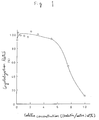
- the amount of addition of gelatin was varied to provide aqueous solutions of different gelatin concentrations: namely, 0.0 wt%, 0.1 wt%, 0.5 wt%, 1.0 wt%, 3.0 wt%, 5.0 wt%, 7.5 wt% and 10.0 wt%.
- the aqueous solutions were allowed to mature for 1 hour at the room temperature, and was made to react by being heated to and maintained at 100°C, with the reaction time varied up to 10 hours.
- the reaction product obtained through 10-hour reaction was filtrated and the filtrate was rinsed with water followed by drying,whereby white crystals were obtained.
- the white crystals were confirmed to be faujasite, through a powder X-ray diffraction analysis. It was also confirmed that the crystals are zeolite Y, as a result of measurement of lattice constant.
- Fig. 1 shows the yields of the reaction products. It will be seen that the yield decreases drastically when the gelatin content exceeds 5.0 wt%, thus proving effect of gelatin to retard generation of zeolite Y.
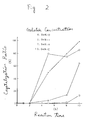
- Aluminosilicate samples were obtained by filtering the reaction products produced with gelatin contents of 0.0 wt%, 1.0 wt%, 7.5 wt% and 10 wt%, as obtained at moments 1 hour, 2 hours, 5 hours, 8 hours and 10 hours after commencement of reaction,. Changes in the rates of generation of zeolite were observed on these filtrates to obtain results shown in Fig. 2. Filtrated matters of aluminosilicate other than crystallized zeolite Y were amorphous and were confirmed to be constituted by aluminosilicate of extremely fine particles having several hundreds of ⁇ , through an X-ray diffraction analysis.
- Fig. 2 shows the yields of these reaction products. It will be seen that the yield decreases drastically when the gelatin content exceeds 5.0 wt%, thus proving effect of gelatin to retard generation of zeolite Y.
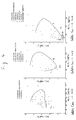
- Samples of zeolite Y were produced under the same reaction conditions as Experiment I while varying the amounts of sodium aluminate and 40 wt% aqueous solution of colloidal silica, and regions in which zeolite Y is obtainable in single phase were examined in each of the cases of the gelatin content being 0.0 wt%, 1.0 wt% and 10.0 wt%, the results being shown in reaction composition chart in Fig. 4.
- zeolite Y when gelatin was not used, zeolite Y was obtainable only in the form of a mixture with herechelite and could not be obtained as a single phase, in the region where the content of silicon oxide was 2.5 mol% or less. In contrast, when gelatin was used in amount of 1.0 wt%, zeolite Y as single phase could be obtained even when the content of silicon oxide was reduced to 1.0 mol%. Reduction in the silicon oxide content means increase in the aluminum oxide content in zeolite Y, which suggests enhancement of the ion-exchanging ability and catalytic activity of the zeolite Y.
- Each of a plurality of triple-inlet flask was charged with 28 cc of water in which were added 0.5 g of sodium hydroxide, 1.5 g of sodium aluminate and 30 g of 40 wt% aqueous solution of colloidal silica. Then, polyvinyl alcohol (saponification value 98.5%, polymerization degree 2400) was added to the respective mixtures so as to form aqueous solutions having polyvinyl alcohol contents of 0.0 wt% and 0.1 wt%. The aqueous solutions were then stirred and allowed to mature for 15 hours at the room temperature. The reaction products were then filtered and the filtrates were rinsed with water followed by drying, whereby samples white powders of zeolite A were obtained.
- Experiment V was conducted to examine the ion exchanging ability of the product, by using th samples of ultra-fine aluminosilicate particles obtained in Experiment I.
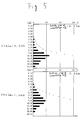
- the ion-exchanging ability was measured by putting the sample in an aqueous solution of strontium chloride and calculating the amount of strontium consumed through exchange of ions. The results of the measurement are shown in Fig. 6.
- the sample obtained with reaction time being zero exhibits only a small ability of ion exchange.
- the amorphous phases obtained through 1-hour or longer reactions showed ion exchanging ability equivalent or superior to that of zeolite.
- a reaction vessel made of a stainless steel having an internal volume of 5 l was charged with 1200 cc of water and 103 g of gelatin. The mixture was stirred to allow gelatin to be uniformly dissolved in water, thus forming a water-soluble solvent. Then, 540 g of 40 wt% aqueous solution of coloidal silica was added to the solvent and stirred so as to be uniformly dispersed in the solvent. Meanwhile, an aqueous solution was prepared by dissolving 160 g of sodium hydroxide and 56 g of sodium aluminate in 370cc of water. The thus-prepared aqueous solution was gradually added to and mixed with the solvent containing the above-mentioned dispersed phase at 30°C, and the mixture was strongly agitated by a strong shearing homo-mixer go as to form a cake.
- the cake was then left for 1 hour at the room temperature for maturing and was then heated to and maintained at 100°C for 10 hours for reaction.
- the reaction product was filtered and the filtrate was rinsed with water, followed by drying, whereby white powder of zeolite Y was obtained.
- zeolite Y was synthesized by the same process as Experiment VI except that gelatin was not added.
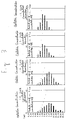
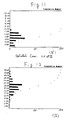
- Fig. 9 shows the results of measurement of particle size distribution of the thus obtained comparative example of zeolite. It will be seen that the comparative example has a mean particle size of 3.96 »m which much greater than that of the product of Experiment VI. The particle size distribution with also was 0.8 to 10 »m, which also is much greater than that of the product of Experiment VI.
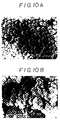
- Figs. 10A and 10B show electron-microscopic photos of the product of Experiment VI and the product of the comparison example. It will be seen that the product of Experiment VI,synthesized by using gelatin dissolved in the solvent, exhibits much smaller particle sizes with higher degree of uniformity, as well as rounded polygonal configurations approximating spheres, as compared with the product of comparison example prepared by the conventional; process employing no gelatin. Thus, the superiority of the product produced by Experiment VI in accordance with the present invention is proved not only from the results of measurement but also through electron-microscopic observation.
- Aluminosilicate was synthesized and white powder of zeolite A was obtained by the same process as Experiment VI except that the amounts of coloidal silica, sodium aluminate and sodium hydroxide were respectively changed to 300 g, 187 g and 62 g.
- zeolite A was synthesized by the same process as Experiment VII except that gelatin was not added.
- Fig. 12 shows the results of measurement of particle size distribution of the thus obtained comparative example of zeolite. It will be seen that the comparative example has a mean particle size of 6.81 »m which much greater than that of the product of Experiment VI. The particle size distribution with also was 1.0 to 10 »m, which also is much greater than that of the product of Experiment VI.
- Figs. 13A and 13B show electron-microscopic photos of the product of Experiment VI and the product of the comparison example. It will be seen that the product of Experiment VII, synthesized by using gelatin dissolved in the solvent, exhibits much smaller particle sizes with higher degree of uniformity, as well as rounded polygonal configurations approximating spheres, as compared with the product of comparison example prepared by the conventional process employing no gelatin. Thus, the superiority of the product produced by Experent VII in accordance with the present invention is proved not only from the results of measurement but also through electron-microscopic observation.
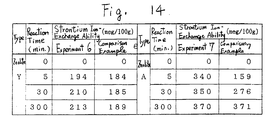
- the Fig.14 shows that the zeolite produced by the Experiment VI and VII have a rapid reaction velocity, comparing to the zeolite produced by the comparison example VI and VII, and some zeolite have a high ion-exchanging ability, thus it is proved that this invention is superior.
Landscapes
- Chemical & Material Sciences (AREA)
- Organic Chemistry (AREA)
- Life Sciences & Earth Sciences (AREA)
- General Life Sciences & Earth Sciences (AREA)
- Geology (AREA)
- Inorganic Chemistry (AREA)
- Silicates, Zeolites, And Molecular Sieves (AREA)
Priority Applications (4)
| Application Number | Priority Date | Filing Date | Title |
|---|---|---|---|
| JP1271363A JPH03131514A (ja) | 1989-10-18 | 1989-10-18 | イオン交換能等の機能を有した超微粒子アルミノ珪酸塩 |
| DE69112377T DE69112377T2 (de) | 1989-10-18 | 1991-04-16 | Mikroteilige Aluminosilikaten und Verfahren zu ihrer Herstellung. |
| EP91303358A EP0509164B1 (en) | 1989-10-18 | 1991-04-16 | Micro-particulate aluminosilicate and process for producing the same |
| US07/686,517 US5183650A (en) | 1989-10-18 | 1991-04-17 | Micro-particulate aluminosilicate and process for producing the same |
Applications Claiming Priority (2)
| Application Number | Priority Date | Filing Date | Title |
|---|---|---|---|
| JP1271363A JPH03131514A (ja) | 1989-10-18 | 1989-10-18 | イオン交換能等の機能を有した超微粒子アルミノ珪酸塩 |
| EP91303358A EP0509164B1 (en) | 1989-10-18 | 1991-04-16 | Micro-particulate aluminosilicate and process for producing the same |
Publications (2)
| Publication Number | Publication Date |
|---|---|
| EP0509164A1 EP0509164A1 (en) | 1992-10-21 |
| EP0509164B1 true EP0509164B1 (en) | 1995-08-23 |
Family
ID=40227707
Family Applications (1)
| Application Number | Title | Priority Date | Filing Date |
|---|---|---|---|
| EP91303358A Expired - Lifetime EP0509164B1 (en) | 1989-10-18 | 1991-04-16 | Micro-particulate aluminosilicate and process for producing the same |
Country Status (4)
| Country | Link |
|---|---|
| US (1) | US5183650A (OSRAM) |
| EP (1) | EP0509164B1 (OSRAM) |
| JP (1) | JPH03131514A (OSRAM) |
| DE (1) | DE69112377T2 (OSRAM) |
Families Citing this family (4)
| Publication number | Priority date | Publication date | Assignee | Title |
|---|---|---|---|---|
| US6306363B1 (en) * | 1998-05-29 | 2001-10-23 | Tosoh Corporation | Fine low silica faujasite type zeolite and process for its production |
| US6894019B2 (en) * | 2000-12-18 | 2005-05-17 | Kao Corporation | Base particles and detergent particles |
| US8177867B2 (en) * | 2008-06-30 | 2012-05-15 | Nano Dispersions Technology Inc. | Nano-dispersions of coal in water as the basis of fuel related technologies and methods of making same |
| US20130074396A1 (en) | 2008-06-30 | 2013-03-28 | Gustavo A. Núñez | Nano-dispersions of carbonaceous material in water as the basis of fuel related technologies and methods of making same |
Family Cites Families (13)
| Publication number | Priority date | Publication date | Assignee | Title |
|---|---|---|---|---|
| US4416805A (en) * | 1978-12-20 | 1983-11-22 | J. M. Huber Corporation | Synthesis of zeolites of small and uniform size having a high magnesium exchange capacity |
| GB2040900B (en) * | 1978-12-20 | 1983-05-11 | Huber Corp J M | Zeolites of small particle size |
| IT1165442B (it) * | 1979-01-26 | 1987-04-22 | Montedison Spa | Zeoliti di tipo a,ad elevato grado di cristallinita' e a granulometria fine e processo per la loro produzione |
| DE2941636A1 (de) * | 1979-10-13 | 1981-05-07 | Degussa Ag, 6000 Frankfurt | Verfahren zur kontinuierlichen herstellung feinstteiliger zeolithischer natriumaluminiumsilikate |
| US4372931A (en) * | 1980-05-30 | 1983-02-08 | Air Products And Chemicals, Inc. | Microcrystalline synthetic faujasite |
| JPS5711819A (en) * | 1980-06-24 | 1982-01-21 | Mitsubishi Heavy Ind Ltd | Preparation of crystalline zeolite |
| JPS58208127A (ja) * | 1982-05-27 | 1983-12-03 | Nippon Chem Ind Co Ltd:The | 懸濁安定性のよいゼオライトスラリ− |
| DE3363827D1 (en) * | 1983-01-11 | 1986-07-03 | Coal Industry Patents Ltd | Improvements in catalyst production |
| JPS6071518A (ja) * | 1983-09-27 | 1985-04-23 | Chiyoda Chem Eng & Constr Co Ltd | 結晶性アルミノシリケ−トの製造方法 |
| JPS60251121A (ja) * | 1984-05-24 | 1985-12-11 | Agency Of Ind Science & Technol | 微結晶zsm−5型ゼオライトの製造方法 |
| JPS638212A (ja) * | 1986-06-27 | 1988-01-14 | Lion Corp | アルミノ珪酸塩含有スラリ−の製造方法 |
| JPS63162520A (ja) * | 1986-12-26 | 1988-07-06 | Tosoh Corp | 合成マザイトの製造方法 |
| DE3869642D1 (de) * | 1987-02-25 | 1992-05-07 | Exxon Chemical Patents Inc | Herstellung von zeolith-l. |
-
1989
- 1989-10-18 JP JP1271363A patent/JPH03131514A/ja active Granted
-
1991
- 1991-04-16 EP EP91303358A patent/EP0509164B1/en not_active Expired - Lifetime
- 1991-04-16 DE DE69112377T patent/DE69112377T2/de not_active Expired - Fee Related
- 1991-04-17 US US07/686,517 patent/US5183650A/en not_active Expired - Fee Related
Also Published As
| Publication number | Publication date |
|---|---|
| EP0509164A1 (en) | 1992-10-21 |
| JPH0567568B2 (OSRAM) | 1993-09-27 |
| US5183650A (en) | 1993-02-02 |
| JPH03131514A (ja) | 1991-06-05 |
| DE69112377T2 (de) | 1996-03-07 |
| DE69112377D1 (de) | 1995-09-28 |
Similar Documents
| Publication | Publication Date | Title |
|---|---|---|
| US5045519A (en) | Process for the preparation of a catalyst carrier based on aluminosilicates | |
| US5597512A (en) | Method for preparing elongated-shaped silica sol | |
| US8226740B2 (en) | Inorganic material that has metal nanoparticles that are trapped in a mesostructured matrix | |
| EP0722422B1 (en) | Preparation of spheroidal aggregates of platy synthetic hydrotalcite | |
| EP0922673B1 (en) | Low-silica faujasite type zeolite and method for producing the same | |
| EP1725498A1 (en) | Synthesis of zsm-48 crystals with heterostructural, non zsm-48, seeding | |
| WO1994019277A1 (en) | Novel silico-titanates and their methods of making and using | |
| CN110139829A (zh) | 聚铝盐及其在制备高纯度胶体铝-二氧化硅复合颗粒中的用途和沸石 | |
| DE69314500T2 (de) | Mikro-partikel | |
| EP0509164B1 (en) | Micro-particulate aluminosilicate and process for producing the same | |
| WO1987000158A1 (en) | Crystalline zeolite lz-202 and process for preparing same | |
| EP0173901A2 (en) | Process to make small crystallites of ZSM-5 | |
| US4900529A (en) | Process for making crystalline siliceous materials | |
| KR950007159B1 (ko) | 24면체상 규산질 입자 및 그 제법 | |
| Tavare et al. | Silica precipitation in a semi-batch crystallizer | |
| JP2618021B2 (ja) | 真球状ペンタシル型ゼオライト粉体の合成方法 | |
| EP0068796A1 (en) | Method for manufacture of AMS-IB crystalline borosilicate molecular sieve | |
| US4606901A (en) | Deagglomeration of porous siliceous crystalline materials | |
| Singh et al. | Nucleation and growth of zeolite A under reagent controlled conditions. Part II | |
| US4497786A (en) | Deagglomeration of porous siliceous crystalline materials | |
| CN101514003A (zh) | Uzm-5分子筛的制备方法 | |
| CN1030286C (zh) | Zsm-5沸石/硅胶复合催化材料的制备 | |
| Hadan et al. | Synthesis of Fine‐grained NaA‐type Zeolites from Superalkaline Solutions | |
| CA1150223A (en) | Process for producing zeolite a | |
| JP3443878B2 (ja) | 無定形アルミノシリケートおよびその用途 |
Legal Events
| Date | Code | Title | Description |
|---|---|---|---|
| PUAI | Public reference made under article 153(3) epc to a published international application that has entered the european phase |
Free format text: ORIGINAL CODE: 0009012 |
|
| 17P | Request for examination filed |
Effective date: 19920623 |
|
| AK | Designated contracting states |
Kind code of ref document: A1 Designated state(s): DE FR GB |
|
| D17Q | First examination report despatched (deleted) | ||
| GRAA | (expected) grant |
Free format text: ORIGINAL CODE: 0009210 |
|
| AK | Designated contracting states |
Kind code of ref document: B1 Designated state(s): DE FR GB |
|
| REF | Corresponds to: |
Ref document number: 69112377 Country of ref document: DE Date of ref document: 19950928 |
|
| ET | Fr: translation filed | ||
| PLBE | No opposition filed within time limit |
Free format text: ORIGINAL CODE: 0009261 |
|
| STAA | Information on the status of an ep patent application or granted ep patent |
Free format text: STATUS: NO OPPOSITION FILED WITHIN TIME LIMIT |
|
| 26N | No opposition filed | ||
| PGFP | Annual fee paid to national office [announced via postgrant information from national office to epo] |
Ref country code: GB Payment date: 20010402 Year of fee payment: 11 |
|
| PGFP | Annual fee paid to national office [announced via postgrant information from national office to epo] |
Ref country code: FR Payment date: 20010427 Year of fee payment: 11 |
|
| PGFP | Annual fee paid to national office [announced via postgrant information from national office to epo] |
Ref country code: DE Payment date: 20010531 Year of fee payment: 11 |
|
| REG | Reference to a national code |
Ref country code: GB Ref legal event code: IF02 |
|
| PG25 | Lapsed in a contracting state [announced via postgrant information from national office to epo] |
Ref country code: GB Free format text: LAPSE BECAUSE OF NON-PAYMENT OF DUE FEES Effective date: 20020416 |
|
| PG25 | Lapsed in a contracting state [announced via postgrant information from national office to epo] |
Ref country code: DE Free format text: LAPSE BECAUSE OF NON-PAYMENT OF DUE FEES Effective date: 20021101 |
|
| GBPC | Gb: european patent ceased through non-payment of renewal fee |
Effective date: 20020416 |
|
| PG25 | Lapsed in a contracting state [announced via postgrant information from national office to epo] |
Ref country code: FR Free format text: LAPSE BECAUSE OF NON-PAYMENT OF DUE FEES Effective date: 20021231 |
|
| REG | Reference to a national code |
Ref country code: FR Ref legal event code: ST |