EP0507451A2 - Magnetische Dünnfilmspeicheranordnung - Google Patents
Magnetische Dünnfilmspeicheranordnung Download PDFInfo
- Publication number
- EP0507451A2 EP0507451A2 EP92301857A EP92301857A EP0507451A2 EP 0507451 A2 EP0507451 A2 EP 0507451A2 EP 92301857 A EP92301857 A EP 92301857A EP 92301857 A EP92301857 A EP 92301857A EP 0507451 A2 EP0507451 A2 EP 0507451A2
- Authority
- EP
- European Patent Office
- Prior art keywords
- thin film
- magnetic thin
- film memory
- magnetic
- memory element
- Prior art date
- Legal status (The legal status is an assumption and is not a legal conclusion. Google has not performed a legal analysis and makes no representation as to the accuracy of the status listed.)
- Granted
Links
Images




















Classifications
-
- G—PHYSICS
- G11—INFORMATION STORAGE
- G11C—STATIC STORES
- G11C11/00—Digital stores characterised by the use of particular electric or magnetic storage elements; Storage elements therefor
- G11C11/02—Digital stores characterised by the use of particular electric or magnetic storage elements; Storage elements therefor using magnetic elements
- G11C11/14—Digital stores characterised by the use of particular electric or magnetic storage elements; Storage elements therefor using magnetic elements using thin-film elements
-
- G—PHYSICS
- G11—INFORMATION STORAGE
- G11C—STATIC STORES
- G11C11/00—Digital stores characterised by the use of particular electric or magnetic storage elements; Storage elements therefor
- G11C11/18—Digital stores characterised by the use of particular electric or magnetic storage elements; Storage elements therefor using Hall-effect devices
Definitions
- This invention relates to a magnetic thin film memory device designed to record or reproduce information in accordance with the direction of magnetization.
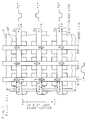
- Fig. 1 is a diagram of a conventional magnetic thin film memory device disclosed in "Magnetic Thin Film Engineering” (p.254, Magnetic Engineering Lecture 5; Maruzen Co., Ltd., 1977).
- a mask with rectangular holes is brought in tight contact with a smooth glass substrate G, onto which a vacuum deposited film of Fe, Ni about 2000 ⁇ thick is formed within in a vacuum apparatus.
- a driving line to drive the magnetic thin film memory elements is obtained by photoetching copper strips on both surfaces of a thin epoxy resin plate or a thin polyester sheet in a manner that the strips on the one surface to be orthogonal to those on the other surface.
- the lines on the both surfaces are rendered word lines and digit lines, respectively, and the memory device is assembled in a manner that each crossing point of the lines is arranged to overlapped onto each memory element.
- the principle of the operating of the memory element will be depicted.
- the lines parallel to the axis of easy magetization in the drawing are word lines W1 through W3, while those orthogonal to the axis of easy magnetization are digit lines D1 through D3.
- the digit line serves also as a sense line to read the storing state of information in the memory element.
- the magnetization in the film is stabilized along the axis of easy magetization corresponding to the storing state of information "0" or "1" in the memory element. Specifically, a white upward arrow in the drawing shows that information "0" is stored and a white downward arrow shows that information "1" is stored in the memory element.
- the digit current 1d is fed as to overlap the trailing edge of the Iw pulse, and in the condition of the magnetization being directed in the axis of hard magnetization, the magnetic field Hd of the polarity corresponding to an information signal is superimposed, thereby determining the direction of magnetization in order to record information in the "1" state or "0" state.
- the value of Iw is set to generate the magnetic field Hw sufficient to turn the magnetization of the magnetic thin film from the axis of easy magnetization to the axis of hard magnetization.
- the value of Id is set to generate the magnetic field Hd about alf the coercive force Hc of the magnetic thin film.
- the upper one reads "1" and writes “0”
- the middle one reads "0” and writes “0” and writes “1”
- the lower one reads "0” and rewrites "0” after reading.
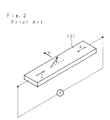
- FIG. 2 shows the principle of a magnetoresistive element disclosed in "Magnetic head and magnetic recording" (pp.182-190, M.Matsumoto; Sogo Denshi Shuppan).
- a reference numeral 101 indicates a magnetoresistive element formed of a magnetized film with the axis of easy magnetization denoted by A.
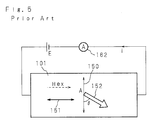
- the magnetoresistance effect is a phenomenon that when a current I runs in the magnetoresistive element 101 to impress an external magnetic field H, thereby to change the direction of magnetization, resistance of the magnetoresistive element is changed by an angle of the direction of the current I to the direction of magnetization M corresponding to the external magnetic field H.
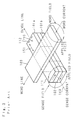
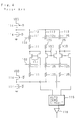
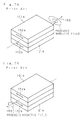
- Figs. 3 and 4 are a perspective view of a conventional magnetic thin film memory element and a circuit diagram of a magnetic thin film memory device using the conventional element revealed in "Reprogrammable Logic Array Using M-R Elements" (pp.2828-2830, IEEE Transactions on Magnetics, Vol. 26, No. 5; Sep., 1990).
- reference numerals represent respectively: 101a, 101b a magnetic thin film of permalloy or the like having the magnetoresistance effect: 102 a metallic thin film of copper ,etc.
- the word line 103 is formed orthogonal to a current running in the magnetic thin films 101a, 101b, and parallel to the axis of easy magnetization A of the magnetic thin films 101a, 101b.
- the above magnetic thin film memory device operates in a maner as follows. First of all, the magnetoresistance effect will be explained below. As shown in Fig. 5, an external magnetic field Hex is applied in the direction of the axis of hard magetization 151 so as to direct the magnetization 152 of the magnetic thin film 101 at an angle ⁇ to the direction of the axis of easy magnetization 150. At this time, by impressing a voltage E to both ends of the magnetic thin film 101 and measuring a sensor current (i) by an ammeter 162, the relation between the direction of magnetization and current (i) becomes as indicated in a graph of Fig. 6.
- the direction of the magnetic field generated by the current is the direction of the axis of that magnetization 151 of the magnetic thin film 101, thereby to turn the direction of magnetization 152 (referring to Fig. 5) to be the direction of the axis of hard magnetization 151, if a sufficient amount of current is allowed to flow.
- a current is supplied to the sense line 112 to determine the direction of magnetization.
- the magnetic field generated by this current is reverse in direction between the magnetic thin films 101a and 101b, both are along the axis of easy magnetization 150.
- the direction of magnetization can be determined by shutting off the current of the word line 103.
- the direction 152a, 152b of magnetization of the magnetic thin films 101a, 101b are determined by the direction of a current 163 running in the sense line 112.
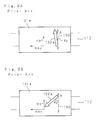
- Fig. 8 is a bottom view when a smaller current than in recording is allowed to flow in the word line 103.
- the direction of magnetization 152a is inclined ⁇ , to the direction of the axis of easy magetization 150 because of the magnetic field Hex generated by the current running in the word line 103. This fact holds true both in Figs. 8A and 8B except that the angle ⁇ , is plus or minus.
- a magnetic field Hsf is generated by the sense line 112 as shown in Fig. 9.
- the direction of magnetization 152a is determined by the external magnetic field 60.
- An angle ⁇ 2 of the direction of magnetization 152a to the direction of the axis of easy magnetization 150 is varied in accordance with the recorded state of magnetization, and the recorded state of magnetization can be detected as an increase or decrease of the electric resistance as shown in Fig. 6.
- the operation of the memory device will be discussed with reference to Fig. 4.
- recording only the memory element 11 having both the word line 103 and the sense line 112 simultaneously turned on is driven.
- the recording state is determined by the direction of the current running in the sense line 112 as described before, the direction of the current is decided by the switching element.
- the potential at a connecting point x is compared with that at a connecting point Z of the dummy line 113 by the auto zero circuit 115 and the potential difference is stored therein. Thereafter, by supplying a current to the word line 103, the recording state of the element is detected according to whether the potential difference becomes larger or smaller than the stored difference.
- the memory elements 111 in the conventional magnetic thin film memory device are connected in series to the sense line 112, resistances of the memory elements 111 works in series, making the impedance of the sense line 112 larger in proportion to the number of the connecting memory elements 111.
- the signal is detected by the static resistance of the sense line 112, thus requiring the comparative resistance 125.
- the temperature compensation of the resistance of each memory element 11 becomes necessary, therefore the comparative resistance 125 must be formed of a magnetic thin film.
- the prior art is disadvantageous in its complicated structure with little allowance of design.
- ferromagnetic alloy made of Ni, Fe, Co or the like used conventionally as a magnetoresistive element for read-out is magnetized thin film having horizontal magnetic anisotropy.
- a large external magnetic field is needed against a demagnetizing field in order to change the magnetization M in a perpendicular direction to the film surface. Therefore, the conventional magnetoresistive element is poorly low in detecting sensitivity to the magnetic field perpendicular to the film surface.
- This invention has been devised to solve the aforementioned disadvantages, and has for its essential object to provide a magnetic thin film memory device realizing good S/N ratio thereby to record/reproduce information stably even from a small size memory element, and besides lowering the power consumption, enhancing the information transfer rate, and realizing high recording density.
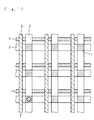
- a magnetic thin film memory element is represented by a reference numeral 1.
- a current line 2 and a voltage line 3 are mounted to the magnetic thin film memory element 1, and orthogonal to each other approximately at the center on the magnetic thin film memory element 1.
- the magnetic thin film memory element 1 is magnetic thin film with perpendicular magnetic anisotropy.
- a rare earth-transition metal alloy e.g., GdCo, HoCo, GdHoCo, TbHoCo, GdFeCo will be cited.
- a current J In order to read information from the magnetic thin film memory element 13b which is magnetized downward, a current J should be fed to a current line 2b to read the voltage change Vhj of a voltage line 3c. Likewise, for reading information from a magnetic thin film memory element 11c magnetized upward, a current J′ should be fed to a current line 2c and the voltage change Vhj′ of a voltage line 3a should be read. At this time Vhj and Vhj′ are reverse in direction.
- recording lines 4 and 5 are orthogonal to each other, and shifted a little from the magnetic thin film memory element 1 in order to apply a magnetic field onto the magnetic thin film memory element 1 in a perpendicular direction thereto, generated by supplying currents Ix and Iy.
- the following description is related to the case of directing the magnetization of the memory element 13b downward. If the current Ix is supplied to a lateral recording line 4c in a direction shown by an arrow ⁇ , a magnetic field Hix is generated. On the other hand, when the current Iy is supplied to a vertical recording line 5b in a direction of a arrow ⁇ a magnetic field Hiy is generated.
- the magnetization of the magnetic thin film memory element 1 is not changed by supplying either of the currents Ix or Iy, but is changed only when both the magnetic fields Hix and Hiy are generated by the current Ix and Iy.
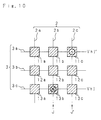
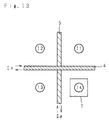
- Areas where both the magnetic fields Hix and Hiy are applied are areas 12 and 14 divided by the recording lines 4, 5 as shown in Fig. 13.
- the magnetic thin film memory element 1 is provided only in he area 14, it is possible to change the magnetization of the magnetic thin film memory element 1 to upward or downward by reversing the direction of the currents Ix and Iy.
- the magnetization of the magnetic thin film memory element 1 is directed downward by supplying the current Ix in the direction ⁇ and the current Iy in the direction ⁇ .
- the magnetization direction of the memory element 1 is directed upward by supplying the current Ix in the direction ⁇ and the current Iy in the direction ⁇ .
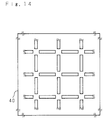
- a mask 40 with rectangular holes (for example, 0.1 ⁇ m X 1.2 ⁇ m) is held in tight contact with a glass substrate, as illustrated in Fig. 14.
- a conductor film of Cu, Au, Al ,etc., 0.5 ⁇ m thick is formed as a reproducing line through sputtering or the like.
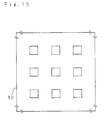
- another mask 50 with rectangular holes (0.5 ⁇ m square) as shown in Fig. 15 is brought in tight contact onto the mask 40 in a manner that each side of the rectangular hole overlaps one end of the conductor film of Cu, Au, Al, etc.
- a GdCo film as the magnetic thin film memory element 1 about 2000 ⁇ is formed through sputtering with a bias voltage (-50V).
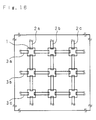
- the magnetic thin film memory element 1 is connected to the reproducing lines 2, 3 as indicated in Fig. 16.
- a di-electric film of SiNx or the like 0.1 ⁇ m thick is formed as a protecting film onto the magnetic thin film memory element 1 and reproducing lines 2, 3.
- the coercive force of the GdCo film used as the magnetic thin film memory element 1 in Embodiment 1 is 40 Oe, and the recording currents Ix, Iy are constant 15mA.
- the pattern cycle is 2 ⁇ m, the magnetic thin film memory element 1 is 0.5 ⁇ m square and the center distance between the recording line and magnetic thin film memory element 1 is about 1 ⁇ m.
- the magnetic field generated by each recording line and applied to the central part of the magnetic thin film memory element 1 is approximately 30 Oe.
- the magnetic force exceeds enough the coercive force 40 Oe of the magnetic thin film memory element 1 only when both magnetic fields are superimposed, whereby good recording is achieved.
- a voltage of approximately 4.5mV is impressed to both ends of the magnetic thin film memory element 1 through the current line 2.
- the voltage change on the voltage line 3 is about 40 ⁇ V, assuring good reading.
- the following films are formed in the following order on a silicon substrate through sputtering.
- the magnetic thin film memory element 1 is formed of TbHoco having the axis of easy magnetization in a perpendicular direction and the coercive force of 30 Oe.
- the pattern cycle is 2 ⁇ m
- the magnetic thin film memory element 1 is 0.5 ⁇ m square
- the center distance between the recording lines 4, 5 and magnetic thin film memory element 1 is approximately 1 ⁇ m.
- the number of the elements is 1000 X 1000.
- a current 10 mA is supplied through the recording lines 4, 5.
- the magnetic field generated by each recording line 4, 5 at the central part of the magnetic thin film memory element 1 is about 20 Oe. Only when both magnetic fields are superimposed, the magnetic force is fully exceeds the coercive force of the memory element 1, thus realizing good recording.
- a voltage of 5V is impressed to both ends of the current line 2, whereby a current of about 3.5mV is applied to both ends of each magnetic thin film memory element 1.
- the voltage change appearing on the voltage line 3 is about 30 ⁇ V. Accordingly, good reading is achieved by sufficiently larger read-out signal than the thermal noise.
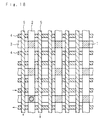
- recording lines 4, 4, 5, 5 are provided on both sides of the magnetic thin film memory element 1.
- currents are supplied in reverse directions to tie recording lines 4, 4 or 5, 5, favorable recording is accomplished. More specifically, when directing the magnetization of the memory element 13a marked by a circle in Fig. 18 to be downward for recording, the currents are fed to the four recording lines in the vicinity of the memory element 13a in respective directions shown by arrows. Meanwhile, in order to direct the magnetization of the memory element 13a upward for recording, the currents should be fed in the opposite directions to those shown by the arrows. In this case, half the amount of current is enough to one recording line in comparison with when the recording lines are provided on one side of the magnetic thin film memory element 1.
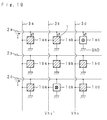
- Fig. 19 is a conceptual diagram of the structure of Embodiment 4 of this invention, wherein reference numerals 1aa, 1ab,..., 1cc are magnetic thin film memory elements, and 2 and 3 are a current line and a voltage line mounted to the magnetic thin film memory elements 1, respectively.
- a magnetic thin film having perpendicular magnetic anisotropy is employed as the magnetic thin film memory element 1.
- GND is the ground.
- a current I For reading out information from the magnetic thin film memory element 1cb magnetized downward, a current I should be fed to a current line 2c and the voltage change Vhj′ of a voltage line 3b at that time should be detected.
- the current I should be supplied to a current line 2a and the voltage change Vhj of a voltage line 3c at that time should be read.
- the voltage generated at the time is the anomalous Hall voltage between the voltage line 3 and the grounded point of the current line 2, which is plus or minus depending on whether the memory element is magnetized downward or upward. Accordingly, the information can be read out by the difference in the recorded direction of magnetization.
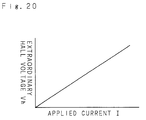
- the relation between the current I applied to the current line 2 and the voltage Vh (extraordinary hall voltage) appeared in the voltage line 3 is indicated in Fig. 20.
- the impressed current I is increased, the voltage change becomes larger, thereby improving the S/N ratio of a reproducing signal and enhancing the integration density of the magnetic thin film memory element 1.
- the temperature of the wiring may rise in accordance with increase in the amount of the current I fed to the current line 2, resulting in a disconnection in the worst case.
- the temperature of the magnetic thin film memory element 1 itself also rises.
- the extraordinary hall voltage Vh is reduced according to the temperature rise of the element, and therefore the increase in the impressing amount of the current I has limitation.
- the pulse width is better to be as short as possible so long as the anomalous Hall voltage Vh changes with readable force.
- the power consumption as a whole of the memory device can be reduced by the pulse current.
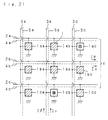
- Fig. 21 is a conceptual diagram showing the structure of Embodiment 5 of this invention.
- recording lines 4, 5 orthogonal to each other are shifted slightly from the magnetic thin film memory element 1, so that a perpendicular magnetic field is impressed to the magnetic thin film memory element 1 when currents Ix and Iy are supplied to the recording lines.
- currents Ix and Iy are supplied to the recording lines.
- the case of directing the magnetization of the magnetic thin film memory element 1bb downward for recording will be described.
- a perpendicular magnetic field HiX is applied to the magnetic thin film memory element 1bb.
- the recording line 4b may be abbreviated.
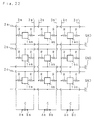
- FIG. 22 illustrates a magnetic thin film memory element employing a different reproducing method from Embodiment 4 of Fig. 19. More specifically, the different three points are:
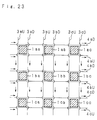
- Fig. 23 shows a magnetic thin film memory element employing a different recording method from Embodiment 5 in Fig. 21.
- the current line 2 and the voltage line 3 are also used as the recording lines according to Embodiment 5.
- recording and reproducing will be considered separately here and only tie lines necessary for recording are indicated in Fig. 23.
- the magnetization of the magnetic thin film memory element 1ac is intended to be directed upward for recording, the currents should be fed to the recording lines 4aU and 3cU in the direction shown by respective arrows.
- the current should be supplied to the recording lines 4aD and 3cD in the direction shown by respective arrows.
- the different recording lines are used between the upward recording and downward recording. Accordingly, it is not necessary to reverse the direction of the currents to the recording lines, which eliminates the reversing time of the current direction. That is, the data transfer rate in recording can be accelerated.
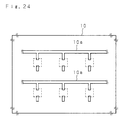
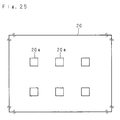
- a mask 10 as shown in Fig. 24 is held in tight contact with a substrate and then, a conductor of Cu, Au, Al or the like is formed as the reproducing current line 2 through a hole 10a by sputtering ,etc. (parts indicated by dotted lies will be described later). Thereafter, a mask 20 shown in Fig. 25 is brought into tight contact with the substrate in a manner that the upper and lower sides of a rectangular hole 20a of the mask 20 overlap the corresponding ends of the conductor formed earlier (as indicated by the dotted lines in Fig. 24.).
- An HoCo film is formed to be a magnetic thin film memory element by sputtering ,etc.
- An insulating film is formed by liftoff method, etc. except where the magnetic thin film memory element 1 is formed.
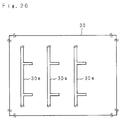
- a mask 30 of Fig. 26 is tightly attached to the substrate and a conductor is formed of Cu, Au, Al ,etc. as the reproducing voltage line 3 through a hole 30a by sputtering or the like to be in touch with the magnetic thin film memory element 1.
- a dielectric film of SiNx, etc. is formed as a protecting film on the voltage line 3 and the magnetic thin film memory element 2.
- strips of Cu wire are provided orthogonal to each other and the both shifted slightly from the rectangular magnetic thin film memory elements 2 (with reference to Fig. 21.)
- a protection coating of resin is applied in the last place.
- the coercive force Hc of the HoCo film in Embodiments 4 through 7 is 30 Oe and the pattern cycle is 2 ⁇ m.
- the magnetic thin film memory element 1 is 0.5 ⁇ m square.
- the center distance between the recording line and the magnetic thin film memory element 1 is 1 ⁇ m.
- the recording currents Ix, Iy, I ⁇ , I ⁇ are constant as shown in Table 1 below.
- the coercive force 30 Oe of the magnetic thin film memory element 1 is sufficiently exceeded, and therefore good recording is carried out.
- a pulse current of the pulse width 50 nsec is fed to the current line 2 so as to impress about 20 mV to both ends of the magnetic thin film memory element 1, the voltage change of about 20 ⁇ V appears at the voltage line 3, that is, good reading is gained.
- Fig. 27 there is shown the structure of a magnetic thin film memory delice according to Embodiment 8 of this invention.
- Fig. 27A being a side view
- Fig. 27B being a cross sectional view taken along the line A-A of Fig. 27A.
- an HoCo film is formed as the magnetic thin film memory element 1 in the similar manner to Embodiments 4 through 7.
- the recording lines 4, 5 are formed while a insulating film of alumina or the like is held therebetween so as to insulate the both lines.
- Embodiments 4 through 7 are repeated to sequentially form the layers of the magnetic thin film memory device.
- the reproducing voltage line 3 which connects the layers with each other is formed by forming through-holes and connecting conductors.
- the coercive force Hc of the Hoco film of Embodiment 8 is 30 Oe.
- a constant current 10 mA is supplied to each of the recording lines 4aa and 5aa.
- the magnetic field generated by each of the recording limes 4aa and 5aa at the central part of the magnetic thin film memory element 1aaa has the magnetic force of 20 Oe. Only when both magnetic fields are super-imposed, the coercive force 30 Oe of the memory element 1 is fully exceeded to achieve favorable recording. Similar to Embodiment 5 in Fig. 21, the additional magnetic field may be applied by supplying a constant current through the reproducing current line 2.
- a pulse current of the pulse width 50 nsec is applied to the current line 2 so as to impress about 20mV to both ends of the magnetic thin film memory element 1.
- the voltage change of about 5 ⁇ V is detected at the voltage line 3aa, and good reading is done.
- the voltage change decreases more as the number of the layers of the magnetic thiin film memory elements 1 increases, and therefore it is necessary to determine the number of layers to ensure the detection of the voltage change.
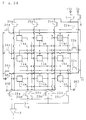
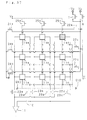
- Fig. 28 shows the structure of a magnetic thin film memory device of Embodiment 9 of this invention, in which nine magnetic thin film memory elements 1aa-1cc are formed in matrix.
- Referring numerals 22a through 22c, 23a through 23c, 24a through 24c, 25a through 25c, 6, 7 represent switches comprised of a transistor, and 8 is a capacitor, 9 is a amplifier such as an operational amplifier, etc.
- V1, V2 are positive voltage sources and GND indicates the ground.
- each magnetic thin film memory element (referred to as a memory element hereinafter) 1aa-1cc is turned upward or downward.
- the upward magnetization corresponds to "0" of a binary digital data
- the downward magnetization corresponds to "1" of a binary digital data.
- the resistances of the recording lines are so set that the currents iX and iY are approximately equal to each other. Therefore, a magnetic field is generated around the direct current iX, iY based on the Ampere's law.
- the magnetic field applied by the direct current iX to the memory elements 1ac, 1ab is upward, having the magnetic force of Hx.
- the magnetic field applied by the direct current iY to the memory elements 1ac, 1bc is also upward, with the magnetic force of Hy.
- the direction currents iX are iY generate magnetic fields to the memory elements 1bc and 1ab, respectively, since the distance of the magnetic fields is farther, the influence of the magnetic fields is negligible. Accordingly, the force of the magnetic fields acting to the memory elements 1ab, 1ac, 1bc is Hx, Hx + Hy, Hy, respectively.
- the magnetic fields acting to the memory elements 1ab, 1ac, 1bc are approximately Hx, 2Hx, Hx, respectively.
- the source voltage V2 may be adjusted to satisfy Hx ⁇ Hc and 2Hx > Hc it becomes possible to selectively magnetize the memory element 1ac alone upward.
- the switches 24a, 25c and 7 should be turned on. Information is recorded to the other memory elements in the same manner as above.
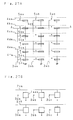
- the extraordinary Hall effect is a phenomenon caused when a current is fed to a ferromagnetic substance or ferrimagnetic substance. In this case, a voltage is generated in a perpendicular direction to the both direction of current and magnetization. As shown in Figs. 30A and 30B, when the direction of magnetization is reversed, the generated voltage is also reversed.
- the reproduction process of the magnetic thin film memory device utilizing the above-described extraordinary Hall effect will be depicted now.
- the switch 22a is turned on, resulting in a flow of a current running downward in the memory elements 1aa, 1ab, 1ac in Fig. 28.
- the potential difference between the electrodes ⁇ , ⁇ at both lateral ends of the memory elements 1ac at this time the direction of magnetization is reproduced as the principle.
- the potential difference is superimposed on a signal as a bias voltage, thus causing an error.
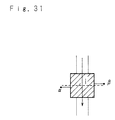
- the shape of the elements should be highly accurate. Particularly, as the size of the elements is required to be about 1 ⁇ m for realizing higher recording density, an advanced processing technique becomes necessary. For example, if the positions of the reading electrodes ⁇ , ⁇ are oppositely shifted from the center as indicated in Fig. 31, such bias voltage is brought about as to render the electrode ⁇ higher than the electrode ⁇ in potential.
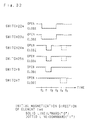
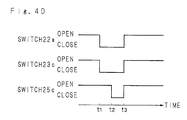
- Fig. 32 is a timing chart of each switch in reproducing the recording state in the memory element 1ac.
- the switches not indicated in the chart are all open.
- the switches 22a, 23c are closed, holding the memory element 1ac in tie reproducing state.
- the switches 24a, 25c, 6 are also closed, so that an upward magnetic field 2Hx (>Hc) is applied to the memory element 1ac.
- the magnetic thin film used for the memory elements 1aa-1cc has perpendicular magnetic anisotropy.
- Ferrimagnetic in substance such as CoCr, Ba ferrite and the like may be used as the magnetic thin film with perpendicular magnetic anisotropy, but a large saturation magnetization Ms and the resultant demagnetizing field of the substance increase the perpendicular magnetic saturation field Hs. Therefore, the ferrimagnetic substance is not suitable for the memory elements.
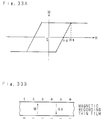
- the recording magnetic field 2Hx to satisfy 2Hx > Hc is necessary, in actual use, 2Hx > Hs should be satisfied. This will be explained with reference to Fig. 33.
- Fig. 33A is a hysteresis loop of a general magnetic thin film with perpendicular magnetic anisotropy.
- the ordinate describes the magnetization M, while the abscissa represents the applied perpendicular magnetic field H.
- the coercive force Hc is defined by the magnetic field when it crosses 0 point of the magnetization.
- the saturation field Hs is defined by the magnetic field where the magnetization is saturated. Therefore, the recording magnetic field necessary to saturate tie magnetization, i.e., 2Hx satisfying the inequality (3) is required to obtain sufficiently large reproducing Hall signal.
- the demagnetizing field Hd against the magnetization M is, as shown in Fig. 33B, produced by the magnetization M, which is directed to obstruct the magnetization.
- M Ms (Ms is the saturation magnetization)
- Ms Ms (Ms is the saturation magnetization)
- the film made of RE-TM (rare earth-transition metal) ferrimagnetic substance wich is easy to control the value of the saturation magnetization Ms during the manufacture is employed. Since RE and TM are bound in antiparallel in the ferromagnetic substance, the saturation magnetization Ms can be controlled by changing the ratio of the composition.
- the saturation magnetization Ms of a representative RE-TM ferrimagnetic substance Gd x Fe 1-x to the composition ratio x at room temperatures is shown in Fig. 34.
- Ms is zero, which composition is specifically called as the compensation composition.
- RE becomes excessive, which composition is called as RE rich.
- TM rich it is called as TM rich.
- Fig. 35 indicates the dependence of the coercive force Hc and saturation magnetic field Hs of the same material on the composition ratio x at room temperatures.
- the magnetic thin film does not interact with the external magnetic field Hext, resulting in the coercive force to be infinity.
- the saturation magnetization Ms is increased, thereby enlarging the interaction of Hext with magnetic thin film. Therefore, as a result of the reversal of magnetization with a small Hext, Hc becomes smaller.
- the saturation magnetic field Hs approximately agrees with the coercive force Hc in the vicinity of the compensation composition.
- Hs becomes larger that Hc and becomes minimum when the composition ratio is X1 or X2. Accordingly, if the composition ratio in the vicinity of X1, X2 is selected, the recording magnetic field is possible to be smaller, contributing to saving of electricity.
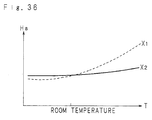
- the composition ratio X2 in RE rich is more advantageous. The reason is that the influence of the temperature change on the saturation magnetic field Hs of TM rich film is generally larger than that of RE rich film as exemplified for the magnetic thin film of Gd X Fe 1-X in Fig. 36. If the influence of the temperature change on Hs is smaller, it is unnecessary to change the recording magnetic field force even if the surrounding temperature changes, thus making it possible to record stably.
- Fig. 37 shows the structure of a magnetic thin film memory device according to Embodiment 10, in which the lines related to recording are indicated by thick lines and the dotted lines. For example, for recording information in the memory element 1ac, the switches 24a, 25c are closed, with the switch 6 closed in the case of recording "0".
- Fig. 38 shows the state of the current running at this time in the thick and dotted lines in the vicinity of the memory element 1ac.
- Fig. 38 the difference from Fig. 29 is that the current iY runs across the memory element 1ac, which causes the magnetic field Hy produced near the memory elements 1ac, 1bc to be parallel to the film surface. That is, both the magnetic field Hx produced by the current iX which is applied perpendicularly to the film surface and the magnetic field Hy produced by the current iY which is applied in parallel to the film surface act on the memory element 1ac.
- Figs. 39A, 39B indicate the hysteresis loops of the perpendicular magnetic field Hx with the magnetic field Hy applied in parallel to the film surface or without Hy, respectively.
- the magnetization of the memory element is directed in the Hx direction only when both the magnetic fields Hx and Hy work.
- the states of magnetization in the memory elements 1ab, 1bc are not changed, in tie memory element 1ac is recorded information by upward magnetization.
- the switch 7, in place of the switch 6, should be closed to record "1" through the downward magnetization.
- an RE rich GdFe film i.e., Gd25Fe75 is used as the memory elements 1aa-1cc of Fig. 28.
- the coercive force of this film Hc is 25 Oe
- the saturation field Hs is 30 Oe.
- the switches 24a, 25c, 6 are closed, thereby generating various magnetic fields Hx from the recording lines.
- 15 Oe ⁇ Hx ⁇ 25 Oe it is possible to solely record information to the memory element 1ac.
- the reproducing output immediately decreases eventually to be 0 when Hx ⁇ 12 Oe.
- Hx > 25 Oe not only to the memory element 1ac, but also to the elements 1aa, 1ab, 1bc, 1cc information is recorded. Therefore, sufficient reproduced output is achieved in a small recording magnetic field where 15 Oe ⁇ Hx ⁇ 25 Oe without destroying recorded information except in the memory element 1ac.
- An RE rich GdFe film that is Gd27Fe73 is used as the memory elements 1aa-1cc of Fig. 28.
- the coercive force Hc is 10 Oe, with the saturation field Hs of 50 Oe.
- switches 6, 24a, 25c are closed and various magnetic fields Hx are generated from the recording lines.
- Hx ⁇ 10 Oe memory elements 1aa, 1ab, 1bc, 1cc are also recorded in addition to the memory element 1ac. If Hx ⁇ 5 Oe, even the memory element 1ac cannot be recorded.
- An Re rich GdFe film specifically, Gd22Fe78 is used as the memory elements 1aa-1cc of Fig. 28.
- the film has the coercive force Hc is 200 Oe, and the saturation field Hs is 200 Oe.
- the switches 24a, 25c, 6 are closed so that various magnetic fields Hx are generated from the recording lies. Only the memory element 1ac can be recorded in such a wide area as 100 Oe ⁇ Hx ⁇ 200 Oe. As compared with Embodiment 11, however, five times V2 is required, thereby increasing the power consumption.
- a TM rich GdFe film i.e., Gd17Fe83 is utilized for the memory elements 1aa-1cc in Fig. 28, which has the coercive force Hc of 28 Oe and saturation field Hs of 34 Oe.
- the switches 24a, 25c, 6 are closed to generate various magnetic fields Hx from the recording lines.
- 17 Oe ⁇ Hx ⁇ 28 Oe only the memory element 1ac is recorded.
- the memory element 1ac can be recorded even when a ⁇ 17 Oe, but, the reproduced output suddenly decreases and eventually to 0 when Hx ⁇ 14 Oe.
- a magnetic thin film used in Embodiments 11, 12 is employed as the memory elements 1aa-1cc of Fig. 28 according to this Embodiment 13.
- the recording field Hx is set to be 23 Oe, and the temperature of recording and reproducing is changed.
- the relation between the reproduced output and temperatures in this case is indicated in Fig. 41.
- the reproduced output is not changed at 5-60° C when the RE rich Gd25Fe75 film of Embodiment 11 is used. This means that recording is carried out while the magnetization is saturated in the above temperature range.
- the reproduced output proportionally decreases as the temperature rises to 40° C and to 60° C when the TM rich Gd17Fe83 film of Embodiment 12 is used.
- the relation Hs ⁇ 2Hx cannot by satisfied above around 40° C, whereby recording is made while the magnetization is not saturated. Therefore, the RE rich film represents a smaller change of the saturation field Hs with respect to the temperature change than the TM rich film, thus ensuring stable recording.
- This film has the coercive force Hc of 30 Oe and saturation field Hs of 38 Oe.
- the switces 24a, 25c, 6 are closed and various magnetic fields Hx are generated from the recording lines.
- 19 Oe ⁇ Hx ⁇ 30 Oe information is recorded only to the memory element 1ac. Even wen Hx ⁇ 19 Oe, it is possible to record information to the memory element 1ac.
- the reproduced output immediately decreases and eventually to 0 when Hx ⁇ 15 Oe.
- Hx ⁇ 30 Oe not only the memory element 1ac, but the memory elements 1aa, 1ab, 1cc are recorded. Therefore, if 19 Oe ⁇ Hx,28 Oe is satisfied, it is possible to record information and obtain sufficient reproduced output without destroying information in the other elements than the memory element 1ac.
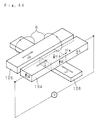
- a magnetic field H in a perpendicular direction to the film surface of a magnetic film 104 having perpendicular magnetic anisotropy is represented by B. Because of the magnetic field in the direction B, a magnetic field H in the magnetic film 104 is directed to a direction perpendicular to the film surface.
- a constant current I is fed to the magnetic film 104 from outside.
- the angle of the magnetization M of the magnetic film 104 to the direction of the current I is 90° .
- ferrimagnetic substance as the magnetic film 104 with perpendicular magnetic anisotropy than ferromagnetic substance in terms of the detection sensitivity of the magnetic field since the demagnetizing field generated in the film of the ferrimagnetic substance is smaller.
- the ferrimagnetic substance provides the film of smaller coercive force.
- a rare earth-transition metal alloy is useful as the ferrimagnetic substance, specifically, such rare earth metal as Gd, Ho, etc. and such transition metal as Ni, Fe, Co, etc. may be employed.
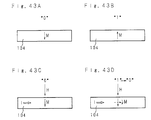
- Fig. 43 is a cross sectional view explanatory of the state of Embodiment 15 where the magnetoresistance effect appears because of the relation between the direction of magnetization M of the magnetic film 104 and the external magnetic field H by the signal line 105.
- Figs. 43A, 43B represent the state without the current J2 and the external magnetic field H, where the upward magnetization M represents information "1", meanwhile the downward magnetization M represents information "0".
- Figs. 43C, 43D when the external magnetic field H is applied perpendicular to the surface of the magnetic film 104 by supplying the current J2 to the signal line 105, the resistance of the magnetic film 104 does not change, if the magnetization M is in the same direction as the external magnetic field H as in Fig.
- the direction of the magnetization M is opposite to that of the external magnetic field H as shown in Fig. 43D, the magnetization M is reversed when the external magnetic field H becomes stronger than the coercive force Hc of the magnetic film 104.
- the angle of the magnetization M to the direction of the current I is other than 90° during the reversal of magnetization M, so that resistance of the magnetic film 104 is increased like pulses. Since the direction of magnetization M is detected from whether the voltage V at both ends of the magnetic film 104 changes or not, it is possible to read out information "0" or "1".
- a word line 106 is provided below the magnetic film 104 so as to impress a bias magnetic field Hw in a direction parallel to the film surface.
- the word line 106 is provided orthogonal to the current I running in the magnetic film 104.
- the magnetization M of the magnetic film 104 is inclined towards the bias magnetic field Hw generated by the current J1 in the word line 106, at an angle ⁇ to a direction A along the axis of easy magnetization.
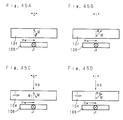
- Fig. 45 is a cross sectional view of the change of the direction of magnetization M when the bias magnetic field Hw is applied to the magnetic film 104 by the word line 106.
- Figs. 45A, 45B show the change when the current J1 is fed to the word line 106
- Figs. 45C, 45D indicate the direction of magnetization M then a bias magnetic field Hb is additionally applied by the signal line 105.
- the magnetization M is inclined ⁇ regardless of the magnetization direction M thereof.
- the downward magnetization M represents "0", and upward magnetization M "1".
- Fig. 46 is a structural diagram when the magnetic film 104 with perpendicular magnetic anisotropy is provided below and adjacent to a recording magnetic film 107.
- the recording magnetic film 107 for recording information has horizontal magnetic anisotropy, the axis of easy magnetization A of which is parallel to the current I running in the magnetic film 104.
- the word line 106 is provided orthogonal to the current I.
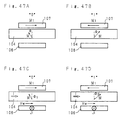
- the magnetization M of the magnetic film 104 is directed upward and turned clockwise or counterclockwise by ⁇ because of the magnetization M 1 of the recording magnetic film 107.
- the relation between M 1 and M is seen from each cross sectional view of Figs. 47A, 47B.
- M 1 directed rightward represents "0"
- the change of the direction of magnetization M of the magnetic film 104 when a minute current J1 is supplied to the word line 106 is shown in cross sectional views of Figs. 47C, 47D.
- the word line 106 may be used as a recording line to record information to the recording magnetic film 107.
- the magnetization M of the magnetic film 104 is upward, but may be downward.
- the word line 106 is provided below the magnetic film 107, it may be arranged above the magnetic film 107.
- Fig. 48 is a structural diagram of the other example of the magnetic thin film memory device having the magnetic film 104 with perpendicular magnetic anisotropy provided below a recording magnetic film 108.
- the magnetic film 108 for recording information has perpendicular magnetic anisotropy
- the word line 106 is provided orthogonal to the current I running in the magnetic film 104.
- the magnetization M of the magnetic film 104 is directed downward.
- the magnetic field Hb generated from the recording magnetic film 108 is smaller than the coercive force Hc of the magnetic film 104 (Hb ⁇ Hc), thereby causing no reversal of the magnetization of the film 104.
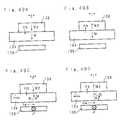
- the relation between the magnetization M of the magnetic film 104 and magetization M 2 of the recording film 108 at this time is indicated in cross sectional views of Figs. 49A, 49B. In the figure, the downward magnetization M 2 represents "0", and the upward magetization M 2 "1".
- the change of the direction of magnetization M of the magnetic film 104 at the supply of the current J1 to the word line 106 is shown in cross sectional views of Figs. 49C, 49D.
- the angle ⁇ between the magnetization M and current I due to the bias magnetic field Hw generated by the current J1 in the word line 106 is different in accordance with the direction of the magetization M 2 of the recording film 108.
- the angle ⁇ of the magnetization M of the film 104 to the current I 90° - ⁇ 1: ⁇ 1 is smaller) becomes larger, and resistance of the magnetic film 104 is reduced.
- the direction of the magnetization M 2 of the recording film 108 is judged by comparing the voltage V at both ends of the film 104, whereby "0" or "1" data is read out.
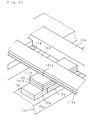
- Fig. 50 is a persprective view of a recording unit of the magnetic thin film memory device.
- a semiconductor device e.g., diode 120 is formed on a part of the sense line 112b (120a is a p-type PN-junction diode and 120b is an n-type PN-junction diode).
- one end of a magnetic thin film memory element 111A consisting of a magnetic thin film 101b, a metallic thin film 102 and a magnetic thin film 101a is formed in contact with the PN-junction diode 120a while an insulator 119A is intervened between memory element 111A and sense line 112b.
- the other end of the memory element 111A is connected to another sense line 112a which is electrically insulated from the sense line 112b by the insulator 119a. Moreover, a word line 103 is arranged across the magnetic thin film 101a via the insulator 119b.
- Fig. 51 is a circuit diagram of the magnetic thin film memory device, for example, 4 bits X 4bits, using the magnetic thin film memory element 111A of Fig. 49 for one bit.
- Reference numerals in Fig. 51 are respectively: 117a, 117b a switching element to select the sense line 112; 118 a switching element to select the word line 103; and 121 an amplifier of the reproduced output.
- this magnetic thin film memory device will be explained in the case where information is recorded to the magnetic thin film memory element 111A hatched in Fig. 51.
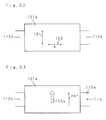
- the direction of the axis of easy magnetization 150 of the magnetic thin film 101a is, as shown in Fig. 52, the direction of the axis of hard magnetization in the prior art (referring to Fig. 3).
- the switching elements 117a 3 , 117b 3 are turned on to supply a recording current Irs (Fig. 53) to the sense line 112.
- the magnetic field Hsf (Fig. 53) generated by the current Irs is approximately parallel to the axis of hard magnetization 151, so that the magnetization 152a is directed to the axis of hard magnetization 151.
- the state where a sufficient amount of the recording current Irs is fed is illustrated in Fig. 53.
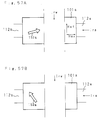
- a switching element 183 is turned on to determine the direction of the current running in the word line 103 by a switching element 114. Since the magnetic field Hex (Fig.
- Figs. 55A, 55B are corresponding to Figs. 54A, 54B, respectively.
- Fig. 55A or 55B The state of the magnetic thin film memory element 111A before data is reproduced is shown in Fig. 55A or 55B.
- the switching elements 117a3, 117b3 are turned on as in recording, thereby impressing a bias magnetic field to the magnetic thin film 101a.
- the current Irs supplied to the sense line 112a should be smaller than at recording (Fig. 56).
- Figs. 56A, 56B are corresponding to Figs. 55A, 55B.
- Figs. 57A, 57B are corresponding to Figs. 55A, 55B and 56A, 56B. Accordingly, it is apparent that the recorded state can be known from the difference of resistance resulting from the magnetoresistance effect (referring to Fig. 7), because the angle of the magnetization 152a to the direction of the current running in the sense line 112a differs depending on the recorded state.
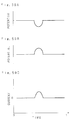
- Figs. 58A, 58B correspond to Figs. 57A, 57B, and Fig. 58C indicates the current of the word line 103.
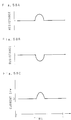
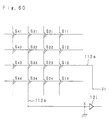
- the potential at point X in Fig. 51 represents the waveform as shown in Fig. 59A which has a downward peak when the recorded magnetization is as in Fig. 55A.
- the potential indicates the waveform with a upward peak as shown in Fig. 59B.
- An alternating current gained by these signals is amplified by an amplifier 121 thereby to obtain a predetermined reproduced output.
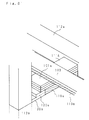
- the magnetic thin film memory device of the foregoing Embodiment 19 is formed flat. If the structure of Embodiment 19 is employed in layers, it is possible to form a memory device of larger scale. Or, the wiring of the magnetic thin film memory elements may be arranged in three dimensions, which will now be depicted with reference to Fig. 61. After the magnetic thin film memory element 111A, diode 120, word line 103, sense line 112a are formed, a through hole is opened toward the n-type PN-junction diode 120b, and the sense line 112b is embedded. The space in Fig. 61 is filled with insulators 119a, 119b. A large-scale memory device is obtained by laminating the layers as manufactured in the above-described manner.
- the switching elements and amplifiers on the first layer of the semiconductor substrate, and forming the memory layers above the second layer.
- the memory layer may be formed in the room of the first layer.
- the sense line 112b is embedded in the through hole in Embodiment 20, the other kind of wiring may be embedded.
- Fig. 62 shows the state were the current Irs is supplied to a magnetic thin film memory element 111B which is formed of TbHoCo or the like perpendicularly magnetized film.
- Fig. 62A shows the case of the upward magnetization
- Fig. 62B indicates the case of the downward magnetization.
- a voltage VH is generated at right angles to the current Irs and the direction of magnetization. This voltage becomes plus or minus depending on the direction of magnetization.
- the magnetic thin film memory element 111B applying the extraordinary Hall effect is shown in Fig.
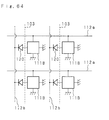
- Figs. 63, 64 are respectively corresponding to Figs. 50, 51.
- the word line 103 is provided adjacent to the lateral side of the memory element 111B.
- the operating principle of the memory device is the same as in the Embodiments using the magnetoresistance effect.
- a reference numeral 180 in Fig. 63 is the grounding line of the memory element 111B.
- Each of the magnetic thin film memory elements 111A, 111B consists of three layers of the magnetic thin film 101a, metallic thin film 102 and magnetic thin film 101b in Embodiments 19 through 21.
- the magnetic field is applied by the current running in the own sense line 112 during recording and reproducing, that is, self-bias system.
- a different bias line may be provided separately while the magnetic thin film memory element connected to the sense line 112 is made of a single magnetic thin film 101a.
- a cross sectional view of a magnetic thin film memory element 111C in such structure as above is indicated in Fig. 65.
- a bias line 181 is provided via the insulator 119 under the sense lines 112a, 112b and magnetic thin film 101a.
- the magnetic field Hsf as the aforementioned embodiments is obtained by the current runing in the bias line 181.
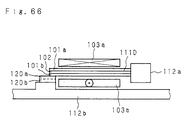
- Fig. 66 is a cross sectional view with a pair of word lines 103a, 103b arranged for the magnetic thin film memory element 111D which corresponds to the element 111A of Fig. 50.
- the diode 120 is connected in series to the magnetic thin film memory element in the above embodiments. Any different arrangement can be employed so long as it forbids the cu rent to run from the one sense line 112b towards the other sense line 112a. For instance, a transistor may be provide in place of the diode, with the same effects achieved.
- the extraordinary magnetoresistance effect may be used except the magnetoresistance effect or extraordinary Hall effect to read the recorded information.
- the magnetic thin film memory element is formed immediately below the recording line, i.e., word line 103, it is possible to form the memory element immediately above the word line.
- the current line constituting the memory device namely, word line 103, sense line 112 may be formed of superconductive wire.
Landscapes
- Engineering & Computer Science (AREA)
- Computer Hardware Design (AREA)
- Mram Or Spin Memory Techniques (AREA)
- Semiconductor Memories (AREA)
- Hall/Mr Elements (AREA)
Applications Claiming Priority (10)
| Application Number | Priority Date | Filing Date | Title |
|---|---|---|---|
| JP39891/91 | 1991-03-06 | ||
| JP3989191 | 1991-03-06 | ||
| JP116415/91 | 1991-05-22 | ||
| JP3116415A JPH04344383A (ja) | 1991-05-22 | 1991-05-22 | 磁性薄膜メモリおよびその読み出し方法 |
| JP3119780A JPH04345987A (ja) | 1991-05-24 | 1991-05-24 | 磁性薄膜メモリおよびその記録,再生方法 |
| JP119780/91 | 1991-05-24 | ||
| JP3181393A JPH0528748A (ja) | 1991-07-23 | 1991-07-23 | 磁性薄膜メモリ |
| JP181393/91 | 1991-07-23 | ||
| JP3324277A JPH05159562A (ja) | 1991-12-09 | 1991-12-09 | 磁性薄膜メモリ及びその記録方法並びにその再生方法 |
| JP324277/91 | 1991-12-09 |
Publications (3)
| Publication Number | Publication Date |
|---|---|
| EP0507451A2 true EP0507451A2 (de) | 1992-10-07 |
| EP0507451A3 EP0507451A3 (en) | 1993-09-08 |
| EP0507451B1 EP0507451B1 (de) | 1998-06-17 |
Family
ID=27522051
Family Applications (1)
| Application Number | Title | Priority Date | Filing Date |
|---|---|---|---|
| EP92301857A Expired - Lifetime EP0507451B1 (de) | 1991-03-06 | 1992-03-04 | Magnetische Dünnfilmspeicheranordnung |
Country Status (4)
| Country | Link |
|---|---|
| US (1) | US5361226A (de) |
| EP (1) | EP0507451B1 (de) |
| KR (1) | KR970009765B1 (de) |
| DE (1) | DE69225920T2 (de) |
Cited By (3)
| Publication number | Priority date | Publication date | Assignee | Title |
|---|---|---|---|---|
| US5420819A (en) * | 1992-09-24 | 1995-05-30 | Nonvolatile Electronics, Incorporated | Method for sensing data in a magnetoresistive memory using large fractions of memory cell films for data storage |
| US5852574A (en) * | 1997-12-24 | 1998-12-22 | Motorola, Inc. | High density magnetoresistive random access memory device and operating method thereof |
| US7072207B2 (en) | 2001-12-21 | 2006-07-04 | Renesas Technology Corp. | Thin film magnetic memory device for writing data of a plurality of bits in parallel |
Families Citing this family (35)
| Publication number | Priority date | Publication date | Assignee | Title |
|---|---|---|---|---|
| US6741494B2 (en) | 1995-04-21 | 2004-05-25 | Mark B. Johnson | Magnetoelectronic memory element with inductively coupled write wires |
| US6064083A (en) * | 1995-04-21 | 2000-05-16 | Johnson; Mark B. | Hybrid hall effect memory device and method of operation |
| MY121607A (en) * | 1995-07-10 | 2006-02-28 | Hyundai Curitel Inc | Grid moving method of object image and apparatus using the same and compaction/motion estimation method using the same and apparatus thereof |
| US5640343A (en) * | 1996-03-18 | 1997-06-17 | International Business Machines Corporation | Magnetic memory array using magnetic tunnel junction devices in the memory cells |
| US5748519A (en) * | 1996-12-13 | 1998-05-05 | Motorola, Inc. | Method of selecting a memory cell in a magnetic random access memory device |
| US5900728A (en) * | 1997-03-20 | 1999-05-04 | International Business Machines Corporation | Alternating current magnetic force microscopy system with probe having integrated coil |
| US5900729A (en) * | 1997-03-20 | 1999-05-04 | International Business Machines Corporation | Magnetic force microscopy probe with integrated coil |
| US6169686B1 (en) * | 1997-11-20 | 2001-01-02 | Hewlett-Packard Company | Solid-state memory with magnetic storage cells |
| US6130835A (en) * | 1997-12-02 | 2000-10-10 | International Business Machines Corporation | Voltage biasing for magnetic RAM with magnetic tunnel memory cells |
| US5991193A (en) * | 1997-12-02 | 1999-11-23 | International Business Machines Corporation | Voltage biasing for magnetic ram with magnetic tunnel memory cells |
| US5956267A (en) * | 1997-12-18 | 1999-09-21 | Honeywell Inc | Self-aligned wordline keeper and method of manufacture therefor |
| JP3679593B2 (ja) | 1998-01-28 | 2005-08-03 | キヤノン株式会社 | 磁性薄膜素子および磁性薄膜メモリ素子およびその記録再生方法 |
| US5936882A (en) * | 1998-03-31 | 1999-08-10 | Motorola, Inc. | Magnetoresistive random access memory device and method of manufacture |
| US6097625A (en) * | 1998-07-16 | 2000-08-01 | International Business Machines Corporation | Magnetic random access memory (MRAM) array with magnetic tunnel junction (MTJ) cells and remote diodes |
| US6872993B1 (en) * | 1999-05-25 | 2005-03-29 | Micron Technology, Inc. | Thin film memory device having local and external magnetic shielding |
| US6178111B1 (en) | 1999-12-07 | 2001-01-23 | Honeywell Inc. | Method and apparatus for writing data states to non-volatile storage devices |
| AU2001243503A1 (en) * | 2000-03-09 | 2001-09-17 | Richard M. Lienau | Method and apparatus for reading data from a ferromagnetic memory cell |
| US6396733B1 (en) | 2000-07-17 | 2002-05-28 | Micron Technology, Inc. | Magneto-resistive memory having sense amplifier with offset control |
| US6493258B1 (en) | 2000-07-18 | 2002-12-10 | Micron Technology, Inc. | Magneto-resistive memory array |
| US6724654B1 (en) * | 2000-08-14 | 2004-04-20 | Micron Technology, Inc. | Pulsed write techniques for magneto-resistive memories |
| US6493259B1 (en) | 2000-08-14 | 2002-12-10 | Micron Technology, Inc. | Pulse write techniques for magneto-resistive memories |
| US6363007B1 (en) | 2000-08-14 | 2002-03-26 | Micron Technology, Inc. | Magneto-resistive memory with shared wordline and sense line |
| DE10056159C2 (de) * | 2000-11-13 | 2002-10-24 | Infineon Technologies Ag | MRAM-Anordnung mit Auswahltransistoren großer Kanalweite |
| JP2002269968A (ja) * | 2001-03-13 | 2002-09-20 | Canon Inc | 強磁性体メモリの情報再生方法 |
| US6794862B2 (en) * | 2001-05-08 | 2004-09-21 | Ramot At Tel-Aviv University Ltd. | Magnetic thin film sensor based on the extraordinary hall effect |
| US6545906B1 (en) | 2001-10-16 | 2003-04-08 | Motorola, Inc. | Method of writing to scalable magnetoresistance random access memory element |
| US7095646B2 (en) | 2002-07-17 | 2006-08-22 | Freescale Semiconductor, Inc. | Multi-state magnetoresistance random access cell with improved memory storage density |
| US6956763B2 (en) | 2003-06-27 | 2005-10-18 | Freescale Semiconductor, Inc. | MRAM element and methods for writing the MRAM element |
| US6967366B2 (en) | 2003-08-25 | 2005-11-22 | Freescale Semiconductor, Inc. | Magnetoresistive random access memory with reduced switching field variation |
| US7684147B2 (en) * | 2003-12-15 | 2010-03-23 | Univ Bar Ilan | Magnetoelectronic devices based on colossal magnetoresistive thin films |
| US7129098B2 (en) | 2004-11-24 | 2006-10-31 | Freescale Semiconductor, Inc. | Reduced power magnetoresistive random access memory elements |
| US7379321B2 (en) * | 2005-02-04 | 2008-05-27 | Hitachi Global Storage Technologies Netherlands B.V. | Memory cell and programmable logic having ferromagnetic structures exhibiting the extraordinary hall effect |
| US7466585B2 (en) * | 2006-04-28 | 2008-12-16 | Taiwan Semiconductor Manufacturing Co., Ltd. | Magnetic random access memory |
| EP2740123A4 (de) | 2011-08-02 | 2015-07-22 | Univ Ramot | Magnetische multibit-speicherzelle |
| US9293160B1 (en) | 2015-02-06 | 2016-03-22 | HGST Netherlands B.V. | Magnetic stabilization and scissor design for anomalous hall effect magnetic read sensor |
Family Cites Families (19)
| Publication number | Priority date | Publication date | Assignee | Title |
|---|---|---|---|---|
| CA720985A (en) * | 1965-11-02 | M. Bradley Edward | Magnetic thin film memory | |
| NL258618A (de) * | 1960-12-01 | |||
| NL280736A (de) * | 1961-07-10 | |||
| US3521255A (en) * | 1967-07-25 | 1970-07-21 | Northern Electric Co | Nondestructive memory with hall voltage readout |
| GB1270541A (en) * | 1968-10-24 | 1972-04-12 | Standard Telephones Cables Ltd | Magnetic storage films and methods of making same |
| US3701126A (en) * | 1971-01-04 | 1972-10-24 | Honeywell Inf Systems | Static non-destructive single wall domain memory with hall voltage readout |
| JPS4965742A (de) * | 1972-10-26 | 1974-06-26 | ||
| US4042341A (en) * | 1973-10-15 | 1977-08-16 | General Electric Company | Magnetic films of transition metal-rare earth alloys |
| US4114191A (en) * | 1977-04-11 | 1978-09-12 | Sperry Rand Corporation | Bubble domain structuring in bubble domain memory plane |
| US4198689A (en) * | 1978-08-30 | 1980-04-15 | Bell Telephone Laboratories, Incorporated | Garnet magnetoresistive sensor for magnetic fields |
| GB2039431A (en) * | 1979-01-11 | 1980-08-06 | Honeywell Inc | Thin film memory |
| US4280194A (en) * | 1979-11-26 | 1981-07-21 | International Business Machines Corporation | Parametric bubble detector |
| US4455626A (en) * | 1983-03-21 | 1984-06-19 | Honeywell Inc. | Thin film memory with magnetoresistive read-out |
| US4550389A (en) * | 1983-08-15 | 1985-10-29 | Litton Systems, Inc. | Apparatus and method for switching a magnetic domain lens |
| US4791604A (en) * | 1984-02-15 | 1988-12-13 | Joseph J. Bednarz | Sheet random access memory |
| US4897288A (en) * | 1987-01-28 | 1990-01-30 | Honeywell Inc. | Vialess shorting bars for magnetoresistive devices |
| JPH02247889A (ja) * | 1989-03-20 | 1990-10-03 | Matsushita Electron Corp | 記憶媒体 |
| US5025416A (en) * | 1989-06-01 | 1991-06-18 | The United States Of America As Represented By The Secretary Of The Navy | Thin film magnetic memory elements |
| US5075247A (en) * | 1990-01-18 | 1991-12-24 | Microunity Systems Engineering, Inc. | Method of making hall effect semiconductor memory cell |
-
1992
- 1992-03-04 DE DE69225920T patent/DE69225920T2/de not_active Expired - Fee Related
- 1992-03-04 EP EP92301857A patent/EP0507451B1/de not_active Expired - Lifetime
- 1992-03-05 US US07/847,964 patent/US5361226A/en not_active Expired - Fee Related
- 1992-03-05 KR KR1019920003622A patent/KR970009765B1/ko not_active Expired - Fee Related
Cited By (7)
| Publication number | Priority date | Publication date | Assignee | Title |
|---|---|---|---|---|
| US5420819A (en) * | 1992-09-24 | 1995-05-30 | Nonvolatile Electronics, Incorporated | Method for sensing data in a magnetoresistive memory using large fractions of memory cell films for data storage |
| US5636159A (en) * | 1992-09-24 | 1997-06-03 | Nonvolatile Electronics, Incorporated | Magnetoresistive memory using large fractions of memory cell films for data storage |
| US5768180A (en) * | 1992-09-24 | 1998-06-16 | Nonvolatile Electronics, Incorporated | Magnetoresistive memory using large fractions of memory cell films for data storage |
| US5892708A (en) * | 1992-09-24 | 1999-04-06 | Nonvolatile Electronics, Incorporated | Magnetoresistive memory using large fraction of memory cell films for data storage |
| US5852574A (en) * | 1997-12-24 | 1998-12-22 | Motorola, Inc. | High density magnetoresistive random access memory device and operating method thereof |
| US7072207B2 (en) | 2001-12-21 | 2006-07-04 | Renesas Technology Corp. | Thin film magnetic memory device for writing data of a plurality of bits in parallel |
| US7272064B2 (en) | 2001-12-21 | 2007-09-18 | Renesas Technology Corp. | Thin film magnetic memory device for writing data of a plurality of bits in parallel |
Also Published As
| Publication number | Publication date |
|---|---|
| US5361226A (en) | 1994-11-01 |
| EP0507451B1 (de) | 1998-06-17 |
| DE69225920T2 (de) | 1998-10-15 |
| DE69225920D1 (de) | 1998-07-23 |
| EP0507451A3 (en) | 1993-09-08 |
| KR920018653A (ko) | 1992-10-22 |
| KR970009765B1 (ko) | 1997-06-18 |
Similar Documents
| Publication | Publication Date | Title |
|---|---|---|
| EP0507451B1 (de) | Magnetische Dünnfilmspeicheranordnung | |
| US5347485A (en) | Magnetic thin film memory | |
| US5448515A (en) | Magnetic thin film memory and recording/reproduction method therefor | |
| EP1244118B1 (de) | Magnetoresistives Element und Benützung für MRAM | |
| EP1320102B1 (de) | Magnetischer Direktzugriffspeicher und sein Betriebsverfahren | |
| US6812537B2 (en) | Magnetic memory and method of operation thereof | |
| US7035138B2 (en) | Magnetic random access memory having perpendicular magnetic films switched by magnetic fields from a plurality of directions | |
| US20040228171A1 (en) | Bistable magnetic device using soft magnetic intermediary material | |
| US5375082A (en) | Integrated, nonvolatile, high-speed analog random access memory | |
| US6724651B2 (en) | Nonvolatile solid-state memory and method of driving the same | |
| US3573760A (en) | High density thin film memory and method of operation | |
| JP2000030434A (ja) | 磁気メモリセル | |
| US6721201B2 (en) | Magnetoresistive film and memory using the same | |
| US5923583A (en) | Ferromagnetic memory based on torroidal elements | |
| US5864498A (en) | Ferromagnetic memory using soft magnetic material and hard magnetic material | |
| US20020131296A1 (en) | Magnetic material memory and information reproducing method of the same | |
| JP2911312B2 (ja) | 磁性薄膜メモリおよびその記録方法 | |
| US4803658A (en) | Cross tie random access memory | |
| US4722073A (en) | Magnetoresistive random access cross-tie memory architecture and signal processing system | |
| JP3171638B2 (ja) | 磁性薄膜メモリ素子、それを用いた磁性薄膜メモリおよび磁性薄膜メモリに記録する方法 | |
| US4841480A (en) | Cross-tie memory system | |
| US3154768A (en) | Magnetic device for nondestructive data store | |
| US6154350A (en) | Soft adjacent layer-biased magnetoresistive head and method | |
| JPH05159562A (ja) | 磁性薄膜メモリ及びその記録方法並びにその再生方法 | |
| RU2066483C1 (ru) | Магниторезистивная ячейка памяти |
Legal Events
| Date | Code | Title | Description |
|---|---|---|---|
| PUAI | Public reference made under article 153(3) epc to a published international application that has entered the european phase |
Free format text: ORIGINAL CODE: 0009012 |
|
| AK | Designated contracting states |
Kind code of ref document: A2 Designated state(s): DE FR GB NL |
|
| PUAL | Search report despatched |
Free format text: ORIGINAL CODE: 0009013 |
|
| AK | Designated contracting states |
Kind code of ref document: A3 Designated state(s): DE FR GB NL |
|
| 17P | Request for examination filed |
Effective date: 19930830 |
|
| 17Q | First examination report despatched |
Effective date: 19960209 |
|
| GRAG | Despatch of communication of intention to grant |
Free format text: ORIGINAL CODE: EPIDOS AGRA |
|
| GRAG | Despatch of communication of intention to grant |
Free format text: ORIGINAL CODE: EPIDOS AGRA |
|
| GRAG | Despatch of communication of intention to grant |
Free format text: ORIGINAL CODE: EPIDOS AGRA |
|
| GRAH | Despatch of communication of intention to grant a patent |
Free format text: ORIGINAL CODE: EPIDOS IGRA |
|
| GRAH | Despatch of communication of intention to grant a patent |
Free format text: ORIGINAL CODE: EPIDOS IGRA |
|
| GRAA | (expected) grant |
Free format text: ORIGINAL CODE: 0009210 |
|
| AK | Designated contracting states |
Kind code of ref document: B1 Designated state(s): DE FR GB NL |
|
| REF | Corresponds to: |
Ref document number: 69225920 Country of ref document: DE Date of ref document: 19980723 |
|
| ET | Fr: translation filed | ||
| PLBE | No opposition filed within time limit |
Free format text: ORIGINAL CODE: 0009261 |
|
| 26N | No opposition filed | ||
| PGFP | Annual fee paid to national office [announced via postgrant information from national office to epo] |
Ref country code: DE Payment date: 20000218 Year of fee payment: 9 |
|
| PGFP | Annual fee paid to national office [announced via postgrant information from national office to epo] |
Ref country code: GB Payment date: 20000301 Year of fee payment: 9 |
|
| PGFP | Annual fee paid to national office [announced via postgrant information from national office to epo] |
Ref country code: FR Payment date: 20000310 Year of fee payment: 9 |
|
| PGFP | Annual fee paid to national office [announced via postgrant information from national office to epo] |
Ref country code: NL Payment date: 20000330 Year of fee payment: 9 |
|
| PG25 | Lapsed in a contracting state [announced via postgrant information from national office to epo] |
Ref country code: GB Free format text: LAPSE BECAUSE OF NON-PAYMENT OF DUE FEES Effective date: 20010304 |
|
| PG25 | Lapsed in a contracting state [announced via postgrant information from national office to epo] |
Ref country code: NL Free format text: LAPSE BECAUSE OF NON-PAYMENT OF DUE FEES Effective date: 20011001 |
|
| GBPC | Gb: european patent ceased through non-payment of renewal fee |
Effective date: 20010304 |
|
| PG25 | Lapsed in a contracting state [announced via postgrant information from national office to epo] |
Ref country code: FR Free format text: LAPSE BECAUSE OF NON-PAYMENT OF DUE FEES Effective date: 20011130 |
|
| NLV4 | Nl: lapsed or anulled due to non-payment of the annual fee |
Effective date: 20011001 |
|
| REG | Reference to a national code |
Ref country code: FR Ref legal event code: ST |
|
| PG25 | Lapsed in a contracting state [announced via postgrant information from national office to epo] |
Ref country code: DE Free format text: LAPSE BECAUSE OF NON-PAYMENT OF DUE FEES Effective date: 20020101 |