EP0507152A2 - Rohrförmige Bauteile aus Faserverbundwerkstoffen - Google Patents
Rohrförmige Bauteile aus Faserverbundwerkstoffen Download PDFInfo
- Publication number
- EP0507152A2 EP0507152A2 EP92104742A EP92104742A EP0507152A2 EP 0507152 A2 EP0507152 A2 EP 0507152A2 EP 92104742 A EP92104742 A EP 92104742A EP 92104742 A EP92104742 A EP 92104742A EP 0507152 A2 EP0507152 A2 EP 0507152A2
- Authority
- EP
- European Patent Office
- Prior art keywords
- vinyl ester
- meth
- ester urethane
- acrylate
- urethane resin
- Prior art date
- Legal status (The legal status is an assumption and is not a legal conclusion. Google has not performed a legal analysis and makes no representation as to the accuracy of the status listed.)
- Withdrawn
Links
Classifications
-
- C—CHEMISTRY; METALLURGY
- C08—ORGANIC MACROMOLECULAR COMPOUNDS; THEIR PREPARATION OR CHEMICAL WORKING-UP; COMPOSITIONS BASED THEREON
- C08G—MACROMOLECULAR COMPOUNDS OBTAINED OTHERWISE THAN BY REACTIONS ONLY INVOLVING UNSATURATED CARBON-TO-CARBON BONDS
- C08G18/00—Polymeric products of isocyanates or isothiocyanates
- C08G18/06—Polymeric products of isocyanates or isothiocyanates with compounds having active hydrogen
- C08G18/70—Polymeric products of isocyanates or isothiocyanates with compounds having active hydrogen characterised by the isocyanates or isothiocyanates used
- C08G18/702—Isocyanates or isothiocyanates containing compounds having carbon-to-carbon double bonds; Telomers thereof
-
- C—CHEMISTRY; METALLURGY
- C08—ORGANIC MACROMOLECULAR COMPOUNDS; THEIR PREPARATION OR CHEMICAL WORKING-UP; COMPOSITIONS BASED THEREON
- C08G—MACROMOLECULAR COMPOUNDS OBTAINED OTHERWISE THAN BY REACTIONS ONLY INVOLVING UNSATURATED CARBON-TO-CARBON BONDS
- C08G18/00—Polymeric products of isocyanates or isothiocyanates
- C08G18/06—Polymeric products of isocyanates or isothiocyanates with compounds having active hydrogen
- C08G18/28—Polymeric products of isocyanates or isothiocyanates with compounds having active hydrogen characterised by the compounds used containing active hydrogen
- C08G18/40—High-molecular-weight compounds
- C08G18/48—Polyethers
- C08G18/50—Polyethers having heteroatoms other than oxygen
- C08G18/5021—Polyethers having heteroatoms other than oxygen having nitrogen
- C08G18/5024—Polyethers having heteroatoms other than oxygen having nitrogen containing primary and/or secondary amino groups
-
- C—CHEMISTRY; METALLURGY
- C08—ORGANIC MACROMOLECULAR COMPOUNDS; THEIR PREPARATION OR CHEMICAL WORKING-UP; COMPOSITIONS BASED THEREON
- C08G—MACROMOLECULAR COMPOUNDS OBTAINED OTHERWISE THAN BY REACTIONS ONLY INVOLVING UNSATURATED CARBON-TO-CARBON BONDS
- C08G18/00—Polymeric products of isocyanates or isothiocyanates
- C08G18/06—Polymeric products of isocyanates or isothiocyanates with compounds having active hydrogen
- C08G18/28—Polymeric products of isocyanates or isothiocyanates with compounds having active hydrogen characterised by the compounds used containing active hydrogen
- C08G18/40—High-molecular-weight compounds
- C08G18/48—Polyethers
- C08G18/50—Polyethers having heteroatoms other than oxygen
- C08G18/5021—Polyethers having heteroatoms other than oxygen having nitrogen
- C08G18/5024—Polyethers having heteroatoms other than oxygen having nitrogen containing primary and/or secondary amino groups
- C08G18/5027—Polyethers having heteroatoms other than oxygen having nitrogen containing primary and/or secondary amino groups directly linked to carbocyclic groups
-
- C—CHEMISTRY; METALLURGY
- C08—ORGANIC MACROMOLECULAR COMPOUNDS; THEIR PREPARATION OR CHEMICAL WORKING-UP; COMPOSITIONS BASED THEREON
- C08G—MACROMOLECULAR COMPOUNDS OBTAINED OTHERWISE THAN BY REACTIONS ONLY INVOLVING UNSATURATED CARBON-TO-CARBON BONDS
- C08G18/00—Polymeric products of isocyanates or isothiocyanates
- C08G18/06—Polymeric products of isocyanates or isothiocyanates with compounds having active hydrogen
- C08G18/28—Polymeric products of isocyanates or isothiocyanates with compounds having active hydrogen characterised by the compounds used containing active hydrogen
- C08G18/65—Low-molecular-weight compounds having active hydrogen with high-molecular-weight compounds having active hydrogen
- C08G18/66—Compounds of groups C08G18/42, C08G18/48, or C08G18/52
- C08G18/6666—Compounds of group C08G18/48 or C08G18/52
- C08G18/667—Compounds of group C08G18/48 or C08G18/52 with compounds of group C08G18/32 or polyamines of C08G18/38
- C08G18/6674—Compounds of group C08G18/48 or C08G18/52 with compounds of group C08G18/32 or polyamines of C08G18/38 with compounds of group C08G18/3203
-
- C—CHEMISTRY; METALLURGY
- C08—ORGANIC MACROMOLECULAR COMPOUNDS; THEIR PREPARATION OR CHEMICAL WORKING-UP; COMPOSITIONS BASED THEREON
- C08G—MACROMOLECULAR COMPOUNDS OBTAINED OTHERWISE THAN BY REACTIONS ONLY INVOLVING UNSATURATED CARBON-TO-CARBON BONDS
- C08G18/00—Polymeric products of isocyanates or isothiocyanates
- C08G18/06—Polymeric products of isocyanates or isothiocyanates with compounds having active hydrogen
- C08G18/28—Polymeric products of isocyanates or isothiocyanates with compounds having active hydrogen characterised by the compounds used containing active hydrogen
- C08G18/67—Unsaturated compounds having active hydrogen
- C08G18/671—Unsaturated compounds having only one group containing active hydrogen
- C08G18/672—Esters of acrylic or alkyl acrylic acid having only one group containing active hydrogen
-
- C—CHEMISTRY; METALLURGY
- C08—ORGANIC MACROMOLECULAR COMPOUNDS; THEIR PREPARATION OR CHEMICAL WORKING-UP; COMPOSITIONS BASED THEREON
- C08K—Use of inorganic or non-macromolecular organic substances as compounding ingredients
- C08K7/00—Use of ingredients characterised by shape
- C08K7/02—Fibres or whiskers
- C08K7/04—Fibres or whiskers inorganic
- C08K7/14—Glass
Definitions
- the invention relates to tubular components based on vinyl ester urethane resins.
- the invention was therefore based on the object of providing tubular, torsionally stressed components made of high-performance composite materials which are improved in the aforementioned respect.
- This object is achieved in that a vinyl ester urethane resin is used as the plastic.
- the invention accordingly relates to tubular components containing 30 to 70 vol .-% oriented reinforcing fibers and 70 to 30 vol .-% of a hardened vinyl ester urethane resin.
- Particularly preferred tubular components are characterized by the following properties: Interlaminar shear strength ILS> 70 [MPa], preferably> 90 [MPa] 90 ° tensile strength> 55 [MPa], preferably> 70 [MPa] Glass transition temperature> 130 ° C, preferably> 150 ° C.
- inorganic or organic fibers preferably those made of glass, carbon or aromatic polyamide, are suitable as reinforcing fibers. It is essential that the fibers are oriented according to their direction of loading. Glass fiber rovings which are deposited using the winding method are preferred.
- the components according to the invention contain 30 to 70, preferably 50 to 60% by volume of reinforcing fibers.
- All known aliphatic, cycloaliphatic and aromatic polyisocyanates with at least 2 isocyanate groups per molecule are suitable for the production of the vinyl ester urethane resins in the sense of the invention.
- suitable isocyanates are: 4,4-diphenylmethane diisocyanate (MDI), hexamethylene diisocyanate, (HDI), trimethylhexyl diisocyanate (TMDI), cyclohexyl diisocyanate, dicyclopentadiene dimethylene diisocyanate, diisocyanato-diphenyl ether, diisocyanatonaphthalene, diphenylmethane diisocyanate and diisocyanol toluene diisocyanate their isomer mixtures, isophorone diisocyanate (IPDI), dicyclohexyl diisocyanate, polyphenylene polymethylene polyisocyanates (raw MDI); Triisocyanato-
- Preferred isocyanates are 4,4'-diphenylmethane diisocyanate and the mixture of isomers of 2,2'- and 4,4'-diphenylmethane diisocyanate.
- Suitable polyhydric alcohols are: aliphatic diols, such as 1,2-ethanediol, 1,2-propanediol, 1,4-butanediol, dipropylene glycol, neopentyl glycol, trimethylolpropane, pentaerythritol; alicyclic diols such as hydrogenated bisphenol A, cyclohexanediol, cyclohexanedimethanol and tricyclohexanedimethanol; Phenols such as bisphenol A or resorcinol; alkoxylated derivatives of bisphenols such as e.g.
- Bisphenol A bisphenol S or bisphenol F; aliphatic or aromatic polyetherols with molecular weights up to 5000, e.g. Polyethylene glycol or polypropylene glycol; as well as polyesterols, both saturated and unsaturated hydroxy-terminated polyesters being suitable.
- aminols such as ethanolamine, propanolamine, diethanolamine, triethanolamine and aminophenols can also be reacted with the isocyanates.
- Dipropylene glycol is preferred, optionally in a mixture with polypropylene glycol.
- Both aliphatic and aromatic amines can be used as polyamines.
- examples include: ethylenediamine, diethylenetriamine, bis- (4-aminocyclohexyl) methane, diaminodiphenylmethane, diaminodiphenyl sulfone.
- Particularly suitable amines are long-chain amines with molecular weights of 150 to 5000.
- ether diamines such as 4,7-dioxadecane-1, 10-diamine or compounds of the general formula H2N- (C3H6O) m -C3H6NH2, where m denotes numbers from 2 to 80, or compounds of the general formula H2N-C3H6-O - [(CH2) 4O] n -C3H6NH2, where n represents numbers from 5 to 80; furthermore the aminobenzoic acid and anthranilic acid esters of diols such as ethylene glycol, propylene glycol, polyethylene glycol, polypropylene glycol, polybutadiene glycol, polycaprolactone glycol or polytetramethylene ether glycol.
- the particularly preferred aminobenzoic acid esters of polytetramethylene ether glycol have the following structure: where p means numbers from 5 to 80.
- hydroxyalkyl (meth) acrylates are reacted with the compounds containing isocyanate groups and prepared from A, B1 and B2.
- Hydroxyalkyl (meth) acrylates are produced by reacting (meth) acrylic acid with alkylene oxides such as ethylene or propylene oxide.
- Suitable hydroxyalkyl (meth) acrylates for the purposes of the invention are also glycerol di (meth) acrylates, trimethylolpropane di (meth) acrylates and pentaerythritol tri (meth) acrylates. Hydroxypropyl (meth) acrylate and hydroxyethyl (meth) acrylate are preferred.
- the isocyanate A can be prereacted with the hydroxyalkyl (meth) acrylate C in a molar ratio of about 1: 0.5 to 1: 3 and then optionally reacted with the polyhydric alcohol B1 and / or the polyhydric amine B2.
- components A, B1 and optionally B2 are mixed in the ratio A: (B1 + B2) from 100: 0 to 100: 300 and reacted at 40 to 110 ° C.
- the amount necessary to saturate the free isocyanate groups is then added to the hydroxyalkyl (meth) acrylate C.
- Another possibility is to implement components A, B1, B2 and C together in a one-pot reaction to give the vinyl ester urethane resin.
- Any excess polyisocyanate present reacts with the hydroxyalkyl (meth) acrylate to form a relatively low molecular weight vinyl ester urethane, which can be used to adjust the viscosity of the resin.
- a residual content of free NCO groups in the vinyl ester urethane resin is advantageous in many cases; excess NCO groups can bind to OH-active materials such as glass fibers and fillers by chemical reaction.
- NCO-containing vinyl ester urethane resin can crosslink with OH / NH-reactive materials such as, for example, OH-terminated unsaturated polyesters.
- Suitable catalysts can be used to accelerate the reactions of the isocyanates with the alcohol and amino compounds. These include, for example, tertiary amines such as 1,2-dimethylimidazole, diazabicyclooctane, diazabicyclononane, triethylene diamine, metal salts such as lead octoate, tin octoate or dibutyltin dilaurate and mixtures of tertiary amines and metal salts.
- the catalysts are usually added in amounts of 0.05 to 2% by weight, based on A + B + C.
- Premature gelation of the reaction mixture can be achieved by adding conventional inhibitors such as e.g. Phenothiazine, hydroquinone, dimethyl hydroquinone, triphenyl phosphite, tert-butyl hydroquinone, hydroquinone monomethyl ether, tert-butyl catechol and p-benzoquinone can be prevented.
- the inhibitors are added in amounts of 0.01 to 2% by weight, based on A + B + C.
- Vinyl ester urethane resins which contain copolymerizable monomers, preferably in amounts of 20 to 60% by weight to set a low resin viscosity, are preferably used to produce the tubular components according to the invention.
- Vinyl compounds such as styrene, ⁇ -methylstyrene, alkylated styrenes, divinylbenzene, vinyl acetate and vinypyridine are suitable; Allyl compounds such as diallyl phthalate and triallyl cyanurate; Acrylic and methacrylic compounds, such as acrylonitrile, (meth) acrylamide, methyl (meth) acrylate, ethyl acrylate, propyl acrylate, butyl acrylate, ethyl hexyl acrylate, neopentyl glycol acrylate, ethylene glycol di (meth) acrylate, trimethylol propane tri (meth) acrylate, propylene glycol di (meth) acrylate, methane acrylate ) acrylate, glycerol (meth) crylates, hydroxyalkyl (meth) acrylates, alkoxylated bisphenol A-di (meth) acrylates and
- curable resins such as unsaturated polyester, vinyl ester, bismaleimide or epoxy resins
- the vinyl ester urethane resin may contain 2 to 40% by weight of a thermoplastic such as polyamide, polyester and polyether sulfone or a rubber.
- Conventional polymerization initiators are suitable for curing the vinyl ester urethane resins, which are added to the resin in amounts of 0.1 to 10% by weight, preferably 0.5 to 3% by weight.
- Examples of initiators which provide free radicals are: benzoyl peroxide, tert-butyl peroctoate, tert-butyl perbenzoate, tert-butyl peroxide, dicumyl peroxide, tert-butyl cumyl peroxide, di (4-methylbenzoyl) peroxide, di (tert-butyl) peroxide or organic Compounds with an unstable carbon-carbon bond.
- the filament winding process is preferably used to produce the tubular components from the vinyl ester urethane resin.
- fiber bundles so-called rovings
- the laminate is then hardened by increasing the temperature or by irradiation with UV light. With the help of so-called ring thread eyes, it is possible to completely cover the winding core in one working stroke.
- the tubes according to the invention can be manufactured in various sizes and can be used both in trucks and passenger cars and for railway wagons.
- fiber tapes - so-called rovings - are pulled from spools and passed through a resin-filled soaking bath, where they are loaded with resin.
- the impregnation bath is heated to about 35 ° C. to set the low resin viscosity required for good wetting.
- the roving bundles then run through a thread eye, which CNC-controls deposits the rovings on a rotating winding core according to a pre-calculated pattern. It has proven to be advantageous to preheat the winding core to about 50 ° C. This lowers the resin viscosity so that trapped air can easily escape from the roving bundle.
- the pulling speed of the rovings is about 10 m / min.
- the applied laminate layers are cured by heating to approx. 120 ° C.
- the metallic winding core is pulled out of the hardened tube by means of a hydraulic device.
- the release agent After the release agent has been applied, it can be reinserted into the winding machine and rewound.
- the finished pipe is cut to the necessary length and provided with holes or the like for fastening force introduction elements.
Landscapes
- Chemical & Material Sciences (AREA)
- Health & Medical Sciences (AREA)
- Chemical Kinetics & Catalysis (AREA)
- Medicinal Chemistry (AREA)
- Polymers & Plastics (AREA)
- Organic Chemistry (AREA)
- Reinforced Plastic Materials (AREA)
- Compositions Of Macromolecular Compounds (AREA)
- Polymerisation Methods In General (AREA)
- Macromonomer-Based Addition Polymer (AREA)
Abstract
Rohrförmige Bauteile für Transportfahrzeuge bestehen aus 30 - 70 Vol.-% orientierter Verstärkungsfasern und 70 - 30 Vol.-% eines gehärteten Vinylesterurethanharzes.
Description
- Die Erfindung betrifft rohrförmige Bauteile auf Basis von Vinylesterurethanharzen.
- In zunehmendem Maße wird versucht, hochbeanspruchte Komponenten in Transportfahrzeugen, z.B. Antriebswellen, statt aus Stahl aus den wesentlich leichteren Faser/Kunststoff-Verbundwerkstoffen herzustellen.
- Als Kunststoffmatrix für die Faserverbundwerkstoffe wurden bisher praktisch ausschließlich Epoxidharze eingesetzt. Diese haben jedoch den Nachteil, daß die Härtung verhältnismäßig lang dauert, so daß lange Zykluszeiten erforderlich sind. Außerdem müssen wegen toxischer Härtungsmittel in vielen Fällen besondere Vorkehrungen bei der Verarbeitung getroffen werden. Auch die radikalisch härtbaren Vinylesterharze (Umsetzungsprodukte von Polyepoxiden mit Methacrylsäure) wurden schon als geeignete Kunststoffmatrix vorgeschlagen. Hier ist jedoch die Haftfestigkeit Faser/Matrix bei hoher Torsionsbeanspruchung nicht ausreichend.
- Der Erfindung lag daher die Aufgabe zugrunde, rohrförmige, torsionsbeanspruchte Bauteile aus Hochleistungsverbundwerkstoffen bereitzustellen, die in der genannten Hinsicht verbessert sind.
- Diese Aufgabe wird erfindungsgemäß dadurch gelöst, daß als Kunststoff ein Vinylesterurethanharz eingesetzt wird.
- Gegenstand der Erfindung sind demzufolge rohrförmige Bauteile, enthaltend
30 bis 70 Vol.-% orientierte Verstärkungsfasern und
70 bis 30 Vol.-% eines gehärteten Vinylesterurethanharzes. - Vorzugsweise enthält das gehärtete Vinylesterurethanharz

-Gruppen (mit n = 2 oder 3 und R¹ = H oder CH₃)
Besonders bevorzugte rohrförmige Bauteile zeichnen sich durch folgende Eigenschaften aus:
Interlaminare Scherfestigkeit ILS > 70 [MPa], vorzugsweise > 90 [MPa]
90° - Zugfestigkeit > 55 [MPa], vorzugsweise > 70 [MPa]
Glasübergangstemperatur > 130°C , vorzugsweise > 150°C. - Als Verstärkungsfasern kommen übliche anorganische oder organische Fasern, bevorzugt solche aus Glas, Kohlenstoff oder aromatischem Polyamid in Frage. Wesentlich ist, daß die Fasern entsprechend ihrer Belastungsrichtung definiert orientiert sind. Bevorzugt sind Glasfaserrovings, die nach dem Wickelverfahren abgelegt sind. Die erfindungsgemäßen Bauteile enthalten 30 bis 70, vorzugsweise 50 bis 60 Vol.-% Verstärkungsfasern.
- Zu den Ausgangsmaterialien zur Herstellung der Vinylesterurethanharze ist folgendes zu sagen:
- Zur Herstellung der Vinylesterurethanharze im Sinne der Erfindung kommen alle bekannten aliphatischen, cycloaliphatischen und aromatischen Polyisocyanate mit mindestens 2 Isocyanatgruppen pro Molekül in Frage. Beispielhaft für geeignete Isocyanate seien genannt: 4,4-Diphenylmethandiisocyanat (MDI), Hexamethylendiisocyanat, (HDI), Trimethylhexyldiisocyanat (TMDI), Cyclohexyldiisocyanat, Dicyclopentadiendimethylen-diisocyanat, Diisocyanato-diphenylether, Diisocyanatonaphthalin, Diphenylmethan-diisocyanat und Diisocyanato-toluol (TDI) mit ihren Isomerengemischen, Isophorondiisocyanat (IPDI), Dicyclohexyl-diisocyanat, Polyphenylenpolymethylenpolyisocyanate (Roh-MDI);
Triisocyanato-cyclohexan, Triisocyanato-toluol, Triisocyanato-naphthalin, Triisocyanatobiphenyl, Triisocyanato-trimethylbenzol, Triisocyanato-diphenylmethan, Triisocyanato-methyldiphenylmethan, Triisocyanato-triphenylmethan, Triisocyanato-diphenylether, Tetraisocyanato-diphenylsulfid;
urethangruppenhaltige, präpolymere Polyisocyanate wie z.B. das Reaktionsprodukt aus Trimethylolpropan und Diisocyanatetoluol;
trimerisierte, Isocyanuratgruppen enthaltende Polyisocyanate z.B. auf Basis HDI, Diphenylmethan-disocyanat und Isophorondiisocyanat;
präpolymere Polyisocyanate, die dargestellt werden durch Reaktion von Polyisocyanaten mit einem Unterschuß an Polyepoxiden in Gegenwart geeigneter Katalysatoren;
Polyisocyanate, die durch Vorreaktion eines Teils der NCO-Gruppen Carbodiimid- und Urethonimineinheiten enthalten;
sowie Präpolymere, die neben NCO-Gruppen Urethdioneinheiten enthalten. - Bevorzugte Isocyanate sind 4,4'-Diphenylmethandiisocyanat sowie das Isomerengemisch aus 2,2'- und 4,4'-Diphenylmethandiisocyanat.
- Geeignete mehrwertige Alkohole sind: aliphatische Diole, wie Ethandiol-1,2, Propandiol-1,2, Butandiol-1,4, Dipropylenglykol, Neopentylglykol, Trimethylolpropan, Pentaerythrit; alicyclische Diole, wie hydriertes Bisphenol A, Cyclohexandiol, Cyclohexandimethanol und Tricyclohexandimethanol; Phenole wie Bisphenol A oder Resorcin; alkoxylierte Derivate von Bisphenolen wie z.B. Bisphenol A, Bisphenol S oder Bisphenol F; aliphatische oder aromatische Polyetherole mit Molekulargewichten bis 5000, z.B. Polyethylenglykol oder Polypropylenglykol; sowie Polyesterole, wobei sowohl gesättigte als auch ungesättigte hydroxyterminierte Polyester in Frage kommen. Grundsätzlich können auch Aminole, wie Ethanolamin, Propanolamin, Diethanolamin, Triethanolamin und Aminophenole mit den Isocyanaten umgesetzt werden. Bevorzugt ist Dipropylenglykol, gegebenenfalls im Gemisch mit Polypropylenglykol.
- Als Polyamine können sowohl aliphatische als auch aromatische Amine eingesetzt werden. Beispielhaft seien genannt: Ethylendiamin, Diethylentriamin, Bis-(4-aminocyclohexyl)-methan, Diaminodiphenylmethan, Diaminodiphenylsulfon. Besonders geeignete Amine sind langkettige Amine mit Molekulargewichten von 150 bis 5000. Dazu zählen Etherdiamine wie 4,7-Dioxadecan-1, 10-diamin oder Verbindungen der allgemeinen Formel
H₂N-(C₃H₆O)m-C₃H₆NH₂,
wobei m Zahlen von 2 bis 80 bedeutet, oder Verbindungen der allgemeinen Formel
H₂N-C₃H₆-O-[(CH₂)₄O]n-C₃H₆NH₂,
wobei n Zahlen von 5 bis 80 bedeutet; weiterhin die Aminobenzoesäureester und Anthranilsäureester von Diolen wie z.B. Ethylenglykol, Propylenglykol, Polyethylenglykol, Polypropylenglykol, Polybutadienglykol, Polycaprolactonglykol oder Polytetramethylenetherglykol. Die besonders bevorzugten Aminobenzoesäureester von Polytetramethylenetherglykol haben folgende Struktur:
wobei p Zahlen von 5 bis 80 bedeutet. - Zum Aufbau der endständigen Doppelbindungen im Vinylesterurethan werden Hydroxyalkyl-(meth-)acrylate mit den aus A, B₁ und B₂ hergestellten, Isocyanatgruppen enthaltenden Verbindungen umgesetzt. Hydroxyalkyl(meth-)acrylate werden durch folgende allgemeine Formel beschrieben:

wobei R₁ = H oder CH₃
und R' eine Alkylengruppe bedeuten. Hydroxyalkyl(meth-)acrylate werden durch Umsetzung von (Meth-)Acrylsäure mit Alkylenoxiden wie Ethylen- oder Propylenoxid hergestellt. Geeignete Hydroxyalkyl-(meth-)acrylate im Sinne der Erfindung sind ferner Glycerindi-(meth-)acrylate, Trimethylolpropan-di(meth-)acrylate und Pentaerythrittri-(meth-)acrylate. Bevorzugt sind Hydroxypropyl(meth-)acrylat und Hydroxyethyl(meth-)acrylat. - Zur Herstellung der Vinylesterurethanharze sind verschiedene Verfahren möglich. Einmal kann zunächst das Isocyanat A mit dem Hydroxyalkyl-(meth)acrylat C im Molverhältnis von etwa 1:0,5 bis 1:3 vorreagiert und gegebenenfalls anschließend mit dem mehrwertigen Alkohol B1 und/oder dem mehrwertigen Amin B2 umgesetzt werden. In einem zweiten Verfahren werden die Komponenten A, B1 und ggf. B2 im Verhältnis A: (B1+B2) von 100:0 bis 100:300 vermischt und bei 40 bis 110°C umgesetzt. Anschließend wird die zur Absättigung der freien Isocyanatgruppen notwendige Menge den Hydroxyalkyl-(meth)acrylat C zugefügt. Eine weitere Möglichkeit besteht darin, die Komponenten A, B1, B2 und C gemeinsam in einer Eintopfreaktion zum Vinylesterurethanharz umzusetzen. Eventuell vorhandenes, überschüssiges Polyisocyanat reagiert dabei mit dem Hydroxyalkyl(meth)acrylat zu einem verhältnismäßig niedermolekularen Vinylesterurethan, was zur Einstellung der Viskosität des Harzes ausgenutzt werden kann. Man erhält stets ein Gemisch präpolymerer Vinylesterurethane mit unterschiedlicher Kettenlänge und Molekulargewicht. Ein Restgehalt an freien NCO-Gruppen im Vinylesterurethanharz ist in vielen Fällen vorteilhaft, überschüssige NCO-Gruppen können durch chemische Reaktion an OH-aktiven Materialien wie z.B. Glasfasern und Füllstoffen anbinden. Weiterhin kann NCO-haltiges Vinylesterurethanharz mit OH/NH-reaktiven Materialien wie z.B. OH-terminierten ungesättigten Polyestern vernetzen.
- Die genannten Umsetzungen können in Substanz oder gegebenenfalls in Monomeren als Lösungsmittel durchgeführt werden. Zur Beschleunigung der Umsetzungen der Isocyanate mit den Alkohol- und Aminoverbindungen können geeignete Katalysatoren, wie sie aus der Polyurethanchemie bekannt sind, eingesetzt werden. Dazu zählen beispielsweise tertiäre Amine wie 1,2-Dimethylimidazol, Diazabicyclooctan, Diazabicyclononan, Triethylendiamin, Metallsalze wie Bleioctoat, Zinnoctoat oder Dibutylzinndilaurat sowie Mischungen von tertiären Aminen und Metallsalzen. Die Katalysatoren werden üblicherweise in Mengen von 0,05 bis 2 Gew.-%, bezogen auf A + B + C, zugegeben. Eine vorzeitige Gelierung der Reaktionsmischung kann durch Zusatz üblicher Inhibitoren wie z.B. Phenothiazin, Hydrochinon, Dimethylhydrochinon, Triphenylphosphit, tert.-Butyl-hydrochinon, Hydrochinonmonomethylether, tert.-Butylbrenzkatechin und p-Benzochinon verhindert werden. Die Inhibitoren werden in Mengen von 0,01 bis 2 Gew.-%, bezogen auf A + B + C, zugesetzt.
- Bevorzugt werden zur Herstellung der erfindungsgemäßen rohrförmigen Bauteile Vinylesterurethanharze eingesetzt, die zur Einstellung einer niedrigen Harzviskosität copolymerisierbare Monomere, vorzugsweise in Mengen von 20 bis 60 Gew.% enthalten.
- Geeignet sind dabei Vinylverbindungen, wie Styrol, α-Methylstyrol, alkylierte Styrole, Divinylbenzol, Vinylacetat und Vinypyridin; Allylverbindungen, wie Diallylphthalat und Triallylcyanurat; Acryl- und Methacrylverbindungen, wie Acrylnitril, (Meth)acrylamid, Methyl(meth)acrylat, Ethylacrylat, Propylacrylat, Butylacrylat, Ethylhexylacrylat, Neopentylglykolacrylat, Ethylenglykoldi(meth)acrylat, Trimethylolpropantri(meth)acrylat, Propylenglykoldi(meth)acrylat, Butandioldi(meth)acrylat, Glycerin(meth)crylate, Hydroxyalkyl(meth)acrylate, alkoxilierte Bisphenol A-di(meth)acrylate und Glycidylmethacrylat, sowie niedermolekulare Maleinimide, wie N-Phenylmaleiimid, N-Alkylmaleinimide und N-Cyclohexylmaleinimid.
- Bei der Verwendung von Styrol als Monomer müssen besondere Vorkehrungen bei der Herstellung der Rohre getroffen werden, um die Arbeitsplatzkonzentration möglichst niedrig zu halten. Andererseits erlaubt die Verwendung styrolhaltiger Harze eine höhere Tränkgeschwindigkeit.
- Dem Vinylesterurethanharz können in Mengen von 2 bis 50 %, bezogen auf sein Gewicht, andere härtbare Harze, wie ungesättigte Polyester-, Vinylester-, Bismaleinimid- oder Epoxid-Harze zugemischt werden. Zum Zweck der Zähmodifizierung kann das Vinylesterurethanharz 2 bis 40 %, bezogen auf sein Gewicht, eines Thermoplasten, wie Polyamid, Polyester und Polyethersulfon oder eines Kautschuks enthalten.
- Zur Aushärtung der Vinylesterurethanharze kommen übliche Polymerisationsinitiatoren in Frage, die dem Harz in Mengen von 0,1 bis 10 Gew.-%, vorzugsweise von 0,5 bis 3 Gew.-%, zugesetzt werden. Als Radikale liefernde Initiatoren seien beispielhaft genannt: Benzoylperoxid, tert.-Butylperoctoat, tert.-Butylperbenzoat, tert.-Butylperoxid, Dicumylperoxid, tert.-Butylcumylperoxid, Di(4-methylbenzoyl)peroxid, Di(tert.-butyl)peroxid oder organische Verbindungen mit einer labilen Kohlenstoff-Kohlenstoff-Bindung.
- Zur Herstellung der rohrförmigen Bauteile aus dem Vinylesterurethanharz wird bevorzugt das Filament-Winding-Verfahren angewandt. Dabei werden Faserbündel, sogenannte Rovings, durch ein Tränkbad gezogen, dabei mit dem Harz beladen und dann mit Hilfe einer "Computer-Numercial-Controll"-gesteuerten Wickelmaschine definiert auf einem Wickelkern abgelegt. Anschließend wird durch Temperaturerhöhung oder durch Bestrahlung mit UV-Licht das Laminat gehärtet. Mit Hilfe sogenannter Ringfadenaugen ist es möglich, den Wickelkern in einem Arbeitshub vollständig zu bedecken.
- Die erfindungsgemäßen Rohre können in verschiedenen Größen hergestellt werden und sowohl in Lastkraftwagen und Personenautos als auch für Eisenbahnwaggons eingesetzt werden.
- 130 Teile 4,4'-Diphenylmethandiisocyanat (Lupranat MS, BASF AG) werden bei 50°C in 90 Teilen Styrol gelöst. Man gibt 0,3 Teile Dibutylzinnlaurat zu und versetzt das Reaktionsgemisch mit 12 Teilen poly-Tetrahydrofuran, welches in 34 Teilen Styrol gelöst wird. Nach 10 Minuten werden bei 50°C 14 Teile Dipropylenglykol zugefügt und 15 Minuten nachgerührt. Danach dosiert man 120 Teile Hydroxypropylmethacrylat bei 50 bis 60°C zur Lösung und stabilisiert mit 0,1 Teil Hydrochinon. Es werden 10 Teile Styrol zugefügt.
- Danach werden 6 Teile Benzoylperoxid in das Harz (Viskosität 450 mPas bei 23°C) eingerührt.
- In einem ersten Schritt werden Faserbänder - sogenannte Rovings - von Spulen abgezogen und durch ein harzgefülltes Tränkbad geführt, wo sie mit Harz beladen werden. Zur Einstellung der zu einer guten Benetzung notwendigen niedrigen Harzviskosität wird das Tränkbad auf etwa 35°C beheizt. Mittels Abstreifdüsen wird der optimale Faservolumenanteil, ca. 55 Vol.%, eingestellt. Die Rovingbündel laufen anschließend durch ein Fadenauge, das CNC-gesteuert die Rovings auf einem rotierenden Wickelkern nach vorausberechnetem Muster ablegt. Als günstig hat sich erwiesen, den Wickelkern auf etwa 50°C vorzuwärmen. Dies erniedrigt die Harzviskosität, so daß eingeschlossene Luft leicht aus den Rovingbündel entweichen kann. Die Ziehgeschwindigkeit der Rovings beträgt etwa 10 m/min.
- Die Aushärtung der aufgebrachten Laminatschichten erfolgt durch Erwärmen auf ca. 120°C. Nach dem Aushärten des Laminates wird mittels einer hydraulischen Vorrichtung der metallische Wickelkern aus dem ausgehärteten Rohr gezogen. Nach Aufbringen von Trennmittel kann er wieder in die Wickelmaschine eingesetzt und erneut bewickelt werden. Das fertige Rohr wird auf die notwendige Länge geschnitten und zur Befestigung von Krafteinleitungselementen mit Bohrungen oder ähnlichem versehen.
- Gemessene Eigenschaften:
Interlaminare Scherfestigkeit: 100 [MPa] 90°-Zugfestigkeit: 60 [MPa] Glasübergangstemperatur: 160°C.
Claims (4)
- Rohrförmige Bauteile, enthaltend
30 bis 70 Vol.-% orientierte Verstärkungsfasern und
70 bis 30 Vol.-% eines gehärteten Vinylesterurethanharzes. - Rohre nach Anspruch 1, dadurch gekennzeichnet, daß das gehärtete Vinylesterurethanharz
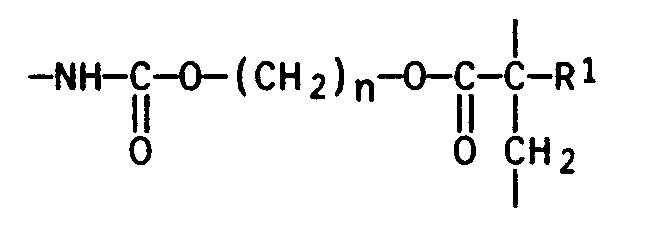
enthält. - Rohre nach Anspruch 1, gekennzeichnet durch folgende Eigenschaften:
Interlaminare Scherfestigkeit ILS > 70 [MPa]
90° - Zugfestigkeit > 55 [MPa]
Glasübergangstemperatur > 130°C - Rohre nach Anspruch 1, dadurch gekennzeichnet, daß das Vinylesterurethanharz hergestellt wurde durch Umsetzung vonA. einem polyfunktionellen Isocyanat,B1. gegebenenfalls einem mehrwertigen Alkohol und/oderB2. gegebenenfalls einem mehrwertigen Amin,C. einem Hydroxyalkyl-(meth)acrylat,wobei das Gewichtsverhältnis A : (B₁ + B₂) zwischen 100:0 und 100:300 betrug und das Äquivalentverhältnis Hydroxyalkyl-(meth)acrylat zu den freien Isocyanatgruppen des Reaktionsprodukts A + B₁ + B₂ zwischen 3:1 und 1:2 lag.
Applications Claiming Priority (2)
| Application Number | Priority Date | Filing Date | Title |
|---|---|---|---|
| DE4110713 | 1991-04-03 | ||
| DE19914110713 DE4110713A1 (de) | 1991-04-03 | 1991-04-03 | Rohrfoermige bauteile aus faserverbundwerkstoffen |
Publications (2)
| Publication Number | Publication Date |
|---|---|
| EP0507152A2 true EP0507152A2 (de) | 1992-10-07 |
| EP0507152A3 EP0507152A3 (en) | 1992-12-23 |
Family
ID=6428702
Family Applications (1)
| Application Number | Title | Priority Date | Filing Date |
|---|---|---|---|
| EP19920104742 Withdrawn EP0507152A3 (en) | 1991-04-03 | 1992-03-19 | Tubular construction materials from fibre-laminates |
Country Status (3)
| Country | Link |
|---|---|
| EP (1) | EP0507152A3 (de) |
| JP (1) | JPH0598151A (de) |
| DE (1) | DE4110713A1 (de) |
Cited By (1)
| Publication number | Priority date | Publication date | Assignee | Title |
|---|---|---|---|---|
| EP0582203A1 (de) * | 1992-08-07 | 1994-02-09 | BASF Aktiengesellschaft | Faserverbundwerkstoffe |
Families Citing this family (1)
| Publication number | Priority date | Publication date | Assignee | Title |
|---|---|---|---|---|
| DE102011002032B4 (de) | 2011-04-13 | 2013-12-12 | Saertex Multicom Gmbh | Imprägnierung von Linern zur Kanalsanierung |
Family Cites Families (4)
| Publication number | Priority date | Publication date | Assignee | Title |
|---|---|---|---|---|
| US3565119A (en) * | 1968-10-25 | 1971-02-23 | Koch Ind Inc | Filament wound reinforced pipe having a vinyl ester resin inner lining |
| US4480079A (en) * | 1982-04-12 | 1984-10-30 | Imperial Chemical Industries Plc | Copolymerization of unsaturated urethane monomers |
| DE3744390A1 (de) * | 1987-12-29 | 1989-07-13 | Basf Ag | Faserverbundwerkstoffe auf basis von modifizierten vinylesterurethanharzen |
| DE4012946A1 (de) * | 1990-04-24 | 1991-10-31 | Basf Ag | Prepreg fuer hochleistungsverbundwerkstoffe |
-
1991
- 1991-04-03 DE DE19914110713 patent/DE4110713A1/de not_active Withdrawn
-
1992
- 1992-03-19 EP EP19920104742 patent/EP0507152A3/de not_active Withdrawn
- 1992-03-27 JP JP4070496A patent/JPH0598151A/ja not_active Withdrawn
Cited By (1)
| Publication number | Priority date | Publication date | Assignee | Title |
|---|---|---|---|---|
| EP0582203A1 (de) * | 1992-08-07 | 1994-02-09 | BASF Aktiengesellschaft | Faserverbundwerkstoffe |
Also Published As
| Publication number | Publication date |
|---|---|
| EP0507152A3 (en) | 1992-12-23 |
| JPH0598151A (ja) | 1993-04-20 |
| DE4110713A1 (de) | 1992-10-08 |
Similar Documents
| Publication | Publication Date | Title |
|---|---|---|
| DE3744390C2 (de) | ||
| EP0508183B1 (de) | Patrone für die chemische Befestigungstechnik | |
| EP0454983A1 (de) | Blattfedern aus Faserverbundwerkstoffen | |
| EP0534197B1 (de) | Patrone oder Kartusche für die chemische Befestigungstechnik | |
| DE3049958C2 (de) | ||
| DE69833322T2 (de) | Eine ein urethan-oligomer mit einem polyestergerüst enthaltende strahlungshärtbare zusamensetzung | |
| EP3538585A1 (de) | Kompositwerkstoffe basierend auf isocyanuratpolymeren mit dualer härtung | |
| EP0345581A2 (de) | Füllstoffhaltige, polymerisierbare Massen und deren Verwendung | |
| DE60109835T2 (de) | Ungesättigte Harze enthaltende bläh- und härtbare Vorform sowie deren Verwendung in Bohrlöchern oder der Kanalisation | |
| CN114845968B (zh) | 树脂组合物、光纤以及光纤的制造方法 | |
| JPS60106819A (ja) | 重合性組成物 | |
| DD271521A5 (de) | Lichthaertbare beschichtungszusammensetzung | |
| DE4119434A1 (de) | Eingedickte haertbare formmassen aus einem vinylester- oder vinylesterurethanharz | |
| CH637685A5 (en) | Process for preparing curable adhesives and sealants | |
| CH643577A5 (en) | Process for the preparation of curable adhesives or sealants, and the use thereof for the production of adhesive bonds and seals | |
| DE4126860A1 (de) | Herstellung von lichtleitbaendern | |
| AT401267B (de) | Verwendung einer härtbaren masse | |
| EP3616888A1 (de) | Folienwickelformverfahren | |
| EP0949058A2 (de) | Faserverstärkter Kunststofformkörper und Verfahren zu seiner Herstellung | |
| DE4110713A1 (de) | Rohrfoermige bauteile aus faserverbundwerkstoffen | |
| DE4126826A1 (de) | Zaehmodifizierte vinylesterurethanharze | |
| EP0658582B1 (de) | Prepolymere, daraus hergestellte radikalisch polymerisierbare Massen und deren Verwendung | |
| EP0582203A1 (de) | Faserverbundwerkstoffe | |
| WO2019096813A1 (de) | Halbzeuge basierend auf dualem vernetzungsmechanismus | |
| KR102030394B1 (ko) | 인발성형용 속경화성 이액형 폴리우레탄 수지 조성물 |
Legal Events
| Date | Code | Title | Description |
|---|---|---|---|
| PUAI | Public reference made under article 153(3) epc to a published international application that has entered the european phase |
Free format text: ORIGINAL CODE: 0009012 |
|
| AK | Designated contracting states |
Kind code of ref document: A2 Designated state(s): AT DE ES FR GB IT SE |
|
| PUAL | Search report despatched |
Free format text: ORIGINAL CODE: 0009013 |
|
| AK | Designated contracting states |
Kind code of ref document: A3 Designated state(s): AT DE ES FR GB IT SE |
|
| 17P | Request for examination filed |
Effective date: 19921125 |
|
| STAA | Information on the status of an ep patent application or granted ep patent |
Free format text: STATUS: THE APPLICATION HAS BEEN WITHDRAWN |
|
| 18W | Application withdrawn |
Withdrawal date: 19931002 |