EP0502824A2 - Meuble - Google Patents
Meuble Download PDFInfo
- Publication number
- EP0502824A2 EP0502824A2 EP92810149A EP92810149A EP0502824A2 EP 0502824 A2 EP0502824 A2 EP 0502824A2 EP 92810149 A EP92810149 A EP 92810149A EP 92810149 A EP92810149 A EP 92810149A EP 0502824 A2 EP0502824 A2 EP 0502824A2
- Authority
- EP
- European Patent Office
- Prior art keywords
- rail
- drawer
- wall
- piece
- stop
- Prior art date
- Legal status (The legal status is an assumption and is not a legal conclusion. Google has not performed a legal analysis and makes no representation as to the accuracy of the status listed.)
- Granted
Links
Images





Classifications
-
- E—FIXED CONSTRUCTIONS
- E05—LOCKS; KEYS; WINDOW OR DOOR FITTINGS; SAFES
- E05B—LOCKS; ACCESSORIES THEREFOR; HANDCUFFS
- E05B15/00—Other details of locks; Parts for engagement by bolts of fastening devices
- E05B15/02—Striking-plates; Keepers; Bolt staples; Escutcheons
- E05B15/0205—Striking-plates, keepers, staples
- E05B15/024—Striking-plates, keepers, staples adjustable
- E05B15/0245—Movable elements held by friction, cooperating teeth, or the like
-
- A—HUMAN NECESSITIES
- A47—FURNITURE; DOMESTIC ARTICLES OR APPLIANCES; COFFEE MILLS; SPICE MILLS; SUCTION CLEANERS IN GENERAL
- A47B—TABLES; DESKS; OFFICE FURNITURE; CABINETS; DRAWERS; GENERAL DETAILS OF FURNITURE
- A47B88/00—Drawers for tables, cabinets or like furniture; Guides for drawers
- A47B88/40—Sliding drawers; Slides or guides therefor
- A47B88/49—Sliding drawers; Slides or guides therefor with double extensible guides or parts
- A47B88/493—Sliding drawers; Slides or guides therefor with double extensible guides or parts with rollers, ball bearings, wheels, or the like
-
- E—FIXED CONSTRUCTIONS
- E05—LOCKS; KEYS; WINDOW OR DOOR FITTINGS; SAFES
- E05B—LOCKS; ACCESSORIES THEREFOR; HANDCUFFS
- E05B65/00—Locks or fastenings for special use
- E05B65/46—Locks or fastenings for special use for drawers
- E05B65/462—Locks or fastenings for special use for drawers for two or more drawers
-
- A—HUMAN NECESSITIES
- A47—FURNITURE; DOMESTIC ARTICLES OR APPLIANCES; COFFEE MILLS; SPICE MILLS; SUCTION CLEANERS IN GENERAL
- A47B—TABLES; DESKS; OFFICE FURNITURE; CABINETS; DRAWERS; GENERAL DETAILS OF FURNITURE
- A47B2210/00—General construction of drawers, guides and guide devices
- A47B2210/0002—Guide construction for drawers
- A47B2210/0029—Guide bearing means
- A47B2210/0043—Wheels
-
- A—HUMAN NECESSITIES
- A47—FURNITURE; DOMESTIC ARTICLES OR APPLIANCES; COFFEE MILLS; SPICE MILLS; SUCTION CLEANERS IN GENERAL
- A47B—TABLES; DESKS; OFFICE FURNITURE; CABINETS; DRAWERS; GENERAL DETAILS OF FURNITURE
- A47B2210/00—General construction of drawers, guides and guide devices
- A47B2210/0002—Guide construction for drawers
- A47B2210/0051—Guide position
- A47B2210/0059—Guide located at the side of the drawer
Definitions
- the present invention relates to a piece of furniture with at least one drawer, which are associated with pull-outs, and with a pull-out locking device, which has at least one locking pin that cooperates with a stop device on the drawer, the stop device having a toothed slot in the drawer wall and one in this slot insertable stop piece includes.
- Furniture especially office furniture that has drawers, is often required to be provided with a central pull-out locking device.
- Such facilities are known.
- One of these devices comprises trestles for mounting a locking rod that runs practically horizontally and can be pivoted about its longitudinal axis.
- a locking part is attached to the locking rod, which can be actuated by the furniture lock in such a way that the locking rod can be pivoted under the action of an actuating element on the lock.
- a driver is attached, which is designed as a one-armed lever. One end this lever is attached to the locking bar.
- a lifting rod is connected to the other end of the driver, which extends essentially vertically. At the level of the respective drawer, the lifting rod is provided with a locking pin that extends from the lifting rod to the immediate vicinity of the drawer.
- a stop is attached to the side of the drawer side wall facing the locking pin.
- the stop is designed as a practically L-shaped element, which can also be referred to as a locking angle.
- One leg of such a locking bracket is fastened flat on the outside of the drawer side wall, so that the other leg of the locking bracket protrudes from the drawer wall.
- the length of this second locking angle leg and the length of the locking mandrel are dimensioned such that the locking mandrel engages with the protruding leg of the locking angle when the two are at the same height.
- the drawer is locked in this position of the lifting rod. If the lifting rod is moved over the lock in such a way that the locking pin is brought to a height that is different from the height of the locking angle leg, the drawer can be freely pulled out of the body.
- the known locking angles are fixed to the respective drawer. This means that the position of the locking angle in relation to the front wall of the drawer, which lies in the area of the front wall of the body, cannot be changed.
- a certain amount of play must be allowed between the cooperating parts of the mechanics of the piece of furniture so that they can work together smoothly and so that tolerances can be compensated for, which are inevitable in the manufacture of the individual parts of the piece of furniture.
- This problem is particularly evident when a piece of furniture is assembled from parts that have been manufactured by different manufacturers. If the play is too large or if it becomes large when the piece of furniture is being assembled, it can happen, for example, that a locked drawer can still be moved over a not inconsiderable distance. Too much play between the locking angle and the locking pin is responsible for this.
- the pull-out comprises a first or outer rail, which is also called the body rail and which can be fastened to the furniture body or similar, a second or inner rail which can be fastened to the drawer and which can therefore also be called a drawer rail, and a middle one or third rail, which is between the body rail and the drawer rail is located.
- a crossbar it was necessary to connect the rear and front end parts of the third rails in the body rails by means of a crossbar. These cross bars held the end sections of the third rails at a predetermined distance from one another and thus also in the body rails. Because without these crossbars, the end parts would fall out of the space between the first rail and the second rail of the respective extension due to the lack of a guide.
- the crossbars were additional components of the drawer pullers. In addition, the crossbars made it difficult to handle the pullouts and the elements thereof, etc.
- the object of the present invention is to design a piece of furniture in such a way that the mentioned and other disadvantages do not occur.
- the pull-out locking device 2 comprises trestles 3 for storage a practically horizontal and pivotable about its longitudinal axis locking rod 4.
- the bearing blocks 3 are substantially U-shaped and the ends of the legs of such bearing blocks are attached to the ceiling of a furniture body (not shown) or similar, in which the drawers 1 are located.
- a locking part 5 is fastened to the locking rod 4 between the bearing blocks 3 and can be actuated by the furniture lock 6 in such a way that the locking rod 4 can be pivoted under the action of an actuating element on the lock 6.
- a driver 7 is attached, which is designed as a one-armed lever. One end of this lever 7 is attached to the locking rod 4.
- a lifting rod 8 is connected, which extends substantially vertically.
- the lifting rod 8 is provided with a locking pin 9, which extends from the lifting rod 8 to the immediate vicinity of the drawer 1.
- a stop 10 is attached to the side of the drawer side wall 11 facing the locking pin 9.
- the drawer 1 further comprises a front wall 12 and a rear wall (not shown).
- the drawer 1 also has a bottom 13. On the outside of the drawer front wall 12 there are plates 14 with openings which are intended for holding a decorative front (not shown).
- the stop 10 in the piece of furniture according to FIG. 1 is designed as a practically L-shaped element, which can also be referred to as a locking angle.
- One leg of such a locking bracket 10 is fastened flat on the outside of the drawer side wall 11, so that the other leg of the locking bracket 10 protrudes from the drawer wall 11.
- the length of this second locking angle leg and the length of the locking mandrel 9 are dimensioned such that the locking mandrel 9 engages with the protruding leg of the locking angle 10 when the two are at the same height.
- the drawer 1 In this position of the lifting rod 8, the drawer 1 is locked. If the lifting rod 8 is moved by the lock 6 so that the locking pin 9 reaches a height which is different from the height of the locking angle leg, then the drawer 1 can be pulled out freely from the body.
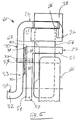
- FIG. 1 also shows that a pull-out 20 is associated with the respective long side 11 of the drawer 1. Only the extract 20 on the right is shown in FIG. 1. It goes without saying that an extract from the opposite, i.e. is assigned to the left side of the drawer 1.
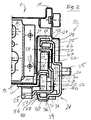
- FIG. 2 is a front view of that portion of one of the drawers 1 of Fig. 1, which is on the right.
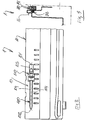
- Fig. 3 shows in a side view that pull-out 20 which is assigned to the left side wall 11 of the drawer 1 according to FIG. 1, the pull-out in FIG. 3 being in the retracted state.
- Fig. 4 shows the essential part of the extract 20 of FIG. 3 in the extended state.
- FIG. 5 shows an enlarged detail from the extract 20 according to FIG. 3 or 4.
- the pull-out 20 comprises a first or outer rail 21, which can also be referred to as a body rail, because it can be fastened to the furniture body (not shown) or the like, a second or inner rail 22, which can also be referred to as a drawer rail, because it can be fastened to the drawer 1, and a middle or third rail 23, which is located between the first rail 21 and the second rail 22.
- the length of the rails 21, 22 and 23 is substantially the same and corresponds to the length of the drawer 1.
- the rails 21 to 23 are made of a plate-like material, such as sheet metal, and they form a telescopic arrangement. This means that the third rail 23 can be moved into and out of the first rail 21 and the second rail 22 into the third rail 23.
- the first rail 21, which can be attached to the envelope of the piece of furniture, has an essentially C-shaped profile.
- In the upper horizontal wall 24 of this rail 21 is one in recess 25 extending in the longitudinal direction of the rail 21, which can also be referred to as a bead.
- This bead 25 opens towards the bottom, ie against the opposite horizontal wall 28 of this rail 21, the outside of this rail wall 24 can be convex.
- the bottom 26, ie the inner surface 26 of this recess 25, is practically flat.
- That edge of the recess 25 which faces the drawer 1 is designed as an edge strip 27 which rises from the bottom 26 of the recess 25 and which is directed towards the opposite, lower horizontal wall 28 of the rail 21 with a C-shaped cross section is.
- That edge 29 of the recess 25, which is removed from the drawer 1 and thus lies opposite the edge strip 27, also serves as an edge or guide strip.
- the vertical wall 30 has a bulge 31.
- This bulge 31 is practically U-shaped in cross-section and extends over the entire length of the rail 21.
- the bulge 31 opens against the drawer 1 or against the other rails 22 and 23 of the pull-out 20, so that it emerges from the outside of the vertical wall 30.
- the free end of the upper U-leg 32 of this bulge 31 adjoins the upper section 33 of the vertical wall 30, so that this upper wall section 33 connects the bulge 31 to the upper wall 24.
- the free end of the lower U-leg 34 connects to the lower horizontal wall 28 of the rail 21.
- a pin 35 is attached, via which this first rail 21 can be connected to the cover (not shown) of the piece of furniture.
- a recess or bead 36 which extends upwards, i.e. opens against the recess 25 in the upper wall 24 and which is practically the same as the recess 25 in the upper rail wall 24.
- These recesses 25 and 36 lie opposite one another or at least partially opposite one another.
- a stop 37 is inserted in the lower wall 28 and 34, which limits the path of movement of the drawer 1 at the rear.
- a further stop 38 is inserted in the upper wall 24, which limits the movement path of the drawer 1 or the third rail 23 at the front.
- the second rail 22 of the pull-out 20 has a Z-like profile.
- This second rail 22 comprises a first or lower flange 41, which is flat and which is attached to the underside of the bottom 13 of the drawer 1 in the region of one of the side walls 11 thereof.
- a second flange 42 of this rail 22 also runs horizontally and it has a downwardly opening recess or bead 43 which, in terms of its cross-sectional shape, is essentially designed like the recesses 25 and 36 described above.
- the recess 43 in the second flange 42 opens against the recess 36 in the lower horizontal wall 28 of the first rail 21 and faces this recess 36.
- That edge of the recess 43, which lies away from the drawer 1, is designed as the edge strip 27 already mentioned, which rises from the bottom 26 of the recess 43 and which has a C-shaped shape against the opposite, lower horizontal wall 28 of the rail 21 Cross section is directed.
- That edge 29 of the recess 43, which is closer to the drawer 1 and thus opposite the edge strip 27, also serves as an edge or guide strip.
- a web 44 extends between the flanges 41 and 42, which is practically perpendicular to the first flange 41 and which is assigned to the side wall 22 of the drawer 1.
- the third or middle rail 23 has an essentially L-shaped cross-section, this rail 23 having a wall 51 and the wall corresponding to the vertically running L-leg includes a wall 52 corresponding to the horizontally extending L-leg.
- a bulge 53 is embodied in the vertical wall 51, which is located in the lower region, ie in the region adjoining the second leg 52 of the rail 23.
- This bulge 53 is practically U-shaped in cross section, it extends over the entire length of the rail 23 and it is essentially designed as the bulge 31 in the first rail 21.
- the bulge 53 in the third rail 23 opens against the Drawer 1 or against the second rail 22 of the pull-out 20 so that it emerges from the outside of the vertical wall 51.
- This bulge 53 lies partly in the bulge 31 of the first rail 21. Since the depth and the width of the bulge 53 in the third rail 23 are smaller than in the bulge 31 in the first rail 21, there are bulges 31 and 53 in between these Extract 20 a free space 54.
- the bottom horizontal wall 52 of the third rail 23 is essentially flat.
- the free edge part of this wall 52 is designed with a shoulder 55 which extends along the rail 23 and which is used primarily for receiving stops 56 which are known per se and which are necessary for the function of the drawer 1.
- top wall 58 of third rail 23 At the upper section 57 of the vertical wall 51 of the third Rail 23, which is offset towards the bottom of bulge 53 against drawer 1, is followed by a top wall 58 of third rail 23.
- This top wall 58 is essentially flat and it is at a right angle to the upper section 57 of the vertical wall 51.
- the third rail 23 is equipped with rollers, which are required for the telescopic sliding of the rails 21 to 23 on or to each other.
- a support roller 61 is located in the front area of the third rail 23, ie in the area of the same which can move out of the piece of furniture when the drawer 1 is pulled out.
- the shaft 62 of this roller 61 is in the bottom of the bulge 53 in the third rail 23 at one end, for example by deforming one of the end parts of the shaft 62.
- a spacer 63 is arranged between the support roller 61 and the bottom of the bulge 53, so that the roller 61 is at a distance from the bottom of the bulge 53.
- the second rail 22, which carries the drawer 1 is inserted into the third rail 23.
- the downward depression 43 lies in the second flange 42 of the second rail 22 on the upper section of the support roller 61.
- the drawer 1 is supported or carried in the body of the piece of furniture. It goes without saying that the two side parts 11 of the drawer 1 are carried and secured in this way.
- roller 64 which is fastened to the upper section 57 of the vertical wall 51 of the third rail 23.
- the top wall 58 of this rail 23 is shortened in this end region of the rail 23 by at least the diameter of this roller 64.
- the attachment point 59 of this roller 64 is so high that part 68 of the ring of this roller 64 is located above the top wall 58.
- This upper section of the roller ring can roll on the bottom 26 of the downwardly opening bead 25 in the upper horizontal wall 24 of the first rail 21 when the drawer 1 is moved.
- This roller 64 serves to support the third rail 23 and thus also the drawer 1 towards the top, when the drawer 1 is extended and thus tends to tip downwards at the front. This is due to the laying on the roller 64 on the bottom 26 of the upper bead 25 in the upper wall 24 of the first rail 21 fastened to the furniture body is prevented.
- rollers 65 and 66 Approximately in the middle region of the length of the third rail 23 is a pair of rollers 65 and 66 which are practically one above the other, these rollers also being located inside the third rail 23.
- the two rollers 65 and 66 can have a friction lining in the area of their circumference.
- the roller 65 lying below, which is also referred to below as a transport roller, is fastened to the third rail 23 in practically the same way as the supporting roller 61.
- a further opening is made in the horizontal leg 28 of the L-rail 23.
- the transport roller 65 is attached to the third rail 23 in such a way that part of it lies in the opening and that a section thereof is therefore below the lower wall 28 of the third rail 23.
- This section of the transport roller 65 is supported on the bottom of the bead 36 in the lower wall 28 of the first rail 21.
- the transport roller 65 is aligned with the support roller 61 when you look at the rail 23 in its longitudinal direction.
- there is a play between the transport roller 65 and the shaft 69 of the latter so that the transport roller 65 can be displaced, for example upwards or downwards, relative to its stationary shaft 69 by a certain amount.
- the second flange 42 of the second rail 22 can rest on the transport roller 65.
- the upper part of the transport roller 65 lies in the bead 43, which is embodied in the second flange 42.
- the beads 25 and 36 in the first rail 21 and the beads 43 in the second flange 42 of the second rail 22 also guide the rollers 64 and 65 lying in them laterally, thanks to the edge strips 27, so that there is no risk that the third rails 23 or the rear end paries emerge from extract 20.
- the counter roller 66 which is also referred to as a pressure roller, is attached to the upper section 57 of the vertical wall 51 of the third rail 23 and lies over the transport roller 65.
- the counter roller is mounted on a shaft 49.
- the distance between the fastening points of the shafts 49 and 69 of these two rollers 65 and 66 is chosen taking into account the thickness of the material of the second flange 42 on the second rail 22 and the vertical displaceability of the transport roller 65 relative to its shaft 69 so that the distance between the running surfaces of these rollers 65 and 66 is only so large that the second flange 42 of the second rail 22 is clamped between these rollers 65 and 66.
- the second flange 42 of the second rail 22 also rests, among other things the upper part of the transport roller 65, which in turn is supported on the first rail 21 fastened to the furniture body.
- the third rail 23 has a considerable weight and this weight is supported by the pressure roller 66 on the upper side of the second rail flange 42, which in turn rests on the upper side of the transport roller 65. This is partly because there is play between the transport roller 65 and the shaft 69 thereof.
- the second flange 42 With a force corresponding to the weight of the third rail 23, the second flange 42 is clamped between the rollers 65 and 66. If one moves with the drawer 1, the transport roller 65 rolls on the first rail 21 because the weight of the drawer 1 acts on the first rail 21 via the second flange 42 of the second rail 22. However, the transport roller 65 does not bear the weight of the third rail 23 because there is play between this roller 65 and the shaft 69 thereof. The weight of the third rail 23 acts via the pressure roller 66 on the upper side of the second flange 42 and with this force the second flange 42 is clamped between the two rollers 65 and 66.
- the third rail 23 Since the transport roller 65 has to move under the weight of the drawer 1 and because the shaft 69 of the transport roller 65 is fastened to the third rail 23, the third rail 23 must also move at a speed which corresponds to half the speed of the drawer . This ensures that the third rail 23 always moves with the drawer 1.
- a further roller 67 is arranged, which can also be referred to as a compensating roller.
- This compensating roller 67 is similar to the transport roller 65 and also stored with play. Compared to the transport roller 65, however, the compensating roller 67 has a somewhat smaller diameter. The weight of the rear half of the drawer 1 rests on this compensating roller 67 when it is retracted into the piece of furniture.
- the edge strips 27 and 29 in the drawer rail 23 serve, as can be seen from the foregoing, to guide the support rollers 61.
- the pull-outs 20 are installed in carcasses or the like, which can be supplied by different manufacturers. Such bodies can have deviations from the specified dimensions. These deviations would affect the use of the above-described extracts in such a way that the support rollers 61 would not roll in the middle of the bottom 26 of the respective bead 43 but also or exclusively on one of the guide strips 27 or 29.
- a pull-out 20 can be used, the drawer rail 22 of which is designed as shown in FIG. 23.
- This drawer rail 23 actually differs from the drawer rail 23 described above only in that it has no edge strip on the edge part of the second flange 42 facing away from the drawer 1.
- the bottom 26 of the bead 43 or the underside of the second flange 42 is thus flat starting from the inclined wall 29 to the outer edge of the said flange 42.
- This flat second flange 42 is advantageously somewhat wider than the second flange 42, which is designed or provided with the edge strip 27, so that deviations in the dimensions of the body can be compensated for as far as possible.
- the pull-out 20, which is arranged on the opposite side of the drawer 1, should have that design of the drawer rail 22 which is described in connection with FIG. 2.
- a dent 40 is made in the bead 36 of the lower horizontal wall 28 approximately in the middle of the length of the first rail 21.
- the dent 40 is intended to ensure that the drawer 1 or drawers, when retracted into the piece of furniture, always assume the same position, even if they are not moved by hand has led to the rearmost or closed position.
- the transport roller 65 comes to rest in the dent 40. If the drawer 1 has not been moved to the rear by hand, then the front and rearward inclined flank 39 of the dent 40 causes the transport roller 65 to begin to roll downwards on this flank 39. This results in a force acting horizontally backwards, which is sufficient to move the drawer 1 to the rear stop and to prevent the drawer 1 from moving back after an impact at the rear stop.
- the rails 21 to 23 are mostly made of metal.
- the profile of the beads 25, 36 and 43 in these rails is not exactly U-shaped, because the parts 27 and 29 of the rails adjoining the bottom 26 of the respective beads are at an angle to the bottom of the beads which is different from the right is.
- the beads are therefore a rather open U-profile, in which the legs 27 and 29 of the same are inclined outwards in order to reduce the friction on the rollers. Under such circumstances, the rollers moving in the beads could also be deflected a little to the side.
- the bodies, especially their vertical walls, could rub against each other. This risk exists particularly with respect to the first rail 21 and the third rail 23 because the vertical walls 30 and 51 these rails 21 and 23 are close to each other.
- sliders or buffers 80 are attached to the rails 21 and 23.
- the respective slider 80 is essentially mushroom-shaped. It has a flat and relatively thin hat 81 (FIG. 5) and a stem 82 adjoining it.
- the stem 82 is embedded in the respective rail and the hat 81 lies flat on the surface of the rail.
- the edges of hat 81 are rounded.
- the buffers are advantageously made of a dimensionally stable plastic.
- the thickness of the hat 81 is smaller than the width of the gap provided between the vertical walls 30 and 51 of the rails 21 and 23.
- Buffers 80 are used in pairs.
- the first pair of buffers 80 (FIGS. 3-5) are attached to the upper portion 33 of the first rail 21, in the front end portion thereof.
- the hats 81 of the buffers 80 lie on the inside of the rail 21, so that they face the vertical wall 51 of the third rail 23.
- the stems 82 of these buffers 80 are inserted in corresponding openings in the wall 33.
- the buffers 80 lie next to or behind one another in the longitudinal direction of the rail 21.
- a second pair of buffers 80 is attached to the rear of third rail 23, at the top Section 57 (FIG. 5) of the vertical wall 51 of this rail 23. These buffers 80 are also located next to or behind one another in the longitudinal direction of the rail 23.
- the hats 81 of these buffers 80 lie on the outside of the vertical wall 51, so that they face the first rail 21.
- the stems 82 of these buffers 80 are inserted in corresponding openings in the vertical wall 57.
- a third pair of sliders 80 are attached approximately midway along the length of the rail 23.
- the edge part of the hat 81 of one or more buffers 80 can be lifted off the surface of the rail a little, for example with the aid of a screwdriver. Since the buffer 80 is made of a dimensionally stable plastic, the treated section of the hat 81 remains in the raised position, as a result of which the gap between the rails 21 and 23 is reduced.
- FIGS. 6 and 7 show this roller 70 in an axial longitudinal section
- FIG. 7 shows this roller 70 in a front view.
- the roller 70 has an annular base body 71, which is advantageously made of a plastic.
- On this base body 71 can be connected laterally to a spacer sleeve 72, which is axially aligned with the base body 71.
- the sleeve 72 can be in one piece with the base body 71, as shown in FIG. 6, or it can form an independent component of the roller 70.
- the roller 70 is rotatably mounted on a shaft 73 which is fastened at one end in a rail 74, a wall or the like.
- the diameter of the central bore 75 in the annular base body 71 is larger than the diameter of the bolt 76 of the shaft 73. This difference is so great that rollers or needles 77, which form a ring, can be accommodated in a resulting annular gap.
- a roller 70 is formed with a needle bearing, in which the roller body 71 represents the outer ring and the shaft 76 the inner ring of the bearing.
- In the front of the roller body 71 there is a circumferential shoulder 79 which is concentric with the central bore 75 in the roller body 71 and which surrounds this bore 75.
- 79 is a circular plate 78 which is concentrically attached to the end face of the shaft 76.
- the diameter of this end plate 78 is somewhat larger than the diameter of the central bore 75, so that the end plate 78 covers the annular gap in which the needles 77 are located.
- the end plate 78 retains the needles 77 in the annular gap and also protects the inside of the Annular gap against pollution.
- FIG. 8 shows a side view of the front section of the right-hand side wall of the drawer 1 according to FIG. 1, which is provided with a finely adjustable stop device 10.
- 9 shows in a vertical section a section from the side wall of the drawer according to FIG. 8.
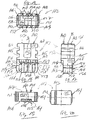
- FIG. 10 shows the stop body of the device in a side view
- FIG. 11 shows the stop body according to FIG. 10 in a top view
- FIG. 12 shows 10 shows a section transverse to the longer dimension of the stop body according to FIG. 10.
- FIGS. 13 to 15 show a second design of the stop body corresponding to FIGS. 10 to 12.
- FIG. 8 shows a side view of the present stop device 10, which is attached to one of the side walls 11 of the drawer 1.
- FIG. 9 shows in a vertical section that area of the drawer wall 11 in which the stop device 10 according to FIG. 8 is attached.
- the stop device 10 comprises a slot 100 in the drawer wall 11 and a stop piece or a stop body 110.
- the slot 100 extends in the direction of movement of the drawer 1 and it has two sections 101 and 102.
- the first section 101 of the slot 100 is closer to the rear or to the inside of the furniture end of the drawer 1 than the second slot section 102.
- the edges of the first slot section 101 are smooth and the distance between the longitudinal edges 103 of this slot section 101 is so great chosen so that the corresponding part of the stop piece 110 can be inserted into the slot 100 through this section 101.
- the second section 102 of the slot in the drawer wall 11 has toothed longitudinal edges 104.
- the distance between the toothed edges 104 from one another is smaller than the distance between the smooth edges 103 in the first slot section 101. It is understood that only one of the longitudinal edges 104 can be toothed.
- the apexes or the axes of the teeth in the longitudinal edges 104 lie opposite one another. However, it is also possible to have teeth to be arranged in the longitudinal edges 104 such that the teeth are offset from one another, for example by the width of half a tooth.
- the second section 102 of the slot 100 serves to hold the stop piece 110 at a desired location on the drawer wall 1. In FIG. 8, the stop piece 110 engages those teeth 104 of the second slot section 102 which are in the immediate vicinity of the first slot section 101 are located.
- FIG. 10 shows the stop piece 110 in a side view, FIG. 11 in a top view and FIG. 12 in a section through the stop body 110 transversely to the longitudinal axis thereof.
- the stop body or the stop piece 110 comprises a housing 111 and a core 112, which can assume two positions in the housing 111.
- the stop housing 111 has a section 115 which is rectangular in plan and a triangular section 116 which adjoin one another via one of its sides, so that these sections 115 and 116 represent parts of a single piece 111.
- a housing 111 has a longitudinal axis A.
- the bead 113 is square Area 118 of the housing 111, it runs in a straight line and perpendicular to the longitudinal axis A of the housing 111.
- a practically square opening 117 is embodied in the housing 111 and extends across the housing 111 between the upper main surface 118 and the lower main surface 119 thereof.
- the larger section of this opening 117 is located in the square housing section 115 and the remaining section of the opening 117 is located in the triangular housing section 116.
- the narrower wall of the opening 117 which is located in the triangular housing section 116, has an outwardly sloping portion 114 .
- This sloping wall section 114 enables a cavity in the stop housing 111, in which a tool, for example a screwdriver or similar, can be used to actuate the core 112 inserted in the housing 111.
- a U-shaped extension 120 connects to the lower main surface 119 of the housing 111.
- the free ends of the U-legs 121 adjoin the lower main surface 119 of the stop housing 111, so that the extension 120 is integral with the housing 111.
- the web 122 of the U-shaped extension 120 runs practically parallel to the longitudinal axis A and the main surface 119 of the housing 111 and its cross section is practically square.
- the width of the web 122 is greater than the width, ie the smaller and transverse to the longitudinal axis A dimension of the opening 117.
- the length of the web 122 is greater than the length, ie the longer dimension of the opening 117.
- In the web 122 is also a breakthrough 123, the dimensions of which are the same as that of the Breakthrough 117 in the stop housing 111.
- the opening 123 in the extension web 122 is aligned with the breakthrough 117 in the stop housing 111.
- an incision 124 is made of a practically square cross section, which runs practically parallel to the longitudinal direction of the web 122 of the extension 120.
- the depth of the cuts 124 is so great that the width of the U-legs 121, measured in the direction between the bottom of the opposite cuts 124 in one of the legs 121, is smaller than the width of the opening 117 or 123.
- there is a window in the stop housing 111 which lies between the respective incision 124 and the opening 117 or 123.
- the length of the extension 120 is somewhat greater than the length of the first section 101 of the slot 100 in the drawer 1.
- the width of the extension 120 is somewhat smaller than the width of the toothless slot section 101 so that the extension 120 can be inserted into the drawer wall 11 in the area of this slot section 101. Since the extension 120 is a little longer than this slot section 101, the stop piece 110 has to be inclined slightly if it is to be inserted into the slot section 101. For this, however, the stop piece 110 does not easily fall out of the slot section 101.
- FIG. 16 shows a top view of one of the two main surfaces 131 and 132 of the core 112 of the stop body 110, which essentially are square.
- 17 shows a plan view of one of the longer side surfaces 136 and 137 of the stop core 112, which are practically of the same design.
- FIG. 19 shows a section through the stop core 112 in the area thereof which is normally located in the housing 111
- FIG. 20 shows a top view of the side surface 135 of the stop core 112 which is normally located on the outside of the housing.
- the stop core 112 has a main body 140 and an extension 141, which have a substantially square cross section.
- the main body 140 may be a full body. However, the main body 140 is advantageously provided with a cutout 142 which opens into one of the main surfaces 131 and 132 thereof.
- the edge region of the main body 140 which comprises the longer narrow sides 136 and 137, two practically rectangular indentations 144 and 145 are executed.
- the cross-sectional dimensions of the main body 140 are selected such that it is shown in FIGS Breakthrough 117 in the housing 111 fits and can be moved in this without significant play.
- the height of the extension 141 of the stop core 112 is slightly smaller than the height of the main body 140, so that the main surfaces 146 and 147 of the extension 141 are closer to one another than the main surfaces 131 and 132 of the main body 140, although the distance Ger main surfaces 131 and 132 or 146 and 147 from a plane of symmetry B of the core 112 is the same.
- there is a step and this material step of the core 112 is followed by a beard 148 or 149 on the respective extension main surface 146 or 147.
- the beard 148 or 149 comprises a number of teeth 150.
- the apexes of the opposing teeth 150 of the beards 148 and 149 lie opposite one another or on a common line which is perpendicular to the main surfaces 146 and 147. This means that the teeth 150 of the beards 148 and 149 are not offset from one another. However, the two sets of teeth 148 and 149 are laterally offset with respect to the plane of symmetry B of the core 112. In the case shown there are the beards 148 and 149 closer to the narrow side 137 of the extension 141 and the core 112 lying on the right.
- the teeth 150 have a length which is practically the same as the width of the window 124 in the housing 111. Sloping contact surfaces 154 adjoin the front ends of the teeth 150.
- a nose 151 with front oblique flanks 158 and with rear oblique flanks 159 emerges from the respective narrow side 136 or 137 of the extension 141.
- These lugs 151 are located in that end region of the extension 141 which is normally inside the housing 111 or even below it.
- the distance between the tips of the noses 151 pointing in opposite directions is somewhat larger than the longer dimension of the square opening 117 or 123. However, the distance between the nose tips is smaller than the distance between the bottom of the inner recesses 125 in the U- Legs 121 of the housing extension 120.
- Material recesses 152 are made in the body of the core extension 141 between the lugs 151, so that the respective lug 151 is supported by a relatively thin and therefore also flexible wall 153.
- a web 160 extends between the end surface 147 and the main body 140 such that the outer surface of this web 160 lies in the plane of the main surface 146.
- the web 160 is narrower than the main body 140, so that there are 161 to the left and right of this window.
- an auxiliary set 155 of teeth 156 is formed, which rise above the plane of the main surface 146. These teeth 156 precede the teeth 150 of the beard 148 present on this side of the main body 140.
- the teeth 156 of the auxiliary set 155 are lower than the teeth 150 of the beard 148 and they extend from the front end parts of the beard teeth 150 to the end face 157 of the core extension 141.
- the auxiliary set 155 comprises only two teeth 156.
- FIG. 21 shows the stop piece 110 on the drawer wall 11 in three positions, the core 112 having a different position in relation to the housing 111 in each of these three positions.
- the housing body 111 is located on one side of the drawer wall 11 and the U-extension 120 of the same is located on the other side of the wall 11.
- the respective row of teeth 140 on the longitudinal edges of the second section 102 of the drawer slot 100 lies in one of the incisions 124, which are located between the housing 111 and the U-extension 120.
- the core 112 is only at the beginning of the opening 117 in the housing 111 and the front oblique surface 158 of the nose 151 on the right lies on the oblique part 114 of the breakthrough wall.
- the stop piece 110 can be freely moved along the drawer slot 100.
- the lugs 151 When force is exerted on the outer end wall 135 of the core 112, the lugs 151 are initially pushed back under the pressure of the vertical parts of the narrow side walls of the opening 117 in the housing 111 and the core 112 can be pushed deeper into the opening 117. As soon as the lugs 151 on the side walls of the core 112 reach the area of the depressions 125 in the U-legs 121, the thin and thus resilient supporting walls 153 press the lugs 151 into the respective depression 125. The lugs 151 snap into these depressions and the core 112 has reached its first locking position in the housing 111. This latching position is shown in the middle illustration in FIG. 21.
- the beards 148 and 149 are not yet in the region of the incisions 124 in the U-extension 120, because they are set back towards the main body 140 of the core 112 with respect to the lugs 151 at the front end of the core extension 141.
- the teeth 156 of the auxiliary set 155 are already in the area of one of the incisions 124 in the U-extension 120, because the lugs 151 on the core 112 are approximately in the position Center of the length of the auxiliary teeth 156 are arranged.
- the height of the auxiliary teeth 156 is selected such that the tip of the respective auxiliary tooth 156 lies only between the tips of two adjacent teeth 104 on one of the edges of the second slot section 102. For this reason, the stop piece 110 in this middle position of the core 112 can be moved easily or without difficulty approximately within the width of a gap between two adjacent teeth 104 at the edge of the slot.
- the web 160 on which the auxiliary teeth 156 are formed is thin, it bends when the stop piece 110 is moved along the slot 102 with the application of force. The bending takes place due to the force of the tips of the teeth 104 at the slot edge on the tips of the auxiliary teeth 156 on the core 112, which slip under the tips of the teeth 104 at the slot edge.
- the passage of the auxiliary teeth 156 under the respective tooth 104 of the slot 102 can be felt as a jerk in the movement of the stop piece 110 along the slot 102.
- This jerky movement brakes the displacement of the stop piece 110 along the slot 102, so that the exact location, where the stop piece 110 is to remain, can be easily found and fixed.
- the distance that the stop piece 110 must travel to its point of use can be counted on the basis of the number of jerky movements thereof.
- the outer end face 135 of the core 112 is pressed again.
- the lugs 151 emerge from the inner recesses 125 of the U-legs 121 off, they are pushed back by the strips 127 in the extension opening 123 and after they have passed these strips 127, they are moved into the interior of the steps 126 in the U-extension 120 through the wall 153 carrying this.
- the beards 148 and 149 enter the incisions 124 in the stop piece 110 and at the same time they engage the teeth 104 in the second section 102 of the drawer slot 100.
- This position of the core 112 is represented by the picture which is on the left in Fig. 21.
- the entry of the beard teeth 148 and 149 into the gaps between the slot teeth 104 is favored and facilitated in that the position of the stop piece 110 with respect to the slot teeth 104 is already pre-centered by the low auxiliary teeth 156.
- the front parts of the beard teeth 148 and 149 cannot be pressed against the front side of the slot teeth 104 and the beard teeth can be damaged or even destroyed as a result.
- the beard teeth 148 and 149 are so high that they practically fill the entire gap between two adjacent teeth 104 of the slot 102 and that they are thus in firm engagement with the slot teeth 104. As a result, the position of the stop piece 110 is fixed at the desired location. However, this also achieves a mounting of the stop piece 110 in place, which can withstand practically any force acting on the locked drawer. As can be seen, no tools are required to attach the stop piece 110 to a drawer 1.
- a tool advantageously a screwdriver.
- the tip of the screwdriver is guided along the inclined part 114 of the narrow wall of the opening 117 in the housing 111 into the opening 117 until the tip penetrates one of the indentations 144 or 145 on the core 112. Then the handle of the screwdriver is pivoted against the drawer wall 11. Since the tip of the screwdriver is in engagement with one of the bulges 144 and 145, the core 112 moves upwards together with the tip. If the core 112 is in the lowest position and shown on the far left in FIG. 21, the screwdriver with the upper recess 144 in the core 112 comes in Intervention. When the core 112 is in the position shown in the middle in FIG. 21, the screwdriver engages with the recess 145 located at a lower level.
- the width of the teeth 104 in the material of the drawer wall 11 must have a minimum width so that these teeth still have the required strength.
- This minimum width is approximately 2 mm.
- the steps of 2 mm are still too large for a play-free mounting of the drawer 1.
- the size of the offset of the beards 148 and 149 relative to the plane of symmetry B of the core 112 can be set such that the reversal of the core 112 is a distance of 1 mm.
- the core 112 can assume two positions in relation to the housing 111. These positions lie at an angle of 180 degrees to one another, the plane of rotation of the core 112 running parallel to the end face 135 or 157 of the core 112. Since the bead 143 is attached to the end face 135 of the core 112 off-center, the bead 143 is located either to the left or to the right of the center of the end face 135 when the core 112 is adjusted in this way.
- FIGS. 10 and 11 show the core 112 in the position in which the bead 143 on the core 112 is aligned with the bead 113 on the housing 111. 13 to 15 show the stop piece 110 in a similar way to FIGS. 10 to 12.
- the core 112 is in a position rotated by 180 degrees. Accordingly, the bead 143 on the core 112 is at a distance from the bead 113 on the housing 111. This makes it possible to know the position of the core 112 when the stop piece 112 is assembled in place.
- the core 112 is inserted into the housing 111 with the opening 142 of the recess downward.
- the beards 148 and 149 are offset to the right relative to the plane of symmetry A and B, as can be seen from FIG. 16. If the core 112 is inserted into the housing 111 in such a way that the mouth of the recess 142 points upward (FIG. 15), the beards 148 and 149 are offset to the left with respect to the plane of symmetry A and B, respectively.
- 22 shows a section of the side wall 11 of the drawer 1 together with the slot 100. 22 is intended to show how the present stop 10 is used.
- the end face 128 of the quadrangular section 115 of the stop body 110 serves as the stop surface with which the locking pin 9 engages when the drawer is locked. Therefore, the function of the stop 10 depends on the position of this end face 128 with respect to the front wall 12 of the drawer 1.
- the position of the front wall 112 of the drawer 1 represents the starting point 0 for determining the distance of the stop surface 128.
- a tooth 104 on the slot 100 shown in FIG. 22 has the width of 2 mm. The stop piece 110 could thus only be adjusted in steps of 2 mm in length without the present core 112.
- distances from the drawer front wall 12 can be set which correspond to the even numbers such as 20 mm, 32 mm etc. . If the core 112 is rotated by 180 degrees, ie if the mark 143 on the core 112 is at a distance from the mark 113 on the housing 111 (FIG. 22, right), then distances can be achieved from the drawer front wall 12 which are the odd ones Numbers, such as 81, etc., correspond.
Landscapes
- Drawers Of Furniture (AREA)
- Mattresses And Other Support Structures For Chairs And Beds (AREA)
- Sheet Holders (AREA)
Applications Claiming Priority (2)
| Application Number | Priority Date | Filing Date | Title |
|---|---|---|---|
| CH63391 | 1991-03-01 | ||
| CH633/91 | 1991-03-01 |
Publications (3)
| Publication Number | Publication Date |
|---|---|
| EP0502824A2 true EP0502824A2 (fr) | 1992-09-09 |
| EP0502824A3 EP0502824A3 (en) | 1993-05-12 |
| EP0502824B1 EP0502824B1 (fr) | 1998-10-28 |
Family
ID=4191564
Family Applications (1)
| Application Number | Title | Priority Date | Filing Date |
|---|---|---|---|
| EP92810149A Expired - Lifetime EP0502824B1 (fr) | 1991-03-01 | 1992-03-02 | Meuble |
Country Status (3)
| Country | Link |
|---|---|
| EP (1) | EP0502824B1 (fr) |
| AT (1) | ATE172776T1 (fr) |
| DE (1) | DE59209539D1 (fr) |
Cited By (1)
| Publication number | Priority date | Publication date | Assignee | Title |
|---|---|---|---|---|
| EP1785062A1 (fr) * | 2005-11-10 | 2007-05-16 | Grass GmbH | Guide telescopique destiné à des tiroirs et le tiroir |
Families Citing this family (1)
| Publication number | Priority date | Publication date | Assignee | Title |
|---|---|---|---|---|
| WO2006015116A2 (fr) | 2004-07-30 | 2006-02-09 | Knaack Manufacturing Company | Petit meuble de rangement equipe d'un mecanisme de verrouillage |
Family Cites Families (11)
| Publication number | Priority date | Publication date | Assignee | Title |
|---|---|---|---|---|
| US2814543A (en) * | 1953-12-01 | 1957-11-26 | James C Siegel | Furniture locking device |
| CH322579A (de) * | 1954-04-21 | 1957-06-30 | Merz Meyer Alice | Doppelauszugeinrichtung für Schubladen |
| US3241902A (en) * | 1962-10-30 | 1966-03-22 | Hamilton Cosco Inc | Article of furniture |
| CH493725A (it) * | 1968-06-27 | 1970-07-15 | Parlier Roger | Serrure de porte |
| NL7411034A (nl) * | 1973-09-01 | 1975-03-04 | Huwil Werke Gmbh | Inrichting voor het geleiden van een schuif- |
| DE2515990A1 (de) * | 1975-04-12 | 1976-10-21 | Stucke Lothar | Laengenverstellbare kupplungsvorrichtung |
| DE2607435C3 (de) * | 1976-02-24 | 1980-08-28 | Kumepa Patentgesellschaft Et., Vaduz | Schubladenführung mit Sicherung gegen seitliches Verkanten |
| AT339532B (de) * | 1976-03-16 | 1977-10-25 | Fulterer & Co Kg | Schubladenfuhrung |
| DE8431867U1 (de) * | 1984-10-30 | 1985-10-24 | Mitteldeutsche Kühlerfabrik GmbH, 6000 Frankfurt | Schubkasten aus Metallblech |
| US4966422A (en) * | 1988-10-24 | 1990-10-30 | Albright Russell E | Desk and file drawer lock |
| AT391604B (de) * | 1989-03-28 | 1990-11-12 | Fulterer Gmbh | Schubkastenauszug in teleskopbauart mit ueberauszug |
-
1992
- 1992-03-02 AT AT92810149T patent/ATE172776T1/de not_active IP Right Cessation
- 1992-03-02 DE DE59209539T patent/DE59209539D1/de not_active Expired - Fee Related
- 1992-03-02 EP EP92810149A patent/EP0502824B1/fr not_active Expired - Lifetime
Cited By (1)
| Publication number | Priority date | Publication date | Assignee | Title |
|---|---|---|---|---|
| EP1785062A1 (fr) * | 2005-11-10 | 2007-05-16 | Grass GmbH | Guide telescopique destiné à des tiroirs et le tiroir |
Also Published As
| Publication number | Publication date |
|---|---|
| EP0502824A3 (en) | 1993-05-12 |
| EP0502824B1 (fr) | 1998-10-28 |
| DE59209539D1 (de) | 1998-12-03 |
| ATE172776T1 (de) | 1998-11-15 |
Similar Documents
| Publication | Publication Date | Title |
|---|---|---|
| DE69715980T2 (de) | Verriegelungssystem mit Stangenverschluss für Schubladen | |
| DE69705662T2 (de) | Rollvorrichtung für Schiebetüren, Fenster oder ähnliches | |
| EP0421458B1 (fr) | Tiroir | |
| EP1316466A1 (fr) | Dispositif d'arrêt avec plusieurs goupilles de blocage | |
| EP1316465A1 (fr) | Dispositif d'arrêt avec goupilles de blocage rainurées | |
| DE19644768A1 (de) | Verriegelbare Schiene, insbesondere für Kraftfahrzeugsitze | |
| EP2606766A1 (fr) | Guidage d'extraction pour tiroirs coulissants avec crochet de préhension | |
| EP0377113A2 (fr) | Tiroir, cadre de suspension ou similaire | |
| DE4445793C1 (de) | Fenster, Tür od. ähnlicher Öffnungsverschluß | |
| EP1513429B1 (fr) | Ensemble pour relier un encadrement de tiroir au fond de tiroir | |
| EP4027836B1 (fr) | Glissière de tiroir | |
| EP2463467A2 (fr) | Fin dispositif de commande à trois positions pour le réglage parallèle d'un battant de porte ou de fenêtre | |
| DE69001725T2 (de) | Verriegelungsvorrichtung fuer ein schiebefenster, eine schiebetuer o.dgl. | |
| WO1986000857A1 (fr) | Dispositif de support d'un siege coulissant dans un vehicule | |
| DE29914072U1 (de) | Verriegelungsbeschlag | |
| DE3232084A1 (de) | Profilschiene | |
| EP0502824A2 (fr) | Meuble | |
| DE9114374U1 (de) | Treibstangenbeschlag für Fenster, Türen o.dgl. | |
| DE2412151B2 (de) | Rost oder Matte, beispielsweise zur begehbaren Abdeckung von Rinnen, Becken, Graben oder als Fußabtreter | |
| EP4124709B1 (fr) | Profilé de guidage pour un verrou de tiroir, verrou de tiroir, meuble et procédé de montage d'un profilé de guidage | |
| DE3632123C2 (de) | Biegepresse | |
| DE4134028C2 (de) | Vorrichtung zur Verriegelung eines Abdeckrostes an einem Rahmen | |
| EP4407136B1 (fr) | Raccord d'angle avec élément d'expansion | |
| DE20008856U1 (de) | Treibstangenbeschlag-System mit Hochkant-Treibstange und Verzahnungsverbindungseinheit | |
| DE2118229A1 (de) | Fahrzeugsitz |
Legal Events
| Date | Code | Title | Description |
|---|---|---|---|
| PUAI | Public reference made under article 153(3) epc to a published international application that has entered the european phase |
Free format text: ORIGINAL CODE: 0009012 |
|
| AK | Designated contracting states |
Kind code of ref document: A2 Designated state(s): AT CH DE ES FR IT LI NL |
|
| PUAL | Search report despatched |
Free format text: ORIGINAL CODE: 0009013 |
|
| AK | Designated contracting states |
Kind code of ref document: A3 Designated state(s): AT CH DE ES FR IT LI NL |
|
| 17P | Request for examination filed |
Effective date: 19931014 |
|
| 17Q | First examination report despatched |
Effective date: 19940708 |
|
| GRAG | Despatch of communication of intention to grant |
Free format text: ORIGINAL CODE: EPIDOS AGRA |
|
| GRAG | Despatch of communication of intention to grant |
Free format text: ORIGINAL CODE: EPIDOS AGRA |
|
| GRAH | Despatch of communication of intention to grant a patent |
Free format text: ORIGINAL CODE: EPIDOS IGRA |
|
| GRAH | Despatch of communication of intention to grant a patent |
Free format text: ORIGINAL CODE: EPIDOS IGRA |
|
| GRAA | (expected) grant |
Free format text: ORIGINAL CODE: 0009210 |
|
| AK | Designated contracting states |
Kind code of ref document: B1 Designated state(s): AT CH DE ES FR IT LI NL |
|
| PG25 | Lapsed in a contracting state [announced via postgrant information from national office to epo] |
Ref country code: NL Free format text: LAPSE BECAUSE OF FAILURE TO SUBMIT A TRANSLATION OF THE DESCRIPTION OR TO PAY THE FEE WITHIN THE PRESCRIBED TIME-LIMIT Effective date: 19981028 Ref country code: FR Free format text: LAPSE BECAUSE OF FAILURE TO SUBMIT A TRANSLATION OF THE DESCRIPTION OR TO PAY THE FEE WITHIN THE PRESCRIBED TIME-LIMIT Effective date: 19981028 Ref country code: ES Free format text: THE PATENT HAS BEEN ANNULLED BY A DECISION OF A NATIONAL AUTHORITY Effective date: 19981028 |
|
| REF | Corresponds to: |
Ref document number: 172776 Country of ref document: AT Date of ref document: 19981115 Kind code of ref document: T |
|
| REG | Reference to a national code |
Ref country code: CH Ref legal event code: EP |
|
| REG | Reference to a national code |
Ref country code: CH Ref legal event code: NV Representative=s name: PATENTANWALTSBUERO DIPL.-ING. S. V. KULHAVY + CO. |
|
| REF | Corresponds to: |
Ref document number: 59209539 Country of ref document: DE Date of ref document: 19981203 |
|
| ITF | It: translation for a ep patent filed | ||
| EN | Fr: translation not filed | ||
| NLV1 | Nl: lapsed or annulled due to failure to fulfill the requirements of art. 29p and 29m of the patents act | ||
| PLBE | No opposition filed within time limit |
Free format text: ORIGINAL CODE: 0009261 |
|
| 26N | No opposition filed | ||
| PGFP | Annual fee paid to national office [announced via postgrant information from national office to epo] |
Ref country code: AT Payment date: 20020320 Year of fee payment: 11 |
|
| PGFP | Annual fee paid to national office [announced via postgrant information from national office to epo] |
Ref country code: DE Payment date: 20020522 Year of fee payment: 11 |
|
| PGFP | Annual fee paid to national office [announced via postgrant information from national office to epo] |
Ref country code: CH Payment date: 20020619 Year of fee payment: 11 |
|
| PG25 | Lapsed in a contracting state [announced via postgrant information from national office to epo] |
Ref country code: AT Free format text: LAPSE BECAUSE OF NON-PAYMENT OF DUE FEES Effective date: 20030302 |
|
| PG25 | Lapsed in a contracting state [announced via postgrant information from national office to epo] |
Ref country code: LI Free format text: LAPSE BECAUSE OF NON-PAYMENT OF DUE FEES Effective date: 20030331 Ref country code: CH Free format text: LAPSE BECAUSE OF NON-PAYMENT OF DUE FEES Effective date: 20030331 |
|
| PG25 | Lapsed in a contracting state [announced via postgrant information from national office to epo] |
Ref country code: DE Free format text: LAPSE BECAUSE OF NON-PAYMENT OF DUE FEES Effective date: 20031001 |
|
| REG | Reference to a national code |
Ref country code: CH Ref legal event code: PL |
|
| PG25 | Lapsed in a contracting state [announced via postgrant information from national office to epo] |
Ref country code: IT Free format text: LAPSE BECAUSE OF NON-PAYMENT OF DUE FEES;WARNING: LAPSES OF ITALIAN PATENTS WITH EFFECTIVE DATE BEFORE 2007 MAY HAVE OCCURRED AT ANY TIME BEFORE 2007. THE CORRECT EFFECTIVE DATE MAY BE DIFFERENT FROM THE ONE RECORDED. Effective date: 20050302 |