EP0500744B1 - Verfahren zum Behandeln von Kohlenstoffmaterial - Google Patents
Verfahren zum Behandeln von Kohlenstoffmaterial Download PDFInfo
- Publication number
- EP0500744B1 EP0500744B1 EP90917557A EP90917557A EP0500744B1 EP 0500744 B1 EP0500744 B1 EP 0500744B1 EP 90917557 A EP90917557 A EP 90917557A EP 90917557 A EP90917557 A EP 90917557A EP 0500744 B1 EP0500744 B1 EP 0500744B1
- Authority
- EP
- European Patent Office
- Prior art keywords
- steam
- autoclave
- carbonaceous material
- vessel
- psig
- Prior art date
- Legal status (The legal status is an assumption and is not a legal conclusion. Google has not performed a legal analysis and makes no representation as to the accuracy of the status listed.)
- Expired - Lifetime
Links
Images

Classifications
-
- C—CHEMISTRY; METALLURGY
- C10—PETROLEUM, GAS OR COKE INDUSTRIES; TECHNICAL GASES CONTAINING CARBON MONOXIDE; FUELS; LUBRICANTS; PEAT
- C10L—FUELS NOT OTHERWISE PROVIDED FOR; NATURAL GAS; SYNTHETIC NATURAL GAS OBTAINED BY PROCESSES NOT COVERED BY SUBCLASSES C10G OR C10K; LIQUIFIED PETROLEUM GAS; USE OF ADDITIVES TO FUELS OR FIRES; FIRE-LIGHTERS
- C10L9/00—Treating solid fuels to improve their combustion
Definitions
- the present invention is particularly applicable, but not necessarily restricted, to the processing of carbonaceous materials under high pressures at elevated temperatures, whereby the energy introduced to effect a heating of the feed material and to effect the desired reaction is substantially recovered, providing for improved efficiency and economies in the practice of the process.
- Typical of processes to which the present invention is applicable is the treating of various naturally occurring organic carbonaceous materials, such as wood or peat, to effect a removal of a predominant portion of moisture therefrom, and the treatment of sub-bituminous coals, such as lignite, to render them more suitable as solid fuel, for example.
- GB-A-2 067 732 describes a process for drying and modifying organic solid materials by treatment in a steam atmosphere at elevated temperatures.
- the carbonaceous material is subjected to high pressure steam to reach an elevated temperature while in a controlled environment for a period of time to achieve the desired thermal treatment.
- a variety of process equipment and processing techniques have heretofore been used or proposed for treating carbonaceous material so as to render it more suitable as a solid fuel.
- the process of the present invention overcomes many of the problems and disadvantages associated with prior art equipment and techniques by providing a unit which is of simple design, of durable construction, which is versatile in use and can be readily adapted for processing different feed materials under different temperatures and/or pressures to produce different products.
- the method of the present invention is further characterized as being simple to control and efficient in the utilization and recovery of heat energy, thereby providing for economical operation and a conservation of resources.
- carbonaceous material containing from 20% up to 80% moisture is charged into a separate pre-heating chamber, wherein the feed material is heated under a relatively low pressure (in the range of from 13.7 bar to 41.4 bar (200 to 600 psig), with 34.5-37.9 bar (500-550 psig) being preferred) to a temperature of from 204°C to 260°C (400°F to 500°F) (240-246°C (465°F-475°F) preferred). Water which is substantially free of coal tar and other impurities is recovered from the preheating chamber, degassed and returned to the boiler as steam generating feedwater.
- the preheated feed material is then vented to the atmosphere and transferred to a second autoclave where it is subjected to steam under pressure for a controlled period of time to effect controlled thermal restructuring.
- Water, wax and tar are recovered during the autoclaveing process, with at least a portion of the water under pressure being filtered and some of its BTU content scavenged via flash pots and recirculated to the preheating chamber to assist in the preheating of a second charge of feed material which has been introduced into the preheating chamber.
- the wax and tar products which have been recovered from the second autoclave can be utilized as a heat source for the steam generator, thereby forming a self-sustaining steam generating treatment system.
- the upgraded product has an internal structure which is visibly transformed from the original carbonaceous material charged and possesses increased heating values of a magnitude generally ranging from 26.68 to 31.32 kJ/g (11,500 up to 13,500 BTU per pound).
- sub-bituminous coal for example, on an as-mined basis has a heating value of about 18.56 kJ/g (8,000 BTU per pound), while on a moisture-free basis has a heating value ranging from 23.9 to 26.68 kJ/g (10,300 up to 11,500 BTU per pound). This same increase in heating value is seen with other carbonaceous materials as well.
- the tar and wax recovered during the autoclaving operation has a heating value from 24.82 to 25.52 kJ/g (10,700 up to 11,000 BTU per pound).
- the process of the present invention is applicable for upgrading carbonaceous materials including but not limited to, brown coal, lignite, and sub-bituminous coals of the type broadly ranging between wood, peat and bituminous coals which are found in deposits similar to higher grade coals.
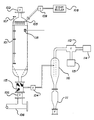
- Such carbonaceous materials as-mined generally contain from 20% up to 80% moisture and can be directly employed without any preliminary treatment other than a screening operation as a charge to an autoclave 101 of Fig. 1. It is usually preferred to effect a screening and/or crushing of the carbonaceous material as-mined to remove any large particles which may be attached thereto so as to facilitate a better handling of the charge and improve the packing thereof in the autoclave 101.
- the size and configuration of the carbonaceous material is not critical in achieving the benefits of the process of the present invention.
- the autoclave 101 employed may comprise any of the types known in the art capable of withstanding the temperatures and pressures required, and while the present description is directed particularly to batch-type autoclaves, it will be understood that continuous autoclaves can also be employed for the practice of the invention.
- the carbonaceous material is charged to an inlet at one end of the autoclave 101 by opening a valve 102, and high pressure steam from a boiler 108 is then introduced through a valve 109 into an opening 103 in the autoclave 101 at a position in the vicinity of inlet valve 102.
- the pressure in the autoclave 101 is monitored by a pressure sensor 116 and is allowed to reach a predetermined level and then a relief valve 104 at the bottom of the autoclave 101 is opened to maintain that pressure.
- the temperature of the steam inside the autoclave 101 is monitored by a thermocouple array 107 until it reaches a preselected temperature at the bottom relief valve 104. Alternatively, the temperature may be monitored in the autoclave's output conduit rather than inside the autoclave itself. When this steam temperature is reached, the bottom relief valve 104 is closed and the carbonaceous material is allowed to soak for a period of time sufficient to allow a desired degree of thermal restructuring and/or decomposition.
- Steam temperatures and pressures can be utilized in a range of from 271°C (520°F) at a pressure of 55.2 bar (800 psig), to 343°C (650°F) at a pressure of 165.5 bar (2400 psig), to obtain a thermal restructuring of the carbonaceous material.
- the best results in treating coal have been obtained when the steam temperature is allowed to reach on the order of 326.7°C (620°F) and the pressure in the autoclave 101 is allowed to reach on the order of 124.1 bar (1800 psig).
- the residence time of the carbonaceous material charge in the autoclave 101 will vary, depending upon the amount of thermal reconstructuring desired and the heating value that is desired. This residence time will generally range from 5 to 15 minutes in length after the bottom relief valve reaches a steam temperature of about 326.7°C (620°F).
- the required residence time decreases as the temperature and pressure in the autoclave 101 increase. Conversely, increased residence times are required when lower temperatures and pressures are used.
- the pressurization of the interior of the autoclave 101 can be controlled by a relief valve 104 located at the bottom of the autoclave 101.
- the relief valve 104 can be opened to maintain that pressure. This pressure of 124.1 bar (1800 psig) is maintained until the steam reaches the bottom relief valve 104 at a temperature of 326.7°C (620°F).
- the bottom relief valve 104 is closed and the carbonaceous material is allowed to soak with the high pressure steam at 326.7°C (620°F) for a period of time preferably between from 5 to 15 minutes.
- the process time - the time during which the high pressure steam is introduced until the desired temperature and pressure are reached and the bottom relief valve 104 is closed - can range from 5 minutes to 60 minutes.
- the autoclave 101 is then vented to the atmosphere or into an adjoining or available holding tank and a valve 105 at the bottom of the autoclave 101 is opened.
- the carbonaceous material is then extracted through a filter, such as a Johnson screen, 115 from the autoclave 101 via an extruder 106.
- water, wax and tar that are formed can be recovered through a pressure relief valve 104 at the bottom of the autoclave 101 and transported to an adjoining conventional separator 110.
- the tar and wax can be separated from the water, for example, by centrifugal force and transported to an adjoining tank 111 for later use.
- the water can then be recovered through a valve 112 and transported to an adjoining tank 113 as waste until the water reaches a temperature of about 121.1°C (250°F).
- the hot water at above about 121.1°C (250°F) could be fed to another autoclave for use in preheating the charge of feed material therein.
- a processing system arranged in accordance with the principles of the invention in an alternative form is set forth and features the use of a separate preheating pressurized chamber for the feed material prior to the feed material's introduction into the high pressure autoclave such as autoclave 101 of Fig. 1.
- feed material such as sub-bituminous coal is directed from a feed conveyor at line 250 via high pressure valve 230 into a preheating chamber 201.
- Output conduit 251 of vessel 201 is coupled to a filter 203 (such as a Johnson screen) and then is passed via high pressure valve 231 to input conduit 252 leading into high pressure autoclave 205.
- Material treated in vessel 205 is then fed via output conduit 253 and filter 207 (also for example a Johnson screen) and valve 232 to an output conveyor or extruder via line 254.
- filter 207 also for example a Johnson screen
- Steam generator 213 produces high pressure steam at its output 255 which is directed via valve 233, thermal compressor 219, valve 234 and input conduit 256 to the interior of preheating chamber 201. Additionally, generated steam at output 255 is coupled via valve 235 to an input 260 to filter 203, via valve 236 to input conduit 259 of autoclave 205 and via valve 239 to input conduit 261 to filter 207.
- One output of filter 207 is coupled via valve 240 to a primary flash pot 209.
- One output of flash pot 209 is coupled via valve 238 to input conduit 256 of preheating chamber 201, while a second output of primary flash pot 209 is coupled via valve 241 to an input of a secondary flash pot 211.
- One output of flash pot 211 is coupled via valve 242 to input 258 to a conventional wax and tar removal system 217, while a second output of flash pot 211 is coupled via valve 237 to thermal compressor 219.
- Wax and tar which have been removed from the output water of flash pot 211 via system 217 may then be fed via line 261 to steam generator 213 for use as a heat source in effecting steam generation therein.
- An output of filter 203 is coupled via valve 243 to input 257 to a conventional degassing and storage system 215.
- the water fed to degassing and storage system 215 via filter 203 is then processed and passed in a substantially clean state via line 262 to steam generator 213 for use as feedwater therein.
- the internal pressure developed within preheating chamber 201 is monitored via pressure sensor 223, while the temperature of the preheating medium utilized in vessel 201 is monitored by a temperature sensor (such as a thermocouple) 221 which has been placed in the output conduit 251 of vessel 201.
- a temperature sensor such as a thermocouple
- pressure within main processing autoclave 205 is monitored via pressure sensor 227, and the temperature of the heating medium of vessel 205 is monitored via a temperature sensor (such as a thermocouple) 225 which has been positioned in output conduit 253 of vessel 205.
- the system of Fig. 2 operates the preheating vessel 201 at a relatively low pressure such that water exiting the preheating chamber via filter 203 is clean enough to be reusable in steam generator 213. This greater efficiency may be achieved at no substantial added cost, since the top vessel 201 can be of a cheaper construction due to the use of lower pressures therein.
- a charge of feed material is introduced via line 250 and high pressure valve 230 into vessel 201.
- Valve 230 is then closed and steam at a pressure of on the order of 13.7 to 41.4 bar (200 to 600 psig), (preferably 34.5-37.9 bar (500-550 psig)) is introduced into preheating chamber 201.
- Condensed water then exits vessel 201 via filter 203 and valve 243 to a degassing and storage system 215 for processing and return to steam generator 213 via line 262 for use in generating further steam requirements of the system.
- vessel 201 After preheating the charge in vessel 201 to a predetermined temperature (preferably 240-246°C (465°-475°F)), vessel 201 is vented to the atmosphere and mid-lock valve 231 is opened thereby emptying the feed charge into main autoclave 205 under atmospheric pressure.
- a predetermined temperature preferably 240-246°C (465°-475°F)
- Valve 231 is then closed and a new feed charge can at that time be fed into preheating vessel 201 via line 250 and valve 230. Simultaneously, high pressure steam 124.1 bar ((1800 psig) preferred) is introduced into main autoclave 205 via valve 236 for contact with the preheated feed material which has been introduced from the upper preheating chamber 201.
- the water and tar and wax mixture remaining in flash pot 211 is then directed via valve 242 to input 258 of conventional wax and tar removal system 217.
- system 217 water is separated from the wax and tar by conventional methods and the wax and tar may then be passed via line 261 to steam generator 213 for use as fuel for boiling the feed water to generate the steam required by the arrangement of Fig. 2.
- valves 232 and 240 are closed and the feed material is allowed to soak with the high pressure steam at the predetermined temperature for a predetermined period of time (preferably 5-15 minutes) in a manner similar to the approach described with reference to the autoclave 101 of Fig. 1.
- Coal having an as-mined moisture content of 30% by weight and a heating value of about 18.79 kJ/g (8100 BTU per pound) was charged into an autoclave.
- High pressure steam was then introduced into the autoclave for a period of 15 minutes while the pressure inside the autoclave was maintained at 124.1 bar (1800 psig) and the temperature of the steam inside the autoclave was allowed to reach 326.7°C (620°F).
- the autoclave was then closed off and the coal was allowed to soak at a pressure of 1800 psig at a temperature of 326.7°C (620°F) for a period of 15 minutes.
- a valve at the bottom of the autoclave was opened and the charge was removed.
- the upgraded coal product had a moisture content of .04% by weight and had a measured heating value of 28.94 kJ/g (12475 BTU per pound).
- Coal having an as-mined moisture content of 30% by weight and a heating value of about 18.79 kJ/g (8100 BTU per pound) was charged into an autoclave.
- High pressure steam was then introduced into the autoclave for a period of 16 minutes while the pressure inside the autoclave was maintained at 1600 psig and the temperature of the steam inside the autoclave was allowed to reach 315.6°C (600°F).
- the autoclave was then closed off and the coal was allowed to soak at a pressure of 110.3 bar (1600 psig) and a steam temperature of 315.6°C (600°F) for a period of 20 minutes.
- a valve at the bottom of the autoclave was opened and the charge was removed.
- the upgraded coal product had a moisture content of 3.17% by weight and had a measured heating value of 28.19 kJ/g (12149 BTU per pound).
- Coal having an as-mined moisture content of 30% by weight and a heating value of about 18.79 kJ/g (8100 BTU per pound) was charged into an autoclave.
- High pressure steam was then introduced into the autoclave for a period of 15 minutes while the pressure inside the autoclave was maintained at 79.3 bar (1150 psig) and the temperature of the steam inside the autoclave was allowed to reach 293.3°C (560°F).
- the autoclave was then closed off and the coal was allowed to soak at a pressure of 79.3 bar (1150 psig) and a steam temperature of 293.3°C (560°F) for a period of 10 minutes.
- the upgraded coal product had a moisture content of 3.9% by weight and a measured heating valve of 26.98 kJ/g (11631 BTU per pound).
- Coal having an as-mined moisture content of 30% by weight and a heating value of 18.79 kJ/g (8100 BTU per pound) was charged into an autoclave.
- High pressure steam was then introduced into the autoclave for a period of 15 minutes while the pressure inside the autoclave was maintained at 124.1 bar (1800 psig) and the temperature of the steam inside the autoclave as allowed to reach 326.7°C (620°F).
- tar was recovered through a valve and transported to a separator along with the water that was forming as condensed steam. The tar was then separated from the water and the tar had a measured heating value of 25.11 kJ/g (10824 BTU per pound).
- Coal having an as-mined moisture content of approximatey 30% by weight and a heating value of 18.56 kJ/g (8000 BTU per pound) was charged into a preheating chamber.
- Steam at 34.5 bar (500 psig) was fed into the preheating chamber until steam exiting the bottom of the preheating chamber reached a temperature of approximately 240°C (465°F).
- the preheating chamber was vented to the atmosphere and the charge was then placed in a main processing autoclave, and steam at 124.1 bar (1800 psig) was introduced therein.
- the temperature of the steam at the bottom of the main processing autoclave reached 326.7°C (620°F)
- the autoclave was closed off and the coal charge was allowed to soak for a period of 10-15 minutes.
- the upgraded coal product had a moisture content of 0.4-2.0% by weight and a measured heating value of approximately 28.54 kJ/g (12,300 BTU per pound).
Landscapes
- Chemical & Material Sciences (AREA)
- Engineering & Computer Science (AREA)
- Combustion & Propulsion (AREA)
- Oil, Petroleum & Natural Gas (AREA)
- Organic Chemistry (AREA)
- Carbon And Carbon Compounds (AREA)
- Solid Fuels And Fuel-Associated Substances (AREA)
- Processing Of Solid Wastes (AREA)
- Hydraulic Clutches, Magnetic Clutches, Fluid Clutches, And Fluid Joints (AREA)
Claims (18)
- Verfahren zur Dampfbehandlung von kohlenstoffhaltigem Material, umfassend die folgenden Schritte:
Einfüllen von kohlenstoffhaltigem Material in ein Gefäß;
Einleiten von Hochdruckdampf in das Gefäß, bis die Innenseite des Gefäßes einen Druck zwischen 55 bar (800 psig) und 165 bar (2400 psig) erreicht;
Messen der Temperatur des aus dem kohlenstoffhaltigen Material ausgetriebenen Dampfes und Wassers und des kondensierten Dampfes in dem Gefäß;
Abziehen des Wassers und des kondensierten Dampfes aus dem Gefäß;
Verschließen des Gefäßes, wenn die gemessene Temperatur des Dampfes zwischen 271°C und 343°C (520°F und 650°F) liegt, und das kohlenstoffhaltige Material solange in dem unkondensierten Dampf einweichen lassen, bis eine weitere thermische Umstrukturierung des kohlenstoffhaltigen Materials möglich ist; und
anschließend Herausnehmen des kohlenstoffhaltigen Materials aus dem Gefäß. - Verfahren nach Anspruch 1, bei dem das Gefäß einen Autoklaven umfaßt, der Hochdruckdampf in ein erstes Ende des Autoklaven eingeleitet wird, und man den Dampf über eine Ladung kohlenstoffhaltiges Material zu einem zweiten Ende des Autoklaven wandern läßt.
- Verfahren nach Anspruch 2, bei dem der Autoklav verschlossen wird, wenn die gemessene Temperatur des Dampfes zwischen 316°C und 327°C (600°F und 620°F) liegt.
- Verfahren nach Anspruch 1, 2 oder 3, bei dem Hochdruckdampf eingeleitet wird, bis die Innenseite des Gefäßes einen Druck zwischen 110 bar und 124 bar (1600 psig und 1800 psig) erreicht.
- Verfahren nach Anspruch 3, bei dem Hochdruckdampf eingeleitet wird, bis die Innenseite des Autoklaven einen Druck zwischen 117 bar und 124 bar (1700 psig und 1800 psig) erreicht.
- Verfahren nach einem der vorhergehenden Ansprüche, bei dem das kohlenstoffhaltige Material mindestens 5 Minuten in unkondensiertem Dampf einweicht.
- Verfahren nach einem der vorhergehenden Ansprüche, bei dem das kohlenstoffhaltige Material mindestens 15 Minuten in dem unkondensierten Dampf einweicht.
- Verfahren nach Anspruch 2, bei dem:
das kohlenstoffhaltige Material in den Autoklaven gefüllt wird, indem ein oberes Ventil desselben geöffnet wird;
das erste Ende des Autoklaven einen oberen Abschnitt desselben umfaßt, und das zweite Ende des Autoklaven einen unteren Abschnitt desselben umfaßt,
der Dampfdruck aufrechterhalten wird, indem ein Überdruckventil im unteren Abschnitt des Autoklaven geöffnet wird;
das abgezogene Wasser und der abgezogene kondensierte Dampf zu einem angrenzenden Tank befördert wird;
die Dampftemperatur an dem Überdruckventil im Boden des Autoklaven gemessen wird;
der Autoklav durch Schließen des oberen und des unteren Ventils verschlossen wird; und
der Autoklav vor dem Herausnehmen des kohlenstoffhaltigen Materials an die Atmosphäre entlüftet wird. - Verfahren nach Anspruch 8, bei dem der Autoklav verschlossen wird, wenn die gemessene Dampftemperatur 327°C (620°F) und der Dampfdruck 124 bar (1800 psig) beträgt.
- Verfahren nach Anspruch 8 oder 9, bei dem der Zeitraum im Bereich von 5 Minuten bis 15 Minuten liegt.
- Verfahren nach Anspruch 8, bei dem der Zeitraum im Bereich von 15 Minuten bis 20 Minuten liegt.
- Verfahren nach einem der vorhergehenden Ansprüche, bei dem vor dem Einfüllen von kohlenstoffhaltigem Material in das Gefäß weiterhin die folgenden Vorstufen stattfinden:
Einbringen des kohlenstoffhaltigen Materials in eine Vorheizkammer;
Einleiten von Dampf mit einem Druck zwischen 13,8 bar und 41,3 bar (200 psig und 600 psig) in die Vorheizkammer;
Überwachen der Temperatur des aus der Vorheizkammer austretenden kondensierten Wassers; und
Unterbrechen der Dampfzufuhr und Entlüften der Vorheizkammer an die Atmosphäre, wenn der aus der Vorheizkammer austretende Dampf eine Temperatur zwischen 204°C und 260°C (400°F und 500°F) erreicht. - Verfahren nach Anspruch 12, bei dem die Dampfzufuhr zu der Vorheizkammer unterbrochen wird und die Vorheizkammer an die Atmosphäre entlüftet wird, wenn der aus der Vorheizkammer austretende Dampf eine Temperatur zwischen 241°C und 246°C (465°F und 475°F) erreicht, und wenn der Dampfdruck in der Vorheizkammer zwischen 34,5 bar und 37,9 bar (500 psig und 550 psig) liegt.
- Verfahren nach Anspruch 12 oder 13, bei dem des weiteren als Vorstufe das aus der Vorheizkammer austretende Wasser zu einem Dampfgenerator zurückgeleitet wird, wo es als Speisewasser verwendet wird.
- Verfahren nach Anspruch 12, 13 oder 14, bei dem weiterhin das aus dem Gefäß austretende Wasser mit vermindertem Druck in einen Verdampfungstopf eingeleitet wird, um weiteren Dampf von dem Wasser abzutreiben und den abgetriebenen Dampf zu der Vorheizkammer zurückzuschicken, wo er verwendet wird.
- Verfahren nach einem der Ansprüche 12 bis 15, bei dem des weiteren Wachs und Teer von dem aus dem Gefäß austretenden Wasser abgetrennt und zu einem Dampfgenerator geschickt werden, um dort als Brennstoff verwendet zu werden.
- Verfahren nach einem der vorhergehenden Ansprüche, bei dem das umstrukturierte kohlenstoffhaltige Material über einen Extruder gewonnen wird, um das umstrukturierte kohlenstoffhaltige Material zu Kügelchen zu formen.
- Verfahren nach einem der Ansprüche 1 bis 15, bei dem des weiteren Teer sowie Wasser und kondensierter Dampf aus dem Gefäß abgelassen werden und Wasser und Teer zu einer Trenneinrichtung befördert werden, um Teer und Wasser getrennt zu gewinnen.
Applications Claiming Priority (3)
| Application Number | Priority Date | Filing Date | Title |
|---|---|---|---|
| US429795 | 1989-10-31 | ||
| US07/429,795 US5071447A (en) | 1989-10-31 | 1989-10-31 | Apparatus and process for steam treating carbonaceous material |
| PCT/US1990/006297 WO1991006617A1 (en) | 1989-10-31 | 1990-10-30 | Apparatus and process for steam treating carbonaceous material |
Publications (3)
| Publication Number | Publication Date |
|---|---|
| EP0500744A1 EP0500744A1 (de) | 1992-09-02 |
| EP0500744A4 EP0500744A4 (en) | 1993-01-07 |
| EP0500744B1 true EP0500744B1 (de) | 1995-03-22 |
Family
ID=23704778
Family Applications (1)
| Application Number | Title | Priority Date | Filing Date |
|---|---|---|---|
| EP90917557A Expired - Lifetime EP0500744B1 (de) | 1989-10-31 | 1990-10-30 | Verfahren zum Behandeln von Kohlenstoffmaterial |
Country Status (10)
| Country | Link |
|---|---|
| US (1) | US5071447A (de) |
| EP (1) | EP0500744B1 (de) |
| JP (1) | JP2723357B2 (de) |
| AT (1) | ATE120229T1 (de) |
| AU (1) | AU649980B2 (de) |
| CA (1) | CA2071921C (de) |
| DE (1) | DE69018091T2 (de) |
| ES (1) | ES2073591T3 (de) |
| HU (1) | HU216759B (de) |
| WO (1) | WO1991006617A1 (de) |
Families Citing this family (21)
| Publication number | Priority date | Publication date | Assignee | Title |
|---|---|---|---|---|
| JPH11510538A (ja) * | 1995-08-09 | 1999-09-14 | ケイエフエクス インコーポレイテッド | 炭素質材料中における副次物質含有量を減少させるための方法および装置 |
| US5656041A (en) * | 1996-06-05 | 1997-08-12 | Rochester Gas & Electric Co. | Method for detoxifying coal-tar deposits |
| US5746787A (en) * | 1996-10-28 | 1998-05-05 | Kfx Inc. | Process for treating carbonaceous materials |
| AUPO876797A0 (en) * | 1997-08-25 | 1997-09-18 | Technological Resources Pty Limited | Heating with steam |
| US6506224B1 (en) * | 1998-08-25 | 2003-01-14 | K-Fuel L.L.C. | Method and an apparatus for upgrading a solid material |
| KR100621713B1 (ko) * | 2000-09-26 | 2006-09-13 | 테크놀라지칼 리소시스 피티와이. 리미티드. | 고체 물질의 품질개량 방법 및 장치 |
| DE10102493B4 (de) | 2001-01-19 | 2007-07-12 | W.C. Heraeus Gmbh | Rohrförmiges Target und Verfahren zur Herstellung eines solchen Targets |
| JP2003275732A (ja) * | 2002-03-25 | 2003-09-30 | Hiroshi Shishido | 未利用バイオマス・水産物ゼロエミッションのシステム |
| WO2003087274A1 (en) * | 2002-04-12 | 2003-10-23 | Gtl Energy | Method of forming a feed for coal gasification |
| WO2005003255A2 (en) * | 2003-07-01 | 2005-01-13 | Gtl Energy | Method to upgrade low rank coal stocks |
| JP3613567B1 (ja) * | 2004-03-26 | 2005-01-26 | 株式会社西村組 | 燃料製造装置および燃料製造方法 |
| US7198655B2 (en) * | 2004-05-03 | 2007-04-03 | Evergreen Energy Inc. | Method and apparatus for thermally upgrading carbonaceous materials |
| WO2009100000A2 (en) * | 2008-01-31 | 2009-08-13 | Oxygenator Water Technologies, Inc. | Apparatus and method for improved electrolytic water treatment process |
| US8021445B2 (en) | 2008-07-09 | 2011-09-20 | Skye Energy Holdings, Inc. | Upgrading carbonaceous materials |
| BRPI0923508A8 (pt) | 2008-12-15 | 2017-07-11 | Zilkha Biomass Fuels Llc | Método de produção de péletes ou briquetes a partir de material contendo lignina |
| CN102072629B (zh) * | 2011-01-11 | 2012-11-21 | 徐斌 | 一种对固体物料进行蒸煮的蒸煮器 |
| US20120204962A1 (en) * | 2011-02-11 | 2012-08-16 | Evergreen Energy Inc. | System and Method for Improved Hydrothermal Upgrading of Carbonaceous Material |
| AU2014386062A1 (en) * | 2014-03-13 | 2016-09-22 | Mitsubishi Heavy Industries, Ltd. | Power generating system using low quality coal |
| JP5865539B1 (ja) * | 2015-05-21 | 2016-02-17 | 株式会社三和商会 | 微細分散複合化装置及び微細分散複合化方法 |
| JP5932120B1 (ja) * | 2015-08-21 | 2016-06-08 | 恵和興業株式会社 | 懸濁液の製造装置及びその製造方法 |
| FI129626B (fi) * | 2021-02-15 | 2022-05-31 | Avant Wood Oy | Modifiointijärjestely hygroskooppiselle materiaalille |
Family Cites Families (18)
| Publication number | Priority date | Publication date | Assignee | Title |
|---|---|---|---|---|
| US3909212A (en) * | 1973-06-29 | 1975-09-30 | Wilburn C Schroeder | Removal of sulfur from carbonaceous fuels |
| US4047898A (en) * | 1975-06-03 | 1977-09-13 | Texaco Inc. | Upgrading of solid fuels |
| US4052293A (en) * | 1975-10-10 | 1977-10-04 | Cryo-Maid Inc. | Method and apparatus for extracting oil from hydrocarbonaceous solid material |
| US4052168A (en) * | 1976-01-12 | 1977-10-04 | Edward Koppelman | Process for upgrading lignitic-type coal as a fuel |
| AU517024B2 (en) * | 1976-09-20 | 1981-07-02 | Kobe Steel Limited | Coking low ranking coals |
| US4192650A (en) * | 1978-07-17 | 1980-03-11 | Sunoco Energy Development Co. | Process for drying and stabilizing coal |
| NL7812248A (nl) | 1978-12-18 | 1980-06-20 | Shell Int Research | Thermische behandeling van kool. |
| AT366090B (de) * | 1980-01-21 | 1982-03-10 | Voest Alpine Ag | Verfahren zum trocknen und umwandeln von organi- schen feststoffen, wie insbesondere braunkohlen, sowie verwendung der auf diese weise getrockneten und umgewandelten braunkohlen |
| AT366405B (de) * | 1980-01-21 | 1981-04-13 | Voest Alpine Ag | Verfahren zum trocknen und umwandeln von organischen feststoffen, insbesondere braunkohlen mit dampf |
| AT370433B (de) * | 1981-06-19 | 1983-03-25 | Voest Alpine Ag | Vorrichtung zum trocknen von kohlen |
| US4472885A (en) * | 1982-01-28 | 1984-09-25 | Electric Power Development Co., Ltd. | Process and apparatus for dehydrating organic solid material |
| JPS5918796A (ja) * | 1982-07-21 | 1984-01-31 | Hitachi Ltd | 石炭の改質方法 |
| US4477257A (en) * | 1982-12-13 | 1984-10-16 | K-Fuel/Koppelman Patent Licensing Trust | Apparatus and process for thermal treatment of organic carbonaceous materials |
| AT385839B (de) * | 1983-06-30 | 1988-05-25 | Voest Alpine Ag | Einrichtung zum trocknen von wasserreichen organischen feststoffen, insbesondere braunkohlen |
| DE3563978D1 (en) * | 1984-03-21 | 1988-09-01 | Voest Alpine Ag | Drying installation for lignite with a high water content |
| US4601113A (en) * | 1985-04-26 | 1986-07-22 | Westinghouse Electric Corp. | Method and apparatus for fluidized steam drying of low-rank coals |
| AT388170B (de) * | 1985-11-08 | 1989-05-10 | Voest Alpine Ag | Verfahren zum trocknen von wasserreichen braunkohlen |
| US4810258A (en) * | 1985-11-12 | 1989-03-07 | Western Energy Company | Low rank coal or peat having impurities removed by a drying process |
-
1989
- 1989-10-31 US US07/429,795 patent/US5071447A/en not_active Expired - Lifetime
-
1990
- 1990-10-30 JP JP3500459A patent/JP2723357B2/ja not_active Expired - Fee Related
- 1990-10-30 WO PCT/US1990/006297 patent/WO1991006617A1/en not_active Ceased
- 1990-10-30 EP EP90917557A patent/EP0500744B1/de not_active Expired - Lifetime
- 1990-10-30 AU AU67581/90A patent/AU649980B2/en not_active Ceased
- 1990-10-30 ES ES90917557T patent/ES2073591T3/es not_active Expired - Lifetime
- 1990-10-30 CA CA002071921A patent/CA2071921C/en not_active Expired - Fee Related
- 1990-10-30 AT AT90917557T patent/ATE120229T1/de not_active IP Right Cessation
- 1990-10-30 DE DE69018091T patent/DE69018091T2/de not_active Expired - Fee Related
- 1990-10-30 HU HU9201428A patent/HU216759B/hu not_active IP Right Cessation
Also Published As
| Publication number | Publication date |
|---|---|
| CA2071921C (en) | 2001-06-12 |
| AU649980B2 (en) | 1994-06-09 |
| WO1991006617A1 (en) | 1991-05-16 |
| DE69018091D1 (de) | 1995-04-27 |
| ES2073591T3 (es) | 1995-08-16 |
| US5071447A (en) | 1991-12-10 |
| EP0500744A4 (en) | 1993-01-07 |
| DE69018091T2 (de) | 1995-07-27 |
| CA2071921A1 (en) | 1991-05-01 |
| AU6758190A (en) | 1991-05-31 |
| HU9201428D0 (en) | 1992-09-28 |
| JP2723357B2 (ja) | 1998-03-09 |
| EP0500744A1 (de) | 1992-09-02 |
| JPH05503954A (ja) | 1993-06-24 |
| ATE120229T1 (de) | 1995-04-15 |
| HUT65258A (en) | 1994-05-02 |
| HU216759B (hu) | 1999-08-30 |
Similar Documents
| Publication | Publication Date | Title |
|---|---|---|
| US5071447A (en) | Apparatus and process for steam treating carbonaceous material | |
| US4502227A (en) | Process for continuously drying and upgrading of organic solid materials such as, for example, brown coals | |
| CA1145699A (en) | Process for upgrading low rank coal | |
| KR100561802B1 (ko) | 폐 타이어 또는 이와 유사한 중합체 물질로부터 열분해 반응기에서 열분해법으로 탄소 및 탄화수소 배합물을 회수하는 방법 | |
| US4557204A (en) | Process and apparatus for treating waste materials | |
| US4579562A (en) | Thermochemical beneficiation of low rank coals | |
| US4632731A (en) | Carbonization and dewatering process | |
| US10280379B2 (en) | Dairy manure waste fiber to energy process | |
| EP0102828A2 (de) | Verfahren zum Austragen von Feststoffen aus einem Hochdruckgefässreaktor | |
| US1898326A (en) | Process of destructive distillation and carbonization of waste matter | |
| JP2011218344A (ja) | 廃棄物の処理方法 | |
| FR2478287A1 (fr) | Procede et appareillage de chauffage de matiere particulaire | |
| US3436314A (en) | Technique for converting bagasse and other moist plant substances into charcoal | |
| KR100621713B1 (ko) | 고체 물질의 품질개량 방법 및 장치 | |
| KR102807968B1 (ko) | 고체 불활성 잔류물 (sir) 건조기 및 추출기 시스템 | |
| GB2463314A (en) | Process for municipal solid waste treatment | |
| GB2067731A (en) | Drying solid organic materials | |
| DK172824B1 (da) | Fremgangsmåde og apparat til fremstilling af brændbare gasformige produkter | |
| DE2966425D1 (en) | Process for gasification and device for such process | |
| US7255785B2 (en) | Apparatus and process for treatment of waste oils | |
| PL166927B1 (pl) | Urządzenie do przetwarzania materiału węglowego za pomocą pary wodnej I sposób przetwarzania materiału węglowego za pomocą pary wodne] | |
| GB2145732A (en) | Process for making aqueous transportable fuel slurry from carbonaceous materials | |
| JPS6035086A (ja) | 廃物を処理するための方法および装置 | |
| US4419217A (en) | Process for improving the yield of shale oil | |
| KR0182769B1 (ko) | 탱크 바닥 폐기물의 회수방법 |
Legal Events
| Date | Code | Title | Description |
|---|---|---|---|
| PUAI | Public reference made under article 153(3) epc to a published international application that has entered the european phase |
Free format text: ORIGINAL CODE: 0009012 |
|
| 17P | Request for examination filed |
Effective date: 19920502 |
|
| AK | Designated contracting states |
Kind code of ref document: A1 Designated state(s): AT BE CH DE DK ES FR GB GR IT LI LU NL SE |
|
| A4 | Supplementary search report drawn up and despatched |
Effective date: 19921119 |
|
| AK | Designated contracting states |
Kind code of ref document: A4 Designated state(s): AT BE CH DE DK ES FR GB GR IT LI LU NL SE |
|
| 17Q | First examination report despatched |
Effective date: 19930916 |
|
| GRAA | (expected) grant |
Free format text: ORIGINAL CODE: 0009210 |
|
| AK | Designated contracting states |
Kind code of ref document: B1 Designated state(s): AT BE CH DE DK ES FR GB GR IT LI LU NL SE |
|
| PG25 | Lapsed in a contracting state [announced via postgrant information from national office to epo] |
Ref country code: DK Effective date: 19950322 Ref country code: BE Effective date: 19950322 |
|
| REF | Corresponds to: |
Ref document number: 120229 Country of ref document: AT Date of ref document: 19950415 Kind code of ref document: T |
|
| ET | Fr: translation filed | ||
| REF | Corresponds to: |
Ref document number: 69018091 Country of ref document: DE Date of ref document: 19950427 |
|
| REG | Reference to a national code |
Ref country code: CH Ref legal event code: PUE Owner name: KFX, INC. |
|
| RAP2 | Party data changed (patent owner data changed or rights of a patent transferred) |
Owner name: KFX, INC. |
|
| ET1 | Fr: translation filed ** revision of the translation of the patent or the claims | ||
| ITF | It: translation for a ep patent filed | ||
| REG | Reference to a national code |
Ref country code: ES Ref legal event code: FG2A Ref document number: 2073591 Country of ref document: ES Kind code of ref document: T3 |
|
| REG | Reference to a national code |
Ref country code: GR Ref legal event code: FG4A Free format text: 3016497 |
|
| PG25 | Lapsed in a contracting state [announced via postgrant information from national office to epo] |
Ref country code: LU Free format text: LAPSE BECAUSE OF NON-PAYMENT OF DUE FEES Effective date: 19951031 |
|
| PLBE | No opposition filed within time limit |
Free format text: ORIGINAL CODE: 0009261 |
|
| STAA | Information on the status of an ep patent application or granted ep patent |
Free format text: STATUS: NO OPPOSITION FILED WITHIN TIME LIMIT |
|
| 26N | No opposition filed | ||
| REG | Reference to a national code |
Ref country code: GB Ref legal event code: IF02 |
|
| PGFP | Annual fee paid to national office [announced via postgrant information from national office to epo] |
Ref country code: AT Payment date: 20020912 Year of fee payment: 13 |
|
| PGFP | Annual fee paid to national office [announced via postgrant information from national office to epo] |
Ref country code: GB Payment date: 20020913 Year of fee payment: 13 |
|
| PGFP | Annual fee paid to national office [announced via postgrant information from national office to epo] |
Ref country code: NL Payment date: 20020919 Year of fee payment: 13 |
|
| PGFP | Annual fee paid to national office [announced via postgrant information from national office to epo] |
Ref country code: GR Payment date: 20020927 Year of fee payment: 13 |
|
| PGFP | Annual fee paid to national office [announced via postgrant information from national office to epo] |
Ref country code: FR Payment date: 20021003 Year of fee payment: 13 |
|
| PGFP | Annual fee paid to national office [announced via postgrant information from national office to epo] |
Ref country code: SE Payment date: 20021004 Year of fee payment: 13 |
|
| PGFP | Annual fee paid to national office [announced via postgrant information from national office to epo] |
Ref country code: ES Payment date: 20021015 Year of fee payment: 13 |
|
| PGFP | Annual fee paid to national office [announced via postgrant information from national office to epo] |
Ref country code: DE Payment date: 20021031 Year of fee payment: 13 |
|
| PGFP | Annual fee paid to national office [announced via postgrant information from national office to epo] |
Ref country code: CH Payment date: 20021223 Year of fee payment: 13 |
|
| PG25 | Lapsed in a contracting state [announced via postgrant information from national office to epo] |
Ref country code: GB Free format text: LAPSE BECAUSE OF NON-PAYMENT OF DUE FEES Effective date: 20031030 Ref country code: AT Free format text: LAPSE BECAUSE OF NON-PAYMENT OF DUE FEES Effective date: 20031030 |
|
| PG25 | Lapsed in a contracting state [announced via postgrant information from national office to epo] |
Ref country code: SE Free format text: LAPSE BECAUSE OF NON-PAYMENT OF DUE FEES Effective date: 20031031 Ref country code: LI Free format text: LAPSE BECAUSE OF NON-PAYMENT OF DUE FEES Effective date: 20031031 Ref country code: ES Free format text: LAPSE BECAUSE OF NON-PAYMENT OF DUE FEES Effective date: 20031031 Ref country code: CH Free format text: LAPSE BECAUSE OF NON-PAYMENT OF DUE FEES Effective date: 20031031 |
|
| PG25 | Lapsed in a contracting state [announced via postgrant information from national office to epo] |
Ref country code: NL Free format text: LAPSE BECAUSE OF NON-PAYMENT OF DUE FEES Effective date: 20040501 Ref country code: DE Free format text: LAPSE BECAUSE OF NON-PAYMENT OF DUE FEES Effective date: 20040501 |
|
| PG25 | Lapsed in a contracting state [announced via postgrant information from national office to epo] |
Ref country code: GR Free format text: LAPSE BECAUSE OF NON-PAYMENT OF DUE FEES Effective date: 20040504 |
|
| EUG | Se: european patent has lapsed | ||
| REG | Reference to a national code |
Ref country code: CH Ref legal event code: PL |
|
| GBPC | Gb: european patent ceased through non-payment of renewal fee |
Effective date: 20031030 |
|
| PG25 | Lapsed in a contracting state [announced via postgrant information from national office to epo] |
Ref country code: FR Free format text: LAPSE BECAUSE OF NON-PAYMENT OF DUE FEES Effective date: 20040630 |
|
| NLV4 | Nl: lapsed or anulled due to non-payment of the annual fee |
Effective date: 20040501 |
|
| REG | Reference to a national code |
Ref country code: FR Ref legal event code: ST |
|
| REG | Reference to a national code |
Ref country code: ES Ref legal event code: FD2A Effective date: 20031031 |
|
| PG25 | Lapsed in a contracting state [announced via postgrant information from national office to epo] |
Ref country code: IT Free format text: LAPSE BECAUSE OF NON-PAYMENT OF DUE FEES;WARNING: LAPSES OF ITALIAN PATENTS WITH EFFECTIVE DATE BEFORE 2007 MAY HAVE OCCURRED AT ANY TIME BEFORE 2007. THE CORRECT EFFECTIVE DATE MAY BE DIFFERENT FROM THE ONE RECORDED. Effective date: 20051030 |