EP0499051B1 - Organopolysiloxane mit an einer gemeinsamen Spacergruppe gebundenen Polyether- und Ester-Gruppen - Google Patents
Organopolysiloxane mit an einer gemeinsamen Spacergruppe gebundenen Polyether- und Ester-Gruppen Download PDFInfo
- Publication number
- EP0499051B1 EP0499051B1 EP92100898A EP92100898A EP0499051B1 EP 0499051 B1 EP0499051 B1 EP 0499051B1 EP 92100898 A EP92100898 A EP 92100898A EP 92100898 A EP92100898 A EP 92100898A EP 0499051 B1 EP0499051 B1 EP 0499051B1
- Authority
- EP
- European Patent Office
- Prior art keywords
- radical
- radicals
- organopolysiloxanes
- carbon atoms
- formula
- Prior art date
- Legal status (The legal status is an assumption and is not a legal conclusion. Google has not performed a legal analysis and makes no representation as to the accuracy of the status listed.)
- Expired - Lifetime
Links
- 229920001296 polysiloxane Polymers 0.000 title claims description 29
- 229920000570 polyether Polymers 0.000 title claims description 25
- 239000004721 Polyphenylene oxide Substances 0.000 title claims description 22
- 125000006850 spacer group Chemical group 0.000 title claims description 10
- 125000004185 ester group Chemical group 0.000 title claims description 7
- 150000003254 radicals Chemical class 0.000 claims description 81
- -1 alkyl radicals Chemical class 0.000 claims description 58
- 125000004432 carbon atom Chemical group C* 0.000 claims description 23
- 239000000203 mixture Substances 0.000 claims description 21
- 125000002887 hydroxy group Chemical group [H]O* 0.000 claims description 17
- 239000003054 catalyst Substances 0.000 claims description 13
- 229910052739 hydrogen Inorganic materials 0.000 claims description 11
- 239000001257 hydrogen Substances 0.000 claims description 11
- KPUWHANPEXNPJT-UHFFFAOYSA-N disiloxane Chemical class [SiH3]O[SiH3] KPUWHANPEXNPJT-UHFFFAOYSA-N 0.000 claims description 10
- 125000002947 alkylene group Chemical group 0.000 claims description 9
- 238000000034 method Methods 0.000 claims description 9
- 150000002763 monocarboxylic acids Chemical class 0.000 claims description 8
- CERQOIWHTDAKMF-UHFFFAOYSA-N Methacrylic acid Chemical compound CC(=C)C(O)=O CERQOIWHTDAKMF-UHFFFAOYSA-N 0.000 claims description 7
- 239000000654 additive Substances 0.000 claims description 7
- GOOHAUXETOMSMM-UHFFFAOYSA-N Propylene oxide Chemical compound CC1CO1 GOOHAUXETOMSMM-UHFFFAOYSA-N 0.000 claims description 6
- IAYPIBMASNFSPL-UHFFFAOYSA-N Ethylene oxide Chemical compound C1CO1 IAYPIBMASNFSPL-UHFFFAOYSA-N 0.000 claims description 5
- SMZOUWXMTYCWNB-UHFFFAOYSA-N 2-(2-methoxy-5-methylphenyl)ethanamine Chemical compound COC1=CC=C(C)C=C1CCN SMZOUWXMTYCWNB-UHFFFAOYSA-N 0.000 claims description 4
- 230000002378 acidificating effect Effects 0.000 claims description 4
- WCYWZMWISLQXQU-UHFFFAOYSA-N methyl Chemical compound [CH3] WCYWZMWISLQXQU-UHFFFAOYSA-N 0.000 claims description 4
- OKTJSMMVPCPJKN-UHFFFAOYSA-N Carbon Chemical group [C] OKTJSMMVPCPJKN-UHFFFAOYSA-N 0.000 claims description 3
- 239000004215 Carbon black (E152) Substances 0.000 claims description 3
- UFHFLCQGNIYNRP-UHFFFAOYSA-N Hydrogen Chemical compound [H][H] UFHFLCQGNIYNRP-UHFFFAOYSA-N 0.000 claims description 3
- 239000011230 binding agent Substances 0.000 claims description 3
- 125000002915 carbonyl group Chemical group [*:2]C([*:1])=O 0.000 claims description 3
- 239000011248 coating agent Substances 0.000 claims description 3
- 239000008199 coating composition Substances 0.000 claims description 3
- 238000000576 coating method Methods 0.000 claims description 3
- 238000009826 distribution Methods 0.000 claims description 3
- 229930195733 hydrocarbon Natural products 0.000 claims description 3
- 125000004430 oxygen atom Chemical group O* 0.000 claims description 3
- 239000004033 plastic Substances 0.000 claims description 3
- 229920003023 plastic Polymers 0.000 claims description 3
- 238000002360 preparation method Methods 0.000 claims description 3
- 238000003847 radiation curing Methods 0.000 claims description 3
- 238000007259 addition reaction Methods 0.000 claims description 2
- 239000002904 solvent Substances 0.000 claims description 2
- 150000002431 hydrogen Chemical class 0.000 claims 2
- 239000000463 material Substances 0.000 claims 2
- RTZKZFJDLAIYFH-UHFFFAOYSA-N Diethyl ether Chemical compound CCOCC RTZKZFJDLAIYFH-UHFFFAOYSA-N 0.000 description 21
- YXFVVABEGXRONW-UHFFFAOYSA-N Toluene Chemical compound CC1=CC=CC=C1 YXFVVABEGXRONW-UHFFFAOYSA-N 0.000 description 21
- UIIMBOGNXHQVGW-UHFFFAOYSA-M Sodium bicarbonate Chemical compound [Na+].OC([O-])=O UIIMBOGNXHQVGW-UHFFFAOYSA-M 0.000 description 14
- WTEOIRVLGSZEPR-UHFFFAOYSA-N boron trifluoride Chemical compound FB(F)F WTEOIRVLGSZEPR-UHFFFAOYSA-N 0.000 description 14
- 0 *OC(C1CC2*C1)C2O* Chemical compound *OC(C1CC2*C1)C2O* 0.000 description 9
- 229910015900 BF3 Inorganic materials 0.000 description 7
- JYYOBHFYCIDXHH-UHFFFAOYSA-N carbonic acid;hydrate Chemical compound O.OC(O)=O JYYOBHFYCIDXHH-UHFFFAOYSA-N 0.000 description 7
- 239000007795 chemical reaction product Substances 0.000 description 7
- 150000001875 compounds Chemical class 0.000 description 7
- 238000001914 filtration Methods 0.000 description 7
- 239000011541 reaction mixture Substances 0.000 description 7
- 229910000030 sodium bicarbonate Inorganic materials 0.000 description 7
- 235000017557 sodium bicarbonate Nutrition 0.000 description 7
- 238000004611 spectroscopical analysis Methods 0.000 description 7
- XLYOFNOQVPJJNP-UHFFFAOYSA-N water Substances O XLYOFNOQVPJJNP-UHFFFAOYSA-N 0.000 description 7
- 125000003700 epoxy group Chemical group 0.000 description 5
- 239000004922 lacquer Substances 0.000 description 5
- 239000003973 paint Substances 0.000 description 5
- 239000000047 product Substances 0.000 description 5
- 239000004793 Polystyrene Substances 0.000 description 4
- NIXOWILDQLNWCW-UHFFFAOYSA-N acrylic acid group Chemical group C(C=C)(=O)O NIXOWILDQLNWCW-UHFFFAOYSA-N 0.000 description 4
- 125000004469 siloxy group Chemical group [SiH3]O* 0.000 description 4
- QTBSBXVTEAMEQO-UHFFFAOYSA-N Acetic acid Chemical compound CC(O)=O QTBSBXVTEAMEQO-UHFFFAOYSA-N 0.000 description 3
- 150000001252 acrylic acid derivatives Chemical class 0.000 description 3
- 238000006459 hydrosilylation reaction Methods 0.000 description 3
- 125000004368 propenyl group Chemical group C(=CC)* 0.000 description 3
- 230000036633 rest Effects 0.000 description 3
- ZKJNETINGMOHJG-UHFFFAOYSA-N 1-prop-1-enoxyprop-1-ene Chemical class CC=COC=CC ZKJNETINGMOHJG-UHFFFAOYSA-N 0.000 description 2
- STMDPCBYJCIZOD-UHFFFAOYSA-N 2-(2,4-dinitroanilino)-4-methylpentanoic acid Chemical compound CC(C)CC(C(O)=O)NC1=CC=C([N+]([O-])=O)C=C1[N+]([O-])=O STMDPCBYJCIZOD-UHFFFAOYSA-N 0.000 description 2
- OBETXYAYXDNJHR-UHFFFAOYSA-N 2-Ethylhexanoic acid Chemical compound CCCCC(CC)C(O)=O OBETXYAYXDNJHR-UHFFFAOYSA-N 0.000 description 2
- 125000003903 2-propenyl group Chemical group [H]C([*])([H])C([H])=C([H])[H] 0.000 description 2
- NBBJYMSMWIIQGU-UHFFFAOYSA-N Propionic aldehyde Chemical compound CCC=O NBBJYMSMWIIQGU-UHFFFAOYSA-N 0.000 description 2
- YZCKVEUIGOORGS-IGMARMGPSA-N Protium Chemical compound [1H] YZCKVEUIGOORGS-IGMARMGPSA-N 0.000 description 2
- 239000002253 acid Substances 0.000 description 2
- 150000007513 acids Chemical class 0.000 description 2
- 230000000996 additive effect Effects 0.000 description 2
- 238000006243 chemical reaction Methods 0.000 description 2
- XBDQKXXYIPTUBI-UHFFFAOYSA-N dimethylselenoniopropionate Natural products CCC(O)=O XBDQKXXYIPTUBI-UHFFFAOYSA-N 0.000 description 2
- POULHZVOKOAJMA-UHFFFAOYSA-N dodecanoic acid Chemical compound CCCCCCCCCCCC(O)=O POULHZVOKOAJMA-UHFFFAOYSA-N 0.000 description 2
- 125000004435 hydrogen atom Chemical group [H]* 0.000 description 2
- 125000005702 oxyalkylene group Chemical group 0.000 description 2
- 238000006116 polymerization reaction Methods 0.000 description 2
- 230000005855 radiation Effects 0.000 description 2
- 238000007086 side reaction Methods 0.000 description 2
- WRIDQFICGBMAFQ-UHFFFAOYSA-N (E)-8-Octadecenoic acid Natural products CCCCCCCCCC=CCCCCCCC(O)=O WRIDQFICGBMAFQ-UHFFFAOYSA-N 0.000 description 1
- ZKJNETINGMOHJG-GGWOSOGESA-N (e)-1-[(e)-prop-1-enoxy]prop-1-ene Chemical compound C\C=C\O\C=C\C ZKJNETINGMOHJG-GGWOSOGESA-N 0.000 description 1
- FCZHJHKCOZGQJZ-UHFFFAOYSA-N 2-oct-7-enyloxirane Chemical compound C=CCCCCCCC1CO1 FCZHJHKCOZGQJZ-UHFFFAOYSA-N 0.000 description 1
- LQJBNNIYVWPHFW-UHFFFAOYSA-N 20:1omega9c fatty acid Natural products CCCCCCCCCCC=CCCCCCCCC(O)=O LQJBNNIYVWPHFW-UHFFFAOYSA-N 0.000 description 1
- XAYDWGMOPRHLEP-UHFFFAOYSA-N 6-ethenyl-7-oxabicyclo[4.1.0]heptane Chemical compound C1CCCC2OC21C=C XAYDWGMOPRHLEP-UHFFFAOYSA-N 0.000 description 1
- QSBYPNXLFMSGKH-UHFFFAOYSA-N 9-Heptadecensaeure Natural products CCCCCCCC=CCCCCCCCC(O)=O QSBYPNXLFMSGKH-UHFFFAOYSA-N 0.000 description 1
- NIXOWILDQLNWCW-UHFFFAOYSA-M Acrylate Chemical compound [O-]C(=O)C=C NIXOWILDQLNWCW-UHFFFAOYSA-M 0.000 description 1
- XUOVAJWFPNHWDC-UHFFFAOYSA-N C(C)(C)[O-].CN1C2=C(C(=C1C=C1C=CC(C=C3C=CC(=CC=4C=C(C(=C2C2=CC=CC=C2)N4)C4=CC=CC=C4)N3)=N1)C1=CC=CC=C1)C1=CC=CC=C1.[Zn+2].C(C)(C)[O-] Chemical compound C(C)(C)[O-].CN1C2=C(C(=C1C=C1C=CC(C=C3C=CC(=CC=4C=C(C(=C2C2=CC=CC=C2)N4)C4=CC=CC=C4)N3)=N1)C1=CC=CC=C1)C1=CC=CC=C1.[Zn+2].C(C)(C)[O-] XUOVAJWFPNHWDC-UHFFFAOYSA-N 0.000 description 1
- JSIGUUUNVYUWQT-UHFFFAOYSA-N CNC1CCC1 Chemical compound CNC1CCC1 JSIGUUUNVYUWQT-UHFFFAOYSA-N 0.000 description 1
- 239000004593 Epoxy Substances 0.000 description 1
- 239000005639 Lauric acid Substances 0.000 description 1
- 239000005642 Oleic acid Substances 0.000 description 1
- ZQPPMHVWECSIRJ-UHFFFAOYSA-N Oleic acid Natural products CCCCCCCCC=CCCCCCCCC(O)=O ZQPPMHVWECSIRJ-UHFFFAOYSA-N 0.000 description 1
- 235000021355 Stearic acid Nutrition 0.000 description 1
- 229910000831 Steel Inorganic materials 0.000 description 1
- 238000003848 UV Light-Curing Methods 0.000 description 1
- DGEZNRSVGBDHLK-UHFFFAOYSA-N [1,10]phenanthroline Chemical compound C1=CN=C2C3=NC=CC=C3C=CC2=C1 DGEZNRSVGBDHLK-UHFFFAOYSA-N 0.000 description 1
- 230000002411 adverse Effects 0.000 description 1
- 125000001931 aliphatic group Chemical group 0.000 description 1
- 125000000217 alkyl group Chemical group 0.000 description 1
- XXROGKLTLUQVRX-UHFFFAOYSA-N allyl alcohol Chemical compound OCC=C XXROGKLTLUQVRX-UHFFFAOYSA-N 0.000 description 1
- ZTQSAGDEMFDKMZ-UHFFFAOYSA-N butyric aldehyde Natural products CCCC=O ZTQSAGDEMFDKMZ-UHFFFAOYSA-N 0.000 description 1
- 230000015556 catabolic process Effects 0.000 description 1
- 238000001816 cooling Methods 0.000 description 1
- 238000001723 curing Methods 0.000 description 1
- 238000006731 degradation reaction Methods 0.000 description 1
- 238000004821 distillation Methods 0.000 description 1
- 230000000694 effects Effects 0.000 description 1
- 238000010894 electron beam technology Methods 0.000 description 1
- 238000011067 equilibration Methods 0.000 description 1
- 230000032050 esterification Effects 0.000 description 1
- 238000005886 esterification reaction Methods 0.000 description 1
- 239000000945 filler Substances 0.000 description 1
- 238000009472 formulation Methods 0.000 description 1
- 239000003999 initiator Substances 0.000 description 1
- QXJSBBXBKPUZAA-UHFFFAOYSA-N isooleic acid Natural products CCCCCCCC=CCCCCCCCCC(O)=O QXJSBBXBKPUZAA-UHFFFAOYSA-N 0.000 description 1
- 238000004519 manufacturing process Methods 0.000 description 1
- LOTBYPQQWICYBB-UHFFFAOYSA-N methyl n-hexyl-n-[2-(hexylamino)ethyl]carbamate Chemical compound CCCCCCNCCN(C(=O)OC)CCCCCC LOTBYPQQWICYBB-UHFFFAOYSA-N 0.000 description 1
- QIQXTHQIDYTFRH-UHFFFAOYSA-N octadecanoic acid Chemical compound CCCCCCCCCCCCCCCCCC(O)=O QIQXTHQIDYTFRH-UHFFFAOYSA-N 0.000 description 1
- OQCDKBAXFALNLD-UHFFFAOYSA-N octadecanoic acid Natural products CCCCCCCC(C)CCCCCCCCC(O)=O OQCDKBAXFALNLD-UHFFFAOYSA-N 0.000 description 1
- ZQPPMHVWECSIRJ-KTKRTIGZSA-N oleic acid Chemical compound CCCCCCCC\C=C/CCCCCCCC(O)=O ZQPPMHVWECSIRJ-KTKRTIGZSA-N 0.000 description 1
- 150000002924 oxiranes Chemical class 0.000 description 1
- 239000000049 pigment Substances 0.000 description 1
- 229920002223 polystyrene Polymers 0.000 description 1
- 229920002635 polyurethane Polymers 0.000 description 1
- 239000004814 polyurethane Substances 0.000 description 1
- 239000002243 precursor Substances 0.000 description 1
- 235000019260 propionic acid Nutrition 0.000 description 1
- IUVKMZGDUIUOCP-BTNSXGMBSA-N quinbolone Chemical compound O([C@H]1CC[C@H]2[C@H]3[C@@H]([C@]4(C=CC(=O)C=C4CC3)C)CC[C@@]21C)C1=CCCC1 IUVKMZGDUIUOCP-BTNSXGMBSA-N 0.000 description 1
- 238000006462 rearrangement reaction Methods 0.000 description 1
- 229920006395 saturated elastomer Polymers 0.000 description 1
- 238000000926 separation method Methods 0.000 description 1
- 239000008117 stearic acid Substances 0.000 description 1
- 239000010959 steel Substances 0.000 description 1
- 239000000126 substance Substances 0.000 description 1
- 239000002966 varnish Substances 0.000 description 1
Classifications
-
- C—CHEMISTRY; METALLURGY
- C08—ORGANIC MACROMOLECULAR COMPOUNDS; THEIR PREPARATION OR CHEMICAL WORKING-UP; COMPOSITIONS BASED THEREON
- C08G—MACROMOLECULAR COMPOUNDS OBTAINED OTHERWISE THAN BY REACTIONS ONLY INVOLVING UNSATURATED CARBON-TO-CARBON BONDS
- C08G77/00—Macromolecular compounds obtained by reactions forming a linkage containing silicon with or without sulfur, nitrogen, oxygen or carbon in the main chain of the macromolecule
- C08G77/42—Block-or graft-polymers containing polysiloxane sequences
- C08G77/46—Block-or graft-polymers containing polysiloxane sequences containing polyether sequences
-
- C—CHEMISTRY; METALLURGY
- C09—DYES; PAINTS; POLISHES; NATURAL RESINS; ADHESIVES; COMPOSITIONS NOT OTHERWISE PROVIDED FOR; APPLICATIONS OF MATERIALS NOT OTHERWISE PROVIDED FOR
- C09D—COATING COMPOSITIONS, e.g. PAINTS, VARNISHES OR LACQUERS; FILLING PASTES; CHEMICAL PAINT OR INK REMOVERS; INKS; CORRECTING FLUIDS; WOODSTAINS; PASTES OR SOLIDS FOR COLOURING OR PRINTING; USE OF MATERIALS THEREFOR
- C09D183/00—Coating compositions based on macromolecular compounds obtained by reactions forming in the main chain of the macromolecule a linkage containing silicon, with or without sulfur, nitrogen, oxygen, or carbon only; Coating compositions based on derivatives of such polymers
- C09D183/10—Block or graft copolymers containing polysiloxane sequences
- C09D183/12—Block or graft copolymers containing polysiloxane sequences containing polyether sequences
Definitions
- the invention relates to organopolysiloxanes with polyether and ester groups bonded to a common spacer group, the spacer group being connected to the siloxane skeleton via an SiC bond.
- propenyl ethers evade the hydrosilylation and, since economical separation, for example by distillation, from the polyether siloxane obtained is not possible, remain in the hydrosilylation product in considerable amounts.
- the propenyl ethers can lead to disturbances and adverse effects when using the polyether siloxanes. However, no method is known which could prevent or at least largely suppress this rearrangement reaction.
- DE-PS 38 10 140 discloses the use of polysiloxanes with (meth) acrylic ester groups bonded via SiC groups as radiation-curing, abhesive coating compositions.
- the present invention is concerned with the technical problem of providing novel organopolysiloxanes with polyether and ester groups bonded to a common spacer group, the spacer group being connected to the siloxane skeleton via an SiC bond, which can be prepared free of propenyl ether and in an economical manner are.
- the R 1 radicals are each lower alkyl radicals having 1 to 4 carbon atoms or phenyl radicals.
- the alkyl radicals can be straight-chain or, if there are more than 2 carbon atoms in the radical, they can also be branched.
- the straight-chain alkyl radicals, in particular the methyl radical, are preferred.
- the condition must be met that at least 90% of the R 1 radicals are methyl radicals.
- radicals R 2 can be partly identical to the radicals R 1 . However, the condition must be met that in the average molecule of the organopolysiloxane at least 1 radical R 2 has the meaning of a radical of the formula R 3 -R 4 .
- R 3 is a divalent hydrocarbon radical whose carbon chain can be interrupted by an oxygen atom and / or has a carbonyl group.
- the radicals R 3 are preferably from the group where c is a number from 1 to 6.
- R 4 radicals are selected from the following group: or
- R 5 is the acyl radical of a monocarboxylic acid with 1 to 20 carbon atoms.
- the monocarboxylic acids are preferably aliphatic, saturated or unsaturated acids. Examples of such monocarboxylic acids are the acetic acid, propionic acid, ethylhexanoic acid, lauric acid, stearic acid, acrylic acid, methacrylic acid and oleic acid. If R 5 is the acyl radical of acrylic or methacrylic acid, products are obtained which can be cured by the action of high-energy radiation.
- R 6 is a polyether radical. It preferably corresponds to the general formula - (C n H 2n O-) m H, where n has an average value from 2.0 to 4.0 and m has an average value from 2 to 100.
- the polyether radical can have oxyethylene, oxypropylene and / or oxybutylene units, which can be arranged in blocks or in a random distribution. Preferably, n has an average value of 2.0 to 3.0.
- the polyether radical can also consist of units or contain units which are obtained by the addition of epoxides, such as, for example, allyl glycidyl ether, 9-epoxydecene or vinylcyclohexene oxide.
- R 7 is a hydrogen or methyl radical, with the hydrogen radical being preferred.
- the radical R 2 can finally also be an alkyl radical with 2 to 30 carbon atoms and / or a hydrogen radical.
- the lower limit for the content of residues R 3 -R 4 is given by the fact that in the average molecule at least 1 residue R 2 is an R 3 -R 4 residue.
- the upper limit for the content of residues R 3 -R 4 is that all residues R 2 are R 3 -R 4 residues.
- the compounds according to the invention may also contain epoxy groups to a lesser extent, since these are the precursors of group R 4 :
- the number of epoxy groups in the average molecule should be less than 1 in order to rule out undesirable side reactions, such as gelling.
- Index a defines the number of difunctional siloxy units. In the case of linear molecules, the number of difunctional siloxy units is 2a. In the case of branched siloxanes, the number of difunctional siloxy units is 2a + b.a.
- a has a value from 1 to 1000, preferably a value from 3 to 200.
- the index b represents the number of trifunctional siloxy units.
- the value of b in the average molecule is 0 to 10, preferably 0 to 2.
- alkylene oxides are used, the addition takes place either one after the other, so that blocks of the individual oxyalkylene units are formed, or in the form of an alkylene oxide mixture, products with a statistical distribution of the different oxyalkylene units being obtained.
- Ethylene oxide and / or propylene oxide are preferably used as alkylene oxides.
- Acidic catalysts or complex catalysts are used as the catalyst for the addition of the alkylene oxides.
- suitable acidic catalysts are BF 3 , AlCl 3 or SnCl 4 .
- complex catalysts examples include Zn 3 [Co (CN) 6 ] 2 , Pt-Me 2 (1,10-phenanthroline) and zinc-N-methyltetraphenylporphyrin isopropanolate.
- a particularly preferred catalyst is BF 3 .
- the alkylene oxides are added at temperatures of ⁇ 60 ° C., preferably at 0 to 50 ° C., in particular at 20 to 40 ° C.
- temperatures in particular temperatures of 80 to 160 ° C., can be used.
- siloxanes with polyoxyalkylene blocks are prepared by reacting the polysiloxane with polyoxyalkylene monools or its reactive derivatives. It was highly surprising that in the process of the invention in the presence of Above-mentioned catalysts side reactions, especially degradation and / or equilibration reactions on the framework of the siloxane are not observed to a disruptive extent.
- organopolysiloxanes as additives for plastics, paints and binders. They can be added to plastics, such as polyurethane acrylates, polyether acrylates, polystyrenes, and, like an additive to paints and binders, cause low gliding properties, higher scratch resistance and an increase in abhesivity.
- the compounds can be used as radiation-curing lacquers or coating compositions or as additives in such systems. They can be compounded in the usual way with curing initiators, fillers, pigments and other customary additives.
- the compounds cure under the influence of high-energy radiation, such as UV or electron beams, within a very short time to form mechanically and chemically resistant layers which, with a suitable composition of the compounds according to the invention, can have predeterminable abhesive properties.
- the silicone polyether acrylates obtained are mixed with a UV-curing coating system in an amount of 1% by weight and the mixture is applied to a sheet steel sheet using a 40 ⁇ m wire doctor.
- the varnish is cured three times under an 80 W / cm UV lamp at a belt speed of 12 m / min and then tested for its release behavior by a peel test with tape 4154.
- a measure of the scratch resistance of the lacquers obtained is the tensile force required to pull a 500 g specimen, which rests on three screws, over the lacquer at 30 cm / min.
- the substances according to the invention impart both abhesive and anti-scratch properties to the lacquer. Due to the nature of the polyether residues and the ratio of the silicone chain to the polyether residue, the polarity of the additive and thus also the miscibility with the paint formulation to be used can be adapted to the respective polarity of the paint system.
Landscapes
- Chemical & Material Sciences (AREA)
- Chemical Kinetics & Catalysis (AREA)
- Organic Chemistry (AREA)
- Health & Medical Sciences (AREA)
- Medicinal Chemistry (AREA)
- Polymers & Plastics (AREA)
- Life Sciences & Earth Sciences (AREA)
- Engineering & Computer Science (AREA)
- Materials Engineering (AREA)
- Wood Science & Technology (AREA)
- Silicon Polymers (AREA)
Description
- Die Erfindung betrifft Organopolysiloxane mit an einer gemeinsamen Spacergruppe gebundenen Polyether- und Ester-Gruppen, wobei die Spacergruppe über eine SiC-Bindung mit dem Siloxangerüst verbunden ist.
- Es ist bekannt, Polyether-Gruppen enthaltende Polysiloxane, bei denen die Polyether-Gruppen über eine SiC-Bindung mit dem Polysiloxangerüst verbunden sind, durch Anlagerung von Allylpolyethern an Wasserstoffsiloxane herzustellen. Es gibt hierzu eine umfangreiche Patentliteratur, wobei hier nur stellvertretend auf die DE-PS 31 33 869 hingewiesen wird.
- Es hat sich jedoch als störend erwiesen, daß unter den Bedingungen der Hydrosilylierung in Konkurrenz zur Additionsreaktion eine Umlagerung der Allylpolyether zu den entsprechenden Propenylpolyethern erfolgt:

- Diese Propenylether entziehen sich der Hydrosilylierung und verbleiben, da eine wirtschaftliche Abtrennung, z.B. durch Destillation, aus dem erhaltenen Polyethersiloxan nicht möglich ist, in erheblichen Mengen im Hydrosilylierungsprodukt. Die Propenylether können bei der Verwendung der Polyethersiloxane zu Störungen und abträglichen Effekten führen. Es ist aber noch kein Verfahren bekannt, das diese Umlagerungsreaktion verhindern oder wenigstens weitgehend unterdrücken könnte.
- Aus der DE-PS 38 10 140 ist die Verwendung von Polysiloxanen mit über SiC-Gruppen gebundenen (Meth)acrylsäureestergruppen als strahlenhärtende abhäsive Beschichtungsmittel bekannt.
- Diese Verbindungen sind erhältlich durch Umsetzung von Polysiloxanen der allgemeinen durchschnittlichen Formel

- die Reste R1
- gleich oder verschieden sind und jeweils niedere Alkylreste mit 1 bis 4 Kohlenstoffatomen oder Phenylreste bedeuten,
- die Reste R2
- zu einem Teil die Bedeutung der Reste R1 haben können und die übrigen Reste R2 zu 70 bis 100 % hydroxyfunktionelle Reste der Formel


wobei
die Reste R3 gleich oder verschieden sind und jeweils einen H- oder Alkylrest mit 1 bis 4 Kohlenstoffatomen bedeuten,
die Reste R4 gleich oder verschieden sind und jeweils einen H- oder Alkylrest mit 1 bis 10 Kohlenstoffatomen bedeuten, und die Indices n = 0 bis 10 und m = 0 bis 40 sind und 30 bis 0 % gegebenenfalls substituierte Alkylreste mit 2 bis 20 Kohlenstoffatomen und/oder Wasserstoffreste sind, - a einen Wert von 1 bis 1000 und
- b einen Wert von 0 bis 10 hat,
- Auch bei dieser Verfahrensweise besteht die Gefahr der Doppelbindungsisomerie der α-En, ω-ol-Komponente im Verlauf der Platin-katalysierten Anlagerung an das Wasserstoffsiloxan. Während z.B. der so entstandene Propenylalkohol, der sich zum Propionaldehyd umlagert, aus dem Anlagerungsprodukt abdestilliert werden kann, verbleibt der Propenylpolyether im Produkt. Da der Propenylpolyether nicht siliconmodifiziert ist, kann er die Abhäsivität des Verfahrensproduktes beeinträchtigen.
- Zum Stand der Technik für Polysiloxane, die an einer SiC-gebundenen Spacergruppe Ester-Gruppen aufweisen, kann als ein Beispiel die DE-PS 38 20 294 genannt werden. Sie betrifft Polysiloxane mit über SiC-Gruppen gebundenen (Meth)acrylsäureestergruppen, die erhältlich sind durch Umsetzung von Polysiloxanen der allgemeinen durchschnittlichen Formel

- die Reste R1
- gleich oder verschieden sind und jeweils niedere Alkylreste mit 1 bis 4 Kohlenstoffatomen oder Phenylreste bedeuten,
- die Reste R2
- zu einem Teil die Bedeutung der Reste R1 haben können und die übrigen Reste R2 zu
70 bis 100 % übliche epoxyfunktionelle Reste und zu
30 bis 0 % Alkylreste mit 2 bis 10 Kohlenstoffatomen oder Wasserstoffreste sind, - a einen Wert von 1 bis 1000 und
- b einen Wert von 0 bis 10 hat,
- Die vorliegende Erfindung befaßt sich mit dem technischen Problem, neuartige Organopolysiloxane mit an einer gemeinsamen Spacergruppe gebundenen Polyether- und Ester-Gruppen, wobei die Spacergruppe über eine SiC-Bindung mit dem Siloxangerüst verbunden ist, bereitzustellen, welche frei von Propenylethern und in wirtschaftlicher Weise herstellbar sind.
- Gegenstand der Erfindung sind deshalb neuartige Organopolysiloxane mit an einer gemeinsamen Spacergruppe gebundenen Polyether- und Ester-Gruppen, wobei die Spacergruppe über eine SiC-Bindung mit dem Siloxangerüst verbunden ist, der allgemeinen Formel

- die Reste R1 gleich oder verschieden sind und jeweils niedere Alkylreste mit 1 bis 4 Kohlenstoffatomen aufweisen oder Phenylreste bedeuten, jedoch mindestens 90 % der Reste R1 Methylreste sind,
- die Reste R2 zu einem Teil die Bedeutung der Reste R1 haben können und die übrigen Reste R2 .
- zu 70 bis 100 % Reste der Formel R3-R4 sind, in der
- R3
- ein zweiwertiger Kohlenwasserstoffrest, dessen Kohlenstoffkette durch ein Sauerstoffatom unterbrochen sein und/oder eine Carbonylgruppe aufweisen kann, und
- R4
- der Rest


in dem R5 der Acylrest einer Monocarbonsäure mit 1 bis 20 Kohlenstoffatomen,
R6 ein Polyetherrest und
R7 ein Wasserstoff- oder Methylrest ist, und
- zu 0 bis 30 % Alkylreste mit 2 bis 30 Kohlenstoffatomen und/oder Wasserstoffreste sind,
- zu 70 bis 100 % Reste der Formel R3-R4 sind, in der
- a einen Wert von 1 bis 1000 und
- b einen Wert von 0 bis 10 hat,
- Die Reste R1 sind jeweils niedere Alkylreste mit 1 bis 4 Kohlenstoffatomen oder Phenylreste. Die Alkylreste können geradkettig oder, bei mehr als 2 Kohlenstoffatomen im Rest, auch verzweigt sein. Bevorzugt sind die geradkettigen Alkylreste, insbesondere der Methylrest. Es muß die Bedingung erfüllt sein, daß mindestens 90 % der Reste R1 Methylreste sind.
- Die Reste R2 können zu einem Teil mit den Resten R1 identisch sein. Es muß jedoch die Bedingung erfüllt sein, daß im durchschnittlichen Molekül des Organopolysiloxans mindestens 1 Rest R2 die Bedeutung eines Restes der Formel R3-R4 hat.
- R3 ist ein zweiwertiger Kohlenwasserstoffrest, dessen Kohlenstoffkette durch ein Sauerstoffatom unterbrochen sein kann und/oder eine Carbonylgruppe aufweist. Vorzugsweise sind die Reste R3 aus der Gruppe

- Weitere Beispiele von Resten R3 sind

- Die Reste R4 sind aus Resten der folgenden Gruppe ausgewählt:


- R5 ist dabei der Acylrest einer Monocarbonsäure mit 1 bis 20 Kohlenstoffatomen. Die Monocarbonsäuren sind vorzugsweise aliphatische, gesättigte oder ungesättigte Säuren. Beispiele solcher Monocarbonsäuren sind die Essigsäure, Propionsäure, Ethylhexansäure, Laurinsäure, Stearinsäure, Acrylsäure, Methacrylsäure und Ölsäure. Ist R5 der Acylrest der Acryl- oder Methacrylsäure, erhält man Produkte, welche der Härtung durch Einwirkung energiereicher Strahlung zugänglich sind.
- R6 ist ein Polyetherrest. Vorzugsweise entspricht er der allgemeinen Formel -(CnH2nO-)mH, wobei n einen durchschnittlichen Wert von 2,0 bis 4,0 und m einen durchschnittlichen Wert von 2 bis 100 hat. Der Polyetherrest kann Oxyethylen-, Oxypropylen- und/oder Oxybutylen-Einheiten aufweisen, die blockweise oder in statistischer Verteilung angeordnet sein können. Vorzugsweise hat n einen durchschnittlichen Wert von 2,0 bis 3,0. Der Polyetherrest kann jedoch auch aus Einheiten bestehen oder solche Einheiten enthalten, die durch Anlagerung von Epoxiden, wie z.B. Allylglycidether, 9-Epoxydecen oder Vinylcyclohexenoxid, erhalten werden.
- R7 ist ein Wasserstoff- oder Methylrest, wobei der Wasserstoffrest bevorzugt ist.
- Der Rest R2 kann schließlich auch ein Alkylrest mit 2 bis 30 Kohlenstoffatomen und/oder ein Wasserstoffrest sein.
- Das Verhältnis der Reste R3-R4 zu den Alkylresten mit 2 bis 12 Kohlenstoffatomen bzw. zu den Wasserstoffresten ist durch das folgende Verhältnis gegeben:
- 70 bis 100 % der Reste R2, die nicht die Bedeutung des Restes R1 haben, sind Reste R3-R4,
- 0 bis 30 % der Reste R2, die nicht die Bedeutung des Restes R1 haben, sind Alkylreste mit 2 bis 12 Kohlenstoffatomen oder Wasserstoffreste.
- Die Untergrenze für den Gehalt an Resten R3-R4 ist dadurch gegeben, daß im durchschnittlichen Molekül mindestens 1 Rest R2 ein R3-R4-Rest ist. Die Obergrenze für den Gehalt an Resten R3-R4 liegt darin, daß alle Reste R2 R3-R4-Reste sind.
- Herstellbedingt können die erfindungsgemäßen Verbindungen in untergeordnetem Maße noch Epoxidgruppen enthalten, da diese die Vorläufer der Gruppe R4 sind:

- Die Anzahl an Epoxidgruppen im durchschnittlichen Molekül sollte aber kleiner als 1 sein, um störende Nebenreaktionen, wie Vergelungen, auszuschließen.
- Durch den Index a wird die Anzahl der difunktionellen Siloxyeinheiten festgelegt. Bei linearen Molekülen ergibt sich die Anzahl der difunktionellen Siloxyeinheiten zu 2a. Bei verzweigten Siloxanen beträgt die Zahl der difunktionellen Siloxyeinheiten 2a + b.a . Dabei hat a einen Wert von 1 bis 1000, vorzugsweise einen Wert von 3 bis 200.
- Der Index b gibt die Anzahl der trifunktionellen Siloxyeinheiten wieder. Der Wert von b ist im durchschnittlichen Molekül 0 bis 10, vorzugsweise 0 bis 2.
- Ein weiterer Gegenstand der Erfindung besteht in dem Verfahren zur Herstellung der Organopolysiloxane und ist dadurch gekennzeichnet, daß man an Organopolysiloxane der allgemeinen Formel

- die Reste R1 und die Indices a und b die bereits angegebene Bedeutung haben und
- die Reste R9 zu einem Teil die Bedeutung der Reste R1 haben können und die übrigen Reste R9
- zu 70 bis 100 % Reste der Formel R3-R10 sind, in der
- R3
- die bereits angegebene Bedeutung hat, und
- R10
- der Rest


in dem R5 und R7 die bereits angegebene Bedeutung haben, und
- zu 0 bis 30 % Alkylreste mit 2 bis 30 Kohlenstoffatomen und/oder Wasserstoffreste sind,
- Im Falle der Verwendung verschiedener Alkylenoxide erfolgt die Anlagerung entweder nacheinander, so daß Blöcke der einzelnen Oxyalkylen-Einheiten entstehen, oder in Form eines Alkylenoxidgemisches, wobei Produkte mit statistischer Verteilung der verschiedenen Oxyalkylen-Einheiten erhalten werden. Vorzugsweise werden als Alkylenoxide Ethylenoxid und/oder Propylenoxid eingesetzt.
- Als Katalysator für die Anlagerung der Alkylenoxide werden saure Katalysatoren oder Komplexkatalysatoren verwendet. Beispiele für geeignete saure Katalysatoren sind BF3, AlCl3 oder SnCl4.
- Beispiele für Komplexkatalysatoren sind Zn3[Co(CN)6]2, Pt-Me2(1,10-phenanthroline) und Zink-N-methyltetraphenylporphyrinisopropanolat.
- Ein besonders bevorzugter Katalysator ist BF3.
- Im Falle der Verwendung von BF3 erfolgt die Anlagerung der Alkylenoxide bei Temperaturen von ≦ 60°C, vorzugsweise bei 0 bis 50°C, insbesondere bei 20 bis 40°C.
- Bei Verwendung der Komplexkatalysatoren können im allgemeinen höhere Temperaturen, insbesondere Temperaturen von 80 bis 160°C, angewendet werden.
- Nach dem Stand der Technik werden Siloxane mit Polyoxyalkylenblöcken dadurch hergestellt, daß man das Polysiloxan mit Polyoxyalkylenmonoolen oder seinen reaktiven Derivaten umsetzt. Es war in hohem Maße überraschend, daß bei dem erfindungsgemäßen Verfahren in Gegenwart der vorgenannten Katalysatoren Nebenreaktionen, insbesondere Abbau- und/oder Äquilibrierungsreaktionen am Gerüst des Siloxans in störendem Ausmaß nicht beobachtet werden.
- Ein weiterer Gegenstand des Verfahrens besteht in der Verwendung der Organopolysiloxane als Additive für Kunstsoffe, Lacke und Bindemittel. Sie können Kunststoffen, wie Polyurethanacrylaten, Polyetheracrylaten, Polystyrolen, zugesetzt werden und bewirken dabei ebenso wie bei einem Zusatz zu Lacken und Bindemitteln niedrige Gleitwerte, höhere Kratzfestigkeit und eine Erhöhung der Abhäsivität.
- Ist in den erfindungsgemäßen Verbindungen R5 der Acylrest der Acryl- oder oder Methacrylsäure, können die Verbindungen als strahlenhärtende Lacke oder Beschichtungsmassen oder als Additive in solchen Systemen eingesetzt werden. Sie können in üblicher Weise mit Härtungsinitiatoren, Füllstoffen, Pigmenten und anderen üblichen Zusatzstoffen compoundiert werden. Die Verbindungen härten unter Einfluß energiereicher Strahlung, wie UV- oder Eletronenstrahlen, innerhalb kürzester Zeit zu mechanisch und chemisch widerstandsfähigen Schichten aus, die bei geeigneter Zusammensetzung der erfindungsgemäßen Verbindungen vorbestimmbare abhäsive Eigenschaften aufweisen können.
- Die Herstellung erfindungsgemäßer Verbindungen und deren anwendungstechnische Eigenschaften werden in den folgenden Beispielen noch näher erläutert.
- Zu einer Mischung von 124,6 g (0,1 Mol) eines Hydroxygruppen enthaltenden Siloxans der durchschnittlichen Formel I
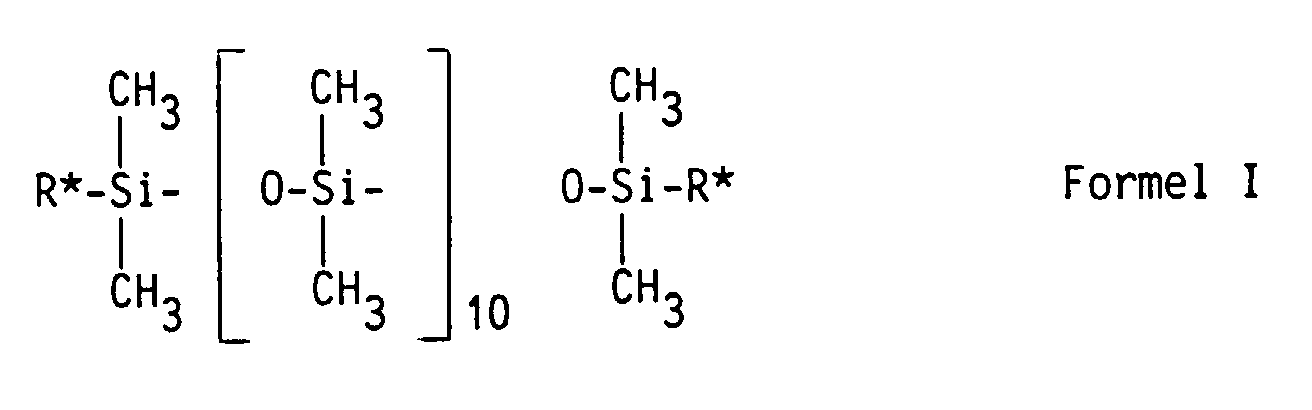
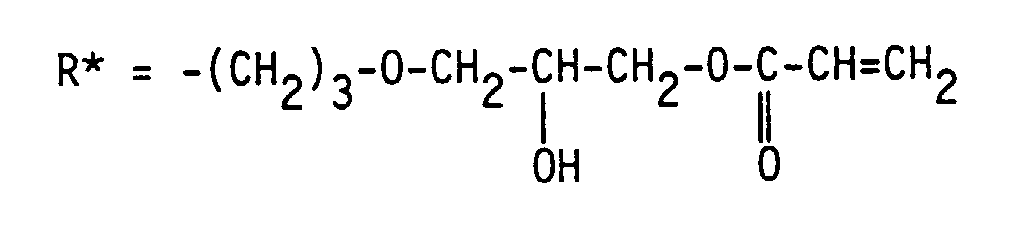


- Zu einer Mischung von 126 g (0,1 Mol) eines Hydroxygruppen enthaltenden Siloxans der durchschnittlichen Formel I mit


- Zu einer Mischung von 223,1 g (0,05 Mol) eines Hydroxygruppen enthaltenden Siloxans der durchschnittlichen Formel II


- Zu einer Mischung von 124,6 g (0,1 Mol) eines Hydroxygruppen enthaltenden Siloxans der durchschnittlichen Formel I


- Zu einer Mischung von 124,6 g (0,1 Mol) eines Hydroxygruppen enthaltenden Siloxans der durchschnittlichen Formel I


- Zu einer Mischung von 55,9 g (0,01 Mol) eines Hydroxygruppen enthaltenden Siloxans der durchschnittlichen Formel III


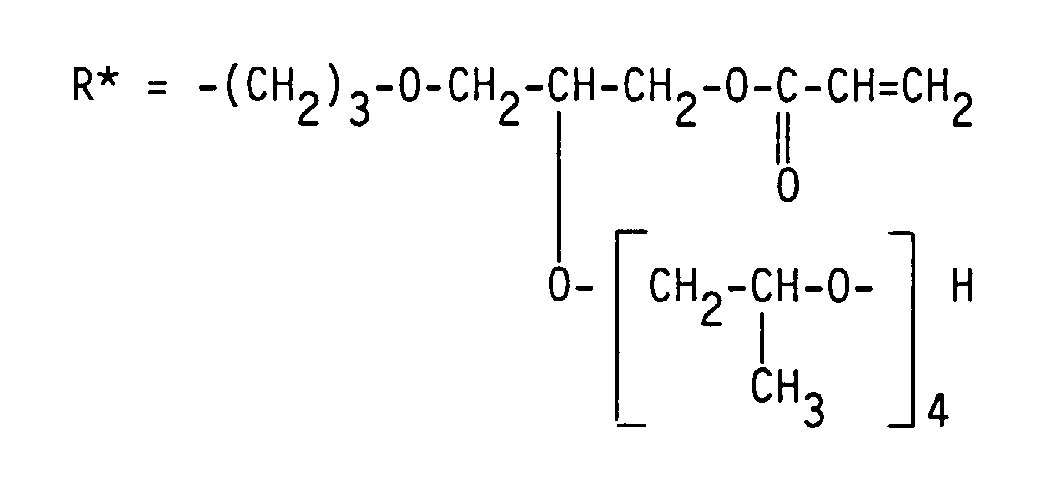

- Zu einer Mischung von 130,6 g (0,1 Mol) eines Hydroxygruppen enthaltenden Siloxanes der durchschnittlichen Formel I


- Zur Prüfung der anwendungstechnischen Eigenschaften werden die erhaltenen Siliconpolyetheracrylate einem UV-härtenden Lacksystem in einer Menge von 1 Gew.-% beigemischt und die Mischung mit einem 40-µm-Drahtrakel auf Bonderstahlblech aufgetragen. Der Lack wird dreimal unter einer 80-W/cm-UV-Lampe bei einer Bandgeschwindigkeit von 12 m/min gehärtet und anschließend durch einen Abzugstest mit Tesaband 4154 auf sein Release-Verhalten geprüft.
- Ein Maß für die Kratzfestigkeit der erhaltenen Lacke ist die Zugkraft, die nötig ist, um einen 500 g schweren Probenkörper, der auf drei Schrauben ruht, mit 30 cm/min über den Lack zu ziehen.
Tabelle 1 Lack mit 1 Gew.-% von Beispiel: Release [N] Kratztest [N] Mischbarkeit Lack ohne Zusatz 11,6 3,2 1 6,7 1,9 schlecht 2 6,4 1,9 schlecht 3 6,4 2,2 gut 4 6,9 1,4 gut 5 7,0 1,8 befriedigend 6 1,2 0,8 schlecht 7 4,3 1,7 befriedigend - Es zeigt sich, daß die erfindungsgemäßen Substanzen dem Lack sowohl abhäsive als auch Antikratzeigenschaften vermitteln. Durch die Natur der Polyetherreste und das Verhältnis der Siliconkette zum Polyetherrest läßt sich die Polarität des Additivs und damit auch die Mischbarkeit mit der zu verwendenden Lackformulierung der jeweiligen Polarität des Lacksystems anpassen.
bezogen auf Reste R3-R10, 2 bis 100 Mol Alkylenoxide mit 2 bis 4 Kohlenstoffatomen einzeln oder im Gemisch in Gegenwart von an sich bekannten sauren Katalysatoren oder Komplexkatalysatoren, die die Anlagerung von Alkylenoxid an Hydroxylgruppen beschleunigen, gegebenenfalls in Gegenwart eines Lösungsmittels, anlagert.
Claims (12)
- Organopolysiloxane mit an einer gemeinsamen Spacergruppe gebundenen Polyether- und Ester-Gruppen, wobei die Spacergruppe über eine SiC-Bindung mit dem Siloxangerüst verbunden ist, der allgemeinen Formel

die Reste R1 gleich oder verschieden sind und jeweils niedere Alkylreste mit 1 bis 4 Kohlenstoffatomen aufweisen oder Phenylreste bedeuten, jedoch mindestens 90 % der Reste R1 Methylreste sind, die Reste R2 zu einem Teil die Bedeutung der Reste R1 haben können und die übrigen Reste R2i) zu 70 bis 100 % Reste der Formel R3-R4 sind, in derR3 ein zweiwertiger Kohlenwasserstoffrest, dessen Kohlenstoffkette durch ein Sauerstoffatom unterbrochen sein und/oder eine Carbonylgruppe aufweisen kann, undR4 der Rest


 in dem R5 der Acylrest einer Monocarbonsäure mit 1 bis 20 Kohlenstoffatomen,R6 ein Polyetherrest undR7 ein Wasserstoff- oder Methylrest ist, undii) zu 0 bis 30 % Alkylreste mit 2 bis 30 Kohlenstoffatomen und/oder Wasserstoffreste sind,a einen Wert von 1 bis 1000 undb einen Wert von 0 bis 10 hat,mit der Maßgabe, daß im durchschnittlichen Molekül mindestens 1 Rest R2 ein Rest der Formel R3-R4 ist.
 - Organopolysiloxane nach Anspruch 1, dadurch gekennzeichnet, daß die Reste R3 aus der Gruppe

- Organopolysiloxane nach Anspruch 1 oder 2, dadurch gekennzeichnet, daß der Rest R5 der Acylrest einer ungesättigten Monocarbonsäure ist.
- Organopolysiloxane nach Anspruch 3, dadurch gekennzeichnet, daß der Rest R5 der Acylrest der Acryl- oder Methacrylsäure ist.
- Organopolysiloxane nach einem oder mehreren der vorhergehenden Ansprüche, dadurch gekennzeichnet, daß der Rest R6 ein Polyetherrest der allgemeinen Formel -(CnH2nO-)mH ist, wobei n einen durchschnittlichen Wert von 2,0 bis 4,0 und m einen durchschnittlichen Wert von 2 bis 100 hat.
- Organopolysiloxane nach Anspruch 5, dadurch gekennzeichnet, daß n einen durchschnittlichen Wert von 2,0 bis 3,0 hat.
- Organopolysiloxane nach einem oder mehreren der vorhergehenden Ansprüche, dadurch gekennzeichnet, daß alle Reste R2 die Bedeutung des Restes R3-R4 haben.
- Verfahren zur Herstellung der Organopolysiloxane nach Anspruch 1 bis 7, dadurch gekennzeichnet, daß man an Organopolysiloxane der allgemeinen Formel
 die Reste R1 und die Indices a und b die bereits angegebene Bedeutung haben unddie Reste R9 zu einem Teil die Bedeutung der Reste R1 haben können und die übrigen Reste R9i) zu 70 bis 100 % Reste der Formel R3-R10 sind, in derR3 die bereits angegebene Bedeutung hat, undR10 der Rest


in dem R5 und R7 die bereits angegebene Bedeutung haben, undii) zu 0 bis 30 % Alkylreste mit 2 bis 30 Kohlenstoffatomen und/oder Wasserstoffreste sind,mit der Maßgabe, daß im durchschnittlichen Molekül mindestens 1 Rest R2 ein Rest der Formel R3-R10 ist,
bezogen auf Reste R3-R10, 2 bis 100 Mol Alkylenoxide mit 2 bis 4 Kohlenstoffatomen einzeln oder im Gemisch in Gegenwart von an sich bekannten sauren Katalysatoren oder Komplexkatalysatoren, die die Anlagerung von Alkylenoxid an Hydroxylgruppen beschleunigen, gegebenenfalls in Gegenwart eines Lösungsmittels, anlagert. - Verfahren nach Anspruch 8, dadurch gekennzeichnet, daß man Ethylenoxid und/oder Propylenoxid einzeln, blockweise oder als Mischung unter Erhalt einer statistischen Verteilung anlagert.
- Verfahren nach Anspruch 8 oder 9, dadurch gekennzeichnet, daß man als Katalysator BF3 verwendet.
- Verwendung der Organopolysiloxane nach einem oder mehreren der Ansprüche 1-7 als Additive für Kunststoffe, Lacke und Bindemittel.
- Verwendung der Organopolysiloxane nach Anspruch 4 als strahlenhärtende Lacke und Beschichtungsmassen.
Applications Claiming Priority (2)
| Application Number | Priority Date | Filing Date | Title |
|---|---|---|---|
| DE4104270A DE4104270A1 (de) | 1991-02-13 | 1991-02-13 | Organopolysiloxane mit an einer gemeinsamen spacergruppe gebundenen polyether- und ester-gruppen |
| DE4104270 | 1991-02-13 |
Publications (3)
| Publication Number | Publication Date |
|---|---|
| EP0499051A2 EP0499051A2 (de) | 1992-08-19 |
| EP0499051A3 EP0499051A3 (en) | 1993-04-28 |
| EP0499051B1 true EP0499051B1 (de) | 1996-12-11 |
Family
ID=6424909
Family Applications (1)
| Application Number | Title | Priority Date | Filing Date |
|---|---|---|---|
| EP92100898A Expired - Lifetime EP0499051B1 (de) | 1991-02-13 | 1992-01-21 | Organopolysiloxane mit an einer gemeinsamen Spacergruppe gebundenen Polyether- und Ester-Gruppen |
Country Status (4)
| Country | Link |
|---|---|
| US (1) | US5208311A (de) |
| EP (1) | EP0499051B1 (de) |
| JP (1) | JP2736198B2 (de) |
| DE (2) | DE4104270A1 (de) |
Families Citing this family (10)
| Publication number | Priority date | Publication date | Assignee | Title |
|---|---|---|---|---|
| DE4219070A1 (de) * | 1992-06-11 | 1993-12-16 | Goldschmidt Ag Th | Verfahren zur Herstellung von Polyethersiloxanen |
| DE4343235C1 (de) * | 1993-12-17 | 1994-12-22 | Goldschmidt Ag Th | Verwendung von organofunktionell modifizierten Polysiloxanen zum Entschäumen von Dieselkraftstoff |
| DE4407189A1 (de) * | 1994-03-04 | 1995-09-07 | Goldschmidt Ag Th | Polysiloxan-Polyoxyalkylen-Blockmischpolymerisate und ihre Verwendung als Zusatzmittel für Haarkosmetika |
| GB9426326D0 (en) * | 1994-12-29 | 1995-03-01 | Dow Corning | Curable compositions |
| US7252864B2 (en) * | 2002-11-12 | 2007-08-07 | Eastman Kodak Company | Optical film for display devices |
| DE102006031152A1 (de) * | 2006-07-04 | 2008-01-10 | Byk-Chemie Gmbh | Polyhydroxyfunktionelle Polysiloxane als anti-adhäsive und schmutzabweisende Zusätze in Beschichtungen, polymeren Formmassen und Thermoplasten, Verfahren zu ihrer Herstellung und ihre Verwendung |
| EP2495270B1 (de) * | 2009-10-30 | 2014-10-01 | Mitsubishi Chemical Corporation | Polyesterpolyol, polyurethan mit dem polyesterpolyol sowie herstellungsverfahren dafür und polyurethanformartikel |
| JP6968087B2 (ja) | 2016-03-16 | 2021-11-17 | コンストラクション リサーチ アンド テクノロジー ゲーエムベーハーConstruction Research & Technology GmbH | 腐食防止剤が塗布された表面 |
| ES2977551T3 (es) * | 2018-12-06 | 2024-08-26 | Henkel Ag & Co Kgaa | Composición curable que comprende copolímeros de polisiloxano polialquilenglicol en cepillo |
| US11732092B2 (en) | 2020-10-19 | 2023-08-22 | Evonik Operations Gmbh | Upcycling process for processing silicone wastes |
Family Cites Families (12)
| Publication number | Priority date | Publication date | Assignee | Title |
|---|---|---|---|---|
| US3057901A (en) * | 1960-05-13 | 1962-10-09 | Dow Corning | Hydroxyether organosilicon compounds |
| DE1570562C3 (de) * | 1965-04-17 | 1975-06-12 | Bayer Ag, 5090 Leverkusen | Diesterfunktlonelle Organopolysiloxane und Verfahren zu ihrer Herstellung |
| DE2756770A1 (de) * | 1977-12-20 | 1979-06-28 | Bayer Ag | Oxalkylierte polysiloxane, deren herstellung und verwendung als waermesensibilisierungsmittel |
| JPS57149290A (en) * | 1981-03-13 | 1982-09-14 | Shin Etsu Chem Co Ltd | Production of glycerol-modified silicone |
| DE3133869C1 (de) * | 1981-08-27 | 1983-05-05 | Th. Goldschmidt Ag, 4300 Essen | Verfahren zur Addition von organischen Siliciumverbindungen mit SiH-Gruppen an Verbindungen mit olefinischen Doppelbindungen |
| US4663185A (en) * | 1984-05-10 | 1987-05-05 | General Electric Company | Novel acrylated polymers |
| US4565714B1 (en) * | 1984-06-14 | 1999-06-29 | Minnesota Mining & Mfg | Low surface energy material |
| DE3810140C1 (de) * | 1988-03-25 | 1989-10-05 | Th. Goldschmidt Ag, 4300 Essen, De | |
| DE3820294C1 (de) * | 1988-06-15 | 1989-10-05 | Th. Goldschmidt Ag, 4300 Essen, De | |
| CA2001930C (en) * | 1988-11-07 | 1999-08-24 | David Beaumont Salberg | Roadway water drainage installation |
| US4906718A (en) * | 1988-12-09 | 1990-03-06 | Dow Corning Corporation | Acrylate functional organosiloxane/oxyalkylene copolymers and electrically conductive compositions containing same and a solubilized lithium salt |
| FR2648821A1 (de) * | 1989-06-22 | 1990-12-28 | Rhone Poulenc Chimie |
-
1991
- 1991-02-13 DE DE4104270A patent/DE4104270A1/de not_active Withdrawn
-
1992
- 1992-01-21 EP EP92100898A patent/EP0499051B1/de not_active Expired - Lifetime
- 1992-01-21 DE DE59207639T patent/DE59207639D1/de not_active Expired - Fee Related
- 1992-01-24 US US07/825,393 patent/US5208311A/en not_active Expired - Fee Related
- 1992-02-07 JP JP4022249A patent/JP2736198B2/ja not_active Expired - Lifetime
Also Published As
| Publication number | Publication date |
|---|---|
| JPH07173291A (ja) | 1995-07-11 |
| EP0499051A3 (en) | 1993-04-28 |
| JP2736198B2 (ja) | 1998-04-02 |
| EP0499051A2 (de) | 1992-08-19 |
| DE59207639D1 (de) | 1997-01-23 |
| DE4104270A1 (de) | 1992-08-20 |
| US5208311A (en) | 1993-05-04 |
Similar Documents
| Publication | Publication Date | Title |
|---|---|---|
| EP0175092B1 (de) | Lacke und Formmassen mit einem den Verlauf fördernden und die Gleitfähigkeit erhöhenden Gehalt an Siloxanen und die Verwendung solcher Siloxane als Zusatzmittel für Lacke und Formmassen | |
| EP0336141B1 (de) | Verfahren zum Beschichten von flächigen Trägern durch Aufbringen von mit (Meth)acrylsäureestergruppen modifizierten härtbaren Organopolysiloxanen | |
| DE3426087C1 (de) | acrylsaeureestermodifizierte Organopolysiloxangemische,deren Herstellung und Verwendung als abhaesive Beschichtungsmassen | |
| EP0331952B1 (de) | Verfahren zum Entschäumen wässriger Dispersionen polymerer organischer Substanzen durch Zusatz von Polyoxyalkylen-Polysiloxan-Blockmischpolymerisaten | |
| EP1679335B1 (de) | Siloxanblockcopolymere | |
| DE2820706C2 (de) | ||
| EP0662334B1 (de) | Verwendung von organofunktionell modifizierten Polysiloxanen zum Entschäumen von Dieselkraftstoff | |
| EP0386507A2 (de) | Polyacrylsäureester mit langkettigen Kohlenwasserstoff- und Polyoxyalkylengruppen und deren Verwendung als grenzflächenaktive Substanzen | |
| DE102004024009A1 (de) | Verwendung von neuen Polysiloxanen mit über SiOC-Gruppen gebundenen (Meth)acrylsäureestergruppen als Additive für strahlenhärtende Beschichtungen | |
| EP0940458B1 (de) | Verwendung von (Meth)Acrylatester von Organosiloxanpolyolen als Additive für strahlenhärtende Beschichtungen | |
| EP0573864B1 (de) | Verfahren zur Herstellung von Polyethersiloxanen | |
| EP0499051A2 (de) | Organopolysiloxane mit an einer gemeinsamen Spacergruppe gebundenen Polyether- und Ester-Gruppen | |
| EP0002252B1 (de) | Wässrige Dispersionen von als Überzugsmittel bzw. Lackbindemittel geeigneten Harzen | |
| DE1064938B (de) | Verfahren zur Oxypropylierung von mehrwertigen Alkoholen | |
| EP0293684B1 (de) | Verwendung von organosiliciummodifizierten Polydienen als Entschäumungs- und Entlüftungsmittel für organische Systeme | |
| EP0867462B1 (de) | Neuartige Siloxanblockcopolymere mit verknüpften Siloxanblöcken | |
| EP3898850B1 (de) | Universelle gleit- und verlaufadditive mit überlackierbarer eigenschaft | |
| EP1403349B1 (de) | Verwendung von mit Oxyalkylenethergruppen modifizierten Epoxypolysiloxanen als Additive für strahlenhärtende Beschichtungen | |
| DE2532228C3 (de) | Hydraulische Flüssigkeiten | |
| EP0617094B1 (de) | Abhäsive Beschichtungsmasse mit einem den Grad der Abhäsivität beeinflussenden Zusatzmittel | |
| EP0606634B1 (de) | Mit Estern olefinisch ungesättigter Säuren sowie quaternären Ammoniumgruppen modifizierte Organopolysiloxane, deren Herstellung und Verwendung | |
| EP0741182A2 (de) | Immuno- und Enzymassays mittels zweiter Oberschwingung und Summenfrequenz-Erzeugung auf einer Oberfläche | |
| EP1904554B1 (de) | Aminocarbonsäureester mit eo/po/buo-blockpolymerisaten und deren verwendung als emulsionsspalter | |
| DE2301789A1 (de) | Siloxan-polyoxyalkylen-blockmischpolymer, verfahren zu dessen herstellung und zwischenprodukt in form eines polyoxyalkylenpolymeren | |
| DE19913725C1 (de) | Verfahren zur Herstellung von modifizierten Vinyletherpolymeren |
Legal Events
| Date | Code | Title | Description |
|---|---|---|---|
| PUAI | Public reference made under article 153(3) epc to a published international application that has entered the european phase |
Free format text: ORIGINAL CODE: 0009012 |
|
| 17P | Request for examination filed |
Effective date: 19920129 |
|
| AK | Designated contracting states |
Kind code of ref document: A2 Designated state(s): BE DE FR GB IT NL |
|
| PUAL | Search report despatched |
Free format text: ORIGINAL CODE: 0009013 |
|
| AK | Designated contracting states |
Kind code of ref document: A3 Designated state(s): BE DE FR GB IT NL |
|
| GRAG | Despatch of communication of intention to grant |
Free format text: ORIGINAL CODE: EPIDOS AGRA |
|
| GRAH | Despatch of communication of intention to grant a patent |
Free format text: ORIGINAL CODE: EPIDOS IGRA |
|
| 17Q | First examination report despatched |
Effective date: 19960510 |
|
| GRAH | Despatch of communication of intention to grant a patent |
Free format text: ORIGINAL CODE: EPIDOS IGRA |
|
| ITF | It: translation for a ep patent filed | ||
| GRAA | (expected) grant |
Free format text: ORIGINAL CODE: 0009210 |
|
| AK | Designated contracting states |
Kind code of ref document: B1 Designated state(s): BE DE FR GB IT NL |
|
| PGFP | Annual fee paid to national office [announced via postgrant information from national office to epo] |
Ref country code: FR Payment date: 19970109 Year of fee payment: 6 |
|
| ET | Fr: translation filed | ||
| PGFP | Annual fee paid to national office [announced via postgrant information from national office to epo] |
Ref country code: GB Payment date: 19970113 Year of fee payment: 6 |
|
| REF | Corresponds to: |
Ref document number: 59207639 Country of ref document: DE Date of ref document: 19970123 |
|
| PGFP | Annual fee paid to national office [announced via postgrant information from national office to epo] |
Ref country code: NL Payment date: 19970130 Year of fee payment: 6 |
|
| GBT | Gb: translation of ep patent filed (gb section 77(6)(a)/1977) |
Effective date: 19970125 |
|
| PGFP | Annual fee paid to national office [announced via postgrant information from national office to epo] |
Ref country code: BE Payment date: 19970318 Year of fee payment: 6 |
|
| PLBE | No opposition filed within time limit |
Free format text: ORIGINAL CODE: 0009261 |
|
| STAA | Information on the status of an ep patent application or granted ep patent |
Free format text: STATUS: NO OPPOSITION FILED WITHIN TIME LIMIT |
|
| 26N | No opposition filed | ||
| PG25 | Lapsed in a contracting state [announced via postgrant information from national office to epo] |
Ref country code: GB Free format text: LAPSE BECAUSE OF NON-PAYMENT OF DUE FEES Effective date: 19980121 |
|
| PG25 | Lapsed in a contracting state [announced via postgrant information from national office to epo] |
Ref country code: FR Free format text: THE PATENT HAS BEEN ANNULLED BY A DECISION OF A NATIONAL AUTHORITY Effective date: 19980131 Ref country code: BE Free format text: LAPSE BECAUSE OF NON-PAYMENT OF DUE FEES Effective date: 19980131 |
|
| BERE | Be: lapsed |
Owner name: TH. GOLDSCHMIDT A.G. Effective date: 19980131 |
|
| PG25 | Lapsed in a contracting state [announced via postgrant information from national office to epo] |
Ref country code: NL Free format text: LAPSE BECAUSE OF NON-PAYMENT OF DUE FEES Effective date: 19980801 |
|
| GBPC | Gb: european patent ceased through non-payment of renewal fee |
Effective date: 19980121 |
|
| NLV4 | Nl: lapsed or anulled due to non-payment of the annual fee |
Effective date: 19980801 |
|
| REG | Reference to a national code |
Ref country code: FR Ref legal event code: ST |
|
| PGFP | Annual fee paid to national office [announced via postgrant information from national office to epo] |
Ref country code: DE Payment date: 20050106 Year of fee payment: 14 |
|
| PG25 | Lapsed in a contracting state [announced via postgrant information from national office to epo] |
Ref country code: IT Free format text: LAPSE BECAUSE OF NON-PAYMENT OF DUE FEES Effective date: 20050121 |
|
| PG25 | Lapsed in a contracting state [announced via postgrant information from national office to epo] |
Ref country code: DE Free format text: LAPSE BECAUSE OF NON-PAYMENT OF DUE FEES Effective date: 20060801 |