EP0497272A1 - Strand displacement amplification - Google Patents
Strand displacement amplification Download PDFInfo
- Publication number
- EP0497272A1 EP0497272A1 EP92101348A EP92101348A EP0497272A1 EP 0497272 A1 EP0497272 A1 EP 0497272A1 EP 92101348 A EP92101348 A EP 92101348A EP 92101348 A EP92101348 A EP 92101348A EP 0497272 A1 EP0497272 A1 EP 0497272A1
- Authority
- EP
- European Patent Office
- Prior art keywords
- sequence
- target
- nucleic acid
- reaction mixture
- endonuclease
- Prior art date
- Legal status (The legal status is an assumption and is not a legal conclusion. Google has not performed a legal analysis and makes no representation as to the accuracy of the status listed.)
- Granted
Links
- 230000003321 amplification Effects 0.000 title abstract description 32
- 238000003199 nucleic acid amplification method Methods 0.000 title abstract description 32
- 238000006073 displacement reaction Methods 0.000 title description 10
- 150000007523 nucleic acids Chemical class 0.000 claims abstract description 48
- 102000039446 nucleic acids Human genes 0.000 claims abstract description 30
- 108020004707 nucleic acids Proteins 0.000 claims abstract description 30
- 108010042407 Endonucleases Proteins 0.000 claims abstract description 22
- 102000004533 Endonucleases Human genes 0.000 claims abstract description 13
- 238000000034 method Methods 0.000 claims description 68
- 239000000523 sample Substances 0.000 claims description 46
- 239000007795 chemical reaction product Substances 0.000 claims description 37
- 230000000295 complement effect Effects 0.000 claims description 24
- 239000012634 fragment Substances 0.000 claims description 24
- 108010017826 DNA Polymerase I Proteins 0.000 claims description 20
- 102000004594 DNA Polymerase I Human genes 0.000 claims description 20
- 108091028043 Nucleic acid sequence Proteins 0.000 claims description 16
- 239000011541 reaction mixture Substances 0.000 claims description 15
- 230000000694 effects Effects 0.000 claims description 13
- 108091008146 restriction endonucleases Proteins 0.000 claims description 12
- 102000016928 DNA-directed DNA polymerase Human genes 0.000 claims description 11
- 108010014303 DNA-directed DNA polymerase Proteins 0.000 claims description 11
- 108010068698 spleen exonuclease Proteins 0.000 claims description 10
- 230000002950 deficient Effects 0.000 claims description 6
- 108060002716 Exonuclease Proteins 0.000 claims description 5
- 102000013165 exonuclease Human genes 0.000 claims description 5
- 239000012620 biological material Substances 0.000 claims description 3
- 238000010438 heat treatment Methods 0.000 claims 1
- 238000001514 detection method Methods 0.000 abstract description 19
- 230000029087 digestion Effects 0.000 abstract 1
- 108020004414 DNA Proteins 0.000 description 27
- 102000053602 DNA Human genes 0.000 description 27
- 239000002773 nucleotide Substances 0.000 description 25
- 125000003729 nucleotide group Chemical group 0.000 description 25
- 102000004190 Enzymes Human genes 0.000 description 24
- 108090000790 Enzymes Proteins 0.000 description 24
- 108090000623 proteins and genes Proteins 0.000 description 19
- 210000000349 chromosome Anatomy 0.000 description 13
- 238000006243 chemical reaction Methods 0.000 description 12
- 102100031780 Endonuclease Human genes 0.000 description 10
- XSQUKJJJFZCRTK-UHFFFAOYSA-N Urea Chemical compound NC(N)=O XSQUKJJJFZCRTK-UHFFFAOYSA-N 0.000 description 10
- 239000000203 mixture Substances 0.000 description 10
- 229920002477 rna polymer Polymers 0.000 description 8
- 238000003776 cleavage reaction Methods 0.000 description 7
- 239000000499 gel Substances 0.000 description 7
- 239000000047 product Substances 0.000 description 7
- 230000007017 scission Effects 0.000 description 7
- YBJHBAHKTGYVGT-ZKWXMUAHSA-N (+)-Biotin Chemical compound N1C(=O)N[C@@H]2[C@H](CCCCC(=O)O)SC[C@@H]21 YBJHBAHKTGYVGT-ZKWXMUAHSA-N 0.000 description 6
- TWRXJAOTZQYOKJ-UHFFFAOYSA-L Magnesium chloride Chemical compound [Mg+2].[Cl-].[Cl-] TWRXJAOTZQYOKJ-UHFFFAOYSA-L 0.000 description 6
- 150000001413 amino acids Chemical class 0.000 description 6
- 239000007983 Tris buffer Substances 0.000 description 5
- 230000027455 binding Effects 0.000 description 5
- 239000004202 carbamide Substances 0.000 description 5
- 201000010099 disease Diseases 0.000 description 5
- 208000037265 diseases, disorders, signs and symptoms Diseases 0.000 description 5
- 238000001962 electrophoresis Methods 0.000 description 5
- 230000002068 genetic effect Effects 0.000 description 5
- 239000000463 material Substances 0.000 description 5
- 230000001404 mediated effect Effects 0.000 description 5
- 238000000926 separation method Methods 0.000 description 5
- 241000588724 Escherichia coli Species 0.000 description 4
- SECXISVLQFMRJM-UHFFFAOYSA-N N-Methylpyrrolidone Chemical compound CN1CCCC1=O SECXISVLQFMRJM-UHFFFAOYSA-N 0.000 description 4
- 102000043276 Oncogene Human genes 0.000 description 4
- 108700020796 Oncogene Proteins 0.000 description 4
- BFNBIHQBYMNNAN-UHFFFAOYSA-N ammonium sulfate Chemical compound N.N.OS(O)(=O)=O BFNBIHQBYMNNAN-UHFFFAOYSA-N 0.000 description 4
- 229910052921 ammonium sulfate Inorganic materials 0.000 description 4
- 235000011130 ammonium sulphate Nutrition 0.000 description 4
- 108010058966 bacteriophage T7 induced DNA polymerase Proteins 0.000 description 4
- 230000008859 change Effects 0.000 description 4
- 230000001351 cycling effect Effects 0.000 description 4
- SUYVUBYJARFZHO-RRKCRQDMSA-N dATP Chemical compound C1=NC=2C(N)=NC=NC=2N1[C@H]1C[C@H](O)[C@@H](COP(O)(=O)OP(O)(=O)OP(O)(O)=O)O1 SUYVUBYJARFZHO-RRKCRQDMSA-N 0.000 description 4
- SUYVUBYJARFZHO-UHFFFAOYSA-N dATP Natural products C1=NC=2C(N)=NC=NC=2N1C1CC(O)C(COP(O)(=O)OP(O)(=O)OP(O)(O)=O)O1 SUYVUBYJARFZHO-UHFFFAOYSA-N 0.000 description 4
- HAAZLUGHYHWQIW-KVQBGUIXSA-N dGTP Chemical compound C1=NC=2C(=O)NC(N)=NC=2N1[C@H]1C[C@H](O)[C@@H](COP(O)(=O)OP(O)(=O)OP(O)(O)=O)O1 HAAZLUGHYHWQIW-KVQBGUIXSA-N 0.000 description 4
- 238000009396 hybridization Methods 0.000 description 4
- 238000003018 immunoassay Methods 0.000 description 4
- 238000012986 modification Methods 0.000 description 4
- 230000004048 modification Effects 0.000 description 4
- 229920002401 polyacrylamide Polymers 0.000 description 4
- 102000004169 proteins and genes Human genes 0.000 description 4
- 102000002260 Alkaline Phosphatase Human genes 0.000 description 3
- 108020004774 Alkaline Phosphatase Proteins 0.000 description 3
- PEDCQBHIVMGVHV-UHFFFAOYSA-N Glycerine Chemical compound OCC(O)CO PEDCQBHIVMGVHV-UHFFFAOYSA-N 0.000 description 3
- 241000282412 Homo Species 0.000 description 3
- 206010028980 Neoplasm Diseases 0.000 description 3
- 102000003992 Peroxidases Human genes 0.000 description 3
- 239000011324 bead Substances 0.000 description 3
- 229960002685 biotin Drugs 0.000 description 3
- 235000020958 biotin Nutrition 0.000 description 3
- 239000011616 biotin Substances 0.000 description 3
- RGWHQCVHVJXOKC-SHYZEUOFSA-J dCTP(4-) Chemical compound O=C1N=C(N)C=CN1[C@@H]1O[C@H](COP([O-])(=O)OP([O-])(=O)OP([O-])([O-])=O)[C@@H](O)C1 RGWHQCVHVJXOKC-SHYZEUOFSA-J 0.000 description 3
- 238000004925 denaturation Methods 0.000 description 3
- 230000036425 denaturation Effects 0.000 description 3
- 239000000975 dye Substances 0.000 description 3
- 239000003446 ligand Substances 0.000 description 3
- 229910001629 magnesium chloride Inorganic materials 0.000 description 3
- 238000004519 manufacturing process Methods 0.000 description 3
- 239000012528 membrane Substances 0.000 description 3
- 125000002496 methyl group Chemical group [H]C([H])([H])* 0.000 description 3
- 230000009871 nonspecific binding Effects 0.000 description 3
- 108040007629 peroxidase activity proteins Proteins 0.000 description 3
- 230000003169 placental effect Effects 0.000 description 3
- 239000013612 plasmid Substances 0.000 description 3
- 230000008569 process Effects 0.000 description 3
- 239000007787 solid Substances 0.000 description 3
- ASJSAQIRZKANQN-CRCLSJGQSA-N 2-deoxy-D-ribose Chemical compound OC[C@@H](O)[C@@H](O)CC=O ASJSAQIRZKANQN-CRCLSJGQSA-N 0.000 description 2
- KDCGOANMDULRCW-UHFFFAOYSA-N 7H-purine Chemical compound N1=CNC2=NC=NC2=C1 KDCGOANMDULRCW-UHFFFAOYSA-N 0.000 description 2
- QTBSBXVTEAMEQO-UHFFFAOYSA-M Acetate Chemical compound CC([O-])=O QTBSBXVTEAMEQO-UHFFFAOYSA-M 0.000 description 2
- IAZDPXIOMUYVGZ-UHFFFAOYSA-N Dimethylsulphoxide Chemical compound CS(C)=O IAZDPXIOMUYVGZ-UHFFFAOYSA-N 0.000 description 2
- ZHNUHDYFZUAESO-UHFFFAOYSA-N Formamide Chemical compound NC=O ZHNUHDYFZUAESO-UHFFFAOYSA-N 0.000 description 2
- 102000003960 Ligases Human genes 0.000 description 2
- 108090000364 Ligases Proteins 0.000 description 2
- 101710147059 Nicking endonuclease Proteins 0.000 description 2
- 101710163270 Nuclease Proteins 0.000 description 2
- ISWSIDIOOBJBQZ-UHFFFAOYSA-N Phenol Chemical compound OC1=CC=CC=C1 ISWSIDIOOBJBQZ-UHFFFAOYSA-N 0.000 description 2
- NBIIXXVUZAFLBC-UHFFFAOYSA-N Phosphoric acid Chemical compound OP(O)(O)=O NBIIXXVUZAFLBC-UHFFFAOYSA-N 0.000 description 2
- 108020004682 Single-Stranded DNA Proteins 0.000 description 2
- RZCIEJXAILMSQK-JXOAFFINSA-N TTP Chemical compound O=C1NC(=O)C(C)=CN1[C@H]1[C@H](O)[C@H](O)[C@@H](COP(O)(=O)OP(O)(=O)OP(O)(O)=O)O1 RZCIEJXAILMSQK-JXOAFFINSA-N 0.000 description 2
- 241000700605 Viruses Species 0.000 description 2
- DZBUGLKDJFMEHC-UHFFFAOYSA-O acridine;hydron Chemical compound C1=CC=CC2=CC3=CC=CC=C3[NH+]=C21 DZBUGLKDJFMEHC-UHFFFAOYSA-O 0.000 description 2
- 208000036878 aneuploidy Diseases 0.000 description 2
- 102000005936 beta-Galactosidase Human genes 0.000 description 2
- 108010005774 beta-Galactosidase Proteins 0.000 description 2
- 238000005415 bioluminescence Methods 0.000 description 2
- 230000029918 bioluminescence Effects 0.000 description 2
- 210000004027 cell Anatomy 0.000 description 2
- OPTASPLRGRRNAP-UHFFFAOYSA-N cytosine Chemical compound NC=1C=CNC(=O)N=1 OPTASPLRGRRNAP-UHFFFAOYSA-N 0.000 description 2
- 230000007423 decrease Effects 0.000 description 2
- 230000003247 decreasing effect Effects 0.000 description 2
- 230000007812 deficiency Effects 0.000 description 2
- 230000001419 dependent effect Effects 0.000 description 2
- 230000002255 enzymatic effect Effects 0.000 description 2
- GNBHRKFJIUUOQI-UHFFFAOYSA-N fluorescein Chemical compound O1C(=O)C2=CC=CC=C2C21C1=CC=C(O)C=C1OC1=CC(O)=CC=C21 GNBHRKFJIUUOQI-UHFFFAOYSA-N 0.000 description 2
- 238000002875 fluorescence polarization Methods 0.000 description 2
- 238000001502 gel electrophoresis Methods 0.000 description 2
- UYTPUPDQBNUYGX-UHFFFAOYSA-N guanine Chemical compound O=C1NC(N)=NC2=C1N=CN2 UYTPUPDQBNUYGX-UHFFFAOYSA-N 0.000 description 2
- 238000002372 labelling Methods 0.000 description 2
- 239000002502 liposome Substances 0.000 description 2
- 238000005567 liquid scintillation counting Methods 0.000 description 2
- 238000011068 loading method Methods 0.000 description 2
- 238000004020 luminiscence type Methods 0.000 description 2
- UEGPKNKPLBYCNK-UHFFFAOYSA-L magnesium acetate Chemical compound [Mg+2].CC([O-])=O.CC([O-])=O UEGPKNKPLBYCNK-UHFFFAOYSA-L 0.000 description 2
- 244000005700 microbiome Species 0.000 description 2
- 239000002245 particle Substances 0.000 description 2
- 238000006116 polymerization reaction Methods 0.000 description 2
- 230000003362 replicative effect Effects 0.000 description 2
- PYWVYCXTNDRMGF-UHFFFAOYSA-N rhodamine B Chemical compound [Cl-].C=12C=CC(=[N+](CC)CC)C=C2OC2=CC(N(CC)CC)=CC=C2C=1C1=CC=CC=C1C(O)=O PYWVYCXTNDRMGF-UHFFFAOYSA-N 0.000 description 2
- 238000000527 sonication Methods 0.000 description 2
- 241000894007 species Species 0.000 description 2
- 239000011550 stock solution Substances 0.000 description 2
- 238000006467 substitution reaction Methods 0.000 description 2
- RWQNBRDOKXIBIV-UHFFFAOYSA-N thymine Chemical compound CC1=CNC(=O)NC1=O RWQNBRDOKXIBIV-UHFFFAOYSA-N 0.000 description 2
- 238000012546 transfer Methods 0.000 description 2
- OSBLTNPMIGYQGY-UHFFFAOYSA-N 2-amino-2-(hydroxymethyl)propane-1,3-diol;2-[2-[bis(carboxymethyl)amino]ethyl-(carboxymethyl)amino]acetic acid;boric acid Chemical compound OB(O)O.OCC(N)(CO)CO.OC(=O)CN(CC(O)=O)CCN(CC(O)=O)CC(O)=O OSBLTNPMIGYQGY-UHFFFAOYSA-N 0.000 description 1
- FWMNVWWHGCHHJJ-SKKKGAJSSA-N 4-amino-1-[(2r)-6-amino-2-[[(2r)-2-[[(2r)-2-[[(2r)-2-amino-3-phenylpropanoyl]amino]-3-phenylpropanoyl]amino]-4-methylpentanoyl]amino]hexanoyl]piperidine-4-carboxylic acid Chemical compound C([C@H](C(=O)N[C@H](CC(C)C)C(=O)N[C@H](CCCCN)C(=O)N1CCC(N)(CC1)C(O)=O)NC(=O)[C@H](N)CC=1C=CC=CC=1)C1=CC=CC=C1 FWMNVWWHGCHHJJ-SKKKGAJSSA-N 0.000 description 1
- NGYHUCPPLJOZIX-XLPZGREQSA-N 5-methyl-dCTP Chemical compound O=C1N=C(N)C(C)=CN1[C@@H]1O[C@H](COP(O)(=O)OP(O)(=O)OP(O)(O)=O)[C@@H](O)C1 NGYHUCPPLJOZIX-XLPZGREQSA-N 0.000 description 1
- 229930024421 Adenine Natural products 0.000 description 1
- GFFGJBXGBJISGV-UHFFFAOYSA-N Adenine Chemical compound NC1=NC=NC2=C1N=CN2 GFFGJBXGBJISGV-UHFFFAOYSA-N 0.000 description 1
- QGZKDVFQNNGYKY-UHFFFAOYSA-O Ammonium Chemical compound [NH4+] QGZKDVFQNNGYKY-UHFFFAOYSA-O 0.000 description 1
- 108020004491 Antisense DNA Proteins 0.000 description 1
- 108090001008 Avidin Proteins 0.000 description 1
- 208000032791 BCR-ABL1 positive chronic myelogenous leukemia Diseases 0.000 description 1
- 241000894006 Bacteria Species 0.000 description 1
- PCDQPRRSZKQHHS-XVFCMESISA-N CTP Chemical class O=C1N=C(N)C=CN1[C@H]1[C@H](O)[C@H](O)[C@@H](COP(O)(=O)OP(O)(=O)OP(O)(O)=O)O1 PCDQPRRSZKQHHS-XVFCMESISA-N 0.000 description 1
- 241000222120 Candida <Saccharomycetales> Species 0.000 description 1
- 241000606161 Chlamydia Species 0.000 description 1
- 208000010833 Chronic myeloid leukaemia Diseases 0.000 description 1
- 102100022641 Coagulation factor IX Human genes 0.000 description 1
- 108091026890 Coding region Proteins 0.000 description 1
- 206010010099 Combined immunodeficiency Diseases 0.000 description 1
- 208000035473 Communicable disease Diseases 0.000 description 1
- HMFHBZSHGGEWLO-SOOFDHNKSA-N D-ribofuranose Chemical compound OC[C@H]1OC(O)[C@H](O)[C@@H]1O HMFHBZSHGGEWLO-SOOFDHNKSA-N 0.000 description 1
- 239000003298 DNA probe Substances 0.000 description 1
- 230000007018 DNA scission Effects 0.000 description 1
- 108090000626 DNA-directed RNA polymerases Proteins 0.000 description 1
- 102000004163 DNA-directed RNA polymerases Human genes 0.000 description 1
- AHCYMLUZIRLXAA-SHYZEUOFSA-N Deoxyuridine 5'-triphosphate Chemical compound O1[C@H](COP(O)(=O)OP(O)(=O)OP(O)(O)=O)[C@@H](O)C[C@@H]1N1C(=O)NC(=O)C=C1 AHCYMLUZIRLXAA-SHYZEUOFSA-N 0.000 description 1
- 201000010374 Down Syndrome Diseases 0.000 description 1
- 108010076282 Factor IX Proteins 0.000 description 1
- 206010016077 Factor IX deficiency Diseases 0.000 description 1
- 201000003542 Factor VIII deficiency Diseases 0.000 description 1
- 208000015872 Gaucher disease Diseases 0.000 description 1
- 208000020322 Gaucher disease type I Diseases 0.000 description 1
- 241000606768 Haemophilus influenzae Species 0.000 description 1
- 208000009292 Hemophilia A Diseases 0.000 description 1
- 208000005176 Hepatitis C Diseases 0.000 description 1
- 101000986595 Homo sapiens Ornithine transcarbamylase, mitochondrial Proteins 0.000 description 1
- 208000018121 Hypoxanthine-guanine phosphoribosyltransferase deficiency Diseases 0.000 description 1
- 208000026350 Inborn Genetic disease Diseases 0.000 description 1
- 241000589248 Legionella Species 0.000 description 1
- 208000007764 Legionnaires' Disease Diseases 0.000 description 1
- 208000009625 Lesch-Nyhan syndrome Diseases 0.000 description 1
- 241000124008 Mammalia Species 0.000 description 1
- 241001465754 Metazoa Species 0.000 description 1
- 241000204031 Mycoplasma Species 0.000 description 1
- 208000033761 Myelogenous Chronic BCR-ABL Positive Leukemia Diseases 0.000 description 1
- 108700026495 N-Myc Proto-Oncogene Proteins 0.000 description 1
- 102100030124 N-myc proto-oncogene protein Human genes 0.000 description 1
- 206010029260 Neuroblastoma Diseases 0.000 description 1
- 208000000599 Ornithine Carbamoyltransferase Deficiency Disease Diseases 0.000 description 1
- 206010052450 Ornithine transcarbamoylase deficiency Diseases 0.000 description 1
- 208000035903 Ornithine transcarbamylase deficiency Diseases 0.000 description 1
- 102100028200 Ornithine transcarbamylase, mitochondrial Human genes 0.000 description 1
- 201000011252 Phenylketonuria Diseases 0.000 description 1
- 102000009097 Phosphorylases Human genes 0.000 description 1
- 108010073135 Phosphorylases Proteins 0.000 description 1
- 108010021757 Polynucleotide 5'-Hydroxyl-Kinase Proteins 0.000 description 1
- 102000008422 Polynucleotide 5'-hydroxyl-kinase Human genes 0.000 description 1
- 206010036790 Productive cough Diseases 0.000 description 1
- 102000055027 Protein Methyltransferases Human genes 0.000 description 1
- 108700040121 Protein Methyltransferases Proteins 0.000 description 1
- 101710150114 Protein rep Proteins 0.000 description 1
- CZPWVGJYEJSRLH-UHFFFAOYSA-N Pyrimidine Chemical compound C1=CN=CN=C1 CZPWVGJYEJSRLH-UHFFFAOYSA-N 0.000 description 1
- 108010066717 Q beta Replicase Proteins 0.000 description 1
- 108010092799 RNA-directed DNA polymerase Proteins 0.000 description 1
- 101710152114 Replication protein Proteins 0.000 description 1
- 201000000582 Retinoblastoma Diseases 0.000 description 1
- PYMYPHUHKUWMLA-LMVFSUKVSA-N Ribose Natural products OC[C@@H](O)[C@@H](O)[C@@H](O)C=O PYMYPHUHKUWMLA-LMVFSUKVSA-N 0.000 description 1
- 241000607142 Salmonella Species 0.000 description 1
- 238000012300 Sequence Analysis Methods 0.000 description 1
- 241000607768 Shigella Species 0.000 description 1
- 206010041067 Small cell lung cancer Diseases 0.000 description 1
- 238000002105 Southern blotting Methods 0.000 description 1
- 239000008051 TBE buffer Substances 0.000 description 1
- 108010006785 Taq Polymerase Proteins 0.000 description 1
- 208000037280 Trisomy Diseases 0.000 description 1
- 206010044688 Trisomy 21 Diseases 0.000 description 1
- ZMXDDKWLCZADIW-UHFFFAOYSA-N Vilsmeier-Haack reagent Natural products CN(C)C=O ZMXDDKWLCZADIW-UHFFFAOYSA-N 0.000 description 1
- 210000001766 X chromosome Anatomy 0.000 description 1
- 210000002593 Y chromosome Anatomy 0.000 description 1
- CCPIKNHZOWQALM-DLQJRSQOSA-N [[(2r,3s,5r)-5-(6-aminopurin-9-yl)-3-hydroxyoxolan-2-yl]methoxy-hydroxyphosphinothioyl] phosphono hydrogen phosphate Chemical compound C1=NC=2C(N)=NC=NC=2N1[C@H]1C[C@H](O)[C@@H](COP(O)(=S)OP(O)(=O)OP(O)(O)=O)O1 CCPIKNHZOWQALM-DLQJRSQOSA-N 0.000 description 1
- DLLXAZJTLIUPAI-UHFFFAOYSA-N [[5-(2-amino-4-oxo-1h-pyrrolo[2,3-d]pyrimidin-7-yl)-3-hydroxyoxolan-2-yl]methoxy-hydroxyphosphoryl] phosphono hydrogen phosphate Chemical compound C1=2NC(N)=NC(=O)C=2C=CN1C1CC(O)C(COP(O)(=O)OP(O)(=O)OP(O)(O)=O)O1 DLLXAZJTLIUPAI-UHFFFAOYSA-N 0.000 description 1
- 230000004913 activation Effects 0.000 description 1
- 229960000643 adenine Drugs 0.000 description 1
- 201000009628 adenosine deaminase deficiency Diseases 0.000 description 1
- 208000006682 alpha 1-Antitrypsin Deficiency Diseases 0.000 description 1
- HMFHBZSHGGEWLO-UHFFFAOYSA-N alpha-D-Furanose-Ribose Natural products OCC1OC(O)C(O)C1O HMFHBZSHGGEWLO-UHFFFAOYSA-N 0.000 description 1
- 229910000147 aluminium phosphate Inorganic materials 0.000 description 1
- 230000003322 aneuploid effect Effects 0.000 description 1
- 231100001075 aneuploidy Toxicity 0.000 description 1
- 239000003816 antisense DNA Substances 0.000 description 1
- 238000013459 approach Methods 0.000 description 1
- 208000036556 autosomal recessive T cell-negative B cell-negative NK cell-negative due to adenosine deaminase deficiency severe combined immunodeficiency Diseases 0.000 description 1
- 208000005980 beta thalassemia Diseases 0.000 description 1
- 230000015572 biosynthetic process Effects 0.000 description 1
- 239000002981 blocking agent Substances 0.000 description 1
- 210000004369 blood Anatomy 0.000 description 1
- 239000008280 blood Substances 0.000 description 1
- 210000001185 bone marrow Anatomy 0.000 description 1
- 239000000872 buffer Substances 0.000 description 1
- 230000015556 catabolic process Effects 0.000 description 1
- 238000005119 centrifugation Methods 0.000 description 1
- 239000003153 chemical reaction reagent Substances 0.000 description 1
- 238000004587 chromatography analysis Methods 0.000 description 1
- 230000002759 chromosomal effect Effects 0.000 description 1
- 229940104302 cytosine Drugs 0.000 description 1
- NHVNXKFIZYSCEB-XLPZGREQSA-N dTTP Chemical compound O=C1NC(=O)C(C)=CN1[C@@H]1O[C@H](COP(O)(=O)OP(O)(=O)OP(O)(O)=O)[C@@H](O)C1 NHVNXKFIZYSCEB-XLPZGREQSA-N 0.000 description 1
- 238000006731 degradation reaction Methods 0.000 description 1
- 238000012217 deletion Methods 0.000 description 1
- 230000037430 deletion Effects 0.000 description 1
- 238000003936 denaturing gel electrophoresis Methods 0.000 description 1
- 239000003599 detergent Substances 0.000 description 1
- 238000003745 diagnosis Methods 0.000 description 1
- 238000010790 dilution Methods 0.000 description 1
- 239000012895 dilution Substances 0.000 description 1
- 238000000605 extraction Methods 0.000 description 1
- 229960004222 factor ix Drugs 0.000 description 1
- 210000003608 fece Anatomy 0.000 description 1
- 239000007850 fluorescent dye Substances 0.000 description 1
- 230000009395 genetic defect Effects 0.000 description 1
- 239000011521 glass Substances 0.000 description 1
- 238000003505 heat denaturation Methods 0.000 description 1
- 208000009429 hemophilia B Diseases 0.000 description 1
- 208000002672 hepatitis B Diseases 0.000 description 1
- 229920006158 high molecular weight polymer Polymers 0.000 description 1
- 239000001257 hydrogen Substances 0.000 description 1
- 229910052739 hydrogen Inorganic materials 0.000 description 1
- 230000000415 inactivating effect Effects 0.000 description 1
- 238000010348 incorporation Methods 0.000 description 1
- 238000003780 insertion Methods 0.000 description 1
- 230000037431 insertion Effects 0.000 description 1
- 239000000543 intermediate Substances 0.000 description 1
- 238000005342 ion exchange Methods 0.000 description 1
- 238000002955 isolation Methods 0.000 description 1
- 210000003734 kidney Anatomy 0.000 description 1
- 238000007834 ligase chain reaction Methods 0.000 description 1
- 239000007788 liquid Substances 0.000 description 1
- 210000004185 liver Anatomy 0.000 description 1
- 210000004072 lung Anatomy 0.000 description 1
- 210000002751 lymph Anatomy 0.000 description 1
- 239000006166 lysate Substances 0.000 description 1
- 238000007885 magnetic separation Methods 0.000 description 1
- 230000035772 mutation Effects 0.000 description 1
- 239000003960 organic solvent Substances 0.000 description 1
- 230000008520 organization Effects 0.000 description 1
- 201000011278 ornithine carbamoyltransferase deficiency Diseases 0.000 description 1
- 210000001672 ovary Anatomy 0.000 description 1
- 244000045947 parasite Species 0.000 description 1
- 150000008300 phosphoramidites Chemical class 0.000 description 1
- 108060006184 phycobiliprotein Proteins 0.000 description 1
- 229920001223 polyethylene glycol Polymers 0.000 description 1
- 238000003752 polymerase chain reaction Methods 0.000 description 1
- 229920001184 polypeptide Polymers 0.000 description 1
- 150000003141 primary amines Chemical class 0.000 description 1
- 108090000765 processed proteins & peptides Proteins 0.000 description 1
- 102000004196 processed proteins & peptides Human genes 0.000 description 1
- 238000000746 purification Methods 0.000 description 1
- 239000002213 purine nucleotide Substances 0.000 description 1
- 150000003212 purines Chemical class 0.000 description 1
- 230000035484 reaction time Effects 0.000 description 1
- 238000012163 sequencing technique Methods 0.000 description 1
- 208000007056 sickle cell anemia Diseases 0.000 description 1
- 238000002741 site-directed mutagenesis Methods 0.000 description 1
- 208000000587 small cell lung carcinoma Diseases 0.000 description 1
- 239000002689 soil Substances 0.000 description 1
- 239000007790 solid phase Substances 0.000 description 1
- 239000006104 solid solution Substances 0.000 description 1
- 239000000243 solution Substances 0.000 description 1
- 238000011895 specific detection Methods 0.000 description 1
- 210000000952 spleen Anatomy 0.000 description 1
- 210000003802 sputum Anatomy 0.000 description 1
- 208000024794 sputum Diseases 0.000 description 1
- 125000001424 substituent group Chemical group 0.000 description 1
- 125000000446 sulfanediyl group Chemical group *S* 0.000 description 1
- 230000001629 suppression Effects 0.000 description 1
- 238000003786 synthesis reaction Methods 0.000 description 1
- 229940113082 thymine Drugs 0.000 description 1
- 210000001519 tissue Anatomy 0.000 description 1
- 238000013518 transcription Methods 0.000 description 1
- 230000035897 transcription Effects 0.000 description 1
- 238000013519 translation Methods 0.000 description 1
- 230000005945 translocation Effects 0.000 description 1
- 210000002700 urine Anatomy 0.000 description 1
- 238000003260 vortexing Methods 0.000 description 1
Images

Classifications
-
- C—CHEMISTRY; METALLURGY
- C12—BIOCHEMISTRY; BEER; SPIRITS; WINE; VINEGAR; MICROBIOLOGY; ENZYMOLOGY; MUTATION OR GENETIC ENGINEERING
- C12Q—MEASURING OR TESTING PROCESSES INVOLVING ENZYMES, NUCLEIC ACIDS OR MICROORGANISMS; COMPOSITIONS OR TEST PAPERS THEREFOR; PROCESSES OF PREPARING SUCH COMPOSITIONS; CONDITION-RESPONSIVE CONTROL IN MICROBIOLOGICAL OR ENZYMOLOGICAL PROCESSES
- C12Q1/00—Measuring or testing processes involving enzymes, nucleic acids or microorganisms; Compositions therefor; Processes of preparing such compositions
- C12Q1/68—Measuring or testing processes involving enzymes, nucleic acids or microorganisms; Compositions therefor; Processes of preparing such compositions involving nucleic acids
-
- C—CHEMISTRY; METALLURGY
- C12—BIOCHEMISTRY; BEER; SPIRITS; WINE; VINEGAR; MICROBIOLOGY; ENZYMOLOGY; MUTATION OR GENETIC ENGINEERING
- C12Q—MEASURING OR TESTING PROCESSES INVOLVING ENZYMES, NUCLEIC ACIDS OR MICROORGANISMS; COMPOSITIONS OR TEST PAPERS THEREFOR; PROCESSES OF PREPARING SUCH COMPOSITIONS; CONDITION-RESPONSIVE CONTROL IN MICROBIOLOGICAL OR ENZYMOLOGICAL PROCESSES
- C12Q1/00—Measuring or testing processes involving enzymes, nucleic acids or microorganisms; Compositions therefor; Processes of preparing such compositions
- C12Q1/68—Measuring or testing processes involving enzymes, nucleic acids or microorganisms; Compositions therefor; Processes of preparing such compositions involving nucleic acids
- C12Q1/6844—Nucleic acid amplification reactions
-
- C—CHEMISTRY; METALLURGY
- C12—BIOCHEMISTRY; BEER; SPIRITS; WINE; VINEGAR; MICROBIOLOGY; ENZYMOLOGY; MUTATION OR GENETIC ENGINEERING
- C12Q—MEASURING OR TESTING PROCESSES INVOLVING ENZYMES, NUCLEIC ACIDS OR MICROORGANISMS; COMPOSITIONS OR TEST PAPERS THEREFOR; PROCESSES OF PREPARING SUCH COMPOSITIONS; CONDITION-RESPONSIVE CONTROL IN MICROBIOLOGICAL OR ENZYMOLOGICAL PROCESSES
- C12Q1/00—Measuring or testing processes involving enzymes, nucleic acids or microorganisms; Compositions therefor; Processes of preparing such compositions
- C12Q1/68—Measuring or testing processes involving enzymes, nucleic acids or microorganisms; Compositions therefor; Processes of preparing such compositions involving nucleic acids
- C12Q1/6844—Nucleic acid amplification reactions
- C12Q1/6853—Nucleic acid amplification reactions using modified primers or templates
Definitions
- This invention relates to a method for amplifying a target nucleic acid sequence, and more particularly relates to a method for amplification by endonuclease mediated strand displacement and detection of the amplified reaction product(s). This invention further relates to a commonly assigned application for exonuclease mediated strand displacement amplification filed of even date herewith.
- Nucleic acids may be either in the form of deoxyribonucleic acids (DNA) or in the form of ribonucleic acids (RNA).
- DNA and RNA are high molecular weight polymers formed from many nucleotide building blocks. Each nucleotide is composed of a base (a purine or a pyrimidine), a sugar (either ribose or deoxyribose) and a molecule of phosphoric acid.
- DNA is composed of the sugar deoxyribose and the bases adenine (A), guanine (G), cytosine (C) and thymine (T).
- the nucleotides are assembled into a linear chain to form the genetic code.
- Each sequence of three nucleotides can be "read” as the code for one amino acid through the process of translation. (DNA must first be converted into RNA through the process of transcription.)
- By varying the combination of bases in each three base sequence different amino acids are coded for.
- By linking various three base sequences together a sequence of amino acids can be made which form proteins.
- the entire coding unit for one protein is referred to as a gene. There can be one or more copies of a gene in an organism. Some genes are present in hundreds or thousands of copies. Others are present only as a single copy.
- genes are linked together in an organism to form higher structural units referred to as chromosomes in higher organisms.
- genes may occur in extra chromosomal units referred to as plasmids.
- Genes need not be linked directly to each other in an end-to-end fashion.
- Certain non-coding regions i.e. , sequences of bases that do not translate into amino acids
- the arrangement of nucleotides in an organism determines its genetic makeup which may be referred to as its genome. (Hence, DNA isolated from an organism is referred to as genomic DNA.)
- DNA in most organisms is arranged in the form of a duplex wherein two strands of DNA are paired together in the familiar double helix.
- hydrogen bonds are formed between A and T and between C and G on the paired strands.
- the sequence ATCG (5' ⁇ 3') will have on its complementary strand the sequence TAGC (3' ⁇ 5').
- Both strands contain the same genetic code only in a complementary base-paired manner. One could read, therefore, either strand of DNA in order to determine the genetic sequence coded for.
- a number of diseases are genetic in the sense that the nucleotide sequence for a "normal" gene is in some manner changed. Such a change could arise by the substitution of one base for another. Given that three bases code for a single amino acid, a change in one base (referred to as a point mutation) could result in a change in the amino acid which, in turn, could result in a defective protein being made in a cell. Sickle cell anemia is a classic example of such a genetic defect caused by a change in a single base in a single gene.
- diseases caused by single gene defects include Factor IX and Factor VIII deficiency, adenosine deaminase deficiency, purine nucleotide phosphorylase deficiency, ornithine transcarbamylase deficiency, argininsuccinate synthetase deficiency, beta-thalassemia, ⁇ 1 antitrypsin deficiency, glucocerebrosidase deficiency, phenylalanine hydroxylase deficiency and hypoxanthine-guanine phosphoribosyltransferase deficiency.
- oncogenes are believed to be caused by the activation, increase in copy number and/or removal of suppression of genes known to be present in the genome referred to as oncogenes.
- oncogenes believed to be relevant to certain cancers include N-myc for neuroblastomas, retinoblastomas and small-cell lung cancers and c-abl for chronic myelogenous leukemia.
- oncogenes see Weinberg, Sci. Amer., Nov. 1983, Slamon et al. , Science, 224:256 (1984), U.S. Pat. No. 4,699,877 and 4,918,162.
- chromosome number In the instance of increased or decreased chromosome number (referred to as aneuploidy), instead of a "normal" individual having the correct number of copies of each chromosome (e.g. , two of each in humans [other than the X and Y chromosomes]), a different number occurs. In humans, for example, Down's syndrome is the result of having three copies of chromosome 21 instead of the normal two copies. Other aneuploid conditions result from trisomies involving chromosomes 13 and 18.
- infectious diseases can be caused by parasites, microorganisms and viruses all of which have their own nucleic acids.
- the presence of these organisms in a sample of biological material often is determined by a number of traditional methods (e.g. , culture). Because each organism has its own genome, however, if there are genes or sequences of nucleic acids that are specific to a single species (to several related species, to a genus or to a higher level of relationship), the genome will provide a "fingerprint" for that organism (or species, etc. ).
- viruses to which this invention is applicable include HIV, HPV, EBV, HSV, Hepatitis B and C and CMV.
- microorganisms to which this invention is applicable include bacteria and more particularly include H. influenzae , mycoplasma, legionella, mycobacteria, chlamydia, candida, gonocci, shigella and salmonella.
- a difficulty with this approach is that it is not readily applicable to those instances where the number of copies of the target sequence present in a sample is low ( i.e. , less than 107). In such instances, it is difficult to distinguish signal from noise (i.e. , true binding between probe and target sequences from non-specific binding between probe and non-target sequences).
- One way around this problem is to increase the signal. Accordingly, a number of methods have been described to amplify the target sequences present in a sample.
- PCR polymerase chain reaction
- LCR ligase chain reaction
- a still further amplification method is described in PCT Appl. No. PCT/US87/00880, published October 22, 1987, and is referred to as the Qbeta Replicase method.
- a replicative sequence of RNA which has a region complementary to that of a target is added to a sample in the presence of an RNA polymerase.
- the polymerase will copy the replicative sequence which then can be detected.
- modified primers are used in a PCR like, template and enzyme dependent synthesis.
- the primers may be modified by labelling with a capture moiety (e.g. , biotin) and/or a detector moiety (e.g. , enzyme).
- a capture moiety e.g. , biotin
- a detector moiety e.g. , enzyme
- an excess of labelled probes are added to a sample.
- the probe binds and is cleaved catalytically. After cleavage, the target sequence is released intact to be bound by excess probe. Cleavage of the labelled probe signals the presence of the target sequence.
- a variety of detection methods may be employed none of which is critical to the amplification method employed.
- One method is detect reaction products having a specific size via electrophoresis.
- Another method is to radiolabel the primer sequence with 32P, for example, and then to detect the radioactivity emitted by the reaction products alone or in combination with electrophoresis.
- a further method is to chemically modify the primer by adding a receptor having a ligand (e.g. , biotin-avidin), and enzyme ( e.g. , alkaline phosphatase), a fluorescent dye (e.g. , phycobiliprotein) or a combination.
- a receptor having a ligand e.g. , biotin-avidin
- enzyme e.g. , alkaline phosphatase
- a fluorescent dye e.g. , phycobiliprotein
- Another method is to develop a detection primer which will bind to the reaction product and be extended in the presence of polymerase.
- the detection primer can be radiolabelled or chemically modified as described above. Many of these methods may be adapted to solid phase as well as solution systems. A number of these methods, as well as others, are described in U.S. Pat. No.s 4,358,535, 4,705,886, 4,743,535, 4,777,129, 4,767,699, and 4,767,700.
- Each of the above-referenced amplification methods has one or more limitations.
- a key limitation is the requirement for temperature cycling to cause the reaction products to dissociate from the target. This places a limitation on both the devices used to perform the method as well as on the choice of enzymes necessary to form the reaction products.
- Other limitations of these methods include production of RNA intermediates sensitive to endogenous nuclease degradation and difficulty in production of associated enzymes. Alternative methods to such existing amplification methods are desirable.
- This invention provides for a method of amplification of a target nucleic acid sequence (and its complementary strand) in a sample by endonuclease mediated strand displacement.
- the method involves the steps of 1) isolating nucleic acids suspected of containing the target sequence from a sample, 2) generating single stranded fragments of target sequences, 3) adding a mixture comprising (a) a nucleic acid polymerase, (b) deoxynucleosidetriphosphates including at least one substituted deoxynucleosidetriphosphate and (c) at least one primer which is complementary to a region at the 3' end of a target fragment and further wherein each primer has a sequence at the 5' end which is a recognition sequence for a restriction endonuclease, and 4) allowing the mixture to react for a time sufficient to generate reaction products.
- the method further comprises denaturing the nucleic acid fragments to form single stranded target sequences.
- the nucleic acids comprise RNA
- the invention further relates to methods for the separation and/or detection of reaction products generated by the above-described method.
- Methods for separation comprise magnetic separation, membrane capture and capture on solid supports.
- a capture moiety may be bound to a magnetic bead, membrane or solid support.
- the beads, membrane or solid support then can be assayed for the presence or absence of reaction products.
- An example of a capture moiety includes a nucleic sequence complementary to the reaction products produced and an antibody directed against a receptor incorporated into the primer or reaction product.
- the separation system may or may not be coupled to a detection system.
- Detection systems useful in the practice of this invention comprise homogeneous systems, which do not require separation, and heterogeneous systems. In each system, one or more detectable markers are used and the reaction or emission from the detection system is monitored, preferably by automated means.
- homogeneous systems include fluorescence polarization, enzyme mediated immunoassays, fluorescence energy transfer, hybridization protection ( e.g. , acridinium luminescence) and cloned enzyme donor immunoassays.
- heterogeneous systems include enzyme labels (such as peroxidase, alkaline phosphatase and beta-galactosidase), fluorescent labels (such as enzymatic labels and direct fluorescence labels [ e.g.
- Liposomes or other sac like particles also can be filled with dyes and other detectable markers and used in such detection systems.
- the detectable markers can be conjugated directly or indirectly to a capture moiety or the reaction products can be generated in the presence of a receptor which can be recognized by a ligand for the receptor.
- the invention further relates to methods of generating amplified products which can function as probes or templates for sequence analysis.
- the above described method and steps are used to generate amplified products.
- the amplified products can then be treated to remove the nicking enzyme recognition sequence from the amplified product, for example by using a restriction enzyme. In this manner, the recognition sequence is removed and the remaining amplified product comprises a probe which can be used in other systems.
- a primer In the presence of a single stranded target fragment, a primer will bind to its complementary target strand. In the presence of polymerase, nucleotides and substituted nucleotides will be added to the 3' end of the primer along the remaining length of the target and nucleotides and substituted nucleotides will be added to the 3' end of the target along the primer sequence.
- the resulting double stranded product will have one sequence containing substituted nucleotides coupled to the 3' end of the target strand while the primer strand will have an unmodified sequence coupled 5' to an extended sequence complementary to the target sequence.
- the endonuclease then cleaves the recognition sequence on the primer strand but does not cleave the complementary sequence on the target strand because its sequence contains the substituted nucleotides.
- the polymerase extends the 3' end at the nick and simultaneously displaces the downstream strand 5' to the nick generating a reaction product complementary to the target strand.
- the method also can function with two primers wherein one primer will bind to one strand of a target sequence and the other primer will bind to the complementary strand of the target sequence.
- each reaction product can function as a "target" for the other primer. In this manner, amplification proceeds logarithmically.
- nicking refers to preferential cleavage of one of two strands present in a double-stranded recognition site.
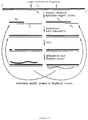
- FIG. 1 comprises a flow chart of the steps in an example of the method claimed in this invention for a single stranded DNA fragment and one amplification primer.
- FIG. 2 comprises a flow chart of the steps in an example of the method claimed in this invention for double stranded genomic DNA and two amplification primers.
- the sample may be isolated from any material suspected of containing the target nucleic acid sequence.
- the sources of such materials may comprise blood, bone marrow, lymph, hard tissues ( e.g. , liver, spleen, kidney, lung, ovary, etc. ), sputum, feces and urine.
- Other sources of material may be derived from plants, soil and other materials suspected of containing biological organisms.
- nucleic acids from these materials can be done any number of ways. Such methods include the use of detergent lysates, sonication, vortexing with glass beads and a French press. In some instances, it may be advantageous to purify the nucleic acids isolated ( e.g. , where endogenous nucleases are present). In those instances, purification of the nucleic acids may be accomplished by phenol extraction, chromatography, ion exchange, gel electrophoresis or density dependent centrifugation.
- the genomic nucleic acid is DNA and is double stranded.
- the selection of the enzyme and the length of the sequence should be such so that the target sequence sought will be contained in its entirety within the fragment generated or at least a sufficient portion of the target sequence will be present in the fragment to provide sufficient binding of the primer sequence.
- Other methods for generating fragments include PCR and sonication.
- the primers used in this method generally have a length of 25 - 100 nucleotides. Primers of approximately 35 nucleotides are preferred. This sequence should be substantially homologous to a sequence on the target such that under high stringency conditions binding will occur.
- the primer also should contain a sequence (toward the 5' end) that will be recognized by the nicking endonuclease to be used in later steps.
- the recognition sequences generally, although not necessarily, are non-palindromic. The sequence selected also may be such that the restriction enzyme used to cleave the fragments in the previous step is the same as the nicking endonuclease to be used in later steps.
- target nucleic acid fragments are generated, they are denatured to render them single stranded so as to permit binding of the primers to the target strands.
- Raising the temperature of the reaction to approximately 95°C is a preferred method for denaturing the nucleic acids.
- Other methods include raising pH; however, this will require lowering the pH in order to allow the primers to bind to the target.
- a mixture comprising an excess of all four deoxynucleosidetriphosphates, wherein at least one of which is substituted, a polymerase and an endonuclease are added.
- a polymerase e.g., a reverse transcriptase
- an endonuclease e.g., a reverse transcriptase
- the substituted deoxynucleosidetriphosphate should be modified such that it will inhibit cleavage in the strand containing the substituted deoxynucleotides but will not inhibit cleavage on the other strand.
- Examples of such substituted deoxynucleosidetriphosphates include 2'deoxyadenosine 5'-O-(1-thiotriphosphate), 5-methyldeoxycytidine 5'-triphosphate, 2'-deoxyuridine 5'-triphosphate and 7-deaza-2'-deoxyguanosine 5'-triphosphate.
- the mixture comprising the reaction components for target generation and SDA can optionally include NMP (1-methyl 2 pyrrolidinone), glycerol, poly (ethylene glycol), dimethyl sulfoxide and/or formamide.
- NMP 1-methyl 2 pyrrolidinone
- glycerol poly (ethylene glycol)
- dimethyl sulfoxide dimethyl sulfoxide and/or formamide.
- organic solvents is believed to help alleviate background hybridization reactions.
- substitution of the deoxynucleotides may be accomplished after incorporation into a strand.
- a methylase such as M. Taq I, could be used to add methyl groups to the synthesized strand.
- the methyl groups when added to the nucleotides are thus substituted and will function in similar manner to the thio substituted nucleotides.
- the polymerase need not lack the 5' ⁇ 3' exonuclease activity.
- the presence of the substituents throughout the synthesized strand will function to prevent such activity without inactivating the system.
- the selection of the endonuclease used in this method should be such that it will cleave a strand at or 3' (or 5') to the recognition sequence.
- the endonuclease further should be selected so as not to cleave the complementary recognition sequence that will be generated in the target strand by the presence of the polymerase, and further should be selected so as to dissociate from the nicked recognition sequence at a reasonable rate. It need not be thermophilic. Endonucleases, such as HincII, HindII, AvaI , Fnu4HI, TthlllI, and NciI are preferred.
- class IIS restriction endonucleases e.g., FokI
- FokI class IIS restriction endonucleases
- the restriction enzyme EcoRI has been shown to preferentially cleave one strand in noncanonical recognition sites or when its canonical recognition site is flanked by an oligopurine tract (Thielking et al.
- DpnI the restriction enzyme cleaves a recognition site containing me6dA on both strands.
- DpnI or an analogous restriction enzyme may be able to nick the methyl containing strand of a hemimethylated recognition site.
- SDA primers P1 and P2 with methylated recognition sequences along with unmodified deoxynucleosidetriphosphates.
- restriction enzymes are known to cleave the nonmethylated strand of a hemimethylated recognition site (e.g., MspI and me5dC). Such a system would use a methylated deoxynucleosidetriphosphate. Finally, one could use origin of replication proteins to nick one strand of a recognition sequence.
- Polymerases useful in this method include those that will initiate 5' - 3' polymerization at a nick site.
- the polymerase should also displace the polymerized strand downstream from the nick, and, importantly, should also lack any 5' ⁇ 3' exonuclease activity.
- Polymerases such as the klenow fragment of DNA polymerase I and the exonuclease deficient klenow fragment of DNA polymerase I and a similar fragment from the Bst polymerase (Bio-Rad, Richmond, CA) are useful.
- SEQUENASE 1.0 and SEQUENASE 2.0 US Biochemical
- T5 DNA polymerase and Phi29 DNA polymerases also work. It should be appreciated that a polymerase ordinarily having such exonuclease activity can be deemed to "lack" such activity if that activity is blocked by the addition of a blocking agent.
- An additional feature of this method is that it does not require temperature cycling. Many amplification methods require temperature cycling in order to dissociate the target from the synthesized strand. In this method, a single temperature may be employed after denaturation has occurred. The temperature of the reaction should be high enough to set a level of stringency that minimizes non-specific binding but low enough to allow specific hybridization to the target strand. In addition proper temperature should support efficient enzyme activity. From about 37°C to about 42 o C has been found to be a preferred temperature range. Denaturation of the enzymes and nucleic acid is to be avoided.
- the strand labelled P represents the primer and contains at the 5' end the sequence CCGGG which is recognized by the endonuclease NciI.
- the strand labelled T is the target sequence which has already been fragmented and rendered single stranded.
- the primer binds to the target and in the presence of polymerase, deoxynucleosidetriphosphates and ⁇ thio substituted deoxycytosinetriphosphate, the primer is extended the length of the target while the target is extended through the recognition sequence.
- the primer strand is nicked between the C-G residues.
- the 3' end at the nick is extended, and downstream the primer strand is displaced from the target strand beginning at the nick to create a reaction product and a new strand is synthesized.
- the newly synthesized strand too will be nicked by the endonuclease and the polymerase then will displace this strand generating another until either the reaction is stopped or one of the reagents becomes limiting.
- FIG. 2 depicts Strand Displacement Amplification (SDA) using two primers.
- the first step is to generate a target DNA fragment with defined 5'- and 3'-ends (e.g., by restriction enzyme cleavage).
- T1 and T2 the two single-stranded target fragments
- P1 and P2 the two SDA primers
- the 5'-overhangs of P1 and P2 contain a recognition sequence for the nicking enzyme.
- DNA polymerase extends the 3'-ends of the duplexes using 3 deoxynucleosidetriphosphates and one modified deoxynucleosidetriposphate which produces hemimodified recognition sites on P1T1 and P2T2.
- the nicking enzyme nicks the unprotected primer strands of the hemimodified recognition sites, leaving intact the modified complementary strands.
- DNA polymerase extends the 3'-end at the nick on P1T1 and displaces the downstream strand that is functionally equivalent to T2.
- extension at the nick on P2T2 results in displacement of a downstream strand functionally equivalent to T1.
- nicking and polymerization/displacement steps cycle continuously on P1T1 and P2T2 because extension at a nick regenerates a nickable recognition site.
- SDA can be used to generate single-stranded DNA probes or single-stranded templates for sequencing. Toward this goal, SDA operates either with a single primer ( Figure 1) or using two primers ( Figure 2) wherein one primer is in excess over the other. The result is excess production of one displaced single strand over the other.
- the presence of the amplified target then can be detected by any number of methods.
- One method is to detect reaction products of a specific size by means of gel electrophoresis. This method is particularly useful when the nucleotides used are labelled with a radio-label, such as 32P.
- Other methods include the use of labelling the nucleotides with a physical label, such as biotin. Biotin-containing reaction products can then be identified by means of avidin bound to a signal generating enzyme, such as peroxidase.
- Detection systems useful in the practice of this invention comprise homogeneous systems, which do not require separation, and heterogeneous systems. In each system, one or more detectable markers are used and the reaction or emission from the detection system is monitored, preferably by automated means.
- homogeneous systems include fluorescence polarization, enzyme mediated immunoassays, fluorescence energy transfer, hybridization protection (e.g. , acridinium luminescence) and cloned enzyme donor immunoassays.
- heterogeneous systems include enzyme labels (such as peroxidase, alkaline phosphatase and beta-galactosidase), fluorescent labels (such as enzymatic labels and direct fluorescence labels (e.g., fluorescein and rhodamine]), chemiluminescence and bioluminescence.
- enzyme labels such as peroxidase, alkaline phosphatase and beta-galactosidase
- fluorescent labels such as enzymatic labels and direct fluorescence labels (e.g., fluorescein and rhodamine]), chemiluminescence and bioluminescence.
- Liposomes or other sac like particles also can be filled with dyes and other detectable markers and used in such detection systems.
- the detectable markers can be conjugated directly or indirectly to a capture moiety or the amplified products can be generated in the presence of a receptor which can be recognized by a ligand for the receptor.
- This example illustrates SDA using a FokI restriction step to generate target fragments prior to amplification.
- Two primers were synthesized on an Applied BioSystems 380B instrument using phosphoramidite chemistry and 3'-amine-ON CPG columns (Clontech Laboratories, Palo Alto, CA) which incorporate a primary amine at the 3' terminus. Nucleotides were ammonium deprotected and purified by denaturing gel electrophoresis.
- the primer sequences were: SEQ ID NO: 1, and SEQ ID NO: 2.
- Plasmid pBR322 (Boerhinger Mannheim, Indianapolis, IN) was serially diluted with 0.05 mg/ml E. coli DNA, 50 mM K acetate, 10 mM Mg acetate, 1 mM DTT, 12.5 mM TRIS (pH 7.9) at 25°C. Twenty ⁇ l samples containing 1 ⁇ g E. coli DNA and various amounts of pBR322 were digested 3 hours at 37°C with 10 Units of FokI (New England Biolabs, Beverly, MA). The FokI digests of pBR322/ E.
- coli DNA were diluted to 100 ⁇ l in the presence of 12.5 mM K acetate, 10 mM Mg acetate, 1 mM DTT, 12.5 mM TRIS (pH 7.9) at 25°C, 100 ⁇ g/ml BSA, 0.3 mM each of dATP, dGTP, TTP dCTP( ⁇ S) (Pharmacia, Piscataway, NJ) and 0.1 ⁇ M of each primer.
- One set of samples underwent strand displacement amplification for 4 hours at 45°C upon addition of 4 Units 5' ⁇ 3' exonuclease deficient klenow fragment of DNA polymerase I (US Biochemical, Cleveland, OH) and 48 Units NciI (New England Biolabs). A second set of samples were run without the polymerase and without NciI as unamplified standards.
- a pBR322 specific detection probe SEQ ID NO: 3, was prepared and was labelled with 32P using polynucleotide kinase.
- Ten ⁇ l aliquots of the amplified and unamplified Fok I/pBR322/ E. coli DNA samples were mixed with 2 ⁇ l of 1.8 ⁇ M 32P labelled detection probe, 0.5 Units/ ⁇ l Tag DNA polymerase (United States Biochemical). Samples were heated for 2 minutes at 95°C, 5 minutes at 50°C, quenched with 50% urea, and a portion was loaded onto a 10% denaturing polyacrylamide gel.
- This example illustrates SDA using a synthetic single stranded target DNA sequence.
- a synthetic nucleic acid target was constructed having the sequence of SEQ ID NO: 4.
- Primers for strand displacement amplification reaction using the restriction enzyme HincII (New England BioLabs) were synthesized to provide a 3'-NH2 cap using 3'-amine-on CPG columns.
- the primer sequences used were: SEE ID NO: 5 and SEQ ID NO: 6.
- a probe for the detection of the reaction products was of the sequence: SEQ ID NO: 7. All synthetic sequences were synthesized on an Applied Biosystems 380B instrument as above, and were gel purified on 10% or 15% polyacrylamide gels containing 50% urea. Excised bands were electroeluted in 1/2X TBE buffer.
- SEQ ID NO: 4 was diluted into 0.3 ⁇ M of the primers (e.g. , SEQ ID NO: 5 and SEQ ID NO: 6) to provide a final stock concentration of 600,000 molecules of target/ ⁇ l. This mixture was boiled for 3 minutes and placed at 37°C. Serial 4 fold dilutions of this stock solution were then prepared in the presence of the primers. (In the control, only amplification primers were present.)
- the primers e.g. , SEQ ID NO: 5 and SEQ ID NO: 6
- pBR322 was digested for 2 hours at 37°C with 8 Units of Fok I, and then was serially diluted with 0.05 mg/ml human placental DNA digested with HphI, 50 mM KCl, 5 mM MgCl2, 20 mM (NH4)2SO4, 1 mM DTT and 20 mM TRIS (pH 7.2 at 25°C).
- Ten ⁇ l samples containing 0.5 ⁇ g human placental DNA and various amounts of pBR322 were diluted to 100 ⁇ l in the presence of 50 mM KCl, 5 mM MgCl2, 20 mM (NH4)2SO4, 1 mM DTT and 20 mM TRIS (pH 7.2 at 25°C) 100 ⁇ g/ml BSA, 0.1 mM each of dGTP, TTP, dCTP (Pharmacia), 0.5 mM dATP( ⁇ S) (Pharmacia) and 0.1 ⁇ M of each probe.
- the pBR322 detection primer having SEQ ID NO: 7 was used having been labelled with 32P.
- Ten ⁇ l aliquots of the amplified and unamplified Fok I/pBR322/human placental DNA samples were mixed with 2 ⁇ l of 1 ⁇ M 32P labelled detection primer, and were heated 2 minutes at 95°C. Two Units of Sequenase 2.0 were then added, and samples were incubated for 5 minutes at 37°C. Samples were quenched with 50% urea and loaded onto a 10% denaturing polyacrylamide gel. The presence of amplified reaction products was detected through extension of the 32P labelled detection primer to lengths of 54 and 75 nucleotides. Unamplified samples were indicated by extension to 50 nucleotides. Electrophoresis of the labelled bands was quantified by liquid scintillation counting subtracting appropriated background bands. The results are shown in TABLE III.
Landscapes
- Chemical & Material Sciences (AREA)
- Life Sciences & Earth Sciences (AREA)
- Organic Chemistry (AREA)
- Engineering & Computer Science (AREA)
- Zoology (AREA)
- Wood Science & Technology (AREA)
- Proteomics, Peptides & Aminoacids (AREA)
- Health & Medical Sciences (AREA)
- Molecular Biology (AREA)
- Bioinformatics & Cheminformatics (AREA)
- Immunology (AREA)
- Microbiology (AREA)
- Biophysics (AREA)
- Analytical Chemistry (AREA)
- Physics & Mathematics (AREA)
- Genetics & Genomics (AREA)
- Biochemistry (AREA)
- Biotechnology (AREA)
- General Engineering & Computer Science (AREA)
- General Health & Medical Sciences (AREA)
- Chemical Kinetics & Catalysis (AREA)
- Measuring Or Testing Involving Enzymes Or Micro-Organisms (AREA)
- Superconductors And Manufacturing Methods Therefor (AREA)
- Materials For Medical Uses (AREA)
- Surgical Instruments (AREA)
- Silicon Polymers (AREA)
- Crystals, And After-Treatments Of Crystals (AREA)
Abstract
Description
- This invention relates to a method for amplifying a target nucleic acid sequence, and more particularly relates to a method for amplification by endonuclease mediated strand displacement and detection of the amplified reaction product(s). This invention further relates to a commonly assigned application for exonuclease mediated strand displacement amplification filed of even date herewith.
- Nucleic acids may be either in the form of deoxyribonucleic acids (DNA) or in the form of ribonucleic acids (RNA). DNA and RNA are high molecular weight polymers formed from many nucleotide building blocks. Each nucleotide is composed of a base (a purine or a pyrimidine), a sugar (either ribose or deoxyribose) and a molecule of phosphoric acid. DNA is composed of the sugar deoxyribose and the bases adenine (A), guanine (G), cytosine (C) and thymine (T).
- The nucleotides are assembled into a linear chain to form the genetic code. Each sequence of three nucleotides can be "read" as the code for one amino acid through the process of translation. (DNA must first be converted into RNA through the process of transcription.) By varying the combination of bases in each three base sequence, different amino acids are coded for. By linking various three base sequences together, a sequence of amino acids can be made which form proteins. The entire coding unit for one protein is referred to as a gene. There can be one or more copies of a gene in an organism. Some genes are present in hundreds or thousands of copies. Others are present only as a single copy.
- Regardless of the number of copies, genes are linked together in an organism to form higher structural units referred to as chromosomes in higher organisms. In some lower organisms, genes may occur in extra chromosomal units referred to as plasmids. Genes need not be linked directly to each other in an end-to-end fashion. Certain non-coding regions (i.e., sequences of bases that do not translate into amino acids) may occur between genes or within a gene. Thus, the arrangement of nucleotides in an organism determines its genetic makeup which may be referred to as its genome. (Hence, DNA isolated from an organism is referred to as genomic DNA.)
- DNA in most organisms is arranged in the form of a duplex wherein two strands of DNA are paired together in the familiar double helix. In this model, hydrogen bonds are formed between A and T and between C and G on the paired strands. Thus, on one strand, the sequence ATCG (5'→3') will have on its complementary strand the sequence TAGC (3'→5'). Both strands, however, contain the same genetic code only in a complementary base-paired manner. One could read, therefore, either strand of DNA in order to determine the genetic sequence coded for.
- For a further description of the organization, structure and function of nucleic acids, see Watson, Molecular Biology of the Gene, W.J. Benjamin, Inc. (3rd edit. 1977), especially ch.s 6-14.
- Understanding and determining the genetic sequence of nucleic acids present in a sample is important for many reasons. First, a number of diseases are genetic in the sense that the nucleotide sequence for a "normal" gene is in some manner changed. Such a change could arise by the substitution of one base for another. Given that three bases code for a single amino acid, a change in one base (referred to as a point mutation) could result in a change in the amino acid which, in turn, could result in a defective protein being made in a cell. Sickle cell anemia is a classic example of such a genetic defect caused by a change in a single base in a single gene. Other examples of diseases caused by single gene defects include Factor IX and Factor VIII deficiency, adenosine deaminase deficiency, purine nucleotide phosphorylase deficiency, ornithine transcarbamylase deficiency, argininsuccinate synthetase deficiency, beta-thalassemia, α₁ antitrypsin deficiency, glucocerebrosidase deficiency, phenylalanine hydroxylase deficiency and hypoxanthine-guanine phosphoribosyltransferase deficiency. Still other diseases, such as cancers, are believed to be caused by the activation, increase in copy number and/or removal of suppression of genes known to be present in the genome referred to as oncogenes. Examples of oncogenes believed to be relevant to certain cancers include N-myc for neuroblastomas, retinoblastomas and small-cell lung cancers and c-abl for chronic myelogenous leukemia. For a further description of the relevance of oncogenes to the diagnosis of cancers and for a listing of specific oncogenes, see Weinberg, Sci. Amer., Nov. 1983, Slamon et al., Science, 224:256 (1984), U.S. Pat. No. 4,699,877 and 4,918,162.
- Second, in addition to changes in the sequence of nucleic acids, there are genetic changes that occur on a structural level. Such changes include insertions, deletions and translocations along a chromosome and include increased or decreased numbers of chromosomes. In the former instance, such changes can result from events referred to as crossing-over where strands of DNA from one chromosome exchange various lengths of DNA with another chromosome. Thus, for example, in a "normal" individual, the gene for protein "X" might reside on chromosome 1; after a crossing-over event, that gene could now have been translocated to chromosome 4 (with or without an equal exchange of DNA from chromosome 4 to chromosome 1) and the cell may not produce X.
- In the instance of increased or decreased chromosome number (referred to as aneuploidy), instead of a "normal" individual having the correct number of copies of each chromosome (e.g., two of each in humans [other than the X and Y chromosomes]), a different number occurs. In humans, for example, Down's syndrome is the result of having three copies of chromosome 21 instead of the normal two copies. Other aneuploid conditions result from trisomies involving chromosomes 13 and 18.
- Third, infectious diseases can be caused by parasites, microorganisms and viruses all of which have their own nucleic acids. The presence of these organisms in a sample of biological material often is determined by a number of traditional methods (e.g., culture). Because each organism has its own genome, however, if there are genes or sequences of nucleic acids that are specific to a single species (to several related species, to a genus or to a higher level of relationship), the genome will provide a "fingerprint" for that organism (or species, etc.). Examples of viruses to which this invention is applicable include HIV, HPV, EBV, HSV, Hepatitis B and C and CMV. Examples of microorganisms to which this invention is applicable include bacteria and more particularly include H. influenzae, mycoplasma, legionella, mycobacteria, chlamydia, candida, gonocci, shigella and salmonella.
- In each example set forth above, by identifying one or more sequences that are specific for a disease or organism, one can isolate nucleic acids from a sample and determine if that sequence is present. A number of methods have been developed in an attempt to do this.
- While it is critical that one or more sequences specific for a disease or organism be identified, it is not important to the practice of this invention what the target sequences are or how they are identified. The most straightforward means to detect the presence of a target sequence in a sample of nucleic acids is to synthesize a probe sequence complementary to the target nucleic acid. (Instrumentation, such as the Applied BioSystems 380B, are presently used to synthesize nucleic acid sequences for this purpose.) The synthesized probe sequence then can be applied to a sample containing nucleic acids and, if the target sequence if present, the probe will bind to it to form a reaction product. In the absence of a target sequence and barring non-specific binding, no reaction product will be formed. If the synthesized probe is tagged with a detectable label, the reaction product can be detected by measuring the amount of label present. Southern blotting is one example where this method is used.
- A difficulty with this approach, however, is that it is not readily applicable to those instances where the number of copies of the target sequence present in a sample is low (i.e., less than 10⁷). In such instances, it is difficult to distinguish signal from noise (i.e., true binding between probe and target sequences from non-specific binding between probe and non-target sequences). One way around this problem is to increase the signal. Accordingly, a number of methods have been described to amplify the target sequences present in a sample.
- One of the best known amplification methods is the polymerase chain reaction (referred to as PCR) which is described in detail in U.S. Pat. No.s 4,683,195, 4,683,202 and 4,800,159. Briefly, in PCR, two primer sequences are prepared which are complementary to regions on opposite complementary strands of the target sequence. An excess of deoxynucleosidetriphosphates are added to a reaction mixture along with a DNA polymerase (e.g., Taq polymerase). If the target sequence is present in a sample, the primers will bind to the target and the polymerase will cause the primers to be extended along the target sequence by adding on nucleotides. By raising and lowering the temperature of the reaction mixture, the extended primers will dissociate from the target to form reaction products, excess primers will bind to the target and to the reaction products, and the process is repeated.
- Another method for amplification is described in EPA No. 320,308, published June 14, 1989, which is the ligase chain reaction (referred to as LCR). In LCR, two complementary probe pairs are prepared and in the presence of the target sequence, each pair will bind to opposite complementary strands of the target such that they abut. In the presence of a ligase, the two probe pairs will link to form a single unit. By temperature cycling, as in PCR, bound ligated units dissociate from the target and then serve as "target sequences for ligation of excess probe pairs. U.S. Pat. No. 4,883,750 describes a method similar to LCR for binding probe pairs to a target sequence but does not describe an amplification step.
- A still further amplification method is described in PCT Appl. No. PCT/US87/00880, published October 22, 1987, and is referred to as the Qbeta Replicase method. In this method, a replicative sequence of RNA which has a region complementary to that of a target is added to a sample in the presence of an RNA polymerase. The polymerase will copy the replicative sequence which then can be detected.
- Still other amplification methods are described in GB Appl. No. 2 202 328, published September 21, 1988, and in PCT Appl. No. PCT/US89/01025, published October 5, 1989. In the former application, "modified" primers are used in a PCR like, template and enzyme dependent synthesis. The primers may be modified by labelling with a capture moiety (e.g., biotin) and/or a detector moiety (e.g., enzyme). In the latter application, an excess of labelled probes are added to a sample. In the presence of the target sequence, the probe binds and is cleaved catalytically. After cleavage, the target sequence is released intact to be bound by excess probe. Cleavage of the labelled probe signals the presence of the target sequence.
- For all of the above-described methods, a variety of detection methods may be employed none of which is critical to the amplification method employed. One method is detect reaction products having a specific size via electrophoresis. Another method is to radiolabel the primer sequence with ³²P, for example, and then to detect the radioactivity emitted by the reaction products alone or in combination with electrophoresis. A further method is to chemically modify the primer by adding a receptor having a ligand (e.g., biotin-avidin), and enzyme (e.g., alkaline phosphatase), a fluorescent dye (e.g., phycobiliprotein) or a combination. Another method is to develop a detection primer which will bind to the reaction product and be extended in the presence of polymerase. The detection primer can be radiolabelled or chemically modified as described above. Many of these methods may be adapted to solid phase as well as solution systems. A number of these methods, as well as others, are described in U.S. Pat. No.s 4,358,535, 4,705,886, 4,743,535, 4,777,129, 4,767,699, and 4,767,700.
- Each of the above-referenced amplification methods has one or more limitations. In most of the amplification methods, a key limitation is the requirement for temperature cycling to cause the reaction products to dissociate from the target. This places a limitation on both the devices used to perform the method as well as on the choice of enzymes necessary to form the reaction products. Other limitations of these methods include production of RNA intermediates sensitive to endogenous nuclease degradation and difficulty in production of associated enzymes. Alternative methods to such existing amplification methods are desirable.
- This invention provides for a method of amplification of a target nucleic acid sequence (and its complementary strand) in a sample by endonuclease mediated strand displacement. The method involves the steps of 1) isolating nucleic acids suspected of containing the target sequence from a sample, 2) generating single stranded fragments of target sequences, 3) adding a mixture comprising (a) a nucleic acid polymerase, (b) deoxynucleosidetriphosphates including at least one substituted deoxynucleosidetriphosphate and (c) at least one primer which is complementary to a region at the 3' end of a target fragment and further wherein each primer has a sequence at the 5' end which is a recognition sequence for a restriction endonuclease, and 4) allowing the mixture to react for a time sufficient to generate reaction products. Where the fragments comprise double stranded nucleic acids, the method further comprises denaturing the nucleic acid fragments to form single stranded target sequences. Where the nucleic acids comprise RNA, it is preferable to use reverse transcriptase to convert RNA to DNA.
- The invention further relates to methods for the separation and/or detection of reaction products generated by the above-described method. Methods for separation comprise magnetic separation, membrane capture and capture on solid supports. In each method, a capture moiety may be bound to a magnetic bead, membrane or solid support. The beads, membrane or solid support then can be assayed for the presence or absence of reaction products. An example of a capture moiety includes a nucleic sequence complementary to the reaction products produced and an antibody directed against a receptor incorporated into the primer or reaction product. The separation system may or may not be coupled to a detection system.
- Detection systems useful in the practice of this invention comprise homogeneous systems, which do not require separation, and heterogeneous systems. In each system, one or more detectable markers are used and the reaction or emission from the detection system is monitored, preferably by automated means. Examples of homogeneous systems include fluorescence polarization, enzyme mediated immunoassays, fluorescence energy transfer, hybridization protection (e.g., acridinium luminescence) and cloned enzyme donor immunoassays. Examples of heterogeneous systems include enzyme labels (such as peroxidase, alkaline phosphatase and beta-galactosidase), fluorescent labels (such as enzymatic labels and direct fluorescence labels [e.g., fluorescein and rhodamine]), chemiluminescence and bioluminescence. Liposomes or other sac like particles also can be filled with dyes and other detectable markers and used in such detection systems. In these systems, the detectable markers can be conjugated directly or indirectly to a capture moiety or the reaction products can be generated in the presence of a receptor which can be recognized by a ligand for the receptor.
- The invention further relates to methods of generating amplified products which can function as probes or templates for sequence analysis. In this format, the above described method and steps are used to generate amplified products. The amplified products can then be treated to remove the nicking enzyme recognition sequence from the amplified product, for example by using a restriction enzyme. In this manner, the recognition sequence is removed and the remaining amplified product comprises a probe which can be used in other systems.
- In the presence of a single stranded target fragment, a primer will bind to its complementary target strand. In the presence of polymerase, nucleotides and substituted nucleotides will be added to the 3' end of the primer along the remaining length of the target and nucleotides and substituted nucleotides will be added to the 3' end of the target along the primer sequence. The resulting double stranded product will have one sequence containing substituted nucleotides coupled to the 3' end of the target strand while the primer strand will have an unmodified sequence coupled 5' to an extended sequence complementary to the target sequence.
- The endonuclease then cleaves the recognition sequence on the primer strand but does not cleave the complementary sequence on the target strand because its sequence contains the substituted nucleotides. The polymerase extends the 3' end at the nick and simultaneously displaces the downstream strand 5' to the nick generating a reaction product complementary to the target strand.
- The method also can function with two primers wherein one primer will bind to one strand of a target sequence and the other primer will bind to the complementary strand of the target sequence. When this embodiment is used, it will be apparent that each reaction product can function as a "target" for the other primer. In this manner, amplification proceeds logarithmically.
- As used in this document, "nicking" refers to preferential cleavage of one of two strands present in a double-stranded recognition site.
- FIG. 1 comprises a flow chart of the steps in an example of the method claimed in this invention for a single stranded DNA fragment and one amplification primer.
- FIG. 2 comprises a flow chart of the steps in an example of the method claimed in this invention for double stranded genomic DNA and two amplification primers.
- In this invention, the sample may be isolated from any material suspected of containing the target nucleic acid sequence. For animals, preferably, mammals, and more preferably humans, the sources of such materials may comprise blood, bone marrow, lymph, hard tissues (e.g., liver, spleen, kidney, lung, ovary, etc.), sputum, feces and urine. Other sources of material may be derived from plants, soil and other materials suspected of containing biological organisms.
- The isolation of nucleic acids from these materials can be done any number of ways. Such methods include the use of detergent lysates, sonication, vortexing with glass beads and a French press. In some instances, it may be advantageous to purify the nucleic acids isolated (e.g., where endogenous nucleases are present). In those instances, purification of the nucleic acids may be accomplished by phenol extraction, chromatography, ion exchange, gel electrophoresis or density dependent centrifugation.
- Once the nucleic acids are isolated, it will be assumed for purposes of illustration only that the genomic nucleic acid is DNA and is double stranded. In such instances, it is preferred to cleave the nucleic acids in the sample into fragments of between approximately 50-500bp. This may be done by a restriction enzyme such as HhaI, FokI or DpnI. The selection of the enzyme and the length of the sequence should be such so that the target sequence sought will be contained in its entirety within the fragment generated or at least a sufficient portion of the target sequence will be present in the fragment to provide sufficient binding of the primer sequence. Other methods for generating fragments include PCR and sonication.
- The primers used in this method generally have a length of 25 - 100 nucleotides. Primers of approximately 35 nucleotides are preferred. This sequence should be substantially homologous to a sequence on the target such that under high stringency conditions binding will occur. The primer also should contain a sequence (toward the 5' end) that will be recognized by the nicking endonuclease to be used in later steps. The recognition sequences generally, although not necessarily, are non-palindromic. The sequence selected also may be such that the restriction enzyme used to cleave the fragments in the previous step is the same as the nicking endonuclease to be used in later steps.
- Once target nucleic acid fragments are generated, they are denatured to render them single stranded so as to permit binding of the primers to the target strands. Raising the temperature of the reaction to approximately 95°C is a preferred method for denaturing the nucleic acids. Other methods include raising pH; however, this will require lowering the pH in order to allow the primers to bind to the target.
- Either before or after the nucleic acids are denatured, a mixture comprising an excess of all four deoxynucleosidetriphosphates, wherein at least one of which is substituted, a polymerase and an endonuclease are added. (If high temperature is used to denature the nucleic acids, unless thermophilic enzymes are used, it is preferrable to add the enzymes after denaturation.) The substituted deoxynucleosidetriphosphate should be modified such that it will inhibit cleavage in the strand containing the substituted deoxynucleotides but will not inhibit cleavage on the other strand. Examples of such substituted deoxynucleosidetriphosphates include 2'deoxyadenosine 5'-O-(1-thiotriphosphate), 5-methyldeoxycytidine 5'-triphosphate, 2'-deoxyuridine 5'-triphosphate and 7-deaza-2'-deoxyguanosine 5'-triphosphate.
- The mixture comprising the reaction components for target generation and SDA can optionally include NMP (1-methyl 2 pyrrolidinone), glycerol, poly (ethylene glycol), dimethyl sulfoxide and/or formamide. The inclusion of such organic solvents is believed to help alleviate background hybridization reactions.
- It should be appreciated that the substitution of the deoxynucleotides may be accomplished after incorporation into a strand. For example, a methylase, such as M. Taq I, could be used to add methyl groups to the synthesized strand. The methyl groups when added to the nucleotides are thus substituted and will function in similar manner to the thio substituted nucleotides.
- It further should be appreciated that if all the nucleotides are substituted, then the polymerase need not lack the 5'→3' exonuclease activity. The presence of the substituents throughout the synthesized strand will function to prevent such activity without inactivating the system.
- As described for the selection of the recognition sequence incorporated in the primer, the selection of the endonuclease used in this method should be such that it will cleave a strand at or 3' (or 5') to the recognition sequence. The endonuclease further should be selected so as not to cleave the complementary recognition sequence that will be generated in the target strand by the presence of the polymerase, and further should be selected so as to dissociate from the nicked recognition sequence at a reasonable rate. It need not be thermophilic. Endonucleases, such as HincII, HindII, AvaI , Fnu4HI, TthlllI, and NciI are preferred.
- One can envision several alternative nicking enzyme systems in addition to those detailed in this application. For example, it is generally regarded that class IIS restriction endonucleases (e.g., FokI) contain two DNA cleavage centers within a single polypeptide unit. If one of the cleavage centers was inactivated, such as through site directed mutagenesis, the resultant nicking enzyme could be used in an amplification system not requiring modified deoxynucleosidetriphosphates. As an additional example, the restriction enzyme EcoRI has been shown to preferentially cleave one strand in noncanonical recognition sites or when its canonical recognition site is flanked by an oligopurine tract (Thielking et al. (1990) Biochemistry 29, 4682; Lesser et al. (1990) Science 250, 776; Venditti & Wells (1991) J. Biol. Chem. 266, 16786). As another example, the restriction enzyme DpnI (available from New England Biolabs, Beverly MA) cleaves a recognition site containing me⁶dA on both strands. DpnI or an analogous restriction enzyme may be able to nick the methyl containing strand of a hemimethylated recognition site. Such a system would employ SDA primers (P₁ and P₂) with methylated recognition sequences along with unmodified deoxynucleosidetriphosphates. Alternatively, certain restriction enzymes are known to cleave the nonmethylated strand of a hemimethylated recognition site (e.g., MspI and me⁵dC). Such a system would use a methylated deoxynucleosidetriphosphate. Finally, one could use origin of replication proteins to nick one strand of a recognition sequence.
- The following chart lists enzymes, their recognition sequences and modified dNTP for use with the method:

- Polymerases useful in this method include those that will initiate 5' - 3' polymerization at a nick site. The polymerase should also displace the polymerized strand downstream from the nick, and, importantly, should also lack any 5'→3' exonuclease activity. Polymerases, such as the klenow fragment of DNA polymerase I and the exonuclease deficient klenow fragment of DNA polymerase I and a similar fragment from the Bst polymerase (Bio-Rad, Richmond, CA) are useful. SEQUENASE 1.0 and SEQUENASE 2.0 (US Biochemical), T5 DNA polymerase and Phi29 DNA polymerases also work. It should be appreciated that a polymerase ordinarily having such exonuclease activity can be deemed to "lack" such activity if that activity is blocked by the addition of a blocking agent.
- An additional feature of this method is that it does not require temperature cycling. Many amplification methods require temperature cycling in order to dissociate the target from the synthesized strand. In this method, a single temperature may be employed after denaturation has occurred. The temperature of the reaction should be high enough to set a level of stringency that minimizes non-specific binding but low enough to allow specific hybridization to the target strand. In addition proper temperature should support efficient enzyme activity. From about 37°C to about 42oC has been found to be a preferred temperature range. Denaturation of the enzymes and nucleic acid is to be avoided.
- Referring to FIG. 1, one example of this invention is set forth. In this example, the strand labelled P represents the primer and contains at the 5' end the sequence CCGGG which is recognized by the endonuclease NciI. The strand labelled T is the target sequence which has already been fragmented and rendered single stranded. In the method, the primer binds to the target and in the presence of polymerase, deoxynucleosidetriphosphates and αthio substituted deoxycytosinetriphosphate, the primer is extended the length of the target while the target is extended through the recognition sequence. In the presence of the endonuclease NciI, the primer strand is nicked between the C-G residues. In the presence of the polymerase lacking 5' to 3' exonuclease activity, the 3' end at the nick is extended, and downstream the primer strand is displaced from the target strand beginning at the nick to create a reaction product and a new strand is synthesized. In summary fashion (not shown), the newly synthesized strand too will be nicked by the endonuclease and the polymerase then will displace this strand generating another until either the reaction is stopped or one of the reagents becomes limiting.
- Figure 2 depicts Strand Displacement Amplification (SDA) using two primers. The first step is to generate a target DNA fragment with defined 5'- and 3'-ends (e.g., by restriction enzyme cleavage). Following heat denaturation, the two single-stranded target fragments (T₁ and T₂) bind respectively to the two SDA primers (P₁ and P₂) which are present in excess. The 5'-overhangs of P₁ and P₂ contain a recognition sequence for the nicking enzyme. DNA polymerase extends the 3'-ends of the duplexes using 3 deoxynucleosidetriphosphates and one modified deoxynucleosidetriposphate which produces hemimodified recognition sites on P₁T₁ and P₂T₂. The nicking enzyme nicks the unprotected primer strands of the hemimodified recognition sites, leaving intact the modified complementary strands. DNA polymerase extends the 3'-end at the nick on P₁T₁ and displaces the downstream strand that is functionally equivalent to T₂. Likewise, extension at the nick on P₂T₂ results in displacement of a downstream strand functionally equivalent to T₁. Nicking and polymerization/displacement steps cycle continuously on P₁T₁ and P₂T₂ because extension at a nick regenerates a nickable recognition site. Target amplification is exponential because strands displaced from P₁T₁ serve as target for P₂ while strands displaced from P₂T₂ serve as target for P₁. These steps continuously repeat over the course of amplification. For example, 10⁶-fold amplification theoretically derives from ∼20 repetitions or cycles of the steps in Figure 2 (2²⁰ = 10⁶). Sense and antisense DNA strands are differentiated by thin and thick lines.
- SDA can be used to generate single-stranded DNA probes or single-stranded templates for sequencing. Toward this goal, SDA operates either with a single primer (Figure 1) or using two primers (Figure 2) wherein one primer is in excess over the other. The result is excess production of one displaced single strand over the other.
- The presence of the amplified target then can be detected by any number of methods. One method is to detect reaction products of a specific size by means of gel electrophoresis. This method is particularly useful when the nucleotides used are labelled with a radio-label, such as ³²P. Other methods include the use of labelling the nucleotides with a physical label, such as biotin. Biotin-containing reaction products can then be identified by means of avidin bound to a signal generating enzyme, such as peroxidase.
- Detection systems useful in the practice of this invention comprise homogeneous systems, which do not require separation, and heterogeneous systems. In each system, one or more detectable markers are used and the reaction or emission from the detection system is monitored, preferably by automated means. Examples of homogeneous systems include fluorescence polarization, enzyme mediated immunoassays, fluorescence energy transfer, hybridization protection (e.g., acridinium luminescence) and cloned enzyme donor immunoassays. Examples of heterogeneous systems include enzyme labels (such as peroxidase, alkaline phosphatase and beta-galactosidase), fluorescent labels (such as enzymatic labels and direct fluorescence labels (e.g., fluorescein and rhodamine]), chemiluminescence and bioluminescence. Liposomes or other sac like particles also can be filled with dyes and other detectable markers and used in such detection systems. In these systems, the detectable markers can be conjugated directly or indirectly to a capture moiety or the amplified products can be generated in the presence of a receptor which can be recognized by a ligand for the receptor.
- The following examples illustrate the specific embodiments of the invention described herein. As would be apparent to skilled artisans, various changes and modifications are possible and are contemplated within the scope of the invention described.
- This example illustrates SDA using a FokI restriction step to generate target fragments prior to amplification. Two primers were synthesized on an Applied BioSystems 380B instrument using phosphoramidite chemistry and 3'-amine-ON CPG columns (Clontech Laboratories, Palo Alto, CA) which incorporate a primary amine at the 3' terminus. Nucleotides were ammonium deprotected and purified by denaturing gel electrophoresis. The primer sequences were:
SEQ ID NO: 1, and
SEQ ID NO: 2. - Plasmid pBR322 (Boerhinger Mannheim, Indianapolis, IN) was serially diluted with 0.05 mg/ml E. coli DNA, 50 mM K acetate, 10 mM Mg acetate, 1 mM DTT, 12.5 mM TRIS (pH 7.9) at 25°C. Twenty µl samples containing 1 µg E. coli DNA and various amounts of pBR322 were digested 3 hours at 37°C with 10 Units of FokI (New England Biolabs, Beverly, MA). The FokI digests of pBR322/E. coli DNA were diluted to 100 µl in the presence of 12.5 mM K acetate, 10 mM Mg acetate, 1 mM DTT, 12.5 mM TRIS (pH 7.9) at 25°C, 100 µg/ml BSA, 0.3 mM each of dATP, dGTP, TTP dCTP(αS) (Pharmacia, Piscataway, NJ) and 0.1 µM of each primer. One set of samples underwent strand displacement amplification for 4 hours at 45°C upon addition of 4 Units 5'→3' exonuclease deficient klenow fragment of DNA polymerase I (US Biochemical, Cleveland, OH) and 48 Units NciI (New England Biolabs). A second set of samples were run without the polymerase and without NciI as unamplified standards.
- To detect the reaction products, a pBR322 specific detection probe, SEQ ID NO: 3, was prepared and was labelled with ³²P using polynucleotide kinase. Ten µl aliquots of the amplified and unamplified Fok I/pBR322/E. coli DNA samples were mixed with 2 µl of 1.8 µM ³²P labelled detection probe, 0.5 Units/µl Tag DNA polymerase (United States Biochemical). Samples were heated for 2 minutes at 95°C, 5 minutes at 50°C, quenched with 50% urea, and a portion was loaded onto a 10% denaturing polyacrylamide gel. The presence of amplified reaction products was detected through extension of the ³²P labelled detection probe to a length of 43 or 60 nucleotides. Unamplified FokI/pBR322 was indicated by extension to 40 nucleotides. Electrophoresis ³²P labelled bands were quantified by liquid scintillation counting subtracting appropriate background bands. The results are shown TABLE I.
TABLE I # pBR322 Molecules Amplified (±50 cpm) Unamplified (±50 cpm) 3x10⁸ 52900 215 3x10⁷ 18200 24 3x10⁶ 5690 21 3x10⁵ 298 0 0 37 ND ND = not determined - As can be seen from TABLE I, as the amount of pBR322 DNA in the aliquot decreases, the number of counts per minute (CPM) also decreases.
- This example illustrates SDA using a synthetic single stranded target DNA sequence. A synthetic nucleic acid target was constructed having the sequence of SEQ ID NO: 4. Primers for strand displacement amplification reaction using the restriction enzyme HincII (New England BioLabs) were synthesized to provide a 3'-NH₂ cap using 3'-amine-on CPG columns. The primer sequences used were:
SEE ID NO: 5 and
SEQ ID NO: 6.
- A probe for the detection of the reaction products was of the sequence: SEQ ID NO: 7. All synthetic sequences were synthesized on an Applied Biosystems 380B instrument as above, and were gel purified on 10% or 15% polyacrylamide gels containing 50% urea. Excised bands were electroeluted in 1/2X TBE buffer.
- SEQ ID NO: 4 was diluted into 0.3 µM of the primers (e.g., SEQ ID NO: 5 and SEQ ID NO: 6) to provide a final stock concentration of 600,000 molecules of target/µl. This mixture was boiled for 3 minutes and placed at 37°C. Serial 4 fold dilutions of this stock solution were then prepared in the presence of the primers. (In the control, only amplification primers were present.)
- Twenty µl of the diluted stock target solutions were added to a mixture to provide a final volume of 60 µl and a final concentration of the following components: 20 mM TRIS (pH 7.2) at 25°C, 0.1 µM of the primer sequences, 20 mM ammonium sulfate, 50 mM KCl, 50 Units HincII, 5 Units exo⁻klenow polymerase (US Biochemical), 1 mM DTT, 5 mM MgCl₂, and 300 µM each of 5'dCTP, 5'dGTP, 5'dTTP and 5'dATP(αS). The amplification reaction was allowed to proceed at 37°C for 1 or 2 hours. In one reaction set, an additional 50 Units of HincII was added after 1 hour and the reaction was allowed to proceed for an additional hour.
- At the end of the reaction times, a 10 µl aliquot of each mixture was placed on ice. To this 10 µl was added 1 µl of a 1 µM stock solution of capture probe freshly labelled with ³²P. This mixture was boiled for 3 minutes and cooled to 37°C, whereupon 1 µl of 1 Unit/µl of Sequenase 2.0 (U.S. Biochemical) was added. (This enzyme will polymerize the capture probe along the full length of any reaction product when the capture probe is bound to a reaction product.) This extension reaction was allowed to proceed for 15 minutes at 37°C. To this mixture was added an equal volume of loading dyes in 50% urea. Samples were boiled again for 3 minutes before loading onto a 10% polyacrylamide gel containing 50% urea. Samples loaded on the gel represented 2.5 µl of the original 60 µl reaction mixture. Electrophoresis was allowed to proceed for 1 to 1.5 hours at 59 W after which the gel was removed and placed on film overnight at -70°C. Bands were rendered visible after exposure, were excised and quantified by liquid scintillation.
TABLE II # Target 1 Hour (cpm) 2 Hour (cpm) 2 Hour with Additional HincII (cpm) 0 0 0 0 2000 ND 2 8 8000 4 12 36 30,000 37 78 129 125,000 175 196 746 500,000 824 1858 2665 - Referring to TABLE II, it can be seen that SDA clearly distinguishes between 0 and 30000 initial targets.
- This is an example using a FokI restriction digest prior to SDA. The following primer sequences were used:
SEQ ID NO: 8 and
SEQ ID NO: 9.
- These sequences were generated as in the other examples and were used to detect a target sequence in the plasmid pBR322.
- One µg of pBR322 was digested for 2 hours at 37°C with 8 Units of Fok I, and then was serially diluted with 0.05 mg/ml human placental DNA digested with HphI, 50 mM KCl, 5 mM MgCl₂, 20 mM (NH₄)₂SO₄, 1 mM DTT and 20 mM TRIS (pH 7.2 at 25°C). Ten µl samples containing 0.5 µg human placental DNA and various amounts of pBR322 were diluted to 100 µl in the presence of 50 mM KCl, 5 mM MgCl₂, 20 mM (NH₄)₂SO₄, 1 mM DTT and 20 mM TRIS (pH 7.2 at 25°C) 100 µg/ml BSA, 0.1 mM each of dGTP, TTP, dCTP (Pharmacia), 0.5 mM dATP(αS) (Pharmacia) and 0.1 µM of each probe. One set of samples underwent strand displacement amplification for 3.5 hours at 39°C upon addition of 5 Units of 5'→3' exonuclease deficient klenow fragment of DNA polymerase I and 50 Units of HincII. A second set of samples were run without polymerase and without HincII as unamplified standards.
- To detect the reaction products, the pBR322 detection primer having SEQ ID NO: 7 was used having been labelled with ³²P. Ten µl aliquots of the amplified and unamplified Fok I/pBR322/human placental DNA samples were mixed with 2 µl of 1 µM ³²P labelled detection primer, and were heated 2 minutes at 95°C. Two Units of Sequenase 2.0 were then added, and samples were incubated for 5 minutes at 37°C. Samples were quenched with 50% urea and loaded onto a 10% denaturing polyacrylamide gel. The presence of amplified reaction products was detected through extension of the ³²P labelled detection primer to lengths of 54 and 75 nucleotides. Unamplified samples were indicated by extension to 50 nucleotides. Electrophoresis of the labelled bands was quantified by liquid scintillation counting subtracting appropriated background bands. The results are shown in TABLE III.

- Comparing the unamplified samples with 10⁹ and 10⁸ pBR322 molecules with respective samples containing 10⁴ and 10³ pBR322 molecules indicates an amplification factor of over 10⁵ fold. Further, it has been found that by adjusting the buffer composition and deoxynucleosidetriphosphate concentrations one can improve amplification performance. Inclusion of (NH₄)₂SO₄, a relatively low pH and a dATP(αS):dGTP ratio of 5:1 have been found to enhance amplification efficiency.
- Although the invention has been described with respect to specific modifications, the details thereof are not to be construed as limitations, for it will be apparent that various equivalents, changes and modifications may be resorted to without departing from the spirit and scope thereof and it is understood that such equivalent embodiments are to be included herein.
- All publications and patent applications mentioned in this specification are indicative of the level of ordinary skill in the art to which this invention pertains. All publications and patent applications are herein incorporated by reference to the same extent as if each individual publication or patent application was specifically and individually indicated to be incorporated by reference.
- It will be apparent to one of ordinary skill in the art that many changes and modifications can be made in the invention without departing from the spirit or scope of the appended claims.


Claims (10)
- A method for amplifying a target nucleic acid sequence comprising the steps of:a) adding to a target nucleic acid sequence a reaction mixture comprising an excess of deoxynucleosidetriphosphates at least one of which is substituted, a DNA polymerase lacking 5' to 3' exonuclease activity, primers that are complementary to the single strands of the target sequence and further having at the 5' end a recognition sequence for an endonuclease, and an endonuclease capable of cleaving the recognition sequence in the primer; andb) allowing the reaction mixture to react with the single stranded fragments for a period of time sufficient to generate reaction products.
- The method of claim 1 wherein the target sequence is double-stranded and is rendered single stranded before step a).
- The method of claim 1 wherein the polymerase is selected from the group consisting of the klenow fragment of DNA polymerase I, the exonuclease deficient klenow fragment of DNA polymerase I and the klenow fragment of Bst polymerase.
- The method of claim 3 wherein the endonuclease is selected from the group consisting of NciI, AvaI, HincII and Fnu4HI.
- A method for amplifying a target nucleic acid sequence in a sample of biological material derived from a human comprising the steps of:a) isolating nucleic acids from said sample;b) preparing double stranded fragments of the nucleic acids by adding a restriction enzyme to the sample;c) generating single stranded nucleic acid fragments by heating the sample;d) adding a reaction mixture comprising an excess of deoxynucleosidetriphosphates at least one of which is substituted, klenow fragment of DNA polymerase I, primers that are complementary to the single strands of the target sequence and further having at the 5' end a recognition sequence of 5'GTPyPuAC3', and HincII;e) allowing the reaction mixture to react with the single stranded fragments for a period of time sufficient to generate reaction products; andf) detecting the reaction products produced.
- A method for generating multiple copies of a single nucleic acid sequence comprising the steps of:a) preparing one or more single stranded fragments of the nucleic acid sequence to be copied;b) adding a reaction mixture comprising an excess of deoxynucleosidetriphosphates at least one of which is substituted, a DNA polymerase lacking 5' to 3' exonuclease activity, a primer that is complementary to the single strands of the target sequence and further having at the 5' end a recognition sequence for an endonuclease, and an endonuclease capable of cleaving the recognition sequence in the probe; andc) allowing the reaction mixture to react with the single stranded fragments for a period of time sufficient to generate reaction products.
- A method for amplifying a target nucleic acid sequence comprising the steps of:a) adding to a target nucleic acid sequence a reaction mixture comprising an excess of deoxynucleosidetriphosphates, a DNA polymerase lacking 5' to 3' exonuclease activity, primers that are complementary to the single strands of the target sequence and further having at the 5' end a recognition sequence for an endonuclease, and an endonuclease capable of cleaving only the one strand in the recognition sequence in the primer; andb) allowing the reaction mixture to react with the single stranded fragments for a period of time sufficient to generate reaction products.
- A method for amplifying a target nucleic acid sequence in a sample of biological material comprising the steps of:a) isolating nucleic acids from said sample;b) preparing double stranded fragments of the nucleic acids in the sample;c) generating single stranded nucleic acid fragments;d) adding a reaction mixture comprising an excess of deoxynucleosidetriphosphates, a DNA polymerase lacking 5' to 3' exonuclease activity, primers that are complementary to the single strands of the target sequence and further have at the 5' end comprising a recognition sequence for an endonuclease, and an endonuclease capable of cleaving only the one strand in the recognition sequence in the primer;e) allowing the reaction mixture to react with the single stranded fragments for a period of time sufficient to generate reaction products; andf) detecting the reaction products produced.
- The method of claim 26 wherein the polymerase is selected from the group consisting of the klenow fragment of DNA polymerase I, the exonuclease deficient klenow fragment of DNA polymerase I and the klenow fragment of Bst polymerase.
- A method for generating multiple copies of a single nucleic acid sequence comprising the steps of:a) preparing one or more single stranded fragments of the nucleic acid sequence to be copied;b) adding a reaction mixture comprising an excess of deoxynucleosidetriphosphates, a DNA polymerase lacking 5' to 3' exonuclease activity, a primer that is complementary to the single strands of the target sequence and further having at the 5' end a recognition sequence for an endonuclease, and an endonuclease capable of cleaving only the one strand in the recognition sequence in the primer; andc) allowing the reaction mixture to react with the single stranded fragments for a period of time sufficient to generate reaction products.
Applications Claiming Priority (4)
| Application Number | Priority Date | Filing Date | Title |
|---|---|---|---|
| US64825791A | 1991-01-31 | 1991-01-31 | |
| US07/819,358 US5455166A (en) | 1991-01-31 | 1992-01-09 | Strand displacement amplification |
| US648257 | 1992-01-09 | ||
| US819358 | 1992-01-09 |
Publications (2)
| Publication Number | Publication Date |
|---|---|
| EP0497272A1 true EP0497272A1 (en) | 1992-08-05 |
| EP0497272B1 EP0497272B1 (en) | 1995-10-04 |
Family
ID=27095344
Family Applications (1)
| Application Number | Title | Priority Date | Filing Date |
|---|---|---|---|
| EP92101348A Expired - Lifetime EP0497272B1 (en) | 1991-01-31 | 1992-01-28 | Strand displacement amplification |
Country Status (11)
| Country | Link |
|---|---|
| US (2) | US5455166A (en) |
| EP (1) | EP0497272B1 (en) |
| JP (1) | JPH07114718B2 (en) |
| KR (1) | KR950003619B1 (en) |
| AT (1) | ATE128737T1 (en) |
| AU (1) | AU659429B2 (en) |
| CA (1) | CA2060372C (en) |
| DE (1) | DE69205181T2 (en) |
| DK (1) | DK0497272T3 (en) |
| ES (1) | ES2077887T3 (en) |
| GR (1) | GR3018271T3 (en) |
Cited By (77)
| Publication number | Priority date | Publication date | Assignee | Title |
|---|---|---|---|---|
| EP0619375A3 (en) * | 1993-04-05 | 1995-03-01 | Becton Dickinson Co | Detection and identification of mycobacteria. |
| WO1995025180A1 (en) * | 1994-03-16 | 1995-09-21 | Gen-Probe Incorporated | Isothermal strand displacement nucleic acid amplification |
| WO1995027067A1 (en) * | 1994-04-01 | 1995-10-12 | Gen-Probe Incorporated | Purified dna polymerase from bacillus stearothermophilus |
| EP0678582A1 (en) * | 1994-04-18 | 1995-10-25 | Becton, Dickinson and Company | Detection of nucleic acid amplification |
| EP0667393A3 (en) * | 1994-01-13 | 1995-11-15 | Enzo Diagnostics Inc | Novel process, construct and conjugate for producing multiple nucleic acid copies. |
| EP0684315A1 (en) * | 1994-04-18 | 1995-11-29 | Becton, Dickinson and Company | Strand displacement amplification using thermophilic enzymes |
| EP0692540A3 (en) * | 1994-06-17 | 1996-03-06 | Becton Dickinson Co | Oligonucleotide primers and probes for detection of bacteria |
| WO1996036731A3 (en) * | 1995-05-19 | 1997-02-06 | Univ Boston | Nucleic acid detection methods |
| WO1997000330A3 (en) * | 1995-06-13 | 1997-04-10 | Gottfried Himmler | Process for the transcriptionless amplification of nucleic acids |
| EP0745849A3 (en) * | 1995-03-10 | 1997-05-07 | Becton Dickinson Co | Sample processing method for whole blood |
| DE19633427A1 (en) * | 1996-08-20 | 1998-03-19 | Hubert S Dr Bernauer | Synthesis of nucleic acid molecules |
| WO1998039485A3 (en) * | 1997-03-05 | 1999-02-25 | Univ Michigan | Compositions and methods for analysis of nucleic acids |
| WO1999049081A3 (en) * | 1998-03-25 | 1999-12-16 | Tepnel Medical Ltd | Amplification of nucleic acids |
| WO1999047536A3 (en) * | 1998-03-19 | 2000-01-27 | Annette Bernauer | Method for conducting the synthesis of nucleic acid molecules |
| US6197557B1 (en) | 1997-03-05 | 2001-03-06 | The Regents Of The University Of Michigan | Compositions and methods for analysis of nucleic acids |
| US6503709B1 (en) | 1997-07-03 | 2003-01-07 | Id Biomedical Corporation | Methods for rapidly detecting methicillin resistant staphylococci |
| WO2002036821A3 (en) * | 2000-11-03 | 2003-03-27 | Univ College Cork Nat Univ Ie | Method for the amplification and optional characterisation of nucleic acids |
| WO2003008642A3 (en) * | 2001-07-15 | 2003-07-31 | Keck Graduate Inst | Amplification of nucleic acid fragments using nicking agents |
| US6692918B2 (en) * | 1999-09-13 | 2004-02-17 | Nugen Technologies, Inc. | Methods and compositions for linear isothermal amplification of polynucleotide sequences |
| EP1228245A4 (en) * | 1999-11-12 | 2004-03-17 | Isis Pharmaceuticals Inc | METHOD FOR QUANTIFYING OLIGONUCLEOTIDES |
| WO2004046383A1 (en) * | 2002-11-15 | 2004-06-03 | Bml, Inc. | Dna amplification method |
| US6784162B1 (en) | 1994-10-11 | 2004-08-31 | The University Of British Columbia | Gene therapy method for reducing risk of atherosclerosis |
| EP1303530A4 (en) * | 2000-06-02 | 2004-10-20 | New England Biolabs Inc | CLONING AND PRODUCING THE N. i Bst /i NBI NICKING ENDONUCLEASE AND RELATED METHODS FOR USING NICKING ENDONUCLEASES IN SINGLE-STRANDED DISPLACEMENT AMPLIFICATION |
| US6858413B2 (en) | 2000-12-13 | 2005-02-22 | Nugen Technologies, Inc. | Methods and compositions for generation of multiple copies of nucleic acid sequences and methods of detection thereof |
| US6908735B2 (en) | 1999-07-23 | 2005-06-21 | Gen-Probe Incorporated | Polynucleotide quantitation method |
| US6946251B2 (en) | 2001-03-09 | 2005-09-20 | Nugen Technologies, Inc. | Methods and compositions for amplification of RNA sequences using RNA-DNA composite primers |
| US6986985B1 (en) | 1994-01-13 | 2006-01-17 | Enzo Life Sciences, Inc. | Process for producing multiple nucleic acid copies in vivo using a protein-nucleic acid construct |
| WO2006040104A3 (en) * | 2004-10-09 | 2006-07-20 | Achim Fischer | Sequencing of nucleic acids with strand displacement |
| WO2006087574A3 (en) * | 2005-02-19 | 2006-10-12 | Geneform Technologies Ltd | Isothermal nucleic acid amplification |
| US7176025B2 (en) | 2002-03-11 | 2007-02-13 | Nugen Technologies, Inc. | Methods for generating double stranded DNA comprising a 3′ single stranded portion and uses of these complexes for recombination |
| US7229800B2 (en) | 2004-04-16 | 2007-06-12 | Becton, Dickinson And Company | Neisseria gonorrhoeae assay |
| US7270958B2 (en) | 1998-09-10 | 2007-09-18 | The Regents Of The University Of Michigan | Compositions and methods for analysis of nucleic acids |
| US7294461B2 (en) | 2000-06-26 | 2007-11-13 | Nugen Technologies, Inc. | Methods and compositions for transcription-based nucleic acid amplification |
| EP1883707A1 (en) | 2005-05-26 | 2008-02-06 | Human Genetic Signatures PTY Ltd | Isothermal strand displacement amplification using primers containing a non-regular base |
| US7351557B2 (en) | 2001-03-09 | 2008-04-01 | Nugen Technologies, Inc. | Amplification of RNA sequences using composite RNA-DNA primers and strand displacement |
| EP2071038A1 (en) | 2003-04-25 | 2009-06-17 | Becton, Dickinson & Company | Detection of herpes simplex virus types 1 and 2 by nucleic acid amplifiction |
| WO2010094061A1 (en) | 2009-02-17 | 2010-08-26 | Murdoch Childrens Research Institute | Assay for determining epigenetic profiles of markers of fragile x alleles |
| WO2011047329A2 (en) | 2009-10-15 | 2011-04-21 | Life Technologies Corporation | Novel human single nucleotide polymorphisms |
| WO2011082325A2 (en) | 2009-12-31 | 2011-07-07 | Life Technologies Corporation | Sequences of e.coli 055:h7 genome |
| WO2012019235A1 (en) | 2010-08-11 | 2012-02-16 | Murdoch Childrens Research Institute | Treatment and diagnosis of epigenetic disorders and conditions |
| WO2012040403A1 (en) | 2010-09-21 | 2012-03-29 | Life Technologies Corporation | Se33 mutations impacting genotype concordance |
| US8323929B2 (en) | 1999-06-17 | 2012-12-04 | Becton, Dickinson And Company | Methods for detecting nucleic acid sequence variations |
| WO2012174119A2 (en) | 2011-06-17 | 2012-12-20 | Life Technologies Corporation | Compositions and methods for detection of cronobacter spp. and cronobacter species and strains |
| WO2013029021A1 (en) | 2011-08-24 | 2013-02-28 | Life Technologies Corporation | Compositions and methods for detection of multiple microorganisms |
| WO2013150376A1 (en) | 2012-04-06 | 2013-10-10 | Geneohm Sciences Canada, Inc. | Sequences for detection and identification of methicillin-resistant staphylococcus aureus (mrsa) of mrej type xxi |
| EP2664677A1 (en) * | 2008-06-30 | 2013-11-20 | BioNano Genomics, Inc. | Methods and devices for single-molecule whole genome analysis |
| WO2014003997A1 (en) | 2012-06-29 | 2014-01-03 | Life Technologies Corporation | Compositions and methods for detection of multiple microorganisms |
| WO2014008312A2 (en) | 2012-07-02 | 2014-01-09 | Price Lance B | Primers, assays and methods for detecting an e. coli subtype |
| WO2014142575A1 (en) | 2013-03-13 | 2014-09-18 | Seegene, Inc. | Quantification of target nucleic acid using melting peak analysis |
| EP2789693A1 (en) | 2009-08-13 | 2014-10-15 | Life Technologies Corporation | Amelogenin SNP on chromosome X |
| US9181578B2 (en) | 2008-11-18 | 2015-11-10 | Bionano Genomics, Inc. | Polynucleotide mapping and sequencing |
| WO2016011280A1 (en) | 2014-07-16 | 2016-01-21 | Tangen Biosciences, Inc. | Isothermal methods for amplifying nucleic acid samples |
| US9310376B2 (en) | 2007-03-28 | 2016-04-12 | Bionano Genomics, Inc. | Methods of macromolecular analysis using nanochannel arrays |
| WO2017086762A1 (en) | 2015-11-20 | 2017-05-26 | Seegene, Inc. | Method for calibrating a data set of a target analyte |
| WO2017105104A1 (en) | 2015-12-15 | 2017-06-22 | Seegene, Inc. | Signal extraction for a target nucleic acid sequence |
| WO2017135756A1 (en) | 2016-02-05 | 2017-08-10 | Seegene, Inc. | Method for reducing noise level of data set for a target analyte |
| US9777335B2 (en) | 2001-06-04 | 2017-10-03 | Geneohm Sciences Canada Inc. | Method for the detection and identification of methicillin-resistant Staphylococcus aureus |
| WO2017207825A1 (en) | 2016-06-03 | 2017-12-07 | MAX-PLANCK-Gesellschaft zur Förderung der Wissenschaften e.V. | Methods for the detection of a latent tuberculosis infection |
| US9845238B2 (en) | 2006-07-19 | 2017-12-19 | Bionano Genomics, Inc. | Nanonozzle device arrays: their preparation and use for macromolecular analysis |
| WO2018182281A1 (en) | 2017-03-28 | 2018-10-04 | Seegene, Inc. . | Analytical signal for determination of the presence of a target nucleic acid sequence |
| EP3392347A1 (en) | 2012-04-02 | 2018-10-24 | Life Technologies Corporation | Compositions and methods for detection of mycobacterium avium paratuberculosis |
| WO2019118912A1 (en) | 2017-12-14 | 2019-06-20 | Medicinal Genomics Corporation | Methods and kits for classifying cannabinoid production in cannabis plants |
| WO2020021272A1 (en) | 2018-07-25 | 2020-01-30 | Sense Biodetection Limited | Nucleic acid detection method |
| WO2020122679A1 (en) | 2018-12-14 | 2020-06-18 | Seegene, Inc. | Method for detecting a target analyte in a sample using an s-shaped function for a slope data set |
| WO2021148816A1 (en) | 2020-01-25 | 2021-07-29 | Sense Biodetection Limited | Virus detection |
| WO2022025642A1 (en) | 2020-07-31 | 2022-02-03 | Seegene, Inc. | Thermal cycler comprising damping module |
| WO2022270984A1 (en) | 2021-06-24 | 2022-12-29 | 주식회사 씨젠 | Automated analysis system using individually operated biological devices, analysis method and storage medium |
| US11559801B2 (en) | 2014-11-03 | 2023-01-24 | Tangen Biosciences, Inc. | Apparatus and method for cell, spore, or virus capture and disruption |
| WO2023003402A1 (en) | 2021-07-21 | 2023-01-26 | 주식회사 씨젠 | Assembled analysis system, method, and computer readable recording medium |
| WO2023054848A1 (en) | 2021-09-30 | 2023-04-06 | 주식회사 씨젠 | Method for processing and analyzing sample in molecular diagnostic system |
| EP4269607A2 (en) | 2014-03-28 | 2023-11-01 | Seegene, Inc. | Detection of target nucleic acid sequences using different detection temperatures |
| US11834720B2 (en) | 2005-10-11 | 2023-12-05 | Geneohm Sciences, Inc. | Sequences for detection and identification of methicillin-resistant Staphylococcus aureus (MRSA) of MREJ types xi to xx |
| WO2024090987A1 (en) | 2022-10-25 | 2024-05-02 | 주식회사 씨젠 | Method and apparatus for managing application for molecular diagnosis |
| KR20240149485A (en) | 2023-04-05 | 2024-10-15 | 크로마흐 주식회사 | Composition related to nucleic acid amplification for on-site diagnosis of infectious disease Influenza B and use thereof |
| KR20250016681A (en) | 2023-07-24 | 2025-02-04 | 크로마흐 주식회사 | Hydrogel composition related to nucleic acid amplification for on-site diagnosis of infectious disease Influenza B and use thereof |
| KR20250018194A (en) | 2023-07-26 | 2025-02-05 | 최호윤 | Composition for nucleic acid amplification for on-site diagnosis of diseases transmitted through droplets and a method for detection using the same |
| KR20250018195A (en) | 2023-07-26 | 2025-02-05 | 임진동 | Detection method for on-site diagnosis to prevent the spread of viruses and compositions used therein |
Families Citing this family (828)
| Publication number | Priority date | Publication date | Assignee | Title |
|---|---|---|---|---|
| WO1992005287A1 (en) * | 1990-09-21 | 1992-04-02 | Amgen Inc. | Enzymatic synthesis of oligonucleotides |
| US5645987A (en) * | 1990-09-21 | 1997-07-08 | Amgen Inc. | Enzymatic synthesis of oligonucleotides |
| US5270184A (en) * | 1991-11-19 | 1993-12-14 | Becton, Dickinson And Company | Nucleic acid target generation |
| US5733733A (en) * | 1992-08-04 | 1998-03-31 | Replicon, Inc. | Methods for the isothermal amplification of nucleic acid molecules |
| US5834202A (en) | 1992-08-04 | 1998-11-10 | Replicon, Inc. | Methods for the isothermal amplification of nucleic acid molecules |
| US6261808B1 (en) | 1992-08-04 | 2001-07-17 | Replicon, Inc. | Amplification of nucleic acid molecules via circular replicons |
| WO1994003624A1 (en) * | 1992-08-04 | 1994-02-17 | Auerbach Jeffrey I | Methods for the isothermal amplification of nucleic acid molecules |
| ZA936015B (en) * | 1992-08-24 | 1994-03-10 | Akzo Nv | Elimination of false negatives in nuleic acid detection. |
| US5422252A (en) * | 1993-06-04 | 1995-06-06 | Becton, Dickinson And Company | Simultaneous amplification of multiple targets |
| US5470723A (en) * | 1993-05-05 | 1995-11-28 | Becton, Dickinson And Company | Detection of mycobacteria by multiplex nucleic acid amplification |
| US6890712B1 (en) * | 1993-09-22 | 2005-05-10 | Bioveris Corporation | Cycling DNA/RNA amplification electrochemiluminescent probe assay |
| US20050123926A1 (en) * | 1994-01-13 | 2005-06-09 | Enzo Diagnostics, Inc., | In vitro process for producing multiple nucleic acid copies |
| US20110097791A1 (en) * | 1999-04-16 | 2011-04-28 | Engelhardt Dean L | Novel process, construct and conjugate for producing multiple nucleic acid copies |
| AUPN245295A0 (en) * | 1995-04-13 | 1995-05-11 | Johnson & Johnson Research Pty. Limited | Assay for genetic abnormalities |
| US5705365A (en) * | 1995-06-07 | 1998-01-06 | Gen-Probe Incorporated | Kits for determining pre-amplification levels of a nucleic acid target sequence from post-amplification levels of product |
| WO1996040992A2 (en) * | 1995-06-07 | 1996-12-19 | Abbott Laboratories | Probe masking method of reducing background in an amplification reaction |
| US5710029A (en) * | 1995-06-07 | 1998-01-20 | Gen-Probe Incorporated | Methods for determining pre-amplification levels of a nucleic acid target sequence from post-amplification levels of product |
| US5882867A (en) * | 1995-06-07 | 1999-03-16 | Dade Behring Marburg Gmbh | Detection of nucleic acids by formation of template-dependent product |
| WO1997003348A1 (en) * | 1995-07-13 | 1997-01-30 | Immunological Associates Of Denver | Self-contained device integrating nucleic acid extraction, amplification and detection |
| US5989813A (en) * | 1995-07-13 | 1999-11-23 | Molecular Innovations, Inc. | Detection of amplified nucleic acid sequences using bifunctional haptenization and dyed microparticles |
| US5916779A (en) * | 1995-09-21 | 1999-06-29 | Becton, Dickinson And Company | Strand displacement amplification of RNA targets |
| US5641633A (en) * | 1995-11-15 | 1997-06-24 | Becton, Dickinson And Company | Fluorescence polarization detection of nucleic acids |
| US5800989A (en) * | 1995-11-15 | 1998-09-01 | Becton, Dickinson And Company | Method for detection of nucleic acid targets by amplification and fluorescence polarization |
| US6143495A (en) * | 1995-11-21 | 2000-11-07 | Yale University | Unimolecular segment amplification and sequencing |
| US5854033A (en) | 1995-11-21 | 1998-12-29 | Yale University | Rolling circle replication reporter systems |
| ATE238434T1 (en) | 1995-12-05 | 2003-05-15 | Jorn Erland Koch | A CASCADED DUPLICATION REACTION OF NUCLEIC ACIDS |
| CA2249717A1 (en) * | 1996-03-18 | 1997-09-25 | Richard K. Wilkosz | Target nucleic acid sequence amplification |
| US5712127A (en) | 1996-04-29 | 1998-01-27 | Genescape Inc. | Subtractive amplification |
| AU2849197A (en) * | 1996-07-17 | 1998-01-29 | Becton Dickinson & Company | Thermophilic strand displacement amplifications using AvaI |
| JP2000516468A (en) | 1996-08-14 | 2000-12-12 | ライフ テクノロジーズ,インコーポレイテッド | Stable compositions for nucleic acid amplification and sequencing |
| US5702926A (en) * | 1996-08-22 | 1997-12-30 | Becton, Dickinson And Company | Nicking of DNA using boronated nucleotides |
| AU4174397A (en) * | 1996-08-30 | 1998-03-19 | Life Technologies, Inc. | Methods for identification and isolation of specific nucleotide sequences in cdna and genomic dna |
| US5858671A (en) * | 1996-11-01 | 1999-01-12 | The University Of Iowa Research Foundation | Iterative and regenerative DNA sequencing method |
| US6096273A (en) * | 1996-11-05 | 2000-08-01 | Clinical Micro Sensors | Electrodes linked via conductive oligomers to nucleic acids |
| US7381525B1 (en) * | 1997-03-07 | 2008-06-03 | Clinical Micro Sensors, Inc. | AC/DC voltage apparatus for detection of nucleic acids |
| GB9624165D0 (en) * | 1996-11-19 | 1997-01-08 | Amdex A S | Use of nucleic acids bound to carrier macromolecules |
| AU746549B2 (en) | 1996-11-20 | 2002-05-02 | Becton Dickinson & Company | Microfabricated isothermal nucleic acid amplification devices and methods |
| US20040142327A1 (en) * | 1996-11-22 | 2004-07-22 | Jhy-Jhu Lin | Methods for identifying and isolating DNA polymorphisms or genetic markers |
| US6306588B1 (en) | 1997-02-07 | 2001-10-23 | Invitrogen Corporation | Polymerases for analyzing or typing polymorphic nucleic acid fragments and uses thereof |
| EP1005481B1 (en) | 1997-04-22 | 2009-10-14 | Life Technologies Corporation | Methods for the production of aslv reverse transcriptases composed of multiple subunits |
| US5863736A (en) * | 1997-05-23 | 1999-01-26 | Becton, Dickinson And Company | Method, apparatus and computer program products for determining quantities of nucleic acid sequences in samples |
| AU9660698A (en) * | 1997-08-29 | 1999-03-16 | Osvaldo J. Lopez | Dna methyltransferase genotyping |
| EP1012344A4 (en) | 1997-09-12 | 2004-08-11 | Public Health Res Instituteof | NON-COMPETITIVE CO-AMPLIFICATION PROCESSES |
| US5935791A (en) * | 1997-09-23 | 1999-08-10 | Becton, Dickinson And Company | Detection of nucleic acids by fluorescence quenching |
| WO1999037819A2 (en) * | 1998-01-27 | 1999-07-29 | Clinical Micro Sensors, Inc. | Amplification of nucleic acids with electronic detection |
| US6686150B1 (en) * | 1998-01-27 | 2004-02-03 | Clinical Micro Sensors, Inc. | Amplification of nucleic acids with electronic detection |
| US6787305B1 (en) | 1998-03-13 | 2004-09-07 | Invitrogen Corporation | Compositions and methods for enhanced synthesis of nucleic acid molecules |
| US6066458A (en) * | 1998-05-18 | 2000-05-23 | Becton, Dickinson And Company | Methods, apparatus and computer program products for determining quantities of nucleic acid sequences in samples using standard curves and amplification ratio estimates |
| US7087148B1 (en) | 1998-06-23 | 2006-08-08 | Clinical Micro Sensors, Inc. | Binding acceleration techniques for the detection of analytes |
| EP1098996A1 (en) | 1998-07-20 | 2001-05-16 | Yale University | Method for detecting nucleic acids using target-mediated ligation of bipartite primers |
| US6180408B1 (en) | 1998-08-21 | 2001-01-30 | Washington University | Fluorescence polarization in nucleic acid analysis |
| CA2342838A1 (en) * | 1998-09-15 | 2000-03-23 | Yale University | Molecular cloning using rolling circle amplification |
| WO2000015849A1 (en) | 1998-09-15 | 2000-03-23 | Yale University | Artificial long terminal repeat vectors |
| KR20000025029A (en) * | 1998-10-07 | 2000-05-06 | 박한오 | Expansion method of arrayed amplification of restriction enzyme fragments |
| GB9822777D0 (en) | 1998-10-20 | 1998-12-16 | Tepnel Medical Ltd | Template chain reaction |
| US6410278B1 (en) * | 1998-11-09 | 2002-06-25 | Eiken Kagaku Kabushiki Kaisha | Process for synthesizing nucleic acid |
| EP1829856A3 (en) | 1998-11-12 | 2009-02-25 | Invitrogen Corporation | Transfection reagents |
| US6630333B1 (en) * | 1999-03-23 | 2003-10-07 | Invitrogen Corporation | Substantially pure reverse transriptases and methods of production thereof |
| US6309833B1 (en) | 1999-04-12 | 2001-10-30 | Nanogen/Becton Dickinson Partnership | Multiplex amplification and separation of nucleic acid sequences on a bioelectronic microchip using asymmetric structures |
| US6531302B1 (en) | 1999-04-12 | 2003-03-11 | Nanogen/Becton Dickinson Partnership | Anchored strand displacement amplification on an electronically addressable microchip |
| US6238868B1 (en) * | 1999-04-12 | 2001-05-29 | Nanogen/Becton Dickinson Partnership | Multiplex amplification and separation of nucleic acid sequences using ligation-dependant strand displacement amplification and bioelectronic chip technology |
| CA2369016A1 (en) * | 1999-04-12 | 2000-10-19 | Nanogen/Becton Dickinson Partnership | Amplification and separation of nucleic acid sequences using strand displacement amplification and bioelectronic microchip technology |
| US6326173B1 (en) * | 1999-04-12 | 2001-12-04 | Nanogen/Becton Dickinson Partnership | Electronically mediated nucleic acid amplification in NASBA |
| US20060275782A1 (en) | 1999-04-20 | 2006-12-07 | Illumina, Inc. | Detection of nucleic acid reactions on bead arrays |
| US20030215821A1 (en) * | 1999-04-20 | 2003-11-20 | Kevin Gunderson | Detection of nucleic acid reactions on bead arrays |
| CA2370976C (en) | 1999-04-20 | 2009-10-20 | Illumina, Inc. | Detection of nucleic acid reactions on bead arrays |
| WO2000066780A2 (en) * | 1999-04-30 | 2000-11-09 | University Of Florida | Adeno-associated virus-delivered ribozyme compositions and methods of use |
| EP1175501A4 (en) * | 1999-05-12 | 2002-11-27 | Invitrogen Corp | Compositions and methods for enhanced sensitivity and specificity of nucleic acid synthesis |
| US8080380B2 (en) | 1999-05-21 | 2011-12-20 | Illumina, Inc. | Use of microfluidic systems in the detection of target analytes using microsphere arrays |
| JP2003500070A (en) * | 1999-05-21 | 2003-01-07 | インビトロゲン・コーポレーション | Compositions and methods for labeling nucleic acid molecules |
| US8481268B2 (en) | 1999-05-21 | 2013-07-09 | Illumina, Inc. | Use of microfluidic systems in the detection of target analytes using microsphere arrays |
| US6316200B1 (en) | 2000-06-08 | 2001-11-13 | Becton, Dickinson And Company | Probes and methods for detection of nucleic acids |
| US20030165913A1 (en) * | 1999-06-17 | 2003-09-04 | Sha-Sha Wang | Methods for detecting nucleic acid sequence variations |
| JP2003510017A (en) | 1999-06-22 | 2003-03-18 | インビトロジェン コーポレイション | Improved primers and methods for nucleic acid detection and identification |
| US6830902B1 (en) | 1999-07-02 | 2004-12-14 | Invitrogen Corporation | Compositions and methods for enhanced sensitivity and specificity of nucleic acid synthesis |
| ATE417127T1 (en) | 1999-07-26 | 2008-12-15 | Clinical Micro Sensors Inc | NUKELIC ACID SEQUENCE DETERMINATION USING ELECTRONIC DETECTION |
| JP2003527087A (en) | 1999-08-13 | 2003-09-16 | イェール・ユニバーシティ | Binary coded array tags |
| US6472156B1 (en) | 1999-08-30 | 2002-10-29 | The University Of Utah | Homogeneous multiplex hybridization analysis by color and Tm |
| US6379888B1 (en) | 1999-09-27 | 2002-04-30 | Becton, Dickinson And Company | Universal probes and methods for detection of nucleic acids |
| US6875619B2 (en) | 1999-11-12 | 2005-04-05 | Motorola, Inc. | Microfluidic devices comprising biochannels |
| US6361958B1 (en) * | 1999-11-12 | 2002-03-26 | Motorola, Inc. | Biochannel assay for hybridization with biomaterial |
| CN1757724B (en) | 1999-12-10 | 2014-06-11 | 茵维特罗根公司 | Use of multiple recombination sites with unique specificity in recombinational cloning |
| US7955794B2 (en) | 2000-09-21 | 2011-06-07 | Illumina, Inc. | Multiplex nucleic acid reactions |
| US7582420B2 (en) | 2001-07-12 | 2009-09-01 | Illumina, Inc. | Multiplex nucleic acid reactions |
| US8076063B2 (en) | 2000-02-07 | 2011-12-13 | Illumina, Inc. | Multiplexed methylation detection methods |
| EP2253717B1 (en) * | 2000-04-07 | 2014-04-30 | Eiken Kagaku Kabushiki Kaisha | Method of amplifying nucleic acid by using double-stranded nucleic acid as template |
| US6291187B1 (en) | 2000-05-12 | 2001-09-18 | Molecular Staging, Inc. | Poly-primed amplification of nucleic acid sequences |
| US7078208B2 (en) | 2000-05-26 | 2006-07-18 | Invitrogen Corporation | Thermostable reverse transcriptases and uses thereof |
| CN1430670A (en) | 2000-05-26 | 2003-07-16 | 茵维特罗根公司 | Thermostable reverse transcriptase and use thereof |
| US6605451B1 (en) | 2000-06-06 | 2003-08-12 | Xtrana, Inc. | Methods and devices for multiplexing amplification reactions |
| EP2351853A1 (en) | 2000-06-06 | 2011-08-03 | Life Technologies Corporation | Method and devices for multiplexing amplification reactions |
| US7087414B2 (en) | 2000-06-06 | 2006-08-08 | Applera Corporation | Methods and devices for multiplexing amplification reactions |
| US6602400B1 (en) | 2000-06-15 | 2003-08-05 | Motorola, Inc. | Method for enhanced bio-conjugation events |
| US7846733B2 (en) | 2000-06-26 | 2010-12-07 | Nugen Technologies, Inc. | Methods and compositions for transcription-based nucleic acid amplification |
| US6323009B1 (en) | 2000-06-28 | 2001-11-27 | Molecular Staging, Inc. | Multiply-primed amplification of nucleic acid sequences |
| US6686157B2 (en) | 2000-06-30 | 2004-02-03 | Molecular Staging Inc. | Signal amplification with lollipop probes |
| WO2002010190A2 (en) * | 2000-07-29 | 2002-02-07 | Genaissance Pharmaceuticals, Inc. | Haplotypes of the il12b gene |
| ATE386821T1 (en) | 2000-10-23 | 2008-03-15 | Gen Probe Inc | COMPOSITIONS AND METHODS FOR DETECTING HUMAN IMMUNODEFICIENCY VIRUS 2 (HIV-2) |
| EP1366192B8 (en) | 2000-10-24 | 2008-10-29 | The Board of Trustees of the Leland Stanford Junior University | Direct multiplex characterization of genomic dna |
| AR031640A1 (en) * | 2000-12-08 | 2003-09-24 | Applied Research Systems | ISOTHERMAL AMPLIFICATION OF NUCLEIC ACIDS IN A SOLID SUPPORT |
| JP4394878B2 (en) | 2000-12-08 | 2010-01-06 | ライフ テクノロジーズ コーポレーション | Methods and compositions for nucleic acid molecule synthesis using multiple recognition sites |
| EP1347060A4 (en) * | 2000-12-26 | 2004-08-18 | Takara Bio Inc | Method of detecting pathogenic microorganism |
| JPWO2002062993A1 (en) * | 2001-02-06 | 2004-06-10 | タカラバイオ株式会社 | Amplified nucleic acid and immobilized product thereof |
| JP3681729B2 (en) * | 2001-02-15 | 2005-08-10 | タカラバイオ株式会社 | Detection method of base substitution |
| US6573051B2 (en) | 2001-03-09 | 2003-06-03 | Molecular Staging, Inc. | Open circle probes with intramolecular stem structures |
| ATE457200T1 (en) | 2001-03-09 | 2010-02-15 | Gen Probe Inc | PERMEABLE HOOD |
| US20030092157A1 (en) * | 2001-03-16 | 2003-05-15 | Hayden Michael R. | Compositions, screening systems and methods for modulating HDL cholesterol and triglyceride levels |
| CN1384203A (en) * | 2001-04-30 | 2002-12-11 | 香港科技创业股份有限公司 | DNA Low Temperature Cyclic Extension Reaction Method with High Extension Specificity |
| US20050009101A1 (en) * | 2001-05-17 | 2005-01-13 | Motorola, Inc. | Microfluidic devices comprising biochannels |
| WO2002097123A2 (en) * | 2001-05-25 | 2002-12-05 | Xenon Genetics, Inc. | Diagnostic methods for cardiovascular disease, low hdl-cholesterol levels, and high triglyceride levels |
| US6887245B2 (en) * | 2001-06-11 | 2005-05-03 | Ge Medical Systems Global Technology Company, Llc | Surgical drill for use with a computer assisted surgery system |
| EA006679B1 (en) * | 2001-06-12 | 2006-02-24 | Такара Био Инк. | Method of stabilizing reagent for amplifying or detecting nucleic acid and storage method |
| AU2002345938A1 (en) * | 2001-06-28 | 2003-03-03 | Mountain View Pharmaceuticals, Inc. | Polymer stabilized proteinases |
| US9261460B2 (en) * | 2002-03-12 | 2016-02-16 | Enzo Life Sciences, Inc. | Real-time nucleic acid detection processes and compositions |
| CA2453527A1 (en) | 2001-07-12 | 2003-01-23 | Illumina, Inc. | Multiplex nucleic acid reactions |
| AU2002365212A1 (en) * | 2001-07-15 | 2003-09-02 | Keck Graduate Institute | Gene expression analysis using nicking agents |
| WO2003008624A2 (en) | 2001-07-15 | 2003-01-30 | Keck Graduate Institute | Nucleic acid amplification using nicking agents |
| TWI335938B (en) * | 2001-08-15 | 2011-01-11 | Rna replication and amplification | |
| JPWO2003016569A1 (en) * | 2001-08-20 | 2004-12-02 | タカラバイオ株式会社 | Nucleic acid amplification method |
| US6902914B2 (en) * | 2001-09-28 | 2005-06-07 | Sigma-Aldrich, Co. | Recombinant DNA processes using a dNTP mixture containing modified nucleotides |
| US7297485B2 (en) | 2001-10-15 | 2007-11-20 | Qiagen Gmbh | Method for nucleic acid amplification that results in low amplification bias |
| US6617137B2 (en) * | 2001-10-15 | 2003-09-09 | Molecular Staging Inc. | Method of amplifying whole genomes without subjecting the genome to denaturing conditions |
| US20030165859A1 (en) | 2001-10-23 | 2003-09-04 | Invitrogen Corporation | Primers and methods for the detection and discrimination of nucleic acids |
| US6942972B2 (en) | 2001-10-24 | 2005-09-13 | Beckman Coulter, Inc. | Efficient synthesis of protein-oligonucleotide conjugates |
| US7553619B2 (en) | 2002-02-08 | 2009-06-30 | Qiagen Gmbh | Detection method using dissociated rolling circle amplification |
| WO2003071252A2 (en) | 2002-02-15 | 2003-08-28 | Exact Sciences Corporation | Methods for analysis of molecular events |
| US7399590B2 (en) | 2002-02-21 | 2008-07-15 | Asm Scientific, Inc. | Recombinase polymerase amplification |
| CA2476481C (en) | 2002-02-21 | 2016-01-26 | Asm Scientific, Inc. | Recombinase polymerase amplification |
| US8030000B2 (en) | 2002-02-21 | 2011-10-04 | Alere San Diego, Inc. | Recombinase polymerase amplification |
| US7112406B2 (en) * | 2002-03-01 | 2006-09-26 | Integrated Dna Technologies, Inc. | Polynomial amplification of nucleic acids |
| US7629152B2 (en) * | 2002-03-01 | 2009-12-08 | Integrated Dna Technologies, Inc. | Methods for amplifying polymeric nucleic acids |
| US9353405B2 (en) | 2002-03-12 | 2016-05-31 | Enzo Life Sciences, Inc. | Optimized real time nucleic acid detection processes |
| US7166478B2 (en) * | 2002-03-12 | 2007-01-23 | Enzo Life Sciences, Inc., C/O Enzo Biochem, Inc. | Labeling reagents and labeled targets, target labeling processes and other processes for using same in nucleic acid determinations and analyses |
| US20030219754A1 (en) * | 2002-05-23 | 2003-11-27 | Oleksy Jerome E. | Fluorescence polarization detection of nucleic acids |
| AU2003253651C1 (en) | 2002-06-14 | 2010-06-03 | Gen-Probe Incorporated | Compositions and methods for detecting hepatitis B virus |
| US20040072217A1 (en) * | 2002-06-17 | 2004-04-15 | Affymetrix, Inc. | Methods of analysis of linkage disequilibrium |
| EP2325303B1 (en) | 2002-09-13 | 2013-11-06 | Life Technologies Corporation | Thermostable reverse transcriptases and uses thereof |
| US7662594B2 (en) * | 2002-09-20 | 2010-02-16 | New England Biolabs, Inc. | Helicase-dependent amplification of RNA |
| JP2006500030A (en) * | 2002-09-20 | 2006-01-05 | イェール ユニバーシティ | Riboswitch, method of using the same, and composition for use with riboswitch |
| DE60324810D1 (en) * | 2002-09-20 | 2009-01-02 | New England Biolabs Inc | HELICASE-DEPENDENT AMPLIFICATION OF NUCLEAR SURES |
| CA2957200C (en) | 2002-10-16 | 2020-05-26 | Gen-Probe Incorporated | Compositions and methods for detecting west nile virus |
| AU2003280603A1 (en) * | 2002-10-29 | 2004-05-25 | Kabushiki Kaisha Dnaform | Method of amplifying nucleic acid |
| US7597936B2 (en) * | 2002-11-26 | 2009-10-06 | University Of Utah Research Foundation | Method of producing a pigmented composite microporous material |
| JP4824312B2 (en) * | 2002-11-26 | 2011-11-30 | ユニバーシティ オブ ユタ リサーチ ファンデーション | Microporous material, analyte localization and quantification method, and analyte localization and quantification article |
| EP3000899A1 (en) | 2002-12-04 | 2016-03-30 | Applied Biosystems, LLC | Multiplex amplification of polynucleotides |
| US7955795B2 (en) * | 2003-06-06 | 2011-06-07 | Qiagen Gmbh | Method of whole genome amplification with reduced artifact production |
| US9487823B2 (en) | 2002-12-20 | 2016-11-08 | Qiagen Gmbh | Nucleic acid amplification |
| JP4886298B2 (en) * | 2002-12-20 | 2012-02-29 | キアゲン ゲゼルシャフト ミット ベシュレンクテル ハフツング | Nucleic acid amplification |
| US6977153B2 (en) * | 2002-12-31 | 2005-12-20 | Qiagen Gmbh | Rolling circle amplification of RNA |
| US6852494B2 (en) * | 2003-01-10 | 2005-02-08 | Linden Technologies, Inc. | Nucleic acid amplification |
| US6943768B2 (en) | 2003-02-21 | 2005-09-13 | Xtellus Inc. | Thermal control system for liquid crystal cell |
| US20060192960A1 (en) * | 2003-03-24 | 2006-08-31 | Rencs Erik V | Polarization detection |
| US8043834B2 (en) | 2003-03-31 | 2011-10-25 | Qiagen Gmbh | Universal reagents for rolling circle amplification and methods of use |
| US20040265870A1 (en) * | 2003-04-09 | 2004-12-30 | Invitrogen Corporation | Methods of synthesizing and labeling nucleic acid molecules |
| JP2006523465A (en) * | 2003-04-14 | 2006-10-19 | ニューゲン テクノロジーズ, インコーポレイテッド | Large-scale amplification using randomly primed composite primers |
| KR20040091462A (en) * | 2003-04-22 | 2004-10-28 | (주)바이오니아 | Quality Control Method for Microorganisms |
| ATE542917T1 (en) | 2003-05-19 | 2012-02-15 | Gen Probe Inc | COMPOSITIONS, METHODS AND KITS FOR DETERMINING THE PRESENCE OF TRICHOMONAS VAGINALIS IN A TEST SAMPLE |
| US20050181394A1 (en) * | 2003-06-20 | 2005-08-18 | Illumina, Inc. | Methods and compositions for whole genome amplification and genotyping |
| EP1636337A4 (en) | 2003-06-20 | 2007-07-04 | Illumina Inc | Methods and compositions for whole genome amplification and genotyping |
| US20040259100A1 (en) | 2003-06-20 | 2004-12-23 | Illumina, Inc. | Methods and compositions for whole genome amplification and genotyping |
| WO2005012487A2 (en) * | 2003-08-01 | 2005-02-10 | Invitrogen Corporation | Compositions and methods for preparing short rna molecules and other nucleic acids |
| CA2538082A1 (en) * | 2003-09-12 | 2005-03-24 | Becton, Dickinson And Company | Assay for sars coronavirus by amplification and detection of the replicase sequence |
| WO2005025408A2 (en) * | 2003-09-12 | 2005-03-24 | Becton, Dickinson And Company | Assay for sars coronavirus by amplification and detection of nucleocapsid rna sequence |
| JP2005110664A (en) * | 2003-09-16 | 2005-04-28 | Nissui Pharm Co Ltd | Method for detecting presence of target dna by amplification of nucleic acid signal, and method for detecting or determining immunological ligand |
| CN1890368A (en) | 2003-12-10 | 2007-01-03 | 宝生物工程株式会社 | Method of amplifying nucleic acid |
| US7314714B2 (en) * | 2003-12-19 | 2008-01-01 | Affymetrix, Inc. | Method of oligonucleotide synthesis |
| CA2547750C (en) | 2003-12-19 | 2014-04-08 | Gen-Probe Incorporated | Compositions, methods and kits for detecting the nucleic acids of hiv-1 and hiv-2 |
| TW200525026A (en) | 2003-12-25 | 2005-08-01 | Riken | Method of amplifying nucleic acid and method of detecting mutated nucleic acid using the same |
| US20050158710A1 (en) * | 2004-01-16 | 2005-07-21 | Shirley Tsang | Detection of enterovirus nucleic acid |
| EP1725680B1 (en) * | 2004-02-04 | 2009-12-23 | QIAGEN North American Holdings, Inc. | Dutp based compositions for reducing primer-aggregate formation during nucleic acid amplification |
| US7481997B1 (en) | 2004-02-12 | 2009-01-27 | Montana State University | Snow mountain virus genome sequence, virus-like particles and methods of use |
| JP2007525224A (en) * | 2004-02-28 | 2007-09-06 | チャン−ニン ジェイ. ワン | Nucleic acid complex |
| EP2208797A3 (en) | 2004-03-01 | 2010-11-24 | Applied Biosystems, LLC | Methods, compositions and kits for use in polynucleotide amplification |
| CA2558266C (en) | 2004-03-05 | 2017-10-17 | Gen-Probe Incorporated | Reagents, methods and kits for use in deactivating nucleic acids |
| EP1574583A1 (en) * | 2004-03-10 | 2005-09-14 | Roche Diagnostics GmbH | Methods for isolation of bacteria from biological samples |
| US20050233332A1 (en) * | 2004-04-14 | 2005-10-20 | Collis Matthew P | Multiple fluorophore detector system |
| US8044184B2 (en) | 2004-04-26 | 2011-10-25 | Wako Pure Chemical Industries, Ltd. | Probe and primer for tubercle bacillus detection, and method of detecting human tubercle bacillus therewith |
| CA2565450C (en) | 2004-05-07 | 2018-03-06 | Gyorgy Petrovics | Methods of diagnosing or treating prostate cancer using the erg gene, alone or in combination with other over or under expressed genes in prostate cancer |
| US7622296B2 (en) | 2004-05-28 | 2009-11-24 | Wafergen, Inc. | Apparatus and method for multiplex analysis |
| US20090269737A1 (en) * | 2004-06-29 | 2009-10-29 | Wallac Oy | Integrated non-homogeneous nucleic acid amplification and detection |
| US7776530B2 (en) * | 2004-06-29 | 2010-08-17 | Wallac Oy | Integrated nucleic acid analysis |
| US20090232771A1 (en) | 2004-07-13 | 2009-09-17 | Takeda Pharmaceutical Company Limited | Method of controlling cell functions |
| US20060040258A1 (en) * | 2004-08-23 | 2006-02-23 | Huiyan Guo | Water-soluble conjugates and methods of preparation |
| US7981607B2 (en) | 2004-08-27 | 2011-07-19 | Esoterix Genetic Laboratories LLC | Method for detecting recombinant event |
| US20060062531A1 (en) * | 2004-09-17 | 2006-03-23 | Stephen Turner | Fabrication of optical confinements |
| US7170050B2 (en) | 2004-09-17 | 2007-01-30 | Pacific Biosciences Of California, Inc. | Apparatus and methods for optical analysis of molecules |
| US20060068430A1 (en) * | 2004-09-20 | 2006-03-30 | Sigma-Aldrich Co. | Purification of biomolecules from contaminating intact nucleic acids |
| ES2759991T3 (en) | 2004-09-30 | 2020-05-12 | Gen Probe Inc | Assay to detect and quantify HIV-1 |
| EP1645640B1 (en) | 2004-10-05 | 2013-08-21 | Affymetrix, Inc. | Method for detecting chromosomal translocations |
| US8158388B2 (en) * | 2004-10-21 | 2012-04-17 | New England Biolabs, Inc. | Repair of nucleic acids for improved amplification |
| US7700283B2 (en) * | 2004-10-21 | 2010-04-20 | New England Biolabs, Inc. | Repair of nucleic acids for improved amplification |
| CN101068932B (en) | 2004-10-27 | 2013-02-13 | 塞弗德公司 | Closed system multi-stage nucleic acid amplification reaction |
| US9109256B2 (en) | 2004-10-27 | 2015-08-18 | Esoterix Genetic Laboratories, Llc | Method for monitoring disease progression or recurrence |
| CA2582661C (en) * | 2004-11-09 | 2015-08-11 | Gen-Probe Incorporated | Compositions and methods for detecting group a streptococci |
| WO2006063355A2 (en) * | 2004-12-11 | 2006-06-15 | Cytogenix , Inc. | Cell free biosynthesis of high-quality nucleic acid and uses thereof |
| RU2411290C2 (en) * | 2005-01-07 | 2011-02-10 | Де Рейтер Сидз Р Энд Д Б.В. | New virus of plants |
| US9505846B2 (en) | 2005-01-28 | 2016-11-29 | Life Technologies Corporation | Multi-component inhibitors of nucleic acid polymerases |
| US20060177859A1 (en) * | 2005-02-07 | 2006-08-10 | Gen-Probe Incorporated | Compositions and methods for detecting group B streptococci |
| US20090124993A1 (en) | 2005-02-17 | 2009-05-14 | Burkly Linda C | Treating neurological disorders |
| CA2597319C (en) | 2005-02-18 | 2014-09-30 | Gen-Probe Incorporated | Sample preparation method incorporating an alkaline shock |
| JP4398886B2 (en) * | 2005-03-07 | 2010-01-13 | ソニー株式会社 | COMMUNICATION TERMINAL DEVICE, COMMUNICATION SYSTEM, COMMUNICATION METHOD, AND PROGRAM |
| CA2842402C (en) | 2005-03-10 | 2016-02-23 | Gen-Probe Incorporated | Systems and methods to perform assays for detecting or quantifying analytes within samples |
| EP1909108B1 (en) | 2005-03-10 | 2019-05-29 | Gen-Probe Incorporated | Systems and methods to perform assays for detecting or quantifiying analytes |
| EP1700922B1 (en) | 2005-03-10 | 2016-08-24 | Roche Diagnostics GmbH | 3-Substituted 5-Nitroindole derivatives and labeled oligonucleotide probes containing them |
| US7759469B2 (en) | 2005-03-10 | 2010-07-20 | Roche Diagnostics Operations, Inc. | Labeling reagent |
| US20060205090A1 (en) * | 2005-03-14 | 2006-09-14 | Newton Michael W | Water-soluble conjugates for electrochemical detection |
| ES2440953T3 (en) | 2005-03-31 | 2014-01-31 | The General Hospital Corporation | Modulation of HGF / HGFR activity to treat lymphedema |
| US8309303B2 (en) | 2005-04-01 | 2012-11-13 | Qiagen Gmbh | Reverse transcription and amplification of RNA with simultaneous degradation of DNA |
| US7989166B2 (en) | 2005-04-12 | 2011-08-02 | In Situ Rcp A/S | Circle probes and their use in the identification of biomolecules |
| WO2006108423A2 (en) | 2005-04-12 | 2006-10-19 | In Situ Rcp A/S Under Founding | Methods for production of oligonucleotides |
| WO2007044071A2 (en) | 2005-04-21 | 2007-04-19 | Exact Sciences Corporation | Analysis of heterogeneous nucleic acid samples |
| KR101381331B1 (en) | 2005-05-09 | 2014-04-04 | 테라노스, 인코포레이티드 | Point-of-care fluidic systems and uses thereof |
| US8242249B2 (en) | 2005-05-13 | 2012-08-14 | Wako Pure Chemical Industries, Ltd. | Primer and probe for use in detection of Mycobacterium kansasii and method for detection of Mycobacterium kansasii using the same |
| EP1929049B1 (en) | 2005-07-25 | 2013-04-10 | Alere San Diego, Inc. | Methods for multiplexing recombinase polymerase amplification |
| US7939258B2 (en) | 2005-09-07 | 2011-05-10 | Nugen Technologies, Inc. | Nucleic acid amplification procedure using RNA and DNA composite primers |
| EP1762627A1 (en) | 2005-09-09 | 2007-03-14 | Qiagen GmbH | Method for the activation of a nucleic acid for performing a polymerase reaction |
| US9957569B2 (en) * | 2005-09-12 | 2018-05-01 | The Regents Of The University Of Michigan | Recurrent gene fusions in prostate cancer |
| JP5512125B2 (en) | 2005-09-12 | 2014-06-04 | ザ リージェンツ オブ ザ ユニバーシティ オブ ミシガン | Recurrent gene fusion in prostate cancer |
| JP2009511019A (en) * | 2005-10-06 | 2009-03-19 | ルシジェン コーポレイション | Thermostable viral polymerase and use thereof |
| JP5237817B2 (en) | 2005-10-21 | 2013-07-17 | ジーンニュース インコーポレーティッド | Method and apparatus for correlating biomarker product levels with disease |
| CA2627490A1 (en) | 2005-11-07 | 2007-05-18 | Siemens Healthcare Diagnostics Inc. | Chlamydia trachomatis specific oligonucleotide sequences |
| JP5071987B2 (en) | 2005-11-14 | 2012-11-14 | ジェン−プロウブ インコーポレイテッド | Parametric calibration method |
| US20120021930A1 (en) | 2005-11-22 | 2012-01-26 | Stichting Dienst Landbouwkundig Onderzoek | Multiplex Nucleic Acid Detection |
| EP1798292A1 (en) | 2005-12-19 | 2007-06-20 | Nutreco Nederland B.V. | Methods for improving turkey meat production |
| EP1974052A2 (en) * | 2005-12-21 | 2008-10-01 | Yale University | Methods and compositions related to the modulation of riboswitches |
| US7981606B2 (en) * | 2005-12-21 | 2011-07-19 | Roche Molecular Systems, Inc. | Control for nucleic acid testing |
| US20080057499A1 (en) * | 2006-02-06 | 2008-03-06 | Affymetrix, Inc. | Methods for high specificity whole genome amplification and hybridization |
| US20090176878A1 (en) * | 2007-10-05 | 2009-07-09 | Washington University In St. Louis | Genetic polymorphisms and substance dependence |
| US20110143344A1 (en) * | 2006-03-01 | 2011-06-16 | The Washington University | Genetic polymorphisms and substance dependence |
| CN101400806A (en) | 2006-03-13 | 2009-04-01 | 和光纯药工业株式会社 | Method for detection of mutant gene |
| JP5254949B2 (en) | 2006-03-15 | 2013-08-07 | マイクロニクス, インコーポレイテッド | Integrated nucleic acid assay |
| EP2021503A1 (en) * | 2006-03-17 | 2009-02-11 | Solexa Ltd. | Isothermal methods for creating clonal single molecule arrays |
| US11287421B2 (en) | 2006-03-24 | 2022-03-29 | Labrador Diagnostics Llc | Systems and methods of sample processing and fluid control in a fluidic system |
| US8741230B2 (en) | 2006-03-24 | 2014-06-03 | Theranos, Inc. | Systems and methods of sample processing and fluid control in a fluidic system |
| MX2008012642A (en) | 2006-04-07 | 2008-10-13 | Siemens Healthcare Diagnostics | Neisseria gonorrhoeae specific oligonucleotide sequences. |
| JP5654749B2 (en) * | 2006-04-11 | 2015-01-14 | ニユー・イングランド・バイオレイブス・インコーポレイテツド | Nucleic acid repair for improved amplification |
| US8900828B2 (en) | 2006-05-01 | 2014-12-02 | Cepheid | Methods and apparatus for sequential amplification reactions |
| US8188256B2 (en) | 2006-05-02 | 2012-05-29 | Wako Pure Chemical Industries, Ltd. | Primer and probe for detection of Mycobacterium intracellulare |
| JP2009535053A (en) | 2006-05-04 | 2009-10-01 | エーエスエム サイエンティフィック, インコーポレイテッド | Recombinase polymerase amplification |
| US8007999B2 (en) | 2006-05-10 | 2011-08-30 | Theranos, Inc. | Real-time detection of influenza virus |
| US7897747B2 (en) * | 2006-05-25 | 2011-03-01 | The Board Of Trustees Of The Leland Stanford Junior University | Method to produce single stranded DNA of defined length and sequence and DNA probes produced thereby |
| US20080125333A1 (en) * | 2006-05-31 | 2008-05-29 | Antara Biosciences Inc. | Devices and kits for detecting one or more target agents |
| US11001881B2 (en) | 2006-08-24 | 2021-05-11 | California Institute Of Technology | Methods for detecting analytes |
| WO2007146154A1 (en) | 2006-06-06 | 2007-12-21 | Gen-Probe Incorporated | Tagged oligonucleotides and their use in nucleic acid amplification methods |
| US8119352B2 (en) * | 2006-06-20 | 2012-02-21 | Cepheld | Multi-stage amplification reactions by control of sequence replication times |
| WO2008002920A2 (en) * | 2006-06-26 | 2008-01-03 | Epoch Biosciences, Inc. | Methods for generating target nucleic acid sequences |
| EP1878803A1 (en) * | 2006-07-10 | 2008-01-16 | Wageningen Universiteit | Methods of detecting root knot nematodes |
| US20080026394A1 (en) * | 2006-07-11 | 2008-01-31 | Antara Biosciences Inc. | Methods of detecting one or more cancer markers |
| US7501254B2 (en) * | 2006-07-20 | 2009-03-10 | Ghc Technologies, Inc. | Methods and compositions for amplification and capture of nucleic acid sequences |
| NZ548731A (en) * | 2006-07-24 | 2008-12-24 | Zygem Corp Ltd | Isothermal detection methods and uses thereof |
| JP4918409B2 (en) | 2006-07-26 | 2012-04-18 | 西川ゴム工業株式会社 | Nucleic acid sequence amplification method |
| US11525156B2 (en) | 2006-07-28 | 2022-12-13 | California Institute Of Technology | Multiplex Q-PCR arrays |
| US8048626B2 (en) | 2006-07-28 | 2011-11-01 | California Institute Of Technology | Multiplex Q-PCR arrays |
| JP5244103B2 (en) | 2006-08-09 | 2013-07-24 | ホームステッド クリニカル コーポレイション | Organ-specific protein and method of use thereof |
| US20080096257A1 (en) * | 2006-08-15 | 2008-04-24 | Zuxu Yao | Methods for Rapid, Single-Step Strand Displacement Amplification of Nucleic Acids |
| US11560588B2 (en) | 2006-08-24 | 2023-01-24 | California Institute Of Technology | Multiplex Q-PCR arrays |
| WO2008033866A2 (en) * | 2006-09-11 | 2008-03-20 | Yale University | Methods and compositions for the use of lysine riboswitches |
| EP1897891A1 (en) | 2006-09-11 | 2008-03-12 | Institut National De La Sante Et De La Recherche Medicale (Inserm) | Diagnosis of hereditary spastic paraplegias (HSP) by detection of a mutation in the KIAA1840 gene or protein |
| US20080076123A1 (en) * | 2006-09-27 | 2008-03-27 | Helicos Biosciences Corporation | Polymerase variants for DNA sequencing |
| EP1914303A1 (en) * | 2006-10-09 | 2008-04-23 | Qiagen GmbH | Thermus eggertssonii DNA polymerases |
| US8012744B2 (en) | 2006-10-13 | 2011-09-06 | Theranos, Inc. | Reducing optical interference in a fluidic device |
| US8338109B2 (en) | 2006-11-02 | 2012-12-25 | Mayo Foundation For Medical Education And Research | Predicting cancer outcome |
| US20080113391A1 (en) | 2006-11-14 | 2008-05-15 | Ian Gibbons | Detection and quantification of analytes in bodily fluids |
| US7492312B2 (en) * | 2006-11-14 | 2009-02-17 | Fam Adly T | Multiplicative mismatched filters for optimum range sidelobe suppression in barker code reception |
| EP2479273A3 (en) | 2006-12-18 | 2012-10-10 | Wako Pure Chemical Industries, Ltd. | Primer and probe for detection of mycobacterium avium and method for detection of mycobacterium avium using the same |
| EP1939303A1 (en) * | 2006-12-27 | 2008-07-02 | Wageningen Universiteit | Method for detecting cyst nematodes |
| GB0701253D0 (en) * | 2007-01-23 | 2007-02-28 | Diagnostics For The Real World | Nucleic acid amplification and testing |
| CA2673748C (en) | 2007-01-29 | 2016-08-16 | Scientific Institute Of Public Health (Iph) | Transgenic plant event detection |
| NL1033431C2 (en) | 2007-02-20 | 2008-08-21 | Expressive Res Bv | Determination of quality characteristics for agricultural or horticultural products. |
| EP1970440A1 (en) * | 2007-03-06 | 2008-09-17 | Qiagen GmbH | Polymerase stabilization by ionic detergents |
| US8153064B2 (en) | 2007-03-22 | 2012-04-10 | Doebler Ii Robert W | Systems and devices for isothermal biochemical reactions and/or analysis |
| EP1978111B1 (en) | 2007-04-02 | 2013-03-27 | Gen-Probe Incorporated | Compositions, kits and related methods for the detection and/or monitoring of Pseudomonas aeruginosa |
| HUE030719T2 (en) | 2007-04-09 | 2017-05-29 | Univ Florida | RAAV vector formulations and methods comprising tyrosine-modified capsid proteins for their use |
| JP2008289483A (en) * | 2007-05-25 | 2008-12-04 | Symphogen As | Screening of transformant expressable in eukaryote system |
| WO2008156987A2 (en) * | 2007-05-29 | 2008-12-24 | Yale University | Riboswitches and methods and compositions for use of and with riboswitches |
| WO2008150884A1 (en) * | 2007-05-29 | 2008-12-11 | Yale University | Methods and compositions related to riboswitches that control alternative splicing and rna processing |
| JP5282088B2 (en) | 2007-06-21 | 2013-09-04 | ジェン−プロウブ インコーポレイテッド | Equipment and containers used for processing execution |
| ES2376509T3 (en) | 2007-07-06 | 2012-03-14 | The Regents Of The University Of Michigan | REPORTS OF GENES MIPOL 1-ETV1. |
| CA2814246A1 (en) | 2007-07-06 | 2009-01-15 | The Regents Of The University Of Michigan | Solute carrier family 45 member 3 (slc45a3) and erg family gene fusions in prostate cancer |
| US9689031B2 (en) | 2007-07-14 | 2017-06-27 | Ionian Technologies, Inc. | Nicking and extension amplification reaction for the exponential amplification of nucleic acids |
| US8143006B2 (en) * | 2007-08-03 | 2012-03-27 | Igor Kutyavin | Accelerated cascade amplification (ACA) of nucleic acids comprising strand and sequence specific DNA nicking |
| US8158430B1 (en) | 2007-08-06 | 2012-04-17 | Theranos, Inc. | Systems and methods of fluidic sample processing |
| ES2453108T3 (en) | 2007-08-06 | 2014-04-04 | Orion Genomics, Llc | New single nucleotide polymorphisms and combinations of new and known polymorphisms to determine the specific allele expression of the IGF2 gene |
| CA2639416C (en) | 2007-09-11 | 2019-12-31 | F. Hoffmann-La Roche Ag | Diagnostic test for susceptibility to b-raf kinase inhibitors |
| US9388457B2 (en) | 2007-09-14 | 2016-07-12 | Affymetrix, Inc. | Locus specific amplification using array probes |
| US8716190B2 (en) | 2007-09-14 | 2014-05-06 | Affymetrix, Inc. | Amplification and analysis of selected targets on solid supports |
| WO2009046094A1 (en) | 2007-10-01 | 2009-04-09 | Nabsys, Inc. | Biopolymer sequencing by hybridization of probes to form ternary complexes and variable range alignment |
| US8088593B2 (en) | 2007-10-02 | 2012-01-03 | Theranos, Inc. | Modular point-of-care devices, systems, and uses thereof |
| WO2009049268A1 (en) | 2007-10-12 | 2009-04-16 | Rheonix, Inc. | Integrated microfluidic device and methods |
| US20100324154A1 (en) | 2007-11-01 | 2010-12-23 | Hageman Gregory S | Assessing susceptibility to vascular disorders |
| EP2205617A4 (en) * | 2007-11-06 | 2013-10-16 | Siemens Healthcare Diagnostics | SPECIFIC OLIGONUCLEOTIDE SEQUENCES OF HEPATITIS B VIRUS (HBV) |
| US8911946B2 (en) | 2007-12-21 | 2014-12-16 | Gen-Probe Incorporated | Detection of antibiotic-resistant microorganisms |
| US20110020819A1 (en) * | 2008-01-08 | 2011-01-27 | Zygem Corporation Limited | Isothermal detection methods and uses thereof |
| EP2232259B1 (en) | 2008-01-09 | 2016-10-12 | Keck Graduate Institute | System, apparatus and method for material preparation and/or handling |
| JPWO2009099037A1 (en) | 2008-02-08 | 2011-05-26 | 和光純薬工業株式会社 | Primer and probe for detection of Chlamydophila caviae, and detection method of Chlamydophila caviae using the same |
| US8034568B2 (en) | 2008-02-12 | 2011-10-11 | Nugen Technologies, Inc. | Isothermal nucleic acid amplification methods and compositions |
| US20090215050A1 (en) * | 2008-02-22 | 2009-08-27 | Robert Delmar Jenison | Systems and methods for point-of-care amplification and detection of polynucleotides |
| US20090227463A1 (en) * | 2008-03-04 | 2009-09-10 | Reif John H | Autonomous in vitro evolution |
| CA2718905A1 (en) | 2008-03-17 | 2009-09-24 | Expressive Research B.V. | Expression-linked gene discovery |
| GB2470672B (en) | 2008-03-21 | 2012-09-12 | Nugen Technologies Inc | Methods of RNA amplification in the presence of DNA |
| CA2719247C (en) * | 2008-03-25 | 2017-03-21 | The Regents Of The University Of Michigan | Ikki inhibitor therapies and screening methods, and related ikki diagnostics |
| EP3269824A1 (en) | 2008-03-28 | 2018-01-17 | Pacific Biosciences Of California, Inc. | Compositions and methods for nucleic acid sequencing |
| EP3957754B1 (en) | 2008-04-21 | 2026-01-28 | Gen-Probe Incorporated | Method for detecting chikungunya virus |
| EP2113574A1 (en) | 2008-04-28 | 2009-11-04 | Biotype AG | Substances and methods for a DNA based profiling assay |
| WO2009140374A2 (en) | 2008-05-13 | 2009-11-19 | Gen-Probe Incorporated | Inactivatable target capture oligomers for use in the selective hybridization and capture of target nucleic acid sequences |
| WO2009145181A1 (en) | 2008-05-28 | 2009-12-03 | 和光純薬工業株式会社 | Primer and probe for detection of mycobacterium intracellulare, and method for detection of mycobacterium intracellulare using the primer or the probe |
| CA2725978A1 (en) | 2008-05-28 | 2009-12-03 | Genomedx Biosciences, Inc. | Systems and methods for expression-based discrimination of distinct clinical disease states in prostate cancer |
| US10407731B2 (en) | 2008-05-30 | 2019-09-10 | Mayo Foundation For Medical Education And Research | Biomarker panels for predicting prostate cancer outcomes |
| EP2297358A2 (en) | 2008-05-30 | 2011-03-23 | Gen-Probe Incorporated | Compositions, kits and related methods for the detection and/or monitoring of salmonella |
| US20110177509A1 (en) * | 2008-07-23 | 2011-07-21 | The Washington University | Risk factors and a therapeutic target for neurodegenerative disorders |
| US8882980B2 (en) | 2008-09-03 | 2014-11-11 | Nabsys, Inc. | Use of longitudinally displaced nanoscale electrodes for voltage sensing of biomolecules and other analytes in fluidic channels |
| US8262879B2 (en) | 2008-09-03 | 2012-09-11 | Nabsys, Inc. | Devices and methods for determining the length of biopolymers and distances between probes bound thereto |
| US9650668B2 (en) | 2008-09-03 | 2017-05-16 | Nabsys 2.0 Llc | Use of longitudinally displaced nanoscale electrodes for voltage sensing of biomolecules and other analytes in fluidic channels |
| US20110171649A1 (en) * | 2008-09-10 | 2011-07-14 | Igor Kutyavin | Detection of nucleic acids by oligonucleotide probes cleaved in presence of endonuclease v |
| US8383345B2 (en) | 2008-09-12 | 2013-02-26 | University Of Washington | Sequence tag directed subassembly of short sequencing reads into long sequencing reads |
| EP2331703A2 (en) * | 2008-09-12 | 2011-06-15 | Promega Corporation | Assessing expression of endogenous and exogenous genes |
| US9090948B2 (en) | 2008-09-30 | 2015-07-28 | Abbott Molecular Inc. | Primers and probes for detecting human papillomavirus and human beta globin sequences in test samples |
| CA2739462A1 (en) * | 2008-10-31 | 2010-05-06 | Abbott Laboratories | Methods for assembling panels of cancer cell lines for use in testing the efficacy of one or more pharmaceutical compositions |
| US9495515B1 (en) | 2009-12-09 | 2016-11-15 | Veracyte, Inc. | Algorithms for disease diagnostics |
| US10236078B2 (en) | 2008-11-17 | 2019-03-19 | Veracyte, Inc. | Methods for processing or analyzing a sample of thyroid tissue |
| WO2010068102A1 (en) | 2008-12-10 | 2010-06-17 | Monsanto Invest N.V. | Novel plant virus |
| WO2010071431A1 (en) | 2008-12-19 | 2010-06-24 | Monsanto Invest N.V. | Method of breeding cysdv-resistant cucumber plants |
| US8748133B2 (en) | 2008-12-30 | 2014-06-10 | Gen-Probe Incorporated | Compositions, kits and related methods for the detection and/or monitoring of Listeria |
| EP2382328A2 (en) | 2009-01-09 | 2011-11-02 | The Regents of the University of Michigan | Recurrent gene fusions in cancer |
| CA2750900C (en) | 2009-01-30 | 2017-03-28 | Gen-Probe Incorporated | Systems and methods for detecting a signal and applying thermal energy to a signal transmission element |
| US8685648B2 (en) | 2009-02-03 | 2014-04-01 | Biohelix Corporation | Endonuclease-enhanced helicase-dependent amplification |
| EP2396429B1 (en) | 2009-02-11 | 2015-05-27 | Orion Genomics, LLC | Combinations of polymorphisms for determining allele-specific expression of igf2 |
| US9074258B2 (en) | 2009-03-04 | 2015-07-07 | Genomedx Biosciences Inc. | Compositions and methods for classifying thyroid nodule disease |
| WO2010108926A1 (en) | 2009-03-24 | 2010-09-30 | Inserm (Institut National De La Sante Et De La Recherche Medicale) | Method for diagnosing or predicting a non syndromic autosomal recessive optic atrophy, or a risk of a non syndromic autosomal recessive optic atrophy. |
| US9393564B2 (en) | 2009-03-30 | 2016-07-19 | Ibis Biosciences, Inc. | Bioagent detection systems, devices, and methods |
| US8669057B2 (en) | 2009-05-07 | 2014-03-11 | Veracyte, Inc. | Methods and compositions for diagnosis of thyroid conditions |
| US9469867B2 (en) | 2009-05-20 | 2016-10-18 | Alere San Diego, Inc. | DNA glycosylase/lyase and AP endonuclease substrates |
| EP3360974B1 (en) | 2009-06-05 | 2025-04-09 | Abbott Diagnostics Scarborough, Inc. | Recombinase polymerase amplification reagents |
| JP5711227B2 (en) | 2009-06-26 | 2015-04-30 | クレアモント バイオソリューソンズ エルエルシー | Capture and elution of biological specimens using sample destruction beads |
| EP2272980A1 (en) | 2009-07-09 | 2011-01-12 | Bioesplora SRL | Molecular probes for target nucleic acid detection and quantification |
| WO2011026139A1 (en) | 2009-08-31 | 2011-03-03 | Gen-Probe Incorporated | Dengue virus assay |
| EP2294912A1 (en) | 2009-09-04 | 2011-03-16 | Wageningen Universiteit | Method for increasing the level of zeaxanthin in a plant line, method for selecting a plant or part thereof, including a seed and tuber, and use thereof |
| WO2011034906A2 (en) * | 2009-09-17 | 2011-03-24 | The Regents Of The University Of Michigan | Recurrent gene fusions in prostate cancer |
| EP2483425B1 (en) | 2009-09-28 | 2016-08-24 | Igor Kutyavin | Methods and compositions for detection of nucleic acids based on stabilized oligonucleotide probe complexes |
| EP2483424B1 (en) | 2009-10-02 | 2013-12-04 | INSERM - Institut National de la Santé et de la Recherche Médicale | Method for the diagnosis/prognosis of age-related macular degeneration |
| US8951733B2 (en) | 2009-10-16 | 2015-02-10 | Monsanto Technology Llc | Methods of polynucleotide detection |
| CN105808956A (en) | 2009-10-19 | 2016-07-27 | 提拉诺斯公司 | Integrated health data capture and analysis system |
| WO2011049439A1 (en) | 2009-10-19 | 2011-04-28 | Universiteit Twente | Method for selecting bone forming mesenchymal stem cells |
| CN102648295B (en) | 2009-12-07 | 2017-08-08 | 伊鲁米那股份有限公司 | Multiple Sample Indexing for Multiplex Genotyping |
| US9121054B2 (en) * | 2009-12-08 | 2015-09-01 | Biohelix Corporation | Detection of nucleic acid amplification products in the presence of an internal control sequence on an immunochromatographic strip |
| US10446272B2 (en) | 2009-12-09 | 2019-10-15 | Veracyte, Inc. | Methods and compositions for classification of samples |
| EP2531515B1 (en) | 2010-01-22 | 2015-10-21 | Gen-Probe Incorporated | Probes for detecting the presence of trochomonas vaginalis in a sample |
| US9132423B2 (en) | 2010-01-29 | 2015-09-15 | Micronics, Inc. | Sample-to-answer microfluidic cartridge |
| WO2011095475A1 (en) | 2010-02-02 | 2011-08-11 | INSERM (Institut National de la Santé et de la Recherche Médicale) | Methods for the diagnosis and therapy of retinitis pigmentosa |
| CN102918155B (en) | 2010-03-23 | 2015-12-16 | 和光纯药工业株式会社 | Chlamydia trachomatis detection primer and probe and use the detection method of chlamydia trachomatis of this primer and probe |
| US10787701B2 (en) | 2010-04-05 | 2020-09-29 | Prognosys Biosciences, Inc. | Spatially encoded biological assays |
| US20190300945A1 (en) | 2010-04-05 | 2019-10-03 | Prognosys Biosciences, Inc. | Spatially Encoded Biological Assays |
| AU2011237729B2 (en) | 2010-04-05 | 2014-04-03 | Prognosys Biosciences, Inc. | Spatially encoded biological assays |
| US8383793B2 (en) | 2010-04-15 | 2013-02-26 | St. Jude Children's Research Hospital | Methods and compositions for the diagnosis and treatment of cancer resistant to anaplastic lymphoma kinase (ALK) kinase inhibitors |
| WO2011128096A1 (en) | 2010-04-16 | 2011-10-20 | Roche Diagnostics Gmbh | Polymorphism markers for predicting response to interleukin-6 receptor-inhibiting monoclonal antibody drug treatment |
| AU2011248625B2 (en) | 2010-04-26 | 2017-01-05 | Pangu Biopharma Limited | Innovative discovery of therapeutic, diagnostic, and antibody compositions related to protein fragments of cysteinyl-tRNA synthetase |
| JP6294074B2 (en) | 2010-04-27 | 2018-03-14 | エータイアー ファーマ, インコーポレイテッド | Innovative discovery of therapeutic, diagnostic and antibody compositions related to protein fragments of isoleucyl-tRNA synthetase |
| JP5454338B2 (en) | 2010-04-28 | 2014-03-26 | 株式会社島津製作所 | Real-time nucleic acid amplification by droplet manipulation |
| CN103097524B (en) | 2010-04-28 | 2016-08-03 | Atyr医药公司 | The innovation for the treatment of, diagnosis and the antibody compositions relevant to the protein fragments of Alanyl-tRNA synthetase finds |
| AU2011248457B2 (en) | 2010-04-29 | 2017-02-16 | Pangu Biopharma Limited | Innovative discovery of therapeutic, diagnostic, and antibody compositions related to protein fragments of valyl tRNA synthetases |
| CA2797374C (en) | 2010-04-29 | 2021-02-16 | Pangu Biopharma Limited | Innovative discovery of therapeutic, diagnostic, and antibody compositions related to protein fragments of asparaginyl trna synthetases |
| WO2011150279A2 (en) | 2010-05-27 | 2011-12-01 | Atyr Pharma, Inc. | Innovative discovery of therapeutic, diagnostic, and antibody compositions related to protein fragments of glutaminyl-trna synthetases |
| WO2011140135A2 (en) | 2010-05-03 | 2011-11-10 | Atyr Pharma, Inc. | Innovative discovery of therapeutic, diagnostic, and antibody compositions related to protein fragments of methionyl-trna synthetases |
| WO2011139986A2 (en) | 2010-05-03 | 2011-11-10 | Atyr Pharma, Inc. | Innovative discovery of therapeutic, diagnostic, and antibody compositions related to protein fragments of arginyl-trna synthetases |
| CA2797977C (en) | 2010-05-03 | 2019-08-20 | Atyr Pharma, Inc. | Innovative discovery of therapeutic, diagnostic, and antibody compositions related to protein fragments of phenylalanyl-alpha-trna synthetases |
| CA2798139C (en) | 2010-05-04 | 2019-09-24 | Atyr Pharma, Inc. | Innovative discovery of therapeutic, diagnostic, and antibody compositions related to protein fragments of p38 multi-trna synthetase complex |
| WO2011137533A1 (en) | 2010-05-05 | 2011-11-10 | The Governing Council Of The University Of Toronto | Method of processing dried samples using digital microfluidic device |
| CN103200953B (en) | 2010-05-14 | 2017-02-15 | Atyr 医药公司 | Innovative discovery of therapeutic, diagnostic, and antibody compositions related to protein fragments of phenylalanyl-beta-trna synthetases |
| CA2800281C (en) | 2010-06-01 | 2021-01-12 | Atyr Pharma, Inc. | Innovative discovery of therapeutic, diagnostic, and antibody compositions related to protein fragments of lysyl-trna synthetases |
| CA2801468C (en) | 2010-06-04 | 2018-09-04 | Chronix Biomedical | Prostate cancer associated circulating nucleic acid biomarkers |
| WO2011162612A1 (en) | 2010-06-25 | 2011-12-29 | Wageningen Universiteit | Method for modulating the level of phosphorylation of starch in a plant line, method for selecting a plant or part thereof, including a seed and tuber, and use thereof |
| EP2588629B1 (en) | 2010-06-30 | 2017-05-17 | Gen-Probe Incorporated | Method and apparatus for identifying analyte-containing samples using single-read determination of analyte and process control signals |
| BR112013000433A2 (en) | 2010-07-07 | 2016-05-17 | Univ Michigan | diagnosis and treatment of breast cancer |
| AU2011289831C1 (en) | 2010-07-12 | 2017-06-15 | Pangu Biopharma Limited | Innovative discovery of therapeutic, diagnostic, and antibody compositions related to protein fragments of glycyl-tRNA synthetases |
| SG187101A1 (en) | 2010-07-16 | 2013-02-28 | Stichting Vu Vumc | A method of analysing a blood sample of a subject for the presence of a disease marker |
| WO2012018639A2 (en) | 2010-07-26 | 2012-02-09 | Biomatrica, Inc. | Compositions for stabilizing dna, rna and proteins in saliva and other biological samples during shipping and storage at ambient temperatures |
| WO2012018638A2 (en) | 2010-07-26 | 2012-02-09 | Biomatrica, Inc. | Compositions for stabilizing dna, rna and proteins in blood and other biological samples during shipping and storage at ambient temperatures |
| WO2012020102A1 (en) | 2010-08-12 | 2012-02-16 | Inserm (Institut National De La Sante Et De La Recherche Medicale) | Methods and kits for of identifying a premature infant at risk of having or developing bronchopulmonary dysplasia |
| US12043866B2 (en) | 2010-08-13 | 2024-07-23 | Envirologix Inc. | Compositions and methods for quantifying a nucleic acid sequence in a sample |
| EP2420579A1 (en) * | 2010-08-17 | 2012-02-22 | QIAGEN GmbH | Helicase dependent isothermal amplification using nicking enzymes |
| CN103108650A (en) | 2010-08-25 | 2013-05-15 | Atyr医药公司 | Innovative discovery of therapeutic, diagnostic, and antibody compositions related to protein fragments of tyrosyl-trna synthetases |
| WO2012040619A2 (en) | 2010-09-24 | 2012-03-29 | Massachusetts Eye And Ear Infirmary | Methods and compositions for prognosing and/or detecting age-related macular degeneration |
| US8715933B2 (en) * | 2010-09-27 | 2014-05-06 | Nabsys, Inc. | Assay methods using nicking endonucleases |
| CA2814532C (en) | 2010-10-12 | 2021-07-27 | Monsanto Technology Llc | Soybean plant and seed corresponding to transgenic event mon87712 and methods for detection thereof |
| WO2012049279A1 (en) | 2010-10-14 | 2012-04-19 | Universitaet Des Saarlandes | MEANS AND METHODS APPLYING SINGLE NUCLEOTIDE PRIMER EXTENSION WITH ION PAIR-, REVERSED-PHASE HPLC (SIRPH) FOR THE DIAGNOSIS OF SNPs |
| US20150218639A1 (en) | 2014-01-17 | 2015-08-06 | Northwestern University | Biomarkers predictive of predisposition to depression and response to treatment |
| US10093981B2 (en) | 2010-10-19 | 2018-10-09 | Northwestern University | Compositions and methods for identifying depressive disorders |
| US20150225792A1 (en) | 2014-01-17 | 2015-08-13 | Northwestern University | Compositions and methods for identifying depressive disorders |
| US10233501B2 (en) | 2010-10-19 | 2019-03-19 | Northwestern University | Biomarkers predictive of predisposition to depression and response to treatment |
| US8563298B2 (en) | 2010-10-22 | 2013-10-22 | T2 Biosystems, Inc. | NMR systems and methods for the rapid detection of analytes |
| CA2815085C (en) | 2010-10-22 | 2022-06-21 | T2 Biosystems, Inc. | Nmr systems and methods for the rapid detection of analytes |
| CN103282511A (en) | 2010-11-01 | 2013-09-04 | 贝克顿·迪金森公司 | Gardnerella vaginalis assay |
| US9074251B2 (en) | 2011-02-10 | 2015-07-07 | Illumina, Inc. | Linking sequence reads using paired code tags |
| EP2640849B1 (en) | 2010-11-16 | 2016-04-06 | Nabsys 2.0 LLC | Methods for sequencing a biomolecule by detecting relative positions of hybridized probes |
| US8945556B2 (en) | 2010-11-19 | 2015-02-03 | The Regents Of The University Of Michigan | RAF gene fusions |
| CA3012765A1 (en) | 2010-11-19 | 2012-05-24 | The Regents Of The University Of Michigan | Ncrna and uses thereof |
| US20130267443A1 (en) | 2010-11-19 | 2013-10-10 | The Regents Of The University Of Michigan | ncRNA AND USES THEREOF |
| WO2012077819A1 (en) | 2010-12-10 | 2012-06-14 | 国立大学法人 東京工業大学 | Method and kit for detecting target nucleic acid |
| CN103269787B9 (en) | 2010-12-21 | 2016-07-20 | 株式会社岛津制作所 | Device and method for manipulating a component of an object within a tube |
| CN106323875B (en) | 2011-01-21 | 2019-07-09 | 西拉诺斯知识产权有限责任公司 | Sample uses maximized system and method |
| WO2012106546A2 (en) | 2011-02-02 | 2012-08-09 | University Of Washington Through Its Center For Commercialization | Massively parallel continguity mapping |
| WO2012109574A2 (en) | 2011-02-11 | 2012-08-16 | Nabsys, Inc. | Assay methods using dna binding proteins |
| ES2659763T3 (en) | 2011-02-14 | 2018-03-19 | The Regents Of The University Of Michigan | Compositions and procedures for the treatment of obesity and related disorders |
| NL2006378C2 (en) | 2011-03-11 | 2012-09-12 | Univ Wageningen | Tyclv resistance. |
| AU2012231884B2 (en) | 2011-03-18 | 2017-03-09 | Stichting Vumc | A method of analysing a blood sample of a subject for the presence of a disease marker |
| GB201106254D0 (en) | 2011-04-13 | 2011-05-25 | Frisen Jonas | Method and product |
| EP2697657B8 (en) | 2011-04-15 | 2017-08-16 | Becton, Dickinson and Company | Scanning real-time microfluidic thermocycler and methods for synchronized thermocycling and scanning optical detection |
| WO2012165943A1 (en) | 2011-05-27 | 2012-12-06 | Vereniging Voor Christelijk Hoger Onderwijs, Wetenschappelijk Onderzoek En Patiëntenzorg | A method of analysing a blood sample of a subject for the presence of an infectious disease marker |
| WO2012169887A2 (en) | 2011-06-06 | 2012-12-13 | Stichting Katholieke Universiteit, More Particularly The Radboud University Nijmegen Medical Centre | Use of new markers in a diagnostic assay for determining severity of rsv infection |
| WO2013002354A1 (en) | 2011-06-29 | 2013-01-03 | 株式会社ダナフォーム | Biological sample pretreatment method, method for detecting rna, and pretreatment kit |
| EP2726618A1 (en) | 2011-06-30 | 2014-05-07 | Monsanto Technology LLC | Alfalfa plant and seed corresponding to transgenic event kk 179-2 and methods for detection thereof |
| EP2742150A1 (en) | 2011-08-09 | 2014-06-18 | Vereniging voor Christelijk Hoger Onderwijs, Wetenschappelijk Onderzoek en Patiëntenzorg | A method of analysing a blood sample of a subject for the presence of a foetal disease or condition marker |
| RU2014110271A (en) | 2011-08-31 | 2015-10-10 | Ф. Хоффманн-Ля Рош Аг | SUSCEPTIBILITY TO ANGIOGENESIS INHIBITORS |
| CN103946395A (en) | 2011-08-31 | 2014-07-23 | 霍夫曼-拉罗奇有限公司 | Method for predicting risk of hypertension associated with anti-angiogenic therapy |
| US10752944B2 (en) | 2011-09-06 | 2020-08-25 | Gen-Probe Incorporated | Circularized templates for sequencing |
| EP2753712B1 (en) | 2011-09-06 | 2017-03-22 | Gen-Probe Incorporated | Closed nucleic acid structures |
| WO2013034645A1 (en) | 2011-09-06 | 2013-03-14 | INSERM (Institut National de la Santé et de la Recherche Médicale) | Methods and kits for predicting the risk of having a melanoma in a subject |
| EP2746395B1 (en) | 2011-09-08 | 2017-11-29 | Kabushiki Kaisha DNAFORM | Primer set, method for amplifying target nucleic acid sequence using same, and method for detecting mutated nucleic acid using same |
| US9632102B2 (en) | 2011-09-25 | 2017-04-25 | Theranos, Inc. | Systems and methods for multi-purpose analysis |
| US9619627B2 (en) | 2011-09-25 | 2017-04-11 | Theranos, Inc. | Systems and methods for collecting and transmitting assay results |
| US9268915B2 (en) | 2011-09-25 | 2016-02-23 | Theranos, Inc. | Systems and methods for diagnosis or treatment |
| US8435738B2 (en) | 2011-09-25 | 2013-05-07 | Theranos, Inc. | Systems and methods for multi-analysis |
| US8380541B1 (en) | 2011-09-25 | 2013-02-19 | Theranos, Inc. | Systems and methods for collecting and transmitting assay results |
| US8475739B2 (en) | 2011-09-25 | 2013-07-02 | Theranos, Inc. | Systems and methods for fluid handling |
| US8840838B2 (en) | 2011-09-25 | 2014-09-23 | Theranos, Inc. | Centrifuge configurations |
| US9664702B2 (en) | 2011-09-25 | 2017-05-30 | Theranos, Inc. | Fluid handling apparatus and configurations |
| US20140170735A1 (en) | 2011-09-25 | 2014-06-19 | Elizabeth A. Holmes | Systems and methods for multi-analysis |
| WO2013043715A1 (en) | 2011-09-19 | 2013-03-28 | Genentech, Inc. | Combination treatments comprising c-met antagonists and b-raf antagonists |
| WO2013044097A1 (en) | 2011-09-21 | 2013-03-28 | Gen-Probe Incorporated | Methods for amplifying nucleic acid using tag-mediated displacement |
| US9352312B2 (en) | 2011-09-23 | 2016-05-31 | Alere Switzerland Gmbh | System and apparatus for reactions |
| US10012664B2 (en) | 2011-09-25 | 2018-07-03 | Theranos Ip Company, Llc | Systems and methods for fluid and component handling |
| US9810704B2 (en) | 2013-02-18 | 2017-11-07 | Theranos, Inc. | Systems and methods for multi-analysis |
| MX344792B (en) | 2011-09-25 | 2017-01-06 | Theranos Inc | Systems and methods for multi-analysis. |
| US9250229B2 (en) | 2011-09-25 | 2016-02-02 | Theranos, Inc. | Systems and methods for multi-analysis |
| US9416153B2 (en) | 2011-10-11 | 2016-08-16 | Enzo Life Sciences, Inc. | Fluorescent dyes |
| EP2768985B1 (en) | 2011-10-21 | 2019-03-20 | Chronix Biomedical | Colorectal cancer associated circulating nucleic acid biomarkers |
| JP6085564B2 (en) | 2011-10-31 | 2017-02-22 | 栄研化学株式会社 | Target nucleic acid detection method |
| WO2013067413A1 (en) | 2011-11-04 | 2013-05-10 | Gen-Probe Incorporated | Molecular assay reagents and methods |
| JP2014533100A (en) | 2011-11-04 | 2014-12-11 | オスロ ウニヴェルスィテーツスィーケフース ハーエフOslo Universitetssykehus Hf | Methods and biomarkers for the analysis of colorectal cancer |
| WO2013071233A1 (en) | 2011-11-10 | 2013-05-16 | The United States Of America, As Represented By The Secretary, Department Of Health & Human Services | Methods for detecting infectious agents and a novel virus detected thereby |
| JP2014533956A (en) | 2011-11-23 | 2014-12-18 | エフ・ホフマン−ラ・ロシュ・アクチェンゲゼルシャフト | Responsiveness to angiogenesis inhibitors |
| US10513737B2 (en) | 2011-12-13 | 2019-12-24 | Decipher Biosciences, Inc. | Cancer diagnostics using non-coding transcripts |
| JP6093498B2 (en) | 2011-12-13 | 2017-03-08 | 株式会社日立ハイテクノロジーズ | Nucleic acid amplification method |
| US20130189679A1 (en) | 2011-12-20 | 2013-07-25 | The Regents Of The University Of Michigan | Pseudogenes and uses thereof |
| WO2013096838A2 (en) | 2011-12-22 | 2013-06-27 | Ibis Biosciences, Inc. | Systems and methods for isolating nucleic acids |
| US9115394B2 (en) | 2011-12-22 | 2015-08-25 | Roche Molecular Systems, Inc. | Methods and reagents for reducing non-specific amplification |
| JP5807542B2 (en) | 2011-12-22 | 2015-11-10 | 株式会社島津製作所 | Chip device for manipulating target components and method using the same |
| US9334491B2 (en) | 2011-12-22 | 2016-05-10 | Ibis Biosciences, Inc. | Systems and methods for isolating nucleic acids from cellular samples |
| WO2013101935A1 (en) | 2011-12-27 | 2013-07-04 | Ibis Biosciences, Inc. | Bioagent detection oligonucleotides |
| EP2802673B1 (en) | 2012-01-09 | 2019-07-03 | Oslo Universitetssykehus HF | Methods and biomarkers for analysis of colorectal cancer |
| IN2014MN01642A (en) | 2012-02-16 | 2015-07-03 | Atyr Pharma Inc | |
| US9506117B2 (en) | 2012-02-21 | 2016-11-29 | Oslo Universitetssykehus Hf | Methods and biomarkers for detection and prognosis of cervical cancer |
| AU2013229151A1 (en) | 2012-03-06 | 2014-09-25 | Aarhus University | Gene signatures associated with efficacy of postmastectomy radiotherapy in breast cancer |
| ES2948896T3 (en) | 2012-03-29 | 2023-09-21 | Becton Dickinson Co | Nucleic acids for nucleic acid amplification |
| WO2013152114A1 (en) | 2012-04-03 | 2013-10-10 | The Regents Of The University Of Michigan | Biomarker associated with irritable bowel syndrome and crohn's disease |
| KR102362649B1 (en) | 2012-04-09 | 2022-02-14 | 엔바이로로직스 인크. | Compositions and methods for quantifying a nucleic acid sequence in a sample |
| EP2836605A1 (en) | 2012-04-11 | 2015-02-18 | Institut National de la Santé et de la Recherche Médicale (INSERM) | Method for diagnosing a skeletal ciliopathy |
| EP2836846B1 (en) | 2012-04-13 | 2024-04-24 | Becton, Dickinson and Company | Reflex testing of samples using residual materials from a prior test |
| CN114214394A (en) | 2012-06-08 | 2022-03-22 | 爱奥尼安技术公司 | Nucleotide amplification reaction |
| US9012022B2 (en) | 2012-06-08 | 2015-04-21 | Illumina, Inc. | Polymer coatings |
| US8895249B2 (en) | 2012-06-15 | 2014-11-25 | Illumina, Inc. | Kinetic exclusion amplification of nucleic acid libraries |
| WO2014005076A2 (en) | 2012-06-29 | 2014-01-03 | The Regents Of The University Of Michigan | Methods and biomarkers for detection of kidney disorders |
| WO2014015217A1 (en) | 2012-07-19 | 2014-01-23 | Vertex Pharmaceuticals Incorporated | Biomarkers for hcv infected patients |
| EP3428290B1 (en) | 2012-07-26 | 2022-04-06 | Illumina, Inc. | Compositions and methods for the amplification of nucleic acids |
| US9932628B2 (en) | 2012-07-27 | 2018-04-03 | Gen-Probe Incorporated | Dual reference calibration method and system for quantifying polynucleotides |
| AU2013202793B2 (en) | 2012-07-31 | 2014-09-18 | Gen-Probe Incorporated | System, method and apparatus for automated incubation |
| ES3015226T3 (en) | 2012-08-16 | 2025-04-30 | Veracyte Sd Inc | Prostate cancer prognosis using biomarkers |
| AU2013315800A1 (en) | 2012-09-11 | 2015-03-12 | Theranos Ip Company, Llc | Information management systems and methods using a biological signature |
| SG11201502189UA (en) | 2012-09-23 | 2015-04-29 | Univ Erasmus Medical Ct | Human betacoronavirus lineage c and identification of n-terminal dipeptidyl peptidase as its virus receptor |
| US9914968B2 (en) | 2012-09-26 | 2018-03-13 | Cepheid | Honeycomb tube |
| CA2886334C (en) | 2012-09-28 | 2021-12-21 | Bna Inc. | Bna clamp method |
| US9593365B2 (en) | 2012-10-17 | 2017-03-14 | Spatial Transcriptions Ab | Methods and product for optimising localised or spatial detection of gene expression in a tissue sample |
| EP2909341A2 (en) | 2012-10-18 | 2015-08-26 | Oslo Universitetssykehus HF | Biomarkers for cervical cancer |
| US9181583B2 (en) | 2012-10-23 | 2015-11-10 | Illumina, Inc. | HLA typing using selective amplification and sequencing |
| MX367366B (en) | 2012-11-27 | 2019-08-16 | Univ Pontificia Catolica Chile | Compositions and methods for diagnosing thyroid tumors. |
| EP2740805B1 (en) | 2012-12-07 | 2019-02-20 | SuppreMol GmbH | Stratification and treatment of patients suffering from idiopathic thrombocytopenic purpura |
| US9914966B1 (en) | 2012-12-20 | 2018-03-13 | Nabsys 2.0 Llc | Apparatus and methods for analysis of biomolecules using high frequency alternating current excitation |
| EP3249054A1 (en) | 2012-12-20 | 2017-11-29 | Biomatrica, INC. | Formulations and methods for stabilizing pcr reagents |
| WO2014100743A2 (en) | 2012-12-21 | 2014-06-26 | Micronics, Inc. | Low elasticity films for microfluidic use |
| EP2935908B1 (en) | 2012-12-21 | 2019-08-14 | PerkinElmer Health Sciences, Inc. | Fluidic circuits and related manufacturing methods |
| EP2935559B1 (en) | 2012-12-21 | 2020-09-16 | PerkinElmer Health Sciences, Inc. | Fluorescence detection system |
| US9683230B2 (en) | 2013-01-09 | 2017-06-20 | Illumina Cambridge Limited | Sample preparation on a solid support |
| WO2014113557A1 (en) | 2013-01-18 | 2014-07-24 | Nabsys, Inc. | Enhanced probe binding |
| SG11201506421PA (en) | 2013-02-18 | 2015-09-29 | Theranos Inc | Systems and methods for collecting and transmitting assay results |
| US9512422B2 (en) | 2013-02-26 | 2016-12-06 | Illumina, Inc. | Gel patterned surfaces |
| US9623409B2 (en) | 2013-03-11 | 2017-04-18 | Cue Inc. | Cartridges, kits, and methods for enhanced mixing for detection and quantification of analytes |
| US10975423B2 (en) | 2013-03-11 | 2021-04-13 | Elitechgroup, Inc. | Methods for true isothermal strand displacement amplification |
| US10590474B2 (en) | 2013-03-11 | 2020-03-17 | Elitechgroup B.V. | Methods for true isothermal strand displacement amplification |
| WO2014164479A1 (en) | 2013-03-11 | 2014-10-09 | Elitech Holding B.V. | Methods for true isothermal strand displacement amplification |
| IL290168B2 (en) | 2013-03-11 | 2023-03-01 | Cue Health Inc | Systems and methods for detection and quantification of analytes |
| US10545161B2 (en) | 2013-03-11 | 2020-01-28 | Cue Health Inc. | Systems and methods for detection and quantification of analytes |
| WO2014160233A1 (en) | 2013-03-13 | 2014-10-02 | Abbott Molecular Inc. | Systems and methods for isolating nucleic acids |
| US20160023208A1 (en) | 2013-03-13 | 2016-01-28 | Illumina, Inc. | Multilayer fluidic devices and methods for their fabrication |
| EP3553175B1 (en) | 2013-03-13 | 2021-07-14 | Illumina, Inc. | Method of preparing a nucleic acid sequencing library |
| JP2016512437A (en) | 2013-03-14 | 2016-04-28 | アボツト・モレキユラー・インコーポレイテツド | Multiple methylation specific amplification systems and methods |
| AU2013202788B2 (en) | 2013-03-14 | 2015-10-01 | Gen-Probe Incorporated | Indexing signal detection module |
| ES2732012T3 (en) | 2013-03-14 | 2019-11-20 | Abbott Molecular Inc | Minimization of errors using uracil-DNA-N-glycosylase |
| AU2013202778A1 (en) | 2013-03-14 | 2014-10-02 | Gen-Probe Incorporated | Systems, methods, and apparatuses for performing automated reagent-based assays |
| CA2899645C (en) | 2013-03-15 | 2022-08-30 | Gen-Probe Incorporated | Calibration method, apparatus and computer program product |
| CN105358709B (en) | 2013-03-15 | 2018-12-07 | 雅培分子公司 | System and method for detecting genome copy numbers variation |
| US11976329B2 (en) | 2013-03-15 | 2024-05-07 | Veracyte, Inc. | Methods and systems for detecting usual interstitial pneumonia |
| US9255265B2 (en) | 2013-03-15 | 2016-02-09 | Illumina, Inc. | Methods for producing stranded cDNA libraries |
| EP2971083B1 (en) | 2013-03-15 | 2018-05-02 | Becton, Dickinson and Company | Detection of neisseria gonorrhoeaes |
| US20160153029A1 (en) | 2013-03-15 | 2016-06-02 | Ibis Biosciences, Inc. | Dna sequences to assess contamination in dna sequencing |
| EP2992331A4 (en) | 2013-04-30 | 2017-03-29 | Université de Montréal | Novel biomarkers for acute myeloid leukemia |
| US9365581B2 (en) | 2013-05-02 | 2016-06-14 | The Regents Of The University Of Michigan | Deuterated amlexanox |
| EP2994532B1 (en) | 2013-05-07 | 2017-11-15 | Micronics, Inc. | Methods for preparation of nucleic acid-containing samples using clay minerals and alkaline solutions |
| US10386377B2 (en) | 2013-05-07 | 2019-08-20 | Micronics, Inc. | Microfluidic devices and methods for performing serum separation and blood cross-matching |
| EP2994543B1 (en) | 2013-05-07 | 2018-08-15 | Micronics, Inc. | Device for preparation and analysis of nucleic acids |
| GB201308313D0 (en) | 2013-05-09 | 2013-06-19 | Medical Res Council | Assay Method |
| US20160115541A1 (en) | 2013-05-29 | 2016-04-28 | Chronix Biomedical | Detection and quantification of donor cell-free dna in the circulation of organ transplant recipients |
| EP3004433B1 (en) | 2013-05-30 | 2018-09-05 | The Regents of The University of California | Substantially unbiased amplification of genomes |
| DK3013983T3 (en) | 2013-06-25 | 2023-03-06 | Prognosys Biosciences Inc | SPATIALLY ENCODED BIOLOGICAL ASSAYS USING A MICROFLUIDIC DEVICE |
| MX363806B (en) | 2013-07-01 | 2019-04-03 | Illumina Inc | Catalyst-free surface functionalization and polymer grafting. |
| US10392670B2 (en) | 2013-07-25 | 2019-08-27 | Dch Molecular Diagnostics, Inc. | Methods and compositions for detecting bacterial contamination |
| TWI707038B (en) | 2013-08-05 | 2020-10-11 | 美商扭轉生物科技有限公司 | De novo synthesized gene libraries |
| US11545241B1 (en) | 2013-09-07 | 2023-01-03 | Labrador Diagnostics Llc | Systems and methods for analyte testing and data management |
| EP3502127B1 (en) | 2013-10-09 | 2023-07-26 | Monsanto Technology LLC | Transgenic corn event mon87403 and methods for detection thereof |
| CN105940024B (en) | 2013-12-05 | 2019-03-15 | 生捷科技控股公司 | modified surface |
| WO2015085274A1 (en) | 2013-12-05 | 2015-06-11 | Centrillion Technology Holdings Corporation | Methods for sequencing nucleic acids |
| EP3077543B1 (en) | 2013-12-05 | 2019-09-25 | Centrillion Technology Holdings Corporation | Fabrication of patterned arrays |
| EP3080268A1 (en) | 2013-12-09 | 2016-10-19 | Illumina, Inc. | Methods and compositions for targeted nucleic acid sequencing |
| US11859246B2 (en) | 2013-12-11 | 2024-01-02 | Accuragen Holdings Limited | Methods and compositions for enrichment of amplification products |
| US11286519B2 (en) | 2013-12-11 | 2022-03-29 | Accuragen Holdings Limited | Methods and compositions for enrichment of amplification products |
| KR20240025725A (en) | 2013-12-11 | 2024-02-27 | 아큐라젠 홀딩스 리미티드 | Compositions and methods for detecting rare sequence variants |
| WO2015089438A1 (en) | 2013-12-13 | 2015-06-18 | Northwestern University | Biomarkers for post-traumatic stress states |
| US10246746B2 (en) | 2013-12-20 | 2019-04-02 | Illumina, Inc. | Preserving genomic connectivity information in fragmented genomic DNA samples |
| JP6739339B2 (en) | 2014-01-15 | 2020-08-12 | アボット・ラボラトリーズAbbott Laboratories | Covered sequence-converted DNA and detection method |
| US9677132B2 (en) | 2014-01-16 | 2017-06-13 | Illumina, Inc. | Polynucleotide modification on solid support |
| WO2015108663A1 (en) | 2014-01-16 | 2015-07-23 | Illumina, Inc. | Amplicon preparation and sequencing on solid supports |
| US9663770B2 (en) | 2014-01-22 | 2017-05-30 | Life Technologies Corporation | Reverse transcriptases for use in high temperature nucleic acid synthesis |
| GB2559919B (en) | 2014-02-28 | 2018-11-14 | Gen Probe Inc | Method of isolating nucleic acid from specimens in liquid-based cytology preservatives containing formaldehyde |
| EP3670663B1 (en) | 2014-02-28 | 2024-08-07 | Gen-Probe Incorporated | Method of isolating nucleic acid from specimens in liquid-based cytology preservatives containing formaldehyde |
| US11060139B2 (en) | 2014-03-28 | 2021-07-13 | Centrillion Technology Holdings Corporation | Methods for sequencing nucleic acids |
| DK3125936T3 (en) | 2014-03-31 | 2019-08-05 | Debiopharm Int Sa | FGFR FUSIONS |
| AU2015239394B2 (en) | 2014-03-31 | 2017-11-02 | Kabushiki Kaisha Dnaform | Fluorescent labeled single-stranded nucleic acid and use thereof |
| MX386087B (en) | 2014-04-22 | 2025-03-18 | Envirologix Inc | COMPOSITIONS AND METHODS FOR IMPROVING AND/OR PREDICTING DNA AMPLIFICATION. |
| USD745423S1 (en) | 2014-05-12 | 2015-12-15 | Cue Inc. | Automated analyzer test cartridge and sample collection device for analyte detection |
| US10760109B2 (en) | 2014-06-06 | 2020-09-01 | The Regents Of The University Of Michigan | Compositions and methods for characterizing and diagnosing periodontal disease |
| US20150353989A1 (en) | 2014-06-09 | 2015-12-10 | Illumina Cambridge Limited | Sample preparation for nucleic acid amplification |
| WO2015191632A1 (en) | 2014-06-10 | 2015-12-17 | Biomatrica, Inc. | Stabilization of thrombocytes at ambient temperatures |
| GB201410420D0 (en) | 2014-06-11 | 2014-07-23 | Illumina Cambridge Ltd | Methods for estimating cluster numbers |
| WO2015189636A1 (en) | 2014-06-13 | 2015-12-17 | Illumina Cambridge Limited | Methods and compositions for preparing sequencing libraries |
| WO2016003814A1 (en) | 2014-06-30 | 2016-01-07 | Illumina, Inc. | Methods and compositions using one-sided transposition |
| US12297505B2 (en) | 2014-07-14 | 2025-05-13 | Veracyte, Inc. | Algorithms for disease diagnostics |
| WO2016011203A1 (en) | 2014-07-15 | 2016-01-21 | Life Technologies Corporation | Compositions with lipid aggregates and methods for efficient delivery of molecules to cells |
| EP3183577B1 (en) | 2014-08-21 | 2020-08-19 | Illumina Cambridge Limited | Reversible surface functionalization |
| WO2016040602A1 (en) | 2014-09-11 | 2016-03-17 | Epicentre Technologies Corporation | Reduced representation bisulfite sequencing using uracil n-glycosylase (ung) and endonuclease iv |
| US20170247756A1 (en) | 2014-10-03 | 2017-08-31 | Life Technologies Corporation | Genetic sequence verification compositions, methods and kits |
| JP6773651B2 (en) | 2014-10-14 | 2020-10-21 | アボット・ラボラトリーズAbbott Laboratories | Sequence conversion and signal amplification DNA having a poly DNA spacer sequence and detection methods using them |
| JP6808617B2 (en) | 2014-10-17 | 2021-01-06 | イルミナ ケンブリッジ リミテッド | Dislocations that maintain continuity |
| US10793922B2 (en) | 2014-10-20 | 2020-10-06 | Envirologix Inc. | Compositions and methods for detecting an RNA virus |
| US10570463B2 (en) | 2014-10-29 | 2020-02-25 | Biotium, Inc. | Nucleic acid modifying agents and uses thereof |
| CN114805710B (en) | 2014-10-31 | 2023-11-17 | 伊鲁米纳剑桥有限公司 | Polymer and DNA copolymer coating |
| CN114606309A (en) | 2014-11-05 | 2022-06-10 | 威拉赛特公司 | Diagnostic system and method using machine learning and high-dimensional transcription data |
| GB201419731D0 (en) | 2014-11-05 | 2014-12-17 | Illumina Cambridge Ltd | Sequencing from multiple primers to increase data rate and density |
| CN107109494B (en) | 2014-11-10 | 2023-10-27 | 豪夫迈·罗氏有限公司 | Therapeutics and Diagnostics of IL-33-Mediated Diseases |
| WO2016077426A1 (en) | 2014-11-11 | 2016-05-19 | Abbott Molecular Inc. | Hybridization probes and methods |
| WO2016118766A2 (en) | 2015-01-21 | 2016-07-28 | T2 Biosystems, Inc. | Nmr methods and systems for the rapid detection of tick-borne pathogens |
| WO2016126882A1 (en) | 2015-02-04 | 2016-08-11 | Twist Bioscience Corporation | Methods and devices for de novo oligonucleic acid assembly |
| WO2016126987A1 (en) | 2015-02-04 | 2016-08-11 | Twist Bioscience Corporation | Compositions and methods for synthetic gene assembly |
| US10208339B2 (en) | 2015-02-19 | 2019-02-19 | Takara Bio Usa, Inc. | Systems and methods for whole genome amplification |
| WO2016134342A1 (en) | 2015-02-20 | 2016-08-25 | Wafergen, Inc. | Method for rapid accurate dispensing, visualization and analysis of single cells |
| US9708647B2 (en) | 2015-03-23 | 2017-07-18 | Insilixa, Inc. | Multiplexed analysis of nucleic acid hybridization thermodynamics using integrated arrays |
| US20180100192A1 (en) | 2015-03-31 | 2018-04-12 | lllumina Cambridge Limited | Surface concatemerization of templates |
| CN120425026A (en) | 2015-04-10 | 2025-08-05 | 十程基因技术瑞典公司 | Spatial differentiation of biological samples and multiplex nucleic acid analysis |
| US9981239B2 (en) | 2015-04-21 | 2018-05-29 | Twist Bioscience Corporation | Devices and methods for oligonucleic acid library synthesis |
| ES2961374T3 (en) | 2015-04-24 | 2024-03-11 | Atila Biosystems Incorporated | Amplification with primers of limited nucleotide composition |
| KR102786859B1 (en) | 2015-04-24 | 2025-03-26 | 벡톤 디킨슨 앤드 컴퍼니 | Multiplex detection of vulvovaginal candidiasis, trichomoniasis and bacterial vaginosis |
| JP2018518157A (en) | 2015-05-11 | 2018-07-12 | イラミーナ インコーポレーテッド | Platform for therapeutic drug discovery and analysis |
| JP6822974B2 (en) | 2015-05-29 | 2021-01-27 | エフ.ホフマン−ラ ロシュ アーゲーF. Hoffmann−La Roche Aktiengesellschaft | How to inactivate microorganisms with citraconic anhydride |
| WO2016196478A1 (en) | 2015-06-01 | 2016-12-08 | St. Jude Children's Research Hospital | Methods and compositions for prognostications and/or clinical management of graft-versus-host disease and transplant rejection |
| WO2016197103A1 (en) | 2015-06-05 | 2016-12-08 | Miroculus Inc. | Air-matrix digital microfluidics apparatuses and methods for limiting evaporation and surface fouling |
| EP3303548A4 (en) | 2015-06-05 | 2019-01-02 | Miroculus Inc. | Evaporation management in digital microfluidic devices |
| ES2955883T3 (en) | 2015-06-19 | 2023-12-07 | Sera Prognostics Inc | Biomarker pairs for the prediction of preterm birth |
| CN107922966B (en) | 2015-07-06 | 2022-06-28 | 伊卢米纳剑桥有限公司 | Sample preparation for nucleic acid amplification |
| CN107924121B (en) | 2015-07-07 | 2021-06-08 | 亿明达股份有限公司 | Selective Surface Patterning via Nanoimprinting |
| WO2017015018A1 (en) | 2015-07-17 | 2017-01-26 | Illumina, Inc. | Polymer sheets for sequencing applications |
| BR112018000851B1 (en) | 2015-07-17 | 2022-10-18 | Cue Health Inc | SAMPLE ANALYSIS CARTRIDGE, CIRCUIT BOARDS FOR THE SAME AND AMPLIFICATION METHOD |
| EP3124619B1 (en) | 2015-07-31 | 2019-03-06 | Menicon Co., Ltd | Reagents, method and kit for across and within dog breed glaucoma diagnosis |
| EA201890512A1 (en) | 2015-08-17 | 2018-09-28 | Кура Онколоджи, Инк. | METHODS OF TREATING PATIENTS WITH MALIGNANT TUMORS WITH THE USE OF PHARNESILTRANSFERASE INHIBITORS |
| CN107921432A (en) | 2015-09-02 | 2018-04-17 | 伊卢米纳剑桥有限公司 | Improve the system and method for the droplet manipulation in flow control system |
| US9499861B1 (en) | 2015-09-10 | 2016-11-22 | Insilixa, Inc. | Methods and systems for multiplex quantitative nucleic acid amplification |
| KR20180050411A (en) | 2015-09-18 | 2018-05-14 | 트위스트 바이오사이언스 코포레이션 | Oligonucleotide mutant library and its synthesis |
| CN108698012A (en) | 2015-09-22 | 2018-10-23 | 特韦斯特生物科学公司 | Flexible substrates for nucleic acid synthesis |
| MX2018004284A (en) | 2015-10-09 | 2018-05-16 | Accuragen Holdings Ltd | Methods and compositions for enrichment of amplification products. |
| EP3156497A1 (en) | 2015-10-16 | 2017-04-19 | Centre National de la Recherche Scientifique (C.N.R.S.) | Trpv2 as a biomarker and as a therapeutic target for melanoma |
| EP3373723B1 (en) | 2015-11-10 | 2025-08-20 | Vilmorin & Cie | Resistance to tolcndv in squash |
| WO2017095958A1 (en) | 2015-12-01 | 2017-06-08 | Twist Bioscience Corporation | Functionalized surfaces and preparation thereof |
| EP3383994A4 (en) | 2015-12-03 | 2019-08-28 | Accuragen Holdings Limited | METHODS AND COMPOSITIONS FOR FORMING LIGATURE PRODUCTS |
| KR102589056B1 (en) | 2015-12-08 | 2023-10-12 | 바이오매트리카 인코포레이티드 | decreased erythrocyte sedimentation rate |
| EP3181699A1 (en) | 2015-12-17 | 2017-06-21 | Oniris | Micrornas as predictive biomarkers of type 1 diabetes |
| US20190032104A1 (en) | 2016-01-21 | 2019-01-31 | T2 Biosystems, Inc. | Rapid antimicrobial susceptibility testing using high-sensitivity direct detection methods |
| EP3407974A4 (en) | 2016-01-29 | 2019-08-28 | The Regents Of The University Of Michigan | ANALOGUES OF AMLEXANOX |
| WO2017155858A1 (en) | 2016-03-07 | 2017-09-14 | Insilixa, Inc. | Nucleic acid sequence identification using solid-phase cyclic single base extension |
| PL3377226T3 (en) | 2016-03-28 | 2021-07-26 | Illumina, Inc. | Multi-plane microarrays |
| WO2017180745A1 (en) | 2016-04-14 | 2017-10-19 | T2 Biosystems, Inc. | Methods and systems for amplification in complex samples |
| WO2017184968A1 (en) | 2016-04-22 | 2017-10-26 | Kura Oncology, Inc. | Methods of selecting cancer patients for treatment with farnesyltransferase inhibitors |
| CN109511265B (en) | 2016-05-16 | 2023-07-14 | 安可济控股有限公司 | A method for improving sequencing through strand identification |
| SG11201809376WA (en) | 2016-05-18 | 2018-12-28 | Illumina Inc | Self assembled patterning using patterned hydrophobic surfaces |
| EP3475706B1 (en) | 2016-06-27 | 2021-08-11 | Juno Therapeutics, Inc. | Mhc-e restricted epitopes, binding molecules and related methods and uses |
| US20200182884A1 (en) | 2016-06-27 | 2020-06-11 | Juno Therapeutics, Inc. | Method of identifying peptide epitopes, molecules that bind such epitopes and related uses |
| WO2018013509A1 (en) | 2016-07-11 | 2018-01-18 | Arizona Board Of Regents On Behalf Of The University Of Arizona | Compositions and methods for diagnosing and treating arrhythmias |
| US11460405B2 (en) | 2016-07-21 | 2022-10-04 | Takara Bio Usa, Inc. | Multi-Z imaging and dispensing with multi-well devices |
| KR102475710B1 (en) | 2016-07-22 | 2022-12-08 | 오레곤 헬스 앤드 사이언스 유니버시티 | Single-cell whole-genome libraries and combinatorial indexing methods for their preparation |
| WO2018035170A1 (en) | 2016-08-15 | 2018-02-22 | Accuragen Holdings Limited | Compositions and methods for detecting rare sequence variants |
| CA3034064A1 (en) | 2016-08-22 | 2018-03-01 | Miroculus Inc. | Feedback system for parallel droplet control in a digital microfluidic device |
| KR102212257B1 (en) | 2016-08-22 | 2021-02-04 | 트위스트 바이오사이언스 코포레이션 | De novo synthesized nucleic acid library |
| US11414708B2 (en) | 2016-08-24 | 2022-08-16 | Decipher Biosciences, Inc. | Use of genomic signatures to predict responsiveness of patients with prostate cancer to post-operative radiation therapy |
| EP3287528A1 (en) | 2016-08-25 | 2018-02-28 | AGCT GmbH | Method for amplification of nucleic acids and kit for same |
| WO2018057526A2 (en) | 2016-09-21 | 2018-03-29 | Twist Bioscience Corporation | Nucleic acid based data storage |
| EP3519554A4 (en) | 2016-09-30 | 2020-05-20 | The Governing Council Of The University Of Toronto | SYSTEM FOR IDENTIFYING AND TARGETING CELLS IN A HETEROGENIC POPULATION FOR SELECTIVE EXTRACTION OF CELL CONTENT |
| RS61745B1 (en) | 2016-11-03 | 2021-05-31 | Kura Oncology Inc | Farnesyltransferase inhibitors for use in treating cancer |
| EP3554514A4 (en) | 2016-12-16 | 2020-08-05 | Twist Bioscience Corporation | VARIANT LIBRARIES OF THE IMMUNOLOGICAL SYNAPSE AND SYNTHESIS THEREOF |
| WO2018126082A1 (en) | 2016-12-28 | 2018-07-05 | Miroculis Inc. | Digital microfluidic devices and methods |
| GB201704754D0 (en) | 2017-01-05 | 2017-05-10 | Illumina Inc | Kinetic exclusion amplification of nucleic acid libraries |
| WO2018127786A1 (en) | 2017-01-06 | 2018-07-12 | Oslo Universitetssykehus Hf | Compositions and methods for determining a treatment course of action |
| AU2018210695B2 (en) | 2017-01-20 | 2024-07-18 | The University Of British Columbia | Molecular subtyping, prognosis, and treatment of bladder cancer |
| WO2018140540A1 (en) | 2017-01-25 | 2018-08-02 | Cue Health Inc. | Systems and methods for enhanced detection and quantification of analytes |
| US10137121B2 (en) | 2017-02-21 | 2018-11-27 | Kura Oncology, Inc. | Methods of treating cancer with farnesyltransferase inhibitors |
| KR102003179B1 (en) | 2017-02-21 | 2019-07-23 | 쿠라 온콜로지, 인크. | Treatment of Cancer Patients Using Paranesyltransferase Inhibitors |
| CN110892485B (en) | 2017-02-22 | 2024-03-22 | 特韦斯特生物科学公司 | Nucleic acid-based data storage |
| WO2018165600A1 (en) | 2017-03-09 | 2018-09-13 | Genomedx Biosciences, Inc. | Subtyping prostate cancer to predict response to hormone therapy |
| AU2018234629A1 (en) | 2017-03-15 | 2019-10-17 | Twist Bioscience Corporation | Variant libraries of the immunological synapse and synthesis thereof |
| EP4219771A3 (en) | 2017-03-24 | 2023-08-16 | Gen-Probe Incorporated | Compositions and methods for multiplex detection of viral pathogens in samples |
| WO2018187476A1 (en) | 2017-04-04 | 2018-10-11 | Miroculus Inc. | Digital microfluidic apparatuses and methods for manipulating and processing encapsulated droplets |
| US10737267B2 (en) | 2017-04-04 | 2020-08-11 | Omniome, Inc. | Fluidic apparatus and methods useful for chemical and biological reactions |
| ES2893528T3 (en) | 2017-04-23 | 2022-02-09 | Illumina Cambridge Ltd | Compositions and methods to improve sample identification in indexed nucleic acid collections |
| AU2018259202B2 (en) | 2017-04-23 | 2022-03-24 | Illumina Cambridge Limited | Compositions and methods for improving sample identification in indexed nucleic acid libraries |
| ES2937929T3 (en) | 2017-04-23 | 2023-04-03 | Illumina Inc | Compositions and methods to improve sample identification in indexed nucleic acid libraries |
| US11078542B2 (en) | 2017-05-12 | 2021-08-03 | Decipher Biosciences, Inc. | Genetic signatures to predict prostate cancer metastasis and identify tumor aggressiveness |
| CA3064762A1 (en) | 2017-05-24 | 2018-11-29 | Northwestern University | Devices and methods for rapid sample processing and analysis |
| US10995104B2 (en) | 2017-05-30 | 2021-05-04 | Roche Molecular System, Inc. | Catalysts for reversing formaldehyde adducts and crosslinks |
| KR102628035B1 (en) | 2017-06-07 | 2024-01-22 | 오레곤 헬스 앤드 사이언스 유니버시티 | Single cell whole genome library for methylation sequencing |
| WO2018231864A1 (en) | 2017-06-12 | 2018-12-20 | Twist Bioscience Corporation | Methods for seamless nucleic acid assembly |
| JP7169999B2 (en) | 2017-06-12 | 2022-11-11 | ツイスト バイオサイエンス コーポレーション | Methods for Seamless Nucleic Acid Assembly |
| US11217329B1 (en) | 2017-06-23 | 2022-01-04 | Veracyte, Inc. | Methods and systems for determining biological sample integrity |
| EP3658908B1 (en) | 2017-07-24 | 2025-11-12 | Integra Biosciences AG | Digital microfluidics systems and methods with integrated plasma collection device |
| EP3662482A1 (en) | 2017-07-31 | 2020-06-10 | Illumina Inc. | Sequencing system with multiplexed biological sample aggregation |
| FI3662083T3 (en) | 2017-08-01 | 2024-11-20 | Illumina Inc | Spatial indexing of genetic material and library preparation using hydrogel beads and flow cells |
| KR102480894B1 (en) | 2017-08-01 | 2022-12-23 | 일루미나, 인코포레이티드 | Hydrogel beads for nucleotide sequencing |
| AU2018310987A1 (en) | 2017-08-04 | 2020-02-27 | Decipher Biosciences, Inc. | Use of immune cell-specific gene expression for prognosis of prostate cancer and prediction of responsiveness to radiation therapy |
| US10806730B2 (en) | 2017-08-07 | 2020-10-20 | Kura Oncology, Inc. | Methods of treating cancer with farnesyltransferase inhibitors |
| MX2020001207A (en) | 2017-08-07 | 2020-03-20 | Kura Oncology Inc | Methods of treating cancer with farnesyltransferase inhibitors. |
| SG11202000964UA (en) | 2017-08-15 | 2020-02-27 | Omniome Inc | Scanning apparatus and methods useful for detection of chemical and biological analytes |
| AU2018317902B2 (en) | 2017-08-18 | 2025-02-20 | Sera Prognostics, Inc. | Pregnancy clock proteins for predicting due date and time to birth |
| EP3676009A4 (en) | 2017-09-01 | 2021-06-16 | Miroculus Inc. | DIGITAL MICROFLUIDIC DEVICES AND THEIR METHODS OF USE |
| AU2018328847A1 (en) | 2017-09-11 | 2020-04-23 | Twist Bioscience Corporation | GPCR binding proteins and synthesis thereof |
| ES2915413T3 (en) | 2017-09-27 | 2022-06-22 | Abbott Molecular Inc | Hepatitis B virus (HBV) detection assay |
| ES3035799T3 (en) | 2017-10-03 | 2025-09-09 | Abbott Molecular Inc | Assay for detecting hepatitis c virus (hcv) |
| CA3068498A1 (en) | 2017-10-03 | 2019-04-11 | Abbott Molecular Inc. | Assay for detecting human immunodeficiency virus (hiv) |
| CA3079411C (en) | 2017-10-19 | 2023-12-05 | Omniome, Inc. | Simultaneous background reduction and complex stabilization in binding assay workflows |
| WO2019079769A1 (en) | 2017-10-20 | 2019-04-25 | Twist Bioscience Corporation | Heated nanowells for polynucleotide synthesis |
| WO2019089982A1 (en) | 2017-11-01 | 2019-05-09 | Juno Therapeutics, Inc. | Method of assessing activity of recombinant antigen receptors |
| EP4715681A2 (en) | 2018-01-04 | 2026-03-25 | Atlas Data Storage, Inc. | Dna-based digital information storage |
| WO2019139792A1 (en) | 2018-01-09 | 2019-07-18 | Abbott Molecular Inc. | Assay for detecting chlamydia trachomatis, neisseria gonorrhoeae, trichomonas vaginalis, and mycoplasma genitalium |
| IL276343B2 (en) * | 2018-01-29 | 2024-10-01 | St Jude Childrens Res Hospital Inc | A method for increasing nucleic acid |
| KR20230142806A (en) | 2018-02-09 | 2023-10-11 | 제넨테크, 인크. | Therapeutic and diagnostic methods for mast cell-mediated inflammatory diseases |
| EP4253562A3 (en) | 2018-02-13 | 2023-10-25 | Illumina, Inc. | Dna sequencing using hydrogel beads |
| US11203782B2 (en) | 2018-03-29 | 2021-12-21 | Accuragen Holdings Limited | Compositions and methods comprising asymmetric barcoding |
| CN110832086A (en) | 2018-04-02 | 2020-02-21 | 伊鲁米那股份有限公司 | Compositions and methods for making controls for sequence-based genetic testing |
| WO2019191900A1 (en) | 2018-04-03 | 2019-10-10 | Burning Rock Biotech | Compositions and methods for preparing nucleic acid libraries |
| WO2019202536A1 (en) | 2018-04-18 | 2019-10-24 | St. Jude Children's Research Hospital | Genotyping assays to identify mutations in xaf1 |
| CA3097583A1 (en) | 2018-04-19 | 2019-10-24 | Omniome, Inc. | Improving accuracy of base calls in nucleic acid sequencing methods |
| SG11202009878VA (en) | 2018-04-20 | 2020-11-27 | Epigeneron Inc | Method for detecting variation of reference sequence in target nucleic acid region |
| AU2019257320B2 (en) | 2018-04-20 | 2022-04-07 | Illumina, Inc. | Methods of encapsulating single cells, the encapsulated cells and uses thereof |
| US12235273B2 (en) | 2018-05-04 | 2025-02-25 | Abbott Laboratories | HBV diagnostic, prognostic, and therapeutic methods and products |
| KR102640255B1 (en) | 2018-05-17 | 2024-02-27 | 일루미나, 인코포레이티드 | High-throughput single-cell sequencing with reduced amplification bias |
| IL278771B2 (en) | 2018-05-18 | 2025-09-01 | Twist Bioscience Corp | Polynucleotides, reagents, and methods for nucleic acid hybridization |
| CA3096855A1 (en) | 2018-05-23 | 2019-11-28 | Miroculus Inc. | Control of evaporation in digital microfluidics |
| KR102507415B1 (en) | 2018-06-04 | 2023-03-07 | 일루미나, 인코포레이티드 | High-throughput single-cell transcriptome libraries and methods of making and of using |
| WO2019241290A1 (en) | 2018-06-12 | 2019-12-19 | Accuragen Holdings Limited | Methods and compositions for forming ligation products |
| CA3103268A1 (en) | 2018-06-28 | 2020-01-02 | Gen-Probe Incorporated | Sample preparation method and system |
| AU2019319203B8 (en) | 2018-08-08 | 2025-10-09 | Gen-Probe Incorporated | Compositions, methods and kits for detecting Mycoplasma genitalium |
| AU2019321683B2 (en) * | 2018-08-17 | 2025-04-03 | Dana-Farber Cancer Institute, Inc. | DNA amplification method for probe generation |
| US11519033B2 (en) | 2018-08-28 | 2022-12-06 | 10X Genomics, Inc. | Method for transposase-mediated spatial tagging and analyzing genomic DNA in a biological sample |
| CA3113271A1 (en) | 2018-10-26 | 2020-04-30 | Illumina, Inc. | Modulating polymer beads for dna processing |
| EP3873469A2 (en) | 2018-11-01 | 2021-09-08 | Kura Oncology, Inc. | Methods of treating cancer with farnesyltransferase inhibitors |
| WO2020101795A1 (en) | 2018-11-15 | 2020-05-22 | Omniome, Inc. | Electronic detection of nucleic acid structure |
| MX2021003771A (en) | 2018-11-30 | 2021-05-27 | Illumina Inc | Analysis of multiple analytes using a single assay. |
| CN211311438U (en) | 2018-12-04 | 2020-08-21 | 欧姆尼欧美公司 | Flow cell |
| WO2020118255A1 (en) | 2018-12-07 | 2020-06-11 | Element Biosciences, Inc. | Flow cell device and use thereof |
| US20220290217A1 (en) | 2018-12-10 | 2022-09-15 | 10X Genomics, Inc. | Resolving spatial arrays using deconvolution |
| CA3124170A1 (en) | 2018-12-18 | 2020-06-25 | Abbott Molecular Inc. | Assay for detecting human papilloma virus (hpv) |
| BR112020026667A2 (en) | 2018-12-19 | 2021-07-27 | Illumina, Inc. | methods to improve the clonality priority of the polynucleotide cluster |
| WO2020132350A2 (en) | 2018-12-20 | 2020-06-25 | Omniome, Inc. | Temperature control for analysis of nucleic acids and other analytes |
| WO2020139871A1 (en) | 2018-12-26 | 2020-07-02 | Twist Bioscience Corporation | Highly accurate de novo polynucleotide synthesis |
| US11926867B2 (en) | 2019-01-06 | 2024-03-12 | 10X Genomics, Inc. | Generating capture probes for spatial analysis |
| US11649485B2 (en) | 2019-01-06 | 2023-05-16 | 10X Genomics, Inc. | Generating capture probes for spatial analysis |
| US12233390B2 (en) | 2019-01-31 | 2025-02-25 | Miroculus Inc. | Nonfouling compositions and methods for manipulating and processing encapsulated droplets |
| CN113613787B (en) | 2019-02-20 | 2023-06-13 | 加利福尼亚太平洋生物科学股份有限公司 | Scanning device and method for detecting chemical and biological analytes |
| WO2020176678A1 (en) | 2019-02-26 | 2020-09-03 | Twist Bioscience Corporation | Variant nucleic acid libraries for glp1 receptor |
| AU2020227802A1 (en) | 2019-02-26 | 2021-10-14 | Twist Bioscience Corporation | Variant nucleic acid libraries for antibody optimization |
| WO2020176816A1 (en) | 2019-02-28 | 2020-09-03 | Miroculus Inc. | Digital microfluidics devices and methods of using them |
| US12624350B2 (en) | 2019-03-01 | 2026-05-12 | Illumina, Inc. | High-throughput single-nuclei and single-cell libraries and methods of making and of using |
| WO2020180663A1 (en) | 2019-03-01 | 2020-09-10 | Kura Oncology, Inc. | Methods of treating cancer with farnesyltransferase inhibitors |
| JP7687957B2 (en) | 2019-03-14 | 2025-06-03 | インシリクサ, インコーポレイテッド | Methods and systems for time-gated fluorescence-based detection |
| JP7413362B2 (en) | 2019-03-29 | 2024-01-15 | シスメックス株式会社 | Novel artificial nucleic acids, their production methods and uses |
| SG11202110472WA (en) | 2019-03-29 | 2021-10-28 | Kura Oncology Inc | Methods of treating squamous cell carcinomas with farnesyltransferase inhibitors |
| US20220168296A1 (en) | 2019-04-01 | 2022-06-02 | Kura Oncology, Inc. | Methods of treating cancer with farnesyltransferase inhibitors |
| US11738345B2 (en) | 2019-04-08 | 2023-08-29 | Miroculus Inc. | Multi-cartridge digital microfluidics apparatuses and methods of use |
| US20220305001A1 (en) | 2019-05-02 | 2022-09-29 | Kura Oncology, Inc. | Methods of treating acute myeloid leukemia with farnesyltransferase inhibitors |
| EP3976820A1 (en) | 2019-05-30 | 2022-04-06 | 10X Genomics, Inc. | Methods of detecting spatial heterogeneity of a biological sample |
| WO2020252186A1 (en) | 2019-06-11 | 2020-12-17 | Omniome, Inc. | Calibrated focus sensing |
| CA3144644A1 (en) | 2019-06-21 | 2020-12-24 | Twist Bioscience Corporation | Barcode-based nucleic acid sequence assembly |
| AU2020312787A1 (en) | 2019-07-12 | 2021-06-17 | Illumina Cambridge Limited | Nucleic acid library preparation using electrophoresis |
| SG11202105836XA (en) | 2019-07-12 | 2021-07-29 | Illumina Cambridge Ltd | Compositions and methods for preparing nucleic acid sequencing libraries using crispr/cas9 immobilized on a solid support |
| US10656368B1 (en) | 2019-07-24 | 2020-05-19 | Omniome, Inc. | Method and system for biological imaging using a wide field objective lens |
| US11524298B2 (en) | 2019-07-25 | 2022-12-13 | Miroculus Inc. | Digital microfluidics devices and methods of use thereof |
| AU2020335996A1 (en) | 2019-08-23 | 2022-03-31 | Gen-Probe Incorporated | Compositions, methods and kits for detecting Treponema pallidum |
| TW202124406A (en) | 2019-09-10 | 2021-07-01 | 美商歐姆尼歐美公司 | Reversible modification of nucleotides |
| EP4034564A4 (en) | 2019-09-23 | 2023-12-13 | Twist Bioscience Corporation | VARIANT NUCLEIC ACID LIBRARIES FOR SINGLE DOMAIN ANTIBODIES |
| US12091777B2 (en) | 2019-09-23 | 2024-09-17 | Twist Bioscience Corporation | Variant nucleic acid libraries for CRTH2 |
| WO2021080629A1 (en) | 2019-10-23 | 2021-04-29 | Elitechgroup, Inc. | Methods for true isothermal strand displacement amplification |
| EP4055185A1 (en) | 2019-11-08 | 2022-09-14 | 10X Genomics, Inc. | Spatially-tagged analyte capture agents for analyte multiplexing |
| WO2021092433A2 (en) | 2019-11-08 | 2021-05-14 | 10X Genomics, Inc. | Enhancing specificity of analyte binding |
| EP4361284B1 (en) | 2019-12-09 | 2025-09-10 | Gen-Probe Incorporated | Quantification of polynucleotide analytes from dried samples |
| BR112022011235A2 (en) | 2019-12-09 | 2022-12-13 | Twist Bioscience Corp | LIBRARIES OF NUCLEIC ACID VARIANTS TO ADENOSINE RECEPTORS |
| MX2021011847A (en) | 2019-12-19 | 2021-11-17 | Illumina Inc | High-throughput single-cell libraries and methods of making and of using. |
| CN121022991A (en) | 2019-12-23 | 2025-11-28 | 10X基因组学有限公司 | Spatial analysis using RNA templated ligation |
| EP4081777B1 (en) | 2019-12-23 | 2026-02-18 | 10X Genomics, Inc. | Reversible fixing reagents and methods of use thereof |
| EP4081656A1 (en) | 2019-12-23 | 2022-11-02 | 10X Genomics, Inc. | Compositions and methods for using fixed biological samples in partition-based assays |
| US12365942B2 (en) | 2020-01-13 | 2025-07-22 | 10X Genomics, Inc. | Methods of decreasing background on a spatial array |
| US12405264B2 (en) | 2020-01-17 | 2025-09-02 | 10X Genomics, Inc. | Electrophoretic system and method for analyte capture |
| US11732299B2 (en) | 2020-01-21 | 2023-08-22 | 10X Genomics, Inc. | Spatial assays with perturbed cells |
| US11702693B2 (en) | 2020-01-21 | 2023-07-18 | 10X Genomics, Inc. | Methods for printing cells and generating arrays of barcoded cells |
| US20210230681A1 (en) | 2020-01-24 | 2021-07-29 | 10X Genomics, Inc. | Methods for spatial analysis using proximity ligation |
| US11821035B1 (en) | 2020-01-29 | 2023-11-21 | 10X Genomics, Inc. | Compositions and methods of making gene expression libraries |
| US12076701B2 (en) | 2020-01-31 | 2024-09-03 | 10X Genomics, Inc. | Capturing oligonucleotides in spatial transcriptomics |
| US11898205B2 (en) | 2020-02-03 | 2024-02-13 | 10X Genomics, Inc. | Increasing capture efficiency of spatial assays |
| US12110541B2 (en) | 2020-02-03 | 2024-10-08 | 10X Genomics, Inc. | Methods for preparing high-resolution spatial arrays |
| WO2021158511A1 (en) | 2020-02-04 | 2021-08-12 | Omniome, Inc. | Flow cells and methods for their manufacture and use |
| US11732300B2 (en) | 2020-02-05 | 2023-08-22 | 10X Genomics, Inc. | Increasing efficiency of spatial analysis in a biological sample |
| WO2021158925A1 (en) | 2020-02-07 | 2021-08-12 | 10X Genomics, Inc. | Quantitative and automated permeabilization performance evaluation for spatial transcriptomics |
| US11835462B2 (en) | 2020-02-11 | 2023-12-05 | 10X Genomics, Inc. | Methods and compositions for partitioning a biological sample |
| US12399123B1 (en) | 2020-02-14 | 2025-08-26 | 10X Genomics, Inc. | Spatial targeting of analytes |
| US12281357B1 (en) | 2020-02-14 | 2025-04-22 | 10X Genomics, Inc. | In situ spatial barcoding |
| US11891654B2 (en) | 2020-02-24 | 2024-02-06 | 10X Genomics, Inc. | Methods of making gene expression libraries |
| US11926863B1 (en) | 2020-02-27 | 2024-03-12 | 10X Genomics, Inc. | Solid state single cell method for analyzing fixed biological cells |
| US11768175B1 (en) | 2020-03-04 | 2023-09-26 | 10X Genomics, Inc. | Electrophoretic methods for spatial analysis |
| EP4127220B1 (en) | 2020-03-30 | 2024-06-05 | Illumina, Inc. | Methods and compositions for preparing nucleic acid libraries |
| WO2021216708A1 (en) | 2020-04-22 | 2021-10-28 | 10X Genomics, Inc. | Methods for spatial analysis using targeted rna depletion |
| BR112022021086A2 (en) | 2020-04-30 | 2022-12-13 | Stab Vida Investig E Servicos Em Ciencias Biologicas Lda | INTEGRATED SYSTEM FOR THE DETECTION AND IDENTIFICATION OF SPECIFIC SEQUENCES OF NUCLEIC ACIDS AND METHOD OF USE OF THE INTEGRATED SYSTEM |
| EP4150065A2 (en) | 2020-05-12 | 2023-03-22 | Illumina Inc | Generating nucleic acids with modified bases using recombinant terminal deoxynucleotidyl transferase |
| CN116134308B (en) | 2020-05-19 | 2025-05-27 | 10X基因组学有限公司 | Electrophoresis cartridge and instrument |
| EP4414459B1 (en) | 2020-05-22 | 2025-09-03 | 10X Genomics, Inc. | Simultaneous spatio-temporal measurement of gene expression and cellular activity |
| WO2021237087A1 (en) | 2020-05-22 | 2021-11-25 | 10X Genomics, Inc. | Spatial analysis to detect sequence variants |
| WO2021242834A1 (en) | 2020-05-26 | 2021-12-02 | 10X Genomics, Inc. | Method for resetting an array |
| WO2021247543A2 (en) | 2020-06-02 | 2021-12-09 | 10X Genomics, Inc. | Nucleic acid library methods |
| EP4158054B1 (en) | 2020-06-02 | 2025-04-16 | 10X Genomics, Inc. | Spatial transcriptomics for antigen-receptors |
| US12265079B1 (en) | 2020-06-02 | 2025-04-01 | 10X Genomics, Inc. | Systems and methods for detecting analytes from captured single biological particles |
| US12031177B1 (en) | 2020-06-04 | 2024-07-09 | 10X Genomics, Inc. | Methods of enhancing spatial resolution of transcripts |
| WO2021252499A1 (en) | 2020-06-08 | 2021-12-16 | 10X Genomics, Inc. | Methods of determining a surgical margin and methods of use thereof |
| US20230193356A1 (en) | 2020-06-08 | 2023-06-22 | The Broad Institute, Inc. | Single cell combinatorial indexing from amplified nucleic acids |
| WO2021252617A1 (en) | 2020-06-09 | 2021-12-16 | Illumina, Inc. | Methods for increasing yield of sequencing libraries |
| WO2021252747A1 (en) | 2020-06-10 | 2021-12-16 | 1Ox Genomics, Inc. | Fluid delivery methods |
| US12435363B1 (en) | 2020-06-10 | 2025-10-07 | 10X Genomics, Inc. | Materials and methods for spatial transcriptomics |
| EP4446430A3 (en) | 2020-06-10 | 2024-12-18 | 10X Genomics, Inc. | Methods for determining a location of an analyte in a biological sample |
| WO2021252574A1 (en) | 2020-06-10 | 2021-12-16 | Sera Prognostics, Inc. | Nucleic acid biomarkers for placental dysfunction |
| WO2021263111A1 (en) | 2020-06-25 | 2021-12-30 | 10X Genomics, Inc. | Spatial analysis of dna methylation |
| EP4172364A1 (en) | 2020-06-30 | 2023-05-03 | Illumina, Inc. | Catalytically controlled sequencing by synthesis to produce scarless dna |
| US12209280B1 (en) | 2020-07-06 | 2025-01-28 | 10X Genomics, Inc. | Methods of identifying abundance and location of an analyte in a biological sample using second strand synthesis |
| US11761038B1 (en) | 2020-07-06 | 2023-09-19 | 10X Genomics, Inc. | Methods for identifying a location of an RNA in a biological sample |
| US11981960B1 (en) | 2020-07-06 | 2024-05-14 | 10X Genomics, Inc. | Spatial analysis utilizing degradable hydrogels |
| CA3190588A1 (en) | 2020-08-06 | 2022-02-10 | Illumina, Inc. | Preparation of rna and dna sequencing libraries using bead-linked transposomes |
| US12553898B1 (en) | 2020-08-10 | 2026-02-17 | 10X Genomics, Inc. | Fluorescent hybridization of antibody-oligonucleotide for multiplexing and signal amplification |
| IL299783A (en) | 2020-08-18 | 2023-03-01 | Illumina Inc | Sequence-specific targeted transposition and selection and sorting of nucleic acids |
| US11981958B1 (en) | 2020-08-20 | 2024-05-14 | 10X Genomics, Inc. | Methods for spatial analysis using DNA capture |
| IL300983A (en) | 2020-09-11 | 2023-04-01 | Illumina Cambridge Ltd | Methods of enriching a target sequence from a sequencing library using hairpin adaptors |
| WO2022061150A2 (en) | 2020-09-18 | 2022-03-24 | 10X Geonomics, Inc. | Sample handling apparatus and image registration methods |
| US11926822B1 (en) | 2020-09-23 | 2024-03-12 | 10X Genomics, Inc. | Three-dimensional spatial analysis |
| CN116322706B (en) | 2020-09-25 | 2025-12-05 | 株式会社理真思 | New artificial nucleic acids, their manufacturing methods and uses |
| CN116964226A (en) | 2020-11-05 | 2023-10-27 | 贝克顿迪金森公司 | Rapid identification and typing of Vibrio parahaemolyticus |
| CA3193878A1 (en) | 2020-11-05 | 2022-05-12 | Qiufeng ZHANG | Multiplex detection and typing of vibrio cholerae |
| US20230407412A1 (en) | 2020-11-05 | 2023-12-21 | Becton, Dickinson And Company | Multiplex detection of bacterial respiratory pathogens |
| US11827935B1 (en) | 2020-11-19 | 2023-11-28 | 10X Genomics, Inc. | Methods for spatial analysis using rolling circle amplification and detection probes |
| EP4121555B1 (en) | 2020-12-21 | 2026-02-25 | 10X Genomics, Inc. | Methods for capturing probes and/or barcodes |
| ES3015114T3 (en) | 2021-02-04 | 2025-04-29 | Illumina Inc | Long indexed-linked read generation on transposome bound beads |
| EP4421491A3 (en) | 2021-02-19 | 2024-11-27 | 10X Genomics, Inc. | Method of using a modular assay support device |
| AU2022238446A1 (en) | 2021-03-18 | 2023-09-07 | 10X Genomics, Inc. | Multiplex capture of gene and protein expression from a biological sample |
| CA3210451A1 (en) | 2021-03-22 | 2022-09-29 | Illumina Cambridge Limited | Methods for improving nucleic acid cluster clonality |
| CA3214282A1 (en) | 2021-03-29 | 2022-10-06 | Illumina, Inc. | Compositions and methods for assessing dna damage in a library and normalizing amplicon size bias |
| JP2024511766A (en) | 2021-03-29 | 2024-03-15 | イルミナ インコーポレイテッド | Improved library preparation method |
| MX2023010495A (en) | 2021-03-30 | 2023-09-18 | Illumina Inc | Improved methods of isothermal complementary dna and library preparation. |
| KR20230164668A (en) | 2021-03-31 | 2023-12-04 | 일루미나, 인코포레이티드 | Method for manufacturing directed tagged sequencing libraries using transposon-based technology using unique molecular identifiers for error correction |
| EP4428246B1 (en) | 2021-04-14 | 2025-12-24 | 10X Genomics, Inc. | Methods of measuring mislocalization of an analyte |
| EP4320271B1 (en) | 2021-05-06 | 2025-03-19 | 10X Genomics, Inc. | Methods for increasing resolution of spatial analysis |
| WO2022256503A1 (en) | 2021-06-03 | 2022-12-08 | 10X Genomics, Inc. | Methods, compositions, kits, and systems for enhancing analyte capture for spatial analysis |
| WO2022265965A1 (en) | 2021-06-14 | 2022-12-22 | 10X Genomics, Inc. | Reverse transcriptase variants for improved performance |
| US12570831B2 (en) | 2021-06-15 | 2026-03-10 | Illumina, Inc. | Hydrogel-free surface functionalization for sequencing |
| CN118234564A (en) | 2021-07-09 | 2024-06-21 | 塞弗德公司 | Advanced multiplexing reaction vessels, reagent spotting devices and related methods |
| GB2629259B (en) | 2021-07-21 | 2025-05-28 | Element Biosciences Inc | Optical systems for nucleic acid sequencing and methods thereof |
| WO2023004357A1 (en) | 2021-07-23 | 2023-01-26 | Illumina, Inc. | Methods for preparing substrate surface for dna sequencing |
| US12553805B2 (en) | 2021-08-02 | 2026-02-17 | 10X Genomics, Inc. | Methods of preserving a biological sample |
| WO2023014222A1 (en) | 2021-08-03 | 2023-02-09 | Wageningen Universiteit | Argonaute-based nucleic acid detection system |
| WO2023021330A1 (en) | 2021-08-16 | 2023-02-23 | University Of Oslo | Compositions and methods for determining a treatment course of action |
| CN118103750A (en) | 2021-08-31 | 2024-05-28 | 伊鲁米纳公司 | Flow cell with enhanced pore imaging resolution |
| EP4196605B1 (en) | 2021-09-01 | 2024-12-04 | 10X Genomics, Inc. | Methods for blocking a capture probe on a spatial array |
| CA3234961A1 (en) | 2021-10-20 | 2023-04-27 | Illumina, Inc. | Methods for capturing library dna for sequencing |
| WO2023086880A1 (en) | 2021-11-10 | 2023-05-19 | 10X Genomics, Inc. | Methods, compositions, and kits for determining the location of an analyte in a biological sample |
| WO2023102118A2 (en) | 2021-12-01 | 2023-06-08 | 10X Genomics, Inc. | Methods, compositions, and systems for improved in situ detection of analytes and spatial analysis |
| EP4441711A1 (en) | 2021-12-20 | 2024-10-09 | 10X Genomics, Inc. | Self-test for pathology/histology slide imaging device |
| EP4458836A4 (en) | 2021-12-27 | 2025-05-21 | Riken Genesis Co., Ltd. | NOVEL ARTIFICIAL NUCLEIC ACID, METHOD FOR THE PRODUCTION THEREOF AND USE THEREOF |
| US11772093B2 (en) | 2022-01-12 | 2023-10-03 | Miroculus Inc. | Methods of mechanical microfluidic manipulation |
| AU2023208743A1 (en) | 2022-01-20 | 2024-01-04 | Illumina, Inc. | Methods of detecting methylcytosine and hydroxymethylcytosine by sequencing |
| WO2023152568A2 (en) | 2022-02-10 | 2023-08-17 | Oslo Universitetssykehus Hf | Compositions and methods for characterizing lung cancer |
| EP4493716A1 (en) | 2022-03-15 | 2025-01-22 | Diagenode S.A. | Detection of methylation status of a dna sample |
| EP4504930A1 (en) | 2022-04-07 | 2025-02-12 | Illumina, Inc. | Altered cytidine deaminases and methods of use |
| WO2024015331A1 (en) | 2022-07-12 | 2024-01-18 | Genentech, Inc. | Therapeutic and diagnostic methods for multiple sclerosis |
| EP4594482A1 (en) | 2022-09-30 | 2025-08-06 | Illumina, Inc. | Cytidine deaminases and methods of use in mapping modified cytosine nucleotides |
| WO2024073659A1 (en) | 2022-09-30 | 2024-04-04 | Biotheranostics, Inc. | Biomarker assay to select breast cancer therapy |
| CN120153070A (en) | 2022-09-30 | 2025-06-13 | 因美纳有限公司 | Helicase-cytidine deaminase complexes and methods of use thereof |
| US20250388894A1 (en) | 2022-09-30 | 2025-12-25 | Illumina, Inc. | Methods of using cpg binding proteins in mapping modified cytosine nucleotides |
| WO2024102809A1 (en) | 2022-11-09 | 2024-05-16 | 10X Genomics, Inc. | Methods, compositions, and kits for determining the location of multiple analytes in a biological sample |
| CN120603940A (en) * | 2022-11-11 | 2025-09-05 | 生米公司 | Methods and compositions for processing and amplifying nucleic acids |
| KR20250130601A (en) | 2022-11-29 | 2025-09-02 | 엘리먼트 바이오사이언스, 인크. | Flow cell device and optical system for nucleic acid sequencing |
| WO2024129969A1 (en) | 2022-12-14 | 2024-06-20 | Illumina, Inc. | Systems and methods for capture and enrichment of clustered beads on flow cell substrates |
| AU2024267362A1 (en) | 2023-05-05 | 2025-11-13 | Gen-Probe Incorporated | Method and system for improving specificity of analyte detection using real-time nucleic acid amplification |
| WO2024238992A1 (en) | 2023-05-18 | 2024-11-21 | 10X Genomics, Inc. | Engineered non-strand displacing family b polymerases for reverse transcription and gap-fill applications |
| WO2025072783A1 (en) | 2023-09-28 | 2025-04-03 | Illumina, Inc. | Altered cytidine deaminases and methods of use |
| WO2025081064A2 (en) | 2023-10-11 | 2025-04-17 | Illumina, Inc. | Thermophilic deaminase and methods for identifying modified cytosine |
| WO2025137222A1 (en) | 2023-12-19 | 2025-06-26 | Illumina, Inc. | Methylation detection assay |
| WO2025240905A1 (en) | 2024-05-17 | 2025-11-20 | The Broad Institute, Inc. | Imaging-free high-resolution spatial macromolecule abundance reconstruction |
| WO2025264836A1 (en) | 2024-06-18 | 2025-12-26 | Illumina, Inc. | Methods for increasing sequencing quality of gc-rich regions |
| WO2025264831A1 (en) | 2024-06-18 | 2025-12-26 | Illumina, Inc. | Methods for increasing sequencing quality of gc-rich regions |
| WO2026006314A1 (en) | 2024-06-28 | 2026-01-02 | Illumina, Inc. | Tagging target regions prior to nucleotide sequencing |
| WO2026006774A1 (en) | 2024-06-28 | 2026-01-02 | Illumina, Inc. | Altered cytidine deaminases and methods of use |
| WO2026090042A1 (en) | 2024-10-21 | 2026-04-30 | The Broad Institute, Inc. | Single-cell and spatial dna methylation measurements |
Citations (8)
| Publication number | Priority date | Publication date | Assignee | Title |
|---|---|---|---|---|
| EP0167238A1 (en) * | 1984-05-07 | 1986-01-08 | Allied Corporation | Displacement polynucleotide assay method and polynucleotide complex reagent therefor |
| WO1986007612A1 (en) * | 1985-06-17 | 1986-12-31 | Amersham International Plc | Nucleic acid sequencing by exonuclease inhibition |
| WO1987001730A1 (en) * | 1985-09-18 | 1987-03-26 | Yale University | RecA NUCLEOPROTEIN FILAMENT AND METHODS |
| WO1990001065A1 (en) * | 1988-07-26 | 1990-02-08 | Genelabs Incorporated | Rna and dna amplification techniques |
| WO1990004649A1 (en) * | 1988-10-24 | 1990-05-03 | MAX-PLANCK-Gesellschaft zur Förderung der Wissenschaften e.V. | Method for direct sequencing of nucleic acid chains using the polymerase chain reaction and deoxynucleoside thiotriphosphates |
| EP0390323A2 (en) * | 1989-03-29 | 1990-10-03 | The Johns Hopkins University | Detection of loss of the wild-type p53 gene |
| EP0395398A2 (en) * | 1989-04-27 | 1990-10-31 | Life Technologies Inc. | Amplification of nucleic acid sequences using random sequence oligonucleotides as primers |
| EP0450370A1 (en) * | 1990-03-26 | 1991-10-09 | Enzo Biochem, Inc. | Branch migration of nucleotides |
Family Cites Families (3)
| Publication number | Priority date | Publication date | Assignee | Title |
|---|---|---|---|---|
| US4683195A (en) * | 1986-01-30 | 1987-07-28 | Cetus Corporation | Process for amplifying, detecting, and/or-cloning nucleic acid sequences |
| US4683202A (en) * | 1985-03-28 | 1987-07-28 | Cetus Corporation | Process for amplifying nucleic acid sequences |
| US5270184A (en) * | 1991-11-19 | 1993-12-14 | Becton, Dickinson And Company | Nucleic acid target generation |
-
1992
- 1992-01-09 US US07/819,358 patent/US5455166A/en not_active Expired - Lifetime
- 1992-01-28 EP EP92101348A patent/EP0497272B1/en not_active Expired - Lifetime
- 1992-01-28 AT AT92101348T patent/ATE128737T1/en not_active IP Right Cessation
- 1992-01-28 DE DE69205181T patent/DE69205181T2/en not_active Expired - Lifetime
- 1992-01-28 DK DK92101348.8T patent/DK0497272T3/en active
- 1992-01-28 ES ES92101348T patent/ES2077887T3/en not_active Expired - Lifetime
- 1992-01-30 KR KR1019920001346A patent/KR950003619B1/en not_active Expired - Fee Related
- 1992-01-30 CA CA002060372A patent/CA2060372C/en not_active Expired - Lifetime
- 1992-01-31 JP JP4016682A patent/JPH07114718B2/en not_active Expired - Lifetime
- 1992-01-31 AU AU10699/92A patent/AU659429B2/en not_active Expired
-
1995
- 1995-01-18 US US08/375,133 patent/US5712124A/en not_active Expired - Lifetime
- 1995-11-30 GR GR950403389T patent/GR3018271T3/en unknown
Patent Citations (8)
| Publication number | Priority date | Publication date | Assignee | Title |
|---|---|---|---|---|
| EP0167238A1 (en) * | 1984-05-07 | 1986-01-08 | Allied Corporation | Displacement polynucleotide assay method and polynucleotide complex reagent therefor |
| WO1986007612A1 (en) * | 1985-06-17 | 1986-12-31 | Amersham International Plc | Nucleic acid sequencing by exonuclease inhibition |
| WO1987001730A1 (en) * | 1985-09-18 | 1987-03-26 | Yale University | RecA NUCLEOPROTEIN FILAMENT AND METHODS |
| WO1990001065A1 (en) * | 1988-07-26 | 1990-02-08 | Genelabs Incorporated | Rna and dna amplification techniques |
| WO1990004649A1 (en) * | 1988-10-24 | 1990-05-03 | MAX-PLANCK-Gesellschaft zur Förderung der Wissenschaften e.V. | Method for direct sequencing of nucleic acid chains using the polymerase chain reaction and deoxynucleoside thiotriphosphates |
| EP0390323A2 (en) * | 1989-03-29 | 1990-10-03 | The Johns Hopkins University | Detection of loss of the wild-type p53 gene |
| EP0395398A2 (en) * | 1989-04-27 | 1990-10-31 | Life Technologies Inc. | Amplification of nucleic acid sequences using random sequence oligonucleotides as primers |
| EP0450370A1 (en) * | 1990-03-26 | 1991-10-09 | Enzo Biochem, Inc. | Branch migration of nucleotides |
Non-Patent Citations (1)
| Title |
|---|
| GENE vol. 77, 1989, AMSTERDAM pages 51 - 59; HO. STEFFAN ET AL.: 'SITE DIRECTED MUTAGENESIS BY OVERLAP EXTENSION USING THE POLYMERASE CHAIN REACTION' * |
Cited By (114)
| Publication number | Priority date | Publication date | Assignee | Title |
|---|---|---|---|---|
| EP0619375A3 (en) * | 1993-04-05 | 1995-03-01 | Becton Dickinson Co | Detection and identification of mycobacteria. |
| EP0667393A3 (en) * | 1994-01-13 | 1995-11-15 | Enzo Diagnostics Inc | Novel process, construct and conjugate for producing multiple nucleic acid copies. |
| EP2065465A2 (en) | 1994-01-13 | 2009-06-03 | Enzo Diagnostics, Inc. | Novel process, construct and conjugate for producing multiple nucleic acid copies |
| US6986985B1 (en) | 1994-01-13 | 2006-01-17 | Enzo Life Sciences, Inc. | Process for producing multiple nucleic acid copies in vivo using a protein-nucleic acid construct |
| WO1995025180A1 (en) * | 1994-03-16 | 1995-09-21 | Gen-Probe Incorporated | Isothermal strand displacement nucleic acid amplification |
| EP0676476A1 (en) * | 1994-03-16 | 1995-10-11 | Gen-Probe Incorporated | Isothermal strand displacement nucleic acid amplification |
| USRE38960E1 (en) * | 1994-03-16 | 2006-01-31 | Gen-Probe Incorporated | Isothermal strand displacement nucleic acid amplification |
| USRE39007E1 (en) | 1994-03-16 | 2006-03-07 | Gen-Probe Incorporated | Isothermal strand displacement nucleic acid amplification |
| EP0699760A1 (en) * | 1994-04-01 | 1996-03-06 | Gen-Probe Incorporated | Purified DNA polymerase from bacillus stearothermophilus |
| WO1995027067A1 (en) * | 1994-04-01 | 1995-10-12 | Gen-Probe Incorporated | Purified dna polymerase from bacillus stearothermophilus |
| EP0678582A1 (en) * | 1994-04-18 | 1995-10-25 | Becton, Dickinson and Company | Detection of nucleic acid amplification |
| EP0684315A1 (en) * | 1994-04-18 | 1995-11-29 | Becton, Dickinson and Company | Strand displacement amplification using thermophilic enzymes |
| EP0692540A3 (en) * | 1994-06-17 | 1996-03-06 | Becton Dickinson Co | Oligonucleotide primers and probes for detection of bacteria |
| US6784162B1 (en) | 1994-10-11 | 2004-08-31 | The University Of British Columbia | Gene therapy method for reducing risk of atherosclerosis |
| EP0745849A3 (en) * | 1995-03-10 | 1997-05-07 | Becton Dickinson Co | Sample processing method for whole blood |
| WO1996036731A3 (en) * | 1995-05-19 | 1997-02-06 | Univ Boston | Nucleic acid detection methods |
| WO1997000330A3 (en) * | 1995-06-13 | 1997-04-10 | Gottfried Himmler | Process for the transcriptionless amplification of nucleic acids |
| DE19633427A1 (en) * | 1996-08-20 | 1998-03-19 | Hubert S Dr Bernauer | Synthesis of nucleic acid molecules |
| DE19633427C2 (en) * | 1996-08-20 | 2001-10-04 | Hubert S Bernauer | Process for the synthesis of nucleic acid molecules with at least partially predetermined nucleotide sequence |
| WO1998039485A3 (en) * | 1997-03-05 | 1999-02-25 | Univ Michigan | Compositions and methods for analysis of nucleic acids |
| US6537757B1 (en) | 1997-03-05 | 2003-03-25 | The Regents Of The University Of Michigan | Nucleic acid sequencing and mapping |
| US6197557B1 (en) | 1997-03-05 | 2001-03-06 | The Regents Of The University Of Michigan | Compositions and methods for analysis of nucleic acids |
| US6117634A (en) * | 1997-03-05 | 2000-09-12 | The Reagents Of The University Of Michigan | Nucleic acid sequencing and mapping |
| US6762022B2 (en) | 1997-03-05 | 2004-07-13 | The Regents Of The University Of Michigan | Compositions and methods for analysis of nucleic acids |
| US6503709B1 (en) | 1997-07-03 | 2003-01-07 | Id Biomedical Corporation | Methods for rapidly detecting methicillin resistant staphylococci |
| WO1999047536A3 (en) * | 1998-03-19 | 2000-01-27 | Annette Bernauer | Method for conducting the synthesis of nucleic acid molecules |
| WO1999049081A3 (en) * | 1998-03-25 | 1999-12-16 | Tepnel Medical Ltd | Amplification of nucleic acids |
| US7270958B2 (en) | 1998-09-10 | 2007-09-18 | The Regents Of The University Of Michigan | Compositions and methods for analysis of nucleic acids |
| US8323929B2 (en) | 1999-06-17 | 2012-12-04 | Becton, Dickinson And Company | Methods for detecting nucleic acid sequence variations |
| US6908735B2 (en) | 1999-07-23 | 2005-06-21 | Gen-Probe Incorporated | Polynucleotide quantitation method |
| US6692918B2 (en) * | 1999-09-13 | 2004-02-17 | Nugen Technologies, Inc. | Methods and compositions for linear isothermal amplification of polynucleotide sequences |
| EP1228245A4 (en) * | 1999-11-12 | 2004-03-17 | Isis Pharmaceuticals Inc | METHOD FOR QUANTIFYING OLIGONUCLEOTIDES |
| EP1303530A4 (en) * | 2000-06-02 | 2004-10-20 | New England Biolabs Inc | CLONING AND PRODUCING THE N. i Bst /i NBI NICKING ENDONUCLEASE AND RELATED METHODS FOR USING NICKING ENDONUCLEASES IN SINGLE-STRANDED DISPLACEMENT AMPLIFICATION |
| EP1757683A1 (en) * | 2000-06-02 | 2007-02-28 | New England Biolabs, Inc. | Method of making a mutated type IIT endonuclease which has nicking activity |
| US7294461B2 (en) | 2000-06-26 | 2007-11-13 | Nugen Technologies, Inc. | Methods and compositions for transcription-based nucleic acid amplification |
| WO2002036821A3 (en) * | 2000-11-03 | 2003-03-27 | Univ College Cork Nat Univ Ie | Method for the amplification and optional characterisation of nucleic acids |
| US7771934B2 (en) | 2000-12-13 | 2010-08-10 | Nugen Technologies, Inc. | Methods and compositions for generation of multiple copies of nucleic acid sequences and methods of detection thereof |
| US6858413B2 (en) | 2000-12-13 | 2005-02-22 | Nugen Technologies, Inc. | Methods and compositions for generation of multiple copies of nucleic acid sequences and methods of detection thereof |
| US7771946B2 (en) | 2001-03-09 | 2010-08-10 | Nugen Technologies, Inc. | Methods, kits and compositions for single primer linear isothermal amplification of nucleic acid sequences |
| US6946251B2 (en) | 2001-03-09 | 2005-09-20 | Nugen Technologies, Inc. | Methods and compositions for amplification of RNA sequences using RNA-DNA composite primers |
| US7354717B2 (en) | 2001-03-09 | 2008-04-08 | Nugen Technologies, Inc. | Methods and kits for amplification of RNA sequences using composite primers |
| US7351557B2 (en) | 2001-03-09 | 2008-04-01 | Nugen Technologies, Inc. | Amplification of RNA sequences using composite RNA-DNA primers and strand displacement |
| US10577664B2 (en) | 2001-06-04 | 2020-03-03 | Geneohm Sciences Canada, Inc. | Method for the detection and identification of methicillin-resistant Staphylococcus aureus |
| US9777335B2 (en) | 2001-06-04 | 2017-10-03 | Geneohm Sciences Canada Inc. | Method for the detection and identification of methicillin-resistant Staphylococcus aureus |
| US10801074B2 (en) | 2001-06-04 | 2020-10-13 | Geneohm Sciences Canada, Inc. | Method for the detection and identification of methicillin-resistant Staphylococcus aureus |
| WO2003008642A3 (en) * | 2001-07-15 | 2003-07-31 | Keck Graduate Inst | Amplification of nucleic acid fragments using nicking agents |
| US7176025B2 (en) | 2002-03-11 | 2007-02-13 | Nugen Technologies, Inc. | Methods for generating double stranded DNA comprising a 3′ single stranded portion and uses of these complexes for recombination |
| WO2004046383A1 (en) * | 2002-11-15 | 2004-06-03 | Bml, Inc. | Dna amplification method |
| US8221976B2 (en) | 2003-04-25 | 2012-07-17 | Becton, Dickinson And Company | Detection of herpes simplex virus types 1 and 2 by nucleic acid amplification |
| EP2267166A1 (en) | 2003-04-25 | 2010-12-29 | Becton Dickinson and Company | Detection of herpes simplex virus types 1 and 2 by nucleic acid amplification |
| EP2071038A1 (en) | 2003-04-25 | 2009-06-17 | Becton, Dickinson & Company | Detection of herpes simplex virus types 1 and 2 by nucleic acid amplifiction |
| EP2910646A1 (en) | 2004-04-16 | 2015-08-26 | Becton Dickinson and Company | Neisseria gonorrhoeae assay |
| US7229800B2 (en) | 2004-04-16 | 2007-06-12 | Becton, Dickinson And Company | Neisseria gonorrhoeae assay |
| WO2006040104A3 (en) * | 2004-10-09 | 2006-07-20 | Achim Fischer | Sequencing of nucleic acids with strand displacement |
| WO2006087574A3 (en) * | 2005-02-19 | 2006-10-12 | Geneform Technologies Ltd | Isothermal nucleic acid amplification |
| US7824890B2 (en) | 2005-02-19 | 2010-11-02 | Avacta Group Plc | Isothermal amplification of nucleic acids |
| EP1883707B1 (en) * | 2005-05-26 | 2014-04-09 | Human Genetic Signatures PTY Ltd | Isothermal strand displacement amplification using primers containing a non-regular base |
| EP1883707A1 (en) | 2005-05-26 | 2008-02-06 | Human Genetic Signatures PTY Ltd | Isothermal strand displacement amplification using primers containing a non-regular base |
| US11834720B2 (en) | 2005-10-11 | 2023-12-05 | Geneohm Sciences, Inc. | Sequences for detection and identification of methicillin-resistant Staphylococcus aureus (MRSA) of MREJ types xi to xx |
| US11529630B2 (en) | 2006-07-19 | 2022-12-20 | Bionano Genomics, Inc. | Nanonozzle device arrays: their preparation and use for macromolecular analysis |
| US9845238B2 (en) | 2006-07-19 | 2017-12-19 | Bionano Genomics, Inc. | Nanonozzle device arrays: their preparation and use for macromolecular analysis |
| US10000804B2 (en) | 2007-03-28 | 2018-06-19 | Bionano Genomics, Inc. | Methods of macromolecular analysis using nanochannel arrays |
| US9310376B2 (en) | 2007-03-28 | 2016-04-12 | Bionano Genomics, Inc. | Methods of macromolecular analysis using nanochannel arrays |
| US10435739B2 (en) | 2008-06-30 | 2019-10-08 | Bionano Genomics, Inc. | Methods and devices for single-molecule whole genome analysis |
| EP2664677A1 (en) * | 2008-06-30 | 2013-11-20 | BioNano Genomics, Inc. | Methods and devices for single-molecule whole genome analysis |
| US8628919B2 (en) | 2008-06-30 | 2014-01-14 | Bionano Genomics, Inc. | Methods and devices for single-molecule whole genome analysis |
| US10995364B2 (en) | 2008-06-30 | 2021-05-04 | Bionano Genomics, Inc. | Methods and devices for single-molecule whole genome analysis |
| US9536041B2 (en) | 2008-06-30 | 2017-01-03 | Bionano Genomics, Inc. | Methods and devices for single-molecule whole genome analysis |
| US11939627B2 (en) | 2008-06-30 | 2024-03-26 | Bionano Genomics, Inc. | Methods and devices for single-molecule whole genome analysis |
| US10000803B2 (en) | 2008-11-18 | 2018-06-19 | Bionano Genomics, Inc. | Polynucleotide mapping and sequencing |
| US9181578B2 (en) | 2008-11-18 | 2015-11-10 | Bionano Genomics, Inc. | Polynucleotide mapping and sequencing |
| WO2010094061A1 (en) | 2009-02-17 | 2010-08-26 | Murdoch Childrens Research Institute | Assay for determining epigenetic profiles of markers of fragile x alleles |
| EP2789693A1 (en) | 2009-08-13 | 2014-10-15 | Life Technologies Corporation | Amelogenin SNP on chromosome X |
| WO2011047329A2 (en) | 2009-10-15 | 2011-04-21 | Life Technologies Corporation | Novel human single nucleotide polymorphisms |
| WO2011082325A2 (en) | 2009-12-31 | 2011-07-07 | Life Technologies Corporation | Sequences of e.coli 055:h7 genome |
| WO2012019235A1 (en) | 2010-08-11 | 2012-02-16 | Murdoch Childrens Research Institute | Treatment and diagnosis of epigenetic disorders and conditions |
| EP2937423A1 (en) | 2010-09-21 | 2015-10-28 | Life Technologies Corporation | Se33 mutations impacting genotype concordance |
| WO2012040403A1 (en) | 2010-09-21 | 2012-03-29 | Life Technologies Corporation | Se33 mutations impacting genotype concordance |
| WO2012174119A2 (en) | 2011-06-17 | 2012-12-20 | Life Technologies Corporation | Compositions and methods for detection of cronobacter spp. and cronobacter species and strains |
| WO2013029021A1 (en) | 2011-08-24 | 2013-02-28 | Life Technologies Corporation | Compositions and methods for detection of multiple microorganisms |
| EP3392347A1 (en) | 2012-04-02 | 2018-10-24 | Life Technologies Corporation | Compositions and methods for detection of mycobacterium avium paratuberculosis |
| EP3936620A1 (en) | 2012-04-06 | 2022-01-12 | Geneohm Sciences Canada, Inc. | Sequences for detection and identification of methicillin-resistant staphylococcus aureus (mrsa) of mrej type xxi |
| WO2013150376A1 (en) | 2012-04-06 | 2013-10-10 | Geneohm Sciences Canada, Inc. | Sequences for detection and identification of methicillin-resistant staphylococcus aureus (mrsa) of mrej type xxi |
| WO2014003997A1 (en) | 2012-06-29 | 2014-01-03 | Life Technologies Corporation | Compositions and methods for detection of multiple microorganisms |
| WO2014008312A2 (en) | 2012-07-02 | 2014-01-09 | Price Lance B | Primers, assays and methods for detecting an e. coli subtype |
| WO2014142575A1 (en) | 2013-03-13 | 2014-09-18 | Seegene, Inc. | Quantification of target nucleic acid using melting peak analysis |
| EP4269607A2 (en) | 2014-03-28 | 2023-11-01 | Seegene, Inc. | Detection of target nucleic acid sequences using different detection temperatures |
| WO2016011280A1 (en) | 2014-07-16 | 2016-01-21 | Tangen Biosciences, Inc. | Isothermal methods for amplifying nucleic acid samples |
| US10364458B2 (en) | 2014-07-16 | 2019-07-30 | Tangen Biosciences, Inc. | Isothermal methods for amplifying nucleic acid samples |
| US11111531B2 (en) | 2014-07-16 | 2021-09-07 | Tangen Biosciences, Inc. | Isothermal methods for amplifying nucleic acid samples |
| US11883816B2 (en) | 2014-11-03 | 2024-01-30 | Tang Biosciences, Inc. | Apparatus and method for cell, spore, or virus capture and disruption |
| US11559801B2 (en) | 2014-11-03 | 2023-01-24 | Tangen Biosciences, Inc. | Apparatus and method for cell, spore, or virus capture and disruption |
| WO2017086762A1 (en) | 2015-11-20 | 2017-05-26 | Seegene, Inc. | Method for calibrating a data set of a target analyte |
| WO2017105104A1 (en) | 2015-12-15 | 2017-06-22 | Seegene, Inc. | Signal extraction for a target nucleic acid sequence |
| WO2017135756A1 (en) | 2016-02-05 | 2017-08-10 | Seegene, Inc. | Method for reducing noise level of data set for a target analyte |
| WO2017207825A1 (en) | 2016-06-03 | 2017-12-07 | MAX-PLANCK-Gesellschaft zur Förderung der Wissenschaften e.V. | Methods for the detection of a latent tuberculosis infection |
| WO2018182281A1 (en) | 2017-03-28 | 2018-10-04 | Seegene, Inc. . | Analytical signal for determination of the presence of a target nucleic acid sequence |
| US12391999B2 (en) | 2017-12-14 | 2025-08-19 | Medicinal Genomics Corporation | Methods and kits for classifying cannabinoid production in cannabis plants |
| US11035010B2 (en) | 2017-12-14 | 2021-06-15 | Medicinal Genomics Corporation | Methods and kits for classifying cannabinoid production in cannabis plants |
| WO2019118912A1 (en) | 2017-12-14 | 2019-06-20 | Medicinal Genomics Corporation | Methods and kits for classifying cannabinoid production in cannabis plants |
| WO2020021272A1 (en) | 2018-07-25 | 2020-01-30 | Sense Biodetection Limited | Nucleic acid detection method |
| EP4647507A2 (en) | 2018-07-25 | 2025-11-12 | Sense Biodetection Limited | Nucleic acid detection method |
| US12275991B2 (en) | 2018-07-25 | 2025-04-15 | Sense Biodetection Limited | Nucleic acid detection method |
| WO2020122679A1 (en) | 2018-12-14 | 2020-06-18 | Seegene, Inc. | Method for detecting a target analyte in a sample using an s-shaped function for a slope data set |
| WO2021148816A1 (en) | 2020-01-25 | 2021-07-29 | Sense Biodetection Limited | Virus detection |
| WO2022025642A1 (en) | 2020-07-31 | 2022-02-03 | Seegene, Inc. | Thermal cycler comprising damping module |
| WO2022270984A1 (en) | 2021-06-24 | 2022-12-29 | 주식회사 씨젠 | Automated analysis system using individually operated biological devices, analysis method and storage medium |
| WO2023003402A1 (en) | 2021-07-21 | 2023-01-26 | 주식회사 씨젠 | Assembled analysis system, method, and computer readable recording medium |
| WO2023054848A1 (en) | 2021-09-30 | 2023-04-06 | 주식회사 씨젠 | Method for processing and analyzing sample in molecular diagnostic system |
| WO2024090987A1 (en) | 2022-10-25 | 2024-05-02 | 주식회사 씨젠 | Method and apparatus for managing application for molecular diagnosis |
| KR20240149485A (en) | 2023-04-05 | 2024-10-15 | 크로마흐 주식회사 | Composition related to nucleic acid amplification for on-site diagnosis of infectious disease Influenza B and use thereof |
| KR20250016681A (en) | 2023-07-24 | 2025-02-04 | 크로마흐 주식회사 | Hydrogel composition related to nucleic acid amplification for on-site diagnosis of infectious disease Influenza B and use thereof |
| KR20250018194A (en) | 2023-07-26 | 2025-02-05 | 최호윤 | Composition for nucleic acid amplification for on-site diagnosis of diseases transmitted through droplets and a method for detection using the same |
| KR20250018195A (en) | 2023-07-26 | 2025-02-05 | 임진동 | Detection method for on-site diagnosis to prevent the spread of viruses and compositions used therein |
Also Published As
| Publication number | Publication date |
|---|---|
| ATE128737T1 (en) | 1995-10-15 |
| US5455166A (en) | 1995-10-03 |
| KR950003619B1 (en) | 1995-04-17 |
| AU659429B2 (en) | 1995-05-18 |
| AU1069992A (en) | 1993-07-29 |
| CA2060372C (en) | 1999-06-01 |
| JPH07114718B2 (en) | 1995-12-13 |
| DE69205181D1 (en) | 1995-11-09 |
| US5712124A (en) | 1998-01-27 |
| EP0497272B1 (en) | 1995-10-04 |
| DK0497272T3 (en) | 1996-01-29 |
| ES2077887T3 (en) | 1995-12-01 |
| KR920014937A (en) | 1992-08-25 |
| CA2060372A1 (en) | 1992-08-01 |
| GR3018271T3 (en) | 1996-02-29 |
| JPH05192195A (en) | 1993-08-03 |
| DE69205181T2 (en) | 1996-03-21 |
Similar Documents
| Publication | Publication Date | Title |
|---|---|---|
| EP0497272B1 (en) | Strand displacement amplification | |
| EP0543612B1 (en) | Nucleic acid target generation | |
| EP0500224A2 (en) | Exonuclease mediated strand displacement amplification | |
| JP2788034B2 (en) | Amplification method for polynucleotide assay | |
| US6013456A (en) | Methods of sequencing polynucleotides by ligation of multiple oligomers | |
| EP0652973B1 (en) | Method for introducing defined sequences at the 3' end of polynucleotides | |
| US5547861A (en) | Detection of nucleic acid amplification | |
| EP0549107B1 (en) | Method for producing a polynucleotide for use in single primer amplification and phosphorothioate-containing oligonucleotides as primers in nucleic acid amplification | |
| US5604098A (en) | Methods and materials for restriction endonuclease applications | |
| EP0461155B1 (en) | Improved methods for in vitro dna amplification and genomic cloning and mapping | |
| CA2195880A1 (en) | High throughput screening method for sequences or genetic alterations in nucleic acids | |
| EP1252334A2 (en) | Rolling circle amplification assay for nucleic acid analysis | |
| WO1998039485A2 (en) | Compositions and methods for analysis of nucleic acids | |
| CN107475779A (en) | Library method for building up and its application suitable for unicellular RRBS sequencings | |
| US5032502A (en) | Purification of polymorphic components of complex genomes | |
| US5663062A (en) | Oligonucleotide libraries useful for producing primers | |
| CA2304258C (en) | Methods of synthesizing polynucleotides by ligation of multiple oligomers | |
| AU652214B2 (en) | Strand displacement amplification "Sealing Clerk - sealing is to be refunded" | |
| Randhawa et al. | Demystified... DNA nucleotide sequencing |
Legal Events
| Date | Code | Title | Description |
|---|---|---|---|
| PUAI | Public reference made under article 153(3) epc to a published international application that has entered the european phase |
Free format text: ORIGINAL CODE: 0009012 |
|
| AK | Designated contracting states |
Kind code of ref document: A1 Designated state(s): AT BE CH DE DK ES FR GB GR IT LI LU NL SE |
|
| 17P | Request for examination filed |
Effective date: 19920813 |
|
| 17Q | First examination report despatched |
Effective date: 19930203 |
|
| GRAA | (expected) grant |
Free format text: ORIGINAL CODE: 0009210 |
|
| AK | Designated contracting states |
Kind code of ref document: B1 Designated state(s): AT BE CH DE DK ES FR GB GR IT LI LU NL SE |
|
| REF | Corresponds to: |
Ref document number: 128737 Country of ref document: AT Date of ref document: 19951015 Kind code of ref document: T |
|
| ET | Fr: translation filed | ||
| REF | Corresponds to: |
Ref document number: 69205181 Country of ref document: DE Date of ref document: 19951109 |
|
| REG | Reference to a national code |
Ref country code: ES Ref legal event code: FG2A Ref document number: 2077887 Country of ref document: ES Kind code of ref document: T3 |
|
| ITF | It: translation for a ep patent filed | ||
| REG | Reference to a national code |
Ref country code: DK Ref legal event code: T3 |
|
| REG | Reference to a national code |
Ref country code: GR Ref legal event code: FG4A Free format text: 3018271 |
|
| PLBE | No opposition filed within time limit |
Free format text: ORIGINAL CODE: 0009261 |
|
| STAA | Information on the status of an ep patent application or granted ep patent |
Free format text: STATUS: NO OPPOSITION FILED WITHIN TIME LIMIT |
|
| 26N | No opposition filed | ||
| REG | Reference to a national code |
Ref country code: GB Ref legal event code: IF02 |
|
| PGFP | Annual fee paid to national office [announced via postgrant information from national office to epo] |
Ref country code: DK Payment date: 20110127 Year of fee payment: 20 |
|
| PGFP | Annual fee paid to national office [announced via postgrant information from national office to epo] |
Ref country code: DE Payment date: 20110127 Year of fee payment: 20 Ref country code: NL Payment date: 20110128 Year of fee payment: 20 Ref country code: IT Payment date: 20110126 Year of fee payment: 20 Ref country code: LU Payment date: 20110201 Year of fee payment: 20 Ref country code: SE Payment date: 20110127 Year of fee payment: 20 Ref country code: CH Payment date: 20110125 Year of fee payment: 20 Ref country code: FR Payment date: 20110301 Year of fee payment: 20 Ref country code: AT Payment date: 20110104 Year of fee payment: 20 |
|
| PGFP | Annual fee paid to national office [announced via postgrant information from national office to epo] |
Ref country code: GR Payment date: 20110128 Year of fee payment: 20 Ref country code: BE Payment date: 20110124 Year of fee payment: 20 |
|
| PGFP | Annual fee paid to national office [announced via postgrant information from national office to epo] |
Ref country code: GB Payment date: 20110125 Year of fee payment: 20 Ref country code: ES Payment date: 20110126 Year of fee payment: 20 |
|
| REG | Reference to a national code |
Ref country code: DE Ref legal event code: R071 Ref document number: 69205181 Country of ref document: DE |
|
| REG | Reference to a national code |
Ref country code: DE Ref legal event code: R071 Ref document number: 69205181 Country of ref document: DE |
|
| BE20 | Be: patent expired |
Owner name: *BECTON DICKINSON AND CY Effective date: 20120128 |
|
| REG | Reference to a national code |
Ref country code: CH Ref legal event code: PL |
|
| REG | Reference to a national code |
Ref country code: NL Ref legal event code: V4 Effective date: 20120128 |
|
| REG | Reference to a national code |
Ref country code: DK Ref legal event code: EUP |
|
| REG | Reference to a national code |
Ref country code: GB Ref legal event code: PE20 Expiry date: 20120127 |
|
| REG | Reference to a national code |
Ref country code: SE Ref legal event code: EUG |
|
| REG | Reference to a national code |
Ref country code: GR Ref legal event code: MA Ref document number: 950403389 Country of ref document: GR Effective date: 20120129 |
|
| REG | Reference to a national code |
Ref country code: AT Ref legal event code: MK07 Ref document number: 128737 Country of ref document: AT Kind code of ref document: T Effective date: 20120128 |
|
| PG25 | Lapsed in a contracting state [announced via postgrant information from national office to epo] |
Ref country code: DE Free format text: LAPSE BECAUSE OF EXPIRATION OF PROTECTION Effective date: 20120129 |
|
| PG25 | Lapsed in a contracting state [announced via postgrant information from national office to epo] |
Ref country code: GB Free format text: LAPSE BECAUSE OF EXPIRATION OF PROTECTION Effective date: 20120127 |
|
| REG | Reference to a national code |
Ref country code: ES Ref legal event code: FD2A Effective date: 20130801 |
|
| PG25 | Lapsed in a contracting state [announced via postgrant information from national office to epo] |
Ref country code: ES Free format text: LAPSE BECAUSE OF EXPIRATION OF PROTECTION Effective date: 20120129 |