EP0484168B1 - Glassdichtmittel für Zündkerzenisolator zur Anwendung in Verbrennungsmotoren - Google Patents
Glassdichtmittel für Zündkerzenisolator zur Anwendung in Verbrennungsmotoren Download PDFInfo
- Publication number
- EP0484168B1 EP0484168B1 EP91310101A EP91310101A EP0484168B1 EP 0484168 B1 EP0484168 B1 EP 0484168B1 EP 91310101 A EP91310101 A EP 91310101A EP 91310101 A EP91310101 A EP 91310101A EP 0484168 B1 EP0484168 B1 EP 0484168B1
- Authority
- EP
- European Patent Office
- Prior art keywords
- glass
- granular
- weight
- less
- insulator
- Prior art date
- Legal status (The legal status is an assumption and is not a legal conclusion. Google has not performed a legal analysis and makes no representation as to the accuracy of the status listed.)
- Expired - Lifetime
Links
Images



Classifications
-
- H—ELECTRICITY
- H01—ELECTRIC ELEMENTS
- H01T—SPARK GAPS; OVERVOLTAGE ARRESTERS USING SPARK GAPS; SPARKING PLUGS; CORONA DEVICES; GENERATING IONS TO BE INTRODUCED INTO NON-ENCLOSED GASES
- H01T13/00—Sparking plugs
- H01T13/20—Sparking plugs characterised by features of the electrodes or insulation
- H01T13/34—Sparking plugs characterised by features of the electrodes or insulation characterised by the mounting of electrodes in insulation, e.g. by embedding
-
- H—ELECTRICITY
- H01—ELECTRIC ELEMENTS
- H01T—SPARK GAPS; OVERVOLTAGE ARRESTERS USING SPARK GAPS; SPARKING PLUGS; CORONA DEVICES; GENERATING IONS TO BE INTRODUCED INTO NON-ENCLOSED GASES
- H01T13/00—Sparking plugs
- H01T13/20—Sparking plugs characterised by features of the electrodes or insulation
- H01T13/39—Selection of materials for electrodes
Definitions
- This invention relates to a glass sealant provided within a spark plug insulator to connect a center electrode to a terminal electrode which are provided within an axial bore of the tubular insulator, and the invention particularly concerns to a composition of the glass sealant to impart heat-resistant property to the glass sealant.
- an electrically conductive glass sealant is air-tightly provided within a tubular insulator of the spark plug to electrically connect a center electrode to a terminal electrode which are provided within an axial bore of the tubular insulator.
- the glass sealant has generally been mainly made of borosilicate glass (SiO2- B2O3- Na2O) and filler metals.
- a sealant of this type is disclosed in FR-A-1 529 044.
- the sealant is a mixture comprising a borosilicate glass, copper and a small amount of zinc, manganese or silicon, which alloys with the copper and forms a mixture which melts and binds with metals and ceramic materials at 815-870°C, at which temperature a volatile constituent of glass is liberated.
- Such glass sealants are useful in spark plugs.
- the borosilicate glass Since the borosilicate glass has a softening point of 600 ⁇ 700°C, it begins to soften when the engine is operated at 5000 rpm with full throttle. This is because a front end of the insulator is exposed to a combustion chamber of the engine so that temperature of the front end rises as far as 1000 °C.
- the borosilicate glass thus softened causes to reduce its viscosity so as to induce voids, and isolating glass components from metal components to significantly deteriorate its electrical conductivity.
- the filler metal is made of boron, copper, tin and the like so as to improve tightness against the terminal electrode which is made of steel.
- the additive of boron, copper and tin reacts to precious metals of the center electrode to compose metal compound of low-melting point, thus corroding the precious metals too badly to insure the electrical conductivity between the center electrode and the terminal electrode.
- a spark plug comprising: a metallic shell in which a tubular ceramic insulator is placed; a center electrode which is made of precious metals, and is supported at a front open end of the insulator simultaneously when the ceramic insulator is sintered, a front end of the center electrode opposing an outer electrode extended from the metallic shell to form a spark gap therebetween; an electrically conductive glass sealant placed within the insulator to electrically connect the center electrode to a terminal electrode which is provided in rear open end of the insulator; the glass sealant being made from the following materials: (a) from 40% to 50% by weight of granular aluminosilicate glass consisting of silica (SiO2), alumina (Al2O3), alkali metal oxides and alkali earth metal oxides, granular size of the aluminosilicate glass being less than 250 »; (b) from 2.5% to 10% by weight of granular silicate glass, granular size of which is less than 74 »;
- a relationship of weight ratio between (a), (b) and (c) is determined as follows: 0.8 ⁇ [(a)+(b)]/(c) ⁇ 1.2 and 0.05 ⁇ (b)/[(a)+(b)] ⁇ 0.2.
- softening point of both the aluminosilicate glass and the silicate glass is more than 1000 °C.
- the granular size of the silicate glass in less than 74 » and with the powdered metal selected from the group consisting of nickel, chromium and nickel-chromium alloy reactivity between the granular silicate glass and the powdered metal is improved so that the reactivity of the powdered metals against the precious metal is limited so as to reduce the metal compound of low-melting point.
- the substantially constant ratio of the glass-based component to the metal-based component it is possible to positively vitrify the glass sealant at an operating temperature, and decreasing the difference of thermal expansion between the glass sealant and the insulator so as to protect the insulator against cracks, and further contributing to maintaining good electrical conductivity between the center electrode and the terminal electrode.
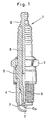
- the spark plug 1 has a metallic shell 2 whose outer surface has a male thread portion 4 used when the spark plug 1 is mounted on a cylinder head of the engine.
- a tubular insulator 5 is concentrically placed which is made with alumina (Al2O3) as a main component.
- An inner space of the tubular insulator 5 serves as an axial bore 6 whose front open end supports a center electrode 7 which is made of precious metal such as e.g. Pt-Ir alloy simultaneously when the insulator 5 is sintered at 1600 °C in the atmosphere.
- the center electrode 7 may be made of an alloy in which yttrium oxide (Y2O3), zirconium oxide (ZrO2) and thorium oxide (ThO2) are uniformly dispersed in Platinum (Pt).
- Y2O3 yttrium oxide
- ZrO2 zirconium oxide
- ThO2 thorium oxide
- a front end of the center electrode 7 opposes an outer electrode 3 extended from the metallic shell 2 so as to form a spark gap (Gp) between the center electrode 7 and the outer electrode 3.
- a rear open end of the insulator 5 receives a terminal electrode 8 which aligns with the center electrode 7 within the axial bore 6.
- An electrically conductive glass sealant 9 is air-tightly placed within the insulator 5 by heating the glass sealant 9 to electrically connect between the center electrode 7 and the terminal electrode 8.
- the glass sealant may be formed into 12 glass press blocks, and the press blocks may be pressed by the pressure of 60 Kg/cm2. After completing the procedure, the glass press blocks may be sealed with an electrically conductive packing 11 and resistor 10 as shown in Fig. 2.
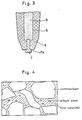
- a front end of the center electrode 7 may be diametrically increased to form an enlarged head 7a as shown in Fig. 3.
- the glass sealant 9 is made from the following materials:
- the silicate glass reacts to the aluminosilicate glass at the time of heating the glass sealant 9 within the insulator 5, and thus forming a vitrified substance having a high softening point (more than 1000 °C).
- a high softening point more than 1000 °C.
- Part of the aluminosilicate glass remains in the powdered metal (filler metal), the remaining part of the aluminosilicate glass does not affect on electrical conductivity of the glass sealant 9 as understood from Fig. 4.
- the granular size of the aluminosilicate glass requires less than 250 » (preferably less than 105 »: less than 30 weight %, less than 149 »: less than 50 weight % and less than 250 »: more than 98 weight %) to prevent the glass sealant 9 from shrinking after heating the glass sealant 9 within the insulator 5.
- the granular size of the silicate glass requires less than 74 » (preferably less than 44 ») to facilitate the reactivity between the silicate glass and the aluminosilicate glass.
- oxidation-resistant metal such as nickel, chromium or nickel-chromium alloy is required to limit the powdered metal from chemically reacting to the precious metal of center electrode 7, thus limiting formation of metal compound which has a low-melting point.
- a relationship of weight ratio between (a), (b) and (c) is determined as follows: 0.8 ⁇ [(a)+(b)]/(c) ⁇ 1.2 and 0.05 ⁇ (b)/[(a)+(b)] ⁇ 0.2.
- the weight ratio of glass-based component to metal-based component is restricted within a range from 0.8 to 1.2 (preferably 1.0).
- An excessive amount of the metal-based component increases a thermal expansion coefficient of the glass sealant 9, thus leading to cracks on the insulator 5 at the time of heating the glass sealant 9 within the insulator 5.
- Too little amount of the metal-based component makes it difficult to sufficiently ensure electrical conductivity between the center electrode 7 and the terminal electrode 8.
- the weight ratio of the silicate glass to the vitric component is restricted within a range from 0.05 to 0.2.
- the weight ratio of more than 0.05 is required to at least improve the softening point of the glass sealant 9 on the one hand.
- the weight ratio of less than 0.2 is required to prevent the softening point from excessively rising, thus ensuring to positively vitrify the glass sealant 9 at an operating temperature on the other hand.
- the weight ratio of the silicate glass to the glass-based component may be within a range from 0.10 to 1.15 upon putting the glass sealant 9 into pratical use.
- each softening point of prepared glass sealants is measured. As a result, softening points of more than 1000 °C are obtained as shown in Table 1.
- Endurance test is carried out by preparing test pieces of glass sealant (C)-(F), (H) and (I), and comparative glass sealants (A), (B), (G) and (J) and the test pieces (C)-(F), (H) and (I) and comparative test pieces (A), (B), (G) and (J) are tested for 100 hours by employing 2000 c.c., six-cylinder engine which is alternately operated at full throttle (for one minute) and idling to heat and cool each of the glass sealants in turn. As a result, it is found that the endurance of the test pieces of the glass sealants is significantly improved as shown in Table 2.
- Fig. 5 shows a schematic view of a main part of the spark plug to cross-sectionally depict an interface (Ia) between a center electrode and the glass sealant
- Fig. 6 shows Fig. 5 analyzed by means of EPMA (Electron Probe Micro Analyzer).
- Fig. 7 shows magnified structural views of the interface (Ia), granular platinum (Pt), granular nickel (Ni) granular aluminum (Al), granular silicon (Si) and granular oxygen (O) each analyzed by means of EPMA.
- EPMA Electro Probe Micro Analyzer
- the invention enables the glass sealant to ensure an electrical conductivity between the center electrode and the terminal electrode, and improving to enhance softening point of the glass sealant.
- the invention enables to make a center electrode from corrosion-resistant precious metals and cermet, the latter of which is not bonded by means of welding.
Landscapes
- Spark Plugs (AREA)
Claims (5)
- Zündkerze, umfassend:
eine Metallhülle, in der ein rohrförmiger keramischer Isolator untergebracht ist;
eine Mittelelektrode, die aus Edelmetallen hergestellt ist und an einem offenen vorderen Ende des Isolators gleichzeitig dann gehalten wird, wenn der keramische Isolator gesintert wird, wobei ein vorderes Ende der Mittelelektrode einer äußeren Elektrode gegenübersteht, die so von der Metallhülle absteht, daß dazwischen eine Funkenstrecke entsteht;
ein elektrisch leitendes Dichtungsmittel aus Glas, das so in dem Isolator untergebracht ist, daß es die Mittelelektrode mit einer Endelektrode, die in dem hinteren offenen Ende des Isolators vorgesehen ist, elektrisch verbindet;
wobei das Dichtungsmittel aus Glas aus den folgenden Materialien hergestellt ist:(a) 40 Gew.-% bis 50 Gew.-% körniges Aluminiumsilicatglas, bestehend aus Siliciumdioxid (SiO₂), Aluminiumoxid (Al₂O₃), Alkalimetalloxiden und Erdalkalimetalloxiden, wobei die Korngröße des Aluminiumsilicatglases weniger als 250 » beträgt;(b) 2,5 Gew.-% bis 10 Gew.-% körnigem Silicatglas, dessen Korngröße weniger als 74 » beträgt; und(c) 40 Gew.-% bis 60 Gew.-% Metallpulver, dessen Korngröße weniger als 74 »m beträgt, wobei das Metallpulver ausgewählt ist aus der Gruppe umfassend Nickel, Chrom und Nickel-Chrom-Legierung. - Zündkerze nach Anspruch 1, bei der eine Beziehung des Gewichtsverhältnisses zwischen (a), (b) und (c) folgendermaßen bestimmt wird:


- Zündkerze nach Anspruch 1, bei der der Erweichungspunkt sowohl des Aluminiumsilicatglases als auch des Silicatglases höher liegt als 1000°C.
- Zündkerze nach Anspruch 1, bei der die Mittelelektrode aus einer Legierung besteht, in der Yttriumoxid (Y₂O₃), Zirconiumoxid (ZrO₂) und Thoriumoxid (ThO₂) in Platin (Pt) dispergiert sind.
- Dichtungsmittelzusammensetzung aus Glas, umfassend(a) 40 Gew.-% bis 50 Gew.-% körniges Aluminiumsilicatglas, bestehend aus Siliciumdioxid (SiO₂), Aluminiumoxid (Al₂O₃), Alkalimetalloxiden und Erdalkalimetalloxiden, wobei die Korngröße des Aluminiumsilicatglases geringer ist als 250 »;(b) 2,5 Gew.-% bis 10 Gew.-% körniges Silicatglas, dessen Korngröße geringer ist als 74 »; und(c) 40 Gew.-% bis 60 Gew.-% Metallpulver, dessen Korngröße geringer ist als 74 », wobei das Metallpulver ausgewählt ist aus der Gruppe umfassend Nickel, Chrom und Nickel-Chrom-Legierung.
Applications Claiming Priority (2)
| Application Number | Priority Date | Filing Date | Title |
|---|---|---|---|
| JP292117/90 | 1990-10-31 | ||
| JP2292117A JP2916813B2 (ja) | 1990-10-31 | 1990-10-31 | 内燃機関用スパークプラグ |
Publications (3)
| Publication Number | Publication Date |
|---|---|
| EP0484168A2 EP0484168A2 (de) | 1992-05-06 |
| EP0484168A3 EP0484168A3 (en) | 1993-08-11 |
| EP0484168B1 true EP0484168B1 (de) | 1995-07-05 |
Family
ID=17777767
Family Applications (1)
| Application Number | Title | Priority Date | Filing Date |
|---|---|---|---|
| EP91310101A Expired - Lifetime EP0484168B1 (de) | 1990-10-31 | 1991-10-31 | Glassdichtmittel für Zündkerzenisolator zur Anwendung in Verbrennungsmotoren |
Country Status (4)
| Country | Link |
|---|---|
| US (1) | US5172025A (de) |
| EP (1) | EP0484168B1 (de) |
| JP (1) | JP2916813B2 (de) |
| DE (1) | DE69111023T2 (de) |
Families Citing this family (8)
| Publication number | Priority date | Publication date | Assignee | Title |
|---|---|---|---|---|
| US6191525B1 (en) * | 1997-08-27 | 2001-02-20 | Ngk Spark Plug Co., Ltd. | Spark plug |
| JP3705921B2 (ja) | 1998-03-03 | 2005-10-12 | 日本特殊陶業株式会社 | スパークプラグの製造設備及びスパークプラグの製造方法 |
| US6426586B1 (en) * | 1999-02-12 | 2002-07-30 | Alliedsignal Inc. | Contact glass composition for use in spark plugs |
| US6611083B2 (en) * | 2000-12-15 | 2003-08-26 | Savage Enterprises, Inc. | Torch jet spark plug electrode |
| US7443089B2 (en) | 2006-06-16 | 2008-10-28 | Federal Mogul World Wide, Inc. | Spark plug with tapered fired-in suppressor seal |
| US20080308057A1 (en) * | 2007-06-18 | 2008-12-18 | Lykowski James D | Electrode for an Ignition Device |
| BR112017002596A2 (pt) * | 2014-08-10 | 2018-01-30 | Federal-Mogul Ignition Company | vela de ignição com vedação melhorada |
| JP6422841B2 (ja) * | 2015-10-20 | 2018-11-14 | 日本特殊陶業株式会社 | スパークプラグ |
Family Cites Families (5)
| Publication number | Priority date | Publication date | Assignee | Title |
|---|---|---|---|---|
| US2106578A (en) * | 1936-05-04 | 1938-01-25 | Gen Motors Corp | Sealing composition, method of using same, and articles made therewith |
| US2837679A (en) * | 1952-08-22 | 1958-06-03 | Gen Motors Corp | Glass sealed centerwire structure |
| US3247132A (en) * | 1963-04-05 | 1966-04-19 | Champion Spark Plug Co | Spark plug seal |
| FR1529044A (fr) * | 1967-06-16 | 1968-06-14 | Gen Motors Corp | Composition d'étanchéité conductrice pour joints céramique sur métal, et bougied'allumage en comportant application |
| US4589900A (en) * | 1983-03-17 | 1986-05-20 | United Technologies Corporation | High-strength thermally stable magnesium aluminosilicate glass-ceramic matrix sic fiber composite |
-
1990
- 1990-10-31 JP JP2292117A patent/JP2916813B2/ja not_active Expired - Lifetime
-
1991
- 1991-10-31 EP EP91310101A patent/EP0484168B1/de not_active Expired - Lifetime
- 1991-10-31 DE DE69111023T patent/DE69111023T2/de not_active Expired - Fee Related
- 1991-10-31 US US07/786,020 patent/US5172025A/en not_active Expired - Lifetime
Also Published As
| Publication number | Publication date |
|---|---|
| JP2916813B2 (ja) | 1999-07-05 |
| JPH04167385A (ja) | 1992-06-15 |
| EP0484168A2 (de) | 1992-05-06 |
| DE69111023T2 (de) | 1995-11-02 |
| DE69111023D1 (de) | 1995-08-10 |
| EP0484168A3 (en) | 1993-08-11 |
| US5172025A (en) | 1992-12-15 |
Similar Documents
| Publication | Publication Date | Title |
|---|---|---|
| EP1130728B1 (de) | Zündkerze | |
| EP0829936B1 (de) | Verfahren zur Herstellung einer Zündkerze | |
| DE69400253T2 (de) | Zündkerzenisolator und sein Herstellungsverfahren | |
| EP1816714B1 (de) | Zündkerze | |
| EP0788204A1 (de) | Keramikisolator, sein Herstellung und Zündkerze mit solchem Isolator | |
| JP4578025B2 (ja) | スパークプラグ | |
| US4795944A (en) | Metallized glass seal resistor composition | |
| EP0484168B1 (de) | Glassdichtmittel für Zündkerzenisolator zur Anwendung in Verbrennungsmotoren | |
| CA1074642A (en) | Metallized glass seal resistor compositions and resistor spark plugs | |
| JP2002175863A (ja) | スパークプラグ | |
| JP3511602B2 (ja) | スパークプラグ | |
| EP0975074A1 (de) | Keramischer Sinterkörper für Zündkerze, sein Herstellungsverfahren und Zündkerze | |
| JPS6328322B2 (de) | ||
| JP3632953B2 (ja) | スパークプラグ | |
| EP0171153A1 (de) | Zündkerze | |
| US3408524A (en) | Sparkplug and seal therefor | |
| EP1677399B1 (de) | Zündkerze | |
| JP2005340171A (ja) | スパークプラグ | |
| CN100533885C (zh) | 火花塞 | |
| JP4833526B2 (ja) | スパークプラグ | |
| JP2002117955A (ja) | スパークプラグ | |
| JP4782561B2 (ja) | スパークプラグ | |
| JP2006196474A (ja) | スパークプラグ | |
| JPS58102481A (ja) | 抵抗入り点火栓 |
Legal Events
| Date | Code | Title | Description |
|---|---|---|---|
| PUAI | Public reference made under article 153(3) epc to a published international application that has entered the european phase |
Free format text: ORIGINAL CODE: 0009012 |
|
| AK | Designated contracting states |
Kind code of ref document: A2 Designated state(s): DE FR GB |
|
| PUAL | Search report despatched |
Free format text: ORIGINAL CODE: 0009013 |
|
| AK | Designated contracting states |
Kind code of ref document: A3 Designated state(s): DE FR GB |
|
| 17P | Request for examination filed |
Effective date: 19931217 |
|
| 17Q | First examination report despatched |
Effective date: 19940120 |
|
| GRAA | (expected) grant |
Free format text: ORIGINAL CODE: 0009210 |
|
| AK | Designated contracting states |
Kind code of ref document: B1 Designated state(s): DE FR GB |
|
| REF | Corresponds to: |
Ref document number: 69111023 Country of ref document: DE Date of ref document: 19950810 |
|
| ET | Fr: translation filed | ||
| PLBE | No opposition filed within time limit |
Free format text: ORIGINAL CODE: 0009261 |
|
| STAA | Information on the status of an ep patent application or granted ep patent |
Free format text: STATUS: NO OPPOSITION FILED WITHIN TIME LIMIT |
|
| 26N | No opposition filed | ||
| PGFP | Annual fee paid to national office [announced via postgrant information from national office to epo] |
Ref country code: FR Payment date: 19981009 Year of fee payment: 8 |
|
| PGFP | Annual fee paid to national office [announced via postgrant information from national office to epo] |
Ref country code: GB Payment date: 19981106 Year of fee payment: 8 Ref country code: DE Payment date: 19981106 Year of fee payment: 8 |
|
| PG25 | Lapsed in a contracting state [announced via postgrant information from national office to epo] |
Ref country code: GB Free format text: LAPSE BECAUSE OF NON-PAYMENT OF DUE FEES Effective date: 19991031 |
|
| GBPC | Gb: european patent ceased through non-payment of renewal fee |
Effective date: 19991031 |
|
| PG25 | Lapsed in a contracting state [announced via postgrant information from national office to epo] |
Ref country code: FR Free format text: LAPSE BECAUSE OF NON-PAYMENT OF DUE FEES Effective date: 20000630 |
|
| PG25 | Lapsed in a contracting state [announced via postgrant information from national office to epo] |
Ref country code: DE Free format text: LAPSE BECAUSE OF NON-PAYMENT OF DUE FEES Effective date: 20000801 |
|
| REG | Reference to a national code |
Ref country code: FR Ref legal event code: ST |