EP0477488B1 - Kalthärtende, lösemittelfreie, duroplastische Polyurethan-Polyharnstoff-Massen - Google Patents
Kalthärtende, lösemittelfreie, duroplastische Polyurethan-Polyharnstoff-Massen Download PDFInfo
- Publication number
- EP0477488B1 EP0477488B1 EP19910111493 EP91111493A EP0477488B1 EP 0477488 B1 EP0477488 B1 EP 0477488B1 EP 19910111493 EP19910111493 EP 19910111493 EP 91111493 A EP91111493 A EP 91111493A EP 0477488 B1 EP0477488 B1 EP 0477488B1
- Authority
- EP
- European Patent Office
- Prior art keywords
- blocked
- weight
- compositions according
- free
- nco
- Prior art date
- Legal status (The legal status is an assumption and is not a legal conclusion. Google has not performed a legal analysis and makes no representation as to the accuracy of the status listed.)
- Expired - Lifetime
Links
- 229920002396 Polyurea Polymers 0.000 title claims abstract description 24
- 229920000768 polyamine Chemical group 0.000 claims abstract description 38
- 239000000203 mixture Substances 0.000 claims abstract description 26
- 229920001228 polyisocyanate Polymers 0.000 claims abstract description 15
- 239000005056 polyisocyanate Substances 0.000 claims abstract description 14
- 125000001931 aliphatic group Chemical group 0.000 claims abstract description 12
- 150000004658 ketimines Chemical class 0.000 claims abstract description 9
- 125000002924 primary amino group Chemical group [H]N([H])* 0.000 claims abstract description 9
- 229920005862 polyol Polymers 0.000 claims abstract description 6
- 229920001187 thermosetting polymer Polymers 0.000 claims abstract description 6
- NIMLQBUJDJZYEJ-UHFFFAOYSA-N isophorone diisocyanate Chemical compound CC1(C)CC(N=C=O)CC(C)(CN=C=O)C1 NIMLQBUJDJZYEJ-UHFFFAOYSA-N 0.000 claims description 23
- 239000005058 Isophorone diisocyanate Substances 0.000 claims description 22
- 239000004814 polyurethane Substances 0.000 claims description 21
- RPNUMPOLZDHAAY-UHFFFAOYSA-N Diethylenetriamine Chemical compound NCCNCCN RPNUMPOLZDHAAY-UHFFFAOYSA-N 0.000 claims description 19
- VILCJCGEZXAXTO-UHFFFAOYSA-N 2,2,2-tetramine Chemical compound NCCNCCNCCN VILCJCGEZXAXTO-UHFFFAOYSA-N 0.000 claims description 17
- LSHROXHEILXKHM-UHFFFAOYSA-N n'-[2-[2-[2-(2-aminoethylamino)ethylamino]ethylamino]ethyl]ethane-1,2-diamine Chemical compound NCCNCCNCCNCCNCCN LSHROXHEILXKHM-UHFFFAOYSA-N 0.000 claims description 13
- -1 when n=2 R4 = H Chemical group 0.000 claims description 13
- RNLHGQLZWXBQNY-UHFFFAOYSA-N 3-(aminomethyl)-3,5,5-trimethylcyclohexan-1-amine Chemical compound CC1(C)CC(N)CC(C)(CN)C1 RNLHGQLZWXBQNY-UHFFFAOYSA-N 0.000 claims description 12
- FAGUFWYHJQFNRV-UHFFFAOYSA-N tetraethylenepentamine Chemical compound NCCNCCNCCNCCN FAGUFWYHJQFNRV-UHFFFAOYSA-N 0.000 claims description 11
- 238000000576 coating method Methods 0.000 claims description 9
- 239000011248 coating agent Substances 0.000 claims description 8
- 239000004721 Polyphenylene oxide Substances 0.000 claims description 5
- 229920000728 polyester Polymers 0.000 claims description 5
- 229920000570 polyether Polymers 0.000 claims description 5
- 150000003077 polyols Chemical class 0.000 claims description 5
- 238000005266 casting Methods 0.000 claims description 4
- 125000006702 (C1-C18) alkyl group Chemical group 0.000 claims description 3
- 125000003837 (C1-C20) alkyl group Chemical group 0.000 claims description 3
- 125000002947 alkylene group Chemical group 0.000 claims description 3
- 239000003054 catalyst Substances 0.000 claims description 3
- 229920002635 polyurethane Polymers 0.000 claims description 3
- 238000007789 sealing Methods 0.000 claims description 3
- NQRYJNQNLNOLGT-UHFFFAOYSA-N Piperidine Chemical class C1CCNCC1 NQRYJNQNLNOLGT-UHFFFAOYSA-N 0.000 claims description 2
- 239000000945 filler Substances 0.000 claims description 2
- 239000000049 pigment Substances 0.000 claims description 2
- 229960001124 trientine Drugs 0.000 claims description 2
- PAFZNILMFXTMIY-UHFFFAOYSA-N cyclohexylamine Chemical compound NC1CCCCC1 PAFZNILMFXTMIY-UHFFFAOYSA-N 0.000 claims 2
- 125000004836 hexamethylene group Chemical group [H]C([H])([*:2])C([H])([H])C([H])([H])C([H])([H])C([H])([H])C([H])([H])[*:1] 0.000 claims 2
- KGRVJHAUYBGFFP-UHFFFAOYSA-N 2,2'-Methylenebis(4-methyl-6-tert-butylphenol) Chemical compound CC(C)(C)C1=CC(C)=CC(CC=2C(=C(C=C(C)C=2)C(C)(C)C)O)=C1O KGRVJHAUYBGFFP-UHFFFAOYSA-N 0.000 claims 1
- 239000000539 dimer Substances 0.000 claims 1
- IQPQWNKOIGAROB-UHFFFAOYSA-N isocyanate group Chemical group [N-]=C=O IQPQWNKOIGAROB-UHFFFAOYSA-N 0.000 claims 1
- 239000013638 trimer Substances 0.000 claims 1
- 150000003053 piperidines Chemical class 0.000 abstract description 9
- 150000001875 compounds Chemical class 0.000 abstract description 6
- 239000008199 coating composition Substances 0.000 abstract 1
- 125000004427 diamine group Chemical group 0.000 abstract 1
- 238000005538 encapsulation Methods 0.000 abstract 1
- 238000013035 low temperature curing Methods 0.000 abstract 1
- 239000000565 sealant Substances 0.000 abstract 1
- NAQMVNRVTILPCV-UHFFFAOYSA-N hexane-1,6-diamine Chemical compound NCCCCCCN NAQMVNRVTILPCV-UHFFFAOYSA-N 0.000 description 20
- 239000007795 chemical reaction product Substances 0.000 description 16
- LYCAIKOWRPUZTN-UHFFFAOYSA-N Ethylene glycol Chemical compound OCCO LYCAIKOWRPUZTN-UHFFFAOYSA-N 0.000 description 8
- 239000004567 concrete Substances 0.000 description 7
- UDKSLGIUCGAZTK-UHFFFAOYSA-N phenyl pentadecane-1-sulfonate Chemical compound CCCCCCCCCCCCCCCS(=O)(=O)OC1=CC=CC=C1 UDKSLGIUCGAZTK-UHFFFAOYSA-N 0.000 description 6
- CXMXRPHRNRROMY-UHFFFAOYSA-N sebacic acid Chemical compound OC(=O)CCCCCCCCC(O)=O CXMXRPHRNRROMY-UHFFFAOYSA-N 0.000 description 6
- 238000006243 chemical reaction Methods 0.000 description 5
- 150000004985 diamines Chemical class 0.000 description 5
- 239000011541 reaction mixture Substances 0.000 description 5
- KCZQSKKNAGZQSZ-UHFFFAOYSA-N 1,3,5-tris(6-isocyanatohexyl)-1,3,5-triazin-2,4,6-trione Chemical compound O=C=NCCCCCCN1C(=O)N(CCCCCCN=C=O)C(=O)N(CCCCCCN=C=O)C1=O KCZQSKKNAGZQSZ-UHFFFAOYSA-N 0.000 description 4
- PCHXZXKMYCGVFA-UHFFFAOYSA-N 1,3-diazetidine-2,4-dione Chemical compound O=C1NC(=O)N1 PCHXZXKMYCGVFA-UHFFFAOYSA-N 0.000 description 4
- VDVUCLWJZJHFAV-UHFFFAOYSA-N 2,2,6,6-tetramethylpiperidin-4-ol Chemical compound CC1(C)CC(O)CC(C)(C)N1 VDVUCLWJZJHFAV-UHFFFAOYSA-N 0.000 description 4
- RTZKZFJDLAIYFH-UHFFFAOYSA-N Diethyl ether Chemical compound CCOCC RTZKZFJDLAIYFH-UHFFFAOYSA-N 0.000 description 4
- 239000005057 Hexamethylene diisocyanate Substances 0.000 description 4
- 239000002253 acid Substances 0.000 description 4
- WNLRTRBMVRJNCN-UHFFFAOYSA-N adipic acid Chemical compound OC(=O)CCCCC(O)=O WNLRTRBMVRJNCN-UHFFFAOYSA-N 0.000 description 4
- 125000003277 amino group Chemical group 0.000 description 4
- 230000000903 blocking effect Effects 0.000 description 4
- 150000002009 diols Chemical class 0.000 description 4
- 229920001971 elastomer Polymers 0.000 description 4
- 239000000806 elastomer Substances 0.000 description 4
- 238000000034 method Methods 0.000 description 4
- XNGIFLGASWRNHJ-UHFFFAOYSA-N phthalic acid Chemical compound OC(=O)C1=CC=CC=C1C(O)=O XNGIFLGASWRNHJ-UHFFFAOYSA-N 0.000 description 4
- 229920000909 polytetrahydrofuran Polymers 0.000 description 4
- NGBCPOUXXDBLMT-UHFFFAOYSA-N 2,2,4,6-tetramethylpiperidine Chemical compound CC1CC(C)NC(C)(C)C1 NGBCPOUXXDBLMT-UHFFFAOYSA-N 0.000 description 3
- ZWEHNKRNPOVVGH-UHFFFAOYSA-N 2-Butanone Chemical compound CCC(C)=O ZWEHNKRNPOVVGH-UHFFFAOYSA-N 0.000 description 3
- CSCPPACGZOOCGX-UHFFFAOYSA-N Acetone Chemical compound CC(C)=O CSCPPACGZOOCGX-UHFFFAOYSA-N 0.000 description 3
- NTIZESTWPVYFNL-UHFFFAOYSA-N Methyl isobutyl ketone Chemical compound CC(C)CC(C)=O NTIZESTWPVYFNL-UHFFFAOYSA-N 0.000 description 3
- UIHCLUNTQKBZGK-UHFFFAOYSA-N Methyl isobutyl ketone Natural products CCC(C)C(C)=O UIHCLUNTQKBZGK-UHFFFAOYSA-N 0.000 description 3
- DNIAPMSPPWPWGF-UHFFFAOYSA-N Propylene glycol Chemical compound CC(O)CO DNIAPMSPPWPWGF-UHFFFAOYSA-N 0.000 description 3
- ZJCCRDAZUWHFQH-UHFFFAOYSA-N Trimethylolpropane Chemical compound CCC(CO)(CO)CO ZJCCRDAZUWHFQH-UHFFFAOYSA-N 0.000 description 3
- 150000007513 acids Chemical class 0.000 description 3
- 150000001412 amines Chemical class 0.000 description 3
- 125000003118 aryl group Chemical group 0.000 description 3
- 230000001588 bifunctional effect Effects 0.000 description 3
- MTHSVFCYNBDYFN-UHFFFAOYSA-N diethylene glycol Chemical compound OCCOCCO MTHSVFCYNBDYFN-UHFFFAOYSA-N 0.000 description 3
- 125000005442 diisocyanate group Chemical group 0.000 description 3
- RRAMGCGOFNQTLD-UHFFFAOYSA-N hexamethylene diisocyanate Chemical compound O=C=NCCCCCCN=C=O RRAMGCGOFNQTLD-UHFFFAOYSA-N 0.000 description 3
- 238000004519 manufacturing process Methods 0.000 description 3
- 229920001451 polypropylene glycol Polymers 0.000 description 3
- XLYOFNOQVPJJNP-UHFFFAOYSA-N water Substances O XLYOFNOQVPJJNP-UHFFFAOYSA-N 0.000 description 3
- YEVQZPWSVWZAOB-UHFFFAOYSA-N 2-(bromomethyl)-1-iodo-4-(trifluoromethyl)benzene Chemical compound FC(F)(F)C1=CC=C(I)C(CBr)=C1 YEVQZPWSVWZAOB-UHFFFAOYSA-N 0.000 description 2
- IRIAEXORFWYRCZ-UHFFFAOYSA-N Butylbenzyl phthalate Chemical compound CCCCOC(=O)C1=CC=CC=C1C(=O)OCC1=CC=CC=C1 IRIAEXORFWYRCZ-UHFFFAOYSA-N 0.000 description 2
- PIICEJLVQHRZGT-UHFFFAOYSA-N Ethylenediamine Chemical compound NCCN PIICEJLVQHRZGT-UHFFFAOYSA-N 0.000 description 2
- PEDCQBHIVMGVHV-UHFFFAOYSA-N Glycerine Chemical compound OCC(O)CO PEDCQBHIVMGVHV-UHFFFAOYSA-N 0.000 description 2
- ISWSIDIOOBJBQZ-UHFFFAOYSA-N Phenol Chemical compound OC1=CC=CC=C1 ISWSIDIOOBJBQZ-UHFFFAOYSA-N 0.000 description 2
- GOOHAUXETOMSMM-UHFFFAOYSA-N Propylene oxide Chemical compound CC1CO1 GOOHAUXETOMSMM-UHFFFAOYSA-N 0.000 description 2
- YSMRWXYRXBRSND-UHFFFAOYSA-N TOTP Chemical compound CC1=CC=CC=C1OP(=O)(OC=1C(=CC=CC=1)C)OC1=CC=CC=C1C YSMRWXYRXBRSND-UHFFFAOYSA-N 0.000 description 2
- WYURNTSHIVDZCO-UHFFFAOYSA-N Tetrahydrofuran Chemical compound C1CCOC1 WYURNTSHIVDZCO-UHFFFAOYSA-N 0.000 description 2
- JWUXJYZVKZKLTJ-UHFFFAOYSA-N Triacetonamine Chemical compound CC1(C)CC(=O)CC(C)(C)N1 JWUXJYZVKZKLTJ-UHFFFAOYSA-N 0.000 description 2
- 150000001298 alcohols Chemical class 0.000 description 2
- CDQSJQSWAWPGKG-UHFFFAOYSA-N butane-1,1-diol Chemical compound CCCC(O)O CDQSJQSWAWPGKG-UHFFFAOYSA-N 0.000 description 2
- 235000013877 carbamide Nutrition 0.000 description 2
- 238000007334 copolymerization reaction Methods 0.000 description 2
- JHIVVAPYMSGYDF-UHFFFAOYSA-N cyclohexanone Chemical compound O=C1CCCCC1 JHIVVAPYMSGYDF-UHFFFAOYSA-N 0.000 description 2
- WOZVHXUHUFLZGK-UHFFFAOYSA-N dimethyl terephthalate Chemical compound COC(=O)C1=CC=C(C(=O)OC)C=C1 WOZVHXUHUFLZGK-UHFFFAOYSA-N 0.000 description 2
- 239000003063 flame retardant Substances 0.000 description 2
- XXMIOPMDWAUFGU-UHFFFAOYSA-N hexane-1,6-diol Chemical compound OCCCCCCO XXMIOPMDWAUFGU-UHFFFAOYSA-N 0.000 description 2
- 239000012948 isocyanate Substances 0.000 description 2
- 150000002513 isocyanates Chemical class 0.000 description 2
- ZFSLODLOARCGLH-UHFFFAOYSA-N isocyanuric acid Chemical compound OC1=NC(O)=NC(O)=N1 ZFSLODLOARCGLH-UHFFFAOYSA-N 0.000 description 2
- QQVIHTHCMHWDBS-UHFFFAOYSA-N isophthalic acid Chemical compound OC(=O)C1=CC=CC(C(O)=O)=C1 QQVIHTHCMHWDBS-UHFFFAOYSA-N 0.000 description 2
- 150000002576 ketones Chemical class 0.000 description 2
- SLCVBVWXLSEKPL-UHFFFAOYSA-N neopentyl glycol Chemical compound OCC(C)(C)CO SLCVBVWXLSEKPL-UHFFFAOYSA-N 0.000 description 2
- 239000004014 plasticizer Substances 0.000 description 2
- 230000009257 reactivity Effects 0.000 description 2
- 150000005846 sugar alcohols Polymers 0.000 description 2
- 229920001169 thermoplastic Polymers 0.000 description 2
- 239000004416 thermosoftening plastic Substances 0.000 description 2
- DVKJHBMWWAPEIU-UHFFFAOYSA-N toluene 2,4-diisocyanate Chemical compound CC1=CC=C(N=C=O)C=C1N=C=O DVKJHBMWWAPEIU-UHFFFAOYSA-N 0.000 description 2
- JOXIMZWYDAKGHI-UHFFFAOYSA-N toluene-4-sulfonic acid Chemical compound CC1=CC=C(S(O)(=O)=O)C=C1 JOXIMZWYDAKGHI-UHFFFAOYSA-N 0.000 description 2
- DNIAPMSPPWPWGF-VKHMYHEASA-N (+)-propylene glycol Chemical compound C[C@H](O)CO DNIAPMSPPWPWGF-VKHMYHEASA-N 0.000 description 1
- HFVMEOPYDLEHBR-UHFFFAOYSA-N (2-fluorophenyl)-phenylmethanol Chemical compound C=1C=CC=C(F)C=1C(O)C1=CC=CC=C1 HFVMEOPYDLEHBR-UHFFFAOYSA-N 0.000 description 1
- ZWVMLYRJXORSEP-UHFFFAOYSA-N 1,2,6-Hexanetriol Chemical compound OCCCCC(O)CO ZWVMLYRJXORSEP-UHFFFAOYSA-N 0.000 description 1
- NNOZGCICXAYKLW-UHFFFAOYSA-N 1,2-bis(2-isocyanatopropan-2-yl)benzene Chemical compound O=C=NC(C)(C)C1=CC=CC=C1C(C)(C)N=C=O NNOZGCICXAYKLW-UHFFFAOYSA-N 0.000 description 1
- YPFDHNVEDLHUCE-UHFFFAOYSA-N 1,3-propanediol Substances OCCCO YPFDHNVEDLHUCE-UHFFFAOYSA-N 0.000 description 1
- ROHUXHMNZLHBSF-UHFFFAOYSA-N 1,4-bis(isocyanatomethyl)cyclohexane Chemical compound O=C=NCC1CCC(CN=C=O)CC1 ROHUXHMNZLHBSF-UHFFFAOYSA-N 0.000 description 1
- 229940008841 1,6-hexamethylene diisocyanate Drugs 0.000 description 1
- PTTPXKJBFFKCEK-UHFFFAOYSA-N 2-Methyl-4-heptanone Chemical compound CC(C)CC(=O)CC(C)C PTTPXKJBFFKCEK-UHFFFAOYSA-N 0.000 description 1
- NYHNVHGFPZAZGA-UHFFFAOYSA-N 2-hydroxyhexanoic acid Chemical compound CCCCC(O)C(O)=O NYHNVHGFPZAZGA-UHFFFAOYSA-N 0.000 description 1
- JZUHIOJYCPIVLQ-UHFFFAOYSA-N 2-methylpentane-1,5-diamine Chemical compound NCC(C)CCCN JZUHIOJYCPIVLQ-UHFFFAOYSA-N 0.000 description 1
- WJIOHMVWGVGWJW-UHFFFAOYSA-N 3-methyl-n-[4-[(3-methylpyrazole-1-carbonyl)amino]butyl]pyrazole-1-carboxamide Chemical compound N1=C(C)C=CN1C(=O)NCCCCNC(=O)N1N=C(C)C=C1 WJIOHMVWGVGWJW-UHFFFAOYSA-N 0.000 description 1
- IGSBHTZEJMPDSZ-UHFFFAOYSA-N 4-[(4-amino-3-methylcyclohexyl)methyl]-2-methylcyclohexan-1-amine Chemical compound C1CC(N)C(C)CC1CC1CC(C)C(N)CC1 IGSBHTZEJMPDSZ-UHFFFAOYSA-N 0.000 description 1
- VGGSQFUCUMXWEO-UHFFFAOYSA-N Ethene Chemical compound C=C VGGSQFUCUMXWEO-UHFFFAOYSA-N 0.000 description 1
- 239000005977 Ethylene Substances 0.000 description 1
- IAYPIBMASNFSPL-UHFFFAOYSA-N Ethylene oxide Chemical compound C1CO1 IAYPIBMASNFSPL-UHFFFAOYSA-N 0.000 description 1
- 239000004743 Polypropylene Substances 0.000 description 1
- KDYFGRWQOYBRFD-UHFFFAOYSA-N Succinic acid Natural products OC(=O)CCC(O)=O KDYFGRWQOYBRFD-UHFFFAOYSA-N 0.000 description 1
- UWHCKJMYHZGTIT-UHFFFAOYSA-N Tetraethylene glycol, Natural products OCCOCCOCCOCCO UWHCKJMYHZGTIT-UHFFFAOYSA-N 0.000 description 1
- XSTXAVWGXDQKEL-UHFFFAOYSA-N Trichloroethylene Chemical compound ClC=C(Cl)Cl XSTXAVWGXDQKEL-UHFFFAOYSA-N 0.000 description 1
- YYQRGCZGSFRBAM-UHFFFAOYSA-N Triclofos Chemical compound OP(O)(=O)OCC(Cl)(Cl)Cl YYQRGCZGSFRBAM-UHFFFAOYSA-N 0.000 description 1
- XSQUKJJJFZCRTK-UHFFFAOYSA-N Urea Chemical compound NC(N)=O XSQUKJJJFZCRTK-UHFFFAOYSA-N 0.000 description 1
- OXIKYYJDTWKERT-UHFFFAOYSA-N [4-(aminomethyl)cyclohexyl]methanamine Chemical compound NCC1CCC(CN)CC1 OXIKYYJDTWKERT-UHFFFAOYSA-N 0.000 description 1
- 230000002378 acidificating effect Effects 0.000 description 1
- 239000000654 additive Substances 0.000 description 1
- 239000001361 adipic acid Substances 0.000 description 1
- 235000011037 adipic acid Nutrition 0.000 description 1
- 125000003368 amide group Chemical group 0.000 description 1
- 150000008064 anhydrides Chemical class 0.000 description 1
- 238000010539 anionic addition polymerization reaction Methods 0.000 description 1
- XITRBUPOXXBIJN-UHFFFAOYSA-N bis(2,2,6,6-tetramethylpiperidin-4-yl) decanedioate Chemical compound C1C(C)(C)NC(C)(C)CC1OC(=O)CCCCCCCCC(=O)OC1CC(C)(C)NC(C)(C)C1 XITRBUPOXXBIJN-UHFFFAOYSA-N 0.000 description 1
- 239000002981 blocking agent Substances 0.000 description 1
- 239000004202 carbamide Substances 0.000 description 1
- 125000004432 carbon atom Chemical group C* 0.000 description 1
- BVKZGUZCCUSVTD-UHFFFAOYSA-N carbonic acid Chemical class OC(O)=O BVKZGUZCCUSVTD-UHFFFAOYSA-N 0.000 description 1
- 150000001733 carboxylic acid esters Chemical class 0.000 description 1
- 150000001735 carboxylic acids Chemical class 0.000 description 1
- 238000010538 cationic polymerization reaction Methods 0.000 description 1
- 239000000919 ceramic Substances 0.000 description 1
- ITVPBBDAZKBMRP-UHFFFAOYSA-N chloro-dioxido-oxo-$l^{5}-phosphane;hydron Chemical compound OP(O)(Cl)=O ITVPBBDAZKBMRP-UHFFFAOYSA-N 0.000 description 1
- 230000002860 competitive effect Effects 0.000 description 1
- 238000009833 condensation Methods 0.000 description 1
- 230000005494 condensation Effects 0.000 description 1
- 238000004132 cross linking Methods 0.000 description 1
- 150000004292 cyclic ethers Chemical class 0.000 description 1
- IFDVQVHZEKPUSC-UHFFFAOYSA-N cyclohex-3-ene-1,2-dicarboxylic acid Chemical compound OC(=O)C1CCC=CC1C(O)=O IFDVQVHZEKPUSC-UHFFFAOYSA-N 0.000 description 1
- QSAWQNUELGIYBC-UHFFFAOYSA-N cyclohexane-1,2-dicarboxylic acid Chemical compound OC(=O)C1CCCCC1C(O)=O QSAWQNUELGIYBC-UHFFFAOYSA-N 0.000 description 1
- VKIRRGRTJUUZHS-UHFFFAOYSA-N cyclohexane-1,4-diamine Chemical compound NC1CCC(N)CC1 VKIRRGRTJUUZHS-UHFFFAOYSA-N 0.000 description 1
- 239000013530 defoamer Substances 0.000 description 1
- 150000001990 dicarboxylic acid derivatives Chemical class 0.000 description 1
- KORSJDCBLAPZEQ-UHFFFAOYSA-N dicyclohexylmethane-4,4'-diisocyanate Chemical compound C1CC(N=C=O)CCC1CC1CCC(N=C=O)CC1 KORSJDCBLAPZEQ-UHFFFAOYSA-N 0.000 description 1
- 235000014113 dietary fatty acids Nutrition 0.000 description 1
- SZXQTJUDPRGNJN-UHFFFAOYSA-N dipropylene glycol Chemical compound OCCCOCCCO SZXQTJUDPRGNJN-UHFFFAOYSA-N 0.000 description 1
- 150000002148 esters Chemical class 0.000 description 1
- 239000000194 fatty acid Substances 0.000 description 1
- 229930195729 fatty acid Natural products 0.000 description 1
- 150000004665 fatty acids Chemical class 0.000 description 1
- 239000011521 glass Substances 0.000 description 1
- 235000011187 glycerol Nutrition 0.000 description 1
- 125000005843 halogen group Chemical group 0.000 description 1
- 238000010438 heat treatment Methods 0.000 description 1
- 125000000623 heterocyclic group Chemical group 0.000 description 1
- 230000003301 hydrolyzing effect Effects 0.000 description 1
- 125000002887 hydroxy group Chemical group [H]O* 0.000 description 1
- WGCNASOHLSPBMP-UHFFFAOYSA-N hydroxyacetaldehyde Natural products OCC=O WGCNASOHLSPBMP-UHFFFAOYSA-N 0.000 description 1
- GKQPCPXONLDCMU-CCEZHUSRSA-N lacidipine Chemical compound CCOC(=O)C1=C(C)NC(C)=C(C(=O)OCC)C1C1=CC=CC=C1\C=C\C(=O)OC(C)(C)C GKQPCPXONLDCMU-CCEZHUSRSA-N 0.000 description 1
- 239000004922 lacquer Substances 0.000 description 1
- 150000002596 lactones Chemical class 0.000 description 1
- 239000000463 material Substances 0.000 description 1
- 239000000155 melt Substances 0.000 description 1
- 239000002184 metal Substances 0.000 description 1
- YZOISHTVEWVNHA-UHFFFAOYSA-N n,n'-dicyclohexylmethanediamine Chemical compound C1CCCCC1NCNC1CCCCC1 YZOISHTVEWVNHA-UHFFFAOYSA-N 0.000 description 1
- LRAJIZNKBMCWJE-UHFFFAOYSA-N n,n,2,2,6,6-hexamethylpiperidin-4-amine Chemical compound CN(C)C1CC(C)(C)NC(C)(C)C1 LRAJIZNKBMCWJE-UHFFFAOYSA-N 0.000 description 1
- OEIJHBUUFURJLI-UHFFFAOYSA-N octane-1,8-diol Chemical compound OCCCCCCCCO OEIJHBUUFURJLI-UHFFFAOYSA-N 0.000 description 1
- 150000002894 organic compounds Chemical class 0.000 description 1
- 150000003014 phosphoric acid esters Chemical class 0.000 description 1
- 229920003023 plastic Polymers 0.000 description 1
- 239000004033 plastic Substances 0.000 description 1
- 229920001281 polyalkylene Polymers 0.000 description 1
- 229920005906 polyester polyol Polymers 0.000 description 1
- 229920000642 polymer Polymers 0.000 description 1
- 238000006116 polymerization reaction Methods 0.000 description 1
- 229920001155 polypropylene Polymers 0.000 description 1
- 229920000166 polytrimethylene carbonate Polymers 0.000 description 1
- 238000002360 preparation method Methods 0.000 description 1
- AOHJOMMDDJHIJH-UHFFFAOYSA-N propylenediamine Chemical compound CC(N)CN AOHJOMMDDJHIJH-UHFFFAOYSA-N 0.000 description 1
- KIDHWZJUCRJVML-UHFFFAOYSA-N putrescine Chemical compound NCCCCN KIDHWZJUCRJVML-UHFFFAOYSA-N 0.000 description 1
- 239000002994 raw material Substances 0.000 description 1
- 238000005096 rolling process Methods 0.000 description 1
- 125000000467 secondary amino group Chemical group [H]N([*:1])[*:2] 0.000 description 1
- 238000005507 spraying Methods 0.000 description 1
- 238000003756 stirring Methods 0.000 description 1
- 239000004575 stone Substances 0.000 description 1
- 239000000758 substrate Substances 0.000 description 1
- 150000003459 sulfonic acid esters Chemical class 0.000 description 1
- AUHHYELHRWCWEZ-UHFFFAOYSA-N tetrachlorophthalic anhydride Chemical compound ClC1=C(Cl)C(Cl)=C2C(=O)OC(=O)C2=C1Cl AUHHYELHRWCWEZ-UHFFFAOYSA-N 0.000 description 1
- YLQBMQCUIZJEEH-UHFFFAOYSA-N tetrahydrofuran Natural products C=1C=COC=1 YLQBMQCUIZJEEH-UHFFFAOYSA-N 0.000 description 1
- UFDHBDMSHIXOKF-UHFFFAOYSA-N tetrahydrophthalic acid Natural products OC(=O)C1=C(C(O)=O)CCCC1 UFDHBDMSHIXOKF-UHFFFAOYSA-N 0.000 description 1
- 229960001147 triclofos Drugs 0.000 description 1
- ZIBGPFATKBEMQZ-UHFFFAOYSA-N triethylene glycol Chemical compound OCCOCCOCCO ZIBGPFATKBEMQZ-UHFFFAOYSA-N 0.000 description 1
- QXJQHYBHAIHNGG-UHFFFAOYSA-N trimethylolethane Chemical compound OCC(C)(CO)CO QXJQHYBHAIHNGG-UHFFFAOYSA-N 0.000 description 1
- 150000003672 ureas Chemical class 0.000 description 1
- 239000002023 wood Substances 0.000 description 1
- PAPBSGBWRJIAAV-UHFFFAOYSA-N ε-Caprolactone Chemical compound O=C1CCCCCO1 PAPBSGBWRJIAAV-UHFFFAOYSA-N 0.000 description 1
Classifications
-
- C—CHEMISTRY; METALLURGY
- C08—ORGANIC MACROMOLECULAR COMPOUNDS; THEIR PREPARATION OR CHEMICAL WORKING-UP; COMPOSITIONS BASED THEREON
- C08G—MACROMOLECULAR COMPOUNDS OBTAINED OTHERWISE THAN BY REACTIONS ONLY INVOLVING UNSATURATED CARBON-TO-CARBON BONDS
- C08G18/00—Polymeric products of isocyanates or isothiocyanates
- C08G18/06—Polymeric products of isocyanates or isothiocyanates with compounds having active hydrogen
- C08G18/70—Polymeric products of isocyanates or isothiocyanates with compounds having active hydrogen characterised by the isocyanates or isothiocyanates used
- C08G18/72—Polyisocyanates or polyisothiocyanates
- C08G18/80—Masked polyisocyanates
- C08G18/8061—Masked polyisocyanates masked with compounds having only one group containing active hydrogen
- C08G18/807—Masked polyisocyanates masked with compounds having only one group containing active hydrogen with nitrogen containing compounds
- C08G18/808—Monoamines
-
- C—CHEMISTRY; METALLURGY
- C08—ORGANIC MACROMOLECULAR COMPOUNDS; THEIR PREPARATION OR CHEMICAL WORKING-UP; COMPOSITIONS BASED THEREON
- C08G—MACROMOLECULAR COMPOUNDS OBTAINED OTHERWISE THAN BY REACTIONS ONLY INVOLVING UNSATURATED CARBON-TO-CARBON BONDS
- C08G18/00—Polymeric products of isocyanates or isothiocyanates
- C08G18/06—Polymeric products of isocyanates or isothiocyanates with compounds having active hydrogen
- C08G18/08—Processes
- C08G18/10—Prepolymer processes involving reaction of isocyanates or isothiocyanates with compounds having active hydrogen in a first reaction step
-
- C—CHEMISTRY; METALLURGY
- C08—ORGANIC MACROMOLECULAR COMPOUNDS; THEIR PREPARATION OR CHEMICAL WORKING-UP; COMPOSITIONS BASED THEREON
- C08G—MACROMOLECULAR COMPOUNDS OBTAINED OTHERWISE THAN BY REACTIONS ONLY INVOLVING UNSATURATED CARBON-TO-CARBON BONDS
- C08G18/00—Polymeric products of isocyanates or isothiocyanates
- C08G18/06—Polymeric products of isocyanates or isothiocyanates with compounds having active hydrogen
- C08G18/28—Polymeric products of isocyanates or isothiocyanates with compounds having active hydrogen characterised by the compounds used containing active hydrogen
- C08G18/30—Low-molecular-weight compounds
- C08G18/32—Polyhydroxy compounds; Polyamines; Hydroxyamines
- C08G18/3225—Polyamines
- C08G18/3253—Polyamines being in latent form
- C08G18/3256—Reaction products of polyamines with aldehydes or ketones
-
- C—CHEMISTRY; METALLURGY
- C08—ORGANIC MACROMOLECULAR COMPOUNDS; THEIR PREPARATION OR CHEMICAL WORKING-UP; COMPOSITIONS BASED THEREON
- C08G—MACROMOLECULAR COMPOUNDS OBTAINED OTHERWISE THAN BY REACTIONS ONLY INVOLVING UNSATURATED CARBON-TO-CARBON BONDS
- C08G18/00—Polymeric products of isocyanates or isothiocyanates
- C08G18/06—Polymeric products of isocyanates or isothiocyanates with compounds having active hydrogen
- C08G18/28—Polymeric products of isocyanates or isothiocyanates with compounds having active hydrogen characterised by the compounds used containing active hydrogen
- C08G18/65—Low-molecular-weight compounds having active hydrogen with high-molecular-weight compounds having active hydrogen
- C08G18/66—Compounds of groups C08G18/42, C08G18/48, or C08G18/52
- C08G18/6603—Compounds of groups C08G18/42, C08G18/48, or C08G18/52 with compounds of group C08G18/32 or polyamines of C08G18/38
- C08G18/6614—Compounds of groups C08G18/42, C08G18/48, or C08G18/52 with compounds of group C08G18/32 or polyamines of C08G18/38 with compounds of group C08G18/3225 or C08G18/3271 and/or polyamines of C08G18/38
- C08G18/6618—Compounds of groups C08G18/42, C08G18/48, or C08G18/52 with compounds of group C08G18/32 or polyamines of C08G18/38 with compounds of group C08G18/3225 or C08G18/3271 and/or polyamines of C08G18/38 with compounds of group C08G18/3225 or polyamines of C08G18/38
-
- C—CHEMISTRY; METALLURGY
- C08—ORGANIC MACROMOLECULAR COMPOUNDS; THEIR PREPARATION OR CHEMICAL WORKING-UP; COMPOSITIONS BASED THEREON
- C08G—MACROMOLECULAR COMPOUNDS OBTAINED OTHERWISE THAN BY REACTIONS ONLY INVOLVING UNSATURATED CARBON-TO-CARBON BONDS
- C08G18/00—Polymeric products of isocyanates or isothiocyanates
- C08G18/06—Polymeric products of isocyanates or isothiocyanates with compounds having active hydrogen
- C08G18/70—Polymeric products of isocyanates or isothiocyanates with compounds having active hydrogen characterised by the isocyanates or isothiocyanates used
- C08G18/72—Polyisocyanates or polyisothiocyanates
- C08G18/77—Polyisocyanates or polyisothiocyanates having heteroatoms in addition to the isocyanate or isothiocyanate nitrogen and oxygen or sulfur
- C08G18/78—Nitrogen
- C08G18/79—Nitrogen characterised by the polyisocyanates used, these having groups formed by oligomerisation of isocyanates or isothiocyanates
- C08G18/791—Nitrogen characterised by the polyisocyanates used, these having groups formed by oligomerisation of isocyanates or isothiocyanates containing isocyanurate groups
- C08G18/792—Nitrogen characterised by the polyisocyanates used, these having groups formed by oligomerisation of isocyanates or isothiocyanates containing isocyanurate groups formed by oligomerisation of aliphatic and/or cycloaliphatic isocyanates or isothiocyanates
-
- C—CHEMISTRY; METALLURGY
- C08—ORGANIC MACROMOLECULAR COMPOUNDS; THEIR PREPARATION OR CHEMICAL WORKING-UP; COMPOSITIONS BASED THEREON
- C08G—MACROMOLECULAR COMPOUNDS OBTAINED OTHERWISE THAN BY REACTIONS ONLY INVOLVING UNSATURATED CARBON-TO-CARBON BONDS
- C08G18/00—Polymeric products of isocyanates or isothiocyanates
- C08G18/06—Polymeric products of isocyanates or isothiocyanates with compounds having active hydrogen
- C08G18/70—Polymeric products of isocyanates or isothiocyanates with compounds having active hydrogen characterised by the isocyanates or isothiocyanates used
- C08G18/72—Polyisocyanates or polyisothiocyanates
- C08G18/77—Polyisocyanates or polyisothiocyanates having heteroatoms in addition to the isocyanate or isothiocyanate nitrogen and oxygen or sulfur
- C08G18/78—Nitrogen
- C08G18/79—Nitrogen characterised by the polyisocyanates used, these having groups formed by oligomerisation of isocyanates or isothiocyanates
- C08G18/798—Nitrogen characterised by the polyisocyanates used, these having groups formed by oligomerisation of isocyanates or isothiocyanates containing urethdione groups
-
- C—CHEMISTRY; METALLURGY
- C08—ORGANIC MACROMOLECULAR COMPOUNDS; THEIR PREPARATION OR CHEMICAL WORKING-UP; COMPOSITIONS BASED THEREON
- C08G—MACROMOLECULAR COMPOUNDS OBTAINED OTHERWISE THAN BY REACTIONS ONLY INVOLVING UNSATURATED CARBON-TO-CARBON BONDS
- C08G2190/00—Compositions for sealing or packing joints
-
- Y—GENERAL TAGGING OF NEW TECHNOLOGICAL DEVELOPMENTS; GENERAL TAGGING OF CROSS-SECTIONAL TECHNOLOGIES SPANNING OVER SEVERAL SECTIONS OF THE IPC; TECHNICAL SUBJECTS COVERED BY FORMER USPC CROSS-REFERENCE ART COLLECTIONS [XRACs] AND DIGESTS
- Y10—TECHNICAL SUBJECTS COVERED BY FORMER USPC
- Y10T—TECHNICAL SUBJECTS COVERED BY FORMER US CLASSIFICATION
- Y10T428/00—Stock material or miscellaneous articles
- Y10T428/31504—Composite [nonstructural laminate]
- Y10T428/31551—Of polyamidoester [polyurethane, polyisocyanate, polycarbamate, etc.]
Definitions
- the present invention relates to cold-curing, solvent-free, thermosetting two-component and one-component polyurethane-polyurea compositions (hereinafter abbreviated as PUR / PH), consisting of primary and / or secondary di- and / or polyamines, where appropriate the primary amino groups in blocked form , e.g. B. may be present as ketimines, and polyisocyanates, the free NCO groups of which are blocked with special piperidine derivatives, for coatings, sealing and casting compounds.
- PUR / PH polyurethane-polyurea compositions
- thermoplastic PUR / PH materials either in solution or in the melt.
- properties of the PUR / PH elastomers are improved by introducing urea segments.
- These cross-linked 2-component PUR elastomers are a polymer network which is formed by reacting a nonylphenol-blocked isocyanate adduct from 1 mol of polypropylene ether triol (MW: approx. 3,000) and 3 mol of tolylene diisocyanate (TDI) with a diamine, e.g. .
- TDI tolylene diisocyanate
- BASF 3,3'-dimethyl-4,4'-diaminedicyclohexylmethane
- this object was achieved in that the NCO groups of the (cyclo) aliphatic polyisocyanate are blocked with special piperidine derivatives and the NCO / NH2 reaction can thus be controlled.
- the ether and ester linkages of formula (II) can also be used in bifunctional form, such as. B. bis- (2.2.6.6-tetramethyl-4-piperidyl) sebacate.
- Reaction products made from linear and / or branched polyether and / or polyester polyols and (cyclo) aliphatic diisocyanates are suitable for the PUR / PH compositions according to the invention, the OH / NCO ratio being 1: 1 to 1.2, preferably 1: 1 can be and the free NCO groups of the diisocyanate prepolymers are blocked with piperidine derivatives.
- Suitable linear or branched polyether polyols are the polyalkylene polyether polyols with an average molecular weight of 200 to 7,000, as obtained by copolymerization, block polymerization or anionic polymerization of alkylene oxides, such as, in particular, ethylene and / or propylene oxide with di- and polyfunctional alcohols, such as ethylene glycol.
- 1,3-propanediol, butanediol, trimethylolpropane or amines, such as ethylenediamine or hexamethylenediamine, as starting components or cationic polymerization and copolymerization of cyclic ethers, such as tetrahydrofuran, ethylene oxide and propylene oxide, with acidic catalysts can be obtained.
- Polyhydroxy polyesters are also suitable. They represent reaction products of polyhydric alcohols with polyhydric carboxylic acids. Instead of the free polycarboxylic acids, the corresponding anhydrides or carboxylic acid esters of lower alcohols or their mixtures can also be used.
- the polycarboxylic acids can be aliphatic, cycloaliphatic, aromatic and / or heterocyclic in nature and optionally z. B. be substituted by halogen atoms.
- polycarboxylic acids or polycarboxylic acid derivatives examples include: Succinic, adipic, sebacic, phthalic and isophthalic acid, phthalic acid, hexahydrophthalic acid, tetrahydrophthalic acid and tetrachlorophthalic anhydride, dimeric fatty acids and dimethyl terephthalate.
- polyhydric alcohols such as polyhydric alcohols such.
- B ethylene glycol, propylene glycol (1,2) and - (1,3), butanediol, 1,6-hexanediol, 1,8-octanediol, neopentyl glycol, 2,2,4 (2,4,4) -trimethylhexanediol- 1,6, cyclohexanedimethanol-1,4, 3-methylpentanediol-1,5, glycerin, trimethylolpropane, trimethylolethane, hexanetriol-1,2,6, diethylene glycol, triethylene glycol, tetraethylene glycol, dipropylene glycol or dibutylene glycol in question.
- lactones e.g. B. ⁇ -caprolactone
- hydroxycarboxylic acids e.g. B. hydroxycaproic acid
- Suitable (cyclo) aliphatic diisocyanates are: 1,6-hexamethylene diisocyanate (HDI), 1,5-2-methyl-pentamethylene diisocyanate, 1,6-2,2,4 (2,4,4) -trimethyl-1,2-hexamethylene diisocyanate (TMDI), isophorone diisocyanate (IPDI), methylene bis (4-cyclohexyl isocyanate), tetramethyl xylylene diisocyanate, 1,4-bis (isocyanatomethyl) cyclohexane.
- HDI 1,6-hexamethylene diisocyanate
- TMDI 1,5-2-methyl-pentamethylene diisocyanate
- IPDI isophorone diisocyanate
- methylene bis (4-cyclohexyl isocyanate) tetramethyl xylylene diisocyanate
- 1,4-bis (isocyanatomethyl) cyclohexane 1,6-hex
- dimeric and trimeric forms of the polyisocyanates such as uretdiones or ureas, and isocyanurates or biurets, which can be prepared by known methods, are of course also suitable for the purposes of the invention.
- the aforementioned compounds can also be used in a mixture with the monomeric diisocyanates for the purposes of the invention.
- the terminal NCO groups of the bifunctional or polyfunctional compounds are then reacted with the piperidine derivatives (I) and (II) at 50 to 100 ° C. in such a way that one mole of the piperidine compound is preferably reacted per NCO equivalent .
- piperidine derivatives used according to the invention 2,2,6,6-tetramethyl-4-dimethylamino-piperidine, 2,2,6,6-tetramethyl-4-oxopiperidine (TAA) and the bifunctional piperidine derivative Bis are preferred - (2,2,6,6-Tetramethyl-4-piperidyl) sebacate used.
- NCO-group-containing polyisocyanates and also their blocking can be carried out in bulk or in suitable plasticizers and flame retardants which are customary in PUR chemistry and are inert to NCO groups.
- Suitable plasticizers or flame retardants are dicarboxylic acid esters, e.g. B. benzyl butyl phthalate, phosphoric acid esters, e.g. B. trioctyl phosphate, tricresyl phosphate, chlorophosphate, e.g. B. trichloroethyl phosphate, sulfonic acid ester or chlorinated paraffins.
- dicarboxylic acid esters e.g. B. benzyl butyl phthalate
- phosphoric acid esters e.g. B. trioctyl phosphate, tricresyl phosphate, chlorophosphate, e.g. B. trichloroethyl phosphate, sulfonic acid ester or chlorinated paraffins.
- the di- and / or polyamines which can be used according to the invention are organic compounds known per se having at least two primary amino groups, preferably linked to primary and / or secondary carbon atoms, and optionally further secondary amino groups.
- di- and / or polyamines are preferably (cyclo) aliphatic primary and / or secondary di- and / or polyamines.
- araliphatic diamines are also to be considered as aliphatic diamines.
- the di- and / or polyamines to be used in the process according to the invention have a molecular weight of 60 to 500, preferably 100 to 300.
- Examples of the primary and / or secondary di- and / or polyamines that can be used are: ethylenediamine, propylenediamine, butylenediamine, 2,2,4 (2,4,4) -trimethylhexamethylenediamine-1,6 (TMD), 2-methyl-pentamethylenediamine -1.5 (DA51), 1,4-diaminocyclohexane, 1,4-bis (aminomethyl) cyclohexane, isophoronediamine (IPD), methylene bis (4-cyclohexylamine) (HMDA) and 3,3'-dimethyl -4,4'-diaminodicyclohexylmethane as well as diethylenetriamine (DETA), triethylenetetramine (TETA), tetraethylenepentamine (TEPA), pentaethylenehexamine (PEHA) and dipropylenetriamine.
- TMD 2-methyl-pentamethylenediamine-1,6
- DA51 2-methyl-p
- the primary amino groups of the aforementioned di- and / or polyamines can be used in their blocked form as ketimines, which by known methods by condensation with ketones, for. B. acetone, methyl ethyl ketone, methyl isobutyl ketone (MIBK), diisobutyl ketone, cyclohexanone.
- ketones for. B. acetone, methyl ethyl ketone, methyl isobutyl ketone (MIBK), diisobutyl ketone, cyclohexanone.
- storage-stable one-component PUR / PH compositions can now be synthesized due to the blocking of the NCO groups with the piperidine derivatives in combination with the blocked diamines, without the known competitive reactions between isocyanate and ketimine groups being possible.
- These 1-component systems are also cured at room temperature by first hydrolyzing the ketimine by means of the air humidity, i.e. water, and then releasing the primary amino groups by crosslinking by deblocking the NCO groups.
- the blocked NCO groups are reacted with the amino groups, also in blocked form, in an NCO / NH ratio of 0.8 to 1.4, preferably 0.9 to 1.1 and in particular in a stoichiometric ratio.
- the two-component and one-component PUR / PH compositions according to the invention are suitable for the production of cold-curing coatings, sealing and casting compounds.
- the auxiliaries and additives required for the respective applications such as fillers, pigments, catalysts, viscosity regulators, defoamers, can be added, whereby in the case of 1-component systems, care must be taken to ensure that they are water-free.
- Any substrates such as concrete, metal, wood, glass, ceramic, stone and plastics, can be used as the base for the PUR / PH compositions according to the invention.
- the application is carried out in a known manner by doctoring, pouring, spraying, rolling.
- the blocked IPDI prepolymer is homogenized with the equivalent amount of polyamine and optionally with 0.05-0.1% by weight of defoamer and then, if necessary, largely degassed until there are no bubbles.
- the casting compound is poured into molds and cured at room temperature. example 1.1 1.2 1.3 1.4 Polyamine DETA TETA TEPA PEHA TZ in h 2-3 2-3 2-3 2.5-3 Shore-A after 1d 8th 15 30th 39 3d 12th 19th 36 44 7d 16 25th 39 47
- 2,000 parts by weight of a linear polyoxypropylene glycol with an OH number of 56 mg KOH / g was 444 parts by weight.
- IPDI heated at 80 ° C until the NCO content reached 3.4 wt .-%. Thereafter, 310 parts by weight.
- TAA is added in portions with vigorous stirring and heating is continued for about 4 hours.
- the reaction product had a viscosity at 25 ° C of 8 100 mPa ⁇ s and a free NCO content of about 0.2 wt .-%.
- the blocked IPDI prepolymer was reacted with the equivalent amount of polyamine and cured at room temperature.
- Example 1 3,000 parts by weight A branched polyoxypropylene glycol with an OH number of 56 mg KOH / g was prepared according to Example 1 with 666 parts by weight. IPDI reacted. The NCO groups were then 423 parts by weight. 2,2,4,6-tetramethylpiperidine blocked. The reaction product had a viscosity of 35,000 mPa ⁇ s at 25 ° C. According to Example 1, the blocked prepolymer was reacted in an equivalent ratio with polyamines and cured at room temperature.
- Example 1 547 parts by weight an NCO prepolymer of 222 parts by weight IPDI and 325 parts by weight of a polytetrahydrofuran diol (MW 650) were in 702 parts by weight.
- DISFLAMOLL (R) CPM with 155 wt. TAA implemented according to Example 1.
- the reaction product had a viscosity of 2,800 mPa ⁇ s at 25 ° C. and a free NCO content of 0.2% by weight.
- the blocked IPDI prepolymer was reacted with the equivalent amount of polyamine and cured at RT. example 5.1 5.2 5.3 5.4 Polyamine DETA TETA TEPA PEHA TZ in h 0.6 0.5 0.3 0.2 Shore-A after 1d 12th 25th 30th 34 3d 20th 30th 40 42 7d 25th 30th 38 46
- the reaction product had a viscosity of 2,400 mPa ⁇ s at 25 ° C. and a free NCO content of 0.2% by weight.
- the blocked IPDI prepolymer was reacted with the equivalent amount of polyamine and cured at RT.
- Example 1 556 parts by weight of the trimeric hexamethylene diisocyanate (isocyanurate of the hexamethylene diisocyanate) were dissolved in 1,000 parts by weight.
- the reaction product had a viscosity at 25 ° C. of 14,600 mPa ⁇ s and a free NCO content of 0.2% by weight.
- the blocked HDI isocyanurate was equivalent to the Amount of polyamine reacted and cured at RT.
- IPDI 444 parts by weight IPDI were with 1,000 parts by weight. of a polytetrahydrofuran diol (MW 1,000) in 1,839 parts by weight. MESAMOLL (R) heated at 80 ° C until the NCO content of the solution had reached 2.6% by weight. The reaction mixture was then treated with 155 parts by weight. TAA and 240 parts by weight Sebacic acid ester of 4-hydroxy-2,2,6,6-tetramethylpiperidine according to Example 1 implemented. The reaction product had a viscosity of 5,300 mPa ⁇ s at 25 ° C. and a free NCO content of 0.2% by weight. According to Example 1, the blocked IPDI prepolymer was reacted with the equivalent amount of polyamine and cured at RT. example 9.1 9.2 9.3 9.4 Polyamine DETA TETA TEPA PEHA TZ in h 0.25 0.25 0.3 0.2 Shore-A after 1d 5 19th 24th 27 3d 7 22 27 32 7d 10th 24th 29 38
- IPDI 444 parts by weight IPDI were with 1,000 parts by weight. of an OH group-containing polyester consisting of adipic acid, 1,6-hexanediol and NPG with a molecular weight of 1,000 in 1,226 parts by weight.
- MESAMOLL (R) heated at 80 ° C until the NCO content of the solution reached 2.6%.
- the reaction mixture was then treated with 155 parts by weight.
- the reaction product had a viscosity at 25 ° C of 14 300 mPa ⁇ s and a free NCO content of 0.2 wt .-%.
- Example 1 the blocked IPDI prepolymer was reacted with the equivalent amount of polyamine and cured at RT.
- Example 1 547 parts by weight an NCO prepolymer of 222 parts by weight IPDI and 325 parts by weight of a polytetrahydrofuran diol (MW 650) were mixed in 787 parts by weight.
- the reaction product had a viscosity at 25 ° C. of 5,600 mPa ⁇ s and a free NCO content of 0.2% by weight.
- the blocked IPDI prepolymer was reacted with the equivalent amount of polyamine and cured at RT.
- 1,222% by weight of the prepolymer from Example 2 were in 365.5 parts by weight.
- Sebacic acid ester of 4-Hydroxy-2,2,6,6-tetramethylpiperidine reacted according to Example 1.
- the reaction product had a viscosity at 25 ° C. of 7,400 mPa ⁇ s and a free NCO content of 0.2% by weight.
- the blocked IPDI prepolymer was reacted with the equivalent amount of polyamine and cured at RT.
- the bis-ketime used were synthesized by known methods from polyamine and ketone using an entrainer and p-toluenesulfonic acid on a water separator. After the calculated amount of water had been obtained, the entrainer was distilled off and the corresponding bis-ketimine was distilled in vacuo.
Landscapes
- Chemical & Material Sciences (AREA)
- Health & Medical Sciences (AREA)
- Chemical Kinetics & Catalysis (AREA)
- Medicinal Chemistry (AREA)
- Polymers & Plastics (AREA)
- Organic Chemistry (AREA)
- Polyurethanes Or Polyureas (AREA)
- Sealing Material Composition (AREA)
Description
- Die vorliegende Erfindung betrifft kalthärtende, lösemittelfreie, duroplastische Zwei- und Einkomponenten-Polyurethan-Polyharnstoff-Massen (nachfolgend als PUR/PH abgekürzt), bestehend aus primären und/oder sekundären Di- und/oder Polyaminen, wobei gegebenenfalls die primären Aminogruppen in blockierter Form, z. B. als Ketimine vorliegen können, und Polyisocyanaten, deren freie NCO-Gruppen mit speziellen Piperidin-Derivaten blockiert sind, für Beschichtungen, Dichtungs- und Vergußmassen.
- Es ist bekannt, daß Polyamine mit Polyisocyanaten so schnell reagieren, daß sie nicht verarbeitbar sind, wenn duroplastische PUR/PH-Massen gebildet werden. Dagegen lassen sich Diamine mit Polyisocyanaten zu thermoplastischen PUR/PH-Massen entweder in Lösung oder in der Schmelze verarbeiten. Bei den zuletzt genannten thermoplastisch-verarbeitbaren PUR/PH-Systemen werden durch Einführung von Harnstoffsegmenten die Eigenschaften der PUR/PH-Elastomeren verbessert.
- Es ist also nicht möglich, vernetzte PUR/PH-Systeme, z. B. durch Reaktion eines Diamins mit einem Triisocyanat oder umgekehrt durch Reaktion eines Tri- oder höherfunktionellen Amins mit einem Diisocyanat herzustellen. In der DE-OS 10 86 372 werden erstmals Überzugsmittel bzw. Reaktionslacke vorgestellt, deren Herstellung bei Raumtemperatur durch Umsetzung eines Phenol-blockierten aromatischen Diisocyanats und eines Amidgruppen enthaltenden Amins erfolgt.

- Voraussetzung für dieses Prinzip - Verminderung der NCO-Reaktivität gegenüber NH₂-Gruppen durch Blockierung der NCO-Gruppen - ist, daß das Blockierungsmittel nur so fest gebunden ist, daß es bereits bei Raumtemperatur durch die Aminogruppe verdrängt werden kann, wie dies ja für die Phenol-blockierten aromatischen NCO-Gruppen zutrifft. Am Fatipec-Kongreß 1980 (Fatipec-Kongreßbuch II, 293-306) wurden flexible, vernetzte Zweikomponenten PUR-Elastomersysteme vorgestellt, die nach dem gleichen Prinzip - Verminderung der NCO-Reaktivität durch Blockierung - hergestellt worden sind. Bei diesen vernetzten 2-K-PUR-Elastomeren handelt es sich um ein polymeres Netzwerk, das durch Reaktion eines Nonylphenol-blockierten Isocyanatadduktes aus 1 mol Polypropylenethertriol (MG: ca. 3 000) und 3 mol Toluylendiisocyanat (TDI) mit einem Diamin, z. B. LAROMIN(R) C 260 der Firma BASF (3.3'-Dimethyl-4.4'-diamindicyclohexylmethan) bei Raumtemperatur im NCO:NH₂-Verhältnis von 1:1 erhalten wird.
- Beiden, durch eine NCO/NH₂-Reaktion vernetzten PUR-Systemen haftet der Nachteil an, daß sie nicht lichtbeständig sind, da es sich jeweils um aromatische Polyurethane handelt, die ja bekanntermaßen bei Bewitterung zur Verfärbung neigen.
- Diesen Nachteil der aromatischen PUR-Systeme durch einfache Substitution des aromatischen Diisocyanats durch ein (cyclo)-aliphatisches zu beseitigen - aliphatische Polyurethane zeigen bekanntermaßen hervorragende Lichtbeständigkeit und Wetterstabilität - ist nicht möglich, da Phenol-blockierte (cyclo)-aliphatisch gebundene NCO-Gruppen bei Raumtemperatur mit Aminogruppen nicht reagieren, d. h. die Deblockierung dieser NCO-Gruppen durch die Aminogruppen findet nicht statt.
- Es war die Aufgabe der Erfindung, kalthärtende, lösemittelfreie, duroplatische Zwei- und Einkomponenten-PUR/PH-Elastomere aufzufinden, die auf der Basis von blockierten (cyclo)-aliphatischen Polyisocyanaten und primären und/oder sekundären Di- und/oder Polyaminen, wobei gegebenenfalls die primären Aminogruppen in blockierter Form als Ketimine vorliegen können, bestehen und sich durch Licht- und Wetterstabilität auszeichnen.
- Überraschenderweise konnte diese Aufgabe dadurch gelöst werden, daß die NCO-Gruppen des (cyclo)-aliphatischen Polyisocyanats mit speziellen Piperidin-Derivaten blockiert werden und damit die NCO/NH₂-Reaktion beherrschbar wird.
- Gegenstand der Erfindung sind kalthärtende, lösemittelfreie, duroplastische Zwei- und Einkomponenten-Polyurethan-Polyharnstoff-Massen, bestehend aus
- a) einem (cyclo)-aliphatischen Polyisocyanat, dessen freie NCO-Gruppen mit Piperidin-Derivaten folgender Formeln blockiert sind:
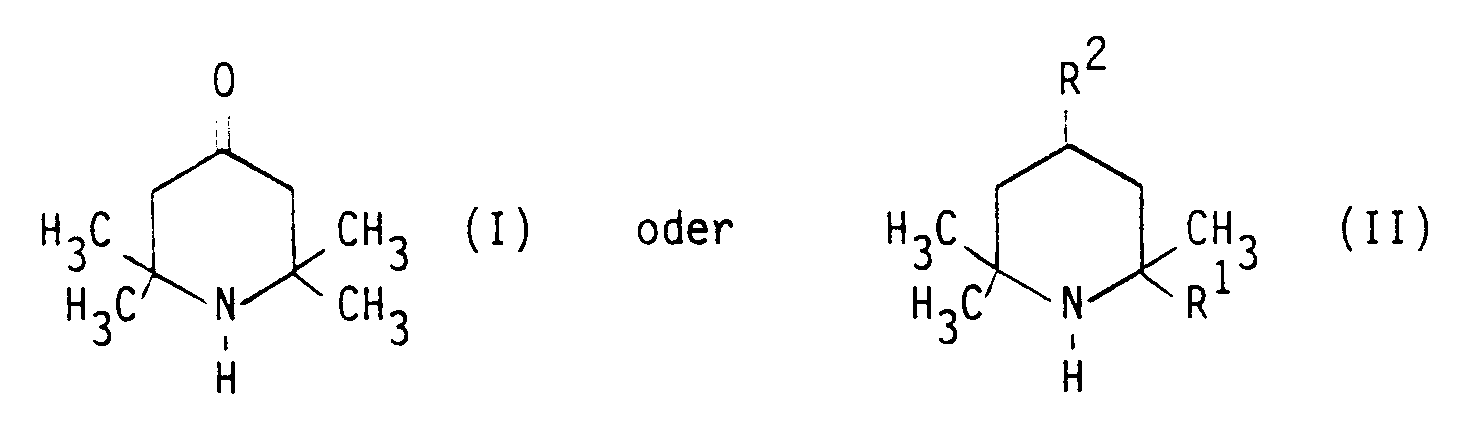
- R¹ =
- H, CH₃
- R² =
- H, OH, (-O)n-R³,


- n =
- 1,2
- R³ =
- C₁-C₁₈-Alkyl, wenn n = 1 und
- R³ =
- C₂-C₁₈-Alkylen, wenn n = 2
- R⁴ =
- H, C₁-C₂₀-Alkyl und
- b) einem primären und/oder sekundären Di- und/oder Polyamin, wobei - im Fall der Einkomponenten-Systeme - die primären Aminogruppen in blockierter Form als Ketimine vorliegen und
- c) Polyester- und/oder Polyetherpolyolen.
- Die Ether- und Esterbindungen nach Formel (II) können auch in bifunktioneller Form eingesetzt werden, wie z. B. Bis-(2.2.6.6-Tetramethyl-4-piperidyl)-sebacat.
- Für die erfindungsgemäßen PUR/PH-Massen sind Reaktionsprodukte aus linearen und/oder verzweigten Polyether- und/oder Polyesterpolyolen und (cyclo)-aliphatischen Diisocyanaten geeignet, wobei das OH/NCO-Verhältnis 1:1 bis 1,2, vorzugsweise 1:1 sein kann und die freien NCO-Gruppen der Diisocyanat-Präpolymeren mit Piperidin-Derivaten blockiert sind. Als lineare oder verzweigte Polyetherpolyole kommen die Polyalkylenpolyetherpolyole mit einem mittleren Molekulargewicht von 200 bis 7 000 in Frage, wie sie durch Copolymerisation, Blockpolymerisation oder anionische Polymerisation von Alkylenoxiden, wie insbesondere Ethylen- und/oder Propylenoxid mit di- und polyfunktionellen Alkoholen, wie Ethylenglykol, Propandiol-1,3, Butandiol, Trimethylolpropan oder Aminen, wie Ethylendiamin oder Hexamethylendiamin als Startkomponenten oder kationischer Polymerisation und Copolymerisation cyclischer Ether, wie Tetrahydrofuran, Ethylen- und Propylenoxid mit sauren Katalysatoren erhalten werden.
- Ferner eignen sich auch Polyhydroxypolyester. Sie stellen Umsetzungsprodukte von mehrwertigen Alkoholen mit mehrwertigen Carbonsäuren dar. Statt der freien Polycarbonsäuren können auch die entsprechenden Anhydride oder Carbonsäureester von niederen Alkoholen oder deren Gemische verwendet werden. Die Polycarbonsäuren können aliphatischer, cycloaliphatischer, aromatischer und/oder heterocyclischer Natur sein und gegebenenfalls z. B. durch Halogenatome substituiert sein. Beispiele geeigneter Polycarbonsäuren bzw. Polycarbonsäurederivaten sind:
Bernstein-, Adipin-, Sebacin-, Phthal- und Isophthalsäure, Phthalsäure-, Hexahydrophthalsäure-, Tetrahydrophthalsäure- und Tetrachlorphthalsäureanhydrid, dimere Fettsäuren und Terephthalsäuredimethylester. - Als mehrwertige Alkohole kommen z. B. Ethylenglykol, Propylenglykol-(1,2) und -(1,3), Butandiol, Hexandiol-1,6, Octandiol-1,8, Neopentylglykol, 2,2,4(2,4,4)-Trimethylhexandiol-1,6, Cyclohexandimethanol-1,4, 3-Methyl-pentandiol-1,5, Glycerin, Trimethylolpropan, Trimethylolethan, Hexantriol-1,2,6, Diethylenglykol, Triethylenglykol, Tetraethylenglykol, Dipropylenglykol oder Dibutylenglykol in Frage.
- Als Rohstoffkomponente zur Polyesterherstellung können auch Lactone, z. B. ε-Caprolacton oder Hydroxycarbonsäuren, z. B. Hydroxycapronsäure, dienen.
- Als geeignete (cyclo)-aliphatische Diisocyanate seien genannt: Hexamethylendiisocyanat-1,6 (HDI), 2-Methyl-pentamethylendiisocyanat-1,5, 2,2,4(2,4,4)-Trimethyl-hexamethylendiisocyanat-1,6 (TMDI), Isophorondiisocyanat (IPDI), Methylen-bis-(4-cyclohexylisocyanat), Tetramethyl-xylylendiisocyanat, 1,4-Bis-(isocyanatomethyl)-cyclohexan.
- Geeignet im Sinne der Erfindung sind selbstverständlich auch die dimeren und trimeren Formen der Polyisocyanate, wie Uretdione oder Harnstoffe sowie Isocyanurate oder Biurete, die nach bekannten Methoden herstellbar sind.
- Selbstverständlich sind die vorgenannten Verbindungen auch im Gemisch mit den monomeren Diisocyanaten im Sinne der Erfindung einsetzbar.
- Die endständigen NCO-Gruppen der bi- oder polyfunktionellen Verbindungen werden anschließend mit den Piperidin-Derivaten (I) und (II) bei 50 bis 100 °C so umgesetzt, daß pro NCO-Äquivalent vorzugsweise ein Mol der Piperidin-Verbindung zur Reaktion gebracht wird.
- Von den erfindungsgemäß eingesetzten Piperidin-Derivaten werden bevorzugt 2,2,6,6-Tetramethyl-4-dimethylamino-piperidin, 2,2,6,6-Tetramethyl-4-oxo-piperidin (TAA) und das bifunktionelle Piperidin-Derivat Bis-(2,2,6,6-Tetramethyl-4-piperidyl)-sebacat verwendet.
- Die Herstellung der NCO-gruppenhaltigen Polyisocyanate sowie auch deren Blockierung kann in Substanz oder in geeigneten, gegenüber NCO-Gruppen inerten, in der PUR-Chemie üblichen Weichmachern und Flammhemmern durchgeführt werden.
- Geeignete Weichmacher oder Flammhemmer sind Dicarbonsäureester, z. B. Benzylbutylphthalat, Phosphorsäureester, z. B. Trioctylphosphat, Trikresylphosphat, Chlorphosphorester, z. B. Trichlorethylphosphat, Sulfonsäureester oder Chlorparaffine.
- Die erfindungsgemäß einsetzbaren Di- und/oder Polyamine sind an sich bekannte organische Verbindungen mit mindestens zwei primären, vorzugsweise mit primären und/oder sekundären Kohlenstoffatomen verknüpften Aminogruppen und gegebenenfalls weiteren sekundären Aminogruppen.
- Es handelt sich dabei vorzugsweise um (cyclo)-aliphatische primäre und/oder sekundäre Di- und/oder Polyamine. Erfindungsgemäß sind auch araliphatische Diamine als aliphatische Diamine zu betrachten. Die beim erfindungsgemäßen Verfahren zu verwendenden Di- und/oder Polyamine weisen eine Molmasse von 60 bis 500, vorzugsweise 100 bis 300 auf.
- Beispiele für die verwendbaren primären und/oder sekundären Di- und/oder Polyamine sind: Ethylendiamin, Propylendiamin, Butylendiamin, 2,2,4(2,4,4)-Trimethylhexamethylendiamin-1,6 (TMD), 2-Methyl-pentamethylendiamin-1,5 (DA51), 1,4-Diaminocyclohexan, 1,4-Bis-(aminomethyl)-cyclohexan, Isophorondiamin (IPD), Methylen-bis-(4-cyclohexylamin) (HMDA) und 3,3'-Dimethyl-4,4'-diaminodicyclohexylmethan sowie Diethylentriamin (DETA), Triethylentetramin (TETA), Tetraethylenpentamin (TEPA), Pentaethylenhexamin (PEHA) und Dipropylentriamin.
- Erfindungsgemäß können die primären Aminogruppen vorgenannter Di- und/oder Polyamine in ihrer blockierten Form als Ketimine eingesetzt werden, die nach bekannten Methoden durch Kondensation mit Ketonen, z. B. Aceton, Methylethylketon, Methylisobutylketon (MIBK), Diisobutylketon, Cyclohexanon, hergestellt werden.
- Erfindungsgemäß lassen sich nunmehr aufgrund der Blockierung der NCO-Gruppen mit den Piperidin-Derivaten in Kombination mit den blockierten Diaminen lagerstabile Einkomponenten-PUR/PH-Massen synthetisieren, ohne daß die bekannten Konkurrenzreaktionen zwischen Isocyanat- und Ketimingruppen möglich sind. Die Aushärtung dieser 1-K-Systeme erfolgt auch bei Raumtemperatur, indem zunächst durch die Luftfeuchtigkeit, also Wasser, das Ketimin hydrolisiert wird und die freigesetzten primären Aminogruppen anschließend die Vernetzung durch Deblockierung der NCO-Gruppen bewirken.
- Die blockierten NCO-Gruppen werden mit den Aminogruppen, auch in blockierter Form, im NCO/NH-Verhältnis von 0,8 bis 1,4, vorzugsweise 0,9 bis 1,1 und insbesondere im stöchiometrischen Verhältnis umgesetzt.
- Die erfindungsgemäßen Zwei- und Einkomponenten-PUR/PH-Massen eignen sich zur Herstellung von kalthärtenden Beschichtungen, Dichtungs- und Vergußmassen. Die für die jeweiligen Anwendungen erforderlichen Hilfs- und Zusatzstoffe wie Füllstoffe, Pigmente, Katalysatoren, Viskositätsregler, Entschäumer können beigemischt werden, wobei im Falle der 1-K-Systeme auf Wasserfreiheit zu achten ist.
- Als Untergrund für die erfindungsgemäßen PUR/PH-Massen kommen beliebige Substrate in Frage, wie Beton, Metall, Holz, Glas, Keramik, Stein sowie Kunststoffe. Die Applikation erfolgt in bekannter Weise durch Rakeln, Gießen, Spritzen, Rollen.
- Die nachstehenden Beispiele demonstrieren die erfindunsgemäßen PUR/PH-Massen. Die Prozentangaben beziehen sich auf Gewichtsprozente; die Angaben in Teilen auf Gewichtsteile.
- 2 000 Gew.-T. eines linearen Polyoxypropylenglkols mit einer OH-Zahl von 56 mg KOH/g wurden mit 444 Gew.-T. IPDI bei 80 °C so lange erhitzt, bis der NCO-Gehalt des Reaktionsgemisches bei ca. 3,4 Gew.-% lag. Danach wurden dem Reaktionsgemisch unter intensiver Rührung 282 Gew.-T. 2,2,4,6-Tetramethylpiperidin portionsweise zugegeben und so lange bei 80 °C weiter erhitzt, bis der NCO-Gehalt des Gemisches auf ca. 0,2 Gew.-% gefallen war. Die Viskosität des Reaktionsproduktes betrug bei 25 °C 54 000 mPa·s.
- Das blockierte IPDI-Präpolymer wird mit der äquivalenten Menge Polyamin und gegebenenfalls mit 0,05-0,1 Gew.-% Entschäumer homogenisiert und anschließend, falls erforderlich, weitgehend bis zur Blasenfreiheit entgast. Die Gießmasse wird in Formen gegossen und bei Raumtemperatur ausgehärtet.
Beispiel 1,1 1,2 1,3 1,4 Polyamin DETA TETA TEPA PEHA TZ in h 2-3 2-3 2-3 2,5-3 Shore-A nach 1d 8 15 30 39 3d 12 19 36 44 7d 16 25 39 47 - Die Abkürzungen in den Tabellen bedeuten:
- TZ
- Topfzeit
- h
- Stunden
- d
- Tage
- DISFLAMOLL(R) TKP
- = Trikresylphosphat
- MESAMOLL(R)
- = Alkylsulfonsäureester des Phenols
- DISFLAMOLL(R) TOF
- = Trioctylphosphat
- 2 000 Gew.-T. eines linearen Polyoxypropylenglykols mit einer OH-Zahl von 56 mg KOH/g wurden mit 444 Gew.-T. IPDI bei 80 °C so lange erhitzt, bis der NCO-Gehalt 3,4-Gew.-% erreicht hatte. Danach wurden 310 Gew.-T. TAA unter intensiver Rührung portionsweise zugegeben und ca. 4 Stunden weiter erhitzt. Das Reaktionsprodukt hatte eine Viskosität bei 25 °C von 8 100 mPa·s und einen freien NCO-Gehalt von ca. 0,2 Gew.-%.
Gemäß Beispiel 1 wurde das blockierte IPDI-Präpolymer mit der äuqivalenten Menge Polyamin umgesetzt und bei Raumtemperatur gehärtet.Beispiel 2,1 2,2 2,3 2,4 2,5 Polyamin DETA TETA TEPA PEHA PEHA/IPD 1:1 TZ in h 1,5-2,5 1,5-2,5 1-2 1,5-2,5 2-3 Shore-A nach 1d 10 14 32 37 42 3d 14 19 39 44 47 7d 19 27 41 49 55 - 3 000 Gew.-T. eines verzweigten Polyoxypropylenglykols mit einer OH-Zahl von 56 mg KOH/g wurde gemäß Beispiel 1 mit 666 Gew.-T. IPDI zur Reaktion gebracht. Anschließend wurden die NCO-Gruppen mit 423 Gew.-T. 2,2,4,6-Tetramethylpiperidin blockiert. Das Reaktionsprodukt hatte bei 25 °C eine Viskosität von 35 000 mPa·s. Gemäß Beispiel 1 wurde das blockierte Präpolymer im äquivalenten Verhältnis mit Polyaminen umgesetzt und bei Raumtemperatur gehärtet.
Beispiel 3,1 3,2 3,3 3,4 3,5 3,6 3,7 Polyamin DETA TETA TEPA PEHA IPD HMDA TETA/HMDA 1:1 TZ in h 1,5-2,5 1,5-2 1,5-2 1,5-2 0,5-1 0,5-1 1-1,5 Shore-A nach 1d 10 19 32 36 28 30 34 3d 12 24 35 40 34 38 43 7d 14 28 37 45 39 43 46 - 3 666 Gew.-T. des NCO-Präpolymeren aus Beispiel 3 wurden bei 80 °C mit 465 Gew.-T. TAA entsprechend Beispiel 2 umgesetzt. Die Viskosität des Reaktionsproduktes betrug bei 25 °C 9 600 mPa·s, der freie NCO-Gehalt lag bei 0,2 Gew.-%.
Gemäß Beispiel 1 wurde das blockierte Präpolymer im äquivalenten Verhältnis mit Polyaminen umgesetzt und bei Raumtemperatur gehärtet.Beispiel 4,1 4,2 4,3 4,4 4,5 4,6 Polyamin DETA TETA TEPA PEHA IPD HMDA TZ in h 1-1,5 1-1,5 1-1,2 1 0,5-0,75 0,5-1 Shore-A nach 1d 11 18 30 38 30 31 3d 14 25 37 42 34 40 7d 17 27 39 47 38 45 - 547 Gew.-T. eines NCO-Präpolymeren aus 222 Gew.-T. IPDI und 325 Gew.-T. eines Polytetrahydrofurandiols (MG 650) wurden in 702 Gew.-T. DISFLAMOLL(R) TKP mit 155 Gew.-T. TAA entsprechend Beispiel 1 umgesetzt. Das Reaktionsprodukt hatte bei 25 °C eine Viskosität von 2 800 mPa·s und einen freien NCO-Gehalt von 0,2 Gew.-%. Gemäß Beispiel 1 wurde das blockierte IPDI-Präpolymer mit der äquivalenten Menge Polyamin umgesetzt und bei RT ausgehärtet.
Beispiel 5,1 5,2 5,3 5,4 Polyamin DETA TETA TEPA PEHA TZ in h 0,6 0,5 0,3 0,2 Shore-A nach 1d 12 25 30 34 3d 20 30 40 42 7d 25 30 38 46 - 722 Gew.-T. eines NCO-Präpolymeren aus 222 Gew.-T. IPDI und 500 Gew.-T. eines Polytetrahydrofurandiols (MG 1 000) wurden in 877 Gew.-T. MESAMOLL(R) mit 155 Gew.-T. TAA entsprechend Beispiel 1 umgesetzt. Das Reaktionsprodukt hatte bei 25 °C eine Viskosität von 2 400 mPa·s und einen freien NCO-Gehalt von 0,2 Gew.-%. Gemäß Beispiel 1 wurde das blockierte IPDI-Präpolymer mit der äquivalenten Menge Polyamin umgesetzt und bei RT ausgehärtet.
Beispiel 6,1 6,2 6,3 6,4 6,5 Polyamin DETA TETA TEPA PEHA TETA/HMDA 50:50 TZ in h 0,5 0,5 0,3 0,2 0,4 Shore-A nach 1d 10 26 31 33 25 3d 12 30 35 36 28 7d 14 26 37 40 34 - 556 Gew.-T. des trimeren Hexamethylendiisocyanats (Isocyanurat des Hexamethylendiisocyanats) wurden in 1 000 Gew.-T. DISFLAMOLL(R) TKP mit 444 Gew.-T. TAA entsprechend Beispiel 1 umgesetzt. Das Reaktionsprodukt hatte eine Viskosität bei 25 °C von 14 600 mPa·s und einen freien NCO-Gehalt von 0,2 Gew.-%.
Gemäß Beisiel 1 wurde das blockierte HDI-Isocyanurat mit der äquivalenten Menge Polyamin umgesetzt und bei RT ausgehärtet.Beispiel 7,1 7,2 7,3 7,4 7,5 7,6 Polyamin TMD IPD HMDA LAROMINR C 260 DETA TMD/IPD 50:50 TZ in h 0,25 1 1,25 1,3 0,5 0,5 Shore-A nach 1d 36 77 69 65 60 48 3d 35 83 72 67 64 52 7d 34 86 75 71 66 56 - 205,1 Gew.-T. des trimeren Hexamethylendiisocyanats (Isocyanurat des Hexamethylendiisocyanats) wurden in 205,1 Gew.-T. DISFLAMOLL(R) TKP mit 157 Gew.-T. 2,2,4,6-Tetramethylpiperidin entsprechend Beispiel 1 umgesetzt. Das Reaktionsprodukt hatte eine Viskosität bei 25 °C von 25 500 mPa·s und einen freien NCO-Gehalt von 0,3 Gew.-%. Gemäß Beispiel 1 wurde das blockierte HDI-Isocyanurat mit der äquivalenten Menge Polyamin umgesetzt und bei RT ausgehärtet.
Beispiel 8,1 8,2 8,3 8,4 8,5 8,6 Polyamin IPD HMDA LAROMINR C 260 DETA TETA PEHA TZ in h 1-1,5 1-1,5 1-1,5 1 1 0,75-1 Shore-A nach 1d 76 78 67 59 70 70 3d 80 81 69 64 73 78 7d 83 84 74 67 78 85 - 444 Gew.-T. IPDI wurden mit 1 000 Gew.-T. eines Polytetrahydrofurandiols (MG 1 000) in 1 839 Gew.-T. MESAMOLL(R) so lange bei 80 °C erhitzt, bis der NCO-Gehalt der Lösung 2,6 Gew.-% erreicht hatte. Anschließend wurde das Reaktionsgemisch mit 155 Gew.-T. TAA und 240 Gew.-T. Sebacinsäureester des 4-Hydroxy-2,2,6,6-Tetramethylpiperidins entsprechend Beispiel 1 umgesetzt. Das Reaktionsprodukt hatte bei 25 °C eine Viskosität von 5 300 mPa·s und einen freien NCO-Gehalt von 0,2 Gew.-%.
Gemäß Beispiel 1 wurde das blockierte IPDI-Präpolymer mit der äquivalenten Menge Polyamin umgesetzt und bei RT ausgehärtet.Beispiel 9,1 9,2 9,3 9,4 Polyamin DETA TETA TEPA PEHA TZ in h 0,25 0,25 0,3 0,2 Shore-A nach 1d 5 19 24 27 3d 7 22 27 32 7d 10 24 29 38 - 444 Gew.-T. IPDI wurden mit 1 000 Gew.-T. eines OH-gruppenhaltigen Polyesters, bestehend aus Adipinsäure, Hexandiol-1,6 und NPG mit einem Molekulargewicht von 1 000 in 1 226 Gew.-T. MESAMOLL(R) so lange bei 80 °C erhitzt, bis der NCO-Gehalt der Lösung 2,6 % erreicht hatte. Anschließend wurde das Reaktionsgemisch mit 155 Gew.-T. TAA und 240 Gew.-T. Sebacinsäureester des 4-Hydroxy-2,2,6,6-Tetramethylpiperidins entsprechend Beispiel 1 umgesetzt. Das Reaktionsprodukt hatte eine Viskosität bei 25 °C von 14 300 mPa·s und einen freien NCO-Gehalt von 0,2 Gew.-%.
Gemäß Beispiel 1 wurde das blockierte IPDI-Präpolymer mit der äquivalenten Menge Polyamin umgesetzt und bei RT ausgehärtet.Beispiel 10,1 10,2 10,3 10,4 Polyamin DETA TETA DETA/IPD 50:50 DETA/HMDA 50:50 TZ in h 0,15 0,1 0,2 0,2 Shore-A nach 1d 16 24 18 21 3d 18 26 21 25 7d 21 29 24 30 - 547 Gew.-T. eines NCO-Präpolymeren aus 222 Gew.-T. IPDI und 325 Gew.-T. eines Polytetrahydrofurandiols (MG 650) wurden in 787 Gew.-T. DISFLAMOLL(R) TOF mit 240 Gew.-T. Sebacinsäureester des 4-Hydroxy-2,2,6,6-Tetramethylpiperidins entsprechend Beispiel 1 umgesetzt. Das Reaktionsprodukt hatte eine Viskosität bei 25 °C von 5 600 mPa·s und einen freien NCO-Gehalt von 0,2 Gew.-%.
Gemäß Beispiel 1 wurde das blockierte IPDI-Präpolymer mit der äquivalenten Menge Polyamin umgesetzt und bei RT ausgehärtet.Beispiel 11,1 11,2 11,3 11,4 Polyamin DETA TETA DETA/IPD 50:50 DETA/LAROMINR C 260 50:50 TZ in h 0,75 0,5 0,5 0,25 Shore-A nach 1d 35 38 37 41 3d 40 42 41 44 7d 41 44 43 49 - 1 222 Gew.-T. des Präpolymeren aus Beispiel 2 wurden in 365,5 Gew.-T. DISFLAMOLL(R) TOF mit 240 Gew.-T. Sebacinsäureester des 4-Hydroxy-2,2,6,6-Tetramethylpiperidins entsprechend Beispiel 1 umgesetzt. Das Reaktionsprodukt hatte eine Viskosität bei 25 °C von 7 400 mPa·s und einen freien NCO-Gehalt von 0,2 Gew.-%. Gemäß Beispiel 1 wurde das blockierte IPDI-Präpolymer mit der äquivalenten Menge Polyamin umgesetzt und bei RT ausgehärtet.
Beispiel 12,1 12,2 12,3 12,4 12,5 Polyamin DETA TETA TEPA PEHA/HMDA 50:50 TETA/IPD 50:50 TZ in h 2 1 0,5 2 2 Shore-A nach 1d 19 23 30 19 17 3d 21 26 34 21 24 7d 24 28 34 23 24 - Die eingesetzten Bis-Ketime wurden nach bekannten Methoden aus Polyamin und Keton unter Verwendung eines Schleppmittels und p-Toluolsulfonsäure am Wasserabscheider synthetisiert. Nach Erhalt der berechneten Wassermenge wurde das Schleppmittel abdestilliert und das entsprechende Bis-Ketimin im Vakuum destilliert.
-
- a) 1 332 Gew.-T. IPDI wurden mit 134 Gew.-T. Trimethylolpropan in 1 907 Gew.-T. DISFLAMOLL(R) TKP so lange bei 80 °C erhitzt, bis der NCO-Gehalt der Lösung 11,2 % erreicht hatte. Anschließend wurde das Reaktionsgemisch mit 1 395 Gew.-T. TAA entsprechend Beispiel 1 umgesetzt. Das Reaktionsprodukt hatte eine Viskosität bei 25 °C von 21 500 mPa·s und einen freien NCO-Gehalt von 0,3 Gew.-%.
- b) 50 Gew.-% des blockierten Präpolymeren gemäß Beispiel B 1a und 50 Gew.-% des blockierten Präpolymeren gemäß Beispiel A 2 wurden mit der äquivalenten Menge MIBK-IPD-bis-Ketimin homogenisiert und auf Betonplatten appliziert. Die Härtung erfolgte bei RT. Nach 24 h Härtezeit war die Oberfläche klebfrei und nach 7d war die Beschichtung ausgehärtet.
- 50 Gew.-% des blockierten Präpolymeren gemäß Beispiel B 1a und 50 Gew.-% des blockierten Präpolymeren gemäß Beispiel A 1 wurden mit der äquivalenten Menge des Bis-Ketimins gemäß Beispiel B 1 b homogenisiert und auf Betonplatten appliziert. Nach 24stündiger RT-Härtung war die Oberfläche klebfrei und nach 7d war die Beschichtung ausgehärtet.
- 50 Gew.-% des blockierten Präpolymeren gemäß Beispiel B 1a und 50 Gew.-% des blockierten Präpolymeren gemäß Beispiel A 5 wurden mit der äquivalenten Menge des Bis-Ketimins gemäß Beispiel B 1b homogenisiert und auf Betonplatten appliziert. Nach 24stündiger RT-Härtung war die Oberfläche klebfrei und nach 7d war die Beschichtung ausgehärtet.
-
- a) 731 Gew.-T. IPDI-Uretdion wurden in 800 Gew.-T. MESAMOLL(R) gelöst und anschießend mit 469 Gew.-T. TAA entsprechend Beispiel 1 umgesetzt. Das Reaktionsprodukt hatte eine Viskosität bei 25 °C von 18 000 mPa·s und einen freien NCO-Gehalt von 0,3 Gew.-%.
- b) 50 Gew.-% des blockierten IPDI-Uretdions gemäß Beispiel 4a und 50 Gew.-% des blockierten Präpolymeren gemäß Beispiel A 2 wurden mit der äquivalenten Menge Bis-Ketimin gemäß Beispiel B 1b homogenisiert und auf Betonplatten appliziert. Nach 24stündiger RT-Härtung war die Oberfläche klebfrei und nach 7d war die Beschichtung ausgehärtet.
- 50 Gew.-% des blockierten IPDI-Uretdions gemäß Beispiel B 4a und 50 Gew.-% des blockierten Präpolymeren gemäß Beispiel A 6 wurden mit der äquivalenten Menge Bis-Ketimin gemäß Beispiel B 1b homogenisiert und auf Betonplatten appliziert. Nach 24stündiger RT-Härtung war die Oberfläche klebfrei und nach 7d war die Beschichtung ausgehärtet.
- 50 Gew.-% des blockierten IPDI-Uretdions gemäß Beispiel B 4a und 50 Gew.-% des blockierten Präpolymeren gemäß Beispiel A 6 wurden mit der äquivalenten Menge eines Bis-Ketimins, hergestellt aus TMD und MIBK, homogenisiert und auf Betonplatten appliziert. Nach 24stündiger RT-Härtung war die Oberfläche klebfrei und nach 7d war die Beschichtung ausgehärtet.
Claims (10)
- Kalthärtende, lösemittelfreie, duroplastische Zwei- und Einkomponenten-Polyurethan-Polyharnstoff-Massen, bestehend ausa) einem (cyclo)-aliphatischen Polyisocyanat, dessen freie NCO-Gruppen mit Piperidin-Derivaten folgender Formeln blockiert sind:
 R¹ = H, CH₃R² = H, OH, (-O)n-R³,
 n = 1,2R³ = C₁-C₁₈-Alkyl, wenn n = 1 undR³ = C₂-C₁₈-Alkylen, wenn n = 2R⁴ = H, C₁-C₂₀-Alkyl undb) einem primären und/oder sekundären Di- und/oder Polyamin, wobei - im Fall der Einkomponenten-Systeme - die primären Aminogruppen in blockierter Form als Ketimine vorliegen undc) Polyester- und/oder Polyetherpolyolen.
 - Massen nach Anspruch 1,
dadurch gekennzeichnet,
daß die blockierten (cyclo)-aliphatischen Polyisocyanate mit Polyolen kettenverlängert sind, wobei das OH/NCO-Verhältnis 1 : 1 bis 1,2 beträgt. - Massen nach Anspruch 1,
dadurch gekennzeichnet,
daß die blockierten (cyclo)-aliphatischen Polyisocyanate als Dimere oder Trimere vorliegen, gegebenenfalls im Gemisch mit den monomeren Polyisocyanaten. - Massen nach Anspruch 1,
dadurch gekennzeichnet,
daß das NCO/H-N -Verhältnis 0,8 bis 1,4 beträgt. - Massen nach Anspruch 1,
dadurch gekennzeichnet,
daß als Polyisocyanate Isophorondiisocyanat, 2,2,4(2,4,4)-Trimethylhexamethylendiisocyanat-1,6 und Hexamethylendiisocyanat-1,6 eingesetzt werden. - Massen nach Anspruch 1,
dadurch gekennzeichnet,
daß man aliphatische, cycloaliphatische oder aliphatische/cycloaliphatische Di- und/oder Polyamine einsetzt. - Massen nach den Ansprüchen 1 und 6,
dadurch gekennzeichnet,
daß Isophorondiamin, 2,2,4(2,4,4)-Trimethylhexamethylendiamin-1,6, 2-Methyl-pentamethylendiamin-1,5, Methylen-bis(n-cyclohexylamin), Diethylentriamin, Triethylentetramin, Tetraethylenpentamin und Pentaethylenhexamin eingesetzt werden. - Massen nach Anspruch 1.
dadurch gekennzeichnet,
daß das Isocyanat-/Aminogruppen-Verhältnis 1 : 1 beträgt. - Massen nach den Ansprüchen 1 bis 8,
dadurch gekennzeichnet,
daß sie in der PUR-Chemie übliche Füllstoffe, Pigmente, Katalysatoren und Viskositätsregler enthalten. - Verwendung der Massen nach den Ansprüchen 1 bis 9 als Beschichtungs-, Dichtungs- und Vergußmassen.
Applications Claiming Priority (2)
| Application Number | Priority Date | Filing Date | Title |
|---|---|---|---|
| DE4028288 | 1990-09-06 | ||
| DE19904028288 DE4028288A1 (de) | 1990-09-06 | 1990-09-06 | Kalthaertende, loesemittelfreie, duroplastische polyurethan-polyharnstoff-massen |
Publications (2)
| Publication Number | Publication Date |
|---|---|
| EP0477488A1 EP0477488A1 (de) | 1992-04-01 |
| EP0477488B1 true EP0477488B1 (de) | 1994-09-21 |
Family
ID=6413727
Family Applications (1)
| Application Number | Title | Priority Date | Filing Date |
|---|---|---|---|
| EP19910111493 Expired - Lifetime EP0477488B1 (de) | 1990-09-06 | 1991-07-10 | Kalthärtende, lösemittelfreie, duroplastische Polyurethan-Polyharnstoff-Massen |
Country Status (5)
| Country | Link |
|---|---|
| US (1) | US5173560A (de) |
| EP (1) | EP0477488B1 (de) |
| JP (1) | JPH04234419A (de) |
| AT (1) | ATE111928T1 (de) |
| DE (2) | DE4028288A1 (de) |
Families Citing this family (17)
| Publication number | Priority date | Publication date | Assignee | Title |
|---|---|---|---|---|
| US5214086A (en) * | 1991-09-04 | 1993-05-25 | Basf Corporation | Coating compositions which may be ambient cured |
| US5786437A (en) * | 1993-04-08 | 1998-07-28 | Tremco Incorporated | One-step sealant based on electronegatively substituted phenolic blocking agents and aliphatic isocyanates providing fast cures and improved stability |
| US5656712A (en) * | 1995-05-02 | 1997-08-12 | Mirossay; Thomas C. | Polyurethane compositions and method |
| US6828405B1 (en) | 1995-05-23 | 2004-12-07 | The Sherwin-Williams Company | Polyimine/polyisocyanate coating composition |
| US5591807A (en) * | 1995-05-23 | 1997-01-07 | The Sherwin-Williams Company | Polyimine/polyisocyanate coating composition containing polymeric anhydride |
| DE19637334A1 (de) * | 1996-09-13 | 1998-03-19 | Bayer Ag | Stabilisierte blockierte Isocyanate |
| GB9828446D0 (en) * | 1998-12-24 | 1999-02-17 | Ici Plc | Coating composition |
| JP2003048949A (ja) * | 2001-08-03 | 2003-02-21 | Yokohama Rubber Co Ltd:The | 硬化性樹脂組成物 |
| US8317956B2 (en) * | 2005-09-14 | 2012-11-27 | Greer Robert W | System, method, and composition for adhering preformed thermoplastic traffic control signage to pavement |
| US7753616B2 (en) * | 2006-12-21 | 2010-07-13 | Greer Robert F | System, method and composition for adhering preformed thermoplastic traffic control signage to pavement |
| WO2008077270A1 (fr) * | 2006-12-22 | 2008-07-03 | Jinhe Lin | Polyuréthane exempt de solvant, sa préparation et son application |
| EP2419468A2 (de) * | 2009-04-16 | 2012-02-22 | 3M Innovative Properties Company | Verfahren und zusammensetzung zum beschichten von trinkwasserpipelines |
| US9657193B2 (en) | 2011-03-30 | 2017-05-23 | 3M Innovative Properties Co. | Composition comprising cyclic secondary amine and methods of coating drinking water pipelines |
| CN102658057B (zh) * | 2012-04-16 | 2014-09-10 | 王志军 | 一种新型聚氨酯分散剂及其制备方法 |
| EP3950758A4 (de) * | 2019-03-29 | 2022-11-30 | Mitsui Chemicals, Inc. | Vernetzungsmittel für fasern oder leder |
| EP3950759B1 (de) * | 2019-03-29 | 2025-06-11 | Mitsui Chemicals, Inc. | Blockiertes isocyanat, verfahren zur herstellung eines mehrschichtigen films und mehrschichtiger film |
| CN116376008B (zh) * | 2022-12-30 | 2025-10-31 | 天集化工助剂(沧州)有限公司 | 一种涂料助剂及其制备方法和应用 |
Family Cites Families (3)
| Publication number | Priority date | Publication date | Assignee | Title |
|---|---|---|---|---|
| DE2642374A1 (de) * | 1976-09-21 | 1978-03-23 | Bayer Ag | Permanent stabilisierte polyurethane |
| US4243792A (en) * | 1977-05-11 | 1981-01-06 | General Motors Corporation | Moisture curing polyurethane topcoat paint with improved gloss stability |
| DE3221558A1 (de) * | 1982-06-08 | 1983-12-08 | Chemische Werke Hüls AG, 4370 Marl | Lagerstabile polyurethan-einkomponenten-einbrennlacke |
-
1990
- 1990-09-06 DE DE19904028288 patent/DE4028288A1/de not_active Withdrawn
-
1991
- 1991-07-10 AT AT91111493T patent/ATE111928T1/de not_active IP Right Cessation
- 1991-07-10 EP EP19910111493 patent/EP0477488B1/de not_active Expired - Lifetime
- 1991-07-10 DE DE59103034T patent/DE59103034D1/de not_active Expired - Fee Related
- 1991-07-18 US US07/732,235 patent/US5173560A/en not_active Expired - Fee Related
- 1991-09-04 JP JP3224303A patent/JPH04234419A/ja not_active Withdrawn
Also Published As
| Publication number | Publication date |
|---|---|
| JPH04234419A (ja) | 1992-08-24 |
| DE59103034D1 (de) | 1994-10-27 |
| US5173560A (en) | 1992-12-22 |
| DE4028288A1 (de) | 1992-03-12 |
| EP0477488A1 (de) | 1992-04-01 |
| ATE111928T1 (de) | 1994-10-15 |
Similar Documents
| Publication | Publication Date | Title |
|---|---|---|
| EP0477488B1 (de) | Kalthärtende, lösemittelfreie, duroplastische Polyurethan-Polyharnstoff-Massen | |
| EP1937742B1 (de) | Zweikomponenten-systeme für die herstellung flexibler beschichtungen | |
| EP0254177A2 (de) | Feuchtigkeitshärtende, lagerstabile Einkomponenten-Polyurethansysteme und deren Verwendung | |
| DE19701835A1 (de) | Kalthärtende, lösemittelarme oder lösemittelfreie Zweikomponenten-Polyurethan-Polyharnstoff-Massen | |
| EP0239834A1 (de) | Feuchtigkeitshärtende, lagerstabile Einkomponenten-Polyurethansysteme und deren Verwendung | |
| DE68911047T2 (de) | Aus Mischungen von Polypropylenoxid-Polyolen und von auf organischen Silicon-Blockcopolymeren basierenden Polyol-Zwischenprodukten hergestellte Polyurethane. | |
| EP0702039A1 (de) | Isocyanatprepolymere, ein Verfahren zu ihrer Herstellung und ihre Verwendung | |
| EP3892659A1 (de) | Mit aus cashewnuss-schalenöl erhältlichen phenolen blockierte, niedrigviskose isocyanat-prepolymere, verfahren zur deren herstellung und deren verwendung | |
| EP0457089B1 (de) | Verfahren zur Herstellung von Aminen und ihre Verwendung als Härter für Epoxidharze | |
| EP0950675A1 (de) | Reaktivsysteme und ihre Verwendung zur Herstellung von Beschichtungen, Klebstoffen, Dichtungsmassen, Vergussmassen oder Formteilen | |
| EP0084106B1 (de) | Härtbare Kunstharzmischungen und Mittel für härtbare Kunstharzmischungen auf Basis von präpolymeren Polyätherurethanharnstoffaminen und Epoxidharzen | |
| DD236539A5 (de) | Verwendung und herstellung von substituierten p,p'-methylen-bis-anilinen | |
| EP0407829B1 (de) | Hitzehärtbare Gemische und ihre Verwendung zur Herstellung von Beschichtungen von hitzeresistenten Substraten | |
| EP1487929B1 (de) | Polyolmischung zur herstellung von polyurethan-gelcoats | |
| EP0082983B1 (de) | Härtbare Kunstharzmischungen und Mittel für härtbare Kunstharzmischungen auf Basis von präpolymeren Polyätherurethanharnstoffaminen und Epoxidharzen und/oder aromatischen Carbamidsäurearylestern | |
| US5852154A (en) | Cold-curing, low-solvent or solvent-free 2-component polyurethane/polyurea compositions | |
| EP1204691B1 (de) | Lösemittelfreie, raumtemperaturhärtende reaktivsysteme und ihre verwendung zur herstellung von klebstoffen, dichtungsmassen, vergussmassen, formteilen oder beschichtungen | |
| EP0475003B1 (de) | Blockierte (cyclo)-aliphatische Polyisocyanate sowie ein Verfahren zu deren Herstellung | |
| DE3143060A1 (de) | Pulverlacke auf der basis von blockierten isophorondiisocyanataddukten | |
| DE19755032B4 (de) | Kalthärtende, lösemittelfreie, duroplastische Polyurethan-Polyharnstoff-Massen | |
| EP0473905A2 (de) | Bei Raumtemperatur härtbare Epoxidharzmischungen | |
| EP4153647B1 (de) | Polyharnstoffzusammensetzung mit niedrigem gehalt an monomeren diisocyanaten | |
| EP0475012A1 (de) | Lichtbeständige, reaktive 2 K-PUR-Lacke, die bei Raumtemperatur härten | |
| DE3610758C2 (de) | ||
| EP0780416A1 (de) | Pulverlack und seine Verwendung zur Beschichtung von hitzeresistenten Substraten |
Legal Events
| Date | Code | Title | Description |
|---|---|---|---|
| PUAI | Public reference made under article 153(3) epc to a published international application that has entered the european phase |
Free format text: ORIGINAL CODE: 0009012 |
|
| AK | Designated contracting states |
Kind code of ref document: A1 Designated state(s): AT BE CH DE FR GB IT LI NL |
|
| 17P | Request for examination filed |
Effective date: 19920226 |
|
| 17Q | First examination report despatched |
Effective date: 19930618 |
|
| GRAA | (expected) grant |
Free format text: ORIGINAL CODE: 0009210 |
|
| AK | Designated contracting states |
Kind code of ref document: B1 Designated state(s): AT BE CH DE FR GB IT LI NL |
|
| REF | Corresponds to: |
Ref document number: 111928 Country of ref document: AT Date of ref document: 19941015 Kind code of ref document: T |
|
| REF | Corresponds to: |
Ref document number: 59103034 Country of ref document: DE Date of ref document: 19941027 |
|
| ET | Fr: translation filed | ||
| GBT | Gb: translation of ep patent filed (gb section 77(6)(a)/1977) |
Effective date: 19941010 |
|
| ITF | It: translation for a ep patent filed | ||
| PLBE | No opposition filed within time limit |
Free format text: ORIGINAL CODE: 0009261 |
|
| STAA | Information on the status of an ep patent application or granted ep patent |
Free format text: STATUS: NO OPPOSITION FILED WITHIN TIME LIMIT |
|
| 26N | No opposition filed | ||
| PGFP | Annual fee paid to national office [announced via postgrant information from national office to epo] |
Ref country code: GB Payment date: 19960701 Year of fee payment: 6 |
|
| PGFP | Annual fee paid to national office [announced via postgrant information from national office to epo] |
Ref country code: BE Payment date: 19960717 Year of fee payment: 6 |
|
| PGFP | Annual fee paid to national office [announced via postgrant information from national office to epo] |
Ref country code: AT Payment date: 19960725 Year of fee payment: 6 |
|
| PGFP | Annual fee paid to national office [announced via postgrant information from national office to epo] |
Ref country code: FR Payment date: 19960730 Year of fee payment: 6 Ref country code: DE Payment date: 19960730 Year of fee payment: 6 |
|
| PGFP | Annual fee paid to national office [announced via postgrant information from national office to epo] |
Ref country code: NL Payment date: 19960731 Year of fee payment: 6 |
|
| PGFP | Annual fee paid to national office [announced via postgrant information from national office to epo] |
Ref country code: CH Payment date: 19961001 Year of fee payment: 6 |
|
| PG25 | Lapsed in a contracting state [announced via postgrant information from national office to epo] |
Ref country code: GB Free format text: LAPSE BECAUSE OF NON-PAYMENT OF DUE FEES Effective date: 19970710 Ref country code: AT Free format text: LAPSE BECAUSE OF NON-PAYMENT OF DUE FEES Effective date: 19970710 |
|
| PG25 | Lapsed in a contracting state [announced via postgrant information from national office to epo] |
Ref country code: LI Free format text: LAPSE BECAUSE OF NON-PAYMENT OF DUE FEES Effective date: 19970731 Ref country code: CH Free format text: LAPSE BECAUSE OF NON-PAYMENT OF DUE FEES Effective date: 19970731 Ref country code: BE Free format text: LAPSE BECAUSE OF NON-PAYMENT OF DUE FEES Effective date: 19970731 |
|
| BERE | Be: lapsed |
Owner name: HULS A.G. Effective date: 19970731 |
|
| PG25 | Lapsed in a contracting state [announced via postgrant information from national office to epo] |
Ref country code: NL Free format text: LAPSE BECAUSE OF NON-PAYMENT OF DUE FEES Effective date: 19980201 |
|
| GBPC | Gb: european patent ceased through non-payment of renewal fee |
Effective date: 19970710 |
|
| REG | Reference to a national code |
Ref country code: CH Ref legal event code: PL |
|
| PG25 | Lapsed in a contracting state [announced via postgrant information from national office to epo] |
Ref country code: FR Free format text: LAPSE BECAUSE OF NON-PAYMENT OF DUE FEES Effective date: 19980331 |
|
| NLV4 | Nl: lapsed or anulled due to non-payment of the annual fee |
Effective date: 19980201 |
|
| PG25 | Lapsed in a contracting state [announced via postgrant information from national office to epo] |
Ref country code: DE Free format text: LAPSE BECAUSE OF NON-PAYMENT OF DUE FEES Effective date: 19980401 |
|
| REG | Reference to a national code |
Ref country code: FR Ref legal event code: ST |
|
| PG25 | Lapsed in a contracting state [announced via postgrant information from national office to epo] |
Ref country code: IT Free format text: LAPSE BECAUSE OF NON-PAYMENT OF DUE FEES;WARNING: LAPSES OF ITALIAN PATENTS WITH EFFECTIVE DATE BEFORE 2007 MAY HAVE OCCURRED AT ANY TIME BEFORE 2007. THE CORRECT EFFECTIVE DATE MAY BE DIFFERENT FROM THE ONE RECORDED. Effective date: 20050710 |