EP0474668B1 - Umwandlung eines delta-16-steroids in einen delta-17(20)-20 silylether - Google Patents
Umwandlung eines delta-16-steroids in einen delta-17(20)-20 silylether Download PDFInfo
- Publication number
- EP0474668B1 EP0474668B1 EP90907636A EP90907636A EP0474668B1 EP 0474668 B1 EP0474668 B1 EP 0474668B1 EP 90907636 A EP90907636 A EP 90907636A EP 90907636 A EP90907636 A EP 90907636A EP 0474668 B1 EP0474668 B1 EP 0474668B1
- Authority
- EP
- European Patent Office
- Prior art keywords
- alkyl
- metal
- copper
- acetate
- ether
- Prior art date
- Legal status (The legal status is an assumption and is not a legal conclusion. Google has not performed a legal analysis and makes no representation as to the accuracy of the status listed.)
- Expired - Lifetime
Links
- 238000006243 chemical reaction Methods 0.000 title abstract description 40
- 238000000034 method Methods 0.000 claims abstract description 36
- 230000008569 process Effects 0.000 claims abstract description 28
- RYGMFSIKBFXOCR-UHFFFAOYSA-N Copper Chemical compound [Cu] RYGMFSIKBFXOCR-UHFFFAOYSA-N 0.000 claims abstract description 24
- 239000010949 copper Substances 0.000 claims abstract description 24
- 229910052802 copper Inorganic materials 0.000 claims abstract description 24
- 229910000050 copper hydride Inorganic materials 0.000 claims abstract description 21
- 239000003795 chemical substances by application Substances 0.000 claims abstract description 19
- 239000003638 chemical reducing agent Substances 0.000 claims abstract description 16
- LTYZGLKKXZXSEC-UHFFFAOYSA-N copper dihydride Chemical compound [CuH2] LTYZGLKKXZXSEC-UHFFFAOYSA-N 0.000 claims abstract description 16
- 229910052987 metal hydride Inorganic materials 0.000 claims abstract description 15
- 150000004681 metal hydrides Chemical class 0.000 claims abstract description 15
- RAXXELZNTBOGNW-UHFFFAOYSA-N imidazole Natural products C1=CNC=N1 RAXXELZNTBOGNW-UHFFFAOYSA-N 0.000 claims description 48
- 125000001424 substituent group Chemical group 0.000 claims description 32
- 239000000203 mixture Substances 0.000 claims description 27
- 229910052751 metal Inorganic materials 0.000 claims description 25
- 239000002184 metal Substances 0.000 claims description 25
- 125000002496 methyl group Chemical group [H]C([H])([H])* 0.000 claims description 23
- GNOIPBMMFNIUFM-UHFFFAOYSA-N hexamethylphosphoric triamide Chemical compound CN(C)P(=O)(N(C)C)N(C)C GNOIPBMMFNIUFM-UHFFFAOYSA-N 0.000 claims description 15
- -1 silyl halide Chemical class 0.000 claims description 15
- 125000006273 (C1-C3) alkyl group Chemical group 0.000 claims description 13
- 125000004178 (C1-C4) alkyl group Chemical group 0.000 claims description 12
- 239000003054 catalyst Substances 0.000 claims description 11
- 238000004519 manufacturing process Methods 0.000 claims description 11
- 150000001412 amines Chemical class 0.000 claims description 10
- SECXISVLQFMRJM-UHFFFAOYSA-N N-Methylpyrrolidone Chemical compound CN1CCCC1=O SECXISVLQFMRJM-UHFFFAOYSA-N 0.000 claims description 9
- KPUWHANPEXNPJT-UHFFFAOYSA-N disiloxane Chemical compound [SiH3]O[SiH3] KPUWHANPEXNPJT-UHFFFAOYSA-N 0.000 claims description 9
- 125000004169 (C1-C6) alkyl group Chemical group 0.000 claims description 8
- 239000003446 ligand Substances 0.000 claims description 8
- 150000003536 tetrazoles Chemical class 0.000 claims description 8
- NSPMIYGKQJPBQR-UHFFFAOYSA-N 4H-1,2,4-triazole Chemical compound C=1N=CNN=1 NSPMIYGKQJPBQR-UHFFFAOYSA-N 0.000 claims description 7
- QTBSBXVTEAMEQO-UHFFFAOYSA-M Acetate Chemical compound CC([O-])=O QTBSBXVTEAMEQO-UHFFFAOYSA-M 0.000 claims description 7
- 150000002118 epoxides Chemical class 0.000 claims description 7
- VHYFNPMBLIVWCW-UHFFFAOYSA-N 4-Dimethylaminopyridine Chemical compound CN(C)C1=CC=NC=C1 VHYFNPMBLIVWCW-UHFFFAOYSA-N 0.000 claims description 6
- JUJWROOIHBZHMG-UHFFFAOYSA-N Pyridine Chemical compound C1=CC=NC=C1 JUJWROOIHBZHMG-UHFFFAOYSA-N 0.000 claims description 6
- AVQQQNCBBIEMEU-UHFFFAOYSA-N 1,1,3,3-tetramethylurea Chemical compound CN(C)C(=O)N(C)C AVQQQNCBBIEMEU-UHFFFAOYSA-N 0.000 claims description 5
- DGAQECJNVWCQMB-PUAWFVPOSA-M Ilexoside XXIX Chemical compound C[C@@H]1CC[C@@]2(CC[C@@]3(C(=CC[C@H]4[C@]3(CC[C@@H]5[C@@]4(CC[C@@H](C5(C)C)OS(=O)(=O)[O-])C)C)[C@@H]2[C@]1(C)O)C)C(=O)O[C@H]6[C@@H]([C@H]([C@@H]([C@H](O6)CO)O)O)O.[Na+] DGAQECJNVWCQMB-PUAWFVPOSA-M 0.000 claims description 5
- ZLMJMSJWJFRBEC-UHFFFAOYSA-N Potassium Chemical compound [K] ZLMJMSJWJFRBEC-UHFFFAOYSA-N 0.000 claims description 5
- 229910052782 aluminium Inorganic materials 0.000 claims description 5
- XAGFODPZIPBFFR-UHFFFAOYSA-N aluminium Chemical compound [Al] XAGFODPZIPBFFR-UHFFFAOYSA-N 0.000 claims description 5
- 150000001768 cations Chemical class 0.000 claims description 5
- GUVUOGQBMYCBQP-UHFFFAOYSA-N dmpu Chemical compound CN1CCCN(C)C1=O GUVUOGQBMYCBQP-UHFFFAOYSA-N 0.000 claims description 5
- 229910052700 potassium Inorganic materials 0.000 claims description 5
- 239000011591 potassium Substances 0.000 claims description 5
- 229910052708 sodium Inorganic materials 0.000 claims description 5
- 239000011734 sodium Substances 0.000 claims description 5
- HYZJCKYKOHLVJF-UHFFFAOYSA-N 1H-benzimidazole Chemical compound C1=CC=C2NC=NC2=C1 HYZJCKYKOHLVJF-UHFFFAOYSA-N 0.000 claims description 4
- VMQMZMRVKUZKQL-UHFFFAOYSA-N Cu+ Chemical compound [Cu+] VMQMZMRVKUZKQL-UHFFFAOYSA-N 0.000 claims description 4
- WHXSMMKQMYFTQS-UHFFFAOYSA-N Lithium Chemical compound [Li] WHXSMMKQMYFTQS-UHFFFAOYSA-N 0.000 claims description 4
- KWYHDKDOAIKMQN-UHFFFAOYSA-N N,N,N',N'-tetramethylethylenediamine Chemical compound CN(C)CCN(C)C KWYHDKDOAIKMQN-UHFFFAOYSA-N 0.000 claims description 4
- XBDQKXXYIPTUBI-UHFFFAOYSA-M Propionate Chemical compound CCC([O-])=O XBDQKXXYIPTUBI-UHFFFAOYSA-M 0.000 claims description 4
- 125000003785 benzimidazolyl group Chemical group N1=C(NC2=C1C=CC=C2)* 0.000 claims description 4
- 125000004093 cyano group Chemical group *C#N 0.000 claims description 4
- 229910052744 lithium Inorganic materials 0.000 claims description 4
- YZBBUYKPTHDZHF-KNVGNIICSA-N (3R)-7,2'-dihydroxy-4'-methoxyisoflavanol Chemical compound OC1=CC(OC)=CC=C1[C@H]1C(O)C2=CC=C(O)C=C2OC1 YZBBUYKPTHDZHF-KNVGNIICSA-N 0.000 claims description 3
- JYEUMXHLPRZUAT-UHFFFAOYSA-N 1,2,3-triazine Chemical compound C1=CN=NN=C1 JYEUMXHLPRZUAT-UHFFFAOYSA-N 0.000 claims description 3
- 229960000549 4-dimethylaminophenol Drugs 0.000 claims description 3
- QAOWNCQODCNURD-UHFFFAOYSA-L Sulfate Chemical compound [O-]S([O-])(=O)=O QAOWNCQODCNURD-UHFFFAOYSA-L 0.000 claims description 3
- DPOPAJRDYZGTIR-UHFFFAOYSA-N Tetrazine Chemical compound C1=CN=NN=N1 DPOPAJRDYZGTIR-UHFFFAOYSA-N 0.000 claims description 3
- 229910021645 metal ion Inorganic materials 0.000 claims description 3
- UMJSCPRVCHMLSP-UHFFFAOYSA-N pyridine Natural products COC1=CC=CN=C1 UMJSCPRVCHMLSP-UHFFFAOYSA-N 0.000 claims description 3
- 125000006701 (C1-C7) alkyl group Chemical group 0.000 claims description 2
- 125000004209 (C1-C8) alkyl group Chemical group 0.000 claims description 2
- JOCBASBOOFNAJA-UHFFFAOYSA-N N-tris(hydroxymethyl)methyl-2-aminoethanesulfonic acid Chemical compound OCC(CO)(CO)NCCS(O)(=O)=O JOCBASBOOFNAJA-UHFFFAOYSA-N 0.000 claims description 2
- HYFJXBYGHMZZPQ-UHFFFAOYSA-N boron(1+) Chemical compound [B+] HYFJXBYGHMZZPQ-UHFFFAOYSA-N 0.000 claims description 2
- HCJWWBBBSCXJMS-UHFFFAOYSA-J copper;dilithium;tetrachloride Chemical compound [Li+].[Li+].[Cl-].[Cl-].[Cl-].[Cl-].[Cu+2] HCJWWBBBSCXJMS-UHFFFAOYSA-J 0.000 claims description 2
- JPVYNHNXODAKFH-UHFFFAOYSA-N Cu2+ Chemical compound [Cu+2] JPVYNHNXODAKFH-UHFFFAOYSA-N 0.000 claims 1
- 239000004411 aluminium Substances 0.000 claims 1
- 238000002360 preparation method Methods 0.000 abstract description 8
- 150000003431 steroids Chemical class 0.000 abstract description 7
- 239000000543 intermediate Substances 0.000 abstract description 2
- 239000003814 drug Substances 0.000 abstract 1
- YXFVVABEGXRONW-UHFFFAOYSA-N Toluene Chemical compound CC1=CC=CC=C1 YXFVVABEGXRONW-UHFFFAOYSA-N 0.000 description 84
- WYURNTSHIVDZCO-UHFFFAOYSA-N Tetrahydrofuran Chemical compound C1CCOC1 WYURNTSHIVDZCO-UHFFFAOYSA-N 0.000 description 54
- QTBSBXVTEAMEQO-UHFFFAOYSA-N Acetic acid Chemical compound CC(O)=O QTBSBXVTEAMEQO-UHFFFAOYSA-N 0.000 description 33
- 150000001875 compounds Chemical class 0.000 description 27
- XLYOFNOQVPJJNP-UHFFFAOYSA-N water Substances O XLYOFNOQVPJJNP-UHFFFAOYSA-N 0.000 description 20
- VLKZOEOYAKHREP-UHFFFAOYSA-N n-Hexane Chemical compound CCCCCC VLKZOEOYAKHREP-UHFFFAOYSA-N 0.000 description 18
- CSCPPACGZOOCGX-UHFFFAOYSA-N Acetone Chemical compound CC(C)=O CSCPPACGZOOCGX-UHFFFAOYSA-N 0.000 description 16
- CSNNHWWHGAXBCP-UHFFFAOYSA-L Magnesium sulfate Chemical compound [Mg+2].[O-][S+2]([O-])([O-])[O-] CSNNHWWHGAXBCP-UHFFFAOYSA-L 0.000 description 16
- SIPUZPBQZHNSDW-UHFFFAOYSA-N bis(2-methylpropyl)aluminum Chemical compound CC(C)C[Al]CC(C)C SIPUZPBQZHNSDW-UHFFFAOYSA-N 0.000 description 16
- 150000001721 carbon Chemical group 0.000 description 16
- 229910052799 carbon Inorganic materials 0.000 description 16
- 238000004809 thin layer chromatography Methods 0.000 description 16
- IMNFDUFMRHMDMM-UHFFFAOYSA-N N-Heptane Chemical compound CCCCCCC IMNFDUFMRHMDMM-UHFFFAOYSA-N 0.000 description 14
- 238000003756 stirring Methods 0.000 description 14
- YLQBMQCUIZJEEH-UHFFFAOYSA-N tetrahydrofuran Natural products C=1C=COC=1 YLQBMQCUIZJEEH-UHFFFAOYSA-N 0.000 description 14
- 238000007792 addition Methods 0.000 description 13
- YKFRUJSEPGHZFJ-UHFFFAOYSA-N N-trimethylsilylimidazole Chemical compound C[Si](C)(C)N1C=CN=C1 YKFRUJSEPGHZFJ-UHFFFAOYSA-N 0.000 description 12
- 239000010410 layer Substances 0.000 description 12
- 230000009467 reduction Effects 0.000 description 11
- 238000006884 silylation reaction Methods 0.000 description 11
- FAPWRFPIFSIZLT-UHFFFAOYSA-M Sodium chloride Chemical compound [Na+].[Cl-] FAPWRFPIFSIZLT-UHFFFAOYSA-M 0.000 description 10
- LZJJVTQGPPWQFS-UHFFFAOYSA-L copper;propanoate Chemical compound [Cu+2].CCC([O-])=O.CCC([O-])=O LZJJVTQGPPWQFS-UHFFFAOYSA-L 0.000 description 10
- 239000002002 slurry Substances 0.000 description 10
- RTZKZFJDLAIYFH-UHFFFAOYSA-N Diethyl ether Chemical compound CCOCC RTZKZFJDLAIYFH-UHFFFAOYSA-N 0.000 description 9
- 125000004429 atom Chemical group 0.000 description 9
- 239000012280 lithium aluminium hydride Substances 0.000 description 9
- 229910052943 magnesium sulfate Inorganic materials 0.000 description 8
- 235000019341 magnesium sulphate Nutrition 0.000 description 8
- 239000000047 product Substances 0.000 description 8
- 239000011541 reaction mixture Substances 0.000 description 8
- 239000011780 sodium chloride Substances 0.000 description 8
- 230000015572 biosynthetic process Effects 0.000 description 7
- UIIMBOGNXHQVGW-UHFFFAOYSA-M Sodium bicarbonate Chemical compound [Na+].OC([O-])=O UIIMBOGNXHQVGW-UHFFFAOYSA-M 0.000 description 6
- 125000004432 carbon atom Chemical group C* 0.000 description 6
- IJOOHPMOJXWVHK-UHFFFAOYSA-N chlorotrimethylsilane Chemical compound C[Si](C)(C)Cl IJOOHPMOJXWVHK-UHFFFAOYSA-N 0.000 description 6
- 239000000284 extract Substances 0.000 description 6
- 238000001914 filtration Methods 0.000 description 6
- 239000000126 substance Substances 0.000 description 6
- CYSGHNMQYZDMIA-UHFFFAOYSA-N 1,3-Dimethyl-2-imidazolidinon Chemical compound CN1CCN(C)C1=O CYSGHNMQYZDMIA-UHFFFAOYSA-N 0.000 description 5
- IJGRMHOSHXDMSA-UHFFFAOYSA-N Atomic nitrogen Chemical compound N#N IJGRMHOSHXDMSA-UHFFFAOYSA-N 0.000 description 5
- 239000000706 filtrate Substances 0.000 description 5
- 239000012299 nitrogen atmosphere Substances 0.000 description 5
- 239000012044 organic layer Substances 0.000 description 5
- CURLTUGMZLYLDI-UHFFFAOYSA-N Carbon dioxide Chemical compound O=C=O CURLTUGMZLYLDI-UHFFFAOYSA-N 0.000 description 4
- KFSLWBXXFJQRDL-UHFFFAOYSA-N Peracetic acid Chemical compound CC(=O)OO KFSLWBXXFJQRDL-UHFFFAOYSA-N 0.000 description 4
- 239000008346 aqueous phase Substances 0.000 description 4
- 235000011089 carbon dioxide Nutrition 0.000 description 4
- 125000002915 carbonyl group Chemical group [*:2]C([*:1])=O 0.000 description 4
- 230000003197 catalytic effect Effects 0.000 description 4
- 125000004122 cyclic group Chemical group 0.000 description 4
- 239000012634 fragment Substances 0.000 description 4
- 150000004965 peroxy acids Chemical class 0.000 description 4
- 239000012071 phase Substances 0.000 description 4
- 239000007787 solid Substances 0.000 description 4
- 239000002904 solvent Substances 0.000 description 4
- 230000003637 steroidlike Effects 0.000 description 4
- XEKOWRVHYACXOJ-UHFFFAOYSA-N Ethyl acetate Chemical compound CCOC(C)=O XEKOWRVHYACXOJ-UHFFFAOYSA-N 0.000 description 3
- OKKJLVBELUTLKV-UHFFFAOYSA-N Methanol Chemical compound OC OKKJLVBELUTLKV-UHFFFAOYSA-N 0.000 description 3
- PMZURENOXWZQFD-UHFFFAOYSA-L Sodium Sulfate Chemical compound [Na+].[Na+].[O-]S([O-])(=O)=O PMZURENOXWZQFD-UHFFFAOYSA-L 0.000 description 3
- 125000004453 alkoxycarbonyl group Chemical group 0.000 description 3
- 239000012298 atmosphere Substances 0.000 description 3
- 238000007865 diluting Methods 0.000 description 3
- 150000004678 hydrides Chemical class 0.000 description 3
- 150000002576 ketones Chemical class 0.000 description 3
- 239000000376 reactant Substances 0.000 description 3
- 235000017557 sodium bicarbonate Nutrition 0.000 description 3
- 229910000030 sodium bicarbonate Inorganic materials 0.000 description 3
- 229910052938 sodium sulfate Inorganic materials 0.000 description 3
- 235000011152 sodium sulphate Nutrition 0.000 description 3
- 239000007858 starting material Substances 0.000 description 3
- 230000009466 transformation Effects 0.000 description 3
- HLTXLBJPCKYTQS-UHFFFAOYSA-N 1,2,4-triazol-1-ylsilane Chemical compound [SiH3]N1C=NC=N1 HLTXLBJPCKYTQS-UHFFFAOYSA-N 0.000 description 2
- VEXZGXHMUGYJMC-UHFFFAOYSA-N Hydrochloric acid Chemical compound Cl VEXZGXHMUGYJMC-UHFFFAOYSA-N 0.000 description 2
- PCLIMKBDDGJMGD-UHFFFAOYSA-N N-bromosuccinimide Chemical compound BrN1C(=O)CCC1=O PCLIMKBDDGJMGD-UHFFFAOYSA-N 0.000 description 2
- RJKFOVLPORLFTN-LEKSSAKUSA-N Progesterone Chemical compound C1CC2=CC(=O)CC[C@]2(C)[C@@H]2[C@@H]1[C@@H]1CC[C@H](C(=O)C)[C@@]1(C)CC2 RJKFOVLPORLFTN-LEKSSAKUSA-N 0.000 description 2
- VYPSYNLAJGMNEJ-UHFFFAOYSA-N Silicium dioxide Chemical compound O=[Si]=O VYPSYNLAJGMNEJ-UHFFFAOYSA-N 0.000 description 2
- VMHLLURERBWHNL-UHFFFAOYSA-M Sodium acetate Chemical compound [Na+].CC([O-])=O VMHLLURERBWHNL-UHFFFAOYSA-M 0.000 description 2
- CEKGLWYWXUIIPV-UHFFFAOYSA-N [SiH3]N1C=NC2=C1C=CC=C2 Chemical compound [SiH3]N1C=NC2=C1C=CC=C2 CEKGLWYWXUIIPV-UHFFFAOYSA-N 0.000 description 2
- 239000002253 acid Substances 0.000 description 2
- 125000004183 alkoxy alkyl group Chemical group 0.000 description 2
- 125000003545 alkoxy group Chemical group 0.000 description 2
- 125000000217 alkyl group Chemical group 0.000 description 2
- 150000001728 carbonyl compounds Chemical class 0.000 description 2
- 239000003153 chemical reaction reagent Substances 0.000 description 2
- YLAPOMNEDSBHKK-UHFFFAOYSA-N copper;methane Chemical compound C.[Cu] YLAPOMNEDSBHKK-UHFFFAOYSA-N 0.000 description 2
- 239000002274 desiccant Substances 0.000 description 2
- 238000011065 in-situ storage Methods 0.000 description 2
- 150000002596 lactones Chemical class 0.000 description 2
- AMXOYNBUYSYVKV-UHFFFAOYSA-M lithium bromide Chemical compound [Li+].[Br-] AMXOYNBUYSYVKV-UHFFFAOYSA-M 0.000 description 2
- CCERQOYLJJULMD-UHFFFAOYSA-M magnesium;carbanide;chloride Chemical compound [CH3-].[Mg+2].[Cl-] CCERQOYLJJULMD-UHFFFAOYSA-M 0.000 description 2
- 238000002156 mixing Methods 0.000 description 2
- 229910052757 nitrogen Inorganic materials 0.000 description 2
- 238000007254 oxidation reaction Methods 0.000 description 2
- 125000001997 phenyl group Chemical group [H]C1=C([H])C([H])=C(*)C([H])=C1[H] 0.000 description 2
- 238000010791 quenching Methods 0.000 description 2
- 239000001632 sodium acetate Substances 0.000 description 2
- 235000017281 sodium acetate Nutrition 0.000 description 2
- YEEWDLNNARIVMT-UHFFFAOYSA-N (2-methylimidazol-1-yl)silane Chemical compound CC1=NC=CN1[SiH3] YEEWDLNNARIVMT-UHFFFAOYSA-N 0.000 description 1
- 125000006274 (C1-C3)alkoxy group Chemical group 0.000 description 1
- RYHBNJHYFVUHQT-UHFFFAOYSA-N 1,4-Dioxane Chemical compound C1COCCO1 RYHBNJHYFVUHQT-UHFFFAOYSA-N 0.000 description 1
- UZKWTJUDCOPSNM-UHFFFAOYSA-N 1-ethenoxybutane Chemical compound CCCCOC=C UZKWTJUDCOPSNM-UHFFFAOYSA-N 0.000 description 1
- 125000004917 3-methyl-2-butyl group Chemical group CC(C(C)*)C 0.000 description 1
- YSWBFLWKAIRHEI-UHFFFAOYSA-N 4,5-dimethyl-1h-imidazole Chemical compound CC=1N=CNC=1C YSWBFLWKAIRHEI-UHFFFAOYSA-N 0.000 description 1
- DAOZBJCTEPJGES-UHFFFAOYSA-N 4-chloro-2-methylpyridine Chemical compound CC1=CC(Cl)=CC=N1 DAOZBJCTEPJGES-UHFFFAOYSA-N 0.000 description 1
- NYZZIRWUQLDQOR-GMNINMNUSA-N 9β,11β-epoxy-21-hydroxypregna-1,4,16-triene-3,20-dione 21-acetate Chemical compound C1CC2=CC(=O)C=C[C@]2(C)[C@]23[C@@H]1[C@@H]1CC=C(C(=O)COC(=O)C)[C@@]1(C)C[C@@H]3O2 NYZZIRWUQLDQOR-GMNINMNUSA-N 0.000 description 1
- CPELXLSAUQHCOX-UHFFFAOYSA-M Bromide Chemical compound [Br-] CPELXLSAUQHCOX-UHFFFAOYSA-M 0.000 description 1
- PLXRJIPNBVMTQX-UHFFFAOYSA-N C1(=CC=CC=C1)C(C1=CC=CC=C1)[SiH2]C=1NC=CN1 Chemical compound C1(=CC=CC=C1)C(C1=CC=CC=C1)[SiH2]C=1NC=CN1 PLXRJIPNBVMTQX-UHFFFAOYSA-N 0.000 description 1
- VEXZGXHMUGYJMC-UHFFFAOYSA-M Chloride anion Chemical compound [Cl-] VEXZGXHMUGYJMC-UHFFFAOYSA-M 0.000 description 1
- 229910021595 Copper(I) iodide Inorganic materials 0.000 description 1
- XFXPMWWXUTWYJX-UHFFFAOYSA-N Cyanide Chemical compound N#[C-] XFXPMWWXUTWYJX-UHFFFAOYSA-N 0.000 description 1
- 239000007818 Grignard reagent Substances 0.000 description 1
- 229930194542 Keto Natural products 0.000 description 1
- DWAQJAXMDSEUJJ-UHFFFAOYSA-M Sodium bisulfite Chemical compound [Na+].OS([O-])=O DWAQJAXMDSEUJJ-UHFFFAOYSA-M 0.000 description 1
- ZBULDJKFUGQBQC-PTRHGPIFSA-N [2-[(8s,10s,13s,14s)-10,13-dimethyl-3-oxo-1,2,6,7,8,12,14,15-octahydrocyclopenta[a]phenanthren-17-yl]-2-oxoethyl] acetate Chemical compound O=C1CC[C@]2(C)C3=CC[C@]4(C)C(C(=O)COC(=O)C)=CC[C@H]4[C@@H]3CCC2=C1 ZBULDJKFUGQBQC-PTRHGPIFSA-N 0.000 description 1
- UFEOMHFPJREVTP-PTRHGPIFSA-N [2-[(8s,10s,13s,14s)-10,13-dimethyl-3-oxo-6,7,8,12,14,15-hexahydrocyclopenta[a]phenanthren-17-yl]-2-oxoethyl] acetate Chemical compound O=C1C=C[C@]2(C)C3=CC[C@]4(C)C(C(=O)COC(=O)C)=CC[C@H]4[C@@H]3CCC2=C1 UFEOMHFPJREVTP-PTRHGPIFSA-N 0.000 description 1
- 230000002378 acidificating effect Effects 0.000 description 1
- 239000003470 adrenal cortex hormone Substances 0.000 description 1
- 229940121363 anti-inflammatory agent Drugs 0.000 description 1
- 239000002260 anti-inflammatory agent Substances 0.000 description 1
- 239000000010 aprotic solvent Substances 0.000 description 1
- 150000004945 aromatic hydrocarbons Chemical class 0.000 description 1
- 230000008901 benefit Effects 0.000 description 1
- AZWXAPCAJCYGIA-UHFFFAOYSA-N bis(2-methylpropyl)alumane Chemical group CC(C)C[AlH]CC(C)C AZWXAPCAJCYGIA-UHFFFAOYSA-N 0.000 description 1
- 239000011203 carbon fibre reinforced carbon Substances 0.000 description 1
- 230000008859 change Effects 0.000 description 1
- DOBRDRYODQBAMW-UHFFFAOYSA-N copper(i) cyanide Chemical compound [Cu+].N#[C-] DOBRDRYODQBAMW-UHFFFAOYSA-N 0.000 description 1
- LSXDOTMGLUJQCM-UHFFFAOYSA-M copper(i) iodide Chemical compound I[Cu] LSXDOTMGLUJQCM-UHFFFAOYSA-M 0.000 description 1
- GBRBMTNGQBKBQE-UHFFFAOYSA-L copper;diiodide Chemical compound I[Cu]I GBRBMTNGQBKBQE-UHFFFAOYSA-L 0.000 description 1
- RKHQGWMMUURILY-UHRZLXHJSA-N cortivazol Chemical compound C([C@H]1[C@@H]2C[C@H]([C@]([C@@]2(C)C[C@H](O)[C@@H]1[C@@]1(C)C2)(O)C(=O)COC(C)=O)C)=C(C)C1=CC1=C2C=NN1C1=CC=CC=C1 RKHQGWMMUURILY-UHRZLXHJSA-N 0.000 description 1
- 150000001923 cyclic compounds Chemical class 0.000 description 1
- FWFSEYBSWVRWGL-UHFFFAOYSA-N cyclohex-2-enone Chemical compound O=C1CCCC=C1 FWFSEYBSWVRWGL-UHFFFAOYSA-N 0.000 description 1
- SBZXBUIDTXKZTM-UHFFFAOYSA-N diglyme Chemical compound COCCOCCOC SBZXBUIDTXKZTM-UHFFFAOYSA-N 0.000 description 1
- 229910001873 dinitrogen Inorganic materials 0.000 description 1
- 239000000839 emulsion Substances 0.000 description 1
- 150000002084 enol ethers Chemical class 0.000 description 1
- 150000004795 grignard reagents Chemical class 0.000 description 1
- 238000010666 hydroalumination reaction Methods 0.000 description 1
- 239000001257 hydrogen Substances 0.000 description 1
- 229910052739 hydrogen Inorganic materials 0.000 description 1
- 125000004435 hydrogen atom Chemical class [H]* 0.000 description 1
- 238000002955 isolation Methods 0.000 description 1
- 125000000468 ketone group Chemical group 0.000 description 1
- XGZVUEUWXADBQD-UHFFFAOYSA-L lithium carbonate Chemical compound [Li+].[Li+].[O-]C([O-])=O XGZVUEUWXADBQD-UHFFFAOYSA-L 0.000 description 1
- 229910052808 lithium carbonate Inorganic materials 0.000 description 1
- 230000011987 methylation Effects 0.000 description 1
- 238000007069 methylation reaction Methods 0.000 description 1
- SNVLJLYUUXKWOJ-UHFFFAOYSA-N methylidenecarbene Chemical compound C=[C] SNVLJLYUUXKWOJ-UHFFFAOYSA-N 0.000 description 1
- PSHKMPUSSFXUIA-UHFFFAOYSA-N n,n-dimethylpyridin-2-amine Chemical compound CN(C)C1=CC=CC=N1 PSHKMPUSSFXUIA-UHFFFAOYSA-N 0.000 description 1
- 239000012074 organic phase Substances 0.000 description 1
- 239000003960 organic solvent Substances 0.000 description 1
- 230000003647 oxidation Effects 0.000 description 1
- 230000000737 periodic effect Effects 0.000 description 1
- 150000002978 peroxides Chemical class 0.000 description 1
- 239000002244 precipitate Substances 0.000 description 1
- 229960003387 progesterone Drugs 0.000 description 1
- 239000000186 progesterone Substances 0.000 description 1
- 238000000746 purification Methods 0.000 description 1
- 230000000171 quenching effect Effects 0.000 description 1
- 238000011946 reduction process Methods 0.000 description 1
- 229920006395 saturated elastomer Polymers 0.000 description 1
- 125000002914 sec-butyl group Chemical group [H]C([H])([H])C([H])([H])C([H])(*)C([H])([H])[H] 0.000 description 1
- 235000010267 sodium hydrogen sulphite Nutrition 0.000 description 1
- 238000004611 spectroscopical analysis Methods 0.000 description 1
- 239000000725 suspension Substances 0.000 description 1
- 238000003786 synthesis reaction Methods 0.000 description 1
- CZDYPVPMEAXLPK-UHFFFAOYSA-N tetramethylsilane Chemical compound C[Si](C)(C)C CZDYPVPMEAXLPK-UHFFFAOYSA-N 0.000 description 1
- 150000003852 triazoles Chemical class 0.000 description 1
Classifications
-
- C—CHEMISTRY; METALLURGY
- C07—ORGANIC CHEMISTRY
- C07J—STEROIDS
- C07J51/00—Normal steroids with unmodified cyclopenta(a)hydrophenanthrene skeleton not provided for in groups C07J1/00 - C07J43/00
Definitions
- the present invention involves two processes for the transformation of a ⁇ 16-steroid to a ⁇ 17(20) -20-silyl ether which is a useful intermediate in the synthesis of corticoids.
- US-A-4568492 discloses the reaction of ⁇ 16-steroids with trimethylsilyl chloride, catalysed by ( ⁇ P)3RhCl, to give the ⁇ 17(20) -20-silyl enol ether. It has now been found that the process is not operable with a ⁇ 1,4 -3-keto functionality in the steroid A-ring.
- Tet. Lett. 28, 1363 (1987) describes the peracid oxidation of a non-steroidal enol ether to give the corresponding epoxy-silyl ether and the subsequent isolation of a non-steroidal epoxy-silyl ether.
- very mild reaction conditions were used and sodium bicarbonate was added to the reaction mixture to neutralise the acid product of the peracid reactant.
- Tet. Lett., 26, 3227 (1985) reports a steroidal epoxy-silyl ether where the epoxy-silyl ether functionality was in the steroid A-ring. This compound was not isolatable.
- EP-A-0165037 discloses the transformation of 16-unsaturated corticoids to the corresponding 16 ⁇ -methyl-17 ⁇ -hydroxycorticoids, by the combination of methylation and silylation.
- EP-A-0175540 discloses converting a 16-unsaturated 20-keto-steroid to a 17 ⁇ -hydroxy-20-keto steroid, using a silylating agent in the presence of a catalyst, and contacting the resultant 17(20)-unsaturated-20-silyl ether steroid with a peracid.
- a metal enolate of formula (II) is prepared by contacting a ⁇ 16-steroid of formula (I) with a preformed copper hydride or a metal hydride reducing agent, in the presence of a copper species; see Chart A.
- a silyl ether of formula (III) is prepared by contacting a metal enolate of formula (II) with a silylating agent.
- a silyl ether of formula (III) is prepared by contacting a ⁇ 16-steroid of formula (I) with a preformed copper hydride or a metal hydride reducing agent in the presence of a copper species, in the presence of a silylating agent.
- the silylating agent is either
- R16 is a ⁇ -H: ⁇ -R16 ⁇ 2 where R16 ⁇ 2 is -H or -CH3; -R16 is -H or -CH3; R21 is -H, -O-R21 ⁇ 1 where R21 ⁇ 1 is -H, C1-C4 alkyl, -CH2-O-CH3, -CHR21 ⁇ 2-O-R21 ⁇ 3 where R21 ⁇ 2 is C1-C4 alkyl and R21 ⁇ 3 is C1-C4 alkyl, -CH2-O-CH2CH2-O-R21 ⁇ 4 where R21 ⁇ 4 is C1-C4 alkyl, THP, -CO-R21 ⁇ 5 where R21 ⁇ 5 is C1-C4 alkyl or - ⁇ , or -Si (R21 ⁇ 6)3 where the R21 ⁇ 6's are the same or different and are selected from C1-C4 alkyl and - ⁇ ; M20
- An advantage of the present invention is that it does not require the addition of a base such as sodium bicarbonate in order to isolate the 17 ⁇ ,20 ⁇ -epoxy-20-silyl ether (IV).
- ⁇ 16-steroids (I) are known to those skilled in the art or can readily be prepared from known starting materials, see for example, US Patents 2,864,834 ( ⁇ 16-steroids) and 3,461,144 (16-methyl- ⁇ 16-steroids).
- the process of the present invention will differ depending on whether or not it is desired to obtain a solution of the 20-metal enolate (II) or proceed with a silylating agent present which gives directly the ⁇ 17(20) -silyl ether (III). It is preferred to convert the ⁇ 16-steroid (I) directly to the ⁇ 17(20) -silyl ether (III).
- the ⁇ 16-steroid (I) is contacted with a member selected from the group consisting of a preformed copper hydride or a metal hydride reducing agent in the presence of a copper species in order to produce the 20-metal enolate (II).
- Metal is copper or a metal ion derived from the metal hydride reducing agent. It is understood in the art that M20 is a copper, aluminum, substituted aluminum or boron cation which may contain other fragments besides the particular metal.
- Preformed copper hydride includes [( ⁇ 3P)CuH]6, (CuH) x where x is from 1 thru 6, LiCuH2, LiCu2H3, Li2Cu3H5, Li2CuH3, Li3CuH4, Li4CuH5, LiCuH6, Li5CuH6, CH3CH2CH2-C ⁇ C-CuHLi, t-butyl-O-CuHLi and ⁇ SCuHLi.
- (CuX) x it is understood that the copper is an aglomerate complex, with "x" believed to be 1-6.
- the preformed copper, for example [( ⁇ 3P)Cu-H]6, can be prepared as described in Tet. Lett. 29, 3749 (1988) or J.A.C.S. 110, 291 (1988) and then added to the reaction mixture.
- the copper hydride can be prepared in situ by reaction of a metal hydride reducing agent and a copper species. Suitable metal hydride reducing agents include
- the active species is the copper hydride. If used as such, one equivalent is required. Less than one equivalent (a catalytic amount) can be used if a reducing agent is present to regenerate the active species. For example, if [( ⁇ 3P)Cu-H]6 is used as the copper hydride (active species) one equivalent is operable. Catalytic amounts can be used if hydrogen, or other appropriate hydride source, is also used to regenerate the active species. More than one equivalent is operable, just not needed and wasteful.
- the ⁇ 16-steroid (I) and a preformed copper hydride or a metal hydride reducing agent in the presence of a copper species are contacted in an anhydrous aprotic solvent, such as an ether or non-halogenated aromatic hydrocarbon.
- anhydrous aprotic solvent such as an ether or non-halogenated aromatic hydrocarbon.
- Preferred solvents include tetrahydrofuran, dioxane, ether, diglyme, toluene and HMPA; more preferred is tetrahydrofuran.
- the reaction is operable in a temperature range of about -100 to about 50°; preferrably about -30 to about -60°.
- the order of contacting the reactants is not critical.
- Suitable ligands include HMPA, DMI, DMPU, TMU, NMP, TES, DMAP, TMEDA and (X20)3P where X20 is C1-C8 alkyl or - ⁇ .
- Preferred ligands are HMPA, DMI, DMPU, TMU and NMP.
- the metal enolate (II) is not isolated but carried on in situ to give the ⁇ 17(20) -silyl ether (III).
- the metal enolate (II) is converted to the ⁇ 17(20) -silyl ether (III) by contacting with a silylating agent.
- Operable silylating agents include
- the 20-metal enolate (II) and silylating agent are contacted in the same solvent that is operable for the production of the 20-metal enolate (II).
- the reaction is operable in a temperature range of about -80 to about 80°; preferably about -60 to about 40°; more preferably about -60 to about 25°.
- the transformation of the ⁇ 16-steroids (I) to the corresponding ⁇ 17(20) -20-silyl ethers (III) in one step by contacting the ⁇ 16-steroid (I) (1) with a preformed copper hydride or a metal hydride reducing agent in the presence of a copper species and (2) in the presence of a silylating agent. It is preferred that the contacting take place in the presence of a ligand.
- the preferred reagents are as described above.
- the ⁇ 17(20) -20-silyl ethers (III) are transformed by known methods (peracid) to the corresponding 17 ⁇ ,20 ⁇ -epoxide-20-silyl ethers (IV).
- the 17 ⁇ ,20 ⁇ -epoxide-20-silyl ethers (IV) can be isolated if desired by addition of the reaction mixture to a dilute solution of aqueous acetic acid. The product is then extracted with an appropriate organic solvent.
- the 17 ⁇ ,20 ⁇ -epoxide-20-silyl ethers (IV) are transformed by acid or base to the corresponding corticoids (V) which have a known utility in the pharmaceutical area as anti-inflammatory agents.
- variable substituents contained in parentheses are bonded to the atom immediately to the left of the variable substituent enclosed in parenthesis.
- each of the consecutive variable substituents is bonded to the immediately preceding atom to the left which is not enclosed in parentheses.
- R i and R j are bonded to the preceding carbon atom.
- C i is the integer corresponding to the carbon atom number.
- C6 represents the 6 position or carbon atom number in the steroid nucleus as traditionally designated by those skilled in the art of steroid chemistry.
- R6 represents a variable substituent (either monovalent or bivalent) at the C6 position.
- Chemical formulas of cyclic (ring) compounds or molecular fragments can be represented in a linear fashion.
- the cyclic molecular fragment, 4-(ethyl)-1-piperazinyl can be represented by -N*-(CH2)2-N(C2H5)-CH2-C*H2.
- a rigid cyclic (ring) structure for any compounds herein defines an orientation with respect to the plane of the ring for substituents attached to each carbon atom of the rigid cyclic compound.
- the two substituents may be in either an axial or equatorial position relative to the ring and may change between axial/equatorial.
- the position of the two substituents realative to the ring and each other remains fixed. While either substituent at times may lie in the plane of the ring (equatorial) rather than above or below the plane (axial), one substituent is always above the other.
- a substituent (X1) which is "below” another substituent (X2) will be identified as being in the alpha ( ⁇ ) configuration and is identified by a broken, dashed or dotted line attachment to the carbon atom, i.e., by the symbol "- - -” or "!.
- the corresponding substituent attached “above” (X2) the other (X1) is identified as being in the beta ( ⁇ ) configuration and is indicated by an unbroken line attachment to the carbon atom.
- variable substituent when a variable substituent is bivalent, the valences may be taken together or separately or both in the definition of the variable.
- R i is defined to consist of two monovalent variable substituents
- the convention used to define the bivalent variable is of the form " ⁇ -R i-j : ⁇ -R i-k " or some variant thereof.
- both ⁇ -R i-j and ⁇ -R i-k are attached to the carbon atom to give -C( ⁇ -R i-j )( ⁇ -R i-k )-.
- two monovalent variable substituents are ⁇ -R6 ⁇ 1: ⁇ -R6 ⁇ 2, .... ⁇ -R6 ⁇ 9: ⁇ -R6 ⁇ 10, etc, giving -C( ⁇ -R6 ⁇ 1)( ⁇ -R6 ⁇ 2)-, .... -C( ⁇ -R6 ⁇ 9) ( ⁇ -R6 ⁇ 10)-, etc.
- two monovalent variable substituents are ⁇ -R11 ⁇ 1: ⁇ -R11 ⁇ 2.
- a ring substituent for which separate ⁇ and ⁇ orientations do not exist e.g. due to the presence of a carbon carbon double bond in the ring
- the above convention is still used, but the ⁇ and ⁇ designations are omitted.
- bivalent variable may be defined as two separate monovalent variable substituents
- two separate monovalent variable substituents may be defined to be taken together to form a bivalent variable.
- C1 and C2 define arbitrarily a first and second carbon atom, respectively
- R i and R j may be defined to be taken together to form (1) a second bond between C1 and C2 or (2) a bivalent group such as oxa (-O-) and the formula thereby describes an epoxide.
- the carbon atom content of variable substituents is indicated in one of two ways.
- the first method uses a prefix to the entire name of the variable such as "C1-C4", where both "1" and "4" are integers representing the minimum and maximum number of carbon atoms in the variable.
- the prefix is separated from the variable by a space.
- C1-C4 alkyl represents alkyl of 1 through 4 carbon atoms, (including isomeric forms thereof unless an express indication to the contrary is given).
- the prefix indicates the entire carbon atom content of the variable being defined.
- C2-C4 alkoxycarbonyl describes a group CH3-(CH2) n -0-CO- where n is zero, one or 2.
- C2-C6 alkoxyalkyl and (C1-C3)alkoxy(C1-C3)alkyl define alkoxyalkyl groups containing from 2 to 6 carbon atoms
- the two definitions differ since the former definition allows either the alkoxy or alkyl portion alone to contain 4 or 5 carbon atoms while the latter definition limits either of these groups to 3 carbon atoms.
- TLC refers to thin-layer chromatography.
- THF refers to tetrahydrofuran.
- DIBAH refers to diisobutylaluminum hydride.
- LAH refers to lithium aluminum hydride.
- HMPA refers to hexamethylphosphoric triamide.
- DMI refers to 1,3-dimethyl-2-imidazolidinone.
- DMPU refers to N,N'-dimethylpropyleneurea.
- TMU refers to tetramethylurea.
- NMP refers to N-methylpyrrolidinone.
- TES tetraethylsulfone.
- DMAP refers to dimethylaminopyridine.
- TMEDA refers to tetramethylethylenediamine.
- Ether refers to diethyl ether.
- Saline refers to an aqueous saturated sodium chloride solution.
- - ⁇ refers to phenyl (C6H5)
- the ratios of solvents used are volume/volume (v/v).
- NMR nuclear (proton) magnetic resonance spectroscopy
- Chlorotrimethylsilane (34.5 ml) is added to the chilled slurry. This mixture is aged for 10 minutes and then methylmagnesium chloride (2.07 M, 101 ml) is added over a period of 75 min. An extra 6.0 ml of the Grignard reagent is added during the next 50 min to consume the starting material.
- the reaction mixture is quenched by adding toluene (1.24 l) and aqueous acetic acid (5%, 1.24 l).
- the two phases are separated after 45 min of vigorous mixing at 5°.
- the aqueous phase is extracted with toluene (200 ml) and the two toluene solutions are combined. This net solution is washed with aqueous acetic acid (5%, 2 x 400 ml) and dried with magnesium sulfate. The drying agent is removed by filtration and the filtrate is concentrated under reduced pressure to give the title compound.
- a slurry, prepared from N-bromosuccinimide (40.96 g), acetone (225 ml) and water (37.7 ml) is cooled to ⁇ -40°.
- a mixture of 20,21-dihydroxy-16 ⁇ -methylpregna-1,4,9(11),17(20)-tetraen-3-one 21-acetate 20-trimethylsilyl ether (PREPARATION 1, 99.56 g) and acetone (350 ml) is added slowly while keeping the temperature less than -35°.
- the silyl ether (III) is consumed within one hour and n-butyl vinyl ether (5.41 ml) is added to quench any access brominating agent.
- the quenching reaction proceeds for 20 min at a temperature of ⁇ -30° and is then warmed to 5°. When this temperature is reached, water (400 ml) and toluene (200 ml) are added. The two phases are separated after adequate mixing. The aqueous phase is extracted with toluene (100 ml). The toluene solutions are combined and washed with water (200 ml). Magnesium sulfate is used to dry the solution, which is concentrated under reduced pressure. The mixture is filtered to give the title compound.
- Lithium carbonate (30.92 g) and lithium bromide (18.17 g) is added to a solution of 17 ⁇ -bromo-21-hydroxy-16 ⁇ -methylpregna-1,4,9(11)-triene-3,20-dione (PREPARATION 2, 98.43 g) in DMF.
- the solids are rinsed into the solution with DMF sufficient to bring the total amount to 350 ml.
- the reaction is warmed to 96° over a 3 hr and forty minute period. It is then transferred to a dropping funnel with 15 ml of DMF and added over a 40 min period to 3.4 l of vigorously stirred half-saturated saline.
- the funnel is rinsed with DMF (15 ml) and the knock-out slurry is cooled to ⁇ 10°. After 30 min, the product is collected by filtration and washed thoroughly with water (3 x 250 ml). The moist solids are dried with nitrogen flow to give the title compound.
- a solution of copper propionate (0.545 g) in THF (110 ml) is added to a precooled -50° slurry of 6 ⁇ -fluoro-21-hydroxypregna-1,4,9(11),16-tetraene-3,20-dione 21-acetate (I, US Patent 3,210,341
- Example 1 20.00 g) in THF (150 ml) containing dimethylimidazolidinone (9.10 ml) and N-trimethylsilylimidazole (15.3 ml) under a nitrogen atmosphere over a 5 min period.
- the suspension is stirred for 5 min, then a solution of DIBAH (25%, 55.27 ml) in toluene is added slowly dropwise over a 40-50 min period.
- the reaction is quenched by adding it to a mixture of aqueous acetic acid (1.5%, 1250 ml) and toluene (250 ml) at 0°. The mixture is stirred for 5-10 minutes, then the layers are separated. The aqueous layer is extracted with toluene (2 x 200 ml) and the combined organic extracts are washed with H2O (2 x 300 ml) and then with saline (300 ml). The organic layer is dried over magnesium sulfate and filtered. The toluene is removed under reduced pressure to give the title composed in a total volume of 220 ml. The title compound is used in the oxidation reaction (EXAMPLE 2) without further purification, NMR (CDCl3) 0.2, 0.9, 1.4, 2.1, 4.5 and 6.24 ⁇ .
- the reaction is held at a temperature less than or equal to -40° for 3 hr and periodic additions of fresh trimethylsilylimidazole (1.63 ml) and LAH (0.145 g) are required to complete the reduction.
- the reaction is then treated with acetone (3.50 ml) and imidazole (0.482 g). It is warmed to 23° and aged at this temperature for 1 hr before it is poured into aqueous acetic acid (2%, 420 ml) and hexane (250 ml) and stirred vigorously at 0°.
- This mixture is filtered through a celite pad, which is washed with aqueous acetic acid (2%, 50 ml) and hexane (200 ml). The two phases of the filtrate are separated. The aqueous phase is extracted with hexane (2 x 60 ml). The organic phases are combined and then washed with water (3 x) and saline (56 ml). Residual water is removed with sodium sulfate. The drying agent is removed by filtration and the filtrate is concentrated under reduced pressure at 38° to give the title compounds as an oil.
- DIBAH (1.50 M, 16.0 ml) in toluene is added to a mixture of cupric propionate (0.314 g), anhydrous THF (10.0 ml) and HMPA (5.20 ml) stirred at ⁇ -60° under an inert atmosphere.
- the mixture is added rapidly to a solution of 21-hydroxy-16-methylpregna-3,20-dione-1,4,9,16-tetraene 21-acetate (I, PREPARATION 3, 5.71 g), THF (75.0 ml) and trimethylsilylimidazole (6.60 ml) and stirred at ⁇ -50°.
- the reaction proceeds at this temperature for 4.5 hr, over which time five portions of fresh copper hydride, each prepared from cupric propionate (0.157 g), THF (5.0 ml), HMPA (0.91 ml) and DIBAH (1.5 M, 3.00 ml), are added. Imidazole (0.532 g) is added, the reaction is warmed to 20° and then it is stirred for 14 hr. The mixture is poured into hexane (300 ml) and aqueous acetic acid (2%, 300 ml) and stirred vigorously at ⁇ 10°. An emulsion results which is filtered through a bed of celite.
- imidazole (0.445 g) is added and the reaction is allowed to warm to 20-25° at which time the reaction is checked for complete silylation by TLC, as described above.
- the reaction is quenched by adding it to a 0° mixture of aqueous acetic acid (1.5%, 500 ml) and toluene (125 ml). The mixture is allowed to stir 5-10 min, then the layers are separated. The aqueous layer is extracted with toluene (2 x 100 ml) and the combined organic extracts are washed with water (2 x 1200 ml) and then with saline (100 ml). The organic layer is dried over magnesum sulfate, filtratered and concentrated under reduced pressure to a total volume of 35 ml containing the title compound.
- a solution of copper propionate (0.572 g) in tetrahydrofuran (10 ml) under a nitrogen atmosphere is cooled in a dry ice/acetone bath to -50°.
- DIBAH in toluene (25% wt, 58 ml) is added to the copper solution over a 5-10 min. period keeping the temperature near -50°.
- the solution turns dark green then lightens to brown during the addition.
- the reaction is quenched by adding it to a 0° mixture of aqueous acetic acid (1.5%, 1250 ml) and toluene (250 ml). The mixture is allowed to stir 5-10 min, then the layers are separated. The aqueous layer is extracted with toluene (2 x 200 ml) and the combined organic extracts are washed with water (2 x 300 ml) and then with saline (300 ml). The organic layer is dried over magnesium sulfate, filtered and concentrated under reduced pressure to a total volume of 220 ml containg the title compounds, NMR (CDCl3) 0.2, 0.9, 1.4, 2.08, 4.47 and 6.1 ⁇ .
- a solution of copper propionate (0.057 g) in THF (12 ml) under a nitrogen atmosphere is cooled in a dry ice/acetone bath to -50°.
- HMPA (1.51 ml) followed by a solution of DIBAH in toluene (25% wt, 5.44 ml) is added to the copper solution over a 5-10 min period keeping the temperature near -50°.
- the blue solution turns dark green then lightens to brown during the addition.
- imidazole (0.185 g) is added and the reaction is allowed to warm to 20-25°, after which the reaction is checked for complete silylation by TLC.
- the reaction is quenched by adding it to a 0° mixture of aqueous acetic acid (1.5%, 210 ml) and toluene (50 ml). The mixture is allowed to stir 5-10 min, then the layers are separated. The aqueous layer is extracted with toluene (2 x 50 ml) and the combined organic extracts are washed with water (2 x 50 ml) and then with saline (50 ml).
- a blue solution of copper propionate (0.545 g) in tetrahydrofuran (110 ml) under a nitrogen atmosphere is cooled in a dry ice/acetone bath to -50°.
- a solution of DIBAH in toluene (25% wt, 55.27 ml) is added over a 5-10 min period keeping the temperature near -50°.
- the blue solution turns dark green then lightens to brown during the addition.
- imidazole (1.77 g) is added and the reaction is permitted to warm to 20-25°. After reaching 20-25° the mixture is checked for complete silylation by TLC. When the silylation is complete the reaction is quenched by adding it to a 0° mixture of aqueous acetic acid (1,250 ml) and toluene (250 ml).
Landscapes
- Chemical & Material Sciences (AREA)
- Organic Chemistry (AREA)
- Health & Medical Sciences (AREA)
- General Health & Medical Sciences (AREA)
- Steroid Compounds (AREA)
- Glass Compositions (AREA)
- Display Devices Of Pinball Game Machines (AREA)
- Vending Machines For Individual Products (AREA)
- Monitoring And Testing Of Transmission In General (AREA)
Claims (19)
- Verfahren zur Herstellung eines 17E-Metallenolats (II)

R₁₆ α-H:β-R₁₆₋₂ mit R₁₆₋₂ gleich -H oder -CH₃;
R₂₁ -H, -O-R₂₁₋₁ mit R₂₁₋₁ gleich -H, C₁-C₄ Alkyl, -CH₂-O-CH₃, -CHR₂₁₋₂-O-R₂₁₋₃, worin R₂₁₋₂ für C₁-C₄ Alkyl steht und R₂₁₋₃ C₁-C₄ Alkyl darstellt, -CH₂-O-CH₂CH₂-O-R₂₁₋₄, worin R₂₁₋₄ für C₁-C₄ Alkyl steht, THP, -CO-R₂₁₋₅, worin R₂₁₋₅ für C₁-C₄ oder -φ steht, Si(R₂₁₋₆)₃, worin die Reste R₂₁₋₆ gleich oder verschieden sind und aus der Gruppe C₁-C₄ Alkyl und -φ ausgewählt sind; und
M₂₀ Kupfer oder ein von dem Metallhydrid-Reduktionsmittel herrührendes Metallion
durch Inberührungbringen eines Δ¹⁶-Steroids (I)
- Verfahren zur Herstellung eines 17E/17Z-Metallenolats (II) nach Anspruch 1, wobei das Δ¹⁶-Steroid (I) aus einem solchen der Formel
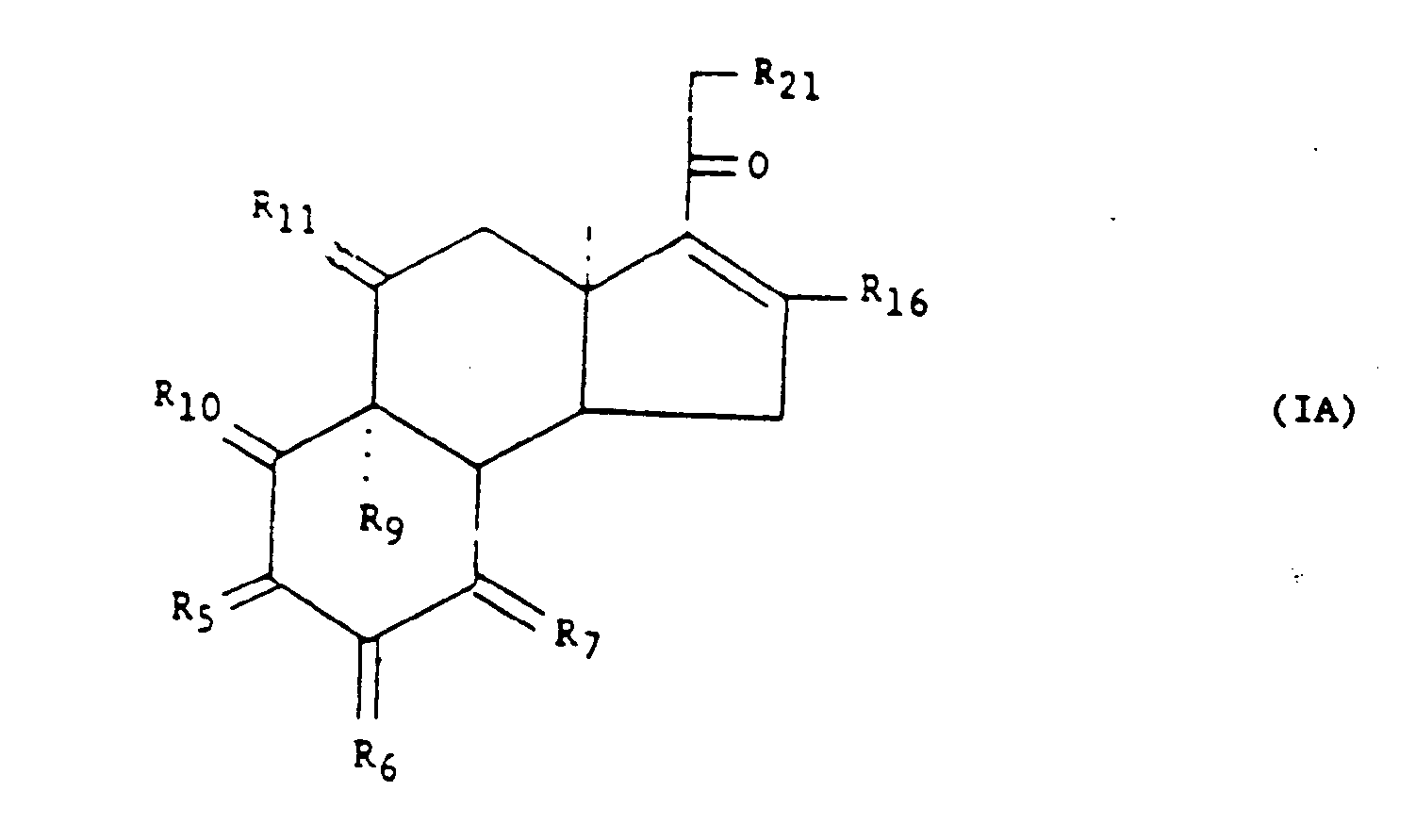
(A-I) R₆ = α-R₆₋₁:β-R₆₋₂, R₁₀ = α-R₁₀₋₁:β-R₁₀₋₂ und R₇ = α-H:β-H, wobei einer der Reste R₆₋₁ und R₆₋₂ für -H steht und der andere -H, -F oder -CH₃ bedeutet, R₁₀₋₂ für -CH₃ steht, R₁₀₋₁ und R₅ zusammen -CH₂-CH₂-CO-CH= oder -CH=CH-CO-CH= darstellen;
(A-II) R₆ = R₆₋₃:R₆₋₄, R₇ = R₇₋₃:R₇₋₄, R₁₀ = α-R₁₀₋₃:β-R₁₀₋₄, wobei einer der Reste R₆₋₃ und R₆₋₄ für -H steht und der andere zusammen mit einem der Reste R₇₋₃ und R₇₋₄ eine zweite Bindung zwischen C₆ und C₇ bildet, und der andere der Reste R₇₋₃ und R₇₋₄ -H darstellt, R₁₀₋₄ für -CH₃ steht, R₁₀₋₃ und R₅ zusammen -CH₂-CH₂-CO-CH= oder -CH=CH-CO-CH= darstellen;
(C-I) R₁₁ = R₁₁₋₁:R₁₁₋₂, worin einer der Reste R₁₁₋₁ und R₁₁₋₂ zusammen mit R₉ eine zweite Bindung zwischen C₉ und C₁₁ ausbildet und der andere der Reste R₁₁₋₁ und R₁₁₋₂ für -H steht;
(C-II) R₁₁ = α-H:β-O-, wobei β-O- zusammen mit R₉ ein Epoxid zwischen C₉ und C₁₁ in der β-Konfiguration bildet;
(C-III) α-R₉ = -H, -Br, -Cl, -F und R₁₁ = =O oder α-R₁₁₋₃:β-R₁₁₋₄, worin einer der Reste R₁₁₋₃ und R₁₁₋₄ für -H steht und der andere der Reste R₁₁₋₃ und R₁₁₋₄ -H oder -OH darstellt;
(C-IV) R₉ = -OH und R₁₁ = α-H:β-H;
R₁₆ = -H oder -CH₃ und worin
R₂₁ die in Anspruch 1 angegebene Bedeutung besitzt, besteht. - Verfahren zur Herstellung eines 17E/17Z-Metallenolats (II) nach Anspruch 1, wobei das vorgeformte Kupferhydrid aus [(φ₃P)-CuH]₆, (CuH)x mit x = 1 bis 6, LiCuH₂, LiCu₂H₃, Li₂Cu₃H₅, Li₂CuH₃, Li₃CuH₄, Li₄CuH₅, LiCuH₆, Li₅CuH₆, CH₃CH₂CH₂-C≡C-CuHLi, tert.-Butyl-O-CuHLi oder φSCuHLi besteht.
- Verfahren zur Herstellung eines 17E/17Z-Metallenolats (II) nach Anspruch 1, wobei das Metallhydrid-Reduktionsmittel aus der GruppeA) (X₂)(X₃)Al-H mit X₂ und X₃, die gleich oder verschieden sind, gleich C₁-C₆ Alkyl;B) [Kation]⁺[(X₄)₃Aluminum-H]⁻, wobei das Kation aus Natrium, Kalium oder Lithium besteht und X₄ gleich oder verschieden -H oder -O-X₄₋₁ mit X₄₋₁ gleich C₁-C₆ Alkyl ist;C) (Metall)(X₅)₃B-H, wobei das Metall aus Natrium, Kalium oder Lithium besteht und X₅ = -H, C₁-C₆ Alkyl, -O-X₅₋₁, worin X₅₋₁ = C₁-C₆ Alkyl, -CO-X₅₋₁, worin X₅₋₁ die angegebene Bedeutung besitzt,
ausgewählt ist. - Verfahren zur Herstellung eines 17E/17Z-Metallenolats (II) nach Anspruch 1, worin die Kupferspezies aus der Gruppe:(1) Cu(I)X₆ mit X₆ gleich -CH₃, -Cl, -Br, -I, -CN, Acetat, Propionat;(2) Cu(II)(X₇)n mit X₇ gleich -CH₃, -Cl, -Br, -I, -CN, Sulfat, Acetat, Propionat;(3) Dilithiumtetrachlorocuprat (Li₂CuCl₄)ausgewählt ist.
- Verfahren zur Herstellung eines 17E/17Z-Metallenolats (II) nach Anspruch 1, durchgeführt in Gegenwart eines Liganden.
- Verfahren zur Herstellung eines 17E/17Z-Metallenolats (II) nach Anspruch 6, wobei der Ligand aus der Gruppe HMPA, DMI, DMPU, TMU, NMP, TES, DMAP, TMEDA und (X₂₀)₃P mit X₂₀ gleich C₁-C₈ Alkyl oder -φ ausgewählt ist.
- Verfahren zur Herstellung eines 17E-Silylethers (III)
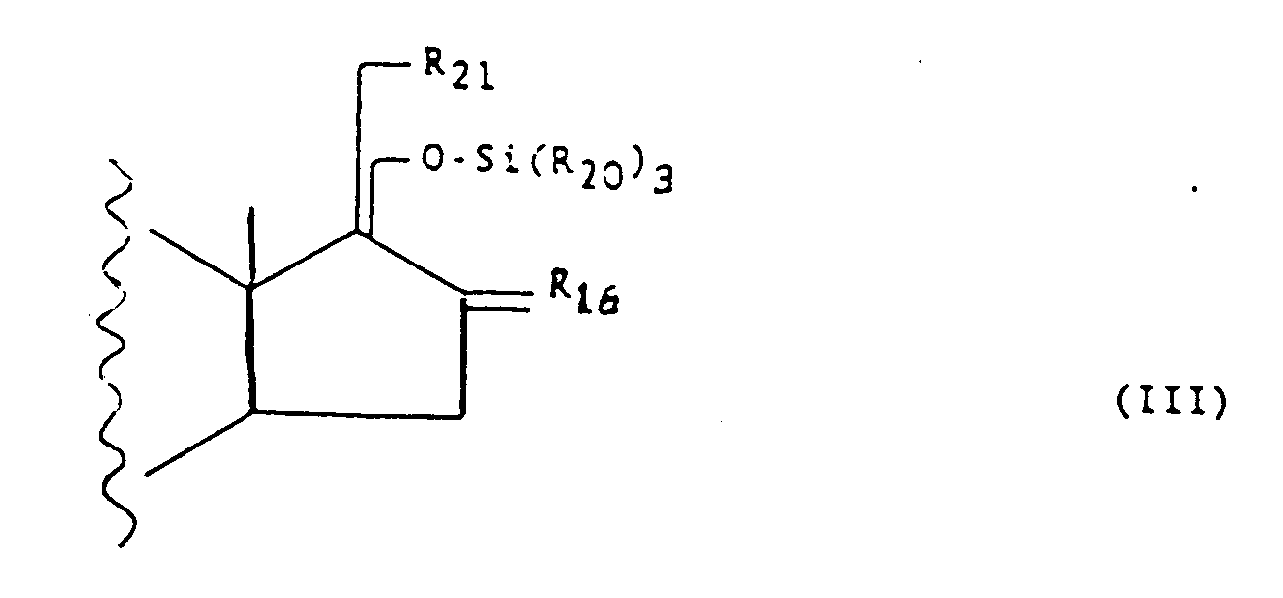 (1) eine Kombination aus einem Silylhalogenid der Formel X₁-Si(R₂₀)₃ mit X₁ gleich Cl, Br oder I und R₂₀ in der angegebenen Definition mit einem Aminkatalysator, ausgewählt aus Pyridin, Triazin, Tetrazin, einem Imidazol, 1,2,4-Triazol oder Tetrazol der Formeln:
 (2) ein Imidazol, 1,2,4-Triazol, Tetrazol oder Benzimidazol der angegebenen Definition mit einem Si(R₂₀)₃- Substituenten in der 1-, 1-, 1- bzw. 3-Stellung handelt.
 - Verfahren zur Herstellung eines 17E/17Z-Silylethers (III) nach Anspruch 8, wobei der Silylether (III) die Formel:

- Verfahren zur Herstellung eines 17E/17Z-Silylethers der Formel (III) nach Anspruch 8 durch Inberührungbringen eines Δ¹⁶-Steroids der Formel (I) entsprechend Anspruch 1 mit einem vorgebildeten Kupferhydrid oder einem Metallhydrid-Reduktionsmittel in Gegenwart einer Kupferspezies in Gegenwart eines Silylierungsmittels.
- Verfahren nach Anspruch 10, wobei das Δ¹⁶-Steroid (I) entsprechend Anspruch 2 definiert ist.
- Verfahren nach Anspruch 10, wobei das vorgebildete Kupferhydrid entsprechend Anspruch 3 definiert ist.
- Verfahren nach Anspruch 10, wobei das Metallhydrid-Reduktionsmittel entsprechend Anspruch 4 definiert ist.
- Verfahren nach Anspruch 10, wobei die Kupferspezies entsprechend Anspruch 5 definiert ist.
- Verfahren nach Anspruch 10, durchgeführt in Gegenwart eines Liganden.
- Verfahren nach Anspruch 15, wobei der Ligand entsprechend Anspruch 7 definiert ist.
- Verfahren nach Anspruch 10, wobei das Silylierungsmittel entweder aus einem Silylhalogenid entsprechend der Definition von Anspruch 8 in Gegenwart eines Aminkatalysators oder aus einem silylierten Imidazol, 1,2,4-Triazol, Tetrazol oder Benzimidazol entsprechend der Definition von Anspruch 8 besteht.
- Verfahren nach Anspruch 17, wobei der Aminkatalysator entsprechend Anspruch 8 definiert ist.
- Verfahren nach Anspruch 10 zur Herstellung eines Gemischs der 17Z- und 17E-Isomeren von
6α-Fluor-20,21-dihydroxypregna-1,4,9(11),17(20)-tetraen-3-on 21-acetat 20-trimethylsilylether,
20,21-Dihydroxy-16β-methylpregna-1,4,9(11),17(20)-tetraen-3-on 21-acetat 20-trimethylsilylether,
9β,11β-Epoxy-20,21-dihydroxypregna-1,4,17(20)-trien-3-on 21-acetat 20-trimethylsilyloxyether,
20,21-Dihydroxypregna-1,4,9(11),17(20)-tetraen-3-on 21-acetat 20-trimethylsilyloxyether oder
20,21-Dihydroxypregna-4,9(11),17(20)-trien-3-on 21-acetat 20-trimethylsilyloxyether.
Applications Claiming Priority (2)
| Application Number | Priority Date | Filing Date | Title |
|---|---|---|---|
| US360850 | 1982-03-22 | ||
| US07/360,850 US4975536A (en) | 1989-06-02 | 1989-06-02 | Conversion of a delta16-steroid to a delta17(20)-20-silyl ether |
Publications (2)
| Publication Number | Publication Date |
|---|---|
| EP0474668A1 EP0474668A1 (de) | 1992-03-18 |
| EP0474668B1 true EP0474668B1 (de) | 1993-08-25 |
Family
ID=23419651
Family Applications (1)
| Application Number | Title | Priority Date | Filing Date |
|---|---|---|---|
| EP90907636A Expired - Lifetime EP0474668B1 (de) | 1989-06-02 | 1990-05-15 | Umwandlung eines delta-16-steroids in einen delta-17(20)-20 silylether |
Country Status (16)
| Country | Link |
|---|---|
| US (1) | US4975536A (de) |
| EP (1) | EP0474668B1 (de) |
| JP (2) | JP3037748B2 (de) |
| KR (1) | KR0137967B1 (de) |
| AT (1) | ATE93525T1 (de) |
| AU (1) | AU5637890A (de) |
| CA (1) | CA2051670C (de) |
| DE (1) | DE69002948T2 (de) |
| DK (1) | DK0474668T3 (de) |
| ES (1) | ES2058916T3 (de) |
| FI (1) | FI103121B (de) |
| HK (1) | HK153796A (de) |
| HU (1) | HU210757B (de) |
| PL (1) | PL165313B1 (de) |
| RU (1) | RU2070887C1 (de) |
| WO (1) | WO1990015068A1 (de) |
Families Citing this family (4)
| Publication number | Priority date | Publication date | Assignee | Title |
|---|---|---|---|---|
| GB2460361B (en) | 2007-03-08 | 2011-12-07 | Honda Motor Co Ltd | Method and device for immersion treatment of vehicle |
| HUE027463T2 (en) | 2008-05-28 | 2016-09-28 | Reveragen Biopharma Inc | Non-hormonal steroid modulators of nf-kb for treatment of disease |
| US10799514B2 (en) | 2015-06-29 | 2020-10-13 | Reveragen Biopharma, Inc. | Non-hormonal steroid modulators of NF-kappa beta for treatment of disease |
| US11382922B2 (en) | 2019-03-07 | 2022-07-12 | Reveragen Biopharma, Inc. | Aqueous oral pharmaceutical suspension compositions |
Family Cites Families (3)
| Publication number | Priority date | Publication date | Assignee | Title |
|---|---|---|---|---|
| US4704455A (en) * | 1984-06-11 | 1987-11-03 | The Upjohn Company | 16α-methylatedΔ17(20)-corticoids |
| US4568492A (en) * | 1984-09-14 | 1986-02-04 | The Upjohn Company | Δ16-20-Keto steroid conversion to 17α-hydroxy-20-keto steroids |
| DE3777652D1 (de) * | 1986-06-04 | 1992-04-23 | Upjohn Co | Verfahren zur 16-alpha methylierung. |
-
1989
- 1989-06-02 US US07/360,850 patent/US4975536A/en not_active Expired - Lifetime
-
1990
- 1990-05-15 CA CA002051670A patent/CA2051670C/en not_active Expired - Fee Related
- 1990-05-15 KR KR1019910701736A patent/KR0137967B1/ko not_active Expired - Fee Related
- 1990-05-15 EP EP90907636A patent/EP0474668B1/de not_active Expired - Lifetime
- 1990-05-15 HU HU904267A patent/HU210757B/hu not_active IP Right Cessation
- 1990-05-15 JP JP02507608A patent/JP3037748B2/ja not_active Expired - Fee Related
- 1990-05-15 DK DK90907636.6T patent/DK0474668T3/da active
- 1990-05-15 RU SU905010602A patent/RU2070887C1/ru not_active IP Right Cessation
- 1990-05-15 ES ES90907636T patent/ES2058916T3/es not_active Expired - Lifetime
- 1990-05-15 AU AU56378/90A patent/AU5637890A/en not_active Abandoned
- 1990-05-15 DE DE90907636T patent/DE69002948T2/de not_active Expired - Fee Related
- 1990-05-15 AT AT90907636T patent/ATE93525T1/de not_active IP Right Cessation
- 1990-05-15 WO PCT/US1990/002623 patent/WO1990015068A1/en not_active Ceased
- 1990-06-01 JP JP2144269A patent/JPH0324475A/ja active Pending
- 1990-06-01 PL PL90285438A patent/PL165313B1/pl not_active IP Right Cessation
-
1991
- 1991-12-02 FI FI915675A patent/FI103121B/fi not_active IP Right Cessation
-
1996
- 1996-08-08 HK HK153796A patent/HK153796A/en not_active IP Right Cessation
Also Published As
| Publication number | Publication date |
|---|---|
| JPH0324475A (ja) | 1991-02-01 |
| CA2051670A1 (en) | 1990-12-03 |
| RU2070887C1 (ru) | 1996-12-27 |
| ATE93525T1 (de) | 1993-09-15 |
| WO1990015068A1 (en) | 1990-12-13 |
| KR0137967B1 (ko) | 1998-04-30 |
| DK0474668T3 (da) | 1993-11-29 |
| FI103121B1 (fi) | 1999-04-30 |
| DE69002948D1 (de) | 1993-09-30 |
| HUT59146A (en) | 1992-04-28 |
| JPH04506065A (ja) | 1992-10-22 |
| PL165313B1 (en) | 1994-12-30 |
| JP3037748B2 (ja) | 2000-05-08 |
| PL285438A1 (en) | 1991-12-02 |
| KR920701233A (ko) | 1992-08-11 |
| AU5637890A (en) | 1991-01-07 |
| DE69002948T2 (de) | 1994-01-20 |
| FI103121B (fi) | 1999-04-30 |
| HU904267D0 (en) | 1992-02-28 |
| EP0474668A1 (de) | 1992-03-18 |
| ES2058916T3 (es) | 1994-11-01 |
| HK153796A (en) | 1996-08-16 |
| US4975536A (en) | 1990-12-04 |
| HU210757B (en) | 1995-07-28 |
| CA2051670C (en) | 1998-06-16 |
| FI915675A0 (fi) | 1991-12-02 |
Similar Documents
| Publication | Publication Date | Title |
|---|---|---|
| JP7311921B2 (ja) | コレステロール、その誘導体及び類似体を調製するための方法 | |
| JP5061061B2 (ja) | 9α,21−ジハロ−プレグナン−11β,17α−ジオール−20−オンの17−エステルの調製のためのプロセス | |
| EP2019114B1 (de) | Herstellungsverfahren für Drospirenon | |
| KR960006394B1 (ko) | 스테로이달 17α-실릴 에테르 및 코르티코이드와 프로게스테론의 제조 방법 | |
| Ito et al. | New stereoselective synthesis of steroids | |
| JP2006508962A (ja) | C−7置換5−アンドロステンの製造方法 | |
| HK153796A (en) | Conversion of delta 16-steroid to a delta 17(20)-20-silyl ether | |
| JP5430603B2 (ja) | ググルステロン及びググルステロールの製造方法 | |
| US4342702A (en) | Metallated halogenated acetylene corticoid synthesis | |
| JPS62158300A (ja) | 10β−アルキニルエストレン誘導体およびそれらの製造法 | |
| EP0532562A1 (de) | VERFAHREN ZUR HERSTELLUNG VON 10-g(b)-H-STEROIDEN. | |
| RU2165938C1 (ru) | СПОСОБ ПОЛУЧЕНИЯ 17β-ГИДРОКСИ-11β-[4-(ДИМЕТИЛАМИНО)ФЕНИЛ]-17α-(ПРОП-1-ИНИЛ)-ЭСТРА-4,9 -ДИЕН-3-ОНА | |
| HU189142B (en) | Process for producing 21-halogen-steroids | |
| US4871482A (en) | Process for the preparation of 1-methylandrosta-1,4-diene-3,17,dione, and the novel intermediates for this process | |
| JPH0480889B2 (de) | ||
| JP3588367B2 (ja) | 1β−ヒドロキシ−1α−低級アルキルビタミンD誘導体 | |
| EP0378563B1 (de) | Herstellung von corticoiden aus steroidischen 17-cyanohydrinen | |
| JP3532488B2 (ja) | ビタミンd合成の中間体 | |
| Kurek-Tyrlik et al. | Towards synthesis of calysterols, marine sterols with cyclopropene moiety in the side chain: Synthesis of 26, 27-dinor-23H-isocalysterol | |
| RU2339642C2 (ru) | Способы получения эплеренона | |
| Baranovskii et al. | Synthesis of 15β-hydroxyalkyl-substituted (17 Z)-pregn-17-enes, their ethers and esters | |
| JP2501604B2 (ja) | コレスタ―1,4,6−トリエン−3−オン類の製造法 | |
| JP2750170B2 (ja) | ステロイド誘導体の製造法 | |
| WO2002038582A2 (de) | Verfahren zur herstellung von 4-(17alpha-(substituierten-methyl)-3-oxoestra-4,9 dien-11-yl)benzaldehyd-(1e oder 1z)-oximen |
Legal Events
| Date | Code | Title | Description |
|---|---|---|---|
| PUAI | Public reference made under article 153(3) epc to a published international application that has entered the european phase |
Free format text: ORIGINAL CODE: 0009012 |
|
| 17P | Request for examination filed |
Effective date: 19911220 |
|
| AK | Designated contracting states |
Kind code of ref document: A1 Designated state(s): AT BE CH DE DK ES FR GB IT LI LU NL SE |
|
| 17Q | First examination report despatched |
Effective date: 19920619 |
|
| GRAA | (expected) grant |
Free format text: ORIGINAL CODE: 0009210 |
|
| AK | Designated contracting states |
Kind code of ref document: B1 Designated state(s): AT BE CH DE DK ES FR GB IT LI LU NL SE |
|
| REF | Corresponds to: |
Ref document number: 93525 Country of ref document: AT Date of ref document: 19930915 Kind code of ref document: T |
|
| ITF | It: translation for a ep patent filed | ||
| REF | Corresponds to: |
Ref document number: 69002948 Country of ref document: DE Date of ref document: 19930930 |
|
| ET | Fr: translation filed | ||
| REG | Reference to a national code |
Ref country code: DK Ref legal event code: T3 |
|
| EPTA | Lu: last paid annual fee | ||
| PLBE | No opposition filed within time limit |
Free format text: ORIGINAL CODE: 0009261 |
|
| STAA | Information on the status of an ep patent application or granted ep patent |
Free format text: STATUS: NO OPPOSITION FILED WITHIN TIME LIMIT |
|
| 26N | No opposition filed | ||
| REG | Reference to a national code |
Ref country code: ES Ref legal event code: FG2A Ref document number: 2058916 Country of ref document: ES Kind code of ref document: T3 |
|
| EAL | Se: european patent in force in sweden |
Ref document number: 90907636.6 |
|
| NLT1 | Nl: modifications of names registered in virtue of documents presented to the patent office pursuant to art. 16 a, paragraph 1 |
Owner name: PHARMACIA & UPJOHN COMPANY |
|
| REG | Reference to a national code |
Ref country code: CH Ref legal event code: PFA Free format text: THE UPJOHN COMPANY TRANSFER- PHARMACIA & UPJOHN COMPANY |
|
| REG | Reference to a national code |
Ref country code: FR Ref legal event code: CD |
|
| REG | Reference to a national code |
Ref country code: ES Ref legal event code: PC2A |
|
| REG | Reference to a national code |
Ref country code: GB Ref legal event code: IF02 |
|
| PGFP | Annual fee paid to national office [announced via postgrant information from national office to epo] |
Ref country code: GB Payment date: 20050406 Year of fee payment: 16 Ref country code: AT Payment date: 20050406 Year of fee payment: 16 |
|
| PGFP | Annual fee paid to national office [announced via postgrant information from national office to epo] |
Ref country code: NL Payment date: 20050407 Year of fee payment: 16 Ref country code: DK Payment date: 20050407 Year of fee payment: 16 |
|
| PGFP | Annual fee paid to national office [announced via postgrant information from national office to epo] |
Ref country code: SE Payment date: 20050503 Year of fee payment: 16 |
|
| PGFP | Annual fee paid to national office [announced via postgrant information from national office to epo] |
Ref country code: FR Payment date: 20050517 Year of fee payment: 16 |
|
| PGFP | Annual fee paid to national office [announced via postgrant information from national office to epo] |
Ref country code: ES Payment date: 20050519 Year of fee payment: 16 |
|
| PGFP | Annual fee paid to national office [announced via postgrant information from national office to epo] |
Ref country code: BE Payment date: 20050527 Year of fee payment: 16 |
|
| PGFP | Annual fee paid to national office [announced via postgrant information from national office to epo] |
Ref country code: DE Payment date: 20050531 Year of fee payment: 16 |
|
| PGFP | Annual fee paid to national office [announced via postgrant information from national office to epo] |
Ref country code: LU Payment date: 20050603 Year of fee payment: 16 |
|
| PGFP | Annual fee paid to national office [announced via postgrant information from national office to epo] |
Ref country code: CH Payment date: 20050613 Year of fee payment: 16 |
|
| PG25 | Lapsed in a contracting state [announced via postgrant information from national office to epo] |
Ref country code: GB Free format text: LAPSE BECAUSE OF NON-PAYMENT OF DUE FEES Effective date: 20060515 Ref country code: AT Free format text: LAPSE BECAUSE OF NON-PAYMENT OF DUE FEES Effective date: 20060515 |
|
| PG25 | Lapsed in a contracting state [announced via postgrant information from national office to epo] |
Ref country code: SE Free format text: LAPSE BECAUSE OF NON-PAYMENT OF DUE FEES Effective date: 20060516 Ref country code: ES Free format text: LAPSE BECAUSE OF NON-PAYMENT OF DUE FEES Effective date: 20060516 |
|
| PG25 | Lapsed in a contracting state [announced via postgrant information from national office to epo] |
Ref country code: LI Free format text: LAPSE BECAUSE OF NON-PAYMENT OF DUE FEES Effective date: 20060531 Ref country code: DK Free format text: LAPSE BECAUSE OF NON-PAYMENT OF DUE FEES Effective date: 20060531 Ref country code: CH Free format text: LAPSE BECAUSE OF NON-PAYMENT OF DUE FEES Effective date: 20060531 Ref country code: BE Free format text: LAPSE BECAUSE OF NON-PAYMENT OF DUE FEES Effective date: 20060531 |
|
| PGFP | Annual fee paid to national office [announced via postgrant information from national office to epo] |
Ref country code: IT Payment date: 20060531 Year of fee payment: 17 |
|
| PG25 | Lapsed in a contracting state [announced via postgrant information from national office to epo] |
Ref country code: NL Free format text: LAPSE BECAUSE OF NON-PAYMENT OF DUE FEES Effective date: 20061201 Ref country code: DE Free format text: LAPSE BECAUSE OF NON-PAYMENT OF DUE FEES Effective date: 20061201 |
|
| REG | Reference to a national code |
Ref country code: CH Ref legal event code: PL Ref country code: DK Ref legal event code: EBP |
|
| EUG | Se: european patent has lapsed | ||
| GBPC | Gb: european patent ceased through non-payment of renewal fee |
Effective date: 20060515 |
|
| NLV4 | Nl: lapsed or anulled due to non-payment of the annual fee |
Effective date: 20061201 |
|
| REG | Reference to a national code |
Ref country code: FR Ref legal event code: ST Effective date: 20070131 |
|
| REG | Reference to a national code |
Ref country code: ES Ref legal event code: FD2A Effective date: 20060516 |
|
| BERE | Be: lapsed |
Owner name: *PHARMACIA & UPJOHN CY Effective date: 20060531 |
|
| PG25 | Lapsed in a contracting state [announced via postgrant information from national office to epo] |
Ref country code: FR Free format text: LAPSE BECAUSE OF NON-PAYMENT OF DUE FEES Effective date: 20060531 |
|
| PG25 | Lapsed in a contracting state [announced via postgrant information from national office to epo] |
Ref country code: LU Free format text: LAPSE BECAUSE OF NON-PAYMENT OF DUE FEES Effective date: 20060515 |
|
| PG25 | Lapsed in a contracting state [announced via postgrant information from national office to epo] |
Ref country code: IT Free format text: LAPSE BECAUSE OF NON-PAYMENT OF DUE FEES Effective date: 20070515 |