EP0471007B1 - Filtre d'absorption pour dispositifs d'affichage en couleur - Google Patents
Filtre d'absorption pour dispositifs d'affichage en couleur Download PDFInfo
- Publication number
- EP0471007B1 EP0471007B1 EP90907670A EP90907670A EP0471007B1 EP 0471007 B1 EP0471007 B1 EP 0471007B1 EP 90907670 A EP90907670 A EP 90907670A EP 90907670 A EP90907670 A EP 90907670A EP 0471007 B1 EP0471007 B1 EP 0471007B1
- Authority
- EP
- European Patent Office
- Prior art keywords
- color
- areas
- elements
- filter
- primary
- Prior art date
- Legal status (The legal status is an assumption and is not a legal conclusion. Google has not performed a legal analysis and makes no representation as to the accuracy of the status listed.)
- Expired - Lifetime
Links
- 238000010521 absorption reaction Methods 0.000 title abstract description 12
- 239000000835 fiber Substances 0.000 claims description 34
- 239000003086 colorant Substances 0.000 claims description 21
- 239000000758 substrate Substances 0.000 claims description 21
- 238000000034 method Methods 0.000 claims description 14
- 230000003287 optical effect Effects 0.000 claims description 13
- 230000005540 biological transmission Effects 0.000 claims description 12
- 238000009826 distribution Methods 0.000 claims description 7
- 238000004519 manufacturing process Methods 0.000 claims description 6
- 238000001228 spectrum Methods 0.000 claims description 6
- 239000011521 glass Substances 0.000 claims description 5
- 239000011347 resin Substances 0.000 claims description 2
- 229920005989 resin Polymers 0.000 claims description 2
- 238000000059 patterning Methods 0.000 claims 7
- 239000011248 coating agent Substances 0.000 claims 3
- 238000000576 coating method Methods 0.000 claims 3
- 230000001681 protective effect Effects 0.000 claims 3
- 108010010803 Gelatin Proteins 0.000 claims 2
- 229920000159 gelatin Polymers 0.000 claims 2
- 239000008273 gelatin Substances 0.000 claims 2
- 235000019322 gelatine Nutrition 0.000 claims 2
- 235000011852 gelatine desserts Nutrition 0.000 claims 2
- 230000002745 absorbent Effects 0.000 claims 1
- 239000002250 absorbent Substances 0.000 claims 1
- 238000000151 deposition Methods 0.000 claims 1
- OAICVXFJPJFONN-UHFFFAOYSA-N Phosphorus Chemical compound [P] OAICVXFJPJFONN-UHFFFAOYSA-N 0.000 abstract description 27
- 239000004973 liquid crystal related substance Substances 0.000 abstract description 3
- 239000000463 material Substances 0.000 description 16
- 239000010410 layer Substances 0.000 description 8
- 230000000694 effects Effects 0.000 description 6
- 230000007935 neutral effect Effects 0.000 description 6
- 239000002245 particle Substances 0.000 description 4
- 238000010894 electron beam technology Methods 0.000 description 3
- 238000001914 filtration Methods 0.000 description 3
- 239000003365 glass fiber Substances 0.000 description 3
- 239000012790 adhesive layer Substances 0.000 description 2
- 239000002131 composite material Substances 0.000 description 2
- 238000000295 emission spectrum Methods 0.000 description 2
- 239000000725 suspension Substances 0.000 description 2
- 239000010409 thin film Substances 0.000 description 2
- 238000001429 visible spectrum Methods 0.000 description 2
- OKTJSMMVPCPJKN-UHFFFAOYSA-N Carbon Chemical compound [C] OKTJSMMVPCPJKN-UHFFFAOYSA-N 0.000 description 1
- 239000011358 absorbing material Substances 0.000 description 1
- 238000000862 absorption spectrum Methods 0.000 description 1
- 239000000853 adhesive Substances 0.000 description 1
- 230000001070 adhesive effect Effects 0.000 description 1
- 238000003491 array Methods 0.000 description 1
- 230000002238 attenuated effect Effects 0.000 description 1
- 238000005253 cladding Methods 0.000 description 1
- 239000000470 constituent Substances 0.000 description 1
- 238000010276 construction Methods 0.000 description 1
- 230000001419 dependent effect Effects 0.000 description 1
- SOCTUWSJJQCPFX-UHFFFAOYSA-N dichromate(2-) Chemical compound [O-][Cr](=O)(=O)O[Cr]([O-])(=O)=O SOCTUWSJJQCPFX-UHFFFAOYSA-N 0.000 description 1
- 239000006185 dispersion Substances 0.000 description 1
- 239000000839 emulsion Substances 0.000 description 1
- 229910002804 graphite Inorganic materials 0.000 description 1
- 239000010439 graphite Substances 0.000 description 1
- 239000007943 implant Substances 0.000 description 1
- 238000005304 joining Methods 0.000 description 1
- 239000000203 mixture Substances 0.000 description 1
- 239000000382 optic material Substances 0.000 description 1
- 229920002120 photoresistant polymer Polymers 0.000 description 1
- 239000000049 pigment Substances 0.000 description 1
- 239000011253 protective coating Substances 0.000 description 1
- 238000000926 separation method Methods 0.000 description 1
- 229910052709 silver Inorganic materials 0.000 description 1
- 239000004332 silver Substances 0.000 description 1
- 239000002356 single layer Substances 0.000 description 1
- 230000003595 spectral effect Effects 0.000 description 1
- 230000007704 transition Effects 0.000 description 1
- 238000000411 transmission spectrum Methods 0.000 description 1
- 238000002834 transmittance Methods 0.000 description 1
- 239000012780 transparent material Substances 0.000 description 1
Images

Classifications
-
- H—ELECTRICITY
- H01—ELECTRIC ELEMENTS
- H01J—ELECTRIC DISCHARGE TUBES OR DISCHARGE LAMPS
- H01J29/00—Details of cathode-ray tubes or of electron-beam tubes of the types covered by group H01J31/00
- H01J29/86—Vessels; Containers; Vacuum locks
- H01J29/89—Optical or photographic arrangements structurally combined or co-operating with the vessel
-
- H—ELECTRICITY
- H01—ELECTRIC ELEMENTS
- H01J—ELECTRIC DISCHARGE TUBES OR DISCHARGE LAMPS
- H01J29/00—Details of cathode-ray tubes or of electron-beam tubes of the types covered by group H01J31/00
- H01J29/02—Electrodes; Screens; Mounting, supporting, spacing or insulating thereof
- H01J29/10—Screens on or from which an image or pattern is formed, picked up, converted or stored
- H01J29/18—Luminescent screens
- H01J29/185—Luminescent screens measures against halo-phenomena
-
- G—PHYSICS
- G02—OPTICS
- G02B—OPTICAL ELEMENTS, SYSTEMS OR APPARATUS
- G02B5/00—Optical elements other than lenses
- G02B5/20—Filters
- G02B5/201—Filters in the form of arrays
-
- H—ELECTRICITY
- H01—ELECTRIC ELEMENTS
- H01J—ELECTRIC DISCHARGE TUBES OR DISCHARGE LAMPS
- H01J29/00—Details of cathode-ray tubes or of electron-beam tubes of the types covered by group H01J31/00
- H01J29/86—Vessels; Containers; Vacuum locks
- H01J29/89—Optical or photographic arrangements structurally combined or co-operating with the vessel
- H01J29/898—Spectral filters
-
- H—ELECTRICITY
- H01—ELECTRIC ELEMENTS
- H01J—ELECTRIC DISCHARGE TUBES OR DISCHARGE LAMPS
- H01J2229/00—Details of cathode ray tubes or electron beam tubes
- H01J2229/89—Optical components associated with the vessel
- H01J2229/8913—Anti-reflection, anti-glare, viewing angle and contrast improving treatments or devices
- H01J2229/8916—Anti-reflection, anti-glare, viewing angle and contrast improving treatments or devices inside the vessel
Definitions
- the invention relates to an optical filter for contrast enhancement of a colour display according to the first part of claim 1.
- a filter is known from DE-U-8 512 243.
- the invention relates also to methods of making such filters.
- the invention pertains generally to contrast enhancement filters for viewing color displays, and more particularly to absorption filters providing improved viewability under conditions of high ambient light levels.
- One known prior art type of filter uses neutral density filtration. This has been achieved by providing colloidal suspensions such as silver in the glass composition of the faceplate or the implosion panel, or a colloidal graphite suspension within an adhesive material used to bond the implosion panel to the faceplate, as in U.S. Patent 3,879,627.
- This type of filter transmits a fraction of the light passing through it, which fraction is independent of the color emissions (i.e., wavelength ). Since the light from the display passes through the filter once, while ambient light reflected from the display must pass through the filter twice, the ratio of display brightness to ambient background brightness is thereby enhanced.
- contrast is enhanced by the greater losses suffered by the ambient light in its reflected passage through the filter, as against a single passage through the filter of internally produced display light of monochromatic wavelength.
- the narrow band filter absorbs substantially all the ambient light. Therefore the contrast ratio, defined herein as the ratio of display brightness plus background brightness to background ambient brightness, is much greater with a narrow band filter than with a neutral density filter.
- this approach requires a different colorant for each type of phosphor screen.
- Optical filters utilized by the prior art for color displays include absorption filters and thin film filters.
- An absorption filter is herein defined as one adapted to pass a narrow spectrum of light and substantially absorb all others. Such filters are relatively independent of the viewing angle.
- Color displays such as are provided by color cathode ray tubes, typically emit three primary color wavelengths, such as red, green and blue, which may be combined to derive many colors.
- the ideal filter for a color CRT is comprised of three individually operative pass bands, each transmitting a narrow band of red, green or blue wavelengths emitted by the display. Materials are known which permit reasonably selective transmission of each of these wavelengths individually.
- a further prior art approach that does not rely on absorbing materials to produce the desired transmission characteristics uses complex multilayer optical thin films or holograms.
- the effectiveness of these types of filters is reduced by a strong angular dependence inherent in the filter.
- the transmittance and reflectance properties are determined by interference phenomena which depend on optical path length which in turn depends on the viewing angle. Therefore, these filters are appropriate only in systems whose viewing angle is tightly constrained.
- GB-A-2 178 226 shows a similar filter where a fiber optic faceplate is used to separate the color phosphor dot groups from a corresponding distribution of filter dot groups.
- the present invention overcomes the disadvantages of the prior art by providing a contrast enhancement filter according to claim 1 containing absorptive dye colorants which are spatially separated. Each color element can therefore act independently of the others. Since absorption effects are used rather than interference effects, the filter performance is essentially independent of angle of vision over a broad viewing range.
- the invention comprises a planar substrate in which are defined a plurality of spaced areas of a predetermined color transmissibility. Each area is selectively dyed to transmit a narrow band color spectrum and substantially to absorb other color wavelengths.
- the colored areas are patterned so that a plurality of such areas comprising at least one primary color wavelength overlay each of the discrete light-responsive elements of a corresponding primary color wavelength of a color display, wherein each of said elements is adapted for emitting or transmitting light in a predetermined primary color wavelength.
- particles of fiber-optic material are selectively dyed to provide a narrow-band transmission of the primary colors, and dispersed within the base material of a planar substrate.
- the fiber-optic particles are selected to have identical indices of refraction to avoid unwanted collimating of the display information, sized so that a plurality of fibers of a given primary absorption characteristic are overlaid on a corresponding primary emission color dot.
- the particles will be randonly disposed over the color dots to avoid Moire' effects.
- Fig. 1 is an elevation view partly in vertical section of a cathode ray tube.
- Fig. 2 is an enlarged sectional view of a portion of the faceplate of the tube shown in Fig. 1, illustrating a contrast enhancement filter.
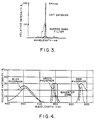
- Fig. 3 is a graph illustrating the light transmission characteristics of a typical monochrome filter.
- Fig. 4 is a graph illustrating the desired bandpass characteristics of an optimum color filter.
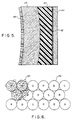
- Fig. 5 is an enlarged sectional view of a portion of the faceplate of the tube shown in Fig. 1 embodying the invention.
- Fig. 6 is a diagrammatic representation of the structure of the present invention, showing a portion of the screen of the tube of Fig. 1 in plan view.
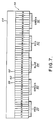
- Fig. 7 is an enlarged view in cross-section of an optical filter as in Fig. 6 emphasizing the fiber-optic filter elements, as in the present invention.
- Fig. 1 is a view showing a cathode ray display tube 10 or other luminescent display device. Electrical terminals 12 project longitudinally from a vacuum sealed envelope 14 including a cylindical neck portion 16, a viewing of faceplate face 18, and a transition section 20 joining the latter two elements.
- the display tube 10 may also include the usual internal elements (not shown) in the form of a cathode for emitting an electron beam, an anode, an electron beam deflecting structure, and a phosphor layer 22 affixed to the inner surface of the faceplate 18.
- Figures 1 and 2 refer to a structure in which a contrast enhancement filter 24 is affixed to the outer surface of the faceplate 18. While this illustrates a bonded filter, this structure is to be considered exemplary and not limiting. The objective of the configuration is to provide clearly to the viewer an undisturbed view of images formed by the electron beam on the cathode ray phosphor screen within the faceplate 18 under a wide range of ambient viewing conditions.
- Fig. 2 shows a light beam 30 emitted by the phosphor screen 22 as it passes through the faceplate 18, bonding layer 32, and contrast filter 24.
- ambient light rays 34 falling on the phosphor layer 22 will seriously interfere with the visibility of the light image produced by phosphor layer 22 by producing reflected rays 36.
- ambient light is considerably reduced with respect to the emitted light beams 30 by means of neutral density filtering which is achieved within the contrast filter 24. This filter effect occurs since the direct ray 30 is attenuated only once in its passage through filter 24, while the incident ray 34 must pass twice through the filter, thus incurring a higher degree of attenuation.
- the filter may be bonded to the faceplate 18 by a transparent adhesive layer 32 contained between the viewing face of the faceplate 18 and inner face of the filter 24. It is desirable that the materials of the cathode ray tube faceplate 18, the filter 24, and the adhesive layer 32 bonding together have substantially the same index of refraction, thereby eliminating undesirable reflections due to refractive mismatches at the interfaces.
- the light emitted by the phosphor 22 is desirably limited to a predetermined narrow region of the visible spectrum by appropriate selection of the phosphor material.
- a typical phosphor is the conventional P-43 phosphor having most of its energy concentrated in the green portion of the visible spectrum, having a wavelength of about 544 nanometers, as shown in Fig. 3. Accordingly, such CRT's can be more effectively filtered by a narrow-band filter which transmits the green wavelength spectrum, but absorbs all other incident wavelengths, than they can by a neutral density filter.
- Fig. 4 shows the emission spectra of a color cathode ray tube, having blue, green, and red components.
- the present invention provides a contrast enhancement filter for color displays (particularly shadow-mask CRT's) which performs in a manner similar to high performance narrow-band contrast enhancement filters presently used for monochrome displays.
- the present invention provides a filter transmission characteristic which closely matches the emission spectrum of the display, as shown in Fig. 4. To achieve this result with an absorbing dye which absorbs three appropriate narrow-band spectra has not proven feasible. Rather, this invention randomly disposes a plurality of individual dye materials within the filter, each of the dye materials having the proper spectral distribution for transmitting one and only one primary color.
- Fig. 5 shows an embodiment of the invention in which the filter is implemented in the form of a substantially transparent planar substrate 40 on which are located colored pigment dye areas 42.
- the composite filter plate may be adhered to the outer surface of the faceplate 18 by a transparent resin 32 or heat bonded in a furnace.
- Triads of phosphor elements 46 comprising phosphor layer 22 of the viewing screen are deposited in the inner surface of the faceplate 18.
- Another approach to fabrication of the absorbing filter is through application of absorbing filter materials, patterned using photolithographic techniques.
- One such technique is to provide a substrate of transparent material, coated with a photoresist material such as dichromate.
- the resist is patterned to provide a plurality of dots in a random pattern, corresponding to a statistical distribution of the primary red, green, and blue color elements.
- a dye having a color value corresponding to a selected primary color is applied to the patterned substrate, which is then coated with a transparent protective coating. This process is repeated with a second and third layer of material, each layer corresponding to a given one primary color, and the dot pattern being disposed so that dots in different layers do not overlap.
- Another process is adapted from a method used for fabricating color faceplates for liquid crystal displays.
- a single substrate is patterned with three groups of transparent, electrically conductive dots corresponding to the red, green, and blue primary colors desired in the finished color filter.
- Each group is comprised of a plurality of electrically interconnected dots which will be commonly colored.
- the groups are then selectively electroplated with an appropriately colored dye material.
- the filter plate may be designed to have substantial thickness, which offers certain advantages over the planar structure described above.
- One structure for implementing controlled thickness of the colored areas is to implant colored glass fibers.
- a filter structure of this type may be fabricated by modifying techniques well known in the art for fabricating fiber-optic collimating plates. While the prior art uses clear glass fibers, here colored fibers are used.
- a glass blank is doped with a colorant representing a primary color and drawn into a fiber.
- the fiber is then cut into sections and the lengths fused with fibers of other primary colors to form a fiber packet comprised of three primary colors, red, green, and blue, whose transmission spectra correspond to those desired to individually act as narrow band filters for each light-emitting phosphor dot.
- the packet is then drawn, fused, and the process repeated until the desired fiber diameter is reached.
- the resultant fused fibers are then distributed in a random pattern and fused to provide a cohesive R-G-B group of fibers.
- the fused fibers may be bonded to a transparent substrate and the resulting filter plate can be lapped to provide a predetermined fiber depth and predetermined thickness and flatness of the plate.
- the filter plate may be bonded to a faceplate or alternatively may be adapted for use as a faceplate 18 of a CRT, thus obviating the need for a separate faceplate and filter, thereby improving optical efficiency as well as simplifying construction, as compared to the laminated or composite structure.
- Fig. 7 shows in schematic form an enlarged cross-sectional view of such a fiber-optic faceplate.
- Red, green and blue phosphor dots 50, 52, 54 are sequentially disposed on the faceplate 56 which is comprised of a clear glass plate 64 on which are embedded a plurality of red, green and blue dyed fibers 58, 60, 62.
- Each fiber 58, 60, 62 absorbs light independently because of the spacial dispersion with respect to each other and with respect to the phosphor color dots.
- the viewing angle is determined by the fiber dimensions and the thickness of the plate. For good optical properties, both surfaces of the filter will be lapped to a desired flatness.
- Shadow mask CRT's generally have phosphor dots of greater than 0,114 mm (0.0045 inch) diameter. Therefore, filter elements having dimensions of 0,038 mm (0,0015 inch) smaller are suitable.
- the index of refraction of all fibers must be closely matched. If not matched, fibers of lower index will act as a cladding for fibers of higher index and produce an undesirable angular property in which the viewing angle of each color is different.
- the fiber-optic filter can be designed to have a specific acceptable angle, beyond which all light will be absorbed.
- This directional property depends on the length of the fiber with respect to the spacing between fibers of different colors. When the optical path through the filter requires passage through different colored fibers, all light will be absorbed.
- This property can be tailored to any acceptable angle by adjusting the length of the fiber, and can be useful when complete absorption of ambient light incident on the display from angles beyond a specified acceptance angle is desired.
- a fiber length equal to its diameter will provide a viewing angle of about 45 degrees, while a length of twice the diameter will limit the viewing angle to about 30 degrees.
- the present invention is applied to a color CRT display tube.
- a shadow mask CRT display it is well known to those skilled in the color CRT art that separate beams of energy are generated, usually from three separate electron guns, which beams are normally focused on a phosphor screen through a mask spaced from the interior surface of the faceplate, on which the phosphor is deposited.
- the screen is comprised of a multiplicity of minute openings through which the beam triad passes and then diverges to energize corresponding arrays of dot triads of red, green, and blue phosphors, resulting in red, green, and blue emissions from the face of the CRT.
- FIG. 6 shows a portion of such triad elements labelled R, G and B and corresponding to red, green, and blue phosphors, respectively.
- Other phosphor configurations such as non-circular regions, or even parallel stripes, may be employed.
- the colored pigmented dye area comprising a multiplicity of a given primary color value, superposed on a phosphor dot of the same color value, are indicated by reference 42.
- an absorption filter may be formed by photographing a master image, patterned with primary color areas of dimensions and separations as described above.
- the method of manufacture is to expose a photographic emulsion with the color pattern formed by the master image and to develop the latent image to form a color transparency whose primary color areas overlay the corresponding light-responsive display elements of a color display.
- the resultant transparency may be reduced or enlarged to suit the display face of a variety of display devices, and used as the absorption filter described above.
- cathode ray tubes having phosphorescent light-emitting elements this is not to be considered limiting, as the invention is applicable to any device employing light-responsive elements, which may be phosphorescent or of variable transmissibility, such as liquid-crystal elements.
- light-responsive elements which may be phosphorescent or of variable transmissibility, such as liquid-crystal elements.
- the disclosed embodiments of the invention have primarily described absorptive filter material located on a substrate which is subsequently attached to the front surface of a light emitting or transmitting color display, it is understood that the substrate may be the front plate of the display itself.
Landscapes
- Physics & Mathematics (AREA)
- Spectroscopy & Molecular Physics (AREA)
- General Physics & Mathematics (AREA)
- Optics & Photonics (AREA)
- Vessels, Lead-In Wires, Accessory Apparatuses For Cathode-Ray Tubes (AREA)
- Optical Filters (AREA)
- Devices For Indicating Variable Information By Combining Individual Elements (AREA)
- Liquid Crystal (AREA)
Abstract
Claims (14)
- Filtre optique (24) pour rehausser le contraste d'un dispositif d'affichage en couleurs (10), ledit dispositif d'affichage comprenant une couche sensible à la lumière ayant une pluralité d'éléments discrets (46), chacun desdits éléments étant adapté pour émettre ou transmettre de la lumière avec une longueur d'onde de couleur primaire prédéterminée, comprenant:
un substrat optiquement transparent (40),
une pluralité de zones (42) ayant une transmissibilité de couleur prédéterminée, disposées et réparties sur ledit substrat, chacune desdites zones étant teintée de manière sélective pour transmettre un spectre de couleur de bande étroite correspondant à au moins une dite longueur d'onde de couleur primaire prédéterminée desdits éléments discrets, et pour absorber sensiblement des longueurs d'onde de couleur autres que ladite longueur d'onde de couleur primaire,
lesdites zones (42) étant dessinées afin de recouvrir certains desdits éléments discrets (46), une pluralité de zones comprenant au moins une longueur d'onde de couleur primaire et recouvrant chacun desdits éléments discrets, caractérisé en ce que
ladite pluralité desdites zones ayant une transmissibilité de couleur prédéterminée ont une distribution répartie de manière aléatoire sur lesdits éléments discrets de ladite couche sensible à la lumière, avec lesdits éléments discrets ayant un premier diamètre prédéterminé et lesdites zones de couleur ayant un second diamètre prédéterminé sensiblement inférieur audit premier diamètre prédéterminé. - Filtre selon la revendication 1, caractérisé en ce que lesdits éléments discrets ont un diamètre d'au moins 0,114 mm (0,0045 pouce), et lesdites zones de couleur ont un diamètre ne dépassant pas 0,038 mm (0,0015 pouce).
- Filtre selon la revendication 1, caractérisé également par:
une pluralité de fibres (58, 60, 62) qui sont orientées à l'intérieur d'une plaque frontale (56) de telle manière que les fibres sont parallèles entre elles et perpendiculaires à la surface de ladite plaque frontale et ayant des indices de réfraction sensiblement identiques, chacune desdites fibres étant teintée de manière sélective pour fournir un spectre de couleur de transmission correspondant à l'une desdites longueurs d'onde de couleur primaire,
lesdites fibres (42) qui sont dessinées afin de recouvrir lesdits éléments discrets (46), une pluralité desdites fibres d'une transmissibilité de couleur prédéterminée recouvrant chacun desdits éléments discrets d'émission de couleur correspondante, et
des moyens (32) pour lier lesdites fibres à une plaque en verre (64). - Filtre selon la revendication 3, caractérisé en ce que lesdites fibres (58, 60, 62) ont une longueur prédéterminée et un écartement prédéterminé entre les fibres d'une transmissibilité de couleur différente, le rapport de ladite longueur à l'écartement définissant un angle de réception optique pour lequel la lumière ambiante incidente sur ledit filtre optique à l'extérieur dudit angle est pratiquement absorbée en totalité.
- Filtre selon la revendication 4, caractérisé en ce que lesdites fibres (58, 60, 62) ont un premier diamètre prédéterminé et lesdits éléments discrets ont un second diamètre prédéterminé, le rapport dudit second diamètre audit premier diamètre étant égal à 3:1.
- Filtre selon la revendication 3, caractérisé également par:
un tube cathodique couleur (10) sur le devant duquel est disposé ladite plaque frontale (56). - Filtre selon la revendication 6, comprenant également:
une résine optiquement transparente (32) pour lier ledit filtre (24) à une plaque frontale (18) dudit tube cathodique (10). - Procédé pour fabriquer un filtre de rehaussement de contraste selon l'une quelconque des revendications 1 à 7, pour une utilisation avec un dispositif d'affichage en couleurs comprenant une face d'affichage incluant une pluralité d'éléments discrets sensibles à la lumière (46) ayant un premier diamètre prédéterminé pour fournir des première, seconde, et troisième couleurs primaires, comprenant les étapes consistant à:
prévoir un substrat pour fournir une première pluralité de zones de couleur (42) ayant un second diamètre prédéterminé qui est sensiblement inférieur audit premier diamètre, lesdites zones de couleur représentatives d'une première pluralité d'éléments de transmission de couleur primaire correspondant à l'une desdites couleurs primaires,
appliquer un premier colorant correspondant à ladite une couleur desdites couleurs primaires pour ladite pluralité desdites zones de couleur,
appliquer un revêtement transparent de protection audit substrat des zones de couleur,
réaliser des motifs sur ledit substrat pour fournir au moins une seconde pluralité de zones de couleur ayant ledit second diamètre prédéterminé et étant réparties entre ladite première pluralité de zones de couleur, ladite seconde pluralité de zones de couleur représentatives d'une seconde pluralité d'éléments de transmission de couleur primaire correspondant à une seconde couleur desdites couleurs primaires,
appliquer un second colorant correspondant à ladite seconde couleur desdites couleurs primaires à ladite seconde pluralité de zones de couleur, et
appliquer une revêtement transparent de protection audit second substrat sur lesdites secondes zones de couleur, dans lequel lesdites première et seconde, ou éventuellement troisième, pluralités de zones de couleur sont disposées en un motif aléatoire correspondant à une distribution statistique desdites première, seconde et troisième couleurs primaires desdits éléments sensibles à la lumière. - Procédé pour fabriquer un filtre de rehaussement de contraste selon la revendication 8, comprenant également les étapes consistant à:
réaliser des motifs sur ledit substrat pour fournir une troisième pluralité de zones de couleur ayant ledit second diamètre prédéterminé et étant réparties entre lesdites première et seconde pluralités de zones de couleur, ladite troisième pluralité de zones de couleur représentative d'une troisième pluralité d'éléments de transmission de couleur primaire correspondant à une troisième couleur desdites couleurs primaires,
appliquer un troisième colorant correspondant à ladite troisième couleur desdites couleurs primaires à ladite troisième pluralité de zones de couleur, et
appliquer un revêtement transparent de protection audit substrat sur lesdites troisièmes zones de couleur, dans lequel lesdites première, seconde et troisième pluralité de zones de couleur sont disposées en un motif aléatoire correspondant à une distribution statistique desdites première, seconde et troisième couleurs primaires desdits éléments sensibles à la lumière. - Procédé selon la revendication 9, caractérisé en ce que ledit substrat comprend des premier, second, et troisième substrats pour recevoir certaines desdites zones de couleur primaire, ledit substrat comprenant une gélatine photosensible, et ladite opération de réalisation de motifs inclut l'exposition de ladite gélatine à une source de lumière et le développement d'une image latente résultante.
- Procédé pour fabriquer un filtre de rehaussement de contraste selon l'une quelconque des revendications 1 à 7, caractérisé par les étapes consistant à:
prévoir un substrat ayant une surface électriquement conductrice,
réaliser des motifs sur ladite surface électriquement conductrice pour fournir des groupes d'une pluralité de zones optiquement transparentes, chacune desdites pluralités comprenant des zones reliées électriquement qui seront colorées en commun avec une valeur de couleur primaire prédéterminée afin de former lesdites zones de couleur,
déposer par électrolyse de manière sélective un colorant absorbant sur chacun desdits groupes de zones disposés conformément à une distribution prédéterminée d'éléments de couleurs rouge, verte et bleue correspondant aux éléments d'émission ou de transmission de lumière d'un dispositif d'affichage en couleurs, lesdites zones de couleur étant agencées en un motif aléatoire et lesdites zones de couleur ayant un diamètre sensiblement plus petit que celui des éléments de couleur. - Procédé pour fabriquer un filtre de rehaussement de contraste destinés à des dispositifs d'affichage en couleur selon l'une quelconque des revendications 1 à 7, caractérisé par les étapes consistant à:
définir une image à photographier avec des motifs d'une pluralité de zones définissant des éléments de couleur primaire, lesdits éléments étant disposés de manière spatiale afin de recouvrir les éléments sensibles à la lumière d'un dispositif d'affichage en couleurs, une pluralité d'éléments de couleur d'au moins une couleur primaire étant disposés de manière aléatoire sur des zones correspondant à chacun desdits éléments sensibles à la lumière,
photographier ledit motif d'image, et
développer une image latente pour reproduire lesdits éléments de couleur primaire. - Procédé selon la revendication 12, caractérisé également par l'étape consistant à réduire ou agrandir de manière photographique ladite image reproduite pour se conformer à la taille et à la disposition des éléments sensibles à la lumière d'un dispositif d'affichage en couleurs donné, de façon à ce qu'un seul motif d'image de contretype puisse être utilisé pour une pluralité de dispositifs d'affichage en couleurs avec des éléments de taille, de forme, et de disposition spatiale variables.
- Un procédé selon la revendication 13, caractérisé également par les étapes consistant à:
dessiner ladite image à photographier avec des éléments de couleur rouge,
dessiner ladite image à photographier avec des éléments de couleur bleue, et
dessiner ladite image à photographier avec des éléments de couleur verte.
Applications Claiming Priority (3)
| Application Number | Priority Date | Filing Date | Title |
|---|---|---|---|
| US07/347,107 US5121030A (en) | 1989-05-03 | 1989-05-03 | Absorption filters for chlor display devices |
| US347107 | 1989-05-03 | ||
| PCT/US1990/002248 WO1990013906A1 (fr) | 1989-05-03 | 1990-04-26 | Filtre d'absorption pour dispositifs d'affichage en couleur |
Publications (3)
| Publication Number | Publication Date |
|---|---|
| EP0471007A1 EP0471007A1 (fr) | 1992-02-19 |
| EP0471007A4 EP0471007A4 (en) | 1992-03-18 |
| EP0471007B1 true EP0471007B1 (fr) | 1995-08-30 |
Family
ID=23362352
Family Applications (1)
| Application Number | Title | Priority Date | Filing Date |
|---|---|---|---|
| EP90907670A Expired - Lifetime EP0471007B1 (fr) | 1989-05-03 | 1990-04-26 | Filtre d'absorption pour dispositifs d'affichage en couleur |
Country Status (7)
| Country | Link |
|---|---|
| US (1) | US5121030A (fr) |
| EP (1) | EP0471007B1 (fr) |
| JP (1) | JPH04504924A (fr) |
| KR (1) | KR920700465A (fr) |
| CA (1) | CA2032166A1 (fr) |
| DE (1) | DE69022048T2 (fr) |
| WO (1) | WO1990013906A1 (fr) |
Families Citing this family (54)
| Publication number | Priority date | Publication date | Assignee | Title |
|---|---|---|---|---|
| US5247600A (en) * | 1990-01-03 | 1993-09-21 | Williams Charles M | Fiber optic data/graphic display screen |
| JPH07120515B2 (ja) * | 1990-09-27 | 1995-12-20 | 三菱電機株式会社 | 光選択吸収膜付カラー陰極線管 |
| JPH04306630A (ja) * | 1991-04-04 | 1992-10-29 | Matsushita Electric Ind Co Ltd | 投写型テレビジョン装置 |
| US6511187B1 (en) | 1992-02-20 | 2003-01-28 | Kopin Corporation | Method of fabricating a matrix display system |
| US5521759A (en) * | 1993-06-07 | 1996-05-28 | National Research Council Of Canada | Optical filters for suppressing unwanted reflections |
| US5569977A (en) * | 1994-03-08 | 1996-10-29 | Philips Electronics North America Corporation | Cathode ray tube with UV-reflective filter and UV-excitable phosphor |
| GB9413883D0 (en) * | 1994-07-09 | 1994-08-31 | Philips Electronics Uk Ltd | Colour liquid crystal projection display systems |
| JPH09509505A (ja) * | 1994-11-21 | 1997-09-22 | フィリップス エレクトロニクス ネムローゼ フェンノートシャップ | 自動的選択的透過性コーティングを設けた画像表示装置 |
| JP3168010B2 (ja) | 1995-04-11 | 2001-05-21 | リトン・システムズ・インコーポレーテッド | 日光の中でも判読可能な液晶ディスプレイ |
| TW300310B (fr) * | 1995-05-10 | 1997-03-11 | Toshiba Co Ltd | |
| USRE37750E1 (en) | 1995-07-24 | 2002-06-18 | Kabushiki Kaisha Toshiba | CRT having color filter with a special green filter |
| EP0756305B1 (fr) * | 1995-07-24 | 2002-04-10 | Kabushiki Kaisha Toshiba | Tube image couleur |
| US5834122A (en) * | 1996-11-25 | 1998-11-10 | Hoechst Celanese Corp. | Spectrally tuned multiple bandpass filters for video displays |
| WO1998057201A1 (fr) * | 1997-06-09 | 1998-12-17 | Hoechst Celanese Corporation | Filtres passe-bande multiples accordes sur les spectres pour ecrans video |
| WO1999001883A1 (fr) * | 1997-07-01 | 1999-01-14 | Hna Holdings, Inc. | Substrats pour afficheurs video munis de filtres multi-passe-bandes a reglage spectroscopique integre |
| US6229252B1 (en) | 1999-01-21 | 2001-05-08 | Asahi Glass Company, Limited | Dye combinations for multiple bandpass filters for video displays |
| US20020005509A1 (en) | 1999-01-21 | 2002-01-17 | Chia-Chi Teng | Dye combinations for image enhancement filters for color video displays |
| JP3576032B2 (ja) * | 1999-03-31 | 2004-10-13 | 富士通株式会社 | ガス放電表示装置 |
| US6717626B1 (en) * | 2000-05-08 | 2004-04-06 | Mitsubishi Digital Electronics America, Inc. | High contrast projection television shield |
| JP3922177B2 (ja) * | 2002-02-12 | 2007-05-30 | セイコーエプソン株式会社 | 成膜方法、成膜装置、液滴吐出装置、カラーフィルタの製造方法、表示装置の製造方法 |
| US6960873B2 (en) * | 2002-08-19 | 2005-11-01 | Thomson Licensing | CRT having internal neutral density filter field of use |
| WO2004088639A1 (fr) * | 2003-04-02 | 2004-10-14 | Magink Display Technologies Ltd. | Renforcement de la perception psychophysique |
| TWI273285B (en) * | 2005-12-23 | 2007-02-11 | Wintek Corp | Color filter having capability of changing light-color |
| ES2281301B1 (es) | 2006-10-16 | 2008-07-16 | Universidad Complutense De Madrid | Dispositivo de iluminacion con filtro terapeutico y profilactico para ojos sanos, pseudo-afaquicos y/o en proceso de neurodegeneracion. |
| US7914177B2 (en) * | 2006-11-07 | 2011-03-29 | Universidad Complutense De Madrid | Prophylaxic/therapeutic vehicle filter component for healthy eyes, pseudoaphakic eyes or eyes suffering neurodegeneration |
| US7832903B2 (en) * | 2006-11-07 | 2010-11-16 | Universidad Complutense De Madrid | Illumination system fitted with a therapeutic/prophylactic filter for healthy eyes, pseudoaphakic eyes or eyes suffering neurodegeneration |
| ES2281303B1 (es) | 2006-12-04 | 2008-07-16 | Universidad Complutense De Madrid | Componente de prevencion para ojos sanos y de terapia y profilaxis para ojos pseudo-afaquicos y/o en proceso de neurodegeneracion en vehiculos. |
| ES2289957B1 (es) | 2007-02-07 | 2008-12-01 | Universidad Complutense De Madrid | Fuente de iluminacion con emision reducida de longitudes de onda corta para la proteccion de ojos. |
| ES2296552B1 (es) | 2007-06-01 | 2009-08-25 | Universidad Complutense De Madrid | Elemento de prevencion sobre superficies transparentes de edificios para la proteccion y terapia de ojos. |
| ES2303484B2 (es) | 2007-10-15 | 2010-03-08 | Universidad Complutense De Madrid | Material de cobertura, revestimiento o pantalla para la proteccion y terapia de ojos contra los efectos de la luz azul. |
| JP4538527B1 (ja) * | 2009-03-19 | 2010-09-08 | イクス株式会社 | 情報処理装置および方法、並びにプログラム |
| CA3030271C (fr) | 2009-10-08 | 2021-08-17 | Delos Living, Llc | Systeme d'eclairage a diodes electroluminescentes |
| EP3567416A1 (fr) * | 2009-10-12 | 2019-11-13 | The Trustees of Columbia University in the City of New York | Spectromètre à cristal photonique |
| US8770749B2 (en) | 2010-04-15 | 2014-07-08 | Oakley, Inc. | Eyewear with chroma enhancement |
| CN102650755B (zh) * | 2011-05-24 | 2014-09-03 | 京东方科技集团股份有限公司 | 彩膜基板、彩色滤光片及其制造方法 |
| BR112014009556A2 (pt) | 2011-10-20 | 2017-06-13 | Oakley, Inc | óculos, laminado e respectivos métodos para fabricá-los |
| WO2013169987A1 (fr) | 2012-05-10 | 2013-11-14 | Oakley, Inc. | Lunettes à couches fonctionnelles stratifiées |
| JP2015534701A (ja) | 2012-08-28 | 2015-12-03 | デロス リビング エルエルシーDelos Living Llc | 居住環境に関連するウェルネスを増進するためのシステム、方法、及び物品 |
| US9575335B1 (en) | 2014-01-10 | 2017-02-21 | Oakley, Inc. | Eyewear with chroma enhancement for specific activities |
| US10712722B2 (en) | 2014-02-28 | 2020-07-14 | Delos Living Llc | Systems and articles for enhancing wellness associated with habitable environments |
| US10871661B2 (en) | 2014-05-23 | 2020-12-22 | Oakley, Inc. | Eyewear and lenses with multiple molded lens components |
| EP3218763A4 (fr) | 2014-11-13 | 2018-06-13 | Oakley, Inc. | Lunettes d'atténuation de lumière variable présentant une accentuation de couleurs |
| WO2016115230A1 (fr) | 2015-01-13 | 2016-07-21 | Delos Living Llc | Systèmes, procédés et articles permettant de surveiller et d'améliorer le bien-être humain |
| US9905022B1 (en) | 2015-01-16 | 2018-02-27 | Oakley, Inc. | Electronic display for demonstrating eyewear functionality |
| WO2017058770A2 (fr) | 2015-09-29 | 2017-04-06 | Chromation Inc. | Article à base de nanostructure, capteur optique et instrument analytique et son procédé de formation |
| CN109313075B (zh) | 2016-05-10 | 2020-10-30 | 施罗玛蒂奥尼有限公司 | 光学部件在折叠光路内的集成 |
| US11338107B2 (en) | 2016-08-24 | 2022-05-24 | Delos Living Llc | Systems, methods and articles for enhancing wellness associated with habitable environments |
| US11668481B2 (en) | 2017-08-30 | 2023-06-06 | Delos Living Llc | Systems, methods and articles for assessing and/or improving health and well-being |
| US12124116B2 (en) | 2017-10-20 | 2024-10-22 | Luxottica S.R.L. | Eyewear with variable transmission lens |
| US11112622B2 (en) | 2018-02-01 | 2021-09-07 | Luxottica S.R.L. | Eyewear and lenses with multiple molded lens components |
| EP3850458A4 (fr) | 2018-09-14 | 2022-06-08 | Delos Living, LLC | Systèmes et procédés d'assainissement d'air |
| US11844163B2 (en) | 2019-02-26 | 2023-12-12 | Delos Living Llc | Method and apparatus for lighting in an office environment |
| WO2020198183A1 (fr) | 2019-03-25 | 2020-10-01 | Delos Living Llc | Systèmes et procédés de surveillance acoustique |
| WO2022076438A1 (fr) | 2020-10-06 | 2022-04-14 | Chromation Inc. | Systèmes et procédés de redistribution de champ de vision dans une spectroscopie |
Family Cites Families (20)
| Publication number | Priority date | Publication date | Assignee | Title |
|---|---|---|---|---|
| US2618759A (en) * | 1952-01-15 | 1952-11-18 | Walter Mellott | Viewing screen for color television receivers |
| US3210585A (en) * | 1960-03-01 | 1965-10-05 | Gen Dynamics Corp | Horizontal color stripe tube with interlacing scan and beam velocity modulation |
| US3863093A (en) * | 1969-01-30 | 1975-01-28 | Itt | Multicolor direct view device |
| US3638060A (en) * | 1970-05-25 | 1972-01-25 | Gte Laboratories Inc | Phosphor display screen and filter including platinum and manganese chloride derivatives of tetraphenylporphin |
| US3814618A (en) * | 1971-10-15 | 1974-06-04 | Kaiser Glass Fiber Corp | Production of colored coated glass fibers |
| JPS49130669A (fr) * | 1973-04-16 | 1974-12-14 | ||
| US4135112A (en) * | 1973-11-02 | 1979-01-16 | Gte Sylvania Incorporated | Color cathode ray tube screen structure providing improved contrast |
| JPS54148473A (en) * | 1978-05-15 | 1979-11-20 | Nec Corp | Cathode-ray tube |
| US4386143A (en) * | 1978-06-28 | 1983-05-31 | Masamichi Sato | Multicolor optical filters and process for producing the same |
| US4185228A (en) * | 1978-10-19 | 1980-01-22 | Gte Laboratories Incorporated | Electrodeless light source with self-contained excitation source |
| CA1128107A (fr) * | 1978-11-06 | 1982-07-20 | American Optical Corporation | Intensificateur d'image en couleurs |
| US4354739A (en) * | 1980-09-03 | 1982-10-19 | Optical Coating Laboratory, Inc. | Color absorption-type filter and method of making |
| US4591232A (en) * | 1983-06-03 | 1986-05-27 | Incom, Inc. | Optical display screen utilizing light-absorbing fibers |
| JPS6023830A (ja) * | 1983-07-19 | 1985-02-06 | Seiko Instr & Electronics Ltd | カラー表示装置およびその製造方法 |
| JPS60179703A (ja) * | 1984-02-28 | 1985-09-13 | Seiko Instr & Electronics Ltd | 多色表示装置の製造方法 |
| US4701789A (en) * | 1985-03-13 | 1987-10-20 | Rank Electronic Tubes Limited | Cathode ray tube |
| DE8512243U1 (de) * | 1985-04-25 | 1986-10-23 | Klimsch & Co KG, 6000 Frankfurt | Optisches Filter |
| GB2178226A (en) * | 1985-06-12 | 1987-02-04 | Gec Avionics Limted | Cathode ray tubes |
| US4786148A (en) * | 1986-12-10 | 1988-11-22 | Canon Kabushiki Kaisha | Color filter having different primary color pigment densities, inter alia |
| JPH0721562B2 (ja) * | 1987-05-14 | 1995-03-08 | 凸版印刷株式会社 | カラ−フイルタ |
-
1989
- 1989-05-03 US US07/347,107 patent/US5121030A/en not_active Expired - Lifetime
-
1990
- 1990-04-26 KR KR1019900702610A patent/KR920700465A/ko not_active Ceased
- 1990-04-26 WO PCT/US1990/002248 patent/WO1990013906A1/fr not_active Ceased
- 1990-04-26 CA CA002032166A patent/CA2032166A1/fr not_active Abandoned
- 1990-04-26 JP JP2507514A patent/JPH04504924A/ja active Pending
- 1990-04-26 DE DE69022048T patent/DE69022048T2/de not_active Expired - Fee Related
- 1990-04-26 EP EP90907670A patent/EP0471007B1/fr not_active Expired - Lifetime
Also Published As
| Publication number | Publication date |
|---|---|
| WO1990013906A1 (fr) | 1990-11-15 |
| EP0471007A4 (en) | 1992-03-18 |
| EP0471007A1 (fr) | 1992-02-19 |
| DE69022048D1 (de) | 1995-10-05 |
| KR920700465A (ko) | 1992-02-19 |
| DE69022048T2 (de) | 1996-05-02 |
| JPH04504924A (ja) | 1992-08-27 |
| US5121030A (en) | 1992-06-09 |
| CA2032166A1 (fr) | 1990-11-04 |
Similar Documents
| Publication | Publication Date | Title |
|---|---|---|
| US5121030A (en) | Absorption filters for chlor display devices | |
| US5233183A (en) | Color image intensifier device and method for producing same | |
| JP3147122B2 (ja) | シート状部材の製造方法及び透過型スクリーン | |
| US4245242A (en) | Contrast enhancement of multicolor displays | |
| US6529322B1 (en) | High contrast front and rear viewing surfaces for projection displays | |
| EP0712148B1 (fr) | Système d'affichage à plasma | |
| US5648860A (en) | Projection type color liquid crystal optical apparatus | |
| KR930002112B1 (ko) | 표시관 | |
| US6751019B2 (en) | Ultrathin mesh optical panel and a method of making an ultrathin mesh optical panel | |
| JPH06102510A (ja) | 光カップリング・レンズアレイを用いる2光路液晶ライトバルブカラー表示装置 | |
| JP3065458B2 (ja) | El素子 | |
| JPS63186213A (ja) | 表示装置 | |
| JPS6155641B2 (fr) | ||
| US4914510A (en) | Method for improving the white field uniformity of a projection color TV using CRTs having interference filters, projection color TV and CRTs resulting from the method | |
| US4454535A (en) | Color picture projection system | |
| EP0166372B1 (fr) | Filtre optique en matériau minéral pour lumière bleue | |
| US4027328A (en) | Catadioptrically coupled color television projection system | |
| JPH0466824B2 (fr) | ||
| KR20050086745A (ko) | 표시 장치 및 컬러 음극선관 | |
| US5559564A (en) | Cathode ray tube apparatus for projection TV system | |
| EP0369730B1 (fr) | Système d'affichage à cristaux liquides en couleur | |
| GB2034513A (en) | Colour image intensifier | |
| JPH0792465A (ja) | 透過形カラー画像表示装置 | |
| GB2178226A (en) | Cathode ray tubes | |
| CA2016379C (fr) | Systeme a triple projecteurs possedant au moins un projecteur sans filtre a interference |
Legal Events
| Date | Code | Title | Description |
|---|---|---|---|
| PUAI | Public reference made under article 153(3) epc to a published international application that has entered the european phase |
Free format text: ORIGINAL CODE: 0009012 |
|
| 17P | Request for examination filed |
Effective date: 19911030 |
|
| AK | Designated contracting states |
Kind code of ref document: A1 Designated state(s): DE FR GB |
|
| A4 | Supplementary search report drawn up and despatched |
Effective date: 19920127 |
|
| AK | Designated contracting states |
Kind code of ref document: A4 Designated state(s): DE FR GB |
|
| 17Q | First examination report despatched |
Effective date: 19940815 |
|
| GRAA | (expected) grant |
Free format text: ORIGINAL CODE: 0009210 |
|
| AK | Designated contracting states |
Kind code of ref document: B1 Designated state(s): DE FR GB |
|
| ET | Fr: translation filed | ||
| REF | Corresponds to: |
Ref document number: 69022048 Country of ref document: DE Date of ref document: 19951005 |
|
| PLBE | No opposition filed within time limit |
Free format text: ORIGINAL CODE: 0009261 |
|
| STAA | Information on the status of an ep patent application or granted ep patent |
Free format text: STATUS: NO OPPOSITION FILED WITHIN TIME LIMIT |
|
| 26N | No opposition filed | ||
| PGFP | Annual fee paid to national office [announced via postgrant information from national office to epo] |
Ref country code: GB Payment date: 20010313 Year of fee payment: 12 |
|
| PGFP | Annual fee paid to national office [announced via postgrant information from national office to epo] |
Ref country code: FR Payment date: 20010405 Year of fee payment: 12 |
|
| PGFP | Annual fee paid to national office [announced via postgrant information from national office to epo] |
Ref country code: DE Payment date: 20010430 Year of fee payment: 12 |
|
| REG | Reference to a national code |
Ref country code: GB Ref legal event code: IF02 |
|
| PG25 | Lapsed in a contracting state [announced via postgrant information from national office to epo] |
Ref country code: GB Free format text: LAPSE BECAUSE OF NON-PAYMENT OF DUE FEES Effective date: 20020426 |
|
| PG25 | Lapsed in a contracting state [announced via postgrant information from national office to epo] |
Ref country code: DE Free format text: LAPSE BECAUSE OF NON-PAYMENT OF DUE FEES Effective date: 20021101 |
|
| GBPC | Gb: european patent ceased through non-payment of renewal fee |
Effective date: 20020426 |
|
| PG25 | Lapsed in a contracting state [announced via postgrant information from national office to epo] |
Ref country code: FR Free format text: LAPSE BECAUSE OF NON-PAYMENT OF DUE FEES Effective date: 20021231 |
|
| REG | Reference to a national code |
Ref country code: FR Ref legal event code: ST |
|
| P01 | Opt-out of the competence of the unified patent court (upc) registered |
Effective date: 20230526 |