EP0470050B1 - Verfahren zur Herstellung von 2-Amino-4-alkoxy-s-triazinen - Google Patents
Verfahren zur Herstellung von 2-Amino-4-alkoxy-s-triazinen Download PDFInfo
- Publication number
- EP0470050B1 EP0470050B1 EP91810603A EP91810603A EP0470050B1 EP 0470050 B1 EP0470050 B1 EP 0470050B1 EP 91810603 A EP91810603 A EP 91810603A EP 91810603 A EP91810603 A EP 91810603A EP 0470050 B1 EP0470050 B1 EP 0470050B1
- Authority
- EP
- European Patent Office
- Prior art keywords
- process according
- formula
- methyl
- solvent
- phenyl
- Prior art date
- Legal status (The legal status is an assumption and is not a legal conclusion. Google has not performed a legal analysis and makes no representation as to the accuracy of the status listed.)
- Expired - Lifetime
Links
Classifications
-
- C—CHEMISTRY; METALLURGY
- C07—ORGANIC CHEMISTRY
- C07D—HETEROCYCLIC COMPOUNDS
- C07D251/00—Heterocyclic compounds containing 1,3,5-triazine rings
- C07D251/02—Heterocyclic compounds containing 1,3,5-triazine rings not condensed with other rings
- C07D251/12—Heterocyclic compounds containing 1,3,5-triazine rings not condensed with other rings having three double bonds between ring members or between ring members and non-ring members
- C07D251/14—Heterocyclic compounds containing 1,3,5-triazine rings not condensed with other rings having three double bonds between ring members or between ring members and non-ring members with hydrogen or carbon atoms directly attached to at least one ring carbon atom
- C07D251/16—Heterocyclic compounds containing 1,3,5-triazine rings not condensed with other rings having three double bonds between ring members or between ring members and non-ring members with hydrogen or carbon atoms directly attached to at least one ring carbon atom to only one ring carbon atom
- C07D251/18—Heterocyclic compounds containing 1,3,5-triazine rings not condensed with other rings having three double bonds between ring members or between ring members and non-ring members with hydrogen or carbon atoms directly attached to at least one ring carbon atom to only one ring carbon atom with nitrogen atoms directly attached to the two other ring carbon atoms, e.g. guanamines
-
- C—CHEMISTRY; METALLURGY
- C07—ORGANIC CHEMISTRY
- C07D—HETEROCYCLIC COMPOUNDS
- C07D251/00—Heterocyclic compounds containing 1,3,5-triazine rings
- C07D251/02—Heterocyclic compounds containing 1,3,5-triazine rings not condensed with other rings
- C07D251/12—Heterocyclic compounds containing 1,3,5-triazine rings not condensed with other rings having three double bonds between ring members or between ring members and non-ring members
- C07D251/14—Heterocyclic compounds containing 1,3,5-triazine rings not condensed with other rings having three double bonds between ring members or between ring members and non-ring members with hydrogen or carbon atoms directly attached to at least one ring carbon atom
- C07D251/16—Heterocyclic compounds containing 1,3,5-triazine rings not condensed with other rings having three double bonds between ring members or between ring members and non-ring members with hydrogen or carbon atoms directly attached to at least one ring carbon atom to only one ring carbon atom
Definitions
- the present invention relates to a process for the preparation of 2-amino-4-alkoxy-s-triazines.
- the present invention relates to a process for the preparation of 2-amino-4-alkoxy-s-triazines which are substituted by an alkyl, aryl or aralkyl group in the 6-position, which is characterized in that an N- reacting cyanoimido-dialkyl carbonate with an amidine salt in the presence of a solvent and a strong base.
- 2-Amino-4-alkoxy-s-triazines are important products that are used as pharmacological agents and as intermediates for herbicides, dyes and optical brighteners. Many synthetic routes for such compounds are known and are described, for example, in U.S. Patents Nos. 3,154,547, 4,587,337 and 4,886,881 are discussed. In general, the prior art processes for manufacturing on an industrial scale cannot satisfy low overall yields from readily available starting materials, extended reaction cycle times, costs, safety and / or environmental problems.
- 2-amino-4-alkoxy-s-triazines which are substituted by an optionally substituted alkyl, aryl or aralkyl group in the 6-position can be prepared in good yield and purity in such a way that by reacting an N-cyanoimido-dialkyl carbonate with an amidine salt in a suitable manner.
- the present invention thus relates to a process for the preparation of 2-amino-4-alkoxy-s-triazines of the formula I.
- R1 is C1-C4-alkyl or C1-C2-alkoxy-C1-C2-alkyl
- R2 is C1-C8 alkyl which is unsubstituted or substituted by C1-C4 alkoxy, phenyl or by C1-C-alkyl, C1-C4 alkoxy, difluoromethyl, trifluoromethyl, halogen or nitro substituted phenyl
- C3-C6-cycloalkyl or allyl are, by reacting an N-cyanoimido-dialkylcarbonate of the formula II wherein R1 is as defined in formula I, with a
- R1 and R2 can be straight-chain or branched.
- R1 is methyl, ethyl, n-propyl, iso-propyl, n-butyl, sec-butyl and tert-butyl, but preferably methyl or ethyl.
- R2 as C1-C8-alkyl includes the radicals mentioned above and also the isomeric pentyl, hexyl, heptyl and octyl radicals, C1-C4-alkyl groups, in particular methyl, ethyl and iso-propyl, being preferred.
- C1-C4 alkoxy includes methoxy, ethoxy, n-propoxy, iso-propoxy and the four isomeric butoxy, but is especially methoxy and ethoxy.
- phenyl and alkylphenyl groups in the meanings of R2 are, for example, phenyl, 2-chlorophenyl, 3-chlorophenyl, 4-chlorophenyl, 2,4-dichlorophenyl, 4-fluorophenyl, 4-methoxyphenyl, 2,4-dimethoxyphenyl, 4-trifluoromethylphenyl, benzyl, 4-methylbenzyl, 4-nitrobenzyl, 4-bromobenzyl, or 2-phenylethyl. Phenyl is preferred.
- Halogen as a substituent is fluorine, chlorine or bromine.
- C3-C6 cycloalkyl includes cyclopropyl, cyclobutyl, cyclopentyl and cyclohexyl, with cyclopropyl being preferred.
- Very particularly preferred compounds of formula I are those in which R1 is methyl and R2 is methyl, ethyl or cyclopropyl.
- X are halides, in particular chlorides, sulfates, bisulfates and acetates.
- N-cyanoimido-dialkyl carbonates of the formula II and amidine salts of the formula III are known compounds or can be prepared by known processes. See, for example, The Chemistry of Amidines and Imidates , Saul Patai Ed., John Wiley & Sons, (1975).
- reaction of an N-cyanoimido-dialkyl carbonate with an amidine salt to form a 2-amino-4-alkoxy-s-triazine is carried out in the presence of a solvent and a strong base.
- Suitable solvents are alcohols of the formula R1OH, in which R1 preferably corresponds to the R1 alkyl groups of N-cyanoimido-dialkyl carbonate, open and cyclic ethers such as methyl tert-butyl ether or tetrafuran, C3-C7-ketones such as acetone and methyl isobutyl ketone, C5-C12 -Hydrocarbons such as hexane, C1-C6 hydrocarbons which are substituted by 1-6 halogen atoms such as methylene chloride, benzene or by 1 or 2 halogen atoms or C1-C3 alkyl groups substituted benzene such as toluene, or mixtures thereof.
- Preferred mixtures contain an alcohol R1OH with at least one of the other solvents. Water can also be used as one of the solvents if the amidine is hydrolytically stable. The amount of solvent is not critical as long as the amount is sufficient to
- Suitable strong bases include the alkali metal alcoholates of the alcohols R1OH.
- Alkali metal hydroxides and alkaline earth metal hydroxides can also be used if the amidine is hydrolytically stable. Approximately stoichiometric amounts of base are preferred.
- the reaction temperatures can vary from about -20 ° C to + 50 ° C, preferably from -10 ° C to +25 ° C.
- the reactants can be added in any order.
- the base is added with stirring and cooling to a mixture of the amidine salt with the N-cyanoimido-dialkyl carbonate.
- the rate of addition is not critical, but should be slow enough to maintain the temperature range mentioned above. Good results were achieved in the laboratory with an addition time of 10 minutes to 2 hours. When the base addition is complete, the reaction is essentially complete.
Landscapes
- Chemical & Material Sciences (AREA)
- Organic Chemistry (AREA)
- Plural Heterocyclic Compounds (AREA)
- Low-Molecular Organic Synthesis Reactions Using Catalysts (AREA)
- Organic Low-Molecular-Weight Compounds And Preparation Thereof (AREA)
- Pharmaceuticals Containing Other Organic And Inorganic Compounds (AREA)
- Agricultural Chemicals And Associated Chemicals (AREA)
Description
- Die vorliegende Erfindung betrifft ein Verfahren zur Herstellung von 2-Amino-4-alkoxy-s-triazinen. Insbesondere betrifft die vorliegende Erfindung ein Verfahren zur Herstellung von 2-Amino-4-alkoxy-s-triazinen, welche durch eine Alkyl-, Aryl- oder Aralkylgruppe in der 6-Position substituiert sind, das dadurch gekennzeichnet ist, daß man ein N-cyanoimido-dialkylcarbonat mit einem Amidinsalz in Gegenwart eines Lösungsmittels und einer starken Base umsetzt.
- 2-Amino-4-alkoxy-s-triazine sind wichtige Produkte, die als pharmakologische Mittel und als Zwischenprodukte für Herbizide, Farbstoffe und optische Aufheller Verwendung finden. Viele Synthesewege für derartige Verbindungen sind bekannt und werden beispielsweise in den U.S. Patenten Nr. 3,154,547, 4,587,337 und 4,886,881 diskutiert. Im allgemeinen können die Verfahren aus dem Stand der Technik für die Herstellung im industriellen Maßstab aus der Sicht niedriger Gesamtausbeuten ausgehend von leicht verfügbaren Ausgangsmaterialien, verlängerter Reaktionszyklusdauer, Kosten, Sicherheit und/oder Umweltproblemen nicht befriedigen.
- Es wurden nun gefunden, daß man 2-Amino-4-alkoxy-s-triazine, welche durch eine gegebenenfalls substituierte Alkyl-, Aryl- oder Aralkylgruppe in der 6-Position substituiert sind, in guter Ausbeute und Reinheit in der Weise herstellen kann, indem man ein N-cyanoimido-dialkylcarbonat mit einem Amidinsalz in geeigneter Weise miteinander umsetzt.
- Gegenstand der vorliegenden Erfindung ist somit ein Verfahren zur Herstellung von 2-Amino-4-alkoxy-s-triazinen der Formel I

worin
R₁ für C₁-C₄-Alkyl oder C₁-C₂-Alkoxy-C₁-C₂-alkyl; und R₂ für C₁-C₈-Alkyl, welches unsubstituiert ist oder durch C₁-C₄-Alkoxy, Phenyl oder durch C₁-C₄-Alkyl, C₁-C₄-Alkoxy, Difluormethyl, Trifluormethyl, Halogen oder Nitro substituiertes Phenyl substituiert ist; Phenyl oder durch C₁-C₄-Alkyl, C₁-C₄-Alkoxy, Difluormethyl, Trifluormethyl, Halogen oder Nitro substituiertes Phenyl; C₃-C₆-Cycloalkyl oder Allyl stehen, durch Umsetzung eines N-cyanoimido-dialkylcarbonats der Formel II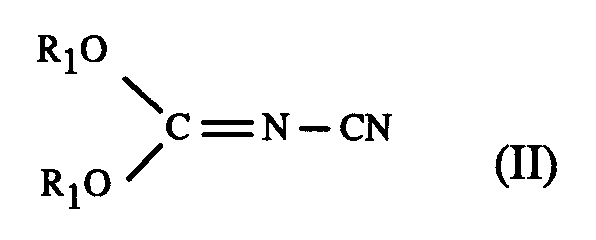
worin R₁ wie in Formel I definiert ist, mit einem
Amidinsalz der Formel III
in welcher R₂ wie unter Formel I definiert ist, X das Anion einer anorganischen oder organischen Säure ist und n die Zahl 1 oder 2 bedeutet, in Gegenwart eines Lösungsmittels und einer starken Base. - Die in den Substituenten R₁ und R₂ vorkommenden Alkylgruppen können geradkettig oder verzweigt sein. Beispielsweise steht R₁ für Methyl, Ethyl, n-Propyl, iso-Propyl, n-Butyl, sek.-Butyl und tert.-Butyl, vorzugsweise jedoch für Methyl oder Ethyl. R₂ als C₁-C₈-Alkyl schließt die oben genannten Radikale ein und ferner die isomeren Pentyl-, Hexyl-, Heptyl-, und Octylradikale, wobei C₁-C₄-Alkylgruppen, insbesondere Methyl, Ethyl und iso-Propyl, bevorzugt sind.
- C₁-C₄-Alkoxy schließt Methoxy, Ethoxy, n-Propoxy, iso-Propoxy und die vier isomeren Butoxy ein, steht aber insbesondere für Methoxy und Ethoxy.
- Die gegebenenfalls substituierten Phenyl und Alkylphenylgruppen in den Bedeutungen von R₂ sind beispielsweise Phenyl, 2-Chlorphenyl, 3-Chlorphenyl, 4-Chlorphenyl, 2,4-Dichlorphenyl, 4-Fluorphenyl, 4-Methoxyphenyl, 2,4-Dimethoxyphenyl, 4-Trifluormethylphenyl, Benzyl, 4-Methylbenzyl, 4-Nitrobenzyl, 4-Brombenzyl, oder 2-Phenylethyl. Phenyl ist dabei bevorzugt.
- Halogen als Substituent ist Fluor, Chlor oder Brom.
- C₃-C₆-Cycloalkyl schließt Cyclopropyl, Cyclobutyl, Cyclopentyl und Cyclohexyl ein, wobei Cyclopropyl bevorzugt ist.
- Ganz besonders bevorzugte Verbindungen der Formel I sind jene, in denen R₁ Methyl und R₂ Methyl, Ethyl oder Cyclopropyl bedeutet.
- Bevorzugte Bedeutungen von X sind Halogenide, insbesondere Chloride, Sulfate, Bisulfate und Acetate.
- Die N-cyanoimido-dialkylcarbonate der Formel II und Amidinsalze der Formel III sind bekannte Verbindungen oder können nach bekannten Verfahren hergestellt werden. Siehe beispielsweise The Chemistry of Amidines and Imidates, Saul Patai Ed., John Wiley & Sons, (1975).
- Die Umsetzung eines N-cyanoimido-dialkylcarbonates mit einem Amidinsalzes zur Bildung eines 2-Amino-4-alkoxy-s-triazines wird in Gegenwart eines Lösungsmittels und einer starken Base durchgeführt.
- Geeignete Lösungsmittel sind Alkohole der Formel R₁OH, in welcher R₁ vorzugsweise den R₁ Alkylgruppen des N-cyanoimido-dialkylcarbonates entspricht, offene und zyklische Ether wie Methyl-tert.-butylether oder Tetrafuran, C₃-C₇-Ketone wie Aceton und Methylisobutylketon, C₅-C₁₂-Kohlenwasserstoffe wie Hexan, C₁-C₆-Kohlenwasserstoffe, die durch 1-6 Halogenatome substituiert sind wie Methylenchlorid, Benzol oder durch 1 oder 2 Halogenatome oder C₁-C₃-Alkylgruppen substituiertes Benzol wie Toluol, oder Mischungen davon. Bevorzugte Mischungen enthalten einen Alkohol R₁OH mit mindestens einem der anderen Lösungsmittel. Wasser kann ebenfalls als eines der Lösungsmittel verwendet werden wenn das Amidin hydrolytisch stabil ist. Die Lösungsmittelmenge ist nicht kritisch solange die Menge ausreichend ist um gute Rührbarkeit sicherzustellen.
- Geeignete starke Basen schließen die Alkalimetallalkoholate der Alkohole R₁OH ein. Alkalimetallhydroxide und Erdalkalimetallhydroxide können ebenfalls verwendet werden wenn das Amidin hydrolytisch stabil ist. Bevorzugt sind etwa stöchiometrische Mengen an Base.
- Die Reaktionstemperaturen können von etwa -20°C bis +50°C, vorzugsweise von -10°C bis +25 °C variieren.
- Die Reaktanden können in beliebiger Reihenfolge zugegeben werden. Bei einer bevorzugten Reakrionsvariante gibt man die Base unter Rühren und Kühlung zu einer Mischung des Amidinsalzes mit dem N-cyanoimido-dialkylcarbonat hinzu. Die Zugaberate ist nicht kritisch, sollte aber langsam genug sein um das oben erwähnte Temperaturintervall einzuhalten. Im Labor wurden gute Resultate mit einer Zugabezeit von 10 Minuten bis 2 Stunden erzielt. Wenn die Zugabe der Base beendet ist ist die Reaktion im wesentlichen vollständig.
- Die Erfindung soll durch die folgenden, den Erfindungsgegenstand nicht beschränkenden Beispiele erläutert werden.
-
- A. In einen 100 ml Kolben gibt man 20 ml trockenes Methanol. Anschließend wird mit Eisbadkühlung mit trockenem HCl-Gas (etwa 10 g) gesättigt. Unter Rühren und Eisbadkühlung werden nun unter Beibehaltung einer Temperatur unter +10 °C 6,9 g (0,2 Mol) Isobutylnitril tropfenweise zugegeben. Man läßt die Lösung auf Raumtemperatur erwärmen und rührt das so hergestellte Methyl-isobutyrimidat für eine weitere Stunde.
- B. In einen 250 ml Kolben gibt man 7,5 g (0.13 Mol) 30%ige wäßriges Ammoniak und 10 ml Wasser hinzu. Anschließend gibt man unter Eisbadkühlung und Beibehaltung einer Temperatur unter +10 °C und mit 25%ige NaOH eingestelltem pH von 9,5 bis 9,8 das Methyl-isobutyrimidat tropfenweise hinzu. Nach Beendigung de Imidatzugabe stellt man den pH auf 9,0 bis 9,5 ein und läßt eine Stunde bei Raumtemperatur rühren um schließlich Isobutyramidin-hydrochlorid zu erhalten.
- C. Isobutyramidin-hydrochloridlösung wird im Eisbad gekühlt. Zu dieser Lösung gibt man 8 g (0,07 Mol) N-cyanoimido-dimethylcarbonat gefolgt von 5,8 g(0,073 Mol) tropfenweise zugegebener 50%iger NaOH. Anschließend läßt man die Mischung durch einstündiges Rühren Raumtemperatur erreichen. Nach Abdampfen des Methanols unter Vakuum schlämmt man die erhaltenen Feststoffe in 75 ml Wasser auf. Nach Kühlung, Filtration und anschließender Trocknung erhält man 7,2 g (61,2%) 2-Amino-4-isopropyl-6-methoxy-s-triazin mit einem Schmelzpunkt von +116 bis +117°C
- In einen 100 ml Kolben gibt man 5,5 g Acetamidin-hydrochlorid, 5,7 g N-cyanoimidodimethylcarbonat, 11 g Methanol und 11 g Toluol. Nach Kühlung der Reaktionsmischung auf +5 °C gibt man unter Beibehaltung einer Reaktionstemperatur von +5°C bis +10 °C 11,8 g 30%iges Natriummethylat tropfenweise hinzu. Nach beendeter Zugabe läßt man die Reaktionsmischung auf Raumtemperatur erwärmen. Anschließend filtert man ab und wäscht den Rückstand mit Methanol. Nach Aufschlämmen des Filterrückstandes in Wasser, Filtrieren, Waschen des Rückstandes mit Wasser und Trocknen erhält man 6,1 g (81 %) 2-Amino-4-methoxy-6-methyl-s-triazin mit einem Schmelzpunkt von + 256 bis +258°C.
- IN einen 250 ml Rundkolben gibt man 5 g (0,05 Mol) 95%iges Acetamidin-hydrochlorid, 10 g (0,088 Mol) N-cyanoimido-diethylcarbonat und 50 g Ethanol. Nach Kühlung der gerührten Lösung auf 0 °C gibt man innerhalb von 30 Minuten eine Lösung von 4 g (0,056 Mol) Natriumethylat in 30 ml Ethanol hinzu. Anschließend läßt man die Reaktionsmischung auf Raumtemperatur erwärmen und rührt eine Stunde lang. Nach Abfiltrieren der Mischung dampft man vom Filtrat den Ethanol im Vakuum bis zum Erscheinen von Feststoffen ab. Der Filterrückstand wird mit diesen Feststoffen vereinigt und anschließend 50 ml Wasser zugegeben. Nach Rühren der Mischung filtriert man ab. Nach Trocknen des Rückstandes erhalt man 6,6 g (85,7%) 2-Amino-4-ethoxy-6-methyl-s-triazin mit einem Schmelzpunkt von +172 bis +174 °C.
- In einen 250 ml Kolben gibt man bei einer Temperatur von + 5 °C 30 g einer wäßrigen Lösung von 0.05 Mol Cyclopropancarboxamidin-Hydrochlorid, 55 ml Methyl-tert.-butylether und 9 g N-cyanoimido-diethylcarbonat hinzu. Nach tropfenweiser Zugabe von 7 g 30%ige NaOH-Lösung läßt man die Reaktionsmischung auf Raumtemperatur erwärmen und rührt eine Stunde lang. Man gibt Wasser zu um das Salz zu lösen und die Phasen zu trennen. Nach zweimaliger Extraktion der wäßrigen Phase mit 20 ml Methyl-tert.-butylether, Vereinigung der Extrakte und Abdampfen des Lösungsmittels erhält man 6,8 g (75,5%) 2-Amino-4-cyclopropyl-6-ethoxy-s-triazin mit einem Schmelzpunkt von +103 bis +106 °C.
- In einen 250 ml Kolben gibt man 30 g einer wäßrigen Lösung von 0.05 Mol Cyclopropancarboxamidin-Hydrochlorid, 20 ml Methylenchlorid und 6,2 g (0,054 Mol) N-cyanoimido-dimethylcarbonat gelöst in 70 ml Methylenchlorid hinzu. Anschließend gibt man bei einer Temperatur von + 5 °C langsam 7 g (0,053 Mol) 30%ige NaOH-Lösung hinzu. Nach Entfernen der Kühlung wird eine Stunde lang gerührt. Nach Filtration und Trocknen des Rückstandes erhält man6,3 g (75,9%) 2-Amino-4-cyclopropyl-6-methoxy-s-triazin mit einem Schmelzpunkt von +162 bis +165 °C.
- In einen 250 ml Kolben gibt man 9,2 g (0.05 Mol) 85%iges Benzamidin-hydrochlorid, 75 ml Methanol und 6 g (0,053 Mol) N-cyanoimido-dimethylcarbonat. Anschließend gibt man bei einer Temperatur von + 5 °C tropfenweise 7 g (0,053 Mol) 30%ige NaOH-Lösung hinzu. Nach einstündigem Rühren bei Raumtemperatur dampft man das Methanol ab und schlämmt die Feststoffe in 75 ml Wasser auf. Nach Filtration und Trocknung erhält man 9,2 g (91 %) 2-Amino-4-methoxy-6-phenyl-s-triazin mit einem Schmelzpunkt von +159 bis +160 °C.
Claims (15)
- Verfahren zur Herstellung von 2-Amino-4-alkoxy-s-triazinen der Formel I

R₁ für C₁-C₄-Alkyl oder C₁-C₂-Alkoxy-C₁-C₂-alkyl; und
R₂ für C₁-C₈-Alkyl, welches unsubstituiert ist oder durch C₁-C₄-Alkoxy, Phenyl oder durch C₁-C₄-Alkyl, C₁-C₄-Alkoxy, Difluormethyl, Trifluormethyl, Halogen oder Nitro substituiertes Phenyl substituiert ist; Phenyl oder durch C₁-C₄-Alkyl, C₁-C₄-Alkoxy, Difluormethyl, Trifluormethyl, Halogen oder Nitro substituiertes Phenyl; C₃-C₆-Cycloalkyl oder Allyl stehen, dadurch gekennzeichnet, daß man ein N-cyanoimido-dialkylcarbonat der Formel II

- Verfahren nach Anspruch 1, dadurch gekennzeichnet, daß R₁ Methyl oder Ethyl und R₂ C₁-C₄-Alkyl, Cyclopropyl oder Phenyl bedeutet.
- Verfahren nach Anspruch 2, dadurch gekennzeichnet, daß R₁ Methyl und R₂ Methyl, Ethyl oder Cyclopropyl bedeuten.
- Verfahren nach Anspruch 3, dadurch gekennzeichnet, daß R₁ und R₂ Methyl bedeuten.
- Verfahren nach Anspruch 1, dadurch gekennzeichnet, daß n die Zahl 1 bedeutet und X für ein Halogenid-, Bisulfat- oder Acetatanion steht oder wenn n die Zahl 2 bedeutet X für das Sulfatanion steht.
- Verfahren nach Anspruch 5, dadurch gekennzeichnet, daß n die Zahl 1 bedeutet und X für das Chloridanion steht.
- Verfahren nach Anspruch 1, dadurch gekennzeichnet, daß man als Lösungsmittel Wasser, ein Alkohol der Formel R₁OH, worin R₁ wie unter Formel I definiert ist, ein offenkettiger oder zyklischer Ether, ein C₃-C₇-Keton, ein C₅-C₁₂-Kohlenwasserstoff, ein C₁-C₆-Kohlenwasserstoff, der durch 1-6 Halogenatome substituiert ist, Benzol oder durch 1 oder 2 Halogenatome oder C₁-C₃-Alkylgruppen substituiertes Phenyl, oder Mischungen davon verwendet.
- Verfahren nach Anspruch 7, dadurch gekennzeichnet, daß man als Lösungsmittel Wasser, Methanol, Ethanol, Methyl-tert.-butylether, Toluol oder Methylenchlorid oder eine Mischung davon verwendet.
- Verfahren nach Anspruch 8, dadurch gekennzeichnet, daß man als Lösungsmittel eine Mischung aus Methanol und Toluol verwendet.
- Verfahren nach Anspruch 1, dadurch gekennzeichnet, daß man als starke Base das Alkalimetallsalz eines C₁-C₄-Alkohols verwendet.
- Verfahren nach Anspruch 1, dadurch gekennzeichnet, daß man als starke Base das Alkalimetallhydroxid oder Erdalkalimetallhydroxid verwendet.
- Verfahren nach Anspruch 11, dadurch gekennzeichnet, daß man als starke Base festes Natriumhydroxid oder in Wasser gelöstes Natriumhydroxid verwendet.
- Verfahren nach Anspruch 1, dadurch gekennzeichnet, daß man es bei einer Temperatur von -20°C bis +50°C durchführt.
- Verfahren nach Anspruch 1, dadurch gekennzeichnet, daß man es bei einer Temperatur von -10°C bis +25°C durchführt.
- Verfahren nach Anspruch 1, dadurch gekennzeichnet, daß man eine methanolische Lösung von Natrimmethylat zu einer gerührten Mischung von N-cyanoimido-dimethylcarbonat und Acetamidin-Hydrochlorid in Methanol und Toluol als Lösungsmittel bei einer Temperatur im Bereich von +5 bis +10 °C zugibt und rührt bis die Reaktion im wesentlichen vollständig ist.
Applications Claiming Priority (2)
| Application Number | Priority Date | Filing Date | Title |
|---|---|---|---|
| US562161 | 1990-08-03 | ||
| US07/562,161 US5075443A (en) | 1990-08-03 | 1990-08-03 | Preparation of 2-amino-4-alkoxy-s-triazines |
Publications (2)
| Publication Number | Publication Date |
|---|---|
| EP0470050A1 EP0470050A1 (de) | 1992-02-05 |
| EP0470050B1 true EP0470050B1 (de) | 1995-11-02 |
Family
ID=24245053
Family Applications (1)
| Application Number | Title | Priority Date | Filing Date |
|---|---|---|---|
| EP91810603A Expired - Lifetime EP0470050B1 (de) | 1990-08-03 | 1991-07-26 | Verfahren zur Herstellung von 2-Amino-4-alkoxy-s-triazinen |
Country Status (10)
| Country | Link |
|---|---|
| US (1) | US5075443A (de) |
| EP (1) | EP0470050B1 (de) |
| JP (1) | JP3079221B2 (de) |
| KR (1) | KR920004363A (de) |
| BR (1) | BR9103339A (de) |
| CA (1) | CA2048334C (de) |
| DE (1) | DE59106804D1 (de) |
| IE (1) | IE69364B1 (de) |
| IL (1) | IL99032A (de) |
| ZA (1) | ZA916093B (de) |
Families Citing this family (2)
| Publication number | Priority date | Publication date | Assignee | Title |
|---|---|---|---|---|
| DE4335497A1 (de) * | 1993-10-19 | 1995-04-20 | Basf Ag | Verfahren zur Herstellung unsymmetrisch substituierter Triazine |
| DE19523206B4 (de) * | 1995-06-27 | 2005-10-20 | Degussa | Verfahren zur Herstellung von 4,6-disubstituierten 2-Amino-s-triazinen |
Family Cites Families (5)
| Publication number | Priority date | Publication date | Assignee | Title |
|---|---|---|---|---|
| US3154547A (en) * | 1963-03-05 | 1964-10-27 | American Cyanamid Co | Process for preparing 2-amino-s-triazines |
| IE49355B1 (en) * | 1979-01-26 | 1985-09-18 | Ici Ltd | Process for the manufacture of(n-cyanoimido)-carbonates |
| CA1250574A (en) * | 1984-03-27 | 1989-02-28 | Stefan Weiss | Process for the preparation of 2-amino-s-triazines |
| DE3411202C2 (de) * | 1984-03-27 | 1986-07-10 | Skw Trostberg Ag, 8223 Trostberg | Verfahren zur Herstellung von 2-Amino-s-triazinen |
| US4886881A (en) * | 1989-05-12 | 1989-12-12 | E. I. Du Pont De Nemours And Company | Preparation of 2-amino triazines |
-
1990
- 1990-08-03 US US07/562,161 patent/US5075443A/en not_active Expired - Lifetime
-
1991
- 1991-07-18 KR KR1019910012257A patent/KR920004363A/ko not_active Ceased
- 1991-07-26 DE DE59106804T patent/DE59106804D1/de not_active Expired - Lifetime
- 1991-07-26 EP EP91810603A patent/EP0470050B1/de not_active Expired - Lifetime
- 1991-08-01 CA CA002048334A patent/CA2048334C/en not_active Expired - Lifetime
- 1991-08-01 IL IL9903291A patent/IL99032A/en not_active IP Right Cessation
- 1991-08-02 JP JP03216348A patent/JP3079221B2/ja not_active Expired - Lifetime
- 1991-08-02 IE IE276591A patent/IE69364B1/en not_active IP Right Cessation
- 1991-08-02 BR BR919103339A patent/BR9103339A/pt not_active IP Right Cessation
- 1991-08-02 ZA ZA916093A patent/ZA916093B/xx unknown
Also Published As
| Publication number | Publication date |
|---|---|
| ZA916093B (en) | 1994-09-26 |
| US5075443A (en) | 1991-12-24 |
| IE912765A1 (en) | 1992-02-12 |
| DE59106804D1 (de) | 1995-12-07 |
| KR920004363A (ko) | 1992-03-27 |
| EP0470050A1 (de) | 1992-02-05 |
| JP3079221B2 (ja) | 2000-08-21 |
| IL99032A0 (en) | 1992-07-15 |
| CA2048334A1 (en) | 1992-02-04 |
| CA2048334C (en) | 2001-09-25 |
| BR9103339A (pt) | 1992-05-05 |
| IE69364B1 (en) | 1996-09-04 |
| IL99032A (en) | 1996-06-18 |
| JPH04244069A (ja) | 1992-09-01 |
Similar Documents
| Publication | Publication Date | Title |
|---|---|---|
| EP0044497B1 (de) | Verfahren zur Herstellung heterocyclisch substituierter 4-Oxiphenoxialkancarbonsäurederivate | |
| EP0470050A1 (de) | Verfahren zur Herstellung von 2-Amino-4-alkoxy-s-triazinen | |
| DE2407305C2 (de) | Triphenyl-1,2,3-triazol-1-yl-methane, Verfahren zu ihrer Herstellung und ihre Verwendung als Fungizide | |
| DE2426878A1 (de) | Verfahren zur herstellung von 1,2,4oxadiazolen | |
| DE3035395A1 (de) | Verfahren zur herstellung von pyrazol | |
| EP0653423B1 (de) | Verfahren zur Herstellung von substituierten Chinazolin-2,4-dionen | |
| EP0378046B1 (de) | Verfahren zur Herstellung von 3-Phenylpyrrolderivaten | |
| EP0907638B1 (de) | 4-jod-2- n-(n-alkyl-aminocarbonyl)-aminosulfonyl]-benzoesäuremethylester und -derivate und verfahren zu deren herstellung | |
| DE19540701A1 (de) | Verfahren zur Herstellung von Aminophenylsulfonylharnstoffen und Zwischenprodukte zu den Verfahren | |
| DE4123608C1 (de) | ||
| DE1445531C3 (de) | In 5 Stellung substituierte 2 Benzol sulfonamidopynmidine und Verfahren zu deren Herstellung | |
| DE1134382B (de) | Verfahren zur Herstellung von Thiolphosphor-, -phosphon-, -phosphin- bzw. Thionothiolphosphor-, -phosphon-, -phosphinsaeureestern | |
| EP0068371B1 (de) | Verfahren zur Herstellung von Sulfiden | |
| EP1220846B1 (de) | Verfahren zur herstellung substituierter phenylsulfonylharnstoffe aus sulfohalogeniden | |
| EP0582288A1 (de) | Verfahren zur Herstellung von 2-Halogen-4,6-dialkoxypyrimidinen | |
| EP0151312B1 (de) | N'-Acylhydrazin-N-thiocarbonsäure-O-carbamoylmethylester | |
| EP0173324A1 (de) | Verfahren zur Herstellung von 1-(2-Oxyaminosulfonyl-phenyl-sulfonyl)-3-heteroaryl-harnstoffen | |
| EP0158248A2 (de) | Verfahren zur Herstellung von Biphenylylsulfonylharnstoff- Derivaten, Zwischenprodukte für diese sowie Verfahren für die Herstellung der Zwischenprodukte | |
| EP0148500B1 (de) | Hydrazin-thiocarbonsäure-O-carbamoylmethylester | |
| EP0764634B1 (de) | N-(4-Brom-2-fluorbenzyl)carbamate sowie ein Verfahren zu ihrer Herstellung | |
| DE69332651T2 (de) | Verfahren zur Herstellung von Phenyl (1,3,5-Triazin-2-Yl) Carbamaten | |
| EP0065217A2 (de) | 5-Halogenalkyl-1.2.4-triazole und Verfahren zu ihrer Herstellung | |
| DE2366215C2 (de) | Glyoxylsäurehydrazid-2-acylhydrazone | |
| EP0069883A1 (de) | Verfahren zur Herstellung von Hydrazidinen | |
| DE3431923A1 (de) | Verfahren zur herstellung von sulvonyliso(thio)harnstoffen |
Legal Events
| Date | Code | Title | Description |
|---|---|---|---|
| PUAI | Public reference made under article 153(3) epc to a published international application that has entered the european phase |
Free format text: ORIGINAL CODE: 0009012 |
|
| AK | Designated contracting states |
Kind code of ref document: A1 Designated state(s): AT BE CH DE DK ES FR GB GR IT LI LU NL SE |
|
| 17P | Request for examination filed |
Effective date: 19910729 |
|
| 17Q | First examination report despatched |
Effective date: 19940824 |
|
| RBV | Designated contracting states (corrected) |
Designated state(s): CH DE FR GB LI |
|
| GRAA | (expected) grant |
Free format text: ORIGINAL CODE: 0009210 |
|
| AK | Designated contracting states |
Kind code of ref document: B1 Designated state(s): CH DE FR GB LI |
|
| REF | Corresponds to: |
Ref document number: 59106804 Country of ref document: DE Date of ref document: 19951207 |
|
| ET | Fr: translation filed | ||
| GBT | Gb: translation of ep patent filed (gb section 77(6)(a)/1977) |
Effective date: 19960116 |
|
| PLBE | No opposition filed within time limit |
Free format text: ORIGINAL CODE: 0009261 |
|
| STAA | Information on the status of an ep patent application or granted ep patent |
Free format text: STATUS: NO OPPOSITION FILED WITHIN TIME LIMIT |
|
| 26N | No opposition filed | ||
| REG | Reference to a national code |
Ref country code: CH Ref legal event code: PFA Free format text: CIBA-GEIGY AG TRANSFER- NOVARTIS AG |
|
| REG | Reference to a national code |
Ref country code: GB Ref legal event code: 732E |
|
| REG | Reference to a national code |
Ref country code: FR Ref legal event code: TP |
|
| REG | Reference to a national code |
Ref country code: GB Ref legal event code: IF02 |
|
| REG | Reference to a national code |
Ref country code: CH Ref legal event code: PUE Owner name: SYNGENTA PARTICIPATIONS AG Free format text: NOVARTIS AG#SCHWARZWALDALLEE 215#4058 BASEL (CH) -TRANSFER TO- SYNGENTA PARTICIPATIONS AG#SCHWARZWALDALLEE 215#4058 BASEL (CH) |
|
| REG | Reference to a national code |
Ref country code: FR Ref legal event code: TP |
|
| PGFP | Annual fee paid to national office [announced via postgrant information from national office to epo] |
Ref country code: CH Payment date: 20100714 Year of fee payment: 20 |
|
| PGFP | Annual fee paid to national office [announced via postgrant information from national office to epo] |
Ref country code: FR Payment date: 20100805 Year of fee payment: 20 Ref country code: DE Payment date: 20100721 Year of fee payment: 20 |
|
| PGFP | Annual fee paid to national office [announced via postgrant information from national office to epo] |
Ref country code: GB Payment date: 20100721 Year of fee payment: 20 |
|
| REG | Reference to a national code |
Ref country code: DE Ref legal event code: R071 Ref document number: 59106804 Country of ref document: DE |
|
| REG | Reference to a national code |
Ref country code: DE Ref legal event code: R071 Ref document number: 59106804 Country of ref document: DE |
|
| REG | Reference to a national code |
Ref country code: CH Ref legal event code: PL |
|
| REG | Reference to a national code |
Ref country code: GB Ref legal event code: PE20 Expiry date: 20110725 |
|
| PG25 | Lapsed in a contracting state [announced via postgrant information from national office to epo] |
Ref country code: GB Free format text: LAPSE BECAUSE OF EXPIRATION OF PROTECTION Effective date: 20110725 |
|
| PG25 | Lapsed in a contracting state [announced via postgrant information from national office to epo] |
Ref country code: DE Free format text: LAPSE BECAUSE OF EXPIRATION OF PROTECTION Effective date: 20110727 |