EP0469033B1 - Audiokompressor, expander und rauschunterdrückungsschaltungen für verbraucher und semiprofessionelle anwendungen - Google Patents
Audiokompressor, expander und rauschunterdrückungsschaltungen für verbraucher und semiprofessionelle anwendungen Download PDFInfo
- Publication number
- EP0469033B1 EP0469033B1 EP90906438A EP90906438A EP0469033B1 EP 0469033 B1 EP0469033 B1 EP 0469033B1 EP 90906438 A EP90906438 A EP 90906438A EP 90906438 A EP90906438 A EP 90906438A EP 0469033 B1 EP0469033 B1 EP 0469033B1
- Authority
- EP
- European Patent Office
- Prior art keywords
- band
- frequency
- low
- circuit
- stage
- Prior art date
- Legal status (The legal status is an assumption and is not a legal conclusion. Google has not performed a legal analysis and makes no representation as to the accuracy of the status listed.)
- Expired - Lifetime
Links
- 230000009467 reduction Effects 0.000 title abstract description 68
- 230000003595 spectral effect Effects 0.000 claims abstract description 151
- 230000009471 action Effects 0.000 claims abstract description 105
- 238000006467 substitution reaction Methods 0.000 claims abstract description 103
- 230000004044 response Effects 0.000 claims abstract description 75
- 230000005236 sound signal Effects 0.000 claims abstract description 20
- 230000006835 compression Effects 0.000 claims description 66
- 238000007906 compression Methods 0.000 claims description 66
- 238000000034 method Methods 0.000 claims description 42
- 230000000295 complement effect Effects 0.000 claims description 36
- 238000012546 transfer Methods 0.000 claims description 33
- 230000000670 limiting effect Effects 0.000 claims description 17
- 230000035945 sensitivity Effects 0.000 claims description 7
- 230000000694 effects Effects 0.000 description 106
- 230000006870 function Effects 0.000 description 45
- 230000001629 suppression Effects 0.000 description 34
- 230000008901 benefit Effects 0.000 description 26
- 230000008859 change Effects 0.000 description 17
- 238000010586 diagram Methods 0.000 description 17
- 230000005540 biological transmission Effects 0.000 description 16
- 230000001419 dependent effect Effects 0.000 description 16
- 238000009499 grossing Methods 0.000 description 16
- 239000003990 capacitor Substances 0.000 description 15
- 230000002829 reductive effect Effects 0.000 description 14
- 238000001228 spectrum Methods 0.000 description 14
- 230000001052 transient effect Effects 0.000 description 12
- 230000003044 adaptive effect Effects 0.000 description 8
- 238000009795 derivation Methods 0.000 description 7
- 238000013461 design Methods 0.000 description 7
- 230000008569 process Effects 0.000 description 7
- 238000012545 processing Methods 0.000 description 7
- 238000013459 approach Methods 0.000 description 6
- 230000007812 deficiency Effects 0.000 description 6
- 230000007306 turnover Effects 0.000 description 6
- 230000007423 decrease Effects 0.000 description 5
- 238000012886 linear function Methods 0.000 description 5
- 239000000872 buffer Substances 0.000 description 4
- 238000005094 computer simulation Methods 0.000 description 4
- 230000008878 coupling Effects 0.000 description 4
- 238000010168 coupling process Methods 0.000 description 4
- 238000005859 coupling reaction Methods 0.000 description 4
- 238000011161 development Methods 0.000 description 4
- 230000018109 developmental process Effects 0.000 description 4
- 238000005086 pumping Methods 0.000 description 4
- 230000003321 amplification Effects 0.000 description 3
- 230000009977 dual effect Effects 0.000 description 3
- 238000003199 nucleic acid amplification method Methods 0.000 description 3
- 230000000717 retained effect Effects 0.000 description 3
- 230000000996 additive effect Effects 0.000 description 2
- 238000010420 art technique Methods 0.000 description 2
- 230000002238 attenuated effect Effects 0.000 description 2
- 230000003139 buffering effect Effects 0.000 description 2
- 238000001914 filtration Methods 0.000 description 2
- 230000006872 improvement Effects 0.000 description 2
- 238000007689 inspection Methods 0.000 description 2
- 230000010363 phase shift Effects 0.000 description 2
- 238000003860 storage Methods 0.000 description 2
- 238000007792 addition Methods 0.000 description 1
- 239000000654 additive Substances 0.000 description 1
- 230000001668 ameliorated effect Effects 0.000 description 1
- 230000009286 beneficial effect Effects 0.000 description 1
- 230000015572 biosynthetic process Effects 0.000 description 1
- 238000013329 compounding Methods 0.000 description 1
- 230000003750 conditioning effect Effects 0.000 description 1
- 230000006735 deficit Effects 0.000 description 1
- 230000002349 favourable effect Effects 0.000 description 1
- 230000005669 field effect Effects 0.000 description 1
- 230000036039 immunity Effects 0.000 description 1
- 230000010354 integration Effects 0.000 description 1
- 238000004519 manufacturing process Methods 0.000 description 1
- 239000000463 material Substances 0.000 description 1
- 238000012544 monitoring process Methods 0.000 description 1
- 238000011084 recovery Methods 0.000 description 1
- 230000002441 reversible effect Effects 0.000 description 1
- 238000007493 shaping process Methods 0.000 description 1
- 230000000087 stabilizing effect Effects 0.000 description 1
- 230000000153 supplemental effect Effects 0.000 description 1
- 230000002195 synergetic effect Effects 0.000 description 1
- 238000012360 testing method Methods 0.000 description 1
- 230000007704 transition Effects 0.000 description 1
- 230000001960 triggered effect Effects 0.000 description 1
- 230000001755 vocal effect Effects 0.000 description 1
Images





Classifications
-
- H—ELECTRICITY
- H03—ELECTRONIC CIRCUITRY
- H03G—CONTROL OF AMPLIFICATION
- H03G9/00—Combinations of two or more types of control, e.g. gain control and tone control
- H03G9/02—Combinations of two or more types of control, e.g. gain control and tone control in untuned amplifiers
-
- H—ELECTRICITY
- H03—ELECTRONIC CIRCUITRY
- H03G—CONTROL OF AMPLIFICATION
- H03G9/00—Combinations of two or more types of control, e.g. gain control and tone control
- H03G9/02—Combinations of two or more types of control, e.g. gain control and tone control in untuned amplifiers
- H03G9/12—Combinations of two or more types of control, e.g. gain control and tone control in untuned amplifiers having semiconductor devices
- H03G9/18—Combinations of two or more types of control, e.g. gain control and tone control in untuned amplifiers having semiconductor devices for tone control and volume expansion or compression
-
- H—ELECTRICITY
- H03—ELECTRONIC CIRCUITRY
- H03G—CONTROL OF AMPLIFICATION
- H03G9/00—Combinations of two or more types of control, e.g. gain control and tone control
- H03G9/02—Combinations of two or more types of control, e.g. gain control and tone control in untuned amplifiers
- H03G9/025—Combinations of two or more types of control, e.g. gain control and tone control in untuned amplifiers frequency-dependent volume compression or expansion, e.g. multiple-band systems
Definitions
- the present invention is concerned in general with circuit arrangements which alter the dynamic range of audio signals, namely compressors which compress the dynamic range and expanders which expand the dynamic range.
- Compressors and expanders are normally used together (a compander system) to effect noise reduction; the signal is compressed before transmission or recording and expanded after reception or playback from the transmission channel.
- compressors may be used alone to reduce the dynamic range, e.g., to suit the capacity of a transmission channel, without subsequent expansion when the compressed signal is adequate for the end purpose.
- compressors alone are used in certain product, especially audio products which are intended only to transmit or record compressed broadcast or pre-recorded signals.
- Expanders alone are used in certain products, especially audio products which are intended only to receive or play back already compressed brodcast or pre-recorded signals.
- a single device is often configured for switchable mode operation as a compressor to record signals and as an expander to play back compressed broadcast or pre-recorded signals.
- a long sought after goal in the design of compressor, expanders and companding type noise-reduction systems is a high degree of adaptiveness of the compressor and expander to applied signals.
- a design philosophy embodying this goal has provided the foundation for a series of successful developments and refinements by Ray M. Dolby beginning in 1965 with A-type noise reduction and culminating recently in the Spectral Recording (SR) process, a highly adaptive signal processing system for high quality professional audio recording.
- SR Spectral Recording
- the underlying design phylosophy which was recently expressed as the "Least Treatment Principle" ("The Spectral Recording Process” by Ray Dolby, J. Audio Eng. Soc., 35, No. 3, 1987 March, pp. 99-118 at page 100) has its roots in the concept of "conformal equalization” mentioned in the U.K. Provisional Specification 43136 GB-A-1 120 541 filed 11 October 1965 of Ray M. Dolby.
- the best treatment of the signal is the least treatment.
- the operating goal of the encoder is to provide fixed, predetermined gains for all frequency components of the signal, with corresponding attenuations in the decoder.
- the gains should be reduced at those frequencies only, in accordance with predetermined compression laws for restoration of the signal during decoding.
- the compressor should try to keep all signal components fully boosted at all times.
- the effect should not be extended to low-level signal components at other frequencies.
- the spectrum is divided into a plurality of frequency bands, each of which is acted upon independently.
- a dominant signal component affects dynamic action (compression or expansion) only within a portion of the overall spectrum, in contrast to a wideband approach in which dynamic action throughout the entire spectrum is affected by a dominant signal component.
- a bandsplitting system provides a greater degree of adaptiveness or conformance than a wideband system.
- a highly adaptive or conformal bandsplitting system could be provided by dividing the overall spectrum into a very large number of frequency bands; however, the complexity and cost of such an arrangement makes it impractical. Consequently, a design compromise is made by selecting a reasonable number of frequency bands capable of providing satisfactory performance.
- A-type noise reduction employs four frequency bands, a fixed-band circuit operating in each band: band 1, 80 Hz lowpass; band 2, 80 Hz to 3 kHz bandpass; band 3, 3 kHz high-pass; and band 4, 9 kHz high-pass.
- the basic elements of A-type noise reduction are described in "An Audio Noise Reduction System, "by Ray M. Dolby, J. Audio Eng. Soc., October 1967, Vol. 15, No. 4, pp. 383-388.
- Spectral Recording The more recent but already well-known commercially successful bandsplitting compander-type audio noise-reduction system, known as Spectral Recording, mentioned above, employs two frequency bands: a low-frequency band an high-frequency band that broadly overlap at 800 Hz. Fixed-band/sliding-band action-substitution circuits operate in each band. Spectral Recording is described in greater detail below.
- Various A-type noise-reduction and SR products are manufactured and sold by Dolby Laboratories.
- variable filter a dominant signal component causes the cutoff or turnover frequency (or frequencies) of one or more variable filters (e.g., high-pass, low-pass, shelf, notch, etc.) to shift so as to compress or expand the dominant signal component.
- variable filters e.g., high-pass, low-pass, shelf, notch, etc.
- a sliding-band system operating only in a single high-frequency band is described in US-PS 4,490,691.
- This system which forms the basis for the well-known consumer companding type audio noise-reduction system known as B-type noise reduction (NR), includes, in a dual-path arrangement ("dual-path" arrangements are described below), a side path having a fixed high-pass filter in series with a variable filter. A total dynamic effect of up to about 10 dB is obtained at high frequencies.
- C-type noise reduction A system providing twice as much total dynamic effect, known as C-type noise reduction, is described in "A 20 dB Audio Noise Reduction System for Consumer Applications" by Ray Dolby, J. Audio Eng. Soc., Vol. 31, No, 3, 1983 March, pp. 98-113. Aspects of the C-type system are also set forth in said US-PS 4,490,691 of Ray M. Dolby.
- the C-type system has a arrangement of two compressors and two expanders in cascade, in which the dynamic action levels of the respective compressors and expanders are staggered so as to increase the overall dynamic action without significant accompanying increases of the overall maximum compression and expansion ratio.
- C-type NR also employs a technique referred to as spectral skewing, described below, to reduce susceptibility to compressor/expander mistracking under certain conditions.
- spectral skewing also described below, reduces the tendency of media subject to frequency-dependent overload to saturate, thereby increasing the useful signal levels which can be handled.
- Spectral skewing and antisaturation are also employed in the Spectral Recording (SR) system described further below.
- variable filter turnover frequency shifts to a frequency above that signal component thereby restricting the frequency area at lower frequencies in which noise reduction is provided.
- the loss of noise reduction may be more noticeable audibly than in bandsplitting systems and the related side effects (noise modulation and signal modulation) may be more severe than in fixed-band arrangements because of a multiplication effect that is inherent in sliding-band systems.
- the multiplication effect results from the way in which sliding-band systems provide compression. If, for example, there is a dominant high-frequency signal and 2 dB of gain reduction is required at that frequency, the variable filter cutoff frequency should shift to the extent necessary to provide that amount of attenuation along the filter slope. However, for lower frequencies, further removed from the new filter cutoff frequency, the effect may be 5 or 10 dB of dynamic action, for example, with a consequent loss of all or most of the noise-reduction effect along with possible audible signal or noise modulation. In other words, in this example, a 2 dB change in a dominant signal can cause a 5 or 10 dB change in gain at frequencies removed from the dominant signal.
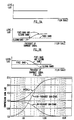
- Figure 1 is an idealized compressor characteristic response curve illustrating this effect. (Throughout this document the characteristic response curves illustrated in the various Figures are those of compressors, it being understood that the respective expander characteristic is the complement of the compressor characteristic.)
- an advantage of a sliding-band arrangement is that the full noise-reduction effect is obtained at frequencies above the dominant signal component (or below the dominant signal component in the case of a sliding-band system acting downward in frequency).
- an arrangement that achieves the advantages of fixed-band and sliding-band systems e.g., the advantage of fixed band is that there is no multiplication of modulation effects and the advantage of sliding band is that there is minimum signal or noise modulation above the dominant signal frequency
- the disadvantages of each e.g., the disadvantage of fixed band is noise and signal modulation throughout its operating range--although not multiplied and the disadvantage of sliding band is the mid-band modulation effect
- the aforementioned action-substitution technique permits such a combination of sliding band and fixed band advantages.
- Action substitution which is the subject matter of said US-PS 4,736,433 of Ray M. Dolby, is based on the recognition that the ideal of conformal equalization can be more closely approached by compressor, expander and compander type noise-reduction arrangements in which a plurality of compression/expansion/equalization characteristics are superposed or overlaid upon one another in such a way that one or more of the characteristics is hidden or concealed until, as dominant signal components appear, the hidden characterisitics are revealed and become active.
- the quiescent characteristic which provides a defining umbrella or envelope that conceals one or more latent characteristics, is modified so that the latent characteristic or characteristics emerge in response to dominant signal components in order to provide a more effective adaptive equalization than provided by earlier circuit arrangements.
- action substitution in the sense that the action resulting from one (or perhaps more than one) characteristic is substituted for one or more other characteristic actions that have the potential to operate in the same frequency and level regions when the level and spectral content of the input signal components change.
- the substitution is such that, with respect to any non-dominant signal components, the transmission is maximized in the compressor and minimized in the expander.
- Compressor, expanders and noise-reduction compander systems employing action substitution have improved abilities to discriminate among dominant and non-dominant signal components and to confine dynamic action to dominant signal components only.
- the noise-reduction decoder (expander) has a very stable noise floor, which is essential to a high quality noise-reduction system.
- Figure 5B shows an example in which the sliding band is above the dominant signal and Figure 5C shows an example in which the sliding band is below the dominant signal.
- Two regimes of operation are revealed, divided at the frequency of the dominant signal.
- the region which the sliding-band characteristic would have left "uncovered” is supplemented by the fixed-band characteristic which, in effect, provides a floor or foundation level. In other words, there is a subtitution of action in response to the dominant signal component.
- An action-substitution arrangement thus obtains the advantages of both fixed-band and sliding-band arrangements while avoiding their disadvantages.
- Maximum noise-reduction effect and minimum modulation effects are obtained above (or below) the dominant signal where the sliding-band characteristic operates while avoiding the loss of noise reduction and the mid-band modulation effect below (or above) the dominant signal by the presence of the fixed-band characteristic.
- a dominant signal component is a signal component having a substantial enough level so as to effect dynamic action within the frequency band under consideration. Under complex signal conditions there may be more than one dominant signal component or a dominant signal component and sub-dominant signal components.
- all of the signal components must be compressed and expanded in accordance with a defined compression/expansion law in order for the signal spectrum, including the dominant signal component (and other signals affected by dynamic action), to be restored to their correct levels in the expander.
- the characteristics of the expander must match those of the compressor. This can be achieved, for instance, by making an expander by placing a compressor in the feedback loop of a high gain amplifier. For the expander to match the compressor exactly, however, the signal entering the expander must be identical to the signal that left the compressor. This requirement can easily be met if the compressor output and the expander input are connected by means of, for instance, a short piece of wire, but is much harder to meet if a practical medium, with frequency- and level-dependent limitations and errors, is interposed between compressor output and expander input. Errors in the medium will be compounded by frequency- and/or level-dependent mistracking between compressor and expander unless the noise reduction system is designed to tolerate such errors.
- A-type, B-type and C-type noise reduction all use a simple bandwidth limiting filter located at the input of the compressor to reduce mis-tracking caused by input signals at frequencies higher than the maximum transmission frequency of the medium.
- Another noise reduction system, dbx II,® has instead a bandwidth limiting filter located in the input to its control circuit. Spectral skewing, used alone or in conjunction with a bandwidth limiting filter, considerably reduces the amount of mistracking caused by errors in the medium.
- Spectral skewing is fully described in U.S. P-S 4,470,691 and will thus be described only briefly here. Spectral skewing reduces the ability of errors in the medium to cause tracking errors by reducing the noise reduction circuit's noise reduction effect at frequencies towards the extremes of the audio spectrum. This noise reduction effect can be given up without increasing the audible noise reduction effect because of the ear's reduced sensitivity to low-level noise at such frequencies.
- the compressor is preceded by a circuit which sharply attenuates signals at frequencies near the extremes of the audio frequency band, say above 10 kHz and below 50 Hz. This reduces the level of such signals entering the compressor, and thus reduces their contribution to the compressor control signal relative to the contribution of signals at frequencies in the middle of the audio band.
- the action of the compressor is thus controlled mainly by mid-frequency signals.
- the frequency response shaping caused by the spectral skewing circuit in the compressor still exists in the signal entering the expander.
- the action of the expander will also be controlled mainly by mid-band signals. Tracking is improved because the dymanic action of the compressor and the expander is controlled mainly by signals which are less subject to errors.
- a spectral de-skewing circuit located at the output of the expander restores the original frequency response of the signal and, as a result, boosts the noise level of the medium.
- a significant spectral skewing effect can be obtained without noticeably increasing the overall audible noise level because the increased noise level occurs only at frequencies at which the ear has a low sensitivity to low-level noise.
- a further advantage of spectral skewing is that it reduces the likelihood of tracking errors caused by level-dependent errors in the medium (e.g. tape saturation) because the spectral skewing circuit reduces the level at which signals at frequencies near the extremes of the audio band are presented to the medium. This is an important advantage because, in many media, the level at which level-dependent errors occur progressively decreases towards one or both extremes of the audio band.
- level-dependent errors e.g. tape saturation
- Spectral skewing can be regarded as a signal conditioning accessory to a noise reduction system.
- Spectral skewing changes the spectral balance of the signal on which the compressor and expander operate, but it otherwise has no effect on the way in which the noise reduction circuit itself operates.
- spectral skewing does not reduce the amount of noise reduction effect produced by the noise reduction circuit itself, even though the noise reduction effect of the combination is reduced at frequencies near the extremes of the audio frequency band.
- Spectral skewing thus does not reduce the peak or average compression ratio of the noise reduction circuit at such frequencies.
- a lower compression ratio is desirable because it would reduce the amount of mis-tracking caused by a given error in the medium.
- Spectral skewing also has a further disadvantage in that, at the frequencies at which it operates, it raises the input levels at which dynamic action starts and finishes. This means that, compared with no spectral skewing, there is a greater chance that the compressor may be giving a significant compression effect (and hence error multiplication effect) at signal levels at which level-dependent errors in the medium can occur. This effect is only partially ameliorated by the reduction in signal level presented to the medium.
- the amount of spectral skewing that can be practically applied to the compressor is limited by the need for spectral de-skewing in the expander. If the spectral skewing circuit in the compressor applies a very large amount of attenuation, then a very large amount of amplification, with attendant phase-shift and noise problems, is required in the expander to restore an overall flat frequency response. Practical spectral skewing circuits thus tend to have a shelf or notch characteristic, which limits their effectiveness.
- Anti-saturation is fully described in U.S. P-S 4,470,691 and will thus be described only briefly here.
- Anti-saturation is a further way of prevending mis-tracking caused by level-dependent errors in the medium. It operates in the compressor by reducing the signal level presented to the medium, and thus increases the input signal level at which medium overload occurs.
- the anti-saturation circuit is located in the main path of a dual path circuit and thus changes the frequency response of the compressor at high levels only. This is in contrast to conventional spectral skewing which changes the frequency response by the same amount at all levels.
- An anti-saturation circuit being located in the main path only, has no effect on the compressor control circuit. It does, however, increase the compression ratio, because it reduces the amplitude of the main-path signal relative to the side-path signal.
- a complementary anti-saturation circuit is needed in the main path of the expander to restore a flat overall frequency response.
- a “dual-path” arrangement is one in which a compression or expansion characteristic is achieved through the use of a main path which is essentially free of dynamic action and one or more secondary or side paths having dynamic action.
- the side path or pahts take their input from the input or output of the main path and their output or outputs are additively or subtractively combined with the main path in order to provide compression or expansion.
- a side path provides a type of limiting or variable attenuation and the manner in which it is connected to the main path determines if it boosts (to provide compression) or bucks (to provide expansion) the main-path signal components.
- Fixed-band, sliding-band, and action-substitution circuits implemented a dual-path or single-path arrangements can be used as building blocks in creating compressors, expanders and noise-reduction companders.
- such circuits may be employed as side paths in dual-path arrangements in the manner shown in Figures 3 and 4.
- FIG 3 a Type I dual-path arrangement (of the type generally described in US-PS 3,846,719) is shown having a compressor 1 in which the input signal is applied to a fixed-band, sliding-band, or action-substitution circuit 2 and to the main path 3.
- the output of circuit 2 is then summed with the main-path signal components in summing means 4 to provide the compressor output for application to a transmission channel.
- the side-path signal components thus boost the main-path signal components causing compressor action.
- the transmission channel output is applied to the expander 5, configured in a complementary manner to the compressor 1, which has an input summing means 4 which receives the transmission channel output and subtracts the output of the fixed-band, sliding-band, or action-substitution circuit 2.
- the side-path signal components thus buck the main-path signal components causing expander action.
- a Type II dual-path arrangements (of the type generally described in US-PS 3,903,485) is shown having a compressor 6 which has an input summing means 4 receiving the input signal and the output of the fixed-band, sliding-band, or action-substitution circuit 2.
- the input summing means 4 provides the compressor output to the transmission channel and the input to the circuit 2 of the compressor.
- the side-path signal components thus boost (additively combine with) the main-path signal components causing compressor action.
- the transmission channel output is applied to the expander 7, configured in a complementary manner to the compressor 6.
- the input signal is applied to the fixed-band, sliding-band, or action-substitution circuit 2 and to the main path 3.
- the output of circuit 2 is then subtracted from the main-path signal components in summing means 4 to provide the expander output.
- the side-path signal components thus buck (subtractively combine with) the main-path signal components causing expander action.
- each compressor and expander is linear with respect to dynamic range ant the level of the side-path circuit output is less than the maximum level of the main path.
- the transmission channel throughout the Figures in this document may include any type of storage or transmission medium and may also include means for converting or encoding the analog signal components from the compressor into a different form (digital, for example), the storage or transmission of the encoded signals, and means for re-converting or decoding the encoded signals back into analog signal components.
- the source-drain path of field effect transistors are employed as voltage controlled variable resistors (forming the variable element of a variable attenuator in fixed-band circuits and forming the variable element of a variable filter in sliding-band circuits).
- DC control voltages derived from the input singals, are applied to the FET gates.
- the derivation includes rectification, smoothing, and adjustement of the control voltage amplitude as necessary to achieve the desired dynamic action.
- the degree of limiting increases: by increasing the attenuation in the fixed-band circuits and, in the sliding-band circuits, by shifting the corner frequency of the filter farther and farther from its quiescent position.
- the DC control signal is formed from the liner additive combination of the pass-band signals and the stop-band signals reaching the control circuit.
- the pass-band is the frequency band in which a particular circuit operates; the stop-band is the remainder of the signal spectrum handled by the system.
- the pass-band is the frequency band within the pass-band of the variable filtre and the stop-band is the frequency band outside its pass-band.
- the formation of the DC control signal is altered, in a level dependent way, so as to make the DC control signal less responsive to stop-band signal components as the level of the input signal rises. In practical embodiments, this is accomplished by opposing (subtractively combining or "bucking") the control signal with a signal referred to as the modulation control signal.
- the modulation control signal assures that the gain changes by no more than is necessary to assure that a dominant controlling signal is not boosted (in the case of compression) above a reference level.
- the modulation control signal assures that the amount of frequency sliding of the variable filter is no more than necessary to assure that a dominant controlling signal is not boosted (in the case of compression) above a reference level.
- a basic design conflict in companding type noise-reduction systems is the requirement to balance the ability to handle rapidly changing waveforms (to minimize signal overshoot) against the desirability of minimizing signal modulation and noise modulation.
- the ability of a compressor (or expander) to respond to a rapid amplitude change in its input signal is directly related to its attack time or the time which is required for the device to change its gain (or shift its filter corner frequency) in response to the input amplitude change. Long attack times tend to reduce modulation distortion. When the change in input signal amplitude occurs more abruptly than the device is capable of changing its gain or corner frequency (caused by control circuit lag), an overshoot results.
- the output signal will exceed its desired amplitude and may exceed the desired maximum output of the device, depending on the amplitude jump and suddenness with which the input signal increases.
- Such an increase in output is referred to as an overshoot.
- Overshoots normally have maximum amplitudes equal in value to the degree of compression. The overshoot will continue until the input signal is suitably changed or, if the input signal remains constant at its new high level, until the control circuit time lag is sufficiently overcome so as to reduce the gain of the compressor to the gain directed by its compression law. Overshoots are undesirable because they can overload the channel or device carrying the output signal from the compressor.
- the dynamic action is provided by an embodiment of the action-substitution technique that combines, in a synergistic manner, the characteristic actions of fixed-band and sliding-band circuits operating in each of its sub-stages.
- the action-substitution technique and the use of single-pole filters to allow a broad overlapping of action above and below the 800 Hz crossover frequency provides an overall dynamic action that is highly conformable to signals virtually anywhere in the audio frequency band.
- the Spectral Recording encoding action is highly frequency selective and adaptive by virtue of its action substitution of fixed-band and sliding-band elements operating in broadly overlapping frequency bands.
- the overall effect is essentially that of variable width and variably positioned frequency bands: an almost infinitely variable characteristic that adapts itself to both the level and frequency content of the signal.
- the dynamic action provided in the Spectral Recording system embodies the above-mentioned Least Treatment Principle.
- the compressor action of the encoder tries to keep all signal components fully boosted at all times.
- the boosting must be cut back at a particular frequency, the effect on low-level signal components at other frequencies is minimized.
- the audible effect of this type of compression is that the signal appears to be enhanced and brighter but without any apparent dynamic compression effects.
- the ear detects dynamic action primarily by the effect of a gain change due to a signal component at one frequency on a signal component at some other frequency, somewhat removed.
- the ear cannot detect dynamic effects in the compressed signal, then 1) it is unlikely that noise modulation effects will be evident in the decoded signal, and 2) it is unlikely that signal modulation effects will be evident in the decoded signal if there should be a gain or frequency response error in the recording or transmission channel.
- Spectral Recording shares certain basic techniques with the predecessor A-type, B-type, and C-type systems originated by Ray M. Dolby and Dolby Laboratories. For example, all are complementary dual-path systems in which a main signal path is primarily responsible for conveying high-level signals and a side-chain or side-path signal with a characteristic unique to the system is additively combined with the main signal in the encoding mode and subtractively in the decoding mode, whereby an overall complementary action is obtained.
- each stage has a low-level gain of about 8 dB, such that when the outputs of the stages are combined with the main signal path a total dynamic effect of up to about 16 dB is obtained at low frequencies and 24 dB at high frequencies.
- the reciprocal characteristic is provided in the Spectral Recording decoder.
- the professional SR system employs level dependent low-frequency and high-frequency antisaturation, described above, providing in the encoded signal a gentle roll-off in the low-frequency and high-frequency regions that increases as the signal level rises in order to reduce the possibility of overloading the medium on which a Spectral Recording encoded signal is recorded or transmitted at frequency extremes where the ear is less sensitive to noise.
- Spectral Recording employs low-frequency and high-frequency spectral skewing, also described above, an abrupt and deep reduction in the low-frequency extremes of the encoded signal, primarily for the purpose of reducing the susceptibility of the Spectral Recording decoder to any uncertainties in the low-frequency and high-frequency extreme regions of the recording or transmission medium.
- Spectral Recording it is desirable to introduce the benefits of Spectral Recording to consumer and semi-professional audio recording and transmission systems, such as its improved dynamic range, lower noise modulation, improved transient response, improved resistance to encode/decode frequency and level errors, and greatly reduced low-frequency and high-frequency saturation.
- the complexity and cost of the professional SR system particularly the complexity of its low frequency circuitry, makes it unsuitable for use in such products.
- the professional SR system is designed to operate in a professional recording system having a dynamic range that is substantially greater than that of consumer or semi-professional equipment.
- a consumer and semi-professional noise-reduction system embodying the principal techniques and advantages of Spectral Recording should have an acceptable degree of compatibility with the ubiquitous B-type NR system.
- One important reason for such compatibility is that cassette tape producers strongly prefer to release prerecorded cassettes in "single inventory" (for example, all copies of particular prerecorded cassettes are B-type encoded). Consequently, a new consumer system embodying the basic elements of Spectral Recording should provide acceptable playback on systems having only B-type decoders and also on systems having no noise-reduction decoder at all.
- Audio processing system compatibility problems are discussed in US-PS 4,815,068. According to that patent specification, listening tests indicate that audible effects relating to system compatibility problems may be characterized as: (1) apparently steady-state effects, namely, changes in frequency content of the reproduced signal as, for example, low-frequency or high-frequency emphasis (e.g., spectral imbalance), and (2) dynamic effects, usually referred to as "pumping," whereby signals and/or noise in one part of the frequency spectrum vary in level in accordance with the level of a signal in another part of the spectrum. The extent to which the ear tolerates such effects is level dependent: generally, the effects is less acceptable at high levels.
- dynamic effects should be eliminated or minimized because such instability in the reproduced signal is more readily perceived by the listener than are steady-state effects.
- Steady-state effects are less likely to be noticed by most listeners because there is no changing sound to attract the ear's attention. Even to critical listeners steady-state effects may seem attribuate to differences in the sound mix.
- a direct A/B comparison between fully complementary encoding/decoding and a partially complementary "compatible" arrangement would reveal some differences in the reproduced signal.
- such a comparison is not available and the only audible cues are those in the reproduced signal itself.
- the encoder always provides at least as much or a surplus of signal at each frequency when the signal is decoded as in the original signal before encoding, the ear tends to be satisfied.
- This principle may be referred to as the Principle of Signal Sufficiency or Signal Surplus.
- the ear is more tolerant of an excess rather than a deficiency of signal.
- the playback arrangement may be considered to be compatible with an encoder if at any frequency or time the low-level signals or ambiences in the presence of primary signals in the reproduced signal are no less than a few dB below the original signal and are no more than some 10 to 15 dB above the original signal.
- This question of compatibility relates to low-level signals in the presence of primary or dominant signals because it is such low-level signals that are primarily manipulated by the B-type system and the system of the present invention. In such systems, high-level primary or dominant signals are substantially unaffected.
- the advantages of action substitution and other advantages of Spectral Recording are achieved in a relatively simple and less expensive arrangement embodying the essential elements of Spectral Recording yet suitable for use in consumer and/or semi-professional applications.
- the overall circuit complexity is reduced sufficiently so that a preferred embodiment of the invention is suitable for practical implementation in integrated circuit form. Component and manufacturing cost are therefore substantially less than professional SR, which to date is embodied only in discrete component form.
- the encode/decode characteristics of the preferred embodiment provide a substantial degree of compatibility with the established B-type NR system such that encoded sound material is acceptable to most listeners when played using a B-type NR decoder.
- the characteristics also provide acceptable playback to most listeners having systems with no noise-reduction decoding.
- the low-frequence circuitry of the professional SR system is particularly complex.
- the sliding-band circuit of the low-frequency action-substitution sub-stages require the use of a gyrator.
- some low-frequency noise reduction is desirable for several reasons: 1) to eliminate residual noise and hum. 2) in order to provide a more balanced noise spectrum, and 3) to provide better compatibility with B-type and no noise reduction playback systems.
- the system of the present invention lowers the corner frequency of the high-frequency band of the professional SR system by an octave from 800 Hz to 400 Hz and in place of employing two action-substitution sub-stages in the low-frequency band instead uses a single fixed-band sub-stage operating in a substantially smaller low-frequency band having a corner frequency of 200 Hz.
- the apparent gap between the 200 Hz corner frequency of the low-frequency band and the 400 Hz corner frequency of the high-frequency band is not actually a gap--the gentle slopes (6 dB/octave) of the bands taken with the substantially greater dynamic range of the high-frequency band results in a smooth transition between the two bands.
- the high-level stage employs high-frequency fixed-band and sliding-band elements, having a corner frequency of about 400 Hz, in an action-subtitution arrangement providing about 12 dB of boost for low-level signals below a threshold.
- the high-level stage also has a low-frequency fixed-band variable element with a corner frequency of about 200 Hz providing about 10 dB of boost for low-level signals below a threshold.
- the low-level stage employs high-frequency fixed-band and sliding-band elements, having a corner frequency of about 400 Hz, in an action-substitution arrangement providing about 12 dB of boost for low-level high-frequency signals below a threshold.
- the low-level stage provides no low-frequency dynamic action.
- a high-frequency shelving filter is employed with the fixed-band element of the action-substitution sub-stages in order to compensate for the substantially higher noise floor present in audio cassette decks (in comparison to professional analog audio recorders).
- the filter is located in the input path to the fixed-band element.
- the filter is located in the output path of the fixed-band circuit prior the takeoff point for the fixed-band circuit control circuit. In both cases the filter reduces the sensitivity of the fixed-band circuit of the sub-stage to high-frequency signals above its lower break frequency. Thus, it inhibits the shutting off of all high-frequency noise reduction in the presence of a dominant high-frequency signal that causes the sliding band filter corner frequency to slide substantially upward in frequency.
- the overall arrangement provides up to about 24 dB of noise reduction at high frequencies and up to about 10 dB of noise reduction at low frequencies.
- the prior B-type and C-type noise reduction provided no noise reduction at low frequencies.
- the present system not only suppresses low-frequency noise and hum but provides a more balanced noise spectrum and enhances compatibility as discussed further below.
- a spectral skewing network in the input signal path has a single-pole high-pass shelving response with a corner frequency at about 50 Hz and a depth of about 6 dB and a two-pole low-pass shelving response with a corner frequency at about 10 kHz and a depth of about 17 dB.
- the high-frequency portion of the network functions in the manner of a traditional spectral skewing network as set forth said US-PS 4,490,691.
- the low-frequency portion of the network provides a low-frequency spectral skewing effect and, as a further benefit, a low-frequency signal de-emphasis to compensate for the IEC standard 3180 ⁇ s (microsecond) low-frequency record emphasis.
- only a low-frequency spectral skewing network is located in the input signal path.
- the network has a corner frequency (pole) of about 80 Hz and a depth of about 8 dB (a zero at about 35 hz).
- High-frequency spectral skewing is provide by low-pass networks having a corner frequency of about 12.8 kHz located in the input paths to the high-frequency action-substitution sub-stages; single pole in the high-level stage and two-pole in the low-level stage.
- the low-frequency spectral skewing filter is also moved to the side path, in this case to the input of the low-frequency fixed-band sub-stage. Also, the two-pole characteristic of the high-frequency spectral skewing filter in the low-level action substitution sub-stage is changed so that it becomes a single-pole characteristic at frequencies above 48 kHz to improve the margin of stability in the decoder.
- the antisaturation network in the main path of the low-level stage acts only at high frequencies, having a low-pass shelving response with a pole at about 3400 Hz and a zero at about 2300 Hz.
- high-frequency antisaturation networks are located in the main path of both the high-level and low-level stages.
- the antisaturation network has a corner frequency (pole) of about 6 kHz with a depth of about 6 dB (a zero at about 12 kHz).
- the antisaturation network has a corner frequency of about 5 kHz with a depth of about 10 dB (a zero at about 15 kHz).
- the high-frequency anti-saturation characteristic in the high-level stage is changed from a shelf to a notch, again to improve the margin of stability in the decoder.
- a low-frequency anti-saturation function is added to the high-level stage to restore the anti-saturation effect lost by moving the low-frequency spectral skewing circuit from the input to the side path.
- the lower corner frequency (pole) of the anti-saturation characteristic in the low-level stage is increased by about 1 kHz and the upper corner frequency (zero) is moved up so as to maintain the same 10 dB shelf depth.
- the overall arrangement is robust in the sense that it provides an improvement over B-type NR and C-type NR with regard to mistracking between record and playback machines caused by substantial record/playback calibration errors resulting from level and/or frequency response errors and/or medium saturation effects.
- This improvement is believed to be a result of using not only spectral skewing and antisaturation but also action substitution and a high-frequency shelving filter in fixed-band high-frequency circuits.
- Figure 6 is a representation of the quiescent characteristics of the low-frequency and high-frequency sub-stages and the system according to the present invention operated in its compressor mode, ignoring the effect of its spectral skewing and antisaturation networks.
- the curves show the additive effect of the single low-frequency sub-stage and of the two high-frequency sub-stages, providing an overall compression of 24 dB at high frequencies and dropping to 10 dB at low frequencies.
- the curves also illustrate the smooth overlap of the 6 dB/octave skirts of the responses of the 200 Hz corner frequency low-frequency band and the 400 Hz corner frequency high-frequency band.
- the arrangement of the present invention is a type of bandsplitting arrangement in which the high-frequency band comprises superposed fixed-band/sliding-band characteristics and the low-frequency band comprises a fixed-band characteristic.
- the sliding band acts upwardly in frequency.
- the nominal quiescent corner frequency is somewhat lower than the 800 Hz corner frequency used in professional SR so that the high-frequency action-substitution sub-stages operate over most of the frequency band, leaving only a small portion of the audio band for the fixed-band low-frequency sub-stage.
- corner frequencies of 400 Hz, rather than 800 Hz as used in the professional Spectral Recording system better suit the noise spectrum of typical consumer cassette tape systems.
- the encoding characteristics of the encoder of the system of the present invention provide an excellent basis for acceptable compatibility with B-type decoders and systems with no noise reduction decoding.
- the system embodies the Least Treatment Principle and, with respect to B-type NR and no NR decoding, the Principle of Signal Sufficiency.
- the system provides highly frequency selective compression during encoding: the compressor tends to keep all signal components fully boosted at all times; when the boosting must be cut back at a particular frequency, reduction in boost essentially is not extended to low-level signal components at other frequencies.
- the audible effect of this type of compression is that the un-decoded signal appears to be enhanced and brighter but without any apparent dynamic compression effects (the ear detects dynamic action primarily by the effect of a gain change due to a signal component at one frequency on a signal component at some other frequency, somewhat removed).
- encoded signals reproduced with no special decoding whatsoever are free of pumping effects for nearly all signal conditions because of the compressor's frequency adaptiveness (dynamic action occurs substantially only at frequencies requiring such action and nowhere else) and thus are discernible to a critical listener as compressed signals only because there are changes in the low-frequency and high-frequencies emphasis.
- the dynamic stability of the encoded signal also minimizes the occurrence of pumping effects with B-type playback decoders.
- B-type playback tends to restore to some extent the high-frequency imbalance of the bright encoded signal.
- the encoder of the present invention provides up to about 24 dB of high-frequency compression and 10 dB of low-frequency compression.
- B-type decoding provides up to 10 dB of high-frequency expansion, thus providing an output signal with about 14 dB of high-frequency boost and 10 dB of low-frequency boost.
- a potential spectral high-frequency to low-frequency spectral imbalance may be reduced to only 4 dB.
- the result is still a somewhat compressed signal, but more specially balanced.
- steady-state effects are less likely to be noticed than are dynamic effects by most listeners because there is no changing sound to attract the ear's attention.
- Figure 1 is an idealized compressor characteristic response curve illustrating the prior art sliding-band multiplication effect.
- Figure 2 is an idealized compressor characteristic response curve illustrating the prior art fixed-band limiting effect.
- Figure 3 is a block diagram showing the prior art Type I dual-path arrangement.
- Figure 4 is a block diagram showing the prior art Type II dual-path arrangement.
- Figure 5A is an idealized compressor characteristic response curve showing the quiescent response of fixed-band and sliding-band elements superposed in accordance with the prior art action-substitution technique.
- Figure 5B is an idealized compressor characteristic response curve showing the response slightly above their threshold of fixed-band and sliding-band elements superposed in accordance with the prior art action-substitution technique, the sliding band acting upward in frequency.
- Figure 5C is an idealized compressor characteristic response curve showing the response slightly above their thresholds of fixed-band and sliding-band elements superposed in accordance with the prior art action-substitution technique, the sliding band acting downward in frequency.
- Figure 6 is a characteristic compression response curve showing the quiescent characteristics of the low-frequency and high-frequency sub-stages and the overall system according to the present invention operated in its compressor mode, ignoring the effect of its spectral skewing and antisaturation networks.
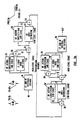
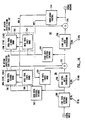
- Figure 7A is a block diagram of a compander system in accordance with an embodiment of the present invention having series staggered stages employing high-frequency and low-frequency sub-stages of the type described in connection with Figures 10, 11, and 12.
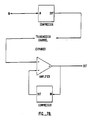
- Figure 7B is a block diagram of a compander system having a compressor as shown in Figure 14, in Figure 18, or in the compressor part of Figure 7A, and an expander formed by placing the compressor shown in Figure 14, in Figure 18, or in the compressor part of Figure 7A in the negative feedback loop of a suitable amplifier.
- Figure 8 is a block diagram of a two element action-substitution sub-stage employing fixed-band and sliding-band elements.
- Figure 9A is an idealized compressor characteristic response curve showing the response of an action-substitution sub-stage of the type shown in the arrangement of Figure 8 for a signal above the threshold of the sliding-band element but below the threshold of the fixed-band element.
- Figure 9B is an idealized compressor characteristic response curve showing the response slightly above the thresholds of both the elements of a sub-stage of the type shown in the arrangement of Figure 8.
- Figure 9C is an idealized compressor characteristic response curve showing the response at an even greater level above the thresholds of the elements of a sub-stage of the type shown in the arrangement of Figure 8.
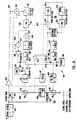
- Figure 10 is a partially schematic block diagram of an embodiment of a high-frequency action-substitution sub-stage employing fixed-band and sliding-band elements for use in a compressor, expander, or compander system in accordance with the invention.
- Figure 11 is a signal flow graph of the high-frequency action-substitution sub-stages according to the embodiments of Figure 10.
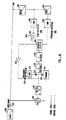
- Figure 12 is a partially schematic block diagram of an embodiment of a low-frequency fixed-band sub-stage for use in a compressor, expander, or compander system in accordance with the invention.
- Figure 13 is a partially schematic block diagram of an embodiment of the circuitry for deriving the modulation control signals used in the embodiments of the circuits of Figures 10 and 12.
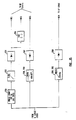
- Figure 14 is a block diagram of a compressor in accordance with one alternative embodiment of the present invention having series staggered stages employing high-frequency and low-frequency sub-stages of the type described in connection with Figures 15 and 16.
- Figure 15 is a partially schematic block diagram of one alternative embodiment of a high-frequency action-substitution sub-stage employing fixed-band and sliding-band elements for use in a compressor, expander, or compander system in accordance with the invention.
- Figure 16 is a partially schematic block diagram of one alternative embodiment of a low-frequency fixed-band sub-stage for use in a compressor, expander, or compander system in accordance with the invention.
- Figure 17 is a partially schematic block diagram of an alternative embodiment of the circuitry for deriving the modulation control signal used in the embodiments of the circuits of Figures 15, 16, 19, and 20.
- Figure 18 is a block diagram of a compressor in accordance with another, preferred, alternative embodiment of the present invention having series staggered stages employing high-frequency and low-frequency sub-stages of the type described in connection with Figures 19 and 20.
- Figure 19 is a partially schematic block diagram of another, preferred, alternative embodiment of a high-frequency action-substitution sub-stage employing fixed-band and sliding-band elements for use in a compressor, expander, or compander system in accordance with the invention.
- Figure 20 is a partially schematic block diagram of another, preferred, alternative embodiment of a low-frequency fixed-band sub-stage for use in a compressor, expander, or compander system in accordance with the invention.
- Figure 21 shows the output level plotted against frequency at different input levels for a compressor according to the third, preferred, embodiment of the invention.
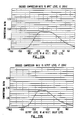
- Figure 22A shows compression slope plotted against input level at various frequencies within the frequency range of the high-frequency action-substitution sub-stage for a compressor according to the third, preferred, embodiment of the invention.
- Figure 22B shows compression ratio plotted against output level at various frequencies within the frequency range of the high-frequency action-substitution sub-stage for a compressor according to the third, preferred, embodiment of the invention.
- Figure 23A shows compression slope plotted against input level at a frequency within the frequency range of the low-frequency sub-stage for a compressor according to the third, preferred, embodiment of the invention.
- Figure 23B shows compression ration plotted against output level at a frequency within the frequency range of the low-frequency sub-stage for a compressor according to the third, preferred, embodiment of the invention.
- FIG 7A an embodiment of a compander system having a compressor and an expander, all in accordance with the present invention is shown, in which there are two series Type I dual-path stages in the compressor and two complementary stages in the expander.
- the threshold levels of the series bi-linear stages are staggered, employing the dynamic action level staggering aspects of US-PS 4,490,691.
- a Type II configuration could be employed.
- the embodiment of Figure 7A also employs the spectral skewing and antisaturation aspects of US-PS 4,490,691.
- the invention may be implemented using dual-path or single-path arrangements, dual-path implementations have certain advantages, as discussed above, and are preferred.
- One alternative embodiment of a compressor in accordance with the present invention is shown in Figure 14.
- Another, preferred, alternative embodiment of a compressor in accordance with the presence invention is shown in Figure 18.
- the decoder is complementary to the encoder and may be implemented by the arrangement shown for the decoder in Figure 7A.
- the well-known technique of placing the encoder in the feedback loop of suitable amplifier, as shown in Figure 7B may be used.
- the compressor shown in Figure 7B may be the one shown in the compressor part of Figure 7A, or the compressor shown in Figure 14 of Figure 18, or some other configuration of compressor.
- the compressor portion of the system of Figure 7A has two stages: a high-level stage 10, which has the higher threshold level, and a low-level stage 12, which has a lower threshold level. As discussed in US-PS 4,490,691, this is the preferred order of arrangement of staggered stages, although the reverse order is possible.
- the threshold is the signal amplitude level above which there is an onset of dynamic action in the compressor or expander.
- the expander portion of the system of Figure 7A also has two stages arranged complementary to the compressor: the low-level stage 14′ and the high-level stage 16′.
- Each high-level stage has both a high-frequency action-substitution sub-stage 24 (24′) and a low-frequency fixed-band sub-stage 28 (28′).
- the low-level stage has only a high-frequency action-substitution sub-stage 26 (26′) and no low-frequency sub-stage.
- Each high-frequency sub-stage 24 (24′) and 26 (26′) is of the type described generally in connection with Figures 8 and 9A-9C and more specifically in connection with Figure 10.
- Each low-frequency sub-stage 28 (28′) is of the type described in connection with Figure 12.
- there are some differences between the high-frequency sub-stages 24 (24′) and 26 (26′) as a result of their respective locations in the high-level and low-level stages. These differences are noted in the discussion of the embodiment of Figure 10.
- each high-frequency action-substitution compressor sub-stage (24, 26) and each high-frequency action-substitution expander sub-stage (24′, 26′) has, for example, 12 dB of compression or expansion, respectively, and if the low-frequency fixed-band compressor sub-stage 28 and the low-frequency fixed-band expander sub-stage 28′ has, for example 10 dB of compression or expansion, then the overall compander system will provide 24 dB of noise reduction in the high-frequency band (above the 400 Hz region, if the high-frequency sub-stages 24 (24′) and 26 (26′) have 400 Hz cutoff frequencies) and 10 dB of noise reduction in the low-frequency band (below 200 Hz, if the low-frequency sub-stage 28 (28′) has a 200 Hz cutoff frequency).
- Such an arrangement is useful, for example, in a high-quality audio noise-reduction system of the type used in consumer and semi-professional applications.
- the input to the compressor portion of the system is applied to low-frequency and high-frequency spectral skewing network shown as block 18.
- the network is a 50 Hz low-pass single-pole shelving section with a 6 dB depth and a 10 kHz high-pass two-pole shelving section with a 17 dB depth.
- the network may be implemented using well-known operational amplifier active filter techniques.
- a complementary de-skewing network is located in block 20 at the output of the expander.
- the main path of the low-level stage 12 in the compressor portion includes a high-frequency antisaturation network 22.
- a complementary antisaturation network 23 is located in the main path of the low-level stage 14 in the expander portion.
- the Type I stages of Figure 7A also include summing means 30 and 30′ that combine the outputs of the high-frequency and low-frequency sub-stages in the high-level stages 10 and 16 Hz, respectively.
- the stages include respective summing means 32 and 32′ and 34 and 34′ which couple the side-path outputs to the main path, thereby combining the side-path output signals with the main-path signal.
- the summing means 30 and 30′ may be dispensed with and the high-frequency and low-frequency sub-stages can be summed in summing means 32 and 32′.
- the fixed-band and sliding-band circuits of the action substitution sub-stages operate in a manner that draws on the best features of both type of circuits.
- the operation can be described as "action substitution.”
- action substitution sub-sage fixed-band dynamic action is used whenever it provides best performance; sliding-band operation is substituted whenever it has an advantage. In this way the best features of both methods are obtained without the attendant disadvantages of each.
- the substitution is effective on a continuous and frequency-by-frequency basis.
- the output from a given high-frequency sub-stage 24 or 26 will typically be from the fixed band for frequencies up to the dominant signal component and from the sliding band above that frequency in the manner of Figures 9A through 9C.
- the output from the low-frequency sub-stage 28 will be a fixed-band response (e.g., a uniform response throughout the band tailored by its 200 Hz low-pass band-defining filter).
- the high-frequency action-substitution sub-stages 24 and 26 are each a two-element action-substitution stack made up of fixed-band and sliding-band dynamic-action elements.
- the "stack" configuration of action-substitution elements is explained in US-PS 4,736,433 and in the above-cited article "The Spectral Recording Process” ( Figure 3, page 102).
- the functionally equivalent “subtractive” topology may be used (US-PS 4,736,433 and the cited article, Figure 2, page 202).
- Figure 8 shows a stack arrangement, with a filter 40, a sliding-band element 42 and fixed-band element 44.
- the fixed and sliding-band circuits are fed in parallel and the output signal is taken from the sliding-band circuit 42.
- the sliding-band variable filter is referenced to the output of the fixed band; that is, the fixed-band output is fed directly to the bottom end of the sliding-band variable resistance element. This connection results in the action-substitution operation mentioned previously.
- the overall output will always be the larger of the fixed- and sliding-band contributions at all frequencies.
- the effective passband threshold of the fixed-band element is -62 dB and that of the sliding-band element is -66 dB at 12 kHz and that each element can provide a maximum of 12 dB of boost. If, for example, a 12 kHz signal is applied at a level of -66 dB, the corner frequency of the sliding-band characteristic will slide to about 600 Hz but nothing happens to the overall characteristic envelope because the fixed band is still inactive and supports the envelope. The new sliding-band characteristic is hidden.
- Figure 9A shows this situation: the overall response is the same as the quiescent fixes band response; the sliding band response has shifted upward in frequency from its quiescent response.
- the overall response enveloppe remains the same as the fixed-band quiescent response until the signal reaches the -62 dB threshold of the fixed-band element.
- the fixed band begins to attenuate revealing the top of the sliding-band characteristic, which continues to slide upward as the signal level rises.
- the overall response and the sliding band response for this situation is shown in Figure 9B.
- the fixed band continues to attenuate and the sliding band continues to move upward as shown in Figure 9C.
- the curves shown in Figures 9A-9C are examples generated by a computer model.
- FIG 10 one embodiment of the high-frequency sub-stages 24 (24′) and 26 (26′) (Figure 7A) is shown, indicating both the steady-state and transient control aspects of the circuit.
- the high-level and low-level stage differ in that the AC and DC circuit gains are increased for the low-level stage.
- this figure shows only the basic parameter determining elements; the practical circuits, of course, contain other details such as buffering, amplification, and attenuation.
- Each sub-stage comprises a fixed-band circuit on the bottom and a sliding-band circuit on the top, each with its own control circuits.
- the fixed- and sliding-band circuits are fed in parallel and the output signal is taken from the sliding-band circuit.
- the sliding-band variable filter is referenced to the output of the fixed band; that is, the fixed-band output is fed directly to the bottom end of the sliding-band variable resistance element 154. This connection results in the action-substitution operation explained above.
- the incoming signal is fed through a single-pole high-pass filter 102.
- the filters throughout the various Figures are configured as passive RC filters in the inputs of operational amplifiers that act as buffers.
- the filter 102 has a cutoff frequency of about 400 Hz.
- the filtered input signal is applied to the fixed-band circuit 104 and to the sliding-band circuit 106.
- the output signal is taken from the sliding-band circuit and is fed through buffer 158.
- the overall quiescent (sub-threshold) frequency response of the circuit is that of a single-pole 400 Hz high-pass network.
- a low-pass filter 107 with a shelving response having a corner frequency of about 3.2 kHz and a shelf depth of 12 dB, is located in the input signal path to the fixed-band element 104.
- the filter parameters are selected by trading off two performance parameters.
- the lower the corner frequency the more the fixed band is able to provide boost in the presence of high frequency signals but the less noise-reduction effect it will provide when fully boosted.
- the deeper the shelf the more the fixed band will be able to provide boost in the presence of a signal frequency above the shelf frequency but the more loss of noise-reduction effect just below the signal frequency will occur.
- the noise spectrum of the cassette recorder also affected the design of this shelf.
- the fixed-band element includes an input resistor 108, a shunt variable-resistance element 110, and a control circuit 112 that generates a DC control signal which is applied to the control input of the variable-resistance element.
- a variable transconductance amplifier may be used as the variable-resistance element 110 and elsewhere throughout the embodiments of the various Figures.
- variable-resistance element preferably has a linear resistance versus control signal input characteristic.
- the variable-resistance element 110 responds to a current input and the applied DC control signal is a current.
- the resistance of the variable-resistance element drops as the DC control signal level increases, causing the amplitude level of the fixed-band filter to drop.
- Low-pass filter 107 desensitizes the fixed-band circuit to signals above its cutoff frequency.
- the threshold of the fixed-band circuit rises and its sensitivity decreases. Consequently, the fixed band provides more compression (or more noise reduction) in the presence of signals above the filter 107 cutoff frequency. This provides a reduction of noise modulation.
- the non-linear response of the FET formed an inherent part of the desired dynamic circuit action
- the response characteristics of individual FETs are subject to some variation and the non-linear response of the FET is not necessarily the optimum response to achieve the desired dynamic characteristic of the circuit.
- J-FETs are not easily implemented in integrated circuits.
- the prior art technique of using and FET as the variable element may be employed, the combination of a non-linear element and a linear variable-resistance element permits the circuit designer to optimize the dynamic circuit characteristic and avoid the problem of various in FET characteristics while permitting easy integration of the circuits.
- the characteristic of the non-linear element determines the circuit's compression ratio.
- An exponential function is used for the fixed-band circuit of the action-substitution sub-stage.
- the onset of compression is broad but the compression characteristic approaches the characteristics of a limiter as the input level rises.
- the finishing point the region in the bi-linear characteristic of the side path and main path where the dynamic action ceases and the characteristic becomes linear at high signal levels
- the finishing point is not too far removed (in input level) from the compressor threshold.
- a series of fixed power law functions could be used in order to avoid temperature dependent effects (two terms, V2 and V8, for example). Such functions also cause the compression ration to continue to rise as the input level increases.
- a fixed power law function is used for the sliding-band circuit of the action-substitution sub-stage, consequently the compression ratio does not increase with input signal level.
- An increasing compression ratio is not required because phase shift in the side path, due to the variable filter characteristics, increases with input signal level, further reducing the side-path contribution to the main path than would be provided by attenuation alone.
- a fixed power law function provides a compressor whose compression characteristics do not change with frequency, whereas an exponential function would do so.
- a fixed power law allows control over the shape of the compression curve.
- the respective exponential and fixed power law functions give the circuit designer control over the shape of the compression curves. Mistracking is minimized when the beginning and end points of the compression curves are smooth and broadly defined. A countervailing requirements is that the dynamic action of the overall circuit must be restricted so as to occur above the noise floor and below the maximum level of its operating environment. For staggered bi-linear stages, this selection of non-linear elements provides the necessary freedom to design an encoder with good overall characteristics.
- V OS , G1, G2, and N are different in the high-level and low-level stages.
- the fixed-band output from the fixed-band variable resistance element 110 is fed via weighting filter 116 to two control circuits, the main (pass-band and stop-band) control signal circuit 118 and the pass-band control circuit 120.
- This arrangement is similar to Figure 21 of US-PS 4,498,055 and Figure 8 of US-PS 4,922,535.
- the signal is rectified in block 128 and opposed in combining means 129 by the modulation control signal MC3. The derivation of the modulation control signals is explained below in connection with Figure 13.
- the resulting DC signal is smoothed by a smoothing circuit 130 with about an 8 millisecond (ms) time constant (the overall steady-state control signal characteristic in this and all other circuits is average responding--an important feature in a practical companding system).
- the control signal is then fed to one input of a maximum selector circuit 122, which passes to its output the larger of two signals applied to the input.
- the fixed-band output is also fed to the pass-band control circuit 120, which comprises the 800 Hz single-pole high-pass filter 132, a full-wave rectifier 134, and a smoothing circuit (about 8 ms) 136.
- the pass-band control signal is applied to the other input of the maximum selector circuit.
- the output of the maximum selector circuit is further smoothed by about a 160 ms time constant in block 124 and is used to control the fixed-band variable resistor 110 via variable resistor driver circuit 126, a non-linear function circuit.
- the second integrator 124 cooperates with the first integrator (of circuit 118 or circuit 120) not only to provide a ripple-free DC control signal but also to adjust the attack and release time constants of the control circuit 112.
- a diode (not shown) across the resistive element of integrator 124 shortens the time constant under certain conditions. If the voltages at the input and output of block 124 become significantly different, the discharge time of the second integrator is reduced to be that of the first integrator. Such a diode is also connected across block 168 for the same purpose.
- the non-linear function element 126 generates a current output having an exponential function in response to the applied input voltage from the second integrator 124 according to the function:
- An exponential current function is easily obtained by driving the base of a transistor with a voltage and obtaining the current from the collector. Using well-known techniques, in a practical circuit a voltage offset is applied at base of the transistor.
- the dual control circuit arrangement described above is employed to obtain optimal performance under both simple signal (single dominant signal) and complex signal (more than one dominant signal) situations.
- the modulation control signal MC3 is optimized in frequency weighting and amount for simple signal conditions, in which the modulation control action is most useful. Under complex signal conditions, however, the modulation control signal developed becomes improper, and the resulting modulation control action is then greater than necessary; that is, the DC control signal output from the main control circuit is less than required. Under this condition the control signal from the pass-band circuit is phased in, via the maximum selector circuit, to control the overall action of the fixed-band compressor circuit.
- the output of the fixed-band element is fed through buffer 114 with an overall gain of unity to provide the reference for the sliding-band filter; this is the only signal output of the fixed-band circuit.
- the sliding-band element 106 includes parallel input resistor 150 and capacitor 152 which are shunted by a variable-resistance element 154, and a control circuit 156 that generates a DC control signal which is applied to the control input of the variable-resistance element.
- the presence of resistor 150 results in a variable high-pass filter characteristics having a shelving response (a "variable high-pass shelf filter").
- the time-constant of capacitor 152 and resistor 150 defines the lower, fixed, corner frequency of the variable high-pass shelf filter. In practical embodiments of the circuit, this corner frequency is at about 200 Hz.
- the time constant of capacitor 152 and the resistance of variable resistance element 154 defines the upper, variable, corner frequency of the variable high-pass shelf filter. A high values of resistance of variable resistance element 154, the two corner frequencies overlap and the variable high-pass shelf filter assumes an all-pass characteristic.
- the variable-resistance element 154 preferably has a linear control signal input versus resistance characteristic.
- the variable-resistance element 154 responds to a current input and the applied DC control signal is a current.
- the resistance of the variable-resistance element drops as the DC control signal level increases, causing the corner frequency of the sliding-band filter to rise.
- the sliding-band control signal is derived by control circuit 156 from the circuit output.
- the signal is fed through the 10 kHz (8 kHz in the low-level stage) single-pole high-pass weighting network 160 and is rectified.
- the rectified signal is opposed in combining means 163 by modulation control signal MC1; since MC1 also has a single-pole high-pass characteristic, the ration between the rectified control signal and MC1 monitors the signal attenuation (this ratio creates and end-stop effect on the sliding-band action).
- the result is smoothed first in block 166 by a time constant of about 8 ms (4 ms in the low-level stage) and finally in block 168 by a time constant of about 80 ms.
- the smoothed control signal is then used to control the sliding-band variable resistance element 154 via variable resistor driver circuit 170, a non-linear function circuit.
- the second integrator cooperates with the first integrator not only to provide a ripple-free DC control signal but also to adjust the attack and release time constants of the control loop.
- a single control circuit suffices in the sliding-band circuit because the high-pass control weighting network 160 tends to offset the effect of complex signals on the modulation control voltage developed (MC1).
- I out k (V in ) N where N is a positive number greater than 1.
- variable element As mentioned above, although the prior art technique of using an FET as the variable element may be employed, the combination of a non-linear element and a linear variable-resistance element is preferred.
- the overall output from the high-frequency action-substitution sub-stage is taken from buffer 158 of the sliding-band element 106.
- overshoot suppression arrangements for the high-frequency sub-stages are also shown in Figure 10.
- a general feature is that unsmoothed rectified signals from the control circuit rectifiers 128 and 162 are opposed by appropriate modulation control signals and are fed via diode means 135 and 137 to the final smoothing circuits 124 and 168, respectively, particularly the capacitors thereof.
- the overshoot suppression thresholds in the present arrangements are significantly higher than the steady-state thresholds.
- the overshoot suppression thresholds are set at about 10 dB above the relevant steady-state thresholds; the overshoot suppression effects are then phased in gradually.
- the net result is that for most musical signals the overshoot suppressors rarely operate; the compressors are controlled by well-smoothed signals. When the suppressors do operate, the effect is so controlled that modulation distortion is minimal.
- the overshoot-suppression effects are gradually phase out or reduced with increasing signal levels; this action further ensures low overall modulation distortion from the system.
- the circuit configuration gives the circuit designer the ability to adjust the relative thresholds and the gradual phase in of the overshoot effects.
- the thresholds are set by adjusting the relative gain of the amplifiers in the steady-state and overshoot suppression circuits.
- the gradual phasing in of overshoot suppression effects is accomplished by operating the diodes which couple the overshoot suppression circuits to the capacitor from which the control signal is derived as variable resistors. Other, more complex circuits may be employed to achieve this function.
- the gradual phasing out or reduction of overshoot suppression effects is achieved by limiting circuits that reduce the gain of the overshoot suppression circuits at very high levels as well as by the modulation control signals that oppose the overshoot suppression signals at high levels.
- the overshoot suppression signal is derived from full-wave rectifier 128 of the main control circuit 118.
- the rectified signal is opposed by MC3 in combining means 131, so that the overshoot suppression threshold is appropriate for conditions in the steady-state regime.
- the appropriate AC and DC conditions are set in amplifier stage 133.
- the gain of the overshoot suppression side circuit is less than the gain of the steady-state control circuit.
- the resultant overshoot suppression signal is coupled by a diode means 135 to the final smoothing circuit 124, particularly the capacitor thereof.
- the primary overshoot suppression signal is derived from the full-wave control circuit rectifier 162, opposed in combining means 163 by MC2, a smoothed version of MC1 (MC1 controls the steady-state characteristics), the appropriate AC and DC conditions are set in amplifier stage 165, and coupled to the final smoothing circuit 168, particularly the capacitor thereof, via diode means 167.
- the gain of the overshoot suppression side circuit is less than unity.
- the smoothing of MC1 to create MC2 is necessary because, unlike the situation in the fixed-band circuit, there is no constant and favorable phase relationship between the signal in the control circuit and MC1 (because of the sliding band); the smoothing enables reliable and effective bucking action to take place.
- the effect of the primary overshoot suppression circuit preferably is maximized for the most significant transient signal situation--that is, a single impulse or tone burst starting from a sub-threshold signal level. Because of the way the primary overshoot signal is derived, the overshoot suppression signal amplitude falls with increasing frequency faster than the control signal amplitude. This causes insufficient overshoot suppression for signals in the 200 to 800 Hz region. To compensate for this, a portion of the fixed-band overshoot suppression is fed to the sliding-band control circuit. This supplemental signal is called the sliding-band secondary overshoot signal.
- the sliding-band and fixed-band control circuits (156 and 118, respectively) further include a "parking" feature.
- a parking circuit 176 is coupled to the second integrator 168 by a coupling diode 178.
- a parking circuit 180 is coupled to the second integrator 124 by a coupling diode 182.
- the parking circuits operate generally in the same way as the parking circuits described in US-PS 4,736,433.
- the fixed-band parking circuit 180 puts a charge on the capacitor in smoothing circuit 124 so as to keep the control circuit just below its threshold; the sliding-band parking circuit 176 operates in the same manner so as to prevent the sliding-band filter corner frequency from dropping below a particular frequency.
- the effect of the parking circuits is to improve noise-reduction performance and transient response under certain signal conditions by allowing the control circuit to react more quickly.
- the parking circuit fixes the corner frequency of the sliding band slightly above the corner frequency of the circuit input filter.
- Figure 12 shows the steady-state and transient control aspects of the low-frequency fixed-band sub-stage 28 (Figure 7A). As with the high-frequency sub-stages, only the basic parameter determining elements are shown. The sub-stage is similar to the fixed-band circuit of the high-frequency sub-stage described in connection with Figure 10.
- the incoming signal is applied through a 200 Hz band-defining low-pass filter (the location of this filter is changed from that of the action-substitution sub-stage) to a variable attenuator circuit provided by resistor 182 and a variable resistance element 184.
- Control circuit frequency weighting is provided by a single-pole 400 Hz low-pass filter 186.
- the main control circuit 188 full-wave rectifies the filtered signal in block 190; the resulting DC signal is bucked by modulation control signal MC4 in combining means 192, smoothed in block 194 by a smoothing circuit with about a 15 ms time constant, and fed to one input of maximum selector circuit 196.
- the maximum selector circuit has the same purpose and mode of operation as in the high-frequency sub-stages.
- the low-frequency fixed-band sub-stage also includes the "parking" feature.
- a parking circuit 210 is coupled to the second integrating capacitor 206 by a coupling diode 212.
- the parking circuit 210 operates in the same way as the fixed-parking circuit 180 of Figure 10: it puts a charge on the capacitor in smoothing circuit 206 so as to keep the control circuit just below its threshold.
- the 400 Hz frequency weighted output of the fixed-band sub-stage is also fed to the pass-band control circuit 198.
- the control signal is further weighted by a 100 Hz single-pole low-pass filter 200, full-wave rectified in block 202, smoothed by a smoothing circuit with about a 15 ms time constant in block 204, and fed to the other input of the maximum selector.
- the larger of the two signals is passed to the final smoothing circuit (about 300 ms) 206 and is used to control the fixed-band variable resistor 184 via variable resistor driver circuit 208, a non-linear function circuit.
- Circuit 208 provides a characteristic similar to circuit 126 of Figure 10.
- unsmoothed rectified signals derived from the outputs of the variable elements are opposed by appropriate modulation control signals and are fed via diode means to the final smoothing circuits, especially the capacitor in each such circuit.
- the low-frequency fixed-band sub-stage generates a primary overshoot suppression signal simply by bucking the output of rectifier 214 against MC4 in combining means 216.
- the appropriate AC and DC conditions are set in amplifier 218 and the overshoot suppression signal is then coupled via diode means 220 to the final smoothing circuit 206, especially the capacitor thereof, of the fixed-band circuit.
- the gain of the overshoot suppression side circuit is less than the gain of the steady-state control circuit.
- modulation control circuits Suitably filtered or frequency weighted signals from the main signal path are rectified, and in some cases smoothed, and are fed in opposition to the control signals generated by the control circuits of the various circuits. The result a higher signal levels is to create a balance or equilibrium between the circuit control signals and the modulation control signals. Under these conditions there is no further gain reduction or sliding of the relevant variable filters with increasing input signal levels.
- FIG. 13 shows a preferred arrangement for deriving modulation control (MC) signals used in the embodiments of Figure 11 and 12.
- MC1 through MC8 eight modulation control signals, designated MC1 through MC8, are employed.
- MC1-MC3 and MC6 are not required because the present system does not use a low-frequency sliding-band stage.
- MC4 controls the sliding-band parts of the low-frequency action substitution sub-stages and MC5 is used to control the low-frequency sliding-band overshoot suppression circuits.
- MC6 of the professional SR system is called MC4 in this application.
- MC4 in this application is not the same as MC4 in professional SR.
- FIG 13 shows further details of the modulation control circuits.
- MC1-3 are used for the high-frequency sub-stages 24 and 26 ( Figure 7A);
- MC4 is used for the low-frequence sub-stage 26 ( Figure 7A).
- MC1 controls the high-frequency sliding-band circuits.
- the signal from the takeoff point is fed through a 100 Hz all-pass filter 250 for phase compensation, a single-pole high-pass filter 252 having about a 3 kHz corner frequency, and is rectified in block 254, and fed in opposition to the control signals generated by the high-frequency sub-stages.
- MC1 is also smoothed by a two-stage integrator 256 having about a 1 ms time constant and is employed, as MC2, to oppose the operation of the high-frequency sliding-band overshot suppression circuits as described above. The overshoot suppression thresholds thereby track the steady-state thresholds.
- MC3 controls the high-frequency fixed-band circuits.
- the signal from the takeoff point is weighted by cascaded single-pole low-pass filters 258, 260, having respective corner frequencies of about 200 Hz and about 400 Hz, rectified in block 262 and fed in opposition to both the steady-state and transient control (overshoot suppression) circuits of the high-frequency fixed-band circuits.
- MC4 controls the low-frequency fixed-band sub-stage.
- the signal from the takeoff point is weighted by cascaded single-pole high-pass filters 264, 266, having corner frequencies of about 200 Hz and 400 Hz, respectively, rectified in block 268, and is fed in opposition to both the steady-state and transient control (overshoot suppression) circuits of the low-frequency fixed-band sub-stage.
- a side effect of the modulation control scheme is that a high signal levels the amplitudes of the noise-reduction signals from the side paths are relatively high in comparison with the situation in the A-type, B-type, and C-type systems that do not employ modulation control. Because of this it is not possible to employ simple overshoot suppression diodes as in these previous systems (for example, clipping diodes 28 in Figure 4 of US-PS Re 28,426). Accordingly, as in the professional SR system and as described in US-PS 4,922,535, overshoot suppression side circuits are used in parallel with a portion of the steady-state control circuit in order to provide a rapid but controlled decrease in attack time of the control circuit.
- FIG 14 an alternative embodiment of a compressor in accordance with the presence invention is shown, having two series Type I dual-path stages.
- the threshold levels of the series bi-linear circuits are staggered, employing the dynamic action level staggering aspects of US-PS 4,490,691.
- a Type II configuration could be employed.
- the embodiment of Figure 14 also employs the spectral skewing and antisaturation aspects of US-PS 4,490,691.
- the invention may be implemented using dual-path or single-path arrangements, dual-path implementations have certain advantages, as discussed above, and are preferred.
- the decoder is complementary to the encoder and may be implemented by the well-known technique of placing the encoder in the feedback loop of suitable high gain amplifier or in the manner of the arrangement of Figure 7A.
- FIG. 14 Corresponding elements in Figures 7 and 14 bear related reference numerals, the Figure 14 reference numerals adding 300 to the numerals used in Figure 7A.
- the compressor portion of the system of Figure 14 has two stages: a high-level stage 310, which has the higher threshold level, and a low-level stage 312, which has a lower threshold level.
- the low-level stage has only a high-frequency action-substitution sub-stage 326 and no low-frequency sub-stage.
- Each high-frequency sub-stage 324 and 326 is of the type described generally in connection with Figures 9A-9C and more specifically in connection with Figures 7 and 10.
- High-frequency sub-stage 324 includes a high-frequency sliding-band element 346 and a high-frequency fixed-band element 348; high-frequency sub-stage 326 includes a high-frequency sliding-band element 350 and a high-frequency fixed-band element 352.
- the low-frequency sub-stage 328 is of the type described in connection with Figure 16. In pratical circuits, there are some differences between the high-frequency sub-stages 324 and 326 as a result of their respective locations in the high-level and low-level stages. These differences are noted in the discussion of the embodiment of Figure 15.
- each high-frequency action-substitution compressor sub-stage (324, 326) and each high-frequency action-substitution expander sub-stage in the complementary expander has, for example, 12 dB of compression or expansion, respectively, and if the low-frequency fixed-band compressor sub-stage 328 and the low-frequency fixed-band expander sub-stage in the complementary expander has, for example, 10 dB of compression or expansion, then an overall compander system employing the compressor of Figure 14 and its complementary expander will provide 24 dB of noise reduction in the high-frequency band (above the 400 Hz region, if the high-frequency sub-stages 324 and 426 have 400 Hz cutoff frequencies) and 10 dB of noise reduction in the low-frequency band (below 200 Hz, if the low-frequency sub-stage 328 has a 200 Hz cutoff frequency).
- Such an arrangement is also useful, for example, as in the embodiment of Figure 7A, in a high-quality audio noise-reduction system of the type used in consumer and semi-professional applications.
- the input to the compressor portion of the system is applied to low-frequency spectral skewing network shown as block 340.
- the network is a low-pass single-pole shelving section with a pole at 80 Hz and a zero at 32 Hz (a depth of about 8 dB).
- the network may be implemented using well-known operational amplifier active filter techniques.
- a complementary de-skewing network is located in the expander (not shown).
- the low-frequency spectral skewing network of the Figure 14 embodiment has a bigger shelf and its action starts at a higher frequency than the corresponding network in the embodiment of Figure 7A.
- This change provides a better antisaturation effect in the frequency region where typical cassette tape starts to saturate as a results of the 3180 ⁇ s (microsecond) low-frequency record equalization by providing about 3 dB of attenuation at 50 Hz at high input signal levels.
- High-frequency spectral skewing is provided by network 342 and network 344 in the inputs to the respective high-frequence action substitution sub-stages 324 and 326.
- network 342 is a single-pole low-pass filter having a corner frequency of 12.8 kHz and network 344 is a two-pole low-pass filter having the same corner frequency.
- These networks may also be implemented using well-known operational amplifier active filter techniques.
- spectral skewing networks 342 and 344 of figure 14 are simple 1-pole and 2-pole low-pass filters respectively. Such filters can be used because, although their effect in the side path continues to increase with increasing frequency, they can never reduce overall compressor gain to less than unity.
- the normal expander characteristic is unable to track the bias-altered compressor characteristic, and serious encode-decode mis-tracking results. Even if the bias signal is prevent when the expander is operating (e.g. in a three-head tape recorder when monitoring off-tape during a recording) there will still be mis-tracking because the amount of bias leakage into the compressor and expander (and hence bias effect) is unlikely to be exactly the same in the compressor and expander.
- a side-path spectral skewing circuit is fully integrated with the noise reduction circuit and changes the way in which the noise reduction circuit operates.
- the spectral skewing circuit attenuates the side-path output signal in the frequency range in which it operates and hence reduces amount of compression obtained at such frequencies. This in turn reduces the peak compression ration and hence the mis-tracking effect.
- side-path spectral skewing does not raise the level of the compressor finishing point as conventional spectral skewing does. In fact, the level of the compressor finishing point progressively decreases with increasing frequency, a desirable feature in consumer tape equipment in which the level at which the tape saturates also progressively decreases with increasing frequency.
- a further advantage of locating spectral skewing in the side path is that such a configuration has a beneficial effect in the expander as well as in the compressor.
- the spectral de-skewing circuit is at the output of the expander, and thus cannot prevent extraneous signals from contributing to the expander control signals, and thus modifying the expander characteristic.
- Side-path spectral skewing reduces the contribution of extraneous signals to the control signal in both the compressor and the expander and thus enhances the accuracy of the noise reduction system in applications in which signals in addition to those that left the compressor are present at the input of the expander.
- the main paths of the low-level and high-level stages 310 and 312 include respective high-frequency antisaturation networks 356 and 358.
- Complementary antisaturation networks are located in the expander (not shown).
- the use of two antisaturation networks and the change in the break frequencies of the networks with respect to the single antisaturation network of the Figure 10 embodiment results in improved antisaturation response and compensates for the reduced antisaturation effect produced by the spectral skewing network arrangements of the Figure 14 embodiment.
- the Type I stages of Figure 14 also include summing means 332 and 334 that combine the outputs of the high-level and low-level stages 310 and 312 with the respective main paths.
- Figure 14 also shows the modulation control circuits as block 354 which applies the modulation control signals MC1-3 to the action substitution sub-stage elements 346, 348, 350, and 352 and the modulation control signal MC4 to the low-frequency fixed band sub-stage 328.
- the action substitution sub-stages of the embodiment of Figure 14 operate in the same way as in described in connection with the embodiment of Figure 7A.
- the stack configuration of the embodiment of Figures 14-17 employs a differential derivation of the sliding-band element control signal.
- FIG 15 an embodiment of the high-frequency sub-stages 324 and 326 ( Figure 14) is shown, indicating both the steady-state and transient control aspects of the circuit.
- the high-level and low-level stages differ in that the AC and AD circuit gains are increased for the low-level stage.
- this figure shows only the basic parameter determining elements; the practical circuits, of course, contain other details such as buffering, amplification, and attenuation.
- Figure 15 and Figure 10 will be described.
- Corresponding elements in Figure 10 and 15 bear related reference numerals, the Figure 15 reference numerals adding 300 to the numerals used in Figure 10.
- the input high-frequency band defining filter 102 of Figure 10 now includes the high-frequency spectral skewing network 342 or 344 ( Figure 14).
- the combined band defining and spectral skewing network is shown as block 403.
- V o V in s/2 ⁇ f1 1 + s/2 ⁇ f1 . 1 + s/2 ⁇ f2 1 + (s/Q ⁇ 2 ⁇ f3) + (s/2 ⁇ f3)2
- the output of the fixed band element at the junction of resistor 408 and the variable element 410 is substracted from the signal fed to the sliding band element control circuit in combining means 459.
- Deriving the sliding band control signal differentially effectively raises the threshold of the sliding band, and prevents the sliding band from being controlled erroneously by noise.
- the differential voltage developed across fixed-band control element 410 (which has a relatively high value under such conditions) is significant and thus considerably reduces the amplitude of the signal at the output of combing means 459 (and hence the amplitude of the sliding band element control signal).
- the effect of the differential voltage from across element 410 is less, and the sliding band control signal has its full effect.
- the effectiveness of the differentially derived sliding band control signal on raising the threshold of the sliding band is enhanced at high frequencies by relocating filter network 107 from the input to the fixed band element 104 of the Figure 10 embodiment.
- the filter is now labelled block 409 and is now located between the fixed band and sliding band elements. Relocating the filter has no effect on the operation of the fixed band element.
- the fixed band element control circuit still receives a filtered signal.
- the signal fed from the fixed band element to the bottom end of sliding band control element 454 is also filtered as before.
- the differential signal fed to combining means 459 is not filtered, however.
- Filter 160 of the Figure 10 embodiment is modified to have a corner frequency of 6 kHz in both the high-level and low level stages. It is shown as block 461.
- the corner frequency of the filter 116 ( Figure 10) is raised to about 400 Hz (Filter 417 in Figure 15).
- control circuit of the fixed-band element is simplified by removing the 8 ms time constant circuits 130 and 136 ( Figure 10). Instead, in the embodiment of Figure 15, maximum selector 422 operates on unsmoothed rectified signals and feeds a single 8 ms time constant circuit 423, followed by 160 ms time constant circuit 424.
- the parking circuit 176 ( Figure 10) is omitted from the embodiment of Figure 15.
- Additions to the embodiment of Figure 15 are circuits for limiting the maximum amplitude level of the sliding-band and fixed-band control signals: limit circuits 477 and 486 and their respective coupling diodes 479 and 482.
- the parking circuit improves the attack time of the circuit by maintaining the capacitor voltage in the integrator at a level just below the threshold of variable element 426
- the limit circuits improve recovery time and enhance compatibility among circuits by preventing the voltage on the capacitor from building up to excessive levels under high level signal conditions. When the high level signal ceases, the voltage on the capacitor can fall more quickly to the new level appropriate for the new input signal condition because it has a lower starting level.
- Figure 16 shows the steady-state and transient control aspects of the low-frequency fixed-band sub-stage 328 ( Figure 14). As with the high-frequency sub-stages, only the basic parameter determining elements are shown. The circuit is similar to the fixed-band circuit of the high-frequency sub-stage described in connection with Figure 15. For the purposes of conciseness and convenience, only the differences between Figure 16 and Figure 12 will be described. Corresponding elements in Figures 12 and 16 bear related reference numerals, the Figure 16 reference numerals adding 300 to the numerals used in Figure 12.
- control circuit is simplified by operating the maximum selector on unsmoothed rectified signals. This enables the two 15 ms time constant circuits 194 and 204 ( Figure 12) to be replaced by a single 15 ms time constant circuit 505 located between the maximum selector 496 and the 300 ms time constant circuit 506.
- overshoot suppression signal is changed in the Figure 16 embodiment with respect to Figure 12. Rectifier 214 and combining means 216 (Figure 12) are omitted and, in the Figure 16 embodiment, the overshoot signal is simply derived from the output of main control circuit 488. This signal is a suitable source of an overshoot suppression signal because smoothing element 194 ( Figure 12) is omitted in the Figure 16 configuration.
- a limit circuit 524 and diode 522 is added to limit the maximum amplitude of the low-frequency fixed-band control signal.
- Figure 17 shows further details of the modulation control circuits used in the embodiments of Figures 14, 15 and 16.
- MC1-3 are used for the high-frequency sub-stages 324 and 326 ( Figure 14);
- MC4 is used for the low-frequency sub-stage 328 ( Figure 14).
- Figure 17 reference numerals adding 300 to the numerals used in Figure 13.
- the embodiment of Figure 17 omits the 100 Hz all-pass filter 250 of Figure 13.
- a single stage integrator 257 with a 2 ms time constant is used instead of a 2-stage integrator 256 with 1 ms time constants.
- Figures 18 through 20 show the preferred embodiment of a compressor in accordance with the present invention. Because the embodiment shown in Figures 18 through 20 is an evolutionary development of that shown in Figures 14 through 17, the description pertaining to Figures 14 though 16 pertains equally to Figures 18 through 20, except for the differences to be described below. Corresponding elements in Figures 14 through 16 and 18 through 20 bear related reference numerals; in the latter three Figures, the reference numerals add the letter A to the reference numerals used the former three figures. Figure 17 shows the modulation control signal derivation for both embodiments.
- the input to the compressor portion of the system is applied in the preferred embodiment ( Figure 18) directly to the input of the main path and the input filters of the high-level stage 310A in the side path, instead of via low-frequency spectral skewing block 340 ( Figure 14).
- Low-frequency spectral skewing is provided in the embodiment of Figure 18 by block 360A, located at the input of low-frequency fixed band 328A in high-level stage 310A.
- the low-frequency spectral skewing network is shown as separate block 360A in Figure 18, its function can be realized simply by changing low frequency band defining filter 480 (Figure 16) at the input to low-frequency fixed band 328 ( Figure 14) into band-pass filter 490A ( Figure 20) in the same location 328A ( Figure 18).
- separate filters can be used for the low frequency band defining filter and spectral skewing functions.
- the high-pass (i.e. low-frequency spectral skewing) portion of band-pass filter 490A is a single-pole section with a corner frequency at 33 Hz and the low-pass (i.e. low frequency band defining) portion of the filter is a single-pole section with a corner frequency of 240 Hz.
- the latter frequency is different from the 200 Hz corner frequency of corresponding low-pass filter 480 of the Figure 14 embodiment because different preferred value components are used.
- the network may be implemented using well-known operational amplifier active filter techniques.
- the same network in the side-path of the expander (not shown) provides complementary de-skewing.
- the low-frequency spectral skewing network 360A of the Figure 18 embodiment operates at lower frequencies than the corresponding network in the embodiments of Figures 7 and 14.
- the effect of low-frequency spectral skewing filter 360A of the Figure 18 embodiment is greater at very low frequencies than that of the low-frequency spectral skewing filter of the other two embodiments because filter 360A has a simple high-pass characteristic rather than a shelf characteristic. This change in characteristic is made possible by location the spectral skewing filter in the side path, where there is no need to limit its action in order to be able to generate an accurate complementary characteristic in decode mode.
- High-frequency spectral skewing is provided by networks 342A and 344A.
- networks 342A and 344A separate circuit blocks are shown in Figure 18, but a practical embodiment of the circuit can use the configuration shown in Figure 14, in which a single band-pass filter (403 in Figure 15) in the input of each of the high-frequency action-substitution sub-stages 324 and 326 in Figure 14 serves as both the high-frequency spectral skewing network and the action-substitution sub-stage high-frequency band defining input filter.
- separate filters can be used to provide the spectral skewing and high-frequency band defining filter functions.
- the input band-pass filter 403A ( Figure 19) of high-frequency action substitution sub-stage 324A of high-level stage 310A has a single-pole high-pass (high-frequency band defining) characteristic with a corner frequency at 406 Hz, and a single-pole low-pass (spectral skewing) characteristic with a corner frequency at 12.6 kHz.
- the slight difference in the these frequencies from the corresponding frequencies used in block 403 of the Figure 14 embodiment is simply a result of using components with different preferred values.
- the input band-pass filter 403A ( Figure 15) to the high-frequency action substitution sub-stage 326A in low-level stage 312A has a single-pole high-pass (high-frequency band defining) characteristic with a corner frequency at 406 Hz, and a double-pole low-pass (spectral skewing) characteristic with a corner frequency at 13.3 kHz.
- the slight difference in the first of these frequencies from the corresponding frequency in block 403 of the Figure 14 embodiment is simply a result of using components with different preferred values.
- the slope of the low-pass characteristic of band-pass filter 403A changes to a single pole characteristic at frequencies above 48 kHz. This causes some reduction of the spectral skewing effect at ultrasonic frequencies, such as tape recorder bias frequency. However, even with the reduced spectral skewing effect, the Figure 18 embodiment remains considerably superior to other noise reduction systems and the Figure 10 configurations in avoiding tracking errors caused by bias and other ultrasonic signals.
- the main advantage of reducing the slope of the spectral skewing characteristic at ultrasonic frequencies is that it increases the margin of stability of the decoder (when an encoder is typically placed in the feedback loop of a high-gain amplifier).
- These networks may also be implemented using well-known operational amplifier active filter techniques.
- the same networks in the corresponding side-paths of the expander (not shown) provide complementary de-skewing.
- the main paths of low-level and high-level stages 310A and 312A respectively include respective antisaturation networks 356A and 358A. Both networks provide high-frequency antisaturation action; additionally, antisaturation network 356A in high-level stage 310A provides low-frequency antisaturation action, substituting for the antisaturation effect lost by moving the low-frequency spectral skewing network 360A to the side-path.
- Combined low-frequency and high-frequency antisaturation network 356A has an overall band-pass-like characteristic.
- the low-frequency antisaturation effect is provided by a single-pole shelf characteristic with an upper corner frequency at 150 Hz and a lower corner frequency at 60Hz. These frequencies are considerably higher than those used in low-frequency spectral skewing network 340 in the Figure 14 embodiment.
- low-frequency spectral skewing network 340 ( Figure 14) is located at the compressor input
- anti-saturation network 356A Figure 18 is located in the main path, where its action is diluted by the non-attenuated low-frequency signal from low-frequency band 328A in the side path.
- low-frequency part of antisaturation network 356A reduces the overall level of the signal at compressor output 361A by about the same amount as low-frequency spectral skewing network 340 reduced it in the Figure 14 embodiment.
- the low-frequency part of antisaturation network 356A reduces the signal level at compressor output 361A by about 3 dB at 50 Hz, which effectively cancels out the troublesome 3180 ⁇ s low-frequency record pre-emphasis required by the I.E.C standard for cassette tapes.
- a greater low-frequency antisaturation effect is obtained at higher levels; at lower levels, the effect is reduced.
- the high-frequency antisaturation effect of block 356A in high-level stage 310A is provided by a high-frequency notch characteristic with a notch frequency of 25 kHz instead of the simple single-pole shelf characteristic used in the Figure 14 embodiment. Above 25 kHz, the attenuation of the notch filter gradually reduces to zero, which usefully increases the margin of stability of the decoder (when an encoder is typically placed in the feedback loop of a high-gain amplifier) compared with the Figure 14 shelf characteristic.
- the resulting reduction in the amount of anti-saturation effect at ultrasonic frequencies does not give rise to appreciable tape overload problems at such frequencies mainly because the normal record amplifier configuration used in most consumer and semi-professional tape recorders has a greatly reduced response at such frequencies. Moroeover, the shelf characteristic is retained in the low-level stage and produces about 10 dB of antisaturation effect at such frequencies.
- Antisaturation network 358A provides high-frequency antisaturation in low-level stage 312A and is a single-pole shelf network, similar to antisaturation network 358 in the Figure 14 embodiment. However, the lower corner frequency has been moved up from 5 kHz to kHz. The depth of the shelf remains essentially unchanged.
- Complementary antisaturation networks are located in the expander (not shown).
- Figure 19 shows the preferred embodiment of the high-frequency action substitution sub-stages 324A and 326A (Figure 18) of the high-level stage 310A and the low-level stage 312A respectively, including both the steady-state and transient control aspects of the circuit. To save repetition, only the differences between the Figure 19 embodiment and the Figure 15 embodiment will be discussed. Corresponding elements in Figures 15 and 19 bear related reference numerals, the Figure 19 reference numerals adding the letter A to the numerals used in Figure 15.
- the corner frequency of filter 461A is changed from 6 kHz to 8 kHz in high-level stage 310A ( Figure 18) only.
- the corner frequency of filter 461A in low-level stage 312A ( Figure 18) remains at 6 kHz. Staggering the corner frequencies gives in an improved compromise between sensitivity of sliding band control circuit 456A to noise and high-frequencies compression ratio.
- the limit circuit 486 in fixed-band control circuit 418 of Figure 15 is omitted from the embodiment of Figure 19.
- Sliding-band control circuit 456A retains limit circuit 477A to prevent excessive sliding of the band, however.
- Figure 20 shows the preferred embodiment of the low-frequency sub-stage 328A (Figure 18), including both the steady-state and transient control aspects of the circuit.
- the Figure 20 embodiment is identical to the Figure 16 embodiment, except for the two changes discussed below.
- Corresponding elements in Figures 16 and 20 bear related reference numerals, the Figure 20 reference numerals adding the letter A to the numerals used in Figure 16.
- the limit circuit 524 and diode 522 which, in the Figure 16 embodiment, was added to the Figure 10 embodiment to limit the maximum amplitude of the low-frequency fixed-band control signal, has been found to be unnecessary and has thus been removed from the Figure 20 embodiment.
- modulation control signals for the embodiment shown in Figures 18, 19 and 20 are derived as shown in Figure 17, and will therefore not be discussed further.
- Figure 21 shows a plot of output level against frequency at different input levels for a computer model of the compressor shown in Figures 18-20.
- the level-dependent influence of the antisaturation networks (high-level) and spectral skewing (low-level) on the overall characteristic can be seen by comparing the high-level and low-level curves.
- Figure 22 shows a plot of compression ratio against input level (Figure 22A) or output level (Figure 22B) at various different frequencies in the high frequency band for a computer model of the compressor shown in Figures 18-20. It can be seen that the compressor acts over a wide range of input levels, but its action at high levels (about 10 dB and up), at which errors are most audible and level-dependent errors are most likely to occur, is considerably less than at medium levels (between about -40 dB and about -15 dB), where errors are less likely to occur and to be audible. There is also very little action at low input levels (below about -45 dB) where noise could cause errors if there were action.
- the range of input levels at which significant dynamic action occurs is about -50 dB to about -5 dB or -10 dB (a range of about 40 to 45 dB) in comparison to the range of output levels at which significant dynamic action occurs which is about -30 dB to -10 dB (a range of about 20 dB).
- the compressor of Figures 18-20 acts over a wide range of input signal levels, a range of levels which, as expressed in decibels, is about twice the range of its compressed output. Similar performance is provided by the other compressor and expander arrangements and set forth in this patent specification.
- Figure 23 shows a plot of compression ratio against input level (Figure 23A) or output level (Figure 23B) at 200 Hz for a computer model of the compressor shown in Figures 18-20.
- a signal at 200 Hz is affected primarily by the action of the low-frequency band sub-stage of the compressor, it is also affected somewhat by the high-frequency sub-stages due to the overlap of the characteristic actions.
- the compression at 200 Hz is somewhat greater than the maximum 10 dB provided by the low-frequency sub-stage.
- Figure 23A and 23B shows that a low frequencies such as 200 Hz, where compression results primarily from action of a single sub-stage, the compressor acts over a narrower range of input levels than it does at higher frequencies. Because the medium levels at which the compressor acts at low frequencies are narrower, the high level and low level regions at which there is little or no action are greater. The compressor at low frequencies thus also exhibits the desired bi-linear characteristic.
- the maximum compression ratio in the high-frequency region ( Figures 22A and 22B) is about 2.4, which is not significantly greater than the compression ratio of about 1.8 to 1.9 in the low-frequency region.
- the compressor shown in Figures 18-20 and its complementary expander have been practically embodied in a set of three linear integrated circuits, and a single-chip embodiment is in development.
- the fact that all the parameters in the circuit are defined in precise mathematical terms means that the compressor and expander could have a digital embodiments. This would be especially useful if, for instance, the signal to be recorded already existed in digital form.
- an analog signal could be digitized using an analog-to-digital convertor.
- the digital signal would be processed using a digital signal processor, the processor being programmed to manipulate the digital signals according to the mathematical definitions stated herein.
- the mathematically manipulated (i.e. compressed) signal would be re-converted to an analog signal which would be recorded on tape in the normal way.
- the signal from the playback head would be amplified and converter into digital form. It would then the mathematically manipulated by the digital signal processor to realize the required expander characteristic. Normal playback equalization could be applied either to the analog signal in the playback amplifier, or by an additional mathematical manipulation of the digital signal in the digital signal processor. Finally, the digital signal would be re-converted to an analog signal.
- a further possibility would be to perform all the signal processing in the analog domain, but to realize all the control circuits in the digital domain.
Landscapes
- Reduction Or Emphasis Of Bandwidth Of Signals (AREA)
- Tone Control, Compression And Expansion, Limiting Amplitude (AREA)
- Signal Processing Not Specific To The Method Of Recording And Reproducing (AREA)
Claims (30)
- Schaltung zur Modifizierung des Dynamikbereichs eines Audiosignals, nämlich Kompressor oder Expander, umfassend
eine Einrichtung zur Komprimierung des Audiosignals im Fall eines Kompressors oder zur Expandierung des Audiosignals im Fall eines Expanders um bis zu etwa 10dB in einem Niederfrequenzband, das sich allgemein von etwa 200Hz nach unten erstreckt, wobei die Einrichtung zum Komprimieren oder Expandieren des Audiosignals in einem Niederfrequenzband eine Festbandcharakteristik aufweist, und
eine Einrichtung zum Komprimieren des Audiosignals im Falle eines Kompressors oder zum Expandieren des Audiosignals im Fall eines Expanders um bis zu etwa 24dB in einem Hochfrequenzband, das sich allgemein von etwa 400Hz nach oben erstreckt, wobei die Einrichtung zum Komprimieren oder Expandieren des Audiosignals in einem Hochfrequenzband eine Festband/Gleitband-Wirkungsaustauschcharakteristik aufweist. - Schaltung nach Anspruch 1, bei der das Hochfrequenzband von einer Doppelpolfiltercharakteristik definiert wird, die eine Eckfrequenz von etwa 400Hz aufweist, und das Niederfrequenzband von einer Einpolfiltercharakteristik definiert wird, die eine Eckfrequenz von etwa 200Hz aufweist, wodurch sich eine breite Frequenzüberlappung beim Betrieb der Einrichtung zum Komprimieren oder Expandieren des Audiosignals in einem Hochfrequenzband und der Einrichtung zum Komprimieren oder Expandieren des Audiosignals in einem Niederfrequenzband ergibt.
- Schaltung nach Anspruch 1 oder 2, bei der die Einrichtung zum Komprimieren oder Expandieren des Audiosignals in einem Niederfrequenzband eine Festband-Unterstufe umfaßt, und bei der die Einrichtung zum Komprimieren oder Expandieren des Audiosignals in einem Hochfrequenzband eine erste Wirkungsaustausch-Unterstufe und eine zweite Wirkungsaustausch-Unterstufe umfaßt und jede der Wirkungsaustausch-Unterstufen eine Festbandschaltung und eine Gleitbandschaltung aufweist.
- Schaltung nach Anspruch 3, bei der die erste und die zweite Wirkungsaustausch-Unterstufe in Reihe geschaltet sind und die Dynamikwirkungspegel der jeweiligen Wirkungsaustausch-Unterstufen so gestaffelt sind, daß die Dynamikwirkung ohne signifikante begleitende Zunahmen des maximalen Kompressions - oder Expansionsverhältnisses der Gesamtschaltung erhöht wird.
- Schaltung nach Anspruch 3 oder 4, bei der die Festband-Unterstufe und entweder die erste Wirkungsaustausch-Unterstufe oder die zweite Wirkungsaustausch-Unterstufe eine erste Stufe bilden und die andere Wirkungsaustausch-Unterstufe eine zweite Stufe bildet.
- Schaltung nach Anspruch 5, bei der die erste Stufe und die zweite Stufe je Zweiwegschaltungen sind, wobei in der ersten Stufe die Wirkungsaustausch-Unterstufe sich in einem ersten Seitenweg befindet und die Festband-Unterstufe in einem zweiten Seitenweg und in der zweiten Stufe die Wirkungs-Austausch-Unterstufe in einem Seitenweg befindet.
- Schaltung nach Anspruch 6, die ferner am Eingang jeder der Wirkungsaustausch-Unterstufe ein Netzwerk für hochfrequentes Spektralskewing aufweist sowie ein Netzwerk für niederfrequentes Spektralskewing aufweist.
- Schaltung nach Anspruch 7, bei der jedes Spektralskewing-Netzwerk eine solche Charakteristik hat, daß seine Abschwächung mit zunehmender Entfernung der Frequenz von der Mitte des Audiofrequenzbereiches zunimmt.
- Schaltung nach Anspruch 7 oder 8, bei der das Netzwerk für niederfrequentes Spektralskewing eine Hochpaßantwort mit einer Eckfrequenz von etwa 33Hz aufweist.
- Schaltung nach Anspruch 9, bei der die Festband-Unterstufe in ihrem Eingangspfad ein band-definierendes Filter aufweist, wobei das Netzwerk für niederfrequentes Spektralskewing und das band-definierende Filter zu einem einzigen Bandpaßfilter kombiniert sind.
- Schaltung nach Anspruch 10, bei der das Bandpaßfilter eine Spannungsübertragungsfunktions im Laplace-Transformierten Bereich im wesentlichen in der Form


- Schaltung nach einem der Ansprüche 7 bis 11, bei der die Netzwerke für hochfrequentes Spekralskewing Tiefpaßfilterantworten mit einer Eckfrequenz von etwa 12,8 kHz aufweisen.
- Schaltung nach Anspruch 12, bei der jede Wirkungsaustausch-Unterstufe in ihrem Eingangspfad ein band-definierendes Filter enthält und jedes Netzwerk für hochfrequentes Spektralskewing und band-definierendes Filter in einem einzigen Bandpaßfilter kombiniert sind.
- Schaltung nach Anspruch 13, bei der die Spektralskewing-Tiefpaßcharakteristik des Bandpaßfilters einer der Wirkungsaustausch-Unterstufen eine Einpolfilterantwort und die Spektralskewing-Tiefpaßcharakteristik des Bandpaßfilters der anderen Wirkungsaustausch-Unterstufen eine Doppelpolfilterantwort bis zu einer speziellen Frequenz und eine Einpolfilterantwort jenseits dieser Frequenz aufweisen.
- Schaltung nach Anspruch 14, bei der das Bandpaßfilter der einen der Wirkungsaustausch-Unterstufen eine Spannungsübertragungsfunktion im Laplace-Transformierten Bereich im wesentlichen der Form


und das Bandpaßfilter der anderen der Wirkungsaustausch-Unterstufen eine Spannungsübertragungsfunktion im Laplace-Transformierten Bereich im wesentlichen der Form

- Schaltung nach einem der Ansprüche 6 bis 15, bei der im Fall eines Kompressors die erste Stufe ferner ein Niederfrequenz-Antisättigungsnetzwerk und ein erstes Hochfrequenz-Antisättigungsnetzwerk in seinem Hauptweg und die zweite Stufe ferner ein zweites Hochfrequenz-Antisättigungsnetzwerk in seinem Hauptweg aufweisen, und im Fall eines Expanders die erste Stufe ferner ein Niederfrequenz-Antisättigungsnetzwerk, das eine Charakteristik hat, die im wesentlichen komplementär zu der des entsprechenden Antisättigungsnetzwerks in der ersten Stufe des Kompressors ist, und ein erstes Hochfrequenz-Antisättigungsnetzwerk in seinem Hauptweg aufweist, das eine Charakteristik hat, die im wesentlichen komplementär zu der des entsprechenden Antisättigungsnetzwerks der ersten Stufe des Kompressors ist, und die zweite Stufe ferner ein zweites Hochfrequenz-Antisättigungsnetzwerk in seinem Hauptweg aufweist, das eine Charakteristik besitzt, die komplementär zu der des Antisättigungsnetzwerks der zweiten Stufe des Kompressors ist.
- Schaltung nach Anspruch 16, bei der im Fall eines Kompressors das Niederfrequenz-Antisättigungsnetzwerk eine Hochpaß-Shelf-Antwort und das zweite Hochfrequenz-Antisättigungsnetzwerk eine Tiefpaß-Shelf-Antwort aufweisen, und im Fall eines Expanders das Niederfrequenz-Antisättigungsnetzwerk eine der Hochpaß-Shelf-Antwort komplementäre Antwort und das zweite Hochfrequenz-Antisättigungsnetzwerk eine der Tiefpaß-Shelf-Antwort komplementäre Antwort aufweisen.
- Schaltung nach Anspruch 17, bei der im Fall eines Kompressors das Niederfrequenz-Antisättigungsnetzwerk eine Spannungsübertragungsfunktion im Laplace-Transformierten Bereich im wesentlichen der Form


- Schaltung nach einem der Ansprüche 3 bis 18, bei der jede Wirkungsaustausch-Unterstufe im Eingangspfad der Festbandschaltung ein empfindlichkeitsreduzierendes Filter zur Reduzierung der Empfindlichkeit der Festbandschaltung aufweist.
- Schaltung nach einem der Ansprüche 3 bis 18, bei in jeder Wirkungsaustauschstufe die Festbandschaltung und die Gleitbandschaltung je eine Steuerschaltung zur Steuerung ihrer Dynamikwirkung aufweisen, das Eingangssignal der Gleitbandsteuerschaltung vom Ausgangssignal der Gleitbandschaltung abgeleitet wird und das Eingangssignal der Festbandsteuerschaltung vom Ausgangssignal der Festbandschaltung über ein empfindlichkeitsreduzierendes Filter zur Reduzierung der Empfindlichkeit der Festbandsteuerschaltung abgeleitet wird.
- Schaltung nach Anspruch 19 oder 20, bei der das empfindlichkeitsreduzierende Filter ein Tiefpaßfilter mit einer Shelf-Antwort ist.
- Schaltung nach Anspruch 21, bei der das empfindlichkeitsreduzierende Filter eine Spannungsübertragungsfunktion im Laplace-Transformierten Bereich im wesentlichen der Form

f₂ die Filternullfrequenz und
f₃ die Filterpolfrequenz sind. - Schaltung nach Anspruch 22, bei der die Polfrequenz des empfindlichkeitsreduzierenden Filters etwa 3,2 kHz beträgt und die Nullfrequenz des empfindlichkeitsreduzierenden Filters etwa 12,8 kHz beträgt.
- Schaltung nach einem der Ansprüche 3 bis 23, bei der in jeder Wirkungsaustausch-Unterstufe die Festbandschaltung und die Gleitbandschaltung je ein veränderbares Element zur Festlegung der Dynamikwirkung der Schaltung aufweisen und das veränderbare Element von einer Steuerschaltung gesteuert wird, wobei die Kombination aus veränderbarem Element und Steuerschaltung in der Festbandschaltung im wesentlichen eine exponentielle Charakteristik und die Kombination aus veränderbarem Element und Steuerschaltung in der Gleitbandschaltung im wesentlichen eine durch eine feste Potenz bestimmte Charakteristik aufweist.
- Schaltung nach Anspruch 24, bei der in jeder Wirkungsaustausch-Unterstufe die Steuerschaltung der Festbandschaltung und die Steuerschaltung der Gleitbandschaltung je ein Steuersignal erzeugen und Mittel zur Begrenzung des maximalen Amplitudenwerts des Steuersignals enthalten.
- Schaltung nach Anspruch 24 in Kombination mit Anspruch 19, bei der in jeder Wirkungsaustausch-Unterstufe das veränderbare Element und die Steuerschaltung jeder Festbandschaltung eine Offsetspannung aufweisen, jede Festbandschaltung eine Spannungsübertragungsfunktion im Laplace-Transformierten Bereich im wesentlichen der Form
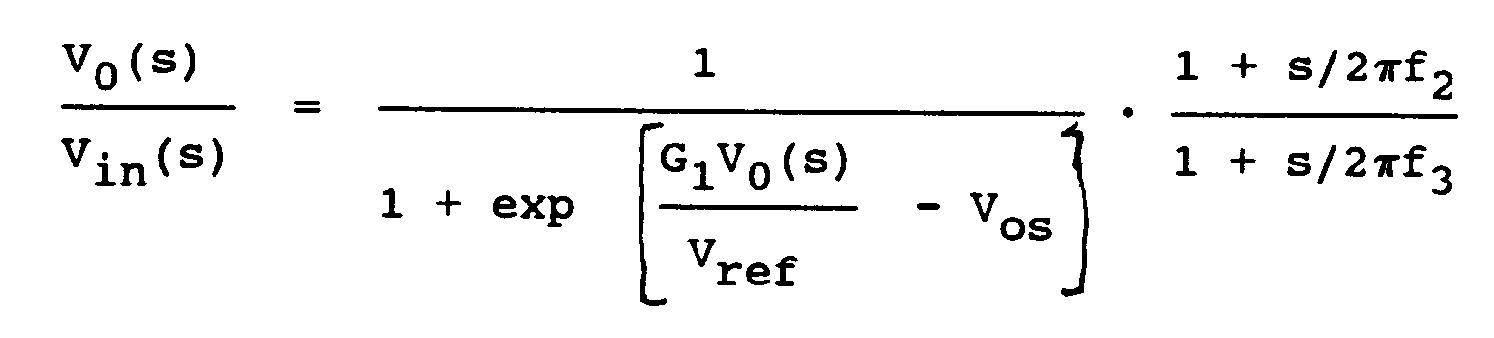
f₂ die Festbandshelffilternullfrequenz ist,
f₃ die Festbandshelffilterpolfrequenz ist,
G₁ die Verstärkung der Hochfrequenz-Festbandsteuerschaltung ist,
Vref der Bezugsspannungseffektivwert ist und
Vos die Offsetspannung des veränderbaren Elements und der Steuerschaltung ist und
jede Gleitbandschaltung eine Spannungsübertragungsfunktion im Laplace-Transformierten Bereich im wesentlichen der Form
f₁ die untere Eckfrequenz des variablen Gleitband-Hochpaßshelffilters ist,
G₂ die Gleitbandsteuerschaltungsverstärkung ist,
Vref der Bezugsspannungseffektivwert ist,
N die feste Potenz der Gleitbandkombination von veränderbarem Element und Steuerschaltung ist und
Asc die Signalverstärkung des Seitenweges ist,
wobei das veränderbare Element und die Steuerschaltung der Festband-Unterstufe ferner eine Offsetspannung aufweisen und die Festband-Unterstufe eine Spannungsübertragungsfunktion in dem Laplace-Transformierten Bereich im wesentlichen der Form
G1F die Steuerschaltungsverstärkung
Vref der Bezugsspannungseffektivwert und
VOSF die Steurelement Offsetspannung sind. - Schaltung nach Anspruch 26, bei die Parameterwerte annähernd sind:


- Schaltung nach einem der Ansprüche 24 bis 27, bei der jedes veränderbare Element eine lineare Charakteristik aufweist und jede entsprechende Steuerschaltung eine nichtlineare Schaltung zur Schaffung der gewünschten Exponentialcharakteristik oder Charakteristik folgend einer festen Potenz enthält.
- Verfahren zur Modifizierung des Dynamkikbereichs eines Audiosignals, nämlich durch Komprimierung oder Expandierung, umfassend,
Komprimieren oder Expandieren des Audiosignals mit einer Festbandcharakteristik um bis zu 10 dB in einem Niederfrequenzbereich, der sich allgemein von etwa 200 Hz nach unten erstreckt, und
Komprimieren oder Expandieren des Audiosignals mit einer Festband/Gleitband-Wirkungsaustauschcharakteristik um bis zu etwa 24 dB in einem Hochfrequenzband, das sich allgemein von 400 Hz nach oben erstreckt. - Verfahren nach Anspruch 29, bei der das Hochfrequenzband durch eine Doppelpolfiltercharakteristik mit einer Eckfrequenz von etwa 400 Hz und das Niederfrquenzband durch eine Einpolfiltercharakteristik mit einer Eckfrequenz von etwa 200 Hz definiert sind, wodurch sich eine breite Frequenzüberlappung bei der Kompression oder Expansion des Audiosignals in dem Hochfrequenzband und der Kompression oder Expansion des Audiosignal in dem Niederfrequenzband ergibt.
Applications Claiming Priority (4)
| Application Number | Priority Date | Filing Date | Title |
|---|---|---|---|
| US33343189A | 1989-04-03 | 1989-04-03 | |
| US333431 | 1989-04-03 | ||
| US42836389A | 1989-10-27 | 1989-10-27 | |
| US428363 | 1989-10-27 |
Publications (2)
| Publication Number | Publication Date |
|---|---|
| EP0469033A1 EP0469033A1 (de) | 1992-02-05 |
| EP0469033B1 true EP0469033B1 (de) | 1993-02-17 |
Family
ID=26988733
Family Applications (1)
| Application Number | Title | Priority Date | Filing Date |
|---|---|---|---|
| EP90906438A Expired - Lifetime EP0469033B1 (de) | 1989-04-03 | 1990-04-03 | Audiokompressor, expander und rauschunterdrückungsschaltungen für verbraucher und semiprofessionelle anwendungen |
Country Status (12)
| Country | Link |
|---|---|
| EP (1) | EP0469033B1 (de) |
| JP (1) | JP3317966B2 (de) |
| KR (1) | KR0149651B1 (de) |
| CN (1) | CN1023278C (de) |
| AT (1) | ATE85868T1 (de) |
| AU (1) | AU636141B2 (de) |
| BR (1) | BR9007263A (de) |
| CA (1) | CA2030784C (de) |
| DE (1) | DE69000936T2 (de) |
| DK (1) | DK0469033T3 (de) |
| ES (1) | ES2038518T3 (de) |
| WO (1) | WO1990012453A1 (de) |
Cited By (1)
| Publication number | Priority date | Publication date | Assignee | Title |
|---|---|---|---|---|
| US7957370B2 (en) | 1993-02-01 | 2011-06-07 | Lake Cherokee Hard Drive Technologies, Llc | Synchronous read channel |
Families Citing this family (4)
| Publication number | Priority date | Publication date | Assignee | Title |
|---|---|---|---|---|
| US5907623A (en) | 1995-11-22 | 1999-05-25 | Sony Corporation Of Japan | Audio noise reduction system implemented through digital signal processing |
| US5910995A (en) * | 1995-11-22 | 1999-06-08 | Sony Corporation Of Japan | DSP decoder for decoding analog SR encoded audio signals |
| US20120278087A1 (en) * | 2009-10-07 | 2012-11-01 | Nec Corporation | Multiband compressor and method of adjusting the same |
| CN114511474B (zh) * | 2022-04-20 | 2022-07-05 | 天津恒宇医疗科技有限公司 | 血管内超声图像的降噪方法、系统、电子设备及存储介质 |
Family Cites Families (3)
| Publication number | Priority date | Publication date | Assignee | Title |
|---|---|---|---|---|
| US4490691A (en) * | 1980-06-30 | 1984-12-25 | Dolby Ray Milton | Compressor-expander circuits and, circuit arrangements for modifying dynamic range, for suppressing mid-frequency modulation effects and for reducing media overload |
| US4701722A (en) * | 1985-06-17 | 1987-10-20 | Dolby Ray Milton | Circuit arrangements for modifying dynamic range using series and parallel circuit techniques |
| US4736433A (en) * | 1985-06-17 | 1988-04-05 | Dolby Ray Milton | Circuit arrangements for modifying dynamic range using action substitution and superposition techniques |
-
1990
- 1990-04-03 CA CA002030784A patent/CA2030784C/en not_active Expired - Lifetime
- 1990-04-03 KR KR1019910701239A patent/KR0149651B1/ko not_active Expired - Lifetime
- 1990-04-03 DE DE9090906438T patent/DE69000936T2/de not_active Expired - Lifetime
- 1990-04-03 JP JP50616690A patent/JP3317966B2/ja not_active Expired - Lifetime
- 1990-04-03 AT AT90906438T patent/ATE85868T1/de not_active IP Right Cessation
- 1990-04-03 DK DK90906438.8T patent/DK0469033T3/da active
- 1990-04-03 ES ES199090906438T patent/ES2038518T3/es not_active Expired - Lifetime
- 1990-04-03 EP EP90906438A patent/EP0469033B1/de not_active Expired - Lifetime
- 1990-04-03 AU AU54317/90A patent/AU636141B2/en not_active Expired
- 1990-04-03 WO PCT/US1990/001804 patent/WO1990012453A1/en not_active Ceased
- 1990-04-03 BR BR909007263A patent/BR9007263A/pt not_active IP Right Cessation
- 1990-04-08 CN CN90101882A patent/CN1023278C/zh not_active Expired - Lifetime
Cited By (1)
| Publication number | Priority date | Publication date | Assignee | Title |
|---|---|---|---|---|
| US7957370B2 (en) | 1993-02-01 | 2011-06-07 | Lake Cherokee Hard Drive Technologies, Llc | Synchronous read channel |
Also Published As
| Publication number | Publication date |
|---|---|
| JP3317966B2 (ja) | 2002-08-26 |
| CA2030784A1 (en) | 1990-10-04 |
| CN1023278C (zh) | 1993-12-22 |
| AU636141B2 (en) | 1993-04-22 |
| DE69000936T2 (de) | 1993-06-24 |
| BR9007263A (pt) | 1992-03-17 |
| JPH04505842A (ja) | 1992-10-08 |
| DK0469033T3 (da) | 1993-05-10 |
| KR920702082A (ko) | 1992-08-12 |
| WO1990012453A1 (en) | 1990-10-18 |
| ES2038518T3 (es) | 1993-07-16 |
| EP0469033A1 (de) | 1992-02-05 |
| KR0149651B1 (ko) | 1999-09-01 |
| DE69000936D1 (de) | 1993-03-25 |
| AU5431790A (en) | 1990-11-05 |
| ATE85868T1 (de) | 1993-03-15 |
| CN1047946A (zh) | 1990-12-19 |
| CA2030784C (en) | 1999-08-10 |
Similar Documents
| Publication | Publication Date | Title |
|---|---|---|
| US4701722A (en) | Circuit arrangements for modifying dynamic range using series and parallel circuit techniques | |
| US5185806A (en) | Audio compressor, expander, and noise reduction circuits for consumer and semi-professional use | |
| US4490691A (en) | Compressor-expander circuits and, circuit arrangements for modifying dynamic range, for suppressing mid-frequency modulation effects and for reducing media overload | |
| US4135590A (en) | Noise suppressor system | |
| US5144675A (en) | Variable recovery time circuit for use with wide dynamic range automatic gain control for hearing aid | |
| US4249042A (en) | Multiband cross-coupled compressor with overshoot protection circuit | |
| US4376916A (en) | Signal compression and expansion system | |
| EP0206731B1 (de) | Schaltungsanordnung zum Abändern des Dynamikbereiches mit Hilfe des Substitutions- und Superpositionstechnik | |
| US4460871A (en) | Multiband cross-coupled compressor with overshoot protection circuit | |
| EP0469033B1 (de) | Audiokompressor, expander und rauschunterdrückungsschaltungen für verbraucher und semiprofessionelle anwendungen | |
| KR880000597B1 (ko) | 잡음 저감 회로 | |
| JP2649911B2 (ja) | 組合せ式ダイナミックレンジ改変回路及び方法 | |
| JPS6232849B2 (de) | ||
| KR840002491B1 (ko) | 신호 압축기 | |
| JPH0243381B2 (de) | ||
| GB2111356A (en) | Improvements in circuit arrangements for modifying dynamic range | |
| CA1219809A (en) | Audio compressors and expanders | |
| Fisher | 8 Noise Reduction Systems | |
| GB2111355A (en) | Improvements in circuit arrangements for modifying dynamic range | |
| CA1201388A (en) | Improvements in audio compressors and expanders | |
| JPS6232850B2 (de) | ||
| JPS6338888B2 (de) | ||
| JPH01236710A (ja) | ノイズリダクション回路 | |
| JPS5942494B2 (ja) | ノイズリダクシヨンソウチ |
Legal Events
| Date | Code | Title | Description |
|---|---|---|---|
| PUAI | Public reference made under article 153(3) epc to a published international application that has entered the european phase |
Free format text: ORIGINAL CODE: 0009012 |
|
| 17P | Request for examination filed |
Effective date: 19910919 |
|
| AK | Designated contracting states |
Kind code of ref document: A1 Designated state(s): AT BE CH DE DK ES FR GB IT LI LU NL SE |
|
| 17Q | First examination report despatched |
Effective date: 19920709 |
|
| GRAA | (expected) grant |
Free format text: ORIGINAL CODE: 0009210 |
|
| AK | Designated contracting states |
Kind code of ref document: B1 Designated state(s): AT BE CH DE DK ES FR GB IT LI LU NL SE |
|
| REF | Corresponds to: |
Ref document number: 85868 Country of ref document: AT Date of ref document: 19930315 Kind code of ref document: T |
|
| ITF | It: translation for a ep patent filed | ||
| ET | Fr: translation filed | ||
| REF | Corresponds to: |
Ref document number: 69000936 Country of ref document: DE Date of ref document: 19930325 |
|
| REG | Reference to a national code |
Ref country code: DK Ref legal event code: T3 |
|
| REG | Reference to a national code |
Ref country code: ES Ref legal event code: FG2A Ref document number: 2038518 Country of ref document: ES Kind code of ref document: T3 |
|
| PLBE | No opposition filed within time limit |
Free format text: ORIGINAL CODE: 0009261 |
|
| STAA | Information on the status of an ep patent application or granted ep patent |
Free format text: STATUS: NO OPPOSITION FILED WITHIN TIME LIMIT |
|
| 26N | No opposition filed | ||
| EPTA | Lu: last paid annual fee | ||
| EAL | Se: european patent in force in sweden |
Ref document number: 90906438.8 |
|
| REG | Reference to a national code |
Ref country code: GB Ref legal event code: IF02 |
|
| REG | Reference to a national code |
Ref country code: CH Ref legal event code: PUE Owner name: DOLBY LABORATORIES LICENSING CORPORATION Free format text: DOLBY LABORATORIES LICENSING CORPORATION#731 SANSOME STREET#SAN FRANCISCO/CA (US) $ RAY MILTON DOLBY#3340 JACKSON STREET#SAN FRANCISCO/CA (US) -TRANSFER TO- DOLBY LABORATORIES LICENSING CORPORATION#100 POTRERO AVENUE#SAN FRANCISCO, CA 94103-4813 (US) Ref country code: CH Ref legal event code: NV Representative=s name: WILLIAM BLANC & CIE CONSEILS EN PROPRIETE INDUSTRI |
|
| REG | Reference to a national code |
Ref country code: GB Ref legal event code: 732E |
|
| NLS | Nl: assignments of ep-patents |
Owner name: DOLBY LABORATORIES LICENSING CORPORATION Effective date: 20060120 |
|
| REG | Reference to a national code |
Ref country code: ES Ref legal event code: PC2A |
|
| PGFP | Annual fee paid to national office [announced via postgrant information from national office to epo] |
Ref country code: ES Payment date: 20090427 Year of fee payment: 20 Ref country code: DK Payment date: 20090428 Year of fee payment: 20 |
|
| PGFP | Annual fee paid to national office [announced via postgrant information from national office to epo] |
Ref country code: SE Payment date: 20090429 Year of fee payment: 20 Ref country code: FR Payment date: 20090417 Year of fee payment: 20 Ref country code: IT Payment date: 20090428 Year of fee payment: 20 Ref country code: LU Payment date: 20090505 Year of fee payment: 20 Ref country code: NL Payment date: 20090423 Year of fee payment: 20 Ref country code: AT Payment date: 20090319 Year of fee payment: 20 Ref country code: DE Payment date: 20090429 Year of fee payment: 20 |
|
| PGFP | Annual fee paid to national office [announced via postgrant information from national office to epo] |
Ref country code: BE Payment date: 20090528 Year of fee payment: 20 |
|
| PGFP | Annual fee paid to national office [announced via postgrant information from national office to epo] |
Ref country code: CH Payment date: 20090427 Year of fee payment: 20 |
|
| PGFP | Annual fee paid to national office [announced via postgrant information from national office to epo] |
Ref country code: GB Payment date: 20090429 Year of fee payment: 20 |
|
| REG | Reference to a national code |
Ref country code: NL Ref legal event code: V4 Effective date: 20100403 |
|
| REG | Reference to a national code |
Ref country code: CH Ref legal event code: PL |
|
| REG | Reference to a national code |
Ref country code: DK Ref legal event code: EUP |
|
| REG | Reference to a national code |
Ref country code: GB Ref legal event code: PE20 Expiry date: 20100402 |
|
| BE20 | Be: patent expired |
Owner name: *DOLBY LABORATORIES LICENSING CORP. Effective date: 20100403 |
|
| EUG | Se: european patent has lapsed | ||
| REG | Reference to a national code |
Ref country code: ES Ref legal event code: FD2A Effective date: 20100405 |
|
| PG25 | Lapsed in a contracting state [announced via postgrant information from national office to epo] |
Ref country code: NL Free format text: LAPSE BECAUSE OF EXPIRATION OF PROTECTION Effective date: 20100403 Ref country code: ES Free format text: LAPSE BECAUSE OF EXPIRATION OF PROTECTION Effective date: 20100405 |
|
| PG25 | Lapsed in a contracting state [announced via postgrant information from national office to epo] |
Ref country code: GB Free format text: LAPSE BECAUSE OF EXPIRATION OF PROTECTION Effective date: 20100402 |
|
| PG25 | Lapsed in a contracting state [announced via postgrant information from national office to epo] |
Ref country code: DE Free format text: LAPSE BECAUSE OF EXPIRATION OF PROTECTION Effective date: 20100403 |