EP0456554B1 - Elektrisch leitendes Element und Verfahren zur Herstellung desselben - Google Patents
Elektrisch leitendes Element und Verfahren zur Herstellung desselben Download PDFInfo
- Publication number
- EP0456554B1 EP0456554B1 EP91401141A EP91401141A EP0456554B1 EP 0456554 B1 EP0456554 B1 EP 0456554B1 EP 91401141 A EP91401141 A EP 91401141A EP 91401141 A EP91401141 A EP 91401141A EP 0456554 B1 EP0456554 B1 EP 0456554B1
- Authority
- EP
- European Patent Office
- Prior art keywords
- flame
- electrically conducting
- base
- component according
- retarding substance
- Prior art date
- Legal status (The legal status is an assumption and is not a legal conclusion. Google has not performed a legal analysis and makes no representation as to the accuracy of the status listed.)
- Expired - Lifetime
Links
Images
Classifications
-
- H—ELECTRICITY
- H01—ELECTRIC ELEMENTS
- H01Q—ANTENNAS, i.e. RADIO AERIALS
- H01Q17/00—Devices for absorbing waves radiated from an antenna; Combinations of such devices with active antenna elements or systems
-
- Y—GENERAL TAGGING OF NEW TECHNOLOGICAL DEVELOPMENTS; GENERAL TAGGING OF CROSS-SECTIONAL TECHNOLOGIES SPANNING OVER SEVERAL SECTIONS OF THE IPC; TECHNICAL SUBJECTS COVERED BY FORMER USPC CROSS-REFERENCE ART COLLECTIONS [XRACs] AND DIGESTS
- Y10—TECHNICAL SUBJECTS COVERED BY FORMER USPC
- Y10S—TECHNICAL SUBJECTS COVERED BY FORMER USPC CROSS-REFERENCE ART COLLECTIONS [XRACs] AND DIGESTS
- Y10S428/00—Stock material or miscellaneous articles
- Y10S428/92—Fire or heat protection feature
-
- Y—GENERAL TAGGING OF NEW TECHNOLOGICAL DEVELOPMENTS; GENERAL TAGGING OF CROSS-SECTIONAL TECHNOLOGIES SPANNING OVER SEVERAL SECTIONS OF THE IPC; TECHNICAL SUBJECTS COVERED BY FORMER USPC CROSS-REFERENCE ART COLLECTIONS [XRACs] AND DIGESTS
- Y10—TECHNICAL SUBJECTS COVERED BY FORMER USPC
- Y10S—TECHNICAL SUBJECTS COVERED BY FORMER USPC CROSS-REFERENCE ART COLLECTIONS [XRACs] AND DIGESTS
- Y10S428/00—Stock material or miscellaneous articles
- Y10S428/92—Fire or heat protection feature
- Y10S428/921—Fire or flameproofing
-
- Y—GENERAL TAGGING OF NEW TECHNOLOGICAL DEVELOPMENTS; GENERAL TAGGING OF CROSS-SECTIONAL TECHNOLOGIES SPANNING OVER SEVERAL SECTIONS OF THE IPC; TECHNICAL SUBJECTS COVERED BY FORMER USPC CROSS-REFERENCE ART COLLECTIONS [XRACs] AND DIGESTS
- Y10—TECHNICAL SUBJECTS COVERED BY FORMER USPC
- Y10T—TECHNICAL SUBJECTS COVERED BY FORMER US CLASSIFICATION
- Y10T428/00—Stock material or miscellaneous articles
- Y10T428/24—Structurally defined web or sheet [e.g., overall dimension, etc.]
- Y10T428/24802—Discontinuous or differential coating, impregnation or bond [e.g., artwork, printing, retouched photograph, etc.]
-
- Y—GENERAL TAGGING OF NEW TECHNOLOGICAL DEVELOPMENTS; GENERAL TAGGING OF CROSS-SECTIONAL TECHNOLOGIES SPANNING OVER SEVERAL SECTIONS OF THE IPC; TECHNICAL SUBJECTS COVERED BY FORMER USPC CROSS-REFERENCE ART COLLECTIONS [XRACs] AND DIGESTS
- Y10—TECHNICAL SUBJECTS COVERED BY FORMER USPC
- Y10T—TECHNICAL SUBJECTS COVERED BY FORMER US CLASSIFICATION
- Y10T442/00—Fabric [woven, knitted, or nonwoven textile or cloth, etc.]
- Y10T442/20—Coated or impregnated woven, knit, or nonwoven fabric which is not [a] associated with another preformed layer or fiber layer or, [b] with respect to woven and knit, characterized, respectively, by a particular or differential weave or knit, wherein the coating or impregnation is neither a foamed material nor a free metal or alloy layer
- Y10T442/2418—Coating or impregnation increases electrical conductivity or anti-static quality
- Y10T442/2426—Elemental carbon containing
-
- Y—GENERAL TAGGING OF NEW TECHNOLOGICAL DEVELOPMENTS; GENERAL TAGGING OF CROSS-SECTIONAL TECHNOLOGIES SPANNING OVER SEVERAL SECTIONS OF THE IPC; TECHNICAL SUBJECTS COVERED BY FORMER USPC CROSS-REFERENCE ART COLLECTIONS [XRACs] AND DIGESTS
- Y10—TECHNICAL SUBJECTS COVERED BY FORMER USPC
- Y10T—TECHNICAL SUBJECTS COVERED BY FORMER US CLASSIFICATION
- Y10T442/00—Fabric [woven, knitted, or nonwoven textile or cloth, etc.]
- Y10T442/20—Coated or impregnated woven, knit, or nonwoven fabric which is not [a] associated with another preformed layer or fiber layer or, [b] with respect to woven and knit, characterized, respectively, by a particular or differential weave or knit, wherein the coating or impregnation is neither a foamed material nor a free metal or alloy layer
- Y10T442/2631—Coating or impregnation provides heat or fire protection
Definitions
- the invention relates to an electrically conductive element intended more particularly for the production of elements which absorb electromagnetic waves, in particular radar waves.
- the invention also relates to a method of manufacturing such an electrically conductive surface element.
- electromagnetic wave absorbing elements for the constitution of facades.
- Such absorbers are for example obtained by filling a frame similar to a cassette, alternately by insulating elements in mineral wool and electrically conductive elements, the laminated structure thus obtained being fixed to the building by means of the frame.
- EP-A-414 613 is described a more industrial method of manufacturing such absorbing elements obtained by stacking strips of mineral wool between which are inserted conductive elements electrics obtained for example by impregnating graphite with a nonwoven or constituted by a nonwoven of carbon fibers, the assembly then being cut by vertical cutting and applied to a support strip.
- the lamellar structure can only be obtained on the condition of using binders with mineral wool, binders which lead to products of a combustible nature. Character reinforced by the very combustible nature of the conductive material which permeates the conductive elements.
- the object of the invention is to provide an electrically conductive element making it possible to constitute, with an economical manufacturing process, elements which absorb electromagnetic waves, in particular radar waves, which are non-combustible, possibly satisfying the fire resistance tests required for construction materials.
- Class A according to DIN 4102. This object is achieved by the manufacturing process claimed in claim 10 and by the product claimed in claim 1.
- the element according to the invention is therefore distinguished from the prior art by the presence of a flame retardant substance on the nonwoven base.
- the absorbers constructed with such an element satisfy the fire resistance tests allowing their classification as non-combustible combustion materials of class A in accordance with DIN 4102.
- the added flame retardant substance compensates for degradations in fire behavior due to the application of a conductive material fuel and the use of binders.
- the quantity of conductive material applied no longer has to be limited as a function of the desired fire behavior and can therefore be chosen only as a function of the expected absorption behavior.
- the application of the electromagnetically active conductive material by a printing process also offers the advantage of making industrial production possible with particularly close tolerances of the quantities applied, which results in the possibility of obtaining very absorbers. selective.
- the techniques of application by immersion, deposit with a brush or doctor blade or even by spraying do not allow a suitable and constant distribution of the material, under the usual industrial conditions.
- printing process is preferably meant a screen printing process, the conductive material - in this case preferably carbon black or graphite - being dispersed in a paint base.
- the conductive material in this case preferably carbon black or graphite - being dispersed in a paint base.
- the base of the element is made of a nonwoven, preferably of the veil type of glass fibers, which is particularly effective for the constitution of an absorber with a lamellar structure.
- layers alternating strips of mineral wool and glass fiber veil will be fixed in particular by gluing on a flat support.
- a flame-retardant substance it is more particularly advantageous to use a material which exhibits an endothermic modification of its structure before reaching the maximum admissible temperature.
- Accumulators with a high content of water of crystallization are particularly suitable for this purpose. In the event of a fire, at critical temperatures, release and vaporization of the water of crystallization is observed; a significant slowing effect is then obtained which can be determined with precision over time.
- Aluminum hydroxide is mainly suitable for this purpose and preferably finds its application with an extremely low content of binder, less than 5% on the basis of the dry weight. Can also be used as accumulators hydrated aluminum oxide and dehydrated sodium sulfate.
- the non-woven base fireproofing is preferably carried out by impregnation before applying the conductive material.
- the inorganic flame retardant is thus applied in a relatively large amount in a separate operation.
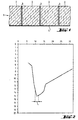
- FIG. 1 represents a planar element produced in the form of a mat having a layered structure formed by layers 2 of mineral wool alternating with narrower strips 3 of an electrically conductive element according to the invention, the assembly forming a system with several layers absorbing the waves scattered by a radar.
- the insulating layers 2 and the conductive strips 3 can be applied separately to a building facade, by gluing, pegging, wedging or in any other way. In the present case, however, they are deposited on a sheet 4, for example a sheet of reinforced aluminum.
- the layered structure 1 is arranged in a cassette-shaped frame, not shown here, which is used for fixing between the masonry and the outer face constituted by a glass plate, or any other cladding plate in any other material.
- the electromagnetic waves reaching the outer cladding plate penetrate largely without reflection through the cladding plate and are substantially absorbed in the layered structure. This results in a weak reflection on the facade.
- the strips 3 advantageously consist of a veil of glass fibers forming the base of the electrically conductive element.
- the electromagnetic conductive substance and a flame-retardant substance are incorporated in the glass fibers, which are decisive substances for damping the reflection of the facade.
- the base is preferably made of a veil of glass fibers but other veils and other materials, for example a thin sheet, can also be used.
- carbon black or graphite or another electrically conductive material is preferably used. These materials must be dispersible.
- the distances between two conductive elements 3 are chosen as a function of the wavelength of the electromagnetic waves to be absorbed, so that there is within the element, absorption, in particular absorption by resonance of the penetrating waves. Furthermore, the degree of absorption depends very closely on the distribution and the quantity of the conductive material.
- a regular distribution of the conductive material on the planar element with a very narrow application tolerance is obtained by a printing process. In this case, a fast-setting colored dispersion, enriched in material, is used as ink. conductive, for example in carbon black.
- the screen printing process is particularly suitable for meeting close tolerances.
- a printing ink specially suitable for screen printing contains organic substances such as emulsifiers, binders and fillers. The printing process thus leads to a relatively significant organic enrichment of the planar element, which certainly results in a layered structure having a high absorption power, but can simultaneously lead to a degradation of the fire resistance.
- a flame retardant substance is applied in an amount such that it forms on the web, an insulating layer which improves the fire content.
- aluminum hydroxide and an extremely low binder content is suitable as a substance.
- Aluminum hydroxide is an accumulation material with a high content of water of crystallization, released in the event of fire.
- hydrated aluminum oxide, hydrated sodium metasilicate or dehydrated sodium sulphate can also be used.
- the process of applying the ink dispersion containing carbon black is carried out in an additional coating operation. .
- the screen printing process leads to an economical consumption of carbon black with low application tolerances.
- the dispersion of liquid ink consists of 70% water and 30% of solids formed by 5% of carbon black, 5% of dispersion auxiliaries and 20% of binder and filler.
- Chalk can for example be chosen as a filler. In this case, it was possible to obtain an excellent absorption behavior of the constant radar throughout the surface of the conducting element.
- the diagram in Figure 2 shows the depreciation of the reflection of microwaves at 600 MHz as a function of the quantity of carbon black incorporated into a veil of glass fibers, previously flame retarded, with a basis weight of 60 g per m 2 .
- This diagram shows very clearly that for elements comprising a quantity of carbon black of 9 to 16 g per m 2 , a very good damping of the reflection, of -11.5 to -15 dB, can be obtained.
- the optimal range is at an applied amount of carbon black of 10 to 12 g per m 2 .
- the damping in reflection of the element in question thus measured in a waveguide gives the direct correlation with the damping of reflection desired of a facade element, for the usual radar frequencies of 1.03 to 1.09 GHz. In this way, a reflection damping of -13.5 to -15 dB could be obtained.
- the conductive material for example carbon black
- an ink dispersion with organic substances emulsifiers and binders
- a prior coating of the glass fiber veil by means of an accumulating material releasing water in the event of fire makes it possible to achieve, for the planar element, favorable properties as regards incombustibility.
- a layered structure formed by means of this element then corresponds to the class of building materials A according to DIN 4102.
- the particular effect obtained by means of the measures in accordance with the invention can be qualified physically as a combined interference and absorption effect for electromagnetic waves. It can also be attributed essentially to an appropriate incorporation of the carbon black particles within the particles forming the ink dispersion and to the conductivity structure which is thus established.
- the screen printing technique leads to a uniform and economical distribution of carbon black particles within the ink dispersion on the veil of glass fibers. This results in a coating with carbon black with very narrow application tolerances and thus optimal damping of the reflection.
- the reproducibility of planar conductive elements having defined absorption properties is an advantage here.
Landscapes
- Shielding Devices Or Components To Electric Or Magnetic Fields (AREA)
- Building Environments (AREA)
- Parts Printed On Printed Circuit Boards (AREA)
- Aerials With Secondary Devices (AREA)
- Laminated Bodies (AREA)
- Thermistors And Varistors (AREA)
- Fixed Capacitors And Capacitor Manufacturing Machines (AREA)
- Encapsulation Of And Coatings For Semiconductor Or Solid State Devices (AREA)
- Chemical Or Physical Treatment Of Fibers (AREA)
Claims (12)
- Elektrisch leitendes Element (3) für einen Absorber elektromagnetischer Wellen im sehr kurzwelligen Bereich, bestimmt für die Bildung von Fassaden, umfassend eine als Basis dienende Schürze, die aus einem nicht gewobenen Material besteht, und eine Schicht eines elektrisch leitenden Materials, dadurch gekennzeichnet, daß das nicht verwobene Material mit einer feuerfesten Substanz überzogen ist, wobei das elektrisch leitende Material als homogene Schicht gemäß einem Druckverfahren auf die mit der nicht brennbaren Substanz überzogene Fläche aufgebracht ist.
- Elektrisch leitendes Element nach Anspruch 1, dadurch gekennzeichnet, daß das leitende Material, welches aus Karbon, Graphit oder ähnlichem gebildet ist, durch ein serigraphisches Verfahren auf die mit einer nicht brennbaren Substanz überzogene Schürze aufgebracht ist.
- Elektrisch leitendes Element nach Anspruch 1 oder 2, dadurch gekennzeichnet, daß das leitende Material zusammen mit einer adhesiven Dispersion auf die Basis aufgebracht ist.
- Elektrisch leitendes Element nach Anspruch 3, dadurch gekennzeichnet, daß die adhesive Dispersion aus organischen Materialien gebildet ist, insbesondere aus Emulgaten, Bindemitteln und Füllstoffen.
- Elektrisch leitendes Element nach einem der vorhergehenden Ansprüche, dadurch gekennzeichnet, daß die Basis durch eine Schürze aus Glasfasern gebildet ist.
- Elektrisch leitendes Element nach einem der vorhergehenden Ansprüche, dadurch gekennzeichnet, daß die Basis mit einem Material als nicht brennbare Substanz überzogen ist, welches seine Struktur vor Erreichen einer maximal zulässigen Temperatur auf endothermische Weise verändert.
- Elektrisch leitendes Element nach Anspruch 1, dadurch gekennzeichnet, daß die nicht brennbare Substanz ein akkumulatorisches Material ist, welches einen hohen Kristallisationsfeuchtigkeitsgehalt hat.
- Elektrisch leitendes Element nach Anspruch 7, dadurch gekennzeichnet, daß die nicht brennbare Substanz aus Aluminiumhydroxid, hyrdratisiertem Aluminiumoxid, dem Metallikat des hydratisierten Natrium oder dem Sulfat des dehydrierten Natriums besteht.
- Elektrisch leitendes Element nach Anspruch 8, dadurch gekennzeichnet, daß die nicht brennbare Substanz einen geringen Bindemittelgehalt hat, vorzugsweise kleiner als 5 % der Basis Trockengewicht.
- Verfahren zur Herstellung eines elektrisch leitenden Elements (3) gemäß den Ansprüchen 1 bis 9, mit einem Schritt des Überziehens einer als Basis dienenden Schürze, die aus einem nicht verwobenen Material besteht, mit einem elektrisch leitenden Material, dadurch gekennzeichnet, daß die Basis vor dem Aufbringen des leitenden Materials vorhergehend mit einer nicht brennbaren Substanz überzogen wird.
- Verfahren nach Anspruch 10, dadurch gekennzeichnet, daß nach dem Überziehen der Basis mit Hilfe der nicht brennbaren Substanz das leitende Material in einer adhesiven Dispersion aufgebracht wird.
- Verfahren nach Anspruch 10 oder 11, dadurch gekennzeichnet, daß der Faktor an Kohlenstoff in einer Menge von 9 bis 16 und vorzugsweise 10 bis 12 g pro m2 auf die Basis aufgetragen wird.
Applications Claiming Priority (2)
| Application Number | Priority Date | Filing Date | Title |
|---|---|---|---|
| DE4014453A DE4014453C2 (de) | 1990-05-06 | 1990-05-06 | Elektrisch leitfähiges Flächenelement sowie Verfahren zur Herstellung desselben |
| DE4014453 | 1990-05-06 |
Publications (3)
| Publication Number | Publication Date |
|---|---|
| EP0456554A2 EP0456554A2 (de) | 1991-11-13 |
| EP0456554A3 EP0456554A3 (en) | 1993-09-29 |
| EP0456554B1 true EP0456554B1 (de) | 1997-03-12 |
Family
ID=6405772
Family Applications (1)
| Application Number | Title | Priority Date | Filing Date |
|---|---|---|---|
| EP91401141A Expired - Lifetime EP0456554B1 (de) | 1990-05-06 | 1991-04-30 | Elektrisch leitendes Element und Verfahren zur Herstellung desselben |
Country Status (8)
| Country | Link |
|---|---|
| US (1) | US5223327A (de) |
| EP (1) | EP0456554B1 (de) |
| JP (1) | JP2971168B2 (de) |
| AT (1) | ATE150216T1 (de) |
| CA (1) | CA2041823A1 (de) |
| DE (2) | DE4014453C2 (de) |
| DK (1) | DK0456554T3 (de) |
| ES (1) | ES2099144T3 (de) |
Families Citing this family (12)
| Publication number | Priority date | Publication date | Assignee | Title |
|---|---|---|---|---|
| DE4215954A1 (de) * | 1992-02-04 | 1993-08-05 | Rheinhold & Mahla Ag | Absorber fuer elektromagnetische wellen |
| US5840383A (en) * | 1996-02-12 | 1998-11-24 | Bgf Industries, Inc. | Electromagnetic wave reflective fabric |
| DE19610197C1 (de) * | 1996-03-15 | 1997-08-28 | Daimler Benz Aerospace Ag | Fassadenaufbau von Gebäuden |
| CN1227676A (zh) * | 1996-08-07 | 1999-09-01 | 西门子公司 | 用于制造绝缘编织层的弱导电材料 |
| IT1289932B1 (it) * | 1997-02-19 | 1998-10-19 | Indutex S R L | Tessuto non tessuto presentante caratteristiche antistatiche e utilizzabile in vari campi |
| DE19717682A1 (de) * | 1997-04-28 | 1998-10-29 | Helmut Dr Reichelt | Beschichtungsmaterial für Strahlungsflächen zur Erzeugung elektromagnetischer Wellen und Verfahren zu dessen Herstellung |
| DE19747622A1 (de) * | 1997-10-28 | 1999-04-29 | Gruenzweig & Hartmann | Dämmplatten mit einer Abschirmung gegen elektromagnetische Felder |
| JP3983404B2 (ja) * | 1999-01-13 | 2007-09-26 | 本田技研工業株式会社 | レーダ搭載車両用ゲート |
| DE19942882B4 (de) * | 1999-09-08 | 2005-11-03 | Sto Ag | Armierung |
| US7686061B2 (en) * | 2002-04-24 | 2010-03-30 | Overhead Door Corporation | Winding assembly for door counterbalance system |
| US7846546B2 (en) * | 2005-09-20 | 2010-12-07 | Ube Industries, Ltd. | Electrically conducting-inorganic substance-containing silicon carbide-based fine particles, electromagnetic wave absorbing material and electromagnetic wave absorber |
| CN108716063A (zh) * | 2018-06-25 | 2018-10-30 | 中原工学院 | 一种导电阻燃抗菌纤维水刺非织造防屏蔽材料的制备方法 |
Family Cites Families (28)
| Publication number | Priority date | Publication date | Assignee | Title |
|---|---|---|---|---|
| DE1234281B (de) * | 1957-12-13 | |||
| US4038660A (en) * | 1975-08-05 | 1977-07-26 | The United States Of America As Represented By The Secretary Of The Army | Microwave absorbers |
| DE2750776C3 (de) * | 1977-11-14 | 1980-06-04 | Precitronic Gesellschaft Fuer Feinmechanik Und Electronic Mbh, 2000 Hamburg | Azimutal richtbare Abschußvorrichtung |
| US4327364A (en) * | 1978-12-22 | 1982-04-27 | Rockwell International Corporation | Apparatus for converting incident microwave energy to thermal energy |
| CH653290A5 (de) * | 1979-05-29 | 1985-12-31 | Ebnoether Ag | Nicht textiles wandbekleidungsmaterial. |
| GB2058469B (en) * | 1979-08-31 | 1983-12-14 | Plessey Co Ltd | Radiation-absorbing materials |
| DE3024888A1 (de) * | 1980-07-01 | 1982-02-04 | Bayer Ag, 5090 Leverkusen | Verbundmaterial zur abschirmung elektromagnetischer strahlung |
| US4347284A (en) * | 1980-11-03 | 1982-08-31 | Hiraoka & Co., Ltd. | White cover sheet material capable of reflecting ultraviolet rays |
| JPS6146099A (ja) * | 1984-08-10 | 1986-03-06 | 株式会社ブリヂストン | 電磁波反射体 |
| US4606848A (en) * | 1984-08-14 | 1986-08-19 | The United States Of America As Represented By The Secretary Of The Army | Radar attenuating paint |
| DE3507889A1 (de) * | 1985-03-06 | 1986-09-11 | Clouth Gummiwerke AG, 5000 Köln | Mit einer beschichtung versehenes objekt |
| EP0193636A1 (de) * | 1985-03-08 | 1986-09-10 | Konrad Hornschuch Aktiengesellschaft | Reflektierende Textilbahn, Verfahren zu ihrer Herstellung und ihre Verwendung |
| JPS62216300A (ja) * | 1986-03-17 | 1987-09-22 | 株式会社イナックス | 導電性不織布樹脂複合成形板の製法 |
| JPH0686100B2 (ja) * | 1986-04-24 | 1994-11-02 | 積水化学工業株式会社 | 導電性布状物とその製造方法及び導電性シ−ト又はフイルム |
| JPH071837B2 (ja) * | 1987-09-04 | 1995-01-11 | 宇部興産株式会社 | 電磁波吸収材 |
| US4940619A (en) * | 1987-10-05 | 1990-07-10 | Smith Novis W Jr | Radiation absorption device |
| DE68928378T2 (de) * | 1988-01-05 | 1998-05-20 | Nippon Electric Co | Absorber für elektromagnetische Strahlung |
| JPH084198B2 (ja) * | 1988-02-26 | 1996-01-17 | 株式会社ペトカ | 可撓性の電磁波反射材料 |
| JP2812953B2 (ja) * | 1988-05-27 | 1998-10-22 | イー・アンド・シー・エンジニアリング 株式会社 | 広帯域耐高電力型電波吸収体 |
| DE3818114A1 (de) * | 1988-05-27 | 1989-11-30 | Gruenzweig & Hartmann Montage | Absorber fuer elektromagnetische und akustische wellen |
| US5160787A (en) * | 1989-01-12 | 1992-11-03 | Mitsubishi Gas Chemical Company, Inc. | Electrical laminate having ability to absorb ultraviolet rays |
| US4965408A (en) * | 1989-02-01 | 1990-10-23 | Borden, Inc. | Composite sheet material for electromagnetic radiation shielding |
| EP0383142B1 (de) * | 1989-02-15 | 1994-08-24 | Ytong Ag | Mittel zum Dämpfen elektromagnetischer Wellen, Verfahren zur Herstellung sowie Verwendung des Mittels |
| US4935281A (en) * | 1989-04-05 | 1990-06-19 | Springs Industries, Inc. | Flame barrier office building materials |
| MX174055B (es) * | 1990-02-06 | 1994-04-18 | Bell Helicopter Textron Inc | Estructura atenuadora de ondas electromagneticas y desescarchadora |
| DE4012672A1 (de) * | 1990-04-20 | 1991-10-24 | Gruenzweig & Hartmann | Flaechiges widerstandselement sowie verfahren zur herstellung desselben |
| US5155316A (en) * | 1990-12-24 | 1992-10-13 | Chiu Sou Kuein | Heat-conducting mat for absorbing microwave and electromagnetic wave energy |
| US5155319A (en) * | 1991-01-17 | 1992-10-13 | Chiu Sou Kuein | Heat-conducting film for absorbing electromagnetic wave and microwave energy |
-
1990
- 1990-05-06 DE DE4014453A patent/DE4014453C2/de not_active Expired - Fee Related
-
1991
- 1991-04-30 ES ES91401141T patent/ES2099144T3/es not_active Expired - Lifetime
- 1991-04-30 AT AT91401141T patent/ATE150216T1/de not_active IP Right Cessation
- 1991-04-30 EP EP91401141A patent/EP0456554B1/de not_active Expired - Lifetime
- 1991-04-30 DK DK91401141.6T patent/DK0456554T3/da active
- 1991-04-30 DE DE69125049T patent/DE69125049T2/de not_active Expired - Fee Related
- 1991-05-03 CA CA002041823A patent/CA2041823A1/fr not_active Abandoned
- 1991-05-06 US US07/695,909 patent/US5223327A/en not_active Expired - Fee Related
- 1991-05-07 JP JP3101231A patent/JP2971168B2/ja not_active Expired - Lifetime
Also Published As
| Publication number | Publication date |
|---|---|
| DE69125049D1 (de) | 1997-04-17 |
| EP0456554A2 (de) | 1991-11-13 |
| DE69125049T2 (de) | 1997-06-19 |
| DE4014453A1 (de) | 1991-11-14 |
| JPH04229698A (ja) | 1992-08-19 |
| DK0456554T3 (da) | 1997-08-18 |
| JP2971168B2 (ja) | 1999-11-02 |
| US5223327A (en) | 1993-06-29 |
| ATE150216T1 (de) | 1997-03-15 |
| DE4014453C2 (de) | 1994-09-08 |
| CA2041823A1 (fr) | 1991-11-07 |
| EP0456554A3 (en) | 1993-09-29 |
| ES2099144T3 (es) | 1997-05-16 |
Similar Documents
| Publication | Publication Date | Title |
|---|---|---|
| EP0456554B1 (de) | Elektrisch leitendes Element und Verfahren zur Herstellung desselben | |
| FI72288B (fi) | Eldfast laminat av skumplast | |
| CN103351150B (zh) | 含气凝胶的垫层 | |
| EP0044178B1 (de) | Faserige zusammengesetzte Materialien, ihre Herstellung und ihre Verwendung | |
| US20040121152A1 (en) | Flame-resistant insulation | |
| US6061011A (en) | Nonflammable radio wave absorber | |
| MXPA02009192A (es) | Panel acustico termoformable. | |
| EP2736711A1 (de) | Schalldämmende wandverkleidung | |
| KR101780649B1 (ko) | 흡음 및 전자파 차단 효과가 우수한 단열패드 | |
| FR2485516A1 (fr) | Procede de production de feuilles planes et comprimees d'amiante-ciment stratifiees a l'aide de melamine, et feuilles stratifiees ainsi obtenues | |
| CZ303420B6 (cs) | Izolacní výrobek z minerálních vláken, zpusob jeho výroby a použití | |
| CN218577239U (zh) | 一种航空超轻量阻尼隔音耐火棉 | |
| US4678700A (en) | Fibrous composite materials | |
| EP2099607A1 (de) | Gebäudeumwicklung zur verwendung in aussenwandanordnungen mit nass aufgetragenen fassaden | |
| EP0408428B1 (de) | Schall- und wärmeisolierendes Produkt, Verfahren zur Herstellung und Verwendung | |
| KR20150056218A (ko) | 불연성 로이단열재 | |
| KR101287380B1 (ko) | 불연성이 우수한 투습방수성 열반사 단열재 | |
| FR2796443A1 (fr) | Materiau isolant anti-feu, adapte a l'isolation aeronautique, procede et dispositif de fabrication correspondants | |
| JP4266204B2 (ja) | 電磁波吸収材およびその製造方法 | |
| EA043202B1 (ru) | Способ изготовления угленаполненного поглотителя электромагнитного излучения и угленаполненный поглотитель электромагнитного излучения, изготовленный этим способом | |
| EP1015709A1 (de) | Schalldämpfende vorrichtung und verfahren zu ihrer herstellung | |
| FR2830268A1 (fr) | Substrat textile a resistance au feu amelioree | |
| JP2000307286A (ja) | 電波吸収体 | |
| WO2026015384A1 (en) | Basemats and fibrous panels comprising large diameter wool fibers | |
| FR2796444A1 (fr) | Materiau isolant anti-feu, adapte a l'isolation aeronautique, procede et dispositif de fabrication correspondants |
Legal Events
| Date | Code | Title | Description |
|---|---|---|---|
| PUAI | Public reference made under article 153(3) epc to a published international application that has entered the european phase |
Free format text: ORIGINAL CODE: 0009012 |
|
| AK | Designated contracting states |
Kind code of ref document: A2 Designated state(s): AT BE CH DE DK ES FR GB IT LI NL SE |
|
| PUAL | Search report despatched |
Free format text: ORIGINAL CODE: 0009013 |
|
| AK | Designated contracting states |
Kind code of ref document: A3 Designated state(s): AT BE CH DE DK ES FR GB IT LI NL SE |
|
| 17P | Request for examination filed |
Effective date: 19940215 |
|
| 17Q | First examination report despatched |
Effective date: 19960115 |
|
| GRAG | Despatch of communication of intention to grant |
Free format text: ORIGINAL CODE: EPIDOS AGRA |
|
| GRAH | Despatch of communication of intention to grant a patent |
Free format text: ORIGINAL CODE: EPIDOS IGRA |
|
| GRAH | Despatch of communication of intention to grant a patent |
Free format text: ORIGINAL CODE: EPIDOS IGRA |
|
| GRAA | (expected) grant |
Free format text: ORIGINAL CODE: 0009210 |
|
| AK | Designated contracting states |
Kind code of ref document: B1 Designated state(s): AT BE CH DE DK ES FR GB IT LI NL SE |
|
| REF | Corresponds to: |
Ref document number: 150216 Country of ref document: AT Date of ref document: 19970315 Kind code of ref document: T |
|
| REG | Reference to a national code |
Ref country code: CH Ref legal event code: EP Ref country code: CH Ref legal event code: NV Representative=s name: E. BLUM & CO. PATENTANWAELTE |
|
| GBT | Gb: translation of ep patent filed (gb section 77(6)(a)/1977) |
Effective date: 19970312 |
|
| REF | Corresponds to: |
Ref document number: 69125049 Country of ref document: DE Date of ref document: 19970417 |
|
| REG | Reference to a national code |
Ref country code: ES Ref legal event code: FG2A Ref document number: 2099144 Country of ref document: ES Kind code of ref document: T3 |
|
| ITF | It: translation for a ep patent filed | ||
| REG | Reference to a national code |
Ref country code: DK Ref legal event code: T3 |
|
| PLBE | No opposition filed within time limit |
Free format text: ORIGINAL CODE: 0009261 |
|
| STAA | Information on the status of an ep patent application or granted ep patent |
Free format text: STATUS: NO OPPOSITION FILED WITHIN TIME LIMIT |
|
| 26N | No opposition filed | ||
| PGFP | Annual fee paid to national office [announced via postgrant information from national office to epo] |
Ref country code: SE Payment date: 19980326 Year of fee payment: 8 |
|
| PGFP | Annual fee paid to national office [announced via postgrant information from national office to epo] |
Ref country code: FR Payment date: 19980417 Year of fee payment: 8 |
|
| PGFP | Annual fee paid to national office [announced via postgrant information from national office to epo] |
Ref country code: AT Payment date: 19980423 Year of fee payment: 8 Ref country code: DK Payment date: 19980423 Year of fee payment: 8 |
|
| PGFP | Annual fee paid to national office [announced via postgrant information from national office to epo] |
Ref country code: CH Payment date: 19980424 Year of fee payment: 8 |
|
| PG25 | Lapsed in a contracting state [announced via postgrant information from national office to epo] |
Ref country code: CH Free format text: LAPSE BECAUSE OF NON-PAYMENT OF DUE FEES Effective date: 19990430 Ref country code: LI Free format text: LAPSE BECAUSE OF NON-PAYMENT OF DUE FEES Effective date: 19990430 Ref country code: AT Free format text: LAPSE BECAUSE OF NON-PAYMENT OF DUE FEES Effective date: 19990430 Ref country code: DK Free format text: LAPSE BECAUSE OF NON-PAYMENT OF DUE FEES Effective date: 19990430 |
|
| PG25 | Lapsed in a contracting state [announced via postgrant information from national office to epo] |
Ref country code: SE Free format text: LAPSE BECAUSE OF NON-PAYMENT OF DUE FEES Effective date: 19990501 |
|
| REG | Reference to a national code |
Ref country code: CH Ref legal event code: PL |
|
| PG25 | Lapsed in a contracting state [announced via postgrant information from national office to epo] |
Ref country code: FR Free format text: LAPSE BECAUSE OF NON-PAYMENT OF DUE FEES Effective date: 19991231 |
|
| REG | Reference to a national code |
Ref country code: FR Ref legal event code: ST |
|
| EUG | Se: european patent has lapsed |
Ref document number: 91401141.6 |
|
| REG | Reference to a national code |
Ref country code: DK Ref legal event code: EBP |
|
| PGFP | Annual fee paid to national office [announced via postgrant information from national office to epo] |
Ref country code: GB Payment date: 20000412 Year of fee payment: 10 |
|
| PGFP | Annual fee paid to national office [announced via postgrant information from national office to epo] |
Ref country code: BE Payment date: 20000425 Year of fee payment: 10 |
|
| PGFP | Annual fee paid to national office [announced via postgrant information from national office to epo] |
Ref country code: ES Payment date: 20000426 Year of fee payment: 10 |
|
| PGFP | Annual fee paid to national office [announced via postgrant information from national office to epo] |
Ref country code: NL Payment date: 20000427 Year of fee payment: 10 |
|
| PG25 | Lapsed in a contracting state [announced via postgrant information from national office to epo] |
Ref country code: GB Free format text: LAPSE BECAUSE OF NON-PAYMENT OF DUE FEES Effective date: 20010430 Ref country code: BE Free format text: LAPSE BECAUSE OF NON-PAYMENT OF DUE FEES Effective date: 20010430 |
|
| PG25 | Lapsed in a contracting state [announced via postgrant information from national office to epo] |
Ref country code: ES Free format text: LAPSE BECAUSE OF NON-PAYMENT OF DUE FEES Effective date: 20010503 |
|
| BERE | Be: lapsed |
Owner name: ISOVER SAINT-GOBAIN Effective date: 20010430 Owner name: GRUNZWEIG + HARTMANN UND GLASFASER A.G. Effective date: 20010430 |
|
| PG25 | Lapsed in a contracting state [announced via postgrant information from national office to epo] |
Ref country code: NL Free format text: LAPSE BECAUSE OF NON-PAYMENT OF DUE FEES Effective date: 20011101 |
|
| GBPC | Gb: european patent ceased through non-payment of renewal fee |
Effective date: 20010430 |
|
| NLV4 | Nl: lapsed or anulled due to non-payment of the annual fee |
Effective date: 20011101 |
|
| REG | Reference to a national code |
Ref country code: ES Ref legal event code: FD2A Effective date: 20030303 |
|
| PG25 | Lapsed in a contracting state [announced via postgrant information from national office to epo] |
Ref country code: IT Free format text: LAPSE BECAUSE OF NON-PAYMENT OF DUE FEES;WARNING: LAPSES OF ITALIAN PATENTS WITH EFFECTIVE DATE BEFORE 2007 MAY HAVE OCCURRED AT ANY TIME BEFORE 2007. THE CORRECT EFFECTIVE DATE MAY BE DIFFERENT FROM THE ONE RECORDED. Effective date: 20050430 |
|
| PGFP | Annual fee paid to national office [announced via postgrant information from national office to epo] |
Ref country code: DE Payment date: 20090423 Year of fee payment: 19 |
|
| PG25 | Lapsed in a contracting state [announced via postgrant information from national office to epo] |
Ref country code: DE Free format text: LAPSE BECAUSE OF NON-PAYMENT OF DUE FEES Effective date: 20101103 |