EP0449705B1 - Outil de robot pour la pose d'un joint annulaire - Google Patents
Outil de robot pour la pose d'un joint annulaire Download PDFInfo
- Publication number
- EP0449705B1 EP0449705B1 EP91400760A EP91400760A EP0449705B1 EP 0449705 B1 EP0449705 B1 EP 0449705B1 EP 91400760 A EP91400760 A EP 91400760A EP 91400760 A EP91400760 A EP 91400760A EP 0449705 B1 EP0449705 B1 EP 0449705B1
- Authority
- EP
- European Patent Office
- Prior art keywords
- small wheel
- tool
- tool according
- jack
- slugs
- Prior art date
- Legal status (The legal status is an assumption and is not a legal conclusion. Google has not performed a legal analysis and makes no representation as to the accuracy of the status listed.)
- Expired - Lifetime
Links
- 238000011144 upstream manufacturing Methods 0.000 claims description 2
- 241000237858 Gastropoda Species 0.000 claims 4
- 210000005069 ears Anatomy 0.000 description 5
- 238000009434 installation Methods 0.000 description 3
- 230000000694 effects Effects 0.000 description 2
- 230000008878 coupling Effects 0.000 description 1
- 238000010168 coupling process Methods 0.000 description 1
- 238000005859 coupling reaction Methods 0.000 description 1
- 238000010586 diagram Methods 0.000 description 1
- 238000006073 displacement reaction Methods 0.000 description 1
- 238000003032 molecular docking Methods 0.000 description 1
- 230000002441 reversible effect Effects 0.000 description 1
- 125000006850 spacer group Chemical group 0.000 description 1
Images


Classifications
-
- B—PERFORMING OPERATIONS; TRANSPORTING
- B23—MACHINE TOOLS; METAL-WORKING NOT OTHERWISE PROVIDED FOR
- B23P—METAL-WORKING NOT OTHERWISE PROVIDED FOR; COMBINED OPERATIONS; UNIVERSAL MACHINE TOOLS
- B23P19/00—Machines for simply fitting together or separating metal parts or objects, or metal and non-metal parts, whether or not involving some deformation; Tools or devices therefor so far as not provided for in other classes
- B23P19/04—Machines for simply fitting together or separating metal parts or objects, or metal and non-metal parts, whether or not involving some deformation; Tools or devices therefor so far as not provided for in other classes for assembling or disassembling parts
- B23P19/047—Machines for simply fitting together or separating metal parts or objects, or metal and non-metal parts, whether or not involving some deformation; Tools or devices therefor so far as not provided for in other classes for assembling or disassembling parts for flexible profiles, e.g. sealing or decorating strips in grooves or on other profiles by devices moving along the flexible profile
-
- B—PERFORMING OPERATIONS; TRANSPORTING
- B60—VEHICLES IN GENERAL
- B60J—WINDOWS, WINDSCREENS, NON-FIXED ROOFS, DOORS, OR SIMILAR DEVICES FOR VEHICLES; REMOVABLE EXTERNAL PROTECTIVE COVERINGS SPECIALLY ADAPTED FOR VEHICLES
- B60J10/00—Sealing arrangements
- B60J10/45—Assembling sealing arrangements with vehicle parts
Definitions
- Seals fitted on a motor vehicle door frame rebate can be open, that is to say rectilinear with a length equal to that of the periphery of the rebate, or else closed, that is to say annulars. See for example document US-A-47 80 943.
- the present invention relates to a robot tool intended to fit an annular seal with or without an overmolded corner and provided with a part in the form of a clamp suitable for engaging on the rebate.
- This tool comprises a first motorized caster acting outside the pliers to put it on the rebate, and a second caster engaged inside the pliers and cooperating with a mad caster to center the joint upstream of the point of the shoe and is characterized in that the second caster is also motorized in synchronism with the first caster.
- the tool comprises a body 1 which can be mounted on a spacer 2 of the robot by means of four flexible couplings 3 screwed onto an interface 4 secured to the body.
- a shaft 5 carrying at one of its ends a drive wheel 6 and at its other end a pinion 7 which is engaged with a pinion 8 keyed on the output shaft of a reversible motor 9.
- Two rollers 10 a and 10 b are keyed onto shafts 11 a and 11 b which are rotatably mounted in ears 12 a and 12 b articulated at 13 a and 13 b on the body 1.
- the axes 11 a and 11 b carry toothed wheels 14 a and 14 b which can, by pivoting the ears, come to mesh with a pinion 15 fixed on an axis 16.
- This pinion is engaged with a pinion 17 which is itself engaged with a pinion 18 wedged on the shaft 5.
- the axes of the shaft 5 and of the pinion 17 as well as the axis 16 are located in the median plane AA of the tool.
- Each of the ears 12 a and 12 b is integral with a pin 19 a or 19 b which is engaged in a horizontal slot 20 of a yoke 21 movable vertically.
- This yoke is integral with an axis 22 which is slidably mounted in the body 1 and carries at its end a pair of rollers 23 mounted on the same axis 24.
- This roller is engaged in an oblique slot 25 of a carriage 26 which is slidably mounted relative to the body 1 by means of rollers 27 and is coupled to a jack 28. The operation of this jack causes the carriage 26 to move horizontally which causes the axis 22 and the yoke 21 to move vertically which is linked.
- this yoke rotates the ears 12 a and 12 b , which has the effect of bringing the rollers 10 a and 10 b closer to the median plane AA of the tool or moving it apart of this plane, in the direction of actuation of the jack 28.
- a spatula 29 intended to spread the lip of the joint to be mounted is fixed on the piston rod of a jack 30 fixed on a support 31; an axis 32 slidably mounted in a plate 33, which is fixed to the support 31, limits the sliding movement of the jack rod.
- the support 31 is attached to an axis 34 which is slidably mounted in the body 1 and is integral with a fork 35 coupled to the piston rod of a jack 36.
- a roller 37 mounted madly on the axis 34 and immobilized in translation by a yoke 38 can cooperate with the movable rollers 10 a and 10 b to form a clamp for the door seal to be put in place.
- a ring seal 39 on a door rebate 40 of a motor vehicle.
- a seal has a part 39 a in the form of a clamp and a finishing lip 39 b (Figure 5).
- the joints are initially suspended on the edge of the laying line in a v-shaped device 41 ( Figure 6).
- the roller 10 a or 10 b is used depending on the door in the rebate of which the seal is to be installed. It is assumed below that it is the rebate of the left front door.
- the tool is approached to the joint.
- the jack 28 is brought into the retracted position so that the axis 22 comes in the high position and that the rollers 10 a and 10 b come in the retracted position ( Figure 6).
- the jacks 36 and 30 have been brought in the extended position so that the tip 29 clears the finishing lip 39 b of the seal.
- the caster 37 and the caster 6 come to tangent the outer side of the seal and the roller 10 a passes over the latter.
- the jack 28 is brought into the extended position so that the ears 12 a and 12 b pivot and the roller 10 a presses the seal 39 against the roller 37; at the same time, the toothed wheel 14 a engages with the pinion 15.
- the tool then inserts the seal on the rebate at the intersection of the pavilion 42 and the center leg 43 ( Figure 7). Then the motor 9 is actuated so that the roller 6 constrains the seal in position and completes the installation.
- the rollers 10 a and 10 b are also driven and, as the seal is pinched between the roller 10 a and the roller 37, it is moved longitudinally, which has the effect of both refocusing and pushing it towards the rebate , parallel to it and the roller 6 puts the seal on the rebate.
- the joint is cut up to three quarters, that is to say up to the intersection of the door threshold 44 and the center leg 43 ( Figure 8). At this time, the tool cannot continue on its path because its displacement would have the consequence of removing the part of the joint already laid, the joint being stretched between the roller 10 a and the corner of the pavilion.
- the cylinder 28 is then brought into the retracted position, which releases the seal, the tool is released, the cylinder 28 is again brought into the extended position to bring the rollers 10 a and 10 b towards the median plane of the tool, to prevent them from being a nuisance, and we roll with the roller 6 on the back of the seal 39 from the bottom of the middle foot 43 to the pavilion 42; at this time, the seal is oriented because it is held at the corner of the roof 42 and on the door threshold 44.
- the seal being installed, the tool can proceed with the installation of another seal.
- the cylinder 30 When the joint must cover a cabinet, the cylinder 30 is in the extended position and the cylinder 36 in the retracted position so that the spatula 29 slides on the lip 39 b of the seal, ensuring that this lip correctly covers the cabinet.
- the jack 36 When there is an obstacle during installation, for example a support tab, the jack 36 is brought into the extended position, which releases the spatula.
Landscapes
- Engineering & Computer Science (AREA)
- Mechanical Engineering (AREA)
- Automobile Manufacture Line, Endless Track Vehicle, Trailer (AREA)
- Hand Tools For Fitting Together And Separating, Or Other Hand Tools (AREA)
Description
- Les joints chaussés sur une feuillure d'encadrement de porte de véhicule automobile peuvent être ouverts, c'est-à-dire rectilignes avec une longueur égale à celle de la périphérie de la feuillure, ou bien fermés, c'est-à-dire annulaires. Voir par exemple le document US-A-47 80 943.
- La présente invention a pour objet un outil de robot destiné à chausser un joint annulaire comportant ou non un coin surmoulé et muni d'une partie en forme de pince propre à s'engager sur la feuillure.
- Cet outil comprend une première roulette motorisée agissant à l'extérieur de la pince pour la chausser sur la feuillure, et une deuxième roulette engagée à l'intérieur de la pince et coopérant avec une roulette folle pour centrer le joint en amont du point chaussé et est caractérisé en ce que la deuxième roulette est également motorisée en synchronisme avec la première roulette.
- On a décrit ci-après, à titre d'exemple non limitatif, un mode de réalisation de l'outil selon l'invention, avec référence aux dessins annexés dans lesquels :
- La Figure 1 est une vue en coupe partielle de l'outil;
- La Figure 2 est une vue de droite avec coupe partielle;
- La Figure 3 en est une vue en élévation;
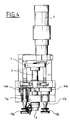
- La Figure 4 en est une vue en plan avec arrachement partiel;
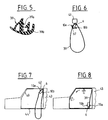
- La Figure 5 est une vue en coupe d'un joint pouvant être posé par l'outil;
- Les Figures 6 à 8 sont des schémas montrant l'utilisation de l'outil.
- Tel qu'il est représenté au dessin, l'outil comprend un corps 1 qui peut être monté sur une entretoise 2 du robot par l'intermédiaire de quatre accouplements souples 3 vissés sur une interface 4 solidaire du corps.
- Dans le corps 1 est monté à rotation un arbre 5 portant à l'une de ses extrémités une roulette d'entraînement 6 et à son autre extrémité un pignon 7 qui est en prise avec un pignon 8 claveté sur l'arbre de sortie d'un moteur réversible 9. Deux galets 10a et 10b sont clavetés sur des arbres 11a et 11b qui sont montés à rotation dans des oreilles 12a et 12b articulées en 13a et 13b sur le corps 1. Les axes 11a et 11b portent des roues dentées 14a et 14b qui peuvent, par pivotement des oreilles, venir s'engrener avec un pignon 15 calé sur un axe 16. Ce pignon est en prise avec un pignon 17 qui est lui-même en prise avec un pignon 18 calé sur l'arbre 5. Les axes de l'arbre 5 et du pignon 17 ainsi que l'axe 16 sont situés dans le plan médian A-A de l'outil.
- Chacune des oreilles 12a et 12b est solidaire d'un pion 19a ou 19b qui est engagé dans une lumière horizontale 20 d'une chape 21 mobile verticalement. Cette chape est solidaire d'un axe 22 qui est monté coulissant dans le corps 1 et porte à son extrémité une paire de galets 23 montés sur un même axe 24. Ce galet est engagé dans une lumière oblique 25 d'un chariot 26 qui est monté coulissant par rapport au corps 1 par l'intermédiaire de roulettes 27 et est attelé à un vérin 28. La manoeuvre de ce vérin fait déplacer horizontalement le chariot 26 qui entraîne un déplacement vertical de l'axe 22 et de la chape 21 qui lui est liée. Par l'intermédiaire des pions 19a et 19b cette chape fait pivoter les oreilles 12a et 12b, ce qui a pour effet de rapprocher les galets 10a et 10b du plan médian A-A de l'outil ou de l'écarter de ce plan, suivant le sens d'actionnement du vérin 28.
- Une spatule 29 destinée à écarter la lèvre du joint à monter est fixée sur la tige de piston d'un vérin 30 fixé sur un support 31; un axe 32 monté coulissant dans une plaque 33, qui est fixée au support 31, limite le mouvement de coulissement de la tige de vérin. Le support 31 est rapporté sur un axe 34 qui est monté coulissant dans le corps 1 et est solidaire d'une fourchette 35 attelée à la tige de piston d'un verin 36.
- Enfin une roulette 37 montée folle sur l'axe 34 et immobilisée en translation par une chape 38 peut coopérer avec les galets mobiles 10a et 10b pour former pince pour le joint de porte à mettre en place.
- L'outil qui vient d'être décrit permet de poser un joint en anneau 39 sur une feuillure de porte 40 d'un véhicule automobile. Un tel joint présente une partie 39a en forme de pince et une lèvre de finition 39b (Figure 5 ). Les joints sont initialement suspendus sur le bord de la ligne de pose dans un dispositif 41 en forme de vé (Figure 6). On utilise le galet 10a ou 10b suivant la porte dans la feuillure de laquelle le joint est à poser. On suppose ci-après qu'il s'agit de la feuillure de la porte avant gauche.
- L'outil est approché du joint. Pendant ce mouvement, le vérin 28 est amené en position rentrée de sorte que l'axe 22 vient en position haute et que les galets 10a et 10b viennent en position escamotée (Figure 6). En même temps, les vérins 36 et 30 ont été amenés en position sortie de façon que la spatule 29 écarte la lèvre de finition 39b du joint. La roulette 37 et la roulette 6 viennent tangenter le côté extérieur du joint et le galet 10a passe au-dessus de celui-ci.
- La position d'accostage étant atteinte, le vérin 28 est amené en position sortie de sorte que les oreilles 12a et 12b pivotent et que le galet 10a vient plaquer le joint 39 contre la roulette 37; en même temps, la roue dentée 14a vient en prise avec le pignon 15.
- Le joint est ainsi pris en pince et l'outil se dirige vers la feuillure 40 de l'entrée de porte avant gauche.
- A l'aide de la roulette 6 l'outil insère alors le joint sur la feuillure à l'intersection du pavillon 42 et du pied milieu 43 (Figure 7). Puis le moteur 9 est actionné de sorte que la roulette 6 contraint le joint en position et parfait la pose. Les galets 10a et 10b sont également entraînés et, comme le joint est pincé entre le galet 10a et la roulette 37, il est déplacé longitudinalement, ce qui a pour effet à la fois de le recentrer et de le pousser vers la feuillure, parallèlement à celle-ci et la roulette 6 chausse le joint sur la feuillure.
- Le joint est débité jusqu'aux trois quarts, c'est-à-dire jusqu'à l'intersection du seuil de porte 44 et du pied milieu 43 (Figure 8). A ce moment, l'outil ne peut poursuivre son chemin car son déplacement aurait pour conséquence de déchausser la partie du joint déjà posée, le joint étant tendu entre la roulette 10a et le coin du pavillon. On amène alors le vérin 28 en position rentrée, ce qui libère le joint, on dégage l'outil, on amène de nouveau le vérin 28 en position sortie pour ramener les galets 10a et 10b vers le plan médian de l'outil, pour éviter que ceux-ci soient une gêne, et on roule avec la roulette 6 sur le dos du joint 39 du bas du pied milieu 43 au pavillon 42; à ce moment, le joint est orienté car il est maintenu au coin du pavillon 42 et sur le seuil de porte 44. Le joint étant posé, l'outil peut procéder à la pose d'un autre joint.
- Lorsque le joint doit recouvrir une ébénisterie, le vérin 30 est en position sortie et le vérin 36 en position rentrée de sorte que la spatule 29 glisse sur la lèvre 39b du joint en assurant que cette lèvre recouvre correctement l'ébénisterie. Lorsqu'il y a un obstacle au cours de la pose, par exemple une patte de support, le vérin 36 est amené en position sortie, ce qui dégage la spatule.
Claims (7)
- Outil de robot pour la pose, sur une feuillure de porte d'un véhicule automobile, d'un joint annulaire (39) muni d'une partie en forme de pince (39a) propre à s'engager sur la feuillure, qui comprend une première roulette motorisée (6) agissant à l'extérieur de la pince pour la chausser sur la feuillure, et une deuxième roulette (10a ou 10b) engagée à l'intérieur de la pince caractérisé en ce que la deuxième roulette (10a ou 10b) coopère avec une roulette folle (37) pour centrer le joint en amont du point chaussé, et
est également motorisée en synchronisme avec la première roulette. - Outil selon la revendication 1,
caractérisé en ce qu'il comporte une troisième roulette motorisée (10b ou 10a) montée symétriquement par rapport à la deuxième et propre à exercer la même fonction en coopération avec la même roulette folle (37), selon le sens du déroulement de la pose. - Outil selon la revendication 2,
caractérisé en ce que la deuxième roulette (10a) et la troisième roulette (10b) sont montées sur des oreilles escamotables (12a et 12b). - Outil selon la revendication 3,
caractérisé en ce que les oreilles (12a et 12b) sont montées pivotantes sur le corps de l'outil et en ce que ce dernier comprend un vérin (28) pour faire pivoter les oreilles. - Outil selon la revendication 3 ou 4,
caractérisé en ce que les axes (11a et 11b) des roulettes (10a et 10b) portent des roues dentées (14a et 14b) qui peuvent, par pivotement des oreilles (12a et 12b) venir s'engrener avec un pignon (15) lié en rotation à un pignon (18) calé sur l'arbre de la roulette (6). - Outil selon l'une des revendications 1 à 5 destiné à la pose d'un joint (39) muni d'une lèvre (39b) cache-ébénisterie,
caractérisé par le fait qu'il comprend des moyens (29) pour écarter la lèvre (39b) de la première roulette (10a) pendant le chaussage. - Outil selon la revendication 6,
caractérisé en ce que les moyens pour écarter la lèvre (39b) sont constitués par une spatule (29) fixée sur la tige de piston d'un premier vérin (30) fixé sur un axe (34) qui est monté coulissant dans le corps (1) de l'outil et peut être déplacé axialement par un second vérin (36).
Applications Claiming Priority (2)
| Application Number | Priority Date | Filing Date | Title |
|---|---|---|---|
| FR9004605A FR2660226A1 (fr) | 1990-03-30 | 1990-03-30 | Outil de robot pour la pose d'un joint annulaire. |
| FR9004605 | 1990-03-30 |
Publications (2)
| Publication Number | Publication Date |
|---|---|
| EP0449705A1 EP0449705A1 (fr) | 1991-10-02 |
| EP0449705B1 true EP0449705B1 (fr) | 1993-10-27 |
Family
ID=9395627
Family Applications (1)
| Application Number | Title | Priority Date | Filing Date |
|---|---|---|---|
| EP91400760A Expired - Lifetime EP0449705B1 (fr) | 1990-03-30 | 1991-03-21 | Outil de robot pour la pose d'un joint annulaire |
Country Status (3)
| Country | Link |
|---|---|
| EP (1) | EP0449705B1 (fr) |
| DE (1) | DE69100549T2 (fr) |
| FR (1) | FR2660226A1 (fr) |
Cited By (1)
| Publication number | Priority date | Publication date | Assignee | Title |
|---|---|---|---|---|
| EP2628620A1 (fr) | 2012-02-17 | 2013-08-21 | Standard Profil A.S. | Outil pour l'assemblage de joints élastomères |
Families Citing this family (8)
| Publication number | Priority date | Publication date | Assignee | Title |
|---|---|---|---|---|
| DE19545733A1 (de) * | 1995-12-08 | 1997-06-12 | Saar Gummiwerk Gmbh | SAS - Montageverfahren für Dicht- und Abdeckstreifen sowie Vorrichtung |
| DE19730123C2 (de) * | 1996-07-12 | 2002-02-14 | Standard Prod Ltd | Werkzeug zum Anbringen eines Dichtungsstreifens auf einen Flansch |
| GB2324327B (en) * | 1997-04-18 | 2001-06-13 | Standard Prod Ltd | Clinching tool with rotatable spindles driven by a worm and gear |
| GB2341412B (en) * | 1998-09-11 | 2002-10-30 | Standard Products Co | Mechanism suitable for use in a clinching apparatus and apparatus incorporating such a mechanism |
| DE19904183A1 (de) * | 1999-02-03 | 2000-08-31 | Saar Gummiwerk Gmbh | Vorrichtung zur Montage von Türdichtprofilen nach dem SAS-SGM Verfahren |
| DE10011854C5 (de) * | 2000-03-10 | 2013-06-20 | Fft Edag Produktionssysteme Gmbh & Co. Kg | Rollfalzkopf und Verfahren zum Erzeugen einer Blechfalzverbindung |
| DE10023332B4 (de) * | 2000-05-12 | 2006-09-21 | Daimlerchrysler Ag | Vorrichtung zum Aufbringen eines Kantenschutzprofiles auf die Türöffnung einer Fahrzeugkarosserie |
| DE102007033363C5 (de) * | 2007-06-05 | 2019-04-04 | Tesla Grohmann Automation Gmbh | Verfahren sowie Vorrichtung zum Aufbringen einer Dichtung in Form eines Dichtungsstreifens auf eine Fläche |
Family Cites Families (3)
| Publication number | Priority date | Publication date | Assignee | Title |
|---|---|---|---|---|
| DE3436791A1 (de) * | 1984-10-06 | 1986-04-10 | Messerschmitt-Bölkow-Blohm GmbH, 8012 Ottobrunn | Montagevorrichtung |
| DE3541865A1 (de) * | 1985-11-27 | 1987-06-04 | Volkswagen Ag | Vorrichtung zum automatischen aufstecken eines strangmaterials auf einen flansch |
| US4780943A (en) * | 1986-07-18 | 1988-11-01 | General Motors Corporation | Apparatus and method of a robot for installing weather stripping in a door or like opening |
-
1990
- 1990-03-30 FR FR9004605A patent/FR2660226A1/fr active Granted
-
1991
- 1991-03-21 EP EP91400760A patent/EP0449705B1/fr not_active Expired - Lifetime
- 1991-03-21 DE DE91400760T patent/DE69100549T2/de not_active Expired - Fee Related
Cited By (1)
| Publication number | Priority date | Publication date | Assignee | Title |
|---|---|---|---|---|
| EP2628620A1 (fr) | 2012-02-17 | 2013-08-21 | Standard Profil A.S. | Outil pour l'assemblage de joints élastomères |
Also Published As
| Publication number | Publication date |
|---|---|
| FR2660226B1 (fr) | 1995-04-07 |
| DE69100549T2 (de) | 1994-04-28 |
| EP0449705A1 (fr) | 1991-10-02 |
| FR2660226A1 (fr) | 1991-10-04 |
| DE69100549D1 (de) | 1993-12-02 |
Similar Documents
| Publication | Publication Date | Title |
|---|---|---|
| EP0449705B1 (fr) | Outil de robot pour la pose d'un joint annulaire | |
| EP0559624B1 (fr) | Dispositif d'actionnement de la rotation d'un marchepied pour véhicules | |
| EP0115353B1 (fr) | Dispositif destiné à déplacer, devant des moyens d'usinage et dans le sens de sa longueur un profilé à usiner | |
| EP0387124A1 (fr) | Machine pour la pose automatique de joint souple, en particulier d'un joint extérieur dans une rainure de vantail | |
| EP0242309B1 (fr) | Presse plieuse à tablier pivotant | |
| FR2507520A1 (fr) | Pince pour dispositif de levage destine a la manutention de pieces | |
| FR2688849A3 (en) | Drive for the displacement of a moving part of a mechanism | |
| EP0726123B1 (fr) | Outil associable à un robot pour la pose automatique d'un joint d'étanchéité | |
| FR2813456A1 (fr) | Dispositif de commande manuelle d'un moteur electrique pour volet roulant | |
| FR2522716A1 (fr) | Porte relevable pliante a deux panneaux | |
| EP1157870B1 (fr) | Store à enrouleur à barre de tirage mobile axialement | |
| EP0662051B1 (fr) | Dispositif de toit ouvrant pour vehicule automobile | |
| FR2606965A1 (fr) | Dispositif de retenue de film pour machine derouleuse et semeuse | |
| FR2644093A1 (fr) | Machine pour la pose automatique de joint souple, en particulier d'un joint exterieur dans une rainure de vantail | |
| EP0022715B1 (fr) | Dispositif de commande d'ouverture et de fermeture d'un toit ouvrant | |
| FR2483269A1 (fr) | Ouvreur de bobine | |
| EP0444988A1 (fr) | Machine automatique de pose de composants sur dormants de portes ou fenêtres | |
| WO2006131608A1 (fr) | Dispositif de deplacement de vehicules | |
| FR2660009A1 (fr) | Dispositif de guidage d'une porte coulissante et escamotable de vehicule, et porte coulissante equipee d'un tel dispositif. | |
| FR2783866A1 (fr) | Electro-reducteur pour l'automatisation de volets roulants | |
| FR2531741A1 (fr) | Dispositif pour le positionnement de volets en vue du scellement de leurs gonds | |
| FR2490272A1 (fr) | Dispositif de ripage pour soutenement marchant, en particulier pour soutenement type bouclier ou type pile | |
| JPS5928899Y2 (ja) | スライドル−フ車のル−フ開閉装置 | |
| FR2719332A1 (fr) | Dispositif de motorisation des manÓoeuvres d'ouverture et de fermeture de portes à effacement vertical. | |
| FR2529250A1 (fr) | Porte basculante motorisee |
Legal Events
| Date | Code | Title | Description |
|---|---|---|---|
| PUAI | Public reference made under article 153(3) epc to a published international application that has entered the european phase |
Free format text: ORIGINAL CODE: 0009012 |
|
| AK | Designated contracting states |
Kind code of ref document: A1 Designated state(s): DE GB IT |
|
| 17P | Request for examination filed |
Effective date: 19910812 |
|
| 17Q | First examination report despatched |
Effective date: 19921029 |
|
| GRAA | (expected) grant |
Free format text: ORIGINAL CODE: 0009210 |
|
| AK | Designated contracting states |
Kind code of ref document: B1 Designated state(s): DE GB IT |
|
| REF | Corresponds to: |
Ref document number: 69100549 Country of ref document: DE Date of ref document: 19931202 |
|
| GBT | Gb: translation of ep patent filed (gb section 77(6)(a)/1977) |
Effective date: 19931201 |
|
| ITF | It: translation for a ep patent filed | ||
| PLBE | No opposition filed within time limit |
Free format text: ORIGINAL CODE: 0009261 |
|
| STAA | Information on the status of an ep patent application or granted ep patent |
Free format text: STATUS: NO OPPOSITION FILED WITHIN TIME LIMIT |
|
| 26N | No opposition filed | ||
| PGFP | Annual fee paid to national office [announced via postgrant information from national office to epo] |
Ref country code: GB Payment date: 19950314 Year of fee payment: 5 |
|
| PGFP | Annual fee paid to national office [announced via postgrant information from national office to epo] |
Ref country code: DE Payment date: 19950324 Year of fee payment: 5 |
|
| PG25 | Lapsed in a contracting state [announced via postgrant information from national office to epo] |
Ref country code: GB Effective date: 19960321 |
|
| GBPC | Gb: european patent ceased through non-payment of renewal fee |
Effective date: 19960321 |
|
| PG25 | Lapsed in a contracting state [announced via postgrant information from national office to epo] |
Ref country code: DE Effective date: 19961203 |
|
| PG25 | Lapsed in a contracting state [announced via postgrant information from national office to epo] |
Ref country code: IT Free format text: LAPSE BECAUSE OF NON-PAYMENT OF DUE FEES;WARNING: LAPSES OF ITALIAN PATENTS WITH EFFECTIVE DATE BEFORE 2007 MAY HAVE OCCURRED AT ANY TIME BEFORE 2007. THE CORRECT EFFECTIVE DATE MAY BE DIFFERENT FROM THE ONE RECORDED. Effective date: 20050321 |