EP0447885A2 - Palierverfahren für Güter und Schleifkissen dafür - Google Patents
Palierverfahren für Güter und Schleifkissen dafür Download PDFInfo
- Publication number
- EP0447885A2 EP0447885A2 EP91103491A EP91103491A EP0447885A2 EP 0447885 A2 EP0447885 A2 EP 0447885A2 EP 91103491 A EP91103491 A EP 91103491A EP 91103491 A EP91103491 A EP 91103491A EP 0447885 A2 EP0447885 A2 EP 0447885A2
- Authority
- EP
- European Patent Office
- Prior art keywords
- abrasives
- water
- abrasive pad
- polishing method
- polishing
- Prior art date
- Legal status (The legal status is an assumption and is not a legal conclusion. Google has not performed a legal analysis and makes no representation as to the accuracy of the status listed.)
- Granted
Links
Images
Classifications
-
- B—PERFORMING OPERATIONS; TRANSPORTING
- B24—GRINDING; POLISHING
- B24B—MACHINES, DEVICES, OR PROCESSES FOR GRINDING OR POLISHING; DRESSING OR CONDITIONING OF ABRADING SURFACES; FEEDING OF GRINDING, POLISHING, OR LAPPING AGENTS
- B24B13/00—Machines or devices designed for grinding or polishing optical surfaces on lenses or surfaces of similar shape on other work; Accessories therefor
- B24B13/01—Specific tools, e.g. bowl-like; Production, dressing or fastening of these tools
Definitions
- the present invention relates to a polishing method of goods and abrasive pads used therein, in particular, to a polishing method and abrasive pads, which are usefully employed to synthetic resin such as plastic lenses, windshield glass, medical goods, tableware, radio parts, machinery parts buttons, caps, cabinets, decorative board, glasses frame, plastic-made safety glass and metal, glass, and semiconductor materials.
- synthetic resin such as plastic lenses, windshield glass, medical goods, tableware, radio parts, machinery parts buttons, caps, cabinets, decorative board, glasses frame, plastic-made safety glass and metal, glass, and semiconductor materials.
- Patent Application Laid-open No. 49-100689, USP No. 4225347, and Patent Application Laid-open No. 61-278589 have been published to describe polishing methods for polishing synthetic resin and metals and polishing compositions used therefor.
- Patent Application Laid-open No. 100689 (USP No. 4225349) describes a polishing method and a polishing composition for synthetic resin, in particular, the composition consists of water, polishing agent and acidic compound.
- polishing composition prepared by adding polishing accelerator (acidic compound), such as polyaluminum chloride, aluminum sulfate, aluminum nitrate, aluminum chloride and aluminum bromide to the slurry of polishing composition of the prior art.
- polishing accelerator acidic compound
- polishing composition for polishing goods which composition consisting of water, abrasives and oxidizing compound can polish at high efficiency and high quality, in particular, plastics. It is noted that disadvantageously the polishing slurry is of strong acid having so low pH value about 4 - 2.
- polishing machine and jigs are apt to corrode and problems on sanitation and safe, such as roughen hands of the operator of the machine are arisen.
- Patent Application Laid-open No. 61-278587 (USP No. 4696697 mentioned-above) in order to solve the problems above, which application describes a polishing composition of neutral or weak acid and consisting of water abrasives of alumina and polishing accelerator of nickel sulfate.
- polishing composition described above are used in a state of slurry, so that complicated appliance of a pumps, an agitator, thermal controllers and pipings are necessary to supply abrasive slurry resulting in often poor operativity of the polishing work.
- abrasives of sand papers and polishing tapes have been used, these abrasives being manufactured by bonding abrasive grains or particles on the faces of paper or fabric sheet-like substrates through synthetic water-soluble high molecular compound such as polyvinyl alcohl or natural substance such as gelatin.
- abrasive grains are adhered by waterproof synthetic resin bond of phenol, epoxy, urethane, vinyl acetate and acryl on the substrates used as rough finish abrasive.
- the conventional sand paper and polishing tapes manufactured by using such water-soluble bonds have no waterproofness and poor bonding strength resulting in swift falling of grains from the faces of sand papers.
- waterproof synthetic resin adhesives are too effective to suitably remove the grains resulting in stuffing or loading sand papers by chips or broken pieces of goods polished and in short life of the sand papers.
- the sand paper has small grains less than 10 ⁇ m adapted to be used for mirror finish, a trend toward loading the sand paper becomes large resulting in poor polishing productivity.
- conventional polishing compositions using grains in slurry have been used to polish plastics, metal, and glass and the like.
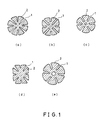
- Fig. 1(a) - (e) respectively sketchilly show patterns of the abrasive pads of various embodiments of the present invention
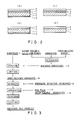
- Fig. 2 is a section of the abrasive pad of the embodiment or example
- Fig. 3 is an explanation view of manufacture of the abrasive pad.
- the abrasive pad used in the polishing method according to the present invention is made of water-soluble cellulose ether which can become hard to soluble in water by dehydro-condensing the hydroxy groups in its chemical structure with other compounds containing hydroxy group in its chemical structure and performing cross linkage of difficulty to soluble in water between chains.
- Crosslinking agents such as glyoxal, citric acid tannic acid, urea formalin resin and methylol melamine resin are used in manufacture of the abrasive pad according to the present invention as an insolubilizing agent.
- the abrasive pad of the present invention when used to polish goods, only water is supplied and poured on to the pad. That is, the abrasive pad has excellent abrasion faces of high productivity.
- the abrasive pad has excellent abrasion faces of high productivity.
- decreased water-soluble cellulose ether used in the pad as binders of alumina polishing agents dissolves little by little, so that new abrasive faces are suitably generated keeping suitable polishing efficiency.
- the binder and the pad substrate have suitable cushion and elasticity effect contributing to obtain the good finished surfaces.
- the mean diameter of abrasive grains is less than 0.5 ⁇ m, the quality of goods abraded or polished is good. However, because the grain diameter is small, sufficient stock removal rate will not be obtained after completion of the polishing process. When the mean diameter of the grains exceeds 10 ⁇ m, rough finished surface will be obtained and no mirror finish are attained. Further, deep scratch is apt to be formed when grains exceeding 10 ⁇ m in mean diameter are used, so it is preferable to use that of the mean diameter of 0.5 - 10 ⁇ m.
- the weight ratio of insolubilizing agent to the abrasives is less than 0.2%, the adhesive force of abrasives is not adequate, similar to the case of water-soluble cellulose ether, so that removal or falling-off speed of grains becomes high.
- the weight ratio exceeds 1.5%, adhesive force becomes too effective unsuitably generating loading phenomenon on the abrasive pads. Considering polishing function and economy, 0.2 - 1.5% of the weight ratio is suitable.
- the substrates for example, flocked fabric, flocked synthetic resin film, non-woven fabric, synthetic paper, artificial leather, woven fabric, synthetic resin film and sponge and use the selected one as the substrate of the abrasive pad according to the present device.
- the polishing method of the present device can polish effectively the goods with supply of only water such as general tap water in the polishing process, so that no polishing machine and no jigs corrode and there is no problem of rough hands of operators.
- the abrasive pad according to the present invention may be laminated with water using a PVA film on an upper face of the dried blended abrasives layer or by adhering using water-soluble acrylic adhesive agent, so that without lowering polishing performance of the resultant abrasives problems such as chipping-off, stripping-off and dirtying the upper layer of the abrasive pad in the manufacturing process can be prevented.
- PVA films have good solubility in water and then, so pouring water on the film earlier step in the polishing step solves it resulting in no effect to polishing operation and polishing effect of goods.
- the PVA film must have its saponification value of about 80 - 90.
- the abrasives is one kind of the group consisting of alumina, zirconium oxide, tin oxide and cerium oxide, and it preferably has the mean diameter of grains: 0.5 - 10 ⁇ m.
- the weight ratio of water-soluble cellulose ether to abrasive is 1 - 8% and the cellulose ether is preferably one of the group consisting of hydroxypropylmethyl cellulose, methyl cellulose, and hydroxyethylmethyl cellulose.
- the weight ratio of the insolubilizing agent to abrasives is 0.2 - 1.5% and the insolubilizing agent is preferably one of the group consisting of glyoxal, citric acid, tannic acid, urea formaldehyde resin and metheylol melamine resin.
- the substrate is one selected from the group of flocked fabric flocked synthetic resin film non-woven fabric, synthetic paper, artificial leather, woven fabric, synthetic resin film and sponge.
- the abrasive pad of the present invention can be used with only water-supplying thereon, so that any polishing machine and jigs do not corrode and hands of the operator are not roughed. Further, because there is water-supply in polishing process of goods, slurried abrasives is not necessary to prepare and any installation for making abrasives slurried is not needed and only simple mechanism is needed to supply water considerably improving a workability of polishing.
- goods can be polished in high efficiency and with high quality, similar to the conventional polishing method employing slurry consisting of abrasives and acidic compounds, with only water-supply without problems of corrosion and of rough hands of the operator.
- a complicated polishing apparatus is not necessary and operativity or workability of the polishing process will be improved according to the present invention.
- the abrasive pad is manufactured by adhering a polyvinylalcohol film to the upper face of the dried blended abrasives consisting of a sustrate and a blended abrasive of water-soluble cellulose ether and insolubilizing agent, so that the covered layer (abrasives layer) does not peel off chip, dirty.
- a polyvinylalcohol film to the upper face of the dried blended abrasives consisting of a sustrate and a blended abrasive of water-soluble cellulose ether and insolubilizing agent
- the abrasive pad can polish goods in high efficiency and high quality.
- the abrasive pad of the present invention can be used with only water-supply resulting in no problems of corrosion and rough hands. Further no complicated abrasive-related appliance is needed in the polishing method of the present application and the workability can be considerably improved.
- reference numeral 1 is a substrate and 2 is a blended abrasives.
- a substrate 1 of rayon-made flocked fabric used to conventionally polish plastic lenses was prepared and the paste blend was applied or coated uniformally on the surface of the flocked fabric at a ratio of 1200g per 1m2 of the blanket. Then, the blanket was dried at 120C degree for 60 minutes in an electric drying oven in order to obtain a dried blended abrasives 6 of abrasives at a weight of about 500g per 1m2 (thickness 0.4mm).
- a pressure sensitive adhesive 5 such as double face adhesive tape was laminated to the rear face of flocked fabric piece 1 used as a substrate of the dried blended abrasives. Then, it was punched and cut to the desired form selected from the various forms of abrasive pads as shown in Fig. 1 and the cut pieces of the abrasive pad of the present invention were used in experiments to determine their performance.
- a conventional, slurry abrasive composition was made by suspending 20 weight % of abrasives of ⁇ -alumina having the mean diameter: 3 ⁇ m which corresponding to that of the present invention in water and 5 weight % of polishing accelerator of nickel sulfate (NiSO4 .6H2O) was added to the suspension.
- a plastic goods product for example, plastic lenses for glasses made of 70mm dia allydiglycole carbonate resin pieces was used in the polishing test.
- the lens fitted into a non-spherical lense polisher, and the abrasive pad of the present invention or a conventional flocked fabric piece was pressed to a face of the lens.
- abrasives slurry is supplied on a circulation system between these above at a rate of 2 l/minute.
- a pressure of 240 g/cm2 is used in these polishing process.
- the faces of lenses were checked to determine degree of finish and any existence of surface defects such as orange peels or scratches.
- weight of the lenses were measured in order to determine removed weight due to the polishing.
- abrasive having the mean grain dia: 3 ⁇ m was used, since when abrasives less than 0.5 ⁇ m is used, polishing quality was good, but stock removal was not sufficient due to small diameter of grains, and when abrasives more than 10 ⁇ m is used, polished surfaces were rough obtaining non-mirror faces and deep scratches are apt to be generated.
- the polishing process of goods can be done with only water-supply and stock removal was large, similar to the conventional method using slurry abrasives, obtaining very high polishing productivity and high quality of polished surfaces without surface defect.
- abrasives of ⁇ -alumina of the mean gain diameter 1 ⁇ m and 6 ⁇ m were used to manufacture abrasive pads.
- Another abrasives of ⁇ -allumina of corresponding mean diameter to the present invention was used to form conventional polishing composition. These abrasives were tested as shown in Table 3.
- the thickness of the abrasives was 0.4mm, but it can change according to the particular kind of the substrate.
- abrasives of thickness: about 0.1 - 1.0mm can be used preferably on the basis of strength and economy of the abrasive pad.
- the pattern of the abrasive pad can be changed according to kind and shape of goods to be polished.
- a reference numeral 1 is a substrate
- 2 is a blended abrasives
- 3 is a water-soluble adhesives
- 4 is a PVA film
- 5 is a pressure sensitive adhesive.
- the example 3 will be explained according to a manufacturing process of the abrasive pad of the present invention.
- a rayon-made flocked fabric of the substrate 1 used for polishing conventional plastic lens was prepared.
- Blended paste abrasive 2 was coated uniformly on the surfaces at a rate of 1200g/1m2 and it was dried by an electric drying oven of about 120 C degree for 60 minutes so as to obtain a dried blended abrasives 6 of about 500g (thickness 0.4 mm) per 1m2.
- the pressure sensitive adhesive agent 5 such as double sided adhesive tape was bonded to the back of the flocked fabric used as a substrate 1 of the dried blended abrasive 6.
- the PVA film 4 of a saponification value of 80 - 90 and thickness: 20 ⁇ m was laminated with water, or an acrylic water-soluble adhesive 3 was adhered to the whole surface of it.
- a particular one was selected from the various shapes of the abrasive pads, the resultant raw pad was punched and cut into the shape to manufacture the abrasive pad.
- the abrasive pad thus produced was used in the experiment.
- a conventional polishing composition was used as a comparison example in the experiment.
- the polishing composition had been prepared by making a suspension of 20 weight % of ⁇ -alumina having the mean grain diameter : 3 ⁇ m corresponding to that of the present invention and using it as an abrasives. 5 weight % of polishing accelerator of nickel sulfate (NiSO4.6H2O) was added to the abrasives making slurry one.
- a lens of 70mm dia made of allyldiglycole carbonate resin was used as a plastic product to be polished. This lens fits to non-spherical lens polisher and a conventional flocked fabric piece or the abrasive pad according to the present invention comes into contact with the faces of the lens, sliding the both relatively and in pressure for five minutes.
- the polished surface of the lens was examined to check surface finish and surface defects such as orange peel and scratches.
- the abrasive pad of the present invention can be effectively used with only pouring water resulting in, similar to the conventional process using abrasives slurry, high stock removal rate, very high polishing efficiency, and high quality of polished surface without surface defects.
- the abrasive pad mentioned above of the present invention is not limited to the examples above.
Landscapes
- Engineering & Computer Science (AREA)
- Mechanical Engineering (AREA)
- Polishing Bodies And Polishing Tools (AREA)
- Finish Polishing, Edge Sharpening, And Grinding By Specific Grinding Devices (AREA)
Applications Claiming Priority (4)
| Application Number | Priority Date | Filing Date | Title |
|---|---|---|---|
| JP2071894A JPH0761609B2 (ja) | 1990-03-23 | 1990-03-23 | 研磨方法及びこれに用いる研磨パッド |
| JP71894/90 | 1990-03-23 | ||
| JP110376/90 | 1990-04-27 | ||
| JP11037690A JP2827131B2 (ja) | 1990-04-27 | 1990-04-27 | 研磨パッド |
Publications (3)
| Publication Number | Publication Date |
|---|---|
| EP0447885A2 true EP0447885A2 (de) | 1991-09-25 |
| EP0447885A3 EP0447885A3 (en) | 1992-03-18 |
| EP0447885B1 EP0447885B1 (de) | 1994-11-02 |
Family
ID=26413012
Family Applications (1)
| Application Number | Title | Priority Date | Filing Date |
|---|---|---|---|
| EP91103491A Expired - Lifetime EP0447885B1 (de) | 1990-03-23 | 1991-03-07 | Palierverfahren für Güter und Schleifkissen dafür |
Country Status (3)
| Country | Link |
|---|---|
| US (1) | US5104421B1 (de) |
| EP (1) | EP0447885B1 (de) |
| DE (1) | DE69104878T2 (de) |
Cited By (8)
| Publication number | Priority date | Publication date | Assignee | Title |
|---|---|---|---|---|
| EP0656031A4 (de) * | 1992-08-19 | 1995-07-26 | Rodel Inc | Polymersubstrate mit polymerischen microelementen. |
| WO1997011484A1 (en) * | 1995-09-22 | 1997-03-27 | Minnesota Mining And Manufacturing Company | Method of modifying an exposed surface of a semiconductor wafer |
| WO1998023411A1 (en) * | 1996-11-27 | 1998-06-04 | Minnesota Mining And Manufacturing Company | Abrasive articles and method for the manufacture of same |
| WO1998049723A1 (en) * | 1997-04-30 | 1998-11-05 | Minnesota Mining And Manufacturing Company | Method of planarizing the upper surface of a semiconductor wafer |
| US6776699B2 (en) | 2000-08-14 | 2004-08-17 | 3M Innovative Properties Company | Abrasive pad for CMP |
| FR2862249A1 (fr) * | 2003-11-19 | 2005-05-20 | Curt Sas | Element consommable de polissage, notamment pour la finition des verres optiques |
| US8092707B2 (en) | 1997-04-30 | 2012-01-10 | 3M Innovative Properties Company | Compositions and methods for modifying a surface suited for semiconductor fabrication |
| CN108068025A (zh) * | 2017-09-25 | 2018-05-25 | 王佳佳 | 一种光学玻璃抛光盘及其制造方法 |
Families Citing this family (28)
| Publication number | Priority date | Publication date | Assignee | Title |
|---|---|---|---|---|
| US5462568A (en) * | 1992-03-13 | 1995-10-31 | Ronald C. Wiand | Stone polishing composition |
| US5586926A (en) * | 1994-09-06 | 1996-12-24 | Minnesota Mining And Manufacturing Company | Method for texturing a metallic thin film |
| JPH09190626A (ja) * | 1995-11-10 | 1997-07-22 | Kao Corp | 研磨材組成物、磁気記録媒体用基板及びその製造方法並びに磁気記録媒体 |
| US6022807A (en) * | 1996-04-24 | 2000-02-08 | Micro Processing Technology, Inc. | Method for fabricating an integrated circuit |
| US5692950A (en) * | 1996-08-08 | 1997-12-02 | Minnesota Mining And Manufacturing Company | Abrasive construction for semiconductor wafer modification |
| US5935278A (en) * | 1996-08-30 | 1999-08-10 | Showa Denko Kabushiki Kaisha | Abrasive composition for magnetic recording disc substrate |
| US5700303A (en) * | 1996-10-31 | 1997-12-23 | Zander; Richard A. | Chrome polish/exhaust pipe de-bluer |
| US6454633B1 (en) | 1997-04-04 | 2002-09-24 | Rodel Holdings Inc. | Polishing pads of flocked hollow fibers and methods relating thereto |
| US6194317B1 (en) | 1998-04-30 | 2001-02-27 | 3M Innovative Properties Company | Method of planarizing the upper surface of a semiconductor wafer |
| US6468909B1 (en) * | 1998-09-03 | 2002-10-22 | Micron Technology, Inc. | Isolation and/or removal of ionic contaminants from planarization fluid compositions using macrocyclic polyethers and methods of using such compositions |
| US6120569A (en) * | 1998-09-23 | 2000-09-19 | Kuo; Ching-An | Method for production and structure of stone pattern processing mills |
| US7204917B2 (en) * | 1998-12-01 | 2007-04-17 | Novellus Systems, Inc. | Workpiece surface influencing device designs for electrochemical mechanical processing and method of using the same |
| US6395194B1 (en) * | 1998-12-18 | 2002-05-28 | Intersurface Dynamics Inc. | Chemical mechanical polishing compositions, and process for the CMP removal of iridium thin using same |
| US6616801B1 (en) | 2000-03-31 | 2003-09-09 | Lam Research Corporation | Method and apparatus for fixed-abrasive substrate manufacturing and wafer polishing in a single process path |
| US6495464B1 (en) | 2000-06-30 | 2002-12-17 | Lam Research Corporation | Method and apparatus for fixed abrasive substrate preparation and use in a cluster CMP tool |
| US6652357B1 (en) | 2000-09-22 | 2003-11-25 | Lam Research Corporation | Methods for controlling retaining ring and wafer head tilt for chemical mechanical polishing |
| US7481695B2 (en) | 2000-08-22 | 2009-01-27 | Lam Research Corporation | Polishing apparatus and methods having high processing workload for controlling polishing pressure applied by polishing head |
| US6640155B2 (en) | 2000-08-22 | 2003-10-28 | Lam Research Corporation | Chemical mechanical polishing apparatus and methods with central control of polishing pressure applied by polishing head |
| US6585572B1 (en) | 2000-08-22 | 2003-07-01 | Lam Research Corporation | Subaperture chemical mechanical polishing system |
| US6471566B1 (en) | 2000-09-18 | 2002-10-29 | Lam Research Corporation | Sacrificial retaining ring CMP system and methods for implementing the same |
| US6443815B1 (en) | 2000-09-22 | 2002-09-03 | Lam Research Corporation | Apparatus and methods for controlling pad conditioning head tilt for chemical mechanical polishing |
| US6649523B2 (en) * | 2000-09-29 | 2003-11-18 | Nutool, Inc. | Method and system to provide material removal and planarization employing a reactive pad |
| US6702866B2 (en) | 2002-01-10 | 2004-03-09 | Speedfam-Ipec Corporation | Homogeneous fixed abrasive polishing pad |
| US7404988B2 (en) * | 2004-03-18 | 2008-07-29 | Terry Mitchell Kuta | Headlight lens resurfacing apparatus and method |
| US7195544B2 (en) * | 2004-03-23 | 2007-03-27 | Cabot Microelectronics Corporation | CMP porous pad with component-filled pores |
| DE102012103743A1 (de) * | 2012-04-27 | 2013-10-31 | Schneider Gmbh & Co. Kg | Polierfolie für Kunststoff-Brillengläser |
| US10144850B2 (en) * | 2015-09-25 | 2018-12-04 | Versum Materials Us, Llc | Stop-on silicon containing layer additive |
| CN113956798A (zh) * | 2021-10-21 | 2022-01-21 | 河南联合精密材料股份有限公司 | 微晶玻璃抛光用多晶氧化铈抛光液及其制备方法和应用 |
Family Cites Families (10)
| Publication number | Priority date | Publication date | Assignee | Title |
|---|---|---|---|---|
| JPS5489389A (en) * | 1977-12-27 | 1979-07-16 | Fujimi Kenmazai Kougiyou Kk | Composition for polishing of moldings in synthetic resin |
| US4189395A (en) * | 1978-01-19 | 1980-02-19 | Minnesota Mining And Manufacturing Company | Cleansing pad and method of making the same |
| US4255164A (en) * | 1979-04-30 | 1981-03-10 | Minnesota Mining And Manufacturing Company | Fining sheet and method of making and using the same |
| US4291508A (en) * | 1979-11-30 | 1981-09-29 | American Optical Corporation | Lens surfacing pad |
| US4576612A (en) * | 1984-06-01 | 1986-03-18 | Ferro Corporation | Fixed ophthalmic lens polishing pad |
| US4581042A (en) * | 1984-06-22 | 1986-04-08 | Pro-Strength, Inc. | Composition for removing hard-water build-up |
| JPS61278587A (ja) * | 1985-06-04 | 1986-12-09 | Fujimi Kenmazai Kogyo Kk | 研磨用組成物 |
| US4733502A (en) * | 1986-09-04 | 1988-03-29 | Ferro Corporation | Method for grinding and polishing lenses on same machine |
| US4859359A (en) * | 1988-03-25 | 1989-08-22 | Dyna-5, Inc. | Hard surface cleaning and polishing compositions |
| US5000761A (en) * | 1988-10-26 | 1991-03-19 | Ferro Corporation | Gel producing pad and improved method for surfacing and polishing lenses |
-
1990
- 1990-11-14 US US90/002873A patent/US5104421B1/en not_active Expired - Fee Related
-
1991
- 1991-03-07 EP EP91103491A patent/EP0447885B1/de not_active Expired - Lifetime
- 1991-03-07 DE DE69104878T patent/DE69104878T2/de not_active Expired - Fee Related
Cited By (12)
| Publication number | Priority date | Publication date | Assignee | Title |
|---|---|---|---|---|
| EP0656031A4 (de) * | 1992-08-19 | 1995-07-26 | Rodel Inc | Polymersubstrate mit polymerischen microelementen. |
| US5578362A (en) * | 1992-08-19 | 1996-11-26 | Rodel, Inc. | Polymeric polishing pad containing hollow polymeric microelements |
| US5900164A (en) * | 1992-08-19 | 1999-05-04 | Rodel, Inc. | Method for planarizing a semiconductor device surface with polymeric pad containing hollow polymeric microelements |
| US6439989B1 (en) | 1992-08-19 | 2002-08-27 | Rodel Holdings Inc. | Polymeric polishing pad having continuously regenerated work surface |
| WO1997011484A1 (en) * | 1995-09-22 | 1997-03-27 | Minnesota Mining And Manufacturing Company | Method of modifying an exposed surface of a semiconductor wafer |
| WO1998023411A1 (en) * | 1996-11-27 | 1998-06-04 | Minnesota Mining And Manufacturing Company | Abrasive articles and method for the manufacture of same |
| US5919549A (en) * | 1996-11-27 | 1999-07-06 | Minnesota Mining And Manufacturing Company | Abrasive articles and method for the manufacture of same |
| WO1998049723A1 (en) * | 1997-04-30 | 1998-11-05 | Minnesota Mining And Manufacturing Company | Method of planarizing the upper surface of a semiconductor wafer |
| US8092707B2 (en) | 1997-04-30 | 2012-01-10 | 3M Innovative Properties Company | Compositions and methods for modifying a surface suited for semiconductor fabrication |
| US6776699B2 (en) | 2000-08-14 | 2004-08-17 | 3M Innovative Properties Company | Abrasive pad for CMP |
| FR2862249A1 (fr) * | 2003-11-19 | 2005-05-20 | Curt Sas | Element consommable de polissage, notamment pour la finition des verres optiques |
| CN108068025A (zh) * | 2017-09-25 | 2018-05-25 | 王佳佳 | 一种光学玻璃抛光盘及其制造方法 |
Also Published As
| Publication number | Publication date |
|---|---|
| US5104421A (en) | 1992-04-14 |
| DE69104878D1 (de) | 1994-12-08 |
| DE69104878T2 (de) | 1995-10-05 |
| US5104421B1 (en) | 1993-11-16 |
| EP0447885B1 (de) | 1994-11-02 |
| EP0447885A3 (en) | 1992-03-18 |
Similar Documents
| Publication | Publication Date | Title |
|---|---|---|
| EP0447885B1 (de) | Palierverfahren für Güter und Schleifkissen dafür | |
| KR20010043003A (ko) | 다중 폴리싱 패드를 구비한 화학적 기계적 폴리싱 | |
| JPS6156864A (ja) | 光学レンズ用みがきパッド及びその製造方法 | |
| JPS61278587A (ja) | 研磨用組成物 | |
| KR19990087574A (ko) | 코팅된 연마제 및 그의 백킹 | |
| US5586926A (en) | Method for texturing a metallic thin film | |
| US5384988A (en) | Lens surfacing assembly | |
| CA2025430A1 (en) | Coated abrasive containing a pressure-sensitive adhesive coatable from water | |
| US2410506A (en) | Coated abrasive | |
| CA2307154C (en) | Polishing slurry | |
| US6638144B2 (en) | Method of cleaning glass | |
| EP1279713A4 (de) | Politurzusammensetzung und verfahren zur herstellung derselben sowie polierverfahren | |
| EP0366051B1 (de) | Ein Gel erzeugendes Kissen und Verfahren zur Oberflächenbehandlung und zum Polieren von Linsen | |
| JPH0761609B2 (ja) | 研磨方法及びこれに用いる研磨パッド | |
| EP1276592B1 (de) | Verfahren zum polieren und reinigen von glas | |
| JP2827131B2 (ja) | 研磨パッド | |
| JPH06114748A (ja) | 研磨布 | |
| EP1106666A1 (de) | Zusammensetzung eines Pulvers und Methode zum Polieren von Stein | |
| JP2002355756A (ja) | 被研磨物保持用のバッキング材 | |
| JPS62107965A (ja) | 研磨方法 | |
| CN116512145A (zh) | 一种高耐磨的背绒砂纸 | |
| EP1203635A1 (de) | Holzartikel mit besonders glatter Oberfläche und Verfahren zum Herstellen desselben | |
| JPS63109975A (ja) | アルミニウム円板の鏡面仕上加工方法 | |
| MY120304A (en) | Method of polishing memory disk substrate. | |
| JPH03178774A (ja) | 研摩砥石 |
Legal Events
| Date | Code | Title | Description |
|---|---|---|---|
| PUAI | Public reference made under article 153(3) epc to a published international application that has entered the european phase |
Free format text: ORIGINAL CODE: 0009012 |
|
| AK | Designated contracting states |
Kind code of ref document: A2 Designated state(s): DE FR GB |
|
| PUAL | Search report despatched |
Free format text: ORIGINAL CODE: 0009013 |
|
| AK | Designated contracting states |
Kind code of ref document: A3 Designated state(s): DE FR GB |
|
| 17P | Request for examination filed |
Effective date: 19920225 |
|
| 17Q | First examination report despatched |
Effective date: 19930621 |
|
| GRAA | (expected) grant |
Free format text: ORIGINAL CODE: 0009210 |
|
| AK | Designated contracting states |
Kind code of ref document: B1 Designated state(s): DE FR GB |
|
| REF | Corresponds to: |
Ref document number: 69104878 Country of ref document: DE Date of ref document: 19941208 |
|
| ET | Fr: translation filed | ||
| PLBE | No opposition filed within time limit |
Free format text: ORIGINAL CODE: 0009261 |
|
| STAA | Information on the status of an ep patent application or granted ep patent |
Free format text: STATUS: NO OPPOSITION FILED WITHIN TIME LIMIT |
|
| 26N | No opposition filed | ||
| PGFP | Annual fee paid to national office [announced via postgrant information from national office to epo] |
Ref country code: DE Payment date: 19980214 Year of fee payment: 8 |
|
| PGFP | Annual fee paid to national office [announced via postgrant information from national office to epo] |
Ref country code: GB Payment date: 19980225 Year of fee payment: 8 |
|
| PGFP | Annual fee paid to national office [announced via postgrant information from national office to epo] |
Ref country code: FR Payment date: 19980226 Year of fee payment: 8 |
|
| PG25 | Lapsed in a contracting state [announced via postgrant information from national office to epo] |
Ref country code: GB Free format text: LAPSE BECAUSE OF NON-PAYMENT OF DUE FEES Effective date: 19990307 |
|
| GBPC | Gb: european patent ceased through non-payment of renewal fee |
Effective date: 19990307 |
|
| PG25 | Lapsed in a contracting state [announced via postgrant information from national office to epo] |
Ref country code: FR Free format text: LAPSE BECAUSE OF NON-PAYMENT OF DUE FEES Effective date: 19991130 |
|
| REG | Reference to a national code |
Ref country code: FR Ref legal event code: ST |
|
| PG25 | Lapsed in a contracting state [announced via postgrant information from national office to epo] |
Ref country code: DE Free format text: LAPSE BECAUSE OF NON-PAYMENT OF DUE FEES Effective date: 20000101 |