EP0446584A1 - Chrombeschichtung zum Schutz des Titans gegen Oxidation - Google Patents
Chrombeschichtung zum Schutz des Titans gegen Oxidation Download PDFInfo
- Publication number
- EP0446584A1 EP0446584A1 EP91100952A EP91100952A EP0446584A1 EP 0446584 A1 EP0446584 A1 EP 0446584A1 EP 91100952 A EP91100952 A EP 91100952A EP 91100952 A EP91100952 A EP 91100952A EP 0446584 A1 EP0446584 A1 EP 0446584A1
- Authority
- EP
- European Patent Office
- Prior art keywords
- coating
- chromium
- film
- atoms
- titanium
- Prior art date
- Legal status (The legal status is an assumption and is not a legal conclusion. Google has not performed a legal analysis and makes no representation as to the accuracy of the status listed.)
- Withdrawn
Links
- 238000000576 coating method Methods 0.000 title claims abstract description 95
- 239000010936 titanium Substances 0.000 title claims abstract description 65
- 239000011248 coating agent Substances 0.000 title claims abstract description 63
- RTAQQCXQSZGOHL-UHFFFAOYSA-N Titanium Chemical compound [Ti] RTAQQCXQSZGOHL-UHFFFAOYSA-N 0.000 title claims abstract description 55
- 229910052719 titanium Inorganic materials 0.000 title claims abstract description 55
- VYZAMTAEIAYCRO-UHFFFAOYSA-N Chromium Chemical compound [Cr] VYZAMTAEIAYCRO-UHFFFAOYSA-N 0.000 title claims abstract description 49
- 230000003647 oxidation Effects 0.000 title claims abstract description 47
- 238000007254 oxidation reaction Methods 0.000 title claims abstract description 47
- 239000011651 chromium Substances 0.000 title claims abstract description 44
- 229910052804 chromium Inorganic materials 0.000 title claims abstract description 44
- 239000000758 substrate Substances 0.000 claims abstract description 62
- 238000000034 method Methods 0.000 claims abstract description 30
- 238000005382 thermal cycling Methods 0.000 claims abstract description 22
- 229910000599 Cr alloy Inorganic materials 0.000 claims abstract description 18
- 239000000788 chromium alloy Substances 0.000 claims abstract description 18
- 230000001464 adherent effect Effects 0.000 claims abstract description 16
- 238000000151 deposition Methods 0.000 claims abstract description 9
- WGLPBDUCMAPZCE-UHFFFAOYSA-N Trioxochromium Chemical compound O=[Cr](=O)=O WGLPBDUCMAPZCE-UHFFFAOYSA-N 0.000 claims abstract description 8
- 229910000423 chromium oxide Inorganic materials 0.000 claims abstract description 8
- 238000004544 sputter deposition Methods 0.000 claims description 17
- 239000000356 contaminant Substances 0.000 claims description 3
- 238000004140 cleaning Methods 0.000 claims 2
- 238000005498 polishing Methods 0.000 claims 1
- 238000005240 physical vapour deposition Methods 0.000 abstract description 6
- 229910052751 metal Inorganic materials 0.000 description 14
- 239000002184 metal Substances 0.000 description 14
- 230000004584 weight gain Effects 0.000 description 14
- 235000019786 weight gain Nutrition 0.000 description 14
- 208000021017 Weight Gain Diseases 0.000 description 13
- 239000007789 gas Substances 0.000 description 13
- XKRFYHLGVUSROY-UHFFFAOYSA-N Argon Chemical compound [Ar] XKRFYHLGVUSROY-UHFFFAOYSA-N 0.000 description 12
- 239000000463 material Substances 0.000 description 12
- 229910052782 aluminium Inorganic materials 0.000 description 9
- XAGFODPZIPBFFR-UHFFFAOYSA-N aluminium Chemical compound [Al] XAGFODPZIPBFFR-UHFFFAOYSA-N 0.000 description 9
- 238000009792 diffusion process Methods 0.000 description 9
- BASFCYQUMIYNBI-UHFFFAOYSA-N platinum Chemical compound [Pt] BASFCYQUMIYNBI-UHFFFAOYSA-N 0.000 description 8
- QVGXLLKOCUKJST-UHFFFAOYSA-N atomic oxygen Chemical compound [O] QVGXLLKOCUKJST-UHFFFAOYSA-N 0.000 description 7
- 239000001301 oxygen Substances 0.000 description 7
- 229910052760 oxygen Inorganic materials 0.000 description 7
- 229910000951 Aluminide Inorganic materials 0.000 description 6
- PXHVJJICTQNCMI-UHFFFAOYSA-N Nickel Chemical compound [Ni] PXHVJJICTQNCMI-UHFFFAOYSA-N 0.000 description 6
- 229910001069 Ti alloy Inorganic materials 0.000 description 6
- 229910052786 argon Inorganic materials 0.000 description 6
- 238000010438 heat treatment Methods 0.000 description 6
- 239000010410 layer Substances 0.000 description 6
- 230000001681 protective effect Effects 0.000 description 6
- 238000004901 spalling Methods 0.000 description 6
- 238000007792 addition Methods 0.000 description 5
- 239000000203 mixture Substances 0.000 description 5
- 230000000737 periodic effect Effects 0.000 description 5
- 238000012360 testing method Methods 0.000 description 5
- 230000008021 deposition Effects 0.000 description 4
- 150000002739 metals Chemical class 0.000 description 4
- OKKJLVBELUTLKV-UHFFFAOYSA-N Methanol Chemical compound OC OKKJLVBELUTLKV-UHFFFAOYSA-N 0.000 description 3
- 230000002411 adverse Effects 0.000 description 3
- -1 alpha-2 Chemical compound 0.000 description 3
- 238000001816 cooling Methods 0.000 description 3
- 229910000765 intermetallic Inorganic materials 0.000 description 3
- 150000002500 ions Chemical class 0.000 description 3
- 229910052759 nickel Inorganic materials 0.000 description 3
- 229910052697 platinum Inorganic materials 0.000 description 3
- 229910021332 silicide Inorganic materials 0.000 description 3
- FVBUAEGBCNSCDD-UHFFFAOYSA-N silicide(4-) Chemical compound [Si-4] FVBUAEGBCNSCDD-UHFFFAOYSA-N 0.000 description 3
- CSCPPACGZOOCGX-UHFFFAOYSA-N Acetone Chemical compound CC(C)=O CSCPPACGZOOCGX-UHFFFAOYSA-N 0.000 description 2
- NLXLAEXVIDQMFP-UHFFFAOYSA-N Ammonia chloride Chemical compound [NH4+].[Cl-] NLXLAEXVIDQMFP-UHFFFAOYSA-N 0.000 description 2
- XEEYBQQBJWHFJM-UHFFFAOYSA-N Iron Chemical compound [Fe] XEEYBQQBJWHFJM-UHFFFAOYSA-N 0.000 description 2
- OAICVXFJPJFONN-UHFFFAOYSA-N Phosphorus Chemical compound [P] OAICVXFJPJFONN-UHFFFAOYSA-N 0.000 description 2
- BLRPTPMANUNPDV-UHFFFAOYSA-N Silane Chemical group [SiH4] BLRPTPMANUNPDV-UHFFFAOYSA-N 0.000 description 2
- 229910045601 alloy Inorganic materials 0.000 description 2
- 239000000956 alloy Substances 0.000 description 2
- 238000009833 condensation Methods 0.000 description 2
- 230000005494 condensation Effects 0.000 description 2
- 125000004122 cyclic group Chemical group 0.000 description 2
- 238000011161 development Methods 0.000 description 2
- 230000008020 evaporation Effects 0.000 description 2
- 238000001704 evaporation Methods 0.000 description 2
- 230000005284 excitation Effects 0.000 description 2
- 238000007733 ion plating Methods 0.000 description 2
- 229910052741 iridium Inorganic materials 0.000 description 2
- GKOZUEZYRPOHIO-UHFFFAOYSA-N iridium atom Chemical compound [Ir] GKOZUEZYRPOHIO-UHFFFAOYSA-N 0.000 description 2
- 229910000510 noble metal Inorganic materials 0.000 description 2
- 230000001590 oxidative effect Effects 0.000 description 2
- 229910052698 phosphorus Inorganic materials 0.000 description 2
- 239000011574 phosphorus Substances 0.000 description 2
- 239000000843 powder Substances 0.000 description 2
- 230000009467 reduction Effects 0.000 description 2
- ZOXJGFHDIHLPTG-UHFFFAOYSA-N Boron Chemical compound [B] ZOXJGFHDIHLPTG-UHFFFAOYSA-N 0.000 description 1
- 229910000906 Bronze Inorganic materials 0.000 description 1
- UFHFLCQGNIYNRP-UHFFFAOYSA-N Hydrogen Chemical compound [H][H] UFHFLCQGNIYNRP-UHFFFAOYSA-N 0.000 description 1
- 229910001260 Pt alloy Inorganic materials 0.000 description 1
- NPXOKRUENSOPAO-UHFFFAOYSA-N Raney nickel Chemical compound [Al].[Ni] NPXOKRUENSOPAO-UHFFFAOYSA-N 0.000 description 1
- 229910000929 Ru alloy Inorganic materials 0.000 description 1
- KJTLSVCANCCWHF-UHFFFAOYSA-N Ruthenium Chemical compound [Ru] KJTLSVCANCCWHF-UHFFFAOYSA-N 0.000 description 1
- XUIMIQQOPSSXEZ-UHFFFAOYSA-N Silicon Chemical compound [Si] XUIMIQQOPSSXEZ-UHFFFAOYSA-N 0.000 description 1
- ATJFFYVFTNAWJD-UHFFFAOYSA-N Tin Chemical compound [Sn] ATJFFYVFTNAWJD-UHFFFAOYSA-N 0.000 description 1
- HCHKCACWOHOZIP-UHFFFAOYSA-N Zinc Chemical compound [Zn] HCHKCACWOHOZIP-UHFFFAOYSA-N 0.000 description 1
- 238000005275 alloying Methods 0.000 description 1
- PNEYBMLMFCGWSK-UHFFFAOYSA-N aluminium oxide Inorganic materials [O-2].[O-2].[O-2].[Al+3].[Al+3] PNEYBMLMFCGWSK-UHFFFAOYSA-N 0.000 description 1
- 235000019270 ammonium chloride Nutrition 0.000 description 1
- 229910052796 boron Inorganic materials 0.000 description 1
- 239000010974 bronze Substances 0.000 description 1
- 229910052792 caesium Inorganic materials 0.000 description 1
- TVFDJXOCXUVLDH-UHFFFAOYSA-N caesium atom Chemical compound [Cs] TVFDJXOCXUVLDH-UHFFFAOYSA-N 0.000 description 1
- 238000005524 ceramic coating Methods 0.000 description 1
- 238000005229 chemical vapour deposition Methods 0.000 description 1
- 229910017052 cobalt Inorganic materials 0.000 description 1
- 239000010941 cobalt Substances 0.000 description 1
- GUTLYIVDDKVIGB-UHFFFAOYSA-N cobalt atom Chemical compound [Co] GUTLYIVDDKVIGB-UHFFFAOYSA-N 0.000 description 1
- 239000000470 constituent Substances 0.000 description 1
- KUNSUQLRTQLHQQ-UHFFFAOYSA-N copper tin Chemical compound [Cu].[Sn] KUNSUQLRTQLHQQ-UHFFFAOYSA-N 0.000 description 1
- 238000005260 corrosion Methods 0.000 description 1
- 230000007797 corrosion Effects 0.000 description 1
- 238000005336 cracking Methods 0.000 description 1
- 230000003111 delayed effect Effects 0.000 description 1
- 230000000694 effects Effects 0.000 description 1
- 238000005516 engineering process Methods 0.000 description 1
- 150000002366 halogen compounds Chemical class 0.000 description 1
- 239000001257 hydrogen Substances 0.000 description 1
- 229910052739 hydrogen Inorganic materials 0.000 description 1
- 239000011261 inert gas Substances 0.000 description 1
- 238000005468 ion implantation Methods 0.000 description 1
- 238000001659 ion-beam spectroscopy Methods 0.000 description 1
- 229910052742 iron Inorganic materials 0.000 description 1
- 238000004519 manufacturing process Methods 0.000 description 1
- 238000005259 measurement Methods 0.000 description 1
- 230000007246 mechanism Effects 0.000 description 1
- 230000007935 neutral effect Effects 0.000 description 1
- 229910000907 nickel aluminide Inorganic materials 0.000 description 1
- 230000006911 nucleation Effects 0.000 description 1
- 238000010899 nucleation Methods 0.000 description 1
- 238000010248 power generation Methods 0.000 description 1
- 230000002028 premature Effects 0.000 description 1
- 239000011253 protective coating Substances 0.000 description 1
- 238000003303 reheating Methods 0.000 description 1
- 230000000979 retarding effect Effects 0.000 description 1
- 229910052707 ruthenium Inorganic materials 0.000 description 1
- 150000003839 salts Chemical class 0.000 description 1
- 229910000077 silane Inorganic materials 0.000 description 1
- 229910052710 silicon Inorganic materials 0.000 description 1
- 239000010703 silicon Substances 0.000 description 1
- HBMJWWWQQXIZIP-UHFFFAOYSA-N silicon carbide Chemical compound [Si+]#[C-] HBMJWWWQQXIZIP-UHFFFAOYSA-N 0.000 description 1
- 229910010271 silicon carbide Inorganic materials 0.000 description 1
- 239000002344 surface layer Substances 0.000 description 1
- 239000013077 target material Substances 0.000 description 1
- 229910052718 tin Inorganic materials 0.000 description 1
- 229910021341 titanium silicide Inorganic materials 0.000 description 1
- 238000012546 transfer Methods 0.000 description 1
- XLYOFNOQVPJJNP-UHFFFAOYSA-N water Chemical compound O XLYOFNOQVPJJNP-UHFFFAOYSA-N 0.000 description 1
- 230000003442 weekly effect Effects 0.000 description 1
- 229910052725 zinc Inorganic materials 0.000 description 1
- 239000011701 zinc Substances 0.000 description 1
Images

Classifications
-
- C—CHEMISTRY; METALLURGY
- C23—COATING METALLIC MATERIAL; COATING MATERIAL WITH METALLIC MATERIAL; CHEMICAL SURFACE TREATMENT; DIFFUSION TREATMENT OF METALLIC MATERIAL; COATING BY VACUUM EVAPORATION, BY SPUTTERING, BY ION IMPLANTATION OR BY CHEMICAL VAPOUR DEPOSITION, IN GENERAL; INHIBITING CORROSION OF METALLIC MATERIAL OR INCRUSTATION IN GENERAL
- C23C—COATING METALLIC MATERIAL; COATING MATERIAL WITH METALLIC MATERIAL; SURFACE TREATMENT OF METALLIC MATERIAL BY DIFFUSION INTO THE SURFACE, BY CHEMICAL CONVERSION OR SUBSTITUTION; COATING BY VACUUM EVAPORATION, BY SPUTTERING, BY ION IMPLANTATION OR BY CHEMICAL VAPOUR DEPOSITION, IN GENERAL
- C23C14/00—Coating by vacuum evaporation, by sputtering or by ion implantation of the coating forming material
- C23C14/06—Coating by vacuum evaporation, by sputtering or by ion implantation of the coating forming material characterised by the coating material
- C23C14/14—Metallic material, boron or silicon
- C23C14/16—Metallic material, boron or silicon on metallic substrates or on substrates of boron or silicon
Definitions
- This invention relates to chromium coatings that provide substantial oxidation protection for titanium and titanium alloys, while remaining adherent during repeated thermal cycling.
- the components of a gas turbine are heated during the operation of the turbine and then cooled to room temperature when the turbine is stopped.
- the heating and cooling cycle can be repeated several times a day, for example in an aircraft engine gas turbine, or more infrequently on a weekly or monthly basis, for example in a gas turbine used in power generation.
- the term "repeated thermal cycling" is used herein to refer to the type of thermal cycling experienced by the components of a gas turbine in the normal operation of the gas turbine.
- metals that form spalling oxide scales are particularly undesirable for high temperature use because the metal surface continually corrodes leading to premature failure of the metal from mechanisms such as stress corrosion cracking.
- a more desirable oxide scale remains tightly adherent to the metal surface and has a low diffusivity for oxygen thereby retarding further oxidation of the metal substrate.
- a protective oxide scale on titanium would also reduce the diffusion of oxygen into the metal so that toughness and creep resistance are not adversely reduced. Because titanium has a high affinity for oxygen, many titanium alloys are similarly embrittled and form spalling oxide scales. Components or structural members formed from titanium or titanium alloys are sometimes herein referred to as titanium substrates.
- Intermetallic compounds of titanium and aluminum such as alpha-2, about 25 to 35 atomic percent aluminum, and gamma, about 50 to 60 atomic percent aluminum, have lower oxidation rates than pure titanium, but by less than an order of magnitude.
- the titanium and aluminum intermetallic compounds are brittle, and their use in the stressed components of a gas turbine has been restricted.
- a desirable alternative is coatings that provide substantial oxidation protection to titanium substrates.
- the predominant aspect of high temperature coating technology is the life expectancy of the coating.
- the coatings composition, structure, porosity, adhesion, operating and coating temperature, and compatability between the substrate and coating are all considerations in the development of a high temperature coating. Compatability includes minimal diffusion between the coating and substrate to avoid composition changes or the development of embrittling phases.
- Coating adhesion has been a particularly difficult requirement to satisfy in coatings for gas turbine components because the repeated thermal cycling normally experienced by such components in the operation of a gas turbine can place severe stresses on the coatings.
- Various coatings have been applied to titanium substrates to improve their oxidation resistance.
- diffusion coatings of aluminum, silicon, nickel, zinc, chromium, and nickel aluminide have been applied to commercially pure titanium, Nejedlik, J. F., "Protective Coatings for Titanium Alloy Compressor Blades," TRW Report TM-4580, December 1970.
- the aluminide and silicide coatings were considered more protective than the other diffused coatings because they exhibited low weight gains during oxidation testing at 650°C for 1000 hour exposure in air.
- Pack cementation is a widely used aluminide diffusion coating process.
- a mixture of an inert oxide, a halide salt and a source of coating metal such as aluminum are placed in a sealed retort.
- the salt decomposes and reacts with the coating metal to form a gaseous metal halogen compound.
- the metal activity in the gas is higher than the substrate so the coating metal reacts and interdiffuses into the substrate.
- the pack-cementation process was used to deposit aluminide layers about 40 to 50 microns thick on titanium, "High Temperature Cyclic Oxidation of Aluminide Layers on Titanium," Subrahmanyam, I. and Annapurna, J., Oxidation of Metals, Vol. 26, Nos.
- Silicide layers of about 10 microns have also been deposited on heated titanium ribbons by the chemical vapor deposition of silane, SiH4.
- SiH4 "High-temperature Oxidation of Titanium Silicide Coatings on Titanium," Abba A.,Galerie A., and Caillet M., Oxidation of Metals, Vol. 17, No. 1, 1982, pp. 43-54.
- the silicide coatings were oxidation tested without rapid thermal cycling, at 900°C longitudinal cracks in the scale and accelerated oxidation were observed.
- Physical Vapor Deposition coating processes are well known, covering three major techniques; evaporation, sputtering and ion plating. Variations of each major technique have been developed enabling the deposition of a wide range of materials.
- a coating material and the substrate on which deposition occurs are contained in a vacuum chamber where the coating material is vaporized, transported to the substrate, and condensed by film nucleation and growth on the substrate.
- Variations in atmosphere, methods of heating the vapor source, and application of electrical voltage to the substrate can produce different coating structures, deposition rates and properties.
- similar coatings can be produced.
- the Physical Vapor Deposition processes can be divided into two categories; processes that provide vaporized coating atoms having a low kinetic energy for transport to the substrate, and processes that provide vaporized coating atoms having a high kinetic energy for transport to the substrate.
- Simple evaporation processes that vaporize the coating material by thermal heating produce low energy atoms having less than about 1 electron volt of kinetic energy.
- Processes that vaporize the coating material by momentum transfer produce high energy atoms having greater than about 1 electron volt, typically about 10 electron volts, of kinetic energy.
- a target that is the source of the coating material is negatively charged by a power supply.
- the negatively charged target, or cathode emits electrons. Electrons leaving the surface of the target travel toward a positively charged anode that contains the substrate to be coated. The electrons strike and ionize one or more atoms in their path, the atoms typically being an inert gas such as argon.
- the positively charged ions formed in the collision are accelerated back to the negatively charged target.
- the energy of the collision between the target and ions is deposited in the target material as phonon excitation.
- Some other coating processes that deposit highly energized atoms of a coating material are Ion beam sputtering and Ion plating.
- Ion beam sputtering and Ion plating are Ion beam sputtering and Ion plating.
- Another object is to provide an adherent continuous chromium coating capable of withstanding repeated thermal cycling while providing substantial oxidation protection on titanium substrates at temperatures up to about 900°C.
- Another object is to provide adherent continuous chromium alloy coatings that form a continuous chromium oxide scale.
- the chromium alloy coatings being capable of withstanding repeated thermal cycling while providing substantial oxidation protection on titanium substrates at temperatures up to about 900°C.
- Another object of this invention is a method for protecting titanium substrates from oxidation up to about 900°C under conditions of repeated thermal cycling such as experienced by the components of a gas turbine.
- the coating is comprised of a continuous film of condensed high energy atoms of chromium, the film being about 1 to 10 microns, preferably about 3 to 6 microns.
- a film of condensed high energy atoms of a ductile chromium alloy that forms a continuous chromium oxide scale can be used instead of the chromium film.
- film of condensed high energy atoms means a film that is formed by the condensation of atoms having a kinetic energy of at least 1 electron volt onto a substrate.
- Adherent, continuous chromium or chromium alloy films that provide substantial oxidation protection are formed on titanium substrates by physical vapor deposition processes depositing atoms having a high kinetic energy.
- a preferred coating process for depositing atoms having a high kinetic energy is performed by diode sputtering with a radio frequency current. First the substrate is polished and then cleaned to remove contaminants such as dirt, carbonaceous deposits, and oxides The cleaned substrate is centrally located on an anode in the sealed sputtering chamber that is reduced to a vacuum.
- a chromium target that is the source of the coating material is negatively charged by a power supply.
- the negatively charged chromium target, or cathode emits electrons. Electrons leaving the surface of the target travel through an argon plasma toward a positively charged anode that contains the titanium substrate. The electrons strike and ionize one or more argon atoms in their path. The positively charged ions formed in the collision are accelerated back to the negatively charged target.
- the collision between the argon ions and the chromium target causes the release of chromium atoms from the target surface having an increased kinetic energy of about 10 electron volts, enabling the chromium atoms to travel to the titanium substrate in a random way and grow into a film.
- atoms having a high kinetic energy means the atoms have a kinetic energy of at least about 1 electron volt.
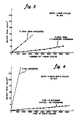
- Figures 1-3 are graphs showing the oxide weight gain on a titanium substrate as compared to the oxide weight gain on a titanium substrate having an adherent chromium coating.
- Figure 4 is a graph showing the oxide weight gain on a titanium substrate as compared to the oxide weight gain on a titanium substrate having an adherent coating of a chromium alloy.
- Ductile chromium alloys that form continuous chromium oxide scales can be used as the coating material instead of chromium.
- Such ductile chromium alloys are, for example, comprised of about 20 to 50 weight percent chromium and the balance nickel, or about 30 to 50 weight percent chromium and the balance cobalt, or about 30 to 50 weight percent chromium and the balance iron.
- Physical Vapor Deposition coating processes that deposit atoms having a high kinetic energy are used to apply the coatings disclosed above.
- diode sputtering with a radio frequency current can be used to deposit chromium or chromium alloy coatings of about 1 to 10 microns.
- Such chromium or chromium alloy coatings are continuous so that no bare spots on the titanium substrate are exposed to oxidative attack, and strongly adherent so that the coating does not spall from the substrate even after repeated thermal cycling between room temperature and elevated temperatures up to about 900°C.
- the following examples further show the deposition of high energy chromium atoms, or high energy atoms of the constituents of chromium alloys, as continuous adherent coatings on titanium substrates.
- Coupons of approximately 1/2" x 1/4" x 1/8" were prepared from large samples having the compositions shown in Table 1 below.
- the coupons were polished on silicon carbide paper down to 600 mesh on all surfaces and then ultrasonically cleaned in acetone and rinsed in methanol.
- the coupons were coated with chromium by the anode sputtering process in a Perkin-Elmer 2400 sputtering machine by the following procedure.
- a chromium target of about 99.999% purity was used to form a cathode assembly.
- the coupons were centrally located on an anode spaced about 1 3/4 inch from the target.
- the anode and cathode were sealed in a chamber reduced to a pressure of 2x10 ⁇ 6 atmospheres for about 1 hour to allow for the removal of water vapor and other contaminants from the chamber.
- the chromium target was sputter cleaned by rotating a blank anode under the target and applying a radio frequency current of 13.56 megahertz for 60 minutes to the cathode target and the anode.
- An argon plasma was formed between the electrodes by introducing argon gas at a rate of 80 milliliters per minute between the anode and cathode to maintain a vessel pressure of 3.2 torr.
- the anode holding the coupons was rotated back under the cathode.
- the coupons were then sputtered by applying the radio frequency current at 350 watts and 2400 volts for 3.5 hours.
- a chromium coating of about 3 microns was deposited on the coupon surface facing the target.
- the sputtering procedure was repeated a second time with the opposite coupon surface facing the target. It should be understood that a chromium coating of about 3 microns was also deposited on the sides of the coupons perpendicular to the target by this procedure. This sputtering procedure was repeated a second time to form a total coating thickness of 6 microns on coupons having the Ti 64 and Ti 6242 substrates shown in Table 1.
- a chromium alloy target comprised of about 20 weight percent chromium and the balance nickel was used to deposit a 6 micron chromium alloy coating on a Ti 64 coupon.
- the sputtering procedure described above and repeated a second time to deposit a 6 micron coating was used.
- a chromium coating was applied by the pack-cementation process on coupons having the Ti substrate in Table 1.
- the coupons were inserted in a powder pack consisting of, in weight percent, about 65% chromium powder, about 25% alumina powder, and about 10% ammonium chloride.
- the pack was heated to about 1000°C for about 1 hour in an atmosphere of hydrogen and argon, forming a chromium coating of about 50 microns.
- a bronze colored surface layer believed to be comprised of chromium and titanium intermetallic compounds was observed on the coupons.
- the oxidation protection provided by the coatings applied in Examples 1 and 2 was measured by heating coated and uncoated coupons having the same titanium substrate.
- the coupons were heated in flowing air and the weight gain on the coupons from oxide growth was measured on automatically recording thermal balances.
- the weight gain measurements are shown by the curves in Figures 1-4, where the weight gain in milligrams per square centimeter is plotted on the ordinate as a function of exposure time as plotted on the abscissa.
- the coupons in Figures 1,2, and 4 were thermally cycled every 4 hours by cooling the coupons to room temperature and then reheating them to the test temperature shown in each figure.
- the coupons in Figure 3 were thermally cycled every hour in the same manner.
- Figure 1 shows the weight gain for uncoated and chromium coated coupons, having the Ti 64 substrate in Table 1, that were heated to 800°C for over 900 hours with periodic thermal cycling.
- Figure 2 shows the weight gain for uncoated and chromium coated coupons, having the Ti 6242 substrate in Table 1, that were were heated to 825°C for over 1200 hours with periodic thermal cycling.
- Figure 3 shows the weight gain for uncoated and chromium coated coupons, having the Ti-25Al-26Nb substrate in Table 1, that were were heated to 900°C for about 824 hours with periodic thermal cycling.
- Figure 4 shows the weight gain for uncoated and chromium alloy coated coupons, having the Ti 64 substrate in Table 1, that were were heated to 825°C for over 900 hours with periodic thermal cycling.
- Each figure shows the substantial oxidation protection provided by the sputtered chromium or chromium alloy coating.
- the uncoated coupons experienced rapid weight gains, spalling of the oxide scale, and oxidized at an essentially linear rate. Uncoated coupons shown in Figures 1 and 2 had become completely oxidized in about 400 hours.
- the coated coupons experienced greatly reduced oxide weight gains of less than about 4 mg/cm2 in about 900 hours or more of exposure to an oxidizing atmosphere with repeated thermal cycling.
- Example 1 the noble metal coatings applied in Example 1 spalled rapidly when heated to 900°C with periodic cooling to room temperature.
- the chromium coatings applied in Example 2 by the pack-cementation process readily spalled on heating in air at 855°C.
- the coatings disclosed herein provide excellent oxidation protection on titanium substrates that is characteristic of the oxidation protection provided by protective oxide scales.
- Protective oxide scales substantially reduce the rate of oxidation on the substrate by substantially reducing the diffusion of oxygen through the scale to the substrate. Therefore it is expected that the coatings of this invention, in addition to providing oxidation protection, also minimize the diffusion of oxygen into the titanium substrate so that the substrate is not embrittled and ductility, toughness, and resistance to creep are not adversely reduced.
Landscapes
- Chemical & Material Sciences (AREA)
- Chemical Kinetics & Catalysis (AREA)
- Engineering & Computer Science (AREA)
- Materials Engineering (AREA)
- Mechanical Engineering (AREA)
- Metallurgy (AREA)
- Organic Chemistry (AREA)
- Physical Vapour Deposition (AREA)
- Other Surface Treatments For Metallic Materials (AREA)
Applications Claiming Priority (2)
| Application Number | Priority Date | Filing Date | Title |
|---|---|---|---|
| US07/479,009 US5098540A (en) | 1990-02-12 | 1990-02-12 | Method for depositing chromium coatings for titanium oxidation protection |
| US479009 | 1990-02-12 |
Publications (1)
| Publication Number | Publication Date |
|---|---|
| EP0446584A1 true EP0446584A1 (de) | 1991-09-18 |
Family
ID=23902280
Family Applications (1)
| Application Number | Title | Priority Date | Filing Date |
|---|---|---|---|
| EP91100952A Withdrawn EP0446584A1 (de) | 1990-02-12 | 1991-01-25 | Chrombeschichtung zum Schutz des Titans gegen Oxidation |
Country Status (4)
| Country | Link |
|---|---|
| US (1) | US5098540A (de) |
| EP (1) | EP0446584A1 (de) |
| JP (1) | JPH0598423A (de) |
| CA (1) | CA2034407A1 (de) |
Cited By (1)
| Publication number | Priority date | Publication date | Assignee | Title |
|---|---|---|---|---|
| US6332900B1 (en) * | 1999-02-08 | 2001-12-25 | Wilson Greatbatch Ltd. | Physical vapor deposited electrode component and method of manufacture |
Families Citing this family (9)
| Publication number | Priority date | Publication date | Assignee | Title |
|---|---|---|---|---|
| JPH02163321A (ja) * | 1988-03-10 | 1990-06-22 | Nkk Corp | 電磁鋼板の酸洗方法 |
| JP2003293126A (ja) | 2002-04-09 | 2003-10-15 | Fujitsu Ltd | スパッタリングターゲット及びその製造方法 |
| US7455890B2 (en) * | 2003-08-05 | 2008-11-25 | General Electric Company | Ion implantation of turbine engine rotor component |
| US6921251B2 (en) * | 2003-09-05 | 2005-07-26 | General Electric Company | Aluminide or chromide coating of turbine engine rotor component |
| US9506136B2 (en) | 2012-09-13 | 2016-11-29 | United Technologies Corporation | Method of coating an iron-based article |
| US9370605B2 (en) | 2013-03-04 | 2016-06-21 | Howmedica Osteonics Corp. | Cobalt chrome coated titanium implant |
| CN110340344B (zh) * | 2018-04-08 | 2021-09-24 | 中国科学院金属研究所 | 一种提高激光增材制造合金钢粉末利用率的方法 |
| FR3087794B1 (fr) * | 2018-10-26 | 2020-10-30 | Safran Aircraft Engines | Procede chimique de matification |
| FR3117508A1 (fr) | 2020-12-15 | 2022-06-17 | Airbus Operations (S.A.S.) | Carénage aérodynamique arrière de mât de moteur d’aéronef |
Citations (4)
| Publication number | Priority date | Publication date | Assignee | Title |
|---|---|---|---|---|
| FR1493040A (fr) * | 1966-07-12 | 1967-08-25 | Commissariat Energie Atomique | Procédé de protection du zirconium et de ses alliages par un revêtement de chrome |
| DE3717044A1 (de) * | 1986-05-27 | 1987-12-03 | Nippon Musical Instruments Mfg | Material fuer zieranwendungen |
| WO1988009397A1 (en) * | 1987-05-18 | 1988-12-01 | The Secretary Of State For Defence In Her Britanni | COATED NEAR -alpha TITANIUM ARTICLES |
| WO1988009396A1 (en) * | 1987-05-18 | 1988-12-01 | The Secretary Of State For Defence In Her Britanni | COATED NEAR -alpha TITANIUM ARTICLES |
Family Cites Families (4)
| Publication number | Priority date | Publication date | Assignee | Title |
|---|---|---|---|---|
| US3632494A (en) * | 1967-11-06 | 1972-01-04 | Warner Lambert Co | Coating method and apparatus |
| BR7102060D0 (pt) * | 1970-04-17 | 1973-04-05 | Wilkinson Sword Ltd | Lamina de barbear e processo para a fabricacao da mesma |
| US4139942A (en) * | 1977-12-16 | 1979-02-20 | The Gillette Company | Process for producing corrosion resistant carbon steel razor blades and products made thereby |
| US4761346A (en) * | 1984-11-19 | 1988-08-02 | Avco Corporation | Erosion-resistant coating system |
-
1990
- 1990-02-12 US US07/479,009 patent/US5098540A/en not_active Expired - Fee Related
-
1991
- 1991-01-17 CA CA002034407A patent/CA2034407A1/en not_active Abandoned
- 1991-01-25 EP EP91100952A patent/EP0446584A1/de not_active Withdrawn
- 1991-02-08 JP JP3037698A patent/JPH0598423A/ja not_active Withdrawn
Patent Citations (4)
| Publication number | Priority date | Publication date | Assignee | Title |
|---|---|---|---|---|
| FR1493040A (fr) * | 1966-07-12 | 1967-08-25 | Commissariat Energie Atomique | Procédé de protection du zirconium et de ses alliages par un revêtement de chrome |
| DE3717044A1 (de) * | 1986-05-27 | 1987-12-03 | Nippon Musical Instruments Mfg | Material fuer zieranwendungen |
| WO1988009397A1 (en) * | 1987-05-18 | 1988-12-01 | The Secretary Of State For Defence In Her Britanni | COATED NEAR -alpha TITANIUM ARTICLES |
| WO1988009396A1 (en) * | 1987-05-18 | 1988-12-01 | The Secretary Of State For Defence In Her Britanni | COATED NEAR -alpha TITANIUM ARTICLES |
Non-Patent Citations (2)
| Title |
|---|
| JOURNAL OF MATERIALS SCIENCE, vol. 25, no. 1A, January 1990, pages 137-143; M. EMILIANI et al.: "Characterization of sputtered inconel 617" * |
| PATENT ABSTRACTS OF JAPAN, vol. 18, no. 232 (C-248)[1669], 25th October 1984; & JP-A-59 113 182 (TOSHIBA K.K.) 29-06-1984 * |
Cited By (3)
| Publication number | Priority date | Publication date | Assignee | Title |
|---|---|---|---|---|
| US6332900B1 (en) * | 1999-02-08 | 2001-12-25 | Wilson Greatbatch Ltd. | Physical vapor deposited electrode component and method of manufacture |
| US6594139B2 (en) | 1999-02-08 | 2003-07-15 | Wilson Greatbatch Ltd. | Physical vapor deposited electrode and method of manufacture |
| US6733926B2 (en) | 1999-02-08 | 2004-05-11 | Wilson Greatbatch Ltd. | Electrochemical cell having a physical vapor deposited electrode and method of manufacture |
Also Published As
| Publication number | Publication date |
|---|---|
| US5098540A (en) | 1992-03-24 |
| JPH0598423A (ja) | 1993-04-20 |
| CA2034407A1 (en) | 1991-08-13 |
Similar Documents
| Publication | Publication Date | Title |
|---|---|---|
| US5077140A (en) | Coating systems for titanium oxidation protection | |
| EP0386386B1 (de) | Verfahren zum Beschichten von Superlegierungen mit yttriumangereicherten Aluminiden | |
| US4419416A (en) | Overlay coatings for superalloys | |
| US5238752A (en) | Thermal barrier coating system with intermetallic overlay bond coat | |
| US4585481A (en) | Overlays coating for superalloys | |
| US7011894B2 (en) | Method of making a protective coating forming a thermal barrier with a bonding underlayer on a superalloy substrate, and a part obtained thereby | |
| CA1128820A (en) | Method for altering the composition and structure of aluminum bearing overlay alloy coatings during deposition from metallic vapor | |
| WO1997047784A1 (en) | Article with a protective coating system comprising an improved anchoring layer and its manufacture | |
| JP2007169788A (ja) | 断熱被膜用の白金改質NiCoCrAlYボンドコート | |
| JPS6014823B2 (ja) | ニツケル基材表面上張り被覆用合金 | |
| CA2205052C (en) | Method of producing reactive element modified-aluminide diffusion coatings | |
| US5098540A (en) | Method for depositing chromium coatings for titanium oxidation protection | |
| US5556713A (en) | Diffusion barrier for protective coatings | |
| EP1209248B1 (de) | Oxidationsbeständiger Bauteil auf Basis eines Titanlegierung-Substrats | |
| US6635124B1 (en) | Method of depositing a thermal barrier coating | |
| US6143141A (en) | Method of forming a diffusion barrier for overlay coatings | |
| Wolf | Modification of chemical properties by ion beam mixing techniques | |
| JP2004269951A (ja) | 耐ハロゲンガス皮膜被覆部材およびその製造方法 | |
| Kim et al. | A study on composite coatings of yttrium ion-plating and pack aluminizing for high-temperature applications | |
| JPH0211753A (ja) | TiAl系複合部材及びその製造方法 | |
| KR960010165B1 (ko) | 니켈기 초합금의 알루미나이드-이트륨 복합코팅층 형성방법 | |
| JP3315246B2 (ja) | 金属コーティング材料 | |
| KR940002691B1 (ko) | 니켈기 초합금의 코팅방법 | |
| Kim et al. | High temperature corrosion study on yttrium modified aluminide coatings on IN 713C | |
| JPH06272031A (ja) | 高耐食性めっき鋼材の製造法 |
Legal Events
| Date | Code | Title | Description |
|---|---|---|---|
| PUAI | Public reference made under article 153(3) epc to a published international application that has entered the european phase |
Free format text: ORIGINAL CODE: 0009012 |
|
| AK | Designated contracting states |
Kind code of ref document: A1 Designated state(s): DE FR GB IT SE |
|
| 17P | Request for examination filed |
Effective date: 19911220 |
|
| 17Q | First examination report despatched |
Effective date: 19940201 |
|
| STAA | Information on the status of an ep patent application or granted ep patent |
Free format text: STATUS: THE APPLICATION IS DEEMED TO BE WITHDRAWN |
|
| 18D | Application deemed to be withdrawn |
Effective date: 19960305 |