EP0444847A2 - Verarbeitungsgerät für linearische Rekurrenzen - Google Patents
Verarbeitungsgerät für linearische Rekurrenzen Download PDFInfo
- Publication number
- EP0444847A2 EP0444847A2 EP91301491A EP91301491A EP0444847A2 EP 0444847 A2 EP0444847 A2 EP 0444847A2 EP 91301491 A EP91301491 A EP 91301491A EP 91301491 A EP91301491 A EP 91301491A EP 0444847 A2 EP0444847 A2 EP 0444847A2
- Authority
- EP
- European Patent Office
- Prior art keywords
- equations
- recurrence
- group
- values
- groups
- Prior art date
- Legal status (The legal status is an assumption and is not a legal conclusion. Google has not performed a legal analysis and makes no representation as to the accuracy of the status listed.)
- Withdrawn
Links
Images



Classifications
-
- G—PHYSICS
- G06—COMPUTING OR CALCULATING; COUNTING
- G06F—ELECTRIC DIGITAL DATA PROCESSING
- G06F17/00—Digital computing or data processing equipment or methods, specially adapted for specific functions
- G06F17/10—Complex mathematical operations
- G06F17/11—Complex mathematical operations for solving equations, e.g. nonlinear equations, general mathematical optimization problems
- G06F17/12—Simultaneous equations, e.g. systems of linear equations
Definitions
- This invention relates to enhancing the performance of data processing systems in handling linear recurrences.
- computation time for arithmetic problems in a data processing system is a function of the number of equations to be solved and the number of processors available to receive and process information.
- Linear recurrences have the characteristic that their solution involves obtaining a number of intermediate solutions x1, x2 -- x w . this may heretofore be done serially where x1 is solved, then x2 is solved by plugging in x1 from the previous equation, and then solving x3 by plugging in x2, etc, clearing a time consuming operation.
- Fig. 1A shows an Mth order linear recurrence to which the linear recurrence dispersal technique of the instant invention proposes an expeditious solution.
- Fig. 1B shows a first order linear recurrence expressed as N recurrence variables to be solved.
- Fig. 2 shows a second order linear recurrence expressed similarly to the first order linear recurrence of Fig. 1B.
- Fig. 3 depicts an Mth order linear recurrence.
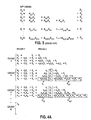
- Fig. 4A shows a set of first order linear recurrence equations broken up into G groups of four equations in each group, setting forth the phase 1 and phase 2 steps of the linear recurrence dispersal method.
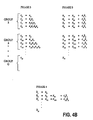
- Fig. 4B illustrates the phase 3 through 5 calculations of the instant invention for the first order recurrence of Fig. 4A.
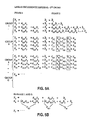
- Fig. 5A shows a set of second order linear recurrence equations broken up into G groups of four equations per group and showing the phase 1 and phase 2 steps of the linear recurrence dispersal method.
- Fig. 5B illustrates how the coefficients C 6, 1 and C 6, 2 and X 6T are formed in the phase 3 calculation of the instant invention for the second order recurrence of Fig. 5A.
- Fig. 5C shows a generalised phase 2 equation and how X iT is determined for the second order recurrence.
- Fig. 5D shows the generalised formula representation for determining the values of C in phase 3 for the second order recurrence.
- Fig. 5E shows the generalised formula representation for determining the values of k in phase 4 in the second order linear recurrence.
- Fig. 5F shows the generalised representation for the phase 5 calculation of the final linear recurrence variable solutions in a second order linear recurrence.
- Fig. 6 shows certain of the generalised representations of an Mth order linear recurrence equation for phases 1 through 5.
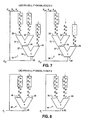
- Fig. 7 diagrammatically illustrates a pair of parallel vector processing elements and the movement of data within said elements as they process data in groups 1-3 and 4-6 (not shown) of Fig. 4A.
- Fig. 8 demonstrates the use of a pair of parallel vector processing elements to calculate phase 3 values of C using the linear recurrence dispersal technique to solve the recurrence of Fig. 4A.
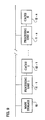
- Fig. 9 shows a diagrammatic illustration of a parallel data processing system with a main storage and processor units 1 through N, each shown with respective cache memory.
- Fig. 1A shows the generalised depiction of an Mth order linear recurrence, wherein the solutions to equations x1 through xN are desired.
- Fig. 1B it has heretofore been necessary, in order to calculate solutions to the X i variables sometimes referred to hereinafter as recurrence variables, to solve the successive equations by calculating X1, then plugging the value of X1 into the X2 equation, then plugging the derived X2 value into the X3 equation, and so on in scalar fashion. Because a solution for the next succeeding equation cannot be calculated before the previous equations have been solved, the prior art technique is very time consuming. Equations are shown in generalised and fragmentary form because of their significant complexity.
- Fig. 2 depicts a second order linear recurrence shown as N equations. Such recurrences have heretofore also been solved by the less efficient method described with respect to Fig. 1B above.
- Fig. 3 shows the generalised depiction of an Mth order linear recurrence broken into N equations. For any order linear recurrence, the solution is time consuming when performed using the prior art scalar solution technique.
- Fig. 9 diagrammatically illustrates a preferred embodiment, a parallel processing system with a main storage 10 and a plurality of processing units 11-1 to 11-n, each shown with respective cache memory 12-1 to 12-n.
- the processing units 11 can, in a preferred embodiment, perform complex vector processing and each processing unit such as 11-1 may have multiple processing elements such as 20, 30, 40 and 50 shown in Figs. 7 and 8.
- Various processing units and their vector processing elements may be assigned various phase 1-5 tasks under program control in a well known manner.
- Figs. 4A and 4B show the Phase 1-5 steps of the first order linear recurrence dispersal method of the present improvement.
- the N equations which comprise the recurrence are broken up into G groups of, in the instant embodiment, but not by way of limitation, four equations per group.
- a substantial savings in computation time is realised by the use of plural parallel processor elements, each possessing vector processing capabilities.
- the plurality of vector processor elements will concurrently perform calculations for a number of groups of equations.
- the computation time will vary with the number of processors used.
- phase 2 calculations will be made across groups, e.g. x1, x5, x9, x2, x6, x10, x3 etc. in one processing element in the preferred embodiment.
- the result of this sequence is that x4 is not solved when the first (temporary) calculation of x5 is performed.
- This sequence is referred to herein as stride 4 addressing.
- the linear recurrence variables in the set of equations which define a linear recurrence of any order are calculated by the following five step process:
- steps (a) through (e) shall correspond to phases 1 through 5, respectively.
- phase 1 all N equations are broken up into G groups, each group having, preferably, an equal number of equations per group (e.g., 4).
- phase 2 the solution of the group 1 equations is straightforward in the preferred embodiment because the sequence of calculations (x1, x5, x9, x2 ...) permits x1 to have been solved and available for solving x2 during phase 2.
- the x i ⁇ 1 to x i-m recurrence variables that. appear on the right side of the equal sign in phase 1 of that group are set equal to zero because they are unknown during phase 2.
- phase 2 group 2, x4 is temporarily set equal to zero because it appears in the preceding group (group 1), is unknown, and also appears in the group under consideration (group 2).
- This step yields a temporary or "partial" value of the recurrence variables in group 2, phase 2.
- This process is carried out through all groups 2-G.
- the "temporary" value of x8, shown in group 2, and designated “X 8T " is: a8 a7 a6 b5 + a8 a7 b6 + a8 b7 + b8 because x4 is temporarily set equal to zero, nullifying the coefficient of x4 in group 2, phase 2.
- the temporary value of x5 in group 2, phase 2, designated x 5T is b5.
- the temporary value of x6, designated x 6T becomes: a6 b5 + b6
- the temporary value (X 7T ) for x7 is therefore: a7 a6 b5 + a7 b6 + b7
- step (b) arithmetic calculations are carried out wherein a temporary or "partial" value is given to each x i because of the error caused by artificially setting variables to 0. That is, by assigning a temporary value of zero to the recurrence variable (or variables, for second or greater order recurrences) which appears on the right side but not on the left side of the equal sign in that group, an x iT , or temporary recurrence value is obtained to be used in the calculations of phases 4 and 5.
- the approximation resulting from the step of setting certain values momentarily equal to zero to calculate temporary values of the recurrence variables is carried out preferably by parallel processor element using stride 4 addressing in Fig. 7.
- step (c), or phase 3 (Fig. 4B) the coefficients C which correspond to the recurrence variables, which were set equal to zero in phase 2 (Fig. 4A), are developed, in general M per equation for groups 2 through G, and it can be done concurrently with step (b).
- the process can also be vectorized as shown in Fig. 8 with stride 4 addressing across groups. Note that the stride 4 addressing is across different groups in Figs. 7 and 8.
- phase 4 the final values k i of the recurrence variables which were set to zero in phase 2 are computed in sequence. This is the one phase that requires scalar processing since each computation requires the results of the previous computation; hence it is desirable to keep the number of computations at a minimum for phase 4.
- phase 5 the coefficients computed in phase 3 are multiplied by the appropriate constants of phase 4 and the results added to the appropriate temporary recurrence values x iT of phase 2 to yield the final values of the recurrence variables.
- the groups may be processed in parallel with vector processing elements operated at stride 1.
- phase 1 the total number of equations to be solved are broken into groups of equal numbers of equations. For example, for a group of 1,000 equations, where there are four processors available to carry out calculations, G may be set equal to 4 and the group of 1,000 equations broken up into four groups of 250 equations each. This results in the improved method being substantially less complicated than the original problem.
- Figs. 5A through 5F depict the linear recurrence dispersal technique disclosed herein carried out on a second order linear recurrence.
- Fig. 5A shows the breakdown of the N equations of the linear recurrence into G groups in phase 1, and in phase 2 temporary values x iT are calculated for the recurrence variables.
- x 6T is as follows: a 6, 5 b5 + b6 because x4 and x3 are temporarily set equal to zero as they appear in the preceding group and on the right side of the equal sign in that group (group 2) but do not appear on the left side of the equal sign in the group under consideration (group 2). It is also to be appreciated from Fig. 5B that the value of x 5T equals b5.
- Fig. 5D shows the generalised phase 3 calculation of the C coefficients for a second order linear recurrence.
- the coefficients of the recurrence variables which were taken as zero in any particular group are represented by the coefficient C.
- Fig. 5E shows a portion of the phase 4 calculation of the k coefficients for a second order linear recurrence. These coefficients are then utilised in the calculation of the final recurrence variables in phase 5 as depicted in Fig. 5F.
- stride refers to the accessing of memory, wherein each succeeding address value is determined by incrementing by the stride value (e.g. 1 to S). Therefore, stride 1 indicates that each succeeding address is one unit distant from the next preceding address. Likewise, stride S indicates that each succeeding address is S units distant from the next preceding address.
- stride S processor can substantially improve performance over a stride 1 processor with faster accessing of data.
- Fig. 6 shows the generalised expression for the five steps or phases of the linear recurrence dispersal method for an Mth order equation, which is merely an extension of the first and second order examples set forth in Figs. 4A through 5F. All five steps are carried out in the manner already described.
- Fig. 7 shows a diagrammatic representation of a pair of parallel vector processing elements 20 and 30 depicting the movement of data within said elements 20 and 30 for phase 2 calculations required in the first order embodiment of Fig. 4A.
- the data processing system on which the linear recurrence dispersal technique is carried out should have effective processing capability such that phases 2 and 3 can be achieved with vector processing and with calculations performed across groups with a stride equal to the number of equations in-a group.
- the output of the vector processing element 20 is the x iT temporary recurrence variable values which are stored temporarily in general purpose registers (not shown) or cache 11-1 of Fig. 9 or main storage.
- the multiplier logic element 22 has two inputs 23 and 25 and an output 26 coupled to a first input 27 of addition logic element 24, which element 24 has a second input 28.
- the output 29 of addition logic element 24 is coupled directly to cache 12 or main storage 10 shown in Fig. 9 and is also coupled to the stream of data connected to input 23 of multiplier logic element 22.
- multiplier logic element 32 of vector processing element 30 has a pair of inputs 33 and 35 and an output 36 coupled to first input 37 of addition logic element 34, which has a second input port 38.
- Addition logic element 34 has output port 39 coupled directly to cache memory as well as being connected to the input port 33.
- the stride of the system depicted is 4. That is, the processing element 20 is calculating values for the first three groups of Fig. 4A and the next processing element 30 is calculating values for the second three groups.
- Fig. 7 and the table below illustrate a preferred method of executing phase 2 calculations of the first order linear recurrence of Fig. 4A.
- the result of a multiplication in logic 22 e.g., b1 a2
- the appropriate value e.g. b2
- the next values b5, a6
- stride 1 processing would necessitate the processing element 20 being rendered inactive until the x2 calculation is complete and the value of x2 being fed directly to the input 23 or put in a general purpose register which register is then accessed to provide the value of x1 to the input 23.
- the application of x2 to the input 23 must be coordinated with the application of values a3 and b3 to respective inputs 25, 28. Thus one or more cycles of operating time are lost to the processing element 20 if stride 1 processing is used.
- stride S (in Fig. 7 stride 4) addressing is used in a preferred embodiment to access b1, then b5, b9 ... etc. This is illustrated in greater detail in the following table for the first three groups of equations:
- each variable e.g. x2
- x1 is available at the appropriate time for the x2 calculation irrespective of the system characteristics.
- the preferred embodiment shows a stride 4 corresponding to the four (4) equations for group, the invention is not so limited. It is merely important to provide a stride value which does not cause the processing element 20 to wait (miss cycles) for a previous calculation result and/or coefficient before initiating its next calculation cycle.
- Fig. 8 shows the use of a vector processing element 40, which in the case shown is a multiplier logic element, to calculate the phase 3 values of Ci using the linear recurrence dispersal technique on the first order recurrence of Figs. 4A, 4B.
- the multiplier logic element 40 has a pair of input ports 41 and 42 and an output port 43, which output port 43 is connected to cache memory 12 or main storage 10 shown in Fig. 9. Comparing Fig. 8 to Fig. 4B, phase 3, it can be seen that coefficients a6 and a5 are about to be input into ports 41 and 42 of multiplier logic element 40, respectively. Therefore, the output therefrom will be a value of C6.
- next pair of coefficients, a10 and a9, to be multiplied by multiplier logic element. 40 will yield a product designated as C10 in the next succeeding group.
- stride of the system is four allowing a single processor to calculate across a plurality of groups (2, 3 and 4). It can thus be appreciated that the next succeeding operation will multiply coefficients a14 and a13, the result of which will be designated as C14, the value produced in group 3 (not shown).
Landscapes
- Engineering & Computer Science (AREA)
- Physics & Mathematics (AREA)
- General Physics & Mathematics (AREA)
- Mathematical Physics (AREA)
- Computational Mathematics (AREA)
- Mathematical Analysis (AREA)
- Mathematical Optimization (AREA)
- Pure & Applied Mathematics (AREA)
- Data Mining & Analysis (AREA)
- Theoretical Computer Science (AREA)
- Operations Research (AREA)
- Databases & Information Systems (AREA)
- Software Systems (AREA)
- General Engineering & Computer Science (AREA)
- Algebra (AREA)
- Complex Calculations (AREA)
- Executing Machine-Instructions (AREA)
- Multi Processors (AREA)
Applications Claiming Priority (2)
| Application Number | Priority Date | Filing Date | Title |
|---|---|---|---|
| US48533690A | 1990-02-26 | 1990-02-26 | |
| US485336 | 1990-02-26 |
Publications (2)
| Publication Number | Publication Date |
|---|---|
| EP0444847A2 true EP0444847A2 (de) | 1991-09-04 |
| EP0444847A3 EP0444847A3 (en) | 1993-07-21 |
Family
ID=23927761
Family Applications (1)
| Application Number | Title | Priority Date | Filing Date |
|---|---|---|---|
| EP19910301491 Withdrawn EP0444847A3 (en) | 1990-02-26 | 1991-02-25 | Enhanced processor for linear recurrences |
Country Status (2)
| Country | Link |
|---|---|
| EP (1) | EP0444847A3 (de) |
| JP (1) | JPH0644289A (de) |
Cited By (2)
| Publication number | Priority date | Publication date | Assignee | Title |
|---|---|---|---|---|
| EP0651338A1 (de) * | 1993-01-26 | 1995-05-03 | Texas Instruments Incorporated | Verfahren und Vorrichtung zur Lösung von Termen einer numerischen Folge |
| WO2006040703A3 (en) * | 2004-10-12 | 2009-02-12 | Koninkl Philips Electronics Nv | Multi-branch parallel processing method and apparatus for implementing iterative computations |
-
1991
- 1991-02-01 JP JP3031473A patent/JPH0644289A/ja active Pending
- 1991-02-25 EP EP19910301491 patent/EP0444847A3/en not_active Withdrawn
Non-Patent Citations (5)
| Title |
|---|
| ACM TRANSACTIONS ON MATHEMATICAL SOFTWARE, ACM vol. 4, no. 8, September 1978, BROADWAY, NEW YORK, US pages 270 - 277 S.C.CHEN ET AL 'PRACTICAL PARALLEL BAND TRIANGULAR SYSTEM SOLVERS' * |
| JJOURNAL OF VLSI SIGNAL PROCESSING, KLUWER ACADEMIC PUBLISHERS vol. 1, no. 2, October 1989, BOSTON, US pages 143 - 152 , XP000228864 P.F.C.KREKEL ET AL 'A SYSTOLIC ALGORITHM AND ARCHITECTURE FOR SOLVING SETS OF LINEAR EQUATIONS WITH MULTI-BAND COEFFICIENT MATRIX' * |
| JOURNAL OF PARALLEL AND DISTRIBUTED COMPUTING, ACADEMIC PRESS INC. vol. 3, no. 2, June 1986, ORLANDO, FL., US pages 215 - 235 , XP000084789 GUANG R. GAO 'A MAXIMALLY PIPELINED TRIDIAGONAL LINEAR EQUATION SOLVER' * |
| PARALLEL COMPUTING, ELSEVIER SCIENCE PUBLISHERS B.V. (NORTH HOLLAND) vol. 7, no. 1, April 1988, AMSTERDAM, NL pages 87 - 95 , XP000104980 P.H.MICHIELSE ET AL 'DATA TRANSPORT IN WANG'S PARTITION METHOD' * |
| THE INTERNATIONAL JOURNAL OF SUPERCOMPUTER APPLICATION, MASSACHUSETTS INSTITUTE OF TECHNOLOGY vol. 3, no. 1, 1989, CAMBRIDGE, MA, US pages 75 - 81 , XP000099190 SWARN P. KUMAR 'SOLVING TRIDIAGONAL SYSTEMS ON THE BUTTERFLY COMPUTER' * |
Cited By (2)
| Publication number | Priority date | Publication date | Assignee | Title |
|---|---|---|---|---|
| EP0651338A1 (de) * | 1993-01-26 | 1995-05-03 | Texas Instruments Incorporated | Verfahren und Vorrichtung zur Lösung von Termen einer numerischen Folge |
| WO2006040703A3 (en) * | 2004-10-12 | 2009-02-12 | Koninkl Philips Electronics Nv | Multi-branch parallel processing method and apparatus for implementing iterative computations |
Also Published As
| Publication number | Publication date |
|---|---|
| EP0444847A3 (en) | 1993-07-21 |
| JPH0644289A (ja) | 1994-02-18 |
Similar Documents
| Publication | Publication Date | Title |
|---|---|---|
| US11698773B2 (en) | Accelerated mathematical engine | |
| US6539368B1 (en) | Neural processor, saturation unit, calculation unit and adder circuit | |
| US5226171A (en) | Parallel vector processing system for individual and broadcast distribution of operands and control information | |
| US4748579A (en) | Method and circuit for performing discrete transforms | |
| US4972359A (en) | Digital image processing system | |
| US4821224A (en) | Method and apparatus for processing multi-dimensional data to obtain a Fourier transform | |
| CN111353126A (zh) | 分块矩阵乘法运算系统 | |
| EP0821303A2 (de) | Verfahren und Vorrichtung zur Durchführung ganzzahliger Divisionsoperationen unter Verwendung von Gleitkomma-Hardware | |
| JPH0622033B2 (ja) | サンプルベクトルの離散余弦変換を計算する回路 | |
| JP4163178B2 (ja) | 素因数分解アルゴリズムを用いる最適化された離散フーリエ変換方法および装置 | |
| JPS6125188B2 (de) | ||
| EP0425296A2 (de) | Beschleunigte Lösung von linearen Gleichungssystemen | |
| CN109144469B (zh) | 流水线结构神经网络矩阵运算架构及方法 | |
| US5237685A (en) | Linear recurrence dispersal structure and method for parallel processors | |
| US6598061B1 (en) | System and method for performing modular multiplication | |
| US5867413A (en) | Fast method of floating-point multiplication and accumulation | |
| EP0444847A2 (de) | Verarbeitungsgerät für linearische Rekurrenzen | |
| EP0474246A2 (de) | Bildsignalverarbeitungsgerät | |
| US6460061B1 (en) | 2-dimensional discrete cosine transform using a polynomial transform | |
| Cohen | A mathematical approach to computational network design | |
| US4823297A (en) | Digit-reversal method and apparatus for computer transforms | |
| US6988120B2 (en) | Arithmetic unit and method thereof | |
| JPS6310263A (ja) | ベクトル処理装置 | |
| JPH0535773A (ja) | ベクトル除算方式とその装置 | |
| JP3226823B2 (ja) | 高精度高桁乗算装置 |
Legal Events
| Date | Code | Title | Description |
|---|---|---|---|
| PUAI | Public reference made under article 153(3) epc to a published international application that has entered the european phase |
Free format text: ORIGINAL CODE: 0009012 |
|
| AK | Designated contracting states |
Kind code of ref document: A2 Designated state(s): DE FR GB IT |
|
| 17P | Request for examination filed |
Effective date: 19911211 |
|
| PUAL | Search report despatched |
Free format text: ORIGINAL CODE: 0009013 |
|
| AK | Designated contracting states |
Kind code of ref document: A3 Designated state(s): DE FR GB IT |
|
| STAA | Information on the status of an ep patent application or granted ep patent |
Free format text: STATUS: THE APPLICATION HAS BEEN WITHDRAWN |
|
| 17Q | First examination report despatched |
Effective date: 19960102 |
|
| 18W | Application withdrawn |
Withdrawal date: 19951219 |