EP0443451B1 - Geschlossene Bleisäurebatterie - Google Patents
Geschlossene Bleisäurebatterie Download PDFInfo
- Publication number
- EP0443451B1 EP0443451B1 EP91102154A EP91102154A EP0443451B1 EP 0443451 B1 EP0443451 B1 EP 0443451B1 EP 91102154 A EP91102154 A EP 91102154A EP 91102154 A EP91102154 A EP 91102154A EP 0443451 B1 EP0443451 B1 EP 0443451B1
- Authority
- EP
- European Patent Office
- Prior art keywords
- lead
- powder
- positive
- sealed lead
- acid battery
- Prior art date
- Legal status (The legal status is an assumption and is not a legal conclusion. Google has not performed a legal analysis and makes no representation as to the accuracy of the status listed.)
- Expired - Lifetime
Links
Images


Classifications
-
- H—ELECTRICITY
- H01—ELECTRIC ELEMENTS
- H01M—PROCESSES OR MEANS, e.g. BATTERIES, FOR THE DIRECT CONVERSION OF CHEMICAL ENERGY INTO ELECTRICAL ENERGY
- H01M50/00—Constructional details or processes of manufacture of the non-active parts of electrochemical cells other than fuel cells, e.g. hybrid cells
- H01M50/30—Arrangements for facilitating escape of gases
- H01M50/383—Flame arresting or ignition-preventing means
-
- H—ELECTRICITY
- H01—ELECTRIC ELEMENTS
- H01M—PROCESSES OR MEANS, e.g. BATTERIES, FOR THE DIRECT CONVERSION OF CHEMICAL ENERGY INTO ELECTRICAL ENERGY
- H01M10/00—Secondary cells; Manufacture thereof
- H01M10/06—Lead-acid accumulators
- H01M10/08—Selection of materials as electrolytes
- H01M10/10—Immobilising of electrolyte
-
- H—ELECTRICITY
- H01—ELECTRIC ELEMENTS
- H01M—PROCESSES OR MEANS, e.g. BATTERIES, FOR THE DIRECT CONVERSION OF CHEMICAL ENERGY INTO ELECTRICAL ENERGY
- H01M10/00—Secondary cells; Manufacture thereof
- H01M10/34—Gastight accumulators
- H01M10/342—Gastight lead accumulators
-
- H—ELECTRICITY
- H01—ELECTRIC ELEMENTS
- H01M—PROCESSES OR MEANS, e.g. BATTERIES, FOR THE DIRECT CONVERSION OF CHEMICAL ENERGY INTO ELECTRICAL ENERGY
- H01M4/00—Electrodes
- H01M4/02—Electrodes composed of, or comprising, active material
- H01M4/36—Selection of substances as active materials, active masses, active liquids
- H01M4/48—Selection of substances as active materials, active masses, active liquids of inorganic oxides or hydroxides
- H01M4/56—Selection of substances as active materials, active masses, active liquids of inorganic oxides or hydroxides of lead
-
- H—ELECTRICITY
- H01—ELECTRIC ELEMENTS
- H01M—PROCESSES OR MEANS, e.g. BATTERIES, FOR THE DIRECT CONVERSION OF CHEMICAL ENERGY INTO ELECTRICAL ENERGY
- H01M4/00—Electrodes
- H01M4/02—Electrodes composed of, or comprising, active material
- H01M4/64—Carriers or collectors
- H01M4/66—Selection of materials
- H01M4/68—Selection of materials for use in lead-acid accumulators
- H01M4/685—Lead alloys
-
- H—ELECTRICITY
- H01—ELECTRIC ELEMENTS
- H01M—PROCESSES OR MEANS, e.g. BATTERIES, FOR THE DIRECT CONVERSION OF CHEMICAL ENERGY INTO ELECTRICAL ENERGY
- H01M50/00—Constructional details or processes of manufacture of the non-active parts of electrochemical cells other than fuel cells, e.g. hybrid cells
- H01M50/40—Separators; Membranes; Diaphragms; Spacing elements inside cells
- H01M50/463—Separators, membranes or diaphragms characterised by their shape
-
- Y—GENERAL TAGGING OF NEW TECHNOLOGICAL DEVELOPMENTS; GENERAL TAGGING OF CROSS-SECTIONAL TECHNOLOGIES SPANNING OVER SEVERAL SECTIONS OF THE IPC; TECHNICAL SUBJECTS COVERED BY FORMER USPC CROSS-REFERENCE ART COLLECTIONS [XRACs] AND DIGESTS
- Y02—TECHNOLOGIES OR APPLICATIONS FOR MITIGATION OR ADAPTATION AGAINST CLIMATE CHANGE
- Y02E—REDUCTION OF GREENHOUSE GAS [GHG] EMISSIONS, RELATED TO ENERGY GENERATION, TRANSMISSION OR DISTRIBUTION
- Y02E60/00—Enabling technologies; Technologies with a potential or indirect contribution to GHG emissions mitigation
- Y02E60/10—Energy storage using batteries
-
- Y—GENERAL TAGGING OF NEW TECHNOLOGICAL DEVELOPMENTS; GENERAL TAGGING OF CROSS-SECTIONAL TECHNOLOGIES SPANNING OVER SEVERAL SECTIONS OF THE IPC; TECHNICAL SUBJECTS COVERED BY FORMER USPC CROSS-REFERENCE ART COLLECTIONS [XRACs] AND DIGESTS
- Y02—TECHNOLOGIES OR APPLICATIONS FOR MITIGATION OR ADAPTATION AGAINST CLIMATE CHANGE
- Y02P—CLIMATE CHANGE MITIGATION TECHNOLOGIES IN THE PRODUCTION OR PROCESSING OF GOODS
- Y02P70/00—Climate change mitigation technologies in the production process for final industrial or consumer products
- Y02P70/50—Manufacturing or production processes characterised by the final manufactured product
Definitions
- This invention relates to an improvement in sealed lead-acid batteries.
- Sealed lead-acid batteries that make use of a phenomenon called "oxygen cycle” (i.e. oxygen gas evolved during charging is absorbed by the negative electrode) are available in two types, a retainer-type and a gel-type.
- oxygen cycle i.e. oxygen gas evolved during charging is absorbed by the negative electrode
- a retainer type sealed lead-acid battery a mat separator (glass separator) made of fine glass fibers is inserted between a positive and a negative plate in order to retain the necessary amount of sulfuric acid electrolyte for charging and discharging the battery and for keeping the electrodes apart.
- the retainer-type battery has many advantages such as maintenance-free operation, no electrolyte leakage and attitude independence. Consequently, this battery has recently been used in increasing volume as a power source for portable equipment, cordless convenience devices and computer backups.
- the glass separator used in retainer-type sealed batteries is a mat of very fine glass fibers of a diameter of approximately 1 micron or less, which are made by a special technique. Therefore, the separator is considerably more expensive than separators in common use with lead-acid batteries. Furthermore, in order to attain the desired battery performance, an assembled element must be compressed into a container with great force, which makes the assembly of a battery difficult and unavoidably increases the cost of battery production. Another problem with retainer type sealed lead-acid batteries is that sulfuric acid electrolyte is only retained in the glass separator inserted between positive and negative plates, so less electrolyte can participate in the charge and discharge cycles.
- the capacity (in particular the low-rate discharge capacity) of the retainer-type ones is low because sulfuric acid used in lead-acid batteries is one of the active material and the battery capacity is limited by the amount of electrolyte.
- the positive and negative plates in retainer-type sealed lead-acid batteries are usually made of grids of antimony-free lead alloy having high hydrogen overvoltage. Repeated "deep" charge and discharge cycles of these batteries forms a passivated layer of poor conductivity at the interface between the positive grid and the positive active material, leading to premature loss of the battery capacity. This phenomenon can be prevented by using the positive grid of a lead alloy containing a small amount of antimony.
- the present invention has taken into consideration these inadequacies and has as its object to provide an inexpensive sealed lead-acid battery having improved battery performance in which a powder having a higher porosity and a larger surface area than active materials in lead-acid batteries is directly placed between electrode plates and around the assembled element. The necessary amount of sulfuric acid electrolyte for charging and discharging the battery is retained in the powder.
- Glass separators commonly used in retainer-type sealed lead-acid batteries are in mat form which have specific surface areas of 1 - 2 m2/g and porosities of about 90%. The greater part of the pores present are about 10 microns in size. Therefore, if the powder which is packed in a container that accommodates an assembled element, has characteristics comparable to glass separators, it should be capable of retaining the necessary amount of sulfuric acid electrolyte for charging and discharging the battery. In addition, the powder can also be placed around the assembled element, so more electrolyte can be retained than in the conventional retainer-type sealed lead-acid batteries. This promises potential improvement in battery performance. Furthermore, the need to compress the assembled element as in the retainer-type sealed lead-acid batteries is eliminated to facilitate the assembly of a battery.
- the interstices formed from the densely(closely) packed particles are so small that sulfuric acid electrolyte impregnated within the powder will completely fill those interstices leaving no gas channels behind. This prevents the progress of the reaction required to cause adequate absorption of the oxygen gas. Conversely, if the primary particles in the powder are coarse, the interstices between them are large thereby favoring the formation of gas channels. However, coarse powder includes small specific surface areas and are not able to retain the necessary amount of electrolyte.
- the present invention uses a powder comprising coarse secondary particles that are agglomerates of fine primary particles, whereby sulfuric acid electrolyte is retained by the fine primary particles in a necessary and sufficient amount for charging and discharging the battery so as to insure a smooth cell reaction.
- the interstices formed between closely packed coarse secondary particles are used as gas channels to permit an efficient reaction for oxygen absorption.
- hydrous silicon dioxide (SiO2 ⁇ nH2O), which may be prepared either by a wet method involving decomposition of sodium silicate with hydrochloric acid or sulfuric acid, or by a dry method involving the burning of a silicon halide.
- Hydrous silicon dioxide is an inexpensive industrial material that is generally called "white carbon”. While powders in this class have various particulate forms depending on the method of preparation, all of them are highly acid resistant and hydrophilic and consist of very fine primary particles. the primary particles have a diameter of 5 - 40 milli-microns and a specific surface area of 20 - 400 m2/g.
- these fine particles agglomerate to form secondary particles of 10 - 500 microns, providing a porosity of 85 - 90% for the powder when it is in a packed condition.
- the present invention has additionally discovered that the powder described above had a noteworthy characteristic, namely the high ability to adsorb antimony. The present invention is described below in detail with reference to a working example.
- Fig. 1 is a schematic view of the sealed lead-acid battery of the present invention.
- a positive plate indicated by 1 is a grid made of an antimony-free lead alloy or a low antimony lead alloy (i.e., an alloy containing a small amount of antimony) and which is filled with a positive paste.
- An antimony-free lead alloy can be selected from common lead-calcium alloys containing 0.02 - 0.12 wt% Ca and 0.20 - 1.0 wt% Sn.
- the addition, of 0.001 - 0.01 wt% aluminum is preferred because it prevents the oxidative loss of calcium in the melt.
- the hydrous silicon dioxide powder used as an electrolyte retainer has the ability to absorb antimony, and thus antimony containing lead alloys can be used.
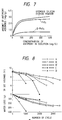
- Fig. 7 shows the results of an experiment conducted to investigate how much antimony could be adsorbed on the hydrous silicon dioxide powder.
- the amount of antimony adsorption on the hydrous silicon dioxide powder increased with the concentration of antimony in the solution and at antimony concentrations of 50 mg/L and above, one gram of the powder adsorbed 2.0 mg and more of antimony. This was higher than the antimony adsorption on rutile type titanium dioxide and ⁇ -form lead dioxide which are good antimony adsorbents.
- the antimony adsorption was dependent on the specific surface area of the hydrous silicon dioxide powder, which was capable of good antimony adsorption at values of 100 m2/g and above.
- antimony added is preferably as small as possible while still remaining sufficient to attain the intended effect of antimony.
- antimony is preferably added in an amount of 0.7 - 2.0 wt%, with the range of 0.7 - 1.2 wt% being particularly preferred.
- Antimony, arsenic (As) and tin (Sn) may be added in respective amounts of 0.1 - 0.3 wt% and 0.01 - 0.5 wt%. If selenium (Se) or sulfur (S) is added in very small amounts as a nucleating agent, the castability and corrosion resistance of the grid can be improved.
- leady dioxide in order to form leady dioxide during the paste mixing process, it is recommended that dilute sulfuric acid be first added to red lead so as to initiate the reaction of eq. (1), with a leady oxide powder being subsequently added, followed by further mixing.
- lead dioxide will be formed in the amount calculated from eq. (1), whereby the quantity of electricity necessary to electroform the battery is reduced and the battery performance is improved.
- red lead must be used in an amount of at least 20 wt% of the weight of the leady oxide powder.
- a negative plate indicated by 2 in Fig. 1 is fabricated by pasting a grid of antimony-free lead alloy with a common negative paste incorporating an expander agent such as lignin and/or barium sulfate.
- the lead alloy as the material for the negative grid may be selected from among common lead-calcium alloys containing 0.02 - 0.12 wt% Ca and 0.001 - 0.5 wt% Sn.
- the positive and negative grids described above can be manufactured by various methods such as by casting, punching sheets of lead alloys and by the expanded metal process.
- the pasted grids are used as electrode plates after curing in a room at 30 - 50 °C.
- the curing of positive grids is a particularly important step for battery performance.
- a synthetic separator 3 is inserted between the positive and negative plates. Any separator can be used as long as it is as thin as 0.02 - 0.3 mm, has a porosity of 70 - 80% and exhibits low electric resistance. Separators having pores of diameter of less than 1 micron are not preferred, since they are not highly permeable to gases.
- a plurality of projections 4 or 4′ are provided on one or both sides of the separator 3 as shown in Fig. 3 or 4. In a sealed lead-acid battery of the type contemplated by the present invention which uses a powder as an electrolyte retainer, the powder must be packed evenly between the positive and negative plates.
- the projections are provided in order to keep the plates apart by a constant distance and can be easily formed by depositing, with a hot-melt gun, a molten resin in dots or in discontinuous lines on a strip sheet used for separation, which is unwound from a roll.
- a hot-melt gun depositing, with a hot-melt gun, a molten resin in dots or in discontinuous lines on a strip sheet used for separation, which is unwound from a roll.
- pores in the separator will be blocked to cause the loss of ion conductivity.
- the projecting areas should not occupy more than 1% of the total area of the separator. Under these circumstances, small projections are preferably distributed over the surface of the separator in order to keep the positive and negative plates apart by a constant distance.
- a synthetic separator having a thickness of 0.25 mm, a porosity of 73% and an average pore diameter of ca. 4 microns was provided on one side with a plurality of projections each having a diameter of ca. 2 mm and a height of 1.2 mm in such a way that their total area occupied ca. 0.7% of the separator surface.
- the positive plates, negative plates and the separators provided with projections are stacked and assembled into an element, with the individual positive plates being soldered separately from the negative plates.
- the assembled element is then inserted into a container 5.
- the conventional element which uses glass separators, experiences considerable difficulty when inserting the separator into a container unless the element is compressed with great force.
- a powder 8 is packed both between the plates and around the element.
- the powder comprises fine primary particles of hydrous silicon dioxide diameters of 10 - 40 millimicrons and specific surface areas of 100 - 150 m2/g.
- the primary particles agglomerate to form secondary particles with diameters of 50 - 200 microns.
- This powder is highly flowable and has an angle of repose of 25 - 30 degrees. Having such high fluidity, the powder can be closely packed into the container within a short time by applying vibrations with an amplitude of 1 - 2 mm under an acceleration of gravity of 2 -4 g.
- the powder 8 is placed in such a way that a positive strap 6 and a negative strap 7 are just covered.
- a porous layer 9 covers the top of the layer of packed powder 8.
- the powder used in the present invention has such high fluidity that unless its layer is immobilized with the porous layer 9, the particles of the powder will readily move to create voids in its layer. These voids are especially created when sulfuric acid electrolyte is added to an uncharged battery or during gassing in the initial charge. Voids in the layer of powder are unable to retain the electrolyte and the active materials will not work effectively to attain the desired battery performance. Hence, immobilizing the layer of powder is very important.
- the porous layer 9 may be made of any porous material that is permeable to liquids and gases but which is impervious to the particles of the powder.
- the porous material must resist sulfuric acid without releasing any deleterious materials.
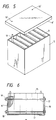
- a suitable example of such porous materials is a foamed phenolic resin. Foamed phenolic resins are highly acid-resistant and have sufficient strength although they are somewhat brittle. If a rectangular block 9′ of phenolic resin foam that is slightly larger than the size of the container as shown in Fig. 5 is pressed against the top end of the container 5, it is cut by the edge of the top lateral sides of the container and its partitions. Thus, the block can be inserted into several cells of the container simultaneously. If small holes 10′ are made in the block of phenolic resin foam in positions that correspond to cell posts 10, the latter will penetrate just snugly through the holes as the block is forced into the container.
- the phenolic resin foam is also snugly fitted over an inter-cell connector 11 by concaving in a corresponding shape.
- the porosity of the phenolic resin foam can be easily changed by adjusting the blow ratios. Experimental results show that blow ratios of 10 - 100 are appropriate.
- a cover 12 is bonded or soldered to the container 5 to complete an uncharged battery.
- the cover 12 has a vent plug 13 as an integral part and a vent valve 14, which will open when the pressure in the battery rises and close when the pressure decreases.
- the vent valve 14 may be of any common type such as a cap valve, a ring valve or a plate valve.
- the vent valve may be fitted either after filling the uncharged battery with sulfuric acid electrolyte or after the initial charging. In the latter case, the valve must be fitted immediately after initial charge is completed.
- the electrolyte retainer used in the sealed lead-acid battery of the present invention is a powder having high fluidity as described above, and thus voids are prone to form in the layer of that powder under the pressure of gases evolved during initial charging of the battery. To avoid this problem, the powder 8 is immobilized with the porous layer 9 but, even then, the evolution of gases during charge is preferably as small as possible.
- the positive paste used by the present invention contains lead dioxide in the unformed active material and a smaller quantity of electricity enables the battery to be charged, whereby the problem described above can reasonably be prevented.
- 80 - 120 Ah is sufficient to charge the battery of the present invention. Since the quantity of charging electricity is reduced, less water will be electrolyzed during charging, thereby minimizing the evolution of gases. Needless to say, a smaller amount of sulfuric acid is needed within the uncharged battery. This feature can be utilized to enable the manufacture of compact batteries.
- Fig. 2 shows a sealed lead acid battery according to another embodiment of the present invention, in which the porous layer 9 is placed below the vent plug 13 and the vent valve 14 is placed above the plug 13 is in order to reduce the space in the upper part of the battery.
- the container 5 accommodating the assembled element is fitted with the cover 12 by either bonding or soldering and then the powder 8 is fed into the container through the port where the vent plug 14 is to be fitted, followed by the fitting of that plug.
- the electrolyte is added with the vent valve 14 removed, which is fitted either after the addition of electrolyte or after charging the battery.
- the head space of the battery is sufficiently reduced to improve the volume energy efficiency of the battery by at least ca. 20%.
- the powder used as an electrolyte retainer in the sealed lead-acid battery of the present invention has a low compressibility characteristic, so the stress due to expansion of the plates will be directly applied to the container wall, eventually causing it to deform outward.
- This deformation is particularly great if the battery is used at high ambient temperatures, which decreases the strength of the synthetic resin used to make the container wall.
- the plate expansion in the sealed lead-acid battery of the present invention exerts enough stress to deform the container wall. Therefore, a great compressive force is applied to the assembled element as reinforcement to permit the battery to exhibit superior life performance.
- plate deterioration is suppressed to further prolong the life of the battery.
- Numeral 15 denotes the sealed lead-acid battery of the present invention
- 16 and 16′ are the reinforcing plates made of iron or aluminum that are fixed to the container wall by means of bolts 17 and nuts 18.
- the sealed lead-acid battery of the present invention was subject to an initial performance test and a life test and the results are described below.
- the test samples were 12 V automotive sealed lead-acid batteries with a nominal capacity of 25 Ah.
- the specifications of the batteries being tested are shown in Table 1.
- Samples A and B were batteries of the present invention using a powder as an electrolyte retainer; sample A used a lead-calcium alloy in the positive grid and sample B used a lead-antimony alloy.
- Samples C and D were prior art batteries using a lead-calcium and a lead-antimony alloy, respectively, in the positive grid.
- the negative grid was made of a lead-calcium alloy (Pb-O.7% Ca-0.5% Sn).
- the positive plates in the samples of the present invention were made from a paste that was prepared by mixing a leady oxide powder with 30% red lead to the recipe described herein. The content of lead dioxide in the paste was found to be 5.9 wt%.
- the batteries of the present invention could be charged with about 40% less electricity than the prior art batteries required.
- the charged batteries were subjected to a 5-h rate discharge test and a 150 A discharge test at -15°C.
- the life test was conducted primarily for the purpose of evaluating battery performance at elevated temperatures. This test was a constant-voltage life test at 75°C which was higher than the normal operating temperature. The test conditions are shown specifically below:
- samples A and B of the present invention was ca. 10% better than prior art samples C and D in terms of both 5-h rate capacity and 150 A discharge capacity. This would be because the samples of the present invention could retain samples of the present invention could retain electrolyte ca. 20% more than the prior art samples and because the incorporation of red lead into the positive paste improved the formability of the positive plates.
- each battery was discharged at a cold cranking current (274 A) for the 30-sec and the life test was completed when the battery failed to maintain 7.2 V (1.2V/cell) for 30sec.
- the determined battery life was 1,800 cycles for sample A, 2,600 cycles for sample B and 3,500 cycles for sample B′. These results were superior to the prior art samples C (1.400 cycles) and D (800 cycles).
- sample B which used a lead-antimony alloy in the positive grids exhibited life performance over three times as long as the life of prior art retainer-type sealed lead-acid battery D using the same alloy.
- Sample B′ in which the container wall was reinforced with steel plates had an even longer life (3,500 cycles).
- the water loss during the life test was determined by measuring the weight of each battery at every 500 cycles.
- the amount of water loss is a measure for the recombination efficiency of a sealed lead-acid battery.
- samples A and C using a lead-calcium alloy in the positive grids the volume of electrolyte decreased at substantially the same rate and the water loss per se was comparatively small.
- the positive grids in sample B and B′ which used a hydrous silicon dioxide powder as an electrolyte retainer in accordance with the present invention were made of a lead-antimony alloy and yet the water loss was just a bit greater than in samples A and C which used antimony-free positive grids.
- samples B and B′ of the present invention which used a hydrous silicon dioxide powder as an electrolyte retainer, were capable of preventing the drop of hydrogen overvoltage at the negative plates, since antimony released from corroded positive grids was effectively trapped by the powder before it reached the negative plates.
- the electrode plates in the batteries of the present invention were firmly secured by the hydrous silicon dioxide powder packed into the container and they experienced only small deformation.
- the extent of electrode deformation was particularly small in battery B′ which of electrode deformation was particularly small in battery B′ which had the container wall reinforced with steel plates. This would be another reason for the superior life performance of the batteries of the present invention.
- the sealed lead-acid battery of the present invention is based on two new concepts for sealed lead-acid batteries. These concepts include retaining an electrolyte by fine primary particles having a large specific area and creating interstices from relatively coarse secondary particles formed by agglomeration of those primary particles which are closely packed together and used as gas channels. This battery exhibits better performance and oxygen absorbing reactions than conventional retainer-type sealed lead-acid batteries using glass separators.
- the electrolyte retainer for use in the sealed lead-acid battery of the present invention may be made of any powder such as one of tabular crystals of calcium silicate (CaO ⁇ 2-2.5SiO2 ⁇ H2O) that has acid resistance and hydrophilicity and which comprises fine primary particles have a large specific surface area and a high porosity that will agglomerate to form coarse secondary particles. If the secondary particles in the powder are friable, a suitable binder may be used.
- the hydrous silicon dioxide powder has the ability to easily adsorb antimony. This characteristic enables the use of antimony containing grids that have been impossible to use in conventional sealed lead-acid batteries.
- the result is a marked improvement in the life performance of the battery of the present invention. Furthermore, the absence of the need to compress the assembled element facilitates cost. In conventional retainer-type sealed lead-acid batteries, negative plate lugs and strap are exposed, so when the battery is used under adverse conditions such as high temperature and overcharge, the lugs and strap will corrode, occasionally leading to a critical accident such as explosion of the battery. However, in the sealed lead-acid battery of the present invention, the assembled element is totally embedded in the layer of the powder specified herein. The negative plate lugs and strap will not corrode even if the battery is used under the adverse conditions described above, which is one of the major advantages of the present invention.
- a separator provided with a plurality of small cylindrical or linear projections is inserted between positive and negative plates. But, this separator may be omitted since the powder used in the present invention also has the characteristics of a separator.
- a suitable spacer is inserted between the plates to keep them apart, with the powder as an electrolyte retainer being placed both between the plates and around the assembled elements. A fairly large space must be allowed between the plates in order to prevent shorting. Experimental results showed that the space had to be at least about 1.5 mm.
- tubular sealed lead-acid battery can easily be manufactured by application of the present invention.
- glass separators cannot be used in tubular lead-acid batteries since the positive plates are not flat and this has inevitably led to the manufacture of short-lived gel-type sealed batteries.
- This serious drawback is eliminated by the present invention which enables a tubular sealed lead-acid battery of superior life performance to be manufactured by a simplified process.
Landscapes
- Chemical & Material Sciences (AREA)
- Chemical Kinetics & Catalysis (AREA)
- Electrochemistry (AREA)
- General Chemical & Material Sciences (AREA)
- Engineering & Computer Science (AREA)
- Manufacturing & Machinery (AREA)
- Inorganic Chemistry (AREA)
- Materials Engineering (AREA)
- Secondary Cells (AREA)
Claims (24)
- Geschlossene Blei/Säure-Batterie mit Entlüftungsventil, welche einen Behälter (5) zur Aufnahme eines zusammengesetzten Elements umfaßt mit:- mindestens einer elektrochemisch gebildeten Plusplatte (1) mit einem Gitter aus einer antimonfreien Legierung, die mit einer porösen aktiven Masse pastiert ist;- mindestens einer elektrochemisch gebildeten Minusplatte (2) mit einem Gitter aus einer antimonfreien Bleilegierung, die mit einer porösen aktiven Masse pastiert ist, und einem Plattenscheider (3), welcher zwischen der Plusplatte und der Minusplatte (1, 2) angebracht wird, wobei der Plattenscheider (3) eine Vielzahl von Vorsprüngen (4, 4′) auf einer Seite oder beiden Seiten aufweist;- einer Pulverschicht zwischen der Plusplatte und der Minusplatte (1, 2) und um das zusammengesetzte Element herum, wobei die Pulverschicht aus einem stark verdichteten Pulver (8) besteht, das säurebeständig und hydrophil ist und eine größere Porosität und eine größere spezifische Oberfläche als die aktiven Massen hat, und die Pulverschicht im Innern kleine, als Gaskanäle genutzte Zwischenräume aufweist, die erzeugt werden, wenn durch Anhäufung feiner Primärteilchen entstandene grobe Sekundärteilchen stark verdichtet und mit einer auf die Pulverschicht aufgetragenen säurebeständigen, porösen Schicht (9) unbeweglich gemacht werden, wobei die poröse Schicht gas- und flüssigkeitsdurchlässig und für Teilchen der Pulverschicht undurchlässig ist; und- Schwefelsäure-Elektrolyten, mit denen die Plusplatte und die Minusplatte (1,2) sowie die Pulverschicht in einer zum Laden und Entladen der Batterie im wesentlichen erforderlichen und ausreichenden Menge getränkt sind und die in selbigen gehalten werden.
- Geschlossene Blei/Säure-Batterie nach Anspruch 1, wobei der zum Laden und Entladen der Batterie erforderliche Elektrolyt im wesentlichen durch die feinen Primärteilchen in der Pulverschicht gehalten wird und wobei ein Sauerstoffgas, das sich während des Ladens an der positiven Elektrode (1) entwickelt, durch die Gaskanäle hindurch von der negativen Elektrode (2) absorbiert wird, und wobei die Batterie einen Sauerstoffkreislauf ohne freie Elektrolyte verwendet.
- Geschlossene Blei/Säure-Batterie nach Anspruch 2, wobei die als Elektrolyt-Halteelement genutzte Pulverschicht als einen Hauptbestandteil ein wasserhaltiges Siliziumdioxid (SiO₂ · nH₂O) mit feinen Primärteilchen in einer Größe von 5 - 40 Millimikronen enthält, wobei sich die Primärteilchen zu Sekundärteilchen mit einer Größe von 10 - 500 Mikronen anhäufen und die Pulverschicht eine spezifische Oberfläche von 20 - 400 m²/g und eine Porosität von 85 - 90 % hat.
- Geschlossene Blei/Säure-Batterie nach Anspruch 1, wobei die Plusplatte ein positives Gitter aus einer antimonfreien Bleilegierung mit 0,02 - 0,12 Masseprozent Kalzium, 0,20 - 1,0 Masseprozent Zinn und 0,001 - 0,01 Masseprozent Aluminium verwendet und die Minusplatte ein negatives Gitter aus einer antimonfreien Bleilegierung mit 0,02 - 0,1 Masseprozent Kalzium und 0,001 - 0,5 Masseprozent Zinn verwendet.
- Geschlossene Blei/Säure-Batterie nach Anspruch 1, wobei der Plattenscheider ein synthetischer Plattenscheider mit geringem Widerstand, einer Dicke von 0,02 - 0,3 mm und einer Porosität von 70 - 80 % ist und eine Vielzahl kleiner zylindrischer oder linearer Vorsprünge auf einer Seite oder beiden Seiten aufweist.
- Geschlossene Blei/Säure-Batterie nach Anspruch 5, wobei die Vielzahl kleiner zylindrischer oder linearer Vorsprünge zum Blockieren der Poren im Plattenscheider nicht mehr als 1 % der Gesamtfläche des Plattenscheiders einnimmt.
- Geschlossene Blei/Säure-Batterie nach Anspruch 5, wobei die kleinen zylindrischen oder linearen Vorsprünge aus einem säurebeständigen Heißschmelzharz bestehen.
- Geschlossene Blei/Säure-Batterie nach Anspruch 1, wobei die Plusplatte mit einer Masse pastiert ist, die durch Vermischen eines bleihaltigen Oxidpulvers mit Bleimennige hergestellt wird und letzteres mindestens 20 Masseprozent des bleihaltigen Oxidpulvers ausmacht.
- Geschlossene Blei/Säure-Batterie nach Anspruch 8, wobei die Plusplatte Bleidioxid umfaßt, welches aus einem Gemisch aus Bleimennige und verdünnter Schwefelsäure gebildet wird, und ein bleihaltiges Oxidpulver dem Bleidioxid enthaltenden Gemisch zugesetzt wird, und wobei das Gemisch die Form einer Paste hat, welche auf eine Plusplatte aufgetragen wird, und die Plusplatte elektrochemisch ausgehärtet und gebildet wird.
- Geschlossene Blei/Säure-Batterie nach Anspruch 1, wobei die poröse Schicht eine Platte aus Phenolharzschaum ist, die größer als eine Oberseite des Behälters ist und zur Schaffung offener Zellen in einem Verhältnis von 10 - 100 aufgeschäumt wurde, und die Platte gegen die Oberseite des Behälters gepreßt und in die einzelnen Zellen der Batterie eingedrückt wird, um die im Behälter verdichtete Pulverschicht unbeweglich zu machen.
- Geschlossene Blei/Säure-Batterie nach Anspruch 1, wobei die poröse Schicht unter einem Entlüftungsstopfen angebracht und das Entlüftungsventil über dem Entlüftungsstopfen angeordnet ist, um die im Behälter verdichtete Pulverschicht unbeweglich zu machen.
- Geschlossene Blei/Säure-Batterie nach Anspruch 1, wobei die starren Platten an den Flächen der Behälteraußenwände parallel zu der Plusplatte und der Minusplatte im Behälter befestigt werden, wodurch eine Verformung der Fläche der Behälteraußenwände verhindert wird.
- Geschlossene Blei/Säure-Batterie mit Entlüftungsventil, welche einen Behälter (5) zur Aufnahme eines zusammengesetzten Elements umfaßt mit:- mindestens einer elektrochemisch gebildeten Plusplatte (1) mit einem Gitter aus einer Bleilegierung, welche eine geringe Menge Antimon enthält, wobei die Plusplatte (1) mit einer porösen aktiven Masse pastiert ist,- mindestens einer elektrochemisch gebildeten Minusplatte (2) mit einem Gitter aus einer antimonfreien Bleilegierung, welche mit einer porösen aktiven Masse pastiert ist, und- einem Plattenscheider (3), welcher zwischen der Plusplatte und der Minusplatte (1, 2) angebracht wird und eine Vielzahl von Vorsprüngen (4, 4′) auf einer Seite oder beiden Seiten aufweist;- einer Pulverschicht zwischen der Plusplatte und der Minusplatte (1, 2) und um das zusammengesetzte Element herum, wobei die Pulverschicht aus einem stark verdichteten Pulver (8) besteht, das säurebeständig und hydrophil ist und eine größere Porosität und eine größere spezifische Oberfläche als die aktiven Massen hat, wobei die Pulverschicht im Innern kleine, als Gaskanäle genutzte Zwischenräume aufweist, die erzeugt werden, wenn durch Anhäufung feiner Primärteilchen entstandene grobe Sekundärteilchen stark verdichtet und mit einer auf die Pulverschicht aufgetragenen säurebeständigen, porösen Schicht (9) unbeweglich gemacht werden, und welche gas- und flüssigkeitsdurchlässig und für Teilchen der Pulverschicht undurchlässig ist; und- Schwefelsäure-Elektrolyten, mit denen die Plusplatte und die Minusplatte (1,2) sowie die Pulverschicht in einer zum Laden und Entladen der Batterie im wesentlichen erforderlichen und ausreichenden Menge getränkt und die in selbigen gehalten werden .
- Geschlossene Blei/Säure-Batterie nach Anspruch 13, wobei der zum Laden und Entladen der Batterie erforderliche Elektrolyt im wesentlichen von den feinen Primärteilchen in der Pulverschicht gehalten wird und wobei ein Sauerstoffgas, welches sich während des Ladens an der positiven Elektrode (1) entwickelt, durch die Gaskanäle hindurch von der Minusplatte (2) absorbiert wird, wobei die Batterie einen Sauerstoffkreislauf ohne freie Elektrolyte verwendet.
- Geschlossene Blei/Säure-Batterie nach Anspruch 14, wobei die als Elektrolyt-Halteelement genutzte Pulverschicht als einen Hauptbestandteil ein wasserhaltiges Siliziumdioxid (SiO₂ nH₂O) mit feinen Primärteilchen in einer Größe von 5 - 40 Millimikronen enthält, die sich zu Sekundärteilchen mit einer Größe von 10 - 500 Mikronen anhäufen und wobei die Pulverschicht eine spezifische Oberfläche von 100 - 400 m²/g und eine Porosität von 85 - 90 % hat und mindestens 2 mg Antimon pro Gramm Pulver adsorbieren kann.
- Geschlossene Blei/Säure-Batterie nach Anspruch 13, wobei das Gitter der Plusplatte ein positives Gitter aus einer Bleilegierung mit 0,7 - 2,0 Masseprozent Antimon, 0,10 - 0,3 Masseprozent Arsen und 0,01 - 0,5 Masseprozent Zinn ist und das Gitter der Minusplatte ein negatives Gitter aus einer antimonfreien Bleilegierung mit 0,02 - 0,12 Masseprozent Kalzium und 0,001 - 0,5 Masseprozent Zinn ist.
- Geschlossene Blei/Säure-Batterie nach Anspruch 13, wobei der Plattenscheider ein synthetischer Plattenscheider mit geringem Widerstand, einer Dicke von 0,02 - 0,3 mm und einer Porosität von 70 - 80 % ist und eine Vielzahl kleiner zylindrischer oder linearer Vorsprünge auf einer Seite oder beiden Seiten aufweist.
- Geschlossene Blei/Säure-Batterie nach Anspruch 17, wobei die Vielzahl kleiner zylindrischer oder linearer Vorsprünge zum Blockieren der Poren im Plattenscheider nicht mehr als 1 % der Gesamtfläche des Plattenscheiders einnimmt.
- Geschlossene Blei/Säure-Batterie nach Anspruch 17, wobei die kleinen zylindrischen oder linearen Vorsprünge aus einem säurebeständigen Heißschmelzharz bestehen.
- Geschlossene Blei/Säure-Batterie nach Anspruch 13, wobei die Plusplatte mit einer Masse pastiert ist, die ein Gemisch aus einem bleihaltigen Oxidpulver und Bleimennige umfaßt und letzteres mindestens 20 Masseprozent des bleihaltigen Oxidpulvers ausmacht.
- Geschlossene Blei/Säure-Batterie nach Anspruch 20, wobei die Plusplatte Bleidioxid umfaßt, welches aus einem Gemisch aus Bleimennige, verdünnter Schwefelsäure und einem bleihaltigem Oxidpulver besteht, und das Gemisch eine Paste bildet, welche auf ein positives Gitter aufgetragen wird, und die Plusplatte elektrochemisch ausgehärtet und gebildet wird.
- Geschlossene Blei/Säure-Batterie nach Anspruch 13, wobei die poröse Schicht eine Platte aus Phenolharzschaum ist, die größer als eine Oberseite des Behälters ist und zur Schaffung offener Zellen in einem Verhältnis von 10 - 100 aufgeschäumt wurde, und die Platte gegen die Oberseite des Behälters gepreßt und in die einzelnen Zellen der Batterie eingedrückt wird, um die im Behälter verdichtete Pulverschicht unbeweglich zu machen.
- Geschlossene Blei/Säure-Batterie nach Anspruch 31, wobei die poröse Schicht unter einem Entlüftungsstopfen angebracht und das Entlüftungsventil über dem Stopfen angeordnet ist, um die im Behälter verdichtete Pulverschicht unbeweglich zu machen.
- Geschlossene Blei/Säure-Batterie nach Anspruch 13, wobei die starren Platten an den Flächen der Behälteraußenwände parallel zu der Plusplatte und der Minusplatte im Behälter befestigt werden, wodurch eine Verformung der Wandflächen des Behälters verhindert wird.
Applications Claiming Priority (10)
| Application Number | Priority Date | Filing Date | Title |
|---|---|---|---|
| JP2034611A JP2995780B2 (ja) | 1990-02-15 | 1990-02-15 | 密閉式鉛蓄電池 |
| JP34611/90 | 1990-02-15 | ||
| JP2136077A JP2573082B2 (ja) | 1990-05-25 | 1990-05-25 | 密閉形鉛蓄電池 |
| JP136077/90 | 1990-05-25 | ||
| JP54924/90U | 1990-05-26 | ||
| JP5492490U JPH0414364U (de) | 1990-05-26 | 1990-05-26 | |
| JP2160458A JPH0451470A (ja) | 1990-06-19 | 1990-06-19 | 密閉式鉛蓄電池 |
| JP160458/90 | 1990-06-19 | ||
| JP286410/90 | 1990-10-24 | ||
| JP2286410A JPH04162368A (ja) | 1990-10-24 | 1990-10-24 | モノブロック形密閉式鉛蓄電池の製造方法 |
Publications (2)
| Publication Number | Publication Date |
|---|---|
| EP0443451A1 EP0443451A1 (de) | 1991-08-28 |
| EP0443451B1 true EP0443451B1 (de) | 1995-12-06 |
Family
ID=27521624
Family Applications (1)
| Application Number | Title | Priority Date | Filing Date |
|---|---|---|---|
| EP91102154A Expired - Lifetime EP0443451B1 (de) | 1990-02-15 | 1991-02-15 | Geschlossene Bleisäurebatterie |
Country Status (3)
| Country | Link |
|---|---|
| US (1) | US5128218A (de) |
| EP (1) | EP0443451B1 (de) |
| DE (1) | DE69115078T2 (de) |
Cited By (1)
| Publication number | Priority date | Publication date | Assignee | Title |
|---|---|---|---|---|
| US7682738B2 (en) | 2002-02-07 | 2010-03-23 | Kvg Technologies, Inc. | Lead acid battery with gelled electrolyte formed by filtration action of absorbent separators and method for producing it |
Families Citing this family (33)
| Publication number | Priority date | Publication date | Assignee | Title |
|---|---|---|---|---|
| US5173374A (en) * | 1991-03-12 | 1992-12-22 | Globe-Union, Inc. | Explosion attenuation system and method for assembly in battery |
| US5401596A (en) * | 1991-10-14 | 1995-03-28 | Stoilov; Georgi T. | Hermetically sealed dry accumulator |
| DE4232961A1 (de) * | 1992-10-01 | 1994-04-07 | Vb Autobatterie Gmbh | Mehrzelliger Bleiakkumulator |
| DE29609239U1 (de) * | 1996-05-23 | 1996-08-14 | VB Autobatterie GmbH, 30419 Hannover | Wartungsfreier Bleiakkumulator |
| US6284411B1 (en) | 1996-10-02 | 2001-09-04 | Japan Storage Battery Co., Ltd. | Valve regulated type battery and producing method thereof |
| DE19739277A1 (de) * | 1997-09-08 | 1999-03-11 | Hagen Batterie Ag | Blei-Säure-Akkumulator |
| JP3952483B2 (ja) * | 1997-10-17 | 2007-08-01 | 株式会社ジーエス・ユアサコーポレーション | 密閉式鉛蓄電池 |
| DE19823147A1 (de) * | 1998-05-23 | 1999-11-25 | Vb Autobatterie Gmbh | Elektrodengitter für Bleiakkumulatoren |
| US6074774A (en) * | 1998-06-03 | 2000-06-13 | Electrosource, Inc. | Sealed recharge battery plenum stabilized with state changeable substance |
| US20050112470A1 (en) * | 1998-06-26 | 2005-05-26 | Johnson Controls Technology Company | Alloy for battery grids |
| ID30457A (id) | 1999-03-29 | 2001-12-06 | Kawasaki Heavy Ind Ltd | Baterai dan peralatan atau piranti yang mempunyai baterai sebagai bagian strukturnya, dan metode pembangkitan daya yang didistribusikan secara lokal dan piranti pembangkit daya untuk itu |
| RU2158047C1 (ru) * | 1999-06-01 | 2000-10-20 | Военный автомобильный институт | Способ восстановления свинцовых аккумуляторов |
| DE10117576A1 (de) * | 2001-04-07 | 2002-10-10 | Vb Autobatterie Gmbh | Elektrischer Akkumulator |
| US20020182500A1 (en) * | 2001-06-04 | 2002-12-05 | Enertec Mexico, S. De R.L. De C.V. | Silver-barium lead alloy for lead-acid battery grids |
| US20040110067A1 (en) * | 2002-12-06 | 2004-06-10 | Johnson Controls Technology Company | Alloy for battery grids |
| WO2004075315A2 (en) * | 2003-02-19 | 2004-09-02 | Kvg Technologies, Inc. | Battery containing fibrous material |
| WO2005001964A1 (ja) * | 2003-06-30 | 2005-01-06 | Zeon Corporation | カソードフィルム用配合剤組成物、カソードフィルム用ポリエーテル重合体組成物 |
| EP1717896B1 (de) * | 2004-04-28 | 2010-08-25 | Panasonic Corporation | Bleiakkumulator |
| DE102005017442B4 (de) * | 2005-04-15 | 2007-11-29 | Vb Autobatterie Gmbh & Co. Kgaa | Akkumulator und Deckel hierzu |
| WO2008013328A1 (en) * | 2006-07-26 | 2008-01-31 | Kim Kwang Soo | Electrode for lead storage battery and manufacturing method thereof |
| TR200807567A1 (tr) * | 2008-10-08 | 2010-04-21 | Mutlu Akü Ve Malzemeleri̇ Sanayi̇ Anoni̇m Şi̇rketi̇ | Bir alaşım |
| EP2290729B1 (de) * | 2009-08-24 | 2012-10-10 | Carl Freudenberg KG | Elektrischer Energiespeicher mit Volumenkompensationseinrichtung |
| JP5727618B2 (ja) | 2010-11-10 | 2015-06-03 | エピック ベンチャーズ インコーポレイテッドEpic Ventures Inc. | 格子内に保持した活物質を有する鉛酸セル |
| US20140087238A1 (en) * | 2011-02-24 | 2014-03-27 | Firefly International Energy Group, Inc. | Battery plate with multiple tabs and mixed pore diameters |
| US10014501B2 (en) | 2014-03-22 | 2018-07-03 | Hollingsworth & Vose Company | Battery separators having a low apparent density |
| US9293748B1 (en) | 2014-09-15 | 2016-03-22 | Hollingsworth & Vose Company | Multi-region battery separators |
| CN104466272B (zh) * | 2014-11-28 | 2017-01-04 | 浙江长兴铁鹰电气有限公司 | 一种颗粒型二氧化硅电解液及蓄电池 |
| CN107431167A (zh) | 2015-02-19 | 2017-12-01 | 霍林斯沃思和沃斯有限公司 | 包含化学添加剂和/或其他组分的电池隔离件 |
| US9786885B2 (en) | 2015-04-10 | 2017-10-10 | Hollingsworth & Vose Company | Battery separators comprising inorganic particles |
| CN109841764A (zh) * | 2017-11-27 | 2019-06-04 | 广西明福科技有限公司 | 一种防撞击铅蓄电池 |
| KR102329403B1 (ko) * | 2019-04-02 | 2021-11-19 | 창저우 마이크로배트 테크놀로지 컴퍼니 리미티드 | 에너지 저장 장치에 이용되는 방폭형 하우징 및 에너지 저장 장치 |
| TWI859325B (zh) * | 2019-09-27 | 2024-10-21 | 日商傑士湯淺國際股份有限公司 | 鉛蓄電池 |
| US12401090B2 (en) | 2020-02-10 | 2025-08-26 | Hollingsworth & Vose Company | Embossed separators |
Family Cites Families (9)
| Publication number | Priority date | Publication date | Assignee | Title |
|---|---|---|---|---|
| US1651226A (en) * | 1922-04-25 | 1927-11-29 | Philadelphia Storage Battery | Battery-sealing construction |
| GB787872A (en) * | 1955-09-23 | 1957-12-18 | Pritchett & Gold & E P S Co | Improvements relating to the manufacture of electric batteries |
| BE630014A (de) * | 1962-04-10 | |||
| US3402077A (en) * | 1964-12-19 | 1968-09-17 | Japan Storage Battery Co Ltd | Storage batteries and method of manufacturing the same |
| DE1571961B2 (de) * | 1965-03-09 | 1973-01-04 | Robert Bosch Gmbh, 7000 Stuttgart | Gasdicht verschlossener Bleiakkumulator mit antimonfreien Plattengittern |
| DE1671693B1 (de) * | 1967-12-01 | 1971-12-23 | Sonnenschein Accumulatoren | Bleiakkumulator |
| US3711332A (en) * | 1971-09-09 | 1973-01-16 | S Bastacky | Lead gel storage battery |
| US3993507A (en) * | 1974-05-13 | 1976-11-23 | Hardigg James S | Battery jar |
| US4447508A (en) * | 1981-10-13 | 1984-05-08 | Allied Corporation | Reduced maintenance explosion damage resistant storage battery |
-
1991
- 1991-02-15 US US07/655,696 patent/US5128218A/en not_active Expired - Lifetime
- 1991-02-15 DE DE69115078T patent/DE69115078T2/de not_active Expired - Fee Related
- 1991-02-15 EP EP91102154A patent/EP0443451B1/de not_active Expired - Lifetime
Non-Patent Citations (1)
| Title |
|---|
| PATENT ABSTRACTS OF JAPAN, vol. 9, no. 277 (E-355)[2000], 06 November 1985 * |
Cited By (1)
| Publication number | Priority date | Publication date | Assignee | Title |
|---|---|---|---|---|
| US7682738B2 (en) | 2002-02-07 | 2010-03-23 | Kvg Technologies, Inc. | Lead acid battery with gelled electrolyte formed by filtration action of absorbent separators and method for producing it |
Also Published As
| Publication number | Publication date |
|---|---|
| DE69115078D1 (de) | 1996-01-18 |
| US5128218A (en) | 1992-07-07 |
| DE69115078T2 (de) | 1996-05-09 |
| EP0443451A1 (de) | 1991-08-28 |
Similar Documents
| Publication | Publication Date | Title |
|---|---|---|
| EP0443451B1 (de) | Geschlossene Bleisäurebatterie | |
| US3457112A (en) | Lead-acid storage battery | |
| RU2298264C2 (ru) | Биполярная электрохимическая батарея из пакетированных галетных гальванических элементов | |
| EP0697746B1 (de) | Gasdichte Zink-Sekundärbatterie und Zink-Elektrode | |
| US4769299A (en) | High rate sealed lead-acid battery with ultrathin plates | |
| US4401730A (en) | Sealed deep cycle lead acid battery | |
| US4414295A (en) | Battery separator | |
| US20050084762A1 (en) | Hybrid gelled-electrolyte valve-regulated lead-acid battery | |
| US20060068294A1 (en) | Lead acid battery with gelled electrolyte contained within compressed absorbent separator mat and method of making the same | |
| CA1179013A (en) | Sealed, maintenance-free, lead-acid batteries for float applications | |
| JP7783872B2 (ja) | 電極群及び鉛蓄電池 | |
| JP3163510B2 (ja) | 密閉形鉛蓄電池 | |
| JP3146438B2 (ja) | 密閉式鉛蓄電池 | |
| EP0024407B1 (de) | Elektrische blei-säure-batterien | |
| KR870000967B1 (ko) | 무 보수 밀폐형 납산-전지 | |
| JP2586249B2 (ja) | 密閉形鉛蓄電池 | |
| JPH0628169B2 (ja) | 密閉形鉛蓄電池 | |
| WO1980002472A1 (en) | Electric storage batteries | |
| JP2573082B2 (ja) | 密閉形鉛蓄電池 | |
| US20220285695A1 (en) | Rechargeable Cell Architecture | |
| JPH0636793A (ja) | 密閉形鉛蓄電池 | |
| JPH06104005A (ja) | 密閉形鉛蓄電池 | |
| JPH05343093A (ja) | 密閉形鉛蓄電池 | |
| JPH05290875A (ja) | 密閉形鉛蓄電池 | |
| JPH06150961A (ja) | 密閉形鉛蓄電池 |
Legal Events
| Date | Code | Title | Description |
|---|---|---|---|
| PUAI | Public reference made under article 153(3) epc to a published international application that has entered the european phase |
Free format text: ORIGINAL CODE: 0009012 |
|
| AK | Designated contracting states |
Kind code of ref document: A1 Designated state(s): DE GB IT |
|
| 17P | Request for examination filed |
Effective date: 19911211 |
|
| 17Q | First examination report despatched |
Effective date: 19931001 |
|
| GRAA | (expected) grant |
Free format text: ORIGINAL CODE: 0009210 |
|
| AK | Designated contracting states |
Kind code of ref document: B1 Designated state(s): DE GB IT |
|
| REF | Corresponds to: |
Ref document number: 69115078 Country of ref document: DE Date of ref document: 19960118 |
|
| ITF | It: translation for a ep patent filed | ||
| PLBE | No opposition filed within time limit |
Free format text: ORIGINAL CODE: 0009261 |
|
| STAA | Information on the status of an ep patent application or granted ep patent |
Free format text: STATUS: NO OPPOSITION FILED WITHIN TIME LIMIT |
|
| 26N | No opposition filed | ||
| REG | Reference to a national code |
Ref country code: GB Ref legal event code: IF02 |
|
| PGFP | Annual fee paid to national office [announced via postgrant information from national office to epo] |
Ref country code: GB Payment date: 20030212 Year of fee payment: 13 |
|
| PGFP | Annual fee paid to national office [announced via postgrant information from national office to epo] |
Ref country code: DE Payment date: 20030227 Year of fee payment: 13 |
|
| PG25 | Lapsed in a contracting state [announced via postgrant information from national office to epo] |
Ref country code: GB Free format text: LAPSE BECAUSE OF NON-PAYMENT OF DUE FEES Effective date: 20040215 |
|
| PG25 | Lapsed in a contracting state [announced via postgrant information from national office to epo] |
Ref country code: DE Free format text: LAPSE BECAUSE OF NON-PAYMENT OF DUE FEES Effective date: 20040901 |
|
| GBPC | Gb: european patent ceased through non-payment of renewal fee |
Effective date: 20040215 |
|
| PG25 | Lapsed in a contracting state [announced via postgrant information from national office to epo] |
Ref country code: IT Free format text: LAPSE BECAUSE OF NON-PAYMENT OF DUE FEES;WARNING: LAPSES OF ITALIAN PATENTS WITH EFFECTIVE DATE BEFORE 2007 MAY HAVE OCCURRED AT ANY TIME BEFORE 2007. THE CORRECT EFFECTIVE DATE MAY BE DIFFERENT FROM THE ONE RECORDED. Effective date: 20050215 |