EP0442386A2 - Strahlungsempfindliches Gemisch, hiermit hergestelltes strahlungsempfindliches Aufzeichnungsmaterial und Verfahren zur Herstellung von Reliefaufzeichnungen - Google Patents
Strahlungsempfindliches Gemisch, hiermit hergestelltes strahlungsempfindliches Aufzeichnungsmaterial und Verfahren zur Herstellung von Reliefaufzeichnungen Download PDFInfo
- Publication number
- EP0442386A2 EP0442386A2 EP91101749A EP91101749A EP0442386A2 EP 0442386 A2 EP0442386 A2 EP 0442386A2 EP 91101749 A EP91101749 A EP 91101749A EP 91101749 A EP91101749 A EP 91101749A EP 0442386 A2 EP0442386 A2 EP 0442386A2
- Authority
- EP
- European Patent Office
- Prior art keywords
- radiation
- hydrogen
- oder
- sensitive
- alkyl
- Prior art date
- Legal status (The legal status is an assumption and is not a legal conclusion. Google has not performed a legal analysis and makes no representation as to the accuracy of the status listed.)
- Granted
Links
- 239000000203 mixture Substances 0.000 title claims abstract description 46
- 230000005855 radiation Effects 0.000 title claims abstract description 43
- 239000000463 material Substances 0.000 title claims abstract description 20
- 238000004519 manufacturing process Methods 0.000 title claims abstract description 9
- 238000000034 method Methods 0.000 title claims description 10
- 230000008569 process Effects 0.000 title claims description 6
- 229910052739 hydrogen Inorganic materials 0.000 claims abstract description 22
- 239000001257 hydrogen Substances 0.000 claims abstract description 22
- 125000000217 alkyl group Chemical group 0.000 claims abstract description 18
- 150000001875 compounds Chemical class 0.000 claims abstract description 16
- 239000011230 binding agent Substances 0.000 claims abstract description 11
- 238000007669 thermal treatment Methods 0.000 claims abstract description 10
- 125000003118 aryl group Chemical group 0.000 claims abstract description 9
- 125000002496 methyl group Chemical group [H]C([H])([H])* 0.000 claims abstract description 8
- 125000005100 aryl amino carbonyl group Chemical group 0.000 claims abstract description 5
- 125000002915 carbonyl group Chemical group [*:2]C([*:1])=O 0.000 claims abstract description 5
- 125000000472 sulfonyl group Chemical group *S(*)(=O)=O 0.000 claims abstract description 5
- 239000012670 alkaline solution Substances 0.000 claims abstract description 4
- MYMOFIZGZYHOMD-UHFFFAOYSA-N Dioxygen Chemical compound O=O MYMOFIZGZYHOMD-UHFFFAOYSA-N 0.000 claims abstract description 3
- JOYRKODLDBILNP-UHFFFAOYSA-N Ethyl urethane Chemical compound CCOC(N)=O JOYRKODLDBILNP-UHFFFAOYSA-N 0.000 claims abstract description 3
- 125000000732 arylene group Chemical group 0.000 claims abstract description 3
- 229910052760 oxygen Inorganic materials 0.000 claims abstract description 3
- 239000001301 oxygen Substances 0.000 claims abstract description 3
- 125000003107 substituted aryl group Chemical group 0.000 claims abstract description 3
- 229910052717 sulfur Inorganic materials 0.000 claims abstract description 3
- 125000004434 sulfur atom Chemical group 0.000 claims abstract description 3
- -1 C1-C2-alkyl Chemical group 0.000 claims description 12
- 238000011161 development Methods 0.000 claims description 10
- 125000001997 phenyl group Chemical group [H]C1=C([H])C([H])=C(*)C([H])=C1[H] 0.000 claims description 7
- 229920000642 polymer Polymers 0.000 claims description 6
- ISWSIDIOOBJBQZ-UHFFFAOYSA-N phenol group Chemical group C1(=CC=CC=C1)O ISWSIDIOOBJBQZ-UHFFFAOYSA-N 0.000 claims description 4
- 125000000843 phenylene group Chemical group C1(=C(C=CC=C1)*)* 0.000 claims description 4
- 125000001424 substituent group Chemical group 0.000 claims description 4
- 239000000470 constituent Substances 0.000 claims description 3
- 125000002887 hydroxy group Chemical group [H]O* 0.000 claims description 3
- 125000001624 naphthyl group Chemical group 0.000 claims description 3
- 125000005142 aryl oxy sulfonyl group Chemical group 0.000 claims description 2
- 125000000325 methylidene group Chemical group [H]C([H])=* 0.000 claims description 2
- 125000004435 hydrogen atom Chemical group [H]* 0.000 claims 9
- 125000000547 substituted alkyl group Chemical group 0.000 claims 1
- UFHFLCQGNIYNRP-UHFFFAOYSA-N Hydrogen Chemical compound [H][H] UFHFLCQGNIYNRP-UHFFFAOYSA-N 0.000 abstract description 20
- 150000002431 hydrogen Chemical class 0.000 abstract description 6
- 230000035945 sensitivity Effects 0.000 abstract description 2
- 238000012545 processing Methods 0.000 description 19
- 239000000654 additive Substances 0.000 description 16
- WYURNTSHIVDZCO-UHFFFAOYSA-N Tetrahydrofuran Chemical compound C1CCOC1 WYURNTSHIVDZCO-UHFFFAOYSA-N 0.000 description 10
- 239000003795 chemical substances by application Substances 0.000 description 9
- 238000007639 printing Methods 0.000 description 9
- 239000000243 solution Substances 0.000 description 8
- 238000006243 chemical reaction Methods 0.000 description 7
- 239000002253 acid Substances 0.000 description 6
- 238000003860 storage Methods 0.000 description 6
- ARXJGSRGQADJSQ-UHFFFAOYSA-N 1-methoxypropan-2-ol Chemical group COCC(C)O ARXJGSRGQADJSQ-UHFFFAOYSA-N 0.000 description 5
- 229920003986 novolac Polymers 0.000 description 5
- 239000002904 solvent Substances 0.000 description 5
- YLQBMQCUIZJEEH-UHFFFAOYSA-N tetrahydrofuran Natural products C=1C=COC=1 YLQBMQCUIZJEEH-UHFFFAOYSA-N 0.000 description 5
- RTZKZFJDLAIYFH-UHFFFAOYSA-N Diethyl ether Chemical compound CCOCC RTZKZFJDLAIYFH-UHFFFAOYSA-N 0.000 description 4
- 150000001298 alcohols Chemical class 0.000 description 4
- ZXJXZNDDNMQXFV-UHFFFAOYSA-M crystal violet Chemical compound [Cl-].C1=CC(N(C)C)=CC=C1[C+](C=1C=CC(=CC=1)N(C)C)C1=CC=C(N(C)C)C=C1 ZXJXZNDDNMQXFV-UHFFFAOYSA-M 0.000 description 4
- 239000012948 isocyanate Substances 0.000 description 4
- 150000002513 isocyanates Chemical class 0.000 description 4
- 238000012360 testing method Methods 0.000 description 4
- ZWEHNKRNPOVVGH-UHFFFAOYSA-N 2-Butanone Chemical compound CCC(C)=O ZWEHNKRNPOVVGH-UHFFFAOYSA-N 0.000 description 3
- WEVYAHXRMPXWCK-UHFFFAOYSA-N Acetonitrile Chemical compound CC#N WEVYAHXRMPXWCK-UHFFFAOYSA-N 0.000 description 3
- ZMXDDKWLCZADIW-UHFFFAOYSA-N N,N-Dimethylformamide Chemical compound CN(C)C=O ZMXDDKWLCZADIW-UHFFFAOYSA-N 0.000 description 3
- SJJISKLXUJVZOA-UHFFFAOYSA-N Solvent yellow 56 Chemical compound C1=CC(N(CC)CC)=CC=C1N=NC1=CC=CC=C1 SJJISKLXUJVZOA-UHFFFAOYSA-N 0.000 description 3
- ALVGSDOIXRPZFH-UHFFFAOYSA-N [(1-diazonioimino-3,4-dioxonaphthalen-2-ylidene)hydrazinylidene]azanide Chemical compound C1=CC=C2C(=N[N+]#N)C(=NN=[N-])C(=O)C(=O)C2=C1 ALVGSDOIXRPZFH-UHFFFAOYSA-N 0.000 description 3
- 238000007792 addition Methods 0.000 description 3
- 229910052782 aluminium Inorganic materials 0.000 description 3
- XAGFODPZIPBFFR-UHFFFAOYSA-N aluminium Chemical compound [Al] XAGFODPZIPBFFR-UHFFFAOYSA-N 0.000 description 3
- 230000001588 bifunctional effect Effects 0.000 description 3
- 238000000576 coating method Methods 0.000 description 3
- 229920001577 copolymer Polymers 0.000 description 3
- 238000001035 drying Methods 0.000 description 3
- 230000009477 glass transition Effects 0.000 description 3
- 150000003673 urethanes Chemical class 0.000 description 3
- DURPTKYDGMDSBL-UHFFFAOYSA-N 1-butoxybutane Chemical compound CCCCOCCCC DURPTKYDGMDSBL-UHFFFAOYSA-N 0.000 description 2
- HTQNYBBTZSBWKL-UHFFFAOYSA-N 2,3,4-trihydroxbenzophenone Chemical compound OC1=C(O)C(O)=CC=C1C(=O)C1=CC=CC=C1 HTQNYBBTZSBWKL-UHFFFAOYSA-N 0.000 description 2
- XNWFRZJHXBZDAG-UHFFFAOYSA-N 2-METHOXYETHANOL Chemical group COCCO XNWFRZJHXBZDAG-UHFFFAOYSA-N 0.000 description 2
- QGZKDVFQNNGYKY-UHFFFAOYSA-N Ammonia Chemical compound N QGZKDVFQNNGYKY-UHFFFAOYSA-N 0.000 description 2
- XKRFYHLGVUSROY-UHFFFAOYSA-N Argon Chemical compound [Ar] XKRFYHLGVUSROY-UHFFFAOYSA-N 0.000 description 2
- VEXZGXHMUGYJMC-UHFFFAOYSA-N Hydrochloric acid Chemical compound Cl VEXZGXHMUGYJMC-UHFFFAOYSA-N 0.000 description 2
- 229910019142 PO4 Inorganic materials 0.000 description 2
- QAOWNCQODCNURD-UHFFFAOYSA-N Sulfuric acid Chemical compound OS(O)(=O)=O QAOWNCQODCNURD-UHFFFAOYSA-N 0.000 description 2
- 229910052799 carbon Inorganic materials 0.000 description 2
- 239000011248 coating agent Substances 0.000 description 2
- 238000004132 cross linking Methods 0.000 description 2
- 239000013078 crystal Substances 0.000 description 2
- 239000000975 dye Substances 0.000 description 2
- 230000032050 esterification Effects 0.000 description 2
- 238000005886 esterification reaction Methods 0.000 description 2
- 150000002148 esters Chemical class 0.000 description 2
- 150000002170 ethers Chemical class 0.000 description 2
- 230000002349 favourable effect Effects 0.000 description 2
- 239000011888 foil Substances 0.000 description 2
- 229910052736 halogen Inorganic materials 0.000 description 2
- 150000002367 halogens Chemical class 0.000 description 2
- 229910052751 metal Inorganic materials 0.000 description 2
- 239000002184 metal Substances 0.000 description 2
- 238000007645 offset printing Methods 0.000 description 2
- QBDSZLJBMIMQRS-UHFFFAOYSA-N p-Cumylphenol Chemical compound C=1C=C(O)C=CC=1C(C)(C)C1=CC=CC=C1 QBDSZLJBMIMQRS-UHFFFAOYSA-N 0.000 description 2
- NKTOLZVEWDHZMU-UHFFFAOYSA-N p-cumyl phenol Natural products CC1=CC=C(C)C(O)=C1 NKTOLZVEWDHZMU-UHFFFAOYSA-N 0.000 description 2
- NFBAXHOPROOJAW-UHFFFAOYSA-N phenindione Chemical class O=C1C2=CC=CC=C2C(=O)C1C1=CC=CC=C1 NFBAXHOPROOJAW-UHFFFAOYSA-N 0.000 description 2
- 235000021317 phosphate Nutrition 0.000 description 2
- 150000003013 phosphoric acid derivatives Chemical class 0.000 description 2
- 239000010695 polyglycol Substances 0.000 description 2
- 229920000151 polyglycol Polymers 0.000 description 2
- 238000003672 processing method Methods 0.000 description 2
- 239000000047 product Substances 0.000 description 2
- BDERNNFJNOPAEC-UHFFFAOYSA-N propan-1-ol Chemical compound CCCO BDERNNFJNOPAEC-UHFFFAOYSA-N 0.000 description 2
- 150000004760 silicates Chemical class 0.000 description 2
- 239000000126 substance Substances 0.000 description 2
- 150000003918 triazines Chemical class 0.000 description 2
- 239000002966 varnish Substances 0.000 description 2
- 229920002554 vinyl polymer Polymers 0.000 description 2
- XLYOFNOQVPJJNP-UHFFFAOYSA-N water Substances O XLYOFNOQVPJJNP-UHFFFAOYSA-N 0.000 description 2
- 239000000080 wetting agent Substances 0.000 description 2
- UOCLXMDMGBRAIB-UHFFFAOYSA-N 1,1,1-trichloroethane Chemical compound CC(Cl)(Cl)Cl UOCLXMDMGBRAIB-UHFFFAOYSA-N 0.000 description 1
- JIHQDMXYYFUGFV-UHFFFAOYSA-N 1,3,5-triazine Chemical class C1=NC=NC=N1 JIHQDMXYYFUGFV-UHFFFAOYSA-N 0.000 description 1
- RYHBNJHYFVUHQT-UHFFFAOYSA-N 1,4-Dioxane Chemical compound C1COCCO1 RYHBNJHYFVUHQT-UHFFFAOYSA-N 0.000 description 1
- SBJCUZQNHOLYMD-UHFFFAOYSA-N 1,5-Naphthalene diisocyanate Chemical compound C1=CC=C2C(N=C=O)=CC=CC2=C1N=C=O SBJCUZQNHOLYMD-UHFFFAOYSA-N 0.000 description 1
- BDQNKCYCTYYMAA-UHFFFAOYSA-N 1-isocyanatonaphthalene Chemical compound C1=CC=C2C(N=C=O)=CC=CC2=C1 BDQNKCYCTYYMAA-UHFFFAOYSA-N 0.000 description 1
- KGWYICAEPBCRBL-UHFFFAOYSA-N 1h-indene-1-carboxylic acid Chemical compound C1=CC=C2C(C(=O)O)C=CC2=C1 KGWYICAEPBCRBL-UHFFFAOYSA-N 0.000 description 1
- IYDYVVVAQKFGBS-UHFFFAOYSA-N 2,4,6-triphenoxy-1,3,5-triazine Chemical class N=1C(OC=2C=CC=CC=2)=NC(OC=2C=CC=CC=2)=NC=1OC1=CC=CC=C1 IYDYVVVAQKFGBS-UHFFFAOYSA-N 0.000 description 1
- BNKYEEOIJLBWAS-UHFFFAOYSA-N 2-(trichloromethyl)-1,3,4-oxadiazole Chemical class ClC(Cl)(Cl)C1=NN=CO1 BNKYEEOIJLBWAS-UHFFFAOYSA-N 0.000 description 1
- JESXATFQYMPTNL-UHFFFAOYSA-N 2-ethenylphenol Chemical class OC1=CC=CC=C1C=C JESXATFQYMPTNL-UHFFFAOYSA-N 0.000 description 1
- ZNQVEEAIQZEUHB-UHFFFAOYSA-N 2-ethoxyethanol Chemical compound CCOCCO ZNQVEEAIQZEUHB-UHFFFAOYSA-N 0.000 description 1
- ZRUOTKQBVMWMDK-UHFFFAOYSA-N 2-hydroxy-6-methylbenzaldehyde Chemical compound CC1=CC=CC(O)=C1C=O ZRUOTKQBVMWMDK-UHFFFAOYSA-N 0.000 description 1
- 125000004189 3,4-dichlorophenyl group Chemical group [H]C1=C([H])C(Cl)=C(Cl)C([H])=C1* 0.000 description 1
- 125000004179 3-chlorophenyl group Chemical group [H]C1=C([H])C(*)=C([H])C(Cl)=C1[H] 0.000 description 1
- ZRYCRPNCXLQHPN-UHFFFAOYSA-N 3-hydroxy-2-methylbenzaldehyde Chemical compound CC1=C(O)C=CC=C1C=O ZRYCRPNCXLQHPN-UHFFFAOYSA-N 0.000 description 1
- 125000004861 4-isopropyl phenyl group Chemical group [H]C1=C([H])C(=C([H])C([H])=C1*)C([H])(C([H])([H])[H])C([H])([H])[H] 0.000 description 1
- 125000000590 4-methylphenyl group Chemical group [H]C1=C([H])C(=C([H])C([H])=C1*)C([H])([H])[H] 0.000 description 1
- DKPFZGUDAPQIHT-UHFFFAOYSA-N Butyl acetate Natural products CCCCOC(C)=O DKPFZGUDAPQIHT-UHFFFAOYSA-N 0.000 description 1
- OKTJSMMVPCPJKN-UHFFFAOYSA-N Carbon Chemical compound [C] OKTJSMMVPCPJKN-UHFFFAOYSA-N 0.000 description 1
- 239000001856 Ethyl cellulose Substances 0.000 description 1
- ZZSNKZQZMQGXPY-UHFFFAOYSA-N Ethyl cellulose Chemical compound CCOCC1OC(OC)C(OCC)C(OCC)C1OC1C(O)C(O)C(OC)C(CO)O1 ZZSNKZQZMQGXPY-UHFFFAOYSA-N 0.000 description 1
- IAYPIBMASNFSPL-UHFFFAOYSA-N Ethylene oxide Chemical compound C1CO1 IAYPIBMASNFSPL-UHFFFAOYSA-N 0.000 description 1
- 229910020451 K2SiO3 Inorganic materials 0.000 description 1
- 229920000877 Melamine resin Polymers 0.000 description 1
- QORUGOXNWQUALA-UHFFFAOYSA-N N=C=O.N=C=O.N=C=O.C1=CC=C(C(C2=CC=CC=C2)C2=CC=CC=C2)C=C1 Chemical compound N=C=O.N=C=O.N=C=O.C1=CC=C(C(C2=CC=CC=C2)C2=CC=CC=C2)C=C1 QORUGOXNWQUALA-UHFFFAOYSA-N 0.000 description 1
- IGFHQQFPSIBGKE-UHFFFAOYSA-N Nonylphenol Natural products CCCCCCCCCC1=CC=C(O)C=C1 IGFHQQFPSIBGKE-UHFFFAOYSA-N 0.000 description 1
- 229920002266 Pluriol® Polymers 0.000 description 1
- DNIAPMSPPWPWGF-UHFFFAOYSA-N Propylene glycol Chemical class CC(O)CO DNIAPMSPPWPWGF-UHFFFAOYSA-N 0.000 description 1
- BOTDANWDWHJENH-UHFFFAOYSA-N Tetraethyl orthosilicate Chemical compound CCO[Si](OCC)(OCC)OCC BOTDANWDWHJENH-UHFFFAOYSA-N 0.000 description 1
- XSTXAVWGXDQKEL-UHFFFAOYSA-N Trichloroethylene Chemical group ClC=C(Cl)Cl XSTXAVWGXDQKEL-UHFFFAOYSA-N 0.000 description 1
- ZJCCRDAZUWHFQH-UHFFFAOYSA-N Trimethylolpropane Chemical compound CCC(CO)(CO)CO ZJCCRDAZUWHFQH-UHFFFAOYSA-N 0.000 description 1
- 229920001807 Urea-formaldehyde Polymers 0.000 description 1
- 239000006096 absorbing agent Substances 0.000 description 1
- 150000001241 acetals Chemical class 0.000 description 1
- 230000002378 acidificating effect Effects 0.000 description 1
- 150000001253 acrylic acids Chemical class 0.000 description 1
- 230000009471 action Effects 0.000 description 1
- 230000000996 additive effect Effects 0.000 description 1
- 239000003513 alkali Substances 0.000 description 1
- 150000001408 amides Chemical class 0.000 description 1
- 229910021529 ammonia Inorganic materials 0.000 description 1
- 150000003863 ammonium salts Chemical class 0.000 description 1
- 229910052786 argon Inorganic materials 0.000 description 1
- 150000008365 aromatic ketones Chemical class 0.000 description 1
- 229920003235 aromatic polyamide Polymers 0.000 description 1
- 239000012298 atmosphere Substances 0.000 description 1
- 230000008901 benefit Effects 0.000 description 1
- 238000009835 boiling Methods 0.000 description 1
- 150000001721 carbon Chemical group 0.000 description 1
- 238000006555 catalytic reaction Methods 0.000 description 1
- 229920003086 cellulose ether Polymers 0.000 description 1
- MRQIXHXHHPWVIL-UHFFFAOYSA-N chembl1397023 Chemical compound OC1=CC=C2C=CC=CC2=C1N=NC1=CC=CC=C1 MRQIXHXHHPWVIL-UHFFFAOYSA-N 0.000 description 1
- 239000007795 chemical reaction product Substances 0.000 description 1
- 150000008280 chlorinated hydrocarbons Chemical class 0.000 description 1
- 238000012937 correction Methods 0.000 description 1
- 238000006114 decarboxylation reaction Methods 0.000 description 1
- 125000000664 diazo group Chemical group [N-]=[N+]=[*] 0.000 description 1
- 230000004069 differentiation Effects 0.000 description 1
- 238000007598 dipping method Methods 0.000 description 1
- 230000000694 effects Effects 0.000 description 1
- 230000005670 electromagnetic radiation Effects 0.000 description 1
- 238000010894 electron beam technology Methods 0.000 description 1
- HQQADJVZYDDRJT-UHFFFAOYSA-N ethene;prop-1-ene Chemical group C=C.CC=C HQQADJVZYDDRJT-UHFFFAOYSA-N 0.000 description 1
- 229920001249 ethyl cellulose Polymers 0.000 description 1
- 235000019325 ethyl cellulose Nutrition 0.000 description 1
- 125000001495 ethyl group Chemical group [H]C([H])([H])C([H])([H])* 0.000 description 1
- 238000002474 experimental method Methods 0.000 description 1
- 150000002191 fatty alcohols Chemical class 0.000 description 1
- 150000002334 glycols Chemical class 0.000 description 1
- 150000002366 halogen compounds Chemical class 0.000 description 1
- 125000005843 halogen group Chemical group 0.000 description 1
- 125000004970 halomethyl group Chemical group 0.000 description 1
- 238000010438 heat treatment Methods 0.000 description 1
- FUZZWVXGSFPDMH-UHFFFAOYSA-N hexanoic acid Chemical compound CCCCCC(O)=O FUZZWVXGSFPDMH-UHFFFAOYSA-N 0.000 description 1
- 229920001519 homopolymer Polymers 0.000 description 1
- XMBWDFGMSWQBCA-UHFFFAOYSA-N hydrogen iodide Chemical class I XMBWDFGMSWQBCA-UHFFFAOYSA-N 0.000 description 1
- 150000004679 hydroxides Chemical class 0.000 description 1
- 239000003999 initiator Substances 0.000 description 1
- 239000000976 ink Substances 0.000 description 1
- 150000002576 ketones Chemical class 0.000 description 1
- 229910052743 krypton Inorganic materials 0.000 description 1
- 230000007774 longterm Effects 0.000 description 1
- JDSHMPZPIAZGSV-UHFFFAOYSA-N melamine Chemical compound NC1=NC(N)=NC(N)=N1 JDSHMPZPIAZGSV-UHFFFAOYSA-N 0.000 description 1
- QSHDDOUJBYECFT-UHFFFAOYSA-N mercury Chemical compound [Hg] QSHDDOUJBYECFT-UHFFFAOYSA-N 0.000 description 1
- 229910052753 mercury Inorganic materials 0.000 description 1
- 229910001507 metal halide Inorganic materials 0.000 description 1
- 150000005309 metal halides Chemical class 0.000 description 1
- 150000002739 metals Chemical class 0.000 description 1
- 125000001570 methylene group Chemical group [H]C([H])([*:1])[*:2] 0.000 description 1
- 238000004377 microelectronic Methods 0.000 description 1
- QVEIBLDXZNGPHR-UHFFFAOYSA-N naphthalene-1,4-dione;diazide Chemical compound [N-]=[N+]=[N-].[N-]=[N+]=[N-].C1=CC=C2C(=O)C=CC(=O)C2=C1 QVEIBLDXZNGPHR-UHFFFAOYSA-N 0.000 description 1
- 229920000847 nonoxynol Polymers 0.000 description 1
- SNQQPOLDUKLAAF-UHFFFAOYSA-N nonylphenol Chemical compound CCCCCCCCCC1=CC=CC=C1O SNQQPOLDUKLAAF-UHFFFAOYSA-N 0.000 description 1
- 150000002896 organic halogen compounds Chemical class 0.000 description 1
- 239000003960 organic solvent Substances 0.000 description 1
- 125000003854 p-chlorophenyl group Chemical group [H]C1=C([H])C(*)=C([H])C([H])=C1Cl 0.000 description 1
- 239000003973 paint Substances 0.000 description 1
- 239000005011 phenolic resin Substances 0.000 description 1
- 150000002989 phenols Chemical class 0.000 description 1
- XYFCBTPGUUZFHI-UHFFFAOYSA-O phosphonium Chemical compound [PH4+] XYFCBTPGUUZFHI-UHFFFAOYSA-O 0.000 description 1
- 150000004714 phosphonium salts Chemical class 0.000 description 1
- 229920002120 photoresistant polymer Polymers 0.000 description 1
- 239000000049 pigment Substances 0.000 description 1
- 229920000058 polyacrylate Polymers 0.000 description 1
- 229920000193 polymethacrylate Polymers 0.000 description 1
- ODGAOXROABLFNM-UHFFFAOYSA-N polynoxylin Chemical compound O=C.NC(N)=O ODGAOXROABLFNM-UHFFFAOYSA-N 0.000 description 1
- 229920001289 polyvinyl ether Polymers 0.000 description 1
- 229920000036 polyvinylpyrrolidone Polymers 0.000 description 1
- 235000013855 polyvinylpyrrolidone Nutrition 0.000 description 1
- 230000002028 premature Effects 0.000 description 1
- 235000013772 propylene glycol Nutrition 0.000 description 1
- 150000004053 quinones Chemical class 0.000 description 1
- 150000003254 radicals Chemical class 0.000 description 1
- 238000005096 rolling process Methods 0.000 description 1
- 150000003335 secondary amines Chemical class 0.000 description 1
- 230000009528 severe injury Effects 0.000 description 1
- 239000007787 solid Substances 0.000 description 1
- 239000011877 solvent mixture Substances 0.000 description 1
- 238000004528 spin coating Methods 0.000 description 1
- 238000009987 spinning Methods 0.000 description 1
- 239000007921 spray Substances 0.000 description 1
- 238000005507 spraying Methods 0.000 description 1
- 239000000758 substrate Substances 0.000 description 1
- RWSOTUBLDIXVET-UHFFFAOYSA-O sulfonium Chemical compound [SH3+] RWSOTUBLDIXVET-UHFFFAOYSA-O 0.000 description 1
- 238000005496 tempering Methods 0.000 description 1
- 150000003512 tertiary amines Chemical class 0.000 description 1
- UWHCKJMYHZGTIT-UHFFFAOYSA-N tetraethylene glycol Chemical group OCCOCCOCCOCCO UWHCKJMYHZGTIT-UHFFFAOYSA-N 0.000 description 1
- DVKJHBMWWAPEIU-UHFFFAOYSA-N toluene 2,4-diisocyanate Chemical compound CC1=CC=C(N=C=O)C=C1N=C=O DVKJHBMWWAPEIU-UHFFFAOYSA-N 0.000 description 1
- RUELTTOHQODFPA-UHFFFAOYSA-N toluene 2,6-diisocyanate Chemical compound CC1=C(N=C=O)C=CC=C1N=C=O RUELTTOHQODFPA-UHFFFAOYSA-N 0.000 description 1
- 125000003866 trichloromethyl group Chemical group ClC(Cl)(Cl)* 0.000 description 1
- LWIHDJKSTIGBAC-UHFFFAOYSA-K tripotassium phosphate Chemical compound [K+].[K+].[K+].[O-]P([O-])([O-])=O LWIHDJKSTIGBAC-UHFFFAOYSA-K 0.000 description 1
- 229910000404 tripotassium phosphate Inorganic materials 0.000 description 1
- 235000019798 tripotassium phosphate Nutrition 0.000 description 1
- 239000008207 working material Substances 0.000 description 1
- 229910052724 xenon Inorganic materials 0.000 description 1
- FHNFHKCVQCLJFQ-UHFFFAOYSA-N xenon atom Chemical compound [Xe] FHNFHKCVQCLJFQ-UHFFFAOYSA-N 0.000 description 1
Classifications
-
- G—PHYSICS
- G03—PHOTOGRAPHY; CINEMATOGRAPHY; ANALOGOUS TECHNIQUES USING WAVES OTHER THAN OPTICAL WAVES; ELECTROGRAPHY; HOLOGRAPHY
- G03F—PHOTOMECHANICAL PRODUCTION OF TEXTURED OR PATTERNED SURFACES, e.g. FOR PRINTING, FOR PROCESSING OF SEMICONDUCTOR DEVICES; MATERIALS THEREFOR; ORIGINALS THEREFOR; APPARATUS SPECIALLY ADAPTED THEREFOR
- G03F7/00—Photomechanical, e.g. photolithographic, production of textured or patterned surfaces, e.g. printing surfaces; Materials therefor, e.g. comprising photoresists; Apparatus specially adapted therefor
- G03F7/20—Exposure; Apparatus therefor
- G03F7/22—Exposing sequentially with the same light pattern different positions of the same surface
-
- G—PHYSICS
- G03—PHOTOGRAPHY; CINEMATOGRAPHY; ANALOGOUS TECHNIQUES USING WAVES OTHER THAN OPTICAL WAVES; ELECTROGRAPHY; HOLOGRAPHY
- G03F—PHOTOMECHANICAL PRODUCTION OF TEXTURED OR PATTERNED SURFACES, e.g. FOR PRINTING, FOR PROCESSING OF SEMICONDUCTOR DEVICES; MATERIALS THEREFOR; ORIGINALS THEREFOR; APPARATUS SPECIALLY ADAPTED THEREFOR
- G03F7/00—Photomechanical, e.g. photolithographic, production of textured or patterned surfaces, e.g. printing surfaces; Materials therefor, e.g. comprising photoresists; Apparatus specially adapted therefor
- G03F7/004—Photosensitive materials
- G03F7/039—Macromolecular compounds which are photodegradable, e.g. positive electron resists
-
- G—PHYSICS
- G03—PHOTOGRAPHY; CINEMATOGRAPHY; ANALOGOUS TECHNIQUES USING WAVES OTHER THAN OPTICAL WAVES; ELECTROGRAPHY; HOLOGRAPHY
- G03F—PHOTOMECHANICAL PRODUCTION OF TEXTURED OR PATTERNED SURFACES, e.g. FOR PRINTING, FOR PROCESSING OF SEMICONDUCTOR DEVICES; MATERIALS THEREFOR; ORIGINALS THEREFOR; APPARATUS SPECIALLY ADAPTED THEREFOR
- G03F7/00—Photomechanical, e.g. photolithographic, production of textured or patterned surfaces, e.g. printing surfaces; Materials therefor, e.g. comprising photoresists; Apparatus specially adapted therefor
- G03F7/004—Photosensitive materials
- G03F7/022—Quinonediazides
- G03F7/023—Macromolecular quinonediazides; Macromolecular additives, e.g. binders
- G03F7/0233—Macromolecular quinonediazides; Macromolecular additives, e.g. binders characterised by the polymeric binders or the macromolecular additives other than the macromolecular quinonediazides
Definitions
- Radiation-sensitive mixture Radiation-sensitive mixture, radiation-sensitive recording material produced therewith and method for producing relief recordings
- the invention relates to a radiation-sensitive mixture, a recording material produced therefrom and a method for producing relief recordings.
- the invention is based on a radiation-sensitive mixture which is normally positive, depending on the processing method, but also negative working and which contains, as essential components, a water-insoluble, polymeric binder soluble in aqueous alkaline solutions and a 1,2-quinonediazide.
- Image reversal latitude is to be understood as the width of the temperature range within which the conversion can be carried out or the tolerance range of the time required for the conversion.
- the mixture additives that can be used can be divided into two classes: firstly, in additives which, in the presence of the indene-carboxylic acid formed during the irradiation, thermally bring about a crosslinking reaction in the light-sensitive mixture and secondly in additives which form the Reduce decarboxylation of the energy required during the irradiation (SAMacDonald et al .: "Image Reversal. The Production of a Negative Image in a Positive Photoresist", Interface 82, San Diego 1982).
- the first class includes the following additives: resols (GB-A 2 082 339), alkoxymethyl- or glycidyl-substituted aromatics (EP-A 0 212 482), monomeric or oligomeric melamine or urea-formaldehyde condensates (EP -A 0 133 216, DE-A 3 711 264); the second class includes: secondary or tertiary amines with a boiling point greater than 200 ° C (US Pat. No. 4,196,003), ammonium salts (EP-A 0 141 400 corresponding to US Pat. No.
- a third variant of the method is that the additive for widening the range of image reversal is not present in the radiation-sensitive layer from the outset, but is applied between image-wise radiation and thermal treatment, as is described, for example, in DE-A 35 41 451 and US Pat. No. 4,775,609 is described, wherein the material is exposed to an ammonia atmosphere.
- first class mixture additives that participate in an acid catalyzed crosslinking reaction generally affect the storage stability of the mixture more than that of the second class, the latter are the preferred additives.
- the object of the invention was therefore to provide a radiation-sensitive mixture which has good storage stability, has a wide range of image reversal and which is less attacked by the developer after conversion than the known mixtures.
- the urethane compounds according to the invention are prepared in a simple manner by reacting the corresponding mono- or bifunctional alcohols with mono-, bi- or trifunctional isocyanates.
- urethane compounds according to the invention are reaction products from monofunctional alcohols, such as Ethylene glycol mono methyl or ethyl ether, propylene glycol mono methyl or ethyl ether, di, tri or tetraethylene or propylene glycol mono methyl, ethyl or butyl ether, fatty alcohol oxyethylates such as Genapol R types of Hoechst AG, alkylphenol oxyethylates, such as nonylphenol oxyethylates (Arkopal R -N, Hoechst AG), tributylphenoloxethylates, such as Sapogenat R -T, Hoechst AG), monobutyl ethers of ethylene oxide / propylene oxide copolymers (polyglycol R -B types, Hoechst AG) and / or bifunctional alcohols, such as mono-, di-, tri-, tetra-, pentaethylene or propyl
- the concentration of the urethanes according to the invention in the radiation-sensitive mixture can vary within relatively wide limits. In general, the proportion is 0.5 to 30, preferably between 1 and 25 percent by weight, based on the weight of the non-volatile constituents of the radiation-sensitive mixture.
- the radiation-sensitive mixture according to the invention preferably contains a 1,2-naphthoquinone-2-diazide derivative as 1,2-quinonediazide, which has an electronegative substituent, such as an aryloxysulfonyl group, in the 4- or 5-position.
- 1,2-Quinonediazides used are, in particular, 1,2-naphthoquinone diazide (2) -4-sulfonic acid esters or amides. Suitable compounds of this type are known and are described, for example, in DE-C 938 233, corresponding to GB-B 739 654 and DE-A 25 47 905, corresponding to GB-B 1 561 438.
- the amount of 1,2-quinonediazide compounds is generally 3 to 50, preferably 7 to 35 percent by weight, based on the total solids of the mixture.
- Polycondensates or polymers with free phenolic hydroxyl groups are used as binders, the content of phenolic hydroxyl groups preferably being in the range from 1 to 10 mmol / g of binder.
- examples of polycondensates are phenol resins of the novolak type or hydroxy-substituted aramids.
- Examples of polymers are: homopolymers and copolymers of vinylphenols (DE-A 23 22 230, corresponding to US Pat. No.
- oligomers and polymers can also be used, e.g. Vinyl polymers such as polyvinyl acetals, polymethacrylates, polyacrylates, polyvinyl ethers and polyvinyl pyrrolidones, which themselves can be modified by comonomers.
- the light-sensitive layer can also contain substances such as polyglycols, cellulose ethers, for example ethyl cellulose, wetting agents and finely divided pigments for special requirements such as flexibility, adhesion, gloss, etc.
- soluble or finely divided dispersible dyes and, depending on the application, UV absorbers can also be added to the light-sensitive mixture.
- a large number of known compounds and mixtures such as phosphonium, sulfonium and iodonium salts, halogen compounds and organometallic-organohalogen combinations are suitable as photosensitive components which form strong acid on exposure.
- halogen-containing photosensitive and hydrohalic acid compounds can be used as halogen-containing photosensitive and hydrohalic acid compounds (US Pat. No. 3,779,778).
- the s-triazine derivatives with halomethyl groups, in particular trichloromethyl groups, and with an aromatic or unsaturated substituent on the triazine nucleus, as described in DE-A 27 18 259, corresponding to US Pat. No. 4,189,323, are preferred.
- 2-Trichloromethyl-1,3,4-oxdiazoles (DE-A 28 51 471, corresponding to US-A 4 212 970).
- the effect of these halogen-containing compounds can also be spectrally influenced and increased by known sensitizers.
- the invention also relates to a radiation-sensitive recording material comprising a layer support and a radiation-sensitive layer applied thereon, which contains a radiation-sensitive mixture according to the invention.
- the mixtures are generally dissolved in a solvent.
- Suitable solvents for the mixture according to the invention are ketones such as methyl ethyl ketone, chlorinated hydrocarbons such as trichlorethylene and 1,1,1-trichloroethane, alcohols such as n-propanol, ethers such as tetrahydrofuran, alcohol ethers such as ethylene glycol monoethyl ether and esters such as butyl acetate.
- Mixtures can also be used, which can also contain solvents such as acetonitrile, dioxane or dimethylformamide for special purposes. In principle, all solvents can be used that do not react irreversibly with the layer components. Partial ethers of glycols, especially ethylene glycol monomethyl ether and propylene glycol monomethyl ether, alone or in a mixture, are particularly preferred.
- Metals are mostly used as a layer support for layer thicknesses below approx. 10 ⁇ m.
- the following can be used for offset printing plates: bright rolled, mechanically and / or electrochemically roughened and optionally anodized aluminum, which is also chemically, e.g. can be pretreated with polyvinylphosphonic acid, silicates, phosphates, hexafluorozirconates or with hydrolyzed tetraethyl orthosilicate.
- the layer support is coated in a known manner by spin coating, spraying, dipping, rolling, by means of wide-slot nozzles, doctor blades or by application by a caster.
- the usual light sources such as tube lamps, xenon pulse lamps, metal halide-doped high-pressure mercury lamps and carbon arc lamps can be used for exposure.
- exposure or irradiation is understood to mean the action of actinic electromagnetic radiation in wavelength ranges below approximately 500 nm. All radiation sources emitting in this wavelength range are suitable in principle.
- laser radiation devices in particular automatic processing systems, which contain, for example, an argon or krypton ion laser as the radiation source.
- the irradiation can also be carried out with electron beams.
- X-rays can also be used for image generation.
- the imagewise exposed or irradiated layer can be removed in a known manner with practically the same developers as are known for commercially available naphthoquinonediazide layers and copy varnishes, or the materials according to the invention can be copied with advantage to the known auxiliaries such as developers and programmed spray development devices be coordinated.
- the aqueous developer solutions can e.g. Contain alkali phosphates, silicates or hydroxides and also wetting agents and optionally smaller proportions of organic solvents. In certain cases, solvent-water mixtures can also be used as developers. The choice of the cheapest developer can be determined by experiments with the layer used in each case. If necessary, the development can be supported mechanically.
- the plates developed can be briefly heated to elevated temperatures, as is known for diazo layers from GB-B 1 154 749, in order to increase the resistance to printing and the resistance to washing-out agents, correction agents and printing inks curable by UV light .
- the radiation-sensitive recording material according to the invention can be considered normal positive working material can be processed. However, it can also be processed in a negative manner and in a combination of both types of process (photocomposing).
- the material according to the invention is very particularly suitable for use in a process for the negative production of a normally positive-working radiation-sensitive recording material from a layer support and a radiation-sensitive layer applied thereon by imagewise exposure, thermal treatment, exposure of the layer without submission and subsequent development with a developer in which a radiation-sensitive recording material according to the invention is used and in which the thermal treatment is carried out at temperatures between 80 ° and 150 ° C. and within 10 seconds and 5 minutes.
- a radiation-sensitive mixture and recording material can be provided which have good storage stability with good radiation sensitivity, which have a technically desirable wide image reversal latitude and whose image areas are attacked by the developer far less after conversion than in the case of known materials is the case.
- This solution is spin-coated on an aluminum foil roughened in hydrochloric acid, anodized in sulfuric acid and hydrophilized with polyvinylphosphonic acid.
- the printing plates are exposed under a 5 kW metal halide lamp at a distance of 110 cm through a halftone step wedge with 13 density steps of 0.15 (exposure wedge "BK 01" from Hoechst AG) for 65 seconds, 2 minutes at 130 ° C. in a convection oven converted, for 45 seconds exposed without template and then developed in the following developer for 1 minute: 7.6 Gt K2SiO3 1.2 Gt K3PO4 91.3 Gt H2O.
- Table 2 shows the halftone wedge reproduction found, from the fully covered stage to that which first shows a veil. Furthermore, it is indicated which open stage is obtained if development is carried out after the imagewise exposure, that is to say a positive processing is carried out.
- the processing latitude of negative processing was determined for a number of the plates. This was carried out in such a way that the temperature during the tempering in the case of negative processing was varied using the same processing method as described above.
- the plates were stored in a paint drying cabinet at 100 ° C. and samples were taken at intervals of 0.5 hours and as above described positively processed.
- Storage stability is the value of the storage time up to which perfect processing - ie unimpaired development behavior - was possible. The test was stopped after 3 hours.
- the solutions are applied to an aluminum foil treated as in Example 1 by spinning and dried, so that a layer thickness of 2 ⁇ m results.
Landscapes
- Physics & Mathematics (AREA)
- Spectroscopy & Molecular Physics (AREA)
- General Physics & Mathematics (AREA)
- Photosensitive Polymer And Photoresist Processing (AREA)
- Non-Silver Salt Photosensitive Materials And Non-Silver Salt Photography (AREA)
- Materials For Photolithography (AREA)
Abstract
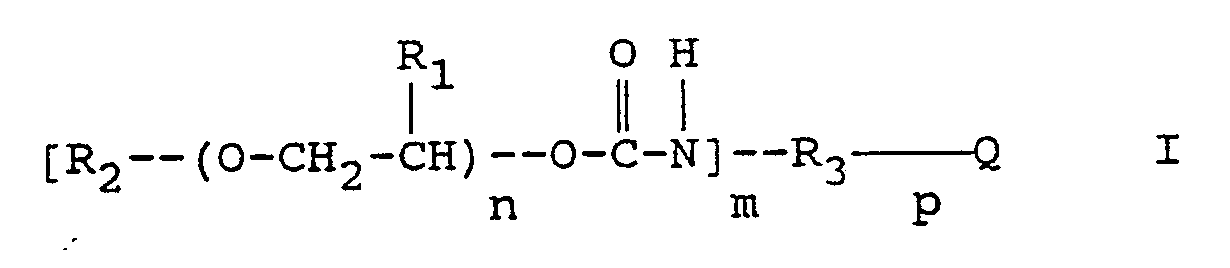
worin
- R₁
- Wasserstoff oder Methyl,
- R₂
- Wasserstoff, Alkyl, gegebenenfalls substituiertes Aryl oder ein gegebenenfalls substituiertes Arylaminocarbonyl,
- R₃
- ein gegebenenfalls substituiertes Arylen oder Arylen-Alkylen,
- Q
- Wasserstoff, -CH₄-p, CR₅R₆ mit R₅ und R₆, die gleich oder verschieden sein können und Wasserstoff, Alkyl oder Aryl bedeuten,
Carbonyl, ein Sauerstoff- oder Schwefelatom oder Sulfonyl, - m
- 1, 2 oder 3 und
- n
- eine Zahl ≧ 1 und ≦ 50 und
- p
- 1, 2 oder 3
bedeuten.
Description
- Strahlungsempfindliches Gemisch, hiermit hergestelltes strahlungsempfindliches Aufzeichnungsmaterial und Verfahren zur Herstellung von Reliefaufzeichnungen
- Die Erfindung betrifft ein strahlungsempfindliches Gemisch, ein daraus hergestelltes Aufzeichnungsmaterial sowie ein Verfahren zur Herstellung von Reliefaufzeichnungen. Die Erfindung geht aus von einem normalerweise positiv, je nach Verarbeitungsweise, aber auch negativ arbeitenden, strahlungsempfindlichen Gemisch, das als wesentliche Bestandteile ein in Wasser unlösliches, in wäßrig-alkalischen Lösungen lösliches polymeres Bindemittel und ein 1,2-Chinondiazid enthält.
- Diese strahlungsempfindlichen Gemische arbeiten dann positiv, wenn man ihre Löslichkeit in einer Entwicklerlösung durch Bestrahlung erhöht. Durch bekannte Verfahrensvariation ergeben die Gemische in Umkehrung auch negative Abbilder der Vorlagen. Diese Verarbeitungsweise erfordert nach der bildmäßigen Bestrahlung eine thermische Behandlung, bei der man das Material in einer dafür geeigneten Vorrichtung für eine bestimmte Zeit auf eine bestimmte Temperatur bringt. Hierdurch erfolgt die Konvertierung des Gemisches in den bestrahlten Bereichen von einem entwicklerlöslichen in einen in der Regel nicht mehr strahlungsempfindlichen, entwicklerunlöslichen Zustand.
- Im einzelnen sind für die Negativ-Verarbeitung folgende Schritte erforderlich: bildmäßige Bestrahlung der das Gemisch enthaltenden Kopierschicht, thermische Behandlung, ganzflächige Bestrahlung und sich anschließende Entwicklung. Eine Variation dieses Verfahrens (US-A 4,544,627) kann darin bestehen, daß die bildmäßige Differenzierung im thermischen Schritt erfolgt, wobei man wie folgt vorgeht: ganzflächige Bestrahlung der das Gemisch enthaltenden Kopierschicht, bildmäßige Erhitzung z.B. mittels IR-Laserstrahlen und Entwicklung.
- Es ist zwar grundsätzlich möglich, dieses im allgemeinen unter dem Begriff Bildumkehr zusammengefaßte Verfahren durchzuführen, ohne daß spezielle Gemischzusätze erforderlich sind (EP-A 131 238 entsprechned US-A 4 576 901) jedoch werden in der Regel Substanzen zugesetzt, die zweierlei bewirken sollen: zum einen soll der Bildumkehrspielraum erweitert werden und zum anderen soll der Angriff der Entwicklerlösung auf die Entwickler unlöslich gemachten Bereiche nach der Konvertierung verringert werden.
- Unter Bildumkehrspielraum ist die Breite des Temperaturbereichs zu verstehen, innerhalb dessen die Konversion durchgeführt werden kann bzw. die Toleranzbreite der für die Konversion erforderlichen Zeit.
- Die verwendbaren Gemischzusätze lassen sich in zwei Klassen einteilen: zum einen in Additive, die in Gegenwart der bei der Bestrahlung gebildeten Inden-Carbonsäure thermisch eine Vernetzungsreaktion im lichtempfindlichen Gemisch bewirken und zum zweiten in Zusätze, die die zur Decarboxylierung der bei der Bestrahlung gebildeten Säure erforderliche Energie herabsetzen (S.A.MacDonald et al.: "Image Reversal. The Production of a Negative Image in a Positive Photoresist", Interface 82, San Diego 1982).
- Zur ersten Klasse sind die folgenden Zusätze zu rechnen: Resole (GB-A 2 082 339), Alkoxymethyl- oder Glycidyl-substituierte Aromaten (EP-A 0 212 482), monomere oder oligomere Melamin- bzw. Harnstoff-Formaldehyd-Kondensate (EP-A 0 133 216, DE-A 3 711 264); zur zweiten Klasse rechnet man:: sekundäre oder tertiäre Amine mit einem Siedepunkt größer als 200 °C (US-A 4 196 003), Ammonium-(EP-A 0 141 400 entsprechend US-A 4 696 891) bzw. Phosphoniumsalze (DE-A 3 437 687), Monazolin (DE-A 25 29 054 entsprechend US-A 4 104 070) bzw. N-substituierte Ethylendiamine (DE-A 28 55 723), Amino-alkoxy-s-triazine (DE-A 37 11 263), Tris-phenoxy-s-triazine (DE-A 37 25 949) oder Chinone bzw. aromatische Ketone (US-A 4 356 255).
- Eine dritte Verfahrensvariante besteht darin, daß der Zusatz zur Verbreiterung des Bildumkehrspielraums nicht von vorneherein in der strahlungsempfindlichen Schicht zugegen ist, sondern zwischen bildmäßiger Bestrahlung und thermischer Behandlung angetragen wird, wie dies etwa in DE-A 35 41 451 und US-A 4 775 609 beschrieben ist, wobei das Material einer Ammoniak-Atmosphäre ausgesetzt wird.
- Auf Grund der Tatsache, daß die Gemischzusätze der ersten Klasse, die an einer säurekatalysierten Vernetzungsreaktion beteiligt sind, generell die Lagerstabilität des Gemisches stärker beeinträchtigen als die der zweiten Klasse, sind letztere die bevorzugten Zusätze.
- Die technisch erfoderliche Breite des Verarbeitungsspielraums für die Bildumkehr wird mit Zusätzen der zweiten Klasse, wie z.B. den in DE-A 37 11 263 beschriebenen Amino-alkoxy-s-triazinen, erzielt. Unbefriedigend ist jedoch, daß der Angriff der Entwicklerlösung gegen die konvertierten Bildbereiche noch relativ hoch ist. Dies kann dazu führen, daß es bei der Entwicklung des latenten Negativbildes zu einem unter Umständen beträchtlichen Abtrag des Kopierlacks in diesen Bereichen kommt. Hieraus resultiert, daß die mit einer so gefertigten Druckform erzielbare Druckauflage geringer ausfällt und daß es durch die hohe Belastung des Entwicklers mit konvertiertem Kopiermaterial, dessen Löslichkeit im Entwickler wiederum begrenzt ist, zu einer frühzeitigen und unerwünschten Erschöpfung des Entwicklers kommt.
- Aufgabe der Erfindung war es daher, ein strahlungsempfindliches Gemisch bereitzustellen, das eine gute Lagerstabilität besitzt, einen breiten Bildumkehrspielraum aufweist und das nach Konvertierung weniger vom Entwickler angegriffen wird als die bekannten Gemische.
- Die Erfindung geht aus von einem strahlungsempfindlichen Gemisch, das als wesentliche Bestandteile ein in Wasser unlösliches, in wäßrig-alkalischen Lösungen lösliches Bindemittel, ein 1,2-Chinondiazid und eine, die Entwicklerlöslichkeit der belichteten Bereiche durch thermische Behandlung vermindernde Verbindung enthält. Das Gemisch ist dadurch gekennzeichnet, daß es als die Entwicklerlöslichkeit vermindernde Verbindung mindestens ein Urethan der allgemeinen Formel I enthält:

worin - R₁
- Wasserstoff oder Methyl,
- R₂
- Wasserstoff, Alkyl, gegebenenfalls substituiertes Aryl oder ein gegebenenfalls substituiertes Arylaminocarbonyl,
- R₃
- ein gegebenenfalls substituiertes Arylen oder Arylen-Alkylen,
- Q
- Wasserstoff, -CH₄-p, CR₅R₆ mit R₅ und R₆, die gleich oder verschieden sein können und Wasserstoff, Alkyl oder Aryl bedeuten,
Carbonyl, ein Sauerstoff- oder Schwefelatom oder Sulfonyl, - m
- 1, 2 oder 3 und
- n
- eine Zahl ≧ 1 und ≦ 50 und
- p
- 1, 2 oder 3
bedeuten. - Bevorzugt sind Verbindungen der allgemeinen Formel I worin:
- R₁
- Wasserstoff oder Methyl
- R₂
- Wasserstoff, C₁-C₂-Alkyl,Phenyl, Naphthyl, oder Phenylaminocarbonyl, die durch Alkyl substituiert sein können,
- R₃
- Phenylen, das Alkyl substituiert sein kann,
- Q
- Wasserstoff oder Methylen,
- m
- 1 oder 2,
- n
- eine Zahl ≧ 3 und ≦ 25 und
- p
- 1 oder 2
bedeuten. - Insbesondere sind Verbindungen der allgemeinen Formel I bevorzugt, in denen
- R₁
- Wasserstoff,
- R₂
- Phenyl, Phenylaminocarbonyl, die durch Alkyl substituiert sein können,
- R₃
- Phenylen,
- Q
- Wasserstoff
- m
- 1
- n
- eine Zahl ≧ 3 und ≦ 25 und
- p
- 1
bedeuten. - Die Herstellung der erfindungsgemäßen Urethanverbindungen erfolgt auf einfache Art und Weise durch Umsetzung der entsprechenden mono- oder bifunktionellen Alkohole mit mono-, bi- oder trifunktionellen Isocyanaten.
- Beispiele für erfindungsgemäße Urethanverbindungen sind Umsetzungsprodukte aus monofunktionellen Alkoholen, wie Ethylenglykol-mono-methyl- oder -ethylether, Propylenglykol-mono-methyl- oder -ethylether, Di-, Tri- oder Tetraethylen- oder Propylenglykol-mono-methyl, -ethyl- oder -butylether, Fettalkoholoxethylate, wie GenapolR-Typen der Hoechst AG, Alkylphenoloxethylate, wie Nonylphenoloxethylate (ArkopalR-N, Hoechst AG), Tributylphenoloxethylate, wie SapogenatR-T, Hoechst AG), Monobutylether von Ethylenoxid/Propylenoxid-Copolymerisaten (PolyglykolR-B-Typen, Hoechst AG) und/oder bifunktionellen Alkoholen, wie Mono-, Di-, Tri-, Tetra-, Pentaethylen- oder Propylenglykole, Ethylen/Propylenblockpolymerisate, wie GenapolR-PF oder PluriolR-PE-Typen der Hoechst bzw. BASF AG mit monofunktionellen Isocyanaten, wie Phenyl-, 3 oder 4-Chlorphenyl-, 3,4-Dichlorphenyl-, 3-Trifluormethylphenyl-, 4-Methylphenyl-, 4-Isopropylphenyl-, 1-Naphthylisocyanat und/oder bifunktionellen Isocyanaten, wie 2,4- oder 2,6-Toluoldiisocyanat, 4,4'- oder 2,4'- oder 2,2'-Diphenylmethandiisocyanat, oder 1,5-Naphthyldiisocyanat und/oder trifunktionellen Isocyanaten, wie Triphenylmethantriisocyanat, dem Addukt aus Trimethylolpropan und Toluoldiisocyanat (DesmodurR, Bayer AG).
- Die Konzentration der erfindungsgemäßen Urethane in dem strahlungsempfindlichen Gemisch kann in relativ weiten Grenzen schwanken. Im allgemeinen liegt der Anteil bei 0,5 bis 30, vorzugsweise zwischen 1 und 25 Gewichtsprozenten, bezogen auf das Gewicht der nicht-flüchtigen Bestandteile des strahlungsempfindlichen Gemisches.
- Die folgenden Erläuterungen beschreiben näher die Zusammensetzung der strahlungsempfindlichen Gemische und Schichten, die Art der Schichtträger sowie die weiteren Prozeßschritte in der Verarbeitung der Aufzeichnungsmaterialien.
- Das erfindungsgemäße strahlungsempfindliche Gemisch enthält als 1,2-Chinondiazid bevorzugt ein 1,2-Naphthochinon-2-diazid-derivat, das in 4- oder 5-Position einen elektronegativen Substituenten, wie eine Aryloxysulfonylgruppe besitzt. Als 1,2-Chinondiazide werden insbesondere 1,2-Naphthochinon-diazid-(2)-4-sulfonsäureester oder - amide verwendet. Geeignete Verbindungen dieser Art sind bekannt und zum Beispiel in DE-C 938 233, entsprechend GB-B 739 654 und DE-A 25 47 905, entsprechned GB-B 1 561 438 beschrieben.
- Die Menge von 1,2-Chinondiazidverbindungen beträgt im allgemeinen 3 bis 50, bevorzugt 7 bis 35 Gewichtsprozent, bezogen auf Gesamtfeststoff des Gemisches.
- Als Bindemittel werden Polykondensate oder Polymerisate mit freien phenolischen Hydroxylgruppen eingesetzt, wobei der Gehalt an phenolischen Hydroxylgruppen bevorzugt im Bereich von 1 und 10 mmol/g Bindemittel liegt. Als Beispiele für Polykondensate sind zu nennen, Phenolharze vom Novolaktyp oder hydroxy-substituierte Aramide. Als Beispiele für Polymerisate seien genannt: Homo- und Copolymerisate von Vinylphenolen (DE-A 23 22 230, entsprechend US-A 3 869 292 und DE-A 3 406 927, entsprechend US-A 4 678 737), Polymerisate der Ester von Acrylsäuren mit Phenolen (JP-A 76/36 129 und EP-A 0 212 439) oder Copolymerisate von Hyroxyphenylmaleinimiden (EP-A 0 187 517). Die Glasübergangstemperaturen dieser Bindemittel variieren je nach Anwendungsbereich. Für Trockenresistanwendungen, wo eine gute Laminierbarkeit gefordert ist, sind Glasübergangstemperaturen ≦ 100 °C vorteilhaft. Im Falle der Anwendung im Flachdruck oder in der Fertigung mikroelektronischer Schaltungen sind Glasübergangstemperaturen ≧ 100 °C günstig. Die Menge des Bindemittels beträgt im allgemeinen 20 bis 90, vorzugsweise 50 bis 85 Gewichtsprozent der nichtflüchtigen Bestandteile des Gemisches.
- Zusätzlich können noch zahlreiche andere Oligomere und Polymere mitverwendet werden, z.B. Vinylpolymerisate wie Polyvinylacetale, Polymethacrylate, Polyacrylate, Polyvinylether und Polyvinylpyrrolidone, die selbst durch Comonomere modifiziert sein können.
- Der günstigste Anteil an diesen Zusätzen richtet sich nach den anwendungstechnischen Erfordernissen und dem Einfluß auf die Entwicklungsbedingungen und beträgt im allgemeinen nicht mehr als 20 Gewichtsprozent vom Bindemittel mit seitenständigen phenolischen Gruppen. In geringen Mengen kann die lichtempfindliche Schicht für spezielle Erfordernisse wie Flexibilität, Haftung, Glanz etc. außerdem noch Substanzen wie Polyglykole, Celluloseether, z.B. Ethylcellulose, Netzmittel und feinteilige Pigmente enthalten.
- Ferner können dem lichtempfindlichen Gemisch noch lösliche oder auch feinteilige dispergierbare Farbstoffe sowie, je nach Anwendungszweck, auch UV-Absorber zugesetzt werden.
- Je nach Art des Farbstoffs, der dem Gemisch zugesetzt wird, um unmittelbar nach Belichtung ein sichtbares Abbild der Vorlage auf dem Aufzeichnungsmaterial anzuzeigen, kann es sinnvoll sein, photochemische Säurebildner zuzusetzen, um den Belichtungskontrast zu verstärken.
- Als lichtempfindliche Komponenten, die beim Belichten starke Säure bilden, sind eine große Anzahl von bekannten Verbindungen und Mischungen, wie Phosphonium-, Sulfonium- und Jodoniumsalze, Halogenverbindungen und Organometall-Organohalogen-Kombinationen geeignet.
- Grundsätzlich sind als halogenhaltige lichtempfindliche und Halogenwasserstoffsäure bildende Verbindungen alle auch als photochemische Radikalstarter bekannten organischen Halogenverbindungen, beispielsweise solche mit mindestens einem Halogenatom an einem Kohlenstoffatom oder an einem aromatischen Ring brauchbar (US-A 3 779 778). Von diesen Verbindungen werden die s-Triazinderivate mit Halogenmethylgruppen, insbesondere Trichlormethylgruppen, und mit einem aromatischen bzw. ungesättigten Substituenten am Triazinkern, wie sie in DE-A 27 18 259, entsprechend US-A 4 189 323, beschrieben sind, bevorzugt. Ebenso geeignet sind 2-Trichlormethyl-1,3,4-oxdiazole (DE-A 28 51 471, entsprechend US-A 4 212 970). Die Wirkung dieser halogenhaltigen Verbindungen kann auch durch bekannte Sensibilisatoren spektral beeinflußt und gesteigert werden.
- Die Erfindung betrifft auch ein strahlungsempfindliches Aufzeichnungsmaterial aus einem Schichtträger und einer darauf aufgebrachten strahlungsempfindlichen Schicht, die ein erfindungsgemäßes strahlungsempfindliches Gemisch enthält.
- Zur Beschichtung eines geeigneten Schichtträgers werden die Gemische im allgemeinen in einem Lösungsmittel gelöst. Die Wahl der Lösungsmittel ist auf das vorgesehene Beschichtungsverfahren, die Schichtdicke und die Trocknungsbedingungen abzustimmen. Geeignete Lösungsmittel für das erfindungsgemäße Gemisch sind Ketone, wie Methylethylketon, chlorierte Kohlenwasserstoffe, wie Trichlorethylen und 1,1,1-Trichlorethan, Alkohole, wie n-Propanol, Ether, wie Tetrahydrofuran, Alkoholether, wie Ethylenglykol-monoethylether und Ester, wie Butylacetat. Es können auch Gemische verwendet werden, die zudem noch für spezielle Zwecke Lösungsmittel, wie Acetonitril, Dioxan oder Dimethylformamid enthalten können. Prinzipiell sind alle Lösungsmittel verwendbar, die mit den Schichtkomponenten nicht irreversibel reagieren. Partialether von Glykolen, insbesondere Ethylenglykolmonomethylether und Propylenglykolmonomethylether allein oder im Gemisch werden besonders bevorzugt.
- Als Schichtträger für Schichtdicken unter ca. 10 µm werden meist Metalle verwendet. Für Offsetdruckplatten können eingesetzt werden: walzblankes, mechanisch und/oder elektrochemisch aufgerauhtes und gegebenenfalls anodisiertes Aluminium, das zudem noch chemisch, z.B. mit Polyvinylphosphonsäure, Silikaten, Phosphaten, Hexafluorzirkonaten oder mit hydrolysiertem Tetraethylorthosilikat vorbehandelt sein kann.
- Die Beschichtung des Schichtträgers erfolgt in bekannter Weise durch Aufschleudern, Sprühen, Tauchen, Walzen, mittels Breitschlitzdüsen, Rakeln oder durch Gießer-Antrag.
- Zum Belichten können die üblichen Lichtquellen wie Röhrenlampen, Xenonimpulslampen, metallhalogeniddotierte Quecksilberdampf-Hochdrucklampen und Kohlebogenlampen verwendet werden.
- Unter Belichtung bzw. Bestrahlung ist in dieser Beschreibung die Einwirkung aktinischer elektromagnetischer Strahlung in Wellenlängenbereichen unterhalb etwa 500 nm zu verstehen. Alle in diesem Wellenlängenbereich emittierenden Strahlungsquellen sind prinzipiell geeignet.
- Mit Vorteil können auch Laserbestrahlungsgeräte, insbesondere automatische Verarbeitungsanlagen verwendet werden, die als Strahlungsquelle, z.B. einen Argon- oder Krypton-Ionen-Laser enthalten.
- Die Bestrahlung kann ferner mit Elektronenstrahlen erfolgen. Auch Röntgenstrahlen können zur Bilderzeugung verwendet werden.
- Die bildmäßig belichtete oder bestrahlte Schicht kann in bekannter Weise mit praktisch den gleichen Entwicklern, wie sie für handelsübliche Naphthochinondiazid-Schichten und Kopierlacke bekannt sind, entfernt werden, oder die erfindungsgemäßen Materialien können in ihrem Kopierverhalten mit Vorteil auf die bekannten Hilfsmittel wie Entwickler und programmierte Sprühentwicklungsgeräte abgestimmt werden. Die wäßrigen Entwicklerlösungen können z.B. Alkaliphosphate, -silikate oder -hydroxide und ferner Netzmittel sowie gegebenenfalls kleinere Anteile organischer Lösungsmittel enthalten. In bestimmten Fällen sind auch Lösungsmittel-Wasser-Gemische als Entwickler brauchbar. Die Wahl des günstigsten Entwicklers kann durch Versuche mit der jeweils verwendeten Schicht ermittelt werden. Bei Bedarf kann die Entwicklung mechanisch unterstützt werden.
- Bei der Anwendung als Druckplatten können zur Erhöhung der Widerstandsfähigkeit beim Druck sowie der Resistenz gegen Auswaschmittel, Korrekturmittel und durch UV-Licht härtbare Druckfarben die entwickelten Platten kurzzeitig auf erhöhte Temperaturen erwärmt werden, wie es für Diazoschichten aus der GB-B 1 154 749 bekannt ist.
- Wie schon eingangs erwähnt kann das erfindungsgemäße strahlungsempfindliche Aufzeichnungsmaterial normal als positiv arbeitendes Material verarbeitet werden. Es ist aber auch negativ arbeitend verarbeitbar sowie in Kombination beider Verfahrensarten (Photocomposing). Ganz besonders geeignet ist das erfindungsgemäße Material in einem Verfahren verarbeitbar zur Negativherstellung eines normalerweise positiv arbeitenden strahlungsempfindlichen Aufzeichnungsmaterials aus einem Schichtträger und einer darauf aufgebrachten strahlungsempfindlichen Schicht durch bildmäßiges Belichten, thermisches Behandeln, Ausbelichten der Schicht ohne Vorlage und anschließendes Entwickeln mit einem Entwickler, bei dem man ein erfindungsgemäßes strahlungsempfindliches Aufzeichnungsmaterial verwendet und bei dem man die thermische Behandlung bei Temperaturen zwischen 80 ° und 150 °C und innerhalb von 10 Sekunden und 5 Minuten durchführt.
- Durch die Erfindung wird erreicht, daß ein strahlungsempfindliches Gemisch und Aufzeichnungsmaterial zur Verfügung gestellt werden kann, das eine gute Lagerstabilität bei guter Strahlungsempfindlichkeit besitzt, das einen technisch erwünschten breiten Bildumkehrspielraum aufweist und dessen Bildbereiche nach der Konvertierung weit weniger von dem Entwickler angegriffen werden als dies bei bekannten Materialien der Fall ist.
- Im folgenden werden Beispiele der bevorzugten Ausführungsformen angegeben. In den Beispielen stehen Gewichtsteile (Gt) und Volumenteile (Vt) im Verhältnis von g zu ccm. Prozent- und Mengenverhältnisse sind, wenn nichts anderes angegeben ist, in Gewichtseinheiten zu verstehen.
- Es wird eine Beschichtungslösung hergestellt aus
- 8,0 Gt
- eines m-Kresol-Formaldehyd-Novolaks mit einem Molgewichtsmittelwert von 6.000,
- 1,6 Gt
- eines Veresterungsproduktes aus 1 Mol 1,2-Naphthochinon-(2)-diazid-4-sulfonylchlorid und 1 Mol p-Cumylphenol,
- 0,4 Gt
- eines Zusatzes entsprechend Tabelle 1 und 2,
- 0,1 G
- t Kristallviolett, Color Index (C.I.) 42555,
- 0,02 Gt
- Sudangelb GGN, C.I. 11021,
- 100 Gt
- eines Lösungsmittelgemisches aus Tetrahydrofuran und Propylenglykolmonomethylether (55:45).
- Diese Lösung wird auf eine in Salzsäure aufgerauhte, in Schwefelsäure anodisierte und mit Polyvinylphosphonsäure hydrophilierte Aluminiumfolie schleuderbeschichtet.
- Nach 2 Minuten Trocknen bei 100 °C resultiert eine Schichtdicke von 2 µm.
- Die Druckplatten werden unter einer 5-kW-Metallhalogenidlampe im Abstand von 110 cm durch einen Halbtonstufenkeil mit 13 Dichtestufen von je 0,15 (Belichtungskeil "BK 01" der Hoechst AG) 65 Sekunden lang belichtet, 2 Minuten bei 130 °C in einem Umluftofen konvertiert, 45 Sekunden lang ohne Vorlage ausbelichtet und dann in folgendem Entwickler 1 Minute entwickelt:
7,6 Gt K₂SiO₃
1,2 Gt K₃PO₄
91,3 Gt H₂O.
- In Tabelle 2 ist die gefundene Halbtonkeilwiedergabe von der voll gedeckten Stufe bis zu der, die erstmals einen Schleier zeigt, angegeben. Weiterhin ist angegeben, welche offene Stufe erhalten wird, wenn nach der bildmäßigen Belichtung entwickelt wird, also eine Positivverarbeitung durchgeführt wird.

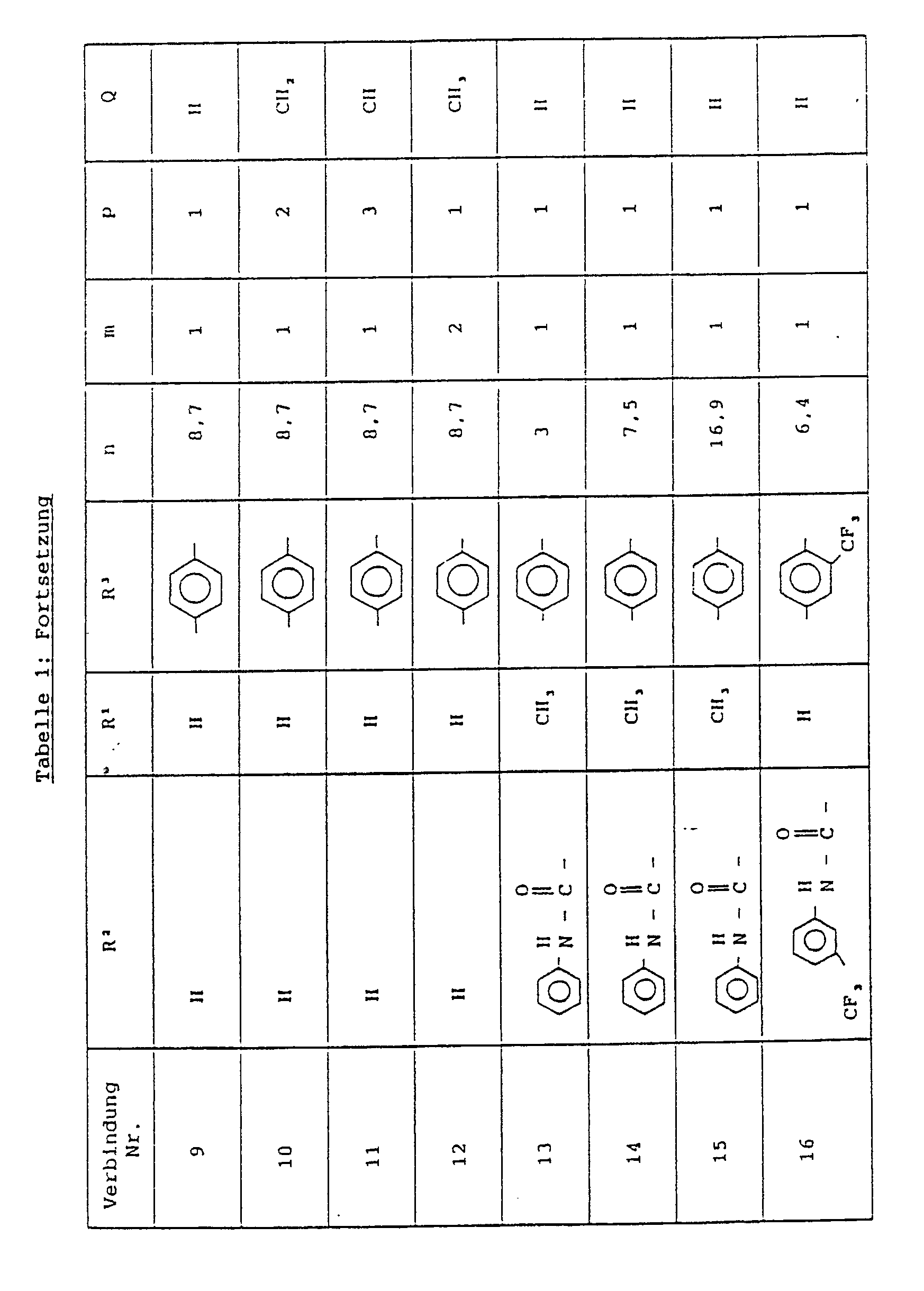


- Diese Ergebnisse zeigen, daß die Positivverarbeitung in allen Fällen ohne Probleme möglich ist, die Negativverarbeitung jedoch nur bei den erfindungsgemäßen Zusätzen ohne starke Schädigung der konvertierten Bildpartien möglich ist.
- Von einigen dieser positiv bzw. negativ verarbeiteten Druckplatten wurde in einer Bogenoffsetdruckmaschine die Druckauflage bestimmt:

- Diese Ergebnisse zeigen, daß bei den Druckplatten, die strahlungsempfindliche Schichten mit den erfindungsgemäßen Zusätzen besitzen, die bei Negativverarbeitung erzielbare Druckauflage nahezu der der Positivverarbeitung entspricht. Dagegen weisen die Vergleichsdruckplatten, deren Bildpartien bei Negativverarbeitung vom Entwickler angegriffen werden, bei Negativverarbeitung eine deutlich geringere Druckauflage als bei Positivverarbeitung auf.
- Weiterhin wurde von einer Reihe der Platten der Verarbeitungsspielraum bei Negativverarbeitung bestimmt. Dies wurde in der Art und Weise durchgeführt, daß die Temperatur bei der Temperung bei Negativverarbeitung bei ansonsten gleicher Verarbeitungsweise wie oben beschrieben variiert wurde.
- Die folgende Tabelle gibt die Ergebnisse wieder.

- Die Ergebnisse zeigen, daß die erfindungsgemäßen Zusätze einen den Triazinderivaten (DE-A 37 11 263) vergleichbaren Verarbeitungsspielraum liefern, der den unter saurer Katalyse aushärtenden Zusätzen deutlich überlegen ist.
- Zur Prüfung der Langzeithaltbarkeit wurden die Platten in einem Lacktrockenschrank bei 100 °C gelagert und in Intervallen von 0,5 Stunden Proben entnommen und wie oben beschrieben positiv verarbeitet. Als Lagerstabilität wird der Wert der Lagerzeit bezeichnet, bis zu dem eine einwandfreie Verarbeitung - d.h. unbeeinträchtigtes Entwicklungsverhalten - möglich war. Der Test wurde nach 3 Stunden abgebrochen.

- Die Werte zeigen, daß die Lagerstabilität der mit den erfindungsgemäßen Zusätzen erhaltenen Schichten deutlich über der der säurekatalysiert aushärtenden Zusätze liegt und damit den praktischen Anforderungen genügt.
- Es wird eine Beschichtungslösung hergestellt aus
- 1,700 Gt
- des Veresterungsproduktes aus 1 Mol 2,3,4-Trihydroxybenzophenon und 1 Mol 1,2-Naphthochinon-(2)-diazid-4-sulfonylchlorid,
- 0,600 Gt
- des Zusatzes entsprechend Tabelle 3,
- 8,500 Gt
- eines Kresol-Formaldehyd-Novolaks mit einem Erweichungspunkt von 127 - 145 °C,
- 0,060 Gt
- 2,4-Bis-trichlormethyl-6-p-stilbenyl-s-triazin,
- 0,070 Gt
- Kristallviolett, C.I. 42555, in
- 70,00 Gt
- Propylenglykolmonomethylether und
- 70,00 Gt
- Tetrahydrofuran
- Die Lösungen werden auf eine wie in Bespiel 1 behandelte Aluminiumfolie durch Schleudern aufgebracht und getrocknet, so daß eine Schichtdicke von 2 µm resultiert.
- Es werden die gleichen Prüfungen vorgenommen, wie in Beispiel 1 unter denselben Bedingungen und demselben Entwickler. Tabelle 3 gibt die Ergebnisse wieder.

- Die Resultate dieser Versuchsreihe zeigen ebenfalls deutlich, daß mit den erfindungsgemäßen Zusätzen beim Einsatz eines stark alkalischen Entwicklers das insgesamt beste Verhalten bei Negativverarbeitung gefunden wird.
Claims (9)
- Strahlungsempfindliches Gemisch, das als wesentliche Bestandteile ein in Wasser unlösliches,in wäßrigalkalischen Lösungen lösliches Bindemittel, ein 1,2-Chinondiazid und eine, die Entwicklerlöslichkeit der belichteten Bereiche durch thermische Behandlung vermindernde Verbindung enthält, dadurch gekennzeichnet, daß es als die Entwicklerlöslichkeit vermindernde Verbindung mindestens ein Urethan der allgemeinen Formel I enthält:
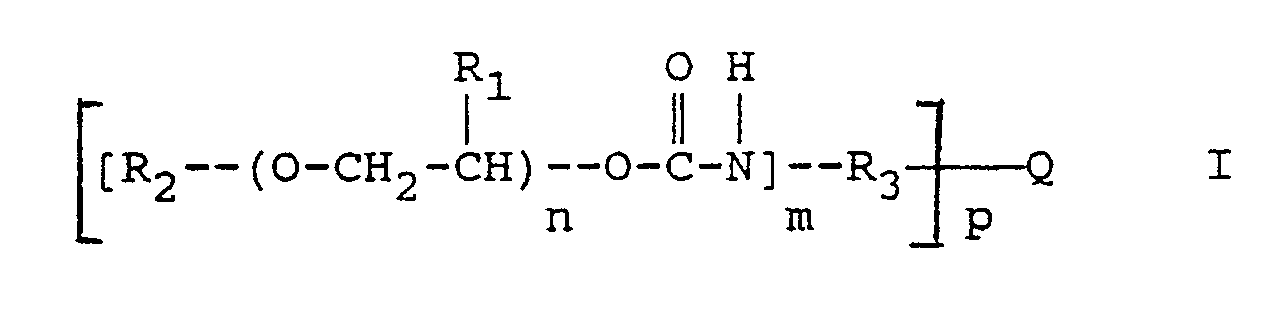 R₁ Wasserstoff oder Methyl,R₂ Wasserstoff, Alkyl, gegebenenfalls substituiertes Aryl oder ein gegebenenfalls substituiertes Arylaminocarbonyl,R₃ ein gegebenenfalls substituiertes Arylen oder Arylen-Alkylen,Q Wasserstoff, -CH₄-p, CR₅R₆ mit R₅ und R₆, die gleich oder verschieden sein können und Wasserstoff, Alkyl oder Aryl bedeuten,
Carbonyl, ein Sauerstoff- oder Schwefelatom oder Sulfonyl,m 1, 2 oder 3 undn eine Zahl ≧ 1 und ≦ 50 undp 1, 2 oder 3
bedeuten. - Gemisch nach Anspruch 1, dadurch gekennzeichnet, daß es mindestens eine Verbindung entsprechend der allgemeinen Formel I enthält,
worin:R₁ Wasserstoff oder Methyl,R₂ Wasserstoff, C₁-C₂-Alkyl,Phenyl, Naphthyl oder Phenylaminocarbonyl, die durch Alkyl substituiert sein können,R₃ Phenylen, das Alkyl substituiert sein kann,Q Wasserstoff oder Methylen,m 1 oder 2,n eine Zahl ≧ 3 und ≦ 25 undp 1 oder 2
bedeuten. - Gemisch nach Anspruch 1 oder 2, dadurch gekennzeichnet, daß es mindestens eine Verbindung entsprechend der allgemeinen Formel I enthält, worin:R₁ Wasserstoff,R₂ Phenyl, Phenylaminocarbonyl, die durch Alkyl substituiert sein können,R₃ Phenylen,Q Wasserstoff,m 1,n eine Zahl ≧ 3 und ≦ 25 undp 1
bedeuten. - Strahlungsempfindliches Gemisch nach Anspruch 1 bis 3, dadurch gekennzeichnet, daß es 0,5 bis 30 Gewichtsprozent, bezogen auf das Gewicht der nichtflüchtigen Bestandteile des Gemisches, an Verbindungen nach der allgemeinen Formel I enthält.
- Strahlungsempfindliches Gemisch nach Anspruch 1, dadurch gekennzeichnet, daß das 1,2-Chinondiazid ein 1,2-Naphthochinon-2-diazid-derivat ist, das in 4- oder 5-Position einen elektronegativen Substituenten besitzt.
- Strahlungsempfindliches Gemisch nach Anspruch 5, dadurch gekennzeichnet, daß der elektronegative Substituent eine Aryloxysulfonylgruppe ist.
- Strahlungsempfindliches Gemisch nach Anspruch 1, dadurch gekennzeichnet, daß das Bindemittel ein Polykondensat oder Polymerisat mit einem Gehalt an phenolischen Hydroxylgruppen im Bereich von 1 bis 10 mmol/g Bindemittel ist.
- Strahlungsempfindliches Aufzeichnungsmaterial aus einem Schichtträger und einer darauf aufgebrachten strahlungsempfindlichen Schicht, die ein Gemisch nach Ansprüchen 1 bis 7 enthält.
- Verfahren zur Negativherstellung eines normalerweise positiv arbeitenden strahlungsempfindlichen Aufzeichnungsmaterials aus einem Schichtträger und einer darauf aufgebrachten strahlungsempfindlichen Schicht durch bildmäßiges Belichten, thermisches Behandeln, Ausbelichten der Schicht ohne Vorlage und anschließendes Entwickeln mit einem Entwickler, dadurch gekennzeichnet, daß man ein strahlungsempfindliches Aufzeichnungsmaterial nach Anspruch 8 verwendet und bei dem man die thermische Behandlung bei Temperaturen zwischen 80 ° und 150 °C und innerhalb von 10 Sekunden und 5 Minuten durchführt.
Applications Claiming Priority (2)
| Application Number | Priority Date | Filing Date | Title |
|---|---|---|---|
| DE4004719 | 1990-02-15 | ||
| DE4004719A DE4004719A1 (de) | 1990-02-15 | 1990-02-15 | Strahlungsempfindliches gemisch, hiermit hergestelltes strahlungsempfindliches aufzeichnungsmaterial und verfahren zur herstellung von reliefaufzeichnungen |
Publications (3)
| Publication Number | Publication Date |
|---|---|
| EP0442386A2 true EP0442386A2 (de) | 1991-08-21 |
| EP0442386A3 EP0442386A3 (en) | 1991-12-18 |
| EP0442386B1 EP0442386B1 (de) | 1996-05-01 |
Family
ID=6400231
Family Applications (1)
| Application Number | Title | Priority Date | Filing Date |
|---|---|---|---|
| EP91101749A Expired - Lifetime EP0442386B1 (de) | 1990-02-15 | 1991-02-08 | Strahlungsempfindliches Gemisch, hiermit hergestelltes strahlungsempfindliches Aufzeichnungsmaterial und Verfahren zur Herstellung von Reliefaufzeichnungen |
Country Status (6)
| Country | Link |
|---|---|
| US (1) | US5368975A (de) |
| EP (1) | EP0442386B1 (de) |
| JP (1) | JPH04214564A (de) |
| KR (1) | KR910015887A (de) |
| CA (1) | CA2035722A1 (de) |
| DE (2) | DE4004719A1 (de) |
Cited By (1)
| Publication number | Priority date | Publication date | Assignee | Title |
|---|---|---|---|---|
| EP0561725A1 (de) * | 1992-03-17 | 1993-09-22 | International Business Machines Corporation | Thermographisch reversibles Photolack |
Families Citing this family (5)
| Publication number | Priority date | Publication date | Assignee | Title |
|---|---|---|---|---|
| JP3382852B2 (ja) * | 1998-06-08 | 2003-03-04 | 株式会社ジャパンエナジー | 新規ポリオキシエチレンアルキルフェノールエーテル誘導体及びその製造方法並びにそれを用いる金属表面処理剤 |
| US6787642B2 (en) * | 2001-03-23 | 2004-09-07 | The Regents Of The University Of California | Use of insect cell membrane transporters as novel target sites for inspection |
| JP5247080B2 (ja) * | 2007-07-25 | 2013-07-24 | 旭化成イーマテリアルズ株式会社 | ポジ型感光性樹脂組成物 |
| WO2017032437A1 (en) * | 2015-08-21 | 2017-03-02 | Merck Patent Gmbh | Patterned bank structures on substrates and formation method |
| CN110683968B (zh) * | 2019-10-14 | 2021-08-06 | 中国石油化工股份有限公司 | 一种稠油开采用泡沫剂及其制备方法 |
Family Cites Families (28)
| Publication number | Priority date | Publication date | Assignee | Title |
|---|---|---|---|---|
| NL185407B (nl) * | 1953-03-11 | Mitsui Petrochemical Ind | Werkwijze voor het polymeriseren of copolymeriseren van 1-alkenen alsmede katalysatorsamenstelling voor toepassing van deze werkwijze. | |
| DE1447963B2 (de) * | 1965-11-24 | 1972-09-07 | KaIIe AG, 6202 Wiesbaden Biebnch | Verfahren zur herstellung einer offsetdruckform aus einem vorsensibilisierten druckplattenmaterial |
| US3779778A (en) * | 1972-02-09 | 1973-12-18 | Minnesota Mining & Mfg | Photosolubilizable compositions and elements |
| GB1375461A (de) * | 1972-05-05 | 1974-11-27 | ||
| US4196003A (en) * | 1974-02-01 | 1980-04-01 | Fuji Photo Film Co., Ltd. | Light-sensitive o-quinone diazide copying composition |
| DE2529054C2 (de) * | 1975-06-30 | 1982-04-29 | Ibm Deutschland Gmbh, 7000 Stuttgart | Verfahren zur Herstellung eines zur Vorlage negativen Resistbildes |
| DE2547905C2 (de) * | 1975-10-25 | 1985-11-21 | Hoechst Ag, 6230 Frankfurt | Lichtempfindliches Aufzeichnungsmaterial |
| US4189323A (en) * | 1977-04-25 | 1980-02-19 | Hoechst Aktiengesellschaft | Radiation-sensitive copying composition |
| US4212970A (en) * | 1977-11-28 | 1980-07-15 | Fuji Photo Film Co., Ltd. | 2-Halomethyl-5-vinyl-1,3,4-oxadiazole compounds |
| JPS5560944A (en) * | 1978-10-31 | 1980-05-08 | Fuji Photo Film Co Ltd | Image forming method |
| JPS566236A (en) * | 1979-06-28 | 1981-01-22 | Fuji Photo Film Co Ltd | Photosensitive material and pattern forming method using it |
| GB2082339B (en) * | 1980-08-05 | 1985-06-12 | Horsell Graphic Ind Ltd | Lithographic printing plates and method for processing |
| DE3325022A1 (de) * | 1983-07-11 | 1985-01-24 | Hoechst Ag, 6230 Frankfurt | Verfahren zur herstellung negativer kopien mittels eines materials auf basis von 1,2-chinondiaziden |
| DE3325023A1 (de) * | 1983-07-11 | 1985-01-24 | Hoechst Ag, 6230 Frankfurt | Verfahren zur herstellung negativer kopien mittels eines materials auf basis von 1,2-chinondiaziden |
| IT1169682B (it) * | 1983-11-08 | 1987-06-03 | I M G Ind Materiali Grafici Sp | Composizione per fotoriproduzioni |
| DE3406927A1 (de) * | 1984-02-25 | 1985-08-29 | Hoechst Ag, 6230 Frankfurt | Strahlungsempfindliches gemisch auf basis von saeurespaltbaren verbindungen |
| CA1254432A (en) * | 1984-12-28 | 1989-05-23 | Conrad G. Houle | High-temperature resistant, selectively developable positive-working resist |
| GB2171530B (en) * | 1985-02-27 | 1989-06-28 | Imtec Products Inc | Method of producing reversed photoresist images by vapour diffusion |
| DE3528930A1 (de) * | 1985-08-13 | 1987-02-26 | Hoechst Ag | Polymere verbindungen und diese enthaltendes strahlungsempfindliches gemisch |
| JPH07120039B2 (ja) * | 1986-11-14 | 1995-12-20 | 富士写真フイルム株式会社 | 感光性組成物 |
| DE3711264A1 (de) * | 1987-04-03 | 1988-10-13 | Hoechst Ag | Lichtempfindliches gemisch und hieraus hergestelltes lichtempfindliches kopiermaterial |
| JPH0727208B2 (ja) * | 1987-04-20 | 1995-03-29 | 富士写真フイルム株式会社 | 感光性組成物 |
| US4775609A (en) * | 1987-05-18 | 1988-10-04 | Hoescht Celanese Corporation | Image reversal |
| DE3725949A1 (de) * | 1987-08-05 | 1989-02-16 | Hoechst Ag | Lichtempfindliches gemisch, daraus hergestelltes lichtempfindliches kopiermaterial und verfahren zur herstellung von negativen reliefkopien |
| US4835086A (en) * | 1988-02-12 | 1989-05-30 | Hoechst Celanese Corporation | Polysulfone barrier layer for bi-level photoresists |
| US4889787A (en) * | 1988-04-25 | 1989-12-26 | Minnesota Mining And Manufacturing Company | Low gain positive acting diazo oxide pre-press proofing system with polyvinyl ether and particulate slip agent in adhesive layer |
| US5024922A (en) * | 1988-11-07 | 1991-06-18 | Moss Mary G | Positive working polyamic acid/imide and diazoquinone photoresist with high temperature pre-bake |
| DE3900736A1 (de) * | 1989-01-12 | 1990-07-26 | Hoechst Ag | Positiv arbeitendes strahlungsempfindliches gemisch enthaltend einen mehrfunktionellen (alpha)-diazo-(beta)-ketoester, verfahren zu dessen herstellung und strahlungsempfindliches aufzeichnungsmaterial enthaltend dieses gemisch |
-
1990
- 1990-02-15 DE DE4004719A patent/DE4004719A1/de not_active Withdrawn
-
1991
- 1991-02-05 CA CA002035722A patent/CA2035722A1/en not_active Abandoned
- 1991-02-08 EP EP91101749A patent/EP0442386B1/de not_active Expired - Lifetime
- 1991-02-08 DE DE59107744T patent/DE59107744D1/de not_active Expired - Fee Related
- 1991-02-13 KR KR1019910002500A patent/KR910015887A/ko not_active Withdrawn
- 1991-02-14 JP JP3042526A patent/JPH04214564A/ja active Pending
-
1993
- 1993-03-26 US US08/039,554 patent/US5368975A/en not_active Expired - Fee Related
Cited By (1)
| Publication number | Priority date | Publication date | Assignee | Title |
|---|---|---|---|---|
| EP0561725A1 (de) * | 1992-03-17 | 1993-09-22 | International Business Machines Corporation | Thermographisch reversibles Photolack |
Also Published As
| Publication number | Publication date |
|---|---|
| KR910015887A (ko) | 1991-09-30 |
| DE4004719A1 (de) | 1991-08-22 |
| EP0442386B1 (de) | 1996-05-01 |
| DE59107744D1 (de) | 1996-06-05 |
| JPH04214564A (ja) | 1992-08-05 |
| EP0442386A3 (en) | 1991-12-18 |
| US5368975A (en) | 1994-11-29 |
| CA2035722A1 (en) | 1991-08-16 |
Similar Documents
| Publication | Publication Date | Title |
|---|---|---|
| EP0933682B1 (de) | Strahlungsempfindliche Gemische mit Bindemitteln aus Polymeren mit Einheiten aus N-substituiertem Maleimid | |
| EP0266654B1 (de) | Lichtempfindliches Gemisch, dieses enthaltendes Aufzeichnungsmaterial und Verfahren zur Herstellung von positiven oder negativen Reliefkopien unter Verwendung dieses Materials | |
| EP0028749B1 (de) | Photopolymerisierbares Gemisch und damit hergestelltes photopolymerisierbares Kopiermaterial | |
| EP0059250B1 (de) | Lichtempfindliches Gemisch und daraus hergestelltes Kopiermaterial | |
| EP0042105B1 (de) | Lichtempfindliches Kopiermaterial und Verfahren zu seiner Herstellung | |
| EP0006626A2 (de) | Strahlungsempfindliches Gemisch und Verfahren zur Herstellung von Reliefbildern | |
| EP0071881B1 (de) | Verfahren zur Herstellung von Flachdruckformen aus einem lichtempfindlichen Material auf Basis von Diazoniumsalz-Polykondensationsprodukten | |
| EP0285013A2 (de) | Lichtempfindliches Gemisch und hieraus hergestelltes lichtempfindliches Kopiermaterial | |
| DE3525901A1 (de) | Mit wasser entwickelbare photopolymerisierbare zusammensetzungen und druckplatten | |
| EP0313007A2 (de) | Durch sichtbares Licht polymerisierbares Gemisch | |
| EP0293656B1 (de) | Verfahren zur Bebilderung lichtempfindlichen Materials | |
| EP0440086B1 (de) | Strahlungsempfindliches Gemisch, hiermit hergestelltes strahlungsempfindliches Aufzeichnungsmaterial und Verfahren zur Herstellung von Reliefaufzeichnungen | |
| EP0303108B1 (de) | Lichtempfindliches Gemisch, daraus hergestelltes lichtempfindliches Kopiermaterial und Verfahren zur Herstellung von negativen Reliefkopien | |
| EP0011786B1 (de) | Photopolymerisierbares Gemisch | |
| EP0474010B1 (de) | Entwicklerzusammensetzung für bestrahlte, strahlungsempfindliche, positiv und negativ arbeitende sowie umkehrbare reprographische Schichten und Verfahren zur Entwicklung solcher Schichten | |
| EP0064733B1 (de) | Verfahren zur Herstellung von Reliefkopien | |
| EP0285014A2 (de) | Lichtempfindliches Gemisch, daraus hergestelltes Kopiermaterial und Verfahren zur Herstellung von Druckformen | |
| EP0442386B1 (de) | Strahlungsempfindliches Gemisch, hiermit hergestelltes strahlungsempfindliches Aufzeichnungsmaterial und Verfahren zur Herstellung von Reliefaufzeichnungen | |
| DE69621173T2 (de) | Benzanthron als Polymerisierungsregler in fotopolymerisierbarer Zusammensetzung | |
| EP0432609B1 (de) | Verfahren zur Herstellung negativer Kopien | |
| DE4002397A1 (de) | Strahlungsempfindliches gemisch und hieraus hergestelltes strahlungsempfindliches aufzeichnungsmaterial | |
| EP0602376B1 (de) | N,N-Disubstituierte Sulfonamide und damit hergestelltes strahlungsempfindliches Gemisch | |
| EP0053708B1 (de) | Verfahren zur Herstellung von Reliefkopien | |
| EP0263434B1 (de) | Lichtempfindliches Gemisch und hieraus hergestelltes lichtempfindliches Kopiermaterial | |
| DE3737734A1 (de) | Strahlungsempfindliches gemisch |
Legal Events
| Date | Code | Title | Description |
|---|---|---|---|
| PUAI | Public reference made under article 153(3) epc to a published international application that has entered the european phase |
Free format text: ORIGINAL CODE: 0009012 |
|
| AK | Designated contracting states |
Kind code of ref document: A2 Designated state(s): DE FR GB IT NL |
|
| PUAL | Search report despatched |
Free format text: ORIGINAL CODE: 0009013 |
|
| AK | Designated contracting states |
Kind code of ref document: A3 Designated state(s): DE FR GB IT NL |
|
| 17P | Request for examination filed |
Effective date: 19920217 |
|
| 17Q | First examination report despatched |
Effective date: 19950609 |
|
| GRAH | Despatch of communication of intention to grant a patent |
Free format text: ORIGINAL CODE: EPIDOS IGRA |
|
| GRAA | (expected) grant |
Free format text: ORIGINAL CODE: 0009210 |
|
| ITPR | It: changes in ownership of a european patent |
Owner name: C.NE EPO;AGFA-GEVAERT AG |
|
| AK | Designated contracting states |
Kind code of ref document: B1 Designated state(s): DE FR GB IT NL |
|
| RAP2 | Party data changed (patent owner data changed or rights of a patent transferred) |
Owner name: AGFA-GEVAERT AG |
|
| REF | Corresponds to: |
Ref document number: 59107744 Country of ref document: DE Date of ref document: 19960605 |
|
| ITF | It: translation for a ep patent filed | ||
| NLT2 | Nl: modifications (of names), taken from the european patent patent bulletin |
Owner name: AGFA-GEVAERT AG |
|
| ET | Fr: translation filed | ||
| GBT | Gb: translation of ep patent filed (gb section 77(6)(a)/1977) |
Effective date: 19960718 |
|
| PLBE | No opposition filed within time limit |
Free format text: ORIGINAL CODE: 0009261 |
|
| STAA | Information on the status of an ep patent application or granted ep patent |
Free format text: STATUS: NO OPPOSITION FILED WITHIN TIME LIMIT |
|
| 26N | No opposition filed | ||
| PGFP | Annual fee paid to national office [announced via postgrant information from national office to epo] |
Ref country code: NL Payment date: 19990228 Year of fee payment: 9 |
|
| REG | Reference to a national code |
Ref country code: GB Ref legal event code: 746 Effective date: 19991124 |
|
| REG | Reference to a national code |
Ref country code: FR Ref legal event code: D6 |
|
| PG25 | Lapsed in a contracting state [announced via postgrant information from national office to epo] |
Ref country code: NL Free format text: LAPSE BECAUSE OF NON-PAYMENT OF DUE FEES Effective date: 20000901 |
|
| NLV4 | Nl: lapsed or anulled due to non-payment of the annual fee |
Effective date: 20000901 |
|
| PGFP | Annual fee paid to national office [announced via postgrant information from national office to epo] |
Ref country code: FR Payment date: 20010112 Year of fee payment: 11 |
|
| PGFP | Annual fee paid to national office [announced via postgrant information from national office to epo] |
Ref country code: GB Payment date: 20010117 Year of fee payment: 11 Ref country code: DE Payment date: 20010117 Year of fee payment: 11 |
|
| REG | Reference to a national code |
Ref country code: GB Ref legal event code: IF02 |
|
| PG25 | Lapsed in a contracting state [announced via postgrant information from national office to epo] |
Ref country code: GB Free format text: LAPSE BECAUSE OF NON-PAYMENT OF DUE FEES Effective date: 20020208 |
|
| PG25 | Lapsed in a contracting state [announced via postgrant information from national office to epo] |
Ref country code: DE Free format text: LAPSE BECAUSE OF NON-PAYMENT OF DUE FEES Effective date: 20020903 |
|
| GBPC | Gb: european patent ceased through non-payment of renewal fee |
Effective date: 20020208 |
|
| PG25 | Lapsed in a contracting state [announced via postgrant information from national office to epo] |
Ref country code: FR Free format text: LAPSE BECAUSE OF NON-PAYMENT OF DUE FEES Effective date: 20021031 |
|
| REG | Reference to a national code |
Ref country code: FR Ref legal event code: ST |
|
| PG25 | Lapsed in a contracting state [announced via postgrant information from national office to epo] |
Ref country code: IT Free format text: LAPSE BECAUSE OF NON-PAYMENT OF DUE FEES;WARNING: LAPSES OF ITALIAN PATENTS WITH EFFECTIVE DATE BEFORE 2007 MAY HAVE OCCURRED AT ANY TIME BEFORE 2007. THE CORRECT EFFECTIVE DATE MAY BE DIFFERENT FROM THE ONE RECORDED. Effective date: 20050208 |