EP0430786A1 - Stapelfaser aus gezogenem Stahl und diese Faser enthaltendes Faserverbundmaterial - Google Patents
Stapelfaser aus gezogenem Stahl und diese Faser enthaltendes Faserverbundmaterial Download PDFInfo
- Publication number
- EP0430786A1 EP0430786A1 EP90403335A EP90403335A EP0430786A1 EP 0430786 A1 EP0430786 A1 EP 0430786A1 EP 90403335 A EP90403335 A EP 90403335A EP 90403335 A EP90403335 A EP 90403335A EP 0430786 A1 EP0430786 A1 EP 0430786A1
- Authority
- EP
- European Patent Office
- Prior art keywords
- fiber
- portions
- wire
- fibers
- curvilinear
- Prior art date
- Legal status (The legal status is an assumption and is not a legal conclusion. Google has not performed a legal analysis and makes no representation as to the accuracy of the status listed.)
- Granted
Links
Images
Classifications
-
- C—CHEMISTRY; METALLURGY
- C04—CEMENTS; CONCRETE; ARTIFICIAL STONE; CERAMICS; REFRACTORIES
- C04B—LIME, MAGNESIA; SLAG; CEMENTS; COMPOSITIONS THEREOF, e.g. MORTARS, CONCRETE OR LIKE BUILDING MATERIALS; ARTIFICIAL STONE; CERAMICS; REFRACTORIES; TREATMENT OF NATURAL STONE
- C04B14/00—Use of inorganic materials as fillers, e.g. pigments, for mortars, concrete or artificial stone; Treatment of inorganic materials specially adapted to enhance their filling properties in mortars, concrete or artificial stone
- C04B14/38—Fibrous materials; Whiskers
- C04B14/48—Metal
-
- C—CHEMISTRY; METALLURGY
- C04—CEMENTS; CONCRETE; ARTIFICIAL STONE; CERAMICS; REFRACTORIES
- C04B—LIME, MAGNESIA; SLAG; CEMENTS; COMPOSITIONS THEREOF, e.g. MORTARS, CONCRETE OR LIKE BUILDING MATERIALS; ARTIFICIAL STONE; CERAMICS; REFRACTORIES; TREATMENT OF NATURAL STONE
- C04B20/00—Use of materials as fillers for mortars, concrete or artificial stone according to more than one of groups C04B14/00 - C04B18/00 and characterised by shape or grain distribution; Treatment of materials according to more than one of the groups C04B14/00 - C04B18/00 specially adapted to enhance their filling properties in mortars, concrete or artificial stone; Expanding or defibrillating materials
- C04B20/0008—Materials specified by a shape not covered by C04B20/0016 - C04B20/0056, e.g. nanotubes
-
- E—FIXED CONSTRUCTIONS
- E04—BUILDING
- E04C—STRUCTURAL ELEMENTS; BUILDING MATERIALS
- E04C5/00—Reinforcing elements, e.g. for concrete; Auxiliary elements therefor
- E04C5/01—Reinforcing elements of metal, e.g. with non-structural coatings
- E04C5/012—Discrete reinforcing elements, e.g. fibres
Definitions
- the present invention relates to the field of fiber composites.
- It relates more particularly to a new geometry of discontinuous metallic fiber intended to be incorporated into a fiber composite, in particular a cementitious material.
- Concrete or mortar have good compression behavior and poor tensile behavior. This poor behavior can cause cracks in the concrete.
- Staple fibers are involved in the three stages of concrete cracking.
- the fibers act like seams and delay the development of microcracks and, therefore, the creation of macrocracks. The latter nevertheless end up forming at a given moment, and the fibers act on them in the manner of bridging which takes up the stresses through the lips of the macrocracks thus ensuring the stability of the cracked structure.
- the fiber For the fiber to be effective at the micro-cracking scale or at the macro-cracking scale, it is necessary that it is well anchored in the cement matrix.
- Adhesion is a property of the fiber-matrix bond which characterizes the local slip resistance of this fiber. This good adhesion of the fiber depends on the material from which it is made, on its more or less significant specific surface, on its more or less rough surface appearance or even on the presence of crenellations, undulations, etc.
- the first problem is that, the more a large quantity of fibers is introduced into concrete, the more the workability of this concrete decreases, which causes problems of placing fiber concrete in the forms.
- the solution consists in modifying the granular skeleton of the concrete, ie the ratio sand / aggregates. The workability of the fiber composite is thus improved, but to the detriment of the mechanical strengths which decrease.
- the second technological problem is that for most of the drawn steel fibers, the length of which is greater than that of the largest aggregates of the cement matrix, there is an entanglement of the fibers in the matrix, especially when the percentage of fibers incorporated. becomes important.
- the fibers have a certain tendency to group in bundles. This phenomenon leads to the production of a fiber composite in which there are spaces without fibers, and therefore a very significant heterogeneity of the material. This aspect is very harmful with respect to the mechanical characteristics of the composite.
- the drawn steel fibers have a high tensile ductility which allows them a significant elongation while continuing to support the force which is applied to them.
- the drawn steel fibers must therefore make it possible to sew the edges of the macrocracks having a large opening while ensuring a certain stability in the cracked structure.
- the known straight staple fibers have poor anchoring in the matrix and are bundled in common concrete when their length is greater than or equal to fifteen millimeters and for percentages incorporated by volume greater than or equal to one percent.
- Corrugated fibers or those which have special anchoring heads at their ends have good anchoring but they also tend to agglutinate when introduced in a high percentage into the matrix. Only specific technological processes for introducing these fibers into the matrix make it possible to solve this problem, but these processes very significantly increase the cost price.
- Fibers are also known, provided with hooks, which are in the form of plates of adjoining fibers, which considerably facilitates their incorporation into concrete and the mixing thereof.
- the hooks significantly improve the anchoring of these fibers.
- the tips of these fibers are divergent to prevent them from hooking together and sticking together, which gives the fiber composite a surface finish with visible tips.
- Staple fibers are also known which have the configuration of a convex and closed loop.
- US Patent 1,913,707 discloses a segment-shaped fiber annular whose two ends are opposite. With this circular fiber, the increase in dissipation by friction which one would obtain by choosing a small radius of curvature would be to the detriment of the anchoring length. Finally, during the kneading of the cement matrix, the segment can open causing agglutination of the fibers.
- U.S. Patent 3,616,589 discloses a fiber having a convex but closed shape.
- the closure of the ring can be obtained by welding the two ends of an annular segment.
- This structure avoids the agglutination of the fibers, but it does not make it possible to obtain both a great dissipation of energy by friction (same problem as with US 1,913,707) and by plasticization, the latter concentrating on the portions of neighboring segments of the crack.
- the present invention therefore relates to a staple fiber of drawn steel intended to be incorporated into a fiber composite, in particular a cementitious material, produced from a section of steel wire shaped so that the fiber is contained in a plane and has, in this plane, the configuration of a convex and closed loop, characterized in that it has the configuration of an oblong loop whose ends are delimited by portions of curvilinear wire, said portions of curvilinear wire being connected between they by straight wire portions and in that the two end portions of said wire section are arranged side by side and in opposite directions and extend between said curvilinear wire portions to form one of said straight wire portions .
- the curvilinear wire portions indeed have a small radius of curvature, which makes it possible to dissipate the maximum of energy by friction.
- the straight wire portions further provide a long anchoring length of the fiber and consequently a great dissipation of energy by plasticization in case of transverse crack.
- the two end portions (3, 4) of wire section being arranged side by side and not welded together, further improve the dissipation of energy by plasticization while preventing the fibers from catching on one another. the other during the mixing of the cement matrix.
- the length of the portions of straight wire is between ten and fifty millimeters.
- the two portions of wire are spaced a distance greater than two-fifths of the length of the portions of straight wire and less than twice this length.
- the wire is cylindrical and its diameter is between 0.1 and 1 millimeter.
- the geometry of the proposed fiber is similar to that of a desk clip called a paper clip, which would miss the loop to ensure pinching.
- the closed structure of the proposed staple fiber allows local confinement of the cement matrix which leads to better control of the microcracking which may appear in this matrix.
- the shape of the proposed fiber can be seen as a fiber provided with very large hooks whose parts close to the tips overlap over a great distance, which allows an excellent anchoring of the fiber in the matrix.
- the present invention also relates to a fiber composite containing a fiber conforming to the fiber described above.
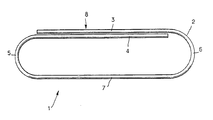
- the staple fiber 1 of drawn steel is produced from a section 2 of cylindrical steel wire shaped so that the fiber 1 is contained in a plane and present in this plane the configuration of a convex and closed loop, the two end parts 3 and 4 of the section 2 of steel wire being arranged side by side and in opposite directions.
- the fiber has the shape of an oblong loop and comprises two portions of curvilinear wire 5 and 6 in a semicircle connected together by portions of straight wire 7 and 8.
- the two end parts 3 and 4 of the section of wire 2 form the rectilinear portion 8 and extend between the curvilinear portions 5 and 6.
- the length of the rectilinear portions 7 and 8 is between ten and fifty millimeters, and these rectilinear portions which are substantially parallel are spaced apart by a distance between two-fifths of their length and twice that length.
- the wire section 2 is preferably cylindrical and its diameter is between one tenth of a millimeter and one millimeter.
- the dimensioning of the fiber 1 used in a fiber composite, in particular a cement matrix is a function of the size of the aggregates incorporated in the cement matrix.
- the percentage by volume of fibers in the cement matrix is close to one percent.
- the closed shape of the fibers 1 prevents them from clinging to each other, and the walls of the aggregates entrain the fibers during the kneading of the cement matrix, thus making it possible to obtain a homogeneous fiber composite in which the fibers are individualized.
- This closed shape also allows perfect anchoring of the fibers and gives the composite a surface state free of spikes.
Landscapes
- Engineering & Computer Science (AREA)
- Chemical & Material Sciences (AREA)
- Ceramic Engineering (AREA)
- Architecture (AREA)
- Structural Engineering (AREA)
- Civil Engineering (AREA)
- Materials Engineering (AREA)
- Organic Chemistry (AREA)
- Nanotechnology (AREA)
- Curing Cements, Concrete, And Artificial Stone (AREA)
- Yarns And Mechanical Finishing Of Yarns Or Ropes (AREA)
- Reinforcement Elements For Buildings (AREA)
- Wire Processing (AREA)
- Ropes Or Cables (AREA)
- Inorganic Fibers (AREA)
- Superconductors And Manufacturing Methods Therefor (AREA)
Applications Claiming Priority (2)
| Application Number | Priority Date | Filing Date | Title |
|---|---|---|---|
| FR8915839 | 1989-11-30 | ||
| FR8915839A FR2655035B1 (fr) | 1989-11-30 | 1989-11-30 | Fibre discontinue en acier trefile et composite fibre contenant ladite fibre. |
Publications (2)
| Publication Number | Publication Date |
|---|---|
| EP0430786A1 true EP0430786A1 (de) | 1991-06-05 |
| EP0430786B1 EP0430786B1 (de) | 1995-03-01 |
Family
ID=9388006
Family Applications (1)
| Application Number | Title | Priority Date | Filing Date |
|---|---|---|---|
| EP90403335A Expired - Lifetime EP0430786B1 (de) | 1989-11-30 | 1990-11-26 | Stapelfaser aus gezogenem Stahl und diese Faser enthaltendes Faserverbundmaterial |
Country Status (9)
| Country | Link |
|---|---|
| US (1) | US5162059A (de) |
| EP (1) | EP0430786B1 (de) |
| JP (1) | JPH03194054A (de) |
| AT (1) | ATE119141T1 (de) |
| AU (1) | AU629068B2 (de) |
| CA (1) | CA2030635A1 (de) |
| DE (1) | DE69017374T2 (de) |
| ES (1) | ES2071799T3 (de) |
| FR (1) | FR2655035B1 (de) |
Families Citing this family (7)
| Publication number | Priority date | Publication date | Assignee | Title |
|---|---|---|---|---|
| US5858082A (en) * | 1997-09-15 | 1999-01-12 | Cruz; Hector Gonzalo | Self-interlocking reinforcement fibers |
| US7727326B1 (en) | 2004-02-13 | 2010-06-01 | Trangsrud Julian P | Varied length fibers in a brittle material |
| HUP1600552A2 (en) * | 2016-09-28 | 2018-05-02 | Novonovon Zrt | Reinforcing fibre and method for the production of reinforced composites especially reinforced concrete |
| JP6405066B1 (ja) * | 2018-04-05 | 2018-10-17 | 株式会社 天野ミューテック | 金属繊維及びこれを適用したコンクリート構造体 |
| DE102020110643A1 (de) | 2020-04-20 | 2021-10-21 | Universität Kassel | Metallische Faser als Bestandteil eines Betonbauteiles |
| JP7300681B2 (ja) * | 2020-05-28 | 2023-06-30 | 株式会社不動テトラ | 材料のリサイクルが可能な繊維補強コンクリート及びそのリサイクル方法 |
| CN113716901A (zh) * | 2021-08-17 | 2021-11-30 | 湖南工业大学 | 一种新型增强增韧混凝土的方法及混凝土 |
Citations (3)
| Publication number | Priority date | Publication date | Assignee | Title |
|---|---|---|---|---|
| GB191411754A (en) * | 1914-05-13 | 1915-05-13 | William Ficklen | Improvements in Reinforced Structures & Wearing Surfaces of Hydraulic, Bituminous, or the like Cement, Concrete, Asphalt or the like. |
| US1913707A (en) * | 1931-06-01 | 1933-06-13 | Etheridge Harry | Concrete construction |
| US3616589A (en) * | 1968-10-31 | 1971-11-02 | James L Sherard | Fiber reinforced concrete |
Family Cites Families (5)
| Publication number | Priority date | Publication date | Assignee | Title |
|---|---|---|---|---|
| GB1446855A (en) * | 1972-08-16 | 1976-08-18 | Gkn Somerset Wire Ltd | Metal reinforcing elements |
| FR2370839A1 (fr) * | 1976-11-12 | 1978-06-09 | Michelin & Cie | Fils metalliques courts pour renforcer des materiaux |
| EP0098825B1 (de) * | 1982-07-01 | 1987-03-04 | Eurosteel S.A. | Armierungsfasern für giessfähige Baustoffe mit hydraulischem oder sonstigem Bindemittel und ihre Herstellung |
| JPS6287448A (ja) * | 1985-10-12 | 1987-04-21 | 兵頭 辰已 | セメント混合物に小輪形繊維補強材を混入した補強方法 |
| US4780141A (en) * | 1986-08-08 | 1988-10-25 | Cemcom Corporation | Cementitious composite material containing metal fiber |
-
1989
- 1989-11-30 FR FR8915839A patent/FR2655035B1/fr not_active Expired - Fee Related
-
1990
- 1990-11-22 CA CA002030635A patent/CA2030635A1/en not_active Abandoned
- 1990-11-26 EP EP90403335A patent/EP0430786B1/de not_active Expired - Lifetime
- 1990-11-26 AT AT90403335T patent/ATE119141T1/de not_active IP Right Cessation
- 1990-11-26 ES ES90403335T patent/ES2071799T3/es not_active Expired - Lifetime
- 1990-11-26 DE DE69017374T patent/DE69017374T2/de not_active Expired - Fee Related
- 1990-11-27 AU AU67016/90A patent/AU629068B2/en not_active Ceased
- 1990-11-30 JP JP2330922A patent/JPH03194054A/ja active Pending
-
1992
- 1992-03-11 US US07/850,241 patent/US5162059A/en not_active Expired - Fee Related
Patent Citations (3)
| Publication number | Priority date | Publication date | Assignee | Title |
|---|---|---|---|---|
| GB191411754A (en) * | 1914-05-13 | 1915-05-13 | William Ficklen | Improvements in Reinforced Structures & Wearing Surfaces of Hydraulic, Bituminous, or the like Cement, Concrete, Asphalt or the like. |
| US1913707A (en) * | 1931-06-01 | 1933-06-13 | Etheridge Harry | Concrete construction |
| US3616589A (en) * | 1968-10-31 | 1971-11-02 | James L Sherard | Fiber reinforced concrete |
Non-Patent Citations (1)
| Title |
|---|
| CHEMICAL ABSTRACTS, vol. 107, no. 4, juillet 1987 Columbus, Ohio, USA page 265; ref. no. 27539X & JP-A-62 087 448 (Eito,Tatsumi) 21-04-1987 * |
Also Published As
| Publication number | Publication date |
|---|---|
| FR2655035A1 (fr) | 1991-05-31 |
| AU6701690A (en) | 1991-06-06 |
| DE69017374T2 (de) | 1995-10-12 |
| ES2071799T3 (es) | 1995-07-01 |
| CA2030635A1 (en) | 1991-05-31 |
| JPH03194054A (ja) | 1991-08-23 |
| ATE119141T1 (de) | 1995-03-15 |
| EP0430786B1 (de) | 1995-03-01 |
| AU629068B2 (en) | 1992-09-24 |
| DE69017374D1 (de) | 1995-04-06 |
| FR2655035B1 (fr) | 1993-08-20 |
| US5162059A (en) | 1992-11-10 |
Similar Documents
| Publication | Publication Date | Title |
|---|---|---|
| CA1224501A (fr) | Elements filiformes utilisables pour le renforcement de materiaux moulables en particulier pour le beton | |
| EP0430786B1 (de) | Stapelfaser aus gezogenem Stahl und diese Faser enthaltendes Faserverbundmaterial | |
| US5904438A (en) | Method of terminating a fiber rope | |
| CA1037793A (fr) | Cable pour armer des objets constitues en materiaux elastiques ou facilement deformables______________________________________________________ | |
| EP1129264B1 (de) | Kabel aus parallelen fäden für ein bauwerk, verankerung und verankerungsverfahren für solchen kabel | |
| FR2906595A1 (fr) | Embout de fixation de conduite tubulaire flexible a hautes resistances | |
| MXPA97004202A (en) | A method of terminating a fibre rope | |
| FR2597182A1 (fr) | Courroie trapezoidale de transmission perfectionnee et son procede de fabrication | |
| WO2020249913A1 (fr) | Procédé et dispositif de fabrication d'un béton fibré anisotrope | |
| WO1984000186A1 (fr) | Fibres de renforcement de materiaux moulables a liant hydraulique ou non et leur fabrication | |
| FR3069558A1 (fr) | Dispositif d'ancrage d'armatures | |
| FR2843435A1 (fr) | Terminaison de joint de cordon | |
| EP1065317B1 (de) | Kabelaufhängung für eine Hängebrücke | |
| EP1869270B9 (de) | Verfahren zur verstärkung einer röhrenförmigen metallstruktur | |
| FR2478193A1 (fr) | Procede pour etayer et/ou consolider des cavites de constructions souterraines, de mines et de tunnels, dispositif pour executer le procede et boulon d'ancrage ancre dans un trou fore dans la paroi d'une cavite | |
| WO2008044855A1 (en) | Wire rope ring for cargo-working and method for manufacturing the same | |
| FR2589543A1 (fr) | Dispositif d'agrafage pour la jonction des courroies, procede de jonctionnement utilisant ce dispositif et courroie jonctionnee selon ce procede | |
| FR2686915A1 (fr) | Dispositif pour l'ancrage sous tension de tirants en materiau composite. | |
| FR2663067A1 (fr) | Fibres d'armature en metal pour le renforcement de beton. | |
| KR100245838B1 (ko) | 다수의 섬유링이 포함된 콘크리트 | |
| FR2652826A1 (fr) | Fil composite comprenant une ame multifilamentaire torse, ceinturee d'une gaine constituee par l'enroulement d'un fil fin a spires jointives. | |
| CN217839700U (zh) | 一种cfrp群锚锚固系统 | |
| FR2751008A1 (fr) | Fibres metalliques, utilisables notamment pour le renforcement du beton, leur procede de fabrication et leur utilisation | |
| EP0863277B1 (de) | Verfahren zur Realisierung eines vor- oder nachgespannten Bauwerks und Verfahren zur Herstellung von Litzen zur Verwendung in einem solchen Verfahren | |
| CN221878557U (zh) | 一种用于预应力筋的锚固装置 |
Legal Events
| Date | Code | Title | Description |
|---|---|---|---|
| PUAI | Public reference made under article 153(3) epc to a published international application that has entered the european phase |
Free format text: ORIGINAL CODE: 0009012 |
|
| AK | Designated contracting states |
Kind code of ref document: A1 Designated state(s): AT BE CH DE DK ES FR GB GR IT LI LU NL SE |
|
| 17P | Request for examination filed |
Effective date: 19911119 |
|
| 17Q | First examination report despatched |
Effective date: 19940114 |
|
| GRAA | (expected) grant |
Free format text: ORIGINAL CODE: 0009210 |
|
| AK | Designated contracting states |
Kind code of ref document: B1 Designated state(s): AT BE CH DE DK ES FR GB GR IT LI LU NL SE |
|
| PG25 | Lapsed in a contracting state [announced via postgrant information from national office to epo] |
Ref country code: IT Free format text: LAPSE BECAUSE OF FAILURE TO SUBMIT A TRANSLATION OF THE DESCRIPTION OR TO PAY THE FEE WITHIN THE PRE;WARNING: LAPSES OF ITALIAN PATENTS WITH EFFECTIVE DATE BEFORE 2007 MAY HAVE OCCURRED AT ANY TIME BEFORE 2007. THE CORRECT EFFECTIVE DATE MAY BE DIFFERENT FROM THE ONE RECORDED.SCRIBED TIME-LIMIT Effective date: 19950301 Ref country code: AT Effective date: 19950301 Ref country code: NL Free format text: LAPSE BECAUSE OF NON-PAYMENT OF DUE FEES Effective date: 19950301 Ref country code: GR Free format text: LAPSE BECAUSE OF FAILURE TO SUBMIT A TRANSLATION OF THE DESCRIPTION OR TO PAY THE FEE WITHIN THE PRESCRIBED TIME-LIMIT Effective date: 19950301 Ref country code: GB Effective date: 19950301 Ref country code: DK Effective date: 19950301 |
|
| REF | Corresponds to: |
Ref document number: 119141 Country of ref document: AT Date of ref document: 19950315 Kind code of ref document: T |
|
| REF | Corresponds to: |
Ref document number: 69017374 Country of ref document: DE Date of ref document: 19950406 |
|
| PG25 | Lapsed in a contracting state [announced via postgrant information from national office to epo] |
Ref country code: SE Effective date: 19950601 |
|
| REG | Reference to a national code |
Ref country code: ES Ref legal event code: FG2A Ref document number: 2071799 Country of ref document: ES Kind code of ref document: T3 |
|
| NLV1 | Nl: lapsed or annulled due to failure to fulfill the requirements of art. 29p and 29m of the patents act | ||
| GBV | Gb: ep patent (uk) treated as always having been void in accordance with gb section 77(7)/1977 [no translation filed] |
Effective date: 19950301 |
|
| PG25 | Lapsed in a contracting state [announced via postgrant information from national office to epo] |
Ref country code: LU Free format text: LAPSE BECAUSE OF NON-PAYMENT OF DUE FEES Effective date: 19951130 Ref country code: LI Effective date: 19951130 Ref country code: CH Effective date: 19951130 |
|
| PLBE | No opposition filed within time limit |
Free format text: ORIGINAL CODE: 0009261 |
|
| STAA | Information on the status of an ep patent application or granted ep patent |
Free format text: STATUS: NO OPPOSITION FILED WITHIN TIME LIMIT |
|
| 26N | No opposition filed | ||
| REG | Reference to a national code |
Ref country code: CH Ref legal event code: PL |
|
| PGFP | Annual fee paid to national office [announced via postgrant information from national office to epo] |
Ref country code: ES Payment date: 19981116 Year of fee payment: 9 |
|
| PGFP | Annual fee paid to national office [announced via postgrant information from national office to epo] |
Ref country code: DE Payment date: 19981119 Year of fee payment: 9 |
|
| PGFP | Annual fee paid to national office [announced via postgrant information from national office to epo] |
Ref country code: FR Payment date: 19981130 Year of fee payment: 9 |
|
| PGFP | Annual fee paid to national office [announced via postgrant information from national office to epo] |
Ref country code: BE Payment date: 19981210 Year of fee payment: 9 |
|
| PG25 | Lapsed in a contracting state [announced via postgrant information from national office to epo] |
Ref country code: ES Free format text: LAPSE BECAUSE OF NON-PAYMENT OF DUE FEES Effective date: 19991127 |
|
| PG25 | Lapsed in a contracting state [announced via postgrant information from national office to epo] |
Ref country code: BE Free format text: LAPSE BECAUSE OF NON-PAYMENT OF DUE FEES Effective date: 19991130 |
|
| BERE | Be: lapsed |
Owner name: ETAT FRANCAIS REPRESENTE PAR LE LABORATOIRE CENTRA Effective date: 19991130 |
|
| PG25 | Lapsed in a contracting state [announced via postgrant information from national office to epo] |
Ref country code: FR Free format text: LAPSE BECAUSE OF NON-PAYMENT OF DUE FEES Effective date: 20000731 |
|
| PG25 | Lapsed in a contracting state [announced via postgrant information from national office to epo] |
Ref country code: DE Free format text: LAPSE BECAUSE OF NON-PAYMENT OF DUE FEES Effective date: 20000901 |
|
| REG | Reference to a national code |
Ref country code: FR Ref legal event code: ST |
|
| REG | Reference to a national code |
Ref country code: ES Ref legal event code: FD2A Effective date: 20001214 |