EP0424232A2 - Process for the production of chenodesoxycholic - Google Patents
Process for the production of chenodesoxycholic Download PDFInfo
- Publication number
- EP0424232A2 EP0424232A2 EP90402879A EP90402879A EP0424232A2 EP 0424232 A2 EP0424232 A2 EP 0424232A2 EP 90402879 A EP90402879 A EP 90402879A EP 90402879 A EP90402879 A EP 90402879A EP 0424232 A2 EP0424232 A2 EP 0424232A2
- Authority
- EP
- European Patent Office
- Prior art keywords
- formula
- acid
- compound
- water
- oxo
- Prior art date
- Legal status (The legal status is an assumption and is not a legal conclusion. Google has not performed a legal analysis and makes no representation as to the accuracy of the status listed.)
- Granted
Links
- 238000000034 method Methods 0.000 title claims abstract description 36
- 238000004519 manufacturing process Methods 0.000 title description 2
- RUDATBOHQWOJDD-UHFFFAOYSA-N (3beta,5beta,7alpha)-3,7-Dihydroxycholan-24-oic acid Natural products OC1CC2CC(O)CCC2(C)C2C1C1CCC(C(CCC(O)=O)C)C1(C)CC2 RUDATBOHQWOJDD-UHFFFAOYSA-N 0.000 claims abstract description 55
- XLYOFNOQVPJJNP-UHFFFAOYSA-N water Substances O XLYOFNOQVPJJNP-UHFFFAOYSA-N 0.000 claims abstract description 52
- QTBSBXVTEAMEQO-UHFFFAOYSA-N Acetic acid Chemical compound CC(O)=O QTBSBXVTEAMEQO-UHFFFAOYSA-N 0.000 claims abstract description 49
- RUDATBOHQWOJDD-BSWAIDMHSA-N chenodeoxycholic acid Chemical compound C([C@H]1C[C@H]2O)[C@H](O)CC[C@]1(C)[C@@H]1[C@@H]2[C@@H]2CC[C@H]([C@@H](CCC(O)=O)C)[C@@]2(C)CC1 RUDATBOHQWOJDD-BSWAIDMHSA-N 0.000 claims abstract description 42
- 229960001091 chenodeoxycholic acid Drugs 0.000 claims abstract description 42
- WQYVRQLZKVEZGA-UHFFFAOYSA-N hypochlorite Inorganic materials Cl[O-] WQYVRQLZKVEZGA-UHFFFAOYSA-N 0.000 claims abstract description 32
- 239000003960 organic solvent Substances 0.000 claims abstract description 26
- WFDIJRYMOXRFFG-UHFFFAOYSA-N Acetic anhydride Chemical compound CC(=O)OC(C)=O WFDIJRYMOXRFFG-UHFFFAOYSA-N 0.000 claims abstract description 24
- 238000007254 oxidation reaction Methods 0.000 claims abstract description 21
- 238000002360 preparation method Methods 0.000 claims abstract description 19
- OAKJQQAXSVQMHS-UHFFFAOYSA-N Hydrazine Chemical compound NN OAKJQQAXSVQMHS-UHFFFAOYSA-N 0.000 claims abstract description 18
- 125000002496 methyl group Chemical group [H]C([H])([H])* 0.000 claims abstract description 16
- -1 alkali metal hypochlorite Chemical class 0.000 claims abstract description 15
- 230000003647 oxidation Effects 0.000 claims abstract description 15
- 239000007858 starting material Substances 0.000 claims abstract description 12
- RUDATBOHQWOJDD-UZVSRGJWSA-N ursodeoxycholic acid Chemical compound C([C@H]1C[C@@H]2O)[C@H](O)CC[C@]1(C)[C@@H]1[C@@H]2[C@@H]2CC[C@H]([C@@H](CCC(O)=O)C)[C@@]2(C)CC1 RUDATBOHQWOJDD-UZVSRGJWSA-N 0.000 claims abstract description 12
- 229960001661 ursodiol Drugs 0.000 claims abstract description 11
- ZKGCEXPUCJDWMB-ZPMVHPDISA-N (4r)-4-[(8r,9s,10s,13r,14s,17r)-10,13-dimethyl-7-oxo-1,2,3,4,5,6,8,9,11,12,14,15,16,17-tetradecahydrocyclopenta[a]phenanthren-17-yl]pentanoic acid Chemical class C1CCCC2CC(=O)[C@H]3[C@@H]4CC[C@H]([C@@H](CCC(O)=O)C)[C@@]4(C)CC[C@@H]3[C@]21C ZKGCEXPUCJDWMB-ZPMVHPDISA-N 0.000 claims abstract description 6
- 150000003512 tertiary amines Chemical class 0.000 claims abstract description 6
- 230000003197 catalytic effect Effects 0.000 claims abstract description 5
- 150000007529 inorganic bases Chemical class 0.000 claims abstract description 3
- 150000001875 compounds Chemical class 0.000 claims description 43
- 238000006243 chemical reaction Methods 0.000 claims description 32
- XEKOWRVHYACXOJ-UHFFFAOYSA-N Ethyl acetate Chemical compound CCOC(C)=O XEKOWRVHYACXOJ-UHFFFAOYSA-N 0.000 claims description 30
- 239000000203 mixture Substances 0.000 claims description 29
- YXFVVABEGXRONW-UHFFFAOYSA-N Toluene Chemical compound CC1=CC=CC=C1 YXFVVABEGXRONW-UHFFFAOYSA-N 0.000 claims description 27
- 239000002904 solvent Substances 0.000 claims description 21
- LRHPLDYGYMQRHN-UHFFFAOYSA-N N-Butanol Chemical compound CCCCO LRHPLDYGYMQRHN-UHFFFAOYSA-N 0.000 claims description 18
- 150000002148 esters Chemical class 0.000 claims description 18
- 239000011541 reaction mixture Substances 0.000 claims description 17
- CPELXLSAUQHCOX-UHFFFAOYSA-M Bromide Chemical compound [Br-] CPELXLSAUQHCOX-UHFFFAOYSA-M 0.000 claims description 14
- JHJLBTNAGRQEKS-UHFFFAOYSA-M sodium bromide Chemical compound [Na+].[Br-] JHJLBTNAGRQEKS-UHFFFAOYSA-M 0.000 claims description 14
- 239000003513 alkali Substances 0.000 claims description 13
- CSCPPACGZOOCGX-UHFFFAOYSA-N Acetone Chemical compound CC(C)=O CSCPPACGZOOCGX-UHFFFAOYSA-N 0.000 claims description 12
- 229910052739 hydrogen Inorganic materials 0.000 claims description 12
- 125000004043 oxo group Chemical group O=* 0.000 claims description 12
- UFHFLCQGNIYNRP-UHFFFAOYSA-N Hydrogen Chemical compound [H][H] UFHFLCQGNIYNRP-UHFFFAOYSA-N 0.000 claims description 11
- 125000001495 ethyl group Chemical group [H]C([H])([H])C([H])([H])* 0.000 claims description 11
- 239000001257 hydrogen Substances 0.000 claims description 11
- LFQSCWFLJHTTHZ-UHFFFAOYSA-N Ethanol Chemical compound CCO LFQSCWFLJHTTHZ-UHFFFAOYSA-N 0.000 claims description 8
- 125000002777 acetyl group Chemical group [H]C([H])([H])C(*)=O 0.000 claims description 8
- 238000009835 boiling Methods 0.000 claims description 8
- BHQCQFFYRZLCQQ-OELDTZBJSA-N cholic acid Chemical compound C([C@H]1C[C@H]2O)[C@H](O)CC[C@]1(C)[C@@H]1[C@@H]2[C@@H]2CC[C@H]([C@@H](CCC(O)=O)C)[C@@]2(C)[C@@H](O)C1 BHQCQFFYRZLCQQ-OELDTZBJSA-N 0.000 claims description 8
- 238000005984 hydrogenation reaction Methods 0.000 claims description 8
- 239000005708 Sodium hypochlorite Substances 0.000 claims description 7
- 150000001412 amines Chemical class 0.000 claims description 7
- 239000002585 base Substances 0.000 claims description 7
- 229940099352 cholate Drugs 0.000 claims description 7
- 125000004123 n-propyl group Chemical group [H]C([H])([H])C([H])([H])C([H])([H])* 0.000 claims description 7
- SUKJFIGYRHOWBL-UHFFFAOYSA-N sodium hypochlorite Chemical compound [Na+].Cl[O-] SUKJFIGYRHOWBL-UHFFFAOYSA-N 0.000 claims description 7
- XNWFRZJHXBZDAG-UHFFFAOYSA-N 2-METHOXYETHANOL Chemical compound COCCO XNWFRZJHXBZDAG-UHFFFAOYSA-N 0.000 claims description 6
- MIHNUBCEFJLAGN-DMMBONCOSA-N 3alpha,7alpha-dihydroxy-12-oxo-5beta-cholanic acid Chemical compound C([C@H]1C[C@H]2O)[C@H](O)CC[C@]1(C)[C@@H]1[C@@H]2[C@@H]2CC[C@H]([C@@H](CCC(O)=O)C)[C@@]2(C)C(=O)C1 MIHNUBCEFJLAGN-DMMBONCOSA-N 0.000 claims description 6
- VHYFNPMBLIVWCW-UHFFFAOYSA-N 4-Dimethylaminopyridine Chemical compound CN(C)C1=CC=NC=C1 VHYFNPMBLIVWCW-UHFFFAOYSA-N 0.000 claims description 6
- IJGRMHOSHXDMSA-UHFFFAOYSA-N Atomic nitrogen Chemical compound N#N IJGRMHOSHXDMSA-UHFFFAOYSA-N 0.000 claims description 6
- QDWJUBJKEHXSMT-UHFFFAOYSA-N boranylidynenickel Chemical compound [Ni]#B QDWJUBJKEHXSMT-UHFFFAOYSA-N 0.000 claims description 6
- 238000006389 diacetylation reaction Methods 0.000 claims description 6
- 238000001704 evaporation Methods 0.000 claims description 6
- 229910052757 nitrogen Inorganic materials 0.000 claims description 6
- BHQCQFFYRZLCQQ-UHFFFAOYSA-N (3alpha,5alpha,7alpha,12alpha)-3,7,12-trihydroxy-cholan-24-oic acid Natural products OC1CC2CC(O)CCC2(C)C2C1C1CCC(C(CCC(O)=O)C)C1(C)C(O)C2 BHQCQFFYRZLCQQ-UHFFFAOYSA-N 0.000 claims description 5
- 239000004380 Cholic acid Substances 0.000 claims description 5
- 229960002471 cholic acid Drugs 0.000 claims description 5
- 235000019416 cholic acid Nutrition 0.000 claims description 5
- KXGVEGMKQFWNSR-UHFFFAOYSA-N deoxycholic acid Natural products C1CC2CC(O)CCC2(C)C2C1C1CCC(C(CCC(O)=O)C)C1(C)C(O)C2 KXGVEGMKQFWNSR-UHFFFAOYSA-N 0.000 claims description 5
- 229910052500 inorganic mineral Inorganic materials 0.000 claims description 5
- 239000011707 mineral Substances 0.000 claims description 5
- BSYCBEFCUGMWAQ-YDCZHVRYSA-N (8S,9S,10R,13S,14S,17R)-16-hydroxy-13-methyl-17-[(2R)-pentan-2-yl]-2,3,4,5,6,7,8,9,11,12,14,15,16,17-tetradecahydro-1H-cyclopenta[a]phenanthrene-10-carboxylic acid Chemical compound C1CC2CCCC[C@]2(C(O)=O)[C@@H]2[C@@H]1[C@@H]1CC(O)[C@H]([C@H](C)CCC)[C@@]1(C)CC2 BSYCBEFCUGMWAQ-YDCZHVRYSA-N 0.000 claims description 4
- 230000008020 evaporation Effects 0.000 claims description 4
- 159000000011 group IA salts Chemical class 0.000 claims description 4
- 125000004573 morpholin-4-yl group Chemical group N1(CCOCC1)* 0.000 claims description 4
- DLYVTEULDNMQAR-SRNOMOOLSA-N Cholic Acid Methyl Ester Chemical compound C([C@H]1C[C@H]2O)[C@H](O)CC[C@]1(C)[C@@H]1[C@@H]2[C@@H]2CC[C@H]([C@H](C)CCC(=O)OC)[C@@]2(C)[C@@H](O)C1 DLYVTEULDNMQAR-SRNOMOOLSA-N 0.000 claims description 3
- 125000004429 atom Chemical group 0.000 claims description 3
- 239000003054 catalyst Substances 0.000 claims description 3
- 125000004433 nitrogen atom Chemical group N* 0.000 claims description 3
- 125000004178 (C1-C4) alkyl group Chemical group 0.000 claims description 2
- 238000006640 acetylation reaction Methods 0.000 abstract description 8
- IOOKJGQHLHXYEF-FFFIEFPASA-N 3,7-Diketocholanic acid Chemical compound C1CC(=O)C[C@H]2CC(=O)[C@H]3[C@@H]4CC[C@H]([C@@H](CCC(O)=O)C)[C@@]4(C)CC[C@@H]3[C@]21C IOOKJGQHLHXYEF-FFFIEFPASA-N 0.000 abstract description 7
- 230000021736 acetylation Effects 0.000 abstract description 6
- RVGVSOKFBAOUCH-JDCDKZKASA-N (4r)-4-[(8r,9s,10s,13r,14s,17r)-10,13-dimethyl-12-oxo-1,2,3,4,5,6,7,8,9,11,14,15,16,17-tetradecahydrocyclopenta[a]phenanthren-17-yl]pentanoic acid Chemical class C1CC2CCCC[C@]2(C)[C@@H]2[C@@H]1[C@@H]1CC[C@H]([C@@H](CCC(O)=O)C)[C@@]1(C)C(=O)C2 RVGVSOKFBAOUCH-JDCDKZKASA-N 0.000 abstract description 3
- 125000000217 alkyl group Chemical group 0.000 abstract description 3
- 150000001801 chenodeoxycholic acids Chemical class 0.000 abstract description 2
- 238000004821 distillation Methods 0.000 abstract description 2
- 150000003674 ursodeoxycholic acids Chemical class 0.000 abstract description 2
- 229910052783 alkali metal Inorganic materials 0.000 abstract 2
- 229910001513 alkali metal bromide Inorganic materials 0.000 abstract 2
- 239000002812 cholic acid derivative Substances 0.000 abstract 2
- 239000013067 intermediate product Substances 0.000 abstract 1
- 239000000047 product Substances 0.000 description 25
- 239000000243 solution Substances 0.000 description 23
- YMWUJEATGCHHMB-UHFFFAOYSA-N Dichloromethane Chemical compound ClCCl YMWUJEATGCHHMB-UHFFFAOYSA-N 0.000 description 21
- 238000006722 reduction reaction Methods 0.000 description 13
- KWYUFKZDYYNOTN-UHFFFAOYSA-M Potassium hydroxide Chemical compound [OH-].[K+] KWYUFKZDYYNOTN-UHFFFAOYSA-M 0.000 description 12
- DXOCDBGWDZAYRQ-UHFFFAOYSA-N (3alpha,5beta)-3-Hydroxy-7-oxocholan-24 -oic acid Natural products C1CC(O)CC2CC(=O)C3C4CCC(C(CCC(O)=O)C)C4(C)CCC3C21C DXOCDBGWDZAYRQ-UHFFFAOYSA-N 0.000 description 10
- DXOCDBGWDZAYRQ-AURDAFMXSA-N 7-oxolithocholic acid Chemical compound C1C[C@@H](O)C[C@H]2CC(=O)[C@H]3[C@@H]4CC[C@H]([C@@H](CCC(O)=O)C)[C@@]4(C)CC[C@@H]3[C@]21C DXOCDBGWDZAYRQ-AURDAFMXSA-N 0.000 description 10
- OKKJLVBELUTLKV-UHFFFAOYSA-N Methanol Chemical compound OC OKKJLVBELUTLKV-UHFFFAOYSA-N 0.000 description 9
- ZMANZCXQSJIPKH-UHFFFAOYSA-N Triethylamine Chemical compound CCN(CC)CC ZMANZCXQSJIPKH-UHFFFAOYSA-N 0.000 description 9
- JUJWROOIHBZHMG-UHFFFAOYSA-N Pyridine Chemical compound C1=CC=NC=C1 JUJWROOIHBZHMG-UHFFFAOYSA-N 0.000 description 8
- 238000007796 conventional method Methods 0.000 description 7
- RTZKZFJDLAIYFH-UHFFFAOYSA-N Diethyl ether Chemical compound CCOCC RTZKZFJDLAIYFH-UHFFFAOYSA-N 0.000 description 6
- VEXZGXHMUGYJMC-UHFFFAOYSA-N Hydrochloric acid Chemical compound Cl VEXZGXHMUGYJMC-UHFFFAOYSA-N 0.000 description 6
- UIIMBOGNXHQVGW-UHFFFAOYSA-M Sodium bicarbonate Chemical compound [Na+].OC([O-])=O UIIMBOGNXHQVGW-UHFFFAOYSA-M 0.000 description 6
- HEMHJVSKTPXQMS-UHFFFAOYSA-M Sodium hydroxide Chemical compound [OH-].[Na+] HEMHJVSKTPXQMS-UHFFFAOYSA-M 0.000 description 6
- QAOWNCQODCNURD-UHFFFAOYSA-N Sulfuric acid Chemical compound OS(O)(=O)=O QAOWNCQODCNURD-UHFFFAOYSA-N 0.000 description 6
- 239000012535 impurity Substances 0.000 description 6
- 238000001914 filtration Methods 0.000 description 5
- 238000010438 heat treatment Methods 0.000 description 5
- 230000007935 neutral effect Effects 0.000 description 5
- ZAMOUSCENKQFHK-UHFFFAOYSA-N Chlorine atom Chemical compound [Cl] ZAMOUSCENKQFHK-UHFFFAOYSA-N 0.000 description 4
- XTHFKEDIFFGKHM-UHFFFAOYSA-N Dimethoxyethane Chemical compound COCCOC XTHFKEDIFFGKHM-UHFFFAOYSA-N 0.000 description 4
- WYURNTSHIVDZCO-UHFFFAOYSA-N Tetrahydrofuran Chemical compound C1CCOC1 WYURNTSHIVDZCO-UHFFFAOYSA-N 0.000 description 4
- 239000002253 acid Substances 0.000 description 4
- 238000010533 azeotropic distillation Methods 0.000 description 4
- 230000015572 biosynthetic process Effects 0.000 description 4
- 239000006227 byproduct Substances 0.000 description 4
- 239000000460 chlorine Substances 0.000 description 4
- 229910052801 chlorine Inorganic materials 0.000 description 4
- 239000012467 final product Substances 0.000 description 4
- BDAGIHXWWSANSR-UHFFFAOYSA-N methanoic acid Natural products OC=O BDAGIHXWWSANSR-UHFFFAOYSA-N 0.000 description 4
- 235000010755 mineral Nutrition 0.000 description 4
- 239000012074 organic phase Substances 0.000 description 4
- UMJSCPRVCHMLSP-UHFFFAOYSA-N pyridine Natural products COC1=CC=CN=C1 UMJSCPRVCHMLSP-UHFFFAOYSA-N 0.000 description 4
- WSLDOOZREJYCGB-UHFFFAOYSA-N 1,2-Dichloroethane Chemical compound ClCCCl WSLDOOZREJYCGB-UHFFFAOYSA-N 0.000 description 3
- UHOVQNZJYSORNB-UHFFFAOYSA-N Benzene Chemical compound C1=CC=CC=C1 UHOVQNZJYSORNB-UHFFFAOYSA-N 0.000 description 3
- 0 C[C@](C(CCC1C2C(C3)=O)C1(C)C=CC2C1(C)C3CC(*)C(C)CC1)C=CC(O)=O Chemical compound C[C@](C(CCC1C2C(C3)=O)C1(C)C=CC2C1(C)C3CC(*)C(C)CC1)C=CC(O)=O 0.000 description 3
- DNIAPMSPPWPWGF-UHFFFAOYSA-N Propylene glycol Chemical compound CC(O)CO DNIAPMSPPWPWGF-UHFFFAOYSA-N 0.000 description 3
- 125000005907 alkyl ester group Chemical group 0.000 description 3
- 239000008346 aqueous phase Substances 0.000 description 3
- 229910052799 carbon Inorganic materials 0.000 description 3
- 238000002425 crystallisation Methods 0.000 description 3
- 230000008025 crystallization Effects 0.000 description 3
- 230000032050 esterification Effects 0.000 description 3
- 238000005886 esterification reaction Methods 0.000 description 3
- VKXXPYARELKQOY-CXFLVZIOSA-N methyl (4r)-4-[(3r,5s,7r,8r,9s,10s,12s,13r,14s,17r)-3,7-diacetyloxy-12-hydroxy-10,13-dimethyl-2,3,4,5,6,7,8,9,11,12,14,15,16,17-tetradecahydro-1h-cyclopenta[a]phenanthren-17-yl]pentanoate Chemical compound C([C@H]1C[C@H]2OC(C)=O)[C@H](OC(C)=O)CC[C@]1(C)[C@@H]1[C@@H]2[C@@H]2CC[C@H]([C@H](C)CCC(=O)OC)[C@@]2(C)[C@@H](O)C1 VKXXPYARELKQOY-CXFLVZIOSA-N 0.000 description 3
- 150000004702 methyl esters Chemical class 0.000 description 3
- 238000010992 reflux Methods 0.000 description 3
- 229910000030 sodium bicarbonate Inorganic materials 0.000 description 3
- 235000017557 sodium bicarbonate Nutrition 0.000 description 3
- 239000000725 suspension Substances 0.000 description 3
- PAMIQIKDUOTOBW-UHFFFAOYSA-N 1-methylpiperidine Chemical compound CN1CCCCC1 PAMIQIKDUOTOBW-UHFFFAOYSA-N 0.000 description 2
- OSWFIVFLDKOXQC-UHFFFAOYSA-N 4-(3-methoxyphenyl)aniline Chemical compound COC1=CC=CC(C=2C=CC(N)=CC=2)=C1 OSWFIVFLDKOXQC-UHFFFAOYSA-N 0.000 description 2
- SMEROWZSTRWXGI-UHFFFAOYSA-N Lithocholsaeure Natural products C1CC2CC(O)CCC2(C)C2C1C1CCC(C(CCC(O)=O)C)C1(C)CC2 SMEROWZSTRWXGI-UHFFFAOYSA-N 0.000 description 2
- JLTDJTHDQAWBAV-UHFFFAOYSA-N N,N-dimethylaniline Chemical compound CN(C)C1=CC=CC=C1 JLTDJTHDQAWBAV-UHFFFAOYSA-N 0.000 description 2
- PXHVJJICTQNCMI-UHFFFAOYSA-N Nickel Chemical compound [Ni] PXHVJJICTQNCMI-UHFFFAOYSA-N 0.000 description 2
- 238000005644 Wolff-Kishner reduction reaction Methods 0.000 description 2
- 239000007864 aqueous solution Substances 0.000 description 2
- 239000003125 aqueous solvent Substances 0.000 description 2
- 150000001768 cations Chemical class 0.000 description 2
- 230000008030 elimination Effects 0.000 description 2
- 238000003379 elimination reaction Methods 0.000 description 2
- LYCAIKOWRPUZTN-UHFFFAOYSA-N ethylene glycol Substances OCCO LYCAIKOWRPUZTN-UHFFFAOYSA-N 0.000 description 2
- 235000019253 formic acid Nutrition 0.000 description 2
- 150000008282 halocarbons Chemical class 0.000 description 2
- 238000002955 isolation Methods 0.000 description 2
- SMEROWZSTRWXGI-HVATVPOCSA-N lithocholic acid Chemical compound C([C@H]1CC2)[C@H](O)CC[C@]1(C)[C@@H]1[C@@H]2[C@@H]2CC[C@H]([C@@H](CCC(O)=O)C)[C@@]2(C)CC1 SMEROWZSTRWXGI-HVATVPOCSA-N 0.000 description 2
- GVIZCQOBODPSLY-ZNYVGMLLSA-N methyl (4r)-4-[(3r,5s,7r,8r,9s,10s,13r,14s,17r)-3,7-diacetyloxy-10,13-dimethyl-12-oxo-1,2,3,4,5,6,7,8,9,11,14,15,16,17-tetradecahydrocyclopenta[a]phenanthren-17-yl]pentanoate Chemical compound C([C@H]1C[C@H]2OC(C)=O)[C@H](OC(C)=O)CC[C@]1(C)[C@@H]1[C@@H]2[C@@H]2CC[C@H]([C@H](C)CCC(=O)OC)[C@@]2(C)C(=O)C1 GVIZCQOBODPSLY-ZNYVGMLLSA-N 0.000 description 2
- 230000020477 pH reduction Effects 0.000 description 2
- JYVLIDXNZAXMDK-UHFFFAOYSA-N pentan-2-ol Chemical compound CCCC(C)O JYVLIDXNZAXMDK-UHFFFAOYSA-N 0.000 description 2
- OVARTBFNCCXQKS-UHFFFAOYSA-N propan-2-one;hydrate Chemical compound O.CC(C)=O OVARTBFNCCXQKS-UHFFFAOYSA-N 0.000 description 2
- 238000007127 saponification reaction Methods 0.000 description 2
- GEHJYWRUCIMESM-UHFFFAOYSA-L sodium sulfite Chemical compound [Na+].[Na+].[O-]S([O-])=O GEHJYWRUCIMESM-UHFFFAOYSA-L 0.000 description 2
- 238000003786 synthesis reaction Methods 0.000 description 2
- YLQBMQCUIZJEEH-UHFFFAOYSA-N tetrahydrofuran Natural products C=1C=COC=1 YLQBMQCUIZJEEH-UHFFFAOYSA-N 0.000 description 2
- GETQZCLCWQTVFV-UHFFFAOYSA-N trimethylamine Chemical compound CN(C)C GETQZCLCWQTVFV-UHFFFAOYSA-N 0.000 description 2
- 238000005406 washing Methods 0.000 description 2
- NWZSZGALRFJKBT-KNIFDHDWSA-N (2s)-2,6-diaminohexanoic acid;(2s)-2-hydroxybutanedioic acid Chemical compound OC(=O)[C@@H](O)CC(O)=O.NCCCC[C@H](N)C(O)=O NWZSZGALRFJKBT-KNIFDHDWSA-N 0.000 description 1
- ZYVYEJXMYBUCMN-UHFFFAOYSA-N 1-methoxy-2-methylpropane Chemical compound COCC(C)C ZYVYEJXMYBUCMN-UHFFFAOYSA-N 0.000 description 1
- POAOYUHQDCAZBD-UHFFFAOYSA-N 2-butoxyethanol Chemical compound CCCCOCCO POAOYUHQDCAZBD-UHFFFAOYSA-N 0.000 description 1
- ZNQVEEAIQZEUHB-UHFFFAOYSA-N 2-ethoxyethanol Chemical compound CCOCCO ZNQVEEAIQZEUHB-UHFFFAOYSA-N 0.000 description 1
- 229940093475 2-ethoxyethanol Drugs 0.000 description 1
- YTTFFPATQICAQN-UHFFFAOYSA-N 2-methoxypropan-1-ol Chemical compound COC(C)CO YTTFFPATQICAQN-UHFFFAOYSA-N 0.000 description 1
- BAOZQZPGQWXJOW-UHFFFAOYSA-N C1C2C=CCC12 Chemical compound C1C2C=CCC12 BAOZQZPGQWXJOW-UHFFFAOYSA-N 0.000 description 1
- GDOPTJXRTPNYNR-UHFFFAOYSA-N CC1CCCC1 Chemical compound CC1CCCC1 GDOPTJXRTPNYNR-UHFFFAOYSA-N 0.000 description 1
- FJJYUWAAXREYNR-IPFWMANMSA-N CCC(C)C(CC1)C(C)(CCC2C(C)(CC[C@H](C3)O)C3C3)C1C2C3O Chemical compound CCC(C)C(CC1)C(C)(CCC2C(C)(CC[C@H](C3)O)C3C3)C1C2C3O FJJYUWAAXREYNR-IPFWMANMSA-N 0.000 description 1
- DHMXLAQUOMWHGR-PYTSDSBPSA-N CCC(CC1)C(C(CC(C2)C=CC[C@H]2O)O)C(CC2)C1(C)C2C(C)CCC(O)=O Chemical compound CCC(CC1)C(C(CC(C2)C=CC[C@H]2O)O)C(CC2)C1(C)C2C(C)CCC(O)=O DHMXLAQUOMWHGR-PYTSDSBPSA-N 0.000 description 1
- VGGSQFUCUMXWEO-UHFFFAOYSA-N Ethene Chemical compound C=C VGGSQFUCUMXWEO-UHFFFAOYSA-N 0.000 description 1
- NTIZESTWPVYFNL-UHFFFAOYSA-N Methyl isobutyl ketone Chemical compound CC(C)CC(C)=O NTIZESTWPVYFNL-UHFFFAOYSA-N 0.000 description 1
- UIHCLUNTQKBZGK-UHFFFAOYSA-N Methyl isobutyl ketone Natural products CCC(C)C(C)=O UIHCLUNTQKBZGK-UHFFFAOYSA-N 0.000 description 1
- SJRJJKPEHAURKC-UHFFFAOYSA-N N-Methylmorpholine Chemical compound CN1CCOCC1 SJRJJKPEHAURKC-UHFFFAOYSA-N 0.000 description 1
- ZLMJMSJWJFRBEC-UHFFFAOYSA-N Potassium Chemical compound [K] ZLMJMSJWJFRBEC-UHFFFAOYSA-N 0.000 description 1
- LSNNMFCWUKXFEE-UHFFFAOYSA-N Sulfurous acid Chemical compound OS(O)=O LSNNMFCWUKXFEE-UHFFFAOYSA-N 0.000 description 1
- 238000006856 Wolf-Kishner-Huang Minlon reduction reaction Methods 0.000 description 1
- 238000010521 absorption reaction Methods 0.000 description 1
- MQRWBMAEBQOWAF-UHFFFAOYSA-N acetic acid;nickel Chemical compound [Ni].CC(O)=O.CC(O)=O MQRWBMAEBQOWAF-UHFFFAOYSA-N 0.000 description 1
- 150000007513 acids Chemical class 0.000 description 1
- 229910001854 alkali hydroxide Inorganic materials 0.000 description 1
- 150000008044 alkali metal hydroxides Chemical class 0.000 description 1
- 150000001447 alkali salts Chemical class 0.000 description 1
- 150000005215 alkyl ethers Chemical class 0.000 description 1
- 150000008064 anhydrides Chemical class 0.000 description 1
- 150000004982 aromatic amines Chemical class 0.000 description 1
- 150000004945 aromatic hydrocarbons Chemical class 0.000 description 1
- 125000004432 carbon atom Chemical group C* 0.000 description 1
- 238000005119 centrifugation Methods 0.000 description 1
- 239000007795 chemical reaction product Substances 0.000 description 1
- 239000003153 chemical reaction reagent Substances 0.000 description 1
- 239000007810 chemical reaction solvent Substances 0.000 description 1
- 125000003907 chenodeoxycholic acid group Chemical group 0.000 description 1
- 238000004817 gas chromatography Methods 0.000 description 1
- IKDUDTNKRLTJSI-UHFFFAOYSA-N hydrazine monohydrate Substances O.NN IKDUDTNKRLTJSI-UHFFFAOYSA-N 0.000 description 1
- 239000000543 intermediate Substances 0.000 description 1
- 150000002576 ketones Chemical class 0.000 description 1
- 238000006386 neutralization reaction Methods 0.000 description 1
- 229910052759 nickel Inorganic materials 0.000 description 1
- 229940078494 nickel acetate Drugs 0.000 description 1
- 239000007800 oxidant agent Substances 0.000 description 1
- 230000001590 oxidative effect Effects 0.000 description 1
- 239000012071 phase Substances 0.000 description 1
- 239000011591 potassium Substances 0.000 description 1
- 229910052700 potassium Inorganic materials 0.000 description 1
- OTYBMLCTZGSZBG-UHFFFAOYSA-L potassium sulfate Chemical compound [K+].[K+].[O-]S([O-])(=O)=O OTYBMLCTZGSZBG-UHFFFAOYSA-L 0.000 description 1
- 229910052939 potassium sulfate Inorganic materials 0.000 description 1
- 235000011151 potassium sulphates Nutrition 0.000 description 1
- 238000001556 precipitation Methods 0.000 description 1
- 125000002112 pyrrolidino group Chemical group [*]N1C([H])([H])C([H])([H])C([H])([H])C1([H])[H] 0.000 description 1
- 239000000376 reactant Substances 0.000 description 1
- 235000010265 sodium sulphite Nutrition 0.000 description 1
- 230000007928 solubilization Effects 0.000 description 1
- 238000005063 solubilization Methods 0.000 description 1
- 238000011916 stereoselective reduction Methods 0.000 description 1
- 238000004809 thin layer chromatography Methods 0.000 description 1
Classifications
-
- C—CHEMISTRY; METALLURGY
- C07—ORGANIC CHEMISTRY
- C07J—STEROIDS
- C07J9/00—Normal steroids containing carbon, hydrogen, halogen or oxygen substituted in position 17 beta by a chain of more than two carbon atoms, e.g. cholane, cholestane, coprostane
- C07J9/005—Normal steroids containing carbon, hydrogen, halogen or oxygen substituted in position 17 beta by a chain of more than two carbon atoms, e.g. cholane, cholestane, coprostane containing a carboxylic function directly attached or attached by a chain containing only carbon atoms to the cyclopenta[a]hydrophenanthrene skeleton
Definitions
- the present invention relates to an improved process for the preparation of chenodeoxycholic acid (or 3 ⁇ , 7 ⁇ -dihydroxy-5 ⁇ -cholanic acid), and of ursodeoxycholic acid (or 3 ⁇ , 7 ⁇ -dihydroxy-5 ⁇ -cholanic acid).
- step a it is well known that the esters of cholic acid can be diacetylated in positions 3 and 7, to obtain the corresponding esters of 3 ⁇ , 7 ⁇ -diacetoxy-12 ⁇ acid. -hydroxycholanic.
- this diacetylation is carried out in particular by esterification with acetic anhydride in pyridine, using an excess of both acetic anhydride and pyridine and, in particular, using the latter two products as reaction solvents.
- step (b) The oxidation of hydroxycholanates provided for in step (b), generally carried out using an alkaline hypochlorite and acetic acid, is also well known in the literature, this reaction being carried out using an excess of acetic acid.
- the main drawback of this reaction is that of the release of chlorine, including, among other things, control problems to avoid ecological damage.
- this reaction does not give good yields in the final product and the main reason is due to the fact that, according to conventional methods, the reaction must be carried out or completed at very high temperature, which causes the formation of quantities not negligible by-products.
- step (d) the oxidation of chenodeoxycholic acid (III) provided for in step (d) to prepare ursodeoxycholic acid, which in the literature is carried out using an alkaline hypochlorite and an excess of acetic acid, disadvantage, previously cited, of releasing chlorine and thus causing control problems.
- step (a) With regard to the diacetylation in 3 and 7 of cholic acid esters, provided for in step (a), it has now been found that, in general, the diacetylation in 3 and 7 is carried out better if the starting ester does not contain traces of the alcohol esterifying the alkyl cholate and that the alcohol can be removed by washing with water of an alkyl cholate solution and azeotropic distillation.
- selective diacetylation of cholic acid esters can be carried out using a stoichiometric amount of acetic anhydride if operated in the presence of catalytic amounts of an N, N-dialkylaniline or a 4-dialkylaminopyridine and an amount of tertiary amine less than one mole of amine or mole of starting material.
- the amount of catalyst can vary from 0.3 to 1.5% by weight relative to the product (VI).
- organic solvent there may be used an aromatic hydrocarbon such as benzene or toluene, a halogenated solvent, such as methylene chloride or 1,2-dichloroethane, an ether, such as methyl isobutyl ether or 1,2 -dimethoxyethane, a ketone, such as acetone or methyl isobutyl ketone, an ester such as ethyl acetate or a mixture of two of these solvents.
- a second solvent is added to complete the solubilization of the reactants without using excessively large volumes.
- the acetylation reaction is preferably carried out in a toluene / acetone mixture, or in ethyl acetate.
- the tertiary amine is used in amounts which can vary between 20 and 50% by weight relative to the compound (VI).
- Preferred amines are aliphatic amines such as trimethylamine or triethylamine, but heterocyclic amines such as 1-methylpiperidine or 1-methylmorpholine or aromatic amines such as pyridine can also be used.
- This acetylation is carried out at a temperature of 0-5 ° C, as in all cases of this type of acetylation.
- the final product is isolated according to conventional techniques and can optionally be crystallized from toluene or from methanol.
- the starting product which must be subjected to acetylation is dry, in particular that it does not contain the alcohol used for the prior esterification.
- a starting methyl, ethyl or n-propyl cholate which contains 5 to 30% of the esterifying alcohol.
- said alcohol can be eliminated by dissolving the starting product in a mixture formed by an organic solvent having a boiling point at ambient pressure greater than 100 ° C., preferably the same solvent which will be used for the reaction acetylation, and water and by removing water first and then, azeotropically, from the solvent / water mixture.
- the water can first be removed and then the mixture of water and alcohol still optionally present by azeotropic distillation at a temperature above 100 ° C.
- toluene as a solvent having a boiling point at ambient pressure greater than 100 ° C.
- step (b) the oxidation reaction of the alkyl esters of 3 ⁇ , 7 ⁇ -diacetoxy-12 ⁇ -hydroxy-5 ⁇ -cholanic acid (I), can be carried out in a manner effective and without control problem by slowly adding an essentially stoichiometric amount of an alkaline hypochlorite to a solution of the 12 ⁇ -hydroxy derivative of formula (I) and acetic acid in stoichiometric amount, in the presence of an alkali bromide, to a temperature below 40 ° C, and preferably below 10 ° C.
- the preparation of the 12-oxocholanate of formula (II) in which both R ⁇ and R ′ represent hydrogen or both R ⁇ represent an acetyl group and R ′ has the same meaning as R above is more suitably produced by slowly adding an alkaline hypochlorite to a solution of a 12 ⁇ -hydroxycholanate of formula (I) wherein R is as defined above, containing acetic acid in stoichiometric quantity and an alkali bromide, at a temperature below 40 ° C, and in optionally saponifying the product thus obtained, to prepare the compound of formula (II) in which R ′ and R ⁇ represent hydrogen.
- the methyl ester of 3 ⁇ , 7 ⁇ -diacetoxy-12 ⁇ -hydroxy-5 ⁇ -cholanic acid is used.
- This reaction can be carried out in an organic or organic-aqueous solvent, the organic solvent being a halogenated hydrocarbon, for example methylene chloride or 1,2-dichloroethane, ethyl acetate or an ether, for example dimethoxyethane or tetrahydrofuran.
- organic solvent being a halogenated hydrocarbon, for example methylene chloride or 1,2-dichloroethane, ethyl acetate or an ether, for example dimethoxyethane or tetrahydrofuran.
- the alkali bromide is used in an amount of 0.30-1.15 mole per mole of starting hydroxycholanate, the cation preferably being that of the hypochlorite used.
- the hypochlorite preferably sodium hypochlorite and sodium bromide are used.
- the reaction temperature should be less than 40 ° C to avoid the release of chlorine, but it is advantageous to conduct the oxidation below 10 ° C and preferably below 0 ° C.
- reaction is terminated after 16-24 hours at a temperature between -10 and 0 ° C and the product of formula (II) is isolated according to conventional techniques.
- the product thus obtained can be isolated in crystalline form by pouring the reaction mixture into water, preferably in the presence of an alkali sulfite which serves to destroy the excess of oxidizing agent still present, by eliminating the phase aqueous and evaporating the solvent.
- the 12-oxo-cholanate thus obtained can also be purified by crystallizing it from a suitable solvent or solvent system, such as acetone or acetone-water mixtures.
- step (c) With regard to the reduction of a compound (II) to obtain chenodeoxycholic acid (III) (step (c)), it has now been found that, if the Wolff-Kishner reaction is carried out in an aqueous-organic solvent by slowly removing the water and part of the solvent by azeotropic distillation, the progress of the reduction is easily controlled and the chenodeoxycholic acid is obtained in the pure state with a practically quantitative yield.
- chenodeoxycholic acid can be obtained with a good yield and substantially free of impurities, in particular lithocholic acid, by treating 3 ⁇ , 7 ⁇ -dihydroxy-12-oxo-5 ⁇ -cholanic acid. or one of its esters of formula (II) in which R ′ and R ⁇ represent, hydrogen or R ⁇ represents an acetyl group and R ′ has the same meaning as R above, with hydrazine and a mineral base in a mixture of water and a hydroxylated organic solvent which has a boiling point at room pressure above 100 ° C and forms an azeotrope with water, at a temperature of 85-110 ° C, then the water and part of the solvent are distilled. increasing the temperature of the reaction mixture to 115-145 ° C and the reaction is allowed to end at this temperature.
- hydroxylated organic solvent means an organic solvent chosen from alkanols and lower alkyl ethers of ethylene or propylene glycol.
- Suitable organic solvents include 2-methoxyethanol (trade name: METHYL CELLOSOLVE) 2-ethoxyethanol, 2-butoxyethanol, 2-methoxy-propanol, 1-butanol and 2-pentanol, 2-methoxyethanol and 1-butanol being preferred.
- 2-methoxyethanol trade name: METHYL CELLOSOLVE
- 2-ethoxyethanol 2-butoxyethanol
- 2-methoxy-propanol 1-butanol and 2-pentanol
- 2-methoxyethanol and 1-butanol being preferred.
- the amount of water present in the reaction mixture with the hydroxylated organic solvent can vary between 10% and 30% by volume and is preferably present in a percentage of approximately 20% by volume relative to the organic solvent.
- the desired end product is chenodeoxycholic acid (III)
- the amount of mineral base must be calculated so as to cause the saponification of all the esters possibly present.
- potassium hydroxide 80-85%
- hydrazine is also used, in the form of the base, in 80-85% aqueous solution.
- the reaction is started slowly by heating to the temperature of 85-110 ° C in about 45-75 minutes, then the reaction mixture is left at the same temperature for a variable period of time between 1 and 5 hours.
- reaction mixture is distilled by slowly increasing the temperature of the mixture to 115-145 ° C, then the mixture is allowed to react at the same temperature.
- step (d) We also improved the oxidation of chenodeoxycholic acid planned in step (d), because we found that the oxidation reaction of chenodeoxycholic acid with an alkaline hypochlorite can be carried out effectively and without control problems by slowly adding the alkaline hypochlorite to a solution of chenodeoxycholic acid containing the stoichiometric amount of acetic acid and operating in the presence of an alkali bromide at a temperature below 40 ° C, preferably below 10 ° C.
- a 7-oxocholanate of formula (IV) in which X represents an oxo group or a ⁇ -H, ⁇ -OH group can better be carried out by oxidizing the chenodeoxycholic acid of formula (III) by slow addition of an alkaline hypochlorite to a solution of compound (III) containing acetic acid in stoichiometric quantity, in the presence of an alkali bromide, at a temperature below 40 ° C, and isolating the compound of formula (IV), where X is ⁇ -H, ⁇ -OH.
- the compound of formula (IV) can also be recovered from the mother liquors, where X is an oxo group or optionally subjecting the product obtained by dry evaporation of the mother liquors, in the form of an alkaline salt, to hydrogenation in the presence of nickel boride.
- the reaction can be carried out in an organic or organic-aqueous solvent, the organic solvent being a halogenated hydrocarbon, for example methylene chloride or 1,2-dichloroethane, ethyl acetate or an ether, for example dimethoxyethane or tetrahydrofuran.
- organic solvent being a halogenated hydrocarbon, for example methylene chloride or 1,2-dichloroethane, ethyl acetate or an ether, for example dimethoxyethane or tetrahydrofuran.
- the alkali bromide is advantageously used at a rate of 0.30-1.15 mole per mole of starting chenodeoxycholic acid, the cation preferably being that of the hypochlorite used.
- the hypochlorite preferably sodium hypochlorite and sodium bromide are used.
- the reaction temperature must be below 40 ° C to avoid the release of chlorine, but it is advantageous to conduct the oxidation below 10 ° C and, preferably, between 0 and 10 ° C.
- the reaction is finished after 6-12 hours at a temperature between 10 and 0 ° C and the final product is isolated according to conventional techniques.
- the reaction mixture is simply filtered and the product is washed with water and the 3 ⁇ -hydroxy-7-oxo-5 ⁇ -cholanic acid is thus recovered.
- the solvent By evaporation of the solvent, a mixture of 3,7-dioxo-5 ⁇ -cholanic acid and 3 ⁇ -hydroxy-7-oxo-5 ⁇ -cholanic acid is recovered.
- the hydrogenation is carried out at a variable temperature between room temperature and 70 ° C, preferably at 40-60 ° C and at a pressure between 1 and 4 bar. After 15 minutes to 4 hours, the hydrogenation is complete and the 3 ⁇ -hydroxy-7-oxo-5 ⁇ -cholanic acid is isolated by precipitation with a strong acid, such as hydrochloric acid or sulfuric acid.
- a strong acid such as hydrochloric acid or sulfuric acid.
- 3 ⁇ -hydroxy-7-oxo-5 ⁇ -cholanic acid can also be obtained with higher yields directly from chenodeoxycholic acid using the method described above, according to the variant illustrated below.
- the oxidation reaction is complete, instead of filtering the product obtained, it is evaporated to remove the organic solvent and the product is isolated, for example by adding water and evaporating, slowly increasing the temperature to 100 ° vs. The product is then separated by simple filtration.
- 3 ⁇ -hydroxy-7-oxo-5 ⁇ -cholanic acid which can contain up to 15% of an impurity constituted by 3,7-dioxo-5 ⁇ -cholanic acid, is thus obtained with good yields. or one of its esters or, possibly of two impurities, one of which is the latter produced and the other of small quantities (up to 2% of the total) of unreacted chenodeoxycholic acid.
- the compounds of formula (IV) thus obtained are useful as intermediates in the preparation of ursodeoxycholic acid by stereoselective reduction of the oxo group or groups (step (e)) according to conventional methods. This reduction allows the reduction of the 7-oxo group to the 7 ⁇ -hydroxy group.
- the reduction is carried out on a mixture of 3 ⁇ -hydroxy-7-oxo-5 ⁇ -cholanic acid and 3,7-dioxo-5 ⁇ -cholanic acid as obtained according to the isolation variant described above, the reduction leads to a single product having the 3 ⁇ , 7 ⁇ -dihydroxy configuration, possibly in presence of small amounts of the product 3 ⁇ , 7 ⁇ -dihydroxy (starting compound).
- a second specific object of the present invention is the process for the preparation of chenodeoxycholic acid of formula (III) by reduction of 3 ⁇ , 7 ⁇ -dihydroxy-12-oxo-5 ⁇ -cholanic acid or one of its esters of formula (II) in which R ′ and R ⁇ represent hydrogen or R ⁇ represents an acetyl group and R ′ a methyl, ethyl or n-propyl group, characterized in that said compound of formula (II) is treated with hydrazine and an inorganic base in a mixture formed by water and a hydroxylated organic solvent having a boiling point at ambient pressure higher than 100 ° C and forming with water an azeotrope at a temperature of 85-110 ° C , then the solvent is distilled up to the temperature of the reaction mixture of 115-145 ° C and the reaction is allowed to finish at this temperature.
- aqueous phase is eliminated, washed with a sodium bicarbonate solution until neutral, and 1.1 volumes of water are added per volume of methyl 3 ⁇ , 7 ⁇ -diacetoxy-12 ⁇ -hydroxy-5 ⁇ -cholanate. Distillation is carried out at 100 ° C., and the suspension is cooled to a temperature below 50 ° C. 3.1 volumes of acetone are added thereto and the mixture is heated under reflux for one hour until a solution is obtained. Cool and allow to crystallize. We lower the temperature to 0-5 ° C for 4 hours and centrifuge by washing the crystallized product with an ice-cold water-acetone mixture 1: 1.
- Step (c) Reduction of a compound (II) into chenodeoxycholic acid
- a mixture of 50 g of methyl ester of 3 ⁇ , 7 ⁇ -diacetoxy-12-oxo-5 ⁇ -cholanic acid, 250 ml of n-butyl alcohol and 25 g of 80% hydrazine hydrate at 103 is heated. ° C and heating is continued at the same temperature for 2 hours. Then the reaction mixture is distilled up to the temperature of 117-122 ° C, 50 g of 88% potassium hydroxide are added and the reaction mixture is distilled up to the temperature of 138-142 ° C. Heating is continued at the same temperature for 24 hours.
- the aqueous phase is separated and distilled until complete elimination of the ethyl acetate.
- Example 6 The operation is carried out substantially as described in Example 6, using methyl cellosolve instead of n-butyl alcohol. It is heated for 10 hours instead of 24 and the chenodeoxycholic acid is isolated according to the method described in example 5. 38.1 g of pure chenodeoxycholic acid is obtained, having a titer of 98.5%, the major impurity. being water.
- the filtration mother liquors of the final product of Example 8 are evaporated to dryness, the residue is taken up (18 g, consisting of impure 3,7-dioxo-5 ⁇ -cholanic acid of 3 ⁇ -hydroxy-7 acid -oxo-5 ⁇ -cholanic) with 120 ml of water, 3.22 g of 85% potassium hydroxide is added.
- the solution thus obtained is subjected to hydrogenation at 50 ° C. and under a pressure of 3 bar in the presence of nickel boride obtained from 5.89 g of nickel acetate (J. Am. Chem. Soc., 1963, 85 , 1003-1005).
- the solution is filtered and precipitated with 6N hydrochloric acid. 18.5 g of 3 ⁇ -hydroxy-7-oxo-5 ⁇ -cholanic acid are thus obtained having a titer greater than 99%.
Landscapes
- Chemical & Material Sciences (AREA)
- Organic Chemistry (AREA)
- Health & Medical Sciences (AREA)
- General Health & Medical Sciences (AREA)
- Steroid Compounds (AREA)
- Organic Low-Molecular-Weight Compounds And Preparation Thereof (AREA)
Abstract
Description
La présente invention concerne un procédé amélioré de préparation de l'acide chénodésoxycholique (ou acide 3α,7α-dihydroxy-5β-cholanique), et de l'acide ursodésoxycholique (ou acide 3α,7β-dihydroxy-5β-cholanique).The present invention relates to an improved process for the preparation of chenodeoxycholic acid (or 3α, 7α-dihydroxy-5β-cholanic acid), and of ursodeoxycholic acid (or 3α, 7β-dihydroxy-5β-cholanic acid).
Des nombreuses synthèses de ces acides ont été décrites dans la littérature. On peut citer, par exemple, les synthèses décrites dans les brevets américains US 3891681, US 3945562 et US 4425273, les demandes de brevet Japonais non examinées J50088856 (Derwent 11665W9), J54079260 (Derwent 57301B), et J59039900 (Derwent 84-092393), les demandes de brevet Japonais examinées J75012434 (Derwent 38598W), J81014120 (Derwent 71422A), et J87054439 (Derwent 38484E), les brevets tchécoslovaques CS-186067 (Chem. Abst. 100, 175130c), et CS-233418 (Chem. Abst. 106, 102613b), les brevets anglais GB-2202850 et GB-2076823, le brevet français FR-1372109, la demande de brevet hollandais NL-7908972, les brevets espagnols ES-489661 (Chem. Abst. 96, 20375m) et ES-499525 (Chem. Abst. 97, 145149t), et les brevets européens EP-63106 et EP-88637.Numerous syntheses of these acids have been described in the literature. One can quote, for example, the syntheses described in the American patents US 3891681, US 3945562 and US 4425273, the Japanese unexamined patent applications J50088856 (Derwent 11665W9), J54079260 (Derwent 57301B), and J59039900 (Derwent 84-092393) , the Japanese patent applications examined J75012434 (Derwent 38598W), J81014120 (Derwent 71422A), and J87054439 (Derwent 38484E), the Czechoslovak patents CS-186067 (Chem. Abst. 100 , 175130c), and CS-233418 (Chem. Abst 106 , 102613b), the British patents GB-2202850 and GB-2076823, the French patent FR-1372109, the Dutch patent application NL-7908972, the Spanish patents ES-489661 (Chem. Abst. 96 , 20375m) and ES -499525 (Chem. Abst. 97 , 145149t), and the European patents EP-63106 and EP-88637.
En effet tous les procédés qui sont utilisés aujourd'hui au niveau industriel pour la préparation de l'acide chénodésoxycholique ainsi que de l'acide ursodésoxycholique se placent dans le même schema réactionnel qui comprend substantiellement les étapes suivantes :
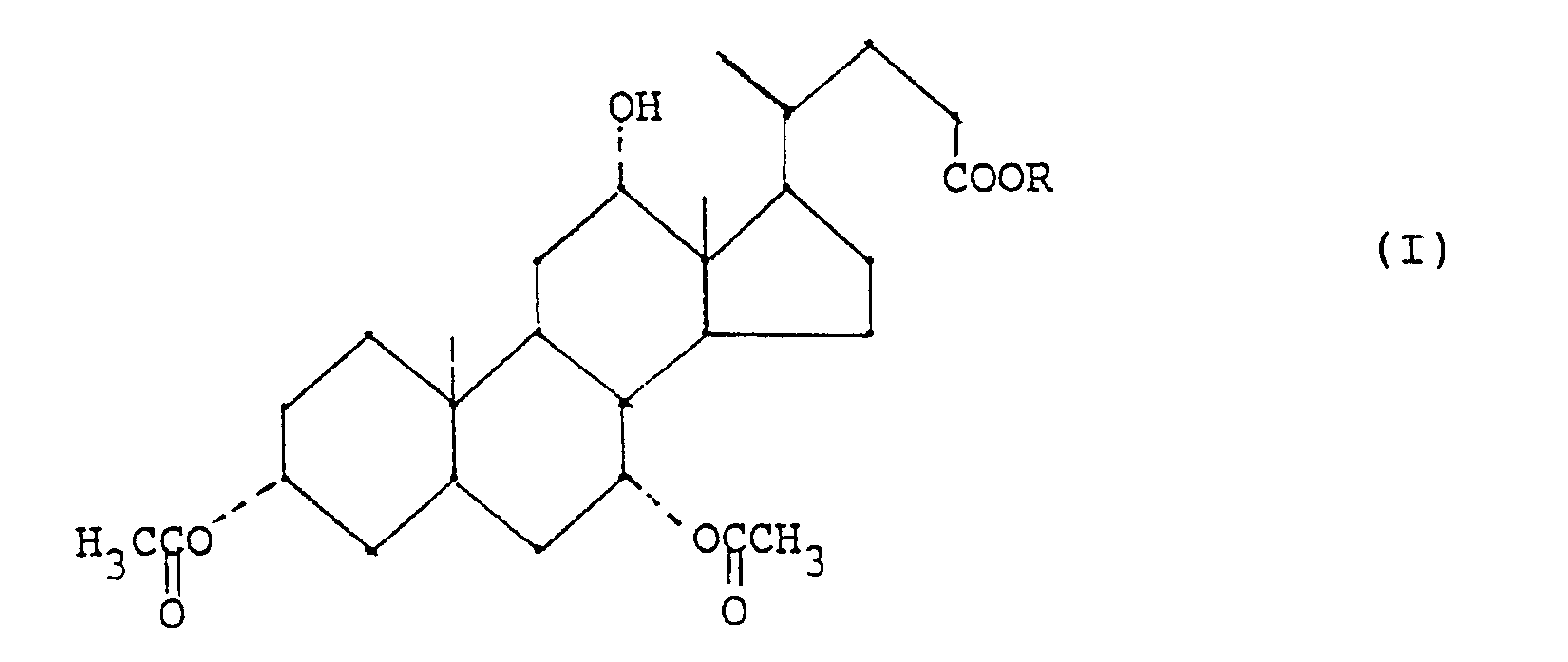
- - étape (a) préparation d'un ester alkylique de l'acide 3α,7α-diacétoxy-12α-hydroxy-5β-cholanique de formule (I) :
- - étape (b) conversion d'un composé de formule (I) en un dérivé 12-oxo de formule (II)

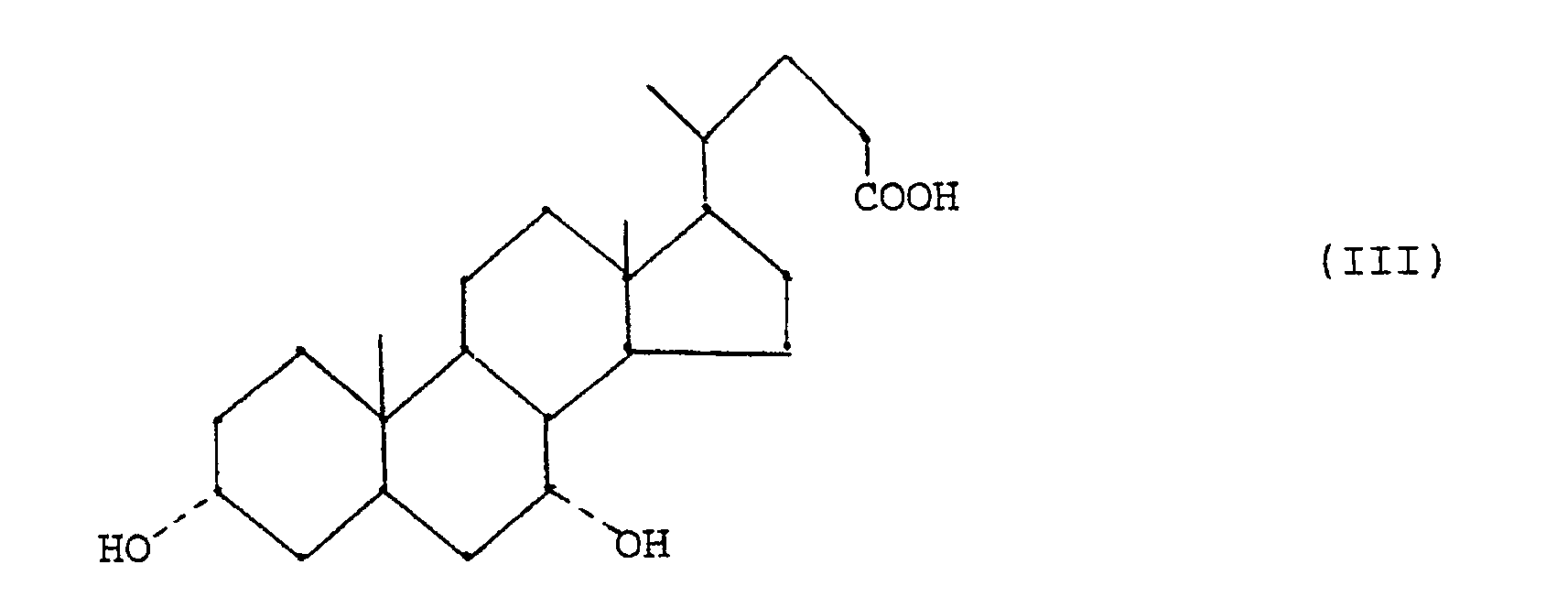
- - étape (c) réduction d'un composé de formule (II) en acide chénodésoxycholique de formule (III)
- - étape (d) oxydation de l'acide chénodésoxycholique (III) en acide 7-oxo-cholanique de formule (IV)

- - étape (e) réduction d'un composé (IV) en acide ursodésoxycholique (V)

- step (a) preparation of an alkyl ester of 3α, 7α-diacetoxy-12α-hydroxy-5β-cholanic acid of formula (I):
- - step (b) conversion of a compound of formula (I) into a 12-oxo derivative of formula (II)
- - step (c) reduction of a compound of formula (II) into chenodeoxycholic acid of formula (III)
- - step (d) oxidation of chenodeoxycholic acid (III) to 7-oxo-cholanic acid of formula (IV)
- - step (e) reduction of a compound (IV) to ursodeoxycholic acid (V)
Chacun de ces passages est bien connu mais, dans les formes de réalisation décrites en littérature, présente des inconvenients qui posent des problèmes serieux du point de vue industriel.Each of these passages is well known but, in the embodiments described in literature, has drawbacks which pose serious problems from the industrial point of view.
Plus particulièrement, en ce qui concerne l'étape a), il est bien connu que les esters de l'acide cholique peuvent être diacétylés en positions 3 et 7, pour obtenir les esters correspondants de l'acide 3α,7α-diacétoxy-12α-hydroxycholanique.More particularly, with regard to step a), it is well known that the esters of cholic acid can be diacetylated in positions 3 and 7, to obtain the corresponding esters of 3α, 7α-diacetoxy-12α acid. -hydroxycholanic.
Selon les méthodes classiques, cette diacétylation est conduite notamment par estérification avec l'anhydride acétique dans la pyridine, en utilisant un excès tant d'anhydride acétique que de pyridine et, notamment, en utilisant ces deux derniers produits en tant que solvants de réaction.According to conventional methods, this diacetylation is carried out in particular by esterification with acetic anhydride in pyridine, using an excess of both acetic anhydride and pyridine and, in particular, using the latter two products as reaction solvents.
Ces méthodes comportent l'utilisation de quantités de réactifs très importantes et la formation d'une quantité non négligeable de sous-produit tri-acétoxylé. Pour éviter la formation de quantités trop importantes de ce sous-produit, il est nécessaire de surveiller le déroulement de la réaction en tenant sous contrôle soit la température, soit la durée de la réaction pour l'arrêter au moment opportun.These methods involve the use of very large quantities of reagents and the formation of a non-negligible quantity of tri-acetoxylated by-product. To avoid the formation of too large quantities of this by-product, it is necessary to monitor the progress of the reaction by keeping under control either the temperature or the duration of the reaction to stop it at the appropriate time.
L'oxydation d'hydroxycholanates prévue à l'étape (b), généralement réalisée au moyen d'un hypochlorite alcalin et de l'acide acétique, est également bien connue dans la littérature, cette réaction étant conduite en utilisant un excès d'acide acétique. L'inconvenient principal de cette réaction est celui de la libération du chlore comportant, entre autres, des problèmes de contrôle pour éviter des dommages écologiques.The oxidation of hydroxycholanates provided for in step (b), generally carried out using an alkaline hypochlorite and acetic acid, is also well known in the literature, this reaction being carried out using an excess of acetic acid. The main drawback of this reaction is that of the release of chlorine, including, among other things, control problems to avoid ecological damage.
La réduction du composé de formule (II) en acide chénodésoxycholique (III), bien connue comme réduction de Wolff-Kishner modifiée par Huang-Minlon, a été décrite, dans le cadre de la préparation de l'acide chénodésoxycholique, par L.F. Fieser et al., J. Am. Chem. Soc. 1950, 72, 5530-5536 et par E. Hauser et al., Helv. Chim. Acta 1960, 43, 1595-1600 et est la méthode couramment utilisée dans le cadre de la fabrication de l'acide chénodésoxycholique.The reduction of the compound of formula (II) to chenodeoxycholic acid (III), well known as a Wolff-Kishner reduction modified by Huang-Minlon, has been described, in the context of the preparation of chenodeoxycholic acid, by LF Fieser and al., J. Am. Chem. Soc. 1950, 72 , 5530-5536 and by E. Hauser et al., Helv. Chim. Acta 1960, 43 , 1595-1600 and is the method commonly used in the production of chenodeoxycholic acid.
De toute façon, cette réaction ne donne pas de bons rendements en produit final et la raison principale est due au fait que, selon les méthodes classiques, la réaction doit être conduite ou complétée à température très élevée, ce qui provoque la formation de quantités non négligeables de sous-produits.In any case, this reaction does not give good yields in the final product and the main reason is due to the fact that, according to conventional methods, the reaction must be carried out or completed at very high temperature, which causes the formation of quantities not negligible by-products.
Enfin, l'oxydation de l'acide chénodésoxycholique (III) prévue à l'étape (d) pour préparer l'acide ursodésoxycholique, qui dans la littérature est conduite en utilisant un hypochlorite alcalin et un excès d'acide acétique, a l'inconvenient, précédemment cité, de libérer du chlore et de comporter ainsi des problèmes de contrôle.Finally, the oxidation of chenodeoxycholic acid (III) provided for in step (d) to prepare ursodeoxycholic acid, which in the literature is carried out using an alkaline hypochlorite and an excess of acetic acid, disadvantage, previously cited, of releasing chlorine and thus causing control problems.
On a maintenant trouvé qu'on peut améliorer chacune de ces étapes, en surmontant les problèmes posés par les méthodes connues.We have now found that each of these steps can be improved by overcoming the problems posed by known methods.
En ce qui concerne la diacétylation en 3 et en 7 d'esters de l'acide cholique, prévue à l'étape (a), on a maintenant trouvé que, de façon générale, la diacétylation en 3 et 7 s'effectue mieux si l'ester de départ ne contient pas de traces de l'alcool estérifiant le cholate d'alkyle et que l'élimination de l'alcool peut être faite par lavage à l'eau d'une solution de cholate d'alkyle et distillation azéotropique.With regard to the diacetylation in 3 and 7 of cholic acid esters, provided for in step (a), it has now been found that, in general, the diacetylation in 3 and 7 is carried out better if the starting ester does not contain traces of the alcohol esterifying the alkyl cholate and that the alcohol can be removed by washing with water of an alkyl cholate solution and azeotropic distillation.
On a également trouvé qu'on peut effectuer une diacétylation sélective des esters de l'acide cholique en utilisant une quantité stoechiométrique d'anhydride acétique si l'on opère en présence de quantités catalytiques d'une N,N-dialkylaniline ou d'une 4-dialkylaminopyridine et d'une quantité d'amine tertiaire inférieure à une mole d'amine oar mole de produit de départ.It has also been found that selective diacetylation of cholic acid esters can be carried out using a stoichiometric amount of acetic anhydride if operated in the presence of catalytic amounts of an N, N-dialkylaniline or a 4-dialkylaminopyridine and an amount of tertiary amine less than one mole of amine or mole of starting material.
Ainsi, la préparation de 3α,7α-diacétoxy-12α-hydroxy-5β-cholanates d'alkyle de formule (I)


Le produit de départ préféré est le cholate de méthyle (formule VI, R = méthyle).The preferred starting material is methyl cholate (formula VI, R = methyl).
Comme catalyseur préféré on utilise la 4-diméthylaminopyridine, ci-après indiquée "4-DMAP" (formule VII, Y′ = Y˝ = méthyle, Z = 

Comme solvant organique on peut utiliser un hydrocarbure aromatique tel que le benzène ou le toluène, un solvant halogéné, tel que le chlorure de méthylène ou le 1,2-dichloroéthane, un éther, tel que le méthyl-isobutyl éther ou le 1,2-diméthoxyéthane, une cétone, telle que l'acétone ou la méthylisobutyl cétone, un ester tel que l'acetate d'éthyle ou bien un mélange de deux de ces solvants. Notamment, on ajoute un deuxième solvant pour compléter la solubilisation des réactifs sans utiliser des volumes trop importants.As organic solvent there may be used an aromatic hydrocarbon such as benzene or toluene, a halogenated solvent, such as methylene chloride or 1,2-dichloroethane, an ether, such as methyl isobutyl ether or 1,2 -dimethoxyethane, a ketone, such as acetone or methyl isobutyl ketone, an ester such as ethyl acetate or a mixture of two of these solvents. In particular, a second solvent is added to complete the solubilization of the reactants without using excessively large volumes.
La réaction d'acétylation est conduite de préférence dans un mélange toluène/acétone, ou dans l'acétate d'éthyle.The acetylation reaction is preferably carried out in a toluene / acetone mixture, or in ethyl acetate.
L'amine tertiaire est utilisée en quantités qui peuvent varier entre 20 et 50% en poids par rapport au composé (VI). Les amines préférées sont les amines aliphatiques comme la triméthylamine ou la triéthylamine, mais des amines hétérocycliques comme la 1-méthylpipéridine ou la 1-méthylmorpholine ou des amines aromatiques comme la pyridine peuvent également être utilisées.The tertiary amine is used in amounts which can vary between 20 and 50% by weight relative to the compound (VI). Preferred amines are aliphatic amines such as trimethylamine or triethylamine, but heterocyclic amines such as 1-methylpiperidine or 1-methylmorpholine or aromatic amines such as pyridine can also be used.
Cette acétylation est conduite à une température de 0-5°C, comme dans tous les cas de ce type d'acétylation.This acetylation is carried out at a temperature of 0-5 ° C, as in all cases of this type of acetylation.
En général, après 10-12 heures à cette température, la réaction est complète, mais sa durée n'est pas critique au delà de 12 heures car, même laissant le mélange réactionnel à 0-5°C pendant 24 heures, on n'observe aucune formation ultérieure de sous-produits. Cela constitue l'avantage principal par rapport aux procédés classiques.In general, after 10-12 hours at this temperature, the reaction is complete, but its duration is not critical beyond 12 hours because, even leaving the reaction mixture at 0-5 ° C for 24 hours, we do not observed no further formation of by-products. This is the main advantage over conventional methods.
Le produit final est isolé selon les techniques conventionnelles et peut être éventuellement cristallisé dans le toluène ou dans le méthanol.The final product is isolated according to conventional techniques and can optionally be crystallized from toluene or from methanol.
Pour obtenir de bons rendements en produit (I), il est souhaitable que le produit de départ qui doit être soumis à l'acétylation soit sec, notamment qu'il ne contienne pas l'alcool utilisé pour l'estérification préalable.To obtain good yields of product (I), it is desirable that the starting product which must be subjected to acetylation is dry, in particular that it does not contain the alcohol used for the prior esterification.
On peut cependant utiliser, selon un autre aspect de la présente invention, un cholate de méthyle, d'éthyle ou de n-propyle de départ qui contient 5 à 30% de l'alcool estérifiant. Dans ce cas, on peut éliminer ledit alcool par dissolution du produit de départ dans un mélange formé par un solvant organique ayant un point d'ébullition à la pression ambiante supérieur à 100°C, de préférence le même solvant qui sera utilisé pour la réaction d'acétylation, et de l'eau et par élimination d'abord de l'eau et ensuite, azéotropiquement, du mélange solvant/eau.It is however possible to use, according to another aspect of the present invention, a starting methyl, ethyl or n-propyl cholate which contains 5 to 30% of the esterifying alcohol. In this case, said alcohol can be eliminated by dissolving the starting product in a mixture formed by an organic solvent having a boiling point at ambient pressure greater than 100 ° C., preferably the same solvent which will be used for the reaction acetylation, and water and by removing water first and then, azeotropically, from the solvent / water mixture.
Il est préférable de dissoudre le produit de départ dans le solvant qui sera utilisé pour la réaction d'acétylation et d'utiliser une quantité d'eau de 10 à 25% en volume par rapport à la quantité de solvant organique utilisé.It is preferable to dissolve the starting material in the solvent which will be used for the acetylation reaction and to use an amount of water from 10 to 25% by volume relative to the amount of organic solvent used.
On peut éliminer d'abord l'eau et ensuite le mélange de l'eau et de l'alcool encore éventuellement présent par distillation azéotropique à une température supérieure à 100°C.The water can first be removed and then the mixture of water and alcohol still optionally present by azeotropic distillation at a temperature above 100 ° C.
Selon cet aspect de la présente invention, il est donc avantageux d'utiliser le toluène comme solvant ayant un point d'ébullition à la pression ambiante supérieur à 100°C.According to this aspect of the present invention, it is therefore advantageous to use toluene as a solvent having a boiling point at ambient pressure greater than 100 ° C.
On a ainsi trouvé que, en ce qui concerne l'étape (b) la réaction d'oxydation des esters alkyliques de l'acide 3α,7α-diacétoxy-12α-hydroxy-5β-cholanique (I), peut être effectuée de façon efficace et sans problème de contrôle en ajoutant lentement une quantité essentiellement stoechiométrique d'un hypochlorite alcalin à une solution du dérivé 12α-hydroxy de formule (I) et d'acide acétique en quantité stoéchiométrique, en présence d'un bromure alcalin, à une température inférieure à 40°C, et de préférence, inférieure à 10°C.It has thus been found that, with regard to step (b), the oxidation reaction of the alkyl esters of 3α, 7α-diacetoxy-12α-hydroxy-5β-cholanic acid (I), can be carried out in a manner effective and without control problem by slowly adding an essentially stoichiometric amount of an alkaline hypochlorite to a solution of the 12α-hydroxy derivative of formula (I) and acetic acid in stoichiometric amount, in the presence of an alkali bromide, to a temperature below 40 ° C, and preferably below 10 ° C.
Ainsi, la préparation du 12-oxocholanate de formule (II)


Comme hydroxycholanate de départ préféré on utilise l'ester méthylique de l'acide 3α,7α-diacétoxy-12α-hydroxy-5β-cholanique.As the preferred starting hydroxycholanate, the methyl ester of 3α, 7α-diacetoxy-12α-hydroxy-5β-cholanic acid is used.
Cette réaction peut être conduite dans un solvant organique ou organique-aqueux, le solvant organique étant un hydrocarbure halogéné, par exemple le chlorure de méthylène ou l'1,2-dichloroéthane, l'acétate d'éthyle ou un éther, par exemple le diméthoxyéthane ou le tétrahydrofuranne.This reaction can be carried out in an organic or organic-aqueous solvent, the organic solvent being a halogenated hydrocarbon, for example methylene chloride or 1,2-dichloroethane, ethyl acetate or an ether, for example dimethoxyethane or tetrahydrofuran.
Le bromure alcalin est utilisé à raison de 0,30-1,15 mole par mole d'hydroxycholanate de départ, le cation étant de préférence celui de l'hypochlorite utilisé. De préférence, on utilise hypochlorite de sodium et bromure de sodium.The alkali bromide is used in an amount of 0.30-1.15 mole per mole of starting hydroxycholanate, the cation preferably being that of the hypochlorite used. Preferably, sodium hypochlorite and sodium bromide are used.
La température de réaction doit être inférieure à 40°C pour éviter la libération de chlore, mais il est avantageux de conduire l'oxydation au dessous de 10°C et, de préférence, au dessous de 0°C.The reaction temperature should be less than 40 ° C to avoid the release of chlorine, but it is advantageous to conduct the oxidation below 10 ° C and preferably below 0 ° C.
En général, selon un mode opératoire préférentiel, la réaction est terminée après 16-24 heures à une température entre -10 et 0°C et le produit de formule (II) est isolé selon les techniques conventionelles.In general, according to a preferred procedure, the reaction is terminated after 16-24 hours at a temperature between -10 and 0 ° C and the product of formula (II) is isolated according to conventional techniques.
Par exemple, le produit ainsi obtenu peut être isolé sous forme cristalline en versant le mélange réactionnel dans l'eau, de préférence en présence d'un sulfite alcalin qui sert à détruire l'excès d'agent oxydant encore présent, en éliminant la phase aqueuse et en évaporant le solvant. Le 12-oxo-cholanate ainsi obtenu peut aussi être purifié en le cristallisant à partir d'un solvant ou système solvant approprié, tel que l'acétone ou les mélanges acétone-eau.For example, the product thus obtained can be isolated in crystalline form by pouring the reaction mixture into water, preferably in the presence of an alkali sulfite which serves to destroy the excess of oxidizing agent still present, by eliminating the phase aqueous and evaporating the solvent. The 12-oxo-cholanate thus obtained can also be purified by crystallizing it from a suitable solvent or solvent system, such as acetone or acetone-water mixtures.
On obtient ainsi un ester de l'acide 3α,7α-diacétoxy-12-oxo-5β-cholanique qui peut être saponifié en utilisant une solution aqueuse d'hydroxyde de sodium pour isoler l'acide 3α,7α-dihydroxy-12-oxo-5β-cholanique.An ester of 3α, 7α-diacetoxy-12-oxo-5β-cholanic acid is thus obtained which can be saponified using an aqueous sodium hydroxide solution to isolate 3α, 7α-dihydroxy-12-oxo acid -5β-cholanic.
En ce qui concerne la réduction d'un composé (II) pour obtenir l'acide chénodésoxycholique (III) (étape (c)), on a maintenant trouvé que, si on conduit la réaction de Wolff-Kishner dans un solvant aqueux-organique en éliminant lentement l'eau et une partie du solvant par distillation azéotropique, le déroulement de la réduction est facilement contrôlé et l'acide chénodésoxycholique est obtenu à l'état pur avec un rendement pratiquement quantitatif.With regard to the reduction of a compound (II) to obtain chenodeoxycholic acid (III) (step (c)), it has now been found that, if the Wolff-Kishner reaction is carried out in an aqueous-organic solvent by slowly removing the water and part of the solvent by azeotropic distillation, the progress of the reduction is easily controlled and the chenodeoxycholic acid is obtained in the pure state with a practically quantitative yield.
Plus particulièrement, on a trouvé que l'acide chénodésoxycholique peut être obtenu avec un bon rendement et substantiellement dépourvu d'impuretés, en particulier d'acide lithocholique, en traitant l'acide 3α,7α-dihydroxy-12-oxo-5β-cholanique ou un de ses esters de formule (II)

Par le terme "solvant organique hydroxylé" on entend un solvant organique choisi entre les alcanols et les éthers alkyliques inférieurs du glycol éthylénique ou propylénique.The term "hydroxylated organic solvent" means an organic solvent chosen from alkanols and lower alkyl ethers of ethylene or propylene glycol.
Des solvants organiques appropriés comprennent le 2-méthoxyéthanol (nom commercial: METHYL CELLOSOLVE) le 2-éthoxyéthanol, le 2-butoxyéthanol, le 2-méthoxy-propanol, le 1-butanol et le 2-pentanol, le 2-méthoxyéthanol et le 1-butanol étant préférés.Suitable organic solvents include 2-methoxyethanol (trade name: METHYL CELLOSOLVE) 2-ethoxyethanol, 2-butoxyethanol, 2-methoxy-propanol, 1-butanol and 2-pentanol, 2-methoxyethanol and 1-butanol being preferred.
La quantité d'eau présente dans le mélange réactionnel avec le solvant organique hydroxylé peut varier entre 10% et 30% en volume et est de préférence présente dans un pourcentage d'environ 20% en volume par rapport au solvant organique.The amount of water present in the reaction mixture with the hydroxylated organic solvent can vary between 10% and 30% by volume and is preferably present in a percentage of approximately 20% by volume relative to the organic solvent.
L'utilisation de ce système solvant permet, aux conditions prévues pour cette réaction, l'élimination lente et en même temps complète de l'eau par distillation azéotropique en permettant ainsi de poursuivre la réaction jusqu'au bout.The use of this solvent system allows, under the conditions provided for this reaction, the slow and at the same time complete elimination of the water by azeotropic distillation, thus allowing the reaction to continue until the end.
Le composé de départ préféré est celui de formule (II) ci-dessus, où R′ = R˝ = H, mais l'ester méthylique du diacétate (formule (II), R′ = méthyle, R˝ = acétyle) convient également.The preferred starting compound is that of formula (II) above, where R ′ = R˝ = H, but the methyl ester of diacetate (formula (II), R ′ = methyl, R˝ = acetyl) is also suitable .
Comme, de toute façon, le produit final souhaité est l'acide chénodésoxycholique (III), la quantité de base minérale doit être calculée de façon à provoquer la saponification de tous les esters éventuellement présents.Since, in any case, the desired end product is chenodeoxycholic acid (III), the amount of mineral base must be calculated so as to cause the saponification of all the esters possibly present.
Comme base minérale on utilise de préférence l'hydroxyde de potassium (80-85%), et l'hydrazine est également utilisée, sous forme de base, en solution aqueuse à 80-85%.As the mineral base, potassium hydroxide (80-85%) is preferably used, and hydrazine is also used, in the form of the base, in 80-85% aqueous solution.
La réaction est amorcée lentement par chauffage jusqu'à la température de 85-110°C en environ 45-75 minutes, puis le mélange réactionnel est laissé à la même température pour une période de temps variable entre 1 et 5 heures.The reaction is started slowly by heating to the temperature of 85-110 ° C in about 45-75 minutes, then the reaction mixture is left at the same temperature for a variable period of time between 1 and 5 hours.
Pour compléter la réaction, on distille le mélange réactionnel en augmentant lentement la température du mélange jusqu'à 115-145°C, puis on laisse le mélange réagir à la même température.To complete the reaction, the reaction mixture is distilled by slowly increasing the temperature of the mixture to 115-145 ° C, then the mixture is allowed to react at the same temperature.
Normalement, après 5-10 heures de chauffage, la réaction est terminée et l'acide chénodésoxycholique (III) est isolé par simple acidification et filtration.Normally, after 5-10 hours of heating, the reaction is complete and the chenodeoxycholic acid (III) is isolated by simple acidification and filtration.
On a aussi amélioré l'oxydation de l'acide chénodésoxycholique prevue à l'étape (d), car on a trouvé que la réaction d'oxydation de l'acide chénodésoxycholique avec un hypochlorite alcalin peut être effectuée de façon efficace et sans problèmes de contrôle en ajoutant lentement l'hypochlorite alcalin à une solution d'acide chénodésoxycholique contenant la quantité stoechiométrique d'acide acétique et en opérant en présence d'un bromure alcalin à une température inférieure à 40°C, de préférence inférieure à 10°C.We also improved the oxidation of chenodeoxycholic acid planned in step (d), because we found that the oxidation reaction of chenodeoxycholic acid with an alkaline hypochlorite can be carried out effectively and without control problems by slowly adding the alkaline hypochlorite to a solution of chenodeoxycholic acid containing the stoichiometric amount of acetic acid and operating in the presence of an alkali bromide at a temperature below 40 ° C, preferably below 10 ° C.
Ainsi, la préparation d'un 7-oxocholanate de formule (IV)


La réaction peut être conduite dans un solvant organique ou organique-aqueux, le solvant organique étant un hydrocarbure halogéné, par exemple le chlorure de méthylène ou l'1,2-dichloroéthane, l'acétate d'éthyle ou un éther, par exemple le diméthoxyéthane ou le tétrahydrofuranne.The reaction can be carried out in an organic or organic-aqueous solvent, the organic solvent being a halogenated hydrocarbon, for example methylene chloride or 1,2-dichloroethane, ethyl acetate or an ether, for example dimethoxyethane or tetrahydrofuran.
Le bromure alcalin est avantageusement utilisé à raison de 0,30-1,15 mole par mole d'acide chénodésoxycholique de départ le cation étant de préférence celui de l'hypochlorite utilisé. De préférence, on utilise l'hypochlorite de sodium et le bromure de sodium.The alkali bromide is advantageously used at a rate of 0.30-1.15 mole per mole of starting chenodeoxycholic acid, the cation preferably being that of the hypochlorite used. Preferably, sodium hypochlorite and sodium bromide are used.
La température de réaction doit être inférieure à 40°C pour éviter la libération de chlore mais il est avantageux de conduire l'oxydation au dessous de 10°C et, de préférence, entre 0 et 10°C.The reaction temperature must be below 40 ° C to avoid the release of chlorine, but it is advantageous to conduct the oxidation below 10 ° C and, preferably, between 0 and 10 ° C.
En général, selon un mode opératoire préférentiel, la réaction est terminée après 6-12 heures à une température entre 10 et 0°C et le produit final est isolé selon les techniques conventionelles.In general, according to a preferred procedure, the reaction is finished after 6-12 hours at a temperature between 10 and 0 ° C and the final product is isolated according to conventional techniques.
Selon une méthode d'isolement, le mélange réactionnel est tout simplement filtré et le produit est lavé à l'eau et l'on récupère ainsi l'acide 3α-hydroxy-7-oxo-5β-cholanique. Par évaporation du solvant, on recupère un mélange d'acide 3,7-dioxo-5β-cholanique et d'acide 3α-hydroxy-7-oxo-5β-cholanique.According to an isolation method, the reaction mixture is simply filtered and the product is washed with water and the 3α-hydroxy-7-oxo-5β-cholanic acid is thus recovered. By evaporation of the solvent, a mixture of 3,7-dioxo-5β-cholanic acid and 3α-hydroxy-7-oxo-5β-cholanic acid is recovered.
Si l'on veut obtenir une quantité supérieure d'acide 3α-hydroxy-7-oxo-5β-cholanique, au lieu de traiter les eaux-mères pour récupérer le dérivé 3,7-dioxo, lesdites eaux-mères sont évaporées à sec, le résidu est repris avec de l'eau et traité avec un hydroxyde alcalin, de potassium de préférence, et le sel alcalin ainsi obtenu est soumis à une hydrogénation en présence de borure de nickel (J. Am. Chem. Soc., 1963, 85, 1003-1005).If we want to obtain a higher amount of 3α-hydroxy-7-oxo-5β-cholanic acid, instead of treating the mother liquors to recover the 3,7-dioxo derivative, said mother liquors are evaporated to dryness , the residue is taken up with water and treated with an alkali hydroxide, preferably potassium, and the alkali salt thus obtained is subjected to hydrogenation in the presence of nickel boride (J. Am. Chem. Soc., 1963 , 85 , 1003-1005).
L'hydrogénation est conduite à une température variable entre la température ambiante et 70°C, de préférence à 40-60°C et à une pression entre 1 et 4 bar. Après 15 minutes à 4 heures, l'hydrogénation est complète et l'acide 3α-hydroxy-7-oxo-5β-cholanique est isolé par précipitation avec un acide fort, tel que l'acide chlorhydrique ou l'acide sulfurique.The hydrogenation is carried out at a variable temperature between room temperature and 70 ° C, preferably at 40-60 ° C and at a pressure between 1 and 4 bar. After 15 minutes to 4 hours, the hydrogenation is complete and the 3α-hydroxy-7-oxo-5β-cholanic acid is isolated by precipitation with a strong acid, such as hydrochloric acid or sulfuric acid.
L'acide 3α-hydroxy-7-oxo-5β-cholanique peut être également obtenu avec des rendements plus élevés directement à partir de l'acide chénodésoxycholique en utilisant la méthode décrite ci-dessus, selon la variante illustrée ci-après.3α-hydroxy-7-oxo-5β-cholanic acid can also be obtained with higher yields directly from chenodeoxycholic acid using the method described above, according to the variant illustrated below.
Lorsque la réaction d'oxydation est complète, au lieu de filtrer le produit obtenu, on évapore pour éliminer le solvant organique et on isole le produit par exemple en ajoutant de l'eau et en évaporant en augmentant lentement la température jusqu'à 100°C. Le produit est alors séparé par simple filtration.When the oxidation reaction is complete, instead of filtering the product obtained, it is evaporated to remove the organic solvent and the product is isolated, for example by adding water and evaporating, slowly increasing the temperature to 100 ° vs. The product is then separated by simple filtration.
On obtient ainsi, avec des bons rendements, l'acide 3α-hydroxy-7-oxo-5β-cholanique, qui peut contenir jusqu'à 15% d'une impureté constituée par l'acide 3,7-dioxo-5β-cholanique ou un de ses esters ou, éventuellement de deux impuretés dont une est ce dernier produit et l'autre des petites quantités (jusqu'à 2% du total) de l'acide chénodésoxycholique qui n'a pas réagi.3α-hydroxy-7-oxo-5β-cholanic acid, which can contain up to 15% of an impurity constituted by 3,7-dioxo-5β-cholanic acid, is thus obtained with good yields. or one of its esters or, possibly of two impurities, one of which is the latter produced and the other of small quantities (up to 2% of the total) of unreacted chenodeoxycholic acid.
Les composés de formule (IV) ainsi obtenus sont utiles comme intermédiaires dans la préparation de l'acide ursodésoxycholique par réduction stéréosélective du ou des groupes oxo (étape(e)) selon des méthodes conventionelles. Cette réduction permet la réduction du groupe 7-oxo en groupe 7β-hydroxy.The compounds of formula (IV) thus obtained are useful as intermediates in the preparation of ursodeoxycholic acid by stereoselective reduction of the oxo group or groups (step (e)) according to conventional methods. This reduction allows the reduction of the 7-oxo group to the 7β-hydroxy group.
Si la réduction est effectuée sur un mélange d'acide 3α-hydroxy-7-oxo-5β-cholanique et d'acide 3,7-dioxo-5β-cholanique tel qu'obtenu selon la variante d'isolement décrite ci-dessus, la réduction conduit à un seul produit ayant la configuration 3α,7β-dihydroxy, éventuellement en présence de petites quantités du produit 3α,7α-dihydroxy (composé de départ).If the reduction is carried out on a mixture of 3α-hydroxy-7-oxo-5β-cholanic acid and 3,7-dioxo-5β-cholanic acid as obtained according to the isolation variant described above, the reduction leads to a single product having the 3α, 7β-dihydroxy configuration, possibly in presence of small amounts of the product 3α, 7α-dihydroxy (starting compound).
Un premier objet de la présente invention est donc un procédé de préparation de l'acide chénodésoxycholique ou ursodésoxycholique se déroulant essentiellement selon les étapes suivantes:
- - étape (a) - 3,7-diacétylation du cholate de méthyle, éthyle ou n-propyle pour obtenir l'ester correspondant de formule (I)

- - étape (b) - oxydation d'un composé de formule (I) en dérivé 12-oxo de formule (II)

- - étape (c) - réduction d'un composé de formule (II) en acide chénodésoxycholique de formule (III)

- - étape (d) - oxydation du composé de formule (III) en acide 7-oxo-cholanique de formule (IV)

- - étape (e) - réduction d'un composé (IV) en acide ursodésoxycholique (V)

- - étape (a) : on prépare un composé de formule (I) en traitant un ester de l'acide cholique de fomule (VI)
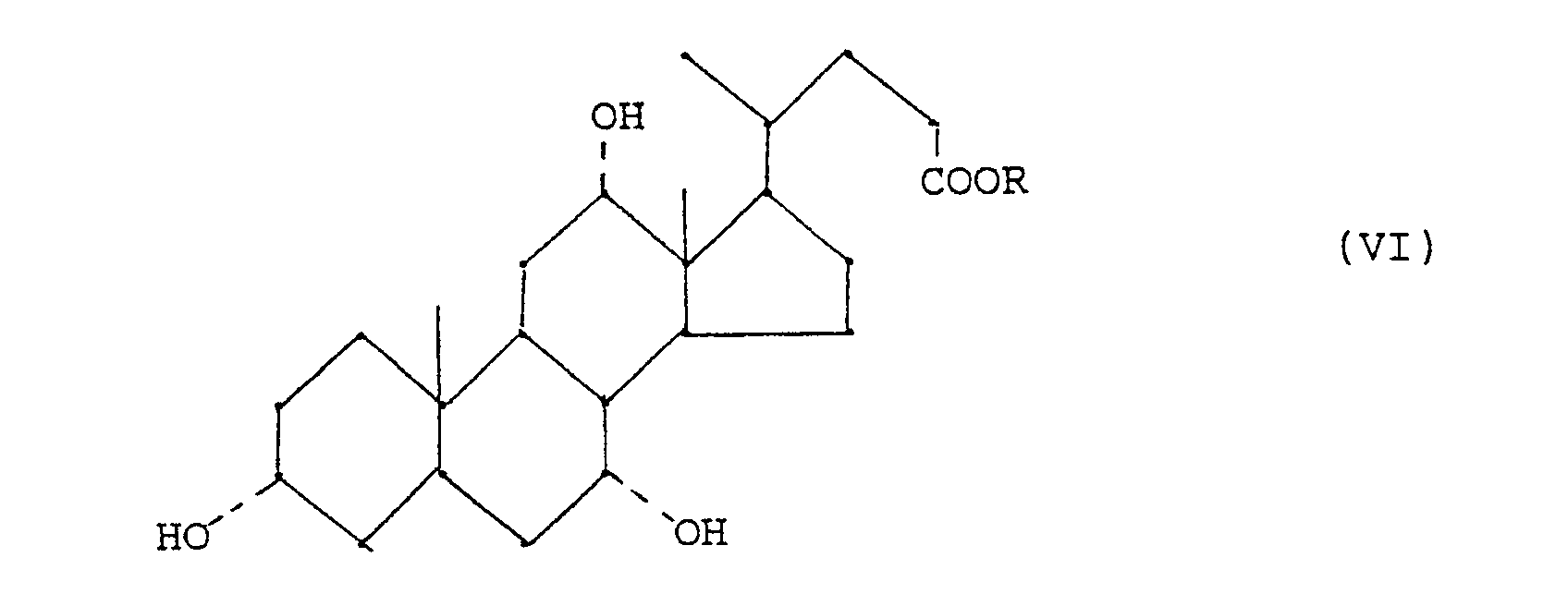
 H, et d'une amine tertiaire en quantité inférieure à une mole d'amine par mole de produit de départ;
- - étape (b): on oxyde un composé de formule (I) en dérivé 12-oxo de formule (II) en ajoutant lentement un hypochlorite alcalin en quantité essentiellement stoechiométrique à une solution d'un 12α-hydroxycholanate de formule (I) dans laquelle R est tel que defini ci-dessus et d'acide acétique en quantité stoechiométrique, en présence d'un bromure alcalin, à une température inferieure à 40°C, et en saponifiant éventuellement le produit ainsi obtenu pour obtenir le composé de formule (II) dans laquelle R′ et R˝ sont l'hydrogène;
- - étape (c): on réduit un composé de formule (II) en acide chénodésoxycholique (III) en traitant ledit composé de formule (II) dans laquelle R′ et R˝ sont tels que definis ci-dessus, avec de l'hydrazine et une base minérale dans un mélange formé par de l'eau et un solvant organique hydroxylé ayant un point d'ébullition à pression ambiante supérieur à 100°C et formant un azéotrope avec l'eau, à une température de 85-110°C, puis on distille l'eau et une partie du solvant en augmentant la température du mélange réactionnel jusqu'à 115-145°C et on laisse terminer la réaction à cette température;
- - étape (d): on oxyde l'acide chénodésoxycholique de formule (III) en ajoutant lentement un hypochlorite alcalin à une solution d'acide chénodésoxycholique (III) et d'acide acétique en quantité stoechiométrique en présence d'un bromure alcalin, à une température inférieure à 40°C, on isole le composé de formule (IV) où X est β-H, α-OH, et on récupère éventuellement des eaux-mères le composé de formule (IV) où X est un groupe oxo, ou bien on soumet éventuellement le produit obtenu par évaporation à sec des eaux-mères, sous forme de sel alcalin à une hydrogénation en présence de borure de nickel.
- - step (a) - 3,7-diacetylation of methyl, ethyl or n-propyl cholate to obtain the corresponding ester of formula (I)
- - step (b) - oxidation of a compound of formula (I) to 12-oxo derivative of formula (II)
- - step (c) - reduction of a compound of formula (II) to chenodeoxycholic acid of formula (III)
- - step (d) - oxidation of the compound of formula (III) to 7-oxo-cholanic acid of formula (IV)
- - step (e) - reduction of a compound (IV) to ursodeoxycholic acid (V)
- - step (a): a compound of formula (I) is prepared by treating an ester of cholic acid of formula (VI)
- step (b): a compound of formula (I) is oxidized to the 12-oxo derivative of formula (II) by slowly adding an alkaline hypochlorite in an essentially stoichiometric amount to a solution of a 12α-hydroxycholanate of formula (I) in which R is as defined above and of acetic acid in stoichiometric amount, in the presence of an alkali bromide, at a temperature below 40 ° C, and optionally saponifying the product thus obtained to obtain the compound of formula ( II) in which R ′ and R˝ are hydrogen;
- - step (c): a compound of formula (II) is reduced to chenodeoxycholic acid (III) by treating said compound of formula (II) in which R ′ and R˝ are as defined above, with hydrazine and a mineral base in a mixture formed by water and a hydroxylated organic solvent having a boiling point at room pressure above 100 ° C and forming an azeotrope with water, at a temperature of 85-110 ° C, then distilled l water and part of the solvent by increasing the temperature of the reaction mixture to 115-145 ° C and the reaction is allowed to end at this temperature;
- step (d): the chenodeoxycholic acid of formula (III) is oxidized by slowly adding an alkaline hypochlorite to a solution of chenodeoxycholic acid (III) and acetic acid in stoichiometric amount in the presence of an alkali bromide, at a temperature below 40 ° C., the compound of formula (IV) is isolated where X is β-H, α-OH, and the compound of formula (IV) where X is an oxo group is optionally recovered, or the product obtained by dry evaporation of the mother liquors, in the form of an alkaline salt, is optionally subjected to hydrogenation in the presence of nickel boride.
Il est entendu que toutes les indications concernantes les conditions de réaction encore plus avantageuses qui ont été mentionnées ci-dessus pour chaque étape, s'appliquent également au procédé global de préparation des acides chénodésoxycholiques et ursodésoxycholique et représentent des formes de réalisation préférés dudit procédé.It is understood that all the indications concerning the even more advantageous reaction conditions which have been mentioned above for each step, also apply to the overall process for the preparation of chenodeoxycholic and ursodeoxycholic acids and represent preferred embodiments of said process.
Un deuxième objet specifique de la présente invention est le procedé de préparation de l'acide chénodésoxycholique de formule (III)

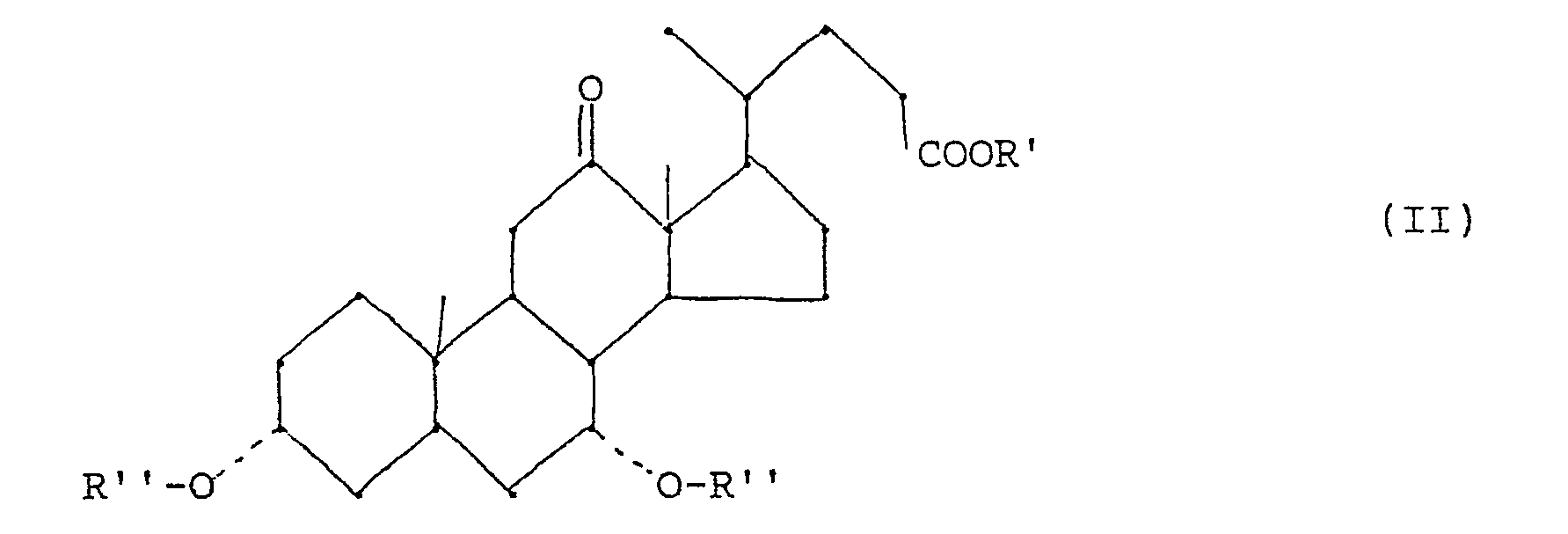
Dans ce cas aussi toutes les indications concernant les conditions de réaction encore plus avantageuses, qui ont été mentionnées plus haut pour l'étape c), représentent des formes de realisations préférées du procédé indiqué ci-dessus.In this case also all the indications concerning the even more advantageous reaction conditions, which were mentioned above for step c), represent preferred embodiments of the process indicated above.
Les exemples suivants illustrent la présente invention sans toutefois la limiter.The following examples illustrate the present invention without, however, limiting it.
On chauffe à 40°C une mélange de 105 kg de cholate de méthyle provenant directement de l'estérification de l'acide cholique avec le méthanol et contenant 15% de méthanol, 580 l de toluène et 90 l d'eau; puis on sépare la phase aqueuse, on chauffe la phase organique au reflux et on élimine l'eau azéotropiquement jusqu'à 110°C. On refroidit, on ajoute 135 l d'acétone et, à une température inférieure à 20°C, on ajoute d'abord 0,78 kg de 4-DMAP et 35 kg de triéthylamine et ensuite, lentement, 44 kg d'anhydride acétique. On porte la température à 0-5°C et on laisse le mélange réactionnel à cette température jusqu'à ce que la réaction est complète. Ensuite, on lave avec 180 l d'eau et on concentre la phase organique jusqu'à une concentration de 1:2. On amorce la cristallisation à 60°C, on isole le produit à 0-5°C par centrifugation et on le lave avec du toluène et de l'eau. Après une cristallisation dans le toluène, on obtient le 3α,7α-diacétoxy-12α-hydroxy-5β-cholanate de méthyle, identique à un échantillon authentique, ayant un titre supérieur à 99% mesuré par chromatographie en phase gazeuse. Rendement en produit cristallisé: 76% sur 90 kg estimés de produit de départ sec.Heated to 40 ° C a mixture of 105 kg of methyl cholate directly from the esterification of cholic acid with methanol and containing 15% methanol, 580 l of toluene and 90 l of water; then the aqueous phase is separated, the organic phase is heated to reflux and the azeotropically water is eliminated up to 110 ° C. It is cooled, 135 l of acetone are added and, at a temperature below 20 ° C., first add 0.78 kg of 4-DMAP and 35 kg of triethylamine and then slowly 44 kg of acetic anhydride. The temperature is brought to 0-5 ° C. and the reaction mixture is left at this temperature until the reaction is complete. Then, wash with 180 l of water and the organic phase is concentrated to a concentration of 1: 2. The crystallization is initiated at 60 ° C, the product is isolated at 0-5 ° C by centrifugation and washed with toluene and water. After crystallization from toluene, methyl 3α, 7α-diacetoxy-12α-hydroxy-5β-cholanate is obtained, identical to an authentic sample, having a titer greater than 99% measured by gas chromatography. Yield of crystallized product: 76% on 90 kg estimated of dry starting product.
En opérant comme décrit dans l'Exemple 1, mais en remplaçant les 35 kg de triéthylamine par 35 kg de pyridine on obtient le 3α,7α-diacétoxy-12α-hydroxy-5β-cholanate de méthyle ayant le même dégré de pureté et avec le même rendement.By operating as described in Example 1, but replacing the 35 kg of triethylamine with 35 kg of pyridine, methyl 3α, 7α-diacetoxy-12α-hydroxy-5β-cholanate is obtained having the same degree of purity and with the same yield.
A une solution de 17 kg de 3α,7α-diacétoxy-12α-hydroxy-5β-cholanate de méthyle et 1,04 kg de bromure de sodium dans 46 kg d'acétate d'éthyle, 3,6 kg d'acide acétique et 3,4 kg d'eau, refroidie à -10°C-0°C, on ajoute en 5 heures 18,48 l d'une solution à 14,9 % poids/volume d'hypochlorite de sodium. On laisse le mélange réactionnel 16 heures à la même température, puis on ajoute 17 kg d'une solution de sulfite de sodium à 10% et on chauffe à 40°C. On élimine la phase aqueuse, on lave à une solution de bicarbonate de sodium jusqu'à neutralité, et on ajoute 1,1 volumes d'eau par volume de 3α,7α-diacétoxy-12α-hydroxy-5β-cholanate de méthyle. On distille à 100°C, et on refroidit la suspension à une température inférieure à 50°C. On y ajoute 3,1 volumes d'acetone et on chauffe au reflux pendant une heure jusqu'à l'obtention d'une solution. On refroidit et on laisse cristalliser. On abaisse la température jusqu'à 0-5°C pendant 4 heures et on centrifuge en lavant le produit cristallisé avec un mélange glacé eau-acétone 1:1. On obtient 15,57 kg de 3α,7α-diacétoxy-12-oxo-5β-cholanate de méthyle ayant un titre supérieur à 99% par rapport à un échantillon authentique. On peut aussi, après neutralisation de la solution du produit dans l'acétate d'éthyle, évaporer le solvant sur un bain d'eau, refroidir et filtrer en obtenant le 3α,7α-diacétoxy-12-oxo-5β-cholanate de méthyle avec un rendement quantitatif.To a solution of 17 kg of 3α, 7α-diacetoxy-12α-hydroxy-5β-methyl cholanate and 1.04 kg of sodium bromide in 46 kg of ethyl acetate, 3.6 kg of acetic acid and 3.4 kg of water, cooled to -10 ° C-0 ° C, 18.48 l of a 14.9% w / v solution of sodium hypochlorite are added over 5 hours. The reaction mixture is left for 16 hours at the same temperature, then 17 kg of a 10% sodium sulfite solution are added and the mixture is heated to 40 ° C. The aqueous phase is eliminated, washed with a sodium bicarbonate solution until neutral, and 1.1 volumes of water are added per volume of methyl 3α, 7α-diacetoxy-12α-hydroxy-5β-cholanate. Distillation is carried out at 100 ° C., and the suspension is cooled to a temperature below 50 ° C. 3.1 volumes of acetone are added thereto and the mixture is heated under reflux for one hour until a solution is obtained. Cool and allow to crystallize. We lower the temperature to 0-5 ° C for 4 hours and centrifuge by washing the crystallized product with an ice-cold water-acetone mixture 1: 1. We obtain 15.57 kg of 3α, 7α-diacetoxy-12-oxo-5β-methyl cholanate having a titer greater than 99% compared to an authentic sample. It is also possible, after neutralization of the solution of the product in ethyl acetate, to evaporate the solvent on a water bath, to cool and to filter while obtaining methyl 3α, 7α-diacetoxy-12-oxo-5β-cholanate with a quantitative yield.
On opère comme décrit ci-dessus jusqu'à la cristallisation du 3α,7α-diacétoxy-12-oxo-5β-cholanate de méthyle, puis on ajoute 4 équivalents d'hydroxyde de sodium à 40% et on chauffe au reflux jusqu'à ce que la saponification soit complète. Par acidification avec de l'acide chlorhydrique, on obtient l'acide 3α,7α-dihydroxy-12-oxo-5β-cholanique ayant un titre supérieur à 99% par rapport à un échantillon authentique.The procedure is as described above until the crystallization of methyl 3α, 7α-diacetoxy-12-oxo-5β-cholanate, then 4 equivalents of 40% sodium hydroxide are added and the mixture is heated to reflux until that the saponification is complete. By acidification with hydrochloric acid, 3α, 7α-dihydroxy-12-oxo-5β-cholanic acid is obtained having a titer greater than 99% compared to an authentic sample.
A un mélange de 40 g d'acide 3α,7α-dihydroxy-12-oxo-5β-cholanique, 80 ml de METHYL CELLOSOLVE et 17 ml d'eau, on ajoute 40 g d'hydroxyde de potassium à 85% et, ensuite, 13 ml d'hydrazine à 80%. On porte la température à 110°C et on continue le chauffage à la même température pendant 4 heures. Ensuite, on distille le mélange réactionnel jusqu'à la température de 135-138°C et on le laisse à la même température pendant 8 heures. On refroidit, on ajoute 120 ml d'eau, puis on verse la solution dans 160 ml d'eau contenant 40 ml d'acide sulfurique 50 B à une température inférieure à 20°C en ajustant le pH à environ 2. On filtre et on lave jusqu'à neutralité. On obtient ainsi 40 g d'acide chénodésoxycholique pur ayant un titre de 86,5 %, les impuretés majeures étant l'eau et le sulfate de potassium. La quantité d'acide lithocholique, évaluée par chromatographie sur couche mince est « 0.05%To a mixture of 40 g of 3α, 7α-dihydroxy-12-oxo-5β-cholanic acid, 80 ml of METHYL CELLOSOLVE and 17 ml of water, 40 g of 85% potassium hydroxide are added and then , 13 ml of 80% hydrazine. The temperature is brought to 110 ° C. and heating is continued at the same temperature for 4 hours. Then the reaction mixture is distilled down to a temperature of 135-138 ° C and left at the same temperature for 8 hours. Cool, add 120 ml of water, then pour the solution into 160 ml of water containing 40 ml of 50 B sulfuric acid at a temperature below 20 ° C., adjusting the pH to approximately 2. Filter and we wash until neutral. 40 g of pure chenodeoxycholic acid are thus obtained having a titer of 86.5%, the major impurities being water and potassium sulfate. The quantity of lithocholic acid, evaluated by thin layer chromatography is “0.05%
On chauffe un mélange de 50g d'ester méthylique de l'acide 3α,7α-diacétoxy-12-oxo-5β-cholanique, 250 ml d'alcool n-butylique et 25 g d'hydrate d'hydrazine à 80% à 103°C et on continue le chauffage à la même température pendant 2 heures. Ensuite on distille le mélange réactionnel jusqu'à la température de 117-122°C, on ajoute 50 g d'hydroxyde de potassium à 88% et on distille le mélange réactionnel jusqu'à la température de 138-142°C. On continue le chauffage à la même température pendant 24 heures. On refroidit, on ajoute 200 ml d'eau, on distille le mélange jusqu'à l'élimination totale de l'alcool n-butylique, on refroidit, on ajoute 130 ml d'eau et d'acide formique à 60% jusqu'à pH 7-8, on ajoute 100 ml d'acétate d'éthyle et d'acide formique jusqu'à pH 4-5. On separe la phase organique qui est lavée avec une solution aqueuse de bicarbonate de sodium jusqu'à neutralité, on sepae la phase organique; le produit est extrait par une solution aqueuse de bicarbonate de sodium.A mixture of 50 g of methyl ester of 3α, 7α-diacetoxy-12-oxo-5β-cholanic acid, 250 ml of n-butyl alcohol and 25 g of 80% hydrazine hydrate at 103 is heated. ° C and heating is continued at the same temperature for 2 hours. Then the reaction mixture is distilled up to the temperature of 117-122 ° C, 50 g of 88% potassium hydroxide are added and the reaction mixture is distilled up to the temperature of 138-142 ° C. Heating is continued at the same temperature for 24 hours. Cool, add 200 ml of water, distill the mixture until the n-butyl alcohol is completely eliminated, cool, add 130 ml of water and 60% formic acid to at pH 7-8, 100 ml of ethyl acetate and formic acid are added to pH 4-5. The organic phase is separated which is washed with an aqueous sodium bicarbonate solution until neutral, the organic phase is separated; the product is extracted with an aqueous solution of sodium bicarbonate.
La phase aqueuse est séparée et on distille jusqu'à l'élimination totale de l'acétate d'éthyle.The aqueous phase is separated and distilled until complete elimination of the ethyl acetate.
On refroidit et on verse la solution dans une quantité d'acide sulfurique 20% pour obtenir un pH final d'environ 2, on filtre et on lave jusqu'à neutralité. On obtient ainsi 36,8 g d'acide chénodésoxycholique pur ayant un titre de 97,2%, l'impureté majeure étant l'eau.It is cooled and the solution is poured into an amount of 20% sulfuric acid to obtain a final pH of around 2, filtered and washed until neutral. 36.8 g of pure chenodeoxycholic acid are thus obtained, having a titer of 97.2%, the major impurity being water.
On opère substantiellement comme décrit dans l'exemple 6 en utilisant le méthyl cellosolve au lieu de l'alcool n-butylique. On chauffe pendant 10 heures au lieu de 24 et on isole l'acide chénodésoxycholique selon la méthode décrite dans l'exemple 5. On obtient 38,1 g d'acide chénodésoxycholique pur ayant un titre de 98,5%, l'impureté majeure étant l'eau.The operation is carried out substantially as described in Example 6, using methyl cellosolve instead of n-butyl alcohol. It is heated for 10 hours instead of 24 and the chenodeoxycholic acid is isolated according to the method described in example 5. 38.1 g of pure chenodeoxycholic acid is obtained, having a titer of 98.5%, the major impurity. being water.
A une suspension de 89 g d'acide chénodésoxycholique et de 24 g de bromure de sodium dans 560 ml de chlorure de méthylène, refroidie à une température de 0-10°C, on ajoute 20 ml d'acide acétique et 40 ml d'eau, puis, à la même température, on ajoute, goutte à goutte, 120 ml d'une solution à 15,1 % poids/volume d'hypochlorite de sodium. Après 12 heures à la même température, la réaction est complète et, par filtration, on obtient 62 g d'acide 3α-hydroxy-7-oxo-5β-cholanique pur, identique à un échantillon authentique.To a suspension of 89 g of chenodeoxycholic acid and 24 g of sodium bromide in 560 ml of methylene chloride, cooled to a temperature of 0-10 ° C., 20 ml of acetic acid and 40 ml of water, then, at the same temperature, 120 ml of a 15.1% w / v solution of sodium hypochlorite are added dropwise. After 12 hours at the same temperature, the reaction is complete and, by filtration, 62 g of pure 3α-hydroxy-7-oxo-5β-cholanic acid are obtained, identical to an authentic sample.
A une suspension de 89 g d'acide chénodésoxycholique et de 24 g de bromure de sodium dans 560 ml de chlorure de méthylène, refroidie à une température de 0-10°C, on ajoute 20 ml d'acide acétique et 40 ml d'eau, puis, à la même température, on ajoute, goutte à goutte, 120 ml d'une solution à 15,1 % poids/volume d'hypochlorite de sodium. Après 12 heures à la même température, la réaction est complète. On distille le chlorure de méthylène, on verse le mélange dans 200 ml d'eau et l'on distille jusqu'à ce que la température soit montée à 100°C. On refroidit, on filtre et on lave le produit sur le filtre jusqu'à neutralité et on sèche. On obtient ainsi 80,5 g d'acide 3α-hydroxy-7-oxo-5β-cholanique contenant 9% d'acide 3,7-dioxo-5β-cholanique et 1% d'acide chénodésoxy-cholique de départ.To a suspension of 89 g of chenodeoxycholic acid and 24 g of sodium bromide in 560 ml of methylene chloride, cooled to a temperature of 0-10 ° C., 20 ml of acetic acid and 40 ml of water, then, at the same temperature, 120 ml of a 15.1% w / v solution of sodium hypochlorite are added dropwise. After 12 hours at the same temperature, the reaction is complete. The methylene chloride is distilled, the mixture is poured into 200 ml of water and distilled until the temperature has risen to 100 ° C. Cool, filter and wash the product on the filter until neutral and dry. 80.5 g of 3α-hydroxy-7-oxo-5β-cholanic acid are thus obtained, containing 9% of 3,7-dioxo-5β-cholanic acid and 1% of starting chenodeoxy-cholic acid.
On évapore à sec les eaux-mères de filtration du produit final de l'Exemple 8, on reprend le résidu (18 g, constitué par l'acide 3,7-dioxo-5β-cholanique impur d'acide 3α-hydroxy-7-oxo-5β-cholanique) par 120 ml d'eau, on ajoute 3,22 g d'hydroxyde de potassium à 85%. On soumet la solution ainsi obtenue à hydrogénation à 50°C et sous une pression de 3 bar en présence de borure de nickel obtenu à partir de 5,89 g d'acétate de nickel (J. Am. Chem. Soc., 1963, 85, 1003-1005). Lorsque l'absorption de l'hydrogène est terminée, on filtre la solution et on précipite avec de l'acide chlorhydrique 6N. On obtient ainsi 18,5 g d'acide 3α-hydroxy-7-oxo-5β-cholanique ayant un titre supérieur à 99%.The filtration mother liquors of the final product of Example 8 are evaporated to dryness, the residue is taken up (18 g, consisting of impure 3,7-dioxo-5β-cholanic acid of 3α-hydroxy-7 acid -oxo-5β-cholanic) with 120 ml of water, 3.22 g of 85% potassium hydroxide is added. The solution thus obtained is subjected to hydrogenation at 50 ° C. and under a pressure of 3 bar in the presence of nickel boride obtained from 5.89 g of nickel acetate (J. Am. Chem. Soc., 1963, 85 , 1003-1005). When the absorption of hydrogen is complete, the solution is filtered and precipitated with 6N hydrochloric acid. 18.5 g of 3α-hydroxy-7-oxo-5β-cholanic acid are thus obtained having a titer greater than 99%.
En opérant comme décrit dans l'Exemple 9, mais en utilisant comme solvant 360 ml d'acétate d'éthyle à la place de 560 ml de chlorure de méthylène, on obtient 80,2 g d'acide 3α-hydroxy-7-oxo-5β-cholanique contenant 8% d'acide 3,7-dioxocholanique et 1% d'acide chénodésoxycholique de départ.By operating as described in Example 9, but using 360 ml of ethyl acetate as solvent instead of 560 ml of methylene chloride, 80.2 g of 3α-hydroxy-7-oxo acid are obtained. -5β-cholanic containing 8% of 3,7-dioxocholanic acid and 1% of starting chenodeoxycholic acid.
Claims (19)
- étape (a) : 3,7-diacétylation du cholate de méthyle, éthyle ou n-propyle pour obtenir l'ester correspondant de formule (I)

- étape (b) : oxydation d'un composé de formule (I) en derivé 12-oxo de formule (II)

- étape (c) : réduction d'un composé de formule (II) dans l'acide chénodésoxycholique de formule (III)

- étape (d) : oxydation du composé de formule (III) en acide 7-oxo-cholanique de formule (IV)

- étape (e) : réduction d'un composé (IV) en acide ursodésoxycholique (V)
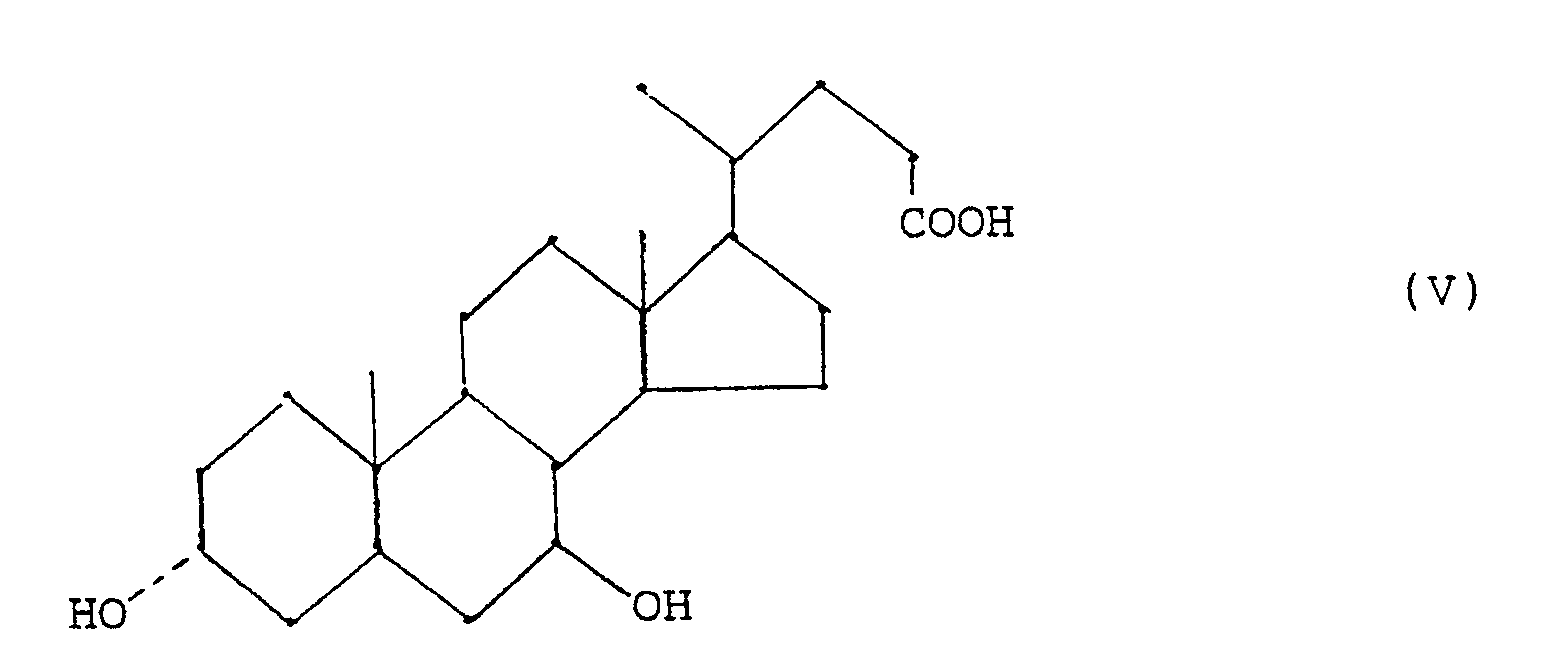


- step (a): 3,7-diacetylation of methyl, ethyl or n-propyl cholate to obtain the corresponding ester of formula (I)
- step (b): oxidation of a compound of formula (I) to the 12-oxo derivative of formula (II)
- step (c): reduction of a compound of formula (II) in chenodeoxycholic acid of formula (III)
- step (d): oxidation of the compound of formula (III) to 7-oxo-cholanic acid of formula (IV)
- step (e): reduction of a compound (IV) to ursodeoxycholic acid (V)


Applications Claiming Priority (8)
| Application Number | Priority Date | Filing Date | Title |
|---|---|---|---|
| FR8913572 | 1989-10-17 | ||
| FR8913572A FR2653129B1 (en) | 1989-10-17 | 1989-10-17 | PROCESS FOR THE PREPARATION OF 7-OXOCHOLANATES. |
| FR8913569A FR2653126B1 (en) | 1989-10-17 | 1989-10-17 | PROCESS FOR THE PREPARATION OF DIACETOXYCHOLANATES. |
| FR8913571A FR2653128B1 (en) | 1989-10-17 | 1989-10-17 | PROCESS FOR THE PREPARATION OF CHENODESOXYCHOLIC ACID. |
| FR8913569 | 1989-10-17 | ||
| FR8913570A FR2653127B1 (en) | 1989-10-17 | 1989-10-17 | PROCESS FOR THE PREPARATION OF 12-OXOCHOLANATES. |
| FR8913571 | 1989-10-17 | ||
| FR8913570 | 1989-10-17 |
Publications (3)
| Publication Number | Publication Date |
|---|---|
| EP0424232A2 true EP0424232A2 (en) | 1991-04-24 |
| EP0424232A3 EP0424232A3 (en) | 1992-05-20 |
| EP0424232B1 EP0424232B1 (en) | 1996-02-21 |
Family
ID=27446720
Family Applications (1)
| Application Number | Title | Priority Date | Filing Date |
|---|---|---|---|
| EP90402879A Expired - Lifetime EP0424232B1 (en) | 1989-10-17 | 1990-10-16 | Process for the production of chenodesoxycholic |
Country Status (7)
| Country | Link |
|---|---|
| EP (1) | EP0424232B1 (en) |
| AT (1) | ATE134378T1 (en) |
| DE (1) | DE69025449T2 (en) |
| DK (1) | DK0424232T3 (en) |
| ES (1) | ES2086388T3 (en) |
| GR (1) | GR3019857T3 (en) |
| IE (1) | IE73449B1 (en) |
Cited By (4)
| Publication number | Priority date | Publication date | Assignee | Title |
|---|---|---|---|---|
| EP2105500A1 (en) | 2008-03-26 | 2009-09-30 | Pharmazell GmbH | New 12alpha-hydroxysteroiddehydrogenases, method for their manufacture and application thereof |
| CN101215311B (en) * | 2008-01-10 | 2010-10-27 | 辽宁百隆生物工程有限公司 | Method for producing ursodesoxycholic acid from 86% of chenodeoxycholic acid |
| EP2333100A1 (en) | 2009-12-11 | 2011-06-15 | PharmaZell GmbH | NAD(P)+-cofactor regeneration system und its use |
| WO2012131591A1 (en) | 2011-03-31 | 2012-10-04 | Prodotti Chimici E Alimentari S.P.A. | New process for the selective oxidation of bile acids, their salts or derivatives |
Families Citing this family (3)
| Publication number | Priority date | Publication date | Assignee | Title |
|---|---|---|---|---|
| CN102060902A (en) * | 2011-01-21 | 2011-05-18 | 郑州大学 | Chenodeoxycholic acid synthesis method |
| WO2017207648A1 (en) | 2016-05-31 | 2017-12-07 | Bionice, S.L.U | Process and intermediates for the preparation of obeticholic acid and derivatives thereof |
| EP3431486A1 (en) | 2017-07-18 | 2019-01-23 | Bionice, S.L.U. | Process and intermediates for the synthesis of obeticholic acid and derivatives thereof |
Family Cites Families (7)
| Publication number | Priority date | Publication date | Assignee | Title |
|---|---|---|---|---|
| US4360470A (en) * | 1980-10-22 | 1982-11-23 | Hoffmann-La Roche Inc. | Process and intermediates for the synthesis of Vitamin D3 metabolites and chenodeoxycholic acid |
| IT1137459B (en) * | 1981-04-14 | 1986-09-10 | Erregierre Spa | PRODUCTION FOR THE PREPARATION OF HIGH PURITY URSODEOXICOLIC ACID |
| IT1167478B (en) * | 1981-07-24 | 1987-05-13 | Carlo Scolastico | URSODESOXICOLIC ACID DERIVATIVES |
| FR2511007A1 (en) * | 1981-08-07 | 1983-02-11 | Roussel Uclaf | PROCESS FOR THE PREPARATION OF URSODESOXYCHOLIC ACID FROM 3A, 7B, 12A-TRIHYDROXYCHOLANIC ACID AND INTERMEDIATE PRODUCT USED |
| JPS5842878B2 (en) * | 1981-12-02 | 1983-09-22 | 名糖産業株式会社 | 12-oxocholanic acid tosylhydrazone compound, its production method and use |
| JPS58155098A (en) * | 1982-03-09 | 1983-09-14 | Yakult Honsha Co Ltd | Preparation of ursodeoxycholic acid by microorganism |
| IT1204429B (en) * | 1986-01-09 | 1989-03-01 | Blaschim Spa | STEREOSELECTIVE REDUCTION IN BILIARY ACIDS |
-
1990
- 1990-10-16 EP EP90402879A patent/EP0424232B1/en not_active Expired - Lifetime
- 1990-10-16 DK DK90402879.2T patent/DK0424232T3/en active
- 1990-10-16 DE DE69025449T patent/DE69025449T2/en not_active Expired - Lifetime
- 1990-10-16 AT AT90402879T patent/ATE134378T1/en not_active IP Right Cessation
- 1990-10-16 ES ES90402879T patent/ES2086388T3/en not_active Expired - Lifetime
- 1990-10-16 IE IE370190A patent/IE73449B1/en not_active IP Right Cessation
-
1996
- 1996-05-07 GR GR960401242T patent/GR3019857T3/en unknown
Cited By (4)
| Publication number | Priority date | Publication date | Assignee | Title |
|---|---|---|---|---|
| CN101215311B (en) * | 2008-01-10 | 2010-10-27 | 辽宁百隆生物工程有限公司 | Method for producing ursodesoxycholic acid from 86% of chenodeoxycholic acid |
| EP2105500A1 (en) | 2008-03-26 | 2009-09-30 | Pharmazell GmbH | New 12alpha-hydroxysteroiddehydrogenases, method for their manufacture and application thereof |
| EP2333100A1 (en) | 2009-12-11 | 2011-06-15 | PharmaZell GmbH | NAD(P)+-cofactor regeneration system und its use |
| WO2012131591A1 (en) | 2011-03-31 | 2012-10-04 | Prodotti Chimici E Alimentari S.P.A. | New process for the selective oxidation of bile acids, their salts or derivatives |
Also Published As
| Publication number | Publication date |
|---|---|
| DE69025449T2 (en) | 1996-07-11 |
| ES2086388T3 (en) | 1996-07-01 |
| IE903701A1 (en) | 1991-04-24 |
| DK0424232T3 (en) | 1996-06-17 |
| EP0424232A3 (en) | 1992-05-20 |
| ATE134378T1 (en) | 1996-03-15 |
| GR3019857T3 (en) | 1996-08-31 |
| DE69025449D1 (en) | 1996-03-28 |
| IE73449B1 (en) | 1997-06-04 |
| EP0424232B1 (en) | 1996-02-21 |
Similar Documents
| Publication | Publication Date | Title |
|---|---|---|
| EP0424232B1 (en) | Process for the production of chenodesoxycholic | |
| FR2675146A1 (en) | NOVEL STEROUID DERIVATIVES OF PREGNA-1,4-DIENE-3,20-DIONE, THEIR PREPARATION, THEIR APPLICATION TO THE PREPARATION OF SUBSTITUTED 16,17-METHYLENE DIOXY DERIVATIVES, AND NOVEL INTERMEDIATES | |
| EP0520879B1 (en) | New 16-methyl substituted steroid derivatives of pregna-1,4-dien-3,20-dione, their preparation, their use in the preparation of 16-methylene substituted steroids and new intermediates therefor | |
| EP0275728B1 (en) | Steroids containing a keto group at position 23, their preparation, their use in the preparation of compounds of the 20-ketopregnane series, and intermediates of this use | |
| EP0012641B1 (en) | Substituted-19-nor-pregn-4-ene-3,20-dione derivatives, process for their preparation and pharmaceutical compositions containing them | |
| FR2700548A1 (en) | New process for the preparation of alpha-methylated steroids | |
| EP1242439B1 (en) | Method for preparing and isolating 9-deoxo-9(z)-hydroxyiminoerythromycin a | |
| FR2482602A1 (en) | PROCESS FOR THE PREPARATION OF URSODESOXYCHOLIC ACID OF HIGH PURITY | |
| CH327513A (en) | Process for preparing a derivative of pregnane | |
| EP0275729B1 (en) | Steroids containing a keto group at position 23, their preparation, their use in the preparation of compounds of the 20-keto-pregnane series, and intermediates of this use | |
| FR2745291A1 (en) | Preparation of 17-hydroxy-4,9,11-oestratrien-3-one, trenbolone, from 17-hydroxy-4,9-oestradien-3-one | |
| FR2923826A1 (en) | PROCESS FOR THE SYNTHESIS OF 4-BENZOFURAN CARBOXYLIC ACID | |
| FR2472571A1 (en) | PROCESS FOR THE PREPARATION OF HALOGENO-VINCAMINIC AND HALOGENO-APOVINCAMINIC ESTERS DERIVATIVES | |
| FR2653126A1 (en) | Process for the preparation of diacetoxycholanates | |
| EP0184572A1 (en) | Process for the preparation of alpha-hydroxy-alkanoic acids | |
| FR2653129A1 (en) | Process for the preparation of 7-oxocholanates | |
| CH508590A (en) | Aspartyl phenyl alanine esters as sweet - ening agents | |
| CH629826A5 (en) | Steroids, process for preparing them and their use in the synthesis of tritium-labelled steroids | |
| EP0184573A1 (en) | Process for the preparation of alpha-hydroxy-alkanoic acids | |
| BE482452A (en) | ||
| BE497200A (en) | ||
| BE556145A (en) | ||
| BE565092A (en) | ||
| BE515950A (en) | ||
| CH660741A5 (en) | PROCESS FOR THE PREPARATION OF AN EVENTUALLY TRITED 16-IMINO 17-AZA STEROID AND INTERMEDIATES OF THIS PROCESS. |
Legal Events
| Date | Code | Title | Description |
|---|---|---|---|
| PUAI | Public reference made under article 153(3) epc to a published international application that has entered the european phase |
Free format text: ORIGINAL CODE: 0009012 |
|
| 17P | Request for examination filed |
Effective date: 19901224 |
|
| AK | Designated contracting states |
Kind code of ref document: A2 Designated state(s): AT BE CH DE DK ES FR GB GR IT LI LU NL SE |
|
| PUAL | Search report despatched |
Free format text: ORIGINAL CODE: 0009013 |
|
| RAP1 | Party data changed (applicant data changed or rights of an application transferred) |
Owner name: ELF SANOFI |
|
| AK | Designated contracting states |
Kind code of ref document: A3 Designated state(s): AT BE CH DE DK ES FR GB GR IT LI LU NL SE |
|
| 17Q | First examination report despatched |
Effective date: 19930616 |
|
| RAP1 | Party data changed (applicant data changed or rights of an application transferred) |
Owner name: SANOFI |
|
| RTI1 | Title (correction) | ||
| GRAA | (expected) grant |
Free format text: ORIGINAL CODE: 0009210 |
|
| AK | Designated contracting states |
Kind code of ref document: B1 Designated state(s): AT BE CH DE DK ES FR GB GR IT LI LU NL SE |
|
| REF | Corresponds to: |
Ref document number: 134378 Country of ref document: AT Date of ref document: 19960315 Kind code of ref document: T |
|
| ITF | It: translation for a ep patent filed | ||
| GBT | Gb: translation of ep patent filed (gb section 77(6)(a)/1977) |
Effective date: 19960217 |
|
| REF | Corresponds to: |
Ref document number: 69025449 Country of ref document: DE Date of ref document: 19960328 |
|
| REG | Reference to a national code |
Ref country code: CH Ref legal event code: NV Representative=s name: BOVARD AG PATENTANWAELTE |
|
| REG | Reference to a national code |
Ref country code: DK Ref legal event code: T3 |
|
| REG | Reference to a national code |
Ref country code: ES Ref legal event code: FG2A Ref document number: 2086388 Country of ref document: ES Kind code of ref document: T3 |
|
| REG | Reference to a national code |
Ref country code: GR Ref legal event code: FG4A Free format text: 3019857 |
|
| PLBE | No opposition filed within time limit |
Free format text: ORIGINAL CODE: 0009261 |
|
| STAA | Information on the status of an ep patent application or granted ep patent |
Free format text: STATUS: NO OPPOSITION FILED WITHIN TIME LIMIT |
|
| 26N | No opposition filed | ||
| REG | Reference to a national code |
Ref country code: CH Ref legal event code: PFA Free format text: SANOFI TRANSFER- SANOFI-SYNTHELABO |
|
| NLS | Nl: assignments of ep-patents |
Owner name: SANOFI-SYNTHELABO |
|
| BECA | Be: change of holder's address |
Free format text: 20000928 *SANOFI-SYNTHELABO:174 AVENUE DE FRANCE, 75013 PARIS |
|
| BECH | Be: change of holder |
Free format text: 20000928 *SANOFI-SYNTHELABO:174 AVENUE DE FRANCE, 75013 PARIS |
|
| BECN | Be: change of holder's name |
Effective date: 20000928 |
|
| REG | Reference to a national code |
Ref country code: FR Ref legal event code: CA Ref country code: FR Ref legal event code: TP |
|
| REG | Reference to a national code |
Ref country code: GB Ref legal event code: 732E |
|
| REG | Reference to a national code |
Ref country code: GB Ref legal event code: IF02 |
|
| REG | Reference to a national code |
Ref country code: CH Ref legal event code: PFA Owner name: SANOFI-AVENTIS Free format text: SANOFI-SYNTHELABO#174, AVENUE DE FRANCE#75013 PARIS (FR) -TRANSFER TO- SANOFI-AVENTIS#174, AVENUE DE FRANCE#75013 PARIS (FR) |
|
| NLT1 | Nl: modifications of names registered in virtue of documents presented to the patent office pursuant to art. 16 a, paragraph 1 |
Owner name: SANOFI -AVENTIS |
|
| REG | Reference to a national code |
Ref country code: FR Ref legal event code: CD |
|
| PGFP | Annual fee paid to national office [announced via postgrant information from national office to epo] |
Ref country code: SE Payment date: 20091007 Year of fee payment: 20 Ref country code: ES Payment date: 20091117 Year of fee payment: 20 Ref country code: DK Payment date: 20091014 Year of fee payment: 20 Ref country code: DE Payment date: 20091008 Year of fee payment: 20 Ref country code: CH Payment date: 20091014 Year of fee payment: 20 Ref country code: AT Payment date: 20091013 Year of fee payment: 20 Ref country code: LU Payment date: 20091120 Year of fee payment: 20 |
|
| PGFP | Annual fee paid to national office [announced via postgrant information from national office to epo] |
Ref country code: NL Payment date: 20091004 Year of fee payment: 20 |
|
| PGFP | Annual fee paid to national office [announced via postgrant information from national office to epo] |
Ref country code: FR Payment date: 20091029 Year of fee payment: 20 Ref country code: GB Payment date: 20091014 Year of fee payment: 20 Ref country code: IT Payment date: 20091017 Year of fee payment: 20 |
|
| PGFP | Annual fee paid to national office [announced via postgrant information from national office to epo] |
Ref country code: BE Payment date: 20091019 Year of fee payment: 20 Ref country code: GR Payment date: 20090915 Year of fee payment: 20 |
|
| REG | Reference to a national code |
Ref country code: NL Ref legal event code: V4 Effective date: 20101016 |
|
| REG | Reference to a national code |
Ref country code: CH Ref legal event code: PL |
|
| BE20 | Be: patent expired |
Owner name: S.A. *SANOFI-AVENTIS Effective date: 20101016 |
|
| REG | Reference to a national code |
Ref country code: DK Ref legal event code: EUP |
|
| REG | Reference to a national code |
Ref country code: GB Ref legal event code: PE20 Expiry date: 20101015 |
|
| EUG | Se: european patent has lapsed | ||
| PG25 | Lapsed in a contracting state [announced via postgrant information from national office to epo] |
Ref country code: NL Free format text: LAPSE BECAUSE OF EXPIRATION OF PROTECTION Effective date: 20101016 |
|
| REG | Reference to a national code |
Ref country code: ES Ref legal event code: FD2A Effective date: 20110224 |
|
| PG25 | Lapsed in a contracting state [announced via postgrant information from national office to epo] |
Ref country code: GB Free format text: LAPSE BECAUSE OF EXPIRATION OF PROTECTION Effective date: 20101015 |
|
| PG25 | Lapsed in a contracting state [announced via postgrant information from national office to epo] |
Ref country code: ES Free format text: LAPSE BECAUSE OF EXPIRATION OF PROTECTION Effective date: 20101017 |
|
| PG25 | Lapsed in a contracting state [announced via postgrant information from national office to epo] |
Ref country code: DE Free format text: LAPSE BECAUSE OF EXPIRATION OF PROTECTION Effective date: 20101016 |