EP0422883B1 - Stärkefreies Formverfahren und Vorrichtung - Google Patents
Stärkefreies Formverfahren und Vorrichtung Download PDFInfo
- Publication number
- EP0422883B1 EP0422883B1 EP90311028A EP90311028A EP0422883B1 EP 0422883 B1 EP0422883 B1 EP 0422883B1 EP 90311028 A EP90311028 A EP 90311028A EP 90311028 A EP90311028 A EP 90311028A EP 0422883 B1 EP0422883 B1 EP 0422883B1
- Authority
- EP
- European Patent Office
- Prior art keywords
- product
- mould
- process according
- solvent
- porous
- Prior art date
- Legal status (The legal status is an assumption and is not a legal conclusion. Google has not performed a legal analysis and makes no representation as to the accuracy of the status listed.)
- Expired - Lifetime
Links
Images
Classifications
-
- A—HUMAN NECESSITIES
- A23—FOODS OR FOODSTUFFS; TREATMENT THEREOF, NOT COVERED BY OTHER CLASSES
- A23G—COCOA; COCOA PRODUCTS, e.g. CHOCOLATE; SUBSTITUTES FOR COCOA OR COCOA PRODUCTS; CONFECTIONERY; CHEWING GUM; ICE-CREAM; PREPARATION THEREOF
- A23G4/00—Chewing gum
- A23G4/02—Apparatus specially adapted for manufacture or treatment of chewing gum
- A23G4/04—Apparatus specially adapted for manufacture or treatment of chewing gum for moulding or shaping
-
- A—HUMAN NECESSITIES
- A23—FOODS OR FOODSTUFFS; TREATMENT THEREOF, NOT COVERED BY OTHER CLASSES
- A23G—COCOA; COCOA PRODUCTS, e.g. CHOCOLATE; SUBSTITUTES FOR COCOA OR COCOA PRODUCTS; CONFECTIONERY; CHEWING GUM; ICE-CREAM; PREPARATION THEREOF
- A23G1/00—Cocoa; Cocoa products, e.g. chocolate; Substitutes therefor
- A23G1/04—Apparatus specially adapted for manufacture or treatment of cocoa or cocoa products
- A23G1/20—Apparatus for moulding, cutting or dispensing chocolate
- A23G1/22—Chocolate moulds
- A23G1/223—Mould materials
- A23G1/226—Moulds of plastic or elastomeric material, or plastic or elastomer coated moulds
-
- A—HUMAN NECESSITIES
- A23—FOODS OR FOODSTUFFS; TREATMENT THEREOF, NOT COVERED BY OTHER CLASSES
- A23G—COCOA; COCOA PRODUCTS, e.g. CHOCOLATE; SUBSTITUTES FOR COCOA OR COCOA PRODUCTS; CONFECTIONERY; CHEWING GUM; ICE-CREAM; PREPARATION THEREOF
- A23G3/00—Sweetmeats; Confectionery; Marzipan; Coated or filled products
- A23G3/02—Apparatus specially adapted for manufacture or treatment of sweetmeats or confectionery; Accessories therefor
- A23G3/0236—Shaping of liquid, paste, powder; Manufacture of moulded articles, e.g. modelling, moulding, calendering
- A23G3/0252—Apparatus in which the material is shaped at least partially in a mould, in the hollows of a surface, a drum, an endless band, or by a drop-by-drop casting or dispensing of the material on a surface, e.g. injection moulding, transfer moulding
- A23G3/0268—Moulds
- A23G3/0273—Moulds of plastic or elastomeric material, or plastic or elastomer coated moulds
-
- A—HUMAN NECESSITIES
- A23—FOODS OR FOODSTUFFS; TREATMENT THEREOF, NOT COVERED BY OTHER CLASSES
- A23P—SHAPING OR WORKING OF FOODSTUFFS, NOT FULLY COVERED BY A SINGLE OTHER SUBCLASS
- A23P30/00—Shaping or working of foodstuffs characterised by the process or apparatus
- A23P30/10—Moulding
-
- A—HUMAN NECESSITIES
- A61—MEDICAL OR VETERINARY SCIENCE; HYGIENE
- A61K—PREPARATIONS FOR MEDICAL, DENTAL OR TOILETRY PURPOSES
- A61K9/00—Medicinal preparations characterised by special physical form
- A61K9/20—Pills, tablets, discs, rods
- A61K9/2095—Tabletting processes
-
- B—PERFORMING OPERATIONS; TRANSPORTING
- B29—WORKING OF PLASTICS; WORKING OF SUBSTANCES IN A PLASTIC STATE IN GENERAL
- B29C—SHAPING OR JOINING OF PLASTICS; SHAPING OF MATERIAL IN A PLASTIC STATE, NOT OTHERWISE PROVIDED FOR; AFTER-TREATMENT OF THE SHAPED PRODUCTS, e.g. REPAIRING
- B29C41/00—Shaping by coating a mould, core or other substrate, i.e. by depositing material and stripping-off the shaped article; Apparatus therefor
- B29C41/02—Shaping by coating a mould, core or other substrate, i.e. by depositing material and stripping-off the shaped article; Apparatus therefor for making articles of definite length, i.e. discrete articles
- B29C41/16—Slip casting, i.e. applying a slip or slurry on a perforated or porous or absorbent surface with the liquid being drained away
Definitions
- This invention relates to a starchless moulding process and apparatus, intended to replace the starch moulds used in the manufacture of food and non-food products.
- Moulded products such as confectionery products
- Preformed depressions in a bed of dry powdered starch are the most commonly used technique for forming the mould.
- Starchless moulding technology has developed from the use of metal moulds with compressed air ejection of the pieces.
- rubber and silicone rubber moulds have been used for some types of fondant, caramels, and toffees.
- Plastic coated "drop” rolls have also been used for certain cremes and pastes.
- the starchless moulds are usually constructed in a tray form, each of which may contain a hundred or more depressions with the trays being operatively connected to one another to form a continuous belt or conveyer.
- each mould is typically coated with a special release agent, the fluid confectionery recipe ingredients are then cast or deposited into the starchless mould (depositing), solidified therein (tempering), and mechanically ejected therefrom (demoulding), and then the moulds are cleaned and coated with fresh release agent for recycling.
- demoulding the mechanical ejection may be accomplished by mechanical fingers which force the gelled composition from a deformed flexible mould (e.g. moulds constructed of synthetic or natural rubber moulds) or by air expulsion from a rigid mould.
- a deformed flexible mould e.g. moulds constructed of synthetic or natural rubber moulds
- One of the disadvantages with such starchless moulding techniques is the cost of preparing and changing moulds which is very high, resulting in the restricted use of such moulds to well established products with assured markets rather than to products being field tested on an experimental basis.
- Starchless moulding procedures also require maintenance. In a continuous operation, each mould is cleaned so that it is free from solidified confectionery product and microbial contamination before recoating with fresh release agent and recycling.
- Critical processing factors need to be developed for effective air demoulding. These include the size and configuration of the holes within the base of the mould impression, the type of release agent and how it is applied, the mould design and construction, air pressure, cooling time and conditions, and so forth.
- a process for making a moulded product which comprises: depositing a molten or fluid mass of product ingredients into a porous non-starch hydrophilic polymeric mould; gelling or hardening the fluid mass while absorbing moisture or other solvent into the porous polymer by a wicking action; and recovering the formed product.
- the process comprises:
- Another aspect of the present invention provides a mould for forming a product, which comprises a mould shaped from a porous non-starch hydrophilic polymeric plastics material capable of wicking solvent or water from the product to be moulded.
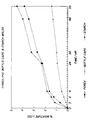
- Figure 1 demonstrates moisture loss from various moulds as described in Example 1.
- porous non-starch hydrophilic polymeric product allows starch to be replaced in traditional moulding operations. This applies not only to food items such as confections but also to non-food items such as pharmaceutical and cosmetic products.
- the porous polymers have utility, when employed in the present invention, in the processing of a wide variety of product formulations currently being made by the starch casting technique.
- the application of porous polymers to wet casting eliminates the problems associated with starch casting such as explosion hazards, microbial contaminations, messy starch trays, starch dust, and so forth.
- Porous polymers can be used when product formulations are deposited in a molten or fluid state, previously requiring starch for the removal of excess water or solvent.
- the porous polymers can be formed, cut or otherwise shaped into a variety of shapes and sizes. In confectionery applications, a large sheet of polymer would be formed into a mould containing many individual depressions into which a fluid mass is deposited.
- the polymer sheets containing deposited material Upon cooling, the polymer sheets containing deposited material would be stored under conditions required to complete drying of the product to an appropriate solids level. These conditions might range from ambient to controlled temperature and humidity conditions and may involve passing air or other gas over and/or below the porous polymer mould to facilitate removal of moisture or solvent from the "wick-like" porous polymer.
- the porous polymer will be used to form the impressions for the deposited product.
- the impressions may be made on top of existing support frames or structures, such as those presently used in starch moulding.
- whole moulds may be prepared from the porous polymer itself provided suitable thickness are employed. Polymer thicknesses may range from 0.16cm (one-sixteenth inch) to several centimetres thick.
- Preferred structures are self supporting and have thicknesses from about 0.32cm to 1.27cm (one-eighth to about one-half inch) thick.
- the products used to fill the mould should be in a molten or fluid state, that is either pourable into the mould or capable of being compressed by the mould. Such products usually contain from 5 to 85% by total weight of water or other solvent. Once placed in or compressed by the mould, the product will be left in the mould for a sufficient time to permit the water or solvent to "wick" into the porous polymer. This wicking action results in a drying effect causing the product to gel and/or harden. Suitable times will vary depending upon the product being made and the amount of water or other solvent that needs to be removed. Exemplary times may range from 15 minutes to several days and are preferably from at least 1 to 24 hours.
- porous polymers used in the present invention may be employed without such additives.
- the porous polymers form a mould which has a smooth surface resulting in products having a smooth surface, which can be easily removed from the mould.
- starch moulds need to be aerated.
- the mould board which prints the impressions compresses the starch in the tray. If the starch is too dense, it compacts badly and prevents deep mould impressions. Aeration is normally done after passing the starch through a fine sieve.
- the porous polymeric plastics material once compressed to form the mould need not be replaced following each moulding operation. This thus enables the moulds to be reused multiple times without concern about mould depth and cleaning.
- the porous polymers are capable of being aerated, like starch moulds, so that moisture or solvent picked up by the mould is easily removed. Such aeration procedures may entail passing air or other gas over and/or below the polymeric plastics material.
- porous polymer plastics material in the formulation of the mould also eliminates the need to remove the tailings and fragments of deposited products that is required in starch moulding procedures.
- the present porous polymer moulds do not require heat to remove the moisture or solvent from the product as is required when using rubber or metal moulds which must be heated to high temperatures to form a solid product within the mould.
- porous polymer moulding of the present invention avoids the dust, explosion hazards and microbial contaminations present with starch moulding operations. Furthermore, porous polymer moulding allows the use of traditional starch cast formulations where other starchless systems require formula modifications or special ingredients.
- the porous polymers useful in the present invention comprise those polymers which are capable of wicking solvent or water from a product to be moulded.
- Exemplary polymers include synthetically produced plastic polymers and particularly those selected from high-density polyethylene, high molecular weight polyethylene, polypropylene, polypropylene, ethylene-vinyl acetate copolymers, polytetrafluoroethylene, styrene-acrylonitrile copolymers, polyvinylidene fluoride and mixtures thereof.
- the porous polymers are hydrophilic in character and preferably have an average pore size of 0.8 to 2000 micrometres.
- a specific polymer material may be selected to achieve maximum product hardening within the shortest time period. For example, when removing solvent from a cosmetic or pharmaceutical composition pore sizes of 35 to 500 micrometres have been found to be useful. Suitable material having this pore size may be obtained from high-density polyethylene (having an average pore size of from 35 to greater than 250 micrometres) and polypropylene (having an average pore size from 125 to 350 micrometres).
- pore sizes of from 5 to 100 micrometres have been found suitable. Such pore sizes can be obtained using high molecular weight polyethylene (having an average pore size of from 10 to 40 micrometres) and the above mentioned materials. Products having this pore size and porous structure may be obtained from Porex Technologies , U.S.A.
- any product which is capable of being prepared in a starch mould may be prepared in the moulds of the present invention.
- pharmaceutical and cosmetic products may be prepared using the porous polymer moulds of the present invention.
- Exemplary pharmaceutical and cosmetic products include tabletted and moulded products, stick deodorants, suppositories, lipstick and shaped cosmetic products.
- the confectionery material may be selected from fondant creams, jellies, nut pastes, marzipans, turkish delights, soft caramels, fudges, marshmallows, gums and pastilles as well as other confectionery products that may be compressed and/or moulded such as shaker moulded products.
- moisture or solvent may be removed by evaporation into the surrounding atmosphere or by passing air over and/or below the polymer mould to accelerate the procedure.
- the mould may contain one or more port holes for air or steam injection to remove the product once formed.
- the present moulds may employ standard ejection procedures, such as the use of pressure being applied to the bottom of the mould to force the product out of the mould or compressed air or steam which passes through tiny holes in the bottom of each mould while they are tilted at an inverted angle, usually 45°.
- Critical processing factors for effecting pressure, air or steam demoulding are well within the skill of the ordinary skilled artisan and do not constitute a part of this invention.
- the moulds of the present invention may be equipped with cooling means which circulate within the mould to aid in chilling the material to be hardened.
- cooling means are well known for chocolate coating confectionery products.
- This example compares the loss of moisture from a deposited product when added to various moulds.
- a cooked gelatin solution (containing about 75% solids and about 25% water) was placed into three separate moulds having identical configurations. The amount of moisture loss was measured (by weight measurements) over a fifty five hour period and is recorded in Figure 1 of the accompanying drawing. The results indicate that moisture loss from mould A prepared from polyvinylchloride was significant lower than that achieved for moulds containing the inventive porous hydrophilic polyethylene (B) and a conventional starch mould (C).
Landscapes
- Engineering & Computer Science (AREA)
- Chemical & Material Sciences (AREA)
- Life Sciences & Earth Sciences (AREA)
- Food Science & Technology (AREA)
- Polymers & Plastics (AREA)
- Health & Medical Sciences (AREA)
- Epidemiology (AREA)
- Medicinal Chemistry (AREA)
- Pharmacology & Pharmacy (AREA)
- Mechanical Engineering (AREA)
- Animal Behavior & Ethology (AREA)
- General Health & Medical Sciences (AREA)
- Public Health (AREA)
- Veterinary Medicine (AREA)
- Manufacturing & Machinery (AREA)
- Confectionery (AREA)
- Cosmetics (AREA)
- Medicinal Preparation (AREA)
- Moulds For Moulding Plastics Or The Like (AREA)
- Seeds, Soups, And Other Foods (AREA)
- Formation And Processing Of Food Products (AREA)
- Manufacture Of Porous Articles, And Recovery And Treatment Of Waste Products (AREA)
- Polysaccharides And Polysaccharide Derivatives (AREA)
Claims (17)
- Verfahren zur Herstellung eines Formlings durch Ablagern einer aufgeschmolzenen oder fließfähigen Masse von Produktbestandteilen in einer porösen, nicht aus Stärke bestehenden, hydrophilen polymeren Form, Gelieren oder Härten der fließfähigen Masse unter Absorption von Feuchtigkeit oder eines sonstigen Lösungsmittels in das poröse Polymer durch Dochtwirkung und Gewinnen des Formlings.
- Verfahren nach Anspruch 1, umfassend (folgende Stufen):a) Zubereiten einer fließfähigen Masse von Produktbestandteilen;b) Ablagern der fließfähigen Masse in einer festen Form, umfassend ein poröses, nicht aus Stärke bestehendes, hydrophiles polymeres Kunststoffmaterial;c) Entfernen von Feuchtigkeit oder eines sonstigen Lösungsmittels aus der abgelagerten Masse durch Absorption in das poröse Polymere infolge Dochtwirkung;d) Gelieren oder Verfestigen der fließfähigen Masse innerhalb der Form zur Bildung eines Formlings unde) Austreiben des Produkts aus der Form.
- Verfahren nach Anspruch 1 oder 2, wobei die fließfähige Produktmasse 5 - 85% Wasser enthält.
- Verfahren nach Anspruch 1 oder 2, wobei die fließfähige Produktmasse 5 - 85% eines Lösungsmittels enthält.
- Verfahren nach einem der vorhergehenden Ansprüche, wobei es sich bei dem Produkt um ein Nahrungsmittel oder Nicht-Nahrungsmittel handelt.
- Verfahren nach Anspruch 5, wobei es sich bei dem Produkt um eine Süßware bzw. ein Zuckerwerk handelt.
- Verfahren nach Anspruch 6, wobei das Zuckerwerk aus Fondantcremes, Gallerten bzw. Fruchtgelees, Nußpasten, Marzipansorten, Geleefrüchten, feinem Konfekt, Fondant, Weichkaramellen bzw. weichem Zuckerwerk, Marshmallows, Gummies und Pastillen ausgewählt ist.
- Verfahren nach Anspruch 5, wobei das Produkt aus einem pharmazeutischen Produkt oder einem kosmetischen Produkt besteht.
- Verfahren nach einem der vorhergehenden Ansprüche, wobei das poröse Polymer aus hochdichtem Polyethylen, hochmolekularem Polyethylen, Polypropylen, Ethylen/Vinylacetat-Copolymeren, Polytetrafluorethylen, Styrol/Acrylnitril-Copolymeren, Polyvinylidenfluorid und Mischungen derselben ausgewählt ist.
- Verfahren nach einem der vorhergehenden Ansprüche, wobei das poröse Polymer eine durchschnittliche Porengröße von 0,8 - 200 »m aufweist.
- Verfahren nach einem der vorhergehenden Ansprüche, wobei Luft zur leichteren Entfernung von Feuchtigkeit oder Lösungsmittel aus dem porösen Polymer über und/oder unter die poröse Polymerform geleitet wird.
- Verfahren nach einem der vorhergehenden Ansprüche, wobei das gelierte oder gehärtete Produkt eine Konsistenz von einer geschmeidigen plastischen Masse bis zu einer geschmeidigen verfestigten Masse aufweist.
- Form zur Ausformung eines Produkts, die aus einem porösen, nicht aus Stärke bestehenden, hydrophilen polymeren Kunststoffmaterial mit der Fähigkeit zum Aufsaugen (durch Dochtwirkung) des Lösungsmittels oder von Wasser aus dem zu formenden Produkt hergestellt ist.
- Form nach Anspruch 13, die vollständig aus dem porösen, nicht aus Stärke bestehenden hydrophilen polymeren Kunststoffmaterial mit der Fähigkeit zum Aufsaugen (infolge Dochtwirkung) eines Lösungsmittels oder von Wasser aus dem auszuformenden Produkt besteht.
- Form nach Anspruch 13, umfassend eine äußere Tragestruktur und eine innere Schicht mit dem porösen, nicht aus Stärke bestehenden, hydrophilen polymeren Kunststoffmaterial mit der Fähigkeit zum Aufsaugen (infolge Dochtwirkung) eines Lösungsmittels oder von Wasser aus dem auszuformenden Produkt.
- Form nach Anspruch 13, 14 oder 15, wobei das poröse Polymer mit der Fähigkeit zum Aufsaugen (infolge Dichtwirkung) eines Lösungsmittels oder von Wasser aus dem auszuformenden Produkt aus hochdichtem Polyethylen, hochmolekularem Polyethylen, Polypropylen, Ethylen/Vinylacetat-Copolymeren, Polytetrafluorethylen, Styrol/Acrylnitril-Copolymeren, Polyvinylidenfluorid und Mischungen derselben ausgewählt ist.
- Form nach einem der Ansprüche 13 bis 16, wobei das poröse Polymer eine durchschnittliche Porengröße von 0,8 - 2000 »m aufweist.
Applications Claiming Priority (2)
| Application Number | Priority Date | Filing Date | Title |
|---|---|---|---|
| US418597 | 1989-10-10 | ||
| US07/418,597 US5059441A (en) | 1989-10-10 | 1989-10-10 | Method for making molded products |
Publications (2)
| Publication Number | Publication Date |
|---|---|
| EP0422883A1 EP0422883A1 (de) | 1991-04-17 |
| EP0422883B1 true EP0422883B1 (de) | 1994-07-20 |
Family
ID=23658785
Family Applications (1)
| Application Number | Title | Priority Date | Filing Date |
|---|---|---|---|
| EP90311028A Expired - Lifetime EP0422883B1 (de) | 1989-10-10 | 1990-10-09 | Stärkefreies Formverfahren und Vorrichtung |
Country Status (9)
| Country | Link |
|---|---|
| US (1) | US5059441A (de) |
| EP (1) | EP0422883B1 (de) |
| JP (1) | JP2919940B2 (de) |
| AU (1) | AU642431B2 (de) |
| CA (1) | CA2027176A1 (de) |
| DE (1) | DE69010820T2 (de) |
| DK (1) | DK0422883T3 (de) |
| ES (1) | ES2057429T3 (de) |
| ZA (1) | ZA908090B (de) |
Families Citing this family (18)
| Publication number | Priority date | Publication date | Assignee | Title |
|---|---|---|---|---|
| US5525351A (en) * | 1989-11-07 | 1996-06-11 | Dam; Anders | Nicotine containing stimulant unit |
| JP2795131B2 (ja) * | 1993-06-14 | 1998-09-10 | 株式会社ダイハン | 食品の成型器 |
| ES2141758T3 (es) * | 1993-11-29 | 2000-04-01 | Procter & Gamble | Composiciones para la eliminacion de manchas de cal. |
| DE19526690A1 (de) * | 1995-07-21 | 1997-01-23 | Huels Chemische Werke Ag | Verfahren zur Herstellung eines flexiblen Fixationsmaterials mit Kathetern oder Schläuchen für die Strahlentherapie |
| US5941197A (en) * | 1997-01-17 | 1999-08-24 | T.F.H. Publications, Inc. | Carrot-based dog chew |
| GB9706097D0 (en) * | 1996-12-05 | 1997-05-14 | Apv Uk Plc | Apparatus for moulding confectionery |
| GB2348106B (en) * | 1998-01-09 | 2002-09-18 | Mars Inc | Improved molding process |
| US6537603B2 (en) * | 1999-11-30 | 2003-03-25 | Dairy Farmers Of America, Inc. | Snack food product method |
| US6458405B1 (en) | 2000-07-17 | 2002-10-01 | General Mills, Inc. | Gel products with carrageenan |
| WO2002015707A1 (en) * | 2000-08-25 | 2002-02-28 | Chocolate Graphics Pty Ltd | Chocolate with raised design |
| US6596334B1 (en) * | 2000-09-26 | 2003-07-22 | General Mills, Inc. | Gel products forming system and methods of preparation |
| US6833100B2 (en) * | 2001-06-01 | 2004-12-21 | Liberty Engineering Company | Mogul machine for manufacturing starch molded products such as candy and apparatus and starch level adjuster and method for reducing starch loss in same |
| FR2837069A1 (fr) * | 2002-03-13 | 2003-09-19 | Kerry Ingredients France | Procede de fabrication d'une garniture congelee pour preparation sucree ou salee a fond de pate, et garniture obtenue par ce procede |
| GB0511868D0 (en) * | 2005-06-10 | 2005-07-20 | Mars Inc | Method and apparatus for the production of a vacuum raised foodstuff |
| US8043080B2 (en) | 2005-06-10 | 2011-10-25 | Mars Incorporated | Vacuum raising in a fluid permeable mould of foodstuff |
| US20150264957A1 (en) * | 2014-03-18 | 2015-09-24 | Pak Nin Chan | Automated manufacturing process for molded confections |
| US20180103655A1 (en) * | 2016-10-18 | 2018-04-19 | Ferrara Candy Company | Hard Candy with Gummy Center and Systems and Methods for Making Same |
| EP4591717A1 (de) | 2024-01-25 | 2025-07-30 | CAPOL GmbH | Verfahren zur herstellung von ausgeformten lebensmitteln |
Family Cites Families (23)
| Publication number | Priority date | Publication date | Assignee | Title |
|---|---|---|---|---|
| US1239167A (en) * | 1916-12-15 | 1917-09-04 | George F Dickson | Manufacture of candy. |
| US1621568A (en) * | 1924-04-15 | 1927-03-22 | Zelman E Vose | Method for making confections |
| US3130060A (en) * | 1960-09-02 | 1964-04-21 | American Maize Prod Co | Confectioners' molding starch |
| US3074803A (en) * | 1960-09-27 | 1963-01-22 | Nat Starch Chem Corp | Molding starch composition |
| US3067262A (en) * | 1961-05-10 | 1962-12-04 | Du Pont | Telomers of tetrafluoroethylene |
| US3226239A (en) * | 1963-06-04 | 1965-12-28 | Corn Products Co | Confectioners' molding starch |
| GB1122307A (en) * | 1965-07-19 | 1968-08-07 | Foseco Trading Ag | Production of moulds for metal casting |
| US3303052A (en) * | 1965-12-20 | 1967-02-07 | Minnesota Mining & Mfg | Oven coating process |
| US3958997A (en) * | 1971-07-21 | 1976-05-25 | Greenberg Allen A | Method of shaker molding and composition therefor |
| JPS5148664B2 (de) * | 1973-03-23 | 1976-12-22 | ||
| GB1447302A (en) * | 1974-04-22 | 1976-08-25 | Baker Perkins Holdings Ltd | Moulds for convectionery moulding plant |
| US4229484A (en) * | 1978-04-11 | 1980-10-21 | Baker Perkins Holdings Limited | Process for the production of center-filled bars of confectionery |
| US4225627A (en) * | 1979-01-08 | 1980-09-30 | A. E. Staley Manufacturing Company | Demolding confections with steam |
| NL7900831A (nl) * | 1979-02-01 | 1980-08-05 | Hollandse Plastic Ind | Kunststofkaasvat. |
| FR2459767A1 (fr) * | 1979-06-22 | 1981-01-16 | Nestle Sa Soc Ass Tech Prod | Moule servant de conditionnement pour desserts |
| US4403932A (en) * | 1980-02-18 | 1983-09-13 | Shiseido Company, Ltd | Apparatus for loading cosmetic material into a hollow space |
| US4335147A (en) * | 1980-03-12 | 1982-06-15 | Helmut Sollich | Method for making confections |
| FR2513860A1 (fr) * | 1981-10-07 | 1983-04-08 | Del Grande Lorenzo | Appareil pour extraire le jus ou la gelatine d'un recipient ferme sous vide et contenant une denree alimentaire cuite et l'obturer par soudure a ultra-sons et recipient prevu a cet effet |
| DE3587413D1 (de) * | 1984-03-16 | 1993-07-29 | Air Products And Chemicals Pur | Formtrennmittel und mit diesem durchfuehrbares verfahren zur herstellung von gegenstaenden aus polyurethanschaum. |
| US4759937A (en) * | 1984-07-23 | 1988-07-26 | Donald Spector | Technique for molding edible popcorn art objects |
| CH669201A5 (de) * | 1986-05-05 | 1989-02-28 | Warner Lambert Co | Bei raumtemperaturen feste und freifliessende basiszusammensetzung fuer das druckformen. |
| US4739963A (en) * | 1986-11-03 | 1988-04-26 | Silite, Inc. | Ice molds |
| US4867662A (en) * | 1987-01-29 | 1989-09-19 | Inax Corporation | Slip casting mold |
-
1989
- 1989-10-10 US US07/418,597 patent/US5059441A/en not_active Expired - Lifetime
-
1990
- 1990-10-05 AU AU63846/90A patent/AU642431B2/en not_active Ceased
- 1990-10-09 JP JP2269698A patent/JP2919940B2/ja not_active Expired - Lifetime
- 1990-10-09 DK DK90311028.6T patent/DK0422883T3/da active
- 1990-10-09 DE DE69010820T patent/DE69010820T2/de not_active Expired - Fee Related
- 1990-10-09 ZA ZA908090A patent/ZA908090B/xx unknown
- 1990-10-09 CA CA002027176A patent/CA2027176A1/en not_active Abandoned
- 1990-10-09 EP EP90311028A patent/EP0422883B1/de not_active Expired - Lifetime
- 1990-10-09 ES ES90311028T patent/ES2057429T3/es not_active Expired - Lifetime
Also Published As
| Publication number | Publication date |
|---|---|
| EP0422883A1 (de) | 1991-04-17 |
| DK0422883T3 (da) | 1994-10-31 |
| DE69010820T2 (de) | 1994-11-10 |
| AU642431B2 (en) | 1993-10-21 |
| ZA908090B (en) | 1991-08-28 |
| US5059441A (en) | 1991-10-22 |
| DE69010820D1 (de) | 1994-08-25 |
| JP2919940B2 (ja) | 1999-07-19 |
| JPH03133369A (ja) | 1991-06-06 |
| CA2027176A1 (en) | 1991-04-11 |
| ES2057429T3 (es) | 1994-10-16 |
| AU6384690A (en) | 1991-04-18 |
Similar Documents
| Publication | Publication Date | Title |
|---|---|---|
| EP0422883B1 (de) | Stärkefreies Formverfahren und Vorrichtung | |
| RU2247504C2 (ru) | Устройство для формования пищевого продукта (варианты) и способ его формования (варианты) | |
| US10285415B2 (en) | Process for producing a confectionery product | |
| US4200658A (en) | Method for making candy in detailed designs | |
| CN108471771B (zh) | 浇注复合物和明胶产品的生产方法 | |
| US4225627A (en) | Demolding confections with steam | |
| CN1065414C (zh) | 巧克力成型的方法 | |
| US2403547A (en) | Manufacture of artificial edible cherries, soft sheets, and the like | |
| CA1199516A (en) | Sorbitol-containing hard candy | |
| US20030075830A1 (en) | Method and apparatus for producing a form body of cooked sugar mass in a mold | |
| AU2018251725B2 (en) | Gelatin product with a core component, and method for producing same | |
| GB2321213A (en) | Decorated confectionary bar | |
| US20030232113A1 (en) | Method and apparatus for making chocolate covering layers | |
| EP1103188A1 (de) | Vorrichtung zur Herstellung von Konfektschalen | |
| KR100805735B1 (ko) | 식품 성형용 전사 몰드 및 그 제조방법 | |
| CN106455617A (zh) | 用相继优化的成型粉末所进行的糖食生产和由此获得的糖食 | |
| GB2048756A (en) | Moulding Confectionery | |
| EP1346644B1 (de) | Verfahren zur Herstellung von Deckschichten aus Schokolade | |
| EP1346645A1 (de) | Vorrichtung zur Herstellung von Deckschichten aus Schokolade | |
| HK1252910B (zh) | 浇注复合物和明胶产品的生产方法 | |
| GB2061171A (en) | A casting process | |
| JPS5832854B2 (ja) | 絵模様を内蔵するキャンデ−の製造方法 | |
| MXPA00006382A (en) | Method for moulding a food product |
Legal Events
| Date | Code | Title | Description |
|---|---|---|---|
| PUAI | Public reference made under article 153(3) epc to a published international application that has entered the european phase |
Free format text: ORIGINAL CODE: 0009012 |
|
| AK | Designated contracting states |
Kind code of ref document: A1 Designated state(s): BE CH DE DK ES FR GB GR IT LI NL SE |
|
| 17P | Request for examination filed |
Effective date: 19911009 |
|
| 17Q | First examination report despatched |
Effective date: 19920716 |
|
| GRAA | (expected) grant |
Free format text: ORIGINAL CODE: 0009210 |
|
| AK | Designated contracting states |
Kind code of ref document: B1 Designated state(s): BE CH DE DK ES FR GB GR IT LI NL SE |
|
| REF | Corresponds to: |
Ref document number: 69010820 Country of ref document: DE Date of ref document: 19940825 |
|
| ET | Fr: translation filed | ||
| ITF | It: translation for a ep patent filed | ||
| REG | Reference to a national code |
Ref country code: ES Ref legal event code: FG2A Ref document number: 2057429 Country of ref document: ES Kind code of ref document: T3 |
|
| REG | Reference to a national code |
Ref country code: GR Ref legal event code: FG4A Free format text: 3013092 Ref country code: DK Ref legal event code: T3 |
|
| EAL | Se: european patent in force in sweden |
Ref document number: 90311028.6 |
|
| PLBE | No opposition filed within time limit |
Free format text: ORIGINAL CODE: 0009261 |
|
| STAA | Information on the status of an ep patent application or granted ep patent |
Free format text: STATUS: NO OPPOSITION FILED WITHIN TIME LIMIT |
|
| 26N | No opposition filed | ||
| REG | Reference to a national code |
Ref country code: GB Ref legal event code: IF02 |
|
| BECH | Be: change of holder |
Owner name: *CADBURY ADAMS USA LLC Effective date: 20030620 |
|
| REG | Reference to a national code |
Ref country code: CH Ref legal event code: PUE Owner name: CADBURY ADAMS USA LLC, US Free format text: WARNER-LAMBERT COMPANY#201 TABOR ROAD#MORRIS PLAINS/NJ (US) -TRANSFER TO- CADBURY ADAMS USA LLC#2711 CENTERVILLE ROAD, SUITE 400#WILMINGTON, DE 19808 (US) |
|
| REG | Reference to a national code |
Ref country code: GB Ref legal event code: 732E |
|
| NLS | Nl: assignments of ep-patents |
Owner name: CADBURY ADAMS USA LLC |
|
| NLT1 | Nl: modifications of names registered in virtue of documents presented to the patent office pursuant to art. 16 a, paragraph 1 |
Owner name: WARNER-LAMBERT COMPANY LLC |
|
| REG | Reference to a national code |
Ref country code: CH Ref legal event code: NV Representative=s name: ROTTMANN, ZIMMERMANN + PARTNER AG |
|
| REG | Reference to a national code |
Ref country code: FR Ref legal event code: CJ Ref country code: FR Ref legal event code: TP |
|
| PGFP | Annual fee paid to national office [announced via postgrant information from national office to epo] |
Ref country code: NL Payment date: 20051013 Year of fee payment: 16 Ref country code: SE Payment date: 20051013 Year of fee payment: 16 |
|
| PGFP | Annual fee paid to national office [announced via postgrant information from national office to epo] |
Ref country code: DE Payment date: 20051014 Year of fee payment: 16 Ref country code: CH Payment date: 20051014 Year of fee payment: 16 |
|
| PGFP | Annual fee paid to national office [announced via postgrant information from national office to epo] |
Ref country code: DK Payment date: 20051017 Year of fee payment: 16 |
|
| PGFP | Annual fee paid to national office [announced via postgrant information from national office to epo] |
Ref country code: GR Payment date: 20051024 Year of fee payment: 16 |
|
| PGFP | Annual fee paid to national office [announced via postgrant information from national office to epo] |
Ref country code: BE Payment date: 20051108 Year of fee payment: 16 |
|
| PG25 | Lapsed in a contracting state [announced via postgrant information from national office to epo] |
Ref country code: SE Free format text: LAPSE BECAUSE OF NON-PAYMENT OF DUE FEES Effective date: 20061010 |
|
| PGFP | Annual fee paid to national office [announced via postgrant information from national office to epo] |
Ref country code: GB Payment date: 20061023 Year of fee payment: 17 |
|
| PGFP | Annual fee paid to national office [announced via postgrant information from national office to epo] |
Ref country code: ES Payment date: 20061030 Year of fee payment: 17 |
|
| PG25 | Lapsed in a contracting state [announced via postgrant information from national office to epo] |
Ref country code: DK Free format text: LAPSE BECAUSE OF NON-PAYMENT OF DUE FEES Effective date: 20061031 Ref country code: LI Free format text: LAPSE BECAUSE OF NON-PAYMENT OF DUE FEES Effective date: 20061031 Ref country code: CH Free format text: LAPSE BECAUSE OF NON-PAYMENT OF DUE FEES Effective date: 20061031 |
|
| PGFP | Annual fee paid to national office [announced via postgrant information from national office to epo] |
Ref country code: IT Payment date: 20061031 Year of fee payment: 17 |
|
| PG25 | Lapsed in a contracting state [announced via postgrant information from national office to epo] |
Ref country code: NL Free format text: LAPSE BECAUSE OF NON-PAYMENT OF DUE FEES Effective date: 20070501 Ref country code: DE Free format text: LAPSE BECAUSE OF NON-PAYMENT OF DUE FEES Effective date: 20070501 |
|
| REG | Reference to a national code |
Ref country code: CH Ref legal event code: PL |
|
| EUG | Se: european patent has lapsed | ||
| NLV4 | Nl: lapsed or anulled due to non-payment of the annual fee |
Effective date: 20070501 |
|
| BERE | Be: lapsed |
Owner name: *CADBURY ADAMS USA LLC Effective date: 20061031 |
|
| GBPC | Gb: european patent ceased through non-payment of renewal fee |
Effective date: 20071009 |
|
| REG | Reference to a national code |
Ref country code: FR Ref legal event code: ST Effective date: 20080630 |
|
| PG25 | Lapsed in a contracting state [announced via postgrant information from national office to epo] |
Ref country code: GR Free format text: LAPSE BECAUSE OF NON-PAYMENT OF DUE FEES Effective date: 20070503 |
|
| PGFP | Annual fee paid to national office [announced via postgrant information from national office to epo] |
Ref country code: FR Payment date: 20061016 Year of fee payment: 17 |
|
| PG25 | Lapsed in a contracting state [announced via postgrant information from national office to epo] |
Ref country code: GB Free format text: LAPSE BECAUSE OF NON-PAYMENT OF DUE FEES Effective date: 20071009 |
|
| REG | Reference to a national code |
Ref country code: ES Ref legal event code: FD2A Effective date: 20071010 |
|
| PG25 | Lapsed in a contracting state [announced via postgrant information from national office to epo] |
Ref country code: ES Free format text: LAPSE BECAUSE OF NON-PAYMENT OF DUE FEES Effective date: 20071010 Ref country code: FR Free format text: LAPSE BECAUSE OF NON-PAYMENT OF DUE FEES Effective date: 20071031 |
|
| PG25 | Lapsed in a contracting state [announced via postgrant information from national office to epo] |
Ref country code: BE Free format text: LAPSE BECAUSE OF FAILURE TO SUBMIT A TRANSLATION OF THE DESCRIPTION OR TO PAY THE FEE WITHIN THE PRESCRIBED TIME-LIMIT Effective date: 20061031 Ref country code: IT Free format text: LAPSE BECAUSE OF NON-PAYMENT OF DUE FEES Effective date: 20071009 |