EP0377905B1 - Verfahren zur Herstellung von 4,5,6-Trichlorpyrimidin - Google Patents
Verfahren zur Herstellung von 4,5,6-Trichlorpyrimidin Download PDFInfo
- Publication number
- EP0377905B1 EP0377905B1 EP89124166A EP89124166A EP0377905B1 EP 0377905 B1 EP0377905 B1 EP 0377905B1 EP 89124166 A EP89124166 A EP 89124166A EP 89124166 A EP89124166 A EP 89124166A EP 0377905 B1 EP0377905 B1 EP 0377905B1
- Authority
- EP
- European Patent Office
- Prior art keywords
- chlorine
- trichloropyrimidine
- process according
- phosphorus oxychloride
- dialkylaminopropionitrile
- Prior art date
- Legal status (The legal status is an assumption and is not a legal conclusion. Google has not performed a legal analysis and makes no representation as to the accuracy of the status listed.)
- Expired - Lifetime
Links
- AUWPHGWEYHEAIG-UHFFFAOYSA-N 4,5,6-trichloropyrimidine Chemical compound ClC1=NC=NC(Cl)=C1Cl AUWPHGWEYHEAIG-UHFFFAOYSA-N 0.000 title claims description 12
- 238000004519 manufacturing process Methods 0.000 title claims 2
- ZMXDDKWLCZADIW-UHFFFAOYSA-N N,N-Dimethylformamide Chemical compound CN(C)C=O ZMXDDKWLCZADIW-UHFFFAOYSA-N 0.000 claims description 14
- XHXFXVLFKHQFAL-UHFFFAOYSA-N phosphoryl trichloride Chemical class ClP(Cl)(Cl)=O XHXFXVLFKHQFAL-UHFFFAOYSA-N 0.000 claims description 12
- ZAMOUSCENKQFHK-UHFFFAOYSA-N Chlorine atom Chemical compound [Cl] ZAMOUSCENKQFHK-UHFFFAOYSA-N 0.000 claims description 11
- 239000000460 chlorine Substances 0.000 claims description 11
- 229910052801 chlorine Inorganic materials 0.000 claims description 11
- RIOQSEWOXXDEQQ-UHFFFAOYSA-N triphenylphosphine Chemical compound C1=CC=CC=C1P(C=1C=CC=CC=1)C1=CC=CC=C1 RIOQSEWOXXDEQQ-UHFFFAOYSA-N 0.000 claims description 10
- 239000003054 catalyst Substances 0.000 claims description 9
- 239000000203 mixture Substances 0.000 claims description 9
- UHZYTMXLRWXGPK-UHFFFAOYSA-N phosphorus pentachloride Chemical compound ClP(Cl)(Cl)(Cl)Cl UHZYTMXLRWXGPK-UHFFFAOYSA-N 0.000 claims description 9
- 238000000034 method Methods 0.000 claims description 8
- 238000006243 chemical reaction Methods 0.000 claims description 7
- SECXISVLQFMRJM-UHFFFAOYSA-N N-Methylpyrrolidone Chemical compound CN1CCCC1=O SECXISVLQFMRJM-UHFFFAOYSA-N 0.000 claims description 6
- ZWXPDGCFMMFNRW-UHFFFAOYSA-N N-methylcaprolactam Chemical compound CN1CCCCCC1=O ZWXPDGCFMMFNRW-UHFFFAOYSA-N 0.000 claims description 6
- 239000002904 solvent Substances 0.000 claims description 6
- FIQMHBFVRAXMOP-UHFFFAOYSA-N triphenylphosphane oxide Chemical compound C=1C=CC=CC=1P(C=1C=CC=CC=1)(=O)C1=CC=CC=C1 FIQMHBFVRAXMOP-UHFFFAOYSA-N 0.000 claims description 5
- 150000001450 anions Chemical class 0.000 claims description 4
- NZMAJUHVSZBJHL-UHFFFAOYSA-N n,n-dibutylformamide Chemical compound CCCCN(C=O)CCCC NZMAJUHVSZBJHL-UHFFFAOYSA-N 0.000 claims description 4
- 150000005698 chloropyrimidines Chemical class 0.000 claims description 3
- 150000001875 compounds Chemical class 0.000 claims description 3
- GTJOHISYCKPIMT-UHFFFAOYSA-N 2-methylundecane Chemical class CCCCCCCCCC(C)C GTJOHISYCKPIMT-UHFFFAOYSA-N 0.000 claims description 2
- SGVYKUFIHHTIFL-UHFFFAOYSA-N Isobutylhexyl Chemical class CCCCCCCC(C)C SGVYKUFIHHTIFL-UHFFFAOYSA-N 0.000 claims description 2
- 150000001338 aliphatic hydrocarbons Chemical class 0.000 claims description 2
- 150000004945 aromatic hydrocarbons Chemical class 0.000 claims description 2
- VKPSKYDESGTTFR-UHFFFAOYSA-N isododecane Chemical class CC(C)(C)CC(C)CC(C)(C)C VKPSKYDESGTTFR-UHFFFAOYSA-N 0.000 claims description 2
- FAIAAWCVCHQXDN-UHFFFAOYSA-N phosphorus trichloride Chemical compound ClP(Cl)Cl FAIAAWCVCHQXDN-UHFFFAOYSA-N 0.000 claims description 2
- AQSJGOWTSHOLKH-UHFFFAOYSA-N phosphite(3-) Chemical class [O-]P([O-])[O-] AQSJGOWTSHOLKH-UHFFFAOYSA-N 0.000 claims 2
- 125000004178 (C1-C4) alkyl group Chemical group 0.000 claims 1
- -1 cyclic carboxamides Chemical class 0.000 claims 1
- VEXZGXHMUGYJMC-UHFFFAOYSA-N Hydrochloric acid Chemical compound Cl VEXZGXHMUGYJMC-UHFFFAOYSA-N 0.000 description 7
- MVPPADPHJFYWMZ-UHFFFAOYSA-N chlorobenzene Chemical compound ClC1=CC=CC=C1 MVPPADPHJFYWMZ-UHFFFAOYSA-N 0.000 description 6
- HVLLSGMXQDNUAL-UHFFFAOYSA-N triphenyl phosphite Chemical compound C=1C=CC=CC=1OP(OC=1C=CC=CC=1)OC1=CC=CC=C1 HVLLSGMXQDNUAL-UHFFFAOYSA-N 0.000 description 6
- IJGRMHOSHXDMSA-UHFFFAOYSA-N Atomic nitrogen Chemical compound N#N IJGRMHOSHXDMSA-UHFFFAOYSA-N 0.000 description 4
- HEDRZPFGACZZDS-UHFFFAOYSA-N Chloroform Chemical compound ClC(Cl)Cl HEDRZPFGACZZDS-UHFFFAOYSA-N 0.000 description 4
- VZGDMQKNWNREIO-UHFFFAOYSA-N tetrachloromethane Chemical compound ClC(Cl)(Cl)Cl VZGDMQKNWNREIO-UHFFFAOYSA-N 0.000 description 4
- MTPJEFOSTIKRSS-UHFFFAOYSA-N 3-(dimethylamino)propanenitrile Chemical compound CN(C)CCC#N MTPJEFOSTIKRSS-UHFFFAOYSA-N 0.000 description 3
- 239000002253 acid Substances 0.000 description 3
- 239000007789 gas Substances 0.000 description 3
- IXCSERBJSXMMFS-UHFFFAOYSA-N hydrogen chloride Substances Cl.Cl IXCSERBJSXMMFS-UHFFFAOYSA-N 0.000 description 3
- 229910000041 hydrogen chloride Inorganic materials 0.000 description 3
- 239000000725 suspension Substances 0.000 description 3
- RFFLAFLAYFXFSW-UHFFFAOYSA-N 1,2-dichlorobenzene Chemical compound ClC1=CC=CC=C1Cl RFFLAFLAYFXFSW-UHFFFAOYSA-N 0.000 description 2
- GVBHCMNXRKOJRH-UHFFFAOYSA-N 2,4,5,6-tetrachloropyrimidine Chemical compound ClC1=NC(Cl)=C(Cl)C(Cl)=N1 GVBHCMNXRKOJRH-UHFFFAOYSA-N 0.000 description 2
- RTZKZFJDLAIYFH-UHFFFAOYSA-N Diethyl ether Chemical compound CCOCC RTZKZFJDLAIYFH-UHFFFAOYSA-N 0.000 description 2
- QAOWNCQODCNURD-UHFFFAOYSA-N Sulfuric acid Chemical compound OS(O)(=O)=O QAOWNCQODCNURD-UHFFFAOYSA-N 0.000 description 2
- 230000015572 biosynthetic process Effects 0.000 description 2
- 238000005660 chlorination reaction Methods 0.000 description 2
- 238000004508 fractional distillation Methods 0.000 description 2
- 229910052757 nitrogen Inorganic materials 0.000 description 2
- OJMIONKXNSYLSR-UHFFFAOYSA-N phosphorous acid Chemical compound OP(O)O OJMIONKXNSYLSR-UHFFFAOYSA-N 0.000 description 2
- 239000002244 precipitate Substances 0.000 description 2
- 238000002360 preparation method Methods 0.000 description 2
- 239000011541 reaction mixture Substances 0.000 description 2
- 230000035484 reaction time Effects 0.000 description 2
- 238000003786 synthesis reaction Methods 0.000 description 2
- OCJBOOLMMGQPQU-UHFFFAOYSA-N 1,4-dichlorobenzene Chemical compound ClC1=CC=C(Cl)C=C1 OCJBOOLMMGQPQU-UHFFFAOYSA-N 0.000 description 1
- DQNOKARDYNQFLN-UHFFFAOYSA-N 5-chloro-4,6-difluoropyrimidine Chemical compound FC1=NC=NC(F)=C1Cl DQNOKARDYNQFLN-UHFFFAOYSA-N 0.000 description 1
- KZBUYRJDOAKODT-UHFFFAOYSA-N Chlorine Chemical compound ClCl KZBUYRJDOAKODT-UHFFFAOYSA-N 0.000 description 1
- 150000007513 acids Chemical class 0.000 description 1
- 150000001412 amines Chemical class 0.000 description 1
- 150000003868 ammonium compounds Chemical class 0.000 description 1
- 238000009835 boiling Methods 0.000 description 1
- 125000004432 carbon atom Chemical group C* 0.000 description 1
- 239000007795 chemical reaction product Substances 0.000 description 1
- 150000001805 chlorine compounds Chemical class 0.000 description 1
- 229940117389 dichlorobenzene Drugs 0.000 description 1
- 238000004821 distillation Methods 0.000 description 1
- 239000001257 hydrogen Substances 0.000 description 1
- 229910052739 hydrogen Inorganic materials 0.000 description 1
- 125000004435 hydrogen atom Chemical group [H]* 0.000 description 1
- LWUUXENGQFMODR-UHFFFAOYSA-N n-(2-cyanoethyl)formamide Chemical class O=CNCCC#N LWUUXENGQFMODR-UHFFFAOYSA-N 0.000 description 1
- JQVWURHUEOBNKK-UHFFFAOYSA-N n-dodecyl-n-methylformamide Chemical compound CCCCCCCCCCCCN(C)C=O JQVWURHUEOBNKK-UHFFFAOYSA-N 0.000 description 1
- 125000004433 nitrogen atom Chemical group N* 0.000 description 1
- 150000007524 organic acids Chemical class 0.000 description 1
- 235000005985 organic acids Nutrition 0.000 description 1
- 239000003208 petroleum Substances 0.000 description 1
- 125000001997 phenyl group Chemical group [H]C1=C([H])C([H])=C(*)C([H])=C1[H] 0.000 description 1
- 239000000047 product Substances 0.000 description 1
- 150000003230 pyrimidines Chemical class 0.000 description 1
- 230000005855 radiation Effects 0.000 description 1
- 150000003839 salts Chemical class 0.000 description 1
- XLYOFNOQVPJJNP-UHFFFAOYSA-N water Substances O XLYOFNOQVPJJNP-UHFFFAOYSA-N 0.000 description 1
Classifications
-
- C—CHEMISTRY; METALLURGY
- C07—ORGANIC CHEMISTRY
- C07D—HETEROCYCLIC COMPOUNDS
- C07D239/00—Heterocyclic compounds containing 1,3-diazine or hydrogenated 1,3-diazine rings
- C07D239/02—Heterocyclic compounds containing 1,3-diazine or hydrogenated 1,3-diazine rings not condensed with other rings
- C07D239/24—Heterocyclic compounds containing 1,3-diazine or hydrogenated 1,3-diazine rings not condensed with other rings having three or more double bonds between ring members or between ring members and non-ring members
- C07D239/28—Heterocyclic compounds containing 1,3-diazine or hydrogenated 1,3-diazine rings not condensed with other rings having three or more double bonds between ring members or between ring members and non-ring members with hetero atoms or with carbon atoms having three bonds to hetero atoms with at the most one bond to halogen, directly attached to ring carbon atoms
- C07D239/30—Halogen atoms or nitro radicals
Definitions
- a process for the preparation of chlorinated pyrimidines is known from DE-A-23 07 863, N- (2-cyanoethyl) formamides, which are further substituted on the N atom by a radical which can be split off under the reaction conditions, initially with acid chlorides at 0- 100 ° C and simultaneously, or subsequently at 0-250 ° C with excess chlorine.
- the present invention relates to a new process for the preparation of 4,5,6-trichloropyrimidine, characterized in that a protonated dialkylaminopropionitrile of the general formula I in which R represents a hydrogen or an alkyl radical with 1 to 4 carbon atoms and X ⁇ represents an anion, in a solvent from the group which is inert for the reaction chlorinated aliphatic and aromatic hydrocarbons, phosphorus oxychloride, isododecane and chloropyrimidines in the presence of organic catalysts from the group of open-chain or cyclic carbonamides, N-C1-C12-alkylpyrrolidones, N-C1-C12-alkylcaprolactams, trialkylphosphites, preferably triarylphosphines and triarylphyloxides, where appropriate, triarylphylites
- phenyl means PCl5 or PCl3 or mixtures thereof at about 100 to 150 ° C treated with
- Preferred solvents are those which are stable to chlorine under the reaction conditions, for example chloroform, carbon tetrachloride, but especially chlorobenzene and dichlorobenzene, and 4,5,6-trichloropyrimidine.
- Phosphorus oxychloride is particularly preferred as solvent.
- Suitable anions are, in particular, those of inorganic strong acids such as hydrochloric acid or sulfuric acid. Anions of organic acids can also be used.
- Suitable organic catalysts are, for example, C1-C12 dialkylformamides, especially dimethylformamide, dibutylformamide, methyldodecylformamide, N-methylpyrrolidone- (2) and N-methylcaprolactam.
- the catalysts can also be used in a mixture with one another, preferably in amounts of 0.1 to 30, preferably 10 to 20% by weight, based on I.
- the reaction is preferably carried out in such a way that the dialkylaminopropionitrile is added to the solvent initially introduced and then protonated by adding about 1.1 to 1.3 mol of acid.
- the mixture heats up and the ammonium compound generally precipitates out as a white, crystalline salt.
- 10 to 20 wt .-% of the catalyst are added and the suspension to about 100 to 130 ° C heated.
- Chlorine is then rapidly introduced at this temperature until the reaction has ended.
- the total time is - depending on the catalyst - about 5 to 20 hours.
- the reaction mixture is then in the form of a yellowish solution. About 400 to 600 g of chlorine are required for the reaction per mole of free starting amine.
- the mixture can then be separated by distillation.
- the reaction product consists of practically pure 4,5,6-trichloropyrimidine, which may be contaminated with small amounts of tetrachloropyrimidine, which can also be separated off by fractional distillation.
- the synthesis according to this invention has the advantage of greater economy and at the same time greater purity of the resulting product.
- 4,5,6-trichloropyrimidine is an interesting intermediate for the reactive component 4,6-difluoro-5-chloropyrimidine (see OS 1 644 203).
- the escaping gas stream contains HCl and a little Cl2 chloroform and carbon tetrachloride.
- the mixture is flushed with nitrogen for 30 minutes and then the reaction mixture is subjected to fractional distillation.
- 339 g of 4,5,6-trichloropyrimidine pass over at a bp 14mb : 90-95 ° C.
- the mp is 51-52 ° C from petroleum ether. Yield: 92.5%.
- the synthesis can be carried out analogously in o-dichlorobenzene.
Landscapes
- Chemical & Material Sciences (AREA)
- Organic Chemistry (AREA)
- Low-Molecular Organic Synthesis Reactions Using Catalysts (AREA)
- Catalysts (AREA)
Description
- Aus DE-A-23 07 863 ist ein Verfahren zur Herstellung von chlorierten Pyrimidinen bekannt, wobei N-(2-Cyanäthyl)formamide, die am N-Atom weiter durch einen unter den Reaktionsbedingungen abspaltbaren Rest substituiert sind, zunächst mit Säurechloriden bei 0-100°C und gleichzeitig, oder anschließend bei 0-250°C mit überschüssigem Chlor umgesetzt werden.
- Gegenstand der vorliegenden Erfindung ist ein neues Verfahren zur Herstellung von 4,5,6-Trichlorpyrimidin, dadurch gekennzeichnet, daß man ein protoniertes Dialkylaminopropionitril der allgemeinen Formel I,

in der R ein Wasserstoff oder ein Alkylradikal mit 1 bis 4 C-Atomen bedeutet und X⊖ für ein Anion steht, in einem für die Reaktion inerten Lösungsmittel aus der Gruppe chlorierter aliphatischer und aromatischer Kohlenwasserstoffe, Phosphoroxychlorid, Isododecan und Chlorpyrimidinen in Anwesenheit von organischen Katalysatoren aus der Gruppe offenkettiger oder cyclischer Carbonamide, N-C₁-C₁₂-alkylpyrrolidone, N-C₁-C₁₂-alkylcaprolactame, Trialkylphosphite, Triarylphosphite und Triarylphosphinoxide, wobei Aryl vorzugsweise gegebenenfalls substituiertes Phenyl bedeutet, PCl₅ oder PCl₃ oder Gemische davon bei etwa 100 bis 150°C mit Chlor behandelt. - Bevorzugte Lösungsmittel sind solche, die unter Reaktionsbedingungen gegenüber Chlor stabil sind, z.B. Chloroform, Tetrachlorkohlenstoff, besonders aber Chlorbenzol und Dichlorbenzol sowie 4,5,6-Trichlorpyrimidin.
- Besonders bevorzugt als Lösungsmittel ist Phosphoroxychlorid.
- Geeignete Anionen sind insbesondere solche anorganischer starker Säuren wie Salzsäure oder Schwefelsäure. Daneben kommen auch Anionen organischer Säuren in Frage.
- Geeignete organische Katalysatoren sind beispielsweise C₁-C₁₂-Dialkylformamide, insbesondere Dimethylformamid, Dibutylformamid, Methyldodecylformamid, N-Methylpyrrolidon-(2) und N-Methylcaprolactam.
- Die Katalysatoren können auch im Gemisch untereinander eingesetzt werden, vorzugsweise in Mengen von 0,1 bis 30, vorzugsweise 10 bis 20 Gew.-%, bezogen auf I.
- Die Reaktion wird vorzugsweise so durchgeführt, daß das Dialkylaminopropionitril in das vorgelegte Lösungsmittel gegeben wird und dann durch Zugabe von etwa 1,1 bis 1,3 Mol. Säure protoniert wird. Dabei erwärmt sich das Gemisch und i.a. fällt die Ammoniumverbindung als weißes, kristallines Salz aus. Dann werden 10 bis 20 Gew.-% des Katalysators zugegeben und die Suspension auf etwa 100 bis 130°C erwärmt. Anschließend wird bei dieser Temperatur zügig Chlor bis zur Beendigung der Reaktion eingeleitet. Die Gesamtdauer beträgt - je nach Katalysator - etwa 5 bis 20 Stunden. Das Reaktionsgemisch liegt dann als gelblich gefärbte Lösung vor. Für die Reaktion werden pro Mol freiem Ausgangsamin etwa 400 bis 600 g Chlor benötigt.
- Anschließend kann das Gemisch destillativ getrennt werden. Das Reaktionsprodukt besteht aus praktisch reinem 4,5,6-Trichlorpyrimidin, das gegebenenfalls mit geringen Mengen Tetrachlorpyrimidin verunreinigt ist, das ebenfalls durch fraktionelle Destillation abgetrennt werden kann.
- Im Vergleich zu vorbekannten Verfahren (z.B. US-Patent 3 509 032) besitzt die Synthese nach dieser Erfindung den Vorteil größerer Wirtschaftlichkeit bei gleichzeitig größerer Reinheit des entstandenen Produktes.
- 4,5,6-Trichlorpyrimidin ist ein interessantes Vorprodukt für die Reaktivkomponente 4,6-Difluor-5-chlor-pyrimidin (s. OS 1 644 203).
- 98 g 3-Dimethylaminopropionitril werden in 600 ml Phosphoroxychlorid gelöst und durch Einleiten von 40 g Chlorwasserstoff (Dauer ca. 15 Minuten) das Hydrochlorid des 3-Dimethylaminopropionitril gebildet. In diese Suspension gibt man 15 g Phosphorpentachlorid, erwärmt auf Siedetemperatur (106°C) und leitet unter UV-Bestrahlung Chlor ein (ca. 45 bis 50 g pro Stunde). Nach 10 Stunden ist eine klare hellgelbe Lösung entstanden und es wurd kein Chlor mehr aufgenommen. Insgesamt wurden 465 g Chlor eingeleitet. Nach Beendigung der Chlorierung wird 30 Minuten mit Stickstoff gespült, dann das Phosphoroxychlorid abdestilliert und der Rückstand im Wasserstrahlvakuum destilliert bei 87 bis 125°C. Man erhält 178 g Destillat, welches zu 90,2 % aus 4,5,6-Trichlorpyrimidin und zu 9,1 % aus 2,4,5,6-Tetrachlorpyrimidin besteht.
- Arbeitet man wie oben angegeben, verwendet jedoch als Katalysatoren die folgenden Verbindungen:
- 2. Dimethylformamid
- 3. Dibutylformamid
- 4. N-Methyl-pyrrolidon
- 5. N-Methyl-caprolactam
- 6. Trialkylphosphit
- 7. Triphenylphosphit
- 8. Triphenylphosphin
- 9. Triphenylphosphinoxid
- 10. Phosphorpentachlorid
- 198 g (2 Mol) Dimethylaminopropionitril und 1105 g Chlorbenzol werden in einem 2 l Vierhalskolben mit Rührer, Gaseinleitungsrohr, Thermometer und absteigendem Kühler vorgelegt. Zuerst werden 95 g (2,6 Mol) Chlorwasserstoffgas eingeleitet. Die Temperatur steigt dabei von 20°C auf 90°C an, und das Hydrochlorid fällt weiß kristallin aus. Zu dieser Suspension gibt man dann 10 g Triphenylphosphin und 20 g Phosphorpentachlorid und leitet bei ca. 125°C innerhalb von 10 Stunden insgesamt 880 g trockenes Chlor gleichmäßig ein. Der entweichende Gasstrom enthält neben HCl und wenig Cl₂ Chloroform und Tetrachlorkohlenstoff. Nach Beendigung der Chlorierung wird 30 Minuten mit Stickstoff gespült und anschließend das Reaktionsgemisch fraktioniert destilliert. Nachdem das Chlorbenzol entfernt wurde, gehen 339 g 4,5,6-Trichlorpyrimidin bei einem Kp14mb: 90 - 95°C über. Der Fp beträgt 51 - 52°C aus Petrolether. Ausbeute: 92,5 %.
- Verfährt man wie in diesem Beispiel angegeben und verwendet als Katalysatoren folgende Verbindungen:
- 2. Dimethylformamid
- 3. Dibutylformamid
- 4. N-Methyl-pyrrolidon
- 5. N-Methyl-caprolactam
- 6. Trialkylphosphit
- 7. Triphenylphosphit
- 8. Triphenylphosphin
- 9. Triphenylphosphinoxid
- 10. Phosphorpentachlorid
- Analog kann die Synthese in o-Dichlorbenzol durchgeführt werden.
Claims (4)
- Verfahren zur Herstellung von 4,5,6-Trichlorpyrimidin, dadurch gekennzeichnet, daß man ein protoniertes Dialkylaminopropionitril der allgemeinen Formel I,
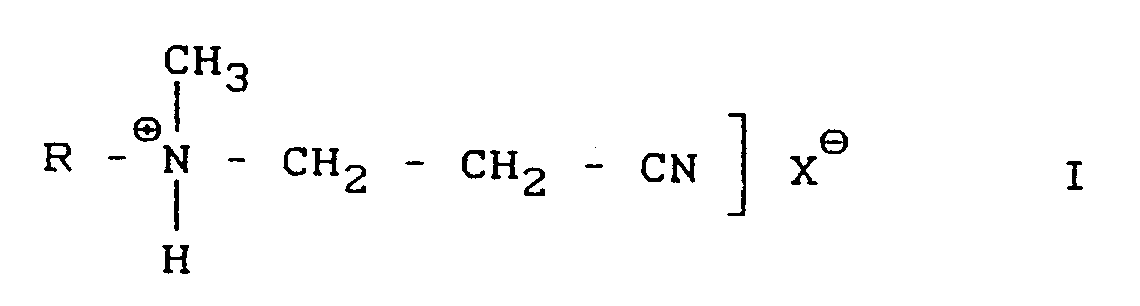
R = H oder C₁-C₄-Alkyl
X⊖ = Anion
in Gegenwart organischer Katalysatoren aus der Gruppe offenkettiger und cyclischer Carbonamide, N-C₁-C₁₂-alkylpyrrolidone, N-C₁-C₁₂-alkylcaprolactame, Trialkylphosphite, Triarylphosphite und Triarylphosphinoxide, oder PCl₅ oder PCl₃ oder Gemische davon in einem für die Reaktion inerten Lösungsmittel aus der Gruppe chlorierter aliphatischer und aromatischer Kohlenwasserstoffe, Phosphoroxychlorid, Isododecan und Chlorpyrimidine bei einer Temperatur von etwa 100-150°C mit Chlor behandelt. - Verfahren nach Anspruch 1, dadurch gekennzeichnet, daß man als Katalysatoren Dimethylformamid, Dibutylformamid, N-Methylpyrrolidon, N-Methylcaprolactam, ein Tri-C₁-C₄-Alkylphosphit, Triphenylphosphin, Triphenylphosphinoxid oder PCl₅ bzw. Gemische dieser Verbindungen verwendet.
- Verfahren nach Anspruch 1, dadurch gekennzeichnet, daß man als Lösungsmittel Phosphoroxychlorid oder Chlorpyrimidine verwendet.
- Verfahren nach Anspruch 1, dadurch gekennzeichnet, daß man pro Mol Dialkylaminopropionitril 400 bis 600 g Chlor einsetzt.
Applications Claiming Priority (2)
| Application Number | Priority Date | Filing Date | Title |
|---|---|---|---|
| DE3900917A DE3900917A1 (de) | 1989-01-13 | 1989-01-13 | Verfahren zur herstellung von 4,5,6-trichlorpyrimidin |
| DE3900917 | 1989-01-13 |
Publications (2)
| Publication Number | Publication Date |
|---|---|
| EP0377905A1 EP0377905A1 (de) | 1990-07-18 |
| EP0377905B1 true EP0377905B1 (de) | 1994-02-16 |
Family
ID=6372055
Family Applications (1)
| Application Number | Title | Priority Date | Filing Date |
|---|---|---|---|
| EP89124166A Expired - Lifetime EP0377905B1 (de) | 1989-01-13 | 1989-12-30 | Verfahren zur Herstellung von 4,5,6-Trichlorpyrimidin |
Country Status (4)
| Country | Link |
|---|---|
| US (1) | US5051507A (de) |
| EP (1) | EP0377905B1 (de) |
| JP (1) | JP2825581B2 (de) |
| DE (2) | DE3900917A1 (de) |
Families Citing this family (2)
| Publication number | Priority date | Publication date | Assignee | Title |
|---|---|---|---|---|
| JP2000511915A (ja) * | 1996-06-10 | 2000-09-12 | バイエル・アクチエンゲゼルシヤフト | 4,5,6―トリクロロ―および2,4,5,6―テトラクロロピリミジンの製造法 |
| DE19624418A1 (de) * | 1996-06-10 | 1997-12-11 | Bayer Ag | Verfahren zur Herstellung von 4,5,6-Trichlor- und 2,4,5,6-Tetrachlorpyrimidin |
Family Cites Families (4)
| Publication number | Priority date | Publication date | Assignee | Title |
|---|---|---|---|---|
| FR1545313A (fr) * | 1967-02-09 | 1968-11-08 | Bayer Ag | Procédé de fabrication de chloro-pyrimidines |
| DE1670795A1 (de) * | 1967-02-09 | 1971-03-25 | Bayer Ag | 4,5,6-Trichlorpyrimidin |
| DE2307863A1 (de) * | 1973-02-17 | 1974-08-22 | Bayer Ag | Verfahren zur herstellung von chlorpyrimidinen |
| US4730046A (en) * | 1986-04-14 | 1988-03-08 | Stauffer Chemical Company | Preparation of aryl halides |
-
1989
- 1989-01-13 DE DE3900917A patent/DE3900917A1/de not_active Withdrawn
- 1989-12-30 EP EP89124166A patent/EP0377905B1/de not_active Expired - Lifetime
- 1989-12-30 DE DE89124166T patent/DE58906998D1/de not_active Expired - Fee Related
-
1990
- 1990-01-09 JP JP2001146A patent/JP2825581B2/ja not_active Expired - Fee Related
- 1990-01-11 US US07/463,648 patent/US5051507A/en not_active Expired - Fee Related
Also Published As
| Publication number | Publication date |
|---|---|
| DE3900917A1 (de) | 1990-07-19 |
| JPH02233663A (ja) | 1990-09-17 |
| EP0377905A1 (de) | 1990-07-18 |
| JP2825581B2 (ja) | 1998-11-18 |
| DE58906998D1 (de) | 1994-03-24 |
| US5051507A (en) | 1991-09-24 |
Similar Documents
| Publication | Publication Date | Title |
|---|---|---|
| DE10333042B4 (de) | Verfahren zur Herstellung von cyclischen Phosphonsäureanhydriden und deren Verwendung | |
| EP0377905B1 (de) | Verfahren zur Herstellung von 4,5,6-Trichlorpyrimidin | |
| EP0277642B1 (de) | Verfahren zur Herstellung von Oximosilanen | |
| EP0157270B1 (de) | Verfahren zur Herstellung von tetrachlorierten Benzo-1,4-dioxenen | |
| EP0013007B1 (de) | Verfahren zur Herstellung von 4-Methyl-2-aminobenzthiazol | |
| DE69819959T2 (de) | Verfahren zur Herstellung von aromatischen Verbindungen die ein heterozyklisches System enthalten | |
| EP0074582B1 (de) | Verfahren zur Herstellung von Dialkylphosphinsäurehalogeniden | |
| DE69811358T2 (de) | Verfahren zur herstellung von 1-chlorocarbonyl-4-piperidinopiperidin oder dem hydrochlorid davon | |
| DE69503212T2 (de) | Verfahren zur Herstellung von (1,1-Dichloromethyl)methylether und (1,1-Dichloromethyl)ethylether | |
| EP3490972B1 (de) | Verfahren zur herstellung von fluoralkylnitrilen und den entsprechenden fluoralkyltetrazolen | |
| DE68913685T2 (de) | Verfahren zur Herstellung von 2,2'-Bis-defla2-oxazolin. | |
| DE1618986C3 (de) | Verfahren zur Herstellung von chlorierten aromatischen Nitrilen | |
| DE69711397T2 (de) | Herstellung von einem hydrazon-beta-ketoester durch reaktion mit einem diazoester | |
| DE2454326C2 (de) | 4,5-Dichlor-2-(dichlormethylen)-2H-imidazol und ein Verfahren zu seiner Herstellung | |
| EP1310476B1 (de) | Verfahren zur Herstellung von 2,3-Pentandion | |
| EP0258805B1 (de) | Verfahren zur Herstellung von 2-Chlorethanphosphonsäuredichlorid | |
| EP1196393B1 (de) | Verfahren zur herstellung von 4,6-dichlorpyrimidin | |
| EP0258804A2 (de) | Verfahren zur Herstellung von Vinylphosphonsäuredichlorid | |
| DE69429728T2 (de) | Verfahren zur herstellung von n-(2,6-dichloro-3-methylphenyl)-5-7-dihalo[1,2,4]triazolo[1,5a]pyrimidin-2-sulfonamid durch cyclisierung und halo-dehydroxylierung | |
| DE19713506A1 (de) | Verfahren zur Herstellung von 2,6-Dichlor-5-fluornicotinonitril und die chemische Verbindung 3-Cyano-2-hydroxy-5-fluorpyrid-6-on-mononatriumsalz sowie dessen Tautomere | |
| EP0022942A1 (de) | Verfahren zur Herstellung von Diazoniumtetrafluoroboraten mittels Nitrosyltetrafluoroborat und deren Verwendung | |
| DE3348300C2 (de) | Verwendung von alpha-Bromdiethylcarbonat | |
| EP0270041A2 (de) | Verfahren zur Herstellung von 2-Chlorethanphosphonsäuredichlorid | |
| EP0747364A2 (de) | Verfahren zur Herstellung von 2,4,6-Trichlorpyrimidin | |
| DE1008316B (de) | Verfahren zur Herstellung von 2-Oxo-1, 3, 2-dioxaphospholanen und 2-Oxo-1, 3, 2-dioxaphosphorinanen |
Legal Events
| Date | Code | Title | Description |
|---|---|---|---|
| PUAI | Public reference made under article 153(3) epc to a published international application that has entered the european phase |
Free format text: ORIGINAL CODE: 0009012 |
|
| 17P | Request for examination filed |
Effective date: 19891230 |
|
| AK | Designated contracting states |
Kind code of ref document: A1 Designated state(s): CH DE FR GB LI |
|
| 17Q | First examination report despatched |
Effective date: 19930223 |
|
| GRAA | (expected) grant |
Free format text: ORIGINAL CODE: 0009210 |
|
| AK | Designated contracting states |
Kind code of ref document: B1 Designated state(s): CH DE FR GB LI |
|
| GBT | Gb: translation of ep patent filed (gb section 77(6)(a)/1977) |
Effective date: 19940217 |
|
| REF | Corresponds to: |
Ref document number: 58906998 Country of ref document: DE Date of ref document: 19940324 |
|
| ET | Fr: translation filed | ||
| PLBE | No opposition filed within time limit |
Free format text: ORIGINAL CODE: 0009261 |
|
| STAA | Information on the status of an ep patent application or granted ep patent |
Free format text: STATUS: NO OPPOSITION FILED WITHIN TIME LIMIT |
|
| 26N | No opposition filed | ||
| REG | Reference to a national code |
Ref country code: GB Ref legal event code: IF02 |
|
| PGFP | Annual fee paid to national office [announced via postgrant information from national office to epo] |
Ref country code: FR Payment date: 20041208 Year of fee payment: 16 |
|
| PGFP | Annual fee paid to national office [announced via postgrant information from national office to epo] |
Ref country code: DE Payment date: 20041223 Year of fee payment: 16 |
|
| PGFP | Annual fee paid to national office [announced via postgrant information from national office to epo] |
Ref country code: GB Payment date: 20041229 Year of fee payment: 16 Ref country code: CH Payment date: 20041229 Year of fee payment: 16 |
|
| PG25 | Lapsed in a contracting state [announced via postgrant information from national office to epo] |
Ref country code: GB Free format text: LAPSE BECAUSE OF NON-PAYMENT OF DUE FEES Effective date: 20051230 |
|
| PG25 | Lapsed in a contracting state [announced via postgrant information from national office to epo] |
Ref country code: LI Free format text: LAPSE BECAUSE OF NON-PAYMENT OF DUE FEES Effective date: 20051231 Ref country code: CH Free format text: LAPSE BECAUSE OF NON-PAYMENT OF DUE FEES Effective date: 20051231 |
|
| PG25 | Lapsed in a contracting state [announced via postgrant information from national office to epo] |
Ref country code: DE Free format text: LAPSE BECAUSE OF NON-PAYMENT OF DUE FEES Effective date: 20060701 |
|
| REG | Reference to a national code |
Ref country code: CH Ref legal event code: PL |
|
| GBPC | Gb: european patent ceased through non-payment of renewal fee |
Effective date: 20051230 |
|
| PG25 | Lapsed in a contracting state [announced via postgrant information from national office to epo] |
Ref country code: FR Free format text: LAPSE BECAUSE OF NON-PAYMENT OF DUE FEES Effective date: 20060831 |
|
| REG | Reference to a national code |
Ref country code: FR Ref legal event code: ST Effective date: 20060831 |