EP0375715B1 - A bracket for attachment of wall linings - Google Patents
A bracket for attachment of wall linings Download PDFInfo
- Publication number
- EP0375715B1 EP0375715B1 EP88907422A EP88907422A EP0375715B1 EP 0375715 B1 EP0375715 B1 EP 0375715B1 EP 88907422 A EP88907422 A EP 88907422A EP 88907422 A EP88907422 A EP 88907422A EP 0375715 B1 EP0375715 B1 EP 0375715B1
- Authority
- EP
- European Patent Office
- Prior art keywords
- bracket
- wall
- attaching
- wires
- bent
- Prior art date
- Legal status (The legal status is an assumption and is not a legal conclusion. Google has not performed a legal analysis and makes no representation as to the accuracy of the status listed.)
- Expired
Links
Images


Classifications
-
- E—FIXED CONSTRUCTIONS
- E04—BUILDING
- E04F—FINISHING WORK ON BUILDINGS, e.g. STAIRS, FLOORS
- E04F13/00—Coverings or linings, e.g. for walls or ceilings
- E04F13/02—Coverings or linings, e.g. for walls or ceilings of plastic materials hardening after applying, e.g. plaster
- E04F13/04—Bases for plaster
- E04F13/045—Means for fastening plaster-bases to a supporting structure
-
- E—FIXED CONSTRUCTIONS
- E04—BUILDING
- E04B—GENERAL BUILDING CONSTRUCTIONS; WALLS, e.g. PARTITIONS; ROOFS; FLOORS; CEILINGS; INSULATION OR OTHER PROTECTION OF BUILDINGS
- E04B2/00—Walls, e.g. partitions, for buildings; Wall construction with regard to insulation; Connections specially adapted to walls
- E04B2/84—Walls made by casting, pouring, or tamping in situ
- E04B2/86—Walls made by casting, pouring, or tamping in situ made in permanent forms
-
- E—FIXED CONSTRUCTIONS
- E04—BUILDING
- E04F—FINISHING WORK ON BUILDINGS, e.g. STAIRS, FLOORS
- E04F13/00—Coverings or linings, e.g. for walls or ceilings
- E04F13/07—Coverings or linings, e.g. for walls or ceilings composed of covering or lining elements; Sub-structures therefor; Fastening means therefor
- E04F13/08—Coverings or linings, e.g. for walls or ceilings composed of covering or lining elements; Sub-structures therefor; Fastening means therefor composed of a plurality of similar covering or lining elements
- E04F13/0801—Separate fastening elements
- E04F13/0803—Separate fastening elements with load-supporting elongated furring elements between wall and covering elements
- E04F13/0805—Separate fastening elements with load-supporting elongated furring elements between wall and covering elements with additional fastening elements between furring elements and the wall
Definitions
- brackets It is known to attach insulating sheets in the form of plates and webs on a wall with the aid of brackets extending from the wall, the sheets being attached to the wall by causing the brackets to extend through the sheets such as to form suspending means therefore. It has previously been suggested to manufacture the bracket from plate material.
- brackets In order to attach to the brackets a surface covering such as wall panel, facade, sheets of wood, plating, lacquered plate, but also for attaching a grid carrying plaster intended to form a finished wall surface, it is known from my Swedish patent application 85 02247-6 to provide the bracket with a recess into which an horizontally directed bar is inserted.
- the bar serves to retain a layer of insulating material which is pressed steadily onto the bracket and thereby is pierced by the bracket.
- the bracket also has a second recess for receiving a beam or bolt.
- the beam serves as a support in which the facade sheet or the like is anchored.
- a disadvantage of the known bracket resides in the fact that it is difficult to set up and that it is relatively bulky whereby handling is troublesome and storing on the work place requires space.
- Brackets for attaching only insultating material but not wall-facing material are known from e.g. SE-A 338 143, SE-A-403 310, SE-A-423 419. These known brackets are manufactured from wire and for attaching the insulation to the brackets separate ties are used which also are made of wire.
- US-A-3 471 988 shows a wire clamp intended to be inserted to a brick wall. Subsequently a wooden board is attached to the clamp. These clamps are in particular used around window and door openings in brick walls. Neither insulating slabs nor facade sheets are attached to the clamp.
- the bracket In accordance with the present invention it is suggested to manufacture the bracket out of two wires which are bent to such shape that the bracket has sufficient strength to support the insulating slabs as well as any wall panel used.
- the bracket according to the invention has an attaching device intended to support a beam or cross bar retaining the perforated insulation against the wall and serving as a support for a facade sheet or the like.
- bracket may be used throughout the whole wall and that various types of wall cover may be attached to the wall.
- wall cover may be attached to the wall.
- facade panel of wood In the central portion of the wall it is for example possible to attach facade panel of wood to the brackets, above, under the eave, panels of plating may be attached to the brackets and on the lower portion of the wall a plaster layer may be supported by the brackets. All these layers are provided on the outside of the insulating slabs attached to the brackets and an air gap exists between the insulating slabs and the facade cover.
- the position of the screw with which the bracket is anchored in the wall is located along the arm of the bracket so that the moment due to which the facade cover under the action of gravity tends to turn the bracket in the downward direction is compensated by maximum moments with which a negative pressure caused by wind acting on the wall tends to turn the bracket in an upward direction.
- a bracket manufactured out of wire is resilient i.e. elastic in both the horizontal and vertical directions which means that the brackets absorb the temperature stresses to which the wall panels are exposed during respectively the day and the year. Hereby cracks in the wall facade are avoided.
- the wire bracket according to the invention appears in connection with the attachment of the insulating slabs.
- the brackets have been screwed into the wall the insulating slabs are attached by being pressed onto the brackets which are caused to cut through the insulating material.
- the insulating material is in the shape of long lengths delivered in the form of a compacted roll, the entire roll is lifted to the top of the scaffold, whereafter the roll is opened and the whole length is released over the wall and attached to the brackets.
- the transverse beams are inserted in the hooks of the bracket whereafter the insulating material is slightly compressed inwardly, about 7-8%.
- the compression is performed uniformly over the whole width of the insulating material whereby the insulating effect is enhanced.
- the longitudinal beams have such a cross-section as to be telescopically shiftable into each other facilitating a quick anchoring of the insulating material along extended horizontal lengths without time-requiring work for adapting the beams end-against-end or to saw the beams into suitable lengths. It is not necessary mutually to anchor the beams, it being sufficient to insert them into each other to a desired degree.
- the whole work of attaching the brackets to the wall, mounting the insulating slabs onto the brackets, anchoring the insulating slabs by means of the cross bars is extremely facilitated and requires short time because no sawing is required of either the insulating material or the beams.
- the insulating material is cut away and removed.
- No conventional cross-bars are needed for insulating purposes.
- No thermal bridges will be formed as no conventional cross-bars are used, whereby the insulating effect is improved.
- the mounting of the wall panels or the like is facilitated because they may be placed against two beams vertically spaced from each other and thereafter be attached e.g. by means of rivets without exact fitting work.
- the side edges of the wall panels are disposed in overlapping relation to the side edges of the insulating sheets to prevent formation of thermal bridges.
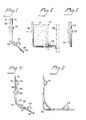
- Figure 1 shows a first embodiment of a bracket in which two wires 121, 122 of acid-resistant rustless steel, quality 3343, by means of welds 123, 124 are connected in a side-by-side position to form a bracket.
- the wires are bent to form an eye 125 through which a screw 126 shown in Figure 2 is intended to be inserted to attach the bracket to the wall.
- the wire 121 is bent to form a hook 127 intended to receive the Z-shaped beam 128 shown in Figure 2 onto which a facade sheet 129 is attached, for example by rivets.
- the end portion 130 of wire 122 is bevelled to form an edge intended to cut throught the insulation sheet 131 which on the outward side may be covered by a rigid facade material 132 such as plastic.
- the web of beam 128 establishes an air gap between the outer surface of the insulating sheet 131 and the inner surface of the facade material 132.
- the end 130 ( Figure 1) has a through opening 133 enabling a plaster-supporting grid (shown in Figure 9) to be attached, e.g. by means of wire elements, (the facade sheet 129 and the beam being omitted in this case).
- the plaster is placed to the desired thickness outwardly of the grid whereby the plaster will be freely suspended and supported by the bracket enabling the plaster to take part in the thermal expansion of the facade.
- the insulating material suitably has such thickness that the grid is in contact with the insulating material. In this case there is no air gap between the plaster layer and the insulation.
- Figure 2 shows how the insulation is secured behind beam 128 on the level of the hook 127.
- the position of the eye 125 on the vertical portion of the bracket is an important factor and is so chosen that the gravitational, downwardly directed moment is balanced by the upward moment acting onto the facade sheet when the wind is blowing to exert a negative pressure on the wall facade.
- the screw 126 in this case only requires a holding force of about 36 kg. This means that if the screw is pulled in a straight outward direction in the normal plane of the wall, the retaining force acting on the screw only needs to amount to about 36 kg.
- Figures 4 and 5 show a bracket similar to that shown in Figures 1 and 2 in that the wires 134 and 135 are positioned side by side and welded together at 136 and 137.
- the vertical and horizontal portions of the bracket have equal length causing the bracket to be symmetric so that it does not matter how it is oriented when it is screwed onto the wall.
- the wires are bent to form eyes 138, 139 for receiving screws.
- the wire 134 forms the points 140, 141 of the bracket which are bevelled to form an edge passing through the insulating sheet and which have an aperture each similar to the aperture shown in Figures 1 and 2 for attaching, for example, a plaster-supporting grid.
- Wire 134 has a bent portion 142 contributing towards stiffness and resiliency of the bracket in the vertical direction. Wire 134 is bent at either end to form one hook 143, 144 each similar hook 127 in Figure 1. The wire 135 is bent rectangularly at 145.
- Figure 6 shows a second embodiment of a bracket comprising two wires 146, 147 positioned side by side.
- the structure is identical with that shown in Figures 4 and 5 except for the fact that the vertical portion (in the orientation of the bracket as shown in Figure 6) is shorter than the horizontal portion.
- This offers the advantage that the same bracket may be used for two different thicknesses of the insulation material.
- wire 146 has a hook at either end whereas wire 147 is bevelled at both ends to form cutting edges.
- Figure 7 shows a wall 148 into which a number of cross-marked bracket 149 are screwed. Lengths of insulating material 150 are suspended on the horizontal portions of the brackets.
- Lengths of insulating material 150 are suspended on the horizontal portions of the brackets.
- three lengths or mats 150 of insulating material disposed side by side tightly adjacent each other in a non-overlapping relation.
- beams 151, 152, 153, 154 of e.g. aluminium, have been inserted into the hooks of the brackets to anchor the insulation.
- the beams 151 and 152 telescopically are inserted into each other and that the joint shown at 155 and 156 respectively is not a butt joint. Thus no cutting of the beams is required at the corners of the wall.
- facade sheets 157 (of which 3 are shown in Figure 7) are attached by rivets (indicated by dots) on the outside of the beams in the way shown in Figure 2.
- the butt-joints between the facade sheets are laterally shifted in relation the butt-joints between the insulating mats 150 in order to eliminate thermal bridges.
- Figure 8 shows an embodiment similar to that shown in Figure 4 with the exception that both wires 158, 159 of the bracket are bent rectangularly and that the hooks 160, 161 of the bracket extend at right angles and thus are not circularly bent.
- the vertical portion A of the bracket is slightly shorter that the horizontal portion B.
- the bracket is intended to be used together with a Z-shaped beam 162 the web portion of which has two rows of elongated through-openings designated 163 for the inner row and 164 for the outer row.
- the beam 162 is placed over hook 161 so that either the inner row 163 of openings or the outer row 164 of openings is engaged with the hook 161.
- the bracket may be used together with an insulation having a first thickness and in the latter case together with an insulation having a second thickness different from the first one.
- the bracket according to Figure 8 may be used in such a way that the section B forms the vertical portion. If the Z-beam 162 shown in Figure 8 is used to squeeze the insulation, the insulation may have a third thickness different from both the first and second thicknesses or a forth thickness different from both the first, second and third thicknesses depending on whether the beam is suspended on the hook 160 with its inner row 163 or outer row 164 of openings.
- Figure 9 shows how the bracket according to Figure 8 may be used to attach a grid 165 with the aid of wire elements 166 having the shape shown and being inserted through the hole 133 in the bracket.
- the hook 161 of the bracket serves as support for the wire structure.
- a plaster layer (not shown) is thereafter applied to the grid 165. Between the wall and the grid 165 the previously mentioned insulation, not shown in Figure 9 is supported.
- Figure 10 shows an arrangement similar to that of Figure 9.
- the bracket 167 is mounted on the wall by means of a screw 168.
- the insulation 169 has a thickness essentially corresponding to the spacing between the wall 148 and the hook 161 of the bracket.
- a spacing element 170 is clamped onto the hook.
- the spacing element 170 has the general shape as shown in Figures 11 and 12 and is preferably made of plastic.
- the spacing element 170 has a clamping portion 171 formed as a rib provided with a groove clamped about the hook 161 of the bracket.
- the spacing element has an outer portion 172 serving to compress the insulation slightly towards the wall 148. This causes the wire meshing 165 to lose contact with the insulation 169 which means that an air gap is formed therebetween.
- the wire meshing is retained between the hook 161 and the wire element 166.
- plaster When plaster is applied a portion thereof will penetrate through the opening of the wire meshing and the grid thus will be positioned some distance into the plaster layer to serve as armouring therein. This armouring is stronger than that achieved by the embodiment according to Figure 9.
- the plaster layer will be supported by the horizontal portion of the brackets.
- the plaster layer will not hang down towards and with its total weight press against and thereby damage the insulation but the plaster layer is freely supported by the brackets. This is an important feature of the invention.
- FIG 13 shows how the bracket according to the invention may be provided with a tie 173 of a type known in itself.
- the tie is passed through the opening 133 of the bracket and serves to retain a brick of a brick wall.
Landscapes
- Architecture (AREA)
- Engineering & Computer Science (AREA)
- Civil Engineering (AREA)
- Structural Engineering (AREA)
- Physics & Mathematics (AREA)
- Electromagnetism (AREA)
- Finishing Walls (AREA)
- Toys (AREA)
- Building Environments (AREA)
- Traffic Control Systems (AREA)
- Pharmaceuticals Containing Other Organic And Inorganic Compounds (AREA)
- Clamps And Clips (AREA)
- Road Signs Or Road Markings (AREA)
- Fishing Rods (AREA)
- Surgical Instruments (AREA)
- Glass Compositions (AREA)
- Saccharide Compounds (AREA)
- Medicines Containing Material From Animals Or Micro-Organisms (AREA)
- Load-Bearing And Curtain Walls (AREA)
- Connection Of Plates (AREA)
Priority Applications (1)
| Application Number | Priority Date | Filing Date | Title |
|---|---|---|---|
| AT88907422T ATE77114T1 (de) | 1987-08-20 | 1988-08-16 | Befestigungsklammer fuer wandverkleidungen. |
Applications Claiming Priority (3)
| Application Number | Priority Date | Filing Date | Title |
|---|---|---|---|
| SE8703240 | 1987-08-20 | ||
| SE8703240A SE460796B (sv) | 1986-08-29 | 1987-08-20 | Konsol foer fastsaettning av vaeggbeklaednader |
| CA000614853A CA1329708C (en) | 1987-08-20 | 1989-09-29 | Bracket for attachment of wall linings |
Publications (2)
| Publication Number | Publication Date |
|---|---|
| EP0375715A1 EP0375715A1 (en) | 1990-07-04 |
| EP0375715B1 true EP0375715B1 (en) | 1992-06-10 |
Family
ID=25673179
Family Applications (1)
| Application Number | Title | Priority Date | Filing Date |
|---|---|---|---|
| EP88907422A Expired EP0375715B1 (en) | 1987-08-20 | 1988-08-16 | A bracket for attachment of wall linings |
Country Status (9)
| Country | Link |
|---|---|
| US (1) | US5063721A (da) |
| EP (1) | EP0375715B1 (da) |
| AT (1) | ATE77114T1 (da) |
| CA (1) | CA1329708C (da) |
| DE (1) | DE3871958T2 (da) |
| DK (1) | DK43490A (da) |
| FI (1) | FI900824A7 (da) |
| NO (1) | NO172139C (da) |
| WO (1) | WO1989001550A1 (da) |
Cited By (1)
| Publication number | Priority date | Publication date | Assignee | Title |
|---|---|---|---|---|
| CN102912861A (zh) * | 2012-10-25 | 2013-02-06 | 长沙远大住宅工业有限公司 | 全预制装配式结构体系 |
Families Citing this family (18)
| Publication number | Priority date | Publication date | Assignee | Title |
|---|---|---|---|---|
| GR1000174B (el) * | 1989-10-20 | 1991-12-10 | Minas Iosifidis | Επιφανειες εφαρμογης κρεμαστων επιχρισματων. |
| CH690186A5 (de) * | 1995-03-20 | 2000-05-31 | Geberit Technik Ag | Montagerahmen für Sanitärapparate. |
| US7001284B2 (en) * | 2001-12-11 | 2006-02-21 | David Edel | Putter fitting template |
| US6735915B1 (en) * | 2002-11-06 | 2004-05-18 | Masonry Reinforcing Corp. Of America | Masonry anchoring system |
| MX2008011077A (es) * | 2006-02-28 | 2009-03-03 | All Terior Systems Llc | Sistemas y metodos para acabado de un borde de una pared en forma de concreto aislado (icf). |
| US8069622B2 (en) * | 2008-02-14 | 2011-12-06 | All-Terior Systems Llc | Systems and methods for finishing a penetration in a concrete structure during construction |
| US8424694B2 (en) * | 2008-10-03 | 2013-04-23 | Brian Eustace | Reduced weight storage rack |
| TW201335470A (zh) * | 2012-01-19 | 2013-09-01 | Richard White | 垂直壁安裝系統 |
| US8789339B2 (en) * | 2012-12-20 | 2014-07-29 | Tecnodima S.R.L. | Method for making façades of buildings |
| JP6438318B2 (ja) * | 2015-02-18 | 2018-12-12 | トヨタホーム株式会社 | コーナー外壁の固定構造 |
| US10188006B2 (en) * | 2015-12-16 | 2019-01-22 | Minka Lighting, Inc. | Bracket mount assembly for light fixtures |
| EP3199719B1 (en) * | 2016-02-01 | 2018-08-01 | Saint-Gobain Sweden AB | A device, system and method for fastening a mesh to a building structure, and a construction element |
| FI3239431T4 (fi) * | 2016-04-26 | 2025-04-22 | Leviat GmbH | Tukikannatin verhouksen kiinnittämiseksi tukiseinään |
| DE102017101509A1 (de) * | 2017-01-26 | 2018-07-26 | Ejot Baubefestigungen Gmbh | Konsole zur Befestigung von Fassadenelementen |
| AU2018280934B2 (en) * | 2017-06-07 | 2024-03-07 | Jaume COLOM TALLO | A construction system for wall cladding |
| US10336156B1 (en) | 2018-01-04 | 2019-07-02 | Fca Us Llc | Plumbing line hangers |
| CN112252630B (zh) * | 2020-09-16 | 2021-11-02 | 飞帆集团有限公司 | 一种装饰面墙结构及其施工工艺 |
| AU2022200889B2 (en) * | 2021-02-21 | 2023-09-07 | Bilge, Henry H MR | Universal z-z channel for mounting wall panels to existing wall |
Family Cites Families (19)
| Publication number | Priority date | Publication date | Assignee | Title |
|---|---|---|---|---|
| US396593A (en) * | 1889-01-22 | Fastening for roof-slates | ||
| US622933A (en) * | 1899-04-11 | Shelf-bracket | ||
| US727852A (en) * | 1902-06-16 | 1903-05-12 | Charles L Sharp | Curtain-pole hanger. |
| US1162375A (en) * | 1915-02-12 | 1915-11-30 | Georges Legros | Coat and hat hanger. |
| US1434915A (en) * | 1921-05-09 | 1922-11-07 | Scholfield Herbert | Building board |
| US1972505A (en) * | 1933-03-22 | 1934-09-04 | United Fruit Co | Display hook |
| FR794538A (fr) * | 1935-12-31 | 1936-02-19 | Verrouillage pour attelage de remorque | |
| US2661515A (en) * | 1948-05-11 | 1953-12-08 | United States Gypsum Co | Resilient fastening clip |
| DK92759C (da) * | 1958-02-05 | 1962-02-12 | Nymoelle Betonvarefabrik As A | Anordning ved med facadeelementer beklædte vægge. |
| US3300939A (en) * | 1963-10-17 | 1967-01-31 | Dur O Wal National Inc | Combination adjustable tie and joint reinforcement for wall constructions |
| US3471988A (en) * | 1968-08-21 | 1969-10-14 | George E Allen | Anchoring device for tying wooden members to brick or masonry walls |
| SE338143B (da) * | 1968-11-27 | 1971-08-30 | Bpa Byggproduktion Ab | |
| SE395941B (sv) * | 1974-04-25 | 1977-08-29 | Fast Devel Ab | Festelement for fastsettning av skiv-, platt- eller mattformigt genomstickbart material, i synnerhet isolationsmaterial, vid ett underlag |
| SE403310B (sv) * | 1976-12-22 | 1978-08-07 | Rockwool Ab | Festelement |
| SE398764C (sv) * | 1977-03-02 | 1979-08-20 | Essve Produkterab | Sett att vermeisolera husfasader samt anordning for genomforande av settet |
| SE423419B (sv) * | 1977-08-01 | 1982-05-03 | Rockwool Ab | Ledat festelement |
| SE438695B (sv) * | 1981-04-06 | 1985-04-29 | Agnate Ab | Forankringsorgan |
| SE455207B (sv) * | 1984-11-30 | 1988-06-27 | Neofac Ab | Festbricka for tradkramla och anvendning av densamma |
| FI871109A7 (fi) * | 1985-10-08 | 1987-04-09 | Ingeberg Bjoern | Liitoselin kiskoprofiiliin kiinnittämisek |
-
1988
- 1988-08-16 WO PCT/SE1988/000417 patent/WO1989001550A1/en not_active Ceased
- 1988-08-16 FI FI900824A patent/FI900824A7/fi not_active Application Discontinuation
- 1988-08-16 AT AT88907422T patent/ATE77114T1/de not_active IP Right Cessation
- 1988-08-16 DE DE8888907422T patent/DE3871958T2/de not_active Expired - Lifetime
- 1988-08-16 EP EP88907422A patent/EP0375715B1/en not_active Expired
- 1988-08-16 US US07/460,884 patent/US5063721A/en not_active Expired - Fee Related
-
1989
- 1989-09-29 CA CA000614853A patent/CA1329708C/en not_active Expired - Fee Related
-
1990
- 1990-02-19 DK DK043490A patent/DK43490A/da not_active Application Discontinuation
- 1990-02-19 NO NO900788A patent/NO172139C/no unknown
Cited By (1)
| Publication number | Priority date | Publication date | Assignee | Title |
|---|---|---|---|---|
| CN102912861A (zh) * | 2012-10-25 | 2013-02-06 | 长沙远大住宅工业有限公司 | 全预制装配式结构体系 |
Also Published As
| Publication number | Publication date |
|---|---|
| WO1989001550A1 (en) | 1989-02-23 |
| DK43490D0 (da) | 1990-02-19 |
| EP0375715A1 (en) | 1990-07-04 |
| ATE77114T1 (de) | 1992-06-15 |
| DE3871958T2 (de) | 1992-12-03 |
| NO172139B (no) | 1993-03-01 |
| US5063721A (en) | 1991-11-12 |
| DK43490A (da) | 1990-04-06 |
| NO172139C (no) | 1993-06-09 |
| DE3871958D1 (de) | 1992-07-16 |
| NO900788L (no) | 1990-04-19 |
| NO900788D0 (no) | 1990-02-19 |
| CA1329708C (en) | 1994-05-24 |
| FI900824A0 (fi) | 1990-02-19 |
| FI900824A7 (fi) | 1990-02-19 |
Similar Documents
| Publication | Publication Date | Title |
|---|---|---|
| EP0375715B1 (en) | A bracket for attachment of wall linings | |
| CA1308668C (en) | Acoustical panel | |
| US9493941B2 (en) | Thermal break wall systems and thermal adjustable clip | |
| US5937600A (en) | Exterior wall system and drip channel | |
| US3748799A (en) | Sound-absorbent panel | |
| CA1309228C (en) | Panels with laminated strips for clips | |
| US4440099A (en) | Ceramic fiber modular assemblies for lining furnace walls | |
| EP0270541B1 (en) | A floor to ceiling mullion structure with hanging panels to realize a demountable partition wall | |
| US5058354A (en) | Panels with laminated strips for clips | |
| US4583342A (en) | Securement of glass in fire doors and the like | |
| EP0886704B1 (en) | An insulating element for clamping installation between roof rafters or beams of other wooden constructions | |
| EP0381356A1 (en) | Panels | |
| US3901471A (en) | Wallboard bracket | |
| CN215889098U (zh) | 一种具有挂装墙顶收口结构的装配式墙面系统 | |
| US2147667A (en) | Prefabricated building | |
| AU604914B2 (en) | Insulating batts sag-preventing wall frame stud | |
| JPH044413Y2 (da) | ||
| CN113550524A (zh) | 一种具有挂装墙顶收口结构的装配式墙面系统及安装方法 | |
| CN220790145U (zh) | 一种建筑保温墙板 | |
| JP3538498B2 (ja) | 葺き下ろし用鋼製天井フレーム | |
| CN213805925U (zh) | 一种装配式现场一体化喷涂保温结构 | |
| JP5643958B2 (ja) | 瓦棒葺き屋根および屋根施工方法 | |
| JP3671357B2 (ja) | 外囲体 | |
| JP3887974B2 (ja) | 折板屋根の支持構造、支持部材及び支持方法 | |
| JP3563548B2 (ja) | 吹き抜け構造 |
Legal Events
| Date | Code | Title | Description |
|---|---|---|---|
| PUAI | Public reference made under article 153(3) epc to a published international application that has entered the european phase |
Free format text: ORIGINAL CODE: 0009012 |
|
| 17P | Request for examination filed |
Effective date: 19900219 |
|
| AK | Designated contracting states |
Kind code of ref document: A1 Designated state(s): AT BE CH DE FR GB IT LI LU NL SE |
|
| 17Q | First examination report despatched |
Effective date: 19910312 |
|
| GRAA | (expected) grant |
Free format text: ORIGINAL CODE: 0009210 |
|
| AK | Designated contracting states |
Kind code of ref document: B1 Designated state(s): AT BE CH DE FR GB IT LI LU NL SE |
|
| PG25 | Lapsed in a contracting state [announced via postgrant information from national office to epo] |
Ref country code: SE Effective date: 19920610 |
|
| REF | Corresponds to: |
Ref document number: 77114 Country of ref document: AT Date of ref document: 19920615 Kind code of ref document: T |
|
| REF | Corresponds to: |
Ref document number: 3871958 Country of ref document: DE Date of ref document: 19920716 |
|
| ET | Fr: translation filed | ||
| ITF | It: translation for a ep patent filed | ||
| PGFP | Annual fee paid to national office [announced via postgrant information from national office to epo] |
Ref country code: BE Payment date: 19920827 Year of fee payment: 5 |
|
| PG25 | Lapsed in a contracting state [announced via postgrant information from national office to epo] |
Ref country code: LU Free format text: LAPSE BECAUSE OF NON-PAYMENT OF DUE FEES Effective date: 19920831 |
|
| PGFP | Annual fee paid to national office [announced via postgrant information from national office to epo] |
Ref country code: NL Payment date: 19920831 Year of fee payment: 5 Ref country code: AT Payment date: 19920831 Year of fee payment: 5 |
|
| PGFP | Annual fee paid to national office [announced via postgrant information from national office to epo] |
Ref country code: CH Payment date: 19930224 Year of fee payment: 5 |
|
| PLBE | No opposition filed within time limit |
Free format text: ORIGINAL CODE: 0009261 |
|
| STAA | Information on the status of an ep patent application or granted ep patent |
Free format text: STATUS: NO OPPOSITION FILED WITHIN TIME LIMIT |
|
| 26N | No opposition filed | ||
| PG25 | Lapsed in a contracting state [announced via postgrant information from national office to epo] |
Ref country code: AT Effective date: 19930816 |
|
| PG25 | Lapsed in a contracting state [announced via postgrant information from national office to epo] |
Ref country code: LI Effective date: 19930831 Ref country code: CH Effective date: 19930831 Ref country code: BE Effective date: 19930831 |
|
| PGFP | Annual fee paid to national office [announced via postgrant information from national office to epo] |
Ref country code: GB Payment date: 19940216 Year of fee payment: 6 |
|
| PGFP | Annual fee paid to national office [announced via postgrant information from national office to epo] |
Ref country code: FR Payment date: 19940224 Year of fee payment: 6 |
|
| BERE | Be: lapsed |
Owner name: LARSSON JOHN ARTHUR Effective date: 19930831 |
|
| PG25 | Lapsed in a contracting state [announced via postgrant information from national office to epo] |
Ref country code: NL Effective date: 19940301 |
|
| NLV4 | Nl: lapsed or anulled due to non-payment of the annual fee | ||
| PGFP | Annual fee paid to national office [announced via postgrant information from national office to epo] |
Ref country code: DE Payment date: 19940428 Year of fee payment: 6 |
|
| REG | Reference to a national code |
Ref country code: CH Ref legal event code: PL |
|
| PG25 | Lapsed in a contracting state [announced via postgrant information from national office to epo] |
Ref country code: GB Effective date: 19940816 |
|
| GBPC | Gb: european patent ceased through non-payment of renewal fee |
Effective date: 19940816 |
|
| PG25 | Lapsed in a contracting state [announced via postgrant information from national office to epo] |
Ref country code: FR Effective date: 19950428 |
|
| PG25 | Lapsed in a contracting state [announced via postgrant information from national office to epo] |
Ref country code: DE Effective date: 19950503 |
|
| REG | Reference to a national code |
Ref country code: FR Ref legal event code: ST |
|
| PG25 | Lapsed in a contracting state [announced via postgrant information from national office to epo] |
Ref country code: IT Free format text: LAPSE BECAUSE OF NON-PAYMENT OF DUE FEES;WARNING: LAPSES OF ITALIAN PATENTS WITH EFFECTIVE DATE BEFORE 2007 MAY HAVE OCCURRED AT ANY TIME BEFORE 2007. THE CORRECT EFFECTIVE DATE MAY BE DIFFERENT FROM THE ONE RECORDED. Effective date: 20050816 |