EP0366996A1 - Drehfeldmotor an Einphasennetz - Google Patents
Drehfeldmotor an Einphasennetz Download PDFInfo
- Publication number
- EP0366996A1 EP0366996A1 EP89119033A EP89119033A EP0366996A1 EP 0366996 A1 EP0366996 A1 EP 0366996A1 EP 89119033 A EP89119033 A EP 89119033A EP 89119033 A EP89119033 A EP 89119033A EP 0366996 A1 EP0366996 A1 EP 0366996A1
- Authority
- EP
- European Patent Office
- Prior art keywords
- motor according
- winding
- rectifier
- switches
- control circuit
- Prior art date
- Legal status (The legal status is an assumption and is not a legal conclusion. Google has not performed a legal analysis and makes no representation as to the accuracy of the status listed.)
- Granted
Links
- 230000006698 induction Effects 0.000 title abstract description 3
- 238000004804 winding Methods 0.000 claims abstract description 55
- 239000003990 capacitor Substances 0.000 claims description 16
- 230000001419 dependent effect Effects 0.000 claims description 2
- 230000001105 regulatory effect Effects 0.000 claims description 2
- 230000009291 secondary effect Effects 0.000 claims 1
- 238000000034 method Methods 0.000 description 3
- 230000007423 decrease Effects 0.000 description 2
- 230000010363 phase shift Effects 0.000 description 2
- 230000033228 biological regulation Effects 0.000 description 1
- 238000013016 damping Methods 0.000 description 1
- 230000005284 excitation Effects 0.000 description 1
- 238000009472 formulation Methods 0.000 description 1
- 239000000203 mixture Substances 0.000 description 1
- 238000013021 overheating Methods 0.000 description 1
- 230000001629 suppression Effects 0.000 description 1
Images

Classifications
-
- H—ELECTRICITY
- H02—GENERATION; CONVERSION OR DISTRIBUTION OF ELECTRIC POWER
- H02P—CONTROL OR REGULATION OF ELECTRIC MOTORS, ELECTRIC GENERATORS OR DYNAMO-ELECTRIC CONVERTERS; CONTROLLING TRANSFORMERS, REACTORS OR CHOKE COILS
- H02P25/00—Arrangements or methods for the control of AC motors characterised by the kind of AC motor or by structural details
- H02P25/02—Arrangements or methods for the control of AC motors characterised by the kind of AC motor or by structural details characterised by the kind of motor
- H02P25/04—Single phase motors, e.g. capacitor motors
Definitions
- the invention relates to a rotary field motor with windings arranged spatially offset from one another, the first of which is directly connected, the second of which is connected to a single-phase network via a rectifier, and to a control circuit.
- the operation of three-phase motors requires at least two voltages offset in phase. This is mandatory for the start-up process and is also required if high torques are to be achieved during operation. If there is only a single-phase network, a phase-shifted voltage must be derived from this. It has already been proposed to generate the auxiliary phase via a series resistor. Because of the power loss, this method is only suitable for low power or is only used as a starting circuit. the auxiliary phase is switched off after the motor has started. Furthermore, the generation of an auxiliary phase by an additional capacitor has been proposed, which generates a voltage on the auxiliary winding that is phase-shifted with respect to the mains voltage. A major disadvantage is that the capacitor can only be optimized for a specific operation. In the case of a condenser intended for operation, the drive runs out of round at low load and tends to generate a lot of noise. At high loads, the drive lacks the corresponding torque.
- phase-shifted auxiliary voltage In principle, it is also possible to generate the phase-shifted auxiliary voltage electronically. It has already been proposed to use such an electronic auxiliary phase as a starting aid.
- the phase-shifting auxiliary voltage is achieved by phase-cutting the mains voltage. This results in a relatively low voltage and the auxiliary phase requires a correspondingly large current. This procedure could not prevail.
- Other electronic circuits are only used to switch a starting capacitor on and off (OE-PS 378 634).
- a generic induction motor is known from DE-OS 24 45 162.
- a main winding is provided, which is located directly on the single-phase network.
- a bridge rectifier is connected in parallel with the main winding and supplies a second winding arranged offset to the main winding, the phase offset being controlled by an electronic circuit.
- a disadvantage of this circuit is that the main winding and the inverter are each parallel to the grid.
- the auxiliary winding cannot be electrically shifted by 90 degrees, since in this case there would hardly be any tension left. Rather, the motor according to the prior art has to work with a 45 degree electrical phase shift in order to achieve a sufficient voltage utilization, which in turn presupposes a corresponding phase position of the winding that differs from 90 degrees. Overall, this does not require a satisfactory Be drive behavior with regard to starting torque, starting current and smooth running.
- the invention is therefore based on the object of providing a rotating field motor which ensures optimum operating behavior, in particular with a low starting current overshoot and adequate overvoltage protection.
- the stated object is achieved in a motor of the type mentioned in the introduction in that the rectifier is connected in series with the first winding.
- the main advantages of the motor according to the invention are optimal concentricity in all load conditions and thus low-noise operation.
- the motor according to the invention ensures an almost constant torque in the entire starting area. It can be designed to save space and can be accommodated in a terminal box as a whole, with no external components being required.
- the starting current overshoot is practically switched off, so that there is a continuous torque curve without steps and steps.
- direct electronic reversing is possible.
- Oversynchronous operation can be carried out on hoists. Mains voltage tolerances have little influence on the behavior of the motor.
- the inrush current or starting current is low. Overall, the configuration according to the invention can be inexpensive and wear-free.
- the switch-on behavior is improved by a preferably provided intermediate circuit capacitor.
- a total of the embodiment according to the invention achieves a largely anti-blocking drive, low network interference, high pump interference suppression, the possibility of oversynchronous operation and thus suitability for use in a hoist.
- control circuit has an inverter, the control circuit being arranged between the rectifier and the second coil, and thus the inverter feeding the auxiliary winding being arranged in series with the main winding.
- the control circuit itself can be designed in various ways, also known per se. While in principle, according to the prior art, the secondary winding can be connected to a common pole of the rectifier via two switches which can be switched alternately, while the other pole of the rectifier lies on a center tap of the winding, a preferred embodiment provides for the use of the entire winding length of the second winding that the inverter has at least two consecutively arranged between the two poles of the rectifier, alternately switched electrical switches, between which one connection of the second winding is switched on, the other connection in a suitable manner depending on the switching state of the two switches mentioned with the pole of Rectifier, to which the connection of the first terminal of the winding is open, can be connected.
- An extremely preferred embodiment provides that capacitors are connected in parallel with the switches, between which the second connection of the second winding is tapped, while it can also be provided that two further switches are connected in parallel with the first two switches, between which the second connection of the second winding is tapped and which can be switched in push-pull to the first two switches.
- the first of the two alternatives mentioned has a smaller number of active switching elements than the second. In any case, it is important that there is no center tap, but the second winding two shafts can always be switched to the rectifier.
- the control circuit has a synchronization circuit which detects the phase position of the mains and main winding voltage, a circuit regulating voltage time areas depending on the load being furthermore provided.
- the invention enables the voltage of the two windings to be electrically at 90 degrees to one another regardless of the load.
- the voltages on both motor windings are reduced as the load decreases, and the excitation is almost independent of voltage fluctuations.
- a synchronization transformer lying parallel to the main winding, the secondary winding of which is connected to inputs of comparators, the further input of which is present at the output of the rectifier. This allows the phase position to be reversed so that the direction of rotation of the motor is reversed.
- the synchronization transformer is followed by a capacitor and / or a reversing switch.
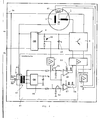
- the three-phase motor 1 is connected to network connections 2 of a single-phase AC network.
- the motor itself has two windings 3, 4, which are arranged spatially offset from one another, for example as stator windings around an armature of the motor (not shown).
- the main winding 3 is connected to one of its terminals 6 at a terminal 2a of the network 2, while the other terminal 7 of the main winding 3 is connected to a rectifier 8, such as a putting rectifier, the second primary terminal of which is connected to the mains contact 2b, during the rectifier 8, an inverter 9 is arranged downstream, a capacitor 10 being located between the two.
- the inverter 9 feeds the further motor winding 4 with a voltage, in particular shifted by 90 degrees, relative to the voltage at the mains connections 2 and thus at the first motor winding 3.
- the inverter 9 and thus the second winding 4 are therefore connected in series with the main winding 3.
- the inverter is represented by schematically represented switches 21 to 24 or switches 31, 32 and capacitors 33, 34, the schematically represented switches representing electronic switches.
- the auxiliary winding 4 is also shown.
- the connections 9a and 9b denote the connections of the inverter 9 (FIG. 1) to the rectifier 8.
- the switches 31, 32 are opened and closed alternately, as a result of which the capacitors 34, 33 are alternately charged via the auxiliary winding 4, while they each discharge after switching over, the other capacitor being charged in each case.
- the switching itself can be carried out in a manner known per se, for example in accordance with a pulse switching according to DE-OS 24 45 162.
- FIG. 4 shows a specific embodiment of a preferred synchronization circuit 41.
- the synchronization circuit 41 has a synchronization transformer 42 which is connected in parallel to the main winding 3 of the motor M via a switch 43.
- the switch 43 is designed as a changeover switch. The direction of rotation of the motor can be selected by switching over, in that the connection to the center tap of the primary winding of the transformer 42 is made to the right or bottom tap of the transformer.
- the transformer continues to supply the entire electronics with energy from the operating voltage Ub via the rectifier 44.
- a capacitor 1 is connected downstream of the transformer, which causes the phase shift of 90 degrees between the main and auxiliary windings 3, 4 of the motor M.
- the two connections of the secondary winding of the transformer lead to (plus) inputs of comparators 46, 47. Their (minus) input is connected to the output of the rectifier 8 via an amplifier V1.
- V1 the voltage on the main winding becomes the DC link voltage of the electronically controlled Compared winding.
- the outputs of the comparators 46, 47 act on the power transistors of the inverter 9 via an amplifier V2.
- the regulation is based on the principle of mutual influence: if the voltage in the intermediate circuit of the auxiliary winding, i.e. on capacitor C o (or 10) increases, the pulse width behind the comparators increases, which in turn leads to a formulation of the voltage on capacitor C o and thus increasing the tension on the main winding until a preselected tension distribution is reached. In the event that the voltage across the capacitor C o drops, the width of the output pulses of the comparators decreases, which in turn allows an optimal voltage to be leveled.
- the invention provides, in a manner known per se, that a temperature sensor 61 is provided in the motor, which acts via an amplifier 62 on the amplifier V 2 or the inverter 9 and can block it, as a result of which the motor is stopped in order to counter it To protect overheating.
- the motor according to the invention can also be provided with a DC brake.
Landscapes
- Engineering & Computer Science (AREA)
- Power Engineering (AREA)
- Control Of Ac Motors In General (AREA)
- Windings For Motors And Generators (AREA)
- Control Of Motors That Do Not Use Commutators (AREA)
- Liquid Developers In Electrophotography (AREA)
Abstract
Description
- Die Erfindung betrifft einen Drehfeldmotor mit räumlich zueinander versetzt angeordneten Wicklungen, deren erste direkt, deren zweite über einen Gleichrichter mit einem Einphasennetz verbunden ist, und mit einer Steuerschaltung.
- Der Betrieb von Drehfeldmotoren erfordert mindestens zwei in der Phasenlage versetzte Spannungen. Dies ist für den Anlaufvorgang zwingend erforderlich und wird ebenfalls benötigt, wenn betriebsmäßig hohe Drehmomente erreicht werden sollen. Liegt nur ein Einphasennetz vor, so muß aus diesem eine phasenverschobene Spannung abgeleitet werden. Es wurde schon vorgeschlagen, die Hilfsphase über einen Vorwiderstand zu erzeugen. Wegen der Verlustleistung ist dieses Verfahren nur für geringe Leistungen geeignet bzw. es wird nur als Anlaufschaltung verwendet, wobei die Hilfsphase nach dem Anlaufen des Motors abgeschaltet wird. Weiterhin wurde die Erzeugung einer Hilfsphase durch einen Zusatzkondensator vorgeschlagen, der eine gegenüber der Netzspannung phasenverschobene Spannung an der Hilfswicklung erzeugt. Ein wesentlicher Nachteil ist, daß der Kondensator nur für einen bestimmten Arbeitsvorgang optimiert werden kann. Bei einem für den Betrieb bestimmten Kondensator läuft der Antrieb bei kleiner Auslastung unrund und neigt zu starker Geräuschentwicklung. Bei hoher Last fehlt dem Antrieb das entsprechende Drehmoment.
- Es ist weiterhin grundsätzlich möglich, die phasenverschobene Hilfsspannung auch elektronisch zu erzeugen. Es wurde schon vorgeschlagen, eine solche elektronische Hilfsphase als Starthilfe zu verwenden. Die phasenverschiebende Hilfsspannung wird durch Phasenanschnitt der Netzspannung erreicht. Daraus resultiert eine relativ kleine Spannung und die Hilfsphase erfordert einen entsprechend großen Strom. Dieses Verfahren konnte sich nicht durchsetzen. Weitere elektronische Schaltungen dienen lediglich zum Ein- und Ausschalten eines Anlaufkondensators (OE-PS 378 634).
- Ein gattungsgemäßer Drehfeldmotor ist aus der DE-OS 24 45 162 bekannt. Es ist eine Hauptwicklung vorgesehen, die direkt am Einphasennetz liegt. Parallel zur Hauptwicklung ist ein Brückengleichrichter geschaltet, der eine versetzt zur Hauptwicklung angeordnete zweite Wicklung versorgt, wobei der Phasenversatz durch eine elektronische Schaltung gesteuert wird.
- Nachteilig bei dieser Schaltung ist, daß Hauptwicklung und Wechselrichter jeweils parallel zum Netz liegen. Die Hilfswicklung kann nicht elektrisch um 90 Grad verschoben sein, da in diesem Falle kaum noch Spannungen vorhanden wären. Der Motor nach dem Stand der Technik muß vielmehr mit 45 Grad elektrischer Phasenverschiebung arbeiten, um noch eine hinreichende Spannungsausnutzung zu erreichen,was wiederum eine entsprechende von 90 Grad verschiedene Phasenlage der Wicklung voraussetzt. Dies insgesamt bedingt kein befriedigendes Be triebsverhalten im Hinblick auf Anlaufmoment, Anlaufstrom und Laufruhe.
- Obwohl diese Schaltung grundsätzlich Vorteile gegenüber den vorgenannten aufweist und deren Nachteile weitgehend überwindet, ist die Anlaufstromüberhöhung sowie der Überspannungsschutz und insgesamt das Betriebsverhalten noch nicht optimal.
- Der Erfindung liegt daher die Aufgabe zugrunde, einen Drehfeldmotor zu schaffen, der ein optimales Betriebsverhalten, insbesondere mit geringer Anlaufstromüberhöhung und hinreichendem Überspannungsschutz gewährleistet.
- Erfindungsgemäß wird die genannte Aufgabe bei einem Motor der eingangs genannten Art dadurch gelöst, daß der Gleichrichter in Reihe zur ersten Wicklung geschaltet ist.
- Wesentliche Vorteile des erfindungsgemäßen Motors bestehen in einem optimalen Rundlauf bei allen Lastzuständen und damit einem geräuscharmen Betrieb. Darüberhinaus gewährleistet der erfindungsgemäße Motor ein nahezu konstantes Drehmoment im gesamten Anlaufbereich. Er kann platzsparend ausgebildet und insgesamt in einem Klemmkasten untergebracht werden, wobei keine externen Bauelemente erforderlich sind. Insbesondere wird die Anlaufstromüberhöhung praktisch ausgeschaltet, so daß ein kontinuierlicher Momentenverlauf ohne Absätze und Stufen gegeben ist. Neben einer hohen Schalthäufigkeit ist ein direktes elektronisches Reversieren möglich. Bei Hubwerken kann ein übersynchroner Betrieb vorgenommen werden. Netzspannungstoleranzen haben einen geringen Einfluß auf das Verhalten des Motors. Der Einschaltstrom bzw. Anlaufstrom ist gering. Insgesamt kann die erfindungsgemäße Ausgestaltung kostengünstig und verschleißfrei ausgebildet sein.
- Durch einen bevorzugterweise vorgesehenen Zwischenkreiskondensator wird das Einschaltverhalten verbessert. Es wird insbesondere ermöglicht, die Hilfswicklung um 90 Grad elektrisch gegenüber der Phase der Hauptwicklung verschoben zu betreiben. Insgesamt erreicht die erfindungsgemäße Ausgestaltung einen weitgehend blockierfesten Antrieb, geringe Netzrückwirkungen, hohe Pumpentstörung, die Möglichkeit zu einem übersynchronen Betrieb und damit die Eignung für den Einsatz bei einem Hubwerk.
- Die erfindungsgemäßen Vorteile werden insbesondere dadurch unterstützt, daß die Steuerschaltung einen Wechselrichter aufweist, wobei die Steuerschaltung zwischen Gleichrichter und zweiter Spule angeordnet und damit der die Hilfswicklung speisende Wechselrichter in Reihenschaltung mit der Hauptwicklung angeordnet ist.
- Die Steuerschaltung selbst kann in verschiedener, auch ansich bekannter Weise ausgebildet sein. Während grundsätzlich entsprechend dem Stande der Technik die Sekundärwicklung über zwei wechselweise schaltbare Schalter mit einem gemeinsamen Pol des Gleichrichters verbunden sein können, während der andere Pol des Gleichrichters an einer Mittelanzapfung der Wicklung liegt, sieht eine bevorzugte Ausgestaltung zur Nutzung der gesamten Wicklungslänge der zweiten Wicklung vor, daß der Wechselrichter mindestens zwei nacheinander zwischen den beiden Polen des Gleichrichters angeordnete, wechselweise geschaltete elektrische Schalter aufweist, zwischen denen ein Anschluß der zweiten Wicklung eingeschaltet ist, wobei der andere Anschluß in geeigneter Weise jeweils je nach Schaltzustand der genannten zwei Schalter mit dem Pol des Gleichrichters, zu dem die Verbindung des ersten Anschlusses der Wicklung gerade geöffnet ist, verbindbar ist. Eine äußerst bevorzugte Ausgestaltung sieht hier vor, daß parallel zu den Schaltern Kondensatoren geschaltet sind, zwischen denen der zweite Anschluß der zweiten Wicklung abgegriffen wird, während darüberhinaus auch vorgesehen sein kann, daß parallel zu den ersten beiden Schaltern zwei weitere Schalter geschaltet sind, zwischen denen der zweite Anschluß der zweiten Wicklung abgegriffen wird und die im Gegentakt zu den zwei ersten Schaltern schaltbar sind. Die erste der beiden genannten Alternativen hat gegenüber der zweiten eine geringere Zahl von aktiven Schaltelementen. Auf jeden Fall ist wichtig, daß kein Mittelabgriff erfolgt, sondern die zweite Wicklung bei beiden Haltwellen immer insgesamt an den Gleichrichter schaltbar ist.
- In weiterer bevorzugter Ausgestaltung ist vorgesehen, daß die Steuerschaltung eine Phasenlage von Netz- und Hauptwicklungsspannung erfassende Synchronisationsschaltung aufweist, wobei weiterhin eine Spannungszeitflächen lastabhängig ausregelnde Schaltung vorgesehen ist. Die Erfindung ermöglicht, daß unabhängig von der Belastung die Spannung der beiden Wicklungen immer mit 90 Grad elektrisch zueinander stehen. Durch die lastabhängige Reglungsmöglichkeit werden mit Abnehmen der Belastung die Spannungen an beiden Motorwicklungen reduziert und damit erreicht, daß die Erregung nahezu unabhängig von Spannungsschwankungen ist. In weiterer bevorzugter Ausgestaltung ist vorgesehen, daß ein parallel zur Hauptwicklung liegender Synchronisationstransformator, dessen Sekundärwicklung mit Eingängen von Komparatoren verbunden ist, deren weiterer Eingang am Ausgang des Gleichrichters anliegt. Hierdurch kann eine Umkehrung der Phasenlage, damit eine Reversierung der Drehrichtung des Motors erreicht werden.
- In weiterer bevorzugter Ausgestaltung kann vorgesehen sein, daß dem Synchronisationstransformator ein Kondensator nachgeschaltet ist und/oder ein Reversierschalter.
- Weitere Vorteile und Merkmale der Erfindung ergeben sich aus den Ansprüchen und aus der nachfolgenden Beschreibung, in der Ausführungsbeispiele der Erfindung unter Bezugnahme auf die Zeichnung im einzelnen erläutert sind. Dabei zeigt:
- Figur 1 Eine bevorzugte Ausgestaltung des erfindungsgemäßen Drehfeldmotors;
- Figur 2 eine erste Ausgestaltung eines Wechselrichters; und
- Figur 3 eine weitere bevorzugte Ausgestaltung des Wechselrichters; und
- Figur 4 eine weitere äußerst bevorzugte Ausgestaltung des erfindungsgemäßen Drehfeldmotors mit Synchronisationsschaltung.
- Der lediglich schematisch dargestellte erfindungsgemäße Drehfeldmotor 1 liegt an Netzanschlüssen 2 eines Einphasen-Wechselstromnetzes. Der Motor selbst weist zwei Wicklungen 3,4 auf, die räumlich zueinander versetzt angeordnet sind, beispielsweise als Statorwicklungen um einen Anker des Motors (nicht dargestellt). Die Hauptwicklung 3 ist mit einem ihrer Anschlüsse 6 an einer Klemme 2a des Netzes 2 verbunden, während der andere Anschluß 7 der Hauptwicklung 3 auf einen Gleichrichter 8, wie einen Putten-Gleichrichter geführt ist, dessen zweiter Primäranschluß am Netzkontakt 2b liegt, während dem Gleichrichter 8 ein Wechselrichter 9 nachgeordnet ist, wobei zwischen beiden ein Kondensator 10 liegt. Der Wechselrichter 9 speist die weitere Motorwicklung 4 mit einer insbesondere um 90 Grad verschobenen Spannung relativ zur Spannung an den Netzanschlüssen 2 und damit an der ersten Motorwicklung 3. Der Wechselrichter 9 und damit die zweite Wicklung 4 sind daher in Reihe zur Hauptwicklung 3 geschaltet.
- In den Figuren 2 und 3 ist der Wechselrichter durch schematisch dargestellte Schalter 21 bis 24 bzw. Schalter 31,32 und Kondensatoren 33, 34 dargestellt, wobei die schematisch dargestellten Schalter elektronische Schalter repräsentieren. Weiterhin ist die Hilfswicklung 4 dargestellt. Die Anschlüsse 9a und 9b bezeichnen die Anschlüsse des Wechselrichters 9 (Figur 1) zum Gleichrichter 8 hin.
- Bei der Ausgestaltung der Figur 2 schaltet der Wechselrichter 9 zwischen folgenden Schaltzuständen hin und her:
- 1. 21 und 24 geschlossen, 22 und 23 geöffnet;
- 2. 21 und 24 geöffnet, 22 und 23 geschlossen.
- Bei der Ausgestaltung der Figur 3 werden die Schalter 31,32 wechselweise geöffnet und geschlossen, wodurch die Kondensatoren 34,33 wechselweise über die Hilfswicklung 4 aufgeladen, während sie sich nach dem Umschalten über diese jeweils entladen, wobei der jeweils andere Kondensator aufgeladen wird.
- Das Schalten selbst kann in an sich bekannter Weise, beispielsweise entsprechend einer Tastimpulsschaltung gemäß der DE-OS 24 45 162 erfolgen.
- In der Figur 4 ist eine konkrete Ausgestaltung einer bevorzugten Synchronisationsschaltung 41 dargestellt. Die Synchronisationsschaltung 41 weist einen Synchronisationstransformator 42 auf, der über einen Schalter 43 parallel zur Hauptwicklung 3 des Motors M geschaltet ist. Der Schalter 43 ist als Wechselschalter ausgebildet. Durch Umschalten kann die Drehrichtung des Motors gewählt werden, indem die Verbindung jeweils zu der gegenüber der Mittelanzapfung der Primärwicklung des Transformators 42 zur rechten oder unteren Anzapfung des Transformators hergestellt wird.
- Dar Transformator versorgt weiterhin die Gesamtelektronik über den Gleichrichter 44 mit Energie der Betriebsspannung Ub. Dem Transformator ist ein Kondensator 1 nachgeschaltet, der die Phasenverschiebung von 90 Grad zwischen der Haupt- und der Hilfswicklung 3, 4 des Motors M bewirkt. Die beiden Anschlüsse der Sekundärwicklung des Transformators führen auf (Plus-)Eingänge von Komparatoren 46, 47. Deren (Minus-)Eingang liegt über einem Verstärker V1 am Ausgang des Gleichrichters 8. Derart wird die Spannung an der Hauptwicklung mit der Zwischenkreisspannung der elektronisch gesteuerten Wicklung verglichen. Durch Einstellung der Verstärkung oder Dämpfung des Verstärkers V1 kann ein bestimmter Betriebszustand des Motors gewählt werden. An den angegebenen Stellen ergeben sich die als 51 - 54 dargestellten Kennlinien.
- Die Ausgänge der Komparatoren 46, 47 wirken über einen Verstärker V2 auf die Leistungstransistoren des Wechselrichters 9.
- Die Regelung erfolgt nach dem Prinzip gegenseitiger Beeinflussung: wenn die Spannung im Zwischenkreis der Hilfswicklung, also am Kondensator C o (bzw. 10) ansteigt, ergibt sich eine Vergrößerung der Impulsbreite hinter den Komparatoren, was wiederum eine Rezeptierung der Spannung am Kondensator C o und damit eine Vergrößerung der Spannung an der Hauptwicklung zur Folge hat, bis eine vorgewählte Spannungsverteilung erreicht ist. Für den Fall, daß die Spannung am Kondensator C o sinkt, verkleinert sich die Breite der Ausgangsimpulse der Komparatoren, wodurch sich wiederum eine optimale Spannung einpegeln kann.
- Zusätzlich sieht die Erfindung in ansich bekannter Weise vor, daß im Motor ein Temperaturfühler 61 vorgesehen ist, der über einen Verstärker 62 auf den Verstärker V 2 bzw. den Wechselrichter 9 wuirkt und diesen sperren kann, wodurch der Motor gestoppt wird, um ihn so gegen Übererwärmung zu schützen. In üblicher Weise kann der erfindungsgemäße Motor weiterhin mit einer Gleichstrombremse versehen sein.
Claims (13)
Priority Applications (1)
| Application Number | Priority Date | Filing Date | Title |
|---|---|---|---|
| AT89119033T ATE94700T1 (de) | 1988-10-28 | 1989-10-13 | Drehfeldmotor an einphasennetz. |
Applications Claiming Priority (2)
| Application Number | Priority Date | Filing Date | Title |
|---|---|---|---|
| DE8813560U | 1988-10-28 | ||
| DE8813560U DE8813560U1 (de) | 1988-10-28 | 1988-10-28 | Drehfeldmotor an Einphasennetz |
Publications (2)
| Publication Number | Publication Date |
|---|---|
| EP0366996A1 true EP0366996A1 (de) | 1990-05-09 |
| EP0366996B1 EP0366996B1 (de) | 1993-09-15 |
Family
ID=6829365
Family Applications (1)
| Application Number | Title | Priority Date | Filing Date |
|---|---|---|---|
| EP89119033A Expired - Lifetime EP0366996B1 (de) | 1988-10-28 | 1989-10-13 | Drehfeldmotor an Einphasennetz |
Country Status (3)
| Country | Link |
|---|---|
| EP (1) | EP0366996B1 (de) |
| AT (1) | ATE94700T1 (de) |
| DE (2) | DE8813560U1 (de) |
Cited By (1)
| Publication number | Priority date | Publication date | Assignee | Title |
|---|---|---|---|---|
| CN103618493A (zh) * | 2013-12-04 | 2014-03-05 | 孙鲁西 | 单绕组单相交流电机控制模块 |
Citations (1)
| Publication number | Priority date | Publication date | Assignee | Title |
|---|---|---|---|---|
| DE2445162B2 (de) * | 1973-09-20 | 1980-10-30 | Unisearch Ltd., Kensington, Neusuedwales (Australien) | Einphasenasynchronmotor mit einem Käfigläufer |
-
1988
- 1988-10-28 DE DE8813560U patent/DE8813560U1/de not_active Expired - Lifetime
-
1989
- 1989-10-13 EP EP89119033A patent/EP0366996B1/de not_active Expired - Lifetime
- 1989-10-13 AT AT89119033T patent/ATE94700T1/de not_active IP Right Cessation
- 1989-10-13 DE DE89119033T patent/DE58905615D1/de not_active Expired - Fee Related
Patent Citations (1)
| Publication number | Priority date | Publication date | Assignee | Title |
|---|---|---|---|---|
| DE2445162B2 (de) * | 1973-09-20 | 1980-10-30 | Unisearch Ltd., Kensington, Neusuedwales (Australien) | Einphasenasynchronmotor mit einem Käfigläufer |
Non-Patent Citations (1)
| Title |
|---|
| CONFERENCE RECORD OF THE 1988 IEEE INDUSTRY APPLICATIONS SOCIETY ANNUAL MEETING * |
Cited By (1)
| Publication number | Priority date | Publication date | Assignee | Title |
|---|---|---|---|---|
| CN103618493A (zh) * | 2013-12-04 | 2014-03-05 | 孙鲁西 | 单绕组单相交流电机控制模块 |
Also Published As
| Publication number | Publication date |
|---|---|
| EP0366996B1 (de) | 1993-09-15 |
| DE8813560U1 (de) | 1989-11-30 |
| DE58905615D1 (de) | 1993-10-21 |
| ATE94700T1 (de) | 1993-10-15 |
Similar Documents
| Publication | Publication Date | Title |
|---|---|---|
| DE69313744T2 (de) | Wechselstrom-Antriebseinrichting mit veränderbarer Geschwindigkeit und Elektrofahrzeug hierfür | |
| DE102008014898A1 (de) | Verfahren zur Steuerung eines mehrphasigen Stromrichters mit verteilten Energiespeichern bei niedrigen Ausgangsfrequenzen | |
| CH667167A5 (de) | Mehrphasige elektrische maschine mit variabler drehzahl. | |
| EP0589525B1 (de) | Schaltungsanordnung zum Speisen eines Zweiphasen-Asynchronmotors | |
| DE2225609A1 (de) | Mehrphasiger Wechselstrommotorantrieb mit einstellbarer Drehzahl | |
| DE2530112C3 (de) | Schaltungsanordnung zur Speisung eines Hysteresemotors | |
| DE3520631A1 (de) | Umrichter-vorrichtung | |
| DE3520632A1 (de) | Inverter | |
| DE69803353T2 (de) | Dreiphasiger, bürstenloser, Synchrongenerator mit verstärktem Läuferfeldsystem | |
| DE69127808T2 (de) | Stromregler für induktive last | |
| DE3810870A1 (de) | Vorrichtung zum umformen von elektrischer energie | |
| EP3602762B1 (de) | Wechselrichter | |
| EP0045951B1 (de) | Verfahren zum Betrieb eines Umrichters mit Gleichstromzwischenkreis zur Speisung einer Drehfeldmaschine | |
| DE69803885T2 (de) | Steuerungsvorrichtung für elektrische motoren | |
| DE60002711T2 (de) | Bürstenloser Motor, Verfahren und Schaltung zu seiner Regelung | |
| EP0474060B1 (de) | Vierquadranten-Wechselstrom-Umrichter | |
| DE3035305C2 (de) | Wechselrichterschaltung für einen Dreiphasen-Synchronmotor | |
| WO2004064240A1 (de) | Verfahren zur verringerung von common-mode-störströmen in einem elektrischen antriebssystem sowie entsprechendes elektrisches antriebssystem | |
| EP0366996B1 (de) | Drehfeldmotor an Einphasennetz | |
| EP0212242A1 (de) | Schaltungsanordnung, bei der ein mit Wechselstrom gespeister Verbraucher mit einer Kondensatoreinheit in Reihe liegt | |
| DE2839712C3 (de) | Schaltung mit Zerhackerfunktion für einen bürstenlosen Gleichstrommotor | |
| EP3531547A1 (de) | Betriebsschaltung zur kopplung einer synchronmaschine mit einem spannungsnetz und verfahren zu deren betrieb | |
| DE69504547T2 (de) | Stromversorgungsvorrichtung für einen Wechselstrommotor | |
| EP0613236B1 (de) | Anordnung zum Betrieb eines elektromotorischen Antriebes eines Kompressors eines Kühlaggregates für elektrische Schaltschränke | |
| DE10116156A1 (de) | Schaltungsanordnung zur Gewinnung einer Gleichspannung |
Legal Events
| Date | Code | Title | Description |
|---|---|---|---|
| PUAI | Public reference made under article 153(3) epc to a published international application that has entered the european phase |
Free format text: ORIGINAL CODE: 0009012 |
|
| AK | Designated contracting states |
Kind code of ref document: A1 Designated state(s): AT BE CH DE ES FR GB GR IT LI LU NL SE |
|
| 17P | Request for examination filed |
Effective date: 19901029 |
|
| 17Q | First examination report despatched |
Effective date: 19921120 |
|
| GRAA | (expected) grant |
Free format text: ORIGINAL CODE: 0009210 |
|
| AK | Designated contracting states |
Kind code of ref document: B1 Designated state(s): AT BE CH DE ES FR GB GR IT LI LU NL SE |
|
| PG25 | Lapsed in a contracting state [announced via postgrant information from national office to epo] |
Ref country code: IT Free format text: LAPSE BECAUSE OF FAILURE TO SUBMIT A TRANSLATION OF THE DESCRIPTION OR TO PAY THE FEE WITHIN THE PRE;WARNING: LAPSES OF ITALIAN PATENTS WITH EFFECTIVE DATE BEFORE 2007 MAY HAVE OCCURRED AT ANY TIME BEFORE 2007. THE CORRECT EFFECTIVE DATE MAY BE DIFFERENT FROM THE ONE RECORDED.SCRIBED TIME-LIMIT Effective date: 19930915 Ref country code: GB Effective date: 19930915 Ref country code: ES Free format text: THE PATENT HAS BEEN ANNULLED BY A DECISION OF A NATIONAL AUTHORITY Effective date: 19930915 Ref country code: FR Effective date: 19930915 Ref country code: BE Effective date: 19930915 Ref country code: SE Effective date: 19930915 Ref country code: GR Free format text: LAPSE BECAUSE OF FAILURE TO SUBMIT A TRANSLATION OF THE DESCRIPTION OR TO PAY THE FEE WITHIN THE PRESCRIBED TIME-LIMIT Effective date: 19930915 Ref country code: NL Effective date: 19930915 |
|
| REF | Corresponds to: |
Ref document number: 94700 Country of ref document: AT Date of ref document: 19931015 Kind code of ref document: T |
|
| PG25 | Lapsed in a contracting state [announced via postgrant information from national office to epo] |
Ref country code: AT Effective date: 19931013 |
|
| REF | Corresponds to: |
Ref document number: 58905615 Country of ref document: DE Date of ref document: 19931021 |
|
| PG25 | Lapsed in a contracting state [announced via postgrant information from national office to epo] |
Ref country code: LU Free format text: LAPSE BECAUSE OF NON-PAYMENT OF DUE FEES Effective date: 19931031 Ref country code: CH Effective date: 19931031 Ref country code: LI Effective date: 19931031 |
|
| EN | Fr: translation not filed | ||
| NLV1 | Nl: lapsed or annulled due to failure to fulfill the requirements of art. 29p and 29m of the patents act | ||
| GBV | Gb: ep patent (uk) treated as always having been void in accordance with gb section 77(7)/1977 [no translation filed] |
Effective date: 19930915 |
|
| REG | Reference to a national code |
Ref country code: CH Ref legal event code: PL |
|
| PLBE | No opposition filed within time limit |
Free format text: ORIGINAL CODE: 0009261 |
|
| STAA | Information on the status of an ep patent application or granted ep patent |
Free format text: STATUS: NO OPPOSITION FILED WITHIN TIME LIMIT |
|
| 26N | No opposition filed | ||
| PGFP | Annual fee paid to national office [announced via postgrant information from national office to epo] |
Ref country code: DE Payment date: 19961029 Year of fee payment: 8 |
|
| PG25 | Lapsed in a contracting state [announced via postgrant information from national office to epo] |
Ref country code: DE Free format text: LAPSE BECAUSE OF NON-PAYMENT OF DUE FEES Effective date: 19980701 |