EP0366255A2 - Procédé de préparation d'un système de délivrance pour une résine échangeuse d'anions - Google Patents
Procédé de préparation d'un système de délivrance pour une résine échangeuse d'anions Download PDFInfo
- Publication number
- EP0366255A2 EP0366255A2 EP89309388A EP89309388A EP0366255A2 EP 0366255 A2 EP0366255 A2 EP 0366255A2 EP 89309388 A EP89309388 A EP 89309388A EP 89309388 A EP89309388 A EP 89309388A EP 0366255 A2 EP0366255 A2 EP 0366255A2
- Authority
- EP
- European Patent Office
- Prior art keywords
- gelatin
- frappe
- mixing chamber
- anion exchange
- process according
- Prior art date
- Legal status (The legal status is an assumption and is not a legal conclusion. Google has not performed a legal analysis and makes no representation as to the accuracy of the status listed.)
- Withdrawn
Links
Images


Classifications
-
- A—HUMAN NECESSITIES
- A23—FOODS OR FOODSTUFFS; TREATMENT THEREOF, NOT COVERED BY OTHER CLASSES
- A23L—FOODS, FOODSTUFFS OR NON-ALCOHOLIC BEVERAGES, NOT OTHERWISE PROVIDED FOR; PREPARATION OR TREATMENT THEREOF
- A23L5/00—Preparation or treatment of foods or foodstuffs, in general; Food or foodstuffs obtained thereby; Materials therefor
- A23L5/20—Removal of unwanted matter, e.g. deodorisation or detoxification
-
- A—HUMAN NECESSITIES
- A61—MEDICAL OR VETERINARY SCIENCE; HYGIENE
- A61K—PREPARATIONS FOR MEDICAL, DENTAL OR TOILETRY PURPOSES
- A61K31/00—Medicinal preparations containing organic active ingredients
- A61K31/74—Synthetic polymeric materials
- A61K31/785—Polymers containing nitrogen
-
- A—HUMAN NECESSITIES
- A61—MEDICAL OR VETERINARY SCIENCE; HYGIENE
- A61K—PREPARATIONS FOR MEDICAL, DENTAL OR TOILETRY PURPOSES
- A61K9/00—Medicinal preparations characterised by special physical form
- A61K9/20—Pills, tablets, discs, rods
- A61K9/2004—Excipients; Inactive ingredients
- A61K9/2022—Organic macromolecular compounds
- A61K9/2063—Proteins, e.g. gelatin
-
- A—HUMAN NECESSITIES
- A61—MEDICAL OR VETERINARY SCIENCE; HYGIENE
- A61K—PREPARATIONS FOR MEDICAL, DENTAL OR TOILETRY PURPOSES
- A61K9/00—Medicinal preparations characterised by special physical form
- A61K9/20—Pills, tablets, discs, rods
- A61K9/2095—Tabletting processes
-
- A—HUMAN NECESSITIES
- A61—MEDICAL OR VETERINARY SCIENCE; HYGIENE
- A61K—PREPARATIONS FOR MEDICAL, DENTAL OR TOILETRY PURPOSES
- A61K9/00—Medicinal preparations characterised by special physical form
- A61K9/48—Preparations in capsules, e.g. of gelatin, of chocolate
- A61K9/50—Microcapsules having a gas, liquid or semi-solid filling; Solid microparticles or pellets surrounded by a distinct coating layer, e.g. coated microspheres, coated drug crystals
- A61K9/5005—Wall or coating material
- A61K9/5015—Organic compounds, e.g. fats, sugars
-
- A—HUMAN NECESSITIES
- A61—MEDICAL OR VETERINARY SCIENCE; HYGIENE
- A61P—SPECIFIC THERAPEUTIC ACTIVITY OF CHEMICAL COMPOUNDS OR MEDICINAL PREPARATIONS
- A61P3/00—Drugs for disorders of the metabolism
- A61P3/06—Antihyperlipidemics
Definitions
- This invention pertains generally to a method for preparing an edible basic anion exchange resin delivery system. More specifically, this invention pertains to a method for blending lecithin-coated edible anion exchange resin granules with a gelatin frappe and selected flavorings. This invention is particularly, but not exclusively, useful for preparing a delivery system which can be ingested by a patent to introduce edible anion exchange resin into the patient's system for reducing the patient's cholesterol level.
- cholesterol can create various health complications. For example, high levels of cholesterol have been directly linked with blockages in arteries which restrict and impede blood flow to vital organs in the body. Additionally, cholesterol is known to be present in gallstones, in various cysts and in carcinomatous tissue. For these and other reasons, the reduction of unnecessarily high cholesterol levels is desirable.
- Edible anion exchange resins such as cholestyramine, colestipol and the like are chemicals that combine with bile acids and cholesterol in the stomach and intestines. Then, rather than being absorbed into the body's blood system, the bound cholesterol and bound bile acids are excreted and eliminated from the body without effect. Such resins, however, have a very unpleasant taste when ingested alone. Further, ingestible resins have a sand-like constituency which can be difficult to prepare for consumption. Throughout the following discussion, colestipol may be used interchangeably with or instead of cholestyramine.
- the present invention provides a method for preparing an edible anion exchange resin delivery system which is acceptable for ingestion by a human.
- the present invention sets forth a method which makes a cholestyramine delivery system that tastes good and is easy to ingest and which allows edible anion exchange resins to be easily and efficaciously ingested with little, if any, pre-ingestion preparation.
- a simple cost effective procedure for preparing an edible anion exchange resin delivery system which can be efficaciously followed in spite of the delivery system's tendency to exhibit the characteristics of a Bingham plastic is also described.
- Cholestyramine as used herein is representative of the class of compounds known as edible anion exchange resins. This class of compounds is useful in the present invention.
- Anion exchange resins useful in the present invention include those anion exchange resins having anticholesteremic properties which promote a reduction of cholesterol levels in the blood.
- Preferred anion exchange resins include cholestyramine, colestipol and anion exchange resins having the imidazolium group as the functional group.
- Preferred resins of the imidazolium type are described in U.S. Pat. No. 4,557,930 the entire contents of which are hereby incorporated by reference.
- the preferred method for preparing a cholestyramine delivery system comprises the step of coating cholestyramine resin granules with lecithin to disguise the unpleasant taste of the cholestyramine.
- a gelatin solution is separately prepared and mixed together with selected sweeteners and bulky agents.
- the lecithin-coated cholestyramine granules are then added to the gelatin frappe and mixed with the frappe until the granules are evenly suspended therein. Flavorings and additional gelling agents can be added to this mixture as desired to enhance consumer acceptance of the delivery system.
- the final blend of the cholestyramine delivery system is then placed into a controlled environment where it is allowed to set-up.
- a controlled environment where it is allowed to set-up.
- temperature-regulated air-tight containers are used to provide this controlled environment.
- a procedural block diagram for the method of the present invention is shown and generally designated 10.
- this method comprises all steps necessary to prepare and mix lecithin-coated cholestyramine granules with a gelatin frappe to create an edible cholestyramine delivery system.
- Different flavorings and texture modifiers can also be added for enhancing the acceptability of the delivery system.
- the final blend of these ingredients is then stored under controlled conditions until it can be apportioned and sized into a commercially viable product.
- the general procedure for preparing the cholestyramine delivery system in accordance with the present invention is set forth when reading diagram 10 in Figure 1 from top to bottom.
- a Cholestyramine Resin USP is preferably used which is commercially available as granules having a consistency of fine sand.
- the cholestyramine granules are preferably coated with an agent such as lecithin which will mask or disguise this unpleasant characteristic of cholestyramine.
- lecithin (Alcolec - 494) is used for this purpose.
- this coating is accomplished by the mechanical and thermal effects caused when a chopper blade is rapidly moved through the material.
- a complete discussion of the necessary equipment and its use in performing the various steps of this procedure are subsequently set forth. It is sufficient for now to recognize that lecithin-coated cholestyramine granules are prepared as an ingredient which has been designated as pre-blend resin in Figure 1.
- cholestyramine resin and lecithin are combined in the ratio of five (5) parts cholestyramine for each one (1) part lecithin. Due primarily to the relatively unstable nature of lecithin in the pre-blend resin, the complete process for making the cholestyramine delivery system should be continued and complete as soon as possible. If however, the pre-blend resin cannot be used relatively quickly and some storage is necessary, it should be noted that during storage pre-blend resin should be protected from heat, light and air in order to prevent damage. Importantly, the storage time for pre-blend resin is limited. At room temperature, pre-blend resin has a shelf life of approximately twenty-four (24) hours. This shelf live can be extended to approximately seventy-two (72) hours if the temperature is either lowered to four (4) degrees centigrade or the pre-blend is stored under Nitrogen.
- a gelatin such as Gelatin USP Granules
- deionized water as indicated by the functional description shown in box 16.
- Glycerin such as Anhydrous USP 99.5%
- steam is introduced to the mixture to enhance further liquification of the constituents of the mixture which is referred to in Figure 1 as a gelatin solution.
- the proportional parts of water, gelatin and glycerin in the gelatin solution are respectively in the range of twelve (12) parts, one (1) part and five (5) parts.
- sweeteners and bulking agents are dissolved into the gelatin solution as shown by the functional descriptor in Box 18.
- the sweetening and bulking agents are Fructose NF and sorbitol such as Sorbitol Crystalline Gamma Form.
- the mixture is agitated while the gelatin begins to set up.
- the result is a fluffy textured frappe.
- this frappe must be sufficiently viscous to suspend the pre-blend resin therein and, because the gelatin frappe begins to set-up as it is being prepared, the frappe cannot be stored for any extended period of time. Consequently, it needs to be mixed with the pre-blend resin soon after it has been prepared.
- the frappe is added as rapidly as possible to the pre-blend resin and combined therewith.
- Pectin such as Type XSS100 (150 Grade) is then added to act as additional structure for the final blend and a selected flavoring is added to enhance the palatability and desirability of the product. Understandably, various flavorings can be used. In this regard, it has been determined that Mocha, Caramel, Pineapple, Strawberry and Raspberry flavorings work well.
- the operable range for mixing cholestyramine is effectively confined well below the yield point of the cholestyramine mixture.
- selected equipment can be precisely operated to overcome or circumvent these difficulties caused by the adverse physical characteristic of the final blend.
- proper storage is a necessary and final step in the preparation of the cholestyramine delivery system before it is shaped and packaged for commercial purposes.
- Some storage of the final blend is necessary in order to allow the mixture to set-up to facilitate subsequent handling and extrusion of the end-product.
- storage of the final blend is done in sealable bins or plastic lined drums wherein the final blend can be protected from air and heat. If properly stored, final blend may be kept at least as long as ten (10) days.
- system 24 comprises a mixer 26 and a mixer 28 which are operatively connected to each other in series. More specifically, mixer 26 is positioned above mixer 28 for a purpose to be subsequently discussed.
- a hopper 30, for holding various ingredients prior to their transfer into mixer 26 is connected to mixer 26 by a connector 32.
- Hopper 30 may include a stirrer (not shown) which can be activated by motor 34 whenever the ingredients in hopper 30 require agitation.
- a manifold 36 is provided to control the flow of material through connector 32 into mixer 26. Likewise, manifold 36 can control the rate at which material is introduced into mixer 26 through inlet 38. Additional access to the interior chamber of mixer 26 can be made through inlets 40 and 42. To enable the controlled entry of fluids through inlets 40 and 42 they are respectively provided with valves 44 and 46.
- a motor 48 is provided to rotate a shaft 50.
- shaft 50 is intended to rotate apparatus (not shown in Figure 2) for mixing materials introduced into mixer 26.
- a motor 52 and its associated apparatus are provided for a similar purpose.
- mixer 26 is serially connected to mixer 28 by a chute 54.
- a manifold 56 operatively associated with chute 54, is positioned to control the flow of material from mixer 26 to mixer 28.
- a hopper 58 is connected directly with mixer 28 by a chute 60.
- a motor 62 is operatively associated with hopper 60 to activate apparatus (not shown) within hopper 58 if it is necessary for the materials held therein to be agitated.
- materials from mixer 26 may be added to mixer 28 via chute 54 and materials from hopper 58 may be added to mixer 28 via chute 60. Also, material may be manually added to mixer 28 through an opening into the mixer 28 which is covered by loading door 64.
- a motor 66 is connected to shaft 68 for the consequent rotation of apparatus (not shown in Figure 2) within mixer 28.
- the mixer 28 itself, comprises a chamber 70 having a hinged front door 72 which is held in operative association with chamber 70 by a latch 74.
- a motor 76 is mounted on front door 72 and is operatively connected with apparatus (not shown) for turning or rotating this apparatus within chamber 70.
- An outlet 78 is also provided which is mounted on front door 72 to allow the removal of material from chamber 70 when front door 72 is closed.
- Mixer 28 may also be provided with a trap door (not shown) which is on the bottom of mix 28.
- the final blend of cholestyramine material which has been processed by mixer 28 is removed from mixer 28 through this trap door.
- mixer 26 and mixer 28 are substantially similar in all important operative aspects. Both mixers 26 and 28 each have independent motor-rotated means which can be operated either separately or in concert. Further, mixers 26 and 28 both have chambers with hinged front doors which can be closed and latched during operation, and both have respective remote controls 80 and 82 which facilitate the opening and closing of the various inlets and outlets.
- the mixer 28 is shown with front door 72 opened. This reveals that a plurality of sickle-shaped blades 84a, 84b and 84c are fixedly attached to shaft 50 by any means well known in the art. Also, this shows that chamber 70 is defined by a back wall 86 ad a circular side wall 88 which configure chamber 70 into the shape of a hollow cylindrical bowl. Further, it will be appreciated that shaft 50 eccentrically extends into chamber 70 through back wall 86. Rotation of shaft 50 by motor 48 causes a consequent rotation of blades 84 in the direction of arrow 90.
- Figure 3 also shows that a short shaft 92 is rotatably mounted at the center of front door 72 for rotation by motor 52 in the direction indicated by arrow 94.
- An arm 96 extends from short shaft 92 substantially as shown and a scrapper 98 is positioned substantially perpendicular to the arm 96.
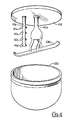
- FIG. 4 An alternate embodiment of a mixer for use with the present invention is the GRAL model 75L which is illustrated in Figure 4.
- the GRAL comprises a round bowl-shaped chamber 100 into which the material to be mixed or processed is placed.
- a circular top 102 covers chamber 100 and the rotatable shafts 104 and 106 extend through top 102 for positioning within chamber 100.
- shaft 104 is concentrically mounted on top 102 while shaft 106 is eccentrically mounted thereon and substantially parallel to shaft 104.
- Figure 4 also shows that a blade 108 is attached to shaft 104 and is rotated by shaft 104 within the chamber 100.
- choppers 110a, 110b, 110c and 110d are rotated by shaft 106 in chamber 100.
- the procedure is initiated by making the pre-blend resin.
- cholestyramine resin granules are placed into hopper 30 and then transferred form hopper 30 into mixer 26 as desired.
- Lecithin is then quickly added to the granulated cholestyramine resin in mixer 26 and the ingredients are agitated by the rotation of shaft 50 at approximately 1750 revolutions per minute for one (1) minute.
- this operation will result in an increase in temperature of the mixture into a range which approximately extends between forty (40) degrees and fifty five (55) degrees centigrade. This temperature rises is sufficient to cause the lecithin to coat the cholestyramine granules.
- This pre-blend which comprises the lecithin-coated cholestyramine resin granules is then temporarily held within mixer 26.
- the fructose and sorbitol materials are introduced into mixer 28.
- the gelatin solution, fructose and sorbitol combination is agitated for three (3) minutes within mixer 28 by the operation of motor 66 which rotates blades 84a, 84b and 84c at 1750 revolutions per minute and the concerted operation of motor 76 which rotates scraper 98 at 24 revolutions per minute.
- the result of this operation is a fluffy textured frappe.
- the pre-blend, pectin and selected flavorings are then added to the contents of mixer 28.
- the pre-blend is introduced into mixer 28 through chute 54 and the pectin and flavoring are either added through chute 60 or through manual loading door 64.
- This entire composition is churned within mixer 28 for one (1) minute by the rotation of blades 84 at 1750 revolutions per minute and the rotation of scraper 98 at 24 revolutions per minute.
- the product is then removed from mixer 28 and stored for at least twelve (12) hours before further apportionment and sizing into the commercial end-products.
- cholestyramine resin is placed into chamber 100.
- a motor (not shown) is started in order to rotate blade 108 at a relatively low speed.
- lecithin which has been warmed to approximately forty-five (45) degrees centigrade to facilitate pumping is rapidly added into chamber 100.
- the cholestyramine resin is coated with lecithin by simultaneously rotating blade 108 at approximately 300 revolutions per minute and rotating choppers 110a, 110b, 110c and 110d by a motor (not shown) at approximately 1750 revolutions per minute for ten (10) minutes.
- This operation will result in an increase in temperature of the mixture into a range which approximately extends between forty-five (45) degrees and fifty-five (55) degrees centigrade.
- This pre-blend which comprises lecithin-coated cholestyramine resin granules, is then removed from chamber 100 and temporarily stored.
- Warm deionized water i.e., water between seventy-five (75) degrees into a tank (80) degrees centigrade
- a tank not shown
- Gelatin granules are added to the tank and the granules are dissolved by agitating the mixture to create the gelatin solution.
- fructose and sorbitol are added to chamber 100.
- the gelatin solution is then mixed with these bulking agents and sweeteners for two and one-half (2 1/2) minutes at 200 revolutions per minute.
- Chamber 100 is then opened and the wall of chamber 100 and blade 108 are manually scraped to bring together any unmixed solution in the center of chamber 100 for further mixing.
- the chamber 100 is again closed and the blade 108 is rotated an additional two and one-half (2 1/2) minutes at 200 revolutions per minute.
- Pre-blend resin, pectin and selected flavorings are then rapidly added to the frappe in chamber 100 and blade 108 is rotated at a relatively low speed.
- Choppers 110a, 110b, 110c and 110d are rotated at 1750 revolutions per minute for a short period of time to remove any agglomeration.
- the chamber 100 is then opened and the wall of chamber 100 and blade 108 are manually scraped to effectuate thorough mixing.
- the chamber 100 is then closed and blade 108 is rotated an additional short period of time to improve uniformity of the material.
- the product is then manually removed from chamber 100 and stored for at least twelve (12) hours before further apportionment and sizing into the commercial end-product.
Landscapes
- Health & Medical Sciences (AREA)
- Chemical & Material Sciences (AREA)
- Life Sciences & Earth Sciences (AREA)
- Medicinal Chemistry (AREA)
- Pharmacology & Pharmacy (AREA)
- Animal Behavior & Ethology (AREA)
- General Health & Medical Sciences (AREA)
- Public Health (AREA)
- Veterinary Medicine (AREA)
- Epidemiology (AREA)
- Engineering & Computer Science (AREA)
- Bioinformatics & Cheminformatics (AREA)
- Obesity (AREA)
- Nutrition Science (AREA)
- Diabetes (AREA)
- Chemical Kinetics & Catalysis (AREA)
- General Chemical & Material Sciences (AREA)
- Nuclear Medicine, Radiotherapy & Molecular Imaging (AREA)
- Organic Chemistry (AREA)
- Hematology (AREA)
- Food Science & Technology (AREA)
- Polymers & Plastics (AREA)
- Medicinal Preparation (AREA)
- Pharmaceuticals Containing Other Organic And Inorganic Compounds (AREA)
- Formation And Processing Of Food Products (AREA)
- Jellies, Jams, And Syrups (AREA)
- Seasonings (AREA)
- Coloring Foods And Improving Nutritive Qualities (AREA)
Applications Claiming Priority (2)
| Application Number | Priority Date | Filing Date | Title |
|---|---|---|---|
| US263846 | 1988-10-28 | ||
| US07/263,846 US5026555A (en) | 1988-10-28 | 1988-10-28 | Method for preparing an anion exchange resin delivery system |
Publications (2)
| Publication Number | Publication Date |
|---|---|
| EP0366255A2 true EP0366255A2 (fr) | 1990-05-02 |
| EP0366255A3 EP0366255A3 (fr) | 1991-04-10 |
Family
ID=23003484
Family Applications (1)
| Application Number | Title | Priority Date | Filing Date |
|---|---|---|---|
| EP19890309388 Withdrawn EP0366255A3 (fr) | 1988-10-28 | 1989-09-15 | Procédé de préparation d'un système de délivrance pour une résine échangeuse d'anions |
Country Status (12)
| Country | Link |
|---|---|
| US (1) | US5026555A (fr) |
| EP (1) | EP0366255A3 (fr) |
| JP (1) | JPH02180832A (fr) |
| KR (1) | KR900005896A (fr) |
| CN (1) | CN1042076A (fr) |
| AU (1) | AU618419B2 (fr) |
| DK (1) | DK537189A (fr) |
| FI (1) | FI895073A7 (fr) |
| NO (1) | NO894269L (fr) |
| NZ (1) | NZ231172A (fr) |
| PT (1) | PT92092A (fr) |
| ZA (1) | ZA898196B (fr) |
Cited By (2)
| Publication number | Priority date | Publication date | Assignee | Title |
|---|---|---|---|---|
| EP0886518A4 (fr) * | 1996-01-31 | 2000-01-26 | Port Systems L L C | Enrobage pharmaceutique hydrosoluble et procede de production de produits pharmaceutiques enrobes |
| AU747451B2 (en) * | 1997-06-20 | 2002-05-16 | Ohkura Pharmaceutical Co., Ltd. | Gelled composition |
Families Citing this family (8)
| Publication number | Priority date | Publication date | Assignee | Title |
|---|---|---|---|---|
| US5137716A (en) * | 1990-11-15 | 1992-08-11 | Weisenfeld Michael S | Method of reducing weight in mammals |
| US5380522A (en) * | 1992-08-11 | 1995-01-10 | Day; Charles E. | Method for treatment of irritable bowel syndrome |
| DE4314583A1 (de) * | 1993-04-29 | 1994-11-03 | Astra Chem Gmbh | Colestyramin enthaltende Zusammensetzung und Verfahren zu deren Herstellung |
| WO1994028881A1 (fr) * | 1993-06-11 | 1994-12-22 | Merix Corporation | Formulation de retention a liberation retardee pour adsorbant d'acides biliaires |
| US6211194B1 (en) * | 1998-04-30 | 2001-04-03 | Duke University | Solution containing nicotine |
| US8192845B2 (en) * | 2005-11-04 | 2012-06-05 | Cargill, Incorported | Lecithin-containing starch compositions, preparation thereof and paper products having oil and grease resistance, and/or release properties |
| US7931778B2 (en) * | 2005-11-04 | 2011-04-26 | Cargill, Incorporated | Lecithin-starches compositions, preparation thereof and paper products having oil and grease resistance, and/or release properties |
| US20100291281A1 (en) * | 2009-05-14 | 2010-11-18 | Lee Sang In | Diet food using pork skin |
Family Cites Families (3)
| Publication number | Priority date | Publication date | Assignee | Title |
|---|---|---|---|---|
| US4230687A (en) * | 1978-05-30 | 1980-10-28 | Griffith Laboratories U.S.A., Inc. | Encapsulation of active agents as microdispersions in homogeneous natural polymeric matrices |
| US4818539A (en) * | 1985-02-05 | 1989-04-04 | Warner-Lambert Company | Ingestible aggregate and delivery system prepared therefrom |
| US4778676A (en) * | 1985-12-20 | 1988-10-18 | Warner-Lambert Company | Confectionery delivery system for actives |
-
1988
- 1988-10-28 US US07/263,846 patent/US5026555A/en not_active Expired - Fee Related
-
1989
- 1989-09-15 EP EP19890309388 patent/EP0366255A3/fr not_active Withdrawn
- 1989-10-07 CN CN89107814A patent/CN1042076A/zh active Pending
- 1989-10-25 FI FI895073A patent/FI895073A7/fi not_active IP Right Cessation
- 1989-10-25 PT PT92092A patent/PT92092A/pt unknown
- 1989-10-26 NZ NZ231172A patent/NZ231172A/xx unknown
- 1989-10-26 NO NO89894269A patent/NO894269L/no unknown
- 1989-10-27 KR KR1019890015539A patent/KR900005896A/ko not_active Withdrawn
- 1989-10-27 AU AU43877/89A patent/AU618419B2/en not_active Expired - Fee Related
- 1989-10-27 DK DK537189A patent/DK537189A/da not_active Application Discontinuation
- 1989-10-27 JP JP1278760A patent/JPH02180832A/ja active Pending
- 1989-10-27 ZA ZA898196A patent/ZA898196B/xx unknown
Cited By (3)
| Publication number | Priority date | Publication date | Assignee | Title |
|---|---|---|---|---|
| EP0886518A4 (fr) * | 1996-01-31 | 2000-01-26 | Port Systems L L C | Enrobage pharmaceutique hydrosoluble et procede de production de produits pharmaceutiques enrobes |
| AU747451B2 (en) * | 1997-06-20 | 2002-05-16 | Ohkura Pharmaceutical Co., Ltd. | Gelled composition |
| US6521257B1 (en) | 1997-06-20 | 2003-02-18 | Ohkura Pharmaceutical Co., Ltd. | Gelled compositions |
Also Published As
| Publication number | Publication date |
|---|---|
| JPH02180832A (ja) | 1990-07-13 |
| NZ231172A (en) | 1990-10-26 |
| DK537189D0 (da) | 1989-10-27 |
| AU618419B2 (en) | 1991-12-19 |
| CN1042076A (zh) | 1990-05-16 |
| FI895073A7 (fi) | 1990-04-29 |
| NO894269D0 (no) | 1989-10-26 |
| ZA898196B (en) | 1991-04-24 |
| EP0366255A3 (fr) | 1991-04-10 |
| DK537189A (da) | 1990-04-29 |
| FI895073A0 (fi) | 1989-10-25 |
| KR900005896A (ko) | 1990-05-07 |
| NO894269L (no) | 1990-04-30 |
| AU4387789A (en) | 1990-05-03 |
| US5026555A (en) | 1991-06-25 |
| PT92092A (pt) | 1990-04-30 |
Similar Documents
| Publication | Publication Date | Title |
|---|---|---|
| US5026555A (en) | Method for preparing an anion exchange resin delivery system | |
| JP2749809B2 (ja) | 調整装置 | |
| CN101909605B (zh) | 制造用于药物递送的咀嚼剂型的方法及其产品 | |
| EP0192367B1 (fr) | Supplément minéral à mâcher | |
| CA2632855C (fr) | Procede pour la fabrication de formes pharmaceutiques a macher pour l'administration de medicament et produits associes | |
| BRPI0921577B1 (pt) | Métodos e composições para controle de peso e para aperfeiçoar controle glicêmico | |
| MX2008013585A (es) | Preacondicionador mejorado que tiene ejes de mezcladora independientemente accionados. | |
| JP2003531873A (ja) | 液体投与調合物を製造する方法および装置 | |
| EP0844881B1 (fr) | Laxatif contenant du lactitol et du psyllium | |
| US4746520A (en) | Sweetening product, method for the manufacturing thereof and plant for the working of this method | |
| CN1315483C (zh) | 组合物内在或相关的改进 | |
| CA1280028C (fr) | Procede de preparation de produits alimentaires prets a consommer contenantde la gelatine | |
| KR100880650B1 (ko) | 당코팅 균질성이 우수한 차전자피분말의 당 코팅방법 | |
| JP2002501727A (ja) | はじけるキャンディーを製造するための新しい方法 | |
| US5633005A (en) | Dimeticon pastilles | |
| AU613880B2 (en) | Method and apparatus for making a molasses-based animal feed mass | |
| EA038764B1 (ru) | Жидкая композиция суспензии смектита и способ ее получения | |
| JPH10509982A (ja) | 高等植物から獲得できる粉末ヒドロコロイドゴムを利用するnsaidの導入 | |
| US4150162A (en) | Fish feeding product and method of making the same | |
| JPH03290196A (ja) | 低粘性難消化性多糖類の製造法およびそれを含有する食品 | |
| JPH03168067A (ja) | 高濃度のマグネシウム及びマグネシウム化合物を含有するマグネシウム溶液の製造方法ならびに該マグネシウム溶液を使用した医薬品並びに加工食品 | |
| JPH0198460A (ja) | 非カロリー性乾燥食品 | |
| JPH08503926A (ja) | バルク緩下剤としての無糖ドライミックスセルロースエーテル組成物 | |
| JPH08509484A (ja) | ラクツロースパステル類 | |
| CN118078734B (zh) | 一种胃内占容凝胶及其制备方法与应用 |
Legal Events
| Date | Code | Title | Description |
|---|---|---|---|
| PUAI | Public reference made under article 153(3) epc to a published international application that has entered the european phase |
Free format text: ORIGINAL CODE: 0009012 |
|
| AK | Designated contracting states |
Kind code of ref document: A2 Designated state(s): AT BE CH DE ES FR GB GR IT LI LU NL SE |
|
| PUAL | Search report despatched |
Free format text: ORIGINAL CODE: 0009013 |
|
| AK | Designated contracting states |
Kind code of ref document: A3 Designated state(s): AT BE CH DE ES FR GB GR IT LI LU NL SE |
|
| RHK1 | Main classification (correction) |
Ipc: A61K 9/50 |
|
| 17P | Request for examination filed |
Effective date: 19911001 |
|
| STAA | Information on the status of an ep patent application or granted ep patent |
Free format text: STATUS: THE APPLICATION HAS BEEN WITHDRAWN |
|
| 18W | Application withdrawn |
Withdrawal date: 19920224 |
|
| R18W | Application withdrawn (corrected) |
Effective date: 19920224 |