EP0365832B1 - Mehrscheibenisolierglas sowie Abstandhalter für das Mehrscheibenisolierglas - Google Patents
Mehrscheibenisolierglas sowie Abstandhalter für das Mehrscheibenisolierglas Download PDFInfo
- Publication number
- EP0365832B1 EP0365832B1 EP89117548A EP89117548A EP0365832B1 EP 0365832 B1 EP0365832 B1 EP 0365832B1 EP 89117548 A EP89117548 A EP 89117548A EP 89117548 A EP89117548 A EP 89117548A EP 0365832 B1 EP0365832 B1 EP 0365832B1
- Authority
- EP
- European Patent Office
- Prior art keywords
- spacer
- desmodur
- spacer mount
- glass
- web
- Prior art date
- Legal status (The legal status is an assumption and is not a legal conclusion. Google has not performed a legal analysis and makes no representation as to the accuracy of the status listed.)
- Revoked
Links
- 125000006850 spacer group Chemical group 0.000 title claims abstract description 41
- 239000011521 glass Substances 0.000 claims abstract description 20
- 239000004033 plastic Substances 0.000 claims abstract description 15
- 229920003023 plastic Polymers 0.000 claims abstract description 15
- 229910052782 aluminium Inorganic materials 0.000 claims abstract description 11
- XAGFODPZIPBFFR-UHFFFAOYSA-N aluminium Chemical compound [Al] XAGFODPZIPBFFR-UHFFFAOYSA-N 0.000 claims abstract description 9
- 238000010438 heat treatment Methods 0.000 claims abstract description 6
- 239000004411 aluminium Substances 0.000 claims abstract description 3
- 229910052751 metal Inorganic materials 0.000 claims abstract 2
- 239000002184 metal Substances 0.000 claims abstract 2
- UPMLOUAZCHDJJD-UHFFFAOYSA-N 4,4'-Diphenylmethane Diisocyanate Chemical compound C1=CC(N=C=O)=CC=C1CC1=CC=C(N=C=O)C=C1 UPMLOUAZCHDJJD-UHFFFAOYSA-N 0.000 claims description 10
- 239000011810 insulating material Substances 0.000 claims description 10
- 238000012545 processing Methods 0.000 claims description 10
- 239000004814 polyurethane Substances 0.000 claims description 9
- 229920002635 polyurethane Polymers 0.000 claims description 8
- 239000000203 mixture Substances 0.000 claims description 7
- 238000010276 construction Methods 0.000 claims description 5
- 229920005862 polyol Polymers 0.000 claims description 4
- 150000003077 polyols Chemical class 0.000 claims description 4
- 238000003756 stirring Methods 0.000 claims description 4
- XLYOFNOQVPJJNP-UHFFFAOYSA-N water Substances O XLYOFNOQVPJJNP-UHFFFAOYSA-N 0.000 claims description 4
- 239000003795 chemical substances by application Substances 0.000 claims description 3
- 238000009472 formulation Methods 0.000 claims description 3
- 239000007788 liquid Substances 0.000 claims description 3
- 239000000654 additive Substances 0.000 claims description 2
- 230000000996 additive effect Effects 0.000 claims description 2
- 239000004020 conductor Substances 0.000 claims description 2
- SYSQUGFVNFXIIT-UHFFFAOYSA-N n-[4-(1,3-benzoxazol-2-yl)phenyl]-4-nitrobenzenesulfonamide Chemical class C1=CC([N+](=O)[O-])=CC=C1S(=O)(=O)NC1=CC=C(C=2OC3=CC=CC=C3N=2)C=C1 SYSQUGFVNFXIIT-UHFFFAOYSA-N 0.000 claims description 2
- 229910000831 Steel Inorganic materials 0.000 claims 1
- 239000011230 binding agent Substances 0.000 claims 1
- CZZYITDELCSZES-UHFFFAOYSA-N diphenylmethane Chemical compound C=1C=CC=CC=1CC1=CC=CC=C1 CZZYITDELCSZES-UHFFFAOYSA-N 0.000 claims 1
- 239000010959 steel Substances 0.000 claims 1
- 238000004519 manufacturing process Methods 0.000 description 9
- 150000001875 compounds Chemical class 0.000 description 5
- 239000000126 substance Substances 0.000 description 5
- 238000005266 casting Methods 0.000 description 4
- 239000000463 material Substances 0.000 description 4
- 239000002994 raw material Substances 0.000 description 4
- 239000000565 sealant Substances 0.000 description 4
- 238000005452 bending Methods 0.000 description 3
- 238000009792 diffusion process Methods 0.000 description 3
- 238000000926 separation method Methods 0.000 description 3
- 239000007787 solid Substances 0.000 description 3
- 239000000853 adhesive Substances 0.000 description 2
- 230000001070 adhesive effect Effects 0.000 description 2
- 125000000484 butyl group Chemical group [H]C([*])([H])C([H])([H])C([H])([H])C([H])([H])[H] 0.000 description 2
- 239000002131 composite material Substances 0.000 description 2
- 238000009413 insulation Methods 0.000 description 2
- 239000004588 polyurethane sealant Substances 0.000 description 2
- 238000012360 testing method Methods 0.000 description 2
- DMYOHQBLOZMDLP-UHFFFAOYSA-N 1-[2-(2-hydroxy-3-piperidin-1-ylpropoxy)phenyl]-3-phenylpropan-1-one Chemical compound C1CCCCN1CC(O)COC1=CC=CC=C1C(=O)CCC1=CC=CC=C1 DMYOHQBLOZMDLP-UHFFFAOYSA-N 0.000 description 1
- ZAMOUSCENKQFHK-UHFFFAOYSA-N Chlorine atom Chemical compound [Cl] ZAMOUSCENKQFHK-UHFFFAOYSA-N 0.000 description 1
- 229920001079 Thiokol (polymer) Polymers 0.000 description 1
- 229920006311 Urethane elastomer Polymers 0.000 description 1
- 239000000460 chlorine Substances 0.000 description 1
- 229910052801 chlorine Inorganic materials 0.000 description 1
- 239000011248 coating agent Substances 0.000 description 1
- 230000001419 dependent effect Effects 0.000 description 1
- 239000002274 desiccant Substances 0.000 description 1
- 238000011161 development Methods 0.000 description 1
- 230000018109 developmental process Effects 0.000 description 1
- 230000000694 effects Effects 0.000 description 1
- 229920001971 elastomer Polymers 0.000 description 1
- 239000000806 elastomer Substances 0.000 description 1
- 238000010292 electrical insulation Methods 0.000 description 1
- 239000003000 extruded plastic Substances 0.000 description 1
- 230000002349 favourable effect Effects 0.000 description 1
- 239000000945 filler Substances 0.000 description 1
- 125000002887 hydroxy group Chemical group [H]O* 0.000 description 1
- 229910052500 inorganic mineral Inorganic materials 0.000 description 1
- 239000012948 isocyanate Substances 0.000 description 1
- 150000002513 isocyanates Chemical class 0.000 description 1
- 239000004922 lacquer Substances 0.000 description 1
- 230000007774 longterm Effects 0.000 description 1
- 230000014759 maintenance of location Effects 0.000 description 1
- 239000002905 metal composite material Substances 0.000 description 1
- 239000011707 mineral Substances 0.000 description 1
- 239000003973 paint Substances 0.000 description 1
- DGTNSSLYPYDJGL-UHFFFAOYSA-N phenyl isocyanate Chemical compound O=C=NC1=CC=CC=C1 DGTNSSLYPYDJGL-UHFFFAOYSA-N 0.000 description 1
- 229920001228 polyisocyanate Polymers 0.000 description 1
- 239000005056 polyisocyanate Substances 0.000 description 1
- 229920000642 polymer Polymers 0.000 description 1
- 238000002360 preparation method Methods 0.000 description 1
- 239000011541 reaction mixture Substances 0.000 description 1
- 238000007789 sealing Methods 0.000 description 1
- 238000007711 solidification Methods 0.000 description 1
- 230000008023 solidification Effects 0.000 description 1
- 230000001360 synchronised effect Effects 0.000 description 1
- 229920003051 synthetic elastomer Polymers 0.000 description 1
- 239000005061 synthetic rubber Substances 0.000 description 1
- 238000012546 transfer Methods 0.000 description 1
Images

Classifications
-
- E—FIXED CONSTRUCTIONS
- E06—DOORS, WINDOWS, SHUTTERS, OR ROLLER BLINDS IN GENERAL; LADDERS
- E06B—FIXED OR MOVABLE CLOSURES FOR OPENINGS IN BUILDINGS, VEHICLES, FENCES OR LIKE ENCLOSURES IN GENERAL, e.g. DOORS, WINDOWS, BLINDS, GATES
- E06B3/00—Window sashes, door leaves, or like elements for closing wall or like openings; Layout of fixed or moving closures, e.g. windows in wall or like openings; Features of rigidly-mounted outer frames relating to the mounting of wing frames
- E06B3/66—Units comprising two or more parallel glass or like panes permanently secured together
- E06B3/67—Units comprising two or more parallel glass or like panes permanently secured together characterised by additional arrangements or devices for heat or sound insulation or for controlled passage of light
- E06B3/6715—Units comprising two or more parallel glass or like panes permanently secured together characterised by additional arrangements or devices for heat or sound insulation or for controlled passage of light specially adapted for increased thermal insulation or for controlled passage of light
-
- E—FIXED CONSTRUCTIONS
- E06—DOORS, WINDOWS, SHUTTERS, OR ROLLER BLINDS IN GENERAL; LADDERS
- E06B—FIXED OR MOVABLE CLOSURES FOR OPENINGS IN BUILDINGS, VEHICLES, FENCES OR LIKE ENCLOSURES IN GENERAL, e.g. DOORS, WINDOWS, BLINDS, GATES
- E06B3/00—Window sashes, door leaves, or like elements for closing wall or like openings; Layout of fixed or moving closures, e.g. windows in wall or like openings; Features of rigidly-mounted outer frames relating to the mounting of wing frames
- E06B3/66—Units comprising two or more parallel glass or like panes permanently secured together
- E06B3/663—Elements for spacing panes
- E06B3/66309—Section members positioned at the edges of the glazing unit
- E06B3/66323—Section members positioned at the edges of the glazing unit comprising an interruption of the heat flow in a direction perpendicular to the unit
-
- Y—GENERAL TAGGING OF NEW TECHNOLOGICAL DEVELOPMENTS; GENERAL TAGGING OF CROSS-SECTIONAL TECHNOLOGIES SPANNING OVER SEVERAL SECTIONS OF THE IPC; TECHNICAL SUBJECTS COVERED BY FORMER USPC CROSS-REFERENCE ART COLLECTIONS [XRACs] AND DIGESTS
- Y02—TECHNOLOGIES OR APPLICATIONS FOR MITIGATION OR ADAPTATION AGAINST CLIMATE CHANGE
- Y02A—TECHNOLOGIES FOR ADAPTATION TO CLIMATE CHANGE
- Y02A30/00—Adapting or protecting infrastructure or their operation
- Y02A30/24—Structural elements or technologies for improving thermal insulation
- Y02A30/249—Glazing, e.g. vacuum glazing
-
- Y—GENERAL TAGGING OF NEW TECHNOLOGICAL DEVELOPMENTS; GENERAL TAGGING OF CROSS-SECTIONAL TECHNOLOGIES SPANNING OVER SEVERAL SECTIONS OF THE IPC; TECHNICAL SUBJECTS COVERED BY FORMER USPC CROSS-REFERENCE ART COLLECTIONS [XRACs] AND DIGESTS
- Y02—TECHNOLOGIES OR APPLICATIONS FOR MITIGATION OR ADAPTATION AGAINST CLIMATE CHANGE
- Y02B—CLIMATE CHANGE MITIGATION TECHNOLOGIES RELATED TO BUILDINGS, e.g. HOUSING, HOUSE APPLIANCES OR RELATED END-USER APPLICATIONS
- Y02B80/00—Architectural or constructional elements improving the thermal performance of buildings
- Y02B80/22—Glazing, e.g. vaccum glazing
Definitions
- the invention relates to a spacer for a multi-pane insulating glass, the type specified in the preamble of claim 1.
- Such a spacer is known from DE-A 25 26 438.
- the insulating material web in the space between the two hollow profiles of this spacer consists of a synthetic rubber or an elastomeric plastic. Because of the insulating web, this spacer lacks strength and torsional stiffness.
- spacer of the type mentioned is known from FR-A 2 352 146.
- the insulating web of this spacer consists of an acoustically insulating butyl material, the strength of which also leaves something to be desired.
- DE-A 2 037 288 discloses a solid, water vapor-permeable spacer for electrically heatable multi-pane insulating glasses made of plastic with an essentially rectangular cross-sectional profile, hygroscopic material being contained in the plastic composition.
- the plastic mass can be a urethane elastomer, among other things.
- such an elastomer is not suitable for giving the spacer the necessary torsional rigidity.
- EP-A 2 250 386 a spacer for a multi-pane insulating glass is known which comprises a central aluminum full-part stiffening element to which Adhere elastomeric sealing plugs on both sides. Because of this construction, the known spacer is not torsionally rigid.
- DE-A1 36 21 765 relates to polyurethane casting compounds which contain mineral hollow bodies as fillers and can be used in the production of insulating webs for metal composite profiles.
- EP-A1 83 797 describes the use of hydrolysis-stable one-component or multicomponent systems based on organic polyisocyanates and selected polyhydroxyl compounds for the production of composite materials which are stable against chemicals and UV light for glass constructions.
- the one-component or multi-component systems are sealants and coating agents for insulating glass panes, where it is important to ensure good permanent adhesion to the glass.
- the proposed polyurethane sealants are permanently elastic sealants based on polyurethane, which retain their plasticity and elasticity at low temperatures. Due to their elasticity and plasticity, these polyurethane sealants are not suitable for designing the spacer mentioned at the outset as a torsion-resistant insulating material.
- the invention has for its object to provide a spacer of the type mentioned, which ensures an extremely low thermal conductivity and an equally low electrical conductivity in addition to excellent strength and torsional rigidity.
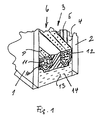
- the heatable multi-pane insulating glass is placed in a frame of a window or a door (not shown). It essentially consists of the two glass panes 1 and 2 arranged parallel to one another and at a distance from one another, between which an intermediate space 3 is provided. Conductor tracks 5 of a resistance heating element (not shown) are e.g. evaporated. The electrical connections and the overall structure of the resistance heating element need not be described because they are prior art and are not critical to the purposes of the invention.
- the space 3 is bridged by a spacer 6, which is shown frontally in FIG. 2 and whose construction is essential to the invention.
- the spacer 6 preferably consists of two aluminum hollow profiles 7 and 8 arranged parallel to one another and at a distance from one another, with side walls 7a, 7b and 8a, 8b parallel to the glass pane surfaces, a bottom wall 7c, 8c and a top wall 7d, 8d.
- Through holes 9 are made in the ceiling wall, which - as is known - a connection between the desiccant 11 create the filled interior 10 of the hollow profiles 7, 8 and the intermediate space 3.
- expediently butyl 12 is arranged between the walls 7a and 8a and the interspace-side surfaces of the glass panes 1 and 2, as is known.
- other connecting substances can also be provided there.
- the space 13 under the spacer 6 is expediently filled with e.g. Thiokol 14
- the space 15 between the two hollow profiles 7, 8 is filled with a product that results in a hard material that firmly bonds with aluminum or adheres firmly to the aluminum and creates a uniformly rigid, torsion-resistant spacer, and above all electrically well insulated and also has an extremely low thermal conductivity.
- the product or substance must be UV and heat resistant. The correct substance has been found through a selection according to the invention.
- a solid insulating web 16 is arranged between the hollow profiles 7, 8, which consists of an unfoamed, hardened polyurethane casting compound.
- the raw material for this insulating material web 16 is traded under the trade name "Baydur VP PU 1397" from Bayer AG. It is a fully formulated, phase-stable, low-viscosity polyol formulation that contains a water-binding additive. The mixture must be homogenized well before processing. Stir slowly during processing.
- the formulation has the following properties: Hydroxyl number (mg KOH / g) 355 ⁇ 20 Water content (%) ⁇ 0.20 ** viscosity at 25 ° C (mPa ⁇ s) 1200 ⁇ 200 PH value about 11.5 Density at 25 ° C (g / cm3) about 1.05 Flash point *** (° C) 120 ° C Solidification range (° C) - 28 to - 26 ° C
- the lower limit of the processing temperature is 23 ° C.
- the activity of Baydur VP PU 1397 can be changed at temperatures above 35 ° C.
- the processing temperature of the raw materials should be at least 23 ° C.
- the following processing recipes result: The following processing characteristics are determined at a raw material temperature of 28 ° C and are characteristic of the system: Gel time (s) 30 ⁇ 10 Tool temp. (° C) 30-75 Molded bulk density (kg / m3) 1180
- Baydur VP PU 1397 is a preparation based on polyols.
- the insulating web 16 has, for example, the following properties: Baydur VP PU 1397 / Desmodur 44 V 10 B Specimen thickness mm 1010 Bulk density DIN 53432 kg / m3 1170 Flexural strength DIN 53432 MPa 72 Deflection b. fracture DIN 53432 mm 20th Bending modulus of elasticity MPa 1500 tensile strenght DIN 53432 * MPa 47 Elongation at break DIN 53432 % 21 Impact strength DIN 53432 kJ / m2 60 Shore-D hardness DIN 53505 74 Behavior in heat b. Bending stress DIN 53432 ** ° C 110
- the processing shrinkage is only 0.8 ⁇ 0.1% manufacturing tolerance. This value applies to the manufacture of an up to 10 mm thick insulating material web 13 with a bulk density of 1180 kg / m3 if the specified processing recipe with Desmodur 44 V 10 B and a mold retention time of 1 minute are maintained in a mold heated to 75 ° C.
- Desmodur 44 V 10 B is a liquid, solvent-free diphenylmethane-4,4'-diisocyanate with a certain content of isomers and higher functional homologues. It is used in conjunction with polyols to manufacture Baydur. It usually has the following delivery specification: Isocyanate content 31.5% by weight ⁇ 1% by weight Viscosity at 25 ° C 130 mPa.s ⁇ 20 mPa.s Acidity Max. 0.06% by weight Total chlorine Max. 0.5% by weight Phenyl isocyanate content Max. 50 ppm
- the width of the solid insulating material web 16 is preferably 1/3 to 1/6 of the total width of the spacer.
- plastic spacers do not meet the long-term guarantee requirements of the test institutes and insulating glass manufacturers in connection with sealants, it can be surprising that the material selected for the insulating web 16 in the context of the invention fulfills all the required properties.
- the material selected for the insulating web 16 in the context of the invention fulfills all the required properties.
- E.g. have been combined with two 5.5 mm wide welded spacer profiles 7, 8 - which are outstandingly suitable due to their great inherent stability - with the plastic selected according to the invention, which is intended to bring about the thermal and electrical separation.
- Plastic angles can be used as corner connectors in order to achieve optimum separation properties in the corner area as well.
- the new spacer profile can be bent in the corner area to the corner without the plastic hindering the bending.
- Another particularly important option is to color the polyurethane plastic and thus create a decorative spacer.
- the electrical insulation of the insulating material web 16 is also one hundred percent.
Landscapes
- Engineering & Computer Science (AREA)
- Civil Engineering (AREA)
- Structural Engineering (AREA)
- Joining Of Glass To Other Materials (AREA)
- Securing Of Glass Panes Or The Like (AREA)
- Glass Compositions (AREA)
- Road Paving Structures (AREA)
- Window Of Vehicle (AREA)
- Insulators (AREA)
- Surface Heating Bodies (AREA)
Description
- Die Erfindung betrifft einen Abstandhalter für ein Mehrscheiben-Isolierglas, der im Oberbegriff des Anspruchs 1 angegebenen Art.
- Ein derartiger Abstandhalter ist aus der DE-A 25 26 438 bekannt. Der Isolierstoffsteg im Zwischenraum zwischen den beiden Hohlprofilen dieses Abstandhalters besteht aus einem synthetischen Kautschuk bzw. aus einem elastomeren Kunststoff. Aufgrund eines derart ausgebildeten Isolierstoffstegs mangelt es diesem Abstandhalter an Festigkeit und Verwindungssteifheit.
- Eine weiterer Abstandhalter der eingangs genannten Art ist aus der FR-A 2 352 146 bekannt. Der Isolierstoffsteg dieses Abstandhalters besteht aus einem akustisch dämmenden Buthylwerkstoff, dessen Festigkeit ebenfalls zu wünschen übrig läßt.
- Aus der DE-A 2 037 288 ist ein massiver Wasserdampf-durchlässiger Abstandhalter für elektrisch beheizbare Mehrscheibenisoliergläser aus Kunststoff mit im wesentlichen rechteckigem Querschnittsprofil bekannt, wobei in der Kunststoffmasse hygroskopisches Material enthalten ist. Die Kunststoffmasse kann unter anderem ein Urethan-Elastomer sein. Ein derartiges Elastomer ist jedoch nicht geeignet, dem Abstandhalter die notwendige Verwindungssteifheit zu verleihen. Aus der EP-A 2 250 386 ist ein Abstandhalter für ein Mehrscheibenisolierglas bekannt, der ein zentrales Aluminiumvollteil-Versteifungselement umfaßt, an das beidseitig elastomere Dichtungsstopfen angrenzen. Aufgrund dieser Konstruktion ist der bekannte Abstandhalter nicht verwindungssteif.
- Die DE-A1 36 21 765 betrifft Polyurethangießmassen, die mineralische Hohlkörper als Füllstoffe enthalten und bei der Herstellung von Isolierstegen für Metall-Verbundprofile verwendbar sind. Um zu verhindern, daß Sägeblätter, mit denen die Verbundprodukte abgelenkt werden, zu schnell verschleißen, wird vorgeschlagen, die Gießmassen mit Hohlkörpern auf Basis von Alkali-Aluminium-Silikanten zu füllen.
- In der EP-A1 83 797 wird die Verwendung von hydrolysestabilen Einkomponenten- oder Mehrkomponentensystemen auf der Basis von organischen Polyisocyanathen und ausgewählten Polyhydroxyl-Verbindungen zur Herstellung von gegenüber Chemikalien und UV-lichtstabilen Verbundmassen für Glaskonstruktionen beschrieben. Die Einkomponenten- oder Mehrkomponentensysteme sind Dichtstoffe und Beschichtungsmittel für Isolierglasscheiben, bei denen es darauf ankommt, eine gute Dauerhaftung auf dem Glas zu gewährleisten. Die vorgeschlagenen Polyurethan-Dichtungsmittel sind dauerelastische Dichtstoffe auf Polyurethan-Basis, die bei niedrigen Temperaturen ihre Plastizität und Elastizität beibehalten. Aufgrund ihrer Elastizität und Plastizität sind diese Polyurethan-Dichtungsmittel nicht geeignet, um als Isolierstoffstegmaterial den eingangs genannten Abstandhalter verwindungssteif zu gestalten.
- Der Erfindung liegt die Aufgabe zugrunde, einen Abstandhalter der eingangs genannten Art zu schaffen, der neben einer hervorragenden Festigkeit und Verwindungssteifheit eine äußerst geringe Wärmeleitfähigkeit und eine ebenso geringe elektrische Leitfähigkeit gewährleistet.
- Diese Aufgabe wird durch die Merkmale des Anspruchs 1 und gelöst. Vorteilhafte Weiterbildungen der Erfindung sind in den von diesen Ansprüchen abhängigen Ansprüchen gekennzeichnet. Anhand der Zeichnung wird die Erfindung im folgenden beispielhaft näher erläutert. Es zeigen:
- Fig. 1
- perspektivisch und schematisch einen Ausbruch aus dem Aufbau eines beheizbaren Mehrscheibenisolierglases,
- Fig. 2
- eine Frontalansicht auf einen Abstandhalter.
- Das beheizbare Mehrscheibenisolierglas wird in einen Rahmen eines Fensters oder einer Tür (nicht dargestellt) gesetzt. Es besteht im wesentlichen aus den beiden parallel nebeneinander und auf Abstand zueinander angeordneten Glasscheiben 1 und 2, zwischen denen ein Zwischenraum 3 vorgesehen ist. Auf der zwischenraumseitigen Fläche 4 der einen Glasscheibe 2 sind Leiterbahnen 5 eines Widerstandsheizelements (nicht dargestellt) z.B. aufgedampft. Die elektrischen Anschlüsse und der gesamte Aufbau des Widerstandsheizelements brauchen nicht beschrieben zu werden, weil sie zum Stand der Technik gehören und für die Zwecke der Erfindung nicht kritisch sind.
- Den Zwischenraum 3 überbrückt ein Abstandhalter 6, der in Fig. 2 frontal dargestellt ist und dessen Aufbau erfindungswesentlich ist.
- Der Abstandhalter 6 besteht aus vorzugsweise zwei parallel nebeneinander und auf Abstand zueinander angeordneten Aluminium-Hohlprofilen 7 und 8 mit zu den Glasscheibenoberflächen parallelen Seitenwandungen 7a, 7b bzw. 8a, 8b einer Bodenwandung 7c, 8c und einer Deckenwandung 7d, 8d. In die Deckenwandung sind Durchgangslöcher 9 eingebracht, die - wie bekannt - eine Verbindung zwischen dem mit Trockenmittel 11 gefüllten Innenraum 10 der Hohlprofile 7, 8 und dem Zwischenraum 3 schaffen. Zwischen den Wandungen 7a und 8a und den zwischenraumseitigen Oberflächen der Glasscheiben 1 und 2 ist zweckmäßigerweise, wie an sich bekannt, Butyl 12 angeordnet. Es können aber auch andere Verbindungsstoffe dort vorgesehen sein.
- Der Raum 13 unter dem Abstandhalter 6 ist zweckmäßigerweise ausgefüllt mit z.B. Thiokol 14.
- Wesentlich ist, daß der Zwischenraum 15 zwischen den beiden Hohlprofilen 7, 8 mit einem Produkt ausgefüllt ist, das einen harten Stoff ergibt, der sich fest mit Aluminium verbindet bzw. fest am Aluminium haftet und einen einheitlich festen verwindungssteifen Abstandhalter schafft, und der vor allem elektrisch hervorragend isoliert und außerdem auch eine äußerst geringe Wärmeleitfähigkeit aufweist. Zudem muß das Produkt bzw. der Stoff UV- und wärmebeständig sein. Durch eine erfindungsgemäße Auswahl ist der richtige Stoff gefunden worden.
- Nach der Erfindung ist zwischen den Hohlprofilen 7, 8 ein fester Isoliersteg 16 angeordnet, der aus einer ungeschäumten ausgehärteten Polyurethanvergußmasse besteht. Der Rohstoff für diesen Isolierstoffsteg 16 wird unter der Handelsbezeichnung "Baydur VP PU 1397" der Bayer AG gehandelt. Es ist eine fertig formulierte phaseninstabile, niedrig viskose Polyolformulierung, welche ein wasserbindendes Zusatzmittel enthält. Vor der Verarbeitung muß die Abmischung gut homogenisiert werden. Während der Verarbeitung soll ständig langsam gerührt werden. Die Formulierung hat die folgenden Eigenschaften:
Hydroxylzahl (mg KOH/g) 355 ± 20 Wassergehalt (%) < 0,20 Viskosität** bei 25°C (mPa·s) 1200 ± 200 pH-Wert ca 11,5 Dichte bei 25°C (g/cm³) ca. 1,05 Flammpunkt*** (°C) 120°C Erstarrungsbereich (°C) - 28 bis - 26°C - Die untere Grenze der Verarbeitungstemperatur liegt bei 23°C. Die Aktivität von Baydur VP PU 1397 kann bei Temperaturen oberhalb 35°C verändert werden.
- Die Verarbeitungstemperatur der Rohstoffe sollte mindestens 23°C betragen. Bei einer Kennzahl von 108 ergeben sich folgende Verarbeitungsrezepturen:

Die folgenden Verarbeitungskenndaten sind bei 28°C Rohstofftemperatur ermittelt und sind für das System charakteristisch:Gelierzeit (s) 30 ± 10 Werkzeugtemp. (°C) 30 - 75 Rohdichte formgegossen (kg/m³) 1180 - Für die richtige Mischung werden z.B. bei einer Verarbeitungstemperatur der Rohstoffe von 23°C 1000 kg Baydur VP PU 1397 mit 970kg Desmodur 44 V 10 B eingewogen und mit einem Rührer mit etwa 2000 U/min 10 Sekunden verrührt. Die Abbindezeit zwischen Rührbeginn und Abbinden des Reaktionsgemisches beträgt 60 ± 10 Sekunden. Zum Zeitpunkt des Abbindens verfestigt sich die Vergußmasse schlagartig.
- Baydur VP PU 1397 ist eine Zubereitung auf Basis von Polyolen.
- Der Isolierstoffsteg 16 hat z.B. die folgenden Eigenschaften:
Baydur VP PU 1397/Desmodur 44 V 10 B Prüfkörperdicke mm 1010 Rohdichte DIN 53432 kg/m³ 1170 Biegefestigkeit DIN 53432 MPa 72 Durchbiegung b. Bruch DIN 53432 mm 20 Biege-E-Modul MPa 1500 Zugfestigkeit DIN 53432* MPa 47 Reißdehnung DIN 53432 % 21 Schlagzähigkeit DIN 53432 kJ/m² 60 Härte nach Shore-D DIN 53505 74 Verhalten in der Wärme b. Biegebeanspruchung DIN 53432** °C 110 - Die Verarbeitungsschwindung beträgt lediglich 0,8 ± 0,1% Fertigungstoleranz. Dieser Wert gilt für die Herstellung eines bis zu 10 mm dicken Isolierstoffstegs 13 bei einer Rohdichte von 1180 kg/m³ bei Einhaltung der angegebenen Verarbeitungsrezeptur mit Desmodur 44 V 10 B und einer Formverweilzeit von 1 Minute in einem auf 75°C temperierten Werkzeug.
- Desmodur 44 V 10 B ist ein flüssiges, lösungsmittelfreies Diphenylmethan-4,4′-diisocyanat mit einem bestimmten Gehalt an Isomeren und höherfunktionellen Homologen. Es wird in Verbindung mit Polyolen zur Herstellung von Baydur eingesetzt. Es weist in der Regel die folgende Lieferspezifikation auf:
Gehalt an Isocyanat 31,5 Gew.-% ± 1 Gew.-% Viskosität bei 25°C 130 mPa.s ± 20 mPa.s Acidität max. 0,06 Gew.-% Gesamtchlor max. 0,5 Gew.-% Gehalt an Phenylisocyanat max. 50 ppm - Die technischen Eigenschaften sind:
Farbe braun Dichte bei 20°C 1,23-1,24g/cm³ Flammpunkt über 200°C Dampfdruck (MDI) bei Raumtemperatur <10⁻⁵mbar - Durch die Auswahl dieses Stoffes ist es gelungen, einen für die Zwecke der Erfindung optimalen Abstandhalter zu schaffen. Die Breite des festen Isolierstoffstegs 16 beträgt vorzugsweise 1/3 bis 1/6 der Gesamtbreite des Abstandhalters.
- Wenn man bedenkt, daß Abstandhalter aus Kunststoff die langfristigen Garantieanforderungen der Prüfinstitute und Isolierglashersteller in Verbindung mit Dichtstoffen nicht erfüllt, kann als überrraschend gelten, daß der im Rahmen der Erfindung ausgewählte Stoff für den Isolierstoffsteg 16 alle geforderten Eigenschaften erfüllt. Z.B. sind bei zwei 5,5 mm breiten geschweißten Abstandhalterprofilen 7, 8 - die sich durch eine große Eigenstabilität hervorragend eignen - mit dem erfindungsgemäß ausgewählten Kunststoff, der die thermische und elektrische Trennung bewirken soll, kombiniert worden. Als Eckverbinder können Kunststoffwinkel verwendet werden, um auch im Eckbereich optimale Trenneigenschaften zu erreichen. Darüber hinaus ist aber auch überraschen, daß das neue Abstandhalterprofil im Eckbereich zur Ecke gebogen werden kann, ohne daß der Kunststoff die Biegung behindert.
- Der erfindungsgemäß ausgewählte Kunststoff erfüllt die folgenden Anforderungen:
- Temperaturbeständigkeit > 70°C und > minus 35°C
- gute Verbindungseigenschaften mit Aluminium
- gute Verbindungseigenschaften mit den für die Aluminiumproduktion notwendigen Dichtstoffen
- Gasdiffusionsbeständigkeit
- Trennung der elektrischen Leitfähigkeit
- Herabsetzung auf ein Minimum der thermischen Diffusion
- Eine weitere besonders wichtige Möglichkeit besteht darin, den Polyurethan-Kunststoff einzufärben und auf diese Weise einen dekorativen Abstandhalter zu schaffen.
- Ein extrudiertes Kunststoffprofil in Verbindung mit Klebstoffen zum einem stabilen verwindungssteifen System zu bringen, sind aufgrund zu geringer Eigenstabilität sowie der Gefahr des Ausdiffundierens der Klebstoffe als auch wegen des aufwendigen Handlings gescheitert. Hinzu kommen die enormen Produktionskosten, die aus der aufwendigen Fertigungsmethode resultieren.
- Die Verwendung von zwei Abstandhalterprofilen im Durchlauf mit einem flüssigen Zweikomponentenpolyurethan-Kunststoff führt zur Herstellung eines optimalen Abstandhalters. Die kontinuierliche synchrone Applikation des Polyurethans zwischen zwei parallel zueinanderlaufenden Abstandhalterprofilen und die anschließende Aushärtung führen zu einem kompakten Verbund der Abstandhalter. Diese erfüllen somit die oben geforderten Bedingungen. Es ist somit eine Problemlösung gefunden worden, die nicht ohne weiteres erkennbar war.
- Während bei bekanntem beheizbaren Mehrscheibenisolierglas Wärmedämmwerte zwischen 1,1 bis 2,6 W/m²K angegeben werden und in Prüfberichten derartiger Mehrscheibenisoliergläser Werte zwischen 2,83 und 2,88 W/m²K gemessen werden, muß als überraschend gelten, daß das erfindungsgemäße Mehrscheibenisolierglas Werte für den Wärmedurchgangskoeffizienten bzw. Wärmedämmwert um 0,45, insbesondere zwischen 0,3 und 0,7 W/m²K gewährleistet. Woraus dieser außergewöhnlich hohe Unterschied der Werte resultiert, ist derzeit noch nicht bekannt.
- Die elektrische Isolierung des Isolierstoffstegs 16 ist zudem hundertprozentig.
Claims (5)
- Abstandhalter (6) für ein Mehrscheibenisolierglas mit wenigstens zwei durch den Abstandhalter auf Abstand gehaltenen Glasscheiben, wobei der Abstandhalter (6) zur Unterbrechung der Wärmeleitung aus zwei parallel nebeneinander auf Abstand zueinander angeordneten, Seitenwandungen (7a, 7b bzw. 8a, 8b) aufweisenden Metallhohlprofilen (7, 8) und einem Isolierstoffsteg (16) im Zwischenraum (15) zwischen den beiden Hohlprofilen (7, 8) besteht,
dadurch gekennzeichnet,
daß der Isolierstoffsteg (16) aus einem harten Kunststoff aus einer Polyurethanvergußmasse mit geringer Wärmeleitfähigkeit und geringer elektrischer Leitfähigkeit besteht, der direkt fest an der Oberfläche der Seitenwandungen (7b, 8b) der Hohlprofile (7, 8) haftet und mit letzteren zusammen ein einteiliges festes, verwindungsteifes Abstandhalterelement bildet, daß der Kunststoff des Isolierstoffstegs (16) aus einer Mischung aus einer fertig formulierten phaseninstabilen niedrig viskosen Polyolformulierung, die ein wasserbindendes Zusatzmittel enthält (Baydur VP PU 1397), mit einem flüssigen, lösungsmittelfreien Diphenylmethan-4,4'-diisocyanat mit einem Gehalt an Isomeren und höherfunktionellen Homologen (Desmodur 44 V10 B oder Desmodur 44 V20 B) hergestellt ist (Baydur: Hersteller Bayer AG; Desmodur: Hersteller Bayer AG), und daß 90 bis 110, insbesondere 100 Gewichtsteile Baydur VP PU 1397 und 90 bis 100, insbesondere 97 Gewichtsteile Desmodur 44 V10 B oder Desmodur 44 V20B verwendet sind. - Abstandhalter nach Anspruch 1,
dadurch gekennzeichnet,
daß der Isolierstoffsteg (16) aus 1000 Kg Baydur VP PU 1397 und 970 kg Desmodur 44 V10 B bei einer Verarbeitungstemperatur von 23 °C und einer Rührzeit von 10 Sekunden mit einem Rührer, der etwa 2000 U/min macht, hergestellt ist, wobei die Abbindezeit zwischen Rührbeginn und Abbinden 60 ± 10 Sekunden betragen hat. - Abstandhalter nach Anspruch 1 oder 2,
dadurch gekennzeichnet,
daß die Abstandhalterhohlprofile (7, 8) aus Aluminium bestehten. - Abstandhalter nach einem oder mehreren der Ansprüche 1 bis 3,
dadurch gekennzeichnet,
daß die Hohlprofile (7, 8) aus Stahl bestehen. - Verwendung eines Abstandhalters nach einem oder mehreren der Ansprüche 1 bis 4 zur Erstellung eines beheizbaren Mehrscheibenisolierglases mit gasgefülltem oder evakuiertem Zwischenraum und einem Widerstandsheizelement auf einer zwischenraumseitigen Glasscheibenoberfläche sowie Anschlüssen für die Zuführung eines elektrischen Stromes zu dem Widerstandsheizelement.
Priority Applications (1)
| Application Number | Priority Date | Filing Date | Title |
|---|---|---|---|
| AT89117548T ATE98332T1 (de) | 1988-09-27 | 1989-09-22 | Mehrscheibenisolierglas sowie abstandhalter fuer das mehrscheibenisolierglas. |
Applications Claiming Priority (2)
| Application Number | Priority Date | Filing Date | Title |
|---|---|---|---|
| DE8812216U DE8812216U1 (de) | 1988-09-27 | 1988-09-27 | Mehrscheibenisolierglas-Element |
| DE8812216U | 1988-09-27 |
Publications (2)
| Publication Number | Publication Date |
|---|---|
| EP0365832A1 EP0365832A1 (de) | 1990-05-02 |
| EP0365832B1 true EP0365832B1 (de) | 1993-12-08 |
Family
ID=6828355
Family Applications (1)
| Application Number | Title | Priority Date | Filing Date |
|---|---|---|---|
| EP89117548A Revoked EP0365832B1 (de) | 1988-09-27 | 1989-09-22 | Mehrscheibenisolierglas sowie Abstandhalter für das Mehrscheibenisolierglas |
Country Status (10)
| Country | Link |
|---|---|
| US (1) | US5087489A (de) |
| EP (1) | EP0365832B1 (de) |
| JP (1) | JPH02176088A (de) |
| AT (1) | ATE98332T1 (de) |
| CA (1) | CA1334355C (de) |
| DE (1) | DE58906371D1 (de) |
| DK (1) | DK170562B1 (de) |
| ES (1) | ES2047081T3 (de) |
| FI (1) | FI91660C (de) |
| NO (1) | NO177867C (de) |
Families Citing this family (44)
| Publication number | Priority date | Publication date | Assignee | Title |
|---|---|---|---|---|
| US5544465A (en) * | 1989-08-02 | 1996-08-13 | Southwall Technologies, Inc. | Thermally insulating multipane glazing struture |
| DE9114709U1 (de) * | 1991-11-26 | 1993-03-25 | Helmut Lingemann GmbH & Co, 5600 Wuppertal | Abstandhalteeinrichtung für eine transparente Isoliereinrichtung |
| FR2693754B1 (fr) * | 1992-07-16 | 1994-09-02 | Saint Gobain Vitrage Int | Caisson isolant acoustique. |
| DE4300481A1 (de) * | 1993-01-11 | 1994-07-14 | Kunert Heinz | Rahmenlose Isolierverglasung und Verfahren zu deren Herstellung |
| US5424111A (en) * | 1993-01-29 | 1995-06-13 | Farbstein; Malcolm N. | Thermally broken insulating glass spacer with desiccant |
| US5394671A (en) * | 1993-10-13 | 1995-03-07 | Taylor; Donald M. | Cardboard spacer/seal as thermal insulator |
| DE9405422U1 (de) * | 1994-03-30 | 1994-06-01 | Cera Handelsgesellschaft Mbh, 87640 Biessenhofen | Doppelläufiger Geradverbinder für aus zwei Profilsträngen gebildete Abstandsprofile eines Mehrscheibenisolierglases |
| US5568714A (en) * | 1995-05-17 | 1996-10-29 | Alumet Manufacturing Inc. | Spacer-frame bar having integral thermal break |
| GB9513702D0 (en) * | 1995-07-05 | 1995-09-06 | Equator Wheels & Sections Ltd | Spacer tubes |
| US5813191A (en) | 1996-08-29 | 1998-09-29 | Ppg Industries, Inc. | Spacer frame for an insulating unit having strengthened sidewalls to resist torsional twist |
| NL1005828C2 (nl) * | 1997-04-17 | 1998-10-20 | Simon Petrus Joseph Schipper | Paneel, element voor dat paneel en werkwijze voor het vervaardigen van een profiel. |
| BE1011279A3 (nl) * | 1997-07-14 | 1999-07-06 | Iq Glass | Verwarmende dubbele beglazing. |
| USD422884S (en) * | 1998-04-08 | 2000-04-18 | Luc Lafond | Spacer |
| DE19828565B4 (de) * | 1998-06-26 | 2005-01-20 | Schott Ag | Mehrscheibenisolierglas für Geräte mit einer gegenüber der Umgebungstemperatur herabgesetzten Innenraumtemperatur |
| CN1158905C (zh) * | 1998-12-25 | 2004-07-21 | 菲格拉株式会社 | 具有发热功能的透光性板材及使用该板材的系统 |
| US6734809B1 (en) * | 1999-04-02 | 2004-05-11 | Think Outside, Inc. | Foldable keyboard |
| FR2794792B1 (fr) * | 1999-06-08 | 2001-08-31 | Saint Gobain Vitrage | Vitrage isolant acoustique a guide d'onde cloisonne |
| US6613404B2 (en) | 2001-05-29 | 2003-09-02 | Terry S. Johnson | Suppressing heat flux in insulating glass structures |
| US6989188B2 (en) | 2003-11-07 | 2006-01-24 | Technoform Caprano Und Brunnhofer Gmbh & Co. Kd | Spacer profiles for double glazings |
| KR20100097154A (ko) * | 2007-11-13 | 2010-09-02 | 인피니트 에지 테크놀로지, 엘엘씨 | 밀폐 유닛 및 스페이서 |
| US9309714B2 (en) | 2007-11-13 | 2016-04-12 | Guardian Ig, Llc | Rotating spacer applicator for window assembly |
| DE102009027297A1 (de) * | 2009-06-29 | 2010-12-30 | Geze Gmbh | Flügel einer Tür, eines Fensters oder dergleichen sowie Verfahren zur Herstellung des Flügels |
| WO2011008860A1 (en) * | 2009-07-14 | 2011-01-20 | Infinite Edge Technologies, Llc | Stretched strips for spacer and sealed unit |
| EP2580418B1 (de) | 2010-06-10 | 2014-08-13 | Guardian IG, LLC | Fensterabstandhalteraufträger |
| US9228389B2 (en) | 2010-12-17 | 2016-01-05 | Guardian Ig, Llc | Triple pane window spacer, window assembly and methods for manufacturing same |
| US9689196B2 (en) | 2012-10-22 | 2017-06-27 | Guardian Ig, Llc | Assembly equipment line and method for windows |
| US9260907B2 (en) | 2012-10-22 | 2016-02-16 | Guardian Ig, Llc | Triple pane window spacer having a sunken intermediate pane |
| USD736594S1 (en) | 2012-12-13 | 2015-08-18 | Cardinal Ig Company | Spacer for a multi-pane glazing unit |
| US8789343B2 (en) | 2012-12-13 | 2014-07-29 | Cardinal Ig Company | Glazing unit spacer technology |
| US9243442B2 (en) | 2013-01-28 | 2016-01-26 | Hok Product Design, Llc | Panelized shadow box |
| CN103244020A (zh) * | 2013-05-06 | 2013-08-14 | 长治市长生安全玻璃有限公司 | 一种夹胶中空玻璃 |
| CN103485676A (zh) * | 2013-10-12 | 2014-01-01 | 江苏耀捷建设工程有限公司 | 双层中空玻璃 |
| CN105525837A (zh) * | 2014-09-01 | 2016-04-27 | 北京中超海奇科技有限公司 | 一种中空两腔或多腔纳米复合节能玻璃及其制备方法 |
| NZ735595A (en) * | 2015-03-02 | 2022-04-29 | Saint Gobain | Foamed spacer for insulated glazing unit |
| US9797140B1 (en) | 2015-08-28 | 2017-10-24 | Wayne Conklin | Skylight framing system |
| US9874018B1 (en) | 2015-08-28 | 2018-01-23 | Wayne Conklin | Skylight framing system with incorporated drainage |
| US9441378B1 (en) | 2015-08-28 | 2016-09-13 | Wayne Conklin | Pedestal paver and skylight walkway |
| US9920532B1 (en) | 2015-08-28 | 2018-03-20 | Wayne Conklin | Skylight framing system |
| US9777531B1 (en) | 2015-08-28 | 2017-10-03 | Wayne Conklin | Load bearing spacer for skylight installations |
| US9598867B1 (en) | 2015-08-31 | 2017-03-21 | Wayne Conklin | Walkable skylight lighting system |
| CN106014125A (zh) * | 2016-08-03 | 2016-10-12 | 常熟市赛蒂镶嵌玻璃制品有限公司 | 一种窗用真空玻璃 |
| US10294662B1 (en) | 2018-01-08 | 2019-05-21 | Wayne Conklin | Glass decking mounting system |
| US11697963B2 (en) * | 2019-05-01 | 2023-07-11 | Oldcastle BuildingEnvelope Inc. | Insulating panel assembly |
| US12538989B2 (en) * | 2020-11-12 | 2026-02-03 | Hussmann Corporation | Transparent door |
Family Cites Families (16)
| Publication number | Priority date | Publication date | Assignee | Title |
|---|---|---|---|---|
| US3609293A (en) * | 1969-08-01 | 1971-09-28 | Ppg Industries Inc | Electrically heated multiple glazed window |
| US3839630A (en) * | 1971-12-27 | 1974-10-01 | Hewlett Packard Co | Programmable calculator employing algebraic language |
| DE2510849B2 (de) * | 1974-03-18 | 1977-05-18 | Scanglas A/S, Korsoer (Dänemark) | Verfahren zum herstellen von isolierglasfenstern mit metallischen distanzschienen und ein nach dem verfahren hergestelltes spezielles isolierglasfenster |
| DE2445332B2 (de) * | 1974-09-23 | 1976-12-09 | GGN Glashandels-Gesellschaft Nördlingen mbH & Co KG, 8860 Nördlingen | Schalldaemmendes mehrscheibenisolierglas |
| DE2518205A1 (de) * | 1975-04-24 | 1976-11-04 | Flachglasveredelung Conzelmann | Isolierglasscheibe |
| DE2526438A1 (de) * | 1975-06-13 | 1976-12-23 | Arnold Alfred | Isolierglasscheibe |
| CH615244A5 (de) * | 1976-05-20 | 1980-01-15 | Cardinale Raffaele | |
| DE2730264A1 (de) * | 1977-07-05 | 1979-01-25 | Erbsloeh Julius & August | Abstandhalterrahmen fuer mehrscheibenisolierglas |
| US4335166A (en) * | 1980-11-21 | 1982-06-15 | Cardinal Insulated Glass Co. | Method of manufacturing a multiple-pane insulating glass unit |
| DE3200430A1 (de) * | 1982-01-09 | 1983-07-21 | Bayer Ag | Verwendung von ein- oder mehrkomponentensystemen als bzw. zur herstellung von verbundmassen fuer glaskonstruktionen |
| GB2122057B (en) * | 1982-05-28 | 1985-10-23 | Glaverbel | Glazing panels |
| DE3223524C2 (de) * | 1982-06-24 | 1984-04-26 | DUROTTERM Wichmann u. Ott GmbH, 2082 Uetersen | Bausatz für Isolierverglasung |
| GB2159201A (en) * | 1984-05-23 | 1985-11-27 | Glaverbel | Hollow glazing units |
| US4613530A (en) * | 1984-11-01 | 1986-09-23 | Southwall Technologies, Inc. | Multiple pane glass unit with electrically conductive transparent film for use as radiation shield |
| EP0250386A3 (de) * | 1986-03-21 | 1988-03-30 | Gloricalor N.V. | Transparentes auf Glas basierendes Wärmestrahlungspaneel |
| DE3621765A1 (de) * | 1986-06-28 | 1988-01-07 | Hueck Fa E | Verwendung von zu polyurethanen ausreagierenden giessmassen zur herstellung von isolierstegen fuer metall-verbundprofile |
-
1989
- 1989-09-22 ES ES89117548T patent/ES2047081T3/es not_active Expired - Lifetime
- 1989-09-22 NO NO893765A patent/NO177867C/no unknown
- 1989-09-22 EP EP89117548A patent/EP0365832B1/de not_active Revoked
- 1989-09-22 DE DE89117548T patent/DE58906371D1/de not_active Revoked
- 1989-09-22 AT AT89117548T patent/ATE98332T1/de not_active IP Right Cessation
- 1989-09-27 JP JP1253725A patent/JPH02176088A/ja active Pending
- 1989-09-27 DK DK476789A patent/DK170562B1/da not_active IP Right Cessation
- 1989-09-27 US US07/413,164 patent/US5087489A/en not_active Expired - Fee Related
- 1989-09-27 FI FI894574A patent/FI91660C/fi not_active IP Right Cessation
- 1989-09-27 CA CA000613410A patent/CA1334355C/en not_active Expired - Fee Related
Also Published As
| Publication number | Publication date |
|---|---|
| JPH02176088A (ja) | 1990-07-09 |
| FI91660C (fi) | 1994-07-25 |
| ATE98332T1 (de) | 1993-12-15 |
| DE58906371D1 (de) | 1994-01-20 |
| EP0365832A1 (de) | 1990-05-02 |
| NO177867C (no) | 1995-12-06 |
| ES2047081T3 (es) | 1994-02-16 |
| CA1334355C (en) | 1995-02-14 |
| NO893765L (no) | 1990-03-28 |
| US5087489A (en) | 1992-02-11 |
| NO893765D0 (no) | 1989-09-22 |
| FI894574L (fi) | 1990-03-28 |
| FI91660B (fi) | 1994-04-15 |
| DK476789D0 (da) | 1989-09-27 |
| NO177867B (no) | 1995-08-28 |
| DK170562B1 (da) | 1995-10-23 |
| FI894574A0 (fi) | 1989-09-27 |
| DK476789A (da) | 1990-03-28 |
Similar Documents
| Publication | Publication Date | Title |
|---|---|---|
| EP0365832A1 (de) | Mehrscheibenisolierglas sowie Abstandhalter für das Mehrscheibenisolierglas | |
| EP0504561A1 (de) | Abstandhalter für ein Mehrscheiben-Isolierglas | |
| DE69632314T2 (de) | Harzzusammensetzung umfassende Doppelverglasungseinheit | |
| DE19827867C1 (de) | Brandschutzverglasung | |
| DE2752542C2 (de) | ||
| DE1569178C3 (de) | Dichtungs-, Abdichtungs-, Kleb-, Binde-, Beschichtungs- und wasserabweisende Massen aus einem Polyurethan-Vorpolymeren und einem bituminösen Addukt, sowie Verfahren zu ihrer Herstellung | |
| DE3853957T2 (de) | Feuerhemmende geformte Elemente und ihre Herstellung. | |
| EP3265636B1 (de) | Glasfaserverstärktes abstandsstück für eisenverglasung, verfahren zu dessen herstellung und verwendung eines solchen abstandhalters in mehrfachverglasungen | |
| EP3080376A1 (de) | Abstandshalter für isolierverglasungen mit extrudiertem dichtprofil | |
| DE202019005906U1 (de) | Abstandhalter mit Verstärkungselementen | |
| US5254377A (en) | Laminated multilayer insulating glass and a spacer for the laminated multilayer insulating glass | |
| EP1893545B1 (de) | Brandschutzglas und verfahren zu dessen herstellung | |
| EP3341548A1 (de) | Eckverbinder für isolierverglasungen | |
| EP0053104A1 (de) | Fenster oder Türe und Verfahren zur Herstellung eines Fensters oder einer Türe | |
| DE1594287A1 (de) | Dichtung und Verfahren zu deren Herstellung | |
| DE2140834A1 (de) | Verfahren zur herstellung von mehrscheibenisolierglas | |
| DE2729838A1 (de) | Feuerbestaendige, elastische dichtungen | |
| EP0453912B1 (de) | Flammfeste Polyorganosiloxanmasse | |
| DE8812216U1 (de) | Mehrscheibenisolierglas-Element | |
| EP4575164A1 (de) | Fenster- oder türhohlkammerprofil sowie dieses umfassende eckverbindung | |
| WO2024126459A1 (de) | Verbundelement für eine isolierglasscheibe | |
| DE69310939T2 (de) | Verfahren zur Härtung von Silikonkautschuk, und Silikonkautschukzusammensetzungen dafür | |
| DE9006999U1 (de) | Abstandhalter für ein beheizbares Mehrscheiben-Isolierglas | |
| DE2451890A1 (de) | Anordnung zur abdichtenden halterung einer glasscheibe in einem rahmen | |
| DE29721211U1 (de) | Glassteinelement der Feuerwiderstandsklasse F |
Legal Events
| Date | Code | Title | Description |
|---|---|---|---|
| PUAI | Public reference made under article 153(3) epc to a published international application that has entered the european phase |
Free format text: ORIGINAL CODE: 0009012 |
|
| AK | Designated contracting states |
Kind code of ref document: A1 Designated state(s): AT BE CH DE ES FR GB GR IT LI LU NL SE |
|
| 17P | Request for examination filed |
Effective date: 19900612 |
|
| 17Q | First examination report despatched |
Effective date: 19910328 |
|
| GRAA | (expected) grant |
Free format text: ORIGINAL CODE: 0009210 |
|
| AK | Designated contracting states |
Kind code of ref document: B1 Designated state(s): AT BE CH DE ES FR GB GR IT LI LU NL SE |
|
| REF | Corresponds to: |
Ref document number: 98332 Country of ref document: AT Date of ref document: 19931215 Kind code of ref document: T |
|
| REF | Corresponds to: |
Ref document number: 58906371 Country of ref document: DE Date of ref document: 19940120 |
|
| ITF | It: translation for a ep patent filed | ||
| ET | Fr: translation filed | ||
| REG | Reference to a national code |
Ref country code: ES Ref legal event code: FG2A Ref document number: 2047081 Country of ref document: ES Kind code of ref document: T3 |
|
| GBT | Gb: translation of ep patent filed (gb section 77(6)(a)/1977) |
Effective date: 19940214 |
|
| PLBI | Opposition filed |
Free format text: ORIGINAL CODE: 0009260 |
|
| 26 | Opposition filed |
Opponent name: JULIUS & AUGUST ERBSLOEH GMBH & CO Effective date: 19940907 |
|
| NLR1 | Nl: opposition has been filed with the epo |
Opponent name: JULIUS & AUGUST ERBSLOEH GMBH & CO |
|
| EAL | Se: european patent in force in sweden |
Ref document number: 89117548.1 |
|
| PGFP | Annual fee paid to national office [announced via postgrant information from national office to epo] |
Ref country code: LU Payment date: 19950801 Year of fee payment: 7 |
|
| PGFP | Annual fee paid to national office [announced via postgrant information from national office to epo] |
Ref country code: GR Payment date: 19950802 Year of fee payment: 7 |
|
| PGFP | Annual fee paid to national office [announced via postgrant information from national office to epo] |
Ref country code: FR Payment date: 19950803 Year of fee payment: 7 Ref country code: CH Payment date: 19950803 Year of fee payment: 7 |
|
| PGFP | Annual fee paid to national office [announced via postgrant information from national office to epo] |
Ref country code: BE Payment date: 19950914 Year of fee payment: 7 |
|
| PGFP | Annual fee paid to national office [announced via postgrant information from national office to epo] |
Ref country code: GB Payment date: 19950915 Year of fee payment: 7 Ref country code: ES Payment date: 19950915 Year of fee payment: 7 |
|
| PGFP | Annual fee paid to national office [announced via postgrant information from national office to epo] |
Ref country code: SE Payment date: 19950918 Year of fee payment: 7 |
|
| PGFP | Annual fee paid to national office [announced via postgrant information from national office to epo] |
Ref country code: NL Payment date: 19950920 Year of fee payment: 7 |
|
| PGFP | Annual fee paid to national office [announced via postgrant information from national office to epo] |
Ref country code: AT Payment date: 19950925 Year of fee payment: 7 |
|
| PGFP | Annual fee paid to national office [announced via postgrant information from national office to epo] |
Ref country code: DE Payment date: 19951129 Year of fee payment: 7 |
|
| PG25 | Lapsed in a contracting state [announced via postgrant information from national office to epo] |
Ref country code: LU Free format text: LAPSE BECAUSE OF NON-PAYMENT OF DUE FEES Effective date: 19960922 |
|
| PG25 | Lapsed in a contracting state [announced via postgrant information from national office to epo] |
Ref country code: ES Free format text: LAPSE BECAUSE OF NON-PAYMENT OF DUE FEES Effective date: 19960923 |
|
| RDAH | Patent revoked |
Free format text: ORIGINAL CODE: EPIDOS REVO |
|
| RDAG | Patent revoked |
Free format text: ORIGINAL CODE: 0009271 |
|
| STAA | Information on the status of an ep patent application or granted ep patent |
Free format text: STATUS: PATENT REVOKED |
|
| REG | Reference to a national code |
Ref country code: CH Ref legal event code: PL |
|
| GBPR | Gb: patent revoked under art. 102 of the ep convention designating the uk as contracting state |
Free format text: 961021 |
|
| 27W | Patent revoked |
Effective date: 19961021 |
|
| REG | Reference to a national code |
Ref country code: GR Ref legal event code: MF4A Free format text: 3010428 |
|
| NLR2 | Nl: decision of opposition |