EP0359508A2 - Sequentiell ausschaltbarer Transistor mit resonantem Tunneleffekt - Google Patents
Sequentiell ausschaltbarer Transistor mit resonantem Tunneleffekt Download PDFInfo
- Publication number
- EP0359508A2 EP0359508A2 EP89309206A EP89309206A EP0359508A2 EP 0359508 A2 EP0359508 A2 EP 0359508A2 EP 89309206 A EP89309206 A EP 89309206A EP 89309206 A EP89309206 A EP 89309206A EP 0359508 A2 EP0359508 A2 EP 0359508A2
- Authority
- EP
- European Patent Office
- Prior art keywords
- circuit
- region
- quantum wells
- emitter
- quantum
- Prior art date
- Legal status (The legal status is an assumption and is not a legal conclusion. Google has not performed a legal analysis and makes no representation as to the accuracy of the status listed.)
- Ceased
Links
Images


Classifications
-
- H—ELECTRICITY
- H10—SEMICONDUCTOR DEVICES; ELECTRIC SOLID-STATE DEVICES NOT OTHERWISE PROVIDED FOR
- H10D—INORGANIC ELECTRIC SEMICONDUCTOR DEVICES
- H10D62/00—Semiconductor bodies, or regions thereof, of devices having potential barriers
- H10D62/10—Shapes, relative sizes or dispositions of the regions of the semiconductor bodies; Shapes of the semiconductor bodies
- H10D62/13—Semiconductor regions connected to electrodes carrying current to be rectified, amplified or switched, e.g. source or drain regions
- H10D62/165—Tunnel injectors
-
- B—PERFORMING OPERATIONS; TRANSPORTING
- B82—NANOTECHNOLOGY
- B82Y—SPECIFIC USES OR APPLICATIONS OF NANOSTRUCTURES; MEASUREMENT OR ANALYSIS OF NANOSTRUCTURES; MANUFACTURE OR TREATMENT OF NANOSTRUCTURES
- B82Y10/00—Nanotechnology for information processing, storage or transmission, e.g. quantum computing or single electron logic
-
- G—PHYSICS
- G06—COMPUTING OR CALCULATING; COUNTING
- G06F—ELECTRIC DIGITAL DATA PROCESSING
- G06F11/00—Error detection; Error correction; Monitoring
- G06F11/07—Responding to the occurrence of a fault, e.g. fault tolerance
- G06F11/08—Error detection or correction by redundancy in data representation, e.g. by using checking codes
- G06F11/10—Adding special bits or symbols to the coded information, e.g. parity check, casting out 9's or 11's
-
- G—PHYSICS
- G11—INFORMATION STORAGE
- G11C—STATIC STORES
- G11C11/00—Digital stores characterised by the use of particular electric or magnetic storage elements; Storage elements therefor
- G11C11/56—Digital stores characterised by the use of particular electric or magnetic storage elements; Storage elements therefor using storage elements with more than two stable states represented by steps, e.g. of voltage, current, phase, frequency
-
- H—ELECTRICITY
- H03—ELECTRONIC CIRCUITRY
- H03B—GENERATION OF OSCILLATIONS, DIRECTLY OR BY FREQUENCY-CHANGING, BY CIRCUITS EMPLOYING ACTIVE ELEMENTS WHICH OPERATE IN A NON-SWITCHING MANNER; GENERATION OF NOISE BY SUCH CIRCUITS
- H03B19/00—Generation of oscillations by non-regenerative frequency multiplication or division of a signal from a separate source
- H03B19/06—Generation of oscillations by non-regenerative frequency multiplication or division of a signal from a separate source by means of discharge device or semiconductor device with more than two electrodes
- H03B19/14—Generation of oscillations by non-regenerative frequency multiplication or division of a signal from a separate source by means of discharge device or semiconductor device with more than two electrodes by means of a semiconductor device
-
- H—ELECTRICITY
- H03—ELECTRONIC CIRCUITRY
- H03M—CODING; DECODING; CODE CONVERSION IN GENERAL
- H03M1/00—Analogue/digital conversion; Digital/analogue conversion
- H03M1/12—Analogue/digital converters
- H03M1/34—Analogue value compared with reference values
- H03M1/36—Analogue value compared with reference values simultaneously only, i.e. parallel type
- H03M1/368—Analogue value compared with reference values simultaneously only, i.e. parallel type having a single comparator per bit, e.g. of the folding type
-
- H—ELECTRICITY
- H10—SEMICONDUCTOR DEVICES; ELECTRIC SOLID-STATE DEVICES NOT OTHERWISE PROVIDED FOR
- H10D—INORGANIC ELECTRIC SEMICONDUCTOR DEVICES
- H10D10/00—Bipolar junction transistors [BJT]
- H10D10/80—Heterojunction BJTs
- H10D10/821—Vertical heterojunction BJTs
- H10D10/881—Resonant tunnelling transistors
-
- H—ELECTRICITY
- H10—SEMICONDUCTOR DEVICES; ELECTRIC SOLID-STATE DEVICES NOT OTHERWISE PROVIDED FOR
- H10D—INORGANIC ELECTRIC SEMICONDUCTOR DEVICES
- H10D62/00—Semiconductor bodies, or regions thereof, of devices having potential barriers
- H10D62/80—Semiconductor bodies, or regions thereof, of devices having potential barriers characterised by the materials
- H10D62/81—Semiconductor bodies, or regions thereof, of devices having potential barriers characterised by the materials of structures exhibiting quantum-confinement effects, e.g. single quantum wells; of structures having periodic or quasi-periodic potential variation
- H10D62/815—Semiconductor bodies, or regions thereof, of devices having potential barriers characterised by the materials of structures exhibiting quantum-confinement effects, e.g. single quantum wells; of structures having periodic or quasi-periodic potential variation of structures having periodic or quasi-periodic potential variation, e.g. superlattices or multiple quantum wells [MQW]
-
- H—ELECTRICITY
- H10—SEMICONDUCTOR DEVICES; ELECTRIC SOLID-STATE DEVICES NOT OTHERWISE PROVIDED FOR
- H10D—INORGANIC ELECTRIC SEMICONDUCTOR DEVICES
- H10D62/00—Semiconductor bodies, or regions thereof, of devices having potential barriers
- H10D62/80—Semiconductor bodies, or regions thereof, of devices having potential barriers characterised by the materials
- H10D62/82—Heterojunctions
- H10D62/824—Heterojunctions comprising only Group III-V materials heterojunctions, e.g. GaN/AlGaN heterojunctions
-
- H—ELECTRICITY
- H10—SEMICONDUCTOR DEVICES; ELECTRIC SOLID-STATE DEVICES NOT OTHERWISE PROVIDED FOR
- H10D—INORGANIC ELECTRIC SEMICONDUCTOR DEVICES
- H10D84/00—Integrated devices formed in or on semiconductor substrates that comprise only semiconducting layers, e.g. on Si wafers or on GaAs-on-Si wafers
- H10D84/01—Manufacture or treatment
- H10D84/0123—Integrating together multiple components covered by H10D12/00 or H10D30/00, e.g. integrating multiple IGBTs
- H10D84/0126—Integrating together multiple components covered by H10D12/00 or H10D30/00, e.g. integrating multiple IGBTs the components including insulated gates, e.g. IGFETs
- H10D84/0156—Manufacturing their doped wells
-
- G—PHYSICS
- G11—INFORMATION STORAGE
- G11C—STATIC STORES
- G11C2211/00—Indexing scheme relating to digital stores characterized by the use of particular electric or magnetic storage elements; Storage elements therefor
- G11C2211/56—Indexing scheme relating to G11C11/56 and sub-groups for features not covered by these groups
- G11C2211/561—Multilevel memory cell aspects
- G11C2211/5614—Multilevel memory cell comprising negative resistance, quantum tunneling or resonance tunneling elements
Definitions
- the invention is concerned with resonant-tunneling semiconductor devices as characterized by device operation involving carrier energy coinciding with a quantized energy level in a potential well.
- a semiconductor device for incorporation, e.g., in switching systems, central processor logic units, memories, frequency multipliers, waveform scramblers, parity-bit generators, and analog-to-digital converters, such device being capable, under suitable operating conditions, of a plurality of negative-resistance regions with equal or nearly equal peak currents.
- the device is a heterostructure bipolar device comprising emitter, base, and collector regions and contacts, the region between the collector region and the contact to the emitter region comprising at least two quantum-well structures. These structures are such that there is no significant quantum-mechanical interaction between their quantum-mechanical states, and such that, during device operation, quenching of resonant tunneling through these quantum wells occurs at different base-emitter voltages.
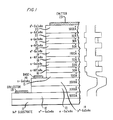
- Exemplary preferred device structure shown in FIG. 1 represents an n-p-n bipolar transistor with two resonant-tunneling double-barrier quantum wells in series in the emitter.
- Such structure can be made by well-established techniques such as, e.g., molecular-beam epitaxy (MBE) or metal-organic chemical vapor deposition (MOCVD), e.g., on an indium phosphide substrate 11 which may be doped or undoped, the latter being preferred in the interest of enhanced device operating speed.
- MBE molecular-beam epitaxy
- MOCVD metal-organic chemical vapor deposition
- Successively deposited lattice-matched layers 12 through 23 have nominal composition Ga 0.47 In 0.53 As in the case of gallium-indium arsenide, and Al 0.48 In 0.52 As in the case of aluminum-indium arsenide.
- Preferred dopant concentrations are greater than or approximately 2x10¹⁸/cm3 for collector-contact layer 12, less than or approximately 2x10¹⁶/cm3 for collector-active layer 13, greater than or approximately 2x10¹⁸/cm3 for base layer 14, approximately 1x10¹⁸/cm3 for layer 15, approximately 5x10¹⁷/cm3 for quantum-well separating layer 19, and greater than or approximately 1x10¹⁸/cm3 for emitter-contact layer 23.
- layers 16, 17, and 18, and layers 20, 21, and 22 form double-barrier resonant-tunneling quantum wells.
- FIG. 1 Not shown in FIG. 1 are 50-Angstrom nominally undoped gallium-indium arsenide offset layers which are preferably included, in the interest of inhibiting dopant diffusion into the barrier layers during high-temperature growth processing, between layers 15 and 16, 18 and 19, 19 and 20, and 22 and 23.
- Photolithography and chemical wet etching were used to produce an emitter mesa having a diameter of approximately 50 micrometers and a base mesa having a diameter of approximately 125 micrometers; the nominal composition of the etchant was 50H2O + 3H3PO4 + 1H2O2.
- Emitter and collector contact metallizations 231 and 121 were made by successively evaporating germanium, gold, silver, and gold; the base contact layer 141 was made by evaporating goldberyllium alloy and then gold.
- the contacts were alloyed at a temperature of approximately 375 degrees C for approximately 10 seconds in a hydrogen atmosphere so as to prevent oxidation. (Oxidation may be prevented also by the use of an inert atmosphere, e.g., of nitrogen or helium.)
- the device structure as described above corresponds to an n-p-n resonant-tunneling bipolar transistor (RTBT), p-n-p structure is not precluded.
- double-barrier quantum-well structures as called for in accordance with the invention are in the conduction band, in the latter case such structures are in the valence band.
- the number of quantum wells present is a plurality of 2 or more, such plurality comprising at least two quantum wells such that, during device operation, quenching of resonant tunneling through these two quantum wells occurs at different base-emitter voltages.
- the two quantum wells are separated such that there is no significant quantum-mechanical interaction between the quantum-mechanical states of the two quantum wells, separation typically resulting from the presence of a sufficiently thick, low-bandgap doped layer between quantum wells.
- Such lower limit on layer thickness is in the interest of precluding the presence of quantum states in the separating layer which are coupled to the quantum states of the quantum wells.
- preferred separating layer thickness is in the range from 500 to 1000 Angstroms for room-temperature operation.
- Preferred doping of the separating layer is at least 2x10¹⁷/cm3.
- Preferred placement of quantum wells is between the base region and the contact to the emitter region; preferred also is the inclusion, adjacent to the base region, of a region having doping type opposite to the doping type of the base region, and having a bandgap which is wider than the bandgap of the base region (see layer 15 in FIG. 1); inclusion of such preferred region serves to inhibit back-injection of minority carriers from the base region during device operation. Conveniently, in the interest of bandgap matching, such region has graded composition towards the quantum wells.
- barrier layers may be made of aluminium-gallium arsenide or aluminum arsenide, and well layers of gallium arsenide or (strained) gallium-indium arsenide, Ga 1-x In x As, 0 ⁇ x ⁇ 0.2. Also, Ga 0.47 In 0.53 As well layers can be combined with aluminum-indium arsenide, indium phosphide, or (strained) aluminum arsenide layers.
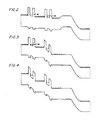
- Device functioning as described below with reference to FIG. 2 to 4 may be understood as based on the sequential quenching of resonant tunneling through two (or more) double-barrier quantum wells as caused by nonuniform electrical field distribution across the quantum wells due to charge build-up. If the collector bias is kept fixed then, for (negative) emitter-base voltages V EB less in magnitude than the build-in voltage of the gallium-indium arsenide p-n junction, most of the bias voltage falls across this junction because its impedance is considerably greater than the impedance of the two quantum wells in series, both of which are conducting via resonant tunneling (as indicated by arrows in FIG. 2).
- V EB If the magnitude of V EB is increased further to equal the build-in voltage, the junction reaches a flat-band configuration and becomes strongly conducting. Any additional increase in the magnitude of V EB will then fall primarily across the quantum wells (see FIG. 3), such wells being designed so that the ground state in the quantum well is significantly above the Fermi level in the adjacent cladding layers.
- the electric field across the quantum well is nonuniform and highest at the aluminum-indium arsenide barrier adjacent to the n-region of the p-n junction (i.e., closest to the base layer) as due to the screening of the field by the charge accumulated in the wells during resonant tunneling.
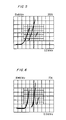
- FIG. 7 Common-emitter output characteristics of the device of FIG. 1 at room temperature are shown in FIG. 7 for base current I B up to 1 mA, in Fig. 8 for I B up to 1.4 mA, and in FIG. 9 for I B up to 1.8 mA.
- I B low V BE
- the applied base-emitter voltage drops mainly across the p-n junction until flat-band condition is reached, the device behaving like a conventional bipolar transistor with a small-signal current gain as high as 70; see FIG. 7.
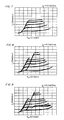
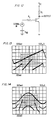
- FIG. 10 and 11 show common-emitter transfer characteristics, I C versus V BE , at constant V CE 2.5 V at respective temperatures of 300 K and 77 K.
- V CE common-emitter transfer characteristics
- V BE increases, the emitter and collector currents increase until the emitter-base junction reaches flat-band condition. Beyond flat-band condition, at higher V BE , resonant tunneling through the two quantum wells quenches sequentially, and sharp drops in the emitter and collector currents are observed.
- the highest peak-to-valley ratio in the transfer characteristics is 4:1 at room temperature, and about 20:1 at 77K.
- the current-voltage characteristics were found to be essentially the same for different values of the collector-base voltage V CE .
- FIG. 15 shows a circuit for parity-bit generation whose operation involves adding up four input bits at the base node of the transistor by the resistive network to generate a stepped waveform.
- the quiescent bias of the transistor adjusted by the resistance R B1 , and the values of the resistance R0 are chosen to select the operating points of the transistor alternately at low and high collector current levels at the successive steps of the summed voltage.
- the output voltage at the collector will be high or low depending on whether the number of input bits set high is even or odd, respectively.
- 24 ordinary transistors are needed in an optimized conventional parity-bit circuit using three exclusive OR's, the circuit according to FIG. 15 performs the same function with a single transistor of the invention.
- conventional parity generators operate by hierarchically comparing two input bits at a time, in the present circuit all input bits are handled simultaneously, and this results in higher operating speed.
- FIG. 15 The circuit of FIG. 15 was tested by means of pseudo-random 4-bit words. Experimental results are shown in FIG. 16 (77 K) and FIG. 17 (room temperature), the top and bottom traces respectively representing the collector output and the base waveforms.
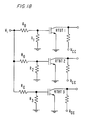
- FIG. 18 shows three devices of the invention combined to form an analog-to-digital converter.
- the analog input V i is applied simultaneously to a parallel array of resonant-tunneling transistors through a plurality of voltage-scaling networks, namely, R0 and R1, R0 and R2, and R0 and R3, to RTBT1, RTBT2, and RTBT3, respectively.
- a parallel array of resonant-tunneling transistors through a plurality of voltage-scaling networks, namely, R0 and R1, R0 and R2, and R0 and R3, to RTBT1, RTBT2, and RTBT3, respectively.
- the outputs from the array form a binary code which represents the quantized analog input level.
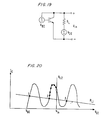
- FIG. 19 shows a multiple-valued logic (or multiple-state memory) circuit as based on multiple-valued negative differential resistance characteristic at the emitter-collector terminals of a RTBT when the base-collector junction is held at fixed bias V BC .
- Variations in V CE then cause variations in V EB , causing the collector current to peak as V EB crosses a tunneling resonance; see FIG. 20.
- the resulting load line intersects the current-voltage characteristics at N stable points, where N is the number of resonant peaks.
- the circuit acts as an N-state memory element which can provide high-density data storage. The element can be latched onto any one of the stable states by momentarily applying a voltage close to the desired state.
Landscapes
- Engineering & Computer Science (AREA)
- Theoretical Computer Science (AREA)
- Nanotechnology (AREA)
- Physics & Mathematics (AREA)
- Chemical & Material Sciences (AREA)
- Computer Hardware Design (AREA)
- Quality & Reliability (AREA)
- Crystallography & Structural Chemistry (AREA)
- Mathematical Physics (AREA)
- General Engineering & Computer Science (AREA)
- General Physics & Mathematics (AREA)
- Bipolar Transistors (AREA)
- Analogue/Digital Conversion (AREA)
- Logic Circuits (AREA)
- Physical Deposition Of Substances That Are Components Of Semiconductor Devices (AREA)
- Recrystallisation Techniques (AREA)
- Bipolar Integrated Circuits (AREA)
- Semiconductor Integrated Circuits (AREA)
Applications Claiming Priority (2)
| Application Number | Priority Date | Filing Date | Title |
|---|---|---|---|
| US07/244,753 US4999697A (en) | 1988-09-14 | 1988-09-14 | Sequential-quenching resonant-tunneling transistor |
| US244753 | 1988-09-14 |
Publications (2)
| Publication Number | Publication Date |
|---|---|
| EP0359508A2 true EP0359508A2 (de) | 1990-03-21 |
| EP0359508A3 EP0359508A3 (de) | 1990-07-18 |
Family
ID=22923986
Family Applications (1)
| Application Number | Title | Priority Date | Filing Date |
|---|---|---|---|
| EP89309206A Ceased EP0359508A3 (de) | 1988-09-14 | 1989-09-11 | Sequentiell ausschaltbarer Transistor mit resonantem Tunneleffekt |
Country Status (5)
| Country | Link |
|---|---|
| US (1) | US4999697A (de) |
| EP (1) | EP0359508A3 (de) |
| JP (1) | JPH0642491B2 (de) |
| KR (1) | KR930004716B1 (de) |
| CA (1) | CA1299769C (de) |
Cited By (3)
| Publication number | Priority date | Publication date | Assignee | Title |
|---|---|---|---|---|
| EP0643489A1 (de) * | 1993-05-24 | 1995-03-15 | Texas Instruments Incorporated | Binärkonverter |
| US5625205A (en) * | 1993-06-02 | 1997-04-29 | Nec Corporation | Bipolar transistor circuit |
| US6031256A (en) * | 1999-01-05 | 2000-02-29 | National Science Council Of Republic Of China | Wide voltage operation regime double heterojunction bipolar transistor |
Families Citing this family (9)
| Publication number | Priority date | Publication date | Assignee | Title |
|---|---|---|---|---|
| JP3542620B2 (ja) * | 1992-09-30 | 2004-07-14 | テキサス インスツルメンツ インコーポレイテツド | 多重ピーク共鳴トンネルダイオード |
| USH1570H (en) * | 1993-03-31 | 1996-08-06 | The United States Of America As Represented By The Secretary Of The Army | Variable lateral quantum confinement transistor |
| US5869845A (en) * | 1997-06-26 | 1999-02-09 | Texas Instruments Incorporated | Resonant tunneling memory |
| TW440968B (en) * | 2000-01-10 | 2001-06-16 | Nat Science Council | Heterojunction bipolar transistor device with sun-hat-shaped negative differential resistance characteristic |
| US20030227057A1 (en) * | 2002-06-07 | 2003-12-11 | Lochtefeld Anthony J. | Strained-semiconductor-on-insulator device structures |
| US6995430B2 (en) * | 2002-06-07 | 2006-02-07 | Amberwave Systems Corporation | Strained-semiconductor-on-insulator device structures |
| US7074623B2 (en) * | 2002-06-07 | 2006-07-11 | Amberwave Systems Corporation | Methods of forming strained-semiconductor-on-insulator finFET device structures |
| US20040109692A1 (en) * | 2002-12-09 | 2004-06-10 | James Plante | FSO communication systems having high performance detectors |
| US7026642B2 (en) * | 2003-08-27 | 2006-04-11 | Micron Technology, Inc. | Vertical tunneling transistor |
Family Cites Families (10)
| Publication number | Priority date | Publication date | Assignee | Title |
|---|---|---|---|---|
| JPS6158268A (ja) * | 1984-08-30 | 1986-03-25 | Fujitsu Ltd | 高速半導体装置 |
| JPH07105488B2 (ja) * | 1986-03-18 | 1995-11-13 | 富士通株式会社 | 半導体装置 |
| GB2191035A (en) * | 1986-05-23 | 1987-12-02 | Philips Electronic Associated | Hot charge-carrier transistors |
| US4845541A (en) * | 1986-05-29 | 1989-07-04 | Regents Of The University Of Minnesota | Tunneling emitter bipolar transistor |
| JPH0642553B2 (ja) * | 1986-06-13 | 1994-06-01 | 日本電気株式会社 | 共鳴トンネル・ダイオ−ド |
| US4849799A (en) * | 1986-07-31 | 1989-07-18 | American Telephone And Telegraph Company At&T Bell Laboratories | Resonant tunneling transistor |
| JPS63153867A (ja) * | 1986-08-04 | 1988-06-27 | Fujitsu Ltd | 共鳴トンネリング半導体装置 |
| JPH0795675B2 (ja) * | 1987-02-14 | 1995-10-11 | 富士通株式会社 | 比較回路 |
| US4907196A (en) * | 1987-04-28 | 1990-03-06 | Fujitsu Limited | Semiconductor memory device using resonant-tunneling transistor |
| US4912539A (en) * | 1988-08-05 | 1990-03-27 | The University Of Michigan | Narrow-band-gap base transistor structure with dual collector-base barrier including a graded barrier |
-
1988
- 1988-09-14 US US07/244,753 patent/US4999697A/en not_active Expired - Lifetime
-
1989
- 1989-09-08 CA CA000610802A patent/CA1299769C/en not_active Expired - Fee Related
- 1989-09-11 EP EP89309206A patent/EP0359508A3/de not_active Ceased
- 1989-09-12 KR KR1019890013200A patent/KR930004716B1/ko not_active Expired - Fee Related
- 1989-09-14 JP JP1237408A patent/JPH0642491B2/ja not_active Expired - Lifetime
Cited By (3)
| Publication number | Priority date | Publication date | Assignee | Title |
|---|---|---|---|---|
| EP0643489A1 (de) * | 1993-05-24 | 1995-03-15 | Texas Instruments Incorporated | Binärkonverter |
| US5625205A (en) * | 1993-06-02 | 1997-04-29 | Nec Corporation | Bipolar transistor circuit |
| US6031256A (en) * | 1999-01-05 | 2000-02-29 | National Science Council Of Republic Of China | Wide voltage operation regime double heterojunction bipolar transistor |
Also Published As
| Publication number | Publication date |
|---|---|
| JPH02114536A (ja) | 1990-04-26 |
| CA1299769C (en) | 1992-04-28 |
| KR930004716B1 (ko) | 1993-06-03 |
| EP0359508A3 (de) | 1990-07-18 |
| JPH0642491B2 (ja) | 1994-06-01 |
| US4999697A (en) | 1991-03-12 |
| KR900005591A (ko) | 1990-04-14 |
Similar Documents
| Publication | Publication Date | Title |
|---|---|---|
| Capasso et al. | Quantum functional devices: resonant-tunneling transistors, circuits with reduced complexity, and multiple valued logic | |
| CA1276275C (en) | Resonant tunneling transistor | |
| Sen et al. | Resonant tunneling device with multiple negative differential resistance: digital and signal processing applications with reduced circuit complexity | |
| US4999697A (en) | Sequential-quenching resonant-tunneling transistor | |
| Sen et al. | Multiple-state resonant-tunneling bipolar transistor operating at room temperature and its application as a frequency multiplier | |
| KR930002817B1 (ko) | 공진 터넬링 구조를 포함하는 디바이스 | |
| Capasso et al. | Multiple negative transconductance and differential conductance in a bipolar transistor by sequential quenching of resonant tunneling | |
| US4902912A (en) | Apparatus including resonant-tunneling device having multiple-peak current-voltage characteristics | |
| Sen et al. | New resonant-tunneling devices with multiple negative resistance regions and high room-temperature peak-to-valley ratio | |
| Chung et al. | Three-terminal Si-based negative differential resistance circuit element with adjustable peak-to-valley current ratios using a monolithic vertical integration | |
| US6303941B1 (en) | Integrated asymmetric resonant tunneling diode pair circuit | |
| Rhee et al. | SiGe resonant tunneling hot‐carrier transistor | |
| Capasso et al. | Quantum transistors and circuits break through the barriers | |
| CA1284234C (en) | Apparatus including resonant-tunneling device having multiple-peak current-voltage characteristics | |
| Potter et al. | A vertically integrated resonant tunneling device with multiple negative differential resistances | |
| Wen-Shiung Lour et al. | Negative-differential-resistance (NDR) superlattice-emitter transistor | |
| Wallmark et al. | The tunnel resistor | |
| US3482306A (en) | Method of making an esaki means for obtaining high current gain factor | |
| Cheng et al. | Observation of the impulse-like negative-differential resistance of superlatticed resonant-tunneling transistor | |
| CHO | AND ALFRED zyxwvutsrqponmlkjih | |
| JPS61290759A (ja) | 共鳴トンネルトランジスタ | |
| Wei et al. | Effects of base-emitter junction on the resonant tunneling bipolar transistor with double barriers in teh emitter | |
| Chen et al. | Co-integration of high speed heterojunction bipolar transistors (HBTs) and tunnel diodes | |
| Capasso | Quantum electron and optoelectronic devices | |
| Sen et al. | Integration of GaAs/AlAs resonant tunneling diodes for digital and analog applications with reduced circuit complexity |
Legal Events
| Date | Code | Title | Description |
|---|---|---|---|
| PUAI | Public reference made under article 153(3) epc to a published international application that has entered the european phase |
Free format text: ORIGINAL CODE: 0009012 |
|
| AK | Designated contracting states |
Kind code of ref document: A2 Designated state(s): DE ES FR GB IT NL |
|
| PUAL | Search report despatched |
Free format text: ORIGINAL CODE: 0009013 |
|
| AK | Designated contracting states |
Kind code of ref document: A3 Designated state(s): DE ES FR GB IT NL |
|
| 17P | Request for examination filed |
Effective date: 19901206 |
|
| 17Q | First examination report despatched |
Effective date: 19930813 |
|
| RAP3 | Party data changed (applicant data changed or rights of an application transferred) |
Owner name: AT&T CORP. |
|
| STAA | Information on the status of an ep patent application or granted ep patent |
Free format text: STATUS: THE APPLICATION HAS BEEN REFUSED |
|
| 18R | Application refused |
Effective date: 19940822 |