EP0359245A2 - Leistungsversorgungsschaltung für EL-Anordnungen - Google Patents
Leistungsversorgungsschaltung für EL-Anordnungen Download PDFInfo
- Publication number
- EP0359245A2 EP0359245A2 EP89116980A EP89116980A EP0359245A2 EP 0359245 A2 EP0359245 A2 EP 0359245A2 EP 89116980 A EP89116980 A EP 89116980A EP 89116980 A EP89116980 A EP 89116980A EP 0359245 A2 EP0359245 A2 EP 0359245A2
- Authority
- EP
- European Patent Office
- Prior art keywords
- inverter
- power supply
- operating circuit
- circuit
- electroluminescent
- Prior art date
- Legal status (The legal status is an assumption and is not a legal conclusion. Google has not performed a legal analysis and makes no representation as to the accuracy of the status listed.)
- Granted
Links
Images






Classifications
-
- H—ELECTRICITY
- H05—ELECTRIC TECHNIQUES NOT OTHERWISE PROVIDED FOR
- H05B—ELECTRIC HEATING; ELECTRIC LIGHT SOURCES NOT OTHERWISE PROVIDED FOR; CIRCUIT ARRANGEMENTS FOR ELECTRIC LIGHT SOURCES, IN GENERAL
- H05B44/00—Circuit arrangements for operating electroluminescent light sources
-
- Y—GENERAL TAGGING OF NEW TECHNOLOGICAL DEVELOPMENTS; GENERAL TAGGING OF CROSS-SECTIONAL TECHNOLOGIES SPANNING OVER SEVERAL SECTIONS OF THE IPC; TECHNICAL SUBJECTS COVERED BY FORMER USPC CROSS-REFERENCE ART COLLECTIONS [XRACs] AND DIGESTS
- Y02—TECHNOLOGIES OR APPLICATIONS FOR MITIGATION OR ADAPTATION AGAINST CLIMATE CHANGE
- Y02B—CLIMATE CHANGE MITIGATION TECHNOLOGIES RELATED TO BUILDINGS, e.g. HOUSING, HOUSE APPLIANCES OR RELATED END-USER APPLICATIONS
- Y02B20/00—Energy efficient lighting technologies, e.g. halogen lamps or gas discharge lamps
- Y02B20/30—Semiconductor lamps, e.g. solid state lamps [SSL] light emitting diodes [LED] or organic LED [OLED]
Definitions
- This invention relates to an EL operating power supply circuit.
- Electroluminescent (EL) elements or panels are widely used as EL displays and background light for liquid crystal displays.
- the EL element is predominantly a capacitance load when considered as a load, and generally requires AC voltage application for operation.
- the luminance and corresponding surface illuminance of the EL element largely depends on both the voltage and frequency of alternating current applied thereto. In order that the EL element generate more light, the effective or root-mean-square value and/or the frequency of applied voltage is increased.
- the frequency of voltage applied to an EL element may be increased by once rectifying an AC power to form a DC power supply of about ⁇ 140 volts, and alternately opening the positive/negative power supply circuit at the desired frequency f by means of a push-pull circuit, thereby applying AC voltage at the frequency f to the EL element.
- power transistors and power MOSFET's are used as the switching elements of the push-pull circuit. An energy loss of such power transistors and power MOSFET's upon switching gives rise to problems that a relatively large heat sink is necessary, a considerable energy loss occurs, and the site and manner of locating such transistors must be carefully taken into account.
- a primary object of the invention is to provide a power supply circuit for operating an EL element which essentially eliminates energy loss, recovers surplus electric charge in the EL element as reverse current flow to the power supply side, and thus increases energy efficiency.
- an EL operating power supply circuit comprising a DC power supply, an inverter connected across the power supply for producing an AC voltage at an output thereof, electroluminescent (EL) means connected to the output of the inverter, and an inductor inserted between the inverter and the electroluminescent means wherein the AC voltage is applied from the inverter through the inductor to the electroluminescent means to emit light.
- EL electroluminescent
- an EL operating power supply circuit comprising a DC power supply, an inverter connected across the power supply for changing the DC power into an AC power at an output thereof, and a transformer connected to the output of the inverter having primary and secondary windings, a bipolar capacitor connected to the transformer, and electroluminescent (EL) means connected to the transformer such that an AC output power available on the transformer secondary winding is applied to the electroluminescent means to emit light.
- the electroluminescent means may be an electroluminescent element or an array of parallel connected electroluminescent elements.
- a bipolar capacitor may be connected parallel to the electroluminescent means.
- the inductance of the inductor or transformer reduces the current during switching operation of the inverter, and a charge accumulated in the electroluminescent means and/or the bipolar capacitor through the inverter and the inductor or transformer is recovered to the power supply side as a reverse current flow.
- a buffering capacitor may be connected between the DC power supply and the inverter.
- a second inverter may be connected between the DC power supply and the first inverter, the second inverter performing opposite switching operation to the first inverter.
- a phase controlling coil may be connected between the DC power supply and the second inverter and/or between the first and second inverters.
- the first inverter may be adapted to receive a switching signal wherein the frequency and/or pulse duration duty ratio of the switching signal can be set in a variable manner.
- the inverter may include a charging inverter section and a feedback inverter section.
- the charging and feedback inverter sections may be driven by a switching signal having the same frequency and the same rise.
- the feedback inverter section has a larger pulse duration duty ratio than the charging inverter section.
- the inverter may include at least a pair of switching elements, and first diodes each may be connected in parallel with one of the switching elements for forming a bypass channel for feeding back the reverse current flow. Second diodes each may be provided in forward series connection with one of the switching elements inside the inverter channel bypassed by the reverse current flow bypass channel.
- capacitor C a capacitor having a capacitance C
- inductor or coil L an inductor or coil L for brevity of description.
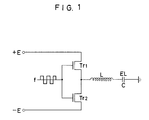
- an inverter including a pair of switching elements Tr1 and Tr2 is connected across a DC power supply having terminals at potentials +E and -E.
- the inverter may be of any well-known construction and generally includes a pair of switching elements Tr1 and Tr2 which are alternately turned on and off at a switching frequency f.
- the switching elements Tr1 and Tr2 may be power transistors or power metal-oxide-semiconductor field-effect transistors (MOSFET) having a withstand voltage of at least 2E, constituting a push-pull inverter.
- MOSFET power metal-oxide-semiconductor field-effect transistors
- the switching elements Tr1 to Tr4 may be constructed from power transistors or ordinary transistors or MOSFET's.
- a pair of complementary P- and N-channel power MOSFET'S are preferably selected for switching elements Tr1 and Tr2.
- Commercially available examples of the power MOSFET of the enhancement mode (or normally off mode) are "2SK310" and "2SJ117” manufactured by Hitachi, Ltd.
- the inverter in the form of paired switching elements Tr1 and Tr2 is connected to an electroluminescent (EL) element having a capacitance C, which is in turn grounded.
- EL electroluminescent
- An inductor in the form of a coil having an inductance L is connected between the inverter and the EL element.
- the EL element when a load is applied to the EL element, the EL element receives a voltage V and a current I as shown in FIG. 2 provided that the resistance (R) component of the circuit is negligibly small.
- the load current I varies over an amplitude of ⁇ CE/ ⁇ LC for a period of ⁇ 0 with a phase shift due to the presence of the coil L.
- the energy loss is then very low though not zero due to the presence of an R component or the like.
- no or little current flows across the inverter circuit for the rise or fall duration of switching operation of switching elements Tr1 and Tr2, resulting in a minimal switching energy loss.
- the coil should have a core having a high magnetic flux permeability at frequency f.
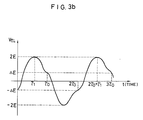
- Tr1 when a load is applied across the EL element, one of the switching elements in the switching section or inverter, for example, Tr1 produces a voltage V DS and a current I DS between the drain and the source as shown in FIG. 3a. Then the EL element receives a voltage V EL as shown in FIG. 3b.
- the voltage V DS that the first switching element Tr1 produces is a rectangular pulse voltage having a height of 2E between ⁇ 0 and 2 ⁇ 0.
- the coil L acts to introduce a phase shift to current I DS such that in a time duration between 0 and ⁇ 1, electric charge flows as a forward current flow a to accumulate in the EL element for a time duration between 0 and ⁇ 0, and returns as a reverse current flow b for a time duration between ⁇ 1 and ⁇ 0.
- the reverse current flow b is shown as a shaded region of I DS in FIG. 3a and the corresponding power or charge is recovered to the same power supply terminal as a surplus power.
- the voltage V EL across the EL element does not have a symmetric waveform as shown in FIG. 2, but a waveform vertically shifted by ⁇ E as shown in FIG. 3b. This means that a charge of ⁇ E ⁇ C cannot be fed back due to light emission of the EL element, dielectric loss and the like.
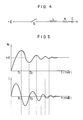
- the operating system of the invention is designed to carry out synchronous switching at a time constant ⁇ 0 with the capacitor C in FIG. 4 considered to be an EL element or a bipolar capacitor (to be described later) and the switch S considered to be one of the switching elements of the inverter. That is, the operating system of the invention utilizes the oscillatory or transient phenomenon of the LCR circuit. A stable steady state is established in the operating circuit by alternately switching the transient phenomenon occurring when the power supply is +E as shown in FIG. 4 and the transient phenomenon occurring when the power supply is -E, though not shown, in synchronization with the time constant ⁇ 0.
- a resistance equivalent component in the operating circuit corresponding to R of an LCR circuit includes a resistance in the circuit, a magnetic flux loss, DC resistance, and magnetic flux saturation of the coil, a dielectric loss and luminous exitance of the EL element, and the like. Smaller the R equivalent component, the more the reverse current flow or the larger the amount of charge is fed back. If the R equivalent component were zero, an ideal state would be achieved as described in conjunction with FIG. 2.
- the operating circuit of the present invention switches the power supply voltage between +E and -E.
- any conventional well-known methods may be employed, for example, the switching frequency f is adjusted so as to provide synchronization with ⁇ 0. This needs a careful adjustment because if the switching frequency f were wrongly adjusted for synchronization with ⁇ 1, then there would result a very unstable circuit which can cause a failure of the EL element.
- the charge accumulated in the EL element is recovered to the same power supply terminal under the impetus of the coil while minimizing a loss or diversion to the other power supply terminal, thereby improving power efficiency.
- switching elements typically power MOSFET's conduct current flow not only in the drain-to-source direction, but also substantially equally in the source-to-drain direction insofar as the channel is open.
- switching elements having the diode characteristic of allowing only drain-to-source current flow for example, power transistors are used, two groups of diodes D11, D12, D13, D14 and D21, D22, D23, D24 may be arranged as shown in FIG. 7. With this arrangement, both forward and reverse currents flow the switching elements only in a collector-to-emitter or emitter-to-collector direction.
- the DC power supply used in the invention is not particularly limited.
- the use of a secondary battery or solar battery as the power supply is advantageous for power saving.
- direct recharging of the secondary battery with the reverse current flow reduces the battery lifetime and is sometimes difficult for some batteries.
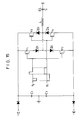
- diodes D1 and D2 are inserted between the power supply terminals +E and -E and the switching elements Tr1 and Tr2, respectively, and capacitors C1 and C1 are connected to the D1-Tr1 and the D2-Tr2 connections, respectively, as shown in FIG. 8.
- FIG. 9 An alternative arrangement is shown in FIG. 9.
- a second inverter is added to the circuit which includes switching elements Tr3 and Tr4 adapted to switch at the same frequency f and close at the time of reverse current flow. It is also effective to further provide coils L3 and L3 between the second inverter and the power supply as phase control inductors because the coils prevent accumulation of charges from the power supply to the capacitors Cl during supply of charges to the EL element or reverse flow of charges from the EL element, considerably reducing the power loss.
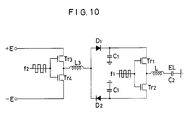
- FIG. 10 A still further arrangement is shown in FIG. 10 which uses a single coil.
- a coil L3 is connected at one end to the aft end of the second inverter consisting of switching elements Tr3 and Tr4 connected to the power supply terminals and at the other end to the connection between diodes D1 and D2.
- the arrangement is such that Tr3 is closed when Tr1 is opened and Tr3 is opened when Tr1 is closed.
- the switching elements Tr1, Tr2, Tr3, and Tr4 open and close as follows. Switching element 0 - ⁇ 0 ⁇ 0 - 2 ⁇ 0 Tr1 Open Close Tr2 Close Open Tr3 Close Open Tr4 Open Close
- inductance L3 and capacitance C1 may also be selected to be approximate values enabling f ⁇ 1/2 ⁇ L3C1 .
- the energy loss is minimized to approximately zero by such a choice.
- the EL elements When it is desired to connect a plurality of EL elements to a direct current supply, the EL elements may be connected in parallel to the output end of the coil L.
- the dynamism that charges accumulated in the EL element are fed back as reverse current flow depends on the capacitances of EL element and capacitors, the inductance of inductor, the frequency and waveform of switching signal. These three parameters must be properly selected before the EL element can be operated by the operating circuit of the invention. Selection of the parameters is not particularly limited and may be carried out by any desired method, but preferably by the following methods because of ease of operation.
- the first method of setting duty ratio is suitable for operating an EL element of a small area at a relatively low frequency without increasing the inductance of the coil.
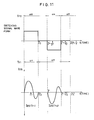
- FIG. 11 shows the switching signal waveform and drain-to-source current I DS for a fixed frequency f and a duty ratio ⁇ 0/ ⁇ set to less than unity (1).
- This method allows one to adjust and determine the switching frequency and duty ratio while observing the current and voltage waveforms between the drain and the source of one of the switching elements of the inverter on a suitable display such as an oscilloscope. More particularly, the switching frequency and duty ratio are adjusted and determined by manipulating an adjustment volume associated with the oscillatory circuit.
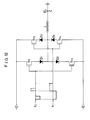
- FIG. 12 shows a circuit for an automatic setting system wherein the current mode will automatically follow a setting of frequency f.
- the circuit includes a charge-up path for forward current flow from the power supply to the EL element and a feedback path for reverse current flow, separately provided between the power supply and the inductor. Both the paths have incorporated therein a charging inverter including switching elements Tr1 and Tr2 and a feedback inverter including switching elements Tr3 and Tr4, and diodes D1, D2, D3, and D4 for separating the paths.
- the charging and feedback inverters are turned on and off with signals having frequencies f2 and f1 matched with the EL operating frequency f.
- This circuit functions such that a charge from the power supply positive terminal +E is accumulated in the EL element as a forward current flow through Tr1 and then fed back as a reverse current flow through Tr3. Similarly, a charge from the power supply negative terminal -E is accumulated in the EL element as a forward current flow through Tr2 and then fed back as a reverse current flow through Tr4. If frequencies f1 and f2 are forward synchronous pulses, a choice is made such that transistors Tr1 and Tr3 are of the same channel type, transistors Tr2 and Tr4 are of the same channel type, and Tr1 and Tr2 and Tr3 and Tr4 are pairs of complementary transistors of different channel types.
- transistors Tr1 and Tr3 are of different channel types
- transistors Tr2 and Tr4 are of different channel types
- Tr1 and Tr2 and Tr3 and Tr4 are pairs of complementary transistors of different channel types.
- the signal wave for switching the transistors Tr3 and Tr4 of the feedback inverter is of rectangular waveform and has a frequency f1 equal to the EL operating frequency f.
- the signal wave of frequency fl may have a pulse duration duty ratio of at least ⁇ 0/ ⁇ though it is generally selected to be a fixed value. In the illustrated embodiment, the duty ratio is equal to 1.
- the signal wave for switching the transistors Tr1 and Tr2 of the charging inverter is of rectangular waveform and has a frequency f2 equal to the EL operating frequency f.
- the signal wave of frequency f2 may have a pulse duration ⁇ 2 having a duty ratio ⁇ 2/ ⁇ which may be either fixed or variable, though a certain restraint is imposed as will be described later.
- the duty ratio ⁇ 2/ ⁇ is generally up to ⁇ 0/ ⁇ , preferably in the range of from ⁇ 1/ ⁇ to ⁇ 0/ ⁇ . It will be understood that the frequency and duty ratio are arbitrary and may be suitably determined insofar as the above-mentioned requirements are met.
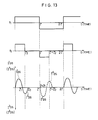
- FIG. 13 is a diagram showing the waveforms of drain-source current flows I1 DS and I3 DS through transistors Tr1 and Tr3 along with the signal waves having frequencies f1 and f2.
- curves in broken lines show the waveforms of drain- source current flows I2 DS and I4 DS through transistors Tr2 and Tr4 associated with the power supply negative terminal -E.
- time constants ⁇ 1 and ⁇ 0 are variables determined as a function of the capacitance, inductance, and resistance of the circuit.
- the value of pulse duration ⁇ 2 need not be identical to the value of ⁇ 1 or ⁇ 0 as seen from FIG. 13, though ⁇ 2 ⁇ ⁇ 0 is necessary as previously described. If ⁇ 2 > ⁇ 0, then the charge once fed back to the power supply terminal is undesirably accumulated again in the EL element through Tr1.
- Another preferred condition is ⁇ 2 ⁇ ⁇ 1 because a noticeable switching energy loss occurs under a condition: ⁇ 2 ⁇ ⁇ 1.
- This operating circuit enables automatic feedback of reverse current flow even if the signal waves of frequencies f1 and f2 are once set and thereafter kept fixed insofar as the condition: ⁇ 2 ⁇ ⁇ 0 is met. This allows the reverse current feed back mode to be automatically followed even when the value of ⁇ 0 has changed due to a change with time of the capacitance of the EL element which is a drawback of the EL element.
- the EL element lowers its capacitance as it is operated for an extended period, say several years.
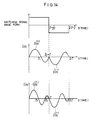
- the value of ⁇ 0 which was equal to the value of ⁇ of switching frequency f at the time of initial setting as shown in a middle section of FIG. 14 decreases so that ⁇ 0 is out of timing with ⁇ as shown in a lower section of FIG. 14.
- I DS is a drain-source current flow at the time of initial setting
- I′ DS is a drain-source current flow after a change with time of the EL element capacitance
- (+) and (-) designate that the associated current flows are on the positive and negative sides of the power supply, respectively.
- a recharging current flow corresponding to a shaded area in the lower section of FIG. 14 generates, resulting in a reduced EL operating efficiency.
- the automatic setting arrangement as illustrated in FIG. 12 essentially eliminates the switching loss and occurrence of a re-charging current flow due to a capaci. tance change with time of the EL element insofar as the condition: ⁇ 1 ⁇ ⁇ 2 ⁇ ⁇ 0 is met.
- FIG. 15 A modification of the circuit of FIG. 12 is shown in FIG. 15 wherein diodes are inserted between the power supply terminals and the switching elements Tr1 and Tr2 of the charging inverter, and capacitors C1, C1 are provided for buffering the reverse current flows for the same reason as previously described.
- the provision of a second inverter or a phase control inductor as shown in FIG. 9 or 10 can further reduce the power loss.
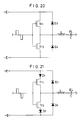
- bypass channels for reverse current flows are formed by connecting diodes D3 and D4 in parallel with the switching elements Tr1 and Tr2 of the inverter, respectively, whereby the reverse current flow mode is automatically locked within a certain range of parameter settings.
- the circuit of FIG. 20 becomes equivalent to that of FIG. 21 when switching elements Tr1 and Tr2 in FIG. 20 also have a diode function like transistors do. These arrangements correspond to the circuit arrangement of FIG. 12 with switching elements Tr3 and Tr4 omitted.
- the operation of the circuit of FIG. 21 is now described for better understanding.
- the switching element Tr1 should be closed at the point of time when the reverse current flow has been recovered to the positive terminal side.
- the second switching element Tr2 should be kept closed until the positive reverse current flow has been recovered to the positive terminal side.
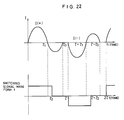
- FIG. 22 shows the waveform of current flow through an LCR circuit given by the L, C and R component of the circuit of FIG. 21 when second switching element Tr2 of FIG. 21 is opened and the waveform of the frequency f switching signal of the inverter.
- reverse current flow locking is automatically accomplished because of ⁇ 1 ⁇ ⁇ 2 ⁇ ⁇ 0 and ⁇ 0 ⁇ ⁇ . That is, the illustrated arrangement can successfully achieve automatic locking of reverse current flow within the range where the conditions: ⁇ 1 ⁇ ⁇ 2 ⁇ ⁇ 0 and ⁇ 0 ⁇ ⁇ are met.
- Imin and Imax respectively designate the waveforms of current flow corresponding to the minimum and maximum areas of an EL element involved in the circuit arrangement wherein reverse current flow is automatically locked.
- the present system can adjust luminance by varying the frequency within the range of EL element minimum to maximum area ratio of 1 : 2.25 for the same fixed L value.
- a still another system capable of automatic follow-up of frequency f is contemplated wherein the frequency f is automatically adjusted to be equal to 1/2 ⁇ 0 in accordance with a change of ⁇ 0, that is, switching elements are automatically opened or closed when the reverse current flow has been fed back.
- a system capable of automatic follow-up of pulse duration duty ratio is also contemplated wherein the frequency f is left variable, and the switching elements are automatically closed when the reverse current flow has been fed back.
- These circuits may be established by using those switching elements which are automatically turned off when current is available no longer, typically triacs, with a modification to the illustrated circuit embodiments.
- an oscillatory circuit may be modified such that the frequency or pulse duration duty ratio of the switching signal to the inverter will follow in synchronization when the reverse current flow has been fed back.
- a power supply of the dual mode providing potentials of ⁇ E volts is necessary and the other end of the EL element is connected to an intermediate or zero potential terminal, that is, grounded.
- a primary power supply of the single mode it must be converted into a power supply of the dual mode allowing connection of an intermediate potential terminal before it can be used as the input power supply in the operating circuit of the invention.
- Any conventional well-known method may be used to convert a power supply of the single mode into a power supply of the dual mode. Some suitable methods are described below.
- a first method is to use a DC-DC converter of the dual mode with an advantage that voltage can be stepped up and down at the same time.
- the potential of 2E volt may be divided into ⁇ E volt and intermediate potentials using two capacitors C4, C4 having an equal capacitance.
- the arrangement is shown in FIG. 16 wherein a first capacitor C4 and a second capacitor C4 are connected across the primary power supply of 2E.
- a terminal 1 between the power supply positive terminal and first capacitor C4 produces an output of +E volt and a terminal 3 between the power supply negative terminal and second capacitor C4 produces an output of -E volt with respect to an intermediate terminal 2 at the connection between first and second capacitors C4 and C4.
- the terminals 1 and 3 are used as input terminals for the inverter while the intermediate terminal 2 is used as the ground terminal for the EL element.
- a DC-DC converter of the dual mode as previously described may be used. It is also possible to use a DC-DC converter of the single mode to convert the potential of e volt into a potential of 2E volt, which can then be divided into ⁇ E volt and intermediate potentials using a capacitor connection as shown in FIG. 16.
- reverse current controlling diodes D1 and D2 are inserted between the primary power supply or the DC-DC converter and the potential dividing capacitors C4 because the capacitors C4 can then also serve to buffer reverse flow power.
- the second aspect is the same in principle as the first aspect in that a reverse current flow is available.
- the second aspect is made by taking into account that the DC power supply potentials of ⁇ E are stepped up to apply an AC load to the EL element.
- Necessary replacements are made to the embodiment of the first aspect.
- the EL element is replaced by a bipolar capacitor, the inductor or coil is replaced by a transformer having primary and secondary windings, and the EL element is connected to the transformer whereby the EL element is operated with an AC power available at the transformer secondary winding.
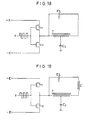
- FIGS. 17 and 18 Two preferred embodiments are shown in FIGS. 17 and 18.
- power supply terminals having potentials of +E and -E are connected to an inverter consisting of switching elements Tr1 and Tr2 as in the first aspect.
- the output of the inverter is connected to a transformer T having primary and secondary windings having inductances L1 and L2.
- the secondary winding L2 is connected across an EL element having a capacitance C.
- the primary winding L1 is connected to a bipolar capacitor having a capacitance C3.
- FIG. 18 is a modification of FIG. 17.
- FIG. 19 is a further modification of FIG. 18 wherein a coil L′ is added as a compensating inductor.
- the inductor L or transformer T between the inverter and the EL element or bipolar capacitor C3 causes phase and period shifts between loading current and voltage, no or little current flows across the circuit at the instant when the switching elements of the inverter are opened and closed, eliminating or minimizing the switching energy loss by the switching elements such as power transistors and power MOSFET.
- a substantial portion of the charge accumulated in the EL element is recovered as reverse current flow to the power supply terminal from which the charge is delivered, by virtue of the inductor or transformer, minimizing any loss to the other terminal and thus resulting in significantly increased power efficiency.
- the EL element can generate an increased amount of light at an increased luminance.
- the amount of heat that the switching elements such as power transistors and power MOSFET generate is significantly reduced with an increased degree of safety, eliminating the need for heat dissipating means.
- Table 1 shows the luminous intensity of each EL panel and the temperature of a heat sink associated with each power MOSFET having an area of 150 cm2 which is indicative of the amount of heat each power MOSFET generated.
- Table 1 also shows the results obtained when an inductance L of 50 mH was connected between the inverter and the parallel connected EL panels according to the present invention.
- Table 1 Luminous intensity (surface illuminance) Temperature of heat sink Comparison 130 lx 115°C Invention 500 lx 42°C
- the present invention provides significant improvements in luminance and power consumption as compared with the prior art system.
- the present invention accomplishes provides significant improvements in both luminance and power consumption over the entire range of varying voltage though the same frequency and effective voltage are used. That is, luminance is increased and power consumption is reduced.
- luminance is increased and power consumption is reduced.
- the benefit that a luminance increase and a power saving are achieved at the same time will be better understood from a quantitative aspect by comparing the power consumption required for providing the same luminance.
- the prior art needs a power consumption of 27.58 m/mVA (Table 2) and the invention needs a power consumption of 6.88 m/mVA (Table 3) which is about 1/4 of the power consumption of the prior art.
Landscapes
- Physics & Mathematics (AREA)
- Engineering & Computer Science (AREA)
- Microelectronics & Electronic Packaging (AREA)
- Optics & Photonics (AREA)
- Inverter Devices (AREA)
- Electroluminescent Light Sources (AREA)
- Dc-Dc Converters (AREA)
Applications Claiming Priority (8)
| Application Number | Priority Date | Filing Date | Title |
|---|---|---|---|
| JP23136288 | 1988-09-14 | ||
| JP231362/88 | 1988-09-14 | ||
| JP1055534A JPH02256191A (ja) | 1988-09-14 | 1989-03-08 | El発光電源回路 |
| JP55534/89 | 1989-03-08 | ||
| JP1989030613U JPH02122591U (de) | 1989-03-17 | 1989-03-17 | |
| JP3061489U JPH02122592U (de) | 1989-03-17 | 1989-03-17 | |
| JP30614/89U | 1989-03-17 | ||
| JP30613/89U | 1989-03-17 |
Publications (3)
| Publication Number | Publication Date |
|---|---|
| EP0359245A2 true EP0359245A2 (de) | 1990-03-21 |
| EP0359245A3 EP0359245A3 (en) | 1990-06-13 |
| EP0359245B1 EP0359245B1 (de) | 1996-06-12 |
Family
ID=27459289
Family Applications (1)
| Application Number | Title | Priority Date | Filing Date |
|---|---|---|---|
| EP89116980A Expired - Lifetime EP0359245B1 (de) | 1988-09-14 | 1989-09-13 | Leistungsversorgungsschaltung für EL-Anordnungen |
Country Status (4)
| Country | Link |
|---|---|
| US (1) | US5027040A (de) |
| EP (1) | EP0359245B1 (de) |
| AU (1) | AU631375B2 (de) |
| DE (1) | DE68926647D1 (de) |
Cited By (11)
| Publication number | Priority date | Publication date | Assignee | Title |
|---|---|---|---|---|
| DE4111581A1 (de) * | 1991-04-10 | 1992-10-15 | Diehl Gmbh & Co | Inverterschalter fuer eine kapazitive lichtquelle |
| EP0487732A4 (en) * | 1990-02-07 | 1993-03-10 | Daichi Co., Ltd | Light-emitting power source circuit |
| WO1993008670A1 (en) * | 1991-10-23 | 1993-04-29 | Dowty Electrics Limited | An a.c. power supply controller |
| EP0684752A1 (de) * | 1994-05-26 | 1995-11-29 | Eta SA Fabriques d'Ebauches | Schaltung zum Betreiben eines elektrolumineszenten Blattes |
| EP0699015A1 (de) * | 1994-08-24 | 1996-02-28 | Hewlett-Packard Company | Speiseschaltung mit Energierückgewinnung zum Betrieb einer elektrolumineszenten Vorrichtung |
| DE29512835U1 (de) * | 1995-08-09 | 1996-12-05 | GEZ Gesellschaft für elektrische Zugausrüstung mbH, 60388 Frankfurt | Beleuchtungseinrichtung |
| EP0762805A1 (de) * | 1995-09-06 | 1997-03-12 | Isa France S.A. | Schaltung und Verfahren zum Betreiben einer Elektrolumineszentenzelle |
| EP0758134A3 (de) * | 1995-08-08 | 1998-08-19 | Ford Motor Company | Steuerung für elektrolumineszentes Lampenpaneel mit mehrere Schaltungen |
| EP0881862A3 (de) * | 1997-05-26 | 2000-01-19 | Seiko Precision Inc. | Steuerungsschaltung für ein elektrolumineszentes Element |
| US6034484A (en) * | 1997-10-15 | 2000-03-07 | Korea Tronix Co., Ltd. | Piezoelectronic ballast for fluorescent lamp |
| AT407460B (de) * | 1998-04-20 | 2001-03-26 | Thomas Dipl Ing Dr Eberharter | Ansteuerung (energieversorgung) von elektrolumineszenzfolien |
Families Citing this family (27)
| Publication number | Priority date | Publication date | Assignee | Title |
|---|---|---|---|---|
| US6028573A (en) * | 1988-08-29 | 2000-02-22 | Hitachi, Ltd. | Driving method and apparatus for display device |
| FI87707C (fi) * | 1990-06-20 | 1993-02-10 | Planar Int Oy | Foerfarande och anordning foer begraensing av effektfoerbrukningen hos en elektroluminescensdisplay av vaexelstroemstyp |
| WO1993007733A1 (en) * | 1991-10-11 | 1993-04-15 | Norand Corporation | Drive circuit for electroluminescent panels and the like |
| WO1994001855A2 (en) * | 1992-06-30 | 1994-01-20 | Westinghouse Electric Corporation | Symmetric drive for an electroluminescent display panel |
| TW344190B (en) * | 1992-09-22 | 1998-11-01 | Matsushita Electric Works Ltd | Discharge lamp lighting device |
| KR0140041B1 (ko) * | 1993-02-09 | 1998-06-15 | 쯔지 하루오 | 표시 장치용 전압 발생 회로, 공통 전극 구동 회로, 신호선 구동 회로 및 계조 전압 발생 회로 |
| US5313141A (en) | 1993-04-22 | 1994-05-17 | Durel Corporation | Three terminal inverter for electroluminescent lamps |
| US5440208A (en) * | 1993-10-29 | 1995-08-08 | Motorola, Inc. | Driver circuit for electroluminescent panel |
| US5747938A (en) * | 1994-10-18 | 1998-05-05 | Norand Corporation | Automatic control electroluminescent backlight panel |
| US5858561A (en) * | 1995-03-02 | 1999-01-12 | The Ohio State University | Bipolar electroluminescent device |
| US5557175A (en) * | 1995-06-13 | 1996-09-17 | Harris Corporation | Battery operated inverter circuit for capacitive loads such as electroluminescent lamps |
| US5525869A (en) * | 1995-06-15 | 1996-06-11 | Harris Corporation | Efficient battery operated inverter circuit for capacitive loads such as electroluminescent lamps |
| JPH1173158A (ja) * | 1997-08-28 | 1999-03-16 | Seiko Epson Corp | 表示素子 |
| JP2000194322A (ja) * | 1998-12-28 | 2000-07-14 | St Microelectronics Kk | Elドライバ回路 |
| JP4359959B2 (ja) | 1999-04-13 | 2009-11-11 | 株式会社デンソー | 容量性負荷の駆動装置 |
| US6181589B1 (en) * | 1999-07-02 | 2001-01-30 | Durel Corporation | Half-bridge inverter for coupling an EL lamp to a high voltage DC rail |
| US6448950B1 (en) | 2000-02-16 | 2002-09-10 | Ifire Technology Inc. | Energy efficient resonant switching electroluminescent display driver |
| GB0115146D0 (en) * | 2001-06-21 | 2001-08-15 | Koninkl Philips Electronics Nv | Low power display device |
| US6819308B2 (en) | 2001-12-26 | 2004-11-16 | Ifire Technology, Inc. | Energy efficient grey scale driver for electroluminescent displays |
| US20050212448A1 (en) * | 2002-11-20 | 2005-09-29 | Makoto Shibusawa | Organic EL display and active matrix substrate |
| US7109520B2 (en) * | 2003-10-10 | 2006-09-19 | E. I. Du Pont De Nemours And Company | Heat sinks |
| EP1544842B1 (de) * | 2003-12-18 | 2018-08-22 | Semiconductor Energy Laboratory Co., Ltd. | Anzeigegerät und Herstellungsverfahren dafür |
| JP4400340B2 (ja) * | 2004-06-30 | 2010-01-20 | 株式会社デンソー | 乗員保護システム |
| US7592975B2 (en) * | 2004-08-27 | 2009-09-22 | Semiconductor Energy Laboratory Co., Ltd. | Display device and driving method thereof |
| JP2007122981A (ja) * | 2005-10-26 | 2007-05-17 | Matsushita Electric Works Ltd | 点灯装置及び照明装置 |
| CN102590619B (zh) * | 2012-03-14 | 2014-01-08 | 国家电网公司 | 基于定时变量的实时测量设备的时间同步能力检测方法 |
| US8773192B2 (en) * | 2012-11-28 | 2014-07-08 | Lsi Corporation | Overshoot suppression for input/output buffers |
Family Cites Families (11)
| Publication number | Priority date | Publication date | Assignee | Title |
|---|---|---|---|---|
| US3749977A (en) * | 1970-12-29 | 1973-07-31 | Intern Scanning Devices Inc | Electroluminescent device |
| US4238793A (en) * | 1979-03-29 | 1980-12-09 | Timex Corporation | Electroluminescent backlight for electrooptic displays |
| US4253097A (en) * | 1979-03-29 | 1981-02-24 | Timex Corporation | Method and apparatus for reducing power consumption to activate electroluminescent panels |
| US4254362A (en) * | 1979-07-30 | 1981-03-03 | Midland-Ross Corporation | Power factor compensating electroluminescent lamp DC/AC inverter |
| US4319164A (en) * | 1979-07-30 | 1982-03-09 | Midland-Ross Corporation | Power factor compensating electroluminescent lamp DC/AC inverter |
| US4346332A (en) * | 1980-08-14 | 1982-08-24 | General Electric Company | Frequency shift inverter for variable power control |
| US4611150A (en) * | 1984-08-16 | 1986-09-09 | Microlite, Inc. | Load responsive inverter for electroluminescent lamp |
| GB2172451B (en) * | 1985-02-07 | 1989-06-14 | El Co Villamos Keszulekek Es S | Circuit system for igniting and lighting a high-pressure discharge lamp particulary a sodium vapour lamp |
| US4633141A (en) * | 1985-02-28 | 1986-12-30 | Motorola, Inc. | Low voltage power source power inverter for an electroluminescent drive |
| US4845489A (en) * | 1985-12-23 | 1989-07-04 | Chrysler Motors Corporation | Electroluminescent display drive circuitry |
| JPS63202888A (ja) * | 1987-02-13 | 1988-08-22 | インターナシヨナル・ビジネス・マシーンズ・コーポレーシヨン | 電界発光パネル用の電源回路 |
-
1989
- 1989-09-12 US US07/406,237 patent/US5027040A/en not_active Expired - Fee Related
- 1989-09-12 AU AU41279/89A patent/AU631375B2/en not_active Ceased
- 1989-09-13 EP EP89116980A patent/EP0359245B1/de not_active Expired - Lifetime
- 1989-09-13 DE DE68926647T patent/DE68926647D1/de not_active Expired - Lifetime
Cited By (18)
| Publication number | Priority date | Publication date | Assignee | Title |
|---|---|---|---|---|
| EP0487732A4 (en) * | 1990-02-07 | 1993-03-10 | Daichi Co., Ltd | Light-emitting power source circuit |
| DE4111581A1 (de) * | 1991-04-10 | 1992-10-15 | Diehl Gmbh & Co | Inverterschalter fuer eine kapazitive lichtquelle |
| EP0508337A3 (en) * | 1991-04-10 | 1993-02-03 | Diehl Gmbh & Co. | Inverter circuit for a capacitive light source |
| WO1993008670A1 (en) * | 1991-10-23 | 1993-04-29 | Dowty Electrics Limited | An a.c. power supply controller |
| US5489839A (en) * | 1991-10-23 | 1996-02-06 | Ultra Electronics Limited | Pulsed switching power supply for electroluminescent light centered on zero-crossing |
| EP0684752A1 (de) * | 1994-05-26 | 1995-11-29 | Eta SA Fabriques d'Ebauches | Schaltung zum Betreiben eines elektrolumineszenten Blattes |
| KR100369855B1 (ko) * | 1994-05-26 | 2003-03-31 | 에타 쏘시에떼 아노님 파브리케스 드' 에바우체스 | 전계발광램프용전원회로 |
| CN1052137C (zh) * | 1994-05-26 | 2000-05-03 | Eta草图制造公司 | 用于电致发光灯的电源电路 |
| US5712533A (en) * | 1994-05-26 | 1998-01-27 | Eta Sa Fabriques D'ebauches | Power supply circuit for an electroluminescent lamp |
| CH688952GA3 (fr) * | 1994-05-26 | 1998-06-30 | Ebauchesfabrik Eta Ag | Circuit d'alimentation pour une feuille électroluminescente. |
| EP0699015A1 (de) * | 1994-08-24 | 1996-02-28 | Hewlett-Packard Company | Speiseschaltung mit Energierückgewinnung zum Betrieb einer elektrolumineszenten Vorrichtung |
| US5559402A (en) * | 1994-08-24 | 1996-09-24 | Hewlett-Packard Company | Power circuit with energy recovery for driving an electroluminescent device |
| EP0758134A3 (de) * | 1995-08-08 | 1998-08-19 | Ford Motor Company | Steuerung für elektrolumineszentes Lampenpaneel mit mehrere Schaltungen |
| DE29512835U1 (de) * | 1995-08-09 | 1996-12-05 | GEZ Gesellschaft für elektrische Zugausrüstung mbH, 60388 Frankfurt | Beleuchtungseinrichtung |
| EP0762805A1 (de) * | 1995-09-06 | 1997-03-12 | Isa France S.A. | Schaltung und Verfahren zum Betreiben einer Elektrolumineszentenzelle |
| EP0881862A3 (de) * | 1997-05-26 | 2000-01-19 | Seiko Precision Inc. | Steuerungsschaltung für ein elektrolumineszentes Element |
| US6034484A (en) * | 1997-10-15 | 2000-03-07 | Korea Tronix Co., Ltd. | Piezoelectronic ballast for fluorescent lamp |
| AT407460B (de) * | 1998-04-20 | 2001-03-26 | Thomas Dipl Ing Dr Eberharter | Ansteuerung (energieversorgung) von elektrolumineszenzfolien |
Also Published As
| Publication number | Publication date |
|---|---|
| AU631375B2 (en) | 1992-11-26 |
| DE68926647D1 (de) | 1996-07-18 |
| EP0359245B1 (de) | 1996-06-12 |
| AU4127989A (en) | 1990-03-22 |
| EP0359245A3 (en) | 1990-06-13 |
| US5027040A (en) | 1991-06-25 |
Similar Documents
| Publication | Publication Date | Title |
|---|---|---|
| EP0359245B1 (de) | Leistungsversorgungsschaltung für EL-Anordnungen | |
| CA2249755C (en) | Full bridge dc-dc converters | |
| EP1120896B1 (de) | Resonanter Leistungsumwandler | |
| US5155670A (en) | Bootstrap modified topologies for wide-input range switchmode DC to DC converters | |
| US6429604B2 (en) | Power feedback power factor correction scheme for multiple lamp operation | |
| US5416387A (en) | Single stage, high power factor, gas discharge lamp ballast | |
| US5323305A (en) | Light emitting power supply circuit | |
| US6198260B1 (en) | Zero voltage switching active reset power converters | |
| US5410466A (en) | High power-factor inverter device having reduced output ripple | |
| US6184630B1 (en) | Electronic lamp ballast with voltage source power feedback to AC-side | |
| US20160352210A1 (en) | Green power converter | |
| US5923152A (en) | Power factor correction circuit with soft switched boost converter | |
| US5144203A (en) | Circuit for driving an electric field luminous lamp | |
| US4933831A (en) | Power supply | |
| US7554820B2 (en) | Series resonant DC-DC converter | |
| US6249444B1 (en) | Offset resonant ZVS forward converter | |
| JP2005503099A (ja) | 調整された2つの出力を有する電力コンバータ | |
| KR20040068239A (ko) | 플라이백 파워 컨버터 | |
| US5977753A (en) | Buck regulator with plural outputs | |
| KR100270897B1 (ko) | 전자식 안정기 | |
| US6222327B1 (en) | Lighting device for illumination and lamp provided with the same | |
| US5181160A (en) | Driving circuit for inverter microwave oven | |
| US5563775A (en) | Full bridge phase displaced resonant transition circuit for obtaining constant resonant transition current from 0° phase angle to 180° phase angle | |
| US5701237A (en) | Switching power supply | |
| KR100199508B1 (ko) | 풀 브릿지 디씨/디씨 컨버터의 영전압/영전류 스위칭을 위한 회로 |
Legal Events
| Date | Code | Title | Description |
|---|---|---|---|
| PUAI | Public reference made under article 153(3) epc to a published international application that has entered the european phase |
Free format text: ORIGINAL CODE: 0009012 |
|
| AK | Designated contracting states |
Kind code of ref document: A2 Designated state(s): BE DE ES FR IT NL |
|
| PUAL | Search report despatched |
Free format text: ORIGINAL CODE: 0009013 |
|
| AK | Designated contracting states |
Kind code of ref document: A3 Designated state(s): BE DE ES FR IT NL |
|
| 17P | Request for examination filed |
Effective date: 19901115 |
|
| 17Q | First examination report despatched |
Effective date: 19921126 |
|
| RAP1 | Party data changed (applicant data changed or rights of an application transferred) |
Owner name: IKEDA, TAKAAKI Owner name: NIHON BEAM ELECTRONICS CO., LTD Owner name: DAICHI CO., LTD |
|
| GRAH | Despatch of communication of intention to grant a patent |
Free format text: ORIGINAL CODE: EPIDOS IGRA |
|
| GRAH | Despatch of communication of intention to grant a patent |
Free format text: ORIGINAL CODE: EPIDOS IGRA |
|
| GRAA | (expected) grant |
Free format text: ORIGINAL CODE: 0009210 |
|
| AK | Designated contracting states |
Kind code of ref document: B1 Designated state(s): BE DE ES FR IT NL |
|
| REF | Corresponds to: |
Ref document number: 68926647 Country of ref document: DE Date of ref document: 19960718 |
|
| ITF | It: translation for a ep patent filed | ||
| ET | Fr: translation filed | ||
| PG25 | Lapsed in a contracting state [announced via postgrant information from national office to epo] |
Ref country code: ES Free format text: LAPSE BECAUSE OF NON-PAYMENT OF DUE FEES Effective date: 19960914 |
|
| PG25 | Lapsed in a contracting state [announced via postgrant information from national office to epo] |
Ref country code: DE Effective date: 19960930 Ref country code: BE Effective date: 19960930 |
|
| REG | Reference to a national code |
Ref country code: ES Ref legal event code: FA2A Effective date: 19970218 |
|
| BERE | Be: lapsed |
Owner name: IKEDA TAKAAKI Effective date: 19960930 Owner name: NIHON BEAM ELECTRONICS CO. LTD Effective date: 19960930 Owner name: DAICHI CO. LTD Effective date: 19960930 |
|
| PG25 | Lapsed in a contracting state [announced via postgrant information from national office to epo] |
Ref country code: NL Effective date: 19970401 |
|
| PLBE | No opposition filed within time limit |
Free format text: ORIGINAL CODE: 0009261 |
|
| STAA | Information on the status of an ep patent application or granted ep patent |
Free format text: STATUS: NO OPPOSITION FILED WITHIN TIME LIMIT |
|
| NLV4 | Nl: lapsed or anulled due to non-payment of the annual fee |
Effective date: 19970401 |
|
| 26N | No opposition filed | ||
| PG25 | Lapsed in a contracting state [announced via postgrant information from national office to epo] |
Ref country code: FR Effective date: 19970630 |
|
| REG | Reference to a national code |
Ref country code: FR Ref legal event code: ST |
|
| REG | Reference to a national code |
Ref country code: FR Ref legal event code: ST |
|
| PG25 | Lapsed in a contracting state [announced via postgrant information from national office to epo] |
Ref country code: IT Free format text: LAPSE BECAUSE OF NON-PAYMENT OF DUE FEES Effective date: 20050913 |