EP0357112B1 - Umsetzungsprodukte von lactamgeblockten Diisocyanaten und daraus hergestellte Lactamblockcopolymere - Google Patents
Umsetzungsprodukte von lactamgeblockten Diisocyanaten und daraus hergestellte Lactamblockcopolymere Download PDFInfo
- Publication number
- EP0357112B1 EP0357112B1 EP89201978A EP89201978A EP0357112B1 EP 0357112 B1 EP0357112 B1 EP 0357112B1 EP 89201978 A EP89201978 A EP 89201978A EP 89201978 A EP89201978 A EP 89201978A EP 0357112 B1 EP0357112 B1 EP 0357112B1
- Authority
- EP
- European Patent Office
- Prior art keywords
- lactam
- polyamide
- groups
- polymer
- block
- Prior art date
- Legal status (The legal status is an assumption and is not a legal conclusion. Google has not performed a legal analysis and makes no representation as to the accuracy of the status listed.)
- Expired - Lifetime
Links
- 229920001400 block copolymer Polymers 0.000 title claims abstract description 40
- 125000005442 diisocyanate group Chemical group 0.000 title claims abstract description 26
- 239000012084 conversion product Substances 0.000 title claims abstract description 7
- 229920000642 polymer Polymers 0.000 claims abstract description 66
- 239000000203 mixture Substances 0.000 claims abstract description 38
- 125000002887 hydroxy group Chemical group [H]O* 0.000 claims abstract description 22
- 150000003951 lactams Chemical group 0.000 claims abstract description 22
- 239000004952 Polyamide Substances 0.000 claims abstract description 21
- 229920002647 polyamide Polymers 0.000 claims abstract description 21
- 239000004721 Polyphenylene oxide Substances 0.000 claims abstract description 18
- 229920006380 polyphenylene oxide Polymers 0.000 claims abstract description 16
- 239000013034 phenoxy resin Substances 0.000 claims abstract description 11
- 229920006287 phenoxy resin Polymers 0.000 claims abstract description 11
- 125000000217 alkyl group Chemical group 0.000 claims abstract description 9
- 125000003118 aryl group Chemical group 0.000 claims abstract description 9
- 239000004417 polycarbonate Substances 0.000 claims abstract description 9
- 229920000515 polycarbonate Polymers 0.000 claims abstract description 9
- 230000004048 modification Effects 0.000 claims abstract description 7
- 238000012986 modification Methods 0.000 claims abstract description 7
- 229920000728 polyester Polymers 0.000 claims abstract description 7
- 125000002877 alkyl aryl group Chemical group 0.000 claims abstract description 6
- 125000003710 aryl alkyl group Chemical group 0.000 claims abstract description 6
- 125000000753 cycloalkyl group Chemical group 0.000 claims abstract description 3
- 125000004430 oxygen atom Chemical group O* 0.000 claims abstract description 3
- 239000004793 Polystyrene Substances 0.000 claims description 28
- 229920002223 polystyrene Polymers 0.000 claims description 20
- -1 polydienens Polymers 0.000 claims description 12
- 229920006147 copolyamide elastomer Polymers 0.000 claims description 7
- 229920001577 copolymer Polymers 0.000 claims description 3
- 229920000089 Cyclic olefin copolymer Chemical group 0.000 claims description 2
- 229920002943 EPDM rubber Polymers 0.000 claims description 2
- 229920001195 polyisoprene Polymers 0.000 claims description 2
- 229920000098 polyolefin Chemical group 0.000 claims description 2
- 238000012693 lactam polymerization Methods 0.000 abstract description 7
- JBKVHLHDHHXQEQ-UHFFFAOYSA-N epsilon-caprolactam Chemical compound O=C1CCCCCN1 JBKVHLHDHHXQEQ-UHFFFAOYSA-N 0.000 description 63
- YXFVVABEGXRONW-UHFFFAOYSA-N Toluene Chemical compound CC1=CC=CC=C1 YXFVVABEGXRONW-UHFFFAOYSA-N 0.000 description 60
- OKKJLVBELUTLKV-UHFFFAOYSA-N Methanol Chemical compound OC OKKJLVBELUTLKV-UHFFFAOYSA-N 0.000 description 39
- 238000000034 method Methods 0.000 description 20
- 229920002292 Nylon 6 Polymers 0.000 description 18
- UHOVQNZJYSORNB-UHFFFAOYSA-N Benzene Chemical compound C1=CC=CC=C1 UHOVQNZJYSORNB-UHFFFAOYSA-N 0.000 description 12
- 239000012299 nitrogen atmosphere Substances 0.000 description 12
- 238000003756 stirring Methods 0.000 description 12
- 239000007795 chemical reaction product Substances 0.000 description 11
- 150000001875 compounds Chemical class 0.000 description 11
- PPBRXRYQALVLMV-UHFFFAOYSA-N Styrene Chemical compound C=CC1=CC=CC=C1 PPBRXRYQALVLMV-UHFFFAOYSA-N 0.000 description 10
- 239000011541 reaction mixture Substances 0.000 description 9
- 230000008878 coupling Effects 0.000 description 8
- 238000010168 coupling process Methods 0.000 description 8
- 238000005859 coupling reaction Methods 0.000 description 8
- NNBZCPXTIHJBJL-UHFFFAOYSA-N decalin Chemical compound C1CCCC2CCCCC21 NNBZCPXTIHJBJL-UHFFFAOYSA-N 0.000 description 8
- 238000010533 azeotropic distillation Methods 0.000 description 7
- 238000006243 chemical reaction Methods 0.000 description 7
- 238000001816 cooling Methods 0.000 description 7
- 239000006185 dispersion Substances 0.000 description 7
- 239000000047 product Substances 0.000 description 7
- XLYOFNOQVPJJNP-UHFFFAOYSA-N water Substances O XLYOFNOQVPJJNP-UHFFFAOYSA-N 0.000 description 7
- 239000004677 Nylon Substances 0.000 description 6
- 125000001931 aliphatic group Chemical group 0.000 description 6
- 229920001778 nylon Polymers 0.000 description 6
- 238000012360 testing method Methods 0.000 description 6
- 239000000178 monomer Substances 0.000 description 5
- 238000006116 polymerization reaction Methods 0.000 description 5
- 239000004593 Epoxy Substances 0.000 description 4
- 125000004432 carbon atom Chemical group C* 0.000 description 4
- 239000003054 catalyst Substances 0.000 description 4
- 229920006018 co-polyamide Polymers 0.000 description 4
- 150000002009 diols Chemical class 0.000 description 4
- IQPQWNKOIGAROB-UHFFFAOYSA-N isocyanate group Chemical group [N-]=C=O IQPQWNKOIGAROB-UHFFFAOYSA-N 0.000 description 4
- IVSZLXZYQVIEFR-UHFFFAOYSA-N m-xylene Chemical group CC1=CC=CC(C)=C1 IVSZLXZYQVIEFR-UHFFFAOYSA-N 0.000 description 4
- 238000010992 reflux Methods 0.000 description 4
- 239000012265 solid product Substances 0.000 description 4
- 239000000725 suspension Substances 0.000 description 4
- NLHHRLWOUZZQLW-UHFFFAOYSA-N Acrylonitrile Chemical compound C=CC#N NLHHRLWOUZZQLW-UHFFFAOYSA-N 0.000 description 3
- IAYPIBMASNFSPL-UHFFFAOYSA-N Ethylene oxide Chemical compound C1CO1 IAYPIBMASNFSPL-UHFFFAOYSA-N 0.000 description 3
- DGAQECJNVWCQMB-PUAWFVPOSA-M Ilexoside XXIX Chemical compound C[C@@H]1CC[C@@]2(CC[C@@]3(C(=CC[C@H]4[C@]3(CC[C@@H]5[C@@]4(CC[C@@H](C5(C)C)OS(=O)(=O)[O-])C)C)[C@@H]2[C@]1(C)O)C)C(=O)O[C@H]6[C@@H]([C@H]([C@@H]([C@H](O6)CO)O)O)O.[Na+] DGAQECJNVWCQMB-PUAWFVPOSA-M 0.000 description 3
- TWRXJAOTZQYOKJ-UHFFFAOYSA-L Magnesium chloride Chemical compound [Mg+2].[Cl-].[Cl-] TWRXJAOTZQYOKJ-UHFFFAOYSA-L 0.000 description 3
- OFOBLEOULBTSOW-UHFFFAOYSA-N Malonic acid Chemical compound OC(=O)CC(O)=O OFOBLEOULBTSOW-UHFFFAOYSA-N 0.000 description 3
- 229920002302 Nylon 6,6 Polymers 0.000 description 3
- RHQDFWAXVIIEBN-UHFFFAOYSA-N Trifluoroethanol Chemical compound OCC(F)(F)F RHQDFWAXVIIEBN-UHFFFAOYSA-N 0.000 description 3
- 125000003277 amino group Chemical group 0.000 description 3
- 229910052799 carbon Inorganic materials 0.000 description 3
- 230000000052 comparative effect Effects 0.000 description 3
- 239000002270 dispersing agent Substances 0.000 description 3
- 238000010438 heat treatment Methods 0.000 description 3
- 229920001519 homopolymer Polymers 0.000 description 3
- 239000003999 initiator Substances 0.000 description 3
- VLKZOEOYAKHREP-UHFFFAOYSA-N n-Hexane Chemical compound CCCCCC VLKZOEOYAKHREP-UHFFFAOYSA-N 0.000 description 3
- 229920005862 polyol Polymers 0.000 description 3
- 150000003077 polyols Chemical class 0.000 description 3
- 239000002244 precipitate Substances 0.000 description 3
- 238000002360 preparation method Methods 0.000 description 3
- 229910052708 sodium Inorganic materials 0.000 description 3
- 239000011734 sodium Substances 0.000 description 3
- 239000007787 solid Substances 0.000 description 3
- DVPHDWQFZRBFND-DMHDVGBCSA-N 1-o-[2-[(3ar,5r,6s,6ar)-2,2-dimethyl-6-prop-2-enoyloxy-3a,5,6,6a-tetrahydrofuro[2,3-d][1,3]dioxol-5-yl]-2-[4-[(2s,3r)-1-butan-2-ylsulfanyl-2-(2-chlorophenyl)-4-oxoazetidin-3-yl]oxy-4-oxobutanoyl]oxyethyl] 4-o-[(2s,3r)-1-butan-2-ylsulfanyl-2-(2-chloropheny Chemical group C1([C@H]2[C@H](C(N2SC(C)CC)=O)OC(=O)CCC(=O)OC(COC(=O)CCC(=O)O[C@@H]2[C@@H](N(C2=O)SC(C)CC)C=2C(=CC=CC=2)Cl)[C@@H]2[C@@H]([C@H]3OC(C)(C)O[C@H]3O2)OC(=O)C=C)=CC=CC=C1Cl DVPHDWQFZRBFND-DMHDVGBCSA-N 0.000 description 2
- NXXYKOUNUYWIHA-UHFFFAOYSA-N 2,6-Dimethylphenol Chemical compound CC1=CC=CC(C)=C1O NXXYKOUNUYWIHA-UHFFFAOYSA-N 0.000 description 2
- XKZQKPRCPNGNFR-UHFFFAOYSA-N 2-(3-hydroxyphenyl)phenol Chemical compound OC1=CC=CC(C=2C(=CC=CC=2)O)=C1 XKZQKPRCPNGNFR-UHFFFAOYSA-N 0.000 description 2
- GSIBMFWJIZEQEP-UHFFFAOYSA-N 4,5-dichloro-3-(5,6-dichloro-1,4,5,6-tetramethylcyclohex-2-en-1-yl)sulfonyl-3,4,5,6-tetramethylcyclohexene Chemical compound CC1C(C(C(C=C1)(C)S(=O)(=O)C1(C(C(C(C=C1)C)(C)Cl)(C)Cl)C)(Cl)C)(Cl)C GSIBMFWJIZEQEP-UHFFFAOYSA-N 0.000 description 2
- NOWKCMXCCJGMRR-UHFFFAOYSA-N Aziridine Chemical class C1CN1 NOWKCMXCCJGMRR-UHFFFAOYSA-N 0.000 description 2
- KAKZBPTYRLMSJV-UHFFFAOYSA-N Butadiene Chemical compound C=CC=C KAKZBPTYRLMSJV-UHFFFAOYSA-N 0.000 description 2
- HEDRZPFGACZZDS-UHFFFAOYSA-N Chloroform Chemical compound ClC(Cl)Cl HEDRZPFGACZZDS-UHFFFAOYSA-N 0.000 description 2
- RRHGJUQNOFWUDK-UHFFFAOYSA-N Isoprene Chemical compound CC(=C)C=C RRHGJUQNOFWUDK-UHFFFAOYSA-N 0.000 description 2
- 229920003189 Nylon 4,6 Polymers 0.000 description 2
- 229920000305 Nylon 6,10 Polymers 0.000 description 2
- 229920010448 Poly(2,6-dimethyl-1,4-phenylene oxide) PPO Polymers 0.000 description 2
- 239000005062 Polybutadiene Substances 0.000 description 2
- ZLMJMSJWJFRBEC-UHFFFAOYSA-N Potassium Chemical compound [K] ZLMJMSJWJFRBEC-UHFFFAOYSA-N 0.000 description 2
- 229920000147 Styrene maleic anhydride Polymers 0.000 description 2
- 238000010539 anionic addition polymerization reaction Methods 0.000 description 2
- 230000015572 biosynthetic process Effects 0.000 description 2
- 230000000903 blocking effect Effects 0.000 description 2
- 230000015271 coagulation Effects 0.000 description 2
- 238000005345 coagulation Methods 0.000 description 2
- 150000004985 diamines Chemical class 0.000 description 2
- 150000001991 dicarboxylic acids Chemical class 0.000 description 2
- ILRSCQWREDREME-UHFFFAOYSA-N dodecanamide Chemical compound CCCCCCCCCCCC(N)=O ILRSCQWREDREME-UHFFFAOYSA-N 0.000 description 2
- 238000000605 extraction Methods 0.000 description 2
- RRAMGCGOFNQTLD-UHFFFAOYSA-N hexamethylene diisocyanate Chemical compound O=C=NCCCCCCN=C=O RRAMGCGOFNQTLD-UHFFFAOYSA-N 0.000 description 2
- 229920005669 high impact polystyrene Polymers 0.000 description 2
- 239000004797 high-impact polystyrene Substances 0.000 description 2
- 238000001746 injection moulding Methods 0.000 description 2
- DLEDOFVPSDKWEF-UHFFFAOYSA-N lithium butane Chemical compound [Li+].CCC[CH2-] DLEDOFVPSDKWEF-UHFFFAOYSA-N 0.000 description 2
- 229910001629 magnesium chloride Inorganic materials 0.000 description 2
- HQKMJHAJHXVSDF-UHFFFAOYSA-L magnesium stearate Chemical compound [Mg+2].CCCCCCCCCCCCCCCCCC([O-])=O.CCCCCCCCCCCCCCCCCC([O-])=O HQKMJHAJHXVSDF-UHFFFAOYSA-L 0.000 description 2
- FPYJFEHAWHCUMM-UHFFFAOYSA-N maleic anhydride Chemical compound O=C1OC(=O)C=C1 FPYJFEHAWHCUMM-UHFFFAOYSA-N 0.000 description 2
- MZRVEZGGRBJDDB-UHFFFAOYSA-N n-Butyllithium Substances [Li]CCCC MZRVEZGGRBJDDB-UHFFFAOYSA-N 0.000 description 2
- 239000002245 particle Substances 0.000 description 2
- ISWSIDIOOBJBQZ-UHFFFAOYSA-N phenol group Chemical group C1(=CC=CC=C1)O ISWSIDIOOBJBQZ-UHFFFAOYSA-N 0.000 description 2
- 150000002989 phenols Chemical class 0.000 description 2
- 239000001967 plate count agar Substances 0.000 description 2
- 229920002492 poly(sulfone) Polymers 0.000 description 2
- 229920002857 polybutadiene Polymers 0.000 description 2
- 238000006068 polycondensation reaction Methods 0.000 description 2
- 229920000570 polyether Polymers 0.000 description 2
- 239000002685 polymerization catalyst Substances 0.000 description 2
- 229910052700 potassium Inorganic materials 0.000 description 2
- 239000011591 potassium Substances 0.000 description 2
- 239000002904 solvent Substances 0.000 description 2
- 230000006641 stabilisation Effects 0.000 description 2
- 238000011105 stabilization Methods 0.000 description 2
- 239000000126 substance Substances 0.000 description 2
- PXXNTAGJWPJAGM-UHFFFAOYSA-N vertaline Natural products C1C2C=3C=C(OC)C(OC)=CC=3OC(C=C3)=CC=C3CCC(=O)OC1CC1N2CCCC1 PXXNTAGJWPJAGM-UHFFFAOYSA-N 0.000 description 2
- 125000000391 vinyl group Chemical group [H]C([*])=C([H])[H] 0.000 description 2
- 229920002554 vinyl polymer Polymers 0.000 description 2
- 229920002818 (Hydroxyethyl)methacrylate Polymers 0.000 description 1
- HRPVXLWXLXDGHG-UHFFFAOYSA-N Acrylamide Chemical compound NC(=O)C=C HRPVXLWXLXDGHG-UHFFFAOYSA-N 0.000 description 1
- GVNWZKBFMFUVNX-UHFFFAOYSA-N Adipamide Chemical compound NC(=O)CCCCC(N)=O GVNWZKBFMFUVNX-UHFFFAOYSA-N 0.000 description 1
- OKTJSMMVPCPJKN-UHFFFAOYSA-N Carbon Chemical compound [C] OKTJSMMVPCPJKN-UHFFFAOYSA-N 0.000 description 1
- BRLQWZUYTZBJKN-UHFFFAOYSA-N Epichlorohydrin Chemical compound ClCC1CO1 BRLQWZUYTZBJKN-UHFFFAOYSA-N 0.000 description 1
- WOBHKFSMXKNTIM-UHFFFAOYSA-N Hydroxyethyl methacrylate Chemical compound CC(=C)C(=O)OCCO WOBHKFSMXKNTIM-UHFFFAOYSA-N 0.000 description 1
- 239000004609 Impact Modifier Substances 0.000 description 1
- 239000005058 Isophorone diisocyanate Substances 0.000 description 1
- JHWNWJKBPDFINM-UHFFFAOYSA-N Laurolactam Chemical compound O=C1CCCCCCCCCCCN1 JHWNWJKBPDFINM-UHFFFAOYSA-N 0.000 description 1
- 239000002841 Lewis acid Substances 0.000 description 1
- 229920000299 Nylon 12 Polymers 0.000 description 1
- 239000004698 Polyethylene Substances 0.000 description 1
- 239000004743 Polypropylene Substances 0.000 description 1
- 229920006097 Ultramide® Polymers 0.000 description 1
- 238000010521 absorption reaction Methods 0.000 description 1
- 239000002253 acid Substances 0.000 description 1
- 150000007513 acids Chemical class 0.000 description 1
- 239000012190 activator Substances 0.000 description 1
- 150000001298 alcohols Chemical class 0.000 description 1
- 229910052783 alkali metal Inorganic materials 0.000 description 1
- 150000001340 alkali metals Chemical class 0.000 description 1
- 125000005250 alkyl acrylate group Chemical group 0.000 description 1
- 229920006125 amorphous polymer Polymers 0.000 description 1
- 229920006318 anionic polymer Polymers 0.000 description 1
- 239000010425 asbestos Substances 0.000 description 1
- 230000001588 bifunctional effect Effects 0.000 description 1
- BVKZGUZCCUSVTD-UHFFFAOYSA-N carbonic acid Chemical compound OC(O)=O BVKZGUZCCUSVTD-UHFFFAOYSA-N 0.000 description 1
- 125000002915 carbonyl group Chemical group [*:2]C([*:1])=O 0.000 description 1
- 230000003197 catalytic effect Effects 0.000 description 1
- 238000007334 copolymerization reaction Methods 0.000 description 1
- 238000000354 decomposition reaction Methods 0.000 description 1
- 230000000694 effects Effects 0.000 description 1
- 229920001971 elastomer Polymers 0.000 description 1
- 229920006351 engineering plastic Polymers 0.000 description 1
- 238000001704 evaporation Methods 0.000 description 1
- 230000008020 evaporation Effects 0.000 description 1
- 239000000945 filler Substances 0.000 description 1
- 239000000706 filtrate Substances 0.000 description 1
- 239000003063 flame retardant Substances 0.000 description 1
- 239000003365 glass fiber Substances 0.000 description 1
- 229920000578 graft copolymer Polymers 0.000 description 1
- 239000008240 homogeneous mixture Substances 0.000 description 1
- 230000002209 hydrophobic effect Effects 0.000 description 1
- 238000011065 in-situ storage Methods 0.000 description 1
- 238000002329 infrared spectrum Methods 0.000 description 1
- NIMLQBUJDJZYEJ-UHFFFAOYSA-N isophorone diisocyanate Chemical compound CC1(C)CC(N=C=O)CC(C)(CN=C=O)C1 NIMLQBUJDJZYEJ-UHFFFAOYSA-N 0.000 description 1
- 238000004898 kneading Methods 0.000 description 1
- 229940116335 lauramide Drugs 0.000 description 1
- 150000007517 lewis acids Chemical class 0.000 description 1
- WGOPGODQLGJZGL-UHFFFAOYSA-N lithium;butane Chemical compound [Li+].CC[CH-]C WGOPGODQLGJZGL-UHFFFAOYSA-N 0.000 description 1
- 229920002521 macromolecule Polymers 0.000 description 1
- 229910001623 magnesium bromide Inorganic materials 0.000 description 1
- 235000019359 magnesium stearate Nutrition 0.000 description 1
- 239000011159 matrix material Substances 0.000 description 1
- 229910021645 metal ion Inorganic materials 0.000 description 1
- 238000002156 mixing Methods 0.000 description 1
- 238000000465 moulding Methods 0.000 description 1
- FJXWKBZRTWEWBJ-UHFFFAOYSA-N nonanediamide Chemical compound NC(=O)CCCCCCCC(N)=O FJXWKBZRTWEWBJ-UHFFFAOYSA-N 0.000 description 1
- 229910052698 phosphorus Inorganic materials 0.000 description 1
- 238000007539 photo-oxidation reaction Methods 0.000 description 1
- 230000000704 physical effect Effects 0.000 description 1
- 239000004014 plasticizer Substances 0.000 description 1
- 229920005906 polyester polyol Polymers 0.000 description 1
- 229920000573 polyethylene Polymers 0.000 description 1
- 229920002959 polymer blend Polymers 0.000 description 1
- 229920001155 polypropylene Polymers 0.000 description 1
- 230000003014 reinforcing effect Effects 0.000 description 1
- 229910052895 riebeckite Inorganic materials 0.000 description 1
- 239000005060 rubber Substances 0.000 description 1
- 238000001228 spectrum Methods 0.000 description 1
- 239000003381 stabilizer Substances 0.000 description 1
- 230000002194 synthesizing effect Effects 0.000 description 1
- 238000009864 tensile test Methods 0.000 description 1
- DVKJHBMWWAPEIU-UHFFFAOYSA-N toluene 2,4-diisocyanate Chemical compound CC1=CC=C(N=C=O)C=C1N=C=O DVKJHBMWWAPEIU-UHFFFAOYSA-N 0.000 description 1
- NHXVNEDMKGDNPR-UHFFFAOYSA-N zinc;pentane-2,4-dione Chemical compound [Zn+2].CC(=O)[CH-]C(C)=O.CC(=O)[CH-]C(C)=O NHXVNEDMKGDNPR-UHFFFAOYSA-N 0.000 description 1
Images
Classifications
-
- C—CHEMISTRY; METALLURGY
- C08—ORGANIC MACROMOLECULAR COMPOUNDS; THEIR PREPARATION OR CHEMICAL WORKING-UP; COMPOSITIONS BASED THEREON
- C08G—MACROMOLECULAR COMPOUNDS OBTAINED OTHERWISE THAN BY REACTIONS ONLY INVOLVING UNSATURATED CARBON-TO-CARBON BONDS
- C08G69/00—Macromolecular compounds obtained by reactions forming a carboxylic amide link in the main chain of the macromolecule
- C08G69/44—Polyester-amides
-
- C—CHEMISTRY; METALLURGY
- C08—ORGANIC MACROMOLECULAR COMPOUNDS; THEIR PREPARATION OR CHEMICAL WORKING-UP; COMPOSITIONS BASED THEREON
- C08G—MACROMOLECULAR COMPOUNDS OBTAINED OTHERWISE THAN BY REACTIONS ONLY INVOLVING UNSATURATED CARBON-TO-CARBON BONDS
- C08G65/00—Macromolecular compounds obtained by reactions forming an ether link in the main chain of the macromolecule
- C08G65/34—Macromolecular compounds obtained by reactions forming an ether link in the main chain of the macromolecule from hydroxy compounds or their metallic derivatives
- C08G65/48—Polymers modified by chemical after-treatment
- C08G65/485—Polyphenylene oxides
-
- C—CHEMISTRY; METALLURGY
- C08—ORGANIC MACROMOLECULAR COMPOUNDS; THEIR PREPARATION OR CHEMICAL WORKING-UP; COMPOSITIONS BASED THEREON
- C08G—MACROMOLECULAR COMPOUNDS OBTAINED OTHERWISE THAN BY REACTIONS ONLY INVOLVING UNSATURATED CARBON-TO-CARBON BONDS
- C08G69/00—Macromolecular compounds obtained by reactions forming a carboxylic amide link in the main chain of the macromolecule
-
- C—CHEMISTRY; METALLURGY
- C08—ORGANIC MACROMOLECULAR COMPOUNDS; THEIR PREPARATION OR CHEMICAL WORKING-UP; COMPOSITIONS BASED THEREON
- C08G—MACROMOLECULAR COMPOUNDS OBTAINED OTHERWISE THAN BY REACTIONS ONLY INVOLVING UNSATURATED CARBON-TO-CARBON BONDS
- C08G69/00—Macromolecular compounds obtained by reactions forming a carboxylic amide link in the main chain of the macromolecule
- C08G69/02—Polyamides derived from amino-carboxylic acids or from polyamines and polycarboxylic acids
- C08G69/08—Polyamides derived from amino-carboxylic acids or from polyamines and polycarboxylic acids derived from amino-carboxylic acids
- C08G69/14—Lactams
-
- C—CHEMISTRY; METALLURGY
- C08—ORGANIC MACROMOLECULAR COMPOUNDS; THEIR PREPARATION OR CHEMICAL WORKING-UP; COMPOSITIONS BASED THEREON
- C08G—MACROMOLECULAR COMPOUNDS OBTAINED OTHERWISE THAN BY REACTIONS ONLY INVOLVING UNSATURATED CARBON-TO-CARBON BONDS
- C08G69/00—Macromolecular compounds obtained by reactions forming a carboxylic amide link in the main chain of the macromolecule
- C08G69/02—Polyamides derived from amino-carboxylic acids or from polyamines and polycarboxylic acids
- C08G69/08—Polyamides derived from amino-carboxylic acids or from polyamines and polycarboxylic acids derived from amino-carboxylic acids
- C08G69/14—Lactams
- C08G69/16—Preparatory processes
- C08G69/18—Anionic polymerisation
- C08G69/20—Anionic polymerisation characterised by the catalysts used
-
- C—CHEMISTRY; METALLURGY
- C08—ORGANIC MACROMOLECULAR COMPOUNDS; THEIR PREPARATION OR CHEMICAL WORKING-UP; COMPOSITIONS BASED THEREON
- C08G—MACROMOLECULAR COMPOUNDS OBTAINED OTHERWISE THAN BY REACTIONS ONLY INVOLVING UNSATURATED CARBON-TO-CARBON BONDS
- C08G69/00—Macromolecular compounds obtained by reactions forming a carboxylic amide link in the main chain of the macromolecule
- C08G69/40—Polyamides containing oxygen in the form of ether groups
Definitions
- the invention relates to conversion products of lactam-blocked diisocyanates, to polylactam block copolymers derived therefrom by lactam polymerization on a lactam group and to the use of such block copolymers as compatibilizers for polyamide mixtures.
- Conversion products of lactam-blocked diisocyanates are known from EP-A-134.616. Such products can be obtained, for instance, according to processes described in EP-A-135.233 by converting lactam-blocked diisocyanates with polyols, preferably polyether polyols, polyester polyols and polybutadiene polyols.
- EP-A-134.616 contains a description to the effect that the conversion products mentioned therein are highly suited as activators or accelerators in the preparation of nylon block copolymers, particularly in the so-called RIM or RRIM systems, which require a rapid polymerization process.
- Such nylon block copolymers contain blocks of a polyamide.
- Polyamides are widely known polycondensates of mostly aliphatic dicarboxylic acids with 4-12 carbon atoms with mostly aliphatic diamines with 4-14 carbon atoms and/or of lactams with 6-12 carbon atoms.
- Examples of polyamides are: polyhexamethylene adipamide (nylon 6,6), polyhexamethylene azelamide (nylon 6,9), polyhexamethylene sebacamide (nylon 6,10), polyhexamethylene lauramide (nylon 6,12), polytetramethylene adipamide (nylon 4,6), polycaprolactam (nylon 6) and polylaurinolactam (nylon 12).
- the dicarboxylic acids and/or the diamines may also be aromatic.
- Polyamides may be built up also of two or more dicarboxylic acids and/or two or more diamines, or of two or more lactams and they may also consist of mixtures of two or more polyamides.
- polyamides are very numerous. For certain of these uses it is often desirable for the properties of polyamides to be modified. Modification of properties is often achieved by synthesizing block copolymers consisting of one or more poplyamide blocks and one or more blocks of a different kind of polymer.
- hydrophobic blocks in, for instance, polycaprolactam are known, for instance, to be capable of abating the sometimes undesired hydrophilic nature thereof.
- polylactam-polyether block copolymers for instance, have a combination of properties that make them well suited for so-called engineering plastics.
- polyamides or copolyamides have been mixed with other polymeric compounds for a diversity of uses.
- An example of it known in the art is polyamide-ABS.
- the components in such mixtures are not compatible, whereas it is necessary for improving the properties or for obtaining the desired properties that the relevant components should be compatible.
- compatibility is understood to mean that a (co)polyamide can either be homogeneously mixed with another polymeric compound or that the polymers can be mixed with each other in a very fine distribution, forming a stable mixture.
- a dispersion of one polymer (discontinuous phase) in a matrix of the other polymer (continuous phase) is usually formed.
- compatibilizers reduce the surface tension between the phases formed by the components, so that a finer dispersion can be obtained. Such fine dispersion is also stabilized by the compatibilizers.
- the compatibilizers are present substantially in the boundary surface between the phases and thus contribute to an improved adhesion between the phases. The mechanical and physical properties are improved by it, while the resulting stabilization of the dispersion is of major importance for the next processing steps, for instance injection-moulding.
- the desired compatibility is generally obtained with minor amounts of compatibilizers of less than 15% (wt) and mostly less than 10% (wt).
- the said compounds can be polymerized by lactam polymerization on the terminal lactam group to form polyamide block copolymers.
- block copolymers can very well be used as compatibilizers for mixtures of (co)polyamides with other polymers, particularly polymers of the grade which the polymer residue P has been derived from or polymers compatible with polymers of the grade which the residue P has been derived from.
- Polymers that are to be mixed with each other need not be the same as the respective polymer blocks in the present block copolymers used as compatibilizer for that mixing process. Those polymers do have to be compatible with one of the polymer blocks.
- Polylactam corresponding with the polylactam block is sufficiently compatible with such substances as polyamide 6, polyamide 6,6, polyamide 4,6 and polyamide 6,11.
- Polyphenylene oxide is compatible with all styrene-containing polymers with a low comonomer content, for instance high-impact polystyrene, polystyrene, SMA with low maleic anhydride content, SAN with low acrylonitrile content, etc.
- Polyphenylene oxide is sufficiently compatible also with such substances as tetramethylbisphenol A-polycarbonate and polysulphone based on tetramethyldichlorophenyl sulphone, etc.
- a block copolymer according to the invention can be used with a polyphenylene oxide block for making such mixtures compatible in which polyphenylene oxide, high-impact polystyrene, polystyrene, SMA with low maleic anhydride content and SAN with low acrylonitrile content is one of the components.
- a block copolymer according to the invention can be used also with a polyphenylene oxide block for making such mixtures compatible in which tetramethylbisphenol-A-polycarbonate and polysulphone based on tetramethyldichlorophenylsulphone, etc. is one of the components.
- Polymer block P in the present block copolymers will generally be a homopolymer block. It will be clear that one of the polymer components to be mixed can mostly without any disadvantage be a copolymer or graft polymer containing monomer units of the polymer block P or be a polymer modified in a different way. For instance, impact-resistant polystyrene and polyamide can be mixed using a block copolymer according to the invention containing a block homopolystyrene.
- the compounds having the above-mentioned general formula can be prepared in a manner known per se by reacting a polymer with one or more OH or NH2 groups, as defined above, at an elevated temperature of at least 80 ⁇ C, preferably between 90 ⁇ C and 250 ⁇ C, in the presence of a catalyst such as, for instance, an alkali metal lactamate, such as sodium or potassium lactamate, a Lewis acid, for instance magnesium stearate, magnesium chloride, zinc acetylacetonate, with a lactam-blocked diisocyanate.
- a catalyst such as, for instance, an alkali metal lactamate, such as sodium or potassium lactamate, a Lewis acid, for instance magnesium stearate, magnesium chloride, zinc acetylacetonate, with a lactam-blocked diisocyanate.
- the chosen temperature must not be so high that decomposition products are formed. It is generally to be preferred not to choose temperatures higher than about 250 ⁇ C.
- Such a conversion is carried out in melted lactam, in a solvent or dispersant in which the polymer may be dissolved, partly dissolved or may not be dissolved, or in the mass, i.e. without solvent, dispersant or melted lactam.
- the catalyst/lactam-blocked diisocyanate molar ratios to be applied in the process may range from, for instance, 0.01 to 10, preferably 0.05 to 5.
- the molar ratio of lactam-blocked diisocyanate/OH or NH2 groups of polymer P(AH) x may range from 10 to 0.5, preferably from 5 to 1, this ratio being most preferably equal to 1.
- lactam-blocked diisocyanate is understood to mean reaction products of a diisocyanate and a lactam, more particularly caprolactam. Lactam-blocked diisocyanates are obtained according to the reaction equation below: where R has the meanings defined above and n is an integer from 3-11 and is preferably 5.
- a polymer which residue P in the above formula has been derived from can be represented by the general formula P(AH) x where P, A and x have the meanings mentioned above.
- P(AH) x contains one or more (x ⁇ 1) OH or NH2 groups and has a number-average molecular weight of at least 5000, preferably between 10000 and 50000 and particularly between 20000 and 250000. Moreover, such a polymer must be chosen from the group mentioned above.
- That group consists of:
- Such polymers can be prepared by introducing into a polymer not containing any hydroxyl and amino groups one or more hydroxyl or amino groups and preferably one such group. Processes to achieve this are known from the state of the art. For instance, on a so-called living anionically polymerized polymer an epoxy compound or an aziridin compound can be made to act. Living polymer is understood to mean a polymer obtained by catalytic polymerization of a monomer without termination taking place. Examples hereof are the anionic polymerization of vinyl monomers, for instance styrene, isoprene, butadiene, acrylonitrile, alkyl acrylates, etc. with n-BuLi as initiator.
- the living anionic polymers obtained in the process can subsequently react with epoxy compounds or with aziridin compounds such as, for instance, ethylene oxide or aziridin, while forming (RO)-M+- or (RNH)-M+- terminal groups, where M+ represents a metal ion. After addition of a proton donor an OH- or NH2-functionalized polymer is formed. It will be quite clear to the average person skilled in the art that living polymers are not limited to the above-mentioned enumeration. From the state of the art many other examples are known.
- Hydroxyl groups can be introduced also by, for instance, photo-oxidation of, for instance, unsaturated rubbers. See E.F.J. Duynstee and M.E.A.H. Mevis, European Polymer Journal 8 (1972) 1375. Also can, for instance, vinyl monomers with minor amounts of a monomer containing a hydroxyl group, for instance hydroxyethylmethacrylate, be copolymerized. Polymerization can also be effected using a radical-initiator containing a hydroxyl group. See J.C. Brosse et al Adv. Pol. Sc. 81 (1986) 167. By copolymerization with, for instance, acrylamide a polymer functionalized with amine groups can be prepared.
- polymers that can be modified with one or more OH or NH2 groups are olefin polymers and copolymers, such as polyethylene, polypropylene, etc. elastomeric or non-elastomeric ethylene-propylene copolymers or ethylene-propylene-diene terpolymers, polydienes, such as polybutadiene, polyisoprene, polystyrene. It will be clear that these have been mentioned only by way of example and that there are many other possibilities that will readily be envisaged by the average person skilled in the art.
- Suitable diisocyanates for use within the scope of the present invention are aliphatic diisocyanates, such as 1,5-hexanediisocyanate, 1,6-hexanediisocyanate, cycloaliphatic diisocyanates, such as isophoronediisocyanate, aromatic diisocyanates, such as toluenediisocyanate, etc. Preference is given to the use of 1,6-hexanediisocyanate.
- the diisocyanate is reacted with lactam, preferably with caprolactam, to form a lactam-blocked diisocyanate by heating, at a temperature of 110 ⁇ C or higher, a mixture of lactam and diisocyanate so composed that the number of lactam groups in the mixture is the same as or larger than the number of isocyanate groups.
- That product can then, in the presence of a lactam polymerization catalyst, be polymerized in melted lactam or in a suitable dispersant or in the mass to form a polyamide block copolymer with the general formula where the symbols A, R, P, - L - and y have the meanings defined hereinbefore and PL represents a polylactam block.
- x 1, so-called two-block or AB-block copolymers are obtained having the general formula where the symbols A, R, P, - L -, PL and y have the meanings mentioned hereinbefore, which is highly desirable for a block copolymer to be used as compatibilizer.
- the block copolymers can be prepared more easily and more economically.
- the lactam polymerization on an N-substituted carbamoyl-lactam compound having the formula mentioned hereinbefore is carried out in a manner know per se in the presence of a basic lactam polymerization catalyst.
- a basic lactam polymerization catalyst Such catalysts and such polymerizations are known in the art and are described, for instance, in EP-A-134,616, EP-A-135,233. Examples thereof include: sodium lactamate, potassium lactamate and lactam-magnesium bromide or lactam-magnesium chloride.
- a small amount of catalyst is already sufficient, for instance less than 1 mole % calculated on the lactam to be polymerized, but larger amounts to, for instance, 3 moles % can be used also.
- the weight ratios between lactam monomer and N-substituted carbamoyllactam compound may vary widely and are generally between 5 : 95 and 95 : 5 and preferably between 30 : 70 and 70 : 30. As the amount of lactam monomer polymerized on the N-substituted carbamoyl-lactam compound increases, the molecular weight of the polylactam block will be higher.
- the polylactam block must have a number-average molecular weight of at least 1000 and preferably it is at least 4000. In general the number molecular weight will be 50,000 at most. Higher molecular weights are indeed possible, but do not produce any advantage. Customary modifications of the lactam polymerization to polyamide and in this case consequently to a polyamide block can be applied.
- the chosen lactam for the formation of the polyamide block in the present block copolymers is preferably the same lactam as used for blocking the diisocyanate. More particularly caprolactam is used for both the blocking and the formation of the polyamide block.
- the preparation of the polymer mixture it may be essential for such preparation to be carried out in the presence of one or more compounds that are normally also used in polymers, such as fillers, plasticizers, flame retardants, stabilizers, impact modifiers and reinforcing fibres such as asbestos, glass fibres or carbon fibres.
- one or more compounds that are normally also used in polymers such as fillers, plasticizers, flame retardants, stabilizers, impact modifiers and reinforcing fibres such as asbestos, glass fibres or carbon fibres.
- ⁇ -hydroxy polystyrene which will hereinafter for the sake of brevity be referred to as PS-OH, was synthesized according to the method described by Heuschen et al in Macromolecules 14 (1981) 242-246. To this end styrene dissolved in toluene was subjected under vacuum to anionic polymerization at room temperature using sec. butyllithium as initiator. After about 16 hours' polymerization, a 20% solution of a fivefold excess of ethylene oxide in benzene was added dropwise to the polymer cooled down to 0 ⁇ C. The ethylene oxide was dried beforehand using CaH and n-BuLi.
- PS-OH OH-functionalized polystyrene
- PS-HMDIBC-1 After stirring for 1 hour at 120 ⁇ C the reaction product of PS-OH-2 and HMDIBC, which is referred to as PS-HMDIBC-1, was coagulated by pouring it out into methanol. The coagulated PS-HMDIBC-1 was filtered off and dried under vacuum at 50 ⁇ C. Caprolactam and an excess of HMDIBC remained in the methanol phase. In a GPC analysis of the PS-HMDIBC no coupling of two PS-OH molecules to one binfunctional HMDIBC molecule could be demonstrated.
- the total yield of block copolymer was 77% calculated on PS-HMDIBC-1 and caprolactam.
- PS-HMDIBC-2 that is the coupling product of PS-OH-2 and HMDIBC obtained according to example 4, 2 g (1.8 x 10 ⁇ 2 moles) dry caprolactam and 4.8 mg (2 x 10 ⁇ 4 moles) NaH were stirred for 2 hours at 200 ⁇ C. After cooling, the solid reaction product was ground and subsequently extracted at room temperature for 16 hours, using methanol, then extracted with toluene and finally extracted with trifluoroethanol for the removal of unconverted caprolactam, styrene homopolymer, unconverted PS-HMDIBC-2 and finally polycaprolactam.
- the yield of block copolymer was 72%, calculated on PS-OH-1 and caprolactam.
- the yield of block copolymer calculated on PS-OH-3 and caprolactam was 62%.
- the yield of block copolymer was 75%, calculated on PS-OH-3 and caprolactam.
- the infrared spectrum of the product thus obtained showed a carbonyl absorption not present in the spectrum of the PPO that was started from. It showed that the PPO had reacted with the HMDIBC.
- the yield of block copolymer was 5.5 g, that is 61% calculated on PPO-HMDIBC coupling product and caprolactam.
- the block copolymer consisted for 73% (mass) of PPO and for 27% (mass) of polycaprolactam.
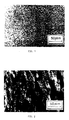
- test bars were made by moulding in a mould for 3 minutes at 240 ⁇ C. From the test bars test specimens with a thickness of 5 m were cut.
- Fig. 1 is a microscope photo of such a specimen enlarged 500x.
- Fig. 2 is a microscope photo of a specimen from the comparative mixture enlarged 500x. According to the invention a much finer dispersion is obtained.
- cryo-fracture surfaces of the test bars of this blend usually showed round, non-deformed dispersed particles with a diameter of 2-15 ⁇ m.
- a finer dispersion is obtained according to the invention.
Landscapes
- Chemical & Material Sciences (AREA)
- Health & Medical Sciences (AREA)
- Chemical Kinetics & Catalysis (AREA)
- Medicinal Chemistry (AREA)
- Polymers & Plastics (AREA)
- Organic Chemistry (AREA)
- General Chemical & Material Sciences (AREA)
- Polyamides (AREA)
- Polyurethanes Or Polyureas (AREA)
- Compositions Of Macromolecular Compounds (AREA)
Claims (7)
- Umsetzungsprodukte aus lactamgeblockten Diisocyanaten und funktionalisierten Polymeren P(AH)x, gekennzeichnet durch die allgemeine Formel:
 A ein Sauerstoffatom oder eine -NH-Gruppe darstellt,R eine Alkyl-, Aralkyl-, Alkaryl- oder Aryl-Gruppe darstellt, wo das Alkyl und das im Aralkyl oder Alkaryl gebundene Alkyl auch ein Cycloalkyl sein kann,P einen Rest eines Polymers P(AH)x mit einem Zahlenmittel des Molekulargewichts von mindestens 5000 mit einer oder mehreren OH- oder NH₂-Gruppe(n) darstellt, welches Polymer ausgewählt worden ist aus der Gruppe bestehend aus Polyphenylenoxiden, Phenoxyharzen, Polyestern und Polycarbonaten mit endständigen OH-Gruppen, Olefinpolymeren und -Copolymeren, elastomeren oder nicht-elastomeren Ethylen-Propylen-Copolymeren oder Ethylen-Propylen-Dien-Terpolymeren, Polydienen, Polyisopren und/oder Polystyrol mit einer oder mehreren OH- oder NH₂-Gruppe(n), ausschließlich als ein Ergebnis einer Modifikation,(- L -) einen geöffneten Lactamring darstellt,(- L) einen nicht-geöffneten Lactamring darstellt,x eine ganze Zahl größer als oder gleich 1 ist,y gleich 0 oder 1 ist.
 - Polyamidblockcopolymere bestehend aus einem oder mehreren Polyamidblöcken und einem weiteren Polymerblock, gekennzeichnet durch die allgemeine Formel:

- Polyamidblockcopolymere nach Anspruch 2, gekennzeichnet durch die allgemeine Formel:

- Verwendung von Blockcopolymeren nach Anspruch 2 oder 3 als Kompatibilisatoren für Gemische aus einem Polyamid mit einem anderen Polymer.
- Gemisch aus einem Polystyrol und einem Polyamid, dadurch gekennzeichnet, daß es höchstens 15 Gew.-% eines Polyamidblockcopolymers nach Anspruch 2 oder 3 enthält, während P in den vorstehend erwähnten Formeln einen Polystyrol-Rest darstellt.
- Gemisch aus einem Polyphenylenoxid oder einem Phenoxyharz und einem Polyamid, dadurch gekennzeichnet, daß es höchstens 15 Gew-% eines Polyamidblockcopolymers gemäß Anspruch 2 oder 3 enthält.
- Gemisch nach Anspruch 6, dadurch gekennzeichnet, daß es höchstens 15 Gew.-% eines Polyamidblockcopolymers nach Anspruch 2 oder 3 enthält, während P in den vorstehend erwähnten Formeln einen Polyphenylenoxid-Rest oder einen Phenoxyharz-Rest darstellt.
Priority Applications (1)
| Application Number | Priority Date | Filing Date | Title |
|---|---|---|---|
| AT89201978T ATE94891T1 (de) | 1988-07-30 | 1989-07-27 | Umsetzungsprodukte von lactamgeblockten diisocyanaten und daraus hergestellte lactamblockcopolymere. |
Applications Claiming Priority (2)
| Application Number | Priority Date | Filing Date | Title |
|---|---|---|---|
| NL8801914A NL8801914A (nl) | 1988-07-30 | 1988-07-30 | Omzettingsprodukten van met lactam geblokkeerde diisocyanaten en daarvan afgeleide polylactamblokcopolymeren. |
| NL8801914 | 1988-07-30 |
Publications (2)
| Publication Number | Publication Date |
|---|---|
| EP0357112A1 EP0357112A1 (de) | 1990-03-07 |
| EP0357112B1 true EP0357112B1 (de) | 1993-09-22 |
Family
ID=19852694
Family Applications (1)
| Application Number | Title | Priority Date | Filing Date |
|---|---|---|---|
| EP89201978A Expired - Lifetime EP0357112B1 (de) | 1988-07-30 | 1989-07-27 | Umsetzungsprodukte von lactamgeblockten Diisocyanaten und daraus hergestellte Lactamblockcopolymere |
Country Status (5)
| Country | Link |
|---|---|
| EP (1) | EP0357112B1 (de) |
| JP (1) | JPH02153914A (de) |
| AT (1) | ATE94891T1 (de) |
| DE (1) | DE68909354T2 (de) |
| NL (1) | NL8801914A (de) |
Cited By (1)
| Publication number | Priority date | Publication date | Assignee | Title |
|---|---|---|---|---|
| US8722794B2 (en) | 2010-03-01 | 2014-05-13 | Lubrizol Advanced Materials, Inc. | Melt processable copolyetheramide elastomers |
Families Citing this family (2)
| Publication number | Priority date | Publication date | Assignee | Title |
|---|---|---|---|---|
| DE4000644A1 (de) * | 1990-01-11 | 1991-07-18 | Huels Chemische Werke Ag | Verkappte polyphenylenether |
| TW201943754A (zh) * | 2018-04-18 | 2019-11-16 | 日商日本化藥股份有限公司 | 隨機共聚物化合物,末端修飾高分子化合物及含有該等化合物的樹脂組成物 |
Family Cites Families (4)
| Publication number | Priority date | Publication date | Assignee | Title |
|---|---|---|---|---|
| EP0135233B1 (de) * | 1983-08-20 | 1988-02-17 | Stamicarbon B.V. | Verfahren zur Herstellung von N-substituierter Carbamoyllactam-Verbindung |
| NL8302928A (nl) * | 1983-08-20 | 1985-03-18 | Stamicarbon | N-gesubstitueerde carbamoyl-lactam verbinding. |
| NL8403860A (nl) * | 1984-12-20 | 1986-07-16 | Stamicarbon | N-gesubstitueerde acyl-lactam verbinding. |
| NL8403861A (nl) * | 1984-12-20 | 1986-07-16 | Stamicarbon | N-gesubstitueerde acyl-lactam verbinding. |
-
1988
- 1988-07-30 NL NL8801914A patent/NL8801914A/nl not_active Application Discontinuation
-
1989
- 1989-07-27 EP EP89201978A patent/EP0357112B1/de not_active Expired - Lifetime
- 1989-07-27 AT AT89201978T patent/ATE94891T1/de active
- 1989-07-27 DE DE89201978T patent/DE68909354T2/de not_active Expired - Fee Related
- 1989-07-31 JP JP1199171A patent/JPH02153914A/ja active Pending
Cited By (1)
| Publication number | Priority date | Publication date | Assignee | Title |
|---|---|---|---|---|
| US8722794B2 (en) | 2010-03-01 | 2014-05-13 | Lubrizol Advanced Materials, Inc. | Melt processable copolyetheramide elastomers |
Also Published As
| Publication number | Publication date |
|---|---|
| ATE94891T1 (de) | 1993-10-15 |
| EP0357112A1 (de) | 1990-03-07 |
| DE68909354T2 (de) | 1994-05-05 |
| JPH02153914A (ja) | 1990-06-13 |
| NL8801914A (nl) | 1990-02-16 |
| DE68909354D1 (de) | 1993-10-28 |
Similar Documents
| Publication | Publication Date | Title |
|---|---|---|
| KR100355649B1 (ko) | 폴리아마이드및당해폴리아마이드의제조방법및당해폴리아마이드를함유한조성물 | |
| US4104330A (en) | Synthesis and copolymerization of tapered block macromer monomers | |
| EP0067695B1 (de) | Verfahren zur Herstellung von Nylon - Blockpolymeren | |
| EP0377259A1 (de) | Acyllactam-funktionsfähige Verbindungen und daraus hergestellte Polylactam-Blockpolymere | |
| EP0357112B1 (de) | Umsetzungsprodukte von lactamgeblockten Diisocyanaten und daraus hergestellte Lactamblockcopolymere | |
| EP0161549B1 (de) | Materialien mit Säurehalogenidfunktion | |
| US6930165B2 (en) | Modified polyamides, compositions based on same and macromolecular compounds used to obtain them | |
| US4590243A (en) | Process for the preparation of nylon block polymers | |
| US3963807A (en) | Polymers of acrylonitrile and aromatic olefins which contain grafted rubber | |
| EP0067694B1 (de) | Materialien mit funktionellem Säurehalogenid und Acyllactam und ihre Verwendung in einem Verfahren zur Herstellung von Nylon - Blockpolymeren | |
| JPH0471931B2 (de) | ||
| Pandya et al. | Synthesis and characterization of nylon 6 triblock copolymer using new hybrid soft segment | |
| EP0147792B1 (de) | Verfahren zur Kondensation von Imid und Alkohol | |
| US4595747A (en) | Viscosified lactam polymerization initiator solutions | |
| US4649177A (en) | Process for the preparation of nylon block polymers | |
| US5185401A (en) | Monofunctional polymers of olefins and block copolymers obtained therefrom | |
| US4581419A (en) | Acyllactam functional materials | |
| EP0350059A2 (de) | Monofunktionalisierte Olefinpolymere und daraus hergestellte Blockpolymere | |
| EP0159704B1 (de) | Verfahren zur Herstellung geformter Nylon-Blockpolymere | |
| EP0164535B1 (de) | Stoffe mit Säurehalogenidfunktionen und Verfahren zu ihrer Herstellung | |
| EP1095075B1 (de) | Kompatibilisierte zusammensetzung aus polyolefin und polyamid | |
| US4596865A (en) | Promotion of ε-caprolactam block copolymerization | |
| US4645800A (en) | Acyllactam functional materials | |
| US4590244A (en) | Acid halide functional materials | |
| US4628075A (en) | Acid halide functional materials |
Legal Events
| Date | Code | Title | Description |
|---|---|---|---|
| PUAI | Public reference made under article 153(3) epc to a published international application that has entered the european phase |
Free format text: ORIGINAL CODE: 0009012 |
|
| AK | Designated contracting states |
Kind code of ref document: A1 Designated state(s): AT BE CH DE ES FR GB GR IT LI NL SE |
|
| 17P | Request for examination filed |
Effective date: 19900816 |
|
| RAP1 | Party data changed (applicant data changed or rights of an application transferred) |
Owner name: DSM N.V. |
|
| 17Q | First examination report despatched |
Effective date: 19920424 |
|
| GRAA | (expected) grant |
Free format text: ORIGINAL CODE: 0009210 |
|
| AK | Designated contracting states |
Kind code of ref document: B1 Designated state(s): AT BE CH DE ES FR GB GR IT LI NL SE |
|
| PG25 | Lapsed in a contracting state [announced via postgrant information from national office to epo] |
Ref country code: SE Effective date: 19930922 Ref country code: LI Effective date: 19930922 Ref country code: GR Free format text: LAPSE BECAUSE OF FAILURE TO SUBMIT A TRANSLATION OF THE DESCRIPTION OR TO PAY THE FEE WITHIN THE PRESCRIBED TIME-LIMIT Effective date: 19930922 Ref country code: ES Free format text: THE PATENT HAS BEEN ANNULLED BY A DECISION OF A NATIONAL AUTHORITY Effective date: 19930922 Ref country code: CH Effective date: 19930922 Ref country code: AT Effective date: 19930922 |
|
| REF | Corresponds to: |
Ref document number: 94891 Country of ref document: AT Date of ref document: 19931015 Kind code of ref document: T |
|
| REF | Corresponds to: |
Ref document number: 68909354 Country of ref document: DE Date of ref document: 19931028 |
|
| ITF | It: translation for a ep patent filed | ||
| REG | Reference to a national code |
Ref country code: CH Ref legal event code: PL |
|
| ET | Fr: translation filed | ||
| PLBE | No opposition filed within time limit |
Free format text: ORIGINAL CODE: 0009261 |
|
| STAA | Information on the status of an ep patent application or granted ep patent |
Free format text: STATUS: NO OPPOSITION FILED WITHIN TIME LIMIT |
|
| ITTA | It: last paid annual fee | ||
| 26N | No opposition filed | ||
| PGFP | Annual fee paid to national office [announced via postgrant information from national office to epo] |
Ref country code: BE Payment date: 19970530 Year of fee payment: 9 |
|
| PGFP | Annual fee paid to national office [announced via postgrant information from national office to epo] |
Ref country code: FR Payment date: 19970625 Year of fee payment: 9 |
|
| PGFP | Annual fee paid to national office [announced via postgrant information from national office to epo] |
Ref country code: NL Payment date: 19970630 Year of fee payment: 9 |
|
| PGFP | Annual fee paid to national office [announced via postgrant information from national office to epo] |
Ref country code: GB Payment date: 19970723 Year of fee payment: 9 |
|
| PGFP | Annual fee paid to national office [announced via postgrant information from national office to epo] |
Ref country code: DE Payment date: 19970929 Year of fee payment: 9 |
|
| PG25 | Lapsed in a contracting state [announced via postgrant information from national office to epo] |
Ref country code: GB Free format text: LAPSE BECAUSE OF NON-PAYMENT OF DUE FEES Effective date: 19980727 |
|
| PG25 | Lapsed in a contracting state [announced via postgrant information from national office to epo] |
Ref country code: BE Free format text: LAPSE BECAUSE OF NON-PAYMENT OF DUE FEES Effective date: 19980731 |
|
| BERE | Be: lapsed |
Owner name: DSM N.V. Effective date: 19980731 |
|
| PG25 | Lapsed in a contracting state [announced via postgrant information from national office to epo] |
Ref country code: NL Free format text: LAPSE BECAUSE OF NON-PAYMENT OF DUE FEES Effective date: 19990201 |
|
| GBPC | Gb: european patent ceased through non-payment of renewal fee |
Effective date: 19980727 |
|
| PG25 | Lapsed in a contracting state [announced via postgrant information from national office to epo] |
Ref country code: FR Free format text: LAPSE BECAUSE OF NON-PAYMENT OF DUE FEES Effective date: 19990331 |
|
| NLV4 | Nl: lapsed or anulled due to non-payment of the annual fee |
Effective date: 19990201 |
|
| PG25 | Lapsed in a contracting state [announced via postgrant information from national office to epo] |
Ref country code: DE Free format text: LAPSE BECAUSE OF NON-PAYMENT OF DUE FEES Effective date: 19990501 |
|
| REG | Reference to a national code |
Ref country code: FR Ref legal event code: ST |
|
| PG25 | Lapsed in a contracting state [announced via postgrant information from national office to epo] |
Ref country code: IT Free format text: LAPSE BECAUSE OF NON-PAYMENT OF DUE FEES;WARNING: LAPSES OF ITALIAN PATENTS WITH EFFECTIVE DATE BEFORE 2007 MAY HAVE OCCURRED AT ANY TIME BEFORE 2007. THE CORRECT EFFECTIVE DATE MAY BE DIFFERENT FROM THE ONE RECORDED. Effective date: 20050727 |