EP0351464A1 - Verfahren zur Wasserstoffbehandlung eines Einsatzmaterials für katalytisches Cracken - Google Patents
Verfahren zur Wasserstoffbehandlung eines Einsatzmaterials für katalytisches Cracken Download PDFInfo
- Publication number
- EP0351464A1 EP0351464A1 EP88306609A EP88306609A EP0351464A1 EP 0351464 A1 EP0351464 A1 EP 0351464A1 EP 88306609 A EP88306609 A EP 88306609A EP 88306609 A EP88306609 A EP 88306609A EP 0351464 A1 EP0351464 A1 EP 0351464A1
- Authority
- EP
- European Patent Office
- Prior art keywords
- hydrotreating
- cracking
- feed
- denitrogenation
- catalyst
- Prior art date
- Legal status (The legal status is an assumption and is not a legal conclusion. Google has not performed a legal analysis and makes no representation as to the accuracy of the status listed.)
- Withdrawn
Links
- 238000000034 method Methods 0.000 title claims description 49
- 230000008569 process Effects 0.000 title claims description 46
- 238000004523 catalytic cracking Methods 0.000 title abstract description 21
- 238000006243 chemical reaction Methods 0.000 claims abstract description 54
- 238000005336 cracking Methods 0.000 claims abstract description 54
- 239000003054 catalyst Substances 0.000 claims abstract description 45
- 238000006477 desulfuration reaction Methods 0.000 claims abstract description 15
- 230000023556 desulfurization Effects 0.000 claims abstract description 15
- 229930195733 hydrocarbon Natural products 0.000 claims abstract description 4
- 150000002430 hydrocarbons Chemical class 0.000 claims abstract description 4
- 239000004215 Carbon black (E152) Substances 0.000 claims abstract description 3
- UFHFLCQGNIYNRP-UHFFFAOYSA-N Hydrogen Chemical compound [H][H] UFHFLCQGNIYNRP-UHFFFAOYSA-N 0.000 claims description 42
- 239000001257 hydrogen Substances 0.000 claims description 42
- 229910052739 hydrogen Inorganic materials 0.000 claims description 42
- 238000009835 boiling Methods 0.000 claims description 19
- 125000003118 aryl group Chemical group 0.000 claims description 9
- 239000012188 paraffin wax Substances 0.000 claims description 2
- UFWIBTONFRDIAS-UHFFFAOYSA-N Naphthalene Chemical compound C1=CC=CC2=CC=CC=C21 UFWIBTONFRDIAS-UHFFFAOYSA-N 0.000 claims 1
- 230000008901 benefit Effects 0.000 abstract description 11
- 230000032683 aging Effects 0.000 abstract description 8
- 238000004519 manufacturing process Methods 0.000 abstract description 7
- TVMXDCGIABBOFY-UHFFFAOYSA-N octane Chemical compound CCCCCCCC TVMXDCGIABBOFY-UHFFFAOYSA-N 0.000 abstract description 4
- IJGRMHOSHXDMSA-UHFFFAOYSA-N Atomic nitrogen Chemical compound N#N IJGRMHOSHXDMSA-UHFFFAOYSA-N 0.000 description 40
- 238000004231 fluid catalytic cracking Methods 0.000 description 36
- 239000000571 coke Substances 0.000 description 32
- 239000003921 oil Substances 0.000 description 32
- 230000000694 effects Effects 0.000 description 26
- 239000007789 gas Substances 0.000 description 26
- 239000003502 gasoline Substances 0.000 description 21
- PXHVJJICTQNCMI-UHFFFAOYSA-N Nickel Chemical compound [Ni] PXHVJJICTQNCMI-UHFFFAOYSA-N 0.000 description 20
- 229910052757 nitrogen Inorganic materials 0.000 description 20
- 239000002184 metal Substances 0.000 description 11
- 229910052751 metal Inorganic materials 0.000 description 10
- 150000002739 metals Chemical class 0.000 description 10
- 229910052717 sulfur Inorganic materials 0.000 description 10
- NINIDFKCEFEMDL-UHFFFAOYSA-N Sulfur Chemical compound [S] NINIDFKCEFEMDL-UHFFFAOYSA-N 0.000 description 9
- 238000005984 hydrogenation reaction Methods 0.000 description 9
- 239000011593 sulfur Substances 0.000 description 9
- 229910052759 nickel Inorganic materials 0.000 description 8
- 239000000356 contaminant Substances 0.000 description 7
- 239000000203 mixture Substances 0.000 description 7
- 239000010457 zeolite Substances 0.000 description 7
- HNPSIPDUKPIQMN-UHFFFAOYSA-N dioxosilane;oxo(oxoalumanyloxy)alumane Chemical compound O=[Si]=O.O=[Al]O[Al]=O HNPSIPDUKPIQMN-UHFFFAOYSA-N 0.000 description 6
- 238000012545 processing Methods 0.000 description 6
- VYPSYNLAJGMNEJ-UHFFFAOYSA-N Silicium dioxide Chemical compound O=[Si]=O VYPSYNLAJGMNEJ-UHFFFAOYSA-N 0.000 description 5
- 229910021536 Zeolite Inorganic materials 0.000 description 5
- PNEYBMLMFCGWSK-UHFFFAOYSA-N aluminium oxide Inorganic materials [O-2].[O-2].[O-2].[Al+3].[Al+3] PNEYBMLMFCGWSK-UHFFFAOYSA-N 0.000 description 5
- 230000003197 catalytic effect Effects 0.000 description 4
- 230000007423 decrease Effects 0.000 description 4
- 230000001419 dependent effect Effects 0.000 description 4
- 230000002349 favourable effect Effects 0.000 description 4
- 229910052720 vanadium Inorganic materials 0.000 description 4
- LEONUFNNVUYDNQ-UHFFFAOYSA-N vanadium atom Chemical compound [V] LEONUFNNVUYDNQ-UHFFFAOYSA-N 0.000 description 4
- 230000002378 acidificating effect Effects 0.000 description 3
- 239000000654 additive Substances 0.000 description 3
- 230000000996 additive effect Effects 0.000 description 3
- 230000002411 adverse Effects 0.000 description 3
- 239000010953 base metal Substances 0.000 description 3
- 238000009826 distribution Methods 0.000 description 3
- 239000000463 material Substances 0.000 description 3
- DDTIGTPWGISMKL-UHFFFAOYSA-N molybdenum nickel Chemical compound [Ni].[Mo] DDTIGTPWGISMKL-UHFFFAOYSA-N 0.000 description 3
- 239000003208 petroleum Substances 0.000 description 3
- 239000011148 porous material Substances 0.000 description 3
- 239000002243 precursor Substances 0.000 description 3
- 238000009738 saturating Methods 0.000 description 3
- DGAQECJNVWCQMB-PUAWFVPOSA-M Ilexoside XXIX Chemical compound C[C@@H]1CC[C@@]2(CC[C@@]3(C(=CC[C@H]4[C@]3(CC[C@@H]5[C@@]4(CC[C@@H](C5(C)C)OS(=O)(=O)[O-])C)C)[C@@H]2[C@]1(C)O)C)C(=O)O[C@H]6[C@@H]([C@H]([C@@H]([C@H](O6)CO)O)O)O.[Na+] DGAQECJNVWCQMB-PUAWFVPOSA-M 0.000 description 2
- 229910003296 Ni-Mo Inorganic materials 0.000 description 2
- KDLHZDBZIXYQEI-UHFFFAOYSA-N Palladium Chemical compound [Pd] KDLHZDBZIXYQEI-UHFFFAOYSA-N 0.000 description 2
- 229910052799 carbon Inorganic materials 0.000 description 2
- 238000004517 catalytic hydrocracking Methods 0.000 description 2
- 229910017052 cobalt Inorganic materials 0.000 description 2
- 239000010941 cobalt Substances 0.000 description 2
- GUTLYIVDDKVIGB-UHFFFAOYSA-N cobalt atom Chemical compound [Co] GUTLYIVDDKVIGB-UHFFFAOYSA-N 0.000 description 2
- 239000002131 composite material Substances 0.000 description 2
- 229910052593 corundum Inorganic materials 0.000 description 2
- 230000020335 dealkylation Effects 0.000 description 2
- 238000006900 dealkylation reaction Methods 0.000 description 2
- 238000007324 demetalation reaction Methods 0.000 description 2
- 238000013461 design Methods 0.000 description 2
- 238000004821 distillation Methods 0.000 description 2
- 239000003344 environmental pollutant Substances 0.000 description 2
- 239000012530 fluid Substances 0.000 description 2
- 230000006872 improvement Effects 0.000 description 2
- NNPPMTNAJDCUHE-UHFFFAOYSA-N isobutane Chemical compound CC(C)C NNPPMTNAJDCUHE-UHFFFAOYSA-N 0.000 description 2
- 229910017464 nitrogen compound Inorganic materials 0.000 description 2
- 150000002830 nitrogen compounds Chemical class 0.000 description 2
- 239000002245 particle Substances 0.000 description 2
- BASFCYQUMIYNBI-UHFFFAOYSA-N platinum Chemical compound [Pt] BASFCYQUMIYNBI-UHFFFAOYSA-N 0.000 description 2
- 231100000719 pollutant Toxicity 0.000 description 2
- 125000003367 polycyclic group Chemical group 0.000 description 2
- 239000003079 shale oil Substances 0.000 description 2
- 239000000377 silicon dioxide Substances 0.000 description 2
- 229910052708 sodium Inorganic materials 0.000 description 2
- 239000011734 sodium Substances 0.000 description 2
- 238000012360 testing method Methods 0.000 description 2
- 229910052723 transition metal Inorganic materials 0.000 description 2
- 229910001845 yogo sapphire Inorganic materials 0.000 description 2
- CIWBSHSKHKDKBQ-JLAZNSOCSA-N Ascorbic acid Chemical compound OC[C@H](O)[C@H]1OC(=O)C(O)=C1O CIWBSHSKHKDKBQ-JLAZNSOCSA-N 0.000 description 1
- OKTJSMMVPCPJKN-UHFFFAOYSA-N Carbon Chemical compound [C] OKTJSMMVPCPJKN-UHFFFAOYSA-N 0.000 description 1
- VYZAMTAEIAYCRO-UHFFFAOYSA-N Chromium Chemical compound [Cr] VYZAMTAEIAYCRO-UHFFFAOYSA-N 0.000 description 1
- ZOKXTWBITQBERF-UHFFFAOYSA-N Molybdenum Chemical compound [Mo] ZOKXTWBITQBERF-UHFFFAOYSA-N 0.000 description 1
- QXZUUHYBWMWJHK-UHFFFAOYSA-N [Co].[Ni] Chemical compound [Co].[Ni] QXZUUHYBWMWJHK-UHFFFAOYSA-N 0.000 description 1
- 239000008186 active pharmaceutical agent Substances 0.000 description 1
- 125000000217 alkyl group Chemical group 0.000 description 1
- 229910000323 aluminium silicate Inorganic materials 0.000 description 1
- 238000013459 approach Methods 0.000 description 1
- 150000001491 aromatic compounds Chemical class 0.000 description 1
- QVGXLLKOCUKJST-UHFFFAOYSA-N atomic oxygen Chemical compound [O] QVGXLLKOCUKJST-UHFFFAOYSA-N 0.000 description 1
- 239000011324 bead Substances 0.000 description 1
- 230000015572 biosynthetic process Effects 0.000 description 1
- 229910052804 chromium Inorganic materials 0.000 description 1
- 239000011651 chromium Substances 0.000 description 1
- 239000004927 clay Substances 0.000 description 1
- 239000003245 coal Substances 0.000 description 1
- WHDPTDWLEKQKKX-UHFFFAOYSA-N cobalt molybdenum Chemical compound [Co].[Co].[Mo] WHDPTDWLEKQKKX-UHFFFAOYSA-N 0.000 description 1
- 229910052681 coesite Inorganic materials 0.000 description 1
- 238000004939 coking Methods 0.000 description 1
- 238000002485 combustion reaction Methods 0.000 description 1
- 229910052906 cristobalite Inorganic materials 0.000 description 1
- 230000003247 decreasing effect Effects 0.000 description 1
- 230000002950 deficient Effects 0.000 description 1
- 230000006866 deterioration Effects 0.000 description 1
- 230000009977 dual effect Effects 0.000 description 1
- 239000012013 faujasite Substances 0.000 description 1
- 239000012634 fragment Substances 0.000 description 1
- 239000000446 fuel Substances 0.000 description 1
- 230000005484 gravity Effects 0.000 description 1
- 238000010438 heat treatment Methods 0.000 description 1
- 125000000623 heterocyclic group Chemical group 0.000 description 1
- 239000012535 impurity Substances 0.000 description 1
- 239000001282 iso-butane Substances 0.000 description 1
- 239000003350 kerosene Substances 0.000 description 1
- 239000011159 matrix material Substances 0.000 description 1
- 229910052750 molybdenum Inorganic materials 0.000 description 1
- 239000011733 molybdenum Substances 0.000 description 1
- QJGQUHMNIGDVPM-UHFFFAOYSA-N nitrogen group Chemical group [N] QJGQUHMNIGDVPM-UHFFFAOYSA-N 0.000 description 1
- 229910000510 noble metal Inorganic materials 0.000 description 1
- 239000001301 oxygen Substances 0.000 description 1
- 229910052760 oxygen Inorganic materials 0.000 description 1
- 229910052763 palladium Inorganic materials 0.000 description 1
- 230000000737 periodic effect Effects 0.000 description 1
- 238000005504 petroleum refining Methods 0.000 description 1
- 229910052697 platinum Inorganic materials 0.000 description 1
- 239000002574 poison Substances 0.000 description 1
- 231100000614 poison Toxicity 0.000 description 1
- 231100000572 poisoning Toxicity 0.000 description 1
- 230000000607 poisoning effect Effects 0.000 description 1
- 239000000843 powder Substances 0.000 description 1
- 238000002360 preparation method Methods 0.000 description 1
- 230000001737 promoting effect Effects 0.000 description 1
- 229910001404 rare earth metal oxide Inorganic materials 0.000 description 1
- 230000009467 reduction Effects 0.000 description 1
- 238000007670 refining Methods 0.000 description 1
- 230000001172 regenerating effect Effects 0.000 description 1
- 230000008929 regeneration Effects 0.000 description 1
- 238000011069 regeneration method Methods 0.000 description 1
- 230000001105 regulatory effect Effects 0.000 description 1
- 230000004044 response Effects 0.000 description 1
- 238000005096 rolling process Methods 0.000 description 1
- 235000012239 silicon dioxide Nutrition 0.000 description 1
- 229910052682 stishovite Inorganic materials 0.000 description 1
- 238000003786 synthesis reaction Methods 0.000 description 1
- 230000002277 temperature effect Effects 0.000 description 1
- 238000012546 transfer Methods 0.000 description 1
- 150000003624 transition metals Chemical class 0.000 description 1
- 229910052905 tridymite Inorganic materials 0.000 description 1
- WFKWXMTUELFFGS-UHFFFAOYSA-N tungsten Chemical compound [W] WFKWXMTUELFFGS-UHFFFAOYSA-N 0.000 description 1
- 229910052721 tungsten Inorganic materials 0.000 description 1
- 239000010937 tungsten Substances 0.000 description 1
Images


Classifications
-
- C—CHEMISTRY; METALLURGY
- C10—PETROLEUM, GAS OR COKE INDUSTRIES; TECHNICAL GASES CONTAINING CARBON MONOXIDE; FUELS; LUBRICANTS; PEAT
- C10G—CRACKING HYDROCARBON OILS; PRODUCTION OF LIQUID HYDROCARBON MIXTURES, e.g. BY DESTRUCTIVE HYDROGENATION, OLIGOMERISATION, POLYMERISATION; RECOVERY OF HYDROCARBON OILS FROM OIL-SHALE, OIL-SAND, OR GASES; REFINING MIXTURES MAINLY CONSISTING OF HYDROCARBONS; REFORMING OF NAPHTHA; MINERAL WAXES
- C10G69/00—Treatment of hydrocarbon oils by at least one hydrotreatment process and at least one other conversion process
- C10G69/02—Treatment of hydrocarbon oils by at least one hydrotreatment process and at least one other conversion process plural serial stages only
- C10G69/04—Treatment of hydrocarbon oils by at least one hydrotreatment process and at least one other conversion process plural serial stages only including at least one step of catalytic cracking in the absence of hydrogen
Definitions
- This invention relates to the catalytic cracking of petroleum oils and more particularly, to a process for improving catalytic cracking processes by hydrotreating the feedstock.
- Catalytic cracking is an established and widely used process in the petroleum refining industry for converting oils and residua of relatively high boiling point to more valuable lower boiling products including gasoline and middle distillates such as kerosene, jet fuel and heating oil.
- the pre-eminent catalytic cracking process now in use is the fluid catalytic process (FCC) in which the pre-heated feed is brought into contact with a hot cracking catalyst which is in the form of a fine powder, typically with a particle size of 10 - 300 microns, usually about 100 microns, for the desired cracking reactions to take place.
- FCC fluid catalytic process
- coke is deposited on the catalyst and this results in a loss of activity and selectivity.
- the coke is removed by continuously removing the coked, spent catalyst from the cracking reactor and oxidatively regenerating it by contacting it with air in a regenerator.
- the combustion of the coke is a strongly exothermic reaction which, besides removing the coke, serves to heat the catalyst to the temperatures appropriate for the endothermic cracking reaction.
- the process is carried out in an integrated unit comprising the cracking reactor, the regenerator and the appropriate ancillary equipment.
- the catalyst is continuously circulated from reactor to regenerator and back to the reactor with the circulation rate being adjusted relative to the feed rate of the oil to maintain a heat balanced operation in which the heat produced in the regenerator is sufficient for maintaining the cracking with the circulating, regenerated catalyst being used as the heat transfer medium.
- Typical fluid catalytic cracking processes are described in the monograph Fluid Catalytic Cracking with Zeolite Catalysts, Venuto, P. B. and Habib, E. T., Marcel Dekker Inc., N.Y. 1979, to which reference is made for a description of such processes.
- the catalysts which are currently used are based on zeolites, especially the large pore synthetic faujasites, zeolites X and Y, which have generally replaced the less active, less selective amorphous and clay catalysts formerly used.
- TCC Thermofor Catalytic Cracking
- the feed to the catalytic cracker can generally be characterized as a high boiling oil or residuum, either on its own or mixed with other fractions, usually of a high boiling point.
- the most common feeds are gas oils, that is, high boiling, non-residual oils with an initial boiling point usually above about 230°C (about 450°F), more commonly above about 345°C (about 650°F), with end points of up to about 620°C (about 1150°F).
- Typical gas oil feeds include straight run (atmospheric) gas oil, vacuum gas oil and coker gas oil; residual feeds include atmospheric residua, vacuum residua and residual fractions from other refining processes.
- Oils from synthetic sources such as Fischer-Tropsch synthesis, coal liquefaction shale oil or other synthetic processes may also yield high boiling fractions which may be catalytically cracked either on their own or in admixture with oils of petroleum origin.
- hydrotreating has been recognized as useful for other purposes, including demetallation and, above all for desulfurization and denitrogenation, both of which are desirable to improve product quality, catalyst selectivity and aging rate as well as reducing emissions, principally SO x , from the regenerator.
- Use of a feed hydrotreater has been reported to result in higher conversion and gasoline yield, lower coke make per pass, more favorable light gas distribution, higher isobutane yield, and lower contaminant content in products and unit off-gases: cf. the Venuto/Habib monograph and the Oil and Gas Journal , 19 May 1966, 131-139; 14 Oct 1974, 99-110; 21 July 1975, 53-58.
- the hydrotreating of catalytic cracking feedstocks has been carried out at relatively low pressures, below about 7000 kPa (about 1,000 psig) and in most cases below about 5,500 kPa (about 785 psig) as the use of higher pressures does not enhance the desulfurization activity which has, for the most part, been the principal objective of cracking feed hydrotreating.
- Denitrogenation has generally followed with the desulfurization to some degree, depending upon the composition of the feed and the severity of the processing although more severe processing conditions are required for nitrogen removal than sulfur removal.
- the hydrogenation of aromatics is known to be favored by the use of higher hydrogen partial pressures although the response of aromatic compounds differs according to their composition: condensed ring aromatics may be hydrogenated at lower pressures than non-condensed, polycyclic aromatics and although the hydrogenation of both is favored by the use of relatively low temperatures (since hydrogenation is an exothermic reaction) the optimum temperature for hydrogenating each of these types varies ( Oil and Gas Journal 21 July 75, 53-58).
- the use of lower temperatures does not favor sulfur or nitrogen removal because these reactions require a certain measure of cracking (an endothermic reaction) and the same is true of demetallation although, in most cases, a relatively mild treatment will suffice for metals removal.
- hydrotreating of catalytic feeds may be optimized in an unexpected manner which permits the cracking operation to be operated under more favorable conditions with better product quality and reduced coke make and which, moreover, enables hydrogen consumption in the hydrotreating step to be minimized without adversely affecting the catalyst aging rate.
- sulfur and nitrogen removal take place readily so as to ensure satisfactorily low contaminant level in the products and a low level of pollutants in the emissions, particularly of SO x , from the cracking unit.
- the basis of the present invention is our finding that in the hydrotreating of catalytic cracking feeds, the saturation of aromatics is more important than nitrogen removal and that if conversion, i.e. bulk conversion to lower boiling products, in the hydrotreater is minimized, the hydrogenation of cracking fragments will be correspondingly reduced. This, in turn, will result in a lower hydrogen consumption, most of which will be represented by a reduction in the quantity of hydrogen-rich dry gas produced during the hydrotreating step.
- the hydrogen is used more efficiently -- to increase aromatic saturation without increasing dry gas production -- and this enables the cracking operation to be carried out under more favorable conditions with improved product quality and distribution.
- the present catalytic cracking feed hydrotreating process is carried out under conditions which may generally be characterized as those of high pressure, low temperature and low severity with limited conversion of not more than 20 volume percent.
- Pressures are typically above about 10,000 kPa (about 1435 psig) and preferably above about 11,000 kPa (about 1,580 psig).
- Temperatures, as indicated by the start-of-cycle (SOC) temperature are typically below about 390°C (about 734°F) and preferably below 365°C (about 690°F).
- space velocity may be relatively low, typically at about 1 hr ⁇ 1 or even less; although desulfurization would proceed at higher space velocities, typically up to 2 hr ⁇ 1, catalyst aging would be accelerated so that, in general, space velocity will be below 2 and in most cases below 1.5.
- End of cycle (EOC) temperatures are generally to be limited to 425°C (800°F) and preferably, 415°C (780°F).
- the present process provides for improvements in the catalytic cracking of hydrocarbon feeds such as those conventionally subjected to catalytic cracking processes, e.g. gas oils, long and short resids, and other high boiling fractions such as those previously described.
- the process is primarily applicable to non-residual feeds since it is with these that the optimal results are obtained.
- the feed will have an initial boiling point of at least 205°C (about 400°F), more usually at least 315°C (about 600°F) and in most cases at least 345°C (about 650°F).
- End points will depend upon other processing constraints, particularly the ability to handle the residual fractions left after removing high end point distillates.
- end points will be from 510°C (about 950°F) to 565°C (about 1,050°F) although lower and higher values may be encountered.
- the high boiling feeds which are to be subjected to catalytic cracking are generally characterized by a relatively high content of aromatic components including polycyclic aromatics and fused ring aromatics together with paraffins, naphthenes and heterocyclics, the relative proportions of each being dependent on the origin of the feed and its previous processing history.
- Naphthenes will mostly be dicyclo- and tricyclo-paraffins, especially at higher boiling points and the proportion of dinuclear and polynuclear aromatics will also increase with increasing boiling point.
- the paraffin content is generally less than 30 volume percent so that aromatics and naphthenes will together constitute at least 70 volume percent of the feed, with the majority of this being aromatics.
- a number of contaminants will also be present, principally sulfur, nitrogen, oxygen and metallic impurities in amounts dependent upon the source of the feed.
- sulfur will be present in amounts from about 0.1 to 3 weight percent although very heavy crudes, e.g. Boscan (Venezuela) may yield feeds which may be as high as about 5 weight percent sulfur.
- Nitrogen will generally be present in amounts from 0.05 - 0.5 weight percent (500-5000 ppmw) although some synthetic feeds such as shale oils may have higher contents.
- a number of different metals may be present, including sodium and heavier metals, of which the most significant from the view of the catalytic cracking process are nickel and vanadium since they exert the greatest deactivating effects on the cracking process.
- Combined nickel and vanadium contents will generally be from about 5 to 1,000 ppmw, with many being from 20 to 100 ppmw, according to source.
- the conditions may be described as being elevated temperature and pressure with a catalyst which combines acidic and hydrogenation functionality.
- the present process departs from prior practice, however, in its careful selection of conditions so as to favor desulfurization and denitrogenation while, at the same time promoting aromatics saturation.
- nitrogen is known to affect the cracking process adversely it has been found, surprisingly, that aromatics saturation was more important than nitrogen removal and that it was possible to obtain better operation of the cracking step as aromatics saturation increased.
- hydrogen consumption is increased by the aromatics saturation which is achieved at the high pressures employed in the process, the benefits achieved are more than sufficient to outweigh the added costs provided that the conditions are controlled so as to maintain the desired reaction equilibria.
- the conditions used in the present process may be characterized as being of low temperature, high pressure, low space velocity and low conversion. Because one objective of the process is to saturate aromatics at the expense of denitrogenation, conversion is to be limited because under more severe conditions, hydrogen does not go into the aromatics as efficiently (the term "conversion" is used here in its specialized sense to mean a bulk conversion, that is, a conversion to lower boiling components). Based on the discovery that suitable choice of reaction conditions can lead to increased aromatics saturation without, at the same time, correspondingly increased nitrogen removal, the process can be optimized so as to improve the processing in the cracking step at minimum cost. The production of distillate in the hydrotreating step is minimized, i.e.
- conversion in the hydrotreating and cracking steps combined is obtained by minimizing conversion in the hydrotreating step so as to obtain the most favorable, selective conversion in the cracking step.
- the optimum hydrotreating conditions should be selected empirically according to factors including, principally, aromatic content and nitrogen level.
- An unexpected characteristic of the present process is that an improved process is obtained by designing for higher pressure.
- the objective in hydrotreater design is to minimise hydrogen consumption and this is generally achieved by operating at lower pressure.
- the principal objective in the present process is to minimise light gas production and this is attained by high pressure, low temperature operation.
- the hydrogen partial pressures used in the present hydrotreating step are generally in excess of 10,000 kPa (about 1,435 psig) and preferably above about 11,000 kPa (about 1,580 psig).
- the upper limit on the pressure is set mainly by equipment limitations which, in turn, are dictated by the cost of fabricating vessels for high pressures. In most cases, the total system pressure in the hydrotreating step will not exceed about 30,000 kPa (about 4,335 psig) and in most cases will be below about 20,000 kPa (about 2,900 psig).
- the use of higher hydrogen partial pressures tends to increase aromatics saturation and therefore is preferred because a higher level of saturation improves the cracking performance.
- pressures between about 11,000 and 15,000 kPa (about 1435-2160 psig) will give the optimum benefit in the process as a whole with pressures of about 12000 kPa giving particular benefit.
- the temperature is to be selected in part according to the hydrogen pressure used because higher temperatures may be tolerated at the higher hydrogen partial pressures which tend to inhibit catalyst aging.
- the thermodynamics of the desired aromatics saturation process -- which is exothermic -- provide a strong incentive for maintaining the temperature at as low a level as possible, consistent with achieving a severity high enough to achieve the degree of desulfurization which is actually desired.
- the level of desulfurization achieved will be dependent on the severity of the hydrotreating step, as indicated in part by the temperature. Another factor relevant to the final choice of temperature is the conversion during the hydrotreating step.
- one objective is to minimize conversion to naphtha and dry gas because this represents a loss of valuable hydrogen to the cracking process where its presence can produce the greatest improvement.
- a certain level of conversion is, however, inevitable and is also necessary if desulfurization is to be achieved.
- the temperature used will depend upon the characteristics of the feed (especially its cracking characteristics, degree of unsaturation and sulfur content) as well as catalyst characteristics (especially its aging rate and the balance of its cracking/hydrogenation activities).
- the temperature of the hydrotreating step will be between 345° and 455°C (about 650° and 850°F), preferably between 365° and 455°C (about 690° and 850°F), with the lower figure being applicable to the start-of-cycle (SOC) temperature.
- the preferred upper temperature limit is about 410°C (about 770°F) for the end of the cycle (EOC), preferably 400°C (750°F) after which catalyst regeneration is required.
- the actual end of cycle temperature will, however, depend upon the characteristics of the feed and the catalyst, especially its hydrogenation activity, since the run should be terminated when the saturation of the aromatics in the feed reaches an unacceptably low level by reason of the increased temperature. (Temperatures referred to are average catalyst bed temperatures, entire bed averaged axially, edge effects excluded).
- the aging rate of the catalyst and the concomitant necessity to increase processing temperature as the cycle progresses is therefore a factor in the selection of temperature at any given time in the cycle.
- the aging rate in turn, will be dependent on severity and hydrogen partial pressure. Severity, in turn will depend upon space velocity. Because the present process seeks to attain a high degree of aromatics saturation with denitrogenation as only a secondary objective, lower space velocities are desired at the lower temperatures used to favor the exothermic saturation reactions. Thus, in the present process, space velocity (LHSV) will be generally below 2 hr ⁇ 1, more generally in the range 0.5 - 1.5 hr ⁇ 1, with optimum values of about 1 hr ⁇ 1.
- the present process represents a departure from prior FCC feed by hydrotreating practice which used relatively high space velocities of about 2 hr ⁇ 1 (LHSV) for desulfurization as the main objective.
- LHSV space velocities
- desulfurization will be sufficient to meet FCC SO x emission restrictions, equivalent to about 85% desulfurization of a feed with about 1 to 2 weight percent sulfur; in most cases, desulfurization will be at least 95% with nitrogen removal at 60 - 80%.
- Cycle durations of 1 to 2 years are envisaged at these severities, particularly if the preferred mode of operation at temperatures entirely below about 390°C (about 730°F) are employed.
- the hydrotreating catalyst used may be conventional in type, comprising an acidic or non-acidic support, e.g. silica, alumina, silica-alumina or a crystalline aluminosilicate, preferably a large pore zeolite such as natural faujasite, zeolite X, zeolite Y or a composite of these materials such as zeolite X in an amorphous silica or silica-alumina matrix, together with a hydrogenation component which is typically a transition metal or metals, usually a base metal of Groups VA, VIA or VIIIA of the Periodic Table (IUPAC Table).
- a low acidity support should be used.
- Base metals are usually preferred for the hydrogenation component because of their low cost and resistance to poisoning by contaminants but noble metals such as platinum or palladium could be used.
- Preferred base metals are vanadium, chromium, cobalt, nickel, molybdenum and tungsten; combinations of metals such as cobalt-molybdenum, nickel-cobalt, nickel-molybdenum may be used to advantage. If the feed to the hydrotreater contains significant quantities of nitrogen as a contaminant, it will generally be preferred to avoid the use of cobalt because the catalytic activity of this metal is inhibited by nitrogen but other metals and combinations, e.g. Ni-Mo, may be used.
- the effluent from the hydrotreating step is then passed to the catalytic cracking step.
- the catalytic cracking is conventional in type and may be a fluid catalytic cracking (FCC) operation or a gravitating moving bed operation, e.g TCC or Houdriflow. Cracking conditions are selected according to the characteristics of the cracking feed from the hydrotreater together with any recycle and, of course, according to the desired products, product distribution and the characteristics of the catalyst and of the unit.
- FCC fluid catalytic cracking
- TCC gravitating moving bed operation
- the hydrotreating of the feed in the manner described above provides a cracking feed of improved crackability and with reduced contaminant level.
- the cracking proceeds more readily to cracking products which are lower in molecular weight and with a relatively higher hydrogen content than would be obtained with the use of low to moderate hydrotreating pressures.
- the cracked products include significantly higher levels of high octane gasoline.
- mild hydrotreating of the feed using lower pressures tends to produce cracked products with a higher proportion of low cetane distillate because of the higher aromatic content of the feed.
- mild hydrotreating conditions may lead to production of an olefinic gasoline which, although high in octane, may be considered undesirable by regulatory anthorities because of its asserted effects on the environment.
- a base feed of California/Alaskan (88:12) crude origin gas oils (mixed vacuum gas oil, coker gas oil) was prepared. Compositions of the feeds are shown in Table 1 below. Table 1 Feed Composition Feed Components, Vol % Base Feed Atmospheric Gas Oil - Vacuum Gas Oil (527°C EP) 78 Coker Gas Oils 22 Gravity, °API 16.8 Sulfur, wt. pct. 1.28 Nitrogen, ppmw 5100 Basic Nitrogen, ppmw 1900 Ni/V, ppmw 1.5/2.4 CCR, wt. pct. 0.9 345°C+ Aromatics, wt. pct. 68.0 Distillation, Wt. Pct. 250°C- 4.8 250°-345°C 15.3 345°C+ 79.9
- the feed was hydrotreated under varying conditions using a commercial Ni-Mo/Al2O3 (3 pct Ni, 18 pct Mo) hydrotreating catalyst.
- the hydrotreating conditions used are given in Table 2 below.
- Cases A and B were designed to simulate start- and end-of-cycle hydrotreating performance at 12065 kPa (1750 psia) hydrogen pressure and 60% denitrogenation. Cases C and D were designed for this same denitrogenation level, but at 8650 kPa (1240 psia) hydrogen. Some unavoidable variation in denitrogenation was observed. Several other cases (F-K) examined various denitrogenation severities at both pressure levels. Case L reflects hydrotreater operation at reduced hydrogen circulation at 1240 psia hydrogen.
- Each of the hydrotreater products was distilled to nominally 250°C (480°F) to produce the FCC feed.
- the hydrotreated feeds were catalytically cracked in an FCC pilot plant having a capacity of 80 l. day ⁇ 1 (0.5 BPD) using an equilibrium cracking catalyst having the properties given in Table 4 below.
- Table 4 FCC Catalyst Properties Density, g/cc Packed 0.91 Loose 0.80 Real 2.78 Particle 1.31 Pore Volume, cc/g 0.41 Surface Area, m2/g 97 Composition Al2O3, wt. pct. 46.4 SiO2, wt. pct. 42.0 Re2O3, wt. pct.
- Hydrotreating serves the dual purpose of removing nitrogen compounds, which act as temporary catalyst poisons, and saturating aromatics (including many containing nitrogen compounds) which act as coke precursors. Hydrotreating also reduced the CCR from 0.8% in the raw feeds to 0.1-0.2%. The removal of CCR reduces the "additive" coke formed in the FCC, that is, the coke that is deposited on catalyst directly from CCR in the feed. Additive coke, defined as 85% of the CCR, does not, however, make a major contribution to the overall coke make nor does it explain why the coke yield is much higher for the raw feeds than the hydrotreated feeds.
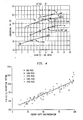
- Fig. 2 is a plot of FCC conversion against the catalyst:oil ratio at differing denitrogenation levels. As more nitrogen is removed by hydrotreating, less active sites on the cracking catalyst are poisoned by basic nitrogen, thus, allowing greater conversion at a given catalyst:oil ratio.
- Case J also shows a slight shift in yields at constant conversion relative to the other cases, probably because conversion for Case J approaches 100-C A .
- the difference in aromatics saturation, and subsequently, in FCC gasoline selectivity conclusively establishes higher pressure, and higher severity, hydrotreating as the preferred conditions.
- the base feed was subjected to hydrotreating and catalytic cracking as described in Example 1 at three temperature ranges: 345°-365°C to simulate SOC 390° to simulate mid cycle 410°C to simulate EOC Space velocity was varied at each combination of temperature and pressure to cover the range of denitrogenation projected for the design.
- Once-through hydrogen was utilized with most data collected at 535 n.l.l. ⁇ 1 (3000 SCF/Bbl) hydrogen circulation.
- the 250°C+ (480°F+) yields were more sensitive to pressure than the 345°C+ (650°F) yields.
- the 250°C+ (480°F+) yields remain greater than 90 wt percent at all reasonable severity levels but decrease significantly at lower pressures.
- the effect of operating pressure on light gas make was apparent even at 365°C (690°F) and becomes more pronounced as temperature was increased.
- Incremental C5-250°C (C5-480°F) naphtha was not a function of operating pressure at 345° (650°F) and 365°C (690°F) but was apparent at 390°C (730°F) and is significant at 410°C (770°F). This is caused by the "rolling down" of higher boiling hydrocarbons as conversion of 345°C+ (650°F+) increases with hydrotreating temperature, particularly at the lower pressures.
- At 12065 kPa (1750 psig) and 75% denitrogenation yield of C5-250°C(C5-480°F) remains essentially constant at 8-10 wt % as temperature increases from 345°C to 410°C (650° to 770°F). Over this same temperature range, 8720 kPa (1250 psig) operation gives an increase from 8 to 16 wt % of C5-250°C (C5-480°F).
- Hydrogen consumption was found to be a function of temperature as well as denitrogenation level except at 12065 kPa (1750 psig) where a temperature effect is not apparent, probably due to thermodynamic limitations in saturating aromatics at the lower pressure levels.
- the composite curve for hydrogen consumption at all temperatures and pressures indicated 133 n.l.l. ⁇ 1 (750 SCF/Bbl) consumption at 60% hydrodenitrogenation and 153 n.l.l. ⁇ 1 (860 SCF/Bbl) at 75% hydrodenitrogenation. A rapid increase in consumption is observed above 90% hydrodenitrogenation where significant hydrocracking can occur.
Landscapes
- Chemical & Material Sciences (AREA)
- Oil, Petroleum & Natural Gas (AREA)
- Engineering & Computer Science (AREA)
- Chemical Kinetics & Catalysis (AREA)
- General Chemical & Material Sciences (AREA)
- Organic Chemistry (AREA)
- Production Of Liquid Hydrocarbon Mixture For Refining Petroleum (AREA)
- Catalysts (AREA)
Applications Claiming Priority (1)
| Application Number | Priority Date | Filing Date | Title |
|---|---|---|---|
| US06/945,254 US4780193A (en) | 1986-12-22 | 1986-12-22 | Process for hydrotreating catalytic cracking feedstocks |
Publications (1)
| Publication Number | Publication Date |
|---|---|
| EP0351464A1 true EP0351464A1 (de) | 1990-01-24 |
Family
ID=25482855
Family Applications (1)
| Application Number | Title | Priority Date | Filing Date |
|---|---|---|---|
| EP88306609A Withdrawn EP0351464A1 (de) | 1986-12-22 | 1988-07-19 | Verfahren zur Wasserstoffbehandlung eines Einsatzmaterials für katalytisches Cracken |
Country Status (4)
| Country | Link |
|---|---|
| US (1) | US4780193A (de) |
| EP (1) | EP0351464A1 (de) |
| AU (1) | AU606433B2 (de) |
| MY (1) | MY103130A (de) |
Cited By (4)
| Publication number | Priority date | Publication date | Assignee | Title |
|---|---|---|---|---|
| RU2284344C1 (ru) * | 2005-08-24 | 2006-09-27 | Открытое акционерное общество "Всероссийский научно-исследовательский институт по переработке нефти" | Способ гидрогенизационной переработки нефтяного сырья |
| CN102911735A (zh) * | 2011-08-04 | 2013-02-06 | 中国石油化工股份有限公司 | 一种高硫蜡油的催化转化方法 |
| CN102911733A (zh) * | 2011-08-04 | 2013-02-06 | 中国石油化工股份有限公司 | 一种高硫蜡油的催化转化方法 |
| CN102911731A (zh) * | 2011-08-04 | 2013-02-06 | 中国石油化工股份有限公司 | 一种高硫蜡油的催化转化方法 |
Families Citing this family (14)
| Publication number | Priority date | Publication date | Assignee | Title |
|---|---|---|---|---|
| US4973396A (en) * | 1989-07-10 | 1990-11-27 | Exxon Research And Engineering Company | Method of producing sweet feed in low pressure hydrotreaters |
| US4952306A (en) * | 1989-09-22 | 1990-08-28 | Exxon Research And Engineering Company | Slurry hydroprocessing process |
| US5314612A (en) * | 1992-11-30 | 1994-05-24 | Exxon Research And Engineering Company | Fluid catalytic cracking process for producing low emissions fuels |
| US5318695A (en) * | 1992-11-30 | 1994-06-07 | Exxon Research And Engineering Company | Fluid cracking process for producing low emissions fuels |
| US6231755B1 (en) | 1998-01-30 | 2001-05-15 | E. I. Du Pont De Nemours And Company | Desulfurization of petroleum products |
| MXPA98005494A (es) | 1998-07-07 | 2002-07-30 | Mexicano Inst Petrol | Procedimiento para la obtencion de un catalizadorpara la hidrodesnitrogenacion e hidrodesulfuracion de fracciones intermedias y pesadas del petroleoy producto resultante. |
| RU2147597C1 (ru) * | 1998-11-11 | 2000-04-20 | ОАО Новокуйбышевский нефтеперерабатывающий завод | Способ каталитического облагораживания продуктов термических процессов |
| US20010042701A1 (en) * | 2000-04-17 | 2001-11-22 | Stuntz Gordon F. | Cycle oil conversion process |
| US20010042702A1 (en) * | 2000-04-17 | 2001-11-22 | Stuntz Gordon F. | Cycle oil conversion process |
| WO2008058400A1 (en) * | 2006-11-14 | 2008-05-22 | The University Of Calgary | Catalytic down-hole upgrading of heavy oil and oil sand bitumens |
| CN102906231B (zh) * | 2009-12-08 | 2015-11-25 | 埃克森美孚研究工程公司 | 使用本体催化剂加氢处理高氮进料的方法 |
| CO6290095A1 (es) * | 2009-12-11 | 2011-06-20 | Ecopetrol Sa | Proceso para incrementar la produccion de aceite liviano de ciclo en una unidad de ruptura catalitica |
| SG10201911151WA (en) * | 2015-10-15 | 2020-02-27 | China Petroleum & Chem Corp | A process for converting inferior feedstock oil |
| CN109423337B (zh) * | 2017-08-22 | 2020-08-04 | 中国石化工程建设有限公司 | 一种蜡油加氢-催化裂化热联合工艺系统及蜡油处理方法 |
Citations (3)
| Publication number | Priority date | Publication date | Assignee | Title |
|---|---|---|---|---|
| US2903413A (en) * | 1956-08-07 | 1959-09-08 | Pure Oil Co | Hydrogenation of a hydrocarbon oil feed for use in a catalytic cracking process to produce gasoline |
| US3506568A (en) * | 1969-01-10 | 1970-04-14 | Chevron Res | Process of hydrofining high nitrogen hydrocarbons followed by catalytic cracking with zeolitic aluminosilicates |
| FR2412606A1 (fr) * | 1977-12-21 | 1979-07-20 | Standard Oil Co | Procede de craquage de courants d'hydrocarbures lourds |
Family Cites Families (18)
| Publication number | Priority date | Publication date | Assignee | Title |
|---|---|---|---|---|
| US3852187A (en) * | 1973-03-29 | 1974-12-03 | Gulf Research Development Co | Hydrodesulfurization process for producing fuel oil and fcc feed |
| US3860510A (en) * | 1973-08-22 | 1975-01-14 | Gulf Research Development Co | Combination residue hydrodesulfurization and zeolite riser cracking process |
| US4025417A (en) * | 1974-05-13 | 1977-05-24 | Mobil Oil Corporation | Hydroprocessing catalytic cracking feed stocks |
| US4067798A (en) * | 1976-02-26 | 1978-01-10 | Standard Oil Company (Indiana) | Catalytic cracking process |
| US4267033A (en) * | 1979-10-22 | 1981-05-12 | Mobil Oil Corporation | Upgrading of aromatic liquids |
| US4357263A (en) * | 1979-10-22 | 1982-11-02 | Mobil Oil Corporation | Catalyst for the upgrading of aromatic liquids |
| BR8100953A (pt) * | 1980-04-14 | 1982-01-12 | Grace W R & Co | Aperfeicoamento em processo para craquear cataliticamente hidrocarbonetos |
| US4442023A (en) * | 1980-12-29 | 1984-04-10 | Mobil Oil Corporation | Hydrotreating hydrocarbon feedstocks |
| US4430198A (en) * | 1980-12-29 | 1984-02-07 | Mobil Oil Corporation | Hydrotreating hydrocarbon feedstocks |
| US4419218A (en) * | 1981-07-08 | 1983-12-06 | Mobil Oil Corporation | Catalytic conversion of shale oil |
| US4521297A (en) * | 1982-02-22 | 1985-06-04 | Mobil Oil Corporation | Catalytic conversion of shale oil |
| US4540481A (en) * | 1982-07-20 | 1985-09-10 | Exxon Research And Engineering Co. | Catalysts from molybdenum polysulfide precursors, their preparation and use |
| US4540482A (en) * | 1982-07-20 | 1985-09-10 | Exxon Research And Engineering Co. | Supported carbon-containing molybdenum and tungsten sulfide catalysts, their preparation and use |
| US4544481A (en) * | 1982-07-20 | 1985-10-01 | Exxon Research And Engineering Co. | Supported carbon-containing molybdenum and tungsten sulfide catalysts their preparation and use |
| US4542121A (en) * | 1982-07-20 | 1985-09-17 | Exxon Research And Engineering Co. | Catalysts from molybdenum polysulfide precursors, their preparation and use |
| US4565620A (en) * | 1984-05-25 | 1986-01-21 | Phillips Petroleum Company | Crude oil refining |
| NL8403551A (nl) * | 1984-11-22 | 1986-06-16 | Shell Int Research | Werkwijze voor de bereiding van benzine. |
| US4534852A (en) * | 1984-11-30 | 1985-08-13 | Shell Oil Company | Single-stage hydrotreating process for converting pitch to conversion process feedstock |
-
1986
- 1986-12-22 US US06/945,254 patent/US4780193A/en not_active Expired - Fee Related
-
1988
- 1988-07-18 AU AU19154/88A patent/AU606433B2/en not_active Ceased
- 1988-07-19 EP EP88306609A patent/EP0351464A1/de not_active Withdrawn
- 1988-07-22 MY MYPI88000828A patent/MY103130A/en unknown
Patent Citations (3)
| Publication number | Priority date | Publication date | Assignee | Title |
|---|---|---|---|---|
| US2903413A (en) * | 1956-08-07 | 1959-09-08 | Pure Oil Co | Hydrogenation of a hydrocarbon oil feed for use in a catalytic cracking process to produce gasoline |
| US3506568A (en) * | 1969-01-10 | 1970-04-14 | Chevron Res | Process of hydrofining high nitrogen hydrocarbons followed by catalytic cracking with zeolitic aluminosilicates |
| FR2412606A1 (fr) * | 1977-12-21 | 1979-07-20 | Standard Oil Co | Procede de craquage de courants d'hydrocarbures lourds |
Cited By (7)
| Publication number | Priority date | Publication date | Assignee | Title |
|---|---|---|---|---|
| RU2284344C1 (ru) * | 2005-08-24 | 2006-09-27 | Открытое акционерное общество "Всероссийский научно-исследовательский институт по переработке нефти" | Способ гидрогенизационной переработки нефтяного сырья |
| CN102911735A (zh) * | 2011-08-04 | 2013-02-06 | 中国石油化工股份有限公司 | 一种高硫蜡油的催化转化方法 |
| CN102911733A (zh) * | 2011-08-04 | 2013-02-06 | 中国石油化工股份有限公司 | 一种高硫蜡油的催化转化方法 |
| CN102911731A (zh) * | 2011-08-04 | 2013-02-06 | 中国石油化工股份有限公司 | 一种高硫蜡油的催化转化方法 |
| CN102911733B (zh) * | 2011-08-04 | 2015-05-20 | 中国石油化工股份有限公司 | 一种高硫蜡油的催化转化方法 |
| CN102911735B (zh) * | 2011-08-04 | 2015-07-01 | 中国石油化工股份有限公司 | 一种高硫蜡油的催化转化方法 |
| CN102911731B (zh) * | 2011-08-04 | 2015-11-25 | 中国石油化工股份有限公司 | 一种高硫蜡油的催化转化方法 |
Also Published As
| Publication number | Publication date |
|---|---|
| US4780193A (en) | 1988-10-25 |
| MY103130A (en) | 1993-04-30 |
| AU606433B2 (en) | 1991-02-07 |
| AU1915488A (en) | 1990-01-18 |
Similar Documents
| Publication | Publication Date | Title |
|---|---|---|
| US4780193A (en) | Process for hydrotreating catalytic cracking feedstocks | |
| US4983273A (en) | Hydrocracking process with partial liquid recycle | |
| EP0537500B1 (de) | Methode zur Behandlung eines schweren Kohlenwasserstofföls | |
| US4789457A (en) | Production of high octane gasoline by hydrocracking catalytic cracking products | |
| AU607448B2 (en) | Production of high octane gasoline | |
| US5403469A (en) | Process for producing FCC feed and middle distillate | |
| EP0093552B1 (de) | Hydrokrackverfahren | |
| US5009768A (en) | Hydrocracking high residual contained in vacuum gas oil | |
| US6149800A (en) | Process for increased olefin yields from heavy feedstocks | |
| CA1272460A (en) | Production of high octane gasoline | |
| US5219814A (en) | Catalyst for light cycle oil upgrading | |
| US4943366A (en) | Production of high octane gasoline | |
| EP0433047B1 (de) | Erzeugung von Benzin und Destillat-Brennstoffen aus leichtem Kreislauföl | |
| US5582711A (en) | Integrated staged catalytic cracking and hydroprocessing process | |
| EP0427547A1 (de) | Erzeugung von Benzin und Destillatbrennstoffen aus leichtem Kreislauföl | |
| US5770043A (en) | Integrated staged catalytic cracking and hydroprocessing process | |
| US5770044A (en) | Integrated staged catalytic cracking and hydroprocessing process (JHT-9614) | |
| KR102444820B1 (ko) | 수소화분해 공정을 위해 촉매 적재를 최적화하는 방법 | |
| WO1995010579A1 (en) | Gasoline/cycle oil upgrading process | |
| EP0600686B1 (de) | Verfahren zum Fluidbedcracken zur Herstellung von Olefinen | |
| US5318692A (en) | FCC for producing low emission fuels from high hydrogen and low nitrogen and aromatic feeds | |
| US4062757A (en) | Residue thermal cracking process in a packed bed reactor | |
| US4404088A (en) | Three-stage hydrocracking process | |
| US4017380A (en) | Sequential residue hydrodesulfurization and thermal cracking operations in a common reactor | |
| US5314612A (en) | Fluid catalytic cracking process for producing low emissions fuels |
Legal Events
| Date | Code | Title | Description |
|---|---|---|---|
| PUAI | Public reference made under article 153(3) epc to a published international application that has entered the european phase |
Free format text: ORIGINAL CODE: 0009012 |
|
| AK | Designated contracting states |
Kind code of ref document: A1 Designated state(s): BE DE ES FR GB IT NL |
|
| 17P | Request for examination filed |
Effective date: 19900521 |
|
| 17Q | First examination report despatched |
Effective date: 19910517 |
|
| STAA | Information on the status of an ep patent application or granted ep patent |
Free format text: STATUS: THE APPLICATION HAS BEEN WITHDRAWN |
|
| 18W | Application withdrawn |
Withdrawal date: 19920626 |