EP0351194B1 - Thiazolderivate mit 5-lipoxygenase-hemmender Wirkung - Google Patents
Thiazolderivate mit 5-lipoxygenase-hemmender Wirkung Download PDFInfo
- Publication number
- EP0351194B1 EP0351194B1 EP89307041A EP89307041A EP0351194B1 EP 0351194 B1 EP0351194 B1 EP 0351194B1 EP 89307041 A EP89307041 A EP 89307041A EP 89307041 A EP89307041 A EP 89307041A EP 0351194 B1 EP0351194 B1 EP 0351194B1
- Authority
- EP
- European Patent Office
- Prior art keywords
- thiazole
- alkyl
- formula
- naphth
- mixture
- Prior art date
- Legal status (The legal status is an assumption and is not a legal conclusion. Google has not performed a legal analysis and makes no representation as to the accuracy of the status listed.)
- Expired - Lifetime
Links
- 0 C*(NC(N*NC)I)OC Chemical compound C*(NC(N*NC)I)OC 0.000 description 4
Classifications
-
- C—CHEMISTRY; METALLURGY
- C07—ORGANIC CHEMISTRY
- C07D—HETEROCYCLIC COMPOUNDS
- C07D417/00—Heterocyclic compounds containing two or more hetero rings, at least one ring having nitrogen and sulfur atoms as the only ring hetero atoms, not provided for by group C07D415/00
- C07D417/02—Heterocyclic compounds containing two or more hetero rings, at least one ring having nitrogen and sulfur atoms as the only ring hetero atoms, not provided for by group C07D415/00 containing two hetero rings
- C07D417/06—Heterocyclic compounds containing two or more hetero rings, at least one ring having nitrogen and sulfur atoms as the only ring hetero atoms, not provided for by group C07D415/00 containing two hetero rings linked by a carbon chain containing only aliphatic carbon atoms
-
- A—HUMAN NECESSITIES
- A61—MEDICAL OR VETERINARY SCIENCE; HYGIENE
- A61P—SPECIFIC THERAPEUTIC ACTIVITY OF CHEMICAL COMPOUNDS OR MEDICINAL PREPARATIONS
- A61P29/00—Non-central analgesic, antipyretic or antiinflammatory agents, e.g. antirheumatic agents; Non-steroidal antiinflammatory drugs [NSAID]
-
- A—HUMAN NECESSITIES
- A61—MEDICAL OR VETERINARY SCIENCE; HYGIENE
- A61P—SPECIFIC THERAPEUTIC ACTIVITY OF CHEMICAL COMPOUNDS OR MEDICINAL PREPARATIONS
- A61P37/00—Drugs for immunological or allergic disorders
- A61P37/08—Antiallergic agents
-
- A—HUMAN NECESSITIES
- A61—MEDICAL OR VETERINARY SCIENCE; HYGIENE
- A61P—SPECIFIC THERAPEUTIC ACTIVITY OF CHEMICAL COMPOUNDS OR MEDICINAL PREPARATIONS
- A61P43/00—Drugs for specific purposes, not provided for in groups A61P1/00-A61P41/00
-
- C—CHEMISTRY; METALLURGY
- C07—ORGANIC CHEMISTRY
- C07D—HETEROCYCLIC COMPOUNDS
- C07D277/00—Heterocyclic compounds containing 1,3-thiazole or hydrogenated 1,3-thiazole rings
- C07D277/02—Heterocyclic compounds containing 1,3-thiazole or hydrogenated 1,3-thiazole rings not condensed with other rings
- C07D277/20—Heterocyclic compounds containing 1,3-thiazole or hydrogenated 1,3-thiazole rings not condensed with other rings having two or three double bonds between ring members or between ring members and non-ring members
- C07D277/22—Heterocyclic compounds containing 1,3-thiazole or hydrogenated 1,3-thiazole rings not condensed with other rings having two or three double bonds between ring members or between ring members and non-ring members with only hydrogen atoms, hydrocarbon or substituted hydrocarbon radicals, directly attached to ring carbon atoms
- C07D277/24—Radicals substituted by oxygen atoms
Definitions
- This invention concerns novel heterocyclic compounds and more particularly novel thiazoles which are inhibitors of the enzyme 5-lipoxygenase (hereinafter referred to as 5-LO).
- the invention also concerns processes for the manufacture of said thiazoles and novel pharmaceutical compositions containing said thiazoles. Also included in the invention is the use of said thiazoles in the treatment of various inflammatory and/or allergic diseases in which the direct or indirect products of 5-LO catalysed oxidation of arachidonic acid are involved, and the production of new medicaments for such use.
- the thiazoles described hereinafter are inhibitors of 5-LO, which enzyme is known to be involved in catalysing the oxidation of arachidonic acid to give rise via a cascade process to the physiologically active leukotrienes such as leukotriene B 4 (LTB 4 ) and the peptido-lipid leukotrienes such as leukotriene C 4 (LTC 4 ) and leukotriene D 4 (LTD 4 ) and various metabolites.
- 5-LO physiologically active leukotrienes
- LTC 4 leukotriene C 4
- LTD 4 leukotriene D 4
- the biosynthetic relationship and physiological properties of the leukotrienes are summarised by G.W. Taylor and S.R. Clarke in Trends in Pharmacological Sciences, 1986, 7, 100-103.
- the leukotrienes and their metabolites have been implicated in the production and development of various inflammatory and allergic diseases such as arthritic diseases, asthma, allergic rhinitis, atopic dermatitis, psoriasis, cardiovascular and cerebrovascular disorders and inflammatory bowel disease.
- the leukotrienes are mediators of inflammatory diseases by virtue of their ability to modulate lymphocyte and leukocyte function.
- Other physiologically active metabolites of arachidonic acid, such as the prostaglandins and thromboxanes arise via the action of the enzyme cyclooxygenase on arachidonic acid.
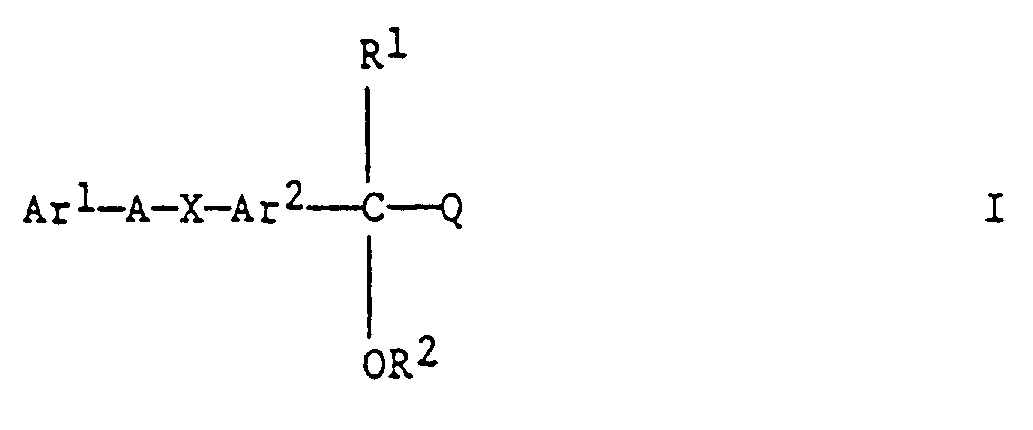
- a thiazole of the formula I wherein Ar1 is aryl of up to 10 carbon atoms which may optionally bear one or more substituents selected from halogeno, amino, hydroxy, cyano, formyl, carbamoyl, (1-6C)alkyl, (2-6C)alkenyl, (2-6C)alkynyl, (1-6C)alkoxy, (1-6C)alkylthio, (1-6C)alkylsulphinyl, (1-6C)alkylsulphonyl, (1-6C)alkylamino, di-[(1-4C)alkyl]amino, (1-4C)-alkoxycarbonyl, N-[(1-6C)alkyl]carbamoyl, N,N-di-[(1-4C)alkyl]carbamoyl, (2-6C)alkanoyl, (2-6C)-alkanoylamino, (1-4C)alky
- A is a direct link to X, or is (1-6C)alkylene, (3-6C)alkenylene, (3-6C)alkynylene or cyclo(3-6C)-alkylene;
- X is oxy, thio, sulphinyl, sulphonyl or imino
- Ar2 is phenylene which may optionally bear one or two substituents selected from halogeno, hydroxy, amino, nitro, cyano, carbamoyl, (1-6C)alkyl, (1-6C)alkoxy, (3-4C)alkenyloxy, (1-6C)alkylthio, (1-6C)-alkylsulphinyl, (1-6C)alkysulphonyl, (1-6C)alkylamino, di-[(1-4C)alkyl]amino, (1-4C)alkoxycarbonyl, N-[(1-6C)-alkyl]carbamoyl, N,N-di-[(1-4C)alkyl]carbamoyl, (2-6C)alkanoylamino, fluoro-(1-4C)alkoxy, hydroxy-(2-4C)-alkoxy, (1-4C)alkoxy-(2-4C)alkoxy, amino-(2-4C)alkoxy, cyano-(1-4C)
- R 1 is hydrogen, (1-6C)alkyl, (2-6C)alkenyl, (2-6C)alkynyl, fluoro-(1-4C)alkyl, cyano-(1-4C)alkyl, hydroxy-(1-4C)alkyl, (1-4C)alkoxy-(1-4C)alkyl and (2-4C)alkanoyloxy-(1-4C)alkyl;
- R 2 is hydrogen, (1-6C)alkyl, (3-6C)alkenyl, (3-6C)alkynyl, fluoro-(1-4C)alkyl, (1-4C)alkylthio-(1-4C)-alkyl, cyano-(1-4C)alkyl, 1- (1-4C)alkoxycarbonyl-(1-4C)alkyl, carboxy-(1-4C)alkyl, carbamoyl-(1-4C)alkyl or (2-6C)alkanoyl or R 2 is benzoyl which may optionally bear a substituent selected from halogeno, (1-6C)alkyl or (1-6C)alkoxy; and
- Q is thiazolyl which may optionally bear one or two substituents selected from halogeno, amino, nitro, cyano, (1-6C)alkyl, (1-6C)alkoxy, (1-6C)alkylamino, di-[(1-4C)alkyl]amino, (1-4C)alkoxycarbonyl, (2-6C)-alkanoyl, (2-6C)alkanoylamino, (1-4C)alkoxycarbonylamino, fluoro-(1-4C)alkyl and hydroxy-(1-4C)alkyl; or a pharmaceutically-acceptable salt thereof.
- alkyl includes both straight-chain and branched-chain alkyl groups.
- references to individual alkyl groups such as “propyl” are specific for the straight-chain version only and references to individual branched-chain alkyl groups such as “isopropyl” are specific for the branched-chain version only.
- An analogous convention applies to other generic terms.
- the invention includes in its definition of active ingredient any such optically active or racemic form which possesses the property of inhibiting 5-LO.
- the synthesis of optically active forms may be carried out by standard techniques of organic chemistry well known in the art, for example by synthesis from optically active starting materials or by resolution of a racemic form.
- inhibitory properties against 5-LO may be evaluated using the standard laboratory techniques referred to hereinafter.
- a suitable value for Ar 1 when it is aryl of up to 10 carbon atoms is, for example, phenyl or naphthyl,
- a suitable value for a halogeno substituent which may be present on Ar 1 , Ar 2 , R 2 or Q is, for example, fluoro, chloro, bromo or iodo.
- a suitable value for a (1-6C)alkyl substituent which may be present on Ar 1 , Ar 2 , R 2 or Q is, for example, methyl, ethyl, propyl, isopropyl, butyl, isobutyl, sec-butyl, pentyl or hexyl.
- a suitable value for a (2-6C)alkenyl substituent on Ar 1 is, for example, vinyl, allyl, 2-butenyl or 3-butenyl.
- a suitable value for a (2-6C)alkynyl substituent on Ar 1 is, for example, ethynyl, 1-propynyl, 2-propynyl, 1-butynyl or 2-butynyl.
- a suitable value for a (1-6C)alkoxy substituent which may be present on Ar 1 , Ar 2 , R 2 or Q is, for example, methoxy, ethoxy, propoxy, isopropoxy or butoxy.
- Suitable values for substituents which may be present on Ar 1 or Ar 2 include, for example:-
- a suitable value for a (2-6C)alkanoyl substituent which may be present on Ar 1 or Q is, for example, acetyl, propionyl or butyryl.
- Suitable values for substituents which may be present on Ar 1 , Ar 2 or Q include, for example:-
- a suitable value for a (1-4C)alkylureido substituent which may be present on Ar 1 is, for example, a 3-(1-4C)alkylureido substituent such as 3-methylureido, 3-ethylureido or 3-propylureido.
- a suitable value for the number of substituents which may be present on Ar 1 is, for example, one, two or three.
- a suitable value for A when it is (1-6C)alkylene is, for example, methylene, ethylene, ethylidene, trimethylene, propylidene, tetramethylene or pentamethylene; when it is (3-6C)alkenylene is, for example, 1-propenylene, 2-methylprop-1-enylene, 3-methylprop-1-enylene, 1-butenylene or 2-butenylene; and when it is (3-6C)alkynylene is, for example, 1-propynylene, 3-methylprop-1-ynylene, 1-butynylene or 2-butynylene.
- a suitable value for A when it is cyclo(3-6C)alkylene is, for example, cyclopropylidene, 1,2-cyclopropylene, cyclopentylidene, 1,2-cyclopentylene, cyclohexylidene or 1,4-cyclohexylene.
- a suitable value for Ar 2 when it is phenylene is, for example, 1,3-phenylene or 1,4-phenylene.
- a suitable value for Ar 2 when it is a 6-membered heterocyclene moiety containing up to three nitrogen atoms is, for example, pyridylene, pyrimidinylene, pyridazinylene, pyrazinylene or 1,3,5-triazinylene.
- Ar 2 when it is a 6-membered heterocyclene moiety containing up to three nitrogen atoms is, for example, 2,4-, 2,5-, 3,5- or 2,6-pyridylene, 2,4-, 2,5- or 4,6-pyrimidinylene, 3,5- or 3,6-pyridazinylene or 2,5-or 2,6-pyrazinylene.
- Suitable values for substituents which may be present on Ar 2 include, for example:-
- a suitable value for R 1 when it is (1-6C)alkyl is, for example, methyl, ethyl, propyl, butyl, pentyl or hexyl; when it is (2-6C)alkenyl is, for example, vinyl, allyl, 2-butenyl or 3-butenyl; when it is (2-6C)alkynyl is, for example, ethynyl, 1-propynyl, 2-propynyl, 1-butynyl or 2-butynyl; when it is fluoro-(1-4C)alkyl is, for example, fluoromethyl, difluoromethyl, trifluoromethyl, 2-fluoroethyl, 2,2,2-trifluoroethyl or pentafluoroethyl; when it is cyano-(1-4C)alkyl is, for example, cyanomethyl, 2-cyanoethyl or 3-cyanopropyl; when it is hydroxy-(1-4C)al
- a suitable value for R 2 when it is (1-6C)alkyl is, for example, methyl, ethyl, propyl, isopropyl, butyl, isobutyl, sec-butyl, pentyl or hexyl; when it is (3-6C)alkenyl is, for example allyl, 2-butenyl or 3-butenyl; when it is (3-6C)alkynyl is, for example 2-propynyl or 2-butynyl; and when it is (2-4C)alkanoyl is, for example, acetyl, propionyl or butyryl.
- a suitable value for R 2 when it is (1-4C)alkoxycarbonyl-(1-4C)alkyl is, for example, methoxycarbonylmethyl, 2-methoxycarbonylethyl, ethoxycarbonylmethyl or 2-ethoxycarbonylethyl; when it is carboxy-(1-4C)-alkyl is, for example, carboxymethyl, 2-carboxyethyl or 3-carboxypropyl; when it is carbamoyl-(1-4C)alkyl is, for example, carbamoylmethyl, 2-carbamoylethyl or 3-carbamoylpropyl; when it is cyano-(1-4C)alkyl is, for example, cyanomethyl, 2-cyanoethyl or 3-cyanopropyl; when it is fluoro-(1-4C)alkyl is, for example, trifluoromethyl, 2-fluoroethyl, 2,2-difluoroethyl, 2,2,2-trifluoroe
- a suitable value for Q when it is thiazolyl is 2-, 4- or 5-thiazolyl.
- a suitable value for (1-4C)alkoxycarbonylamino substituent which may be present on Q is, for example, methoxycarbonylamino, ethoxycarbonylamino and propoxycarbonylamino.
- a suitable pharmaceutically-acceptable salt of a thiazole of the invention which is sufficiently basic is an acid-addition salt with, for example, an inorganic or organic acid, for example hydrochloric, hydrobromic, sulphuric, phosphoric, trifluoroacetic, citric or maleic acid.
- an inorganic or organic acid for example hydrochloric, hydrobromic, sulphuric, phosphoric, trifluoroacetic, citric or maleic acid.
- a suitable pharmaceutically-acceptable salt of a thiazole of the invention which is sufficiently acidic is an alkali metal salt, for example a sodium or potassium salt, an alkaline earth metal salt, for example a calcium or magnesium salt, an ammonium salt or a salt with an organic base which affords a physiologically-acceptable cation, for example a salt with methylamine, dimethylamine, trimethylamine, piperidine, morpholine or tris-(2-hydroxyethyl)amine.
- a particular compound of the invention comprises a thiazole of the formula I wherein Ar 1 is phenyl, naphth-1-yl or naphth-2-yl which may optionally bear one, two or three substituents selected from fluoro, chloro, amino, hydroxy, cyano, formyl, carbamoyl, methyl, methoxy, methylthio, methylsulphinyl, methylsulphonyl, methoxycarbonyl, acetamido, difluoromethyl and trifluoromethyl;
- A is a direct link to X, or is methylene, 1-propenylene, 2-methylprop-1-enylene or 1-propynylene;
- X is oxy, thio, sulphinyl or sulphonyl
- Ar 2 is 1,3-phenylene or 1,4-phenylene which may optionally bear one substituent selected from fluoro, hydroxy, amino, nitro, cyano, carbamoyl, methyl, methoxy, allyloxy, methylamino, dimethylamino, tert-butoxycarbonyl, acetamido, cyanomethoxy, carbamoylmethoxy, ethoxycarbonylmethoxy, trifluoromethyl, carbamoylmethylamino, cyanomethylamino, 2-hydroxyethylamino and methanesulphonamido, or
- Ar 2 is 2,4-, 2,5- or 3,5-pyridylene, or 4,6-pyrimidinylene;
- R 1 is methyl, ethyl, propyl, vinyl, ethynyl, 2-propynyl, trifluoromethyl, cyanomethyl, hydroxymethyl, methoxymethyl or acetoxymethyl;
- R 2 is methyl, ethyl, allyl, 2-propynyl, 2-fluoroethyl, 2,2-difluoroethyl, methylthiomethyl or cyanomethyl; and Q is 2-, 4- or 5-thiazolyl which may optionally bear one substituent selected from chloro, methyl and methoxycarbonyl; or a pharmaceutically-acceptable salt thereof.
- a preferred compound of the invention comprises a thiazole of the formula I wherein Ar 1 is phenyl, naphth-1-yl or naphth-2-yl which may optionally bear one or two substituents selected from fluoro, chloro, cyano, methyl, methoxy, methylthio, methoxycarbonyl, difluoromethyl and trifluoromethyl;
- A is a direct link to X, or is methylene, 1-propenylene, 2-methylprop-1-enylene or 1-propynylene;
- X is oxy, thio, sulphinyl or sulphonyl
- Ar 2 is 1,3-phenylene or 1,4-phenylene which may optionally bear one subtituent selected from fluoro, hydroxy, amino, nitro, methyl, methoxy, methylamino, dimethylamino, cyanomethoxy and trifluoromethyl, or Ar 2 is 2,5- or 3,5-pyridylene;
- R 1 is methyl, ethyl, vinyl, 2-propynyl or cyanomethyl
- R 2 is methyl, ethyl, allyl, 2-propynyl or cyanomethyl
- Q is 2- or 4-thiazolyl; or a pharmaceutically-acceptable salt thereof.
- a further preferred compound of the invention comprises a thiazole of the formula I wherein Ar 1 is phenyl, naphth-2-yl, 3,4-dichlorophenyl, 3-iodophenyl, 3-cyanophenyl, 3,4-dimethoxyphenyl, 3,4,5-trimethoxyphenyl, 4-methylthiophenyl, 4-methylsulphinylphenyl, 3-trifluoromethylphenyl, 6-fluoronaphth-2-yl or 5-cyanonaphth-2-yl;
- A is methylene, 1-propenylene, 2-methylprop-1-enylene or 1-propynylene;
- X is oxy
- Ar 2 is 1,3-phenylene, 5-hydroxy-1,3-phenylene, 5-amino-1,3-phenylene, 5-nitro-1,3-phenylene, 4-methyl-1,3-phenylene, 5-methoxy-1,3-phenylene, 5-cyanomethoxy-1,3-phenylene, 5-carbamoylmethoxy-1,3-phenylene, 2,5-pyridylene, 3,5-pyridylene, 2,6-pyridylene or 4,6-pyrimidinylene;
- R 1 is hydrogen, methyl, ethyl, propyl, vinyl, trifluoromethyl, hydroxymethyl, methoxymethyl or acetoxymethyl;
- R 2 is hydrogen or methyl
- Q is 2-thiazolyl or 4-thiazolyl; or a pharmaceutically-acceptable salt thereof.
- An especially preferred compound of the invention comprises a thiazole of the formula I wherein Ar 1 is phenyl, naphth-1-yl, naphth-2-yl, 2-fluorophenyl, 3-fluorophenyl, 4-fluorophenyl, 3,4-difluorophenyl, 6-fluoronaphth-2-yl, 7-fluoronaphth-2-yl, 2-chlorophenyl, 3-chlorophenyl, 2-tolyl, 6-methylnaphth-2-yl, 2-methoxyphenyl, 3-methoxyphenyl, 4-methoxyphenyl, 2-methylthiophenyl, 3-methoxycarbonylphenyl, 2-trifluoromethylphenyl, 3-trifluoromethylphenyl or 7-difluoromethylnaphth-2-yl;
- A is a direct link to X, or is methylene, 1-propenylene or 1-propynylene;
- X is oxy or thio
- Ar 2 is 1,3-phenylene, 5-fluoro-1,3-phenylene, 5-methoxy-1,3-phenylene,2-methoxy-1,4-phenylene, 5-cyanomethoxy-1,3-phenylene, 5-trifluoromethyl-1,3-phenylene or 3,5-pyridylene;
- R 1 is methyl or ethyl
- R 2 is methyl, ethyl, allyl, 2-propynyl or cyanomethyl
- Q is 2-thiazolyl; or a pharmaceutically-acceptable salt thereof.
- a further especially preferred compound of the invention comprises a thiazole of the formula I wherein Ar 1 is phenyl, naphth-1-yl, 2-fluorophenyl, 3-fluorophenyl, 4-fluorophenyl, 3,4-difluorophenyl, 2-chlorophenyl, 3-chlorophenyl, 2-tolyl, 2-methoxyphenyl, 3-methoxyphenyl, 4-methoxyphenyl, 3-methoxycarbonylphenyl, 2-trifluoromethylphenyl or 3-trifluoromethylphenyl;
- Ar 2 is 1,3-phenylene, 5-fluoro-1,3-phenylene, 5-methoxy-1,3-phenylene,2-methoxy-1,4-phenylene or 5-trifluoromethyl-1,3-phenylene;
- R 1 is methyl or ethyl
- R 2 is methyl
- Q is 2-thiazolyl; or a pharmaceutically-acceptable salt thereof.
- a further especially preferred compound of the invention comprises a thiazole of the formula I wherein Ar 1 is phenyl or naphth-2-yl;
- A is methylene or 1-propynylene
- X is oxy
- Ar 2 is 1,3-phenylene, 5-methoxy-1,3-phenylene or 3,5-pyridylene;
- R 1 is ethyl
- R 2 is methyl and Q is 2-thiazolyl; or a pharmaceutically-acceptable salt thereof.
- a compound of the invention comprising a thiazole of the formula I, or a pharmaceutically-acceptable salt thereof, may be prepared by any process known to be applicable to the preparation of structurally- related compounds. Such procedures are provided as a further feature of the invention and are illustrated by the following representative examples in which, unless otherwise stated, Ar 1 , A, X, Ar 2 , R 1 , R 2 and Q have any of the meanings defined hereinbefore.
- a suitable displaceable group Z is, for example, a halogeno, sulphonyloxy or hydroxy group, for example a chloro, bromo, iodo, methanesulphonyloxy, toluene-p-sulphonyloxy or hydroxy group.
- a suitable reagent for the alkylation reaction when Z is a halogeno or sulphonyloxy group is, for example, a suitable base, for example, an alkali or alkaline earth metal carbonate, hydroxide or hydride, for example sodium carbonate, potassium carbonate, sodium hydroxide, potassium hydroxide, sodium hydride or potassium hyride.
- the alkylation reaction is preferably performed in a suitable inert solvent or diluent, for example N,N-dimethylformamide, dimethylsulphoxide, acetone, 1,2-dimethoxyethane or tetrahydrofuran, and at a temperature in the range, for example, 10 to 150 ° C, conveniently at or near ambient temperature.
- a suitable reagent for the alkylation reaction when Z is a hydroxy group is, for example, the reagent obtained when a compound of the formula Ar'-A-OH is reacted with a di-(1-4C)alkyl azodicarboxylate in the presence of a triarylphosphine, for example with diethyl azodicarboxylate in the presence of triphenylphosphine.
- the alkylation reaction is preferably performed in a suitable inert solvent or diluent, for example acetone, 1,2-dimethoxyethane or tetrahydrofuran, and at a temperature in the range, for example, 10 to 80 C, conveniently at or near ambient temperature.
- a suitable protecting group for an amino or alkylamino group is, for example, an acyl group for example a (1-4C)alkanoyl group (especially acetyl), a (1-4C)alkoxycarbonyl group (especially methoxycarbonyl, ethoxycarbonyl or t-butoxycarbonyl), an arylmethoxycarbonyl group (especially benzyloxycarbonyl) or an aroyl group (especially benzoyl).
- the deprotection conditions for the above protecting groups necessarily vary with the choice of protecting group.
- an acyl group such as an alkanoyl, alkoxycarbonyl or an aroyl group may be removed for example, by hydrolysis with a suitable base such as an alkali metal hydroxide, for example lithium or sodium hydroxide.
- a suitable base such as an alkali metal hydroxide, for example lithium or sodium hydroxide.
- an acyl group such as a t-butoxycarbonyl group may be removed, for example, by treatment with a suitable acid such as hydrochloric, sulphuric or phosphoric acid and an arylmethoxycarbonyl group such as a benzyloxycarbonyl group may be removed, for example, by hydrogenation over a catalyst such as palladium-on-charcoal.
- a suitable protecting group for a carboxy group is, for example, an esterifying group, for example a (1-4C)alkyl group (especially methyl or ethyl) or an arylmethyl group (especially benzyl).
- the deprotection conditions for the above protecting groups necessarily vary with the choice of protecting group.
- an esterifying group such as an alkyl or arylmethyl group may be removed, for example, by hydrolysis with a suitable base such as an alkali metal hydroxide, for example lithium or sodium hydroxide.
- a suitable base such as an alkali metal hydroxide, for example lithium or sodium hydroxide.
- an esterifying group such as an arylmethyl group may be removed, for example, by hydrogenation over a catalyst such as palladium-on-charcoal.
- a suitable protecting group for a hydroxy group is, for example, an acyl group, for example a (1-4C)-alkanoyl group (especially acetyl), an aroyl group (especially benzoyl) or an arylmethyl group (especially benzyl).
- the deprotection conditions for the above protecting groups will necessarily vary with the choice of protecting group.
- an acyl group such as an alkanoyl or an aroyl group may be removed, for example, by hydrolysis with a suitable base such as an alkali metal hydroxide, for example lithium or sodium hydroxide.
- a suitable base such as an alkali metal hydroxide, for example lithium or sodium hydroxide.
- an arylmethyl group such as a benzyl group may be removed, for example, by hydrogenation over a catalyst such as palladium-on-charcoal.
- the starting material of the formula II may be obtained, for example, by deprotecting a protected thiazole of the formula III wherein R 3 is a protecting group and X, Ar 2 , R 1 , R 2 and Q have the meanings defined hereinbefore.
- a suitable protecting group R 3 is, for example, an arylmethyl group (especially benzyl), a tri-(1-4C)-alkylsilyl group (especially trimethylsilyl or t-butyldimethylsilyl), an aryldi-(1-4C)alkylsilyl group (especially dimethylphenylsilyl), a (1-4C)alkyl group (especially methyl), a (1-4C)alkoxymethyl group (especially methoxymethyl) or a tetrahydropyranyl group (especially tetrahydropyran-2-yl).
- the deprotection conditions for the above protecting groups will necessarily vary with the choice of protecting group.
- an arylmethyl group such as a benzyl group may be removed, for example, by hydrogenation over a catalyst such as palladium-on-charcoal.
- a trialkylsilyl or an aryl dialkylsilyl group such as a t-butyldimethylsilyl or a dimethylphenylsilyl group may be removed, for example, by treatment with a suitable acid such as hydrochloric, sulphuric, phosphoric or trifluoroacetic acid or with an alkali metal or ammonium fluoride such as sodium fluoride or, preferably, tetrabutylammonium fluoride.
- an alkyl group may be removed, for example, by treatment with an alkali metal (1-4C)alkylsulphide such as sodium thioethoxide or, for example, by treatment with an alkali metal diarylphosphide such as lithium diphenylphosphide or, for example, by treatment with a boron or aluminium trihalide such as boron tribromide.
- an alkali metal (1-4C)alkylsulphide such as sodium thioethoxide
- an alkali metal diarylphosphide such as lithium diphenylphosphide
- a boron or aluminium trihalide such as boron tribromide.
- a (1-4C)alkoxymethyl group or tetrahydropyranyl group may be removed, for example, by treatment with a suitable acid such as hydrochloric or trifluoracetic acid.
- the protecting group R 3 may be, for example, a tri-(1-4C)alkylsilyl group which can be removed while the protecting group for any amino, alkylamino, carboxy or hydroxy group in Ar 2 , R 1 or Q is retained.
- the protected starting material of the formula III may be obtained by standard procedures of organic chemistry.
- the following process variants are described for the purposes of illustration only and as examples of the many routes available to the man skilled in the art of organic chemistry for the preparation of the starting material of formula III. Further process variants are provided within the Examples provided hereinafter to illustrate further the many options available to the man skilled in the art.
- an alcohol of the formula R 3- X-Ar 2- CH(OH)-Q wherein R 3 is a protecting group as defined hereinbefore
- R 3 is a protecting group as defined hereinbefore
- an aldehyde of the formula R 3- X-Ar 2- CHO with an organometallic compound of the formula Q-M, wherein Q has the meaning defined hereinbefore and M is a metallic group, for example lithium, and provided that any amino, alkylamino, carboxy or hydroxy group in Ar 2 or Q is protected by a conventional protecting group.
- the reaction may be carried out in, for example, a suitable solvent or diluent such as an ether (for example tetrahydrofuran, t-butylmethylether or diethyl ether) at a temperature in the range, for example, -100 to 50°C (especially -80 to 30 C).
- a suitable solvent or diluent such as an ether (for example tetrahydrofuran, t-butylmethylether or diethyl ether) at a temperature in the range, for example, -100 to 50°C (especially -80 to 30 C).
- the secondary alcohol of the formula R 3- X-Ar 2- CH(OH)-Q may be oxidised to give a ketone of the formula R 3- X-Ar 2- CO-Q.
- a particular suitable oxidising agent is, for example, any agent known in the art for the oxidation of a secondary alcohol to a ketone, for example, manganese dioxide, chromium trioxide pyridine complex, 2,3-dichloro-5,6-dicyano-1,4-benzoquinone (hereinafter DDQ), a mixture of dimethylsulphoxide, oxalyl chloride and triethylamine, a mixture of acetic anhydride and dimethylsulphoxide or a mixture of dimethylsulphoxide and a dialkylcarbodiimide, for example N,N'-dicyclohexylcarbodiimide or N-ethyl-N'-(3-dimethylaminopropyl)carbodiimide.
- a tertiary alcohol of the formula IV, wherein R 3 has the meaning defined hereinbefore, may be obtained by the reaction of the ketone R 3- X-Ar 2- CO-Q with an organometallic compound of the formula R'-M-Z, wherein M is a metallic group, for example magnesium, and Z is a halogeno group, for example chloro, bromo or iodo, and provided that any amino, alkylamino, carboxy or hydroxy group in Ar 2 , R 1 or Q is protected by a conventional protecting group.
- the reaction may be carried out in a suitable solvent or diluent such as an ether (for example tetrahydrofuran, t-butyl methyl ether or diethyl ether) at a temperature in the range, for example, -30 to 100°C (especially ambient temperature to 80 ° C).
- a suitable solvent or diluent such as an ether (for example tetrahydrofuran, t-butyl methyl ether or diethyl ether) at a temperature in the range, for example, -30 to 100°C (especially ambient temperature to 80 ° C).
- the tertiary alcohol of the formula IV may be obtained from the aldehyde of the formula R 3- X-Ar 2- CHO by reversing the order of introduction of the groups Q and R 1.
- the aldehyde of the formula R 3- X-Ar 2- CHO may be treated initially with the organometallic compound of the formula R'-M-Z, the product so obtained may be oxidised using a suitable oxidising agent as described above and the resultant ketone may be treated with the organometallic compound Q-M to give the compound of the formula IV, and provided that any amino, alkylamino, carboxy or hydroxy group in Ar 2 , R 1 or Q is protected by a conventional protecting group.
- the protected thiazole of the formula III, wherein R 3 has the meaning defined hereinbefore, may be obtained by the alkylation of the tertiary alcohol of the formula IV with an alkylating agent of the formula R 2- Z, wherein Z is a displaceable group as defined hereinbefore other than hydroxy, in the presence of a suitable base as defined hereinbefore, and provided that any amino, alkylamino, carboxy or hydroxy group in Ar 2 , R 1 or Q is protected by a conventional protecting group,
- the tertiary alcohol starting material of the formula IV may be obtained by the reaction of a compound of the formula R 3- X-Ar 2- Z, wherein R 3 and Ar 2 have the meanings defined hereinbefore and Z is a halogeno group as defined hereinbefore and provided that any amino, alkylamino or hydroxy group in Ar 2 is protected with a conventional protecting group, with either an organometallic compound of the formula R 5- M, wherein R 5 is a (1-6C)alkyl group such as butyl and M is a metallic group, for example lithium, to give an organometallic compound of the formula R 3- X-Ar 2- M, or with a metal such as magnesium to give an organometallic compound of the formula R 3- X-Ar 2- M-Z; whereafter either of these organometallic compounds may be reacted with a ketone of the formula R 1 -CO-Q, wherein R 1 and Q have the meanings defined hereinbefore, and provided that any amino, alkylamino, carboxy
- the ketone of the formula R 4- X-Ar 2- CO-Q described hereinbefore may be obtained by the reaction of the nitrile of the formula R 3- X-Ar-CN with an organometallic compound of the formula Q-M using the conditions defined hereinbefore for the corresponding reaction of the aldehyde of the formula R 3- X-Ar 2- CHO.
- a suitable protecting group for an imino group is, for example, any one of the protecting group defined hereinbefore as a suitable protecting group for an amino or alkylamino group.
- the tertiary alcohol starting material of the formula V may be obtained, for example, by the reaction of an aldehyde of the formula Ar 1 -A-X-Ar 2 -CHO with an organometallic compound of the formula Q-M, having the meaning defined hereinbefore and using the conditions defined hereinbefore, to give a secondary alcohol of the formula Ar 1 -A-X-Ar 2 -CH(OH)-Q and provided that any amino, imino, alkylamino, carboxy or hydroxy group in Ar 1 , X, Ar 2 or Q is protected by a conventional protecting group.
- the product so obtained may be oxidised using a suitable oxidising agent, as defined hereinbefore, to give a ketone of the formula Ar 1 -A-X-Ar 2 -CO-Q, which in turn may be treated with an organometallic compound of the formula R'-M-Z, having the meaning defined hereinbefore and using the conditions defined hereinbefore, to give the required tertiary alcohol starting material of the formula V.
- the tertiary alcohol of the formula V may be obtained from the aldehyde of the formula Ar 1 -A-X-Ar 2 -CHO by reversing the order of the introduction of the groups Q and R 1 , i.e.
- the ketone intermediate of the formula Ar 1 -A-X-Ar 2 -CO-R 1 may be obtained, for example, by the alkylation, in the presence of a suitable base as defined hereinbefore, of a ketone of the formula H-X-Ar 2- CO-R 1 with a compound of the formula Ar 1 -A-Z, wherein Z is a displaceable group as defined hereinbefore, and provided that any amino, alkylamino, carboxy or hydroxy group in Ar 1 or Ar 2 is protected by a conventional protecting group.
- the aldehyde starting material of the formula Ar 1 -A-X-Ar 2 -CHO may be obtained, for example, by the alkylation, in the presence of a suitable base as defined hereinbefore, of an aldehyde of the formula H-X-Ar 2- CHO with a compound of the formula Ar 1 -A-Z, wherein Z is a displaceable group, as defined hereinbefore, and provided that any amino, alkylamino, carboxy or hydroxy group in Ar 1 or Ar 2 is protected by a conventional protecting group.
- the tertiary alcohol starting material of the formula V may be obtained, for example, by the reaction of an ester of the formula Ar 1 -A-X-Ar 2 -CO 2 R 4 , wherein R 4 is a (1-4C)alkyl group such as methyl or ethyl, with an organometallic compound of the formula Q-M, having the meaning defined hereinbefore and using the conditions defined hereinbefore for the corresponding reaction of the aldehyde of the formula R 3- X-Ar 2- CHO, and provided that any amino, imino, alkylamino, carboxy or hydroxy group in Ar 1 , X, Ar 2 or Q is protected by a conventional protecting group, to give a ketone of the formula Ar 1 -A-X-Ar 2 -CO-Q.
- the product so obtained may be treated with an organometallic compound of the formula R 1 -M-Z, having the meaning defined hereinbefore and using the conditions defined hereinbefore, to give the required tertiary alcohol starting material of the formula V.
- the tertiary alcohol of the formula V may be obtained from the ester of the formula AR 1 -A-X-Ar 2 -CO 2 R 4 by reversing the order of the introduction of the groups Q and R 1 , i.e.
- the ester starting material of the formula Ar 1 -A-X-Ar 2 -CO 2 R 4 may be obtained, for example, by the alkylation, in the presence of a suitable base as defined hereinbefore, of an ester of the formula H-X-Ar 2- C0 2 R 4 , wherein R 4 has the meaning defined hereinbefore, with a compound of the formula Ar 1 -A-Z, wherein Z is a displaceable group as defined hereinbefore, and provided that any amino, alkylamino, carboxy, or hydroxy group in Ar 1 or Ar 2 is protected by a conventional protecting group.
- the tertiary alcohol starting material of the formula V may be obtained, for example, by the alkylation, in the presence of a suitable base, of a compound of the formula Ar 1 -A-X-H, wherein Ar 1 , A and X have the meanings defined hereinbefore, with a compound of the formula Z-Ar 2- Z, wherein Z is a displaceable group as defined hereinbefore, and provided that any amino, alkylamino, carboxy or hydroxy group in Ar 1 or Ar 2 is protected by a conventional protecting group, to give a compound of the formula Ar 1 -A-X-Ar 2 -Z.
- the product so obtained may be treated with an organometallic compound of the formula R 5- M, wherein R 5 is a (1-6C)alkyl group such as butyl and M is a metallic group, for example lithium, to give an organometallic compound of the formula Ar'-A-X-Ar 2- M which may be reacted with a ketone of the formula Q.CO.R 1 , provided that any amino, alkylamino or hydroxy group in Q or R 1 is protected by a conventional protecting group, to give the required tertiary alcohol starting material of the formula V.
- a suitable organometallic catalyst is, for example, any agent known in the art for such a coupling reaction.
- a suitable reagent is formed when, for example, bis(triphenylphosphine)-palladium chloride, and a copper halide, for example cuprous iodide, are mixed.
- the coupling is generally carried out in a suitable inert solvent or diluent, for example acetonitrile, 1,2-dimethoxyethane or tetrahydrofuran, at a temperature in the range, for example, 10 to 80 C, conveniently at or near 70 ° C, and in the presence of a suitable base such as, for example, a tri-(1-4C)alkylamine such as triethylamine.
- a suitable inert solvent or diluent for example acetonitrile, 1,2-dimethoxyethane or tetrahydrofuran
- the ethynyl compound of the formula VI used as a starting material, may be obtained, for example, by the alkylation, in the presence of a suitable base, of a compound of the formula II, wherein X, Ar 2 , R 1 , R 2 and Q have the meanings defined hereinbefore, with an alkylating agent of the formula H-C ⁇ C-A 1 -Z, wherein A 1 has the meaning defined hereinbefore and Z is a halogeno group, and provided that any amino, alkylamino, carboxy or hydroxy group in Ar 2 , R 1 , R 2 or Q is protected by a convention protecting group.
- a suitable oxidising agent is, for example, any agent known in the art for the oxidation of thio to sulphinyl and/or sulphonyl, for example, hydrogen peroxide, a peracid (such as 3-chloroperoxybenzoic or peroxyacetic acid), an alkali metal peroxysulphate (such as potassium peroxymonosulphate), chromium trioxide or gaseous oxygen in the presence of platinum.
- the oxidation is generally carried out under as mild conditions as possible and with the required stoichiometric amount of oxidising agent in order to reduce the risk of over oxidation and damage to other functional groups.
- the reaction is carried out in a suitable solvent or diluent such as methylene chloride, chloroform, acetone, tetrahydrofuran or t-butyl methyl ether and at a temperature, for example, at or near ambient temperature, that is in the range 15 to 35 ° C.
- a milder oxidising agent may also be used, for example sodium or potassium metaperiodate, conveniently in a polar solvent such as acetic acid or ethanol.
- a suitable acylating agent is, for example, any agent known in the art for the acylation of amino to acylamino or of aminoalkyl to acylaminoalkyl, for example an acyl halide, for example a (2-6C)alkanoyl chloride or bromide, in the presence of a suitable base, an alkanoic acid anhydride, for example a (2-6C)alkanoic acid anhydride, or an alkanoic acid mixed anhydride, for example the mixed anhydride formed by the reaction of an alkanoic acid and a (1-4C)alkoxycarbonyl halide, for example a (1-4C)-alkoxycarbonyl chloride, in the presence of a suitable base.
- an acyl halide for example a (2-6C)alkanoyl chloride or bromide
- an alkanoic acid anhydride for example a (2-6C)alkanoic acid anhydride
- an alkanoic acid mixed anhydride
- reaction is carried out in a suitable solvent or diluent such as methylene chloride, acetone, tetrahydrofuran or t-butyl methyl ether and at a temperature, for example, at or near ambient temperature, that is in the range 15 to 35° C.
- a suitable base when it is required is, for example, pyridine, 4-dimethylaminopyridine, triethylamine, ethyldiisopropylamine, N-methylmorpholine, an alkali metal carbonate, for example potassium carbonate, or an alkali metal carboxylate, for example sodium acetate.
- a palladium-on-barium sulphate catalyst is used to substantially prevent over-reduction of the alkynyl or alkynylene group to an alkyl or alkylene group respectively.
- the reaction is generally carried out at a temperature at or near ambient temperature, that is in the range 15 to 35 C.
- the reduction may be carried out by treating a solution of the alkynyl or alkynylene compound in an inert solvent or diluent with a suitable mixture such as a 1:1 mixture of an organometallic hydride, for example a di-(1-6C)alkylaluminium hydride such as diisobutylaluminium hydride, and an alkyl metal, for example a (1-6C)alkyl lithium such as methyl lithium.
- a suitable mixture such as a 1:1 mixture of an organometallic hydride, for example a di-(1-6C)alkylaluminium hydride such as diisobutylaluminium hydride, and an alkyl metal, for example a (1-6C)alkyl lithium such as methyl lithium.
- a suitable inert solvent or diluent is, for example, tetrahydrofuran, diethyl ether or t-butyl methyl ether and, in general, the reaction is carried out at a temperature, for example, in the range -25 ° C to ambient temperature (especially -10 to 10 0 C).
- a suitable alkylating agent is, for example, any agent known in the art for the alkylation of hydroxy to alkoxy or substituted alkoxy, or for the alkylation of amino to alkylamino or substituted alkylamino, for example an alkyl or substituted alkyl halide, for example a (1-6C)alkyl chloride, bromide or iodide or a substituted (1-4C)alkyl chloride, bromide or iodide, in the presence of a suitable base.
- an alkyl or substituted alkyl halide for example a (1-6C)alkyl chloride, bromide or iodide or a substituted (1-4C)alkyl chloride, bromide or iodide, in the presence of a suitable base.
- a suitable base for the alkylation reaction is, for example, an alkali or alkaline earth metal carbonate, hydroxide or hydride, for example sodium carbonate, potassium carbonate, sodium hydroxide, potassium hydroxide, sodium hydride or potassium hydride.
- the alkylation reaction is preferably performed in a suitable inert solvent or diluent, for example N,N-dimethylformamide, dimethylsulphoxide, acetone, 1,2-dimethoxyethane or tetrahydrofuran, and at a temperature in the range, for example, 10 to 150 ° C, conveniently at or near ambient temperature.
- a suitable reducing agent is, for example, any agent known in the art for the reduction of a nitro group to an amino group.
- the reduction may be carried out by the hydrogenation of a solution of the nitro compound in an inert solvent or diluent in the presence of a suitable metal catalyst, for example finely divided platinum metal (obtained by the reduction of platinum oxide in situ).
- a suitable inert solvent or diluent is, for example, an alcohol, for example methanol, ethanol or isopropanol, or an ether, for example tetrahydrofuran.
- a further suitable reducing agent is, for example, an activated metal such as activated iron (produced by washing iron powder with a dilute solution of an acid such as hydrochloric acid).
- an activated metal such as activated iron (produced by washing iron powder with a dilute solution of an acid such as hydrochloric acid).
- the reduction may be carried out by heating a mixture of the nitro compound and the activated metal in a suitable solvent or diluent such as a mixture of water and an alcohol, for example, methanol or ethanol, to a temperature in the range, for example, 50 to 150°C, conveniently at or near 70 C.
- a pharmaceutically-acceptable salt of a novel compound of the formula I When a pharmaceutically-acceptable salt of a novel compound of the formula I is required, it may be obtained, for example, by reaction of said compound with a suitable acid or base using a conventional procedure.
- an optically active form of a compound of the formula I it may be obtained by carrying out one of the aforesaid procedures using an optically active starting material, or by resolution of a racemic form of said compound using a conventional procedure.
- the thiazoles of the formula I are inhibitors of the enzyme 5-LO.
- the effects of this inhibition may be demonstrated using one or more of the standard procedures set out below:-
- the compound 2-[1-methoxy-1-[3-(naphth-2-ylmethoxy)phenyl]propyl]thiazole has an IC 50 of 0.1 ⁇ M in test a), an IC 50 of 0.3 ⁇ M against LTB 4 and of >100 ⁇ M against TxB 2 in test b), and an oral ED 50 of 10mg/kg versus LTB 4 in test c); and the compound 2-[1-[3-(3-(4-fluorophenyl)prop-2- ynyloxy)phenyl]-1-methoxypropyl]thiazole has an IC 50 of 0.04 ⁇ M against LTB 4 in test b) and an oral ED 50 of 10 mg/kg versus LTB 4 in test c).
- those compounds of the formula I which are particularly preferred have an IC 50 of ⁇ 5 ⁇ M against LTB 4 and of >100 ⁇ M against TxB 2 in test b), and an oral ED 50 of ⁇ 100 mg/kg against LTB 4 in test c).
- thiazoles of the invention which show selective inhibitory properties for 5-LO as opposed to cyclooxygenase, which selective properties are expected to impart improved therapeutic properties, for example, a reduction in or freedom from the gastrointestinal side-effects frequently associated with cyclooxygenase inhibitors such as indomethacin.
- a pharmaceutical composition which comprises a thiazole of the formula I, or a pharmaceutically-acceptable salt thereof, in association with a pharmaceutically-acceptable diluent or carrier.
- the composition may be in a form suitable for oral use, for example a tablet, capsule, aqueous or oily solution, suspension or emulsion; for topical use, for example a cream, ointment, gel or aqueous or oily solution or suspension; for nasal use, for example a snuff, nasal spray or nasal drops; for vaginal or rectal use, for example a suppository; for administration by inhalation, for example as a finely divided powder or a liquid aerosol; for sub-lingual or buccal use, for example a tablet or capsule; or for parenteral use (including intravenous, subcutaneous, intramuscular, intravascular or infusion), for example a sterile aqueous or oily solution or suspension.
- parenteral use including intravenous, subcutaneous, intramuscular, intravascular or infusion
- compositions may be prepared in a conventional manner using conventional excipients.
- the amount of active ingredient (that is a thiazole of the formula I or a pharmaceutically-acceptable salt thereof) that is combined with one or more excipients to produce a single dosage form will necessarily vary depending upon the host treated and the particular route of administration.
- a formulation intended for oral administration to humans will generally contain, for example, from 0.5 mg to 2g of active agent compounded with an appropriate and convenient amount of excipients which may vary from about 5 to about 98 percent by weight of the total composition.
- Dosage units forms will generally contain about 1 mg to about 500 mg of an active ingredient.
- the invention also includes a thiazole of the formula I, or a pharmaceutically-acceptable salt thereof, for use in a method of treatment of the human or animal body by therapy.
- the invention also includes a method of treating a disease or medical condition mediated alone or in part by one or more leukotrienes which comprises administering to a warm-blooded animal requiring such treatment an effective amount of an active ingredient as defined above.
- the invention also provides the use of such an active ingredient in the production of a new medicament for use in a leukotriene mediated disease or medical condition.
- thiazoles of the formula I are useful in treating those allergic and inflammatory conditions which are due alone or in part to the effects of the metabolites of arachidonic acid arising by the linear (5-LO catalysed) pathway and in particular the leukotrienes, the production of which is mediated by 5-LO.
- such conditions include, for example, asthmatic conditions, allergic reactions, allergic rhinitis, allergic shock, psoriasis, atopic dermatitis, cardiovascular and cerebrovasular disorders of an inflammatory nature, arthritic and inflammatory joint disease, and inflammatory bowel diseases.
- a daily dose in the range for example, 0.5mg to 75mg per kg body weight is received, given if required in divided doses.
- a parenteral route is employed.
- a dose in the range for example, 0.5mg to 30 mg per kg body weight will generally be used.
- a dose in the range for example, 0.5 mg to 25 mg per kg body weight will be used.
- the compounds of the formula I are primarily of value as therapeutic agents for use in warm-blooded animals (including man), they are also useful whenever it is required to inhibit the enzyme 5-LO. Thus, they are useful as pharmacological standards for use in the development of new biological tests and in the search for new pharmacological agents.
- the compounds of the formula I have certain cytoprotective effects, for example they are useful in reducing or suppressing certain of the adverse gastrointestinal effects of the cyclooxygenase inhibitory non-steroidal anti-inflammatory agents (NSAIA), such as indomethacin, acetylsalicylic acid, ibuprofen, sulindac, tolmetin and piroxicam.
- NSAIA cyclooxygenase inhibitory non-steroidal anti-inflammatory agents
- coadministration of a 5-LO inhibitor of the formula I with a NSAIA can result in a reduction in the quantity of the latter agent needed to produce a therapeutic effect, thereby reducing the likelihood of adverse side-effects.
- a pharmaceutical composition which comprises a thiazole of the formula I, or a pharmaceutically-acceptable salt thereof as defined hereinbefore, in conjunction or admixture with a cyclooxygenase inhibitory non-steroidal anti-inflammatory agent (such as mentioned above), and a pharmaceutically-acceptable diluent or carrier.
- cytoprotective effects of the compounds of the formula I may be demonstrated, for example in a standard laboratory model which assesses protection against indomethacin-induced or ethanol-induced ulceration in the gastrointestinal tract of rats.
- compositions of the invention may in addition contain one or more therapeutic or prophylactic agents known to be of value for the disease under treatment.
- a known platelet aggregation inhibitor, hypolipidemic agent, anti-hypertensive agent, beta-adrenergic blocker or a vasodilator may usefully also be present in a pharmaceutical composition of the invention for use in treating a heart or vascular disease or condition.
- an anti-histamine, steroid such as be- clomethasone dipropionate
- sodium cromoglycate sodium cromoglycate
- phosphodiesterase inhibitor or a beta-adrenergic stimulant may usefully also be present in a pharmaceutical composition of the invention for use in treating a pulmonary disease or condition.
- the thiazole starting material was obtained as follows:-
- the thiazole starting material was obtained as follows:-
- Powdered potassium hydroxide (0.155 g) was added to a solution of 2-[1-hydroxy-1-[5-(naphth-2-ylmethoxy)pyrid-3-yl]propyl]thiazole (0.218 g) in dimethylsulphoxide (2 ml) and the mixture was stirred at ambient temperature for 5 minutes.
- Methyl iodide (0.073 ml) was added and the mixture was stirred at ambient temperature for 30 minutes.
- the mixture was partitioned between water and methylene chloride (3 x 20 ml). The organic extracts were combined, dried (Na 2 S0 4 ) and evaporated. The residue was purified by column chromatography eluting with increasingly polar mixtures of petrol (b.p.
- the thiazole starting material was obtained as follows:-
- (E)-2-Methyl-3-phenylprop-2-en-1-yl bromide used as the alkylating agent for Compound No 19 was prepared as follows:-A mixture of a-methylcinnamaldehyde (1.46 g), sodium cyanoborohydride (1.25 g), methyl orange indicator (1 drop) and methanol (20 ml) was acidified to pH3 by the addition of 2N hydrochloric acid solution. The mixture was stirred at ambient temperature for 1.5 hours with sufficient further additions of 2N hydrochloric acid solution to maintain the reaction mixture at pH3. The mixture was evaporated and the residue was partitioned between diethyl ether and 2N hydrochloric acid solution.
- the thiazole used as a starting material was obtained as follows:-Tert-butyldimethylsilyl chloride (12 g) was added to a mixture of ethyl vanillate (15 g), imidazole (13 g) and tetrahydrofuran (100 ml) and the mixture was stirred at ambient temperature for 48 hours. The mixture was filtered and evaporated to give ethyl 4-(tert-butyldimethylsilyloxy)-3-methoxybenzoate (25.1 g).
- Tetra-n-butylammonium fluoride (1 M in tetrahydrofuran; 16 ml) was added over 5 minutes to a solution of the product so obtained in tetrahydrofuran (50 ml).
- the mixture was poured into a saturated aqueous ammonium chloride solution and extracted with ethyl acetate (3 x 70 ml).
- the combined extracts were washed with water, with a saturated aqueous sodium chloride solution, dried (MgS0 4 ) and evaporated.
- 2-[1-(4-hydroxy-3-methoxyphenyl)-1-methoxypropyl]thiazole (1.3 g), m.p. 127-129°C (recrystallised from a mixture of petroleum ether (b.p. 60-80 ° C) and methylene chloride).
- Example 4 Using a similar procedure to that described in either Example 3 or Example 4, except that the appropriate 2-[1-hydroxyalkyl]thiazole was used in place of 2-[1-hydroxy-1-[3-methoxy-5-(naphth-2-ylmethoxy)phenyl]propyl]thiazole (Example 3) or 2-(1-hydroxy-1-[5-(naphth-2-ylmethoxy)pyrid-3-yl]propyl]-thiazole (Example 4), and the appropriate alkylating agent was, where appropriate, used in place of methyl iodide, there were obtained the compounds described in the following tables.
- the 2-[1-methoxy-1-(3-prop-2 ynyloxyphenyl)propyl]thiazole used as a starting material was obtained by the reaction of 2-propynyl bromide with 2-[l-(3-hydroxyphenyl)-l-methoxypropyl]thiazole using the conditions described in the portion of Example 10 which is concerned with the preparation of starting materials.
- the material was purified by column chromatography using a 1:1 v/v mixture of hexane and ethyl acetate as eluent. There was thus obtained the required starting material as an oil, in 94% yield.
- Titanium trichloride (30% w/v in aqueous hydrochloric acid; 5 ml) was added over 15 minutes to a mixture of (E)-2-[1-methoxy-1-(3-(3-(4-nitrophenyl)prop-2-enyloxy)phenyl)propyl]thiazole (0.7 g) and tetrahydrofuran (10 ml) and the mixture was stirred at ambient temperature for 2 hours. The mixture was poured onto a mixture of ethyl acetate, concentrated sodium hydroxide solution and ice. The organic phase was separated, washed with water and with a saturated aqueous sodium chloride solution, dried (MgS0 4 ) and evaporated.
- the (E)-2-[1-methoxy-1-(3-(3-(4-nitrophenyl)prop-2-enyloxy)phenyl)propyl]thiazole used as a starting material was obtained by the reaction of (E)-3-(4-nitrophenyl)prop-2-en-1-yl bromide [obtained from (E)-3-(4-nitrophenyl)propenoic acid using the procedure described in Example 5] with 2-[1-(3-hydroxyphenyl)-1-methoxypropyl]thiazole using the procedure described in Example 5. There was thus obtained the required starting material in 63% yield as an oil.
- Acetyl chloride (0.1 ml) was added to a mixture of 2-[1-(5-amino-3-(naphth-2-ylmethoxy)phenyl)-1-methoxypropyl]thiazole (0.48 g), triethylamine (0.2 ml) and methylene chloride (15 ml) which had been cooled to 0 ° C and the mixture was stirred at this temperature for 15 minutes. The mixture was partitioned between methylene chloride and water. The organic phase was washed with a saturated aqueous sodium chloride solution, dried (MgS0 4 ) and evaporated. The residue was recrystallised from a mixture of petroleum ether (b.p.
- Methanesulphonyl chloride (0.315 g) was added to a mixture of 2-[1-(5-amino-3-(naphth-2-ylmethoxy)-phenyl)-1-methoxypropyl]thiazole (1.01 g), triethylamine (0.505 g) and methylene chloride (5 ml) and the mixture was stirred at ambient temperature for 18 hours. The mixture was partitioned between methylene chloride and water. The organic phase was washed with a saturated aqueous sodium chloride solution, dried (MgS0 4 ) and evaporated.
- Ethyl isocyanate (2 ml) was added to a solution of 2-[1-(3-(3-(3-aminophenyl)prop-2-ynyloxy)phenyl)-1-methoxypropyl]thiazole (1.15 g; Example 11, Compound No. 12) in toluene (5 ml) and the mixture was heated to 90 ° C for 3 hours. The mixture was cooled to ambient temperature and partitioned between ethyl acetate and water. The organic phase was washed with a saturated sodium chloride solution, dried (MgS0 4 ) and evaporated.
- Acetyl chloride (0.193 g) was added to a mixture of 2-[2-hydroxy-1-methoxy-1-(3-naphth-2-ylmethoxy)-phenyl)ethyl]thiazole (0.646 g; Example 9, Compound No. 8), triethylamine (0.166 g) and methylene chloride (10 ml) and the mixture was stirred at ambient temperature for 15 hours. The mixture was evaporated and the residue was purified by column chromatography using a 19:1 v/v mixture of methylene chloride and acetone as eluent.
- Trifluoroacetic anhydride (0.165 ml) was added dropwise to a mixture of 2-[1-(5-amino-3-(naphth-2-ylmethoxy)phenyl-1-methoxypropyl]thiazole (0.43 g; Example 14), triethylamine (0.165 ml) and methylene chloride (20 ml) which had been cooled to 5 ° C. The mixture was stirred at 5 ° C for 30 minutes and then partitioned between methylene chloride and water. The organic layer was dried (MgS0 4 ) and evaporated.
- Trifluoroacetic anhydride (0.153 ml) was added to a mixture of 2-[1-carbamoylmethoxy-1-(5-methoxy-3-(naphth-2-ylmethoxy)phenyl)-propyl]thiazole (0.462 g, Example 26), pyridine (0.16 ml) and dimethoxyethane (2 ml) which had been cooled to 0°C. The mixture was stirred at ambient temperature for 3 hours and partitioned between diethyl ether and water. The organic layer was washed with 2N hydrochloric acid solution and with water, dried (MgS0 4 ) and evaporated.
- Trifluoroacetic acid (0.2 ml) was added to amixture of 2-[1-(3-tert-butoxycarbonyl-4-(naphth-2-yl- methoxy)phenyl)-1-methoxypropyl]thiazole (1.9 g; Example 9, Compound No. 30) and methylene chloride (50 ml) and the mixture was stirred at ambient temperature for 2 hours. The mixture was evaporated and the residue was partitioned between ethyl acetate and water. The organic layer was washed with a saturated aqueous sodium hydrogen carbonate solution and with water, dried (MgS0 4 ) and evaporated.
- the 2-[1-(3,5-dihydroxyphenyl)-1-methoxypropyl]thiazole used as a starting material was obtained as follows:-Water (1 ml) was added to a mixture of 2-[1-(5-tert-butoxydimethylsilyloxy-3-(naphth-2-ylmethoxy)-phenyl)-1-methoxypropyl]thiazole (1.25 g; Example 9, Note t.) and trifluoroacetic acid (6 ml) which had been cooled to 0°C. The mixture was stirred and allowed to warm to ambient temperature. The mixture was partitioned between ethyl acetate and a saturated aqueous ammonium chloride solution.
- the 2-[1-methoxy-1-(3-(naphth-2-ylmethoxy)phenyl)propyl]-thiazole-5-carboxylic acid used as a starting material was obtained as follows:-A solution of 2-[1-methoxy-1-(3-(naphth-2-ylmethoxy)phenyl)propyl]thiazole (1.56 g) in diethyl ether (32 ml) was added dropwise to a mixture of n-butyl-lithium (1.6 M in hexane, 4 ml) and diethyl ether (32 ml) which had been cooled to -78 ° C and the mixture was stirred at this temperature for 1 hour.
- Diphenylphosphoryl azide (0.587 ml) was added to a stirred suspension of 2-[1-methoxy-1-(3-(naphth-2-ylmethoxy)phenyl)propyl]-thiazole-2-carboxylic acid (1.08 g) in dimethylformamide (3 ml) which had been cooled to 0 ° C. The mixture was stirred at 0 ° C for 30 minutes and at ambient temperature for 2.5 hours. Ethanol (2 ml) was added and the mixture was heated to reflux for 2 hours. The mixture was partitioned between diethyl ether and water.
- Example 3 The procedure described in Example 3 was repeated except that 2-[1-hydroxy-1-(3-(naphth-2-ylthio)-phenyl)propyl]thiazole was used in place of 2-[1-hydroxy-1-[3-methoxy-5-(naphth-2-ylmethoxy)phenyl]-propyl]thiazole.
- the reaction product was purified by column chromatography using increasingly polar mixtures of hexane and ethyl acetate as eluent. There was thus obtained 2-[1-methoxy-1-(3-(naphth-2- ylthio)phenyl)propyl]thiazole as an oil, in 86% yield.
- Example 35 The procedure described in Example 35 was repeated except that a solution of potassium peroxymonosulphate (1.16 g) in water (6 ml) was employed. There was thus obtained 2-[1-methoxy-1-(3-naphth-2-ylsulphonyl)phenyl)propyl]thiazole (0.33 g, 60%), m.p. 103-107 ° C.
- the above formulations may be obtained by conventional procedures well known in the pharmaceutical art.
- the tablets (a)-(c) may be enteric coated by conventional means, for example to provide a coating of cellulose acetate phthalate.
- the aerosol formulations (h)-(k) may be used in conjunction with standard, metered dose aerosol dispensers, and the suspending agents sorbitan trioleate and soya lecithin may be replaced by an alternative suspending agent such as sorbitan monooleate, sorbitan sesquioleate, polysorbate 80, polyglycerol oleate or oleic acid.
Landscapes
- Chemical & Material Sciences (AREA)
- Organic Chemistry (AREA)
- Health & Medical Sciences (AREA)
- General Health & Medical Sciences (AREA)
- Veterinary Medicine (AREA)
- General Chemical & Material Sciences (AREA)
- Medicinal Chemistry (AREA)
- Nuclear Medicine, Radiotherapy & Molecular Imaging (AREA)
- Chemical Kinetics & Catalysis (AREA)
- Pharmacology & Pharmacy (AREA)
- Life Sciences & Earth Sciences (AREA)
- Animal Behavior & Ethology (AREA)
- Public Health (AREA)
- Engineering & Computer Science (AREA)
- Bioinformatics & Cheminformatics (AREA)
- Pulmonology (AREA)
- Immunology (AREA)
- Pain & Pain Management (AREA)
- Rheumatology (AREA)
- Pharmaceuticals Containing Other Organic And Inorganic Compounds (AREA)
- Plural Heterocyclic Compounds (AREA)
- Nitrogen And Oxygen Or Sulfur-Condensed Heterocyclic Ring Systems (AREA)
- Thiazole And Isothizaole Compounds (AREA)
- Separation Using Semi-Permeable Membranes (AREA)
- Detergent Compositions (AREA)
- Air Bags (AREA)
Claims (10)
oder ein pharmazeutisch geeignetes Salz davon.
oder ein pharmazeutisch geeignetes Salz davon.
oder ein pharmazeutisch geeignetes Salz davon.
oder ein pharmazeutisch geeignet Salz davon.
oder ein pharmazeutisch geeignetes Salz davon.


und wenn ein pharmazeutisch geeignetes Salz einer neuen Verbindung mit der Formel I gewünscht ist, dieses durch Umsetzung der Verbindung mit einer geeigneten Säure oder Base unter Verwendung von herkömmlichen Verfahren erhalten werden kann.
Applications Claiming Priority (2)
| Application Number | Priority Date | Filing Date | Title |
|---|---|---|---|
| EP88401816 | 1988-07-12 | ||
| EP88401816 | 1988-07-12 |
Publications (3)
| Publication Number | Publication Date |
|---|---|
| EP0351194A2 EP0351194A2 (de) | 1990-01-17 |
| EP0351194A3 EP0351194A3 (en) | 1990-06-27 |
| EP0351194B1 true EP0351194B1 (de) | 1994-06-15 |
Family
ID=8200404
Family Applications (1)
| Application Number | Title | Priority Date | Filing Date |
|---|---|---|---|
| EP89307041A Expired - Lifetime EP0351194B1 (de) | 1988-07-12 | 1989-07-11 | Thiazolderivate mit 5-lipoxygenase-hemmender Wirkung |
Country Status (14)
| Country | Link |
|---|---|
| US (1) | US5089513A (de) |
| EP (1) | EP0351194B1 (de) |
| JP (1) | JPH0276864A (de) |
| AT (1) | ATE107294T1 (de) |
| AU (1) | AU618610B2 (de) |
| DE (1) | DE68916119T2 (de) |
| DK (1) | DK346089A (de) |
| ES (1) | ES2055791T3 (de) |
| FI (1) | FI893381A7 (de) |
| IE (1) | IE63681B1 (de) |
| NO (1) | NO892823L (de) |
| NZ (1) | NZ229761A (de) |
| PT (1) | PT91123B (de) |
| ZA (1) | ZA894913B (de) |
Families Citing this family (25)
| Publication number | Priority date | Publication date | Assignee | Title |
|---|---|---|---|---|
| US5236919A (en) * | 1989-02-28 | 1993-08-17 | Imperial Chemical Industries Plc | Quinoxalinyl derivatives suitable for use in leukotriene mediated disease |
| JPH03173874A (ja) * | 1989-09-29 | 1991-07-29 | Mitsubishi Kasei Corp | 新規複素環化合物 |
| US5254581A (en) * | 1990-06-21 | 1993-10-19 | Imperial Chemical Industries Plc | Pyran derivatives and their use as inhibitors of 5-lipoxygenase |
| IE914005A1 (en) * | 1990-12-14 | 1992-06-17 | Zeneca Ltd | Novel intermediates |
| DE4139751A1 (de) * | 1991-12-03 | 1993-06-09 | Bayer Ag, 5090 Leverkusen, De | Thiazolyl substituierte chinolylmethoxyphenylessigsaeurederivate |
| US5281720A (en) * | 1991-02-28 | 1994-01-25 | Merck Frosst Canada, Inc. | Pyranylphenyl hydroxyalkylnaphthoic acids as inhibitors of leukotriene biosynthesis |
| FI943727A0 (fi) * | 1992-02-13 | 1994-08-12 | Merrell Dow Pharma | Piperidinyylitiasyklisiä johdannaisia |
| US5308852A (en) * | 1992-06-29 | 1994-05-03 | Merck Frosst Canada, Inc. | Heteroarylnaphthalenes as inhibitors of leukotriene biosynthesis |
| US5350744A (en) * | 1992-08-27 | 1994-09-27 | Merck Frosst Canada, Inc. | Phenylnaphthalene lactones as inhibitors of leukotriene biosynthesis |
| US5252599A (en) * | 1992-08-27 | 1993-10-12 | Merck Frosst Canada, Inc. | Heteroarylnaphthalene hydroxy acids as inhibitors of leukotriene biosynthesis |
| US5426109A (en) * | 1992-08-27 | 1995-06-20 | Merck Frosst Canada, Inc. | Phenylnaphthalene hydroxy acids |
| US5428060A (en) * | 1992-08-27 | 1995-06-27 | Merck Frosst Canada, Inc. | Heteroarylnaphthalene lactones as inhibitors of leukotriene biosynthesis |
| US5458793A (en) * | 1993-05-13 | 1995-10-17 | The Lubrizol Corporation | Compositions useful as additives for lubricants and liquid fuels |
| US5981559A (en) * | 1994-10-14 | 1999-11-09 | Yamanouchi Pharmaceutical Co., Ltd. | Azole derivative with leukotriene (LTs) antagonizing activity and thromboxane (TX) A2 antagonizing activity |
| US5527827A (en) * | 1994-10-27 | 1996-06-18 | Merck Frosst Canada, Inc. | Bisarylcarbinol cinnamic acids as inhibitors of leukotriene biosynthesis |
| SE9804212D0 (sv) * | 1998-12-04 | 1998-12-04 | Astra Pharma Prod | Compounds |
| CN1468055A (zh) * | 2000-10-03 | 2004-01-14 | �����ɷ� | 苯基丙炔基羟吡啶除草剂 |
| US6825221B2 (en) | 2001-10-18 | 2004-11-30 | Allergan, Inc. | Arylsulfanyl and heteroarylsulfanyl derivatives for treating pain |
| WO2010128388A2 (en) * | 2009-05-08 | 2010-11-11 | Aurobindo Pharma Limited | An improved process for the preparation of intermediate compounds useful for the preparation of cinacalcet |
| KR20190082985A (ko) | 2009-10-02 | 2019-07-10 | 아벡신 에이에스 | 소염제 2-옥소티아졸 및 2-옥소옥사졸 |
| JPWO2011093352A1 (ja) | 2010-01-27 | 2013-06-06 | 武田薬品工業株式会社 | チアゾール誘導体 |
| AU2014211489A1 (en) | 2013-01-29 | 2015-08-13 | Avexxin As | Antiinflammatory and antitumor 2-oxothiazoles and 2-oxothiophenes compounds |
| US9944664B2 (en) | 2014-04-15 | 2018-04-17 | Dow Agrosciences Llc | Metalloenzyme inhibitor compounds as fungicides |
| GB201413695D0 (en) | 2014-08-01 | 2014-09-17 | Avexxin As | Compound |
| GB201604318D0 (en) | 2016-03-14 | 2016-04-27 | Avexxin As | Combination therapy |
Family Cites Families (18)
| Publication number | Priority date | Publication date | Assignee | Title |
|---|---|---|---|---|
| JPS5835178A (ja) * | 1981-08-26 | 1983-03-01 | Santen Pharmaceut Co Ltd | チアゾリジン環を有するカルボン酸類 |
| JPS5841872A (ja) * | 1981-09-04 | 1983-03-11 | Santen Pharmaceut Co Ltd | チアゾリジン環を有するエ−テル類 |
| IE56702B1 (en) * | 1982-12-01 | 1991-11-06 | Usv Pharma Corp | Antiinflammatory antiallergic compounds |
| US4778931A (en) * | 1982-12-01 | 1988-10-18 | Usv Pharmaceutical Corporation | Certain [3-(1-hydroxy hexyl-tetrahydro)naphthalenes], the corresponding naphthalenes having anti-inflammatory and anti-allergic activity |
| US4794188A (en) * | 1982-12-01 | 1988-12-27 | Usv Pharmaceutical Corporation | Certain unsymmetrical quinolinyl ethers having anti-inflammatory and anti-allergic activity |
| US4567184A (en) * | 1982-12-01 | 1986-01-28 | Usv Pharmaceutical Corporation | Certain aryl or hetero-aryl derivatives of 1-hydroxy-pentane or 1-hydroxy-hexane which are useful for treating inflammation and allergies |
| US4644009A (en) * | 1984-10-29 | 1987-02-17 | Usv Pharmaceutical Corporation | Aryl-alkyl heterocyclic compounds |
| NZ213986A (en) * | 1984-10-30 | 1989-07-27 | Usv Pharma Corp | Heterocyclic or aromatic compounds, and pharmaceutical compositions containing such |
| US4631287A (en) * | 1985-04-16 | 1986-12-23 | Usv Pharmaceutical Corp. | Aryl and heteroaryl ethers as agents for the treatment of hypersensitive ailments |
| US4725619A (en) * | 1985-04-16 | 1988-02-16 | Usv Pharmaceutical Corporation | Aryl and heteroaryl ethers as agents for the treatment of hypersensitive ailments |
| US4728668A (en) * | 1985-04-16 | 1988-03-01 | Usv Pharmaceutical Corporation | Aryl and heteroaryl ethers as agents for the treatment of hypersensitive ailments |
| US4839369A (en) * | 1985-04-16 | 1989-06-13 | Rorer Pharmaceutical Corporation | Aryl and heteroaryl ethers as agents for the treatment of hypersensitive ailments |
| US4677210A (en) * | 1985-06-19 | 1987-06-30 | Rorer Pharmaceutical Corporation | 1-arylalkoxy- and 1-arylalkylthioaryl-2-pyrazolines as anti-inflammatory or anti-allergic agents |
| JPS62142168A (ja) * | 1985-10-16 | 1987-06-25 | Mitsubishi Chem Ind Ltd | チアゾ−ル誘導体及びそれを有効成分とするロイコトリエンきつ抗剤 |
| EP0260305B1 (de) * | 1986-03-13 | 1992-12-16 | Rhone-Poulenc Rorer International (Holdings) Inc. | Chinolinyläther tetrazole als mittel zur behandlung von hyperempfindlichen krankheiten |
| US4868193A (en) * | 1986-09-24 | 1989-09-19 | Rorer Pharmaceutical Corporation | Styryl tetrazoles and anti-allergic use thereof |
| US4668694A (en) * | 1986-04-22 | 1987-05-26 | Usv Pharmaceutical Corporation | 1-arylalkoxyphenyl-pyrazolines, ketones or enoles as anti-inflammatory or anti-allergic agents |
| US4874777A (en) * | 1987-04-10 | 1989-10-17 | Eli Lilly And Company | Leukotriene antagonists |
-
1989
- 1989-06-28 ZA ZA894913A patent/ZA894913B/xx unknown
- 1989-06-28 NZ NZ229761A patent/NZ229761A/en unknown
- 1989-07-07 NO NO89892823A patent/NO892823L/no unknown
- 1989-07-11 US US07/378,163 patent/US5089513A/en not_active Expired - Fee Related
- 1989-07-11 PT PT91123A patent/PT91123B/pt not_active IP Right Cessation
- 1989-07-11 AT AT89307041T patent/ATE107294T1/de not_active IP Right Cessation
- 1989-07-11 EP EP89307041A patent/EP0351194B1/de not_active Expired - Lifetime
- 1989-07-11 ES ES89307041T patent/ES2055791T3/es not_active Expired - Lifetime
- 1989-07-11 DE DE68916119T patent/DE68916119T2/de not_active Expired - Fee Related
- 1989-07-11 IE IE223289A patent/IE63681B1/en not_active IP Right Cessation
- 1989-07-11 AU AU38014/89A patent/AU618610B2/en not_active Ceased
- 1989-07-12 FI FI893381A patent/FI893381A7/fi not_active Application Discontinuation
- 1989-07-12 DK DK346089A patent/DK346089A/da not_active Application Discontinuation
- 1989-07-12 JP JP1178206A patent/JPH0276864A/ja active Pending
Also Published As
| Publication number | Publication date |
|---|---|
| NZ229761A (en) | 1991-10-25 |
| PT91123A (pt) | 1990-02-08 |
| DE68916119D1 (de) | 1994-07-21 |
| IE892232L (en) | 1990-01-12 |
| ZA894913B (en) | 1990-03-28 |
| EP0351194A3 (en) | 1990-06-27 |
| EP0351194A2 (de) | 1990-01-17 |
| DK346089D0 (da) | 1989-07-12 |
| US5089513A (en) | 1992-02-18 |
| FI893381A0 (fi) | 1989-07-12 |
| ES2055791T3 (es) | 1994-09-01 |
| JPH0276864A (ja) | 1990-03-16 |
| NO892823D0 (no) | 1989-07-07 |
| NO892823L (no) | 1990-01-15 |
| DE68916119T2 (de) | 1994-09-22 |
| PT91123B (pt) | 1995-01-31 |
| AU3801489A (en) | 1990-01-18 |
| AU618610B2 (en) | 1992-01-02 |
| IE63681B1 (en) | 1995-05-31 |
| FI893381A7 (fi) | 1990-01-13 |
| ATE107294T1 (de) | 1994-07-15 |
| DK346089A (da) | 1990-01-13 |
Similar Documents
| Publication | Publication Date | Title |
|---|---|---|
| EP0351194B1 (de) | Thiazolderivate mit 5-lipoxygenase-hemmender Wirkung | |
| US5208259A (en) | Diaryl ether hetrocycles | |
| EP0375457B1 (de) | Zyklische Ätherderivate | |
| EP0381375B1 (de) | Heterocyclische Derivate | |
| EP0375452B1 (de) | Cycloalkanderivate | |
| EP0375368B1 (de) | Derivate von Alkoholen und Ethern | |
| CA2449256A1 (en) | Modulators of peroxisome proliferator activated receptors | |
| KR20100132073A (ko) | Pai―1 저해제 | |
| JP2004501147A (ja) | 1,3−ビス−(置換フェニル)−2−プロペン−1−オン類およびvcam−1媒介障害を治療するためのそれらの使用 | |
| US5134148A (en) | Heterocycles for use as inhibitors of leukotrienes | |
| EP0385679A2 (de) | Heterozyklische zyklische Ether mit hemmender Wirkung auf 5-Lipoxygenase | |
| EP0385680B1 (de) | Heterozyklische Ether als 5-Lipoxygenase-hemmer | |
| US5420343A (en) | Derivatives of aromatic cyclic alkylethers | |
| EP0409412B1 (de) | Zyklische Äther von Diaryläther | |
| US5196422A (en) | 5-lipoxygenase inhibiting thiazoles | |
| US5214070A (en) | Diaryl ether cycloalkanes | |
| EP0409414B1 (de) | Diarylcycloalkanether | |
| US5214069A (en) | Alcohol and ether derivatives | |
| WO1997001533A1 (en) | Thiocarbamic acid derivatives | |
| EP0610032A1 (de) | Acetanilide Derivate |
Legal Events
| Date | Code | Title | Description |
|---|---|---|---|
| PUAI | Public reference made under article 153(3) epc to a published international application that has entered the european phase |
Free format text: ORIGINAL CODE: 0009012 |
|
| AK | Designated contracting states |
Kind code of ref document: A2 Designated state(s): AT BE CH DE ES FR GB GR IT LI LU NL SE |
|
| PUAL | Search report despatched |
Free format text: ORIGINAL CODE: 0009013 |
|
| AK | Designated contracting states |
Kind code of ref document: A3 Designated state(s): AT BE CH DE ES FR GB GR IT LI LU NL SE |
|
| 17P | Request for examination filed |
Effective date: 19900709 |
|
| 17Q | First examination report despatched |
Effective date: 19920519 |
|
| GRAA | (expected) grant |
Free format text: ORIGINAL CODE: 0009210 |
|
| AK | Designated contracting states |
Kind code of ref document: B1 Designated state(s): AT BE CH DE ES FR GB GR IT LI LU NL SE |
|
| REF | Corresponds to: |
Ref document number: 107294 Country of ref document: AT Date of ref document: 19940715 Kind code of ref document: T |
|
| ITF | It: translation for a ep patent filed | ||
| REF | Corresponds to: |
Ref document number: 68916119 Country of ref document: DE Date of ref document: 19940721 |
|
| EPTA | Lu: last paid annual fee | ||
| ET | Fr: translation filed | ||
| REG | Reference to a national code |
Ref country code: ES Ref legal event code: FG2A Ref document number: 2055791 Country of ref document: ES Kind code of ref document: T3 |
|
| REG | Reference to a national code |
Ref country code: GR Ref legal event code: FG4A Free format text: 3013242 |
|
| EAL | Se: european patent in force in sweden |
Ref document number: 89307041.7 |
|
| PLBE | No opposition filed within time limit |
Free format text: ORIGINAL CODE: 0009261 |
|
| STAA | Information on the status of an ep patent application or granted ep patent |
Free format text: STATUS: NO OPPOSITION FILED WITHIN TIME LIMIT |
|
| 26N | No opposition filed | ||
| PGFP | Annual fee paid to national office [announced via postgrant information from national office to epo] |
Ref country code: GB Payment date: 19950630 Year of fee payment: 7 |
|
| PGFP | Annual fee paid to national office [announced via postgrant information from national office to epo] |
Ref country code: DE Payment date: 19950710 Year of fee payment: 7 |
|
| PGFP | Annual fee paid to national office [announced via postgrant information from national office to epo] |
Ref country code: FR Payment date: 19950711 Year of fee payment: 7 |
|
| PGFP | Annual fee paid to national office [announced via postgrant information from national office to epo] |
Ref country code: CH Payment date: 19950713 Year of fee payment: 7 Ref country code: AT Payment date: 19950713 Year of fee payment: 7 |
|
| PGFP | Annual fee paid to national office [announced via postgrant information from national office to epo] |
Ref country code: SE Payment date: 19950717 Year of fee payment: 7 |
|
| PGFP | Annual fee paid to national office [announced via postgrant information from national office to epo] |
Ref country code: NL Payment date: 19950727 Year of fee payment: 7 Ref country code: ES Payment date: 19950727 Year of fee payment: 7 |
|
| PGFP | Annual fee paid to national office [announced via postgrant information from national office to epo] |
Ref country code: GR Payment date: 19950728 Year of fee payment: 7 |
|
| PGFP | Annual fee paid to national office [announced via postgrant information from national office to epo] |
Ref country code: LU Payment date: 19950801 Year of fee payment: 7 |
|
| PGFP | Annual fee paid to national office [announced via postgrant information from national office to epo] |
Ref country code: BE Payment date: 19950911 Year of fee payment: 7 |
|
| PG25 | Lapsed in a contracting state [announced via postgrant information from national office to epo] |
Ref country code: LU Free format text: LAPSE BECAUSE OF NON-PAYMENT OF DUE FEES Effective date: 19960711 Ref country code: GB Effective date: 19960711 Ref country code: AT Effective date: 19960711 |
|
| PG25 | Lapsed in a contracting state [announced via postgrant information from national office to epo] |
Ref country code: SE Effective date: 19960712 Ref country code: ES Free format text: LAPSE BECAUSE OF THE APPLICANT RENOUNCES Effective date: 19960712 |
|
| PG25 | Lapsed in a contracting state [announced via postgrant information from national office to epo] |
Ref country code: LI Effective date: 19960731 Ref country code: CH Effective date: 19960731 Ref country code: BE Effective date: 19960731 |
|
| BERE | Be: lapsed |
Owner name: ICI PHARMA Effective date: 19960731 Owner name: IMPERIAL CHEMICAL INDUSTRIES P.L.C. Effective date: 19960731 |
|
| PG25 | Lapsed in a contracting state [announced via postgrant information from national office to epo] |
Ref country code: GR Free format text: THE PATENT HAS BEEN ANNULLED BY A DECISION OF A NATIONAL AUTHORITY Effective date: 19970131 |
|
| PG25 | Lapsed in a contracting state [announced via postgrant information from national office to epo] |
Ref country code: NL Effective date: 19970201 |
|
| REG | Reference to a national code |
Ref country code: GR Ref legal event code: MM2A Free format text: 3013242 |
|
| GBPC | Gb: european patent ceased through non-payment of renewal fee |
Effective date: 19960711 |
|
| REG | Reference to a national code |
Ref country code: CH Ref legal event code: PL |
|
| PG25 | Lapsed in a contracting state [announced via postgrant information from national office to epo] |
Ref country code: FR Effective date: 19970328 |
|
| NLV4 | Nl: lapsed or anulled due to non-payment of the annual fee |
Effective date: 19970201 |
|
| PG25 | Lapsed in a contracting state [announced via postgrant information from national office to epo] |
Ref country code: DE Effective date: 19970402 |
|
| EUG | Se: european patent has lapsed |
Ref document number: 89307041.7 |
|
| REG | Reference to a national code |
Ref country code: FR Ref legal event code: ST |
|
| REG | Reference to a national code |
Ref country code: ES Ref legal event code: FD2A Effective date: 20001009 |
|
| PG25 | Lapsed in a contracting state [announced via postgrant information from national office to epo] |
Ref country code: IT Free format text: LAPSE BECAUSE OF NON-PAYMENT OF DUE FEES Effective date: 20050711 |