EP0346899B1 - Lichtempfindliches farbphotographisches Silberhalogenidmaterial - Google Patents
Lichtempfindliches farbphotographisches Silberhalogenidmaterial Download PDFInfo
- Publication number
- EP0346899B1 EP0346899B1 EP19890110883 EP89110883A EP0346899B1 EP 0346899 B1 EP0346899 B1 EP 0346899B1 EP 19890110883 EP19890110883 EP 19890110883 EP 89110883 A EP89110883 A EP 89110883A EP 0346899 B1 EP0346899 B1 EP 0346899B1
- Authority
- EP
- European Patent Office
- Prior art keywords
- group
- silver halide
- aliphatic
- aromatic
- general formula
- Prior art date
- Legal status (The legal status is an assumption and is not a legal conclusion. Google has not performed a legal analysis and makes no representation as to the accuracy of the status listed.)
- Expired - Lifetime
Links
- -1 Silver halide Chemical class 0.000 title claims description 121
- 239000004332 silver Substances 0.000 title claims description 63
- 229910052709 silver Inorganic materials 0.000 title claims description 63
- 239000000463 material Substances 0.000 title claims description 45
- 150000001875 compounds Chemical class 0.000 claims description 52
- 125000003118 aryl group Chemical group 0.000 claims description 51
- 125000001931 aliphatic group Chemical group 0.000 claims description 49
- 239000000839 emulsion Substances 0.000 claims description 39
- 238000011161 development Methods 0.000 claims description 32
- 125000000623 heterocyclic group Chemical group 0.000 claims description 31
- 125000004432 carbon atom Chemical group C* 0.000 claims description 29
- 239000003795 chemical substances by application Substances 0.000 claims description 28
- 125000001424 substituent group Chemical group 0.000 claims description 21
- 239000003112 inhibitor Substances 0.000 claims description 16
- BQCADISMDOOEFD-UHFFFAOYSA-N Silver Chemical compound [Ag] BQCADISMDOOEFD-UHFFFAOYSA-N 0.000 claims description 13
- 239000000126 substance Substances 0.000 claims description 12
- 125000004122 cyclic group Chemical group 0.000 claims description 9
- 125000004435 hydrogen atom Chemical group [H]* 0.000 claims description 9
- 125000003545 alkoxy group Chemical group 0.000 claims description 8
- 125000005843 halogen group Chemical group 0.000 claims description 8
- 229910052757 nitrogen Inorganic materials 0.000 claims description 8
- 125000004430 oxygen atom Chemical group O* 0.000 claims description 8
- 229910052717 sulfur Inorganic materials 0.000 claims description 8
- 125000004434 sulfur atom Chemical group 0.000 claims description 8
- 125000004442 acylamino group Chemical group 0.000 claims description 7
- 238000003776 cleavage reaction Methods 0.000 claims description 7
- 125000004433 nitrogen atom Chemical group N* 0.000 claims description 7
- 230000000269 nucleophilic effect Effects 0.000 claims description 7
- 125000005544 phthalimido group Chemical group 0.000 claims description 7
- 125000005420 sulfonamido group Chemical group S(=O)(=O)(N*)* 0.000 claims description 7
- 125000002252 acyl group Chemical group 0.000 claims description 6
- 125000004453 alkoxycarbonyl group Chemical group 0.000 claims description 6
- 125000005161 aryl oxy carbonyl group Chemical group 0.000 claims description 6
- 125000004104 aryloxy group Chemical group 0.000 claims description 6
- 125000003917 carbamoyl group Chemical group [H]N([H])C(*)=O 0.000 claims description 6
- 125000004093 cyano group Chemical group *C#N 0.000 claims description 6
- 230000002401 inhibitory effect Effects 0.000 claims description 6
- 125000005647 linker group Chemical group 0.000 claims description 6
- 125000001434 methanylylidene group Chemical group [H]C#[*] 0.000 claims description 6
- 125000000449 nitro group Chemical group [O-][N+](*)=O 0.000 claims description 6
- 230000003647 oxidation Effects 0.000 claims description 6
- 238000007254 oxidation reaction Methods 0.000 claims description 6
- 125000003277 amino group Chemical group 0.000 claims description 5
- 125000005842 heteroatom Chemical group 0.000 claims description 5
- 125000000472 sulfonyl group Chemical group *S(*)(=O)=O 0.000 claims description 5
- 125000002887 hydroxy group Chemical group [H]O* 0.000 claims description 4
- 125000004521 1,3,4-thiadiazol-2-yl group Chemical group S1C(=NN=C1)* 0.000 claims description 3
- 125000002941 2-furyl group Chemical group O1C([*])=C([H])C([H])=C1[H] 0.000 claims description 3
- 125000004105 2-pyridyl group Chemical group N1=C([*])C([H])=C([H])C([H])=C1[H] 0.000 claims description 3
- 125000000175 2-thienyl group Chemical group S1C([*])=C([H])C([H])=C1[H] 0.000 claims description 3
- 125000000339 4-pyridyl group Chemical group N1=C([H])C([H])=C([*])C([H])=C1[H] 0.000 claims description 3
- 125000004423 acyloxy group Chemical group 0.000 claims description 3
- 125000000217 alkyl group Chemical group 0.000 claims description 3
- 125000004397 aminosulfonyl group Chemical group NS(=O)(=O)* 0.000 claims description 3
- 125000003710 aryl alkyl group Chemical group 0.000 claims description 3
- 125000003178 carboxy group Chemical group [H]OC(*)=O 0.000 claims description 3
- 238000006073 displacement reaction Methods 0.000 claims description 3
- 125000003373 pyrazinyl group Chemical group 0.000 claims description 3
- 125000000246 pyrimidin-2-yl group Chemical group [H]C1=NC(*)=NC([H])=C1[H] 0.000 claims description 3
- 230000007017 scission Effects 0.000 claims description 2
- 239000010410 layer Substances 0.000 description 100
- 239000000243 solution Substances 0.000 description 33
- 238000012545 processing Methods 0.000 description 26
- XLYOFNOQVPJJNP-UHFFFAOYSA-N water Substances O XLYOFNOQVPJJNP-UHFFFAOYSA-N 0.000 description 24
- 239000000975 dye Substances 0.000 description 18
- 0 CCC(CC)C(*)(*)NC(*)(C*)C=C Chemical compound CCC(CC)C(*)(*)NC(*)(C*)C=C 0.000 description 15
- 108010010803 Gelatin Proteins 0.000 description 14
- 239000008273 gelatin Substances 0.000 description 14
- 229920000159 gelatin Polymers 0.000 description 14
- 235000019322 gelatine Nutrition 0.000 description 14
- 235000011852 gelatine desserts Nutrition 0.000 description 14
- 239000000203 mixture Substances 0.000 description 13
- XEKOWRVHYACXOJ-UHFFFAOYSA-N Ethyl acetate Chemical compound CCOC(C)=O XEKOWRVHYACXOJ-UHFFFAOYSA-N 0.000 description 12
- 238000005406 washing Methods 0.000 description 12
- 230000015572 biosynthetic process Effects 0.000 description 11
- 238000000034 method Methods 0.000 description 11
- 238000003786 synthesis reaction Methods 0.000 description 11
- 230000009102 absorption Effects 0.000 description 10
- 238000010521 absorption reaction Methods 0.000 description 10
- VLKZOEOYAKHREP-UHFFFAOYSA-N n-Hexane Chemical compound CCCCCC VLKZOEOYAKHREP-UHFFFAOYSA-N 0.000 description 9
- 239000007844 bleaching agent Substances 0.000 description 8
- 230000000087 stabilizing effect Effects 0.000 description 8
- 238000006243 chemical reaction Methods 0.000 description 7
- 238000011160 research Methods 0.000 description 7
- 230000035945 sensitivity Effects 0.000 description 7
- HEDRZPFGACZZDS-UHFFFAOYSA-N Chloroform Chemical compound ClC(Cl)Cl HEDRZPFGACZZDS-UHFFFAOYSA-N 0.000 description 6
- 239000011248 coating agent Substances 0.000 description 6
- 238000000576 coating method Methods 0.000 description 6
- 238000002360 preparation method Methods 0.000 description 6
- 239000000047 product Substances 0.000 description 6
- 239000002253 acid Substances 0.000 description 5
- 239000013078 crystal Substances 0.000 description 5
- 230000006870 function Effects 0.000 description 5
- WKBOTKDWSSQWDR-UHFFFAOYSA-N Bromine atom Chemical compound [Br] WKBOTKDWSSQWDR-UHFFFAOYSA-N 0.000 description 4
- 101100412856 Mus musculus Rhod gene Proteins 0.000 description 4
- 239000000654 additive Substances 0.000 description 4
- GDTBXPJZTBHREO-UHFFFAOYSA-N bromine Substances BrBr GDTBXPJZTBHREO-UHFFFAOYSA-N 0.000 description 4
- 229910052794 bromium Inorganic materials 0.000 description 4
- 229920001429 chelating resin Polymers 0.000 description 4
- 125000001997 phenyl group Chemical group [H]C1=C([H])C([H])=C(*)C([H])=C1[H] 0.000 description 4
- 239000011241 protective layer Substances 0.000 description 4
- 239000011541 reaction mixture Substances 0.000 description 4
- QTBSBXVTEAMEQO-UHFFFAOYSA-N Acetic acid Chemical compound CC(O)=O QTBSBXVTEAMEQO-UHFFFAOYSA-N 0.000 description 3
- WEVYAHXRMPXWCK-UHFFFAOYSA-N Acetonitrile Chemical compound CC#N WEVYAHXRMPXWCK-UHFFFAOYSA-N 0.000 description 3
- UHOVQNZJYSORNB-UHFFFAOYSA-N Benzene Chemical compound C1=CC=CC=C1 UHOVQNZJYSORNB-UHFFFAOYSA-N 0.000 description 3
- ZAMOUSCENKQFHK-UHFFFAOYSA-N Chlorine atom Chemical compound [Cl] ZAMOUSCENKQFHK-UHFFFAOYSA-N 0.000 description 3
- YMWUJEATGCHHMB-UHFFFAOYSA-N Dichloromethane Chemical compound ClCCl YMWUJEATGCHHMB-UHFFFAOYSA-N 0.000 description 3
- LYCAIKOWRPUZTN-UHFFFAOYSA-N Ethylene glycol Chemical compound OCCO LYCAIKOWRPUZTN-UHFFFAOYSA-N 0.000 description 3
- AVXURJPOCDRRFD-UHFFFAOYSA-N Hydroxylamine Chemical compound ON AVXURJPOCDRRFD-UHFFFAOYSA-N 0.000 description 3
- XEEYBQQBJWHFJM-UHFFFAOYSA-N Iron Chemical compound [Fe] XEEYBQQBJWHFJM-UHFFFAOYSA-N 0.000 description 3
- ZMXDDKWLCZADIW-UHFFFAOYSA-N N,N-Dimethylformamide Chemical compound CN(C)C=O ZMXDDKWLCZADIW-UHFFFAOYSA-N 0.000 description 3
- ZMANZCXQSJIPKH-UHFFFAOYSA-N Triethylamine Chemical compound CCN(CC)CC ZMANZCXQSJIPKH-UHFFFAOYSA-N 0.000 description 3
- 150000007513 acids Chemical class 0.000 description 3
- 125000002947 alkylene group Chemical group 0.000 description 3
- 239000002738 chelating agent Substances 0.000 description 3
- 239000000460 chlorine Substances 0.000 description 3
- 229910052801 chlorine Inorganic materials 0.000 description 3
- MTHSVFCYNBDYFN-UHFFFAOYSA-N diethylene glycol Chemical compound OCCOCCO MTHSVFCYNBDYFN-UHFFFAOYSA-N 0.000 description 3
- 230000000694 effects Effects 0.000 description 3
- 125000001495 ethyl group Chemical group [H]C([H])([H])C([H])([H])* 0.000 description 3
- 150000002430 hydrocarbons Chemical group 0.000 description 3
- 125000002496 methyl group Chemical group [H]C([H])([H])* 0.000 description 3
- 125000000843 phenylene group Chemical group C1(=C(C=CC=C1)*)* 0.000 description 3
- 230000008569 process Effects 0.000 description 3
- 150000003839 salts Chemical class 0.000 description 3
- 239000002904 solvent Substances 0.000 description 3
- 239000011877 solvent mixture Substances 0.000 description 3
- IMNIMPAHZVJRPE-UHFFFAOYSA-N triethylenediamine Chemical compound C1CN2CCN1CC2 IMNIMPAHZVJRPE-UHFFFAOYSA-N 0.000 description 3
- NWUYHJFMYQTDRP-UHFFFAOYSA-N 1,2-bis(ethenyl)benzene;1-ethenyl-2-ethylbenzene;styrene Chemical compound C=CC1=CC=CC=C1.CCC1=CC=CC=C1C=C.C=CC1=CC=CC=C1C=C NWUYHJFMYQTDRP-UHFFFAOYSA-N 0.000 description 2
- RNMCCPMYXUKHAZ-UHFFFAOYSA-N 2-[3,3-diamino-1,2,2-tris(carboxymethyl)cyclohexyl]acetic acid Chemical compound NC1(N)CCCC(CC(O)=O)(CC(O)=O)C1(CC(O)=O)CC(O)=O RNMCCPMYXUKHAZ-UHFFFAOYSA-N 0.000 description 2
- DMQQXDPCRUGSQB-UHFFFAOYSA-N 2-[3-[bis(carboxymethyl)amino]propyl-(carboxymethyl)amino]acetic acid Chemical compound OC(=O)CN(CC(O)=O)CCCN(CC(O)=O)CC(O)=O DMQQXDPCRUGSQB-UHFFFAOYSA-N 0.000 description 2
- CDAWCLOXVUBKRW-UHFFFAOYSA-N 2-aminophenol Chemical class NC1=CC=CC=C1O CDAWCLOXVUBKRW-UHFFFAOYSA-N 0.000 description 2
- JKFYKCYQEWQPTM-UHFFFAOYSA-N 2-azaniumyl-2-(4-fluorophenyl)acetate Chemical compound OC(=O)C(N)C1=CC=C(F)C=C1 JKFYKCYQEWQPTM-UHFFFAOYSA-N 0.000 description 2
- DLFVBJFMPXGRIB-UHFFFAOYSA-N Acetamide Chemical compound CC(N)=O DLFVBJFMPXGRIB-UHFFFAOYSA-N 0.000 description 2
- NLXLAEXVIDQMFP-UHFFFAOYSA-N Ammonia chloride Chemical compound [NH4+].[Cl-] NLXLAEXVIDQMFP-UHFFFAOYSA-N 0.000 description 2
- BHPQYMZQTOCNFJ-UHFFFAOYSA-N Calcium cation Chemical compound [Ca+2] BHPQYMZQTOCNFJ-UHFFFAOYSA-N 0.000 description 2
- 229920002284 Cellulose triacetate Polymers 0.000 description 2
- KCXVZYZYPLLWCC-UHFFFAOYSA-N EDTA Chemical compound OC(=O)CN(CC(O)=O)CCN(CC(O)=O)CC(O)=O KCXVZYZYPLLWCC-UHFFFAOYSA-N 0.000 description 2
- WSFSSNUMVMOOMR-UHFFFAOYSA-N Formaldehyde Chemical compound O=C WSFSSNUMVMOOMR-UHFFFAOYSA-N 0.000 description 2
- QIGBRXMKCJKVMJ-UHFFFAOYSA-N Hydroquinone Chemical compound OC1=CC=C(O)C=C1 QIGBRXMKCJKVMJ-UHFFFAOYSA-N 0.000 description 2
- DGAQECJNVWCQMB-PUAWFVPOSA-M Ilexoside XXIX Chemical compound C[C@@H]1CC[C@@]2(CC[C@@]3(C(=CC[C@H]4[C@]3(CC[C@@H]5[C@@]4(CC[C@@H](C5(C)C)OS(=O)(=O)[O-])C)C)[C@@H]2[C@]1(C)O)C)C(=O)O[C@H]6[C@@H]([C@H]([C@@H]([C@H](O6)CO)O)O)O.[Na+] DGAQECJNVWCQMB-PUAWFVPOSA-M 0.000 description 2
- KFZMGEQAYNKOFK-UHFFFAOYSA-N Isopropanol Chemical compound CC(C)O KFZMGEQAYNKOFK-UHFFFAOYSA-N 0.000 description 2
- JLVVSXFLKOJNIY-UHFFFAOYSA-N Magnesium ion Chemical compound [Mg+2] JLVVSXFLKOJNIY-UHFFFAOYSA-N 0.000 description 2
- CSNNHWWHGAXBCP-UHFFFAOYSA-L Magnesium sulfate Chemical compound [Mg+2].[O-][S+2]([O-])([O-])[O-] CSNNHWWHGAXBCP-UHFFFAOYSA-L 0.000 description 2
- QPCDCPDFJACHGM-UHFFFAOYSA-N N,N-bis{2-[bis(carboxymethyl)amino]ethyl}glycine Chemical compound OC(=O)CN(CC(O)=O)CCN(CC(=O)O)CCN(CC(O)=O)CC(O)=O QPCDCPDFJACHGM-UHFFFAOYSA-N 0.000 description 2
- ISWSIDIOOBJBQZ-UHFFFAOYSA-N Phenol Chemical compound OC1=CC=CC=C1 ISWSIDIOOBJBQZ-UHFFFAOYSA-N 0.000 description 2
- 229910021612 Silver iodide Inorganic materials 0.000 description 2
- PMZURENOXWZQFD-UHFFFAOYSA-L Sodium Sulfate Chemical compound [Na+].[Na+].[O-]S([O-])(=O)=O PMZURENOXWZQFD-UHFFFAOYSA-L 0.000 description 2
- UIIMBOGNXHQVGW-UHFFFAOYSA-M Sodium bicarbonate Chemical compound [Na+].OC([O-])=O UIIMBOGNXHQVGW-UHFFFAOYSA-M 0.000 description 2
- NNLVGZFZQQXQNW-ADJNRHBOSA-N [(2r,3r,4s,5r,6s)-4,5-diacetyloxy-3-[(2s,3r,4s,5r,6r)-3,4,5-triacetyloxy-6-(acetyloxymethyl)oxan-2-yl]oxy-6-[(2r,3r,4s,5r,6s)-4,5,6-triacetyloxy-2-(acetyloxymethyl)oxan-3-yl]oxyoxan-2-yl]methyl acetate Chemical compound O([C@@H]1O[C@@H]([C@H]([C@H](OC(C)=O)[C@H]1OC(C)=O)O[C@H]1[C@@H]([C@@H](OC(C)=O)[C@H](OC(C)=O)[C@@H](COC(C)=O)O1)OC(C)=O)COC(=O)C)[C@@H]1[C@@H](COC(C)=O)O[C@@H](OC(C)=O)[C@H](OC(C)=O)[C@H]1OC(C)=O NNLVGZFZQQXQNW-ADJNRHBOSA-N 0.000 description 2
- 125000002777 acetyl group Chemical group [H]C([H])([H])C(*)=O 0.000 description 2
- 230000002378 acidificating effect Effects 0.000 description 2
- 239000003957 anion exchange resin Substances 0.000 description 2
- 239000007864 aqueous solution Substances 0.000 description 2
- 125000003354 benzotriazolyl group Chemical group N1N=NC2=C1C=CC=C2* 0.000 description 2
- 125000003236 benzoyl group Chemical group [H]C1=C([H])C([H])=C(C([H])=C1[H])C(*)=O 0.000 description 2
- 238000004061 bleaching Methods 0.000 description 2
- 229910001424 calcium ion Inorganic materials 0.000 description 2
- 239000003729 cation exchange resin Substances 0.000 description 2
- 230000000052 comparative effect Effects 0.000 description 2
- DOIRQSBPFJWKBE-UHFFFAOYSA-N dibutyl phthalate Chemical compound CCCCOC(=O)C1=CC=CC=C1C(=O)OCCCC DOIRQSBPFJWKBE-UHFFFAOYSA-N 0.000 description 2
- 230000001747 exhibiting effect Effects 0.000 description 2
- 125000002541 furyl group Chemical group 0.000 description 2
- 230000007062 hydrolysis Effects 0.000 description 2
- 238000006460 hydrolysis reaction Methods 0.000 description 2
- XLYOFNOQVPJJNP-UHFFFAOYSA-M hydroxide Chemical compound [OH-] XLYOFNOQVPJJNP-UHFFFAOYSA-M 0.000 description 2
- 125000002883 imidazolyl group Chemical group 0.000 description 2
- 230000006872 improvement Effects 0.000 description 2
- 229910001425 magnesium ion Inorganic materials 0.000 description 2
- 125000001160 methoxycarbonyl group Chemical group [H]C([H])([H])OC(*)=O 0.000 description 2
- 125000001624 naphthyl group Chemical group 0.000 description 2
- 125000000962 organic group Chemical group 0.000 description 2
- 239000012044 organic layer Substances 0.000 description 2
- 239000003960 organic solvent Substances 0.000 description 2
- 150000004989 p-phenylenediamines Chemical class 0.000 description 2
- 239000002245 particle Substances 0.000 description 2
- 229960003330 pentetic acid Drugs 0.000 description 2
- CMCWWLVWPDLCRM-UHFFFAOYSA-N phenidone Chemical compound N1C(=O)CCN1C1=CC=CC=C1 CMCWWLVWPDLCRM-UHFFFAOYSA-N 0.000 description 2
- 125000000951 phenoxy group Chemical group [H]C1=C([H])C([H])=C(O*)C([H])=C1[H] 0.000 description 2
- 125000003226 pyrazolyl group Chemical group 0.000 description 2
- 230000002829 reductive effect Effects 0.000 description 2
- 230000005070 ripening Effects 0.000 description 2
- 229920006395 saturated elastomer Polymers 0.000 description 2
- 230000001235 sensitizing effect Effects 0.000 description 2
- ZUNKMNLKJXRCDM-UHFFFAOYSA-N silver bromoiodide Chemical group [Ag].IBr ZUNKMNLKJXRCDM-UHFFFAOYSA-N 0.000 description 2
- 229940045105 silver iodide Drugs 0.000 description 2
- 239000011734 sodium Substances 0.000 description 2
- 229910052708 sodium Inorganic materials 0.000 description 2
- 229910052938 sodium sulfate Inorganic materials 0.000 description 2
- 235000011152 sodium sulphate Nutrition 0.000 description 2
- 230000003595 spectral effect Effects 0.000 description 2
- 239000004094 surface-active agent Substances 0.000 description 2
- 125000001376 1,2,4-triazolyl group Chemical group N1N=C(N=C1)* 0.000 description 1
- ZRHUHDUEXWHZMA-UHFFFAOYSA-N 1,4-dihydropyrazol-5-one Chemical compound O=C1CC=NN1 ZRHUHDUEXWHZMA-UHFFFAOYSA-N 0.000 description 1
- KJCVRFUGPWSIIH-UHFFFAOYSA-N 1-naphthol Chemical compound C1=CC=C2C(O)=CC=CC2=C1 KJCVRFUGPWSIIH-UHFFFAOYSA-N 0.000 description 1
- VZYDKJOUEPFKMW-UHFFFAOYSA-N 2,3-dihydroxybenzenesulfonic acid Chemical class OC1=CC=CC(S(O)(=O)=O)=C1O VZYDKJOUEPFKMW-UHFFFAOYSA-N 0.000 description 1
- QTLHLXYADXCVCF-UHFFFAOYSA-N 2-(4-amino-n-ethyl-3-methylanilino)ethanol Chemical compound OCCN(CC)C1=CC=C(N)C(C)=C1 QTLHLXYADXCVCF-UHFFFAOYSA-N 0.000 description 1
- ZFIQGRISGKSVAG-UHFFFAOYSA-N 4-methylaminophenol Chemical compound CNC1=CC=C(O)C=C1 ZFIQGRISGKSVAG-UHFFFAOYSA-N 0.000 description 1
- XBTWVJKPQPQTDW-UHFFFAOYSA-N 4-n,4-n-diethyl-2-methylbenzene-1,4-diamine Chemical compound CCN(CC)C1=CC=C(N)C(C)=C1 XBTWVJKPQPQTDW-UHFFFAOYSA-N 0.000 description 1
- FFAJEKUNEVVYCW-UHFFFAOYSA-N 4-n-ethyl-4-n-(2-methoxyethyl)-2-methylbenzene-1,4-diamine Chemical compound COCCN(CC)C1=CC=C(N)C(C)=C1 FFAJEKUNEVVYCW-UHFFFAOYSA-N 0.000 description 1
- INQFOPKMVKNBTF-UHFFFAOYSA-N C/C(/S)=N\N=C(/C)\S Chemical compound C/C(/S)=N\N=C(/C)\S INQFOPKMVKNBTF-UHFFFAOYSA-N 0.000 description 1
- 101100501963 Caenorhabditis elegans exc-4 gene Proteins 0.000 description 1
- 229940090898 Desensitizer Drugs 0.000 description 1
- 229920001174 Diethylhydroxylamine Polymers 0.000 description 1
- DBVJJBKOTRCVKF-UHFFFAOYSA-N Etidronic acid Chemical compound OP(=O)(O)C(O)(C)P(O)(O)=O DBVJJBKOTRCVKF-UHFFFAOYSA-N 0.000 description 1
- PXGOKWXKJXAPGV-UHFFFAOYSA-N Fluorine Chemical compound FF PXGOKWXKJXAPGV-UHFFFAOYSA-N 0.000 description 1
- VEXZGXHMUGYJMC-UHFFFAOYSA-N Hydrochloric acid Chemical compound Cl VEXZGXHMUGYJMC-UHFFFAOYSA-N 0.000 description 1
- JYXGIOKAKDAARW-UHFFFAOYSA-N N-(2-hydroxyethyl)iminodiacetic acid Chemical compound OCCN(CC(O)=O)CC(O)=O JYXGIOKAKDAARW-UHFFFAOYSA-N 0.000 description 1
- VVANCKVKWPXLRT-UHFFFAOYSA-N O=Cc(c(CI)c1)ccc1I Chemical compound O=Cc(c(CI)c1)ccc1I VVANCKVKWPXLRT-UHFFFAOYSA-N 0.000 description 1
- 229910019142 PO4 Inorganic materials 0.000 description 1
- AVKHCKXGKPAGEI-UHFFFAOYSA-N Phenicarbazide Chemical class NC(=O)NNC1=CC=CC=C1 AVKHCKXGKPAGEI-UHFFFAOYSA-N 0.000 description 1
- 239000002202 Polyethylene glycol Substances 0.000 description 1
- 206010070834 Sensitisation Diseases 0.000 description 1
- QAOWNCQODCNURD-UHFFFAOYSA-L Sulfate Chemical compound [O-]S([O-])(=O)=O QAOWNCQODCNURD-UHFFFAOYSA-L 0.000 description 1
- RAHZWNYVWXNFOC-UHFFFAOYSA-N Sulphur dioxide Chemical group O=S=O RAHZWNYVWXNFOC-UHFFFAOYSA-N 0.000 description 1
- YSMRWXYRXBRSND-UHFFFAOYSA-N TOTP Chemical compound CC1=CC=CC=C1OP(=O)(OC=1C(=CC=CC=1)C)OC1=CC=CC=C1C YSMRWXYRXBRSND-UHFFFAOYSA-N 0.000 description 1
- GSEJCLTVZPLZKY-UHFFFAOYSA-N Triethanolamine Chemical compound OCCN(CCO)CCO GSEJCLTVZPLZKY-UHFFFAOYSA-N 0.000 description 1
- HOLVRJRSWZOAJU-UHFFFAOYSA-N [Ag].ICl Chemical compound [Ag].ICl HOLVRJRSWZOAJU-UHFFFAOYSA-N 0.000 description 1
- 125000000738 acetamido group Chemical group [H]C([H])([H])C(=O)N([H])[*] 0.000 description 1
- 125000003668 acetyloxy group Chemical group [H]C([H])([H])C(=O)O[*] 0.000 description 1
- 229910052783 alkali metal Inorganic materials 0.000 description 1
- 150000001340 alkali metals Chemical class 0.000 description 1
- 125000003282 alkyl amino group Chemical group 0.000 description 1
- 125000005115 alkyl carbamoyl group Chemical group 0.000 description 1
- 125000005153 alkyl sulfamoyl group Chemical group 0.000 description 1
- 125000005422 alkyl sulfonamido group Chemical group 0.000 description 1
- 125000004390 alkyl sulfonyl group Chemical group 0.000 description 1
- 125000004414 alkyl thio group Chemical group 0.000 description 1
- 125000001118 alkylidene group Chemical group 0.000 description 1
- 150000001412 amines Chemical class 0.000 description 1
- 235000019270 ammonium chloride Nutrition 0.000 description 1
- 150000003863 ammonium salts Chemical class 0.000 description 1
- 125000002490 anilino group Chemical group [H]N(*)C1=C([H])C([H])=C([H])C([H])=C1[H] 0.000 description 1
- 125000005116 aryl carbamoyl group Chemical group 0.000 description 1
- 125000005421 aryl sulfonamido group Chemical group 0.000 description 1
- 125000004391 aryl sulfonyl group Chemical group 0.000 description 1
- 125000005110 aryl thio group Chemical group 0.000 description 1
- 125000000043 benzamido group Chemical group [H]N([*])C(=O)C1=C([H])C([H])=C([H])C([H])=C1[H] 0.000 description 1
- 125000003785 benzimidazolyl group Chemical class N1=C(NC2=C1C=CC=C2)* 0.000 description 1
- IOJUPLGTWVMSFF-UHFFFAOYSA-N benzothiazole Chemical class C1=CC=C2SC=NC2=C1 IOJUPLGTWVMSFF-UHFFFAOYSA-N 0.000 description 1
- 125000001164 benzothiazolyl group Chemical group S1C(=NC2=C1C=CC=C2)* 0.000 description 1
- 125000001231 benzoyloxy group Chemical group C(C1=CC=CC=C1)(=O)O* 0.000 description 1
- 125000001797 benzyl group Chemical group [H]C1=C([H])C([H])=C(C([H])=C1[H])C([H])([H])* 0.000 description 1
- 238000009835 boiling Methods 0.000 description 1
- 150000001642 boronic acid derivatives Chemical class 0.000 description 1
- 150000001649 bromium compounds Chemical class 0.000 description 1
- 125000000484 butyl group Chemical group [H]C([*])([H])C([H])([H])C([H])([H])C([H])([H])[H] 0.000 description 1
- 125000004744 butyloxycarbonyl group Chemical group 0.000 description 1
- 125000001951 carbamoylamino group Chemical group C(N)(=O)N* 0.000 description 1
- 150000004649 carbonic acid derivatives Chemical class 0.000 description 1
- 125000002915 carbonyl group Chemical group [*:2]C([*:1])=O 0.000 description 1
- 239000002131 composite material Substances 0.000 description 1
- 229940125904 compound 1 Drugs 0.000 description 1
- 229940126214 compound 3 Drugs 0.000 description 1
- 229940125898 compound 5 Drugs 0.000 description 1
- 230000008878 coupling Effects 0.000 description 1
- 238000010168 coupling process Methods 0.000 description 1
- 238000005859 coupling reaction Methods 0.000 description 1
- 125000000113 cyclohexyl group Chemical group [H]C1([H])C([H])([H])C([H])([H])C([H])(*)C([H])([H])C1([H])[H] 0.000 description 1
- 125000002704 decyl group Chemical group [H]C([H])([H])C([H])([H])C([H])([H])C([H])([H])C([H])([H])C([H])([H])C([H])([H])C([H])([H])C([H])([H])C([H])([H])* 0.000 description 1
- 230000007547 defect Effects 0.000 description 1
- FVCOIAYSJZGECG-UHFFFAOYSA-N diethylhydroxylamine Chemical compound CCN(O)CC FVCOIAYSJZGECG-UHFFFAOYSA-N 0.000 description 1
- 150000005205 dihydroxybenzenes Chemical class 0.000 description 1
- 239000006185 dispersion Substances 0.000 description 1
- 125000003438 dodecyl group Chemical group [H]C([H])([H])C([H])([H])C([H])([H])C([H])([H])C([H])([H])C([H])([H])C([H])([H])C([H])([H])C([H])([H])C([H])([H])C([H])([H])C([H])([H])* 0.000 description 1
- PZZHMLOHNYWKIK-UHFFFAOYSA-N eddha Chemical compound C=1C=CC=C(O)C=1C(C(=O)O)NCCNC(C(O)=O)C1=CC=CC=C1O PZZHMLOHNYWKIK-UHFFFAOYSA-N 0.000 description 1
- 150000002148 esters Chemical class 0.000 description 1
- RTZKZFJDLAIYFH-UHFFFAOYSA-N ether Substances CCOCC RTZKZFJDLAIYFH-UHFFFAOYSA-N 0.000 description 1
- 125000001301 ethoxy group Chemical group [H]C([H])([H])C([H])([H])O* 0.000 description 1
- 229940093476 ethylene glycol Drugs 0.000 description 1
- 238000002474 experimental method Methods 0.000 description 1
- 239000000706 filtrate Substances 0.000 description 1
- 239000006081 fluorescent whitening agent Substances 0.000 description 1
- 229910052731 fluorine Inorganic materials 0.000 description 1
- 239000011737 fluorine Substances 0.000 description 1
- 150000004820 halides Chemical class 0.000 description 1
- 238000010438 heat treatment Methods 0.000 description 1
- 150000002373 hemiacetals Chemical class 0.000 description 1
- 125000004051 hexyl group Chemical group [H]C([H])([H])C([H])([H])C([H])([H])C([H])([H])C([H])([H])C([H])([H])* 0.000 description 1
- 150000002429 hydrazines Chemical class 0.000 description 1
- 125000002632 imidazolidinyl group Chemical group 0.000 description 1
- 238000005470 impregnation Methods 0.000 description 1
- 150000004694 iodide salts Chemical class 0.000 description 1
- 229910052742 iron Inorganic materials 0.000 description 1
- 230000001788 irregular Effects 0.000 description 1
- 125000000959 isobutyl group Chemical group [H]C([H])([H])C([H])(C([H])([H])[H])C([H])([H])* 0.000 description 1
- 125000001449 isopropyl group Chemical group [H]C([H])([H])C([H])(*)C([H])([H])[H] 0.000 description 1
- 239000004816 latex Substances 0.000 description 1
- 229920000126 latex Polymers 0.000 description 1
- 229910000464 lead oxide Inorganic materials 0.000 description 1
- 229910052943 magnesium sulfate Inorganic materials 0.000 description 1
- 235000019341 magnesium sulphate Nutrition 0.000 description 1
- 125000000956 methoxy group Chemical group [H]C([H])([H])O* 0.000 description 1
- 125000004184 methoxymethyl group Chemical group [H]C([H])([H])OC([H])([H])* 0.000 description 1
- 125000004170 methylsulfonyl group Chemical group [H]C([H])([H])S(*)(=O)=O 0.000 description 1
- 125000004573 morpholin-4-yl group Chemical group N1(CCOCC1)* 0.000 description 1
- NPKFETRYYSUTEC-UHFFFAOYSA-N n-[2-(4-amino-n-ethyl-3-methylanilino)ethyl]methanesulfonamide Chemical compound CS(=O)(=O)NCCN(CC)C1=CC=C(N)C(C)=C1 NPKFETRYYSUTEC-UHFFFAOYSA-N 0.000 description 1
- 238000006386 neutralization reaction Methods 0.000 description 1
- MGFYIUFZLHCRTH-UHFFFAOYSA-N nitrilotriacetic acid Chemical compound OC(=O)CN(CC(O)=O)CC(O)=O MGFYIUFZLHCRTH-UHFFFAOYSA-N 0.000 description 1
- 239000012434 nucleophilic reagent Substances 0.000 description 1
- 125000002347 octyl group Chemical group [H]C([*])([H])C([H])([H])C([H])([H])C([H])([H])C([H])([H])C([H])([H])C([H])([H])C([H])([H])[H] 0.000 description 1
- 125000002971 oxazolyl group Chemical group 0.000 description 1
- YEXPOXQUZXUXJW-UHFFFAOYSA-N oxolead Chemical compound [Pb]=O YEXPOXQUZXUXJW-UHFFFAOYSA-N 0.000 description 1
- 239000006179 pH buffering agent Substances 0.000 description 1
- 125000000913 palmityl group Chemical group [H]C([*])([H])C([H])([H])C([H])([H])C([H])([H])C([H])([H])C([H])([H])C([H])([H])C([H])([H])C([H])([H])C([H])([H])C([H])([H])C([H])([H])C([H])([H])C([H])([H])C([H])([H])C([H])([H])[H] 0.000 description 1
- 125000005010 perfluoroalkyl group Chemical group 0.000 description 1
- 125000006678 phenoxycarbonyl group Chemical group 0.000 description 1
- WVDDGKGOMKODPV-ZQBYOMGUSA-N phenyl(114C)methanol Chemical compound O[14CH2]C1=CC=CC=C1 WVDDGKGOMKODPV-ZQBYOMGUSA-N 0.000 description 1
- 235000021317 phosphate Nutrition 0.000 description 1
- ZJAOAACCNHFJAH-UHFFFAOYSA-N phosphonoformic acid Chemical class OC(=O)P(O)(O)=O ZJAOAACCNHFJAH-UHFFFAOYSA-N 0.000 description 1
- 150000003013 phosphoric acid derivatives Chemical class 0.000 description 1
- 229920001223 polyethylene glycol Polymers 0.000 description 1
- 239000002243 precursor Substances 0.000 description 1
- 239000003755 preservative agent Substances 0.000 description 1
- 238000003672 processing method Methods 0.000 description 1
- 125000001436 propyl group Chemical group [H]C([*])([H])C([H])([H])C([H])([H])[H] 0.000 description 1
- NDGRWYRVNANFNB-UHFFFAOYSA-N pyrazolidin-3-one Chemical class O=C1CCNN1 NDGRWYRVNANFNB-UHFFFAOYSA-N 0.000 description 1
- 125000004076 pyridyl group Chemical group 0.000 description 1
- 125000000719 pyrrolidinyl group Chemical group 0.000 description 1
- GZTPJDLYPMPRDF-UHFFFAOYSA-N pyrrolo[3,2-c]pyrazole Chemical class N1=NC2=CC=NC2=C1 GZTPJDLYPMPRDF-UHFFFAOYSA-N 0.000 description 1
- 230000027756 respiratory electron transport chain Effects 0.000 description 1
- 230000000452 restraining effect Effects 0.000 description 1
- 230000008313 sensitization Effects 0.000 description 1
- RHUVFRWZKMEWNS-UHFFFAOYSA-M silver thiocyanate Chemical compound [Ag+].[S-]C#N RHUVFRWZKMEWNS-UHFFFAOYSA-M 0.000 description 1
- 235000017557 sodium bicarbonate Nutrition 0.000 description 1
- 229910000030 sodium bicarbonate Inorganic materials 0.000 description 1
- 229910000033 sodium borohydride Inorganic materials 0.000 description 1
- 239000012279 sodium borohydride Substances 0.000 description 1
- 239000003381 stabilizer Substances 0.000 description 1
- 125000004079 stearyl group Chemical group [H]C([*])([H])C([H])([H])C([H])([H])C([H])([H])C([H])([H])C([H])([H])C([H])([H])C([H])([H])C([H])([H])C([H])([H])C([H])([H])C([H])([H])C([H])([H])C([H])([H])C([H])([H])C([H])([H])C([H])([H])C([H])([H])[H] 0.000 description 1
- LSNNMFCWUKXFEE-UHFFFAOYSA-L sulfite Chemical class [O-]S([O-])=O LSNNMFCWUKXFEE-UHFFFAOYSA-L 0.000 description 1
- 125000000999 tert-butyl group Chemical group [H]C([H])([H])C(*)(C([H])([H])[H])C([H])([H])[H] 0.000 description 1
- 125000003831 tetrazolyl group Chemical group 0.000 description 1
- 125000001113 thiadiazolyl group Chemical group 0.000 description 1
- 125000000335 thiazolyl group Chemical group 0.000 description 1
- 125000003396 thiol group Chemical group [H]S* 0.000 description 1
- JOXIMZWYDAKGHI-UHFFFAOYSA-N toluene-4-sulfonic acid Chemical compound CC1=CC=C(S(O)(=O)=O)C=C1 JOXIMZWYDAKGHI-UHFFFAOYSA-N 0.000 description 1
- 238000006276 transfer reaction Methods 0.000 description 1
- 125000001425 triazolyl group Chemical group 0.000 description 1
- JOYRKODLDBILNP-UHFFFAOYSA-N urethane group Chemical group NC(=O)OCC JOYRKODLDBILNP-UHFFFAOYSA-N 0.000 description 1
Classifications
-
- C—CHEMISTRY; METALLURGY
- C07—ORGANIC CHEMISTRY
- C07D—HETEROCYCLIC COMPOUNDS
- C07D401/00—Heterocyclic compounds containing two or more hetero rings, having nitrogen atoms as the only ring hetero atoms, at least one ring being a six-membered ring with only one nitrogen atom
- C07D401/02—Heterocyclic compounds containing two or more hetero rings, having nitrogen atoms as the only ring hetero atoms, at least one ring being a six-membered ring with only one nitrogen atom containing two hetero rings
- C07D401/06—Heterocyclic compounds containing two or more hetero rings, having nitrogen atoms as the only ring hetero atoms, at least one ring being a six-membered ring with only one nitrogen atom containing two hetero rings linked by a carbon chain containing only aliphatic carbon atoms
-
- G—PHYSICS
- G03—PHOTOGRAPHY; CINEMATOGRAPHY; ANALOGOUS TECHNIQUES USING WAVES OTHER THAN OPTICAL WAVES; ELECTROGRAPHY; HOLOGRAPHY
- G03C—PHOTOSENSITIVE MATERIALS FOR PHOTOGRAPHIC PURPOSES; PHOTOGRAPHIC PROCESSES, e.g. CINE, X-RAY, COLOUR, STEREO-PHOTOGRAPHIC PROCESSES; AUXILIARY PROCESSES IN PHOTOGRAPHY
- G03C7/00—Multicolour photographic processes or agents therefor; Regeneration of such processing agents; Photosensitive materials for multicolour processes
- G03C7/30—Colour processes using colour-coupling substances; Materials therefor; Preparing or processing such materials
- G03C7/305—Substances liberating photographically active agents, e.g. development-inhibiting releasing couplers
- G03C7/30511—Substances liberating photographically active agents, e.g. development-inhibiting releasing couplers characterised by the releasing group
Definitions
- the present invention relates to a silver halide color photographic light-sensitive material, and more particularly to a silver halide color photographic light-sensitive material which is excellent in sharpness and color reproducibility.
- Couplers which release a development inhibitor from non-color forming coupler moieties which do not substantially form a dye are also known and described, for example, in U.S. Patents 3,632,345, 3,958,993, 3,928,041, 4,187,110, 4,259,437 and 4,226,934.
- couplers described in JP-A-52-82423 have a sufficiently high coupling rate, but provide a dye having a large molecular absorption coefficient. Accordingly, they are not suitable for non-color forming couplers.
- Couplers capable of releasing a photographically useful group are ordinarily employed in a combination with image forming couplers. Therefore, they can be employed only for the purpose of releasing a photographically useful group other than that which forms a dye, i.e., it is not always necessary to form a dye.
- couplers which are substantially non-color forming, which form a dye having a small molecular absorption coefficient, or which form a dye that is unstable and immediately decomposes can be employed in any of a blue, green or red-sensitive layer and an intermediate layer without limitation.
- an object of the present invention is to provide a silver halide color photographic material which is excellent in sharpness.
- Another object of the present invention is to provide a silver halide color photographic material of high sensitivity without damaging its color reproducibility and desilvering properties.
- a silver halide color photographic light-sensitive material comprising a support having thereon at least one silver halide emulsion layer, wherein the silver halide color photographic material contains a compound represented by the following general formula (II): wherein X, Y and Z, which may be the same or different, each represents a methine group or a nitrogen atom provided that at least one of X, Y and Z is a nitrogen atom; R1 represents a group capable of substituting on the hetero ring; R2 represents an organic moiety; L represents a group capable of being cleaved from when the compound represented by the general formula (II) is reacted with an oxidation product of a developing agent and capable of releasing PUG after the cleavage from the methine group; PUG represents a photographically useful group; m represents an integer from 0 to 2; and n represents an integer from 0 to 4, when m or n represents 2 or more, two or more
- the compounds represented by the general formula (II) can be substantially employed as non-color forming couplers since dyes obtained therefrom upon the reaction with the oxidation products of developing agents have their maximum absorption in a comparative shorter wavelength region and a small molecular absorption coefficient.
- the group represented by R1 is preferably a halogen atom (for example, chlorine, or bromine), an aliphatic group, an aromatic group, a heterocyclic group, a cyano group, an alkoxy group (for example, methoxy, ethoxy, or 2-methoxyethoxy), an aryloxy group (for example, phenoxy, or 4-tert-butylphenoxy), an aliphatic or aromatic acyloxy group (for example, acetoxy), a carbamoyloxy group, an aliphatic or aromatic sulfonyloxy group, an aliphatic or aromatic acylamino group (for example, acetamide, propylamido, or tert-butylamido), an aliphatic or aromatic sulfonamido group, a carbamoyl group, an aliphatic or aromatic acyl group (for example, acetyl, or benzoyl), an alipha
- the organic group represented by R2 is preferably an aromatic group, a heterocyclic group, an aliphatic group, -OR3 or (wherein R3 and R4 each represents an aromatic group, a heterocyclic group or an aliphatic group; R5 represents an aromatic group, a heterocyclic group, an aliphatic group or a hydrogen atom; or R4 and R5 may combine with each other to form a cyclic structure.
- the aliphatic group as used herein is an aliphatic hydrocarbon group having from 1 to 40 carbon atoms, preferably from 1 to 20 carbon atoms in the hydrocarbon moiety thereof, and may be saturated or unsaturated, chain-like or cyclic, straight or branched chain, substituted or unsubstituted.
- unsubstituted aliphatic group examples include a methyl group, an ethyl group, a propyl group, an isopropyl group, a butyl group, a tert-butyl group, an isobutyl group, a tert-amyl group, a hexyl group, a cyclohexyl group, a 2-ethylhexyl group, an octyl group, a 1,1,3,3-tetramethylbutyl group, a decyl group, a dodecyl group, a hexadecyl group, or an octadecyl group.
- the aromatic group as used herein is an aromatic group having from 6 to 20 carbon atoms, and preferably an unsubstituted or substituted phenyl group or an unsubstituted or substituted naphthyl group.
- the heterocyclic group as used herein is a heterocyclic group having from 1 to 20 carbon atoms, preferably from 1 to 7 carbon atoms, and containing at least one of a nitrogen atom, an oxygen atom and a sulfur atom, as a hetero atom, and preferably a three-membered to eight-membered, substituted or unsubstituted heterocyclic group.
- heterocyclic groups include a 2-pyridyl group, a 4-pyridyl group, a 2-thienyl group, a 2-furyl group, a 2-imidazolyl group, a pyrazinyl group, a 2-pyrimidinyl group, a 1-imidazolyl group, a 1-indolyl group, a phthalimido group, a 1,3,4-thiadiazol-2-yl group, a benzoxazol-2-yl group, a 2-quinolyl group, a 2,4-dioxo-1,3-imidazolidin-5-yl group, a 2,4-dioxo 1,3-imidazolidin-3-yl group, a succinimido group, a phthalimido group, a 1,2,4-triazol-2-yl group, or a 1-pyrazolyl group.
- the aliphatic group, aromatic group and heterocyclic group as described above may have one or more substituents.
- substituents include a mono-valent organic group, for example, a halogen atom (for example, chlorine, fluorine, or bromine), an alkyl group (for example, methyl, ethyl, tert-octyl, tert-amyl, n-nonyl, or methoxymethyl), an alkoxy group (for example, methoxy, n-octyloxy, n-decyloxy, or n-pentadecyloxy), an aryloxy group (for example, phenoxy, or tert-octylphenoxy), an alkoxycarbonyl group (for example, methoxycarbonyl, n-dodecyloxycarbonyl, or n-hexadecyloxycarbonyl), an aryloxycarbonyl group (for example, phenoxycarbonyl
- the group represented by L include known linking groups described below.
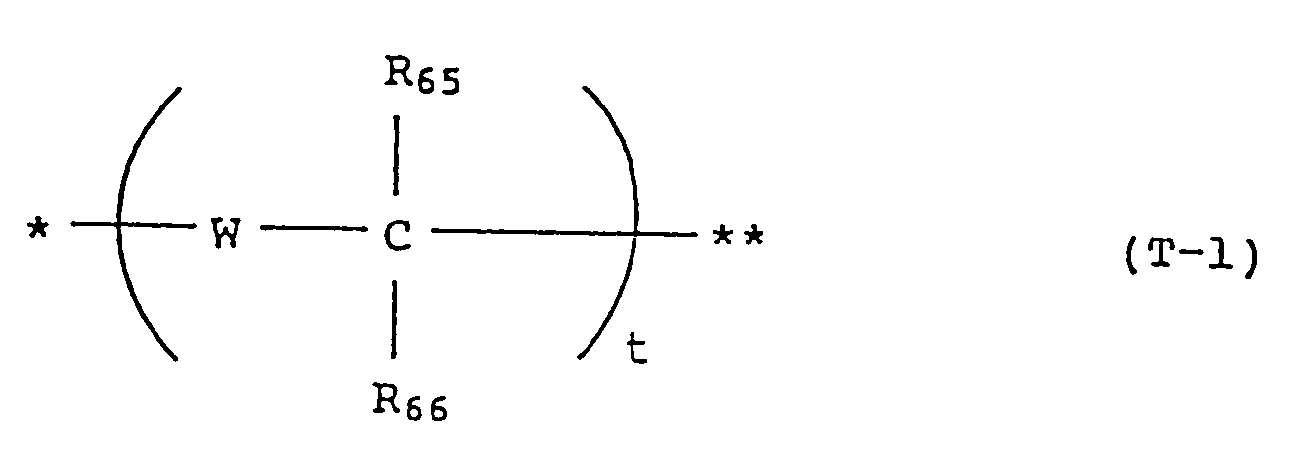
- T-1 JP-A-60-249148 (U.S. Patent 4,698,297) and JP-A-60-249149 (U.S. Patent 4,652,516), and are represented by the following general formula (T-1): wherein a bond indicated by * denotes the position at which the group is connected to the upper side group in the general formula (II); a bond indicated by ** denotes the position at which the group is connected to the lower side group in the general formula (II); W represented an oxygen atom, a sulfur atom or a group of R65 and R66 each represents a hydrogen atom or a substituent; R67 represents a substituent; t represents 1 or 2; and when t represents 2, two may be the same or different.
- R65, R66 or R67 include a group of R69, a group of R69CO-, a group of R69SO2-, a group of and a group of etc., wherein R69 represents an aliphatic group, an aromatic group or a heterocyclic group as defined above; and R70 represents a hydrogen atom, an aliphatic group, an aromatic group or a heterocyclic group as defined above.
- Each of the groups represented by R65, R66 and R67 may also represents a divalent group and be connected with each other to form a cyclic structure.
- T-2 *-Nu-Link-E-** (T-2) wherein a bond indicated by * denotes the position at which the group is connected to the upper side group in the general formula (II); a bond indicated by** denotes the position at which the group is connected to the lower side group in the general formula (II); Nu represents a nucleophilic group such as an oxygen atom or a sulfur atom; E represents an electrophilic group which is able to cleave the bond indicated by ** upon a nucleophilic attack of Nu; and Ling represents a linking group which connects Nu with E in a stereochemical position capable of causing an intramolecular nucleophilic displacement reaction between Nu and E.
- T-2 *-Nu-Link-E-**
- T-3 Examples of these groups include those descried in U.S. Patents 4,409,323 and 4,421,845, and are represented by the following general formula (T-3): wherein a bond indicated by *, a bond indicated by **, W, R65, R66 and t each has the same meaning as defined in the general formula (T-1) above.
- T-6 examples include those described in U.S. Patent 4,546,073, and are represented by the following general formula (T-6): wherein a bond indicated by *, a bond indicated by ** and W each has the same meaning as defined in the general formula (T-1); and R68 has the same meaning as defined for R67 in the general formula (T-1) above.
- PUG represents a photographically useful group.
- Suitable examples of the photographically useful groups include those which provide development inhibitors, development accelerators, bleach restraining agents, bleach accelerating agents, developing agents, fixing agents, silver halide solvents, silver-complex forming agents, hardening agents, tanning agents, tanning agents, toning agent, fogging agents, antifogging agents, chemical sensitizers, desensitizers, photographic dyes or precursors thereof, and couplers (including competing couplers, color forming couplers, and development inhibitor releasing couplers).
- PUG in the general formula (II) represents a development inhibitor
- suitable examples of the releasing groups include those described, for example, in U.S.Patents 4,390,618 and 4,724,199, JP-A-59-168444, JP-A-60-128440, JP-A-60-191241, JP-A-61-212842, JP-A-62-166340, JP-A-62-168147, JP-A-62-205344 and JP-A-63-73245.
- PUG in the general formula (II) represents a bleach accelerating agent
- suitable examples of the releasing groups include those as described, for example, in JP-A-61-201247 (EP-A-193,389), JP-A-62-173467, JP-A-63-70239, JP-A-63-70854, JP-A-63-70851, JP-A-63-70852, JP-A-63-70853 and JP-A-63-73245.
- the group represented by PUG is preferably a development inhibitor.
- the development inhibitors include a phenyltetrazolylthio group, a 1,3,4-thiadiazolyl-2-thio group, a 1,3,4-oxadiazolyl-2-thio group, a 1,3,4-triazolyl-2-thio group, a benzimidazolyl-2-thio group, a benzoxazolyl-2-thio group, benzothiazolyl-2-thio group, a benzotriazolyl group, a benzoindazolyl group and an imidazolylthio group.
- These groups may be substituted with one or more substituents as those for the aromatic group represented by R2 described above on the positions capable of being substituted.
- a more preferred PUG is a group providing a compound having a development inhibiting function when being released as PUG.
- a development inhibitor which is capable of being decomposed (or changed into) a compound having substantially no effect on photographic properties after being discharged into a color developing solution is particularly preferred.
- development inhibitors include those as described in U.S. Patent 4,477,563, JP-A-60-218644, JP-A-60-221750, JP-A-60-233650 and JP-A-61-111743.
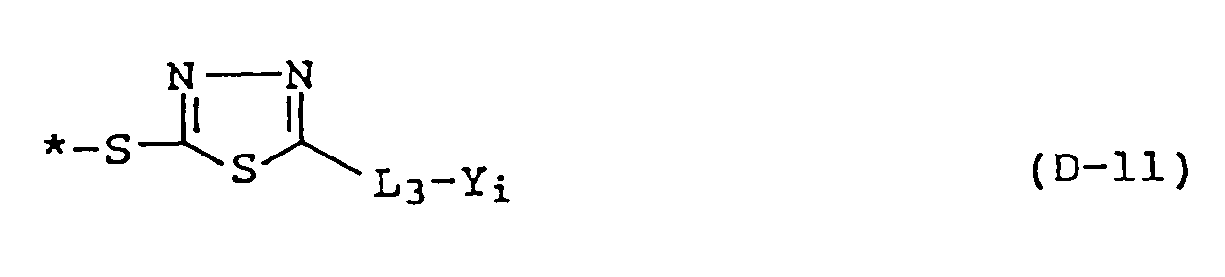
- Preferred examples of the development inhibitors include those represented by the following general formulas (D-1), (D-2), (D-3), (D-4), (D-5), (D-6), (D-7), (D-8), (D-9), (D-10), (D-11) and (D-12): wherein a bond indicated by * denotes the position at which the group is connected to the methine group or the linking group (L) in the general formula (II); R16 represents a hydrogen atom or a substituent; e represents 1 or 2; L3 represents a group containing a chemical bond which is capable of being cleaved in a developing solution; and Y i represents a substituent capable of generating the development inhibiting function and is selected from an aliphatic group, an aromatic group or a heterocyclic group.
- the development inhibitor described above which is released diffuses in a photographic layer while exhibiting the development inhibiting function and a part thereof discharges into the color developing solution.
- the development inhibitor discharged into the color developing solution rapidly decomposes at the chemical bond, included in L3, to releases the group represented by Y i (for example, hydrolysis of an ester bond) upon a reaction with a hydroxy ion or hydroxylamine generally present in the color developing solution; whereby the compound changes into a compound having a large water-solubility and a small development inhibiting function, and thus the development inhibiting function substantially disappears.
- R16 in the above described formulae is preferably a hydrogen atom, it may also be a substituent.
- substituents include an aliphatic group (for example, methyl, or ethyl), an aliphatic or aromatic acylamino group (for example, acetamido, or propionamido), an alkoxy group (for example, methoxy, or ethoxy), a halogen atom (for example, chlorine, or bromine), a nitro group, or an aliphatic or aromatic sulfonamido group (for example, methanesulfonamido).
- the linking group represented by L3 in the above described general formulae includes a chemical bond which is cleaved in a developing solution. Suitable examples of such chemical bonds include those described in the table below. These chemical bonds are cleaved with a nucleophilic reagent such as hydroxy ion or hydroxylamine, etc. which is a component of the color developing solution.
- the chemical bond group shown in the table above is connected directly or through an alkylene group and/or a phenylene group with a heterocyclic moiety constituting development inhibitor or a benzene ring constituting development inhititor (in the case of benzene condensed ring) and connected directly with Y i .
- the alkylene group and/or phenylene group may contain an ether bond, an amido bond, a carbonyl group, a thioether bond, a sulfon group, a sulfonamido bond or a ureido bond at the divalent group.
- the aliphatic group represented by Y i is a hydrocarbon group having from 1 to 20 carbon atoms, preferably from 1 to 10 carbon atoms, and may be saturated or unsaturated, straight chain, branched chain or cyclic, or substituted or unsubstituted.
- a substituted hydrocarbon group is particularly preferred.
- the aromatic group represented by Y i is a substituted or unsubstituted phenyl group or a substituted or unsubstituted naphthyl group.
- the heterocyclic group represented by Y i is a substituted or unsubstituted four-membered to eight-membered heterocyclic group containing at least one of a sulfur atom, an oxygen atom and a nitrogen atom as a hetero atom.
- heterocyclic groups include a pyridyl group, an imidazolyl group, a furyl group, a pyrazolyl group, an oxazolyl group, a thiazolyl group, a thiadiazolyl group, a triazolyl group, a diazolidinyl group, and a diadinyl group.
- Suitable examples of the substituents for the substituted aliphatic group, aromatic group or heterocyclic groups include a halogen atom, a nitro group, an alkoxy group having from 1 to 10 carbon atoms, an aryloxy group having from 6 to 10 carbon atoms, an alkanesulfonyl group having from 1 to 10 carbon atoms, an arylsulfonyl group having from 6 to 10 carbon atoms, an alkanamido group having from 2 to 10 carbon atoms, an anilino group, a benzamido group, a carbamoyl group, an alkyl carbamoyl group having from 2 to 10 carbon atoms, an aryl carbamoyl group having from 7 to 10 carbon atoms, an alkylsulfonamido group having from 1 to 10 carbon atoms, an arylsulfonamido group having from 6 to 10 carbon atoms, an alkylthio group having from 1 to 10 carbon atom
- the compound represented by the general formula (II) according to the present invention can be applied to a multilayer multicolor photographic material containing on a support at least three light-sensitive layers having spectral sensitivity different from each other for the main purpose of improving sharpness, color reproducibility or graininess.
- a multilayer natural color photographic material generally possesses at least one red-sensitive silver halide emulsion layer, at least one green-sensitive silver halide emulsion layer and at least one blue-sensitive silver halide emulsion layer, respectively, on a support.
- the order of the layers can be appropriately varied, if desired.
- the compounds according to the present invention can be added to any appropriate layer including not only a light-sensitive emulsion layer but also a layer adjacent thereto, for example, an intermediate layer. Further, the compounds according to the present invention can be added to any light-sensitive layer of appropriate sensitivity, for example, a high-sensitive layer or a low-sensitive layer.
- the amount of the compound represented by the general formula (II) according to the present invention to be added can be varied depending on the structure of the compound. However, it is preferred to use in a range from 1 ⁇ 10 ⁇ 6 mol to 0.5 mol, particularly from 1 ⁇ 10 ⁇ 5 mol to 1 ⁇ 10 ⁇ 1 mol per mol of silver (silver halide calculated as silver and colloidal silver) present in the same layer to which it is to be added, or a layer adjacent thereto directly.
- the compound represented by the general formula (II) according to the present invention can be employed in a combination with a color image forming coupler in a silver halide emulsion layer.
- a molar ratio of the compound according to the present invention/color image forming coupler is generally from 0.01/99.99 to 50/50, preferably from 1/99 to 30/70.
- Compound (1) was synthesized according to the route schematically shown below.
- Dyes 10 and 11 which were obtained from Compounds (25) and (26) according to the present invention described above were synthesized. The maximum absorption wavelength, and the molecular absorption coefficient ( ⁇ ) at the maximum absorption wavelength of each dye were measured. The results are shown in Table 1.
- compounds of the present invention can be employed in any of a blue, green and red sensitive layer and an intermediate layer without limitation, since they act as substantially non-color forming couplers.
- a preferably employed silver halide is silver iodobromide, silver iodochloride or silver iodochlorobromide, each containing about 30 mol% or less of silver iodide.
- Silver iodobromide containing from about 2 mol% to about 25 mol% of silver iodide is particularly preferred.
- Silver halide grains in the silver halide emulsion may have a regular crystal structure, for example, a cubic octahedral or tetradecahedral structure, an irregular crystal structure, for example, a spherical or tabular structure, a crystal defect, for example, a twin plane, or a composite structure thereof.
- the particle size of silver halide utilized may be varied and includes particles from fine grains, having about 0.2 micron diameter or less, to large size grains, having about a 10 micron diameter of projected area. Further, polydispersed emulsion and monodispersed emulsion of the same may be used.
- the silver halide photographic emulsion which can be used in the present invention can be prepared using known methods, for example, those as described in Research Disclosure , No. 17643 (December, 1978), pages 22 to 23, "I. Emulsion Preparation and Types" and ibid. , No. 18716 (November, 1979), page 648, P. Glafkides, Chimie et Physique Photographique , Paul Montel (1967), G.F. Duffin, Photographic Emulsion Chemistry , The Focal Press (1966), and V.L. Zelikman et al., Making and Coating Photographic Emulsion , The Focal Press (1964).
- Monodispersed emulsions as described, for example, in U.S. Patents 3,574,628 and 3,655,394, and British Patent 1,413,748 are preferably used in the present invention.
- tabular silver halide grains having an aspect ratio of about 5 or more can be employed in the present invention.
- the tabular grains may be easily prepared by the method as described, for example, in Gutoff, Photographic Science and Engineering , Vol. 14, pages 248 to 257 (1970), U.S. Patents 4,434,226, 4,414,310, 4,433,048 and 4,439,520, and British Patent 2,112,157.
- the crystal structure of silver halide grains may be uniform, composed of different halide compositions between the inner portion and the outer portion, or may have a stratified structure.
- silver halide emulsions in which silver halide grains having different compositions are connected upon epitaxial junctions, or silver halide emulsions in which silver halide grains are connected with compounds other than silver halide, such as silver thiocyanate, or lead oxide may also be employed.
- a mixture of grains having a different crystal structure may be used.
- the silver halide emulsion used in the present invention are usually conducted with physical ripening, chemical ripening and spectral sensitization.
- Various kinds of additives which can be employed in these steps are described in Research Disclosure , No. 17643, (December, 1978) and ibid. , No. 18716 (November, 1979). Concerned items thereof are summarized in the table shown below.
- yellow couplers used in the present invention for example, those as described in U.S. Patents 3,933,501, 4,022,620, 4,326,024 and 4,401,752, JP-B-58-10739, British Patents 1,425,020 and 1,476,760.
- magenta couplers used in the present invention 5-pyrazolone type and pyrazoloazole type compounds are preferred.
- cyan couplers used in the present invention phenol type and naphthol type couplers are exemplified.
- couplers capable of forming appropriately diffusible dyes those as described in U.S. Patent 4,366,237, British Patent 2,125,570, European Patent 96,570, and West German Patent Application (OLS) No. 3,234,533 are preferably employed.
- the couplers which can be used in the present invention can be introduced into the photographic light-sensitive material according to various known dispersing methods.
- organic solvents having a high boiling point which can be employed in an oil droplet-in-water type dispersing method are described, for example, in U.S. Patent 2,322,027.
- Suitable supports which can be used in the present invention are described, for example, in Research Disclosure , No. 17643, page 28 and ibid. , No. 18716, page 647, right column to page 648, left column, as mentioned above.
- a color developing solution which can be used in development processing of the color photographic light-sensitive material according to the present invention is preferably an alkaline aqueous solution containing an aromatic primary amine type color developing agent as a main component.
- an aromatic primary amine type color developing agent as a main component.
- an aminophenol type compound is also useful, a p-phenylenediamine type compound is preferably employed.
- Typical examples of the p-phenylenediamine type compounds include 3-methyl-4-amino-N,N-diethylaniline, 3-methyl-4-amino-N-ethyl-N- ⁇ -hydroxyethylaniline, 3-methyl-4-amino-N-ethyl-N- ⁇ -methanesulfonamidoethylaniline, 3-methyl-4-amino-N-ethyl-N- ⁇ -methoxyethylaniline, or sulfate, hydrochloride or p-toluenesulfonate thereof.
- Two or more kinds of color developing agents may be employed in a combination thereof, depending on the purpose.
- the color developing solution can ordinarily contain pH buffering agents, such as carbonates, borates or phosphates of alkali metals; and development inhibitors or anti-fogging agents such as bromides, iodides, benzimidazoles, benzothiazoles, or mercapto compounds.
- pH buffering agents such as carbonates, borates or phosphates of alkali metals
- development inhibitors or anti-fogging agents such as bromides, iodides, benzimidazoles, benzothiazoles, or mercapto compounds.
- the color developing solution may contain various preservatives such as hydroxylamine, diethylhydroxylamine, sulfites, hydrazines, phenylsemicarbazides, triethanolamine, catechol sulfonic acids, or triethylenediamine(1,4-diazabicyclo[2,2,2]octane); organic solvents such as ethyleneglycol, or diethylene glycol; development accelerators such as benzyl alcohol, polyethylene glycol, quarternary ammonium salts, or amines; dye forming couplers; competing couplers; fogging agents such as sodium borohydride; auxiliary developing agents such as 1-phenyl-3-pyrazolidone; viscosity imparting agents; and various chelating agents represented by aminopolycarboxylic acids, aminopolyphosphonic acids, alkylphosphonic acids, or phosphonocarboxylic acids.
- preservatives such as hydroxylamine, diethylhydroxylamine, sulfites, hydr
- chelating agents include ethylenediaminetetraacetic acid, nitrilotriacetic acid, diethylenetriaminepentaacetic acid, cyclohexanediaminetetraacetic acid, hydroxyethyliminodiacetic acid, 1-hydroxyethylidene-1,1-diphosphonic acid, nitrilo-N,N,N-trimethylenephosphonic acid, ethylenediamine-N,N,N′,N′-tetramethylenephosphonic acid, ethylenediamine-di(o-hydroxyphenylacetic acid), and salts thereof.
- black-and-white developing agents for example, dihydroxybenzenes such as hydroquinone, 3-pyrazolidones such as 1-phenyl-3 pyrazolidone, or aminophenols such as N-methyl-p-aminophenol may be employed individually or in a combination.
- the pH of the color developing solution or the black-and-white developing solution is usually in a range from 9 to 12.
- the photographic emulsion layers are usually subjected to a bleach processing.
- the bleach processing can be performed simultaneously with a fix processing (bleach-fix processing), or it can be performed independently from the fix processing. Further, for the purpose of a rapid processing, a processing method wherein after a bleach processing a bleach-fix processing is conducted may be employed.
- ferric complex salts of aminopolycarboxylic acid such as ethylenediaminetetraacetic acid, diethylenetriaminepentaacetic acid, cyclohexanediaminetetraacetic acid, or 1,3-diaminopropanetetraacetic acid
- aminopolycarboxylic acid such as ethylenediaminetetraacetic acid, diethylenetriaminepentaacetic acid, cyclohexanediaminetetraacetic acid, or 1,3-diaminopropanetetraacetic acid
- ferric complex salt of 1,3-diaminopropanetetraacetic acid is particularly preferred in view of rapid processing.
- the pH of the bleaching solution or bleach-fixing solution is preferably in a range from 3 to 7, particularly preferably from 4 to 6 in view of rapid processing.
- the silver halide color photographic material according to the present invention is generally subjected to a water washing step and/or a stabilizing step.
- An amount of water required for the water washing step may be set in a wide range depending on characteristics of photographic light-sensitive materials (due to elements used therein, for example, couplers, etc.), uses thereof, temperature of washing water, a number of water washing tanks (stages), a replenishment system such as countercurrent or orderly current, or other various conditions.
- a relationship between a number of water washing tanks and an amount of water in a multi-stage countercurrent system can be determined based on the method as described in Journal of the Society of Motion Picture and Television Engineers, Vol. 64, pages 248 to 253 (May, 1955).
- a pH of the washing water used in the processing of the photographic light-sensitive materials according to the present invention is usually from 4 to 9, preferably from 5 to 8.
- Temperature of washing water and time for a water washing step can be variously set depending on characteristics or uses the of photographic light-sensitive materials. However, one generally selects a range of from 15 to 45°C and a period from 20 sec. to 10 min., and preferably a range of from 25 to 40°C and a period from 30 sec. to 5 min.
- the photographic light-sensitive material of the present invention can also be directly processed with a stabilizing solution in place of the above-described water washing step.
- a stabilizing solution in place of the above-described water washing step.
- any of known methods as described, for example, in JP-A-57-8543, JP-A-58-14834 and JP-A-60-220345 can be employed.
- a stabilizing bath containing formalin and a surface active agent, which is employed as a final bath in the processing of color photographic light-sensitive materials for photography.
- various chelating agents and antimolds may also be added.
- various kinds of processing solutions can be employed in a temperature range from 10 to 50°C.
- a standard temperature is from 33 to 38°C, it is possible to carry out the processing at higher temperatures in order to accelerate the processing whereby the processing time is shortened, or at lower temperatures in order to achieve improvement in image quality and to maintain stability of the processing solutions.
- silver halide color photographic material excellent in image sharpness without losing sensitivity. Further, these silver halide color photographic materials are suitable for pradical use since their sensitivity and desilvering property are not deteriorated.
- a cellulose triacetate film support provided with a subbing layer, were coated layers, having the composition set forth below, to prepare a multilayer color light-sensitive material which was designated Sample 101.
- compositions of the layers coating amounts of silver halide and colloidal silver are shown by g/m2 units in terms of silver, the coating amounts of couplers, additives and gelatin are shown by g/m2 unites, and the coating amounts of sensitizing dyes are shown by mol per mol of silver halide present in the same layer.
- Second Layer Intermediate Layer
- Twelfth Layer High-Speed Blue-sensitive Emulsion Layer
- Second Protective Layer Second Protective Layer
- Each layer described above further contained a stabilizer for emulsion (Cpd-3: 0.04 g/m2) and a surface active agent (Cpd-4: 0.02 g/m2) as a coating aid in addition to the above-described compounds.
- a stabilizer for emulsion Cpd-3: 0.04 g/m2
- a surface active agent Cpd-4: 0.02 g/m2
- Samples 102 to 113 were prepared in the same manner as described for Sample 101 except for using the compounds shown in Table 1 below in place of Coupler ExN-1 used in the low-speed green-sensitive emulsion layer (sixth layer) of Sample 101, respectively.
- the couplers shown below were employed for comparison.
- (Coupler disclosed in U.S. Patent 3,642,345) (Coupler disclosed in U.S. Patent 4,259,437)
- (Coupler disclosed in U.S. Patent 4,226,934) (Coupler disclosed in U.S. Patent 3,928,041) (Coupler disclosed in U.S. Patent 4,187,110) (Coupler disclosed in JP-B-52-82423)
- Samples 101 to 113 thus-prepared were exposed wedgewise to white light and then subjected to color development processing according to the processing steps shown below. As the results show, the almost the same sensitivity and gradation were obtained with each of these samples.
- composition of each processing solution used is illustrated below.
- City water was passed through a mixed bed type column filled with an H type strong acidic cation exchange resin (Amberlite IR-120B manufactured by Rhom & Haas Co.) and an OH type anion exchange resin (Amberlite IR-400 manufactured by Rhom & Haas Co.) to prepare water containing not more than 3 mg/l of calcium ion and magnesium ion.
- H type strong acidic cation exchange resin Amberlite IR-120B manufactured by Rhom & Haas Co.
- an OH type anion exchange resin Amberlite IR-400 manufactured by Rhom & Haas Co.
- composition of each processing solution used is illustrated below.
- City water was passed through a mixed bed type column filled with an H type strong acidic cation exchange resin (Amberlite IR-120B manufactured by Rhom & Haas Co.) and an OH type anion exchange resin (Amberlite IR-400 manufactured by Rhom & Haas Co.) to prepare water containing not more than 3 mg/l of calcium ion and magnesium ion.
- H type strong acidic cation exchange resin Amberlite IR-120B manufactured by Rhom & Haas Co.
- an OH type anion exchange resin Amberlite IR-400 manufactured by Rhom & Haas Co.
- a cellulose triacetate film support provided with a subbing layer, were coated layer, having the composition set forth below, to prepare a multilayer color photographic light-sensitive material which was designated Sample 114.
- compositions of the layers coating amounts of silver halide and colloidal silver are shown by g/m2 units in terms of silver, those of couplers, additives and gelatin are shown by g/m2 unites, and those of sensitizing dyes are shown by molar amount per mol of silver halide present in the same layer.
- Second Layer Intermediate Layer
- Fourth Layer Second Red-Sensitive Emulsion Layer
- Second Blue-Sensitive Emulsion Layer Second Blue-Sensitive Emulsion Layer
- Samples 114 to 1206 were prepared in the same manner as described for Sample 111 except for using the compounds shown in Table 2 below in place of Coupler ExN-1 used in the first green-sensitive emulsion layer (seventh layer) of Sample 111, respectively.
- Ex-B, Ex-C, Ex-D, Ex-E, Ex-F and Ex-G were employed for comparison.
- Samples 114 to 126 thus-prepared were exposed wedgewise to white light and then subjected to color development processing in the same manner as described in Example 1. As the results show, almost the same sensitivity and gradation were obtained with each of these samples.
Landscapes
- Chemical & Material Sciences (AREA)
- Organic Chemistry (AREA)
- Physics & Mathematics (AREA)
- General Physics & Mathematics (AREA)
- Silver Salt Photography Or Processing Solution Therefor (AREA)
Claims (19)
- Lichtempfindliches farbphotographisches Silberhalogenidmaterial, umfassend einen Träger und darauf mindestens eine Silberhalogenidemulsionsschicht, wobei das farbphotographische Silberhalogenidmaterial eine Verbindung der folgenden allgemeinen Formel (II) enthält:


- Lichtempfindliches farbphotographisches Silberhalogenidmaterial gemäß Anspruch 1, worin R₁ ausgewählt ist aus einem Halogenatom, einer aliphatischen Gruppe, einer aromatischen Gruppe, einer heterocyclischen Gruppe, einer Cyano-Gruppe, einer Alkoxy-Gruppe, einer Aryloxy-Gruppe, einer aliphatischen oder aromatischen Acyloxy-Gruppe, einer Carbamoyloxy-Gruppe, einer aliphatischen oder aromatischen Sulfonyloxy-Gruppe, einer aliphatischen oder aromatischen Acylamino-Gruppe, einer aliphatischen oder aromatische Sulfonamido-Gruppe, einer Carbamoyl-Gruppe, einer aliphatischen oder aromatischen Acyl-Gruppe, einer aliphatischen oder aromatischen Sulfonyl-Gruppe, einer Alkoxycarbonyl-Gruppe und einer Aryloxycarbonyl-Gruppe, und wenn n 2 ist, können zwei R₁ miteinander unter Bildung einer cyclischen Struktur kombinieren.
- Lichtempfindliches farbphotographisches Silberhalogenidmaterial gemäß Anspruch 1, worin R₂ eine aromatische Gruppe, eine heterocyclische Gruppe, eine aliphatische Gruppe, -OR₃ oder

- Lichtempfindliches farbphotographisches Silberhalogenidmaterial gemäß Anspruch 3, worin die heterocyclische Gruppe eine substituierte oder unsubstituierte heterocyclische Gruppe mit 1 bis 20 Kohlenstoffatomen ist, die mindestens ein Atom aus einem Stickstoffatom, einem Sauerstoffatom und einem Schwefelatom als Heteroatom enthält.
- Lichtempfindliches farbphotographisches Silberhalogenidmaterial gemäß Anspruch 2, worin die heterocyclische Gruppe ausgewählt aus der Gruppe bestehend aus einer 2-Pyridyl-Gruppe, einer 4-Pyridyl-Gruppe, einer 2-Thienyl-Gruppe, einer 2-Furyl-Gruppe, einer 2-Imidazolyl-Gruppe, einer Pyrazinyl-Gruppe, einer 2-Pyrimidinyl-Gruppe, einer 1-Imidazolyl-Gruppe, einer 1-Indolyl-Gruppe, einer Phthalimido-Gruppe, einer 1,3,4-Thiadiazol-2-yl-Gruppe, einer Benzoxazol-2-yl-Gruppe, einer 2-Chinolyl-Gruppe, einer 2,4-Dioxo-1,3-imidazolidin-5-yl-Gruppe, einer 2,4-Dioxo-1,3-imidazolidin-3-yl-Gruppe, einer Succinimido-Gruppe, einer Phthalimido-Gruppe, einer 1,2,4-Triazol-2-yl-Gruppe und einer 1-Pyrazolyl-Gruppe.
- Lichtempfindliches farbphotographisches Silberhalogenidmaterial gemäß Anspruch 3, worin die heterocyclische Gruppe ausgewählt ist aus der Gruppe bestehend aus einer 2-Pyridyl-Gruppe, einer 4-Pyridyl-Gruppe, einer 2-Thienyl-Gruppe, einer 2-Furyl-Gruppe, einer 2-Imidazolyl-Gruppe, einer Pyrazinyl-Gruppe, einer 2-Pyrimidinyl-Gruppe, einer 1-Imidazolyl-Gruppe, einer 1-Indolyl-Gruppe, einer Phthalimido-Gruppe, einer 1,3,4-Thiadiazol-2-yl-Gruppe, einer Benzoxazol-2-yl-Gruppe, einer 2-Chinolyl-Gruppe, einer 2,4-Dioxo-1,3-imidazolidin-5-yl-Gruppe, einer 2,4-Dioxo-1,3-imidazolidin-3-yl-Gruppe, einer Succinimido-Gruppe, einer Phthalimido-Gruppe, einer 1,2,4-Triazol-2-yl-Gruppe und einer 1-Pyrazolyl-Gruppe.
- Lichtempfindliches farbphotographisches Silberhalogenidmaterial gemäß Anspruch 2, worin mindestens eine der aliphatischen, aromatischen und heterocyclischen Gruppen substituiert ist und der Substituent ausgewählt ist aus der Gruppe bestehend aus einem Halogenatom, einer Alkyl-Gruppe, einer Alkoxy-Gruppe, einer Aryloxy-Gruppe, einer Alkoxycarbonyl-Gruppe, einer Aryloxycarbonyl-Gruppe, einer aliphatischen oder aromatischen Sulfonamido-Gruppe, einer Sulfamoyl-Gruppe, einer Amino-Gruppe, einer Carbamoyl-Gruppe, einer aliphatischen oder aromatischen Acylamino-Gruppe, einer aliphatischen oder aromatischen Sulfonyl-Gruppe, einer Cyano-Gruppe, einer Aryl-Gruppe, einer Aralkyl-Gruppe, einer Nitro-Gruppe, einer Hydroxy-Gruppe, einer Carboxy-Gruppe, einer aliphatischen oder aromatischen Acyl-Gruppe oder einer heterocyclischen Gruppe.
- Lichtempfindliches farbphotographisches Silberhalogenidmaterial gemäß Anspruch 3, worin mindestens eine der aliphatischen, aromatischen und heterocyclischen Gruppen substituiert ist und der Substituent ausgewählt ist aus der Gruppe bestehend aus einem Halogenatom, einer Alkyl-Gruppe, einer Alkoxy-Gruppe, einer Aryloxy-Gruppe, einer Alkoxycarbonyl-Gruppe, einer Aryloxycarbonyl-Gruppe, einer aliphatischen oder aromatischen Sulfonamido-Gruppe, einer Sulfamoyl-Gruppe, einer Amino-Gruppe, einer Carbamoyl-Gruppe, einer aliphatischen oder aromatischen Acylamino-Gruppe, einer aliphatischen oder aromatischen Sulfonyl-Gruppe, einer Cyano-Gruppe, einer Aryl-Gruppe, einer Aralkyl-Gruppe, einer Nitro-Gruppe, einer Hydroxy-Gruppe, einer Carboxy-Gruppe, einer aliphatischen oder aromatischen Acyl-Gruppe oder einer heterocyclischen Gruppe.
- Lichtempfindliches farbphotographisches Silberhalogenidmaterial gemäß Anspruch 1, worin die durch L dargestellte Gruppe eine Gruppe ist, die durch die allgemeine Formel (T-1) dargestellt wird:


- Lichtempfindliches farbphotographisches Silberhalogenidmaterial gemäß Anspruch 1, worin die durch L dargestellte Gruppe eine Gruppe der folgenden allgemeinen Formel (T-2) ist:
*-Nu-Link-E-** (T-2)
worin eine durch * bezeichnete Bindung die Position angibt, in der die Gruppe mit der oberen Gruppe in der allgemeinen Formel (II) verbunden ist; eine durch ** bezeichnete Bindung die Position bezeichnet, in der die Gruppe mit der unteren Gruppe in der allgemeinen Formel (II) verbunden ist; Nu eine nukleophile Gruppe darstellt; E eine elektrophile Gruppe darstellt, die die durch ** bezeichnete Bindung bei einer nukleophilen Attacke von Nu abspalten kann; und Link eine verbindende Gruppe darstellt, die Nu mit E in einer stereochemischen Position verbindet, die imstande ist, eine intramolekulare nukleophile Verschiebungsreaktion zwischen Nu und E zu bewirken. - Lichtempfindliches farbphotographisches Silberhalogenidmaterial gemäß Anspruch 1, worin die durch L dargestellte Gruppe eine Gruppe der folgenden allgemeinen Formel (T-3) ist:


- Lichtempfindliches farbphotographisches Silberhalogenidmaterial gemäß Anspruch 1, worin die durch L dargestellte Gruppe eine Gruppe der folgenden allgemeinen Formeln (T-4) oder (T-5) ist:


- Lichtempfindliches farbphotographisches Silberhalogenidmaterial gemäß Anspruch 1, worin die durch L dargestellte Gruppe eine Gruppe der folgenden allgemeinen Formel (T-6) ist:


- Lichtempfindliches farbphotographisches Silberhalogenidmaterial gemäß Anspruch 1, worin die durch PUG dargestellte Gruppe ein Entwicklungsinhibitor ist.
- Lichtempfindliches farbphotographisches Silberhalogenidmaterial gemäß Anspruch 14, worin der Entwicklungsinhibitor eine Gruppe ist, die ausgewählt ist aus Gruppen der folgenden allgemeinen Formeln (D-1), (D-2), (D-3), (D-4), (D-5), (D-6), (D-7), (D-8), (D-9), (D-10), (D-11) und (D-12):



- Lichtempfindliches farbphotographisches Silberhalogenidmaterial gemäß Anspruch 15, worin der durch R₁₆ dargestellte Substituent ausgewählt ist aus einer aliphatischen Gruppe, einer aliphatischen oder aromatischen Acylamino-Gruppe, einer Alkoxy-Gruppe, einem Halogenatom, einer Nitro-Gruppe und einer Sulfonamido-Gruppe.
- Lichtempfindliches farbphotographisches Silberhalogenidmaterial gemäß Anspruch 15, worin die chemische Bindung, die in L₃ eingeschlossen ist, ausgewählt ist aus -COO-, -NHCOO-, -SO₂O-, -OCH₂CH₂SO₂-,


- Lichtempfindliches farbphotographisches Silberhalogenidmaterial gemäß Anspruch 1, worin die Menge der Verbindung in einem Bereich von 1 x 10⁻⁶ Mol bis 0,5 Mol pro Mol Silber, das in derselben Schicht, zu der es zugesetzt wird, oder einer benachbarten Schicht vorliegt, liegt.
- Lichtempfindliches farbphotographisches Silberhalogenidmaterial gemäß Anspruch 1, worin die Silberhalogenidemulsionsschicht einen Farbbilderzeugenden Kuppler in einem Molverhältnis von Kuppler zu Verbindung der Formel (II) von 0,01/99,99 bis 50/50 enthält.
Applications Claiming Priority (2)
| Application Number | Priority Date | Filing Date | Title |
|---|---|---|---|
| JP148906/88 | 1988-06-16 | ||
| JP63148906A JP2522690B2 (ja) | 1988-06-16 | 1988-06-16 | ハロゲン化銀カラ―写真感光材料 |
Publications (3)
| Publication Number | Publication Date |
|---|---|
| EP0346899A2 EP0346899A2 (de) | 1989-12-20 |
| EP0346899A3 EP0346899A3 (en) | 1990-05-09 |
| EP0346899B1 true EP0346899B1 (de) | 1994-08-31 |
Family
ID=15463311
Family Applications (1)
| Application Number | Title | Priority Date | Filing Date |
|---|---|---|---|
| EP19890110883 Expired - Lifetime EP0346899B1 (de) | 1988-06-16 | 1989-06-15 | Lichtempfindliches farbphotographisches Silberhalogenidmaterial |
Country Status (3)
| Country | Link |
|---|---|
| EP (1) | EP0346899B1 (de) |
| JP (1) | JP2522690B2 (de) |
| DE (1) | DE68917802T2 (de) |
Families Citing this family (8)
| Publication number | Priority date | Publication date | Assignee | Title |
|---|---|---|---|---|
| JPH0580466A (ja) * | 1990-03-12 | 1993-04-02 | Fuji Photo Film Co Ltd | ハロゲン化銀カラー写真感光材料 |
| JP2794503B2 (ja) * | 1990-10-24 | 1998-09-10 | 富士写真フイルム株式会社 | ハロゲン化銀カラー写真感光材料 |
| US5385815A (en) | 1992-07-01 | 1995-01-31 | Eastman Kodak Company | Photographic elements containing loaded ultraviolet absorbing polymer latex |
| DE4329418A1 (de) * | 1993-09-01 | 1995-03-02 | Agfa Gevaert Ag | Gelbkuppler |
| JPH08101477A (ja) | 1994-08-01 | 1996-04-16 | Eastman Kodak Co | 水性写真用コーティング組成物 |
| FR2793245B1 (fr) | 1999-05-05 | 2002-10-11 | Adir | Nouveaux composes pyridiniques ou piperidiniques substitues, leur procede de preparation et les compositions pharmaceutiques qui les contiennent |
| JP4010169B2 (ja) | 2002-04-09 | 2007-11-21 | 三菱自動車工業株式会社 | 車体構造 |
| WO2025233822A1 (en) | 2024-05-08 | 2025-11-13 | Cochrane Usa Inc. | Barrier |
Family Cites Families (5)
| Publication number | Priority date | Publication date | Assignee | Title |
|---|---|---|---|---|
| US4226934A (en) * | 1977-08-12 | 1980-10-07 | Ciba-Geigy Ag | Light sensitive photographic material containing development inhibitor releasing compounds |
| GB2032914B (en) * | 1977-08-12 | 1982-07-14 | Ciba Geigy Ag | Hetero-cyclyl-substituted phenacyl thioether derivatives for use as photographic development inhibitors |
| JPS5533102A (en) * | 1978-04-11 | 1980-03-08 | Konishiroku Photo Ind Co Ltd | Silver halide color photographic material |
| JPS56116029A (en) * | 1980-01-16 | 1981-09-11 | Konishiroku Photo Ind Co Ltd | Silver halide color photographic sensitive material |
| DE3711418A1 (de) * | 1987-04-04 | 1988-10-20 | Agfa Gevaert Ag | Farbfotografisches aufzeichnungsmaterial mit einem kuppler, der eine fotografisch wirksame verbindung freisetzt |
-
1988
- 1988-06-16 JP JP63148906A patent/JP2522690B2/ja not_active Expired - Fee Related
-
1989
- 1989-06-15 EP EP19890110883 patent/EP0346899B1/de not_active Expired - Lifetime
- 1989-06-15 DE DE1989617802 patent/DE68917802T2/de not_active Expired - Fee Related
Also Published As
| Publication number | Publication date |
|---|---|
| EP0346899A3 (en) | 1990-05-09 |
| JPH022552A (ja) | 1990-01-08 |
| DE68917802D1 (de) | 1994-10-06 |
| EP0346899A2 (de) | 1989-12-20 |
| DE68917802T2 (de) | 1995-02-02 |
| JP2522690B2 (ja) | 1996-08-07 |
Similar Documents
| Publication | Publication Date | Title |
|---|---|---|
| US4818664A (en) | Processing of silver halide color photographic materials containing a compound releasing a specified development inhibitor | |
| US4842994A (en) | Material comprising a novel bleach accelerator-releasing coupler | |
| GB2165954A (en) | Method for processing of silver halide color photographic materials | |
| EP0336411A2 (de) | Farbphotographisches Silberhalogenidmaterial | |
| EP0346899B1 (de) | Lichtempfindliches farbphotographisches Silberhalogenidmaterial | |
| EP0362808B1 (de) | Farbphotographisches Silberhalogenidmaterial | |
| US5118597A (en) | Silver halide color photographic material containing at least one monodispersed emulsion having a specified particle size distribution | |
| EP0456257A1 (de) | Farbphotographisches Silberhalogenidmaterial | |
| EP0285176B1 (de) | Farbphotographisches Silberhalogenidmaterial | |
| EP0720047B1 (de) | Photographisches Element das einen stabilen Aryloxypyrazolonekuppler enthält und Verfahren das diesen verwendet | |
| DE69603934T2 (de) | Photographisches Material, das einen verbesserten Pyrazolotriazolkuppler enthält | |
| EP0622673B1 (de) | Photographische Farbkuppler und Materialien, die diese Kuppler enthalten | |
| US5021329A (en) | Silver halide photographic material containing a dye precursor residue | |
| CN1258859A (zh) | 可促进显影的照相记录材料 | |
| JPH0750319B2 (ja) | ハロゲン化銀カラ−写真感光材料 | |
| US5385814A (en) | Silver halide color photographic light-sensitive material | |
| JP2553890B2 (ja) | ハロゲン化銀カラー写真感光材料 | |
| US5302502A (en) | Silver halide color photographic material | |
| EP0681215A1 (de) | Photographische Elemente enthaltend Acylacetanilid-Kuppler in Kombination mit einem einen Entwicklungsinhibitor freisetzenden Kuppler | |
| JP2001075245A (ja) | ハロゲン化銀カラー写真感光材料 | |
| DE69900970T2 (de) | Fotografisches Element, das einen Kuppler enthält, der eine fotografisch nützliche Pyrazolongruppe freisetzt, sowie Bildaufzeichnungs-Verfahren, unter Verwendung desselben | |
| JP2000206656A (ja) | 写真要素 | |
| US6787294B1 (en) | Photographic material comprising a bicyclic pyrazolotriazole coupler with improved hue | |
| JP2559247B2 (ja) | ハロゲン化銀カラー写真感光材料 | |
| US6852480B1 (en) | Photographic material comprising a bicyclic pyrazolotriazole coupler with improved photographic properties |
Legal Events
| Date | Code | Title | Description |
|---|---|---|---|
| PUAI | Public reference made under article 153(3) epc to a published international application that has entered the european phase |
Free format text: ORIGINAL CODE: 0009012 |
|
| AK | Designated contracting states |
Kind code of ref document: A2 Designated state(s): DE FR GB NL |
|
| PUAL | Search report despatched |
Free format text: ORIGINAL CODE: 0009013 |
|
| AK | Designated contracting states |
Kind code of ref document: A3 Designated state(s): DE FR GB NL |
|
| 17P | Request for examination filed |
Effective date: 19901102 |
|
| 17Q | First examination report despatched |
Effective date: 19930528 |
|
| GRAA | (expected) grant |
Free format text: ORIGINAL CODE: 0009210 |
|
| AK | Designated contracting states |
Kind code of ref document: B1 Designated state(s): DE FR GB NL |
|
| PG25 | Lapsed in a contracting state [announced via postgrant information from national office to epo] |
Ref country code: NL Effective date: 19940831 Ref country code: FR Effective date: 19940831 |
|
| REF | Corresponds to: |
Ref document number: 68917802 Country of ref document: DE Date of ref document: 19941006 |
|
| EN | Fr: translation not filed | ||
| NLV1 | Nl: lapsed or annulled due to failure to fulfill the requirements of art. 29p and 29m of the patents act | ||
| PLBE | No opposition filed within time limit |
Free format text: ORIGINAL CODE: 0009261 |
|
| STAA | Information on the status of an ep patent application or granted ep patent |
Free format text: STATUS: NO OPPOSITION FILED WITHIN TIME LIMIT |
|
| 26N | No opposition filed | ||
| REG | Reference to a national code |
Ref country code: GB Ref legal event code: IF02 |
|
| PGFP | Annual fee paid to national office [announced via postgrant information from national office to epo] |
Ref country code: GB Payment date: 20040609 Year of fee payment: 16 |
|
| PGFP | Annual fee paid to national office [announced via postgrant information from national office to epo] |
Ref country code: DE Payment date: 20040624 Year of fee payment: 16 |
|
| PG25 | Lapsed in a contracting state [announced via postgrant information from national office to epo] |
Ref country code: GB Free format text: LAPSE BECAUSE OF NON-PAYMENT OF DUE FEES Effective date: 20050615 |
|
| PG25 | Lapsed in a contracting state [announced via postgrant information from national office to epo] |
Ref country code: DE Free format text: LAPSE BECAUSE OF NON-PAYMENT OF DUE FEES Effective date: 20060103 |
|
| GBPC | Gb: european patent ceased through non-payment of renewal fee |
Effective date: 20050615 |