EP0343694A2 - Mittel zur Behandlung und zum Schutz der Haut - Google Patents
Mittel zur Behandlung und zum Schutz der Haut Download PDFInfo
- Publication number
- EP0343694A2 EP0343694A2 EP89112798A EP89112798A EP0343694A2 EP 0343694 A2 EP0343694 A2 EP 0343694A2 EP 89112798 A EP89112798 A EP 89112798A EP 89112798 A EP89112798 A EP 89112798A EP 0343694 A2 EP0343694 A2 EP 0343694A2
- Authority
- EP
- European Patent Office
- Prior art keywords
- vitamin
- alpha
- tocopherol
- ointment
- capsule contains
- Prior art date
- Legal status (The legal status is an assumption and is not a legal conclusion. Google has not performed a legal analysis and makes no representation as to the accuracy of the status listed.)
- Granted
Links
Classifications
-
- A—HUMAN NECESSITIES
- A61—MEDICAL OR VETERINARY SCIENCE; HYGIENE
- A61K—PREPARATIONS FOR MEDICAL, DENTAL OR TOILETRY PURPOSES
- A61K8/00—Cosmetics or similar toiletry preparations
- A61K8/18—Cosmetics or similar toiletry preparations characterised by the composition
- A61K8/30—Cosmetics or similar toiletry preparations characterised by the composition containing organic compounds
- A61K8/67—Vitamins
- A61K8/676—Ascorbic acid, i.e. vitamin C
-
- A—HUMAN NECESSITIES
- A61—MEDICAL OR VETERINARY SCIENCE; HYGIENE
- A61K—PREPARATIONS FOR MEDICAL, DENTAL OR TOILETRY PURPOSES
- A61K31/00—Medicinal preparations containing organic active ingredients
- A61K31/33—Heterocyclic compounds
- A61K31/335—Heterocyclic compounds having oxygen as the only ring hetero atom, e.g. fungichromin
- A61K31/35—Heterocyclic compounds having oxygen as the only ring hetero atom, e.g. fungichromin having six-membered rings with one oxygen as the only ring hetero atom
- A61K31/352—Heterocyclic compounds having oxygen as the only ring hetero atom, e.g. fungichromin having six-membered rings with one oxygen as the only ring hetero atom condensed with carbocyclic rings, e.g. methantheline
- A61K31/353—3,4-Dihydrobenzopyrans, e.g. chroman, catechin
- A61K31/355—Tocopherols, e.g. vitamin E
-
- A—HUMAN NECESSITIES
- A61—MEDICAL OR VETERINARY SCIENCE; HYGIENE
- A61K—PREPARATIONS FOR MEDICAL, DENTAL OR TOILETRY PURPOSES
- A61K31/00—Medicinal preparations containing organic active ingredients
- A61K31/33—Heterocyclic compounds
- A61K31/335—Heterocyclic compounds having oxygen as the only ring hetero atom, e.g. fungichromin
- A61K31/365—Lactones
- A61K31/375—Ascorbic acid, i.e. vitamin C; Salts thereof
-
- A—HUMAN NECESSITIES
- A61—MEDICAL OR VETERINARY SCIENCE; HYGIENE
- A61K—PREPARATIONS FOR MEDICAL, DENTAL OR TOILETRY PURPOSES
- A61K8/00—Cosmetics or similar toiletry preparations
- A61K8/18—Cosmetics or similar toiletry preparations characterised by the composition
- A61K8/30—Cosmetics or similar toiletry preparations characterised by the composition containing organic compounds
- A61K8/67—Vitamins
- A61K8/671—Vitamin A; Derivatives thereof, e.g. ester of vitamin A acid, ester of retinol, retinol, retinal
-
- A—HUMAN NECESSITIES
- A61—MEDICAL OR VETERINARY SCIENCE; HYGIENE
- A61K—PREPARATIONS FOR MEDICAL, DENTAL OR TOILETRY PURPOSES
- A61K8/00—Cosmetics or similar toiletry preparations
- A61K8/18—Cosmetics or similar toiletry preparations characterised by the composition
- A61K8/30—Cosmetics or similar toiletry preparations characterised by the composition containing organic compounds
- A61K8/67—Vitamins
- A61K8/673—Vitamin B group
-
- A—HUMAN NECESSITIES
- A61—MEDICAL OR VETERINARY SCIENCE; HYGIENE
- A61K—PREPARATIONS FOR MEDICAL, DENTAL OR TOILETRY PURPOSES
- A61K8/00—Cosmetics or similar toiletry preparations
- A61K8/18—Cosmetics or similar toiletry preparations characterised by the composition
- A61K8/30—Cosmetics or similar toiletry preparations characterised by the composition containing organic compounds
- A61K8/67—Vitamins
- A61K8/678—Tocopherol, i.e. vitamin E
-
- A—HUMAN NECESSITIES
- A61—MEDICAL OR VETERINARY SCIENCE; HYGIENE
- A61Q—SPECIFIC USE OF COSMETICS OR SIMILAR TOILETRY PREPARATIONS
- A61Q17/00—Barrier preparations; Preparations brought into direct contact with the skin for affording protection against external influences, e.g. sunlight, X-rays or other harmful rays, corrosive materials, bacteria or insect stings
-
- A—HUMAN NECESSITIES
- A61—MEDICAL OR VETERINARY SCIENCE; HYGIENE
- A61Q—SPECIFIC USE OF COSMETICS OR SIMILAR TOILETRY PREPARATIONS
- A61Q17/00—Barrier preparations; Preparations brought into direct contact with the skin for affording protection against external influences, e.g. sunlight, X-rays or other harmful rays, corrosive materials, bacteria or insect stings
- A61Q17/04—Topical preparations for affording protection against sunlight or other radiation; Topical sun tanning preparations
-
- A—HUMAN NECESSITIES
- A61—MEDICAL OR VETERINARY SCIENCE; HYGIENE
- A61Q—SPECIFIC USE OF COSMETICS OR SIMILAR TOILETRY PREPARATIONS
- A61Q19/00—Preparations for care of the skin
- A61Q19/08—Anti-ageing preparations
-
- A—HUMAN NECESSITIES
- A61—MEDICAL OR VETERINARY SCIENCE; HYGIENE
- A61Q—SPECIFIC USE OF COSMETICS OR SIMILAR TOILETRY PREPARATIONS
- A61Q7/00—Preparations for affecting hair growth
Definitions
- the present invention relates to an agent for the treatment and protection of the skin using vitamin E.
- Vitamin E is known as an antioxidant and protective vitamin for phosphorus lipids in the cell membrane. It maintains the permeability and stability of the cell membrane; Lucy, Ann. N.Y. Academy of Science 203 1972, p. 4. It is also known that vitamin E has a membrane sealing effect; F. Mittelbach and G. Bodmül, Kunststoff Medical Weekly Bulletin 110 (1968) 36: 1988-1993. With erythrocytes, the simplest cells in the human body, it has been found that vitamin E acts as a protective agent for the cell membrane. Animal and human studies have shown that anemia is the first sign of vitamin E deficiency. When high doses of vitamin E are administered, hemolysis of the erythrocytes normalizes; see. William J.
- Vitamin E has also been used to treat sickle cell anemia over a period of 6 to 35 weeks; see. Natt CL. At the. J. clin. 33, pp. 968-971 (1980); Natt CL. At the. J. clin. nutr. 32, pp. 1359-1362 (1979); Gawlik G.M. Fed. Proc. 35 (3), p. 252 (1976) and Gorash L. Bieri J.G. et al univ. Conn. Farmington, GT.
- Vitamin E has continued to be used successfully in patients with acute hepatitis and alcoholic hepatitis who have a deficiency of vitamin E in the serum; see. Yoshiakawa T. Takemura S. Kato H. et al. Japan J. Gastrovent, 74/7, pp. 732-739 (1977). Finally, vitamin E was used in patients with iron deficiency anemia and brought about an improvement or normalization of lipid metabolism in the bone marrow over a period of 4 to 8 weeks; see. Takoshi Itaga, Central Clinical Laboratory Nagasaki University of Medicine, Japan.
- cholesterol alpha oxide a substance known as a carcinogen, by ultraviolet light.
- mice Experiments with mice have shown that no cholesterol alpha oxide is formed when vitamin E and C and two further antioxidants are administered (Pharm. Indu. 36, No. 3 (1974) Anschel, USA).
- vitamin E and combinations of vitamin E with other active ingredients are suitable as agents, in particular for the treatment of eczema, skin lichen, skin inflammation, itching, allergies, wrinkles, pigmentation of the skin and hair loss and wounds.
- the agents according to the invention can be used as protection against ultraviolet light and to promote hair growth.
- the agents according to the invention are also used as skin protection agents in the case of radiation, e.g. cancer patients. Based on current knowledge, this new area of indication could not be foreseen and opens up a new, broad field of application for vitamin E.
- the use of vitamin E brings about long-term stabilization and permanent elimination of symptoms, which means that the likelihood of relapse is very low.
- the vitamin E-containing combination products must, however, be used for a long time, approx. 6 months or longer.
- the present invention thus relates to an agent for the treatment and protection of human and animal skin, which is characterized in that, in addition to conventional carriers and / or auxiliaries, it is an essential constituent of high-dose vitamin E and also, if appropriate, vitamin C, vitamin A, B-series vitamins, blood circulation and / or vasodilators, phospholipids, unsaturated fatty acids and / or emulsifiers.
- vitamin E is liquid at room temperature
- the capsule is particularly suitable as an application form.
- the other active ingredients are in vitamin E and, if desired, in a low-viscosity neutral oil and introduced into the capsules by a solubilizer in a manner known per se.
- Emulsifiers for example Tween, can also be used here.
- a sufficient dosage which should be at least 200 mg, is particularly important for the effectiveness of vitamin E.
- Lower doses of vitamin E make little sense, since significant amounts are destroyed by the gastric acid and thereby lose their effectiveness (cf. Arthur Vogelsang, Angiology 21, pp. 275 to 279 (1970)).
- the dosage should be in the range of 200 to 1,000 mg. Dosage forms containing 250 to 600 mg are preferably used. Typical combination preparations contain 300 to 500 mg of vitamin E, each per dosage unit.
- Vitamin E can be used in all of its alpha forms, both as free tocopherol and as an ester of natural or synthetic origin. This ester can be used as acetate, succinate or as another ester. For ointments, gels and creams the free tocopherol, e.g. D, L-alpha-tocopherol and D-alpha-tocopherol are used.
- vitamin E The absorption of vitamin E through the skin is improved in particular in the presence of blood circulation-promoting agents such as heparin sodium or extr. Hippocastani.
- blood circulation-promoting agents such as heparin sodium or extr. Hippocastani.
- heparin sodium When using heparin sodium, the high dosage of 30,000 to 150,000 IU. prefers.
- agents that significantly increase the effect of vitamin E and can thus be used according to the invention are blood circulation-promoting agents, such as ⁇ -hydroxyethyl rutoside, trimethylol rutoside, arnicae extract, nicotinic acid, nicotinic acid esters and derivatives, xantinol nicotinate and inositol nicotinate, as well as salicylic acid and the like whose esters, dihydroergotoxin methane sulfonate, dihydroergocornin methane sulfonate, dihydroergocristine methane sulfonate, ⁇ -hydroxyethyl salicylate, Ol. Juniperi, Ol.
- Pini pumilionis (mountain pine oil), Ol. Eucalypte Tinct. Camphorae or camphor, cinnarizine, vincamine, pentoxyfylline, bamethanesulfate, bencyclan hydrogen fumarate, ⁇ -pyridilcarbinol, ginkgoflavone glycosides.
- Other derivatives of the blood circulation or vasodilators can also be used.
- Extract Calendulae from Herba Calendulae should be mentioned as a vasodilating plant remedy.
- the circulation-promoting agents can also be used in the form of a sustained release. Numerous circulation-promoting agents, such as hydroxy-rutoside, also have anticoagulant properties.
- the combinations according to the invention with sufficient amounts of vitamin E further improve blood flow to the extremities, the periphery of the eye, the inner ear and the cerebrum. If you also dimethylaminoethanol or the combinations thereof Adding derivatives or salts increases the blood flow to the brain, the stimulation of the central nervous system and the ability to concentrate.
- the combinations according to the invention also have an advantageous effect on lipid and cholesterol metabolism.
- the agents according to the invention can also be used externally in the form of cream, gel, ointment or lotion or solution, optionally together with emulsifiers.
- the vitamin E concentration in this case is 0.5 to 20% by weight. 4 to 10% by weight are particularly preferred. You can also prepare other dosage forms, e.g. Sprays, tinctures or alcoholic solutions. Isopropanol or propanediol is a particularly preferred solvent that also promotes blood circulation.
- the concentration of vitamin E in this case can be 32% by weight. A concentration of up to 25% by weight per dosage form is preferred.
- Eucerin can cum. aqua, Ungt. Cordes, Ungt. Emulsificans, as well as other non-water-soluble ointment bases or their mixtures can be used.
- Suitable ointment bases are, for example, wool wax, Vaseline DAB 8, thin paraffin and mixtures thereof. They can also contain emulsifiers such as cetylstearyl alcohol. Unguentum alkoholum lanae aquosum with cetiol (oleic acid oleyl ester) and Unguentum lanette, cetylstearyl alcohol, Cetiol DAB 8, aqua conservata are also suitable as ointment bases.
- the agent according to the invention can also advantageously other vitamins, for example vitamins C, A, B1, B2 and B6 be set.
- the ointments according to the invention advantageously contain 70 to 30% by weight of water as the basis preferably 60 to 40% by weight, 30 to 5% by weight, preferably 25 to 7% by weight, cetiol (oleyl oleate), 30 to 2 wt .-%, preferably 25 to 2 wt .-% cetyl stearyl alcohol or other aliphatic alcohols.
- the cetyl-stearyl alcohol can also be replaced in whole or in part by other emulsifying alcohols, for example by aliphatic alcohols or wool wax alcohol or diols, stearinol, monoglycerides esterified with aliphatic acids or similar substances. Paraffin or petroleum jelly can also be added to make the ointment spreadable. Cetiol (oleyl oleate) can also be completely or partially replaced by other emulsifiers, for example Tween 20 or Tween 80.
- a particularly preferred combination as a basis for creams containing vitamin E is the following: 30 to 20% by weight of cetyl stearyl alcohol, 20 to 10% by weight of cetiol (oleyl oleate) 60 to 40 wt .-% water (aqua conservata).
- water-containing ointment bases such as Unguentum emulsificans aquosum and Unguentum alkoholum lanae aquosum are suitable for processing water-soluble active ingredients.
- water-containing ointment bases which can even have a water content of more than 50%, are very well suited for processing fat-soluble active ingredients such as vitamin E.
- the Mit bring according to the invention special advantages when vitamin A is added.
- the duration of treatment is shortened.
- the present invention also relates to novel skin treatment and protection agents which contain vitamin A together with vitamin E and blood circulation promoting agents.
- Vitamin A can be used in the form of vitamin A palmitate, vitamin A acetate and other esters of vitamin A and / or ⁇ -carotene.
- Vitamin A should be selected so that the maximum daily dose does not exceed 50,000 IU, ie if two dosage forms are used per day, the dosage should be a maximum of 25,000 IU per dosage form.
- the vitamin A dose of the agent according to the invention is between 5,000 and 25,000 IU, preferably 6,000 to 15,000 IU
- Vitamins A and E have a strong tendency to form lumps, especially in the presence of other active ingredients in an aqueous medium. There is a risk that the fat-soluble valuable substances will not be absorbed. It was surprisingly found that small amounts of emulsifier, about 1%, are sufficient to prevent the formation of lumps. The active ingredients are more easily dispersed or suspended in the aqueous medium. This has the advantage that absorption by the intestine is facilitated. A larger amount of emulsifier is not necessary, since 1 to 7% is usually sufficient to prevent the formation of lumps. Amounts up to 10% or more can also be used. However, there is a risk that too many auxiliary substances are added. The result can be side effects, especially if the drug is administered for a long time.
- emulsifiers used in the medical preparations such as Tween 20, Cre mophor, aliphatic alcohols, partially esterified triglycerides. According to the invention, however, Tween 80 and cetiol are preferred. It was observed here that when about 10% emulsifier was added, the emulsification was not significantly better than when 5% emulsifier was added.
- Lecithin can also be used as an emulsifier in a concentration between 1 and 13%. This promotes the absorption of the combination vitamin A + E, but especially vitamin E. A positive effect can be seen even when using large amounts of lecithin up to 50%. However, small amounts of the lecithin emulsifier are sufficient to prevent clumping of the fat-soluble vitamins and to promote optimal absorption. It is also recommended to add approx. 1% conventional emulsifiers such as Tween 80, as they promote the miscibility of lecithin with the two vitamins and prevent clumping. The use of approx. 1% Tween 80 with 1 to 13% lecithin is particularly advantageous for absorption.
- the conventional emulsifiers Tween 20, cetiol (oleic acid oleate) and Cremophor can also be used. Soy lecithin is preferred as the lecithin preparation.
- the agents according to the invention are also suitable as protection against ultraviolet light.
- UV stabilizers are added, which are skin-friendly as well as fat and water soluble, eg Eusolex R.
- the UV stabilizers can be added in an amount of 0.1 to 20% by weight. 0.5 to 10% by weight is preferred.
- additives can be cod liver oil and / or unsaturated fatty acids, eg linoleic acid, linolenic acid or oleic acid.
- unsaturated fatty acids silicone oils or polysiloxanes can also be used.
- the agents according to the invention are in combination with phospholipids e.g. Suitable for lecithin.
- phospholipids e.g. Suitable for lecithin.
- the phospholipids accelerate the penetration of vitamin E into the skin, thereby increasing the effectiveness of the vitamin E preparations.
- bufexamac can be added to the vitamin E preparations according to the invention for the treatment of skin inflammation. 3 to 10% by weight, based in each case on the dosage form, are preferred.
- bufexamac cream or ointment is suitable for the treatment of skin inflammation, allergies, eczema and itching. Surprisingly, however, the duration of treatment in the presence of vitamin E is significantly reduced and the likelihood of relapse is reduced. After the disease has subsided, it is preferred to rub only with vitamin E ointment to prevent relapse.
- the agents according to the invention can be combined with anti-allergic active substances, in particular antihistamines.
- anti-allergic active substances in particular antihistamines.
- vitamin E to such anti-allergic agents accelerates the healing process.
- antiallergic agents for example Clemastine hydrogen fumarate Chlorphenoxamine hydrochloride Dimetidine maleate Bamipin lactate or hydrochloride or other salts or esters Propylhexedrine hydrochloride Tritoqualine Dephenhydramine Meclozin hydrochloride used.
- the agents according to the invention can also serve to promote hair growth, especially when amino acids are added.
- the agents according to the invention contain the usual carriers and auxiliaries, which is particularly important for external applications.
- Example 1 100 g of ointment contain: 400 mg Allantoin; 400 mg Dexapanthenol; 5000 mg D-alpha tocopherol; 30000 IU Heparin sodium;
- Example 2 100 g of ointment contain: 2.5 g O- ( ⁇ -hydroxyethyl) rutoside; 6.5 g D-alpha-tocopherol or D, L-alpha-tocopherol;
- Example 3 100 g of ointment contain: 400 mg Allantoin; 400 mg Dexapanthenol; 8.8 g D-alpha-tocopherol or D, L-alpha-tocopherol; 30000 IU Heparin sodium
- Example 4 100 g of ointment contain: 4.5 g Extract Hippocastani (contains approx.
- Example 5 100 g of gel contain: 50000 IU Heparin sodium; 12 g Arnica flower extract ((1:10) alcohol 60%); 25 g Tinct. Hippocastani e sem.
- Example 10 1 corresponds to 0.65 g aescin; 7.5 g D-alpha tocopherol;
- Example 6 100 g of gel contain: 7.0 g ⁇ -hydroxyethyl salicylate; 7.0 g D-alpha tocopherol;
- Example 7 100 g of ointment contain: 10 g Benzocaine (anesthetic); 8 g D-alpha tocopherol concentrate; 1 g Benzyl nicotinate;
- Example 8 100 g of ointment contain: 3 g Hydroxyethyl salicylate; 1 g Benzyl nicotinate; 7 g D-alpha tocopherol;
- Example 9 100 g of ointment contain: 8 g D-alpha tocopherol; 400 mg Allantoin; 400 mg Dexapanthenol; 150000 IU Heparin sodium;
- Example 10 1 capsule contains: 250 mg Nicotinic acid; 400 mg D, L-alpha-
- Example 23 1 capsule contains: 150 mg Bencyclan hydrogen fumarate; 400 mg Vitamin E as D, L-alpha-tocopherol acetate; 150 mg Soybean oil.
- Example 24 1 capsule contains: Pentoxyfylline 400 mg Vitamin E. 400 mg Vitamin A acetate 15,000 IU Soybean oil 120 mg
- Example 25 1 capsule contains: Naftidirofuryl hydrogen oxalate 100 mg Vitamin E. 500 mg Vitamin A palmitate 30,000 IU Soybean oil 150 mg
- Example 27 100 ml drops of ethyl alcohol contain: Cinnarizine 7.5 g Vitamin E. 4.0 g Vitamin A palmitate 2.5 million units
- Example 28 1 capsule contains: Xantinol nicotinate 500 mg Vitamins E (DL-alpha-tocopherol) 400 mg Vitamin A palmitate 10,000 IU Tween 80 20 mg Soybean oil 150 mg
- Example 34 400 mg Vitamin A palmitate 15,000 IU Cetiol 20 mg Soybean oil 150 mg
- Example 34 1 capsule contains: D, L-alpha-tocopherol acetate 200 mg ⁇ -hydroxyethyl rutoside 300 mg Vitamin A palmitate 25,000 IU Soybean oil 120 mg
- Example 35 1 capsule contains: Pentoxyfylline 400 mg Vitamin E (D, L-alpha-tocopherol acetate) 400 mg Vitamin A palmitate 15,000 IU Tween 80 10 mg Soybean oil 150 mg
- Example 37 contains: Vincamin 30 mg Vitamin E (D, L-alpha-tocopherol acetate) 400 mg Vitamin A palmitate 30,000 IU Soybean oil 150 mg
- Example 38 100 g of ointment contain: 10 g D-alpha tocopherol 50,000 IU Heparin sodium the ointment base consists of 22 T.
- Example 39 100 g of ointment contain: 7 g Vitamin E (D-alpha-tocopherol) 1 g Benzyl nicotinate 1 g Fighter the ointment base consists of 17 d Cetyl stearyl alcohol 8 d White petroleum jelly 15 T. Cetiol 60 T. Water (aqua conservata)
- Example 40 100 g of ointment contain: 7 g Vitamin E. 15 g Tinct. calendulae ad 100 g of ointment base 13 T. Wool wax alcohol 2 d Cetyl stearyl alcohol 20 T.
- Example 41 100 g of ointment contain: 8 g Vitamin E (D, L-alpha-tocopherol) 1.5 g Rosemary oil 1 g Extract Hippocastani (standardized to at least 8% aescin) 1 g Oil juniperi Ointment base as in example 38
- Example 42 Solution 10 g Vitamin E (D-alpha tocopherol concentrate) 1 g Mountain pine oil (oil pini pumilionis) 1 g Eucalyptus oil 1 g Oil juniperi 1 g Tween 80 ad 100 g of isopropyl alcohol
- Example 46 1 capsule contains: Pentoxyfylline 400 mg Vitamin E (D, L-alpha-tocopherol acetate) 400 mg Vitamin A acetate 25,000 IU Soy lecithin 200 mg Soybean oil 120 mg Tween 80 8 mg
- Example 47 1 capsule contains: Naftidirofuryl hydrogen oxalate 100 mg Vitamin E (D-alpha tocopherol concentrate) 500 mg Vitamin A palmitate 30,000 IU Soy lecithin 25 mg Soybean oil 150 mg
- Example 48 1 capsule contains: Cinnarizine 75 mg Vitamin E (D-alpha tocopherol acetate) 400 mg Vitamin A palmitate 25,000 IU Vitamin B1, B2, B6 in equal parts 10 mg Vitamin B12 5 ⁇ g Soybean oil 100 mg Soy lecithin 280 mg
- Example 49 Contain 100 ml drops of ethyl alcohol Cinnarizine 7.5 g Vitamin E.
- Example 50 1 capsule contains: Xantinol nicotinate 500 mg Vitamin E (D, L-alpha-tocopherol) 400 mg Vitamin A palmitate 25,000 IU Tween 80 20 mg Soybean oil 150 mg Soy lecithin 25 mg
- Vitamin A palmitate 15,000 IU Cetiol (oleic acid ester) 10 mg Soybean oil 100 mg Soy lecithin 20 mg
- Example 56 1 capsule contains: D-alpha tocopherol 200 mg Lecithin 500 mg Soybean oil 180 mg Tween 80 10 mg
- Example 59 1 capsule contains: D-alpha tocopherol 400 mg Lecithin 400 mg Soybean oil 200 mg Tween 80 15 mg
- Vitamin A palmitate or vitamin A acetate or 9.5 mg ⁇ -carotene is 15,000 IU.
- Examples 46 to 60 can be used as agents for lowering the cholesterol level.
- Example 61 1 capsule contains: 20 mg Dimethylaminoethanol 400 mg D, L-alpha-tocopherol acetate 50 mg Soybean oil 200 mg Soy lecithin 200 mg ⁇ -hydroxyethyl rutoside
- Example 62 1 capsule contains: 20 mg Dimethylaminoethanol 400 mg D, L-alpha-tocopherol acetate 12,000 IU Vitamin A palmitate (6.67 mg) 100 mg Soybean oil 300 mg Lecithin 8 mg Tween 80 75 mg Cinnarizine
- Example 63 1 capsule contains: 25 mg Dimethylaminoethanol orotate 400 mg D, L-alpha-tocopherol acetate 15,000 IU Vitamin A palmitate (8.33 mg) 20 mg Soy lecithin 400 mg Nicotinic acid
- Example 65 1 capsule contains: 25 mg Dimethylaminoethanol orotate 500 mg D-alpha tocopherol concentrate 22,000 IU Vitamin A palmitate (12.22 mg) 28 mg Soy lecithin 120 mg Soybean oil 3.0 mg Ginkoflavone glucoside
- Example 67 1 capsule contains: 30 mg Dimethylaminoethanol orotate 400 mg D, L-alpha-tocopherol acetate 300 mg Lecithin 8 mg Tween 80 30 mg Vincamin
- Example 68 1 capsule contains: 25 mg Dimethylaminoethanol orotate 350 mg D-alpha tocopherol acetate 15,000 IU Vitamin A palmitate 5 mg each of vitamin B1, B2, B6, 5 ⁇ g vitamin B12 15 mg Nicotinamide 280 mg Lecithin 75 mg Cinnarizine
- Example 70 1 capsule contains: 25 mg Dimethylaminoethanol orotate 400 mg D, L-alpha-tocopherol acetate 15,000 IU Vitamin A palmitate (8.33 mg) 300 mg ⁇ -hydroxyethyl rutoside
- Example 72 1 capsule contains: 35 mg Dimethylaminoethanol orotate 500 mg D-alpha tocopherol concentrate 22,000 IU Vitamin A palmitate (12.22 mg) 400 mg Xantinol nicotinate
- Example 74 1 capsule contains: 30 mg Dimethylaminoethanol orotate 400 mg D, L-alpha-tocopherol acetate 400 mg Pentoxyfylline
- Example 75 1 capsule contains: 35 mg Dimethylaminoethanol orotate 350 mg D-alpha tocopherol acetate 15,000 IU Vitamin A palmitate 5 mg each of vitamin B1, B2, B6 5 ⁇ g vitamin B12 100 mg Bencyclan fumarate
- Example 77 1 capsule contains: 25 mg Dimethylaminoethanol orotate 350 mg D, L-alpha-tocopherol acetate 17,000 IU (9.44 mg) Vitamin A palmitate 70 mg Soybean oil 75 mg Cinnarizine
- Example 78 1 capsule contains: 20 mg Dimethylaminoethanol 200 mg D, L-alpha-tocopherol acetate 12,000 IU Vitamin A palmitate (6.67 mg) 50 mg Soybean oil 250 mg Soy lecithin
- Example 81 1 capsule contains: 20 mg Dimethylaminoethanol 200 mg D, L-alpha-tocopherol acetate 12,000 IU Vitamin A palmitate (6.67 mg) 50 mg Soybean oil
- Example 82 1 capsule contains: 35 mg Dimethylaminoethanol orotate 400 mg D, L-alpha-tocopherol acetate 15,000 IU Vitamin A palmitate (8.33 mg)
- Example 84 1 capsule contains: 35 mg Dimethylaminoethanol orotate 500 mg D-alpha tocopherol concentrate 22,000 IU Vitamin A palmitate (12.22 mg)
- Example 86 1 capsule contains: 30 mg Dimethylaminoethanol orotate 400 mg D, L-alpha-tocopherol acetate
- Example 87 1 capsule contains: 35 mg Dimethylaminoethanol orotate 350 mg D-alpha tocopherol acetate 15,000 IU Vitamin A palmitate 5 mg each of vitamin B1, B2, B6 5 ⁇ g vitamin B12 15 mg Nicotinamide
- Example 89 1 capsule contains: 25 mg Dimethylaminoethanol orotate 350 mg D, L-alpha-tocopherol acetate 17,000 IU (9.44 mg) Vitamin A palmitate 70 mg Soybean oil
- Example 90 Solution for external use, especially in the form of spray from: 33 T.
- Example 91 1 capsule contains: 600 mg D-alpha tocopherol concentrate 5000 IU Vitamin A 8 mg Tween 80 120 mg Soybean oil
- Example 92 1 capsule contains: 400 mg D-alpha tocopherol 8.250 mg Vitamin A 8 mg Tween 80
- Example 93 1 capsule contains: 500 mg D, L-alpha-tocopherol acetate 100 mg Soybean oil 1000 mg D, L-alpha-tocopherol acetate 10 mg Tween 80 150 mg Soybean oil
- Example 94 1 capsule contains: 30 mg Chlorphenoxamine hydrochloride 400 mg D, L-alpha-tocopherol acetate 50
- Example 96 1 capsule contains: 70 mg Bamipin hydrochloride 500 mg D-alpha tocopherol concentrate 100 mg Troxerutin 80 mg Peanut oil
- Example 97 1 capsule contains: 120 mg Tritoqualine 300 mg D-alpha tocopherol acetate 100 mg Troxerutin 80 mg Soybean oil
- An ointment contains: 40.0 g Clemastine hydrogen fumarate 8.0 g D-alpha tocopherol concentrate 60,000 IU Heparin sodium ad 100.0 g an ointment from 20.0 g cetiol (oleic acid oleyl ester) 20.0 g Cetylstearyl alcohol 60.0 aqua conservata
- An ointment contains: 1.5 g Chlorphenoxamine hydrochloride 10 g D, L-alpha tocopherol 50,000 IU Heparin sodium
- Example 102 An ointment contains: 5 g D-alpha tocopherol concentrate 10,000 IU Vitamin A palmitate 50,000 IU Heparin sodium ad 100.0 g Eucerin anhydricum
- Example 102 The same as Example 102 but with 8 g D-alpha tocopherol concentrate.
- Example 104 100 g of ointment contain: 5.0 g Bufexamac 8.0 g D-alpha tocopherol concentrate ad 100.0 g of an ointment base consisting of 20% cetylstearyl alcohol, 20% cetiol (oleic acid Oleylester) and 60% aqua conservata.
- Example 105 100 g of ointment contain: 5.0 g Bufexamac 8.0 g D, L-alpha tocopherol ad 100.0 g from an ointment base as under 104, but instead of 60% water 55% and 5% Vaseline Alba.
- Example 106 100 g of ointment contain: 10.0 g D-alpha tocopherol 500 mg Dexapanthenol 300 mg Allantoin ad 100.0 g of ointment base as example 104
- Example 107 100 g of ointment contain: 4.0 g Bufexamac 8.0 g D-alpha tocopherol 400 mg Dexapanthenol 400 mg Allantoin ad 100.0 g of ointment base as example 104
- Ointment as in example 106. Triglyceride mixtures were used as the ointment base.
- Example 110 1 capsule contains: 30 mg Chlorphenoxamine hydrochloride 400 mg D, L-alpha-tocopherol acetate 100 mg Soybean oil
- Example 112 1 capsule contains: 70 mg Bamipin hydrochloride 500 mg D-alpha tocopherol concentrate 80 mg Peanut oil
- Example 113 1 capsule contains: 120 mg Tritoqualine 300 mg D-alpha tocopherol acetate 80 mg Soybean oil
- Example 114 An ointment contains: 40.0 g Clemastine hydrogen fumarate 8.0 g D-alpha tocopherol concentrate ad 100.0 g an ointment from 20.0 g cetiol (oleic acid oleyl ester) 20.0 g Cetylstearyl alcohol 60.0 g aqua conservata
- Example 115 An ointment contains: 1.5 g Chlorphenoxamine hydrochloride 10 g D, L-alpha tocopherol ad 100.0 g of ointment as in example 114.
- Example 116 An ointment contains: 8 g D-alpha tocopherol concentrate 2 g Phospholipids 2 g 4-phenylbenzophenone-2-carboxylic acid isooctyl ester ad 100 g of ointment base 22 Parts of cetyl stearyl alcohol 18th Parts of Cetiol oleic acid oleyl ester 60 Parts of water
- Example 117 100 g of ointment contain: 3 g Hydroxyethyl salicylate 1 g Benzyl nicotinate 8 g D-alpha tocopherol concentrate 2 g Phospholipids ad 100.0 g of ointment base as in Example 116
- Example 122 A cream contains: 8 g D, L-alpha tocopherol concentrate 3 g Eusolex R (232 Merck) ad 100 g of ointment base as example 121
- Example 123 A cream contains: 12 g Vitamin E. 1 g Eusolex R (8020 Merck) ad 100 ointment base as example 121
- Example 124 A cream contains: 9.0 g Vitamin E. 0.3 g Eusolex R (8020 Merck) ad 100 ointment base 17 d Cetyl stearyl alcohol 8 d White petroleum jelly 15 T. Cetiol 60 T.
- Example 125 An ointment contains: 8.00 g Vitamin E. 2.00 g Phospholipids 0.50 g Octadecadeinic acid 0.15 g Linoleic acid ad 100 ointment base as example 121
- Example 128 1 capsule contains: 35 mg Xanthaxanthin 8 mg ⁇ -carotene 8 mg Calcium D pantothenate 0.15 mg D-biotin 250 mg Lecithin 400 mg D, L-alpha-tocopherol acetate 80 mg Soy
- Example 129 1 capsule contains: 30 mg Xanthaxanthin 300 mg D-alpha tocopherol concentrate 150 mg Soy
- Example 130 1 capsule contains: 15 mg ⁇ -carotene 400 mg D-alpha tocopherol concentrate 120 mg Soy
- the sun protection effect was determined as an average protection factor according to SCHULZE on 20 skin-healthy test subjects of different sex, age and skin type, in accordance with DIN standard 67 501, unless expressly stated otherwise.
- the products were applied uniformly in a layer thickness of 150 mg / 100 cm2.
- Osram R -Ultravitalux lamps at a distance of 30 cm to each other and to the back of the test person were used for light exposure.
- the erythema threshold time was read after about 24 hours.
- the individual protection factor represents the quotient of the erythema threshold time of the protected skin and the erythema threshold time of the unprotected skin.
- Possible intermediate values e.g. 1.7, 3.4 etc. result when the two control fields adjacent to the test field have different erythema threshold times or the test field shows a lower increase in intensity can be recognized as the control fields.
- a commercially available preparation (standard preparation K 17 N), which had previously shown an average protection factor of 3.82 in 220 test subjects, had an arithmetic mean of 3.74 in this test.
- the results 131, 135 and 136 can be described as almost medium-effective light stabilizers, while the other products can be described as medium to strong light stabilizers.
- the one, relatively weakly active group contains 8% by weight of vitamin E either like the product 136 various additives or like the product 135 arnica oil or the product 131 only the natural vitamin.
- vitamin E both in natural and in racemic form, has a clear sunscreen effect, which can obviously be increased, especially by adding heparin.
Landscapes
- Health & Medical Sciences (AREA)
- Life Sciences & Earth Sciences (AREA)
- Animal Behavior & Ethology (AREA)
- General Health & Medical Sciences (AREA)
- Public Health (AREA)
- Veterinary Medicine (AREA)
- Epidemiology (AREA)
- Birds (AREA)
- Chemical & Material Sciences (AREA)
- Medicinal Chemistry (AREA)
- Pharmacology & Pharmacy (AREA)
- Dermatology (AREA)
- Pharmaceuticals Containing Other Organic And Inorganic Compounds (AREA)
- Medicinal Preparation (AREA)
- Solid-Sorbent Or Filter-Aiding Compositions (AREA)
- Cosmetics (AREA)
Abstract
Description
- Gegenstand der vorliegenden Erfindung ist ein Mittel zur Behandlung und zum Schutz der Haut unter Einsatz von Vitamin E.
- Vitamin E ist bekannt als Antioxidans und Schutzvitamin für Phosphorlipide der Zellmembran. Es hält die Permeabilität und Stabilität der Zellmembran aufrecht; Lucy, Ann. N.Y. Academy of Science 203 1972, S. 4. Es ist weiterhin bekannt, daß Vitamin E eine membranabdichtende Wirkung besitzt; F. Mittelbach und G. Bodechtel, Münchner Medizinische Wochenschrift 110 (1968) 36: 1988-1993. Bei Erythrocyten, den einfachsten Zellen des menschlichen Körpers wurde festgestellt, daß Vitamin E eine Schutzwirkung für die Zellmembran darstellt. In Tierversuchen und beim Menschen wurde bewiesen, daß Anämie das erste Anzeichen von Vitamin-E-Mangel ist. Bei Gabe von hohen Vitamin-E-Dosen normalisiert sich die Hämolyse der Erythrocyten; vgl. William J. Darbey Vitamin Horm, 26 (50) S. 685-704 (1968) und Phelps DL Pediatrics 63 (6) S. 933-935 (1979). Aus diesen Literaturstellen geht hervor, daß bei oraler Verabreichung von 200 bis 800 mg Vitamin E an Patienten für einen Zeitraum von 1 bis 4 Tagen, deren Hämolyse der Erythrocyten significant verbessert wird im Vergleich zu Patienten mit Vitamin-E-Mangel.
- Vitamin E ist weiterhin verwendet worden zur Behandlung der Sichelzellenanämie in einem Zeitraum von 6 bis 35 Wochen; vgl. Natt CL. Am. J. clin. 33, S. 968-971 (1980); Natt CL. Am. J. clin. nutr. 32, S. 1359-1362 (1979); Gawlik G.M. Fed. Proc. 35 (3), S. 252 (1976) und Gorash L. Bieri J.G. et al univ. Conn. Farmington, GT.
- Weiterhin ist bekannt, daß 750 mg Vitamin E täglich in einem Zeitraum von 3 bis 6 Monaten erfolgreich bei Thalassamie-Patienten eingesetzt wurden, wobei eine Normalisierung der Hämolyse der Erythrocyten beobachtet wurde; vgl. Kahane I. ISR. J. med. 12 (1), S. 11-15 (1976).
- Erfolgreich eingesetzt wurde Vitamin E weiterhin bei Patienten mit akuter Hepatitis und alkoholischer Hepatitis, die einen Mangel an Vitamin E im Serum haben; vgl. Yoshiakawa T. Takemura S. Kato H. et al. Japan J. Gastrovent, 74/7, S. 732-739 (1977). Schließlich wurde Vitamin E bei Patienten mit Eisenmangelanämie eingesetzt und bewirkte während eines Zeitraumes von 4 bis 8 Wochen eine Verbesserung bzw. Normalisierung des Lipidmetabolismus im Knochenmark; vgl. Takoshi Itaga, Central Clinical Laboratory Nagasaki University of Medicine, Japan.
- In den deutschen Patentanmeldungen P 34 20 738, P 34 05 928, P 34 05 239, P 34 07 025, P 34 08 260, P 34 16 162, P 34 32 881, P 34 05 240, P 34 02 930, P 34 07 024, P 34 07 026, P 34 15 250, P 34 27 193 wird ferner der Einsatz von Vitamin E zur Behandlung der Venen, des Analbereichs und von Rheumaerkrankungen vorgeschlagen.
- Es ist weiterhin bekannt, daß Cholesterin in menschlicher und tierischer Haut durch Ultraviolett-Licht zu Cholesterin-alpha-oxyd, einen als Krebserreger bekannten Stoff, umgewandelt wird. Versuch mit Mäusen haben gezeigt, daß bei Verabreichung von Vitamin E und C sowie zwei weiteren Antioxidantien sich kein Cholesterin-alpha-oxyd bildet (Pharm. Indu. 36, Nr. 3 (1974) Anschel, USA).
- Es wurde nun überraschenderweise gefunden, daß Vitamin-E sowie Kombinationen von Vitamin E mit anderen Wirkstoffen sich als Mittel, insbesondere zur Behandlung von Ekzemen, Hautflechte, Hautentzündungen, Juckreiz, Allergien, Faltenbildungen, Pigmentierungen der Haut und Haarausfall sowie Wunden, eignen. Darüberhinaus können die erfindungsgemäßen Mittel als Schutz gegen ultraviolettes Licht und zur Förderung des Haarwuchses eingesetzt werden. Die erfindungsgemäßen Mittel sind ferner als Hautschutzmittel bei Bestrahlungen, z.B. von Krebspatienten, geeignet. Dieser neue Indikationsbereich war aufgrund des bisherigen Wissenstandes nicht vorherzusehen und eröffnet ein neues breites Anwendungsfeld für Vitamin E. Die Verwendung von Vitamin E bringt auf lange Sicht eine Stabilisierung und dauernde Beseitigung der Symptome, die Wahrscheinlichkeit der Rückfälligkeit ist dadurch sehr gering. Die Vitamin-E-haltigen Kombinationspräparate müssen jedoch längere Zeit, ca. 6 Monate oder länger, angewendet werden.
- Gegenstand der vorliegenden Erfindung ist somit ein Mittel zur Behandlung und zum Schutz der menschlichen und tierischen Haut, das dadurch gekennzeichnet ist, daß es neben üblichen Träger- und/oder Hilfsstoffen als wesentlichen Bestandteil hochdosiertes Vitamin E und außerdem ggf. Vitamin C, Vitamin A, Vitamine der B-Reihe, durchblutungsfördernde und/oder gefäßerweiternde Mittel, Phospholipide, ungesättigte Fettsäuren und/oder Emulgatoren, enthält.
- Da Vitamin E bei Raumtemperatur flüssig ist, bietet sich als Applikationsform insbesondere die Kapsel an. Die übrigen Wirkstoffe werden in Vitamin E sowie gewünschtenfalls in einem dünnflüssigen Neutralöl und einem Lösungsvermittler in an sich bekannter Weise in die Kapseln eingebracht. Auch hier können Emulgatoren, z.B. Tween, eingesetzt werden.
- Bei dem Mittel gemäß der Erfindung ist für die Wirksamkeit von Vitamin E vor allem eine ausreichende Dosierung entscheidend, die mindestens 200 mg betragen sollte. Niedrigere Dosierungen an Vitamin E sind wenig sinnvoll, da erhebliche Mengen durch die Magensäure zerstört werden und dadurch ihre Wirksamkeit verlieren (vgl. Arthur Vogelsang, Angiology 21, S. 275 bis 279 (1970)).
- Sofern in der Vergangenheit hin und wieder geringe Mengen Vitamin E, nämlich bis zu 40 mg in Kombinationspräparaten zum Einsatz gekommen sind, waren sie mit Sicherheit wegen der zu niedrigen Dosierung völlig wirkungslos. Zur Behandlung sollte die Dosierung im Bereich von 200 bis 1.000 mg liegen. Vorzugsweise werden Darreichungsformen, die 250 bis 600 mg enthalten, eingesetzt. Typische Kombinationspräparate enthalten 300 bis 500 mg Vitamin E, jeweils pro Darreichungseinheit.
- Vitamin E kann in allen seinen alpha-Formen verwendet werden, sowohl als freies Tocopherol als auch als Ester natürlicher oder synthetischer Herkunft. Dieser Ester kann als Acetat, Succinat oder als anderer Ester verwendet werden. Für Salben, Gele und Cremes wird bevorzugt das freie Tocopherol, z.B. D,L-alpha-Tocopherol und D-alpha-Tocopherol verwendet.
- Überraschenderweise wird die Wirkung von Vitamin E in Gegenwart von gefäßerweiternden und/oder durchblutungsfördernden Mitteln erheblich gesteigert in Form von Synergismen und dadurch die Behandlungszeit verkürzt.
- Insbesondere in Gegenwart der durchblutungsfördernden Mitteln, wie Heparin Natrium oder Extr. Hippocastani wird die Aufnahme des Vitamin E durch die Haut verbessert. Bei Verwendung von Heparin Natrium wird die hohe Dosierung von 30.000 bis 150.000 I.E. bevorzugt.
- Weitere Mittel, die die Wirkung von Vitamin E erheblich steigern und dadurch erfindungsgemäß verwendet werden können, sind durchblutungsfördernde Mittel, wie β-Hydroxy-äthyl-rutosid, Trimethylolrutosid, Arnicae-Extract, Nicotinsäure, Nicotinsäureester und Derivate, Xantinolnicotinat und Inositolnicotinat, sowie Salicylsäure bzw. deren Ester, Dihydroergotoxin-methan-sulphonat, Dihydroergocornin-methan-sulphonat, Dihydroergocristin-methan-sulphonat, β-Hydroxy-äthyl-salicylat, Ol. Juniperi, Ol. Pini pumilionis (Latschenkiefernöl), Ol. Eucalypti, Ol. Rosmarinae, Tinct. Camphorae bzw. Kampfer, Cinnarizin, Vincamin, Pentoxyfyllin, Bamethansulfat, Bencyclanhydrogenfumarat, β-Pyridilcarbinol, Ginkgoflavonglykoside.Es können auch weitere Derivate der durchblutungs- bzw. gefäßerweiternden Mittel verwendet werden.
- Als gefäßerweiterndes Pflanzenmittel ist Extract Calendulae aus Herba Calendulae zu nennen. Die durchblutungsfördernden Mittel können ebenfalls in Retard-Form verwendet werden. Zahlreiche durchblutungsfördernde Mittel, wie Hydroxy-rutoside haben auch anticoagulierende Eigenschaften.
- Die erfindungsgemäßen Kombinationen mit ausreichenden Mengen an Vitamin E verbessern ferner die Durchblutung der Extremitäten, der Peripherie des Auges, des Innenohres und des Cerebrum. Wenn man den erfindungsgemäßen Kombinationen außerdem Dimethylaminoethanol bzw. dessen Derivate oder Salze zusetzt, werden die Durchblutung des Gehirns, die Stimulation des Zentralnervensystems und das Konzentrationsvermögen gesteigert.
- Die erfindungsgemäßen Kombinationen wirken sich außerdem auf den Lipid- und Cholesterinstoffwechsel vorteilhaft aus.
- Die erfindungsgemäßen Mittel können auch äußerlich in Form von Creme, Gel, Salbe oder Lotion oder Lösung ggf. zusammen mit Emulgatoren angewendet werden. Die Vitamin E-Konzentration beträgt in diesem Fall 0,5 bis 20 Gew.-%. Besonders bevorzugt werden 4 bis 10 Gew.-%. Man kann auch andere Darreichungsformen zubereiten, z.B. Sprays, Tinkturen oder alkoholische Lösungen. Isopropanol bzw. Propandiol ist ein besonders bevorzugtes Lösungsmittel, das zugleich durchblutungsfördernd wirkt. Die Konzentration des Vitamin E kann in diesem Fall 32 Gew.-% betragen. Bevorzugt wird eine Konzentration bis zu 25 Gew.-% pro Darreichungsform.
- Als übliche Salben oder Cremegrundlagen können Eucerin cum. aqua, Ungt. Cordes, Ungt. Emulsificans, sowie andere nicht wasserlösliche Salbengrundlagen bzw. deren Gemische verwendet werden. Geeignete Salbengrundlagen sind beispielsweise Wollwachs, Vaseline DAB 8, Paraffin dünnflüssig sowie Gemische derselben. Sie können auch Emulgatoren enthalten wie Cetylstearylalkohol. Geeignet als Salbengrundlagen sind auch Unguentum alkoholum lanae aquosum mit Cetiol (Ölsäureoleylester) sowie Unguentum lanette, Cetylstearylalkohol, Cetiol DAB 8, aqua conservata.
- Dem Mittel gemäß der Erfindung können vorteilhaft auch weitere Vitamine, z.B. Vitamin C, A, B₁, B₂ und B₆ zu gesetzt werden.
- Die erfindungsgemäßen Salben enthalten als Grundlagen zweckmäßig 70 bis 30 Gew.-%, Wasser
vorzugsweise 60 bis 40 Gew.-%,
30 bis 5 Gew.-%, vorzugsweise 25 bis 7 Gew.-%, Cetiol (Oleyloleat),
30 bis 2 Gew.-%, vorzugsweise 25 bis 2 Gew.-% Cetyl-Stearylalkohol oder andere aliphatische Alkohole. - Man kann den Cetyl-Stearylalkohol ganz oder teilweise auch durch andere emulgierende Alkohole ersetzen, z.B. durch aliphatische Alkohole oder Wollwachsalkohol bzw. Diole, Stearinol, mit aliphatischen Säuren veresterte Monoglyceride oder ähnliche Stoffe. Man kann z.B. auch Paraffin oder Vaseline zusetzen, um die Salbe streichfähig zu machen. Auch Cetiol (Oleyloleat) kann durch andere Emulgatoren, z.B. Tween 20 oder Tween 80 ganz oder teilweise ersetzt werden. Eine besonders bevorzugte Kombinaton als Grundlage für Vitamin-E-haltige Salben von Cremes ist jedoch folgende:
30 bis 20 Gew.-% Cetyl-Stearylalkohol,
20 bis 10 Gew.-% Cetiol (oleyl oleat)
60 bis 40 Gew.-% Wasser (aqua conservata). - Es ist bekannt, daß wasserhaltige Salbengrundlagen, wie Unguentum emulsificans aquosum und Unguentum alkoholum lanae aquosum geeignet sind zur Verarbeitung von wasserlöslichen Wirkstoffen. Hier überrascht, daß wasserhaltige Salbengrundlagen, die sogar über 50% Wassergehalt aufweisen können, sehr gut zur Verarbeitung fettlöslicher Wirkstoffe wie Vitamin E geeignet sind.
- Überraschenderweise bringen die erfindungsgemäßen Mit tel besondere Vorteile, wenn Vitamin A zugesetzt wird. Insbesondere wird die Behandlungsdauer verkürzt. Demzufolge betrifft die vorliegende Erfindung auch neue Mittel zur Behandlung und zum Schutz der Haut, die Vitamin A zusammen mit Vitamin E und durchblutungsfördernde Mittel enthalten. Vitamin A kann in Form von Vitamin-A-Palmitat, Vitamin-A-Acetat sowie weiterer Ester des Vitamin A und/oder β-Carotin verwendet werden. Vitamin A soll so ausgewählt sein, daß die maximale Tagesdosis 50.000 I.E. nicht überschreitet, d.h. wenn zwei Darreichungsformen pro Tag angewendet werden, soll die Dosierung bei maximal 25.000 I.E. pro Darreichungsform liegen. Die Vitamin-A-Dosis des erfindungsgemäßen Mittels liegt zwischen 5.000 und 25.000 I.E., vorzugsweise 6.000 bis 15.000 I.E.
- Die Vitamine A und E neigen insbesondere in Gegenwart von anderen Wirkstoffen im wässrigen Medium sehr stark zur Klumpenbildung. Dabei besteht Gefahr, daß die fettlöslichen wertvollen Stoffe nicht absorbiert werden. Überraschend wurde festgestellt, daß geringe Mengen Emulgator, ca. 1%, ausreichen, um die Klumpenbildung zu verhindern. Die Wirkstoffe werden leichter im wässrigen Medium dispergiert bzw. suspendiert. Dies hat den Vorteil, daß die Absorption durch den Darm erleichtert wird. Eine größere Menge Emulgator ist nicht notwendig, da meistens 1 bis 7% ausreichend sind, um die Klumpenbildung zu verhindern. Man kann auch Mengen bis zu 10% oder mehr verwenden. Dabei besteht aber die Gefahr, daß man zuviele Hilfsstoffe zugibt. Die Folge können Nebenwirkungen sein, insbesondere wenn das Medikament längere Zeit verabreicht wird.
- Es können die üblichen Emulgatoren, die in den medizinischen Präparaten verwendet werden, wie Tween 20, Cre mophor, aliphatische Alkohole, partialveresterte Triglyceride. Erfindungsgemäß werden jedoch Tween 80 und Cetiol bevorzugt. Hierbei wurde beobachtet, daß bei Zugabe von ca. 10% Emulgator die Emulgierung nicht wesentlich besser ist als bei Zusatz von 5% Emulgator.
- Man kann als Emulgator auch Lecithin in einer Konzentration zwischen 1 und 13% verwenden. Damit wird die Resorption der Kombination Vitamin A + E, insbesondere aber des Vitamin E begünstigt. Zwar ist auch bei Verwendung von großen Mengen Lecithin bis zu 50% eine positive Wirkung erkennbar. Geringe Mengen des Emulgators aus Lecithin sind aber ausreichend, um die Klumpenbildung der fettlöslichen Vitamine zu verhindern und um eine optimale Resorption zu begünstigen. Es ist ferner zu empfehlen, ca. 1% herkömmliche Emulgatoren wie Tween 80 beizufügen, da sie die Mischbarkeit von Lecithin mit den beiden Vitaminen begünstigen und eine Klumpenbildung verhindern. Besonders vorteilhaft für die Resorption ist die Verwendung von ca. 1% Tween 80 mit 1 bis 13% Lecithin. Ebenso können die herkömmlichen Emulgatoren Tween 20, Cetiol (Ölsäureoleylester) und Cremophor verwendet werden. Als Lecithinpräparat wird das Sojalecithin bevorzugt.
- Die erfindungsgemäßen Mittel sind auch als Schutz gegen ultraviolettes Licht geeignet. Hierbei werden UV-Stabilisatoren zugesetzt, die hautverträglich sowie fett- und wasserlöslich sind, z.B. EusolexR. Die UV-Stabilisatoren können in einer Menge von 0,1 bis 20 Gew.-% zugesetzt werden. 0,5 bis 10 Gew.-% werden bevorzugt.
- Weitere Zusatzstoffe können Lebertran und/oder ungesättigte Fettsäuren sein, z.B. Linolsäure, Linolensäure oder Ölsäure. Anstelle der ungesättigten Fettsäuren können auch Siliconöle oder Polysiloxane verwendet werden.
- Insbesondere für Hautschutzmittel sind die erfindungsgemäßen Mittel in Kombination mit Phospholipiden z.B. Lecithin geeignet. Durch die Phospholipide wird das Eindringen des Vitamin E in die Haut beschleunigt und dadurch die Wirksamkeit der Vitamin-E-Präparate gesteigert.
- Weiterhin können zur Behandlung von Hautentzündungen den erfindungsgemäßen Vitamin-E-Präparaten bis zu 12 Gew.-% Bufexamac zugesetzt werden. Bevorzugt werden 3 bis 10 Gew.-%, jeweils bezogen auf die Darreichungsform.
- Es ist bekannt, daß Bufexamac-Creme oder -salbe zur Behandlung von Hautentzündungen, Allergien, Ekzemen und Juckreizen sich eignet. Überraschenderweise wird jedoch die Behandlungsdauer in Gegenwart von Vitamin E wesentlich verkürzt und die Wahrscheinlichkeit des Rückfalls vermindert. Nach dem Abklingen der Krankheit wird bevorzugt nur mit Vitamin-E-Salbe eingerieben, um einen Rückfall vorzubeugen.
- Zur Behandlung von Allergien können die erfindungsgemäßen Mittel mit antiallergischen Wirkstoffe, insbesondere Antihistaminika kombiniert werden. Der Zusatz von Vitamin E zu solchen antiallergischen Wirkstoffen beschleunigt den Heilungsprozeß.
- Als antiallergische Wirkstoffe werden beispielsweise
Clemastinehydrogenfumarat
Chlorphenoxaminehydrochlorid
Dimetidinmaleat
Bamipinlactat oder -hydrochlorid oder andere Salze bzw. Ester
Propylhexedrinehydrochlorid
Tritoqualine
Dephenhydramin
Meclozinhydrochlorid, verwendet. - Die erfindungsgemäßen Mittel können auch der Förderung des Haarwuchses dienen, insbesondere wenn Aminosäuren zugesetzt werden.
- Neben Vitamin E enthalten die Mittel gemäß der Erfindung die üblichen Träger- und Hilfsstoffe, was insbesondere für die äußerlichen Anwendungen von Bedeutung ist.
- Die nachfolgenden Beispiele dienen der näheren Erläuterung der Erfindung:
Beispiel 1 100 g Salbe enthalten: 400 mg Allantoin; 400 mg Dexapanthenol; 5000 mg D-alpha-Tocopherol; 30000 I.E. Heparin Natrium; Beispiel 2 100 g Salbe enthalten: 2,5 g O-(β-Hydroxyäthyl)-Rutoside; 6,5 g D-alpha-Tocopherol oder D,L-alpha-Tocopherol; Beispiel 3 100 g Salbe enthalten: 400 mg Allantoin; 400 mg Dexapanthenol; 8,8 g D-alpha-Tocopherol oder D,L-alpha-Tocopherol; 30000 I.E. Heparin Natrium Beispiel 4 100 g Salbe enthalten: 4,5 g Extract Hippocastani (enthält ca. 800 mg Aescin); 5,0 g D-alpha-Tocopherol; Beispiel 5 100 g Gel enthalten: 50000 I.E. Heparin Natrium; 12 g Arnikablüten-Extract ((1:10) Alkohol 60%); 25 g Tinct. Hippocastani e sem. 1:1 entspricht 0,65 g Aescin; 7,5 g D-alpha-Tocopherol; Beispiel 6 100 g Gel enthalten: 7,0 g β-Hydroxyäthyl-Salicylat; 7,0 g D-alpha-Tocopherol; Beispiel 7 100 g Salbe enthalten: 10 g Benzocain (Anaesthesin); 8 g D-alpha-Tocopherol-Konzentrat; 1 g Benzylnicotinat; Beispiel 8 100 g Salbe enthalten: 3 g Hydroxyäthyl-Salicylat; 1 g Benzylnicotinat; 7 g D-alpha-Tocopherol; Beispiel 9 100 g Salbe enthalten: 8 g D-alpha-Tocopherol; 400 mg Allantoin; 400 mg Dexapanthenol; 150000 I.E. Heparin Natrium; Beispiel 10 1 Kapsel enthält: 250 mg Nicotinsäure; 400 mg D,L-alpha-Tocopherolacetat; 150 mg Sojabohnenöl; Beispiel 11 1 Kapsel enthält: 200 mg β-Hydroxyäthyl-rutoside; 300 mg D-alpha-Tocopherolacetat; 180 mg Sojaöl; Beispiel 12 1 Kapsel enthält: 150 mg Extract Hippocastani (enthalten 25 mg Aescin); 300 mg D-alpha-Tocopherol; 150 mg Sojaöl; Beispiel 13 1 Kapsel enthält: 300 mg Xantinolnicotinat; 400 mg D-alpha-Tocopherol; 190 mg Sojaöl; Beispiel 14 1 Kapsel enthält: 150 mg Extract Hippocastani (enthalten 25 mg Aescin); 250 mg Vitamin E; 150 mg Sojaöl; Beispiel 15 1 Kapsel enthält: 5 mg Vitamin B₁; 5 mg Vitamin B₂; 5 mg Vitamin B₆; 200 mg β-Hydroxyäthyl-rutoside; 300 mg Vitamin E; 50 mg Nicotinsäureamid; 200 mg Sojaöl; Beispiel 16 1 Kapsel enthält: 100 mg Nicotinsäure; 100 mg Rosskastanienextract (enthalten 16 mg Aescin); 300 mg D-alpha-Tocopherolacetat; 200 mg Sojaöl; Beispiel 17 1 Kapsel enthält: 200 mg Inositol Nicotinat; 300 mg D-alpha-Tocopherol-Konzentrat; 150 mg Sojaöl; Beispiel 18 1 Kapsel enthält: 50 mg Procainhydrochlorid; 400 mg D-alpha-Tocopherol-Konzentrat; 150 mg Sojaöl; Beispiel 19 1 Kapsel enthält: 50 mg Procainhydrochlorid; 400 mg D,L-alpha-Tocopherolacetat; 5 mg Vitamin B₁; 5 mg Vitamin B₂; 5 mg Vitamin B₆; 150 mg Sojaöl oder Maisöl; Beispiel 20 Tropfen 100 ml 90% Äthylalkohol enthalten 40 g D,L-alpha-Tocopherolacetat; 4,5 g Extract Hippocastani (enthalten 750 mg Aescin); Beispiel 21 1 Kapsel enthält: 4,5 mg entsprechend Dihydroergotoxin-methan-sulphonat; 400 mg D,L-alpha-Tocopherolacetat; Beispiel 22 1 Kapsel enthält: 50 mg Procain-Hydrochlorid; 200 mg Nicotinsäure; 400 mg Vitamin E; 150 mg Maisöl. Beispiel 23 1 Kapsel enthält: 150 mg Bencyclan-hydrogenfumarat; 400 mg Vitamin E als D,L-alpha-Tocopherolacetat; 150 mg Sojaöl. Beispiel 24 1 Kapsel enthält: Pentoxyfyllin 400 mg Vitamin E 400 mg Vitamin A Acetat 15.000 I.E. Sojaöl 120 mg Beispiel 25 1 Kapsel enthält: Naftidirofuryl-Hydrogenoxalat 100 mg Vitamin E 500 mg Vitamin A Palmitat 30.000 I.E. Sojaöl 150 mg Beispiel 26 1 Kapsel enthält: Cinnarizin 75 mg Vitamin E 400 mg Vitamin A Palmitat 15.000 I.E. Vitamin B₁, B₂, B₆ zu gleichen Teilen 10 mg Vitamin B₁₂ 5 µg Sojaöl 150 mg Beispiel 27 100 ml Tropfen aus Äthylalkohol enthalten: Cinnarizin 7,5 g Vitamin E 4,0 g Vitamin A Palmitat 2,5 Millionen Einheiten Beispiel 28 1 Kapsel enthält: Xantinolnicotinat 500 mg Vitamine E (DL-alpha-Tocopherol) 400 mg Vitamin A Palmitat 10.000 I.E. Tween 80 20 mg Sojaöl 150 mg - Tropfen in 100 ml Äthylalkohol:
Dihydroergotoxinmethansulphonat 1,5 g
aus (0,5 g Dihydroergocristinmethansulphonat)
0,5 g Dihydroergocorninmethansulphonat
0,333 mg alpha-Dihydroergocryptinmethansulphonat
0,167 mg β-Dihydroergocryptinmethansulphonat)
Vitamin E (DL-alpha-Tocopherolacetat) 3,5 g
Vitamin A Palmitat 2,5 Millionen EinheitenBeispiel 30 1 Kapsel enthält: β-Pyridyl-carbinol-tartrat entspricht 150 mg Pyridylcarbinol 360 mg D-alpha-Tocopherol 400 mg Vitamin A Palmitat 12.000 I.E. Sojaöl 150 mg Beispiel 31 1 Kapsel enthält: D,L-alpha-Tocopherol 400 mg β-Hydroxyäthylrutosid 300 mg Vitamin A Palmitat 15.000 I.E. Sojaöl 150 mg Beispiel 32 1 Kapsel enthält: Ginkoflavonglykoside 3,0 mg Vitamin E (D,L-alpha-Tocopherolacetat) 300 mg Vitamin A Palmitat 25.000 I.E. Sojaöl 100 mg Beispiel 33 1 Kapsel enthält: Nicotinsäure 300 mg Vitamin E 400 mg Vitamin A Palmitat 15.000 I.E. Cetiol 20 mg Sojaöl 150 mg Beispiel 34 1 Kapsel enthält: D,L-alpha-Tocopherolacetat 200 mg β-Hydroxyäthylrutosid 300 mg Vitamin A Palmitat 25.000 I.E. Sojaöl 120 mg Beispiel 35 1 Kapsel enthält: Pentoxyfyllin 400 mg Vitamin E (D,L-alpha-Tocopherolacetat) 400 mg Vitamin A Palmitat 15.000 I.E. Tween 80 10 mg Sojaöl 150 mg 
Beispiel 37 1 Kapsel enthält: Vincamin 30 mg Vitamin E (D,L-alpha-Tocopherolacetat) 400 mg Vitamin A Palmitat 30.000 I.E. Sojaöl 150 mg Beispiel 38 100 g Salbe enthalten: 10 g D-alpha-Tocopherol 50.000 I.E. Heparin Natrium die Salbengrundlage besteht aus 22 T Cetyl-Stearylalkohol 18 T Cetiol 60 T Wasser (aqua conservata) Beispiel 39 100 g Salbe enthalten: 7 g Vitamin E (D-alpha-Tocopherol) 1 g Nicotinsäurebenzylester 1 g Kampfer die Salbengrundlage besteht aus 17 T Cetyl-Stearylalkohol 8 T Weiße Vaseline 15 T Cetiol 60 T Wasser (aqua conservata) Beispiel 40 100 g Salbe enthalten: 7 g Vitamin E 15 g Tinct. calendulae ad 100 g Salbengrundlage aus 13 T Wollwachsalkohol 2 T Cetyl-Stearylalkohol 20 T Cetiol 5 T Paraffin 50 T Wasser (aqua conservata) Beispiel 41 100 g Salbe enthalten: 8 g Vitamin E (D,L-alpha-Tocopherol) 1,5 g Rosmarinöl 1 g Extract Hippocastani (standardirisiert auf mind. 8% Aescin) 1 g Öl juniperi Salbengrundlage wie Beispiel 38 Beispiel 42 Lösung aus 10 g Vitamin E (D-alpha-Tocopherol-Konzentrat) 1 g Latschenkiefernöl (Öl pini pumilionis) 1 g Eucalyptusöl 1 g Öl juniperi 1 g Tween 80 ad 100 g Isopropylalkohol 
Beispiel 44 Lösung gemäß Beispiel 42: 7,0 g Vitamin E 1,0 g Latschenkiefernöl 1,0 g Arnikatinktur 1,0 g Cetiol ad 100 g Isopropylalkohol Beispiel 45 100 g Salbe enthalten: 9,0 g Vitamin E 20,0 g Tinct. calendulae Salbengrundlage wie Beispiel 38 Beispiel 46 1 Kapsel enthält: Pentoxyfyllin 400 mg Vitamin E (D,L-alpha-Tocopherolacetat) 400 mg Vitamin-A-Acetat 25.000 I.E. Sojalecithin 200 mg Sojaöl 120 mg Tween 80 8 mg Beispiel 47 1 Kapsel enthält: Naftidirofuryl-Hydrogenoxalat 100 mg Vitamin E (D-alpha-Tocopherol-Konzentrat) 500 mg Vitamin-A-Palmitat 30.000 I.E. Sojalecithin 25 mg Sojaöl 150 mg Beispiel 48 1 Kapsel enthält: Cinnarizin 75 mg Vitamin E (D-alpha Tocopherolacetat) 400 mg Vitamin-A-Palmitat 25.000 I.E. Vitamin B₁, B₂, B₆ zu gleichen Teilen 10 mg Vitamin B₁₂ 5 µg Sojaöl 100 mg Sojalecithin 280 mg Beispiel 49 100 ml Tropfen aus Äthylalkohol enthalten Cinnarizin 7,5 g Vitamin E 4,0 g Vitamin-A-Palmitat 2,5 Millionen Einheiten Lecithin 2,5 g Beispiel 50 1 Kapsel enthält: Xantinolnicotinat 500 mg Vitamin E (D,L-alpha-Tocopherol) 400 mg Vitamin-A-Palmitat 25.000 I.E. Tween 80 20 mg Sojaöl 150 mg Sojalecithin 25 mg - Tropfen in 100 ml Äthylalkohol
Dihydroergotoxinmethansulphonat 1,6 g
aus
(0,5 g Dihydroergocristinmethansulphonat
0,5 g Dihydroergocorninmethansulphonat
333 mg alpha-Dihydroergocryptinmethansulphonat
167 mg β-Dihydroergocryptinmethansulphonat)
Vitamin E (DL-alpha-Tocopherolacetat) 3,5 g
Vitamin-A-Palmitat 1,5 Millionen Einheiten
Sojalecithin 3,5 gBeispiel 52 1 Kapsel enthält: β-Pyridil-carbinol-tartrat entspricht 150 mg Pyridyl-carbinol 360 mg D-alpha-Tocopherolacetat 400 mg Vitamin-A-Palmitat 10.000 I.E. Sojaöl 100 mg Sojalecithin 150 mg Tween 20 6 mg 
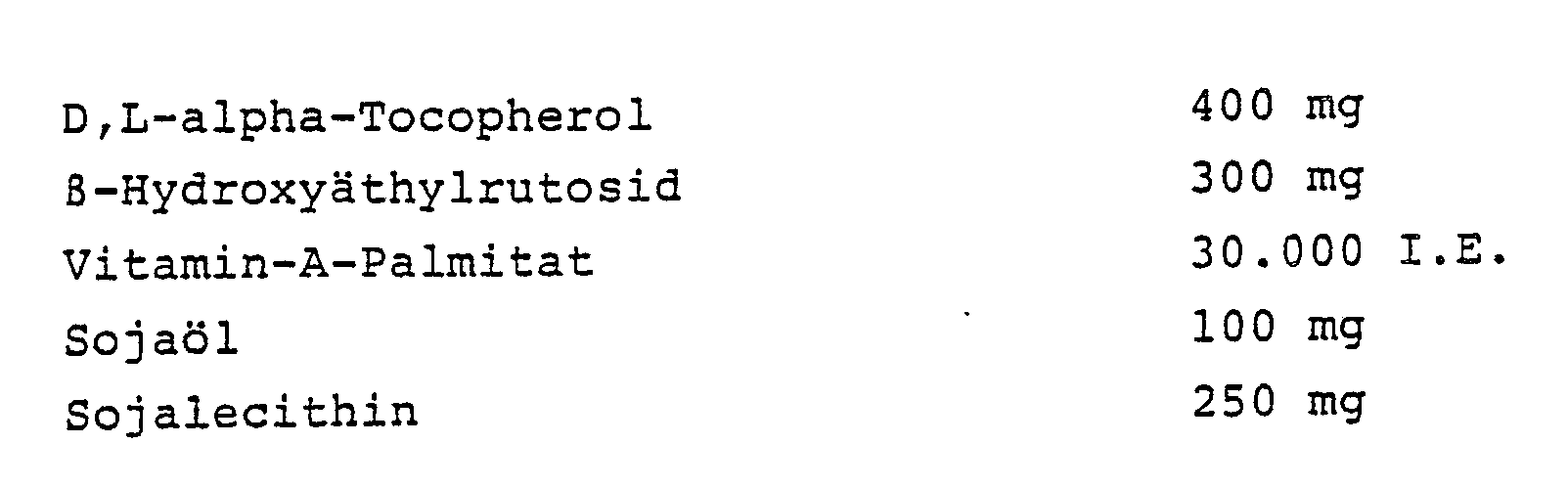
Beispiel 54 1 Kapsel enthält: Ginkoflavonglykoside 3,0 mg Vitamin E (D,L-alpha-Tocopherolacetat) 300 mg Vitamin-A-Palmitat 25.000 I.E. Sojaöl 100 mg Sojalecithin 200 mg Beispiel 55 1 Kapsel enthält: Nicotinsäure 300 mg Vitamin E 400 mg Vitamin-A-Palmitat 15.000 I.E. Cetiol (Oleylsäureester) 10 mg Sojaöl 100 mg Sojalecithin 20 mg Beispiel 56 1 Kapsel enthält: D-alpha-Tocopherol 200 mg Lecithin 500 mg Sojaöl 180 mg Tween 80 10 mg - Kapsel wie obiges Beispiel jedoch enthält sie 15.000 I.E. Vitamin-A-Palmitat.
- Kapsel wie obige beide Beispiele jedoch mit D,L-alpha-Tocopherol-Acetat anstelle von D-alpha-Tocopherol.
Beispiel 59 1 Kapsel enthält: D-alpha-Tocopherol 400 mg Lecithin 400 mg Sojaöl 200 mg Tween 80 15 mg - Kapsel wie obiges Beispiel jedoch mit 15.000 I.E. Vitamin-A-Palmitat oder Vitamin-A-Acetat bzw. 9,5 mg β-Carotin.
- Die Produkte der Beispiele 46 bis 60 können als Mittel zur Senkung des Cholesterinspiegels eingesetzt werden.
- Die folgenden Beispiele betreffen Vitamin-E-Präparate enthaltend Dimethylaminoäthanol.
Beispiel 61 1 Kapsel enthält: 20 mg Dimethylaminoäthanol 400 mg D,L-alpha-Tocopherolacetat 50 mg Sojaöl 200 mg Sojalecithin 200 mg β-Hydroxyäthylrutosid Beispiel 62 1 Kapsel enthält: 20 mg Dimethylaminoäthanol 400 mg D,L-alpha-Tocopherolacetat 12.000 I.E. Vitamin-A-Palmitat (6,67 mg) 100 mg Sojaöl 300 mg Lecithin 8 mg Tween 80 75 mg Cinnarizin Beispiel 63 1 Kapsel enthält: 25 mg Dimethylaminoäthanolorotat 400 mg D,L-alpha-Tocopherolacetat 15.000 I.E. Vitamin-A-Palmitat (8,33 mg) 20 mg Sojalecithin 400 mg Nicotinsäure - Wie Beispiel 61, jedoch mit 8 mg Tween 80 angesetzt.
Beispiel 65 1 Kapsel enthält: 25 mg Dimethylaminoäthanolorotat 500 mg D-alpha-Tocopherol-Konzentrat 22.000 I.E. Vitamin-A-Palmitat (12,22 mg) 28 mg Sojalecithin 120 mg Sojaöl 3,0 mg Ginkoflavonglucosid - Kombination gemäß Beispiel 65, jedoch mit 8 mg Tween 20.
Beispiel 67 1 Kapsel enthält: 30 mg Dimethylaminoäthanolorotat 400 mg D,L-alpha-Tocopherolacetat 300 mg Lecithin 8 mg Tween 80 30 mg Vincamin Beispiel 68 1 Kapsel enthält: 25 mg Dimethylaminoäthanolorotat 350 mg D-alpha-Tocopherolacetat 15.000 I.E. Vitamin-A-Palmitat je 5 mg von Vitamin B₁, B₂, B₆, 5 µg Vitamin B₁₂ 15 mg Nicotinsäureamid 280 mg Lecithin 75 mg Cinnarizin - Kombination gemäß Beispiel 68, jedoch mit 5 mg Tween 80.
Beispiel 70 1 Kapsel enthält: 25 mg Dimethylaminoäthanolorotat 400 mg D,L-alpha-Tocopherolacetat 15.000 I.E. Vitamin-A-Palmitat (8,33 mg) 300 mg β-Hydroxyäthylrutosid - Kombination gemäß Beispiel 70, jedoch mit 8 mg Tween 80 angesetzt.
Beispiel 72 1 Kapsel enthält: 35 mg Dimethylaminoäthanolorotat 500 mg D-alpha-Tocopherol-Konzentrat 22.000 I.E Vitamin-A-Palmitat (12,22 mg) 400 mg Xantinolnicotinat - Gemäß Beispiel 72, jedoch mit 4 mg Tween 20.
Beispiel 74 1 Kapsel enthält: 30 mg Dimethylaminoäthanolorotat 400 mg D,L-alpha-Tocopherolacetat 400 mg Pentoxyfyllin Beispiel 75 1 Kapsel enthält: 35 mg Dimethylaminoäthanolorotat 350 mg D-alpha-Tocopherolacetat 15.000 I.E. Vitamin-A-Palmitat je 5 mg von Vitamin B₁, B₂, B₆ 5 µg Vitamin B₁₂ 100 mg Bencyclanfumarat - Kombination gemäß Beispiel 75, jedoch mit 3 mg Tween 80.
Beispiel 77 1 Kapsel enthält: 25 mg Dimethylaminoethanolorotat 350 mg D,L-alpha-Tocopherolacetat 17.000 I.E. (9,44 mg) Vitamin-A-Palmitat 70 mg Sojaöl 75 mg Cinnarizin Beispiel 78 1 Kapsel enthält: 20 mg Dimethylaminoäthanol 200 mg D,L-alpha-Tocopherolacetat 12.000 I.E. Vitamin-A-Palmitat (6,67 mg) 50 mg Sojaöl 250 mg Sojalecithin 
- Kombination gemäß Beispiel 78, jedoch mit 3 mg Tween 80 angesetzt.
Beispiel 81 1 Kapsel enthält: 20 mg Dimethylaminoäthanol 200 mg D,L-alpha-Tocopherolacetat 12.000 I.E. Vitamin-A-Palmitat (6,67 mg) 50 mg Sojaöl Beispiel 82 1 Kapsel enthält: 35 mg Dimethylaminoäthanolorotat 400 mg D,L-alpha-Tocopherolacetat 15.000 I.E. Vitamin-A-Palmitat (8,33 mg) - Kombination gemäß Beispiel 81, jedoch mit 3 mg Tween 80 angesetzt.
Beispiel 84 1 Kapsel enthält: 35 mg Dimethylaminoäthanolorotat 500 mg D-alpha-Tocopherol-Konzentrat 22.000 I.E. Vitamin-A-Palmitat (12,22 mg) - Kombination gemäß Beispiel 84, jedoch mit 4 mg Tween 20.
Beispiel 86 1 Kapsel enthält: 30 mg Dimethylaminoäthanolorotat 400 mg D,L-alpha-Tocopherolacetat Beispiel 87 1 Kapsel enthält: 35 mg Dimethylaminoäthanolorotat 350 mg D-alpha-Tocopherolacetat 15.000 I.E. Vitamin-A-Palmitat je 5 mg von Vitamin B₁, B₂, B₆ 5 µg Vitamin B₁₂ 15 mg Nicotinsäureamid - Kombination gemäß Beispiel 87 jedoch mit 3 mg Tween 80.
Beispiel 89 1 Kapsel enthält: 25 mg Dimethylaminoethanolorotat 350 mg D,L-alpha-Tocopherolacetat 17.000 I.E. (9,44 mg) Vitamin-A-Palmitat 70 mg Sojaöl - In allen Beispielen wurde Sojaöl zwischen 50 und 200 mg pro Kapsel zugesetzt. Es können auch andere neutrale Öle wie Olivenöl, Rüböl etc. verwendet werden.
Beispiel 90 Lösung zur äußerlichen Anwendung, insbesondere in Form von Spray aus: 33 T D-alpha-Tocopherolkonzentrat 8 T Phosphorlipide 99 T Isopropylalkohol 45 T Isopropylalkohol (70%) Beispiel 91 1 Kapsel enthält: 600 mg D-alpha-Tocopherolkonzentrat 5000 I.E. Vitamin A 8 mg Tween 80 120 mg Sojaöl Beispiel 92 1 Kapsel enthält: 400 mg D-alpha-Tocopherol 8,250 mg Vitamin A 8 mg Tween 80 Beispiel 93 1 Kapsel enthält: 500 mg D,L-alpha-Tocopherolacetat 100 mg Sojaöl 1000 mg D,L-alpha-Tocopherolacetat 10 mg Tween 80 150 mg Sojaöl Beispiel 94 1 Kapsel enthält: 30 mg Chlorphenoxaminehydrochlorid 400 mg D,L-alpha-Tocopherolacetat 50 mg Nicotinsäure 100 mg Sojaöl - Gemäß Beispiel 94 jedoch anstelle von 30 mg Chlorphenoxaminehydrochlorid werden 40 mg verwendet und 20.000 I.E. Vitamin-A-Palmitat.
Beispiel 96 1 Kapsel enthält: 70 mg Bamipinhydrochlorid 500 mg D-alpha-Tocopherolkonzentrat 100 mg Troxerutin 80 mg Erdnußöl Beispiel 97 1 Kapsel enthält: 120 mg Tritoqualine 300 mg D-alpha-Tocopherolacetat 100 mg Troxerutin 80 mg Sojaöl Beispiel 98 Eine Salbe enthält: 40,0 g Clemastinehydrogenfumarat 8,0 g D-alpha-Tocopherolkonzentrat 60.000 I.E. Heparin Natrium ad 100,0 g eine Salbe aus 20,0 g Cetiol (Ölsäureoleylester) 20,0 g Cetylstearylalkohol 60,0 aqua Conservata Beispiel 99 Eine Salbe enthält: 1,5 g Chlorphenoxaminehydrochlorid 10 g D,L-alpha-Tocopherol 50.000 I.E. Heparin Natrium ad 100,0 g Salbe wie Beispiel 98 Beispiel 100 1 Kapsel enthält: 70 mg Bamipinhydrochlorid 400 mg D-alpha-Tocopherolkonzentrat 30 mg Cinnarizin - Gemäß Beispiel 98 jedoch mit 3% Calendulaeöl.
Beispiel 102 Eine Salbe enthält: 5 g D-alpha-Tocopherolkonzentrat 10.000 I.E. Vitamin-A-Palmitat 50.000 I.E. Heparin Natrium ad 100,0 g Eucerinanhydricum - Das gleiche wie Beispiel 102 jedoch mit 8 g D-alpha-Tocopherolkonzentrat.
- Bei den folgenden Kombinationen handelt es sich um Salben enthaltend Bufexamac zur Behandlung von Hautentzündungen.
Beispiel 104 100 g Salbe enthalten: 5,0 g Bufexamac 8,0 g D-alpha-Tocopherolkonzentrat ad 100,0 g aus einer Salbengrundlage, bestehend aus 20% Cetylstearylalkohol, 20% Cetiol (Ölsäure Oleylester) und 60% aqua Conservata. Beispiel 105 100 g Salbe enthalten: 5,0 g Bufexamac 8,0 g D,L-alpha-Tocopherol ad 100,0 g aus einer Salbengrundlage wie unter 104, jedoch anstelle von 60% Wasser 55% und 5% Vaseline Alba. Beispiel 106 100 g Salbe enthalten: 10,0 g D-alpha-Tocopherol 500 mg Dexapanthenol 300 mg Allantoin ad 100,0 g Salbengrundlage wie Beispiel 104 Beispiel 107 100 g Salbe enthalten: 4,0 g Bufexamac 8,0 g D-alpha-Tocopherol 400 mg Dexapanthenol 400 mg Allantoin ad 100,0 g Salbengrundlage wie Beispiel 104 - Salbe wie Beispiel 107. Als Salbengrundlage wurde aber Ungt. Cordes verwendet.
- Salbe wie Beispiel 106. Als Salbengrundlage wurden aber Triglyceridgemische verwendet.
- Die folgenden Beispiele betreffen antiallergische Mittel enthaltende Vitamin-E-Präparate.
Beispiel 110 1 Kapsel enthält: 30 mg Chlorphenoxaminehydrochlorid 400 mg D,L-alpha-Tocopherolacetat 100 mg Sojaöl - Gemäß Beispiel 110 jedoch anstelle von 30 mg Chlor phenoxaminehydrochlorid werden 40 mg verwendet und 20.000 I.E. Vitamin-A-Palmitat.
Beispiel 112 1 Kapsel enthält: 70 mg Bamipinhydrochlorid 500 mg D-alpha-Tocopherolkonzentrat 80 mg Erdnußöl Beispiel 113 1 Kapsel enthält: 120 mg Tritoqualine 300 mg D-alpha-Tocopherolacetat 80 mg Sojaöl Beispiel 114 Eine Salbe enthält: 40,0 g Clemastinehydrogenfumarat 8,0 g D-alpha-Tocopherolkonzentrat ad 100,0 g eine Salbe aus 20,0 g Cetiol (Ölsäureoleylester) 20,0 g Cetylstearylalkohol 60,0 g aqua Conservata Beispiel 115 Eine Salbe enthält: 1,5 g Chlorphenoxaminehydrochlorid 10 g D,L-alpha-Tocopherol ad 100,0 g Salbe wie Beispiel 114. - Die folgenden Beispiele betreffen Lichtschutzmittel.
Beispiel 116 Eine Salbe enthält: 8 g D-alpha-Tocopherolkonzentrat 2 g Phospholipide 2 g 4-Phenylbenzophenon-2-Carbonsäure-Isooctylester ad 100 g Salbengrundlage aus 22 Teile Cetyl-Stearylalkohol 18 Teile Cetiol Ölsäureoleylester 60 Teile Wasser Beispiel 117 100 g Salbe enthalten: 3 g Hydroxyäthylsalicylat 1 g Benzylnicotinat 8 g D-alpha-Tocopherolkonzentrat 2 g Phospholipide ad 100,0 g Salbengrundlage wie Beispiel 116 Beispiel 118 100 g Salbe enthalten: 50.000 I.E. Heparin Natrium 12,0 g Arnica Lebutenextract 1 = 10 (Alkal 60%) 7,5 g D-alpha-Tocopherolkonzentrat 3 g Phospholipide 0,5 g Octadecadeinsäure 0,15 g Linolsäure ad 100 g Salbengrundlage wie 116 Beispiel 119 Eine Salbe enthält: 1,5 g Chlorphenoxaminehydrochlorid 8 g D-alpha-Tocopherolkonzentrat 2 g Phospholipide ad 100,0 g Salbengrundlage wie 116 Beispiel 120 Eine Salbe enthält: 10,0 g D-alpha-Tocopherol-Konzentrat 2,0 g Benzaron 2 g Phospholipide ad 100,0 g Salbengrundlage wie 116 Beispiel 121 Eine Creme enthält: 10 g D-alpha-Tocopherol-Konzentrat 2 g EusolexR (8020 Merck) ad 100 g Salbengrundlage aus 22 T Cetyl-Stearylalkohol 18 T Cetiol 60 T Wasser (aqua conservata) Beispiel 122 Eine Creme enthält: 8 g D,L-alpha-Tocopherolkonzentrat 3 g EusolexR (232 Merck) ad 100 g Salbengrundlage wie Beispiel 121 Beispiel 123 Eine Creme enthält: 12 g Vitamin E 1 g EusolexR (8020 Merck) ad 100 Salbengrundlage wie Beispiel 121 Beispiel 124 Eine Creme enthält: 9,0 g Vitamin E 0,3 g EusolexR (8020 Merck) ad 100 Salbengrundlage aus 17 T Cetyl-Stearylalkohol 8 T Weiße Vaseline 15 T Cetiol 60 T Wasser (aqua conservata) Beispiel 125 Eine Salbe enthält: 8,00 g Vitamin E 2,00 g Phospholipide 0,50 g Octadecadeinsäure 0,15 g Linolsäure ad 100 Salbengrundlage wie Beispiel 121 - Salbe gemäß Beispiel 121 mit dem Zusatz von 1,0 g EusolexR (8020 Merck).

Beispiel 128 1 Kapsel enthält: 35 mg Xanthaxanthin 8 mg β-Carotin 8 mg Calcium D Pantothenat 0,15 mg D-Biotin 250 mg Lecithin 400 mg D,L-alpha-Tocopherolacetat 80 mg Sojabohnenöl Beispiel 129 1 Kapsel enthält: 30 mg Xanthaxanthin 300 mg D-alpha-Tocopherolkonzentrat 150 mg Sojabohnenöl Beispiel 130 1 Kapsel enthält: 15 mg β-Carotin 400 mg D-alpha-Tocopherolkonzentrat 120 mg Sojabohnenöl - Acht Lichtschutzmittel zur Bestimmung der erythemverhütenden Wirkung wurden am Menschen getestet. Dabei handelte es sich um die folgenden:
- "Vitamin E Natur"
mit 8 Gew.-% D-alpha-Tocopherol - "DL Hep Na"
mit 8 Gew.-% D,L-alpha-Tocopherol und
50.000 Einheiten Heparin Natrium - "Vitamin E COO/8
55.000 Hepa Na"
mit 8 Gew.-% natürlichem Vitamin E und 55.000 I.E. Heparin Natrium - "Vitamin E + COO
BN 8/1.5"
mit 8 Gew.-% natürlichem Vitamin E und 1,5 Gew.-% Benzylnicotinat - "8 Gew.-% Covitol und
4 Gew.-% Arnika"
mit 8 Gew.-% natürlichem Vitamin E und 2 Gew.-% Arnikaöl - "8 Gew.-% Covitol
2 Gew.-% Campher
2 Gew.-% Menthol
10 Gew.-% Pfefferminzöl
80 Gew.-% Lanette"
mit 8 Gew.-% natürlichem Vitamin E und den vorher bezeichneten Nebeninhaltsstoffen. - "8 Gew.-% Covitol
10 Gew.-% Calendulaeöl
82 Gew.-% Lanette"
mit 8 Gew.-% natürlichem Vitamin E. - Bei allen Produkten mit Ausnahme der Lanette-Salbe, handelte es sich um weiße, salbige Emulsionen.
Die Produkte erfüllten die üblichen, an solche Kosmetika zu stellenden Anforderungen. Sie ließen sich leicht und gleichmäßig auf die Haut auftragen und erzeugten hier keine Schicht, die durch übermäßigen Glanz, Klebrigkeit oder Fettigkeit aufgefallen wäre. - Bei der Anwendung gab keine der Versuchspersonen eine Mißempfindung wie Jucken, Brennen oder Spannen der Haut oder übermäßiges Kälte- oder Wärmegefühl an.
- Bei den Untersuchungen der Haut nach 24 Stunden zeigten sich außerhalb der Erythemreaktionen keine Hautveränderungen, die für eine (photo)toxische oder (photo)allergische Wirkung der Produkte gesprochen hätten.
- Die Bestimmung der Lichtschutzwirkung erfolgte als mittlerer Schutzfaktor nach SCHULZE an 20 hautgesunden Versuchspersonen unterschiedlichen Geschlechts, Alters und Hauttyps, entsprechend der DIN-Norm 67 501, wenn nicht ausdrücklich etwas anderes vermerkt wird. Die Anwendung der Produkte erfolgte einheitlich in einer Schichtdicke von 150 mg/100 cm².
- Zur Lichtexposition wurden wie üblich vier OsramR-Ultravitalux-Lampen im Abstand von 30 cm zueinander und zum Rücken des Probanden benutzt. Die Erythemschwellenzeit wurde nach etwa 24 Stunden abgelesen. Der individuelle Schutzfaktor stellt den Quotienten aus der Erythemschwellenzeit der geschützten Haut und der Erythemschwellenzeit der ungeschützten Haut dar. Etwaige Zwischenwerte (z.B. 1.7, 3.4 usw.) ergeben sich dann, wenn die beiden dem Testfeld benachbarten Kontrollfelder unterschiedliche Erythemschwellenzeiten aufweisen oder das Testfeld eine geringere Intensitätszunahme erkennen läßt als die Kontrollfelder.
- Bei der so an 20 Probanden unterschiedlichen Alters, Geschlechts und Hauttyps vorgenommenen Prüfung wurden die folgende mittleren Schutzfaktoren (unterstrichen) als arithmetische Mittel aus den angegebenen Einzelwerten (in Klammern) erhalten:
- 3.28 (5x2.0, 5x2.8, 9x4.0, 1x5.6)
- 4.38 (1x2.0, 2x2.8, 11x4.0, 5x5.6, 1x8.0)
- 4.02 (2x2.0, 9x2.8, 6x4.0, 2x8.0, 1x11.2)
- 4.21 (1x1.4, 5x2.0, 4x2.8, 3x4.0, 4x5.6, 2x8.0, 1x11.2)
- 2.72 (4x1.4, 3x2.0, 9x2.8, 3x4.0, 1x5.6)
- 2.88 (6x2.0, 10x2.8, 3x4.0, 1x5.6)
- 3.94 (2x2.0, 5x2.8, 9x4.0, 3x5.6, 1x8.0)
- Ein handelsübliches Präparat (Standardpräparat K 17 N), das bisher an 220 Probanden einen mittleren Schutzfaktor von 3.82 gezeigt hatte, wies bei dieser Prüfung einen arithmetischen Mittelwert von 3.74 auf.
- Aufgrund der obigen Werte und bei deren Vergleich mit den an zahlreichen Versuchs- und Handelsprodukten unter den gleichen Bedingungen und in der Praxis erhaltenen Egebnissen sind die Produkte 131, 135 und 136 als knapp mittel-wirksame Lichtschutzmittel, die übrigen Produkte dagegen als mittel- bis stark-wirksame Lichtschutzmittel zu bezeichnen.
- Während die Grundlage, das Unguentum-Lanette, erwartungsgemäß keinerlei Lichtschutzwirkung aufwies, lassen sich die übrigen sieben Produkte aufgrund teilweise statistisch signifikanter Unterschiede in zwei Gruppen einteilen. Die eine, verhältnismäßig schwach-wirksame Gruppe, enthält neben 8 Gew.-% Vitamin E entweder wie das Produkt 136 verschiedene Zusätze oder wie das Produkt 135 Arnikaöl oder das Produkt 131 ausschließlich das natürliche Vitamin.
- Dem ist eine sehr viel stärker wirksame Gruppe gegenüberzustellen, die entweder wie die "Produkte 132 und 133" Heparin enthalten oder aber wie das "Produkt 134" 1,5 Gew.-% Benzylnicotinat oder das "Produkt 137" 10 Gew.-% Calendulaeöl.
- Diese Unterschiede berechtigen zu mehreren Schlüssen. Zunächst ist festzustellen, daß Vitamin E sowohl in natürlicher wie auch in racemischer Form eine deutliche Lichtschutzwirkung besitzt, die offenbar, vor allem durch Zusatz von Heparin, erhöht werden kann. Ähnlich wirksam ist auch ein verhältnismäßig hoher Zusatz an Calendulaeöl sowie überraschenderweise auch das hyperaemesierende Benzylnicotinat.
Claims (3)
Priority Applications (1)
| Application Number | Priority Date | Filing Date | Title |
|---|---|---|---|
| AT89112798T ATE82684T1 (de) | 1984-03-07 | 1985-02-28 | Mittel zur behandlung und zum schutz der haut. |
Applications Claiming Priority (14)
| Application Number | Priority Date | Filing Date | Title |
|---|---|---|---|
| DE3408258 | 1984-03-07 | ||
| DE3408258 | 1984-03-07 | ||
| DE3410641 | 1984-03-23 | ||
| DE19843410641 DE3410641A1 (de) | 1984-03-23 | 1984-03-23 | Vitaminhaltige hautschutzmittel |
| DE3420459 | 1984-06-01 | ||
| DE3420459 | 1984-06-01 | ||
| DE3427374 | 1984-07-25 | ||
| DE3427374 | 1984-07-25 | ||
| DE3435098 | 1984-09-25 | ||
| DE3435098 | 1984-09-25 | ||
| DE3441711 | 1984-11-15 | ||
| DE19843441711 DE3441711A1 (de) | 1984-11-15 | 1984-11-15 | Vitaminhaltige hautschutzmittel |
| DE3504695 | 1985-02-12 | ||
| DE19853504695 DE3504695A1 (de) | 1985-02-12 | 1985-02-12 | Haarwuchsmittel |
Related Parent Applications (1)
| Application Number | Title | Priority Date | Filing Date |
|---|---|---|---|
| EP85102222.8 Division | 1985-02-28 |
Publications (3)
| Publication Number | Publication Date |
|---|---|
| EP0343694A2 true EP0343694A2 (de) | 1989-11-29 |
| EP0343694A3 EP0343694A3 (en) | 1990-02-07 |
| EP0343694B1 EP0343694B1 (de) | 1992-11-25 |
Family
ID=27561406
Family Applications (2)
| Application Number | Title | Priority Date | Filing Date |
|---|---|---|---|
| EP89112798A Expired - Lifetime EP0343694B1 (de) | 1984-03-07 | 1985-02-28 | Mittel zur Behandlung und zum Schutz der Haut |
| EP85102222A Expired - Lifetime EP0158090B1 (de) | 1984-03-07 | 1985-02-28 | Mittel zur Behandlung und zum Schutz der Haut |
Family Applications After (1)
| Application Number | Title | Priority Date | Filing Date |
|---|---|---|---|
| EP85102222A Expired - Lifetime EP0158090B1 (de) | 1984-03-07 | 1985-02-28 | Mittel zur Behandlung und zum Schutz der Haut |
Country Status (5)
| Country | Link |
|---|---|
| US (1) | US4938960A (de) |
| EP (2) | EP0343694B1 (de) |
| AT (2) | ATE55905T1 (de) |
| CA (1) | CA1257200A (de) |
| DE (2) | DE3586859D1 (de) |
Cited By (12)
| Publication number | Priority date | Publication date | Assignee | Title |
|---|---|---|---|---|
| DE3912477A1 (de) * | 1989-04-15 | 1990-10-18 | Mueller Robert Dr | Aeusserlich anzuwendendes praeparat und seine verwendung |
| WO1992001439A1 (en) * | 1990-07-17 | 1992-02-06 | Maja Zeidler | A concentrate for skin lotions, creams, and similar skin preparations |
| WO1993003720A3 (en) * | 1991-08-16 | 1993-04-01 | John R Trevithick | Methods and compositions for treating sunburns |
| DE4313402A1 (de) * | 1993-04-23 | 1994-10-27 | Hexal Pharma Gmbh | Transdermale Wirkstoffzubereitung |
| CN1038303C (zh) * | 1991-12-30 | 1998-05-13 | 王俊英 | 一种口服痔疮药的制造方法 |
| EP0822812A4 (de) * | 1995-04-27 | 2000-06-14 | Nicholas V Perricone | Örtliche behandlung und/oder vorbeugung des durchhängens subkutaner muskel und des darüberliegenden hautgewebes unter verwendung von acetylcholinvorstufen und catecholaminen |
| ES2144979A1 (es) * | 1998-12-16 | 2000-06-16 | F D A Innovaciones Terapeutica | Composicion, producto limpiaporos de uso topico que comprende, alfa-tocoferol y un procedimiento para la obtencion de dicho producto limpiaporos. |
| WO2001074328A3 (en) * | 2000-04-03 | 2002-04-04 | Colgate Palmolive Co | Topical antioxidant vitamin composition for skin care |
| US6607735B2 (en) | 2000-12-21 | 2003-08-19 | Johnson & Johnson Consumer Companies, Inc. | Method for reducing the appearance of dark circles under the eyes |
| EP1192939A3 (de) * | 2000-10-02 | 2003-12-03 | Johnson & Johnson Consumer Companies, Inc. | Verfahren zur Verminderung von Inflammation und Erytheme |
| US6730310B2 (en) | 1998-10-30 | 2004-05-04 | Colgate-Palmolive Company | Wash-off vitamin E compositions |
| EP3821896A4 (de) * | 2018-07-09 | 2022-09-07 | LG Household & Health Care Ltd. | Zusammensetzung zur verhinderung von haarausfall oder zur stimulation von erneutem haarwachstum |
Families Citing this family (75)
| Publication number | Priority date | Publication date | Assignee | Title |
|---|---|---|---|---|
| US5656620A (en) * | 1984-01-28 | 1997-08-12 | Ismail; Roshdy | Method for treating pain |
| DE3588023D1 (de) * | 1984-01-28 | 1995-06-29 | Roshdy Ismail | Mittel zur Behandlung von Herzerkrankungen. |
| US5541220A (en) * | 1984-03-07 | 1996-07-30 | Ismail; Roshdy | Agents for the treatment and protection of the skin |
| DE3416209A1 (de) * | 1984-05-02 | 1985-11-21 | Mohamed Roshdy Dr Ismail | Zubereitungen zur behandlung von augen |
| DE3682538D1 (de) * | 1985-05-15 | 1992-01-02 | Roshdy Ismail | Vitamin e-haltiges mittel zur verbesserung der eigenschaften des blutes. |
| EP0203211A1 (de) * | 1985-05-28 | 1986-12-03 | Chemisch Adviesbureau Drs. J.C.P. Schreuder B.V. | Zusammensetzung zur Behandlung von Hautkrankheiten und Verfahren zu ihrer Herstellung |
| US4603046A (en) * | 1985-08-23 | 1986-07-29 | Charles Of The Ritz Group Ltd. | Improved sunscreen or sunblock composition |
| US4760095A (en) * | 1986-01-28 | 1988-07-26 | Hoffmann-La Roche, Inc. | Moisturizers |
| AU596581B2 (en) * | 1986-04-15 | 1990-05-10 | Sansho Seiyaku Co., Ltd. | Topical agents for inhibiting the melanin generation |
| IL84864A0 (en) * | 1986-12-31 | 1988-06-30 | Univ Boston | Composition for promoting hair growth containing omental lipids and process for promoting hair growth utilizing the same |
| US4954332A (en) * | 1987-10-22 | 1990-09-04 | The Procter & Gamble Company | Photoprotection compositions comprising tocopherol sorbate and an anti-inflammatory agent |
| DE58902094D1 (de) * | 1988-01-28 | 1992-10-01 | Koeltringer Peter | Kombinationspraeparat zur behandlung von nervenzell-und nervenfasererkrankungen und verletzungen. |
| CH676470A5 (de) * | 1988-02-03 | 1991-01-31 | Nestle Sa | |
| IE891173L (en) * | 1988-04-18 | 1989-10-18 | Univ Utrecht | Composition for promoting hair growth in androgenetic¹alopecia and method thereof |
| LU87390A1 (fr) * | 1988-11-17 | 1990-06-12 | Oreal | Utilisation du nicotinate d'alpha-tocopherol et/ou du nicotinate d'hexyle dans une composition cosmetique a action amincissante |
| GB8827968D0 (en) * | 1988-11-30 | 1989-01-05 | Boots Co Plc | Sunscreen compositions |
| US5053222A (en) * | 1989-06-07 | 1991-10-01 | Shiseido Company Ltd. | Hair cosmetic composition |
| FR2648709A1 (fr) * | 1989-06-23 | 1990-12-28 | Boehringer Ingelheim France | Nouvelle utilisation de derives de 1-phenyl-2-aminoethanol en tant que moyens cicatrisants |
| FR2657526B1 (fr) * | 1990-01-31 | 1994-10-28 | Lvmh Rech | Utilisation d'un phosphate d'alpha-tocopherol, ou de l'un de ses derives, pour la preparation de compositions cosmetiques, dermatologiques, ou pharmaceutiques; compositions ainsi obtenues. |
| GB9010389D0 (en) * | 1990-05-09 | 1990-06-27 | Idb Holding Spa | Pharmaceutical formulations for the treatment of peripheral vascular diseases |
| ATE154230T1 (de) * | 1990-08-14 | 1997-06-15 | Kenneth M Hallam | Haarwuchsmittel |
| FR2666226B1 (fr) * | 1990-08-30 | 1994-10-28 | Jean Noel Thorel | Composition protectrice de la peau. |
| EP0514576A1 (de) * | 1991-05-24 | 1992-11-25 | Societe Des Produits Nestle S.A. | Öllösliche Antioxydationsmischung |
| IL99368A (en) * | 1991-09-02 | 1996-01-19 | Teva Pharma | Preparations for the treatment of psoriasis and atopic dermatitis, which contain the result of xanthine |
| JP2671248B2 (ja) * | 1991-10-23 | 1997-10-29 | ブロック・ドラッグ・カンパニー・インコーポレイテッド | 薬効または化粧効果成分の浸透性増進方法 |
| WO1993010756A1 (en) * | 1991-11-25 | 1993-06-10 | Richardson-Vicks, Inc. | Use of salicylic acid for regulating skin wrinkles and/or skin atrophy |
| EP0614353A1 (de) * | 1991-11-25 | 1994-09-14 | Richardson-Vicks, Inc. | Mittel zur Kontrolle von Hautfalten und/oder der Hautatrophie |
| US5780459A (en) * | 1991-11-25 | 1998-07-14 | The Procter & Gamble Company | Compositions for regulating skin wrinkles and or skin atrophy |
| KR950007045B1 (ko) * | 1992-04-14 | 1995-06-30 | 주식회사태평양 | 폴리에톡실레이티드 비타민 e를 함유한 피부화장료 |
| US5962000A (en) * | 1992-07-13 | 1999-10-05 | Shiseido Company, Ltd. | External skin treatment composition |
| WO1994001083A1 (fr) * | 1992-07-13 | 1994-01-20 | Shiseido Company, Ltd. | Composition de preparation dermatologique |
| ES2221921T3 (es) * | 1992-07-13 | 2005-01-16 | Shiseido Company, Ltd. | Composicion para preparacion dermatologica. |
| US5686086A (en) * | 1992-07-13 | 1997-11-11 | Shiseido Co., Ltd. | External skin treatment composition |
| GB9220670D0 (en) * | 1992-09-30 | 1992-11-11 | Unilever Plc | Cosmetic composition |
| EP0640333A3 (de) * | 1993-08-09 | 1997-04-02 | Tsumura & Co | Haarwuchs befördernde Sprayformulierung. |
| GB9403855D0 (en) * | 1994-03-01 | 1994-04-20 | Scotia Holdings Plc | Fatty acid derivatives |
| US5976521A (en) * | 1994-08-09 | 1999-11-02 | The Procter & Gamble Company | Anti-acne cosmetic compositions |
| US5470874A (en) * | 1994-10-14 | 1995-11-28 | Lerner; Sheldon | Ascorbic acid and proanthocyanidine composition for topical application to human skin |
| DE19509354A1 (de) * | 1994-12-08 | 1996-06-13 | Klett Loch Lore M | Kombinationspräparat zur Förderung des Haarwachstums und ggf. des Haut- und Nagelwachstums sowie zur Verhinderung bzw. zur Beseitigung von Haarausfall |
| US5939082A (en) * | 1995-11-06 | 1999-08-17 | The Procter & Gamble Company | Methods of regulating skin appearance with vitamin B3 compound |
| US5833998A (en) * | 1995-11-06 | 1998-11-10 | The Procter & Gamble Company | Topical compositions for regulating the oily/shiny appearance of skin |
| US6238678B1 (en) | 1995-11-06 | 2001-05-29 | The Procter & Gamble Company | Methods of regulating skin appearance with vitamin B3 compound |
| US5750122A (en) * | 1996-01-16 | 1998-05-12 | The Procter & Gamble Company | Compositions for treating hair or skin |
| CA2258513A1 (en) * | 1996-07-02 | 1998-01-08 | Beat Schmid | Topical composition comprising a combination of antihistaminic compounds with terpenoid compounds |
| US5976547A (en) * | 1997-04-22 | 1999-11-02 | Niblick Pharmaceuticals, Inc. | Analgesic and antiphlogistic compositions and therapeutic wrap for topical delivery |
| US5968528A (en) * | 1997-05-23 | 1999-10-19 | The Procter & Gamble Company | Skin care compositions |
| USH2013H1 (en) | 1997-05-23 | 2002-02-05 | The Procter & Gamble Company | Skin care compositions |
| JP3687277B2 (ja) | 1997-06-10 | 2005-08-24 | サンスター株式会社 | 美白化粧料 |
| US5824359A (en) * | 1997-06-30 | 1998-10-20 | Becton Dickinson And Company | Medical device lubricant containing lecithin |
| US6036946A (en) | 1997-12-24 | 2000-03-14 | Shaklee Corporation | Methods for protecting skin from damaging effects of ultraviolet light |
| EP1063967B1 (de) | 1998-03-16 | 2004-02-11 | The Procter & Gamble Company | Zusammensetzung zur regulierung des hauterscheinungsbildes |
| US6146664A (en) * | 1998-07-10 | 2000-11-14 | Shaklee Corporation | Stable topical ascorbic acid compositions |
| US7396526B1 (en) | 1998-11-12 | 2008-07-08 | Johnson & Johnson Consumer Companies, Inc. | Skin care composition |
| WO2000032179A2 (en) | 1998-12-01 | 2000-06-08 | University Of Kentucky Research Foundation | Use of nicotonic acid derivatives for the treatment of dna damage in skin cells |
| US20020119954A1 (en) * | 1999-01-06 | 2002-08-29 | L'oreal, S.A. | Composition containing stabilized ascorbic acid, and uses thereof |
| AU3596900A (en) * | 1999-02-19 | 2000-09-04 | Marcus R. Jones | Method and composition for promoting hair growth |
| FR2793686B1 (fr) * | 1999-04-13 | 2001-12-28 | Jean Jung | Utilisation d'un melange synergique de polyphenols et de composes vitaminiques dans des compositions cosmetiques et dermatologiques et procede de capture de radicaux libres au niveau de la peau et de phaneres |
| RU2164794C1 (ru) * | 1999-07-19 | 2001-04-10 | ООО "БиоДом" | Субстанция липовитам бета, каротин липосомальный, витаминный комплекс и способ его изготовления |
| US6228387B1 (en) | 2000-01-27 | 2001-05-08 | Murray Borod | Integrated comprehensive hemorrhoid treatment compositions and regimen |
| WO2001085128A2 (en) * | 2000-05-08 | 2001-11-15 | Pfizer Products Inc. | Skin protectant spray compositions |
| KR100438007B1 (ko) * | 2001-09-10 | 2004-06-30 | 한불화장품주식회사 | 향나무 목질부 추출물을 주요 활성성분으로 함유하는 항노화용 화장료 조성물 |
| US20040147534A1 (en) * | 2003-01-23 | 2004-07-29 | Foote Mary Ann | Topical composition and method for treating occlusive wounds |
| CN1250229C (zh) * | 2003-05-16 | 2006-04-12 | 美时化学制药股份有限公司 | 经皮给药的外用组合物 |
| WO2004100923A1 (en) * | 2003-05-16 | 2004-11-25 | Lotus Pharmaceutical Co., Ltd. | The composition for external use by percutaneous administration |
| RU2325900C2 (ru) * | 2003-05-16 | 2008-06-10 | Лотус Фармасьютикал Ко., Лтд | Состав для кожи наружного применения |
| US20050008684A1 (en) * | 2003-07-10 | 2005-01-13 | Claus Herdeis | Method of treatment for acne, rosacea and ulcers with taurolidine and/or taurultam in a pharmaceutical composition |
| DE10352602A1 (de) * | 2003-11-11 | 2005-06-02 | Rovi Gmbh & Co. Kosmetische Rohstoffe Kg | Kosmetisches oder therapeutisches Kombinationspräparat |
| DE102004041270A1 (de) * | 2004-08-26 | 2006-03-02 | Merz Pharma Gmbh & Co. Kgaa | Ein Kapillar- Wirksystem enthaltende Zusammensetzungen mit anwendungsbezogener Differenzierbarkeit und deren Verwendung |
| US20070077220A1 (en) * | 2005-09-30 | 2007-04-05 | Ramirez Jose E | Stable ascorbic acid compositions |
| US20070269534A1 (en) * | 2006-02-02 | 2007-11-22 | Ramirez Jose E | Methods of treating skin to enhance therapeutic treatment thereof |
| US20070178058A1 (en) * | 2006-02-02 | 2007-08-02 | Ramirez Jose E | Methods of using stable ascorbic acid compositions |
| US10449130B2 (en) * | 2008-02-11 | 2019-10-22 | Kenneth O. Russell | Method and composition for inhibiting aged skin |
| US8466335B2 (en) | 2010-04-26 | 2013-06-18 | The Procter & Gamble Company | Personal care product |
| US8685309B2 (en) | 2010-04-26 | 2014-04-01 | The Procter & Gamble Company | Method for making a personal care product |
| US9161932B1 (en) * | 2015-01-15 | 2015-10-20 | Michael Smith | Anesthetic and cooling mixture |
Family Cites Families (15)
| Publication number | Priority date | Publication date | Assignee | Title |
|---|---|---|---|---|
| FR1593M (fr) * | 1960-11-16 | 1962-12-03 | Kabi Ab | Compositions pour le traitement de l'acne. |
| DE2240187A1 (de) * | 1972-08-16 | 1974-02-21 | Jereb Franz Dr Albin | Salbe |
| JPS522979B2 (de) * | 1972-09-29 | 1977-01-25 | ||
| GB1453239A (en) * | 1974-04-30 | 1976-10-20 | Ahrens G W | Vitamin e active product and a method of preparing same |
| US3943248A (en) * | 1974-11-04 | 1976-03-09 | Shulman Max J | Methods of treating burns using colophony containing preparations |
| US4144325A (en) * | 1976-11-10 | 1979-03-13 | Voyt Walter F | Method of and composition for preventing sunburn while affording tanning |
| US4248861A (en) * | 1979-02-21 | 1981-02-03 | Schutt Steven R | Skin treatment methods |
| JPS5659710A (en) * | 1979-10-22 | 1981-05-23 | Eisai Co Ltd | Preventive and remedy for psoriasis |
| FR2492659A1 (fr) * | 1980-10-27 | 1982-04-30 | Wiel Gaston | Composition destinee a etre utilise |
| US4454159A (en) * | 1981-12-28 | 1984-06-12 | Albert Musher | Dermatological treatment preparations |
| US4649155A (en) * | 1983-07-22 | 1987-03-10 | Hoffmann-La Roche Inc. | Injectable solutions |
| US4525344A (en) * | 1983-08-15 | 1985-06-25 | Tutsky Ronald J | Skin care and shaving composition |
| DE3588023D1 (de) * | 1984-01-28 | 1995-06-29 | Roshdy Ismail | Mittel zur Behandlung von Herzerkrankungen. |
| EP0366156B1 (de) * | 1984-01-28 | 1995-01-11 | Roshdy Dr. Ismail | Mittel zur Behandlung von Erkrankungen der Venen und des Analbereichs |
| US4612194A (en) * | 1984-02-15 | 1986-09-16 | Roshdy Ismail | Anti-rheumatic agents and their use |
-
1985
- 1985-02-28 DE DE8989112798T patent/DE3586859D1/de not_active Expired - Fee Related
- 1985-02-28 EP EP89112798A patent/EP0343694B1/de not_active Expired - Lifetime
- 1985-02-28 CA CA000475486A patent/CA1257200A/en not_active Expired
- 1985-02-28 DE DE8585102222T patent/DE3579343D1/de not_active Expired - Lifetime
- 1985-02-28 EP EP85102222A patent/EP0158090B1/de not_active Expired - Lifetime
- 1985-02-28 AT AT85102222T patent/ATE55905T1/de not_active IP Right Cessation
- 1985-02-28 AT AT89112798T patent/ATE82684T1/de active
-
1988
- 1988-06-21 US US07/211,125 patent/US4938960A/en not_active Expired - Lifetime
Cited By (13)
| Publication number | Priority date | Publication date | Assignee | Title |
|---|---|---|---|---|
| DE3912477A1 (de) * | 1989-04-15 | 1990-10-18 | Mueller Robert Dr | Aeusserlich anzuwendendes praeparat und seine verwendung |
| WO1992001439A1 (en) * | 1990-07-17 | 1992-02-06 | Maja Zeidler | A concentrate for skin lotions, creams, and similar skin preparations |
| WO1993003720A3 (en) * | 1991-08-16 | 1993-04-01 | John R Trevithick | Methods and compositions for treating sunburns |
| CN1038303C (zh) * | 1991-12-30 | 1998-05-13 | 王俊英 | 一种口服痔疮药的制造方法 |
| DE4313402A1 (de) * | 1993-04-23 | 1994-10-27 | Hexal Pharma Gmbh | Transdermale Wirkstoffzubereitung |
| WO1994025069A1 (de) * | 1993-04-23 | 1994-11-10 | Hexal Ag | Transdermale wirkstoffzubereitung |
| EP0822812A4 (de) * | 1995-04-27 | 2000-06-14 | Nicholas V Perricone | Örtliche behandlung und/oder vorbeugung des durchhängens subkutaner muskel und des darüberliegenden hautgewebes unter verwendung von acetylcholinvorstufen und catecholaminen |
| US6730310B2 (en) | 1998-10-30 | 2004-05-04 | Colgate-Palmolive Company | Wash-off vitamin E compositions |
| ES2144979A1 (es) * | 1998-12-16 | 2000-06-16 | F D A Innovaciones Terapeutica | Composicion, producto limpiaporos de uso topico que comprende, alfa-tocoferol y un procedimiento para la obtencion de dicho producto limpiaporos. |
| WO2001074328A3 (en) * | 2000-04-03 | 2002-04-04 | Colgate Palmolive Co | Topical antioxidant vitamin composition for skin care |
| EP1192939A3 (de) * | 2000-10-02 | 2003-12-03 | Johnson & Johnson Consumer Companies, Inc. | Verfahren zur Verminderung von Inflammation und Erytheme |
| US6607735B2 (en) | 2000-12-21 | 2003-08-19 | Johnson & Johnson Consumer Companies, Inc. | Method for reducing the appearance of dark circles under the eyes |
| EP3821896A4 (de) * | 2018-07-09 | 2022-09-07 | LG Household & Health Care Ltd. | Zusammensetzung zur verhinderung von haarausfall oder zur stimulation von erneutem haarwachstum |
Also Published As
| Publication number | Publication date |
|---|---|
| EP0158090B1 (de) | 1990-08-29 |
| US4938960A (en) | 1990-07-03 |
| EP0343694B1 (de) | 1992-11-25 |
| ATE55905T1 (de) | 1990-09-15 |
| EP0158090A1 (de) | 1985-10-16 |
| CA1257200A (en) | 1989-07-11 |
| ATE82684T1 (de) | 1992-12-15 |
| DE3579343D1 (de) | 1990-10-04 |
| EP0343694A3 (en) | 1990-02-07 |
| DE3586859D1 (de) | 1993-01-07 |
Similar Documents
| Publication | Publication Date | Title |
|---|---|---|
| EP0343694B1 (de) | Mittel zur Behandlung und zum Schutz der Haut | |
| EP0152106B1 (de) | Rheumamittel | |
| DE3882383T2 (de) | Phospholipidische Komplexe aus Vitis Vinifera-Extrakten, Verfahren zu ihrer Herstellung und sie enthaltende pharmazeutische und kosmetische Zusammensetzungen. | |
| US5164182A (en) | Composition containing a mulberry extract incorporated into hydrated lipidic lamellar phases of liposomes | |
| US5541220A (en) | Agents for the treatment and protection of the skin | |
| EP0151989A2 (de) | Mittel zur Behandlung von Herzerkrankungen | |
| DE69128653T2 (de) | Verwendung von Alphatocopherol phosphate oder eines Derivates davon zur Herstellung kosmetischer, dermatologischer oder pharmazeutischer Präparate mit anti-radikaler Aktivität und Zusammensetzungen | |
| DE60012709T2 (de) | Nahrungsergänzungsmittel und verfahren zur kosmetischen behandlung unter verwendung von einem polyphenolreichen traubenextrakt | |
| DE69926843T2 (de) | Aktives vitamin-d3 enthaltende lotionen in form von emulsionen | |
| DE3832218A1 (de) | Zusammensetzungen zur topischen anwendung mit melaninsynthese-inhibitoraktivitaet | |
| EP0163924B1 (de) | Vitaminhaltiges Mittel zur Behandlung und zum Schutz der Schleimhäute sowie Verwendung von Vitamin E zur Herstellung des Mittels | |
| EP0151987B1 (de) | Mittel zur Behandlung von Erkrankungen der Venen und des Analbereichs | |
| DE3504695A1 (de) | Haarwuchsmittel | |
| DE3522572C2 (de) | Verwendung von Vitamin E zum Schutz der Haut | |
| DE60124516T2 (de) | Kombination des lezithins mit ascorbinsäure | |
| DE60035613T2 (de) | Topische,kosmetische und pharmazeutische Mittel,enthaltend spezifische alkoxylierte Diester der Fumarsäure | |
| DE4310015C2 (de) | Verfahren zur Herstellung eines Mittels zur Pflege der Haut | |
| DE3507791A1 (de) | Mittel zum schutz der haut | |
| DE4327089A1 (de) | Mittel zur Behandlung von allergischen Erkrankungen der Atemwege | |
| DE3535084A1 (de) | Mittel zum schutz der haut | |
| DE69529980T2 (de) | Carotenoidwirkstoffe zur hemmung der umwandlung von epithelzellen in melanome | |
| DE3405240A1 (de) | Rheuma- und venenmittel | |
| EP0620000A2 (de) | Kosmetische und/oder pharmazeutische Verwendung von N-Acylalkanolaminen | |
| EP0344820A2 (de) | Mittel zur Behandlung von Herzerkrankungen | |
| KR100552923B1 (ko) | 퀘르세틴을 함유하는 두발조성물 |
Legal Events
| Date | Code | Title | Description |
|---|---|---|---|
| PUAI | Public reference made under article 153(3) epc to a published international application that has entered the european phase |
Free format text: ORIGINAL CODE: 0009012 |
|
| 17P | Request for examination filed |
Effective date: 19890713 |
|
| AC | Divisional application: reference to earlier application |
Ref document number: 158090 Country of ref document: EP |
|
| AK | Designated contracting states |
Kind code of ref document: A2 Designated state(s): AT BE CH DE FR GB IT LI LU NL SE |
|
| PUAL | Search report despatched |
Free format text: ORIGINAL CODE: 0009013 |
|
| RHK1 | Main classification (correction) |
Ipc: A61K 35/78 |
|
| AK | Designated contracting states |
Kind code of ref document: A3 Designated state(s): AT BE CH DE FR GB IT LI LU NL SE |
|
| 17Q | First examination report despatched |
Effective date: 19901120 |
|
| GRAA | (expected) grant |
Free format text: ORIGINAL CODE: 0009210 |
|
| AC | Divisional application: reference to earlier application |
Ref document number: 158090 Country of ref document: EP |
|
| AK | Designated contracting states |
Kind code of ref document: B1 Designated state(s): AT BE CH DE FR GB IT LI LU NL SE |
|
| PG25 | Lapsed in a contracting state [announced via postgrant information from national office to epo] |
Ref country code: SE Effective date: 19921125 |
|
| REF | Corresponds to: |
Ref document number: 82684 Country of ref document: AT Date of ref document: 19921215 Kind code of ref document: T |
|
| ITF | It: translation for a ep patent filed | ||
| GBT | Gb: translation of ep patent filed (gb section 77(6)(a)/1977) | ||
| REF | Corresponds to: |
Ref document number: 3586859 Country of ref document: DE Date of ref document: 19930107 |
|
| ET | Fr: translation filed | ||
| PG25 | Lapsed in a contracting state [announced via postgrant information from national office to epo] |
Ref country code: LU Free format text: LAPSE BECAUSE OF NON-PAYMENT OF DUE FEES Effective date: 19930228 Ref country code: BE Effective date: 19930228 Ref country code: AT Effective date: 19930228 |
|
| BERE | Be: lapsed |
Owner name: ISMAIL ROSHDY Effective date: 19930228 |
|
| PG25 | Lapsed in a contracting state [announced via postgrant information from national office to epo] |
Ref country code: NL Effective date: 19930901 |
|
| PLBE | No opposition filed within time limit |
Free format text: ORIGINAL CODE: 0009261 |
|
| STAA | Information on the status of an ep patent application or granted ep patent |
Free format text: STATUS: NO OPPOSITION FILED WITHIN TIME LIMIT |
|
| NLV4 | Nl: lapsed or anulled due to non-payment of the annual fee | ||
| 26N | No opposition filed | ||
| PGFP | Annual fee paid to national office [announced via postgrant information from national office to epo] |
Ref country code: GB Payment date: 19990310 Year of fee payment: 15 |
|
| PGFP | Annual fee paid to national office [announced via postgrant information from national office to epo] |
Ref country code: FR Payment date: 19990318 Year of fee payment: 15 |
|
| PGFP | Annual fee paid to national office [announced via postgrant information from national office to epo] |
Ref country code: CH Payment date: 19990324 Year of fee payment: 15 |
|
| PG25 | Lapsed in a contracting state [announced via postgrant information from national office to epo] |
Ref country code: GB Free format text: LAPSE BECAUSE OF NON-PAYMENT OF DUE FEES Effective date: 20000228 |
|
| PG25 | Lapsed in a contracting state [announced via postgrant information from national office to epo] |
Ref country code: LI Free format text: LAPSE BECAUSE OF NON-PAYMENT OF DUE FEES Effective date: 20000229 Ref country code: CH Free format text: LAPSE BECAUSE OF NON-PAYMENT OF DUE FEES Effective date: 20000229 |
|
| PGFP | Annual fee paid to national office [announced via postgrant information from national office to epo] |
Ref country code: DE Payment date: 20000725 Year of fee payment: 16 |
|
| REG | Reference to a national code |
Ref country code: CH Ref legal event code: PL |
|
| GBPC | Gb: european patent ceased through non-payment of renewal fee |
Effective date: 20000228 |
|
| PG25 | Lapsed in a contracting state [announced via postgrant information from national office to epo] |
Ref country code: FR Free format text: LAPSE BECAUSE OF NON-PAYMENT OF DUE FEES Effective date: 20001031 |
|
| REG | Reference to a national code |
Ref country code: FR Ref legal event code: ST |
|
| PG25 | Lapsed in a contracting state [announced via postgrant information from national office to epo] |
Ref country code: DE Free format text: LAPSE BECAUSE OF NON-PAYMENT OF DUE FEES Effective date: 20011201 |