EP0341516B1 - Stabilisierte Polyisocyanate - Google Patents
Stabilisierte Polyisocyanate Download PDFInfo
- Publication number
- EP0341516B1 EP0341516B1 EP89107742A EP89107742A EP0341516B1 EP 0341516 B1 EP0341516 B1 EP 0341516B1 EP 89107742 A EP89107742 A EP 89107742A EP 89107742 A EP89107742 A EP 89107742A EP 0341516 B1 EP0341516 B1 EP 0341516B1
- Authority
- EP
- European Patent Office
- Prior art keywords
- acid
- polyisocyanates
- und
- polyisocyanate
- die
- Prior art date
- Legal status (The legal status is an assumption and is not a legal conclusion. Google has not performed a legal analysis and makes no representation as to the accuracy of the status listed.)
- Expired - Lifetime
Links
- 229920001228 polyisocyanate Polymers 0.000 title claims description 41
- 239000005056 polyisocyanate Substances 0.000 title claims description 38
- 238000000576 coating method Methods 0.000 claims description 11
- 125000002496 methyl group Chemical group [H]C([H])([H])* 0.000 claims description 7
- 239000000460 chlorine Substances 0.000 claims description 6
- GAWAYYRQGQZKCR-UHFFFAOYSA-N 2-chloropropionic acid Chemical compound CC(Cl)C(O)=O GAWAYYRQGQZKCR-UHFFFAOYSA-N 0.000 claims description 5
- UFHFLCQGNIYNRP-UHFFFAOYSA-N Hydrogen Chemical compound [H][H] UFHFLCQGNIYNRP-UHFFFAOYSA-N 0.000 claims description 4
- 239000002253 acid Substances 0.000 claims description 4
- 150000001732 carboxylic acid derivatives Chemical class 0.000 claims description 4
- 239000001257 hydrogen Substances 0.000 claims description 4
- 229910052739 hydrogen Inorganic materials 0.000 claims description 4
- ZAMOUSCENKQFHK-UHFFFAOYSA-N Chlorine atom Chemical compound [Cl] ZAMOUSCENKQFHK-UHFFFAOYSA-N 0.000 claims description 3
- 150000007513 acids Chemical class 0.000 claims description 3
- 239000000853 adhesive Substances 0.000 claims description 3
- 230000001070 adhesive effect Effects 0.000 claims description 3
- QEYMMOKECZBKAC-UHFFFAOYSA-N 3-chloropropanoic acid Chemical compound OC(=O)CCCl QEYMMOKECZBKAC-UHFFFAOYSA-N 0.000 claims description 2
- 239000011230 binding agent Substances 0.000 claims description 2
- 229910052801 chlorine Inorganic materials 0.000 claims description 2
- 150000002431 hydrogen Chemical class 0.000 claims description 2
- 125000006527 (C1-C5) alkyl group Chemical group 0.000 claims 1
- 239000003381 stabilizer Substances 0.000 description 16
- 230000009257 reactivity Effects 0.000 description 13
- XEKOWRVHYACXOJ-UHFFFAOYSA-N Ethyl acetate Chemical compound CCOC(C)=O XEKOWRVHYACXOJ-UHFFFAOYSA-N 0.000 description 12
- 239000000203 mixture Substances 0.000 description 8
- 238000006243 chemical reaction Methods 0.000 description 6
- 239000011248 coating agent Substances 0.000 description 6
- 125000005442 diisocyanate group Chemical group 0.000 description 6
- 238000003860 storage Methods 0.000 description 6
- 239000004848 polyfunctional curative Substances 0.000 description 5
- WNLRTRBMVRJNCN-UHFFFAOYSA-N adipic acid Chemical compound OC(=O)CCCCC(O)=O WNLRTRBMVRJNCN-UHFFFAOYSA-N 0.000 description 4
- 125000003277 amino group Chemical group 0.000 description 4
- 238000002845 discoloration Methods 0.000 description 4
- 239000012948 isocyanate Substances 0.000 description 4
- 150000002513 isocyanates Chemical class 0.000 description 4
- 229920000728 polyester Polymers 0.000 description 4
- 239000000047 product Substances 0.000 description 4
- 239000000376 reactant Substances 0.000 description 4
- 230000006641 stabilisation Effects 0.000 description 4
- 238000011105 stabilization Methods 0.000 description 4
- DVKJHBMWWAPEIU-UHFFFAOYSA-N toluene 2,4-diisocyanate Chemical compound CC1=CC=C(N=C=O)C=C1N=C=O DVKJHBMWWAPEIU-UHFFFAOYSA-N 0.000 description 4
- ZWEHNKRNPOVVGH-UHFFFAOYSA-N 2-Butanone Chemical compound CCC(C)=O ZWEHNKRNPOVVGH-UHFFFAOYSA-N 0.000 description 3
- QTBSBXVTEAMEQO-UHFFFAOYSA-N Acetic acid Chemical compound CC(O)=O QTBSBXVTEAMEQO-UHFFFAOYSA-N 0.000 description 3
- OFOBLEOULBTSOW-UHFFFAOYSA-N Malonic acid Chemical compound OC(=O)CC(O)=O OFOBLEOULBTSOW-UHFFFAOYSA-N 0.000 description 3
- MUBZPKHOEPUJKR-UHFFFAOYSA-N Oxalic acid Chemical compound OC(=O)C(O)=O MUBZPKHOEPUJKR-UHFFFAOYSA-N 0.000 description 3
- YXFVVABEGXRONW-UHFFFAOYSA-N Toluene Chemical compound CC1=CC=CC=C1 YXFVVABEGXRONW-UHFFFAOYSA-N 0.000 description 3
- XSQUKJJJFZCRTK-UHFFFAOYSA-N Urea Chemical compound NC(N)=O XSQUKJJJFZCRTK-UHFFFAOYSA-N 0.000 description 3
- 125000001931 aliphatic group Chemical group 0.000 description 3
- 150000001875 compounds Chemical class 0.000 description 3
- 238000002474 experimental method Methods 0.000 description 3
- RRAMGCGOFNQTLD-UHFFFAOYSA-N hexamethylene diisocyanate Chemical compound O=C=NCCCCCCN=C=O RRAMGCGOFNQTLD-UHFFFAOYSA-N 0.000 description 3
- 150000002576 ketones Chemical class 0.000 description 3
- 229920000642 polymer Polymers 0.000 description 3
- 238000003756 stirring Methods 0.000 description 3
- 238000012360 testing method Methods 0.000 description 3
- 239000013638 trimer Substances 0.000 description 3
- XLYOFNOQVPJJNP-UHFFFAOYSA-N water Substances O XLYOFNOQVPJJNP-UHFFFAOYSA-N 0.000 description 3
- 229940008841 1,6-hexamethylene diisocyanate Drugs 0.000 description 2
- RNLHGQLZWXBQNY-UHFFFAOYSA-N 3-(aminomethyl)-3,5,5-trimethylcyclohexan-1-amine Chemical compound CC1(C)CC(N)CC(C)(CN)C1 RNLHGQLZWXBQNY-UHFFFAOYSA-N 0.000 description 2
- VZCYOOQTPOCHFL-OWOJBTEDSA-N Fumaric acid Chemical compound OC(=O)\C=C\C(O)=O VZCYOOQTPOCHFL-OWOJBTEDSA-N 0.000 description 2
- 238000007792 addition Methods 0.000 description 2
- 239000000654 additive Substances 0.000 description 2
- 239000001361 adipic acid Substances 0.000 description 2
- 235000011037 adipic acid Nutrition 0.000 description 2
- 230000002411 adverse Effects 0.000 description 2
- WPYMKLBDIGXBTP-UHFFFAOYSA-N benzoic acid Chemical compound OC(=O)C1=CC=CC=C1 WPYMKLBDIGXBTP-UHFFFAOYSA-N 0.000 description 2
- 230000015572 biosynthetic process Effects 0.000 description 2
- 239000003054 catalyst Substances 0.000 description 2
- 230000000694 effects Effects 0.000 description 2
- 239000011521 glass Substances 0.000 description 2
- XXMIOPMDWAUFGU-UHFFFAOYSA-N hexane-1,6-diol Chemical compound OCCCCCCO XXMIOPMDWAUFGU-UHFFFAOYSA-N 0.000 description 2
- 125000002887 hydroxy group Chemical group [H]O* 0.000 description 2
- NIMLQBUJDJZYEJ-UHFFFAOYSA-N isophorone diisocyanate Chemical compound CC1(C)CC(N=C=O)CC(C)(CN=C=O)C1 NIMLQBUJDJZYEJ-UHFFFAOYSA-N 0.000 description 2
- 150000004658 ketimines Chemical group 0.000 description 2
- 239000010985 leather Substances 0.000 description 2
- BDAGIHXWWSANSR-UHFFFAOYSA-N methanoic acid Natural products OC=O BDAGIHXWWSANSR-UHFFFAOYSA-N 0.000 description 2
- 238000000034 method Methods 0.000 description 2
- SLCVBVWXLSEKPL-UHFFFAOYSA-N neopentyl glycol Chemical compound OCC(C)(C)CO SLCVBVWXLSEKPL-UHFFFAOYSA-N 0.000 description 2
- 229920003226 polyurethane urea Polymers 0.000 description 2
- YGSDEFSMJLZEOE-UHFFFAOYSA-N salicylic acid Chemical compound OC(=O)C1=CC=CC=C1O YGSDEFSMJLZEOE-UHFFFAOYSA-N 0.000 description 2
- 238000007789 sealing Methods 0.000 description 2
- 230000000087 stabilizing effect Effects 0.000 description 2
- 239000000126 substance Substances 0.000 description 2
- VZCYOOQTPOCHFL-UHFFFAOYSA-N trans-butenedioic acid Natural products OC(=O)C=CC(O)=O VZCYOOQTPOCHFL-UHFFFAOYSA-N 0.000 description 2
- JOYRKODLDBILNP-UHFFFAOYSA-N urethane group Chemical group NC(=O)OCC JOYRKODLDBILNP-UHFFFAOYSA-N 0.000 description 2
- JIRHAGAOHOYLNO-UHFFFAOYSA-N (3-cyclopentyloxy-4-methoxyphenyl)methanol Chemical compound COC1=CC=C(CO)C=C1OC1CCCC1 JIRHAGAOHOYLNO-UHFFFAOYSA-N 0.000 description 1
- PCHXZXKMYCGVFA-UHFFFAOYSA-N 1,3-diazetidine-2,4-dione Chemical group O=C1NC(=O)N1 PCHXZXKMYCGVFA-UHFFFAOYSA-N 0.000 description 1
- ALLSOOQIDPLIER-UHFFFAOYSA-N 2,3,4-trichlorobenzoic acid Chemical compound OC(=O)C1=CC=C(Cl)C(Cl)=C1Cl ALLSOOQIDPLIER-UHFFFAOYSA-N 0.000 description 1
- LBLYYCQCTBFVLH-UHFFFAOYSA-N 2-Methylbenzenesulfonic acid Chemical compound CC1=CC=CC=C1S(O)(=O)=O LBLYYCQCTBFVLH-UHFFFAOYSA-N 0.000 description 1
- RVBUZBPJAGZHSQ-UHFFFAOYSA-N 2-chlorobutanoic acid Chemical compound CCC(Cl)C(O)=O RVBUZBPJAGZHSQ-UHFFFAOYSA-N 0.000 description 1
- YBJGQSNSAWZZHL-UHFFFAOYSA-N 3-chloro-2,2-dimethylpropanoic acid Chemical compound ClCC(C)(C)C(O)=O YBJGQSNSAWZZHL-UHFFFAOYSA-N 0.000 description 1
- UPMLOUAZCHDJJD-UHFFFAOYSA-N 4,4'-Diphenylmethane Diisocyanate Chemical compound C1=CC(N=C=O)=CC=C1CC1=CC=C(N=C=O)C=C1 UPMLOUAZCHDJJD-UHFFFAOYSA-N 0.000 description 1
- OSWFIVFLDKOXQC-UHFFFAOYSA-N 4-(3-methoxyphenyl)aniline Chemical compound COC1=CC=CC(C=2C=CC(N)=CC=2)=C1 OSWFIVFLDKOXQC-UHFFFAOYSA-N 0.000 description 1
- 241001136792 Alle Species 0.000 description 1
- 239000005711 Benzoic acid Substances 0.000 description 1
- 241001295925 Gegenes Species 0.000 description 1
- 239000005057 Hexamethylene diisocyanate Substances 0.000 description 1
- 229920005830 Polyurethane Foam Polymers 0.000 description 1
- 230000002378 acidificating effect Effects 0.000 description 1
- 238000004026 adhesive bonding Methods 0.000 description 1
- 150000001299 aldehydes Chemical class 0.000 description 1
- QVGXLLKOCUKJST-UHFFFAOYSA-N atomic oxygen Chemical compound [O] QVGXLLKOCUKJST-UHFFFAOYSA-N 0.000 description 1
- 235000010233 benzoic acid Nutrition 0.000 description 1
- OHJMTUPIZMNBFR-UHFFFAOYSA-N biuret Chemical group NC(=O)NC(N)=O OHJMTUPIZMNBFR-UHFFFAOYSA-N 0.000 description 1
- 239000004202 carbamide Substances 0.000 description 1
- 235000013877 carbamide Nutrition 0.000 description 1
- 150000001735 carboxylic acids Chemical class 0.000 description 1
- 230000008859 change Effects 0.000 description 1
- 239000007795 chemical reaction product Substances 0.000 description 1
- 150000003982 chlorocarboxylic acids Chemical class 0.000 description 1
- 230000000052 comparative effect Effects 0.000 description 1
- 238000001816 cooling Methods 0.000 description 1
- 230000018044 dehydration Effects 0.000 description 1
- 238000006297 dehydration reaction Methods 0.000 description 1
- 238000006471 dimerization reaction Methods 0.000 description 1
- 238000001035 drying Methods 0.000 description 1
- 230000007717 exclusion Effects 0.000 description 1
- 235000019253 formic acid Nutrition 0.000 description 1
- 239000001530 fumaric acid Substances 0.000 description 1
- 230000007062 hydrolysis Effects 0.000 description 1
- 238000006460 hydrolysis reaction Methods 0.000 description 1
- 230000003301 hydrolyzing effect Effects 0.000 description 1
- ZFSLODLOARCGLH-UHFFFAOYSA-N isocyanuric acid Chemical group OC1=NC(O)=NC(O)=N1 ZFSLODLOARCGLH-UHFFFAOYSA-N 0.000 description 1
- 239000007788 liquid Substances 0.000 description 1
- VZCYOOQTPOCHFL-UPHRSURJSA-N maleic acid Chemical compound OC(=O)\C=C/C(O)=O VZCYOOQTPOCHFL-UPHRSURJSA-N 0.000 description 1
- 239000011976 maleic acid Substances 0.000 description 1
- 238000002156 mixing Methods 0.000 description 1
- 230000004048 modification Effects 0.000 description 1
- 238000012986 modification Methods 0.000 description 1
- 239000004745 nonwoven fabric Substances 0.000 description 1
- 235000006408 oxalic acid Nutrition 0.000 description 1
- 239000001301 oxygen Substances 0.000 description 1
- 229910052760 oxygen Inorganic materials 0.000 description 1
- 239000003973 paint Substances 0.000 description 1
- FJKROLUGYXJWQN-UHFFFAOYSA-N papa-hydroxy-benzoic acid Natural products OC(=O)C1=CC=C(O)C=C1 FJKROLUGYXJWQN-UHFFFAOYSA-N 0.000 description 1
- 150000002989 phenols Chemical class 0.000 description 1
- 150000002990 phenothiazines Chemical class 0.000 description 1
- 229920000768 polyamine Polymers 0.000 description 1
- 229920000570 polyether Polymers 0.000 description 1
- -1 polysiloxane Polymers 0.000 description 1
- 229920001296 polysiloxane Polymers 0.000 description 1
- 239000004814 polyurethane Substances 0.000 description 1
- 229920002635 polyurethane Polymers 0.000 description 1
- 239000011496 polyurethane foam Substances 0.000 description 1
- 238000002360 preparation method Methods 0.000 description 1
- 230000008569 process Effects 0.000 description 1
- 238000012545 processing Methods 0.000 description 1
- 239000011541 reaction mixture Substances 0.000 description 1
- 238000010992 reflux Methods 0.000 description 1
- 238000005096 rolling process Methods 0.000 description 1
- 229960004889 salicylic acid Drugs 0.000 description 1
- 239000000565 sealant Substances 0.000 description 1
- 239000002904 solvent Substances 0.000 description 1
- 239000007921 spray Substances 0.000 description 1
- 150000005846 sugar alcohols Polymers 0.000 description 1
- 239000004094 surface-active agent Substances 0.000 description 1
- 238000003786 synthesis reaction Methods 0.000 description 1
- RUELTTOHQODFPA-UHFFFAOYSA-N toluene 2,6-diisocyanate Chemical compound CC1=C(N=C=O)C=CC=C1N=C=O RUELTTOHQODFPA-UHFFFAOYSA-N 0.000 description 1
- YNJBWRMUSHSURL-UHFFFAOYSA-N trichloroacetic acid Chemical compound OC(=O)C(Cl)(Cl)Cl YNJBWRMUSHSURL-UHFFFAOYSA-N 0.000 description 1
- 238000005829 trimerization reaction Methods 0.000 description 1
- AVWRKZWQTYIKIY-UHFFFAOYSA-N urea-1-carboxylic acid Chemical group NC(=O)NC(O)=O AVWRKZWQTYIKIY-UHFFFAOYSA-N 0.000 description 1
Classifications
-
- C—CHEMISTRY; METALLURGY
- C08—ORGANIC MACROMOLECULAR COMPOUNDS; THEIR PREPARATION OR CHEMICAL WORKING-UP; COMPOSITIONS BASED THEREON
- C08G—MACROMOLECULAR COMPOUNDS OBTAINED OTHERWISE THAN BY REACTIONS ONLY INVOLVING UNSATURATED CARBON-TO-CARBON BONDS
- C08G18/00—Polymeric products of isocyanates or isothiocyanates
- C08G18/06—Polymeric products of isocyanates or isothiocyanates with compounds having active hydrogen
- C08G18/08—Processes
- C08G18/089—Reaction retarding agents
-
- C—CHEMISTRY; METALLURGY
- C07—ORGANIC CHEMISTRY
- C07C—ACYCLIC OR CARBOCYCLIC COMPOUNDS
- C07C263/00—Preparation of derivatives of isocyanic acid
- C07C263/18—Separation; Purification; Stabilisation; Use of additives
-
- C—CHEMISTRY; METALLURGY
- C08—ORGANIC MACROMOLECULAR COMPOUNDS; THEIR PREPARATION OR CHEMICAL WORKING-UP; COMPOSITIONS BASED THEREON
- C08G—MACROMOLECULAR COMPOUNDS OBTAINED OTHERWISE THAN BY REACTIONS ONLY INVOLVING UNSATURATED CARBON-TO-CARBON BONDS
- C08G18/00—Polymeric products of isocyanates or isothiocyanates
- C08G18/06—Polymeric products of isocyanates or isothiocyanates with compounds having active hydrogen
- C08G18/28—Polymeric products of isocyanates or isothiocyanates with compounds having active hydrogen characterised by the compounds used containing active hydrogen
- C08G18/40—High-molecular-weight compounds
- C08G18/42—Polycondensates having carboxylic or carbonic ester groups in the main chain
- C08G18/4236—Polycondensates having carboxylic or carbonic ester groups in the main chain containing only aliphatic groups
- C08G18/4238—Polycondensates having carboxylic or carbonic ester groups in the main chain containing only aliphatic groups derived from dicarboxylic acids and dialcohols
-
- C—CHEMISTRY; METALLURGY
- C08—ORGANIC MACROMOLECULAR COMPOUNDS; THEIR PREPARATION OR CHEMICAL WORKING-UP; COMPOSITIONS BASED THEREON
- C08G—MACROMOLECULAR COMPOUNDS OBTAINED OTHERWISE THAN BY REACTIONS ONLY INVOLVING UNSATURATED CARBON-TO-CARBON BONDS
- C08G18/00—Polymeric products of isocyanates or isothiocyanates
- C08G18/06—Polymeric products of isocyanates or isothiocyanates with compounds having active hydrogen
- C08G18/70—Polymeric products of isocyanates or isothiocyanates with compounds having active hydrogen characterised by the isocyanates or isothiocyanates used
- C08G18/72—Polyisocyanates or polyisothiocyanates
- C08G18/721—Two or more polyisocyanates not provided for in one single group C08G18/73 - C08G18/80
- C08G18/724—Combination of aromatic polyisocyanates with (cyclo)aliphatic polyisocyanates
-
- C—CHEMISTRY; METALLURGY
- C08—ORGANIC MACROMOLECULAR COMPOUNDS; THEIR PREPARATION OR CHEMICAL WORKING-UP; COMPOSITIONS BASED THEREON
- C08G—MACROMOLECULAR COMPOUNDS OBTAINED OTHERWISE THAN BY REACTIONS ONLY INVOLVING UNSATURATED CARBON-TO-CARBON BONDS
- C08G18/00—Polymeric products of isocyanates or isothiocyanates
- C08G18/06—Polymeric products of isocyanates or isothiocyanates with compounds having active hydrogen
- C08G18/70—Polymeric products of isocyanates or isothiocyanates with compounds having active hydrogen characterised by the isocyanates or isothiocyanates used
- C08G18/72—Polyisocyanates or polyisothiocyanates
- C08G18/73—Polyisocyanates or polyisothiocyanates acyclic
-
- C—CHEMISTRY; METALLURGY
- C08—ORGANIC MACROMOLECULAR COMPOUNDS; THEIR PREPARATION OR CHEMICAL WORKING-UP; COMPOSITIONS BASED THEREON
- C08G—MACROMOLECULAR COMPOUNDS OBTAINED OTHERWISE THAN BY REACTIONS ONLY INVOLVING UNSATURATED CARBON-TO-CARBON BONDS
- C08G18/00—Polymeric products of isocyanates or isothiocyanates
- C08G18/06—Polymeric products of isocyanates or isothiocyanates with compounds having active hydrogen
- C08G18/70—Polymeric products of isocyanates or isothiocyanates with compounds having active hydrogen characterised by the isocyanates or isothiocyanates used
- C08G18/72—Polyisocyanates or polyisothiocyanates
- C08G18/74—Polyisocyanates or polyisothiocyanates cyclic
- C08G18/75—Polyisocyanates or polyisothiocyanates cyclic cycloaliphatic
- C08G18/751—Polyisocyanates or polyisothiocyanates cyclic cycloaliphatic containing only one cycloaliphatic ring
- C08G18/752—Polyisocyanates or polyisothiocyanates cyclic cycloaliphatic containing only one cycloaliphatic ring containing at least one isocyanate or isothiocyanate group linked to the cycloaliphatic ring by means of an aliphatic group
- C08G18/753—Polyisocyanates or polyisothiocyanates cyclic cycloaliphatic containing only one cycloaliphatic ring containing at least one isocyanate or isothiocyanate group linked to the cycloaliphatic ring by means of an aliphatic group containing one isocyanate or isothiocyanate group linked to the cycloaliphatic ring by means of an aliphatic group having a primary carbon atom next to the isocyanate or isothiocyanate group
- C08G18/755—Polyisocyanates or polyisothiocyanates cyclic cycloaliphatic containing only one cycloaliphatic ring containing at least one isocyanate or isothiocyanate group linked to the cycloaliphatic ring by means of an aliphatic group containing one isocyanate or isothiocyanate group linked to the cycloaliphatic ring by means of an aliphatic group having a primary carbon atom next to the isocyanate or isothiocyanate group and at least one isocyanate or isothiocyanate group linked to a secondary carbon atom of the cycloaliphatic ring, e.g. isophorone diisocyanate
-
- C—CHEMISTRY; METALLURGY
- C08—ORGANIC MACROMOLECULAR COMPOUNDS; THEIR PREPARATION OR CHEMICAL WORKING-UP; COMPOSITIONS BASED THEREON
- C08G—MACROMOLECULAR COMPOUNDS OBTAINED OTHERWISE THAN BY REACTIONS ONLY INVOLVING UNSATURATED CARBON-TO-CARBON BONDS
- C08G18/00—Polymeric products of isocyanates or isothiocyanates
- C08G18/06—Polymeric products of isocyanates or isothiocyanates with compounds having active hydrogen
- C08G18/70—Polymeric products of isocyanates or isothiocyanates with compounds having active hydrogen characterised by the isocyanates or isothiocyanates used
- C08G18/72—Polyisocyanates or polyisothiocyanates
- C08G18/74—Polyisocyanates or polyisothiocyanates cyclic
- C08G18/76—Polyisocyanates or polyisothiocyanates cyclic aromatic
- C08G18/7614—Polyisocyanates or polyisothiocyanates cyclic aromatic containing only one aromatic ring
- C08G18/7621—Polyisocyanates or polyisothiocyanates cyclic aromatic containing only one aromatic ring being toluene diisocyanate including isomer mixtures
Definitions
- Polyisocyanates that are used for paints and coatings are generally reaction products made from diisocyanates. These are modified by urethanization, urea formation, allophanatization, biuretization, trimerization and dimerization and similar reaction options.
- the polyisocyanates modified in this way often contain little or no free starting diisocyanate. However, they still contain free NCO groups, which still have a high reactivity that is to be used for later use. However, they must remain stable and tradable over long periods of time.
- stabilizer does not mean the polyurethane foam stabilizers which have long played a major role in isocyanate chemistry and which contain surfactants e.g. are based on polysiloxane.
- polyisocyanates which are used for coating compositions, sealants and adhesives, with additions of certain compounds from the class of acids or substances with an acidic character for the purpose of stabilization and / or to check the reactivity with respect to certain reactants, such as polyols or optionally blocked polyamines, is repeated previously described.
- basic catalysts contained in isocyanurate polyisocyanates are eliminated by acids such as phosphoric acid, dodecylbenzenesulfonic acid, monochloroacetic acid, monofluoroacetic acid or benzoyl chloride, thereby stabilizing the polyisocyanates.
- EP-A 239 834 and EP-A 254 177 compounds such as formic acid, acetic acid, mono-, di- and trichloroacetic acid, oxalic acid, malonic acid, maleic acid, fumaric acid, benzoic acid, mono-, di- and trichlorobenzoic acid were added to polyisocyanates containing urethane groups, Salicylic acid, toluenesulfonic acid, xylenesulfonic acid and others This addition ensures that the polyisocyanates mentioned have a constant reactivity towards reactants such as polyaldimines, with which they react when moisture enters, since the additives also influence the rate of hydrolysis of the polyaldimines.
- reactants such as polyaldimines, with which they react when moisture enters, since the additives also influence the rate of hydrolysis of the polyaldimines.
- the known and known additives only partially meet the previously mentioned requirements for a stabilizer. In some cases, they even have adverse effects. they cause discoloration of the polyisocyanate or impair the resistance of the coating, sealing and adhesive compositions produced therefrom to hydrolytic influences. Their effect can be lost during storage, the properties of the polyisocyanates to be stabilized can therefore change. It is therefore also proposed to use additional stabilizers such as phenothiazines, sterically hindered phenols, etc.
- the object of the present invention was therefore to provide modified polyisocyanates with improved storage stability.
- the invention also relates to the polyisocyanates stabilized in this way and their use for coating, sealing and adhesive binders.
- chlorocarboxylic acids to be used according to the invention are known. Examples include 3-chloro-2,2-dimethyl-propanoic acid, 2-chlorobutanoic acid and 2- and 3-chloropropanoic acid. 2-Chloropropanoic acid is the most preferred acid.
- the acids mentioned are added to the modified polyisocyanate in an amount of 0.0001 to 1% by weight, preferably 0.001 to 0.1% by weight (based on polyisocyanate), or are suitably incorporated homogeneously. However, it is also possible to add the acids to be used according to the invention during the preparation of the modified isocyanate.
- any modified polyisocyanates which, in addition to free NCO groups, also contain urethane groups and / or allophanate groups and / or urea groups and / or biuret groups and / or isocyanurate groups and / or uretdione groups can be stabilized.
- Examples include polyisocyanates from the diisocyanates 2,4- and 2,6-tolylene diisocyanate, 2,4'- and 4,4'-diphenylmethane diisocyanate, 1,6-hexamethylene diisocyanate, 1-isocyanato-3,3,5-trimethyl-5 -Isocyanatomethylcyclohexane, 2,4'- and 4,4'-dicyclohexylmethane diisocyanate and any mixtures of these diisocyanates.
- Other diisocyanates and modification products of these diisocyanates are e.g. mentioned in DE-A 2 637 115, i.e. thus polyisocyanates or NCO prepolymers containing water and a hardener mixture of the compounds of the general formulas
- the modified polyisocyanates described in DE-A 2 637 115, DE-A 3 011 711, EP-A 3569 are particularly suitable for stabilization.
- the polyisocyanates described in EP-A 0 254 177 and EP-A 0 239 834, which are used for coating purposes, can also be very easily stabilized or their reactivity to polyaldimines reproducibly adjusted.
- 6039 g of a hydroxyl polyester of adipic acid, neopentyl glycol and 1,6-hexanediol with an average molecular weight of 1700 are mixed with 1655 g of 1-isocyanato-3,3,5-trimethyl-5-isocyanatomethylcyclohexane and added at 100 ° C. in 5 hours with stirring implemented an NCO prepolymer.
- 314 g of the mixed trimer are mixed in as described in Example 1 and stirred at 60 ° C. for a few minutes. About 80% is dissolved in ethyl acetate and a solution of a polyisocyanate with an NCO content of 3.28% and 4200 mPas is obtained.
- IPDA 3,3,5-trimethyl-5-aminomethylcyclohexylamine
- 4170 g of methyl ethyl ketone is boiled under reflux for 2 hours. After cooling, the hardener is ready for use. It contains free amino groups and ketimine groups.
- Example 1 The experiment of example 1 is repeated with the following difference: after the dehydration of the polyester, 200 ppm (based on the total batch without solvent) 2-chloropropionic acid are added, which are mixed in well and then proceeded as described in example 1, i.e. Reaction with tolylene diisocyanate and mixing with the mixed trimer of tolylene diisocyanate and hexamethylene diisocyanate.
- the 80% solution in ethyl acetate has an NCO content of 3.52% by weight.
- a stabilizer according to the invention is compared in its effectiveness with stabilizers from the prior art.
- the stabilizers are added to the polyisocyanate solution according to Example 1 or Example 4 (at No. 17) at about 25 ° C. in an amount of 20 ppm (based on the solvent-free product) and mixed by stirring until a clear, homogeneous liquid has formed.
- NCO content The changes in NCO content, color and reactivity during storage are examined.
- the samples are stored in colorless glass bottles with exclusion of moisture at room temperature i.e. at around 23 ° C in daylight and artificial laboratory lighting, conditions that also occur in practice. NCO content and color were investigated in approx. 80% solutions.
- the reactivity was measured with respect to the hardener from Example 3 containing amino groups and ketimine groups.
- the respective polyisocyanate was diluted 1: 1 with the mixture of toluene / ethyl acetate to a content of 50% by weight and with the hardener which was not further diluted from Example 3 quickly mixed homogeneously with good stirring.
- a ratio of NCO groups to amino groups (free or blocked with ketone) of 1.08 to 1 is maintained.
- the time is measured after which the mixture has reached a viscosity of 60,000 mPas at 23 ° C. To ensure a perfect coating, e.g. To guarantee split leather (e.g. according to DE-A 2 637 115), experience has shown that this time should not be more than about 250 to 270 seconds.
- nonwovens or split leather are applied by hand and mechanically pressed on evenly by rolling.
- the coated parts then pass through a drying tunnel heated to about 80 ° C. After 4 minutes, the parts can be removed from the die.
- the coatings have a leather-like grain, which remains fully intact when stacked, are completely tack-free and can be processed quickly on shoe machines.
- the coated parts are resistant to chemicals and water. They survive a kink test at -25 ° C with more than 2000 kinks without damage.
- the properties show that the polyurethane urea formed is fully reacted by the influence of the stabilizer according to the invention.
Landscapes
- Chemical & Material Sciences (AREA)
- Organic Chemistry (AREA)
- Health & Medical Sciences (AREA)
- Chemical Kinetics & Catalysis (AREA)
- Medicinal Chemistry (AREA)
- Polymers & Plastics (AREA)
- Polyurethanes Or Polyureas (AREA)
- Paints Or Removers (AREA)
Description
- Polyisocyanate, die für Lacke und Beschichtungen eingesetzt werden, sind im allgemeinen Reaktionsprodukte aus Diisocyanaten. Diese werden durch Urethanisierung, Harnstoffbildung, Allophanatisierung, Biuretisierung, Trimerisierung und Dimerisierung und ähnlichen Reaktionsmögichkeiten modifiziert. Die auf diese Weise modifizierten Polyisocyanate enthalten oft kein oder nur sehrwenig freies Ausgangsdiisocyanat. Sie enthalten aber noch freie NCO-Gruppen, die nach wie vor eine hohe Reaktivität haben, die für eine spätere Anwendung genutzt werden soll. Sie müssen aber über lange Zeiträume unverändert beständig sein und gehandelt werden können.
- Es ist deshalb bereits vorgeschlagen worden, modifizierte Polyiscoyanate durch Zusätze von bestimmten Verbindungen, die im allgmeinen sauren Charakter haben, zu stabilisieren.
- Ein Stabilisator soll mehrere Funktionen erfüllen:
- - er soll Reaktionsbeschleuniger und Katalysatoren, die vorher gegebenenfalls bei Umsetzungen benutzt wurden oder mit Reaktionspartnern wie z.B. Polyethern oder Polyestern ungewollt aber zwangsläufig eingeschleppt wurden, binden und wirkungslos machen;
- - er soll verhindern, daß das Polyisocyanat durch Licht oder ähnliche äußere Einflüsse nachteilig verändert wird und darf natürlich selbst keine Veränderungen wie Verfärbungen hervorrufen; er soll erreichen, daß das Polyisocyanat unverändert bleibt und seine hohe Reaktivität behält;
- - er soll bei der nachfolgenden Anwendung des Polyisocyanats dafür sorgen, daß die Reaktivität gegenüber Reaktionspartnern wie Polyalkoholen oder gegebenenfalls blockierten Polyaminen reproduzierbar ist, d.h. er soll gleichzeitig ein Katalysator für nachfolgende Umsetzungen sein.
- Daraus geht hervor, daß in der vorliegenden Anmeldung unter dem Begriff "Stabilisator" nicht die Polyurethanschaumstabilisatoren gemeint sind, die seit langem in der Isocyanatchemie eine große Rolle spielen und oberflächenaktive Mittel z.B. auf Polysiloxan-Basis sind.
- Die Synthese von Polyisocyanaten, die für Beschichtungszwecke geeignet sind oder die für Verklebungen und als Dichtstoffe eine Rolle spielen ist durch zahlreiche Veröffentlichungen vorbeschrieben. Als Beispiele für Übersichten seien genannt:
- 1. G.W. Becker und D. Braun, Kunststoff Handbuch Band 7 "Polyurethane", Herausgeber G. Oertel, Carl-Hanser-Verlag, München, Wien 1983, Seiten 540-610
- 2. J.H. Saunders und K.C. Frisch, "High Polymers", Verlag Interscience Publishers, New York 1962, Vol. XVI
- 3. H. Kittel, Lehrbuch der Lacke und Beschichtungen, Verlag W.A. Colomb Berlin 1973, Band I, Teil 2
- 4. K.C. Frisch, P. Kordomenos, American Chemical Society Symposium, 285, "Applied Polymer Science", Seite 985, 2. Auflage, Washington 1985.
- Die Modifizierung von Polyisocyanaten, die für Beschichtungsmittel, Dichtstoffe und Klebstoffe Verwendung finden, mit Zusätzen von bestimmten Verbindungen aus der Klasse von Säuren oder Substanzen mit saurem Charakter zum Zwecke einer Stabilisierung und/oder zur Reaktivitätskontrolle gegenüber bestimmten Reaktionspartnern wie Polyolen oder gegebenenfalls blockierten Polyaminen ist mehrfach vorbeschrieben. In der EP-A 155 559 werden beispielweise in Isocyanuratpolyisocyanaten enthaltene basische Katalysatoren durch Säuren wie Phosphorsäure, Dodecylbenzolsulfonsäure, Monochloressigsäure, Monofluoressigsäure oder Benzoylchlorid beseitigt und dadurch die Polyisocyanate stabilisiert. In EP-A 239 834 und EP-A 254 177 wurden zu Urethangruppen enthaltenden Polyisocyanaten Verbindungen zugesetzt wie Ameisensäure, Essigsäure, Mono-, Di- und Trichloressigsäure, Oxalsäure, Malonsäure, Maleinsäure, Fumarsäure, Benzoesäure, Mono-, Di- und Trichlorbenzoesäure, Salicylsäure, Toluolsulfonsäure, Xylolsulfonsäure u.a. Durch diesen Zusatz wird erreicht, daß die genannten Polyisocyanate gegenüber Reaktionspartnern wie Polyaldiminen, mit denen sie bei Zutritt von Feuchtigkeit abreagieren, eine konstante Reaktivität besitzen, da die Zusätze auch die Hydrolysegeschwindigkeit der Polyaldimine beeinflussen.
- Die genannten und bekannten Zusätze erfüllen allerdings die vorher genannten Forderungen an einen Stabilisator nur teilweise. Sie haben zum Teil sogar nachteilige Wirkungen u.a. verursachen sie Verfärbungen des Polyisocyanats oder verschlechtern die Beständigkeit der daraus hergestellten Beschichtungs-, Dichtungs-und Klebstoffmassen gegenüber hydrolytischen Einflüssen. Ihre Wirkung kann bei Lagerung verloren gehen, die Eigenschaften der zu stabilisierenden Polyisocyanate können sich deshalb verändern. Deshalb wird auch vorgeschlagen, noch weitere Stabilisatoren wie Phenothiazine, sterisch gehinderte Phenole usw. zusätzlich mitzuverwenden.
- Aufgabe der vorliegenden Erfindung war es deshalb, modifizierte Polyisocyanate mit verbesserter Lagerstabilität zur Verfügung zu stellen.
- Diese Aufgabe konnte überraschend gelöst werden durch das Auffinden der Wirksamkeit von speziellen Carbonsäuren, die in kleinen Mengen zu dem modifizierten Polyisocyanat zugesetzt werden.
- Gegenstand der Erfindung sind deshalb Polyisocyanate, die eine Carbonsäure der allgemeinen Formel

- R1, R2 und R3 Wasserstoff oder Cl-C5-Alkyl und
- X und Y Wasserstoff, Chlor oder Methyl bedeuten, mit der Maßgabe, daß
- X = Cl, wenn Y = H oder CH3 bzw. Y = Cl, wenn X = H oder CH3.
- Gegenstand der Erfindung sind auch die derart stabilisierten Polyisocyanate und ihre Verwendung für Beschichtungs-, Dichtungs-und Klebstoffbindemittel.
- Die erfindungsgemäß zu verwendenden Chlorcarbonsäuren sind bekannt. Genannt seien 3-Chlor-2,2-dimethyl-propansäure, 2-Chlorbutansäure und 2- und 3-Chlorpropansäure. 2-Chlorpropansäure ist die besonders bevorzugte Säure.
- Die genannten Säuren werden in einer Menge von 0,0001 bis 1 Gew.-%, bevorzugt von 0,001 bis 0,1 Gew.- % (bezogen auf Polyisocyanat) zu dem modifizierten Polyisocyanat zugesetzt bzw. in geeigneterweise homogen eingearbeitet. Es ist aber auch möglich die erfindungsgemäß zu verwendenden Säuren schon während der Herstellung des modifizierten Isocyanats zuzusetzen.
- Erfindungsgemäß können beliebige modifizierte Polyisocyanate, die neben freien NCO-Gruppen noch Urethangruppen und/oder Allophanatgruppen und/oder Harnstoffgruppen und/oder Biuretgruppen und/oder Isocyanuratgruppen und/oder Uretdiongruppen enthalten, stabilisiert werden.
- Beispielhaft genannt seien Polyisocyanate aus den Diisocyanaten 2,4- und 2,6-Toluylendiisocyanat, 2,4'-und 4,4'-Diphenylmethandiisocyanat, 1,6-Hexamethylendiisocyanat, 1-Isocyanato-3,3,5-trimethyl-5-isocyanatomethylcyclohexan, 2,4'- und 4,4'-Dicyclohexylmethandiisocyanat und beliebigen Gemischen dieser Diisocyanate. Weitere Diisocyanate und Modifizierungsprodukte dieser Diisocyanate sind z.B. in DE-A 2 637 115 erwähnt, d.h. also Polyisocyanate bzw. NCO-Vorpolymere, die mit Wasser und einem Härtergemisch aus den Verbindungen der allgemeinen Formeln
-


- Polyurethanharnstoffe bilden.
- In diesen Formeln bedeuten:
- Reinen divalenten aliphatischen, cycloaliphatischen oder araliphatischen Rest
- R1 einen aliphatischen oder cycloaliphatischen Rest, wie er durch Entfernung des Sauerstoffs aus einem Keton oder Aldehyd entsteht,
- Die in DE-A 2 637 115, DE-A 3 011 711, EP-A 3569 beschriebenen modifizierten Polyisocyanate eignen sich in besonderer Weise für eine Stabilisierung. Auch die Polyisocyanate, die in EP-A 0 254 177 und EP-A 0 239 834 beschrieben sind und für Beschichtungszwecke Verwendung finden, lassen sich sehr gut stabilisieren bzw. in ihrer Reaktivität gegenüber Polyaldiminen reproduzierbar einstellen.
- Weitere modifizierte Polyisocyanate, die sich erfindungsgemäß vorteilhaft stabilisieren lassen, sind in DE-A 2 641 448 beschrieben.
- Das erfindungsgemäß stabilisierte Produkt zeigt gegenüber dem Stand der Technik bemerkenswerte Vorteile:
- - sie haben eine verbesserte Lagerstabilität d.h. vor allem Farbzahl, Viskosität und NCO-Gehalt der Polyisocyanate bleiben über lange Zeit konstant;
- - sie lassen sich mit Reaktionspartnern leichter und reproduzierbar verarbeiten, d.h. insbesondere in Kombination mit Polyaldiminen (z.B. gemäß EP-A 254 117) und Polyketiminen (z.B. gemäß DE-A 2 637 115) lassen sich mit den erfindungsgemäßen Verfahrensprodukten wiederholbar Beschichtungen mit gleichen Eigenschaften herstellen.
- 6000 g (3,53 Mol) Hydroxylpolyester aus Adipinsäure, Hexandiol-1,6 und Neopentylglykol werden im Vakuum bei 120° C entwässert und mit 1290 g (7,41 Mol) Toluylendidisocyanat (80 % 2,4-, 20 % 2,6-lsomeres) vermischt und in 30 Minuten bei 90° C zur Reaktion gebracht. Nun werden 320 g eines Mischtrimerisates aus 3 mol 2,4-Toluylendiisocyanat und 2 Mol 1,6-Hexamethylendiisocyanat zugefügt (5 Mol-% berechnet auf gesamte Isocyanatkomponente), das Reaktionsgemisch 30 Minuten bei 90°C nachreagieren gelassen, auf 60° C abgekühlt und mit 1900 g Ethylacetat verdünnt. NCO-Gehalt des erhaltenen Polyisocyanats: 3,45 Gew.-% der ca. 80 %igen Lösung.
- Bei einer Wiederholung des Versuchs wurde ein NCO-Gehalt von 3,62 Gew.-% bei einer 80 %igen Lösung gemessen.
- 6039 g eines Hydroxylpolyesters aus Adipinsäure, Neopentylglykol und Hexandiol-1,6 mit dem mittleren Molgewicht 1700 werden mit 1655 g 1-Isocyanato-3,3,5-trimethyl-5-isocyanatomethylcyclohexan vermischt und bei 100° C in 5 Stunden unter Rühren zu einem NCO-Prepolymeren umgesetzt. Nun werden 314 g des Mischtrimerisats wie in Beisiel 1 beschrieben eingemischt und noch einige Minuten bei 60° C gerührt. Man löst ca. 80 %ig in Ethylacetat und erhält eine Lösung eines Polyisocyanats mit einem NCO-Gehalt von 3,28 % und 4200 mPas.
- Eine Mischung aus 1700 g 3,3,5-Trimethyl-5-aminomethylcyclohexylamin (IPDA), 130 g Wasser und 4170 g Methylethylketon wird 2 Stunden unter Rückfluß gekocht. Nach dem Abkühlen ist der Härter gebrauchsfertig. Er enthält freie Aminogruppen und Ketimingruppen.
- Der Versuch von Beispiel 1 wird wiederholt mit folgendem Unterschied: Nach der Entwässerung des Polyesters gibt man 200 ppm (bezogen auf Gesamtansatz ohne Lösemittel) 2-Chlorpropionsäure zu, die man gut untermischt und verfährt danach wie in Beispiel 1 angegeben d.h. Umsetzung mit Toluylendiisocyanat und Abmischung mit dem Mischtrimerisat aus Toluylendiisocyanat und Hexamethylendiisocyanat.
- Die 80 %ige Lösung in Ethylacetat hat einen NCO-Gehalt von 3,52 Gew.-%.
- In diesen Beispielen wird ein erfindungsgemäßer Stabilisator in seiner Wirksamkeit mit Stabilisatoren vom Stand der Technik vergleichen. Die Stabilisatoren werden der Polyisocyanatlösung gemäß Beispiel 1 bzw. Beispiel 4 (bei Nr. 17) bei ca. 25° C in einer Menge von 20 ppm (bezogen auf lösungsmittelfreies Produkt) zugesetzt und durch Rühren vermischt, bis eine klare homogene Flüssigkeit entstanden ist.
- Untersucht werden die Veränderungen, die bei NCO-Gehalt, Farbe und Reaktivität während der Lagerung auftreten. Die Lagerung der Proben erfolgt in farblosen Glasflaschen unter Feuchtigkeitsausschluß bei Raumtemperatur d.h. bei etwa 23° C bei Tageslicht und künstlicher Laborbeleuchtung, Bedingungen wie sie auch in der Praxis auftreten. NCO-Gehalt und Farbe wurden an ca. 80 %igen Lösungen untersucht.
- Die Reaktivität wurde gemessen gegenüber dem Aminogruppen und Ketimingruppen enthaltenden Härter aus Beispiel 3. Zur Messung der Reaktivität wurde das jeweilige Polyisocyanat mit dem Gemisch von Toluol/Ethylacetat 1:1 auf einen Gehalt von 50 Gew.-% verdünnt und mit dem nicht weiter verdünnten Härter aus Beispiel 3 unter gutem Rühren schnell homogen vermischt. Dabei wird ein Verhältnis von NCO-Gruppen zu Amino-Gruppen (frei oder mit Keton blockiert) von 1,08 zu 1 eingehalten. Gemessen wird die Zeit, nach der die Mischung eine Viskosität von 60 000 mPas bei 23° C erreicht hat. Um eine einwandfreie Beschichtung z.B. vo nSpaltleder zu gewährleisten (z.B. gemäß DE-A 2 637 115) darf diese Zeit erfahrungsgemäß nicht mehr als etwa 250 bis 270 sec betragen.
-

- Alle Stabilisatoren bewirken eine gute Konstanz des NCO-Gehaltes. Die Vergleichsversuche 5-14 zeigen, daß die Stabilisatoren vom Stand der Technik nicht in der Lage ist, die geforderte Stabilisierung gegen Verfärbung zu leisten. Zu einer Stabilisierung der Reaktivität sind die meisten Stabilisatoren des Standes der Technik ungeeignet. Die erfindungsgemäßen Beispiele 15, 16 und 17 zeigen in der Stabilisierung von NCO-Gehalt, Farbe und Reaktivität die besten Ergebnisse. Auch der Zusatz des Stabilisators schon während der Umsetzung (Beispiel 17) bringt bei NCO-Gehalt und Reaktivität gute Ergebnisse, die Farbe wird geringfügig verschlechtert.
- Man verfährt wie in den Beispielen 5 bis 17 und untersucht das Polyisocyanat aus Beispiel 2. Zur Stabilisierung werden wieder Stabilisatoren vom Stand der Technik und die erfindungsgemäßen eingesetzt. Bei Raumtemperatur (ca. 23° C) werden in die 80 %ige Lösung des Polyisocyanats je 200 ppm Stabilisator homogen eingearbeitet. Wie in den Beisielen 5 bis 17 werden NCO-Gehalt, Verfärbung und Reaktivität vor und nach Lagerung in farblosen Glasflaschen bei etwa 23° C untersucht. Die Reaktivität wird gegenüber dem Härter aus Beispiel 3 gemessen. Beide Lösungen werden unverdünnt eingesetzt.
- Das Verhältnis von NCO-Gruppen zu Aminogruppen (frei oder mit Keton blockiert) beträgt 1,1. Gemessen wird die Zeit, nach der die Mischung eine Viskosität von 60 000 mPas erreicht hat. Diese Zeit sollte ebenfalls unter 300 sec liegen, um eine problemlose Verarbeitung auf schnellen Beschichtungsmaschinen zu ermöglichen.

- Im Vergleich zu allen geprüften Stabilisatoren erbringen die erfindungsgemäßen Versuche 27 und 28 auch beim aliphatischen Polyisocyanat die besten Stabilisierungsergebnisse in der Summe aller untersuchten Eigenschaften.
-
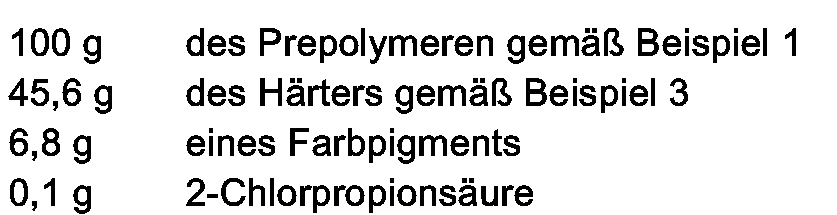
- Nach verschiedenen Zeitspannen, gerechnet vom Auftragen der Mischung, werden Vliesstoffe oder Spaltleder von Hand aufgelegt und durch Walzen mechanisch gleichmäßig aufgedrückt.
- Die beschichteten Teile passieren dann einen auf etwa 80° C geheizten Trockenkanal. Nach 4 Minuten können die Teile von der Matrize abgezogen werden. Die Beschichtungen haben eine lederähnliche Narbung, die beim Stapeln voll erhalten bleibt, sind völlig klebfrei und lassen sich auf Schuhmaschinen schnell verarbeiten. Die beschichteten Teile sind gegen Chemikalien und Wasser beständig. Sie überstehen einen Knicktest bei -25° C mit mehr als 2000 Knickungen ohne Beschädigung.
- Die Eigenschaften zeigen, daß der entstandene Polyurethanharnstoff durch den Einfluß des erfindungsgemäßen Stabilisators voll ausreagiert ist.
- Führt man den gleichen Versuch mit einem Isocyanat-Prepolymer nach Beispiel 1 durch und verzichtet auf die Zugabe von 2-Chlorpropionsäure, erhält man Beschichtungen, die erst nach 8 Minuten abgezogen werden können und die erst nach einer Lagerung von 24 Stunden gestapelt und verarbeitet werden können.
wobei die Molverhältnisse


Claims (5)

Applications Claiming Priority (2)
| Application Number | Priority Date | Filing Date | Title |
|---|---|---|---|
| DE3816118A DE3816118A1 (de) | 1988-05-11 | 1988-05-11 | Stabilisierte polyisocyanate |
| DE3816118 | 1988-05-11 |
Publications (2)
| Publication Number | Publication Date |
|---|---|
| EP0341516A1 EP0341516A1 (de) | 1989-11-15 |
| EP0341516B1 true EP0341516B1 (de) | 1992-03-18 |
Family
ID=6354174
Family Applications (1)
| Application Number | Title | Priority Date | Filing Date |
|---|---|---|---|
| EP89107742A Expired - Lifetime EP0341516B1 (de) | 1988-05-11 | 1989-04-28 | Stabilisierte Polyisocyanate |
Country Status (5)
| Country | Link |
|---|---|
| US (1) | US5068402A (de) |
| EP (1) | EP0341516B1 (de) |
| CA (1) | CA1317965C (de) |
| DE (2) | DE3816118A1 (de) |
| ES (1) | ES2030554T3 (de) |
Families Citing this family (13)
| Publication number | Priority date | Publication date | Assignee | Title |
|---|---|---|---|---|
| EP0445608B1 (de) * | 1990-03-07 | 1994-06-08 | Bayer Ag | Stabilisierung von organischen Polyisocyanaten |
| DE4111212A1 (de) * | 1991-04-06 | 1992-10-08 | Bayer Ag | Verfahren zur konditionierung und/oder reinigung von organischen isocyanaten |
| US5169878A (en) * | 1991-04-08 | 1992-12-08 | The Dow Chemical Company | Composition and method of preparation of viscosity-stabilized polyisocyanates comprising triazine groups |
| DE4236939A1 (de) * | 1992-11-02 | 1994-05-05 | Bayer Ag | Verfahren zur Herstellung von stabilisierten aromatischen Diaminen und ihre Verwendung zur Herstellung von wärmestandfesten Polyurethanharnstoff-Elastomeren |
| DE4328076A1 (de) * | 1993-08-20 | 1995-02-23 | Bayer Ag | Verfahren zur Herstellung von weichen, Urethangruppen aufweisenden Schaumstoffen |
| JP3778507B2 (ja) * | 2002-11-28 | 2006-05-24 | 横浜ゴム株式会社 | 硬化剤組成物およびそれを含有した硬化性樹脂組成物 |
| WO2008068197A1 (de) * | 2006-12-04 | 2008-06-12 | Basf Se | Polyisocyanatzubereitungen |
| EP1990387B1 (de) | 2007-05-11 | 2010-07-21 | Sika Technology AG | Über Polyurethan-Heissschmelzklebstoff verbundene Schichtbundkörper sowie Verfahren zum Verkleben von Weichmacher enthaltenden Kunststoffen |
| US20090004392A1 (en) * | 2007-06-27 | 2009-01-01 | The Sherwin-Williams Company | Transiently Inhibited Urea And Urethane-Urea Hybrid Coating Compositions |
| JP6080857B2 (ja) * | 2011-10-28 | 2017-02-15 | ビーエーエスエフ ソシエタス・ヨーロピアBasf Se | 溶剤中で凝集安定性の、(環式)脂肪族ジイソシアナートのポリイソシアナートの製造方法 |
| US9617402B2 (en) | 2011-10-28 | 2017-04-11 | Basf Se | Process for preparing polyisocyanates which are flocculation-stable in solvents from (cyclo)aliphatic diisocyanates |
| US9139352B2 (en) | 2014-02-07 | 2015-09-22 | Yeti Coolers, Llc | Insulating container |
| EP3305863A1 (de) | 2016-10-07 | 2018-04-11 | Basf Se | Verfahren zur herstellung von in lösungsmitteln flockulationsstabilen polyisocyanaten von (cyclo)aliphatischen diisocyanaten |
Family Cites Families (7)
| Publication number | Priority date | Publication date | Assignee | Title |
|---|---|---|---|---|
| DE2436741A1 (de) * | 1974-07-30 | 1976-02-12 | Bayer Ag | Verfahren zur herstellung modifizierter polyisocyanate |
| US4077989A (en) * | 1974-07-30 | 1978-03-07 | Bayer Aktiengesellschaft | Process for the production of modified polyisocyanates |
| US3953387A (en) * | 1974-11-06 | 1976-04-27 | Atlantic Richfield Company | Stabilized thermoplastic polyurethanes |
| CA1266272A (en) * | 1983-05-27 | 1990-02-27 | Masakatsu Yoshimura | A 2,2,6,6-tetramethylpiperidine derivative, its production and a stabilizer for synthetic resins containing the same |
| EP0155559A1 (de) * | 1984-02-29 | 1985-09-25 | Dainippon Ink And Chemicals, Inc. | Verfahren zur Herstellung von isocyanuratringe enthaltendem Polyisocyanat und Harzzusammensetzung für Urethanüberzüge, die dieses Polyisocyanat und ein Acrylpolyol enthalten |
| DE3607996A1 (de) * | 1986-03-11 | 1987-09-17 | Basf Ag | Feuchtigkeitshaertende, lagerstabile einkomponenten-polyurethansysteme und deren verwendung |
| DE3624924A1 (de) * | 1986-07-23 | 1988-01-28 | Basf Ag | Feuchtigkeitshaertende, lagerstabile einkomponenten-polyurethansysteme und deren verwendung |
-
1988
- 1988-05-11 DE DE3816118A patent/DE3816118A1/de not_active Withdrawn
-
1989
- 1989-04-20 CA CA000597331A patent/CA1317965C/en not_active Expired - Fee Related
- 1989-04-28 ES ES198989107742T patent/ES2030554T3/es not_active Expired - Lifetime
- 1989-04-28 DE DE8989107742T patent/DE58900974D1/de not_active Expired - Lifetime
- 1989-04-28 EP EP89107742A patent/EP0341516B1/de not_active Expired - Lifetime
-
1990
- 1990-07-20 US US07/555,872 patent/US5068402A/en not_active Expired - Lifetime
Also Published As
| Publication number | Publication date |
|---|---|
| ES2030554T3 (es) | 1992-11-01 |
| EP0341516A1 (de) | 1989-11-15 |
| DE58900974D1 (de) | 1992-04-23 |
| CA1317965C (en) | 1993-05-18 |
| DE3816118A1 (de) | 1989-11-23 |
| US5068402A (en) | 1991-11-26 |
Similar Documents
| Publication | Publication Date | Title |
|---|---|---|
| EP0341516B1 (de) | Stabilisierte Polyisocyanate | |
| DE3739261A1 (de) | Verfahren zur herstellung von urethangruppen aufweisenden polyisocyanaten und ihre verwendung | |
| EP0150769B1 (de) | Verfahren zur Herstellung von Polyisocyanaten mit Biuretstruktur | |
| DE1174759B (de) | Verfahren zur Herstellung von Polyisocyanaten mit Biuretstruktur | |
| EP0337116A1 (de) | Verfahren zur Herstellung von Uretdion- und Isocyanuratgruppen aufweisenden Polyisocyanatgemischen | |
| DE1494465C3 (de) | Feuchtigkeitstrocknende Eintopfüberzugs- und -klebemasse | |
| DE2342603C3 (de) | Verfahren zur Herstellung von Malonsäuredialkylesterblockierten Biuretpolyisocyanaten sowie deren Verwendung | |
| DE1013869B (de) | Verfahren zur Herstellung von Isocyanat-Polymerisationsprodukten | |
| DE2403858A1 (de) | Stabile, fluessige amid- und/oder acylharnstoffgruppenhaltige isocyanurat-polyisocyanatloesungen | |
| DE3133865C2 (de) | Verfahren zur Herstellung einer organischen Polyisocyanat-Zusammensetzung sowie deren Verwendung | |
| EP0232541B1 (de) | Latente Zinn-Katalysatoren enthaltende Polyisocyanat-Zubereitungen, ihre Verwendung zur Herstellung von Polyurethankunststoffen und Umsetzungsprodukte von Sulfonylisocyanaten mit ausgewählten Zinnverbindungen | |
| EP0183150B1 (de) | Verfahren zur Herstellung von modifizierten Polyisocyanaten und ihre Verwendung in Polyurethananlacken | |
| DE2500921C3 (de) | Verfahren zur Herstellung von Polyurethanlösungen | |
| EP0082987B1 (de) | Neue Isocyanato-isocyanurate sowie ein Verfahren zu deren Herstellung | |
| EP1158013B2 (de) | Verfahren zur Herstellung von Polyisocyanaten mit Biuretstruktur | |
| DE1695520A1 (de) | Isocyanuratgruppen aufweisende Polyisocyanate | |
| DE2437130A1 (de) | Gegen monomerenrueckspaltung stabilisiertes biuretpolyisocyanat-gemisch | |
| DE19504530A1 (de) | Blockierte Polyisocyanate, Verfahren zu ihrer Herstellung und daraus hergestellte Lacke und Beschichtungssysteme | |
| EP0662487B1 (de) | Feuchtigkeitshärtende Einkomponenten-Beschichtungsmittel | |
| DE69526633T2 (de) | Auf 2-methyl-1,5-pentandiamin basierenden Aldiminen und ihre Verwendung zur Herstellung von Polyharnstoffbeschichtungen | |
| EP0849268A1 (de) | Polycyclische Iminooxadiazindione aus (cyclo)aliphatischen 1,4-Diisocyanaten | |
| EP0496209B1 (de) | Härtergemisch für Isocyanatgruppen aufweisende Vorpolymere | |
| EP0220485B1 (de) | Sulfonsäureestergruppen aufweisenden Polyhydroxylverbindungen und ihre Verwendung als Polyolkomponente in Giessharzen | |
| EP0082973B1 (de) | Neue biuretgruppenhaltige Polyisocyanate sowie ein Verfahren zu deren Herstellung | |
| EP4134386B1 (de) | Adduktzusammensetzungen aus diisocyanaten und hydroxy- oder aminofunktionalisierten alkylsulfonsäuren und/oder alkylsulfonsäurederivaten |
Legal Events
| Date | Code | Title | Description |
|---|---|---|---|
| PUAI | Public reference made under article 153(3) epc to a published international application that has entered the european phase |
Free format text: ORIGINAL CODE: 0009012 |
|
| 17P | Request for examination filed |
Effective date: 19890428 |
|
| AK | Designated contracting states |
Kind code of ref document: A1 Designated state(s): BE DE ES FR GB IT NL |
|
| 17Q | First examination report despatched |
Effective date: 19910830 |
|
| GRAA | (expected) grant |
Free format text: ORIGINAL CODE: 0009210 |
|
| AK | Designated contracting states |
Kind code of ref document: B1 Designated state(s): BE DE ES FR GB IT NL |
|
| ITF | It: translation for a ep patent filed | ||
| REF | Corresponds to: |
Ref document number: 58900974 Country of ref document: DE Date of ref document: 19920423 |
|
| ET | Fr: translation filed | ||
| GBT | Gb: translation of ep patent filed (gb section 77(6)(a)/1977) | ||
| REG | Reference to a national code |
Ref country code: ES Ref legal event code: FG2A Ref document number: 2030554 Country of ref document: ES Kind code of ref document: T3 |
|
| PLBE | No opposition filed within time limit |
Free format text: ORIGINAL CODE: 0009261 |
|
| STAA | Information on the status of an ep patent application or granted ep patent |
Free format text: STATUS: NO OPPOSITION FILED WITHIN TIME LIMIT |
|
| 26N | No opposition filed | ||
| REG | Reference to a national code |
Ref country code: GB Ref legal event code: IF02 |
|
| PGFP | Annual fee paid to national office [announced via postgrant information from national office to epo] |
Ref country code: DE Payment date: 20070326 Year of fee payment: 19 |
|
| PGFP | Annual fee paid to national office [announced via postgrant information from national office to epo] |
Ref country code: NL Payment date: 20070403 Year of fee payment: 19 |
|
| PGFP | Annual fee paid to national office [announced via postgrant information from national office to epo] |
Ref country code: ES Payment date: 20070521 Year of fee payment: 19 |
|
| PGFP | Annual fee paid to national office [announced via postgrant information from national office to epo] |
Ref country code: BE Payment date: 20070615 Year of fee payment: 19 |
|
| PGFP | Annual fee paid to national office [announced via postgrant information from national office to epo] |
Ref country code: GB Payment date: 20070425 Year of fee payment: 19 |
|
| PGFP | Annual fee paid to national office [announced via postgrant information from national office to epo] |
Ref country code: IT Payment date: 20070622 Year of fee payment: 19 |
|
| PGFP | Annual fee paid to national office [announced via postgrant information from national office to epo] |
Ref country code: FR Payment date: 20070411 Year of fee payment: 19 |
|
| BERE | Be: lapsed |
Owner name: *BAYER A.G. Effective date: 20080430 |
|
| GBPC | Gb: european patent ceased through non-payment of renewal fee |
Effective date: 20080428 |
|
| NLV4 | Nl: lapsed or anulled due to non-payment of the annual fee |
Effective date: 20081101 |
|
| PG25 | Lapsed in a contracting state [announced via postgrant information from national office to epo] |
Ref country code: NL Free format text: LAPSE BECAUSE OF NON-PAYMENT OF DUE FEES Effective date: 20081101 Ref country code: DE Free format text: LAPSE BECAUSE OF NON-PAYMENT OF DUE FEES Effective date: 20081101 |
|
| REG | Reference to a national code |
Ref country code: FR Ref legal event code: ST Effective date: 20081231 |
|
| PG25 | Lapsed in a contracting state [announced via postgrant information from national office to epo] |
Ref country code: BE Free format text: LAPSE BECAUSE OF NON-PAYMENT OF DUE FEES Effective date: 20080430 |
|
| PG25 | Lapsed in a contracting state [announced via postgrant information from national office to epo] |
Ref country code: FR Free format text: LAPSE BECAUSE OF NON-PAYMENT OF DUE FEES Effective date: 20080430 |
|
| REG | Reference to a national code |
Ref country code: ES Ref legal event code: FD2A Effective date: 20080429 |
|
| PG25 | Lapsed in a contracting state [announced via postgrant information from national office to epo] |
Ref country code: GB Free format text: LAPSE BECAUSE OF NON-PAYMENT OF DUE FEES Effective date: 20080428 |
|
| PG25 | Lapsed in a contracting state [announced via postgrant information from national office to epo] |
Ref country code: ES Free format text: LAPSE BECAUSE OF NON-PAYMENT OF DUE FEES Effective date: 20080429 |
|
| PG25 | Lapsed in a contracting state [announced via postgrant information from national office to epo] |
Ref country code: IT Free format text: LAPSE BECAUSE OF NON-PAYMENT OF DUE FEES Effective date: 20080428 |