EP0341102B1 - Produits, compositions et traitements antimottants pour sels, engrais simples et complexes - Google Patents
Produits, compositions et traitements antimottants pour sels, engrais simples et complexes Download PDFInfo
- Publication number
- EP0341102B1 EP0341102B1 EP89400923A EP89400923A EP0341102B1 EP 0341102 B1 EP0341102 B1 EP 0341102B1 EP 89400923 A EP89400923 A EP 89400923A EP 89400923 A EP89400923 A EP 89400923A EP 0341102 B1 EP0341102 B1 EP 0341102B1
- Authority
- EP
- European Patent Office
- Prior art keywords
- clumping
- weight
- fact
- salts
- composition
- Prior art date
- Legal status (The legal status is an assumption and is not a legal conclusion. Google has not performed a legal analysis and makes no representation as to the accuracy of the status listed.)
- Expired - Lifetime
Links
Images

Classifications
-
- B—PERFORMING OPERATIONS; TRANSPORTING
- B01—PHYSICAL OR CHEMICAL PROCESSES OR APPARATUS IN GENERAL
- B01J—CHEMICAL OR PHYSICAL PROCESSES, e.g. CATALYSIS OR COLLOID CHEMISTRY; THEIR RELEVANT APPARATUS
- B01J2/00—Processes or devices for granulating materials, e.g. fertilisers in general; Rendering particulate materials free flowing in general, e.g. making them hydrophobic
- B01J2/30—Processes or devices for granulating materials, e.g. fertilisers in general; Rendering particulate materials free flowing in general, e.g. making them hydrophobic using agents to prevent the granules sticking together; Rendering particulate materials free flowing in general, e.g. making them hydrophobic
-
- C—CHEMISTRY; METALLURGY
- C05—FERTILISERS; MANUFACTURE THEREOF
- C05G—MIXTURES OF FERTILISERS COVERED INDIVIDUALLY BY DIFFERENT SUBCLASSES OF CLASS C05; MIXTURES OF ONE OR MORE FERTILISERS WITH MATERIALS NOT HAVING A SPECIFIC FERTILISING ACTIVITY, e.g. PESTICIDES, SOIL-CONDITIONERS, WETTING AGENTS; FERTILISERS CHARACTERISED BY THEIR FORM
- C05G3/00—Mixtures of one or more fertilisers with additives not having a specially fertilising activity
- C05G3/20—Mixtures of one or more fertilisers with additives not having a specially fertilising activity for preventing the fertilisers being reduced to powder; Anti-dusting additives
-
- C—CHEMISTRY; METALLURGY
- C05—FERTILISERS; MANUFACTURE THEREOF
- C05G—MIXTURES OF FERTILISERS COVERED INDIVIDUALLY BY DIFFERENT SUBCLASSES OF CLASS C05; MIXTURES OF ONE OR MORE FERTILISERS WITH MATERIALS NOT HAVING A SPECIFIC FERTILISING ACTIVITY, e.g. PESTICIDES, SOIL-CONDITIONERS, WETTING AGENTS; FERTILISERS CHARACTERISED BY THEIR FORM
- C05G3/00—Mixtures of one or more fertilisers with additives not having a specially fertilising activity
- C05G3/30—Anti-agglomerating additives; Anti-solidifying additives
Definitions
- the subject of the invention is products, compositions and anti-clumping treatments to prevent solidification of salts, simple and complex fertilizers.
- nitrogenous salts such as ammonium, potassium and calcium nitrates as well as mono-ammonium and diammonic sulfates and fertilizers containing urea.
- Complex fertilizers are binary or ternary mixtures of the elements of the group consisting of nitrogen, phosphorus or potassium; these fertilizers are identified by formulas of the type N x P y K z in which x, y, z represent numbers which respectively designate the percentages of nitrogen, phosphoric anhydride and K2O in the mixture constituting the complex fertilizer.
- the solidification can sometimes reach proportions such that the fertilizer takes the form of a hard, compact mass or large blocks extremely difficult to break up; the fertilizer is then no longer usable as it is.
- the solidification may be such that the crust formed must be broken using heavy mechanical means. The storage, handling and spreading of the fertilizer are made more difficult, the solidification resulting in a significant and unacceptable additional economic cost.
- organic products such as anionic and cationic surfactants, formulated in oily or waxy derivatives and possibly associated with other products such as certain polymers or surfactants.
- non-ionic active ingredients such as anionic and cationic surfactants, formulated in oily or waxy derivatives and possibly associated with other products such as certain polymers or surfactants.
- amino oils there may be mentioned amino oils.
- the simultaneous use of the two types of anti-caking agents constituted respectively by the amine salts of the alkylaryl sulfonic acids and the amine salts of the esters of acid phosphates potentiated the anti-clumping properties of each of the two types of agents, which makes it possible to have recourse, in the case of their simultaneous use according to the invention, to an amount of active material lower than that which is necessary to obtain the same anti-clumping effect when one or the other of the two types of agents is used alone, said simultaneous use also making it possible, always for the same anti-caking effect, to reduce or even eliminate the coating charges generally necessary .
- the anti-clumping product according to the invention for salts, simple and complex fertilizers essentially consists of a combination of one or more amine salts of alkylaryl sulfonic acids and one or more salts of amines of acid phosphate esters, optionally in the presence of an excess of amine, the said combination being able to be prepared by neutralization or "superneutralization" of a mixture of the alkylaryl sulfonic acid (s) and of the acid phosphate ester or using one or more amines.
- alkylaryl sulfonic acids we mean denotes mixtures of mono-, di- or trisulfonic acids whose aromatic part, preferably benzene or naphthalene, more particularly naphthalene, is mono- or polyalkyl-substituted, the degree of substitution being a medium degree corresponding to the molar ratios alkyl / aryl used for the synthesis, it being understood that, for each of the degrees of substitution envisaged, namely generally from 1 to 4, it is possible to be in the presence of complex mixtures of isomers of sulfonic acids; preferably, the total number of carbon atoms in the alkyl part does not exceed 16 in the mixtures in question.
- a mixture of compounds with a hydroxyl group is often chosen, for example a mixture of fatty alcohols.
- a mixture of alkylaryl sulfonic acids and esters of acid phosphates is produced, a mixture which is then neutralized and even "superneutralized” by one or more amines.
- amine use is preferably made of alkylamines, cycloalkoylamines or aromatic amines and optionally alkanolamines, said amines being able to be primary, secondary or tertiary.
- the amine can be oxyalkylene.
- fatty alkylamines are used and preferably alkylamines - or mixtures of such amines - whose number of carbon atoms varies from 12 to 20; technical stearylamine or hydrogenated tallow amine gives good results.
- the subject of the invention is also anti-caking compositions comprising, in addition to the above anti-caking products in accordance with the invention, at least one other anti-caking product advantageously chosen from the group of fatty acids and their salts as well as at least one formulating agent. advantageously chosen from the group comprising mineral oils and their mixtures with macrocrystalline waxes.
- fatty acids use is advantageously made of those having 12 to 20 carbon atoms and preferably stearic acid.
- fatty acid salts use is advantageously made of calcium or magnesium salts and preferably of aluminum; even more particularly, we uses an aluminum salt in which the “aluminum / stearic acid” molar ratio is close to 2.
- paraffin wax having the following characteristics:
- compositions in accordance with the invention are frequently of type I or II defined below in Table A and differing from one another by the proportions of the constituents.
- the anti-clumping treatment in accordance with the invention is characterized in that a simple or complex fertilizer is incorporated into a salt, preferably at the outlet of the drum or fluidized bed, the treated product having then acquired almost all of its mechanical properties final, an effective amount of the anti-clumping product according to the invention, preferably used in the form of the anti-caking composition according to the invention.
- the above effective amount of product in accordance with the invention is advantageously from 0.005 to 0.05% by weight relative to the salt, simple or complex fertilizer.
- the coating of a salt, simple or complex fertilizer using a doped filler is generally followed by the spraying of an oil, petroleum jelly or waxy products. Heavy fuel oil is also widely used. These materials are used to bond the load and to avoid dust.
- the temperature of the treated product is generally less than 40 ° C. and often less than 32 ° C., which corresponds, for ammonium nitrate, to the transition temperature of phases IV to III well known to manufacturers.
- the humidity is generally, at this stage, less than 1%.
- the anti-clumping treatment can be done on a partially cooled fertilizer between 80 and 40 ° C. The cooling is then continued after the incorporation of the anti-caking agent.
- a type I anti-clumping composition In the case of the use of a type I anti-clumping composition, it can be sprayed at a temperature of approximately 80 ° C. by an appropriate system allowing its homogeneous distribution over the fertilizer; the amount of coating agent, the possible application of which follows or precedes that of the anti-clumping composition of type I, can reach 2% by weight relative to the product treated but most often does not exceed 0.5%.
- the anti-clumping compositions according to the invention make it possible to avoid the use of mineral coatings, the influence of which on the removal of dust is well known.
- the fertilizer is then packaged in polyethylene bags and then stacked in a caking module of the type shown in the single figure.
- This caking module comprises a metal frame made up of uprights 1, a load plate 2, spacers 3 and a fixed plate 4.
- Polyethylene bags 5, filled with product to be tested, are stacked as shown on the tray 2.
- a tray 6 carrying a lifting cushion 7 is placed on the stack of bags.
- pressure is transmitted to the stack of bags.
- This applied pressure is variable and can simulate a stack of 12 m high bags.
- the fertilizer is kept under pressure for a more or less long time, generally from 10 to 45 days, sometimes several months.
- the bags are opened, the lumps are weighed and the hardness of the lumps is measured using a dynamometer.
- Cloding is expressed as a percentage of clods (between 0 and 100). In general, the hardness of the lumps is between 0 and 100 N but can reach 200 N for untreated controls.
- a clumping index is defined as the product of the percentage of clods by the hardness of the clods.
- the anti-clumping compositions A, B and C are applied by spraying at 80 ° C. at a rate of 0.15% by weight relative to the fertilizer, this application being preceded by the application of an inert clay at a rate of 0, 3% by weight relative to the fertilizer.
- the anti-clumping composition according to the prior art consists of a clay doped with 3% by weight of stearylamine. It is applied at the rate of 0.6% by weight relative to the fertilizer, this application being followed by the spraying of 0.2% by weight relative to the fertilizer, with petroleum jelly.
- the treated fertilizer is packaged in polyethylene bags and is subjected to a caking test in the caking module described above.
- the stacking time is 20 days under a pressure of 1.5 kg / cm2.
- Table B show that it is possible to reduce the dose of coating agent by half compared to an anti-caking agent consisting of a commercial doped filler and that the combination of anti-caking agents according to the invention shows a potentiation anti-clumping properties of the two active ingredients making up the combination.
- An anti-clumping treatment is applied to an ammonium nitrate titrating 33.5% of nitrogen and containing 3% of ammonium sulphate in the mass.
- the fertilizer is treated at 30 ° C.
- the anti-clumping treatment consists respectively of a spraying at 80 ° C. of 0.1% by weight relative to the fertilizer of the anti-clumping compositions D, E and F described below, and of an anti-clumping composition according to the prior art constituted by a commercial amino oil containing 18% of stearylamine and sprayed under the same conditions.
- compositions D, E and F are applied at a rate of 0.1% by weight relative to the fertilizer.
- the treated fertilizer is subjected to the test described in Example 1 and the same measurements are made.
- composition G is sprayed at 80 ° C. at a rate of 0.2% by weight relative to fertilizer.
- witness No. 1 is an alkylaryl sulfonate marketed by the Applicant Company under the brand name "GALORYL ATH 24". It is used in the context of a treatment which consists in coating with 0.7% by weight relative to the fertilizer of a clay, followed by spraying at 80 ° C. of 0, 2% by weight relative to the fertilizer of a mixture containing 15% by weight of the control n ° 1 in heavy fuel oil n ° 2.
- witness No. 2 consists of petroleum jelly. It is used in the context of a treatment which consists in coating at a rate of 0.5% by weight relative to the fertilizer of a doped clay at 3% by weight of a composition based on stearylamine. , followed by the spraying at 80 ° C of 0.2% by weight relative to the fertilizer, of said control.
- the treated fertilizer is subjected to the test described in Example 1 and the same measurements are made.
- the anti-clumping composition G does not include macrocrystalline wax.
- the anti-clumping composition I is constituted in the same way as composition H, with the difference that the 60% by weight of a mineral oil is replaced by a mixture of 57% mineral oil and 3% aluminum stearate .
- the anti-clumping compositions B, H, I and J are applied by spraying at 80 ° C. at a rate of 0.15% by weight relative to the fertilizer, this application being preceded by the application of an inert clay at a rate of 0.3% by weight relative to the fertilizer.
- composition according to the prior art consists of a clay doped with 3% by weight of stearylamine.
- the treated fertilizer is packaged in polyethylene bags and is subjected to a caking test in the caking module described above.
- the stacking time is 40 days at a pressure of 1.5 kg / cm2.
- This example illustrates the potentiation of the anti-clumping properties of the two active materials constituting the composition associated with aluminum stearate.
- An anti-clogging treatment is applied to an ammonium nitrate titrating 33.3% and containing 4% of ammonium sulphate in the mass.
- the fertilizer is treated at 30 ° C.
- the anti-clumping treatment consists respectively of a spraying at 80 ° C. of 0.1% by weight relative to the fertilizer of the anti-clumping compositions K, L and M described below, and of an anti-clumping composition according to the prior art constituted by a commercial amino oil containing 18% of stearylamine and sprayed under the same conditions.
- Composition L comprises one of the two agents forming part of the anti-clumping product of composition K.
- the treated fertilizer is subjected to the test described in Example 1 and the same measurements are made.
- the stacking time is, in this case, 45 days under a pressure of 1 kg / cm2.
- An anti-clumping treatment is applied to a NPK complex fertilizer of formula 15.11.22 known to be difficult to anti-cuddle and which is at a temperature of 35 ° C. using, by spraying in a proportion of 0.1% by weight per compared to the treated fertilizer, an anti-clumping composition N in accordance with the invention and an anti-clumping composition according to the prior art constituted by a doped clay in an amount of 3% by weight of stearylamine.
- this remarkable anti-clumping performance is accompanied by a suppression of the return of the dust.
- An anti-clumping treatment is applied to a fertilizer based on granulated urea with a filler in the mass using an anti-clumping composition O according to the invention and an anti-clumping composition according to the prior art.
- the anti-clumping composition according to the prior art consists of a commercial aqueous solution of an alkyl sulphate associated with a soluble polymer of ethylene vinyl acetate type.
- the anti-clumping compositions are sprayed onto the fertilizer at a rate of 0.1% by weight relative to fertilizer.
- the test is that described in Example 1.
- the duration of the stacking is 20 days under a pressure of 1 kg / cm2.
- This example illustrates the anti-clumping properties of a composition according to the invention.
- the tests are carried out on 33.5% ammonium nitrate containing 4% ammonium sulfate.
- the treatment consists of a spraying at 80 ° C. of 0.1% by weight relative to the fertilizer of the various anti-clumping compositions.
- the treated fertilizer is subjected to the test described in Example 1 and the same measurements are made.
- the stacking time is, in this case, 45 days under a pressure of 1 kg / cm2.
Landscapes
- Chemical & Material Sciences (AREA)
- Organic Chemistry (AREA)
- Life Sciences & Earth Sciences (AREA)
- Pest Control & Pesticides (AREA)
- Chemical Kinetics & Catalysis (AREA)
- Fertilizers (AREA)
- Solid Fuels And Fuel-Associated Substances (AREA)
- Agricultural Chemicals And Associated Chemicals (AREA)
- Organic Low-Molecular-Weight Compounds And Preparation Thereof (AREA)
Description
- L'invention a pour objet des produits, des compositions et traitements antimottants pour empêcher la prise en masse des sels, engrais simples et complexes.
- Parmi les sels et engrais simples concernés par l'invention, on peut citer les sels azotés tels que les nitrates d'ammonium, de potassium et de calcium ainsi que les sulfates mono-ammonique et diammonique et les engrais contenant de l'urée.
- Les engrais complexes sont des mélanges binaires ou ternaires des éléments du groupe constitué par l'azote, le phosphore ou le potassium; ces engrais sont identifiés par des formules du type Nx Py Kz dans lesquelles x, y, z représentent des nombres qui désignent respectivement les pourcentages d'azote, d'anhydride phosphorique et de K₂O dans le mélange constituant l'engrais complexe.
- Tous les engrais subissent en général une prise en masse ou mottage lors du stockage.
- La tendance au mottage est plus ou moins forte selon:
- le procédé de granulation, le grain pouvant se trouver sous forme de granulés, de grains, de billes, de sphérules, de petits cylindres ou de prills; l'engrais peut également être compacté,
- l'origine des matières premières constitutives de l'engrais,
- la nature des additifs introduits dans la masse avant granulation.
- Parmi les nombreux facteurs qui influent sur le mottage, on peut citer:
- l'humidité intrinsèque de l'engrais ainsi que l'humidité extérieure,
- la température,
- le temps de stockage,
- la pression de stockage,
- le polymorphisme structural notamment les transitions de phase du nitrate d'ammonium,
- la forme physique et la composition chimique du grain.
- La prise en masse peut parfois atteindre des proportions telles que l'engrais prend la forme d'une masse dure, compacte ou de blocs importants extrêmement difficiles à déliter; l'engrais n'est alors plus utilisable tel quel. Dans le cas d'un stockage en silo, la prise en masse peut être telle que la croûte formée doit être brisée à l'aide de moyens mécaniques lourds. Le stockage, la manipulation et l'épandage de l'engrais sont rendus plus difficiles, la prise en masse entraînant alors un surcoût économique important et inacceptable.
- Pour lutter contre la prise en masse, on a proposé de recourir à des produits organiques tels que les tensio-actifs anioniques et cationiques, formulés dans des dérivés huileux ou cireux et associés éventuellement avec d'autres produits tels que certains polymères ou des tensio-actifs non ioniques.
- Parmi les tensio-actifs cationiques proposés, on peut citer les huiles aminées.
- Parmi les tensio-actifs anioniques déjà proposés, on peut citer
- les alcoylaryl-sulfonates d'amine dont la mise en oeuvre est décrite dans le brevet France N° 2.460.706 de la Société Demanderesse,
- les sels d'amines des esters de phosphates acides dont la mise en oeuvre, en association avec une huile minérale, une cire microcristalline et une cire macrocristalline, est décrite dans le brevet européen N° 113 687, ainsi que
- les sels de potassium des esters de phosphate acide dont la mise en oeuvre est décrite dans le brevet URSS SU 1.131.859.
- Ces produits selon l'art antérieur donnent généralement satisfaction mais, devant les exigences toujours plus grandes des utilisateurs, la Société Demanderesse a poursuivi ses recherches en vue de mettre au point des produits encore plus efficaces.
- Et elle a eu le mérite de trouver que, de façon surprenante et inattendue, la mise en oeuvre simultanée des deux types d'agents antimottants constitués respectivement par les sels d'amines des acides alcoylaryl-sulfoniques et les sels d'amines des esters de phosphates acides potentialisait les propriétés antimottantes de chacun des deux types d'agents, ce qui permet d'avoir recours, dans le cas de leur utilisation simultanée conforme à l'invention, à une quantité de matière active inférieure à celle qui est nécessaire pour obtenir un même effet antimottant lorsqu'on utilise l'un ou l'autre des deux types d'agents seuls, ladite utilisation simultanée permettant de plus, toujours pour le même effet antimottant, de réduire, voire de supprimer les charges d'enrobage généralement nécessaires.
- Grâce à l'invention, il devient possible de résoudre le problème de la prise en masse d'engrais très sensibles au phénomène de mottage, tels que les nitrates d'ammonium contenant des sulfates dans la masse ou les engrais complexes.
- Il s'ensuit que le produit antimottant conforme à l'invention pour sels, engrais simples et complexes est essentiellement constitué par une combinaison d'un ou plusieurs sels d'amines d'acides alcoylaryl-sulfoniques et d'un ou plusieurs sels d'amines d'esters de phosphates acides, en présence éventuellement d'un excès d'amine, ladite combinaison pouvant être préparée par neutralisation ou "surneutralisation" d'un mélange du ou des acides alcoylaryl-sulfoniques et du ou des esters de phosphates acides à l'aide d'une ou de plusieurs amines.
- Par le terme "acides alcoylaryl-sulfoniques", on désigne les mélanges d'acides mono-, di- ou trisulfoniques dont la partie aromatique, de préférence benzénique ou naphtalénique, plus particulièrement naphtalénique, est mono- ou polyalcoyl-substituée, le degré de substitution étant un degré moyen correspondant aux rapports molaires alcoyle/aryle utilisés pour la synthèse, étant entendu que, pour chacun des degrés de substitution envisagés, à savoir généralement de 1 à 4, il est possible de se trouver en présence de mélanges complexes d'isomères d'acides sulfoniques; de préférence, le nombre total d'atomes de carbone de la partie alcoyle ne dépasse pas 16 dans les mélanges en question.
- A titre d'exemple, on indique que, dans le cas de l'acide 1,3-isopropyl-naphtalène-sulfonique, le rapport molaire moyen isopropyl/naphtalène est égal à 1,3.
- Par le terme "esters de phosphates acides" qui peuvent être préparés par réaction directe d'un composé à groupement hydroxyle tel qu'un alcool, alcoylphénol ou alcoylnaphtol avec, par exemple, l'anhydride phosphorique, on désigne de préférence ceux qui répondent aux formules générales:

dans lesquelles - R₁ représente un groupe alcoylène ayant de 2 à 4 atomes de carbone,
- R₂, R₃ et R₄ représentent un groupe alcoyle ayant de 8 à 20 atomes de carbone ou un groupe alcoylaryle dont la partie alcoylée a de 8 à 12 atomes de carbone, et
- n₁, n₂ et n₃ représentent un nombre de 0 à 15 et préférentiellement de 0 à 5.
- En général, la réaction rappelée ci-dessus de préparation de ces esters conduit à des mélanges de mono- et diesters.
- Pour des raisons économiques, on choisit souvent un mélange de composés à groupement hydroxyle, par exemple un mélange d'alcools gras.
- Pour la préparation du produit antimottant conforme à l'invention, on réalise un mélange d'acides alcoylaryl-sulfoniques et d'esters de phosphates acides, mélange qui est ensuite neutralisé et même "surneutralisé" par une ou plusieurs amines.
- En tant qu'amine, on a de préférence recours à des alcoylamines, des cycloalcoylamines ou à des amines aromatiques et éventuellement à des alcanolamines, lesdites amines pouvant être primaires, secondaires ou tertiaires.
- L'amine peut être oxyalcoylénée.
- Avantageusement on a recours aux alcoylamines grasses et préférentiellement aux alcoylamines --ou à des mélanges de telles amines-- dont le nombre d'atomes de carbone varie de 12 à 20; la stéarylamine technique ou amine de suif hydrogéné donne de bons résultats.
- Lorsqu'il y a surneutralisation, celle-ci ne dépasse pas 25% d'excès molaire d'amine et est préférentiellement limitée à 10%.
- L'invention a également pour objet des compositions antimottantes comprenant, outre les susdits produits antimottants conformes à l'invention, au moins un autre produit antimottant choisi avantageusement dans le groupe des acides gras et de leurs sels ainsi qu'au moins un agent de formulation choisi avantageusement dans le groupe comprenant les huiles minérales et leurs mélanges avec des cires macrocristallines.
- Parmi les acides gras, on a recours avantageusement à ceux ayant de 12 à 20 atomes de carbone et préférentiellement à l'acide stéarique.
- Parmi les sels d'acides gras, on a recours avantageusement aux sels de calcium ou magnésium et préférentiellement d'aluminium ; encore plus particulièrement, on a recours à un sel d'aluminium dans lequel le rapport molaire "aluminium/acide stéarique" est voisin de 2.
- On utilise généralement les huiles à caractère paraffinique ou naphténique, par exemple
- l'huile naphténique commercialisée par la Société NYNAS sous la marque NYTEX et répondant aux spécifications suivantes:

- l'huile paraffinique commercialisée par BP France sous la marque ENERPAR et répondant aux spécifications suivantes:

- Lorsque la formulation est réalisée à l'aide d'une cire macrocristalline, on a avantageusement recours à une cire de paraffine ayant les caractéristiques suivantes:
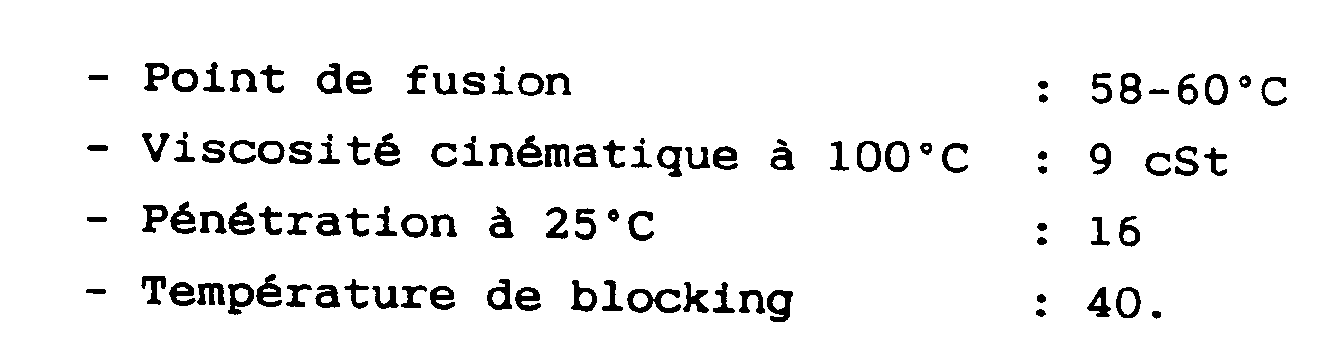
- Les susdites compositions antimottantes conformes à l'invention sont fréquemment du type I ou II définis ci-après dans le tableau A et différant l'un de l'autre par les proportions des constituants.

- Dans les types I et II, le produit antimottant conforme à l'invention comprend:
- de 15 à 85% d'acides alcoylarylsulfoniques,
- de 85 à 15% d'esters de phosphates acides et préférentiellement
- de 30 à 70% d'acides alcoylarylsulfoniques,
- de 70 à 30% d'esters de phosphates acides.
- Le traitement antimottant conforme à l'invention est caractérisé par le fait qu'on incorpore à un sel, engrais simple ou complexe, de préférence en sortie de tambour ou de lit fluidisé, le produit traité ayant alors acquis la presque totalité de ses propriétés mécaniques finales, une quantité efficace du produit antimottant conforme à l'invention, de préférence mis en oeuvre sous la forme de la composition antimottante conforme à l'invention.
- La susdite quantité efficace en produit conforme à l'invention est avantageusement de 0,005 à 0,05% en poids par rapport aux sel, engrais simple ou complexe.
- Plus particulièrement, on incorpore à un sel, engrais simple ou complexe,
- soit une composition antimottante du type I, par pulvérisation, en une quantité de 0,03 à 0,4% et, de préférence, de 0,05 à 0,2% en poids par rapport au produit traité, cette pulvérisation pouvant être suivie ou précédée par un enrobage à l'aide d'une charge du groupe comprenant la craie, la terre d'infusoire, le talc, les argiles ou autres,
- soit une charge dite dopée obtenue par traitement à l'aide d'une composition antimottante du type II d'une charge du groupe comprenant la craie, la terre d'infusoire, le talc, les argiles, la proportion de composition II par rapport à la charge étant de 1 à 10%, de préférence de 1 à 6% en poids, ladite charge dopée étant mise en oeuvre par enrobage à raison de 0,1 à 1%, de préférence de 0,2 à 0,6% en poids par rapport au produit traité,
- Il est connu qu'il n'est pas souhaitable de préparer la charge dopée en utilisant des produits contenant trop d'huile.
- L'enrobage d'un sel, engrais simple ou complexe à l'aide d'une charge dopée est généralement suivi de la pulvérisation d'une huile, d'une vaseline ou de produits cireux. Le fuel lourd est également très utilisé. Ces matières servent à coller la charge et à éviter la poussière.
- En sortie de tambour refroidisseur ou en fin de lit fluidisé, la température du produit traité est généralement inférieure à 40°C et souvent inférieure à 32°C, ce qui correspond pour le nitrate d'ammonium, à la température de transition des phases IV à III bien connue des fabricants. L'humidité est en général, à ce stade, inférieure à 1%.
- Dans certains cas particuliers, le traitement antimottant peut se faire sur un engrais partiellement refroidi entre 80 et 40°C. Le refroidissement est alors poursuivi après l'incorporation de l'antimottant.
- Dans le cas de la mise en oeuvre d'une composition antimottante de type I, celle-ci peut être pulvérisée à une température d'environ 80°C par un système approprié permettant sa répartition homogène sur l'engrais; la quantité d'enrobant dont l'application éventuelle suit ou précède celle de la composition antimottante de type I, peut atteindre 2% en poids par rapport au produit traité mais ne dépasse le plus souvent pas 0,5%.
- Avantageusement, les compositions antimottantes selon l'invention permettent d'éviter l'emploi d'enrobants minéraux dont l'influence sur le réenvolement de la poussière est bien connue.
- Pour illustrer les propriétés antimottantes des produits conformes à l'invention, on a procédé à un certain nombre d'essais comparatifs.
- Pour ces essais, on utilise une bétonnière dans laquelle on applique sur 20 kg d'engrais un traitement antimottant selon l'invention.
- L'engrais est ensuite conditionné dans des sacs en polyéthylène puis empilé dans un module de mottage du type de celui illustré par la figure unique.
- Ce module de mottage comprend une armature métallique constituée de montants 1, d'un plateau de charge 2, d'entretoises 3 et d'un plateau fixe 4.
- Des sacs 5 en polyéthylène, remplis de produit à tester, sont empilés comme montré sur le plateau 2.
- Un plateau 6 portant un coussin de levage 7 est posé sur la pile de sacs. En gonflant le coussin à l'air comprimé entre le plateau mobile 6 et le plateau fixe 4, on transmet une pression à la pile de sacs.
- Cette pression appliquée est variable et peut simuler une pile de sacs de 12 m de haut.
- L'engrais est maintenu sous pression pendant un temps plus ou moins long, en général de 10 à 45 jours, parfois de plusieurs mois. A la fin du test, les sacs sont ouverts, les mottes sont pesées et la dureté des mottes est mesurée à l'aide d'un dynamomètre.
- Le mottage est exprimé en pourcentage de mottes (entre 0 et 100). En général, la dureté des mottes est comprise entre 0 et 100 N mais peut atteindre 200 N pour les témoins non traités.
- On définit un indice de mottage comme étant le produit du pourcentage de mottes par la dureté des mottes.
- Chaque mesure résulte de la moyenne de plusieurs sacs (en général 4 sacs).
- On applique un traitement d'antimottage à un engrais complexe granulé NPK de formule 15.12.24 en utilisant
- une composition antimottante A conforme à l'invention,
- une composition antimottante B comportant l'un des deux agents entrant dans la constitution du produit antimottant de la composition A,
- une composition C comportant l'autre des deux agents entrant dans la constitution du produit antimottant de la composition A,
- une composition antimottante selon l'art antérieur.
- La composition antimottante A est constituée
- à raison de 15% en poids du produit de la neutralisation d'un mélange à 66% en poids d'acide 1,3-isopropyl naphtalènesulfonique et à 37% en poids d'un lauryl phosphate acide à 3 moles d'oxyde d'éthylène par la stéarylamine,
- à raison de 60% en poids d'une huile minérale,
- à raison de 25% en poids d'une cire macrocristalline.
- La composition antimottante B est constituée
- à raison de 15% en poids du produit de la neutralisation d'un acide 1,3-isopropyl naphtalènesulfonique par la stéarylamine,
- à raison de 60% en poids d'une huile minérale,
- à raison de 25% en poids d'une cire macrocristalline.
- La composition antimottante C est constituée
- à raison de 15% en poids du produit de la neutralisation d'un lauryl phosphate acide à 3 moles d'oxyde d'éthylène (mélange 50/50 molaire de mono- et diesters) par la stéarylamine,
- à raison de 60% en poids d'une huile minérale,
- à raison de 25% en poids d'une cire macrocristalline.
- Les compositions antimottantes A, B et C sont appliquées par pulvérisation à 80°C à raison de 0,15% en poids par rapport à l'engrais, cette application étant précédée de l'application d'une argile inerte à raison de 0,3% en poids par rapport à l'engrais.
- La composition antimottante selon l'art antérieur est constituée par une argile dopée à 3% en poids de stéarylamine. Elle est appliquée à raison de 0,6% en poids par rapport à l'engrais, cette application étant suivie de la pulvérisation de 0,2% en poids par rapport à l'engrais, d'une vaseline.
- L'engrais traité est conditionné dans des sacs de polyéthylène et est soumis à un test de mottage dans le module de mottage décrit plus haut. La durée de l'empilage est de 20 jours sous une pression de 1,5 kg/cm².
- A l'issue de ce test, les sacs sont ouverts avec précaution. Les mottes sont pesées et la dureté des mottes est mesurée à l'aide d'un dynamomètre.
- Les résultats de ces mesures sont réunis dans le tableau B.

- Les résultats réunis dans le tableau B montrent qu'il est possible de diminuer la dose d'enrobant de moitié par rapport à un antimottant constitué d'une charge dopée commerciale et que la combinaison d'agents antimottants selon l'invention fait apparaître une potentialisation des propriétés antimottantes des deux matières actives constitutives de la combinaison.
- On applique un traitement d'antimottage à un nitrate d'ammonium titrant 33,5% d'azote et contenant 3% de sulfate d'ammonium dans la masse. L'engrais est traité à 30°C.
- On effectue quatre essais dans lesquels le traitement antimottant consiste respectivement en une pulvérisation à 80°C de 0,1% en poids par rapport à l'engrais des compositions antimottantes D, E et F décrites ci-dessous, et d'une composition antimottante selon l'art antérieur constituée par une huile aminée commerciale contenant 18% de stéarylamine et pulvérisée dans les mêmes conditions.
- La composition D est constituée:
- à raison de 19% en poids du produit de la neutralisation d'un mélange à 66% en poids d'un acide 1,3-isopropyl naphtalènesulfonique et à 37% en poids d'un lauryl phosphate acide (mélange 50/50 de mono- et diesters) par la stéarylamine,
- à raison de 6% en poids d'acide stéarique,
- à raison de 50% en poids d'une huile minérale,
- à raison de 25% en poids d'une cire macrocristalline.
- La composition E est constituée:
- à raison de 19% en poids du produit de la neutralisation d'un acide 1,3-isopropyl naphtalènesulfonique par la stéarylamine,
- à raison de 6% en poids d'acide stéarique,
- à raison de 50% en poids d'une huile minérale et
- à raison de 25% en poids d'une cire macrocristalline.
- La composition F est constituée:
- à raison de 19% en poids du produit de la neutralisation d'un lauryl phosphate acide (mélange 50/50 de mono- et diesters) par la stéarylamine,
- à raison de 6% en poids d'acide stéarique,
- à raison de 50% en poids d'une huile minérale et
- à raison de 25% en poids d'une cire macrocristalline.
- Les compositons D, E et F sont appliquées à raison de 0,1% en poids par rapport à l'engrais.
- On soumet l'engrais traité au test décrit à l'exemple 1 et on effectue les mêmes mesures.
- Les résultats de ces mesures sont réunis dans le tableau C.

- Les résultats réunis dans le tableau C montrent que la combinaison conforme à l'invention fait apparaître une potentialisation des propriétés antimottantes par rapport aux propriétés de chacun des agents constitutifs de la combinaison pris isolément et formulés de la même manière.
- On applique un traitement d'antimottage à un engrais complexe NPK de formule 16.10.5 connu pour être difficile à antimotter et qui se trouve à une température de 35°C.
- On a recours à une composition G conforme à l'invention constituée
- à raison de 10% en poids du produit de la neutralisation par la stéarylamine d'un mélange à 75% en poids d'acide 1,3-isopropylnaphtalène sulfonique et à 25% en poids d'un alcoyl phosphate acide (mélange 50/50 molaire de mono- et diesters) dont la partie alcoyle est constituée par une chaîne comprenant essentiellement un mélange en C16 et en C18,
- à raison de 90% en poids d'une huile minérale.
- On applique d'abord, à raison de 0,3% en poids par rapport à l'engrais, une argile puis on pulvérise à 80°C la composition G à raison de 0,2% en poids par rapport à l'engrais.
- On effectue deux expériences comparatives à l'aide de deux compositions selon l'art antérieur, désignées par "Témoin n°1" et "Témoin n°2".
- Le Témoin n°1 est un alcoylaryl sulfonate commercialisé par la Société Demanderesse sous la marque "GALORYL ATH 24". Il est mis en oeuvre dans le cadre d'un traitement qui consiste en un enrobage à l'aide de 0,7% en poids par rapport à l'engrais d'une argile, suivi de la pulvérisation à 80°C de 0,2% en poids par rapport à l'engrais d'un mélange contenant 15% en poids du Témoin n°1 dans du fuel lourd n°2.
- Le Témoin n°2 est constitué par de la vaseline. Il est mis en oeuvre dans le cadre d'un traitement qui consiste en un enrobage à raison de 0,5% en poids par rapport à l'engrais d'une argile dopée à 3% en poids d'une composition à base de stéarylamine, suivi de la pulvérisation à 80°C de 0,2% en poids par rapport à l'engrais, dudit témoin.
- On soumet l'engrais traité au test décrit à l'exemple 1 et on effectue les mêmes mesures.
- Les résultats de ces mesures sont réunis dans le tableau D.

- Les résultats réunis dans le tableau D montrent que, sur un engrais extrêmement difficile à antimotter, l'invention permet de diminuer les quantités d'enrobant minéral, donc de diminuer le taux de réenvolement de la poussière de façon significative tout en améliorant les performances antimottantes.
- La composition antimottante G ne comprend pas de cire macrocristalline.
- On applique un traitement d'antimottage à un engrais complexe granulé NPK de formule 15.12.24 en utilisant:
- des compositions antimottantes H et I conformes à l'invention,
- la composition antimottante B de l'exemple 1,
- une composition antimottante J comportant l'autre des deux agents entrant dans la constitution du produit antimottant des compositions H et I,
- une composition antimottante selon l'art antérieur.
- La composition antimottante H est constituée
- à raison de 15% en poids du produit de la neutralisation d'un mélange à 65% en poids d'acide 1,3-isopropyl naphtalènesulfonique et à 35% en poids d'un alcoylphosphate acide défini dans la composition J, par la stéarylamine,
- à raison de 60% en poids d'une huile minérale et
- à raison de 25% en poids d'une cire macrocristalline.
- La composition antimottante I est constituée de la même façon que la composition H, à la différence près que les 60% en poids d'une huile minérale sont remplacés par un mélange de 57% d'huile minérale et 3% de stéarate d'aluminium.
- La composition antimottante J est constituée
- à raison de 15% en poids du produit de la neutralisation d'un alcoylphosphate acide (mélange 50/50 molaire de mono- et diester) dont la partie alcoyle est constituée par une chaîne comprenant essentiellement un mélange en C₈ et en C₁₀ par la stéarylamine,
- à raison de 60% en poids d'une huile minérale et
- à raison de 25% en poids d'une cire macrocristalline.
- Les compositions antimottantes B, H, I et J sont appliquées par pulvérisation à 80°C à raison de 0,15% en poids par rapport à l'engrais, cette application étant précédée de l'application d'une argile inerte à raison de 0,3% en poids par rapport à l'engrais.
- La composition selon l'art antérieur est constituée par une argile dopée à 3% en poids de stéarylamine.
- Elle est appliquée à raison de 0,6% en poids par rapport à l'engrais, cette application étant suivie de la pulvérisation d'une vaseline à raison de 0,2% en poids par rapport à l'engrais,.
- L'engrais traité est conditionné dans des sacs de polyéthylène et est soumis à un test de mottage dans le module de mottage décrit plus haut. La durée de l'empilage est de 40 jours sous une pression de 1,5 kg/cm².
- A l'issue de ce test, les sacs sont ouverts avec précaution. Les mottes sont pesées et la dureté des mottes est mesurée à l'aide d'un dynamomètre.
- Les résultats de ces mesures sont réunis dans le tableau E.

- Cet exemple illustre la potentialisation des propriétés antimottantes des deux matières actives constitutives de la composition associées au stéarate d'aluminium.
- On applique un traitement d'antimottage à un nitrate d'ammoniaque titrant 33,3% et contenant 4% de sulfate d'ammonium dans la masse. L'engrais est traité à 30°C.
- On effectue quatre essais dans lesquels le traitement antimottant consiste respectivement en une pulvérisation à 80°C de 0,1% en poids par rapport à l'engrais des compositions antimottantes K, L et M décrites ci-dessous, et d'une composition antimottante selon l'art antérieur constituée par une huile aminée commerciale contenant 18% de stéarylamine et pulvérisée dans les mêmes conditions.
- La composition K conforme à l'invention est constituée:
- à raison de 22% en poids du produit de la neutralisation d'un mélange à 55% en poids d'un acide tributylnaphtalènesulfonique et à 45% en poids d'un stéarylphosphate acide (mélange 50/50 de mono- et diesters) par la stéarylamine,
- à raison de 10% en poids d'acide stéarique,
- à raison de 45% en poids d'une huile paraffinique,
- à raison de 23% en poids d'une cire macrocristalline.
- La composition L comporte l'un des deux agents entrant dans la constitution du produit antimottant de la composition K.
- Elle est constituée:
- à raison de 22% en poids du produit de la neutralisation d'un acide tributylnaphtalènesulfonique par la stéarylamine,
- à raison de 10% en poids d'acide stéarique,
- à raison de 45% en poids d'une huile paraffinique et
- à raison de 23% en poids d'une cire macrocristalline.
- La composition M comporte l'autre des deux agents entrant dans la constitution du produit antimottant de la composition K. Elle est constituée:
- à raison de 22% en poids du produit de la neutralisation d'un stéarylphosphate acide (mélange 50/50 mono- et diesters) par la stéarylamine,
- à raison de 10% en poids d'acide stéarique,
- à raison de 45% en poids d'une huile paraffinique et
- à raison de 23% en poids d'une cire macrocristalline.
- On soumet l'engrais traité au test décrit à l'exemple 1 et on effectue les mêmes mesures. La durée de l'empilage est, dans ce cas, de 45 jours sous une pression de 1 kg/cm².
- Les résultats de ces mesures sont réunis dans le tableau F.

- Les résultats réunis dans le tableau F montrent que la combinaison conforme à l'invention fait apparaître une potentialisation des propriétés antimottantes par rapport aux propriétés de chacun des agents constitutifs de la combinaison pris isolément et formulés de la même manière.
- On applique un traitement d'antimottage à un engrais complexe NPK de formule 15.11.22 connu pour être difficile à antimotter et qui se trouve à une température de 35°C en utilisant, par pulvérisation à une proportion de 0,1% en poids par rapport à l'engrais traité, une composition antimottante N conforme à l'invention et une composition antimottante selon l'art antérieur constituée par une argile dopée à raison de 3% en poids de stéarylamine.
- La composition N est constituée:
- à raison de 15% en poids du produit de la neutralisation d'un mélange à 50% d'un acide 1,3-isopropyl-naphtalènesulfonique et à 50% d'un laurylphosphate acide (mélange 50/50 molaire de mono- et diesters) par la stéarylamine,
- à raison de 60% en poids d'une huile minérale et
- à raison de 25% en poids d'une cire macrocristalline.
- Cet exemple illustre le fait qu'une composition selon l'invention permet la suppression de l'enrobant minéral.
- Avantageusement, cette performance antimottante remarquable s'accompagne d'une suppression du réenvolement de la poussière.
- On applique un traitement d'antimottage à un engrais à base d'urée granulée avec une charge dans la masse en utilisant une composition antimottante O conforme à l'invention et une composition antimottante selon l'art antérieur.
- La composition antimottante O est constituée:
- à raison de 19% en poids du produit de la neutralisation d'un mélange à 75% d'un acide 1,3-isopropyl-naphtalènesulfonique et à 25% d'un laurylphosphate acide (mélange 50/50 molaire de mono- et diesters) par la stéarylamine,
- à raison de 5% en poids d'acide stéarique,
- à raison de 53% en poids d'une huile minérale et
- à raison de 23% en poids d'une cire macrocristalline.
- La composition antimottante selon l'art antérieur est constituée par une solution aqueuse commerciale d'un alcoylsulfate associé à un polymère soluble type éthylène acétate de vinyle.
- Les compositions antimottantes sont pulvérisées sur l'engrais à raison de 0,1% en poids par rapport à l'engrais.
- Le test est celui décrit à l'exemple 1. La durée de l'empilage est de 20 jours sous une pression de 1 kg/cm².

- Cet exemple illustre les propriétés antimottantes d'une composition selon l'invention.
- On a testé comparativement à la composition K décrite à l'exemple 5, les formules appelées "coating mixture A, B et C" décrites dans le brevet EP 113 687.
- Les essais sont réalisés sur un nitrate d'ammonium 33,5% contenant 4% de sulfate d'ammonium.
- Le traitement consiste en une pulvérisation à 80°C de 0,1% en poids par rapport à l'engrais des différentes compositions antimottantes.
- On soumet l'engrais traité au test décrit à l'exemple 1 et on effectue les mêmes mesures. La durée de l'empilage est, dans ce cas, de 45 jours sous une pression de 1 kg/cm².
- Les résultats sont réunis dans le tableau I.

- Cet exemple illustre la supériorité décisive des compositions antimottantes selon l'invention par rapport à l'art antérieur sur un engrais ayant une très forte tendance à la prise en masse.

Claims (17)

étant entendu que, dans les deux cas, la proportion de produit antimottant selon l'une des revendications 1 à 9, introduite dans les sels, engrais simples ou complexes, est comprise entre 0,005 et 0,05% en poids par rapport à la masse de sels, engrais simples ou complexes traités.
Priority Applications (1)
| Application Number | Priority Date | Filing Date | Title |
|---|---|---|---|
| AT89400923T ATE77813T1 (de) | 1988-04-07 | 1989-04-04 | Produkt, zusammensetzungen und behandlungen zur verhinderung des zusammenbackens von salzen, einnaehrstoffduengern und mehrnaehrstoffduengern. |
Applications Claiming Priority (2)
| Application Number | Priority Date | Filing Date | Title |
|---|---|---|---|
| FR8804614A FR2629815B1 (fr) | 1988-04-07 | 1988-04-07 | Produits, compositions et traitements antimottants pour sels, engrais simples et complexes |
| FR8804614 | 1988-04-07 |
Publications (2)
| Publication Number | Publication Date |
|---|---|
| EP0341102A1 EP0341102A1 (fr) | 1989-11-08 |
| EP0341102B1 true EP0341102B1 (fr) | 1992-07-01 |
Family
ID=9365074
Family Applications (1)
| Application Number | Title | Priority Date | Filing Date |
|---|---|---|---|
| EP89400923A Expired - Lifetime EP0341102B1 (fr) | 1988-04-07 | 1989-04-04 | Produits, compositions et traitements antimottants pour sels, engrais simples et complexes |
Country Status (9)
| Country | Link |
|---|---|
| EP (1) | EP0341102B1 (fr) |
| AT (1) | ATE77813T1 (fr) |
| CA (1) | CA1333127C (fr) |
| DE (1) | DE68901948T2 (fr) |
| ES (1) | ES2032662T3 (fr) |
| FI (1) | FI95238C (fr) |
| FR (1) | FR2629815B1 (fr) |
| GR (1) | GR3005222T3 (fr) |
| NO (1) | NO179202C (fr) |
Families Citing this family (8)
| Publication number | Priority date | Publication date | Assignee | Title |
|---|---|---|---|---|
| FR2687933B1 (fr) * | 1992-02-28 | 1994-05-20 | Cfpi | Produits antimottants, compositions contenant ces produits et traitements mettant ces produits en óoeuvre. |
| FR2701408B1 (fr) * | 1993-02-16 | 1995-04-21 | Prod Ind Cfpi Franc | Composition et procédé d'antimottage pour engrais. |
| FR2722427B1 (fr) * | 1994-07-13 | 1997-01-24 | Francais Prod Ind Cfpi | Procede de traitement d'engrais pour lutter contrela reprise d'humidite |
| FR2724851B1 (fr) | 1994-09-26 | 1997-01-17 | Francais Prod Ind Cfpi | Composition simultanement antimottante et hydrophobante pour sels, engrais simples et complexes et procede de mise en oeuvre |
| ES2121694B1 (es) * | 1996-10-08 | 1999-09-16 | Kao Corp Sa | Composiciones antiapelmazantes para fertilizantes solidos granulares, su utilizacion y metodo de aplicacion de las mismas. |
| US6475259B1 (en) * | 1999-10-29 | 2002-11-05 | Mississippi Chemical Corporation | Coating agent and coated particulate fertilizers |
| EP1404629A1 (fr) | 2001-07-10 | 2004-04-07 | Holland Novochem B.V. | Granules de fertilisant contenant du nitrate d'ammonium |
| ES2319367B1 (es) * | 2007-07-03 | 2010-01-12 | Kao Corporation, S.A. | Composiciones antiapelmazantes para fertilizantes. |
Family Cites Families (5)
| Publication number | Priority date | Publication date | Assignee | Title |
|---|---|---|---|---|
| GB742636A (en) * | 1952-12-08 | 1955-12-30 | Nitroglycerin Ab | A method of treating ammonium nitrate for reducing or preventing its tendency to cake |
| FR2460706A1 (fr) * | 1979-07-13 | 1981-01-30 | Produits Ind Cie Fse | Produits et traitements antimottants a base de sels d'amine |
| NL8300043A (nl) * | 1983-01-06 | 1984-08-01 | Azote Sa Cie Neerlandaise | Ammoniumnitraat bevattende meststofkorrels en bekledingsmengsel daarvoor. |
| SU1131859A1 (ru) * | 1983-07-08 | 1984-12-30 | Предприятие П/Я Р-6603 | Способ устранени слеживаемости аммиачной селитры |
| FR2575084A1 (fr) * | 1984-12-24 | 1986-06-27 | Produits Ind Cie Fse | Procede et composition pour l'antimottage des sels ou des engrais non pulverulents |
-
1988
- 1988-04-07 FR FR8804614A patent/FR2629815B1/fr not_active Expired - Lifetime
-
1989
- 1989-04-04 DE DE8989400923T patent/DE68901948T2/de not_active Expired - Lifetime
- 1989-04-04 EP EP89400923A patent/EP0341102B1/fr not_active Expired - Lifetime
- 1989-04-04 ES ES198989400923T patent/ES2032662T3/es not_active Expired - Lifetime
- 1989-04-04 AT AT89400923T patent/ATE77813T1/de not_active IP Right Cessation
- 1989-04-06 FI FI891647A patent/FI95238C/fi not_active IP Right Cessation
- 1989-04-06 NO NO891423A patent/NO179202C/no not_active IP Right Cessation
- 1989-04-07 CA CA000595995A patent/CA1333127C/fr not_active Expired - Lifetime
-
1992
- 1992-07-16 GR GR920401553T patent/GR3005222T3/el unknown
Also Published As
| Publication number | Publication date |
|---|---|
| FI891647L (fi) | 1989-10-08 |
| CA1333127C (fr) | 1994-11-22 |
| ES2032662T3 (es) | 1993-02-16 |
| ATE77813T1 (de) | 1992-07-15 |
| NO891423D0 (no) | 1989-04-06 |
| FI95238B (fi) | 1995-09-29 |
| NO891423L (no) | 1989-10-09 |
| NO179202C (no) | 1996-08-28 |
| FR2629815A1 (fr) | 1989-10-13 |
| FI891647A0 (fi) | 1989-04-06 |
| FI95238C (fi) | 1996-01-10 |
| DE68901948T2 (de) | 1993-02-04 |
| FR2629815B1 (fr) | 1991-10-18 |
| GR3005222T3 (fr) | 1993-05-24 |
| DE68901948D1 (de) | 1992-08-06 |
| NO179202B (no) | 1996-05-20 |
| EP0341102A1 (fr) | 1989-11-08 |
Similar Documents
| Publication | Publication Date | Title |
|---|---|---|
| EP3582627B1 (fr) | Formulations stables au stockage | |
| CA2710545A1 (fr) | Composition inhibitrice d'urease et de nitrification | |
| EP3541200B1 (fr) | Formulations pulvérulentes | |
| EP0341102A1 (fr) | Produits, compositions et traitements antimottants pour sels, engrais simples et complexes | |
| EP0586650B1 (fr) | Compositions antimottantes et traitments mettant ces compositions en oeuvre | |
| EP0702999B1 (fr) | Composition simultanément antimottante et hydrophobante pour sels, engrais simples et complexes et procédé de mise en oeuvre | |
| US6475259B1 (en) | Coating agent and coated particulate fertilizers | |
| EP0692468B1 (fr) | Procédé de traitement d'engrais pour lutter contre la reprise d'humidité | |
| EP0188969B1 (fr) | Procédé et composition pour l'antimottage des sels ou des engrais non pulvérulents | |
| FR2460706A1 (fr) | Produits et traitements antimottants a base de sels d'amine | |
| EP0574306B1 (fr) | Utilisation de compositions hydrophobantes pour le traitement d'engrais stockés en vrac | |
| FR2701942A1 (fr) | Additif interne et procédé pour la préparation de certaines formes cristallisées du nitrate d'ammonium et applications industrielles de celles-ci. | |
| US5203906A (en) | Anti-clumping products, compositions and treatments for salts, simple and complex fertilizers | |
| EP0048226A1 (fr) | Agent anti-agglutinant; procédé pour sa fabrication et son utilisation | |
| CA1205624A (fr) | Produits et traitements antimottants a base de sels d'amines | |
| FR3091706A1 (fr) | Composition d’huile végétale pour l’enrobage de particules | |
| FR2701860A1 (fr) | Additif interne et procédé pour la préparation de certaines formes cristallisées du nitrate d'ammonium et applications industrielles de celles-ci. | |
| SU1421729A1 (ru) | Способ получени минерального удобрени продленного действи | |
| JPS5811406B2 (ja) | パラジクロルベンゼンの固結防止方法 | |
| EP0813902A1 (fr) | Procédé de traitement d'engrais par compositions hydrophobantes/antimottantes en vue de leur stockage en vrac | |
| EP0191518B1 (fr) | Procédé pour inhiber l'agglutination de particules de silicate de métal alcalin et compositions de matières comprenant des particules de silicate de métal alcalin | |
| WO2021250353A1 (fr) | Formulation d'enrobage de protection contre l'agglomeration et la poussiere, particule enrobée | |
| JPS61227829A (ja) | 非水系の固体分散剤 | |
| FR2636623A1 (fr) | Composition fertilisante resistant a l'agglutination |
Legal Events
| Date | Code | Title | Description |
|---|---|---|---|
| PUAI | Public reference made under article 153(3) epc to a published international application that has entered the european phase |
Free format text: ORIGINAL CODE: 0009012 |
|
| AK | Designated contracting states |
Kind code of ref document: A1 Designated state(s): AT BE CH DE ES GB GR IT LI LU NL SE |
|
| 17P | Request for examination filed |
Effective date: 19900507 |
|
| 17Q | First examination report despatched |
Effective date: 19910904 |
|
| GRAA | (expected) grant |
Free format text: ORIGINAL CODE: 0009210 |
|
| AK | Designated contracting states |
Kind code of ref document: B1 Designated state(s): AT BE CH DE ES GB GR IT LI LU NL SE |
|
| REF | Corresponds to: |
Ref document number: 77813 Country of ref document: AT Date of ref document: 19920715 Kind code of ref document: T |
|
| REF | Corresponds to: |
Ref document number: 68901948 Country of ref document: DE Date of ref document: 19920806 |
|
| ITF | It: translation for a ep patent filed | ||
| GBT | Gb: translation of ep patent filed (gb section 77(6)(a)/1977) | ||
| REG | Reference to a national code |
Ref country code: ES Ref legal event code: FG2A Ref document number: 2032662 Country of ref document: ES Kind code of ref document: T3 |
|
| REG | Reference to a national code |
Ref country code: GR Ref legal event code: FG4A Free format text: 3005222 |
|
| PLBE | No opposition filed within time limit |
Free format text: ORIGINAL CODE: 0009261 |
|
| STAA | Information on the status of an ep patent application or granted ep patent |
Free format text: STATUS: NO OPPOSITION FILED WITHIN TIME LIMIT |
|
| 26N | No opposition filed | ||
| EPTA | Lu: last paid annual fee | ||
| EAL | Se: european patent in force in sweden |
Ref document number: 89400923.2 |
|
| REG | Reference to a national code |
Ref country code: CH Ref legal event code: PFA Free format text: COMPAGNIE FRANCAISE DE PRODUITS INDUSTRIELS TRANSFER- CFPI Ref country code: CH Ref legal event code: PUE Owner name: CFPI TRANSFER- CFPI INDUSTRIES |
|
| REG | Reference to a national code |
Ref country code: GB Ref legal event code: 732E |
|
| NLS | Nl: assignments of ep-patents |
Owner name: C.F.P.I. INDUSTRIES S.A. |
|
| NLT1 | Nl: modifications of names registered in virtue of documents presented to the patent office pursuant to art. 16 a, paragraph 1 |
Owner name: CFPI S.A. |
|
| REG | Reference to a national code |
Ref country code: ES Ref legal event code: PC2A |
|
| BECH | Be: change of holder |
Free format text: 970218 *CFPI INDUSTRIES |
|
| REG | Reference to a national code |
Ref country code: GB Ref legal event code: 732E |
|
| REG | Reference to a national code |
Ref country code: GB Ref legal event code: IF02 |
|
| REG | Reference to a national code |
Ref country code: CH Ref legal event code: PFA Free format text: CFPI TRANSFER- CFPI NUFARM Ref country code: CH Ref legal event code: PUE Owner name: CFPI INDUSTRIES TRANSFER- CFPI |
|
| NLS | Nl: assignments of ep-patents |
Owner name: CFPI |
|
| NLT1 | Nl: modifications of names registered in virtue of documents presented to the patent office pursuant to art. 16 a, paragraph 1 |
Owner name: CFPI NUFARM |
|
| REG | Reference to a national code |
Ref country code: ES Ref legal event code: PC2A |
|
| BECN | Be: change of holder's name |
Effective date: 20020411 |
|
| PGFP | Annual fee paid to national office [announced via postgrant information from national office to epo] |
Ref country code: GB Payment date: 20040330 Year of fee payment: 16 |
|
| PGFP | Annual fee paid to national office [announced via postgrant information from national office to epo] |
Ref country code: LU Payment date: 20040427 Year of fee payment: 16 |
|
| PG25 | Lapsed in a contracting state [announced via postgrant information from national office to epo] |
Ref country code: LU Free format text: LAPSE BECAUSE OF NON-PAYMENT OF DUE FEES Effective date: 20050404 Ref country code: GB Free format text: LAPSE BECAUSE OF NON-PAYMENT OF DUE FEES Effective date: 20050404 |
|
| PGFP | Annual fee paid to national office [announced via postgrant information from national office to epo] |
Ref country code: GR Payment date: 20050421 Year of fee payment: 17 |
|
| GBPC | Gb: european patent ceased through non-payment of renewal fee |
Effective date: 20050404 |
|
| REG | Reference to a national code |
Ref country code: CH Ref legal event code: NV Representative=s name: KELLER & PARTNER PATENTANWAELTE AG Ref country code: CH Ref legal event code: PUE Owner name: ARRMAZ SPECIALTY CHEMICALS, INC. Free format text: CFPI NUFARM#28 BOULEVARD CAMELINAT#92233 GENNEVILLIERS (FR) -TRANSFER TO- ARRMAZ SPECIALTY CHEMICALS, INC.#23 JOHN MEEKS WAY#LOBECO, SOUTH CAROLINA 29931 (US) |
|
| NLS | Nl: assignments of ep-patents |
Owner name: ARRMAZ SPECIALTY CHEMICALS, INC., A DELAWARE CORPO Effective date: 20070308 |
|
| REG | Reference to a national code |
Ref country code: ES Ref legal event code: PC2A |
|
| PGFP | Annual fee paid to national office [announced via postgrant information from national office to epo] |
Ref country code: ES Payment date: 20080520 Year of fee payment: 20 Ref country code: DE Payment date: 20080411 Year of fee payment: 20 Ref country code: CH Payment date: 20080415 Year of fee payment: 20 |
|
| PGFP | Annual fee paid to national office [announced via postgrant information from national office to epo] |
Ref country code: AT Payment date: 20080410 Year of fee payment: 20 |
|
| PGFP | Annual fee paid to national office [announced via postgrant information from national office to epo] |
Ref country code: BE Payment date: 20080616 Year of fee payment: 20 |
|
| PG25 | Lapsed in a contracting state [announced via postgrant information from national office to epo] |
Ref country code: GR Free format text: LAPSE BECAUSE OF NON-PAYMENT OF DUE FEES Effective date: 20061102 |
|
| PGFP | Annual fee paid to national office [announced via postgrant information from national office to epo] |
Ref country code: SE Payment date: 20080408 Year of fee payment: 20 Ref country code: NL Payment date: 20080303 Year of fee payment: 20 |
|
| REG | Reference to a national code |
Ref country code: CH Ref legal event code: PL |
|
| BE20 | Be: patent expired |
Owner name: S.A. *NUFARM Effective date: 20090404 |
|
| PG25 | Lapsed in a contracting state [announced via postgrant information from national office to epo] |
Ref country code: NL Free format text: LAPSE BECAUSE OF EXPIRATION OF PROTECTION Effective date: 20090404 |
|
| NLV7 | Nl: ceased due to reaching the maximum lifetime of a patent |
Effective date: 20090404 |
|
| EUG | Se: european patent has lapsed | ||
| REG | Reference to a national code |
Ref country code: ES Ref legal event code: FD2A Effective date: 20090406 |
|
| PG25 | Lapsed in a contracting state [announced via postgrant information from national office to epo] |
Ref country code: ES Free format text: LAPSE BECAUSE OF EXPIRATION OF PROTECTION Effective date: 20090406 |
|
| PGFP | Annual fee paid to national office [announced via postgrant information from national office to epo] |
Ref country code: IT Payment date: 20080428 Year of fee payment: 20 |