EP0340839A2 - Werkstoff für Verbundlager und Verfahren zu seiner Herstellung - Google Patents
Werkstoff für Verbundlager und Verfahren zu seiner Herstellung Download PDFInfo
- Publication number
- EP0340839A2 EP0340839A2 EP89201046A EP89201046A EP0340839A2 EP 0340839 A2 EP0340839 A2 EP 0340839A2 EP 89201046 A EP89201046 A EP 89201046A EP 89201046 A EP89201046 A EP 89201046A EP 0340839 A2 EP0340839 A2 EP 0340839A2
- Authority
- EP
- European Patent Office
- Prior art keywords
- mass
- fluorine
- support layer
- containing polymer
- layer
- Prior art date
- Legal status (The legal status is an assumption and is not a legal conclusion. Google has not performed a legal analysis and makes no representation as to the accuracy of the status listed.)
- Granted
Links
Images

Classifications
-
- F—MECHANICAL ENGINEERING; LIGHTING; HEATING; WEAPONS; BLASTING
- F16—ENGINEERING ELEMENTS AND UNITS; GENERAL MEASURES FOR PRODUCING AND MAINTAINING EFFECTIVE FUNCTIONING OF MACHINES OR INSTALLATIONS; THERMAL INSULATION IN GENERAL
- F16C—SHAFTS; FLEXIBLE SHAFTS; ELEMENTS OR CRANKSHAFT MECHANISMS; ROTARY BODIES OTHER THAN GEARING ELEMENTS; BEARINGS
- F16C33/00—Parts of bearings; Special methods for making bearings or parts thereof
- F16C33/02—Parts of sliding-contact bearings
- F16C33/04—Brasses; Bushes; Linings
- F16C33/20—Sliding surface consisting mainly of plastics
-
- F—MECHANICAL ENGINEERING; LIGHTING; HEATING; WEAPONS; BLASTING
- F16—ENGINEERING ELEMENTS AND UNITS; GENERAL MEASURES FOR PRODUCING AND MAINTAINING EFFECTIVE FUNCTIONING OF MACHINES OR INSTALLATIONS; THERMAL INSULATION IN GENERAL
- F16C—SHAFTS; FLEXIBLE SHAFTS; ELEMENTS OR CRANKSHAFT MECHANISMS; ROTARY BODIES OTHER THAN GEARING ELEMENTS; BEARINGS
- F16C33/00—Parts of bearings; Special methods for making bearings or parts thereof
- F16C33/02—Parts of sliding-contact bearings
- F16C33/04—Brasses; Bushes; Linings
- F16C33/20—Sliding surface consisting mainly of plastics
- F16C33/201—Composition of the plastic
-
- C—CHEMISTRY; METALLURGY
- C08—ORGANIC MACROMOLECULAR COMPOUNDS; THEIR PREPARATION OR CHEMICAL WORKING-UP; COMPOSITIONS BASED THEREON
- C08K—Use of inorganic or non-macromolecular organic substances as compounding ingredients
- C08K3/00—Use of inorganic substances as compounding ingredients
- C08K3/02—Elements
- C08K3/08—Metals
-
- Y—GENERAL TAGGING OF NEW TECHNOLOGICAL DEVELOPMENTS; GENERAL TAGGING OF CROSS-SECTIONAL TECHNOLOGIES SPANNING OVER SEVERAL SECTIONS OF THE IPC; TECHNICAL SUBJECTS COVERED BY FORMER USPC CROSS-REFERENCE ART COLLECTIONS [XRACs] AND DIGESTS
- Y10—TECHNICAL SUBJECTS COVERED BY FORMER USPC
- Y10T—TECHNICAL SUBJECTS COVERED BY FORMER US CLASSIFICATION
- Y10T428/00—Stock material or miscellaneous articles
- Y10T428/25—Web or sheet containing structurally defined element or component and including a second component containing structurally defined particles
-
- Y—GENERAL TAGGING OF NEW TECHNOLOGICAL DEVELOPMENTS; GENERAL TAGGING OF CROSS-SECTIONAL TECHNOLOGIES SPANNING OVER SEVERAL SECTIONS OF THE IPC; TECHNICAL SUBJECTS COVERED BY FORMER USPC CROSS-REFERENCE ART COLLECTIONS [XRACs] AND DIGESTS
- Y10—TECHNICAL SUBJECTS COVERED BY FORMER USPC
- Y10T—TECHNICAL SUBJECTS COVERED BY FORMER US CLASSIFICATION
- Y10T428/00—Stock material or miscellaneous articles
- Y10T428/25—Web or sheet containing structurally defined element or component and including a second component containing structurally defined particles
- Y10T428/254—Polymeric or resinous material
-
- Y—GENERAL TAGGING OF NEW TECHNOLOGICAL DEVELOPMENTS; GENERAL TAGGING OF CROSS-SECTIONAL TECHNOLOGIES SPANNING OVER SEVERAL SECTIONS OF THE IPC; TECHNICAL SUBJECTS COVERED BY FORMER USPC CROSS-REFERENCE ART COLLECTIONS [XRACs] AND DIGESTS
- Y10—TECHNICAL SUBJECTS COVERED BY FORMER USPC
- Y10T—TECHNICAL SUBJECTS COVERED BY FORMER US CLASSIFICATION
- Y10T428/00—Stock material or miscellaneous articles
- Y10T428/25—Web or sheet containing structurally defined element or component and including a second component containing structurally defined particles
- Y10T428/256—Heavy metal or aluminum or compound thereof
-
- Y—GENERAL TAGGING OF NEW TECHNOLOGICAL DEVELOPMENTS; GENERAL TAGGING OF CROSS-SECTIONAL TECHNOLOGIES SPANNING OVER SEVERAL SECTIONS OF THE IPC; TECHNICAL SUBJECTS COVERED BY FORMER USPC CROSS-REFERENCE ART COLLECTIONS [XRACs] AND DIGESTS
- Y10—TECHNICAL SUBJECTS COVERED BY FORMER USPC
- Y10T—TECHNICAL SUBJECTS COVERED BY FORMER US CLASSIFICATION
- Y10T428/00—Stock material or miscellaneous articles
- Y10T428/26—Web or sheet containing structurally defined element or component, the element or component having a specified physical dimension
-
- Y—GENERAL TAGGING OF NEW TECHNOLOGICAL DEVELOPMENTS; GENERAL TAGGING OF CROSS-SECTIONAL TECHNOLOGIES SPANNING OVER SEVERAL SECTIONS OF THE IPC; TECHNICAL SUBJECTS COVERED BY FORMER USPC CROSS-REFERENCE ART COLLECTIONS [XRACs] AND DIGESTS
- Y10—TECHNICAL SUBJECTS COVERED BY FORMER USPC
- Y10T—TECHNICAL SUBJECTS COVERED BY FORMER US CLASSIFICATION
- Y10T428/00—Stock material or miscellaneous articles
- Y10T428/26—Web or sheet containing structurally defined element or component, the element or component having a specified physical dimension
- Y10T428/263—Coating layer not in excess of 5 mils thick or equivalent
- Y10T428/264—Up to 3 mils
-
- Y—GENERAL TAGGING OF NEW TECHNOLOGICAL DEVELOPMENTS; GENERAL TAGGING OF CROSS-SECTIONAL TECHNOLOGIES SPANNING OVER SEVERAL SECTIONS OF THE IPC; TECHNICAL SUBJECTS COVERED BY FORMER USPC CROSS-REFERENCE ART COLLECTIONS [XRACs] AND DIGESTS
- Y10—TECHNICAL SUBJECTS COVERED BY FORMER USPC
- Y10T—TECHNICAL SUBJECTS COVERED BY FORMER US CLASSIFICATION
- Y10T428/00—Stock material or miscellaneous articles
- Y10T428/31504—Composite [nonstructural laminate]
- Y10T428/3154—Of fluorinated addition polymer from unsaturated monomers
-
- Y—GENERAL TAGGING OF NEW TECHNOLOGICAL DEVELOPMENTS; GENERAL TAGGING OF CROSS-SECTIONAL TECHNOLOGIES SPANNING OVER SEVERAL SECTIONS OF THE IPC; TECHNICAL SUBJECTS COVERED BY FORMER USPC CROSS-REFERENCE ART COLLECTIONS [XRACs] AND DIGESTS
- Y10—TECHNICAL SUBJECTS COVERED BY FORMER USPC
- Y10T—TECHNICAL SUBJECTS COVERED BY FORMER US CLASSIFICATION
- Y10T428/00—Stock material or miscellaneous articles
- Y10T428/31504—Composite [nonstructural laminate]
- Y10T428/3154—Of fluorinated addition polymer from unsaturated monomers
- Y10T428/31544—Addition polymer is perhalogenated
-
- Y—GENERAL TAGGING OF NEW TECHNOLOGICAL DEVELOPMENTS; GENERAL TAGGING OF CROSS-SECTIONAL TECHNOLOGIES SPANNING OVER SEVERAL SECTIONS OF THE IPC; TECHNICAL SUBJECTS COVERED BY FORMER USPC CROSS-REFERENCE ART COLLECTIONS [XRACs] AND DIGESTS
- Y10—TECHNICAL SUBJECTS COVERED BY FORMER USPC
- Y10T—TECHNICAL SUBJECTS COVERED BY FORMER US CLASSIFICATION
- Y10T428/00—Stock material or miscellaneous articles
- Y10T428/31504—Composite [nonstructural laminate]
- Y10T428/31678—Of metal
- Y10T428/31692—Next to addition polymer from unsaturated monomers
- Y10T428/31699—Ester, halide or nitrile of addition polymer
Definitions
- the invention relates to a material for composite bearings with a plastic sliding layer, which consists of a metallic support layer, preferably made of steel, bronze or a high-strength aluminum alloy, and an associated 30 to 500 ⁇ m, preferably 50 to 250 ⁇ m, thick sliding layer made of matrix-forming fluorine-containing polymer consists in which 5 to 50% by mass, preferably 30 to 40% by mass, a high affinity for fluorine-containing metal powder with a grain size of ⁇ m 40 ⁇ m are finely dispersed, and a method for producing the material for composite bearings.
- a material for composite bearings with a plastic sliding layer which consists of a metallic support layer, preferably a steel support layer, with a 30 to 500 ⁇ m thick sliding layer made of the matrix fluorine-containing polymer, ie Polyvinylidene fluoride (PVDF), with 5 to 50 vol .-% lead particles with a grain size of ⁇ 50 microns, and which can improve the sliding behavior substances such as PTFE, MoS2, graphite as inclusions in finely dispersed form.
- PVDF Polyvinylidene fluoride
- the plastic sliding layer is advantageously applied to a rough layer which is porous sintered or sprayed on the support layer and has a thickness of 250 to 350 ⁇ m made of metallic material, preferably bronze, which has good sliding properties, the gap volume of the rough layer being filled with the plastic of the sliding layer .
- the bearing bodies made from this composite bearing material have found a wide range of uses, However, they cannot withstand very high mechanical and tribological loads, such as occur, for example, in bearings of hydraulic motors, ie their service life is inadmissibly short, so that the service life of the machine is limited. This results in the demand for composite bearing materials with a comparatively greater mechanical load capacity, greater wear resistance and as little friction as possible.
- Suitable metal powders which have a particularly high affinity for fluorine are, for the present use, in particular those of lead, tin, zinc, indium, thallium, cadmium, bismuth, barium, copper, silver and their alloys, individually or in combination, where bearing metals based on lead and tin are also included.
- the composite bearing material constructed in accordance with the invention is distinguished by a comparatively small amount Wear rates and a high level of fatigue resistance, which ensures that the bearing bodies made from it function perfectly even after very long running times.
- the matrix can also contain 1 to 20% by mass, preferably 5 to 15% by mass, of finely dispersed powder particles, consisting of PTFE, MoS2, graphite, ZnS, BaSO4, individually or in groups, the grain size of these powder particles is expedient in adaptation to the metal powder particles ⁇ 40 microns.
- the matrix contains 15 to 25% by mass of lead fluoride, 1 to 3% by mass of lead oxide fluoride and 30 to 40% by mass of lead as well as possibly 5 to 15% by mass of PTFE.
- a preferred embodiment of the matrix consists of the composition 59% by mass of fluorine-containing polymer, 8% by mass of lead, 24% by mass of PbF2, 1% by mass of PbOF2, 8% by mass of PTFE.
- the matrix can consist of 53% by mass of fluorine-containing polymers, 8% by mass of PTFE, 15% by mass of PbF2, 4% by mass of PbOF2, 20% by mass of lead.
- the matrix is made up of 43% by mass of fluorine-containing polymer, 18% by mass of PTFE, 15% by mass of PbF2, 4% by mass of PbOF2 and 20% by mass of lead.
- the matrix according to the invention is directly with the mechanically or chemically roughened surface of the metallic support layer connected.
- an intermediate layer made of porous sintered metallic sliding material, preferably bronze, the sliding layer filling the gap volume and a sliding layer of 10 to 350 ⁇ m thickness being present over the tips of the intermediate layer.
- a mixture of 30 to 80% by mass of fluorine-containing polymer and 5 to 50% by mass of metal powder with a high affinity for fluorine is applied to a metallic support layer, rolled on and at a temperature of> 330 ° C., preferably 345 to 400 ° C, heated, held at this temperature for 5 to 60 min, preferably 10 to 30 min, and then continuously cooled to at least 100 ° C in a time of 0.5 to 10 min, preferably 1 to 4 min.
- the composite bearing material can be produced both in a continuous manner by continuously coating a strip-shaped support layer and in a discontinuous manner by coating strip-shaped sections individually.
- the band (2) wound on the reel (1) which consists of the steel band (10) serving as a support layer and the rough base layer (11) sintered porously on it from lead bronze, is continuously unwound from the reel (1) and made of a rough base a container equipped with an agitator (3) with a powder mixture of 60 mass% polyvinylidene fluoride (PVDF), 30 mass% lead and 10 mass% polytetrafluoroethylene (PTFE) evenly coated.
- PVDF polyvinylidene fluoride
- PTFE polytetrafluoroethylene
- the fluorine-containing polymer is post-compressed and smoothed in the roll stand (6) and then continuously cooled to a temperature of about 100 ° C. in the continuous furnace (7) within 5 minutes.
- the composite bearing material produced is calibrated in the subsequent roll stand (8) and finally wound onto the reel (9).
- Plain bearing elements, in particular bearing bushes, bearing shells, flange bushings and thrust washers, can be produced from the band-shaped composite bearing material without any post-treatment or finishing.
- a comparative test is described below in which a bearing bush made from the composite bearing material produced according to the above-described process measures with a bearing bush made from a composite bearing material according to the prior art according to EP-PS 0 044 577 and is made of a steel support layer with a porous sintered bronze layer, the open pores of which are filled to the top with a sintered mixture of 50 mass% PVDF, 40 mass% lead and 10 mass% PTFE , exists, is compared in terms of friction torque and wear.
- the test bearing bush is pressed into a bearing body designed as a pendulum and loaded with a specific load of 3.3 N / mm2.
- the friction torque is determined from the rotation of the test bearing bush via the deflection of the bearing body designed as a pendulum.
- the wear is measured after a glide path of 8, 16, 32 and 48 km.
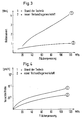
- FIGS. 3 and 4 show that the bearing bushes made from the composite bearing material constructed according to the invention with respect to the frictional torque (Nm) and wear rate ( ⁇ m / h) as a function of the surface pressure (MPa) clearly those bearing bushes that consist of the composite bearing material according to the prior art, are superior.
Landscapes
- Engineering & Computer Science (AREA)
- General Engineering & Computer Science (AREA)
- Chemical & Material Sciences (AREA)
- Mechanical Engineering (AREA)
- Polymers & Plastics (AREA)
- Organic Chemistry (AREA)
- Health & Medical Sciences (AREA)
- Medicinal Chemistry (AREA)
- Chemical Kinetics & Catalysis (AREA)
- Sliding-Contact Bearings (AREA)
- Laminated Bodies (AREA)
- Manufacture Of Macromolecular Shaped Articles (AREA)
- Compositions Of Macromolecular Compounds (AREA)
- Lubricants (AREA)
- Manufacture Of Alloys Or Alloy Compounds (AREA)
- Organic Low-Molecular-Weight Compounds And Preparation Thereof (AREA)
- Glass Compositions (AREA)
Abstract
Description
- Die Erfindung betrifft einen Werkstoff für Verbundlager mit Kunststoff-Gleitschicht, der aus einer metallischen Stützschicht, vorzugsweise aus Stahl, Bronze oder einer hochfesten Aluminiumlegierung, und einer damit verbundenen 30 bis 500 µm, vorzugsweise 50 bis 250 µm, dicken Gleitschicht aus Matrix bildendem fluorhaltigem Polymeren besteht, in dem 5 bis 50 Masse-%, vorzugsweise 30 bis 40 Masse-% eine hohe Affinität zu Fluor besitzendes Metallpulver mit einer Korngröße von ≦ 40 µm feindispergiert sind, sowie ein Verfahren zur Herstellung des Werkstoffs für Verbundlager.
- Aus der EP-PS 0 044 577 und der DE-PS 29 28 061 ist ein Werkstoff für Verbundlager mit Kunststoff-Gleitschicht bekannt, der aus einer metallischen Stützschicht, vorzugsweise Stahlstützschicht, mit einer darauf befindlichen 30 bis 500 µm dicken Gleitschicht aus die Matrix bildendem fluorhaltigem Polymerem, d.h. Polyvinylidenfluorid (PVDF), mit 5 bis 50 Vol.-% Bleiteilchen mit einer Korngröße von ≦ 50 µm besteht, und die das Gleitverhalten verbessernde Stoffe wie PTFE, MoS₂, Graphit als Einlagerungen in feindisperser Form enthalten kann. Die Kunststoff-Gleitschicht ist in vorteilhafter Weise auf eine auf der Stützschicht porös aufgesinterten oder aufgespritzten Rauhschicht mit einer Dicke von 250 bis 350 µm aus gute Gleiteigenschaften aufweisendem metallischem Werkstoff, vorzugsweise Bronze, aufgetragen, wobei das Lückenvolumen der Rauhschicht mit dem Kunststoff der Gleitschicht ausgefüllt ist.
- Die aus diesem Verbundlagerwerkstoff hergestellten Lagerkörper haben einen breiten Einsatzbereich gefunden, können jedoch in nachteiliger Weise sehr hohe mechanische und tribologische Belastungen, wie sie beispielsweise in Lagerungen von Hydraulikmotoren auftreten, nicht ertragen, d.h. ihre Lebensdauer ist unzulässig gering, so daß die Standzeit der Maschine begrenzt wird. Daraus resultiert die Forderung nach Verbundlagerwerkstoffen mit vergleichsweise größerer mechanischer Belastbarkeit, größerem Verschleißwiderstand und möglichst kleiner Reibung.
- Es ist deshalb die Aufgabe vorliegender Erfindung, einen gegenüber dem eingangs beschriebenen Verbundlagerwerkstoff bezüglich Verschleißraten und Lebensdauer verbesserten Verbundlagerwerkstoff bereitzustellen.
- Die Lösung dieser Aufgabe besteht darin, daß das fluorhaltige Polymere in einem mittels CuKα-Strahlung erstellten Röntgendiffraktogramm ein scharfes Intensitätsmaximum bei einem doppeltem Braggwinkel von 2ϑ = 18,07 ± 0,03° sowie einen Schmelzbereich von 320 bis 350°C aufweist und 5 bis 30 Masse-%, vorzugsweise 15 bis 25 Masse-% Metallfluorid sowie 0,5 bis 5,0 Masse-%, vorzugsweise 1,0 bis 3,0 Masse-% Metalloxifluorid enthält.
- Als Metallpulver, die eine besonders hohe Affinität zu Fluor besitzen, kommen für den vorliegenden Verwendungszweck insbesondere solche von Blei, Zinn, Zink, Indium, Thallium, Kadmium, Wismut, Barium, Kupfer, Silber und deren Legierungen einzeln oder zu mehreren in Betracht, wobei auch Lagermetalle auf Blei- und Zinn-Basis mitumfaßt sind.
- Der erfindungsgemäß aufgebaute Verbundlagerwerkstoff zeichnet sich durch vergleichsweise geringe Verschleißraten und eine hohe Ermüdungsfestigkeit aus, der eine einwandfreie Funktion der daraus hergestellten Lagerkörper auch noch nach sehr langen Laufzeiten gewährleistet. Die Matrix kann zur Verbesserung der Gleiteigenschaften sowie zur Stabilisierung noch 1 bis 20 Masse-%, vorzugsweise 5 bis 15 Masse-% feindispergierte Pulverteilchen, bestehend aus PTFE, MoS₂, Graphit, ZnS, BaSO₄ einzeln oder zu mehreren enthalten, wobei die Korngröße dieser Pulverteilchen zweckmäßigerweise in Anpassung an die Metallpulverteilchen ≦ 40 µm ist.
- Im Rahmen der vorzugsweisen Ausgestaltung des erfindungsgemäßen Verbundlagerwerkstoffs sind in der Matrix 15 bis 25 Masse-% Bleifluorid, 1 bis 3 Masse-% Bleioxidfluorid und 30 bis 40 Masse-% Blei sowie ggf. noch 5 bis 15 Masse-% PTFE enthalten.
- Eine bevorzugte Ausführungsform der Matrix besteht in der Zusammensetzung 59 Masse-% fluorhaltiges Polymeres, 8 Masse-% Blei, 24 Masse-% PbF₂, 1 Masse-% PbOF₂, 8 Masse-% PTFE.
- In einer zweiten Zusammensetzung kann die Matrix aus 53 Masse-% fluorhaltigem Polymeren, 8 Masse-% PTFE, 15 Masse-% PbF₂, 4 Masse-% PbOF₂, 20 Masse-% Blei bestehen.
- Nach einer weiteren Ausführungsform ist die Matrix aus 43 Masse-% fluorhaltigem Polymerem, 18 Masse-% PTFE, 15 Masse-% PbF₂, 4 Masse-% PbOF₂ und 20 Masse-% Blei aufgebaut.
- Die erfindungsgemäße Matrix ist unmittelbar mit der mechanisch oder chemisch aufgerauhten Oberfläche der metallischen Stützschicht verbunden. Es besteht aber auch die Möglichkeit, die Matrix über eine Zwischenschicht aus porös aufgesintertem metallischen Gleitwerkstoff, vorzugsweise Bronze, mit der Stützschicht zu verbinden, wobei die Gleitschichtmasse das Lückenvolumen ausfüllt und über den Spitzen der Zwischenschicht eine Gleitschicht von 10 bis 350 µm Dicke vorhanden ist.
- Bei dem Verfahren zur Herstellung des Verbundlagerwerkstoffs wird ein Gemisch aus 30 bis 80 Masse-% fluorhaltigem Polymeren und 5 bis 50 Masse-% eine hohe Affinität zu Fluor besitzendes Metallpulver auf eine metallische Stützschicht aufgetragen, aufgewalzt und auf eine Temperatur von > 330°C, vorzugsweise 345 bis 400°C, erwärmt, bei dieser Temperatur 5 bis 60 min, vorzugsweise 10 bis 30 min, gehalten und dann in einer Zeit von 0,5 bis 10 min, vorzugsweise 1 bis 4 min auf wenigstens 100°C kontinuierlich abgekühlt.
- Die Herstellung des Verbundlagerwerkstoffs kann sowohl auf kontinuierliche Weise, indem eine bandförmige Stützschicht fortlaufend beschichtet wird, als auch in diskontinuierlicher Weise, indem streifenförmige Abschnitte einzeln beschichtet werden, erfolgen.
- Im folgenden ist die Erfindung anhand eines Ausführungsbeispiels sowie von Zeichnungen näher erläutert. Es zeigen:
- Fig. 1 eine schematische Darstellung der Vorrichtung zur Durchführung des Verfahrens und Herstellung des Verbundlagerwerkstoffs und
- Fig. 2 einen Schnitt durch den Verbundlagerwerkstoff.
- Das auf dem Haspel (1) aufgewickelte Band (2), das aus dem als Stützschicht dienenden Stahlband (10) und der darauf aus Bleibronze porös gesinterten Rauhgrundschicht (11) besteht, wird kontinuierlich von dem Haspel (1) abgewickelt und rauhgrundseitig aus einem mit einem Rührwerk ausgestatteten Behälter (3) mit einer Pulvermischung aus 60 Masse-% Polyvinylidenfluorid (PVDF), 30 Masse-% Blei und 10 Masse-% Polytetrafluoräthylen (PTFE) gleichmäßig beschichtet. Nachdem das Band (2) das Walzgerüst (4) durchlaufen hat, in dem die offenen Poren des Rauhgrundes (11) so mit der Pulvermischung ausgefüllt sind, daß über den Spitzen des Rauhgrundes (11) eine Gleitschicht (12) vorhanden ist, wird das beschichtete Band (2) durch den Durchlaufofen (5) geführt und auf 345°C für die Dauer von 15 min erwärmt. Dabei wird das PVDF aufgeschmolzen und in ein fluorhaltiges Polymer umgewandelt, in das neben l2 Masse-% Blei und 10 Masse-% PTFE noch 20 Masse-% Bleifluorid sowie 2,5 Masse-% Bleioxifluorid eingelagert sind und das durch ein in einem mittels CuKα-Strahlung erstellten Röntgendiffraktogramm bei einem doppelten Braggwinkel von 2ϑ = 18,07 ± 0,03° liegendes Intensitätsmaximum sowie einen Schmelzbereich von 320 bis 350°C charakterisiert ist. Nach dem Austritt aus dem Ofen (5) wird das fluorhaltige Polymere in dem Walzgerüst (6) nachverdichtet sowie geglättet und anschließend in dem Durchlaufofen (7) innerhalb von 5 min kontinuierlich auf eine Temperatur von etwa 100°C abgekühlt. In dem nachfolgenden Walzgerüst (8) wird der hergestellte Verbundlagerwerkstoff kalibriert und schließlich auf den Haspel (9) aufgewickelt. Aus dem bandförmigen Verbundlagerwerkstoff lassen sich ohne jede Nachbehandlung bzw. Nachbearbeitung ohne Schwierigkeiten Gleitlagerelemente, insbesondere Lagerbuchsen, Lagerschalen, Bundbuchsen sowie Anlaufscheiben, herstellen.
- Um das tribologische Verhalten des erfindungsgemäß ausgebildeten Verbundlagerwerkstoffs darzustellen, ist nachfolgend ein Vergleichsversuch beschrieben, bei dem eine Lagerbuchse, gefertigt aus dem nach vorstehend beschriebenen Verfahrensmaßnahmen hergestellten Verbundlagerwerkstoff, mit einer Lagerbuchse, die aus einem Verbundlagerwerkstoff nach dem Stand der Technik gemäß der EP-PS 0 044 577 hergestellt ist und aus einer Stahlstützschicht mit einer darauf porös gesinterten Bronzeschicht, deren offene Poren bis über ihre Spitzen unter Ausbildung einer Gleitschicht mit einer gesinterten Mischung aus 50 Masse-% PVDF, 40 Masse-% Blei und 10 Masse-% PTFE gefüllt sind, besteht, bezüglich Reibmoment und Verschleiß verglichen wird.
- Das Reibmoment und der Verschleiß wurden mit einer Prüfmaschine gemessen, bei der ein aus Stahl vom Typ C35 weich bestehender, eine Oberflächenrauhigkeit von RA = 0, 2 µm aufweisender und mit einer Gleitgeschwindigkeit von 0,3 m/s rotierender Lagerzapfen eine Prüflagerbuchse der Abmessung ⌀ 21 x ⌀ 22 x 15 mm mit einem Spiel von 0,03 mm trägt. Die Prüflagerbuchse ist in einen als Pendel ausgebildeten und mit einer spezifischen Belastung von 3,3 N/mm² belasteten Lagerkörper eingepreßt. Das Reibmoment wird aus der Drehung der Prüflagerbuchse über den Ausschlag des als Pendel ausgebildeten Lagerkörpers ermittelt. Der Verschleiß wird jeweils nach einem Gleitweg von 8, 16, 32 und 48 km gemessen.
- Die Versuchsergebnisse sind in Fig. 3 und Fig. 4 graphisch dargestellt und zeigen, daß die aus dem erfindungsgemäß aufgebauten Verbundlagerwerkstoff gefertigten Lagerbuchsen bezüglich Reibmoment (Nm) und Verschleißrate (µm/h) in Abhängigkeit von der Flächenpressung (MPa) deutlich denjenigen Lagerbuchsen, die aus dem Verbundlagerwerkstoff nach dem Stand der Technik bestehen, überlegen sind.
Claims (6)
Applications Claiming Priority (2)
| Application Number | Priority Date | Filing Date | Title |
|---|---|---|---|
| DE3815264 | 1988-05-05 | ||
| DE3815264A DE3815264A1 (de) | 1988-05-05 | 1988-05-05 | Werkstoff fuer verbundlager und verfahren zu seiner herstellung |
Publications (3)
| Publication Number | Publication Date |
|---|---|
| EP0340839A2 true EP0340839A2 (de) | 1989-11-08 |
| EP0340839A3 EP0340839A3 (de) | 1991-05-02 |
| EP0340839B1 EP0340839B1 (de) | 1994-05-25 |
Family
ID=6353666
Family Applications (1)
| Application Number | Title | Priority Date | Filing Date |
|---|---|---|---|
| EP89201046A Revoked EP0340839B1 (de) | 1988-05-05 | 1989-04-22 | Werkstoff für Verbundlager und Verfahren zu seiner Herstellung |
Country Status (11)
| Country | Link |
|---|---|
| US (1) | US5024882A (de) |
| EP (1) | EP0340839B1 (de) |
| JP (1) | JP2785037B2 (de) |
| KR (1) | KR0156728B1 (de) |
| CN (1) | CN1020688C (de) |
| AT (1) | ATE106118T1 (de) |
| AU (1) | AU611019B2 (de) |
| BR (1) | BR8902100A (de) |
| CA (1) | CA1330507C (de) |
| DE (2) | DE3815264A1 (de) |
| ES (1) | ES2055007T3 (de) |
Cited By (7)
| Publication number | Priority date | Publication date | Assignee | Title |
|---|---|---|---|---|
| DE4106001A1 (de) * | 1990-02-27 | 1991-08-29 | Daido Metal Co Ltd | Gleit- bzw. schiebematerial und verfahren zu seiner herstellung |
| DE19603353A1 (de) * | 1996-01-31 | 1997-08-07 | Glyco Metall Werke | Schichtwerkstoff für Gleitelemente, Verwendung und Verfahren zu seiner Herstellung |
| US6911488B2 (en) | 2000-09-27 | 2005-06-28 | Shamrock Technologies, Inc. | Physical methods of dispersing characteristic use particles and compositions thereof |
| CN100449163C (zh) * | 2007-07-19 | 2009-01-07 | 北京科技大学 | 一种整体梯度自润滑轴承及其制造方法 |
| US7942581B2 (en) | 2006-08-02 | 2011-05-17 | Miba Gleitlager Gmbh | Anti-friction layer for a bearing element |
| US8033733B2 (en) | 2005-04-29 | 2011-10-11 | Miba Gleitlager Gmbh | Bearing element |
| CN111749988A (zh) * | 2019-03-28 | 2020-10-09 | 大同金属工业株式会社 | 滑动构件 |
Families Citing this family (31)
| Publication number | Priority date | Publication date | Assignee | Title |
|---|---|---|---|---|
| DE3815265A1 (de) * | 1988-05-05 | 1989-11-16 | Kolbenschmidt Ag | Werkstoff fuer verbundlager und verfahren zu seiner herstellung |
| GB9019251D0 (en) * | 1990-09-04 | 1990-10-17 | Glacier Metal Co Ltd | Bearings |
| US5217814A (en) * | 1991-02-09 | 1993-06-08 | Taiho Kogyo Co., Ltd. | Sintered sliding material |
| DE4319867A1 (de) * | 1993-06-16 | 1994-12-22 | Kolbenschmidt Ag | Mehrschicht-Gleitlagerwerkstoff |
| EP2278166B1 (de) * | 1998-07-29 | 2018-12-05 | Daikin Industries, Limited | Lagerung für einen Kühlkompressor |
| JP4543450B2 (ja) * | 1999-06-25 | 2010-09-15 | オイレス工業株式会社 | 滑り軸受構造 |
| JP2001221231A (ja) * | 2000-02-03 | 2001-08-17 | Daido Metal Co Ltd | 摺動材 |
| JP3571623B2 (ja) * | 2000-08-07 | 2004-09-29 | 大同メタル工業株式会社 | 摺動材料 |
| BR0311595A (pt) * | 2002-06-07 | 2005-02-22 | Ks Gleitlager Gmbh | Material composto para mancal de deslize |
| DE10226266B4 (de) * | 2002-06-07 | 2005-09-15 | Ks Gleitlager Gmbh | Gleitlagerverbundwerkstoff |
| US7163368B2 (en) * | 2003-05-30 | 2007-01-16 | Russell Charles Ide | Hydrodynamic bearing runner for use in tilting pad thrust bearing assemblies for electric submersible pumps |
| DE102005030047A1 (de) * | 2005-06-27 | 2007-01-11 | Eurocopter Deutschland Gmbh | Verfahren zur Herstellung eines nichtmetallischen, mit Verstärkungsfasern versehenen Gleitlagerwerkstoff-Halbzeugs |
| US20070029738A1 (en) * | 2005-08-05 | 2007-02-08 | Person Dennis F | MLS gasket sealability with bronze addition |
| DE102007029470A1 (de) * | 2007-06-26 | 2009-01-02 | Mahle International Gmbh | Verfahren zur Herstellung von Gleitlagern sowie mit diesem Verfahren herstellbare Gleitlager |
| JP4757853B2 (ja) * | 2007-10-10 | 2011-08-24 | 大同メタル工業株式会社 | すべり軸受 |
| JP5253857B2 (ja) * | 2008-03-27 | 2013-07-31 | 株式会社東芝 | 摺動材料、摺動材料の製造方法およびそれを用いた軸受装置 |
| US7892659B2 (en) * | 2008-07-30 | 2011-02-22 | Honeywell International Inc. | Coating precursor materials, turbomachinery components, and methods of forming the turbomachinery components |
| JP5443734B2 (ja) * | 2008-11-19 | 2014-03-19 | 株式会社東芝 | 複合軸受部材、複合軸受部材の製造方法、軸受装置および回転電機 |
| DE102008055195B4 (de) * | 2008-12-30 | 2013-02-28 | Federal-Mogul Wiesbaden Gmbh | Gleitelement und Verfahren zu seiner Herstellung |
| JP4983931B2 (ja) * | 2010-01-12 | 2012-07-25 | オイレス工業株式会社 | 滑り軸受構造 |
| US8808848B2 (en) | 2010-09-10 | 2014-08-19 | W. L. Gore & Associates, Inc. | Porous article |
| CN102478067A (zh) * | 2010-11-25 | 2012-05-30 | 贵州红林机械有限公司 | 碳/碳复合材料与铝、铜合金构成的轴承及其制造方法 |
| CN102049891B (zh) * | 2011-01-07 | 2013-05-08 | 江西东方豹紧固件有限公司 | 一种耐磨板材及其制作方法 |
| CN103502665B (zh) * | 2011-04-29 | 2016-11-02 | 美国圣戈班性能塑料公司 | 在粘结剂层中具有fep或pfa的免维护滑动轴承 |
| CN103182808A (zh) | 2011-12-28 | 2013-07-03 | 圣戈班高功能塑料集团 | 一种包括含氟聚合物表面层以及非氟聚合物过渡层的多层复合物 |
| US20140010484A1 (en) | 2012-06-29 | 2014-01-09 | Olaf Schmitjes | Slide bearing comprising a primer system as adhesion promoter |
| US9803690B2 (en) | 2012-09-28 | 2017-10-31 | Saint-Gobain Performance Plastics Pampus Gmbh | Maintenance-free slide bearing with a combined adhesive sliding layer |
| JP5636033B2 (ja) * | 2012-12-28 | 2014-12-03 | 大同メタル工業株式会社 | 摺動部材及びこれを用いた軸受装置 |
| SI24472A (sl) | 2013-09-19 | 2015-03-31 | Institut "Jožef Stefan" | Fluoro-polimerni nanokompoziti s prilagojenimi tornimi lastnostmi |
| DE102013227188A1 (de) * | 2013-12-27 | 2015-07-02 | Federal-Mogul Wiesbaden Gmbh | Selbstschmierende thermoplastische Schichten mit Zusatz von PTFE mit polymodalem Molekulargewicht |
| CN113853485B (zh) * | 2019-05-17 | 2024-06-04 | 美国圣戈班性能塑料公司 | 粘合剂和包括粘合剂的轴承 |
Family Cites Families (9)
| Publication number | Priority date | Publication date | Assignee | Title |
|---|---|---|---|---|
| DE2436424A1 (de) * | 1974-07-29 | 1976-02-05 | Kurokawa Masao | Verfahren zum verbinden eines fluorkunststoffes und eines substrates |
| JPS5486041A (en) * | 1977-12-14 | 1979-07-09 | Daido Metal Co Ltd | Bearing material |
| MX172740B (es) * | 1979-07-12 | 1994-01-10 | Glyco Metall Werke | PROCEDIMIENTO MEJORADO PARA FABRICAR UN MATERIA L AGLUTINANTE EN CAPAS lúmen con respecto a la capa de fricción. |
| DE2928081C2 (de) * | 1979-07-12 | 1982-08-19 | Glyco-Metall-Werke Daelen & Loos Gmbh, 6200 Wiesbaden | Verbund-Schichtwerkstoff und Verfahren zu seiner Herstellung |
| DE3027409A1 (de) * | 1980-07-19 | 1982-02-25 | Karl Schmidt Gmbh, 7107 Neckarsulm | Verbundgleitlagerwerkstoff |
| JPS59103022A (ja) * | 1982-12-03 | 1984-06-14 | Daido Metal Kogyo Kk | 耐摩耗性にすぐれた軸受材料 |
| JPS60258297A (ja) * | 1984-06-05 | 1985-12-20 | Daido Metal Kogyo Kk | 耐摩耗性にすぐれた摺動材料 |
| GB8426637D0 (en) * | 1984-10-22 | 1984-11-28 | Ae Plc | Plain bearing |
| DE3815265A1 (de) * | 1988-05-05 | 1989-11-16 | Kolbenschmidt Ag | Werkstoff fuer verbundlager und verfahren zu seiner herstellung |
-
1988
- 1988-05-05 DE DE3815264A patent/DE3815264A1/de not_active Withdrawn
-
1989
- 1989-04-22 DE DE58907705T patent/DE58907705D1/de not_active Revoked
- 1989-04-22 AT AT89201046T patent/ATE106118T1/de not_active IP Right Cessation
- 1989-04-22 EP EP89201046A patent/EP0340839B1/de not_active Revoked
- 1989-04-22 ES ES89201046T patent/ES2055007T3/es not_active Expired - Lifetime
- 1989-05-02 JP JP1113516A patent/JP2785037B2/ja not_active Expired - Fee Related
- 1989-05-02 US US07/346,059 patent/US5024882A/en not_active Expired - Lifetime
- 1989-05-04 KR KR1019890006026A patent/KR0156728B1/ko not_active Expired - Fee Related
- 1989-05-04 BR BR898902100A patent/BR8902100A/pt not_active IP Right Cessation
- 1989-05-04 AU AU33995/89A patent/AU611019B2/en not_active Ceased
- 1989-05-04 CN CN89102940A patent/CN1020688C/zh not_active Expired - Fee Related
- 1989-05-04 CA CA000598740A patent/CA1330507C/en not_active Expired - Fee Related
Cited By (8)
| Publication number | Priority date | Publication date | Assignee | Title |
|---|---|---|---|---|
| DE4106001A1 (de) * | 1990-02-27 | 1991-08-29 | Daido Metal Co Ltd | Gleit- bzw. schiebematerial und verfahren zu seiner herstellung |
| DE4106001C2 (de) * | 1990-02-27 | 2000-01-05 | Daido Metal Co Ltd | Gleit- bzw. Schiebematerial und Verfahren zu seiner Herstellung |
| DE19603353A1 (de) * | 1996-01-31 | 1997-08-07 | Glyco Metall Werke | Schichtwerkstoff für Gleitelemente, Verwendung und Verfahren zu seiner Herstellung |
| US6911488B2 (en) | 2000-09-27 | 2005-06-28 | Shamrock Technologies, Inc. | Physical methods of dispersing characteristic use particles and compositions thereof |
| US8033733B2 (en) | 2005-04-29 | 2011-10-11 | Miba Gleitlager Gmbh | Bearing element |
| US7942581B2 (en) | 2006-08-02 | 2011-05-17 | Miba Gleitlager Gmbh | Anti-friction layer for a bearing element |
| CN100449163C (zh) * | 2007-07-19 | 2009-01-07 | 北京科技大学 | 一种整体梯度自润滑轴承及其制造方法 |
| CN111749988A (zh) * | 2019-03-28 | 2020-10-09 | 大同金属工业株式会社 | 滑动构件 |
Also Published As
| Publication number | Publication date |
|---|---|
| CA1330507C (en) | 1994-07-05 |
| DE3815264A1 (de) | 1989-11-16 |
| CN1037481A (zh) | 1989-11-29 |
| DE58907705D1 (de) | 1994-06-30 |
| ATE106118T1 (de) | 1994-06-15 |
| CN1020688C (zh) | 1993-05-19 |
| KR890017379A (ko) | 1989-12-15 |
| BR8902100A (pt) | 1989-12-05 |
| KR0156728B1 (ko) | 1998-12-01 |
| AU611019B2 (en) | 1991-05-30 |
| EP0340839B1 (de) | 1994-05-25 |
| ES2055007T3 (es) | 1994-08-16 |
| EP0340839A3 (de) | 1991-05-02 |
| US5024882A (en) | 1991-06-18 |
| JPH0216141A (ja) | 1990-01-19 |
| AU3399589A (en) | 1989-11-09 |
| JP2785037B2 (ja) | 1998-08-13 |
Similar Documents
| Publication | Publication Date | Title |
|---|---|---|
| EP0340839B1 (de) | Werkstoff für Verbundlager und Verfahren zu seiner Herstellung | |
| EP0340838A2 (de) | Werkstoff für Verbundlager und Verfahren zu seiner Herstellung | |
| DE3616360C2 (de) | ||
| DE4105657C2 (de) | Gleit- bzw. Schiebematerial und Verfahren zu seiner Herstellung | |
| EP0232922B1 (de) | Verbund-Gleitlagerwerkstoff | |
| DE3520068C2 (de) | Zusammensetzung für gleitende Teile | |
| DE4106001C2 (de) | Gleit- bzw. Schiebematerial und Verfahren zu seiner Herstellung | |
| DE69619553T2 (de) | Selbstschmierendes gesintertes gleitmaterial und verfahren zu dessen herstellung | |
| EP0217462B1 (de) | Wartungsarmer Gleitlagerwerkstoff | |
| EP0193218B1 (de) | Gleitlager | |
| DE2857283C1 (de) | Mehrstofflagermaterial | |
| DE69327377T2 (de) | Mehrschichtiger Gleitteil | |
| DE3128412C2 (de) | Selbstschmiermittel | |
| DE2000632C2 (de) | Gleitlagermaterial | |
| DE3601568A1 (de) | Gleitlagerwerkstoff | |
| DE4227909C2 (de) | Metall-Kunststoff-Verbundlagerwerkstoff sowie Verfahren zu dessen Herstellung | |
| EP0852298A1 (de) | Verfahren zur Herstellung eines Gleitlagerwerkstoffes | |
| DE4308371C2 (de) | Verschleißbeständige Legierung eines Gleitmaterials | |
| EP0272447A2 (de) | Verbundwerkstoff mit einer durch Kathodenzerstäubung aufgebrachten Gleitschicht | |
| EP0991869B1 (de) | Gerollte gleitlagerbuchse | |
| DE3728273A1 (de) | Lagermaterial mit mehreren schichten und verfahren zu dessen herstellung | |
| EP0395130A2 (de) | Werkstoff für Mehrschicht-Gleitlager | |
| DE1947647A1 (de) | OElfreies Gleitlagermaterial und Verfahren zur Herstellung desselben | |
| DE3516649A1 (de) | Selbstschmierendes lager | |
| EP0412238A1 (de) | Verbundwerkstoff für Gleitzwecke und Verfahren für seine Herstellung |
Legal Events
| Date | Code | Title | Description |
|---|---|---|---|
| PUAI | Public reference made under article 153(3) epc to a published international application that has entered the european phase |
Free format text: ORIGINAL CODE: 0009012 |
|
| AK | Designated contracting states |
Kind code of ref document: A2 Designated state(s): AT DE ES FR GB IT SE |
|
| PUAL | Search report despatched |
Free format text: ORIGINAL CODE: 0009013 |
|
| AK | Designated contracting states |
Kind code of ref document: A3 Designated state(s): AT DE ES FR GB IT SE |
|
| 17P | Request for examination filed |
Effective date: 19910918 |
|
| 17Q | First examination report despatched |
Effective date: 19921006 |
|
| GRAA | (expected) grant |
Free format text: ORIGINAL CODE: 0009210 |
|
| AK | Designated contracting states |
Kind code of ref document: B1 Designated state(s): AT DE ES FR GB IT SE |
|
| REF | Corresponds to: |
Ref document number: 106118 Country of ref document: AT Date of ref document: 19940615 Kind code of ref document: T |
|
| REF | Corresponds to: |
Ref document number: 58907705 Country of ref document: DE Date of ref document: 19940630 |
|
| ET | Fr: translation filed | ||
| REG | Reference to a national code |
Ref country code: ES Ref legal event code: FG2A Ref document number: 2055007 Country of ref document: ES Kind code of ref document: T3 |
|
| ITF | It: translation for a ep patent filed | ||
| GBT | Gb: translation of ep patent filed (gb section 77(6)(a)/1977) |
Effective date: 19940822 |
|
| EAL | Se: european patent in force in sweden |
Ref document number: 89201046.3 |
|
| PLBI | Opposition filed |
Free format text: ORIGINAL CODE: 0009260 |
|
| PGFP | Annual fee paid to national office [announced via postgrant information from national office to epo] |
Ref country code: AT Payment date: 19950320 Year of fee payment: 7 |
|
| 26 | Opposition filed |
Opponent name: GLYCO-METALL-WERKE GLYCO B.V. & CO. KG Effective date: 19950227 |
|
| PLBF | Reply of patent proprietor to notice(s) of opposition |
Free format text: ORIGINAL CODE: EPIDOS OBSO |
|
| PG25 | Lapsed in a contracting state [announced via postgrant information from national office to epo] |
Ref country code: AT Effective date: 19960422 |
|
| PGFP | Annual fee paid to national office [announced via postgrant information from national office to epo] |
Ref country code: GB Payment date: 19980401 Year of fee payment: 10 |
|
| PGFP | Annual fee paid to national office [announced via postgrant information from national office to epo] |
Ref country code: FR Payment date: 19980417 Year of fee payment: 10 |
|
| PGFP | Annual fee paid to national office [announced via postgrant information from national office to epo] |
Ref country code: ES Payment date: 19980421 Year of fee payment: 10 |
|
| PGFP | Annual fee paid to national office [announced via postgrant information from national office to epo] |
Ref country code: SE Payment date: 19980422 Year of fee payment: 10 |
|
| PGFP | Annual fee paid to national office [announced via postgrant information from national office to epo] |
Ref country code: DE Payment date: 19980630 Year of fee payment: 10 |
|
| RAP2 | Party data changed (patent owner data changed or rights of a patent transferred) |
Owner name: KS GLEITLAGER GMBH |
|
| RDAH | Patent revoked |
Free format text: ORIGINAL CODE: EPIDOS REVO |
|
| RDAG | Patent revoked |
Free format text: ORIGINAL CODE: 0009271 |
|
| STAA | Information on the status of an ep patent application or granted ep patent |
Free format text: STATUS: PATENT REVOKED |
|
| 27W | Patent revoked |
Effective date: 19981115 |
|
| GBPR | Gb: patent revoked under art. 102 of the ep convention designating the uk as contracting state |
Free format text: 981115 |