EP0340169A2 - Chromogene Laktonverbindungen von Benzopyrano-2H-pyrazolen - Google Patents
Chromogene Laktonverbindungen von Benzopyrano-2H-pyrazolen Download PDFInfo
- Publication number
- EP0340169A2 EP0340169A2 EP89810293A EP89810293A EP0340169A2 EP 0340169 A2 EP0340169 A2 EP 0340169A2 EP 89810293 A EP89810293 A EP 89810293A EP 89810293 A EP89810293 A EP 89810293A EP 0340169 A2 EP0340169 A2 EP 0340169A2
- Authority
- EP
- European Patent Office
- Prior art keywords
- halogen
- alkyl
- substituted
- lower alkyl
- formula
- Prior art date
- Legal status (The legal status is an assumption and is not a legal conclusion. Google has not performed a legal analysis and makes no representation as to the accuracy of the status listed.)
- Granted
Links
Classifications
-
- C—CHEMISTRY; METALLURGY
- C07—ORGANIC CHEMISTRY
- C07D—HETEROCYCLIC COMPOUNDS
- C07D491/00—Heterocyclic compounds containing in the condensed ring system both one or more rings having oxygen atoms as the only ring hetero atoms and one or more rings having nitrogen atoms as the only ring hetero atoms, not provided for by groups C07D451/00 - C07D459/00, C07D463/00, C07D477/00 or C07D489/00
- C07D491/12—Heterocyclic compounds containing in the condensed ring system both one or more rings having oxygen atoms as the only ring hetero atoms and one or more rings having nitrogen atoms as the only ring hetero atoms, not provided for by groups C07D451/00 - C07D459/00, C07D463/00, C07D477/00 or C07D489/00 in which the condensed system contains three hetero rings
- C07D491/20—Spiro-condensed systems
-
- C—CHEMISTRY; METALLURGY
- C07—ORGANIC CHEMISTRY
- C07D—HETEROCYCLIC COMPOUNDS
- C07D491/00—Heterocyclic compounds containing in the condensed ring system both one or more rings having oxygen atoms as the only ring hetero atoms and one or more rings having nitrogen atoms as the only ring hetero atoms, not provided for by groups C07D451/00 - C07D459/00, C07D463/00, C07D477/00 or C07D489/00
- C07D491/12—Heterocyclic compounds containing in the condensed ring system both one or more rings having oxygen atoms as the only ring hetero atoms and one or more rings having nitrogen atoms as the only ring hetero atoms, not provided for by groups C07D451/00 - C07D459/00, C07D463/00, C07D477/00 or C07D489/00 in which the condensed system contains three hetero rings
- C07D491/14—Ortho-condensed systems
-
- B—PERFORMING OPERATIONS; TRANSPORTING
- B41—PRINTING; LINING MACHINES; TYPEWRITERS; STAMPS
- B41M—PRINTING, DUPLICATING, MARKING, OR COPYING PROCESSES; COLOUR PRINTING
- B41M5/00—Duplicating or marking methods; Sheet materials for use therein
- B41M5/124—Duplicating or marking methods; Sheet materials for use therein using pressure to make a masked colour visible, e.g. to make a coloured support visible, to create an opaque or transparent pattern, or to form colour by uniting colour-forming components
- B41M5/132—Chemical colour-forming components; Additives or binders therefor
- B41M5/136—Organic colour formers, e.g. leuco dyes
- B41M5/145—Organic colour formers, e.g. leuco dyes with a lactone or lactam ring
-
- B—PERFORMING OPERATIONS; TRANSPORTING
- B41—PRINTING; LINING MACHINES; TYPEWRITERS; STAMPS
- B41M—PRINTING, DUPLICATING, MARKING, OR COPYING PROCESSES; COLOUR PRINTING
- B41M5/00—Duplicating or marking methods; Sheet materials for use therein
- B41M5/26—Thermography ; Marking by high energetic means, e.g. laser otherwise than by burning, and characterised by the material used
- B41M5/30—Thermography ; Marking by high energetic means, e.g. laser otherwise than by burning, and characterised by the material used using chemical colour formers
- B41M5/323—Organic colour formers, e.g. leuco dyes
- B41M5/327—Organic colour formers, e.g. leuco dyes with a lactone or lactam ring
-
- C—CHEMISTRY; METALLURGY
- C07—ORGANIC CHEMISTRY
- C07D—HETEROCYCLIC COMPOUNDS
- C07D491/00—Heterocyclic compounds containing in the condensed ring system both one or more rings having oxygen atoms as the only ring hetero atoms and one or more rings having nitrogen atoms as the only ring hetero atoms, not provided for by groups C07D451/00 - C07D459/00, C07D463/00, C07D477/00 or C07D489/00
- C07D491/12—Heterocyclic compounds containing in the condensed ring system both one or more rings having oxygen atoms as the only ring hetero atoms and one or more rings having nitrogen atoms as the only ring hetero atoms, not provided for by groups C07D451/00 - C07D459/00, C07D463/00, C07D477/00 or C07D489/00 in which the condensed system contains three hetero rings
-
- B—PERFORMING OPERATIONS; TRANSPORTING
- B41—PRINTING; LINING MACHINES; TYPEWRITERS; STAMPS
- B41M—PRINTING, DUPLICATING, MARKING, OR COPYING PROCESSES; COLOUR PRINTING
- B41M5/00—Duplicating or marking methods; Sheet materials for use therein
- B41M5/124—Duplicating or marking methods; Sheet materials for use therein using pressure to make a masked colour visible, e.g. to make a coloured support visible, to create an opaque or transparent pattern, or to form colour by uniting colour-forming components
- B41M5/132—Chemical colour-forming components; Additives or binders therefor
- B41M5/136—Organic colour formers, e.g. leuco dyes
- B41M5/145—Organic colour formers, e.g. leuco dyes with a lactone or lactam ring
- B41M5/1455—Organic colour formers, e.g. leuco dyes with a lactone or lactam ring characterised by fluoran compounds
-
- B—PERFORMING OPERATIONS; TRANSPORTING
- B41—PRINTING; LINING MACHINES; TYPEWRITERS; STAMPS
- B41M—PRINTING, DUPLICATING, MARKING, OR COPYING PROCESSES; COLOUR PRINTING
- B41M5/00—Duplicating or marking methods; Sheet materials for use therein
- B41M5/26—Thermography ; Marking by high energetic means, e.g. laser otherwise than by burning, and characterised by the material used
- B41M5/30—Thermography ; Marking by high energetic means, e.g. laser otherwise than by burning, and characterised by the material used using chemical colour formers
- B41M5/323—Organic colour formers, e.g. leuco dyes
- B41M5/327—Organic colour formers, e.g. leuco dyes with a lactone or lactam ring
- B41M5/3275—Fluoran compounds
Definitions
- the present invention relates to chromogenic lactone compounds of benzopyrano-2H-pyrazole compounds, processes for their preparation and their use as color formers in pressure-sensitive or heat-sensitive recording materials.
- lactone compounds of benzopyrano-2H-pyrazoles correspond to the general formula wherein Ar is an aryl radical which is unsubstituted or substituted by halogen, nitro, cyano, lower alkyl, lower alkoxy, lower alkylthio, lower alkoxycarbonyl, trifluoromethyl, phenoxy, phenylthio or -NX3X4, R1 is hydrogen, halogen, lower alkyl or lower alkoxy, R2 lower alkyl, phenyl or phenyl substituted by halogen, lower alkyl or lower alkoxy, and X1, X2, X3 and X4, independently of one another, each hydrogen, unsubstituted or substituted by halogen, hydroxy, cyano, tetrahydrofuryl or lower alkoxy alkyl having at most 12 carbon atoms, acyl having 1 to 12 carbon atoms, cycloalkyl having 5 to 10 carbon atoms or unsub
- Lower alkyl, lower alkoxy and lower alkylthio in the definition of the residues of the lactone compounds are those groups or group components which have 1 to 5, in particular 1 to 3, carbon atoms.
- Examples of such groups are methyl, ethyl, n-propyl, isopropyl, n-butyl, sec-butyl, tert-butyl, amyl, isoamyl or tert-amyl or methoxy, ethoxy, isopropoxy, isobutoxy or tert-butoxy or Methylthio, ethylthio, propylthio or butylthio.
- Halogen means for example fluorine, bromine or preferably chlorine.
- Acyl is especially formyl, lower alkylcarbonyl, e.g. Acetyl or propionyl, or benzoyl.
- Further acyl residues can be lower alkylsulfonyl, e.g. Be methylsulfonyl or ethylsulfonyl and phenylsulfonyl.
- Benzoyl and phenylsulfonyl can be substituted by halogen, methyl, methoxy or ethoxy.
- R1 is preferably methyl, methoxy, bromine, chlorine or especially hydrogen.
- R2 is preferably lower alkyl and especially methyl.
- R2 can be phenyl, tolyl, xylyl, chlorophenyl, methoxyphenyl or carbomethoxyphenyl.
- the aryl radical Ar expediently means diphenyl, naphthyl and primarily phenyl.
- Ar is preferably an unsubstituted or substituted by halogen, nitro, lower alkyl, lower alkoxy, lower alkoxycarbonyl, phenoxy or -NX3X4 phenyl or naphthyl radical.
- substituents X1, X2, X3 and X4 represent alkyl groups, they can be straight-chain or branched.
- alkyl radicals are methyl, ethyl, n-propyl, isopropyl, n-butyl, sec-butyl, tert-butyl, amyl, isoamyl, n-hexyl, 2-ethyl-hexyl, n-heptyl, n-octyl, Isooctyl, n-nonyl, isononyl or n-dodecyl.
- alkyl radicals in X1, X2, X3 and X4 are substituted, it is mainly cyanoalkyl, haloalkyl, hydroxyalkyl, alkoxyalkyl each preferably with a total of 2 to 6 carbon atoms, such as e.g. ⁇ -cyanoethyl, ⁇ -chloroethyl, ⁇ -chloropropyl, ⁇ -hydroxyethyl, ⁇ -hydroxypropyl, ⁇ -methoxyethyl, ⁇ -ethoxyethyl or ⁇ -methoxypropyl as well as tetrahydrofurfuryl.
- cycloalkyl with the meaning of the X radicals are cyclopentyl, cycloheptyl or preferably cyclohexyl.
- the cycloalkyl radicals can contain one or more C1-C4 alkyl radicals, preferably methyl groups, and have a total of 5 to 10 carbon atoms.
- aralkyl X1, X2, X3 and X4 can be phenethyl, phenylisopropyl or especially benzyl.
- the X radicals are especially naphthyl or primarily phenyl as aryl.
- Preferred substituents in the aralkyl and aryl group of the X radicals are e.g. Halogen, cyano, methyl, trifluoromethyl, methoxy or carbomethoxy.
- araliphatic or aromatic radicals are methylbenzyl, 2,4- or 2,5-dimethylbenzyl, chlorobenzyl, dichlorobenzyl, cyanobenzyl, tolyl, xylyl, chlorophenyl, methoxyphenyl, trifluoromethylphenyl, 2,6-dimethylphenyl or carbomethoxyphenyl.
- substituent pairs (X1 and X2) and (X3 and X4) each together with the common nitrogen atom represent a heterocyclic radical, this is, for example, pyrrolidino, piperidino, pipecolino, morpholino, thiomorpholino or piperazino, for example N-methylpiperazino.
- Preferred saturated heterocyclic radicals for -NX1X2 and -NX3X4 are pyrrolidino, piperidino or morpholino.
- the substituents X1 and X2 are preferably cyclohexyl, tolyl, benzyl, cyano-lower alkyl e.g. ⁇ -cyanoethyl or primarily lower alkyl, e.g. Methyl, ethyl, n-propyl, isopropyl, n-butyl or isoamyl.
- -NX1X2 is also preferably pyrrolidinyl or N-lower alkyl-N-tetrahydrofurfurylamino.
- the substituents X3 and X4 are preferably hydrogen, C1-C8-alkyl, cyclohexyl, phenyl, benzyl or phenyl or benzyl substituted by halogen, methyl, methoxy, carbomethoxy or trifluoromethyl.
- -NX3X4 is preferably also acetylamino, propionylamino or benzoylamino.
- the ring A is advantageously not further substituted. If it has substituents, it is primarily substituted by halogen, nitro, lower alkyl, lower alkoxycarbonyl or di-lower alkylamino. Ring A is preferably unsubstituted or substituted by halogen.
- lactone compounds of the formula (2) those in which R3 is lower alkyl, in particular methyl and Y are hydrogen, halogen, nitro, methyl or di-lower alkylamino and the ring A1 is unsubstituted, are particularly preferred.
- Lactone compounds of benzopyrano-2H-pyrazoles of the formula are of particular interest wherein R4 methyl or phenyl, Y1 is hydrogen, chlorine, nitro, methyl, carbomethoxy or di-lower alkylamino, X9 C1-C6 alkyl, cyclohexyl, benzyl, phenyl or phenyl substituted by methyl or chlorine and X10 C1-C6 alkyl mean.
- Lactone compounds of the formula (3) in which X9 and X10 are C1-C5-alkyl, R4 methyl and Y1 are very particularly preferred are hydrogen, chlorine, nitro, methyl or dimethylamino.
- lactone compounds of the formulas (1) to (3) according to the invention are prepared by adding a keto acid compound of the formula with a pyrazolone compound of the formula wherein A, Ar, R1, R2, X1 and X2 have the meaning given.
- the reaction is expediently carried out in such a way that the reaction components are reacted in the presence of an acidic condensing agent at a temperature of 20 to 140 ° C.
- an acidic condensing agent examples include acetic anhydride, zinc chloride, aluminum chloride, sulfuric acid, phosphoric acid and phosphorus oxychloride.
- the end product of the formula (1) is isolated in a generally known manner by adjusting the reaction mixture to a pH of at least 6, preferably 7 to 14, e.g. with alkalis, e.g. Alkali metal hydroxides, ammonia, alkali metal carbonates or bicarbonates and separation of the product formed, washing and drying or by treatment with suitable organic solvents, such as e.g. Methanol, isopropanol, ligroin, benzene, chlorobenzene, toluene or xylene.
- alkalis e.g. Alkali metal hydroxides, ammonia, alkali metal carbonates or bicarbonates
- suitable organic solvents such as e.g. Methanol, isopropanol, ligroin, benzene, chlorobenzene, toluene or xylene.
- Compounds of formula (1) in which Ar is an aryl radical substituted by -NX3X4 can also be prepared by reducing a compound of formula (1) in which Ar is a nitroaryl radical in a conventional manner to the aminoaryl group and then with a reactive one Esters of an alkyl or benzyl alcohol and an inorganic or organic acid or with a reactive functional derivative of a carboxylic acid, in particular fatty acid halides or anhydrides, such as, for example Acetyl chloride, acetyl bromide or acetic anhydride.
- Examples of the above-mentioned reactive esters are methyl, ethyl, n-propyl, n-butyl or benzyl esters of hydrochloric, hydrobromic or hydroiodic acid, dimethyl or diethyl sulfate.
- lactone compounds of benzopyrano-2H-pyrazoles of the formulas (1) to (3) are normally colorless or at most weakly colored. If these color formers are brought into contact with a preferably acidic developer, ie an electron acceptor, depending on the importance of Ar, in particular Y and the developer used, they immediately give rise to intense yellow, orange or red hues which are particularly fast to light and sublimation .
- a preferably acidic developer ie an electron acceptor
- lactone compounds of formulas (1) to (3) are also very valuable when mixed with one or more other known color formers, e.g. 3,3- (bis-aminophenyl -) - phthalides, 3-indolyl-3-aminophenylazaphthalides, (3,3-bis-indolyl -) - phthalides, 3-amino-fluoranes, 3-dialkylamino-7-dibenzylaminofluoranes, 3- Dialkylamino-6-methyl-7-arylaminofluoranes, leucoauramines, spiropyrans, spirodipyrans, chromenoindoles, phenoxazines, phenothiazines, quinazolines, rhodamine lactams, carbazolylmethanes or other triarylmethane leuco dyes to produce gray or black colors.
- 3- (bis-aminophenyl -) - phthalides 3-indoly
- the lactone compounds of the formulas (1) to (3) show an excellent color intensity both on activated clays and on phenolic substrates. They are particularly suitable as rapidly developing color formers for use in a heat-sensitive or, in particular, pressure-sensitive recording material, which can be both copying and registration material. They are characterized by the fact that they are pH stable, non-fading and readily soluble in the capsule oils. After exposure in CB sheet, they show a slight decrease in color strength (CB deactivation).
- a pressure-sensitive material consists, for example, of at least one pair of sheets which contain at least one color former of the formulas (1) to (3) dissolved in an organic solvent and an electron acceptor as developer.
- Typical examples of such developers are active clay substances, such as attapulgus clay, acid clay, bentonite, montmorillonite, activated clay, such as, for example, acid-activated bentonite or montmorillonite, furthermore zeolite, halloysite, silicon dioxide, aluminum oxide, aluminum sulfate, aluminum phosphate, hydrated zirconium dioxide, zinc chloride, zinc nitrate , activated kaolin or any clay.
- active clay substances such as attapulgus clay, acid clay, bentonite, montmorillonite, activated clay, such as, for example, acid-activated bentonite or montmorillonite, furthermore zeolite, halloysite, silicon dioxide, aluminum oxide, aluminum sulfate, aluminum phosphate, hydrated zirconium dioxide, zinc chloride, zinc nitrate , activated kaolin or any clay.
- Acidic organic compounds such as, for example, optionally ring-substituted phenols, resorcinols, salicylic acids, such as, for example, 3,5-bis ( ⁇ , ⁇ -dimethylbenzyl) salicylic acid or 3,5-bis ( ⁇ -methylbenzyl) -salicylic acid or salicylic acid esters and their metal salts, for example zinc salts, and an acidic polymer material, such as a phenolic polymer, an alkylphenol acetylene resin, a maleic rosin resin or a partially or fully hydrolyzed polymer of maleic anhydride with styrene, ethylene or vinyl methyl ether, or carboxymethylene.
- salicylic acids such as, for example, 3,5-bis ( ⁇ , ⁇ -dimethylbenzyl) salicylic acid or 3,5-bis ( ⁇ -methylbenzyl) -salicylic acid or salicylic acid esters and their metal salts, for example zinc salts
- compositions of the monomeric and polymeric compounds mentioned can also be used.
- Particularly preferred developers are acid-activated bentonite, zinc salicylates or the condensation products of p-substituted phenols with formaldehyde. The latter can also be modified with zinc.
- the developers can also be mixed with per se unreactive or less reactive pigments or other auxiliaries such as silica gel or UV absorbers, e.g. 2- (2'-hydroxyphenyl) benzotriazoles are used.
- pigments are: talc, titanium dioxide, aluminum oxide, aluminum hydroxide, zinc oxide, chalk, clays such as kaolin, and organic pigments, e.g. Urea-formaldehyde condensates (BET surface 2-75 m2 / g) or melamine-formaldehyde condensation products.
- the color former provides a colored marking at the points where it comes into contact with the electron acceptor.
- these are usually separated from the electron acceptor. This can conveniently be achieved by incorporating the color formers into foam, sponge or honeycomb structures.
- the color formers are preferably enclosed in microcapsules which can usually be broken by pressure.
- the color former solution When the capsules are broken by pressure, for example using a pencil, the color former solution is transferred to an adjacent sheet coated with an electron acceptor, thereby producing a colored area. The color results from the dye formed, which absorbs in the visible range of the electromagnetic spectrum.
- the color formers are preferably encapsulated in the form of solutions in organic solvents.
- suitable solvents are preferably non-volatile solvents, for example halogenated paraffin or diphenyl, such as chlorinated paraffin, monochlorodiphenyl or trichlor diphenyl, also tricresyl phosphate, di-n-butyl phthalate, dioctyl phthalate, trichlorobenzene, trichloroethyl phosphate, aromatic ethers, such as benzylphenyl ether, hydrocarbon oils, such as paraffin or kerosene, for example derivatives of diphenyl alkylated with isopropyl, isobutyl, sec-butyl or tert-butyl or terphenyl, dibenzyltoluene, partially hydrogenated terphenyl, mono- to tetra-C1-C3-alkylated diphenylalkanes
- Mixtures of various solvents in particular mixtures of paraffin oils or kerosene and diisopropylnaphthalene or partially hydrogenated terphenyl, are often used in order to achieve optimum solubility for color formation, rapid and intensive coloring and a viscosity which is favorable for microencapsulation.
- the capsule walls can be formed evenly around the droplets of the color former solution by coacervation forces, the encapsulation material e.g. in U.S. Patent 2,800,457.
- the capsules can preferably also be formed from an aminoplast or modified aminoplast by polycondensation as described in British Patents 989,264, 1,156,725, 1,301,052 and 1,355,124.
- Microcapsules formed by interfacial polymerization such as e.g. Capsules made of polyester, polycarbonate, polysulfonamide, polysulfonate, but especially made of polyamide or polyurethane.
- the color formers of the formulas (1) to (3) containing microcapsules can be used to produce pressure-sensitive copying materials of various known types.
- the different systems differ essentially from each other in the arrangement of the capsules, the color reactants and the carrier material.
- the encapsulated color former is present in the form of a layer on the back of a transfer sheet and the electron acceptor is in the form of a layer on the front of a receiver sheet.
- microcapsules containing the color former and the developer are present in or on the same sheet in the form of one or more individual layers or in the paper pulp.
- the capsules are preferably attached to the carrier by means of a suitable binder.
- this binder is mainly paper coating agents, such as gum arabic, polyvinyl alcohol, hydroxymethyl cellulose, casein, methyl cellulose, dextrin, starch, starch derivatives or polymer latices.
- the latter are, for example, butadiene-styrene copolymers or acrylic homo- or copolymers.
- the paper used is not only normal paper made from cellulose fibers, but also papers in which the cellulose fibers are (partially or completely) replaced by fibers made from synthetic polymers.
- the carbonless material preferably also consists of a capsule-free layer containing the lactone compound and a color-developing layer which, as color developer, contains at least one inorganic metal salt, especially halides or nitrates of a polyvalent metal, such as e.g. Contains zinc chloride, tin chloride, zinc nitrate or mixtures thereof.
- a polyvalent metal such as e.g. Contains zinc chloride, tin chloride, zinc nitrate or mixtures thereof.
- the compounds of formulas (1) to (3) can also be used as color formers in a thermoreactive recording material.
- This usually contains at least one layer support, a color former, an electron acceptor and optionally also a binder and / or wax. If desired, activators or sensitizers can also be present in the recording material.
- Thermoreactive recording systems include, for example, heat sensitive recording and copying materials and papers. These systems are used, for example, to record information, for example in electronic computers, remote printers, teletype machines or in recording devices and measuring instruments, such as, for example, electrocardiographs.
- the picture Generation can also be done manually with a heated spring.
- Another device for generating markings using heat is laser beams.
- thermoreactive recording material can be constructed such that the color former is dissolved or dispersed in a binder layer and the developer is dissolved and dispersed in the binder in a second layer. Another possibility is that both the color former and the developer are dispersed in one layer.
- the binder is softened by heat in specific areas and at these points where heat is applied the color former comes into contact with the electron acceptor and the desired color develops immediately.
- developers are the clay minerals and phenolic resins already mentioned, or also phenolic compounds, as described, for example, in DE-PS 12,51,348, e.g. 4-tert-butylphenol, 4-phenylphenol, methylene bis (p-phenylphenol), 4-hydroxydiphenyl ether, ⁇ -naphthol, ⁇ -naphthol, 4-hydroxybenzoic acid methyl ester or benzyl ester, 4-hydroxydiphenyl sulfone, 2,4- Dihydroxydiphenyl sulfone, 4'-hydroxy-4-methyldiphenyl sulfone, 4'-hydroxy-4-isopropoxydiphenyl sulfone, 4-hydroxy-acetophenone, 2,2'-dihydroxydiphenyl, 4,4'-cyclohexylidenediphenol, 4,4'-isopropylidenediphenol, 4,4 '-Iso
- Fusible, film-forming binders are preferably used to produce the thermoreactive recording material. These binders are usually water soluble, while the lactone compounds and the developer is sparingly soluble or insoluble in water. The binder should be able to disperse and fix the color former and developer at room temperature.
- Water-soluble or at least water-swellable binders are e.g. hydrophilic polymers, such as polyvinyl alcohol, polyacrylic acid, hydroxyethyl cellulose, methyl cellulose, carboxymethyl cellulose, polyacrylamide, polyvinyl pyrrolidone, carboxylated butadiene-styrene copolymers, gelatin, starch or etherified corn starch.
- hydrophilic polymers such as polyvinyl alcohol, polyacrylic acid, hydroxyethyl cellulose, methyl cellulose, carboxymethyl cellulose, polyacrylamide, polyvinyl pyrrolidone, carboxylated butadiene-styrene copolymers, gelatin, starch or etherified corn starch.
- water-insoluble binders i.e. binders soluble in non-polar or only weakly polar solvents, e.g. Natural rubber, synthetic rubber, chlorinated rubber, polystyrene, styrene / butadiene copolymers, polymethylacrylates, ethyl cellulose, nitrocellulose and polyvinyl carbazole
- binders soluble in non-polar or only weakly polar solvents
- the preferred arrangement is one in which the color former and the developer are contained in one layer in a water-soluble binder.
- thermoreactive layers can contain further additives.
- these layers can contain, for example, talc, titanium dioxide, zinc oxide, aluminum hydroxide, calcium carbonate (for example chalk), clays or else organic pigments, for example urea-formaldehyde polymers .
- substances such as urea, thiourea, diphenylthiourea, acetamide, acetanilide, benzenesulfanilide, bis-stearoyl-ethylenediamide, stearic acid amide, phthalic anhydride, metal stearates, such as, for example, zinc stearate, such as, for example, zinc stearate, such as, for example, zinc stearate, such as zinc stearate , Dibenzyl terephthalate or other corresponding meltable products which induce the simultaneous melting of the color former and the developer, are added.
- Thermographic recording materials preferably contain waxes, for example carnauba wax, montan wax, paraffin wax, Polyethylene wax, condensates of higher fatty acid amides and formaldehyde and condensates of higher fatty acids and ethylenediamine.
- waxes for example carnauba wax, montan wax, paraffin wax, Polyethylene wax, condensates of higher fatty acid amides and formaldehyde and condensates of higher fatty acids and ethylenediamine.
- a further application of the compounds of the formulas (1) to (3) is the production of a color image by means of photocurable microcapsules, such as those e.g. are described in DE-OS 3 247 488.
- a solution of 3 g of the lactone compound of the formula (11) in 80 g of di-isopropylnaphthalene and 17 g of kerosene is microencapsulated in a manner known per se with gelatin and gum arabic by coacervation, mixed with starch solution and spread on a sheet of paper.
- a second sheet of paper is coated on the front with acid-activated bentonite as a color developer.
- the first sheet containing the color former and the paper coated with color developer is placed on top of each other with the coatings adjacent. Writing by hand or with the typewriter on the first sheet exerts pressure, and an intense orange copy develops on the sheet coated with the developer, which has excellent sublimation and lightfastness.
- Example 13 the lactone compound of the formula (11) is replaced by a mixture of the following composition 1.2 g of 3,3-bis (4'-dimethylaminophenyl) -6-dimethylaminophthalide, 1.2 g of N-butylcarbazol-3-yl-bis- (4'-N-methyl-N-phenylaminophenyl) methane 1.2 g of the lactone compound of formula (11) and 0.4 g of 3,3-bis (N-octyl-2'-methylindol-3'-yl) phthalide and if the procedure is otherwise as described in Example 13, a pressure-sensitive recording material is obtained which, by hand or by typewriter, produces an intense and lightfast black copy.
- 1 g of the lactone compound according to Example 6 is dissolved in 17 g of toluene. 12 g of polyvinyl acetate, 8 g of calcium carbonate and 2 g of titanium dioxide are added to this solution with stirring.
- the suspension obtained is diluted in a weight ratio of 1: 1 with toluene and spread on a sheet of paper using a 10 ⁇ m doctor blade.
- a second sheet of paper is placed on this sheet of paper, the underside of which has been coated with a mixture consisting of 1 part of an amide wax, 1 part of a stearic wax and 1 part of zinc chloride at an application weight of 3 g / m2.
- Example 16 Preparation of a heat-sensitive recording material
- the two dispersions are combined and coated onto a paper with a dry application weight of 5.5 g / m2.
- a paper with a dry application weight of 5.5 g / m2. By touching the paper with a heated metal pen, an intense orange color is obtained, which has excellent sublimation and light fastness.
Landscapes
- Chemical & Material Sciences (AREA)
- Organic Chemistry (AREA)
- Chemical Kinetics & Catalysis (AREA)
- General Chemical & Material Sciences (AREA)
- Physics & Mathematics (AREA)
- Optics & Photonics (AREA)
- Color Printing (AREA)
- Nitrogen Condensed Heterocyclic Rings (AREA)
- Heat Sensitive Colour Forming Recording (AREA)
- Plural Heterocyclic Compounds (AREA)
- Heterocyclic Carbon Compounds Containing A Hetero Ring Having Oxygen Or Sulfur (AREA)
Abstract
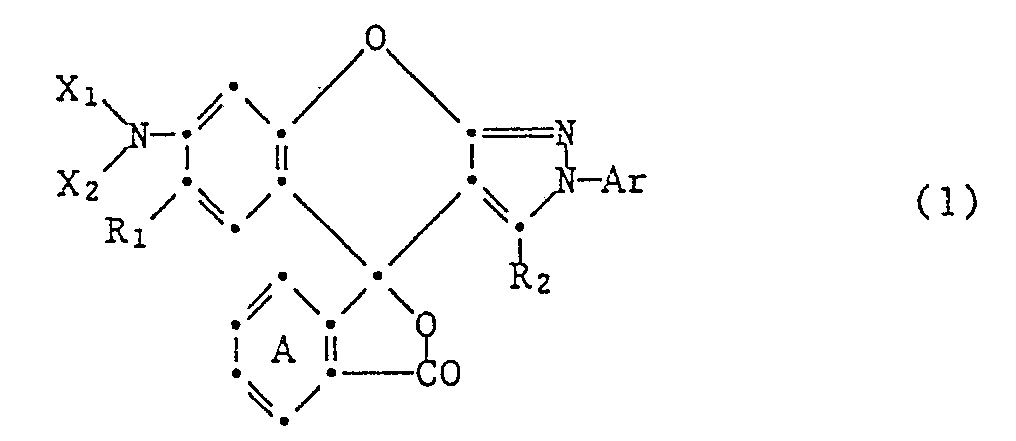
Ar einen unsubstituierten oder durch Halogen, Nitro, Cyano, Niederalkyl, Niederalkoxy, Niederalkylthio, Niederalkoxycarbonyl, Trifluormethyl, Phenoxy, Phenylthio oder -NX₃X₄ substituierten Arylrest,
R₁ Wasserstoff, Halogen, Niederalkyl oder Niederalkoxy,
R₂ Niederalkyl, Phenyl oder durch Halogen, Niederalkyl oder Niederalkoxy substituiertes Phenyl, und
X₁, X₂, .X₃ und X₄, unabhängig voneinander, je Wasserstoff, unsubstituiertes oder durch Halogen, Hydroxy, Cyano, Tetrahydrofuryl oder Niederalkoxy substituiertes Alkyl, Acyl, Cycloalkyl oder unsubstituiertes oder durch Halogen, Cyano, Nitro, Trifluormethyl, Niederalkyl, Niederalkoxy oder Niederalkoxycarbonyl substituiertes Aralkyl oder Aryl oder die Substituentenpaare (X₁ und X₂) und (X₃ und X₄) je zusammen mit dem gemeinsamen Stickstoffatom einen fünf- oder sechsgliedrigen, vorzugsweise gesättigten, heterocyclischen Rest bedeuten und worin
der Ring A unsubstituiert oder durch Halogen, Nitro, Niederalkyl, Niederalkoxy, Niederalkylthio, Niederalkoxycarbonyl, Amino, Mononiederalkylamino oder Diniederalkylamino substituiert ist.
Description
- Die vorliegende Erfindung betrifft chromogene Laktonverbindungen von Benzopyrano-2H-pyrazolverbindungen, Verfahren zu ihrer Herstellung und ihre Verwendung als Farbbildner in druckempfindlichen oder wärmeempfindlichen Aufzeichnungsmaterialien.
- Die erfindungsgemässen Laktonverbindungen von Benzopyrano-2H-pyrazolen entsprechen der allgemeinen Formel

Ar einen unsubstituierten oder durch Halogen, Nitro, Cyano, Niederalkyl, Niederalkoxy, Niederalkylthio, Niederalkoxycarbonyl, Trifluormethyl, Phenoxy, Phenylthio oder -NX₃X₄ substituierten Arylrest,
R₁ Wasserstoff, Halogen, Niederalkyl oder Niederalkoxy,
R₂ Niederalkyl, Phenyl oder durch Halogen, Niederalkyl oder Niederalkoxy substituiertes Phenyl, und
X₁, X₂, X₃ und X₄, unabhängig voneinander, je Wasserstoff, unsubstituiertes oder durch Halogen, Hydroxy, Cyano, Tetrahydrofuryl oder Niederalkoxy substituiertes Alkyl mit höchstens 12 Kohlenstoffatomen, Acyl mit 1 bis 12 Kohlenstoffatomen, Cycloalkyl mit 5 bis 10 Kohlenstoffatomen oder unsubstituiertes oder durch Halogen, Cyano, Nitro, Trifluormethyl, Niederalkyl, Niederalkoxy oder Niederalkoxycarbonyl substituiertes Aralkyl oder Aryl oder die Substituentenpaare (X₁ und X₂) und (X₃ und X₄) je zusammen mit dem gemeinsamen Stickstoffatom einen fünf- oder sechsgliedrigen, vorzugsweise gesättigten, heterocyclischen Rest bedeuten und worin
der Ring A unsubstituiert oder durch Halogen, Nitro, Niederalkyl, Niederalkoxy, Niederalkylthio, Niederalkoxycarbonyl, Amino, Mononiederalkylamino oder Diniederalkylamino substituiert ist. - Niederalkyl, Niederalkoxy und Niederalkylthio stellen bei der Definition der Reste der Laktonverbindungen solche Gruppen oder Gruppenbestandteile dar, die 1 bis 5, insbesondere 1 bis 3 Kohlenstoffatome aufweisen. Beispiele für derartige Gruppen sind Methyl, Ethyl, n-Propyl, Isopropyl, n-Butyl, sek.-Butyl, tert.Butyl, Amyl, Isoamyl oder tert.Amyl bzw. Methoxy, Ethoxy, Isopropoxy, Isobutoxy oder tert.Butoxy bzw. Methylthio, Ethylthio, Propylthio oder Butylthio.
- Halogen bedeutet beispielsweise Fluor, Brom oder vorzugsweise Chlor.
- Acyl ist besonders Formyl, Niederalkylcarbonyl, wie z.B. Acetyl oder Propionyl, oder Benzoyl. Weitere Acylreste können Niederalkylsulfonyl, wie z.B. Methylsulfonyl oder Ethylsulfonyl sowie Phenylsulfonyl sein. Benzoyl und Phenylsulfonyl können durch Halogen, Methyl, Methoxy oder Ethoxy substituiert sein.
- R₁ ist vorzugsweise Methyl, Methoxy, Brom, Chlor oder vor allem Wasserstoff.
- R₂ ist vorzugsweise Niederalkyl und besonders Methyl. Als gegebenenfalls substituiertes Phenyl kann R₂ Phenyl, Tolyl, Xylyl, Chlorphenyl, Methoxyphenyl oder Carbomethoxyphenyl darstellen.
- Der Arylrest Ar bedeutet zweckmässigerweise Diphenyl, Naphthyl und in erster Linie Phenyl. Vorzugsweise bedeutet Ar einen unsubstituierten oder durch Halogen, Nitro, Niederalkyl, Niederalkoxy, Niederalkoxycarbonyl, Phenoxy oder -NX₃X₄ substituierten Phenyl- oder Naphthylrest.
- Stellen die Substituenten X₁, X₂, X₃ und X₄ Alkylgruppen dar, so können sie geradkettig oder verzweigt sein. Beispiele solcher Alkylreste sind Methyl, Ethyl, n-Propyl, Isopropyl, n-Butyl, sek.-Butyl, tert.-Butyl, Amyl, Isoamyl, n-Hexyl, 2-Ethyl-hexyl, n-Heptyl, n-Octyl, Isooctyl, n-Nonyl, Isononyl oder n-Dodecyl.
- Sind die Alkylreste in X₁, X₂, X₃ und X₄ substituiert, so handelt es sich vor allem um Cyanoalkyl, Halogenalkyl, Hydroxyalkyl, Alkoxyalkyl jeweils vorzugsweise mit insgesamt 2 bis 6 Kohlenstoffatomen, wie z.B. β-Cyanoethyl, β-Chlorethyl, γ-Chlorpropyl, β-Hydroxyethyl, γ-Hydroxypropyl, β-Methoxyethyl, β-Ethoxyethyl oder γ-Methoxypropyl sowie auch Tetrahydrofurfuryl.
- Beispiele für Cycloalkyl in der Bedeutung der X-Reste sind Cyclopentyl, Cycloheptyl oder vorzugsweise Cyclohexyl. Die Cycloalkylreste können einen oder mehrere C₁-C₄-Alkylreste, vorzugsweise Methylgruppen, enthalten und weisen insgesamt 5 bis 10 Kohlenstoffatome auf.
- Als Aralkyl können X₁, X₂, X₃ und X₄ Phenethyl, Phenylisopropyl oder vor allem Benzyl sein. Als Aryl stellen die X-Reste besonders Naphthyl oder in erster Linie Phenyl dar.
- Bevorzugte Substituenten in der Aralkyl- und Arylgruppe der X-Reste sind z.B. Halogen, Cyano, Methyl, Trifluormethyl, Methoxy oder Carbomethoxy. Beispiele für derartige araliphatische bzw. aromatische Reste sind Methylbenzyl, 2,4- oder 2,5-Dimethylbenzyl, Chlorbenzyl, Dichlorbenzyl, Cyanobenzyl, Tolyl, Xylyl, Chlorphenyl, Methoxyphenyl, Trifluormethylphenyl, 2,6-Dimethylphenyl oder Carbomethoxyphenyl.
- Wenn die Substituentenpaare (X₁ und X₂) und (X₃ und X₄) jeweils zusammen mit dem gemeinsamen Stickstoffatom einen heterocyclischen Rest darstellen, so ist dieser beispielsweise Pyrrolidino, Piperidino, Pipecolino, Morpholino, Thiomorpholino oder Piperazino, z.B. N-Methylpiperazino. Bevorzugte gesättigte heterocyclische Reste für -NX₁X₂ und -NX₃X₄ sind Pyrrolidino, Piperidino oder Morpholino.
- Die Substituenten X₁ und X₂ sind vorzugsweise Cyclohexyl, Tolyl, Benzyl, Cyano-Niederalkyl z.B. β-Cyanoethyl oder in erster Linie Niederalkyl, wie z.B. Methyl, Ethyl, n-Propyl, Isopropyl, n-Butyl oder Isoamyl. -NX₁X₂ ist bevorzugt auch Pyrrolidinyl oder N-Niederalkyl-N-tetrahydrofurfurylamino.
- Die Substituenten X₃ und X₄ sind vorzugsweise Wasserstoff, C₁-C₈-Alkyl, Cyclohexyl, Phenyl, Benzyl oder durch Halogen, Methyl, Methoxy, Carbomethoxy oder Trifluormethyl substituiertes Phenyl oder Benzyl. -NX₃X₄ ist vorzugsweise auch Acetylamino, Propionylamino oder Benzoylamino.
- Der Ring A ist vorteilhafterweise nicht weiter substituiert. Falls er Substituenten aufweist, ist er in erster Linie durch Halogen, Nitro, Niederalkyl, Niederalkoxycarbonyl oder Diniederalkylamino substituiert. Der Ring A ist bevorzugt unsubstituiert oder durch Halogen substituiert.
- Praktisch wichtige Laktonverbindungen von Benzopyrano-2H-pyrazolen entsprechen der Formel

R₃ Niederalkyl oder Phenyl,
Y Wasserstoff, Halogen, Nitro, Niederalkyl, Niederalkoxy, Phenoxy oder -NX₇X₈,
X₅, X₆, X₇ und X₈, unabhängig voneinander, je C₁-C₈-Alkyl, C₅-C₆-Cycloalkyl oder unsubstituiertes oder durch Halogen, Niederalkyl, Niederalkoxy oder Niederalkoxycarbonyl substituiertes Benzyl oder Phenyl und X₈ auch Wasserstoff oder
die Substituentenpaare (X₅ und X₆) und (X₇ und X₈), unabhängig voneinander, je zusammen mit dem jeweiligen gemeinsamen Stickstoffatom Pyrrolidino, Piperidino oder Morpholino bedeuten und der Ring A₁ unsubstituiert oder durch Halogen, Niederalkyl, Niederalkoxycarbonyl oder Diniederalkylamino substituiert ist. - Unter den Laktonverbindungen der Formel (2) sind diejenigen, in denen R₃ Niederalkyl, insbesondere Methyl und Y Wasserstoff, Halogen, Nitro, Methyl oder Diniederalkylamino bedeuten und der Ring A₁ unsubstituiert ist, besonders bevorzugt.
- Von besonderem Interesse sind Laktonverbindungen von Benzopyrano-2H-pyrazolen der Formel

R₄ Methyl oder Phenyl,
Y₁ Wasserstoff, Chlor, Nitro, Methyl, Carbomethoxy oder Diniederalkylamino,
X₉ C₁-C₆-Alkyl, Cyclohexyl, Benzyl, Phenyl oder durch Methyl oder Chlor substituiertes Phenyl und
X₁₀ C₁-C₆-Alkyl bedeuten. - Ganz besonders bevorzugt sind Laktonverbindungen der Formel (3), in der X₉ und X₁₀ C₁-C₅-Alkyl, R₄ Methyl und Y₁ Wasserstoff, Chlor, Nitro, Methyl oder Dimethylamino bedeuten.
- Die erfindungsgemässen Laktonverbindungen der Formeln (1) bis (3) werden dadurch hergestellt, dass man eine Ketosäureverbindung der Formel
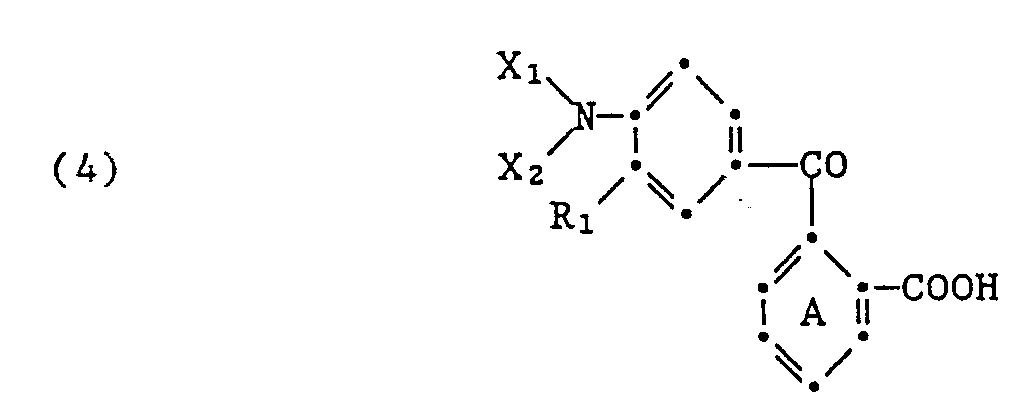

A, Ar, R₁, R₂, X₁ und X₂ die angegebene Bedeutung haben, umsetzt. - Die Umsetzung wird zweckmässigerweise so ausgeführt, dass man die Reaktionskomponenten in Gegenwart eines sauren Kondensationsmittels bei einer Temperatur von 20 bis 140°C zur Reaktion bringt. Beispiele für derartige Kondensationsmittel sind Essigsäureanhydrid, Zinkchlorid, Aluminiumchlorid, Schwefelsäure, Phosphorsäure und Phosphoroxychlorid.
- Die Isolierung des Endproduktes der Formel (1) erfolgt in allgemein bekannter Weise durch Einstellen des Reaktionsgemisches auf einen pH-Wert von mindestens 6, vorzugsweise 7 bis 14, z.B. mit Alkalien, wie z.B. Alkalimetallhydroxiden, Ammoniak, Alkalimetallcarbonaten oder -bicarbonaten und Abtrennen des gebildeten Produktes, Waschen und Trocknen oder durch Behandeln mit geeigneten organischen Lösungsmitteln, wie z.B. Methanol, Isopropanol, Ligroin, Benzol, Chlorbenzol, Toluol oder Xylol.
- Die Ausgangsstoffe der Formel (4) sind grösstenteils bekannt. Sie werden durch Umsetzung des Säureanhydrids der Formel
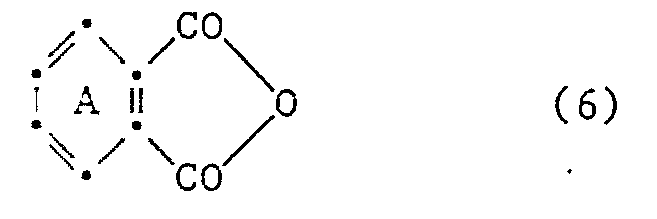

- Die Ausgangsstoffe der Formel (5) sind ebenfalls zum Teil bekannt. Sie können z.B. gemäss C. Venturello, R. D'Aloisio, Synthesis 1979, 283 aus 2-Arylazo-2,5-dimethyl-3-oxo-2,3-dihydrofuranen in stark saurem Medium in Gegenwart von Essigsäure und konz. Salzsäure und unter Bildung der entsprechenden N-Acetylderivate als Zwischenprodukte hergestellt werden. Eine weitere Herstellungsmethode für Ausgangsstoffe der Formel (5) ist in der US-A-2,227,654 beschrieben.
- Verbindungen der Formel (1), worin Ar einen durch -NX₃X₄ substituierten Arylrest darstellt, können auch dadurch hergestellt werden, dass man eine Verbindung der Formel (1), worin Ar einen Nitroarylrest bedeutet, auf übliche Weise zur Aminoarylgruppe reduziert und dann mit einem reaktiven Ester eines Alkyl- oder Benzylalkohols und einer anorganischen oder organischen Säure oder auch mit einem reaktiven funktionellen Derivat einer Carbonsäure, insbesondere Fettsäurehalogeniden oder -anhydriden, wie z.B. Acetylchlorid, Acetylbromid oder Acetanhydrid umsetzt. Beispiele für obengenannte reaktive Ester sind Methyl-, Ethyl-, n-Propyl-, n-Butyl- oder Benzylester der Chlorwasserstoff-, Bromwasserstoff- bzw. Jodwasserstoffsäure, Dimethyl- oder Diethylsulfat.
- Die Laktonverbindungen von Benzopyrano-2H-pyrazolen der Formeln (1) bis (3) sind normalerweise farblos oder höchstens schwach gefärbt. Wenn diese Farbbildner mit einem vorzugsweise sauren Entwickler, d.h. einem Elektronenakzeptor, in Kontakt gebracht werden, so ergeben sie je nach Bedeutung von Ar, insbesondere von Y und dem verwendeten Entwickler sofort intensive gelbe, orange oder rote Farbtöne, die besonders licht-und sublimationsecht sind.
- Die Laktonverbindungen der Formeln (1) bis (3) sind auch sehr wertvoll im Gemisch mit einem oder mehreren anderen bekannten Farbbildnern, z.B. 3,3-(Bis-aminophenyl-)-phthaliden, 3-Indolyl-3-aminophenylazaphthaliden, (3,3-Bis-indolyl-)-phthaliden, 3-Amino-fluoranen, 3-Dialkylamino-7-dibenzylaminofluoranen, 3-Dialkylamino-6-methyl-7-arylaminofluoranen, Leukoauraminen, Spiropyranen, Spirodipyranen, Chromenoindolen, Phenoxazinen, Phenothiazinen, Chinazolinen, Rhodaminlaktamen, Carbazolylmethanen oder weiteren Triarylmethan-leukofarbstoffen, um graue oder schwarze Färbungen zu erzeugen.
- Die Laktonverbindungen der Formeln (1) bis (3) zeigen sowohl auf aktivierten Tonen, wie auch auf phenolischen Unterlagen eine ausgezeichnete Farbintensität. Sie eignen sich insbesondere als sich schnell entwickelnde Farbbildner für die Verwendung in einem wärmeempfindlichen oder insbesondere druckempfindlichen Aufzeichnungsmaterial, das sowohl Kopier- als auch Registriermaterial sein kann. Sie zeichnen sich dadurch aus, dass sie pH stabil, lichtecht und in den Kapselölen gut löslich sind. Nach Belichtung in CB-Blatt weisen sie eine geringe Abnahme der Farbstärke (CB-Desaktivierung) auf.
- Ein druckempfindliches Material besteht beispielsweise aus mindestens einem Paar von Blättern, die mindestens einen Farbbildner der Formeln (1) bis (3) gelöst in einem organischen Lösungsmittel und einen Elektronenakzeptor als Entwickler enthalten.
- Typische Beispiele für solche Entwickler sind Aktivton-Substanzen, wie Attapulgus-Ton, Säureton, Bentonit, Montmorillonit, aktivierter Ton, wie z.B. säureaktiviertes Bentonit oder Montmorillonit, ferner Zeolith, Halloysit, Siliciumdioxyd, Aluminiumoxid, Aluminiumsulfat, Aluminiumphosphat, hydratisiertes Zirkondioxid, Zinkchlorid, Zinknitrat, aktiviertes Kaolin oder irgendein beliebiger Ton. Als Entwickler können auch sauer reagierende, organische Verbindungen, wie z.B. gegebenenfalls ringsbustituierte Phenole, Resorcine, Salicylsäuren, wie z.B. 3,5-Bis-(α,α-dimethylbenzyl-)-salicylsäure oder 3,5-Bis-(α-methylbenzyl)-salicylsäure oder Salicylsäureester und deren Metallsalze, z.B. Zinksalze, sowie ein sauer reagierendes, polymeres Material, wie z.B. ein phenolisches Polymerisat, ein Alkylphenolacetylenharz, ein Maleinsäure-Kolophonium-Harz oder ein teilweise oder vollständig hydrolysiertes Polymerisat von Maleinsäureanhydrid mit Styrol, Ethylen oder Vinylmethylether, oder Carboxymethylen verwendet werden. Es können auch Mischungen der genannten monomeren und polymeren Verbindungen eingesetzt werden. Besonders bevorzugte Entwickler sind säureaktiviertes Bentonit, Zinksalicylate oder die Kondensationsprodukte von p-substituierten Phenolen mit Formaldehyd. Die letzteren können auch mit Zink modifiziert sein.
- Die Entwickler können zusätzlich auch im Gemisch mit an sich unreaktiven oder wenig reaktiven Pigmenten oder weiteren Hilfstoffen wie Kieselgel oder UV-Absorbern, wie z.B. 2-(2′-Hydroxyphenyl-)benztriazolen eingesetzt werden. Beispiele für solche Pigmente sind: Talk, Titandioxid, Aluminiumoxid, Aluminiumhydroxyd, Zinkoxid, Kreide, Tone wie Kaolin, sowie organische Pigmente, z.B. Harnstoff-Formaldehydkondensate (BET-Oberfläche 2-75 m²/g) oder Melamin-Formaldehyd-Kondensationsprodukte.
- Der Farbbildner liefert an den Punkten, an denen er mit dem Elektronenakzeptor in Kontakt kommt, eine gefärbte Markierung. Um eine frühzeitige Aktivierung der in dem druckempfindlichen Aufzeichnungsmaterial vorhandenen Farbbildner zu verhindern, werden diese in der Regel von dem Elektronenakzeptor getrennt. Dies kann zweckmässig erzielt werden, indem man die Farbbildner in schaum-, schwamm- oder bienenwabenartigen Strukturen einarbeitet. Vorzugsweise sind die Farbbildner in Mikrokapseln eingeschlossen, die sich in der Regel durch Druck zerbrechen lassen.
- Beim Zerbrechen der Kapseln durch Druck, beispielsweise mittels eines Bleistiftes, wird die Farbbildnerlösung auf ein benachbartes mit einem Elektronenakzeptor beschichtetes Blatt übertragen, wodurch eine farbige Stelle erzeugt wird. Die Farbe resultiert aus dem dabei gebildeten Farbstoff, der im sichtbaren Bereich des elektromagnetischen Spektrums absorbiert.
- Die Farbbildner werden vorzugsweise in Form von Lösungen in organischen Lösungsmitteln eingekapselt. Beispiele für geeignete Lösungsmittel sind vorzugsweise nichtflüchtige Lösungsmittel, z.B. halogeniertes Paraffin oder Diphenyl, wie Chlorparaffin, Monochlordiphenyl oder Trichlor diphenyl, ferner Tricresylphosphat, Di-n-butylphthalat, Dioctylphthalat, Trichlorbenzol, Trichlorethylphosphat, aromatische Ether, wie Benzylphenylether, Kohlenwasserstofföle, wie Paraffin oder Kerosin, z.B. mit Isopropyl, Isobutyl, sek-Butyl oder tert.-Butyl alkylierte Derivate von Diphenyl, Naphthalin oder Terphenyl, Dibenzyltoluol, partiell hydriertes Terphenyl, mono- bis tetra-C₁-C₃-alkylierte Diphenylalkane, Dodecylbenzol, benzylierte Xylole, oder weitere chlorierte oder hydrierte, kondensierte, aromatische Kohlenwasserstoffe. Oft werden Mischungen verschiedener Lösungsmittel, insbesondere Mischungen aus Paraffinölen oder Kerosin und Diisopropylnaphthalin oder partiell hydriertem Terphenyl, eingesetzt, um eine optimale Löslichkeit für die Farbbildung, eine rasche und intensive Färbung und eine für die Mikroverkapselung günstige Viskosität zu erreichen.
- Die Kapselwände können durch Koazervationskräfte gleichmässig um die Tröpfchen der Farbbildnerlösung herum gebildet werden, wobei das Einkapselungsmaterial z.B. in der US-Patentschrift 2,800,457 beschrieben ist. Die Kapseln können vorzugsweise auch aus einem Aminoplast oder modifizierten Aminoplasten durch Polykondensation gebildet werden, wie es in den britischen Patentschriften 989,264, 1,156,725, 1,301,052 und 1,355,124 beschrieben ist. Ebenfalls geeignet sind Mikrokapseln, welche durch Grenzflächenpolymerisation gebildet werden, wie z.B. Kapseln aus Polyester, Polycarbonat, Polysulfonamid, Polysulfonat, besonders aber aus Polyamid oder Polyurethan.
- Die Farbbildner der Formeln (1) bis (3) enthaltenden Mikrokapseln können zur Herstellung von druckempfindlichen Kopiermaterialien der verschiedensten bekannten Arten verwendet werden. Die verschiedenen Systeme unterscheiden sich im wesentlichen voneinander durch die Anordnung der Kapseln, der Farbreaktanten und durch das Trägermaterial.
- Bevorzugt wird eine Anordnung, bei der der eingekapselte Farbbildner in Form einer Schicht auf der Rückseite eines Uebertragungsblattes und der Elektronenakzeptor in Form einer Schicht auf der Vorderseite eines Empfangsblattes vorhanden sind.
- Eine andere Anordnung der Bestandteile besteht darin, dass die den Farbbildner enthaltenden Mikrokapseln und der Entwickler in oder auf dem gleichen Blatt in Form einer oder mehrerer Einzelschichten oder in der Papierpulpe vorliegen.
- Die Kapseln werden vorzugsweise mittels eines geeigneten Binders auf dem Träger befestigt. Da Papier das bevorzugte Trägermaterial ist, handelt es sich bei diesem Binder hauptsächlich um Papierbeschichtungsmittel, wie Gummi arabicum, Polyvinylalkohol, Hydroxymethylcellulose, Casein, Methylcellulose, Dextrin, Stärke, Stärkederivate oder Polymerlatices. Letztere sind beispielsweise Butadien-Styrolcopolymerisate oder Acrylhomo- oder -copolymere.
- Als Papier werden nicht nur normale Papiere aus Cellulosefasern, sondern auch Papiere, in denen die Cellulosefasern (teilweise oder vollständig) durch Fasern aus synthetischen Polymerisaten ersetzt sind, verwendet.
- Vorzugsweise besteht das Durchschreibematerial auch darin, dass es eine kapselfreie, die Laktonverbindung enthaltende Schicht und eine farbentwickelnde Schicht, die als Farbentwickler mindestens ein anorganisches Metallsalz vor allem Halogenide oder Nitrate eines mehrwertigen Metalles, wie z.B. Zinkchlorid, Zinnchlorid, Zinknitrat oder deren Gemische enthält, aufweist.
- Die Verbindungen der Formeln (1) bis (3) können auch als Farbbildner in einem thermoreaktiven Aufzeichnungsmaterial verwendet werden. Dieses enthält in der Regel mindestens einen Schichtträger, einen Farbbildner, einen Elektronenakzeptor und gegebenenfalls auch ein Bindemittel und/oder Wachs. Gewünschtenfalls können auch Aktivatoren oder Sensibilisatoren im Aufzeichnungsmaterial vorhanden sein.
- Thermoreaktive Aufzeichnungssysteme umfassen, z.B. wärmeempfindliche Aufzeichnungs- und Kopiermaterialien und -papiere. Diese Systeme werden beispielsweise zum Aufzeichnen von Informationen, z.B. in elektronischen Rechnern, Ferndruckern, Fernschreibern oder in Aufzeichnungsgeräten und Messinstrumenten, wie z.B. Elektrocardiographen, verwendet. Die Bild erzeugung (Markierung) kann auch manuell mit einer erhitzten Feder erfolgen. Eine weitere Einrichtung zur Erzeugung von Markierungen mittels Wärme sind Laserstrahlen.
- Das thermoreaktive Aufzeichnungsmaterial kann so aufgebaut sein, dass der Farbbildner in einer Bindemittelschicht gelöst oder dispergiert ist und in einer zweiten Schicht der Entwickler in dem Bindemittel gelöst und dispergiert ist. Eine andere Möglichkeit besteht darin, dass sowohl der Farbbildner als auch der Entwickler in einer Schicht dispergiert sind. Das Bindemittel wird in spezifischen Bezirken mittels Wärme erweicht und an diesen Punkten, an denen Wärme angewendet wird, kommt der Farbbildner mit dem Elektronenakzeptor in Kontakt und es entwickelt sich sofort die erwünschte Farbe.
- Als Entwickler eignen sich die gleichen Elektronenakzeptoren, wie sie in druckempfindlichen Papieren verwendet werden. Beispiele für Entwickler sind die bereits erwähnten Tonminerale und Phenolharze, oder auch phenolische Verbindungen, wie sie beispielsweise in der DE-PS 12,51,348 beschrieben sind, z.B. 4-tert.-Butylphenol, 4-Phenylphenol, Methylen-bis-(p-phenylphenol), 4-Hydroxydiphenylether, α-Naphthol, β-Naphthol, 4-Hydroxybenzoesäure-methylester oder -benzylester, 4-Hydroxydiphenylsulfon, 2,4-Dihydroxydiphenylsulfon, 4′-Hydroxy-4-methyldiphenylsulfon, 4′-Hydroxy-4-isopropoxydiphenylsulfon, 4-Hydroxy-acetophenon, 2,2′-Dihydroxydiphenyl, 4,4′-Cyclohexylidendiphenol, 4,4′-Isopropylidendiphenol, 4,4′-Isopropyliden-bis-(2-methylphenol), ein Antipyrinkomplex von Zinkthiocyanat, ein Pyridinkomplex von Zinkthiocyanat, 4,4-Bis-(4-hydroxyphenyl)valeriansäure, Hydrochinon, Pyrogallol, Phloroglucin, p-, m-, o-Hydroxybenzoesäure, Gallussäure, 1-Hydroxy-2-naphthoesäure sowie Borsäure oder organische, vorzugsweise aliphatische Dicarbonsäuren, wie z.B. Weinsäure, Oxalsäure, Maleinsäure, Zitronensäure, Citraconsäure oder Bernsteinsäure.
- Vorzugsweise werden zur Herstellung des thermoreaktiven Aufzeichnungsmaterials schmelzbare, filmbildende Bindemittel verwendet. Diese Bindemittel sind normalerweise wasserlöslich, während die Laktonverbindungen und der Entwickler in Wasser schwer löslich oder unlöslich sind. Das Bindemittel sollte in der Lage sein, den Farbbildner und den Entwickler bei Raumtemperatur zu dispergieren und zu fixieren.
- Bei Einwirkung von Wärme erweicht oder schmilzt das Bindemittel, so dass der Farbbildner mit dem Entwickler in Kontakt kommt und sich eine Farbe bilden kann. Wasserlösliche oder mindestens in Wasser quellbare Bindemittel sind z.B. hydrophile Polymerisate, wie Polyvinylalkohol, Polyacrylsäure, Hydroxyethylcellulose, Methylcellulose, Carboxymethylcellulose, Polyacrylamid, Polyvinylpyrrolidon, carboxylierte Butadien-Styrolcopolymerisate, Gelatine, Stärke oder veretherte Maisstärke.
- Wenn der Farbbildner und der Entwickler in zwei getrennten Schichten vorliegen, können in Wasser unlösliche Bindemittel, d.h. in nichtpolaren oder nur schwach polaren Lösungsmitteln lösliche Bindemittel, wie z.B. Naturkautschuk, synthetischer Kautschuk, chlorierter Kautschuk, Polystyrol, Styrol/Butadien-Mischpolymerisate, Polymethylacrylate, Ethylcellulose, Nitrocellulose und Polyvinylcarbazol, verwendet werden. Die bevorzugte Anordnung ist jedoch diejenige, bei der der Farbbildner und der Entwickler in einer Schicht in einem wasserlöslichen Bindemittel enthalten sind.
- Die thermoreaktiven Schichten können weitere Zusätze enthalten. Zur Verbesserung des Weissgrades, zur Erleichterung des Bedruckens der Papiere und zur Verhinderung des Festklebens der erhitzten Feder können diese Schichten, z.B. Talk, Titandioxyd, Zinkoxyd, Aluminiumhydroxyd, Calciumcarbonat (z.B. Kreide), Tone oder auch organische Pigmente, wie z.B. Harnstoff-Formaldehydpolymerisate enthalten. Um zu bewirken, dass nur innnerhalb eines begrenzten Temperaturbereiches die Farbe gebildet wird, können Substanzen, wie Harnstoff, Thioharnstoff, Diphenylthioharnstoff, Acetamid, Acetanilid, Benzolsulfanilid, Bis-Stearoyl-ethylendiamid, Stearinsäureamid, Phthalsäureanhydrid, Metallstearate, wie z.B. Zinkstearat, Phthalsäurenitril, Dimethylterephthalat, Dibenzylterephthalat oder andere entsprechende, schmelzbare Produkte, welche das gleichzeitige Schmelzen des Farbbildners und des Entwicklers induzieren, zugesetzt werden. Bevorzugt enthalten thermographische Aufzeichnungsmaterialien Wachse, z.B. Carnaubawachs, Montanwachs, Paraffinwachs, Polyethylenwachs, Kondensate höherer Fettsäureamide und Formaldehyde und Kondensate höherer Fettsäuren und Ethylendiamin.
- Eine weitere Anwendung der Verbindungen der Formeln (1) bis (3) ist die Herstellung eines Farbbildes mittels photohärtbarer Mikrokapseln, wie sie z.B. in der DE-OS 3 247 488 beschrieben sind.
- In den folgenden Beispielen beziehen sich die angegebenen Prozentsätze, wenn nichts anderes angegeben ist, auf das Gewicht. Teile bedeuten Gewichtsteile.
- 15,7 g 2-Hydroxy-4-diethylamino-2′-carboxy-benzophenon werden unter Rühren in 50 ml Schwefelsäure (98 %) bei Raumtemperatur gelöst. In diese Lösung werden portionenweise 8,7 g 1-Phenyl-5-methyl-pyrazol-(3)-on eingetragen, worauf das Gemisch über Nacht (10-12 Stunden) bei Raumtemperatur gerührt wird. Man giesst das Reaktionsgemisch auf Eiswasser und stellt mit konz. Ammoniakwasser alkalisch ein. Das ausgeschiedene Produkt wird abfiltriert, mit Wasser gewaschen und bei 60-70°C im Vakuum getrocknet. Man erhält 23 g eines Rohproduktes, das nach Umkristallisation aus Ligroin/Toluol 15,2 g einer Verbindung der Formel

- Verwendet man in Beispiel 1 anstelle von 2-Hydroxy-4-diethylamino-2′-carboxy-benzophenon die äquivalente Menge von
- a) 2-Hydroxy-4-diethylamino-2′-carboxy-3′,4′,5′,6′-tetrachlor-benzophenon oder
- b) 2-Hydroxy-4-diethylamino-2′-carboxy-4′/5′-tert.butyl-benzophenon.
- Auf gleiche Weise wie in Beispiel 1 beschrieben, erhält man unter Verwendung der entsprechenden Ausgangsstoffe die in der folgenden Tabelle aufgeführten Laktonverbindungen der Formel
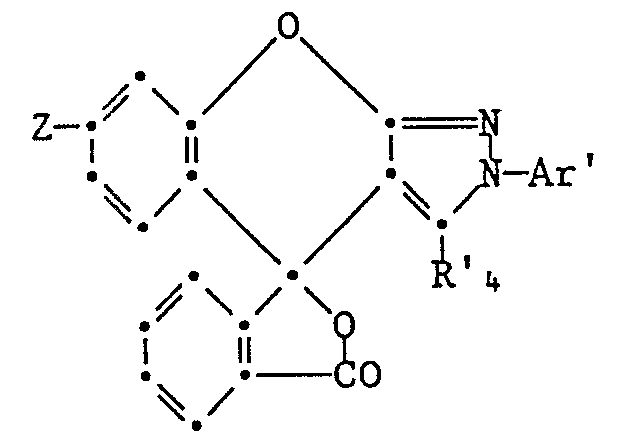

- Eine Suspension von 4,7 g der gemäss Beispiel 6 hergestellten Benzopyrano-2H-pyrazolverbindung der Formel


- a) 1,3 g der Verbindung der Formel (16) werden in 10 ml Acetanhydrid auf 100°C erhitzt, dann mit Wasser versetzt und gerührt. Das ausgefallene Produkt wird abfiltriert, mit Wasser gewaschen und im Vakuum bei 70°C getrocknet. Nach Reinigung über die Kieselgelsäule mit Methylendichlorid erhält man 0,8 g einer Verbindung der Formel

- b) 1,3 g der Verbindung der Formel (16) werden in 10 ml Benzylchlorid unter Rühren 10 Stunden bei 150-160°C erhitzt, worauf überschüssiges Benzylchlorid durch Abdampfen entfernt wird. Der Rückstand wird mit verdünnter Ammoniaklösung behandelt und abfiltriert. Nach Waschen, Trocknen im Vakuum bei 60-70°C und Reinigung über Kieselgelsäule mit Methylendichlorid erhält man eine Verbindung der Formel
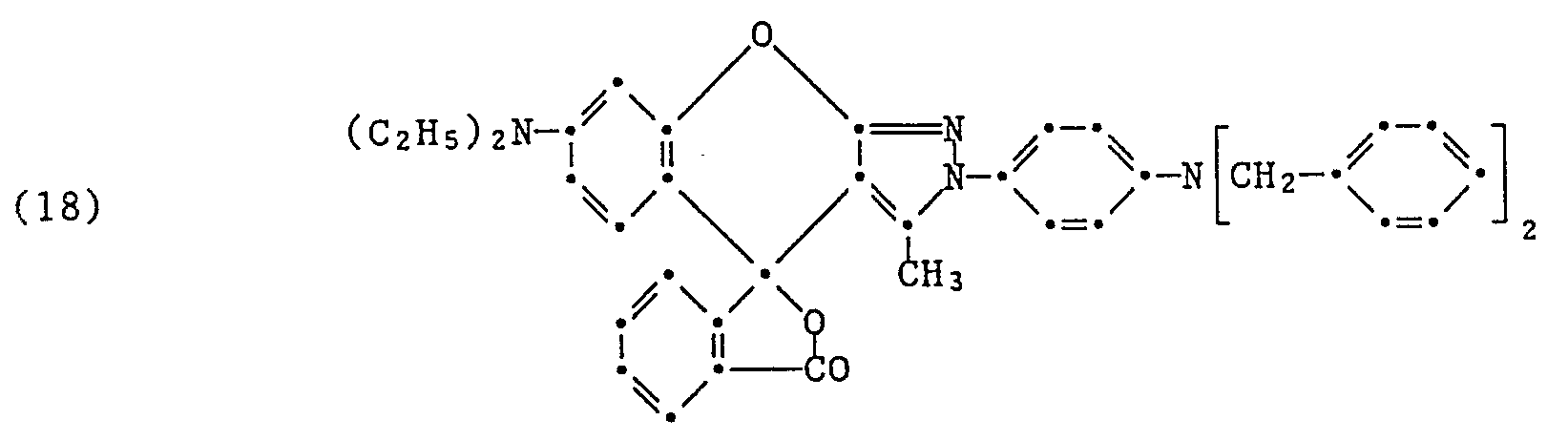
- Eine Lösung von 3 g der Laktonverbindung der Formel (11) in 80 g Di-Isopropylnaphthalin und 17 g Kerosin wird auf an sich bekannte Weise mit Gelatine und Gummi arabicum durch Koazervation mikroverkapselt, mit Stärkelösung vermischt und auf ein Blatt Papier gestrichen. Ein zweites Blatt Papier wird auf der Frontseite mit säureaktiviertem Bentonit als Farbentwickler beschichtet. Das erste, den Farbbildner enthaltende Blatt und das mit Farbentwickler beschichtete Papier werden mit den Beschichtungen benachbart aufeinandergelegt. Durch Schreiben mit der Hand oder mit der Schreibmaschine auf dem ersten Blatt wird Druck ausgeübt, und es entwickelt sich sofort auf dem mit dem Entwickler beschichteten Blatt eine intensive orange Kopie, die ausgezeichnet sublimier- und lichtecht ist.
- Entsprechende intensive, sublimier- und lichtechte Kopien werden auch bei Verwendung der Farbbildner gemäss den Beispielen 2 bis 12 erzielt.
- Ersetzt man in Beispiel 13 die Laktonverbindung der Formel (11) durch eine Mischung der folgenden Zusammensetzung
1,2 g 3,3-Bis-(4′-dimethylaminophenyl)-6-dimethylaminophthalid,
1,2 g N-Butylcarbazol-3-yl-bis-(4′-N-methyl-N-phenylaminophenyl-)-methan
1,2 g der Laktonverbindung der Formel (11) und
0,4 g 3,3-Bis-(N-octyl-2′-methylindol-3′-yl-)phthalid
und verfährt im übrigen wie in Beispiel 13 beschrieben, so erhält man ein druckempfindliches Aufzeichnungsmaterial, welches durch Schreiben mit der Hand oder mit der Schreibmaschine eine intensive und lichtechte schwarze Kopie ergibt. - 1 g der Laktonverbindung gemäss Beispiel 6 wird in 17 g Toluol gelöst. Zu dieser Lösung gibt man unter Rühren 12 g Polyvinylacetat, 8 g Calciumcarbonat und 2 g Titandioxyd. Die erhaltene Suspension wird im Gewichtsverhältnis 1:1 mit Toluol verdünnt und mit einem 10 µm Rakel auf ein Blatt Papier gestrichen. Auf dieses Blatt Papier wird ein zweites Blatt Papier gelegt, dessen Unterseite bei einem Auftragsgewicht von 3 g/m² mit einer Mischung bestehend aus 1 Teil eines Amidwachses, 1 Teil eines Stearinwachses und 1 Teil Zinkchlorid beschichtet worden ist. Durch Schreiben mit der Hand oder mit der Schreibmaschine auf dem oberen Blatt wird Druck ausgeübt, und es entwickelt sich sofort auf dem mit den Farbbildner beschichteten Blatt, eine intensive, sublimier- und lichtechte rote Farbe.
- In einer Kugelmühle werden 32 g 4,4′-Isopropylidendiphenol (Bisphenol A), 3,8 g Distearylamid des Ethylendiamins, 39 g Kaolin, 20 g eines 88 % hydrolysierten Polyvinylalkohols und 500 ml Wasser gemahlen bis die Teilchengrösse ca 5 µm beträgt. In einer zweiten Kugelmühle werden 6 g der Laktonverbindung der Formel (11), 3 g eines zu 88 % hydrolysierten Polyvinylalkohols und 60 ml Wasser zu einer Teilchengrösse von ca. 3 µm gemahlen.
- Die beiden Dispersionen werden zusammengegeben und mit einem Trockenauftragsgewicht von 5,5 g/m² auf ein Papier gestrichen. Durch Berührung des Papiers mit einem erhitzten Metallstift wird eine intensive orange Farbe erhalten, die eine ausgezeichnete Sublimier- und Lichtechtheit hat.
- Intensive und lichtechte Farben werden auch bei Verwendung der Farbbildner gemäss den Beispielen 2 bis 12 erhalten.

Claims (18)

Ar einen unsubstituierten oder durch Halogen, Nitro, Cyano, Niederalkyl, Niederalkoxy, Niederalkylthio, Niederalkoxycarbonyl, Trifluormethyl, Phenoxy, Phenylthio oder -NX₃X₄ substituierten Arylrest,
R₁ Wasserstoff, Halogen, Niederalkyl oder Niederalkoxy,
R₂ Niederalkyl, Phenyl oder durch Halogen, Niederalkyl oder Niederalkoxy substituiertes Phenyl, und
X₁, X₂, X₃ und X₄, unabhängig voneinander, je Wasserstoff, unsubstituiertes oder durch Halogen, Hydroxy, Cyano, Tetrahydrofuryl oder Niederalkoxy substituiertes Alkyl mit höchstens 12 Kohlenstoffatomen, Acyl mit 1 bis 12 Kohlenstoffatomen, Cycloalkyl mit 5 bis 10 Kohlenstoffatomen oder unsubstituiertes oder durch Halogen, Cyano, Nitro, Trifluormethyl, Niederalkyl, Niederalkoxy oder Niederalkoxycarbonyl substituiertes Aralkyl oder Aryl oder die Substituentenpaare (X₁ und X₂) und (X₃ und X₄) je zusammen mit dem gemeinsamen Stickstoffatom einen fünf- oder sechsgliedrigen heterocyclischen Rest bedeuten und worin
der Ring A unsubstituiert oder durch Halogen, Nitro, Niederalkyl, Niederalkoxy, Niederalkylthio, Niederalkoxycarbonyl, Amino, Mononiederalkylamino oder Diniederalkylamino substituiert ist.

worin
R₃ Niederalkyl oder Phenyl,
Y Wasserstoff, Halogen, Nitro, Niederalkyl, Niederalkoxy, Phenoxy oder -NX₇X₈,
X₅, X₆, X₇ und X₈, unabhängig voneinander, je C₁-C₈-Alkyl, C₅-C₆-Cycloalkyl oder unsubstituiertes oder durch Halogen, Niederalkyl, Niederalkoxy oder Niederalkoxycarbonyl substituiertes Benzyl oder Phenyl und X₈ auch Wasserstoff oder
die Substituentenpaare (X₅ und X₆) und (X₇ und X₈), unabhängig voneinander, je zusammen mit dem jeweiligen gemeinsamen Stickstoffatom Pyrrolidino, Piperidino oder Morpholino bedeuten und der Ring A₁ unsubstituiert oder durch Halogen, Niederalkyl, Niederalkoxycarbonyl oder Diniederalkylamino substituiert ist.
R₃ Niederalkyl, insbesondere Methyl und
Y Wasserstoff, Halogen, Nitro, Methyl oder Diniederalkylamino bedeuten und der Ring A₁ unsubstituiert ist.

worin
R₄ Methyl oder Phenyl,
Y₁ Wasserstoff, Chlor, Nitro, Methyl, Carbomethoxy oder Diniederalkylamino,
X₉ C₁-C₆-Alkyl, Cyclohexyl, Benzyl, Phenyl oder durch Methyl oder Chlor substituiertes Phenyl und
X₁₀ C₁-C₆-Alkyl bedeuten.


Applications Claiming Priority (2)
| Application Number | Priority Date | Filing Date | Title |
|---|---|---|---|
| CH1568/88 | 1988-04-27 | ||
| CH156888 | 1988-04-27 |
Publications (3)
| Publication Number | Publication Date |
|---|---|
| EP0340169A2 true EP0340169A2 (de) | 1989-11-02 |
| EP0340169A3 EP0340169A3 (de) | 1991-05-29 |
| EP0340169B1 EP0340169B1 (de) | 1994-11-30 |
Family
ID=4213471
Family Applications (1)
| Application Number | Title | Priority Date | Filing Date |
|---|---|---|---|
| EP89810293A Expired - Lifetime EP0340169B1 (de) | 1988-04-27 | 1989-04-18 | Chromogene Laktonverbindungen von Benzopyrano-2H-pyrazolen |
Country Status (10)
| Country | Link |
|---|---|
| US (1) | US4933448A (de) |
| EP (1) | EP0340169B1 (de) |
| JP (1) | JPH07103315B2 (de) |
| KR (1) | KR970011393B1 (de) |
| AT (1) | ATE114656T1 (de) |
| AU (1) | AU609972B2 (de) |
| DE (1) | DE58908670D1 (de) |
| ES (1) | ES2064481T3 (de) |
| FI (1) | FI90981C (de) |
| ZA (1) | ZA893076B (de) |
Families Citing this family (2)
| Publication number | Priority date | Publication date | Assignee | Title |
|---|---|---|---|---|
| US5846901A (en) * | 1996-03-01 | 1998-12-08 | Minnesota Mining And Manufacturing Company | Color-forming compounds and their use in carbonless imaging |
| EP3063234B1 (de) * | 2013-09-27 | 2018-06-27 | Chromatic Technologies, Inc. | Rote thermochrome farbstoffe und tintenzusammensetzungen |
Family Cites Families (7)
| Publication number | Priority date | Publication date | Assignee | Title |
|---|---|---|---|---|
| GB1264636A (de) * | 1968-07-15 | 1972-02-23 | ||
| BE795746A (fr) * | 1972-02-21 | 1973-08-21 | Wiggins Teape Ltd | Nouveaux formateurs de couleur |
| JPS5138245B2 (de) * | 1973-05-22 | 1976-10-20 | ||
| GB1469515A (en) * | 1973-09-06 | 1977-04-06 | Ciba Geigy Ag | Chromeno-pyrazole compounds their manufacture and their use in thermo-reactive recording material |
| GB1469516A (en) * | 1974-08-15 | 1977-04-06 | Ciba Geigy Ag | Nitrochromeno pyrazole compounds their manufacture and use |
| US4007195A (en) * | 1974-09-18 | 1977-02-08 | Ciba-Geigy Ag | Heterocyclic substituted fluorans |
| CH598013A5 (de) * | 1974-11-13 | 1978-04-28 | Ciba Geigy Ag |
-
1989
- 1989-04-18 EP EP89810293A patent/EP0340169B1/de not_active Expired - Lifetime
- 1989-04-18 ES ES89810293T patent/ES2064481T3/es not_active Expired - Lifetime
- 1989-04-18 AT AT89810293T patent/ATE114656T1/de not_active IP Right Cessation
- 1989-04-18 DE DE58908670T patent/DE58908670D1/de not_active Expired - Fee Related
- 1989-04-24 FI FI891932A patent/FI90981C/fi not_active IP Right Cessation
- 1989-04-25 US US07/343,094 patent/US4933448A/en not_active Expired - Fee Related
- 1989-04-26 KR KR1019890005481A patent/KR970011393B1/ko not_active Expired - Lifetime
- 1989-04-26 AU AU33706/89A patent/AU609972B2/en not_active Ceased
- 1989-04-26 ZA ZA893076A patent/ZA893076B/xx unknown
- 1989-04-27 JP JP1106085A patent/JPH07103315B2/ja not_active Expired - Lifetime
Also Published As
| Publication number | Publication date |
|---|---|
| EP0340169A3 (de) | 1991-05-29 |
| FI90981B (fi) | 1994-01-14 |
| FI891932A0 (fi) | 1989-04-24 |
| FI90981C (fi) | 1994-04-25 |
| JPH01316382A (ja) | 1989-12-21 |
| FI891932A7 (fi) | 1989-10-28 |
| ZA893076B (en) | 1989-12-27 |
| EP0340169B1 (de) | 1994-11-30 |
| AU609972B2 (en) | 1991-05-09 |
| ATE114656T1 (de) | 1994-12-15 |
| ES2064481T3 (es) | 1995-02-01 |
| KR900016430A (ko) | 1990-11-13 |
| DE58908670D1 (de) | 1995-01-12 |
| JPH07103315B2 (ja) | 1995-11-08 |
| KR970011393B1 (ko) | 1997-07-10 |
| US4933448A (en) | 1990-06-12 |
| AU3370689A (en) | 1989-11-02 |
Similar Documents
| Publication | Publication Date | Title |
|---|---|---|
| EP0033716A1 (de) | Chromogene Chinazolinverbindungen, Verfahren zu ihrer Herstellung und ihre Verwendung als Farbbildner in druckempfindlichen oder wärmeempfindlichen Aufzeichnungsmaterialien | |
| EP0561738B1 (de) | Fluoran Farbbildner | |
| EP0316277A2 (de) | Chromogene 1-heterocyclisch substituierte 2,4-Benzoxazine | |
| CH656580A5 (de) | Druckempfindliches oder waermeempfindliches aufzeichnungsmaterial. | |
| EP0082822B1 (de) | Chromogene Dihydrofuropyridinone, Verfahren zu ihrer Herstellung und ihre Verwendung in druck- oder wärmeempfindlichen Aufzeichnungsmaterialien | |
| DE3600725A1 (de) | Ringsubstituierte 4-azaphthalide | |
| EP0475908A1 (de) | Chromogene Lactamverbindungen und ihre Herstellung und Verwendung | |
| EP0373104B1 (de) | Veretherte Fluoresceinverbindungen | |
| EP0266310B1 (de) | Chromogene Phthalide | |
| EP0333649B1 (de) | 3-Basisch substituierte 2-Methylfluorane | |
| EP0140833B1 (de) | 5-und 6-Azaphthalide, ihre Isomerengemische, Verfahren zu ihrer Herstellung und ihre Verwendung in druck- und wärmeempfindlichen Aufzeichnungsmaterialien | |
| EP0266311B1 (de) | Fluoranfarbbildnergemisch und seine Verwendung in Aufzeichnungsmaterialien | |
| DE3423369A1 (de) | Chromogene chinazolonverbindungen | |
| EP0109930B1 (de) | Chromogene Bis-Chinazolinverbindungen, Verfahren zu ihrer Herstellung und ihre Verwendung als Farbbildner in druckempfindlichen oder wärmeempfindlichen Aufzeichnungsmaterialien | |
| EP0356386B1 (de) | Chromogene Phthalide | |
| CH653353A5 (de) | Chromogene 3,3-bisindolyl-4-azaphthalide. | |
| EP0340169B1 (de) | Chromogene Laktonverbindungen von Benzopyrano-2H-pyrazolen | |
| EP0159295B1 (de) | Chromogene Bis-Chinazolinverbindungen, Verfahren zu ihrer Herstellung und ihre Verwendung als Farbbildner in druckempfindlichen oder wärmeempfindlichen Aufzeichnungsmaterialien | |
| EP0135469B1 (de) | Chromogene Chinazolinverbindungen | |
| EP0560722B1 (de) | Chromogene Lactamverbindungen, ihre Herstellung und Verwendung | |
| EP0384895B1 (de) | 2- oder 3-Dicarbonsäureimid-Fluoranverbindungen, Verfahren zu deren Herstellung und deren Verwendung in Aufzeichnungsmaterialien | |
| EP0218548B1 (de) | Chromogene Chinazolinverbindungen | |
| EP0420808B1 (de) | Pyranhaltige Phthalide | |
| EP0291456B1 (de) | Chromogene polycyclische Azamethinverbindungen und ihre Herstellung und Verwendung | |
| EP0437185B1 (de) | Pyrrolin- bzw. indolinhaltige Phthalide |
Legal Events
| Date | Code | Title | Description |
|---|---|---|---|
| PUAI | Public reference made under article 153(3) epc to a published international application that has entered the european phase |
Free format text: ORIGINAL CODE: 0009012 |
|
| 17P | Request for examination filed |
Effective date: 19890420 |
|
| AK | Designated contracting states |
Kind code of ref document: A2 Designated state(s): AT BE CH DE ES FR GB IT LI |
|
| PUAL | Search report despatched |
Free format text: ORIGINAL CODE: 0009013 |
|
| AK | Designated contracting states |
Kind code of ref document: A3 Designated state(s): AT BE CH DE ES FR GB IT LI |
|
| 17Q | First examination report despatched |
Effective date: 19930723 |
|
| GRAA | (expected) grant |
Free format text: ORIGINAL CODE: 0009210 |
|
| AK | Designated contracting states |
Kind code of ref document: B1 Designated state(s): AT BE CH DE ES FR GB IT LI |
|
| REF | Corresponds to: |
Ref document number: 114656 Country of ref document: AT Date of ref document: 19941215 Kind code of ref document: T |
|
| ET | Fr: translation filed | ||
| REF | Corresponds to: |
Ref document number: 58908670 Country of ref document: DE Date of ref document: 19950112 |
|
| ITF | It: translation for a ep patent filed | ||
| REG | Reference to a national code |
Ref country code: ES Ref legal event code: FG2A Ref document number: 2064481 Country of ref document: ES Kind code of ref document: T3 |
|
| GBT | Gb: translation of ep patent filed (gb section 77(6)(a)/1977) |
Effective date: 19950116 |
|
| PLBE | No opposition filed within time limit |
Free format text: ORIGINAL CODE: 0009261 |
|
| STAA | Information on the status of an ep patent application or granted ep patent |
Free format text: STATUS: NO OPPOSITION FILED WITHIN TIME LIMIT |
|
| 26N | No opposition filed | ||
| PGFP | Annual fee paid to national office [announced via postgrant information from national office to epo] |
Ref country code: FR Payment date: 19960306 Year of fee payment: 8 |
|
| PGFP | Annual fee paid to national office [announced via postgrant information from national office to epo] |
Ref country code: GB Payment date: 19960319 Year of fee payment: 8 Ref country code: AT Payment date: 19960319 Year of fee payment: 8 |
|
| PGFP | Annual fee paid to national office [announced via postgrant information from national office to epo] |
Ref country code: ES Payment date: 19960419 Year of fee payment: 8 |
|
| PGFP | Annual fee paid to national office [announced via postgrant information from national office to epo] |
Ref country code: BE Payment date: 19960502 Year of fee payment: 8 |
|
| PGFP | Annual fee paid to national office [announced via postgrant information from national office to epo] |
Ref country code: CH Payment date: 19960620 Year of fee payment: 8 |
|
| PG25 | Lapsed in a contracting state [announced via postgrant information from national office to epo] |
Ref country code: GB Effective date: 19970418 Ref country code: AT Effective date: 19970418 |
|
| PG25 | Lapsed in a contracting state [announced via postgrant information from national office to epo] |
Ref country code: ES Free format text: LAPSE BECAUSE OF NON-PAYMENT OF DUE FEES Effective date: 19970419 |
|
| PG25 | Lapsed in a contracting state [announced via postgrant information from national office to epo] |
Ref country code: LI Free format text: LAPSE BECAUSE OF NON-PAYMENT OF DUE FEES Effective date: 19970430 Ref country code: CH Free format text: LAPSE BECAUSE OF NON-PAYMENT OF DUE FEES Effective date: 19970430 Ref country code: BE Effective date: 19970430 |
|
| BERE | Be: lapsed |
Owner name: CIBA-GEIGY A.G. Effective date: 19970430 |
|
| GBPC | Gb: european patent ceased through non-payment of renewal fee |
Effective date: 19970418 |
|
| REG | Reference to a national code |
Ref country code: CH Ref legal event code: PL |
|
| PG25 | Lapsed in a contracting state [announced via postgrant information from national office to epo] |
Ref country code: FR Free format text: LAPSE BECAUSE OF NON-PAYMENT OF DUE FEES Effective date: 19971231 |
|
| REG | Reference to a national code |
Ref country code: FR Ref legal event code: ST |
|
| PGFP | Annual fee paid to national office [announced via postgrant information from national office to epo] |
Ref country code: DE Payment date: 19980312 Year of fee payment: 10 |
|
| REG | Reference to a national code |
Ref country code: ES Ref legal event code: PC2A |
|
| REG | Reference to a national code |
Ref country code: ES Ref legal event code: FD2A Effective date: 19990503 |
|
| PG25 | Lapsed in a contracting state [announced via postgrant information from national office to epo] |
Ref country code: DE Free format text: LAPSE BECAUSE OF NON-PAYMENT OF DUE FEES Effective date: 20000201 |
|
| PG25 | Lapsed in a contracting state [announced via postgrant information from national office to epo] |
Ref country code: IT Free format text: LAPSE BECAUSE OF NON-PAYMENT OF DUE FEES;WARNING: LAPSES OF ITALIAN PATENTS WITH EFFECTIVE DATE BEFORE 2007 MAY HAVE OCCURRED AT ANY TIME BEFORE 2007. THE CORRECT EFFECTIVE DATE MAY BE DIFFERENT FROM THE ONE RECORDED. Effective date: 20050418 |