EP0337930A2 - Procédé et installation de préparation de pièces moulées céramiques - Google Patents
Procédé et installation de préparation de pièces moulées céramiques Download PDFInfo
- Publication number
- EP0337930A2 EP0337930A2 EP89730099A EP89730099A EP0337930A2 EP 0337930 A2 EP0337930 A2 EP 0337930A2 EP 89730099 A EP89730099 A EP 89730099A EP 89730099 A EP89730099 A EP 89730099A EP 0337930 A2 EP0337930 A2 EP 0337930A2
- Authority
- EP
- European Patent Office
- Prior art keywords
- particles
- electrode
- sintering
- mold
- sintered
- Prior art date
- Legal status (The legal status is an assumption and is not a legal conclusion. Google has not performed a legal analysis and makes no representation as to the accuracy of the status listed.)
- Granted
Links
Images
Classifications
-
- C—CHEMISTRY; METALLURGY
- C04—CEMENTS; CONCRETE; ARTIFICIAL STONE; CERAMICS; REFRACTORIES
- C04B—LIME, MAGNESIA; SLAG; CEMENTS; COMPOSITIONS THEREOF, e.g. MORTARS, CONCRETE OR LIKE BUILDING MATERIALS; ARTIFICIAL STONE; CERAMICS; REFRACTORIES; TREATMENT OF NATURAL STONE
- C04B35/00—Shaped ceramic products characterised by their composition; Ceramics compositions; Processing powders of inorganic compounds preparatory to the manufacturing of ceramic products
- C04B35/01—Shaped ceramic products characterised by their composition; Ceramics compositions; Processing powders of inorganic compounds preparatory to the manufacturing of ceramic products based on oxide ceramics
-
- B—PERFORMING OPERATIONS; TRANSPORTING
- B22—CASTING; POWDER METALLURGY
- B22F—WORKING METALLIC POWDER; MANUFACTURE OF ARTICLES FROM METALLIC POWDER; MAKING METALLIC POWDER; APPARATUS OR DEVICES SPECIALLY ADAPTED FOR METALLIC POWDER
- B22F3/00—Manufacture of workpieces or articles from metallic powder characterised by the manner of compacting or sintering; Apparatus specially adapted therefor ; Presses and furnaces
- B22F3/004—Filling molds with powder
-
- B—PERFORMING OPERATIONS; TRANSPORTING
- B28—WORKING CEMENT, CLAY, OR STONE
- B28B—SHAPING CLAY OR OTHER CERAMIC COMPOSITIONS; SHAPING SLAG; SHAPING MIXTURES CONTAINING CEMENTITIOUS MATERIAL, e.g. PLASTER
- B28B13/00—Feeding the unshaped material to moulds or apparatus for producing shaped articles; Discharging shaped articles from such moulds or apparatus
- B28B13/02—Feeding the unshaped material to moulds or apparatus for producing shaped articles
-
- C—CHEMISTRY; METALLURGY
- C04—CEMENTS; CONCRETE; ARTIFICIAL STONE; CERAMICS; REFRACTORIES
- C04B—LIME, MAGNESIA; SLAG; CEMENTS; COMPOSITIONS THEREOF, e.g. MORTARS, CONCRETE OR LIKE BUILDING MATERIALS; ARTIFICIAL STONE; CERAMICS; REFRACTORIES; TREATMENT OF NATURAL STONE
- C04B35/00—Shaped ceramic products characterised by their composition; Ceramics compositions; Processing powders of inorganic compounds preparatory to the manufacturing of ceramic products
- C04B35/515—Shaped ceramic products characterised by their composition; Ceramics compositions; Processing powders of inorganic compounds preparatory to the manufacturing of ceramic products based on non-oxide ceramics
-
- B—PERFORMING OPERATIONS; TRANSPORTING
- B22—CASTING; POWDER METALLURGY
- B22F—WORKING METALLIC POWDER; MANUFACTURE OF ARTICLES FROM METALLIC POWDER; MAKING METALLIC POWDER; APPARATUS OR DEVICES SPECIALLY ADAPTED FOR METALLIC POWDER
- B22F2999/00—Aspects linked to processes or compositions used in powder metallurgy
Definitions
- the invention relates to a method and a device for the production of ceramic shaped bodies from inorganic raw materials by joining particles in a sintering mold by means of a stationary high-voltage electrical field and to the ceramic shaped bodies produced by the method, which have a very high density and other improved properties .
- Ceramic moldings are usually produced from crushed, inorganic raw material with the addition of water and optionally binders, industrial products being produced by pressing or extruding.
- the invention has set itself the task of using a dry path and by means of an electrostatic field to produce ceramic moldings essentially from inorganic raw materials with a high density and thus also further improved mechanical properties.
- a sintered mold made of electrically non-conductive material is arranged in an electrostatic field between two electrodes.
- a charge is imparted to the inorganic particles by a first electrode, which is preferably arranged outside the mold.
- a second electrode is arranged on an outer wall of the sintered mold, for example it can form the receiving surface for the sintered mold.
- the charged particles are attracted by the second electrode. They accumulate on the wall of the sintered mold. They only gradually transfer their charge to the sintered form, which is a dielectric. Subsequent charged particles are repelled by the charge of the already accumulated particles, but the predominant attraction of the electrostatic field leads to a densified accumulation of further particles.
- the flow of charged particles must be uniform, since an interruption or disruption of the charge transport leads at least to inhomogeneities in the structure of the attached particles.
- the second electrode accelerates the charged particles in the electrostatic field.
- the second electrode can therefore also be referred to as an accelerator electrode.
- the impact and contact of the dry, charged and accelerated particles on and to the already deposited particles lead to a high density of the structure. This high density is maintained when the molded body is subsequently in the Sintered form is sintered.
- the field line advance and the field strength are matched to the geometry of the ceramic molded body.
- the maximum density that can be achieved depends on various factors, such as the size and shape of the molded body, the type of inorganic raw material, the grain size of the particles and the field strength of the electrostatic field.
- a high field strength up to the breakdown field strength is advantageous for a high compression, but it should be noted that strikethrough must be avoided. Strikethrough can occur, for example, at high atmospheric humidity, which is why the process is preferably carried out in an atmosphere whose humidity does not exceed 45%.
- a field strength of over 100 kV / m to about 600 kV / m seems to be an option for the proposed shaped bodies. However, deviations from this area are also conceivable for special cases.
- a voltage source is expediently used, with which the field strength can be regulated in this area.
- This controllability is also used in particular to keep the field strength above the fill level as constant as possible during the entire filling process.
- the field effect of the electrostatic field should also be directed essentially according to gravity, as a result of which improved mechanical properties are achieved in this preferred direction.
- a high density can be achieved if the particle size of the inorganic particles is in the particle size range from 0 to 1 mm.
- a grain size range of 0.03 to 0.06 mm is preferred. Particularly good results were obtained if the particle size of the particles differed little from one another, that is to say a very narrow particle size range from the abovementioned ranges was used. It is even possible to use extremely fine-grained material which, when dry, cannot be compressed very much under uniaxial pressure, but springs back elastically when compressed.
- a preferred material for the sintered form is sintered corundum.
- Such a form has the advantage over the forms made of graphite proposed in DE-PS 32 48 537 that it has a high specific electrical resistance, which enables the production of dense ceramic shaped articles by the method according to the invention, and it does not change during the sintering process can therefore be used several times.
- the sinter shape and the electrodes are to be adapted to the shape of the shaped bodies to be produced.
- a vibrating screen which emits the particles by oscillating movements in at least two spatial directions in a time-constant stream and a grain size distribution that is uniform over the supply cross section.
- a ring electrode which charges the particles, can be used as the first electrode below the sieve and the feed device and above the sintering mold.
- This ring electrode is preferably negative, so that the particles also receive a negative charge.
- This ring electrode must consist of a conductive material, for example copper or graphite.
- the cross section of the supplied stream of particles and also the electrode can have a shape that deviates from the circle.
- a rod electrode is also possible as the first electrode, which has at least one tip at which a corona discharge takes place, through which the particles are preferably also negatively charged before they accumulate in the sintering mold under the influence of the electrostatic field.
- an electrode surrounded by the sintered shape can be arranged centrally to a jacket electrode enveloping the shape.
- a generator is used as the voltage source, which supplies a sufficient voltage or a sufficient potential difference. If necessary, several generators can also be interconnected so that they result in the necessary potential difference.
- Suitable inorganic raw materials are all suitable materials for ceramic products such as oxides (e.g. SiO2, Al2O3, ZrO 2), nitrides (e.g. Si3N4), borides (e.g. TiB2), rare earths (e.g. Y and its compounds) and their mixtures or compounds .
- ceramic superconductors can also be produced by the method according to the invention.
- the density of the ceramic molded body can be changed locally in a targeted manner.
- the packing of the particles produced according to the invention by the electrostatic field had a high density that could not be achieved by uniaxial pressing. This structure was retained during the sintering. It was found that a shorter time and a lower temperature were required for the sintering. This is due to the denser packing of the particles.
- Samples produced in accordance with the invention were compared with comparison samples which were pressed from the same material using high pressure and with the addition of binders. It was found that, for example, the cold compressive strength was 1.7 times or more that in conventionally produced bodies, and a density of about at least 2.0 g / m3 compared to an average of 1.6 g / cm3 was achieved.
- Artalschamotte 23 was used, consisting of about 54.4% SiO2 and 30.9% Al2O3 with an average grain diameter of 0.25 mm, which was sintered at 1400 ° C. in the production according to the invention. The tests showed that if the working conditions were optimized, a density of over 2.2 g / cm3 could be achieved with this material.
- the products produced were extremely hard compared to, for example, refractory material. You can also expect a low and also direction-dependent thermal expansion when heated.
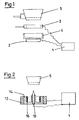
- a voltage source 1 for example a generator, is used which generates a voltage corresponding to the electrostatic field. It is connected to a positive electrode 2, which is designed as a plate to support a sintering mold 4. It is also connected to a negative electrode which is designed as a ring electrode and is arranged above the sintered mold.
- the electrode 2 expediently consists of copper, the electrode 3 of graphite or preferably also of copper.
- the feed device in the form of a vibrating screen 5 is arranged above the electrode 3. The particles falling from the vibrating sieve 5 in a uniform metered flow are negatively charged by the annular electrode 3 and then accelerated into the sintering mold 4 by the accelerator electrode 2. The electrostatic forces between the electrodes 3 and 2 cause the negatively charged particles attracted by the positive electrode to accumulate in the sintering mold 4 to form an extremely dense packing.
- the first electrode is designed as a rod electrode 13, surrounded by the sintered mold 14, and arranged centrally to the second electrode 12.
- the electrode 12 surrounds the sintered mold 14 in a ring shape, on the inner wall of which the particles accumulate.
- the electrode 13 has a tip at which corona discharges can take place, and this tip leads to a concentrated charging of the inorganic particles falling out of the feed device 5. These particles are deposited on the sintering mold 14 to form an annular structure 16.
Landscapes
- Engineering & Computer Science (AREA)
- Chemical & Material Sciences (AREA)
- Ceramic Engineering (AREA)
- Manufacturing & Machinery (AREA)
- Structural Engineering (AREA)
- Materials Engineering (AREA)
- Mechanical Engineering (AREA)
- Organic Chemistry (AREA)
- Compositions Of Oxide Ceramics (AREA)
- Ceramic Products (AREA)
- Devices For Post-Treatments, Processing, Supply, Discharge, And Other Processes (AREA)
- Physical Or Chemical Processes And Apparatus (AREA)
- Press-Shaping Or Shaping Using Conveyers (AREA)
Priority Applications (1)
| Application Number | Priority Date | Filing Date | Title |
|---|---|---|---|
| AT89730099T ATE88687T1 (de) | 1988-04-11 | 1989-04-10 | Verfahren und vorrichtung zur herstellung von keramischen formkoerpern. |
Applications Claiming Priority (2)
| Application Number | Priority Date | Filing Date | Title |
|---|---|---|---|
| DE3812356A DE3812356A1 (de) | 1988-04-11 | 1988-04-11 | Verfahren und vorrichtung zur herstellung von keramischen formkoerpern und hiermit hergestellte formkoerper |
| DE3812356 | 1988-04-11 |
Publications (3)
| Publication Number | Publication Date |
|---|---|
| EP0337930A2 true EP0337930A2 (fr) | 1989-10-18 |
| EP0337930A3 EP0337930A3 (en) | 1990-11-28 |
| EP0337930B1 EP0337930B1 (fr) | 1993-04-28 |
Family
ID=6351931
Family Applications (1)
| Application Number | Title | Priority Date | Filing Date |
|---|---|---|---|
| EP89730099A Expired - Lifetime EP0337930B1 (fr) | 1988-04-11 | 1989-04-10 | Procédé et installation de préparation de pièces moulées céramiques |
Country Status (4)
| Country | Link |
|---|---|
| EP (1) | EP0337930B1 (fr) |
| AT (1) | ATE88687T1 (fr) |
| DE (2) | DE3812356A1 (fr) |
| ES (1) | ES2041032T3 (fr) |
Cited By (1)
| Publication number | Priority date | Publication date | Assignee | Title |
|---|---|---|---|---|
| EP2361705A1 (fr) * | 2010-02-23 | 2011-08-31 | Robert Bosch GmbH | Procédé et dispositif de liaison de particules dotées d'un substrat |
Family Cites Families (4)
| Publication number | Priority date | Publication date | Assignee | Title |
|---|---|---|---|---|
| US3387972A (en) * | 1964-01-27 | 1968-06-11 | Inoue Kiyoshi | Method of and apparatus for bonding together metallic bodies |
| FR2343818A1 (fr) * | 1976-03-10 | 1977-10-07 | Air Ind | Procede et installation d'emaillage par poudrage electrostatique |
| GB2000990A (en) * | 1977-07-15 | 1979-01-24 | British Steel Corp | Electrostatic deposition of metals |
| DE3248537C2 (de) * | 1982-12-29 | 1986-10-23 | Erich 8500 Nürnberg Rabe | Sinterformkörper auf der Basis von Quarzsand sowie Verfahren und Vorrichtung zu ihrer Herstellung |
-
1988
- 1988-04-11 DE DE3812356A patent/DE3812356A1/de active Granted
-
1989
- 1989-04-10 EP EP89730099A patent/EP0337930B1/fr not_active Expired - Lifetime
- 1989-04-10 ES ES198989730099T patent/ES2041032T3/es not_active Expired - Lifetime
- 1989-04-10 DE DE8989730099T patent/DE58904177D1/de not_active Expired - Fee Related
- 1989-04-10 AT AT89730099T patent/ATE88687T1/de active
Cited By (1)
| Publication number | Priority date | Publication date | Assignee | Title |
|---|---|---|---|---|
| EP2361705A1 (fr) * | 2010-02-23 | 2011-08-31 | Robert Bosch GmbH | Procédé et dispositif de liaison de particules dotées d'un substrat |
Also Published As
| Publication number | Publication date |
|---|---|
| ATE88687T1 (de) | 1993-05-15 |
| EP0337930B1 (fr) | 1993-04-28 |
| ES2041032T3 (es) | 1993-11-01 |
| EP0337930A3 (en) | 1990-11-28 |
| DE3812356C2 (fr) | 1990-02-08 |
| DE3812356A1 (de) | 1989-10-19 |
| DE58904177D1 (de) | 1993-06-03 |
Similar Documents
| Publication | Publication Date | Title |
|---|---|---|
| DE3013943C2 (fr) | ||
| EP0002067B1 (fr) | Procédé pour la fabrication de corps denses polycristallins en carbure de bore par frittage sans compression à chaud | |
| DE69404480T2 (de) | Brennen von feinkoernigen teilchen | |
| EP0042130B1 (fr) | Corps façonné en céramique contenant des constituants de structure eutectique et procédé pour sa préparation | |
| DE2323096C2 (de) | Geformter Feuerfestgegenstand und ein Verfahren zu seiner Herstellung | |
| DE2628342B2 (de) | Siliciumcarbidsinterkörper und Verfahren zu deren Herstellung | |
| DE69426925T2 (de) | Herstellen von gegenständen durch ein pulverformverfahren und pulverzuführung | |
| DE1215649B (de) | Verfahren zum Herstellen eines extrem reinen, stabfoermigen Halbleiterkristalls | |
| DE69023429T2 (de) | Poröser Sinterkörper und Verfahren zu seiner Herstellung. | |
| DE102011014875B3 (de) | Verfahren für die Herstellung poröser Granulatteilchen aus anorganischem Werkstoff sowie deren Verwendung | |
| EP0197586B1 (fr) | Procédé et dispositifs pour la fabrication de corps en verre | |
| DE69009577T2 (de) | Methode zur Herstellung eines Filterelementes für Staubsammler. | |
| DE3430186A1 (de) | Verfahren zur herstellung eines poroesen piezoelektrischen materials und nach diesem verfahren hergestelltes material | |
| EP0337930B1 (fr) | Procédé et installation de préparation de pièces moulées céramiques | |
| DE4442409A1 (de) | Korundporzellanmasse, Verfahren zu ihrer Aufbereitung und Verwendung der Korundporzellanmasse | |
| DE2347491C3 (de) | Verfahren und Vorrichtung zum elektrostatischen Beschichten mit pulverförmigen Stoffen | |
| DE1936592A1 (de) | Verfahren zur Herstellung eines Koerpers aus schweissbarem Material | |
| WO1984002520A1 (fr) | Elements moules a base de sable siliceux, leur fabrication, leur utilisation ainsi qu'une installation conçue pour executer ce procede | |
| DE3116786A1 (de) | Homogener siliciumcarbid-formkoerper und verfahren zu seiner herstellung | |
| DE68926338T2 (de) | Verfahren zur Elektroverfestigung eines vorgeformten Einzelwerkstücks | |
| DE1683784A1 (de) | Verfahren und Einrichtung zum Herstellen von Formteilen | |
| DE102016207370A1 (de) | Gaseinlass für ein Ionentriebwerk | |
| JP3121053B2 (ja) | 放電加工電極の製造方法 | |
| DE1592089C3 (de) | Verfahren zur Verbesserung der Fliessfähigkeit von Korngemischen aus elektrisch erschmolzenem Magnesiumoxid | |
| DE3729700C2 (de) | Verfahren zur Herstellung von preßfähigem Granulat für die Fertigung von Produkten aus gesintertem keramischen Werkstoff |
Legal Events
| Date | Code | Title | Description |
|---|---|---|---|
| PUAI | Public reference made under article 153(3) epc to a published international application that has entered the european phase |
Free format text: ORIGINAL CODE: 0009012 |
|
| AK | Designated contracting states |
Kind code of ref document: A2 Designated state(s): AT BE CH DE ES FR GB GR IT LI LU NL SE |
|
| RAP1 | Party data changed (applicant data changed or rights of an application transferred) |
Owner name: SALZGITTER AG |
|
| PUAL | Search report despatched |
Free format text: ORIGINAL CODE: 0009013 |
|
| AK | Designated contracting states |
Kind code of ref document: A3 Designated state(s): AT BE CH DE ES FR GB GR IT LI LU NL SE |
|
| 17P | Request for examination filed |
Effective date: 19901227 |
|
| RAP1 | Party data changed (applicant data changed or rights of an application transferred) |
Owner name: PREUSSAG AKTIENGESELLSCHAFT |
|
| 17Q | First examination report despatched |
Effective date: 19920221 |
|
| GRAA | (expected) grant |
Free format text: ORIGINAL CODE: 0009210 |
|
| AK | Designated contracting states |
Kind code of ref document: B1 Designated state(s): AT BE CH DE ES FR GB GR IT LI LU NL SE |
|
| REF | Corresponds to: |
Ref document number: 88687 Country of ref document: AT Date of ref document: 19930515 Kind code of ref document: T |
|
| REF | Corresponds to: |
Ref document number: 58904177 Country of ref document: DE Date of ref document: 19930603 |
|
| ITF | It: translation for a ep patent filed | ||
| ET | Fr: translation filed | ||
| GBT | Gb: translation of ep patent filed (gb section 77(6)(a)/1977) |
Effective date: 19930726 |
|
| REG | Reference to a national code |
Ref country code: GR Ref legal event code: FG4A Free format text: 3008475 |
|
| REG | Reference to a national code |
Ref country code: ES Ref legal event code: FG2A Ref document number: 2041032 Country of ref document: ES Kind code of ref document: T3 |
|
| PLBE | No opposition filed within time limit |
Free format text: ORIGINAL CODE: 0009261 |
|
| STAA | Information on the status of an ep patent application or granted ep patent |
Free format text: STATUS: NO OPPOSITION FILED WITHIN TIME LIMIT |
|
| PGFP | Annual fee paid to national office [announced via postgrant information from national office to epo] |
Ref country code: FR Payment date: 19940309 Year of fee payment: 6 |
|
| PGFP | Annual fee paid to national office [announced via postgrant information from national office to epo] |
Ref country code: SE Payment date: 19940315 Year of fee payment: 6 Ref country code: AT Payment date: 19940315 Year of fee payment: 6 |
|
| PGFP | Annual fee paid to national office [announced via postgrant information from national office to epo] |
Ref country code: GB Payment date: 19940316 Year of fee payment: 6 |
|
| PGFP | Annual fee paid to national office [announced via postgrant information from national office to epo] |
Ref country code: GR Payment date: 19940324 Year of fee payment: 6 Ref country code: BE Payment date: 19940324 Year of fee payment: 6 |
|
| PGFP | Annual fee paid to national office [announced via postgrant information from national office to epo] |
Ref country code: CH Payment date: 19940325 Year of fee payment: 6 |
|
| PGFP | Annual fee paid to national office [announced via postgrant information from national office to epo] |
Ref country code: LU Payment date: 19940331 Year of fee payment: 6 |
|
| PGFP | Annual fee paid to national office [announced via postgrant information from national office to epo] |
Ref country code: ES Payment date: 19940406 Year of fee payment: 6 |
|
| 26N | No opposition filed | ||
| PGFP | Annual fee paid to national office [announced via postgrant information from national office to epo] |
Ref country code: DE Payment date: 19940426 Year of fee payment: 6 |
|
| PGFP | Annual fee paid to national office [announced via postgrant information from national office to epo] |
Ref country code: NL Payment date: 19940430 Year of fee payment: 6 |
|
| EPTA | Lu: last paid annual fee | ||
| EAL | Se: european patent in force in sweden |
Ref document number: 89730099.2 |
|
| PG25 | Lapsed in a contracting state [announced via postgrant information from national office to epo] |
Ref country code: LU Free format text: LAPSE BECAUSE OF NON-PAYMENT OF DUE FEES Effective date: 19950410 Ref country code: GB Effective date: 19950410 Ref country code: AT Effective date: 19950410 |
|
| PG25 | Lapsed in a contracting state [announced via postgrant information from national office to epo] |
Ref country code: SE Effective date: 19950411 Ref country code: ES Free format text: LAPSE BECAUSE OF NON-PAYMENT OF DUE FEES Effective date: 19950411 |
|
| PG25 | Lapsed in a contracting state [announced via postgrant information from national office to epo] |
Ref country code: LI Effective date: 19950430 Ref country code: CH Effective date: 19950430 Ref country code: BE Effective date: 19950430 |
|
| BERE | Be: lapsed |
Owner name: PREUSSAG A.G. Effective date: 19950430 |
|
| PG25 | Lapsed in a contracting state [announced via postgrant information from national office to epo] |
Ref country code: GR Free format text: THE PATENT HAS BEEN ANNULLED BY A DECISION OF A NATIONAL AUTHORITY Effective date: 19951031 |
|
| PG25 | Lapsed in a contracting state [announced via postgrant information from national office to epo] |
Ref country code: NL Effective date: 19951101 |
|
| GBPC | Gb: european patent ceased through non-payment of renewal fee |
Effective date: 19950410 |
|
| REG | Reference to a national code |
Ref country code: CH Ref legal event code: PL |
|
| PG25 | Lapsed in a contracting state [announced via postgrant information from national office to epo] |
Ref country code: FR Effective date: 19951229 |
|
| REG | Reference to a national code |
Ref country code: GR Ref legal event code: MM2A Free format text: 3008475 |
|
| NLV4 | Nl: lapsed or anulled due to non-payment of the annual fee |
Effective date: 19951101 |
|
| PG25 | Lapsed in a contracting state [announced via postgrant information from national office to epo] |
Ref country code: DE Effective date: 19960103 |
|
| EUG | Se: european patent has lapsed |
Ref document number: 89730099.2 |
|
| REG | Reference to a national code |
Ref country code: FR Ref legal event code: ST |
|
| REG | Reference to a national code |
Ref country code: ES Ref legal event code: FD2A Effective date: 19990405 |
|
| PG25 | Lapsed in a contracting state [announced via postgrant information from national office to epo] |
Ref country code: IT Free format text: LAPSE BECAUSE OF NON-PAYMENT OF DUE FEES;WARNING: LAPSES OF ITALIAN PATENTS WITH EFFECTIVE DATE BEFORE 2007 MAY HAVE OCCURRED AT ANY TIME BEFORE 2007. THE CORRECT EFFECTIVE DATE MAY BE DIFFERENT FROM THE ONE RECORDED. Effective date: 20050410 |