EP0336571A1 - Verfahren zur Zubereitung wieder herstellbarer, wieder gebratener Bohnen, die aus zerquetschten und ganzen Bohnen bestehen - Google Patents
Verfahren zur Zubereitung wieder herstellbarer, wieder gebratener Bohnen, die aus zerquetschten und ganzen Bohnen bestehen Download PDFInfo
- Publication number
- EP0336571A1 EP0336571A1 EP89302425A EP89302425A EP0336571A1 EP 0336571 A1 EP0336571 A1 EP 0336571A1 EP 89302425 A EP89302425 A EP 89302425A EP 89302425 A EP89302425 A EP 89302425A EP 0336571 A1 EP0336571 A1 EP 0336571A1
- Authority
- EP
- European Patent Office
- Prior art keywords
- beans
- sub
- whole
- crushed
- approximately
- Prior art date
- Legal status (The legal status is an assumption and is not a legal conclusion. Google has not performed a legal analysis and makes no representation as to the accuracy of the status listed.)
- Granted
Links
Images
Classifications
-
- A—HUMAN NECESSITIES
- A23—FOODS OR FOODSTUFFS; TREATMENT THEREOF, NOT COVERED BY OTHER CLASSES
- A23B—PRESERVATION OF FOODS, FOODSTUFFS OR NON-ALCOHOLIC BEVERAGES; CHEMICAL RIPENING OF FRUIT OR VEGETABLES
- A23B7/00—Preservation of fruit or vegetables; Chemical ripening of fruit or vegetables
- A23B7/02—Dehydrating; Subsequent reconstitution
- A23B7/022—Dehydrating; Subsequent reconstitution with addition of chemicals before or during drying, e.g. semi-moist products
-
- A—HUMAN NECESSITIES
- A23—FOODS OR FOODSTUFFS; TREATMENT THEREOF, NOT COVERED BY OTHER CLASSES
- A23B—PRESERVATION OF FOODS, FOODSTUFFS OR NON-ALCOHOLIC BEVERAGES; CHEMICAL RIPENING OF FRUIT OR VEGETABLES
- A23B9/00—Preservation of edible seeds, e.g. cereals
- A23B9/08—Drying; Subsequent reconstitution
-
- A—HUMAN NECESSITIES
- A23—FOODS OR FOODSTUFFS; TREATMENT THEREOF, NOT COVERED BY OTHER CLASSES
- A23L—FOODS, FOODSTUFFS OR NON-ALCOHOLIC BEVERAGES, NOT OTHERWISE PROVIDED FOR; PREPARATION OR TREATMENT THEREOF
- A23L11/00—Pulses, i.e. fruits of leguminous plants, for production of food; Products from legumes; Preparation or treatment thereof
- A23L11/01—Pulses or legumes in the form of whole pieces or fragments thereof, without mashing or comminuting
-
- A—HUMAN NECESSITIES
- A23—FOODS OR FOODSTUFFS; TREATMENT THEREOF, NOT COVERED BY OTHER CLASSES
- A23L—FOODS, FOODSTUFFS OR NON-ALCOHOLIC BEVERAGES, NOT OTHERWISE PROVIDED FOR; PREPARATION OR TREATMENT THEREOF
- A23L11/00—Pulses, i.e. fruits of leguminous plants, for production of food; Products from legumes; Preparation or treatment thereof
- A23L11/05—Mashed or comminuted pulses or legumes; Products made therefrom
Definitions
- the present invention relates generally to the art of food preparation and more particularly to an improved method for preparing a reconstitutable, dehydrated refried bean product containing whole beans as well as crushed beans.
- Refried beans are a well known and popular food dish which is common to Mexico and the South-Western United States.
- the preparation of non-reconstituted refried beans by conventional methodology is generally time consuming and requires high levels of culinary skill. Efforts to minimize the time required in preparing such refried bean dishes, and also efforts to ensure the consistent quality of such preparations, have resulted in the establishment of various methods for pre-preparing refried bean products.
- At least one of the prior art pre-preparation methods involves the preparation of a canned refried bean product for subsequent warming prior to consumption.
- the use of canned products in the food service trade has not, however, been widespread because of the high shipping and warehousing costs associated with canned products, as well as inherent difficulties in using can-type containers.
- the present invention has particular utility in the preparation of refried bean dishes and is described herein with particular reference to "beans”, however, it must be appreciated that the invention is certainly not limited to beans and may find utility in the preparation of any leguminous comestible or similar food product, such as corn, peas, and the like.
- the present invention comprises an improved method of preparing a reconstitutible refried bean product containing a quantity of cooked whole beans in combination with crushed or mashed beans.
- a method for preparing a reconstitutible refried bean product containing a quantity of whole beans interspersed within a matrix of crushed and/or mashed beans Initially, a supply of whole Pinto or pink beans are inspected, de-stoned, and cleaned. Any substandard or undesirable beans are thereafter discarded. The remaining beans are subsequently subjected to a washing process wherein the beans are thoroughly washed in 50- to 60-degree Fahrenheit water to remove any pesticides or other foreign matter from the beans. Following washing, excess water is drained from the beans and the beans are subsequently "tempered” for a period of at least four hours.
- the "tempering" process typically comprises the beans being permitted to stand, unagitated, for the prescribed minimum period of four hours. Whole beans which have been washed in 50- to 60-degree Fahrenheit water may, however, undergo tempering for a long as 48 hours prior to use without souring or exhibiting other deliterious effects on flavor.
- the beans are divided into two separate sub-quantities or streams.
- a first stream consists of beans which are destined to remain whole while the second stream consists of beans which are destined to be subsequently crushed.
- the first stream of beans (destined to remain whole) are then subjected to a period of hydration followed by cooking.
- the moisture content of the first sub-quantity of whole beans at the end of the cooking process must be in the range of 50% to 56%.
- the second sub-quantity of beans (destined to be crushed) may be subjected to an optional splitting process prior to conditioning. However, such splitting is not required and the second sub-quantity of beans may be permitted to remain whole through the subsequent hydration and cooking with appropriate adjustments in cooking temperature residence times being made depending upon whether the beans are whole or split.
- the moisture content of the second sub-quantity of beans (destined to be crushed) at the end of the cooking process is preferably in the range of 46% to 50%.
- the second sub-quantity of beans is subjected to crushing.
- the second sub-quantity of crushed beans and the first sub-quantity of previously cooked whole beans may be combined in a manner disposing the crushed beans over top of the whole beans in a layer-like fashion.
- dehydration of the beans may be accomplished by initially directing heated drying air downwardly on the layered cooked beans at about 1500 cubic ft/min. for about 10 minutes at a temperature of approximately 215 degrees Fahrenheit.
- the air temperature is reduced to approximately 140 degrees Fahrenheit but the drying air is continued until the moisture content of the whole bean/crushed bean mixture has been reduced to approximately 8%.
- the combined, dehydrated beans may be mixed with lard or other secondary ingredients, packaged, and distributed for subsequent use.
- the presently preferred whole bean/crushed bean preparation will generally contain about 15% to 40% whole beans. It must be appreciated, however, that the present method for preparing cooked, dehydrated whole beans may be employed independently to provide a dehydrated preparation of 100% whole beans without subsequent combination with crushed beans.
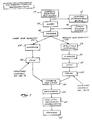
- Figure 1 is a flow diagram outlining a general method for preparing crushed refried beans having a quantity of whole beans contained therein.
- the initial inspection, de-stoning, and cleaning 10 of the beans is carried out manually or automatically in accordance with known methods in the art. Undesirable or substandard beans are discarded 12.
- the beans are washed 14 with water or any other acceptable liquid capable of removing foreign materials such as dirt and pesticide. After washing, the beans are drained 16 and the excess water is discarded.
- tempering This tempering process 18 assures that the beans will subsequently hydrate evenly, whether they remain whole or become crushed. It has been determined that beans washed in 50- to 60-degree Fahrenheit water may be tempered 18 for up to 48 hours prior to cooking without undergoing deliterious flavor changes such as souring.
- the beans After tempering 18, the beans are divided into two separate sub-quantities or streams 20 and 22.
- the first sub-quantity or stream 20 consists of beans which are destined to remain whole.
- the second sub-quantity or stream 22 consists of beans which are destined to be crushed.
- the second sub-quantity of beans 22 may be split 28 immediately following separation. If such optional splitting 28 is elected, the temperature and/or conditions during subsequent hydration 30 and cooking 32 will, of course, be adjusted accordingly.
- moisture content of the beans at the end of the cooking process is one factor which determines how well the beans are cooked. It has been further determined that the maximum desirable amount of water that may be added to beans during cooking is approximately 20 pounds per hundred pounds of raw dry bean weight. Thus, given the limited amount of water that may be added during cooking, the pre-cooking hydration steps 24,30 may be critical in insuring that the beans have taken in their optimal amount of moisture prior to the cooking process, thereby ensuring adequate cooking and desirable consistency of the final product.
- the hydration steps 24,30 may simply comprise subjecting the washed and tempered beans to a continuous spray of 120-degree Fahrenheit water for 30 to 60 minutes, depending upon the desired degree of hydration.
- a few alternative hydration methods have also been used successfully.
- the first alternate method requires that the initially tempered beans be immersed in water at 90 to 120 degrees Fahrenheit for approximately 30 to 60 minutes.
- the second alternative hydration method is referred to as a "dip and temper" hydration process.
- dip and temper process comprises cyclic competitive immersion, draining, and tempering of the beans. Three to five cycles of immersion, draining, and tempering are generally sufficient to ensure even hydration during cooking.
- the period of tempering at the end of the first cycle comprises approximately 4 hours.
- the subsequent tempering steps are then progressively shortened to approximately 2 hours at the end of the final (generally the 5th) cycle.
- Such dip and temper method of hydration yields beans which are most evenly hydrated. It should be noted, however, that even though the dip and temper hydration method may be used, such does not obviate the need for the initial tempering period described above. Thus, the cyclic tempering periods associated with this alternative hydration method are carried out in addition to the initial tempering step referred to above.
- the whole beans and crushed beans are cooked 26,32 in separate vessels, under separately controlled conditions, so as to ensure optimal texture and flavor characteristics of the final product.
- Such separate cooking 26,32 is generally effectuated live steam under pressure of approximately 15 psig.
- the separate cooking vessels employed are independently rotatable about their horizontal axes, and generally have a capacity of approximately 14 cubic feet. Larger vessels may, of course, be employed provided that the vessels are designed to accomplish the desired cooking of whole and/or crushed beans and further provided that the volume of beans contained in each such vessel is not so large as to result in crushing of the beans located near the bottom of the vessel during the final stages of cooking.
- the cooking vessels employed will preferably be of the type described in U.S. Patent Application Serial Number 935,265.
- the relative conditions under which the whole beans and crushed beans are cooked will be carefully controlled to ensure desirable consistency and flavor of the end product.
- the variables which must be controlled during cooking in the live steam environment are (a) moisture content of the bean; (b) temperature; and (c) duration of cooking.
- a bean is considered to be "fully cooked” if, after dehydration, it has no hard center when rehydrated for 15 minutes in boiling water.
- beans which are fully cooked prior to drying will take on less moisture upon subsequent rehydration than will beans which have been slightly undercooked prior to drying.
- slight undercooking of the second sub-quantity of beans (destined to be crushed) is a viable means of ensuring that such beans will be of optimal consistency for subsequent crushing. Accordingly, by the method of the present invention, the first sub-quantity of beans (destined to remain whole) will be fully cooked while the second sub-quantity of beans (destined to be crushed) will be slightly undercooked.
- the moisture content of the first sub-quantity of whole beans (destined to remain whole) is carefully controlled prior to and during cooking 26 to ensure complete cooking of such whole beans.
- To fully cook the first sub-quantity of whole beans it is generally necessary to have a final moisture content within the beans of approximately 50% to 56%.
- Such optimal moisture content at the end of the cooking may be achieved by the addition of water in accordance with either of the following examples:
- Total Water Total water is 56% of gross batch weight of 608 lbs.
- Total Water Total water is approximately 50% of total batch weight of 546 lbs.
- the second sub-quantity of beans (destined to be crushed) will be slightly undercooked prior to crushing 34.
- the moisture content of the second sub-quantity of beans at the end of cooking 32 and prior to crushing 34 should be approximately 46% to 50%.
- a typical batch of beans destined to be crushed will contain water in accordance with the following example:
- Total Water Total water is 48% of total batch weight of 548 lbs.
- beans which have been cooked at a very low moisture content in a live steam atmosphere tend to darken and may lack important flavor and texture characteristics after cooking. Thus, close control of the water content during cooking is critical.
- the first sub-quantity of beans (destined to remain whole) are cooked 26 in live steam at 15 psig for a period of 60 to 75 minutes.
- the second sub-quantity of beans (destined to be crushed) are cooked 32 in live steam at 15 psi for approximately 60 minutes. It is also possible to use split beans, rather than whole beans, in the second quantity of beans which are intended to be crushed. If such is the case, a 45-minute cook 32 of the split beans is carried out at approximately 250 degrees Fahrenheit. Furthermore, in processes wherein split beans are employed, it is important to commence cooking 32 of the split beans within 12 hours of washing lest some degradation of the bean occur prior to cooking.
- the second quantity of whole or split beans is crushed 34 in a manner which intricately fractures the cotyledon of the bean in such a way as to create small voids within the structure of the bean. Such voids are not present in the uncrushed bean.
- Crushing 34 may be achieved by passing the second sub-quantity of split or whole beans between a pair of rollers having a clearance of approximately .005 to .060 inch therebetween, depending upon the texture desired.
- the refried beans are crushed 34 between opposing rollers having approximately .010 inch clearance therebetween, thereby yielding a final dehydrated crushed bean product capable of rehydration in less than 5 minutes when covered with boiling water.
- the whole and crushed beans may be combined and layered 36 prior to drying or may be dried separately and subsequently combined.
- the first and/or second sub-quantity of beans are dried by a special method which has been devised to prevent problems of "bird mouthing" of the whole beans while at the same time providing a quickly rehydratable crushed and whole bean.
- "Bird mouthing” is a phenomenon wherein the whole bean splits along its two halves and opens, taking on the appearance of an open bird's mouth.
- a prior art drying method described in U.S. Patent No. 3,290,159, teaches the drying of whole beans with incremental increases in heat being utilized to avoid the problem of "bird mouth”.
- such prior art method has proven not to provide a quickly rehydratable bean as required by the method of the present invention.
- the cooked beans are first subjected to high drying heat and high humidity for an initial period. After the initial period, the drying of the beans is completed at lower heat and lower humidity.
- such diminution in drying heat is carried out in accordance with Example 4 below:
- the first sub-quantity of whole beans and the second sub-quantity of crushed beans may be dried simultaneously.
- the whole and crushed beans must first be combined by layering 36 the crushed beans over top of the whole beans on the surface of a common dryer conveyor.
- the combined, layered whole and crushed beans may then be dehydrated 38 in accordance with the drying conditions set forth in Example 4 provided that, during the initial stage of the process, the heated drying air is directed downwardly so as to be forced through the upper layer of crushed beans at a velocity of approximately 1500 cubic feet per minute.
- Such downwardly directed drying air creates a high temperature, high humidity atmosphere within the lower layer wherein the whole beans are located.
- the whole and crushed beans may then be comingled during the subsequent, lower temperature drying period.
- the dried whole bean/crushed bean mixture may be combined with quantities of lard or other ingredients 40, ground if necessary, packaged 42, and distributed for reconstitution prior to human consumption.
- the principal ingredients of refried bean preparations of the present invention comprise pinto beans and/or pink beans and sodium chloride (NaCl).
- a small amount of hydrochloric acid is added to the water during the cooking process in order to enhance the flavor and texture of the beans.
- a quantity of calcium preferably in the form of calcium chloride (CaCl)
- CaCl calcium chloride
- Typical batch formulas for whole beans and crushed beans are shown below as Examples 5 and 6, respectively.
- a Typical Batch Formula For First Sub-Quantity of Beans (Destined to Remain Whole 300 lbs. Dry Raw Beans (540 lbs. after precooking hydration) 7 lbs. Salt (NaCl) 200 ml 12 N Hydrochloric Acid (HCl) 9 oz. Calcium Chloride (CaCl) 20 lbs. Water (H2O)
- a Typical Batch Formula For Second Sub-Quantity of Beans (Destined To Be Crushed) 300 lbs. Dry Raw Beans (440 lbs. after precooking hydration) 7 lbs. Salt (NaCl) 200 ml 12 N Hydrochloric Acid (HCl) 20 lbs. Water (H2O)
- the method of the present invention may employ an automated system for preparing a reconstitutable refried bean product containing both whole and crushed beans.
- Such automated system will function to control; (a) the ratio of whole beans to crushed beans, and (b) the timing of each step of the process.
- Such automated system may provide for continuous production by utilizing continuous tempering bins, continuous conditioning bins, continuous live steam rotational pressure cookers, etc.
Landscapes
- Life Sciences & Earth Sciences (AREA)
- Engineering & Computer Science (AREA)
- Chemical & Material Sciences (AREA)
- Polymers & Plastics (AREA)
- Food Science & Technology (AREA)
- Zoology (AREA)
- Wood Science & Technology (AREA)
- Agronomy & Crop Science (AREA)
- Botany (AREA)
- Health & Medical Sciences (AREA)
- Nutrition Science (AREA)
- General Chemical & Material Sciences (AREA)
- Chemical Kinetics & Catalysis (AREA)
- Beans For Foods Or Fodder (AREA)
- Medicines Containing Plant Substances (AREA)
Priority Applications (1)
| Application Number | Priority Date | Filing Date | Title |
|---|---|---|---|
| AT89302425T ATE83355T1 (de) | 1988-03-18 | 1989-03-13 | Verfahren zur zubereitung wieder herstellbarer, wieder gebratener bohnen, die aus zerquetschten und ganzen bohnen bestehen. |
Applications Claiming Priority (2)
| Application Number | Priority Date | Filing Date | Title |
|---|---|---|---|
| US169819 | 1988-03-18 | ||
| US07/169,819 US4871567A (en) | 1986-11-26 | 1988-03-18 | Method for preparing reconstitutable refried beans containing crushed and whole beans |
Publications (2)
| Publication Number | Publication Date |
|---|---|
| EP0336571A1 true EP0336571A1 (de) | 1989-10-11 |
| EP0336571B1 EP0336571B1 (de) | 1992-12-16 |
Family
ID=22617299
Family Applications (1)
| Application Number | Title | Priority Date | Filing Date |
|---|---|---|---|
| EP89302425A Expired - Lifetime EP0336571B1 (de) | 1988-03-18 | 1989-03-13 | Verfahren zur Zubereitung wieder herstellbarer, wieder gebratener Bohnen, die aus zerquetschten und ganzen Bohnen bestehen |
Country Status (6)
| Country | Link |
|---|---|
| US (1) | US4871567A (de) |
| EP (1) | EP0336571B1 (de) |
| AT (1) | ATE83355T1 (de) |
| DE (1) | DE68903857T2 (de) |
| ES (1) | ES2036341T3 (de) |
| GR (1) | GR3006739T3 (de) |
Cited By (2)
| Publication number | Priority date | Publication date | Assignee | Title |
|---|---|---|---|---|
| EP0649285A4 (de) * | 1992-07-17 | 1996-06-12 | Mark H Sterner | Snackprodukt aus leguminosen und verfahren zur dessen herstellung. |
| WO1997003575A1 (en) * | 1995-07-18 | 1997-02-06 | Heart Of The Valley Cooperative | Method for manufacture of dehydrated leguminous food products |
Families Citing this family (24)
| Publication number | Priority date | Publication date | Assignee | Title |
|---|---|---|---|---|
| DE69221468T2 (de) * | 1992-03-16 | 1998-03-12 | Soreb Sa | Verfahren zur Herstellung eines Produkt für die menschliche Nährung |
| ATE252852T1 (de) * | 1994-11-21 | 2003-11-15 | Mark H Sterner | Dehydratisierte erbsensuppe und verfahren zu ihrer herstellung |
| DE69627157T2 (de) * | 1995-06-13 | 2003-12-18 | Mark H. Sterner | Methode und vorrichtung für die zubereitung dehydrierter erbsensuppe |
| US5744188A (en) * | 1996-06-19 | 1998-04-28 | Hunt-Wesson, Inc. | Process for preparing dehydrated bean products |
| AU4644697A (en) * | 1996-10-07 | 1998-05-05 | Mark H. Sterner | Process for producing dehydrated whole lentils |
| US6238725B1 (en) | 1998-01-22 | 2001-05-29 | Bush Brothers & Company | Process for removing flatulence-causing oligosaccharides in legumes |
| US6465031B1 (en) | 1998-01-22 | 2002-10-15 | Bush Brothers & Company | Process for reducing flatulence in legumes |
| US6602534B1 (en) | 1999-01-22 | 2003-08-05 | Bush Brothers & Company | Process for enhancing the starch gelation in legumes |
| US6355291B1 (en) | 1999-01-22 | 2002-03-12 | Bush Brothers & Company | Process for reducing flatulence in legumes |
| EP1174042A1 (de) * | 2000-07-17 | 2002-01-23 | Société des Produits Nestlé S.A. | Pflanzensamenprodukt und Verfahren zu seiner Zubereitung |
| US6482457B1 (en) | 2000-08-16 | 2002-11-19 | Geoffrey Margolis | Method for producing a reconstitutable dehydrated food product |
| US7029716B2 (en) * | 2000-08-16 | 2006-04-18 | Geoffrey Margolis | Method and system for producing a dehydrated whole food product |
| AU2001285004A1 (en) * | 2000-08-16 | 2002-02-25 | Geoffrey Margolis | Method and apparatus for producing a reconstituable dehydrated food product |
| USRE41885E1 (en) | 2000-08-16 | 2010-10-26 | Geoffrey Margolis | Method for producing a dehydrated whole food product |
| US7074444B2 (en) * | 2000-08-16 | 2006-07-11 | Geoffrey Margolis | Method for producing a dehydrated whole food product |
| US6220150B1 (en) | 2000-08-16 | 2001-04-24 | Geoffrey Margolis | Apparatus for producing a reconstitutable dehydrated food product |
| US6602539B2 (en) | 2001-05-10 | 2003-08-05 | Kraft Foods Holdings, Inc. | Cooked bean product having reduced solids content and improved viscosity |
| US20050226982A1 (en) * | 2004-04-08 | 2005-10-13 | Inland Empire Foods | Authentic refried beans rapidly produced from dehydrated starting material |
| US7087262B2 (en) * | 2004-04-21 | 2006-08-08 | Triple Nickel, Inc. | Process for manufacturing dehydrated precooked flaked pinto beans |
| US20060263509A1 (en) * | 2004-04-21 | 2006-11-23 | Nickels Nicky C | Process for manufacturing dehydrated precooked legumes |
| US20060198934A1 (en) * | 2005-03-01 | 2006-09-07 | Ronald S.O. Zane | Process for removing flatulence-associated oligosaccharides in legumes |
| WO2008112761A1 (en) * | 2007-03-12 | 2008-09-18 | Conagra Foods Rdm, Inc. | Methods for producing partially hydrated and cooked bean products |
| US10045553B2 (en) | 2014-12-18 | 2018-08-14 | Mark H. Sterner | Legume/grain based food product with prebiotic/probiotic source |
| US20180042277A1 (en) * | 2015-01-29 | 2018-02-15 | Geirmund Vik | Soybean Processing Method |
Citations (4)
| Publication number | Priority date | Publication date | Assignee | Title |
|---|---|---|---|---|
| US3290159A (en) * | 1963-09-30 | 1966-12-06 | Vacu Dry Company | Dehydrated precooked bean process |
| US3388998A (en) * | 1967-04-21 | 1968-06-18 | Ataullah K. Ozai Durrani | Process of preparing a quick-cooking bean |
| US3876807A (en) * | 1973-09-24 | 1975-04-08 | Us Agriculture | Process for increasing digestibility of legume seeds |
| US4735816A (en) * | 1985-09-13 | 1988-04-05 | Sterner Mark H | Dehydrated refried bean product and methods of manufacture |
Family Cites Families (9)
| Publication number | Priority date | Publication date | Assignee | Title |
|---|---|---|---|---|
| US1088741A (en) * | 1913-04-21 | 1914-03-03 | Edward U Stephens | Process for preparing leguminous products for edible purposes. |
| US1813268A (en) * | 1927-08-01 | 1931-07-07 | Frederick R Bachler | Process of making leguminous flakes |
| US2279280A (en) * | 1939-05-10 | 1942-04-07 | Musher Corp | Method for preparing dehydrated peas and beans |
| US2475554A (en) * | 1943-01-22 | 1949-07-05 | Scholten Chemische Fab | Process of manufacturing foodstuffs from leguminosae |
| US2343149A (en) * | 1943-02-11 | 1944-02-29 | Jr Charles A Krause | Preparation of dehydrated precooked legumes |
| US2657999A (en) * | 1950-03-06 | 1953-11-03 | Albert C Rauch | Method of preparing soup |
| US4251558A (en) * | 1979-08-06 | 1981-02-17 | Kanesa Miso Kabushiki-Kaisha | Method of making granular bean paste |
| US4407840A (en) * | 1981-05-15 | 1983-10-04 | Carnation Company | Instant refried bean powder and process for producing the same |
| US4676990A (en) * | 1984-09-06 | 1987-06-30 | Basic American Foods | Dehydrated legume product and process for producing same |
-
1988
- 1988-03-18 US US07/169,819 patent/US4871567A/en not_active Expired - Lifetime
-
1989
- 1989-03-13 ES ES198989302425T patent/ES2036341T3/es not_active Expired - Lifetime
- 1989-03-13 EP EP89302425A patent/EP0336571B1/de not_active Expired - Lifetime
- 1989-03-13 AT AT89302425T patent/ATE83355T1/de not_active IP Right Cessation
- 1989-03-13 DE DE8989302425T patent/DE68903857T2/de not_active Expired - Fee Related
-
1993
- 1993-01-07 GR GR930400003T patent/GR3006739T3/el unknown
Patent Citations (4)
| Publication number | Priority date | Publication date | Assignee | Title |
|---|---|---|---|---|
| US3290159A (en) * | 1963-09-30 | 1966-12-06 | Vacu Dry Company | Dehydrated precooked bean process |
| US3388998A (en) * | 1967-04-21 | 1968-06-18 | Ataullah K. Ozai Durrani | Process of preparing a quick-cooking bean |
| US3876807A (en) * | 1973-09-24 | 1975-04-08 | Us Agriculture | Process for increasing digestibility of legume seeds |
| US4735816A (en) * | 1985-09-13 | 1988-04-05 | Sterner Mark H | Dehydrated refried bean product and methods of manufacture |
Cited By (3)
| Publication number | Priority date | Publication date | Assignee | Title |
|---|---|---|---|---|
| EP0649285A4 (de) * | 1992-07-17 | 1996-06-12 | Mark H Sterner | Snackprodukt aus leguminosen und verfahren zur dessen herstellung. |
| WO1997003575A1 (en) * | 1995-07-18 | 1997-02-06 | Heart Of The Valley Cooperative | Method for manufacture of dehydrated leguminous food products |
| US5980971A (en) * | 1995-07-18 | 1999-11-09 | Heart Of The Valley Cooperative | Method for manufacture of dry instantly rehydratable bean paste |
Also Published As
| Publication number | Publication date |
|---|---|
| EP0336571B1 (de) | 1992-12-16 |
| GR3006739T3 (de) | 1993-06-30 |
| DE68903857T2 (de) | 1993-04-22 |
| ES2036341T3 (es) | 1993-05-16 |
| ATE83355T1 (de) | 1993-01-15 |
| DE68903857D1 (de) | 1993-01-28 |
| US4871567A (en) | 1989-10-03 |
Similar Documents
| Publication | Publication Date | Title |
|---|---|---|
| US4871567A (en) | Method for preparing reconstitutable refried beans containing crushed and whole beans | |
| US3835222A (en) | Process for producing potato chips | |
| US5599573A (en) | Preparation of acidified pastas | |
| US20020136811A1 (en) | Process for the production of reconstitutable bean products | |
| KR890004901B1 (ko) | α화 건조미의 제조방법 | |
| CA1205665A (en) | Decompression oil-frying method for food products | |
| KR890005274B1 (ko) | 건조 α화 곡물의 제조방법 | |
| US3086867A (en) | Process of preparing a quick-cooking brown rice | |
| EP0884000B1 (de) | Verfahren zur Herstellung einer schnell-kochbaren Pasta | |
| US4889734A (en) | Method for preparing quick-reconstituting foodstuffs | |
| DE60006351T2 (de) | Getrockneter schnellkochender Reis | |
| EP0352876B1 (de) | Herstellungsverfahren für schnellkochende Teigwaren | |
| US3510313A (en) | Method of pre-cooking dry beans | |
| CN109527408B (zh) | 一种用于红豆的无损预熟化方法 | |
| CN104026519B (zh) | 一种薯仔食品及其制备方法 | |
| US4615899A (en) | Sauce containing acidified textured protein | |
| KR101931124B1 (ko) | 명태튀김용 냉동 커틀릿 제조방법 및 이 방법으로 제조된 커틀릿을 이용한 명태튀김 조리방법 | |
| CA1238226A (en) | Dehydrated food products and method for making the same | |
| CN115211525A (zh) | 一种冻干方便米类食品的制备方法 | |
| CN1226943C (zh) | 绿豆饼的制作方法 | |
| EP0957693B1 (de) | Verfahren zur herstellung von dehydratisierten ganzen linsen | |
| US6001407A (en) | Quick-cooking dehydrated vegetables | |
| EP0941670A1 (de) | Verfahren zur Herstellung von entwässertem Gemüse, das schnell wieder-hergestellt werden kann | |
| KR100856502B1 (ko) | 취반이 용이한 씻어나온 현미 및 그 제조방법 | |
| JPS58158148A (ja) | 発酵食品の製造法 |
Legal Events
| Date | Code | Title | Description |
|---|---|---|---|
| PUAI | Public reference made under article 153(3) epc to a published international application that has entered the european phase |
Free format text: ORIGINAL CODE: 0009012 |
|
| AK | Designated contracting states |
Kind code of ref document: A1 Designated state(s): AT BE CH DE ES FR GB GR IT LI LU NL SE |
|
| 17P | Request for examination filed |
Effective date: 19900319 |
|
| 17Q | First examination report despatched |
Effective date: 19910905 |
|
| GRAA | (expected) grant |
Free format text: ORIGINAL CODE: 0009210 |
|
| AK | Designated contracting states |
Kind code of ref document: B1 Designated state(s): AT BE CH DE ES FR GB GR IT LI LU NL SE |
|
| REF | Corresponds to: |
Ref document number: 83355 Country of ref document: AT Date of ref document: 19930115 Kind code of ref document: T |
|
| ITF | It: translation for a ep patent filed | ||
| REF | Corresponds to: |
Ref document number: 68903857 Country of ref document: DE Date of ref document: 19930128 |
|
| ET | Fr: translation filed | ||
| REG | Reference to a national code |
Ref country code: ES Ref legal event code: FG2A Ref document number: 2036341 Country of ref document: ES Kind code of ref document: T3 |
|
| REG | Reference to a national code |
Ref country code: GR Ref legal event code: FG4A Free format text: 3006739 |
|
| PLBE | No opposition filed within time limit |
Free format text: ORIGINAL CODE: 0009261 |
|
| STAA | Information on the status of an ep patent application or granted ep patent |
Free format text: STATUS: NO OPPOSITION FILED WITHIN TIME LIMIT |
|
| 26N | No opposition filed | ||
| EPTA | Lu: last paid annual fee | ||
| EAL | Se: european patent in force in sweden |
Ref document number: 89302425.7 |
|
| PGFP | Annual fee paid to national office [announced via postgrant information from national office to epo] |
Ref country code: GR Payment date: 19990318 Year of fee payment: 11 Ref country code: GB Payment date: 19990318 Year of fee payment: 11 |
|
| PGFP | Annual fee paid to national office [announced via postgrant information from national office to epo] |
Ref country code: DE Payment date: 19990319 Year of fee payment: 11 |
|
| PGFP | Annual fee paid to national office [announced via postgrant information from national office to epo] |
Ref country code: FR Payment date: 19990324 Year of fee payment: 11 |
|
| PGFP | Annual fee paid to national office [announced via postgrant information from national office to epo] |
Ref country code: SE Payment date: 19990325 Year of fee payment: 11 |
|
| PGFP | Annual fee paid to national office [announced via postgrant information from national office to epo] |
Ref country code: AT Payment date: 19990326 Year of fee payment: 11 |
|
| PGFP | Annual fee paid to national office [announced via postgrant information from national office to epo] |
Ref country code: CH Payment date: 19990329 Year of fee payment: 11 |
|
| PGFP | Annual fee paid to national office [announced via postgrant information from national office to epo] |
Ref country code: NL Payment date: 19990330 Year of fee payment: 11 |
|
| PGFP | Annual fee paid to national office [announced via postgrant information from national office to epo] |
Ref country code: LU Payment date: 19990331 Year of fee payment: 11 Ref country code: ES Payment date: 19990331 Year of fee payment: 11 |
|
| PGFP | Annual fee paid to national office [announced via postgrant information from national office to epo] |
Ref country code: BE Payment date: 19990517 Year of fee payment: 11 |
|
| PG25 | Lapsed in a contracting state [announced via postgrant information from national office to epo] |
Ref country code: LU Free format text: LAPSE BECAUSE OF NON-PAYMENT OF DUE FEES Effective date: 20000313 Ref country code: GB Free format text: LAPSE BECAUSE OF NON-PAYMENT OF DUE FEES Effective date: 20000313 Ref country code: AT Free format text: LAPSE BECAUSE OF NON-PAYMENT OF DUE FEES Effective date: 20000313 |
|
| PG25 | Lapsed in a contracting state [announced via postgrant information from national office to epo] |
Ref country code: SE Free format text: LAPSE BECAUSE OF NON-PAYMENT OF DUE FEES Effective date: 20000314 Ref country code: ES Free format text: LAPSE BECAUSE OF EXPIRATION OF PROTECTION Effective date: 20000314 |
|
| PG25 | Lapsed in a contracting state [announced via postgrant information from national office to epo] |
Ref country code: LI Free format text: LAPSE BECAUSE OF NON-PAYMENT OF DUE FEES Effective date: 20000331 Ref country code: GR Free format text: LAPSE BECAUSE OF NON-PAYMENT OF DUE FEES Effective date: 20000331 Ref country code: CH Free format text: LAPSE BECAUSE OF NON-PAYMENT OF DUE FEES Effective date: 20000331 Ref country code: BE Free format text: LAPSE BECAUSE OF NON-PAYMENT OF DUE FEES Effective date: 20000331 |
|
| BERE | Be: lapsed |
Owner name: STERNER MARK M. Effective date: 20000331 Owner name: ZANE RONALD S. O. Effective date: 20000331 Owner name: STERNER MARK H. Effective date: 20000331 |
|
| PG25 | Lapsed in a contracting state [announced via postgrant information from national office to epo] |
Ref country code: NL Free format text: LAPSE BECAUSE OF NON-PAYMENT OF DUE FEES Effective date: 20001001 |
|
| GBPC | Gb: european patent ceased through non-payment of renewal fee |
Effective date: 20000313 |
|
| EUG | Se: european patent has lapsed |
Ref document number: 89302425.7 |
|
| REG | Reference to a national code |
Ref country code: CH Ref legal event code: PL |
|
| PG25 | Lapsed in a contracting state [announced via postgrant information from national office to epo] |
Ref country code: FR Free format text: LAPSE BECAUSE OF NON-PAYMENT OF DUE FEES Effective date: 20001130 |
|
| NLV4 | Nl: lapsed or anulled due to non-payment of the annual fee |
Effective date: 20001001 |
|
| REG | Reference to a national code |
Ref country code: FR Ref legal event code: ST |
|
| PG25 | Lapsed in a contracting state [announced via postgrant information from national office to epo] |
Ref country code: DE Free format text: LAPSE BECAUSE OF NON-PAYMENT OF DUE FEES Effective date: 20010103 |
|
| REG | Reference to a national code |
Ref country code: ES Ref legal event code: FD2A Effective date: 20010910 |
|
| PG25 | Lapsed in a contracting state [announced via postgrant information from national office to epo] |
Ref country code: IT Free format text: LAPSE BECAUSE OF NON-PAYMENT OF DUE FEES;WARNING: LAPSES OF ITALIAN PATENTS WITH EFFECTIVE DATE BEFORE 2007 MAY HAVE OCCURRED AT ANY TIME BEFORE 2007. THE CORRECT EFFECTIVE DATE MAY BE DIFFERENT FROM THE ONE RECORDED. Effective date: 20050313 |