EP0335934B1 - Verfahren zur herstellung katalytisch wirkender pulverförmiger mischphasen - Google Patents
Verfahren zur herstellung katalytisch wirkender pulverförmiger mischphasen Download PDFInfo
- Publication number
- EP0335934B1 EP0335934B1 EP88908681A EP88908681A EP0335934B1 EP 0335934 B1 EP0335934 B1 EP 0335934B1 EP 88908681 A EP88908681 A EP 88908681A EP 88908681 A EP88908681 A EP 88908681A EP 0335934 B1 EP0335934 B1 EP 0335934B1
- Authority
- EP
- European Patent Office
- Prior art keywords
- heat carrying
- carrying particles
- reactor
- accordance
- mixed phase
- Prior art date
- Legal status (The legal status is an assumption and is not a legal conclusion. Google has not performed a legal analysis and makes no representation as to the accuracy of the status listed.)
- Expired - Lifetime
Links
- 238000000034 method Methods 0.000 title claims abstract description 47
- 230000003197 catalytic effect Effects 0.000 title description 2
- 239000002243 precursor Substances 0.000 claims abstract description 34
- 239000000843 powder Substances 0.000 claims abstract description 12
- 238000004519 manufacturing process Methods 0.000 claims abstract description 9
- 239000000725 suspension Substances 0.000 claims abstract description 8
- 239000002904 solvent Substances 0.000 claims abstract description 7
- 238000001704 evaporation Methods 0.000 claims abstract description 6
- 230000008020 evaporation Effects 0.000 claims abstract description 6
- 239000002245 particle Substances 0.000 claims description 37
- 230000005484 gravity Effects 0.000 claims description 5
- 239000007787 solid Substances 0.000 claims description 5
- 239000007788 liquid Substances 0.000 abstract description 2
- 239000012071 phase Substances 0.000 description 45
- 238000012546 transfer Methods 0.000 description 24
- GNTDGMZSJNCJKK-UHFFFAOYSA-N divanadium pentaoxide Chemical compound O=[V](=O)O[V](=O)=O GNTDGMZSJNCJKK-UHFFFAOYSA-N 0.000 description 20
- 238000001556 precipitation Methods 0.000 description 11
- MUBZPKHOEPUJKR-UHFFFAOYSA-N Oxalic acid Chemical compound OC(=O)C(O)=O MUBZPKHOEPUJKR-UHFFFAOYSA-N 0.000 description 9
- 238000001354 calcination Methods 0.000 description 5
- 238000002156 mixing Methods 0.000 description 5
- 238000002360 preparation method Methods 0.000 description 5
- 230000000694 effects Effects 0.000 description 4
- 238000000227 grinding Methods 0.000 description 4
- 238000012982 x-ray structure analysis Methods 0.000 description 4
- MXOSECBTSFQUJS-UHFFFAOYSA-N [O-2].[Ti+4].[V+5] Chemical compound [O-2].[Ti+4].[V+5] MXOSECBTSFQUJS-UHFFFAOYSA-N 0.000 description 3
- UNTBPXHCXVWYOI-UHFFFAOYSA-O azanium;oxido(dioxo)vanadium Chemical compound [NH4+].[O-][V](=O)=O UNTBPXHCXVWYOI-UHFFFAOYSA-O 0.000 description 3
- 238000001035 drying Methods 0.000 description 3
- 235000006408 oxalic acid Nutrition 0.000 description 3
- 230000005070 ripening Effects 0.000 description 3
- XJDNKRIXUMDJCW-UHFFFAOYSA-J titanium tetrachloride Chemical compound Cl[Ti](Cl)(Cl)Cl XJDNKRIXUMDJCW-UHFFFAOYSA-J 0.000 description 3
- XLYOFNOQVPJJNP-UHFFFAOYSA-N water Substances O XLYOFNOQVPJJNP-UHFFFAOYSA-N 0.000 description 3
- 229910016526 CuMn2O4 Inorganic materials 0.000 description 2
- XEEYBQQBJWHFJM-UHFFFAOYSA-N Iron Chemical compound [Fe] XEEYBQQBJWHFJM-UHFFFAOYSA-N 0.000 description 2
- XHCLAFWTIXFWPH-UHFFFAOYSA-N [O-2].[O-2].[O-2].[O-2].[O-2].[V+5].[V+5] Chemical compound [O-2].[O-2].[O-2].[O-2].[O-2].[V+5].[V+5] XHCLAFWTIXFWPH-UHFFFAOYSA-N 0.000 description 2
- RHZUVFJBSILHOK-UHFFFAOYSA-N anthracen-1-ylmethanolate Chemical compound C1=CC=C2C=C3C(C[O-])=CC=CC3=CC2=C1 RHZUVFJBSILHOK-UHFFFAOYSA-N 0.000 description 2
- 239000003830 anthracite Substances 0.000 description 2
- 230000008033 biological extinction Effects 0.000 description 2
- 238000006243 chemical reaction Methods 0.000 description 2
- PHFQLYPOURZARY-UHFFFAOYSA-N chromium trinitrate Chemical compound [Cr+3].[O-][N+]([O-])=O.[O-][N+]([O-])=O.[O-][N+]([O-])=O PHFQLYPOURZARY-UHFFFAOYSA-N 0.000 description 2
- XTVVROIMIGLXTD-UHFFFAOYSA-N copper(II) nitrate Chemical compound [Cu+2].[O-][N+]([O-])=O.[O-][N+]([O-])=O XTVVROIMIGLXTD-UHFFFAOYSA-N 0.000 description 2
- 238000000354 decomposition reaction Methods 0.000 description 2
- 238000010586 diagram Methods 0.000 description 2
- 238000011049 filling Methods 0.000 description 2
- 238000001914 filtration Methods 0.000 description 2
- 239000007789 gas Substances 0.000 description 2
- 239000012535 impurity Substances 0.000 description 2
- 239000000203 mixture Substances 0.000 description 2
- 238000005507 spraying Methods 0.000 description 2
- 239000000126 substance Substances 0.000 description 2
- 239000010936 titanium Substances 0.000 description 2
- 229910001935 vanadium oxide Inorganic materials 0.000 description 2
- 229910002477 CuCr2O4 Inorganic materials 0.000 description 1
- RTAQQCXQSZGOHL-UHFFFAOYSA-N Titanium Chemical compound [Ti] RTAQQCXQSZGOHL-UHFFFAOYSA-N 0.000 description 1
- 230000006978 adaptation Effects 0.000 description 1
- QVGXLLKOCUKJST-UHFFFAOYSA-N atomic oxygen Chemical compound [O] QVGXLLKOCUKJST-UHFFFAOYSA-N 0.000 description 1
- 239000011230 binding agent Substances 0.000 description 1
- 230000015572 biosynthetic process Effects 0.000 description 1
- 239000000969 carrier Substances 0.000 description 1
- 239000003054 catalyst Substances 0.000 description 1
- 239000000919 ceramic Substances 0.000 description 1
- 150000001875 compounds Chemical class 0.000 description 1
- 239000000470 constituent Substances 0.000 description 1
- JGDFBJMWFLXCLJ-UHFFFAOYSA-N copper chromite Chemical compound [Cu]=O.[Cu]=O.O=[Cr]O[Cr]=O JGDFBJMWFLXCLJ-UHFFFAOYSA-N 0.000 description 1
- UBBMSYXANQQGJD-UHFFFAOYSA-N copper dioxido(dioxo)manganese Chemical compound [Cu+2].[O-][Mn]([O-])(=O)=O UBBMSYXANQQGJD-UHFFFAOYSA-N 0.000 description 1
- 229910052593 corundum Inorganic materials 0.000 description 1
- 239000010431 corundum Substances 0.000 description 1
- 239000013078 crystal Substances 0.000 description 1
- 238000011161 development Methods 0.000 description 1
- 238000009826 distribution Methods 0.000 description 1
- 230000007717 exclusion Effects 0.000 description 1
- 238000010438 heat treatment Methods 0.000 description 1
- 229910052742 iron Inorganic materials 0.000 description 1
- MIVBAHRSNUNMPP-UHFFFAOYSA-N manganese(2+);dinitrate Chemical compound [Mn+2].[O-][N+]([O-])=O.[O-][N+]([O-])=O MIVBAHRSNUNMPP-UHFFFAOYSA-N 0.000 description 1
- 239000000463 material Substances 0.000 description 1
- 229910052751 metal Inorganic materials 0.000 description 1
- 239000002184 metal Substances 0.000 description 1
- MEFBJEMVZONFCJ-UHFFFAOYSA-N molybdate Chemical compound [O-][Mo]([O-])(=O)=O MEFBJEMVZONFCJ-UHFFFAOYSA-N 0.000 description 1
- 230000006911 nucleation Effects 0.000 description 1
- 238000010899 nucleation Methods 0.000 description 1
- 239000003960 organic solvent Substances 0.000 description 1
- 150000002902 organometallic compounds Chemical class 0.000 description 1
- FULFYAFFAGNFJM-UHFFFAOYSA-N oxocopper;oxo(oxochromiooxy)chromium Chemical compound [Cu]=O.O=[Cr]O[Cr]=O FULFYAFFAGNFJM-UHFFFAOYSA-N 0.000 description 1
- 239000001301 oxygen Substances 0.000 description 1
- 229910052760 oxygen Inorganic materials 0.000 description 1
- 238000004886 process control Methods 0.000 description 1
- 238000012545 processing Methods 0.000 description 1
- 238000003303 reheating Methods 0.000 description 1
- 150000003839 salts Chemical class 0.000 description 1
- 238000007493 shaping process Methods 0.000 description 1
- 239000007790 solid phase Substances 0.000 description 1
- 239000007921 spray Substances 0.000 description 1
- 238000013517 stratification Methods 0.000 description 1
- 238000004441 surface measurement Methods 0.000 description 1
- 238000012360 testing method Methods 0.000 description 1
- 238000007669 thermal treatment Methods 0.000 description 1
- 229910052719 titanium Inorganic materials 0.000 description 1
- GFNGCDBZVSLSFT-UHFFFAOYSA-N titanium vanadium Chemical group [Ti].[V] GFNGCDBZVSLSFT-UHFFFAOYSA-N 0.000 description 1
- 229910052720 vanadium Inorganic materials 0.000 description 1
- LEONUFNNVUYDNQ-UHFFFAOYSA-N vanadium atom Chemical compound [V] LEONUFNNVUYDNQ-UHFFFAOYSA-N 0.000 description 1
Images
Classifications
-
- B—PERFORMING OPERATIONS; TRANSPORTING
- B01—PHYSICAL OR CHEMICAL PROCESSES OR APPARATUS IN GENERAL
- B01J—CHEMICAL OR PHYSICAL PROCESSES, e.g. CATALYSIS OR COLLOID CHEMISTRY; THEIR RELEVANT APPARATUS
- B01J37/00—Processes, in general, for preparing catalysts; Processes, in general, for activation of catalysts
- B01J37/02—Impregnation, coating or precipitation
- B01J37/0215—Coating
- B01J37/0221—Coating of particles
Definitions
- the invention relates to a process for producing catalytically active powdery mixed phases from precursors which contain the elements of the mixed phases under thermal and mechanical treatment.
- the invention has for its object the process for the production of catalytically active powdery mixed phases essential to simplify and to represent the desired mixing phases with the exclusion of impurities, with little equipment and system costs, preferably at atmospheric pressure and at a reduced temperature level.
- this object is achieved according to the invention in that the precursor contained in a solution or suspension is applied to heated surfaces of moving heat transfer particles, is deposited thereon with evaporation of the solvent and is decomposed, the mixed phase formed on the heat transfer particles by the Heat transfer particles removed and the solid mixed phase is subsequently crushed. Because of this procedure, a constantly renewing, wettable heat transfer surface is to be provided at a temperature level corresponding to the evaporation temperatures of the suspension or solution, which allows the individual stages of the process to be continuously connected in series.
- the surface of the heat transfer particles is heated to a higher temperature level that exceeds the evaporation temperature of its solvent before the precursor is given up.
- the economy of the process for the preparation of catalytically active mixed phases can be further improved by continuously removing the volatile constituent of the solvent or the suspension, separating off the solid portion entrained therefrom and feeding the portion of the mixed phase drawn off directly from the process.
- the surfaces of the heat transfer particles within a reactor with a jacket designed in cross-section as a circular ring or approximately in the form of a polygon the mixed phase is continuously removed by the relative movement within the bed of the heat transfer medium and, furthermore, the mixed phase is simultaneously ground and continuously or discontinuously separated from the circuit of the heat transfer medium.
- the individual process steps are carried out within a moving bed of the heat transfer particles and the temperature of the heat transfer particles can be adapted to the optimum for the individual process steps. Both temperature undershoots and overshoots are to be avoided in this way, which result in loss of activity of the mixed crystals formed.
- the circulation of the heat transfer medium particles is further particularly advantageously carried out within a reactor with a spherical jacket or a shell that is approximated as a polyhedron, which can be rotated around an approximately horizontal axis, the heat transfer medium particles being continuously conveyed upwards by contact with the reactor jacket - back downwards by gravity managed and circulated.
- a method in which the heat transfer particles within a reactor with a tubular jacket and with an axis of rotation arranged inclined to the horizontal through contact with the reactor jacket in the direction of rotation upward, backward by gravity and at the same time, is particularly advantageous for maintaining narrow tolerances of the temperature control axially conveyed from the feed of the precursor at one end to the removal of the mixed phase at the other end of the tubular reactor and in this case shifted and further the heat transfer particles are subsequently forcibly returned from the removal of at least part of the mixed phase to the area of the feed of the precursor.
- a tubular reactor is also to be understood as an essentially conical or frustoconical configuration.
- the heat transfer particles within a reactor with an essentially vertical axis of symmetry with relative movement of the reactor jacket to carriers within the reactor from an upper task of the precursor to a lower decrease in the heat transfer particles, essentially automatically gravitationally downwards and at the same time shifted, and furthermore the heat transfer particles inevitably vertically upwards from closing in the area of the task of the precursor, with closing promoted their circulation.
- a quasi-static bed of the heat transfer particles as a filter and / or another is to be arranged with a vertical arrangement of the container axis above the feed of the precursors and the formation of the mixing phase in order to limit emissions.
- the reheating of the heat transfer particles or the adjustment of their surface to the temperature level required for the individual process section can in particular be advantageously carried out by indirectly supplying heat to the heat transfer particles during their movement within the reactor via its jacket and / or the drivers.
- the ball diameter or the mixing ratio of balls of different diameters is chosen depending on the desired fineness and the optimum temperature for precipitation and decomposition of the same or simultaneous calcination. Due to the vertical stratification of balls of different diameters, the grinding function is more separated from the heat transfer function.
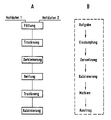
- Circuit diagram A shows a precipitation process according to the prior art, which was taken from Catalyze de Contact, le Page, Inst. Francaise du Petrole p. 396.
- Precursors 1 and 2 are fed to an agitator tank by performing the precipitation. Below the precipitation obtained is first dewatered and then dewatered in drying apparatus. The dry substance obtained in this way is then comminuted and subsequently subjected to a ripening process in a further process apparatus. The product obtained in this ripening process is finally removed from the dryer again before the calcination of the previously obtained dry substance is carried out in ovens.
- Circuit diagram B shows the individual stages of the process sequence according to the invention.
- the precursors are evaporated and decomposed on these and subsequently the mixed phase is calcined.
- the catalytically active mixed phase formed is then removed from the surfaces of the heat transfer particles, ground and discharged continuously or discontinuously to match the desired fineness.
- the free choice of process parameters in particular the temperature control within the moving bed, the orbital period of the bulk particles and their relative speed, allow optimal liquid film thicknesses as well as precipitation to be formed on the heat transfer particles within optimal precipitation speeds, which are equally decisive for the nucleation and germ growth rate of the solid phase. The same applies to the temperature profile during the calcination and the fineness of grinding.
- a ball filling of commercial grinding balls made of corundum was introduced in an amount of 10 kg and a diameter of the balls of 8-15 mm.
- the drum was slightly inclined and rotatable with respect to the horizontal and connected to a drive motor via an adjustable gear.
- the precursor was applied to the ball bed on the elevated side of the drum via a lance within an axially centrally arranged bore in the end wall of the drum and the mixed phase was discharged in powder form on the opposite side below.
- the lower side had an annular gap between the jacket of the drum and a central disk.
- the speed of the drum was 4-6 revolutions per minute.
- the outer wall of the drum was heated with gas surface burners connected in series over the depth of the drum.
- the surface temperature of the grinding balls was kept constant at a temperature of 450 ° C, the temperature deviations being a maximum of ⁇ 50 ° C.
- the temperature was maintained by changing the quantity of the precursor that was carried through.
- CuMn2O4 copper manganate
- a precursor was introduced into the drum from a solution of a one-molar copper nitrate solution and a two-molar manganese nitrate solution.
- a powder was obtained which corresponds to the CuMn2O4 phase according to ASTM 11-480 according to X-ray structure analysis.
- the gloss angles obtained on the basis of the X-ray structure analysis were compared in the usual way with the standards according to ASTM
- a precursor consisting of a 0.5 molar copper nitrate and a one molar chromium nitrate solution was introduced into the drum.
- a powder was obtained which corresponds to the phase CuCr2O4 according to ASTM 26-508 according to X-ray structure analysis.
- a precursor of a hydrolyzate of titanium tetrachloride in water and ammonium vanadate dissolved therein was produced.
- a spray dryer By spraying this precursor in a spray dryer at 350 ° C and post-calcination at 450 ° C for one hour, an ocher yellow to brown colored powder is obtained.
- the brown-yellow color indicates a proportion of free vanadium pentoxide in the mixed phase.
- a dark green to anthracite-colored powder is obtained after filtration. The amount of vanadium oxide dissolved out can be determined photometrically in the separated solution.
- a precursor of a hydrolyzate of titanium tetrachloride in water and ammonium vanadate dissolved therein was prepared in accordance with Example 3.
- a powder was obtained whose yellow-brown, slightly greenish color was analogous to that of Example 3 indicates a content of free vanadium pentoxide in the mixed phase.
- the free vanadium oxide was again extracted from the mixed phase with 0.5 molar oxalic acid. After filtration, a dark green to anthracite powder is again obtained.
- the amount of vanadium pentoxide dissolved out can be determined photometrically in the separated solution.
- a precursor of a hydrolyzate of titanium tetrachloride in water and ammonium vanadate dissolved therein was prepared and subsequently applied to a bed of spheres within a drum in accordance with the procedure described in Examples 1 and 2 by the process according to the invention.
- a dark green to anthracite powder was obtained which had a BET surface area (surface measurement according to Brunauer / Emmett and Teller) of 90 m2 / g.
- the color of the mixed phase obtained indicates a negligible proportion of the disruptive component of the free vanadium pentoxide in the mixed phase.
- the ratio of titanium and vanadium in the mixed phase thus corresponds to that in the precursor. For the special application, this ratio can be set directly by choosing the appropriate solution.
- the small proportion of free vanadium pentoxide in the mixed phase can be determined as set out in Examples 1 and 2.
- mixed phases are, for example, iron molybdate or bismuth-nickel-iron-molybdate mixed phases.
- the powder obtained is applied in the usual way as a catalytically active compound to support structures.
- Commercial binders preferably for ceramic compositions, are used for this purpose.
- the process according to the invention also offers the possibility, in adaptation to this further processing, of selecting the particle size distribution of the solid mixed phase produced by changing the speed, the ball size and the degree of filling within the reactor.
Landscapes
- Chemical & Material Sciences (AREA)
- Engineering & Computer Science (AREA)
- Materials Engineering (AREA)
- Organic Chemistry (AREA)
- Chemical Kinetics & Catalysis (AREA)
- Catalysts (AREA)
- Organic Low-Molecular-Weight Compounds And Preparation Thereof (AREA)
- Devices And Processes Conducted In The Presence Of Fluids And Solid Particles (AREA)
- Oxygen, Ozone, And Oxides In General (AREA)
- Inorganic Compounds Of Heavy Metals (AREA)
Description
- Die Erfindung betrifft ein Verfahren zur Herstellung katalytisch wirkender pulverförmiger Mischphasen aus Vorläufern, die die Elemente der Mischphasen enthalten unter thermischer und mechanischer Behandlung.
- Es sind zahlreiche Verfahren zur Darstellung katalytisch wirkender Mischphasen beispielsweise ternärer oder quaternärer Oxide als Grundlage für die Herstellung von Katalysatoren bekannt. Die Herstellungsverfahren sind hierbei abhängig von der Struktur der gewünschten Phase. Zumeist liegen diesen Herstellungsverfahren Feststoffreaktionen zugrunde, bei denen Einzeloxide miteinander vermischt und nachfolgend einer thermischen Behandlung unterzogen werden. Anderen Verfahren werden Fällprozesse zugrunde gelegt, bei denen die Mischphase aus einer Suspension oder Lösung von Vorläufern ausgefällt wird. So wird z.B. in FR-A-2084406 die Fällung von feinverteilten Mischphasen aus wäßrigen Ausgangslösungen mit heißen organischen Lösungsmitteln vorgenommen. Bei diesen Verfahren werden zumeist Metallsalze oder metallorganische Verbindungen einer Fällung unterzogen, getrocknet, zerkleinert, eine Reifung vorgenommen, erneut getrocknet, geformt und zuletzt noch eine Wärmebehandlung angeschlossen. Derartige Verfahren lassen selbst unter besonderer Beachtung der Verfahrensführung bezüglich aufzuwendender Temperaturen und Drücke nicht in allen Fällen reine Mischphasen erzielen. In diesen Fällen sind binäre Oxide als Verunreinigungen in der gewünschten Mischphase eingebunden, wodurch u.a. katalytische Eigenschaften wesentlich herabgesetzt werden. Allen diesen vorbekannten Verfahren liegen jedoch zahlreiche Verfahrensschritte zugrunde, die einen hohen apparativen Aufwand und entsprechend hohe Anlagekosten nach sich ziehen.
- Der Erfindung liegt die Aufgabe zugrunde, das Verfahren zur Herstellung katalytisch wirkender pulverförmiger Mischphasen wesentlich zu vereinfachen und unter geringem apparativem Aufwand sowie Anlagekosten vorzugsweise bei atmosphärischem Druck und auf einem herabgesetzten Temperaturniveau die gewünschten Mischphasen unter Ausschluß von Verunreinigungen darzustellen.
- Ausgehend von einem Verfahren der eingangs erwähnten Art wird diese Aufgabe erfindungsgemäß dadurch gelöst, daß der in einer Lösung oder Suspension enthaltene Vorläufer auf erwärmte Oberflächen bewegter Wärmeträgerteilchen aufgebracht, auf diesen unter Verdampfung des Lösungsmittels niedergeschlagen und zersetzt wird, die auf den Wärmeträgerteilchen gebildete Mischphase von den Wärmeträgerteilchen entfernt und die feste Mischphase nachfolgend zerkleinert wird. Aufgrund dieser Verfahrensführung ist eine sich ständig erneuernde, benetzbare Wärmeträgeroberfläche auf einem der Verdampfungstemperaturen der Suspension oder Lösung entsprechenden Temperaturniveau zur Verfügung zu stellen, die die einzelnen Stufen des Verfahrens kontinuierlich hintereinanderschalten läßt.
- In erfindungsgemäßer Weiterbildung ist vorgesehen, daß die Oberfläche der Wärmeträgerteilchen auf ein die Verdampfungstemperatur seines Lösungsmittels überschreitendes, höheres Temperaturniveau vor Aufgabe des Vorläufers erhitzt wird. Hierdurch gelingt es neben einem Niederschlagen und Zersetzen des Vorläufers zugleich die Kalzinierung der Mischphase unter Verkürzen des Zeitaufwands für die Herstellung der pulverförmigen Mischphase durchzuführen.
- Die Wirtschaftlichkeit des Verfahrens zur Herstellung katalytisch wirkender Mischphasen läßt sich dadurch weiter verbessern, daß kontinuierlich der flüchtige Bestandteil des Lösungsmittels oder der Suspension entfernt, der von diesen mitgeführte feste Anteil abgetrennt und dem aus dem Verfahren direkt abgezogenen Anteil der Mischphase zugeleitet wird.
- In einer bevorzugten Ausgestaltung der Erfindung wird von den Oberflächen der Wärmeträgerteilchen innerhalb eines Reaktors mit einem im Querschnitt als Kreisring oder diesem angenähert als Vieleck ausgebildeten Mantel laufend die Mischphase durch die Relativbewegung innerhalb des Betts der Wärmeträgerteilchen abgetragen und ferner die Mischphase zugleich vermahlen sowie kontinuierlich oder diskontinuierlich aus dem Kreislauf der Wärmeträgerteilchen abgetrennt. Durch diese Verfahrensführung werden die einzelnen Verfahrensstufen innerhalb eines wandernden Betts der Wärmeträgerteilchen durchgeführt und die Temperatur der Wärmeträgerteilchen läßt sich an das Optimum für die einzelnen Verfahrensstufen anpassen. Sowohl Temperatur-unter- als auch -überschreitungen sind hierdurch zu vermeiden, die Aktivitätsverluste der gebildeten Mischkristalle nach sich ziehen.
- Die Kreislaufführung der Wärmeträgerteilchen ist des weiteren besonders vorteilhaft innerhalb eines um eine etwa horizontale Achse drehbar angeordneten Reaktors mit kugelförmigem oder als Vielflächner der Kugelform angenäherten Mantel vorzunehmen, wobei die Wärmeträgerteilchen durch den Kontakt mit dem Reaktormantel laufend nach oben gefördert ― durch Schwerkraft wieder zurück nach unten geführt sowie umgewälzt werden.
- Besonders vorteilhaft für das Einhalten enger Toleranzen der Temperaturführung ist ein Verfahren, bei dem die Wärmeträgerteilchen innerhalb eines Reaktors mit rohrförmigem Mantel und mit gegen die Horizontale geneigt angeordneter Drehachse durch den Kontakt mit dem Reaktormantel in dessen Drehrichtung nach oben, durch Schwerkraft zurück nach unten und zugleich axial von der Aufgabe des Vorläufers an dem einen zur Abnahme der Mischphase an dem anderen Ende des röhrenförmigen Reaktors weitergefördert sowie hierbei umgeschichtet und ferner die Wärmeträgerteilchen nachfolgend von der Abnahme zumindest eines Teils der Mischphase in den Bereich der Aufgabe des Vorläufers zwangsweise zurückgefördert werden. Unter röhrenförmigem Reaktor ist gleichfalls eine im wesentlichen kegel- bzw. kegelstumpfförmige Ausgestaltung zu verstehen.
- In einer hiervon abweichenden Ausgestaltung werden die Wärmeträgerteilchen innerhalb eines Reaktors mit im wesentlichen vertikaler Symmetrieachse unter Relativbewegung des Reaktormantels zu Mitnehmern innerhalb des Reaktors von einer oberen Aufgabe des Vorläufers zu einer unteren Abnahme der Wärmeträgerteilchen im Wesentlichen durch Schwerkraft selbsttätig vertikal nach unten geführt und zugleich umgeschichtet und ferner die Wärmeträgerteilchen nachfolgend von ihrer Abnahme in den Bereich der Aufgabe des Vorläufers zwangsläufig vertikal nach oben unter Schließen ihres Kreislaufs zurückgefördert. Mit dieser Lösung ist unter vertikaler Anordnung der Behälterachse oberhalb der Zuführung der Vorläufer und der Ausbildung der Mischphase ein quasi statisches Bett der Wärmeträgerteilchen als Filter und/oder ein weiteres anzuordnen um Emissionen zu begrenzen.
- Die Wiederaufheizung der Wärmeträgerteilchen bzw. die Einstellung ihrer Oberfläche auf das für den einzelnen Verfahrensabschnitt erforderliche Temperaturniveau läßt sich insbesonders dadurch vorteilhaft vornehmen, daß den Wärmeträgerteilchen während ihrer Bewegung innerhalb des Reaktors indirekt über dessen Mantel und/oder die Mitnehmer Wärme zugeführt wird. Der Kugeldurchmesser bzw. das Mischungsverhältnis von Kugeln verschiedener Durchmesser wird hierbei abhängig von der gewünschten Mahlfeinheit und dem Optimum der Temperatur für Niederschlag und Zersetzung desselben bzw. gleichzeitige Kalzinierung gewählt. Durch die sich ausbildende vertikale Schichtung von Kugeln unterschiedlicher Durchmesser wird die Mahlfunktion stärker von der Wärmeträgerfunktion getrennt.
- Zur Erläuterung des erfindungsgemäßen Verfahrens ist dieses einem Fällungsverfahren gemäß Stand der Technik in der Zeichnung gegenübergestellt.
- In dem Schaltschema A ist ein Fällungsprozeß gemäß Stand der Technik dargestellt, das Catalyse de Contact, le Page, Inst. Francaise du Petrole S. 396 entnommen wurde.
- Die Vorläufer 1 und 2 werden hierbei einem Rührwerksbehälter zugeleitet indem die Fällung durchgeführt wird. Nachfolgend wird der erhaltene Niederschlag in Trockenapparaten zunächst vor- und dann nachentwässert. Die auf diese Weise erhaltene Trockensubstanz wird anschließend zerkleinert und nachfolgend einem Reifeprozeß in einer weiteren Prozeßapparatur unterworfen. Dem bei diesem Reifeprozeß erhaltenen Produkt wird schließlich in Trocknern erneut Feuchtigkeit entzogen, bevor in Öfen die Kalzinierung der zuvor erhaltenen Trockensubstanz durchgeführt wird.
- Dem Schaltschema B sind die einzelnen Stufen des Verfahrensablaufs gemäß der Erfindung zu entnehmen.
- Ausgehend von der Aufgabe der Vorläufer auf die Oberflächen bewegter Wärmeträgerteilchen werden die Vorläufer auf diesen eingedampft sowie zersetzt und nachfolgend die Mischphase kalziniert. Die gebildete katalytisch wirkende Mischphase wird anschließend von den Oberflächen der Wärmeträgerteilchen abgetragen, vermahlen und kontinuierlich oder diskontinuierlich in Anpassung an die gewünschte Mahlfeinheit ausgetragen. Durch die freie Wahl der Verfahrensparameter, insbesondere die Temperaturführung innerhalb des bewegten Schüttbetts, die Umlaufdauer der Schüttgutteilchen und deren Relativgeschwindigkeit lassen sich optimale Flüssigkeitsfilmdicken sowie innerhalb optimaler Niederschlagsgeschwindigkeiten Niederschläge auf den Wärmeträgerteilchen ausbilden, die für die Kernbildungs- und Keimwachstumsgeschwindigkeit der festen Phase gleichermaßen maßgeblich sind. Gleiches gilt für den Temperaturverlauf bei der Kalzinierung und die Mahlfeinheit.
- In einer Trommel mit einem Durchmesser von 350 mm und einer Tiefe oder Länge von 300 mm wurde eine Kugelfüllung handelsüblicher Mahlkugeln aus Korund in einer Menge von 10 kg und einem Durchmesser der Kugeln von 8-15 mm eingebracht. Die Trommel war gegenüber der Horizontalen leicht geneigt und drehbar gelagert sowie mit einem Antriebsmotor über ein regelbares Getriebe verbunden. Der Vorläufer wurde auf der erhöhten Seite der Trommel über eine Lanze innerhalb einer axial mittig angeordneten Bohrung in der Stirnwand der Trommel auf die Kugelschüttung aufgegeben und die Mischphase in Pulverform auf der gegenüberliegenden Seite unten ausgetragen. Für den Austrag der Mischphase wies die niedriger angeordnete Seite einen Ringspalt zwischen dem Mantel der Trommel und einer zentrischen Scheibe auf. Die Drehzahl der Trommel betrug 4-6 Umdrehungen in der Minute. Die Außenwand der Trommel wurde mit über die Tiefe der Trommel hintereinander geschalteten Gasflächenbrennern beheizt. Die Oberflächentemperatur der Mahlkugeln wurde auf einer Temperatur von 450°C konstant gehalten, wobei die Temperaturabweichungen maximal ± 50°C betrugen. Die Temperaturhaltung erfolgte über die Veränderung der durchgesetzten Menge des Vorläufers.
- Für eine Herstellung von Kupfermanganat (CuMn₂O₄) wurde ein Vorläufer aus einer Lösung ein-molarer Kupfernitratlösung und zwei-molarer Mangannitratlösung in die Trommel geführt. Es wurde ein Pulver erhalten, das nach Röntgenstrukturanalyse entsprechend ASTM 11-480 der CuMn₂O₄-Phase entspricht. In der üblichen Weise wurden die aufgrund der Röntgenstrukturanalyse erhaltenen Glanzwinkel mit den Standards nach ASTM verglichen
- Für die Herstellung eines Kupferchromits wurde ein Vorläufer aus einer 0,5-molaren Kupfernitrat- und einer ein-molaren Chromnitratlösung in die Trommel eingeleitet.
- Es wurde ein Pulver erhalten, das nach Röntgenstrukturanalyse entsprechend ASTM 26-508 der Phase CuCr₂O₄ entspricht.
- Wie zuvor beschrieben, wurden die aufgrund der Röntgenstrukturanalyse erhaltenen Glanzwinkel mit den Standards ASTM verglichen.
- Für die Herstellung einer Mischphase aus Titan-Vanadiumoxid wurde ein Vorläufer eines Hydrolysats von Titantetrachlorid in Wasser und darin gelöst Ammoniumvanadat hergestellt. Durch Versprühen dieses Vorläufers in einem Sprühtrockner bei 350°C und Nachkalzinieren bei 450°C über eine Stunde erhält man ein ockergelbes bis braungefärbtes Pulver. Die braungelbe Farbe weist auf einen Anteil von freiem Vanadiumpentoxid in der Mischphase hin. Nach Herauslösen des freien Vanadiumpentoxids aus der Mischphase mit 0,5-molarer Oxalsäure erhält man nach Filtration ein dunkelgrünes bis anthrazitfarbenes Pulver. In der abgetrennten Lösung läßt sich die Menge des herausgelösten Vanadiumoxids fotometrisch bestimmen.
- Für die Herstellung einer Mischphase aus Titan-Vanadiumoxid wurde ein Vorläufer eines Hydrolysats von Titantetrachlorid in Wasser und darin gelöst Ammoniumvanadat in Übereinstimmung mit Beispiel 3 hergestellt. Durch Aufsprühen des Vorläufers auf eine beheizte Trommel, deren Temperatur 450°C betrug, erhielt man ein Pulver, dessen gelbbraune, leicht grünstichige Farbe in Analogie zu Beispiel 3 auf einen Gehalt an freiem Vanadiumpentoxid in der Mischphase hinweist. Das freie Vanadiumoxid wurde wiederum aus der Mischphase mit 0,5-molarer Oxalsäure herausgelöst. Nach Filtration wird erneut ein dunkelgrünes bis anthrazitfarbenes Pulver erhalten. In der abgetrennten Lösung läßt sich die Menge des herausgelösten Vanadiumpentoxids fotometrisch bestimmen.
- Für die Herstellung einer Mischphase aus Titan-Vanadiumoxid wurde ein Vorläufer eines Hydrolysats von Titantetrachlorid in Wasser und darin gelöst Ammoniumvanadats hergestellt und nachfolgend nach dem erfindungsgemäßen Verfahren auf eine Kugelschüttung innerhalb einer Trommel in Übereinstimmung mit dem den Beispielen 1 und 2 vorangestellten Verfahrensablauf aufgegeben. Es wurde ein dunkelgrünes bis anthrazitfarbenes Pulver erhalten, das eine BET-Oberfläche (Oberflächenmessung nach Brunauer/Emmett und Teller) von 90 m²/g aufweist. Die Farbgebung der erhaltenen Mischphase weist auf einen vernachlässigbar geringen Anteil der störenden Komponente des freien Vanadiumpentoxids in der Mischphase hin. Damit entspricht das Verhältnis von Titan und Vanadium in der Mischphase demjenigen im Vorlaüfer. Für den speziellen Einsatzfall kann dieses Verhältnis durch Wahl der entsprechenden Lösung somit direkt eingestellt werden. Der geringe Anteil an freiem Vanadiumpentoxid in der Mischphase läßt sich wie in den Beispielen 1 und 2 dargelegt bestimmen.
- In einer Testapparatur wurden jeweils 1 g der gemäß Beispielen 3-5 erhaltenen Pulver eingewogen und mit einem Gasgemisch von 1000 ppm NO, 1000 ppm NH₃ 3% Sauerstoff, Rest N₂ überströmt. Der Volumenstrom betrug bei 25°C 13,5 cm³/sec. In Abhängigkeit der Reaktortemperatur wurde ein Umsatz der Reduktion von NO bestimmt.

- Für die Mischphase wurde in allen Anwendungsbeispielen ein Titanvanadiumatomverhältnis Ti: V = 1: 0,18 im Vorläufer eingestellt.
- Der Gegenüberstellung der vorstehenden Tafel ist für die nach Beispiel 3 und 4 nach den üblichen Verfahren hergestellten Mischphasen im Bereich hoher Temperaturen ein erhblicher Aktivitätsverlust zu entnehmen. Dieser Aktivitätsverlust wird mit der Anwesenheit von freiem V₂O₅ in Verbindung gebracht.
- In der nachfolgenden Tafel sind für die Beispiele 3 bis 5 die Extinktionen der Lösungen dargestellt, die durch Lösen des freien Vanadiumpentoxids in 0,5-molarer Oxalsäure erhalten wurden.

- Die das Vanadiumpentoxid in der Lösung und damit das freie Vanadiumpentoxid in der Mischphase kennzeichnende Extinktion korroliert mit dem Aktivitätsverlust bei hohen Temperaturen gemäß Tabelle 1.
- Nach dem erfindungsgemäßen Verfahren können zahlreiche weitere Mischphasen vorteilhaft, nahezu rein, mit anderen Stoffsystemen hergestellt werden. Derartige Mischphasen sind beispielsweise Eisenmolybdat- oder Wismut-Nickel-Eisen-Molybdat-Mischphasen.
- Das erhaltene Pulver wird in der üblichen Weise als katalytisch wirkende Verbindung auf Trägerstrukturen aufgebracht. Hierzu werden handelsübliche Bindemittel, vorzugsweise für keramische Massen, verwendet. Das erfindungsgemäße Verfahren bietet des weiteren die Möglichkeit, in Anpassung an diese Weiterverarbeitung die Korngrößenverteilung der hergestellten festen Mischphase durch die Veränderung der Drehzahl, der Kugelgröße und des Füllgrads innerhalb des Reaktors zu wählen.
Claims (12)
Priority Applications (1)
| Application Number | Priority Date | Filing Date | Title |
|---|---|---|---|
| AT88908681T ATE70740T1 (de) | 1987-10-12 | 1988-10-08 | Verfahren zur herstellung katalytisch wirkender pulverfoermiger mischphasen. |
Applications Claiming Priority (2)
| Application Number | Priority Date | Filing Date | Title |
|---|---|---|---|
| DE3734429 | 1987-10-12 | ||
| DE19873734429 DE3734429A1 (de) | 1987-10-12 | 1987-10-12 | Verfahren zur herstellung katalytisch wirkender pulverfoermiger mischphasen |
Publications (2)
| Publication Number | Publication Date |
|---|---|
| EP0335934A1 EP0335934A1 (de) | 1989-10-11 |
| EP0335934B1 true EP0335934B1 (de) | 1991-12-27 |
Family
ID=6338123
Family Applications (1)
| Application Number | Title | Priority Date | Filing Date |
|---|---|---|---|
| EP88908681A Expired - Lifetime EP0335934B1 (de) | 1987-10-12 | 1988-10-08 | Verfahren zur herstellung katalytisch wirkender pulverförmiger mischphasen |
Country Status (6)
| Country | Link |
|---|---|
| US (1) | US5200383A (de) |
| EP (1) | EP0335934B1 (de) |
| JP (1) | JPH02501542A (de) |
| AT (1) | ATE70740T1 (de) |
| DE (2) | DE3734429A1 (de) |
| WO (1) | WO1989003244A1 (de) |
Family Cites Families (6)
| Publication number | Priority date | Publication date | Assignee | Title |
|---|---|---|---|---|
| DE899648C (de) * | 1943-09-16 | 1953-12-14 | Chemische Werke Huels Ges Mit | Verfahren zum UEberziehen von koernigen Stoffen mit in Loesung befindlichen Stoffen |
| FR1023052A (fr) * | 1949-09-09 | 1953-03-13 | Degussa | Procédé pour l'imprégnation superficielle de matières poreuses |
| NL168429C (nl) * | 1970-04-18 | 1982-04-16 | Stamicarbon | Werkwijze voor het bereiden van een dragerkatalysator en gevormde voortbrengsels, bestaande uit de aldus bereide dragerkatalysator. |
| IL34081A (en) * | 1970-03-16 | 1972-11-28 | Gorin C | Production of solid material in a state of thin division |
| US3966639A (en) * | 1972-07-13 | 1976-06-29 | Standard Oil Company | Amphora aggregates |
| US4170570A (en) * | 1978-01-03 | 1979-10-09 | Standard Oil Company (Ohio) | Process for preparing oxidation catalysts |
-
1987
- 1987-10-12 DE DE19873734429 patent/DE3734429A1/de not_active Withdrawn
-
1988
- 1988-10-08 JP JP63508137A patent/JPH02501542A/ja active Pending
- 1988-10-08 WO PCT/EP1988/000902 patent/WO1989003244A1/de not_active Ceased
- 1988-10-08 US US07/382,785 patent/US5200383A/en not_active Expired - Fee Related
- 1988-10-08 EP EP88908681A patent/EP0335934B1/de not_active Expired - Lifetime
- 1988-10-08 DE DE8888908681T patent/DE3867231D1/de not_active Expired - Fee Related
- 1988-10-08 AT AT88908681T patent/ATE70740T1/de not_active IP Right Cessation
Also Published As
| Publication number | Publication date |
|---|---|
| US5200383A (en) | 1993-04-06 |
| DE3867231D1 (de) | 1992-02-06 |
| WO1989003244A1 (en) | 1989-04-20 |
| DE3734429A1 (de) | 1989-04-20 |
| ATE70740T1 (de) | 1992-01-15 |
| JPH02501542A (ja) | 1990-05-31 |
| EP0335934A1 (de) | 1989-10-11 |
Similar Documents
| Publication | Publication Date | Title |
|---|---|---|
| DE69201169T2 (de) | Katalysator und Verfahren zur Herstellung von Phtalsäureanhydrid. | |
| DE3041676C2 (de) | ||
| DE69529861T2 (de) | Dispergierbare Zusammensetzung auf Basis von einem Seltenerdmetall, Verfahren zur deren Herstellung und Verfahren zur Herstellung einer kolloidale Suspension. | |
| EP1670575B1 (de) | Vorrichtung zum mischen, trocknen und beschichten von pulvrigem, körnigem oder geformtem schüttgut in einem fliessbett | |
| EP2260003B1 (de) | Verfahren zur herstellung eines nanokristallinen molybdänmischoxids | |
| DE2948771A1 (de) | Verfahren zum regenerieren eines antimonhaltigen oxidkatalysators | |
| DE69207552T2 (de) | Verfahren zur Herstellung von Phthalsäureanhydrid durch Oxydation der Gemisch von ortho-Xylol mit Naphthalin | |
| CA1290738C (en) | Attrition-resistant catalyst composition, method of making and use | |
| DE1955260C3 (de) | Verfahren zur Herstellung von abriebsbeständigen, festen, ein Antimonoxyd enthaltenden Katalysatoren | |
| DE69422716T2 (de) | Methode zur verbesserung der oxydation und ammoxydationskatalysatoren | |
| EP1379470B2 (de) | Eisenoxide mit höherem veredelungsgrad | |
| DE2533209C2 (de) | Verfahren zum Herstellen eines Molybdän-Eisen-Katalysators und dessen Verwendung zur Oxidation von Methanol zu Formaldehyd | |
| DE19617081C2 (de) | Verfahren zur Herstellung von Mischoxidpulvern aus desaktivierten DENOX-Katalysatoren | |
| DE102009054229B4 (de) | Verfahren zur Herstellung einer Molybdänmischoxidvorstufe und damit erhältliche Molybdänmischoxidvorstufe | |
| EP0335934B1 (de) | Verfahren zur herstellung katalytisch wirkender pulverförmiger mischphasen | |
| EP1927580A1 (de) | Verfahren zur Herstellung von Eisenpulver oder Stahlpulver aus Eisenoxid-Pulver durch Oxidation und Reduktion | |
| DE19935298A1 (de) | Verfahren zur Herstellung von Calciumpropionat und Vorrichtung zur Durchführung des Verfahrens | |
| DE3150555C2 (de) | Phosphor-Vanadium-Sauerstoff-Katalysator und Verfahren zu seiner Herstellung | |
| DE102004023068B4 (de) | Wolframsäure und Verfahren zu deren Herstellung | |
| DE1417731C3 (de) | Verfahren zur Herstellung eines Katalysators, der Wismut, Molybdän, Silicium, Sauerstoff und gegebenenfalls Phosphor enthält | |
| DE3429165C2 (de) | ||
| DE2111216C3 (de) | Verfahren zur Herstellung von e-Caprolactam | |
| DE2550686A1 (de) | Verfahren zur herstellung eines katalysators | |
| DE2540524C2 (de) | Verfahren zur Entmetallisierung von Kohlenwasserstoffrückstandsölen | |
| DE3234052C2 (de) |
Legal Events
| Date | Code | Title | Description |
|---|---|---|---|
| PUAI | Public reference made under article 153(3) epc to a published international application that has entered the european phase |
Free format text: ORIGINAL CODE: 0009012 |
|
| 17P | Request for examination filed |
Effective date: 19890503 |
|
| AK | Designated contracting states |
Kind code of ref document: A1 Designated state(s): AT BE DE FR GB IT NL SE |
|
| 17Q | First examination report despatched |
Effective date: 19900719 |
|
| GRAA | (expected) grant |
Free format text: ORIGINAL CODE: 0009210 |
|
| AK | Designated contracting states |
Kind code of ref document: B1 Designated state(s): AT BE DE FR GB IT NL SE |
|
| REF | Corresponds to: |
Ref document number: 70740 Country of ref document: AT Date of ref document: 19920115 Kind code of ref document: T |
|
| REF | Corresponds to: |
Ref document number: 3867231 Country of ref document: DE Date of ref document: 19920206 |
|
| ITF | It: translation for a ep patent filed | ||
| GBT | Gb: translation of ep patent filed (gb section 77(6)(a)/1977) | ||
| ET | Fr: translation filed | ||
| PLBE | No opposition filed within time limit |
Free format text: ORIGINAL CODE: 0009261 |
|
| STAA | Information on the status of an ep patent application or granted ep patent |
Free format text: STATUS: NO OPPOSITION FILED WITHIN TIME LIMIT |
|
| 26N | No opposition filed | ||
| PGFP | Annual fee paid to national office [announced via postgrant information from national office to epo] |
Ref country code: SE Payment date: 19930922 Year of fee payment: 6 |
|
| PGFP | Annual fee paid to national office [announced via postgrant information from national office to epo] |
Ref country code: GB Payment date: 19930928 Year of fee payment: 6 |
|
| PGFP | Annual fee paid to national office [announced via postgrant information from national office to epo] |
Ref country code: AT Payment date: 19931014 Year of fee payment: 6 |
|
| PGFP | Annual fee paid to national office [announced via postgrant information from national office to epo] |
Ref country code: FR Payment date: 19931027 Year of fee payment: 6 |
|
| PGFP | Annual fee paid to national office [announced via postgrant information from national office to epo] |
Ref country code: NL Payment date: 19931031 Year of fee payment: 6 |
|
| PGFP | Annual fee paid to national office [announced via postgrant information from national office to epo] |
Ref country code: BE Payment date: 19931215 Year of fee payment: 6 |
|
| PG25 | Lapsed in a contracting state [announced via postgrant information from national office to epo] |
Ref country code: GB Effective date: 19941008 Ref country code: AT Effective date: 19941008 |
|
| PG25 | Lapsed in a contracting state [announced via postgrant information from national office to epo] |
Ref country code: SE Effective date: 19941009 |
|
| PG25 | Lapsed in a contracting state [announced via postgrant information from national office to epo] |
Ref country code: BE Effective date: 19941031 |
|
| EAL | Se: european patent in force in sweden |
Ref document number: 88908681.5 |
|
| BERE | Be: lapsed |
Owner name: KRAFTANLAGEN A.G. Effective date: 19941031 |
|
| PG25 | Lapsed in a contracting state [announced via postgrant information from national office to epo] |
Ref country code: NL Effective date: 19950501 |
|
| GBPC | Gb: european patent ceased through non-payment of renewal fee |
Effective date: 19941008 |
|
| NLV4 | Nl: lapsed or anulled due to non-payment of the annual fee | ||
| PG25 | Lapsed in a contracting state [announced via postgrant information from national office to epo] |
Ref country code: FR Effective date: 19950630 |
|
| EUG | Se: european patent has lapsed |
Ref document number: 88908681.5 |
|
| REG | Reference to a national code |
Ref country code: FR Ref legal event code: ST |
|
| PGFP | Annual fee paid to national office [announced via postgrant information from national office to epo] |
Ref country code: DE Payment date: 19950913 Year of fee payment: 8 |
|
| PG25 | Lapsed in a contracting state [announced via postgrant information from national office to epo] |
Ref country code: DE Effective date: 19970701 |
|
| PG25 | Lapsed in a contracting state [announced via postgrant information from national office to epo] |
Ref country code: IT Free format text: LAPSE BECAUSE OF NON-PAYMENT OF DUE FEES;WARNING: LAPSES OF ITALIAN PATENTS WITH EFFECTIVE DATE BEFORE 2007 MAY HAVE OCCURRED AT ANY TIME BEFORE 2007. THE CORRECT EFFECTIVE DATE MAY BE DIFFERENT FROM THE ONE RECORDED. Effective date: 20051008 |