EP0335158B1 - Stickstoffhaltige polymere Verbindungen - Google Patents
Stickstoffhaltige polymere Verbindungen Download PDFInfo
- Publication number
- EP0335158B1 EP0335158B1 EP89104344A EP89104344A EP0335158B1 EP 0335158 B1 EP0335158 B1 EP 0335158B1 EP 89104344 A EP89104344 A EP 89104344A EP 89104344 A EP89104344 A EP 89104344A EP 0335158 B1 EP0335158 B1 EP 0335158B1
- Authority
- EP
- European Patent Office
- Prior art keywords
- acid
- epoxypropyl
- alkyl
- mol
- polyamines
- Prior art date
- Legal status (The legal status is an assumption and is not a legal conclusion. Google has not performed a legal analysis and makes no representation as to the accuracy of the status listed.)
- Expired - Lifetime
Links
- 229920000642 polymer Polymers 0.000 title description 10
- QJGQUHMNIGDVPM-UHFFFAOYSA-N nitrogen group Chemical group [N] QJGQUHMNIGDVPM-UHFFFAOYSA-N 0.000 title description 2
- 229920000768 polyamine Polymers 0.000 claims abstract description 39
- 239000000203 mixture Substances 0.000 claims abstract description 32
- -1 2-hydroxypropyl Chemical group 0.000 claims abstract description 31
- 150000001875 compounds Chemical class 0.000 claims abstract description 17
- 238000006243 chemical reaction Methods 0.000 claims abstract description 12
- 239000002253 acid Substances 0.000 claims description 18
- 125000002887 hydroxy group Chemical group [H]O* 0.000 claims description 16
- IJGRMHOSHXDMSA-UHFFFAOYSA-N Atomic nitrogen Chemical compound N#N IJGRMHOSHXDMSA-UHFFFAOYSA-N 0.000 claims description 14
- 239000001257 hydrogen Substances 0.000 claims description 14
- 229910052739 hydrogen Inorganic materials 0.000 claims description 14
- UFHFLCQGNIYNRP-UHFFFAOYSA-N Hydrogen Chemical compound [H][H] UFHFLCQGNIYNRP-UHFFFAOYSA-N 0.000 claims description 12
- 150000007513 acids Chemical class 0.000 claims description 12
- QAOWNCQODCNURD-UHFFFAOYSA-N Sulfuric acid Chemical compound OS(O)(=O)=O QAOWNCQODCNURD-UHFFFAOYSA-N 0.000 claims description 10
- 125000004093 cyano group Chemical group *C#N 0.000 claims description 10
- BRLQWZUYTZBJKN-UHFFFAOYSA-N Epichlorohydrin Chemical compound ClCC1CO1 BRLQWZUYTZBJKN-UHFFFAOYSA-N 0.000 claims description 9
- QTBSBXVTEAMEQO-UHFFFAOYSA-N Acetic acid Chemical compound CC(O)=O QTBSBXVTEAMEQO-UHFFFAOYSA-N 0.000 claims description 8
- XSQUKJJJFZCRTK-UHFFFAOYSA-N Urea Chemical compound NC(N)=O XSQUKJJJFZCRTK-UHFFFAOYSA-N 0.000 claims description 8
- 239000000839 emulsion Substances 0.000 claims description 8
- BDAGIHXWWSANSR-UHFFFAOYSA-N methanoic acid Natural products OC=O BDAGIHXWWSANSR-UHFFFAOYSA-N 0.000 claims description 8
- 125000001931 aliphatic group Chemical group 0.000 claims description 7
- 125000000217 alkyl group Chemical group 0.000 claims description 7
- KRKNYBCHXYNGOX-UHFFFAOYSA-N citric acid Chemical compound OC(=O)CC(O)(C(O)=O)CC(O)=O KRKNYBCHXYNGOX-UHFFFAOYSA-N 0.000 claims description 7
- 229910052757 nitrogen Inorganic materials 0.000 claims description 7
- WFDIJRYMOXRFFG-UHFFFAOYSA-N Acetic anhydride Chemical compound CC(=O)OC(C)=O WFDIJRYMOXRFFG-UHFFFAOYSA-N 0.000 claims description 6
- 125000003545 alkoxy group Chemical group 0.000 claims description 6
- 125000003277 amino group Chemical group 0.000 claims description 6
- 125000004432 carbon atom Chemical group C* 0.000 claims description 6
- 150000004985 diamines Chemical class 0.000 claims description 6
- 150000002431 hydrogen Chemical group 0.000 claims description 6
- 150000003951 lactams Chemical class 0.000 claims description 6
- 125000002496 methyl group Chemical group [H]C([H])([H])* 0.000 claims description 6
- 238000002360 preparation method Methods 0.000 claims description 6
- 125000002924 primary amino group Chemical group [H]N([H])* 0.000 claims description 6
- 125000000229 (C1-C4)alkoxy group Chemical group 0.000 claims description 5
- NBIIXXVUZAFLBC-UHFFFAOYSA-N Phosphoric acid Chemical compound OP(O)(O)=O NBIIXXVUZAFLBC-UHFFFAOYSA-N 0.000 claims description 5
- 150000002148 esters Chemical class 0.000 claims description 5
- 125000000467 secondary amino group Chemical group [H]N([*:1])[*:2] 0.000 claims description 5
- 125000004178 (C1-C4) alkyl group Chemical group 0.000 claims description 4
- VEXZGXHMUGYJMC-UHFFFAOYSA-N Hydrochloric acid Chemical compound Cl VEXZGXHMUGYJMC-UHFFFAOYSA-N 0.000 claims description 4
- 125000003118 aryl group Chemical group 0.000 claims description 4
- 230000005494 condensation Effects 0.000 claims description 4
- 125000000753 cycloalkyl group Chemical group 0.000 claims description 4
- JVTAAEKCZFNVCJ-UHFFFAOYSA-N lactic acid Chemical compound CC(O)C(O)=O JVTAAEKCZFNVCJ-UHFFFAOYSA-N 0.000 claims description 4
- NCGARFWFKHNMJK-UHFFFAOYSA-N oxiran-2-ylmethyl methanesulfonate Chemical compound CS(=O)(=O)OCC1CO1 NCGARFWFKHNMJK-UHFFFAOYSA-N 0.000 claims description 4
- SLRMQYXOBQWXCR-UHFFFAOYSA-N 2154-56-5 Chemical compound [CH2]C1=CC=CC=C1 SLRMQYXOBQWXCR-UHFFFAOYSA-N 0.000 claims description 3
- OSWFIVFLDKOXQC-UHFFFAOYSA-N 4-(3-methoxyphenyl)aniline Chemical compound COC1=CC=CC(C=2C=CC(N)=CC=2)=C1 OSWFIVFLDKOXQC-UHFFFAOYSA-N 0.000 claims description 3
- AFVFQIVMOAPDHO-UHFFFAOYSA-N Methanesulfonic acid Chemical compound CS(O)(=O)=O AFVFQIVMOAPDHO-UHFFFAOYSA-N 0.000 claims description 3
- GRYLNZFGIOXLOG-UHFFFAOYSA-N Nitric acid Chemical compound O[N+]([O-])=O GRYLNZFGIOXLOG-UHFFFAOYSA-N 0.000 claims description 3
- 229920002396 Polyurea Polymers 0.000 claims description 3
- 150000001408 amides Chemical class 0.000 claims description 3
- 150000008064 anhydrides Chemical class 0.000 claims description 3
- SRSXLGNVWSONIS-UHFFFAOYSA-N benzenesulfonic acid Chemical compound OS(=O)(=O)C1=CC=CC=C1 SRSXLGNVWSONIS-UHFFFAOYSA-N 0.000 claims description 3
- 239000004202 carbamide Substances 0.000 claims description 3
- 238000009833 condensation Methods 0.000 claims description 3
- 125000001495 ethyl group Chemical group [H]C([H])([H])C([H])([H])* 0.000 claims description 3
- 235000019253 formic acid Nutrition 0.000 claims description 3
- 125000000623 heterocyclic group Chemical group 0.000 claims description 3
- 125000001624 naphthyl group Chemical group 0.000 claims description 3
- 125000001302 tertiary amino group Chemical group 0.000 claims description 3
- BJEPYKJPYRNKOW-REOHCLBHSA-N (S)-malic acid Chemical compound OC(=O)[C@@H](O)CC(O)=O BJEPYKJPYRNKOW-REOHCLBHSA-N 0.000 claims description 2
- DEWLEGDTCGBNGU-UHFFFAOYSA-N 1,3-dichloropropan-2-ol Chemical compound ClCC(O)CCl DEWLEGDTCGBNGU-UHFFFAOYSA-N 0.000 claims description 2
- LBLYYCQCTBFVLH-UHFFFAOYSA-N 2-Methylbenzenesulfonic acid Chemical compound CC1=CC=CC=C1S(O)(=O)=O LBLYYCQCTBFVLH-UHFFFAOYSA-N 0.000 claims description 2
- KXDHJXZQYSOELW-UHFFFAOYSA-N Carbamic acid Chemical class NC(O)=O KXDHJXZQYSOELW-UHFFFAOYSA-N 0.000 claims description 2
- FEWJPZIEWOKRBE-JCYAYHJZSA-N Dextrotartaric acid Chemical compound OC(=O)[C@H](O)[C@@H](O)C(O)=O FEWJPZIEWOKRBE-JCYAYHJZSA-N 0.000 claims description 2
- LSNNMFCWUKXFEE-UHFFFAOYSA-N Sulfurous acid Chemical compound OS(O)=O LSNNMFCWUKXFEE-UHFFFAOYSA-N 0.000 claims description 2
- FEWJPZIEWOKRBE-UHFFFAOYSA-N Tartaric acid Natural products [H+].[H+].[O-]C(=O)C(O)C(O)C([O-])=O FEWJPZIEWOKRBE-UHFFFAOYSA-N 0.000 claims description 2
- BJEPYKJPYRNKOW-UHFFFAOYSA-N alpha-hydroxysuccinic acid Natural products OC(=O)C(O)CC(O)=O BJEPYKJPYRNKOW-UHFFFAOYSA-N 0.000 claims description 2
- 229910000147 aluminium phosphate Inorganic materials 0.000 claims description 2
- 239000003795 chemical substances by application Substances 0.000 claims description 2
- 235000015165 citric acid Nutrition 0.000 claims description 2
- 239000004310 lactic acid Substances 0.000 claims description 2
- 235000014655 lactic acid Nutrition 0.000 claims description 2
- 239000001630 malic acid Substances 0.000 claims description 2
- 235000011090 malic acid Nutrition 0.000 claims description 2
- 238000000034 method Methods 0.000 claims description 2
- 229910017604 nitric acid Inorganic materials 0.000 claims description 2
- NOQXXYIGRPAZJC-UHFFFAOYSA-N oxiran-2-ylmethyl 4-methylbenzenesulfonate Chemical compound C1=CC(C)=CC=C1S(=O)(=O)OCC1OC1 NOQXXYIGRPAZJC-UHFFFAOYSA-N 0.000 claims description 2
- PGIGXJYEXSOUNZ-UHFFFAOYSA-N oxiran-2-ylmethyl benzenesulfonate Chemical compound C=1C=CC=CC=1S(=O)(=O)OCC1CO1 PGIGXJYEXSOUNZ-UHFFFAOYSA-N 0.000 claims description 2
- 125000001997 phenyl group Chemical group [H]C1=C([H])C([H])=C(*)C([H])=C1[H] 0.000 claims description 2
- 230000000087 stabilizing effect Effects 0.000 claims description 2
- 239000011975 tartaric acid Substances 0.000 claims description 2
- 235000002906 tartaric acid Nutrition 0.000 claims description 2
- 125000005518 carboxamido group Chemical group 0.000 claims 2
- 125000004435 hydrogen atom Chemical group [H]* 0.000 claims 2
- 229910052783 alkali metal Inorganic materials 0.000 claims 1
- 125000003055 glycidyl group Chemical group C(C1CO1)* 0.000 claims 1
- NZVGPFHRAGJKKI-UHFFFAOYSA-N oxiran-2-ylmethyl cyclohexanesulfonate Chemical compound C1CCCCC1S(=O)(=O)OCC1CO1 NZVGPFHRAGJKKI-UHFFFAOYSA-N 0.000 claims 1
- 238000006116 polymerization reaction Methods 0.000 claims 1
- 239000001117 sulphuric acid Substances 0.000 claims 1
- 235000011149 sulphuric acid Nutrition 0.000 claims 1
- XLYOFNOQVPJJNP-UHFFFAOYSA-N water Substances O XLYOFNOQVPJJNP-UHFFFAOYSA-N 0.000 description 17
- 150000001412 amines Chemical class 0.000 description 15
- 239000007787 solid Substances 0.000 description 13
- 239000004952 Polyamide Substances 0.000 description 10
- 229920002647 polyamide Polymers 0.000 description 10
- WNLRTRBMVRJNCN-UHFFFAOYSA-N adipic acid Chemical compound OC(=O)CCCCC(O)=O WNLRTRBMVRJNCN-UHFFFAOYSA-N 0.000 description 9
- 239000000243 solution Substances 0.000 description 9
- MUBZPKHOEPUJKR-UHFFFAOYSA-N Oxalic acid Chemical compound OC(=O)C(O)=O MUBZPKHOEPUJKR-UHFFFAOYSA-N 0.000 description 7
- 239000007795 chemical reaction product Substances 0.000 description 7
- 210000000056 organ Anatomy 0.000 description 7
- 239000000047 product Substances 0.000 description 7
- RPNUMPOLZDHAAY-UHFFFAOYSA-N Diethylenetriamine Chemical compound NCCNCCN RPNUMPOLZDHAAY-UHFFFAOYSA-N 0.000 description 6
- OFOBLEOULBTSOW-UHFFFAOYSA-N Malonic acid Chemical compound OC(=O)CC(O)=O OFOBLEOULBTSOW-UHFFFAOYSA-N 0.000 description 6
- JBKVHLHDHHXQEQ-UHFFFAOYSA-N epsilon-caprolactam Chemical compound O=C1CCCCCN1 JBKVHLHDHHXQEQ-UHFFFAOYSA-N 0.000 description 6
- 229920005989 resin Polymers 0.000 description 6
- 239000011347 resin Substances 0.000 description 6
- 239000007864 aqueous solution Substances 0.000 description 5
- 239000002585 base Substances 0.000 description 5
- 238000003756 stirring Methods 0.000 description 5
- VILCJCGEZXAXTO-UHFFFAOYSA-N 2,2,2-tetramine Chemical compound NCCNCCNCCN VILCJCGEZXAXTO-UHFFFAOYSA-N 0.000 description 4
- PIICEJLVQHRZGT-UHFFFAOYSA-N Ethylenediamine Chemical compound NCCN PIICEJLVQHRZGT-UHFFFAOYSA-N 0.000 description 4
- 239000001361 adipic acid Substances 0.000 description 4
- 235000011037 adipic acid Nutrition 0.000 description 4
- 229960001124 trientine Drugs 0.000 description 4
- DETXZQGDWUJKMO-UHFFFAOYSA-N 2-hydroxymethanesulfonic acid Chemical compound OCS(O)(=O)=O DETXZQGDWUJKMO-UHFFFAOYSA-N 0.000 description 3
- QGZKDVFQNNGYKY-UHFFFAOYSA-N Ammonia Chemical compound N QGZKDVFQNNGYKY-UHFFFAOYSA-N 0.000 description 3
- LFQSCWFLJHTTHZ-UHFFFAOYSA-N Ethanol Chemical compound CCO LFQSCWFLJHTTHZ-UHFFFAOYSA-N 0.000 description 3
- XEKOWRVHYACXOJ-UHFFFAOYSA-N Ethyl acetate Chemical compound CCOC(C)=O XEKOWRVHYACXOJ-UHFFFAOYSA-N 0.000 description 3
- LYCAIKOWRPUZTN-UHFFFAOYSA-N Ethylene glycol Chemical compound OCCO LYCAIKOWRPUZTN-UHFFFAOYSA-N 0.000 description 3
- OKKJLVBELUTLKV-UHFFFAOYSA-N Methanol Chemical compound OC OKKJLVBELUTLKV-UHFFFAOYSA-N 0.000 description 3
- ZMXDDKWLCZADIW-UHFFFAOYSA-N N,N-Dimethylformamide Chemical compound CN(C)C=O ZMXDDKWLCZADIW-UHFFFAOYSA-N 0.000 description 3
- XBDQKXXYIPTUBI-UHFFFAOYSA-N Propionic acid Chemical compound CCC(O)=O XBDQKXXYIPTUBI-UHFFFAOYSA-N 0.000 description 3
- 230000015572 biosynthetic process Effects 0.000 description 3
- 238000004132 cross linking Methods 0.000 description 3
- MTHSVFCYNBDYFN-UHFFFAOYSA-N diethylene glycol Chemical compound OCCOCCO MTHSVFCYNBDYFN-UHFFFAOYSA-N 0.000 description 3
- 229910052736 halogen Inorganic materials 0.000 description 3
- 150000002367 halogens Chemical class 0.000 description 3
- KMBPCQSCMCEPMU-UHFFFAOYSA-N n'-(3-aminopropyl)-n'-methylpropane-1,3-diamine Chemical compound NCCCN(C)CCCN KMBPCQSCMCEPMU-UHFFFAOYSA-N 0.000 description 3
- 239000011541 reaction mixture Substances 0.000 description 3
- FAGUFWYHJQFNRV-UHFFFAOYSA-N tetraethylenepentamine Chemical compound NCCNCCNCCNCCN FAGUFWYHJQFNRV-UHFFFAOYSA-N 0.000 description 3
- 125000004209 (C1-C8) alkyl group Chemical group 0.000 description 2
- WSLDOOZREJYCGB-UHFFFAOYSA-N 1,2-Dichloroethane Chemical compound ClCCCl WSLDOOZREJYCGB-UHFFFAOYSA-N 0.000 description 2
- RTBFRGCFXZNCOE-UHFFFAOYSA-N 1-methylsulfonylpiperidin-4-one Chemical compound CS(=O)(=O)N1CCC(=O)CC1 RTBFRGCFXZNCOE-UHFFFAOYSA-N 0.000 description 2
- KDSNLYIMUZNERS-UHFFFAOYSA-N 2-methylpropanamine Chemical compound CC(C)CN KDSNLYIMUZNERS-UHFFFAOYSA-N 0.000 description 2
- FEPBITJSIHRMRT-UHFFFAOYSA-N 4-hydroxybenzenesulfonic acid Chemical compound OC1=CC=C(S(O)(=O)=O)C=C1 FEPBITJSIHRMRT-UHFFFAOYSA-N 0.000 description 2
- ROSDSFDQCJNGOL-UHFFFAOYSA-N Dimethylamine Chemical compound CNC ROSDSFDQCJNGOL-UHFFFAOYSA-N 0.000 description 2
- QUSNBJAOOMFDIB-UHFFFAOYSA-N Ethylamine Chemical compound CCN QUSNBJAOOMFDIB-UHFFFAOYSA-N 0.000 description 2
- PEDCQBHIVMGVHV-UHFFFAOYSA-N Glycerine Chemical compound OCC(O)CO PEDCQBHIVMGVHV-UHFFFAOYSA-N 0.000 description 2
- AEMRFAOFKBGASW-UHFFFAOYSA-N Glycolic acid Chemical compound OCC(O)=O AEMRFAOFKBGASW-UHFFFAOYSA-N 0.000 description 2
- KFZMGEQAYNKOFK-UHFFFAOYSA-N Isopropanol Chemical compound CC(C)O KFZMGEQAYNKOFK-UHFFFAOYSA-N 0.000 description 2
- BAVYZALUXZFZLV-UHFFFAOYSA-N Methylamine Chemical compound NC BAVYZALUXZFZLV-UHFFFAOYSA-N 0.000 description 2
- 239000004698 Polyethylene Substances 0.000 description 2
- KDYFGRWQOYBRFD-UHFFFAOYSA-N Succinic acid Natural products OC(=O)CCC(O)=O KDYFGRWQOYBRFD-UHFFFAOYSA-N 0.000 description 2
- KKEYFWRCBNTPAC-UHFFFAOYSA-N Terephthalic acid Chemical compound OC(=O)C1=CC=C(C(O)=O)C=C1 KKEYFWRCBNTPAC-UHFFFAOYSA-N 0.000 description 2
- DKGAVHZHDRPRBM-UHFFFAOYSA-N Tert-Butanol Chemical compound CC(C)(C)O DKGAVHZHDRPRBM-UHFFFAOYSA-N 0.000 description 2
- JFCQEDHGNNZCLN-UHFFFAOYSA-N anhydrous glutaric acid Natural products OC(=O)CCCC(O)=O JFCQEDHGNNZCLN-UHFFFAOYSA-N 0.000 description 2
- HQABUPZFAYXKJW-UHFFFAOYSA-N butan-1-amine Chemical compound CCCCN HQABUPZFAYXKJW-UHFFFAOYSA-N 0.000 description 2
- KDYFGRWQOYBRFD-NUQCWPJISA-N butanedioic acid Chemical compound O[14C](=O)CC[14C](O)=O KDYFGRWQOYBRFD-NUQCWPJISA-N 0.000 description 2
- ZHGASCUQXLPSDT-UHFFFAOYSA-N cyclohexanesulfonic acid Chemical compound OS(=O)(=O)C1CCCCC1 ZHGASCUQXLPSDT-UHFFFAOYSA-N 0.000 description 2
- 150000001991 dicarboxylic acids Chemical class 0.000 description 2
- 238000004821 distillation Methods 0.000 description 2
- 150000003944 halohydrins Chemical group 0.000 description 2
- QQVIHTHCMHWDBS-UHFFFAOYSA-N isophthalic acid Chemical compound OC(=O)C1=CC=CC(C(O)=O)=C1 QQVIHTHCMHWDBS-UHFFFAOYSA-N 0.000 description 2
- GKQPCPXONLDCMU-CCEZHUSRSA-N lacidipine Chemical compound CCOC(=O)C1=C(C)NC(C)=C(C(=O)OCC)C1C1=CC=CC=C1\C=C\C(=O)OC(C)(C)C GKQPCPXONLDCMU-CCEZHUSRSA-N 0.000 description 2
- LSHROXHEILXKHM-UHFFFAOYSA-N n'-[2-[2-[2-(2-aminoethylamino)ethylamino]ethylamino]ethyl]ethane-1,2-diamine Chemical compound NCCNCCNCCNCCNCCN LSHROXHEILXKHM-UHFFFAOYSA-N 0.000 description 2
- AQGNVWRYTKPRMR-UHFFFAOYSA-N n'-[2-[2-[2-[2-(2-aminoethylamino)ethylamino]ethylamino]ethylamino]ethyl]ethane-1,2-diamine Chemical compound NCCNCCNCCNCCNCCNCCN AQGNVWRYTKPRMR-UHFFFAOYSA-N 0.000 description 2
- 235000006408 oxalic acid Nutrition 0.000 description 2
- NIXKBAZVOQAHGC-UHFFFAOYSA-N phenylmethanesulfonic acid Chemical compound OS(=O)(=O)CC1=CC=CC=C1 NIXKBAZVOQAHGC-UHFFFAOYSA-N 0.000 description 2
- 229920001281 polyalkylene Polymers 0.000 description 2
- 229920000573 polyethylene Polymers 0.000 description 2
- 239000002994 raw material Substances 0.000 description 2
- CXMXRPHRNRROMY-UHFFFAOYSA-N sebacic acid Chemical compound OC(=O)CCCCCCCCC(O)=O CXMXRPHRNRROMY-UHFFFAOYSA-N 0.000 description 2
- 239000007858 starting material Substances 0.000 description 2
- 238000003786 synthesis reaction Methods 0.000 description 2
- XFNJVJPLKCPIBV-UHFFFAOYSA-N trimethylenediamine Chemical compound NCCCN XFNJVJPLKCPIBV-UHFFFAOYSA-N 0.000 description 2
- DHYSHCXBABHKMO-UHFFFAOYSA-N (3-methyloxiran-2-yl) methanesulfonate Chemical compound CC1C(O1)OS(=O)(=O)C DHYSHCXBABHKMO-UHFFFAOYSA-N 0.000 description 1
- HXKKHQJGJAFBHI-UHFFFAOYSA-N 1-aminopropan-2-ol Chemical compound CC(O)CN HXKKHQJGJAFBHI-UHFFFAOYSA-N 0.000 description 1
- JAHNSTQSQJOJLO-UHFFFAOYSA-N 2-(3-fluorophenyl)-1h-imidazole Chemical compound FC1=CC=CC(C=2NC=CN=2)=C1 JAHNSTQSQJOJLO-UHFFFAOYSA-N 0.000 description 1
- HZAXFHJVJLSVMW-UHFFFAOYSA-N 2-Aminoethan-1-ol Chemical compound NCCO HZAXFHJVJLSVMW-UHFFFAOYSA-N 0.000 description 1
- 125000000954 2-hydroxyethyl group Chemical group [H]C([*])([H])C([H])([H])O[H] 0.000 description 1
- ZAXCZCOUDLENMH-UHFFFAOYSA-N 3,3,3-tetramine Chemical compound NCCCNCCCNCCCN ZAXCZCOUDLENMH-UHFFFAOYSA-N 0.000 description 1
- WTKWFNIIIXNTDO-UHFFFAOYSA-N 3-isocyanato-5-methyl-2-(trifluoromethyl)furan Chemical compound CC1=CC(N=C=O)=C(C(F)(F)F)O1 WTKWFNIIIXNTDO-UHFFFAOYSA-N 0.000 description 1
- BLFRQYKZFKYQLO-UHFFFAOYSA-N 4-aminobutan-1-ol Chemical compound NCCCCO BLFRQYKZFKYQLO-UHFFFAOYSA-N 0.000 description 1
- LVQFHDAKZHGEAJ-UHFFFAOYSA-M 4-methylbenzenesulfonate Chemical compound [CH2]C1=CC=C(S([O-])(=O)=O)C=C1 LVQFHDAKZHGEAJ-UHFFFAOYSA-M 0.000 description 1
- LQGKDMHENBFVRC-UHFFFAOYSA-N 5-aminopentan-1-ol Chemical compound NCCCCCO LQGKDMHENBFVRC-UHFFFAOYSA-N 0.000 description 1
- SUTWPJHCRAITLU-UHFFFAOYSA-N 6-aminohexan-1-ol Chemical compound NCCCCCCO SUTWPJHCRAITLU-UHFFFAOYSA-N 0.000 description 1
- VHUUQVKOLVNVRT-UHFFFAOYSA-N Ammonium hydroxide Chemical compound [NH4+].[OH-] VHUUQVKOLVNVRT-UHFFFAOYSA-N 0.000 description 1
- NOWKCMXCCJGMRR-UHFFFAOYSA-N Aziridine Chemical compound C1CN1 NOWKCMXCCJGMRR-UHFFFAOYSA-N 0.000 description 1
- TVLLGBBEJMXQMJ-UHFFFAOYSA-N C(CC)OS(=O)(=O)CC1C(C)O1 Chemical compound C(CC)OS(=O)(=O)CC1C(C)O1 TVLLGBBEJMXQMJ-UHFFFAOYSA-N 0.000 description 1
- WIMLEQXOFMCILS-UHFFFAOYSA-N CCCOS(=O)(=O)C1CCCC2OC12 Chemical compound CCCOS(=O)(=O)C1CCCC2OC12 WIMLEQXOFMCILS-UHFFFAOYSA-N 0.000 description 1
- 229920003043 Cellulose fiber Polymers 0.000 description 1
- 239000004971 Cross linker Substances 0.000 description 1
- 235000008331 Pinus X rigitaeda Nutrition 0.000 description 1
- 235000011613 Pinus brutia Nutrition 0.000 description 1
- 241000018646 Pinus brutia Species 0.000 description 1
- 239000002202 Polyethylene glycol Substances 0.000 description 1
- 229920002873 Polyethylenimine Polymers 0.000 description 1
- WUGQZFFCHPXWKQ-UHFFFAOYSA-N Propanolamine Chemical compound NCCCO WUGQZFFCHPXWKQ-UHFFFAOYSA-N 0.000 description 1
- 239000004480 active ingredient Substances 0.000 description 1
- 239000003513 alkali Substances 0.000 description 1
- LHIJANUOQQMGNT-UHFFFAOYSA-N aminoethylethanolamine Chemical compound NCCNCCO LHIJANUOQQMGNT-UHFFFAOYSA-N 0.000 description 1
- 229910021529 ammonia Inorganic materials 0.000 description 1
- 239000012736 aqueous medium Substances 0.000 description 1
- 239000007900 aqueous suspension Substances 0.000 description 1
- 239000002152 aqueous-organic solution Substances 0.000 description 1
- 150000007514 bases Chemical class 0.000 description 1
- 229940077388 benzenesulfonate Drugs 0.000 description 1
- 229940092714 benzenesulfonic acid Drugs 0.000 description 1
- 125000001797 benzyl group Chemical group [H]C1=C([H])C([H])=C(C([H])=C1[H])C([H])([H])* 0.000 description 1
- KGBXLFKZBHKPEV-UHFFFAOYSA-N boric acid Chemical compound OB(O)O KGBXLFKZBHKPEV-UHFFFAOYSA-N 0.000 description 1
- 239000004327 boric acid Substances 0.000 description 1
- BVKZGUZCCUSVTD-UHFFFAOYSA-N carbonic acid Chemical compound OC(O)=O BVKZGUZCCUSVTD-UHFFFAOYSA-N 0.000 description 1
- 125000003178 carboxy group Chemical group [H]OC(*)=O 0.000 description 1
- 125000002091 cationic group Chemical group 0.000 description 1
- SYGWYBOJXOGMRU-UHFFFAOYSA-N chembl233051 Chemical compound C1=CC=C2C3=CC(C(N(CCN(C)C)C4=O)=O)=C5C4=CC=CC5=C3SC2=C1 SYGWYBOJXOGMRU-UHFFFAOYSA-N 0.000 description 1
- 239000007859 condensation product Substances 0.000 description 1
- 230000003750 conditioning effect Effects 0.000 description 1
- 238000011109 contamination Methods 0.000 description 1
- 125000000113 cyclohexyl group Chemical group [H]C1([H])C([H])([H])C([H])([H])C([H])(*)C([H])([H])C1([H])[H] 0.000 description 1
- 238000010790 dilution Methods 0.000 description 1
- 239000012895 dilution Substances 0.000 description 1
- IUNMPGNGSSIWFP-UHFFFAOYSA-N dimethylaminopropylamine Chemical compound CN(C)CCCN IUNMPGNGSSIWFP-UHFFFAOYSA-N 0.000 description 1
- 239000012153 distilled water Substances 0.000 description 1
- 238000001035 drying Methods 0.000 description 1
- 230000000694 effects Effects 0.000 description 1
- 239000000835 fiber Substances 0.000 description 1
- 239000007789 gas Substances 0.000 description 1
- 235000011187 glycerol Nutrition 0.000 description 1
- 229910052500 inorganic mineral Inorganic materials 0.000 description 1
- JJWLVOIRVHMVIS-UHFFFAOYSA-N isopropylamine Chemical compound CC(C)N JJWLVOIRVHMVIS-UHFFFAOYSA-N 0.000 description 1
- VZCYOOQTPOCHFL-UPHRSURJSA-N maleic acid Chemical compound OC(=O)\C=C/C(O)=O VZCYOOQTPOCHFL-UPHRSURJSA-N 0.000 description 1
- 239000011976 maleic acid Substances 0.000 description 1
- 238000004519 manufacturing process Methods 0.000 description 1
- 239000000155 melt Substances 0.000 description 1
- 229940098779 methanesulfonic acid Drugs 0.000 description 1
- LVHBHZANLOWSRM-UHFFFAOYSA-N methylenebutanedioic acid Natural products OC(=O)CC(=C)C(O)=O LVHBHZANLOWSRM-UHFFFAOYSA-N 0.000 description 1
- 239000011707 mineral Substances 0.000 description 1
- IMENJLNZKOMSMC-UHFFFAOYSA-N n'-[2-[2-[2-[2-[2-(2-aminoethylamino)ethylamino]ethylamino]ethylamino]ethylamino]ethyl]ethane-1,2-diamine Chemical compound NCCNCCNCCNCCNCCNCCNCCN IMENJLNZKOMSMC-UHFFFAOYSA-N 0.000 description 1
- QHJABUZHRJTCAR-UHFFFAOYSA-N n'-methylpropane-1,3-diamine Chemical compound CNCCCN QHJABUZHRJTCAR-UHFFFAOYSA-N 0.000 description 1
- KVKFRMCSXWQSNT-UHFFFAOYSA-N n,n'-dimethylethane-1,2-diamine Chemical compound CNCCNC KVKFRMCSXWQSNT-UHFFFAOYSA-N 0.000 description 1
- UQUPIHHYKUEXQD-UHFFFAOYSA-N n,n′-dimethyl-1,3-propanediamine Chemical compound CNCCCNC UQUPIHHYKUEXQD-UHFFFAOYSA-N 0.000 description 1
- TVIDDXQYHWJXFK-UHFFFAOYSA-N n-Dodecanedioic acid Natural products OC(=O)CCCCCCCCCCC(O)=O TVIDDXQYHWJXFK-UHFFFAOYSA-N 0.000 description 1
- 230000007935 neutral effect Effects 0.000 description 1
- 239000002798 polar solvent Substances 0.000 description 1
- 229920002401 polyacrylamide Polymers 0.000 description 1
- 229920001223 polyethylene glycol Polymers 0.000 description 1
- 230000000379 polymerizing effect Effects 0.000 description 1
- 235000019260 propionic acid Nutrition 0.000 description 1
- TUPKMQWSQSJFAM-UHFFFAOYSA-N propyl 1-methyl-7-oxabicyclo[4.1.0]hepta-3,5-diene-2-sulfonate Chemical compound C(CC)OS(=O)(=O)C1C2(C(=CC=C1)O2)C TUPKMQWSQSJFAM-UHFFFAOYSA-N 0.000 description 1
- PMTCIVPPUVHEJB-UHFFFAOYSA-N propyl 6-methyl-7-oxabicyclo[4.1.0]hepta-2,4-diene-2-sulfonate Chemical compound C(CC)OS(=O)(=O)C=1C2C(C=CC=1)(O2)C PMTCIVPPUVHEJB-UHFFFAOYSA-N 0.000 description 1
- AOHJOMMDDJHIJH-UHFFFAOYSA-N propylenediamine Chemical compound CC(N)CN AOHJOMMDDJHIJH-UHFFFAOYSA-N 0.000 description 1
- IUVKMZGDUIUOCP-BTNSXGMBSA-N quinbolone Chemical compound O([C@H]1CC[C@H]2[C@H]3[C@@H]([C@]4(C=CC(=O)C=C4CC3)C)CC[C@@]21C)C1=CCCC1 IUVKMZGDUIUOCP-BTNSXGMBSA-N 0.000 description 1
- 229920013730 reactive polymer Polymers 0.000 description 1
- 238000010992 reflux Methods 0.000 description 1
- 150000003839 salts Chemical class 0.000 description 1
- RMAQACBXLXPBSY-UHFFFAOYSA-N silicic acid Chemical compound O[Si](O)(O)O RMAQACBXLXPBSY-UHFFFAOYSA-N 0.000 description 1
- 235000012239 silicon dioxide Nutrition 0.000 description 1
- 239000002904 solvent Substances 0.000 description 1
- 125000001424 substituent group Chemical group 0.000 description 1
- IIACRCGMVDHOTQ-UHFFFAOYSA-N sulfamic acid Chemical compound NS(O)(=O)=O IIACRCGMVDHOTQ-UHFFFAOYSA-N 0.000 description 1
- LSNNMFCWUKXFEE-UHFFFAOYSA-L sulfite Chemical compound [O-]S([O-])=O LSNNMFCWUKXFEE-UHFFFAOYSA-L 0.000 description 1
- 150000003459 sulfonic acid esters Chemical class 0.000 description 1
- 238000009864 tensile test Methods 0.000 description 1
- 238000012360 testing method Methods 0.000 description 1
- HQHCYKULIHKCEB-UHFFFAOYSA-N tetradecanedioic acid Natural products OC(=O)CCCCCCCCCCCCC(O)=O HQHCYKULIHKCEB-UHFFFAOYSA-N 0.000 description 1
- VZCYOOQTPOCHFL-UHFFFAOYSA-N trans-butenedioic acid Natural products OC(=O)C=CC(O)=O VZCYOOQTPOCHFL-UHFFFAOYSA-N 0.000 description 1
- 238000007056 transamidation reaction Methods 0.000 description 1
- ZIBGPFATKBEMQZ-UHFFFAOYSA-N triethylene glycol Chemical compound OCCOCCOCCO ZIBGPFATKBEMQZ-UHFFFAOYSA-N 0.000 description 1
- 229920002554 vinyl polymer Polymers 0.000 description 1
- 239000002351 wastewater Substances 0.000 description 1
Classifications
-
- C—CHEMISTRY; METALLURGY
- C08—ORGANIC MACROMOLECULAR COMPOUNDS; THEIR PREPARATION OR CHEMICAL WORKING-UP; COMPOSITIONS BASED THEREON
- C08G—MACROMOLECULAR COMPOUNDS OBTAINED OTHERWISE THAN BY REACTIONS ONLY INVOLVING UNSATURATED CARBON-TO-CARBON BONDS
- C08G73/00—Macromolecular compounds obtained by reactions forming a linkage containing nitrogen with or without oxygen or carbon in the main chain of the macromolecule, not provided for in groups C08G12/00 - C08G71/00
- C08G73/02—Polyamines
- C08G73/0246—Polyamines containing other atoms than carbon, hydrogen, nitrogen or oxygen in the main chain
- C08G73/0253—Polyamines containing sulfur in the main chain
-
- C—CHEMISTRY; METALLURGY
- C08—ORGANIC MACROMOLECULAR COMPOUNDS; THEIR PREPARATION OR CHEMICAL WORKING-UP; COMPOSITIONS BASED THEREON
- C08G—MACROMOLECULAR COMPOUNDS OBTAINED OTHERWISE THAN BY REACTIONS ONLY INVOLVING UNSATURATED CARBON-TO-CARBON BONDS
- C08G69/00—Macromolecular compounds obtained by reactions forming a carboxylic amide link in the main chain of the macromolecule
- C08G69/48—Polymers modified by chemical after-treatment
-
- C—CHEMISTRY; METALLURGY
- C08—ORGANIC MACROMOLECULAR COMPOUNDS; THEIR PREPARATION OR CHEMICAL WORKING-UP; COMPOSITIONS BASED THEREON
- C08G—MACROMOLECULAR COMPOUNDS OBTAINED OTHERWISE THAN BY REACTIONS ONLY INVOLVING UNSATURATED CARBON-TO-CARBON BONDS
- C08G73/00—Macromolecular compounds obtained by reactions forming a linkage containing nitrogen with or without oxygen or carbon in the main chain of the macromolecule, not provided for in groups C08G12/00 - C08G71/00
- C08G73/02—Polyamines
- C08G73/0206—Polyalkylene(poly)amines
- C08G73/0213—Preparatory process
- C08G73/022—Preparatory process from polyamines and epihalohydrins
-
- D—TEXTILES; PAPER
- D21—PAPER-MAKING; PRODUCTION OF CELLULOSE
- D21H—PULP COMPOSITIONS; PREPARATION THEREOF NOT COVERED BY SUBCLASSES D21C OR D21D; IMPREGNATING OR COATING OF PAPER; TREATMENT OF FINISHED PAPER NOT COVERED BY CLASS B31 OR SUBCLASS D21G; PAPER NOT OTHERWISE PROVIDED FOR
- D21H17/00—Non-fibrous material added to the pulp, characterised by its constitution; Paper-impregnating material characterised by its constitution
- D21H17/20—Macromolecular organic compounds
- D21H17/33—Synthetic macromolecular compounds
- D21H17/46—Synthetic macromolecular compounds obtained otherwise than by reactions only involving carbon-to-carbon unsaturated bonds
- D21H17/54—Synthetic macromolecular compounds obtained otherwise than by reactions only involving carbon-to-carbon unsaturated bonds obtained by reactions forming in the main chain of the macromolecule a linkage containing nitrogen
Definitions
- the present invention relates to nitrogen-containing, crosslinkable polymeric compounds, their preparation and their use as auxiliaries in papermaking.
- water-soluble, curable resins are obtained by reacting epichlorohydrin with ammonia and / or polyamines.
- the object of the present invention was to produce water-soluble, storage-stable compounds which can be crosslinked in the neutral or alkaline pH range and which contain no or only very small amounts of organically bound halogen. A gradual or complete replacement of epihalohydrin or dihalohydrin should be achieved by using suitable halogen-free crosslinkers.
- the task was also to achieve wet strengths on paper that correspond to the commercially available polyamine-epihalohydrin resins.
- the compounds A1), A2) and A3) are preferred.
- the preferred molar ratio of the amines A 3 ⁇ ) to dicarboxylic acids A3 ⁇ ) is 0.8 to 1.4: 1.
- R16 are C1-C9-alkyl, cyclohexyl or optionally substituted by C1-C4-alkyl, C1-C5-alkoxy or hydroxy-substituted phenyl or benzyl.
- the polyamide amines Depending on the molar ratio A3 ⁇ : A3 ⁇ , the polyamide amines contain amino or carboxyl end groups.
- the polymers contain amide structures corresponding to diamines II.
- the crosslinkable compounds have a solids content of 5 to 30% by weight, preferably 10 to 25% by weight, a viscosity of 10 to 600 mPa.s, preferably 15 to 500 mPa.s at 25 ° C. Their molecular weight is approximately 1500 to 250,000, preferably 2000 to 200,000. (Weight average)
- reaction products according to the invention are preferably produced in an aqueous medium.
- polar solvents such as methanol, ethanol, isopropanol, tert-butanol, ethylene glycol, diethylene glycol, triethylene glycol, polyethylene glycol, glycerin, dimethylformamide, ethyl acetate or preferably their mixtures with water can also be used.
- the reaction of the starting components A and B is carried out by treating the aqueous or aqueous-organic about 10 to 60% solutions or emulsions of the two components at a temperature of 20 to 95 ° C, preferably 40 to 85 ° C, until one Sample of the reaction mixture in the form of a 15% aqueous or aqueous-organic solution or emulsion at 25 ° C has a viscosity of 15 to 300 mPa.s, preferably 20 to 200 mPa.s.
- Acids are then added to the mixture, which becomes more viscous, in order to end the action and to stabilize the self-crosslinking products, so that the pH is between 1 and 6, preferably 1.5 and 5.5.
- Acid derivatives include acid-reacting derivatives of the abovementioned acids, in particular anhydrides and acid salts, such as e.g. Alkali hydrogen sulfates to understand.
- the solids content of the products is then adjusted to the desired content by dilution with water and / or solvent.
- Diethylene triamine triethylene tetramine, tetraethylene pentamine, pentaethylene hexamine, hexaethylene heptamine, dipropylenetriamine, methyl bis (3-aminopropyl) amine, dihexamethylene triamine or mixtures thereof or mixtures thereof with 50 mol% of a diamine of the formula (II), preferably ethylenediamine.
- Preferred dicarboxylic acids (A3 ⁇ ) are:
- Preferred compound (A3 ⁇ ) is ⁇ -caprolactam.
- Aminocarboxylic acids such as those in lactams or their lactams, as described, for example, in German Offenlegungsschrift 2 925 567.
- Preferred 1,2-alkyleneimine (A5) is ethyleneimine.
- Preferred examples of 2,3-epoxypropyl sulfonates or 2-hydroxypropyl-1,3-bissulfonic acid esters (B) are:
- the paper is equipped with the polymers according to the invention in a manner known per se at pH values from 5 to 9.
- the crosslinkable compounds are preferably added in bulk in the form of aqueous solutions or emulsions to the aqueous suspension of the paper stock; this is then processed into paper.
- the amounts added are between 0.4 and 4.0% by weight of the solution or emulsion (based on paper raw material) with a respective polymer content (active ingredient content) of 10 to 20% by weight. If the requirements for wet strength are particularly high, even higher amounts are used. For example, in laminate papers with a high ash content and low basis weight, additional amounts of 6.0% by weight and more are required.
- 61.0 g 2 are added dropwise at 30 ° C. in 20 minutes to a template from 120 g of a 50% aqueous solution of a polyamide amine from DE-B 1 771 043, column 4, lines 4 to 25 and 350 ml of water , 3-epoxypropyl methanesulfonate and stirred for 30 minutes at 35 ° C.
- the mixture is then heated to 70 ° C. and 450 ml of water and 15.0 g of methyl bis (3-aminopropyl) amine are added as the viscosity increases. After the desired viscosity has been reached, the mixture is acidified to pH 2.8 using a sulfuric acid solution and the solids content is adjusted as desired. Solids content: 15.0% by weight Viscosity: 28 mPa.s (25 ° C) organ. Cl content: 0.001% by weight organ. S content: 1.5% by weight
- the mixture is then stirred at 30 ° C. for 30 minutes and then heated to 70 ° C.
- the mixture is acidified to pH 3.0 using a sulfuric acid solution and the solids content of the stable emulsion is adjusted as desired.
- Solids content 14.1% by weight
- Viscosity 465 mPas / 25 ° C organ.
- Cl content ⁇ 0.01% by weight
- Bleached pine sulphite pulp is ground in the Dutch at a consistency of 2.5% to a freeness of 38 ° Schopper-Riegler. 100 g of this are placed in a beaker and diluted to 1 l with water.
- test strips 1.5 cm wide are cut out of each sheet of paper and immersed in distilled water for 5 minutes.
- the wet strips are then clamped in a tensile testing machine and the wet breaking load is determined.
Landscapes
- Chemical & Material Sciences (AREA)
- Chemical Kinetics & Catalysis (AREA)
- Organic Chemistry (AREA)
- Health & Medical Sciences (AREA)
- Medicinal Chemistry (AREA)
- Polymers & Plastics (AREA)
- General Chemical & Material Sciences (AREA)
- Paper (AREA)
- Macromolecular Compounds Obtained By Forming Nitrogen-Containing Linkages In General (AREA)
- Polymers With Sulfur, Phosphorus Or Metals In The Main Chain (AREA)
- Polyamides (AREA)
- Polyoxymethylene Polymers And Polymers With Carbon-To-Carbon Bonds (AREA)
- Epoxy Resins (AREA)
Description
- Die vorliegende Erfindung betrifft stickstoffhaltige, vernetzbare polymere Verbindungen, deren Herstellung sowie deren Verwendung als Hilfsmittle bei der Papierherstellung.
- Vernetzbare Umsetzungsprodukte aus Mono- oder Polyaminen und Epihalogenhydrin oder Dihalogenhydrin und ihre Verwendung zur Naßfestausrüstung von Papier sind bekannt.
- So werden beispielsweise in den deutschen Offenlegungsschriften 22 29 219, 22 57 271, 29 38 588 und 29 49 870, den deutschen Patentschriften 17 20 905, 17 71 043 und 19 06 450, den europäischen Patentanmeldungen 0 131 200 und 0 126 176 und den US-Patentschriften 29 26 154 und 33 32 901 selbstvernetzende, wasserlösliche Reaktionsprodukte aus Epihalogenhydrinen und basischen Polyamidaminen oder Polyaminen bzw. Gemischen hieraus beschrieben, wobei jeweils ein Überschuß an Epihalogenhydrin pro Äquivalent an basischen Aminogruppen verwendet wird.
- Aus den deutschen Offenlegungsschriften 15 95 302 und 19 06 561 sind wasserlösliche Kondensationsprodukte aus ε-Caprolactam, Polyaminen, Polyamidaminen und Epichlorhydrin bekannt.
- Nach dem Verfahren der deutschen Offenlegungsschrift 20 52 023 werden wasserlösliche, härtbare Harze durch Umsetzung von Epichlorhydrin mit Ammoniak und/oder Polyaminen gewonnen.
- Außerdem sind aus der deutschen Offenlegungsschrift 17 70 150 wasserlösliche, kationische Vinylpolymere bekannt, die durch Transamidierung von Polyacrylamid mit Polyaminen und anschließende Umsetzung mit Epichlorhydrin zugänglich sind.
- Aus den deutschen Offenlegungsschriften 17 95 416 und 15 46 323 sind wasserlösliche Reaktionsprodukte aus Polyethylenimin und Epichlorhydrin oder Dichlorhydrin bekannt.
- Im allgemeinen werden zur Synthese von technisch hochwertigen Produkten 1,0 bis 2,5 Mol Epihalogenhydrin oder Dihalogenhydrin bezogen auf 1 Mol basischen Stickstoff im Mono- oder Polyamin verwendet. Die Reaktionsprodukte haben einen hohen Gehalt an Halogenhydrin-Reaktivgruppen. Diese sorgen dafür, daß ausreichend reaktive, vernetzungsfähige Produkte erhalten und dadurch die gewünschten Naßfestwerte von Papier erzielt werden.
- Bei der Verwendung als Naßfestmittel in der Papierherstellung erfolgt jedoch eine unvollständige Reaktion mit der Cellulosefaser bzw. Selbstvernetzung, so daß nicht umgesetzte Anteile der Produkte gelangen in das Abwasser der Papiermaschinen gelangen und zu dessen Belastung mit organisch gebundenem Halogen beitragen.
- Aufgabe der vorliegenden Erfindung war es, wasserlösliche, lagerstabile Verbindungen herzustellen, die im neutralen oder alkalischen pH-Bereich vernetzbar sind und die keine oder nur sehr geringe Mengen an organisch gebundenem Halogen enthalten. Durch die Verwendung geeigneter halogenfreier Vernetzer sollte ein schrittweiser oder vollständiger Ersatz von Epihalogenhydrin oder Dihalogenhydrin erreicht werden.
- Aufgabe war es weiterhin, Naßfestigkeiten auf Papier zu erreichen, die den handelsüblichen Polyamin-Epihalogenhydrin-Harzen entsprechen.
- Es wurde gefunden, daß sich die weiter unten definierten erfindungsgemäßen Verbindungen hervorragend zum Aufbau wasserlöslicher, lagerstabiler, vernetzbarer Polyamin-Harze eignen.
- Gegenstand der Erfindung sind vernetzbare Verbindungen mit einem Molekulargewicht (Gewichtsmittel) von 1500 bis 200 000, deren 5 bis 30 gew.-%ige Lösungen oder Emulsionen eine Viskosität (25°C) von 10 bis 600 m Pa·s aufweisen und die erhältlich sind durch Umsetzung von
- A
- 1) einem wasserlöslichen Mono- oder Polyamin der Formeln

- R₁, R₄ und R₆
- unabhängig voneinander für Wasserstoff oder einen gegebenenfalls durch Hydroxy, oder Amino substituierten C₁-C₅-Alkylrest,
- R₂, R₃, R₅ und R₉
- unabhängig voneinander für Wasserstoff, Methyl oder Ethyl,
- R₇ und R₈
- unabhängig voneinander für Wasserstoff, Hydroxy oder einen gegebenenfalls durch Hydroxy substituierten C₁-C₄-Alkylrest,
- a, b, e, f
- unabhängig voneinander für eine ganze Zahl von 0 bis 4,
- c und d
- unabhängig voneinander für eine ganze Zahl von 1 bis 6 stehen,
- 2) einem Polyalkylenpolyamin der Formel
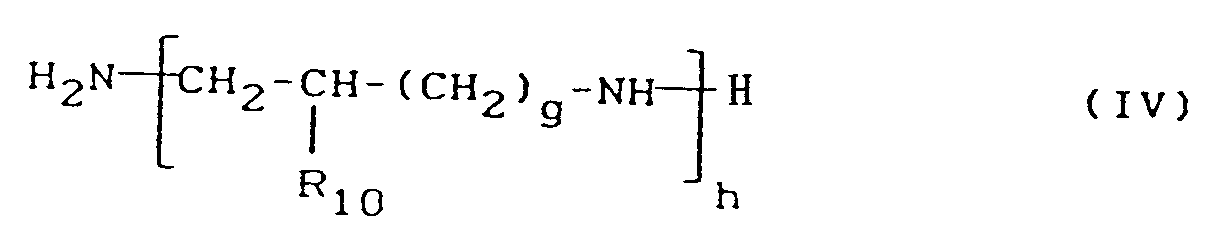
- R₁₀
- für Wasserstoff und Methyl,
- g
- für 0 oder 1 und
- h
- für eine ganze Zahl von 14 bis 2500
und/oder - 3) einem wasserlöslichen Polyamidamin mit einem Molekulargewicht von mindestens 800, hergestellt aus
- α) Polyaminen der Formel I oder aus Gemischen dieser Polyamine mit bis zu 50 Mol-% an Diaminen der Formel II
- β) aliphatischen oder aromatischen Dicarbonsäuren mit 2 bis 12 C-Atomen bzw. deren funktionellen Derivaten, wie Anhydriden, Estern, Halbestern oder Amiden
- γ) 3 bis 6 C-Atome enthaltenden Aminocarbonsäuren oder deren Lactamen
- 4) einem wasserlöslichen, sekundären Aminogruppen aufweisenden Polyharnstoff, welcher durch Kondensation von Harnstoff mit Polyaminen, die mindestens drei Aminogruppen enthalten, von denen wenigstens eine eine tertiäre Aminogruppe ist, oder Mischungen dieser Polyamine mit zwei primären oder, zwei sekundären Aminogruppen enthaltenden aliphatischen, araliphatischen, cycloaliphatischen oder heterocyclischen Polyaminen sowie gegebenenfalls mit mindestens drei Kohlenstoffatomen enthaltenden ω-Aminocarbonsäuren oder deren Lactamen hergestellt worden ist,
und/oder - 5) einem durch Polymerisation von 1,2-Alkyleniminen hergestellten Polyalkylenimin
- 1) einem wasserlöslichen Mono- oder Polyamin der Formeln
- B) 2,3-Epoxypropyl-sulfonsäureestern und/oder 2-Hydroxypropyl-1,3-bis-sulfonsäureester, gegebenenfalls im Gemisch mit bis zu 15 Mol-%, an Epichlorhydrin oder Dihalogenhydrin,
- Besonders bevorzugte wasserlösliche, vernetzbare Verbindungen sind erhältlich, wenn als Komponente
- B) ein 2,3-Epoxypropylsulfonsäureester oder 2-Hydroxypropyl-1,3-bissulfonsäureester der Formeln

- R₁₁, R₁₂, R₁₃, R₁₄ und R₁₅
- unabhängig voneinander für Wasserstoff oder einen gegebenenfalls durch Alkoxy, Cyano, Carbonsäurealkylester substituierten Alkyl-, Cycloalkyl-, Aryl- oder Aralkyl-Rest und
- R₁₆
- für einen Alkyl-, Cycloalkyl- oder einen gegebenenfalls durch Hydroxy, Alkoxy, Cyano, Carbonamido, Carbonsäurealkylester oder eine gegebenenfalls mono- oder dialkylierte Aminogruppe substituierten Aryl- oder Aralkyl-Rest stehen,
- Von den Ausgangskomponenten A) sind die Verbindungen A1), A2) und A3) bevorzugt.
- Das bevorzugte Molverhältnis der Amine A 3α) zu Dicarbonsäuren A3 β) liegt bei 0,8 bis 1,4:1.
- In den Formeln (V) und (VI) stehen bevorzugt:
- R₁₁-R₁₅
- für Wasserstoff oder einen gegebenenfalls durch C₁-C₄-Alkoxy, Cyano oder Carbonsäure-C₁-C₄-alkylester substituierten C₁-C₈-Alkyl-, C₅-C₁₂-Cycloalkyl-, Phenyl-, Naphthyl- oder Benzyl-Rest und
- R₁₆
- für einen C₁-C₁₆-Alkyl-, C₅-C₁₂-Cycloalkyl- oder einen gegebenenfalls durch Hydroxy, C₁-C₄-Alkoxy, Cyano, Carbonamido, Carbonsäure-C₁-C₄-alkylester oder gegebenenfalls durch 1 oder 2 C₁-C₄-Alkyl substituiertes Amino substituierten Phenyl-, Naphthyl- oder Benzyl-Rest.
- Bevorzugte Sulfonsäureester der Formeln (V) und (VI) haben die Formeln

und
worin - R₁₆
- die vorstehend genannte (bevorzugte) Bedeutung hat.
- Bei Verwendung von wasserlöslichen Polyaminen der allgemeinen Formeln (I) bzw. (II) als Ausgangsverbindungen werden für den Fall, daß R₁, R₄ und R₆ für Wasserstoff stehen, als Reaktionsprodukte insbesondere die erfindungsgemäßen Polymeren der allgemeinen Formeln

bzw.
worin
R₂, R₃, R₅, a, b, c, d und e die in Formeln (I) und (II) angegebene Bedeutung haben,
q eine Zahl von 5 bis 250,
E und E₁ Wasserstoff oder eine Gruppe
E außerdem C₁-C₄-Alkyl und
E₂ eine Gruppe
bedeuten, und
R₁₆ die vorstehend genannte (bevorzugte Bedeutung hat,
erhalten. - Die besonders zu nennenden Bedeutungen von R₁₆ sind C₁-C₉-Alkyl, Cyclohexyl oder gegebenenfalls durch C₁-C₄-Alkyl, C₁-C₅-Alkoxy oder Hydroxy substituiertes Phenyl oder Benzyl.
- Bei Verwendung von wasserlöslichen Polyamidaminen, die unter A3) beschrieben sind und aus den Aminen (I) und aliphatischen Dicarbonsäuren hergestellt werden, als Ausgangsverbindungen werden für den Fall, daß R₁ in I Wasserstoff bedeutet, die erfindungsgemäßen Polymeren der allgemeinen Formel

worin
f für eine ganze Zahl von 0 bis 10 steht und die übrigen Symbole die vorstehend genannte Bedeutung haben,
erhalten. - Je nach Molverhältnis A3α: A3β enthalten die Polyamidamine Amino- oder Carboxylendgruppen.
- Bei der zusätzlichen Verwendung von Diaminen II als Ausgangskomponente enthalten die Polymeren den Diaminen II entsprechende Amidstrukturen.
- Selbstverständlich ist es möglich, bei der Synthese Gemische der basischen Verbindungen A1) bis A5) zu verwenden.
- Neben den in den allgemeinen Formeln (IX) bis (XI) wiedergegebenen, sich wiederholenden Struktur-Einheiten treten dann in den erfindungsgemäßen Polymeren die auf die angeführten Mischkomponenten zurückzuführenden Struktur-Einheiten in den Polymerketten auf.
- Die vernetzbaren Verbindungen weisen bei einem Feststoffgehalt von 5 bis 30 Gew.-%, vorzugsweise 10 bis 25 Gew.-%, eine Viskosität von 10 bis 600 mPa.s, vorzugsweise 15 bis 500 mPa.s bei 25°C auf. Ihr Molekulargewicht beträgt etwa 1500 bis 250.000, vorzugsweise 2000 bis 200.000. (Gewichtsmittel)
- Die Herstellung der erfindungsgemäßen Reaktionsprodukte erfolgt bevorzugt in wäßrigem Medium. Es können auch andere polare Lösungsmittel, wie Methanol, Ethanol, Isopropanol, tert.-Butanol, Ethylenglykol, Diethylenglykol, Triethylenglykol, Polyethylenglykol, Glycerin, Dimethylformamid, Essigester oder bevorzugt deren Gemische mit Wasser verwendet werden.
- Die Umsetzung der Ausgangskomponenten A und B erfolgt durch Behandlung der wäßrigen oder wäßrig-organischen etwa 10 bis 60 %ige Lösungen oder Emulsionen der beiden Komponenten bei einer Temperatur von 20 bis 95°C, vorzugsweise 40 bis 85°C, so lange, bis eine Probe der Reaktionsmischung in Form einer 15 %igen, wäßrigen oder wäßrig-organischen Lösung bzw. Emulsion bei 25°C eine Viskosität von 15 bis 300 mPa.s, vorzugsweise 20 bis 200 mPa.s, aufweist.
- Danach setzt man dem viskoser werdenden Gemisch zur Beendigung der Einwirkung und zur Stabilisierung der selbstvernetzenden Produkte Säuren zu, so daß der pH-Wert zwischen 1 und 6, vorzugsweise 1,5 und 5,5, liegt.
- Als stabilisierende Säuren sind prinzipiell alle Säuren geeignet, insbesondere sind zu nennen:
- 1. Mineralsäuren bzw. sauer reagierende Derivate dieser Säuren, wie Amidosulfonsäure, schweflige Säure, Kieselsäure, Borsäure, Salpetersäure, Kohlensäure und besonders Schwefel-, Salz- und Phosphorsäure,
- 2. halogenfreie, gegebenenfalls Hydroxy-Gruppen enthaltende Mono- oder Polycarbonsäuren bzw. Derivate dieser Säuren, wie Essigsäure, Essigsäureanhydrid, Propionsäure, Oxalsäure, Malonsäure, Bernsteinsäure, Glutarsäure, Adipinsäure, Maleinsäure, Milchsäure, Weinsäure, Glykolsäure und besonders Ameisensäure, Äpfelsäure und Citronensäure,
- 3. halogenfreie aliphatische oder aromatische Sulfonsäuren, wie Hydroxymethansulfonsäure, Cyclohexansulfonsäure, Alkansulfonsäuren, deren Alkanrest 1 bis 6 C-Atome umfaßt, Benzylsulfonsäure, Benzolsulfonsäure, 4-Hydroxybenzolsulfonsäure und besonders Methansulfonsäure und Toluolsulfonsäure (o,m,p)
oder Gemische hieraus. - Unter Säure-Derivaten sind sauer reagierende Derivate der obengenannten Säuren, insbesondere Anhydride und saure Salze, wie z.B. Alkalihydrogensulfate, zu verstehen.
- Durch Verdünnen mit Wasser und/oder Lösungsmittel wird der Feststoffgehalt der Produkte anschließend auf den gewünschten Gehalt eingestellt.
- Diethylentriamin, Triethylentetramin, Tetraethylenpentamin, Pentaethylenhexamin, Hexaethylenheptamin, Heptaethylenoctamin, Dipropylentriamin, Tripropylentetramin, Methyl-bis-(3-aminopropyl)-amin, Ethyl-bis-(3-aminopropyl)-amin, 2-Hydroxyethyl-bis-(3-aminopropyl)-amin, Dihexamethylentriamin oder Gemische hieraus.
- Ethylendiamin, N-(2-hydroxyethyl)-ethylendiamin, N,N'-Dimethylethylendiamin, 1,2-Diaminopropan, 1,3-Diaminopropan, N-Methyl-1,3-diaminopropan, N,N'-Dimethyl-1,3-diaminopropan, N,N-Dimethyl-1,3-diaminopropan oder Gemische hieraus.
- Methylamin, Ethylamin, Isopropylamin, Butylamin, Isobutylamin, Dimethylamin, Aminoethanol, 3-Amino-1-propanol, 3-Amino-2-propanol, 4-Amino-1-butanol, 5-Amino-1-pentanol, 6-Amino-1-hexanol und deren Isomeren sowie Gemische hieraus.
-
- a) das bei der diskontinuierlichen, (z.B. Houben-Weyl, 4. Auflage, XI/1, Seite 44), oder bei der kontinuierlichen (z.B. im GB-PS 1 147 984, US-PS 1 832 534 und 2 049 467) Umsetzung von 1,2-Dichlorethan mit wäßrigem Ammoniak, gegebenenfalls in Gegenwart von Ethylendiamin, Diethylentriamin (US-PS 2 769 841 und DE-OS 1 668 922) oder Triethylentetramin erhaltene Polyethylenpolyamingemisch das destillativ von Ethylendiamin, Diethylentriamin, Triethylentetramin und Tetraethylenpentamin befreit ist,
- b) die durch Kondensation von 1,2-Dichlorethan mit den in a) genannten Polyethylenpolyaminen, einzeln oder im Gemisch, herstellbaren mehrwertigen oligomeren Amine mit einem mittleren Molekulargewicht von 1000 bis 10.000, vorzugsweise 2000 bis 5000.
- Beispiele für aliphatische Polyamine (A3 α) sind bei den Polyaminen (I) genannt.
- Diethylentriamin, Triethylentetramin, Tetraethylenpentamin, Pentaethylenhexamin, Hexaethylenheptamin, Dipropylentriamin, Methyl-bis-(3-aminopropyl)-amin, Dihexamethylentriamin bzw. Gemische hieraus oder Gemische hieraus mit 50 Mol-% eines Diamins der Formel (II), vorzugsweise Ethylendiamin.
- Oxalsäure, Bernsteinsäure, Malonsäure, Glutarsäure, Adipinsäure, Sebacinsäure, 1,12-Dodecandisäure, Itaconsäure, Terephthalsäure und Isophthalsäure oder Gemische hieraus.
- Bevorzugte Verbindung (A3 γ) ist ε-Caprolactam.
- Umsetzungsprodukte aus Harnstoff mit mehrwertigen Aminen, die mindestens drei Aminogruppen enthalten, von denen wenigstens eine eine tertiäre Aminogruppe ist, oder Mischungen dieser Polyamine mit zwei primären oder zwei sekundären Aminogruppen enthaltenden aliphatischen, araliphatischen, cycloaliphatischen oder heterocyclischen Polyaminen sowie gegebenenfalls mit mindestens drei Kohlenstoffatomen enthaltenden ω-Aminocarbonsäuren wie sie z.B. in der oder deren Lactamen,
wie sie z.B. in der Deutschen Offenlegungsschrift 2 925 567 beschrieben werden. - Bevorzugtes 1,2-Alkylenimin (A5) ist Ethylenimin.
-
- 2,3-Epoxypropyl-3-methylbenzolsulfonat, 2,3-Epoxypropyl-2-methylbenzolsulfonat, 2,3-Epoxypropylethansulfonat, 2,3-Epoxypropyl-butansulfonat, 2,3-Epoxypropyl-C₁-C₆-alkansulfonat, 2,3-Epoxypropylcyclohexylsulfonat, 2-Hydroxypropyl-1,3-dimethansulfonat, 2-Hydroxypropyl,1,3-di-(4-methylbenzolsulfonat), 2-Hydroxypropyl-1,3-di-benzolsulfonat und besonders 2,3-Epoxypropyl-methansulfonat, 2,3-Epoxypropyl-benzolsulfonat und 2,3-Epoxypropyl-4-methylbenzolsulfonat.
- Die Ausrüstung des Papiers mit den erfindungsgemäßen Polymeren erfolgt in an sich bekannter Weise bei pH-Werten von 5 bis 9. Bevorzugt werden die vernetzbaren Verbindungen in Form wäßriger Lösungen oder Emulsionen der wäßrigen Suspension des Papierrohstoffes in der Masse zugesetzt; diese wird dann zu Papier weiterverarbeitet.
- Die Zugabemengen betragen je nach gewünschtem Effekt zwischen 0,4 und 4,0 Gew.-% der Lösung oder Emulsion (bezogen auf Papierrohstoff) mit einem jeweiligen Gehalt an Polymeren (Wirkstoffgehalt) von 10 bis 20 Gew.-%. Bei besonders hohen Anforderungen an die Naßfestigkeit werden noch höhere Mengen verwendet. Beispielsweise sind bei Laminatpapieren mit hohem Aschegehalt und niedrigem Flächengewicht Zusatzmengen von 6,0 Gew.-% und mehr erforderlich.
- Auf die beschriebene Weise werden unter technisch einfachen und gut handhabbaren Bedingungen, klare, über Monate, vorzugsweise 6 bis 9 Monate, lagerstabile, vorzugsweise wäßrige, kationaktive Lösungen oder Emulsionen erhalten, die vollkommen frei von organisch gebundenem, adsorbierbarem Halogen sind oder sehr geringe Anteile enthalten und hervorragend die Naßfestigkeit eines damit ausgerüsteten Papieres verbessern.
- Die erfindungsgemäßen Polymeren unterscheiden sich von bekannten Polyamin/Polyamidamin Reaktiv-Polymeren dadurch, daß bei der Herstellung auf den Einsatz von Epihalogenhydrin oder Epihalogenhydrin-Derivaten vollständig oder weitestgehend verzichtet wurde. Im Gegensatz zu den bisher bekannten Harzen mit einem hohen Gehalt an Halogenhydrin-Reaktivgruppen, enthalten die erfindungsgemäßen Harze die gegenüber dem Papierrohstoff reaktiven Gruppen der Formel

in der - R
- für einen Substituenten wie in R₁₆ beschrieben stehen kann.
-
- a) Herstellung des Polyamidamins (gemäß DE-B 1 771 043, Spalte 4, Zeile 4 bis 25).
In einem Reaktionsgefäß mit Gaseinleitungsrohr, Innenthermometer und Kolonnenkopf wurden 211,5 g (2,05 mol) Diethylentriamin vorgelegt. Unter Rühren wurden 292 g (2,0 mol) Adipinsäure so zugegeben, daß die Temperatur des Reaktionsgemisches 110°C nicht überschritt. Nach beendeter Zugabe wurden unter Überleiten von Stickstoff auf 150°C erwärmt und 1 Stunde unter Rückfluß erhitzt. Danach wurde auf Destillation umgeschaltet und die Temperatur im Verlauf von 3 Stunden auf 190-195°C erhöht. Dabei wurde das Reaktionswasser kontinuierlich abdestilliert. Als die theoretische Menge Wasser (72 g) abdestilliert worden war, wurde nach Abkühlen der Schmelze auf 170°C durch anfangs langsame Zugabe von Wasser auf den gewünschten Feststoffgehalt eingestellt.
Viskosität (25°C): 470 m Pa·s
Basen-Äquivalentgewicht: 414 g/basischer Stickstoff (Lösung)
Basen-Äquivalentgewicht: 203 g/basischer Stickstoff (Festharz) - b) Zu einer Vorlage aus 120 g einer 50 %igen wäßrigen Lösung des gemäß 1a) hergestellten Polyamidamins und 300 ml Wasser tropft man unter Rühren bei 30°C in 30 Minuten 50,0 g 2,3-Epoxypropylmethansulfonat und rührt 30 Minuten bei 35°C nach.
- Anschließend heizt man auf 60 bis 70°C auf und fügt bei steigender Viskosität 400 ml Wasser zu. Sobald die gewünschte Viskosität erreicht ist, säuert man durch Zusatz einer Schwefelsäurelösung auf pH 3,0 an.
Feststoffgehalt: 15,0 Gew.-%
Viskosität: 34 mPa.s (25°C)
organ. Cl-Gehalt: 0,001 Gew.-%
organ. S-Gehalt: 1,3 Gew.-% - Zu einer Vorlage aus 120 g einer 50 %igen, wäßrigen Lösung eines Polyamidamins der DE-B 1 771 043, Spalte 4, Zeile 4 bis 25 und 350 ml Wasser tropft man bei 30°C in 20 Minuten unter Rühren 61,0 g 2,3-Epoxypropylmethansulfonat und rührt 30 Minuten bie 35°C nach.
- Im Anschluß erwärmt man auf 70°C und fügt bei steigender Viskosität 450 ml Wasser sowie 15,0 g Methyl-bis-(3-aminopropyl)-amin zu. Nach Erreichen der gewünschten Viskosität säuert man mittels einer Schwefelsäurelösung auf pH 2,8 an und stellt den Feststoffgehalt, wie gewünscht ein.
Feststoffgehalt: 15,0 Gew.-%
Viskosität: 28 mPa.s (25°C)
organ. Cl-Gehalt: 0,001 Gew.-%
organ. S-Gehalt: 1,5 Gew.-% -
- a) Zu einer Vorlage aus 324 g Diethylentriamin fügt man unter Rühren 438 g Adipinsäure und 169,5 g ε-Caprolactam; hierbei steigt die Innentemperatur auf etwa 100°C an.
Anschließend heizt man in 3 Stunden auf 190°C, wobei das Reaktionswasser gleichmäßig abdestilliert, kühlt dann auf 150°C ab und setzt 800 ml Wasser zu.
Man rührt noch 1 Stunde bei 80 bis 90°C nach und kühlt dann ab.
Viskosität: 330 mPa.s (25°C)
Feststoffgehalt: 51,7 Gew.-%
Basenäquivalentgewicht: 436 g/Val bas. N
(titriert) - b) Zu einer Vorlage aus 174 g eines in Wasser gelösten Vorproduktes gemäß Beispiel 3a) und 500 ml Wasser tropft man unter Rühren bei 30°C in 30 Minuten 68,3 g 2,3-Epoxypropyl-methansulfonat und rührt 45 Minuten bei dieser Temperatur nach.
Im Anschluß erwärmt man das Reaktionsgemisch auf 65°C und verdünnt bei steigender Viskosität mit 500 ml Wasser.
Nach Erreichen der gewünschten Viskosität säuert man mit Hilfe einer Ameisensäure-Lösung auf pH: 3,3 an und stellt den gewünschten Feststoffgehalt ein.
Feststoffgehalt: 15,0 Gew.-%
Viskosität: 119 mPa.s (25°C)
organ. Cl-Gehalt: 0,001 Gew.-%
organ. S-Gehalt: 1,4 Gew.-% - Zu einer Vorlage aus 122 g einer 50 %igen wäßrigen Lösung eines Polyamidamins der DE-B-1 771 043, Spalte 4, Zeile 4 bis 25, und 381 g Wasser setzt man bei 25°C 71,8 g 2.3-Epoxypropyl-4-methyl-benzolsulfonat portionsweise innerhalb von 30 Minuten zu.
- Danach wird 30 Minuten bei 30°C gerührt und anschließend auf 70°C erhitzt.
- Diese Temperatur wird beibehalten, und man fügt bei steigender Viskosität kontinuierlich 581 ml Wasser zu.
- Nach Erreichen der gewünschten Viskosität säuert man mittels einer Schwefelsäure-Lösung auf pH 3,0 an und stellt den Feststoffgehalt der stabilen Emulsion wie gewünscht ein.
Feststoffgehalt: 14.1 Gew.-%
Viskosität: 465 mPas/25°C
organ. Cl-Gehalt: < 0,01 Gew.-% - Gebleichter Kiefernsulfit-Zellstoff wird bei einer Stoffdichte von 2,5 % im Holländer auf einen Mahlgrad von 38° Schopper-Riegler gemahlen. Hiervon werden 100 g in ein Becherglas gegeben und mit Wasser auf 1 l verdünnt.
- 2- bzw. 4-Gew.-% des erfindungsgemäßen Produktes (15 Gew.-% Feststoff) werden auf Faserstoff bezogen in das Becherglas gegeben. Nach einer Rührdauer von 3 Minuten werden mit den Inhalten der Bechergläser auf einem Blattbildner (Rapid-Köthen-Gerät) Papierblätter mit einem Flächengewicht von ca. 80 g/m² gebildet. Die Papierblätter werden bei 90°C 6 Minuten im Vakuum bei einem Druck von 20 mm/Hg getrocknet und im Trockenschrank noch 15 Minuten auf 110°C nacherhitzt.
- Aus jedem Papierblatt werden nach der Klimatisierung 5 Prüfstreifen von 1,5 cm Breite ausgeschnitten und 5 Minuten in destilliertes Wasser eingetaucht. Danach werden die nassen Streifen in eine Zugprüfmaschine eingespannt und die Naßbruchlast bestimmt.
- Die erhaltenen Ergebnisse sind in der folgenden Tabelle wiedergegeben.
Beispiel Naßbruchlast (Newton) Einsatzmenge 2 % 4 % 6 % 1 10,3 13,8 17,7 2 10,4 14,2 16,9 3b 9,5 13,0 -
Claims (8)
- Vernetzbare Verbindungen mit einem Molekulargewicht (Gewichtsmittel) von 1500 bis 250 000, deren 5 bis 30 Gew.-%ige Lösungen oder Emulsionen eine Viskosität (25°C) von 10 bis 600 m Pa·s aufweisen und die erhältlich sind durch Umsetzung vonA1) einem wasserlöslichen Mono- oder Polyamin der Formeln
 R₁, R₄ und R₆ unabhängig voneinander für Wasserstoff oder einen gegebenenfalls durch Hydroxy, oder Amino substituierten C₁-C₅-Alkylrest,R₂, R₃, R₅ und R₉ unabhängig voneinander für Wasserstoff, Methyl oder Ethyl,R₇ und R₈ unabhängig voneinander für Wasserstoff, Hydroxy oder einen gegebenenfalls durch Hydroxy substituierten C₁-C₄-Alkylrest,a, b, e, f unabhängig voneinander für eine ganze Zahl von 0 bis 4,c und d unabhängig voneinander für eine ganze Zahl von 1 bis 6 stehen,und/oder2) einem Polyalkylenpolyamin der Formel
 R₁₀ für Wasserstoff und Methyl,g für 0 oder 1 undh für eine ganze Zahl von 14 bis 2500stehen,
und/oder3) einem wasserlöslichen Polyamidamin mit einem Molekulargewicht von mindestens 800, hergestellt ausα) Polyaminen der Formel I oder aus Gemischen dieser Polyamine mit bis zu 50 Mol-% an Diaminen der Formel IIundβ) aliphatischen oder aromatischen Dicarbonsäuren mit 2 bis 12 C-Atomen bzw. deren funktionellen Derivaten, wie Anhydriden, Estern, Halbestern oder Amidenund/oderγ) 3 bis 6 C-Atome enthaltenden Aminocarbonsäuren oder deren Lactamenund/oder4) einem wasserlöslichen, sekundären Aminogruppen aufweisenden Polyharnstoff, welcher durch Kondensation von Harnstoff mit Polyaminen, die mindestens drei Aminogruppen enthalten, von denen wenigstens eine eine tertiäre Aminogruppe ist, oder Mischungen dieser Polyamine mit zwei primären oder zwei sekundären Aminogruppen enthaltenden aliphatischen, araliphatischen, cycloaliphatischen oder heterocyclischen Polyaminen sowie gegebenenfalls mit mindestens drei Kohlenstoffatomen enthaltenden ω-Aminocarbonsäuren oder deren Lactamen hergestellt worden ist,
und/oder5) einem durch Polymerisation von 1,2-Alkyleniminen hergestellten PolyalkyleniminmitB) 2,3-Epoxypropyl-sulfonsäureestern und/oder 2-Hydroxypropyl-1,3-bissulfonsäureester, gegebenenfalls im Gemisch mit bis zu 15 Mol-%, an Epichlorhydrin oder Dihalogenhydrin,und gegebenenfalls anschließende oder gleichzeitige Umsetzung mit weiterem Mono- oder Polyamin der Formeln (I) bis (III) im Molverhältnis von 0,75 bis 3,5 Mol der Komponente B) pro Mol Basenstickstoff der Komponente A). - Verbindungen nach Anspruch 1, bei deren Herstellung als KomponenteB) 2,3-Epoxypropylsulfonsäureester oder 2-Hydroxypropyl-1,3-bissulfonsäureester der Formeln
 R₁₁, R₁₂, R₁₃, R₁₄ und R₁₅ unabhängig voneinander für Wasserstoff oder einen gegebenenfalls durch Alkoxy, Cyano oder Carbonsäurealkylester substituierten Alkyl-, Cycloalkyl-, Aryl- oder Aralkyl-Rest undR₁₆ für einen Alkyl-, Cycloalkyl- oder einen gegebenenfalls durch Hydroxy, Alkoxy, Cyano, Carbonamido, Carbonsäurealkylester oder eine gegebenenfalls mono- oder dialkylierte Aminogruppe substituierten Aryl- oder Aralkyl-Rest stehen,eingesetzt werden.
 - Verbindungen nach Anspruch 1, bei deren Herstellung 2,3-Epoxypropyl-sulfonsäureester oder 2-Hydroxypropyl-1,3-bissulfonsäureester der Formeln
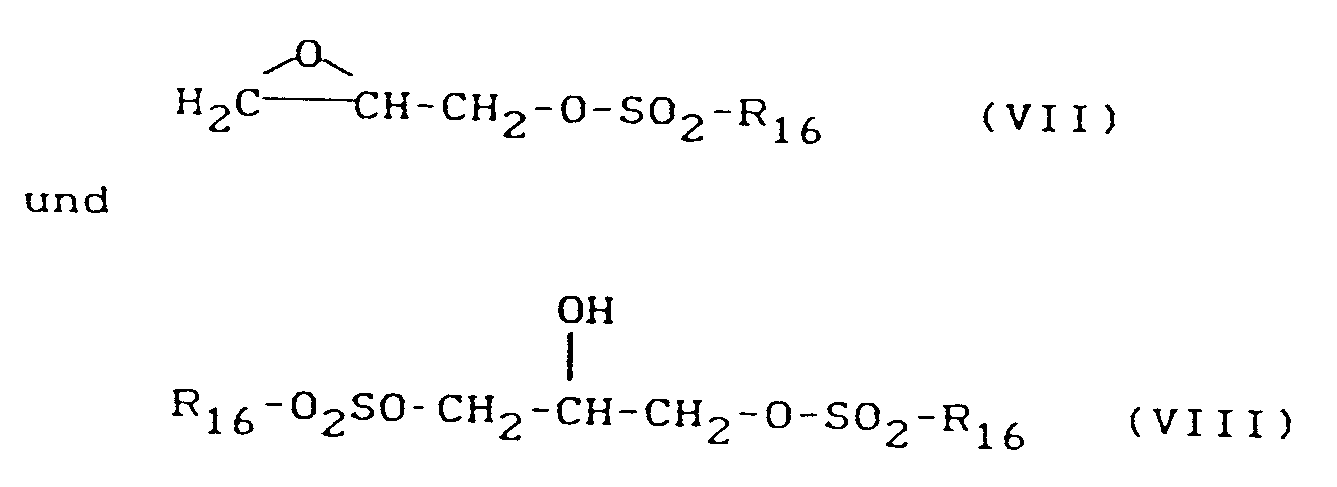 R₁₆ für einen C₁-C₁₆-Alkyl-, C₅-C₁₂-Cycloalkyl- oder einen gegebenenfalls durch Hydroxy, C₁-C₄-Alkoxy, Cyano, Carbonamido, Carbonsäure-C₁-C₄-alkylester oder gegebenenfalls durch 1 oder 2 C₁-C₄-Alkyl substituiertes Amino substituierten Phenyl-, Naphthyl- oder Benzyl-Rest steht,gegebenenfalls im Gemisch mit bis zu 15 Mol-% Epichlorhydrin oder Dichlorhydrin verwendet werden.
 - Verbindungen nach Anspruch 1, bei deren Herstellung 2,3-Epoxypropylsulfonsäureester, 2,3-Epoxypropyl-methansulfonat, 2,3-Epoxypropyl-C₁-C₆-alkansulfonat, 2,3-Epoxypropyl-cyclohexylsulfonat, 2,3-Epoxypropyl-benzolsulfonat, 2,3-Epoxypropyl-4-methylbenzolsulfonat gegebenenfalls im Gemisch mit bis zu 15 Mol-% Epichlorhydrin verwendet werden.
- Verbindungen nach Anspruch 1, deren Molekulargewicht 2000 bis 200.000 beträgt.
- Verbindungen nach Anspruch 1, bei deren Herstellung als stabilisierende Säuren bzw. deren sauer reagierende Derivate Alkalihydrogensulfate, Amidosulfonsäure, schweflige Säure, Salpetersäure, Schwefelsäure, Salzsäure, Phosphorsäure, Essigsäure, Essigsäureanhydrid, Milchsäure, Weinsäure, Ameisensäure, Äpfelsäure, Citronensäure, Methansulfonsäure, Toluolsulfonsäure (o,m,p) und/oder Benzolsulfonsäure verwendet werden.
- Verfahren zur Behandlung von Papier, dadurch gekennzeichnet, daß man Verbindungen nach Anspruch 1 verwendet.
- Naßfestmittel für Papier, dadurch gekennzeichnet, daß sie Verbindungen des Anspruchs 1 enthalten.
Applications Claiming Priority (2)
| Application Number | Priority Date | Filing Date | Title |
|---|---|---|---|
| DE3810424A DE3810424A1 (de) | 1988-03-26 | 1988-03-26 | Stickstoffhaltige polymere verbindungen |
| DE3810424 | 1988-03-26 |
Publications (2)
| Publication Number | Publication Date |
|---|---|
| EP0335158A1 EP0335158A1 (de) | 1989-10-04 |
| EP0335158B1 true EP0335158B1 (de) | 1994-07-06 |
Family
ID=6350844
Family Applications (1)
| Application Number | Title | Priority Date | Filing Date |
|---|---|---|---|
| EP89104344A Expired - Lifetime EP0335158B1 (de) | 1988-03-26 | 1989-03-11 | Stickstoffhaltige polymere Verbindungen |
Country Status (6)
| Country | Link |
|---|---|
| US (2) | US5082527A (de) |
| EP (1) | EP0335158B1 (de) |
| JP (1) | JPH028219A (de) |
| AT (1) | ATE108192T1 (de) |
| DE (2) | DE3810424A1 (de) |
| FI (1) | FI891397A7 (de) |
Families Citing this family (11)
| Publication number | Priority date | Publication date | Assignee | Title |
|---|---|---|---|---|
| US5239047A (en) * | 1990-08-24 | 1993-08-24 | Henkel Corporation | Wet strength resin composition and method of making same |
| US5364927A (en) * | 1990-08-24 | 1994-11-15 | Henkel Corporation | Wet strength resin composition and method of making same |
| US5189142A (en) * | 1990-08-24 | 1993-02-23 | Henkel Corporation | Wet strength resin composition and method of making same |
| DE4101822A1 (de) * | 1991-01-23 | 1992-07-30 | Bayer Ag | Pigmentdruck auf faserstoffen |
| EP0585812A3 (de) * | 1992-08-29 | 1995-04-12 | Hoechst Ag | Grenzflächenaktive Verbindungen auf Basis alkoxylierter Fettamine. |
| US7576162B2 (en) * | 2005-06-30 | 2009-08-18 | Akzo Nobel N.V. | Chemical process |
| EP2456835A1 (de) | 2009-07-20 | 2012-05-30 | Akzo Nobel Coatings International B.V. | Haftsystem und verfahren zur herstellung eines produkts auf holzbasis |
| EP2456828A1 (de) | 2009-07-20 | 2012-05-30 | Akzo Nobel Coatings International B.V. | Haftsystem und verfahren zur herstellung eines produkts auf holzbasis |
| EP2649145B1 (de) | 2010-12-10 | 2014-11-26 | Akzo Nobel Coatings International B.V. | Wässriger klebstoff aus einem synthetischen polymer und lupinprotein |
| CA2839129C (en) | 2011-08-25 | 2019-01-15 | Ashland Licensing And Intellectual Property Llc | Manufacturing of paper with biocides |
| US11332889B2 (en) | 2019-05-03 | 2022-05-17 | First Quality Tissue, Llc | Absorbent structures with high absorbency and low basis weight |
Family Cites Families (7)
| Publication number | Priority date | Publication date | Assignee | Title |
|---|---|---|---|---|
| US3361590A (en) * | 1962-07-25 | 1968-01-02 | Monsanto Co | Polyglycidylpolyamine treated polysaccharides |
| DE1595302A1 (de) * | 1966-02-08 | 1970-03-05 | Basf Ag | Verfahren zur Herstellung von wasserloeslichen Kondensationsprodukten |
| DE1771814C2 (de) * | 1968-07-16 | 1974-05-09 | Bayer Ag, 5090 Leverkusen | Hilfsmittel-Verwendung für die Papierfabrikation |
| GB8429273D0 (en) * | 1984-11-20 | 1984-12-27 | Dow Chemical Nederland | Producing nitrogen containing prepolymer |
| DE3609984A1 (de) * | 1986-03-25 | 1987-10-01 | Bayer Ag | Verfahren zur behandlung von fasermaterialien |
| DE3708544A1 (de) * | 1987-03-17 | 1988-09-29 | Bayer Ag | Stickstoffhaltige, wasserloesliche verbindungen |
| DE3810425A1 (de) * | 1988-03-26 | 1989-10-12 | Bayer Ag | Stickstoffhaltige, wasserloesliche, polymere verbindungen |
-
1988
- 1988-03-26 DE DE3810424A patent/DE3810424A1/de not_active Withdrawn
-
1989
- 1989-03-11 EP EP89104344A patent/EP0335158B1/de not_active Expired - Lifetime
- 1989-03-11 DE DE58907991T patent/DE58907991D1/de not_active Expired - Fee Related
- 1989-03-11 AT AT89104344T patent/ATE108192T1/de active
- 1989-03-14 US US07/323,457 patent/US5082527A/en not_active Expired - Fee Related
- 1989-03-23 FI FI891397A patent/FI891397A7/fi not_active Application Discontinuation
- 1989-03-23 JP JP1069404A patent/JPH028219A/ja active Pending
-
1991
- 1991-08-14 US US07/745,043 patent/US5093470A/en not_active Expired - Fee Related
Also Published As
| Publication number | Publication date |
|---|---|
| ATE108192T1 (de) | 1994-07-15 |
| DE58907991D1 (de) | 1994-08-11 |
| EP0335158A1 (de) | 1989-10-04 |
| US5093470A (en) | 1992-03-03 |
| DE3810424A1 (de) | 1989-10-12 |
| FI891397A0 (fi) | 1989-03-23 |
| FI891397L (fi) | 1989-09-27 |
| US5082527A (en) | 1992-01-21 |
| JPH028219A (ja) | 1990-01-11 |
| FI891397A7 (fi) | 1989-09-27 |
Similar Documents
| Publication | Publication Date | Title |
|---|---|---|
| EP0332967B1 (de) | Polyamidamin-Harze | |
| EP0282862B1 (de) | Stickstoffhaltige, wasserlösliche Verbindungen | |
| EP0002474B1 (de) | Amidgruppenhaltige Polyamine und ihre Verwendung bei der Papierherstellung | |
| DE3128478A1 (de) | Verfahren zur herstellung von linearen, basischen polymerisaten | |
| DE3822490A1 (de) | Waessrige loesungen von polyamidoamin-epichlorhyrin-harzen, verfahren zu ihrer herstellung und ihre verwendung | |
| CH616170A5 (en) | Process for the preparation of nitrogen-containing condensation products | |
| EP0335158B1 (de) | Stickstoffhaltige polymere Verbindungen | |
| DE1802435B2 (de) | Verfahren zur Herstellung von vernetzten Harzen auf der Basis von basischen Polyamidoaminen und deren Verwendung als Entwässerungs-, Retentions- und Flockungsmittel bei der Papierherstellung | |
| EP0828890B1 (de) | Verfahren zur papierveredlung unter verwendung von polyisocyanaten mit anionischen gruppen | |
| EP0074558A2 (de) | Verfahren zur Herstellung von wasserlöslichen, stickstoffhaltigen Kondensationsprodukten und deren Verwendung bei der Papierherstellung | |
| EP0335157A1 (de) | Stickstoffhaltige, wasserlösliche polymere Verbindungen | |
| DE2127082B2 (de) | Verfahren zur Herstellung von wasserlöslichen, hochmolekularen Polyätheraminen und deren Salze und deren Verwendung | |
| DE69210794T2 (de) | Neue kationische Polyaminen als Hilfsmittel für Entwässerung und als Stabilizatore für Kolophonum enthaltende Leimungsmittel | |
| DE2544948C3 (de) | Verfahren zur Herstellung von kationischen Leimungsmitteln für Papier | |
| DE2229219A1 (de) | Verfahren zur herstellung eines polyamaidpolyamin-epichlorhydrin- harzes und dessen verwendung zur verbesserung der nassfestigkeit von papier | |
| WO2000040639A1 (de) | Nassfestmittel mit niedrigem dcp-gehalt | |
| EP0031899B1 (de) | Selbstvernetzende wasserlösliche Reaktionsprodukte, Verfahren zur Herstellung von Bindemitteln aus solchen Produkten und Verwendung der Produkte zur Erhöhung der Nassfestigkeit von Papier | |
| EP0540943B1 (de) | Verfahren zur Herstellung von Polykondensaten | |
| EP0131200B1 (de) | Wasserlösliche, von Esterbindungen weitgehend freie Reaktionsprodukte aus Epihalogenhydrin und wasserlöslichen basischen Polyamidoaminen, Verfahren zu ihrer Herstellung und ihre Verwendung | |
| DE19607641A1 (de) | Wasserlösliche Kondensationsprodukte aus Aminogruppen enthaltenden Verbindungen und halogenfreien Vernetzern, Verfahren zu ihrer Herstellung und ihre Verwendung | |
| EP0123763A2 (de) | Verfahren zum Leimen von Papier mit anionischen, hydrophoben Leimungsmitteln und kationischen Retentionsmitteln | |
| EP0879260B1 (de) | Verfahren zur herstellung von vernetzten polymeren | |
| DE3706435A1 (de) | Verfahren zum leimen von papier mit nicht-ionogenen, hydrophoben leimungsmitteln und gegebenenfalls kationischen retentionsmitteln | |
| DE3942466A1 (de) | Wasserloesliche vernetzbare polyamine, verfahren zu deren herstellung und ihre verwendung als papierhilfsmittel | |
| EP1151029B1 (de) | Nassfestmittel mit niedrigem dcp-gehalt |
Legal Events
| Date | Code | Title | Description |
|---|---|---|---|
| PUAI | Public reference made under article 153(3) epc to a published international application that has entered the european phase |
Free format text: ORIGINAL CODE: 0009012 |
|
| 17P | Request for examination filed |
Effective date: 19890311 |
|
| AK | Designated contracting states |
Kind code of ref document: A1 Designated state(s): AT BE CH DE FR GB IT LI NL SE |
|
| 17Q | First examination report despatched |
Effective date: 19910723 |
|
| GRAA | (expected) grant |
Free format text: ORIGINAL CODE: 0009210 |
|
| AK | Designated contracting states |
Kind code of ref document: B1 Designated state(s): AT BE CH DE FR GB IT LI NL SE |
|
| PG25 | Lapsed in a contracting state [announced via postgrant information from national office to epo] |
Ref country code: IT Free format text: LAPSE BECAUSE OF FAILURE TO SUBMIT A TRANSLATION OF THE DESCRIPTION OR TO PAY THE FEE WITHIN THE PRE;WARNING: LAPSES OF ITALIAN PATENTS WITH EFFECTIVE DATE BEFORE 2007 MAY HAVE OCCURRED AT ANY TIME BEFORE 2007. THE CORRECT EFFECTIVE DATE MAY BE DIFFERENT FROM THE ONE RECORDED.SCRIBED TIME-LIMIT Effective date: 19940706 Ref country code: NL Effective date: 19940706 Ref country code: BE Effective date: 19940706 |
|
| REF | Corresponds to: |
Ref document number: 108192 Country of ref document: AT Date of ref document: 19940715 Kind code of ref document: T |
|
| REF | Corresponds to: |
Ref document number: 58907991 Country of ref document: DE Date of ref document: 19940811 |
|
| GBT | Gb: translation of ep patent filed (gb section 77(6)(a)/1977) |
Effective date: 19940722 |
|
| PG25 | Lapsed in a contracting state [announced via postgrant information from national office to epo] |
Ref country code: SE Effective date: 19941006 |
|
| ET | Fr: translation filed | ||
| NLV1 | Nl: lapsed or annulled due to failure to fulfill the requirements of art. 29p and 29m of the patents act | ||
| PGFP | Annual fee paid to national office [announced via postgrant information from national office to epo] |
Ref country code: DE Payment date: 19950214 Year of fee payment: 7 |
|
| PGFP | Annual fee paid to national office [announced via postgrant information from national office to epo] |
Ref country code: CH Payment date: 19950216 Year of fee payment: 7 |
|
| PGFP | Annual fee paid to national office [announced via postgrant information from national office to epo] |
Ref country code: GB Payment date: 19950302 Year of fee payment: 7 |
|
| PG25 | Lapsed in a contracting state [announced via postgrant information from national office to epo] |
Ref country code: AT Effective date: 19950311 |
|
| PGFP | Annual fee paid to national office [announced via postgrant information from national office to epo] |
Ref country code: FR Payment date: 19950315 Year of fee payment: 7 |
|
| PLBE | No opposition filed within time limit |
Free format text: ORIGINAL CODE: 0009261 |
|
| STAA | Information on the status of an ep patent application or granted ep patent |
Free format text: STATUS: NO OPPOSITION FILED WITHIN TIME LIMIT |
|
| 26N | No opposition filed | ||
| PG25 | Lapsed in a contracting state [announced via postgrant information from national office to epo] |
Ref country code: GB Effective date: 19960311 |
|
| PG25 | Lapsed in a contracting state [announced via postgrant information from national office to epo] |
Ref country code: LI Effective date: 19960331 Ref country code: CH Effective date: 19960331 |
|
| GBPC | Gb: european patent ceased through non-payment of renewal fee |
Effective date: 19960311 |
|
| REG | Reference to a national code |
Ref country code: CH Ref legal event code: PL |
|
| PG25 | Lapsed in a contracting state [announced via postgrant information from national office to epo] |
Ref country code: FR Effective date: 19961129 |
|
| PG25 | Lapsed in a contracting state [announced via postgrant information from national office to epo] |
Ref country code: DE Effective date: 19961203 |
|
| REG | Reference to a national code |
Ref country code: FR Ref legal event code: ST |