EP0334844B1 - Virtuelle prozessortechniken in einem feldmultiprozessor - Google Patents
Virtuelle prozessortechniken in einem feldmultiprozessor Download PDFInfo
- Publication number
- EP0334844B1 EP0334844B1 EP87906540A EP87906540A EP0334844B1 EP 0334844 B1 EP0334844 B1 EP 0334844B1 EP 87906540 A EP87906540 A EP 87906540A EP 87906540 A EP87906540 A EP 87906540A EP 0334844 B1 EP0334844 B1 EP 0334844B1
- Authority
- EP
- European Patent Office
- Prior art keywords
- virtual
- processor
- processors
- physical
- instruction
- Prior art date
- Legal status (The legal status is an assumption and is not a legal conclusion. Google has not performed a legal analysis and makes no representation as to the accuracy of the status listed.)
- Expired
Links
Images









Classifications
-
- G—PHYSICS
- G06—COMPUTING OR CALCULATING; COUNTING
- G06F—ELECTRIC DIGITAL DATA PROCESSING
- G06F15/00—Digital computers in general; Data processing equipment in general
- G06F15/76—Architectures of general purpose stored program computers
- G06F15/80—Architectures of general purpose stored program computers comprising an array of processing units with common control, e.g. single instruction multiple data processors
- G06F15/8007—Architectures of general purpose stored program computers comprising an array of processing units with common control, e.g. single instruction multiple data processors single instruction multiple data [SIMD] multiprocessors
Definitions
- This invention relates to the field of parallel processing and multi-processing in digital computer systems. More particularly, it relates to a method of simulating and utilizing additional (i.e., virtual) processors in a single-instruction multiple-data (SIMD) parallel processor array.
- SIMD single-instruction multiple-data
- SIMD computer such as the Connection Machine (registered trademark of Thinking Machines Corporation, Cambridge, MA) computer system
- Connection Machine registered trademark of Thinking Machines Corporation, Cambridge, MA
- the architecture is designed to support a data parallel style of programming. In this style one programs assuming a separate processor for every data element, so that one may effectively operate on all data elements in parallel.
- the Connection Machine computer system supports such a style of programming by providing tens of thousands of individual hardware data Processors, each with its own memory for holding a data element. (Current standard Connection Machine system configurations provide l6,384 Processors and 65,536 processors.)
- the data Processors all process instructions issued on a centrally controlled instruction bus, so that at any given time all processors (or all processors in a large group) are executing the same instruction.
- the instruction bus is driven by a front end computer, which is a conventional single-processor computer such as a Symbolics 3600 computer or a Digital Equipment Corporation VAX computer.
- the instruction set of the Connection Machine computer system alleviates these difficulties by supporting a virtual processor mechanism at the lowest level of implementation.
- the virtual processor mechanism causes every physical hardware processor to be used to simulate multiple "virtual" processors.
- Each physical processor simulates the same number of virtual processors; the number of virtual procesors simulated by each physical processor is called the VP-ratio.
- the VP-ratio is software selectable and is determined when the Connection Machine is initialized (i.e., "cold-booted") before running a used application.
- n stand for the VP-ratio at a given point in time.
- the virtual processor mechanism causes the memory of each physical processor to be divided into n regions of equal size; each such region is the memory for one virtual processor.
- the set of virtual processors whose memory is stored the same relative position within each physical memory is called a VP-bank. If the VP-ratio is n, then there are n VP-banks.
- a VP-bank is a set of virtual processors that can be serviced simultaneously by the physical processors.
- each physical processor is time-sliced among the virtual memory regions, performing the operation first as one virtual processor, then another, until the operation has been performed for all virtual processors. Only then is the next instruction accepted from the intruction bus.
- the switching of a processor among virtual processes typically occurs between instructions; the physical processor executes some instructions on behalf of one virtual process, and then, after a switch, executes some instructions on behalf of another virtual process.
- the present virtual processor mechanism by contrast, switches among virtual processors within instructions; at the completion of each instruction, that instruction has been executed on behalf of all virtual processors.
- the invention is also superficially similar to a system described in IEEE Computer Society Workshop on Computer Architecture for Pattern Analysis and Image Database Management , Hot Springs, Virginia, USA, ll to l3 November l98l, IEEE, pages 20l to 208. That reference shows an image processor based on an array of pipelines, wherein each physical processor element may simulate a number of virtual processors.
- each physical processor element may simulate a number of virtual processors.
- the number of virtual processors which may be simulated is limited by the fact that a fixed number of registers is provided for each physical processor. These registers are all of fixed size. If all of the fixed registers are not used, or if the register size is larger than required, resources are wasted. flexibility is also quite limited.
- the present invention as claimed comprises a method of operating a single-instruction multiple data (SIMD) parallel processor comprising a controller and an array of substantially identical physical processors controlled in parallel by the controller.
- SIMD single-instruction multiple data
- Each processor comprises an input, an output, a processing element and a memory element associated with each processing element, the processing element operating on data provided by its input and associated memory element, in accordance with instructions provided by the controller, to produce data at its output.
- the method of operating this system according to the invention simulates the presence of a larger number of processors in the array than the number of actual physical processors, thereby to provide a corresponding number of so-called "virtual processors," and of utilizing such virtual processors.
- the method is characterized by the steps of:
- the invention comprises particular instructions intended to cause the virtual processors to perform predetermined operations, such as adding together a multiplicity of numbers and several other operations described herein.
- the memory of a physical processor is partitioned into n regions of identical size, but there is more to the story than that.
- a certain amount r of each physical processor's memory is set aside for per-physical-processor housekeeping purposes.
- m is the total amount of memory per physical processor (4,096 bits in the current implementation)
- the v bits of per-processor physical memory set aside for each virtual processor may (but need not) be continguous. If these V bits are continguous, the first v - f bits may be used for the simulated memory, and bits v - 4 through v - l of each block may contain the simulated flags. In this arrangement, memory bit j of virtual processor k is stored at physical address kv + j. Other arrangements are possible, including one where the bits of all virtual processors are interleaved and therefore memory bit j of virtual processor k is stored at physical address jn + k.
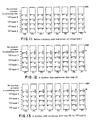
- the context flag is represented as a bullet (o) for the value l or as a circle (o) for the value 0.
- results are stored only in virtual processors whose context flag is l.
- the carry and overflow flags are not represented in the figures.
- an arrow ( ⁇ ) indicates the places where that figure differs from the preceding one. For uniformity with later figures, the per-physical-processor housekeeping area is shown even though it is not used for the ADD instruction.
- a refinement of this technique allows conditional instructions of this sort to be executed much more efficiently in some cases.
- the global-OR of the context flags for all virtual processors in that bank can be checked quickly; if the global-OR bit is zero, then no virtual processor in that bank will store results, and the labor of computing the sums can be avoided, as shown in Fig. 8. For some user applications this technique can yield a significant speed improvement.
- the GLOBAL-ADD instruction causes one integer from each hardware processor whose context flag is set to be contributed to an accumulating sum; the total sum of all such integers is reported to the front end computer.
- the memory and flag bits of the individual processors are not changed (except for scratch space in a reserved housekeeping area of memory not visible to the user, that is, front end computer).
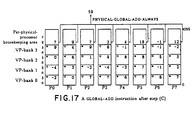
- Figs. ll-l7 illustrate the operation of the conditional GLOBAL-ADD instruction for eight hardware processors operated as four VP-banks.
- Every physical processor has a distinct processor number, or address.
- the virtual processor mechanism also assigns a distinct number to each virtual processor.
- the VP-banks are numbered from 0 to n - l.
- the virtual processor in physical processor j and in VP-bank k then has virtual processor number jn + k.
- the VP-ratio is restricted to be an integral power of 2. This is primarily for implementation convenience, so that the physical processor number is simply one bit field of the virtual processor number that can be extracted without performing a division operation).
- the unconditional PLUS-SCAN instruction with operand addresses a and b causes field a in hardware processor j to receive the integer sum of fields b from every hardware processor whose processor number k is strictly less than j.
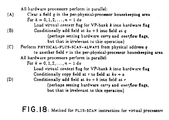
- PHYSICAL-PLUS-SCAN-ALWAYS Its conditional analogue, PHYSICAL-PLUS-SCAN, causes field a in hardware processor j to receive (provided that the context flag of processor j is l) the integer sum of fields b from every hardware Processor whose processor number k is strictly less than j and whose context flag is 1. The flag bits of the individual processors are not changed.
- step (A) and (B) resembles the first part of the GLOBAL-ADD algorithm for Fig. 9.
- step (C) an unconditional plus-scan on physical processors is performed.
- Steps (D) spread results back to the virtual processors within each physical processor.
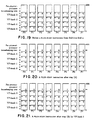
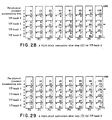
- Figs. l9-29 illustrate the operation of the PLUS-SCAN instruction for eight hardware processors operated as four VP-banks.
- the context flag of every processor is l, so the operation is effectively unconditional.
- the field r in the highest-numbered physical processor contains the total sum of fields b from all virtual processors.
- the hardware NEWS grid of the Connection Machine organizes physical processors in a regular manner into a two-dimensional frid wherein each processor communicates with its north, east, west and south neighbors.
- a given physical processors 's x and y coordinates within the grid can be calculated from its processor number.
- P(X(j), Y(j)) j
- X(P(x,y)) x
- Y(P(x,y) y.
- the hardware grid is so organized that every physical processor has four neighbors.
- the neighbors of Processor j are processors with numbers P(x(j-l) mod P x ),Z(j)), P(X((j+l) mod P x ),Y(j)), P(X(j),Y((j-l) mod P y )) and P(X(j),Y((j+l) mod P y )) These are respectively called the neighbors to the West, East, North and South.
- Each instruction comes in conditional and unconditional varieties; the conditional form causes each processor to store the incoming data only if its context flag is l.
- a virtual processor in VP-bank k has coordinates X v (k) and V v (k) within this small grid.
- the small grids within the physical processors are conjoined like the patchwork squares in a quilt to make one large grid of size P x n x by P y n y .
- the virtual processor in VP-bank k of physical processor j has, as a ready stated above, virtual processor number jn+k. That same virtual processor then has virtual NEWS coordinates X(j)n x + X v (k) and Y(j)n x + Y v (k).
- the virtual processor with virtual NEWS coordinates x v and y v has virtual processor number P v (x v ,y v ).
- Fig. 30 depicts the general behavior of the instruction GET-FROM-EAST, with the virtual processor mechanism, sending out data from field b and receiving it into the distinct field a.
- the unconditional version is obtained simply by changing any and all conditional subsidiary operations to be unconditional; all loading of the hardware context flag may then be eliminated).
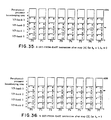
- Figs. 32-36 illustrate the operation of the GET-FROM-EAST instruction for eight hardware processors operated as four VP-banks, using the method of Fig. 30 to put a shifted copy of field b into field a. Assume that the physical processors P0 through P7 are organized into a physical grid as shown in Fig. 32:
- the physical-processor version of the SEND instruction relies on special purpose hardware (the router detailed in the above-noted patent No. 4,598,400 and application no. 499,474, both incorporated by reference herein) to transmit messages from one processor to another.
- the actual hardware implementation is quite complex, but for the purposes of this discussion may be summarized abstractly as follows.
- Each processor is attached to a router node.
- each router node services several processors, but that fact is not important here.
- a different memory address may be supplied. To go over the same example in more detail, it might be specified that only messages whose first three bits are l0l are to be stored, and they are to be stored at address 2570. It might next be specified that messages whose first three bits are ll0 are to be stored at address 3082; next that message whose first three bits are lll are to be stored at adddress 3594; and so on.
- message transmission may be abstractly divided into two phases: (l) inject a message into the router, perhaps conditionally on the context flag; (2) receive a message from the router, if one has been sent and if the message detector permits.
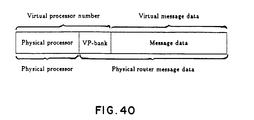
- the message detector makes it Possible to support the efficient transmission of messages among virtual processors. If virtual Processor u is to send message m to virtual Processor w, it provides to the "virtual router" the virtual processor number of w and the message data m (effectively concatenated into one long string of bits). Because in the current implementation the VP-ratio is constrained to be a power of two, a virtual processor address is simply the concatenation of a physical processor address and a VP-bank number. The message information supplied to the virtual router can therefore be interpreted by the physical router hardware as consisting of a physical processor number followed by a somewhat longer message data string (which consists of a VP-bank number followed by the virtual message data m), as illustrated in Fig. 40.
- the method therefore requires the delivery of the message to the physical processor that contains w and then the use of the message detector to ensure that the message data is stored at a location within the memory set aside for the VP-bank that contains w.
- This method for sending data from field b to field a in the virtual processor specified by field d is outlined in Fig. 4l.
- the method shown in Fig. 4l unfortunately takes a number of steps proportional to tie square of the VP-ratio. In practice, a more complex method may be used. The latter takes advantage of the buffering within the physical router, plus three additional features of the router hardware not yet discussed: (l) Injection and storing of messages may take Place concurrently. (2) It is not always possible, because of buffer limitations, for every physical processor to inject a message simultaneously. Instead, the Protocol is that every physical processor may attempt to inject a message, and the router returns to the processor a bit that is l if the message was injected and 0 otherwise. (3) The global-OR facility may also be used to determine whether any router node still has messaces buffered within it.
- Fig. 42 The improved method is shown in Fig. 42. It assumes that there are two additional one-bit fields called c and e in each virtual (not physical) procesor. In the worst case this methods can still take time proportional to the square of the VP-ratio, but empirical results show that in practice its performance is considerably better than the performance of the method in Fig. 4l. Of course, many other strategies are possible with the given hardware.
- the five instructions ADD, GLOBAL-ADD, PLUS-SCAN, SEND, and GET-FROM-EAST are handled by the instant virtual processor mechanism in a variety of ways:
Landscapes
- Engineering & Computer Science (AREA)
- Computer Hardware Design (AREA)
- Theoretical Computer Science (AREA)
- Computing Systems (AREA)
- Physics & Mathematics (AREA)
- General Engineering & Computer Science (AREA)
- General Physics & Mathematics (AREA)
- Multi Processors (AREA)
Claims (3)
- Verfahren zum Betreiben eines Einzelbefehl-Vielfachdaten- (SIMD-) Parallelprozessors, der einen Steuerer und eine Gruppe von im wesentlichen identischen, physikalischen Prozessoren aufweist, die von dem Steuerer parallel gesteuert werden, wobei jeder Prozessor einen Eingang, einen Ausgang, ein Prozessorelement und ein jedem Prozessorelement zugeordnetes Speicherelement aufweist, wobei das Prozessorelement aufgrund von Daten arbeitet, die von seinem Eingang zugeführt werden, und im zugehörigen Speicherelement arbeitet in Übereinstimmung mit Befehlen, die von dem Steuerer geliefert werden, um Daten an seinem Ausgang zu erzeugen, wobei das Verfahren zum Betreiben des SIMD-Prozessors ein Verfahren zum Simulieren der Anwesenheit einer größeren Anzahl von Prozessoren in der Gruppe als die Anzahl der physikalischen Prozessoren ist, um dadurch eine entsprechende Anzahl sogenannter "virtueller Prozessoren" zu bilden, die für die Ausführung von Benutzerprogrammen verwendbar sind, und ein Verfahren zum Ausnutzen dieser virtuellen Prozessoren ist,
gekennzeichnet durch
die folgenden Schritte:(a) vor Ausfühurng eines Benutzerprogramms und ansprechend auf einen Programmbefehl werden die Speicherelemente, die jedem aus einer Vielzahl physikalischer Verarbeitungselemente zugeordnet sind, in identischer Weise unterteilt, um eine Anzahl m Unterspeicher zu bilden, die jedem Verarbeitungselement zugeordnet sind und jeweils v Bit Länge haben, wobei m eine variable Zahl ist, die von dem Programmbefehl angegeben wird und gleich der Anzahl virtueller Prozessoren ist, die von jedem physikalischen Prozessor zu simulieren sind;(b) Abgeben wenigstens eines ersten ausführbaren Befehls von dem Steuerer an einen Satz der physiskalischen Prozessoren, um deren Verarbeitungselemente zu veranlassen, die Daten zu verarbeiten, die an einen ersten Platz in einem ersten Unterspeicher gespeichert sind, der jedem dieser Verarbeitungselemente zugeordnet ist; und(c) zu einem nachfolgenden Zeitpunkt innerhalb der für die Ausführung des ersten ausführbaren Befehls zulässigen Zeit das Abgeben dieses ersten ausführbaren Befehls von dem Steuerer an einen solchen Satz physikalischer Prozessoren, um die Verarbeitungselemente desselben jeweils zu veranlassen, Daten zu verarbeiten, die an dem gleichen ersten Platz in einem zweiten Unterspeicher gespeichert sind, der jedem dieser Verarbeitungselemente zugeordnet ist. - Verfahren nach Anspruch 1, weiterhin dadurch gekennzeichnet, daß der ausführbare Befehl ein Addierbefehl ist, der dazu bestimmt ist, die virtuellen Prozessoren zu veranlassen, eine Vielzahl von Zahlen zusammenzuzählen, und wobei der Satz virtueller Prozessoren, deren Speicher an derselben Relativposition innerhalb eines jeden Speicherelements gespeichert ist, eine "VP-Bank" genannt wird, wobei bei diesem Verfahren(d) für jede VP-Bank(i) virtuelle Übertrags-, Überlauf- und Kontext-Kennzeichen für die VP-Bank k in entsprechende Hardware-Kennzeichenbits geladen werden, 2) gegebenenfalls das Feld an der Stelle kv + b in das Feld kv + a addiert wird, wobei a und b Operandenadressen sind, die Hardware-Übertrags- und -überlaufkennzeichenbits geeignet eingestellt werden und die HardwareÜbertrags- und -überlaufkennzeichen in virtuelle Kennzeichen für die VP-Bank k gespeichert werden.
- Verfahren nach Anspruch 1 oder 2, weiterhin gekennzeichnet durch den zusätzlichen Schritt:(e) Abgeben einer Anzahl von Kennzeichenbits f für jeden virtuellen Prozessor, wobei erste und zweite der genannten Kennzeichenbits als Zustandscodebits funktionieren, wobei die Operationsergebnisse aufgezeichnet und ein drittes Kennzeichenbit steuert, ob die gegebenenfalls ausgeführten Operationen ihre Ergebnisse speichern.
Applications Claiming Priority (2)
| Application Number | Priority Date | Filing Date | Title |
|---|---|---|---|
| US06/933,810 US4827403A (en) | 1986-11-24 | 1986-11-24 | Virtual processor techniques in a SIMD multiprocessor array |
| US933810 | 1986-11-24 |
Publications (2)
| Publication Number | Publication Date |
|---|---|
| EP0334844A1 EP0334844A1 (de) | 1989-10-04 |
| EP0334844B1 true EP0334844B1 (de) | 1992-09-09 |
Family
ID=25464538
Family Applications (1)
| Application Number | Title | Priority Date | Filing Date |
|---|---|---|---|
| EP87906540A Expired EP0334844B1 (de) | 1986-11-24 | 1987-09-23 | Virtuelle prozessortechniken in einem feldmultiprozessor |
Country Status (6)
| Country | Link |
|---|---|
| US (1) | US4827403A (de) |
| EP (1) | EP0334844B1 (de) |
| JP (1) | JP2559784B2 (de) |
| CA (1) | CA1297987C (de) |
| DE (1) | DE3781694T2 (de) |
| WO (1) | WO1988004076A1 (de) |
Families Citing this family (42)
| Publication number | Priority date | Publication date | Assignee | Title |
|---|---|---|---|---|
| US4985832A (en) * | 1986-09-18 | 1991-01-15 | Digital Equipment Corporation | SIMD array processing system with routing networks having plurality of switching stages to transfer messages among processors |
| US6108763A (en) * | 1986-09-18 | 2000-08-22 | Grondalski; Robert S. | Simultaneous parity generating/reading circuit for massively parallel processing systems |
| US5418970A (en) * | 1986-12-17 | 1995-05-23 | Massachusetts Institute Of Technology | Parallel processing system with processor array with processing elements addressing associated memories using host supplied address value and base register content |
| US5170482A (en) * | 1987-08-14 | 1992-12-08 | Regents Of The University Of Minnesota | Improved hypercube topology for multiprocessor computer systems |
| EP0360527B1 (de) * | 1988-09-19 | 1995-01-04 | Fujitsu Limited | Paralleles Rechnersystem mit Verwendung eines SIMD-Verfahrens |
| US5136717A (en) * | 1988-11-23 | 1992-08-04 | Flavors Technology Inc. | Realtime systolic, multiple-instruction, single-data parallel computer system |
| US5072371A (en) * | 1989-03-01 | 1991-12-10 | The United States Of America As Represented By The United States Department Of Energy | Method for simultaneous overlapped communications between neighboring processors in a multiple |
| US5170370A (en) * | 1989-11-17 | 1992-12-08 | Cray Research, Inc. | Vector bit-matrix multiply functional unit |
| US5280474A (en) * | 1990-01-05 | 1994-01-18 | Maspar Computer Corporation | Scalable processor to processor and processor-to-I/O interconnection network and method for parallel processing arrays |
| WO1991010200A1 (en) * | 1990-01-05 | 1991-07-11 | Maspar Computer Corporation | Parallel processor memory system |
| US5193202A (en) * | 1990-05-29 | 1993-03-09 | Wavetracer, Inc. | Processor array with relocated operand physical address generator capable of data transfer to distant physical processor for each virtual processor while simulating dimensionally larger array processor |
| GB9018048D0 (en) * | 1990-08-16 | 1990-10-03 | Secr Defence | Digital processor for simulating operation of a parallel processing array |
| US5367642A (en) * | 1990-09-28 | 1994-11-22 | Massachusetts Institute Of Technology | System of express channels in an interconnection network that automatically bypasses local channel addressable nodes |
| US5325500A (en) * | 1990-12-14 | 1994-06-28 | Xerox Corporation | Parallel processing units on a substrate, each including a column of memory |
| US5379438A (en) * | 1990-12-14 | 1995-01-03 | Xerox Corporation | Transferring a processing unit's data between substrates in a parallel processor |
| US5131054A (en) * | 1991-01-09 | 1992-07-14 | Thinking Machines Corporation | Character recognition system using massively parallel computer that identifies a query character using degree of similarity with plurality of training characters of known identity |
| US5515535A (en) * | 1991-11-05 | 1996-05-07 | Thinking Machines Corporation | System and method for parallel variable optimization |
| US5355492A (en) * | 1991-11-05 | 1994-10-11 | Thinking Machines Corporation | System for compiling parallel communications instructions including their embedded data transfer information |
| US5442797A (en) * | 1991-12-04 | 1995-08-15 | Casavant; Thomas L. | Latency tolerant risc-based multiple processor with event driven locality managers resulting from variable tagging |
| US5355494A (en) * | 1991-12-12 | 1994-10-11 | Thinking Machines Corporation | Compiler for performing incremental live variable analysis for data-parallel programs |
| US5278986A (en) * | 1991-12-13 | 1994-01-11 | Thinking Machines Corporation | System and method for compiling a source code supporting data parallel variables |
| US5561801A (en) * | 1991-12-13 | 1996-10-01 | Thinking Machines Corporation | System and method for multilevel promotion |
| US5586026A (en) * | 1991-12-20 | 1996-12-17 | Schlumberger Technology Corporation | Method of seismic migration using a massively parallel computer |
| US5349527A (en) * | 1991-12-20 | 1994-09-20 | Schlumberger Technology Corporation | Method of seismic time migration using a massively parallel computer |
| US5274818A (en) * | 1992-02-03 | 1993-12-28 | Thinking Machines Corporation | System and method for compiling a fine-grained array based source program onto a course-grained hardware |
| US5347654A (en) * | 1992-02-03 | 1994-09-13 | Thinking Machines Corporation | System and method for optimizing and generating computer-based code in a parallel processing environment |
| US5551039A (en) * | 1992-02-03 | 1996-08-27 | Thinking Machines Corporation | Compiling a source code vector instruction by generating a subgrid loop for iteratively processing array elements by plural processing elements |
| US5659778A (en) * | 1992-02-03 | 1997-08-19 | Tm Patents, L.P. | System and method of mapping an array to processing elements |
| US5524212A (en) * | 1992-04-27 | 1996-06-04 | University Of Washington | Multiprocessor system with write generate method for updating cache |
| US5581773A (en) * | 1992-05-12 | 1996-12-03 | Glover; Michael A. | Massively parallel SIMD processor which selectively transfers individual contiguously disposed serial memory elements |
| US5428803A (en) * | 1992-07-10 | 1995-06-27 | Cray Research, Inc. | Method and apparatus for a unified parallel processing architecture |
| JP3003418B2 (ja) * | 1992-09-25 | 2000-01-31 | 株式会社日立製作所 | プロセッサ間データ通信方法 |
| US5537319A (en) * | 1993-12-01 | 1996-07-16 | Schlumberger Technology Corporation | Method for load balancing seismic migration processing on a multiproccessor computer |
| US5524223A (en) * | 1994-01-31 | 1996-06-04 | Motorola, Inc. | Instruction accelerator for processing loop instructions with address generator using multiple stored increment values |
| US5692193A (en) * | 1994-03-31 | 1997-11-25 | Nec Research Institute, Inc. | Software architecture for control of highly parallel computer systems |
| US6567837B1 (en) * | 1997-01-29 | 2003-05-20 | Iq Systems | Object oriented processor arrays |
| US6366999B1 (en) * | 1998-01-28 | 2002-04-02 | Bops, Inc. | Methods and apparatus to support conditional execution in a VLIW-based array processor with subword execution |
| US6321279B1 (en) * | 1998-09-14 | 2001-11-20 | Compaq Computer Corporation | System for implementing intelligent I/O processing in a multi-processor system by redirecting I/O messages to a target central processor selected from the multi-processor system |
| US7454749B2 (en) * | 2002-11-12 | 2008-11-18 | Engineered Intelligence Corporation | Scalable parallel processing on shared memory computers |
| US20040093390A1 (en) * | 2002-11-12 | 2004-05-13 | Matthias Oberdorfer | Connected memory management |
| GB0420004D0 (en) * | 2004-09-09 | 2004-10-13 | Koninkl Philips Electronics Nv | Interconnections in SIMD processor architectures |
| CN100583049C (zh) * | 2007-11-29 | 2010-01-20 | 上海华为技术有限公司 | 多核处理器共享代码段补丁方法及装置 |
Family Cites Families (8)
| Publication number | Priority date | Publication date | Assignee | Title |
|---|---|---|---|---|
| US3573852A (en) * | 1968-08-30 | 1971-04-06 | Texas Instruments Inc | Variable time slot assignment of virtual processors |
| US4101960A (en) * | 1977-03-29 | 1978-07-18 | Burroughs Corporation | Scientific processor |
| US4380046A (en) * | 1979-05-21 | 1983-04-12 | Nasa | Massively parallel processor computer |
| US4481580A (en) * | 1979-11-19 | 1984-11-06 | Sperry Corporation | Distributed data transfer control for parallel processor architectures |
| US4435758A (en) * | 1980-03-10 | 1984-03-06 | International Business Machines Corporation | Method for conditional branch execution in SIMD vector processors |
| BG35575A1 (en) * | 1982-04-26 | 1984-05-15 | Kasabov | Multimicroprocessor system |
| US4523273A (en) * | 1982-12-23 | 1985-06-11 | Purdue Research Foundation | Extra stage cube |
| US4621339A (en) * | 1983-06-13 | 1986-11-04 | Duke University | SIMD machine using cube connected cycles network architecture for vector processing |
-
1986
- 1986-11-24 US US06/933,810 patent/US4827403A/en not_active Expired - Lifetime
-
1987
- 1987-09-23 JP JP62505910A patent/JP2559784B2/ja not_active Expired - Lifetime
- 1987-09-23 DE DE8787906540T patent/DE3781694T2/de not_active Expired - Lifetime
- 1987-09-23 WO PCT/US1987/002393 patent/WO1988004076A1/en not_active Ceased
- 1987-09-23 EP EP87906540A patent/EP0334844B1/de not_active Expired
- 1987-11-24 CA CA000552629A patent/CA1297987C/en not_active Expired - Lifetime
Also Published As
| Publication number | Publication date |
|---|---|
| US4827403A (en) | 1989-05-02 |
| CA1297987C (en) | 1992-03-24 |
| JP2559784B2 (ja) | 1996-12-04 |
| WO1988004076A1 (en) | 1988-06-02 |
| JPH02501599A (ja) | 1990-05-31 |
| DE3781694T2 (de) | 1993-03-18 |
| EP0334844A1 (de) | 1989-10-04 |
| DE3781694D1 (de) | 1992-10-15 |
Similar Documents
| Publication | Publication Date | Title |
|---|---|---|
| EP0334844B1 (de) | Virtuelle prozessortechniken in einem feldmultiprozessor | |
| CN114168525B (zh) | 可重构并行处理 | |
| JP2562845B2 (ja) | メッシュプロセッサアレー | |
| US5404562A (en) | Massively parallel processor including queue-based message delivery system | |
| US4016545A (en) | Plural memory controller apparatus | |
| US5226131A (en) | Sequencing and fan-out mechanism for causing a set of at least two sequential instructions to be performed in a dataflow processing computer | |
| EP0186150B1 (de) | Parallelverarbeitungsrechner | |
| EP0724221A2 (de) | Verfahren und Vorrichtung zur Ausführung unähnlicher Befehlsfolgen in einem Prozessor eines Einzelbefehl- und Mehrfahrdatenrechners (SIMD) | |
| JPS59160267A (ja) | ベクトル処理装置 | |
| EP0377976B1 (de) | Mikroprogrammierte Steuervorrichtung mit programmierbaren logischen Anordnungen | |
| KR880001170B1 (ko) | 마이크로 프로세서 | |
| JPH0652530B2 (ja) | ベクトル・プロセッサ | |
| US20050024983A1 (en) | Providing a register file memory with local addressing in a SIMD parallel processor | |
| US8370845B1 (en) | Method for synchronizing independent cooperative thread arrays running on a graphics processing unit | |
| JPH0512750B2 (de) | ||
| WO2016024508A1 (ja) | マルチプロセッサ装置 | |
| US8473948B1 (en) | Method for synchronizing independent cooperative thread arrays running on a graphics processing unit | |
| JP2518293B2 (ja) | デ−タフロ−プロセツサ | |
| Merigot et al. | A pyramidal system for image processing | |
| JPS6042516B2 (ja) | デ−タ処理装置 | |
| Pang | Line-drawing algorithms for parallel machines | |
| JPH08227405A (ja) | 反復処理の並列実行方法 | |
| US20020156992A1 (en) | Information processing device and computer system | |
| JP2654451B2 (ja) | データ出力方法 | |
| JPH07325805A (ja) | ベクトル処理装置 |
Legal Events
| Date | Code | Title | Description |
|---|---|---|---|
| PUAI | Public reference made under article 153(3) epc to a published international application that has entered the european phase |
Free format text: ORIGINAL CODE: 0009012 |
|
| 17P | Request for examination filed |
Effective date: 19890519 |
|
| AK | Designated contracting states |
Kind code of ref document: A1 Designated state(s): DE GB |
|
| 17Q | First examination report despatched |
Effective date: 19910918 |
|
| GRAA | (expected) grant |
Free format text: ORIGINAL CODE: 0009210 |
|
| AK | Designated contracting states |
Kind code of ref document: B1 Designated state(s): DE GB |
|
| REF | Corresponds to: |
Ref document number: 3781694 Country of ref document: DE Date of ref document: 19921015 |
|
| PLBE | No opposition filed within time limit |
Free format text: ORIGINAL CODE: 0009261 |
|
| STAA | Information on the status of an ep patent application or granted ep patent |
Free format text: STATUS: NO OPPOSITION FILED WITHIN TIME LIMIT |
|
| 26N | No opposition filed | ||
| PGFP | Annual fee paid to national office [announced via postgrant information from national office to epo] |
Ref country code: GB Payment date: 20000905 Year of fee payment: 14 |
|
| PG25 | Lapsed in a contracting state [announced via postgrant information from national office to epo] |
Ref country code: GB Free format text: LAPSE BECAUSE OF NON-PAYMENT OF DUE FEES Effective date: 20010923 |
|
| REG | Reference to a national code |
Ref country code: GB Ref legal event code: IF02 |
|
| GBPC | Gb: european patent ceased through non-payment of renewal fee |
Effective date: 20010923 |
|
| PGFP | Annual fee paid to national office [announced via postgrant information from national office to epo] |
Ref country code: DE Payment date: 20061031 Year of fee payment: 20 |