EP0334055A2 - Substituierte Benzoxazinone, mehrere Verfahren sowie neue Zwischenprodukte zu ihrer Herstellung sowie ihre herbizide Verwendung - Google Patents
Substituierte Benzoxazinone, mehrere Verfahren sowie neue Zwischenprodukte zu ihrer Herstellung sowie ihre herbizide Verwendung Download PDFInfo
- Publication number
- EP0334055A2 EP0334055A2 EP89103461A EP89103461A EP0334055A2 EP 0334055 A2 EP0334055 A2 EP 0334055A2 EP 89103461 A EP89103461 A EP 89103461A EP 89103461 A EP89103461 A EP 89103461A EP 0334055 A2 EP0334055 A2 EP 0334055A2
- Authority
- EP
- European Patent Office
- Prior art keywords
- halogen
- alkyl
- optionally substituted
- formula
- represents hydrogen
- Prior art date
- Legal status (The legal status is an assumption and is not a legal conclusion. Google has not performed a legal analysis and makes no representation as to the accuracy of the status listed.)
- Withdrawn
Links
- 0 CC1N(C)N(C)C(*)=C1C Chemical compound CC1N(C)N(C)C(*)=C1C 0.000 description 8
- LMFRUIHYZBKOIC-LDCQAJDESA-N CCC/C(/C)=C(/C)\C(\C)=C(\C)/NC(CC([C@H](C)C1)NC(CO)=O)=C1F Chemical compound CCC/C(/C)=C(/C)\C(\C)=C(\C)/NC(CC([C@H](C)C1)NC(CO)=O)=C1F LMFRUIHYZBKOIC-LDCQAJDESA-N 0.000 description 1
Classifications
-
- C—CHEMISTRY; METALLURGY
- C07—ORGANIC CHEMISTRY
- C07D—HETEROCYCLIC COMPOUNDS
- C07D249/00—Heterocyclic compounds containing five-membered rings having three nitrogen atoms as the only ring hetero atoms
- C07D249/02—Heterocyclic compounds containing five-membered rings having three nitrogen atoms as the only ring hetero atoms not condensed with other rings
- C07D249/08—1,2,4-Triazoles; Hydrogenated 1,2,4-triazoles
-
- A—HUMAN NECESSITIES
- A01—AGRICULTURE; FORESTRY; ANIMAL HUSBANDRY; HUNTING; TRAPPING; FISHING
- A01N—PRESERVATION OF BODIES OF HUMANS OR ANIMALS OR PLANTS OR PARTS THEREOF; BIOCIDES, e.g. AS DISINFECTANTS, AS PESTICIDES OR AS HERBICIDES; PEST REPELLANTS OR ATTRACTANTS; PLANT GROWTH REGULATORS
- A01N43/00—Biocides, pest repellants or attractants, or plant growth regulators containing heterocyclic compounds
- A01N43/72—Biocides, pest repellants or attractants, or plant growth regulators containing heterocyclic compounds having rings with nitrogen atoms and oxygen or sulfur atoms as ring hetero atoms
- A01N43/84—Biocides, pest repellants or attractants, or plant growth regulators containing heterocyclic compounds having rings with nitrogen atoms and oxygen or sulfur atoms as ring hetero atoms six-membered rings with one nitrogen atom and either one oxygen atom or one sulfur atom in positions 1,4
-
- C—CHEMISTRY; METALLURGY
- C07—ORGANIC CHEMISTRY
- C07D—HETEROCYCLIC COMPOUNDS
- C07D231/00—Heterocyclic compounds containing 1,2-diazole or hydrogenated 1,2-diazole rings
- C07D231/02—Heterocyclic compounds containing 1,2-diazole or hydrogenated 1,2-diazole rings not condensed with other rings
- C07D231/10—Heterocyclic compounds containing 1,2-diazole or hydrogenated 1,2-diazole rings not condensed with other rings having two or three double bonds between ring members or between ring members and non-ring members
- C07D231/12—Heterocyclic compounds containing 1,2-diazole or hydrogenated 1,2-diazole rings not condensed with other rings having two or three double bonds between ring members or between ring members and non-ring members with only hydrogen atoms, hydrocarbon or substituted hydrocarbon radicals, directly attached to ring carbon atoms
-
- C—CHEMISTRY; METALLURGY
- C07—ORGANIC CHEMISTRY
- C07D—HETEROCYCLIC COMPOUNDS
- C07D231/00—Heterocyclic compounds containing 1,2-diazole or hydrogenated 1,2-diazole rings
- C07D231/02—Heterocyclic compounds containing 1,2-diazole or hydrogenated 1,2-diazole rings not condensed with other rings
- C07D231/10—Heterocyclic compounds containing 1,2-diazole or hydrogenated 1,2-diazole rings not condensed with other rings having two or three double bonds between ring members or between ring members and non-ring members
- C07D231/14—Heterocyclic compounds containing 1,2-diazole or hydrogenated 1,2-diazole rings not condensed with other rings having two or three double bonds between ring members or between ring members and non-ring members with hetero atoms or with carbon atoms having three bonds to hetero atoms with at the most one bond to halogen, e.g. ester or nitrile radicals, directly attached to ring carbon atoms
- C07D231/16—Halogen atoms or nitro radicals
-
- C—CHEMISTRY; METALLURGY
- C07—ORGANIC CHEMISTRY
- C07D—HETEROCYCLIC COMPOUNDS
- C07D231/00—Heterocyclic compounds containing 1,2-diazole or hydrogenated 1,2-diazole rings
- C07D231/54—Heterocyclic compounds containing 1,2-diazole or hydrogenated 1,2-diazole rings condensed with carbocyclic rings or ring systems
-
- C—CHEMISTRY; METALLURGY
- C07—ORGANIC CHEMISTRY
- C07D—HETEROCYCLIC COMPOUNDS
- C07D231/00—Heterocyclic compounds containing 1,2-diazole or hydrogenated 1,2-diazole rings
- C07D231/54—Heterocyclic compounds containing 1,2-diazole or hydrogenated 1,2-diazole rings condensed with carbocyclic rings or ring systems
- C07D231/56—Benzopyrazoles; Hydrogenated benzopyrazoles
-
- C—CHEMISTRY; METALLURGY
- C07—ORGANIC CHEMISTRY
- C07D—HETEROCYCLIC COMPOUNDS
- C07D233/00—Heterocyclic compounds containing 1,3-diazole or hydrogenated 1,3-diazole rings, not condensed with other rings
- C07D233/54—Heterocyclic compounds containing 1,3-diazole or hydrogenated 1,3-diazole rings, not condensed with other rings having two double bonds between ring members or between ring members and non-ring members
- C07D233/56—Heterocyclic compounds containing 1,3-diazole or hydrogenated 1,3-diazole rings, not condensed with other rings having two double bonds between ring members or between ring members and non-ring members with only hydrogen atoms or radicals containing only hydrogen and carbon atoms, attached to ring carbon atoms
-
- C—CHEMISTRY; METALLURGY
- C07—ORGANIC CHEMISTRY
- C07D—HETEROCYCLIC COMPOUNDS
- C07D249/00—Heterocyclic compounds containing five-membered rings having three nitrogen atoms as the only ring hetero atoms
- C07D249/02—Heterocyclic compounds containing five-membered rings having three nitrogen atoms as the only ring hetero atoms not condensed with other rings
- C07D249/08—1,2,4-Triazoles; Hydrogenated 1,2,4-triazoles
- C07D249/10—1,2,4-Triazoles; Hydrogenated 1,2,4-triazoles with hetero atoms or with carbon atoms having three bonds to hetero atoms with at the most one bond to halogen, e.g. ester or nitrile radicals, directly attached to ring carbon atoms
- C07D249/12—Oxygen or sulfur atoms
-
- C—CHEMISTRY; METALLURGY
- C07—ORGANIC CHEMISTRY
- C07D—HETEROCYCLIC COMPOUNDS
- C07D265/00—Heterocyclic compounds containing six-membered rings having one nitrogen atom and one oxygen atom as the only ring hetero atoms
- C07D265/28—1,4-Oxazines; Hydrogenated 1,4-oxazines
- C07D265/34—1,4-Oxazines; Hydrogenated 1,4-oxazines condensed with carbocyclic rings
- C07D265/36—1,4-Oxazines; Hydrogenated 1,4-oxazines condensed with carbocyclic rings condensed with one six-membered ring
-
- C—CHEMISTRY; METALLURGY
- C07—ORGANIC CHEMISTRY
- C07D—HETEROCYCLIC COMPOUNDS
- C07D271/00—Heterocyclic compounds containing five-membered rings having two nitrogen atoms and one oxygen atom as the only ring hetero atoms
- C07D271/02—Heterocyclic compounds containing five-membered rings having two nitrogen atoms and one oxygen atom as the only ring hetero atoms not condensed with other rings
- C07D271/06—1,2,4-Oxadiazoles; Hydrogenated 1,2,4-oxadiazoles
- C07D271/07—1,2,4-Oxadiazoles; Hydrogenated 1,2,4-oxadiazoles with oxygen, sulfur or nitrogen atoms, directly attached to ring carbon atoms, the nitrogen atoms not forming part of a nitro radical
-
- C—CHEMISTRY; METALLURGY
- C07—ORGANIC CHEMISTRY
- C07D—HETEROCYCLIC COMPOUNDS
- C07D413/00—Heterocyclic compounds containing two or more hetero rings, at least one ring having nitrogen and oxygen atoms as the only ring hetero atoms
- C07D413/02—Heterocyclic compounds containing two or more hetero rings, at least one ring having nitrogen and oxygen atoms as the only ring hetero atoms containing two hetero rings
- C07D413/04—Heterocyclic compounds containing two or more hetero rings, at least one ring having nitrogen and oxygen atoms as the only ring hetero atoms containing two hetero rings directly linked by a ring-member-to-ring-member bond
-
- C—CHEMISTRY; METALLURGY
- C07—ORGANIC CHEMISTRY
- C07D—HETEROCYCLIC COMPOUNDS
- C07D413/00—Heterocyclic compounds containing two or more hetero rings, at least one ring having nitrogen and oxygen atoms as the only ring hetero atoms
- C07D413/02—Heterocyclic compounds containing two or more hetero rings, at least one ring having nitrogen and oxygen atoms as the only ring hetero atoms containing two hetero rings
- C07D413/06—Heterocyclic compounds containing two or more hetero rings, at least one ring having nitrogen and oxygen atoms as the only ring hetero atoms containing two hetero rings linked by a carbon chain containing only aliphatic carbon atoms
-
- C—CHEMISTRY; METALLURGY
- C07—ORGANIC CHEMISTRY
- C07D—HETEROCYCLIC COMPOUNDS
- C07D413/00—Heterocyclic compounds containing two or more hetero rings, at least one ring having nitrogen and oxygen atoms as the only ring hetero atoms
- C07D413/14—Heterocyclic compounds containing two or more hetero rings, at least one ring having nitrogen and oxygen atoms as the only ring hetero atoms containing three or more hetero rings
-
- C—CHEMISTRY; METALLURGY
- C07—ORGANIC CHEMISTRY
- C07D—HETEROCYCLIC COMPOUNDS
- C07D471/00—Heterocyclic compounds containing nitrogen atoms as the only ring hetero atoms in the condensed system, at least one ring being a six-membered ring with one nitrogen atom, not provided for by groups C07D451/00 - C07D463/00
- C07D471/02—Heterocyclic compounds containing nitrogen atoms as the only ring hetero atoms in the condensed system, at least one ring being a six-membered ring with one nitrogen atom, not provided for by groups C07D451/00 - C07D463/00 in which the condensed system contains two hetero rings
- C07D471/04—Ortho-condensed systems
-
- C—CHEMISTRY; METALLURGY
- C07—ORGANIC CHEMISTRY
- C07D—HETEROCYCLIC COMPOUNDS
- C07D487/00—Heterocyclic compounds containing nitrogen atoms as the only ring hetero atoms in the condensed system, not provided for by groups C07D451/00 - C07D477/00
- C07D487/02—Heterocyclic compounds containing nitrogen atoms as the only ring hetero atoms in the condensed system, not provided for by groups C07D451/00 - C07D477/00 in which the condensed system contains two hetero rings
- C07D487/04—Ortho-condensed systems
Definitions
- the present invention relates to new substituted benzoxazinones, processes for their preparation and their use as herbicides.
- R represents hydrogen or an optionally substituted radical from the series alkyl, cycloalkyl, cycloalkylalkyl, alkenyl, alkynyl, aralkyl and heteroarylalkyl
- X represents hydrogen or halogen
- Y represents the heterocyclic groupings below wherein R1 represents hydrogen, halogen or alkyl optionally substituted by halogen, R2 represents hydrogen, cyano, nitro, halogen or alkyl optionally substituted by halogen, R3 represents hydrogen or alkyl which is optionally substituted by halogen, or together with R2 represents alkanediyl, R4 stands for hydrogen or for alkyl, cycloalkyl, alkenyl or alkynyl which is optionally substituted by halogen and Z represents oxygen or the grouping -N-R5, wherein R5 represents hydrogen or alkyl, alkenyl or alkynyl
- the substituted benzoxazinones of the formula (I) according to the invention are more potent against weeds than 5-tert-butyl-3- (2,4-dichloro-5-isopropoxy-phenyl) -1,3,4-oxadiazol-2-one , which is a structurally similar previously known active ingredient with the same direction of action.
- the carbon chains in the individual radicals are each straight-chain or branched.
- the invention preferably relates to compounds of the formula (I) in which A R for hydrogen, optionally by fluorine, chlorine, bromine, iodine, cyano, carboxy, carbamoyl, C1-C4-alkoxy, C1-C4-alkoxy-C1-C2-alkoxy, C1-C4-alkoxy-carbonyl, C1-C4 -Alkylamino-carbonyl, C1-C4-alkoxy-carbonyloxy, C1-C4-alkoxy-carbonylamino, aminocarbonyloxy, aminocarbonylamino and / or C1-C4-alkylamino-carbonylamino substituted C1-C8-alkyl, optionally substituted by fluorine, chlorine, bromine, Iodine, cyano, carboxy, carbamoyl and / or C1-C4-alkoxy-carbonyl substituted C3-C8-alkenyl, optionally substituted
- the invention relates in particular to compounds of the formula (I) in which A for methylene (-CH2-) or ethylidene stands, R for hydrogen, for optionally substituted by fluorine, chlorine, cyano or C1-C Alk-alkoxy C1-C4-alkyl, for C1-C4-alkoxy-carbonyl-C1-C2-alkyl, for C1-C4-alkylamino-carbonyl-C1 -C2-alkyl, for C3-C6-alkenyl, for C3-C4-alkynyl, for benzyl or pyridinylmethyl, X represents hydrogen or fluorine and Y represents the heterocyclic groupings below wherein R1 represents hydrogen, chlorine, bromine, C1-C4-alkyl or methyl substituted by fluorine and / or chlorine, R2 represents hydrogen, cyano, nitro, chlorine, bromine, C1-C4-alkyl or methyl substituted by
- Formula (II) provides a general definition of the hydrazino-benzoxazinones to be used as starting materials in process (a) according to the invention for the preparation of compounds of the formula (I).
- A, R and X preferably or in particular have those meanings which have already been mentioned above in connection with the description of the compounds of the formula (I) according to the invention preferably or as particularly preferred for A, R and X.
- tin (II) chloride As zinc, tin (II) chloride, titanium (III) chloride or sodium (hydrogen) sulfite, in the presence of acids, such as. As hydrochloric acid, reacted at temperatures between 0 ° C and 30 ° C and then optionally with bases such as. B. aqueous ammonia or sodium hydroxide solution at temperatures between 0 ° C and 30 ° C and worked up by conventional methods.
- X3 preferably represents fluorine or chlorine, in particular fluorine and A and R preferably or particularly preferably have those meanings which are preferred or particularly preferred in the description of the compounds of the formula (I) according to the invention for A and B.
- Formula (X) provides a general definition of the aminobenzoxazines to be used as intermediates.
- A, R and X3 preferably or in particular have those meanings which have already been mentioned above in connection with the description of the compounds of the formula (IIa) according to the invention preferably or as particularly preferred for A, R and X3.
- Examples of the intermediates of the formula (X) are: 6-amino-3,4-dihydro-3-oxo-2H-1,4-benzoxazine, 7-chloro and 7-fluoro-6-amino-3,4-dihydro-3-oxo-2H-1,4 -benzoxazine, 4-methyl, 4-ethyl, 4-propyl, 4-isopropyl, 4-butyl, 4-sec-butyl, 4-isobutyl, 4-cyanomethyl, 4- (1-cyano -ethyl) -, 4- (2-cyano-ethyl) -, 4-methoxymethyl-, 4-ethoxymethyl, 4-difluoromethyl-, 4-allyl-, 4- (3-methyl-2-buten-1-yl) -, 4- (2-buten-1-yl) -, 4-propargyl-, 4- (2-butyn-1-yl) -, 4-methoxycarbonylmethyl-, 4-ethoxycarbonyl
- amino-benzoxazinones of the formula (X) are known and / or can be prepared by processes known per se (cf. EP-A 170 191, EP-A 237 899).
- Formula (III) provides a general definition of the 1,3-dicarbonyl compounds to be used as starting materials in process (a) according to the invention for the preparation of compounds of formula (I).
- R1, R2 and R3 preferably or in particular have those meanings which have already been given above or in connection with the description of the compounds of the formula (I) according to the invention preferably or as particularly preferred for R1, R2 and R3.
- Examples of the starting materials of the formula (III) are: Malonaldehyde tetraethyl acetal, 3-oxo-butyraldehyde dimethyl acetal, pentane-2,4-dione, 3-nitro, 3-fluoro, 3-chloro, 3-bromo, 3-methyl, 3-ethyl, 3-propyl-, 3-butyl- and 3-trifluoromethyl-pentane-2,4-dione, 1,1,1, -trifluoropentane-2,4-dione, 1,1,1,5,5,5 -hexafluoropentane-2,4-dione, 2-formyl- and 2-acetyl-cyclopentanone and 2-formyl- and 2-acetyl-cyclohexanone.
- the starting materials of formula (III) are known organic synthetic chemicals.
- Process (a) according to the invention for the preparation of the new substituted benzoxazinones of the formula (I) is preferably carried out using diluents.
- diluents Practically all inert organic solvents can be used as diluents. These preferably include aliphatic and aromatic, optionally halogenated hydrocarbons such as pentane, hexane, heptane, cyclohexane, petroleum ether, gasoline, ligroin, benzene, toluene, xylene, methylene chloride, ethylene chloride, chloroform, carbon tetrachloride, chlorobenzene and o-dichlorobenzene, alcohols, such as methanol, Ethanol, propanol, isopropanol, butanol, isobutanol, sec-butanol and tert-butanol, ethers such as diethyl and dibutyl
- amides such as. B. dimethylformamide, dimethylacetamide and N-methyl-pyrrolidone and dimethyl sulfoxide, tetramethylene sulfone and hexamethylphosphoric triamide.
- Water can also be used as a diluent in process (a), if appropriate in a mixture with the organic solvents specified above.
- reaction temperatures in process (a) according to the invention can be varied within a substantial range. In general, temperatures between 0 ° C and 150 ° C, preferably at temperatures between 20 ° C and 100 ° C. Process (a) is generally carried out at normal pressure.
- process (a) the starting materials required in each case are generally used in approximately equimolar amounts. However, it is also possible to use one of the two components used in each case in a larger excess.
- the reactions are generally carried out in a suitable diluent and the reaction mixture is stirred for several hours at the temperature required in each case.
- Working up in process (a) according to the invention is carried out in each case by customary methods.
- Formula (IV) provides a general definition of the N-alkoxycarbonylimidic acid esters to be used as starting materials in process (b) according to the invention for the preparation of compounds of the formula (I).
- R4 preferably or in particular has the meaning which has already been given above in connection with the description of the compounds of the formula (I) according to the invention preferably or as particularly preferred for R4 and R6 preferably represents C1-C4-alkyl , especially for methyl or ethyl.
- N-alkoxycarbonyl-carbonimidic acid esters of the formula (IV) are known organic synthetic chemicals.
- Process (b) according to the invention for the preparation of the new substituted benzoxazinones of the formula (I) is preferably carried out using diluents.
- a diluent come in handy table all inert organic solvents in question.
- These preferably include aliphatic and aromatic, optionally halogenated hydrocarbons such as pentane, hexane, heptane, cyclohexane, petroleum ether, gasoline, ligroin, benzene, toluene, xylene, methylene chloride, ethylene chloride, chloroform, carbon tetrachloride, chlorobenzene and o-dichlorobenzene, ethers such as diethyl and Dibutyl ether, glycol dimethyl ether and diglycol dimethyl ether, tetrahydrofuran and dioxane, ketones such as acetone, methyl ether, methyl isopropyl and methyl isobutyl ketone, esters such as methyl acetate and ethyl acetate, nitriles such as, for.
- aliphatic and aromatic, optionally halogenated hydrocarbons such as pentane, hexane
- reaction temperatures can be varied within a substantial range in process (b) according to the invention. In general, temperatures between 0 ° C and 200 ° C, preferably at temperatures between 20 ° C and 150 ° C.
- process (b) generally between 1 and 2 mol, preferably between 1.2 and 1.5 mol, of N-alkoxycarbonylcarbonimidic acid ester of the formula (IV) are used per mol of hydrazino-benzoxazinone of the formula (II) .
- the reaction components are generally added together at room temperature and the reaction mixture is added, if appropriate elevated temperature, stirred until the end of the reaction. Working up can be carried out according to customary methods.
- Formula (V) provides a general definition of the acylhydrazino-benzoxazinones to be used as starting materials in process (c) according to the invention for the preparation of compounds of the formula (I).
- A, R, R4 and X preferably or in particular have those meanings which have already been mentioned above in connection with the description of the compounds of the formula (I) according to the invention preferably or as particularly preferred for A, R, R4 and X. were specified.
- the starting materials of the formula (V) are not yet known from the literature.
- the new compounds of the formula (V) are obtained if corresponding hydrazino-benzoxazinones of the formula (II) in which A, R and X have the meanings given above, with acylating agents of the general formula (XI) R4 - CO - X4 (XI) in which R4 has the meaning given above and X4 represents halogen, optionally in the presence of acid acceptors, such as. As triethylamine or pyridine, and optionally in the presence of diluents, such as. B. toluene or methylene chloride, at temperatures between -20 ° C and +50 ° C and processed by conventional methods.
- Formula (XI) provides a general definition of the acylating agents to be used further as intermediates.
- R4 preferably or in particular has the meaning which has already been mentioned above in connection with the description of the compounds of the formula (I) according to the invention preferably or as particularly preferred for R4 and X4 preferably represents chlorine.
- Examples of the starting materials of the formula (XI) are: Acetyl chloride, propionyl chloride, butyric acid chloride, isobutyric acid chloride, pivaloyl chloride and dichloroacetyl chloride.
- the phosgene to be used further as starting material in process (c) is also a known synthetic chemical.
- Process (c) according to the invention is preferably carried out using diluents. Those organic solvents which have already been mentioned above for process (b) are particularly suitable.
- Acid acceptors which can be used in process (c) according to the invention are all acid binders which can customarily be used for such reactions.
- Alkali metal hydroxides such as, for. B. sodium and potassium hydroxide, alkaline earth metal hydroxides such. B.
- alkali carbonates and alcoholates such as sodium and potassium carbonate, sodium and potassium tert-butoxide, also aliphatic, aromatic or heterocyclic amines, for example triethylamine, trimethylamine, dimethylaniline, dimethylbenzylamine, pyridine, 1,5-diazabicyclo- [4 , 3,0] non-5-ene (DBN), 1,8-diazabicyclo- [5,4,0] -undec-7-ene (DBU) and 1,4-diazabicyclo- [2,2,2 ] octane (DABCO).
- DBN 1,5-diazabicyclo- [4 , 3,0] non-5-ene
- DBU 1,8-diazabicyclo- [5,4,0] -undec-7-ene
- DABCO 1,4-diazabicyclo- [2,2,2 ] octane
- reaction temperatures can be varied within a substantial range in process (c) according to the invention. In general, temperatures between 0 ° C and 150 ° C, preferably at temperatures between 10 ° C and 120 ° C.
- acylhydrazino-benzoxazinone of the formula (V) For carrying out process (c) according to the invention, generally between 1 and 2 mol, preferably between 1.1 and 1.5 mol, of phosgene are used per mole of acylhydrazino-benzoxazinone of the formula (V).
- the reaction components are generally combined at room temperature or with gentle cooling and the reaction mixture is stirred, if appropriate at elevated temperature, until the end of the reaction.
- Working up can be carried out according to customary methods.
- Formula (VI) provides a general definition of the compounds to be used as starting materials in process (d) according to the invention for the preparation of compounds of the formula (I).
- A, X and Y preferably or in particular have those meanings which have already been mentioned above in connection with the description of the compounds of the formula (I) according to the invention preferably or as particularly preferred for A, X and Y, and Q is preferably cyano, carboxy, methoxycarbonyl or ethoxycarbonyl.
- the starting materials of the formula (VI) are not yet known from the literature.
- the new intermediates of the formula (VI) are obtained if compounds of the general formula (XII) in which A, Q, X and Y have the meanings given above, with nitrating agents, such as. B. nitric acid, optionally in the presence of sulfuric acid, at temperatures between -20 ° C and +50 ° C and processed by conventional methods.
- arylhydrazines of the formula (XIII) are known and / or can be prepared by processes known per se.
- phenol derivatives of the formula (XIV) can be obtained from corresponding hydroxyarylhydrazines of the formula (XVI) in which R7 and X have the meanings given above, analogously to the processes (a), (b) or (c) according to the invention.
- alkylating agents of the formula (XV) and the hydroxyarylhydrazines of the formula (XVI) are known and / or can be prepared by processes known per se.
- phenol derivatives of the formula (XIV) are also obtained if corresponding methyl ethers of the formula (XVII) in which X and Y have the meanings given above, by conventional ether cleavage methods, for example by reaction with 48% hydrobromic acid, cleaves at temperatures between 0 ° C and 150 ° C.
- methyl ethers of the formula (XVII) can be obtained from corresponding methoxyarylhydrazines of the formula (XVIII) in which R7 and X have the meanings given above, analogously to the processes (a), (b) or (c) according to the invention.
- Process (d) according to the invention for the preparation of the new compounds of the formula (I) is carried out using a reducing agent.
- reducing agents for process (d) are especially hydrogen in the presence of a catalyst or iron in combination with an acid, such as. B. hydrochloric acid.
- Process (d) according to the invention is optionally carried out using a catalyst.
- Raney nickel, platinum and palladium are examples of this. Raney nickel is preferably used for process (d).
- Process (d) is carried out in the presence of a diluent.
- Alcohols such as methanol, ethanol, propanol or isopropanol
- ethers such as glycol dimethyl ether, diglycol dimethyl ether, tetrahydrofuran or dioxane, or esters, such as methyl acetate or ethyl acetate, and, if appropriate, water, are also used as solvents for process (d).
- reaction temperatures in process (d) according to the invention can be varied within a substantial range will. In general, temperatures between 0 ° C and 150 ° C, preferably at temperatures between 20 ° C and 100 ° C.
- Process (d) is generally carried out at atmospheric pressure or elevated pressure up to about 200 bar, preferably up to about 100 bar.
- Process (d) can be carried out under the conditions customary in catalytic hydrogenations.
- the starting compound of the formula (VI) is mixed with the diluent and the catalyst and then hydrogen is metered in until no more consumption of hydrogen can be determined.
- the reaction mixture is filtered and, after the filtrate has been concentrated, the crude product is obtained as a residue which can be purified in the customary manner, for example by column chromatography.
- iron is initially introduced with an acid, preferably hydrochloric acid, in a suitable solvent, the starting compounds of the formula (VI) are added slowly, if appropriate at elevated temperature, and the reaction mixture is added until the end of Implementation stirred.
- an acid preferably hydrochloric acid
- Formula (Ia) provides a general definition of the benzoxazinones to be used as starting materials in process (e) according to the invention for the preparation of compounds of the formula (I).
- A, X and Y preferably or in particular have those meanings which have already been mentioned above in connection with the description of the compounds of the formula (I) according to the invention preferably or as particularly preferred for A, X and Y.
- the starting materials of the formula (Ia) for process (e) are novel compounds according to the invention; they can be prepared by processes (a), (b), (c) or (d) according to the invention.
- Formula (VII) provides a general definition of the alkylating agents which are further to be used as starting materials in process (e) according to the invention for the preparation of compounds of the formula (I).
- R preferably or in particular has the meaning which has already been mentioned above in connection with the description of the compounds of the formula (I) according to the invention preferably or as particularly preferred for R and X1 preferably represents chlorine, bromine or iodine .
- Examples of the starting materials of the formula (VII) are: Methyl, ethyl, propyl, isopropyl, butyl, isobutyl, sec-butyl, tert-butyl, allyl, propargyl, benzyl, picolyl, methoxymethyl, ethoxymethyl, cyanomethyl and cyanoethyl -chloride and the corresponding bromides and iodides, chloro- and bromoacetic acid methyl esters and ethyl esters and ⁇ -chloro and ⁇ -bromo-propionic acid methyl esters and ethyl esters.
- the starting materials of formula (VII) are known organic synthetic chemicals.
- Process (e) according to the invention is preferably carried out using diluents. Those organic solvents which have already been mentioned above for process (b) are particularly suitable.
- Process (e) according to the invention is preferably carried out in the presence of an acid acceptor.
- acid acceptors come into consideration which have already been given above for process (c), but also alkali metal hydrides, such as, for. B. sodium and potassium hydride.
- reaction temperatures can be varied within a substantial range in process (e) according to the invention. In general, temperatures between -20 ° C and +200 ° C, preferably at temperatures between 0 ° C and 150 ° C.
- Process (e) according to the invention is generally carried out under normal pressure. However, it is also possible to work under increased or reduced pressure.
- process (e) the starting materials required in each case are generally used in approximately equimolar amounts. However, it is also possible to switch one of the two on put components to use in a larger excess.
- the reactions are generally carried out in a suitable diluent in the presence of an acid acceptor, and the reaction mixture is stirred for several hours at the temperature required in each case.
- Working up in process (e) according to the invention is carried out in each case by customary methods.
- Formula (Ib) provides a general definition of the benzoxazinones to be used as starting materials in process (f) according to the invention for the preparation of compounds of the formula (I).
- A, R, R4 and X preferably or in particular have those meanings which, in connection with the description of the compounds of the formula (I) according to the invention, are preferred or particularly preferred for A, R, R4 and X. were specified.
- the starting materials of the formula (Ib) for process (f) are novel compounds according to the invention; they can be produced by process (b) according to the invention.
- Formula (VIII) provides a general definition of the alkylating agents to be used further as starting materials in process (f) according to the invention.
- R5 it is preferred R5 for each optionally substituted by fluorine and / or chlorine C1-C4-alkyl, C3-C4-alkenyl or C3-C4-alkynyl and X2 for chlorine, bromine or iodine.
- the starting materials of formula (VIII) are known organic synthetic chemicals.
- Process (f) according to the invention is preferably carried out using diluents. Those organic solvents which have already been mentioned above for process (b) are particularly suitable.
- Process (f) according to the invention is preferably carried out in the presence of an acid acceptor.
- acid acceptors come into consideration which have already been given above for process (c), but also alkali metal hydrides, such as, for. B. sodium and potassium hydride.
- reaction temperatures can be varied within a substantial range in process (f) according to the invention. Generally one works at temperatures between -20 ° C and +200 ° C, preferably at temperatures between 0 ° C and 150 ° C.
- Process (f) according to the invention is generally carried out under normal pressure. However, it is also possible to work under increased or reduced pressure.
- process (f) the starting materials required in each case are generally used in approximately equimolar amounts. However, it is also possible to use one of the two components used in each case in a larger excess.
- the reactions are generally carried out in a suitable diluent in the presence of an acid acceptor, and the reaction mixture is stirred for several hours at the temperature required in each case.
- Working up in process (f) according to the invention is carried out in each case by customary methods.
- Formula (IX) provides a general definition of the benzoxazinones to be used as starting materials in process (g) according to the invention for the preparation of compounds of the formula (I).
- A, R, R2, R3 and X preferably or in particular have those meanings which have already been mentioned above in connection with the description of the compounds of the formula (I) according to the invention preferably or as particularly preferred for A, R, R2 , R3 and X were given.
- the starting materials of the formula (IX) are not yet known from the literature.
- the new compounds of the formula (IX) are obtained if hydrazino-benzoxazinones of the general formula (II) - above - with ⁇ -keto esters of the general formula (XX) in which R2 and R3 have the meanings given above and R8 represents alkyl, optionally in the presence of diluents, such as. B. ethanol and / or water, at temperatures between 0 ° C and 150 ° C.
- Formula (XX) provides a general definition of the ⁇ -keto esters to be used as intermediates.
- R2 and R3 preferably or in particular have those meanings which have already been given above in connection with the description of the compounds of the formula (I) according to the invention preferably or as particularly preferred for R2 and R3 and R8 preferably represents methyl or ethyl.
- the compounds of formula (XX) are known organic synthetic chemicals.
- Process (g) according to the invention is carried out using a halogenating agent.
- a halogenating agent The usual means for converting activated hydroxy compounds into halogen compounds derived therefrom can be used.
- suitable halogenating agents are: Phosgene, diphosgene, thionyl chloride, phosphoryl chloride, phosphorus (III) chloride and phosphorus (III) bromide.
- Process (g) is optionally carried out in the presence of a catalyst. It can be the usual for the conversion of hydroxy compounds into corresponding halogen compounds catalysts, such as.
- a catalyst such as pyridine, dimethylformamide, N, N-diethylaniline, triphenylphosphine and triphenylphosphine oxide can be used.
- Process (g) is optionally carried out in the presence of a diluent.
- Inert organic solvents preferably come from the series of halogenated hydrocarbons, such as, for. As methylene chloride, chloroform, carbon tetrachloride or 1,2-dichloroethane, into consideration.
- reaction temperatures in the fiction method (g) can be varied over a wide range. In general, temperatures between 0 ° C and 100 ° C, preferably at temperatures between 10 ° C and 90 ° C.
- Process (g) is generally carried out at normal pressure.
- reaction components between 1 and 100 mol, preferably between 2 and 50 mol, of halogenating agent are generally used per mol of starting compound of the formula (IX).
- the reaction components are generally combined at room temperature and the reaction mixture is stirred, if appropriate at elevated temperature, until the reaction has ended.
- the reaction product remaining after the volatile components have been distilled off under reduced pressure can be purified by recrystallization.
- Formula (Ic) provides a general definition of the benzoxazinones to be used as starting materials in process (h) according to the invention for the preparation of compounds of the formula (I).
- R, R1, R3 and X preferably or in particular have those meanings which have already been mentioned above in connection with the description of the compounds of the formula (I) according to the invention preferably or as particularly preferred for A, R, R1 , R3 and X were given.
- the starting materials of the formula (Ic) for process (h) are novel compounds according to the invention; they can be produced by process (a) according to the invention.
- Process (h) can be carried out by customary halogenation or nitration methods.
- Elemental halogens such as chlorine, bromine or iodine, or halogen compounds, such as sulfuryl chloride or sodium hypochlorite, are preferably used for the halogenation.
- Nitric acid is used for the nitration, optionally in the presence of sulfuric acid and / or in the presence of a nitrite, such as sodium nitrite.
- Process (h) is preferably carried out in the presence of a diluent.
- a diluent Inert organic solvents from the series of halogenated hydrocarbons, such as methylene chloride, chloroform, carbon tetrachloride or 1,2-dichloroethane, are preferred.
- reaction temperatures can be varied within a substantial range in process (h) according to the invention. In general, temperatures between -20 ° C and +80 ° C, preferably at temperatures between 0 ° C and 50 ° C.
- Process (h) according to the invention is generally carried out under normal pressure. However, it is also possible Lich to work under increased or reduced pressure.
- process (h) the starting materials required in each case are generally used in approximately equimolar amounts. However, it is also possible to use one of the two components used in each case in a larger excess.
- the reactions are generally carried out in a suitable diluent in the presence of an acid acceptor, and the reaction mixture is stirred for several hours at the temperature required in each case.
- Working up in process (h) according to the invention is in each case carried out by customary methods.
- the active compounds according to the invention can be used as defoliants, desiccants, haulm killers and in particular as weed killers. Weeds in the broadest sense are understood to mean all plants that grow up in places where they are undesirable. Whether the substances according to the invention act as total or selective herbicides depends essentially on the amount used.
- the active compounds according to the invention can be used, for example, in the following plants: Dicotyledon weeds of the genera: Sinapis, Lepidium, Galium, Stellaria, Matricaria, Anthemis, Galinsoga, Cheno podium, Urtica, Senecio, Amaranthus, Portulaca, Xanthium, Convolvulus, Ipomoea, Polygonum, Sesbania, Ambrosia, Cirsium, Carduus, Sonchus, Solanum, Rorippa, Rotala, Lindernia, Lamium, Veronica, Abutilon, Emex, Datura, Viola Papaver, Centaurea.
- the compounds are suitable for total weed control, for example on industrial and rail tracks and on paths and squares with and without tree cover.
- the connections to Weed control in permanent crops e.g. forest, ornamental trees, fruit, wine, citrus, nut, banana, coffee, tea, rubber, oil palm, cocoa, berry fruit and hop plants and for selective weed control in annuals Cultures are used.
- the compounds of formula (I) according to the invention are particularly suitable for the selective control of dicotyledon weeds in the pre-emergence and in the post-emergence process.
- the active compounds can be converted into the customary formulations, such as solutions, emulsions, wettable powders, suspensions, powders, dusts, pastes, soluble powders, granules, suspension emulsion concentrates, active substance-impregnated natural and synthetic substances and very fine encapsulations in polymeric substances.
- formulations are prepared in a known manner, e.g. B. by mixing the active ingredients with extenders, ie liquid solvents and / or solid carriers, optionally using surface-active agents, ie emulsifiers and / or dispersants and / or foam-generating agents.
- organic solvents can, for example, also be used as auxiliary solvents.
- auxiliary solvents include aromatics, such as xylene, toluene, or alkylnaphthalenes, chlorinated aromatics and chlorinated aliphatic hydrocarbons, such as chlorine benzenes, chloroethylene or methylene chloride, aliphatic hydrocarbons such as cyclohexane or paraffins, for example petroleum fractions, mineral and vegetable oils, alcohols such as butanol or glycol and their ethers and esters, ketones such as acetone, methyl ethyl ketone, methyl isobutyl ketone or cyclohexanone, strongly polar solvents such as dimethylformamide and dimethyl sulfoxide, and water.
- aromatics such as xylene, toluene, or alkylnaphthalenes
- chlorinated aromatics and chlorinated aliphatic hydrocarbons such as chlorine benzenes,
- ammonium salts and natural rock powders such as kaolins, clays, talc, chalk, quartz, attapulgite, montmorillonite or diatomaceous earth and synthetic rock powders, such as highly disperse silica, aluminum oxide and silicates, as solid carriers for granules are possible: eg broken and fractionated natural rocks such as calcite, marble, pumice, sepiolite, dolomite and synthetic granules from inorganic and organic flours as well as granules from organic material such as sawdust, coconut shells, corn cobs and tobacco stems; suitable emulsifying and / or foam-generating agents are: for example nonionic and anionic emulsifiers, such as polyoxyethylene fatty acid esters, polyoxyethylene fatty alcohol ethers, for example alkylaryl polyglycol ethers, alkyl sulfonates, alkyl sulfates, aryl
- Adhesives such as carboxymethyl cellulose, natural and synthetic polymers in the form of powders, granules or latices, such as gum arabic, polyvinyl alcohol, polyvinyl acetate, and natural phospholipids such as cephalins and lecithins and synthetic phospholipids.
- Other additives can be mineral and vegetable oils.
- Dyes such as inorganic pigments, e.g. Iron oxide, titanium oxide, ferrocyan blue and organic dyes such as alizarin, azo and metal phthalocyanine dyes and trace nutrients such as salts of iron, manganese, boron, copper, cobalt, molybdenum and zinc can be used.
- the formulations generally contain between 0.1 and 95 percent by weight of active compound, preferably between 0.5 and 90%.
- the active compounds according to the invention can also be used in a mixture with known herbicides for weed control, finished formulations or tank mixes being possible.
- Known herbicides such as 1-amino-6-ethylthio-3- (2,2-dimethylpropyl) -1,3,5-triazine-2,4 (1H, 3H) -dione (AMETHYDIONE) or N- (2-benzothiazolyl) -N, N'-dimethyl-urea (METABENZTHIAZURON) for weed control in cereals; 4-amino-3-methyl-6-phenyl-1,2,4-triazin-5 (4H) -one (METAMITRON) for weed control in sugar beets and 4-amino-6- (1,1-dimethylethyl) -3- methylthio-1,2,4-triazin-5 (4H) -one (METRIBUZIN) for weed control in soybeans, in question, also 2,4-dichlorophenoxyacetic acid (2,4-D); 4- (2,4-dichlorophenoxy) butyric acid (2,4-DB); 2,4-d
- mixtures also show a synergistic effect.
- active compounds such as fungicides, insecticides, acaricides, nematicides, bird repellants, plant nutrients and agents which improve soil structure, is also possible.
- the active compounds can be used as such, in the form of their formulations or in the use forms prepared therefrom by further dilution, such as ready-to-use solutions, suspensions, emulsions, powders, pastes and granules. They are used in the usual way, e.g. by pouring, spraying, spraying, sprinkling.
- the active compounds according to the invention can be applied both before and after emergence of the plants. They can also be worked into the soil before sowing.
- the amount of active ingredient used can vary over a wide range. It essentially depends on the type of effect desired. In general, the application rates are between 0.01 and 10 kg of active ingredient per hectare of soil, preferably between 0.05 and 5 kg per ha.
- the mixture is extracted with methylene chloride, the extraction solution is washed with saturated sodium bicarbonate solution and with water, dried with sodium sulfate and filtered. The solvent is removed from the filtrate in water Jet vacuum carefully distilled off, leaving the desired product as a crystalline residue.
- a solution of 8.8 g (0.13 mol) of sodium nitrite in 65 ml of 98% sulfuric acid is stirred with a mixture of 20 g (0.11 mol) of 6-amino-7-fluoro-3,4-dihydro- 3-oxo-2H-1,4-benzoxazine and 270 ml of acetic acid added and the reaction mixture is stirred for 3 hours at 15 ° C to 25 ° C.
- a solution of 80 g (0.35 mol) of tin (II) chloride dihydrate in 70 ml of 36% hydrochloric acid is then added at 10 ° C., the mixture is stirred for a further 15 hours at 20 ° C. and then to 5 ° C cooled.
- the crystalline product is isolated by filtration, suspended in 300 ml of 25% ammonia solution and cooled to 5 ° C.
- the crystalline product is again isolated by filtration, air-dried and extracted with ethyl acetate.
- the solvent is carefully distilled off from the extraction solution in a water jet vacuum.
- the sodium bicarbonate obtained during working up solution is diluted with water and acidified with hydrochloric acid while stirring.
- the precipitate is filtered off, washed with water and dried in vacuo at 50 ° C.
- active compound 1 part by weight of active compound is mixed with the stated amount of solvent, the stated amount of emulsifier is added and the concentrate is diluted with water to the desired concentration.
- Seeds of the test plants are sown in normal soil and watered with the preparation of active compound after 24 hours.
- the amount of water per unit area is expediently kept constant.
- the concentration of active substance in the preparation is irrelevant, the only decisive factor is the amount of active substance applied per unit area.
- active compound 1 part by weight of active compound is mixed with the stated amount of solvent, the stated amount of emulsifier is added and the concentrate is diluted with water to the desired concentration.
- Test plants which have a height of 5-15 cm are sprayed with the active substance preparation in such a way that the desired amounts of active substance are applied per unit area.
- the concentration of the spray liquor is chosen so that the particular amounts of active compound desired are applied in 2000 l of water / ha.
- the degree of damage to the plants is rated in% damage compared to the development of the untreated control.
- a clear superiority in the effectiveness compared to the comparison substance (A) shows in this test e.g. the compounds according to Preparation Examples 3, 4, 5, 22, 31, 32, 33, 34, 35, 47 and 49.
Landscapes
- Chemical & Material Sciences (AREA)
- Organic Chemistry (AREA)
- Life Sciences & Earth Sciences (AREA)
- Dentistry (AREA)
- Wood Science & Technology (AREA)
- Plant Pathology (AREA)
- Health & Medical Sciences (AREA)
- Engineering & Computer Science (AREA)
- Agronomy & Crop Science (AREA)
- General Health & Medical Sciences (AREA)
- Pest Control & Pesticides (AREA)
- Zoology (AREA)
- Environmental Sciences (AREA)
- Heterocyclic Carbon Compounds Containing A Hetero Ring Having Nitrogen And Oxygen As The Only Ring Hetero Atoms (AREA)
- Nitrogen Condensed Heterocyclic Rings (AREA)
- Plural Heterocyclic Compounds (AREA)
- Agricultural Chemicals And Associated Chemicals (AREA)
Abstract
Description
- Die vorliegende Erfindung betrifft neue substituierte Benzoxazinone, Verfahren zu ihrer Herstellung sowie ihre Verwendung als Herbizide.
- Es ist bekannt, daß bestimmte substituierte Oxadiazolone, wie z. B. 5-tert-Butyl-3-(2,4-dichlor-5-isopropoxy-phenyl)-1,3,4-oxadiazol-2-on (Oxadiazone/Ronstar), herbizide Eigenschaften aufweisen (vgl. US-P 3 835 862). Die Wirkung dieser Verbindungen ist jedoch bei niedrigen Aufwandmengen bzw. Wirkstoffkonzentrationen unbefriedigend.
- Es wurden nun die neuen substituierten Benzoxazinone der allgemeinen Formel (I)

A
X für Wasserstoff oder Halogen steht und
Y für die nachstehenden heterocyclischen Gruppierungen steht
R¹ für Wasserstoff, Halogen oder gegebenenfalls durch Halogen substituiertes Alkyl steht,
R² für Wasserstoff, Cyano, Nitro, Halogen oder gegebenenfalls durch Halogen substituiertes Alkyl steht,
R³ für Wasserstoff oder gegebenenfalls durch Halogen substituiertes Alkyl steht, oder zusammen mit R² für Alkandiyl steht,
R⁴ für Wasserstoff oder für jeweils gegebenenfalls durch Halogen substituiertes Alkyl, Cycloalkyl, Alkenyl oder Alkinyl steht und
Z für Sauerstoff oder die Gruppierung -N-R⁵ steht, worin
R⁵ für Wasserstoff oder für jeweils gegebenenfalls durch Halogen substituiertes Alkyl, Alkenyl oder Alkinyl steht, oder zusammen mit R⁴ für Alkandiyl steht,
gefunden. - Weiter wurde gefunden, daß man die neuen substituierten Benzoxazinone der allgemeinen Formel (I) erhält, wenn man
- (a) Hydrazino-benzoxazinone der allgemeinen Formel (II)

A, R und X die oben angegebenen Bedeutungen haben,
mit 1,3-Dicarbonylverbindungen der allgemeinen Formel (III)
R¹, R² und R³ die oben angegebenen Bedeutungen haben,
bzw. mit Dimethyl- oder Diethyl-Acetalen bzw. -Ketalen von Verbindungen der Formel (III) gegebenenfalls in Gegenwart von Verdünnungsmitteln umsetzt, oder wenn man - (b) die bei Verfahren (a) beschriebenen Hydrazino-benzoxazinone der allgemeinen Formel (II)

A, R und X die oben angegebenen Bedeutungen haben,
mit N-Alkoxycarbonylcarbonimidsäureestern der allgemeinen Formel (IV)
R⁴ die oben angegebene Bedeutung hat und
R⁶ für Niederalkyl steht,
gegebenenfalls in Gegenwart eines Verdünnungsmittels umsetzt, oder wenn man - (c) Acylhydrazino-benzoxazinone der allgemeinen Formel (V)

A, R, R⁴ und X die oben angegebenen Bedeutungen haben,
mit Phosgen gegebenenfalls in Gegenwart eines Säureakzeptors und gegebenenfalls in Gegenwart eines Verdünnungsmittels umsetzt, oder wenn man - (d) Verbindungen der allgemeinen Formel (VI)

A, X und Y die oben angegebenen Bedeutungen haben und
Q für Cyano, Carboxy oder C₁-C₄-Alkoxy-carbonyl steht,
mit einem Reduktionsmittel, gegebenenfalls in Gegenwart eines Katalysators und in Gegenwart eines Verdünnungsmittels umsetzt, oder wenn man - (e) Benzoxazinone der allgemeinen Formel (Ia)
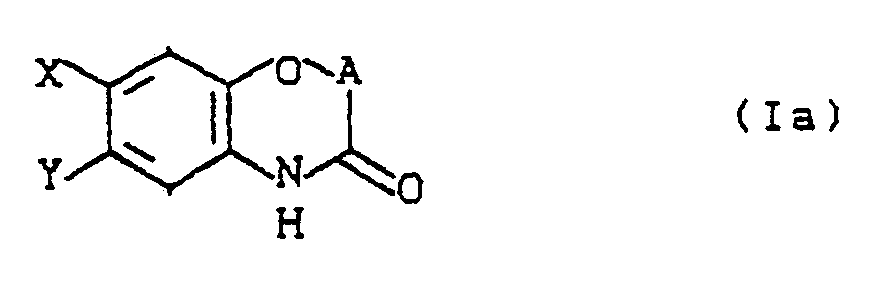
A, X und Y die oben angegebenen Bedeutungen haben und
mit Alkylierungsmitteln der allgemeinen Formel (VII)
R - X¹ (VII)
in welcher
R die oben angegebene Bedeutung hat und
X¹ für Halogen steht,
gegebenenfalls in Gegenwart eines Säureakzeptors und gegebenenfalls in Gegenwart eines Verdünnungsmittels umsetzt, oder wenn man - (f) Benzoxazinone der allgemeinen Formel (Ib)

A, R, R⁴ und X die oben angegebenen Bedeutungen haben,
mit Alkylierungsmitteln der allgemeinen Formel (VIII)
R⁵ - X² (VIII)
in welcher
R⁵ für jeweils gegebenenfalls durch Halogen sub stituiertes Alkyl, Alkenyl oder Alkinyl steht und
X² für Halogen steht,
gegebenenfalls in Gegenwart eines Säureakzeptors und gegebenenfalls in Gegenwart eines Verdünnungsmittels umsetzt, oder wenn man - (g) Benzoxazinone der allgemeinen Formel (IX)

A, R, R², R³ und X die oben angegebenen Bedeutungen haben,
mit einem Halogenierungsmittel, gegebenenfalls in Gegenwart eines Katalysators und gegebenenfalls in Gegenwart eines Verdünnungsmittels umsetzt, oder wenn man - (h) Benzoxazinone der allgemeinen Formel (Ic)

A, R, R¹, R³ und X die oben angegebenen Bedeutungen haben,
mit einem Halogenierungsmittel oder Nitrierungsmittel, gegebenenfalls in Gegenwart eines Katalysators und gegebenenfalls in Gegenwart eines Verdünnungsmittel, umsetzt. - Schließlich wurde gefunden, daß die neuen substituierten Benzoxazinone der Formel (I) hervorragende herbizide Eigenschaften aufweisen.
- Überraschenderweise sind die erfindungsgemäßen substituierten Benzoxazinone der Formel (I) gegen Unkräuter wesentlich stärker wirksam als 5-tert-Butyl-3-(2,4-dichlor-5-isopropoxy-phenyl)-1,3,4-oxadiazol-2-on, welches ein strukturell ähnlicher vorbekannter Wirkstoff gleicher Wirkungsrichtung ist.
- Die Kohlenstoffketten in den einzelnen Resten, wie beispielsweise Alkyl, Alkoxy, Alkylthio, Alkoxycarbonyl oder Alkylaminocarbonyl sind jeweils geradkettig oder verzweigt.
- Die Erfindung betrifft vorzugsweise Verbindungen der Formel (I), in welcher A

X für Wasserstoff, Fluor oder Chlor steht und
Y für die nachstehenden heterocyclischen Gruppierungen steht
R¹ für Wasserstoff, Fluor, Chlor, Brom oder für gegebenenfalls durch Fluor und/oder Chlor substituiertes C₁-C₄-Alkyl steht,
R² für Wasserstoff, Cyano, Nitro, Fluor, Chlor, Brom, Iod oder für gegebenenfalls durch Fluor und/oder Chlor substituiertes C₁-C₄-Alkyl steht,
R³ für Wasserstoff oder gegebenenfalls durch Fluor und/oder Chlor substituiertes C₁-C₄-Alkyl steht oder zusammen mit R² für C₃- oder C₄-Alkandiyl steht,
R⁴ für Wasserstoff oder für jeweils gegebenenfalls durch Fluor, Chlor und/oder Brom substituiertes C₁-C₄-Alkyl, C₃-C₆-Cycloalkyl, C₂-C₄-Alkenyl oder C₂-C₄-Alkinyl steht, und
Z für Sauerstoff oder für die Gruppierung -N-R⁵ steht, worin
R⁵ für Wasserstoff oder für jeweils gegebenenfalls durch Fluor und/oder Chlor substituiertes C₁-C₄-Alkyl, C₃-C₄-Alkenyl oder C₃-C₄-Alkinyl steht, oder zusammen mit R⁴ mit C₃-oder C₄-Alkandiyl steht. - Die Erfindung betrifft insbesondere Verbindungen der Formel (I), in welcher
A für Methylen (-CH₂-) oder Ethyliden
R für Wasserstoff, für gegebenenfalls durch Fluor, Chlor, Cyano oder C₁-C₄-Alkoxy substituiertes C₁-C₄-Alkyl, für C₁-C₄-Alkoxy-carbonyl-C₁-C₂-alkyl, für C₁-C₄-Alkylamino-carbonyl-C₁-C₂-alkyl, für C₃-C₆-Alkenyl, für C₃-C₄-Alkinyl, für Benzyl oder Pyridinylmethyl steht,
X für Wasserstoff oder Fluor steht und
Y für die nachstehenden heterocyclischen Gruppierungen steht
R¹ für Wasserstoff, Chlor, Brom, C₁-C₄-Alkyl oder durch Fluor und/oder Chlor substituiertes Methyl steht,
R² für Wasserstoff, Cyano, Nitro, Chlor, Brom, C₁-C₄-Alkyl oder durch Fluor und/oder Chlor substituiertes Methyl steht,
R³ für Wasserstoff, C₁-C₄-Alkyl oder durch Fluor und/oder Chlor substituiertes Methyl steht oder zusammen mit R² für C₃- oder C₄-Alkandiyl steht,
R⁴ für Wasserstoff oder für jeweils gegebenenfalls durch Fluor und/oder Chlor substituiertes C₁-C₄-Alkyl, C₃-C₆-Cycloalkyl, C₂-C₄-Alkenyl oder C₂-C₄-Alkinyl steht, und
Z für Sauerstoff oder die Gruppierung -N-R⁵ steht, worin
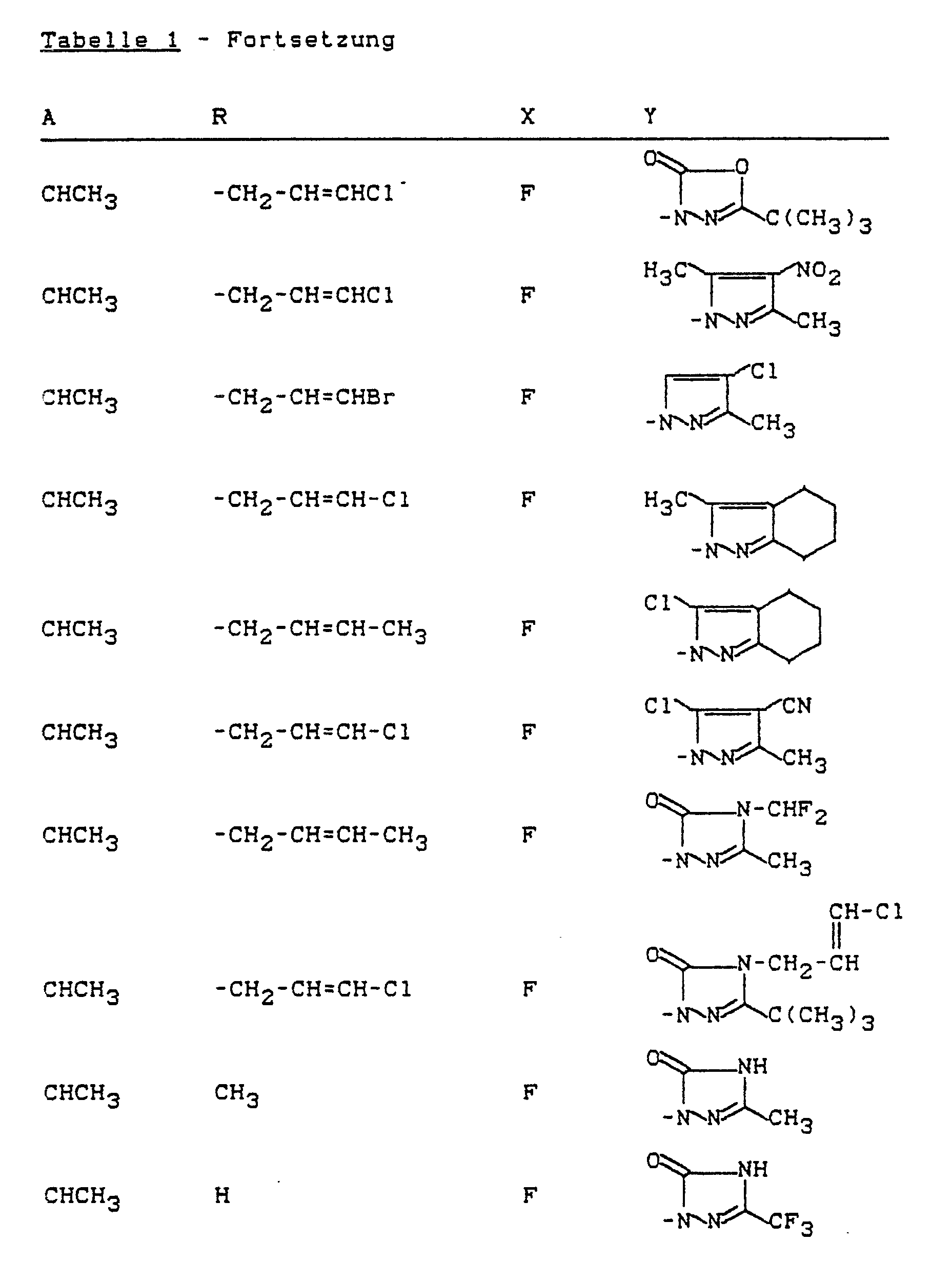
R⁵ für Wasserstoff, C₁-C₂-Alkyl, jeweils durch Fluor und/oder Chlor substituiertes Methyl, C₃-C₄-Alkenyl oder C₃-C₄-Alkinyl steht. - Beispiele für die erfindungsgemäßen Verbindungen der Formel (I) sind in der nachstehenden Tabelle 1 aufgeführt - vgl. auch die Herstellungsbeispiele.


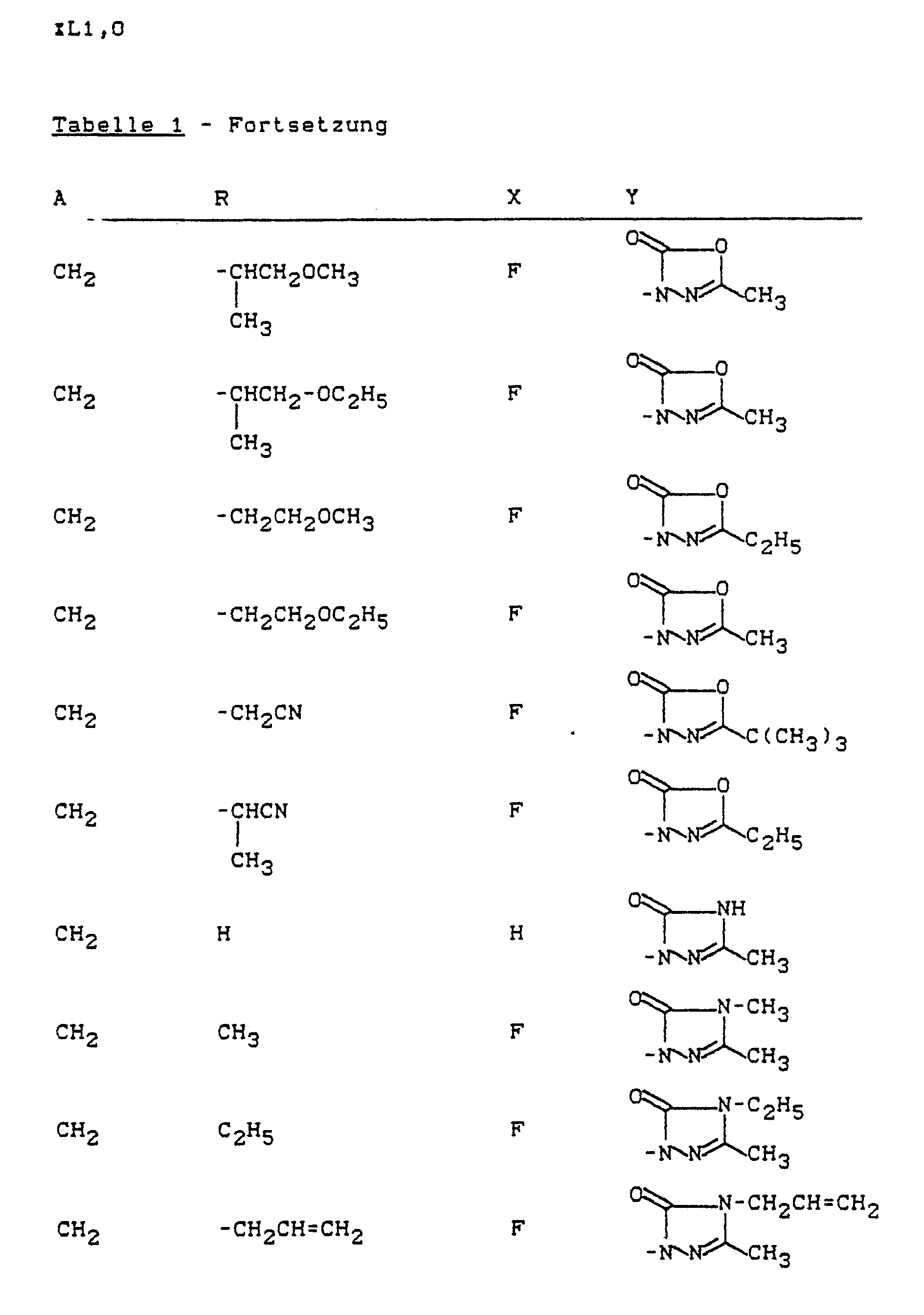


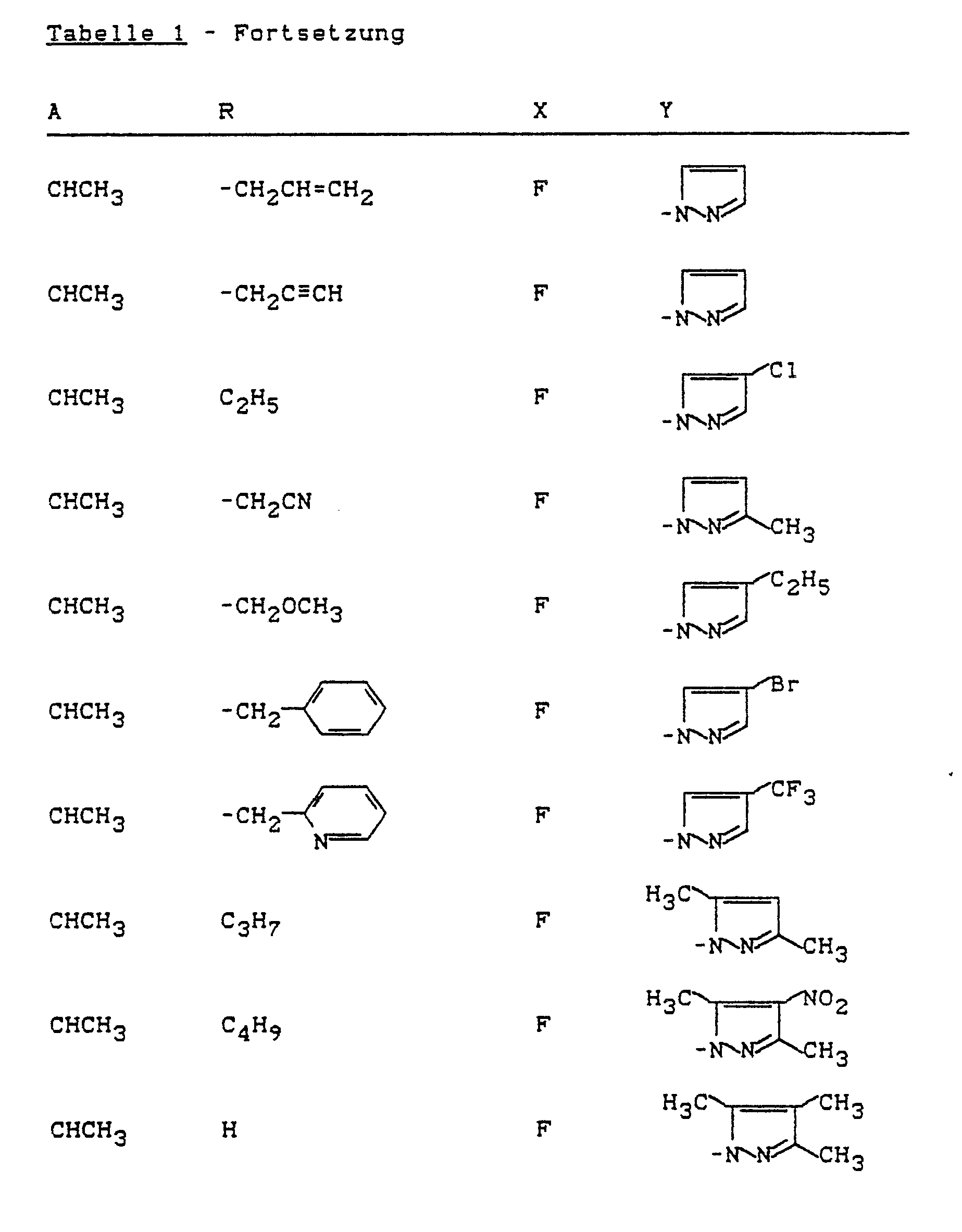


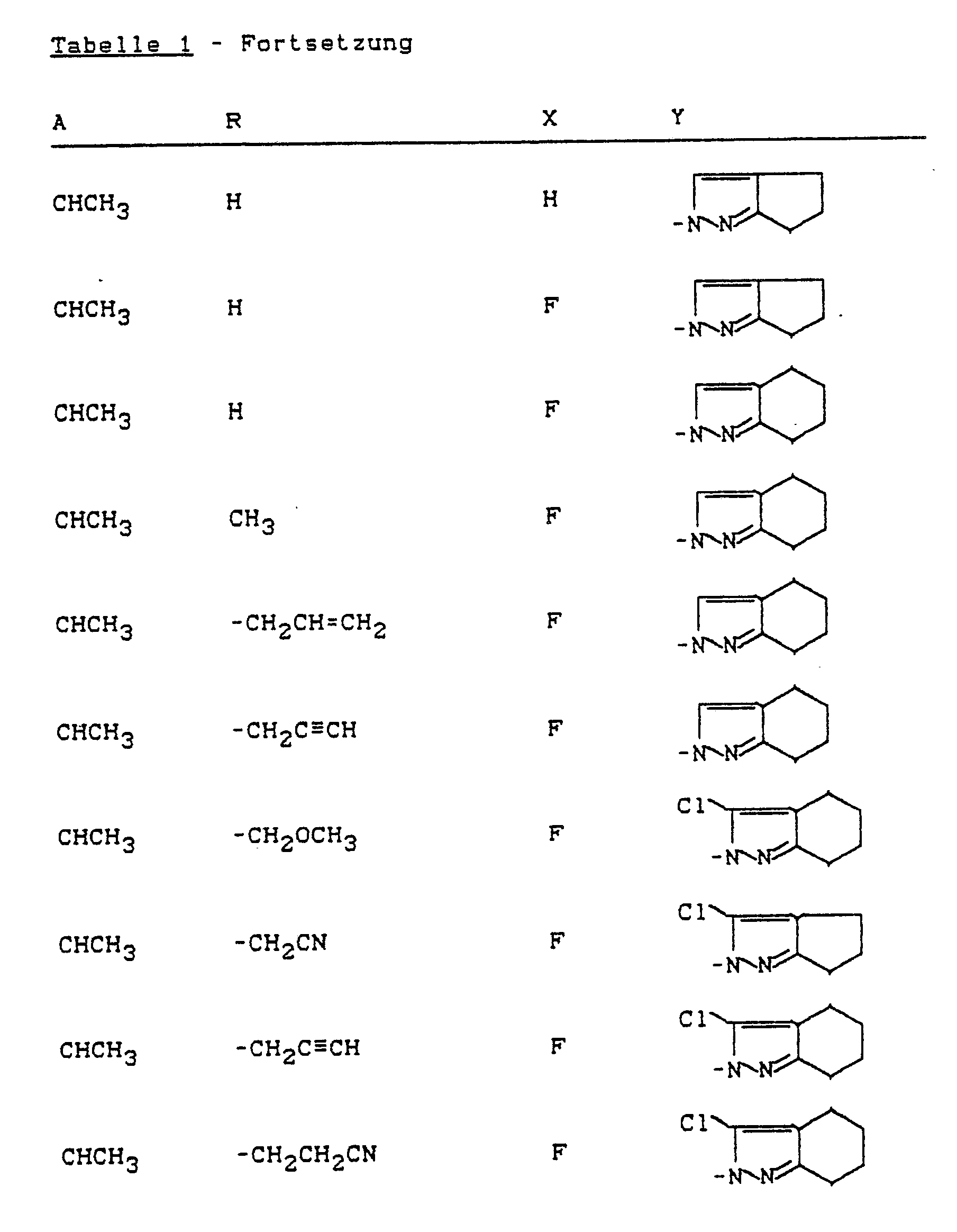




- Verwendet man für das erfindungsgemäße Verfahren (a) beispielsweise 7-Fluor-6-hydrazino-3,4-dihydro-3-oxo-2H-1,4-benzoxazin und Acetylaceton als Ausgangsstoffe, so kann der Reaktionsablauf durch das folgenden Formelschema wiedergegeben werden:

- Verwendet man für das erfindungsgemäße Verfahren (b) beispielsweise 6-Hydrazino-3,4-dihydro-3-oxo-2H-1,4-benzoxazin und N-Methoxycarbonyl-O-ethyl-acetimidester als Ausgangsstoffe, so kann der Reaktionsablauf durch das folgende Formelschema wiedergegeben werden:

- Verwendet man für das erfindungsgemäße Verfahren (c) beispielsweise 6-Acetylhydrazino-7-chlor-3,4-dihydro-3-oxo-2H-1,4-benzoxazin und Phosgen als Ausgangsstoffe so kann der Reaktionsablauf durch das folgende Formelschema wiedergegeben werden:

- Verwendet man für das erfindungsgemäße Verfahren (d) beispielsweise 1-(2-Fluor-4-methoxycarbonyl-methoxy-5-nitro-phenyl)-pyrazol und Wasserstoff als Ausgangsstoffe, so kann der Reaktionsablauf durch das folgende Formelschema wiedergegeben werden:

- Verwendet man für das erfindungsgemäße Verfahren (e) beispielsweise 7-Fluor-6-trimethylpyrazolyl-3,4-dihydro-3-oxo-2H-1,4-benzoxazin und Allylbromid als Ausgangsstoffe, so kann der Reaktionsablauf durch das folgende Formelschema wiedergegeben werden:

- Verwendet man für das erfindungsgemäße Verfahren (f) beispielsweise 7-Fluor-6-(4,5-dihydro-3-methyl-5-oxo-1H-triazol-1-yl)-3,4-dihydro-3-oxo-2H-4-propargyl-1,4-benzoxazin und Allylbromid als Ausgangsstoffe, so kann der Reaktionsablauf durch das folgende Formelschema wiedergegeben werden:

- Verwendet man für das erfindungsgemäße Verfahren (g) beispielsweise 7-Fluor-6-(5-hydroxy-3-trifluormethylpyrazol-1-yl)-3,4-dihydro-4-methyl-3-oxo-2H-1,4-benzoxazin und Thionylchlorid als Ausgangsstoffe, so kann der Reaktionsablauf durch das folgende Formelschema wiedergegeben werden:

- Verwendet man für das erfindungsgemäße Verfahren (h) beispielsweise 7-Fluor-6-(3,5-dimethylpyrazol-1-yl)-3,4- dihydro-4-methoxymethyl-3-oxo-2H-1,4-benzoxazin und Brom als Ausgangsstoffe, so kann der Reaktionsablauf durch das folgende Formelschema wiedergegeben werden:

- Die beim erfindungsgemäßen Verfahren (a) zur Herstellung von Verbindungen der Formel (I) als Ausgangsstoffe zu verwendenden Hydrazino-benzoxazinone sind durch die Formel (II) allgemein definiert.
- In Formel (II) haben A, R und X vorzugsweise bzw. insbesondere diejenigen Bedeutungen, die bereits oben im Zusammenhang mit der Beschreibung der erfindungsgemäßen Verbindungen der Formel (I) vorzugsweise bzw. als insbesondere bevorzugt für A, R und X angegeben wurden.
- Als Beispiele für die Ausgangsstoffe der Formel (II) seien genannt:
6-Hydrazino-3,4-dihydro-3-oxo-2H-1,4-benzoxazin, 7-Chlor und 7-Fluor-6-hydrazino-3,4-dihydro-3-oxo-2H-1,4-benzoxazin, 4-Methyl, 4-Ethyl-, 4-Propyl-, 4-Isopropyl-, 4-Butyl-, 4-sec-Butyl-, 4-Isobutyl, 4-Cyanomethyl-, 4-(1-Cyano-ethyl)-, 4-(2-Cyano-ethyl)-, 4-Methoxymethyl-, 4-Ethoxymethyl-, 4-Difluormethyl-, 4-Allyl-, 4-(3-Methyl-2-buten-1-yl)-, 4-(2-Buten-1-yl)-, 4-Propargyl-, 4-(2-Butin-1-yl)-, 4-Methoxycarbonylmethyl-, 4-Ethoxycarbonylmethyl-, 4-(1-Methoxycarbonylethyl)-, 4-(1- Ethoxycarbonyl-ethyl)-, 4-Methylaminocarbonylmethyl-, 4-Ethylaminocarbonylmethyl-, 4-(1-Methylaminocarbonylethyl)-, 4-(1-Ethylaminocarbonyl-ethyl)-, 4-(2-Methoxy-1-methyl-ethyl)-, 4-(2-Ethoxy-1-methyl-ethyl)-, 4-(2-Methoxy-ethyl)-, 4-(2-Ethoxy-ethyl)- und 4-(2-Propoxy-ethyl)-6-hydrazino-3,4-dihydro-3-oxo-2H-1,4-benzoxazin sowie 4-Methyl-, 4-Ethyl-, 4-Propyl-, 4-Isopropyl-, 4-Butyl-, 4-sec-Butyl-, 4-Isobutyl, 4-Cyanomethyl, 4-(1-Cyano-ethyl)-, 4-(2-Cyano-ethyl)-, 4-Methoxymethyl-, 4-Ethoxymethyl-, 4-Difluormethyl-, 4-Allyl-, 4-(3-Methyl-2-buten-1-yl)-, 4-(2-Buten-1-yl)-, 4-Propargyl-, 4-(2-Butin-1-yl)-, 4-Methoxycarbonylmethyl-, 4-Ethoxycarbonylmethyl-, 4-(1-Methoxycarbonylethyl)-, 4-(1-Ethoxycarbonyl-ethyl)-, 4-Methylaminocarbonylmethyl-, 4-Ethylaminocarbonylmethyl-, 4-(1-Methylaminocarbonyl-ethyl)-, 4-(1-Ethylaminocarbonyl-ethyl)-, 4-(2-Methoxy-1-methyl-ethyl)-, 4-(2-Ethoxy-1-methyl-ethyl)-, 4-(2-Methoxy-ethyl)-, 4-(2-Ethoxy-ethyl)- und 4-(2-Propoxy-ethyl)-7-fluor-6-hydrazino-3,4-dihydro-3-oxo-2H-1,4-benzoxazin. - Die Ausgangsstoffe der Formel (II) - in welcher X für Halogen steht - sind noch nicht aus der Literatur bekannt. Man erhält die neuen Verbindungen der Formel (IIa),

X³ für Halogen steht und
A und R die oben angegebenen Bedeutungen haben,
wenn man entsprechende Amino-benzoxazinone der allgemeinen Formel (X)
A, R und X³ die oben angegebene Bedeutung haben,
mit Nitriten, wie z. B. Natrium- oder Kalium-nitrit, in Gegenwart von Säuren und/oder Verdünnungsmitteln, wie z. B. Salzsäure, Schwefelsäure und/oder Essigsäure, bei Temperaturen zwischen 0 °C und 30 °C umsetzt, anschließend mit Reduktionsmitteln, wie z. B. Zink, Zinn-(II)-chlorid, Titan-(III)-chlorid oder Natrium(hydrogen) sulfit, in Gegenwart von Säuren, wie z. B. Salzsäure, bei Temperaturen zwischen 0 °C und 30 °C umsetzt und gegebenenfalls anschließend mit Basen, wie z. B. wäßrigem Ammoniak oder Natronlauge, bei Temperaturen zwischen 0 °C und 30 °C umsetzt und nach üblichen Methoden aufarbeitet. - Verbindungen der Formel (II) in welcher X für Wasserstoff steht sind dagegen bereits bekannt (vgl. DE-OS 27 40 836).
- In der Formel (IIa) steht X³ vorzugsweise für Fluor oder Chlor, insbesondere für Fluor und A und R haben vorzugsweise bzw. besonders bevorzugt diejenigen Bedeutungen, die bereits oben bei der Beschreibung der erfindungsgemäßen Verbindungen der Formel (I) vorzugsweise bzw. als insbesondere bevorzugt für A und B angegeben wurden.
- Die als Zwischenprodukte zu verwendenden Aminobenzoxazine sind durch die Formel (X) allgemein definiert.
- In Formel (X) haben A, R und X³ vorzugsweise bzw. insbesondere diejenigen Bedeutungen, die bereits oben im Zusammenhang mit der Beschreibung der erfindungsgemäßen Verbindungen der Formel (IIa) vorzugsweise bzw. als insbesondere bevorzugt für A, R und X³ angegeben wurden.
- Als Beispiele für die Zwischenprodukte der Formel (X) seien genannt:
6-Amino-3,4-dihydro-3-oxo-2H-1,4-benzoxazin, 7-Chlor- und 7-Fluor-6-amino-3,4-dihydro-3-oxo-2H-1,4-benzoxazin, 4-Methyl-, 4-Ethyl-, 4-Propyl-, 4-Isopropyl-, 4-Butyl-, 4-sec-Butyl-, 4-Isobutyl, 4-Cyanomethyl-, 4-(1-Cyano-ethyl)-, 4-(2-Cyano-ethyl)-, 4-Methoxymethyl-, 4-Ethoxymethyl, 4-Difluormethyl-, 4-Allyl-, 4-(3-Methyl-2-buten-1-yl)-, 4-(2-Buten-1-yl)-, 4-Propargyl-, 4-(2-Butin-1-yl)-, 4-Methoxycarbonylmethyl-, 4-Ethoxycarbonylmethyl-, 4-(1-Methoxycarbonylethyl)-, 4-(1-Ethoxycarbonyl-ethyl)-, 4-Methylaminocarbonylmethyl-, 4-Ethylaminocarbonylmethyl-, 4-(1-Methylaminocarbonyl-ethyl)-, 4-(1-Ethylaminocarbonyl-ethyl)-, 4-Methoxy-1-methyl- ethyl)-, 4-(2-Ethoxy-1-methyl-ethyl)-, 4-(2-Methoxy-ethyl)-, 4-(2-Ethoxy-ethyl)- und 4-(2-Propoxy-ethyl)-6-amino-3,4-dihydro-3-oxo-2H-1,4-benzoxazin sowie 4-Methyl-, 4-Ethyl-, 4-Propyl-, 4-Isopropyl-, 4-Butyl-, 4-sec-Butyl-, 4-Isobutyl, 4-Cyanomethyl-, 4-(1-Cyano-ethyl)-, 4-(2-Cyano-ethyl)-, 4-Methoxymethyl, 4-Ethoxymethyl-, 4-Difluormethyl-, 4-Allyl-, 4-(3-Methyl-2-buten-1-yl)-, 4-(2-Buten-1-yl)-, 4-Propargyl-, 4-(2-Butin-1-yl)-, 4-Methoxycarbonylmethyl-, 4-Ethoxycarbonylmethyl-, 4-(1-Methoxycarbonylethyl)-, 4-(1-Ethoxycarbonylethyl)-, 4-Methylaminocarbonylmethyl-, 4-Ethylaminocarbonylmethyl-, 4-(1-Methylaminocarbonyl-ethyl)-, 4-(1-Ethylaminocarbonyl-ethyl)-, 4-(2-Methoxy-1-methyl-ethyl-4-(2-Ethoxy-1-methyl-ethyl)-, 4-(2-Methoxy-ethyl)-, 4-(2-Ethoxy-ethyl)- und 4-(2-Propoxy-ethyl)-7-fluor-6-amino-3,4-dihydro-3-oxo-2H-1,4-benzoxazin. - Die Amino-benzoxazinone der Formel (X) sind bekannt und/oder können nach an sich bekannten Verfahren hergestellt werden (vgl. EP-A 170 191, EP-A 237 899).
- Die beim erfindungsgemäßen Verfahren (a) zur Herstellung von Verbindungen der Formel (I) weiter als Ausgangsstoffe zu verwendenden 1,3-Dicarbonylverbindungen sind durch die Formel (III) allgemein definiert.
- In Formel (III) haben R¹, R² und R³ vorzugsweise bzw. insbesondere diejenigen Bedeutungen, die bereits oben im Zusammenhang mit der Beschreibung der erfindungsgemäßen Verbindungen der Formel (I) vorzugsweise bzw. als insbesondere bevorzugt für R¹, R² und R³ angegeben wurden.
- Als Beispiele für die Ausgangsstoffe der Formel (III) seien genannt:
Malonaldehyd-tetraethylacetal, 3-Oxo-butyraldehyd-dimethylacetal, Pentan-2,4-dion, 3-Nitro-, 3-Fluor-, 3-Chlor-, 3-Brom-, 3-Methyl-, 3-Ethyl-, 3-Propyl-, 3-Butyl- und 3-Trifluormethyl-pentan-2,4-dion, 1,1,1,-Trifluor-pentan-2,4-dion, 1,1,1,5,5,5-hexafluor-pentan-2,4-dion, 2-Formyl- und 2-Acetyl-cyclopentanon sowie 2-Formyl- und 2-Acetyl-cyclohexanon. - Die Ausgangsstoffe der Formel (III) sind bekannte organischen Synthesechemikalien.
- Das erfindungsgemäße Verfahren (a) zur Herstellung der neuen substituierten Benzoxazinone der Formel (I) wird vorzugsweise unter Verwendung von Verdünnungsmitteln durchgeführt. Als Verdünnungsmittel kommen dabei praktisch alle inerten organischen Lösungsmittel in Frage. Hierzu gehören vorzugsweise aliphatische und aromatische, gegebenenfalls halogenierte Kohlenwasserstoffe wie Pentan, Hexan, Heptan, Cyclohexan, Petrolether, Benzin, Ligroin, Benzol, Toluol, Xylol, Methylenchlorid, Ethylenchlorid, Chloroform, Tetrachlorkohlenstoff, Chlorbenzol und o-Dichlorbenzol, Alkohole, wie Methanol, Ethanol, Propanol, Isopropanol, Butanol, Isobutanol, sec-Butanol und tert-Butanol, Ether wie Diethyl- und Dibutylether, Glykoldimethylether und Diglykoldimethylether, Tetrahydrofuran und Dioxan, Ketone wie Aceton, Methyl-ethyl-, Methyl-isopropyl- und Methyl-isobutyl-keton, Ester wie Essigsäuremethylester und -ethylester, Nitrile wie z. B. Acetonitril und Propionitril, Amide wie z. B. Dimethylformamid, Dimethylacetamid und N-Methyl-pyrrolidon sowie Dimethylsulfoxid, Tetramethylensulfon und Hexamethylphosphorsäuretriamid.
- Auch Wasser kann - gegebenenfalls im Gemisch mit den oben angegebenen organischen Lösungsmitteln - als Verdünnungsmittel bei Verfahren (a) verwendet werden.
- Die Reaktionstemperaturen können bei dem erfindungsgemäßen Verfahren (a) in einem größeren Bereich variiert werden. Im allgemeinen arbeitet man bei Temperaturen zwischen 0 °C und 150 °C, vorzugsweise bei Temperaturen zwischen 20 °C und 100 °C. Verfahren (a) wird im allgemeinen bei Normaldruck durchgeführt.
- Zur Durchführung des erfindungsgemäßen Verfahrens (a) werden die jeweils benötigten Ausgangsstoffe im allgemeinen in angenähert äquimolaren Mengen eingesetzt. Es ist jedoch auch möglich, eine der beiden jeweils eingesetzten Komponenten in einem größeren Überschuß zu verwenden. Die Reaktionen werden im allgemeinen in einem geeigneten Verdünnungsmittel durchgeführt, und das Reaktionsgemisch wird mehrere Stunden bei der jeweils erforderlichen Temperatur gerührt. Die Aufarbeitung erfolgt bei dem erfindungsgemäßen Verfahren (a) jeweils nach üblichen Methoden.
- Auf die beim erfindungsgemäßen Verfahren (b) als Ausgangsstoffe einzusetzenden Hydrazino-benzoxazinone der Formel (II) ist bereits im Zusammenhang mit der Beschreibung der Ausgangsstoffe für Verfahren (a) eingegangen worden.
- Die beim erfindungsgemäßen Verfahren (b) zur Herstellung von Verbindungen der Formel (I) weiter als Ausgangsstoffe zu verwendenden N-Alkoxycarbonylimidsäureester sind durch die Formel (IV) allgemein definiert.
- In Formel (IV) hat R⁴ vorzugsweise bzw. insbesondere diejenige Bedeutung, die bereits oben im Zusammenhang mit der Beschreibung der erfindungsgemäßen Verbindungen der Formel (I) vorzugsweise bzw. als insbesondere bevorzugt für R⁴ angegeben wurde und R⁶ steht vorzugsweise für C₁-C₄-Alkyl, insbesondere für Methyl oder Ethyl.
- Als Beispiele für die Ausgangsstoffe der Formel (IV) seien genannt:
N-Methoxycarbonyl-O-methyl-, N-Ethoxycarbonyl-O-methyl-, N-Methoxycarbonyl-O-ethyl- und N-Ethoxycarbonyl-O-ethyl-acetimidester, -formimidester, -propionimidester, -butyrimidester und -trifluoracetimidester. - Die N-Alkoxycarbonyl-carbonimidsäureester der Formel (IV) sind bekannte organische Synthesechemikalien.
- Das erfindungsgemäße Verfahren (b) zur Herstellung der neuen substituierten Benzoxazinone der Formel (I) wird vorzugsweise unter Verwendung von Verdünnungsmitteln durchgeführt. Als Verdünnungsmittel kommen dabei prak tisch alle inerten organischen Lösungsmittel in Frage. Hierzu gehören vorzugsweise aliphatische und aromatische, gegebenenfalls halogenierte Kohlenwasserstoffe wie Pentan, Hexan, Heptan, Cyclohexan, Petrolether, Benzin, Ligroin, Benzol, Toluol, Xylol, Methylenchlorid, Ethylenchlorid, Chloroform, Tetrachlorkohlenstoff, Chlorbenzol und o-Dichlorbenzol, Ether wie Diethyl- und Dibutylether, Glykoldimethylether und Diglykoldimethylether, Tetrahydrofuran und Dioxan, Ketone wie Aceton, Methyl-ether, Methyl-isopropyl- und Methyl-isobutyl-keton, Ester wie Essigsäuremethylester und -ethylester, Nitrile wie z. B. Acetonitril und Propionitril, Amide wie z. B. Dimethylformamid, Dimethylacetamid und N-Methyl-pyrrolidon sowie Dimethylsulfoxid, Tetramethylensulfon und Hexamethylphosphorsäuretriamid.
- Die Reaktionstemperaturen können bei dem erfindungsgemäßen Verfahren (b) in einem größeren Bereich variiert werden. Im allgemeinen arbeitet man bei Temperaturen zwischen 0 °C und 200 °C, vorzugsweise bei Temperaturen zwischen 20 °C und 150 °C.
- Zur Durchführung des erfindungsgemäßen Verfahrens (b) setzt man je Mol Hydrazino-benzoxazinon der Formel (II) im allgemeinen zwischen 1 und 2 Mol, vorzugsweise zwischen 1,2 und 1,5 Mol, N-Alkoxycarbonyl-carbonimidsäureester der Formel (IV) ein. Die Reaktionskomponenten werden im allgemeinen bei Raumtemperatur zusammen gegeben und das Reaktionsgemisch wird, gegebenenfalls bei erhöhter Temperatur, bis zum Reaktionsende gerührt. Die Aufarbeitung kann nach üblichen Methoden durchgeführt werden.
- Die beim erfindungsgemäßen Verfahren (c) zur Herstellung von Verbindungen der Formel (I) als Ausgangsstoffe zu verwendenden Acylhydrazino-benzoxazinone sind durch die Formel (V) allgemein definiert.
- In Formel (V) haben A, R, R⁴ und X vorzugsweise bzw. insbesondere diejenigen Bedeutungen, die bereits oben im Zusammenhang mit der Beschreibung der erfindungsgemäßen Verbindungen der Formel (I) vorzugsweise bzw. als insbesondere bevorzugt für A, R, R⁴ und X angegeben wurden.
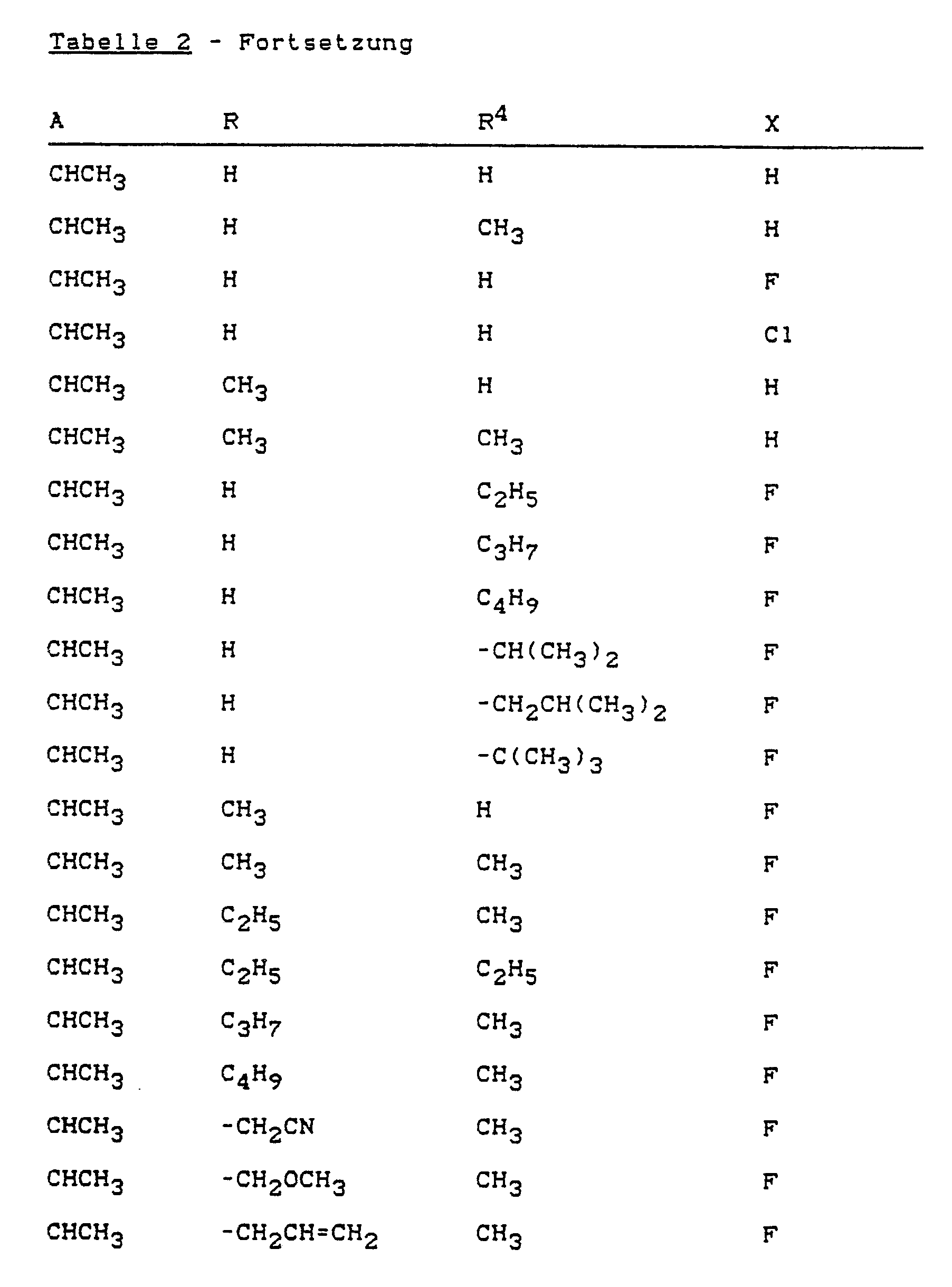
- Beispiele für die Ausgangsstoffe der Formel (V) sind in der nachstehenden Tabelle 2 aufgeführt:



- Die Ausgangsstoffe der Formel (V) sind noch nicht aus der Literatur bekannt. Man erhält die neuen Verbindungen der Formel (V), wenn man entsprechende Hydrazino-benzoxazinone der Formel (II)

A, R und X die oben angegebenen Bedeutungen haben,
mit Acylierungsmitteln der allgemeinen Formel (XI)
R⁴ - CO - X⁴ (XI)
in welcher
R⁴ die oben angegebene Bedeutung hat und
X⁴ für Halogen steht,
gegebenenfalls in Gegenwart von Säureakzeptoren, wie z. B. Triethylamin oder Pyridin, und gegebenenfalls in Gegenwart von Verdünnungsmitteln, wie z. B. Toluol oder Methylenchlorid, bei Temperaturen zwischen -20 °C und +50 °C umsetzt und nach üblichen Methoden aufarbeitet. - Auf die als Zwischenprodukte zu verwendenden Hydrazino-benzoxazinone der Formel (II) ist bereits im Zusammen hang mit der Beschreibung der Ausgangsstoffe für Verfahren (a) eingegangen worden.
- Die weiter als Zwischenprodukte zu verwendenden Acylierungsmittel sind durch die Formel (XI) allgemein definiert.
- In Formel (XI) hat R⁴ vorzugsweise bzw. insbesondere diejenige Bedeutung, die bereits oben im Zusammenhang mit der Beschreibung der erfindungsgemäßen Verbindungen der Formel (I) vorzugsweise bzw. als insbesondere bevorzugt für R⁴ angegeben wurde und X⁴ steht vorzugsweise für Chlor.
- Als Beispiele für die Ausgangsstoffe der Formel (XI) seien genannt:
Acetylchlorid, Propionylchlorid, Buttersäurechlorid, Isobuttersäurechlorid, Pivaloylchlorid und Dichloracetylchlorid. - Die Zwischenprodukte der Formel (XI) sind bekannte organische Synthesechemikalien.
- Das bei Verfahren (c) weiter als Ausgangsstoff zu verwendende Phosgen ist ebenfalls eine bekannte Synthesechemikalie.
- Das erfindungsgemäße Verfahren (c) wird vorzugsweise unter Verwendung von Verdünnungsmitteln durchgeführt. Es kommen vor allem diejenigen organischen Lösungsmittel in Betracht, die bereits oben für Verfahren (b) angegeben wurden.
- Als Säureakzeptoren können bei dem erfindungsgemäßen Verfahren (c) alle üblicherweise für derartige Umsetzungen verwendbaren Säurebindemittel eingesetzt werden. Vorzugsweise in Frage kommen Alkalimetallhydroxide wie z. B. Natrium- und Kaliumhydroxid, Erdalkalihydroxide wie z. B. Calciumhydroxid, Alkalicarbonate und -alkoholate wie Natrium- und Kaliumcarbonat, Natrium- und Kalium-tert-butylat, ferner aliphatische, aromatische oder heterocyclische Amine, beispielsweise Triethylamin, Trimethylamin, Dimethylanilin, Dimethylbenzylamin, Pyridin, 1,5-Diazabicyclo-[4,3,0]-non-5-en (DBN), 1,8-Diazabicyclo-[5,4,0]-undec-7-en (DBU) und 1,4-Diazabicyclo-[2,2,2]-octan (DABCO).
- Die Reaktionstemperaturen können bei dem erfindungsgemäßen Verfahren (c) in einem größeren Bereich variiert werden. Im allgemeinen arbeitet man bei Temperaturen zwischen 0 °C und 150 °C, vorzugsweise bei Temperaturen zwischen 10 °C und 120 °C.
- Zur Durchführung des erfindungsgemäßen Verfahrens (c) setzt man je Mol Acylhydrazino-benzoxazinon der Formel (V) im allgemeinen zwischen 1 und 2 Mol, vorzugsweise zwischen 1,1 und 1,5 Mol, Phosgen ein. Die Reaktionskomponenten werden im allgemeinen bei Raumtemperatur oder unter leichtem Kühlen zusammengegeben und das Reaktionsgemisch wird, gegebenenfalls bei erhöhter Temperatur bis zum Reaktionsende gerührt. Die Aufarbeitung kann nach üblichen Methoden durchgeführt werden.
- Die beim erfindungsgemäßen Verfahren (d) zur Herstellung von Verbindungen der Formel (I) als Ausgangsstoffe zu verwendenden Verbindungen sind durch die Formel (VI) allgemein definiert.
- In Formel (VI) haben A, X und Y vorzugsweise bzw. insbesondere diejenigen Bedeutungen, die bereits oben im Zusammenhang mit der Beschreibung der erfindungsgemäßen Verbindungen der Formel (I) vorzugsweise bzw. als insbesondere bevorzugt für A, X und Y angegeben wurden, und Q steht vorzugsweise für Cyano, Carboxy, Methoxycarbonyl oder Ethoxycarbonyl.
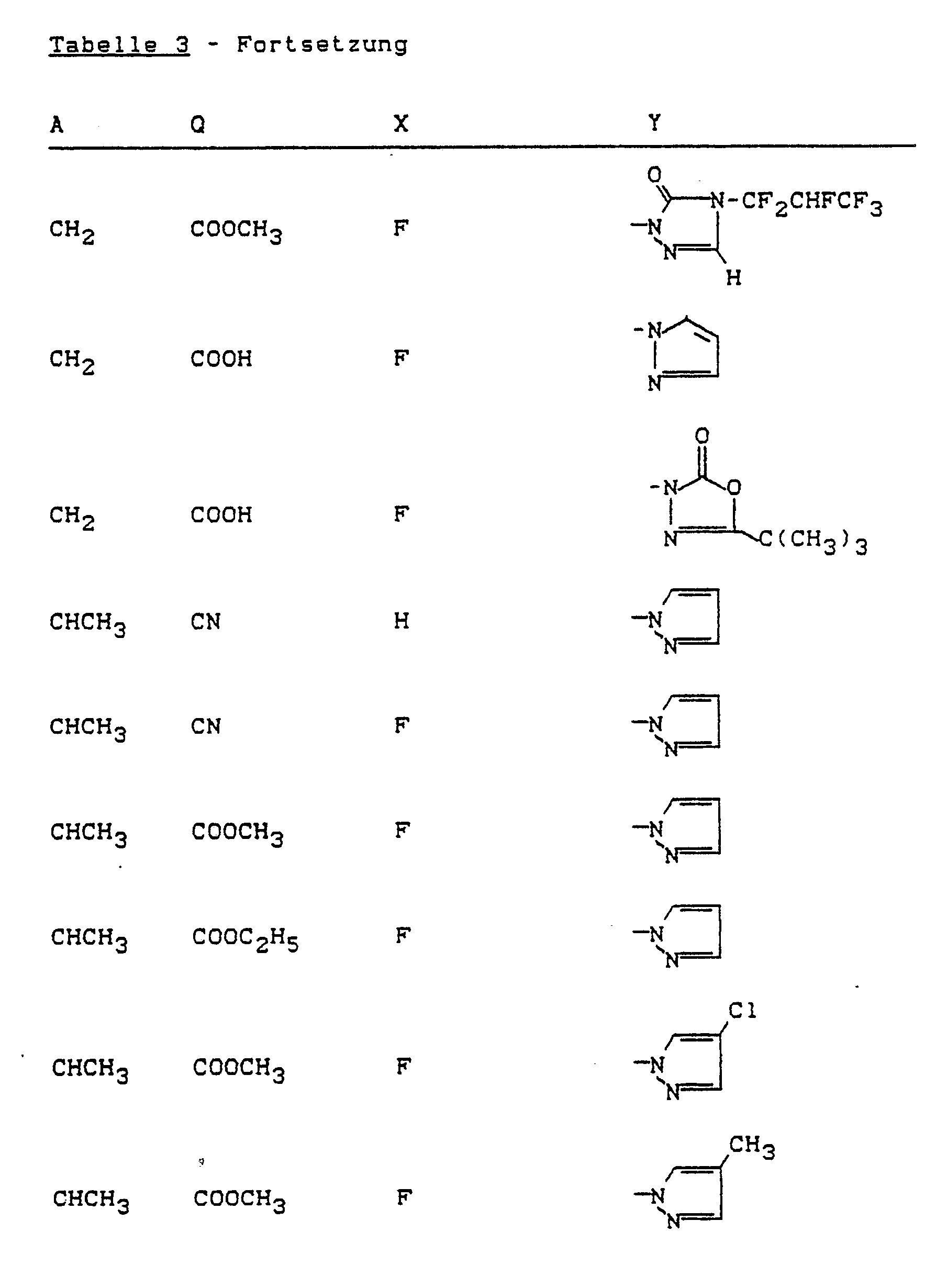
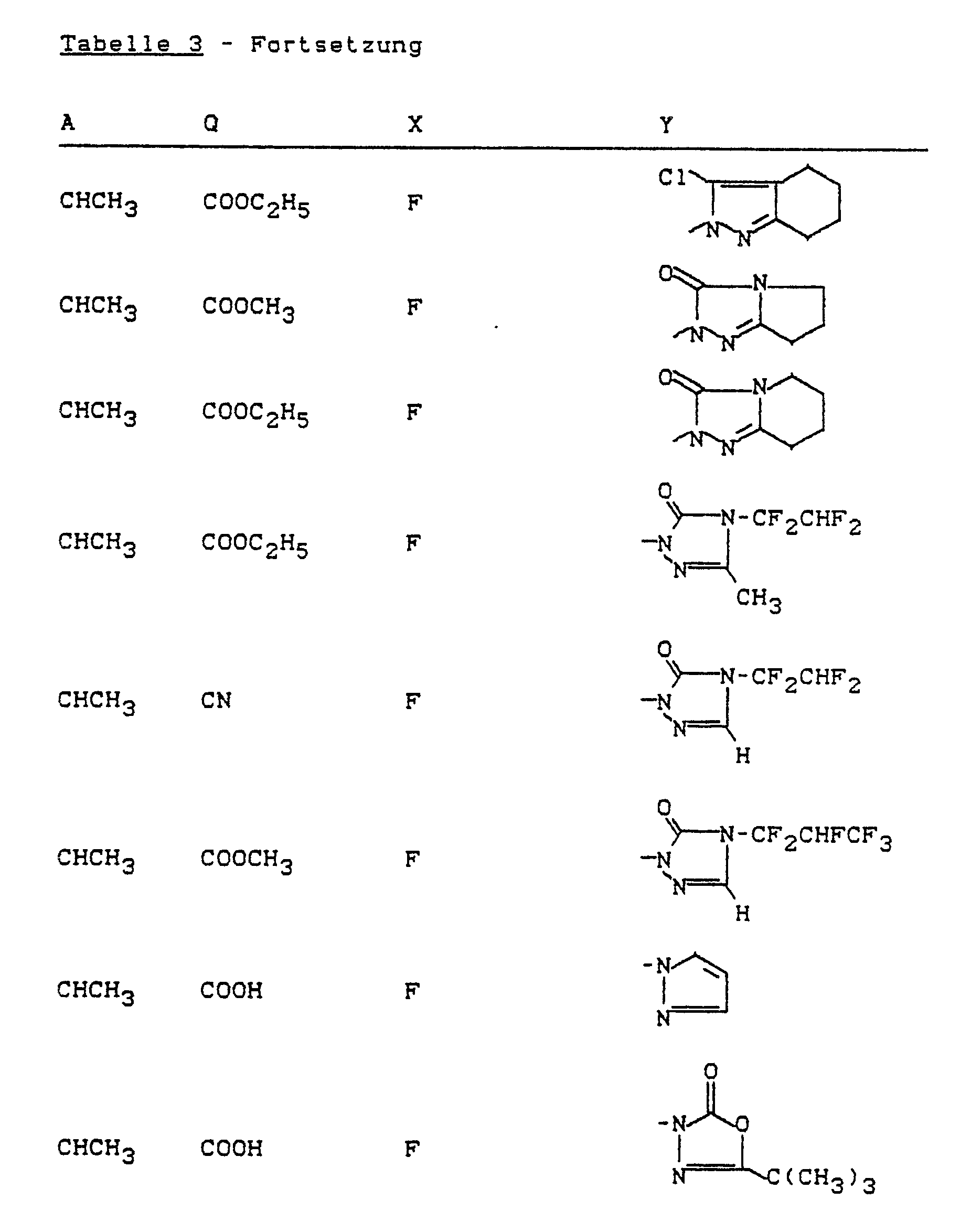
- Beispiele für die Ausgangsstoffe der Formel (VI) sind in der nachstehenden Tabelle 3 aufgeführt:




- Die Ausgangsstoffe der Formel (VI) sind noch nicht aus der Literatur bekannt. Man erhält die neuen Zwischenprodukte der Formel (VI), wenn man Verbindungen der allgemeinen Formel (XII)

A, Q, X und Y die oben angegebenen Bedeutungen haben,
mit Nitrierungsmitteln, wie z. B. Salpetersäure, gegebenenfalls in Gegenwart von Schwefelsäure, bei Temperaturen zwischen -20 °C und +50 °C umsetzt und nach üblichen Methoden aufarbeitet. - Die - ebenfalls neuen - Zwischenprodukte der Formel (XII) können, ausgehend von entsprechenden Arylhydrazinen der allgemeinen Formel (XIII)

A, Q und X die oben angegebenen Bedeutungen haben und
R⁷ für Wasserstoff bzw. für die Gruppierung -CO-R⁴ steht - worin R⁴ die oben angegebene Bedeutung hat,
analog zu den erfindungsgemäßen Verfahren (a), (b) oder (c) hergestellt werden. - Die Arylhydrazine der Formel (XIII) sind bekannt und/oder können nach an sich bekannten Verfahren hergestellt werden.
- Man erhält die Zwischenprodukte der Formel (XII) auch, wenn man Phenolderivate der Formel (XIV)

X und Y die oben angegebenen Bedeutungen haben,
mit Alkylierungsmitteln der Formel (XV)
X⁵ - A - Q (XV)
in welcher
A und Q die oben angegebenen Bedeutungen haben und
X⁵ für Halogen steht,
in Gegenwart eines Säureakzeptors, wie z. B. Kaliumcarbonat, und in Gegenwart eines Verdünnungsmittels, wie z. B. Aceton oder Acetonitril, bei Temperaturen zwischen 0 °C und 100 °C umsetzt. - Die Phenolderivate der Formel (XIV) können aus entsprechenden Hydroxyarylhydrazinen der Formel (XVI)

R⁷ und X die oben angegebenen Bedeutungen haben,
analog zu den erfindungsgemäßen Verfahren (a), (b) oder (c) hergestellt werden. - Die Alkylierungsmittel der Formel (XV) und die Hydroxyarylhydrazine der Formel (XVI) sind bekannt und/oder können nach an sich bekannten Verfahren hergestellt werden.
- Man erhält die Phenolderivate der Formel (XIV) ferner auch, wenn man entsprechende Methylether der Formel (XVII)
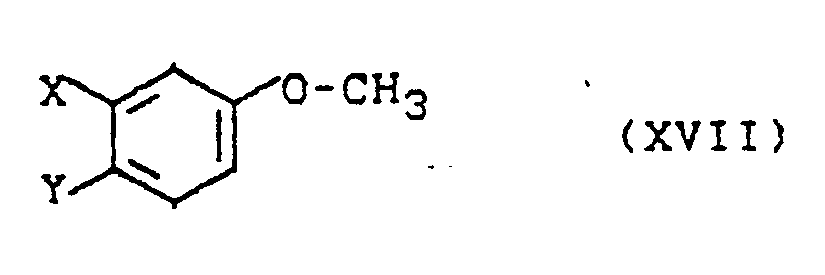
X und Y die oben angegebenen Bedeutungen haben,
nach üblichen Etherspaltungsmethoden, beispielsweise durch Umsetzung mit 48 %iger Bromwasserstoffsäure, bei Temperaturen zwischen 0 °C und 150 °C spaltet. - Die Methylether der Formel (XVII) können aus entsprechenden Methoxyarylhydrazinen der Formel (XVIII)

R⁷ und X die oben angegebenen Bedeutungen haben,
analog zu den erfindungsgemäßen Verfahren (a), (b) oder (c) hergestellt werden. - An den Zwischenprodukten der Formeln (XIV) und (XVII) können gegebenenfalls auch Reaktionen analog zu den erfindungsgemäßen Verfahren (f) und (h) - zu entspechenden Veränderungen des Substituenten Y - durchgeführt werden.
- Bei der Umsetzung von Verbindungen der Formel (XIV) mit Nitrierungsmitteln kann gegebenenfalls auch eine zweifache Nitrierung, beispielsweise zu Verbindungen der Formel (XIX)
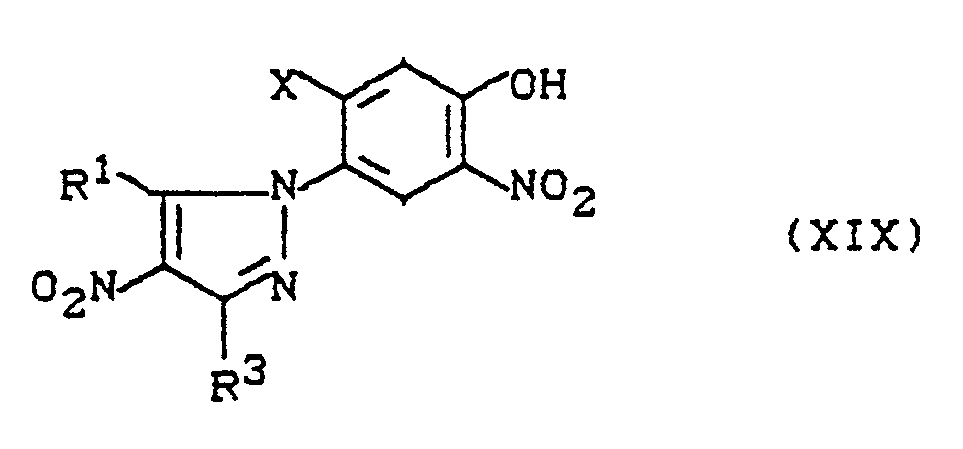
R¹, R³ und X die oben angegebenen Bedeutungen haben,
erreicht werden. Die so erhaltenen Verbindungen der Formel (XIX) können mit Alkylierungsmitteln der Formel (XV) - oben, wie dort beschrieben - weiter zu entsprechenden Ausgangsstoffen der Formel (VI) umgesetzt werden. - Das erfindungsgemäße Verfahren (d) zur Herstellung der neuen Verbindungen der Formel (I) wird unter Einsatz eines Reduktionsmittels durchgeführt. Als Reduktionsmittel für Verfahren (d) sind vor allem Wasserstoff in Gegegenwart eines Katalysators oder Eisen in Kombination mit einer Säure, wie z. B. Salzsäure, geeignet.
- Das erfindungsgemäße Verfahren (d) wird gegebenenfalls unter Verwendung eines Katalysators durchgeführt. Als Beispiele hierfür seien Raney-Nickel, Platin und Palladium genannt. Vorzugsweise wird Raney-Nickel für Verfahren (d) eingesetzt.
- Verfahren (d) wird in Gegenwart eines Verdünnungsmittels durchgeführt. Vorzugsweise werden Alkohole, wie Methanol, Ethanol, Propanol oder Isopropanol, Ether, wie Glycoldimethylether, Diglycoldimethylether, Tetrahydrofuran oder Dioxan, oder Ester, wie Essigsäuremethylester oder Essigsäureethylester, daneben gegebenenfalls auch Wasser als Lösungsmittel für Verfahren (d) eingesetzt.
- Die Reaktionstemperaturen können bei dem erfindungsgemäßen Verfahren (d) in einem größeren Bereich variiert werden. Im allgemeinen arbeitet man bei Temperaturen zwischen 0 °C und 150 °C, vorzugsweise bei Temperaturen zwischen 20 °C und 100 °C.
- Verfahren (d) wird im allgemeinen bei Normaldruck oder erhöhtem Druck bis etwa 200 bar, vorzugsweise bis etwa 100 bar, durchgeführt.
- Verfahren (d) kann unter den bei katalytischen Hydrierungen üblichen Bedingungen durchgeführt werden. In einer bevorzugten Ausführungsform von Verfahren (d) wird die Ausgangsverbindung der Formel (VI) mit dem Verdünnungsmittel und dem Katalysator vermischt und dann so lange Wasserstoff zudosiert, bis kein Verbrauch von Wasserstoff mehr festzustellen ist. Nach dem Ende der Hydrierung filtriert man das Reaktionsgemisch und erhält nach Einengen des Filtrates das Rohprodukt als Rückstand, welches auf übliche Weise, beispielsweise durch Säulenchromatographie, gereinigt werden kann.
- In einer anderen bevorzugten Ausführungsform von Verfahren (d) wird Eisen mit einer Säure, vorzugsweise Salzsäure, in einem geeigneten Lösungsmittel vorgelegt, die Ausgangsverbindungen der Formel (VI) wird, gegebenenfalls bei erhöhter Temperatur, langsam dazu gegeben und das Reaktionsgemisch wird bis zum Ende der Umsetzung gerührt. Die Aufarbeitung erfolgt nach üblichen Methoden.
- Die beim erfindungsgemäßen Verfahren (e) zur Herstellung von Verbindungen der Formel (I) als Ausgangsstoffe zu verwendenden Benzoxazinone sind durch die Formel (Ia) allgemein definiert.
- In Formel (Ia) haben A, X und Y vorzugsweise bzw. insbesondere diejenigen Bedeutungen, die bereits oben im Zusammenhang mit der Beschreibung der erfindungsgemäßen Verbindungen der Formel (I) vorzugsweise bzw. als insbesondere bevorzugt für A, X und Y angegeben wurden.
- Die Ausgangsstoffe der Formel (Ia) für Verfahren (e) sind erfindungsgemäße, neue Verbindungen; sie können nach den erfindungsgemäßen Verfahren (a), (b), (c) oder (d) hergestellt werden.
- Die beim erfindungsgemäßen Verfahren (e) zur Herstellung von Verbindungen der Formel (I) weiter als Ausgangsstoffe zu verwendenden Alkylierungsmittel sind durch die Formel (VII) allgemein definiert.
- In Formel (VII) hat R vorzugsweise bzw. insbesondere diejenige Bedeutung, die bereits oben im Zusammenhang mit der Beschreibung der erfindungsgemäßen Verbindungen der Formel (I) vorzugsweise bzw. als insbesondere bevorzugt für R angegeben wurde und X¹ steht vorzugsweise für Chlor, Brom oder Iod.
- Als Beispiele für die Ausgangsstoffe der Formel (VII) seien genannt:
Methyl-, Ethyl-, Propyl-, Isopropyl-, Butyl-, Isobutyl-, sec-Butyl-, tert-Butyl-, Allyl-, Propargyl-, Benzyl-, Picolyl-, Methoxymethyl-, Ethoxymethyl-, Cyanomethyl- und Cyanoethyl-chlorid sowie die entsprechenden Bromide und Iodide, Chlor- und Bromessigsäure-methylester und -ethylester sowie α-Chlor- und α-Brom-propionsäure-methylester und -ethylester. - Die Ausgangsstoffe der Formel (VII) sind bekannte organische Synthesechemikalien.
- Das erfindungsgemäße Verfahren (e) wird vorzugsweise unter Verwendung von Verdünnungsmitteln durchgeführt. Es kommen vor allem diejenigen organischen Lösungsmittel in Betracht, die bereits oben für Verfahren (b) angegeben wurden.
- Das erfindungsgemäße Verfahren (e) wird vorzugsweise in Gegenwart eines Säureakzeptors durchgeführt. Es kommen vor allem diejenigen Säureakzeptoren in Betracht, die bereits oben für Verfahren (c) angegeben wurden, ferner jedoch auch Alkalimetallhydride, wie z. B. Natrium- und Kalium-hydrid.
- Die Reaktionstemperaturen können bei dem erfindungsgemäßen Verfahren (e) in einem größeren Bereich variiert werden. Im allgemeinen arbeitet man bei Temperaturen zwischen -20 °C und +200 °C, vorzugsweise bei Temperaturen zwischen 0 °C und 150 °C.
- Das erfindungsgemäße Verfahren (e) wird im allgemeinen unter Normaldruck durchgeführt. Es ist jedoch auch möglich, unter erhöhtem oder vermindertem Druck zu arbeiten.
- Zur Durchführung des erfindungsgemäßen Verfahrens (e) werden die jeweils benötigten Ausgangsstoffe im allgemeinen in angenähert äquimolaren Mengen eingesetzt. Es ist jedoch auch möglich, eine der beiden jeweils einge setzten Komponenten in einem größeren Überschuß zu verwenden. Die Reaktionen werden im allgemeinen in einem geeigneten Verdünnungsmittel in Gegenwart eines Säureakzeptors durchgeführt, und das Reaktionsgemisch wird mehrere Stunden bei der jeweils erforderlichen Temperatur gerührt. Die Aufarbeitung erfolgt bei dem erfindungsgemäßen Verfahren (e) jeweils nach üblichen Methoden.
- Die beim erfindungsgemäßen Verfahren (f) zur Herstellung von Verbindungen der Formel (I) als Ausgangsstoffe zu verwendenden Benzoxazinone sind durch die Formel (Ib) allgemein definiert.
- In Formel (Ib) haben A, R, R⁴ und X vorzugsweise bzw. insbesondere diejenigen Bedeutungen, die bereits oben im Zusammenhang mit der Beschreibung der erfindungsgemäßen Verbindungen der Formel (I) vorzugsweise bzw. als insbesondere bevorzugt für A, R, R⁴ und X angegeben wurden.
- Die Ausgangsstoffe der Formel (Ib) für Verfahren (f) sind erfindungsgemäße, neue Verbindungen; sie können nach dem erfindungsgemäßen Verfahren (b) hergestellt werden.
- Die beim erfindungsgemäßen Verfahren (f) weiter als Ausgangsstoffe zu verwendenden Alkylierungsmittel sind durch die Formel (VIII) allgemein definiert. In Fomel (VIII) steht vorzugsweise
R⁵ für jeweils gegebenenfalls durch Fluor und/oder Chlor substituiertes C₁-C₄-Alkyl, C₃-C₄-Alkenyl oder C₃-C₄-Alkinyl und
X² für Chlor, Brom oder Iod. - Als Beispiele für die Ausgangsstoffe der Formel (VIII) seien genannt:
Methyl-, Ethyl-, Propyl-, Isopropyl-, Butyl-, Isobutyl-, sec-Butyl-, tert-Butyl-, Allyl- und Propargyl-bromid sowie die entsprechenden Chloride und Iodide. - Die Ausgangsstoffe der Formel (VIII) sind bekannte organische Synthesechemikalien.
- Das erfindungsgemäße Verfahren (f) wird vorzugsweise unter Verwendung von Verdünnungsmitteln durchgeführt. Es kommen vor allem diejenigen organischen Lösungsmittel in Betracht, die bereits oben für Verfahren (b) angegeben wurden.
- Das erfindungsgemäße Verfahren (f) wird vorzugsweise in Gegenwart eines Säureakzeptors durchgeführt. Es kommen vor allem diejenigen Säureakzeptoren in Betracht, die bereits oben für Verfahren (c) angegeben wurden, ferner jedoch auch Alkalimetallhydride, wie z. B. Natrium- und Kalium-hydrid.
- Die Reaktionstemperaturen können bei dem erfindungsgemäßen Verfahren (f) in einem größeren Bereich variiert werden. Im allgemeinen arbeitet man bei Temperaturen zwischen -20 °C und +200 °C, vorzugsweise bei Temperaturen zwischen 0 °C und 150 °C.
- Das erfindungsgemäße Verfahren (f) wird im allgemeinen unter Normaldruck durchgeführt. Es ist jedoch auch möglich, unter erhöhtem oder vermindertem Druck zu arbeiten.
- Zur Durchführung des erfindungsgemäßen Verfahrens (f) werden die jeweils benötigten Ausgangsstoffe im allgemeinen in angenähert äquimolaren Mengen eingesetzt. Es ist jedoch auch möglich, eine der beiden jeweils eingesetzten Komponenten in einem größeren Überschuß zu verwenden. Die Reaktionen werden im allgemeinen in einem geeigneten Verdünnungsmittel in Gegenwart eines Säureakzeptors durchgeführt, und das Reaktionsgemisch wird mehrere Stunden bei der jeweils erforderlichen Temperatur gerührt. Die Aufarbeitung erfolgt bei dem erfindungsgemäßen Verfahren (f) jeweils nach üblichen Methoden.
- Die beim erfindungsgemäßen Verfahren (g) zur Herstellung von Verbindungen der Formel (I) als Ausgangsstoffe zu verwendenden Benzoxazinone sind durch die Formel (IX) allgemein definiert.
- In Formel (IX) haben A, R, R², R³ und X vorzugsweise bzw. insbesondere diejenigen Bedeutungen, die bereits oben im Zusammenhang mit der Beschreibung der erfindungsgemäßen Verbindungen der Formel (I) vorzugsweise bzw. als insbesondere bevorzugt für A, R, R², R³ und X angegeben wurden.
- Beispiele für die Ausgangsstoffe der Formel (IX) sind in der nachstehenden Tabelle 4 aufgeführt.
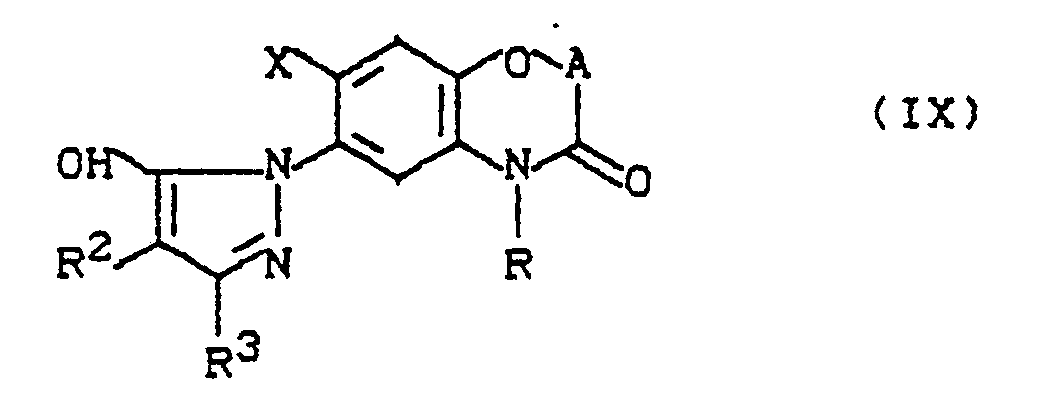

- Die Ausgangsstoffe der Formel (IX) sind noch nicht aus der Literatur bekannt. Man erhält die neuen Verbindungen der Formel (IX), wenn man Hydrazino-benzoxazinone der allgemeinen Formel (II) - oben - mit β-Ketoestern der allgemeinen Formel (XX)

R² und R³ die oben angegebenen Bedeutungen haben und
R⁸ für Alkyl steht,
gegebenenfalls in Gegenwart von Verdünnungsmitteln, wie z. B. Ethanol und/oder Wasser, bei Temperaturen zwischen 0 °C und 150 °C umsetzt. - Die als Zwischenprodukte zu verwendenden β-Ketoester sind durch die Formel (XX) allgemein definiert. In Formel (XX) haben R² und R³ vorzugsweise bzw. insbesondere diejenigen Bedeutungen, die bereits oben im Zusammenhang mit der Beschreibung der erfindungsgemäßen Verbindungen der Formel (I) vorzugsweise bzw. als insbesonders bevorzugt für R² und R³ angegeben wurden und R⁸ steht vorzugsweise für Methyl oder Ethyl.
- Als Beispiele für die Zwischenprodukte der Formel (XX) seien genannt:
Acetessigsäure-methylester und -ethylester, α-Fluor-, α-Chlor-, α-Cyano- und α-Methyl-acetessigsäure-methylester und -ethylester sowie ω,ω,ω-Trifluoracetessigsäure-methylester und -ethylester. - Die Verbindungen der Formel (XX) sind bekannte organische Synthesechemikalien.
- Das erfindungsgemäße Verfahren (g) wird unter Verwendung eines Halogenierungsmittels durchgeführt. Es können die üblichen Mittel für die Umwandlung aktivierter Hydroxyverbindungen in davon abgeleitete Halogenverbindungen eingesetzt werden. Als Beispiele für geeignete Halogenierungsmittel seien genannt:
Phosgen, Diphosgen, Thionylchlorid, Phosphorylchlorid, Phosphor(III)-chlorid und Phosphor(III)-bromid. - Verfahren (g) wird gegebenenfalls in Gegenwart eines Katalystors durchgeführt. Es können die für die Umwandlung von Hydroxyverbindungen in entsprechende Halogenverbindungen üblichen Katalysatoren, wie z. B. Pyridin, Dimethylformamid, N,N-Diethylanilin, Triphenylphosphin und Triphenylphosphinoxid, verwendet werden.
- Verfahren (g) wird gegebenenfalls in Gegenwart eines Verdünnungsmittels durchgeführt. Vorzugsweise kommen inerte organische Lösungsmittel aus der Reihe der halogenierten Kohlenwasserstoffe, wie z. B. Methylenchlorid, Chloroform, Tetrachlormethan oder 1,2-Dichlorethan, in Betracht.
- Die Reaktionstemperaturen können bei dem erfindungsge mäßen Verfahren (g) in einem größeren Bereich variiert werden. Im allgemeinen arbeitet man bei Temperaturen zwischen 0 °C und 100 °C, vorzugsweise bei Temperaturen zwischen 10 °C und 90 °C.
- Verfahren (g) wird im allgemeinen bei Normaldruck durchgeführt.
- Zur Durchführung von Verfahren (g) werden je Mol Ausgangsverbindung der Formel (IX) im allgemeinen zwischen 1 und 100 Mol, vorzugsweise zwischen 2 und 50 Mol, Halogenierungsmittel eingesetzt. Die Reaktionskomponenten werden im allgemeinen bei Raumtemperatur zusammengegeben und das Reaktionsgemisch wird, gegebenenfalls bei erhöhter Temperatur bis zum Ende der Umsetzung gerührt. Das nach Abdestillieren der flüchtigen Komponenten unter vermindertem Druck verbleibende Reaktionsprodukt kann durch Umkristallisation gereinigt werden.
- Die beim erfindungsgemäßen Verfahren (h) zur Herstellung von Verbindungen der Formel (I) als Ausgangsstoffe zu verwendenden Benzoxazinone sind durch die Formel (Ic) allgemein definiert.
- In Formel (Ic) haben A, R, R¹, R³ und X vorzugsweise bzw. insbesondere diejenigen Bedeutungen, die bereits oben im Zusammenhang mit der Beschreibung der erfindungsgemäßen Verbindungen der Formel (I) vorzugsweise bzw. als insbesondere bevorzugt für A, R, R¹, R³und X angegeben wurden.
- Die Ausgangsstoffe der Formel (Ic) für Verfahren (h) sind erfindungsgemäße, neue Verbindungen; sie können nach dem erfindungsgemäßen Verfahren (a) hergestellt werden.
- Verfahren (h) kann nach üblichen Halogenierungs- bzw. Nitrierungsmethoden durchgeführt werden.
- Zur Halogenierung werden vorzugsweise elementare Halogene, wie Chlor, Brom oder Iod, oder Halogenverbindungen, wie Sulfurylchlorid oder Natriumhypochlorit, eingesetzt.
- Zur Nitrierung wird Salpetersäure, gegebenenfalls in Gegenwart von Schwefelsäure und/oder in Gegenwart eines Nitrits, wie Natriumnitrit, eingesetzt.
- Verfahren (h) wird vorzugsweise in Gegenwart eines Verdünnungsmittels durchgeführt. Vorzugsweise kommen inerte organische Lösungsmittel aus der Reihe der halogenierten Kohlenwasserstoffe, wie Methylenchlorid, Chloroform, Tetrachlormethan oder 1,2-Dichlorethan, in Betracht.
- Die Reaktionstemperaturen können bei dem erfindungsgemäßen Verfahren (h) in einem größeren Bereich variiert werden. Im allgemeinen arbeitet man bei Temperaturen zwischen -20 °C und +80 °C, vorzugsweise bei Temperaturen zwischen 0 °C und 50 °C.
- Das erfindungsgemäße Verfahren (h) wird im allgemeinen unter Normaldruck durchgeführt. Es ist jedoch auch mög lich, unter erhöhtem oder vermindertem Druck zu arbeiten.
- Zur Durchführung des erfindungsgemäßen Verfahrens (h) werden die jeweils benötigten Ausgangsstoffe im allgemeinen in angenähert äquimolaren Mengen eingesetzt. Es ist jedoch auch möglich, eine der beiden jeweils eingesetzten Komponenten in einem größeren Überschuß zu verwenden. Die Reaktionen werden im allgemeinen in einem geeigneten Verdünnungsmittel in Gegenwart eines Säureakzeptors durchgeführt, und das Reaktionsgemisch wird mehrere Stunden bei der jeweils erforderlichen Temperatur gerührt. Die Aufarbeitung erfolgt bei dem erfindungsgemäßen Verfahren (h) jeweils nach üblichen Methoden.
- Die erfindungsgemäßen Wirkstoffe können als Defoliants, Desiccants, Krautabtötungsmittel und insbesondere als Unkrautvernichtungsmittel verwendet werden. Unter Unkraut im weitesten Sinne sind alle Pflanzen zu verstehen, die an Orten aufwachsen, wo sie unerwünscht sind. Ob die erfindungsgemäßen Stoffe als totale oder selektive Herbizide wirken, hängt im wesentlichen von der angewendeten Menge ab.
- Die erfindungsgemäßen Wirkstoffe können z.B. bei den folgenden Pflanzen verwendet werden:
Dikotyle Unkräuter der Gattungen: Sinapis, Lepidium, Galium, Stellaria, Matricaria, Anthemis, Galinsoga, Cheno podium, Urtica, Senecio, Amaranthus, Portulaca, Xanthium, Convolvulus, Ipomoea, Polygonum, Sesbania, Ambrosia, Cirsium, Carduus, Sonchus, Solanum, Rorippa, Rotala, Lindernia, Lamium, Veronica, Abutilon, Emex, Datura, Viola, Galeopsis, Papaver, Centaurea.
Dikotyle Kulturen der Gattungen: Gossypium, Glycine, Beta, Daucus, Phaseolus, Pisum, Solanum, Linum, Ipomoea, Vicia, Nicotiana, Lycopersicon, Arachis, Brassica, Lactuca, Cucumis, Cucurbita.
Monokotyle Unkräuter der Gattungen: Echinochloa, Setaria, Panicum, Digitaria, Phleum, Poa, Festuca, Eleusine, Brachiaria, Lolium, Bromus, Avena, Cyperus, Sorghum, Agropyron, Cynodon, Monochoria, Fimbristylis, Sagittaria, Eleocharis, Scirpus, Paspalum, Ischaemum, Sphenoclea, Dactyloctenium, Agrostis, Alopecurus, Apera.
Monokotyle Kulturen der Gattungen: Oryza, Zea, Triticum, Hordeum, Avena, Secale, Sorghum, Panicum, Saccharum, Ananas, Asparagus, Allium. - Die Verwendung der erfindungsgemäßen Wirkstoffe ist jedoch keineswegs auf diese Gattungen beschränkt, sondern erstreckt sich in gleicher Weise auch auf andere Pflanzen.
- Die Verbindungen eignen sich in Abhängigkeit von der Konzentration zur Totalunkrautbekämpfung z.B. auf Industrie- und Gleisanlagen und auf Wegen und Plätzen mit und ohne Baumbewuchs. Ebenso können die Verbindungen zur Unkrautbekämpfung in Dauerkulturen, z.B. Forst, Ziergehölz-, Obst-, Wein-, Citrus-, Nuß-, Bananen-, Kaffee-, Tee-, Gummi-, Ölpalm-, Kakao-, Beerenfrucht- und Hopfenanlagen und zur selektiven Unkrautbekämpfung in einjährigen Kulturen eingesetzt werden.
- Die erfindungsgemäßen Verbindungen der Formel (I) eignen sich insbesondere zur selektiven Bekämpfung von dikotylen Unkräutern im Vorauflauf- und im Nachauflauf-Verfahren.
- Die Wirkstoffe können in die üblichen Formulierungen überführt werden, wie Lösungen, Emulsionen, Spritzpulver, Suspensionen, Pulver, Stäubemittel, Pasten, lösliche Pulver, Granulate, Suspensions-Emulsions-Konzentrate, Wirkstoff-imprägnierte Natur- und synthetische Stoffe sowie Feinstverkapselungen in polymeren Stoffen.
- Diese Formulierungen werden in bekannter Weise hergestellt, z. B. durch Vermischen der Wirkstoffe mit Streckmitteln, also flüssigen Lösungsmitteln und/oder festen Trägerstoffen, gegebenenfalls unter Verwendung von oberflächenaktiven Mitteln, also Emulgiermitteln und/oder Dispergiermitteln und/oder schaumerzeugenden Mitteln.
- Im Falle der Benutzung von Wasser als Streckmittel können z.B. auch organische Lösungsmittel als Hilfslösungsmittel verwendet werden. Als flüssige Lösungsmittel kommen im wesentlichen in Frage: Aromaten, wie Xylol, Toluol, oder Alkylnaphthaline, chlorierte Aromaten und chlorierte aliphatische Kohlenwasserstoffe, wie Chlor benzole, Chlorethylene oder Methylenchlorid, aliphatische Kohlenwasserstoffe, wie Cyclohexan oder Paraffine, z.B. Erdölfraktionen, mineralische und pflanzliche Öle, Alkohole, wie Butanol oder Glykol sowie deren Ether und Ester, Ketone wie Aceton, Methylethylketon, Methylisobutylketon oder Cyclohexanon, stark polare Lösungsmittel, wie Dimethylformamid und Dimethylsulfoxid, sowie Wasser. Als feste Trägerstoffe kommen in Frage: z.B. Ammoniumsalze und natürliche Gesteinsmehle, wie Kaoline, Tonerden, Talkum, Kreide, Quarz, Attapulgit, Montmorillonit oder Diatomeenerde und synthetische Gesteinsmehle, wie hochdisperse Kieselsäure, Aluminiumoxid und Silikate, als feste Trägerstoffe für Granulate kommen in Frage: z.B. gebrochene und fraktionierte natürliche Gesteine wie Calcit, Marmor, Bims, Sepiolith, Dolomit sowie synthetische Granulate aus anorganischen und organischen Mehlen sowie Granulate aus organischem Material wie Sägemehl, Kokosnußschalen, Maiskolben und Tabakstengeln; als Emulgier- und/oder schaumerzeugende Mittel kommen in Frage: z.B. nichtionogene und anionische Emulgatoren, wie Polyoxyethylen-Fettsäure-Ester, Polyoxyethylen-Fettalkohol-Ether, z.B. Alkylaryl-polyglykolether, Alkylsulfonate, Alkylsulfate, Arylsulfonate sowie Eiweißhydrolysate; als Dispergiermittel kommen in Frage: z.B. Lignin-Sulfitablaugen und Methylcellulose.
- Es können in den Formulierungen Haftmittel wie Carboxymethylcellulose, natürliche und synthetische pulvrige, körnige oder latexförmige Polymere verwendet werden, wie Gummiarabicum, Polyvinylalkohol, Polyvinylacetat, sowie natürliche Phospholipide, wie Kephaline und Lecithine und synthetische Phospholipide. Weitere Additive können mineralische und vegetabile Öle sein.
- Es können Farbstoffe wie anorganische Pigmente, z.B. Eisenoxid, Titanoxid, Ferrocyanblau und organische Farbstoffe, wie Alizarin-, Azo- und Metallphthalocyaninfarbstoffe und Spurennährstoffe wie Salze von Eisen, Mangan, Bor, Kupfer, Kobalt, Molybdän und Zink verwendet werden.
- Die Formulierungen enthalten im allgemeinen zwischen 0,1 und 95 Gewichtsprozent Wirkstoff, vorzugsweise zwischen 0,5 und 90 %.
- Die erfindungsgemäßen Wirkstoffe können als solche oder in ihren Formulierungen auch in Mischung mit bekannten Herbiziden zur Unkrautbekämpfung Verwendung finden, wobei Fertigformulierungen oder Tankmischungen möglich sind.
- Für die Mischungen kommen bekannte Herbizide wie z.B. 1-Amino-6-ethylthio-3-(2,2-dimethylpropyl)-1,3,5-triazin-2,4(1H,3H)-dion (AMETHYDIONE) oder N-(2-Benzthiazolyl)-N,N′-dimethyl-harnstoff (METABENZTHIAZURON) zur Unkrautbekämpfung in Getreide; 4-Amino-3-methyl-6-phenyl-1,2,4-triazin-5(4H)-on (METAMITRON) zur Unkrautbekämpfung in Zuckerrüben und 4-Amino-6-(1,1-dimethylethyl)-3-methylthio-1,2,4-triazin-5(4H)-on (METRIBUZIN) zur Unkrautbekämpfung in Sojabohnen, in Frage, ferner auch 2,4-Dichlorphenoxyessigsäure (2,4-D); 4-(2,4-Dichlorphenoxy)-buttersäure (2,4-DB); 2,4-Dichlorphenoxypropionsäure (2,4-DP); 2-[[[[[(4,6-Dimethoxypyrimidin-2-yl)-amino]-carbonyl]-amino]-sulfonyl]-methyl]-benzoesäure- methylester (BENSULFURON); 3-Isopropyl-2,1,3-benzothiadiazin-4-on-2,2-dioxid (BENTAZON); Methyl-5-(2,4-dichlorphenoxy)-2-nitrobenzoat (BIFENOX); 3,5-Dibrom-4-hydroxy-benzonitril (BROMOXYNIL); 2-Chlor-N-{[(4-methoxy-6-methyl-1,3,5-triazin-2-yl)-amino]-carbonyl}-benzolsulfonamid (CHLORSULFURON); N,N-Dimethyl-N′-(3-chlor-4-methylphenyl)-harnstoff (CHLORTOLURON); 2-[4-(2,4-Dichlorphenoxy)-phenoxy]-propionsäure, deren Methyl-oder deren Ethylester (DICLOFOP); 4-Amino-6-t-butyl-3-ethylthio-1,2,4-triazin-5(4H)-on (ETHIOZIN); 2-{4-[(6-Chlor-2-benzoxazolyl)-oxy]-phenoxy}-propansäure, deren Methyl- oder deren Ethylester (FENOXAPROP); Methyl-2-[4,5-dihydro-4-methyl-4-(1-methylethyl)-5-oxo-1H-imidazol-2-yl]-4(5)-methylbenzoat (IMAZAMETHABENZ); 3,5-Diiod-4-hydroxybenzonitril (IOXYNIL); N,N-Dimethyl-N′-(4-isopropylphenyl)-harnstoff (ISOPROTURON); (2-Methyl-4-chlorphenoxy)-essigsäure (MCPA); (4-Chlor-2-methylphenoxy)-propionsäure (MCPP); N-Methyl-2-(1,3-benzthiazol-2-yloxy)-acetanilid (MEFENACET); 2-{[[((4-Methoxy-6-methyl-1,3,5-triazin-2-yl)-amino)-carbonyl]-amino]-sulfonyl}-benzoesäure oder deren Methylester (METSULFURON); S-Ethyl-N,N-hexamethylen-thiolcarbamat (MOLINATE); 4-(Di-n-propylamino)-3,5-dinitrobenzolsulfonamid (ORYZALIN); N-(1-Ethylpropyl)-3,4-dimethyl-2,6-dinitroanilin (PENDIMETHALIN); 0-(6-Chlor-3-phenylpyridazin-4-yl)-S-octyl-thiocarbonat (PYRIDATE); 2,4-Bis-[N-ethylamino]-6-methylthio-1,3,5-triazin (SIMETRYNE); 4-Ethylamino-2-t-butylamino-6-methylthio-s-triazin (TERBUTRYNE); 3-[[[[(4-Methoxy-6-methyl-1,3,5-triazin-2-yl)-amino]-carbonyl]-amino]-sulfonyl]-thiophen-2-carbonsäure-methylester (THIAMETURON); N,N-Diisopropyl-S-(2,3,3-trichlorallyl)-thiolcarbamat (TRIALLATE) und 3,5,6-Trichlor-2-pyridyloxyessigsäure (TRICLOPYR). Einige Mischungen zeigen überraschenderweise auch synergistische Wirkung. Auch eine Mischung mit anderen bekannten Wirkstoffen, wie Fungiziden, Insektiziden, Akariziden, Nematiziden, Schutzstoffen gegen Vogelfraß, Pflanzennährstoffen und Bodenstrukturverbesserungsmitteln ist möglich.
- Die Wirkstoffe können als solche, in Form ihrer Formulierungen oder den daraus durch weiteres Verdünnen bereiteten Anwendungsformen, wie gebrauchsfertige Lösungen, Suspensionen, Emulsionen, Pulver, Pasten und Granulate angewandt werden. Die Anwendung geschieht in üblicher Weise, z.B. durch Gießen, Spritzen, Sprühen, Streuen.
- Die erfindungsgemäßen Wirkstoffe können sowohl vor als auch nach dem Auflaufen der Pflanzen appliziert werden. Sie können auch vor der Saat in den Boden eingearbeitet werden.
- Die angewandte Wirkstoffmenge kann in einem größeren Bereich schwanken. Sie hängt im wesentlichen von der Art des gewünschten Effektes ab. Im allgemeinen liegen die Aufwandmengen zwischen 0,01 und 10 kg Wirkstoff pro Hektar Bodenfläche, vorzugsweise zwischen 0,05 und 5 kg pro ha.
- Die Herstellung und die Verwendung der erfindungsgemäßen Wirkstoffe geht aus den nachfolgenden Beispielen hervor.
-
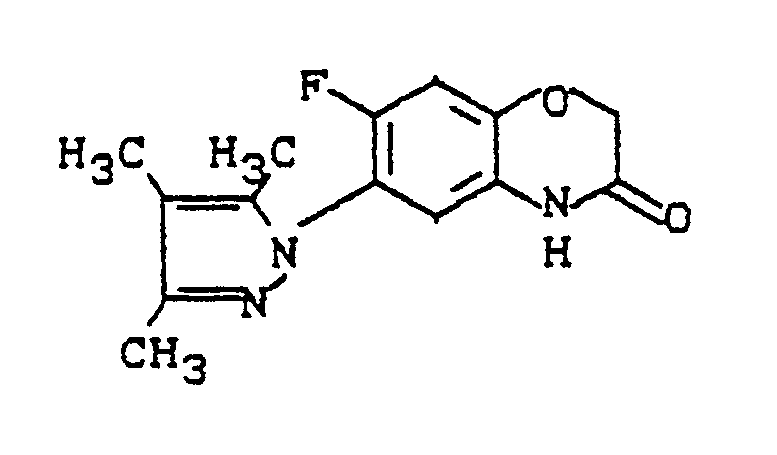
- Eine Mischung aus 4,0 g (0,02 Mol) 7-Fluor-6-hydrazino-3,4-dihydro-3-oxo-2H-1,4-benzoxazin, 2,3 g (0,02 Mol) 3-Methyl-2,4-pentandion (90 %ig), 20 ml Ethanol und 20 ml Wasser wird 15 Stunden unter Rückfluß zum Sieden erhitzt. Danach wird das Lösungsmittel im Wasserstrahlvakuum abdestilliert und der Rückstand durch Chromatographie an Kieselgel (Eluens: Cyclohexan/Essigsäureethylester, 1/3) gereinigt.
- Man erhält 1,1 g (20 % der Theorie) 7-Fluor-6-trimethylpyrazolyl-3,4-dihydro-3-oxo-2H-1,4-benzoxazin vom Schmelzpunkt 181 °C.
-

- Eine Mischung aus 2,36 g (0,012 Mol) 7-Fluor-6-hydrazino-3,4-dihydro-3-oxo-2H-1,4-benzoxazin, 2,86 g (0,018 Mol) N-Ethoxycarbonyl-O-ethyl-acetamidester und 25 ml Toluol wird 18 Stunden unter Rückfluß zum Sieden erhitzt. Anschließend wird das Lösungsmittel im Wasserstrahlvakuum abdestilliert und der Rückstand durch Chromatographie an Kieselgel (Eluens: Cyclohexan/Essigsäureethylester, 1/3) gereinigt.
- Man erhält 0,78 g (25 % der Theorie) 7-Fluor-6-(3-methyl-5-oxo-4,5-dihydro-1H-1,2,4-triazol-1-yl)-3,4-dyhydro-3-oxo-2H-1,4-benzoxazin (Schmelzpunkt >300 °C).
¹H-NMR (80 Mhz, CDCl₃/DMSO, δ): 10,75 (bs, 1H); 7,01 (d, 1H, J=6,6 Hz); 6,89 (d, 1H, J=9,0 Hz); 4,57 (s, 2H); 3,32 (bs, 1H); 2,18 (s, 3H). -
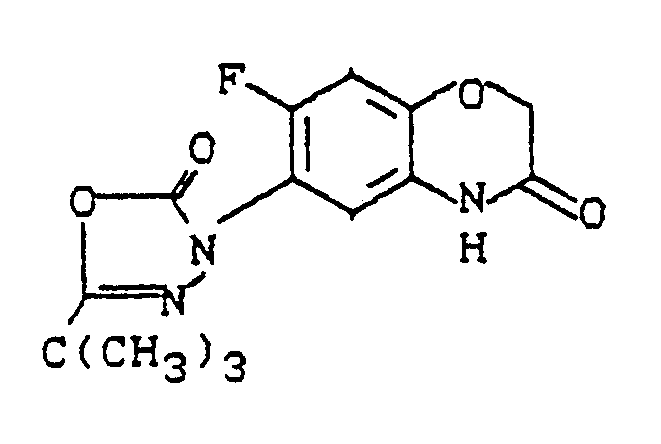
- Zu einer Lösung von 1,41 g (0,005 Mol) 7-Fluor-6-pivaloylhydrazino-3,4-dihydro-3-oxo-2H-1,4-benzoxazin in 50 ml Toluol werden 0,6 g (0,5 ml, 0,007 Mol) Phosgen eindosiert und dann wird unter Rühren eine Lösung von 1,52 g (0,015 Mol) Triethylamin in 2 ml Toluol tropfenweise dazu gegeben. Das Reaktionsgemisch wird dann eine Stunde bei 100 °C gerührt. Anschließend wird Stickstoff eingeleitet und im Wasserstrahlvakuum eingeengt. Der Rückstand wird durch Chromatograpie an Kieselgel (Eluens: Cyclohexan/Essigsäureethylester, 1/3) gereinigt.
- Man erhält 0,55 g (36 % der Theorie) 7-Fluor-6-(2-tert-butyl-5-oxo-4,5-dihydro-1H-1,3,4-oxadiazol-3-yl)-3,4-dihydro-3-oxo-2H-1,4-benzoxazin vom Schmelzpunkt 176 °C.
¹H-NMR (80 Mhz, CDCl₃, δ): 9,68 (bs, 1H); 7,05 (d, 1H, J =6,6 Hz); 6,85 (d, 1H, J =9,0 Hz); 4,65 (s, 2H); 1,36 (s, 9h). -

- 0,12 g (0,004 Mol) Natriumhydrid (80 %ig in Paraffinöl) und 0,46 g (0,0038 Mol) Propargylbromid (98 %ig) werden nacheinander zu einer Lösung von 1,0 g (0,0036 Mol) 7-Fluor-6-trimethylpyrazolyl-3,4-dihydro-3-oxo-2H-1,4-benzoxazin - Herstellung vgl. Beispiel 1 - in 15 ml Dimethylsulfoxid gegeben. Das Reaktionsgemisch wird 3 Stunden bei 20 °C gerührt, dann in 50 ml Wasser gegossen und gerührt, bis der anfangs ölige Niederschlag kristallisiert. Das kristalline Produkt wird durch Absaugen isoliert.
- Man erhält 0,9 g (79 % der Theorie) 7-Fluor-6-trimethylpyrazolyl-4-propargyl-3,4-dihydro-3-oxo-2H-1,4-benzoxazin vom Schmelzpunkt 189 °C.
-

- Eine Mischung aus 0,46 g (0,0015 Mol) 7-Fluor-6-(2-tert-butyl-5-oxo-4,5-dihydro-1H-1,3,4-oxadiazol-3-yl)-3,4-dihydro-3-oxo-2H-1,4-benzoxazin - Herstellung vgl. Beispiel 3 - 0,30 g (0,003 Mol) Kaliumcarbonat und 8 ml Acetonitril wird eine Stunde unter Rückfluß zum Sieden erhitzt. Nach Abkühlen auf 25 °C wird eine 80 %ige Lösung von 0,35 g (0,003 Mol) Propargylbromid in Toluol dazu gegeben und das Reaktionsgemisch wird noch 4 Stunden unter Rückfluß zum Sieden erhitzt. Nach Einengen wird mit Methylenchlorid extrahiert, die Extraktionslösung mit gesättigter Natriumhydrogencarbonat-Lösung und mit Wasser gewaschen, mit Natriumsulfat getrocknet und filtriert. Vom Filtrat wird das Lösungsmittel im Wasser strahlvakuum sorgfältig abdestilliert, wobei das gewünschte Produkt als kristalliner Rückstand verbleibt.
- Man erhält 0,35 g (68 % der Theorie) 7-Fluor-4-propargyl-6-(2-tert-butyl-5-oxo-4,5-dihydro-1H-1,3,4-oxadiazol-3-yl)-3,4-dihydro-3-oxo-2H-1,4-benzoxazin vom Schmelzpunkt 161 °C.
¹H-NMR (80 Mhz, CDCl₃, δ): 7,31 (d, 1H, J =6,6 Hz); 6,90 (d, 1H, J =9,0 Hz); 4,79 (d, 2H, J =2,0 Hz), 4,68 (s, 2H); 2,32 (t, 1H, J =2,0 Hz); 1,38 (s, 9H). - Analog zu den Beispielen 1 bis 5 sowie nach der allgemeinen Beschreibung der erfindungsgemäßen Herstellungsverfahren können die in der nachstehenden Tabelle 5 aufgeführten Verbindungen der Formel (I) erhalten werden.

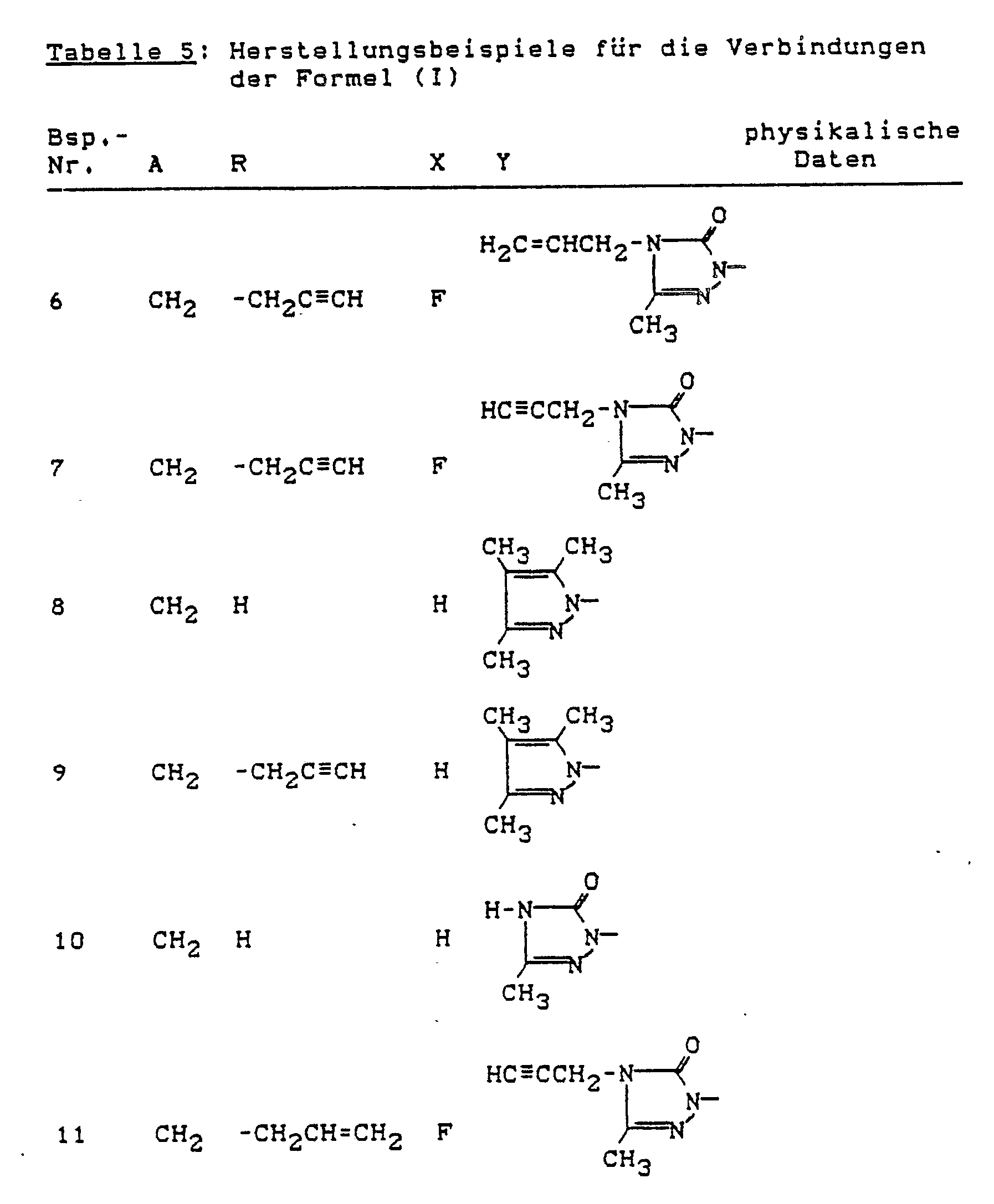


- Im Folgenden ist an einigen Beispielen die Herstellung von in Tabelle 5 aufgeführten Verbindungen der Formel (I) ausführlich beschrieben.
-

- 2,8 g (0,05 Mol) Eisenpulver werden in 8 ml Ethanol, 3 ml Wasser und 0,2 ml konz. Salzsäure 30 Minuten unter Rückfluß gerührt. Danach werden bei 65 °C bis 70 °C innerhalb von 2 Stunden in kleinen Portionen 3,9 g (0,011 Mol) 2-Nitro-4-(3-chloro-4,5,6,7-tetrahydro-2H-indazolyl)-phenoxyessigsäure zugefügt. Nach Zugabe von 10 ml Ethanol wird 2 Stunden unter Rückfluß gerührt. Das Reaktionsgemisch wird in etwa 100 ml Essigsäureethylester aufgenommen, verrührt und abgesaugt. Das Filtrat wird nach dem Ausschütteln mit Wasser und konz. Natriumhydrogencarbonatlösung über Magnesiumsulfat getrocknet und im Vakuum eingedampft.
- Man erhält 1,8 g (53 % der Theorie) 2-(3,4-dihydro-3-oxo-2H-1,4-benzoxazinyl)-3-chloro-4,5,6,7-tetrahydro-2H-indazol vom Schmelzpunkt 182 °C.
-

- 1,68 g (5,54 mMol) 2-(3,4-Dihydro-3-oxo-2H-1,4-benzoxazinyl)-3-chloro-4,5,6,7-tetrahydro-2H-imidazol werden in 22 ml Dimethylsulfoxid gelöst und nacheinander bei 10 °C - 15 °C mit 0,22 g (7,33 mMol) 80 %igem Natriumhydrid und 0,53 ml (7,02 mMol) Propargylbromid versetzt. Man rührt 15 Stunden bei 20 °C bis 25 °C nach. Das Reaktionsgemisch wird unter Rühren auf ca. 200 ml Wasser gegossen, der entstehende Feststoff abgesaugt, mit Wasser gewaschen und im Vakuum bei 50 °C getrocknet.
- Man erhält 1,7 g (89,9 % der Theorie) 2-(3,4-Dihydro-3-oxo-4-propargyl-2H-1,4-benzoxazinyl)-3-chloro-4,5,6,7-tetrahydro-2H-indazol vom Schmelzpunkt 153 °C.
-

- Eine Lösung aus 3,7 g (0,019 Mol) 7-(Fluor-6-hydrazino-3,4-dihydro-3-oxo-2H-1,4-benzoxazin, 100 ml Ethanol und 1,9 g (0,019 Mol) Pentandion werden 2 Stunden bei Raumtemperatur gerührt (Hydrazonbildung); anschließend wird 20 Stunden unter Rückfluß erhitzt. Zur Aufarbeitung wird im Vakuum das Lösungsmittel entfernt, der Rückstand in Methylenchlorid aufgenommen, zweimal mit Wasser gewaschen, über Natriumsulfat getrocknet und das Lösungsmittel im Vakuum abdestilliert. Der Rückstand wird mit Ether/Petrolether verrührt und der kristalline Niederschlag abgesaugt.
- Man erhält 4,0 g (81 % der Theorie) 7-Fluor-6-(3,5-dimethylpyrazol)-3,4-dihydro-3-oxo-2H-1,4-benzoxazin vom Schmelzpunkt 168 °C.
-

- Eine Mischung aus 0,78 g (3 mMol) 7-Fluor-6-(3,5-dimethylpyrazolyl)-3,4-dihydro-3-oxo-2H-1,4-benzoxazin, 20 ml Acetonitril und 0,46 g (3,3 mMol) Kaliumcarbonat wird mit 0,37 g (3,2 mMol) Propargylbromid versetzt und 15 Stunden bei 60 °C gerührt. Nach Einengen wird der Rückstand in Methylenchlorid aufgenommen, mit Wasser gewaschen, über Magnesiumsulfat getrocknet und das Lösungsmittel im Vakuum entfernt.
- Man erhält 0,69 g (77 % der Theorie) an 7-Fluor-6-(3,5-dimethylpyrazol)-4-propargyl-3,4-dihydro-3-oxo-2H-1,4-benzoxazin vom Schmelzpunkt 163 °C.
-

- 0,6 g (0,002 Mol) 7-Fluor-6-(3,5-dimethylpyrazol)-4-propargyl-3,4-dihydro-3-oxo-2H-1,4-benzoxazin in 30 ml Methylenchlorid werden mit 0,2 ml (0,0025 Mol) Sulfurylchlorid versetzt. Man läßt 20 Stunden bei 35 °C nachrühren. Anschließend wird die Reaktionsmischung mit gesättigter Natriumchloridlösung gewaschen, über Natriumsulfat getrocknet und das Lösungsmittel im Vakuum entfernt.
- Man erhält 0,4 g (60 % der Theorie) an 7-Fluor-6-(3,5-dimethyl-4-chlorpyrazol)-4-propargyl-3,4-dihydro-3-oxo-2H-1,4-benzoxazin vom Schmelzpunkt 178 °C.
-

- Eine Lösung von 8,8 g (0,13 Mol) Natriumnitrit in 65 ml 98 %iger Schwefelsäure wird unter Rühren zu einer Mischung aus 20 g (0,11 Mol) 6-Amino-7-fluor-3,4-dihydro-3-oxo-2H-1,4-benzoxazin und 270 ml Essigsäure gegeben und das Reaktionsgemisch wird 3 Stunden bei 15 °C bis 25 °C gerührt. Dann wird bei 10 °C eine Lösung von 80 g (0,35 Mol) Zinn-(II)-chlorid-Dihydrat in 70 ml 36 %iger Salzsäure dazu gegeben, die Mischung weitere 15 Stunden bei 20 °C gerührt und dann auf 5 °C abgekühlt. Das kristallin angefallene Produkt wird durch Filtration isoliert, in 300 ml 25 %iger Ammoniaklösung suspendiert und auf 5 °C abgekühlt. Das kristalline Produkt wird wiederum durch Filtration isoliert, an der Luft getrocknet und mit Essigsäureethylester extrahiert. Von der Extraktionslösung wird das Lösungsmittel im Wasserstrahlvakuum sorgfältig abdestilliert.
- Man erhält 10,4 g (48 % der Theorie) 7-Fluor-6-hydrazino-3,4-dihydro-3-oxo-2H-1,4-benzoxazin als öligen Rückstand.
¹H-NMR (D₆-DMSO, δ): 6,35 (d, 1H); 6,72 (d, 1H); 4,42 (s, 2H). - Analog Beispiel (II-1) können die in der nachstehenden Tabelle 6 aufgeführten Verbindungen der Formel (II) erhalten werden.


-

- 5,35 g (0,053 Mol) Pivaloylchlorid werden tropfenweise zu einer auf 0 °C gekühlten Mischung aus 6,30 g (0,032 Mol) 7-Fluor-6-hydrazino-3,4-dihydro-3-oxo-2H-1,4-benzoxazin, 6,3 g (0,053 Mol) Triethylamin und 150 ml Methylenchlorid unter Rühren gegeben und die Reaktionsmischung wird 10 Stunden bei 20 °C gerührt. Anschließend wird eingeengt und der Rückstand mit Essigsäureethylester/Wasser geschüttelt. Die organische Phase wird mit Natriumsulfat getrocknet und filtriert. Das Filtrat wird eingeengt und der Rückstand durch Chromatographie an Kieselgel (Eluens: Cyclohexan/Essigester, 1/3) gereinigt.
- Man erhält 4,75 g (53 % der Theorie) 7-Fluor-6-pivaloylhydrazino-3,4-dihydro-3-oxo-2H-1,4-benzoxazin vom Schmelzpunkt 195 °C.
¹H-NMR (80 Mhz, DMSO-D₆, δ): 10,40 (s, 1H); 9,30 (d, 1H, J =2,0 Hz); 6,64 (d, 1H, J =9,0); 6,52 (d, 1H, J = 7,4 Hz); 6,36 (d, 1H, J =2,= Hz); 4,43 (s, 2H); 1,25 (s, 9H). - Analog Beispiel (V-1) können die in der nachstehenden Tabelle 7 aufgeführten Verbindungen der Formel (V) erhalten werden.
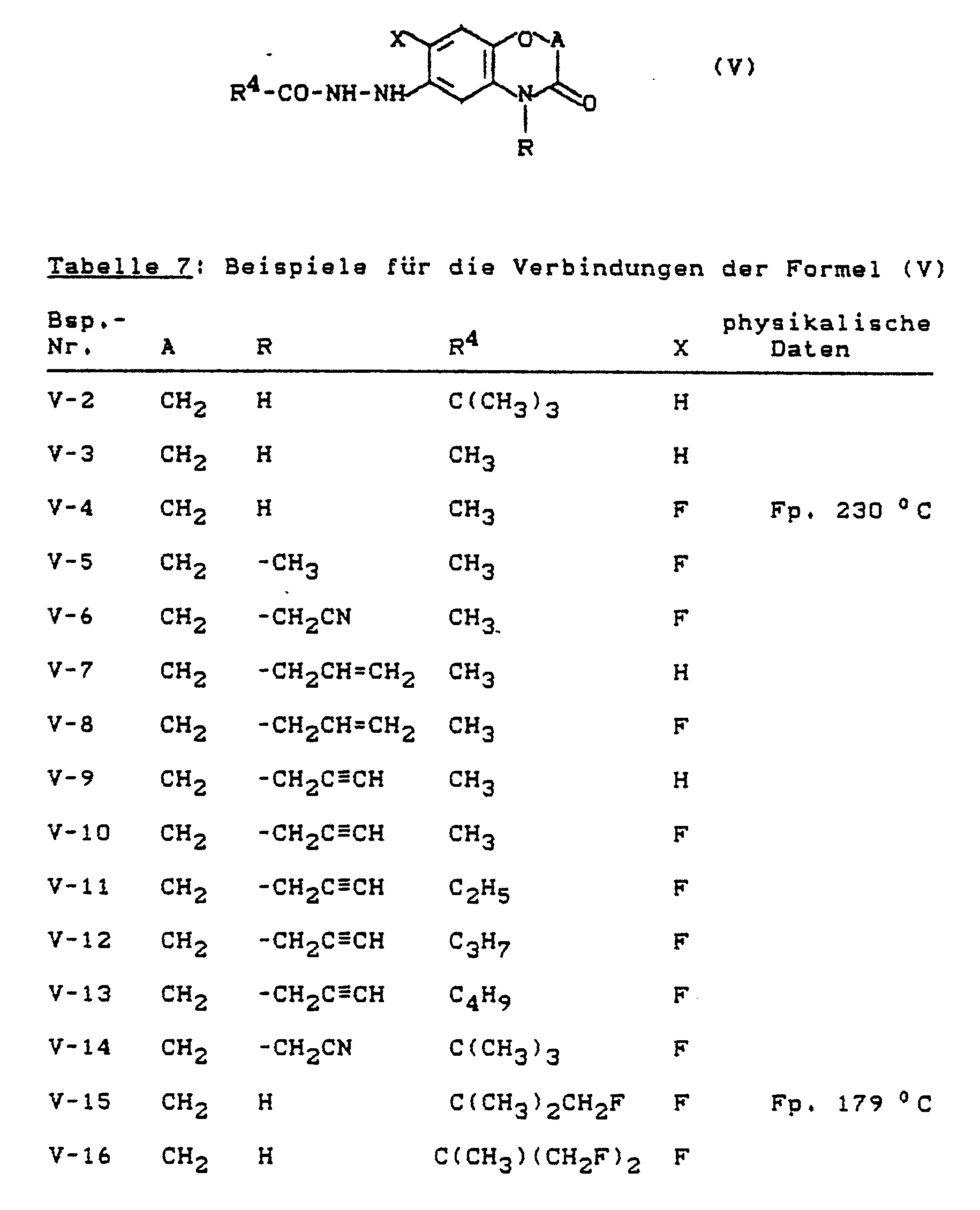
-

- 10 g (0,03 Mol) 4-(3-Chlor-4,5,6,7-tetrahydro-2H-imidazolyl)-phenoxyessigsäureethylester werden in 33 ml konz. Schwefelsäure gelöst und auf -20 °C abgekühlt. Es werden 1,9 ml 100 %ige Salpetersäure unter Rühren bie -20 °C bis -15 °C langsam zugetropft. Dann wird 3 Stunden bei dieser Temperatur nachgerührt. Anschließend wird der Ansatz unter Rühren auf Eiswasser gegossen. Der Niederschlag wird abgesaugt und in Essigsäureethylester gelöst. Die organische Lösung wird mit gesättigter Natriumhydrogencarbonatlösung ausgeschüttelt, über Magnesiumsulfat getrocknet und im Vakuum eingedampft.
- Man erhält 4,6 g (41 % der Theorie) 2-Nitro-4-(3-chlor-4,5,6,7-tetrahydro-2H-indazolyl)-phenoxyessigsäureethylester als öliges Produkt.
NMR (Dimethylsulfoxid) δ = 7,47 ppm (1H, Dublett) - Die beim Aufarbeiten erhaltene Natriumhydrogencarbonat lösung wird mit Wasser verdünnt und unter Rühren mit Salzsäure sauer gestellt. Der ausgefallene Niederschlag wird abgesaugt, mit Wasser gewaschen und im Vakuum bei 50 °C getrocknet.
- Man erhält 4,1 g (39 % der Theorie) 2-Nitro-4-(3-chlor-4,5,6,7-tetrahydro-2H-indazolyl)-phenoxyessigsäure vom Schmelzpunkt 167 °C - 172 °C.
-
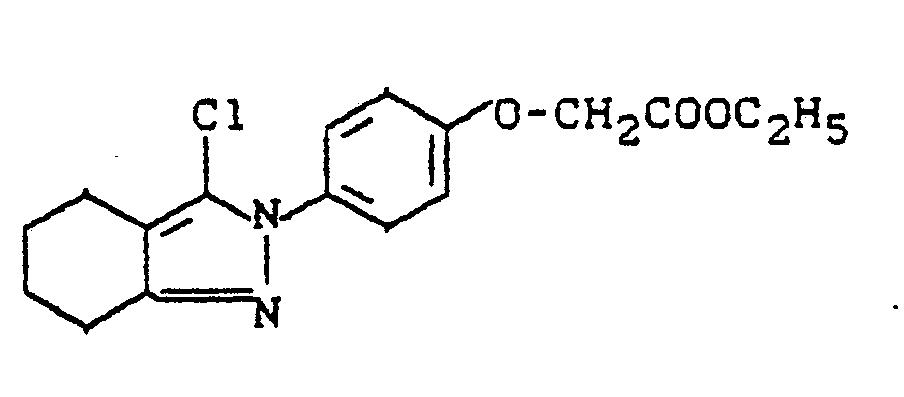
- 9,9 g (0,04 Mol) 2-(4-Hydroxyphenyl)-3-chlor-4,5,6,7-tetrahydro-2H-indazol werden in 100 ml Acetonitril gelöst, nacheinander mit 6,1 g (0,044 Mol) Kaliumcarbonat sowie 7,4 ml (0,066 Mol) Bromessigsäureethylester versetzt und 6 Stunden unter Rückfluß gerührt. Das Reaktionsgemisch wird im Vakuum eingedampft, in Methylenchlorid gelöst, dreimal mit Wasser ausgeschüttelt, über Magnesiumsulfat getrocknet und erneut im Vakuum eingedampft.
- Man erhält 13,4 g (100 % der Theorie) 4-(3-Chlor-4,5,6,7-tetrahydro-2H-indazolyl)-phenoxyessigsäuremethylester als öliges Produkt.
NMR (CDCl₃) δ = 4,64 ppm (2H, Singulett) -
- 49,0 g (0,178 Mol) 2-(4-Methoxyphenyl)-3-chlor-4,5,6,7-tetrahydro-2H-indazol werden in 450 ml 48 %iger Bromwasserstoffsäure 10 Stunden unter leichtem Rückfluß gerührt. Das Reaktionsgemisch wird im Vakuum eingedampft, der so erhaltene Feststoff mit Essigsäureethylester heiß verrührt, abgesaugt und zur Beseitigung des anhaltenden Bromwasserstoffs 3 Stunden mit gesättigter Natriumhydrogencarbonatlösung verrührt. Danach wird abgesaugt, mit Wasser gewaschen und im Vakuum bei 50 °C getrocknet.
- Man erhält 35,7 g (77 % der Theorie) 2-(4-Hydroxyphenyl)-3-chlor-4,5,6,7-tetrahydro-2H-indazol vom Schmelzpunkt 217 °C - 223 °C.
-

- 5,8 g (0,25 Mol) Natrium werden in 220 ml Ethanol gelöst. Durch die Lösung wird Argon geleitet. Es werden 43,6 g (0,25 Mol) 4-Methoxy-phenylhydrazin-hydrochlorid zugesetzt und ca. 40 Minuten unter Argon bei 40 °C gerührt. Danach werden 42,6 g (0,25 Mol) 2-Oxo-cyclohexancarbonsäureethylester zugegeben und 5 Stunden unter Rückfluß gerührt. Das entstandene Natriumchlorid wird abgesaugt und das erhaltene Filtrat im Wasserstrahlvakuum eingedampft. Der Rückstand wird zwecks Reinigung mit Petrolether verrührt und anschließend im Vakuum bei 50 °C getrocknet.
Man erhält 57,1 g (93,5 % der Theorie) 2-(4-Methoxyphenyl)-3-hydroxy-4,5,6,7-tetrahydro-2H-indazol vom Schmelzpunkt 159 °C. - 42,7 g (0,175 Mol) 2-(4-Methoxyphenyl)-3-hydroxy-4,5,6,7-tetrahydro-2H-indazol werden in 75 ml Phosphoroxychlorid 19 Stunden unter Rückfluß gerührt. Das überschüssige Phosphoroxychlorid wird im Vakuum abgedampft, der ölige Rückstand in Methylenchlorid gelöst und mit Wasser, 2 %iger Salzsäure, gesättigter Natriumhydrogencarbonatlösung und gesättigter Natriumchloridlösung gewaschen. Die Lösung wird über Magnesiumsulfat getrocknet und anschließend im Vakuum eingedampft.
Man erhält 25,7 g ( 55,9 % der Theorie) 2-(4-Methoxyphenyl)-3-chlor-4,5,6,7-tetrahydro-2H-indazol als öliges Produkt.
NMR (CDCl₃) = 3,85 ppm (3H, Singulett) - In den folgenden Anwendungsbeispielen wird die nachstehend aufgeführte Verbindung als Vergleichssubstanz herangezogen:
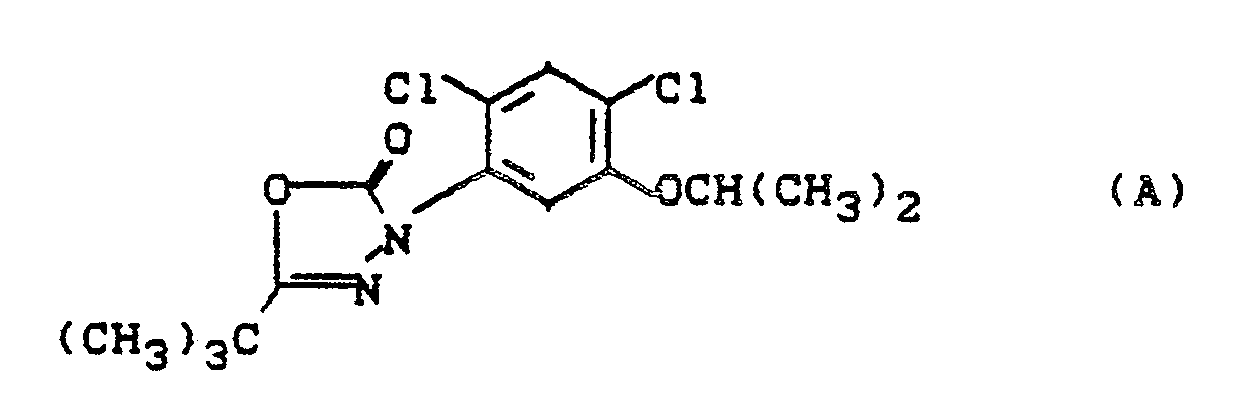
- bekannt aus US-P 3 835 862. - Lösungsmittel: 5 Gewichtsteile Aceton
Emulgator: 1 Gewichtsteil Alkylarylpolyglykolether - Zur Herstellung einer zweckmäßigen Wirkstoffzubereitung vermischt man 1 Gewichtsteil Wirkstoff mit der angegebenen Menge Lösungsmittel, gibt die angegebene Menge Emulgator zu und verdünnt das Konzentrat mit Wasser auf die gewünschte Konzentration.
- Samen der Testpflanzen werden in normalen Boden ausgesät und nach 24 Stunden mit der Wirkstoffzubereitung begossen. Dabei hält man die Wassermenge pro Flächeneinheit zweckmäßigerweise konstant. Die Wirkstoffkonzentration in der Zubereitung spielt keine Rolle, entscheidend ist nur die Aufwandmenge des Wirkstoffs pro Flächeneinheit. Nach drei Wochen wird der Schädigungsgrad der Pflanzen bonitiert in % Schädigung im Vergleich zur Entwicklung der unbehandelten Kontrolle. Es bedeuten:
0 % = keine Wirkung (wie unbehandelte Kontrolle)
100 % = totale Vernichtung - Eine deutliche Überlegenheit in der Wirksamkeit gegenüber der Vergleichssubstanz (A) zeigen in diesem Test z. B. die Verbindungen gemäß Herstellungsbeispiel 3, 4, 5, 22, 24, 30, 31, 35 und 49.
- Lösungsmittel: 5 Gewichtsteil Aceton
Emulgator: 1 Gewichtsteil Alkylarylpolyglykolether - Zur Herstellung einer zweckmäßigen Wirkstoffzubereitung vermischt man 1 Gewichtsteil Wirkstoff mit der angegebenen Menge Lösungsmittel, gibt die angegebene Menge Emulgator zu und verdünnt das Konzentrat mit Wasser auf die gewünschte Konzentration.
- Mit der Wirkstoffzubereitung spritzt man Testpflanzen, welche eine Höhe von 5 - 15 cm haben so, daß die jeweils gewünschten Wirkstoffmengen pro Flächeneinheit ausgebracht werden. Die Konzentration der Spritzbrühe wird so gewählt, daß in 2000 l Wasser/ha die jeweils gewünschten Wirkstoffmengen ausgebracht werden. Nach drei Wochen wird der Schädigungsgrad der Pflanzen bonitiert in % Schädigung im Vergleich zur Entwicklung der unbehandelten Kontrolle.
- Es bedeuten:
0 % = keine Wirkung (wie unbehandelte Kontrolle)
100 % = totale Vernichtung - Eine deutliche Überlegenheit in der Wirksamkeit gegenüber der Vergleichssubstanz (A) zeigt in diesem Test z.B. die Verbindungen gemäß der Herstellungsbeispiele 3, 4, 5, 22, 31, 32, 33, 34, 35, 47 und 49.
Claims (17)

A
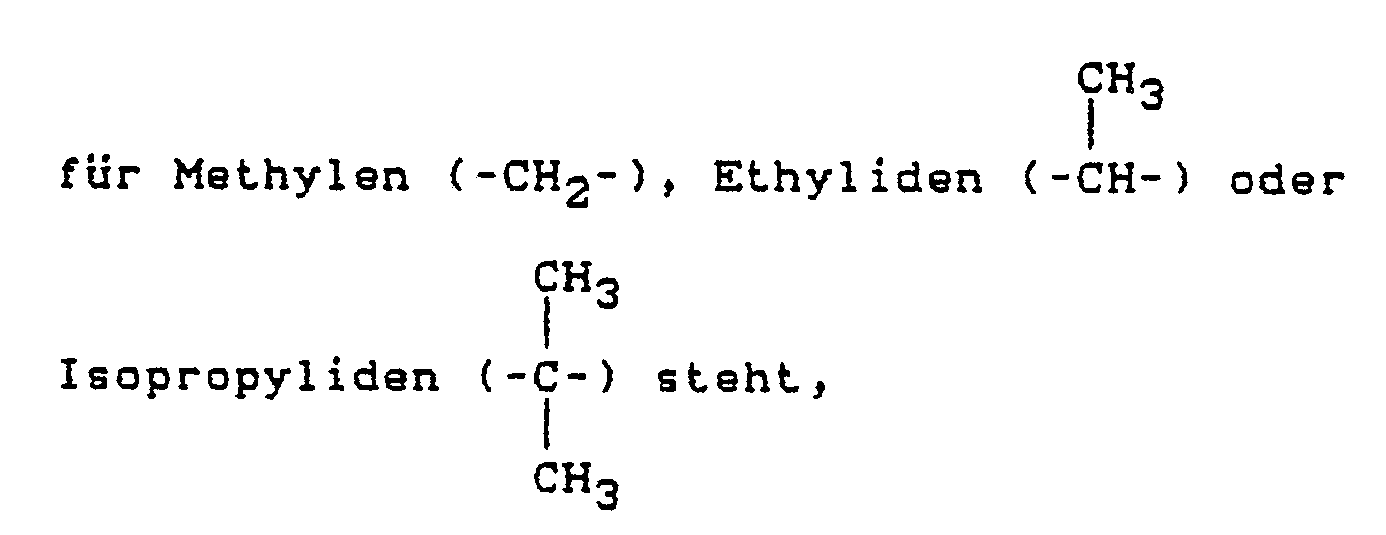
X für Wasserstoff oder Halogen steht und
Y für die nachstehenden heterocyclischen Gruppierungen steht

R¹ für Wasserstoff, Halogen oder gegebenenfalls durch Halogen substituiertes Alkyl steht,
R² für Wasserstoff, Cyano, Nitro, Halogen oder gegebenenfalls durch Halogen substituiertes Alkyl steht,
R³ für Wasserstoff oder gegebenenfalls durch Halogen substituiertes Alkyl steht, oder zusammen mit R² für Alkandiyl steht,
R⁴ für Wasserstoff oder für jeweils gegebenenfalls durch Halogen substituiertes Alkyl, Cycloalkyl, Alkenyl oder Alkinyl steht und
Z für Sauerstoff oder die Gruppierung -N-R⁵ steht, worin
R⁵ für Wasserstoff oder für jeweils gegebenenfalls durch Halogen substituiertes Alkyl, Alkenyl oder Alkinyl steht, oder zusammen mit R⁴ für Alkandiyl steht.
A

Cyano, C₁-C₄-Alkyl, C₁-C₄-Alkoxy und/oder C₁-C₄-Alkoxy-carbonyl substituiertes Benzyl oder für gegebenenfalls durch Fluor, Chlor, Brom, Iod, Cyano, C₁-C₄-Alkyl und/oder C₁-C₄-Alkoxy substituiertes Heteroarylalkyl aus der Reihe Furyl-C₁-C₄-alkyl, Thienyl-C₁-C₄-alkyl, Oxazolyl-C₁-C₄-alkyl, Oxadiazolyl-C₁-C₄-alkyl, Thiazolyl-C₁-C₄-alkyl, Thiadiazolyl-C₁-C₄-alkyl, Pyridinyl-C₁-C₄-alkyl und Pyrimidinyl-C₁-C₄-alkyl steht,
X für Wasserstoff, Fluor oder Chlor steht und
Y für die nachstehenden heterocyclischen Gruppierungen steht

R¹ für Wasserstoff, Fluor, Chlor, Brom oder für gegebenenfalls durch Fluor und/oder Chlor substituiertes C₁-C₄-Alkyl steht,
R² für Wasserstoff, Cyano, Nitro, Fluor, Chlor, Brom, Iod oder für gegebenenfalls durch Fluor und/oder Chlor substituiertes C₁-C₄-Alkyl steht,
R³ für Wasserstoff oder gegebenenfalls durch Fluor und/oder Chlor substituiertes C₁-C₄-Alkyl steht oder zusammen mit R² für C₃- oder C₄-Alkandiyl steht,
R⁴ für Wasserstoff oder für jeweils gegebenenfalls durch Fluor, Chlor und/oder Brom substituiertes C₁-C₄-Alkyl, C₃-C₆-Cycloalkyl, C₂-C₄-Alkenyl oder C₂-C₄-Alkinyl steht, und
Z für Sauerstoff oder für die Gruppierung -N-R⁵ steht, worin
R⁵ für Wasserstoff oder für jeweils gegebenenfalls durch Fluor und/oder Chlor substituiertes C₁-C₄-Alkyl, C₃-C₄-Alkenyl oder C₃-C₄-Alkinyl steht, oder zusammen mit R⁴ für C₃- oder C₄-Alkandiyl steht.

A

R für Wasserstoff oder für einen gegebenenfalls substituierten Rest aus der Reihe Alkyl, Cycloalkyl, Cycloalkylalkyl, Alkenyl, Alkinyl, Aralkyl und Heteroarylalkyl steht,
X für Wasserstoff oder Halogen steht und
Y für die nachstehenden heterocyclischen Gruppierungen steht

R¹ für Wasserstoff, Halogen oder gegebenenfalls durch Halogen substituiertes Alkyl steht,
R² für Wasserstoff, Cyano, Nitro, Halogen oder gegebenenfalls durch Halogen substituiertes Alkyl steht,
R³ für Wasserstoff oder gegebenenfalls durch Halogen substituiertes Alkyl steht, oder zusammen mit R² für Alkandiyl steht,
R⁴ für Wasserstoff oder für jeweils gegebenenfalls durch Halogen substituiertes Alkyl, Cycloalkyl, Alkenyl oder Alkinyl steht und
Z für Sauerstoff oder die Gruppierung -N-R⁵ steht, worin
R⁵ für Wasserstoff oder für jeweils gegebenenfalls durch Halogen substituiertes Alkyl, Alkenyl oder Alkinyl steht, oder zusammen mit R⁴ für Alkandiyl steht,
dadurch gekennzeichnet, daß man
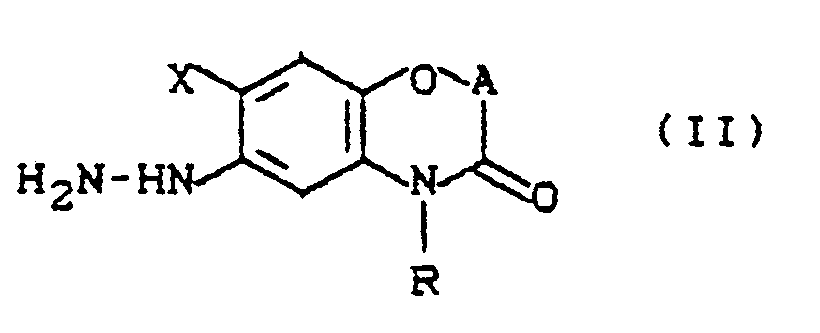
A, R und X die oben angegebenen Bedeutungen haben,
mit 1,3-Dicarbonylverbindungen der allgemeinen Formel (III)

R¹, R² und R³ die oben angegebenen Bedeutungen haben,
bzw. mit Dimethyl- oder Diethyl-Acetalen bzw. -Ketalen von Verbindungen der Formel (III) gegebenenfalls in Gegenwart von Verdünnungsmitteln umsetzt, oder daß man

A, R und X die oben angegebenen Bedeutungen haben,
mit N-Alkoxycarbonylcarbonimidsäureestern der allgemeinen Formel (IV)

R⁴ die oben angegebene Bedeutung hat und
R⁶ für Niederalkyl steht,
gegebenenfalls in Gegenwart eines Verdünnungsmittels umsetzt, oder daß man

A, R, R⁴ und X die oben angegebenen Bedeutungen haben,
mit Phosgen gegebenenfalls in Gegenwart eines Säureakzeptors und gegebenenfalls in Gegenwart eines Verdünnungsmittels umsetzt, oder daß man

A, X und Y die oben angegebenen Bedeutungen haben und
Q für Cyano, Carboxy oder C₁-C₄-Alkoxycarbonyl steht,
mit einem Reduktionsmittel, gegebenenfalls in Gegenwart eines Katalysators und in Gegenwart eines Verdünnungsmittels umsetzt, oder daß man

A, X und Y die oben angegebenen Bedeutungen haben,
mit Alkylierungsmitteln der allgemeinen Formel (VII)
R - X¹ (VII)
in welcher
R die oben angegebene Bedeutung hat und
X¹ für Halogen steht,
gegebenenfalls in Gegenwart eines Säureakzeptors und gegebenenfalls in Gegenwart eines Verdünnungsmittels umsetzt, oder daß man

A, R, R⁴ und X die oben angegebenen Bedeutungen haben,
mit Alkylierungsmitteln der allgemeinen Formel (VIII)
R⁵ - X² (VIII)
in welcher
R⁵ für jeweils gegebenenfalls durch Halogen substituiertes Alkyl, Alkenyl oder Alkinyl steht und
X² für Halogen steht,
gegebenenfalls in Gegenwart eines Säureakzeptors und gegebenenfalls in Gegenwart eines Verdünnungsmittels umsetzt, oder daß man

A, R, R², R³ und X die oben angegebenen Bedeutungen haben,
mit einem Halogenierungsmittel, gegebenenfalls in Gegenwart eines Katalysators und gegebenenfalls in Gegenwart eines Verdünnungsmittels umsetzt, oder daß man

A, R, R¹, R³ und X die oben angegebenen Bedeutungen haben,
mit einem Halogenierungsmittel oder Nitrierungsmittel, gegebenenfalls in Gegenwart eines Katalysators und gegebenenfalls in Gegenwart eines Verdünnungsmittel, umsetzt.

X³ für Halogen steht,
A EMI ID=128.2 HE=45 WI=115 TI=CF> steht und
R für Wasserstoff oder für einen gegebenenfalls substituierten Rest aus der Reihe Alkyl, Cycloalkyl, Cycloalkylalkyl, Alkenyl, Alkinyl, Aralkyl und Heteroarylalkyl steht.

A

R für Wasserstoff oder für einen gegebenenfalls substituierten Rest aus der Reihe Alkyl, Cycloalkyl, Cycloalkylalkyl, Alkenyl, Alkinyl, Aralkyl und Heteroarylalkyl steht,
R⁴ für Wasserstoff oder für jeweils gegebenenfalls durch Halogen substituiertes Alkyl, Cycloalkyl, Alkenyl oder Alkinyl steht und
X für Wasserstoff oder Halogen steht.

A

X für Wasserstoff oder Halogen steht,
Y für die nachstehenden heterocyclischen Gruppierungen steht

R¹ für Wasserstoff, Halogen oder gegebenenfalls durch Halogen substituiertes Alkyl steht,
R² für Wasserstoff, Cyano, Nitro, Halogen oder gegebenenfalls durch Halogen substituiertes Alkyl steht,
R³ für Wasserstoff oder gegebenenfalls durch Halogen substituiertes Alkyl steht, oder zusammen mit R² für Alkandiyl steht,
R⁴ für Wasserstoff oder für jeweils gegebenenfalls durch Halogen substituiertes Alkyl, Cycloalkyl, Alkenyl oder Alkinyl steht und
Z für Sauerstoff oder die Gruppierung -N-R⁵ steht, worin
R⁵ für Wasserstoff oder für jeweils gegebenenfalls durch Halogen substituiertes Alkyl, Alkenyl oder Alkinyl steht, oder zusammen mit R⁴ für Alkandiyl steht und
Q für Cyano, Carboxy oder C₁-C₄-Alkoxycarbonyl steht.
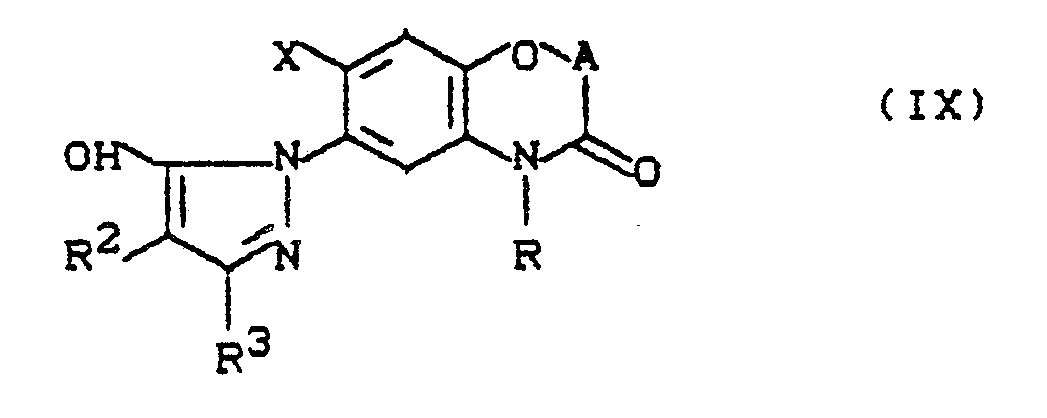
A

R für Wasserstoff oder für einen gegebenenfalls substituierten Rest aus der Reihe Alkyl, Cycloalkyl, Cycloalkylalkyl, Alkenyl, Alkinyl, Aralkyl und Heteroarylalkyl steht,
R² für Wasserstoff, Cyano, Nitro, Halogen oder gegebenenfalls durch Halogen substituiertes Alkyl steht,
R³ für Wasserstoff oder gegebenenfalls durch Halogen substituiertes Alkyl steht, oder zusammen mit R² für Alkandiyl steht,
X für Wasserstoff oder Halogen steht.

A

Q für Cyano, Carboxy oder C₁-C₄-Alkoxycarbonyl steht,
X für Wasserstoff oder Halogen steht und
Y für die nachstehenden heterocyclischen Gruppierungen steht

R¹ für Wasserstoff, Halogen oder gegebenenfalls durch Halogen substituiertes Alkyl steht,
R² für Wasserstoff, Cyano, Nitro, Halogen oder gegebenenfalls durch Halogen substituiertes Alkyl steht,
R³ für Wasserstoff oder gegebenenfalls durch Halogen substituiertes Alkyl steht, oder zusammen mit R² für Alkandiyl steht,
R⁴ für Wasserstoff oder für jeweils gegebenenfalls durch Halogen substituiertes Alkyl, Cycloalkyl, Alkenyl oder Alkinyl steht und
Z für Sauerstoff oder die Gruppierung -N-R⁵ steht, worin
R⁵ für Wasserstoff oder für jeweils gegebenenfalls durch Halogen substituiertes Alkyl, Alkenyl oder Alkinyl steht, oder zusammen mit R⁴ für Alkandiyl steht.

X³ für Halogen steht,
A

R für Wasserstoff oder für einen gegebenenfalls substituierten Rest aus der Reihe Alkyl, Cycloalkyl, Cycloalkylalkyl, Alkenyl, Alkinyl, Aralkyl und Heteroarylalkyl steht, dadurch gekennzeichnet, daß man Amino-benzoxazinone der Formel (X)

A, R und X³ die oben angegebene Bedeutung haben,
mit Nitriten in Gegenwart von Säuren und gegebenenfalls in Gegenwart von Verdünnungsmitteln und anschließend mit Reduktionsmitteln in Gegenwart von Säuren umsetzt.

A

R für Wasserstoff oder für einen gegebenenfalls substituierten Rest aus der Reihe Alkyl, Cycloalkyl, Cycloalkylalkyl, Alkenyl, Alkinyl, Aralkyl und Heteroarylalkyl steht,
R⁴ für Wasserstoff oder für jeweils gegebenenfalls durch Halogen substituiertes Alkyl, Cycloalkyl, Alkenyl oder Alkinyl steht und
X für Wasserstoff oder Halogen steht,
dadurch gekennzeichnet, daß man Hydrazino-benzoxazinone der Formel (II)

A, R und X die oben angegebenen Bedeutungen haben,
mit Acylierungsmitteln der allgemeinen Formel (XI)
R⁴ - CO - X⁴ (XI)
in welcher
R⁴ die oben angegebene Bedeutung hat und
X⁴ für Halogen steht,
gegebenenfalls in Gegenwart von Säureakzeptoren und gegebenenfalls in Gegenwart von Verdünnungsmitteln umsetzt.

A

X für Wasserstoff oder Halogen steht,
Y für die nachstehenden heterocyclischen Gruppierungen steht

R¹ für Wasserstoff, Halogen oder gegebenenfalls durch Halogen substituiertes Alkyl steht,
R² für Wasserstoff, Cyano, Nitro, Halogen oder gegebenenfalls durch Halogen substituiertes Alkyl steht,
R³ für Wasserstoff oder gegebenenfalls durch Halogen substituiertes Alkyl steht, oder zusammen mit R² für Alkandiyl steht,
R⁴ für Wasserstoff oder für jeweils gegebenenfalls durch Halogen substituiertes Alkyl, Cycloalkyl, Alkenyl oder Alkinyl steht und
Z für Sauerstoff oder die Gruppierung -N-R⁵ steht, worin
R⁵ für Wasserstoff oder für jeweils gegebenenfalls durch Halogen substituiertes Alkyl, Alkenyl oder Alkinyl steht, oder zusammen mit R⁴ für Alkandiyl steht, und
Q für Cyano, Carboxy oder C₁-C₄-Alkoxycarbonyl steht,
dadurch gekennzeichnet, daß man Verbindungen der Formel (XII)
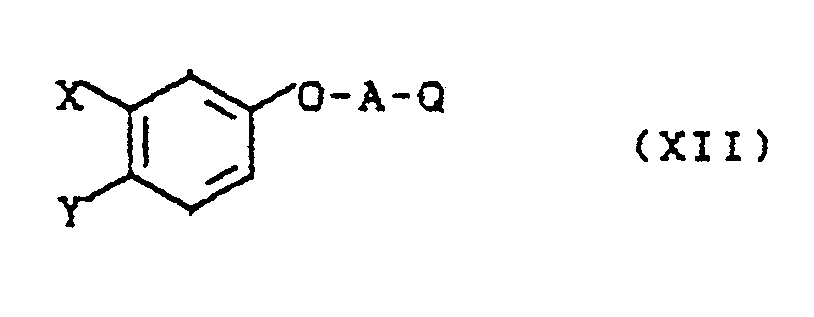
A, Q, X und Y die oben angegebenen Bedeutungen haben,
mit Nitrierungsmitteln, gegebenenfalls in Gegenwart von Schwefelsäure, umsetzt.

A

R für Wasserstoff oder für einen gegebenenfalls substituierten Rest aus der Reihe Alkyl, Cycloalkyl, Cycloalkylalkyl, Alkenyl, Alkinyl, Aralkyl und Heteroarylalkyl steht,
R² für Wasserstoff, Cyano, Nitro, Halogen oder für gegebenenfalls durch Halogen substituiertes Alkyl steht,
R³ für Wasserstoff oder gegebenenfalls durch Halogen substituiertes Alkyl steht oder zusammen mit R² für Alkandiyl steht und
X für Wasserstoff oder Halogen steht,
dadurch gekennzeichnet, daß man Hydrazinobenzoxazinone der Formel (II)

A, R und X die oben angegebenen Bedeutungen haben,
mit β-Ketoestern der allgemeinen Formel (XX)
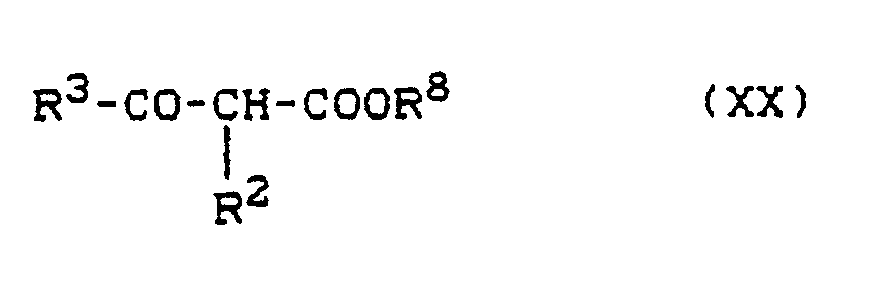
R² und R³ die oben angegebenen Bedeutungen haben und
R⁸ für Alkyl steht,
gegebenenfalls in Gegenwart von Verdünnungsmitteln, umsetzt.

A

Q für Cyano, Carboxy oder C₁-C₄-Alkoxycarbonyl steht,
X für Wasserstoff oder Halogen steht und
Y für die nachstehenden heterocyclischen Gruppierungen steht
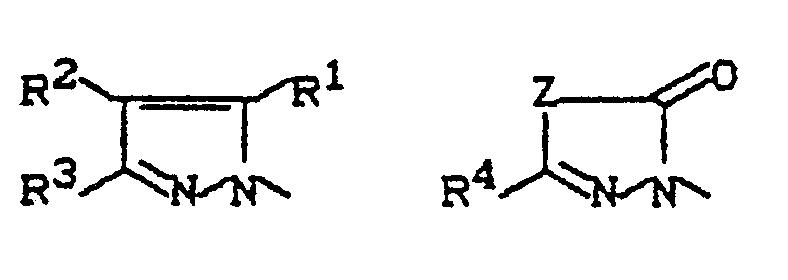
R¹ für Wasserstoff, Halogen oder gegebenenfalls durch Halogen substituiertes Alkyl steht,
R² für Wasserstoff, Cyano, Nitro, Halogen oder gegebenenfalls durch Halogen substituiertes Alkyl steht,
R³ für Wasserstoff oder gegebenenfalls durch Halogen substituiertes Alkyl steht, oder zusammen mit R² für Alkandiyl steht,
R⁴ für Wasserstoff oder für jeweils gegebenenfalls durch Halogen substituiertes Alkyl, Cycloalkyl, Alkenyl oder Alkinyl steht und
Z für Sauerstoff oder die Gruppierung -N-R⁵ steht, worin
R⁵ für Wasserstoff oder für jeweils gegebenenfalls durch Halogen substituiertes Alkyl, Alkenyl oder Alkinyl steht, oder zusammen mit R⁴ für Alkandiyl steht,
dadurch gekennzeichnet, daß man Phenolderivate der Formel (XIV)

X und Y die oben angegebenen Bedeutungen haben,
mit Alkylierungsmitteln der Formel (XV)
X⁵ - A - Q (XV)
in welcher
A und Q die oben angegebenen Bedeutungen haben und
X⁵ für Halogen steht,
in Gegenwart eines Säureakzeptors und in Gegenwart eines Verdünnungsmittels umsetzt.
Applications Claiming Priority (4)
| Application Number | Priority Date | Filing Date | Title |
|---|---|---|---|
| DE3807836 | 1988-03-10 | ||
| DE3807836 | 1988-03-10 | ||
| DE3832348 | 1988-09-23 | ||
| DE19883832348 DE3832348A1 (de) | 1988-03-10 | 1988-09-23 | Substituierte benzoxazinone, mehrere verfahren sowie neue zwischenprodukte zu ihrer herstellung sowie ihre herbizide verwendung |
Publications (2)
| Publication Number | Publication Date |
|---|---|
| EP0334055A2 true EP0334055A2 (de) | 1989-09-27 |
| EP0334055A3 EP0334055A3 (de) | 1990-01-17 |
Family
ID=25865741
Family Applications (1)
| Application Number | Title | Priority Date | Filing Date |
|---|---|---|---|
| EP89103461A Withdrawn EP0334055A3 (de) | 1988-03-10 | 1989-02-28 | Substituierte Benzoxazinone, mehrere Verfahren sowie neue Zwischenprodukte zu ihrer Herstellung sowie ihre herbizide Verwendung |
Country Status (5)
| Country | Link |
|---|---|
| EP (1) | EP0334055A3 (de) |
| JP (1) | JPH01275573A (de) |
| AU (1) | AU624122B2 (de) |
| BR (1) | BR8901132A (de) |
| DE (1) | DE3832348A1 (de) |
Cited By (11)
| Publication number | Priority date | Publication date | Assignee | Title |
|---|---|---|---|---|
| EP0422639A1 (de) * | 1989-10-12 | 1991-04-17 | Sumitomo Chemical Company, Limited | Benzoxazinyl-Pyrazole und Verfahren zur Herstellung und Anwendung |
| US5281571A (en) * | 1990-10-18 | 1994-01-25 | Monsanto Company | Herbicidal benzoxazinone- and benzothiazinone-substituted pyrazoles |
| TR26599A (tr) * | 1992-03-17 | 1995-03-15 | Monsanto Co | MUZIR OT ÖLDüRüCü (HERBISID), IKAME EDILMIS ARIL- HALOALKILPIRAZOLLER. |
| WO2001019820A1 (de) * | 1999-09-10 | 2001-03-22 | Basf Aktiengesellschaft | Substituierte pyrazol-3-ylbenzoxazinone |
| WO2001025216A1 (de) * | 1999-10-01 | 2001-04-12 | Basf Aktiengesellschaft | 1-aryl-1,3-dihydro-imidazol-2-(thi)on derivate, deren herstellung und deren verwendung als herbizide oder zur desikkation/defoliation von pflanzen |
| WO2002006277A1 (de) * | 2000-07-18 | 2002-01-24 | Bayer Aktiengesellschaft | Substituierte benzostickstoffheterocyclen und deren verwendung als herbizide |
| WO2012041789A1 (en) | 2010-10-01 | 2012-04-05 | Basf Se | Herbicidal benzoxazinones |
| CN102875540A (zh) * | 2012-10-30 | 2013-01-16 | 南开大学 | 2-苯并恶嗪酮基-5-环己氨基羰基四唑酮的除草活性 |
| CN103319471A (zh) * | 2013-07-10 | 2013-09-25 | 南开大学 | 含7-氟-2-甲基苯并噁嗪-3-酮结构的四唑酮衍生物的除草活性 |
| WO2019101513A1 (en) | 2017-11-23 | 2019-05-31 | Basf Se | Herbicidal pyridylethers |
| WO2019101551A1 (en) | 2017-11-23 | 2019-05-31 | Basf Se | Herbicidal phenylethers |
Families Citing this family (6)
| Publication number | Priority date | Publication date | Assignee | Title |
|---|---|---|---|---|
| US4877444A (en) * | 1987-08-27 | 1989-10-31 | Sumitomo Chemical Company, Limited | Tetrahydroindazolyl-benzoxazines and use |
| JPH02138183A (ja) * | 1988-11-17 | 1990-05-28 | Nippon Tokushu Noyaku Seizo Kk | 除草性ピロール類 |
| US5532416A (en) * | 1994-07-20 | 1996-07-02 | Monsanto Company | Benzoyl derivatives and synthesis thereof |
| IT1289618B1 (it) * | 1997-02-12 | 1998-10-15 | Isagro Ricerca Srl | Benzossazinil-eterocicli ad attivita' erbicida |
| CN114945561A (zh) * | 2020-01-13 | 2022-08-26 | 阿普塔生物治疗公司 | 新吡唑衍生物 |
| CN115109006B (zh) * | 2022-05-20 | 2025-03-14 | 上海大学 | 一种3-取代-1,2-苯并噁嗪-4-酮类化合物的制备方法 |
Family Cites Families (5)
| Publication number | Priority date | Publication date | Assignee | Title |
|---|---|---|---|---|
| DE2740836A1 (de) * | 1977-09-10 | 1979-03-22 | Troponwerke Gmbh & Co Kg | Anellierte indolderivate, verfahren zu ihrer herstellung und ihre verwendung als arzneimittel |
| US4640707A (en) * | 1984-07-23 | 1987-02-03 | Sumitomo Chemical Company, Ltd. | Tetrahydrophthalimides and their herbicidal use |
| US4804394A (en) * | 1986-09-09 | 1989-02-14 | Nihon Tokushu Noyaku Seizo K.K. | Benzoxazines and use as herbicides |
| AU608304B2 (en) * | 1987-02-27 | 1991-03-28 | Terumo Kabushiki Kaisha | Process for preparing liposome |
| US4877444A (en) * | 1987-08-27 | 1989-10-31 | Sumitomo Chemical Company, Limited | Tetrahydroindazolyl-benzoxazines and use |
-
1988
- 1988-09-23 DE DE19883832348 patent/DE3832348A1/de not_active Withdrawn
-
1989
- 1989-02-28 EP EP89103461A patent/EP0334055A3/de not_active Withdrawn
- 1989-03-10 AU AU31200/89A patent/AU624122B2/en not_active Ceased
- 1989-03-10 JP JP5651889A patent/JPH01275573A/ja active Pending
- 1989-03-10 BR BR8901132A patent/BR8901132A/pt unknown
Cited By (12)
| Publication number | Priority date | Publication date | Assignee | Title |
|---|---|---|---|---|
| EP0422639A1 (de) * | 1989-10-12 | 1991-04-17 | Sumitomo Chemical Company, Limited | Benzoxazinyl-Pyrazole und Verfahren zur Herstellung und Anwendung |
| US5156668A (en) * | 1989-10-12 | 1992-10-20 | Sumitomo Chemical Company, Limited | Benzoxazinyl-pyrazoles and their use as herbicides |
| US5281571A (en) * | 1990-10-18 | 1994-01-25 | Monsanto Company | Herbicidal benzoxazinone- and benzothiazinone-substituted pyrazoles |
| TR26599A (tr) * | 1992-03-17 | 1995-03-15 | Monsanto Co | MUZIR OT ÖLDüRüCü (HERBISID), IKAME EDILMIS ARIL- HALOALKILPIRAZOLLER. |
| WO2001019820A1 (de) * | 1999-09-10 | 2001-03-22 | Basf Aktiengesellschaft | Substituierte pyrazol-3-ylbenzoxazinone |
| WO2001025216A1 (de) * | 1999-10-01 | 2001-04-12 | Basf Aktiengesellschaft | 1-aryl-1,3-dihydro-imidazol-2-(thi)on derivate, deren herstellung und deren verwendung als herbizide oder zur desikkation/defoliation von pflanzen |
| WO2002006277A1 (de) * | 2000-07-18 | 2002-01-24 | Bayer Aktiengesellschaft | Substituierte benzostickstoffheterocyclen und deren verwendung als herbizide |
| WO2012041789A1 (en) | 2010-10-01 | 2012-04-05 | Basf Se | Herbicidal benzoxazinones |
| CN102875540A (zh) * | 2012-10-30 | 2013-01-16 | 南开大学 | 2-苯并恶嗪酮基-5-环己氨基羰基四唑酮的除草活性 |
| CN103319471A (zh) * | 2013-07-10 | 2013-09-25 | 南开大学 | 含7-氟-2-甲基苯并噁嗪-3-酮结构的四唑酮衍生物的除草活性 |
| WO2019101513A1 (en) | 2017-11-23 | 2019-05-31 | Basf Se | Herbicidal pyridylethers |
| WO2019101551A1 (en) | 2017-11-23 | 2019-05-31 | Basf Se | Herbicidal phenylethers |
Also Published As
| Publication number | Publication date |
|---|---|
| BR8901132A (pt) | 1989-10-31 |
| DE3832348A1 (de) | 1989-09-28 |
| EP0334055A3 (de) | 1990-01-17 |
| AU3120089A (en) | 1989-09-21 |
| JPH01275573A (ja) | 1989-11-06 |
| AU624122B2 (en) | 1992-06-04 |
Similar Documents
| Publication | Publication Date | Title |
|---|---|---|
| EP0370332B1 (de) | N-Aryl-Stickstoffheterocyclen, Verfahren sowie neue Zwischenprodukte zu ihrer Herstellung und ihre Verwendung als Herbizide und Pflanzenwuchsregulatoren | |
| EP0354329B1 (de) | (Hetero)Aryloxynaphthaline mit über Schwefel gebundenen Substituenten | |
| EP0661262A1 (de) | Halogenierte Triazolinone | |
| DE3832348A1 (de) | Substituierte benzoxazinone, mehrere verfahren sowie neue zwischenprodukte zu ihrer herstellung sowie ihre herbizide verwendung | |
| EP0335156A1 (de) | 5-Amino-1-phenylpyrazole | |
| EP0148501B1 (de) | 5-Halogenalkyl-1,3,4-thiadiazol-2-yloxyacetamide | |
| EP0363585A1 (de) | N-Aryl-Stickstoffheterocyclen | |
| EP0138149A2 (de) | Substituierte 5-Acylamino-1-phenylpyrazole | |
| EP0224831A2 (de) | 5-Dichloracetamido-4-nitro-1-aryl-pyrazole | |
| EP0334133A1 (de) | Pyrazolylpyrrolinone | |
| DE3731516A1 (de) | N-aryl-stickstoffheterocyclen | |
| DE3903799A1 (de) | N-aryl-stickstoffheterocyclen | |
| EP0349748B1 (de) | Substituierte N-Aryl-Stickstoffheterocyclen | |
| DE3640155A1 (de) | Triazolo-pyrimidin-2-sulfonamide | |
| DE3726919A1 (de) | 1-arylpyrazole | |
| EP0300344B1 (de) | Halogenierte Thiadiazolyl-oxyessig-säureamide, Verfahren und Zwischenprodukte zu ihrer Herstellung und ihre Verwendung als Herbizide | |
| EP0415196B1 (de) | Substituierte 4,5-Diamino-1,2,4-triazol-3-(thi)one | |
| EP0171544B1 (de) | Substituierte 5-Acylamino-1-phenylpyrazole | |
| DE3917469A1 (de) | Heterocyclylpyridine | |
| EP0422369A2 (de) | Substituierte Carbamoyltriazole | |
| DE3812350A1 (de) | Triazoloazine | |
| DE3905006A1 (de) | N-aryl-stickstoffheterocyclen mit fluorhaltigen substituenten | |
| EP0369212A1 (de) | (Hetero)Aryloxynaphthalinderivate, Verfahren und neue (Hetero)Aryloxynaphthylamine zu ihrer Herstellung sowie ihre Verwendung als Herbizide | |
| DE3934197A1 (de) | Thiazolcarbonsaeureamid-derivate | |
| EP0316733A1 (de) | 3-Aminopyrazolin-5-one |
Legal Events
| Date | Code | Title | Description |
|---|---|---|---|
| PUAI | Public reference made under article 153(3) epc to a published international application that has entered the european phase |
Free format text: ORIGINAL CODE: 0009012 |
|
| 17P | Request for examination filed |
Effective date: 19890228 |
|
| AK | Designated contracting states |
Kind code of ref document: A2 Designated state(s): BE CH DE FR GB IT LI NL |
|
| PUAL | Search report despatched |
Free format text: ORIGINAL CODE: 0009013 |
|
| AK | Designated contracting states |
Kind code of ref document: A3 Designated state(s): BE CH DE FR GB IT LI NL |
|
| 17Q | First examination report despatched |
Effective date: 19920723 |
|
| STAA | Information on the status of an ep patent application or granted ep patent |
Free format text: STATUS: THE APPLICATION IS DEEMED TO BE WITHDRAWN |
|
| 18D | Application deemed to be withdrawn |
Effective date: 19930729 |