EP0332005A1 - Supertwist-Flüssigkristallanzeige - Google Patents
Supertwist-Flüssigkristallanzeige Download PDFInfo
- Publication number
- EP0332005A1 EP0332005A1 EP89103412A EP89103412A EP0332005A1 EP 0332005 A1 EP0332005 A1 EP 0332005A1 EP 89103412 A EP89103412 A EP 89103412A EP 89103412 A EP89103412 A EP 89103412A EP 0332005 A1 EP0332005 A1 EP 0332005A1
- Authority
- EP
- European Patent Office
- Prior art keywords
- trans
- liquid crystal
- crystal mixture
- display according
- compound
- Prior art date
- Legal status (The legal status is an assumption and is not a legal conclusion. Google has not performed a legal analysis and makes no representation as to the accuracy of the status listed.)
- Granted
Links
- 0 *C(CC1)CCC1N Chemical compound *C(CC1)CCC1N 0.000 description 5
- AFKMHDZOVNDWLO-UHFFFAOYSA-N OC(CC1)CCC1C1CCCCC1 Chemical compound OC(CC1)CCC1C1CCCCC1 AFKMHDZOVNDWLO-UHFFFAOYSA-N 0.000 description 1
- HPXRVTGHNJAIIH-UHFFFAOYSA-N OC1CCCCC1 Chemical compound OC1CCCCC1 HPXRVTGHNJAIIH-UHFFFAOYSA-N 0.000 description 1
Classifications
-
- C—CHEMISTRY; METALLURGY
- C09—DYES; PAINTS; POLISHES; NATURAL RESINS; ADHESIVES; COMPOSITIONS NOT OTHERWISE PROVIDED FOR; APPLICATIONS OF MATERIALS NOT OTHERWISE PROVIDED FOR
- C09K—MATERIALS FOR MISCELLANEOUS APPLICATIONS, NOT PROVIDED FOR ELSEWHERE
- C09K19/00—Liquid crystal materials
- C09K19/04—Liquid crystal materials characterised by the chemical structure of the liquid crystal components, e.g. by a specific unit
- C09K19/42—Mixtures of liquid crystal compounds covered by two or more of the preceding groups C09K19/06 - C09K19/40
- C09K19/46—Mixtures of liquid crystal compounds covered by two or more of the preceding groups C09K19/06 - C09K19/40 containing esters
-
- C—CHEMISTRY; METALLURGY
- C09—DYES; PAINTS; POLISHES; NATURAL RESINS; ADHESIVES; COMPOSITIONS NOT OTHERWISE PROVIDED FOR; APPLICATIONS OF MATERIALS NOT OTHERWISE PROVIDED FOR
- C09K—MATERIALS FOR MISCELLANEOUS APPLICATIONS, NOT PROVIDED FOR ELSEWHERE
- C09K19/00—Liquid crystal materials
- C09K19/02—Liquid crystal materials characterised by optical, electrical or physical properties of the components, in general
- C09K19/0208—Twisted Nematic (T.N.); Super Twisted Nematic (S.T.N.); Optical Mode Interference (O.M.I.)
-
- C—CHEMISTRY; METALLURGY
- C09—DYES; PAINTS; POLISHES; NATURAL RESINS; ADHESIVES; COMPOSITIONS NOT OTHERWISE PROVIDED FOR; APPLICATIONS OF MATERIALS NOT OTHERWISE PROVIDED FOR
- C09K—MATERIALS FOR MISCELLANEOUS APPLICATIONS, NOT PROVIDED FOR ELSEWHERE
- C09K19/00—Liquid crystal materials
- C09K19/04—Liquid crystal materials characterised by the chemical structure of the liquid crystal components, e.g. by a specific unit
- C09K19/06—Non-steroidal liquid crystal compounds
- C09K19/08—Non-steroidal liquid crystal compounds containing at least two non-condensed rings
- C09K19/30—Non-steroidal liquid crystal compounds containing at least two non-condensed rings containing saturated or unsaturated non-aromatic rings, e.g. cyclohexane rings
- C09K19/3001—Cyclohexane rings
-
- C—CHEMISTRY; METALLURGY
- C09—DYES; PAINTS; POLISHES; NATURAL RESINS; ADHESIVES; COMPOSITIONS NOT OTHERWISE PROVIDED FOR; APPLICATIONS OF MATERIALS NOT OTHERWISE PROVIDED FOR
- C09K—MATERIALS FOR MISCELLANEOUS APPLICATIONS, NOT PROVIDED FOR ELSEWHERE
- C09K19/00—Liquid crystal materials
- C09K19/04—Liquid crystal materials characterised by the chemical structure of the liquid crystal components, e.g. by a specific unit
- C09K19/42—Mixtures of liquid crystal compounds covered by two or more of the preceding groups C09K19/06 - C09K19/40
-
- C—CHEMISTRY; METALLURGY
- C09—DYES; PAINTS; POLISHES; NATURAL RESINS; ADHESIVES; COMPOSITIONS NOT OTHERWISE PROVIDED FOR; APPLICATIONS OF MATERIALS NOT OTHERWISE PROVIDED FOR
- C09K—MATERIALS FOR MISCELLANEOUS APPLICATIONS, NOT PROVIDED FOR ELSEWHERE
- C09K19/00—Liquid crystal materials
- C09K19/04—Liquid crystal materials characterised by the chemical structure of the liquid crystal components, e.g. by a specific unit
- C09K19/42—Mixtures of liquid crystal compounds covered by two or more of the preceding groups C09K19/06 - C09K19/40
- C09K19/44—Mixtures of liquid crystal compounds covered by two or more of the preceding groups C09K19/06 - C09K19/40 containing compounds with benzene rings directly linked
Definitions
- the invention relates to a supertwist liquid crystal display - two plane-parallel carrier plates, which form a cell with a border, a nematic liquid crystal mixture in the cell with positive dielectric anisotropy and with at least one chiral dopant, Electrode layers with overlying orientation layers on the inside of the carrier plates, - An angle of attack between the longitudinal axis of the molecules on the surface of the carrier plates and the carrier plates of about 1 ° to 30 °, and - A twist angle of the liquid crystal mixture in the cell from orientation layer to orientation layer according to the amount between 160 ° and 450 °, characterized in that the nematic liquid crystal mixture satisfies the following conditions: - nematic phase range of at least 60 ° C, - viscosity of 30 mPa.s or less, and - ⁇ / ⁇ ⁇ ⁇ 2.0, where ⁇ means the dielectric anisotropy and ⁇ ⁇ the dielectric constant in the direction of the short axis
- Supertwist liquid crystal displays (SFK displays) according to the preamble are known, for example from EP 0 131 216 B1; DE 34 23 993 A1; EP 0 098 070 A2; M. Schadt and F. Leenhouts, 17th Koch Working Conference on Liquid Crystals (April 8-10, 1987); K. Kawasaki et al., SID 87 Digest 391 (20.6); M. Schadt and F. Leenhouts, SID 87 Digest 372 (20.1); K. Katoh et al., Japanese Journal of Applied Physics, vol. 26, no. 11, L 1784-L 1786 (1987); F. Leenhouts et al., Appl. Phys. Lett.
- SFK display here includes any higher twisted display with a twist angle between 160 ° and 360 °, such as the displays according to Waters et al. (CM Waters et al., Proc.
- displays of this type are distinguished by significantly better slopes of the electro-optical characteristic curve and the associated better contrast values, and by a significantly lower angle dependence of the contrast.
- Supertwist displays with a very steep slope.
- the elastic properties of the liquid crystal mixture in particular have so far been optimized in order to achieve high slope characteristics. The slopes achieved were not sufficient for every application.
- the invention has for its object to provide SFK displays that do not have the disadvantages indicated above or only to a lesser extent and at the same time have very high slope characteristics.
- nematic liquid-crystal mixtures are used in these displays, the following conditions being met: - nematic phase range of at least 60 ° C, - viscosity of 30 mPa.s or less, and - ⁇ / ⁇ ⁇ ⁇ 2.0, where ⁇ means the dielectric anisotropy and ⁇ ⁇ the dielectric constant in the direction of the short axis of the liquid crystal molecules .
- the invention thus relates to a supertwist liquid crystal display - two plane-parallel carrier plates, which form a cell with a border, a nematic liquid crystal mixture in the cell with positive dielectric anisotropy and with at least one chiral dopant, Electrode layers with overlying orientation layers on the inside of the carrier plates, - An angle of attack between the longitudinal axis of the molecules on the surface of the carrier plates and the carrier plates of about 1 ° to 30 °, and - A twist angle of the liquid crystal mixture in the cell from orientation layer to orientation layer according to the amount between 160 and 450 °, characterized in that the nematic liquid crystal mixture satisfies the following conditions: - nematic phase range of at least 60 ° C, - viscosity of 30 mPa.s or less, and - ⁇ / ⁇ ⁇ ⁇ 2.0, where ⁇ means the dielectric anisotropy and ⁇ ⁇ the dielectric constant in the direction of the short axis of
- the invention further relates to the use of nematic liquid crystal mixtures which satisfy the following conditions: - nematic phase range of at least 60 ° C, - viscosity of 30 mPa.s or less, and - ⁇ / ⁇ ⁇ ⁇ 2.0, where ⁇ means the dielectric anisotropy and ⁇ ⁇ the dielectric constant in the direction of the short axis of the liquid crystal molecules , as dielectrics of SFK displays.
- the invention also relates to corresponding liquid crystal mixtures for use in SFK displays.
- Nematic liquid crystal mixtures which satisfy two of the three specified conditions are known and are used commercially in various embodiments. It is also known that by using high proportions of phenylbenzoates according to DE-PS 21 67 252 or of strongly dielectric negative liquid crystals (eg according to DE-OS 32 31 707) values of ⁇ / ⁇ ⁇ ⁇ 2.0 can be achieved. However, these liquid crystal mixtures are distinguished by high viscosities, the values at 20 ° being often between 40 and 50 mPa.s or higher. Corresponding SFK displays have switching times that are clearly too long for a commercial application.
- the liquid crystal mixtures according to the invention make it possible to achieve a low value for ⁇ / ⁇ ⁇ at low viscosities, as a result of which excellent slopes of the electro-optical characteristic curve can be achieved in SKF displays.
- the liquid crystal mixtures according to the invention preferably have an ⁇ ⁇ ⁇ 4, in particular ⁇ ⁇ ⁇ 5 or ⁇ 6.
- ⁇ / ⁇ ⁇ is preferably ⁇ 1.5, in particular ⁇ 1.3.
- the viscosity at 20 ° C is preferably ⁇ 25 mPa.s.
- the nematic phase range is preferably at least 70, in particular at least 80 °. This range preferably extends at least from -20 ° to + 70 °.
- the mixtures according to the invention preferably contain 5-60% of one or more compounds with a dielectric anisotropy of less than -2.0. This proportion is preferably> 20%, in particular 25-40%.
- the viscosity of these compounds is preferably 10 to 50 mPa.s at 20 ° C.
- the individual compounds of the formulas I, II, A to Q and E1 to E7 which can be used in the SFK displays according to the invention are either known, or they can be prepared analogously to the known compounds.
- liquid-crystal mixtures which can be used according to the invention preferably contain a total of 5-60%, in particular 10-40%, of compounds of the formula I.
- liquid-crystal mixtures which, in addition to dielectrically negative compounds of the formula I, also comprise at least one compound of the formula I with positive dielectric anisotropy (in which one of the radicals R1 and R2 is F, Cl, CN, NCS, CF3 or OCF3, preferably CN or F). In total, they preferably contain 10-30, in particular 12-20, components.
- Liquid crystal mixtures, the known liquid crystalline esters of p-fluorophenol, are particularly preferred and / or liquid-crystalline tolan derivatives. The latter are characterized by high birefringence and high values for K3 / K1. The use of tolan derivatives enables the transition to SFK displays with smaller layer thicknesses (approx. 5 to 6 ⁇ m), which results in significantly shorter switching times.
- the proportion of tolan derivatives is preferably 5% to 35%, particularly preferably 10% to 30%.
- Preferred tolan derivatives are given below: wherein R1 and R2 have the meanings given for formula I.
- R1 is preferably n-alkyl with 1 to 7 C atoms or n-alkenyl with 3 to 7 C atoms.
- R2 is preferably n-alkoxy or n-alkyl each having 1 to 7 carbon atoms or n-alkenyl or n-alkenyloxy each having 3 to 7 carbon atoms.
- Q is 1,4-phenylene, 2-fluoro-1,4-phenylene, 3-fluoro-1,4-phenylene or 2,3-difluoro-1,4-phenylene.
- the mixtures according to the invention preferably contain one or more compounds of the formulas T1, T2 and T3, in which Q is 2-fluoro-1,4-phenylene, 3-fluoro-1,4-phenylene or 2,3-difluoro-1,4-phenylene , particularly preferably 2,3-difluoro-1,4-phenylene.
- the compounds of the formulas I and II are ideally suited for this purpose, since the viscosity of the mixture as a whole remains surprisingly low when added, while strongly dielectrically negative compounds from the prior art, such as, for example, derivatives of 2,3-dicyanohydroquinone or cyclohexane derivatives the structural element lead to an unacceptable increase in viscosity in many cases.
- a mixture preferably contains one or more dielectrically negative compounds ( ⁇ ⁇ -1.5) which at the same time have high optical anisotropy ( ⁇ n> 0.15).
- Compounds of the formula II are preferably used.
- the mixtures according to the invention preferably contain ester compounds with the structural element wherein Q1 and Q2 independently of one another are trans-1,4-cyclohexylene, 1,4-phenylene, 2- or 3-fluoro-1,4-phenylene or 2,3-difluoro-1,4-phenylene.
- Q1 and Q2 independently of one another are trans-1,4-cyclohexylene, 1,4-phenylene, 2- or 3-fluoro-1,4-phenylene or 2,3-difluoro-1,4-phenylene.
- the latter are preferred compounds of the formula I.
- ester compounds of the formulas A to G are particularly preferred, compounds of the formulas B, C, D and E being particularly preferred.
- Further preferred ester compounds are those of the formulas wherein R A and R B have the meaning given in the formulas A to G. G1 is particularly preferred.
- the proportion of these ester compounds can be up to about 60%, in particular about 10% to 40%.
- the mixtures contain one or more compounds with the structural element wherein Q3 means trans-1,4-cyclohexylene, 1,4-phenylene, 2- or 3-fluoro-1,4-phenylene or 2,3-difluoro-1,4-phenylene.
- Q3 means trans-1,4-cyclohexylene, 1,4-phenylene, 2- or 3-fluoro-1,4-phenylene or 2,3-difluoro-1,4-phenylene.
- the latter are preferred compounds of the formula I.
- the proportion of these compounds is preferably 10% to 45%, particularly preferably approximately 10% to 35%.
- the compounds of the formulas E1 to E7 are particularly preferred, including in particular E3 and E6.
- the mixtures according to the invention contain one or more compounds with ⁇ > 1.5.
- the selection of these compounds known in large numbers is not critical.
- the person skilled in the art can, without inventive step, type and proportion of these compounds to achieve the desired ones Set threshold voltage.
- the proportion is preferably approximately 30% to 70%, particularly preferably 40% to 60%.
- Dielectric positive compounds of the formula I and / or II are also preferably used in addition to conventional components such as wherein R A has the meaning given in the formulas A to G, x 1 or 2, X1 CN or F and X2 H or F.
- chiral dopants are not critical in itself.
- the person skilled in the art can determine the type and amount of the chiral component to achieve the desired ratio between the layer thickness and the natural pitch of the total mixture (e.g. between 0.3 and 1.3) without inventive step.
- the displays according to the invention also show particularly low angle dependence of the contrast, ie the value is particularly low.
- the mixtures according to the invention also show favorable elastic properties, i.e. especially for K3 / K1.
- K3 / K1 is preferably ⁇ 0.8.
- the proportion of these compounds in the mixtures according to the invention is preferably 1% to 20%, in particular 5% to 15%.
- Particularly preferred are 2-pn-alkyl or 2-pn-alkoxyphenyl-5-n-alkylpyrimidines, in which the alkyl or alkoxy groups have up to 12 carbon atoms.
- trans-1-pn-alkanoyloxyphenyl-4-n-alkylcyclohexanes trans, trans-4-n-alkanoyloxy4-n-alkylcyclohexyl-cyclohexanes and / or pn-alkylbenzoic acid (pn-alkylphenyl esters), in which the alkanoyloxy or.
- Alkyl groups each have up to 12 carbon atoms.
- 2-p-cyanophenyl-5-n-alkylpyrimidines in which the alkyl group has up to 12 carbon atoms.
- the mixtures according to the invention do not contain any compounds with a dielectric anisotropy ⁇ of less than -1.5, but instead, in order to achieve the required values for ⁇ / ⁇ ⁇ , a sufficient proportion of one or more compounds with ⁇ > -1.5 and high Values for ⁇ ⁇ .
- ⁇ is preferably in the range +3 to +15, in particular +4 to +9 ⁇ ⁇ is preferably in the range 5 to 8.
- Preferred compounds of this type are those of the formula I in which R2 is F, Cl, -CN, -NCS, -CF3 or -OCF3. These compounds are the subject of German patent applications 38 07 868, 38 07 822, 38 07 806 and 38 07 864.
- the mixtures according to the invention can also contain highly clarifying additives (clearing point> 180 °).
- the proportion of these compounds is preferably approximately 5% to 20%.
- Suitable compounds are known to the person skilled in the art.
- the compounds specified below are particularly preferred: wherein R A and R B have the meaning given in the formulas A to G.
- the structure of the liquid crystal displays according to the invention made of polarizers, electrode base plates and electrodes with such a surface treatment that the preferred orientation (director) of the respective adjacent liquid crystal molecules from one electrode to the other is usually rotated relative to one another by amounts of 160 ° to 450 ° the usual design for such displays.
- the concept of conventional construction is broad here and also includes all modifications and modifications of the super twist cell.
- the surface tilt angle on the two carrier plates can be the same or different. The same tilt angles are preferred.
- the twist angle of the displays according to the invention is preferably between 160 ° and 360 ° in amount, particularly preferably between 220 ° and 270 ° in amount.
- Liquid-crystalline phases are used in the displays according to the invention, in which the liquid-crystal parameters ⁇ and ⁇ / ⁇ ⁇ are selected in such a way that the steepest possible electro-optical characteristic is guaranteed, together with a maximum contrast and a minimal dependence on the viewing angle with a nematic phase range of at least 60 ° and a viscosity of 30 mPa.s or less.
- liquid crystal mixtures which can be used according to the invention are prepared in a manner which is conventional per se.
- the desired amount of the components used in smaller amounts is dissolved in the components which make up the main constituent, advantageously at elevated temperature.
- solutions of the components in an organic solvent e.g. in acetone, chloroform or methanol and to remove the solvent after thorough mixing, for example by distillation.
- the dielectrics can also contain further additives known to the person skilled in the art and described in the literature. For example, 0-15% pleochroic dyes can be added.
- the percentages are percentages by weight.
- the physical data are based on 20 ° C.
- the data relating to the individual connections are based on 20 ° C.
- An SFK display with the following parameters: Twist angle 180 ° Angle of attack 1 ° d / p (layer thickness / pitch) 0.35 d. ⁇ n 1.06 containing a liquid crystal mixture with the following parameters: Clearing point 84.7 ° ⁇ n 0.1275 (589 nm) 0.1257 (633 nm) viscosity 23.4 mPa.s ⁇ +8.3 ⁇ ⁇ 6.0 and consisting of 15% p-trans-4-propylcyclohexyl-benzonitrile, 7% p-trans-4-butylcyclohexyl-benzonitrile, 8% 4-ethyl-4'-cyanbiphenyl, 7% 4-propyl-4'-cyanbiphenyl, 8% 4-butyl-4'-cyanbiphenyl, 19% trans-4-pentylcyclohexane carboxylic acid (2,3-difluoro-4-ethoxyphenyl ester), 6% trans-4- (trans-4
- a nematic liquid crystal mixture consisting of is produced 15% 2,3-difluoro-4- (trans-4-propylcyclohexylethyl) benzonitrile, 15% 2,3-difluoro-4- (trans-4-butylcyclohexylethyl) benzonitrile, 10% 2,3-difluoro-4- (trans-4-pentylcyclohexylethyl) benzonitrile, 9% trans-4-propylcyclohexane carboxylic acid (trans-4-propylcyclohexyl ester), 9% trans-4-propylcyclohexane carboxylic acid (trans-4-pentylcyclohexyl ester), 6% trans-4- (trans-4-propylcyclohexyl) cyclohexane carboxylic acid (p-propylphenyl ester), 6% trans-4- (trans-4-propylcyclohexyl) cyclohexane carb
- a nematic liquid crystal mixture consisting of is produced 15% p-trans-4-propylcyclohexyl-benzonitrile, 8% 4-ethyl-2 ′, 3′-difluoro-4′-cyanbiphenyl, 7% 4-propyl-2 ′, 3′-difluoro-4′-cyanbiphenyl, 8% 4-butyl-2 ′, 3′-difluoro-4′-cyanbiphenyl, 5% trans-4-propylcyclohexane carboxylic acid (p-methoxyphenyl ester), 4% trans-4-propylcyclohexane carboxylic acid (p-ethoxyphenyl ester), 5% trans-4-butylcyclohexane carboxylic acid (p-methoxyphenyl ester), 4% trans-4-butylcyclohexane carboxylic acid (p-ethoxyphenyl ester), 4% trans-4-pentylcyclohexan
- a nematic liquid crystal mixture consisting of is produced 9% p-ethylbenzoic acid (4-cyan-2,3-difluorophenyl ester), 9% p-propylbenzoic acid (4-cyan-2,3-difluorophenyl ester), 8% p-pentylbenzoic acid (4-cyan-2,3-difluorophenyl ester), 9% trans, trans-4-methoxy-4'-methylcyclohexylcyclohexane, 17% trans-4-propylcyclohexane carboxylic acid (trans-4-propylcyclohexyl ester), 8% trans-4-propylcyclohexane carboxylic acid (trans-4-pentylcyclohexyl ester), 4% trans-4-butylcyclohexane carboxylic acid (p-trans-4-propylcyclohexylphenyl ester), 4% trans-4-pentylcyclohexan
- An SFK display with the following parameters: Twist angle 180 ° Angle of attack 1 ° d / p (layer thickness / pitch) 0.35 d. ⁇ n 1.0 containing a liquid crystal mixture with the following parameters: Clearing point 85 ° ⁇ n 0.141 viscosity 22.4 mPa.s ⁇ +7.2 ⁇ ⁇ 5.5 K3 / K1 1.42 and consisting of 9% p-trans-4-propylcyclohexyl-benzonitrile, 7% 4-ethyl-4'-cyanbiphenyl, 7% 4-propyl-4'-cyanbiphenyl, 7% 4-butyl-4'-cyanbiphenyl, 5% trans-4-propylcyclohexane carboxylic acid (p-fluorophenyl ester), 4% trans-4-propylcyclohexane carboxylic acid (p-methoxyphenyl ester), 4% trans-4-propylcyclohexane carboxylic acid (p
- An SFK display with the following parameters: Twist angle 220 ° Angle of attack 1 ° d / p (layer thickness / pitch) 0.36 d. ⁇ n 0.85 containing a liquid crystal mixture with the following parameters: Clearing point 94 ° ⁇ n 0.1238 (589 nm) viscosity 25 mPa.s ⁇ +7.5 ⁇ ⁇ 5.9 and consisting of 15% p-trans-4-propylcyclohexyl-benzonitrile, 11% p-trans-4-butylcyclohexyl-benzonitrile, 11% p-trans-4-pentylcyclohexyl-benzonitrile, 5% p-trans-4-ethylcyclohexyl-benzonitrile, 7% trans-4-propylcyclohexane carboxylic acid (2,3-difluoro-4-ethoxyphenyl ester), 6% trans-4-pentylcyclohexane carboxylic acid (2,
- An SFK display with the following parameters: Twist angle 220 ° Angle of attack 1 ° d / p (layer thickness / pitch) 0.4 ° d. ⁇ n 0.85 containing a liquid crystal mixture with the following parameters: Clearing point 91 ° ⁇ n 0.1085 (589 nm) viscosity 25 mPa.s ⁇ +8.2 ⁇ ⁇ 5.1 and consisting of 15% p-trans-4-propylcyclohexyl-benzonitrile, 11% p-trans-4-butylcyclohexyl-benzonitrile, 11% p-trans-4-pentylcyclohexyl-benzonitrile, 5% p-trans-4-ethylcyclohexyl-benzonitrile, 7% trans-4-propylcyclohexane carboxylic acid (2,3-difluoro-4-ethoxyphenyl ester), 6% trans-4-pentylcyclohexane carboxy
- An SFK display with the following parameters: Twist angle 220 ° Angle of attack 1 ° d / p (layer thickness / pitch) 0.41 d. ⁇ n 0.85 containing a liquid crystal mixture with the following parameters: Clearing point 88 ° ⁇ n 0.1569 (589 nm) viscosity 22 mPa.s ⁇ +7.8 ⁇ ⁇ 5.9 and consisting of 15% p-trans-4-propylcyclohexyl-benzonitrile, 11% p-trans-4-butylcyclohexyl-benzonitrile, 11% p-trans-4-pentylcyclohexyl-benzonitrile, 5% p-trans-4-ethylcyclohexyl-benzonitrile, 9% 4-propyl-2 ′, 3′-difluoro-4′-ethoxy-tolane, 9% 4-pentyl-2 ′, 3′-difluoro-4′-ethoxy-tolane,
- An SFK display with the following parameters: Twist angle 220 ° Angle of attack 1 ° d / p (layer thickness / pitch) 0.42 d. ⁇ n 0.85 containing a liquid crystal mixture with the following parameters: Clearing point 94 ° ⁇ n 0.1420 (589 nm) viscosity 23 mPa.s ⁇ +8.3 ⁇ ⁇ 5.0 and consisting of 15% p-trans-4-propylcyclohexyl-benzonitrile, 11% p-trans-4-butylcyclohexyl-benzonitrile, 11% p-trans-4-pentylcyclohexyl-benzonitrile, 5% p-trans-4-ethylcyclohexyl-benzonitrile, 12% 4-pentyl-2 ′, 3′-difluoro-4′-ethoxy-tolane, 5% 4- (trans-4-propylcyclohexyl) -2 ′, 3′-diflu
- An SFK display with the following parameters: Twist angle 220 ° Angle of attack 1 ° d / p (layer thickness / pitch) 0.44 d. ⁇ n 0.85 containing a liquid crystal mixture with the following parameters: Clearing point 92 ° ⁇ n 0.1250 (589 nm) viscosity 21 mPa.s ⁇ +8.2 ⁇ ⁇ 4.3 and consisting of 15% p-trans-4-propylcyclohexyl benzonitrile, 11% p-trans-4-butylcyclohexyl-benzonitrile, 11% p-trans-4-pentylcyclohexyl-benzonitrile, 5% p-trans-4-ethylcyclohexyl-benzonitrile, 10% 4-pentyl-2 ′, 3′-difluoro-4-ethoxy-tolan, 8% 1- [trans-4- (trans-4-propylcyclohexyl) cyclohexyl)
- An SFK display with the following parameters: Twist angle 220 ° Angle of attack 1 ° d / p (layer thickness / pitch) 0.37 d. ⁇ n 0.85 containing a liquid crystal mixture with the following parameters: Clearing point 88 ° ⁇ n 0.1544 (589 nm) viscosity 26 mPa.s ⁇ +7.3 ⁇ ⁇ 6.4 and consisting of 15% p-trans-4-propylcyclohexyl-benzonitrile, 11% p-trans-4-butylcyclohexyl-benzonitrile, 11% p-trans-4-pentylcyclohexyl-benzonitrile, 5% p-trans-4-ethylcyclohexyl-benzonitrile, 7% trans-4-propylcyclohexane carboxylic acid (2,3-difluoro-4-ethoxyphenyl ester), 6% trans-4-butylcyclohexane carboxylic acid (2,3
- An SFK display with the following parameters: Twist angle 220 ° Angle of attack 1 ° d / p (layer thickness / pitch) 0.45 d. ⁇ n 0.85 containing a liquid crystal mixture with the following parameters: Clearing point 78 ° ⁇ n 0.1206 (589 nm) viscosity 25 mPa.s ⁇ +7.0 ⁇ ⁇ 5.3 and consisting of 15% p-trans-4-propylcyclohexyl-benzonitrile, 11% p-trans-4-butylcyclohexyl-benzonitrile, 9% p-trans-4-pentylcyclohexyl-benzonitrile, 6% trans-4-pentylcyclohexane carboxylic acid (2,3-difluoro-4-ethoxyphenyl ester), 7% trans-4-propylcyclohexane carboxylic acid (2,3-difluoro-4-ethoxyphenyl ester), 7% trans-4-prop
- a nematic liquid crystal mixture consisting of is produced 15% 2,3-difluoro-4- (trans-4-propylcyclohexylethyl) benzonitrile, 15% 2,3-difluoro-4- (trans-4-butylcyclohexylethyl) benzonitrile, 10% 2,3-difluoro-4- (trans-4-pentylcyclohexylethyl) benzonitrile, 9% trans-4-propylcyclohexane carboxylic acid (2-fluoro-4-propylphenyl ester), 9% trans-4-propylcyclohexane carboxylic acid (trans-4-pentylcyclohexyl ester), 6% trans-4- (trans-4-propylcyclohexyl) cyclohexane carboxylic acid (p-propylphenyl ester), 6% trans-4- (trans-4-propylcyclohexyl) cyclohexane carb
- a nematic liquid crystal mixture consisting of is produced 9% p-ethylbenzoic acid (4-cyan-2,3-difluorophenyl ester), 9% p-propylbenzoic acid (4-cyan-2,3-difluorophenyl ester), 8% p-pentylbenzoic acid (4-cyan-2,3-difluorophenyl ester), 9% trans, trans-4-methoxy-4'-methylcyclohexylcyclohexane, 17% trans-4-propylcyclohexane carboxylic acid (trans-4-propylcyclohexyl ester), 8% trans-4-propylcyclohexanecarboxylic acid (trans-4-pentylcyclohexyl ester), 4% trans-4-butylcyclohexanecarboxylic acid (p-trans-4-propylcyclohexylphenyl ester), 4% trans-4-pentylcyclohe
- a liquid crystal mixture consisting of is produced 9% p-trans-4-propylcyclohexyl-benzonitrile, 7% 4-ethyl-4'-cyanbiphenyl, 7% 4-propyl-4'-cyanbiphenyl, 7% 4-butyl-4'-cyanbiphenyl, 5% trans-4-propylcyclohexane carboxylic acid (p-fluorophenyl ester), 4% trans-4-propylcyclohexane carboxylic acid (p-methoxyphenyl ester), 4% trans-4-propylcyclohexane carboxylic acid (p-ethoxyphenyl ester), 4% trans-4-butylcyclohexane carboxylic acid (p-ethoxyphenyl ester), 4% trans-4-butylcyclohexane carboxylic acid (p-methoxyphenyl ester), 13% 4-ethoxy-4′-pentyltolane, 5% trans-4- (trans
- a liquid crystal mixture consisting of is produced 15% p-trans-4-propylcyclohexyl-benzonitrile, 11% p-trans-4-butylcyclohexyl-benzonitrile, 11% p-trans-4-pentylcyclohexyl-benzonitrile, 5% p-trans-4-ethylcyclohexyl-benzonitrile, 7% trans-4-propylcyclohexane carboxylic acid (2,3-difluoro-4-ethoxyphenyl ester), 6% trans-4-pentylcyclohexane carboxylic acid (2,3-difluoro-4-ethoxyphenyl ester), 7% trans, trans-4-propylcyclohexylcyclohexane-4'-carboxylic acid (2,3-difluoro-4-ethoxyphenyl ester), 5% 4- (trans-4-propylcyclohexyl) -2 ′, 3′-
- a liquid crystal mixture consisting of is produced 15% p-trans-4-propylcyclohexyl-benzonitrile, 11% p-trans-4-butylcyclohexyl-benzonitrile, 11% p-trans-4-pentylcyclohexyl-benzonitrile, 5% p-trans-4-ethylcyclohexyl-benzonitrile, 7% trans-4-propylcyclohexane carboxylic acid (2,3-difluoro-4-ethoxyphenyl ester), 6% trans-4-butylcyclohexane carboxylic acid (2,3-difluoro-4-ethoxyphenyl ester), 7% trans-4-pentylcyclohexane carboxylic acid (2,3-difluoro-4-ethoxyphenyl ester), 6% 4-propyl-2 ′, 3′-difluoro-4′-ethoxy-tolane, 4% 4- (trans-4-propy
Landscapes
- Chemical & Material Sciences (AREA)
- Crystallography & Structural Chemistry (AREA)
- Engineering & Computer Science (AREA)
- Materials Engineering (AREA)
- Organic Chemistry (AREA)
- Liquid Crystal Substances (AREA)
- Liquid Crystal (AREA)
- Enzymes And Modification Thereof (AREA)
Abstract
- nematischer Phasenbereich von mindestens 60 °C,
- Viskosität von 30 mPa.s oder darunter, und
- Δε/ε⊥ < 2.0, wobei Δε die dielektrische Anisotropie und ε⊥ die Dielektrizitätskonstante in Richtung der kurzen Achse der Flüssigkristallmoleküle bedeutet.
Description
- Die Erfindung betrifft eine Supertwist-Flüssigkristallanzeige mit
- zwei planparallelen Trägerplatten, die mit einer Umrandung eine Zelle bilden,
- einer in der Zelle befindlichen nematischen Flüssigkristallmischung mit positiver dielektrischer Anisotropie und mit mindestens einem chiralen Dotierstoff,
- Elektrodenschichten mit darüberliegenden Orientierungsschichten auf den Innenseiten der Trägerplatten,
- einem Anstellwinkel zwischen der Längsachse der Moleküle an der Oberfläche der Trägerplatten und den Trägerplatten von etwa 1° bis 30°, und
- einem Verdrillungswinkel der Flüssigkristallmischung in der Zelle von Orientierungsschicht zu Orientierungsschicht dem Betrag nach zwischen 160° und 450°, dadurch gekennzeichnet, daß die nematische Flüssigkristallmischung folgenden Bedingungen genügt:
- nematischer Phasenbereich von mindestens 60 °C,
- Viskosität von 30 mPa.s oder darunter, und
- Δε/ε⊥ < 2.0, wobei Δε die dielektrische Anisotropie und ε⊥ die Dielektrizitätskonstante in Richtung der kurzen Achse der Flüssigkristallmoleküle bedeutet. - Supertwist-Flussigkristallanzeigen (SFK-Anzeigen) gemäß des Oberbegriffs sind bekannt, z.B. aus EP 0 131 216 B1; DE 34 23 993 A1; EP 0 098 070 A2; M. Schadt und F. Leenhouts, 17. Freiburger Arbeitstagung Flüssigkristalle (8.-10.04.87); K. Kawasaki et al., SID 87 Digest 391 (20.6); M. Schadt und F. Leenhouts, SID 87 Digest 372 (20.1); K. Katoh et al., Japanese Journal of Applied Physics, Vol. 26, No. 11, L 1784-L 1786 (1987); F. Leenhouts et al., Appl. Phys. Lett. 50 (21), 1468 (1987); H.A. van Sprang und H.G. Koopman, J. Appl. Phys. 62 (5), 1734 (1987); T.J. Scheffer und J. Nehring, Appl. Phys. Lett. 45 (10), 1021 (1984), M. Schadt und F. Leenhouts, Appl. Phys. Lett. 50 (5), 236 (1987) und E.P. Raynes, Mol. Cryst. Liq. Cryst. Letters Vol. 4 (1), pp. 1-8 (1986). Der Begriff SFK-Anzeige umfaßt hier jede höher verdrillte Anzeige mit einem Verdrillungswinkel dem Betrage nach zwischen 160° und 360°, wie beispielsweise die Anzeigen nach Waters et al. (C.M. Waters et al., Proc. Soc. Inf. Disp. (New York) (1985) (3rd Intern. Display Conference, Kobe, Japan), die STN-LCD'S (DE OS 35 03 259), SBE-LCD'S (T.J. Scheffer und J. Nehring, Appl. Phys. Lett. 45 (1984) 1021), OMI-LCD'S (M. Schadt und F. Leenhouts, Appl. Phys. Lett. 50 (1987), 236, DST-LCD'S (EP OS 0 246 842) oder BW-STN-LCD'S (K. Kawasaki et al., SID 87 Digest 391 (20.6)).
- Derartige Anzeigen zeichnen sich im Vergleich zu Standard-TN-Anzeigen durch wesentlich bessere Steilheiten der elektrooptischen Kennlinie und damit verbundenen besseren Kontrastwerten sowie durch eine wesentlich geringere Winkelabhängigkeit des Kontrastes aus. Von besonderem Interesse sind Supertwist-Anzeigen mit sehr hoher Kennliniensteilheit. Als Maß für die Kennliniensteilheit wird im allgemeinen das Verhältnis V₅₀/V₁₀ gewählt (V₅₀ = Spannung bei 50 % Kontrast/V₁₀ = Spannung bei 10 % Kontrast). Zur Erzielung von hohen Kennliniensteilheiten wurden bisher insbesondere die elastischen Eigenschaften der Flüssigkristallmischung optimiert. Die erzielten Steilheiten waren jedoch nicht für jede Anwendung ausreichend.
- Es besteht somit immer noch ein großer Bedarf nach SFK-Anzeigen mit sehr hohen Kennliniensteilheiten bei gleichzeitig großem Arbeitstemperaturbereich, kurzen Schaltzeiten und niedriger Schwellenspannung.
- Der Erfindung liegt die Aufgabe zugrunde, SFK-Anzeigen bereitzustellen, die die oben angegebenen Nachteile nicht oder nur in geringerem Maße und gleichzeitig sehr hohe Kennliniensteilheiten aufweisen.
- Es wurde nun gefunden, daß diese Aufgabe gelöst werden kann, wenn man in diesen Anzeigen nematische Flüssigkristallmischungen verwendet, die folgenden Bedingungen genügen:
- nematischer Phasenbereich von mindestens 60 °C,
- Viskosität von 30 mPa.s oder darunter, und
- Δε/ε⊥ < 2.0, wobei Δε die dielektrische Anisotropie und ε⊥ die Dielektrizitätskonstante in Richtung der kurzen Achse der Flüssigkristallmoleküle bedeutet. - Gegenstand der Erfindung ist somit eine Supertwist-Flüssigkristallanzeige mit
- zwei planparallelen Trägerplatten, die mit einer Umrandung eine Zelle bilden,
- einer in der Zelle befindlichen nematischen Flüssigkristallmischung mit positiver dielektrischer Anisotropie und mit mindestens einem chiralen Dotierstoff,
- Elektrodenschichten mit darüberliegenden Orientierungsschichten auf den Innenseiten der Trägerplatten,
- einem Anstellwinkel zwischen der Längsachse der Moleküle an der Oberfläche der Trägerplatten und den Trägerplatten von etwa 1° bis 30°, und
- einem Verdrillungswinkel der Flüssigkristallmischung in der Zelle von Orientierungsschicht zu Orientierungsschicht dem Betrag nach zwischen 160 und 450°, dadurch gekennzeichnet, daß die nematische Flüssigkristallmischung folgenden Bedingungen genügt:
- nematischer Phasenbereich von mindestens 60 °C,
- Viskosität von 30 mPa.s oder darunter, und
- Δε/ε⊥ < 2.0, wobei Δε die dielektrische Anisotropie und ε⊥ die Dielektrizitätskonstante in Richtung der kurzen Achse der Flüssigkristallmoleküle bedeutet. - Gegenstand der Erfindung sind ferner entsprechende bevorzugte Anzeigen, die folgenden Bedingungen genügen:
- Produkt von Doppelbrechung Δn und der Schichtdicke der Flüssigkristallmischung zwischen 0,1 µm und 2,5 µm,
- Dielektrizitätskonstante ε⊥ größer oder gleich 4, vorzugsweise größer oder gleich 5,
- dielektrische Anisotropie Δε größer oder gleich 5,
- Flüssigkristallmischung enthält mindestens eine 1,4-disubstituierte 2,3-Difluorbenzolverbindung,
- die 2,3-Difluorbenzolverbindung enthält eine 4-substituierte 2,3-Difluorphenoxy-Gruppe,
- die 2,3-Difluorbenzolverbindung ist eine Verbindung der Formel I,
R¹ und R² jeweils unabhängig voneinander Alkyl mit 1 bis 15 C-Atomen oder Alkenyl mit 3 bis 15 C-Atomen, wobei in diesen Resten jeweils auch eine CH₂-Gruppe durch -O-, -CO-, -CO-O- oder -O-CO- ersetzt sein kann, einer der Reste R¹ und R² auch F, Cl, CN, NCS, CF₃ oder OCF₃,
A¹ und A² jeweils unabhängig voneinander - a) trans-1,4-Cyclohexylen, worin auch eine oder zwei nicht benachbarte CH₂-Gruppen durch -O- und/oder -S- ersetzt sein können,
- b) 1,4-Phenylen, worin auch eine oder zwei CH-Gruppen durch N ersetzt sein können,
- c) Rest aus der Gruppe bestehend aus 1,4-Bicyclo(2,2,2)octylen und 1,4-Cyclohexenylen,
- a) trans-1,4-Cyclohexylen, worin auch eine oder zwei nicht benachbarte CH₂-Gruppen durch -O- und/oder -S- ersetzt sein können,
- b) 1,4-Phenylen, worin auch eine oder zwei CH-Gruppen durch N ersetzt sein können,
- c) Rest aus der Gruppe bestehend aus 1,4-Bicyclo(2,2,2)octylen und 1,4-Cyclohexenylen,
- Gegenstand der Erfindung ist ferner die Verwendung nematischer Flüssigkristallmischungen, die folgenden Bedingungen genügen:
- nematischer Phasenbereich von mindestens 60 °C,
- Viskosität von 30 mPa.s oder darunter, und
- Δε/ε⊥ < 2.0, wobei Δε die dielektrische Anisotropie und ε⊥ die Dielektrizitätskonstante in Richtung der kurzen Achse der Flüssigkristallmoleküle bedeutet, als Dielektrika von SFK-Anzeigen. - Gegenstand der Erfindung sind schließlich auch entsprechende Flüssigkristallmischungen zur Verwendung in SFK-Anzeigen.
- Nematische Flüssigkristallmischungen, die zwei der drei angegebenen Bedingungen genügen sind bekannt und werden in vielfältigen Ausführungsformen kommerziell genutzt. Es ist weiterhin bekannt, daß durch Verwendung hoher Anteile von Phenylbenzoaten entsprechend DE-PS 21 67 252 oder von stark dielektrisch negativen Flüssigkristallen (z.B. entsprechend DE-OS 32 31 707) Werte von Δε/ε⊥ < 2.0 realisiert werden können. Diese Flüssigkristallmischungen zeichnen sich jedoch durch hohe Viskositäten aus, wobei die Werte bei 20° oft zwischen 40 und 50 mPa.s oder höher liegen. Entsprechende SFK-Anzeigen haben für eine kommerzielle Anwendung somit deutlich zu lange Schaltzeiten.
- Die erfindungsgemäßen Flüssigkristallmischungen ermöglichen es jedoch bei niedrigen Viskositäten gleichzeitig einen niedrigen Wert fürΔε/ε⊥ zu erreichen, wodurch in SKF-Anzeigen hervorragende Steilheiten der elektrooptischen Kennlinie erzielt werden können. Die erfindungsgemäßen Flüssigkristallmischungen haben vorzugsweise ein ε⊥ ≧ 4, insbesondere ε⊥ ≧ 5 bzw. ≧ 6. Δε/ε⊥ ist vorzugsweise < 1,5, insbesondere ≦ 1,3. Es lassen sich jedoch insbesondere mit Hilfe der Verbindungen der Formel I auch Werte für Δε/ε⊥ ≦ 1.1 oder sogar ≦ 0,9 erreichen. Derartige Ausführungsformen sind ebenfalls bevorzugt. Die Viskosität bei 20 °C ist vorzugsweise ≦ 25 mPa.s. Der nematische Phasenbereich ist vorzugsweise mindestens 70, insbesondere mindestens 80°. Vorzugsweise erstreckt sich dieser Bereich mindestens von -20° bis +70°.
- Zur Erzielung der geforderten Werte für Δε/ε⊥ enthalten die erfindungsgemäßen Mischungen vorzugsweise 5-60 % an einer oder mehreren Verbindungen mit einer dielektrischen Anisotropie von unter -2,0. Vorzugsweise ist dieser Anteil > 20 % insbesondere 25-40 %. Die Viskosität dieser Verbindungen ist vorzugsweise 10 bis 50 mPa.s bei 20 °C.
- Die einzelnen Verbindungen der Formeln I, II, A bis Q und E1 bis E7, die in den erfindungsgemäßen SFK-Anzeigen verwendet werden können, sind entweder bekannt, oder sie können analog zu den bekannten Verbindungen hergestellt werden.
- Bevorzugte erfindungsgemäß verwendbare Flüssigkristallmischungen enthalten insgesamt vorzugsweise 5-60 %, insbesondere 10-40 % an Verbindungen der Formel I. Besonders bevorzugt sind Flüssigkristallmischungen, die neben dielektrisch negativen Verbindungen der Formel I auch mindestens eine Verbindung der Formel I mit positiver dielektrischer Anisotropie enthalten (worin einer der Reste R¹ und R² F, Cl, CN, NCS, CF₃ oder OCF₃, vorzugsweise CN oder F bedeutet). Sie enthalten insgesamt vorzugsweise 10-30, insbesondere 12-20 Komponenten. Besonders bevorzugt sind Flüssigkristallmischungen, die bekannte flüssigkristalline Ester des p-Fluorphenols und/oder flüssigkristalline Tolanderivate enthalten. Letztere zeichnen sich durch eine hohe Doppelbrechung und hohe Werte für K₃/K₁ aus. Der Einsatz von Tolanderivaten ermöglicht den Übergang zu SFK-Anzeigen mit kleineren Schichtdicken (ca. 5 bis 6 µm), wodurch deutlich kürzere Schaltzeiten resultieren.
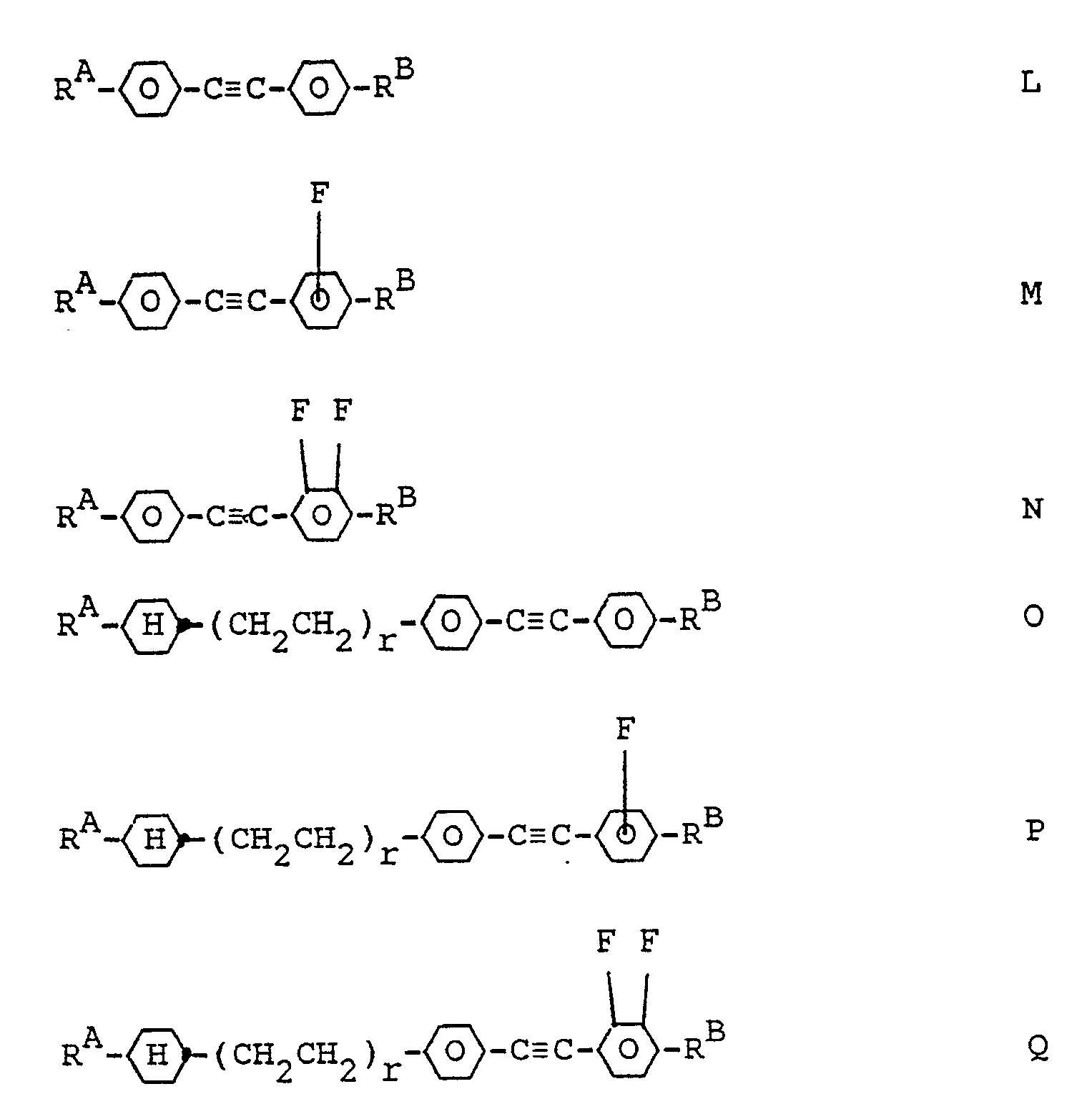
- Der Anteil der Tolanderivate liegt vorzugsweise bei 5 % bis 35 %, insbesondere bevorzugt bei 10 % bis 30 %. Bevorzugte Tolanderivate sind im folgenden angegeben:

- Die zur Erzielung von kleinen Werten für Δε/ε⊥ erforderlichen Komponenten der Formeln I bzw. II sind in den folgenden Deutschen Offenlegungsschriften DE-OS 38 07 801, 38 07 861, 38 07 863, 38 07 864 und 38 07 908 bzw. in der Internationalen Patentanmeldung PCT/DE 88/00133 beschrieben. Vorzugsweise wird der Anteil dieser Verbindungen derart gewählt, daß ε⊥ der Gesamtmischung mindestens 4.0, vorzugsweise mindestens 5.0 beträgt. Die Verbindungen der Formeln I und II eignen sich hierzu in idealer Weise, da durch deren Zugabe die Viskosität der Gesamtmischung überraschend niedrig bleibt, während stark dielektrisch negative Verbindungen aus dem Stand der Technik, wie zum Beispiel Derivate des 2,3-Dicyanhydrochinons oder Cyclohexanderivate mit dem Strukturelement

- Vorzugsweise enthält eine Mischung eine oder mehrere dielektrisch negative Verbindungen (Δε < -1,5), die gleichzeitig eine hohe optische Anisotropie (Δn > 0,15) aufweisen. Vorzugsweise werden Verbindungen der Formel II eingesetzt.
- Vorzugsweise enthalten die erfindungsgemäßen Mischungen Ester-Verbindungen mit dem Strukturelement

- Besonders bevorzugt sind Mischungen, die eine oder mehrere Ester-Verbindungen der Formeln A bis G enthalten, wobei Verbindungen der Formeln B, C, D und E besonders bevorzugt sind. Weitere bevorzugte Ester-Verbindungen sind diejenigen der Formeln

- In einer besonders bevorzugten Ausführungsform enthalten die Mischungen eine oder mehrere Verbindungen mit dem Strukturelement

- Die erfindungsgemäßen Mischungen enthalten eine oder mehrere Verbindungen mit Δε > 1.5. Die Auswahl dieser in großer Zahl bekannten Verbindungen ist nicht kritisch.. Der Fachmann kann ohne erfinderisches Zutun Art und Anteil dieser Verbindungen zur Erzielung der gewünschten Schwellenspannung festlegen. Der Anteil ist vorzugsweise ca. 30 % bis 70% , insbesondere bevorzugt 40 % bis 60 %. Vorzugsweise werden auch dielektrisch positive Verbindungen der Formel I und/oder II (einer der Reste R¹ und R² F, CN, CF₃ oder OCF₃) verwendet neben üblichen Komponenten wie z.B.

- Die Wahl der chiralen Dotierstoffe ist an sich nicht kritisch. Der Fachmann kann ohne erfinderisches Zutun Art und Menge der chiralen Komponente zur Erzielung des gewünschten Verhältnisses zwischen Schichtdicke und natürlicher Ganghöhe des Gesamtgemisches (z.B. zwischen 0,3 und 1,3) festlegen.
- Die erfindungsgemäßen Anzeigen zeigen neben sehr guten Kennliniensteilheiten auch besonders geringe Winkelabhängigkeit des Kontrastes, d.h. der Wert

- Die erfindungsgemäßen Mischungen zeigen gleichzeitig günstige elastische Eigenschaften, d.h. insbesondere für K₃/K₁ .
- Bei den erfindungsgemäßen Anzeigen mit einem Verdrillungswinkel dem Betrage nach zwischen 200° und 450°, insbesondere bei solchen im Bereich 220° bis 270°, tritt bei kleinen Verhältnissen Δε/ε⊥ zwar eine deutliche Verbesserung der Kennliniensteilheit auf, in vielen Fällen wird jedoch gleichzeitig das für die Massenproduktion sehr wichtige, sogenannte d/p-Fenster (d.h. der Bereich für den Wert des Verhältnisses Schichtdicke des Displays zu der Größe des natürlichen Pitch, innerhalb dessen die gewünschte Verdrillung jedoch noch keine Domainen erhalten werden) sehr klein oder verschwindet sogar in einzelnen Fällen. Das hierdurch bedingte Auftreten von Domänen ist bei kleineren Verdrillungswinkeln (zum Beispiel 180° bei OMI) nicht akut. Dies hängt vermutlich damit zusammen, daß bei Verdrillungswinkeln im Bereich von 160° bis 220°, insbesondere bei 180°, mit kleinen Anstellwinkeln gearbeitet wird, welche vorzugsweise im Bereich von 1° bis 2° liegen. Bei höheren Verdrillungswinkeln (zum Beispiel im Bereich 220° bis 270°) sind auch höhere Anstellwinkel (zum Beispiel im Bereich von 4° bis 6°) erforderlich. Es wurde nun gefunden, daß die störende Domänenbildung bei diesen Verdrillungswinkeln vermieden werden kann, falls die Flüssigkristallmischung einen effektiven Gehalt an einer oder mehreren Verbindungen aufweist, welche einen Wert K₃/K₁ < 0,9 haben. Diese Verbindungen haben vorzugsweise eine dielektrische Anisotropie von -6 bis +2, insbesondere von -2 bis +2 und einen Klärpunkt unter 80°. K₃/K₁ ist vorzugsweise ≦ 0,8. Der Anteil dieser Verbindungen in den erfindungsgemäßen Mischungen liegt vorzugsweise bei 1 % bis 20 %, insbesondere 5 % bis 15 %. Besonders bevorzugt sind 2-p-n-Alkyl- bzw. 2-p-n-Alkoxyphenyl-5-n-alkylpyrimidine, worin die Alkyl- bzw. Alkoxygruppen bis zu 12 C-Atome aufweisen. Ferner sind bevorzugt trans-1-p-n-Alkanoyloxyphenyl-4-n-alkylcyclohexane, trans,trans-4-n-Alkanoyloxy4-n-alkylcyclohexyl-cyclohexane und/oder p-n-Alkylbenzoesäure-(p-n-alkylphenylester), worin die Alkanoyloxybzw. Alkylgruppen jeweils bis zu 12 C-Atome aufweisen. Ferner bevorzugt sind 2-p-Cyanphenyl-5-n-alkylpyrimidine, worin die Alkylgruppe bis zu 12 C-Atome aufweist.
- In einer bevorzugten Ausführungsform enthalten die erfindungsgemäßen Mischungen keine Verbindungen mit einer dielektrischen Anisotropie Δε von unter -1,5, sondern zur Erzielung der geforderten Werte für Δε/ε⊥ einen ausreichenden Anteil an einer oder mehreren Verbindungen mit Δε > -1,5 und hohen Werten für ε⊥. Δε ist vorzugsweise im Bereich +3 bis +15, insbesondere +4 bis +9 ε⊥ ist vorzugsweise im Bereich 5 bis 8.
- Bevorzugte Verbindungen dieses Typs sind diejenigen der Formel I, worin R² F, Cl, -CN, -NCS, -CF₃ oder -OCF₃ bedeutet. Diese Verbindungen sind Gegenstand der Deutschen Patentanmeldungen 38 07 868, 38 07 822, 38 07 806 und 38 07 864.
- Die erfindungsgemäßen Mischungen können ferner auch noch hochklärende Zusätze (Klärpunkt > 180°) enthalten. Der Anteil dieser Verbindungen beträgt vorzugsweise ca. 5 % bis 20 %. Geeignete Verbindungen sind dem Fachmann bekannt. Besonder bevorzugt sind die im folgenden angegebenen Verbindungen:

- Der Aufbau der erfindungsgemäßen Flüssigkristall-Anzeigen aus Polarisatoren, Elektrodengrundplatten und Elektroden mit einer solchen Oberflächenbehandlung, daß die Vorzugsorientierung (Direktor) der jeweils daran angrenzenden Flüssigkristall-Moleküle von der einen zur anderen Elektrode gewöhnlich um betragsmäßig 160° bis 450° gegeneinander verdreht ist, entspricht der für derartige Anzeigen üblichen Bauweise. Dabei ist der Begriff der üblichen Bauweise hier weit gefaßt und umfaßt auch alle Abwandlungen und Modifikationen der Supertwistzelle. Der Oberflächentiltwinkel an den beiden Trägerplatten kann gleich oder verschieden sein. Gleiche Tiltwinkel sind bevorzugt.
- Der Verdrillungswinkel der erfindungsgemäßen Anzeigen ist vorzugsweise dem Betrage nach zwischen 160° und 360°, insbesondere bevorzugt dem Betrage nach zwischen 220° und 270°.
- Ein wesentlicher Unterschied der erfindungsgemäßen Anzeigen zu den bisher üblichen auf der Basis der verdrillten nematischen Zelle besteht jedoch in der Wahl der Flüssigkristallparameter der Flüssigkristallschicht.
- In den erfindungsgemäßen Anzeigen werden flüssigkristalline Phasen eingesetzt, bei denen die Flüssigkristallparameter Δε und Δε/ε⊥ so gewählt werden, daß eine möglichst steile elektrooptische Kennlinie gewährleistet ist, zusammen mit einem maximalen Kontrast und einer minimalen Blickwinkelabhängigkeit bei einem nematischen Phasenbereich von mindestens 60° und einer Viskosität von 30 mPa.s oder darunter.
- Die Herstellung der erfindungsgemäß verwendbaren Flüssigkristallmischungen erfolgt in an sich üblicher Weise. In der Regel wird die gewünschte Menge der in geringerer Menge verwendeten Komponenten in der den Hauptbestandteil ausmachenden Komponenten gelöst, zweckmäßig bei erhöhter Temperatur. Es ist auch möglich, Lösungen der Komponenten in einem organischen Lösungsmittel, z.B. in Aceton, Chloroform oder Methanol, zu mischen und das Lösungsmittel nach Durchmischung wieder zu entfernen, beispielsweise durch Destillation.
- Alle Komponenten der erfindungsgemäßen Mischungen sind bekannt bzw. können in Analogie zu bekannten Verbindungen nach an sich bekannten Verfahren hergestellt werden.
- Die Dielektrika können auch weitere, dem Fachmann bekannte und in der Literatur beschriebene Zusätze enthalten. Beispielsweise können 0-15 % pleochroitische Farbstoffe zugesetzt werden.
- Die folgenden Beispiele sollen die Erfindung erläutern, ohne sie zu begrenzen.
- Es bedeutet:
S-N Phasenübergangs-Temperatur smektisch-nematisch,
Klp. Klärpunkt,
Visk. Viskosität bei 20° (m Pa.s) (Bulkviskosität),
V₅₀/V₁₀ Steilheit der Kennlinie eines SFK-Anzeigeelements bei 20°. - Vor und nachstehend sind alle Temperaturen in °C angegeben. Die Prozentzahlen sind Gewichtsprozente. Die physikalischen Daten sind jeweils auf 20 °C bezogen. Die Einzelverbindungen betreffende Daten (z.B. dielektrische und elastische Daten) sind bezogen auf 20 °C.
- Alle das Gesamtgemisch betreffenden Werte beziehen sich auf 20 °C.
- Eine SFK-Anzeige mit folgenden Parametern:
Verdrillungswinkel 180° Anstellwinkel 1° d/p (Schichtdicke/Ganghöhe) 0,35 d.Δn 1,06 Klärpunkt 84,7° Δn 0,1275 (589 nm) 0,1257 (633 nm) Viskosität 23,4 mPa.s Δε +8,3 ε⊥ 6,0
15 % p-trans-4-Propylcyclohexyl-benzonitril,
7 % p-trans-4-Butylcyclohexyl-benzonitril,
8 % 4-Ethyl-4′-cyanbiphenyl,
7 % 4-Propyl-4′-cyanbiphenyl,
8 % 4-Butyl-4′-cyanbiphenyl,
19 % trans-4-Pentylcyclohexancarbonsäure-(2,3-difluor-4-ethoxyphenylester),
6 % trans-4-(trans-4-Propylcyclohexyl)-cyclohexancarbonsäure-(p-propylphenylester),
6 % trans-4-(trans-4-Propylcyclohexyl)-cyclohexancarbonsäure-(p-pentylphenylester),
6 % trans-4-(trans-4-Butylcyclohexyl)-cyclohexancarbonsäure-(p-pentylphenylester),
6 % trans-4-(trans-4-Butylcyclohexyl)-cyclohexancarbonsäure-(p-propylphenylester),
6 % trans-4-Butylcyclohexancarbonsäure-(p-trans-4-propylcyclohexylphenylester), und
6 % trans-4-Pentylcyclohexancarbonsäure-(p-trans-4-propylcyclohexylphenylester)
zeigt eine Kennliniensteilheit V₅₀/V₁₀ von 3,4 %. - Man stellt eine nematische Flüssigkristallmischung her bestehend aus
15% 2,3-Difluor-4-(trans-4-propylcyclohexylethyl)benzonitril,
15% 2,3-Difluor-4-(trans-4-butylcyclohexylethyl)benzonitril,
10 % 2,3-Difluor-4-(trans-4-pentylcyclohexylethyl)benzonitril,
9 % trans-4-Propylcyclohexancarbonsäure-(trans-4-propylcyclohexylester),
9 % trans-4-Propylcyclohexancarbonsäure-(trans-4-pentylcyclohexylester),
6 % trans-4-(trans-4-Propylcyclohexyl)-cyclohexancarbonsäure-(p-propylphenylester),
6 % trans-4-(trans-4-Propylcyclohexyl)-cyclohexancarbonsäure-(p-pentylphenylester),
6 % trans-4-(trans-4-Butylcyclohexyl)-cyclohexancarbonsäure-(p-pentylphenylester),
6 % trans-4-(trans-4-Butylcyclohexyl)-cyclohexancarbonsäure-(p-propylphenylester),
6 % trans-4-Butylcyclohexancarbonsäure-(p-trans-4-propylcyclohexylphenylester),
6% trans-4-Pentylcyclohexancarbonsäure-(p-trans-4-propylcyclohexylphenylester),
3% 4,4′-Bis-(trans-4-propylcyclohexyl)-2-fluorbiphenyl und
3% 4-(trans-4-Pentylcyclohexyl)-4′-(trans-4-propylcyclohexyl)-2-fluorbiphenyl. - Man stellt eine nematische Flüssigkristallmischung her bestehend aus
15% p-trans-4-Propylcyclohexyl-benzonitril,
8% 4-Ethyl-2′,3′-difluor-4′-cyanbiphenyl,
7% 4-Propyl-2′,3′-difluor-4′-cyanbiphenyl,
8% 4-Butyl-2′,3′-difluor-4′-cyanbiphenyl,
5% trans-4-Propylcyclohexancarbonsäure-(p-methoxyphenylester),
4% trans-4-Propylcyclohexancarbonsäure-(p-ethoxyphenylester),
5% trans-4-Butylcyclohexancarbonsäure-(p-methoxyphenylester),
4% trans-4-Butylcyclohexancarbonsäure-(p-ethoxyphenylester),
4% trans-4-Pentylcyclohexancarbonsäure-(p-ethoxyphenylester),
4% trans-4-Pentylcyclohexancarbonsäure-(p-methoxyphenylester),
6% trans-4-(trans-4-Propylcyclohexyl)-cyclohexancarbonsäure-(p-propylphenylester),
6% trans-4-(trans-4-Propylcyclohexyl)-cyclohexancarbonsäure-(p-pentylphenylester),
5% trans-4-(trans-4-Butylcyclohexyl)-cyclohexancarbonsäure-(p-pentylphenylester),
5% trans-4-(trans-4-Butylcyclohexyl)-cyclohexancarbonsäure-(p-propylphenylester),
8% p-trans-4-Propylcylohexylbenzoesäure-(p-propylphenylester) und
6% p-trans-4-Pentylcyclohexylbenzoesäure-(p-propylphenylester). - Man stellt eine nematische Flüssigkristallmischung her bestehend aus
9% p-Ethylbenzoesäure-(4-cyan-2,3-difluorphenylester),
9% p-Propylbenzoesäure-(4-cyan-2,3-difluorphenylester),
8% p-Pentylbenzoesäure-(4-cyan-2,3-difluorphenylester),
9% trans,trans-4-Methoxy-4′-methylcyclohexylcyclohexan,
17% trans-4-Propylcyclohexancarbonsäure-(trans-4-propylcyclohexylester),
8% trans-4-Propylcyclohexancarbonsäure-(trans-4-pentylcyclohexylester),
4% trans-4-Butylcyclohexancarbonsäure-(p-trans-4-propylcyclohexylphenylester),
4% trans-4-Pentylcyclohexancarbonsäure-(p-trans-4-propylcyclohexylphenylester),
4% trans-4-(trans-4-Propylcyclohexyl)-cyclohexancarbonsäure-(p-propylphenylester),
4% trans-4-(trans-4-Propylcyclohexyl)-cyclohexancarbonsäure-(p-pentylphenylester),
4% trans-4-(trans-4-Butylcyclohexyl)-cyclohexancarbonsäure-(p-pentylphenylester),
4% trans-4-(trans-4-Butylcyclohexyl)-cyclohexancarbonsäure-(p-propylphenylester),
3% 1-[trans-4-(trans-4-Pentylcyclohexyl)-cyclohexyl]2-(p-propylphenyl)-ethan,
3% 1-trans-4-(trans-4-Propylcyclohexyl)-cyclohexyl]2-(p-propylphenyl)-ethan,
3% 4,4′-Bis-(trans-4-propylcyclohexyl)-2-fluorbiphenyl,
3% 4,4′-Bis-(trans-4-pentylcyclohexyl)-2-fluorbiphenyl und
4% 4-(trans-4-Pentylcyclohexyl)-4′-(trans-4-propylcyclohexyl)-2-fluorbiphenyl. - Eine SFK-Anzeige mit folgenden Parametern:
Verdrillungswinkel 180° Anstellwinkel 1° d/p (Schichtdicke/Ganghöhe) 0,35 d.Δn 1,0 Klärpunkt 85° Δn 0,141 Viskosität 22,4 mPa.s Δε +7,2 ε⊥ 5,5 K₃/K₁ 1,42
9 % p-trans-4-Propylcyclohexyl-benzonitril,
7 % 4-Ethyl-4′-cyanbiphenyl,
7 % 4-Propyl-4′-cyanbiphenyl,
7 % 4-Butyl-4′-cyanbiphenyl,
5 % trans-4-Propylcyclohexancarbonsäure-(p-fluorphenylester),
4 % trans-4-Propylcyclohexancarbonsäure-(p-methoxyphenylester),
4 % trans-4-Propylcyclohexancarbonsäure-(p-ethoxyphenylester),
4 % trans-4-Butylcyclohexancarbonsäure-(p-ethoxyphenylester),
4 % trans-4-Butylcyclohexancarbonsäure-(p-methoxyphenylester),
13 % 2,3-Difluor-4-ethoxy-4′-pentyl-tolan,
5 % trans-4-(trans-4-Propylcyclohexyl)-cyclohexancarbonsäure-(p-propylphenylester),
5 % trans-4-(trans-4-Propylcyclohexyl)-cyclohexancarbonsäure-(p-pentylphenylester),
5 % trans-4-(trans-4-Propylcyclohexyl)-cyclohexancarbonsäure-(p-fluorphenylester),
5 % trans-4-(trans-4-Pentylcyclohexyl)-cyclohexancarbonsäure-(p-fluorphenylester),
4 % trans-4-(trans-4-Pentylcyclohexyl)-cyclohexancarbonsäure-(2,3,4-trifluorphenylester),
6 % trans-4-Butylcyclohexancarbonsäure-(p-trans-4-propylcyclohexylphenylester) und
6 % trans-4-Pentylcyclohexancarbonsäure-(p-trans-4-propylcyclohexylphenylester)
zeigt eine Kennliniensteilheit V₅₀/V₁₀ von 3,4 %. - Als chiraler Dotierstoff wurde jeweils S-811[p-(p-n-Hexylbenzoyloxyphenyl)-benzoesäure-(2-octylester)] eingesetzt.
- Eine SFK-Anzeige mit folgenden Parametern:
Verdrillungswinkel 220° Anstellwinkel 1° d/p (Schichtdicke/Ganghöhe) 0,36 d.Δn 0,85 Klärpunkt 94° Δn 0,1238 (589 nm) Viskosität 25 mPa.s Δε +7,5 ε⊥ 5,9
15 % p-trans-4-Propylcyclohexyl-benzonitril,
11 % p-trans-4-Butylcyclohexyl-benzonitril,
11 % p-trans-4-Pentylcyclohexyl-benzonitril,
5 % p-trans-4-Ethylcyclohexyl-benzonitril,
7 % trans-4-Propylcyclohexancarbonsäure-(2,3-difluor-4-ethoxyphenylester),
6 % trans-4-Pentylcyclohexancarbonsäure-(2,3-difluor-4-ethoxyphenylester),
7 % trans,trans-4-Propylcyclohexylcyclohexan-4′-carbonsäure-(2,3-difluor-4-ethoxyphenylester),
5 % 4-(trans-4-Propylcyclohexyl)-2′,3′-difluor-4′-ethoxy-tolan,
5 % 4-(trans-4-Pentylcyclohexyl)-2′,3′-difluor-4′-ethoxy-tolan,
6 % 1-[trans-4-(trans-4-Propylcyclohexyl)-cyclohexyl]-2-(p-methylphenyl)-ethan,
6 % 1-[trans-4-(trans-4-Propylcyclohexyl)-cyclohexyl]-2-(p-propylphenyl)-ethan,
6 % 1-[trans-4-(trans-4-Propylcyclohexyl)-cyclohexyl]-2-(p-pentylphenyl)-ethan,
4 % 1-[trans-4-(trans-4-Propylcyclohexyl)-cyclohexyl]-2-(p-cyanphenyl)-ethan und
6 % 1-[trans-4-(trans-4-Propylcyclohexyl)-cyclohexyl]-2-(p-fluorphenyl)-ethan
zeigt eine Kennliniensteilheit V₅₀/V₁₀ von 2,7 %. - Dieselbe Mischung zeigt in einer SFK-Anzeige mit höherem Anstellwinkel (5°), d/p = 0,40, d.Δn = 0,85 und 220° Verdrillungswinkel eine Steilheit V₅₀/V₁₀ von 2,9 % und einen Wert β für die Winkelabhängigkeit des Kontrastes von 0,4 %.
- Eine SFK-Anzeige mit folgenden Parametern:
Verdrillungswinkel 220° Anstellwinkel 1° d/p (Schichtdicke/Ganghöhe) 0,4° d.Δn 0,85 Klärpunkt 91° Δn 0,1085 (589 nm) Viskosität 25 mPa.s Δε +8,2 ε⊥ 5,1
15 % p-trans-4-Propylcyclohexyl-benzonitril,
11 %p-trans-4-Butylcyclohexyl-benzonitril,
11 % p-trans-4-Pentylcyclohexyl-benzonitril,
5 % p-trans-4-Ethylcyclohexyl-benzonitril,
7 % trans-4-Propylcyclohexancarbonsäure-(2,3-difluor-4-ethoxyphenylester),
6 % trans-4-Pentylcyclohexancarbonsäure-(2,3-difluor-4-ethoxyphenylester),
7 % trans,trans-4-Propylcyclohexylcyclohexan-4′-carbonsäure-(2,3-difluor-4-ethoxyphenylester),
8 % 1-[trans-4-(trans-4-Propylcyclohexyl)-cyclohexyl]-2-(p-methylphenyl)-ethan,
6 % 1-[trans-4-(trans-4-Propylcyclohexyl)-cyclohexyl]-2-(p-propylphenyl)-ethan,
8 % 1-[trans-4-(trans-4-Propylcyclohexyl)-cyclohexyl]-2-(p-pentylphenyl)-ethan,
8 % 1-[trans-4-(trans-4-Propylcyclohexyl)-cyclohexyl]-2-(p-cyanphenyl)-ethan und
8 % 1-[trans-4-(trans-4-Propylcyclohexyl)-cyclohexyl]-2-(p-fluorphenyl)-ethan
zeigt eine Kennliniensteilheit V₅₀/V₁₀ von 2,2 %. - Eine SFK-Anzeige mit folgenden Parametern:
Verdrillungswinkel 220° Anstellwinkel 1° d/p (Schichtdicke/Ganghöhe) 0,41 d.Δn 0,85 Klärpunkt 88° Δn 0,1569 (589 nm) Viskosität 22 mPa.s Δε +7,8 ε⊥ 5,9
15 % p-trans-4-Propylcyclohexyl-benzonitril,
11 % p-trans-4-Butylcyclohexyl-benzonitril,
11 % p-trans-4-Pentylcyclohexyl-benzonitril,
5 % p-trans-4-Ethylcyclohexyl-benzonitril,
9 % 4-Propyl-2′,3′-difluor-4′-ethoxy-tolan,
9 % 4-Pentyl-2′,3′-difluor-4′-ethoxy-tolan,
6 % 4-(trans-4-Propylcyclohexyl)-2′,3′-difluor-4-ethoxy-tolan
6 % 4-(trans-4-Pentylcyclohexyl)-2′,3′-difluor-4′-ethoxy-tolan
6 % 1-[trans-4-(trans-4-Propylcyclohexyl)-cyclohexyl]-2-(p-methylphenyl)-ethan,
6 % 1-[trans-4-(trans-4-Propylcyclohexyl)-cyclohexyl]-2-(p-propylphenyl)-ethan,
6 % 1-[trans-4-(trans-4-Propylcylcohexyl)-cyclohexyl]-2-(p-pentylphenyl)-ethan,
4 % 1-[trans-4-(trans-4-Propylcylcohexyl)-cyclohexyl]-2-(p-cyanphenyl)-ethan und
6 % 1-[trans-4-(trans-4-Propylcyclohexyl)-cyclohexyl]-2-(p-fluorphenyl)-ethan
zeigt eine Kennliniensteilheit V₅₀/V₁₀ von 3,7 %. - Eine SFK-Anzeige mit folgenden Parametern:
Verdrillungswinkel 220° Anstellwinkel 1° d/p (Schichtdicke/Ganghöhe) 0,42 d.Δn 0,85 Klärpunkt 94° Δn 0,1420 (589 nm) Viskosität 23 mPa.s Δε +8,3 ε⊥ 5,0
15 % p-trans-4-Propylcyclohexyl-benzonitril,
11 % p-trans-4-Butylcyclohexyl-benzonitril,
11 % p-trans-4-Pentylcyclohexyl-benzonitril,
5 % p-trans-4-Ethylcyclohexyl-benzonitril,
12 % 4-Pentyl-2′,3′-difluor-4′-ethoxy-tolan,
5 % 4-(trans-4-Propylcyclohexyl)-2′,3′-difluor-4′-ethoxy-tolan,
6 % 1-[trans-4-(trans-4-Propylcyclohexyl)-cyclohexyl]-2-(p-methylphenyl)-ethan,
6 % 1-[trans-4-(trans-4-Propylcyclohexyl)-cyclohexyl]-2-(p-propylphenyl)-ethan,
6 % 1-[trans-4-(trans-4-Propylcyclohexyl)-cyclohexyl]-2-(p-pentylphenyl)-ethan,
4 % 1-[trans-4-(trans-4-Propylcyclohexyl)-cyclohexyl]-2-(p-cyanphenyl)-ethan und
6 % 1-[trans-4-(trans-4-Propylcyclohexyl)-cyclohexyl]-2-(p-fluorphenyl)-ethan
zeigt eine Kennliniensteilheit V₅₀/V₁₀ von 3,6 %. - Eine SFK-Anzeige mit folgenden Parametern:
Verdrillungswinkel 220° Anstellwinkel 1° d/p (Schichtdicke/Ganghöhe) 0,44 d.Δn 0,85 Klärpunkt 92° Δn 0,1250 (589 nm) Viskosität 21 mPa.s Δε +8,2 ε⊥ 4,3
15 % p-trans-4-Propylcylcohexyl-benzonitril,
11% p-trans-4-Butylcyclohexyl-benzonitril,
11% p-trans-4-Pentylcyclohexyl-benzonitril,
5 % p-trans-4-Ethylcyclohexyl-benzonitril,
10% 4-Pentyl-2′,3′-difluor-4-ethoxy-tolan,
8 % 1-[trans-4-(trans-4-Propylcyclohexyl)-cyclohexyl)-2-(p-methylphenyl)-ethan,
8 % 1-[trans-4-(trans-4-Propylcyclohexyl)-cyclohexyl)-2-(p-ethylphenyl)-ethan,
8 % 1-[trans-4-(trans-4-Propylcyclohexyl)-cyclohexyl)-2-(p-propylphenyl)-ethan,
8 % 1-[trans-4-(trans-4-Propylcyclohexyl)-cyclohexyl)-2-(p-pentylphenyl)-ethan,
8 % 1-[trans-4-(trans-4-Propylcyclohexyl)-cyclohexyl)-2-(p-cyanphenyl)-ethan und
8 % 1-[trans-4-(trans-4-Propylcyclohexyl)-cyclohexyl)-2-(p-fluorphenyl)-ethan
zeigt eine Kennliniensteilheit V₅₀/V₁₀ von 4,0 %. - Eine SFK-Anzeige mit folgenden Parametern:
Verdrillungswinkel 220° Anstellwinkel 1° d/p (Schichtdicke/Ganghöhe) 0,37 d.Δn 0,85 Klärpunkt 88° Δn 0,1544 (589 nm) Viskosität 26 mPa.s Δε +7,3 ε⊥ 6,4
15 % p-trans-4-Propylcyclohexyl-benzonitril,
11 % p-trans-4-Butylcyclohexyl-benzonitril,
11 % p-trans-4-Pentylcyclohexyl-benzonitril,
5 % p-trans-4-Ethylcyclohexyl-benzonitril,
7 % trans-4-Propylcyclohexancarbonsäure-(2,3-difluor-4-ethoxyphenylester),
6 % trans-4-Butylcyclohexancarbonsäure-(2,3-difluor-4-ethoxyphenylester),
7 % trans-4-Pentylcyclohexancarbonsäure-(2,3-difluor-4-ethoxyphenylester),
6 % 4-Propyl-2′,3′-difluor-4′-ethoxy-tolan,
4 % 4-(trans-4-Propylcyclohexyl)-2′,3′-difluor-4′-ethoxy-tolan,
6 % 4-(trans-4-Propylcyclohexyl)-4′-methoxy-tolan,
5 % 4-(trans-4-Propylcyclohexyl)-4′-ethoxy-tolan,
7 % 4-(trans-4-Propylcyclohexyl)-4′-propoxy-tolan,
6 % 1-[trans-(trans-4-Propylcyclohexyl)-cyclohexyl]-2-(p-methylphenyl)-ethan und
4 % 1-[trans-(trans-4-Propylcyclohexyl)-cyclohexyl]-2-(p-propylphenyl)-ethan
zeigt eine Kennliniensteilheit V₅₀/V₁₀ von 2,7 und eine Winkelabhängigkeit des Kontrastes β = 0,9 %. - Eine SFK-Anzeige mit folgenden Parametern:
Verdrillungswinkel 220° Anstellwinkel 1° d/p (Schichtdicke/Ganghöhe) 0,45 d.Δn 0,85 Klärpunkt 78° Δn 0,1206 (589 nm) Viskosität 25 mPa.s Δε +7,0 ε⊥ 5,3
15 % p-trans-4-Propylcyclohexyl-benzonitril,
11 % p-trans-4-Butylcyclohexyl-benzonitril,
9 % p-trans-4-Pentylcyclohexyl-benzonitril,
6 % trans-4-Pentylcyclohexancarbonsäure-(2,3-difluor-4-ethoxyphenylester),
7 % trans-4-Propylcyclohexancarbonsaure-(2,3-difluor-4-ethoxyphenylester),
7 % trans-4-(trans-4-Propylcyclohexyl)-cyclohexancarbonsäure-(2,3-difluor-4-ethoxyphenylester),
7 % 2-p-Methoxyphenyl-5-hexylpyrimidin,
7 % 2-p-Pentyloxyphenyl-5-hexylpyrimidin,
7 % 2-p-Heptyloxyphenyl-5-hexylpyrimidin,
6 % 1-(trans-4-(trans-4-Propyicyclohexyl)-cyclohexyl)-2-(p-methylphenyl)-ethan,
6 % 1-(trans-4-(trans-4-Propylcyclohexyl)-cyclohexyl)-2-(p-propylphenyl)-ethan,
6 % 1-(trans-4-(trans-4-Propylcyclohexyl)-cyclohexyl)-2-(p-pentylphenyl)-ethan und
6 % 1-(trans-4-(trans-4-Propylcyclohexyl)-cyclohexyl)-2-(p-cyanphenyl)-ethan
zeigt eine Kennliniensteilheit V₉₀/V₁₀ von 7,5 % und ein d/p-Fenster von 0,42 - 0,53. - Man stellt eine nematische Flüssigkristallmischung her bestehend aus
15 % 2,3-Difluor-4-(trans-4-propylcyclohexylethyl)-benzonitril,
15 % 2,3-Difluor-4-(trans-4-butylcyclohexylethyl)-benzonitril,
10 % 2,3-Difluor-4-(trans-4-pentylcyclohexylethyl)-benzonitril,
9 % trans-4-Propylcyclohexancarbonsäure-(2-fluor-4-propylphenylester),
9 % trans-4-Propylcyclohexancarbonsäure-(trans-4-pentylcyclohexylester),
6 % trans-4-(trans-4-Propylcyclohexyl)-cyclohexancarbonsäure-(p-propylphenylester),
6 % trans-4-(trans-4-Propylcyclohexyl)-cyclohexancarbonsäure-(p-pentylphenylester),
6 % trans-4-(trans-4-Butylcyclohexyl)-cyclohexancarbonsäure-(p-pentylphenylester),
6 % trans-4-(trans-4-Butylcyclohexyl)-cyclohexancarbonsäure-(p-propylphenylester),
6 % trans-4-Butylcyclohexancarbonsäure-(p-trans-4-propylcyclohexylphenylester),
6 % trans-4-Pentylcyclohexancarbonsäure-(p-trans-4-propylcyclohexylphenylester),
3 % 4,4′-Bis-(trans-4-propylcyclohexyl)-2-fluorbiphenyl und
3 % 4-(trans-4-Pentylcyclohexyl)-4′-(trans-4-propylcyclohexyl)-2-fluorbiphenyl. - Man stellt eine nematische Flüssigkristallmischung her bestehend aus
9 % p-Ethylbenzoesäure-(4-cyan-2,3-difluorphenylester),
9 % p-Propylbenzoesäure-(4-cyan-2,3-difluorphenylester),
8 % p-Pentylbenzoesäure-(4-cyan-2,3-difluorphenylester),
9 % trans,trans-4-Methoxy-4′-methylcyclohexylcyclohexan,
17 % trans-4-Propylcyclohexancarbonsäure-(trans-4-propylcyclohexylester),
8 % trans-4-Propylcyclohexancarbonsäure-(trans-4-pentylcyclohexylester), 4 % trans-4-Butylcyclohexancarbonsäure-(p-trans-4-propylcyclohexylphenylester),
4 % trans-4-Pentylcyclohexancarbonsäure-(p-trans-4-propylcyclohexylphenylester),
4 % trans-4-(trans-4-Propylcyclohexyl)-cyclohexancarbonsäure-(p-propylphenylester),
4 % trans-4-(trans-4-Propylcyclohexyl)-cyclohexancarbonsäure-(p-pentylphenylester),
4 % trans-4-(trans-4-Butylcyclohexyl)-cyclohexancarbonsäure-(p-pentylphenylester),
4 % trans-4-(trans-4-Butylcyclohexyl)-cyclohexancarbonsäure-(p-propylphenylester),
3 % 1-[ p- (trans-4-Pentylcyclohexyl)-phenyl]-2-(p-propylphenyl)-ethan,
3 % 1-[trans-4-(trans-4-Propylcyclohexyl)-cyclohexyl]-2-(p-propylphenyl)-ethan,
3 % 4,4′-Bis-(trans-4-propylcyclohexyl)-2-fluorbiphenyl,
3 % 4,4′-Bis-(trans-4-pentylcyclohexyl)-2-fluorbiphenyl und
4 % 4-(trans-4-Pentylcyclohexyl)-4′-(trans-4-propylcyclohexyl)-2-fluorbiphenyl. - Man stellt eine Flüssigkristallmischung her bestehend aus
9 % p-trans-4-Propylcyclohexyl-benzonitril,
7 % 4-Ethyl-4′-cyanbiphenyl,
7 % 4-Propyl-4′-cyanbiphenyl,
7 % 4-Butyl-4′-cyanbiphenyl,
5 % trans-4-Propylcyclohexancarbonsäure-(p-fluorphenylester),
4 % trans-4-Propylcyclohexancarbonsäure-(p-methoxyphenylester),
4 % trans-4-Propylcyclohexancarbonsäure-(p-ethoxyphenylester),
4 % trans-4-Butylcyclohexancarbonsäure-(p-ethoxyphenylester),
4 % trans-4-Butylcyclohexancarbonsäure-(p-methoxyphenylester),
13 % 4-Ethoxy-4′-pentyl-tolan,
5 % trans-4-(trans-4-Propylcyclohexyl)-cyclohexancarbonsäure-(p-propylphenylester),
5 % trans-4-(trans-4-Propylcyclohexyl)-cyclohexancarbonsäure-(p-pentylphenylester),
5 % trans-4-(trans-4-Propylcyclohexyl)-cyclohexancarbonsäure-(p-fluorphenylester),
5 % trans-4-(trans-4-Pentylcyclohexyl)-cyclohexancarbonsäure-(p-fluorphenylester),
4 % trans-4-(trans-4-Pentylcyclohexyl)-cyclohexancarbonsäure-(2,3,4-trifluorphenylester),
6 % trans-4-Butylcyclohexancarbonsäure-(p-trans-4-propylcyclohexylphenylester) und
6 % trans-4-Pentylcyclohexancarbonsäure-(p-trans-4-propylcyclohexylphenylester). - Man stellt eine Flüssigkristallmischung her bestehend aus
15 % p-trans-4-Propylcyclohexyl-benzonitril,
11 % p-trans-4-Butylcyclohexyl-benzonitril,
11 % p-trans-4-Pentylcyclohexyl-benzonitril,
5 % p-trans-4-Ethylcyclohexyl-benzonitril,
7 % trans-4-Propylcyclohexancarbonsäure-(2,3-difluor-4-ethoxyphenylester),
6 % trans-4-Pentylcyclohexancarbonsäure-(2,3-difluor-4-ethoxyphenylester),
7 % trans,trans-4-Propylcyclohexylcyclohexan-4′-carbonsäure-(2,3-difluor-4-ethoxyphenylester),
5 % 4-(trans-4-Propylcyclohexyl)-2′,3′-difluor-4′-ethoxy-tolan,
5 % 2-(2,3-Difluor-4-ethoxyphenyl)-5-heptylpyrimidin,
6 % 1-[trans-4-(trans-4-Propylcyclohexyl)-cyclohexyl]-2-(p-methylphenyl)-ethan,
6 % 1-[trans-4-(trans-4-Propylcyclohexyl)-cyclohexyl]-2-(p-propylphenyl)-ethan,
6 % 1-[trans-4-(trans-4-Propylcyclohexyl)-cyclohexyl]-2-(p-pentylphenyl)-ethan,
4 % 1-[trans-4-(trans-4-Propylcyclohexyl)-cyclohexyl]-2-(p-cyanphenyl)-ethan und
6 % 1-[trans-4-(trans-4-Propylcyclohexyl)-cyclohexyl]-2-(p-fluorphenyl)-ethan. - Man stellt eine Flüssigkristallmischung her bestehend aus
15 % p-trans-4-Propylcyclohexyl-benzonitril,
11 % p-trans-4-Butylcyclohexyl-benzonitril,
11 % p-trans-4-Pentylcyclohexyl-benzonitril,
5 % p-trans-4-Ethylcyclohexyl-benzonitril,
7 % trans-4-Propylcyclohexancarbonsäure-(2,3-difluor-4-ethoxyphenylester),
6 % trans-4-Butylcyclohexancarbonsäure-(2,3-difluor-4-ethoxyphenylester),
7 % trans-4-Pentylcyclohexancarbonsäure-(2,3-difluor-4-ethoxyphenylester),
6 % 4-Propyl-2′,3′-difluor-4′-ethoxy-tolan,
4 % 4-(trans-4-Propylcyclohexyl)-2′,3′-difluor-4′-ethoxy-tolan,
6 % 4-(trans-4-Propylcyclohexylethyl)-4′-methoxy-tolan,
5 % 4-(trans-4-Propylcyclohexyl)-4′-ethoxy-tolan,
7 % 4-(trans-4-Propylcyclohexyl)-4′-propoxy-tolan,
6 % 1-[trans-(trans-4-Propylcyclohexyl)-cyclohexyl]-2-(p-methylphenyl)-ethan und
4 % 1-[trans-(trans-4-Propylcyclohexyl)-cyclohexyl]-2-(p-propylphenyl)-ethan. - Als chiraler Dotierstoff wurde jeweils S-811[p-(p-n-Hexylbenzoyloxyphenyl)-benzoesäure-(2-octylester)] eingesetzt.
Z¹ und Z² jeweils unabhängig voneinander -CO-O-, -O-CO-, -CH₂O-, -OCH₂-, -CH₂CH₂- oder eine Einfachbindung,
m und n jeweils unabhängig voneinander 0, 1 oder 2, und
(m + n) 1, 2 oder 3 bedeutet,
- die Flüssigkristallmischung enthält mindestens eine flüssigkristalline Verbindung mit dem Strukturelement,

- Flüssigkristallmischung enthält mindestens eine Verbindung der nachfolgenden Formeln A bis G:

- Flüssigkristallmischung enthält mindestens eine Verbindung der nachfolgenden Formeln H bis K:

- Flüssigkristallmischung enthält mindestens eine flüssigkristalline Tolanverbindung mit dem Strukturelement

- Flüssigkristallmischung enthält mindestens eine Verbindung der nachfolgenden Formeln L bis Q:

- Flüssigkristallmischung enthält mindestens eine Verbindung der nachfolgenden Formeln R und/oder S:

- Flüssigkristallmischung enthält eine Ethinverbindung der Formel II

R¹ und R² jeweils unabhängig voneinander Alkyl mit 1 bis 15 C-Atomen oder Alkenyl mit 3 bis 15 C-Atomen, wobei in diesen Resten jeweils auch eine CH₂-Gruppe durch -O-, -CO-, -CO-O- oder -O-CO- ersetzt sein kann, einer der Reste R¹ und R² auch F, Cl, CN, NCS, CF₃ oder OCF₃,
A¹ und A² jeweils unabhängig voneinander
Z¹ und Z² jeweils unabhängig voneinander -CO-O-, -O-CO-, -CH₂O-, -OCH₂-, -CH₂CH₂ oder eine Einfachbindung, und
m und n jeweils unabhängig voneinander 0 oder 1 bedeuten,
- Flüssigkristallmischung enthält mindestens eine flüssigkristalline Verbindung mit dem Strukturelement

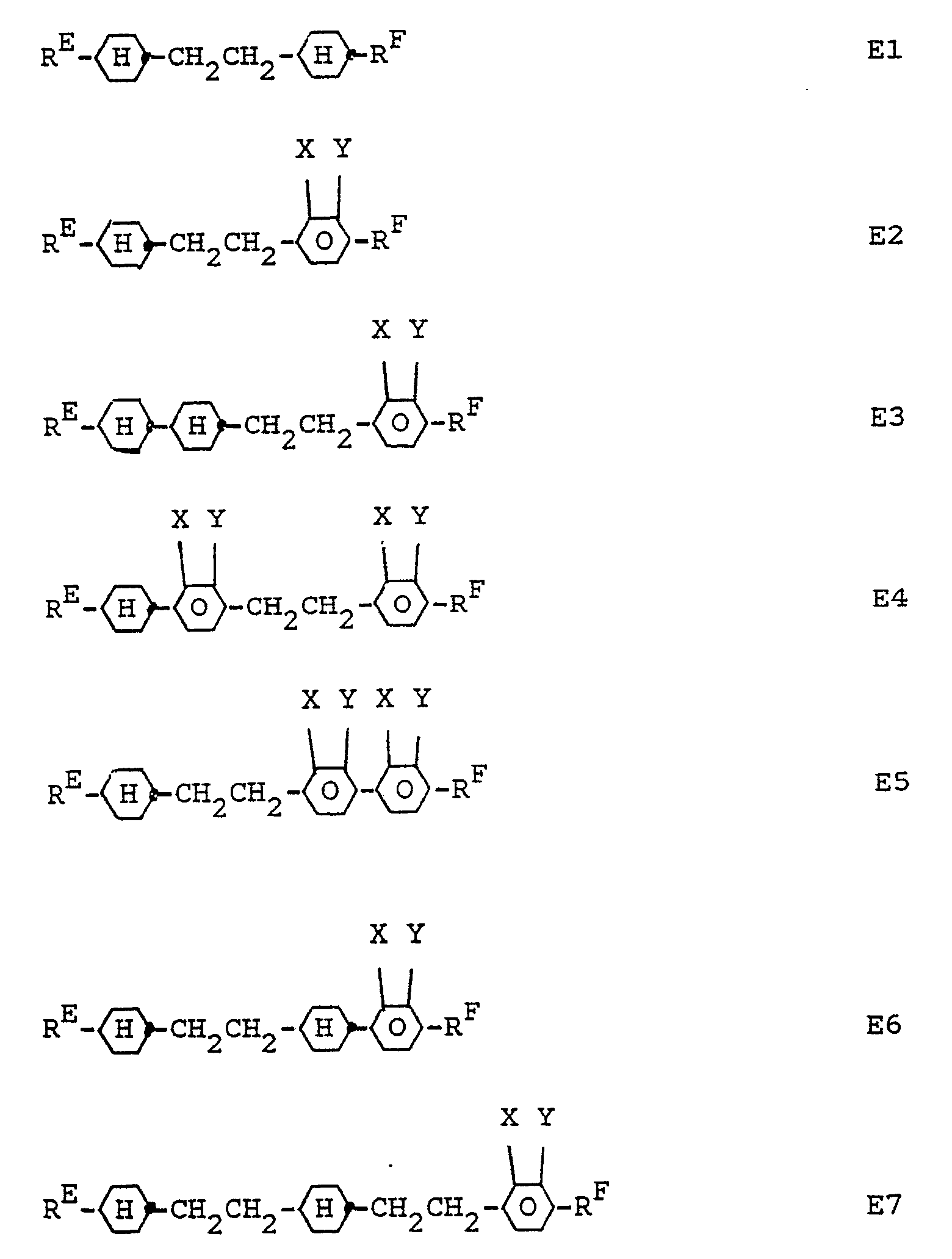
- Flüssigkristallmischung enthält mindestens eine Verbindung der nachfolgenden Formeln E1 bis E7:


- Flüssigkristallmischung enthält mindestens eine Verbindung der Formeln E3 bis E7,
- Flüssigkristallmischung enthält mindestens eine Verbindung der Formeln E3 bis E7, worin RF n-Alkyl oder n-Alkenyl und X und Y jeweils H bedeuten,
- Flüssigkristallmischung enthält mindestens eine Verbindung der Formeln E3 bis E7, worin RF Fluor, X H und Y H oder Fluor bedeutet,
- Flüssigkristallmischung enthält mindestens eine Verbindung der Formeln E3 bis E7, worin RF Cyan bedeutet.
Claims (23)
- zwei planparallelen Trägerplatten, die mit einer Umrandung eine Zelle bilden,
- einer in der Zelle befindlichen nematischen Flüssigkristallmischung mit positiver dielektrischer Anisotropie und mit mindestens einem chiralen Dotierstoff,
- Elektrodenschichten mit darüberliegenden Orientierungsschichten auf den Innenseiten der Trägerplatten,
- einem Anstellwinkel zwischen der Längsachse der Moleküle an der Oberfläche der Trägerplatten und den Trägerplatten von etwa 1° bis 30°, und
- einem Verdrillungswinkel der Flüssigkristallmischung in der Zelle von Orientierungsschicht zu Orientierungsschicht dem Betrag nach zwischen 160° und 450°, dadurch gekennzeichnet, daß die nematische Flüssigkristallmischung folgenden Bedingungen genügt:
- nematischer Phasenbereich von mindestens 60 °C,
- Viskosität von 30 mPa.s oder darunter, und
- Δε/ε⊥ < 2.0, wobei Δε die dielektrische Anisotropie und ε⊥ die Dielektrizitätskonstante in Richtung der kurzen Achse der Flüssigkristallmoleküle bedeutet.

R¹ und R² jeweils unabhängig voneinander Alkyl mit 1 bis 15 C-Atomen oder Alkenyl mit 3 bis 15 C-Atomen, wobei in diesen Resten jeweils auch eine CH₂-Gruppe durch -O-, -CO-, -CO-O- oder -O-CO- ersetzt sein kann, einer der Reste R¹ und R² auch F, Cl, CN, NCS, CF₃ oder OCF₃,
A¹ und A² jeweils unabhängig voneinander
a) trans-1,4-Cyclohexylen, worin auch eine oder zwei nicht benachbarte CH₂-Gruppen durch -O- und/oder -S- ersetzt sein können,
b) 1,4-Phenylen, worin auch eine oder zwei CH-Gruppen durch N ersetzt sein können,
c) Rest aus der Gruppe bestehend aus 1,4-Bicyclo(2,2,2)octylen und 1,4-Cyclohexenylen,
wobei die Reste b) durch Fluor ein- oder mehrfach substituiert sein können,
Z¹ und Z² jeweils unabhängig voneinander -CO-O-, -O-CO-, -CH₂O-, -OCH₂-, -CH₂CH₂- oder eine Einfachbindung,
m und n jeweils unabhängig voneinander 0, 1 oder 2, und
(m + n) 1, 2 oder 3 bedeutet.




R¹ und R² jeweils unabhängig voneinander Alkyl mit 1 bis 15 C-Atomen oder Alkenyl mit 3 bis 15 C-Atomen, wobei in diesen Resten jeweils auch eine CH₂-Gruppe durch -O-, -CO-, -CO-O-oder -O-CO- ersetzt sein kann, einer der Reste R¹ und R² auch F, Cl, CN, NCS, CF₃ oder OCF₃,
A¹ und A² jeweils unabhängig voneinander
a) trans-1,4-Cyclohexylen, worin auch eine oder zwei nicht benachbarte CH₂-Gruppen durch -O- und/oder -S- ersetzt sein können,
b) 1,4-Phenylen, worin auch eine oder zwei CH-Gruppen durch N ersetzt sein können,
c) Rest aus der Gruppe bestehend aus 1,4-Bicyclo(2,2,2)octylen und 1,4-Cyclohexenylen,
wobei die Reste b) durch Fluor ein- oder mehrfach substituiert sein können,
Z¹ und Z² jeweils unabhängig voneinander -CO-O-, -O-CO-, -CH₂O-, -OCH₂-, -CH₂CH₂- oder eine Einfachbindung und
m und n jeweils unabhängig voneinander 0 oder 1 bedeuten.

- nematischer Phasenbereich von mindestens 60 °C,
- Viskosität von 30 mPa.s oder darunter, und
- Δε/ε⊥ < 2.0, wobei Δε die dielektrische Anisotropie und ε⊥ die Dielektrizitätskonstante in Richtung der kurzen Achse der Flüssigkristallmoleküle bedeutet,
als Dielektrikum einer Supertwist-Flüssigkristallanzeige mit hoher Kennliniensteilheit und mit
- zwei planparallelen Trägerplatten, die mit einer Umrandung eine Zelle bilden,
- einer in der Zelle befindlichen nematischen Flüssigkristallmischung mit positiver dielektrischer Anisotropie und mit mindestens einem chiralen Dotierstoff,
- Elektrodenschichten mit darüberliegenden Orientierungsschichten auf den Innenseiten der Trägerplatten,
- einem Anstellwinkel zwischen der Längsachse der Moleküle an der Oberfläche der Trägerplatten und den Trägerplatten von etwa 1° bis 30°, und
- einem Verdrillungswinkel der Flüssigkristallmischung in der Zelle von Orientierungsschicht zu Orientierungsschicht dem Betrag nach zwischen 160° und 450°.
Priority Applications (1)
| Application Number | Priority Date | Filing Date | Title |
|---|---|---|---|
| AT89103412T ATE80409T1 (de) | 1988-03-10 | 1989-02-27 | Supertwist-fluessigkristallanzeige. |
Applications Claiming Priority (4)
| Application Number | Priority Date | Filing Date | Title |
|---|---|---|---|
| DE3807805 | 1988-03-10 | ||
| DE19883807805 DE3807805A1 (de) | 1988-03-10 | 1988-03-10 | Supertwist-fluessigkristallanzeigeelement |
| DE3835803 | 1988-10-20 | ||
| DE3835803A DE3835803A1 (de) | 1988-03-10 | 1988-10-20 | Supertwist-fluessigkristallanzeigeelement und fluessigkristallmischung |
Publications (2)
| Publication Number | Publication Date |
|---|---|
| EP0332005A1 true EP0332005A1 (de) | 1989-09-13 |
| EP0332005B1 EP0332005B1 (de) | 1992-09-09 |
Family
ID=25865727
Family Applications (2)
| Application Number | Title | Priority Date | Filing Date |
|---|---|---|---|
| EP89103412A Expired - Lifetime EP0332005B1 (de) | 1988-03-10 | 1989-02-27 | Supertwist-Flüssigkristallanzeige |
| EP89902769A Pending EP0360851A1 (de) | 1988-03-10 | 1989-02-27 | Supertwist-flüssigkristallanzeige |
Family Applications After (1)
| Application Number | Title | Priority Date | Filing Date |
|---|---|---|---|
| EP89902769A Pending EP0360851A1 (de) | 1988-03-10 | 1989-02-27 | Supertwist-flüssigkristallanzeige |
Country Status (12)
| Country | Link |
|---|---|
| US (1) | US5178790A (de) |
| EP (2) | EP0332005B1 (de) |
| JP (1) | JPH02503445A (de) |
| KR (1) | KR900700574A (de) |
| CN (1) | CN1036029A (de) |
| AT (1) | ATE80409T1 (de) |
| AU (1) | AU3188789A (de) |
| BR (1) | BR8906383A (de) |
| DE (2) | DE3835803A1 (de) |
| FI (1) | FI895339A7 (de) |
| NO (1) | NO894477L (de) |
| WO (1) | WO1989008691A1 (de) |
Cited By (11)
| Publication number | Priority date | Publication date | Assignee | Title |
|---|---|---|---|---|
| EP0365962A1 (de) * | 1988-10-20 | 1990-05-02 | MERCK PATENT GmbH | Matrix-Flüssigkristallanzeige |
| WO1990004622A1 (de) * | 1988-10-20 | 1990-05-03 | MERCK Patent Gesellschaft mit beschränkter Haftung | Supertwist-flüssigkristallanzeige |
| EP0393443A3 (de) * | 1989-04-19 | 1991-07-03 | MERCK PATENT GmbH | Supertwist-Flüssigkristallanzeige |
| EP0393442A3 (de) * | 1989-04-19 | 1991-08-14 | MERCK PATENT GmbH | Supertwist-Flüssigkristallanzeige |
| WO1991015555A3 (en) * | 1990-04-02 | 1991-12-26 | Merck Patent Gmbh | Nematic liquid crystal mixtures and a matrix liquid crystal display |
| EP0398606A3 (de) * | 1989-05-17 | 1991-12-27 | Seiko Epson Corporation | Flüssigkristallanzeigevorrichtung |
| EP0500210A3 (en) * | 1991-01-19 | 1992-10-21 | Sanyo Chemical Industries, Ltd. | Liquid crystal compounds and compositions |
| WO1993001253A1 (en) * | 1991-07-04 | 1993-01-21 | MERCK Patent Gesellschaft mit beschränkter Haftung | Liquid-crystalline medium |
| US5229031A (en) * | 1989-05-17 | 1993-07-20 | Seiko Epson Corporation | Liquid crystal display device |
| US5876626A (en) * | 1988-10-20 | 1999-03-02 | Merck Patent Gesellschaft Mit Beschrankter Haftung | Supertwist liquid crystal display |
| US6004479A (en) * | 1988-07-13 | 1999-12-21 | Merck Kgaa | Matrix liquid crystal display |
Families Citing this family (23)
| Publication number | Priority date | Publication date | Assignee | Title |
|---|---|---|---|---|
| US5536442A (en) * | 1987-09-25 | 1996-07-16 | Merck Patent Gesellschaft Mit Beschrankter Haftung | Fluorinated liquid crystal compounds and liquid crystal medium containing same |
| US5516454A (en) * | 1989-07-13 | 1996-05-14 | Merck Patent Gesellschaft Mit Beschrankter Haftung | Supertwist liquid crystal display |
| DE4025550B4 (de) | 1989-08-16 | 2007-05-03 | Merck Patent Gmbh | Phenylcyclohexane und flüssigkristallines Medium |
| US5456860A (en) * | 1990-03-31 | 1995-10-10 | Merck Patent Gesellschaft Mit Beschrankter Haftung | Matrix liquid-crystal display |
| DE59107572D1 (de) * | 1990-04-13 | 1996-04-25 | Merck Patent Gmbh | Flüssigkristallines medium |
| EP0503021B1 (de) * | 1990-10-02 | 1996-06-12 | MERCK PATENT GmbH | Flüssigkristallmedium |
| DE4032579A1 (de) * | 1990-10-13 | 1992-04-16 | Merck Patent Gmbh | Supertwist-fluessigkristallanzeige |
| DE59109091D1 (de) * | 1990-12-07 | 1999-03-04 | Merck Patent Gmbh | Supertwist-Flüssigkristallanzeige |
| US5409637A (en) * | 1991-02-20 | 1995-04-25 | Merck Patent Gesellschaft Mit Beschrankter Haftung | Nematic liquid-crystal composition |
| DE4107167B4 (de) * | 1991-03-06 | 2008-05-08 | Merck Patent Gmbh | Flüssigkristallmischung |
| EP0589331B1 (de) * | 1992-09-25 | 1997-04-09 | MERCK PATENT GmbH | Acetylen Derivate und sie enthaltende flüssigkristalline Mischungen |
| DE4340271A1 (de) * | 1993-11-26 | 1995-06-01 | Nokia Deutschland Gmbh | Flüssigkristallanzeige |
| US5626792A (en) * | 1994-09-06 | 1997-05-06 | Displaytech, Inc. | High birefringence liquid crystal compounds |
| DE19736445B4 (de) * | 1996-08-22 | 2006-06-08 | Asmo Co., Ltd., Kosai-shi | Türgliedverriegelungs-/entriegelungsvorrichtung |
| DE19828149A1 (de) * | 1997-07-04 | 1999-01-07 | Merck Patent Gmbh | Supertwist-Flüssigkristallanzeige |
| US20060038929A1 (en) * | 2004-08-18 | 2006-02-23 | Chenhui Wang | Tunable spectral imaging filter configured for UV spectral ranges |
| JP5961933B2 (ja) * | 2011-06-24 | 2016-08-03 | Dic株式会社 | 誘電率異方性が負である液晶組成物、及び該液晶組成物を用いた液晶表示素子 |
| JP5834535B2 (ja) * | 2011-06-24 | 2015-12-24 | Dic株式会社 | 誘電率異方性が負である液晶組成物、及び該液晶組成物を用いた液晶表示素子 |
| JP5845653B2 (ja) * | 2011-06-24 | 2016-01-20 | Dic株式会社 | 誘電率異方性が負である液晶組成物、及び該液晶組成物を用いた液晶表示素子 |
| JP5845654B2 (ja) * | 2011-06-24 | 2016-01-20 | Dic株式会社 | 誘電率異方性が負である液晶組成物、及び該液晶組成物を用いた液晶表示素子 |
| JP5696816B2 (ja) * | 2012-05-28 | 2015-04-08 | Dic株式会社 | 誘電率異方性が負である液晶組成物、及び該液晶組成物を用いた液晶表示素子 |
| CN107880900B (zh) * | 2016-09-29 | 2021-01-15 | 石家庄诚志永华显示材料有限公司 | 含有2,3,4-三取代苯的液晶化合物及其组合物 |
| CN107057717A (zh) * | 2016-12-19 | 2017-08-18 | 西安近代化学研究所 | 一种含氟液晶化合物 |
Citations (4)
| Publication number | Priority date | Publication date | Assignee | Title |
|---|---|---|---|---|
| EP0125563A2 (de) * | 1983-05-14 | 1984-11-21 | MERCK PATENT GmbH | Bicyclohexylethane |
| EP0131216A2 (de) * | 1983-07-12 | 1985-01-16 | BBC Brown Boveri AG | Flüssigkristallanzeige |
| EP0260450A1 (de) * | 1986-09-12 | 1988-03-23 | F. Hoffmann-La Roche Ag | Flüssigkristallanzeige |
| WO1988007514A1 (fr) * | 1987-04-03 | 1988-10-06 | MERCK Patent Gesellschaft mit beschränkter Haftung | Tolanes |
Family Cites Families (24)
| Publication number | Priority date | Publication date | Assignee | Title |
|---|---|---|---|---|
| DE2967129D1 (en) * | 1979-05-28 | 1984-08-30 | Merck Patent Gmbh | Liquid-crystal compositions |
| DE2933563A1 (de) * | 1979-07-18 | 1981-02-05 | Bbc Brown Boveri & Cie | Anisotrope verbindungen mit negativer dk-anisotropie |
| DE3042391A1 (de) * | 1980-11-10 | 1982-06-16 | Merck Patent Gmbh, 6100 Darmstadt | Fluorhaltige cyclohexylbiphenylderivate, diese enthaltende dielektrika und elektrooptisches anzeigeelement |
| DE3362830D1 (en) * | 1982-02-04 | 1986-05-15 | Merck Patent Gmbh | Anisotropic compounds and liquid crystal compositions |
| DE3209178A1 (de) * | 1982-03-13 | 1983-09-15 | Merck Patent Gmbh, 6100 Darmstadt | Polyhalogenaromaten |
| DE3376692D1 (en) * | 1982-06-29 | 1988-06-23 | Secr Defence Brit | Liquid crystal devices |
| GB8314077D0 (en) * | 1983-05-20 | 1983-06-29 | Secr Defence | Disubstituted ethanes |
| EP0133489B1 (de) * | 1983-08-04 | 1988-01-20 | MERCK PATENT GmbH | Nematische Verbindungen |
| DE3401320A1 (de) * | 1984-01-17 | 1985-07-25 | Merck Patent Gmbh, 6100 Darmstadt | Ethanderivate |
| US4652088A (en) * | 1984-02-01 | 1987-03-24 | Hitachi, Ltd. | Liquid crystal display device |
| CH660003A5 (de) * | 1984-04-16 | 1987-03-13 | Merck Patent Gmbh | Anisotrope verbindungen und fk-mischungen mit diesen. |
| DE3433248A1 (de) * | 1984-09-11 | 1986-03-20 | Merck Patent Gmbh, 6100 Darmstadt | Elektrooptisches anzeigeelement |
| DE3506446A1 (de) * | 1985-02-23 | 1986-08-28 | Merck Patent Gmbh, 6100 Darmstadt | Pyrimidinderivate |
| DE3515373A1 (de) * | 1985-04-27 | 1986-11-06 | Merck Patent Gmbh, 6100 Darmstadt | Stickstoffhaltige heterocyclen |
| DE3518734A1 (de) * | 1985-05-24 | 1986-11-27 | Merck Patent Gmbh, 6100 Darmstadt | Smektische fluessigkristalline phasen |
| JPS61282328A (ja) * | 1985-06-10 | 1986-12-12 | Chisso Corp | シクロヘキサン誘導体 |
| DE3609141A1 (de) * | 1986-03-19 | 1987-09-24 | Merck Patent Gmbh | Elektrooptisches anzeigeelement |
| DE3752339T2 (de) * | 1986-05-19 | 2002-05-08 | Seiko Epson Corp., Tokio/Tokyo | Flüssigkristallanzeigevorrichtung |
| EP0247466B1 (de) * | 1986-05-22 | 1993-11-24 | F. Hoffmann-La Roche Ag | Flüssigkristalline Derivate von Phenylbenzoat |
| DE3773446D1 (de) * | 1986-08-04 | 1991-11-07 | Chisso Corp | Tolanderivat und dieses enthaltende fluessigkristallmischung. |
| WO1988002130A2 (en) * | 1986-09-16 | 1988-03-24 | MERCK Patent Gesellschaft mit beschränkter Haftung | Liquid crystal phases for electro-optic display elements based on the ecb effect |
| US4925590A (en) * | 1988-03-10 | 1990-05-15 | Merck Patent Gesellschaft Mit Beschrankter Haftung | Derivatives of 4-cyano-2,3-difluorophenol |
| DE3807910A1 (de) * | 1988-03-10 | 1989-09-21 | Merck Patent Gmbh | Verfahren zur herstellung von 2,3-difluorbenzolen |
| US4897216A (en) * | 1988-03-10 | 1990-01-30 | Merck Patent Gesellschaft Mit Beschrankter Haftung | 2,3-difluorophenol derivatives |
-
1988
- 1988-10-20 DE DE3835803A patent/DE3835803A1/de not_active Withdrawn
-
1989
- 1989-02-27 DE DE8989103412T patent/DE58902221D1/de not_active Expired - Fee Related
- 1989-02-27 WO PCT/EP1989/000178 patent/WO1989008691A1/de not_active Ceased
- 1989-02-27 AT AT89103412T patent/ATE80409T1/de not_active IP Right Cessation
- 1989-02-27 EP EP89103412A patent/EP0332005B1/de not_active Expired - Lifetime
- 1989-02-27 BR BR898906383A patent/BR8906383A/pt unknown
- 1989-02-27 AU AU31887/89A patent/AU3188789A/en not_active Abandoned
- 1989-02-27 US US07/359,666 patent/US5178790A/en not_active Expired - Fee Related
- 1989-02-27 FI FI895339A patent/FI895339A7/fi not_active IP Right Cessation
- 1989-02-27 JP JP1502559A patent/JPH02503445A/ja active Pending
- 1989-02-27 EP EP89902769A patent/EP0360851A1/de active Pending
- 1989-02-27 KR KR1019890702085A patent/KR900700574A/ko not_active Withdrawn
- 1989-03-09 CN CN89101254A patent/CN1036029A/zh active Pending
- 1989-11-09 NO NO89894477A patent/NO894477L/no unknown
Patent Citations (4)
| Publication number | Priority date | Publication date | Assignee | Title |
|---|---|---|---|---|
| EP0125563A2 (de) * | 1983-05-14 | 1984-11-21 | MERCK PATENT GmbH | Bicyclohexylethane |
| EP0131216A2 (de) * | 1983-07-12 | 1985-01-16 | BBC Brown Boveri AG | Flüssigkristallanzeige |
| EP0260450A1 (de) * | 1986-09-12 | 1988-03-23 | F. Hoffmann-La Roche Ag | Flüssigkristallanzeige |
| WO1988007514A1 (fr) * | 1987-04-03 | 1988-10-06 | MERCK Patent Gesellschaft mit beschränkter Haftung | Tolanes |
Cited By (19)
| Publication number | Priority date | Publication date | Assignee | Title |
|---|---|---|---|---|
| US6004479A (en) * | 1988-07-13 | 1999-12-21 | Merck Kgaa | Matrix liquid crystal display |
| US5378395A (en) * | 1988-10-20 | 1995-01-03 | Merck Patent Gesellschaft Mit Beschrankter Haftung | Matrix liquid crystal display |
| WO1990004622A1 (de) * | 1988-10-20 | 1990-05-03 | MERCK Patent Gesellschaft mit beschränkter Haftung | Supertwist-flüssigkristallanzeige |
| EP0366985A1 (de) * | 1988-10-20 | 1990-05-09 | MERCK PATENT GmbH | Supertwist-Flüssigkristallanzeige |
| US7445818B2 (en) | 1988-10-20 | 2008-11-04 | Merck Patent Gesellschaft Mit Beschrankter Haftung | Matrix liquid crystal display |
| US6905740B2 (en) | 1988-10-20 | 2005-06-14 | Merck Patent Gmbh | Matrix liquid crystal display |
| US5122295A (en) * | 1988-10-20 | 1992-06-16 | Merck Patent Gesellschaft Mit Beschrankter Haftung | Matrix liquid crystal display |
| WO1990004623A1 (de) * | 1988-10-20 | 1990-05-03 | MERCK Patent Gesellschaft mit beschränkter Haftung | Matrix-flüssigkristallanzeige |
| US6562419B1 (en) | 1988-10-20 | 2003-05-13 | Merck Patent Gesellschaft Mit Beschrankter Haftung | Matrix liquid crystal display |
| US6210760B1 (en) | 1988-10-20 | 2001-04-03 | Merck Patent Gesellschaft Mit Beschrankter Haftung | Supertwist liquid crystal display |
| EP0365962A1 (de) * | 1988-10-20 | 1990-05-02 | MERCK PATENT GmbH | Matrix-Flüssigkristallanzeige |
| US5876626A (en) * | 1988-10-20 | 1999-03-02 | Merck Patent Gesellschaft Mit Beschrankter Haftung | Supertwist liquid crystal display |
| EP0393443A3 (de) * | 1989-04-19 | 1991-07-03 | MERCK PATENT GmbH | Supertwist-Flüssigkristallanzeige |
| EP0393442A3 (de) * | 1989-04-19 | 1991-08-14 | MERCK PATENT GmbH | Supertwist-Flüssigkristallanzeige |
| US5229031A (en) * | 1989-05-17 | 1993-07-20 | Seiko Epson Corporation | Liquid crystal display device |
| EP0398606A3 (de) * | 1989-05-17 | 1991-12-27 | Seiko Epson Corporation | Flüssigkristallanzeigevorrichtung |
| WO1991015555A3 (en) * | 1990-04-02 | 1991-12-26 | Merck Patent Gmbh | Nematic liquid crystal mixtures and a matrix liquid crystal display |
| EP0500210A3 (en) * | 1991-01-19 | 1992-10-21 | Sanyo Chemical Industries, Ltd. | Liquid crystal compounds and compositions |
| WO1993001253A1 (en) * | 1991-07-04 | 1993-01-21 | MERCK Patent Gesellschaft mit beschränkter Haftung | Liquid-crystalline medium |
Also Published As
| Publication number | Publication date |
|---|---|
| KR900700574A (ko) | 1990-08-16 |
| US5178790A (en) | 1993-01-12 |
| JPH02503445A (ja) | 1990-10-18 |
| NO894477D0 (no) | 1989-11-09 |
| EP0332005B1 (de) | 1992-09-09 |
| FI895339A0 (fi) | 1989-11-09 |
| CN1036029A (zh) | 1989-10-04 |
| AU3188789A (en) | 1989-10-05 |
| WO1989008691A1 (fr) | 1989-09-21 |
| DE3835803A1 (de) | 1990-04-26 |
| BR8906383A (pt) | 1990-08-28 |
| ATE80409T1 (de) | 1992-09-15 |
| NO894477L (no) | 1989-11-09 |
| DE58902221D1 (de) | 1992-10-15 |
| FI895339A7 (fi) | 1989-11-09 |
| EP0360851A1 (de) | 1990-04-04 |
Similar Documents
| Publication | Publication Date | Title |
|---|---|---|
| EP0332005B1 (de) | Supertwist-Flüssigkristallanzeige | |
| EP0494368B1 (de) | Supertwist-Flüssigkristallanzeige | |
| EP0394419B1 (de) | Matrixanzeigeanordnung mit flüssigkristallen | |
| DE69407050T2 (de) | Supertwist-flüssigkristallanzeige | |
| DE3835804B4 (de) | Nematische Flüssigkristallmischung | |
| EP1191082B1 (de) | Flüssigkristalline Mischungen | |
| DE19758941B4 (de) | Flüssigkristallmischung und ihre Verwendung in TN- und STN-Flüssigkristallanzeigen | |
| EP0481293B1 (de) | Supertwist-Flüssigkristallanzeige | |
| DE4107119A1 (de) | Fluessigkristallines medium | |
| EP0363451B1 (de) | Supertwist-flüssigkristallanzeige | |
| DE3923064B4 (de) | Flüssigkristallmischung und sie enthaltende Supertwist-Flüssigkristallanzeige | |
| DE69125055T2 (de) | Supertwist Flüssigkristallanzeige | |
| EP0548318B1 (de) | Flüssigkristallines medium | |
| EP0562051B1 (de) | Supertwist-flüssigkristallanzeige | |
| DE19720296B4 (de) | Flüssigkristallmischung und deren Verwendung in einer Supertwist-Flüssigkristallanzeige | |
| DE4441469B4 (de) | Neue nematische Flüssigkristallmischungen sowie deren Verwendung in STN-Flüssigkristallanzeigen | |
| EP0393443A2 (de) | Supertwist-Flüssigkristallanzeige | |
| DE19720295A1 (de) | Supertwist-Flüssigkristallanzeige | |
| DE4100287A1 (de) | Supertwist-fluessigkristallanzeigeelement | |
| DE10030459B4 (de) | Nematische Flüssigkristallmischung und deren Verwendung in TN- und STN-Flüssigkristallanzeigen | |
| EP0393442A2 (de) | Supertwist-Flüssigkristallanzeige | |
| DE3807805A1 (de) | Supertwist-fluessigkristallanzeigeelement | |
| DE4119292A1 (de) | Supertwist-fluessigkristallanzeige | |
| DE3939983A1 (de) | Supertwist-fluessigkristallanzeige und fluessigkristallmischung | |
| DE4010684A1 (de) | Supertwist-fluessigkristallanzeige |
Legal Events
| Date | Code | Title | Description |
|---|---|---|---|
| PUAI | Public reference made under article 153(3) epc to a published international application that has entered the european phase |
Free format text: ORIGINAL CODE: 0009012 |
|
| AK | Designated contracting states |
Kind code of ref document: A1 Designated state(s): ES GR |
|
| 17P | Request for examination filed |
Effective date: 19900120 |
|
| 17Q | First examination report despatched |
Effective date: 19910906 |
|
| RBV | Designated contracting states (corrected) |
Designated state(s): AT BE CH DE ES FR GB GR IT LI LU NL SE |
|
| XX | Miscellaneous (additional remarks) |
Free format text: VERBUNDEN MIT 89902769.2/0360851 (EUROPAEISCHE ANMELDENUMMER/VEROEFFENTLICHUNGSNUMMER) DURCH ENTSCHEIDUNG VOM 14.11.91. |
|
| GRAA | (expected) grant |
Free format text: ORIGINAL CODE: 0009210 |
|
| AK | Designated contracting states |
Kind code of ref document: B1 Designated state(s): AT BE CH DE ES FR GB GR IT LI LU NL SE |
|
| PG25 | Lapsed in a contracting state [announced via postgrant information from national office to epo] |
Ref country code: IT Free format text: LAPSE BECAUSE OF FAILURE TO SUBMIT A TRANSLATION OF THE DESCRIPTION OR TO PAY THE FEE WITHIN THE PRESCRIBED TIME-LIMIT;WARNING: LAPSES OF ITALIAN PATENTS WITH EFFECTIVE DATE BEFORE 2007 MAY HAVE OCCURRED AT ANY TIME BEFORE 2007. THE CORRECT EFFECTIVE DATE MAY BE DIFFERENT FROM THE ONE RECORDED. Effective date: 19920909 Ref country code: NL Effective date: 19920909 Ref country code: SE Effective date: 19920909 Ref country code: BE Effective date: 19920909 Ref country code: GR Free format text: LAPSE BECAUSE OF FAILURE TO SUBMIT A TRANSLATION OF THE DESCRIPTION OR TO PAY THE FEE WITHIN THE PRESCRIBED TIME-LIMIT Effective date: 19920909 Ref country code: ES Free format text: THE PATENT HAS BEEN ANNULLED BY A DECISION OF A NATIONAL AUTHORITY Effective date: 19920909 |
|
| REF | Corresponds to: |
Ref document number: 80409 Country of ref document: AT Date of ref document: 19920915 Kind code of ref document: T |
|
| XX | Miscellaneous (additional remarks) |
Free format text: VERBUNDEN MIT 89902769.2/0360851 (EUROPAEISCHE ANMELDENUMMER/VEROEFFENTLICHUNGSNUMMER) DURCH ENTSCHEIDUNG VOM 14.11.91. |
|
| REF | Corresponds to: |
Ref document number: 58902221 Country of ref document: DE Date of ref document: 19921015 |
|
| GBT | Gb: translation of ep patent filed (gb section 77(6)(a)/1977) | ||
| EN | Fr: translation not filed | ||
| PG25 | Lapsed in a contracting state [announced via postgrant information from national office to epo] |
Ref country code: FR Effective date: 19930129 |
|
| NLV1 | Nl: lapsed or annulled due to failure to fulfill the requirements of art. 29p and 29m of the patents act | ||
| PG25 | Lapsed in a contracting state [announced via postgrant information from national office to epo] |
Ref country code: AT Effective date: 19930227 |
|
| PG25 | Lapsed in a contracting state [announced via postgrant information from national office to epo] |
Ref country code: LU Free format text: LAPSE BECAUSE OF NON-PAYMENT OF DUE FEES Effective date: 19930228 Ref country code: CH Effective date: 19930228 Ref country code: LI Effective date: 19930228 |
|
| PLBE | No opposition filed within time limit |
Free format text: ORIGINAL CODE: 0009261 |
|
| STAA | Information on the status of an ep patent application or granted ep patent |
Free format text: STATUS: NO OPPOSITION FILED WITHIN TIME LIMIT |
|
| 26N | No opposition filed | ||
| REG | Reference to a national code |
Ref country code: CH Ref legal event code: PL |
|
| REG | Reference to a national code |
Ref country code: FR Ref legal event code: ST |
|
| PGFP | Annual fee paid to national office [announced via postgrant information from national office to epo] |
Ref country code: GB Payment date: 19940217 Year of fee payment: 6 |
|
| PGFP | Annual fee paid to national office [announced via postgrant information from national office to epo] |
Ref country code: DE Payment date: 19940224 Year of fee payment: 6 |
|
| PG25 | Lapsed in a contracting state [announced via postgrant information from national office to epo] |
Ref country code: GB Effective date: 19950227 |
|
| GBPC | Gb: european patent ceased through non-payment of renewal fee |
Effective date: 19950227 |
|
| PG25 | Lapsed in a contracting state [announced via postgrant information from national office to epo] |
Ref country code: DE Effective date: 19951101 |