EP0331541B1 - Vorrichtung zur Verbesserung der Qualität eines metallischen oder keramischen Pulvers - Google Patents
Vorrichtung zur Verbesserung der Qualität eines metallischen oder keramischen Pulvers Download PDFInfo
- Publication number
- EP0331541B1 EP0331541B1 EP89400295A EP89400295A EP0331541B1 EP 0331541 B1 EP0331541 B1 EP 0331541B1 EP 89400295 A EP89400295 A EP 89400295A EP 89400295 A EP89400295 A EP 89400295A EP 0331541 B1 EP0331541 B1 EP 0331541B1
- Authority
- EP
- European Patent Office
- Prior art keywords
- particles
- powder
- spraying
- plasma
- cryogenic
- Prior art date
- Legal status (The legal status is an assumption and is not a legal conclusion. Google has not performed a legal analysis and makes no representation as to the accuracy of the status listed.)
- Expired - Lifetime
Links
Images

Classifications
-
- B—PERFORMING OPERATIONS; TRANSPORTING
- B01—PHYSICAL OR CHEMICAL PROCESSES OR APPARATUS IN GENERAL
- B01J—CHEMICAL OR PHYSICAL PROCESSES, e.g. CATALYSIS OR COLLOID CHEMISTRY; THEIR RELEVANT APPARATUS
- B01J19/00—Chemical, physical or physico-chemical processes in general; Their relevant apparatus
- B01J19/08—Processes employing the direct application of electric or wave energy, or particle radiation; Apparatus therefor
- B01J19/087—Processes employing the direct application of electric or wave energy, or particle radiation; Apparatus therefor employing electric or magnetic energy
- B01J19/088—Processes employing the direct application of electric or wave energy, or particle radiation; Apparatus therefor employing electric or magnetic energy giving rise to electric discharges
-
- B—PERFORMING OPERATIONS; TRANSPORTING
- B22—CASTING; POWDER METALLURGY
- B22F—WORKING METALLIC POWDER; MANUFACTURE OF ARTICLES FROM METALLIC POWDER; MAKING METALLIC POWDER; APPARATUS OR DEVICES SPECIALLY ADAPTED FOR METALLIC POWDER
- B22F1/00—Metallic powder; Treatment of metallic powder, e.g. to facilitate working or to improve properties
- B22F1/06—Metallic powder characterised by the shape of the particles
- B22F1/065—Spherical particles
-
- B—PERFORMING OPERATIONS; TRANSPORTING
- B22—CASTING; POWDER METALLURGY
- B22F—WORKING METALLIC POWDER; MANUFACTURE OF ARTICLES FROM METALLIC POWDER; MAKING METALLIC POWDER; APPARATUS OR DEVICES SPECIALLY ADAPTED FOR METALLIC POWDER
- B22F1/00—Metallic powder; Treatment of metallic powder, e.g. to facilitate working or to improve properties
- B22F1/14—Treatment of metallic powder
- B22F1/142—Thermal or thermo-mechanical treatment
-
- B—PERFORMING OPERATIONS; TRANSPORTING
- B01—PHYSICAL OR CHEMICAL PROCESSES OR APPARATUS IN GENERAL
- B01J—CHEMICAL OR PHYSICAL PROCESSES, e.g. CATALYSIS OR COLLOID CHEMISTRY; THEIR RELEVANT APPARATUS
- B01J2219/00—Chemical, physical or physico-chemical processes in general; Their relevant apparatus
- B01J2219/08—Processes employing the direct application of electric or wave energy, or particle radiation; Apparatus therefor
- B01J2219/0894—Processes carried out in the presence of a plasma
Definitions
- the invention relates to improving the quality of metallic or ceramic powders, and in particular the shape of the particles, their specific surface, their porosity, and their content of absorbed gas.
- this kind of powders can be done in different ways. First, it can be obtained during the actual manufacture of the powder; this is the case with the manufacture of powders by melting an ingot, followed by spraying. Another improvement in the quality of the powder consists in baking after obtaining the powder. Finally, torch treatment is often used to improve the quality of the powders.
- the object of the invention is to propose an installation for improving the quality of the powders making it possible to avoid the abovementioned drawbacks, while seeking to obtain spherical particles of increased reactivity during their use, and purified or chemically modified.
- a method for improving the quality of powders formed from particles by modifying the physical and chemical characteristics of the particles using at least one heat treatment. It further comprises the following stages: passage of the powder to be treated through a plasma capable of being reactive to subject it to a very strong and abrupt rise in temperature, causing an out of equilibrium state of the particles, this state being followed immediately by a passage in a cooling cone created by the spraying of a cryogenic fluid to impose on the particles of the powder an instantaneous quenching while the particles are still in an out of equilibrium state.
- the cryogenic fluid can be argon or liquid helium.
- the plasma can be in the form of a mixture, prepared according to the particles and the impurities to be treated in the powder.
- French Patent No. 1,398,731 describes a treatment of tungsten carbide powder for which it is desired to improve certain physical and chemical characteristics.
- the treatment consists of injecting the powder into a plasma jet, then immediately cooling it to solidify the particles with the plasma.
- a pipe is used there to carry out the passage of the powder into the plasma, a plasma torch and a supply pipe in particles.
- the cooling takes place in a tubular chamber surrounded by water cooling by means of a coil.
- the main object of the invention is an installation for implementing the above method. It mainly comprises a projection enclosure in which is placed a single plasma and powder projection torch, and cryogenic spray nozzles for the cryogenic fluid, these nozzles being placed at the outlet of the projection torch. It also uses a container for cryogenic liquid and a control console for the projection torch.
- a projection enclosure in which is placed a single plasma and powder projection torch, and cryogenic spray nozzles for the cryogenic fluid, these nozzles being placed at the outlet of the projection torch. It also uses a container for cryogenic liquid and a control console for the projection torch.
- the installation according to the invention may comprise a first gravity recovery pot for heavy particles, placed at the exit from the projection enclosure, and a cyclone for vacuum separation of the medium particles which fall by gravity and very fine particles which are entrained by an air flow.
- the nozzles are preferably used in numbers of three and slightly inclined relative to the plane perpendicular to the general direction of movement of the particles.
- the principle according to the invention consists in improving the quality of the powder by modifying the chemical and physical characteristics of the particles forming this powder, and this by using two heat treatments. It consists more particularly in passing the powder to be treated through a plasma capable of being reactive. In this way, the powder undergoes a very strong and very brutal rise in temperature. For example, this temperature rise can be of the order of 20,000 ° for a time which is of the order of a millisecond. It follows a partial volatilization of the particle which then takes an out of equilibrium state. The principle also consists in subjecting each particle, immediately after its passage through the plasma, and even when it is still in an out of equilibrium state, a brutal quenching.
- This quenching is obtained by spraying a cryogenic fluid at the outlet of the passage of the particles of the powder in the plasma. This quenching takes place for a duration which is of the order of a microsecond. The quenching is therefore instantaneous, particles being still out of equilibrium.
- the sudden rise in temperature obtained by plasma passage makes it possible to melt the particles by eliminating the impurities which they contain. These can be occluded gas, oxides or solid or volatile impurities. This heating means also makes it possible to possibly cause chemical reactions, depending on the composition of the plasma which is used.
- the rapid quenching operation by cooling using a cryogenic fluid makes it possible to freeze the new characteristics of the powder particles at the outlet of the passage in the plasma.
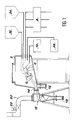
- FIG. 1 there is mainly and in the center a projection enclosure 2 in which is disposed a projection torch 4 of the plasma and powder, and cryogenic spray nozzles 6 placed at the outlet of the projection torch 4. These main elements will be detailed later.
- a first pot 16 for gravity recovery of the heaviest particles at the outlet 14 of the enclosure 2 is placed a first pot 16 for gravity recovery of the heaviest particles.
- the speed of movement of the particles at the exit of the torch being of the order of 500 meters per second, by placing in a determined manner with respect to the trajectory of the particles, such a recovery pot 16, placed below from the inlet 14 of the enclosure 2, the heaviest particles can be recovered by gravity.
- the recovery can be extended by a cyclone 12 placed after the outlet 14 of the enclosure 2.
- a second pot 18 is therefore placed below the cyclone 12 to recover them.
- a recovery tube 20 placed at the top of cyclone 12 to recover the finest particles.
- This tube can comprise a Pitot tube 22 making it possible to measure the speed of the air flow in this recovery tube 20.
- a control console 10 of the projection torch and a plasma generator 8 are used.
- a first container 26 of the cryogenic liquid and a second container 24 containing the powder to be treated are also essential.
- the projection torch 4 can be supplied by a "TWIN” distributor, the plasma generator being able to be a “Plasmatechnik” generator supplemented by a “Plasmatechnik” control console making it possible to adjust the powder flow rate and the gas flow rate.
- the cryogenic spray nozzles 6 can be "EMANI 1/4" nozzles.
- FIG. 2 makes it possible to see, more precisely, the position of the cryogenic spray nozzles 6 relative to the projection torch 4.
- these are placed angularly at 120 ° the relative to each other, around an axis XX ′ symbolizing the trajectory of the powder particles leaving the projection torch 4.
- the nozzles 6 are placed at a distance d of approximately 100 mm from torch 4 along axis XX ′. They are placed at equidistant distances from this axis XX ′.
- they are positioned, inclined at an angle of the order of about ten degrees relative to a plane perpendicular to the axis XX ′. This inclination is such that the nozzles are inclined forward relative to the progression of the particles of the powder.
- the angle ⁇ can also vary between 5 and 60 °.
- One of the main advantages of the principle according to the invention is the good spheroidization of the particles constituting the powder. This improves heat transfers, momentum transfers, and gives better flowability of the powder, which is very important in the use of the latter for sintering. Due to the good spheroidization, each particle has a practically minimal specific surface.
- Another advantage is the improvement in the particle size of the powder thus treated, that is to say an improvement in the standardization of the particle size.
- the invention allows the elimination of the gases occluded inside the particles, the oxides or the impurities which they contain. The risks of bursting of these particles due to the presence of these foreign materials, having very different melting temperatures, are thereby greatly reduced.
- amorphous powders that is to say without crystalline structure. It is also possible to obtain powders with particular chemical characteristics by using the reactive nature of the plasma.
- the installation described in the present application is very easy to use, since it suffices to adjust and control the operation of the projection torch and the operation of the cryogenic spray nozzles, these commands being able to be grouped together.
- This material using the plasma heating and the cooling by cryogenic liquid allows very frequent starting and stopping, and requiring very little preparation. The operator can stop the mechanism at any time; it is the same for a start.
Landscapes
- Chemical & Material Sciences (AREA)
- Engineering & Computer Science (AREA)
- Toxicology (AREA)
- General Health & Medical Sciences (AREA)
- Organic Chemistry (AREA)
- Chemical Kinetics & Catalysis (AREA)
- Health & Medical Sciences (AREA)
- Nanotechnology (AREA)
- Physics & Mathematics (AREA)
- Thermal Sciences (AREA)
- Physical Or Chemical Processes And Apparatus (AREA)
- Oxygen, Ozone, And Oxides In General (AREA)
- Inorganic Compounds Of Heavy Metals (AREA)
- Manufacture Of Metal Powder And Suspensions Thereof (AREA)
Claims (5)
- Vorrichtung zur Ausführung eines Verfahrens zur Verbesserung der Qualität von aus Teilchen gebildeten Pulvern durch Modifizierung von physikalischen und chemischen Eigenschaften, unter Verwendung von mindestens einer thermischen Behandlung und umfassend mindestens die beiden folgenden Schritte: Durchgang des zu behandelnden Pulvers durch ein reaktionsfähiges Plasma, um es einer sehr starken und plötzlichen Temperaturerhöhung auszusetzen, was einen Nichtgleichgewichtszustand der Teilchen hervorruft, auf den sogleich eine Abkühlung erfolgt, um die Teilchen des Pulvers augenblicklich zu härten, während die Teilchen noch in einem Nichtgleichgewichtszustand sind, wobei die Vorrichtung dadurch gekennzeichnet ist, daß sie eine Spritzkammer (2), in der sich ein einziger Spritzbrenner (4) für das Plasma und das Pulver befindet, und Düsen für die kryogene Zerstäubung (6) eines kryogenen Fluids umfaßt, wobei sich diese Düsen (6) am Ausgang des Spritzbrenners (4) befinden, so daß sie einen Abkühlungskonus bilden.
- Vorrichtung nach Anspruch 1, dadurch gekennzeichnet, daß sie ein Steuerpult (10) des Spritzbrenners (4), einen Plasmagenerator (8), einen ersten Behälter (24) des zu behandelnden Pulvers und einen zweiten Behälter (26) des kryogenen Fluids umfaßt.
- Vorrichtung nach Anspruch 1, dadurch gekennzeichnet, daß sie einen ersten Topf (16) zum Sammeln der schweren Teilchen durch Schwerkraft, der sich am Ausgang (14) der Spritzkammer (2) befindet, einen Fliehkraftabscheider (12) zur Trennung durch Unterdruck (dépression) der mittleren Teilchen, die durch Schwerkraft in einen zweiten Topf (18) fallen, und der feinen Teilchen, die von einem Luftstrom in ein Sammelrohr (20) mitgerissen werden, um das Pulver nach mehreren Teilchengrößen getrennt zu sammeln, umfaßt.
- Vorrichtung nach einem der Ansprüche 1 bis 3, dadurch gekennzeichnet, daß sie eine Einrichtung zur Temperaturkontrolle (28) im Inneren der Kammer (2) umfaßt.
- Vorrichtung nach einem der Ansprüche 1 bis 4, dadurch gekennzeichnet, daß die Düsen der kryogenen Zerstäubung (6) drei an der Zahl sind, in einem Winkel von 120° zueinander angebracht sind und einen bestimmten Neigungswinkel (α) mit einer Ebene senkrecht zu der allgemeinen Richtung der Fortbewegung der Teilchen des Pulvers bilden.
Priority Applications (1)
| Application Number | Priority Date | Filing Date | Title |
|---|---|---|---|
| AT89400295T ATE92810T1 (de) | 1988-02-04 | 1989-02-02 | Vorrichtung zur verbesserung der qualitaet eines metallischen oder keramischen pulvers. |
Applications Claiming Priority (2)
| Application Number | Priority Date | Filing Date | Title |
|---|---|---|---|
| FR8801296 | 1988-02-04 | ||
| FR8801296A FR2626797B1 (fr) | 1988-02-04 | 1988-02-04 | Procede et installation pour l'amelioration de la qualite d'une poudre metallique ou ceramique |
Publications (2)
| Publication Number | Publication Date |
|---|---|
| EP0331541A1 EP0331541A1 (de) | 1989-09-06 |
| EP0331541B1 true EP0331541B1 (de) | 1993-08-11 |
Family
ID=9362932
Family Applications (1)
| Application Number | Title | Priority Date | Filing Date |
|---|---|---|---|
| EP89400295A Expired - Lifetime EP0331541B1 (de) | 1988-02-04 | 1989-02-02 | Vorrichtung zur Verbesserung der Qualität eines metallischen oder keramischen Pulvers |
Country Status (6)
| Country | Link |
|---|---|
| US (1) | US4952144A (de) |
| EP (1) | EP0331541B1 (de) |
| JP (1) | JPH01225704A (de) |
| AT (1) | ATE92810T1 (de) |
| DE (1) | DE68908212T2 (de) |
| FR (1) | FR2626797B1 (de) |
Families Citing this family (14)
| Publication number | Priority date | Publication date | Assignee | Title |
|---|---|---|---|---|
| US5124091A (en) * | 1989-04-10 | 1992-06-23 | Gte Products Corporation | Process for producing fine powders by hot substrate microatomization |
| US5184662A (en) * | 1990-01-22 | 1993-02-09 | Quick Nathaniel R | Method for clad-coating ceramic particles |
| US5294242A (en) * | 1991-09-30 | 1994-03-15 | Air Products And Chemicals | Method for making metal powders |
| US5558822A (en) * | 1995-08-16 | 1996-09-24 | Gas Research Institute | Method for production of spheroidized particles |
| US5738705A (en) * | 1995-11-20 | 1998-04-14 | Iowa State University Research Foundation, Inc. | Atomizer with liquid spray quenching |
| US5651925A (en) * | 1995-11-29 | 1997-07-29 | Saint-Gobain/Norton Industrial Ceramics Corporation | Process for quenching molten ceramic material |
| US6159898A (en) * | 1997-05-23 | 2000-12-12 | Uop Llc | Alumina bodies containing alkali or alkaline earth metal compounds |
| US6013600A (en) * | 1997-05-23 | 2000-01-11 | Laroche Industries Inc. | Alumina bodies containing alkali or alkaline earth metal compounds |
| US5856265A (en) * | 1997-05-23 | 1999-01-05 | La Roche Industries, Inc. | Alumina body formation using high pH |
| US6398125B1 (en) * | 2001-02-10 | 2002-06-04 | Nanotek Instruments, Inc. | Process and apparatus for the production of nanometer-sized powders |
| PL1689519T3 (pl) * | 2003-08-28 | 2012-11-30 | Tekna Plasma Systems Inc | Sposób syntezy, rozdzielania i oczyszczania materiałów proszkowych |
| EP1777302B1 (de) * | 2005-10-21 | 2009-07-15 | Sulzer Metco (US) Inc. | Verfahren zur Herstellung hochreinen fliessfähigen Metalloxidpulvers durch Plasmaschmelzen |
| EP3730208B1 (de) * | 2014-03-11 | 2024-01-17 | Tekna Plasma Systems Inc. | Verfahren zur herstellung von pulverteilchen durch zerstäubung eines beschickungsmaterials in form eines länglichen elements |
| US11077497B2 (en) | 2017-06-07 | 2021-08-03 | Global Titanium Inc. | Deoxidation of metal powders |
Family Cites Families (15)
| Publication number | Priority date | Publication date | Assignee | Title |
|---|---|---|---|---|
| US2892766A (en) * | 1955-01-28 | 1959-06-30 | Herbert P Broida | Formation and stabilization of atoms and free radicals |
| FR1398731A (fr) * | 1963-04-01 | 1965-05-14 | Jersey Prod Res Co | Matériau composite |
| US3451910A (en) * | 1964-09-29 | 1969-06-24 | Us Air Force | Method of synthesizing a high energy yielding solid material |
| US3510291A (en) * | 1966-11-10 | 1970-05-05 | Westinghouse Electric Corp | Vapor phase conversion of molybdenum or tungsten compound to form the oxide or metal |
| US3752611A (en) * | 1969-06-18 | 1973-08-14 | Republic Steel Corp | Apparatus for producing metal powder |
| US4218201A (en) * | 1978-07-25 | 1980-08-19 | Nippon Steel Corporation | Apparatus for producing solidified granular slag from molten blast furnace slag |
| FR2435988A1 (fr) * | 1978-09-18 | 1980-04-11 | Air Liquide | Procede et installation de fabrication de poudre metallique a partir d'un metal ou alliage en fusion |
| JPS58141323A (ja) * | 1982-02-12 | 1983-08-22 | Hitachi Ltd | 焼入方法およびその装置 |
| JPS58197206A (ja) * | 1982-04-30 | 1983-11-16 | Hitachi Metals Ltd | 高品位金属または合金粉末の製造方法 |
| US4687510A (en) * | 1983-01-24 | 1987-08-18 | Gte Products Corporation | Method for making ultrafine metal powder |
| US4647305A (en) * | 1983-07-19 | 1987-03-03 | Nippon Kinzoku Co., Ltd. | Process for manufacturing amorphous alloy powders |
| US4734451A (en) * | 1983-09-01 | 1988-03-29 | Battelle Memorial Institute | Supercritical fluid molecular spray thin films and fine powders |
| JPS6227507A (ja) * | 1985-07-25 | 1987-02-05 | Kobe Steel Ltd | 金属粉末の冷却方法 |
| US4781754A (en) * | 1987-09-24 | 1988-11-01 | General Motors Corporation | Rapid solidification of plasma sprayed magnetic alloys |
| US4793853A (en) * | 1988-02-09 | 1988-12-27 | Kale Sadashiv S | Apparatus and method for forming metal powders |
-
1988
- 1988-02-04 FR FR8801296A patent/FR2626797B1/fr not_active Expired - Lifetime
-
1989
- 1989-02-02 EP EP89400295A patent/EP0331541B1/de not_active Expired - Lifetime
- 1989-02-02 DE DE89400295T patent/DE68908212T2/de not_active Expired - Fee Related
- 1989-02-02 US US07/305,559 patent/US4952144A/en not_active Expired - Fee Related
- 1989-02-02 AT AT89400295T patent/ATE92810T1/de not_active IP Right Cessation
- 1989-02-03 JP JP1025591A patent/JPH01225704A/ja active Pending
Also Published As
| Publication number | Publication date |
|---|---|
| EP0331541A1 (de) | 1989-09-06 |
| DE68908212D1 (de) | 1993-09-16 |
| ATE92810T1 (de) | 1993-08-15 |
| JPH01225704A (ja) | 1989-09-08 |
| DE68908212T2 (de) | 1994-03-03 |
| US4952144A (en) | 1990-08-28 |
| FR2626797B1 (fr) | 1991-04-19 |
| FR2626797A1 (fr) | 1989-08-11 |
Similar Documents
| Publication | Publication Date | Title |
|---|---|---|
| EP0331541A1 (de) | Vorrichtung zur Verbesserung der Qualität eines metallischen oder keramischen Pulvers | |
| EP0048713B1 (de) | Verfahren und vorrichtung zur herstellung von metallteilchen sowie dabei erhaltene teilchen | |
| CA2183290C (fr) | Methode de production de poudres metalliques ou ceramiques par atomisation plasma | |
| US3900639A (en) | Method for coating surfaces of a workpiece by spraying on a coating substance | |
| CA3193690A1 (fr) | Dispositif et procede de production de poudres metalliques | |
| JP2000517244A (ja) | レーザ加工方法および装置 | |
| FR2634758A1 (fr) | Procede et dispositif de reparation d'un corps refractaire | |
| EP0196952B1 (de) | Verfahren zur Herstellung beruhigten Stahls mit niedrigem Stickstoffgehalt | |
| Kochuev et al. | Formation of microspheres under the action of femtosecond laser radiation on titanium samples in hydrocarbons | |
| US3646176A (en) | Method for producing low oxide metal powders | |
| EP0766595B1 (de) | Verfahren zur zerstäubung einer dispergierbaren flüssigkeit | |
| EP1517855B1 (de) | Verfahren zur calciumnitridsysnthese | |
| RU2185931C1 (ru) | Способ получения нанопорошков сложных соединений и смесевых составов и устройство для его реализации | |
| EP1324846B1 (de) | Verfahren zur herstellung von pulver aus kernbrennstoffmetall oder -metalllegierung | |
| EP0125173A1 (de) | Verfahren zur Herstellung erstarrter Metallkörper aus der Schmelze eines Metalls | |
| Funken et al. | Laser-assisted physical vapour deposition of ceramics | |
| GB2187762A (en) | Metal powder by atomization process | |
| EP0667810A1 (de) | Verfahren zur herstellung von verbund-materialien oder beschichtungen und vorrichtung zu seiner durchführung | |
| EP0125964A1 (de) | Verfahren und Vorrichtung zur Kühlung eines Materials und Verwendung für die Herstellung von feuerfesten Materialien durch Härtung | |
| RU2643287C2 (ru) | Способ получения нанопорошка соединений и смесевых составов и устройство для его реализации | |
| TW201304895A (zh) | 被覆基材的方法 | |
| JPH04280906A (ja) | 超微粒子製造方法 | |
| JPS58150424A (ja) | 微粒子の表面を被覆処理する方法 | |
| BE714546A (de) | ||
| FR2480421A1 (fr) | Procede de revetement du garnissage des appareils metallurgiques par projection au jet de flamme et appareil metallurgique traite conformement audit procede |
Legal Events
| Date | Code | Title | Description |
|---|---|---|---|
| PUAI | Public reference made under article 153(3) epc to a published international application that has entered the european phase |
Free format text: ORIGINAL CODE: 0009012 |
|
| AK | Designated contracting states |
Kind code of ref document: A1 Designated state(s): AT CH DE GB IT LI |
|
| 17P | Request for examination filed |
Effective date: 19900210 |
|
| 17Q | First examination report despatched |
Effective date: 19920123 |
|
| GRAA | (expected) grant |
Free format text: ORIGINAL CODE: 0009210 |
|
| AK | Designated contracting states |
Kind code of ref document: B1 Designated state(s): AT CH DE GB IT LI |
|
| REF | Corresponds to: |
Ref document number: 92810 Country of ref document: AT Date of ref document: 19930815 Kind code of ref document: T |
|
| REF | Corresponds to: |
Ref document number: 68908212 Country of ref document: DE Date of ref document: 19930916 |
|
| ITF | It: translation for a ep patent filed | ||
| GBT | Gb: translation of ep patent filed (gb section 77(6)(a)/1977) |
Effective date: 19931020 |
|
| PLBE | No opposition filed within time limit |
Free format text: ORIGINAL CODE: 0009261 |
|
| STAA | Information on the status of an ep patent application or granted ep patent |
Free format text: STATUS: NO OPPOSITION FILED WITHIN TIME LIMIT |
|
| 26N | No opposition filed | ||
| PGFP | Annual fee paid to national office [announced via postgrant information from national office to epo] |
Ref country code: GB Payment date: 19980129 Year of fee payment: 10 |
|
| PGFP | Annual fee paid to national office [announced via postgrant information from national office to epo] |
Ref country code: DE Payment date: 19980209 Year of fee payment: 10 |
|
| PGFP | Annual fee paid to national office [announced via postgrant information from national office to epo] |
Ref country code: CH Payment date: 19980211 Year of fee payment: 10 |
|
| PGFP | Annual fee paid to national office [announced via postgrant information from national office to epo] |
Ref country code: AT Payment date: 19980213 Year of fee payment: 10 |
|
| PG25 | Lapsed in a contracting state [announced via postgrant information from national office to epo] |
Ref country code: GB Free format text: LAPSE BECAUSE OF NON-PAYMENT OF DUE FEES Effective date: 19990202 Ref country code: AT Free format text: LAPSE BECAUSE OF NON-PAYMENT OF DUE FEES Effective date: 19990202 |
|
| PG25 | Lapsed in a contracting state [announced via postgrant information from national office to epo] |
Ref country code: LI Free format text: LAPSE BECAUSE OF NON-PAYMENT OF DUE FEES Effective date: 19990228 Ref country code: CH Free format text: LAPSE BECAUSE OF NON-PAYMENT OF DUE FEES Effective date: 19990228 |
|
| GBPC | Gb: european patent ceased through non-payment of renewal fee |
Effective date: 19990202 |
|
| REG | Reference to a national code |
Ref country code: CH Ref legal event code: PL |
|
| PG25 | Lapsed in a contracting state [announced via postgrant information from national office to epo] |
Ref country code: DE Free format text: LAPSE BECAUSE OF NON-PAYMENT OF DUE FEES Effective date: 19991201 |
|
| PG25 | Lapsed in a contracting state [announced via postgrant information from national office to epo] |
Ref country code: IT Free format text: LAPSE BECAUSE OF NON-PAYMENT OF DUE FEES;WARNING: LAPSES OF ITALIAN PATENTS WITH EFFECTIVE DATE BEFORE 2007 MAY HAVE OCCURRED AT ANY TIME BEFORE 2007. THE CORRECT EFFECTIVE DATE MAY BE DIFFERENT FROM THE ONE RECORDED. Effective date: 20050202 |