EP0331001B1 - Thermoplastische Formmassen auf der Basis von Polyamiden - Google Patents
Thermoplastische Formmassen auf der Basis von Polyamiden Download PDFInfo
- Publication number
- EP0331001B1 EP0331001B1 EP89103149A EP89103149A EP0331001B1 EP 0331001 B1 EP0331001 B1 EP 0331001B1 EP 89103149 A EP89103149 A EP 89103149A EP 89103149 A EP89103149 A EP 89103149A EP 0331001 B1 EP0331001 B1 EP 0331001B1
- Authority
- EP
- European Patent Office
- Prior art keywords
- weight
- poly
- thermoplastic
- acid
- glycol
- Prior art date
- Legal status (The legal status is an assumption and is not a legal conclusion. Google has not performed a legal analysis and makes no representation as to the accuracy of the status listed.)
- Revoked
Links
- 238000009757 thermoplastic moulding Methods 0.000 title claims description 12
- 239000004952 Polyamide Substances 0.000 title description 26
- 229920002647 polyamide Polymers 0.000 title description 26
- LYCAIKOWRPUZTN-UHFFFAOYSA-N Ethylene glycol Chemical compound OCCO LYCAIKOWRPUZTN-UHFFFAOYSA-N 0.000 claims description 38
- 239000000203 mixture Substances 0.000 claims description 35
- WGCNASOHLSPBMP-UHFFFAOYSA-N hydroxyacetaldehyde Natural products OCC=O WGCNASOHLSPBMP-UHFFFAOYSA-N 0.000 claims description 18
- 150000002009 diols Chemical class 0.000 claims description 17
- 238000000465 moulding Methods 0.000 claims description 17
- 239000004014 plasticizer Substances 0.000 claims description 10
- 229920000233 poly(alkylene oxides) Polymers 0.000 claims description 6
- 239000003381 stabilizer Substances 0.000 claims description 6
- 239000000945 filler Substances 0.000 claims description 5
- OFOBLEOULBTSOW-UHFFFAOYSA-N Malonic acid Chemical compound OC(=O)CC(O)=O OFOBLEOULBTSOW-UHFFFAOYSA-N 0.000 claims description 4
- 239000003795 chemical substances by application Substances 0.000 claims description 4
- 125000002887 hydroxy group Chemical group [H]O* 0.000 claims description 4
- 239000000314 lubricant Substances 0.000 claims description 4
- 239000006082 mold release agent Substances 0.000 claims description 4
- 239000002667 nucleating agent Substances 0.000 claims description 4
- 125000003178 carboxy group Chemical group [H]OC(*)=O 0.000 claims description 3
- 239000003086 colorant Substances 0.000 claims description 3
- 229920006346 thermoplastic polyester elastomer Polymers 0.000 claims description 3
- 239000012963 UV stabilizer Substances 0.000 claims description 2
- 239000012760 heat stabilizer Substances 0.000 claims description 2
- 229920006345 thermoplastic polyamide Polymers 0.000 claims description 2
- 239000012778 molding material Substances 0.000 claims 4
- 239000003963 antioxidant agent Substances 0.000 claims 1
- -1 oxidation retardants Substances 0.000 description 19
- KKEYFWRCBNTPAC-UHFFFAOYSA-N Terephthalic acid Chemical compound OC(=O)C1=CC=C(C(O)=O)C=C1 KKEYFWRCBNTPAC-UHFFFAOYSA-N 0.000 description 15
- WERYXYBDKMZEQL-UHFFFAOYSA-N butane-1,4-diol Chemical compound OCCCCO WERYXYBDKMZEQL-UHFFFAOYSA-N 0.000 description 11
- 150000001991 dicarboxylic acids Chemical class 0.000 description 10
- QQVIHTHCMHWDBS-UHFFFAOYSA-N isophthalic acid Chemical compound OC(=O)C1=CC=CC(C(O)=O)=C1 QQVIHTHCMHWDBS-UHFFFAOYSA-N 0.000 description 10
- WNLRTRBMVRJNCN-UHFFFAOYSA-N adipic acid Chemical compound OC(=O)CCCCC(O)=O WNLRTRBMVRJNCN-UHFFFAOYSA-N 0.000 description 6
- 150000002334 glycols Chemical class 0.000 description 6
- 125000004432 carbon atom Chemical group C* 0.000 description 5
- 238000000354 decomposition reaction Methods 0.000 description 5
- 239000000975 dye Substances 0.000 description 4
- 229920001971 elastomer Polymers 0.000 description 4
- 239000000806 elastomer Substances 0.000 description 4
- NAQMVNRVTILPCV-UHFFFAOYSA-N hexane-1,6-diamine Chemical compound NCCCCCCN NAQMVNRVTILPCV-UHFFFAOYSA-N 0.000 description 4
- 238000004519 manufacturing process Methods 0.000 description 4
- 239000004033 plastic Substances 0.000 description 4
- 229920003023 plastic Polymers 0.000 description 4
- CXMXRPHRNRROMY-UHFFFAOYSA-N sebacic acid Chemical compound OC(=O)CCCCCCCCC(O)=O CXMXRPHRNRROMY-UHFFFAOYSA-N 0.000 description 4
- 239000000243 solution Substances 0.000 description 4
- DNIAPMSPPWPWGF-VKHMYHEASA-N (+)-propylene glycol Chemical compound C[C@H](O)CO DNIAPMSPPWPWGF-VKHMYHEASA-N 0.000 description 3
- YPFDHNVEDLHUCE-UHFFFAOYSA-N 1,3-propanediol Substances OCCCO YPFDHNVEDLHUCE-UHFFFAOYSA-N 0.000 description 3
- ZMXDDKWLCZADIW-UHFFFAOYSA-N N,N-Dimethylformamide Chemical compound CN(C)C=O ZMXDDKWLCZADIW-UHFFFAOYSA-N 0.000 description 3
- 229920002302 Nylon 6,6 Polymers 0.000 description 3
- MUBZPKHOEPUJKR-UHFFFAOYSA-N Oxalic acid Chemical compound OC(=O)C(O)=O MUBZPKHOEPUJKR-UHFFFAOYSA-N 0.000 description 3
- QAOWNCQODCNURD-UHFFFAOYSA-N Sulfuric acid Chemical compound OS(O)(=O)=O QAOWNCQODCNURD-UHFFFAOYSA-N 0.000 description 3
- 229920006097 Ultramide® Polymers 0.000 description 3
- 239000002253 acid Substances 0.000 description 3
- 239000001361 adipic acid Substances 0.000 description 3
- 235000011037 adipic acid Nutrition 0.000 description 3
- 125000003118 aryl group Chemical group 0.000 description 3
- IISBACLAFKSPIT-UHFFFAOYSA-N bisphenol A Chemical compound C=1C=C(O)C=CC=1C(C)(C)C1=CC=C(O)C=C1 IISBACLAFKSPIT-UHFFFAOYSA-N 0.000 description 3
- 150000002148 esters Chemical class 0.000 description 3
- 150000003951 lactams Chemical class 0.000 description 3
- 230000003647 oxidation Effects 0.000 description 3
- 238000007254 oxidation reaction Methods 0.000 description 3
- 229920000728 polyester Polymers 0.000 description 3
- 229920000166 polytrimethylene carbonate Polymers 0.000 description 3
- PUPZLCDOIYMWBV-UHFFFAOYSA-N (+/-)-1,3-Butanediol Chemical compound CC(O)CCO PUPZLCDOIYMWBV-UHFFFAOYSA-N 0.000 description 2
- IRIAEXORFWYRCZ-UHFFFAOYSA-N Butylbenzyl phthalate Chemical compound CCCCOC(=O)C1=CC=CC=C1C(=O)OCC1=CC=CC=C1 IRIAEXORFWYRCZ-UHFFFAOYSA-N 0.000 description 2
- VZCYOOQTPOCHFL-OWOJBTEDSA-N Fumaric acid Chemical compound OC(=O)\C=C\C(O)=O VZCYOOQTPOCHFL-OWOJBTEDSA-N 0.000 description 2
- QIGBRXMKCJKVMJ-UHFFFAOYSA-N Hydroquinone Chemical compound OC1=CC=C(O)C=C1 QIGBRXMKCJKVMJ-UHFFFAOYSA-N 0.000 description 2
- 229920011453 Hytrel® 4056 Polymers 0.000 description 2
- IPRJXAGUEGOFGG-UHFFFAOYSA-N N-butylbenzenesulfonamide Chemical compound CCCCNS(=O)(=O)C1=CC=CC=C1 IPRJXAGUEGOFGG-UHFFFAOYSA-N 0.000 description 2
- 239000004677 Nylon Substances 0.000 description 2
- 229920002292 Nylon 6 Polymers 0.000 description 2
- ALQSHHUCVQOPAS-UHFFFAOYSA-N Pentane-1,5-diol Chemical compound OCCCCCO ALQSHHUCVQOPAS-UHFFFAOYSA-N 0.000 description 2
- 229920003171 Poly (ethylene oxide) Polymers 0.000 description 2
- GOOHAUXETOMSMM-UHFFFAOYSA-N Propylene oxide Chemical compound CC1CO1 GOOHAUXETOMSMM-UHFFFAOYSA-N 0.000 description 2
- VYPSYNLAJGMNEJ-UHFFFAOYSA-N Silicium dioxide Chemical compound O=[Si]=O VYPSYNLAJGMNEJ-UHFFFAOYSA-N 0.000 description 2
- WYURNTSHIVDZCO-UHFFFAOYSA-N Tetrahydrofuran Chemical compound C1CCOC1 WYURNTSHIVDZCO-UHFFFAOYSA-N 0.000 description 2
- GWEVSGVZZGPLCZ-UHFFFAOYSA-N Titan oxide Chemical compound O=[Ti]=O GWEVSGVZZGPLCZ-UHFFFAOYSA-N 0.000 description 2
- 150000007513 acids Chemical class 0.000 description 2
- 239000000654 additive Substances 0.000 description 2
- 125000001931 aliphatic group Chemical group 0.000 description 2
- 229920006212 co-poly(ether-esters) Polymers 0.000 description 2
- 238000009833 condensation Methods 0.000 description 2
- 230000005494 condensation Effects 0.000 description 2
- 229920001577 copolymer Polymers 0.000 description 2
- TVIDDXQYHWJXFK-UHFFFAOYSA-N dodecanedioic acid Chemical compound OC(=O)CCCCCCCCCCC(O)=O TVIDDXQYHWJXFK-UHFFFAOYSA-N 0.000 description 2
- JBKVHLHDHHXQEQ-UHFFFAOYSA-N epsilon-caprolactam Chemical compound O=C1CCCCCN1 JBKVHLHDHHXQEQ-UHFFFAOYSA-N 0.000 description 2
- 239000003063 flame retardant Substances 0.000 description 2
- 238000001746 injection moulding Methods 0.000 description 2
- 239000000155 melt Substances 0.000 description 2
- 238000002844 melting Methods 0.000 description 2
- 230000008018 melting Effects 0.000 description 2
- VNWKTOKETHGBQD-UHFFFAOYSA-N methane Chemical compound C VNWKTOKETHGBQD-UHFFFAOYSA-N 0.000 description 2
- 238000000034 method Methods 0.000 description 2
- 238000002156 mixing Methods 0.000 description 2
- BDJRBEYXGGNYIS-UHFFFAOYSA-N nonanedioic acid Chemical compound OC(=O)CCCCCCCC(O)=O BDJRBEYXGGNYIS-UHFFFAOYSA-N 0.000 description 2
- 229920001778 nylon Polymers 0.000 description 2
- AHHWIHXENZJRFG-UHFFFAOYSA-N oxetane Chemical compound C1COC1 AHHWIHXENZJRFG-UHFFFAOYSA-N 0.000 description 2
- 239000000049 pigment Substances 0.000 description 2
- 229920000642 polymer Polymers 0.000 description 2
- 238000002360 preparation method Methods 0.000 description 2
- 239000012744 reinforcing agent Substances 0.000 description 2
- GHMLBKRAJCXXBS-UHFFFAOYSA-N resorcinol Chemical compound OC1=CC=CC(O)=C1 GHMLBKRAJCXXBS-UHFFFAOYSA-N 0.000 description 2
- 229920006395 saturated elastomer Polymers 0.000 description 2
- VZCYOOQTPOCHFL-UHFFFAOYSA-N trans-butenedioic acid Natural products OC(=O)C=CC(O)=O VZCYOOQTPOCHFL-UHFFFAOYSA-N 0.000 description 2
- XLYOFNOQVPJJNP-UHFFFAOYSA-N water Substances O XLYOFNOQVPJJNP-UHFFFAOYSA-N 0.000 description 2
- DNIAPMSPPWPWGF-GSVOUGTGSA-N (R)-(-)-Propylene glycol Chemical compound C[C@@H](O)CO DNIAPMSPPWPWGF-GSVOUGTGSA-N 0.000 description 1
- RBACIKXCRWGCBB-UHFFFAOYSA-N 1,2-Epoxybutane Chemical compound CCC1CO1 RBACIKXCRWGCBB-UHFFFAOYSA-N 0.000 description 1
- 150000005207 1,3-dihydroxybenzenes Chemical class 0.000 description 1
- 150000005208 1,4-dihydroxybenzenes Chemical class 0.000 description 1
- RTBFRGCFXZNCOE-UHFFFAOYSA-N 1-methylsulfonylpiperidin-4-one Chemical compound CS(=O)(=O)N1CCC(=O)CC1 RTBFRGCFXZNCOE-UHFFFAOYSA-N 0.000 description 1
- GUOSQNAUYHMCRU-UHFFFAOYSA-N 11-Aminoundecanoic acid Chemical compound NCCCCCCCCCCC(O)=O GUOSQNAUYHMCRU-UHFFFAOYSA-N 0.000 description 1
- GIAHBOGFOFDTAM-UHFFFAOYSA-N 2-(4-methylphenyl)ethanesulfonamide Chemical compound CC1=CC=C(CCS(N)(=O)=O)C=C1 GIAHBOGFOFDTAM-UHFFFAOYSA-N 0.000 description 1
- FZIIBDOXPQOKBP-UHFFFAOYSA-N 2-methyloxetane Chemical compound CC1CCO1 FZIIBDOXPQOKBP-UHFFFAOYSA-N 0.000 description 1
- WUPHOULIZUERAE-UHFFFAOYSA-N 3-(oxolan-2-yl)propanoic acid Chemical compound OC(=O)CCC1CCCO1 WUPHOULIZUERAE-UHFFFAOYSA-N 0.000 description 1
- 239000005995 Aluminium silicate Substances 0.000 description 1
- 0 C[N+](*[N+]([O-])ONO)[O-] Chemical compound C[N+](*[N+]([O-])ONO)[O-] 0.000 description 1
- OKTJSMMVPCPJKN-UHFFFAOYSA-N Carbon Chemical compound [C] OKTJSMMVPCPJKN-UHFFFAOYSA-N 0.000 description 1
- 229920000049 Carbon (fiber) Polymers 0.000 description 1
- 239000004215 Carbon black (E152) Substances 0.000 description 1
- MQIUGAXCHLFZKX-UHFFFAOYSA-N Di-n-octyl phthalate Natural products CCCCCCCCOC(=O)C1=CC=CC=C1C(=O)OCCCCCCCC MQIUGAXCHLFZKX-UHFFFAOYSA-N 0.000 description 1
- 241001295925 Gegenes Species 0.000 description 1
- DGAQECJNVWCQMB-PUAWFVPOSA-M Ilexoside XXIX Chemical compound C[C@@H]1CC[C@@]2(CC[C@@]3(C(=CC[C@H]4[C@]3(CC[C@@H]5[C@@]4(CC[C@@H](C5(C)C)OS(=O)(=O)[O-])C)C)[C@@H]2[C@]1(C)O)C)C(=O)O[C@H]6[C@@H]([C@H]([C@@H]([C@H](O6)CO)O)O)O.[Na+] DGAQECJNVWCQMB-PUAWFVPOSA-M 0.000 description 1
- 239000004609 Impact Modifier Substances 0.000 description 1
- 239000006057 Non-nutritive feed additive Substances 0.000 description 1
- 229920000305 Nylon 6,10 Polymers 0.000 description 1
- 229920000572 Nylon 6/12 Polymers 0.000 description 1
- OAICVXFJPJFONN-UHFFFAOYSA-N Phosphorus Chemical compound [P] OAICVXFJPJFONN-UHFFFAOYSA-N 0.000 description 1
- 239000004721 Polyphenylene oxide Substances 0.000 description 1
- ZLMJMSJWJFRBEC-UHFFFAOYSA-N Potassium Chemical compound [K] ZLMJMSJWJFRBEC-UHFFFAOYSA-N 0.000 description 1
- 235000021355 Stearic acid Nutrition 0.000 description 1
- KDYFGRWQOYBRFD-UHFFFAOYSA-N Succinic acid Natural products OC(=O)CCC(O)=O KDYFGRWQOYBRFD-UHFFFAOYSA-N 0.000 description 1
- DHXVGJBLRPWPCS-UHFFFAOYSA-N Tetrahydropyran Chemical compound C1CCOCC1 DHXVGJBLRPWPCS-UHFFFAOYSA-N 0.000 description 1
- YKTSYUJCYHOUJP-UHFFFAOYSA-N [O--].[Al+3].[Al+3].[O-][Si]([O-])([O-])[O-] Chemical compound [O--].[Al+3].[Al+3].[O-][Si]([O-])([O-])[O-] YKTSYUJCYHOUJP-UHFFFAOYSA-N 0.000 description 1
- 230000002411 adverse Effects 0.000 description 1
- 125000002947 alkylene group Chemical group 0.000 description 1
- 235000012211 aluminium silicate Nutrition 0.000 description 1
- 229920006127 amorphous resin Polymers 0.000 description 1
- JFCQEDHGNNZCLN-UHFFFAOYSA-N anhydrous glutaric acid Natural products OC(=O)CCCC(O)=O JFCQEDHGNNZCLN-UHFFFAOYSA-N 0.000 description 1
- 239000010425 asbestos Substances 0.000 description 1
- QVGXLLKOCUKJST-UHFFFAOYSA-N atomic oxygen Chemical compound [O] QVGXLLKOCUKJST-UHFFFAOYSA-N 0.000 description 1
- IRERQBUNZFJFGC-UHFFFAOYSA-L azure blue Chemical compound [Na+].[Na+].[Na+].[Na+].[Na+].[Na+].[Na+].[Na+].[Al+3].[Al+3].[Al+3].[Al+3].[Al+3].[Al+3].[S-]S[S-].[O-][Si]([O-])([O-])[O-].[O-][Si]([O-])([O-])[O-].[O-][Si]([O-])([O-])[O-].[O-][Si]([O-])([O-])[O-].[O-][Si]([O-])([O-])[O-].[O-][Si]([O-])([O-])[O-] IRERQBUNZFJFGC-UHFFFAOYSA-L 0.000 description 1
- 239000012965 benzophenone Chemical class 0.000 description 1
- 150000008366 benzophenones Chemical class 0.000 description 1
- 150000001565 benzotriazoles Chemical class 0.000 description 1
- BJQHLKABXJIVAM-UHFFFAOYSA-N bis(2-ethylhexyl) phthalate Chemical compound CCCCC(CC)COC(=O)C1=CC=CC=C1C(=O)OCC(CC)CCCC BJQHLKABXJIVAM-UHFFFAOYSA-N 0.000 description 1
- PXKLMJQFEQBVLD-UHFFFAOYSA-N bisphenol F Chemical compound C1=CC(O)=CC=C1CC1=CC=C(O)C=C1 PXKLMJQFEQBVLD-UHFFFAOYSA-N 0.000 description 1
- 229920001400 block copolymer Polymers 0.000 description 1
- 238000009835 boiling Methods 0.000 description 1
- 150000001649 bromium compounds Chemical class 0.000 description 1
- BMRWNKZVCUKKSR-UHFFFAOYSA-N butane-1,2-diol Chemical compound CCC(O)CO BMRWNKZVCUKKSR-UHFFFAOYSA-N 0.000 description 1
- KDYFGRWQOYBRFD-NUQCWPJISA-N butanedioic acid Chemical compound O[14C](=O)CC[14C](O)=O KDYFGRWQOYBRFD-NUQCWPJISA-N 0.000 description 1
- 229910052980 cadmium sulfide Inorganic materials 0.000 description 1
- UHYPYGJEEGLRJD-UHFFFAOYSA-N cadmium(2+);selenium(2-) Chemical compound [Se-2].[Cd+2] UHYPYGJEEGLRJD-UHFFFAOYSA-N 0.000 description 1
- WUKWITHWXAAZEY-UHFFFAOYSA-L calcium difluoride Chemical compound [F-].[F-].[Ca+2] WUKWITHWXAAZEY-UHFFFAOYSA-L 0.000 description 1
- 229910001634 calcium fluoride Inorganic materials 0.000 description 1
- 239000000378 calcium silicate Substances 0.000 description 1
- 229910052918 calcium silicate Inorganic materials 0.000 description 1
- OYACROKNLOSFPA-UHFFFAOYSA-N calcium;dioxido(oxo)silane Chemical compound [Ca+2].[O-][Si]([O-])=O OYACROKNLOSFPA-UHFFFAOYSA-N 0.000 description 1
- 229910052799 carbon Inorganic materials 0.000 description 1
- 239000006229 carbon black Substances 0.000 description 1
- 239000004917 carbon fiber Substances 0.000 description 1
- 150000001805 chlorine compounds Chemical class 0.000 description 1
- HNEGQIOMVPPMNR-IHWYPQMZSA-N citraconic acid Chemical compound OC(=O)C(/C)=C\C(O)=O HNEGQIOMVPPMNR-IHWYPQMZSA-N 0.000 description 1
- 229940018557 citraconic acid Drugs 0.000 description 1
- PDXRQENMIVHKPI-UHFFFAOYSA-N cyclohexane-1,1-diol Chemical class OC1(O)CCCCC1 PDXRQENMIVHKPI-UHFFFAOYSA-N 0.000 description 1
- FOTKYAAJKYLFFN-UHFFFAOYSA-N decane-1,10-diol Chemical compound OCCCCCCCCCCO FOTKYAAJKYLFFN-UHFFFAOYSA-N 0.000 description 1
- 150000004985 diamines Chemical class 0.000 description 1
- UCVPKAZCQPRWAY-UHFFFAOYSA-N dibenzyl benzene-1,2-dicarboxylate Chemical compound C=1C=CC=C(C(=O)OCC=2C=CC=CC=2)C=1C(=O)OCC1=CC=CC=C1 UCVPKAZCQPRWAY-UHFFFAOYSA-N 0.000 description 1
- 238000007580 dry-mixing Methods 0.000 description 1
- 238000001035 drying Methods 0.000 description 1
- 230000000694 effects Effects 0.000 description 1
- RTZKZFJDLAIYFH-UHFFFAOYSA-N ether Substances CCOCC RTZKZFJDLAIYFH-UHFFFAOYSA-N 0.000 description 1
- 238000001125 extrusion Methods 0.000 description 1
- 239000010433 feldspar Substances 0.000 description 1
- IYWCBYFJFZCCGV-UHFFFAOYSA-N formamide;hydrate Chemical compound O.NC=O IYWCBYFJFZCCGV-UHFFFAOYSA-N 0.000 description 1
- 239000001530 fumaric acid Substances 0.000 description 1
- 239000003365 glass fiber Substances 0.000 description 1
- 239000008187 granular material Substances 0.000 description 1
- 238000005469 granulation Methods 0.000 description 1
- 230000003179 granulation Effects 0.000 description 1
- 150000004820 halides Chemical class 0.000 description 1
- XXMIOPMDWAUFGU-UHFFFAOYSA-N hexane-1,6-diol Chemical compound OCCCCCCO XXMIOPMDWAUFGU-UHFFFAOYSA-N 0.000 description 1
- 229930195733 hydrocarbon Natural products 0.000 description 1
- 150000002430 hydrocarbons Chemical class 0.000 description 1
- 230000001771 impaired effect Effects 0.000 description 1
- 238000002347 injection Methods 0.000 description 1
- 239000007924 injection Substances 0.000 description 1
- 150000004694 iodide salts Chemical class 0.000 description 1
- NLYAJNPCOHFWQQ-UHFFFAOYSA-N kaolin Chemical compound O.O.O=[Al]O[Si](=O)O[Si](=O)O[Al]=O NLYAJNPCOHFWQQ-UHFFFAOYSA-N 0.000 description 1
- 229910052744 lithium Inorganic materials 0.000 description 1
- ZLNQQNXFFQJAID-UHFFFAOYSA-L magnesium carbonate Chemical compound [Mg+2].[O-]C([O-])=O ZLNQQNXFFQJAID-UHFFFAOYSA-L 0.000 description 1
- 239000001095 magnesium carbonate Substances 0.000 description 1
- 229910000021 magnesium carbonate Inorganic materials 0.000 description 1
- VZCYOOQTPOCHFL-UPHRSURJSA-N maleic acid Chemical compound OC(=O)\C=C/C(O)=O VZCYOOQTPOCHFL-UPHRSURJSA-N 0.000 description 1
- 239000011976 maleic acid Substances 0.000 description 1
- 229910052751 metal Inorganic materials 0.000 description 1
- 239000002184 metal Substances 0.000 description 1
- 150000002739 metals Chemical class 0.000 description 1
- 239000010445 mica Substances 0.000 description 1
- 229910052618 mica group Inorganic materials 0.000 description 1
- DNIAPMSPPWPWGF-UHFFFAOYSA-N monopropylene glycol Natural products CC(O)CO DNIAPMSPPWPWGF-UHFFFAOYSA-N 0.000 description 1
- NXPPAOGUKPJVDI-UHFFFAOYSA-N naphthalene-1,2-diol Chemical class C1=CC=CC2=C(O)C(O)=CC=C21 NXPPAOGUKPJVDI-UHFFFAOYSA-N 0.000 description 1
- WPUMVKJOWWJPRK-UHFFFAOYSA-N naphthalene-2,7-dicarboxylic acid Chemical compound C1=CC(C(O)=O)=CC2=CC(C(=O)O)=CC=C21 WPUMVKJOWWJPRK-UHFFFAOYSA-N 0.000 description 1
- SLCVBVWXLSEKPL-UHFFFAOYSA-N neopentyl glycol Chemical compound OCC(C)(C)CO SLCVBVWXLSEKPL-UHFFFAOYSA-N 0.000 description 1
- GLDOVTGHNKAZLK-UHFFFAOYSA-N octadecan-1-ol Chemical compound CCCCCCCCCCCCCCCCCCO GLDOVTGHNKAZLK-UHFFFAOYSA-N 0.000 description 1
- LYRFLYHAGKPMFH-UHFFFAOYSA-N octadecanamide Chemical class CCCCCCCCCCCCCCCCCC(N)=O LYRFLYHAGKPMFH-UHFFFAOYSA-N 0.000 description 1
- QIQXTHQIDYTFRH-UHFFFAOYSA-N octadecanoic acid Chemical compound CCCCCCCCCCCCCCCCCC(O)=O QIQXTHQIDYTFRH-UHFFFAOYSA-N 0.000 description 1
- OQCDKBAXFALNLD-UHFFFAOYSA-N octadecanoic acid Natural products CCCCCCCC(C)CCCCCCCCC(O)=O OQCDKBAXFALNLD-UHFFFAOYSA-N 0.000 description 1
- 239000003921 oil Substances 0.000 description 1
- 235000006408 oxalic acid Nutrition 0.000 description 1
- UHHKSVZZTYJVEG-UHFFFAOYSA-N oxepane Chemical compound C1CCCOCC1 UHHKSVZZTYJVEG-UHFFFAOYSA-N 0.000 description 1
- 238000010525 oxidative degradation reaction Methods 0.000 description 1
- TWNQGVIAIRXVLR-UHFFFAOYSA-N oxo(oxoalumanyloxy)alumane Chemical compound O=[Al]O[Al]=O TWNQGVIAIRXVLR-UHFFFAOYSA-N 0.000 description 1
- HZIVRQOIUMAXID-UHFFFAOYSA-N oxocane Chemical compound C1CCCOCCC1 HZIVRQOIUMAXID-UHFFFAOYSA-N 0.000 description 1
- YVQBOKCDPCUWSP-UHFFFAOYSA-N oxonane Chemical compound C1CCCCOCCC1 YVQBOKCDPCUWSP-UHFFFAOYSA-N 0.000 description 1
- 229910052760 oxygen Inorganic materials 0.000 description 1
- 239000001301 oxygen Substances 0.000 description 1
- 230000000737 periodic effect Effects 0.000 description 1
- 150000002989 phenols Chemical class 0.000 description 1
- 150000003018 phosphorus compounds Chemical class 0.000 description 1
- 229920001484 poly(alkylene) Polymers 0.000 description 1
- 229920000570 polyether Polymers 0.000 description 1
- 238000006116 polymerization reaction Methods 0.000 description 1
- 229920001343 polytetrafluoroethylene Polymers 0.000 description 1
- 239000004810 polytetrafluoroethylene Substances 0.000 description 1
- 239000011591 potassium Substances 0.000 description 1
- 229910052700 potassium Inorganic materials 0.000 description 1
- 230000001376 precipitating effect Effects 0.000 description 1
- 235000013772 propylene glycol Nutrition 0.000 description 1
- 239000010453 quartz Substances 0.000 description 1
- 229910052895 riebeckite Inorganic materials 0.000 description 1
- 238000007142 ring opening reaction Methods 0.000 description 1
- 150000003873 salicylate salts Chemical class 0.000 description 1
- 239000011734 sodium Substances 0.000 description 1
- 229910052708 sodium Inorganic materials 0.000 description 1
- HHJJPFYGIRKQOM-UHFFFAOYSA-N sodium;oxido-oxo-phenylphosphanium Chemical compound [Na+].[O-][P+](=O)C1=CC=CC=C1 HHJJPFYGIRKQOM-UHFFFAOYSA-N 0.000 description 1
- 239000002904 solvent Substances 0.000 description 1
- 238000001228 spectrum Methods 0.000 description 1
- 230000006641 stabilisation Effects 0.000 description 1
- 238000011105 stabilization Methods 0.000 description 1
- 229920006301 statistical copolymer Polymers 0.000 description 1
- 239000008117 stearic acid Substances 0.000 description 1
- 239000000126 substance Substances 0.000 description 1
- 125000001424 substituent group Chemical group 0.000 description 1
- 235000011149 sulphuric acid Nutrition 0.000 description 1
- 239000000454 talc Substances 0.000 description 1
- 229910052623 talc Inorganic materials 0.000 description 1
- 229920001169 thermoplastic Polymers 0.000 description 1
- 239000004416 thermosoftening plastic Substances 0.000 description 1
- 239000004408 titanium dioxide Substances 0.000 description 1
- 235000013799 ultramarine blue Nutrition 0.000 description 1
Classifications
-
- C—CHEMISTRY; METALLURGY
- C08—ORGANIC MACROMOLECULAR COMPOUNDS; THEIR PREPARATION OR CHEMICAL WORKING-UP; COMPOSITIONS BASED THEREON
- C08L—COMPOSITIONS OF MACROMOLECULAR COMPOUNDS
- C08L77/00—Compositions of polyamides obtained by reactions forming a carboxylic amide link in the main chain; Compositions of derivatives of such polymers
Definitions
- the invention relates to the use of such molding compositions for the production of moldings and moldings which are obtainable as essential components using such molding compositions.
- the molded articles made from highly crystalline, medium molecular weight polyamides are particularly sensitive to impact stress.
- those polyamides which at the same time have high tensile strength, high heat resistance, good solvent resistance, easy processability and high impact strength and good flexibility.
- plasticizers that form real solutions with polyamides usually have negative effects on the mechanical properties of the polyamides. Strongly polar substances with a low molecular weight, such as water or dimethylformamide, cause good softening, but can only be incorporated into the molded article after it has been produced, because otherwise during processing of the pretreated polyamide granules because of the relatively low boiling points of these plasticizers would result in molded articles containing bubbles. In addition, because of their high vapor pressure, such plasticizers escape again from the treated polyamide molded body.
- JP-A 53/140 530 discloses polyamide molding compositions which contain polyester elastomers as impact modifiers.
- the present invention was therefore based on the object of providing thermoplastic molding compositions which have a good overall spectrum of mechanical properties and, in particular, good reproducibility of the impact strength properties, even at low temperatures, in particular when measuring molded articles produced from the molding compositions.
- the rigidity and flowability should not be impaired if possible.
- thermoplastic molding compositions defined at the outset are achieved according to the invention by the thermoplastic molding compositions defined at the outset.
- the polyamides contained in the compositions as component A) are known per se and comprise the semi-crystalline and amorphous resins with molecular weights (weight average values) of at least 5000, which are usually referred to as nylon.
- Such polyamides are e.g. in U.S. Patents 2,071,250, 2,071,251, 2,130,523, 2,130,948, 2,241,322, 2,312,966, 2,512,606 and 3,393,210.
- the polyamides can be prepared, for example, by condensation of equimolar amounts of a saturated or an aromatic dicarboxylic acid with 4 to 12 carbon atoms, with a diamine which has up to 14 carbon atoms, or by condensation of ⁇ -aminocarboxylic acids or polyaddition of lactams.
- polyamides examples include polyhexamethylene adipamide (Nylon 66), polyhexamethylene azelaic acid amide (nylon 69), polyhexamethylene sebacic acid amide (nylon 610), polyhexamethylene dodecanedioic acid amide (nylon 612), the polyamides obtained by ring opening of lactams, such as polycaprolactam, polylauric acid lactam, also poly-11-aminoundecanoic acid (p- and a polyamide aminocyclohexyl) methane and dodecanedioic acid.
- lactams such as polycaprolactam, polylauric acid lactam
- polyamides which have been prepared by copolycondensation of two or more of the abovementioned polymers or their components, for example a copolymer of adipic acid, isophthalic acid or terephthalic acid and hexamethylenediamine or copolymers of caprolactam, terephthalic acid and hexamethylenediamine.
- the polyamides are preferably linear and have melting points of more than 200 ° C.
- Preferred polyamides are polyhexamethylene adipic acid amide, polyhexamethylene sebacic acid amide and polycaprolactam.
- the polyamides generally have a relative viscosity of 2.5 to 5, determined on a 1% by weight solution in 96% sulfuric acid at 23 ° C., which corresponds to a molecular weight of about 15,000 to 45,000.
- Polyamides with a relative viscosity of 2.5 to 3.5, in particular 2.6 to 3.4, are preferably used.
- the proportion of polyamides A) in the molding compositions according to the invention is up to 99 and preferably 60 to 98% by weight.
- thermoplastic molding compositions according to the invention contain 1 to 2% by weight, based on the total weight of the molding compositions, of a thermoplastic polyester elastomer.
- Polyester elastomers are understood to mean segmented copolyether esters which contain long-chain segments which are generally derived from poly (alkylene) ether glycols and short-chain segments which are derived from low molecular weight diols and dicarboxylic acids.
- mixtures of several poly (alkylene oxide) glycols, several diols or several dicarboxylic acids can also be used.
- the poly (alkylene oxide) glycols HO-G-OH preferably have a melting point of less than 55 ° C. and a carbon / oxygen molar ratio of preferably 2 to 10, in particular 2 to 6.
- poly (alkylene oxide) glycols examples include poly (ethylene oxide) glycol, poly (1,2-propylene oxide) glycol, poly (1,3-propylene oxide) glycol, poly (1,2-butylene oxide) glycol, poly (1,3-butylene oxide) ) glycol, poly (1,4-butylene oxide) glycol, poly (pentamethylene oxide) glycol, poly (hexamethylene oxide) glycol, poly (heptamethylene oxide) glycol, poly (octamethylene oxide) glycol, poly (nonamethylene oxide) glycol and statistical or block copolymers from various of the above called glycols.
- Poly (ethylene oxide) glycol, poly (1,2-propylene oxide) glycol, poly (1,3-propylene oxide) glycol are preferred and poly (1,4-butylene oxide) glycol and mixtures thereof.
- the proportion by weight of the long-chain segments derived from the above polyalkylene oxide glycols and dicarboxylic acids is generally in the range from 5 to 70% by weight, preferably from 7 to 50% by weight, based on the total weight of component B.
- diols HO-D-OH very generally low-molecular diols with molecular weights of preferably less than 250 come into consideration. These can have linear or branched, cycloaliphatic or aromatic basic structures.
- Diols with 2 to 15 carbon atoms are preferred. Only 1,2-ethanediol, 1,3-propanediol, 1,2-propanediol, 1,4-butanediol, 1,3-butanediol, 1,2-butanediol, 1,5-pentanediol, 2,2- Dimethyl-1,3-propanediol, 1,6-hexanediol and its isomers, decamethylene diol, the isomeric dihydroxycyclohexanes, resorcinol, hydroquinone and the various dihydroxynaphthalenes. Of these, aliphatic diols with 2 to 8, in particular 2 to 4, carbon atoms are particularly preferred (1,2-ethanediol, 1,3-propanediol, 1,4-butanediol).
- Unsaturated diols have also been found to be suitable in some cases, e.g. But-2-en-1,4-diol, especially in a mixture with the above-mentioned saturated diols.
- Examples of polyether esters from such mixtures can be found in EP-A 49 823.
- diphenols such as 4,4-dihydroxydiphenyl, di- (4-hydroxyphenyl) methane and 2,2-di- (4-hydroxyphenyl) propane (often referred to as bisphenol A) can also be mentioned as diols.
- ester-forming derivatives can also be used instead of the diols; in this case the molecular weight can of course also be more than 250, depending on the type of derivative, since the preferred molecular weight range (MW ⁇ 250) relates to the diols themselves.
- the HOOC-R-COOH dicarboxylic acids preferably have molecular weights of less than 300 and can be aromatic, aliphatic or cycloaliphatic.
- the dicarboxylic acids can also have substituents which do not interfere in the course of the polymerization reaction.
- aromatic dicarboxylic acids are terephthalic acid, isophthalic acid and substituted dicarboxylic acids of the general formula where A is a chem. Binding, an alkylene group with 1 to 3 C atoms, -CO-, -S- or -SO2-, 1,5-, 2,6- and 2,7-naphthalenedicarboxylic acid and their C1-C6-alkyl-substituted derivatives called .
- terephthalic acid, isophthalic acid, their mixtures or mixtures of tere- or isophthalic acid with other dicarboxylic acids are preferred.
- Aliphatic dicarboxylic acids that can be used are, for example, oxalic acid, fumaric acid, maleic acid, citraconic acid, sebacic acid, adipic acid, glutaric acid, succinic acid, azelaic acid, to name but a few.
- Dicarboxylic acids can be used.
- their ester-forming derivatives can also be used instead of the acids themselves. In some cases, this has also proven to be particularly advantageous.
- the proportion of long-chain segments is generally 5 to 70% by weight, preferably 7 to 50% by weight, and the proportion of short-chain segments correspondingly 30 to 95% by weight, preferably 50 to 93% by weight.
- the weight proportion of the respective segments influences, among other things, the hardness of the products.
- the dicarboxylic acids in the long-chain and short-chain segments can be the same or different; mixtures of diols or dicarboxylic acids can also be used in the production of the long-chain or short-chain segments.
- segmented Co segmented Co
- copolyether esters whose long-chain units are derived from poly (1,4-alkylene oxide) glycol with a molecular weight of 600 to 2000, terephthalic acid and 1,4-butanediol are preferred.
- diols e.g. 1,3-propanediol, 1,5-pentanediol or but-2-en-1,4-diol
- segmented Co polyether esters
- the Co (polyetherester) B can contain stabilizers for stabilization against thermal or oxidative degradation, as described, for example, in US Pat. Nos. 4,136,090 and 4,185,003 and an article by G.K. Hoeschele (Angew. Macromolecular Chemistry 58/59, 299-319 (1977)).
- thermoplastic molding compositions according to the invention can contain customary additives and processing aids such as stabilizers, oxidation retardants, agents against heat decomposition and decomposition by ultraviolet light, lubricants and mold release agents, colorants such as dyes and pigments, and fibrous and powdery fillers and reinforcing agents , Nucleating agents, plasticizers, etc., the proportion of which is not more than 50% by weight, based on the total weight of the molding compositions.
- customary additives and processing aids such as stabilizers, oxidation retardants, agents against heat decomposition and decomposition by ultraviolet light, lubricants and mold release agents, colorants such as dyes and pigments, and fibrous and powdery fillers and reinforcing agents , Nucleating agents, plasticizers, etc., the proportion of which is not more than 50% by weight, based on the total weight of the molding compositions.
- the stabilizers can be added to the thermoplastic molding compositions at any stage of their preparation, but are preferably added as early as possible in order to prevent the decomposition from beginning before the stabilizer has been incorporated.
- oxidation retarders and heat stabilizers are halides of metals of group I of the periodic system, e.g. Sodium, potassium and / or lithium halides, optionally in combination with copper (I) halides, e.g. Chlorides, bromides, iodides, sterically hindered phenols, hydroquinones, various substituted representatives of these groups and their mixtures in concentrations of up to 1% by weight, based on the weight of the thermoplastic molding composition.
- UV stabilizers which are generally used in amounts of up to 2% by weight, based on the molding composition.
- Lubricants and mold release agents are used in quantities of max. 1 wt .-%, based on the total weight, added to the molding composition.
- examples include stearic acid, stearic alcohol and stearic acid amides.
- Organic dyes such as nigrosine, pigments such as titanium dioxide, cadmium sulfide, cadmium selenide, phthalocyanines, ultramarine blue and carbon black can also be added as dyes, and fibrous and powdery fillers and reinforcing agents.
- examples of the latter are carbon fibers, glass fibers, amorphous silica, asbestos, calcium silicate, aluminum silicate, magnesium carbonate, kaolin, chalk, powdered quartz, mica and feldspar.
- the proportion of such fillers and dyes is up to 50% by weight, based on the total weight of the molding compositions.
- nucleating agents e.g. Talc, calcium fluoride, sodium phenylphosphinate, aluminum oxide and finely divided polytetrafluoroethylene can be used.
- plasticizers are dioctyl phthalate, dibenzyl phthalate, butyl benzyl phthalate, hydrocarbon oils, N- (n-butyl) benzenesulfonamide and o- and p-tolylethylsulfonamide.
- the molding compositions according to the invention can be prepared by processes known per se, e.g. by mixing in the melt at elevated temperatures.
- extruders e.g. Single-screw or twin-screw extruders or other conventional plasticizing devices, such as Brabender mills or Banbury mills.
- production can also be carried out by jointly precipitating the components from a solution or by mixing or dry-mixing the components and then melt extruding the dry mixture.
- the molding compositions according to the invention are suitable for processing by injection molding or extrusion, in particular for the production of highly stressed, thermostable impact-resistant molded parts for technical purposes of all kinds.
- Component A is a compound having Component A:
- Component B is a compound having Component B:
- Hytrel® 4056 (copolyetherester, essentially composed of units derived from poly (1,4-butylene glycol), terephthalic acid and 1,4-butanediol) with a Shore hardness of 92 A or 40 D (according to ASTM D- 2240) and a melt index of 4 to 6.5 g / 10 min (190 ° C, 2.16 kg load) (manufacturer: DuPont de Nemours and Company) A mixture of 98% by weight of Ultramid® A3 and 2% by weight of Hytrel 4056 was mixed at 280 ° C. in a twin-screw extruder and melted and then extruded into a water bath.
- the mixtures were injection molded into round discs with a diameter of 60 mm and a thickness of 2 mm on an injection molding machine and the falling bolt test was carried out on these moldings, the puncture work (impact strength) according to DIN 53443, Part 2 and the elasticity module according to DIN 53457 as well as the shortest possible cycle time on a test tool.
Landscapes
- Chemical & Material Sciences (AREA)
- Health & Medical Sciences (AREA)
- Chemical Kinetics & Catalysis (AREA)
- Medicinal Chemistry (AREA)
- Polymers & Plastics (AREA)
- Organic Chemistry (AREA)
- Compositions Of Macromolecular Compounds (AREA)
Description
- Die vorliegende Erfindung betrifft thermoplastische Formmassen, bestehend aus
- A) bis zu 99 Gew.-% eines thermoplastischen Polyamids,
- B) 1 bis 2 Gew.-% eines thermoplastischen Polyester-Elastomeren,
- C) 0 bis 50 Gew.-% faser- oder teilchenförmigen Füllstoffen oder deren Mischungen, Stabilisatoren, Oxidationsverzögerer, Mittel gegen Wärmezersetzung und Zersetzung durch ultraviolettes Licht, Gleit- und Entformungsmittel, Färbemittel, Keimbildungsmittel, Weichmacher und Flammschutzmittel.
- Darüber hinaus betrifft die Erfindung die Verwendung derartiger Formmassen zur Herstellung von Formkörpern und Formkörper, die unter Verwendung von derartigen Formmassen als wesentliche Komponenten erhältlich sind.
- In wasserfreiem Zustand sind besonders die aus hochkristallinen Polyamiden mit mittlerem Molekulargewicht hergestellten Formkörper relativ empfindlich gegen Schlagbeanspruchung. Es besteht daher ein Bedarf nach rasch verarbeitbaren, leicht fließenden Polyamidkunststoffen, aus denen sich insbesondere Formkörper herstellen lassen, die in trockenem Zustand eine erhöhte Schlagzähigkeit aufweisen. Besonders sind solche Polyamide von Interesse, die gleichzeitig eine hohe Zugfestigkeit, eine hohe Wärmestandfestigkeit, eine gute Lösungsmittelbeständigkeit, eine leichte Verarbeitbarkeit und eine hohe Schlagzähigkeit und eine gute Flexibilität aufweisen.
- Zur Verbesserung der Schlagzähigkeit und Flexibilität von Polyamiden ist es bekannt, niedermolekulare Weichmacher in Polyamide einzumischen. Dies führt aber nicht zu zufriedenstellenden Lösungen. Der größte Teil der für Kunststoffe geeigneten Weichmacher ist mit Polyamiden nicht ausreichend verträglich und entmischt sich beim Verarbeiten, oder die Weichmacher neigen zum Ausschwitzen aus dem Kunststoff. Weichmacher, die mit Polyamiden echte Lösungen bilden, haben meist negative Auswirkungen auf die mechanischen Eigenschaften der Polyamide. Stark polare Stoffe mit niedrigem Molekulargewicht wie Wasser oder Dimethylformamid bewirken zwar eine gute Weichmachung, können jedoch erst nach der Herstellung der Formkörper in diese eingearbeitet werden, weil sonst bei der Verarbeitung des vorbehandelten Polyamidgranulats wegen der relativ niedrigen Siedepunkte dieser Weichmacher blasenhaltige Formkörper entstehen würden. Außerdem entweichen derartige Weichmacher wegen ihres hohen Dampfdrucks wieder aus dem behandelten Polyamidformkörper.
- Aus der JP-A 53/140 530 sind Polyamidformassen bekannt, welche Polyesterelastomere als Schlagzähmodifier enthalten.
- Den aus dem Stand der Technik bekannten Mischungen haftet häufig auch das Problem an, daß durch den Zusatz signifikanter Mengen (>10 Gew.%) schlagzäh-modifizierender Polymerer der Elastizitätsmodul (d.h. die Steifigkeit) beeinträchtigt wird.
- Der vorliegenden Erfindung lag daher die Aufgabe zugrunde, thermoplastische Formmassen zur Verfügung zu stellen, die ein gutes Gesamtspektrum der mechanischen Eigenschaften und insbesondere eine gute Reproduzierbarkeit der Schlagzähigkeitseigenschaften auch bei tiefen Temperaturen, insbesondere bei Messungen an aus den Formmassen hergestellten Formkörpern zeigen. Darüber hinaus sollte die Steifigkeit und die Fließfähigkeit möglichst nicht beeinträchtigt werden.
- Diese Aufgabe wird erfindungsgemäß durch die eingangs definierten thermoplastischen Formmassen gelöst.
- Bevorzugte Massen dieser Art sind dem Unteranspruch 2 zu entnehmen.
- Die als Komponente A) in den Massen enthaltende Polyamide sind an sich bekannt und umfassen die halbkristallinen und amorphen Harze mit Molekulargewichten (Gewichtsmittelwerten) von mindestens 5000, die gewöhnlich als Nylon bezeichnet werden. Solche Polyamide sind z.B. in den amerikanischen Patentschriften 2 071 250, 2 071 251, 2 130 523, 2 130 948, 2 241 322, 2 312 966, 2 512 606 und 3 393 210 beschrieben.
- Die Polyamide können z.B. durch Kondensation äquimolarer Mengen einer gesättigten oder einer aromatischen Dicarbonsäure mit 4 bis 12 Kohlenstoffatomen, mit einem Diamin, welches bis 14 Kohlenstoffatome aufweist, hergestellt werden, oder durch Kondensation von ω-Aminocarbonsäuren oder Polyaddition von Lactamen. Beispiele für Polyamide sind Polyhexamethylenadipinsäureamid (Nylon 66), Polyhexamethylenazelainsäureamid (Nylon 69), Polyhexamethylensebacinsäureamid (Nylon 610), Polyhexamethylendodecandisäureamid (Nylon 612), die durch Ringöffnung von Lactamen erhaltenen Polyamide, wie Polycaprolactam, Polylaurinsäurelactam, ferner Poly-11-aminoundecansäure und ein Polyamid aus Di(p-aminocyclohexyl)-methan und Dodecandisäure. Es ist auch möglich, gemäß der Erfindung Polyamide zu verwenden, die durch Copolykondensation von zwei oder mehr der obengenannten Polymeren oder ihrer Komponenten hergestellt worden sind, z.B. ein Copolymeres aus Adipinsäure, Isophthalsäure oder Terephthalsäure und Hexamethylendiamin oder Copolymere aus Caprolactam, Terephthalsäure und Hexamethylendiamin. Vorzugsweise sind die Polyamide linear und haben Schmelzpunkte von mehr als 200°C.
- Bevorzugte Polyamide sind Polyhexamethylenadipinsäureamid, Polyhexamethylensebacinsäureamid und Polycaprolactam. Die Polyamide weisen im allgemeinen eine relative Viskosität von 2,5 bis 5 auf, bestimmt an einer 1 gew.%igen Lösung in 96 %iger Schwefelsäure bei 23°C, was einem Molekulargewicht von etwa 15 000 bis 45 000 entspricht. Polyamide mit einer relativen Viskosität von 2,5 bis 3,5, insbesondere 2,6 bis 3,4 werden bevorzugt verwendet.
- Der Anteil der Polyamide A) an den erfindungsgemäßen Formmassen beträgt bis zu 99 und vorzugsweise 60 bis 98 Gew.-%.
- Als Komponente B enthalten die erfindungsgemäßen thermoplastischen Formmassen 1 bis 2, Gew.%, bezogen auf das Gesamtgewicht der Formmassen, eines thermoplastischen Polyester-Elastomeren.
- Unter Polyester-Elastomeren werden dabei segmentierte Copolyetherester verstanden, die langkettige Segmente, die sich in der Regel von Poly(alkylen)etherglykolen und kurzkettige Segmente, die sich von niedermolekularen Diolen und Dicarbonsäuren ableiten, enthalten.
- Derartige Produkte sind an sich bekannt und in der Literatur beschrieben. Nur beispielsweise sei hier auf die US-Patente 3 651 014, 3 784 520, 4 185 003 und 4 136 090, sowie auf einige Veröffentlichungen von G.K. Hoeschele (Chimia 28, (9), 544 (1974); Angew. Makromolek. Chemie 58/59, 299 - 319 (1977) und Pol. Eng. Sci. 1974, 848) verwiesen. Auch im Handel sind entsprechende Produkte unter den Bezeichnungen Hytrel® (DuPont), Arnitel® (Akzo) sowie Pelprene® (Toyobo Co. Ltd.) erhältlich.
- Ganz allgemein setzen sich thermoplastische Copolyetherester-Elastomere aus langkettigen Segmenten der allgemeinen Formel

und kurzkettigen Segmenten der allgemeinen Formel
zusammen,
wobei - G
- einen zweiwertigen Rest, der nach der Entfernung der terminalen Hydroxylgruppen aus einem Poly(alkylenoxid)glykol mit einem Molekulargewicht von vorzugsweise 400 bis 6000, insbesondere 600 bis 4000 entsteht,
- D
- einen zweiwertigen Rest, der nach Entfernung der terminalen Hydroxylgruppen aus einem niedermolekularen Diol mit einem Molekulargewicht von vorzugsweise weniger als 250 entsteht, und
- R
- einen zweiwertigen Rest, der nach Entfernung der Carboxylgruppen aus einer Dicarbonsäure mit einem Molekulargewicht von vorzugsweise weniger als 300 entsteht,
- Es versteht sich, daß auch Mischungen von mehreren Poly(alkylenoxid)glykolen, mehreren Diolen oder mehreren Dicarbonsäuren eingesetzt werden können.
- Die Poly(alklyenoxid)glykole HO-G-OH haben vorzugsweise einen Schmelzpunkt von weniger als 55°C und ein Kohlenstoff/Sauerstoff-Molverhältnis von vorzugsweise 2 bis 10, insbesondere 2 bis 6.
- Beispiele für Poly(alkylenoxid)glykole sind Poly(ethylenoxid)glykol Poly(1,2-propylenoxid)glykol, Poly(1,3-propylenoxid)glykol, Poly(1,2-butylenoxid)glykol, Poly(1,3-butylenoxid)glykol, Poly(1,4-butylenoxid)glykol, Poly(pentamethylenoxid)glykol, Poly(hexamethylenoxid)glykol, Poly(heptamethylenoxid)glykol, Poly(octamethylenoxid)glykol, Poly(nonamethylenoxid)glykol sowie statistische oder Blockcopolymere aus verschiedenen der vorstehend genannten Glykole. Bevorzugt werden Poly(ethylenoxid)glykol, Poly(1,2-propylenoxid)glykol, Poly(1,3-propylenoxid)glykol und Poly(1,4-butylenoxid)glykol sowie deren Mischungen. Der Gewichtsanteil der langkettigen Segmente, die sich von den vorstehenden Polyalkylenoxidglykolen und Dicarbonsäuren ableiten, liegt im allgemeinen im Bereich von 5 bis 70 Gew.%, vorzugsweise von 7 bis 50 Gew.%, bezogen auf das Gesamtgewicht der Komponente B.
- Als Diole HO-D-OH kommen ganz allgemein niedermolekulare Diole mit Molekulargewichten von vorzugsweise weniger als 250 in Betracht. Diese können lineare oder verzweigte, cycloaliphatische oder aromatische Grundstrukturen aufweisen.
- Diole mit 2 bis 15 C-Atomen werden bevorzugt. Beispielhaft seien hier nur 1,2-Ethandiol, 1,3-Propandiol, 1,2-Propandiol, 1,4-Butandiol, 1,3-Butandiol, 1,2-Butandiol, 1,5-Pentandiol, 2,2-Dimethyl-1,3-propandiol, 1,6-Hexandiol sowie dessen Isomere, Decamethylendiol, die isomeren Dihydroxycyclohexane, Resorcin, Hydrochinon und die verschiedenen Dihydroxynaphthaline genannt. Von diesen werden besonders aliphatische Diole mit 2 bis 8, insbesondere 2 bis 4 C-Atomen bevorzugt (1,2-Ethandiol, 1,3-Propandiol, 1,4-Butandiol).
- Auch ungesättigte Diole haben sich in einigen Fällen als geeignet herausgestellt, z.B. But-2-en-1,4-diol, insbesondere in Mischung mit den vorstehend genannten gesättigten Diolen. Beispiele für Polyetherester aus derartigen Mischungen sind der EP-A 49 823 zu entnehmen.
- Schließlich sind als Diole auch noch Diphenole wie 4,4-Dihydroxydiphenyl, Di-(4-hydroxyphenyl)methan und 2,2-Di-(4-hydroxyphenyl)propan (häufig als Bisphenol A bezeichnet) zu nennen.
- Selbstverständlich können anstelle der Diole auch deren esterbildende Derivate eingesetzt werden; in diesem Fällen kann das Molekulargewicht natürlich je nach Art des Derivats auch mehr als 250 betragen, da der bevorzugte Molekulargewichtsbereich (MG < 250) sich auf die Diole selbst bezieht.
- Die Dicarbonsäuren HOOC-R-COOH haben vorzugsweise Molekulargewichte von weniger als 300 und können aromatisch, aliphatisch oder cycloaliphatisch sein. Die Dicarbonsäuren können auch Substituenten aufweisen, die im Verlauf der Polymerisationsreaktion nicht stören.
- Als Beispiele für aromatische Dicarbonsäuren seien Terephthalsäure, Isophthalsäure, substituierte Dicarbonsäuren der allgemeinen Formel

wobei A eine chem. Bindung, eine Alkylengruppe mit 1 bis 3- C-Atomen, -CO-, -S- oder -SO₂- ist, 1,5-, 2,6- und 2,7-Naphthalindicarbonsäure und deren C₁-C₆-alkylsubstituierten Derivate genannt. Von diesen werden Terephthalsäure, Isophthalsäure, deren Mischungen oder Mischungen aus Tere- oder Isophthalsäure mit anderen Dicarbonsäuren bevorzugt. - Aliphatische Dicarbonsäuren, die eingesetzt werden können sind beipsielsweise Oxalsäure, Fumarsäure, Maleinsäure, Citraconsäure, Sebacinsäure, Adipinsäure, Glutarsäure, Succinsäure, Azelainsäure, um nur einige zu nennen.
- Es versteht sich, daß auch Mischungen verschiedener aliphat. Dicarbonsäuren eingesetzt werden können. Wie im Fall der Diole können anstelle der Säuren selbst auch deren esterbildende Derivate eingesetzt werden. Dies hat sich in einigen Fällen auch als besonders vorteilhaft herausgestellt.
- Wegen weiterer langkettiger Glykole HO-G-OH, kurzkettiger Diole HO-D-OH und Dicarbonsäuren HOOC-R-COOH sei auf die US-A 3 651 014 verwiesen.
- Wie bereits vorstehend erwähnt, beträgt der Anteil der langkettigen Segmente im allgemeinen 5 bis 70 Gew.%, vorzugsweise 7 bis 50 Gew.% und der Anteil der kurzkettigen Segmente entsprechend 30 bis 95 Gew.%, vorzugsweise 50 bis 93 Gew.%. Der Gewichtsanteil der jew. Segmente beeinflußt unter anderem die Härte der Produkte.
- Die Dicarbonsäuren in der langkettigen und kurzkettigen Segmenten können dabei gleich oder verschieden sein; ebenso können auch bei der Herstellung der langkettigen bzw. kurzkettigen Segmente Mischungen von Diolen oder Dicarbonsäuren eingesetzt werden.
- Die vorstehenden Ausführungen zeigen, daß eine Vielzahl verschiedener segmentierter Co(polyetherester) als Komponente B eingesetzt werden kann. Von diesen werden Copolyetherester, deren langkettige Einheiten sich von Poly(1,4-alkylenoxid)glykol mit einem Molekulargewicht von 600 bis 2000, Terephthalsäure und 1,4-Butandiol ableiten, bevorzugt.
- In einigen Fällen hat es sich als vorteilhaft erwiesen, einen Teil der Terephthalsäure durch Isophthalsäure, Adipinsäure oder Sebacinsäure oder einen Teil des 1,4-Butandiols durch andere Diole, z.B. 1,3-Propandiol, 1,5-Pentandiol oder But-2-en-1,4-diol zu ersetzen. Derartige Produkte werden in der US-A 3 651 014 und der EP-A 49 823 beschrieben.
- Verfahren zur Herstellung segmentierter Co(polyetherester) sind an sich bekannt und in der Literatur beschrieben, so daß sich hier nähere Angaben erübrigen. Hier sei nur auf US-A 3 651 014, US-A 3 784 520 und einen Übersichtsartikel von G.K. Hoeschele (Chimia 28, 544 (1974) verwiesen).
- Die Co(polyetherester) B können zur Stabilisierung gegen thermischen oder oxidativen Abbau Stabilisatoren enthalten, wie dies beispielsweise in den US-A 4 136 090 und 4 185 003 sowie einem Artikel von G.K. Hoeschele (Angew. Makromolekulare Chemie 58/59, 299 - 319 (1977)) zu entnehmen ist.
- Neben den Komponenten A) und B) können die erfindungsgemäßen thermoplastischen Formmassen übliche Zusatzstoffe und Verarbeitungshilfsmittel wie Stabilisatoren, Oxidationsverzögerer, Mittel gegen Wärmezersetzung und Zersetzung durch ultraviolettes Licht, Gleit-und Entformungsmittel, Färbemittel wie Farbstoffe und Pigmente, faser- und pulverförmige Füll- und Verstärkungsmittel, Keimbildungsmittel, Weichmacher usw. enthalten, deren Anteil nicht mehr als 50 Gew.-%, bezogen auf das Gesamtgewicht der Formmassen beträgt.
- Die Stabilisatoren können den thermoplastischen Formmassen in jedem Stadium der Herstellung zugesetzt werden, werden jedoch vorzugsweise möglichst früh zugegeben, um zu verhindern, daß die Zersetzung bereits beginnt, bevor der Stabilisator eingearbeitet ist. Als Beispiele für Oxidationsverzögerer und Wärmestabilisatoren sind Halogenide von Metallen der Gruppe I des periodischen Systems, z.B. Natrium-, Kalium- und/oder Lithiumhalogenide, ggf. in Verbindung mit Kupfer-(I)-Halogeniden, z.B. Chloriden, Bromiden, Jodiden, sterisch gehinderte Phenole, Hydrochinone, verschiedene substituierte Vertreter dieser Gruppen und deren Mischungen in Konzentrationen bis zu 1 Gew.-%, bezogen auf das Gewicht der thermoplastischen Formmasse genannt.
- Als UV-Stabilisatoren, die im allgemeinen in Mengen bis zu 2 Gew.-%, bezogen auf die Formmasse, verwendet werden, seien verschiedene substituierte Resorcine, Salicylate, Benzotriazole und Benzophenone genannt.
- Gleit- und Entformungsmittel werden in Mengen von max. 1 Gew.-%, bezogen auf das Gesamtgewicht, der Formmasse zugesetzt. Beispiele hierfür sind Stearinsäure, Stearinalkohol und Stearinsäureamide.
- Weiterhin können organische Farbstoffe wie Nigrosin, Pigmente wie Titandioxid, Cadmiumsulfid, Cadmiumselenid, Phthalocyanine, Ultramarinblau und Ruß als Farbstoffe zugesetzt werden, sowie faser- und pulverförmige Füllstoffe und Verstärkungsmittel. Beispiele für letztere sind Kohlenstoffasern, Glasfasern, amorphe Kieselsäure, Asbest, Calciumsilicat, Aluminiumsilicat, Magnesiumcarbonat, Kaolin, Kreide, gepulverter Quarz, Glimmer und Feldspat. Der Anteil derartiger Füll- und Farbstoffe beträgt bis zu 50 Gew.-%, bezogen auf das Gesamtgewicht der Formmassen.
- Als Keimbildungsmittel können z.B. Talkum, Calciumfluorid, Natriumphenylphosphinat, Aluminiumoxid und feinteiliges Polytetrafluorethylen eingesetzt werden.
- Als Beispiele für Weichmacher seien Phthalsäuredioctylester, Phthalsäuredibenzylester, Phthalsäurebutylbenzylester, Kohlenwasserstofföle, N-(n-Butyl)benzolsulfonamid und o- und p-Tolylethylsulfonamid genannt.
- Als weitere Zusatzstoffe können alle für Polyamide bekannten Flammschutzmittel zugegeben werden, insbesondere solche auf Basis von Phosphorverbindungen bzw. roter Phosphor selbst.
- Die Herstellung der erfindungsgemäßen Formmassen kann nach an sich bekannten Verfahren erfolgen, z.B. durch Abmischen in der Schmelze bei erhöhten Temperaturen. Zweckmäßigerweise verwendet man hierzu Extruder, z.B. Einschnecken- oder Zweischneckenextruder oder andere herkömmliche Plastifizierungsvorrichtungen, wie Brabender-Mühlen oder Banbury-Mühlen. Die Herstellung kann aber auch durch gemeinsames Ausfällen der Komponenten aus einer Lösung oder durch Mischen oder Trockenmischen der Komponenten und anschließendes Schmelzstrangpressen des trockenen Gemisches hergestellt werden.
- Die erfindungsgemäßen Formmassen eignen sich für die Verarbeitung durch Spritzguß oder Extrusion, insbesondere zur Herstellung von hochbeanspruchten, thermostabilen schlagzähen Formteilen für technische Zwecke aller Art.
- Dabei ist vor allem die gute Schlagzähigkeit bei tiefen Temperaturen, verbunden mit einer guten Fließfähigkeit und einer guten Steifigkeit, von besonderem Vorteil.
- Polyhexamethylenadipinsäureamid mit einer rel. Viskosität (1 g/100 ml in 96 %iger H₂SO₄ bei 25°C) von 2,6 (Ultramid® A3 der BASF AG)
- Hytrel® 4056 (Copolyetherester, aufgebaut im wesentlichen aus Einheiten, die sich von Poly(1,4-butylenglykol), Terephthalsäure und 1,4-Butandiol ableiten) mit einer Shore-Härte von 92 A bzw. 40 D (nach ASTM D-2240) und einem Schmelzindex von 4 bis 6,5 g/10 min (190°C, 2,16 kg Belastung) (Hersteller: DuPont de Nemours and Company)
Eine Mischung aus 98 Gew.% Ultramid® A3 und 2 Gew.% Hytrel 4056 wurde bei 280°C auf einem Zweischneckenextruder abgemischt und aufgeschmolzen und anschließend in ein Wasserbad extrudiert. Nach Granulierung und Trocknung wurden die Mischungen auf einer Spritzgußmaschine zu Rundscheiben mit einem Durchmesser von 60 mm und einer Dicke von 2 mm verspritzt und an diesen Formkörpern der Fallbolzentest durchgeführt, die Durchstoßarbeit (Schlagzähigkeit) nach DIN 53443, Teil 2 und der Elastizitätsmodul nach DIN 53457 sowie die kürzeste mögliche Zykluszeit an einem Testwerkzeug bestimmt. - Die Ergebnisse sind nachstehend aufgeführt.
Beispiel Fallbolzentest W₅₀ [Nm] Durchstoßarbeit DIN 53443 [Nm] Elastizitätsmodul kürzeste Zykluszeit (am Testwerkzeug) 23°C -20°C Vergl. (100% Ultramid® A3) 30 74(pV)¹) 10(b)²) 3000 39 1 92 135(pV) 110(b) 2800 26 ¹) pV = plastische Verformung beim Durchstoß ²) b = Sprödbruch beim Durchstoß - Diese Ergebnisse belegen eindrucksvoll, daß die Schlagzähigkeit und die Verarbeitbarkeit von Polyamiden bereits bei Zugabe von nur 2 % eines Polyester-Elastomeren wesentlich verbessert werden.
Claims (4)
- Thermoplastische Formmassen, bestehend ausA) bis zu 99 Gew.-% eines thermoplastischen Polyamids,B) 1 bis 2 Gew.-% eines thermoplastischen Polyester-Elastomeren,C) 0 bis 50 Gew.-% faser- oder teilchenförmige Füllstoffe oder deren Mischungen, Stabilisatoren, Oxidationsverzögerer, Mittel gegen Wärmezersetzung und Zersetzung durch ultraviolettes Licht, Gleit- und Entformungsmittel, Färbemittel, Keimbildungsmittel, Weichmacher und Flammschutzmittel.
- Thermoplastische Formmassen nach Anspruch 1, dadurch gekennzeichnet, daß die Komponente B aufgebaut ist aus Einheiten
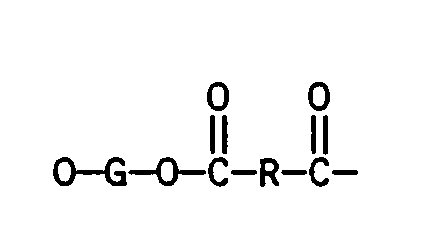
 G einen zweiwertigen Rest, der nach der Entfernung der terminalen Hydroxylgruppen aus einem Poly(alkylenoxid)glykol verbleibt,D einen zweiwertigen Rest, der nach Entfernung der terminalen Hydroxylgruppen aus einem zweiwertigen Diol verbleibt, undR einen zweiwertigen Rest, der nach Entfernung der Carboxylgruppen aus einer Dicarbonsäure verbleibt,darstellen.
 - Verwendung der thermoplastischen Formmassen gemäß den Ansprüchen 1 und 2 zur Herstellung von Formkörpern.
- Formkörper, erhältlich aus thermoplastischen Formmassen gemäß den Ansprüchen 1 und 2.
Applications Claiming Priority (2)
| Application Number | Priority Date | Filing Date | Title |
|---|---|---|---|
| DE3806271A DE3806271A1 (de) | 1988-02-27 | 1988-02-27 | Thermoplastische formmassen auf der basis von polyamiden und ethylencopolymerisaten |
| DE3806271 | 1988-02-27 |
Publications (2)
| Publication Number | Publication Date |
|---|---|
| EP0331001A1 EP0331001A1 (de) | 1989-09-06 |
| EP0331001B1 true EP0331001B1 (de) | 1993-09-08 |
Family
ID=6348344
Family Applications (1)
| Application Number | Title | Priority Date | Filing Date |
|---|---|---|---|
| EP89103149A Revoked EP0331001B1 (de) | 1988-02-27 | 1989-02-23 | Thermoplastische Formmassen auf der Basis von Polyamiden |
Country Status (6)
| Country | Link |
|---|---|
| US (1) | US5034450A (de) |
| EP (1) | EP0331001B1 (de) |
| JP (1) | JPH01256565A (de) |
| DE (2) | DE3806271A1 (de) |
| ES (1) | ES2058358T3 (de) |
| NO (1) | NO890792L (de) |
Families Citing this family (21)
| Publication number | Priority date | Publication date | Assignee | Title |
|---|---|---|---|---|
| DE4039420A1 (de) * | 1990-12-08 | 1992-06-11 | Basf Ag | Thermoplastische formmassen auf der basis von polyamiden und thermoplastischen polyester-elastomeren |
| US5489667A (en) * | 1991-03-20 | 1996-02-06 | Atochem Deutschland Gmbh | Polyetheresteramides and process for making and using the same |
| US5393849A (en) * | 1993-10-19 | 1995-02-28 | Georgia-Pacific Resins, Inc. | Curable polyester/polyamino compositions |
| WO1997010303A1 (en) * | 1995-09-13 | 1997-03-20 | Du Pont | Thermoplastic resin composition |
| US5987688A (en) * | 1995-11-09 | 1999-11-23 | Gillette Canada Inc. | Gum-massaging oral brush |
| CA2264907C (en) * | 1996-09-10 | 2005-10-18 | E.I. Du Pont De Nemours And Company | Polyamide resin composition |
| US6886207B1 (en) | 1999-06-14 | 2005-05-03 | The Procter & Gamble Company | Toothbrush |
| US6553604B1 (en) | 2000-03-16 | 2003-04-29 | Gillette Canada Company | Toothbrush |
| US20060272112A9 (en) | 2003-03-14 | 2006-12-07 | The Gillette Company | Toothbrush |
| US20040177462A1 (en) | 2003-03-14 | 2004-09-16 | The Gillette Company | Toothbrush head |
| CA2644300C (en) | 2003-04-23 | 2013-07-23 | John Geoffrey Chan | Electric toothbrushes |
| US7941886B2 (en) | 2003-09-19 | 2011-05-17 | Braun Gmbh | Toothbrushes |
| WO2005118408A2 (en) | 2004-06-01 | 2005-12-15 | Automated Packaging Systems, Inc. | Web and method for making fluid filled units |
| US7897219B2 (en) * | 2004-06-01 | 2011-03-01 | Automated Packaging Systems, Inc. | Web and method for making fluid filled units |
| PL2209614T3 (pl) | 2007-10-31 | 2016-02-29 | Automated Packaging Systems Inc | Wstęga i sposób wytwarzania modułów wypełnionych płynem |
| US9205622B2 (en) | 2009-02-27 | 2015-12-08 | Automated Packaging Systems, Inc. | Web and method for making fluid filled units |
| EP2406301A1 (de) * | 2009-03-11 | 2012-01-18 | E. I. du Pont de Nemours and Company | Salzresistente polyamidzusammensetzungen |
| CA2841365A1 (en) | 2011-07-07 | 2013-01-10 | Automated Packaging Systems, Inc. | Air cushion inflation machine |
| NZ728417A (en) | 2013-03-15 | 2018-05-25 | Automated Packaging Systems Inc | On-demand inflatable packaging |
| WO2015077551A1 (en) | 2013-11-21 | 2015-05-28 | Automated Packaging Systems, Inc. | Air cushion inflation machine |
| DE102017218453A1 (de) * | 2017-10-16 | 2019-04-18 | Clariant Plastics & Coatings Ltd | Flammwidrige und farbstabile Polyamidformmassen |
Citations (1)
| Publication number | Priority date | Publication date | Assignee | Title |
|---|---|---|---|---|
| JPS53140350A (en) * | 1977-05-14 | 1978-12-07 | Toyobo Co Ltd | Polyamide resin composition |
Family Cites Families (27)
| Publication number | Priority date | Publication date | Assignee | Title |
|---|---|---|---|---|
| US2071251A (en) * | 1931-07-03 | 1937-02-16 | Du Pont | Fiber and method of producing it |
| US2071250A (en) * | 1931-07-03 | 1937-02-16 | Du Pont | Linear condensation polymers |
| US2130523A (en) * | 1935-01-02 | 1938-09-20 | Du Pont | Linear polyamides and their production |
| US2130948A (en) * | 1937-04-09 | 1938-09-20 | Du Pont | Synthetic fiber |
| US2241322A (en) * | 1938-09-30 | 1941-05-06 | Du Pont | Process for preparing polyamides from cyclic amides |
| US2312966A (en) * | 1940-04-01 | 1943-03-02 | Du Pont | Polymeric material |
| US2512606A (en) * | 1945-09-12 | 1950-06-27 | Du Pont | Polyamides and method for obtaining same |
| DE1138922B (de) * | 1960-10-08 | 1962-10-31 | Basf Ag | Formmassen aus Polyolefinen und Carbonsaeureamidgruppen aufweisenden Polymeren |
| NL302805A (de) * | 1962-12-31 | |||
| IL24111A (en) * | 1964-08-24 | 1969-02-27 | Du Pont | Linear polyamides |
| US3472916A (en) * | 1965-12-01 | 1969-10-14 | Gulf Oil Corp | Copolymers of ethylene and alkyl acrylates as plasticizers in polycarbonamide resins |
| US3845163A (en) * | 1966-01-24 | 1974-10-29 | Du Pont | Blends of polyamides and ionic copolymer |
| DE1669702C3 (de) * | 1967-06-19 | 1975-10-23 | Basf Ag, 6700 Ludwigshafen | Verfahren zur Herstellung von schlagzähen thermoplastischen Polyamid-Formmassen |
| US3651014A (en) * | 1969-07-18 | 1972-03-21 | Du Pont | Segmented thermoplastic copolyester elastomers |
| SE349132B (de) * | 1971-01-07 | 1972-09-18 | Goetaverken Angteknik Ab | |
| BE793332A (fr) * | 1972-01-26 | 1973-04-16 | Du Pont | Copolyesters thermoplastiques a segments |
| DE2713537B2 (de) * | 1977-03-26 | 1981-04-16 | Bayer Ag, 5090 Leverkusen | Polyamidlegierungen |
| JPS5441955A (en) * | 1977-09-08 | 1979-04-03 | Toray Ind Inc | Impact-resistant resin composition |
| US4185003A (en) * | 1978-02-16 | 1980-01-22 | E. I. Du Pont De Nemours And Company | Stabilized copolyetheresters |
| EP0004141B1 (de) * | 1978-02-23 | 1982-10-20 | International Harvester Company | Kolbenring-Bestückung bei Dieselmotor |
| US4136090A (en) * | 1978-03-02 | 1979-01-23 | E. I. Du Pont De Nemours And Company | Stabilized copolyetherester compositions |
| DE3169961D1 (en) * | 1980-07-14 | 1985-05-23 | Ici Plc | Filled compositions of thermoplastic polyamide and polyester |
| DE3121666A1 (de) * | 1981-05-30 | 1982-12-16 | Ibm Deutschland Gmbh, 7000 Stuttgart | Verfahren und einrichtung zur gegenseitigen ausrichtung von objekten bei roentgenstrahl- und korpuskularstrahl-belichtungsvorgaengen |
| DE3220380A1 (de) * | 1982-05-29 | 1983-12-01 | Basf Ag, 6700 Ludwigshafen | Schlagzaehe polyamid-formmassen |
| JPS60106854A (ja) * | 1983-11-15 | 1985-06-12 | Mitsubishi Rayon Co Ltd | 耐衝撃性,耐熱性ならびにめつき性に優れたポリアミド樹脂組成物 |
| JPH0649823B2 (ja) * | 1986-08-21 | 1994-06-29 | 鐘淵化学工業株式会社 | ポリアミド組成物 |
| JPS6474264A (en) * | 1987-09-11 | 1989-03-20 | Daihatsu Motor Co Ltd | Production of nylon composite of good vibration-damping performance |
-
1988
- 1988-02-27 DE DE3806271A patent/DE3806271A1/de not_active Withdrawn
-
1989
- 1989-02-23 DE DE89103149T patent/DE58905496D1/de not_active Expired - Lifetime
- 1989-02-23 JP JP1041952A patent/JPH01256565A/ja active Pending
- 1989-02-23 EP EP89103149A patent/EP0331001B1/de not_active Revoked
- 1989-02-23 ES ES89103149T patent/ES2058358T3/es not_active Expired - Lifetime
- 1989-02-24 US US07/315,141 patent/US5034450A/en not_active Expired - Fee Related
- 1989-02-24 NO NO89890792A patent/NO890792L/no unknown
Patent Citations (1)
| Publication number | Priority date | Publication date | Assignee | Title |
|---|---|---|---|---|
| JPS53140350A (en) * | 1977-05-14 | 1978-12-07 | Toyobo Co Ltd | Polyamide resin composition |
Also Published As
| Publication number | Publication date |
|---|---|
| NO890792L (no) | 1989-08-28 |
| ES2058358T3 (es) | 1994-11-01 |
| US5034450A (en) | 1991-07-23 |
| DE3806271A1 (de) | 1989-09-07 |
| EP0331001A1 (de) | 1989-09-06 |
| JPH01256565A (ja) | 1989-10-13 |
| NO890792D0 (no) | 1989-02-24 |
| DE58905496D1 (de) | 1993-10-14 |
Similar Documents
| Publication | Publication Date | Title |
|---|---|---|
| EP0331001A1 (de) | Thermoplastische Formmassen auf der Basis von Polyamiden | |
| EP0410301B2 (de) | Flammgeschützte thermoplastische Formmassen | |
| EP0299444B1 (de) | Teilaromatische Copolyamide mit verringertem Triamingehalt | |
| DE2248242A1 (de) | Verstaerkte interkristalline thermoplastische polyester-zusammensetzungen | |
| DE2716004A1 (de) | Thermoplastische formmassen auf der basis von polyamiden aus omega-aminocarbonsaeuren bzw. lactamen mit mehr als 10 kohlenstoffatomen mit verbesserter flexibilitaet und kaelteschlagzaehigkeit | |
| EP0106027B1 (de) | Schlagzähe thermoplastische Formmassen mit hoher Wärmeformbeständigkeit | |
| DE3640875A1 (de) | Thermoplastische formmassen auf der basis von polycarbonaten, polyestern und polyamiden | |
| DE3728334C2 (de) | ||
| EP0490155B1 (de) | Thermoplastische Formmassen auf der Basis von Polyamiden und thermoplastischen Polyester-Elastomeren | |
| EP0399415B1 (de) | Thermoplastische verarbeitbare elastomere Blockcopolyetheresteretheramide, Verfahren zu ihrer Herstellung und ihre Verwendung | |
| EP0840758A1 (de) | Verfahren zur herstellung von verkappten polyarylenethern | |
| EP0613916B1 (de) | Formmasse auf der Grundlage von Polyarylenethern mit Anhydridendgruppen | |
| EP0415144A2 (de) | Verfahren zur Herstellung von verstärkten, zähmodifizierten thermoplastischen Formmassen | |
| DE69103171T2 (de) | Polyamid-Harzmasse. | |
| DE3617501A1 (de) | Thermoplastische formmassen | |
| EP0400428A1 (de) | Thermoplastische Formmassen aus teilaromatischen und amorphen Copolyamiden | |
| DE3903364A1 (de) | Schlagzaehe polyamidformmassen | |
| EP0302483A1 (de) | Feststoffmischung aus nukleierten und nicht-nukleierten Polyamiden | |
| DE3926895A1 (de) | Flammfeste thermoplastische formmassen auf der basis von polyamiden und polyester-elastomeren | |
| DE3782188T2 (de) | Polyethylenterephthalat-harzmasse. | |
| EP0591731B1 (de) | Fliessfähige Polyamidformmassen | |
| DE3844228A1 (de) | Flammfeste thermoplastische formmassen auf der basis von polyamiden und polyester-elastomeren | |
| EP0275518B1 (de) | Thermoplastische Formmassen auf der Basis von Polyamiden und Ethylencopolymerisaten | |
| EP0327983A2 (de) | Füllstoffhaltige thermoplastische Formmassen mit verringertem Abrieb | |
| DE3641499A1 (de) | Thermoplastische formmassen auf der basis von polyestern und polyamiden |
Legal Events
| Date | Code | Title | Description |
|---|---|---|---|
| PUAI | Public reference made under article 153(3) epc to a published international application that has entered the european phase |
Free format text: ORIGINAL CODE: 0009012 |
|
| AK | Designated contracting states |
Kind code of ref document: A1 Designated state(s): BE CH DE ES FR GB IT LI NL SE |
|
| 17P | Request for examination filed |
Effective date: 19900215 |
|
| 17Q | First examination report despatched |
Effective date: 19911011 |
|
| GRAA | (expected) grant |
Free format text: ORIGINAL CODE: 0009210 |
|
| AK | Designated contracting states |
Kind code of ref document: B1 Designated state(s): BE CH DE ES FR GB IT LI NL SE |
|
| PG25 | Lapsed in a contracting state [announced via postgrant information from national office to epo] |
Ref country code: IT Free format text: LAPSE BECAUSE OF FAILURE TO SUBMIT A TRANSLATION OF THE DESCRIPTION OR TO PAY THE FEE WITHIN THE PRE;WARNING: LAPSES OF ITALIAN PATENTS WITH EFFECTIVE DATE BEFORE 2007 MAY HAVE OCCURRED AT ANY TIME BEFORE 2007. THE CORRECT EFFECTIVE DATE MAY BE DIFFERENT FROM THE ONE RECORDED.SCRIBED TIME-LIMIT Effective date: 19930908 Ref country code: SE Effective date: 19930908 |
|
| REF | Corresponds to: |
Ref document number: 58905496 Country of ref document: DE Date of ref document: 19931014 |
|
| GBT | Gb: translation of ep patent filed (gb section 77(6)(a)/1977) |
Effective date: 19930927 |
|
| ET | Fr: translation filed | ||
| PLBI | Opposition filed |
Free format text: ORIGINAL CODE: 0009260 |
|
| 26 | Opposition filed |
Opponent name: DSM N.V. PATENT DEPARTMENT Effective date: 19940606 |
|
| NLR1 | Nl: opposition has been filed with the epo |
Opponent name: DSM N.V. |
|
| REG | Reference to a national code |
Ref country code: ES Ref legal event code: FG2A Ref document number: 2058358 Country of ref document: ES Kind code of ref document: T3 |
|
| APAC | Appeal dossier modified |
Free format text: ORIGINAL CODE: EPIDOS NOAPO |
|
| APAA | Appeal reference recorded |
Free format text: ORIGINAL CODE: EPIDOS REFN |
|
| PGFP | Annual fee paid to national office [announced via postgrant information from national office to epo] |
Ref country code: FR Payment date: 19980127 Year of fee payment: 10 |
|
| PGFP | Annual fee paid to national office [announced via postgrant information from national office to epo] |
Ref country code: NL Payment date: 19980130 Year of fee payment: 10 |
|
| PGFP | Annual fee paid to national office [announced via postgrant information from national office to epo] |
Ref country code: CH Payment date: 19980204 Year of fee payment: 10 |
|
| PGFP | Annual fee paid to national office [announced via postgrant information from national office to epo] |
Ref country code: ES Payment date: 19980213 Year of fee payment: 10 |
|
| PGFP | Annual fee paid to national office [announced via postgrant information from national office to epo] |
Ref country code: GB Payment date: 19980217 Year of fee payment: 10 Ref country code: BE Payment date: 19980217 Year of fee payment: 10 |
|
| PGFP | Annual fee paid to national office [announced via postgrant information from national office to epo] |
Ref country code: DE Payment date: 19980226 Year of fee payment: 10 |
|
| PG25 | Lapsed in a contracting state [announced via postgrant information from national office to epo] |
Ref country code: GB Free format text: LAPSE BECAUSE OF NON-PAYMENT OF DUE FEES Effective date: 19990223 |
|
| PG25 | Lapsed in a contracting state [announced via postgrant information from national office to epo] |
Ref country code: ES Free format text: LAPSE BECAUSE OF NON-PAYMENT OF DUE FEES Effective date: 19990224 |
|
| PG25 | Lapsed in a contracting state [announced via postgrant information from national office to epo] |
Ref country code: DE Free format text: LAPSE BECAUSE OF THE APPLICANT RENOUNCES Effective date: 19990225 |
|
| PG25 | Lapsed in a contracting state [announced via postgrant information from national office to epo] |
Ref country code: CH Free format text: LAPSE BECAUSE OF NON-PAYMENT OF DUE FEES Effective date: 19990228 Ref country code: LI Free format text: LAPSE BECAUSE OF NON-PAYMENT OF DUE FEES Effective date: 19990228 |
|
| APAC | Appeal dossier modified |
Free format text: ORIGINAL CODE: EPIDOS NOAPO |
|
| RDAH | Patent revoked |
Free format text: ORIGINAL CODE: EPIDOS REVO |
|
| RDAG | Patent revoked |
Free format text: ORIGINAL CODE: 0009271 |
|
| STAA | Information on the status of an ep patent application or granted ep patent |
Free format text: STATUS: PATENT REVOKED |
|
| GBPC | Gb: european patent ceased through non-payment of renewal fee |
Effective date: 19990223 |
|
| REG | Reference to a national code |
Ref country code: CH Ref legal event code: PL |
|
| 27W | Patent revoked |
Effective date: 19990604 |
|
| APAH | Appeal reference modified |
Free format text: ORIGINAL CODE: EPIDOSCREFNO |