EP0330136A2 - Neue Zirkonium(IV)-Chelate, deren Herstellung und deren Verwendung in Druckfarben - Google Patents
Neue Zirkonium(IV)-Chelate, deren Herstellung und deren Verwendung in Druckfarben Download PDFInfo
- Publication number
- EP0330136A2 EP0330136A2 EP89102974A EP89102974A EP0330136A2 EP 0330136 A2 EP0330136 A2 EP 0330136A2 EP 89102974 A EP89102974 A EP 89102974A EP 89102974 A EP89102974 A EP 89102974A EP 0330136 A2 EP0330136 A2 EP 0330136A2
- Authority
- EP
- European Patent Office
- Prior art keywords
- zirconium
- chelates
- citric acid
- esters
- printing inks
- Prior art date
- Legal status (The legal status is an assumption and is not a legal conclusion. Google has not performed a legal analysis and makes no representation as to the accuracy of the status listed.)
- Granted
Links
Classifications
-
- C—CHEMISTRY; METALLURGY
- C09—DYES; PAINTS; POLISHES; NATURAL RESINS; ADHESIVES; COMPOSITIONS NOT OTHERWISE PROVIDED FOR; APPLICATIONS OF MATERIALS NOT OTHERWISE PROVIDED FOR
- C09D—COATING COMPOSITIONS, e.g. PAINTS, VARNISHES OR LACQUERS; FILLING PASTES; CHEMICAL PAINT OR INK REMOVERS; INKS; CORRECTING FLUIDS; WOODSTAINS; PASTES OR SOLIDS FOR COLOURING OR PRINTING; USE OF MATERIALS THEREFOR
- C09D11/00—Inks
- C09D11/02—Printing inks
- C09D11/03—Printing inks characterised by features other than the chemical nature of the binder
-
- C—CHEMISTRY; METALLURGY
- C07—ORGANIC CHEMISTRY
- C07F—ACYCLIC, CARBOCYCLIC OR HETEROCYCLIC COMPOUNDS CONTAINING ELEMENTS OTHER THAN CARBON, HYDROGEN, HALOGEN, OXYGEN, NITROGEN, SULFUR, SELENIUM OR TELLURIUM
- C07F7/00—Compounds containing elements of Groups 4 or 14 of the Periodic Table
- C07F7/003—Compounds containing elements of Groups 4 or 14 of the Periodic Table without C-Metal linkages
Definitions
- the present invention relates to zirconium (IV) compounds which are distinguished by good solubility in organic solvents, by their reactivity as catalysts and crosslinking agents and by a certain stability to hydrolysis.
- Esters of hypothetical zirconium (IV) acid also known as tetraalkyl zirconates
- the alkyl groups can be replaced by chelating groups, which e.g. leads to zirconium acetylacetonate.
- acylates such as zirconium propionate, play a technical role.
- Such metal acid esters are used as an additive in flexographic printing inks based on nitrocellulose, cellulose ester derivatives or other suitable printing ink binders in order to improve their adhesion to critical substrates, such as polyolefin films, and to improve their solvent and heat stability;
- titanates e.g. titanium acetylacetonate
- zirconium compounds none of the available zirconium compounds is problem-free: the alkyl zirconates already crosslink the paint in the storage container, zirconium acetylacetonate dissolves only extremely little in the solvents in question, and zirconium propionate can lead to odor problems.
- zirconium (IV) chelates containing alkoxy groups have now been found, which are characterized in that they contain esters of citric acid as chelating agents. These zirconium chelates are used in the above-mentioned printing inks as alcoholic solutions, so that these solutions and their use in printing inks have also been found to fulfill the above-mentioned object.
- the alkoxy groups of the new zirconium chelates preferably have 2 to 4 carbon atoms; however, they can also have up to and including 8 carbon atoms for special applications, which can also be interrupted by oxygen atoms.
- the citric acid ester component of the new chelates is derived from citric acid partial esters, preferably from the citric acid dialkyl esters, the alkyl groups of which preferably have 2 to 4 carbon atoms, generally 1 to 8 carbon atoms.
- one to four of the alkoxy groups of a zirconic acid ester can be replaced by the citric acid ester groups mentioned. Accordingly, the ratio of the alkoxy groups bonded to the central Zr atom to the citric acid ester groups can be between 3: 1 and 0: 4.
- the new zirconium chelates can be produced in a simple manner by reacting zirconium acid esters with the amount of citric acid ester corresponding to the desired end product, after which the alcohol can be distilled off.
- the reaction is advantageously carried out in such a way that the zirconic acid ester is heated to the reaction temperature tronic acid ester added.
- the reaction temperature is in the range between 20 and 100 ° C, preferably between 60 and 80 ° C.
- the reaction is generally complete after a reaction time of 2 to 5 hours if the preferred temperature range is used.
- To produce the pure esters all of the alcohol which has formed during the reaction is distilled off, and also that which may have been introduced as diluent alcohol with the zirconic acid ester.
- the solutions When used in printing inks, the solutions, which can optionally be further diluted with alcohols or other solvents, show improved crosslinking and adhesion properties compared to titanium acetylacetonate. They can be mixed into the printing inks in amounts of between 1 and 10% by weight, preferably between 1 and 4% by weight, it being advantageous that gelling does not occur even after a long service life. After mounting the paint on a substrate, the adhesion to the substrate is surprisingly improved compared to titanium acetylacetonate.
- the natural color of the new chelates is light yellow to yellow. By adding in the specified amount, white printing inks are practically not discolored. There is also no discoloration when these printing inks are applied to substrates which contain phenolic-based antioxidants.
- the liquid state of the product is a significant advantage. Furthermore, the product is easier to mix and distribute or more soluble in printing inks than solid zirconium acetylacetonate.
- the printing inks for which the zirconium chelate solutions according to the invention are used are printing inks known per se based on binders such as nitrocellulose (NC Fabren) or other cellulose ester derivatives which are crosslinked by metal acid esters.
- the claimed zirconium chelates no longer have the disadvantages described at the beginning. Examples 5 to 8 Diethyl citrate complexes from n-butyl zirconate, containing alcohol approach Substance data Example No. Diethyl citrate n-butyl zirconate ** ZrO2 go. Refractive index n20 D Density g / ml.
- Example 2 for C26H44O16Zr + 4.C3H8O found 48.0 8.0 12.7 about. 48.3 8.0 13.0
- Example 3 for C33H52O22Zr + 5.C3H8O found 48.1 7.9 10.1 about. 48.3 7.7 10.3
- Example 6 for C28H48O16Zr + 2.62.C4H10O found 49.5 8.1 13.7 about. 49.9 8.0 13.3
- Example 7 for C34H54O22Zr + 3.62.C4H10O found 49.5 7.9 10.1 about.
- Example 15 Viscosity behavior of an NC color after adding the zirconium chelate complexes according to the invention: A white ink containing 25% by weight of ester-soluble nitrocellulose was used as the test medium, to which 4% by weight of the substances to be tested were added. The viscosity was determined using a rotary viscometer, and storage was carried out at 50 ° C. between measurements. Table of results Additive Viscosity in mPa.s after ... storage time at 50 ° C 1 day 1 week 2 weeks 1 month 2 months Titanium acetylacetonate 560 480 480 440 850 according to example 2 700 630 570 420 830 according to example 4 700 640 550 330 400
Landscapes
- Chemical & Material Sciences (AREA)
- Organic Chemistry (AREA)
- Chemical Kinetics & Catalysis (AREA)
- General Chemical & Material Sciences (AREA)
- Life Sciences & Earth Sciences (AREA)
- Engineering & Computer Science (AREA)
- Materials Engineering (AREA)
- Wood Science & Technology (AREA)
- Paints Or Removers (AREA)
- Organic Low-Molecular-Weight Compounds And Preparation Thereof (AREA)
- Inks, Pencil-Leads, Or Crayons (AREA)
Abstract
Description
- Gegenstand der vorliegenden Erfindung sind Zirkonium(IV)-Verbindungen, die sich durch gute Löslichkeit in organischen Lösungsmitteln, durch ihre Reaktivität als Katalysatoren und Vernetzer und durch eine gewisse Hydrolysestabilität auszeichnen.
- Ester der hypothetischen Zirkonium(IV)-Säure, auch als Tetraalkylzirkonate bezeichnet, sind seit längerem bekannt und werden als Katalysatoren, z.B. bei Veresterungsreaktionen, oder als Vernetzungsreagentien, z.B. für funktionelle Gruppen tragende Polymere, vielseitig eingesetzt. Um die für manche Verwendungszwecke zu stark ausgeprägte Reaktivität solcher Zirkonate wie Tetrapropyl- oder Tetrabutylzirkonat herabzusetzen, können die Alkylgruppen durch chelatisierend wirkende Gruppen ersetzt werden, was z.B. zu Zirkoniumacetylacetonat führt. Als weitere organische Zirkoniumverbindungen spielen Acylate, wie Zirkoniumpropionat, technisch eine Rolle.
- Solche Metallsäureester finden Verwendung als Additiv in Flexodruckfarben auf Basis von Nitrocellulose, Celluloseesterderivaten oder anderen geeigneten Druckfarbenbindemitteln, um deren Haftung auf kritischen Substraten, wie Polyolefinfolien, sowie ihre Lösungsmittel- und Hitzestabilität zu verbessern; gegenüber den häufiger verwendeten Titanaten, z B. Titanacetylacetonat, ist bei Zirkonaten die Gefahr sowohl der Vergilbung weißer Farbtöne als auch die Wechselwirkung mit Antioxidantien stark vermindert. Von den zur Verfügung stehenden Zirkoniumverbindungen ist allerdings keine problemfrei: die Alkylzirkonate vernetzen die Farbe schon Vorratsgefäß, Zirkoniumacetylacetonat löst sich in den in Frage kommenden Lösemitteln nur außerordentlich gering, und Zirkoniumpropionat kann in geruchlicher Hinsicht zu Schwierigkeiten führen.
- Es bestand deshalb die Aufgabe, Zirkoniumverbindungen zu finden, deren vernetzende Wirkung in ähnlicher Weise wie beim Zirkoniumacetylacetonat herabgesetzt ist, so daß eine Vernetzung der mit diesen Verbindungen versetzten Bindemitteln erst während oder nach dem Verdunsten des Lösemittels aus der verdruckten Farbe stattfindet, die aber eine vergleichsweise gute Löslichkeit in z.B. Farbe aufweisen und deren Geruch gering ist.
- In Erfüllung dieser Aufgabe wurden nun gegebenenfalls Alkoxygruppen enthaltende Zirkonium(IV)-Chelate gefunden, die dadurch gekennzeichnet sind, daß sie als Chelatbildner Ester der Zitronensäure enthalten. Zum Einsatz in den obengenannten Druckfarben gelangen diese Zirkoniumchelate als alkoholische Lösungen, so daß diese Lösungen und deren Verwendung in Druckfarben ebenfalls in Erfüllung der obengenannten Aufgabe gefunden wurden.
- Die Alkoxygruppen der neuen Zirkoniumchelate haben vorzugsweise 2 bis 4 C-Atome; sie können jedoch auch für spezielle Auwendungen bis zu einschließlich 8 C-Atome haben, die auch durch Sauerstoffatome unterbrochen sein können.
- Die Zitronensäureester-Komponente der neuen Chelate leitet sich von Zitronensäurepartialestern, vorzugsweise von den Zitronensäuredialkylestern, ab, deren Alkylgruppen vorzugsweise 2 bis 4 C-Atome, allgemein 1 bis 8 C-Atome, aufweisen.
- In den neuen Chelaten können eine bis vier der Alkoxygruppen eines Zirkonsäureesters durch die genannten Zitronensäureestergruppen ersetzt sein. Demzufolge kann das Verhältnis der an das zentrale Zr-Atom gebundenen Alkoxygruppen zu den Zitronensäureestergruppen zwischen 3 : 1 und 0 : 4 liegen.
- Die neuen Zirkoniumchelate lassen sich auf einfache Weise herstellen, indem man Zirkoniumsäureester mit der dem gewünschten Endprodukt entsprechenden Menge an Zitronensäureester umsetzt, wonach der Alkohol abdestilliert werden kann. Die Umsetzung wird zweckmäßigerweise in der Weise durchgeführt, daß man den Zirkoniumsäureester dem auf Reaktionstemperatur erwärmten Zi tronensäureester hinzufügt. Die Reaktionstemperatur liegt im Bereich zwischen 20 und 100 °C, vorzugsweise zwischen 60 und 80 °C. Die Umsetzung ist im allgemeinen nach einer Reaktionsdauer von 2 bis 5 Stunden beendet, wenn im bevorzugten Temperaturbereich gearbeitet wird. Zur Herstellung der reinen Ester wird der gesamte Alkohol abdestilliert, der bei der Reaktion entstanden ist, sowie auch derjenige, der ggf. als Verdünnungsalkohol mit dem Zirkoniumsäureester eingebracht wurde.
- Wenn man die alkoholischen Lösungen der neuen Zirkoniumchelate erhalten will, ist es selbstverständlich nicht notwendig, den gesamten bei der Umsetzung frei werdenden Alkohol abzudestillieren. Es wird dann nur so viel Alkohol abdestilliert, wie zur Herstellung der einsatzfertigen Chelate notwendig ist. Gegebenenfalls braucht auch kein Alkohol abdestilliert zu ,werden. Die auf diese Weise erhaltenen Lösungen haben einen Gehalt an Chelaten, der über 70 Gew.-% liegt.
- Die Lösungen, die gegebenenfalls mit Alkoholen oder anderen Lösungsmitteln weiter verdünnt werden können, zeigen beim Einsatz in Druckfarben hinsichtlich Vernetzung und Haftung verbesserte Eigenschaften gegenüber Titanacetylacetonat. Sie lassen sich in Mengen zwischen 1 und 10 Gew.-%, vorzugsweise zwischen 1 und 4 Gew.-%, in die Druckfarben untermischen, wobei es von Vorteil ist, daß auch bei längerer Standdauer keine Gelierung eintritt. Nach dem Aufziehen der Farbe auf einen Untergrund ist die Haf tung auf dem Untergrund gegenüber Titanacetylacetonat überraschend jedoch verbessert.
- Die Eigenfarbe der neuen Chelate ist hellgelb bis gelb. Durch den Zusatz in der angegebenen Menge werden weiße Druckfarben praktisch nicht verfärbt. Es tritt auch keine Verfärbung ein, wenn diese Druckfarben auf solche Untergründe appliziert werden, die Antioxidantien auf Phenolbasis enthalten.
- Ein erheblicher Vorteil ist der flüssige Zustand des Produktes. Weiter ist das Produkt leichter vermischbar und verteilbar bzw. besser löslich in z.B. Druckfarben als festes Zirkoniumacetylacetonat.
- Bei den Druckfarben, für die die erfindungsgemäßen Zirkoniumchelat-Lösungen eingesetzt werden, handelt es sich um an sich bekannte Druckfarben auf der Basis von Bindemitteln wie Nitrocellulose (NC-Fabren) oder andere Celluloseesterderivate, die durch Metallsäureester vernetzt werden. Im Vergleich zu anderen Zirkoniumverbindungen besitzen die beanspruchten Zirkoniumchelate die anfangs geschilderten Nachteile jedoch nicht mehr.

Beispiele 5 bis 8: Diethylzitrat-Komplexe aus n-Butylzirkonat, alkoholhaltig Ansatz Stoffdaten Bsp. Nr. Diethylzitrat n-Butylzirkonat** ZrO₂-Geh. Brechungszahl n²⁰D Dichte g/ml. 20 °C Viskosität mPa.s 20 °C g Mol g Mol 5 248 1,0 457 1,0 17,5% 1,460 1,12 140 6 347,2 1,4 319,9 0,7 13,0% 1,458 1,13 135 7 446,4 1,8 274,2 0,6 10,3% 1,457 1,15 176 8 446,4 1,8 205,7 0,45 8,5% 1,457 1,15 215 ** = n-Butylzirkonat: 84 gew.-%ig in n-Butanol Beispiele 9 bis 12: Diethylzitrat-Zirkoniumkomplexe, Alkohol abgetrennt Bsp. Nr. Ausgangsmaterial aus Beispiel... Abgetrennter Alkohol / % d.Th. Art Stoffdaten Brechungszahl n²⁰D Viskosität mPa.s,20°C 9 2 n-Propanol/95,9 1,485 44000 10 4 n-Propanol/64,1 1,474 6100 11 6 n-Propanol/107,6 1,488 138000 12 8 n-Propanol/80,5 1,478 25000 - Für die Produkte nach den vorangehenden Beispielen 1 bis 12 wurden bei der Elementaranalyse folgende Ergebnisse gefunden (gef. in Gew.-%), welche mit den berechneten Werten (ber. in Gew.-%) für die angegebenen Formeln übereinstimmen:
C H ZrO₂ Beispiel 2: für C₂₆H₄₄O₁₆Zr + 4.C₃H₈O gef. 48,0 8,0 12,7 ber. 48,3 8,0 13,0 Beispiel 3: für C₃₃H₅₂O₂₂Zr + 5.C₃H₈O gef. 48,1 7,9 10,1 ber. 48,3 7,7 10,3 Beispiel 6: für C₂₈H₄₈O₁₆Zr + 2,62.C₄H₁₀O gef. 49,5 8,1 13,7 ber. 49,9 8,0 13,3 Beispiel 7: für C₃₄H₅₄O₂₂Zr + 3,62.C₄H₁₀O gef. 49,5 7,9 10,1 ber. 49,6 7,7 10,5 Beispiel 9: für C₂₆H₄₄O₁₆Zr gef. 44,4 6,3 17,4 ber. 44,4 6,3 17,5 Beispiel 11: für C₂₈H₄₈O₁₆Zr gef. 46,5 6,7 16,3 ber. 46,0 6,6 16,8 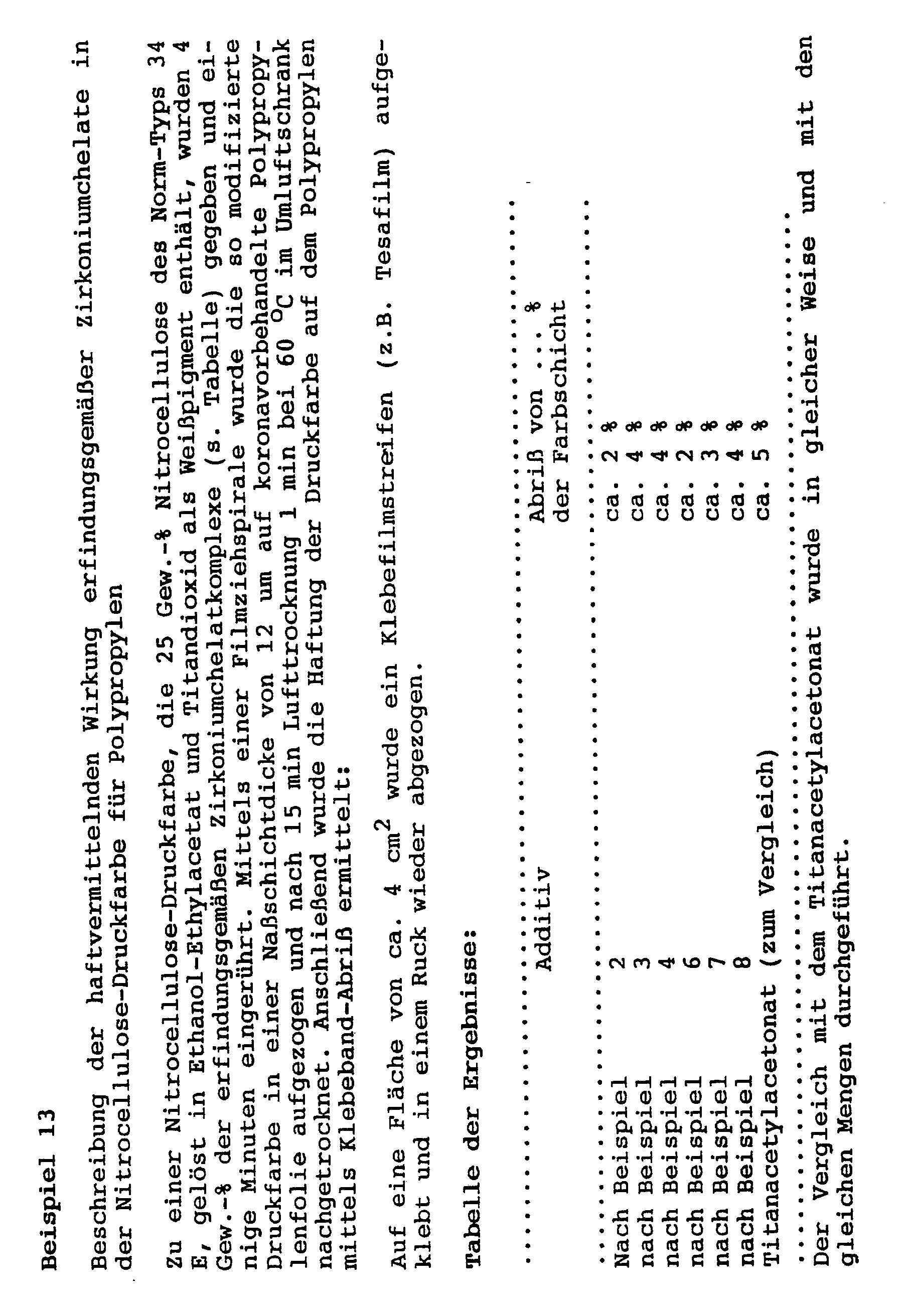

Beispiel 15 Viskositätsverhalten einer NC-Farbe nach Zusatz der erfindungsgemäßen Zirkoniumchelatkomplexe: Als Prüfmedium diente eine 25 Gew.-% esterlösliche Nitrocellulose enthaltende weiße Druckfarbe, der 4 Gew.-% der zu prüfenden Substanzen zugesetzt wurden. Die Viskosität wurde mit einem Rotationsviskosimeter bestimmt, gelagert wurde zwischen den Messungen bei 50 °C. Tabelle der Ergebnisse Additiv Viskosität in mPa.s nach ... Lagerzeit bei 50 °C 1 Tag 1 Woche 2 Wochen 1 Monat 2 Monate Titanacetylacetonat 560 480 480 440 850 nach Beispiel 2 700 630 570 420 830 nach Beispiel 4 700 640 550 330 400
Claims (8)
Applications Claiming Priority (2)
| Application Number | Priority Date | Filing Date | Title |
|---|---|---|---|
| DE3805879 | 1988-02-25 | ||
| DE3805879A DE3805879C1 (de) | 1988-02-25 | 1988-02-25 |
Publications (3)
| Publication Number | Publication Date |
|---|---|
| EP0330136A2 true EP0330136A2 (de) | 1989-08-30 |
| EP0330136A3 EP0330136A3 (en) | 1990-11-22 |
| EP0330136B1 EP0330136B1 (de) | 1994-06-15 |
Family
ID=6348126
Family Applications (1)
| Application Number | Title | Priority Date | Filing Date |
|---|---|---|---|
| EP89102974A Expired - Lifetime EP0330136B1 (de) | 1988-02-25 | 1989-02-21 | Neue Zirkonium(IV)-Chelate, deren Herstellung und deren Verwendung in Druckfarben |
Country Status (6)
| Country | Link |
|---|---|
| US (1) | US5021596A (de) |
| EP (1) | EP0330136B1 (de) |
| JP (1) | JPH01249781A (de) |
| CA (1) | CA1326857C (de) |
| DE (2) | DE3805879C1 (de) |
| ES (1) | ES2056977T3 (de) |
Families Citing this family (13)
| Publication number | Priority date | Publication date | Assignee | Title |
|---|---|---|---|---|
| DE4115034A1 (de) * | 1991-05-08 | 1992-11-12 | Bayer Ag | Verfahren zur herstellung von metallcarboxylaten sowie deren verwendung fuer die polymerisation von fuer eine ziegler-natta-polymerisation geeigneten monomeren |
| DE4242622A1 (de) * | 1992-12-17 | 1994-06-23 | Bayer Ag | Neue Titan(IV)-chelate und ihre Verwendung in Polysiloxanmassen |
| GB2290545B (en) * | 1994-06-22 | 1998-03-11 | Tioxide Specialties Ltd | Printing inks containing zirconium compounds |
| GB9412579D0 (en) * | 1994-06-22 | 1994-08-10 | Tioxide Specialties Ltd | Compositions containing zirconium compounds |
| US5897694A (en) * | 1997-01-06 | 1999-04-27 | Formulabs | Methods for improving the adhesion and/or colorfastness of ink jet inks with respect to substrates applied thereto, and compositions useful therefor |
| USH1967H1 (en) * | 1998-07-02 | 2001-06-05 | Kimberly-Clark Worldwide, Inc. | Methods for improving the adhesion and/or colorfastness of ink jet inks with respect to substrates applied thereto |
| US20030091647A1 (en) * | 2001-11-15 | 2003-05-15 | Lewis Jennifer A. | Controlled dispersion of colloidal suspensions via nanoparticle additions |
| US20040226620A1 (en) * | 2002-09-26 | 2004-11-18 | Daniel Therriault | Microcapillary networks |
| US7141617B2 (en) * | 2003-06-17 | 2006-11-28 | The Board Of Trustees Of The University Of Illinois | Directed assembly of three-dimensional structures with micron-scale features |
| US7956102B2 (en) * | 2007-04-09 | 2011-06-07 | The Board Of Trustees Of The University Of Illinois | Sol-gel inks |
| US7922939B2 (en) * | 2008-10-03 | 2011-04-12 | The Board Of Trustees Of The University Of Illinois | Metal nanoparticle inks |
| US8187500B2 (en) * | 2008-10-17 | 2012-05-29 | The Board Of Trustees Of The University Of Illinois | Biphasic inks |
| US10259953B2 (en) * | 2016-09-30 | 2019-04-16 | Borica Co., Ltd. | Adhesion promoted and ink composition |
Family Cites Families (6)
| Publication number | Priority date | Publication date | Assignee | Title |
|---|---|---|---|---|
| GB885679A (en) * | 1956-12-21 | 1961-12-28 | Union Carbide Corp | Organic zirconium derivatives and paint, oil and organic-base ink compositions containing them |
| US4065544A (en) * | 1970-05-11 | 1977-12-27 | Union Carbide Corporation | Finely divided metal oxides and sintered objects therefrom |
| US3682688A (en) * | 1970-06-17 | 1972-08-08 | Du Pont | Method of fixing a chelated organic titanate vehicle to a substrate |
| US4160051A (en) * | 1972-03-17 | 1979-07-03 | I.W.S. Nominee Company Limited | Zirconium flame-resist treatment |
| US4623738A (en) * | 1985-04-22 | 1986-11-18 | Kenrich Petrochemicals, Inc. | Neoalkoxy organo-titanates and organo-zirconates useful as coupling and polymer processing agents |
| DE3733608A1 (de) * | 1987-10-05 | 1989-04-13 | Huels Troisdorf | Neue titan(iv)-chelate und ihre verwendung in druckfarben |
-
1988
- 1988-02-25 DE DE3805879A patent/DE3805879C1/de not_active Expired
-
1989
- 1989-02-21 EP EP89102974A patent/EP0330136B1/de not_active Expired - Lifetime
- 1989-02-21 JP JP1039485A patent/JPH01249781A/ja active Pending
- 1989-02-21 CA CA000591628A patent/CA1326857C/en not_active Expired - Fee Related
- 1989-02-21 DE DE58907862T patent/DE58907862D1/de not_active Expired - Fee Related
- 1989-02-21 ES ES89102974T patent/ES2056977T3/es not_active Expired - Lifetime
- 1989-02-23 US US07/314,816 patent/US5021596A/en not_active Expired - Fee Related
Also Published As
| Publication number | Publication date |
|---|---|
| DE58907862D1 (de) | 1994-07-21 |
| EP0330136A3 (en) | 1990-11-22 |
| JPH01249781A (ja) | 1989-10-05 |
| CA1326857C (en) | 1994-02-08 |
| ES2056977T3 (es) | 1994-10-16 |
| DE3805879C1 (de) | 1989-08-10 |
| EP0330136B1 (de) | 1994-06-15 |
| US5021596A (en) | 1991-06-04 |
Similar Documents
| Publication | Publication Date | Title |
|---|---|---|
| EP0314966B1 (de) | Zubereitung auf Basis von Titan-Chelaten von Diolen und von Titanacylaten | |
| EP0330136B1 (de) | Neue Zirkonium(IV)-Chelate, deren Herstellung und deren Verwendung in Druckfarben | |
| DE69526854T2 (de) | Physikalisch modifizierte abbaubare thermoplastische zusammensetzung | |
| DE69514575T2 (de) | Zirconium-Verbindungen enthaltende Zusammensetzungen | |
| DE69308651T2 (de) | Organische Cerium-IV-Verbindungen und deren Herstellung und Verwendung | |
| DE3427064C2 (de) | ||
| DE3337098C2 (de) | ||
| EP0603628B1 (de) | Titan(IV)-chelate und ihre Verwendung in Polysiloxanmassen | |
| DE3337100C2 (de) | Wasserlösliche Titan(IV)-bis-acetylacetonate | |
| DE3733608C2 (de) | ||
| DE1545766A1 (de) | Verfahren zur Herstellung von ultraviolette Strahlung absorbierenden 2-Phenylimino-5-benzyliden-4-thiazolidonen | |
| EP0139214B1 (de) | Wasserlösliche Triethanolamintitanate | |
| DE2739671A1 (de) | Neue rifamyzin-verbindungen (ii) | |
| DE2933995A1 (de) | Antimonmercaptide | |
| DE3404949C1 (de) | Wasserloesliche Zirkonsaeureester | |
| DE69025762T2 (de) | Urethanpräpolymer sowie polyurethan-zusammensetzung | |
| EP0038924B1 (de) | Beschleuniger für die Härtung von ungesättigten Harzen und seine Verwendung | |
| EP0316893B1 (de) | Kondensierte Acetessigsäureester-Titanchelate und Verfahren zu deren Herstellung | |
| EP0802248A2 (de) | Mischungen von Carbonsäuresalzen und Carbonsäureestern, Verfahren zu deren Herstellung und deren Verwendung | |
| DE2439946A1 (de) | Dreiwertiger antimonkatalysator | |
| DE4038243B4 (de) | Organische Goldverbindungen und Verfahren zu ihrer Herstellung | |
| DE2209319A1 (de) | Photoempfindliche Zusammensetzung und Verfahren zur Herstellung eines Bildes unter Verwendung von dieser | |
| EP0167857B1 (de) | Modifizierte Titan(IV)-acetylacetonate | |
| DE1953706B2 (de) | Verfahren zur Herstellung von Polyestern | |
| DE2937909C2 (de) | Verfahren zur Härtung eines Acrylpolymerisats |
Legal Events
| Date | Code | Title | Description |
|---|---|---|---|
| PUAI | Public reference made under article 153(3) epc to a published international application that has entered the european phase |
Free format text: ORIGINAL CODE: 0009012 |
|
| AK | Designated contracting states |
Kind code of ref document: A2 Designated state(s): BE DE ES FR GB IT NL |
|
| PUAL | Search report despatched |
Free format text: ORIGINAL CODE: 0009013 |
|
| AK | Designated contracting states |
Kind code of ref document: A3 Designated state(s): BE DE ES FR GB IT NL |
|
| 17P | Request for examination filed |
Effective date: 19901222 |
|
| 17Q | First examination report despatched |
Effective date: 19930816 |
|
| GRAA | (expected) grant |
Free format text: ORIGINAL CODE: 0009210 |
|
| ITF | It: translation for a ep patent filed | ||
| AK | Designated contracting states |
Kind code of ref document: B1 Designated state(s): BE DE ES FR GB IT NL |
|
| GBT | Gb: translation of ep patent filed (gb section 77(6)(a)/1977) |
Effective date: 19940615 |
|
| REF | Corresponds to: |
Ref document number: 58907862 Country of ref document: DE Date of ref document: 19940721 |
|
| ET | Fr: translation filed | ||
| REG | Reference to a national code |
Ref country code: ES Ref legal event code: FG2A Ref document number: 2056977 Country of ref document: ES Kind code of ref document: T3 |
|
| PLBE | No opposition filed within time limit |
Free format text: ORIGINAL CODE: 0009261 |
|
| STAA | Information on the status of an ep patent application or granted ep patent |
Free format text: STATUS: NO OPPOSITION FILED WITHIN TIME LIMIT |
|
| 26N | No opposition filed | ||
| REG | Reference to a national code |
Ref country code: GB Ref legal event code: 732E |
|
| REG | Reference to a national code |
Ref country code: ES Ref legal event code: PC2A |
|
| NLS | Nl: assignments of ep-patents |
Owner name: E.I. DU PONT DE NEMOURS AND COMPANY |
|
| REG | Reference to a national code |
Ref country code: FR Ref legal event code: TP |
|
| PGFP | Annual fee paid to national office [announced via postgrant information from national office to epo] |
Ref country code: NL Payment date: 19971218 Year of fee payment: 10 |
|
| PGFP | Annual fee paid to national office [announced via postgrant information from national office to epo] |
Ref country code: ES Payment date: 19980217 Year of fee payment: 10 |
|
| PG25 | Lapsed in a contracting state [announced via postgrant information from national office to epo] |
Ref country code: ES Free format text: LAPSE BECAUSE OF EXPIRATION OF PROTECTION Effective date: 19990222 |
|
| PG25 | Lapsed in a contracting state [announced via postgrant information from national office to epo] |
Ref country code: NL Free format text: LAPSE BECAUSE OF NON-PAYMENT OF DUE FEES Effective date: 19990901 |
|
| REG | Reference to a national code |
Ref country code: ES Ref legal event code: FD2A Effective date: 20010601 |
|
| REG | Reference to a national code |
Ref country code: GB Ref legal event code: IF02 |
|
| PGFP | Annual fee paid to national office [announced via postgrant information from national office to epo] |
Ref country code: BE Payment date: 20020418 Year of fee payment: 14 |
|
| PG25 | Lapsed in a contracting state [announced via postgrant information from national office to epo] |
Ref country code: BE Free format text: LAPSE BECAUSE OF NON-PAYMENT OF DUE FEES Effective date: 20030228 |
|
| PGFP | Annual fee paid to national office [announced via postgrant information from national office to epo] |
Ref country code: DE Payment date: 20070215 Year of fee payment: 19 |
|
| PGFP | Annual fee paid to national office [announced via postgrant information from national office to epo] |
Ref country code: GB Payment date: 20070221 Year of fee payment: 19 |
|
| PGFP | Annual fee paid to national office [announced via postgrant information from national office to epo] |
Ref country code: IT Payment date: 20070625 Year of fee payment: 19 |
|
| PGFP | Annual fee paid to national office [announced via postgrant information from national office to epo] |
Ref country code: FR Payment date: 20070208 Year of fee payment: 19 |
|
| GBPC | Gb: european patent ceased through non-payment of renewal fee |
Effective date: 20080221 |
|
| REG | Reference to a national code |
Ref country code: FR Ref legal event code: ST Effective date: 20081031 |
|
| PG25 | Lapsed in a contracting state [announced via postgrant information from national office to epo] |
Ref country code: DE Free format text: LAPSE BECAUSE OF NON-PAYMENT OF DUE FEES Effective date: 20080902 |
|
| PG25 | Lapsed in a contracting state [announced via postgrant information from national office to epo] |
Ref country code: FR Free format text: LAPSE BECAUSE OF NON-PAYMENT OF DUE FEES Effective date: 20080229 |
|
| PG25 | Lapsed in a contracting state [announced via postgrant information from national office to epo] |
Ref country code: GB Free format text: LAPSE BECAUSE OF NON-PAYMENT OF DUE FEES Effective date: 20080221 |
|
| PG25 | Lapsed in a contracting state [announced via postgrant information from national office to epo] |
Ref country code: IT Free format text: LAPSE BECAUSE OF NON-PAYMENT OF DUE FEES Effective date: 20080221 |