EP0310645B1 - Composes utiles notamment pour la radiotherapie ou l'imagerie du cancer - Google Patents
Composes utiles notamment pour la radiotherapie ou l'imagerie du cancer Download PDFInfo
- Publication number
- EP0310645B1 EP0310645B1 EP88903292A EP88903292A EP0310645B1 EP 0310645 B1 EP0310645 B1 EP 0310645B1 EP 88903292 A EP88903292 A EP 88903292A EP 88903292 A EP88903292 A EP 88903292A EP 0310645 B1 EP0310645 B1 EP 0310645B1
- Authority
- EP
- European Patent Office
- Prior art keywords
- ligands
- methyl
- chloromethyl
- cancer
- group
- Prior art date
- Legal status (The legal status is an assumption and is not a legal conclusion. Google has not performed a legal analysis and makes no representation as to the accuracy of the status listed.)
- Expired - Lifetime
Links
- 206010028980 Neoplasm Diseases 0.000 title claims abstract description 16
- 201000011510 cancer Diseases 0.000 title claims abstract description 12
- 238000003384 imaging method Methods 0.000 title claims abstract description 6
- 150000001875 compounds Chemical class 0.000 title abstract description 5
- 238000001959 radiotherapy Methods 0.000 title abstract description 3
- 239000003446 ligand Substances 0.000 claims abstract description 45
- 125000002496 methyl group Chemical group [H]C([H])([H])* 0.000 claims abstract description 21
- 230000002285 radioactive effect Effects 0.000 claims abstract description 17
- ZCYVEMRRCGMTRW-UHFFFAOYSA-N 7553-56-2 Chemical compound [I] ZCYVEMRRCGMTRW-UHFFFAOYSA-N 0.000 claims abstract description 16
- 229910052740 iodine Inorganic materials 0.000 claims abstract description 16
- 239000011630 iodine Substances 0.000 claims abstract description 16
- 125000000391 vinyl group Chemical group [H]C([*])=C([H])[H] 0.000 claims abstract description 10
- 229920002554 vinyl polymer Polymers 0.000 claims abstract description 10
- 125000002887 hydroxy group Chemical group [H]O* 0.000 claims abstract description 7
- 125000000217 alkyl group Chemical group 0.000 claims abstract description 4
- 125000003342 alkenyl group Chemical group 0.000 claims abstract description 3
- 125000004218 chloromethyl group Chemical group [H]C([H])(Cl)* 0.000 claims abstract description 3
- 125000000468 ketone group Chemical group 0.000 claims abstract 4
- 229960004719 nandrolone Drugs 0.000 claims description 6
- 238000002626 targeted therapy Methods 0.000 claims description 5
- 102000005969 steroid hormone receptors Human genes 0.000 claims description 4
- 238000002059 diagnostic imaging Methods 0.000 claims description 3
- 108020003113 steroid hormone receptors Proteins 0.000 claims description 3
- 125000003118 aryl group Chemical group 0.000 claims description 2
- ZCYVEMRRCGMTRW-AHCXROLUSA-N Iodine-123 Chemical compound [123I] ZCYVEMRRCGMTRW-AHCXROLUSA-N 0.000 abstract description 6
- 238000011282 treatment Methods 0.000 abstract description 6
- 239000003270 steroid hormone Substances 0.000 abstract description 3
- 238000002560 therapeutic procedure Methods 0.000 abstract 1
- YMWUJEATGCHHMB-UHFFFAOYSA-N Dichloromethane Chemical compound ClCCl YMWUJEATGCHHMB-UHFFFAOYSA-N 0.000 description 25
- 210000004027 cell Anatomy 0.000 description 21
- 102000005962 receptors Human genes 0.000 description 19
- 108020003175 receptors Proteins 0.000 description 19
- WYURNTSHIVDZCO-UHFFFAOYSA-N Tetrahydrofuran Chemical compound C1CCOC1 WYURNTSHIVDZCO-UHFFFAOYSA-N 0.000 description 18
- 150000003431 steroids Chemical class 0.000 description 18
- RTZKZFJDLAIYFH-UHFFFAOYSA-N Diethyl ether Chemical compound CCOCC RTZKZFJDLAIYFH-UHFFFAOYSA-N 0.000 description 17
- 239000000203 mixture Substances 0.000 description 16
- CSCPPACGZOOCGX-UHFFFAOYSA-N Acetone Chemical compound CC(C)=O CSCPPACGZOOCGX-UHFFFAOYSA-N 0.000 description 15
- VYPSYNLAJGMNEJ-UHFFFAOYSA-N Silicium dioxide Chemical compound O=[Si]=O VYPSYNLAJGMNEJ-UHFFFAOYSA-N 0.000 description 14
- 238000002360 preparation method Methods 0.000 description 14
- 239000000243 solution Substances 0.000 description 13
- HEMHJVSKTPXQMS-UHFFFAOYSA-M Sodium hydroxide Chemical compound [OH-].[Na+] HEMHJVSKTPXQMS-UHFFFAOYSA-M 0.000 description 12
- 238000000034 method Methods 0.000 description 12
- LEHBURLTIWGHEM-UHFFFAOYSA-N pyridinium chlorochromate Chemical compound [O-][Cr](Cl)(=O)=O.C1=CC=[NH+]C=C1 LEHBURLTIWGHEM-UHFFFAOYSA-N 0.000 description 12
- 239000003921 oil Substances 0.000 description 10
- UHOVQNZJYSORNB-UHFFFAOYSA-N Benzene Chemical compound C1=CC=CC=C1 UHOVQNZJYSORNB-UHFFFAOYSA-N 0.000 description 9
- LYCAIKOWRPUZTN-UHFFFAOYSA-N Ethylene glycol Chemical compound OCCO LYCAIKOWRPUZTN-UHFFFAOYSA-N 0.000 description 9
- 230000015572 biosynthetic process Effects 0.000 description 9
- 230000008569 process Effects 0.000 description 9
- JRNVZBWKYDBUCA-UHFFFAOYSA-N N-chlorosuccinimide Chemical compound ClN1C(=O)CCC1=O JRNVZBWKYDBUCA-UHFFFAOYSA-N 0.000 description 8
- MUMGGOZAMZWBJJ-DYKIIFRCSA-N Testostosterone Chemical class O=C1CC[C@]2(C)[C@H]3CC[C@](C)([C@H](CC4)O)[C@@H]4[C@@H]3CCC2=C1 MUMGGOZAMZWBJJ-DYKIIFRCSA-N 0.000 description 8
- 229940011871 estrogen Drugs 0.000 description 8
- 239000000262 estrogen Substances 0.000 description 8
- 239000000047 product Substances 0.000 description 8
- LFQSCWFLJHTTHZ-UHFFFAOYSA-N Ethanol Chemical compound CCO LFQSCWFLJHTTHZ-UHFFFAOYSA-N 0.000 description 7
- 238000010992 reflux Methods 0.000 description 7
- 239000000377 silicon dioxide Substances 0.000 description 7
- 238000003786 synthesis reaction Methods 0.000 description 7
- XEKOWRVHYACXOJ-UHFFFAOYSA-N Ethyl acetate Chemical compound CCOC(C)=O XEKOWRVHYACXOJ-UHFFFAOYSA-N 0.000 description 6
- 239000005977 Ethylene Substances 0.000 description 6
- 108010080146 androgen receptors Proteins 0.000 description 6
- 238000006243 chemical reaction Methods 0.000 description 6
- 238000010586 diagram Methods 0.000 description 6
- 238000000605 extraction Methods 0.000 description 6
- 230000033444 hydroxylation Effects 0.000 description 6
- 238000005805 hydroxylation reaction Methods 0.000 description 6
- 150000002576 ketones Chemical group 0.000 description 6
- 239000000583 progesterone congener Substances 0.000 description 6
- 239000002904 solvent Substances 0.000 description 6
- QTBSBXVTEAMEQO-UHFFFAOYSA-N Acetic acid Chemical group CC(O)=O QTBSBXVTEAMEQO-UHFFFAOYSA-N 0.000 description 5
- 108020004414 DNA Proteins 0.000 description 5
- 102000015694 estrogen receptors Human genes 0.000 description 5
- 108010038795 estrogen receptors Proteins 0.000 description 5
- 230000005764 inhibitory process Effects 0.000 description 5
- 230000003647 oxidation Effects 0.000 description 5
- 238000007254 oxidation reaction Methods 0.000 description 5
- 238000003756 stirring Methods 0.000 description 5
- FEJUGLKDZJDVFY-UHFFFAOYSA-N 9-borabicyclo(3.3.1)nonane Chemical compound C1CCC2CCCC1B2 FEJUGLKDZJDVFY-UHFFFAOYSA-N 0.000 description 4
- 102000001307 androgen receptors Human genes 0.000 description 4
- UORVGPXVDQYIDP-UHFFFAOYSA-N borane Chemical compound B UORVGPXVDQYIDP-UHFFFAOYSA-N 0.000 description 4
- 239000013078 crystal Substances 0.000 description 4
- 238000010511 deprotection reaction Methods 0.000 description 4
- 230000002427 irreversible effect Effects 0.000 description 4
- 230000003211 malignant effect Effects 0.000 description 4
- PTQMMNYJKCSPET-OMHQDGTGSA-N mibolerone Chemical compound C1C[C@]2(C)[C@](O)(C)CC[C@H]2[C@@H]2[C@H](C)CC3=CC(=O)CC[C@@H]3[C@H]21 PTQMMNYJKCSPET-OMHQDGTGSA-N 0.000 description 4
- NPAGDVCDWIYMMC-IZPLOLCNSA-N nandrolone Chemical compound O=C1CC[C@@H]2[C@H]3CC[C@](C)([C@H](CC4)O)[C@@H]4[C@@H]3CCC2=C1 NPAGDVCDWIYMMC-IZPLOLCNSA-N 0.000 description 4
- 238000000746 purification Methods 0.000 description 4
- 239000011541 reaction mixture Substances 0.000 description 4
- 229960003604 testosterone Drugs 0.000 description 4
- YLQBMQCUIZJEEH-UHFFFAOYSA-N tetrahydrofuran Natural products C=1C=COC=1 YLQBMQCUIZJEEH-UHFFFAOYSA-N 0.000 description 4
- JOXIMZWYDAKGHI-UHFFFAOYSA-N toluene-4-sulfonic acid Chemical compound CC1=CC=C(S(O)(=O)=O)C=C1 JOXIMZWYDAKGHI-UHFFFAOYSA-N 0.000 description 4
- RIOQSEWOXXDEQQ-UHFFFAOYSA-N triphenylphosphine Chemical compound C1=CC=CC=C1P(C=1C=CC=CC=1)C1=CC=CC=C1 RIOQSEWOXXDEQQ-UHFFFAOYSA-N 0.000 description 4
- XLYOFNOQVPJJNP-UHFFFAOYSA-N water Substances O XLYOFNOQVPJJNP-UHFFFAOYSA-N 0.000 description 4
- RZACPWSZIQKVDY-IRIMSJTPSA-N (8s,9s,10r,13s,14s)-10,13-dimethyl-6,7,8,9,12,14,15,16-octahydrocyclopenta[a]phenanthrene-3,11,17-trione Chemical compound O=C1C=C[C@]2(C)[C@H]3C(=O)C[C@](C)(C(CC4)=O)[C@@H]4[C@@H]3CCC2=C1 RZACPWSZIQKVDY-IRIMSJTPSA-N 0.000 description 3
- -1 11-beta-chloromethyl-estradiol compound Chemical class 0.000 description 3
- ZWEHNKRNPOVVGH-UHFFFAOYSA-N 2-Butanone Chemical compound CCC(C)=O ZWEHNKRNPOVVGH-UHFFFAOYSA-N 0.000 description 3
- WFDIJRYMOXRFFG-UHFFFAOYSA-N Acetic anhydride Chemical compound CC(=O)OC(C)=O WFDIJRYMOXRFFG-UHFFFAOYSA-N 0.000 description 3
- WEVYAHXRMPXWCK-UHFFFAOYSA-N Acetonitrile Chemical compound CC#N WEVYAHXRMPXWCK-UHFFFAOYSA-N 0.000 description 3
- 208000026310 Breast neoplasm Diseases 0.000 description 3
- 102000014914 Carrier Proteins Human genes 0.000 description 3
- ZAFNJMIOTHYJRJ-UHFFFAOYSA-N Diisopropyl ether Chemical compound CC(C)OC(C)C ZAFNJMIOTHYJRJ-UHFFFAOYSA-N 0.000 description 3
- IAZDPXIOMUYVGZ-UHFFFAOYSA-N Dimethylsulphoxide Chemical compound CS(C)=O IAZDPXIOMUYVGZ-UHFFFAOYSA-N 0.000 description 3
- MHAJPDPJQMAIIY-UHFFFAOYSA-N Hydrogen peroxide Chemical compound OO MHAJPDPJQMAIIY-UHFFFAOYSA-N 0.000 description 3
- OKKJLVBELUTLKV-UHFFFAOYSA-N Methanol Chemical compound OC OKKJLVBELUTLKV-UHFFFAOYSA-N 0.000 description 3
- 230000009471 action Effects 0.000 description 3
- 239000003098 androgen Substances 0.000 description 3
- 108091008324 binding proteins Proteins 0.000 description 3
- 238000005660 chlorination reaction Methods 0.000 description 3
- 239000012043 crude product Substances 0.000 description 3
- MTHSVFCYNBDYFN-UHFFFAOYSA-N diethylene glycol Chemical compound OCCOCCO MTHSVFCYNBDYFN-UHFFFAOYSA-N 0.000 description 3
- 238000001704 evaporation Methods 0.000 description 3
- 230000008020 evaporation Effects 0.000 description 3
- 230000003054 hormonal effect Effects 0.000 description 3
- 108091008039 hormone receptors Proteins 0.000 description 3
- 238000006197 hydroboration reaction Methods 0.000 description 3
- 229910052739 hydrogen Inorganic materials 0.000 description 3
- 229950006489 mibolerone Drugs 0.000 description 3
- 230000002906 microbiologic effect Effects 0.000 description 3
- VJMRKWPMFQGIPI-UHFFFAOYSA-N n-(2-hydroxyethyl)-5-(hydroxymethyl)-3-methyl-1-[2-[[3-(trifluoromethyl)phenyl]methyl]-1-benzothiophen-7-yl]pyrazole-4-carboxamide Chemical compound OCC1=C(C(=O)NCCO)C(C)=NN1C1=CC=CC2=C1SC(CC=1C=C(C=CC=1)C(F)(F)F)=C2 VJMRKWPMFQGIPI-UHFFFAOYSA-N 0.000 description 3
- IGZOCKFEUZBDKY-LJCOXQHRSA-N (8s,9r,13s,14s)-13-methyl-11-methylidene-3-phenylmethoxy-6,7,8,9,12,14,15,16-octahydrocyclopenta[a]phenanthren-17-one Chemical compound C([C@@H]1[C@@H](C2=CC=3)C(=C)C[C@]4([C@H]1CCC4=O)C)CC2=CC=3OCC1=CC=CC=C1 IGZOCKFEUZBDKY-LJCOXQHRSA-N 0.000 description 2
- MSEZLHAVPJYYIQ-VMXHOPILSA-N (8s,9s,10r,13s,14s)-10,13-dimethyl-1,2,6,7,8,9,11,12,14,15,16,17-dodecahydrocyclopenta[a]phenanthren-3-one Chemical compound C1CC2=CC(=O)CC[C@]2(C)[C@@H]2[C@@H]1[C@@H]1CCC[C@@]1(C)CC2 MSEZLHAVPJYYIQ-VMXHOPILSA-N 0.000 description 2
- PPJVXZVTPWQOQS-UHFFFAOYSA-N 1-ethoxy-1-(1-ethoxyethoxy)ethane Chemical compound CCOC(C)OC(C)OCC PPJVXZVTPWQOQS-UHFFFAOYSA-N 0.000 description 2
- LGHBWDKMGOIZKH-CBZIJGRNSA-N 3-Deoxyestrone Chemical compound C1=CC=C2[C@H]3CC[C@](C)(C(CC4)=O)[C@@H]4[C@@H]3CCC2=C1 LGHBWDKMGOIZKH-CBZIJGRNSA-N 0.000 description 2
- 102100032187 Androgen receptor Human genes 0.000 description 2
- IJGRMHOSHXDMSA-UHFFFAOYSA-N Atomic nitrogen Chemical compound N#N IJGRMHOSHXDMSA-UHFFFAOYSA-N 0.000 description 2
- 206010006187 Breast cancer Diseases 0.000 description 2
- VGGSQFUCUMXWEO-UHFFFAOYSA-N Ethene Chemical compound C=C VGGSQFUCUMXWEO-UHFFFAOYSA-N 0.000 description 2
- JUJWROOIHBZHMG-UHFFFAOYSA-N Pyridine Chemical compound C1=CC=NC=C1 JUJWROOIHBZHMG-UHFFFAOYSA-N 0.000 description 2
- CDBYLPFSWZWCQE-UHFFFAOYSA-L Sodium Carbonate Chemical compound [Na+].[Na+].[O-]C([O-])=O CDBYLPFSWZWCQE-UHFFFAOYSA-L 0.000 description 2
- VMHLLURERBWHNL-UHFFFAOYSA-M Sodium acetate Chemical compound [Na+].CC([O-])=O VMHLLURERBWHNL-UHFFFAOYSA-M 0.000 description 2
- PNDPGZBMCMUPRI-XXSWNUTMSA-N [125I][125I] Chemical compound [125I][125I] PNDPGZBMCMUPRI-XXSWNUTMSA-N 0.000 description 2
- 239000002253 acid Substances 0.000 description 2
- 238000005899 aromatization reaction Methods 0.000 description 2
- 230000008901 benefit Effects 0.000 description 2
- 229910000085 borane Inorganic materials 0.000 description 2
- YCIMNLLNPGFGHC-UHFFFAOYSA-N catechol Chemical compound OC1=CC=CC=C1O YCIMNLLNPGFGHC-UHFFFAOYSA-N 0.000 description 2
- 239000003795 chemical substances by application Substances 0.000 description 2
- VDQQXEISLMTGAB-UHFFFAOYSA-N chloramine T Chemical compound [Na+].CC1=CC=C(S(=O)(=O)[N-]Cl)C=C1 VDQQXEISLMTGAB-UHFFFAOYSA-N 0.000 description 2
- NEHNMFOYXAPHSD-UHFFFAOYSA-N citronellal Chemical compound O=CCC(C)CCC=C(C)C NEHNMFOYXAPHSD-UHFFFAOYSA-N 0.000 description 2
- 230000001472 cytotoxic effect Effects 0.000 description 2
- 230000006378 damage Effects 0.000 description 2
- 230000018044 dehydration Effects 0.000 description 2
- 238000006297 dehydration reaction Methods 0.000 description 2
- ZUOUZKKEUPVFJK-UHFFFAOYSA-N diphenyl Chemical compound C1=CC=CC=C1C1=CC=CC=C1 ZUOUZKKEUPVFJK-UHFFFAOYSA-N 0.000 description 2
- 230000000694 effects Effects 0.000 description 2
- FJKIXWOMBXYWOQ-UHFFFAOYSA-N ethenoxyethane Chemical compound CCOC=C FJKIXWOMBXYWOQ-UHFFFAOYSA-N 0.000 description 2
- 230000009036 growth inhibition Effects 0.000 description 2
- 229940088597 hormone Drugs 0.000 description 2
- 239000005556 hormone Substances 0.000 description 2
- 230000026045 iodination Effects 0.000 description 2
- 238000006192 iodination reaction Methods 0.000 description 2
- PNDPGZBMCMUPRI-UHFFFAOYSA-N iodine Chemical compound II PNDPGZBMCMUPRI-UHFFFAOYSA-N 0.000 description 2
- 229940044173 iodine-125 Drugs 0.000 description 2
- 230000014759 maintenance of location Effects 0.000 description 2
- 238000002844 melting Methods 0.000 description 2
- 230000008018 melting Effects 0.000 description 2
- VNWKTOKETHGBQD-UHFFFAOYSA-N methane Chemical compound C VNWKTOKETHGBQD-UHFFFAOYSA-N 0.000 description 2
- 230000007935 neutral effect Effects 0.000 description 2
- 239000008363 phosphate buffer Substances 0.000 description 2
- BWHMMNNQKKPAPP-UHFFFAOYSA-L potassium carbonate Chemical compound [K+].[K+].[O-]C([O-])=O BWHMMNNQKKPAPP-UHFFFAOYSA-L 0.000 description 2
- 230000000757 progestagenic effect Effects 0.000 description 2
- 239000001632 sodium acetate Substances 0.000 description 2
- 235000017281 sodium acetate Nutrition 0.000 description 2
- 239000007787 solid Substances 0.000 description 2
- 239000000725 suspension Substances 0.000 description 2
- LUJVUUWNAPIQQI-UHFFFAOYSA-N (+)-androsta-1,4-diene-3,17-dione Natural products O=C1C=CC2(C)C3CCC(C)(C(CC4)=O)C4C3CCC2=C1 LUJVUUWNAPIQQI-UHFFFAOYSA-N 0.000 description 1
- JUHWKPIFSQNQOC-ZXTXGHHLSA-N (8S,9R,13S,14S)-11-(chloromethyl)-13-methyl-3-phenylmethoxy-6,7,8,9,11,12,14,15,16,17-decahydrocyclopenta[a]phenanthrene Chemical compound C(C1=CC=CC=C1)OC1=CC=2CC[C@H]3[C@@H]4CCC[C@@]4(C)CC([C@@H]3C=2C=C1)CCl JUHWKPIFSQNQOC-ZXTXGHHLSA-N 0.000 description 1
- DQQMDOLPKAVVIE-HASHYOOPSA-N (8r,9s,13s,14s)-17-[(e)-2-iodanylethenyl]-13-methyl-7,8,9,11,12,14,15,16-octahydro-6h-cyclopenta[a]phenanthrene-3,17-diol Chemical class OC1=CC=C2[C@H]3CC[C@](C)(C(CC4)(O)\C=C\[125I])[C@@H]4[C@@H]3CCC2=C1 DQQMDOLPKAVVIE-HASHYOOPSA-N 0.000 description 1
- CMRVQKLOPOELDL-RXRUYEAZSA-N (8s,9r,13s,14s)-11-(chloromethyl)-13-methyl-3-phenylmethoxy-7,8,9,11,12,14,15,16-octahydro-6h-cyclopenta[a]phenanthren-17-one Chemical compound C([C@@H]1[C@@H](C2=CC=3)C(CCl)C[C@]4([C@H]1CCC4=O)C)CC2=CC=3OCC1=CC=CC=C1 CMRVQKLOPOELDL-RXRUYEAZSA-N 0.000 description 1
- GKZQFEBHZUEWMR-RXRUYEAZSA-N (8s,9r,13s,14s)-11-(hydroxymethyl)-13-methyl-3-phenylmethoxy-7,8,9,11,12,14,15,16-octahydro-6h-cyclopenta[a]phenanthren-17-one Chemical compound C([C@@H]1[C@@H](C2=CC=3)C(CO)C[C@]4([C@H]1CCC4=O)C)CC2=CC=3OCC1=CC=CC=C1 GKZQFEBHZUEWMR-RXRUYEAZSA-N 0.000 description 1
- UBIBSXMTVJAYTQ-QMNUTNMBSA-N 11alpha,17beta-Dihydroxy-17-methylandrost-4-en-3-one Chemical compound C1CC2=CC(=O)CC[C@]2(C)[C@@H]2[C@@H]1[C@@H]1CC[C@](C)(O)[C@@]1(C)C[C@H]2O UBIBSXMTVJAYTQ-QMNUTNMBSA-N 0.000 description 1
- BFPYWIDHMRZLRN-UHFFFAOYSA-N 17alpha-ethynyl estradiol Natural products OC1=CC=C2C3CCC(C)(C(CC4)(O)C#C)C4C3CCC2=C1 BFPYWIDHMRZLRN-UHFFFAOYSA-N 0.000 description 1
- MEKOFIRRDATTAG-UHFFFAOYSA-N 2,2,5,8-tetramethyl-3,4-dihydrochromen-6-ol Chemical compound C1CC(C)(C)OC2=C1C(C)=C(O)C=C2C MEKOFIRRDATTAG-UHFFFAOYSA-N 0.000 description 1
- OZAIFHULBGXAKX-UHFFFAOYSA-N 2-(2-cyanopropan-2-yldiazenyl)-2-methylpropanenitrile Chemical compound N#CC(C)(C)N=NC(C)(C)C#N OZAIFHULBGXAKX-UHFFFAOYSA-N 0.000 description 1
- 102100027324 2-hydroxyacyl-CoA lyase 1 Human genes 0.000 description 1
- OZAIFHULBGXAKX-VAWYXSNFSA-N AIBN Substances N#CC(C)(C)\N=N\C(C)(C)C#N OZAIFHULBGXAKX-VAWYXSNFSA-N 0.000 description 1
- 241000122824 Aspergillus ochraceus Species 0.000 description 1
- BVKZGUZCCUSVTD-UHFFFAOYSA-M Bicarbonate Chemical compound OC([O-])=O BVKZGUZCCUSVTD-UHFFFAOYSA-M 0.000 description 1
- 201000009030 Carcinoma Diseases 0.000 description 1
- XDTMQSROBMDMFD-UHFFFAOYSA-N Cyclohexane Chemical compound C1CCCCC1 XDTMQSROBMDMFD-UHFFFAOYSA-N 0.000 description 1
- 241000160765 Erebia ligea Species 0.000 description 1
- BFPYWIDHMRZLRN-SLHNCBLASA-N Ethinyl estradiol Chemical group OC1=CC=C2[C@H]3CC[C@](C)([C@](CC4)(O)C#C)[C@@H]4[C@@H]3CCC2=C1 BFPYWIDHMRZLRN-SLHNCBLASA-N 0.000 description 1
- PIICEJLVQHRZGT-UHFFFAOYSA-N Ethylenediamine Chemical compound NCCN PIICEJLVQHRZGT-UHFFFAOYSA-N 0.000 description 1
- 101001009252 Homo sapiens 2-hydroxyacyl-CoA lyase 1 Proteins 0.000 description 1
- WHXSMMKQMYFTQS-UHFFFAOYSA-N Lithium Chemical compound [Li] WHXSMMKQMYFTQS-UHFFFAOYSA-N 0.000 description 1
- 229910004879 Na2S2O5 Inorganic materials 0.000 description 1
- ZXSWTMLNIIZPET-ZOFHRBRSSA-N Normethandrolone Chemical compound C1CC2=CC(=O)CC[C@@H]2[C@@H]2[C@@H]1[C@@H]1CC[C@](C)(O)[C@@]1(C)CC2 ZXSWTMLNIIZPET-ZOFHRBRSSA-N 0.000 description 1
- 206010061535 Ovarian neoplasm Diseases 0.000 description 1
- 241000203720 Pimelobacter simplex Species 0.000 description 1
- 208000000236 Prostatic Neoplasms Diseases 0.000 description 1
- PMZURENOXWZQFD-UHFFFAOYSA-L Sodium Sulfate Chemical compound [Na+].[Na+].[O-]S([O-])(=O)=O PMZURENOXWZQFD-UHFFFAOYSA-L 0.000 description 1
- DWAQJAXMDSEUJJ-UHFFFAOYSA-M Sodium bisulfite Chemical compound [Na+].OS([O-])=O DWAQJAXMDSEUJJ-UHFFFAOYSA-M 0.000 description 1
- 108010085012 Steroid Receptors Proteins 0.000 description 1
- 241000906446 Theraps Species 0.000 description 1
- MUCRYNWJQNHDJH-OADIDDRXSA-N Ursonic acid Chemical group C1CC(=O)C(C)(C)[C@@H]2CC[C@@]3(C)[C@]4(C)CC[C@@]5(C(O)=O)CC[C@@H](C)[C@H](C)[C@H]5C4=CC[C@@H]3[C@]21C MUCRYNWJQNHDJH-OADIDDRXSA-N 0.000 description 1
- 208000002495 Uterine Neoplasms Diseases 0.000 description 1
- XTXRWKRVRITETP-UHFFFAOYSA-N Vinyl acetate Chemical compound CC(=O)OC=C XTXRWKRVRITETP-UHFFFAOYSA-N 0.000 description 1
- 238000007239 Wittig reaction Methods 0.000 description 1
- WAHQVRCNDCHDIB-QZYSPNBYSA-N [(3s,8r,9s,10r,13s,14s,17r)-17-acetyl-17-acetyloxy-6,10,13-trimethyl-1,2,3,8,9,11,12,14,15,16-decahydrocyclopenta[a]phenanthren-3-yl] 3-cyclopentylpropanoate Chemical compound O([C@@H]1C=C2C(C)=C[C@H]3[C@@H]4CC[C@]([C@]4(CC[C@@H]3[C@@]2(C)CC1)C)(OC(=O)C)C(C)=O)C(=O)CCC1CCCC1 WAHQVRCNDCHDIB-QZYSPNBYSA-N 0.000 description 1
- 125000003275 alpha amino acid group Chemical group 0.000 description 1
- 229940030486 androgens Drugs 0.000 description 1
- LUJVUUWNAPIQQI-QAGGRKNESA-N androsta-1,4-diene-3,17-dione Chemical compound O=C1C=C[C@]2(C)[C@H]3CC[C@](C)(C(CC4)=O)[C@@H]4[C@@H]3CCC2=C1 LUJVUUWNAPIQQI-QAGGRKNESA-N 0.000 description 1
- 230000001093 anti-cancer Effects 0.000 description 1
- 125000004429 atom Chemical group 0.000 description 1
- AGEZXYOZHKGVCM-UHFFFAOYSA-N benzyl bromide Chemical compound BrCC1=CC=CC=C1 AGEZXYOZHKGVCM-UHFFFAOYSA-N 0.000 description 1
- 235000010290 biphenyl Nutrition 0.000 description 1
- 239000004305 biphenyl Substances 0.000 description 1
- 210000000481 breast Anatomy 0.000 description 1
- GDTBXPJZTBHREO-UHFFFAOYSA-N bromine Chemical compound BrBr GDTBXPJZTBHREO-UHFFFAOYSA-N 0.000 description 1
- CPELXLSAUQHCOX-IGMARMGPSA-N bromine-80 Chemical compound [80BrH] CPELXLSAUQHCOX-IGMARMGPSA-N 0.000 description 1
- 230000003139 buffering effect Effects 0.000 description 1
- 210000003855 cell nucleus Anatomy 0.000 description 1
- 230000004663 cell proliferation Effects 0.000 description 1
- 230000001413 cellular effect Effects 0.000 description 1
- 239000003153 chemical reaction reagent Substances 0.000 description 1
- 238000002512 chemotherapy Methods 0.000 description 1
- 229930003633 citronellal Natural products 0.000 description 1
- 235000000983 citronellal Nutrition 0.000 description 1
- 238000011109 contamination Methods 0.000 description 1
- 238000001816 cooling Methods 0.000 description 1
- 239000010779 crude oil Substances 0.000 description 1
- 238000002425 crystallisation Methods 0.000 description 1
- 230000008025 crystallization Effects 0.000 description 1
- 210000000805 cytoplasm Anatomy 0.000 description 1
- 230000001086 cytosolic effect Effects 0.000 description 1
- 231100000433 cytotoxic Toxicity 0.000 description 1
- 230000003013 cytotoxicity Effects 0.000 description 1
- 231100000135 cytotoxicity Toxicity 0.000 description 1
- 230000007423 decrease Effects 0.000 description 1
- CZZYITDELCSZES-UHFFFAOYSA-N diphenylmethane Chemical compound C=1C=CC=CC=1CC1=CC=CC=C1 CZZYITDELCSZES-UHFFFAOYSA-N 0.000 description 1
- 238000001035 drying Methods 0.000 description 1
- 208000010932 epithelial neoplasm Diseases 0.000 description 1
- 230000002349 favourable effect Effects 0.000 description 1
- 239000000706 filtrate Substances 0.000 description 1
- 238000001914 filtration Methods 0.000 description 1
- WBJINCZRORDGAQ-UHFFFAOYSA-N formic acid ethyl ester Natural products CCOC=O WBJINCZRORDGAQ-UHFFFAOYSA-N 0.000 description 1
- 125000005843 halogen group Chemical group 0.000 description 1
- 239000003668 hormone analog Substances 0.000 description 1
- 230000007062 hydrolysis Effects 0.000 description 1
- 238000006460 hydrolysis reaction Methods 0.000 description 1
- 238000001727 in vivo Methods 0.000 description 1
- 230000006698 induction Effects 0.000 description 1
- 239000002198 insoluble material Substances 0.000 description 1
- 230000003834 intracellular effect Effects 0.000 description 1
- 230000005865 ionizing radiation Effects 0.000 description 1
- 238000002372 labelling Methods 0.000 description 1
- ACKFDYCQCBEDNU-UHFFFAOYSA-J lead(2+);tetraacetate Chemical compound [Pb+2].CC([O-])=O.CC([O-])=O.CC([O-])=O.CC([O-])=O ACKFDYCQCBEDNU-UHFFFAOYSA-J 0.000 description 1
- 230000001665 lethal effect Effects 0.000 description 1
- 229910052744 lithium Inorganic materials 0.000 description 1
- IHLVCKWPAMTVTG-UHFFFAOYSA-N lithium;carbanide Chemical compound [Li+].[CH3-] IHLVCKWPAMTVTG-UHFFFAOYSA-N 0.000 description 1
- 238000004519 manufacturing process Methods 0.000 description 1
- 238000005259 measurement Methods 0.000 description 1
- 230000004060 metabolic process Effects 0.000 description 1
- LSEFCHWGJNHZNT-UHFFFAOYSA-M methyl(triphenyl)phosphanium;bromide Chemical compound [Br-].C=1C=CC=CC=1[P+](C=1C=CC=CC=1)(C)C1=CC=CC=C1 LSEFCHWGJNHZNT-UHFFFAOYSA-M 0.000 description 1
- 230000011987 methylation Effects 0.000 description 1
- 238000007069 methylation reaction Methods 0.000 description 1
- 238000005822 methylenation reaction Methods 0.000 description 1
- 230000017066 negative regulation of growth Effects 0.000 description 1
- 229910052757 nitrogen Inorganic materials 0.000 description 1
- 239000012299 nitrogen atmosphere Substances 0.000 description 1
- 229940053934 norethindrone Drugs 0.000 description 1
- VIKNJXKGJWUCNN-XGXHKTLJSA-N norethisterone Chemical compound O=C1CC[C@@H]2[C@H]3CC[C@](C)([C@](CC4)(O)C#C)[C@@H]4[C@@H]3CCC2=C1 VIKNJXKGJWUCNN-XGXHKTLJSA-N 0.000 description 1
- 210000004940 nucleus Anatomy 0.000 description 1
- 238000011017 operating method Methods 0.000 description 1
- 239000012074 organic phase Substances 0.000 description 1
- 230000002611 ovarian Effects 0.000 description 1
- 239000012071 phase Substances 0.000 description 1
- 230000001766 physiological effect Effects 0.000 description 1
- 235000015320 potassium carbonate Nutrition 0.000 description 1
- 229910000027 potassium carbonate Inorganic materials 0.000 description 1
- 239000000843 powder Substances 0.000 description 1
- 239000002244 precipitate Substances 0.000 description 1
- 238000001556 precipitation Methods 0.000 description 1
- HPOKESDSMZRZLC-UHFFFAOYSA-N propan-2-one;hydrochloride Chemical compound Cl.CC(C)=O HPOKESDSMZRZLC-UHFFFAOYSA-N 0.000 description 1
- 230000001681 protective effect Effects 0.000 description 1
- UMJSCPRVCHMLSP-UHFFFAOYSA-N pyridine Natural products COC1=CC=CN=C1 UMJSCPRVCHMLSP-UHFFFAOYSA-N 0.000 description 1
- 230000005855 radiation Effects 0.000 description 1
- 239000012217 radiopharmaceutical Substances 0.000 description 1
- 229940121896 radiopharmaceutical Drugs 0.000 description 1
- 230000002799 radiopharmaceutical effect Effects 0.000 description 1
- 238000011160 research Methods 0.000 description 1
- 150000003839 salts Chemical class 0.000 description 1
- 229920006395 saturated elastomer Polymers 0.000 description 1
- 239000007974 sodium acetate buffer Substances 0.000 description 1
- 235000017550 sodium carbonate Nutrition 0.000 description 1
- 229910000029 sodium carbonate Inorganic materials 0.000 description 1
- HRZFUMHJMZEROT-UHFFFAOYSA-L sodium disulfite Chemical compound [Na+].[Na+].[O-]S(=O)S([O-])(=O)=O HRZFUMHJMZEROT-UHFFFAOYSA-L 0.000 description 1
- 235000010267 sodium hydrogen sulphite Nutrition 0.000 description 1
- 235000010262 sodium metabisulphite Nutrition 0.000 description 1
- 238000004611 spectroscopical analysis Methods 0.000 description 1
- 239000007858 starting material Substances 0.000 description 1
- 230000001954 sterilising effect Effects 0.000 description 1
- 230000008685 targeting Effects 0.000 description 1
- 210000001519 tissue Anatomy 0.000 description 1
- 229960001479 tosylchloramide sodium Drugs 0.000 description 1
- 238000013518 transcription Methods 0.000 description 1
- 230000035897 transcription Effects 0.000 description 1
- 230000005945 translocation Effects 0.000 description 1
- DBGVGMSCBYYSLD-UHFFFAOYSA-N tributylstannane Chemical compound CCCC[SnH](CCCC)CCCC DBGVGMSCBYYSLD-UHFFFAOYSA-N 0.000 description 1
- GKASDNZWUGIAMG-UHFFFAOYSA-N triethyl orthoformate Chemical compound CCOC(OCC)OCC GKASDNZWUGIAMG-UHFFFAOYSA-N 0.000 description 1
- 230000007306 turnover Effects 0.000 description 1
Classifications
-
- A—HUMAN NECESSITIES
- A61—MEDICAL OR VETERINARY SCIENCE; HYGIENE
- A61K—PREPARATIONS FOR MEDICAL, DENTAL OR TOILETRY PURPOSES
- A61K51/00—Preparations containing radioactive substances for use in therapy or testing in vivo
- A61K51/02—Preparations containing radioactive substances for use in therapy or testing in vivo characterised by the carrier, i.e. characterised by the agent or material covalently linked or complexing the radioactive nucleus
- A61K51/04—Organic compounds
- A61K51/0493—Steroids, e.g. cholesterol, testosterone
-
- A—HUMAN NECESSITIES
- A61—MEDICAL OR VETERINARY SCIENCE; HYGIENE
- A61K—PREPARATIONS FOR MEDICAL, DENTAL OR TOILETRY PURPOSES
- A61K2121/00—Preparations for use in therapy
Definitions
- the technical field of the present invention is that of targeted therapy and medical imaging, in particular of cancer.
- the present invention relates to the treatment of disseminated cancers using targeted cytotoxic radioisotopes.
- the target for the ionizing radiation administered is ADN.
- malignant cells The sterilizing effect of radiation is mainly due to the induction of double breaks in the ADN.
- radioisotopes become very effective when they are linked to molecules which are incorporated into ADN. or settling in the A.D.N ..
- 125I and 80m Br have already been proposed for this purpose.
- 125I is not ideal for this in-vivo application due to its half-life of 60 days.
- the turnover of estrogen receptor estrogen complexes takes place on a scale of hours rather than days, which means that only a small fraction of the radioactivity administered to the patient will reach the target cells at the appropriate time and that the patient will be exposed unnecessarily to a significant amount of radioactivity.
- the Br80 m produces only an average of 6 to 7 AUGER electrons per decay.
- iodine 123 which has a half-life of 13, 21 hours and produces about twenty ALGER electrons by disintegration, does not have the drawbacks of iodine 125 and Brome 80 m . Its half-life is short enough not to unnecessarily expose the patient to doses of radioactivity for an extended period but is long enough to allow the synthesis of radiopharmaceuticals and their dispatch to treatment centers located far from the production cylcotron, account given that it is necessary to plan up to 48 hours of journey and 24 hours of treatment.
- the subject of the present invention is a compound useful in particular for the treatment in targeted radiotherapy or imaging.
- cancer characterized in that it consists of a molecule capable of passing near the DNA of target cells, said molecule being radiolabelled with iodine 123.
- Steroid hormones bind with high affinity to the cytoplasmic protein receptors of target cells and, after binding, undergo translocation in the cell nucleus and activate the transcription of the portions of the genome relating to the physiological effect specific to the hormone. Given the passage of the steroid-receptor complex near the DNA, a radioactive i125 or I123 carried by the steroid can seriously damage the DNA and have a lethal effect on the target cell.
- cancers have a high concentration of receptors specific either to estrogens, or to progestagens, or to androgens. These include breast, uterine, ovarian and prostate cancers. For example, 65% of breast cancers have detectable levels of estrogen receptors (5,000 to 50,000 receptor molecules per cell).
- a radioactive i125 or I123 iodine attached to the steroid will allow specific destruction of cancer cells.
- an iodine 123 will allow to visualize the tumor by radioimaging.
- these ligands constitute agents for controlling the active element proper, which is their radionuclide.
- hormone analogs having a high affinity for the receptor and a low affinity for the plasma binding proteins will be the most suitable steering agents.
- the present invention relates to new steroid ligands specific for hormone receptors, ligands which can then carry a radionuclide I125 or I123.
- An object of the present invention was also, in fact, to propose new analogs of steroid hormones having a high affinity for the hormonal receptor and which binds in an almost irreversible manner to the receptor in order to improve the proportion of analogues fixed, the iodinated derivatives of these analogs having to be stable in the extracellular medium, in particular in the plasma, as in the cytoplasm, while keeping a high affinity for the hormonal receptor.
- All cells containing hormone receptors, whether malignant or healthy, may be subject to this increase in cytotoxicity.
- the present invention therefore also relates to new ligands specific for steroid hormone receptors useful for targeted therapy or imaging, in particular of cancer having a basic structural skeleton having the formula:
- the 11 ⁇ -chloromethyl function ensures an almost "irreversible" bond between the steroid and the receptor, it is in fact rather a very strong affinity for the receptor.
- the estrogen, androgen and progestagen hormone binding sites exhibit amino acid sequence homologies, which explains their common behavior with regard to the "irreversible" bond between the receptor and the steroid in the presence of an 11 ⁇ -chloromethyl function.
- the ligands more particularly useful for targeted therapy, will include the isotope I125 or I123 as radioactive iodine.
- This radioactive iodine thus piloted exhibits a strong cytotoxic activity, insofar as it is brought close to the DNA of which it induces cuts in the double helix.
- Ligands more particularly useful for medical imaging, in particular of cancer, will carry as radioactive iodine the isotope I123.
- the radioactive iodine is located on the double bond of vinyl in ⁇ at the C17 position.
- These ligands are more specific for estrogen and progestagen receptors. This position has the advantage of having great stability.
- the radioactive iodine is located on an angular methyl positioned at C18.
- the position C18 is that which is directly linked to C13.
- ligands according to the first variant of those whose function in C3 is a hydroxyl group, the ring to which it is attached being an aromatic ring. These ligands are more specific to estrogen receptors.
- ligands according to the first variant of the invention Mention may also be made, as ligands according to the first variant of the invention, of ligands whose function in position C3 is a ketone function conjugated to a double bond in C4-C5. These ligands are more particularly specific for progestagen receptors.
- the radioactive iodine of which is located on an angular methyl positioned at C18
- Stage 1 consists of a microbiological hydroxylation with a strain "ASPERGILLUS OCHRACEUS" in 11 ⁇ according to the details provided on page 136 of reference 4.
- the starting product is 17 ⁇ -ethynyl estradiol [1].
- Step 2 is an oxidation with pyridinium chlorochromate (PCC) in CH2Cl2 oxidation which therefore gives a ketone function in position 11 according to the protocol described on page 2649 of reference 7.
- PCC pyridinium chlorochromate
- Step 3 consists of protection with 1 ethoxy-ethyl-ether by the action of ethyl-vinyl-ether in the hydroxyl function in position C3.
- the operating mode to be followed is described on page 334 of reference 2.
- Step 4 consists of a methylenation of the ketone function in position C11 by addition of (CH3) 3 Si CH3 Mg Cl, the details of which are described on page 39 of reference 3.
- Step 5 consists of dehydration with an HCl acetone mixture in accordance with the operating procedure detailed on page 39 of reference 3 and deprotection of the C en and C17 functions.
- Step 6 consists of a selective hydroboration of the C11 double bond with 9-borabicyclo (3.3.1) nonane (BBN), the details of which are provided in reference 8.
- BBN 9-borabicyclo (3.3.1) nonane
- Step 7 consists of a hydroxylation of the BBN derivative by oxidation with sodium hydroxide (NaOH) and hydrogen peroxide (H2O2). This type of hydroxylation is described on page 334 of reference 2.
- Step 8 is chlorination with triphenyl phosphine and N-chlorosuccinimide (NCS) according to the method described on page 500 of reference 5. An 11 ⁇ -chloromethyl derivative is therefore obtained.
- Step 9 is a hydroboration by borane catechol at 70 ° C for 2 hours according to the process described on page 1289 of reference 6. A derivative 17 ⁇ -vinyl is therefore obtained.
- Step 10 is the formation of an acetate derivative in position C3 with acetic anhydride and pyridine. This type of process is described on page 1289 of reference 6.
- Step 11 is an iodination step according to the NAKATSUKA method (page 1289 of reference 6) with chloramine T, NaI *, THF and a phosphate buffer. A derivative 17 ⁇ -iodovinyl is obtained.
- Step 12 is a deprotection of the function in position C3 by hydrolysis of the acetate function with sodium acetate and Na2CO3, in methanol, and ether (according to the details provided on page 1289 of reference 6) .
- 11 ⁇ -chloromethyl 17 ⁇ -iodovinyl estradiol (I125 or I123) [2] is thus obtained.
- Another access route to the intermediate [3] obtained at the end of step 8 is the flavoring of the intermediate [5], at the end of step 8 at course of the synthetic route of scheme II of the following example.
- the aromatization of the intermediate [5] occurring after acid deprotection of its ethylene dioxide group in position C3.
- This aromatization is carried out microbiologically with the "ARTHROBACTER SIMPLEX” strain (this process is carried out according to that described in reference 1).
- the yield and the purity of the intermediate [5] during the chlorination stage being relatively better than those which can be obtained during the synthesis of [3].
- Step 1 consists of a preparation of ⁇ 1 adrenosterone 17 ethylene ketal from ⁇ 1 adrenosterone ( 1 ′ ).
- 25 g ⁇ 1 adrenosterone (84 mM) are added with vigorous stirring to a mixture of 500 ml of benzene, 25 ml of ethylene glycol (approximately 420 mM) and 1 g of para-toluenesulfonic acid.
- the mixture is brought to reflux for 4 hours in a Dean-Stark apparatus.
- reaction mixture is extracted with 200 ml of water containing 1 g of bicarbonate, then with water saturated with salt, dried and then evaporated.
- the white crystals are filtered, then dried at 60 ° C, a mass of ⁇ 26 g is obtained.
- Step 2 consists in the preparation of 11 ⁇ -hydroxy 17-ethylene ketal androsta 1,4-diene 3,17-dione ( 2 ′ ).
- the solid mass obtained is washed hot with 200 ml of diisopropyl ether.
- Step 3 consists in the preparation of 3,11 ß-dihydroxy estra 1,3,5 (10) -triene 17-one 17-ethylene ketal ( 3 ′ ).
- the product formed is extracted with 300 ml of 5% KOH which is re-acidified with acetic acid (12 ml).
- the yellow precipitate is re-extracted with ethyl acetate. After evaporation of the solvent, the product is redissolved hot in 15 ml of an acetone and diisopropyl ether mixture.
- the corrected melting point is: 191.1 ° C.
- Step 4 consists in the preparation of 3-benzyloxy, 11 ⁇ -hydroxy estra 1,3,5 (10) -triene 17-one 17-ethylene ketal ( 4 ′ ).
- Step 5 consists in the preparation of 3-benzyloxy estra 1,3,5 (10) -triene 11,17-one 17-ethylene ketal ( 5 ′ ).
- the solvents are decanted, the insoluble material is washed with 4 times 50 ml of the v / v CH2Cl2 / ether mixture.
- the organic phase is percolated on a florisa column, then evaporated.
- Step 6 is the preparation of 3-benzyloxy 11-hydroxy, 11-methyltrimethylsilane estra 1,3,5 (10) -triene 17-one 17-ketal ( 6 ′ ).
- the mixture is brought to reflux for 5 hours, then decomposed and extracted.
- the crude product is purified on silica, 5.7 g of a viscous oil which crystallizes are obtained.
- Step 7 is the preparation of 3-benzyloxy 11-methylene 1,3,5 (10) -estratriene 17-one ( 7 ′ ).
- the crude product is recrystallized from acetone.
- the corrected melting point is: 168.1 ° C.
- Step 8 consists in the preparation of 3-benzyloxy 11-methylene 1,3,5 (10) -estratriene 17-one, 17-ketal ( 8 ′ ).
- Step 9 consists in the preparation of 3-benzyloxy 11-hydroxymethyl 1,3,5 (10) -estratriene 17-one 17-ketal ( 9 ′ ).
- Step 10 consists in the preparation of 3-benzyloxy 11-chloromethyl 1,3,5 (10) -estratriene 17-one ( 10 ′ ).
- Step 11 consists in the preparation of 3-benzyloxy 11-chloromethyl 1,3,5 (10) -estratriene 17 ⁇ -ethynyl 17 ⁇ -hydroxy ( 11 ′ ).
- Step 12 consists in the preparation of 11-chloromethyl 3,17 ⁇ -dihydroxy 17 ⁇ -ethynyl 1,3,5 (10) -estratriene ( 12 ′ ).
- Step 13 consists in the preparation of the derivative (E) -11-chloromethyl-3,17 ⁇ -dihydroxy-17 ⁇ - (2-tributylstannylvinyl) -1,3,5 (10) -estratriene ( 13 ′ ).
- the tube is hermetically closed and then stirred in an oil bath at 70 ° C for 1 hour.
- the reaction is extracted with an ethyl acetate / water mixture.
- the crude oil is purified by silica; 55 mg of a white oil are obtained.
- Step 14 consists in the preparation of the derivative (E) -11-chloromethyl-3,17 ⁇ -dihydroxy-17 ⁇ - (2-iodovinyl) -1,3,5 (10) -estratriene ( 14 ′ ).
- the crude product is then purified on silica; 20 g of white crystals are obtained for a mass of 20 mg.
- the mixture is passed through an SPE C18 cartridge (1 ML, BAKER) and the steroid is eluted with 1 ml of ethanol. After evaporation of the solvent, the labeled steroid is purified on an HPCL ⁇ BONDAPAK C18 column with mobile phase 50% H mobileO and 50% acetonitrile. The retention time is around 17 minutes.
- the starting product is 17 ⁇ -ethynyl-17 ⁇ -hydroxy-19-nor-4-androsten-3-one (NORETHINDRONE) [4].
- I * represents the isotopes I125 or I123.
- Step 1 is a step to protect the 3 ketone function with an ethylene dioxy function.
- ethylene glycol, p-toluenesulfonic acid and ethyl orthoformate and CH2Cl2 are used as solvent (details of this type of process are provided on page 39 of reference 3).
- Step 2 is a step of protection of the hydroxyl function in position 17 ⁇ protection with a 1-ethoxy-ethyl-ether function (according to step 3 of scheme I of Example I).
- Stage 3 is a stage of hydroxylation by microbiological route 11 ⁇ according to the process of stage 1 of scheme I.
- Step 4 is an oxidation step with pyridinium chlorochromate (PCC) in neutral condition by buffering with sodium acetate according to a type of process described (synthesis of CITRONELLAL page 2649 of reference 7). A ketone function is thus obtained in position C11.
- PCC pyridinium chlorochromate
- Step 5 consists in methylation of the C11 position by WITTIG reaction using methyltriphenylphosphonium bromide and NaH in DMSO, in accordance with the process described on page 39 of reference 3.
- Steps 6, 7 and 8 are in accordance with steps 6, 7 and 8 of scheme I. Likewise for steps 9 and 10 which are in accordance with steps 9 and 11 respectively of scheme I.
- Step 11 of the present process consists of deprotection with HCl in acetone in accordance with the procedure described on page 334 of reference 2 to give the compound [6] 11 ⁇ -chloromethyl-17 ⁇ -iodovinyl-17 ⁇ -hydroxy- 19-nor-4-androsten-3-one.
- the starting material is a derivative 11 ⁇ -hydroxy 17 ⁇ -methyl testosterone [7].
- Stage 1 is a protective stage in accordance with that of stage 1 of scheme II of ethylene glycol in an acid medium.
- Step 2 is an oxidation step in step 4 of scheme II of pyridinium chlorochromate in neutral condition with a sodium acetate buffer.
- Step 3 is a protection step in accordance with step 3 of diagram I.
- Step 4 is a step of adding a methyl in the C11 position by the action of CH3Li in a benzene / diethyl ether mixture in accordance with the details provided on page 39 of reference 3.
- Step 5 is dehydration in accordance with step 5 of scheme I.
- Step 6 is hydroboration with BBN as in step 6 of scheme I.
- Step 7 is a hydroxylation like that of step 7 of scheme I.
- Step 8 is a chlorination according to step 8 of scheme I with NCS / P ⁇ 3. A product [11] 11 ⁇ -chloromethyl is thus obtained.
- Step 9 is an iodination of methyl in position 18, by prior action of lead tetraacetate and radioactive iodine under reflux in cyclohexane followed by addition of the steroid [11] and azodisobutyronitrile according to the process described on page 506 of reference 5. This gives 11 ⁇ -chloromethyl 17 ⁇ -methyl 18-iodotestosterone [8].
- Analogous derivatives [10] and [9] are formed from the microbiological hydroxylation product, as in step 1, the derivative 17 ⁇ -methyl-19-nor-testosterone and mibolerone (7 ⁇ , 17 ⁇ -dimethyl-19-nor-testosterone) respectively, and undergo the same steps from 4 to 9 of this diagram.
- Mibolerone and 17 ⁇ -methyl-19-nor-testosterone have a better affinity than testosterone for the androgen receptor.
- Examples VI Inhibition of the growth of malignant cells by 17-beta-iodovinyloestradiol (I125 and I123).
- MCF7 cells continuous line of human mammary carcinoma containing receptors for estrogens
- EP2 cells continuous line of pharyngeal epithelioma having no receptors for estrogens, inhibition with 17-beta-iodobinyloerstradiol I125 or I123.
- this ligand 17-beta-iodovinyloestradiol labeled with iodine 123 (an iodine molecule for a ligand molecule) in a concentration of 4.6 10 ⁇ 10M corresponding at 31.3 ⁇ Ci / ml gives growth percentages for MCF7 cells (5000 cells per well for the control) of 56.2%, ie a growth inhibition of 43.8%, and for the EP2 cells (control 5000 cells per well) growth of 97%, an inhibition of only 3%.
- the iodine-123-labeled compound exhibits very interesting growth inhibition with respect to MCF7 cells.
Landscapes
- Health & Medical Sciences (AREA)
- Life Sciences & Earth Sciences (AREA)
- General Health & Medical Sciences (AREA)
- Public Health (AREA)
- Chemical & Material Sciences (AREA)
- Medicinal Chemistry (AREA)
- Optics & Photonics (AREA)
- Pharmacology & Pharmacy (AREA)
- Epidemiology (AREA)
- Animal Behavior & Ethology (AREA)
- Proteomics, Peptides & Aminoacids (AREA)
- Physics & Mathematics (AREA)
- Veterinary Medicine (AREA)
- Steroid Compounds (AREA)
- Medicines That Contain Protein Lipid Enzymes And Other Medicines (AREA)
- Saccharide Compounds (AREA)
- Plural Heterocyclic Compounds (AREA)
- Medicinal Preparation (AREA)
- Medicines Containing Antibodies Or Antigens For Use As Internal Diagnostic Agents (AREA)
- Organic Low-Molecular-Weight Compounds And Preparation Thereof (AREA)
Description
- Le domaine technique de la présente invention est celui de la thérapie ciblée et de l'imagerie médicale, notamment du cancer.
- En particulier, la présente invention concerne le traitement des cancers disséminés à l'aide de radioisotopes cytotoxiques ciblés.
- Selon l'invention, la cible pour les radiations ionisantes administrées est l'A.D.N. des cellules malignes. L'effet stérilisant des radiations est dû de façon prépondérante à l'induction de doubles cassures dans l'A.D.N..
- L'utilisation de radioisotopes se désintégrant en émettant des électrons Auger est très propice à cet effet. Due au court parcours des électrons AUGER, l'efficacité de tels radioisotopes, en ce qui concerne l'inactivité cellulaire, est totalement perdue lorsqu'ils ne sont pas liés ou tout au plus à une distance de quelques atomes de l'A.D.N..
- Par contre, de tels radioisotopes deviennent très efficaces lorsqu'ils sont liés à des molécules s'incorporant dans l'A.D.N. ou se fixant à l'A.D.N..
- ¹²⁵I et 80mBr ont déjà été proposés dans ce but. Cependant, ¹²⁵I n'est pas idéal pour cette application in-vivo vu sa demi-vie de 60 jours.
- Par exemple, le turn-over des complexes oestrogènes récepteurs d'oestrogènes prend place à une échelle d'heures et non de jours, ce qui signifie que seulement une faible fraction de la radioactivité administrée au patient atteindra les cellules cibles au moment opportun et que le patient sera exposé inutilement à une quantité de radioactivité importante.
- Le brome 80m par contre a une demi-vie de 4,4 heures, ce qui impose pratiquement de traiter le patient dans les environs immédiats du cyclotron. En outre, le Br80m ne produit qu'une moyenne de 6 à 7 électrons AUGER par désintégration.
- On a découvert, selon l'invention, que l'iode 123 qui a une demi-vie de 13, 21 heures et produit environ une vingtaine d'électrons ALGER par désintégration, ne présente pas les inconvénients de l'iode 125 et du Brome 80m. Sa demi-vie est suffisamment courte pour ne pas exposer inutilement le patient à des doses de radioactivité pendant une période prolongée mais est suffisamment longue pour permettre la synthèse des produits radiopharmaceutiques et leur envoi dans les centres de traitement situés loin du cylcotron de production, compte tenu du fait qu'il faut prévoir jusqu'à 48 heures de trajet et 24 heures de traitement.
- En effet, les activités spécifiques maximales pour un atome d'halogène radioactif incorporé par molécule sont les suivantes :

- En outre, l'activité décroît très vite après 72 heures pour I¹²³ alors qu'elle persiste avec I¹²⁵ laissant substituer une contamination inutile.
- C'est pourquoi, la présente invention a pour objet un composé utile notamment pour le traitement en radiothérapie ciblée ou l'imagerie du cancer, caractérisé en ce qu'il est constitué par une molécule susceptible de passer à proximité de l'ADN des cellules cibles, ladite molécule étant radiomarquée à l'iode 123.
- On peut également citer comme molécules susceptibles de passer à proximité de l'ADN des cellules cibles des ligands spécifiques de récepteurs d'hormones stéroïdes.
- Les hormones stéroïdes se lient avec une haute affinité aux récepteurs protéiques cytoplasmiques des cellules cibles et, après liaison, subissent une translocation dans le noyau cellulaire et activent la transcription des portions du génome relatives à l'effet physiologique propre à l'hormone. Etant donné le passage du complexe stéroïde-récepteur à proximité du DNA, un iode radioactif I¹²⁵ ou I¹²³ porté par le stéroïde pourra endommager gravement le DNA et avoir un effet léthal sur la cellule cible.
- Or un certain nombre de cancers présentent une concentration élévée en récepteurs spécifiques soit aux estrogènes, soit aux progestagènes, soit aux androgènes. Il s'agit notamment des cancers du sein, de l'utérus, de l'ovaire et de la prostate. Par example, 65 % des cancers du sein présentent des niveaux détectables de récepteurs d'estrogènes (de 5000 à 50000 molécules de récepteurs par cellule).
- Un iode radioactif I¹²⁵ ou I¹²³ attaché au stéroïde permettra la destruction spécifique des cellules cancéreuses. En outre, un iode 123 permettra de visualiser la tumeur par radioimagerie. En fait, ces ligands constituent des agents de pilotage de l'élément actif proprement dit qui est leur radionucléide.
- Pour des sites de fixation intracellulaire tels que les récepteurs hormonaux, des analogues d'hormones présentant une haute affinité pour le récepteur et une faible affinité pour les proteines de liaison plasmatiques seront les agents de pilotage les plus appropriés.
- Un composé 11-beta-chlorométhyl-estradiol est décrit dans "Steroids", 38, n° 5, 1981, pages 537-555.
EP-A-169515 décrit des composés 17-alpha-iodovinyl-oestradiol. - La présente invention concerne de nouveaux ligands stéroïdes spécifiques de récepteurs hormonaux, ligands pouvant alors porter un radionucléide I¹²⁵ ou I¹²³.
- Un but de la présente invention était aussi, en effet, de proposer de nouveaux analogues d'hormo nes stéroïdes présentant une haute affinité pour le récepteur hormonal et qui se lie de manière quasi irréversible au récepteur en vue d'améliorer la proportion d'analogues fixés, les dérivés iodés de ces analogues devant être stables dans le milieu extracellulaire, notamment dans le plasma, comme dans le cytoplasme, tout en gardant une haute affinité pour le récepteur hormonal.
- Toutes les cellules contenant des récepteurs hormonaux, qu'elles soient malignes ou saines, peuvent être l'objet de cet accroissement de cytotoxicité.
- Toutefois, on observe quand même une sélectivité améliorée, puisque dans les traitements de chimiothérapie de cancer conventionnel, les tissus cibles estrogènes sains ont soit un taux de prolifération de cellules faibles, soit ne sont pas essentiels à la vie. Il en est de même pour les récepteurs androgènes et progestagènes.
- La présente invention a donc également pour objet de nouveaux ligands spécifiques de récepteurs d'hormones stéroides utiles pour la thérapie ciblée ou l'imagerie notamment du cancer présentant un squelette structurel de base ayant pour formule :
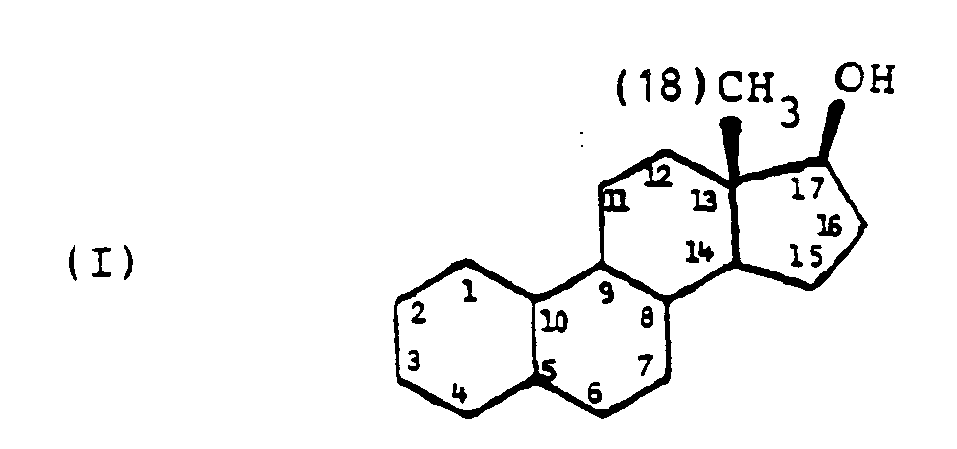
- Ces produits de formule I sont caractérisés en ce qu'ils comportent notamment :
- a une fonction hydroxyle ou cétone en position C₃,
- b une fonction chlorométhyle en β sur la position C₁₁,
- c une fonction vinyle ou méthyle en α sur la position C₁₇ et,
- d un iode radioactif substitué sur un groupement alkyl ou alkényl rattaché au squelette, notamment un méthyl ou un vinyl.
- Les fonctions en positions C₃ et C₁₇ confèrent à ces ligands une affinité élevée pour les récepteurs hormonaux auxquels ils sont destinés, à savoir des récepteurs androgènes, estrogènes ou progestagènes notamment.
- La fonction 11 β-chlorométhyle assure une liaison quasi "irréversible" entre le stéroïde et le récepteur, il s'agit en fait plutôt d'une très forte affinité pour le récepteur.
- La formation du lien quasi "irréversible" entre le stéroïde et le récepteur améliore la stabilité du complexe et augmente sa concentration dans le noyau.
- Les sites de liaison des hormones estrogènes, androgènes et progestagènes présentent des homologies de séquences d'acide aminé, ce qui explique leur commun comportement s'agissant de la liaison"irréversible"entre le récepteur et le stéroïde en présence d'une fonction 11 β-chlorométhyle.
- Ces dérivés possédent une fonction vinyle ou méthyle en C₁₇ en α de la position C₁₇, ce qui leur confère une résistance au métabolisme et une liaison réduite au protéine de liaison plasmatique.
- Les ligands, plus particulièrement utiles pour la thérapie ciblée, comporteront l'isotope I¹²⁵ ou I¹²³ comme iode radioactif.
- Cet iode radioactif ainsi piloté présente une forte activité cytotoxique, dans la mesure où il est amené à proximité de l'ADN dont il induit des coupures dans la double hélice.
- Des ligands, plus particulièrement utiles pour l'imagerie médicale, notamment du cancer, porteront comme iode radioactif l'isotope I¹²³ .
- Selon une première variante des ligands selon l'invention, l'iode radioactif est situé sur la double liaison du vinyl en α sur la position C₁₇. Ces ligands sont plus spécifiques des récepteurs estrogènes et progestagènes. Cette position a l'avantage de présenter une grande stabilité.
- Selon une seconde variante des ligands selon l'invention, l'iode radioactif est situé sur un méthyl angulaire positionné en C₁₈. La position C₁₈ est celle qui est directement liée à C₁₃. Ces ligands sont plus particulièrement spécifiques des récepteurs androgènes.
- On peut citer en particulier comme ligands selon la première variante, ceux dont la fonction en C₃ est un groupe hydroxyl, le cycle sur lequel il est attaché étant un cycle aromatique. Ces ligands sont plus spécifiques des récepteurs estrogènes.
- On peut également citer comme ligands selon la première variante de l'invention des ligands dont la fonction en position C₃ est une fonction cétone conjuguée à une double liaison en C₄-C₅. Ces ligands sont plus particulièrement spécifiques des récepteurs progestagènes.
- Parmi les ligands, plus particulièrement spécifiques des récepteurs androgènes, dont l'iode radioactif est situé sur un méthyl angulaire positionné en C₁₈, on peut citer ceux dont la fonction en position C₃ est une cétone conjuguée à une double liaison en C₄-C₅.
- Parmi ces derniers, on peut également citer ceux qui comportent un méthyle en position C₇.
- Parmi les ligands, plus spécifiques des récepteurs estrogènes vus précédemment, on peut citer le 11 β-chlorométhyl 17 α-iodovinyl estradiol de formule

- Parmi les ligands les plus spécifiques des récepteurs progestaqènes, on peut citer particulièrement le 11 β-chlorométhyl 17 α-iodovinyl 17 β-hydroxy 19-nor 4-androstène 3-one de formule

- Parmi les ligands spécifiques des récepteurs androgènes, on peut citer les 11 β-chlorométhyle 17 α-méthyle 18-iodotestostérone ou 19-nortestostérone de formule

selon que
R = CH₃ (dérivé testostérone) ou
H (dérivé 19-nortestostérone) - Parmi ces derniers, on peut également citer les 11 β-chlorométhyle 17 α-méthyle 18-iodo 7 α-méthyle testostérone ou 19-nortestostérone de formule

selon que
R = CH₃ (dérivé testostérone) ou
H (dérivé 19-nortestostérone) - D'autres caractéristiques et avantages de la présente invention apparaîtront à la lumière de la description qui va suivre.
- Le schéma I ci-après reproduit la synthèse d'un ligand 11 β-chlorométhyl 17 α-iodovinyl-estradiol.
- L'étape 1 consiste en une hydroxylation microbiologique avec une souche "ASPERGILLUS OCHRACEUS" en 11 α selon les détails fournis page 136 de la référence 4. Le produit de départ est le 17 α-éthynyl estradiol [¹].
- L'étape 2 est une oxydation avec du pyridinium chlorochromate (PCC) dans CH₂Cl₂ oxydation qui donne donc une fonction cétone en position 11 selon le protocole décrit page 2649 de la référence 7.
- L'étape 3 consiste en une protection avec le 1 éthoxy-éthyl-éther par action de l'éthyl-vinyl-éther dans la fonction hydroxyl en position C₃. Le mode opératoire à suivre est décrit page 334 de la référence 2.
- L'étape 4 consiste en une méthylénation de la fonction cétone en position C₁₁ par addition de(CH₃)₃ Si CH₃ Mg Cl dont les détails sont décrits page 39 de la référence 3.
- L'étape 5 consiste en une déshydratation avec un mélange HCl acétone conformément au mode opératoire détaillé page 39 de la référence 3 et une déprotection des fonctions en C₃ et C₁₇.
- L'étape 6 consiste en une hydroboration sélective de la double liaison en C₁₁ avec le 9-borabicyclo (3.3.1) nonane (BBN) dont les détails sont fournis en référence 8 .
- L'étape 7 consiste en une hydroxylation du dérivé BBN par oxydation avec de la soude (NaOH) et de l'eau oxygénée (H₂O₂). Ce type d'hydroxylation est décrit page 334 de la référence 2.
- L'étape 8 est une chloration par du triphényl phosphine et du N-chlorosuccinimide (NCS) conformément au procédé décrit page 500 de la référence 5. On obtient donc un dérivé 11 β-chlorométhyl.
- L'étape 9 est une hydroboration par catéchol borane à 70°C pendant 2 heures selon le procédé décrit page 1289 de la référence 6. On obtient donc un dérivé 17 α-vinyl.
- L'étape 10 est une formation d'un dérivé acétate en position C₃ avec de l'anhydride acétique et de la pyridine. Ce type de procédé est décrit page 1289 de la référence 6.
- L'étape 11 est une étape d'iodination selon la méthode de NAKATSUKA (page 1289 de la référence 6) avec de la chloramine T, du NaI*, du THF et un tampon phosphate. On obtient un dérivé 17 α-iodovinyl.
- L'étape 12 est une déprotection de la fonction en position C₃ par hydrolyse de la fonction acétate avec de l'acétate de sodium et Na₂CO₃, dans du méthanol, et de l'éther(selon les détails fournis page 1289 de la référence 6). On obtient ainsi le 11 β-chlorométhyl 17 α-iodovinyl estradiol (I¹²⁵ ou I¹²³) [²] .
- Une autre voie d'accès à l'intermédiaire [³] obtenu à l'issue de l'étape 8 est l'aromatisation de l'intermédiaire [⁵] , à l'issue de l'étape 8 au cours de la voie de synthèse du schéma II de l'exemple suivant. L'aromatisation de l'intermédiaire [⁵] intervenant après déprotection acide de son groupement éthylène dioxyde en position C₃. Cette aromatisation se fait par voie microbiologique avec la souche "ARTHROBACTER SIMPLEX" (ce procédé se fait selon celui décrit référence 1). Le rendement et la pureté de l'intermédiaire [⁵] lors de l'étape de chloration étant relativement meilleurs à ceux que l'on peut obtenir lors de la synthèse de [³] .

- L'étape 1 consiste en une préparation du Δ¹ adrénostérone 17 éthylène kétal à partir du Δ ¹ adrénostérone (1′).
- 25 g Δ¹ adrénostérone (84 mM) sont ajoutés sous forte agitation à un mélange de 500 ml de benzène, 25 ml d'éthylène glycol (environ 420 mM) et 1 g d'acide para-toluènesulfonique.
- Le mélange est porté au reflux pendant 4 heures dans un appareil de Dean-Stark.
- Le mélange réactionnel est extrait par 200 ml d'eau contenant 1 g de bicarbonate, puis par de l'eau saturée en sel, séché, puis évaporé.
- On obtient une masse jaunâtre qui est lavée à chaud par 200 ml d'éther isopropylique.
- Les cristaux blancs sont filtrés, puis séchés à 60°C, on obtient une masse de ± 26 g.
- L'étape 2 consiste en la préparation du 11 β-hydroxy 17-éthylène kétal androsta 1,4-diène 3,17-dione (2′).
- 340 g de (1′) (88 mM) sont ajoutés sous azote à une suspension de 50 g (± 200 mM) dans 400 ml de tétrahydrofuranne.
- Après 24 heures de réaction à température ordinaire, on ajoute 100 ml d'éther, puis 40 ml de NaOH 1N, puis 25 g de sulfate de sodium anhydre. On maintient l'agitation pendant la nuit.
- Le mélange est filtré, puis le filtrat est évaporé sous vide.
- La masse solide obtenue est lavée à chaud par 200 ml d'éther diisopropylique.
- On obtient, après filtration et séchage, 24 g d'une poudre blanche (70,6 mM).
- L'étape 3 consiste en la préparation du 3,11 ß-dihydroxy estra 1,3,5(10)-triène 17-one 17-éthylène kétal (3′).
- Sous atmosphère d'azote, un mélange de 3 g de lithium enrobé dans de l'huile (environ 0,4 M), 25 g de biphényl (0,16 M) et de diphénylméthane (0,08 M) dans 360 ml de tétrahydrofuranne est porté à reflux pendant 1 heure.
- Le mélange réactionnel bleu foncé, auquel on ajoute 20,7 g de (2′), est à nouveau porté à reflux pendant 30 minutes.
- Après refroidissement, on ajoute 8 ml de méthane, puis 100 ml d'eau et on évapore le solvant sous vide.
- Après redissolution dans la masse restante, dans l'éther, on extrait le produit formé par 300 ml de KOH 5 % qui est réacidifié avec l'acide acétique (12 ml).
- Le précipité jaune est réextrait par l'acétate d'éthyle. Après évaporation du solvant, on redissout le produit à chaud dans 15 ml d'un mélange acétone et éther diisopropylique.
- Après deux cristallisations, on obtient 10,5 g de produit.
- Le point de fusion corrigé est : 191,1°C.
- L'étape 4 consiste en la préparation du 3-benzyloxy, 11 β-hydroxy estra 1,3,5(10)-triène 17-one 17-éthylène kétal (4′).
- Le mélange de 10,3 g de (3′) (30 mM), 5,2 g de K₂CO₃ anhydre broyés et 100 ml de méthyléthyl cétone est porté à reflux sous forte agitation pendant 1 heure.
- On ajoute alors 5,4 ml (45 mM) de bromure de benzyle et le reflux est maintenu pendant 48 heures.
- Après extraction, on obtient 15 g d'une huile jaunâtre.
- Cette huile est engagée telle quelle dans la synthèse de (5′).
- L'étape 5 consiste en la préparation du 3-benzyloxy estra 1,3,5(10)-triène 11, 17-one 17-éthylène kétal (5′).
- 30 mM de (4′) brut (13 g) dissous dans 50 ml de chlorure de méthylène sec sont ajoutés en une fois au mélange de 13 g de pyridinium chlorochromate en suspension dans 200 ml de chlorure de méthylène sec.
- Après 3 heures d'agitation à température ambiante, on ajoute 250 ml d'éther, ce qui entraîne la précipitation d'une masse noire.
- Les solvants sont décantés, on lave l'insoluble avec 4 fois 50 ml du mélange v/v CH₂Cl₂/éther. La phase organique est percolée sur une colonne de florisa, puis évaporée.
- On obtient après purification sur silice 9,6 g d'une huile jaunâtre.
- L'étape 6 est la préparation du 3-benzyloxy 11-hydroxy, 11-méthyltriméthylsilane estra 1,3,5(10)-triène 17-one 17-kétal (6′).
- 8,6 g de (5′) dissous dans 100 ml d'éther (20 mM) sont ajoutés rapidement à 165 ml d'une solution 1 M de chlorure de méthyltriméthylsilane de magnésium.
- Le mélange est porté à reflux pendant 5 heures, puis décomposé et extrait.
- Le produit brut est purifié sur silice, on obtient 5,7 g d'une huile visqueuse qui cristallise.
- L'étape 7 est la préparation du 3-benzyloxy 11-méthylène 1,3,5(10)-estratriène 17-one (7′).
- Après addition de 0,5 ml d'HCL concentré, une solution de 5,2 g de (6′) (10 mM) dans 50 ml d'acétone est agitée pendant 2 heures à température ambiante. Le mélange réactionnel est neutralisé par HCO₃⁻ concentré sous vide, extrait par CH₂Cl₂.
- Le produit brut est recristallisé dans l'acétone.
- On obtient 3,4 g de cristaux jaunâtres.
- Le point de fusion corrigé est : 168,1°C.
- L'étape 8 consiste en la préparation du 3-benzyloxy 11-méthylène 1,3,5(10)-estratriène 17-one, 17-kétal (8′).
- Une solution de 3 g de (7′), 7 mM, 100 ml de benzène, 3 ml de diéthylène glycol, 150 mg d'acide paratoluènesulfonique est refluée avec "Dean Stark" pendant 4 heures.
- L'extraction puis l'évaporation des solvants donnent 3,3 g d'une huile blanche qui est employée telle quelle.
- L'étape 9 consiste en la préparation du 3-benzyloxy 11-hydroxyméthyl 1,3,5(10)-estratriène 17-one 17-kétal (9′).
- Une solution de 2,84 g de (8′) (± 6 mM) dans 20 ml de THF sec est additionnée de 0,5 ml du complexe borane oxathione (± 6 mM). Après 1 heure de réaction, on ajoute 6 ml d'éthanol, puis 4 ml de NaOH 3M (± 12 mM), enfin 10 ml de H₂O₂ 30 % (± 12 mM). Après une nuit à température ambiante, la réaction est extraite par CH₂Cl₂. On obtient une huile blanche qui cristallise rapidement (poids : 2,4 g).
- L'étape 10 consiste en la préparation du 3-benzyloxy 11-chlorométhyl 1,3,5(10)-estratriène 17-one (10′).
- A une solution de 2 g de (9′) d'environ 4 mM dans 20 ml de tétrahydrofuranne est ajoutée la suspension formée dans 30 ml de THF par la réaction de 2,1 g de triphénylphosphine (8 mM) et de 1,07 g (± 8 mM) de N-chlorosuccinimide.
- Le mélange devenu limpide après à peu près 1 heure est laissé à température ambiante pendant la nuit. Le THF est évaporé sous vide, le résidu brut est redissout dans 50 ml d'acétone, auquel on ajoute 0,5 ml d'HCl concentré. On laisse sous agitation pendant 2 heures. L'extraction puis la purification sur silice donnent des cristaux blancs pour 1,02 g.
- S.M. (FAB) 435 (M+1).
- L'étape 11 consiste en la préparation du 3-benzyloxy 11-chlorométhyl 1,3,5(10)-estratriène 17α-éthynyl 17 β-hydroxy (11′).
- A une solution de 0,93 g de (10′) (à peu près 2 mM) dans 10 ml de tétrahydrofuranne, on rajoute 400 mg (± 4 mM) du complexe éthylènediamine - Acétylure de lithium. Après 4 heures de réaction, on réajoute 400 mg de réactif. On laisse réagir la nuit à température ambiante.
- L'extraction par CH₂Cl₂ puis la purification sur silice nous donnent un solide légèrement jaunâtre d'environ 500 mg (1,02 mM).
- L'étape 12 consiste en la préparation du 11-chlorométhyl 3,17 β-dihydroxy 17α-éthynyl 1,3,5(10)-estratriène (12′).
- 440 mg de (11′) 0,9 mM sont dissous à froid dans 20 ml de chlorure de méthylène.
- On ajoute alors 4,5 ml (4,5 mM) d'une solution 1 M du complexe BF3/(CH₃)₂S. Le mélange réactionnel est agité à froid pendant 45 minutes.
- L'extraction puis la purification sur silice nous donnent une huile qui cristallise avec une masse d'environ 150 mg (0,375 mM).
- L'étape 13 consiste en la préparation du dérivé (E)-11-chlorométhyl-3,17 β-dihydroxy-17 α-(2-tributylstannylvinyl)-1,3,5(10)-estratriène (13′).
- A une solution de 50 mg de (12′): 0,15 mM dans 1 ml de THF, on ajoute, sous N₂, 150 µl de tributylétainhydrure (à peu près 0,55 mM) et 5 mg de AIBN (à peu près 0,03 mM).
- Le tube est hermétiquement fermé puis agité au bain d'huile à 70°C pendant 1 heure.
- La réaction est extraite par un mélange acétate d'éthyle/eau. L'huile brute est purifiée par silice ; on obtient 55 mg d'une huile blanche.
- L'étape 14 consiste en la préparation du dérivé (E)-11-chlorométhyl-3,17 β-dihydroxy-17α-(2-iodovinyl)-1,3,5(10)-estratriène (14′).
- A une solution de 32 mg de (13′) (0,05 mM) dans 3 ml de CH₂Cl₂, on ajoute goutte à goutte une solution d'iode 0,1 mM dans CH₂Cl₂ jusqu'à persistance de la coloration rosée.
- Après 30 minutes, on ajoute a peu près 10 ml d'H₂O avec un peu de NaHSO₃, on extrait par Et₂O.
- Le produit brut est alors purifié sur silice ; on obtient 20 g de cristaux blancs pour une masse de 20 mg.
- Données spectroscopiques :
RMN (CDcl₃, (CD₃)₂SO) S 1.1 (S,13CH₃), 3.45 (m, CHHcl), 3.62 (dd, CHHcl), 6.27 (d, CH=CHI, J=14 Hz), 6.53 (d, H(4)), 6.66 (dd, H(2)), 6.81 (d, CH=CHI, J= 14 Hz), 7.03 (d, H(1)). - 50 µl d'une solution du dérivé (E)- 17α-tributylétainvinyl-11 β-chlorométhylestradiol (13′ du schéma 1 bis) dans l'éthanol absolu à 1 mg/ml sont ajoutés à 1 mCi de NaI¹²³ (10 µl dans H₂O pH 7-11) contenu dans un tube d'environ 500 µl avec bouchon à visser. On ajoute 10 µl d'une solution de chloramine-T à 1 mg/ml et on agite virougeusement pendant 15 secondes. Ensuite on ajoute 10 µl d'une solution de Na₂S₂O₅ à 2 mg/ml et 200 µl de tampon phosphate pH 7,4. Le mélange est passé sur cartouche SPE C18 (1 ML, BAKER) et le stéroïde est élué avec 1 ml d'éthanol. Après évaporation du solvant, le stéroïde marqué est purifié sur colonne HPCL µ BONDAPAK C18 avec phase mobile 50 % H₂O et 50 % d'acétonitrile. Le temps de rétention est de l'ordre de 17 minutes.


- La voie de synthèse de dérivés 11 β-chlorométhyl 17 α-iodovinyl 17 β-hydroxy 19-nor 4-androstène 3-one est décrite en référence au schéma 11 ci-après.
- Le produit de départ est le 17 α-éthynyl-17 β-hydroxy-19-nor-4-androstèn-3-one (NORETHINDRONE) [⁴].
- Dans ce schéma I* représente les isotopes I¹²⁵ ou I¹²³.
- L'étape 1 est une étape de protection de la fonction cétone en ₃ par une fonction éthylène dioxy. On utilise, à cet effet, l'éthylène glycol, l'acide p-toluènesulfonique et l'orthoformate d'éthyle et CH₂Cl₂ comme solvant (détails de ce type de procédé sont fournis page 39 de la référence 3).
- L'étape 2 est une étape de protection de la fonction hydroxyle en position 17 α protection par une fonction 1-éthoxy-éthyl-éther (selon l'étape 3 du schéma I de l'exemple I).
- L'étape 3 est une étape d'hydroxylation par voie microbiologique 11 α selon le procédé de l'étape 1 du schéma I.
- L'étape 4 est une étape d'oxydation avec pyridinium chlorochromate (PCC) en condition neutre par tamponnage avec l'acétate de sodium selon un type de procédé décrit(synthèse du CITRONELLAL page 2649 de la référence 7 ). On obtient ainsi une fonction cétone en position C₁₁.
- L'étape 5 consiste en une méthylénation de la position C₁₁ par réaction de WITTIG utilisant le bromure de méthyltriphényl-phosphonium et le NaH dans du DMSO, conformément au procédé décrit page 39 de la référence 3.
- Les étapes 6, 7 et 8 sont conformes aux étapes 6, 7 et 8 du schéma I. De même pour les étapes 9 et 10 qui sont conformes aux étapes 9 et 11 respectivement du schéma I.
- L'étape 11 du présent procédé consiste en une déprotection par HCl dans l'acétone conformément au mode opératoire décrit page 334 de la référence 2 pour donner le composé [⁶] 11 β-chlorométhyl-17 α-iodovinyl-17 β-hydroxy-19-nor-4-androstèn-3-one.

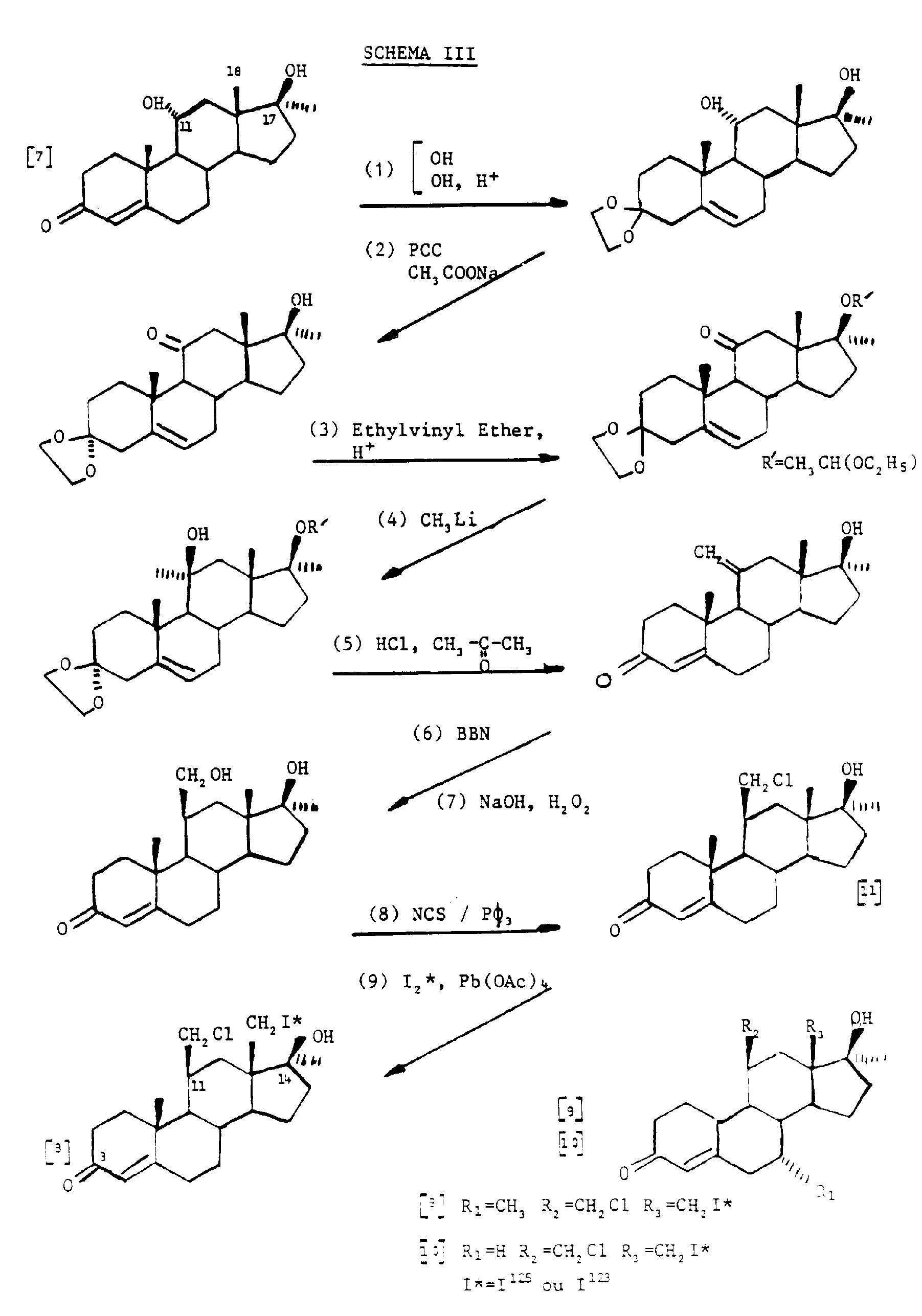
- La voie de synthèse d'un dérivé 11 β-chlorométhyl-17 α-méthyl-18-iodotestostérone [⁸] est présentée sur le schéma III ci-après.
- Le produit de départ est un dérivé 11 α-hydroxy 17 α-méthyl testostérone [⁷].
- L'étape 1 est une étape de protection conforme à celle de l'étape 1 du schéma II de l'éthylène glycol en milieu acide.
- L'étape 2 est une étape d'oxydation à l'étape 4 du schéma II du pyridinium chlorochromate en condition neutre avec un tampon acétate de sodium.
- L'étape 3 est une étape de protection conforme à l'étape 3 du schéma I.
- L'étape 4 est une étape d'addition'd'un méthyle en position C₁₁ par action de CH₃Li dans un mélange benzène/éther diéthylique conformément aux détails fournis page 39 de la référence 3.
- L'étape 5 est une déshydratation conforme à l'étape 5 du schéma I.
- L'étape 6 est une hydroboration avec du BBN comme à l'étape 6 du schéma I.
- L'étape 7 est une hydroxylation comme celle de l'étape 7 du schéma I.
- L'étape 8 est une chloration conforme à l'étape 8 du schéma I avec du NCS/Pφ3. On obtient ainsi un produit [¹¹] 11 β-chlorométhyle.
- L'étape 9 est une iodination du méthyle en position 18, par action préalable du tétraacétate de plomb et de l'iode radioactif sous reflux dans du cyclohexane suivi d'addition du stéroide [¹¹] et de l'azodisobutyronitrile selon le procédé décrit page 506 de la référence 5. On obtient ainsi la 11 β-chlorométhyl 17 α-méthyl 18-iodotestostérone [⁸].
- Les dérivés analogues [¹⁰] et [⁹] sont formés à partir du produit d'hydroxylation microbiologique, comme à l'étape 1, du dérivé 17 α-méthyl-19-nor-testostérone et de la mibolérone (7 α, 17 α-diméthyl-19-nor-testostérone) respectivement, et subissent les mêmes étapes de 4 à 9 du présent schéma.
- La mibolérone et la 17 α-méthyl-19-nor-testostérone ont une meilleure affinité que la testostérone pour le récepteur androgène.
- En outre, la mibolérone décrite dans le brevet US 3 341 557 a une affinité plus faible que la testostérone pour les protéines de liaison plasmatique et une rétention nucléaire nettement plus élevée confère au dérivé [⁹] un ciblage de haute spécificité.
- Le marquage du stéroïde a été réalisé selon le protocole décrit dans Journal of Nuclear Medicin Vol. 23 n° 5 pages 431 à 436, 1982 Robert N. HANSON et al.
- La mesure de l'inhibition de la croissance de cellules malignes a été réalisée en suivant le protocole décrit par MADEDDU et al. dans ANTICANCER RESEARCH 6: 11-16(1986).
- On a mesuré l'inhibition de la croissance au cinquième jour de cellules MCF7 (lignée continue de carcinome mammaire humain contenant des récepteurs pour les oestrogènes) et des cellules EP2 (lignée continue d'epithélioma pharyngien ne possédant pas de récepteurs pour les oestrogènes, inhibition par le 17-bêta-iodobinyloerstradiol I¹²⁵ ou I¹²³. Il apparaît que ce ligand 17-bêta-iodovinyloestradiol marqué à l'iode 123 (une molécule d'iode pour une molécule de ligand) dans une concentration de 4,6 10⁻¹⁰M correspondant à 31,3 µCi/ml donne des pourcentages de croissance pour les cellules MCF7 (5000 cellules par puits pour le contrôle) de 56,2 %, soit une inhibition de croissance de 43,8 %, et pour les cellules EP2 (contrôle 5000 cellules par puits) une croissance de 97 %, soit une inhibition de 3 % seulement.
- Le même ligand comportant un iode 125 dans la même concentration de 4,6 10⁻¹⁰M correspondant de 1 µCi/ml de donnait pour les cellules MCF7 (contrôle 5000 cellules par puits) une inhibition que de 10,4 % et pour les cellules EP2, le pourcentage de croissance était de 105,1 %.
- En conséquence, le composé marqué à l'iode 123 présente une inhibition de la croissance très intéressante, vis-à-vis des cellules MCF7.
-
- (1) A.J. VAN DEN BROEK et al., PHARMACEUTISCH WEEKBLAD SC. ED., p. 182-183, Vol. 5, 1983,
- (2) K.H. SCHÖNEMANN et al., EUR. J. MED. CHEM. CHIMICA THERAP. - p. 333-335, 15n° 4, 1980
- (3) A.J VAN DEN BROEK et al., RECUEIL JOURNAL OF THE ROYAL NETHERLANDS CHEMICAL SOC. - p. 35-39, 94/2, 1975,
- (4) J. DE FLINES et al., RECUEIL J. ROYAL NETH. CHEM. SOC. p. 129)138, 82, 1963,
- (5) A.J. VAN DEN BROEK et al., STEROIDS - p. 481-510, 30, 1977,
- (6) I. NAKATSUKA et al., J. OF MEDICINAL CHEMISTRY, p. 1287-1291, 27, n° 10, 1984,
- (7) E.J. COREY et W. SUGGS, TETRAHEDRON LETTERS, p. 2647-2650, n° 31, 1975,
- (8) C.A. BROWN, R.A. COLLMAN, J. ORG. CH., P 2328, 44, 1979.
Claims (13)


Priority Applications (1)
| Application Number | Priority Date | Filing Date | Title |
|---|---|---|---|
| AT88903292T ATE77074T1 (de) | 1987-04-17 | 1988-04-15 | Verbindungen zur verwendung in der radiotherapie oder zur krebsvisualisierung. |
Applications Claiming Priority (2)
| Application Number | Priority Date | Filing Date | Title |
|---|---|---|---|
| FR8705524A FR2613937B1 (fr) | 1987-04-17 | 1987-04-17 | Ligands specifiques de recepteurs d'hormones steroides utiles pour la therapie ciblee ou l'imagerie medicale notamment du cancer |
| FR8705524 | 1987-04-17 |
Publications (2)
| Publication Number | Publication Date |
|---|---|
| EP0310645A1 EP0310645A1 (fr) | 1989-04-12 |
| EP0310645B1 true EP0310645B1 (fr) | 1992-06-10 |
Family
ID=9350264
Family Applications (1)
| Application Number | Title | Priority Date | Filing Date |
|---|---|---|---|
| EP88903292A Expired - Lifetime EP0310645B1 (fr) | 1987-04-17 | 1988-04-15 | Composes utiles notamment pour la radiotherapie ou l'imagerie du cancer |
Country Status (8)
| Country | Link |
|---|---|
| US (1) | US5096694A (fr) |
| EP (1) | EP0310645B1 (fr) |
| JP (1) | JP2708204B2 (fr) |
| AT (1) | ATE77074T1 (fr) |
| CA (1) | CA1325803C (fr) |
| DE (1) | DE3871892T2 (fr) |
| FR (1) | FR2613937B1 (fr) |
| WO (1) | WO1988007986A2 (fr) |
Families Citing this family (13)
| Publication number | Priority date | Publication date | Assignee | Title |
|---|---|---|---|---|
| FR2637803B1 (fr) * | 1988-10-19 | 1993-07-09 | Ire Celltarg Sa | Ligands specifiques de recepteurs d'hormones steroides estrogenes et progestagenes, application et produits intermediaires de synthese |
| WO1990012321A1 (fr) * | 1989-03-31 | 1990-10-18 | The Cancer Institute Board | Radiosensibilisateurs avec ligand d'adn halogene pour la therapie anticancereuse |
| US5641764A (en) * | 1989-03-31 | 1997-06-24 | Peter Maccallum Institute | Halogenated DNA ligand radiosensitizers for cancer therapy |
| AU639920B2 (en) * | 1989-03-31 | 1993-08-12 | Anti-Cancer Council Of Victoria | Halogenated dna ligand radiosensitisers for cancer therapy |
| US5427766A (en) * | 1993-11-15 | 1995-06-27 | The Dow Chemical Company | Radiolabeled steroids for use in radiochemical-guided surgery |
| EP0757559A4 (fr) * | 1994-04-29 | 1999-06-23 | Molecular Medicine Center | Composition destinee a l'apport de radio-isotopes toxiques au noyau de la cellule, et son utilisation |
| US6238644B1 (en) | 1997-09-03 | 2001-05-29 | Wayne State University | Method for treating and/or imaging breast cancer using radioactive iodide |
| SE513149C2 (sv) * | 1997-12-05 | 2000-07-17 | Katarina Edwards | Läkemedelsdistributionssystem med tvåstegsmålsökning, till specifika celler eller vävnad och till dess cellkärna |
| US6547812B1 (en) | 2000-12-29 | 2003-04-15 | Advanced Cardiovascular Systems, Inc. | Radiation therapy using a radioactive implantable device and a radiosensitizer agent |
| US7220730B2 (en) * | 2003-09-25 | 2007-05-22 | Board Of Regents Of The University Of Nebraska | Cancer specific radiolabeled conjugates regulated by the cell cycle for the treatment and diagnosis of cancer |
| CN1321127C (zh) * | 2005-04-06 | 2007-06-13 | 江苏省原子医学研究所 | 碘(*i)-23-羟基白桦酸及其制备方法和应用 |
| WO2008109080A2 (fr) * | 2007-03-01 | 2008-09-12 | Siemens Medical Solutions Usa, Inc. | Marqueurs d'imagerie de la prolifération à base de nucléosides |
| JP2014062054A (ja) * | 2012-09-20 | 2014-04-10 | Gyoseiin Genshino Iinkai Kakuno Kenkyusho | よう素−123標記チミン類似物[123I]−IaraUのプローブ |
Family Cites Families (11)
| Publication number | Priority date | Publication date | Assignee | Title |
|---|---|---|---|---|
| DE518547C (de) * | 1931-02-17 | Buderus Eisenwerk | Verfahren zur Herstellung von Schleudergussrohren | |
| NL7405626A (nl) * | 1974-04-26 | 1975-10-28 | Akzo Nv | Nieuwe 11-gesubstitueerde steroiden van de oestraanreeks. |
| US4465676A (en) * | 1980-04-09 | 1984-08-14 | New England Nuclear Corporation | 16α Halogen substituted 3,17β-dihydroxy steroidal estrogens |
| US4541957A (en) * | 1983-09-07 | 1985-09-17 | The George Washington University | Process for preparing iodovinyl-estradiol |
| DE3337179A1 (de) * | 1983-10-10 | 1985-05-23 | Schering AG, 1000 Berlin und 4709 Bergkamen | Estran- und androstan-derivate, verfahren zu ihrer herstellung und diese verbindungen enthaltende praeparate |
| JPS60126231A (ja) * | 1983-12-09 | 1985-07-05 | Seitai Kagaku Kenkyusho:Kk | 放射性診断剤 |
| DE3427795A1 (de) * | 1984-07-25 | 1986-02-06 | Schering AG, 1000 Berlin und 4709 Bergkamen | Neue 17(alpha)-halogenvinyl-estran-derivate, ihre herstellung und verwendung in der medizin |
| US4882141A (en) * | 1984-10-22 | 1989-11-21 | Bio-Medical Research Laboratories, Inc. | Tissue imaging utilizing labelled steroids |
| US5104637A (en) * | 1985-02-06 | 1992-04-14 | University Of Cincinnati | Radio labeled dihematophorphyrin ether and its use in detecting and treating neoplastic tissue |
| EP0263877A1 (fr) * | 1986-04-11 | 1988-04-20 | The President And Fellows Of Harvard College | Dihydrorhodamines et leurs derives halogenes |
| FR2637803B1 (fr) * | 1988-10-19 | 1993-07-09 | Ire Celltarg Sa | Ligands specifiques de recepteurs d'hormones steroides estrogenes et progestagenes, application et produits intermediaires de synthese |
-
1987
- 1987-04-17 FR FR8705524A patent/FR2613937B1/fr not_active Expired
-
1988
- 1988-04-15 CA CA000564275A patent/CA1325803C/fr not_active Expired - Lifetime
- 1988-04-15 DE DE8888903292T patent/DE3871892T2/de not_active Expired - Lifetime
- 1988-04-15 WO PCT/FR1988/000188 patent/WO1988007986A2/fr not_active Ceased
- 1988-04-15 AT AT88903292T patent/ATE77074T1/de active
- 1988-04-15 EP EP88903292A patent/EP0310645B1/fr not_active Expired - Lifetime
- 1988-04-15 JP JP63503500A patent/JP2708204B2/ja not_active Expired - Lifetime
- 1988-04-19 US US07/297,864 patent/US5096694A/en not_active Expired - Lifetime
Non-Patent Citations (3)
| Title |
|---|
| International Journal of Radiation Applications and Instrumentation. Part A, Applied Radiation and Isotopes, vol. 37, no. 8, 1986, Marsh Barton, Essex (GB) H.K. Misra et al.: "Synthesis of 131I, 123I, and 82BR labelled 5-halo-1-(2-deoxy-2fluoro-B-D-arabinofuranosyl) uracils", pages 901-905, see the whole article * |
| Journal of Nuclear Medicine, vol. 25, no. 10, October 1984, (New York, US) L.A. Franke et al.: "Radioiodinated ligands for the estrogen receptor: effect of 3-methylation of tissue distribution", pages 1116-1121 * |
| Steroids, vol. 38, no. 5, November 1981, (San Francisco, US) T. Ratajczak et al.: "The synthesis and study of some potential affinity labelling reagents for estrogen receptors", pages 537-555 * |
Also Published As
| Publication number | Publication date |
|---|---|
| JP2708204B2 (ja) | 1998-02-04 |
| WO1988007986A2 (fr) | 1988-10-20 |
| EP0310645A1 (fr) | 1989-04-12 |
| DE3871892D1 (de) | 1992-07-16 |
| WO1988007986A3 (fr) | 1988-12-01 |
| ATE77074T1 (de) | 1992-06-15 |
| FR2613937A1 (fr) | 1988-10-21 |
| US5096694A (en) | 1992-03-17 |
| FR2613937B1 (fr) | 1989-07-21 |
| DE3871892T2 (de) | 1993-02-04 |
| CA1325803C (fr) | 1994-01-04 |
| JPH01503708A (ja) | 1989-12-14 |
Similar Documents
| Publication | Publication Date | Title |
|---|---|---|
| DiZio et al. | Progestin-rhenium complexes: metal-labeled steroids with high receptor binding affinity, potential receptor-directed agents for diagnostic imaging or therapy | |
| French et al. | A synthesis of 7α-substituted estradiols: synthesis and biological evaluation of a 7α-pentyl-substituted BODIPY fluorescent conjugate and a fluorine-18-labeled 7α-pentylestradiol analog | |
| JP2004123757A (ja) | ステロイドスルファメート、その製造方法、及びその使用 | |
| CA1325803C (fr) | Composes utiles notamment pour la radiotherapie ou l'imagerie du cancer et nouveaux ligands specifiques de recepteurs d'hormones steroides | |
| FR2485022A1 (fr) | Nouveaux composes derives de la vitamine d | |
| FR2485543A1 (fr) | Alcynyl-10 steroides utiles comme medicaments, procede et intermediaires pour leur preparation et compositions therapeutiques et formes pharmaceutiques contenant ces medicaments | |
| JPS60502100A (ja) | 黄体活性を示すステロイド | |
| Fevig et al. | Estrogen receptor binding tolerance of 16α-substituted estradiol derivatives | |
| EP0365421B1 (fr) | Ligands spécifiques de récepteurs d'hormones stéroides estrogènes et progestagènes, application et produits intermediaires de synthèse | |
| FR2569408A1 (fr) | Nouveaux steroides substitues en position 10 par un radical comportant une double ou triple liaison, leur procede de preparation, leur application comme medicaments, les compositions pharmaceutiques les renfermant | |
| EP0069648B1 (fr) | Procédé de préparation extemporanée d'un acide gras injectable, marqué à l'iode radioactif et préparation de dérivés iodes utilisables pour la mise en oeuvre de ce procédé | |
| Joselevich et al. | 6, 19-Carbon-bridged steroids. Synthesis of 6, 19-methanoprogesterone | |
| HUT69408A (en) | Androstane derivatives as antiandrogenes and pharmaceutical compositions containing them and intermediates | |
| e Silva et al. | Synthesis and biological evaluation of two new radiolabelled estrogens:[125I](E)-3-methoxy-17α-iodovinylestra-1, 3, 5 (10), 6-tetraen-17β-ol and [125I](Z)-3-methoxy-17α-iodovinylestra-1, 3, 5 (10), 6-tetraen-17β-ol | |
| JPH053477B2 (fr) | ||
| Mitra et al. | Vitamin D and its analogs. I. Synthesis of 1. alpha.-hydroxycholest-5-ene | |
| US4659517A (en) | Halogen labeled compounds including estradiol derivatives, their synthetic intermediates and the syntheses thereof | |
| JPH033677B2 (fr) | ||
| EP0565449B1 (fr) | Marquage des hormones par le Rhenium et le technetium | |
| Marton et al. | A New Precursor for the Radiosynthesis of 6-O-(2-[18F] Fluoroethyl)-6-Odesmethyl-diprenorphine ([18F] FE-DPN) by Nucleophilic Radiofluorination | |
| Ali et al. | 7. alpha.-Methyl-and 11. beta.-ethoxy-substitution of iodine-125-labeled [125I] 16. alpha.-iodoestradiol: effect on estrogen receptor-mediated target tissue uptake | |
| Qian et al. | A unified total synthesis route to 18-trideuterated and/or 19-trideuterated testosterone, androstenedione and progesterone | |
| CA2237879A1 (fr) | Derives de nitrile de 19-nor-steroides a utiliser en radiotherapie et (ou) en imagerie relatives au cancer | |
| JP3058710B2 (ja) | ハロエチル置換されたステロイド酵素阻害剤 | |
| JPS59152400A (ja) | 17α−ブロムエチニル−又は17α−ヨ−ドエチニル−17β−ヒドロキシステロイド、その製造法及び該化合物を含有する診断薬 |
Legal Events
| Date | Code | Title | Description |
|---|---|---|---|
| PUAI | Public reference made under article 153(3) epc to a published international application that has entered the european phase |
Free format text: ORIGINAL CODE: 0009012 |
|
| AK | Designated contracting states |
Kind code of ref document: A1 Designated state(s): AT BE CH DE FR GB IT LI LU NL SE |
|
| 17P | Request for examination filed |
Effective date: 19890306 |
|
| 17Q | First examination report despatched |
Effective date: 19900710 |
|
| GRAA | (expected) grant |
Free format text: ORIGINAL CODE: 0009210 |
|
| AK | Designated contracting states |
Kind code of ref document: B1 Designated state(s): AT BE CH DE FR GB IT LI LU NL SE |
|
| REF | Corresponds to: |
Ref document number: 77074 Country of ref document: AT Date of ref document: 19920615 Kind code of ref document: T |
|
| REF | Corresponds to: |
Ref document number: 3871892 Country of ref document: DE Date of ref document: 19920716 |
|
| ITF | It: translation for a ep patent filed | ||
| GBT | Gb: translation of ep patent filed (gb section 77(6)(a)/1977) | ||
| PGFP | Annual fee paid to national office [announced via postgrant information from national office to epo] |
Ref country code: LU Payment date: 19930324 Year of fee payment: 6 Ref country code: SE Payment date: 19930324 Year of fee payment: 6 |
|
| PLBE | No opposition filed within time limit |
Free format text: ORIGINAL CODE: 0009261 |
|
| STAA | Information on the status of an ep patent application or granted ep patent |
Free format text: STATUS: NO OPPOSITION FILED WITHIN TIME LIMIT |
|
| PGFP | Annual fee paid to national office [announced via postgrant information from national office to epo] |
Ref country code: BE Payment date: 19930414 Year of fee payment: 6 |
|
| PGFP | Annual fee paid to national office [announced via postgrant information from national office to epo] |
Ref country code: CH Payment date: 19930423 Year of fee payment: 6 |
|
| PGFP | Annual fee paid to national office [announced via postgrant information from national office to epo] |
Ref country code: AT Payment date: 19930427 Year of fee payment: 6 |
|
| PGFP | Annual fee paid to national office [announced via postgrant information from national office to epo] |
Ref country code: NL Payment date: 19930430 Year of fee payment: 6 |
|
| 26N | No opposition filed | ||
| EPTA | Lu: last paid annual fee | ||
| REG | Reference to a national code |
Ref country code: FR Ref legal event code: TP |
|
| PG25 | Lapsed in a contracting state [announced via postgrant information from national office to epo] |
Ref country code: AT Effective date: 19940415 Ref country code: LU Free format text: LAPSE BECAUSE OF NON-PAYMENT OF DUE FEES Effective date: 19940415 |
|
| PG25 | Lapsed in a contracting state [announced via postgrant information from national office to epo] |
Ref country code: SE Effective date: 19940416 |
|
| PG25 | Lapsed in a contracting state [announced via postgrant information from national office to epo] |
Ref country code: LI Effective date: 19940430 Ref country code: CH Effective date: 19940430 Ref country code: BE Effective date: 19940430 |
|
| BERE | Be: lapsed |
Owner name: S.A. IRE-CELLTARG Effective date: 19940430 |
|
| PG25 | Lapsed in a contracting state [announced via postgrant information from national office to epo] |
Ref country code: NL Effective date: 19941101 |
|
| NLV4 | Nl: lapsed or anulled due to non-payment of the annual fee | ||
| REG | Reference to a national code |
Ref country code: CH Ref legal event code: PL |
|
| EUG | Se: european patent has lapsed |
Ref document number: 88903292.6 Effective date: 19941110 |
|
| REG | Reference to a national code |
Ref country code: GB Ref legal event code: 732E |
|
| REG | Reference to a national code |
Ref country code: GB Ref legal event code: IF02 |
|
| PG25 | Lapsed in a contracting state [announced via postgrant information from national office to epo] |
Ref country code: IT Free format text: LAPSE BECAUSE OF NON-PAYMENT OF DUE FEES Effective date: 20050415 |
|
| PGFP | Annual fee paid to national office [announced via postgrant information from national office to epo] |
Ref country code: DE Payment date: 20070410 Year of fee payment: 20 |
|
| PGFP | Annual fee paid to national office [announced via postgrant information from national office to epo] |
Ref country code: GB Payment date: 20070416 Year of fee payment: 20 |
|
| REG | Reference to a national code |
Ref country code: GB Ref legal event code: PE20 Expiry date: 20080414 |
|
| PG25 | Lapsed in a contracting state [announced via postgrant information from national office to epo] |
Ref country code: GB Free format text: LAPSE BECAUSE OF EXPIRATION OF PROTECTION Effective date: 20080414 |
|
| PGFP | Annual fee paid to national office [announced via postgrant information from national office to epo] |
Ref country code: FR Payment date: 20070430 Year of fee payment: 20 |